EP4395044A1 - Copper bar isolation support, battery pack, and vehicle - Google Patents
Copper bar isolation support, battery pack, and vehicle Download PDFInfo
- Publication number
- EP4395044A1 EP4395044A1 EP22860552.3A EP22860552A EP4395044A1 EP 4395044 A1 EP4395044 A1 EP 4395044A1 EP 22860552 A EP22860552 A EP 22860552A EP 4395044 A1 EP4395044 A1 EP 4395044A1
- Authority
- EP
- European Patent Office
- Prior art keywords
- copper bar
- fixing
- isolation bracket
- connecting portion
- fixing device
- Prior art date
- Legal status (The legal status is an assumption and is not a legal conclusion. Google has not performed a legal analysis and makes no representation as to the accuracy of the status listed.)
- Pending
Links
- RYGMFSIKBFXOCR-UHFFFAOYSA-N Copper Chemical compound [Cu] RYGMFSIKBFXOCR-UHFFFAOYSA-N 0.000 title claims abstract description 146
- 229910052802 copper Inorganic materials 0.000 title claims abstract description 146
- 239000010949 copper Substances 0.000 title claims abstract description 146
- 238000002955 isolation Methods 0.000 title claims abstract description 43
- 238000000465 moulding Methods 0.000 claims description 3
- 238000000034 method Methods 0.000 description 6
- 238000009413 insulation Methods 0.000 description 3
- 230000003993 interaction Effects 0.000 description 3
- 230000008569 process Effects 0.000 description 3
- 208000035874 Excoriation Diseases 0.000 description 2
- 238000005299 abrasion Methods 0.000 description 2
- 238000009434 installation Methods 0.000 description 2
- 239000002184 metal Substances 0.000 description 2
- 229910052751 metal Inorganic materials 0.000 description 2
- 230000003068 static effect Effects 0.000 description 2
- VYPSYNLAJGMNEJ-UHFFFAOYSA-N Silicium dioxide Chemical compound O=[Si]=O VYPSYNLAJGMNEJ-UHFFFAOYSA-N 0.000 description 1
- 238000005452 bending Methods 0.000 description 1
- 238000005516 engineering process Methods 0.000 description 1
- 239000000463 material Substances 0.000 description 1
- 238000012986 modification Methods 0.000 description 1
- 230000004048 modification Effects 0.000 description 1
- 229910052755 nonmetal Inorganic materials 0.000 description 1
- 238000012856 packing Methods 0.000 description 1
- 239000003973 paint Substances 0.000 description 1
- 239000000741 silica gel Substances 0.000 description 1
- 229910002027 silica gel Inorganic materials 0.000 description 1
- 230000007704 transition Effects 0.000 description 1
Images

Classifications
-
- H—ELECTRICITY
- H02—GENERATION; CONVERSION OR DISTRIBUTION OF ELECTRIC POWER
- H02G—INSTALLATION OF ELECTRIC CABLES OR LINES, OR OF COMBINED OPTICAL AND ELECTRIC CABLES OR LINES
- H02G5/00—Installations of bus-bars
- H02G5/02—Open installations
- H02G5/025—Supporting structures
-
- H—ELECTRICITY
- H01—ELECTRIC ELEMENTS
- H01M—PROCESSES OR MEANS, e.g. BATTERIES, FOR THE DIRECT CONVERSION OF CHEMICAL ENERGY INTO ELECTRICAL ENERGY
- H01M50/00—Constructional details or processes of manufacture of the non-active parts of electrochemical cells other than fuel cells, e.g. hybrid cells
- H01M50/50—Current conducting connections for cells or batteries
- H01M50/502—Interconnectors for connecting terminals of adjacent batteries; Interconnectors for connecting cells outside a battery casing
- H01M50/507—Interconnectors for connecting terminals of adjacent batteries; Interconnectors for connecting cells outside a battery casing comprising an arrangement of two or more busbars within a container structure, e.g. busbar modules
-
- H—ELECTRICITY
- H01—ELECTRIC ELEMENTS
- H01M—PROCESSES OR MEANS, e.g. BATTERIES, FOR THE DIRECT CONVERSION OF CHEMICAL ENERGY INTO ELECTRICAL ENERGY
- H01M50/00—Constructional details or processes of manufacture of the non-active parts of electrochemical cells other than fuel cells, e.g. hybrid cells
- H01M50/50—Current conducting connections for cells or batteries
- H01M50/502—Interconnectors for connecting terminals of adjacent batteries; Interconnectors for connecting cells outside a battery casing
- H01M50/514—Methods for interconnecting adjacent batteries or cells
- H01M50/517—Methods for interconnecting adjacent batteries or cells by fixing means, e.g. screws, rivets or bolts
-
- H—ELECTRICITY
- H01—ELECTRIC ELEMENTS
- H01M—PROCESSES OR MEANS, e.g. BATTERIES, FOR THE DIRECT CONVERSION OF CHEMICAL ENERGY INTO ELECTRICAL ENERGY
- H01M2220/00—Batteries for particular applications
- H01M2220/20—Batteries in motive systems, e.g. vehicle, ship, plane
-
- H—ELECTRICITY
- H01—ELECTRIC ELEMENTS
- H01M—PROCESSES OR MEANS, e.g. BATTERIES, FOR THE DIRECT CONVERSION OF CHEMICAL ENERGY INTO ELECTRICAL ENERGY
- H01M50/00—Constructional details or processes of manufacture of the non-active parts of electrochemical cells other than fuel cells, e.g. hybrid cells
- H01M50/20—Mountings; Secondary casings or frames; Racks, modules or packs; Suspension devices; Shock absorbers; Transport or carrying devices; Holders
- H01M50/298—Mountings; Secondary casings or frames; Racks, modules or packs; Suspension devices; Shock absorbers; Transport or carrying devices; Holders characterised by the wiring of battery packs
-
- H—ELECTRICITY
- H01—ELECTRIC ELEMENTS
- H01M—PROCESSES OR MEANS, e.g. BATTERIES, FOR THE DIRECT CONVERSION OF CHEMICAL ENERGY INTO ELECTRICAL ENERGY
- H01M50/00—Constructional details or processes of manufacture of the non-active parts of electrochemical cells other than fuel cells, e.g. hybrid cells
- H01M50/50—Current conducting connections for cells or batteries
- H01M50/502—Interconnectors for connecting terminals of adjacent batteries; Interconnectors for connecting cells outside a battery casing
-
- Y—GENERAL TAGGING OF NEW TECHNOLOGICAL DEVELOPMENTS; GENERAL TAGGING OF CROSS-SECTIONAL TECHNOLOGIES SPANNING OVER SEVERAL SECTIONS OF THE IPC; TECHNICAL SUBJECTS COVERED BY FORMER USPC CROSS-REFERENCE ART COLLECTIONS [XRACs] AND DIGESTS
- Y02—TECHNOLOGIES OR APPLICATIONS FOR MITIGATION OR ADAPTATION AGAINST CLIMATE CHANGE
- Y02E—REDUCTION OF GREENHOUSE GAS [GHG] EMISSIONS, RELATED TO ENERGY GENERATION, TRANSMISSION OR DISTRIBUTION
- Y02E60/00—Enabling technologies; Technologies with a potential or indirect contribution to GHG emissions mitigation
- Y02E60/10—Energy storage using batteries
Definitions
- a bolt head protecting cap and a copper bar protecting cap are generally used.
- the bolt head protecting cap is made of plastic, and a transition fit is generally formed between the bolt head protecting cap and the bolt head, which is only suitable for a static state and is easy to loosen and fall off in a non-static state. There is still a risk of abrasion and wear-through due to the contact between the bolt head protecting cap and the adjacent copper bar.
- the copper bar protecting cap is made of silica gel.
- the fixing portion 30 includes a fixing plate 32, the fixing plate 32 has a rectangular structure, and the fixing plate 32 is fixedly connected to the connecting portion 20.
- the fixing device 31 is arranged on the fixing plate 32, and the fixing plate 32 is fixed to an automobile through the fixing device 31, and the first copper bar 40 is also fixed to the fixing plate 32 through the fixing device 31.
- the fixing device 31 includes a through hole 311 defined in the fixing plate 32, and a bolt 313 passes through the through hole 311 and is fixed to the automobile to fix the copper bar isolation bracket, and at the same time, a fixing hole is defined in the first copper bar 40, and the bolt passes through the fixing hole to fix the first copper bar 40 to the fixing plate 32.
- a nut 312 fitting with the bolt 313 may be arranged in the through hole 311 in the fixing plate 32, and the nut 312 is fixed in the through hole 311, so that when the bolt 313 fixes the fixing plate 32 and the first copper bar 40, the bolt 313 may be screwed onto the nut 312, ensuring the stability of fixing the bolt 313 with the fixing plate 32 and also the stability of fixing the first copper bar 40 on the fixing plate 32 by the bolt 313.
- the first copper bar 40 may be stably fixed on the fixing plate 32 without shaking even if the automobile shakes during driving.
- the connecting portion 20 has a certain height.
- other implementable structures may also be adopted for fixing the first copper bar 40.
- a collar may be fixed on the fixing plate 32, and a tightening device is arranged on the collar.
- the first copper bar 40 is fitted into the collar, and the first copper bar 40 is tightened in the collar by the tightening device, so that the first copper bar 40 is fixed.
- the copper bar isolation bracket is fixed on the automobile by a bolt or snap.
- a snap structure may be arranged on the fixing plate 32, and the first copper bar 40 may be fixed on the fixing plate 32 through the snap structure.
- a width of the fixing plate 32 is smaller than a width of the connecting portion 20, and the width of the fixing plate 32 refers to an extending direction along a connection joint between the fixing plate 32 and the connecting portion 20.
- the function of the fixing plate 32 is to fix the copper bar isolation bracket and the first copper bar 40, so the width of the fixing plate 32 only needs to accommodate the through hole 311 and provide stable support for the connecting portion 20 and the supporting portion 10.
- the width of the fixing plate 32 is set to be smaller than the width of the connecting portion 20, to occupy the limited space inside the automobile as little as possible and not interfere with the installation or layout of other devices, so that the layout of the devices inside the automobile is more reasonable, the layout of the devices may be more flexible, and the devices may be laid out by bending or other manners according to actual needs.
- the fixing device 31 may not only fix the first copper bus 40, but also fix the third copper bar 60, or other components that need to be fixed, thus achieving the purpose of fixing a plurality of components through one fixing device 31, saving a lot of space inside the automobile and maximizing the utilization of the fixing device 31.
- the supporting portion 10 includes a baffle 11 connected to the connecting portion 20, the baffle 11 extends away from the connecting portion 20, and the baffle 11 and the fixing portion 30 are parallel to each other.
- An extending direction of the baffle 11 is perpendicular to the width direction of the connecting portion 20.
- the second copper bar 50 is placed on the baffle 11.
- the second copper bar 50 is not in a freely movable state, and other parts of the second copper bar 50 may be fixed as required. In this embodiment, only a part of the second copper bar 50 located at the copper bar isolation bracket is placed on the baffle 11, to isolate the first copper bar 40 from the second copper bar 50.
- the connecting portion 20 and the fixing plate 32 are perpendicular to each other, so that the fixing plate 32 and the baffle 11 are parallel to each other.
- the connecting portion 20 has enough height to ensure that the fixing device 31 on the fixing plate 32 will not touch the second copper bar 50, which ensures that the shaking of the automobile will not make the fixing device 31 touch the second copper bar 50 during the driving of the automobile, thus effectively prolonging the service life of the second copper bar 50.
- the baffle 11 and the fixing portion 30 are located at a same side of the connecting portion 20, that is, the baffle 11 is located directly above the fixing portion 30, to reduce the space occupied by the copper bar isolation bracket and ensure the overall stability of the copper bar isolation bracket.
- the number of baffles 11 is two, and the two baffles 11 have are completely the same length and width.
- the two baffles 11 are arranged in parallel and spaced apart from each other, and an interval space 12 is defined between the two baffles 11.
- the number of the baffles 11 may be set according to actual needs.
- a plurality of baffles 11 may be provided, and the plurality of baffles 11 are arranged in parallel with each other.
- the second copper bar 50 When the second copper bar 50 is placed on the baffles 11, it contacts with the plurality of baffles 11, thus the plurality of baffles 11 share the weight of the second copper bar 50.
- the baffle 11 and the fixing portion 30 may also be arranged on two sides of the connecting portion 20 when the internal space of the automobile allows.
- the first copper bar 40 and the second copper bar 50 are respectively arranged on two sides of the connecting portion 20, and the fixing device 31 for fixing the first copper bar 40 will not affect the second copper bar 50 at all.
- the fixing device 31 may also be arranged on the baffle 11 to fix the second copper bar 50 on the fixing device 31 on the baffle 11 to prevent the second copper bar 50 from sliding on the baffle 11 and colliding with other devices and thus from being damaged.
- the baffles 11 may also be arranged on two sides of the connecting portion 20, and the baffles 11 are arranged parallel to each other and spaced from each other, to increase the width of the second copper bar 50 placed on the baffles 11 and ensure that the second copper bar 50 will not slip off the baffles 11.
- the connecting portion 20 is a connecting plate 21, the connecting plate is vertically arranged, and has an upper end connected to the supporting portion 10 and a lower end connected to the fixing portion 30.
- the connecting portion 20 may also be configured as a rod-like structure.
- the copper bar isolation bracket is made of nonmetal material to prevent short circuit between the copper bar isolation bracket and the copper bar.
- the copper bar isolation bracket may also be made of metal, and a layer of insulating paint is coated on an outer surface of the metal to prevent short circuit between the copper bar and the copper bar isolation bracket.
- the present disclosure also provides a battery pack, which includes the copper bar isolation bracket described above.
- a battery pack which includes the copper bar isolation bracket described above.
Landscapes
- Chemical & Material Sciences (AREA)
- Chemical Kinetics & Catalysis (AREA)
- Electrochemistry (AREA)
- General Chemical & Material Sciences (AREA)
- Connection Of Batteries Or Terminals (AREA)
- Battery Mounting, Suspending (AREA)
Abstract
Description
- This application is based on and claims the priority of
Chinese patent application No. 202122053349.X filed on August 27, 2021 - The present disclosure relates to the field of copper bar fixing, and in particular to a copper bar isolation bracket, a battery pack and a vehicle.
- With the development of electric vehicle technology, power battery packs pursue higher packing efficiency and safer structure. After a copper bar is fixed, a bolt head is easy to cause abrasion of an insulation layer of an adjacent copper bar, resulting in insulation and short circuit problems. For these problems, a bolt head protecting cap and a copper bar protecting cap are generally used. The bolt head protecting cap is made of plastic, and a transition fit is generally formed between the bolt head protecting cap and the bolt head, which is only suitable for a static state and is easy to loosen and fall off in a non-static state. There is still a risk of abrasion and wear-through due to the contact between the bolt head protecting cap and the adjacent copper bar. The copper bar protecting cap is made of silica gel. There is no risk that the copper bar protecting cap will fall off as it is sleeved on the copper bar. However, since the bolt head, the copper bar protecting cap and the adjacent copper bar are not separated, there is still a risk that the bolt head will wear the insulation layer of the adjacent copper bar after wearing through the copper bar protecting cap.
- In order to solve or at least partially solve the above technical problems, the present disclosure provides a copper bar isolation bracket, a battery pack and a vehicle.
- The present disclosure provides a copper bar isolation bracket, which includes a supporting portion, a connecting portion and a fixing portion.
- The connecting portion is arranged between the supporting portion and the fixing portion, and is separately connected to the supporting portion and the fixing portion. The fixing portion is provided with a fixing device, and the fixing device is configured to fix a first copper bar on the fixing portion. Spacing for accommodating the first copper bar and the fixing device is defined between the supporting portion and the fixing portion, and a gap is defined between the fixing device and the supporting portion. The supporting portion is configured to support a second copper bar.
- In some embodiments, the fixing portion includes a fixing plate, the fixing plate is fixedly connected to the connecting portion, and the fixing device is arranged on the fixing plate.
- In some embodiments, the fixing device includes a through hole defined in the fixing plate, and a nut is arranged in the through hole.
- In some embodiments, a width of the fixing plate is smaller than a width of the connecting portion.
- In some embodiments, the supporting portion includes a baffle connected to the connecting portion, the baffle extends away from the connecting portion, and the baffle and the fixing portion are parallel to each other.
- In some embodiments, the baffle and the fixing portion are located at a same side of the connecting portion.
- In some embodiments, two baffles are provided, the two baffles are spaced from each other, an interval space is defined between the two baffles, and the interval space is arranged opposite to the fixing device.
- In some embodiments, the connecting portion is a connecting plate, and the connecting plate has an upper end connected to the supporting portion and a lower end connected to the fixing portion.
- In some embodiments, the connecting portion is configured as a rod-like structure.
- In some embodiments, the copper bar isolation bracket is integrally molded.
- In some embodiments, the supporting portion, the connecting portion and the fixing portion are integrally molded, and the nut in the through hole of the fixing portion is formed by placing the nut in the through hole to embed the nut in the through hole during integral molding.
- The present disclosure also provides a battery pack including the copper bar isolation bracket.
- The present disclosure also provides a vehicle including the battery pack.
- According to the copper bar isolation bracket provided by the present disclosure, by arranging the fixing portion and arranging the fixing device on the fixing portion, the bracket and the first copper bar are fixed by the fixing device at the same time. By arranging the supporting portion, arranging the connecting portion between the supporting portion and the fixing portion, and supporting the second copper bar on the supporting portion, with the spacing for accommodating the first copper bar and the fixing device being defined between the supporting portion and the fixing portion, and the gap being defined between the fixing device and the supporting portion, the first copper bar is isolated from the second copper bar to prevent the fixing device for fixing the first copper bar from contacting with the second copper bar and from causing the second copper bar to wear, thereby prolonging the service life of the copper bar and reducing the use cost.
- The accompanying drawings, which are incorporated in and constitute a part of this specification, illustrate embodiments consistent with the present disclosure and together with the description, serve to explain the principles of the present disclosure.
- The drawings needed in the description are briefly introduced. Obviously, for ordinary technicians in the field, other drawings may be obtained according to these drawings without paying inventive labor.
-
FIG. 1 is a schematic structural view of a copper bar isolation bracket according to an embodiment of the present disclosure; -
FIG. 2 is a schematic structural view of a copper bar isolation bracket according to an embodiment of the present disclosure in another angle; and -
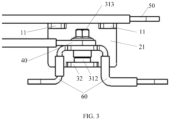
FIG. 3 is a schematic view a copper bar isolation bracket according to an embodiment of the present disclosure after installation. - 10 supporting portion; 11 baffle; 12 interval space; 20 connecting portion; 21 connecting plate; 30 fixing portion; 31 fixing device; 311 through hole; 312 nut; 313 bolt; 32 fixing plate; 40 first copper bar; 50 second copper bar; 60 third copper bar.
- In order to understand the above objects, features and advantages of the present disclosure more clearly, the solution of the present disclosure will be further described below. It should be noted that the embodiments of the present disclosure and the features in the embodiments may be combined with each other without conflict.
- In the following description, many specific details are set forth in order to fully understand the present disclosure, but the present disclosure may be practiced in other ways than those described herein. Obviously, the embodiments in the specification are only part of the embodiments of the present disclosure, not all of them.
- The terms "up", "down", "left", "right", "front" and "rear" described in the embodiments indicate the orientation or positional relationship based on the orientation or positional relationship shown in the attached drawings, which is only for the convenience of describing the embodiments and simplifying the description, and does not indicate or imply that the device or element referred to must have a specific orientation, be constructed and operated in a specific orientation, so it cannot be understood as a limitation of the present disclosure.
- The copper bar isolation bracket provided by the present disclosure is used for isolating two adjacent copper bars in an automobile, to prevent the interaction between the two adjacent copper bars, and prevent damaging the copper bars and affecting the service life of the copper bars. In actual use, the copper bar isolation bracket may also be arranged on other devices according to actual needs.
- As shown in
FIGS. 1 and 2 , a copper bar isolation bracket of the present disclosure includes a supportingportion 10, a connectingportion 20 and afixing portion 30. - The connecting
portion 20 is arranged between the supportingportion 10 and thefixing portion 30, and is separately connected to the supportingportion 10 and thefixing portion 30. The supportingportion 10 is located above thefixing portion 30, and thefixing portion 30 is provided with afixing device 31. Thefixing device 31 is configured to fix afirst copper bar 40 on thefixing portion 30. Spacing for accommodating thefirst copper bar 40 and thefixing device 31 is defined between the supportingportion 10 and thefixing portion 30, and a gap is defined between thefixing device 31 and the supportingportion 10. The supportingportion 10 is configured to support asecond copper bar 50. - According to the copper bar isolation bracket provided by the present disclosure, by arranging the
fixing portion 30 and arranging thefixing device 31 on thefixing portion 30, the bracket and thefirst copper bar 40 are fixed by thefixing device 31 at the same time. By arranging the supportingportion 10, arranging the connectingportion 20 between the supportingportion 10 and thefixing portion 30, and supporting thesecond copper bar 50 on the supportingportion 10, with the spacing for accommodating thefirst copper bar 40 and thefixing device 31 being defined between the supportingportion 10 and thefixing portion 30, and the gap being defined between thefixing device 31 and the supportingportion 10, thefirst copper bar 40 is separated from thesecond copper bar 50, to prevent thefixing device 31 for fixing thefirst copper bar 40 from contacting with thesecond copper bar 50 and from causing thesecond copper bar 50 to wear, thereby prolonging the service life of the copper bar and reducing the cost. - In some embodiments, the
fixing portion 30 includes afixing plate 32, thefixing plate 32 has a rectangular structure, and thefixing plate 32 is fixedly connected to the connectingportion 20. Thefixing device 31 is arranged on thefixing plate 32, and thefixing plate 32 is fixed to an automobile through thefixing device 31, and thefirst copper bar 40 is also fixed to thefixing plate 32 through thefixing device 31. - Further, the
fixing device 31 includes a throughhole 311 defined in thefixing plate 32, and abolt 313 passes through the throughhole 311 and is fixed to the automobile to fix the copper bar isolation bracket, and at the same time, a fixing hole is defined in thefirst copper bar 40, and the bolt passes through the fixing hole to fix thefirst copper bar 40 to thefixing plate 32. - In some embodiments, a
nut 312 fitting with thebolt 313 may be arranged in the throughhole 311 in thefixing plate 32, and thenut 312 is fixed in the throughhole 311, so that when thebolt 313 fixes thefixing plate 32 and thefirst copper bar 40, thebolt 313 may be screwed onto thenut 312, ensuring the stability of fixing thebolt 313 with thefixing plate 32 and also the stability of fixing thefirst copper bar 40 on thefixing plate 32 by thebolt 313. Thefirst copper bar 40 may be stably fixed on thefixing plate 32 without shaking even if the automobile shakes during driving. - At the same time, the connecting
portion 20 has a certain height. When thefirst copper bar 40 and the fixingplate 32 are fixed by thebolt 313, it may be ensured that a top end of thebolt 313 will not touch thesecond copper bar 50 above it, thus preventing thesecond copper bar 50 from being worn and damaged by collision of thebolt 313, and prolonging the service life of the copper bar. - In some other embodiments, other implementable structures may also be adopted for fixing the
first copper bar 40. For example, a collar may be fixed on the fixingplate 32, and a tightening device is arranged on the collar. Thefirst copper bar 40 is fitted into the collar, and thefirst copper bar 40 is tightened in the collar by the tightening device, so that thefirst copper bar 40 is fixed. The copper bar isolation bracket is fixed on the automobile by a bolt or snap. For another example, a snap structure may be arranged on the fixingplate 32, and thefirst copper bar 40 may be fixed on the fixingplate 32 through the snap structure. - In some embodiments, a width of the fixing
plate 32 is smaller than a width of the connectingportion 20, and the width of the fixingplate 32 refers to an extending direction along a connection joint between the fixingplate 32 and the connectingportion 20. In this embodiment, the function of the fixingplate 32 is to fix the copper bar isolation bracket and thefirst copper bar 40, so the width of the fixingplate 32 only needs to accommodate the throughhole 311 and provide stable support for the connectingportion 20 and the supportingportion 10. Therefore, in this embodiment, on the basis of ensuring the above requirements, the width of the fixingplate 32 is set to be smaller than the width of the connectingportion 20, to occupy the limited space inside the automobile as little as possible and not interfere with the installation or layout of other devices, so that the layout of the devices inside the automobile is more reasonable, the layout of the devices may be more flexible, and the devices may be laid out by bending or other manners according to actual needs. - As shown in
FIG. 3 , in this embodiment, the fixingdevice 31 may not only fix thefirst copper bus 40, but also fix thethird copper bar 60, or other components that need to be fixed, thus achieving the purpose of fixing a plurality of components through onefixing device 31, saving a lot of space inside the automobile and maximizing the utilization of the fixingdevice 31. - In some embodiments, the supporting
portion 10 includes abaffle 11 connected to the connectingportion 20, thebaffle 11 extends away from the connectingportion 20, and thebaffle 11 and the fixingportion 30 are parallel to each other. An extending direction of thebaffle 11 is perpendicular to the width direction of the connectingportion 20. Thesecond copper bar 50 is placed on thebaffle 11. Thesecond copper bar 50 is not in a freely movable state, and other parts of thesecond copper bar 50 may be fixed as required. In this embodiment, only a part of thesecond copper bar 50 located at the copper bar isolation bracket is placed on thebaffle 11, to isolate thefirst copper bar 40 from thesecond copper bar 50. - In some embodiments, the connecting
portion 20 and the fixingplate 32 are perpendicular to each other, so that the fixingplate 32 and thebaffle 11 are parallel to each other. The connectingportion 20 has enough height to ensure that the fixingdevice 31 on the fixingplate 32 will not touch thesecond copper bar 50, which ensures that the shaking of the automobile will not make the fixingdevice 31 touch thesecond copper bar 50 during the driving of the automobile, thus effectively prolonging the service life of thesecond copper bar 50. - In this embodiment, the
baffle 11 and the fixingportion 30 are located at a same side of the connectingportion 20, that is, thebaffle 11 is located directly above the fixingportion 30, to reduce the space occupied by the copper bar isolation bracket and ensure the overall stability of the copper bar isolation bracket. - Further, the number of
baffles 11 is two, and the twobaffles 11 have are completely the same length and width. The two baffles 11 are arranged in parallel and spaced apart from each other, and aninterval space 12 is defined between the two baffles 11. When thesecond copper bar 50 is placed on thebaffle 11, it contacts the twobaffles 11 at the same time to share the weight of thesecond copper bar 50, so that the weight of thesecond copper bar 50 will not be completely applied to onebaffle 11, and thebaffle 11 will be prevented from being damaged due to the excessive weight of thesecond copper bar 50. - In some embodiments, the
interval space 12 is arranged opposite to the fixingdevice 31, that is, theinterval space 12 is located directly above the fixingdevice 31. When thefirst copper bar 40 is fixed or disassembled, an operator may operate thebolt 313 on the fixingplate 32 in the space between thebaffle 11 and the fixingplate 32, or operate thebolt 313 through theinterval space 12 when the space in the automobile is limited. - In some other embodiments, the number of the
baffles 11 may be set according to actual needs. For example, a plurality ofbaffles 11 may be provided, and the plurality ofbaffles 11 are arranged in parallel with each other. When thesecond copper bar 50 is placed on thebaffles 11, it contacts with the plurality ofbaffles 11, thus the plurality ofbaffles 11 share the weight of thesecond copper bar 50. - In addition, in some other embodiments, the
baffle 11 and the fixingportion 30 may also be arranged on two sides of the connectingportion 20 when the internal space of the automobile allows. In this way, thefirst copper bar 40 and thesecond copper bar 50 are respectively arranged on two sides of the connectingportion 20, and the fixingdevice 31 for fixing thefirst copper bar 40 will not affect thesecond copper bar 50 at all. At the same time, in order to ensure the stability of placing thesecond copper bar 50, the fixingdevice 31 may also be arranged on thebaffle 11 to fix thesecond copper bar 50 on the fixingdevice 31 on thebaffle 11 to prevent thesecond copper bar 50 from sliding on thebaffle 11 and colliding with other devices and thus from being damaged. - Further, when the plurality of
baffles 11 are provided, thebaffles 11 may also be arranged on two sides of the connectingportion 20, and thebaffles 11 are arranged parallel to each other and spaced from each other, to increase the width of thesecond copper bar 50 placed on thebaffles 11 and ensure that thesecond copper bar 50 will not slip off thebaffles 11. - In some embodiments, the connecting
portion 20 is a connectingplate 21, the connecting plate is vertically arranged, and has an upper end connected to the supportingportion 10 and a lower end connected to the fixingportion 30. - In some other embodiments, the connecting
portion 20 may also be configured as a rod-like structure. - Further, the copper bar isolation bracket is integrally molded, that is, the supporting
portion 10, the connectingportion 20 and the fixingportion 30 are integrally molded. Thenut 312 in the throughhole 311 of the fixingportion 30 is formed by placing thenut 312 in the throughhole 311 to embed thenut 312 in the through hole during integral molding. - In this embodiment, the copper bar isolation bracket is made of nonmetal material to prevent short circuit between the copper bar isolation bracket and the copper bar. In some other embodiments, the copper bar isolation bracket may also be made of metal, and a layer of insulating paint is coated on an outer surface of the metal to prevent short circuit between the copper bar and the copper bar isolation bracket.
- The present disclosure also provides a battery pack, which includes the copper bar isolation bracket described above. By using the copper bar isolation bracket on the battery pack to isolate the two adjacent copper bars, it is effectively prevented the adjunct copper bars from being damaged due to interaction between the fixing
device 31 on the copper bar and the adjacent copper bar caused by the shaking of the two adjacent copper bars during the driving of the vehicle. - The present disclosure also provides a vehicle including the battery pack described above. By arranging the battery pack with the copper bar isolation bracket on the vehicle, it may effectively prevent the adjacent copper bars from being damaged due to the interaction between the fixing
devices 31 on the copper bar and the adjacent copper bars caused by the shaking of two adjacent copper bars on the battery pack during the driving of the vehicle. - It should be noted that in this disclosure, relational terms such as "first" and "second" are only used to distinguish one entity or operation from another entity or operation, and do not necessarily require or imply that there is any such actual relationship or order between these entities or operations. Moreover, the terms "comprising", "including" or any other variation thereof are intended to cover non-exclusive inclusion, so that a process, method, article or device including a series of elements includes not only those elements, but also other elements not explicitly listed or elements inherent to such process, method, article or device. Without further restrictions, an element defined by the phrase "including ..." does not exclude the existence of other identical elements in the process, method, article or device including the element.
- What has been described above is only the specific embodiments of the present disclosure, so that those skilled in the art may understand or realize the present disclosure. Many modifications to these embodiments will be obvious to those skilled in the art, and the general principles defined herein may be implemented in other embodiments without departing from the spirit or scope of this disclosure. Therefore, this disclosure will not be limited to the embodiments described herein, but is to be accorded the widest scope consistent with the principles and novel features disclosed herein.
Claims (13)
- A copper bar isolation bracket, comprising a supporting portion (10), a connecting portion (20) and a fixing portion (30),
wherein the connecting portion (20) is arranged between the supporting portion (10) and the fixing portion (30), and is separately connected to the supporting portion (10) and the fixing portion (30); the fixing portion (30) is provided with a fixing device (31), and the fixing device (31) is configured to fix a first copper bar (40) on the fixing portion (30); spacing for accommodating the first copper bar (40) and the fixing device (31) is defined between the supporting portion (10) and the fixing portion (30), and a gap is defined between the fixing device (31) and the supporting portion (10); and the supporting portion (10) is configured to support a second copper bar (50). - The copper bar isolation bracket according to claim 1, wherein the fixing portion (30) comprises a fixing plate (32), the fixing plate (32) is fixedly connected to the connecting portion (20), and the fixing device (31) is arranged on the fixing plate (32).
- The copper bar isolation bracket according to claim 2, wherein the fixing device (31) comprises a through hole (311) defined in the fixing plate (32), and a nut (312) is arranged in the through hole (311).
- The copper bar isolation bracket according to claim 2, wherein a width of the fixing plate (32) is smaller than a width of the connecting portion (20).
- The copper bar isolation bracket according to any one of claims 1 to 4, wherein the supporting portion (10) comprises a baffle (11) connected to the connecting portion (20), the baffle (11) extends away from the connecting portion (20), and the baffle (11) and the fixing portion (30) are parallel to each other.
- The copper bar isolation bracket according to claim 5, wherein the baffle (11) and the fixing portion (30) are located at a same side of the connecting portion (20).
- The copper bar isolation bracket according to claim 5, wherein two baffles (11) are provided, the two baffles (11) are spaced apart from each other, an interval space (12) is defined between the two baffles (11), and the interval space (12) is arranged opposite to the fixing device (31).
- The copper bar isolation bracket according to any one of claims 1 to 7, wherein the connecting portion (20) is a connecting plate (21), and the connecting plate (21) has an upper end connected to the supporting portion (10) and a lower end connected to the fixing portion (30).
- The copper bar isolation bracket according to any one of claims 1 to 8, wherein the connecting portion (20) is configured as a rod-like structure.
- The copper bar isolation bracket according to any one of claims 1 to 9, wherein the copper bar isolation bracket is integrally molded.
- The copper bar isolation bracket according to claim 3, wherein the supporting portion (10), the connecting portion (20) and the fixing portion (30) are integrally molded, and the nut (312) in the through hole (311) of the fixing portion (30) is formed by placing the nut (312) in the through hole (311) to embed the nut (312) in the through hole (311) during integral molding.
- A battery pack, comprising a copper bar isolation bracket according to any one of claims 1 to 11.
- A vehicle, comprising a battery pack according to claim 12.
Applications Claiming Priority (2)
| Application Number | Priority Date | Filing Date | Title |
|---|---|---|---|
| CN202122053349.XU CN215680899U (en) | 2021-08-27 | 2021-08-27 | Copper bar isolation support, battery pack and vehicle |
| PCT/CN2022/114585 WO2023025206A1 (en) | 2021-08-27 | 2022-08-24 | Copper bar isolation support, battery pack, and vehicle |
Publications (2)
| Publication Number | Publication Date |
|---|---|
| EP4395044A1 true EP4395044A1 (en) | 2024-07-03 |
| EP4395044A4 EP4395044A4 (en) | 2024-11-20 |
Family
ID=79957108
Family Applications (1)
| Application Number | Title | Priority Date | Filing Date |
|---|---|---|---|
| EP22860552.3A Pending EP4395044A4 (en) | 2021-08-27 | 2022-08-24 | COPPER BAR INSULATION SUPPORT, BATTERY PACK AND VEHICLE |
Country Status (4)
| Country | Link |
|---|---|
| US (1) | US20240372226A1 (en) |
| EP (1) | EP4395044A4 (en) |
| CN (1) | CN215680899U (en) |
| WO (1) | WO2023025206A1 (en) |
Families Citing this family (1)
| Publication number | Priority date | Publication date | Assignee | Title |
|---|---|---|---|---|
| CN215680899U (en) * | 2021-08-27 | 2022-01-28 | 北京车和家信息技术有限公司 | Copper bar isolation support, battery pack and vehicle |
Family Cites Families (8)
| Publication number | Priority date | Publication date | Assignee | Title |
|---|---|---|---|---|
| JP4774062B2 (en) * | 2008-01-10 | 2011-09-14 | 富士通テレコムネットワークス株式会社 | Copper bar mounting structure |
| DE102013204825A1 (en) * | 2013-03-19 | 2014-09-25 | Bombardier Transportation Gmbh | Busbar arrangement and method for producing a busbar arrangement |
| CN204809797U (en) * | 2015-07-14 | 2015-11-25 | 易霸科技(威海)股份有限公司 | Range upon range of formula bus bar support |
| CN207215983U (en) * | 2017-10-12 | 2018-04-10 | 江苏高博锐电气有限公司 | A kind of structure for improving low-voltage circuit breaker experiment stability |
| CN207398595U (en) * | 2017-10-18 | 2018-05-22 | 江苏经纬轨道交通设备有限公司 | Multilayer copper bar fixed structure and electrical equipment |
| CN109616963A (en) * | 2018-12-07 | 2019-04-12 | 蜂巢能源科技有限公司 | Positioning support for battery pack and battery pack having the same |
| CN113161660B (en) * | 2021-04-01 | 2022-05-27 | 蜂巢能源科技有限公司 | Wire harness copper bar bracket, battery pack and wire harness installation method |
| CN215680899U (en) * | 2021-08-27 | 2022-01-28 | 北京车和家信息技术有限公司 | Copper bar isolation support, battery pack and vehicle |
-
2021
- 2021-08-27 CN CN202122053349.XU patent/CN215680899U/en active Active
-
2022
- 2022-08-24 WO PCT/CN2022/114585 patent/WO2023025206A1/en not_active Ceased
- 2022-08-24 US US18/683,937 patent/US20240372226A1/en active Pending
- 2022-08-24 EP EP22860552.3A patent/EP4395044A4/en active Pending
Also Published As
| Publication number | Publication date |
|---|---|
| EP4395044A4 (en) | 2024-11-20 |
| US20240372226A1 (en) | 2024-11-07 |
| WO2023025206A1 (en) | 2023-03-02 |
| CN215680899U (en) | 2022-01-28 |
Similar Documents
| Publication | Publication Date | Title |
|---|---|---|
| EP2544262B1 (en) | Battery connection assembly | |
| EP2579404B1 (en) | Wiring harness and method of assembling the same | |
| EP2817839B1 (en) | Wire arranging device for batteries | |
| EP4395044A1 (en) | Copper bar isolation support, battery pack, and vehicle | |
| US9887402B2 (en) | Battery having supporting elements | |
| CN108352690B (en) | Reduced height relay block for vehicle electrical distribution devices | |
| US20230299512A1 (en) | Hybrid electric charging inlet | |
| EP1203698A2 (en) | Electric power distributor for use in motor vehicle | |
| WO2021206278A1 (en) | Battery module and battery pack including same | |
| WO2022019653A1 (en) | Battery module and battery pack comprising same | |
| JP2023524674A (en) | Copper busbar protective structure, battery pack and electric vehicle | |
| WO2016068380A1 (en) | Ldc integrated junction box | |
| KR101623294B1 (en) | Busbar system especially for long vertical paths | |
| JP2016091780A (en) | Battery module and battery pack | |
| CN116169530A (en) | Signal transfer module and battery pack | |
| CN221163788U (en) | A placing plate and a transfer rack | |
| CN210430436U (en) | BDU for battery pack and shell thereof | |
| CN218005133U (en) | Matrix type electric core assembly | |
| CN219812323U (en) | BMS device | |
| CN223224840U (en) | Circuit board accommodation device | |
| CN222691936U (en) | Circuit board and electronic equipment | |
| CN222940116U (en) | Parallel fixing device for copper bars and wire harnesses and battery pack | |
| CN222234257U (en) | High voltage box structure | |
| CN216980487U (en) | Fuse base | |
| CN222355340U (en) | Power extraction structure for battery pack, battery pack and vehicle |
Legal Events
| Date | Code | Title | Description |
|---|---|---|---|
| STAA | Information on the status of an ep patent application or granted ep patent |
Free format text: STATUS: THE INTERNATIONAL PUBLICATION HAS BEEN MADE |
|
| PUAI | Public reference made under article 153(3) epc to a published international application that has entered the european phase |
Free format text: ORIGINAL CODE: 0009012 |
|
| STAA | Information on the status of an ep patent application or granted ep patent |
Free format text: STATUS: REQUEST FOR EXAMINATION WAS MADE |
|
| 17P | Request for examination filed |
Effective date: 20240117 |
|
| AK | Designated contracting states |
Kind code of ref document: A1 Designated state(s): AL AT BE BG CH CY CZ DE DK EE ES FI FR GB GR HR HU IE IS IT LI LT LU LV MC MK MT NL NO PL PT RO RS SE SI SK SM TR |
|
| REG | Reference to a national code |
Ref country code: DE Ref legal event code: R079 Free format text: PREVIOUS MAIN CLASS: H01M0050507000 Ipc: H02G0005020000 |
|
| A4 | Supplementary search report drawn up and despatched |
Effective date: 20241023 |
|
| RIC1 | Information provided on ipc code assigned before grant |
Ipc: H01M 50/502 20210101ALN20241017BHEP Ipc: H01M 50/298 20210101ALN20241017BHEP Ipc: H02G 5/02 20060101AFI20241017BHEP |
|
| DAV | Request for validation of the european patent (deleted) | ||
| DAX | Request for extension of the european patent (deleted) |