EP4394713A1 - Image rendering method and apparatus, electronic device, computer-readable storage medium, and computer program product - Google Patents
Image rendering method and apparatus, electronic device, computer-readable storage medium, and computer program product Download PDFInfo
- Publication number
- EP4394713A1 EP4394713A1 EP22928314.8A EP22928314A EP4394713A1 EP 4394713 A1 EP4394713 A1 EP 4394713A1 EP 22928314 A EP22928314 A EP 22928314A EP 4394713 A1 EP4394713 A1 EP 4394713A1
- Authority
- EP
- European Patent Office
- Prior art keywords
- rendering
- fitted
- texture
- virtual object
- graph
- Prior art date
- Legal status (The legal status is an assumption and is not a legal conclusion. Google has not performed a legal analysis and makes no representation as to the accuracy of the status listed.)
- Pending
Links
Images




Classifications
-
- G—PHYSICS
- G06—COMPUTING OR CALCULATING; COUNTING
- G06T—IMAGE DATA PROCESSING OR GENERATION, IN GENERAL
- G06T15/00—Three-dimensional [3D] image rendering
- G06T15/04—Texture mapping
-
- A—HUMAN NECESSITIES
- A63—SPORTS; GAMES; AMUSEMENTS
- A63F—CARD, BOARD, OR ROULETTE GAMES; INDOOR GAMES USING SMALL MOVING PLAYING BODIES; VIDEO GAMES; GAMES NOT OTHERWISE PROVIDED FOR
- A63F13/00—Video games, i.e. games using an electronically generated display having two or more dimensions
- A63F13/50—Controlling the output signals based on the game progress
- A63F13/52—Controlling the output signals based on the game progress involving aspects of the displayed game scene
-
- A—HUMAN NECESSITIES
- A63—SPORTS; GAMES; AMUSEMENTS
- A63F—CARD, BOARD, OR ROULETTE GAMES; INDOOR GAMES USING SMALL MOVING PLAYING BODIES; VIDEO GAMES; GAMES NOT OTHERWISE PROVIDED FOR
- A63F13/00—Video games, i.e. games using an electronically generated display having two or more dimensions
- A63F13/80—Special adaptations for executing a specific game genre or game mode
- A63F13/822—Strategy games; Role-playing games
-
- G—PHYSICS
- G06—COMPUTING OR CALCULATING; COUNTING
- G06T—IMAGE DATA PROCESSING OR GENERATION, IN GENERAL
- G06T7/00—Image analysis
- G06T7/40—Analysis of texture
-
- G—PHYSICS
- G06—COMPUTING OR CALCULATING; COUNTING
- G06V—IMAGE OR VIDEO RECOGNITION OR UNDERSTANDING
- G06V10/00—Arrangements for image or video recognition or understanding
- G06V10/70—Arrangements for image or video recognition or understanding using pattern recognition or machine learning
- G06V10/74—Image or video pattern matching; Proximity measures in feature spaces
- G06V10/75—Organisation of the matching processes, e.g. simultaneous or sequential comparisons of image or video features; Coarse-fine approaches, e.g. multi-scale approaches; using context analysis; Selection of dictionaries
- G06V10/751—Comparing pixel values or logical combinations thereof, or feature values having positional relevance, e.g. template matching
Definitions
- a physically based rendering (PBR) method loads a plurality of textures to generate the virtual objects in the virtual scene; such a solution may require a large amount of storage space and computing resources, thereby affecting a user experience.
- PBR physically based rendering
- the embodiments of the present disclosure provide an image rendering method and apparatus, an electronic device, a computer-readable storage medium, and a computer program product, which can sufficiently and effectively utilize fitted texture data and save relevant storage space and computing resources.
- the embodiments of the present disclosure provide an image rendering method, including:
- the embodiments of the present disclosure provide an image rendering apparatus, including:
- the embodiments of the present disclosure provide an electronic device for image rendering, the electronic device including:
- the embodiments of the present disclosure provide a computer-readable storage medium storing computer-executable instructions for causing a processor when executed, to implement the image rendering method provided by the embodiments of the present disclosure.
- Differential fitting processing is performed on to-be-fitted texture data; the fitted texture data is baked into a texture image; image rendering is performed on the to-be-rendered virtual object based on the rendered texture image, to sufficiently and effectively use the fitted texture data to perform image rendering; compared with the PBR method, it saves relevant storage space and computing resources, thereby improving the rendering efficiency of the virtual object.
- FIG. 1A is a diagram of an application mode of an image rendering method provided by an embodiment of the present disclosure.
- the method is applicable to some application modes completely relying on the graphics processing hardware computing capability of a terminal 400 to complete the relevant data calculation of a virtual scene 100, such as a game in a stand-alone/off-line mode, completing the output of a virtual scene through various types of terminals 400, such as a smartphone, a tablet, and a virtual reality/augmented reality device.
- types of graphics processing hardware include a central processing unit (CPU) and GPU.
- the terminal 400 calculates data required for display via the graphics computing hardware, completes the loading, parsing, and rendering of the display data, and outputs a video frame capable of forming the visual perception of the virtual scene on the graphics output hardware, for example, a video frame for presenting 2D on a display screen of a smartphone, or a video frame for realizing a 3D display effect by projecting on a lens of augmented reality/virtual reality glasses.
- the terminal 400 may also form one or more auditory perceptions, tactile perceptions, motion perceptions, and taste perceptions through different hardware.
- the pixel value difference between the target rendering graph and the fitted rendering graph in a screen space is obtained through the following manner: performing the following processing for any same pixel of the target rendering graph and the fitted rendering graph in the screen space: determining a first pixel value corresponding to the pixel in the fitted rendering graph, and determining a second pixel value corresponding to the pixel in the target rendering graph; taking an absolute value of a difference value between the first pixel value and the second pixel value as a pixel value difference of the pixel; and summing pixel value differences of a plurality of pixels in the target rendering graph as the pixel value difference between the target rendering graph and the fitted rendering graph in the screen space.
- the virtual characters will not always be in the same orientation, so it is necessary to fit the rendering effect of each orientation of the characters, to ensure that the fitting effect of each state of the virtual characters is relatively accurate.
- the orientation setting example of the virtual character in FIG. 13 three different orientations of the virtual character 1301 randomly set the orientation of one virtual character at each iteration.
- Step 204 Acquire a fitted rendering graph.
- the fitting module 4652 is further configured to: determine a pixel value difference between the target rendering graph and the fitted rendering graph in a screen space; and determine the rendering loss function based on the pixel value difference and a size of the target rendering graph.
Landscapes
- Engineering & Computer Science (AREA)
- Theoretical Computer Science (AREA)
- Physics & Mathematics (AREA)
- General Physics & Mathematics (AREA)
- Multimedia (AREA)
- Computer Vision & Pattern Recognition (AREA)
- Computer Graphics (AREA)
- Artificial Intelligence (AREA)
- Health & Medical Sciences (AREA)
- Computing Systems (AREA)
- Databases & Information Systems (AREA)
- Evolutionary Computation (AREA)
- General Health & Medical Sciences (AREA)
- Medical Informatics (AREA)
- Software Systems (AREA)
- Image Generation (AREA)
- Processing Or Creating Images (AREA)
Abstract
Description
- This application is based on and claims priority to
Chinese Patent Application No. 202210179700.6 with an application date of February 25, 2022 - The present disclosure relates to the computer graphics and image technology, and in particular to, an image rendering method and apparatus, an electronic device, a computer-readable storage medium, and a computer program product.
- The display technology based on graphics processing hardware extends the perception environment and the access to information; especially with the display technology of a virtual scene, the diversified interaction between virtual objects controlled by users or artificial intelligence (AI) can be realized according to actual application requirements. With various typical application scenes, for example, in virtual scenes such as games, the true battle process between the virtual objects can be simulated.
- In the related art, a physically based rendering (PBR) method loads a plurality of textures to generate the virtual objects in the virtual scene; such a solution may require a large amount of storage space and computing resources, thereby affecting a user experience.
- The embodiments of the present disclosure provide an image rendering method and apparatus, an electronic device, a computer-readable storage medium, and a computer program product, which can sufficiently and effectively utilize fitted texture data and save relevant storage space and computing resources.
- The technical solutions of the embodiments of the present disclosure are implemented as follows:
The embodiments of the present disclosure provide an image rendering method, including: - acquiring to-be-fitted texture data of a to-be-rendered virtual object;
- performing differential fitting processing on the to-be-fitted texture data to obtain fitted texture data;
- baking the fitted texture data into a texture image to obtain a rendered texture image; and
- performing, based on the rendered texture image, image rendering processing corresponding to the to-be-rendered virtual object to obtain a rendered virtual object.
- The embodiments of the present disclosure provide an image rendering apparatus, including:
- an acquisition module, configured to acquire to-be-fitted texture data of a to-be-rendered virtual object;
- a fitting module, configured to perform differential fitting processing on the to-be-fitted texture data to obtain fitted texture data;
- a baking module, configured to bake the fitted texture data into a texture image to obtain a rendered texture image; and
- a rendering module, configured to perform, based on the rendered texture image, image rendering processing corresponding to the to-be-rendered virtual object to obtain a rendered virtual object.
- The embodiments of the present disclosure provide an electronic device for image rendering, the electronic device including:
- a memory, configured to store computer-executable instructions; and
- a processor, configured to implement, when executing the computer-executable instructions stored in the memory, the image rendering method provided by the embodiments of the present disclosure.
- The embodiments of the present disclosure provide a computer-readable storage medium storing computer-executable instructions for causing a processor when executed, to implement the image rendering method provided by the embodiments of the present disclosure.
- The embodiments of the present disclosure provide a computer program product including computer programs or computer-executable instructions, the computer programs or computer-executable instructions implementing, when executed by a processor, the image rendering method provided by the embodiments of the present disclosure.
- The embodiments of the present disclosure have the following beneficial effects:
- Differential fitting processing is performed on to-be-fitted texture data; the fitted texture data is baked into a texture image; image rendering is performed on the to-be-rendered virtual object based on the rendered texture image, to sufficiently and effectively use the fitted texture data to perform image rendering; compared with the PBR method, it saves relevant storage space and computing resources, thereby improving the rendering efficiency of the virtual object.
-
-
FIGs. 1A to 1B are diagrams of an application mode of an image rendering method provided by an embodiment of the present disclosure. -
FIG. 2 is a structural diagram of an electronic device for image rendering provided by an embodiment of the present disclosure. -
FIGs. 3A to 3B are flow diagrams of an image rendering method provided by an embodiment of the present disclosure. -
FIG. 4 is a diagram of a base object model provided by an embodiment of the present disclosure. -
FIG. 5 is a rendering diagram provided by the related art. -
FIG. 6 is a rendering schematic provided by an embodiment of the present disclosure. -
FIG. 7 is a diagram of a fitted rendering flow provided by an embodiment of the present disclosure. -
FIG. 8 is a diagram of a rasterization rendering flow provided by an embodiment of the present disclosure. -
FIG. 9 is a diagram of a machine learning fitted scene provided by an embodiment of the present disclosure. -
FIG. 10 is a diagram of a fitted texture provided by an embodiment of the present disclosure. -
FIG. 11 is a flow diagram of a machine learning fit provided by an embodiment of the present disclosure. -
FIG. 12 is a diagram of an initial value of a to-be-fitted texture provided by an embodiment of the present disclosure. -
FIG. 13 is a screen space rendering graph of a virtual character provided by an embodiment of the present disclosure. -
FIG. 14 is a screen space rendering graph of a virtual character provided by an embodiment of the present disclosure. -
FIG. 15 is a screen space rendering graph of a fitted virtual character provided by an embodiment of the present disclosure. -
FIG. 16 is a diagram of a pixel value difference between a PBR-based target rendering graph and a fitted rendering graph in a screen space provided by an embodiment of the present disclosure. -
FIG. 17 is a comparative diagram of an inclusion footprint provided by an embodiment of the present disclosure. -
FIG. 18 is a diagram of actual machine test results of a memory footprint provided by an embodiment of the present disclosure. -
FIG. 19 is a diagram of actual machine test results of a graphics processing unit (GPU) computing overhead provided by an embodiment of the present disclosure. - To make the objectives, technical solutions, and advantages of the present disclosure clearer, the following describes the present disclosure in further detail with reference to the accompanying drawings. The described embodiments are not to be considered as a limitation to the present disclosure. All other embodiments obtained by a person of ordinary skill in the art without creative efforts shall fall within the protection scope of the present disclosure.
- In the following description, the terms "first/second" are merely intended to distinguish similar objects and do not represent a particular ordering of objects. It may be understood that the terms "first/second" may be interchanged either in a particular order or in a sequential order, as permitted, to enable the embodiments of the present disclosure described herein to be implemented other than that illustrated or described herein.
- Unless otherwise defined, meanings of all technical and scientific terms used in this specification are the same as those usually understood by a person skilled in the art to which the present disclosure belongs. The terms used herein are for the purpose of describing the embodiments of the present disclosure only and are not intended to limit the present disclosure.
- Before the embodiments of the present disclosure are further described in detail, a description is made on nouns and terms in the embodiments of the present disclosure, and the nouns and terms in the embodiments of the present disclosure are applicable to the following explanations.
- (1) In response to is used for representing a condition or state upon which the performed operation depends. The performed operation or operations may be in real-time or may have a set delay in response to meeting the dependent condition or state. Without being specifically stated, there is no limitation in the order of execution of the operations performed.
- (2) A client is an application (APP) running in a terminal for providing various services, such as a video playback client and a game client.
- (3) A virtual scene is a virtual game scene that is displayed (or provided) while a game APP is running on a terminal. The virtual scene may be a real-world simulation environment, a semi-simulation semi-fictional virtual environment, or a purely fictional virtual environment. The virtual scene may be any one of a two-dimensional (2D) virtual scene, a 2.5-dimensional (2.5D) virtual scene, or a three-dimensional (3D) virtual scene; and the dimensions of the virtual scene are not limited in the embodiments of the present disclosure. For example, the virtual scene may include a sky, a land, a sea, and the like. The land may include an environmental element such as a desert, a city, and the like. A user may control the virtual object to move in the virtual scene.
- (4) A virtual object is an image of various people and things that can interact in a virtual scene or a movable object in a virtual scene. The movable object may be a virtual character, a virtual animal, an animated character, and the like, such as a character and an animal displayed in the virtual scene. The virtual object may be a virtual avatar in the virtual scene for representing a user. A plurality of virtual objects may be included in the virtual scene, each virtual object having its own shape and volume in the virtual scene and occupying a part of the space in the virtual scene.
- (5) Scene data represents feature data of a virtual scene, and for example, may be the area of a construction region in the virtual scene and the architectural style where the virtual scene is currently located. It may also include the location of the virtual building in the virtual scene, the footprint of the virtual building, and the like.
- (6) Image rendering is a process of converting 3D light energy transfer processing into a 2D image. Scenes and objects are represented in a 3D form, closer to the real world, for ease of manipulation and transformation, while image display devices are mostly 2D raster displays and dot-matrix printers. The representation of the N-dimensional raster and dot-matrix from the representation of the 3D scene is image rendering, that is, rasterization. A raster display can be viewed as a matrix of pixels, and any image displayed on a raster display is a collection of pixels having one or more colors and greyscales.
- (7) Image baking is to save the geometric features of a 3D grid to a texture file (a bitmap file); baking an object using a lightmapping technique is a technique for enhancing the lighting effect of a scene, to make the scene look more realistic, rich, and more stereoscopic through a low performance. (8) Detail degree is used for representing the richness of the details of the virtual object; according to the position where the model of the virtual object is located at the 3D environment and the importance degree of the virtual object itself, the resource allocation (such as the number of faces and the number of shaders) for object rendering can be determined; and the more resource allocation, the greater the number of details of the virtual object will be. The greater the number of details (that is, the number of triangular meshes) of the virtual object, the finer the virtual object is.
- The embodiments of the present disclosure provide an image rendering method and apparatus, an electronic device, a computer-readable storage medium, and a computer program product, which can sufficiently and effectively utilize fitted texture data and save relevant storage space and computing resources. In order to facilitate an easier understanding of the image rendering method provided by the embodiment of the present disclosure, an exemplary implementation scene of the image rendering method provided by the embodiment of the present disclosure will first be described; the virtual object in the image rendering method provided by the embodiment of the present disclosure may be completely output based on the terminal, or output based on the terminal and the server in cooperation.
- In some embodiments, the virtual scene may be an environment for a game character to interact with, for example, for a game character to perform a rival battle in the virtual scene; and two-sided interaction may be performed in the virtual scene by controlling the action of the game character, thereby enabling a user to relax the stress of life during the game.
- In one implementation scene, referring to
FIG. 1A, FIG. 1A is a diagram of an application mode of an image rendering method provided by an embodiment of the present disclosure. The method is applicable to some application modes completely relying on the graphics processing hardware computing capability of a terminal 400 to complete the relevant data calculation of avirtual scene 100, such as a game in a stand-alone/off-line mode, completing the output of a virtual scene through various types ofterminals 400, such as a smartphone, a tablet, and a virtual reality/augmented reality device. - As an example, types of graphics processing hardware include a central processing unit (CPU) and GPU.
- When forming the visual perception of the
virtual scene 100, the terminal 400 calculates data required for display via the graphics computing hardware, completes the loading, parsing, and rendering of the display data, and outputs a video frame capable of forming the visual perception of the virtual scene on the graphics output hardware, for example, a video frame for presenting 2D on a display screen of a smartphone, or a video frame for realizing a 3D display effect by projecting on a lens of augmented reality/virtual reality glasses. Furthermore, in order to enrich the perception effect, the terminal 400 may also form one or more auditory perceptions, tactile perceptions, motion perceptions, and taste perceptions through different hardware. - As an example, a client 410 (for example, a stand-alone version of a game application) runs on the terminal 400, and outputs a virtual scene including role-playing during the running process of the
client 410; the virtual scene is an environment for a game character to interact with, for example, may be a plain, a street, a valley, and the like for the game character to battle. Illustrated with displaying avirtual scene 100 from a first person perspective, a renderedvirtual object 101 is displayed in thevirtual scene 100; the renderedvirtual object 101 may be a game character controlled by a user (or referred to as a player), and will operate in the virtual scene in response to the operation of a real user on a button (including a rocker button, an attack button, a defense button, and the like); for example, when the real user moves the rocker button to the left, the virtual object will move to the left in the virtual scene, and can also remain stationary in place, jump, and use various functions (such as skills and props). The renderedvirtual object 101 may also be AI set in a virtual scene battle through training. The renderedvirtual object 101 may also be a non-player character (NPC) set in virtual scene interaction. The renderedvirtual object 101 may also be an immovable object or a movable object in thevirtual scene 100. - For example, illustrated by displaying a
virtual scene 100 from a first person perspective, a to-be-rendered virtual object is displayed in thevirtual scene 100; to-be-fitted texture data of the to-be-rendered virtual object is acquired by the image rendering method provided by an embodiment of the present disclosure; differential fitting processing is performed on the to-be-fitted texture data to obtain fitted texture data; the fitted texture data is baked into a texture image to obtain a rendered texture image; image rendering processing corresponding to the to-be-rendered virtual object is performed based on the rendered texture image to obtain a renderedvirtual object 101; and human-computer interaction of the virtual scene is performed based on the renderedvirtual object 101, such as game confrontation. - In another implementation scenario, referring to
FIG. 1B, FIG. 1B is a diagram of an application mode of an image rendering method provided by an embodiment of the present disclosure, which is applied to a terminal 400 and aserver 200. The method is applicable to an application mode that completes the calculation of a virtual scene relying on the computing capability of theserver 200 and outputs the virtual scene at the terminal 400. - Taking the visual perception of forming a
virtual scene 100 as an example, theserver 200 calculates display data (such as scene data) related to the virtual scene and sends same to the terminal 400 via anetwork 300; the terminal 400 completes the loading, parsing, and rendering of the calculated display data relying on graphic calculation hardware, and outputs the virtual scene relying on graphic output hardware to form the visual perception, for example, a video frame for presenting two-dimension on a display screen of a smartphone, or a video frame for realizing a three-dimensional display effect by projecting on a lens of augmented reality/virtual reality glasses. For the perception in the form of a virtual scene, it will be appreciated that it is possible to form an auditory perception through corresponding hardware outputs of the terminal 400, for example using a microphone output, and form a tactile perception using a vibrator output, and the like. - As an example, a client 410 (for example, a network version of a game application) runs on a terminal 400, and performs game interaction with other users by connecting to a server 200 (for example, a game server); the terminal 400 outputs a
virtual scene 100 of theclient 410. Illustrated with displaying avirtual scene 100 from a first person perspective, a renderedvirtual object 101 is displayed in thevirtual scene 100; the renderedvirtual object 101 may be a game character controlled by a user (or referred to as a player), and will operate in the virtual scene in response to the operation of a real user on a button (including a rocker button, an attack button, a defense button, and the like); for example, when the real user moves the rocker button to the left, the virtual object will move to the left in the virtual scene, and can also remain stationary in place, jump, and use various functions (such as skills and props). The renderedvirtual object 101 may also be AI set in a virtual scene battle through training. The renderedvirtual object 101 may also be an NPC set in virtual scene interaction. The renderedvirtual object 101 may also be an immovable object or a movable object in thevirtual scene 100. - For example, illustrated by displaying a
virtual scene 100 from a first person perspective, a to-be-rendered virtual object is displayed in thevirtual scene 100; to-be-fitted texture data of the to-be-rendered virtual object is acquired by the image rendering method provided by an embodiment of the present disclosure; differential fitting processing is performed on the to-be-fitted texture data to obtain fitted texture data; the fitted texture data is baked into a texture image to obtain a rendered texture image; image rendering processing corresponding to the to-be-rendered virtual object is performed based on the rendered texture image to obtain a renderedvirtual object 101; and human-computer interaction of the virtual scene is performed based on the renderedvirtual object 101, such as game confrontation. - In some embodiments, the terminal 400 may implement the image rendering method provided by the embodiments of the present disclosure by running a computer program, for example, the computer program may be a native program or a software module in an operating system. It may be a local APP, namely, a program that needs to be installed in the operating system to run, such as a dress-up game APP (namely, the above client 410). It may be an applet, namely, a program that only needs to be downloaded to the browser environment to run. It may also be a game applet that can be embedded in any APP. In general, the above computer programs may be any form of APP, module, or plug-in.
- Illustrated with the computer program as an APP, in actual implementation, the terminal 400 installs and runs an APP supporting a virtual scene. The APP may be any one of a first-person shooting (FPS) game, a third-person shooting (TPS) game, a virtual reality APP, a 3D map program, or a multi-player gunfight survival game. A user uses the terminal 400 to operate a virtual object located in a virtual scene to perform an activity, and the activity includes but is not limited to at least one of adjusting body postures, crawling, walking, running, riding, jumping, driving, picking up, shooting, attacking, throwing, and constructing a virtual building. Illustratively, the virtual object may be a virtual character, such as a simulation character or an anime character.
- In some embodiments, the embodiments of the present disclosure may be implemented through cloud technology, which refers to a hosting technology for unifying a series of resources, such as hardware, software, and a network, in a wide area network or a local area network to realize the calculation, storage, processing, and sharing of data.
- Cloud technology is a general term for network technology, information technology, integration technology, management platform technology, and application technology based on cloud computing business model application, which can form a resource pool, be used as needed, and be flexible and convenient. Cloud computing will become an important support. Background services of technical network systems require a large amount of computing and storage resources.
- Exemplarily, a
server 200 inFIG. 1B may be an independent physical server, and may also be a server cluster or distributed system composed of a plurality of physical servers, and may further be a cloud server providing basic cloud computing services such as cloud services, cloud databases, cloud computing, cloud functions, cloud storage, network services, cloud communications, middleware services, domain name services, security services, content delivery network (CDN), as well as big data and artificial intelligence platforms. The terminal 400 may be but is not limited to, a smartphone, a tablet, a laptop, a desktop computer, a smart speaker, and a smartwatch. The terminal 400 and theserver 200 may be directly or indirectly connected through wired or wireless communication, which is not limited in the embodiments of the present disclosure. - Referring to
FIG. 2, FIG. 2 is a structural diagram of an electronic device for image rendering provided by an embodiment of the present disclosure. Illustrated with an electronic device as a terminal 400, theelectronic device 400 shown inFIG. 2 includes at least oneprocessor 420, amemory 460, at least onenetwork interface 430, and a user interface 440. The various assemblies in the terminal 400 are coupled together by abus system 450. It may be understood that thebus system 450 is configured to implement connection and communication between the components. Thebus system 450 includes a power bus, a control bus, and a status signal bus in addition to a data bus. However, for the sake of clarity, the various buses are labeled asbus system 450 inFIG. 2 . - The
processor 420 may be an integrated circuit chip with signal processing capabilities, such as a general-purpose processor, a digital signal processor (DSP), or other programmable logic devices, discrete gate or transistor logic devices, and discrete hardware assemblies; the general-purpose processor may be a microprocessor or any conventional processor, and the like. - The user interface 440 includes one or more output apparatuses 441 enabling the presentation of media content, including one or more speakers and/or one or more visual display screens. The user interface 440 further includes one or more input apparatuses 442, including user interface components that facilitate user input, such as a keyboard, mouse, microphone, touch-screen display screen, camera, other input buttons, and controls.
- The
memory 460 may be removable, non-removable, or a combination thereof. Exemplary hardware devices include solid-state memories, hard disk drives, optical disk drives, and the like. Thememory 460 optionally includes one or more storage devices physically located remotely from theprocessor 420. - The
memory 460 includes a volatile memory or a non-volatile memory and may include both volatile and non-volatile memories. The non-volatile memory may be a read-only memory (ROM), and the volatile memory may be a random-access memory (RAM). Thememory 460 described in the embodiments of the present disclosure is intended to include any suitable type of memory. - In some embodiments, the
memory 460 can store data to support various operations, and the examples of the data include programs, modules, and data structures, or subsets or superset thereof, as exemplified below. - An
operating system 461 is configured to implement various basic services and processing hardware-based tasks, including system programs for processing various basic system services, and executing hardware-related tasks, such as a framework layer, a core library layer, and a driver layer. - A
network communication module 462 is configured to reach other electronic devices via one or more (wired or wireless) network interfaces 430; anexemplary network interface 430 includes Bluetooth, WiFi, a universal serial bus (USB), and the like. - A
presentation module 463 is configured to enable the presentation of information (for example, a user interface for operating peripheral devices and displaying content and information) via one or more output apparatuses 441 (for example, a display screen and a speaker) associated with the user interface 440. - An
input processing module 464 is configured to detect one or more user inputs or interactions from one of the one or more input apparatuses 442 and interpret the detected inputs or interactions. - In the embodiments of the present disclosure including the embodiments of both the claims and the specification (hereinafter referred to as "all embodiments of the present disclosure"), an image rendering apparatus provided by an embodiment of the present disclosure may be implemented preferably in software.
FIG. 2 shows an image rendering apparatus 465 stored in amemory 460, which may be software in the form of a program and a plug-in, and the like, including the following software modules: anacquisition module 4651, afirst mapping module 4652, asecond mapping module 4653, arendering module 4654, and a processing module 4655; these modules are logical, and therefore any combination or further division can be performed according to the functions realized. - In other embodiments, the image rendering apparatus provided by the embodiments of the present disclosure may be implemented in hardware. As an example, the image rendering apparatus provided by the embodiments of the present disclosure may be a processor in the form of a hardware decoding processor which is programmed to execute the image rendering method provided by the embodiments of the present disclosure. For example, the processor in the form of the hardware decoding processor may use one or more application specific integrated circuits (ASIC), DSP, programmable logic device (PLD), complex programmable logic device (CPLD), field-programmable gate array (FPGA), or other electronic elements.
- The image rendering method provided by the embodiments of the present disclosure will be explained in detail below in combination with the drawings. The image rendering method provided by the embodiments of the present disclosure can be executed by the terminal 400 in
FIG. 1A alone, or by the terminal 400 in cooperation with theserver 200 inFIG. 1B . - Illustrated in the following is that the image rendering method provided by the embodiments of the present disclosure is separately executed by the terminal 400 in
FIG. 1A . Referring toFIG. 3A, FIG. 3A is a flow diagram of an image rendering method provided by an embodiment of the present disclosure. There will be illustrated in combination with the steps shown inFIG. 3A . - It should be noted that the method shown in
FIG. 3A may be executed by various forms of computer programs run by the terminal 400 and is not limited to theabove client 410; it may be theoperating system 461, software modules, and scripts described above. Therefore, the client is not to be considered a limitation on the embodiments of the present disclosure. - Step 101: Acquire to-be-fitted texture data of a to-be-rendered virtual object.
- It should be noted that the to-be-rendered virtual object is a base object model; the base object model includes a trunk of the virtual object and does not include display information for decorating the virtual object; for example, the display information includes make-up for decorating the face of the virtual object (such as a lip, an eye shadow, a pupil, an iris, and a blush), and clothing for decorating the limbs of the virtual object (such as antique and combat clothing); and for example, the to-be-rendered
virtual object 401 shown inFIG. 4 is a base object model, and decoration needs to be added to the base object model, such as make-up and clothing. - It should be noted that the to-be-fitted texture data may be parameters in the initialized texture image, including material parameters, texture parameters, and the like.
- Step 102: Performing differential fitting processing on the to-be-fitted texture data to obtain fitted texture data.
- For example, large rendering overhead (large inclusion footprint, memory footprint, bandwidth footprint, and more computational cost) is incurred due to the rendering methods in the related art (for example, the PBR technology). Therefore, the embodiments of the present disclosure do not load various textures to perform image rendering via the PBR technology to generate a virtual object in a virtual scene in real-time, but perform differential fitting processing on to-be-fitted texture data based on the rendered result of PBR (a detailed process of differential fitting processing is described subsequently) to obtain the fitted texture data, and perform real-time rendering based on the fitted texture data, avoiding loading various textures, saving relevant storage space and computing resources, and thereby improving the rendering efficiency of the virtual obj ect.
- It should be noted that before performing the differential fitting, the rendering scene is initialized, including loading a model (base object model), texture, material, and the like, followed by setting the position and orientation of the camera, setting the position and orientation of the model, and setting the parameters of various lights. In the process of performing differential fitting, the to-be-fitted texture data is continuously optimized, so that the fitted rendering graph obtained by performing fitting processing on the to-be-fitted texture data is as similar as possible to the PBR-based target rendering graph; the target rendering graph refers to the rendering result obtained by loading the textures through the PBR technology to perform image rendering.
- Referring to
FIG. 3B, FIG. 3B is an alternative flow diagram of an image rendering method provided by an embodiment of the present disclosure.FIG. 3B shows thatstep 102 inFIG. 3A can be implemented fromstep 1021 to step 1024. - Step 1021: Perform standard rendering processing corresponding to the to-be-rendered virtual object to obtain a target rendering graph corresponding to the virtual object.
- As an example of standard rendering processing, a to-be-rendered virtual object is subjected to standard rendering processing by a standard rendering technology to obtain a target rendering graph. The standard rendering processing may be performed based on physical web graphics library (WebGL) technology, which provides an APP interface for drawing 3D graphics. Specifically, the above performance of standard rendering processing corresponding to a to-be-rendered virtual object to obtain a target rendering graph corresponding to the virtual object can be realized by calling an APP interface provided by WebGL to execute the following technical solutions: acquiring a plurality of rendering data of the to-be-rendered virtual object; and performing physical-based rendering processing based on the plurality of rendering data to obtain the target rendering graph corresponding to the virtual object.
- For example, a plurality of rendering data (including texture data and material data) of a to-be-rendered virtual object are loaded by the PBR technology, and the plurality of rendering data is rendered based on the physical rule to obtain a target rendering graph complying with the physical rule. The rendering result obtained by fitting can be optimized as much as possible by the target rendering graph provided by an embodiment of the present disclosure.
- Step 1022: Perform the following iterative processing: performing fitted rendering processing based on the to-be-fitted texture data to obtain a fitted rendering graph.
- As an example, the orientation of the virtual object in the target rendering graph is the same as that set when fitting in the iterative processing. Taking the to-be-fitted texture data as a resource, fitted rendering processing is performed on the to-be-fitted texture data in a rendering manner of an unlit, to obtain a fitted rendering graph.
- In all embodiments of the present disclosure, the performing fitted rendering processing based on the to-be-fitted texture data to obtain a fitted rendering graph in
step 1022 can be achieved preferably by the following technical solutions: determining a fitted mapping relationship between texture data and a rendering graph; mapping the to-be-fitted texture data based on the fitted mapping relationship to obtain the fitted rendering graph. - For example, the rendering process is a very complex fitted mapping relationship f; the input thereof is x; x is a parameter set, including data such as a vertex position, a material parameter, and a texture parameter; and the output y of f is a rendering result (namely, a fitted rendering graph). The embodiment of the present disclosure does not optimize data such as a vertex position, only the to-be-fitted texture data (including a material parameter and a texture parameter) in x needs to be optimized; after inputting the to-be-fitted texture data into a fitted mapping relationship f, the fitted mapping relationship f outputs a fitted rendering graph.
- Step 1023: Construct a rendering loss function based on a difference between the target rendering graph and the fitted rendering graph.
- As an example, a difference value between the pixel value of each position in the target rendering graph and the pixel value of each position in the fitted rendering graph can be obtained, and the difference value corresponding to each position is averaged to obtain the rendering loss function.
- Step 1024: Update the to-be-fitted texture data based on the rendering loss function until an iteration end condition is satisfied, and take the to-be-fitted texture data updated at an end of an iteration as the fitted texture data.
- The fitted rendering graph continually optimizes the to-be-fitted texture data by the embodiments of the present disclosure so that the fitted rendering graph is as similar as possible to the PBR-based target rendering graph.
- It should be noted that the orientation of the to-be-rendered virtual object is set in the process of differential fitting; in actual game running, the virtual objects are not always in the same orientation, so the rendering effect of each orientation of the virtual object needs to be fitted, so that the fitting effect of each orientation of the virtual object can be ensured, and therefore all the processing involved in
step 1021 to step 1024 are performed for to-be-fitted texture data corresponding to a certain orientation. - In all embodiments of the present disclosure, the above constructing a rendering loss function based on a difference between the target rendering graph and the fitted rendering graph can be achieved preferably by the following technical solutions: determining a pixel value difference between the target rendering graph and the fitted rendering graph in a screen space; and determining the rendering loss function based on the pixel value difference and a size of the target rendering graph. With the embodiments of the present disclosure, a loss function is determined using the difference of pixel dimensions, so that a fitted rendering graph can be optimized from the pixel dimensions, so that the fitted rendering graph approaches a target rendering graph, thereby improving the optimization effect.
- For example, the pixel value difference between the target rendering graph and the fitted rendering graph in a screen space is obtained through the following manner: performing the following processing for any same pixel of the target rendering graph and the fitted rendering graph in the screen space: determining a first pixel value corresponding to the pixel in the fitted rendering graph, and determining a second pixel value corresponding to the pixel in the target rendering graph; taking an absolute value of a difference value between the first pixel value and the second pixel value as a pixel value difference of the pixel; and summing pixel value differences of a plurality of pixels in the target rendering graph as the pixel value difference between the target rendering graph and the fitted rendering graph in the screen space.
- For example, the rendering loss function is L1(Img1, Img2) =


- It should be noted that the rendering loss function of the embodiments of the present disclosure is not limited to

- In all embodiments of the present disclosure, the above updating the to-be-fitted texture data based on the rendering loss function may be achieved preferably by the following technical solutions: performing, based on the rendering loss function, partial derivative processing on the to-be-fitted texture data to obtain a gradient of the rendering loss function; and updating the to-be-fitted texture data based on the gradient of the rendering loss function to obtain new to-be-fitted texture data.
- It should be noted that a process of updating to-be-fitted texture data based on a rendering loss function is similar to a back propagation process of machine learning; the to-be-fitted texture data is input to a differentiable rasterization renderer; a fitted rendering graph is output through a forward rendering process of the differentiable rasterization renderer; since an output result of the differentiable rasterization renderer has an error with a target rendering graph, an error between the output result and the target rendering graph is calculated; reverse rendering is performed based on the error; in the process of reverse rendering, the to-be-fitted texture data is adjusted according to the error, namely, according to the error between the output result and the target rendering graph, a rendering loss function is constructed, and the partial derivative of the rendering loss function to the to-be-fitted texture data is obtained; a gradient of the rendering loss function to the to-be-fitted texture data is generated; since the direction of the gradient indicates the direction in which the error expands, a gradient descent algorithm is used to update the to-be-fitted texture data; and the above process is continuously iterated until the iteration end condition is satisfied.
- In some embodiments, the iteration end condition includes at least one of the following: a value of the rendering loss function being less than a loss threshold; and the number of the iteration reaching a set number.
- For example, when the number of iterations is not limited, the degree of similarity of the fitted rendering graph to the PBR-based target rendering graph is defined by setting a loss threshold; the smaller the loss threshold, the more similar the fitted rendering graph to the PBR-based target rendering graph. When the loss threshold is not defined, the degree of similarity of the fitted rendering graph to the PBR-based target rendering graph is defined by setting the number of iterations; the greater the set number of iterations, the more similar the fitted rendering graph to the PBR-based target rendering graph, but the more time-consuming the iteration process.
- In all embodiments of the present disclosure, a setting entry for an iteration end condition is displayed preferably. In response to the setting operation for the setting entry, the content input through the setting operation is taken as the iteration end condition.
- For example, the setting entry may be a text input box; a setting operation for the text input box is achieved by inputting text in the text input box; and the input text is taken as an iteration end condition, for example, if 100 iterations are input in the text input box, 100 is taken as a set number of the iteration; and if 5 is input in the text input box, 5 is taken as a set loss threshold. The setting entry may also be a scroll bar by which an iteration end condition is set. The embodiments of the present disclosure flexibly control the iteration process by manually setting the iteration end conditions to make the fitted rendering graph meet the user's requirements.
- In all embodiments of the present disclosure, historical detail degrees of a plurality of historical virtual objects in a virtual scene are obtained preferably, and one historical virtual object corresponds to at least one historical detail degree. A detail degree for rendering a to-be-rendered virtual object is determined based on a plurality of historical detail degrees, types of the detail degree including at least one of the following: a highest historical detail degree; a historical detail degree with a highest application frequency; and a detail degree averaged over the plurality of historical detail degrees. The detail degree for rendering the to-be-rendered virtual object is mapped to obtain the iteration end condition.
- For example, a historically rendered virtual object can represent a user preference to a certain extent, and therefore a historical detail degree (a detail amount of the virtual object; when the more the detail amount (namely, the number of triangular meshes) of the virtual object is, the finer the virtual object is) of the historical virtual object for a set period (for example, about one month) is acquired. The highest historical detail degree among a plurality of historical detail degrees can be taken as the detail degree for rendering the to-be-rendered virtual object; the historical detail degree with the highest application frequency among the plurality of historical detail degrees can also be taken as the detail degree for rendering the to-be-rendered virtual object. The detail degree after the plurality of historical detail degrees is averaged may also be used as the detail degree for rendering the to-be-rendered virtual object, and of course, the detail degree for rendering the to-be-rendered virtual object may also be synthesized by combining the highest historical detail degree, the historical detail degree with the highest application frequency, and the detail degree after the plurality of historical detail degrees are averaged. A mapping relationship between the detail degree and the iteration end condition is acquired; based on the mapping relationship between the detail degree and the iteration end condition, the detail degree used for rendering the to-be-rendered virtual object is mapped to obtain an iteration end condition for fitting the rendering, for example, the detail degree being 100; and the iteration end condition is calculated to be 50 iterations through a mapping function between the detail degree and the iteration end condition, the detail degree being proportional to the iteration end condition.
- In some embodiments, scene data of a virtual scene is acquired. Based on the scene data of the virtual scene and the target rendering graph, a condition prediction model is called to perform condition prediction processing to obtain the iteration end condition; the condition prediction model is obtained by training historical scene data, a historical target rendering graph, and a historical iteration end condition.
- It should be noted that the condition prediction model is obtained by training historical scene data, a historical target rendering graph and a historical iteration end condition; the condition prediction model can be various neural network models, such as a convolution neural network model, a circulation neural network model, and a depth neural network model.
- As an example, historical scene data, a historical target rendering graph; a historical iteration end condition are taken as training data, and the training process using the training data is as follows: condition prediction processing is performed on the historical scene data, and the historical target rendering graph through the initialized condition prediction model to obtain a prediction probability of each candidate iteration end condition; a first prediction probability of the candidate iteration end condition which is the same as the historical iteration end condition is obtained, a flag value of the historical iteration end condition being 1; a loss function is determined based on the difference between the first prediction probability and the
numerical value 1; a parameter change value of the condition prediction model when a loss function takes a minimum value is acquired; and parameters of the condition prediction model are updated based on the parameter change value. - As an example, the condition prediction model includes a convolution layer, a pooling layer, and a full connection layer; the condition prediction processing is performed on the historical scene data and the historical target rendering graph through the initialized condition prediction model to obtain a prediction probability of each candidate iteration end condition, which can be achieved by the following technical solutions: Feature extraction processing is performed on the historical scene data and the historical target rendering graph through a convolution layer to obtain a scene feature of the historical scene data and an image feature of the historical target rendering graph; pooling processing is performed on the scene feature and the image feature through a pooling layer to obtain a pooling feature; and mapping processing is performed on the pooling feature through a full connection layer to obtain a prediction probability of each candidate iteration end condition.
- After the training is completed, the condition prediction model performs conditional prediction on the scene data of the virtual scene and the target rendering graph to obtain a predicted iteration end condition, that is, the predicted number of the iteration or a predicted loss threshold; the stricter the predicted iteration end condition is, the finer the scene data in the virtual scene needs to be adapted to other virtual objects in the virtual scene; for example, the to-be-rendered virtual object is a virtual character in a game, and other virtual objects in the game are a virtual mountain peak, a virtual green plant, and the like; when the virtual mountain peak and the virtual green plant are finer, the finer the to-be-rendered virtual object needs to be rendered, and the more stringent the predicted iteration end conditions are.
- Step 103: Bake the fitted texture data into a texture image to obtain a rendered texture image.
- Specifically, in the
above step 102, if updating the to-be-fitted texture data based on the rendering loss function satisfies an iteration end condition (for example, the value of the rendering loss function Loss is less than a set threshold), it is indicated that the fitted rendering graph is very close to the original PBR effect at this time, the iteration process is exited; the updated to-be-fitted texture data obtained at the end of the iteration is taken as the fitted texture data, and step 103 is carried out to bake the fitted texture data into the texture image to obtain the rendered texture image, which is equivalent to saving the fitted texture data into the texture image to obtain the rendered texture image. This rendered texture image can then be used for image rendering during the game. - Step 104: Perform, based on the rendered texture image, image rendering processing corresponding to the to-be-rendered virtual object to obtain a rendered virtual object.
- As an example of
step 103 and step 104, after the fitted texture data is baked into a texture image to obtain a rendered texture image, the rendered texture image can be used for real-time image rendering during a game, to avoid loading various textures, save relevant storage space and computing resources, and thus improve the rendering efficiency of a virtual object. - In all embodiments of the present disclosure, the performing, based on the rendered texture image, image rendering processing corresponding to the to-be-rendered virtual object to obtain a rendered virtual object in
step 104 can be achieved preferably by the following technical solutions: determining 2D texture coordinates of the to-be-rendered virtual object; and performing, based on the 2D texture coordinates, sampling fitting processing on the rendered texture image to obtain the rendered virtual object. - For example, before performing differential fitting, 2D texture coordinates, namely, UV2 of a to-be-rendered virtual object are automatically generated; a rendered texture image is sampled through the UV2; and the fitted texture (namely, a rendered texture image) is pasted on the to-be-rendered virtual object to realize a real-time rendering process.
- The embodiments of the present disclosure may be applied to rendering scenes of various games, such as confrontation games, racing games, and cross-dressing games. A virtual scene is described as an example of a game.
- In recent years, with the popularity of the PBR technology in rendering, the rendering effect of mobile-end games is also gradually improved, but at the same time, PBR also brings more rendering overhead (large inclusion footprint, memory footprint, bandwidth footprint, and more computational cost).
- As shown in
FIG. 5 , the substance painter baked lighting method provides a solution for baking the PBR rendering effect in a certain direction to the texture, storing thecurrent rendering result 501 in the unwrapped texture coordinate (UV)space 502 by fixing the light source, the model position, and orientation after adjusting the texture and lighting. - However, the related art needs to manually and repeatedly adjust the lighting parameters and the orientation position of the model to perform baking to achieve a desired result, and can only bake the rendering result in one direction, and cannot guarantee that the rendering effect in other directions is correct, such as the back surface, and can only store a low dynamic range texture (LDRT), but cannot store a high dynamic range texture (HDRT), and can lose important high dynamic range (HDR) information, and lose the rendering effect.
- In order to solve the above problems, the embodiments of the present disclosure provide a computing framework based on differentiable rendering (DR) and a machine learning fitting algorithm (realized by the image rendering method of the embodiments of the present disclosure), which bake a PBR-based target rendering graph to a texture, can greatly reduce the rendering overhead of the PBR, and align the original PBR rendering effect as far as possible, so that the PBR effect can be obtained with a lower overhead during the game.
- It should be noted that the embodiments of the present disclosure are applicable to most mobile game projects, and particularly, can satisfy mobile game projects requiring higher rendering performance and rendering effect, and the solution can greatly improve the rendering efficiency and achieve a small difference from the original effect.
- It should be noted that as shown in
FIG. 6 , the rendering effect in the game of the embodiment of the present disclosure only requires one piece of texture and corresponding UV2 vertex data, and can be seen as pasting the fittedtexture 601 on a model 602 (namely, a to-be-rendered virtual object) using the second texture coordinate (UV2). - The computing framework based on DR and a machine learning fitting algorithm provided by embodiments of the present disclosure are described in detail below:
- As shown in
FIG. 7 , the rendering process is a very complex function f whose input is x; x is a parameter set containing data such as model vertex positions, material parameters, and texture parameters; and the output y of f is a fitted rendering graph. - The embodiment of the present disclosure does not optimize data such as a vertex position; only to-be-fitted texture data (including a material parameter and a texture parameter) in x needs to be optimized; and the object is to calculate x so that f (x) approaches to the PBR-based target rendering graph as far as possible given the PBR-based target rendering graph, and the degree of approximation is calculated using a loss function. The partial differential of the fitted rendering graph to the to-be-fitted parameters is calculated by the following formula


- The gradient descent algorithm is adopted in the optimization algorithm. However, f is a very complex function and the normal rendering flow is not derivable, so in order to use a gradient descent algorithm to find the optimal x requires that f be derivable, the embodiments of the present disclosure provide a derivable (that is, differentiable) rasterization rendering framework.
- It should be noted that f is a complete rasterization rendering flow, and in order to make it differentiable, the embodiments of the present disclosure improve the rasterization rendering. As shown in
FIG. 8 , the reformed whole rasterization rendering flow is realized by a compute unified device architecture (CUDA) and runs as a module of a machine learning library (such as PyTorch), and the whole rendering process can inversely propagate gradients, so the whole process is differentiable. - As shown in
FIG. 8 , all relevant assets are connected through a calculation of a transitive gradient; model tangent/normal data is acquired; lightmap texture coordinates are generated; animation and skinning are calculated; model tangent/normal data, lightmap texture coordinates, and the animation and skinning are connected through a calculation of a transitive gradient; coordinates in a clip space are acquired; all relevant assets are connected through a conventional calculation; triangle index data is acquired; and rasterization is performed based on the coordinates in the clip space and the triangle index data to obtain coordinates (u,v),


- The machine learning fitting process of an embodiment of the present disclosure will be described in detail below, and the input and output of the fitting process are as follows:
- As shown in
FIG. 9 , the input part includes: (1) an original virtual character rendered by PBR, including amodel 901, a material sphere, and lighting 902 (which may include a parallel light, a point light, a surface light source, and the like); (2) acamera 903, which remains stationary throughout the fitting process. - The output part includes (1) an automatically generated model UV2 for mapping the rendering result of the model to a texture space; (2) a
texture 1001 unwrapped based on the UV2, as shown inFIG. 10 , which is stored as a baked rendering result when the fitting is finished. The pixel parameters of this texture are denoted by ϕ in the following description. - As shown in the complete fitting process in
FIG. 11 , under the given input and output conditions, the complete fitting process mainly includes 7 steps, and each step will be described in detail as follows:
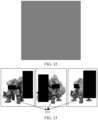
Step 201: Initialize scenes and parameters. - Prior to performing the machine learning fitting, the scene is initialized, including loading models, textures, materials, and the like; then the camera's position and orientation (not optimized), the model's position and orientation, the parameters of the various lights (not optimized), and the automatically generated model UV2 are set. There is also a need to initialize to-be-fitted texture data; the to-be-fitted texture data includes data for each pixel, which may typically be initialized to a gray constant as shown in
FIG. 12 . The parameters of camera position, orientation, and lighting are not optimized in the process of machine learning fitting. - Step 202: Set the orientation of the character, and particularly, set the orientation of the virtual character (that is, the model) during the machine learning fitting.
- In the actual game running, the virtual characters will not always be in the same orientation, so it is necessary to fit the rendering effect of each orientation of the characters, to ensure that the fitting effect of each state of the virtual characters is relatively accurate. As shown in the orientation setting example of the virtual character in
FIG. 13 , three different orientations of thevirtual character 1301 randomly set the orientation of one virtual character at each iteration. - Step 203: Acquire a PBR-based target rendering graph.
- Specifically, PBR rendering processing is performed according to the set orientation; what the PBR rendering processing achieves is a target rendering effect needing to be fitted, and PBR rendering needs to be performed first using resources of an original PBR to obtain a rendering graph (namely, a target rendering graph) of a certain orientation of a
virtual character 1401 as shown inFIG. 14 . - Step 204: Acquire a fitted rendering graph.
- Specifically, the same orientation of the virtual character is adopted; the to-be-fitted texture data is used as a resource; and the rendering is performed in an unlit rendering manner, to obtain a rendering graph with the same orientation as shown in
FIG. 15 (namely, a fitted rendering graph). - Step 205: Calculate Loss.
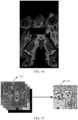
- In order to enable the fitted rendering to approach the original PBR rendering, it is necessary to modify the to-be-fitted texture data firstly, a gap between a PBR-based target rendering graph and the fitted rendering graph is calculated; and
FIG. 16 is a pixel value difference of the two in a screen space, and the embodiment of the present disclosure uses an L1 Loss function, as shown in formula (1):
- Img1 and Img2 represent a PBR-based target rendering graph and a fitted rendering graph, respectively, namely,
FIG. 14 and FIG. 15 ; H and W represent the length and width of Img1 (or Img2), respectively. - Step 206: Determine whether Loss is less than a threshold or not; if so, proceed to step 207 and step 208; and if not, proceed to step 209.
- Step 207: Calculate a gradient of the to-be-fitted texture data.
- After computing Loss, the gradient of Loss to ϕ can be computed through the PyTorch framework and the differentiable rasterization renderer.
- Step 208: Update the to-be-fitted texture data with the gradient.
- After calculating the gradient data of ϕ, the optimizer of PyTorch is used to update ϕ before going to step 202 to enter the next iteration, continuously repeating the iterative process of the previous step 2 to step 7, the data of ϕ will gradually converge and approach the optimal value.
- Step 209: Output the result.
- When the value of Loss is small (less than the set threshold), the fitted rendering graph has been very close to the original PBR effect, namely, the whole iteration process is exited, ϕ is saved into the texture, and UV2 can be used to sample this texture in the game to get close to the PBR-based target rendering graph.
- In the following, the optimization results after baking the rendering to the texture are described from the aspects of inclusion footprint, memory footprint, and computational overhead.
- As shown in
FIG. 17 , theoriginal PBR rendering 1701 generally requires 3 to 4 pieces of textures, while the number oftextures 1702 fitted with the embodiment of the present disclosure has only one piece, so the inclusion footprint has only 1/4 to 1/3 of the previous one, thereby reducing the inclusion footprint. - The actual machine test results of memory occupation are shown in
FIG. 18 ; the actual machine test results of a GPU computing overhead are shown inFIG. 19 . The test tool is PerfDog, both the absolute value and the relative value of memory footprint are greatly reduced, and the computational overhead is greatly reduced and the relative value is relatively small. - In summary, the texture fitted by the embodiments of the present disclosure can be directly applied to a mobile-end game, and the rendering effect of approximating the original PBR can be realized with very low overhead, thus greatly improving the frame rate of the game, and improving the rendering efficiency.
- Having thus described an image rendering method provided by an embodiment of the present disclosure in connection with an exemplary application and implementation of a terminal provided by an embodiment of the present disclosure, the following will continue to describe an image rendering solution implemented by various modules in the image rendering apparatus 465 provided by an embodiment of the present disclosure.
- An
acquisition module 4651 is configured to acquire to-be-fitted texture data of a to-be-rendered virtual object. Afitting module 4652 is configured to perform differential fitting processing on the to-be-fitted texture data to obtain fitted texture data. Abaking module 4653 is configured to bake the fitted texture data into a texture image to obtain a rendered texture image. Arendering module 4654 is configured to perform, based on the rendered texture image, image rendering processing corresponding to the to-be-rendered virtual object to obtain a rendered virtual obj ect. - In all embodiments of the present disclosure, the
fitting module 4652 is preferably further configured to perform standard rendering processing corresponding to the to-be-rendered virtual object to obtain a target rendering graph corresponding to the virtual object. The following iterative processing is performed: performing fitted rendering processing based on the to-be-fitted texture data to obtain a fitted rendering graph; constructing a rendering loss function based on a difference between the target rendering graph and the fitted rendering graph; and updating the to-be-fitted texture data based on the rendering loss function until an iteration end condition is satisfied, and taking the to-be-fitted texture data updated at an end of an iteration as the fitted texture data. - In some embodiments, the
fitting module 4652 is further configured to: acquire a plurality of rendering data of the to-be-rendered virtual object; and perform physical-based rendering processing based on the plurality of rendering data to obtain the target rendering graph corresponding to the virtual object. - In some embodiments, the
fitting module 4652 is further configured to: determine a fitted mapping relationship between texture data and a rendering graph; and map the to-be-fitted texture data based on the fitted mapping relationship to obtain the fitted rendering graph. - In some embodiments, the
fitting module 4652 is further configured to: determine a pixel value difference between the target rendering graph and the fitted rendering graph in a screen space; and determine the rendering loss function based on the pixel value difference and a size of the target rendering graph. - In some embodiments, the
fitting module 4652 is further configured to perform the following processing for any same pixel of the target rendering graph and the fitted rendering graph in the screen space: determining a first pixel value corresponding to the pixel in the fitted rendering graph, and determining a second pixel value corresponding to the pixel in the target rendering graph; taking an absolute value of a difference value between the first pixel value and the second pixel value as a pixel value difference of the pixel; and summing pixel value differences of a plurality of pixels in the target rendering graph as the pixel value difference between the target rendering graph and the fitted rendering graph in the screen space. - In some embodiments, the
fitting module 4652 is further configured to: perform, based on the rendering loss function, partial derivative processing on the to-be-fitted texture data to obtain a gradient of the rendering loss function; and update the to-be-fitted texture data based on the gradient of the rendering loss function to obtain new to-be-fitted texture data. - In some embodiments, the iteration end condition includes at least one of the following: a value of the rendering loss function being less than a loss threshold; and the number of the iteration reaching a set number.
- In some embodiments, the
fitting module 4652 is further configured to: display a setting entry for the iteration end condition; and take the content set by the setting entry as an iteration end condition in response to the setting operation for the setting entry. - In some embodiments, the
fitting module 4652 is further configured to: obtain historical detail degrees of a plurality of historical virtual objects in the virtual scene, one historical virtual object corresponding to at least one historical detail degree; determining a detail degree for rendering the to-be-rendered virtual object based on a plurality of historical detail degrees, types of the detail degree including at least one of the following: a highest historical detail degree; a historical detail degree with a highest application frequency; and a detail degree averaged over the plurality of historical detail degrees; and mapping the detail degree for rendering the to-be-rendered virtual object to obtain the iteration end condition. - In some embodiments, the
fitting module 4652 is further configured to: acquire scene data of a virtual scene; and call, based on the scene data of the virtual scene and the target rendering graph, a condition prediction model to perform condition prediction processing to obtain the iteration end condition, the condition prediction model being obtained by training historical scene data, a historical target rendering graph, and a historical iteration end condition. - In some embodiments, the
rendering module 4654 is further configured to: determine 2D texture coordinates of the to-be-rendered virtual object; and perform, based on the 2D texture coordinates, sampling fitting processing on the rendered texture image to obtain the rendered virtual obj ect. - The embodiments of the present disclosure provide a computer program product or computer program including computer-executable instructions, the computer-executable instructions being stored in a computer-readable storage medium. A processor of an electronic device reads the computer-executable instructions from a computer-readable storage medium, and the processor executes the computer-executable instructions to cause the electronic device to execute the above image rendering method in the embodiments of the present disclosure.
- The embodiments of the present disclosure provide a computer-readable storage medium storing thereon computer-executable instructions that, when executed by a processor, cause the processor to execute an image rendering method provided by embodiments of the present disclosure, for example, the image rendering method illustrated in
FIGs. 3A to 3B . - In some embodiments, the computer-readable storage medium may be a memory such as FRAM, ROM, PROM, EPROM, EEPROM, flash memory, magnetic surface storage, optical disk, or CD-ROM; or various devices including one or any combination of the above memories.
- In some embodiments, the computer-executable instructions may be written in any form of program, software, software module, script, or code, in any form of programming language, including compiled or interpreted languages, or declarative or procedural languages. They may be deployed in any form, including as stand-alone programs or as modules, assemblies, subroutines, or other units suitable for use in a computing environment.
- As an example, the computer-executable instructions may, but need not, correspond to files in a file system, may be stored in a portion of a file that holds other programs or data, for example, in one or more scripts in a hypertext markup language (HTML) document, in a single file dedicated to the program in question, or in multiple coordinated files (for example, files storing one or more modules, subroutines, or portions of code).
- As an example, the computer-executable instructions may be deployed to be executed on one electronic device, or on multiple electronic devices located at one site, or on multiple electronic devices distributed across multiple sites and interconnected by a communication network.
- The above is only embodiments of the present disclosure and is not intended to limit the scope of protection of the present disclosure. Any modification, equivalent replacement, improvement, and the like made within the spirit and scope of the present disclosure shall be included in the scope of protection of the present disclosure.
Claims (16)
- An image rendering method executable by an electronic device, the method comprising:acquiring to-be-fitted texture data of a to-be-rendered virtual object;performing differential fitting processing on the to-be-fitted texture data to obtain fitted texture data;baking the fitted texture data into a texture image to obtain a rendered texture image; andperforming, based on the rendered texture image, image rendering processing on the to-be-rendered virtual object to obtain a rendered virtual object.
- The method according to claim 1, wherein the performing differential fitting processing on the to-be-fitted texture data to obtain fitted texture data comprises:performing standard rendering processing on the to-be-rendered virtual object to obtain a target rendering graph of the virtual object; andperforming the following iterative processing:performing fitted rendering processing based on the to-be-fitted texture data to obtain a fitted rendering graph;constructing a rendering loss function based on a difference between the target rendering graph and the fitted rendering graph; andupdating the to-be-fitted texture data based on the rendering loss function until an iteration end condition is satisfied, and taking the to-be-fitted texture data updated at an end of an iteration as the fitted texture data.
- The method according to claim 2, wherein the performing standard rendering processing on the to-be-rendered virtual object to obtain a target rendering graph of the virtual object comprises:acquiring a plurality of rendering data of the to-be-rendered virtual object; andperforming physically based rendering (PBR) processing based on the plurality of rendering data to obtain the target rendering graph of the virtual object.
- The method according to claim 2, wherein the performing fitted rendering processing based on the to-be-fitted texture data to obtain a fitted rendering graph comprises:determining a fitted mapping relationship between texture data and a rendering graph; andmapping the to-be-fitted texture data based on the fitted mapping relationship to obtain the fitted rendering graph.
- The method according to claim 2, wherein the constructing a rendering loss function based on a difference between the target rendering graph and the fitted rendering graph comprises:determining a pixel value difference between the target rendering graph and the fitted rendering graph in a screen space; anddetermining the rendering loss function based on the pixel value difference and a size of the target rendering graph.
- The method according to claim 5, wherein the determining a pixel value difference between the target rendering graph and the fitted rendering graph in a screen space comprises:
performing the following processing for any same pixel of the target rendering graph and the fitted rendering graph in the screen space:determining a first pixel value of the pixel in the fitted rendering graph, and determining a second pixel value of the pixel in the target rendering graph;taking an absolute value of a difference value between the first pixel value and the second pixel value as a pixel value difference of the pixel; andsumming pixel value differences of a plurality of pixels in the target rendering graph as the pixel value difference between the target rendering graph and the fitted rendering graph in the screen space. - The method according to claim 2, wherein the updating the to-be-fitted texture data based on the rendering loss function comprises:performing, based on the rendering loss function, partial derivative processing on the to-be-fitted texture data to obtain a gradient of the rendering loss function; andupdating the to-be-fitted texture data based on the gradient of the rendering loss function to obtain new to-be-fitted texture data.
- The method according to claim 2, wherein the iteration end condition comprises at least one of the following:a value of the rendering loss function being less than a loss threshold; andthe number of the iteration reaching a set number.
- The method according to claim 8, further comprising:displaying a setting entry of the iteration end condition; andtaking, in response to a setting operation for the setting entry, content input through the setting operation as the iteration end condition.
- The method according to claim 8, further comprising:acquiring historical detail degrees of a plurality of historical virtual objects in a virtual scene, one of the historical virtual objects corresponding to at least one of the historical detail degrees;determining a detail degree for rendering the to-be-rendered virtual object based on a plurality of historical detail degrees,types of the detail degree comprising at least one of the following: a highest historical detail degree; a historical detail degree with a highest application frequency; and a detail degree averaged over the plurality of historical detail degrees; andmapping the detail degree for rendering the to-be-rendered virtual object to obtain the iteration end condition.
- The method according to claim 8, further comprising:acquiring scene data of a virtual scene; andcalling, based on the scene data of the virtual scene and the target rendering graph, a condition prediction model to perform condition prediction processing to obtain the iteration end condition,the condition prediction model being obtained by training historical scene data, a historical target rendering graph, and a historical iteration end condition.
- The method according to claim 1, wherein the performing, based on the rendered texture image, image rendering processing on the to-be-rendered virtual object to obtain a rendered virtual object comprises:determining two-dimensional (2D) texture coordinates of the to-be-rendered virtual object; andperforming, based on the 2D texture coordinates, sampling fitting processing on the rendered texture image to obtain the rendered virtual object.
- An image rendering apparatus, the apparatus comprising:an acquisition module, configured to acquire to-be-fitted texture data of a to-be-rendered virtual object;a fitting module, configured to perform differential fitting processing on the to-be-fitted texture data to obtain fitted texture data;a baking module, configured to bake the fitted texture data into a texture image to obtain a rendered texture image; anda rendering module, configured to perform, based on the rendered texture image, image rendering processing on the to-be-rendered virtual object to obtain a rendered virtual object.
- An electronic device, the electronic device comprising:a memory, configured to store computer-executable instructions; anda processor, configured to implement, when executing the computer-executable instructions stored in the memory, the image rendering method according to any one of claims 1 to 12.
- A computer-readable storage medium storing thereon computer-executable instructions which, when executed by a processor, implement the image rendering method according to any one of claims 1 to 12.
- A computer program product comprising computer programs or computer-executable instructions, the computer programs or computer-executable instructions, when executed by a processor, implementing the image rendering method according to any one of claims 1 to 12.
Applications Claiming Priority (2)
| Application Number | Priority Date | Filing Date | Title |
|---|---|---|---|
| CN202210179700.6A CN116704103A (en) | 2022-02-25 | 2022-02-25 | Image rendering method, device, equipment, storage medium and program product |
| PCT/CN2022/134151 WO2023160054A1 (en) | 2022-02-25 | 2022-11-24 | Image rendering method and apparatus, electronic device, computer-readable storage medium, and computer program product |
Publications (2)
| Publication Number | Publication Date |
|---|---|
| EP4394713A1 true EP4394713A1 (en) | 2024-07-03 |
| EP4394713A4 EP4394713A4 (en) | 2025-03-12 |
Family
ID=87764575
Family Applications (1)
| Application Number | Title | Priority Date | Filing Date |
|---|---|---|---|
| EP22928314.8A Pending EP4394713A4 (en) | 2022-02-25 | 2022-11-24 | Image rendering method and apparatus, electronic device, computer-readable storage medium, and computer program product |
Country Status (4)
| Country | Link |
|---|---|
| US (1) | US20240037839A1 (en) |
| EP (1) | EP4394713A4 (en) |
| CN (1) | CN116704103A (en) |
| WO (1) | WO2023160054A1 (en) |
Families Citing this family (4)
| Publication number | Priority date | Publication date | Assignee | Title |
|---|---|---|---|---|
| CN117078797B (en) * | 2023-10-18 | 2024-02-06 | 腾讯科技(深圳)有限公司 | Rendering methods, devices, electronic equipment, storage media and products for road signs |
| CN117315375B (en) * | 2023-11-20 | 2024-03-01 | 腾讯科技(深圳)有限公司 | Virtual part classification method, device, electronic equipment and readable storage medium |
| CN117351133B (en) * | 2023-12-05 | 2024-07-12 | 腾讯科技(深圳)有限公司 | Data rendering method, device, equipment and computer readable storage medium |
| CN117472592B (en) * | 2023-12-27 | 2024-03-19 | 中建三局集团有限公司 | Three-dimensional model explosion method and system based on vertex shader and texture mapping |
Family Cites Families (4)
| Publication number | Priority date | Publication date | Assignee | Title |
|---|---|---|---|---|
| GB2581374B (en) * | 2019-02-14 | 2022-05-11 | Huawei Tech Co Ltd | 3D face reconstruction system and method |
| US11127225B1 (en) * | 2020-06-01 | 2021-09-21 | Microsoft Technology Licensing, Llc | Fitting 3D models of composite objects |
| CN113963110B (en) * | 2021-10-11 | 2022-10-25 | 北京百度网讯科技有限公司 | Texture map generation method and device, electronic equipment and storage medium |
| CN114067042B (en) * | 2021-11-08 | 2025-06-27 | 腾讯科技(深圳)有限公司 | Image rendering method, device, equipment, storage medium and program product |
-
2022
- 2022-02-25 CN CN202210179700.6A patent/CN116704103A/en active Pending
- 2022-11-24 WO PCT/CN2022/134151 patent/WO2023160054A1/en not_active Ceased
- 2022-11-24 EP EP22928314.8A patent/EP4394713A4/en active Pending
-
2023
- 2023-10-11 US US18/378,778 patent/US20240037839A1/en active Pending
Also Published As
| Publication number | Publication date |
|---|---|
| WO2023160054A1 (en) | 2023-08-31 |
| US20240037839A1 (en) | 2024-02-01 |
| CN116704103A (en) | 2023-09-05 |
| EP4394713A4 (en) | 2025-03-12 |
Similar Documents
| Publication | Publication Date | Title |
|---|---|---|
| EP4394713A1 (en) | Image rendering method and apparatus, electronic device, computer-readable storage medium, and computer program product | |
| US12383820B2 (en) | Method for controlling game display, non-transitory computer-readable storage medium and electronic device | |
| CN114359458B (en) | An image rendering method, apparatus, device, storage medium, and program product. | |
| CN114067042B (en) | Image rendering method, device, equipment, storage medium and program product | |
| US12437464B2 (en) | Method and apparatus, electronic device, computer-readable storage medium, and computer program product for performing real-time image rendering of virtual objects | |
| CN112669194B (en) | Animation processing method, device, equipment and storage medium in virtual scene | |
| CN116958390A (en) | An image rendering method, device, equipment, storage medium and program product | |
| CN114399580B (en) | Image rendering method, device, equipment, storage medium and program product | |
| CN112843704B (en) | Animation model processing method, device, equipment and storage medium | |
| CN117101127A (en) | Image rendering methods, devices, electronic equipment and storage media in virtual scenes | |
| CN117078824A (en) | Parameter fitting methods, devices, equipment, storage media and program products | |
| CN118615703A (en) | Virtual scene rendering method, device, equipment, storage medium and program product | |
| CN115082607B (en) | Virtual character hair rendering method, device, electronic equipment and storage medium | |
| CN114219924B (en) | Adaptive display method, device, equipment, medium and program product for virtual scene | |
| KR100632535B1 (en) | 3D graphic engine and method of providing graphic for mobile communication terminal | |
| CN115719392A (en) | Virtual character generation method and device | |
| HK40095357A (en) | An image rendering method, device, equipment, storage medium and program product | |
| CN121147372A (en) | Object rendering methods, apparatuses, electronic devices, computer-readable storage media, and computer program products | |
| HK40095329A (en) | Image rendering method, device, electronic equipment, storage medium and program product | |
| US20250256207A1 (en) | Displaying levels of detail of 2d and 3d objects in virtual spaces | |
| HK40102318A (en) | Image rendering method, device, equipment, storage medium and program product | |
| CN118537475A (en) | Image rendering method, device, electronic device, storage medium and program product | |
| HK40069398B (en) | Image rendering method, device, equipment, storage medium and program product | |
| CN118384493A (en) | Scene picture processing method and device, storage medium and electronic device | |
| CN119185930A (en) | Scene rendering method, game scene rendering method and device |
Legal Events
| Date | Code | Title | Description |
|---|---|---|---|
| STAA | Information on the status of an ep patent application or granted ep patent |
Free format text: STATUS: THE INTERNATIONAL PUBLICATION HAS BEEN MADE |
|
| PUAI | Public reference made under article 153(3) epc to a published international application that has entered the european phase |
Free format text: ORIGINAL CODE: 0009012 |
|
| STAA | Information on the status of an ep patent application or granted ep patent |
Free format text: STATUS: REQUEST FOR EXAMINATION WAS MADE |
|
| 17P | Request for examination filed |
Effective date: 20240328 |
|
| AK | Designated contracting states |
Kind code of ref document: A1 Designated state(s): AL AT BE BG CH CY CZ DE DK EE ES FI FR GB GR HR HU IE IS IT LI LT LU LV MC ME MK MT NL NO PL PT RO RS SE SI SK SM TR |
|
| REG | Reference to a national code |
Ref country code: DE Ref legal event code: R079 Free format text: PREVIOUS MAIN CLASS: G06T0015200000 Ipc: G06T0015040000 |
|
| A4 | Supplementary search report drawn up and despatched |
Effective date: 20250206 |
|
| RIC1 | Information provided on ipc code assigned before grant |
Ipc: G06T 15/04 20110101AFI20250203BHEP |
|
| DAV | Request for validation of the european patent (deleted) | ||
| DAX | Request for extension of the european patent (deleted) |