EP4394097A1 - Method for producing protein material without using organic solvent - Google Patents
Method for producing protein material without using organic solvent Download PDFInfo
- Publication number
- EP4394097A1 EP4394097A1 EP22861324.6A EP22861324A EP4394097A1 EP 4394097 A1 EP4394097 A1 EP 4394097A1 EP 22861324 A EP22861324 A EP 22861324A EP 4394097 A1 EP4394097 A1 EP 4394097A1
- Authority
- EP
- European Patent Office
- Prior art keywords
- protein material
- raw material
- protein
- water
- solution containing
- Prior art date
- Legal status (The legal status is an assumption and is not a legal conclusion. Google has not performed a legal analysis and makes no representation as to the accuracy of the status listed.)
- Pending
Links
Images


Classifications
-
- C—CHEMISTRY; METALLURGY
- C08—ORGANIC MACROMOLECULAR COMPOUNDS; THEIR PREPARATION OR CHEMICAL WORKING-UP; COMPOSITIONS BASED THEREON
- C08H—DERIVATIVES OF NATURAL MACROMOLECULAR COMPOUNDS
- C08H1/00—Macromolecular products derived from proteins
- C08H1/06—Macromolecular products derived from proteins derived from horn, hoofs, hair, skin or leather
-
- C—CHEMISTRY; METALLURGY
- C08—ORGANIC MACROMOLECULAR COMPOUNDS; THEIR PREPARATION OR CHEMICAL WORKING-UP; COMPOSITIONS BASED THEREON
- C08H—DERIVATIVES OF NATURAL MACROMOLECULAR COMPOUNDS
- C08H1/00—Macromolecular products derived from proteins
-
- C—CHEMISTRY; METALLURGY
- C08—ORGANIC MACROMOLECULAR COMPOUNDS; THEIR PREPARATION OR CHEMICAL WORKING-UP; COMPOSITIONS BASED THEREON
- C08L—COMPOSITIONS OF MACROMOLECULAR COMPOUNDS
- C08L89/00—Compositions of proteins; Compositions of derivatives thereof
- C08L89/04—Products derived from waste materials, e.g. horn, hoof or hair
- C08L89/06—Products derived from waste materials, e.g. horn, hoof or hair derived from leather or skin, e.g. gelatin
-
- D—TEXTILES; PAPER
- D01—NATURAL OR MAN-MADE THREADS OR FIBRES; SPINNING
- D01F—CHEMICAL FEATURES IN THE MANUFACTURE OF ARTIFICIAL FILAMENTS, THREADS, FIBRES, BRISTLES OR RIBBONS; APPARATUS SPECIALLY ADAPTED FOR THE MANUFACTURE OF CARBON FILAMENTS
- D01F4/00—Monocomponent artificial filaments or the like of proteins; Manufacture thereof
Definitions
- organic solvents are known to have adverse effects on living organisms or living bodies. Therefore, there is a need for a method for producing protein materials that does not use organic solvents, and protein materials that do not contain organic solvents obtained thereby.
- a protein material that does not contain an organic solvent can be obtained.
- Protein materials that do not contain organic solvents have less adverse effects on living organisms or living bodies and are less harmful to the ecosystem, the natural world, or the environment.
- the method for producing a protein material of the present invention that does not use an organic solvent also has less adverse effects on living organisms or living bodies and less harmful to the ecosystem, the natural world, or the environment.
- the present invention provides a method for producing a protein material comprising: dispensing a solution containing a protein material raw material into a water-based medium; and drying the dispensed protein material raw material.
- the solution containing a protein material raw material can be prepared by dissolving the protein material raw material in a solvent.
- the solution containing the protein material raw material contains substantially no organic solvent or does not contain an organic solvent.
- the type of the solvent in which the protein material raw material is dissolved is not particularly limited and can be selected according to the type and the concentration of the protein material raw material, the pH and the temperature of the solvent, the temperature of the water-based medium into which the solution containing the protein material raw material is dispensed, the shape and the strength of the protein material, and the like.
- the solvent include water, aqueous solutions containing salts, phosphate buffered salines, culture solutions, and mixtures thereof.
- the temperature of the solution may be, for example, 53°C or lower, 37°C or lower, 0°C to 53°C, 4°C to 53°C, 0°C to 50°C, 4°C to 50°C, 0°C to 40°C, 4°C to 40°C, 0°C to 37°C, 4°C to 37°C, 0°C to 30°C, 4°C to 30°C, 0°C to 20°C, 4°C to 20°C, 0°C to 10°C, 4°C to 10°C, 4°C, and the like.
- water-based medium into which the solution containing the protein material raw material is dispensed examples include, but not limited to, ultrapure water, pure water and distilled water.
- the water-based medium into which the solution containing the protein material raw material is dispensed is, as an embodiment, water.
- the water-based medium into which the solution containing the protein material raw material is dispensed may contain, for example, inorganic salts, organic salts, proteins, growth factors, organic low molecular weight compounds, inorganic substances, and the like. However, these are the substances that can be dissolved or dispersed in water.
- the organic solution is, for example, a polar organic solvent.
- the organic solvent include acetonitrile, acetone and methanol.
- the water-based medium into which the solution containing the protein material raw material is dispensed contains substantially no these organic solvents.
- the combination of the temperature of the solution containing protein material raw material and the temperature of the water-based medium into which the solution containing the protein material raw material is dispensed may also be appropriately selected from the above temperatures of the solution containing protein material raw material and the above temperatures of the water-based medium into which the solution containing the protein material raw material is dispensed, respectively, according to the type and the concentration of the protein material raw material, the type and the pH of the solvent, the shape and the strength of the protein material, and the like.
- the combination of the temperature of the solution containing protein material raw material and the temperature of the water-based medium into which the solution containing the protein material raw material is dispensed may be 0°C to 53°C and 0°C to 53°C, 0°C to 4°C and 25°C to 53°C, 4°C and 4°C to 45°C, 4°C and 37°C to 45°C, and the like.
- the protein material produced by the method of the present invention does not contain organic solvents, and thus have less adverse effects on living organisms or living bodies and are less harmful to the ecosystem, the natural world, or the environment than protein materials produced using organic solvents.
- the method of the present invention for producing the protein material without using organic solvents also has less adverse effects on living organisms or living bodies and less adverse effects on the ecosystem, the natural world, or the environment.
- the protein material produced by the method of the present invention does not contain organic solvents, even during or after the disposition and disposal of the protein material after use, it has less adverse effects on living organisms or living bodies and is less harmful to the ecosystem, the natural world, or the environment than protein materials produced using organic solvents.
- the shape of the protein material produced by the method of the present invention can be varied according to the use applications of the material and other factors.
- one-dimensional fibrous materials include, but are not limited to, thread-like, rod-like, needle-like, and column-like materials.
- sheet-like materials include, but are not limited to, plate-like, film-like materials, and cardiomyocyte sheets.
- steric materials include, but are not limited to, vascular, organ-like, spherical, block-like, and container-like materials. Fibers may be intertwined or woven together to increase the strength.
- the elastic modulus of the protein material produced by the method of the present invention can be varied according to the use applications of the material and other factors.
- the elastic modulus of the protein material varies according to the type and the concentration of the protein material raw material, the type, the pH and the temperature of the solvent of the solution containing the protein material raw material, the temperature of the water-based medium into which the solution containing the protein material raw material is dispensed, the type and the concentration of salts included in the water-based medium into which the solution containing the protein material raw material is dispensed, the dispensation speed, and the like.
- Dispensation of the solution containing the protein material raw material into the water-based medium can be performed according to known methods, and can be performed, for example, using a nozzle and an injection needle.
- the protein material raw material is dispensed as an aqueous solution.
- Conditions, such as the size and the shape of the dispensation opening and the dispensation speed can be changed according to the type and the concentration of the protein material raw material, the type, the pH and the temperature of the solvent of the solution containing the protein material raw material, the temperature of the water-based medium into which the solution containing the protein material raw material is dispensed, and the shape and the strength of the desired protein material.
- Examples of the size of the dispensation opening include, but are not limited to, 7G to 33G, 10G to 30G, 7G to 25G, 10G to 25G, 14G to 30G, 14G to 25G, 14G to 20G, 20G to 25G, 14G, 20G and 25G.
- examples of the size of the dispensation opening include, but are not limited to, 4.0 mm to 80 ⁇ m ID, 2.8 mm to 130 ⁇ m ID, 4.0 mm to 260 ⁇ m ID, 2.8 mm to 260 ⁇ m ID, 1.6 mm to 130 ⁇ m ID, 1.6 mm to 260 ⁇ m ID, 1.6 mm to 600 ⁇ m ID, 600 ⁇ m to 260 ⁇ m ID, 1.6 mm ID, 600 ⁇ m ID and 260 ⁇ m ID.
- Examples of the dispensation speed include, but are not limited to, 0.1 mL/min to 100 mL/min, 0.5 mL/min to 50 mL/min, 0.6 mL/min to 30 mL/min, 0.7 mL/min to 10 mL/min, 0.8 mL/min to 8 mL/min, 0.9 mL/min to 5 mL/min, and 1 mL/min, or 0.1 mm/min to 100 mm/min, 0.5 mm/min to 50 mm/min, 0.6 mm/min to 30 mm/min, 0.7 mm/min to 10 mm/min, 0.8 mm/min to 8 mm/min, 0.9 mm/min to 5 mm/min, and 1 mm/min.
- Dispensation of the solution containing the protein material raw material into the water-based medium may be in any direction, including a horizontal, upward, or downward direction, or a direction with any inclined angle, in the water-based medium into which the solution containing the protein material raw material is dispensed.
- Dispensation of the solution containing the protein material raw material may be performed according to known wet spinning methods.
- the protein material raw material may be dispensed using a combination of a known liquid printing method and a 3D printer to be shaped as a sheet-like material to match, for example, the morphology of a cardiomyocyte sheet, or to be shaped as a steric material to match, for example, the morphology of a blood vessel or an organ.
- the solution containing the protein material raw material may be homogenized before the solution containing the protein material raw material is dispensed into the water-based medium.
- the homogenization of the solution containing the protein material raw material may be performed under cooling, for example, in an ice bath.
- the protein material raw material may be crosslinked.
- Methods for cross-linking are known and include, but are not limited to, cross-linking using crosslinkers, such as formaldehyde, glutaraldehyde, carbodiimide, and cross-linking using transglutaminase.
- Cross-linking of the protein material raw material can not only increase the strength of the protein material, but also prevent redissolution of the protein material raw material in the aqueous solution.
- the dispensed protein material raw material obtained by dispensing the solution containing the protein material raw material into the water-based medium is dried. Drying can be performed by known methods. Air drying, ventilation drying, drying under reduced pressure, and freeze-drying can be used, but methods for drying are not limited thereto.
- the temperature of drying may be 10°C to 70°C, 10°C to 60°C, 10°C to 50°C, 10°C to 40°C, 10°C to 30°C, 10°C to 20°C, 20°C to 70°C, 20°C to 60°C, 20°C to 50°C, 20°C to 40°C, 20°C to 30°C, 30°C to 70°C, 30°C to 60°C, 30°C to 50°C, 30°C to 40°C, 40°C to 70°C, 40°C to 60°C, 40°C to 50°C, 40°C, 37°C, 35°C, 30°C, 25°C, 20°C, room temperature, and the like.
- the time of drying may be 10 minutes to 7 days, 10 minutes to 3 days, 10 minutes to 24 hours, 20 minutes to 7 days, 20 minutes to 3 days, 20 minutes to 24 hours, 1 hour to 7 days, 1 hour to 3 days, 1 hour to 24 hours, 3 hours to 24 hours, 6 hours to 24 hours, 9 hours to 24 hours, 12 hours to 24 hours, 18 hours to 24 hours, 1 hour to 18 hours, 3 hours to 18 hours, 6 hours to 18 hours, 9 hours to 18 hours, 12 hours to 18 hours, 1 hours to 12 hours, 3 hours to 12 hours, 6 hours to 12 hours, 9 hours to 12 hours, 1 hour to 9 hours, 3 hours to 9 hours, 6 hours to 9 hours, 1 hour to 6 hours, 3 hours to 6 hours, overnight, 4 hours, 8 hours, 12 hours, 24 hours, and the like.
- a protein material having a high elastic modulus can also be obtained by the method of the present invention.
- the elastic modulus of the protein material obtained by the method of the present invention can be 1 GPa to 3 GPa or higher.
- a fiber with a higher elastic modulus can be obtained by sufficiently drying the protein material using drying under reduced pressure or other means.
- the elastic modulus of the protein material can be 4.5 GPa to 8 GPa, 5 GPa to 8 GPa or higher when drying is performed by drying under reduced pressure.
- the elastic modulus can be measured and calculated using a tensile strength testing equipment. Various tensile strength testing equipment have been designed, are commercially available, and can be used as appropriate.
- 300 mg of type I collagen derived from a pig skin (provided by NH Foods Ltd.) was placed in 30 mL of 1x phosphate buffered saline solution (PBS) (SIGMA-ALDRICH, D5652-10L, St. Louis, USA) in a 50 mL centrifuge tube (CORNING, 430829, New York, USA) and fibrillated in an ice bath for 6 minutes using a homogenizer with a diameter of 8 mm (AS ONE Bioscience, VH-10, Osaka, Japan) to obtain a 1 wt% collagen aqueous solution.
- PBS 1x phosphate buffered saline solution
- CORNING 430829, New York, USA
- the prepared fibers were observed on glass slides using a phase contrast microscope, and the tensile modulus was measured using an elastic modulus measuring instrument under the conditions including the area of each fiber, distance between grippers: 40 mm, tensile speed: 1 mm/min, and temperature: 25°C.
- Figure 2 shows the elastic modulus of collagen fibers prepared at 37°C, and 45°C.
- the elastic modulus of collagen fibers prepared in water at 37°C was 5 GPa
- the elastic modulus of collagen fibers prepared in water at 45°C was 4.5 GPa. No significant difference was observed therebetween.
- fibers were prepared in water at 37°C.
- Figure 3 shows photographs of the fibers 1 hour after the spinning.
- the gelation time in water was the same for 14, 20 and 25G needles.
- Figure 4 shows the elastic modulus of the collagen fibers prepared with various inner diameters of needles. No significant difference was observed between the needles of 14G and 20G with the elastic modulus of 5 GPa, while 25G showed a marked decrease with the elastic modulus of 1.5 GPa.
- Fibers were prepared in the same manner as Examples 1 or 2 using 2 wt% collagen aqueous solution at 4°C, ultrapure water at 37°C or 60% acetonitrile (ACN), and a needle of 20G.
- Tensile modulus of the prepared fibers was measured using an elastic modulus measuring instrument under the conditions including the area of each fiber, distance between grippers: 40 mm, tensile speed: 1 mm/min, and temperature: 25°C.
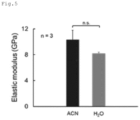
- the elastic modulus of collagen fibers prepared using ultrapure water at 37°C was 8 GPa, and it was not significantly different from the elastic modulus of 10 GPa of collagen fibers prepared using an organic solvent of 60% acetonitrile (ACN) ( Figure 5 ).
- the method can also be used to construct two-dimensional or three-dimensional protein materials.
Landscapes
- Chemical & Material Sciences (AREA)
- Health & Medical Sciences (AREA)
- Chemical Kinetics & Catalysis (AREA)
- Medicinal Chemistry (AREA)
- Organic Chemistry (AREA)
- Polymers & Plastics (AREA)
- Engineering & Computer Science (AREA)
- Dermatology (AREA)
- Life Sciences & Earth Sciences (AREA)
- Biochemistry (AREA)
- Materials Engineering (AREA)
- Textile Engineering (AREA)
- General Chemical & Material Sciences (AREA)
- Peptides Or Proteins (AREA)
Abstract
Description
- The present invention relates to a method for producing a protein material without using an organic solvent and a protein material produced thereby.
- Protein materials are used as one-dimensional fibrous materials, two-dimensional sheet-like materials, and three-dimensional steric materials. Protein materials are generally obtained by production methods that use organic solvents, such as a method comprising dispensing a protein solution into an organic solvent (Patent Literature 1). Protein materials produced using organic solvents usually contain organic solvents.
- Patent Literature 1:
Japanese Patent Laid-Open No. 2005-314865 - However, organic solvents are known to have adverse effects on living organisms or living bodies. Therefore, there is a need for a method for producing protein materials that does not use organic solvents, and protein materials that do not contain organic solvents obtained thereby.
- As a result of the intensive research efforts to solve the problem above, the present inventors have surprisingly found that a protein material can be obtained by dispensing a solution containing a protein material raw material into a water-based medium and drying the dispensed protein material raw material, thus completing the present invention. That is, the present invention provides the following.
-
- (1) A method for producing a protein material, the method comprising:
- dispensing a solution containing a protein material raw material into a water-based medium; and
- drying the dispensed protein material raw material.
- (2) The method described in (1), wherein the water-based medium does not contain an organic solvent.
- (3) The method described in (1) or (2), wherein the temperature of the water-based medium is from 4°C to 53°C.
- (4) The method described in any one of (1) to (3), wherein the temperature of the solution containing the protein material raw material is 37°C or lower.
- (5) The method described in any one of (1) to (4), wherein the concentration of the protein material raw material is from 0.1 wt% to 5 wt%.
- (6) The method described in any one of (1) to (5), wherein the obtained protein material is selected from the group consisting of a fibrous material, a sheet-like material and a steric material.
- (7) The method described in any one of (1) to (6), wherein the protein material raw material is selected from the group consisting of type I collagen, type II collagen, type III collagen, type V collagen, type XI collagen, keratin, myosin and elastin.
- (8) The method described in (7), wherein the protein material raw material is type I collagen.
- (9) The method described in any one of (1) to (8), wherein drying is performed by drying under reduced pressure.
- (10) The method described in any one of (1) to (9), wherein the elastic modulus of the obtained protein material is 1 GPa or higher.
- (11) The method described in any one of (1) to (10), wherein the elastic modulus of the obtained protein material is 8 GPa or higher.
- (12) The method described in any one of (1) to (11), wherein the obtained protein material is for medical use.
- According to the present invention, a protein material that does not contain an organic solvent can be obtained. Protein materials that do not contain organic solvents have less adverse effects on living organisms or living bodies and are less harmful to the ecosystem, the natural world, or the environment. The method for producing a protein material of the present invention that does not use an organic solvent also has less adverse effects on living organisms or living bodies and less harmful to the ecosystem, the natural world, or the environment.
-
- [
Figure 1] Figure 1 shows photographs taken 1 hour after dispensing an aqueous solution of 1 wt% collagen into water at 4°C, 25°C, 37°C or 45°C. It was possible to prepare a protein material in water at temperatures of 4°C, 25°C, 37°C and 45°C. - [
Figure 2] Figure 2 shows the elastic modulus of collagen fibers prepared in water at 37°C or 45°C. It was possible to prepare a protein material with high elastic modulus in water at 37°C and 45°C. - [
Figure 3] Figure 3 shows photographs taken 1 hour after injecting an aqueous solution of 1 wt% collagen into water using a syringe pump equipped with a 14, 20 or 25 G needle. The gelation time in water was the same for the 14, 20 and 25 G needles. It was possible to prepare a protein material in water using the syringe pumps equipped with the 14, 20 and 25 G needles. - [
Figure 4] Figure 4 shows the elastic modulus of collagen fibers prepared in water using a syringe pump equipped with a 14, 20 or 25 G needle. Using the syringe pumps equipped with the 14 and 20 G needles, it was possible to prepare a protein material having the elastic modulus of approximately 5 GPa. - [
Figure 5] Figure 5 shows the elastic modulus of collagen fibers prepared in an organic solvent of 60% acetonitrile (ACN) or in water. The elastic modulus of collagen fibers prepared in the organic solvent of 60% acetonitrile (ACN) is 10 GPa, while the elastic modulus of collagen fibers prepared in water is 8 GPa. The elastic modulus of the protein material prepared in water was not significantly different from that of the protein material prepared in acetonitrile (ACN). - The present invention provides a method for producing a protein material comprising: dispensing a solution containing a protein material raw material into a water-based medium; and drying the dispensed protein material raw material.
- The protein material raw material is a protein that has a fibrous structure, and there are many protein material raw materials making up connective tissues, tendons, bones, and skeletal muscles of living bodies. Examples of protein material raw materials include, but are not limited to, collagens, keratins, myosins, elastins, resilins, silk proteins, and amyloids. Families of protein material raw materials are also included. For example, in the case of collagens, types I, II, III, V, XI collagens, atelocollagens and the like are included. The protein material raw material may be derived from any part of any animal. Methods for obtaining and purifying protein material raw materials from living bodies are known. The protein material raw material may be a wild-type protein, may be a mutant protein, or may be a modified protein. The protein material raw material may be extracted from living body tissues or may be artificially produced by methods, such as peptide chemical synthesis or genetic recombination. According to the physical properties, such as the strength and the shape and the chemical and biological properties of the desired protein material, types of the protein material raw material can be selected, or mutations or modifications can be added by known methods.
- The solution containing a protein material raw material can be prepared by dissolving the protein material raw material in a solvent. The solution containing the protein material raw material contains substantially no organic solvent or does not contain an organic solvent. The type of the solvent in which the protein material raw material is dissolved is not particularly limited and can be selected according to the type and the concentration of the protein material raw material, the pH and the temperature of the solvent, the temperature of the water-based medium into which the solution containing the protein material raw material is dispensed, the shape and the strength of the protein material, and the like. Examples of the solvent include water, aqueous solutions containing salts, phosphate buffered salines, culture solutions, and mixtures thereof.
- The concentration of the protein material raw material in the solution containing the protein material raw material can be selected appropriately according to the type of the protein material raw material, the type, the pH and the temperature of the solvent, the temperature of the water-based medium into which the solution containing the protein material raw material is dispensed, the shape and the strength of the protein material, and the like. The concentration of the protein material raw material may be, for example, 0.1 wt% to 5 wt%, 0.5 wt% to 4 wt%, 0.8 wt% to 3 wt%, 1 wt% to 2 wt%, and the like.
- The pH of the solution containing the protein material raw material can be selected appropriately according to the type and the concentration of the protein material raw material, the type and the temperature of the solvent, the temperature of the water-based medium into which the solution containing the protein material raw material is dispensed, the shape and the strength of the protein material, and the like. The pH of the solution may be, for example, pH 6.0 to pH 9.0, pH 6.0 to pH 8.0, pH 7.0 to pH 9.0, pH 7.0 to pH 8.0, pH 7.4, and the like.
- The temperature of the solution containing the protein material raw material can be selected appropriately according to the type and the concentration of the protein material raw material, the type and the pH of the solvent, the temperature of the water-based medium into which the solution containing the protein material raw material is dispensed, the shape and the strength of the protein material, and the like. The temperature of the solution may be, for example, 53°C or lower, 37°C or lower, 0°C to 53°C, 4°C to 53°C, 0°C to 50°C, 4°C to 50°C, 0°C to 40°C, 4°C to 40°C, 0°C to 37°C, 4°C to 37°C, 0°C to 30°C, 4°C to 30°C, 0°C to 20°C, 4°C to 20°C, 0°C to 10°C, 4°C to 10°C, 4°C, and the like.
- The water-based medium into which the solution containing the protein material raw material is dispensed contains substantially no organic solvent. The concentration of the organic solvent in the water-based medium into which the solution containing the protein material raw material is dispensed is preferably less than 1 volume percent (vol%), less than 0.5 vol%, less than 0.1 vol%, less than 0.05 vol%, less than 0.01 vol%, less than 0.005 vol%, or less than 0.001 vol%. More preferably, the water-based medium into which the solution containing the protein material raw material is dispensed does not contain an organic solvent. To not contain an organic solvent means that no organic solvent is detected using means or methods known to those skilled in the art. Examples of water-based medium into which the solution containing the protein material raw material is dispensed include, but not limited to, ultrapure water, pure water and distilled water. The water-based medium into which the solution containing the protein material raw material is dispensed is, as an embodiment, water. The water-based medium into which the solution containing the protein material raw material is dispensed may contain, for example, inorganic salts, organic salts, proteins, growth factors, organic low molecular weight compounds, inorganic substances, and the like. However, these are the substances that can be dissolved or dispersed in water.
- In the present application, the organic solution is, for example, a polar organic solvent. Examples of the organic solvent include acetonitrile, acetone and methanol. The water-based medium into which the solution containing the protein material raw material is dispensed contains substantially no these organic solvents.
- The temperature of the water-based medium into which the solution containing the protein material raw material is dispensed can be appropriately selected according to the type and the concentration of the protein material raw material, the type, the pH and the temperature of the solvent, the shape and the strength of the protein material, and the like. The temperature of the water-based medium into which the solution containing the protein material raw material is dispensed may be 53°C or less, 0°C to 53°C, 0°C to 45°C, 0°C to 37°C, 0°C to 25°C, 4°C to 53°C, 4°C to 45°C, 4°C to 37°C, 4°C to 25°C, 10°C to 53°C, 10°C to 45°C, 10°C to 37°C, 10°C to 25°C, 20°C to 53°C, 20°C to 45°C, 20°C to 37°C, 20°C to 25°C, 25°C to 53°C, 25°C to 45°C, 25°C to 37°C, 30°C to 53°C, 30°C to 45°C, 30°C to 37°C, 37°C to 53°C, 37°C to 45°C, 4°C, 25°C, 37°C, 45°C, and the like.
- The combination of the temperature of the solution containing protein material raw material and the temperature of the water-based medium into which the solution containing the protein material raw material is dispensed may also be appropriately selected from the above temperatures of the solution containing protein material raw material and the above temperatures of the water-based medium into which the solution containing the protein material raw material is dispensed, respectively, according to the type and the concentration of the protein material raw material, the type and the pH of the solvent, the shape and the strength of the protein material, and the like. The combination of the temperature of the solution containing protein material raw material and the temperature of the water-based medium into which the solution containing the protein material raw material is dispensed may be 0°C to 53°C and 0°C to 53°C, 0°C to 4°C and 25°C to 53°C, 4°C and 4°C to 45°C, 4°C and 37°C to 45°C, and the like.
- The protein material produced by the method of the present invention may be applied to all use applications. The protein material may be applied, for example, in the medical field, including regenerative medicine and surgery, or as containers, threads, fabrics, clothing, and the like.
- The protein material produced by the method of the present invention does not contain organic solvents, and thus have less adverse effects on living organisms or living bodies and are less harmful to the ecosystem, the natural world, or the environment than protein materials produced using organic solvents. The method of the present invention for producing the protein material without using organic solvents also has less adverse effects on living organisms or living bodies and less adverse effects on the ecosystem, the natural world, or the environment. Furthermore, because the protein material produced by the method of the present invention does not contain organic solvents, even during or after the disposition and disposal of the protein material after use, it has less adverse effects on living organisms or living bodies and is less harmful to the ecosystem, the natural world, or the environment than protein materials produced using organic solvents.
- The shape of the protein material produced by the method of the present invention can be varied according to the use applications of the material and other factors. As the shape of the protein material, one-dimensional fibrous materials, two-dimensional sheet-like materials, and three-dimensional steric materials can be cited as examples. Examples of fibrous materials include, but are not limited to, thread-like, rod-like, needle-like, and column-like materials. Examples of sheet-like materials include, but are not limited to, plate-like, film-like materials, and cardiomyocyte sheets. Examples of steric materials include, but are not limited to, vascular, organ-like, spherical, block-like, and container-like materials. Fibers may be intertwined or woven together to increase the strength.
- The elastic modulus of the protein material produced by the method of the present invention can be varied according to the use applications of the material and other factors. The elastic modulus of the protein material varies according to the type and the concentration of the protein material raw material, the type, the pH and the temperature of the solvent of the solution containing the protein material raw material, the temperature of the water-based medium into which the solution containing the protein material raw material is dispensed, the type and the concentration of salts included in the water-based medium into which the solution containing the protein material raw material is dispensed, the dispensation speed, and the like.
- Dispensation of the solution containing the protein material raw material into the water-based medium can be performed according to known methods, and can be performed, for example, using a nozzle and an injection needle. Typically, the protein material raw material is dispensed as an aqueous solution. Conditions, such as the size and the shape of the dispensation opening and the dispensation speed can be changed according to the type and the concentration of the protein material raw material, the type, the pH and the temperature of the solvent of the solution containing the protein material raw material, the temperature of the water-based medium into which the solution containing the protein material raw material is dispensed, and the shape and the strength of the desired protein material. Examples of the size of the dispensation opening include, but are not limited to, 7G to 33G, 10G to 30G, 7G to 25G, 10G to 25G, 14G to 30G, 14G to 25G, 14G to 20G, 20G to 25G, 14G, 20G and 25G. Alternatively, examples of the size of the dispensation opening include, but are not limited to, 4.0 mm to 80 µm ID, 2.8 mm to 130 µm ID, 4.0 mm to 260 µm ID, 2.8 mm to 260 µm ID, 1.6 mm to 130 µm ID, 1.6 mm to 260 µm ID, 1.6 mm to 600 µm ID, 600 µm to 260 µm ID, 1.6 mm ID, 600 µm ID and 260 µm ID. Examples of the dispensation speed include, but are not limited to, 0.1 mL/min to 100 mL/min, 0.5 mL/min to 50 mL/min, 0.6 mL/min to 30 mL/min, 0.7 mL/min to 10 mL/min, 0.8 mL/min to 8 mL/min, 0.9 mL/min to 5 mL/min, and 1 mL/min, or 0.1 mm/min to 100 mm/min, 0.5 mm/min to 50 mm/min, 0.6 mm/min to 30 mm/min, 0.7 mm/min to 10 mm/min, 0.8 mm/min to 8 mm/min, 0.9 mm/min to 5 mm/min, and 1 mm/min. There may be one dispensation opening, or there may be several ones to dispense a large volume, for example. Dispensation of the solution containing the protein material raw material into the water-based medium may be in any direction, including a horizontal, upward, or downward direction, or a direction with any inclined angle, in the water-based medium into which the solution containing the protein material raw material is dispensed.
- Dispensation of the solution containing the protein material raw material may be performed according to known wet spinning methods. The protein material raw material may be dispensed using a combination of a known liquid printing method and a 3D printer to be shaped as a sheet-like material to match, for example, the morphology of a cardiomyocyte sheet, or to be shaped as a steric material to match, for example, the morphology of a blood vessel or an organ.
- The solution containing the protein material raw material may be homogenized before the solution containing the protein material raw material is dispensed into the water-based medium. The homogenization of the solution containing the protein material raw material may be performed under cooling, for example, in an ice bath.
- The protein material raw material dispensed into the water-based medium may be extended prior to drying. Extension can be performed by known methods. Extension is preferably performed in water or during drying.
- The protein material raw material may be crosslinked. Methods for cross-linking are known and include, but are not limited to, cross-linking using crosslinkers, such as formaldehyde, glutaraldehyde, carbodiimide, and cross-linking using transglutaminase. Cross-linking of the protein material raw material can not only increase the strength of the protein material, but also prevent redissolution of the protein material raw material in the aqueous solution.
- In the method of the present invention, the dispensed protein material raw material obtained by dispensing the solution containing the protein material raw material into the water-based medium is dried. Drying can be performed by known methods. Air drying, ventilation drying, drying under reduced pressure, and freeze-drying can be used, but methods for drying are not limited thereto. The temperature of drying may be 10°C to 70°C, 10°C to 60°C, 10°C to 50°C, 10°C to 40°C, 10°C to 30°C, 10°C to 20°C, 20°C to 70°C, 20°C to 60°C, 20°C to 50°C, 20°C to 40°C, 20°C to 30°C, 30°C to 70°C, 30°C to 60°C, 30°C to 50°C, 30°C to 40°C, 40°C to 70°C, 40°C to 60°C, 40°C to 50°C, 40°C, 37°C, 35°C, 30°C, 25°C, 20°C, room temperature, and the like. The time of drying may be 10 minutes to 7 days, 10 minutes to 3 days, 10 minutes to 24 hours, 20 minutes to 7 days, 20 minutes to 3 days, 20 minutes to 24 hours, 1 hour to 7 days, 1 hour to 3 days, 1 hour to 24 hours, 3 hours to 24 hours, 6 hours to 24 hours, 9 hours to 24 hours, 12 hours to 24 hours, 18 hours to 24 hours, 1 hour to 18 hours, 3 hours to 18 hours, 6 hours to 18 hours, 9 hours to 18 hours, 12 hours to 18 hours, 1 hours to 12 hours, 3 hours to 12 hours, 6 hours to 12 hours, 9 hours to 12 hours, 1 hour to 9 hours, 3 hours to 9 hours, 6 hours to 9 hours, 1 hour to 6 hours, 3 hours to 6 hours, overnight, 4 hours, 8 hours, 12 hours, 24 hours, and the like.
- A protein material having a high elastic modulus can also be obtained by the method of the present invention. The elastic modulus of the protein material obtained by the method of the present invention can be 1 GPa to 3 GPa or higher. In the method of the present invention, a fiber with a higher elastic modulus can be obtained by sufficiently drying the protein material using drying under reduced pressure or other means. In the method of the present invention, the elastic modulus of the protein material can be 4.5 GPa to 8 GPa, 5 GPa to 8 GPa or higher when drying is performed by drying under reduced pressure. The elastic modulus can be measured and calculated using a tensile strength testing equipment. Various tensile strength testing equipment have been designed, are commercially available, and can be used as appropriate.
- 300 mg of type I collagen derived from a pig skin (provided by NH Foods Ltd.) was placed in 30 mL of 1x phosphate buffered saline solution (PBS) (SIGMA-ALDRICH, D5652-10L, St. Louis, USA) in a 50 mL centrifuge tube (CORNING, 430829, New York, USA) and fibrillated in an ice bath for 6 minutes using a homogenizer with a diameter of 8 mm (AS ONE Bioscience, VH-10, Osaka, Japan) to obtain a 1 wt% collagen aqueous solution. 10 mL of 1 wt% collagen aqueous solution at 4°C was placed in a Terumo syringe (medium mouth), and the syringe equipped with a Top three-way stopcock and a 20G needle was placed in a syringe pump. The solution was spun and cut by every 0.5 mL into 50 mL of ultrapure water at 4, 25, 37, and 45°C in No. 7 sample tube bottles at a spinning speed of 1 mL/min and incubated at each temperature for 1 hour. Then taken out into air, fibers were prepared by performing air-drying for 20 minutes. Subsequently, thermoresponsive collagen fibers were obtained by performing drying under reduced pressure overnight. The prepared fibers were observed on glass slides using a phase contrast microscope, and the tensile modulus was measured using an elastic modulus measuring instrument under the conditions including the area of each fiber, distance between grippers: 40 mm, tensile speed: 1 mm/min, and temperature: 25°C.
-
Figure 1 shows photographs of thefibers 1 hour after the spinning. It was possible to prepare the fibers in water at 4°C, 25°C, 37°C, and 45°C. -
Figure 2 shows the elastic modulus of collagen fibers prepared at 37°C, and 45°C. The elastic modulus of collagen fibers prepared in water at 37°C was 5 GPa, and the elastic modulus of collagen fibers prepared in water at 45°C was 4.5 GPa. No significant difference was observed therebetween. - In Examples below, fibers were prepared in water at 37°C.
- 10 mL of 1 wt% collagen aqueous solution at 4°C was placed in a Terumo syringe (medium mouth), and the syringe equipped with a Top three-way stopcock and a 14, 20, or 25G needle was placed in a syringe pump. The solution was spun and cut by every 0.5 mL into 50 mL of ultrapure water at 37°C in a sample tube bottle at a spinning speed of 1 mL/min and incubated at 37°C for 1 hour. Then taken out into air, fibers were prepared by performing air-drying for 20 minutes. Subsequently, thermoresponsive collagen fibers were obtained by performing drying under reduced pressure overnight. Tensile modulus of the prepared fibers was measured using an elastic modulus measuring instrument under the conditions including the area of each fiber, distance between grippers: 40 mm, tensile speed: 1 mm/min, and temperature: 25°C.
-
Figure 3 shows photographs of thefibers 1 hour after the spinning. The gelation time in water was the same for 14, 20 and 25G needles. -
Figure 4 shows the elastic modulus of the collagen fibers prepared with various inner diameters of needles. No significant difference was observed between the needles of 14G and 20G with the elastic modulus of 5 GPa, while 25G showed a marked decrease with the elastic modulus of 1.5 GPa. - Fibers were prepared in the same manner as Examples 1 or 2 using 2 wt% collagen aqueous solution at 4°C, ultrapure water at 37°C or 60% acetonitrile (ACN), and a needle of 20G. Tensile modulus of the prepared fibers was measured using an elastic modulus measuring instrument under the conditions including the area of each fiber, distance between grippers: 40 mm, tensile speed: 1 mm/min, and temperature: 25°C.
- The elastic modulus of collagen fibers prepared using ultrapure water at 37°C was 8 GPa, and it was not significantly different from the elastic modulus of 10 GPa of collagen fibers prepared using an organic solvent of 60% acetonitrile (ACN) (
Figure 5 ). - Since the present method is two-dimensionally or three-dimensionally printable, the method can also be used to construct two-dimensional or three-dimensional protein materials.
Claims (12)
- A method for producing a protein material, the method comprising:dispensing a solution containing a protein material raw material into a water-based medium; anddrying the dispensed protein material raw material.
- The method according to claim 1, wherein the water-based medium does not contain an organic solvent.
- The method according to claim 1 or 2, wherein the temperature of the water-based medium is from 4°C to 53°C.
- The method according to any one of claims 1 to 3, wherein the temperature of the solution containing the protein material raw material is 37°C or lower.
- The method according to any one of claims 1 to 4, wherein the concentration of the protein material raw material is from 0.1 wt% to 5 wt%.
- The method according to any one of claims 1 to 5, wherein the obtained protein material is selected from the group consisting of a fibrous material, a sheet-like material and a steric material.
- The method according to any one of claims 1 to 6, wherein the protein material raw material is selected from the group consisting of type I collagen, type II collagen, type III collagen, type V collagen, type XI collagen, keratin, myosin and elastin.
- The method according to claim 7, wherein the protein material raw material is type I collagen.
- The method according to any one of claims 1 to 8, wherein drying is performed by drying under reduced pressure.
- The method according to any one of claims 1 to 9, wherein the elastic modulus of the obtained protein material is 1 GPa or higher.
- The method according to any one of claims 1 to 10, wherein the elastic modulus of the obtained protein material is 8 GPa or higher.
- The method according to any one of claims 1 to 11, wherein the obtained protein material is for medical use.
Applications Claiming Priority (2)
| Application Number | Priority Date | Filing Date | Title |
|---|---|---|---|
| JP2021137700 | 2021-08-26 | ||
| PCT/JP2022/031603 WO2023027036A1 (en) | 2021-08-26 | 2022-08-22 | Method for producing protein material without using organic solvent |
Publications (2)
| Publication Number | Publication Date |
|---|---|
| EP4394097A1 true EP4394097A1 (en) | 2024-07-03 |
| EP4394097A4 EP4394097A4 (en) | 2026-04-08 |
Family
ID=85323218
Family Applications (1)
| Application Number | Title | Priority Date | Filing Date |
|---|---|---|---|
| EP22861324.6A Pending EP4394097A4 (en) | 2021-08-26 | 2022-08-22 | METHOD FOR THE PRODUCTION OF PROTEIN MATERIAL WITHOUT THE USE OF AN ORGANIC SOLVENT |
Country Status (3)
| Country | Link |
|---|---|
| US (1) | US20240352198A1 (en) |
| EP (1) | EP4394097A4 (en) |
| WO (1) | WO2023027036A1 (en) |
Family Cites Families (10)
| Publication number | Priority date | Publication date | Assignee | Title |
|---|---|---|---|---|
| JP2708231B2 (en) * | 1989-06-17 | 1998-02-04 | 鐘淵化学工業株式会社 | Manufacturing method of regenerated collagen fiber |
| JPH0835193A (en) * | 1994-07-19 | 1996-02-06 | Mitsubishi Rayon Co Ltd | Method for producing non-woven collagen fiber sheet |
| JP4356654B2 (en) | 2005-06-02 | 2009-11-04 | ニプロ株式会社 | Method for producing collagen single yarn |
| EP2504472A1 (en) * | 2009-11-24 | 2012-10-03 | Collplant Ltd. | Method of generating collagen fibers |
| KR101317420B1 (en) * | 2010-03-11 | 2013-10-10 | 한국과학기술원 | High Molecular Weight Recombinant Silk or Silk-like Proteins and Micro or Nano-spider Silk or Silk-like Fibres Manufactured by Using the Same |
| JP6743388B2 (en) * | 2016-01-06 | 2020-08-19 | 住友ゴム工業株式会社 | Pneumatic tire |
| CN112041332A (en) * | 2018-04-27 | 2020-12-04 | 凸版印刷株式会社 | Composition containing extracellular matrix, temporary scaffold material for three-dimensional organoid formation, three-dimensional organoid-forming agent, and method for recovering cells from three-dimensional organoids |
| WO2020162627A1 (en) * | 2019-02-07 | 2020-08-13 | Spiber株式会社 | Method for manufacturing artificially-structured protein fiber |
| US20230110381A1 (en) * | 2020-03-05 | 2023-04-13 | Osaka University | Method for controlling young's modulus of three-dimensional tissue body, method for producing three-dimensional tissue body, and three-dimensional tissue body |
| JP7630124B2 (en) * | 2020-05-11 | 2025-02-17 | 国立大学法人大阪大学 | Method for producing ultra-high modulus protein fiber |
-
2022
- 2022-08-22 EP EP22861324.6A patent/EP4394097A4/en active Pending
- 2022-08-22 US US18/686,227 patent/US20240352198A1/en active Pending
- 2022-08-22 WO PCT/JP2022/031603 patent/WO2023027036A1/en not_active Ceased
Also Published As
| Publication number | Publication date |
|---|---|
| EP4394097A4 (en) | 2026-04-08 |
| US20240352198A1 (en) | 2024-10-24 |
| JPWO2023027036A1 (en) | 2023-03-02 |
| WO2023027036A1 (en) | 2023-03-02 |
Similar Documents
| Publication | Publication Date | Title |
|---|---|---|
| Rojas-Martínez et al. | 3D printing of PLA composites scaffolds reinforced with keratin and chitosan: Effect of geometry and structure | |
| Wang et al. | Cross-linking of dialdehyde carboxymethyl cellulose with silk sericin to reinforce sericin film for potential biomedical application | |
| JP7529300B2 (en) | Composite Materials Containing Synthetic Spider Dragline Silk | |
| EP3112396A1 (en) | Preparation method and use of sericin hydrogel | |
| Du et al. | Potential applications of three-dimensional structure of silk fibroin/poly (ester-urethane) urea nanofibrous scaffold in heart valve tissue engineering | |
| Shankar et al. | Investigation of different cross-linking approaches on 3D gelatin scaffolds for tissue engineering application: A comparative analysis | |
| de Cassan et al. | Blending chitosan‐g‐poly (caprolactone) with poly (caprolactone) by electrospinning to produce functional fiber mats for tissue engineering applications | |
| Sheik et al. | Study on the morphological and biocompatible properties of chitosan grafted silk fibre reinforced PVA films for tissue engineering applications | |
| Zhang et al. | Poly (glyceryl sebacate)/silk fibroin small-diameter artificial blood vessels with good elasticity and compliance | |
| EP2546263A2 (en) | High molecular weight recombinant silk or silk-like protein, and micro- or nanoscale spider-web fiber or spider-web-like fiber produced using the recombinant silk or silk-like protein | |
| US20180193524A1 (en) | Method of generating collagen fibers | |
| Mota et al. | Human bone marrow mesenchymal stem cell behaviors on PCL/gelatin nanofibrous scaffolds modified with a collagen IV-derived RGD-containing peptide | |
| Alippilakkotte et al. | Benign route for the modification and characterization of poly (lactic acid)(PLA) scaffolds for medicinal application | |
| US20240216571A1 (en) | Chitosan superfine fiber systems | |
| CN101507843A (en) | Multi-purpose surgery biology patching material | |
| CN103046225A (en) | Preparation method of collagen membrane | |
| Hu et al. | Production of novel elastic bacterial nanocellulose/polyvinyl alcohol conduits via mercerization and phase separation for small-caliber vascular grafts application | |
| Wang et al. | Fabrication and characterization of Antheraea pernyi silk fibroin-blended P (LLA-CL) nanofibrous scaffolds for peripheral nerve tissue engineering | |
| Dastjerdi et al. | Novel versatile 3D bio-scaffold made of natural biocompatible hagfish exudate for tissue growth and organoid modeling | |
| Yuan et al. | Performance of water-immiscible silk fibroin based hydrogel as underwater biomedical adhesive | |
| Wang et al. | Regenerated collagen fibers with grooved surface texture: physicochemical characterization and cytocompatibility | |
| US20240352198A1 (en) | Method for producing protein material without using organic solvent | |
| JP6892387B2 (en) | Injectable collagen suspensions, methods of their preparation, and their use, especially for the formation of high concentration collagen matrices. | |
| Wu et al. | Designing biomimetic triple-layered nanofibrous vascular grafts via combinatorial electrospinning approach | |
| Dodel et al. | Modifying the mechanical properties of silk nanofiber scaffold by knitted orientation for regenerative medicine applications |
Legal Events
| Date | Code | Title | Description |
|---|---|---|---|
| STAA | Information on the status of an ep patent application or granted ep patent |
Free format text: STATUS: THE INTERNATIONAL PUBLICATION HAS BEEN MADE |
|
| PUAI | Public reference made under article 153(3) epc to a published international application that has entered the european phase |
Free format text: ORIGINAL CODE: 0009012 |
|
| STAA | Information on the status of an ep patent application or granted ep patent |
Free format text: STATUS: REQUEST FOR EXAMINATION WAS MADE |
|
| 17P | Request for examination filed |
Effective date: 20240222 |
|
| AK | Designated contracting states |
Kind code of ref document: A1 Designated state(s): AL AT BE BG CH CY CZ DE DK EE ES FI FR GB GR HR HU IE IS IT LI LT LU LV MC MK MT NL NO PL PT RO RS SE SI SK SM TR |
|
| DAV | Request for validation of the european patent (deleted) | ||
| DAX | Request for extension of the european patent (deleted) | ||
| A4 | Supplementary search report drawn up and despatched |
Effective date: 20260309 |
|
| RIC1 | Information provided on ipc code assigned before grant |
Ipc: D01F 4/00 20060101AFI20260303BHEP Ipc: C08H 1/00 20060101ALI20260303BHEP Ipc: C08L 89/06 20060101ALI20260303BHEP |