EP4394063A1 - Method for extracting lithium from salt lake - Google Patents
Method for extracting lithium from salt lake Download PDFInfo
- Publication number
- EP4394063A1 EP4394063A1 EP22914047.0A EP22914047A EP4394063A1 EP 4394063 A1 EP4394063 A1 EP 4394063A1 EP 22914047 A EP22914047 A EP 22914047A EP 4394063 A1 EP4394063 A1 EP 4394063A1
- Authority
- EP
- European Patent Office
- Prior art keywords
- lithium
- salt lake
- adsorbent
- flow rate
- detergent
- Prior art date
- Legal status (The legal status is an assumption and is not a legal conclusion. Google has not performed a legal analysis and makes no representation as to the accuracy of the status listed.)
- Pending
Links
- 229910052744 lithium Inorganic materials 0.000 title claims abstract description 256
- WHXSMMKQMYFTQS-UHFFFAOYSA-N Lithium Chemical compound [Li] WHXSMMKQMYFTQS-UHFFFAOYSA-N 0.000 title claims abstract description 254
- 238000000034 method Methods 0.000 title claims abstract description 92
- 239000003463 adsorbent Substances 0.000 claims abstract description 171
- 238000001179 sorption measurement Methods 0.000 claims abstract description 120
- 239000012267 brine Substances 0.000 claims abstract description 115
- HPALAKNZSZLMCH-UHFFFAOYSA-M sodium;chloride;hydrate Chemical compound O.[Na+].[Cl-] HPALAKNZSZLMCH-UHFFFAOYSA-M 0.000 claims abstract description 115
- 238000003795 desorption Methods 0.000 claims abstract description 72
- 229910001416 lithium ion Inorganic materials 0.000 claims abstract description 50
- HBBGRARXTFLTSG-UHFFFAOYSA-N Lithium ion Chemical compound [Li+] HBBGRARXTFLTSG-UHFFFAOYSA-N 0.000 claims abstract description 48
- 239000000243 solution Substances 0.000 claims abstract description 42
- 239000003480 eluent Substances 0.000 claims abstract description 14
- 239000003599 detergent Substances 0.000 claims description 108
- 238000005406 washing Methods 0.000 claims description 87
- XLYOFNOQVPJJNP-UHFFFAOYSA-N water Substances O XLYOFNOQVPJJNP-UHFFFAOYSA-N 0.000 claims description 45
- 229910001868 water Inorganic materials 0.000 claims description 41
- 239000000463 material Substances 0.000 claims description 39
- 239000011230 binding agent Substances 0.000 claims description 36
- 238000009736 wetting Methods 0.000 claims description 27
- 239000002270 dispersing agent Substances 0.000 claims description 26
- 239000000080 wetting agent Substances 0.000 claims description 26
- 229920001577 copolymer Polymers 0.000 claims description 25
- WSFSSNUMVMOOMR-UHFFFAOYSA-N Formaldehyde Chemical compound O=C WSFSSNUMVMOOMR-UHFFFAOYSA-N 0.000 claims description 18
- 238000001914 filtration Methods 0.000 claims description 18
- 239000012535 impurity Substances 0.000 claims description 14
- 229910052782 aluminium Inorganic materials 0.000 claims description 12
- XAGFODPZIPBFFR-UHFFFAOYSA-N aluminium Chemical compound [Al] XAGFODPZIPBFFR-UHFFFAOYSA-N 0.000 claims description 12
- 239000002202 Polyethylene glycol Substances 0.000 claims description 11
- 229920001223 polyethylene glycol Polymers 0.000 claims description 11
- JLVVSXFLKOJNIY-UHFFFAOYSA-N Magnesium ion Chemical compound [Mg+2] JLVVSXFLKOJNIY-UHFFFAOYSA-N 0.000 claims description 10
- 229910001425 magnesium ion Inorganic materials 0.000 claims description 10
- 229920001495 poly(sodium acrylate) polymer Polymers 0.000 claims description 6
- NNMHYFLPFNGQFZ-UHFFFAOYSA-M sodium polyacrylate Chemical compound [Na+].[O-]C(=O)C=C NNMHYFLPFNGQFZ-UHFFFAOYSA-M 0.000 claims description 6
- 239000007864 aqueous solution Substances 0.000 claims description 4
- 230000003247 decreasing effect Effects 0.000 claims description 4
- 239000004372 Polyvinyl alcohol Substances 0.000 claims description 3
- 229920002451 polyvinyl alcohol Polymers 0.000 claims description 3
- 230000007423 decrease Effects 0.000 abstract description 9
- 238000000605 extraction Methods 0.000 description 17
- 239000011777 magnesium Substances 0.000 description 13
- 230000000052 comparative effect Effects 0.000 description 12
- FYYHWMGAXLPEAU-UHFFFAOYSA-N Magnesium Chemical compound [Mg] FYYHWMGAXLPEAU-UHFFFAOYSA-N 0.000 description 11
- 230000000694 effects Effects 0.000 description 11
- 229910052749 magnesium Inorganic materials 0.000 description 11
- KWGKDLIKAYFUFQ-UHFFFAOYSA-M lithium chloride Chemical compound [Li+].[Cl-] KWGKDLIKAYFUFQ-UHFFFAOYSA-M 0.000 description 8
- 238000004519 manufacturing process Methods 0.000 description 8
- 239000000203 mixture Substances 0.000 description 6
- -1 lithium halide Chemical class 0.000 description 5
- 239000002245 particle Substances 0.000 description 5
- WMFOQBRAJBCJND-UHFFFAOYSA-M Lithium hydroxide Chemical compound [Li+].[OH-] WMFOQBRAJBCJND-UHFFFAOYSA-M 0.000 description 4
- WNROFYMDJYEPJX-UHFFFAOYSA-K aluminium hydroxide Chemical compound [OH-].[OH-].[OH-].[Al+3] WNROFYMDJYEPJX-UHFFFAOYSA-K 0.000 description 4
- 239000011575 calcium Substances 0.000 description 4
- GCICAPWZNUIIDV-UHFFFAOYSA-N lithium magnesium Chemical compound [Li].[Mg] GCICAPWZNUIIDV-UHFFFAOYSA-N 0.000 description 4
- 229910021645 metal ion Inorganic materials 0.000 description 4
- 239000011734 sodium Substances 0.000 description 4
- ZOXJGFHDIHLPTG-UHFFFAOYSA-N Boron Chemical compound [B] ZOXJGFHDIHLPTG-UHFFFAOYSA-N 0.000 description 3
- OYPRJOBELJOOCE-UHFFFAOYSA-N Calcium Chemical compound [Ca] OYPRJOBELJOOCE-UHFFFAOYSA-N 0.000 description 3
- DGAQECJNVWCQMB-PUAWFVPOSA-M Ilexoside XXIX Chemical compound C[C@@H]1CC[C@@]2(CC[C@@]3(C(=CC[C@H]4[C@]3(CC[C@@H]5[C@@]4(CC[C@@H](C5(C)C)OS(=O)(=O)[O-])C)C)[C@@H]2[C@]1(C)O)C)C(=O)O[C@H]6[C@@H]([C@H]([C@@H]([C@H](O6)CO)O)O)O.[Na+] DGAQECJNVWCQMB-PUAWFVPOSA-M 0.000 description 3
- ZLMJMSJWJFRBEC-UHFFFAOYSA-N Potassium Chemical compound [K] ZLMJMSJWJFRBEC-UHFFFAOYSA-N 0.000 description 3
- 229910052796 boron Inorganic materials 0.000 description 3
- 229910052791 calcium Inorganic materials 0.000 description 3
- 238000004090 dissolution Methods 0.000 description 3
- NBVXSUQYWXRMNV-UHFFFAOYSA-N fluoromethane Chemical compound FC NBVXSUQYWXRMNV-UHFFFAOYSA-N 0.000 description 3
- 239000007788 liquid Substances 0.000 description 3
- 229910052700 potassium Inorganic materials 0.000 description 3
- 239000011591 potassium Substances 0.000 description 3
- 230000001603 reducing effect Effects 0.000 description 3
- 229920005989 resin Polymers 0.000 description 3
- 239000011347 resin Substances 0.000 description 3
- 229910052708 sodium Inorganic materials 0.000 description 3
- 239000008399 tap water Substances 0.000 description 3
- 235000020679 tap water Nutrition 0.000 description 3
- XEEYBQQBJWHFJM-UHFFFAOYSA-N Iron Chemical compound [Fe] XEEYBQQBJWHFJM-UHFFFAOYSA-N 0.000 description 2
- 239000002033 PVDF binder Substances 0.000 description 2
- VSCWAEJMTAWNJL-UHFFFAOYSA-K aluminium trichloride Chemical compound Cl[Al](Cl)Cl VSCWAEJMTAWNJL-UHFFFAOYSA-K 0.000 description 2
- 238000006243 chemical reaction Methods 0.000 description 2
- 239000003795 chemical substances by application Substances 0.000 description 2
- 238000004140 cleaning Methods 0.000 description 2
- 239000008367 deionised water Substances 0.000 description 2
- 229910021641 deionized water Inorganic materials 0.000 description 2
- 239000012153 distilled water Substances 0.000 description 2
- 230000007613 environmental effect Effects 0.000 description 2
- 238000011049 filling Methods 0.000 description 2
- 239000011521 glass Substances 0.000 description 2
- 239000003673 groundwater Substances 0.000 description 2
- AMWRITDGCCNYAT-UHFFFAOYSA-L hydroxy(oxo)manganese;manganese Chemical compound [Mn].O[Mn]=O.O[Mn]=O AMWRITDGCCNYAT-UHFFFAOYSA-L 0.000 description 2
- 238000009776 industrial production Methods 0.000 description 2
- KJLLKLRVCJAFRY-UHFFFAOYSA-N mebutizide Chemical compound ClC1=C(S(N)(=O)=O)C=C2S(=O)(=O)NC(C(C)C(C)CC)NC2=C1 KJLLKLRVCJAFRY-UHFFFAOYSA-N 0.000 description 2
- 230000020477 pH reduction Effects 0.000 description 2
- 229920002981 polyvinylidene fluoride Polymers 0.000 description 2
- 238000002791 soaking Methods 0.000 description 2
- 229910001220 stainless steel Inorganic materials 0.000 description 2
- 239000010935 stainless steel Substances 0.000 description 2
- BQCIDUSAKPWEOX-UHFFFAOYSA-N 1,1-Difluoroethene Chemical compound FC(F)=C BQCIDUSAKPWEOX-UHFFFAOYSA-N 0.000 description 1
- KXGFMDJXCMQABM-UHFFFAOYSA-N 2-methoxy-6-methylphenol Chemical compound [CH]OC1=CC=CC([CH])=C1O KXGFMDJXCMQABM-UHFFFAOYSA-N 0.000 description 1
- SRDOTWUOTQTGAK-UHFFFAOYSA-N C=O.C1(=CC=CC2=CC=CC=C12)S(=O)(=O)OCC1=CC=CC=C1 Chemical compound C=O.C1(=CC=CC2=CC=CC=C12)S(=O)(=O)OCC1=CC=CC=C1 SRDOTWUOTQTGAK-UHFFFAOYSA-N 0.000 description 1
- 241001391944 Commicarpus scandens Species 0.000 description 1
- PWHULOQIROXLJO-UHFFFAOYSA-N Manganese Chemical compound [Mn] PWHULOQIROXLJO-UHFFFAOYSA-N 0.000 description 1
- 239000004698 Polyethylene Substances 0.000 description 1
- 239000004743 Polypropylene Substances 0.000 description 1
- 239000004793 Polystyrene Substances 0.000 description 1
- RTAQQCXQSZGOHL-UHFFFAOYSA-N Titanium Chemical compound [Ti] RTAQQCXQSZGOHL-UHFFFAOYSA-N 0.000 description 1
- 230000009286 beneficial effect Effects 0.000 description 1
- 230000015572 biosynthetic process Effects 0.000 description 1
- 238000005119 centrifugation Methods 0.000 description 1
- UUAGAQFQZIEFAH-UHFFFAOYSA-N chlorotrifluoroethylene Chemical group FC(F)=C(F)Cl UUAGAQFQZIEFAH-UHFFFAOYSA-N 0.000 description 1
- 239000012459 cleaning agent Substances 0.000 description 1
- 238000000975 co-precipitation Methods 0.000 description 1
- 230000015271 coagulation Effects 0.000 description 1
- 238000005345 coagulation Methods 0.000 description 1
- 150000001875 compounds Chemical class 0.000 description 1
- 238000007334 copolymerization reaction Methods 0.000 description 1
- 238000005260 corrosion Methods 0.000 description 1
- 230000007797 corrosion Effects 0.000 description 1
- 238000005336 cracking Methods 0.000 description 1
- 238000009792 diffusion process Methods 0.000 description 1
- 238000010410 dusting Methods 0.000 description 1
- 230000003670 easy-to-clean Effects 0.000 description 1
- 239000003822 epoxy resin Substances 0.000 description 1
- 239000005038 ethylene vinyl acetate Substances 0.000 description 1
- XUZHLZDRCCUWEV-UHFFFAOYSA-N formaldehyde;methyl naphthalene-1-sulfonate Chemical compound O=C.C1=CC=C2C(S(=O)(=O)OC)=CC=CC2=C1 XUZHLZDRCCUWEV-UHFFFAOYSA-N 0.000 description 1
- NVVZQXQBYZPMLJ-UHFFFAOYSA-N formaldehyde;naphthalene-1-sulfonic acid Chemical compound O=C.C1=CC=C2C(S(=O)(=O)O)=CC=CC2=C1 NVVZQXQBYZPMLJ-UHFFFAOYSA-N 0.000 description 1
- 238000000227 grinding Methods 0.000 description 1
- 238000005342 ion exchange Methods 0.000 description 1
- 150000002500 ions Chemical class 0.000 description 1
- 229910052742 iron Inorganic materials 0.000 description 1
- XGZVUEUWXADBQD-UHFFFAOYSA-L lithium carbonate Chemical compound [Li+].[Li+].[O-]C([O-])=O XGZVUEUWXADBQD-UHFFFAOYSA-L 0.000 description 1
- 229910052808 lithium carbonate Inorganic materials 0.000 description 1
- INHCSSUBVCNVSK-UHFFFAOYSA-L lithium sulfate Inorganic materials [Li+].[Li+].[O-]S([O-])(=O)=O INHCSSUBVCNVSK-UHFFFAOYSA-L 0.000 description 1
- 238000011068 loading method Methods 0.000 description 1
- 229910052748 manganese Inorganic materials 0.000 description 1
- 239000011572 manganese Substances 0.000 description 1
- 239000000178 monomer Substances 0.000 description 1
- 230000035515 penetration Effects 0.000 description 1
- 229920001568 phenolic resin Polymers 0.000 description 1
- 239000005011 phenolic resin Substances 0.000 description 1
- 229940044652 phenolsulfonate Drugs 0.000 description 1
- 229920001200 poly(ethylene-vinyl acetate) Polymers 0.000 description 1
- 229920000647 polyepoxide Polymers 0.000 description 1
- 229920000573 polyethylene Polymers 0.000 description 1
- 229920001155 polypropylene Polymers 0.000 description 1
- 229920002223 polystyrene Polymers 0.000 description 1
- 229920000915 polyvinyl chloride Polymers 0.000 description 1
- 239000004800 polyvinyl chloride Substances 0.000 description 1
- 239000011148 porous material Substances 0.000 description 1
- 238000001556 precipitation Methods 0.000 description 1
- 238000004064 recycling Methods 0.000 description 1
- 150000003839 salts Chemical class 0.000 description 1
- 229920006395 saturated elastomer Polymers 0.000 description 1
- 239000013049 sediment Substances 0.000 description 1
- 239000007787 solid Substances 0.000 description 1
- 238000002336 sorption--desorption measurement Methods 0.000 description 1
- 238000003860 storage Methods 0.000 description 1
- 239000000126 substance Substances 0.000 description 1
- 230000002195 synergetic effect Effects 0.000 description 1
- RBTVSNLYYIMMKS-UHFFFAOYSA-N tert-butyl 3-aminoazetidine-1-carboxylate;hydrochloride Chemical compound Cl.CC(C)(C)OC(=O)N1CC(N)C1 RBTVSNLYYIMMKS-UHFFFAOYSA-N 0.000 description 1
- 239000010936 titanium Substances 0.000 description 1
- 229910052719 titanium Inorganic materials 0.000 description 1
Images

Classifications
-
- C—CHEMISTRY; METALLURGY
- C22—METALLURGY; FERROUS OR NON-FERROUS ALLOYS; TREATMENT OF ALLOYS OR NON-FERROUS METALS
- C22B—PRODUCTION AND REFINING OF METALS; PRETREATMENT OF RAW MATERIALS
- C22B7/00—Working up raw materials other than ores, e.g. scrap, to produce non-ferrous metals and compounds thereof; Methods of a general interest or applied to the winning of more than two metals
- C22B7/005—Separation by a physical processing technique only, e.g. by mechanical breaking
-
- C—CHEMISTRY; METALLURGY
- C22—METALLURGY; FERROUS OR NON-FERROUS ALLOYS; TREATMENT OF ALLOYS OR NON-FERROUS METALS
- C22B—PRODUCTION AND REFINING OF METALS; PRETREATMENT OF RAW MATERIALS
- C22B26/00—Obtaining alkali, alkaline earth metals or magnesium
- C22B26/10—Obtaining alkali metals
- C22B26/12—Obtaining lithium
-
- C—CHEMISTRY; METALLURGY
- C22—METALLURGY; FERROUS OR NON-FERROUS ALLOYS; TREATMENT OF ALLOYS OR NON-FERROUS METALS
- C22B—PRODUCTION AND REFINING OF METALS; PRETREATMENT OF RAW MATERIALS
- C22B3/00—Extraction of metal compounds from ores or concentrates by wet processes
- C22B3/20—Treatment or purification of solutions, e.g. obtained by leaching
- C22B3/22—Treatment or purification of solutions, e.g. obtained by leaching by physical processes, e.g. by filtration, by magnetic means, or by thermal decomposition
- C22B3/24—Treatment or purification of solutions, e.g. obtained by leaching by physical processes, e.g. by filtration, by magnetic means, or by thermal decomposition by adsorption on solid substances, e.g. by extraction with solid resins
-
- Y—GENERAL TAGGING OF NEW TECHNOLOGICAL DEVELOPMENTS; GENERAL TAGGING OF CROSS-SECTIONAL TECHNOLOGIES SPANNING OVER SEVERAL SECTIONS OF THE IPC; TECHNICAL SUBJECTS COVERED BY FORMER USPC CROSS-REFERENCE ART COLLECTIONS [XRACs] AND DIGESTS
- Y02—TECHNOLOGIES OR APPLICATIONS FOR MITIGATION OR ADAPTATION AGAINST CLIMATE CHANGE
- Y02P—CLIMATE CHANGE MITIGATION TECHNOLOGIES IN THE PRODUCTION OR PROCESSING OF GOODS
- Y02P10/00—Technologies related to metal processing
- Y02P10/20—Recycling
Definitions
- the lithium extraction process by adsorption method has the problems of low adsorption efficiency for lithium, and difficulty in producing a qualified desorption solution with a high lithium content at a low temperature (such as in winter).
- the present disclosure provides a method for extracting lithium from salt lake, in which a particular rate-varying adsorption process is employed in the brine adsorption stage, to greatly improve the adsorption efficiency of lithium in brine.
- the present disclosure solves the problem of difficulty in obtaining a qualified desorption solution with a high lithium content at a low temperature, improves the adsorption efficiency of lithium in brine, and makes it possible to obtain a qualified desorption solution with a high lithium content at a low temperature. This guarantees the uninterrupted production all year round.
- the present disclosure provides a method for extracting lithium from salt lake, which includes the following steps.
- the salt lake brine is flowed through a lithium adsorbent at a varying rate, to allow the lithium ions in the salt lake brine to be adsorbed on the lithium adsorbent, to obtain a lithium-rich adsorbent.
- the flow rate of the salt lake brine gradually decreases, and the difference between the initial flow rate and the final flow rate of the salt lake brine is 0.5BV/h-3BV/h.
- the lithium-rich adsorbent is washed.
- the lithium ions are desorbed from the washed lithium-rich adsorbent with a lithium ion eluent, to obtain a desorption solution.
- a particular flow rate-varying adsorption process in which the flow rate of the brine decreases gradually is employed in the adsorption stage of salt lake brine, to greatly improve the adsorption efficiency of lithium in brine, and particularly achieve high-efficiency adsorption of lithium at a low temperature (below zero Celsius degree).
- a desorption solution with a lithium content of 500 mg/L or higher can be obtained without affecting the production capacity.
- the lithium content in the desorption solution obtained by the lithium extraction method of the present disclosure is much higher than that in a desorption solution obtained by a conventional lithium extraction method using a brine adsorption process with a constant flow rate (generally about 400 mg/L).
- the initial flow rate is 2.0 BV/h-3.0 BV/h
- the final flow rate is 1.2 BV/h-1.8 BV/h.
- the total amount of the salt lake brine to be adsorbed is 6 BV-8 BV, and the total adsorption time is 2.5 hrs-4 hrs.
- the washing includes a 1st wash, a 2nd wash, and a 3rd wash in sequence.
- the flow rate of a first detergent for the 1st wash, the flow rate of a second detergent for the 2nd wash, and the flow rate of a third detergent for the 3rd wash increase sequentially.
- the amount of the second detergent is greater than the amount of the first detergent and the amount of the third detergent.
- the flow rate of the first detergent in the 1st wash, is 3 BV/h-5 BV/h, and the amount of the first detergent is 0.5 BV-1 BV; in the 2nd wash, the flow rate of the second detergent is 6 BV/h-8 BV/h, and the amount of the second detergent is 1 BV-1.5 BV; and in the 3rd wash, the flow rate of the third detergent is 9 BV/h-12 BV/h, and the amount of the third detergent is 0.5 BV-1 BV
- the first detergent includes an aqueous solution having magnesium ions with a concentration of 50 g/L or less and lithium ions with a concentration of 300 mg/L or less;
- the second detergent includes an aqueous solution having magnesium ions with a concentration of 5 g/L or less and lithium ions with a concentration of 250 mg/L or less;
- the third detergent is pure water.
- the lithium ion eluent is water, and the temperature is 30-50°C.
- the lithium adsorbent includes an adsorbent material, a binder, and a wetting and dispersing agent.
- the binder includes at least one of a vinylidene fluoride-chlorotrifluoroethylene copolymer and a fluoroolefin-vinyl ether copolymer; and the wetting and dispersing agent includes one or more of polyethylene glycol, sodium polyacrylate, polyvinyl alcohol, and a formaldehyde condensate.
- the adsorbent material is an aluminum-based adsorbent material.
- the content of the adsorbent material is 80 wt%-95 wt%
- the content of the binder is 4 wt%-17 wt%
- the content of the wetting and dispersing agent is 1 wt%-5 wt%.
- the ratio of the weight of the adsorbent material to the total weight of the binder and the wetting and dispersing agent is greater than or equal to 8: 1.
- the molecular weight of the vinylidene fluoride-chlorotrifluoroethylene copolymer or the fluoroolefin-vinyl ether copolymer is 100,000-800,000.
- the method before the step of flowing the salt lake brine through the lithium adsorbent at a varying rate, the method further includes the following step.
- the salt lake brine is filtered, to remove impurities therein.
- the step of filtering the salt lake brine includes high-speed centrifugal filtration and backwash filtration of the salt lake brine sequentially.
- the lithium adsorbent is filled in an exchange column or an adsorption tower.
- the method before the step of flowing salt lake brine through the lithium adsorbent at a varying rate, the method further includes lithium desorption of the lithium adsorbent.
- the flow rate of the lithium ion eluent is 1.5 BV/h-2.5 BV/h.
- the desorption time is 2.5 hrs-4 hrs.
- the present disclosure provides a method for extracting lithium from salt lake, which includes the following steps.
- the lithium content in the desorption solution obtained by the lithium extraction method of the present disclosure is much higher than that in a desorption solution obtained by a conventional lithium extraction method using a brine adsorption process with a constant flow rate (generally about 400 mg/L).
- the 1st flow rate interval (the flow rate is V1) is the initial flow rate of brine
- the last flow rate interval (that is, the nth flow rate interval, the flow rate is Vn) is the final flow rate.
- the amount of brine flowing through the adsorbent in each flow rate interval can be Q/n.
- the flow rate of the 1st Q/n BV of salt lake brine through the lithium adsorbent is referred to as the initial flow rate.
- the flow rate of the last Q/n BV of salt lake brine through the lithium adsorbent is referred to as the final flow rate.
- each BV of brine is flowed through the lithium adsorbent respectively at a flow rate of 2.5, 2.3, 2.1, 2.0, 1.8, and 1.6 BV/h, where the initial flow rate of brine is 2.5 BV/h, the final flow rate is 1.6 BV/h, and the adsorption time of each brine was respectively 24 min, 26 min, 28.6 min, 30 min, 33 min, and 37.5 min.
- the initial flow rate may be specifically 2.0, 2.1, 2.2, 2.3, 2.4, 2.5, 2.6, 2.7, 2.8, 2.9 or 3.0 BV/h.
- the final flow rate may be specifically 1.2, 1.3, 1.4, 1.5, 1.6, 1.7 or 1.8 BV/h.
- Backwash filtration is provided for further precision filtration, to make the salt lake brine have less solid impurities to ensure that the material after filtration does not affect the adsorption function of the lithium adsorbent, and the filtered impurities can be easily backwashed off, without frequently renewing the filter consumables.
- Backwash filtration can be carried out with a stainless steel mesh-type backwash filter.
- LiCl ⁇ mAl(OH) 3 ⁇ nH 2 O can be prepared by soaking aluminum hydroxide in a LiCl solution, or by immersing aluminum hydroxide in a LiOH solution followed by acidification and conversion, or by co-precipitation of AlCl 3 and a LiCl solution, or by grinding LiOH and aluminum hydroxide.
- the binder is at least one of a vinylidene fluoride-chlorotrifluoroethylene copolymer and a fluoroolefin-vinyl ether copolymer.
- the lithium adsorbent also includes a wetting and dispersing agent, and specifically one or more of polyethylene glycol, sodium polyacrylate, polyvinyl alcohol, and a formaldehyde condensate.
- the binder is a vinylidene fluoride-chlorotrifluoroethylene copolymer, or a mixture of a vinylidene fluoride-chlorotrifluoroethylene copolymer and a fluoroolefin-vinyl ether copolymer.
- the molecular weight of the formaldehyde condensate is 4000-10000; and the molecular weight of the sodium polyacrylate is 5000-10000.
- the wetting and dispersing agent is polyethylene glycol.
- Polyethylene glycol has good wetting and dispersing abilities.
- the molecular weight of the polyethylene glycol is 10000-30000. Higher-molecular-weight polyethylene glycol is less soluble in water with the adsorbent, making the adsorbent have a longer service life.
- the content of the adsorbent material is 80-95 wt%
- the content of the binder is 4-17 wt%
- the content of the wetting and dispersing agent is 1-5 wt%.
- the overall lithium adsorbent has good structural stability, adsorption effect and desorption effect.
- the content of the adsorbent material is 85-92 wt%.
- the content of the binder is 5-15 wt%, and further preferably 6-12 wt%.
- the content of the wetting and dispersing agent is 1-3 wt%.
- the weight of the binder is 8-12.5% of the weight of the adsorbent material.
- An appropriate amount of the binder can not only ensure a high structural stability and a long service life (not easy to break) of the lithium adsorbent but also weaken its reducing effect on the adsorption capacity of the obtained lithium adsorbent.
- the weight of the wetting and dispersing agent is 1-5% of the weight of the adsorbent material.
- the wetting and dispersing agent allows the adsorbent material to be more uniformly distribute in the lithium adsorbent particles, the structure to become more stable, and the lithium adsorbent particles to have an improved wettability, and thus an increased rate of adsorption/desorption of lithium.
- wetting and dispersing agent can also be dissolved relatively slowly in brine, to increase the porosity of the adsorbent slowly, thus further improving the adsorption efficiency of the adsorbent without causing a significant impact on the dissolution loss rate of the adsorbent and reducing the service life of the adsorbent obviously.
- the ratio of the weight of the adsorbent material to the total weight of the binder and the wetting and dispersing agent is greater than or equal to 8:1. This contributes to the good structural stability and excellent adsorption and desorption performances of the lithium adsorbent.
- the ratio can be in the range of (8-10): 1. Specifically, the ratio can be 8.5, 9:1, or 9.5:1.
- a lithium adsorbent with such a shape and suitable size gives a path that is more suitable for the diffusion of a liquids and ions, and when the adsorbent is squeezed between each other, it is easy to leave a certain gap to facilitate the penetration of brine, thus facilitating the improvement of the adsorption efficiency for lithium ions, making the ion exchange between lithium ions and water easier during the desorption process, and thus reducing the lithium desorption temperature and the amount of desorption water to ensure that the adsorbed lithium is completely desorbed.
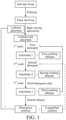
- FIG. 1 A flow chart of a method for extracting lithium from salt lake is shown in FIG. 1 .
- the method includes specifically the following steps:
- the initial flow rate of the 1st BV of brine through the column was 2.5 BV/h, and the adsorption time was 24 min.
- the flow rate of the 2nd BV of brine was 2.3 BV/h, and the adsorption time was 26 min.
- the flow rate of the 3rd BV of brine was 2.1 BV/h, and the adsorption time was 28 min.
- the flow rate of the 4th BV of brine was 2.0 BV/h, and the adsorption time was 30 min.
- the flow rate of the 5th BV of brine was 1.8 BV/h, and the adsorption time was 33 min.
- the flow rate (i.e. the final flow rate) of the 6th BV of brine was 1.3 BV/h, and the adsorption time was 38 min.
- the total adsorption time of the adsorption process was about 3 h.
- the adsorption column with the lithium-rich adsorbent was washed with clean water to remove the impurities adsorbed on the surface of the lithium-rich adsorbent.
- the whole washing process was carried out in 3 steps, in which the total amount of the detergents was 2250 mL (that is, 2.5 BV), and the total washing time was 20 min.
- the washing process includes the following:
- Example 2 differed from Example 1 in that during the adsorption process, according to the order of adsorption, the flow rate of brine was 2.8 BV/h (initial flow rate), 2.6 BV/h, 2.4 BV/h, 2.1 BV/h, 1.8 BV/h, and 1.5 BV/h (final flow rate) respectively; the adsorption time was 21.5 min, 23 min, 25 min, 28.5 min, 33 min, and 40 min, respectively; the total adsorption time was 171 min (that is, 2.85 h); and the other process conditions were the same as those in Example 1.
- the flow rate of brine was 2.8 BV/h (initial flow rate), 2.6 BV/h, 2.4 BV/h, 2.1 BV/h, 1.8 BV/h, and 1.5 BV/h (final flow rate) respectively; the adsorption time was 21.5 min, 23 min, 25 min, 28.5 min, 33 min, and 40 min, respectively; the total adsorption time was 17
- Example 5 differed from Example 1 in that the amount of brine to be adsorbed was 7.5 BV, and during the adsorption process, the flow rate of brine was decreased stepwise. 7 different flow rate intervals were included, the decrease step between adjacent flow rate intervals was 0.5 BV/h, the initial flow rate was 5 BV/h, and the final flow rate was 2 BV/h.
- the adsorption time of each 1.07 BV of brine was 12.9 min, 14.3 min, 16.1 min, 18.4 min, 21.4 min, 25.7 min, and 32.1 min respectively; and the total adsorption time was about 140.9 min.
- Example 7 differed from Example 1 in that a constant-rate washing process was used for washing. A same flow rate of 7. 5BV/h was used in the three steps of washing. The amount of the detergent in each wash was 0.8 BV, 0.9 BV and 0.8 BV respectively, and the washing time was 384 s, 432 s, and 384 s respectively. The total time of the washing process was 20 min, and the total amount of the detergent was maintained constantly at 2.5BV
- Example 14 differed from Example 11 in that the weight ratio of the adsorbent material, the binder, and polyethylene glycol was 9.5: 0.4: 0.1.
- Comparative Example 1 differed from Example 1 in that a constant-rate adsorption process was used for adsorption, where the salt lake brine was flowed through the lithium adsorbent at a flow rate of 2.5 BV/h, and the adsorption time was still 3 h.
- Comparative Example 2 differed from Example 1 in that a constant-rate adsorption process was used for adsorption in Step (1), the salt lake brine was flowed through the lithium adsorbent at a flow rate of 2.5 BV/h, and the adsorption time was still 3 h; and a constant-rate washing process was used for washing in Step (2), where a same flow rate of 7.5BV/h was used in the three steps of washing, the amount of the detergent used in each wash was 0.83 BV, and the time in each wash was 6.64 min. The total time of the washing process was 20 min, and the total amount of the detergent was maintained constantly at 2.5BV
- the amount of lithium adsorbed is a ratio of the weight of lithium adsorbed by the adsorbent (i.e., the difference between the weight of the lithium element in brine after adsorption and in brine before adsorption) to the weight of the adsorbent.
- the lithium loss rate during the washing process can be effectively reduced (Examples 1 and 6).
- the lithium loss rate is slightly higher, and the ratio of magnesium to lithium in the obtained desorption solution is slightly higher (similar cases in Comparative Example 2 and Comparative Example 1).
- the lithium loss rate where pure water is used for washing throughout the process is higher than the lithium loss rate where recycled water and pure water are used together for washing (Example 1).
- Example 11-14 it can be known from the comparison of Examples 11-14 with Example 1 that when an adsorbent with at least one of a vinylidene fluoride-chlorotrifluoroethylene copolymer and a fluoroolefin-vinyl ether copolymer as a binder and containing a wetting and dispersing agent is used, the desorption temperature is lower, and the lithium ion concentration in the lithium desorption solution is basically the same as that of Example 1. When the lithium ion concentration in the lithium desorption solution is comparable, the energy can be saved largely with the decreasing of the desorption temperature in the example. For the salt lake area where water and power resource are scarce, the water and power consumption are of great significance to the production cost and capacity.
- Examples 15-16 differ from Example 11 in that the molecular weight of the binder VDF-CTFE is different.
- the binder in Examples 15-16 has a molecular weight in the range of 100,000-800,000, and has a desorption effect that is better than that in Example 11 where the binder a molecular weight of 20,000 when other conditions are the same.
- the wetting and dispersing agents are different. The desorption effect in Example 11 where polyethylene glycol is used as a wetting and dispersing agent is slightly better than that in Example 17 where sodium polyacrylate is used as a wetting and dispersing agent.
- a particular rate varying adsorption process is used, to achieve a high adsorption efficiency of lithium in brine, and achieve high-efficiency lithium adsorption at low temperature.
- a reasonable lithium desorption solution is ensured to be obtained.
Landscapes
- Engineering & Computer Science (AREA)
- Chemical & Material Sciences (AREA)
- Materials Engineering (AREA)
- Mechanical Engineering (AREA)
- Geology (AREA)
- Manufacturing & Machinery (AREA)
- General Life Sciences & Earth Sciences (AREA)
- Environmental & Geological Engineering (AREA)
- Life Sciences & Earth Sciences (AREA)
- Metallurgy (AREA)
- Organic Chemistry (AREA)
- Geochemistry & Mineralogy (AREA)
- Solid-Sorbent Or Filter-Aiding Compositions (AREA)
- Treatment Of Liquids With Adsorbents In General (AREA)
Abstract
Description
- The present disclosure claims priority to
Chinese Patent Application No. 202111630401.1 filed on December 28, 2021 - The present disclosure relates to the fields of environmental protection and resource recycling, and specifically, to a method for extracting lithium from salt lake.
- Most of lithium resources in China are stored in salt lake brine, which is largely brine with high magnesium-lithium ratio. Therefore, extraction of lithium from brine with high magnesium-lithium ratio has become a focus in lithium resource development in China. The adsorption method developed recently is widely used due to good selectivity for lithium ions, simple process, ability to extract lithium from salt lake brine with high magnesium-lithium ratio, low cost, and other advantages.
- However, the lithium extraction process by adsorption method has the problems of low adsorption efficiency for lithium, and difficulty in producing a qualified desorption solution with a high lithium content at a low temperature (such as in winter).
- To solve the above technical problems, the present disclosure provides a method for extracting lithium from salt lake, in which a particular rate-varying adsorption process is employed in the brine adsorption stage, to greatly improve the adsorption efficiency of lithium in brine. The present disclosure solves the problem of difficulty in obtaining a qualified desorption solution with a high lithium content at a low temperature, improves the adsorption efficiency of lithium in brine, and makes it possible to obtain a qualified desorption solution with a high lithium content at a low temperature. This guarantees the uninterrupted production all year round.
- The present disclosure provides a method for extracting lithium from salt lake, which includes the following steps. The salt lake brine is flowed through a lithium adsorbent at a varying rate, to allow the lithium ions in the salt lake brine to be adsorbed on the lithium adsorbent, to obtain a lithium-rich adsorbent. During the adsorption process, the flow rate of the salt lake brine gradually decreases, and the difference between the initial flow rate and the final flow rate of the salt lake brine is 0.5BV/h-3BV/h. The lithium-rich adsorbent is washed. The lithium ions are desorbed from the washed lithium-rich adsorbent with a lithium ion eluent, to obtain a desorption solution.
- In the method for extracting lithium from salt lake provided in the present disclosure, a particular flow rate-varying adsorption process in which the flow rate of the brine decreases gradually is employed in the adsorption stage of salt lake brine, to greatly improve the adsorption efficiency of lithium in brine, and particularly achieve high-efficiency adsorption of lithium at a low temperature (below zero Celsius degree). As a result, a desorption solution with a lithium content of 500 mg/L or higher can be obtained without affecting the production capacity. With the same adsorption time (for example, 180 min), while the production capacity is kept unchanged, the lithium content in the desorption solution obtained by the lithium extraction method of the present disclosure is much higher than that in a desorption solution obtained by a conventional lithium extraction method using a brine adsorption process with a constant flow rate (generally about 400 mg/L).
- In some embodiments, the initial flow rate is 2.0 BV/h-3.0 BV/h, and the final flow rate is 1.2 BV/h-1.8 BV/h.
- In some embodiments, the total amount of the salt lake brine to be adsorbed is 6 BV-8 BV, and the total adsorption time is 2.5 hrs-4 hrs.
- In some embodiments, the washing includes a 1st wash, a 2nd wash, and a 3rd wash in sequence. The flow rate of a first detergent for the 1st wash, the flow rate of a second detergent for the 2nd wash, and the flow rate of a third detergent for the 3rd wash increase sequentially. The amount of the second detergent is greater than the amount of the first detergent and the amount of the third detergent.
- In some embodiments, in the 1st wash, the flow rate of the first detergent is 3 BV/h-5 BV/h, and the amount of the first detergent is 0.5 BV-1 BV; in the 2nd wash, the flow rate of the second detergent is 6 BV/h-8 BV/h, and the amount of the second detergent is 1 BV-1.5 BV; and in the 3rd wash, the flow rate of the third detergent is 9 BV/h-12 BV/h, and the amount of the third detergent is 0.5 BV-1 BV
- In some embodiments, the first detergent includes an aqueous solution having magnesium ions with a concentration of 50 g/L or less and lithium ions with a concentration of 300 mg/L or less; the second detergent includes an aqueous solution having magnesium ions with a concentration of 5 g/L or less and lithium ions with a concentration of 250 mg/L or less; and the third detergent is pure water.
- In some embodiments, during the desorption process of lithium, the lithium ion eluent is water, and the temperature is 30-50°C.
- In some embodiments, the lithium adsorbent includes an adsorbent material, a binder, and a wetting and dispersing agent. The binder includes at least one of a vinylidene fluoride-chlorotrifluoroethylene copolymer and a fluoroolefin-vinyl ether copolymer; and the wetting and dispersing agent includes one or more of polyethylene glycol, sodium polyacrylate, polyvinyl alcohol, and a formaldehyde condensate.
- In some embodiments, the adsorbent material is an aluminum-based adsorbent material.
- In some embodiments, the aluminum-based adsorbent material can be represented by LiaX·mAl(OH)3·nH2O, where X may be Cl- or SO4 2-, a=1 or 2, m is 1-5, and n is 1-5.
- In some embodiments, based on the weight of the lithium adsorbent, the content of the adsorbent material is 80 wt%-95 wt%, the content of the binder is 4 wt%-17 wt%, and the content of the wetting and dispersing agent is 1 wt%-5 wt%.
- In some embodiments, the ratio of the weight of the adsorbent material to the total weight of the binder and the wetting and dispersing agent is greater than or equal to 8: 1.
- In some embodiments, the binder accounts for 8%-12.5% by weight of the adsorbent material.
- In some embodiments, the molecular weight of the vinylidene fluoride-chlorotrifluoroethylene copolymer or the fluoroolefin-vinyl ether copolymer is 100,000-800,000.
- In some embodiments, before the step of flowing the salt lake brine through the lithium adsorbent at a varying rate, the method further includes the following step. The salt lake brine is filtered, to remove impurities therein.
- In some embodiments, the step of filtering the salt lake brine includes high-speed centrifugal filtration and backwash filtration of the salt lake brine sequentially.
- In some embodiments, the lithium adsorbent is filled in an exchange column or an adsorption tower.
- In some embodiments, before the step of flowing salt lake brine through the lithium adsorbent at a varying rate, the method further includes lithium desorption of the lithium adsorbent.
- In some embodiments, the flow rate of the lithium ion eluent is 1.5 BV/h-2.5 BV/h.
- In some embodiments, the desorption time is 2.5 hrs-4 hrs.
- In the method for extracting lithium from salt lake provided in the present disclosure, a particular flow rate-varying process is employed in the adsorption stage of salt lake brine, to effectively improve the adsorption efficiency of lithium in brine. The present disclosure solves the problem of difficulty in obtaining a qualified desorption solution with a high lithium content at a low temperature (where the brine generally does not freeze at a temperature as low as of minus ten more degrees Celsius in winter), improves the adsorption efficiency of lithium in brine, and makes it possible to obtain a qualified desorption solution with a high lithium content at a low temperature. This guarantees the uninterrupted production all year round. The method for extracting lithium from salt lake has simple process and high lithium extraction efficiency, thus being suitable for large-scale industrial production.
-
-
FIG. 1 shows a flow chart of a method for extracting lithium from salt lake provided in an embodiment of the present disclosure. -
FIG. 2 shows a flow chart of a method for extracting lithium from salt lake provided in another embodiment of the present disclosure. - The present disclosure provides a method for extracting lithium from salt lake, which includes the following steps.
- (1) The salt lake brine is flowed through a lithium adsorbent at a varying rate, to allow the lithium ions in the salt lake brine to be adsorbed on the lithium adsorbent, to obtain a lithium-rich adsorbent. During the adsorption process, the flow rate of the salt lake brine gradually decreases, and the difference between the initial flow rate and the final flow rate of the salt lake brine is 0.5-3BV/h.
- (2) The lithium-rich adsorbent is washed.
- (3) The lithium ions are desorbed from the washed lithium-rich adsorbent with a lithium ion eluent, to obtain a desorption solution.
- In the method for extracting lithium from salt lake provided in the present disclosure, a particular flow rate-varying adsorption process in which the flow rate of the brine decreases gradually is employed in the adsorption stage of salt lake brine, to greatly improve the adsorption efficiency of lithium in brine, and particularly achieve high-efficiency adsorption of lithium at a low temperature (below zero Celsius degree). As a result, a desorption solution with a lithium content of 500 mg/L or higher can be obtained without affecting the production capacity. With the same adsorption time (for example, 180 min), while the production capacity is kept unchanged, the lithium content in the desorption solution obtained by the lithium extraction method of the present disclosure is much higher than that in a desorption solution obtained by a conventional lithium extraction method using a brine adsorption process with a constant flow rate (generally about 400 mg/L).
- In the present disclosure, the flow rate of salt lake brine varies over time during the adsorption process, and the overall flow rate decreases gradually as the adsorption proceeds. The difference between the initial flow rate and the final flow rate of salt lake brine is 0.5-3BV/h, and particularly 0.8 BV/h, 1 BV/h, 1.2 BV/h, 1.5 BV/h, 1.8 BV/h, 2 BV/h or 2.5 BV/h. A suitable difference between the initial flow rate and the final flow rate promotes the improvement of the adsorption efficiency of lithium in brine.
- The initial flow rate and the final flow rate can be defined according to the particular rate-varying adsorption process of brine. If the flow rate of brine decreases constantly, the initial flow rate is the flow rate of brine that first passes through the lithium adsorbent when the adsorption begins, and the final flow rate is the flow rate of salt lake brine that finally passes through the lithium adsorbent when the adsorption is about to end. If the flow rate of brine is discretely decreased in stage, that is, the flow rate of brine has n different values (n is definite, and the flow rates may be V1, V2... and Vn) during the adsorption process, the 1st flow rate interval (the flow rate is V1) is the initial flow rate of brine, the last flow rate interval (that is, the nth flow rate interval, the flow rate is Vn) is the final flow rate. If the total amount of brine to be adsorbed is Q (in Bv), the amount of brine flowing through the adsorbent in each flow rate interval can be Q/n. The flow rate of the 1st Q/n BV of salt lake brine through the lithium adsorbent is referred to as the initial flow rate. The flow rate of the last Q/n BV of salt lake brine through the lithium adsorbent is referred to as the final flow rate. For example, when 6 BV of salt lake brine need to be adsorbed, and each BV of brine is flowed through the lithium adsorbent respectively at a flow rate of 2.5, 2.3, 2.1, 2.0, 1.8, and 1.6 BV/h, where the initial flow rate of brine is 2.5 BV/h, the final flow rate is 1.6 BV/h, and the adsorption time of each brine was respectively 24 min, 26 min, 28.6 min, 30 min, 33 min, and 37.5 min.
- In some embodiments of the present disclosure, the initial flow rate is 2.0-3.0 BV/h, and the final flow rate is 1.2-1.8 BV/h. Compared with a brine adsorption process with a constant flow rate, with such an initial flow rate and final flow rate of brine, the adsorption efficiency of lithium in brine can be increased by 5%-20%. BV generally refers to the filling volume of lithium adsorbent, and 2.0-3.0 BV/h (the same below) represents that the flow rate of brine in volume is 2-3 times the volume of the lithium adsorbent per hour. In some embodiments, the initial flow rate may be specifically 2.0, 2.1, 2.2, 2.3, 2.4, 2.5, 2.6, 2.7, 2.8, 2.9 or 3.0 BV/h. The final flow rate may be specifically 1.2, 1.3, 1.4, 1.5, 1.6, 1.7 or 1.8 BV/h.
- In some embodiments, during the adsorption process, the total amount of the salt lake brine to be adsorbed is 6-8 BV That is, the volume of salt lake brine to be brought into contact with the lithium adsorbent is 6-8 times the loading volume of the lithium adsorbent. The amount of salt lake brine to be adsorbed can vary depending on the level of lithium in the salt lake brine (usually 180-300 ppm). In some embodiments, the total adsorption time can be 2.5-4 h, for example, 2.8 h, 3 h, 3.5 h, and 3.8 h.
- In some embodiments, in Step (1), before the salt lake brine flows through the lithium adsorbent at a varying rate, the method further includes the following step. The brine is filtered, to remove impurities therein (for example, particulate impurities) therein. Filtration may sequentially include: high-speed centrifugal filtration and backwash filtration. High-speed centrifugal filtration is mainly used to remove large particulate sediment. High-speed centrifugal filtration can be carried out in a centrifugal solid-liquid separator at a centrifugation speed of 15000-35000 rpm. Backwash filtration is provided for further precision filtration, to make the salt lake brine have less solid impurities to ensure that the material after filtration does not affect the adsorption function of the lithium adsorbent, and the filtered impurities can be easily backwashed off, without frequently renewing the filter consumables. Backwash filtration can be carried out with a stainless steel mesh-type backwash filter.
- In the present disclosure, lithium extraction from salt lake brine is achieved by adsorption. The lithium adsorbent can be filled in a carrier such as an exchange column (e.g. glass column, stainless steel column) or an adsorption tower. When the salt lake brine flows through the carrier containing the lithium adsorbent, and is brought into contact with the lithium adsorbent, the lithium ions therein can be adsorbed and fixed by the lithium adsorbent, during which the lithium adsorbent is also transformed into a lithium-rich adsorbent with lithium adsorbed.
- In an embodiment of the present disclosure, the lithium adsorbent used may include an adsorbent material and a binder. The adsorbent material may be, for example, an aluminum-based adsorbent material, a manganese-based adsorption material (such as a combination of spinel-type manganese oxide and lithium ions), a titanium-based adsorbent material (such as a metatitanate lithium ion sieve adsorbent), and an iron-based adsorbent, etc. In some embodiments of the present disclosure, the adsorbent material is an aluminum-based adsorbent material. The aluminum-based adsorbent material can be a combination of aluminum hydroxide and a lithium-containing compound (such as lithium halide, and lithium sulfate, etc.). The aluminum-based adsorbent material can adsorb lithium ions from a lithium-containing solution. After reaching saturated adsorption, the lithium ions are eluted off with water at a certain temperature, to release into a solution. In some embodiments, the aluminum-based adsorbent material can be represented by LiaX·mAl(OH)3·nH2O, where X may be Cl- or SO4 2- etc.; a=1 or 2; m is 1-5, and preferably 2; and n is 1-5. Further, to give a higher lithium adsorption capacity of the lithium adsorbent of the present disclosure, before lithium extraction from salt lake therewith, lithium can be appropriately desorbed from the lithium adsorbent to allow the adsorbent material to have more lithium vacancies. The aluminum-based adsorbent material after lithium desorption can be expressed as (1-x)Lia'X·mAl(OH)3·H2O, 0<x<1. The aluminum-based adsorbent material can be synthesized by a mechanochemical method, or by soaking, acidification conversion, or precipitation, etc. For example, LiCl·mAl(OH)3·nH2O can be prepared by soaking aluminum hydroxide in a LiCl solution, or by immersing aluminum hydroxide in a LiOH solution followed by acidification and conversion, or by co-precipitation of AlCl3 and a LiCl solution, or by grinding LiOH and aluminum hydroxide.
- The binder can be one or more of an epoxy resin, a phenolic resin, polyvinyl chloride, polyethylene, polypropylene, polystyrene, polyvinylidene fluoride, an ethylene-vinyl acetate copolymer, a vinylidene fluoride-chlorotrifluoroethylene copolymer (referred to as VDF-CTFE) and a fluoroolefin-vinyl ether copolymer (also known as FEVE type fluorocarbon resin).
- In some embodiments, the binder is at least one of a vinylidene fluoride-chlorotrifluoroethylene copolymer and a fluoroolefin-vinyl ether copolymer. In this case, the lithium adsorbent also includes a wetting and dispersing agent, and specifically one or more of polyethylene glycol, sodium polyacrylate, polyvinyl alcohol, and a formaldehyde condensate. Exemplary formaldehyde condensates may include, but are not limited to, one or more of a naphthalenesulfonate formaldehyde condensate, a methylnaphthalenesulfonate formaldehyde condensate, a benzylnaphthalenesulfonate formaldehyde condensate, a phenolsulfonate formaldehyde condensate and the like.
- Using vinylidene fluoride-chlorotrifluoroethylene copolymer and/or fluoroolefin-vinyl ether copolymer as binder, the lithium adsorbent is not only allowed to have a higher structural stability and mechanical strength, good corrosion resistance, and low dissolution loss rate and long service life of the adsorbent after several cycles of lithium absorption-lithium desorption, but also allowed to have a suitable porosity and surface state of narrow pore size. As a result, the lithium adsorbent is caused to have a high lithium adsorption efficiency, the adsorption speed and efficiency of the lithium adsorbent will not be affected due to the reduction of the effective active area. The wettability of the wetting and dispersing agent also contribute to the improvement of the adsorption efficiency and adsorption capacity of the adsorbent for lithium ions. In addition, with the synergistic effect of the excellent surface smoothness and cleaning effect of the two specific binders and the wettability of the wetting and dispersing agent, the lithium adsorbent is easy to clean after adsorbing lithium, and the process of lithium desorption is convenient. This saves water in the cleaning and desorption process, reduces the rate of dissolution loss of the adsorbent in these processes, and lowers the desorption temperature, thus being of great significance for industrialized lithium extraction in areas with high energy shortages such as salt lakes. Qualified desorption solution with low magnesium-lithium ratio and high lithium content is obtained.
- In some embodiments, the molecular weight of the vinylidene fluoride-chlorotrifluoroethylene copolymer or the fluoroolefin-vinyl ether copolymer can be 100,000-800,000. Appropriate high-molecular-weight binder has better bonding effect, and reduce the risk of cracking and breaking of the lithium adsorbent during use, thus extending the service life. In the vinylidene fluoride-chlorotrifluoroethylene copolymer, the copolymerization ratio of the monomers vinylidene fluoride and chlorotrifluoroethylene can be 1: (1-5), and preferably 1 : 4. Preferably, the binder is a vinylidene fluoride-chlorotrifluoroethylene copolymer, or a mixture of a vinylidene fluoride-chlorotrifluoroethylene copolymer and a fluoroolefin-vinyl ether copolymer.
- In some embodiments, the molecular weight of the formaldehyde condensate is 4000-10000; and the molecular weight of the sodium polyacrylate is 5000-10000.
- In some embodiments of the present disclosure, the wetting and dispersing agent is polyethylene glycol. Polyethylene glycol has good wetting and dispersing abilities. In some embodiments, the molecular weight of the polyethylene glycol is 10000-30000. Higher-molecular-weight polyethylene glycol is less soluble in water with the adsorbent, making the adsorbent have a longer service life.
- In an embodiment of the present disclosure, based on the weight of the lithium adsorbent, the content of the adsorbent material is 80-95 wt%, the content of the binder is 4-17 wt%, and the content of the wetting and dispersing agent is 1-5 wt%. With a combination of the adsorbent material, the binder, and the wetting and dispersing agent in an appropriate proportion, the overall lithium adsorbent has good structural stability, adsorption effect and desorption effect. Preferably, the content of the adsorbent material is 85-92 wt%. Preferably, the content of the binder is 5-15 wt%, and further preferably 6-12 wt%. Preferably, the content of the wetting and dispersing agent is 1-3 wt%.
- In some embodiments of the present disclosure, the weight of the binder is 8-12.5% of the weight of the adsorbent material. An appropriate amount of the binder can not only ensure a high structural stability and a long service life (not easy to break) of the lithium adsorbent but also weaken its reducing effect on the adsorption capacity of the obtained lithium adsorbent.
- In an embodiment of the present disclosure, the weight of the wetting and dispersing agent is 1-5% of the weight of the adsorbent material. At this time, the wetting and dispersing agent allows the adsorbent material to be more uniformly distribute in the lithium adsorbent particles, the structure to become more stable, and the lithium adsorbent particles to have an improved wettability, and thus an increased rate of adsorption/desorption of lithium. In addition, the wetting and dispersing agent can also be dissolved relatively slowly in brine, to increase the porosity of the adsorbent slowly, thus further improving the adsorption efficiency of the adsorbent without causing a significant impact on the dissolution loss rate of the adsorbent and reducing the service life of the adsorbent obviously.
- In some embodiments of the present disclosure, the ratio of the weight of the adsorbent material to the total weight of the binder and the wetting and dispersing agent is greater than or equal to 8:1. This contributes to the good structural stability and excellent adsorption and desorption performances of the lithium adsorbent. Preferably, the ratio can be in the range of (8-10): 1. Specifically, the ratio can be 8.5, 9:1, or 9.5:1.
- In an embodiment of the present disclosure, the lithium adsorbent may be columnar particles. The columnar lithium adsorbent particles can be formed simply, and have surface smoothness, to avoid the wear and dusting due to squeezing and friction of one other during use, and reduce the loss. In some embodiments, the particle size of the lithium adsorbent is 1.2mm-1.8mm, and the length is 1.5mm-2.5mm. A lithium adsorbent with such a shape and suitable size gives a path that is more suitable for the diffusion of a liquids and ions, and when the adsorbent is squeezed between each other, it is easy to leave a certain gap to facilitate the penetration of brine, thus facilitating the improvement of the adsorption efficiency for lithium ions, making the ion exchange between lithium ions and water easier during the desorption process, and thus reducing the lithium desorption temperature and the amount of desorption water to ensure that the adsorbed lithium is completely desorbed.
- In Step (2) in the present disclosure, the washing of the lithium-rich adsorbent is mainly to wash away impurities on the surface of the lithium-rich adsorbent that has adsorbed lithium ions. In an embodiment of the present disclosure, the washing includes three steps, including a 1st wash, a 2nd wash and a 3rd wash in sequence. The flow rate of a first detergent in the 1st wash, the flow rate of a second detergent in the 2nd wash, and the flow rate of a third detergent in the 3rd wash increase sequentially (that is, the flow rate of the first detergent < the flow rate of the second detergent < the flow rate of the third detergent). The amount of the second detergent is greater than the amount of the first detergent and the amount of the third detergent. The amount of the first detergent used and the amount third detergent used may be the same or different.
- The above-mentioned washing process for the lithium-rich adsorbent is carried out in three steps in which the flow rate is increased from slow to fast. In the 1st wash, the flow rate is slow, to avoid the difficulty in removing the impurities in the brine caused by the formation of a coagulation layer by a large amount of high-concentration brine at a high flow rate in the carrier filled with the lithium-rich adsorbent during the wash, which greatly reduces the washing effect. In the 2rd wash, the flow rate is moderate, and the amount of detergent is large, to ensure an adequate washing time, and ensure that impurities such as magnesium adhered by the adsorbent can be fully dissolved and removed. In the 3rd wash, the flow rate is fast, and the amount of the detergent is lower than the amount of the detergent in the 2rd wash, to reduce the desorption of lithium adsorbed on the lithium-rich adsorbent into the detergent, and reduce the lithium loss during water washing. Therefore, the specific washing process can wash off the impurities on the surface of the lithium-rich adsorbent, such that the weight ratio of magnesium to lithium in the desorption solution obtained by subsequent desorption is relatively low; the amount of the detergents used is small, and the lithium loss rate during washing (i.e., the percentage by weight of lithium dissolved in the detergents relative to the total lithium adsorbed by the lithium-rich adsorbent) is 16% or less and even 15%.
- In some embodiments, the difference between the detergent flow rate in the 3rd wash and the detergent flow rate in the 1st wash may be 5-9 BV/h. At this time, a better washing effect can be obtained.
- In some embodiments of the present disclosure, the washing includes three steps, including a 1st wash, in which the flow rate of a first detergent is 3-5 BV/h, and the amount of the first detergent is 0.5-1 BV; a 2nd wash, in which the flow rate of a second detergent is 6-8 BV/h, and the amount of the second detergent is 1-1.5 BV; and a 3rd wash, in which the flow rate of a third detergent is 9-12 BV/h, and the amount of the third detergent is 0.5-1 BV The washing process can well wash off the impurities on the surface of the lithium-rich adsorbent, such that the weight ratio of magnesium to lithium in the desorption solution obtained by subsequent desorption is much lower, for example, as low as 2:1 or less; and the lithium loss rate during washing is much lower, and is lower than 15%, which is far lower than a lithium loss rate of about 20% (or even 25%) caused by a constant-rate washing process commonly used in the industry.
- Particularly, the amount of the first detergent can be 0.6, 0.7, 0.8 or 0.9 BV; the amount of the second detergent can be 1, 1.2, 1.3, 1.4, or 1.5 BV; and the amount of the third detergent can be 0.6, 0.7, 0.8 or 0.9 BV Further, to reduce the lithium loss rate during washing, the total amount of each detergent in the washing process is controlled not to exceed 2.5BV in some embodiments.
- In some embodiments, the duration of the 1st wash is 6-20 min, and further 7-15 min (for example 9 min); the duration of the 2nd wash is 7.5-15 min, and further 9-13 min (for example 11 min); and the duration of the 3rd wash is 2.5-6.6 min (for example 4 min). In some embodiments, in Step (2), the total washing time can be controlled to 25 min or less, and further 20 min or less. As a result, a better effect of washing off the impurities can be achieved, while the lithium loss rate is reduced.
- In a specific embodiment, the washing process specifically includes:
- i) a 1st wash of the lithium-rich adsorbent with a first detergent (i.e., the detergent for the 1st wash), to obtain a first washing effluent and a first adsorbent;
- ii) a 2nd wash of the first adsorbent with a second detergent (i.e., the detergent for the 2st wash), to obtain a second washing effluent and a second detergent; and
- iii) a 3rd wash of the second adsorbent with a third detergent (i.e., the detergent for the 3rd wash), to obtain a third washing effluent and a third adsorbent. The third adsorbent here is the lithium-rich adsorbent after washing, and the desorption of the aforementioned Step (3) is also carried out on it.
- In the present disclosure, the first detergent, the second detergent, and the third detergent contain a large amount of water, and can each be pure water, or recycled water (containing some inorganic metal ion impurities); and the composition of each detergent may be different. In some embodiments, the first detergent, the second detergent, and the third detergent are all pure water. In this case, the amount of pure water used is large, and the loss rate of lithium during the washing process is slightly larger.
- In some other embodiments, the first detergent and the second detergent are recycled water; and the third detergent is pure water, instead of recycled water, and specifically, deionized water, distilled water, clean groundwater, and tap water, etc. By using recycled water in the first 2 washes, the desorption of lithium during the washing process is inhibited; and pure water is used in the last wash, the amount of pure water is small, and a good washing effect can be ensured. In some embodiments, each detergent does not contain organic substances, and has a conductivity of 300 µs/cm, further 200 µs/cm, and preferably 50 µs/cm or less.
- Further, magnesium content in the first detergent, the second detergent, and the third detergent decreases sequentially. In some embodiments, the magnesium content in the first detergent is not higher than 50 g/L, preferably not higher than 30 g/L, further preferably not higher than 10 g/L; the magnesium content in the second detergent is not higher than 5 g/L; and the magnesium content in the third detergent is not higher than 100 mg/L. In some embodiments, the magnesium ion content in the first detergent is not higher than 50 g/L, and the lithium ion content is not higher than 300 mg/L. In some embodiments, the first detergent further includes other metal ions each having a concentration of not higher than 10 g/L (calcium, boron, sodium or potassium). The magnesium ion content in the second detergent is not higher than 5 g/L, and the lithium ion content is not higher than 250 mg/L.
- In some embodiments of the present disclosure, an unqualified desorption solution (produced in a later stage of desorption) with a lithium concentration of not higher than 250 mg/L obtained in the desorption process of Step (3) can be used as a detergent in the 2nd wash (that is, the second detergent). After the desorption is completed, the residual water in the carrier (such as an adsorption column) filled with the lithium adsorbent can also be discharged and used as the second detergent. A third washing effluent obtained after the 3rd wash or a second washing effluent obtained after the 2nd wash can be used as a detergent in the 1st wash (that is, the first detergent). A first washing effluent obtained after the 1st wash can be fed back and mixed into the salt lake brine. As a result, during the entire washing process, pure water is only used in the 3rd wash, so the amount of pure water used is small. This brings great economic and environmental benefits in the extraction of lithium from salt lake brine in water-scarce regions. Exemplarily, the second washing effluent generally contains magnesium ions with a concentration of not higher than 50 g/L and other metal ions (calcium, lithium, boron, sodium or potassium) each having a concentration of not higher than 10 g/L, where further the lithium ion concentration can be 100-200 ppm. The third washing effluent generally contains magnesium ions with a concentration of not higher than 10 g/L, and other metal ions (for example, calcium, lithium, boron, sodium or potassium) each having a concentration of not higher than 0.5 g/L, where further, the lithium ion concentration is lower than 300 mg/L.
- In Step (3) in the present disclosure, the washed lithium-rich adsorbent is eluted with a lithium ion eluent (also called a lithium desorbing agent), to desorb the lithium ions adsorbed on the lithium-rich adsorbent, so that the lithium ions are eluted off and released into the eluent to obtain a desorption solution. The desorption solution can be further treated and used (usually converted into lithium carbonate products). Moreover, after lithium is desorbed from the lithium-rich adsorbent, the lithium adsorbent can be regenerated, and then used to contact with salt lake brine for lithium extraction by adsorption. In the lithium extraction method, Steps (1)-(3) form one cycle.
- In an embodiment of the present disclosure, the temperature of the lithium ion eluent (i.e., the "temperature of the desorption process") can be 30-50°C. In some embodiments (for example, when a lithium adsorbent containing a vinylidene fluoride-chlorotrifluoroethylene copolymer and/or a fluoroolefin-vinyl ether copolymer as a binder is used), the temperature can be 30-40°C, for example, 28, 30, 32, 35, 38 or 40°C, and further 30-35°C. The lithium ion eluent can be deionized water, distilled water, clean groundwater or tap water. Definitely, it is also feasible to use an unqualified desorption solution that does not meet the lithium concentration requirements (generated in a later stage of desorption) for desorption of lithium in an order from high to low, to obtain a qualified desorption solution with the maximum lithium content.
- In some embodiments, the flow rate of the lithium ion eluent is 1.5-2.5 BV/h, for example, 1.8 BV/h, 2 BV/h, and 2.2 BV/h. This can ensure that the lithium ion content in the desorption solution is relatively high, and the desorption time will not be too long. In some embodiments, the desorption time is 2.5-4 h, for example, 2.8 h, 3 h, 3.5 h, and 3.8 h.
- In the method for extracting lithium from salt lake provided in the present disclosure, a particular rate-varying adsorption process is employed in the adsorption stage of salt lake brine, to effectively improve the adsorption efficiency of lithium in brine, thus solving the problem that it is difficult to obtain a qualified desorption solution with high lithium content at low temperature (brine is generally not frozen in winter at a temperature that is as low as minus ten degrees Celsius). This guarantees the uninterrupted production all year round. The method for extracting lithium from salt lake has simple process and high lithium extraction efficiency, thus being suitable for large-scale industrial production.
- The technical solution of the implementations of the present disclosure is described in detail with several examples hereinafter.
- The composition of the salt lake brine for lithium extraction used in the following examples is shown in Table 1 below.
Table 1 Composition of salt lake brine Li (%) 0.0138 Na (%) 0.2325 Mg (%) 7.0719 K (%) 0.6241 Ca (%) 0.2970 B (%) 0.0133 Cl- (%) 22.7497 SO4 2- (%) 0.0577 Mg: Li 222.4 - A flow chart of a method for extracting lithium from salt lake is shown in
FIG. 1 . The method includes specifically the following steps: - A lithium adsorbent (including specifically an aluminum-based adsorbent material LiCl·2Al(OH)3·nH2O and a binder polyvinylidene fluoride, at a weight ratio of 9:1) was filled in a glass adsorption column in a filling amount of 0.9 dm3.
- The salt lake brine (referred to as "brine" hereinafter) for lithium extraction was subjected to high-speed centrifugal filtration and backwash filtration sequentially, and then flowed through the adsorption column filled with the lithium adsorbent at a varying rate, to allow lithium ions therein to be adsorbed on the lithium adsorbent and the lithium adsorbent to be transformed into a lithium-rich adsorbent. The temperature during the adsorption process was 25°C, The amount of the brine to be adsorbed was 6 BV, and 5400 mL in total. The flow rate (i.e. initial flow rate) of the 1st BV of brine through the column was 2.5 BV/h, and the adsorption time was 24 min. The flow rate of the 2nd BV of brine was 2.3 BV/h, and the adsorption time was 26 min. The flow rate of the 3rd BV of brine was 2.1 BV/h, and the adsorption time was 28 min. The flow rate of the 4th BV of brine was 2.0 BV/h, and the adsorption time was 30 min. The flow rate of the 5th BV of brine was 1.8 BV/h, and the adsorption time was 33 min. The flow rate (i.e. the final flow rate) of the 6th BV of brine was 1.3 BV/h, and the adsorption time was 38 min. The total adsorption time of the adsorption process was about 3 h.
- The adsorption column with the lithium-rich adsorbent was washed with clean water to remove the impurities adsorbed on the surface of the lithium-rich adsorbent. The whole washing process was carried out in 3 steps, in which the total amount of the detergents was 2250 mL (that is, 2.5 BV), and the total washing time was 20 min. Specifically, the washing process includes the following:
- a) 1 st wash: A third washing effluent from a 3rd wash in a previous cycle (having a composition with a Li+ content of 210 mg/L and a Mg2+ content of 10 g/L) was used as a first detergent to wash the lithium-rich adsorbent, where the amount of the first detergent was 0.6BV, the flow rate was 4.5 BV/h, and the washing time was 8 min. After washing, a first adsorbent and a first washing effluent were obtained. The first washing effluent could be fed back and mixed into the salt lake brine.
- b) 2nd wash: An unqualified desorption solution collected at a later stage of a previous cycle of desorption (having a composition with a Li+ content of 105 mg/L and a Mg2+ content of 150 mg/L) was used as a second detergent to wash the first adsorbent, where the amount in volume of the second detergent was 1.3 BV (that is, 1170 mL), the flow rate was 8.5 BV/h, and the washing time was 9 min. After washing, a second adsorbent and a second washing effluent were obtained. The second washing effluent has a weight ratio of magnesium to lithium of 206: 1, and could be collected and used in adsorption of brine again, to reduce the loss of lithium.
- c) 3rd wash: Pure water was used as a third detergent in this washing procedure, where the amount in volume of pure water was 0.6 BV (5400 mL), the flow rate was 12BV/h, and the washing time was 3 min. After washing, a third adsorbent and a third washing effluent were obtained. The third washing effluent could be stored in a pre-storage tank and used as a first detergent in a next cycle.
- The third adsorbent was eluted with pure water at 50°C as a lithium ion eluent to desorb the adsorbed lithium ions, where the amount of water was 3.3BV, the flow rate was 1.7BV/h, and the desorption time was 116 min. The liquid of the first 2BV in the desorption process was collected and used as a qualified desorption solution (with a Li+ content of greater than 500 mg/L), and the latter 1.3BV as a unqualified solution was recycled and used as a washing agent.
- Example 2 differed from Example 1 in that during the adsorption process, according to the order of adsorption, the flow rate of brine was 2.8 BV/h (initial flow rate), 2.6 BV/h, 2.4 BV/h, 2.1 BV/h, 1.8 BV/h, and 1.5 BV/h (final flow rate) respectively; the adsorption time was 21.5 min, 23 min, 25 min, 28.5 min, 33 min, and 40 min, respectively; the total adsorption time was 171 min (that is, 2.85 h); and the other process conditions were the same as those in Example 1.
- Example 3 differed from Example 1 in that during the adsorption process, according to the order of adsorption, the flow rate of brine was 2 BV/h (initial flow rate), 1.8 BV/h, 1.6 BV/h, 1.4 BV/h, 1.3 BV/h, and 1.2 BV/h (final flow rate) respectively; the adsorption time was 30 min, 33.3 min, 37.5 min, 43 min, 46 min, and 50 min respectively; the total adsorption time was about 240 min; and the other process conditions were the same as those in Example 1.
- Example 4 differed from Example 1 in that the initial flow rate of brine was 3.5 BV/h, and the final flow rate was 2.0 BV/h. Particularly, according to the order of adsorption, the flow rate of the 6 BV of brine to be adsorbed was 3.5 BV/h, 3.2 BV/h, 3.0 BV/h, 2.8 BV/h, 2.5 BV/h, and 2.0B V/h respectively. The adsorption time of each 1 BV of brine was 17 min, 18.75 min, 20 min, 21.4 min, 24 min, and 30min respectively; and the total adsorption time was about 240 min.
- Example 5 differed from Example 1 in that the amount of brine to be adsorbed was 7.5 BV, and during the adsorption process, the flow rate of brine was decreased stepwise. 7 different flow rate intervals were included, the decrease step between adjacent flow rate intervals was 0.5 BV/h, the initial flow rate was 5 BV/h, and the final flow rate was 2 BV/h. The adsorption time of each 1.07 BV of brine was 12.9 min, 14.3 min, 16.1 min, 18.4 min, 21.4 min, 25.7 min, and 32.1 min respectively; and the total adsorption time was about 140.9 min.
- Example 6 differed from Example 1 in that the flow rate in three steps of washing was 5 BV/h, 8 BV/h, and 12 BV/h respectively; the washing time was 7 min, 10 min, and 3 min respectively; and the total washing time was 20 min. The other process conditions were the same as those in Example 1.
- Example 7 differed from Example 1 in that a constant-rate washing process was used for washing. A same flow rate of 7. 5BV/h was used in the three steps of washing. The amount of the detergent in each wash was 0.8 BV, 0.9 BV and 0.8 BV respectively, and the washing time was 384 s, 432 s, and 384 s respectively. The total time of the washing process was 20 min, and the total amount of the detergent was maintained constantly at 2.5BV
- Example 8 differed from Example 1 in that a constant-rate washing process was used for washing. A same flow rate of 7.5BV/h was used in the three steps of washing, the amount of the detergent used in each wash was 0.83 BV, and the time in each wash was 6.64 min. The total time of the washing process was 20 min, and the total amount of the detergent was maintained constantly at 2.5BV.
- Example 9 differed from Example 1 in that a constant-rate washing process was used for washing. A same flow rate of 5 BV/h was used in the three steps of washing, the amount of the detergent used in each wash was 0.83 BV, and the time in each wash was 10 min. The total amount of the detergent was maintained constantly at 2.5BV, and the total time of the washing process was 30 min.
- A flow chart of a method for extracting lithium from salt lake is shown in
FIG. 2 . Example 10 differed from Example 1 in that during the washing process, the detergent used in each wash was pure water (different from the 1st and 2nd wash in Example 1 in which recycled water was used). - Example 11 differed from Example 1 in that a different lithium adsorbent was used, the desorption temperature was 30°C, and the other process parameters were the same. Particularly, in the lithium adsorbent used in Example 11, the adsorbent material was the same as that in Example 1, but the binder was a vinylidene fluoride-chlorotrifluoroethylene copolymer with a molecular weight of about 20,000, and polyethylene glycol with a molecular weight of 10,000 was used a wetting and dispersing agent, where the weight ratio of the adsorbent material, the binder and the wetting and dispersing agent (polyethylene glycol) was 9:0.9:0.1.
- Example 12 differed from Example 11 in that in the method for extracting lithium from salt lake, the binder used in the lithium adsorbent was a FEVE-type fluorocarbon resin.
- Example 13 differed from Example 11 in that in the method for extracting lithium from salt lake, the binder used in the lithium adsorbent was VDF-CTFE and a FEVE-type fluorocarbon resin at a weight ratio of 1:1.
- Example 14 differed from Example 11 in that the weight ratio of the adsorbent material, the binder, and polyethylene glycol was 9.5: 0.4: 0.1.
- The lithium adsorbent in Example 15 differed from that in Example 11 in that the molecular weight of the binder (VDF-CTFE) was 200,000.
- The lithium adsorbent in Example 16 differed from that in Example 11 in that the molecular weight of the binder (VDF-CTFE) was 600,000.
- The lithium adsorbent in Example 17 differed from that in Example 11 in that the wetting and dispersing agent used was sodium polyacrylate with a molecular weight of 6,000.
- To highlight the beneficial effects of the examples of the present disclosure, the following comparative examples are provided.
- Comparative Example 1 differed from Example 1 in that a constant-rate adsorption process was used for adsorption, where the salt lake brine was flowed through the lithium adsorbent at a flow rate of 2.5 BV/h, and the adsorption time was still 3 h.
- Comparative Example 2 differed from Example 1 in that a constant-rate adsorption process was used for adsorption in Step (1), the salt lake brine was flowed through the lithium adsorbent at a flow rate of 2.5 BV/h, and the adsorption time was still 3 h; and a constant-rate washing process was used for washing in Step (2), where a same flow rate of 7.5BV/h was used in the three steps of washing, the amount of the detergent used in each wash was 0.83 BV, and the time in each wash was 6.64 min. The total time of the washing process was 20 min, and the total amount of the detergent was maintained constantly at 2.5BV
- To provide powerful support for the effect of the examples of the present disclosure, the amount of lithium adsorbed, the total adsorption time and the adsorption yield, the lithium loss rate during washing, the lithium content in the desorption solution finally obtained, the ratio of magnesium to lithium in desorption solution, and the amount of pure water for washing in the adsorption process of the method of each example and comparative example were determined. The amount of lithium adsorbed is a ratio of the weight of lithium adsorbed by the adsorbent (i.e., the difference between the weight of the lithium element in brine after adsorption and in brine before adsorption) to the weight of the adsorbent. The adsorption yield is expressed by the ratio of the weight of lithium adsorbed by the lithium adsorbent to the weight of lithium in the original brine. The lithium loss rate during washing is a ratio of the weight of element lithium in the washing effluent obtained after washing (the washing effluent obtained after the final wash if there were multiple steps of wash) to the total amount of lithium adsorbed by the lithium-rich adsorbent. The adsorption efficiency indicates the comprehensive performance of the example, that is, other factors, such as the total adsorption time, the amount of cleaning agent and so on, are comprehensively considered on the basis of the adsorption yield.
- The results are summarized in Table 2 below.
Table 2. Summary of the results of each example and comparative example No. Amount of lithium adsorbed (mg/g) Total adsorption time (min) Adsorption yield (%) Lithium loss rate during washing (%) Lithium content in desorption solution (mg/L) Ratio of magnesium to lithium in desorption solution Amount of pure water for washing (non-recycled water) Example 1 2.5 180 80 13 543 2:1 0.6BV Example 2 2.4 171 77 13 530 2:1 0.6BV Example 3 2.7 240 86 13 577 1.9:1 0.6BV Example 4 2.0 131.15 64 13 510 2.2:1 0.6BV Example 5 2.2 140.9 70 13 518 2.1:1 0.6BV Example 6 2.5 180 80 14 534 2.1:1 0.6BV Example 7 2.5 180 80 17 529 3:1 0.8BV Example 8 2.5 180 80 19 513 3.3:1 0.83BV Example 9 2.5 180 80 20 501 3.2:1 0.83BV Example 10 2.5 180 80 22 487 1.8:1 2.5BV Example 11 2.55 180 82 13 556 2:1 0.6BV Example 12 2.42 180 77.5 14 544 2:1 0.6BV Example 13 2.48 180 79.4 13 548 2:1 0.6BV Example 14 2.6 180 83 16 539 2:1 0.6BV Example 15 2.58 180 82.6 13.1 563 2:1 0.6BV Example 16 2.57 180 82.2 13.2 560 2:1 0.6BV Example 17 2.52 180 80.6 13 551 2:1 0.6BV Comparative Example 1 2.1 180 67 14 501 2.2:1 0.6BV Comparative Example 2 2.1 180 67 20 440 3.4:1 0.83BV - Generally, when lithium is extracted using the same adsorbent at the same temperature, the longer the total adsorption time is, the higher the adsorption efficiency will be. As can be seen from Table 2, with the same adsorbent and the same total adsorption time, the adsorption efficiency of the rate-varying adsorption process (Example 1) is much higher than the adsorption efficiency of the constant-rate adsorption process (Comparative Examples 1-2). Adsorption time of Examples 2-5 is different from Example 1. Although the total adsorption time in Examples 2, 4, and 5 is shorter than that in Example 1, the adsorption efficiency in Examples 2, 4, and 5 is comparable to that in Example 1. In addition, using a varying-rate (from slow to fast) washing process where the flow rate of the detergent is used as a variable, the lithium loss rate during the washing process can be effectively reduced (Examples 1 and 6). In the constant-rate washing process (Examples 7-9), the lithium loss rate is slightly higher, and the ratio of magnesium to lithium in the obtained desorption solution is slightly higher (similar cases in Comparative Example 2 and Comparative Example 1). In addition, the lithium loss rate where pure water is used for washing throughout the process (Example 10) is higher than the lithium loss rate where recycled water and pure water are used together for washing (Example 1).
- In addition, it can be known from the comparison of Examples 11-14 with Example 1 that when an adsorbent with at least one of a vinylidene fluoride-chlorotrifluoroethylene copolymer and a fluoroolefin-vinyl ether copolymer as a binder and containing a wetting and dispersing agent is used, the desorption temperature is lower, and the lithium ion concentration in the lithium desorption solution is basically the same as that of Example 1. When the lithium ion concentration in the lithium desorption solution is comparable, the energy can be saved largely with the decreasing of the desorption temperature in the example. For the salt lake area where water and power resource are scarce, the water and power consumption are of great significance to the production cost and capacity. Particularly, the costs of tap water, and pure water, etc., are often 3-5 more times that of other regions. In addition, Examples 15-16 differ from Example 11 in that the molecular weight of the binder VDF-CTFE is different. The binder in Examples 15-16 has a molecular weight in the range of 100,000-800,000, and has a desorption effect that is better than that in Example 11 where the binder a molecular weight of 20,000 when other conditions are the same. In Examples 17 and Example 11, the wetting and dispersing agents are different. The desorption effect in Example 11 where polyethylene glycol is used as a wetting and dispersing agent is slightly better than that in Example 17 where sodium polyacrylate is used as a wetting and dispersing agent.
- In general, in the lithium extraction method provided in the examples of the present disclosure, a particular rate varying adsorption process is used, to achieve a high adsorption efficiency of lithium in brine, and achieve high-efficiency lithium adsorption at low temperature. Thus, a reasonable lithium desorption solution is ensured to be obtained.
- The foregoing descriptions are some implementations of the present disclosure. A person of ordinary skill in the art may make several improvements and refinements without departing from the principle of the present disclosure, and the improvements and refinements shall fall within the protection scope of the present disclosure.
Claims (20)
- A method for extracting lithium from salt lake, comprising:flowing a salt lake brine through a lithium adsorbent at a varying rate, to allow lithium ions in the salt lake brine to be adsorbed on the lithium adsorbent, to obtain a lithium-rich adsorbent, during adsorption process, a flow rate of the salt lake brine gradually decreasing, and a difference between an initial flow rate and a final flow rate of the salt lake brine being 0.5 BV/h-3BV/h;washing the lithium-rich adsorbent; anddesorbing lithium ions from the washed lithium-rich adsorbent with a lithium ion eluent, to obtain a desorption solution.
- The method for extracting lithium from salt lake according to claim 1, wherein the initial flow rate is 2.0 BV/h-3.0 BV/h, and the final flow rate is 1.2 BV/h-1.8 BV/h.
- The method for extracting lithium from salt lake according to claim 1 or 2, wherein a total amount of the salt lake brine to be adsorbed is 6 BV-8 BV, and a total adsorption time is 2.5 h-4 h.
- The method for extracting lithium from salt lake according to any one of claims 1 to 3, wherein the washing comprises a 1st wash, a 2nd wash and a 3rd wash; and a flow rate of a first detergent in the 1st wash, a flow rate of a second detergent in the 2nd wash, and a flow rate of a third detergent in the 3rd wash increase sequentially, and an amount of the second detergent used is greater than an amount of the first detergent used and an amount of the third detergent used.
- The method for extracting lithium from salt lake according to claim 4, whereinin the 1st wash, the flow rate of the first detergent is 3 BV/h-5 BV/h, and the amount of the first detergent is 0.5 BV-1 BV;in the 2nd wash, the flow rate of the second detergent is 6 BV/h-8 BV/h, and the amount of the second detergent is 1 BV-1.5 BV; andin the 3rd wash, the flow rate of the third 3rd detergent is 9 BV/h-12 BV/h, and the amount of the third 3rd detergent is 0.5 BV-1 BV
- The method for extracting lithium from salt lake according to claim 4 or 5, wherein the first detergent comprises an aqueous solution having magnesium ions with a concentration of 50 g/L or less and lithium ions with a concentration of 300 mg/L or less; the second detergent comprises an aqueous solution having magnesium ions with a concentration of 5 g/L or less and lithium ions with a concentration of 250 mg/L or less; and the third detergent is pure water.
- The method for extracting lithium from salt lake according to claims 1 to 6, wherein during desorption process of lithium ions, the lithium ion eluent is water, and a temperature is controlled at 30°C-50°C.
- The method for extracting lithium from salt lake according to any one of claims 1 to 7, wherein the lithium adsorbent comprises an adsorbent material, a binder, and a wetting and dispersing agent, where the binder comprises at least one of a vinylidene fluoride-chlorotrifluoroethylene copolymer and a fluoroolefin-vinyl ether copolymer; and the wetting and dispersing agent comprises one or more of polyethylene glycol, sodium polyacrylate, polyvinyl alcohol, and a formaldehyde condensate.
- The method for extracting lithium from salt lake according to claim 8, wherein the adsorbent material is an aluminum-based adsorbent material.
- The method for extracting lithium from salt lake according to claim 9, wherein the aluminum-based adsorbent material is represented by LiaX·mAl(OH)3·nH2O, in which X is Cl- or SO42-, a=1 or 2, m is 1-5, and n is 1-5.
- The method for extracting lithium from salt lake according to any one of claims 8 to 10, wherein based on a weight of the lithium adsorbent, a content of the adsorbent material is 80 wt%-95 wt%, a content of the binder is 4 wt%-17 wt%, and a content of the wetting and dispersing agent is 1 wt%-5 wt%.
- The method for extracting lithium from salt lake according to any one of claims 8 to 11, wherein a ratio of the weight of the adsorbent material to a total weight of the binder and the wetting and dispersing agent is greater than or equal to 8:1.
- The method for extracting lithium from salt lake according to any one of claims 8 to 12, wherein a weight of the binder is 8%-12.5% of a weight of the adsorbent material.
- The method for extracting lithium from salt lake according to any one of claims 8 to 13, wherein a molecular weight of the vinylidene fluoride-chlorotrifluoroethylene copolymer or the fluoroolefin-vinyl ether copolymer is 100,000-800,000.
- The method for extracting lithium from salt lake according to any one of claims 1 to 14, further comprising, before the step of flowing the salt lake brine through the lithium adsorbent at a varying rate,
filtering the salt lake brine, to remove impurities therein. - The method for extracting lithium from salt lake according to claim 15, wherein the step of filtering the salt lake brine comprises
high-speed centrifugal filtration and backwash filtration on the salt lake brine sequentially. - The method for extracting lithium from salt lake according to any one of claims 1 to 16, wherein the lithium adsorbent is filled in an exchange column or an adsorption tower.
- The method for extracting lithium from salt lake according to any one of claims 1 to 17, further comprising, before the step of flowing the salt lake brine through the lithium adsorbent at a varying rate,
desorbing lithium from the lithium adsorbent. - The method for extracting lithium from salt lake according to any one of claims 1 to 18, wherein a flow rate of the lithium ion eluent is 1.5 BV/h-2.5 BV/h.
- The method for extracting lithium from salt lake according to any one of claims 1 to 19, wherein a desorption time is 2.5 h-4 h.
Applications Claiming Priority (2)
| Application Number | Priority Date | Filing Date | Title |
|---|---|---|---|
| CN202111630401.1A CN116356144B (en) | 2021-12-28 | 2021-12-28 | Method for extracting lithium from salt lake |
| PCT/CN2022/136482 WO2023124792A1 (en) | 2021-12-28 | 2022-12-05 | Method for extracting lithium from salt lake |
Publications (2)
| Publication Number | Publication Date |
|---|---|
| EP4394063A1 true EP4394063A1 (en) | 2024-07-03 |
| EP4394063A4 EP4394063A4 (en) | 2025-04-16 |
Family
ID=86898381
Family Applications (1)
| Application Number | Title | Priority Date | Filing Date |
|---|---|---|---|
| EP22914047.0A Pending EP4394063A4 (en) | 2021-12-28 | 2022-12-05 | PROCESS FOR EXTRACTION OF LITHIUM FROM A SALT LAKE |
Country Status (8)
| Country | Link |
|---|---|
| US (1) | US12540370B2 (en) |
| EP (1) | EP4394063A4 (en) |
| CN (1) | CN116356144B (en) |
| AR (1) | AR128132A1 (en) |
| AU (1) | AU2022428473B2 (en) |
| CA (1) | CA3233544A1 (en) |
| CL (1) | CL2024001276A1 (en) |
| WO (1) | WO2023124792A1 (en) |
Families Citing this family (9)
| Publication number | Priority date | Publication date | Assignee | Title |
|---|---|---|---|---|
| CA3071649C (en) | 2017-08-02 | 2025-05-20 | Lilac Solutions, Inc. | Ion exchange system for lithium extraction |
| WO2023192192A1 (en) | 2022-03-28 | 2023-10-05 | Lilac Solutions, Inc. | Lithium extraction enhanced by an alternate phase |
| CN118222825B (en) * | 2023-09-28 | 2025-04-08 | 比亚迪股份有限公司 | Lithium extraction system and method |
| WO2025085617A1 (en) * | 2023-10-20 | 2025-04-24 | Altillion, Inc. | System and method for recovery of elements from an aqueous solution |
| CN118406894A (en) * | 2023-10-30 | 2024-07-30 | 西安蓝晓科技新材料股份有限公司 | A method for extracting lithium from brine and its application |
| CN117466319B (en) * | 2023-11-08 | 2026-03-20 | 唐山鑫丰锂业有限公司 | A method for purifying lithium-containing solutions and preparing lithium carbonate using an adsorption-pressure desorption process. |
| WO2025129489A1 (en) * | 2023-12-20 | 2025-06-26 | Ddp Specialty Electronic Materials Us, Llc | Lithium extraction method |
| CN118543345A (en) * | 2024-04-26 | 2024-08-27 | 武汉工程大学 | Adsorbent for extracting lithium from high-silicon lithium-containing wastewater, preparation method thereof and lithium extraction method |
| CN121314245B (en) * | 2025-12-12 | 2026-03-20 | 湖南卓亚科技发展有限责任公司 | A multi-stage gradient adsorption washing and acid desorption process for brine resource extraction |
Family Cites Families (24)
| Publication number | Priority date | Publication date | Assignee | Title |
|---|---|---|---|---|
| CN101928828B (en) * | 2010-09-25 | 2012-12-12 | 西安蓝晓科技新材料股份有限公司 | Method for extracting lithium from salt lake brine by adsorption method |
| CN102031368B (en) * | 2010-10-29 | 2013-01-02 | 西安蓝晓科技新材料股份有限公司 | Continuous ion exchange device and method for extracting lithium from salt lake brine |
| FR2976295B1 (en) * | 2011-06-07 | 2013-07-05 | Sarp Ind | PROCESS FOR SEPARATING METALS FROM BATTERIES CONTAINING LITHIUM |
| KR101405484B1 (en) * | 2012-07-31 | 2014-06-13 | 재단법인 포항산업과학연구원 | Method for extraction of lithium from solution including lithium |
| CN102824759A (en) * | 2012-09-29 | 2012-12-19 | 上海空间电源研究所 | Method for adsorbing lithium ions from salt lake brine through utilizing manganese oxide ion sieve adsorbent |
| CN104014308B (en) | 2014-02-25 | 2016-01-20 | 江苏海普功能材料有限公司 | Prepare the method for high performance halogen water extraction lithium adsorbent and the adsorbent of preparation thereof |
| AU2015339757A1 (en) * | 2014-10-30 | 2017-04-27 | Albemarle Corporation | Sorbents for recovery of lithium values from brines |
| KR101544353B1 (en) * | 2015-01-28 | 2015-08-17 | 한국지질자원연구원 | Underwater mounting lithium collecting apparatus and method |
| CN107949541A (en) * | 2015-08-28 | 2018-04-20 | 雅宝公司 | The method that lithium value is recycled from bittern containing lithium |
| US10604414B2 (en) * | 2017-06-15 | 2020-03-31 | Energysource Minerals Llc | System and process for recovery of lithium from a geothermal brine |
| CN109759006B (en) * | 2017-11-09 | 2022-05-13 | 比亚迪股份有限公司 | Lithium adsorbent, preparation method and application thereof, and method for extracting lithium from salt lake brine |
| WO2019173716A1 (en) * | 2018-03-08 | 2019-09-12 | Ut-Battelle, Llc | Lithium extraction composite for recovery of lithium from brines, and process of using said composition |
| CN108543514B (en) | 2018-05-18 | 2019-09-10 | 江苏久吾高科技股份有限公司 | A kind of separation method of aluminum salt adsorbent, preparation method and Lithium from Salt Lake Brine |
| CN109266851B (en) * | 2018-09-07 | 2020-06-09 | 中国科学院青海盐湖研究所 | Method for extracting lithium through magnetic microporous lithium adsorbent |
| CN108996528B (en) | 2018-09-27 | 2019-08-09 | 中蓝长化工程科技有限公司 | A method for extracting lithium from old brine in Yantian |
| JP2020097011A (en) * | 2018-12-19 | 2020-06-25 | 住友金属鉱山株式会社 | Method of producing granulated substance of lithium adsorbent |
| CN109336142B (en) * | 2018-12-26 | 2020-06-05 | 北京化工大学 | Method for extracting lithium from salt lake brine and preparing aluminum hydroxide simultaneously |
| CN110215896A (en) * | 2019-06-05 | 2019-09-10 | 南京亘闪生物科技有限公司 | A kind of lithium absorption resin of porous silicon ball support and preparation method thereof |
| CN210795792U (en) * | 2019-08-28 | 2020-06-19 | 比亚迪股份有限公司 | Absorption and desorption tower for extracting lithium from salt lake brine and lithium extracting system from salt lake brine |
| CN112538575A (en) * | 2019-09-20 | 2021-03-23 | 比亚迪股份有限公司 | Method for extracting lithium from salt lake |
| CN110743516A (en) | 2019-10-28 | 2020-02-04 | 湖北凯旭企业管理咨询有限公司 | Granulation technology suitable for brine extraction lithium adsorbent |
| CN111826524A (en) * | 2020-07-13 | 2020-10-27 | 礼思(上海)材料科技有限公司 | Method for extracting lithium from salt lake brine by using adsorbent |
| CN112142076B (en) | 2020-09-08 | 2022-06-24 | 中国科学院青海盐湖研究所 | Method for extracting lithium from brine by adsorption method |
| US11638916B1 (en) * | 2021-11-22 | 2023-05-02 | Clayton McMonigle Jones | Ion lithium extraction apparatus |
-
2021
- 2021-12-28 CN CN202111630401.1A patent/CN116356144B/en active Active
-
2022
- 2022-12-05 WO PCT/CN2022/136482 patent/WO2023124792A1/en not_active Ceased
- 2022-12-05 EP EP22914047.0A patent/EP4394063A4/en active Pending
- 2022-12-05 AU AU2022428473A patent/AU2022428473B2/en active Active
- 2022-12-05 CA CA3233544A patent/CA3233544A1/en active Pending
- 2022-12-27 US US18/089,344 patent/US12540370B2/en active Active
- 2022-12-27 AR ARP220103614A patent/AR128132A1/en active IP Right Grant
-
2024
- 2024-04-24 CL CL2024001276A patent/CL2024001276A1/en unknown
Also Published As
| Publication number | Publication date |
|---|---|
| EP4394063A4 (en) | 2025-04-16 |
| WO2023124792A1 (en) | 2023-07-06 |
| US20230203619A1 (en) | 2023-06-29 |
| AU2022428473A1 (en) | 2024-04-18 |
| CN116356144B (en) | 2024-10-29 |
| AR128132A1 (en) | 2024-03-27 |
| CA3233544A1 (en) | 2023-07-06 |
| CN116356144A (en) | 2023-06-30 |
| AU2022428473B2 (en) | 2025-05-08 |
| CL2024001276A1 (en) | 2024-09-23 |
| US12540370B2 (en) | 2026-02-03 |
Similar Documents
| Publication | Publication Date | Title |
|---|---|---|
| AU2022428473B2 (en) | Method for extracting lithium from salt lake | |
| EP4458462A1 (en) | Lithium sorbent, preparation method for lithium sorbent, and salt lake lithium extraction method | |
| CN104291483B (en) | A kind of ion type rareearth mine wastewater membrane isolation technique treatment process and device | |
| CN112717468A (en) | Method for recovering lithium in lithium precipitation mother liquor | |
| CN105289455A (en) | Method for prolonging service life of lithium ion sieve adsorbent through limiting practical use capacity | |
| CN112538575A (en) | Method for extracting lithium from salt lake | |
| CN106435220A (en) | A method for reducing the ratio of magnesium to lithium in salt lake brine | |
| CN107746953A (en) | The method that high purity copper and nickel nitrate are prepared with electroplating sludge | |
| CN103241803A (en) | Electroplating wastewater separating process | |
| CN114262034B (en) | Method for separating rubidium from salt lake brine by using polyvinyl alcohol/chitosan/graphene/nickel copper hexacyanide complex | |
| Vu | Synthesis of novel EDTA-modified aluminum oxide for improved removal of heavy metal in contaminated water | |
| CN116281908A (en) | Method for preparing lithium dihydrogen phosphate and magnesium-based functional material by multistage adsorption and lithium extraction | |
| CN116332298A (en) | A Membrane Unit for Purification of Lithium Chloride in Salt Lake Brine | |
| CN116332140A (en) | Method for co-producing lithium phosphate and boric acid from carbonate type salt lake or lithium carbonate lithium precipitation mother solution | |
| CN214829053U (en) | Salt lake brine adsorbs and carries lithium device | |
| CN103382531B (en) | A kind of method of producing enrichment gallium alumina technology mother liquor from aluminous fly-ash | |
| CN118531229A (en) | A method for extracting lithium from non-chloride brine based on aluminum-based lithium adsorbent | |
| CN118978193A (en) | A sodium-electrolyte layered precursor with low sodium and sulfur content and its preparation method and application | |
| CN117821775A (en) | Method for extracting lithium from salt lake brine | |
| CN117844575B (en) | Cleaning agent composition, cleaning agent, and regeneration method of aluminum hydroxide-based lithium adsorbent | |
| CN107243328B (en) | A kind of cerium nitrate modified sodium alginate microsphere phosphorus removing agent and its preparation and application | |
| CN118079873A (en) | Resin microspheres and preparation method and application thereof, method for removing calcium and magnesium impurities from lithium-containing solution | |
| CN108531728A (en) | A kind of method that zinc is separated and recovered in sodium sulphate brine | |
| CN117385193A (en) | A method and device for extracting lithium from lithium-containing aqueous solution | |
| CN117265290A (en) | Method for extracting lithium from brine and application thereof |
Legal Events
| Date | Code | Title | Description |
|---|---|---|---|
| STAA | Information on the status of an ep patent application or granted ep patent |
Free format text: STATUS: THE INTERNATIONAL PUBLICATION HAS BEEN MADE |
|
| PUAI | Public reference made under article 153(3) epc to a published international application that has entered the european phase |
Free format text: ORIGINAL CODE: 0009012 |
|
| STAA | Information on the status of an ep patent application or granted ep patent |
Free format text: STATUS: REQUEST FOR EXAMINATION WAS MADE |
|
| 17P | Request for examination filed |
Effective date: 20240328 |
|
| AK | Designated contracting states |
Kind code of ref document: A1 Designated state(s): AL AT BE BG CH CY CZ DE DK EE ES FI FR GB GR HR HU IE IS IT LI LT LU LV MC ME MK MT NL NO PL PT RO RS SE SI SK SM TR |
|
| DAV | Request for validation of the european patent (deleted) | ||
| DAX | Request for extension of the european patent (deleted) | ||
| A4 | Supplementary search report drawn up and despatched |
Effective date: 20250318 |
|
| RIC1 | Information provided on ipc code assigned before grant |
Ipc: C22B 3/24 20060101ALI20250312BHEP Ipc: C02F 101/10 20060101ALI20250312BHEP Ipc: C02F 1/28 20230101ALI20250312BHEP Ipc: C22B 7/00 20060101ALI20250312BHEP Ipc: C22B 26/12 20060101AFI20250312BHEP |