EP4393933A1 - Bisphosphite mit dioxaphosphinan-rest - Google Patents
Bisphosphite mit dioxaphosphinan-rest Download PDFInfo
- Publication number
- EP4393933A1 EP4393933A1 EP22216770.2A EP22216770A EP4393933A1 EP 4393933 A1 EP4393933 A1 EP 4393933A1 EP 22216770 A EP22216770 A EP 22216770A EP 4393933 A1 EP4393933 A1 EP 4393933A1
- Authority
- EP
- European Patent Office
- Prior art keywords
- compound
- acac
- dioxaphosphinane
- cod
- olefin
- Prior art date
- Legal status (The legal status is an assumption and is not a legal conclusion. Google has not performed a legal analysis and makes no representation as to the accuracy of the status listed.)
- Withdrawn
Links
Classifications
-
- C—CHEMISTRY; METALLURGY
- C07—ORGANIC CHEMISTRY
- C07F—ACYCLIC, CARBOCYCLIC OR HETEROCYCLIC COMPOUNDS CONTAINING ELEMENTS OTHER THAN CARBON, HYDROGEN, HALOGEN, OXYGEN, NITROGEN, SULFUR, SELENIUM OR TELLURIUM
- C07F9/00—Compounds containing elements of Groups 5 or 15 of the Periodic Table
- C07F9/02—Phosphorus compounds
- C07F9/547—Heterocyclic compounds, e.g. containing phosphorus as a ring hetero atom
- C07F9/6564—Heterocyclic compounds, e.g. containing phosphorus as a ring hetero atom having phosphorus atoms, with or without nitrogen, oxygen, sulfur, selenium or tellurium atoms, as ring hetero atoms
- C07F9/6571—Heterocyclic compounds, e.g. containing phosphorus as a ring hetero atom having phosphorus atoms, with or without nitrogen, oxygen, sulfur, selenium or tellurium atoms, as ring hetero atoms having phosphorus and oxygen atoms as the only ring hetero atoms
- C07F9/6574—Esters of oxyacids of phosphorus
- C07F9/65746—Esters of oxyacids of phosphorus the molecule containing more than one cyclic phosphorus atom
-
- B—PERFORMING OPERATIONS; TRANSPORTING
- B01—PHYSICAL OR CHEMICAL PROCESSES OR APPARATUS IN GENERAL
- B01J—CHEMICAL OR PHYSICAL PROCESSES, e.g. CATALYSIS OR COLLOID CHEMISTRY; THEIR RELEVANT APPARATUS
- B01J31/00—Catalysts comprising hydrides, coordination complexes or organic compounds
- B01J31/16—Catalysts comprising hydrides, coordination complexes or organic compounds containing coordination complexes
- B01J31/18—Catalysts comprising hydrides, coordination complexes or organic compounds containing coordination complexes containing nitrogen, phosphorus, arsenic or antimony as complexing atoms, e.g. in pyridine ligands, or in resonance therewith, e.g. in isocyanide ligands C=N-R or as complexed central atoms
- B01J31/1845—Catalysts comprising hydrides, coordination complexes or organic compounds containing coordination complexes containing nitrogen, phosphorus, arsenic or antimony as complexing atoms, e.g. in pyridine ligands, or in resonance therewith, e.g. in isocyanide ligands C=N-R or as complexed central atoms the ligands containing phosphorus
- B01J31/185—Phosphites ((RO)3P), their isomeric phosphonates (R(RO)2P=O) and RO-substitution derivatives thereof
-
- C—CHEMISTRY; METALLURGY
- C07—ORGANIC CHEMISTRY
- C07C—ACYCLIC OR CARBOCYCLIC COMPOUNDS
- C07C45/00—Preparation of compounds having >C = O groups bound only to carbon or hydrogen atoms; Preparation of chelates of such compounds
- C07C45/49—Preparation of compounds having >C = O groups bound only to carbon or hydrogen atoms; Preparation of chelates of such compounds by reaction with carbon monoxide
- C07C45/50—Preparation of compounds having >C = O groups bound only to carbon or hydrogen atoms; Preparation of chelates of such compounds by reaction with carbon monoxide by oxo-reactions
Definitions
- the invention relates to bisphosphites with dioxaphosphinane residue and their use in hydroformylation.
- Phosphorus-containing compounds play a crucial role as ligands in a variety of reactions, e.g. in hydrogenation, hydrocyanation and also in hydroformylation.
- the technical object of the invention is to provide a compound with which an increased yield of aldehyde can be achieved in the hydroformylation of olefins.
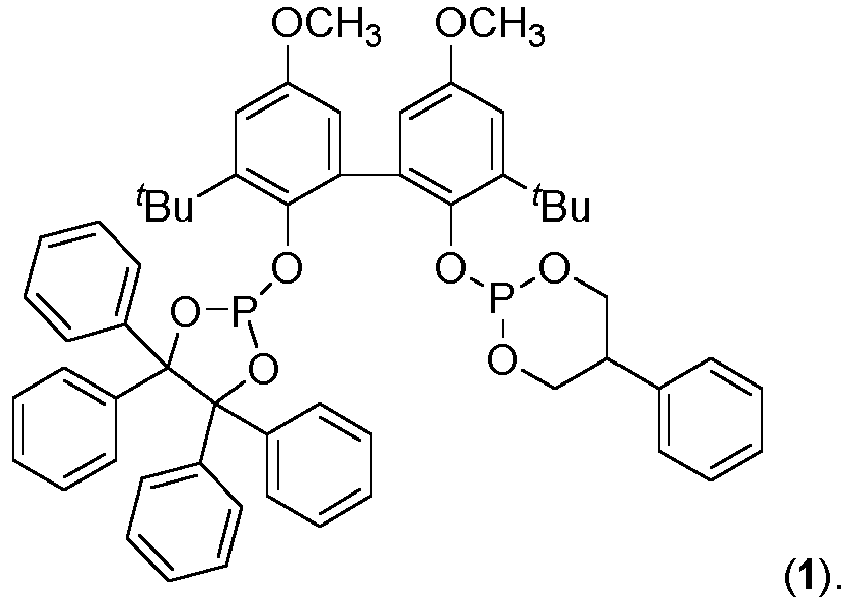
- the compound has the structure (1):
- the Rh compound is Rh(acac)(COD).
- the supply of H 2 and CO in process step d) takes place at a pressure in the range of 1 to 6 MPa (10 to 60 bar).
- the supply of H 2 and CO in process step d) takes place at a pressure in the range of 1.5 to 4.5 MPa (15 to 45 bar).
- reaction mixture in process step e) is heated to a temperature in the range from 80 °C to 160 °C.
- Ligand (2) 2-((3,3'-Di-tert-butyl-5,5'-dimethoxy-2'-((4,4,5,5-tetraphenyl-1,3,2-dioxaphospholan-2-yl)oxy)-[1,1'-biphenyl]-2-yl)oxy)-5,5-dimethyl-1,3,2-dioxaphosphinane
- the hydroformylation was carried out in a 200 ml autoclave from Premex Reactor AG, Lengau, Switzerland, equipped with constant pressure, gas flow measurement, gassing stirrer and pressure pipette.
- the toluene used as solvent was purified in a Pure Solv. MD-7 system and stored under argon.
- the olefin cis/trans-2-pentene (Aldrich) used as substrate was refluxed over sodium and distilled under argon. Solutions of the catalyst precursor and the ligand, each in toluene, were mixed in the autoclave under an argon atmosphere.
- the compound ( 2 ) serves as a reference ligand.
Landscapes
- Chemical & Material Sciences (AREA)
- Organic Chemistry (AREA)
- Chemical Kinetics & Catalysis (AREA)
- Inorganic Chemistry (AREA)
- Engineering & Computer Science (AREA)
- Materials Engineering (AREA)
- Health & Medical Sciences (AREA)
- Life Sciences & Earth Sciences (AREA)
- Biochemistry (AREA)
- General Health & Medical Sciences (AREA)
- Molecular Biology (AREA)
- Organic Low-Molecular-Weight Compounds And Preparation Thereof (AREA)
Abstract
Bisphosphite mit Dioxaphosphinan-Rest und deren Einsatz in der Hydroformylierung.
Description
- Die Erfindung betrifft Bisphosphite mit Dioxaphosphinan-Rest und deren Einsatz in der Hydroformylierung.
- Phosphorhaltige Verbindungen spielen als Liganden in einer Vielzahl von Reaktionen eine entscheidende Rolle, z.B. in der Hydrierung, in der Hydrocyanierung und auch in der Hydroformylierung.
- Die Reaktionen zwischen Olefinverbindungen, Kohlenmonoxid und Wasserstoff in Gegenwart eines Katalysators zu den um ein C-Atom reicheren Aldehyden ist als Hydroformylierung bzw. Oxierung bekannt. Als Katalysatoren in diesen Reaktionen werden häufig Verbindungen der Übergangsmetalle der VIII. Gruppe des Periodensystems der Elemente verwendet. Bekannte Liganden sind beispielsweise Verbindungen aus den Klassen der Phosphine, Phosphite und Phosphonite. Eine gute Übersicht über den Stand der Hydroformylierung von Olefinen findet sich in R. Franke, D. Selent, A. Börner, "Applied Hydroformylation", Chem. Rev., 2012 (112), 11, 5675-5732, DOI:10.1021/cr3001803.
- Die technische Aufgabe der Erfindung ist die Bereitstellung einer Verbindung, mit welcher bei der Hydroformylierung von Olefinen eine gesteigerte Ausbeute an Aldehyd erzielt werden kann.
- Die Aufgabe wird gelöst durch eine Verbindung gemäß Anspruch 1.
- Verbindung gemäß Formel (I):

- In einer Ausführungsform weist die Verbindung die Struktur (1) auf:
- Neben der Verbindung selbst, wird auch ein Verfahren beansprucht, in welchem die zuvor beschriebenen Verbindungen zum Einsatz kommen.
- Verfahren umfassend die Verfahrensschritte:
- a) Vorlegen eines Olefins;
- b) Zugabe einer zuvor beschriebenen Verbindung;
- c) Zugabe einer Rh-Verbindung;
- d) Zuführen von H2 und CO;
- e) Erwärmen des Reaktionsgemisches aus a) bis d), wobei das Olefin zu einem Aldehyd umgesetzt wird.
- In einer Variante des Verfahrens ist die Rh-Verbindung ausgewählt aus: Rh(acac)(CO)2, [(acac)Rh(COD)] (Umicore, acac = Acetylacetonat-Anion; COD = 1,5-Cyclooctadien), Rh4CO12.
- In einer Variante des Verfahrens ist die Rh-Verbindung Rh(acac)(COD).
- In einer Variante des Verfahrens erfolgt das Zuführen von H2 und CO in Verfahrensschritt d) mit einem Druck in dem Bereich von 1 bis 6 MPa (10 bis 60 bar).
- In einer Variante des Verfahrens erfolgt das Zuführen von H2 und CO in Verfahrensschritt d) mit einem Druck in dem Bereich von 1,5 bis 4,5 MPa (15 bis 45 bar).
- In einer Variante des Verfahrens erfolgt das Erwärmen des Reaktionsgemisches in Verfahrensschritt e) auf eine Temperatur in dem Bereich von 80 °C bis 160 °C.
- In einer Variante des Verfahrens erfolgt das Erwärmen des Reaktionsgemisches in Verfahrensschritt e) auf eine Temperatur in dem Bereich von 100 °C bis 140 °C.
- Im Folgenden soll die Erfindung anhand von Ausführungsbeispielen näher erläutert werden.
-

- Zu einer Lösung von 4,4,5,5-Tetraphenyl-2-((3,3',5,5'-tetra-tert-butyl-2'-((dichlorophosphaneyl)oxy)-[1,1'-biphenyl]-2-yl)oxy)-1,3,2-dioxaphospholan (0,4361 g; 0,5108 mmol) in 5 ml Toluol wird bei Raumtemperatur tropfenweise eine Mischung von 2-Phenylpropandiol-1,2 (0,0777 g; 0,5108 mmol) und Triethylamin (0,28 ml) in 2 ml Toluol gegeben. Man rührt über Nacht, filtriert und engt das Filtrat im Vakuum zur Trockne ein. Der erhaltene Feststoff wird 2 h bei 60°C/0,1mbar getrocknet anschließend 1 h mit 4 ml Heptan verrührt. Ausbeute: 0,37 g (0,396 mmol; 77%).
- ESI-TOF HRMS: m/z=933,3684; [M++H], berechnet m/z=933,3679 und m/z=955,3489; [M++Na], berechnet m/z=955,3499.
- 31P-NMR (CD2Cl2): 116,3 (d, J PP=17 Hz); 123,0 (d, J PP=19 Hz); 145,3 (d, J PP=17 Hz); 145,3 (d, J PP=19Hz) ppm.
- 1H-NMR (CD2Cl2): 1,07+1,12 (2s, 9H); 1,33+1,37 (2s, 9H); 3,54+3,57 (2s, 6H); 2,94-4,60 (m, 5H); 3,60+3,64 (2s, 6H); 6,58 (m, 2H); 6,78-7,33 (m, 27H) ppm.
-

- Zu einer Lösung von 4,4,5,5-Tetraphenyl-2-((3,3',5,5'-tetra-tert-butyl-2'-((dichlorophosphaneyl)oxy)-[1,1'-biphenyl]-2-yl)oxy)-1,3,2-dioxaphospholan (0,445 g; 0,5212 mmol) in 5 ml Toluol wird bei Raumtemperatur tropfenweise eine Mischung von 2,2'-Dimethylpropandiol-1,2 (0,0543 g; 0,5212 mmol) und Triethylamin (0,29 ml) in 2 ml Toluol gegeben. Man rührt über Nacht, filtriert und engt das Filtrat im Vakuum zur Trockne ein. Der erhaltene Feststoff wird 2 h bei 60°C/ 0,1 mbar getrocknet. Ausbeute: 0,410 g (0,463 mmol, 89%).
- ESI-TOF HRMS: m/z=907,3514; [M++Na], berechnet m/z=907,3499.
- 31P-NMR (CD2Cl2): 116,6 (d, J PP=19 Hz); 145,6 (d, J PP=19 Hz) ppm.
- 1H-NMR (CD2Cl2): 0,75 (s; 3H); 1,20 (s; 3H); 1,27 (s; 9H); 1,47 (s; 9H); 2,98 (m; 1H); 3,38 (s; 1H); 3,74 (s; 3H); 3,81 (s; 3H); 3,97 (m, 1H); 4,20 (m, 1H); 6,74 (m, 2H); 6,95-7,20 (m; 18H); 7,31 (m, 2H); 7,43 (m, 2H) ppm.
- Die Hydroformylierung wurde in einem mit Druckkonstanthaltung, Gasflussmessung, Begasungsrührer und Druckpipette ausgestatteten 200 ml-Autoklaven der Fa. Premex Reactor AG, Lengau, Schweiz, durchgeführt. Zur Minimierung eines Einflusses von Feuchtigkeit und Sauerstoff wurde das als Solvens benutzte Toluol in einem Pure Solv. MD-7 System gereinigt und unter Argon aufbewahrt. Das als Substrat eingesetzten Olefin cis/trans-2-Penten (Aldrich) wurden über Natrium am Rückfluss erhitzt und unter Argon destilliert. Im Autoklaven wurden unter Argonatmosphäre Lösungen der Katalysatorvorstufe und des Liganden, jeweils in Toluol, gemischt. Als Katalysatorvorstufe kam [(acac)Rh(COD)] (Umicore, acac = Acetylacetonat-Anion; COD = 1,5-Cyclooctadien), zum Einsatz. Der Autoklav wurde bei 12 bar für den Enddruck von 20 bar unter Rühren (1500 U/min) aufgeheizt. Nach Erreichen der Reaktionstemperatur wurde das Olefin mit einem in der Druckpipette eingestellten Überdruck in den Autoklaven gepresst. Die Reaktion wurde bei konstantem Druck (20 bar) (Nachdruckregler der Fa. Bronkhorst, NL) über 4h geführt. Der Autoklav wurde nach Ablauf der Reaktionszeit auf Zimmertemperatur abgekühlt, unter Rühren entspannt und mit Argon gespült. 1 ml der Reaktionsmischungen wurden unmittelbar nach Abschalten des Rührers entnommen, mit 10 ml Pentan verdünnt und gaschromatographisch analysiert: HP 5890 Series II plus, PONA, 50 m × 0,2 mm × 0,5 µm.
- Der Versuch wurde mit den Verbindungen (1) und (2) durchgeführt.
- Die Verbindung (2) dient hierbei als Vergleichsligand.
- [Rh]: 100 ppm, p: 20 bar, T: 120 °C; t: 4 h; Rh:L = 1:2, Toluol
Tabelle: Hydroformylierung von cis/trans-2-Penten Ligand Ausbeute Aldehyd [%] (1)* 78 (2) 74 * erfindungsgemäße Verbindung - Die durchgeführten Versuche belegen, dass die gestellte Aufgabe durch eine erfindungsgemäße Verbindung gelöst wird.
Claims (5)
- Verbindung gemäß Formel (I):

- Verbindung nach Anspruch 1 wobei die Verbindung die Struktur (1) aufweist:

- Verfahren umfassend die Verfahrensschritte:a) Vorlegen eines Olefins;b) Zugabe einer Verbindung nach einem der Ansprüche 1 oder 2;c) Zugabe einer Rh-Verbindung;d) Zuführen von H2 und CO;e) Erwärmen des Reaktionsgemisches aus a) bis d), wobei das Olefin zu einem Aldehyd umgesetzt wird.
- Verfahren nach Anspruch 3,
wobei die Rh-Verbindung ausgewählt ist aus: Rh(acac)(CO)2, [(acac)Rh(COD)] (Umicore, acac = Acetylacetonat-Anion; COD = 1,5-Cyclooctadien), Rh4CO12. - Verfahren nach einem der Ansprüche 3 oder 4,
wobei die Rh-Verbindung Rh(acac)(COD) ist.
Priority Applications (1)
| Application Number | Priority Date | Filing Date | Title |
|---|---|---|---|
| EP22216770.2A EP4393933A1 (de) | 2022-12-27 | 2022-12-27 | Bisphosphite mit dioxaphosphinan-rest |
Applications Claiming Priority (1)
| Application Number | Priority Date | Filing Date | Title |
|---|---|---|---|
| EP22216770.2A EP4393933A1 (de) | 2022-12-27 | 2022-12-27 | Bisphosphite mit dioxaphosphinan-rest |
Publications (1)
| Publication Number | Publication Date |
|---|---|
| EP4393933A1 true EP4393933A1 (de) | 2024-07-03 |
Family
ID=84604193
Family Applications (1)
| Application Number | Title | Priority Date | Filing Date |
|---|---|---|---|
| EP22216770.2A Withdrawn EP4393933A1 (de) | 2022-12-27 | 2022-12-27 | Bisphosphite mit dioxaphosphinan-rest |
Country Status (1)
| Country | Link |
|---|---|
| EP (1) | EP4393933A1 (de) |
Citations (1)
| Publication number | Priority date | Publication date | Assignee | Title |
|---|---|---|---|---|
| EP4059914A1 (de) * | 2021-03-18 | 2022-09-21 | Evonik Operations GmbH | Bisphosphitliganden auf basis von benzpinakol und 1,3-propandiol |
-
2022
- 2022-12-27 EP EP22216770.2A patent/EP4393933A1/de not_active Withdrawn
Patent Citations (1)
| Publication number | Priority date | Publication date | Assignee | Title |
|---|---|---|---|---|
| EP4059914A1 (de) * | 2021-03-18 | 2022-09-21 | Evonik Operations GmbH | Bisphosphitliganden auf basis von benzpinakol und 1,3-propandiol |
Non-Patent Citations (1)
| Title |
|---|
| R. FRANKED. SELENTA. BÖRNER: "Applied Hydroformylation", CHEM. REV., vol. 112, no. 11, 2012, pages 5675 - 5732 |
Similar Documents
| Publication | Publication Date | Title |
|---|---|---|
| EP3763723B1 (de) | Bisphosphite mit einem geschlossenen und einem offenen flügelbaustein | |
| DE102006058682A1 (de) | Bisphosphitliganden für die übergangsmetallkatalysierte Hydroformylierung | |
| EP4059914A1 (de) | Bisphosphitliganden auf basis von benzpinakol und 1,3-propandiol | |
| EP3971195B1 (de) | Diphosphite mit einem offenen, 2,4-methylierten flügelbaustein | |
| EP4059918B1 (de) | Bisphosphitliganden auf basis von benzopinakol mit einem offenen flügelbaustein | |
| EP4393588A1 (de) | Bisphosphite mit 2-naphthylresten | |
| EP3957643B1 (de) | Neue diphosphite auf basis von cis-butendiol-1,4 | |
| EP4059939B1 (de) | Bisphosphitliganden auf basis von benzpinakol | |
| EP4663651A1 (de) | Bisphosphite mit tert-butylresten am zentralbaustein und substituiertem flügelbaustein | |
| EP4393900B1 (de) | Diphosphite mit cis-ständigen substituenten | |
| EP4393901B1 (de) | Diphosphite mit trans-ständigen substituenten | |
| EP4393931B1 (de) | Diphosphite mit dicyclohexylphosphinorest | |
| EP4393932A1 (de) | Diphosphonite und deren einsatz in der hydroformylierung | |
| EP3816171B1 (de) | Phosphazyklische phosphite aus dem enol des benzoins | |
| EP3763722B1 (de) | Bisphosphite mit einem offenen und einem geschlossenen flügelbaustein | |
| EP3293190A1 (de) | Phosphite mit einem silyloxyphenol | |
| EP3816172B1 (de) | Phosphazyklische phosphite aus dem enol des 1-hydroxy-2-acetonaphthons | |
| EP3438111B1 (de) | Phosphonite mit einer direkt am phosphor gebundenen tert.-butyl-gruppe | |
| EP3438110B1 (de) | Phosphinite mit zwei direkt am phosphor gebundenen tert.-butyl-gruppen | |
| EP4403562A1 (de) | Diphosphite mit tert-butylresten und methylresten | |
| EP3438112B1 (de) | Liganden mit einer o-p-o-brücke zwischen zwei anthracentriolbausteinen | |
| EP3816173B1 (de) | Phosphazyklische phosphite aus dem enol des pyridoins und furoins | |
| EP4059940A1 (de) | Liganden auf basis von phosphonit-phosphiten | |
| EP3459960A1 (de) | Bisphosphitliganden mit dioxaphosphepin-flügelbausteinen | |
| EP3293192B1 (de) | Phosphite mit einem dihydroxyterphenyl mit einem tetraphenyl-dioxaphospholan |
Legal Events
| Date | Code | Title | Description |
|---|---|---|---|
| PUAI | Public reference made under article 153(3) epc to a published international application that has entered the european phase |
Free format text: ORIGINAL CODE: 0009012 |
|
| STAA | Information on the status of an ep patent application or granted ep patent |
Free format text: STATUS: THE APPLICATION HAS BEEN PUBLISHED |
|
| AK | Designated contracting states |
Kind code of ref document: A1 Designated state(s): AL AT BE BG CH CY CZ DE DK EE ES FI FR GB GR HR HU IE IS IT LI LT LU LV MC ME MK MT NL NO PL PT RO RS SE SI SK SM TR |
|
| STAA | Information on the status of an ep patent application or granted ep patent |
Free format text: STATUS: THE APPLICATION IS DEEMED TO BE WITHDRAWN |
|
| 18D | Application deemed to be withdrawn |
Effective date: 20250104 |