EP4392479B1 - Oligomeric organosilanes, preparation thereof and use thereof in rubber mixtures - Google Patents
Oligomeric organosilanes, preparation thereof and use thereof in rubber mixtures Download PDFInfo
- Publication number
- EP4392479B1 EP4392479B1 EP23783708.3A EP23783708A EP4392479B1 EP 4392479 B1 EP4392479 B1 EP 4392479B1 EP 23783708 A EP23783708 A EP 23783708A EP 4392479 B1 EP4392479 B1 EP 4392479B1
- Authority
- EP
- European Patent Office
- Prior art keywords
- eto
- och
- structural unit
- oligomeric organosilanes
- group
- Prior art date
- Legal status (The legal status is an assumption and is not a legal conclusion. Google has not performed a legal analysis and makes no representation as to the accuracy of the status listed.)
- Active
Links
Classifications
-
- C—CHEMISTRY; METALLURGY
- C08—ORGANIC MACROMOLECULAR COMPOUNDS; THEIR PREPARATION OR CHEMICAL WORKING-UP; COMPOSITIONS BASED THEREON
- C08G—MACROMOLECULAR COMPOUNDS OBTAINED OTHERWISE THAN BY REACTIONS ONLY INVOLVING UNSATURATED CARBON-TO-CARBON BONDS
- C08G77/00—Macromolecular compounds obtained by reactions forming a linkage containing silicon with or without sulfur, nitrogen, oxygen or carbon in the main chain of the macromolecule
- C08G77/04—Polysiloxanes
- C08G77/045—Polysiloxanes containing less than 25 silicon atoms
-
- C—CHEMISTRY; METALLURGY
- C08—ORGANIC MACROMOLECULAR COMPOUNDS; THEIR PREPARATION OR CHEMICAL WORKING-UP; COMPOSITIONS BASED THEREON
- C08G—MACROMOLECULAR COMPOUNDS OBTAINED OTHERWISE THAN BY REACTIONS ONLY INVOLVING UNSATURATED CARBON-TO-CARBON BONDS
- C08G77/00—Macromolecular compounds obtained by reactions forming a linkage containing silicon with or without sulfur, nitrogen, oxygen or carbon in the main chain of the macromolecule
- C08G77/04—Polysiloxanes
- C08G77/14—Polysiloxanes containing silicon bound to oxygen-containing groups
- C08G77/18—Polysiloxanes containing silicon bound to oxygen-containing groups to alkoxy or aryloxy groups
-
- C—CHEMISTRY; METALLURGY
- C08—ORGANIC MACROMOLECULAR COMPOUNDS; THEIR PREPARATION OR CHEMICAL WORKING-UP; COMPOSITIONS BASED THEREON
- C08G—MACROMOLECULAR COMPOUNDS OBTAINED OTHERWISE THAN BY REACTIONS ONLY INVOLVING UNSATURATED CARBON-TO-CARBON BONDS
- C08G77/00—Macromolecular compounds obtained by reactions forming a linkage containing silicon with or without sulfur, nitrogen, oxygen or carbon in the main chain of the macromolecule
- C08G77/04—Polysiloxanes
- C08G77/22—Polysiloxanes containing silicon bound to organic groups containing atoms other than carbon, hydrogen and oxygen
- C08G77/28—Polysiloxanes containing silicon bound to organic groups containing atoms other than carbon, hydrogen and oxygen sulfur-containing groups
-
- C—CHEMISTRY; METALLURGY
- C08—ORGANIC MACROMOLECULAR COMPOUNDS; THEIR PREPARATION OR CHEMICAL WORKING-UP; COMPOSITIONS BASED THEREON
- C08G—MACROMOLECULAR COMPOUNDS OBTAINED OTHERWISE THAN BY REACTIONS ONLY INVOLVING UNSATURATED CARBON-TO-CARBON BONDS
- C08G77/00—Macromolecular compounds obtained by reactions forming a linkage containing silicon with or without sulfur, nitrogen, oxygen or carbon in the main chain of the macromolecule
- C08G77/42—Block-or graft-polymers containing polysiloxane sequences
- C08G77/46—Block-or graft-polymers containing polysiloxane sequences containing polyether sequences
Definitions
- the present invention relates to oligomeric organosilanes, to a process for preparation thereof and to the use thereof in rubber mixtures.
- sulfur-containing organosilicon compounds such as 3-mercaptopropyltrimethoxysilane or bis(3-[triethoxysilyl]propyl)tetrasulfane can be used as a silane adhesion promoter or reinforcing additive in rubber mixtures with oxidic fillers, including for tyre treads and other parts of automobile tyres ( DE 2 141 159 , DE 2 212 239 , US 3 978 103 , US 4 048 206 ).
- EP 0784072 A1 discloses rubber mixtures based on at least one elastomer with silica as a filler and a reinforcing additive which is prepared by blending or as an in situ reaction product from at least one functional polyorganosiloxane compound, and which contain a functional organosilane as a further constituent.
- Monomeric units used are especially 3-mercaptopropyltrialkoxysilanes or bis(trialkoxysilylpropyl)tetrasulfanes, which bear 3 and 6 alkoxy substituents respectively.
- EP 0964021 discloses oligomeric organosilane polysulfanes which are not polycondensed to give a solid, and which contain the structural units A and/or B and/or C in any linear, branched or cyclic arrangement.
- WO 2006/037380 , EP 0997489 and EP 1273613 likewise disclose oligomeric organosilanes.
- US 7368584 discloses mercapto-functional silane compositions comprising at least one mercapto-functional silane having the chemical structure [G 1 -/SiX ⁇ u Z ⁇ v Z ⁇ w ) s ] m [(HS) r -G 2 -(SiX ⁇ u Z ⁇ v Z ⁇ w ) ] n .
- EP 3094686 discloses oligomeric organosilanes containing at least two different structural units within a molecule, selected from the structural units A, B, C and D joined in any desired linear, branched or cyclic arrangement
- US 2016/289251 A1 discloses in its examples 1 to 4 oligomeric organosilanes, which comprise units derived from mercaptopropyltrimethoxysilane and from an alkyltriethoxysilane. In the process is also used a Marlosol compound. However, there is no diol such as 2-MPD, which could give rise to a unit (C) as disclosed herein.
- the invention provides oligomeric organosilanes containing at least structural units A, B and C in any linear, branched or cyclic arrangement
- the molar ratio of the alkyl polyether group -O-(R 5 -O) m -R 6 to silicon may be between 0 and 0.30, preferably between 0 and 0.10, more preferably from 0.01 to 0.09, most preferably from 0.01 to 0.08.
- the molar ratio of structural unit C to silicon may be between 0 and 1.7, preferably between 0.1 and 1.5.
- Structural unit C may also be present in R 1 and/or R 3 and may be terminated by an OH group or be cyclically attached to the oxygen atom of the Si-O group of the same structural unit.
- the molar ratio of structural units A and B in the oligomeric organosilanes according to the invention may be 10:1 to 1:10, preferably 3:1 to 1:3, more preferably 2:1 to 1:2.
- the alkyl polyether group may preferably be -O-(CH 2 CH 2 -O) m -R 6 , more preferably -O-(CHzCHz-O) 5 -R 6 , most preferably -O-(CH 2 CH 2 -O) 5 -C 13 H 27 .
- R 1 OC 2 H 5 or -O-(R 5 -O) m -R 6
- R 2 (CH 2 ) 7 CH 3
- R 3 OC 2 H 5 or -O-(R 5 -O) m -R 6
- R 4 H or CH 3
- R 5 CH 2 CH 2
- R 6 C 13 H 27
- structural unit C may more preferably be [-O-CH 2 -CH(CH) 3 -CH 2 -] or [-O-CHz-CHz-].
- the oligomeric organosilane according to the invention may most preferably contain the structural units
- the present invention further provides a process for preparing the oligomeric organosilanes according to the invention, which is characterized in that a mercaptosilane D, an alkylsilane E, a polyol F, an alkyl polyether alcohol of the formula HO-(R 5 -O) m -R 6 where R 2 , R 4 , R 5 , R 6 n, m, p have the same definition as defined above,
- the reaction can be effected within 30 min - 10 h, preferably within 30 min - 3 h.
- the reaction can be effected with stirring.
- the secondary components can be separated off by distillation.
- the secondary components can be separated off by distillation during the reaction or thereafter.
- the secondary components can preferably be separated off during the reaction.
- the secondary components can be separated off by distillation at atmospheric pressure or reduced pressure.
- the secondary components can preferably be separated off by distillation under reduced pressure. More preferably, they can be separated off by distillation at a pressure of 20-200 mbar.
- Components D and E may be used in a molar ratio of 1:10 to 10:1, preferably of 1:3 to 3:1, more preferably of 1:2 to 2:1.
- Components D and F may be used in a molar ratio of 1:1 to 1:10.
- components D and F may be used in a molar ratio of 1:2 to 1:10. More preferably, components D and F may be used in a molar ratio of 1:2 to 1:4. Most preferably, components D and F may be used in a molar ratio of 1:2 to 1:3.
- Component D and the alkyl polyether alcohol of the formula HO-(R 5 -O) m -R 6 may be used in a molar ratio of 1:0.01 to 1:2.
- component D and the polyether alcohol of the formula HO-(R 5 -O) m -R 6 may be used in a molar ratio of 1:0.1 to 1:1.
- the catalyst may be added in catalytic or stoichiometric amounts.
- all kinds of acidic, basic or nucleophilic catalysts which are known to those skilled in the art from the SOLGEL chemistry of alkoxysilanes (see, for example, R. Corriu, D. Leclercq, Angew. Chem. 1996, 108, 1524-1540 ) are also suitable for the oligomerization in the context of the invention. It is unimportant here whether the catalysts are in the same phase as the reaction solution (homogeneous catalysis) or are in the form of solids (heterogeneous catalysis) and are removed after the reaction has ended.
- the homogeneous catalysis can be conducted with a transition metal complex, for example tetrabutyl orthotitanate, or a transition metal salt.
- Basic catalysis can be effected, for example, with an organic base such as triethylamine, tetramethylpiperidine, tributylamine or pyridine, or with an inorganic base such as NaOH, KOH, Ca(OH) 2 , Na 2 CO 3 , K 2 CO 3 , CaCOs, CaO, NaHCOs, KHCOs or alkoxides such as NaOCH 3 or NaOC 2 H 5 .
- Acidic catalysis can be effected with dilute aqueous mineral acids, such as H 2 SO 4 or HCl, or solutions of Lewis acid in water.
- the catalyst used may be a transition metal complex, KOH, NaOH, ammonium fluoride, H 2 SO 4 or HCl.
- the catalyst used may be a transition metal complex.
- the catalyst used may be tetrabutyl orthotitanate.
- the process according to the invention can be performed in solvent-free form or in the presence of a solvent, preferably in solvent-free form.
- Solvents may be an inert organic solvent or mixture thereof, for example an aromatic solvent such as chlorobenzene, a halogenated hydrocarbon, for example chloroform, methylene chloride, an ether, for example diisopropyl ether, tert-butyl methyl ether, tetrahydrofuran or diethyl ether, acetonitrile, a carboxylic ester, for example ethyl acetate, methyl acetate, isopropyl acetate, or an alcohol, for example methanol, ethanol, n-propanol, i-propanol, n-butanol, sec-butanol or tert-butanol.
- aromatic solvent such as chlorobenzene, a halogenated hydrocarbon, for example chloroform, methylene chloride
- an ether for example diisopropyl ether, tert-butyl methyl ether, tetrahydrofuran
- the mercaptosilane of the formula D may, for example, be
- the alkylsilane of the formula E may, for example, be
- the polyol of the formula F may, for example, be any polyol of the formula F.
- the alkyl polyether alcohol may, for example, be C 13 H 27 -(OCH 2 CH 2 ) 5 -OH.
- the catalyst can remain in the product after the reaction, be deactivated, preferably by neutralization, or be removed, preferably by filtration. More preferably, the catalyst may not be deactivated after the reaction and remain in the product.
- the invention further provides for the use of the oligomeric organosilanes according to the invention in rubber mixtures.
- the invention further provides rubber mixtures comprising the oligomeric organosilanes according to the invention.
- the rubber mixtures according to the invention can be used for production of shaped bodies, especially pneumatic tyres or tyre treads.
- the rubber mixtures according to the invention may comprise rubber, filler, preferably precipitated silica, optionally further rubber auxiliaries, and at least one oligomeric organosilane according to the invention.
- TESPT bis(3-[triethoxysilyl]propyl)tetrasulfane
- Rubber used may be natural rubber and/or synthetic rubbers. Preferred synthetic rubbers are described, for example, in W. Hofmann, H. Gupta, "Handbuch der Kautschuktechnologie"
- the rubber may be a functionalized rubber, where the functional groups may be amine and/or amide and/or urethane and/or urea and/or aminosiloxane and/or siloxane and/or silyl and/or alkylsilyl, for example N,N-bis(trimethylsilyl)aminopropylmethyldiethoxysilane or methyltriphenoxysilane, and/or halogenated silyl and/or silane sulfide and/or thiol and/or hydroxyl and/or ethoxy and/or epoxy and/or carboxyl and/or tin, for example tin tetrachloride or dibutyldichlorotin, and/or silanol and/or hexachlorodisiloxane and/or thiocarboxy and/or nitrile and/or nitroxide and/or amido and/or imino and/or urethane and/or ure
- the rubber mixture according to the invention may contain at least one filler.
- Fillers usable for the rubber mixtures according to the invention include the following fillers:
- amorphous silicas prepared by precipitation from solutions of silicates with BET surface areas of 20 to 400 m 2 /g, more preferably 100 m 2 /g to 250 m 2 /g, in amounts of 5 to 150 parts by weight, based in each case on 100 parts of rubber.
- the fillers mentioned may be used alone or in a mixture.
- the rubber mixtures according to the invention may contain 5 to 150 parts by weight of filler and 0.1 to 30 parts by weight, preferably 1 to 25 parts by weight, more preferably 2 to 20 parts by weight, of the oligomeric organosilanes according to the invention, wherein the parts by weight are based on 100 parts by weight of rubber.
- the oligomeric organosilanes according to the invention may be used as adhesion promoter between inorganic materials, for example glass beads, glass flakes, glass surfaces, glass fibres, or oxidic fillers, preferably silicas such as precipitated silicas and fumed silicas, and organic polymers, for example thermosets, thermoplastics or elastomers, or as crosslinking agents and surface modifiers for oxidic surfaces.
- inorganic materials for example glass beads, glass flakes, glass surfaces, glass fibres, or oxidic fillers, preferably silicas such as precipitated silicas and fumed silicas, and organic polymers, for example thermosets, thermoplastics or elastomers, or as crosslinking agents and surface modifiers for oxidic surfaces.
- the oligomeric organosilanes according to the invention may be used as coupling reagents in filled rubber mixtures, examples being tyre treads, industrial rubber articles or footwear soles.
- rubber auxiliaries such as reaction accelerators, ageing stabilizers, heat stabilizers, light stabilizers, antiozonants, processing aids, plasticizers, resins, tackifiers, blowing agents, dye
- the rubber auxiliaries may be used in familiar amounts determined by factors including the end use. Customary amounts may, for example, be amounts of 0.1% to 50% by weight based on rubber. Crosslinkers used may be peroxides, sulfur or sulfur donor substances.
- the rubber mixtures according to the invention may further comprise vulcanization accelerators. Examples of suitable vulcanization accelerators may be mercaptobenzothiazoles, sulfenamides, thiurams, dithiocarbamates, thioureas and thiocarbonates.
- the vulcanization accelerators and sulfur may be used in amounts of 0.1% to 10% by weight, preferably 0.1% to 5% by weight, based on 100 parts by weight of rubber.
- the rubber mixtures according to the invention can be vulcanized at temperatures of 100°C to 200°C, preferably 120°C to 180°C, optionally at a pressure of 10 to 200 bar.
- the blending of the rubbers with the filler, any rubber auxiliaries and the oligomeric organosilanes according to the invention can be conducted in known mixing units, such as rollers, internal mixers and mixing extruders.
- the rubber mixtures according to the invention can be used for production of moulded articles, for example for the production of tyres, especially pneumatic tyres or tyre treads, cable sheaths, hoses, drive belts, conveyor belts, roller coverings, footwear soles, sealing rings and damping elements.
- oligomeric organosilanes according to the invention and the fillers are preferably added at mass temperatures of 100 to 200°C, but can also be added at a later stage at lower temperatures (40 to 100°C), for example together with further rubber auxiliaries.
- the oligomeric organosilanes can be added to the blending operation either in pure form or else applied to an inert organic or inorganic carrier.
- Preferred carrier materials are silicas, natural or synthetic silicate, aluminium oxide or carbon blacks.
- oligomeric organosilanes according to the invention are obtainable by the process according to the invention.
- the oligomeric organosilanes according to the invention have improved storage stability and/or, in rubber mixtures, the advantage of improved tear resistance.
- the volatile components are determined by gas chromatography by the internal standard method. For this purpose, calibration of the individual components is conducted with an internal standard such as n-nonane, n-decade or n-dodecane in an appropriate solvent.
- the gas chromatograph used is an HP 6850 or HP7820 with a TCD detector.
- the separating column used is an HP5 column having the following properties: length: 30 m; internal diameter: 0.53 mm with a film thickness of 2.65 mm.
- an HP1 column having the following properties is used: length: 30 m; internal diameter: 0.53 mm with a film thickness of 1.50 mm.
- the temperature is 250°C, the detector temperature 280°C.
- the temperature program of the column oven is: 50°C - 5 min - 15°C/min - 275°C - 15 min.
- the carrier gas used is helium with a flow rate of ⁇ 4 ml/min and a split ratio of 1:50 to 1:100.
- the amount of sample injected is 0.4 ml.
- This method is employed analogously for the determination of other alcohols, for example methanol.
- the determination of the ethanol after hydrolysis can be effected by the hydrolysis of the silane by means of sulfuric acid (20 w%). Subsequently, water and sodium hydroxide (20 w%) are added. The resultant mixture is subjected to steam distillation with a suitable apparatus. The distillate is collected in a corresponding standard flask, 2-butanol is added as internal standard, and the mixture is made up to the mark with distilled water.
- the gas chromatograph used is a capillary gas chromatograph with FID and evaluation software, for example HP7820 with OpenLab.
- the separating column has the following properties: length: 30 m; internal diameter: 0.32 mm; film thickness 1.00 mm; stationary phase: Stabiwax (#10654-6850).
- the injector temperature is 250°C, the detector temperature 280°C.
- the column oven 90°C - 10 min - 25°C/min - 240°C - 0 min.
- the carrier gas used is helium with a flow rate of ⁇ 2 ml/min and a split ratio of ⁇ 1:50.
- the combustion gas used is a hydrogen/synthetic air mixture.
- the amount of sample injected is 1.0 ml.
- trialkoxysilane content and also M, D and T structures, can be determined using 29 Si NMR spectrometry, which is likewise well known to the person skilled in the art.
- the solvent used is deuterated chloroform with tetramethylsilane as internal standard.
- the solvent used is deuterated chloroform with tetramethylsilane as internal standard and chromium acetylacetonate.
- Structural unit C may also be present in R' and/or R 3 and may be terminated by an OH group or be cyclically attached to the oxygen atom of the Si-O group of the same structural unit.
- the oligomeric silanes were characterized by spectroscopic determination of the following ratios via integration of the corresponding 13 C NMR signals:
- Octyltriethoxysilane (OCTEO) and VP Si 263 ® (MPTES, 3-mercaptopropyltriethoxysilane) are silanes from Evonik Operations GmbH.
- 2-methylpropane-1,3-diol (2-MPD) (10 eq; 3.395 mol; 306.00 g) is metered in within 30 min.
- the ethanol formed is removed by distillation.
- the mixture is stirred for a further 4.5 h.
- the reaction mixture is cooled down to room temperature and 2-methylpropane-1,3-diol (10.0 eq; 3.395 mol; 306.00 g) and tetra-n-butyl titanate (0.0026 eq; 0.88 mmol; 0.30 g) are added, and the mixture is heated again to 130°C.
- the ethanol formed is removed by distillation.
- a vacuum of 200 mbar is applied, which is maintained for 30 minutes, then the pressure is reduced to 20 mbar within 30 minutes.
- the vacuum of 20 mbar is maintained for 1 h and the mixture is cooled back down to room temperature.
- the formulation used for the rubber mixtures is specified in Table 1 below.
- the unit phr means parts by weight based on 100 parts of the crude rubber employed.
- the oligomeric silanes, based on the reference silane according to Comparative Example 1, were used in an equimolar amount based on the mercapto group, since the mercapto group is the only function that binds to the rubber.
- rub-ber mixture I cont. Comp. Ex. 1 Ref. rub-ber mix-ture II, cont. Comp. Ex. 2 Inv. rubber mixture I, cont. Inv. Ex. 1 Inv. rubber mixture II, cont. Inv. Ex. 2 Inv. rubber mixture III, cont. Inv. Ex.
- the polymer Buna ® VSL 4526-2 is a solution-polymerized SBR copolymer from ARLANXEO Deutschland GmbH, having a styrene content of 26% by weight and a vinyl fraction of 45% by weight.
- the copolymer contains 37.5% TDAE oil and has a Mooney viscosity (ML 1+4/100°C) of 50.
- the polymer Buna ® CB 24 is a cis-1,4-polybutadiene (neodymium type) from ARLANXEO Deutschland GmbH, having a cis-1,4 content of at least 96% and a Mooney viscosity of 44.
- ULTRASIL ® 7000 GR is a readily dispersible silica from Evonik Industries AG and has a CTAB surface area of 160 m 2 /g.
- N330 is carbon black from Orion Engineered Carbons GmbH, TDAE oil used is Vivatec 500 from Hansen & Rosenthal GmbH & Co. KG, Vulkanox ® 4020 is 6PPD from LANXESS Distribution GmbH, Vulkanox ® HS/LG is TMQ from Lanxess and Protektor TM G3108 is an antiozonant wax from Paramelt B.V.,
- Tosiegel Spezial zinc oxide is ZnO from Grillo Zinkoxid GmbH, Palmera B1804 is palmitic/stearic acid from Caldic GmbH & Co. KG.
- Vulkacit ® CZ is CBS from LANXESS Distribution GmbH.
- Uhoo TBzTD tetrabenzylthiuram disulfide
- Uhoo TBzTD tetrabenzylthiuram disulfide
- the rubber mixture is produced in three stages in an internal mixer according to Table 2.
- Table 2 Stage 1 Settings Mixing unit Werner & Pfleiderer GK 1.5E Speed 65 min -1 Ram pressure 5.5 bar Flow temp. 65°C Fill level 0.65 Mixing procedure 0 to 0.25 min Buna ® VSL 4526-2 + Buna ® CB 24 0.25 min to 1.25 min 1.25 1 ⁇ 2 ULTRASIL ® 7000 GR, silane or oligomeric organosilanes vent and purge 1.25 to 2.25 min Vivatec 500 together with N330, 1 ⁇ 2 ULTRASIL ® 7000 GR, Protector TM G3108, Vulkanox ® HS/LG, Vulkanox ® 4020 2.25 min clean and ventilate 2.25 to 3.75 min ZnO, Palmera B1804, mix and discharge at 145-155°C Stage 2 Settings Mixing unit as in stage 1 except: Speed 75 min -1 Flow temp.
- Rubber testing is effected in accordance with the test method specified in Table 3.
- Table 3 Physical testing Standard/conditions Graves tear resistance DIN ISO 34-1, method B, measured using Z005T tensile tester from Zwick GmbH & Co. KG
- Vulcanization is effected at a temperature of 165°C for a period of 12 minutes.
- Table 4 reports the rubber data for the vulcanizates.
- the rubber mixtures containing the oligomeric silanes according to the invention show improved tear resistance over the reference mixtures.
Landscapes
- Chemical & Material Sciences (AREA)
- Health & Medical Sciences (AREA)
- Chemical Kinetics & Catalysis (AREA)
- Medicinal Chemistry (AREA)
- Polymers & Plastics (AREA)
- Organic Chemistry (AREA)
- Silicon Polymers (AREA)
- Tires In General (AREA)
- Compositions Of Macromolecular Compounds (AREA)
Description
- The present invention relates to oligomeric organosilanes, to a process for preparation thereof and to the use thereof in rubber mixtures.
- It is known that sulfur-containing organosilicon compounds such as 3-mercaptopropyltrimethoxysilane or bis(3-[triethoxysilyl]propyl)tetrasulfane can be used as a silane adhesion promoter or reinforcing additive in rubber mixtures with oxidic fillers, including for tyre treads and other parts of automobile tyres (
DE 2 141 159 ,DE 2 212 239 ,US 3 978 103 ,US 4 048 206 ). -
EP 0784072 A1 discloses rubber mixtures based on at least one elastomer with silica as a filler and a reinforcing additive which is prepared by blending or as an in situ reaction product from at least one functional polyorganosiloxane compound, and which contain a functional organosilane as a further constituent. Monomeric units used are especially 3-mercaptopropyltrialkoxysilanes or bis(trialkoxysilylpropyl)tetrasulfanes, which bear 3 and 6 alkoxy substituents respectively. - In addition,
EP 0964021 discloses oligomeric organosilane polysulfanes which are not polycondensed to give a solid, and which contain the structural units A and/or B and/or C in any linear, branched or cyclic arrangement.
-
WO 2006/037380 ,EP 0997489 andEP 1273613 likewise disclose oligomeric organosilanes. In addition,US 7368584 discloses mercapto-functional silane compositions comprising at least one mercapto-functional silane having the chemical structure [G1-/SiXα uZβ vZθ w)s]m[(HS)r-G2-(SiXα uZβ vZθ w)s]n. -
EP 3094686 discloses oligomeric organosilanes containing at least two different structural units within a molecule, selected from the structural units A, B, C and D joined in any desired linear, branched or cyclic arrangement

-
US 2016/289251 A1 discloses in its examples 1 to 4 oligomeric organosilanes, which comprise units derived from mercaptopropyltrimethoxysilane and from an alkyltriethoxysilane. In the process is also used a Marlosol compound. However, there is no diol such as 2-MPD, which could give rise to a unit (C) as disclosed herein. - Disadvantages of the known oligomeric organosilanes are poor tear resistance and/or poor storage stability.
- It is an object of the present invention to provide oligomeric organosilanes having improved tear resistance and/or improved storage stability.
- The invention provides oligomeric organosilanes containing at least structural units A, B and C in any linear, branched or cyclic arrangement
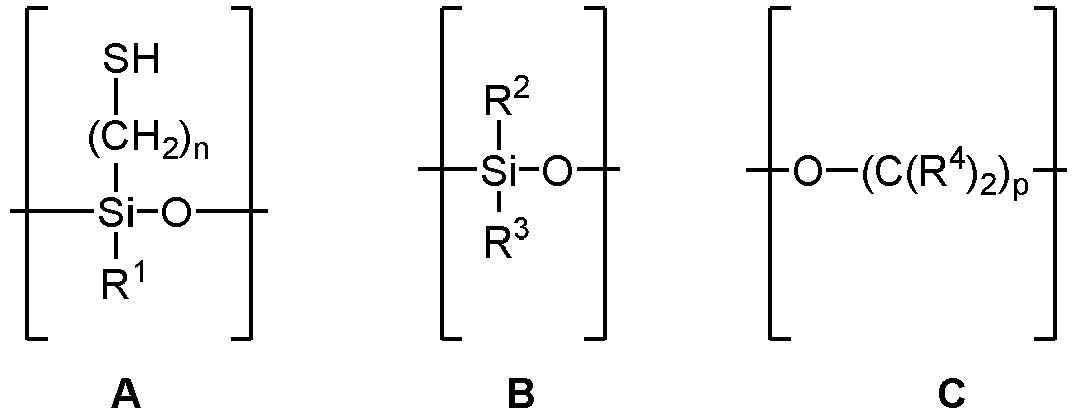
- where n = 1-10, preferably 1-4, more preferably 3,
- R1 and R3 are the same or different and are independently -OH, (C1-C4)alkoxy, preferably ethoxy, OSiR2R3 2, OSi((CH2)nSH)R3 2, structural unit C which is attached via the oxygen atom to the silicon atom of structural unit A or B and is terminated by an -OH group or is attached cyclically to the oxygen of the Si-O group of the same structural unit, and
- an alkyl polyether group -O-(R5-O)m-R6
- where R5 is the same or different and is a branched or unbranched, saturated or unsaturated, aliphatic divalent C1-C30 hydrocarbon group, preferably CH2CH2, m has an average value of 1 to 30, preferably 5, and R6 is an unsubstituted or substituted, branched or unbranched C1-C30-alkyl, preferably C13H17, C2-C30-alkenyl, a C6-C14-aryl group, or a C7-C40-aralkyl group,
- R2 is a branched or unbranched, saturated or unsaturated, aliphatic monovalent C1-C30, preferably C1-C8, more preferably C8, hydrocarbon group,
- R4 is identical or different branched or unbranched, saturated or unsaturated C1-C10-alkyl, C1-C10-alkyl-OH, C1-C10-alkyl-NH2 or H,
- and p = 1-10,
- which are characterized in that the molar ratio of the alkyl polyether group -O-(R5-O)m-R6 to silicon is greater than 0.
- The molar ratio of the alkyl polyether group -O-(R5-O)m-R6 to silicon may be between 0 and 0.30, preferably between 0 and 0.10, more preferably from 0.01 to 0.09, most preferably from 0.01 to 0.08.
- The molar ratio of structural unit C to silicon may be between 0 and 1.7, preferably between 0.1 and 1.5. Structural unit C may also be present in R1 and/or R3 and may be terminated by an OH group or be cyclically attached to the oxygen atom of the Si-O group of the same structural unit. The molar ratio of structural units A and B in the oligomeric organosilanes according to the invention may be 10:1 to 1:10, preferably 3:1 to 1:3, more preferably 2:1 to 1:2.
- The alkyl polyether group may preferably be -O-(CH2CH2-O)m-R6, more preferably -O-(CHzCHz-O)5-R6, most preferably -O-(CH2CH2-O)5-C13H27.
- In the oligomeric organosilane according to the invention, it may preferably be the case that R1 = OC2H5 or -O-(R5-O)m-R6, R2 = (CH2)7CH3, R3 = OC2H5 or -O-(R5-O)m-R6, R4 = H or CH3, R5 = CH2CH2, R6 = C13H27, n = 3, m = 5, p = 3.
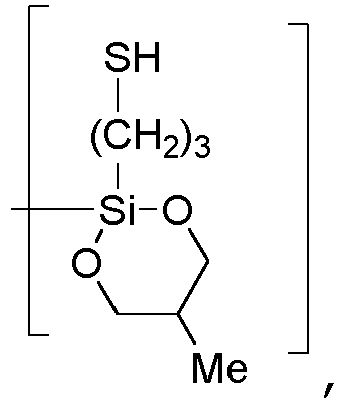
- Structural unit A may be, for example,
- [-O-(EtO)Si(-(CH2)3-SH)-],
- [-O-(MeO)Si(-(CH2)3-SH)-],
- [-O-(EtO)Si(-(CH2)4-SH)-],
- [-O-(EtO)Si(-(CH2)5-SH)-],
- [-O-(EtO)Si(-(CH2)6-SH)-],
- [-O-(C13H27-(OCH2CH2)5-O)Si(-(CH2)3-SH)-],
- [-O-(HO-CH2-CH(CH3)-CH2-O)Si(-(CH2)3-SH)-],

- [-O-(HO-CH2-CH2-O)Si(-(CH2)3-SH)-],
- [-O-((EtO)2Si((CH2)3-SH)-O-)Si(-(CH2)3-SH)-],
- [-O-((C13H27-(OCH2CH2)5-O)(EtO)Si(-(CH2)3-SH)-O-)Si((CH2)3-SH)-],
- [-O-((HO-CH2-CH(CH3)-CH2-O)(EtO)Si(-(CH2)3-SH)-O-)Si((CH2)3-SH)-],
- [-O-((EtO)2Si((CH2)7-CH3)-O-)Si(-(CH2)3-SH)-],
- [-O-((C13H27-(OCH2CH2)5-O)(EtO)Si(-(CH2)7-CH3)-O-)Si((CH2)3-SH)-] or
- [-O-((HO-CH2-CH(CH3)-CH2-O)(EtO)Si(-(CH2)7-CH3)-O-)Si((CH2)3-SH)-].
- Structural unit B may be, for example,
- [-O-(MeO)Si(-(CH2)7-CH3)-],
- [-O-(EtO)Si(-(CH2)2-CH3)-],
- [-O-(EtO)Si(-(CH2)3-CH3)-],
- [-O-(EtO)Si(-(CH2)4-CH3)-],
- [-O-(EtO)Si(-(CH2)5-CH3)-],
- [-O-(EtO)Si(-(CH2)6-CH3)-],
- [-O-(EtO)Si(-(CH2)7-CH3)-],
- [-O-(EtO)Si(-(CH2)2-CH(CH3)2)-],
- [-O-(EtO)Si(-(CH2)15-CH3)-],
- [-O-(C13H27-(OCH2CH2)5-O)Si(-(CH2)2-CH3)-],
- [-O-(C13H27-(OCH2CH2)5-O)Si(-(CH2)3-CH3)-],
- [-O-(C13H27-(OCH2CH2)5-O)Si(-(CH2)4-CH3)-],
- [-O-(C13H27-(OCH2CH2)5-O)Si(-(CH2)5-CH3)-],
- [-O-(C13H27-(OCH2CH2)5-O)Si(-(CH2)6-CH3)-],
- [-O-(C13H27-(OCH2CH2)5-O)Si(-(CH2)7-CH3)-],
- [-O-(C13H27-(OCH2CH2)5-O)Si(-(CH2)2-CH(CH3)2)-],
- [-O-( C13H27-(OCH2CH2)5-O)Si(-(CH2)15-CH3)-],
- [-O-(HO-CH2-CH(CH3)-CH2-O)Si(-(CH2)2-CH3)-],
- [-O-(HO-CH2-CH(CH3)-CH2-O)Si(-(CH2)3-CH3)-],
- [-O-(HO-CH2-CH(CH3)-CH2-O)Si(-(CH2)4-CH3)-],
- [-O-(HO-CH2-CH(CH3)-CH2-O)Si(-(CH2)5-CH3)-],
- [-O-(HO-CH2-CH(CH3)-CH2-O)Si(-(CH2)6-CH3)-],
- [-O-(HO-CH2-CH(CH3)-CH2-O)Si(-(CH2)7-CH3)-],
- [-O-(HO-CH2-CH(CH3)-CH2-O)Si(-(CH2)2-CH(CH3)2)-],
- [-O-(HO-CH2-CH(CH3)-CH2-O)Si(-(CH2)15-CH3)-],
- [-O-(HO-CH2-CH2-O)Si(-(CH2)2-CH3)-],
- [-O-(HO-CH2-CH2-O)Si(-(CH2)3-CH3)-],
- [-O-(HO-CH2-CH2-O)Si(-(CH2)4-CH3)-],
- [-O-(HO-CH2-CH2-O)Si(-(CH2)5-CH3)-],
- [-O-(HO-CH2-CH2-O)Si(-(CH2)6-CH3)-],
- [-O-(HO-CH2-CH2-O)Si(-(CH2)7-CH3)-],
- [-O-(HO-CH2-CH2-O)Si(-(CH2)2-CH(CH3)2)-],


- In the oligomeric organosilane according to the invention, structural unit C may more preferably be [-O-CH2-CH(CH)3-CH2-] or [-O-CHz-CHz-].
- The oligomeric organosilane according to the invention may most preferably contain the structural units
- A = [-O-(EtO)Si(-(CH2)3-SH)-] or [-O-(C13H27-(OCH2CH2)5-O)Si(-(CH2)3-SH)-] or [-O-(HO-CH2-CH(CH3)-CH2-O)Si(-(CH2)3-SH)-] or

- B = [-O-(EtO)Si(-(CH2)7-CH3)-] or [-O-(C13H27-(OCH2CH2)5-O)Si(-(CH2)7-CH3)-] or [-O-(HO-CH2-CH(CH3)-CH2-O)Si(-(CH2)7-CH3)-] or

- C = [-O-CH2-CH(CH)3-CH2-].
- The present invention further provides a process for preparing the oligomeric organosilanes according to the invention, which is characterized in that a mercaptosilane D, an alkylsilane E, a polyol F,

- R7 is the same or different and is -OH, (C1-C4)-alkoxy, preferably ethoxy, or an alkyl polyether group -O-(R5-O)m-R6 where R5 is the same or different and is a branched or unbranched, saturated or unsaturated, aliphatic divalent C1-C30 hydrocarbon group, preferably CH2CH2, m has an average value of 1 to 30, preferably 5, and R6 is an unsubstituted or substituted, branched or unbranched C1-C30-alkyl, preferably C13H17, C2-C30-alkenyl, a C6-C14-aryl group, or a C7-C40-aralkyl group,
- and a catalyst are mixed and reacted at a temperature of 20-180°C, preferably 90°C-150°C.
- The reaction can be effected within 30 min - 10 h, preferably within 30 min - 3 h.
- The reaction can be effected with stirring.
- The secondary components can be separated off by distillation.
- The secondary components can be separated off by distillation during the reaction or thereafter.
- The secondary components can preferably be separated off during the reaction.
- The secondary components can be separated off by distillation at atmospheric pressure or reduced pressure. The secondary components can preferably be separated off by distillation under reduced pressure. More preferably, they can be separated off by distillation at a pressure of 20-200 mbar.
- Components D and E may be used in a molar ratio of 1:10 to 10:1, preferably of 1:3 to 3:1, more preferably of 1:2 to 2:1.
- Components D and F may be used in a molar ratio of 1:1 to 1:10. Preferably, components D and F may be used in a molar ratio of 1:2 to 1:10. More preferably, components D and F may be used in a molar ratio of 1:2 to 1:4. Most preferably, components D and F may be used in a molar ratio of 1:2 to 1:3.
- Component D and the alkyl polyether alcohol of the formula HO-(R5-O)m-R6 may be used in a molar ratio of 1:0.01 to 1:2. Preferably, component D and the polyether alcohol of the formula HO-(R5-O)m-R6 may be used in a molar ratio of 1:0.1 to 1:1.
- The catalyst may be added in catalytic or stoichiometric amounts. In this context, all kinds of acidic, basic or nucleophilic catalysts which are known to those skilled in the art from the SOLGEL chemistry of alkoxysilanes (see, for example, R. Corriu, D. Leclercq, Angew. Chem. 1996, 108, 1524-1540) are also suitable for the oligomerization in the context of the invention. It is unimportant here whether the catalysts are in the same phase as the reaction solution (homogeneous catalysis) or are in the form of solids (heterogeneous catalysis) and are removed after the reaction has ended.
- Preferably, the homogeneous catalysis can be conducted with a transition metal complex, for example tetrabutyl orthotitanate, or a transition metal salt. Basic catalysis can be effected, for example, with an organic base such as triethylamine, tetramethylpiperidine, tributylamine or pyridine, or with an inorganic base such as NaOH, KOH, Ca(OH)2, Na2CO3, K2CO3, CaCOs, CaO, NaHCOs, KHCOs or alkoxides such as NaOCH3 or NaOC2H5. Acidic catalysis can be effected with dilute aqueous mineral acids, such as H2SO4 or HCl, or solutions of Lewis acid in water. Preferably, the catalyst used may be a transition metal complex, KOH, NaOH, ammonium fluoride, H2SO4 or HCl.
- More preferably, the catalyst used may be a transition metal complex.
- Most preferably, the catalyst used may be tetrabutyl orthotitanate.
- The process according to the invention can be performed in solvent-free form or in the presence of a solvent, preferably in solvent-free form.
- Solvents may be an inert organic solvent or mixture thereof, for example an aromatic solvent such as chlorobenzene, a halogenated hydrocarbon, for example chloroform, methylene chloride, an ether, for example diisopropyl ether, tert-butyl methyl ether, tetrahydrofuran or diethyl ether, acetonitrile, a carboxylic ester, for example ethyl acetate, methyl acetate, isopropyl acetate, or an alcohol, for example methanol, ethanol, n-propanol, i-propanol, n-butanol, sec-butanol or tert-butanol.
- The mercaptosilane of the formula D may, for example, be
- 3-mercaptopropyltrimethoxysilane,
- 3-mercaptopropyltriethoxysilane,
- 4-mercaptobutyltriethoxysilane,
- 5-mercaptopentyltriethoxysilane or
- 6-mercaptohexyltriethoxysilane.
- The alkylsilane of the formula E may, for example, be
- methyltrimethoxysilane,
- methyltriethoxysilane,
- propyltrimethoxysilane,
- propyltriethoxysilane,
- butyltrimethoxysilane,
- butyltriethoxysilane,
- isobutyltrimethoxysilane,
- isobutyltriethoxysilane,
- pentyltrimethoxysilane,
- pentyltriethoxysilane,
- hexyltrimethoxysilane,
- hexylltriethoxysilane,
- octyltrimethoxysilane,
- octyltriethoxysilane,
- hexadecyltrimethoxysilane or
- hexadecyltriethoxysilane.
- The polyol of the formula F may, for example, be
- propane-1,3-diol,
- propane-1,2,3-triol,
- 2-methylpropane-1,3-diol or
- ethane-1,2-diol.
- The alkyl polyether alcohol may, for example, be
C13H27-(OCH2CH2)5-OH. - The catalyst can remain in the product after the reaction, be deactivated, preferably by neutralization, or be removed, preferably by filtration. More preferably, the catalyst may not be deactivated after the reaction and remain in the product.
- The invention further provides for the use of the oligomeric organosilanes according to the invention in rubber mixtures.
- The invention further provides rubber mixtures comprising the oligomeric organosilanes according to the invention.
- The rubber mixtures according to the invention can be used for production of shaped bodies, especially pneumatic tyres or tyre treads.
- The rubber mixtures according to the invention may comprise rubber, filler, preferably precipitated silica, optionally further rubber auxiliaries, and at least one oligomeric organosilane according to the invention.
- The use of the oligomeric organosilanes according to the invention in rubber blending processes distinctly reduces the unpleasant release of alcohol because of the precondensation that has already taken place. Compared to the usual mode of operation, for example by simple use of bis(3-[triethoxysilyl]propyl)tetrasulfane (TESPT) as adhesion promoter, evolution of alcohol is reduced during the blending operation.
- Rubber used may be natural rubber and/or synthetic rubbers. Preferred synthetic rubbers are described, for example, in W. Hofmann, H. Gupta, "Handbuch der Kautschuktechnologie"
- [Handbook of Rubber Technology], Dr. Gupta Verlag, Ratingen 2001, chapter 3, p. 2-4. They may include:
- polybutadiene (BR),
- polyisoprene (IR),
- styrene/butadiene copolymers, for example emulsion SBR (E-SBR) or solution SBR (S-SBR), preferably having styrene contents of 1% to 60% by weight, more preferably 5% to 50% by weight (SBR),
- chloroprene (CR),
- isobutylene/isoprene copolymers (IIR),
- butadiene/acrylonitrile copolymers having acrylonitrile contents of 5% to 60%, preferably 10% to 50%, by weight of (NBR),
- partly hydrogenated or fully hydrogenated NBR rubber (HNBR),
- ethylene/propylene/diene copolymers (EPDM),
- abovementioned rubbers which also have functional groups, e.g. carboxy, silanol or epoxy groups, for example epoxidized NR, carboxy-functionalized NBR or amine(NR2), silanol(-SiOH)-, epoxy-, mercapto-, hydroxy-, or siloxy(-Si-OR)-functionalized SBR,
- It is preferably possible to use mixtures of the abovementioned rubbers which have an S-SBR content of more than 50% by weight, preferably more than 60% by weight.
- The rubber may be a functionalized rubber, where the functional groups may be amine and/or amide and/or urethane and/or urea and/or aminosiloxane and/or siloxane and/or silyl and/or alkylsilyl, for example N,N-bis(trimethylsilyl)aminopropylmethyldiethoxysilane or methyltriphenoxysilane, and/or halogenated silyl and/or silane sulfide and/or thiol and/or hydroxyl and/or ethoxy and/or epoxy and/or carboxyl and/or tin, for example tin tetrachloride or dibutyldichlorotin, and/or silanol and/or hexachlorodisiloxane and/or thiocarboxy and/or nitrile and/or nitroxide and/or amido and/or imino and/or urethane and/or urea and/or dimethylimidazolidinone and/or 2-methyl-2-thiazoline and/or 2-benzothiazoleacetonitrile and/or 2-thiophenecarbonitrile and/or 2-(N-methyl-N-3-trimethoxysilylpropyl)thiazoline and/or carbodiimide and/or N-substituted aminoaldehyde and/or N-substituted aminoketone and/or N-substituted aminothioaldehyde and/or N-substituted aminothioketone and/or benzophenone and/or thiobenzophenone with amino group and/or isocyanate and/or isothiocyanate and/or hydrazine and/or sulfonyl and/or sulfinyl and/or oxazoline and/or ester groups.
- The rubber mixture according to the invention may contain at least one filler.
- Fillers usable for the rubber mixtures according to the invention include the following fillers:
- Carbon blacks: The carbon blacks may be produced by the lamp-black process, furnace-black process, gas-black process or thermal process and have BET surface areas of from 20 to 200 m2/g. The carbon blacks may optionally also contain heteroatoms, such as Si for example.
- Amorphous silicas produced for example by precipitation from solutions of silicates or flame-hydrolysis of silicon halides with specific surface areas of from 5 to 1000 m2/g, preferably from 20 to 400 m2/g (BET surface area) and with primary particle sizes of from 10 to 400 nm. The silicas may optionally also be in the form of mixed oxides with other metal oxides, such as oxides of Al, Mg, Ca, Ba, Zn and titanium.
- Synthetic silicates, such as aluminium silicate, alkaline earth metal silicates such as magnesium silicate or calcium silicate, having BET surface areas of 20 to 400 m2/g and primary particle diameters of 10 to 400 nm.
- Synthetic or natural aluminium oxides and synthetic or natural aluminium hydroxides.
- Natural silicates, such as kaolin and other naturally occurring silicas.
- Glass fibres and glass-fibre products (mats, strands) or glass microbeads.
- It is possible with preference to use amorphous silicas prepared by precipitation from solutions of silicates, with BET surface areas of 20 to 400 m2/g, more preferably 100 m2/g to 250 m2/g, in amounts of 5 to 150 parts by weight, based in each case on 100 parts of rubber.
- With very particular preference, it is possible to use precipitated silicas as filler.
- The fillers mentioned may be used alone or in a mixture.
- The rubber mixtures according to the invention may contain 5 to 150 parts by weight of filler and 0.1 to 30 parts by weight, preferably 1 to 25 parts by weight, more preferably 2 to 20 parts by weight, of the oligomeric organosilanes according to the invention, wherein the parts by weight are based on 100 parts by weight of rubber.
- The oligomeric organosilanes according to the invention may be used as adhesion promoter between inorganic materials, for example glass beads, glass flakes, glass surfaces, glass fibres, or oxidic fillers, preferably silicas such as precipitated silicas and fumed silicas,
and organic polymers, for example thermosets, thermoplastics or elastomers, or as crosslinking agents and surface modifiers for oxidic surfaces. - The oligomeric organosilanes according to the invention may be used as coupling reagents in filled rubber mixtures, examples being tyre treads, industrial rubber articles or footwear soles.
- The rubber mixtures according to the invention may comprise further rubber auxiliaries, such as reaction accelerators, ageing stabilizers, heat stabilizers, light stabilizers, antiozonants, processing aids, plasticizers, resins, tackifiers, blowing agents, dyes, pigments, waxes, extenders, organic acids, retarders, metal oxides, and activators such as diphenylguanidine, triethanolamine, polyethylene glycol, alkoxy-terminated polyethylene glycol alkyl-O-(CH2-CH2-O)yl-H with yl = 2-25, preferably yl = 2-15, more preferably yl = 3-10, most preferably yl = 3-6, or hexanetriol, that are familiar to the rubber industry.
- The rubber auxiliaries may be used in familiar amounts determined by factors including the end use. Customary amounts may, for example, be amounts of 0.1% to 50% by weight based on rubber. Crosslinkers used may be peroxides, sulfur or sulfur donor substances. The rubber mixtures according to the invention may further comprise vulcanization accelerators. Examples of suitable vulcanization accelerators may be mercaptobenzothiazoles, sulfenamides, thiurams, dithiocarbamates, thioureas and thiocarbonates. The vulcanization accelerators and sulfur may be used in amounts of 0.1% to 10% by weight, preferably 0.1% to 5% by weight, based on 100 parts by weight of rubber.
- The rubber mixtures according to the invention can be vulcanized at temperatures of 100°C to 200°C, preferably 120°C to 180°C, optionally at a pressure of 10 to 200 bar. The blending of the rubbers with the filler, any rubber auxiliaries and the oligomeric organosilanes according to the invention can be conducted in known mixing units, such as rollers, internal mixers and mixing extruders.
- The rubber mixtures according to the invention can be used for production of moulded articles, for example for the production of tyres, especially pneumatic tyres or tyre treads, cable sheaths, hoses, drive belts, conveyor belts, roller coverings, footwear soles, sealing rings and damping elements.
- The oligomeric organosilanes according to the invention and the fillers are preferably added at mass temperatures of 100 to 200°C, but can also be added at a later stage at lower temperatures (40 to 100°C), for example together with further rubber auxiliaries.
- The oligomeric organosilanes can be added to the blending operation either in pure form or else applied to an inert organic or inorganic carrier. Preferred carrier materials are silicas, natural or synthetic silicate, aluminium oxide or carbon blacks.
- The oligomeric organosilanes according to the invention are obtainable by the process according to the invention.
- The oligomeric organosilanes according to the invention have improved storage stability and/or, in rubber mixtures, the advantage of improved tear resistance.
- The volatile components are determined by gas chromatography by the internal standard method. For this purpose, calibration of the individual components is conducted with an internal standard such as n-nonane, n-decade or n-dodecane in an appropriate solvent. The gas chromatograph used is an HP 6850 or HP7820 with a TCD detector. The separating column used is an HP5 column having the following properties: length: 30 m; internal diameter: 0.53 mm with a film thickness of 2.65 mm. Alternatively, an HP1 column having the following properties is used: length: 30 m; internal diameter: 0.53 mm with a film thickness of 1.50 mm. The temperature is 250°C, the detector temperature 280°C. The temperature program of the column oven is: 50°C - 5 min - 15°C/min - 275°C - 15 min. The carrier gas used is helium with a flow rate of ~ 4 ml/min and a split ratio of 1:50 to 1:100. The amount of sample injected is 0.4 ml.
- This method is employed analogously for the determination of other alcohols, for example methanol.
- Calculation of the content of the sample:

- ci = concentration of the components i to be determined
- fi = calibration factor of component i
- Ast = peak area of the internal standard
- Ai = peak area of the component i to be determined
- mst = weight of the internal standard
- mP = weight of the sample
- The determination of the ethanol after hydrolysis can be effected by the hydrolysis of the silane by means of sulfuric acid (20 w%). Subsequently, water and sodium hydroxide (20 w%) are added. The resultant mixture is subjected to steam distillation with a suitable apparatus. The distillate is collected in a corresponding standard flask, 2-butanol is added as internal standard, and the mixture is made up to the mark with distilled water.
- The gas chromatograph used is a capillary gas chromatograph with FID and evaluation software, for example HP7820 with OpenLab. The separating column has the following properties: length: 30 m; internal diameter: 0.32 mm; film thickness 1.00 mm; stationary phase: Stabiwax (#10654-6850). The injector temperature is 250°C, the detector temperature 280°C. The column oven: 90°C - 10 min - 25°C/min - 240°C - 0 min. The carrier gas used is helium with a flow rate of ~ 2 ml/min and a split ratio of ~ 1:50. The combustion gas used is a hydrogen/synthetic air mixture. The amount of sample injected is 1.0 ml.
- This method is analogously applicable to the determination of other hydrolysable alkoxy groups, for example methoxy groups.
- Calculation of the content of the sample:

- ci = concentration of the components i to be determined
- fi = calibration factor of component i
- Ast = peak area of the internal standard
- Ai = peak area of the component i to be determined
- mst = weight of the internal standard
- mP = weight of the sample
- In addition, the trialkoxysilane content, and also M, D and T structures, can be determined using 29Si NMR spectrometry, which is likewise well known to the person skilled in the art. The solvent used is deuterated chloroform with tetramethylsilane as internal standard.
- 29Si NMR (79.5 MHz): 40-46 ppm (trialkoxysilane); 50-54 ppm (M structures); 57-61 ppm (D structures); 61-65 ppm (T structures).

- The molar proportion of silicon-containing groups (structural units A, B) and of structural unit C, and of the attached alkyl polyether group (R1, R3 = -O-(R5-O)m-R6), can be determined by using 13 C NMR spectroscopy, which is likewise well known to the person skilled in the art. The solvent used is deuterated chloroform with tetramethylsilane as internal standard and chromium acetylacetonate. Structural unit C may also be present in R' and/or R3 and may be terminated by an OH group or be cyclically attached to the oxygen atom of the Si-O group of the same structural unit.
- The oligomeric silanes were characterized by spectroscopic determination of the following ratios via integration of the corresponding 13 C NMR signals:
- Molar ratio of structural unit C to silicon:

- Molar ratio of the alkyl polyether group -O-(R 5 -O) m -R 6 to silicon:

- Molar ratio of structural units A and B:

- Octyltriethoxysilane (OCTEO) and VP Si 263® (MPTES, 3-mercaptopropyltriethoxysilane) are silanes from Evonik Operations GmbH.
- Marlosol is a polyether alcohol of the formula HO-(R5-O)m-R6 with R5 = CH2CH2, R6 = C13H27 and m = 5 from Sasol.
- Comparative Example 1, corresponding to Example 3 from
US7369584 (MPTES:OCTEO:2-MPD = 1:2.33:10) - An initial charge of 3-mercaptopropyltriethoxysilane (MPTES) (1.00 eq; 0.34 mol; 81.00 g) together with octyltriethoxysilane (OCTEO) (2.33 eq; 0.79 mol; 219.00 g) in a round-bottom flask is mixed. Concentrated sulfuric acid (0.010 eq; 3.60 mmol; 0.30 g) is added to the mixture. Subsequently, a vacuum of 67 mbar is applied and the mixture is heated to 50°C. As soon as 50°C has been attained, 2-methylpropane-1,3-diol (2-MPD) (10 eq; 3.395 mol; 306.00 g) is metered in within 30 min. The ethanol formed is removed by distillation. On completion of metered addition, the mixture is stirred for a further 4.5 h. As soon as the product has cooled down to room temperature, sodium ethoxide (w = 21%; 0.012 eq; 4.30 mmol; 1.45 g) is added to neutralize the sulfuric acid.
-
- GC:
- free ethanol: 3.6%
- ethanol after hydrolysis: 4.3%
- MPTES (1.1%), OCTEO (< 0.1%), 2-methylpropane-1,3-diol (38%)
- 13C NMR (100 MHz): δ (ppm) 27.5 (m, Si-(CH2)3-SH), 29.2 (m, Si-(CH2)7-CH3), 64.0 - 65.8 (m, -(O-CH2)2CH(CH3)), 70.1-70.8 (m, -O-CH2-CH(CH3)-CH2-OH).
- Molar ratio of the alkyl polyether group -O-(R 5 -O) m -R 6 to silicon:

- Molar ratio of structural unit C to silicon:

- Molar ratio of structural units A and B:

- 29Si NMR: trialkoxysilanes: 94 mol%; M structures: 6 mol%
- 29Si NMR after 4 months: trialkoxysilanes: 88 mol%; M structures: 12 mol%
- Comparative Example 2, corresponding to example 1 from
EP 3094686 (MPTES:OCTEO:Marlosol = 1:0.5:0.5) - 0.8 eq H2O - An initial charge of 3-mercaptopropyltriethoxysilane (1.00 eq; 1.75 mol; 417.00 g) together with octyltriethoxysilane (0.50 eq; 0.880 mol; 242.00 g) is heated to 85°C. A mixture of H2O (0.8 eq; 2.11 mol; 38.00 g) and concentrated hydrochloric acid (w = 37%; 0.005 eq; 8.00 mmol; 0.30 g) in ethanol (4.50 eq; 7.88 mol; 363.00 g) is slowly added dropwise, and the reaction mixture is stirred for a further 8.5 h. The solvent and the alcohol of hydrolysis are removed under reduced pressure. To the oligomer thus obtained are added Marlosol (0.50 eq; 0.880 mol; 368.00 g) and tetra-n-butyl titanate (0.0008 eq; 1.469 mmol; 0.50 g). The mixture is heated to 140°C and the temperature is maintained for 1 h. The ethanol formed is removed by distillation under reduced pressure.
-
- GC:
- free ethanol: 0.7%
- ethanol after hydrolysis: 3.7%
- MPTES (0.3%), OCTEO (0.1%)
- 13C NMR (100 MHz): δ (ppm) = 27.5 (m, Si-(CH2)3-SH), 29.2 (m, Si-(CH2)7-CH3), 61.2 (HO-(CH2-CH2-O)5-C13H27), 61.5 (Si-O-(CH2-CH2-O)5-C13H27).
- Molar ratio of the alkyl polyether group -O-(R 5 -O) m -R 6 to silicon:

- Molar ratio of structural units A and B:

- 29Si NMR: trialkoxysilanes: 0 mol%; M structures: 48 mol%; D structures: 38 mol%; T structures: 14 mol%
- 29Si NMR after 4 months: trialkoxysilanes: 0 mol%; M structures: 62 mol%; D structures: 35 mol%; T structures: 3 mol%
- An initial charge of 3-mercaptopropyltriethoxysilane (1.00 eq; 0.344 mol; 81.00 g), octyltriethoxysilane (2.33 eq; 0.794 mol; 219.00 g) and Marlosol (1.00 eq; 1.132 mol; 476.12 g) together with tetra-n-butyl titanate (0.0026 eq; 0.88 mmol; 0.30 g) is heated to 130°C. The ethanol formed is removed by distillation. As soon as the mixture has reached 130°C, a vacuum of 200 mbar is applied, which is maintained for 30 minutes. Next, the pressure is reduced to 100 mbar for 30 minutes. The reaction mixture is cooled down to room temperature and 2-methylpropane-1,3-diol (10.0 eq; 3.395 mol; 306.00 g) and tetra-n-butyl titanate (0.0026 eq; 0.88 mmol; 0.30 g) are added, and the mixture is heated again to 130°C. The ethanol formed is removed by distillation. As soon as the mixture has reached 130°C, a vacuum of 200 mbar is applied, which is maintained for 30 minutes, then the pressure is reduced to 20 mbar within 30 minutes. The vacuum of 20 mbar is maintained for 1 h and the mixture is cooled back down to room temperature.
-
- GC:
- free ethanol: 0.1%
- ethanol after hydrolysis: 0.2%
- MPTES (< 0.1%), OCTEO (< 0.1%), 2-methylpropane-1,3-diol (22%)
- 13C NMR (100 MHz): δ (ppm) = 27.5 (m, Si-(CH2)3-SH), 29.2 (m, Si-(CH2)7-CH3), 61.2 (HO-(CH2-CH2-O)5-C13H27), 61.5 (Si-O-(CH2-CH2-O)5-C13H27), 64.0-65.8 (m, -(O-CH2)2CH(CH3)), 70.1-70.8 (m, -O-CH2-CH(CH3)-CH2-OH).
- Molar ratio of structural unit C to silicon:

- Molar ratio of the alkyl polyether group -O-(R 5 -O) m -R 6 to silicon:

- Molar ratio of structural units A and B:

- 29Si NMR: trialkoxysilanes: 100 mol%
- 29Si NMR after 4 months: trialkoxysilanes: 83 mol%; M structures: 17 mol%
- An initial charge of 3-mercaptopropyltriethoxysilane (1.00 eq; 2.20 mol; 524.57 g), octyltriethoxysilane (1.00 eq; 2.20 mol; 602.20 g), 2-methylpropane-1,3-diol (2.95 eq; 6.425 mol; 579.00 g), Marlosol (0.10 eq; 0.216 mol; 90.69 g) and tetra-n-butyl titanate (0.00076 eq; 2.00 mmol; 0.57 g) is heated to 130°C. The temperature is maintained for 1.5 h. The ethanol formed is removed by distillation under reduced pressure (200-20 mbar), then the product obtained is cooled down to room temperature.
-
- GC:
- free ethanol: 0.5%
- ethanol after hydrolysis: 0.5%
- MPTES (< 0.1%), OCTEO (1.1%), 2-methylpropane-1,3-diol (0.6%)
- 13C NMR (100 MHz): δ (ppm) = 27.5 (m, Si-(CH2)3-SH), 29.2 (m, Si-(CH2)7-CH3), 61.2 (HO-(CH2-CH2-O)5-C13H27), 61.5 (Si-O-(CH2-CH2-O)5-C13H27), 64.0-65.8 (m, -(O-CH2)2CH(CH3)), 70.1-70.8 (m, -O-CH2-CH(CH3)-CH2-OH).
- Molar ratio of structural unit C to silicon:

- Molar ratio of the alkyl polyether group -O-(R 5 -O) m -R 6 to silicon:

- Molar ratio of structural units A and B:

- 29Si NMR: trialkoxysilanes: 100 mol%
- 29Si NMR after 4 months: trialkoxysilanes: 95 mol%; M structures: 5 mol%
- An initial charge of 3-mercaptopropyltriethoxysilane (1.00 eq; 1.75 mol; 417.00 g), octyltriethoxysilane (0.50 eq; 0.88 mol; 242.00 g), 2-methylpropane-1,3-diol (2.00 eq; 3.50 mol; 315.42 g), Marlosol (0.50 eq; 0.88 mol; 368.00 g) and tetra-n-butyl titanate (0.00038 eq; 1.67 mmol; 0.57 g) is heated to 130°C. The temperature is maintained for 1.5 h. The ethanol formed is removed by distillation under reduced pressure (200-20 mbar), then the product obtained is cooled down to room temperature.
- GC:
- free ethanol: 0.4%
- ethanol after hydrolysis: 0.7%
- MPTES (0.1%), OCTEO (0.4%), 2-methylpropane-1,3-diol (1.1%)
- 13C NMR (100 MHz): δ (ppm) = 27.5 (m, Si-(CH2)3-SH), 29.2 (m, Si-(CH2)7-CH3), 61.2 (HO-(CH2-CH2-O)5-C13H27), 61.5 (Si-O-(CH2-CH2-O)5-C13H27), 64.0-65.8 (m, -(O-CH2)2CH(CH3)), 70.1-70.8 (m, -O-CH2-CH(CH3)-CH2-OH).
- Molar ratio of structural unit C to silicon:

- Molar ratio of the alkyl polyether group -O-(R 5 -O) m -R 6 to silicon:

- Molar ratio of structural units A and B:

- 29Si NMR: trialkoxysilanes: 100 mol%
- 29Si NMR after 4 months: trialkoxysilanes: 96 mol%; M structures: 4 mol%
- The formulation used for the rubber mixtures is specified in Table 1 below. In this table, the unit phr means parts by weight based on 100 parts of the crude rubber employed. The oligomeric silanes, based on the reference silane according to Comparative Example 1, were used in an equimolar amount based on the mercapto group, since the mercapto group is the only function that binds to the rubber.
- The molar mass of the oligomeric silanes based on the mercapto group can be calculated from the integration of the 13C and 29Si NMR signals according to the following formula:
M(g/mol)=[M(R2) * X13C(R2) + M(-(CH2)n-SH) * X13C (-(CH2)n-SH) + M(-O-(C(R4)2)n-) * X13C (-O-(C(R4)2n-O)) + M(-O-(R5-O)m-R6 * X13C (-O-(R5-O)m-R6 + M(Si) * X29Si(trialkoxysilanes) + (M(SiO0.5) * X29Si(M structures) + (M(SiO)) * X29Si(D strucutres) + (M(SiO1.5) * X29Si(T structures)] / X13C(-(CH2)n-SH)
χ13C (x) = molar proportion of component x based on the total amount of silanes from integration of the 13C NMR signals = Int(x) / (lnt((-(CH2)n-SH) + Int(R2))
χ29Si (x)= molar proportion from 29Si NMR based on the total amount of silanes (trialkoxysilanes, M, D and T structures) from integration of the 29Si NMR signals = Int(x) / (Int (trialkoxysilanes) + Int (M structures) + Int (D structures) + Int (T structures))M (g/mol) / mercapto group Comparative Example 1 977 Comparative Example 2 540 Example 1 1340 Example 2 539 Example 3 484 Table 1 Substance Amount [phr] Amount [phr] Amount [phr] Amount [phr] Amount [phr] Stage 1 Ref. rub-ber mixture I, cont. Comp. Ex. 1 Ref. rub-ber mix-ture II, cont. Comp. Ex. 2 Inv. rubber mixture I, cont. Inv. Ex. 1 Inv. rubber mixture II, cont. Inv. Ex. 2 Inv. rubber mixture III, cont. Inv. Ex. 3 Buna VSL 4526-2 96.25 96.25 96.25 96.25 96.25 Buna CB 24 30 30 30 30 30 ULTRASIL® 7000 GR 80 80 80 80 80 N330 5 5 5 5 5 ZnO Weisssiegel Spezial 2 2 2 2 2 Palmera B1804 2 2 2 2 2 Vivatec 500 8.75 8.75 8.75 8.75 8.75 Protector G 3108 2 2 2 2 2 Vulkanox- 4020/LG 2 2 2 2 2 Vulkanox-HS/LG 1.5 1.5 1.5 1.5 1.5 Comparative Example 1 8.90 - - - - Comparative Example 2 - 4.92 - - - Example 1 - - 12.21 - - Example 2 - - - 4.91 - Example 3 - - - - 4.41 Stage 2 Stage 1 batch Stage 3 Stage 2 batch Uhoo TBzTD 0.4 0.4 0.4 0.4 0.4 Vulkacit® CZ/EG-C 1.6 1.6 1.6 1.6 1.6 Sulfur 2.0 2.0 2.0 2.0 2.0 - The polymer Buna® VSL 4526-2 is a solution-polymerized SBR copolymer from ARLANXEO Deutschland GmbH, having a styrene content of 26% by weight and a vinyl fraction of 45% by weight. The copolymer contains 37.5% TDAE oil and has a Mooney viscosity (ML 1+4/100°C) of 50.
- The polymer Buna® CB 24 is a cis-1,4-polybutadiene (neodymium type) from ARLANXEO Deutschland GmbH, having a cis-1,4 content of at least 96% and a Mooney viscosity of 44. ULTRASIL® 7000 GR is a readily dispersible silica from Evonik Industries AG and has a CTAB surface area of 160 m2/g.
- N330 is carbon black from Orion Engineered Carbons GmbH, TDAE oil used is Vivatec 500 from Hansen & Rosenthal GmbH & Co. KG, Vulkanox® 4020 is 6PPD from LANXESS Distribution GmbH, Vulkanox® HS/LG is TMQ from Lanxess and Protektor™ G3108 is an antiozonant wax from Paramelt B.V., Weißsiegel Spezial zinc oxide is ZnO from Grillo Zinkoxid GmbH, Palmera B1804 is palmitic/stearic acid from Caldic Deutschland GmbH & Co. KG. Vulkacit® CZ is CBS from LANXESS Distribution GmbH. Uhoo TBzTD (tetrabenzylthiuram disulfide) is a product from Hebi Uhoo Rubber Chemicals Co., Ltd., ground sulfur from Avokal GmbH.
- The rubber mixture is produced in three stages in an internal mixer according to Table 2.
Table 2: Stage 1 Settings Mixing unit Werner & Pfleiderer GK 1.5E Speed 65 min-1 Ram pressure 5.5 bar Flow temp. 65°C Fill level 0.65 Mixing procedure 0 to 0.25 min Buna® VSL 4526-2 + Buna® CB 24 0.25 min to 1.25 min 1.25 ½ ULTRASIL® 7000 GR, silane or oligomeric organosilanes vent and purge 1.25 to 2.25 min Vivatec 500 together with N330, ½ ULTRASIL® 7000 GR, Protector™ G3108, Vulkanox® HS/LG, Vulkanox® 4020 2.25 min clean and ventilate 2.25 to 3.75 min ZnO, Palmera B1804, mix and discharge at 145-155°C Stage 2 Settings Mixing unit as in stage 1 except: Speed 75 min-1 Flow temp. 75°C Fill level 0.62 Mixing procedure 0 to 1 min Break up stage 1 batch 1 to 3 min mix at 145-155°C 3 min discharge Stage 3 Settings Mixing unit as in stage 1 except Speed 50 min-1 Flow temp. 50°C Fill level 0.59 Mixing procedure 0 to 2 min Stage 2 batch, Uhoo TBzTD, Vulkacit® CZ and sulfur 2 min discharge and form milled sheet on laboratory roll mill Batch temp. 90-110°C - The general method of producing rubber mixtures and vulcanizates thereof is described in W. Hofmann, H. Gupta, "Handbuch der Kautschuktechnologie", Dr. Gupta Verlag, Ratingen 2001, chapter 10, pages 1-27 and 82-107.
- Rubber testing is effected in accordance with the test method specified in Table 3. Table 3:
Physical testing Standard/conditions Graves tear resistance DIN ISO 34-1, method B, measured using Z005T tensile tester from Zwick GmbH & Co. KG - Vulcanization is effected at a temperature of 165°C for a period of 12 minutes. Table 4 reports the rubber data for the vulcanizates.
Table 4: Substance Ref. rubber mix-ture I, cont. Comp. Ex. 1 Ref. rubber mix-ture II, cont. Comp. Ex. 2 Inv. rubber mix-ture I, cont. Inv. Ex. 1 Inv. rubber mix-ture II, cont. Inv. Ex. 2 Inv. rubber mix-ture III, cont. Inv. Ex. 3 Graves tear resistance [N/mm] 32.8 33.8 54.0 52.7 44.8 The rubber mixtures containing the oligomeric silanes according to the invention show improved tear resistance over the reference mixtures.
Claims (15)
- Oligomeric organosilanes containing at least structural units A, B and C in any linear, branched or cyclic arrangement
 where n = 1-10, preferably 1-4, more preferably 3,R1 and R3 are the same or different and are independently -OH, (C1-C4)alkoxy, preferably ethoxy, OSiR2R3 2, OSi((CH2)nSH)R3 2,wherein structural unit C is attached via the oxygen atom to the silicon atom of structural unit A or B to form an O-Si-O bond, and is terminated by an -OH group oris attached cyclically to the oxygen of the Si-O group of the same structural unit, and an alkyl polyether group -O-(R5-O)m-R6 where R5 is the same or different and is a branched or unbranched, saturated or unsaturated, aliphatic divalent C1-C30 hydrocarbon group, preferably CH2CH2, m has an average value of 1 to 30, preferably 5, and R6 is an unsubstituted or substituted, branched or unbranched C1-C30-alkyl, preferably C13H17, C2-C30-alkenyl, a C6-C14-aryl group, or a C7-C40-aralkyl group,R2 is a branched or unbranched, saturated or unsaturated, aliphatic monovalent C1-C30, preferably C1-C8, more preferably C8, hydrocarbon group,R4 is identical or different branched or unbranched, saturated or unsaturated C1-C10-alkyl, C1-C10-alkyl-OH, C1-C10-alkyl-NH2 or H,and p = 1-10,characterized in that the molar ratio of the alkyl polyether group -O-(R5-O)m-R6 to silicon is greater than 0.
 - Oligomeric organosilanes according to Claim 1, characterized in that the molar ratio of the alkyl polyether group -O-(R5-O)m-R6 to silicon is in the range of > 0 and < 0.30, preferably in the range of > 0 and ≤ 0.10, more preferably in the range from 0.01 to 0.09, most preferably in the range from 0.01 to 0.08.
- Oligomeric organosilanes according to Claim 1, characterized in that the molar ratio of structural unit C to silicon is in the range of > 0 and <1.7, preferably in the range of ≥ 0.1 and ≤ 1.5.
- Oligomeric organosilanes according to Claim 1, characterized in that the molar ratio of structural units A and B is 10:1 to 1:10, preferably 3:1 to 1:3, more preferably 2:1 to 1:2.
- Oligomeric organosilanes according to Claim 1, characterized in that structural unit A is [-O-(EtO)Si(-(CH2)3-SH)-], [-O-(MeO)Si(-(CH2)3-SH)-], [-O-(EtO)Si(-(CH2)4-SH)-], [-O-(EtO)Si(-(CH2)5-SH)-], [-O-(EtO)Si(-(CH2)6-SH)-], [-O-(C13H27-(OCH2CH2)5-O)Si(-(CH2)3-SH)-], [-O-(HO-CH2-CH(CH3)-CH2-O)Si(-(CH2)3-SH)-],
- Oligomeric organosilanes according to Claim 1, characterized in that structural unit B is [-O-(MeO)Si(-(CH2)7-CH3)-], [-O-(EtO)Si(-(CH2)2-CH3)-], [-O-(EtO)Si(-(CH2)3-CH3)-], [-O-(EtO)Si(-(CH2)4-CH3)-], [-O-(EtO)Si(-(CH2)5-CH3)-], [-O-(EtO)Si(-(CH2)6-CH3)-], [-O-(EtO)Si(-(CH2)7-CH3)-], [-O-(EtO)Si(-(CH2)2-CH(CH3)2)-], [-O-(EtO)Si(-(CH2)15-CH3)-], [-O-(C13H27-(OCH2CH2)5-O)Si(-(CH2)2-CH3)-], [-O-(C13H27-(OCH2CH2)5-O)Si(-(CH2)3-CH3)-], [-O-(C13H27-(OCH2CH2)5-O)Si(-(CH2)4-CH3)-], [-O-(C13H27-(OCH2CH2)5-O)Si(-(CH2)5-CH3)-], [-O-(C13H27-(OCH2CH2)5-O)Si(-(CH2)6-CH3)-], [-O-(C13H27-(OCH2CH2)5-O)Si(-(CH2)7-CH3)-], [-O-(C13H27-(OCH2CH2)5-O)Si(-(CH2)2-CH(CH3)2)-], [-O-(C13H27-(OCH2CH2)5-O)Si(-(CH2)15-CH3)-], [-O-(HO-CH2-CH(CH3)-CH2-O)Si(-(CH2)2-CH3)-], [-O-(HO-CH2-CH(CH3)-CH2-O)Si(-(CH2)3-CH3)-], [-O-(HO-CH2-CH(CH3)-CH2-O)Si(-(CH2)4-CH3)-], [-O-(HO-CH2-CH(CH3)-CH2-O)Si(-(CH2)5-CH3)-], [-O-(HO-CH2-CH(CH3)-CH2-O)Si(-(CH2)6-CH3)-], [-O-(HO-CH2-CH(CH3)-CH2-O)Si(-(CH2)7-CH3)-], [-O-(HO-CH2-CH(CH3)-CH2-O)Si(-(CH2)2-CH(CH3)2)-], O-(HO-CH2-CH(CH3)-CH2-O)Si(-(CH2)i5-CH3)-], [-O-(HO-CH2-CH2-O)Si(-(CH2)2-CH3)-], [-O-(HO-CH2-CH2-O)Si(-(CH2)3-CH3)-], [-O-(HO-CH2-CH2-O)Si(-(CH2)4-CH3)-], [-O-(HO-CHz-CH2-O)Si(-(CH2)5-CH3)-], [-O-(HO-CH2-CH2-O)Si(-(CH2)6-CH3)-], [-O-(HO-CH2-CH2-O)Si(-(CH2)7-CH3)-], [-O-(HO-CH2-CH2-O)Si(-(CH2)2-CH(CH3)2)-],

- Oligomeric organosilanes according to Claim 1, characterized in that structural unit C is [-O-CH2-CH(CH)3-CH2-] or [-O-CH2-CH2-].
- Oligomeric organosilanes according to Claim 1, characterized in that structural unit A is [-O-(EtO)Si(-(CH2)3-SH)-] or [-O-(C13H27-(OCH2CH2)5-O)Si(-(CH2)3-SH)-] or [-O-(HO-CH2-CH(CH3)-CH2-O)Si(-(CH2)3-SH)-] or
 and structural unit B is [-O-(EtO)Si(-(CH2)7-CH3)-] or [-O-(C13H27-(OCH2CH2)5-O)Si(-(CH2)7-CH3)-] or [-O-(HO-CH2-CH(CH3)-CH2-O)Si(-(CH2)7-CH3)-] or
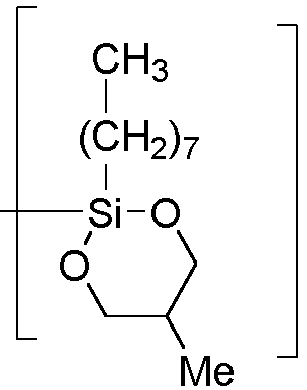 and structural unit C is [-O-CH2-CH(CH)3-CH2-].
 - Process for preparing the oligomeric organosilanes according to Claim 1, characterized in that a mercaptosilane D, an alkylsilane E, a polyol F,
 an alkyl polyether alcohol of the formula HO-(R5-O)m-R6 where R2, R4, R5, R6 n, m, p have the same definition as defined above,R7 is the same or different and is -OH, (C1-C4)-alkoxy, preferably ethoxy, or an alkyl polyether group -O-(R5-O)m-R6 where R5 is the same or different and is a branched or unbranched, saturated or unsaturated, aliphatic divalent C1-C30 hydrocarbon group, preferably CH2CH2, m has an average value of 1 to 30, preferably 5, and R6 is an unsubstituted or substituted, branched or unbranched C1-C30-alkyl, preferably C13H17, C2-C30-alkenyl, a C6-C14-aryl group, or a C7-C40-aralkyl group,and a catalyst are mixed and reacted at a temperature of 20-180°C, preferably 90°C-150°C.
 - Process for preparing the oligomeric organosilanes according to Claim 9, characterized in that components D and F are used in a molar ratio of 1:1 to 1:10, preferably 1:2 to 1:10, more preferably 1:2 to 1:4, most preferably 1:2.1 to 1:3.
- Process for preparing the oligomeric organosilanes according to Claim 9, characterized in that the catalyst is tetrabutyl orthotitanate.
- Process for preparing the oligomeric organosilanes according to Claim 9, characterized in that the catalyst is not deactivated after the reaction and remains in the product.
- Use of the oligomeric organosilanes according to Claim 1 in rubber mixtures.
- Rubber mixtures, characterized in that these contain oligomeric organosilanes according to Claim 1.
- Use of the rubber mixtures according to Claim 14 for production of shaped bodies, especially pneumatic tyres or tyre treads.
Priority Applications (3)
| Application Number | Priority Date | Filing Date | Title |
|---|---|---|---|
| SI202330019T SI4392479T1 (en) | 2022-10-24 | 2023-10-13 | Oligomeric organosilanes, preparation thereof and use thereof in rubber mixtures |
| RS20250175A RS66532B1 (en) | 2022-10-24 | 2023-10-13 | Oligomeric organosilanes, preparation thereof and use thereof in rubber mixtures |
| HRP20250180TT HRP20250180T1 (en) | 2022-10-24 | 2023-10-13 | OLIGOMERIC ORGANOSILANES, THEIR PREPARATION AND USE IN RUBBER COMPOUNDS |
Applications Claiming Priority (2)
| Application Number | Priority Date | Filing Date | Title |
|---|---|---|---|
| EP22203242 | 2022-10-24 | ||
| PCT/EP2023/078473 WO2024088789A1 (en) | 2022-10-24 | 2023-10-13 | Oligomeric organosilanes, preparation thereof and use thereof in rubber mixtures |
Publications (2)
| Publication Number | Publication Date |
|---|---|
| EP4392479A1 EP4392479A1 (en) | 2024-07-03 |
| EP4392479B1 true EP4392479B1 (en) | 2024-12-25 |
Family
ID=83995204
Family Applications (1)
| Application Number | Title | Priority Date | Filing Date |
|---|---|---|---|
| EP23783708.3A Active EP4392479B1 (en) | 2022-10-24 | 2023-10-13 | Oligomeric organosilanes, preparation thereof and use thereof in rubber mixtures |
Country Status (17)
| Country | Link |
|---|---|
| EP (1) | EP4392479B1 (en) |
| JP (1) | JP2025536546A (en) |
| KR (1) | KR20250093371A (en) |
| CN (1) | CN120112582A (en) |
| DK (1) | DK4392479T3 (en) |
| ES (1) | ES3014902T3 (en) |
| FI (1) | FI4392479T3 (en) |
| HR (1) | HRP20250180T1 (en) |
| HU (1) | HUE070705T2 (en) |
| MA (1) | MA71480A1 (en) |
| MX (1) | MX2025004440A (en) |
| PL (1) | PL4392479T3 (en) |
| PT (1) | PT4392479T (en) |
| RS (1) | RS66532B1 (en) |
| SI (1) | SI4392479T1 (en) |
| TW (1) | TW202428719A (en) |
| WO (1) | WO2024088789A1 (en) |
Citations (2)
| Publication number | Priority date | Publication date | Assignee | Title |
|---|---|---|---|---|
| WO2008021308A2 (en) | 2006-08-14 | 2008-02-21 | Momentive Performance Materials Inc. | Mercapto-functional silane compositions having reduced voc levels |
| US20160289251A1 (en) | 2014-01-15 | 2016-10-06 | Evonik Degussa Gmbh | Oligomeric organosilanes, the production thereof and the use thereof in rubber mixtures |
Family Cites Families (10)
| Publication number | Priority date | Publication date | Assignee | Title |
|---|---|---|---|---|
| DE2212239C3 (en) | 1972-03-14 | 1984-03-15 | Degussa Ag, 6000 Frankfurt | Process for the preparation of sulfur-containing organosilicon compounds |
| US3978103A (en) | 1971-08-17 | 1976-08-31 | Deutsche Gold- Und Silber-Scheideanstalt Vormals Roessler | Sulfur containing organosilicon compounds |
| DE2141159C3 (en) | 1971-08-17 | 1983-11-24 | Degussa Ag, 6000 Frankfurt | Organosilicon compounds containing sulfur |
| US4048206A (en) | 1975-04-22 | 1977-09-13 | Mikhail Grigorievich Voronkov | Process for the production of 1-organylsilatranes and carbofunctional derivatives thereof |
| FR2743564A1 (en) | 1996-01-11 | 1997-07-18 | Michelin & Cie | RUBBER COMPOSITIONS FOR SILICA-BASED TIRE CASINGS CONTAINING A REINFORCING ADDITIVE BASED ON A FUNCTIONALIZED POLYORGANOSILOXANE AND AN ORGANOSILANE COMPOUND. |
| DE19825796A1 (en) | 1998-06-10 | 1999-12-16 | Degussa | New oligomeric organosilane polysulfanes, their use in rubber mixtures and for the production of moldings |
| DE19905820A1 (en) | 1998-10-27 | 2000-05-04 | Degussa | Sulfur-functional polyorganosilanes |
| DE10132941A1 (en) | 2001-07-06 | 2003-01-23 | Degussa | Oligomeric organosilanes, process for their preparation and their use |
| US7369584B2 (en) | 2003-12-31 | 2008-05-06 | Symbol Technologies, Inc. | Laser projection display |
| DE102004049427A1 (en) | 2004-10-08 | 2006-04-13 | Degussa Ag | Polyether-functional siloxanes, polyethersiloxane-containing compositions, processes for their preparation and their use |
-
2023
- 2023-10-13 RS RS20250175A patent/RS66532B1/en unknown
- 2023-10-13 HU HUE23783708A patent/HUE070705T2/en unknown
- 2023-10-13 ES ES23783708T patent/ES3014902T3/en active Active
- 2023-10-13 JP JP2025523556A patent/JP2025536546A/en active Pending
- 2023-10-13 DK DK23783708.3T patent/DK4392479T3/en active
- 2023-10-13 CN CN202380074970.3A patent/CN120112582A/en active Pending
- 2023-10-13 WO PCT/EP2023/078473 patent/WO2024088789A1/en not_active Ceased
- 2023-10-13 KR KR1020257016662A patent/KR20250093371A/en active Pending
- 2023-10-13 HR HRP20250180TT patent/HRP20250180T1/en unknown
- 2023-10-13 FI FIEP23783708.3T patent/FI4392479T3/en active
- 2023-10-13 PT PT237837083T patent/PT4392479T/en unknown
- 2023-10-13 SI SI202330019T patent/SI4392479T1/en unknown
- 2023-10-13 EP EP23783708.3A patent/EP4392479B1/en active Active
- 2023-10-13 PL PL23783708.3T patent/PL4392479T3/en unknown
- 2023-10-19 TW TW112139914A patent/TW202428719A/en unknown
-
2025
- 2025-04-15 MX MX2025004440A patent/MX2025004440A/en unknown
- 2025-04-22 MA MA71480A patent/MA71480A1/en unknown
Patent Citations (2)
| Publication number | Priority date | Publication date | Assignee | Title |
|---|---|---|---|---|
| WO2008021308A2 (en) | 2006-08-14 | 2008-02-21 | Momentive Performance Materials Inc. | Mercapto-functional silane compositions having reduced voc levels |
| US20160289251A1 (en) | 2014-01-15 | 2016-10-06 | Evonik Degussa Gmbh | Oligomeric organosilanes, the production thereof and the use thereof in rubber mixtures |
Also Published As
| Publication number | Publication date |
|---|---|
| PL4392479T3 (en) | 2025-04-28 |
| FI4392479T3 (en) | 2025-03-18 |
| EP4392479A1 (en) | 2024-07-03 |
| TW202428719A (en) | 2024-07-16 |
| PT4392479T (en) | 2025-01-29 |
| DK4392479T3 (en) | 2025-03-17 |
| RS66532B1 (en) | 2025-03-31 |
| HUE070705T2 (en) | 2025-06-28 |
| MA71480A1 (en) | 2025-12-31 |
| WO2024088789A1 (en) | 2024-05-02 |
| CN120112582A (en) | 2025-06-06 |
| ES3014902T3 (en) | 2025-04-28 |
| HRP20250180T1 (en) | 2025-04-11 |
| JP2025536546A (en) | 2025-11-07 |
| KR20250093371A (en) | 2025-06-24 |
| MX2025004440A (en) | 2025-05-02 |
| SI4392479T1 (en) | 2025-04-30 |
Similar Documents
| Publication | Publication Date | Title |
|---|---|---|
| US6727339B2 (en) | Oligomeric organosilanes, process for their production and their use | |
| US6849754B2 (en) | Organosilicon compounds | |
| JP4376999B2 (en) | Oligomeric organosilane polysulfane, process for producing the same, rubber mixture containing the same, process for producing the same and molded product obtained from the rubber mixture | |
| US9029450B2 (en) | Mixtures of silicon-containing coupling reagents | |
| US9745330B2 (en) | Oligomeric organosilanes, the production thereof and the use thereof in rubber mixtures | |
| MXPA04006052A (en) | Organosilicon compounds. | |
| JP2010529252A (en) | Process for preparing rubber composition and product made therefrom | |
| US20070049669A1 (en) | Rubber mixtures | |
| FI3837310T3 (en) | RUBBER JOINTS | |
| US20150353734A1 (en) | Mercaptosilane polymer mixture | |
| US11254693B2 (en) | Benzothiazole-containing silanes, method for the preparation and use thereof | |
| WO2024088789A1 (en) | Oligomeric organosilanes, preparation thereof and use thereof in rubber mixtures | |
| US20240409716A1 (en) | Silane-azodicarbonamide mixtures, process for production thereof and use thereof | |
| US20210292514A1 (en) | Thioether silanes, method for the production thereof, and use thereof |
Legal Events
| Date | Code | Title | Description |
|---|---|---|---|
| REG | Reference to a national code |
Ref country code: HR Ref legal event code: TUEP Ref document number: P20250180T Country of ref document: HR |
|
| STAA | Information on the status of an ep patent application or granted ep patent |
Free format text: STATUS: UNKNOWN |
|
| STAA | Information on the status of an ep patent application or granted ep patent |
Free format text: STATUS: THE INTERNATIONAL PUBLICATION HAS BEEN MADE |
|
| PUAI | Public reference made under article 153(3) epc to a published international application that has entered the european phase |
Free format text: ORIGINAL CODE: 0009012 |
|
| STAA | Information on the status of an ep patent application or granted ep patent |
Free format text: STATUS: REQUEST FOR EXAMINATION WAS MADE |
|
| 17P | Request for examination filed |
Effective date: 20231013 |
|
| AK | Designated contracting states |
Kind code of ref document: A1 Designated state(s): AL AT BE BG CH CY CZ DE DK EE ES FI FR GB GR HR HU IE IS IT LI LT LU LV MC ME MK MT NL NO PL PT RO RS SE SI SK SM TR |
|
| TPAC | Observations filed by third parties |
Free format text: ORIGINAL CODE: EPIDOSNTIPA |
|
| GRAP | Despatch of communication of intention to grant a patent |
Free format text: ORIGINAL CODE: EPIDOSNIGR1 |
|
| STAA | Information on the status of an ep patent application or granted ep patent |
Free format text: STATUS: GRANT OF PATENT IS INTENDED |
|
| GRAS | Grant fee paid |
Free format text: ORIGINAL CODE: EPIDOSNIGR3 |
|
| GRAA | (expected) grant |
Free format text: ORIGINAL CODE: 0009210 |
|
| STAA | Information on the status of an ep patent application or granted ep patent |
Free format text: STATUS: THE PATENT HAS BEEN GRANTED |
|
| DAV | Request for validation of the european patent (deleted) | ||
| DAX | Request for extension of the european patent (deleted) | ||
| INTG | Intention to grant announced |
Effective date: 20241025 |
|
| RIN1 | Information on inventor provided before grant (corrected) |
Inventor name: HASSE, ANDRE Inventor name: DANIELI, FLORIAN Inventor name: KOEPFER, ALEXANDER Inventor name: JUERGENS, HANNES Inventor name: PAULUS, KATHARINA MARIE |
|
| AK | Designated contracting states |
Kind code of ref document: B1 Designated state(s): AL AT BE BG CH CY CZ DE DK EE ES FI FR GB GR HR HU IE IS IT LI LT LU LV MC ME MK MT NL NO PL PT RO RS SE SI SK SM TR |
|
| REG | Reference to a national code |
Ref country code: GB Ref legal event code: FG4D |
|
| REG | Reference to a national code |
Ref country code: CH Ref legal event code: EP |
|
| P01 | Opt-out of the competence of the unified patent court (upc) registered |
Free format text: CASE NUMBER: APP_62089/2024 Effective date: 20241121 |
|
| REG | Reference to a national code |
Ref country code: DE Ref legal event code: R096 Ref document number: 602023001510 Country of ref document: DE |
|
| REG | Reference to a national code |
Ref country code: IE Ref legal event code: FG4D |
|
| REG | Reference to a national code |
Ref country code: PT Ref legal event code: SC4A Ref document number: 4392479 Country of ref document: PT Date of ref document: 20250129 Kind code of ref document: T Free format text: AVAILABILITY OF NATIONAL TRANSLATION Effective date: 20250124 |
|
| REG | Reference to a national code |
Ref country code: NL Ref legal event code: FP |
|
| REG | Reference to a national code |
Ref country code: DK Ref legal event code: T3 Effective date: 20250311 |
|
| REG | Reference to a national code |
Ref country code: FI Ref legal event code: FGE |
|
| REG | Reference to a national code |
Ref country code: SE Ref legal event code: TRGR |
|
| REG | Reference to a national code |
Ref country code: LT Ref legal event code: MG9D |
|
| REG | Reference to a national code |
Ref country code: HR Ref legal event code: T1PR Ref document number: P20250180 Country of ref document: HR |
|
| PG25 | Lapsed in a contracting state [announced via postgrant information from national office to epo] |
Ref country code: GR Free format text: LAPSE BECAUSE OF FAILURE TO SUBMIT A TRANSLATION OF THE DESCRIPTION OR TO PAY THE FEE WITHIN THE PRESCRIBED TIME-LIMIT Effective date: 20250326 Ref country code: LV Free format text: LAPSE BECAUSE OF FAILURE TO SUBMIT A TRANSLATION OF THE DESCRIPTION OR TO PAY THE FEE WITHIN THE PRESCRIBED TIME-LIMIT Effective date: 20241225 |
|
| REG | Reference to a national code |
Ref country code: SK Ref legal event code: T3 Ref document number: E 46081 Country of ref document: SK |
|
| REG | Reference to a national code |
Ref country code: EE Ref legal event code: FG4A Ref document number: E024965 Country of ref document: EE Effective date: 20250212 |
|
| REG | Reference to a national code |
Ref country code: HU Ref legal event code: AG4A Ref document number: E070705 Country of ref document: HU |
|
| PG25 | Lapsed in a contracting state [announced via postgrant information from national office to epo] |
Ref country code: SM Free format text: LAPSE BECAUSE OF FAILURE TO SUBMIT A TRANSLATION OF THE DESCRIPTION OR TO PAY THE FEE WITHIN THE PRESCRIBED TIME-LIMIT Effective date: 20241225 |
|
| PG25 | Lapsed in a contracting state [announced via postgrant information from national office to epo] |
Ref country code: IS Free format text: LAPSE BECAUSE OF FAILURE TO SUBMIT A TRANSLATION OF THE DESCRIPTION OR TO PAY THE FEE WITHIN THE PRESCRIBED TIME-LIMIT Effective date: 20250425 |
|
| REG | Reference to a national code |
Ref country code: DE Ref legal event code: R026 Ref document number: 602023001510 Country of ref document: DE |
|
| PLBI | Opposition filed |
Free format text: ORIGINAL CODE: 0009260 |
|
| REG | Reference to a national code |
Ref country code: CH Ref legal event code: L10 Free format text: ST27 STATUS EVENT CODE: U-0-0-L10-L00 (AS PROVIDED BY THE NATIONAL OFFICE) Effective date: 20251008 |
|
| PLAX | Notice of opposition and request to file observation + time limit sent |
Free format text: ORIGINAL CODE: EPIDOSNOBS2 |
|
| PGFP | Annual fee paid to national office [announced via postgrant information from national office to epo] |
Ref country code: SI Payment date: 20251002 Year of fee payment: 3 |
|
| 26 | Opposition filed |
Opponent name: MOMENTIVE PERFORMANCE MATERIALS Effective date: 20250925 |
|
| REG | Reference to a national code |
Ref country code: HR Ref legal event code: ODRP Ref document number: P20250180 Country of ref document: HR Payment date: 20251002 Year of fee payment: 3 |
|
| PGFP | Annual fee paid to national office [announced via postgrant information from national office to epo] |
Ref country code: HU Payment date: 20251027 Year of fee payment: 3 |
|
| PGFP | Annual fee paid to national office [announced via postgrant information from national office to epo] |
Ref country code: LU Payment date: 20251022 Year of fee payment: 3 |
|
| PGFP | Annual fee paid to national office [announced via postgrant information from national office to epo] |
Ref country code: PT Payment date: 20251002 Year of fee payment: 3 |
|
| PGFP | Annual fee paid to national office [announced via postgrant information from national office to epo] |
Ref country code: DE Payment date: 20251021 Year of fee payment: 3 |
|
| PGFP | Annual fee paid to national office [announced via postgrant information from national office to epo] |
Ref country code: NO Payment date: 20251024 Year of fee payment: 3 |
|
| PGFP | Annual fee paid to national office [announced via postgrant information from national office to epo] |
Ref country code: AT Payment date: 20260113 Year of fee payment: 3 |
|
| PGFP | Annual fee paid to national office [announced via postgrant information from national office to epo] |
Ref country code: FI Payment date: 20251028 Year of fee payment: 3 Ref country code: DK Payment date: 20251027 Year of fee payment: 3 Ref country code: IT Payment date: 20251031 Year of fee payment: 3 |
|
| PGFP | Annual fee paid to national office [announced via postgrant information from national office to epo] |
Ref country code: HR Payment date: 20251002 Year of fee payment: 3 Ref country code: FR Payment date: 20251030 Year of fee payment: 3 |
|
| PGFP | Annual fee paid to national office [announced via postgrant information from national office to epo] |
Ref country code: TR Payment date: 20251007 Year of fee payment: 3 Ref country code: BE Payment date: 20251021 Year of fee payment: 3 |
|
| PGFP | Annual fee paid to national office [announced via postgrant information from national office to epo] |
Ref country code: SE Payment date: 20251021 Year of fee payment: 3 |
|
| PGFP | Annual fee paid to national office [announced via postgrant information from national office to epo] |
Ref country code: CZ Payment date: 20251009 Year of fee payment: 3 Ref country code: IE Payment date: 20251024 Year of fee payment: 3 |
|
| PGFP | Annual fee paid to national office [announced via postgrant information from national office to epo] |
Ref country code: BG Payment date: 20251023 Year of fee payment: 3 Ref country code: PL Payment date: 20251003 Year of fee payment: 3 |
|
| PGFP | Annual fee paid to national office [announced via postgrant information from national office to epo] |
Ref country code: EE Payment date: 20251105 Year of fee payment: 3 |
|
| PGFP | Annual fee paid to national office [announced via postgrant information from national office to epo] |
Ref country code: SK Payment date: 20251008 Year of fee payment: 3 Ref country code: RO Payment date: 20251003 Year of fee payment: 3 |
|
| PGFP | Annual fee paid to national office [announced via postgrant information from national office to epo] |
Ref country code: RS Payment date: 20251002 Year of fee payment: 3 |
|
| PGFP | Annual fee paid to national office [announced via postgrant information from national office to epo] |
Ref country code: ES Payment date: 20251217 Year of fee payment: 3 |
|
| PLBB | Reply of patent proprietor to notice(s) of opposition received |
Free format text: ORIGINAL CODE: EPIDOSNOBS3 |
|
| PG25 | Lapsed in a contracting state [announced via postgrant information from national office to epo] |
Ref country code: LT Free format text: LAPSE BECAUSE OF FAILURE TO SUBMIT A TRANSLATION OF THE DESCRIPTION OR TO PAY THE FEE WITHIN THE PRESCRIBED TIME-LIMIT Effective date: 20241225 |
|
| PG25 | Lapsed in a contracting state [announced via postgrant information from national office to epo] |
Ref country code: MC Free format text: LAPSE BECAUSE OF FAILURE TO SUBMIT A TRANSLATION OF THE DESCRIPTION OR TO PAY THE FEE WITHIN THE PRESCRIBED TIME-LIMIT Effective date: 20241225 |
|
| REG | Reference to a national code |
Ref country code: CH Ref legal event code: W10 Free format text: ST27 STATUS EVENT CODE: U-0-0-W10-W00 (AS PROVIDED BY THE NATIONAL OFFICE) Effective date: 20260729 |