EP4391539A1 - Video transmission device, video reception device, video transmission method, video reception method, video transmission program, and video reception program - Google Patents
Video transmission device, video reception device, video transmission method, video reception method, video transmission program, and video reception program Download PDFInfo
- Publication number
- EP4391539A1 EP4391539A1 EP21954169.5A EP21954169A EP4391539A1 EP 4391539 A1 EP4391539 A1 EP 4391539A1 EP 21954169 A EP21954169 A EP 21954169A EP 4391539 A1 EP4391539 A1 EP 4391539A1
- Authority
- EP
- European Patent Office
- Prior art keywords
- video
- video data
- frame rate
- transmission
- packets
- Prior art date
- Legal status (The legal status is an assumption and is not a legal conclusion. Google has not performed a legal analysis and makes no representation as to the accuracy of the status listed.)
- Pending
Links
Images



Classifications
-
- H—ELECTRICITY
- H04—ELECTRIC COMMUNICATION TECHNIQUE
- H04N—PICTORIAL COMMUNICATION, e.g. TELEVISION
- H04N21/00—Selective content distribution, e.g. interactive television or video on demand [VOD]
- H04N21/20—Servers specifically adapted for the distribution of content, e.g. VOD servers; Operations thereof
- H04N21/23—Processing of content or additional data; Elementary server operations; Server middleware
- H04N21/236—Assembling of a multiplex stream, e.g. transport stream, by combining a video stream with other content or additional data, e.g. inserting a URL [Uniform Resource Locator] into a video stream, multiplexing software data into a video stream; Remultiplexing of multiplex streams; Insertion of stuffing bits into the multiplex stream, e.g. to obtain a constant bit-rate; Assembling of a packetised elementary stream
- H04N21/2365—Multiplexing of several video streams
-
- H—ELECTRICITY
- H04—ELECTRIC COMMUNICATION TECHNIQUE
- H04N—PICTORIAL COMMUNICATION, e.g. TELEVISION
- H04N21/00—Selective content distribution, e.g. interactive television or video on demand [VOD]
- H04N21/20—Servers specifically adapted for the distribution of content, e.g. VOD servers; Operations thereof
- H04N21/25—Management operations performed by the server for facilitating the content distribution or administrating data related to end-users or client devices, e.g. end-user or client device authentication, learning user preferences for recommending movies
- H04N21/266—Channel or content management, e.g. generation and management of keys and entitlement messages in a conditional access system, merging a VOD unicast channel into a multicast channel
- H04N21/2662—Controlling the complexity of the video stream, e.g. by scaling the resolution or bitrate of the video stream based on the client capabilities
-
- H—ELECTRICITY
- H04—ELECTRIC COMMUNICATION TECHNIQUE
- H04N—PICTORIAL COMMUNICATION, e.g. TELEVISION
- H04N19/00—Methods or arrangements for coding, decoding, compressing or decompressing digital video signals
- H04N19/42—Methods or arrangements for coding, decoding, compressing or decompressing digital video signals characterised by implementation details or hardware specially adapted for video compression or decompression, e.g. dedicated software implementation
- H04N19/436—Methods or arrangements for coding, decoding, compressing or decompressing digital video signals characterised by implementation details or hardware specially adapted for video compression or decompression, e.g. dedicated software implementation using parallelised computational arrangements
-
- H—ELECTRICITY
- H04—ELECTRIC COMMUNICATION TECHNIQUE
- H04N—PICTORIAL COMMUNICATION, e.g. TELEVISION
- H04N21/00—Selective content distribution, e.g. interactive television or video on demand [VOD]
- H04N21/20—Servers specifically adapted for the distribution of content, e.g. VOD servers; Operations thereof
- H04N21/23—Processing of content or additional data; Elementary server operations; Server middleware
- H04N21/234—Processing of video elementary streams, e.g. splicing of video streams or manipulating encoded video stream scene graphs
- H04N21/2343—Processing of video elementary streams, e.g. splicing of video streams or manipulating encoded video stream scene graphs involving reformatting operations of video signals for distribution or compliance with end-user requests or end-user device requirements
- H04N21/234381—Processing of video elementary streams, e.g. splicing of video streams or manipulating encoded video stream scene graphs involving reformatting operations of video signals for distribution or compliance with end-user requests or end-user device requirements by altering the temporal resolution, e.g. decreasing the frame rate by frame skipping
-
- H—ELECTRICITY
- H04—ELECTRIC COMMUNICATION TECHNIQUE
- H04N—PICTORIAL COMMUNICATION, e.g. TELEVISION
- H04N21/00—Selective content distribution, e.g. interactive television or video on demand [VOD]
- H04N21/20—Servers specifically adapted for the distribution of content, e.g. VOD servers; Operations thereof
- H04N21/23—Processing of content or additional data; Elementary server operations; Server middleware
- H04N21/234—Processing of video elementary streams, e.g. splicing of video streams or manipulating encoded video stream scene graphs
- H04N21/2343—Processing of video elementary streams, e.g. splicing of video streams or manipulating encoded video stream scene graphs involving reformatting operations of video signals for distribution or compliance with end-user requests or end-user device requirements
- H04N21/23439—Processing of video elementary streams, e.g. splicing of video streams or manipulating encoded video stream scene graphs involving reformatting operations of video signals for distribution or compliance with end-user requests or end-user device requirements for generating different versions
-
- H—ELECTRICITY
- H04—ELECTRIC COMMUNICATION TECHNIQUE
- H04N—PICTORIAL COMMUNICATION, e.g. TELEVISION
- H04N21/00—Selective content distribution, e.g. interactive television or video on demand [VOD]
- H04N21/20—Servers specifically adapted for the distribution of content, e.g. VOD servers; Operations thereof
- H04N21/23—Processing of content or additional data; Elementary server operations; Server middleware
- H04N21/238—Interfacing the downstream path of the transmission network, e.g. adapting the transmission rate of a video stream to network bandwidth; Processing of multiplex streams
- H04N21/2381—Adapting the multiplex stream to a specific network, e.g. an Internet Protocol [IP] network
-
- H—ELECTRICITY
- H04—ELECTRIC COMMUNICATION TECHNIQUE
- H04N—PICTORIAL COMMUNICATION, e.g. TELEVISION
- H04N21/00—Selective content distribution, e.g. interactive television or video on demand [VOD]
- H04N21/40—Client devices specifically adapted for the reception of or interaction with content, e.g. set-top-box [STB]; Operations thereof
- H04N21/45—Management operations performed by the client for facilitating the reception of or the interaction with the content or administrating data related to the end-user or to the client device itself, e.g. learning user preferences for recommending movies, resolving scheduling conflicts
- H04N21/462—Content or additional data management e.g. creating a master electronic programme guide from data received from the Internet and a Head-end or controlling the complexity of a video stream by scaling the resolution or bit-rate based on the client capabilities
- H04N21/4621—Controlling the complexity of the content stream or additional data, e.g. lowering the resolution or bit-rate of the video stream for a mobile client with a small screen
-
- H—ELECTRICITY
- H04—ELECTRIC COMMUNICATION TECHNIQUE
- H04N—PICTORIAL COMMUNICATION, e.g. TELEVISION
- H04N21/00—Selective content distribution, e.g. interactive television or video on demand [VOD]
- H04N21/80—Generation or processing of content or additional data by content creator independently of the distribution process; Content per se
- H04N21/85—Assembly of content; Generation of multimedia applications
- H04N21/854—Content authoring
- H04N21/8547—Content authoring involving timestamps for synchronizing content
-
- H—ELECTRICITY
- H04—ELECTRIC COMMUNICATION TECHNIQUE
- H04L—TRANSMISSION OF DIGITAL INFORMATION, e.g. TELEGRAPHIC COMMUNICATION
- H04L65/00—Network arrangements, protocols or services for supporting real-time applications in data packet communication
- H04L65/60—Network streaming of media packets
- H04L65/65—Network streaming protocols, e.g. real-time transport protocol [RTP] or real-time control protocol [RTCP]
Definitions
- the present invention relates to a video transmission device, a video reception device, a video transmission method, a video reception method, a video transmission program, and a video reception program.
- SDI serial digital interface
- the video transmission device can store video data in real-time transport protocol (RTP) packets and transmit the data using IP packets (Non Patent Literature 1).
- RTP real-time transport protocol
- IP packets IP packets
- Non Patent Literature 1 the video data of the SDI signal input to the SDI is converted into RTP packets and transmitted, the RTP time stamps applied to each of the RTP packets storing the video data extracted from the same video frame are all the same.
- the video transmission device and the video reception device can operate by synchronizing the time with the International Atomic Time (TAI) using a precision time protocol (PTP) or the like.
- TAI International Atomic Time
- PTP precision time protocol
- the origin of the clock counter is 00:00:00 TAI on January 1, 1970 (Non Patent Literature 2).
- the video transmission device and the video reception device hold a synchronized clock counter.
- the video transmission device and the video reception device can execute seamless protection for protecting video data transmitted in IP packets from packet loss using fully redundant transmission (Non Patent Literature 3).
- the video transmission device duplicates an RTP packet and transmits the duplicated RTP packets over two IP flows (two paths).
- the video reception device receives two IP flows at all times and integrates RTP packets acquired from the respective IP flows.
- video data not missing anything can be output unless packet loss occurs at the same place at the same time.
- standard frame rates are 50 frames per second (FPS), 59.94 FPS, 60 FPS, and the like.
- FPS frames per second
- a high frame rate such as 120 FPS is suitable.
- the high frame rate f H is set to N times (N is a natural number of 2 or more) the standard frame rate f S .
- the video data with the high frame rate is divided into multiple pieces of video data with a standard frame rate and mapped to a plurality of synchronized SDI signals, which can be used as an input/output interface for the video data with the high frame rate.
- the video data with the high frame rate is allocated to multiple pieces of video data with the standard frame rate in temporally preceding order in units of video frames.
- phase division The division of the video data with the high frame rate into a plurality of pieces of video data with the standard frame rate in this manner is called phase division.
- the phase numbers are labeled sequentially as shown by the phase 1, 2, ..., N for the pieces of video data with the standard frame rate after the phase division.
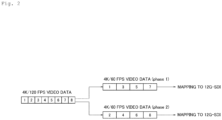
- the 4K/120 FPS video data is divided into two lines of 4K/60 FPS video data of a phase 1 and 4K/60 FPS video data of a phase 2. Since the 4K/60 FPS video data can be input/output via one 12G-SDI line, 4K/120 FPS video data can be input/output via two synchronized 12G-SDI lines.
- the 8K/120 FPS video data is divided into two lines of 8K/60 FPS video data of a phase 1 and 8K/60 FPS video data of a phase 2. Since the 8K/60 FPS video data can be input/output via four 12G-SDI lines (one set of 12G-SDI quad links), the 8K/120 FPS video can be input/output via synchronized two sets of 12G-SDI quad links.
- the SDI is parallelized to be used as an input interface of video data with a high frame rate.
- one input unit takes out 4K/60 FPS video data from each 12G-SDI and alternately passes the video frame (4K/60 FPS video data) of the phase 1 and the video frame (4K/60 FPS video data) of the phase 2 to one transmission unit.
- a conventional video transmission device converts video data with a high frame rate into IP packets, it is necessary to perform high speed processing N times as high as that in the case of converting video data with a standard frame rate of the same resolution into IP packets, and the mounting difficulty of the video transmission device is large.
- the conventional video reception device directly processes video data with a high frame rate, the mounting difficulty of the video reception device is large.
- a waiting delay time of (N-1)/f H is required to continue transmission of IP packets at a fixed bit rate, a delay time of about 8 milliseconds occurs between video frames in the case of 4K/120 FPS video data.
- the present invention has been made in view of the above circumstances, and an object of the present invention is to provide a technology that facilitates mounting of a video transmission device and a video reception device and eliminates the occurrence of a waiting delay time.
- a video transmission device includes a plurality of transmission units that each convert into IP packets in parallel each video data with a low frame rate obtained by dividing video data with a high frame rate through allocation in units of vide frames in temporally preceding order and transmit the IP packets.
- a video reception device includes a plurality of reception units that receive IP packets of each video data with a low frame rate obtained by dividing video data with a high frame rate through allocation in units of video frames in temporally preceding order and convert the IP packets into the video data with the low frame rate in parallel.
- a video transmission method is a video transmission method performed by a video transmission device, the method including a step of causing each of a plurality of transmission units to convert into IP packets in parallel each video data with a low frame rate obtained by dividing video data with a high frame rate through allocation in units of video frames in temporally preceding order and transmit the IP packets.
- a video reception method is a video reception method performed by a video reception device, the method including a step of causing a plurality of reception units to receive IP packets of each video data with a low frame rate obtained by dividing video data with a high frame rate through allocation in units of video frames in temporally preceding order and convert the IP packets into the video data with the low frame rate in parallel.
- a video transmission program causes a computer to function as the video transmission device described above.
- a video reception program causes a computer to function as the video reception device described above.
- the present invention it is possible to provide a technique capable of facilitating mounting of the video transmission device and the video reception device and eliminating the occurrence of a waiting delay time.
- the present invention relates to a video transmission device that converts video data with a high frame rate input using SDI into an IP flow and transmits the IP flow, a video reception device that receives video data for converting the video data with the high frame rate into SDI by receiving the IP flow, and a parallel transmission control device that controls parallel transmission of IP flows between the video transmission device and the video reception device.
- the present invention parallelizes transmission units that process video data with a standard frame rate.
- the processing of video data with a high frame rate is executed, the mounting of the video transmission device and the video reception device is facilitated, and the occurrence of the waiting delay time is eliminated.
- the present invention provides priority to video data with a standard frame rate, and applies execution of seamless protection from video data having high priority within the range of an available bandwidth.
- high reliability of transmission can be realized by effectively utilizing the available bandwidth.
- Fig. 1 is a diagram illustrating an overall configuration of a video transmission system 1 according to a first embodiment.
- the video transmission system 1 includes a video transmission device 11 supporting 4K/120 FPS, a video reception device 12 supporting 4K/120 FPS, and a parallel transmission control device 13 that controls parallel transmission of IP flows between the video transmission device 11 and the video reception device 12.
- Each of the devices 11, 12, and 13 is connected via an IP network 14 to be able to communicate with each other.
- the video transmission device 11 and the video reception device 12 need not necessarily be mounted as a single hardware unit.
- the video transmission device 11 is a device that converts 4K/120 FPS video data input via two synchronized 12G-SDI lines into two IP flows and transmits the data.
- the 4K/120 FPS video data is phase-divided into 4K/60 FPS video data of a phase 1 and 4K/60 FPS video data of a phase 2 as illustrated in Fig. 2 , and each data is mapped to 12G-SDI and input to the video transmission device 11.
- the video transmission device 11 transmits an IP flow for each phase in accordance with Non Patent Literature 4 (RP2110-23).
- Phase division is a method of dividing video data with a high frame rate into a plurality of pieces of video data of a standard frame rate by allocating the video data with the high frame rate in units of video frames in temporally preceding order.
- the 4K/120 FPS video data is set as video data with a high frame rate
- the 4K/60 FPS video data is set as video data with a standard frame rate.
- the standard frame rate is an example of a low frame rate having a smaller number of frames than a high frame rate.
- the video transmission device 11 includes, for example, a first input unit 111a and a second input unit 111b that input an SDI signal, a first transmission unit 112a and a second transmission unit 112b compliant with ST2110 and supporting 4K/60 FPS, and a first addition unit 113a and a second addition unit 113b that add time stamps.
- the first input unit 111a has a function for inputting one SDI signal out of two synchronized 12G-SDI lines and extracting 4K/60 FPS video data of the phase 1 from the SDI signal.
- the second input unit 111b has a function for inputting the other SDI signal and extracting 4K/60 FPS video data of the phase 2 from the SDI signal.
- the first input unit 111a and the second input unit 111b mutually execute processing in parallel.
- the first transmission unit 112a has a function of storing 4K/60 FPS video data of the phase 1 in IP packets.
- the second transmission unit 112b has a function of storing 4K/60 FPS video data of the phase 2 in IP packets.
- the first transmission unit 112a and the second transmission unit 112b mutually execute processing in parallel.
- the first addition unit 113a and the second addition unit 113b mutually execute processing in parallel.
- the video reception device 12 receives two IP flows transmitted from the video transmission device 11 via the IP network 14, maps the IP flows to two synchronized 12G-SDI lines and outputs them.
- the video reception device 12 includes a first subtraction unit 121a and a second subtraction unit 121b that subtract a time stamp, a first reception unit 122a and a second reception unit 122b that are compliant with ST2110 and support 4K/60 FPS, and a first output unit 123a and a second output unit 123b that output an SDI signal.
- the first subtraction unit 121a has a function of receiving an IP packet of 4K/60 FPS video data of the phase 1 and subtracting the offset from the RTP time stamp of the RTP packet of the IP packet.
- the second subtraction unit 121b has a function of receiving an IP packet of 4K/60 FPS video data of the phase 2 and subtracting the offset from the RTP time stamp of the RTP packet of the IP packet.
- the first subtraction unit 121a and the second subtraction unit 121b mutually execute processing in parallel.
- the first reception unit 122a has a function for extracting 4K/60 FPS video data of the phase 1 from an IP packet of 4K/60 FPS video data of the phase 1 after offset subtraction.
- the second reception unit 122b has a function for extracting 4K/60 FPS video data of the phase 2 from an IP packet of 4K/60 FPS video data of the phase 2 after offset subtraction.
- the first reception unit 122a and the second reception unit 122b mutually execute processing in parallel.
- the first output unit 123a has a function of mapping 4K/60 FPS video data of the phase 1 to 12G-SDI and outputting an SDI signal.
- the second output unit 123b has a function of mapping 4K/60 FPS video data of the phase 2 to 12G-SDI and outputting an SDI signal.
- the first output unit 123a and the second output unit 123b mutually execute processing in parallel.
- the parallel transmission control device 13 is a device that controls the parallel transmission of the IP flows between the video transmission device 11 and the video reception device 12.
- the parallel transmission control device 13 includes a first designation unit 131a and a second designation unit 131b that designate the number (k value) of the phase k, and a first determination unit 132a and a second determination unit 132b that determine to enable or disable the seamless protection.
- the first designation unit 131a has a function for designating a k value of a phase k of video data to be processed by each addition unit, for the first addition unit 113a and the second addition unit 113b of the video transmission device 11.
- the second designation unit 131b has a function for designating a k value of a phase k of the video data to be processed by each subtraction unit, for the first subtraction unit 121a and the second subtraction unit 121b of the video reception device 12.
- the first determination unit 132a has a function for determining to enable or disable the seamless protection on the basis of the priority of the phase, for the first transmission unit 112a and the second transmission unit 112b of the video transmission device 11.
- the second determination unit 132b has a function for determining to enable or disable the seamless protection on the basis of the priority of the phase, for the first reception unit 122a and the second reception unit 122b of the video reception device 12.
- Non Patent Literature 4 (RP2110-23) defines a method of transmitting phase-divided video data with a high frame rate using a separate IP flow for each phase.
- the video data with a high frame rate is transmitted using a plurality of IP flows in accordance with Non Patent Literature 4
- it is necessary to add an offset ⁇ k (k-1) ⁇ F/f H to the RTP time stamp of the standard frame rate, with respect to the RTP time stamp of the IP packets storing the video data of the phase k (1 ⁇ k ⁇ N.
- N is a natural number of 2 or more.).
- transmission units (the first transmission unit 112a and the second transmission unit 112b) compliant with ST2110 and supporting a standard frame rate do not know the phase of the video to be processed, the same RTP time stamp is stamped regardless of the phase of the video data.
- Fig. 3 is a diagram illustrating a processing flow of the video transmission device 11.
- the video transmission device 11 processes 4K/120 FPS video data by parallelizing the first transmission unit 112a and the second transmission unit 112b compliant with ST2110 and supporting 4K/60 FPS.
- the first input unit 111a inputs one SDI signal of two synchronized 12G-SDI lines, extracts 4K/60 FPS video data of the phase 1 from the SDI signal, and passes the video data to the first transmission unit 112a.
- the second input unit 111b inputs the other SDI signal, extracts 4K/60 FPS video data of the phase 2 from the SDI signal, and passes the data to the second transmission unit 112b.
- the first transmission unit 112a stores the 4K/60 FPS video data of the phase 1 in IP packets in accordance with ST2110.
- the second transmission unit 112b stores 4K/60 FPS video data of the phase 2 in IP packets in accordance with ST2110.
- the first transmission unit 112a transmits the IP packets of 4K/60 FPS video data of the phase 1 to the video reception device 12 via the IP network 14.
- the second transmission unit 112b transmits the IP packets of 4K/60 FPS video data of the phase 2 to the video reception device 12 via the IP network 14.
- the first transmission unit 112a and the second transmission unit 112b are designated by the parallel transmission control device 13 whether the seamless protection is enabled or not. In a case where the seamless protection is valid, the first transmission unit 112a and the second transmission unit 112b duplicate the RTP packets of the video data to transmit the video data using two IP flows, and in a case where the seamless protection is invalid, the first transmission unit 112a and the second transmission unit 112b transmit the video data using one IP flow.
- the phase k is designated by the parallel transmission control device 13.
- Fig. 4 is a diagram illustrating a processing flow of the video reception device 12.
- the video reception device 12 processes the 4K/120 FPS video data by parallelizing the first reception unit 122a and the second reception unit 122b compliant with ST2110 and supporting 4K/60 FPS.
- the RTP time stamp included in an IP packet received by the video reception device 12 is different for each phase due to addition of the offset performed in the step S103.
- the RTP time stamp is used for controlling the video output timing, when the IP packet is passed to the first reception unit 122a and the second reception unit 122b as it is, the SDI signal is output at a timing different for each phase.
- the second subtraction unit 121b receives an IP packet of 4K/60 FPS video data of the phase 2
- the phase k is designated by the parallel transmission control device 13.
- the first reception unit 122a extracts 4K/60 FPS video data of the phase 1 from an IP packet of 4K/60 FPS video data of the phase 1 after offset subtraction and passes the extracted data to the first output unit 123a.
- the second reception unit 122b extracts 4K/60 FPS video data of the phase 2 from an IP packet of 4K/60 FPS video data of the phase 2 after offset subtraction and passes the extracted data to the second output unit 123b.
- the first reception unit 122a and the second reception unit 122b are designated by the parallel transmission control device 13 whether the seamless protection is enabled or not.
- the first reception unit 122a and the second reception unit 122b integrate the received two IP flows and then extract 4K/60 FPS video data.
- the first reception unit 122a and the second reception unit 122b extract 4K/60 FPS video data from one received IP flow.
- the first output unit 123a maps the 4K/60 FPS video data of the phase 1 to 12G-SDI and outputs the SDI signal.
- the second output unit 123b maps the 4K/60 FPS video data of the phase 2 to 12G-SDI and outputs the SDI signal.
- the parallel transmission control device 13 determines and designates whether seamless protection of the first transmission unit 112a and the second transmission unit 112b is enabled or not according to the priority of the phase. For example, the parallel transmission control device 13 preferentially applies seamless protection from the phase of a small number (k value) within a range not exceeding an available bandwidth.
- the first transmission unit 112a and the second transmission unit 112b of the video transmission device 11 duplicate and transmit the RTP packets of the video data with the standard frame rate of the phase in a case where the priority of the phase to be transmitted by each transmission unit is high.
- the 4K/120 FPS video data can be output.
- 4K/60 FPS video data can be output if only the phase 1 can be received stably, and the worst situation where the output video is interrupted can be avoided.
- Equation (1) the maximum value k max of the phase which can be protected by seamless protection can be defined as in Equation (1).
- k max ⁇ B b ⁇ N ⁇
- Fig. 5 is a diagram illustrating a configuration of the video transmission device 11 according to a second embodiment.
- Fig. 6 is a diagram illustrating a configuration of the video transmission device 12 according to the second embodiment.
- the video transmission device 11 converts 8K/120P video data input via synchronized two sets of 12G-SDI quad links into eight IP flows of ST2110 for each link of 12G-SDI in accordance with RP2110-23, and transmits them.
- the video reception device 12 receives these eight IP flows, maps them to synchronized two sets of 12G-SDI quad links and outputs them.
- the video transmission device 11 processes 8K/120P video data by arranging in parallel eight transmission units 112 which are compliant with ST2110 and support 4K/60 FPS.
- Eight input units 111 extract 4K/60 FPS video data from the respective SDI signals and pass them to the transmission units 112.
- the video reception device 12 processes 8K/120P video data by arranging in parallel eight reception units 122, which are compliant with ST2110 and support 4K/60 FPS. Eight reception units 122 extract 4K/60 FPS video data from the respective IP flows and pass them to an output unit 123.
- the parallel transmission control device 13 designates whether the seamless protection of each transmission unit 112 is enabled in accordance with the communication quality of the IP network 14.
- the seamless protection is preferentially applied from the transmission unit 112 and the reception unit 122 corresponding to an IP flow with poor communication quality within a range not exceeding an available band.
- each transmission unit 112 of the video transmission device 11 duplicates and transmits the RTP packets of video data with a standard frame rate to be transmitted by each transmission unit.
- the communication quality may be determined by using a packet loss rate in the reception unit 122 as a criterion.
- the consumed bandwidth in the case of 8K/120 FPS video data is 84 Gbps.
- the available bandwidth is 100 Gbps, one IP flow of 4K/60 FPS can be added.
- the seamless protection is enabled in the transmission unit 112 and the reception unit 122 corresponding to the link A of the phase 1 having the highest packet loss rate.
- the consumed bandwidth is 94.5 Gbps.
- Fig. 8 illustrates the configuration of a conventional video transmission device 11' supporting 4K/120 FPS.
- the conventional video transmission device 11' transmits 4K/120 FPS video data input via two parallel 12G-SDI lines, in accordance with ST2110.
- One input unit 111' extracts 4K/60 FPS video data from each 12G-SDI, and alternately passes the video frame (4K/60 FPS video data) of the phase 1 and the video frame (4K/60 FPS video data) of the phase 2 to a transmission unit 112'.
- the transmission unit 112' stores the video data passed from the input unit 111' in RTP packets in order, and transmits the 4K/120 FPS video data as one IP flow.
- a delay time of about 8 milliseconds occurs between video frames in the case of 4K/120 FPS video data.
- the video transmission device 11 includes a plurality of transmission units 112 that each convert video data with a standard frame rate obtained by phase-dividing video data with a high frame rate into IP packets in parallel and transmit the IP packets.
- the video reception device 12 includes a plurality of reception units 122 that receive IP packets of each video data with a standard frame rate obtained by phase-dividing video data with a high frame rate and convert the IP packets into video data with a low frame rate in parallel.
- the throughput required in the transmission unit 112 and the reception unit 122 can be reduced compared to the conventional method of directly processing the video data with a high frame rate, and thus mounting of the video transmission device 11 and the video reception device 12 becomes easy and occurrence of a waiting delay time can be eliminated.
- the video transmission device 11 and the video reception device 12 do not necessarily need to be mounted as a single piece of hardware, for example, by using two video transmission devices 11 of the first embodiment and arranging four transmission units 112 supporting 4K/60 FPS in parallel, 4K/240 FPS can be supported.
- a configuration such as using in parallel two video transmission device 11 supporting 8K/60 FPS equipped with four transmission units 112 supporting 4K/60 FPS is also possible.
- the number of each of the video transmission device 11, the input unit 111, the transmission unit 112, the addition unit 113, the video reception device 12, the subtraction unit 121, the reception unit 122, and the output unit 123 can be optionally changed according to image resolution such as 4K and 8K and the frame rate such as 60 FPS.
- the video transmission unit supporting the standard frame rate does not concern the phase
- the RTP time stamp which does not conform to the PR2110-23 is stamped.
- the addition unit 113 since the addition unit 113 converts the RTP time stamp into the RTP time stamp based on the RP2110-23, the interconnection property can be secured.
- the delay can be reduced by performing a time stamp operation without waiting for video data in each embodiment.
- the parallel transmission control device 13 includes a determination unit 132 that automatically determines whether redundant transmission is enabled or not for each of the transmission units 112 of the video transmission device 11 and the reception units 122 of the video reception device 12 which are arranged in parallel, based on the priority of the phase or the communication quality of the IP network 14.
- the RTP packet of the video data of the standard frame rate is duplicated and transmitted by the plurality of the transmission units 112 of the video transmission device 11.
- the present invention is not limited to the embodiments described above.
- the present invention can be modified in a number of ways within the scope of the gist of the present invention.
- the video transmission device 11 of the present embodiment described above can be realized using, for example, a computer system including a CPU 901, a memory 902, a storage 903, a communication device 904, an input device 905, and an output device 906 as illustrated in Fig. 10 .
- the memory 902 and the storage 903 are storage devices.
- each function of the video transmission device 11 is realized by the CPU 901 executing a predetermined program loaded on the memory 902.
- a program for the video transmission device 11 can be stored in a computer-readable recording medium such as an HDD, an SSD, a USB memory, a CD, or a DVD.
- the program for the video transmission device 11 can also be distributed via a communication network.
- the video reception device 12 also has a hardware configuration similar to that illustrated in Fig. 10 .
Landscapes
- Engineering & Computer Science (AREA)
- Multimedia (AREA)
- Signal Processing (AREA)
- Databases & Information Systems (AREA)
- Computing Systems (AREA)
- Theoretical Computer Science (AREA)
- Computer Security & Cryptography (AREA)
- Data Exchanges In Wide-Area Networks (AREA)
Abstract
Description
- The present invention relates to a video transmission device, a video reception device, a video transmission method, a video reception method, a video transmission program, and a video reception program.
- Conventionally, there is known a video transmission device that converts video data input via a serial digital interface (SDI) into an IP flow and transmits the IP flow. A video reception device that receives an IP flow and converts video data into SDI is known.
- The video transmission device can store video data in real-time transport protocol (RTP) packets and transmit the data using IP packets (Non Patent Literature 1). In a case where the video data of the SDI signal input to the SDI is converted into RTP packets and transmitted, the RTP time stamps applied to each of the RTP packets storing the video data extracted from the same video frame are all the same. A clock frequency F of the RTP time stamp in the RTP packet of the video is F=9.0×10⁴.
- In addition, the video transmission device and the video reception device can operate by synchronizing the time with the International Atomic Time (TAI) using a precision time protocol (PTP) or the like. The origin of the clock counter is 00:00:00 TAI on January 1, 1970 (Non Patent Literature 2). By this mechanism, the video transmission device and the video reception device hold a synchronized clock counter.
- Further, the video transmission device and the video reception device can execute seamless protection for protecting video data transmitted in IP packets from packet loss using fully redundant transmission (Non Patent Literature 3). For example, the video transmission device duplicates an RTP packet and transmits the duplicated RTP packets over two IP flows (two paths). The video reception device receives two IP flows at all times and integrates RTP packets acquired from the respective IP flows. Thus, video data not missing anything can be output unless packet loss occurs at the same place at the same time.
- Here, attention is paid to the video data.
- In the case of ultra high definition (UHD) video data, standard frame rates are 50 frames per second (FPS), 59.94 FPS, 60 FPS, and the like. In the case of expressing a fast moving scene, a high frame rate such as 120 FPS is suitable. Thereafter, the high frame rate fH is set to N times (N is a natural number of 2 or more) the standard frame rate fS.
- In addition, the video data with the high frame rate is divided into multiple pieces of video data with a standard frame rate and mapped to a plurality of synchronized SDI signals, which can be used as an input/output interface for the video data with the high frame rate. At this time, the video data with the high frame rate is allocated to multiple pieces of video data with the standard frame rate in temporally preceding order in units of video frames.
- The division of the video data with the high frame rate into a plurality of pieces of video data with the standard frame rate in this manner is called phase division. The phase numbers are labeled sequentially as shown by the
phase - For example, the 4K/120 FPS video data is divided into two lines of 4K/60 FPS video data of a
phase phase 2. Since the 4K/60 FPS video data can be input/output via one 12G-SDI line, 4K/120 FPS video data can be input/output via two synchronized 12G-SDI lines. - Similarly, the 8K/120 FPS video data is divided into two lines of 8K/60 FPS video data of a
phase 1 and 8K/60 FPS video data of aphase 2. Since the 8K/60 FPS video data can be input/output via four 12G-SDI lines (one set of 12G-SDI quad links), the 8K/120 FPS video can be input/output via synchronized two sets of 12G-SDI quad links. - Further, the SDI is parallelized to be used as an input interface of video data with a high frame rate. For example, in the video transmission device, one input unit takes out 4K/60 FPS video data from each 12G-SDI and alternately passes the video frame (4K/60 FPS video data) of the
phase 1 and the video frame (4K/60 FPS video data) of thephase 2 to one transmission unit. - The transmission unit sequentially stores the video data passed from the input unit in RTP packets, and transmits 4K/120 FPS video data as one IP flow. Since the RTP time stamp increases by F/fH for each video frame, in the case of 4K/120 FPS video data, F=9.0×10⁴, fH=120, and the increase width becomes 750.
-
- [Non Patent Literature 1] SMPTE ST2110-20, "Professional Media Over Managed IP Networks: Uncompressed Active Video," 2017
- [Non Patent Literature 2] SMPTE ST2059-1, "Generation and Alignment of Interface Signals to the SMPTE Epoch," 2015
- [Non Patent Literature 3] SMPTE ST2022-7, "Seamless Protection Switching of RTP Datagrams," 2019
- [Non Patent Literature 4] SMPTE RP2110-23, "Single Video Essence Transport over Multiple ST 2110-20 Streams," 2019
- However, since a conventional video transmission device converts video data with a high frame rate into IP packets, it is necessary to perform high speed processing N times as high as that in the case of converting video data with a standard frame rate of the same resolution into IP packets, and the mounting difficulty of the video transmission device is large. Similarly, since the conventional video reception device directly processes video data with a high frame rate, the mounting difficulty of the video reception device is large.
- Further, since the video data with a high frame rate is transmitted as one IP flow, waiting delay time increases. Since a waiting delay time of (N-1)/fH is required to continue transmission of IP packets at a fixed bit rate, a delay time of about 8 milliseconds occurs between video frames in the case of 4K/120 FPS video data.
- The present invention has been made in view of the above circumstances, and an object of the present invention is to provide a technology that facilitates mounting of a video transmission device and a video reception device and eliminates the occurrence of a waiting delay time.
- A video transmission device according to one aspect of the present invention includes a plurality of transmission units that each convert into IP packets in parallel each video data with a low frame rate obtained by dividing video data with a high frame rate through allocation in units of vide frames in temporally preceding order and transmit the IP packets.
- A video reception device according to one aspect of the present invention includes a plurality of reception units that receive IP packets of each video data with a low frame rate obtained by dividing video data with a high frame rate through allocation in units of video frames in temporally preceding order and convert the IP packets into the video data with the low frame rate in parallel.
- A video transmission method according to one aspect of the present invention is a video transmission method performed by a video transmission device, the method including a step of causing each of a plurality of transmission units to convert into IP packets in parallel each video data with a low frame rate obtained by dividing video data with a high frame rate through allocation in units of video frames in temporally preceding order and transmit the IP packets.
- A video reception method according to one aspect of the present invention is a video reception method performed by a video reception device, the method including a step of causing a plurality of reception units to receive IP packets of each video data with a low frame rate obtained by dividing video data with a high frame rate through allocation in units of video frames in temporally preceding order and convert the IP packets into the video data with the low frame rate in parallel.
- A video transmission program according to one aspect causes a computer to function as the video transmission device described above.
- A video reception program according to one aspect causes a computer to function as the video reception device described above.
- According to the present invention, it is possible to provide a technique capable of facilitating mounting of the video transmission device and the video reception device and eliminating the occurrence of a waiting delay time.
-
- [
Fig. 1] Fig. 1 is a diagram illustrating an overall configuration of a video transmission system according to a first embodiment. - [
Fig. 2] Fig. 2 is a diagram illustrating an example of phase division. - [
Fig. 3] Fig. 3 is a diagram illustrating a processing flow of a video transmission device. - [
Fig. 4] Fig. 4 is a diagram illustrating a processing flow of a video reception device. - [
Fig. 5] Fig. 5 is a diagram illustrating a configuration of the video transmission device according to a second embodiment. - [
Fig. 6] Fig. 6 is a diagram illustrating a configuration of the video reception device according to a second embodiment. - [
Fig. 7] Fig. 7 is a diagram illustrating an example of a packet loss rate for each phase number/link. - [
Fig. 8] Fig. 8 is a diagram illustrating a configuration of a conventional video transmission device. - [
Fig. 9] Fig. 9 is a diagram illustrating a waiting delay time of the conventional video transmission device. - [
Fig. 10] Fig. 10 is a diagram illustrating an example of a hardware configuration of the video transmission device. - Embodiments of the present invention will be described below with reference to the drawings. In the description provided with reference to the drawings, the same parts are denoted by the same reference numerals and the description thereof is omitted.
- The present invention relates to a video transmission device that converts video data with a high frame rate input using SDI into an IP flow and transmits the IP flow, a video reception device that receives video data for converting the video data with the high frame rate into SDI by receiving the IP flow, and a parallel transmission control device that controls parallel transmission of IP flows between the video transmission device and the video reception device.
- In order to solve the above issue, the present invention parallelizes transmission units that process video data with a standard frame rate. Thus, even if only the transmission units supporting a standard frame rate are used, the processing of video data with a high frame rate is executed, the mounting of the video transmission device and the video reception device is facilitated, and the occurrence of the waiting delay time is eliminated.
- Further, when seamless protection is executed, there is a further issue that the band consumption of the IP network increases. In a case where 4K/120 FPS video data is transmitted, its band consumption is 21 Gbps, but when seamless protection is applied for high reliability, a bandwidth of 42 Gbps, which is twice that bandwidth, is required.
- Therefore, in order to solve the above-mentioned further issue, the present invention provides priority to video data with a standard frame rate, and applies execution of seamless protection from video data having high priority within the range of an available bandwidth. Thus, high reliability of transmission can be realized by effectively utilizing the available bandwidth.
- Two embodiments will be described.
-
Fig. 1 is a diagram illustrating an overall configuration of avideo transmission system 1 according to a first embodiment. Thevideo transmission system 1 includes avideo transmission device 11 supporting 4K/120 FPS, avideo reception device 12 supporting 4K/120 FPS, and a paralleltransmission control device 13 that controls parallel transmission of IP flows between thevideo transmission device 11 and thevideo reception device 12. - Each of the
devices IP network 14 to be able to communicate with each other. Thevideo transmission device 11 and thevideo reception device 12 need not necessarily be mounted as a single hardware unit. - The
video transmission device 11 is a device that converts 4K/120 FPS video data input via two synchronized 12G-SDI lines into two IP flows and transmits the data. The 4K/120 FPS video data is phase-divided into 4K/60 FPS video data of aphase phase 2 as illustrated inFig. 2 , and each data is mapped to 12G-SDI and input to thevideo transmission device 11. Thevideo transmission device 11 transmits an IP flow for each phase in accordance with Non Patent Literature 4 (RP2110-23). - Phase division is a method of dividing video data with a high frame rate into a plurality of pieces of video data of a standard frame rate by allocating the video data with the high frame rate in units of video frames in temporally preceding order. In this embodiment, the 4K/120 FPS video data is set as video data with a high frame rate, and the 4K/60 FPS video data is set as video data with a standard frame rate. The standard frame rate is an example of a low frame rate having a smaller number of frames than a high frame rate.
- As illustrated in
Fig. 1 , thevideo transmission device 11 includes, for example, afirst input unit 111a and asecond input unit 111b that input an SDI signal, afirst transmission unit 112a and a second transmission unit 112b compliant with ST2110 and supporting 4K/60 FPS, and afirst addition unit 113a and asecond addition unit 113b that add time stamps. - The
first input unit 111a has a function for inputting one SDI signal out of two synchronized 12G-SDI lines and extracting 4K/60 FPS video data of thephase 1 from the SDI signal. Thesecond input unit 111b has a function for inputting the other SDI signal and extracting 4K/60 FPS video data of thephase 2 from the SDI signal. Thefirst input unit 111a and thesecond input unit 111b mutually execute processing in parallel. - The
first transmission unit 112a has a function of storing 4K/60 FPS video data of thephase 1 in IP packets. The second transmission unit 112b has a function of storing 4K/60 FPS video data of thephase 2 in IP packets. Thefirst transmission unit 112a and the second transmission unit 112b mutually execute processing in parallel. - The
first addition unit 113a and thesecond addition unit 113b have a function for adding, to the RTP time stamp of the RTP packet of each IP packet, an offset Δk=(k-1)×F/fH corresponding to a phase k (k=1, 2) labeled to the video data of each 4K/60 FPS video data in the division order of the 4K/120 FPS video data. F is a clock frequency of the RTP time stamp in RTP packets of a video, and F = 9.0 × 10⁴. The fH is a frame rate of 4K/120 FPS video data, and fH = 120. Thefirst addition unit 113a and thesecond addition unit 113b mutually execute processing in parallel. - The
video reception device 12 receives two IP flows transmitted from thevideo transmission device 11 via theIP network 14, maps the IP flows to two synchronized 12G-SDI lines and outputs them. - For example, as illustrated in
Fig. 1 , thevideo reception device 12 includes afirst subtraction unit 121a and asecond subtraction unit 121b that subtract a time stamp, afirst reception unit 122a and asecond reception unit 122b that are compliant with ST2110 and support 4K/60 FPS, and afirst output unit 123a and asecond output unit 123b that output an SDI signal. - The
first subtraction unit 121a has a function of receiving an IP packet of 4K/60 FPS video data of thephase 1 and subtracting the offset from the RTP time stamp of the RTP packet of the IP packet. Thesecond subtraction unit 121b has a function of receiving an IP packet of 4K/60 FPS video data of thephase 2 and subtracting the offset from the RTP time stamp of the RTP packet of the IP packet. Thefirst subtraction unit 121a and thesecond subtraction unit 121b mutually execute processing in parallel. - The
first reception unit 122a has a function for extracting 4K/60 FPS video data of thephase 1 from an IP packet of 4K/60 FPS video data of thephase 1 after offset subtraction. Thesecond reception unit 122b has a function for extracting 4K/60 FPS video data of thephase 2 from an IP packet of 4K/60 FPS video data of thephase 2 after offset subtraction. Thefirst reception unit 122a and thesecond reception unit 122b mutually execute processing in parallel. - The
first output unit 123a has a function ofmapping 4K/60 FPS video data of thephase 1 to 12G-SDI and outputting an SDI signal. Thesecond output unit 123b has a function ofmapping 4K/60 FPS video data of thephase 2 to 12G-SDI and outputting an SDI signal. Thefirst output unit 123a and thesecond output unit 123b mutually execute processing in parallel. - The parallel
transmission control device 13 is a device that controls the parallel transmission of the IP flows between thevideo transmission device 11 and thevideo reception device 12. - For example, as illustrated in
Fig. 1 , the paralleltransmission control device 13 includes afirst designation unit 131a and asecond designation unit 131b that designate the number (k value) of the phase k, and afirst determination unit 132a and asecond determination unit 132b that determine to enable or disable the seamless protection. - The
first designation unit 131a has a function for designating a k value of a phase k of video data to be processed by each addition unit, for thefirst addition unit 113a and thesecond addition unit 113b of thevideo transmission device 11. Thesecond designation unit 131b has a function for designating a k value of a phase k of the video data to be processed by each subtraction unit, for thefirst subtraction unit 121a and thesecond subtraction unit 121b of thevideo reception device 12. - The
first determination unit 132a has a function for determining to enable or disable the seamless protection on the basis of the priority of the phase, for thefirst transmission unit 112a and the second transmission unit 112b of thevideo transmission device 11. Thesecond determination unit 132b has a function for determining to enable or disable the seamless protection on the basis of the priority of the phase, for thefirst reception unit 122a and thesecond reception unit 122b of thevideo reception device 12. - The reason why the offset is added will now be described.
- Non Patent Literature 4 (RP2110-23) defines a method of transmitting phase-divided video data with a high frame rate using a separate IP flow for each phase. In a case where the video data with a high frame rate is transmitted using a plurality of IP flows in accordance with
Non Patent Literature 4, it is necessary to add an offset Δk=(k-1)×F/fH to the RTP time stamp of the standard frame rate, with respect to the RTP time stamp of the IP packets storing the video data of the phase k (1≤k≤N. N is a natural number of 2 or more.). In the case of a 4K/120 FPS video, since F = 9.0 × 10⁴, and fH = 120, the followings are established: Δ1 = 0, Δ2 = 750, .... - However, generally, since transmission units (the
first transmission unit 112a and the second transmission unit 112b) compliant with ST2110 and supporting a standard frame rate do not know the phase of the video to be processed, the same RTP time stamp is stamped regardless of the phase of the video data. - In order to make the RTP time stamps compliant with
Non Patent Literature 4, thefirst addition unit 113a and thesecond addition unit 113b add, to the same RTP time stamps, an offset Δk=(k-1)×F/fH according to the phase k of the video data to be processed. -
Fig. 3 is a diagram illustrating a processing flow of thevideo transmission device 11. Thevideo transmission device 11processes 4K/120 FPS video data by parallelizing thefirst transmission unit 112a and the second transmission unit 112b compliant with ST2110 and supporting 4K/60 FPS. - First, the
first input unit 111a inputs one SDI signal of two synchronized 12G-SDI lines, extracts 4K/60 FPS video data of thephase 1 from the SDI signal, and passes the video data to thefirst transmission unit 112a. At the same time, thesecond input unit 111b inputs the other SDI signal, extracts 4K/60 FPS video data of thephase 2 from the SDI signal, and passes the data to the second transmission unit 112b. - Next, the
first transmission unit 112a stores the 4K/60 FPS video data of thephase 1 in IP packets in accordance with ST2110. At the same time, the second transmissionunit 112b stores 4K/60 FPS video data of thephase 2 in IP packets in accordance with ST2110. - Finally, the
first transmission unit 112a transmits the IP packets of 4K/60 FPS video data of thephase 1 to thevideo reception device 12 via theIP network 14. At the same time, the second transmission unit 112b transmits the IP packets of 4K/60 FPS video data of thephase 2 to thevideo reception device 12 via theIP network 14. - At this time, the
first transmission unit 112a and the second transmission unit 112b are designated by the paralleltransmission control device 13 whether the seamless protection is enabled or not. In a case where the seamless protection is valid, thefirst transmission unit 112a and the second transmission unit 112b duplicate the RTP packets of the video data to transmit the video data using two IP flows, and in a case where the seamless protection is invalid, thefirst transmission unit 112a and the second transmission unit 112b transmit the video data using one IP flow. - In addition, at this time, since the
first addition unit 113a makes the RTP time stamp conform toNon Patent Literature 4, thefirst addition unit 113a adds an offset Δk=(k-1)×F/fH=0 corresponding to the phase k (k=1) to the RTP time stamp of the RTP packets of the IP packets of thephase 1. Similarly, thesecond addition unit 113b adds an offset Δk=(k-1)×F/fH=750 corresponding to the phase k (k=2) to the RTP time stamp of the RTP packets of the IP packets of thephase 2. The phase k is designated by the paralleltransmission control device 13. -
Fig. 4 is a diagram illustrating a processing flow of thevideo reception device 12. Thevideo reception device 12 processes the 4K/120 FPS video data by parallelizing thefirst reception unit 122a and thesecond reception unit 122b compliant with ST2110 and supporting 4K/60 FPS. - The RTP time stamp included in an IP packet received by the
video reception device 12 is different for each phase due to addition of the offset performed in the step S103. However, since the RTP time stamp is used for controlling the video output timing, when the IP packet is passed to thefirst reception unit 122a and thesecond reception unit 122b as it is, the SDI signal is output at a timing different for each phase. - When the
first subtraction unit 121a first receives an IP packet of 4K/60 FPS video data of thephase 1, the offset Δ1=0 corresponding to the phase k (k=1) is subtracted from the RTP time stamp of the RTP packet of the IP packet. At the same time, when thesecond subtraction unit 121b receives an IP packet of 4K/60 FPS video data of thephase 2, the offset Δ2=750 corresponding to the phase k (k=2) is subtracted from the RTP time stamp of the RTP packet of the IP packet. Thus, the RTP time stamps of all the phases are aligned. The phase k is designated by the paralleltransmission control device 13. - Next, the
first reception unit 122a extracts 4K/60 FPS video data of thephase 1 from an IP packet of 4K/60 FPS video data of thephase 1 after offset subtraction and passes the extracted data to thefirst output unit 123a. At the same time, thesecond reception unit 122b extracts 4K/60 FPS video data of thephase 2 from an IP packet of 4K/60 FPS video data of thephase 2 after offset subtraction and passes the extracted data to thesecond output unit 123b. - At this time, the
first reception unit 122a and thesecond reception unit 122b are designated by the paralleltransmission control device 13 whether the seamless protection is enabled or not. In a case where the seamless protection is valid, thefirst reception unit 122a and thesecond reception unit 122b integrate the received two IP flows and then extract 4K/60 FPS video data. For example, in a case where the video data of one IP flow is missing, it is complemented by the video data of the other IP flow. In a case where the seamless protection is invalid, thefirst reception unit 122a and thesecond reception unit 122b extract 4K/60 FPS video data from one received IP flow. - Finally, the
first output unit 123a maps the 4K/60 FPS video data of thephase 1 to 12G-SDI and outputs the SDI signal. At the same time, thesecond output unit 123b maps the 4K/60 FPS video data of thephase 2 to 12G-SDI and outputs the SDI signal. - The parallel
transmission control device 13 determines and designates whether seamless protection of thefirst transmission unit 112a and the second transmission unit 112b is enabled or not according to the priority of the phase. For example, the paralleltransmission control device 13 preferentially applies seamless protection from the phase of a small number (k value) within a range not exceeding an available bandwidth. Thefirst transmission unit 112a and the second transmission unit 112b of thevideo transmission device 11 duplicate and transmit the RTP packets of the video data with the standard frame rate of the phase in a case where the priority of the phase to be transmitted by each transmission unit is high. - When both the
phase 1 and thephase 2 can be stably received, the 4K/120 FPS video data can be output. However, since the validity/invalidity of seamless protection is determined and designated according to the priority of the phase, 4K/60 FPS video data can be output if only thephase 1 can be received stably, and the worst situation where the output video is interrupted can be avoided. - Here, assuming that B is an available bandwidth and b is a bit rate of an IP flow per video data with a standard frame rate, the maximum value kmax of the phase which can be protected by seamless protection can be defined as in Equation (1).
[Math. 1]
- A consumed bandwidth b in a case of transmitting the 4K/60 FPS video data with SMPTE ST2110 is b=10.5 Gbps. If the available bandwidth B is set to 40 Gbps, the seamless protection transmission of all packets consumes twice the bandwidth and thus cannot be applied. According to Equation (1), since kmax = 1, only the
phase 1 can be protected by the seamless protection, and the consumed bandwidth is 31.5 Gbps. -
Fig. 5 is a diagram illustrating a configuration of thevideo transmission device 11 according to a second embodiment.Fig. 6 is a diagram illustrating a configuration of thevideo transmission device 12 according to the second embodiment. - The
video transmission device 11 converts 8K/120P video data input via synchronized two sets of 12G-SDI quad links into eight IP flows of ST2110 for each link of 12G-SDI in accordance with RP2110-23, and transmits them. Thevideo reception device 12 receives these eight IP flows, maps them to synchronized two sets of 12G-SDI quad links and outputs them. - The
video transmission device 11 according to the present embodiment processes 8K/120P video data by arranging in parallel eighttransmission units 112 which are compliant with ST2110 and support 4K/60 FPS. Eightinput units 111extract 4K/60 FPS video data from the respective SDI signals and pass them to thetransmission units 112. - The
video reception device 12 according to the present embodiment processes 8K/120P video data by arranging in parallel eightreception units 122, which are compliant with ST2110 and support 4K/60 FPS. Eightreception units 122extract 4K/60 FPS video data from the respective IP flows and pass them to anoutput unit 123. - The parallel
transmission control device 13 according to the present embodiment designates whether the seamless protection of eachtransmission unit 112 is enabled in accordance with the communication quality of theIP network 14. The seamless protection is preferentially applied from thetransmission unit 112 and thereception unit 122 corresponding to an IP flow with poor communication quality within a range not exceeding an available band. In a case where the communication quality of theIP network 14 is low, eachtransmission unit 112 of thevideo transmission device 11 duplicates and transmits the RTP packets of video data with a standard frame rate to be transmitted by each transmission unit. - The communication quality may be determined by using a packet loss rate in the
reception unit 122 as a criterion. The consumed bandwidth in the case of 8K/120 FPS video data is 84 Gbps. When the available bandwidth is 100 Gbps, one IP flow of 4K/60 FPS can be added. For example, in a case where a packet loss rate as illustrated inFig. 7 is observed, the seamless protection is enabled in thetransmission unit 112 and thereception unit 122 corresponding to the link A of thephase 1 having the highest packet loss rate. At this time, the consumed bandwidth is 94.5 Gbps. -
Fig. 8 illustrates the configuration of a conventional video transmission device 11' supporting 4K/120 FPS. The conventional video transmission device 11' transmits 4K/120 FPS video data input via two parallel 12G-SDI lines, in accordance with ST2110. One input unit 111'extracts 4K/60 FPS video data from each 12G-SDI, and alternately passes the video frame (4K/60 FPS video data) of thephase 1 and the video frame (4K/60 FPS video data) of thephase 2 to a transmission unit 112'. The transmission unit 112' stores the video data passed from the input unit 111' in RTP packets in order, and transmits the 4K/120 FPS video data as one IP flow. - As compared with the
video transmission device 11 according to each of the embodiments illustrated inFigs. 1 and5 , there is only one transmission unit 112', and one transmission unit 112' converts the video data of 4K/120 FPS into IP packets. Therefore, as described above, as compared with the case of converting the video data with the standard frame rate of the same resolution into IP packets, N times faster processing is required, and the mounting difficulty of the video transmission device is large. - Further, as illustrated in
Fig. 9 , since the waiting delay time of (N-1)/fH is required to continue the transmission of IP packets at a constant bit rate, a delay time of about 8 milliseconds occurs between video frames in the case of 4K/120 FPS video data. - On the other hand, in the first embodiment and the second embodiment, the
video transmission device 11 includes a plurality oftransmission units 112 that each convert video data with a standard frame rate obtained by phase-dividing video data with a high frame rate into IP packets in parallel and transmit the IP packets. - In addition, in the first embodiment and the second embodiment, the
video reception device 12 includes a plurality ofreception units 122 that receive IP packets of each video data with a standard frame rate obtained by phase-dividing video data with a high frame rate and convert the IP packets into video data with a low frame rate in parallel. - In this way, since with a configuration that processes the video data with the high frame rate by parallelizing the
transmission unit 112 and thereception unit 122 supporting the standard frame rate, the throughput required in thetransmission unit 112 and thereception unit 122 can be reduced compared to the conventional method of directly processing the video data with a high frame rate, and thus mounting of thevideo transmission device 11 and thevideo reception device 12 becomes easy and occurrence of a waiting delay time can be eliminated. - Further, by increasing the number of parallels, scalability is provided which can cope with a higher frame rate. Since the
video transmission device 11 and thevideo reception device 12 do not necessarily need to be mounted as a single piece of hardware, for example, by using twovideo transmission devices 11 of the first embodiment and arranging fourtransmission units 112 supporting 4K/60 FPS in parallel, 4K/240 FPS can be supported. A configuration such as using in parallel twovideo transmission device 11 supporting 8K/60 FPS equipped with fourtransmission units 112 supporting 4K/60 FPS is also possible. The number of each of thevideo transmission device 11, theinput unit 111, thetransmission unit 112, theaddition unit 113, thevideo reception device 12, thesubtraction unit 121, thereception unit 122, and theoutput unit 123 can be optionally changed according to image resolution such as 4K and 8K and the frame rate such as 60 FPS. - Furthermore, efficient development is enabled by utilizing design resources of existing video transmission units and video reception units supporting a standard frame rate.
- In addition, in the first embodiment and the second embodiment, the
video transmission device 11 includes a plurality ofaddition units 113 that add, to the RTP time stamp of the RTP packet of each IP packet, an offset (offset Δk=(k-1)×F/fH according to the phase k (1≤k≤N) of the video data with the standard frame rate) that increases by a constant in accordance with the number attached to each video data with the standard frame rate in the order of division of the video data with the high frame rate. - In addition, in the first embodiment and the second embodiment, the
video reception device 12 includes a plurality ofsubtraction units 121 that subtract, from the RTP time stamp of the RTP packet of each IP packet, an offset (offset Δk=(k-1)×F/fH according to the phase k (1≤k≤N) of the video data with the standard frame rate) that increases by a constant in accordance with the number attached to each video data with the standard frame rate in the order of division of the video data with the high frame rate. - As described above, since the video transmission unit supporting the standard frame rate does not concern the phase, the RTP time stamp which does not conform to the PR2110-23 is stamped. On the other hand, in each embodiment, since the
addition unit 113 converts the RTP time stamp into the RTP time stamp based on the RP2110-23, the interconnection property can be secured. - In an IP flow based on the RP2110-23, since RTP time stamps different between phases are stamped, there is a possibility that output timing from the video reception unit supporting the standard frame rate is deviated. On the other hand, in each embodiment, since the
subtraction unit 121 aligns the time stamps of all the phases, it is possible to align the output timings from the video reception units supporting the standard frame rate. - Although a waiting delay time is required when high frame rate video data is transmitted via one IP flow, the delay can be reduced by performing a time stamp operation without waiting for video data in each embodiment.
- In addition, in the first embodiment and the second embodiment, the parallel
transmission control device 13 includes a determination unit 132 that automatically determines whether redundant transmission is enabled or not for each of thetransmission units 112 of thevideo transmission device 11 and thereception units 122 of thevideo reception device 12 which are arranged in parallel, based on the priority of the phase or the communication quality of theIP network 14. - In addition, in the first embodiment and the second embodiment, in a case where the priority of the video data of the standard frame rate to be transmitted is high, or in a case where the communication quality of the
IP network 14 connected to thevideo transmission device 11 is low, the RTP packet of the video data of the standard frame rate is duplicated and transmitted by the plurality of thetransmission units 112 of thevideo transmission device 11. - In this manner, since the seamless protection is controlled with fine granularity utilizing the fact that high frame rate video data is divided into a plurality of pieces of video data with a standard frame rate and transmitted, high reliability of transmission utilizing an available band effectively can be achieved.
- The present invention is not limited to the embodiments described above. The present invention can be modified in a number of ways within the scope of the gist of the present invention.
- The
video transmission device 11 of the present embodiment described above can be realized using, for example, a computer system including aCPU 901, amemory 902, astorage 903, acommunication device 904, aninput device 905, and anoutput device 906 as illustrated inFig. 10 . Thememory 902 and thestorage 903 are storage devices. In the computer system, each function of thevideo transmission device 11 is realized by theCPU 901 executing a predetermined program loaded on thememory 902. - A program for the
video transmission device 11 can be stored in a computer-readable recording medium such as an HDD, an SSD, a USB memory, a CD, or a DVD. The program for thevideo transmission device 11 can also be distributed via a communication network. - The
video reception device 12 also has a hardware configuration similar to that illustrated inFig. 10 . -
- 1
- Video transmission system
- 11
- Video transmission device
- 111
- Input unit
- 112
- Transmission unit
- 113
- Addition unit
- 12
- Video reception device
- 121
- Subtraction unit
- 122
- Reception unit
- 123
- Output unit
- 13
- Parallel transmission control device
- 131
- Designation unit
- 132
- Determination unit
Claims (8)
- A video transmission device comprising:
a plurality of transmission units that each convert into IP packets in parallel each video data with a low frame rate obtained by dividing video data with a high frame rate through allocation in units of video frames in temporally preceding order and transmit the IP packets. - The video transmission device according to claim 1, further comprising:
a plurality of addition units that each add, to an RTP time stamp of an RTP packet of each of the IP packets, an offset that increases by a constant in accordance with a number attached to the each video data with the low frame rate in order of division of the video data with the high frame rate. - The video transmission device according to claim 1 or 2, wherein the plurality of transmission units,
in a case where a priority of the video data with the low frame rate to be transmitted is high or communication quality of an IP network connected to the video transmission device is low, each duplicate and transmit RTP packets of the video data with the low frame rate. - A video reception device comprising:
a plurality of reception units that receive IP packets of each video data with a low frame rate obtained by divining video data with a high frame rate through allocation in units of video frames in temporally preceding order and convert the IP packets into the video data with the low frame rate in parallel. - A video transmission method performed by a video transmission device, the method comprising:
a step of causing each of a plurality of transmission units to convert into IP packets in parallel each video data with a low frame rate obtained by dividing video data with a high frame rate through allocation in units of video frames in temporally preceding order and transmit the IP packets. - A video reception method performed by a video reception device, the method comprising:
a step of causing a plurality of reception units to receive IP packets of each video data with a low frame rate obtained by dividing video data with a high frame rate through allocation in units of video frames in temporally preceding order and convert the IP packets into the video data with the low frame rate in parallel. - A video transmission program that causes a computer to function as the video transmission device according to any one of claims 1 to 3.
- A video reception program that causes a computer to function as the video reception device according to claim 4.
Applications Claiming Priority (1)
| Application Number | Priority Date | Filing Date | Title |
|---|---|---|---|
| PCT/JP2021/030132 WO2023021595A1 (en) | 2021-08-18 | 2021-08-18 | Video transmission device, video reception device, video transmission method, video reception method, video transmission program, and video reception program |
Publications (2)
| Publication Number | Publication Date |
|---|---|
| EP4391539A1 true EP4391539A1 (en) | 2024-06-26 |
| EP4391539A4 EP4391539A4 (en) | 2025-04-09 |
Family
ID=85240212
Family Applications (1)
| Application Number | Title | Priority Date | Filing Date |
|---|---|---|---|
| EP21954169.5A Pending EP4391539A4 (en) | 2021-08-18 | 2021-08-18 | VIDEO TRANSMISSION DEVICE, VIDEO RECEIVING DEVICE, VIDEO TRANSMISSION METHOD, VIDEO RECEIVING METHOD, VIDEO TRANSMISSION PROGRAM, AND VIDEO RECEIVING PROGRAM |
Country Status (4)
| Country | Link |
|---|---|
| US (1) | US12464181B2 (en) |
| EP (1) | EP4391539A4 (en) |
| JP (1) | JP7598062B2 (en) |
| WO (1) | WO2023021595A1 (en) |
Family Cites Families (10)
| Publication number | Priority date | Publication date | Assignee | Title |
|---|---|---|---|---|
| US7797391B2 (en) | 2007-09-19 | 2010-09-14 | The Chinese University Of Hong Kong | Load balancing and admission scheduling in pull-based parallel video servers |
| JP5368895B2 (en) * | 2009-06-23 | 2013-12-18 | 日本放送協会 | Video data transmitter and receiver |
| PL2719190T3 (en) * | 2011-06-08 | 2018-02-28 | Koninklijke Kpn N.V. | Delivering spatially segmented content |
| GB2496418A (en) * | 2011-11-10 | 2013-05-15 | Esaturnus | Ultra low latency video communication. |
| WO2016036295A2 (en) * | 2014-09-05 | 2016-03-10 | Telefonaktiebolaget L M Ericsson (Publ) | Method, device, computer program and computer program product for encoding of high frame rate video |
| WO2017065128A1 (en) * | 2015-10-13 | 2017-04-20 | ソニー株式会社 | Transmission device, transmission method, reception device, and reception method |
| US9755789B2 (en) * | 2015-11-20 | 2017-09-05 | Ringcentral, Inc. | Systems and methods for dynamic packet duplication in a network |
| US10367750B2 (en) * | 2017-06-15 | 2019-07-30 | Mellanox Technologies, Ltd. | Transmission and reception of raw video using scalable frame rate |
| TWI759695B (en) * | 2019-03-01 | 2022-04-01 | 弗勞恩霍夫爾協會 | Hypothetical reference decoder |
| JP7338992B2 (en) * | 2019-03-06 | 2023-09-05 | 日本放送協会 | Transmitting device, receiving device, and program |
-
2021
- 2021-08-18 EP EP21954169.5A patent/EP4391539A4/en active Pending
- 2021-08-18 WO PCT/JP2021/030132 patent/WO2023021595A1/en not_active Ceased
- 2021-08-18 US US18/682,033 patent/US12464181B2/en active Active
- 2021-08-18 JP JP2023542075A patent/JP7598062B2/en active Active
Also Published As
| Publication number | Publication date |
|---|---|
| JP7598062B2 (en) | 2024-12-11 |
| WO2023021595A1 (en) | 2023-02-23 |
| EP4391539A4 (en) | 2025-04-09 |
| US12464181B2 (en) | 2025-11-04 |
| JPWO2023021595A1 (en) | 2023-02-23 |
| US20250126314A1 (en) | 2025-04-17 |
Similar Documents
| Publication | Publication Date | Title |
|---|---|---|
| US8913196B2 (en) | Video processing device and video processing method including deserializer | |
| KR20180021997A (en) | Apparatus, system on chip and method for tranmitting video image | |
| US8923347B2 (en) | Data transmission involving multiplexing and demultiplexing of embedded clock signals | |
| JP2013062687A (en) | Data multiplex transmission system, multiplex transmission signal receiver, multiplex transmission signal reception module, and multiplex transmission signal transmitter | |
| JP5615749B2 (en) | Transmitting apparatus and receiving apparatus | |
| JPH05507398A (en) | Synchronizer for terminal equipment in asynchronous transfer mode digital telecommunications networks | |
| US12464181B2 (en) | Video transmission device, video reception device, video transmission method, strage medium of video transmission program, and strage medium of video reception program | |
| EP2083526A1 (en) | Method for synchronizing applicative clock signals in a synchronous communications network, corresponding emitter and receiver devices, computer program product and computer-readable storage means. | |
| KR20180021998A (en) | Apparatus, data propcessing module and method for receiving video image | |
| EP3376773B1 (en) | Information processing device, information processing method, and program | |
| JP5827733B2 (en) | Transmitter | |
| CN100372252C (en) | Method and system for lossless switching between active and standby receiving and receiving for asynchronous signals | |
| JP5510538B2 (en) | Transmission apparatus and transmission method | |
| CN112118063A (en) | Clock synchronization device, optical transmitter, optical receiver and method | |
| US7447238B2 (en) | Method for compensating for internal delays within each node and transmission delays between the nodes | |
| US9436211B2 (en) | Clock conversion apparatus with an elastic store memory from which data is written in synchronization with a first clock and read out in synchronization with a second clock | |
| US9003075B2 (en) | Transmission device and transmission method | |
| CN114070446A (en) | Data synchronous transmission method, device, equipment and storage medium | |
| JP2011009812A (en) | Video data transmitter and receiver | |
| JP5263410B2 (en) | Transmission system, transmission device, reception device, transmission method, and computer program | |
| US20090110005A1 (en) | Switching circuit and switching method | |
| JP5471237B2 (en) | Method and circuit for transferring clock and frame | |
| JP7315758B1 (en) | Media transmission system, transmitting device, transmitting system, receiving device and receiving system | |
| US7440476B1 (en) | Method and apparatus for video capture | |
| JP4648151B2 (en) | Data demultiplexing apparatus, data demultiplexing method, and data demultiplexing program |
Legal Events
| Date | Code | Title | Description |
|---|---|---|---|
| STAA | Information on the status of an ep patent application or granted ep patent |
Free format text: STATUS: THE INTERNATIONAL PUBLICATION HAS BEEN MADE |
|
| PUAI | Public reference made under article 153(3) epc to a published international application that has entered the european phase |
Free format text: ORIGINAL CODE: 0009012 |
|
| STAA | Information on the status of an ep patent application or granted ep patent |
Free format text: STATUS: REQUEST FOR EXAMINATION WAS MADE |
|
| 17P | Request for examination filed |
Effective date: 20240216 |
|
| AK | Designated contracting states |
Kind code of ref document: A1 Designated state(s): AL AT BE BG CH CY CZ DE DK EE ES FI FR GB GR HR HU IE IS IT LI LT LU LV MC MK MT NL NO PL PT RO RS SE SI SK SM TR |
|
| DAV | Request for validation of the european patent (deleted) | ||
| DAX | Request for extension of the european patent (deleted) | ||
| A4 | Supplementary search report drawn up and despatched |
Effective date: 20250310 |
|
| RIC1 | Information provided on ipc code assigned before grant |
Ipc: H04N 21/8547 20110101ALI20250304BHEP Ipc: H04L 65/65 20220101ALI20250304BHEP Ipc: G06F 13/00 20060101ALI20250304BHEP Ipc: H04N 21/262 20110101ALI20250304BHEP Ipc: H04N 21/23 20110101ALI20250304BHEP Ipc: H04N 19/436 20140101AFI20250304BHEP |
|
| STAA | Information on the status of an ep patent application or granted ep patent |
Free format text: STATUS: EXAMINATION IS IN PROGRESS |
|
| 17Q | First examination report despatched |
Effective date: 20250829 |
|
| RAP3 | Party data changed (applicant data changed or rights of an application transferred) |
Owner name: NTT, INC. |