EP4391208A1 - Unified battery cell sensor integrated battery module - Google Patents
Unified battery cell sensor integrated battery module Download PDFInfo
- Publication number
- EP4391208A1 EP4391208A1 EP23215389.0A EP23215389A EP4391208A1 EP 4391208 A1 EP4391208 A1 EP 4391208A1 EP 23215389 A EP23215389 A EP 23215389A EP 4391208 A1 EP4391208 A1 EP 4391208A1
- Authority
- EP
- European Patent Office
- Prior art keywords
- temperature
- battery module
- temperature sensor
- battery cell
- plate part
- Prior art date
- Legal status (The legal status is an assumption and is not a legal conclusion. Google has not performed a legal analysis and makes no representation as to the accuracy of the status listed.)
- Pending
Links
Images


Classifications
-
- H—ELECTRICITY
- H01—ELECTRIC ELEMENTS
- H01M—PROCESSES OR MEANS, e.g. BATTERIES, FOR THE DIRECT CONVERSION OF CHEMICAL ENERGY INTO ELECTRICAL ENERGY
- H01M10/00—Secondary cells; Manufacture thereof
- H01M10/42—Methods or arrangements for servicing or maintenance of secondary cells or secondary half-cells
- H01M10/4285—Testing apparatus
-
- H—ELECTRICITY
- H01—ELECTRIC ELEMENTS
- H01M—PROCESSES OR MEANS, e.g. BATTERIES, FOR THE DIRECT CONVERSION OF CHEMICAL ENERGY INTO ELECTRICAL ENERGY
- H01M50/00—Constructional details or processes of manufacture of the non-active parts of electrochemical cells other than fuel cells, e.g. hybrid cells
- H01M50/50—Current conducting connections for cells or batteries
- H01M50/569—Constructional details of current conducting connections for detecting conditions inside cells or batteries, e.g. details of voltage sensing terminals
-
- G—PHYSICS
- G01—MEASURING; TESTING
- G01K—MEASURING TEMPERATURE; MEASURING QUANTITY OF HEAT; THERMALLY-SENSITIVE ELEMENTS NOT OTHERWISE PROVIDED FOR
- G01K1/00—Details of thermometers not specially adapted for particular types of thermometer
- G01K1/14—Supports; Fastening devices; Arrangements for mounting thermometers in particular locations
- G01K1/143—Supports; Fastening devices; Arrangements for mounting thermometers in particular locations for measuring surface temperatures
-
- G—PHYSICS
- G01—MEASURING; TESTING
- G01R—MEASURING ELECTRIC VARIABLES; MEASURING MAGNETIC VARIABLES
- G01R31/00—Arrangements for testing electric properties; Arrangements for locating electric faults; Arrangements for electrical testing characterised by what is being tested not provided for elsewhere
- G01R31/36—Arrangements for testing, measuring or monitoring the electrical condition of accumulators or electric batteries, e.g. capacity or state of charge [SoC]
- G01R31/3644—Constructional arrangements
-
- H—ELECTRICITY
- H01—ELECTRIC ELEMENTS
- H01M—PROCESSES OR MEANS, e.g. BATTERIES, FOR THE DIRECT CONVERSION OF CHEMICAL ENERGY INTO ELECTRICAL ENERGY
- H01M10/00—Secondary cells; Manufacture thereof
- H01M10/04—Construction or manufacture in general
- H01M10/0436—Small-sized flat cells or batteries for portable equipment
-
- H—ELECTRICITY
- H01—ELECTRIC ELEMENTS
- H01M—PROCESSES OR MEANS, e.g. BATTERIES, FOR THE DIRECT CONVERSION OF CHEMICAL ENERGY INTO ELECTRICAL ENERGY
- H01M10/00—Secondary cells; Manufacture thereof
- H01M10/42—Methods or arrangements for servicing or maintenance of secondary cells or secondary half-cells
- H01M10/425—Structural combination with electronic components, e.g. electronic circuits integrated to the outside of the casing
-
- H—ELECTRICITY
- H01—ELECTRIC ELEMENTS
- H01M—PROCESSES OR MEANS, e.g. BATTERIES, FOR THE DIRECT CONVERSION OF CHEMICAL ENERGY INTO ELECTRICAL ENERGY
- H01M10/00—Secondary cells; Manufacture thereof
- H01M10/42—Methods or arrangements for servicing or maintenance of secondary cells or secondary half-cells
- H01M10/48—Accumulators combined with arrangements for measuring, testing or indicating the condition of cells, e.g. the level or density of the electrolyte
- H01M10/482—Accumulators combined with arrangements for measuring, testing or indicating the condition of cells, e.g. the level or density of the electrolyte for several batteries or cells simultaneously or sequentially
-
- H—ELECTRICITY
- H01—ELECTRIC ELEMENTS
- H01M—PROCESSES OR MEANS, e.g. BATTERIES, FOR THE DIRECT CONVERSION OF CHEMICAL ENERGY INTO ELECTRICAL ENERGY
- H01M10/00—Secondary cells; Manufacture thereof
- H01M10/42—Methods or arrangements for servicing or maintenance of secondary cells or secondary half-cells
- H01M10/48—Accumulators combined with arrangements for measuring, testing or indicating the condition of cells, e.g. the level or density of the electrolyte
- H01M10/486—Accumulators combined with arrangements for measuring, testing or indicating the condition of cells, e.g. the level or density of the electrolyte for measuring temperature
-
- H—ELECTRICITY
- H01—ELECTRIC ELEMENTS
- H01M—PROCESSES OR MEANS, e.g. BATTERIES, FOR THE DIRECT CONVERSION OF CHEMICAL ENERGY INTO ELECTRICAL ENERGY
- H01M50/00—Constructional details or processes of manufacture of the non-active parts of electrochemical cells other than fuel cells, e.g. hybrid cells
- H01M50/20—Mountings; Secondary casings or frames; Racks, modules or packs; Suspension devices; Shock absorbers; Transport or carrying devices; Holders
- H01M50/204—Racks, modules or packs for multiple batteries or multiple cells
- H01M50/207—Racks, modules or packs for multiple batteries or multiple cells characterised by their shape
- H01M50/209—Racks, modules or packs for multiple batteries or multiple cells characterised by their shape adapted for prismatic or rectangular cells
-
- H—ELECTRICITY
- H01—ELECTRIC ELEMENTS
- H01M—PROCESSES OR MEANS, e.g. BATTERIES, FOR THE DIRECT CONVERSION OF CHEMICAL ENERGY INTO ELECTRICAL ENERGY
- H01M50/00—Constructional details or processes of manufacture of the non-active parts of electrochemical cells other than fuel cells, e.g. hybrid cells
- H01M50/20—Mountings; Secondary casings or frames; Racks, modules or packs; Suspension devices; Shock absorbers; Transport or carrying devices; Holders
- H01M50/204—Racks, modules or packs for multiple batteries or multiple cells
- H01M50/207—Racks, modules or packs for multiple batteries or multiple cells characterised by their shape
- H01M50/211—Racks, modules or packs for multiple batteries or multiple cells characterised by their shape adapted for pouch cells
-
- H—ELECTRICITY
- H01—ELECTRIC ELEMENTS
- H01M—PROCESSES OR MEANS, e.g. BATTERIES, FOR THE DIRECT CONVERSION OF CHEMICAL ENERGY INTO ELECTRICAL ENERGY
- H01M50/00—Constructional details or processes of manufacture of the non-active parts of electrochemical cells other than fuel cells, e.g. hybrid cells
- H01M50/20—Mountings; Secondary casings or frames; Racks, modules or packs; Suspension devices; Shock absorbers; Transport or carrying devices; Holders
- H01M50/233—Mountings; Secondary casings or frames; Racks, modules or packs; Suspension devices; Shock absorbers; Transport or carrying devices; Holders characterised by physical properties of casings or racks, e.g. dimensions
- H01M50/242—Mountings; Secondary casings or frames; Racks, modules or packs; Suspension devices; Shock absorbers; Transport or carrying devices; Holders characterised by physical properties of casings or racks, e.g. dimensions adapted for protecting batteries against vibrations, collision impact or swelling
-
- H—ELECTRICITY
- H01—ELECTRIC ELEMENTS
- H01M—PROCESSES OR MEANS, e.g. BATTERIES, FOR THE DIRECT CONVERSION OF CHEMICAL ENERGY INTO ELECTRICAL ENERGY
- H01M50/00—Constructional details or processes of manufacture of the non-active parts of electrochemical cells other than fuel cells, e.g. hybrid cells
- H01M50/20—Mountings; Secondary casings or frames; Racks, modules or packs; Suspension devices; Shock absorbers; Transport or carrying devices; Holders
- H01M50/249—Mountings; Secondary casings or frames; Racks, modules or packs; Suspension devices; Shock absorbers; Transport or carrying devices; Holders specially adapted for aircraft or vehicles, e.g. cars or trains
-
- H—ELECTRICITY
- H01—ELECTRIC ELEMENTS
- H01M—PROCESSES OR MEANS, e.g. BATTERIES, FOR THE DIRECT CONVERSION OF CHEMICAL ENERGY INTO ELECTRICAL ENERGY
- H01M50/00—Constructional details or processes of manufacture of the non-active parts of electrochemical cells other than fuel cells, e.g. hybrid cells
- H01M50/20—Mountings; Secondary casings or frames; Racks, modules or packs; Suspension devices; Shock absorbers; Transport or carrying devices; Holders
- H01M50/262—Mountings; Secondary casings or frames; Racks, modules or packs; Suspension devices; Shock absorbers; Transport or carrying devices; Holders with fastening means, e.g. locks
- H01M50/264—Mountings; Secondary casings or frames; Racks, modules or packs; Suspension devices; Shock absorbers; Transport or carrying devices; Holders with fastening means, e.g. locks for cells or batteries, e.g. straps, tie rods or peripheral frames
-
- H—ELECTRICITY
- H01—ELECTRIC ELEMENTS
- H01M—PROCESSES OR MEANS, e.g. BATTERIES, FOR THE DIRECT CONVERSION OF CHEMICAL ENERGY INTO ELECTRICAL ENERGY
- H01M50/00—Constructional details or processes of manufacture of the non-active parts of electrochemical cells other than fuel cells, e.g. hybrid cells
- H01M50/20—Mountings; Secondary casings or frames; Racks, modules or packs; Suspension devices; Shock absorbers; Transport or carrying devices; Holders
- H01M50/284—Mountings; Secondary casings or frames; Racks, modules or packs; Suspension devices; Shock absorbers; Transport or carrying devices; Holders with incorporated circuit boards, e.g. printed circuit boards [PCB]
- H01M50/287—Fixing of circuit boards to lids or covers
-
- H—ELECTRICITY
- H01—ELECTRIC ELEMENTS
- H01M—PROCESSES OR MEANS, e.g. BATTERIES, FOR THE DIRECT CONVERSION OF CHEMICAL ENERGY INTO ELECTRICAL ENERGY
- H01M50/00—Constructional details or processes of manufacture of the non-active parts of electrochemical cells other than fuel cells, e.g. hybrid cells
- H01M50/20—Mountings; Secondary casings or frames; Racks, modules or packs; Suspension devices; Shock absorbers; Transport or carrying devices; Holders
- H01M50/298—Mountings; Secondary casings or frames; Racks, modules or packs; Suspension devices; Shock absorbers; Transport or carrying devices; Holders characterised by the wiring of battery packs
-
- H—ELECTRICITY
- H01—ELECTRIC ELEMENTS
- H01M—PROCESSES OR MEANS, e.g. BATTERIES, FOR THE DIRECT CONVERSION OF CHEMICAL ENERGY INTO ELECTRICAL ENERGY
- H01M50/00—Constructional details or processes of manufacture of the non-active parts of electrochemical cells other than fuel cells, e.g. hybrid cells
- H01M50/30—Arrangements for facilitating escape of gases
-
- H—ELECTRICITY
- H01—ELECTRIC ELEMENTS
- H01M—PROCESSES OR MEANS, e.g. BATTERIES, FOR THE DIRECT CONVERSION OF CHEMICAL ENERGY INTO ELECTRICAL ENERGY
- H01M2220/00—Batteries for particular applications
- H01M2220/20—Batteries in motive systems, e.g. vehicle, ship, plane
-
- Y—GENERAL TAGGING OF NEW TECHNOLOGICAL DEVELOPMENTS; GENERAL TAGGING OF CROSS-SECTIONAL TECHNOLOGIES SPANNING OVER SEVERAL SECTIONS OF THE IPC; TECHNICAL SUBJECTS COVERED BY FORMER USPC CROSS-REFERENCE ART COLLECTIONS [XRACs] AND DIGESTS
- Y02—TECHNOLOGIES OR APPLICATIONS FOR MITIGATION OR ADAPTATION AGAINST CLIMATE CHANGE
- Y02E—REDUCTION OF GREENHOUSE GAS [GHG] EMISSIONS, RELATED TO ENERGY GENERATION, TRANSMISSION OR DISTRIBUTION
- Y02E60/00—Enabling technologies; Technologies with a potential or indirect contribution to GHG emissions mitigation
- Y02E60/10—Energy storage using batteries
Definitions
- the present invention relates to a unified battery cell sensor integrated battery module, and more particularly, to a unified battery cell sensor integrated battery module that is simple in structure, excellent in assemblability, and capable of immediately and accurately detect abnormalities in the battery cells.
- the battery cell As a crucial component of electric vehicles, the battery cell must ensure safety in addition to enhancing performance.
- Patent Document 1 KR 2022-0065159 A
- the present invention has been conceived the above problems and it is an object of the present invention to provide a unified battery cell sensor integrated battery module that is simple in structure, excellent in assemblability, and capable of immediately and accurately detect abnormalities in the battery cells.
- a unified battery cell sensor integrated battery module includes an end plate part 200 positioned on the left and right sides of the battery module, and a unified sensor part 400 formed integrally on the end plate part 200 and configured to sense at least one of voltage or temperature of a battery cell 300.
- the unified sensor part 400 includes a wire part 402 including a first voltage sensing part 403 and a second voltage sensing part 404 configured each to measure voltage at the front and rear ends of the battery module, a temperature sensing part 401 formed integrally on the wire part 402 and configured to contact the battery cell 300 and sense the temperature of the battery cell 300.
- the end plate part 200 includes an outer plate part 210 and an inner plate part 220 coupled with the outer plate part 210 on one side thereof and facing the battery cell 300 on the other side, wherein the temperature sensing part 401 is positioned between the inner plate part 220 and the battery cell 300.
- the temperature sensing part 401 includes a temperature sensor configured to sensing the temperature of the battery cell 300
- the inner plate part 220 includes a compartment 225 facing the outer plate part 210 at a position corresponding to the temperature sensor to accommodate the temperature sensor in response to swelling of the battery cell 300.
- the temperature sensor includes a first temperature sensor 411 and a second temperature sensor 412 positioned at a predetermined distance from each other vertically.
- first temperature sensor 411 is positioned on the upper side of the temperature sensing part 410 to sense the temperature at the top of the battery cell 300
- second temperature sensor 412 is positioned on the lower side of the temperature sensing part 401 to sense the temperature at the bottom of the battery cell 300.
- the temperature sensing part 401 includes a pad part 413 around each of the first temperature sensor 411 and the second temperature sensor 412, and the inner plate part 220 includes a first recessed portion 221 and a second recessed portion 222 formed deeper than the first recessed portion 221 facing the outer plate 210, the pad part 413 being situated in the first recessed portion 221.
- the first temperature sensor 411 is mounted at the center of the pad part 413.
- the outer plate part 210 includes a second round portion 212 formed in a convex shape away from the inner plate 220 at a position facing each of the first temperature sensor 411 and the second temperature sensor 412.
- the temperature sensing part 401 includes an adhesive portion 414 to be fixed to the inner plate part 220.
- the adhesive portion 414 is positioned between the first temperature sensor 411 and the second temperature sensor 412.
- the end plate part 200 includes an air gap part 201 configured to dissipate heat generated during welding.
- the end plate part 200 includes a first guide part 202 and a second guide part 203 protruded upward at the top thereof to guide the wiring work of the wire part 402.
- first guide part 202 and the second guide part 203 are formed in a zigzag pattern at the top of the inner plate part 220.
- a unified battery cell sensor integrated battery module includes an end plate part 200 contacting a battery cell 300, and a unified sensor part 400 provided integrally on the end plate part 200 and configured to sense at least one of voltage or temperature of a battery cell 300, wherein the unified sensor part 400 includes a wire part 402 including a first voltage sensing part 403 and a second voltage sensing part 404 configured each to measure voltage at the front and rear ends of the battery module, and a temperature sensing part 401 formed integrally on the wire part 402 and configured to contact the battery cell 300 and sense the temperature of the battery cell 300, the temperature sensing part 401 including a first temperature sensor 411 and a second temperature sensor 412 to measure temperature at the top and bottom of the battery module.
- a first component may be referred to as a second component and, similarly, the second element may be referred to as the first component, without departing from the scope of the present invention.
- the term "and/or" includes a combination of a plurality of related items enumerated or any of a plurality of related items enumerated.
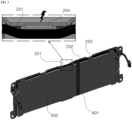
- FIG. 1 is a perspective view illustrating a battery module 100 according to a preferred embodiment of the present invention
- FIG. 2 illustrates the end plate part 200 located on both sides of the battery module according to a preferred embodiment of the present invention.
- the end plate part 200 includes an inner plate part 220 in contact with the cells, an outer plate 210 positioned outward from the inner plate part, and an air gap part 201 formed between the inner plate part 220 and the outer plate part 210, and first and second guide parts 202 and 203 may be formed on the upper portion of the inner plate part 220 to support a wire part 402.
- the wire part 402 is positioned on the upper portion of the end plate part 200, particularly on the upper part of the inner plate 220.
- the wire part 402 is installed lengthwise along the top of the end plate part 200 in the longitudinal direction of the end plate part 200.
- the air gap part 201 may form a predetermined air layer inside the end plate part 200.
- the air gap part 201 may include the space between the wire part 402 and the outer plate part 210 as well as the space formed by the contact between the protrusion 204 of the inner plate 220 and the outer plate part 210.
- the air gap part 201 may protect the wire part 402 from the heat generated during welding in a predetermined area of the end plate part 200.
- first and second guide parts 202 and 203 are each protruded upward from the top of the end plate part 200.
- first guide part 202 and the second guide part 203 may be formed at different positions along the length direction of the top of the end plate part 200, i.e., formed in a zigzag pattern on the top sides of the end plate part 200.
- the first guide part 202 and the second guide part 203 may guide the wiring operation of the wire part 402.
- first guide part 202 and the second guide part 203 may play a role in guiding and supporting the wire part 402.
- the battery cell 300 may sense the temperature of the upper and lower parts of the internal battery cell enclosed by the end plate part 200.
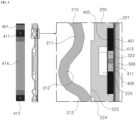
- FIG. 3 is a perspective view illustrating an end plate 200 according to a preferred embodiment of the present invention
- FIG. 4 is a cross-sectional view illustrating an end plate part 200 according to a preferred embodiment of the present invention.
- the unified sensor part 400 is installed on the end plate part 200 to sense at least one of the voltage or temperature of the battery cell 300.
- the first voltage sensing part 403 and the second voltage sensing part 404 form the opposite ends of the wire part 402, respectively.
- the temperature sensing part 401 is mounted on the flexible printed circuit board (FPCB) on the wire part 402.
- FPCB flexible printed circuit board
- the temperature sensor 401 is provided on the FPCB positioned on the inner wall of the inner plate part 220.
- the inner wall of the end plate part 200 faces the battery cell.
- the end plate part 200 may be composed of an outer plate part 210 and an inner plate part 220, the inner plate part 220 being positioned to face the battery cell 300.
- the temperature sensing part 401 and the wire part 402 may be integrally attached to the end plate part 200.
- the end plate part 200 may be provided with a first recessed portion 221 and a second recessed portion 222 that are formed to correspond to the temperature sensing part 401.
- the first and second recessed portions 221 and 222 are formed in the end plate part 200 in a stepwise manner such that the depth of the second recessed portion 222 is deeper than that of the first recessed portion 221.
- a pair of the first and second portions 221 and 222 is provided on both the upper and lower parts of the inner wall of the end plate part 200.
- the temperature sensing part 401 is elongated and narrow in the height direction of the end plate part 200 and takes the form of a flat bar-shaped FPCB with a predetermined width.
- the temperature sensing part 401 includes a first temperature sensor 411 positioned on the upper part thereof and a second temperature sensor 412 positioned on the lower part thereof.
- An adhesive portion 414 is provided on the temperature sensing part 401 between the first and second temperature sensors 411 and 412 and adhered to the inner wall of the inner plate part.
- the adhesive portion 414 is a double-sided tape with a predetermined adhesive strength to attach the temperature sensing part 401 in the form of an FPCB to the inner plate part 220.
- the end plate part 200 may have an outer plate part 210 and an inner plate part 220 as mentioned above.
- the outer plate part 210 may have a first round portion 211, a second round portion 212, and a third round portion 213.
- the first round portion 211 is curved toward the inner plate part 220 with a predetermined curvature.
- the second round portion 212 has a predetermined curvature convex in the direction away from the inner plate part 220, extending from the first round portion 211.
- the third round portion 213 has a predetermined curvature concave in the direction towards the inner plate part 220, extending from the second round portion 212.
- the inner plate part 220 may have a first recessed portion 221 and a second recessed portion 222, which are recessed at different depths.
- the inner plate part 220 may have the first recessed portion 221, the second recessed portion 222, the first side part 223, and the second side part 224.
- the first side part 223 is a portion from protruding the inner plate part 220 towards the outer plate part 210, and the bottom of the first side part 223 may make a contact with the third round portion 213.
- the second side part 224 forms a step from the first side part 223.
- the temperature sensing part 401 including the first temperature sensor 411 is positioned between the inner plate part 220 and the battery cell 300.
- the first temperature sensor 411 may be located at the center of the pad part 413 provided on the temperature sensing part 401.
- the pad part 413 may be a polyurethane pad.
- a temperature sensor protection portion 406 is formed with epoxy to protect the temperature sensor, and the surface of the pad part 413 and the epoxy temperature sensor protection portion 406 are taped with a temperature sensor protection cover 405 to be in contact with the inner surface of the inner plate part 220.
- the pad part 413 may come into contact with the first recessed portion 221.
- the second recessed portion 222 is formed deeper than the first recessed portion 221.
- a compartment 225 is formed between the pad part 413 and the second recessed portion 222.
- the compartment 225 provides an accommodation space for the first temperature sensor 411 when the battery cell 300 swells and to mitigate the impact to the inner plate 220, thereby preventing damage to the first temperature sensor 411.
- the compartment 225 is designed to prevent direct contact between the first temperature sensor 411 and the inner plate part 220, even when the battery cell 300 swells and expands, exerting pressure on the first temperature sensor 411 towards the inner plate part 220, thereby mitigating the risk of potential damage.
- the space provided by the outer plate part 210 between the second round portion 212 and the inner plate part 220 allows for the dispersion of impact forces, preventing damage to the first temperature sensor 411 and ensuring accurate temperature measurement.
- the convex shape of the second round portion 212 facing outward allows for mitigation of direct damage to the first temperature sensor 411 even when external impacts occur.
- the first temperature sensor 411 is shielded from damage caused by battery swelling inside the battery pack by the compartment 225 formed by the second recessed portion 222, and doubly protected from external impact by the second round portion 212.
- the second temperature sensor 412 can also be prevented from being damaged by direct contact with the inner plate part 220 when the battery cell 300 swells.
- the compartment 225 can be similarly provided at a position corresponding to the second temperature sensor 412 on the inner plate part 220.
- the present invention offers the advantages of a simplified structure, enhanced assemblability, and immediate and accurate detection of battery cell abnormalities.
- the present invention offers the advantages of maximizing productivity through the automation and minimization of module processes.
Landscapes
- Chemical & Material Sciences (AREA)
- Chemical Kinetics & Catalysis (AREA)
- Electrochemistry (AREA)
- General Chemical & Material Sciences (AREA)
- Engineering & Computer Science (AREA)
- Manufacturing & Machinery (AREA)
- Physics & Mathematics (AREA)
- General Physics & Mathematics (AREA)
- Microelectronics & Electronic Packaging (AREA)
- Aviation & Aerospace Engineering (AREA)
- Battery Mounting, Suspending (AREA)
- Secondary Cells (AREA)
Abstract
The present invention relates to a unified battery cell sensor integrated battery module, and more particularly, to a unified battery cell sensor integrated battery module that is simple in structure, excellent in assemblability, and capable of immediately and accurately detect abnormalities in the battery cells. The unified battery cell sensor integrated battery module includes an end plate part 200 positioned on the left and right sides of the battery module and a unified sensor part 400 formed integrally on the end plate part 200 and configured to sense at least one of voltage or temperature of a battery cell 300, which is simple in structure, excellent in assemblability, and capable of immediately and accurately detect abnormalities in the battery cells.
Description
- The present invention relates to a unified battery cell sensor integrated battery module, and more particularly, to a unified battery cell sensor integrated battery module that is simple in structure, excellent in assemblability, and capable of immediately and accurately detect abnormalities in the battery cells.
- Recently, the increasing focus on environmental issues and energy challenges has led to the rapid proliferation of electric vehicles.
- As a crucial component of electric vehicles, the battery cell must ensure safety in addition to enhancing performance.
- In other words, there is a significant need for real-time confirmation of any abnormalities in electric vehicle battery cells compared to other components.
- This is particularly crucial as extinguishing a fire in the battery cell of electric vehicles is highly challenging once it occurs.
- Therefore, technologies are being attempted to immediately confirm abnormalities in the battery, such as early signs of thermal runaway in the cell, namely swelling, through abnormal state monitoring of the battery cells.
- Accordingly, in the past, various sensors were placed inside and outside the cell or module to detect abnormalities such as battery cell swelling.
- Traditionally, a separate structure had to be installed to sense the voltage and temperature of the battery module for voltage monitoring.
- In other words, separate structures such as a flexible printed circuit board (FPCB), sensing wires, and an upper cover for fixation were utilized to connect the front and rear of the battery module.
- However, with this traditional technology, there were problems of reduced assemblability and difficulty in process automation due to tolerances and clearances among assembly components.
- Furthermore, using such conventional technologies still posed limitations in accurately and reliably confirming battery abnormalities.
- (Patent Document 1)
KR 2022-0065159 A - The present invention has been conceived the above problems and it is an object of the present invention to provide a unified battery cell sensor integrated battery module that is simple in structure, excellent in assemblability, and capable of immediately and accurately detect abnormalities in the battery cells.
- A unified battery cell sensor integrated battery module includes an
end plate part 200 positioned on the left and right sides of the battery module, and a unifiedsensor part 400 formed integrally on theend plate part 200 and configured to sense at least one of voltage or temperature of abattery cell 300. - In addition, the
unified sensor part 400 includes awire part 402 including a first voltage sensingpart 403 and a second voltage sensingpart 404 configured each to measure voltage at the front and rear ends of the battery module, atemperature sensing part 401 formed integrally on thewire part 402 and configured to contact thebattery cell 300 and sense the temperature of thebattery cell 300. - In addition, the
end plate part 200 includes anouter plate part 210 and aninner plate part 220 coupled with theouter plate part 210 on one side thereof and facing thebattery cell 300 on the other side, wherein the temperature sensingpart 401 is positioned between theinner plate part 220 and thebattery cell 300. - In addition, the
temperature sensing part 401 includes a temperature sensor configured to sensing the temperature of thebattery cell 300, and theinner plate part 220 includes acompartment 225 facing theouter plate part 210 at a position corresponding to the temperature sensor to accommodate the temperature sensor in response to swelling of thebattery cell 300. - In addition, the temperature sensor includes a
first temperature sensor 411 and asecond temperature sensor 412 positioned at a predetermined distance from each other vertically. - In addition, the
first temperature sensor 411 is positioned on the upper side of the temperature sensing part 410 to sense the temperature at the top of thebattery cell 300, and thesecond temperature sensor 412 is positioned on the lower side of the temperature sensingpart 401 to sense the temperature at the bottom of thebattery cell 300. - In addition, the temperature sensing
part 401 includes apad part 413 around each of thefirst temperature sensor 411 and thesecond temperature sensor 412, and theinner plate part 220 includes a first recessedportion 221 and a secondrecessed portion 222 formed deeper than the first recessedportion 221 facing theouter plate 210, thepad part 413 being situated in the first recessedportion 221. - In addition, the
first temperature sensor 411 is mounted at the center of thepad part 413. - In addition, the
outer plate part 210 includes asecond round portion 212 formed in a convex shape away from theinner plate 220 at a position facing each of thefirst temperature sensor 411 and thesecond temperature sensor 412. - In addition, the temperature sensing
part 401 includes anadhesive portion 414 to be fixed to theinner plate part 220. - In addition, the
adhesive portion 414 is positioned between thefirst temperature sensor 411 and thesecond temperature sensor 412. - In addition, the
end plate part 200 includes anair gap part 201 configured to dissipate heat generated during welding. - In addition, the
end plate part 200 includes afirst guide part 202 and asecond guide part 203 protruded upward at the top thereof to guide the wiring work of thewire part 402. - In addition, the
first guide part 202 and thesecond guide part 203 are formed in a zigzag pattern at the top of theinner plate part 220. - A unified battery cell sensor integrated battery module includes an
end plate part 200 contacting abattery cell 300, and aunified sensor part 400 provided integrally on theend plate part 200 and configured to sense at least one of voltage or temperature of abattery cell 300, wherein theunified sensor part 400 includes awire part 402 including a firstvoltage sensing part 403 and a second voltage sensingpart 404 configured each to measure voltage at the front and rear ends of the battery module, and atemperature sensing part 401 formed integrally on thewire part 402 and configured to contact thebattery cell 300 and sense the temperature of thebattery cell 300, the temperature sensingpart 401 including afirst temperature sensor 411 and asecond temperature sensor 412 to measure temperature at the top and bottom of the battery module. -
-
FIG. 1 is a perspective view illustrating abattery module 100 according to a preferred embodiment of the present invention; -
FIG. 2 is an exploded perspective view illustrating anend plate part 200 according to a preferred embodiment of the present invention; -
FIG. 3 is a perspective view illustrating anend plate 200 according to a preferred embodiment of the present invention; and -
FIG. 4 is a cross-sectional view illustrating anend plate part 200 according to a preferred embodiment of the present invention. - The present invention can be implemented in diverse embodiments with various modifications, as specifically illustrated in the drawings and comprehensively described in the specification. However, this is not intended to limit the present invention to specific embodiments, and it should be understood that all modifications, equivalents, and substitutions fall within the scope and spirit of the present invention.
- When providing descriptions with reference to the attached drawings, similar reference symbols are used for similar components.
- The terms such as 'first' and 'second' can be used to describe various components, the components should not be limited by these terms. The terms are used only for distinguishing one component from another component.
- For example, a first component may be referred to as a second component and, similarly, the second element may be referred to as the first component, without departing from the scope of the present invention. The term "and/or" includes a combination of a plurality of related items enumerated or any of a plurality of related items enumerated.
- Unless otherwise defined herein, all terms including technical or scientific terms used herein have the same meanings as commonly understood by those skilled in the art to which the present invention belongs.
- It will be further understood that terms, such as those defined in commonly used dictionaries, should be interpreted as having a meaning that is consistent with their meaning in the context of the relevant art and should not be interpreted in an idealized or overly formal sense unless expressly so defined herein.
-
FIG. 1 is a perspective view illustrating abattery module 100 according to a preferred embodiment of the present invention, andFIG. 2 illustrates theend plate part 200 located on both sides of the battery module according to a preferred embodiment of the present invention. - The
end plate part 200 includes aninner plate part 220 in contact with the cells, anouter plate 210 positioned outward from the inner plate part, and anair gap part 201 formed between theinner plate part 220 and theouter plate part 210, and first andsecond guide parts inner plate part 220 to support awire part 402. - The
wire part 402 is positioned on the upper portion of theend plate part 200, particularly on the upper part of theinner plate 220. - In detail, the
wire part 402 is installed lengthwise along the top of theend plate part 200 in the longitudinal direction of theend plate part 200. - The
air gap part 201 may form a predetermined air layer inside theend plate part 200. - When the clamp (see
FIG. 1 ) supporting the cells and left and rightend plate parts 200 along the top of thebattery module 100 is welded to theouter plate 210, the high-temperature heat generated is dissipated through theair gap part 201, preventing direct thermal stress on thewire part 402. Theinner plate part 220 is provided with aprotrusion 204 formed on one surface thereof to create anair gap part 201 between theinner plate part 220 and theouter plate part 210, and as shown in the enlarged top view inFIG. 3 , theair gap part 201 may include the space between thewire part 402 and theouter plate part 210 as well as the space formed by the contact between theprotrusion 204 of theinner plate 220 and theouter plate part 210. - As a result, the
air gap part 201 may protect thewire part 402 from the heat generated during welding in a predetermined area of theend plate part 200. - Meanwhile, the first and
second guide parts end plate part 200. - Here, the
first guide part 202 and thesecond guide part 203 may be formed at different positions along the length direction of the top of theend plate part 200, i.e., formed in a zigzag pattern on the top sides of theend plate part 200. - The
first guide part 202 and thesecond guide part 203 may guide the wiring operation of thewire part 402. - That is, the
first guide part 202 and thesecond guide part 203 may play a role in guiding and supporting thewire part 402. - The
battery cell 300 may sense the temperature of the upper and lower parts of the internal battery cell enclosed by theend plate part 200. -
FIG. 3 is a perspective view illustrating anend plate 200 according to a preferred embodiment of the present invention, andFIG. 4 is a cross-sectional view illustrating anend plate part 200 according to a preferred embodiment of the present invention. - The
unified sensor part 400 is installed on theend plate part 200 to sense at least one of the voltage or temperature of thebattery cell 300. - The first voltage sensing
part 403 and the second voltage sensingpart 404 form the opposite ends of thewire part 402, respectively. - The temperature sensing
part 401 is mounted on the flexible printed circuit board (FPCB) on thewire part 402. - The
temperature sensor 401 is provided on the FPCB positioned on the inner wall of theinner plate part 220. - Here, the inner wall of the
end plate part 200 faces the battery cell. - In more detail, the
end plate part 200 may be composed of anouter plate part 210 and aninner plate part 220, theinner plate part 220 being positioned to face thebattery cell 300. - Therefore, the
temperature sensing part 401 and thewire part 402 may be integrally attached to theend plate part 200. - Here, the
end plate part 200 may be provided with a first recessedportion 221 and a second recessedportion 222 that are formed to correspond to thetemperature sensing part 401. - The first and second recessed
portions end plate part 200 in a stepwise manner such that the depth of the second recessedportion 222 is deeper than that of the first recessedportion 221. - A pair of the first and
second portions end plate part 200. - Meanwhile, the
temperature sensing part 401 is elongated and narrow in the height direction of theend plate part 200 and takes the form of a flat bar-shaped FPCB with a predetermined width. - The
temperature sensing part 401 includes afirst temperature sensor 411 positioned on the upper part thereof and asecond temperature sensor 412 positioned on the lower part thereof. - An
adhesive portion 414 is provided on thetemperature sensing part 401 between the first andsecond temperature sensors - The
adhesive portion 414 is a double-sided tape with a predetermined adhesive strength to attach thetemperature sensing part 401 in the form of an FPCB to theinner plate part 220. - Hereinafter, a description is made of the installation structure of the
first temperature sensor 411 in detail. - The
end plate part 200 may have anouter plate part 210 and aninner plate part 220 as mentioned above. - The
outer plate part 210 may have afirst round portion 211, asecond round portion 212, and a third round portion 213. - The
first round portion 211 is curved toward theinner plate part 220 with a predetermined curvature. - The
second round portion 212 has a predetermined curvature convex in the direction away from theinner plate part 220, extending from thefirst round portion 211. - The third round portion 213 has a predetermined curvature concave in the direction towards the
inner plate part 220, extending from thesecond round portion 212. - The
inner plate part 220 may have a first recessedportion 221 and a second recessedportion 222, which are recessed at different depths. - That is, the
inner plate part 220 may have the first recessedportion 221, the second recessedportion 222, thefirst side part 223, and thesecond side part 224. - The
first side part 223 is a portion from protruding theinner plate part 220 towards theouter plate part 210, and the bottom of thefirst side part 223 may make a contact with the third round portion 213. - The
second side part 224 forms a step from thefirst side part 223. - The
temperature sensing part 401 including thefirst temperature sensor 411 is positioned between theinner plate part 220 and thebattery cell 300. - Technically, when the
end plate part 200 is assembled onto the side of thebattery cell 300 in the state where thetemperature sensing part 401 is attached to theinner plate part 220 of theend plate part 200, automatic bonding occurs between thetemperature sensing part 401 and thebattery cell 300, and simultaneously, thefirst temperature sensor 411 aligns with the first recessedportion 221. - In more detail, the
first temperature sensor 411 may be located at the center of thepad part 413 provided on thetemperature sensing part 401. - Here, the
pad part 413 may be a polyurethane pad. Between thepad part 413 and thefirst temperature sensor 411, a temperaturesensor protection portion 406 is formed with epoxy to protect the temperature sensor, and the surface of thepad part 413 and the epoxy temperaturesensor protection portion 406 are taped with a temperaturesensor protection cover 405 to be in contact with the inner surface of theinner plate part 220. - Meanwhile, the
pad part 413 may come into contact with the first recessedportion 221. - The second recessed
portion 222 is formed deeper than the first recessedportion 221. - A
compartment 225 is formed between thepad part 413 and the second recessedportion 222. - The
compartment 225 provides an accommodation space for thefirst temperature sensor 411 when thebattery cell 300 swells and to mitigate the impact to theinner plate 220, thereby preventing damage to thefirst temperature sensor 411. - In other words, the
compartment 225 is designed to prevent direct contact between thefirst temperature sensor 411 and theinner plate part 220, even when thebattery cell 300 swells and expands, exerting pressure on thefirst temperature sensor 411 towards theinner plate part 220, thereby mitigating the risk of potential damage. - In addition, even during excessive swelling of the
battery cell 300, the space provided by theouter plate part 210 between thesecond round portion 212 and theinner plate part 220 allows for the dispersion of impact forces, preventing damage to thefirst temperature sensor 411 and ensuring accurate temperature measurement. - Moreover, the convex shape of the
second round portion 212 facing outward allows for mitigation of direct damage to thefirst temperature sensor 411 even when external impacts occur. - In other words, the
first temperature sensor 411 is shielded from damage caused by battery swelling inside the battery pack by thecompartment 225 formed by the second recessedportion 222, and doubly protected from external impact by thesecond round portion 212. - In such a structure, the
second temperature sensor 412 can also be prevented from being damaged by direct contact with theinner plate part 220 when thebattery cell 300 swells. - That is, the
compartment 225 can be similarly provided at a position corresponding to thesecond temperature sensor 412 on theinner plate part 220. - According to this invention, the following effects are achieved.
- Firstly, the present invention offers the advantages of a simplified structure, enhanced assemblability, and immediate and accurate detection of battery cell abnormalities.
- Secondly, the present invention offers the advantages of maximizing productivity through the automation and minimization of module processes.
-
- 100: battery module
- 200: end plate part
- 201: air gap part
- 202: first guide part
- 203: second guide part
- 210: outer plate part
- 211: first round portion
- 212: second round portion
- 213: third round portion
- 220: inner plate part
- 221: first recessed portion
- 222: second recessed portion
- 223: first side part
- 224: second side part
- 225: compartment
- 300: battery cell
- 400: unified sensor part
- 401: temperature sensing part
- 402: wire part
- 403: first voltage sensing part
- 404: second voltage sensing part
- 405: temperature sensor protection cover
- 406: temperature sensor protection portion
- 411: first temperature sensor
- 412: second temperature sensor
- 413: pad part
- 414: adhesive portion
Claims (15)
- A unified battery cell sensor integrated battery module comprising:an end plate part 200 positioned on the left and right sides of the battery module; anda unified sensor part 400 formed integrally on the end plate part 200 and configured to sense at least one of voltage or temperature of a battery cell 300.
- The battery module of claim 1, wherein the unified sensor part 400 comprises:a wire part 402 comprising a first voltage sensing part 403 and a second voltage sensing part 404 configured each to measure voltage at the front and rear ends of the battery module; anda temperature sensing part 401 formed integrally on the wire part 402 and configured to contact the battery cell 300 and sense the temperature of the battery cell 300.
- The battery module of claim 2, wherein the end plate part 200 comprises:an outer plate part 210; andan inner plate part 220 coupled with the outer plate part 210 on one side thereof and facing the battery cell 300 on the other side,wherein the temperature sensing part 401 is positioned between the inner plate part 220 and the battery cell 300.
- The battery module of claim 3, wherein the temperature sensing part 401 comprises a temperature sensor configured to sensing the temperature of the battery cell 300, and the inner plate part 220 comprises a compartment 225 facing the outer plate part 210 at a position corresponding to the temperature sensor to accommodate the temperature sensor in response to swelling of the battery cell 300.
- The battery module of claim 4, wherein the temperature sensor comprises a first temperature sensor 411 and a second temperature sensor 412 positioned at a predetermined distance from each other vertically.
- The battery module of claim 5, wherein the first temperature sensor 411 is positioned on the upper side of the temperature sensing part 401 to sense the temperature at the top of the battery cell 300, and the second temperature sensor 412 is positioned on the lower side of the temperature sensing part 401 to sense the temperature at the bottom of the battery cell 300.
- The battery module of claim 6, wherein the temperature sensing part 401 comprises a pad part 413 around each of the first temperature sensor 411 and the second temperature sensor 412, and the inner plate part 220 comprises a first recessed portion 221 and a second recessed portion 222 formed deeper than the first recessed portion 221 facing the outer plate 210, the pad part 413 being situated in the first recessed portion 221.
- The battery module of claim 7, wherein the first temperature sensor 411 is mounted at the center of the pad part 413.
- The battery module of claim 7, wherein the outer plate part 210 comprises a second round portion 212 formed in a convex shape away from the inner plate 220 at a position facing each of the first temperature sensor 411 and the second temperature sensor 412.
- The battery module of claim 4, wherein the temperature sensing part 401 comprises an adhesive portion 414 to be fixed to the inner plate part 220.
- The battery module of claim 10, wherein the adhesive portion 414 is positioned between the first temperature sensor 411 and the second temperature sensor 412.
- The battery module of claim 1, wherein the end plate part 200 comprises an air gap part 201 configured to dissipate heat generated during welding.
- The battery module of claim 3, wherein the end plate part 200 comprises a first guide part 202 and a second guide part 203 protruded upward at the top thereof to guide the wiring work of the wire part 402.
- The battery module of claim 13, wherein the first guide part 202 and the second guide part 203 are formed in a zigzag pattern at the top of the inner plate part 220.
- A unified battery cell sensor integrated battery module comprising:an end plate part 200 contacting a battery cell 300; anda unified sensor part 400 provided integrally on the end plate part 200 and configured to sense at least one of voltage or temperature of a battery cell 300,wherein the unified sensor part 400 comprises:a wire part 402 comprising a first voltage sensing part 403 and a second voltage sensing part 404 configured each to measure voltage at the front and rear ends of the battery module; anda temperature sensing part 401 formed integrally on the wire part 402 and configured to contact the battery cell 300 and sense the temperature of the battery cell 300, the temperature sensing part 401 comprising a first temperature sensor 411 and a second temperature sensor 412 to measure temperature at the top and bottom of the battery module.
Applications Claiming Priority (1)
| Application Number | Priority Date | Filing Date | Title |
|---|---|---|---|
| KR1020220183324A KR20240101057A (en) | 2022-12-23 | 2022-12-23 | A battery module in use with battery cell integrated sensor |
Publications (1)
| Publication Number | Publication Date |
|---|---|
| EP4391208A1 true EP4391208A1 (en) | 2024-06-26 |
Family
ID=89168256
Family Applications (1)
| Application Number | Title | Priority Date | Filing Date |
|---|---|---|---|
| EP23215389.0A Pending EP4391208A1 (en) | 2022-12-23 | 2023-12-08 | Unified battery cell sensor integrated battery module |
Country Status (4)
| Country | Link |
|---|---|
| US (1) | US20240213555A1 (en) |
| EP (1) | EP4391208A1 (en) |
| KR (1) | KR20240101057A (en) |
| CN (1) | CN221928436U (en) |
Families Citing this family (1)
| Publication number | Priority date | Publication date | Assignee | Title |
|---|---|---|---|---|
| KR20230150669A (en) * | 2022-04-22 | 2023-10-31 | 현대모비스 주식회사 | Battery module assembly |
Citations (5)
| Publication number | Priority date | Publication date | Assignee | Title |
|---|---|---|---|---|
| EP3671905A1 (en) * | 2018-03-30 | 2020-06-24 | Lg Chem, Ltd. | Easier to assemble battery module including bus bar frame |
| EP3855554A1 (en) * | 2019-12-31 | 2021-07-28 | Samsung SDI Co., Ltd. | Battery pack |
| EP3979380A1 (en) * | 2020-10-05 | 2022-04-06 | Hyundai Motor Company | Battery module |
| KR20220065159A (en) | 2020-11-12 | 2022-05-20 | 에스케이온 주식회사 | Battery fire detection device and method, Energy Storage System |
| EP4024019A1 (en) * | 2020-12-29 | 2022-07-06 | SK On Co., Ltd. | Battery module comprising temperature sensor |
-
2022
- 2022-12-23 KR KR1020220183324A patent/KR20240101057A/en active Pending
-
2023
- 2023-12-07 US US18/532,948 patent/US20240213555A1/en active Pending
- 2023-12-08 EP EP23215389.0A patent/EP4391208A1/en active Pending
- 2023-12-21 CN CN202323498112.8U patent/CN221928436U/en active Active
Patent Citations (5)
| Publication number | Priority date | Publication date | Assignee | Title |
|---|---|---|---|---|
| EP3671905A1 (en) * | 2018-03-30 | 2020-06-24 | Lg Chem, Ltd. | Easier to assemble battery module including bus bar frame |
| EP3855554A1 (en) * | 2019-12-31 | 2021-07-28 | Samsung SDI Co., Ltd. | Battery pack |
| EP3979380A1 (en) * | 2020-10-05 | 2022-04-06 | Hyundai Motor Company | Battery module |
| KR20220065159A (en) | 2020-11-12 | 2022-05-20 | 에스케이온 주식회사 | Battery fire detection device and method, Energy Storage System |
| EP4024019A1 (en) * | 2020-12-29 | 2022-07-06 | SK On Co., Ltd. | Battery module comprising temperature sensor |
Also Published As
| Publication number | Publication date |
|---|---|
| US20240213555A1 (en) | 2024-06-27 |
| CN221928436U (en) | 2024-10-29 |
| KR20240101057A (en) | 2024-07-02 |
Similar Documents
| Publication | Publication Date | Title |
|---|---|---|
| EP3547391B1 (en) | Protective pressure plate and battery module | |
| US20220077536A1 (en) | Wiring material and battery module | |
| EP4391208A1 (en) | Unified battery cell sensor integrated battery module | |
| ES2380359T3 (en) | Surface mount connector | |
| JP5289712B2 (en) | Shield cover mounting structure and display device | |
| US11758667B2 (en) | Electronic control unit | |
| EP3796459B1 (en) | Battery module and manufacturing method | |
| KR20120016992A (en) | Battery pack | |
| JP2013097894A (en) | Battery wiring module | |
| ES2787880T3 (en) | Frame structure to avoid deformation and electronic device that includes the same | |
| KR20170110746A (en) | Battery Module | |
| US20210151812A1 (en) | Battery module and vehicle with the same | |
| US11876249B2 (en) | Conductive module | |
| US20240079664A1 (en) | Battery module | |
| CN219643060U (en) | Wire harness plate assembly and battery pack | |
| JP5761744B2 (en) | FPC board for strain gauge | |
| EP4589747A1 (en) | Cell monitoring circuit capable of wireless communication and battery module provided with same | |
| US20230344025A1 (en) | Battery module assembly and method for manufacturing battery module assembly | |
| JP2019129056A (en) | Power storage module | |
| CN224153558U (en) | Data acquisition components and battery modules | |
| JP4055012B2 (en) | Electronics | |
| CN224138175U (en) | Battery devices and electrical equipment | |
| CN220691795U (en) | Encapsulation equipment is used in piezo-resistor production | |
| CN212871490U (en) | Infrared thermometer | |
| JP7738527B2 (en) | Temperature sensor device and battery module |
Legal Events
| Date | Code | Title | Description |
|---|---|---|---|
| PUAI | Public reference made under article 153(3) epc to a published international application that has entered the european phase |
Free format text: ORIGINAL CODE: 0009012 |
|
| STAA | Information on the status of an ep patent application or granted ep patent |
Free format text: STATUS: REQUEST FOR EXAMINATION WAS MADE |
|
| 17P | Request for examination filed |
Effective date: 20231208 |
|
| AK | Designated contracting states |
Kind code of ref document: A1 Designated state(s): AL AT BE BG CH CY CZ DE DK EE ES FI FR GB GR HR HU IE IS IT LI LT LU LV MC ME MK MT NL NO PL PT RO RS SE SI SK SM TR |
|
| RAP1 | Party data changed (applicant data changed or rights of an application transferred) |
Owner name: HYUNDAI MOBIS CO., LTD. |