EP4390951A1 - Pharmaceutical assistance device, operation method for pharmaceutical assistance device, and operation program for pharmaceutical assistance device - Google Patents
Pharmaceutical assistance device, operation method for pharmaceutical assistance device, and operation program for pharmaceutical assistance device Download PDFInfo
- Publication number
- EP4390951A1 EP4390951A1 EP22875763.9A EP22875763A EP4390951A1 EP 4390951 A1 EP4390951 A1 EP 4390951A1 EP 22875763 A EP22875763 A EP 22875763A EP 4390951 A1 EP4390951 A1 EP 4390951A1
- Authority
- EP
- European Patent Office
- Prior art keywords
- candidate
- preservation solution
- protein
- preservation
- information
- Prior art date
- Legal status (The legal status is an assumption and is not a legal conclusion. Google has not performed a legal analysis and makes no representation as to the accuracy of the status listed.)
- Pending
Links
Images





Classifications
-
- G—PHYSICS
- G16—INFORMATION AND COMMUNICATION TECHNOLOGY [ICT] SPECIALLY ADAPTED FOR SPECIFIC APPLICATION FIELDS
- G16H—HEALTHCARE INFORMATICS, i.e. INFORMATION AND COMMUNICATION TECHNOLOGY [ICT] SPECIALLY ADAPTED FOR THE HANDLING OR PROCESSING OF MEDICAL OR HEALTHCARE DATA
- G16H20/00—ICT specially adapted for therapies or health-improving plans, e.g. for handling prescriptions, for steering therapy or for monitoring patient compliance
- G16H20/10—ICT specially adapted for therapies or health-improving plans, e.g. for handling prescriptions, for steering therapy or for monitoring patient compliance relating to drugs or medications, e.g. for ensuring correct administration to patients
-
- G—PHYSICS
- G16—INFORMATION AND COMMUNICATION TECHNOLOGY [ICT] SPECIALLY ADAPTED FOR SPECIFIC APPLICATION FIELDS
- G16B—BIOINFORMATICS, i.e. INFORMATION AND COMMUNICATION TECHNOLOGY [ICT] SPECIALLY ADAPTED FOR GENETIC OR PROTEIN-RELATED DATA PROCESSING IN COMPUTATIONAL MOLECULAR BIOLOGY
- G16B15/00—ICT specially adapted for analysing two-dimensional [2D] or three-dimensional [3D] molecular structures, e.g. structural or functional relations or structure alignment
- G16B15/30—Drug targeting using structural data; Docking or binding prediction
-
- C—CHEMISTRY; METALLURGY
- C12—BIOCHEMISTRY; BEER; SPIRITS; WINE; VINEGAR; MICROBIOLOGY; ENZYMOLOGY; MUTATION OR GENETIC ENGINEERING
- C12M—APPARATUS FOR ENZYMOLOGY OR MICROBIOLOGY; APPARATUS FOR CULTURING MICROORGANISMS FOR PRODUCING BIOMASS, FOR GROWING CELLS OR FOR OBTAINING FERMENTATION OR METABOLIC PRODUCTS, i.e. BIOREACTORS OR FERMENTERS
- C12M1/00—Apparatus for enzymology or microbiology
-
- G—PHYSICS
- G16—INFORMATION AND COMMUNICATION TECHNOLOGY [ICT] SPECIALLY ADAPTED FOR SPECIFIC APPLICATION FIELDS
- G16B—BIOINFORMATICS, i.e. INFORMATION AND COMMUNICATION TECHNOLOGY [ICT] SPECIALLY ADAPTED FOR GENETIC OR PROTEIN-RELATED DATA PROCESSING IN COMPUTATIONAL MOLECULAR BIOLOGY
- G16B15/00—ICT specially adapted for analysing two-dimensional [2D] or three-dimensional [3D] molecular structures, e.g. structural or functional relations or structure alignment
- G16B15/20—Protein or domain folding
-
- G—PHYSICS
- G16—INFORMATION AND COMMUNICATION TECHNOLOGY [ICT] SPECIALLY ADAPTED FOR SPECIFIC APPLICATION FIELDS
- G16B—BIOINFORMATICS, i.e. INFORMATION AND COMMUNICATION TECHNOLOGY [ICT] SPECIALLY ADAPTED FOR GENETIC OR PROTEIN-RELATED DATA PROCESSING IN COMPUTATIONAL MOLECULAR BIOLOGY
- G16B30/00—ICT specially adapted for sequence analysis involving nucleotides or amino acids
-
- G—PHYSICS
- G16—INFORMATION AND COMMUNICATION TECHNOLOGY [ICT] SPECIALLY ADAPTED FOR SPECIFIC APPLICATION FIELDS
- G16B—BIOINFORMATICS, i.e. INFORMATION AND COMMUNICATION TECHNOLOGY [ICT] SPECIALLY ADAPTED FOR GENETIC OR PROTEIN-RELATED DATA PROCESSING IN COMPUTATIONAL MOLECULAR BIOLOGY
- G16B40/00—ICT specially adapted for biostatistics; ICT specially adapted for bioinformatics-related machine learning or data mining, e.g. knowledge discovery or pattern finding
- G16B40/20—Supervised data analysis
-
- G—PHYSICS
- G16—INFORMATION AND COMMUNICATION TECHNOLOGY [ICT] SPECIALLY ADAPTED FOR SPECIFIC APPLICATION FIELDS
- G16C—COMPUTATIONAL CHEMISTRY; CHEMOINFORMATICS; COMPUTATIONAL MATERIALS SCIENCE
- G16C20/00—Chemoinformatics, i.e. ICT specially adapted for the handling of physicochemical or structural data of chemical particles, elements, compounds or mixtures
- G16C20/30—Prediction of properties of chemical compounds, compositions or mixtures
-
- G—PHYSICS
- G16—INFORMATION AND COMMUNICATION TECHNOLOGY [ICT] SPECIALLY ADAPTED FOR SPECIFIC APPLICATION FIELDS
- G16C—COMPUTATIONAL CHEMISTRY; CHEMOINFORMATICS; COMPUTATIONAL MATERIALS SCIENCE
- G16C20/00—Chemoinformatics, i.e. ICT specially adapted for the handling of physicochemical or structural data of chemical particles, elements, compounds or mixtures
- G16C20/70—Machine learning, data mining or chemometrics
Definitions
- the technology of the present disclosure relates to a pharmaceutical support device, a method for operating a pharmaceutical support device, and a program for operating a pharmaceutical support device.
- the biopharmaceutical has, for example, a protein, such as interferon or an antibody, as an active ingredient.
- the biopharmaceutical is preserved in a preservation solution. It is important to prescribe a preservation solution (also referred to as a formulation prescription) suitable for the biopharmaceutical in order to stably maintain the quality of the biopharmaceutical.
- the preservation solution includes a buffer solution, an additive, and a surfactant.
- the prescription of the preservation solution is, for example, the type and concentration of each of the buffer solution, the additive, and the surfactant and a hydrogen ion exponent (Potential of Hydrogen (pH) value) of the preservation solution.
- An embodiment according to the technology of the present disclosure provides a pharmaceutical support device, a method for operating a pharmaceutical support device, and a program for operating a pharmaceutical support device that can improve prediction accuracy of preservation stability of a preservation solution.
- a pharmaceutical support device comprising a processor.
- the processor is configured to: acquire protein information related to a protein included in a biopharmaceutical to be preserved, prescription information related to a prescription of a candidate preservation solution, which is a candidate for a preservation solution for the biopharmaceutical to be preserved, and measurement data indicating preservation stability of the candidate preservation solution measured by an actual test; derive a feature amount related to the preservation stability of the candidate preservation solution on the basis of the protein information and the prescription information; and input the measurement data and the feature amount to a machine learning model such that a score indicating the preservation stability of the candidate preservation solution is output from the machine learning model.
- the protein information includes at least one of an amino acid sequence of the protein or a three-dimensional structure of the protein.
- the prescription information includes a type and concentration of each of a buffer solution, an additive, and a surfactant included in the candidate preservation solution and a hydrogen ion exponent of the candidate preservation solution.
- the processor is configured to derive the feature amount using a molecular dynamics method.
- the feature amount includes at least one of a solvent accessible surface area, a spatial aggregation propensity, or a space charge map of the protein.
- the feature amount includes an indicator showing compatibility between the protein and the additive included in the candidate preservation solution.
- the measurement data includes at least one of aggregation analysis data of sub-visible particles of the protein in the candidate preservation solution, analysis data of the protein in the candidate preservation solution by a dynamic light scattering method, analysis data of the protein in the candidate preservation solution by size exclusion chromatography, or analysis data of the protein in the candidate preservation solution by differential scanning calorimetry.
- the processor is configured to present auxiliary information that is based on the score and that assists determination of whether or not the candidate preservation solution is adoptable.
- the processor is configured to: determine whether or not the score satisfies a selection condition that has been set in advance; and present a determination result as the auxiliary information.
- the processor is configured to: output a plurality of the scores for a plurality of types of the candidate preservation solutions; determine ranking of the candidate preservation solutions on the basis of the plurality of scores; and present a determination result of the ranking as the auxiliary information.
- the processor is configured to input the prescription information to the machine learning model in addition to the measurement data and the feature amount.
- the protein is an antibody.
- a method for operating a pharmaceutical support device comprises: acquiring protein information related to a protein included in a biopharmaceutical to be preserved, prescription information related to a prescription of a candidate preservation solution, which is a candidate for a preservation solution for the biopharmaceutical to be preserved, and measurement data indicating preservation stability of the candidate preservation solution measured by an actual test; deriving a feature amount related to the preservation stability of the candidate preservation solution on the basis of the protein information and the prescription information; and inputting the measurement data and the feature amount to a machine learning model such that a score indicating the preservation stability of the candidate preservation solution is output from the machine learning model.
- a program for operating a pharmaceutical support device causes a computer to execute a process comprising: acquiring protein information related to a protein included in a biopharmaceutical to be preserved, prescription information related to a prescription of a candidate preservation solution, which is a candidate for a preservation solution for the biopharmaceutical to be preserved, and measurement data indicating preservation stability of the candidate preservation solution measured by an actual test; deriving a feature amount related to the preservation stability of the candidate preservation solution on the basis of the protein information and the prescription information; and inputting the measurement data and the feature amount to a machine learning model such that a score indicating the preservation stability of the candidate preservation solution is output from the machine learning model.
- a pharmaceutical support device a method for operating a pharmaceutical support device, and a program for operating a pharmaceutical support device that can improve prediction accuracy of preservation stability of a preservation solution.
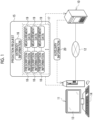
- a pharmaceutical support server 10 is connected to an operator terminal 11 through a network 12.
- the pharmaceutical support server 10 is an example of a "pharmaceutical support device" according to the technology of the present disclosure.
- the operator terminal 11 is installed, for example, in a pharmaceutical facility and is operated by an operator, such as a pharmacist, who is involved in the production of biopharmaceuticals in the pharmaceutical facility.
- the operator terminal 11 has a display 13 and an input device 14 such as a keyboard and a mouse.
- the network 12 is, for example, a wide area network (WAN) such as the Internet or a public communication network.
- WAN wide area network
- only one operator terminal 11 is connected to the pharmaceutical support server 10.
- a plurality of operator terminals 11 in a plurality of pharmaceutical facilities are connected to the pharmaceutical support server 10.
- the operator terminal 11 transmits a prediction request 15 to the pharmaceutical support server 10.
- the prediction request 15 is a request for the pharmaceutical support server 10 to predict preservation stability of a candidate preservation solution 35 (see Fig. 3 ), which is a candidate for a preservation solution for the biopharmaceutical.
- the prediction request 15 includes antibody information 16 and a prescription information and measurement data set group 17.
- the antibody information 16 is information related to an antibody 37 (see Fig. 3 ) which is an active ingredient of the biopharmaceutical.
- the operator operates the input device 14 to input the antibody information 16.
- the antibody 37 is an example of a "protein” according to the technology of the present disclosure
- the antibody information 16 is an example of "protein information” according to the technology of the present disclosure.
- the prescription information and measurement data set group 17 includes a plurality of sets of prescription information 18 and measurement data 19.
- the set of the prescription information 18 and the measurement data 19 is registered for each of a plurality of types, for example, several to several tens of types of candidate preservation solutions 35.
- the prescription information 18 is information related to the prescription of the candidate preservation solution 35.
- the measurement data 19 is data indicating the preservation stability of the candidate preservation solution 35 measured by an actual test.
- the operator also operates the input device 14 to input the prescription information 18 and the measurement data 19.
- the prediction request 15 also includes terminal identification data (ID) for uniquely identifying the operator terminal 11 which is a transmission source of the prediction request 15, which is not illustrated.
- ID terminal identification data
- the pharmaceutical support server 10 derives auxiliary information 20 that assists the determination of whether or not the candidate preservation solution 35 can be adopted.
- the pharmaceutical support server 10 delivers the auxiliary information 20 to the operator terminal 11 which is the transmission source of the prediction request 15.
- the operator terminal 11 displays the auxiliary information 20 on the display 13 such that the operator views the auxiliary information 20.
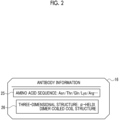
- the antibody information 16 includes an amino acid sequence 25 of the antibody 37 and a three-dimensional structure 26 of the antibody 37.
- the antibody information 16 is obtained by analyzing the antibody 37 with a well-known technique such as mass spectrometry, X-ray crystal structure analysis, or electron microscopy.
- the amino acid sequence 25 the order of peptide bonds of amino acids constituting the antibody 37, such as asparagine (abbreviated to ASn), glutamine (abbreviated to Glu), and arginine (abbreviated to Arg), is described from an amino terminal to a carboxyl terminal.
- the amino acid sequence 25 is also referred to as a primary structure.
- the three-dimensional structure 26 indicates the secondary structure, tertiary structure, and quaternary structure of the amino acids constituting the antibody 37.
- the secondary structure include a ⁇ -sheet and a ⁇ -turn in addition to ⁇ -helix given as an example.
- the tertiary structure is, for example, a dimer coiled coil structure given as an example.
- the quaternary structure include a dimer, a trimer, and a tetramer.
- Some antibodies 37 do not have the quaternary structure (that is, some antibodies 37 are monomers). In this case, the quaternary structure is not registered as described in the example.
- the three-dimensional structure 26 can also be obtained by inputting the amino acid sequence 25 to "AlphaFold2" which is a three-dimensional protein structure prediction program developed by DeepMind Technologies Limited.
- the prescription information 18 includes a type and concentration 30 of a buffer solution, a type and concentration 31 of an additive, and a type and concentration 32 of a surfactant in the candidate preservation solution 35.
- the operator creates the prescription information 18, relying on the antibody information 16, his/her own experience, and the like.
- a plurality of types of buffer solutions, additives, and surfactants are used as can be seen from L-arginine hydrochloride and purified white sugar which are the additives given as an example.
- a type and a concentration are registered for each of the plurality of types.
- the prescription information 18 also includes a hydrogen ion exponent 33 of the candidate preservation solution 35.
- a molecular formula of each of the buffer solution, the additive, and the surfactant may be added to the prescription information 18.
- the operator actually prepares the candidate preservation solution 35 in a test tube 36 on the basis of the prescription information 18. Then, the antibody 37 is added to the prepared candidate preservation solution 35. Then, a stress test including the repetition of freezing and thawing and stirring is performed for 2 weeks. During the stress test for two weeks, the measurement data 19 is actually measured by a measurement device 38.
- Fig. 3 illustrates an example in which measurement data 19_1 and measurement data 19_2 are measured in the first week and the second week of the stress test, respectively.
- the measurement device 38 transmits the measurement data 19 to the operator terminal 11.
- the measurement data 19 includes aggregation analysis data (hereinafter, referred to as SVP aggregation analysis data) 40 of sub-visible particles (SVPs) of the antibody 37 in the candidate preservation solution 35 and analysis data (hereinafter, referred to as DLS analysis data) 41 of the antibody 37 in the candidate preservation solution 35 by a dynamic light scattering (DLS) method as illustrated in the measurement data 19_1 in the first week.
- SVP aggregation analysis data 40 indicates the amount of SVPs of the antibody 37 in the candidate preservation solution 35 that causes a reduction in the drug efficacy of the biopharmaceutical.
- the DLS analysis data 41 indicates the amount of nanoparticles of the antibody 37 in the candidate preservation solution 35 that causes the reduction in the drug efficacy of the biopharmaceutical.
- the measurement data 19 includes analysis data (hereinafter, referred to as SEC analysis data) 42 of the antibody 37 in the candidate preservation solution 35 by size exclusion chromatography (SEC) and analysis data (hereinafter, referred to as DSC analysis data) 43 of the antibody 37 in the candidate preservation solution 35 by differential scanning calorimetry (DSC).
- SEC analysis data 42 indicates a molecular weight distribution of the antibody 37 in the candidate preservation solution 35.
- DSC analysis data 43 indicates values related to thermophysical property values such as the glass transition point and crystallization temperature of the antibody 37 in the candidate preservation solution 35.
- Fig. 3 for convenience, only one measurement device 38 is illustrated. However, in practice, various measurement devices 38 that measure these analysis data items 40 to 43 are prepared.
- a common candidate preservation solution ID is given to the prescription information 18 and the measurement data 19 of one candidate preservation solution 35.
- the prescription information 18 and the measurement data 19 are associated with each other by the candidate preservation solution ID.
- FIG. 3 only the preparation of one candidate preservation solution 35, the addition of the antibody 37, the stress test, and the measurement of the measurement data 19 are illustrated. However, in practice, the preparation, the addition, the stress test, and the measurement of the measurement data 19 are performed for each of a plurality of types of candidate preservation solutions 35.
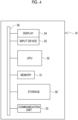
- a computer constituting the pharmaceutical support server 10 comprises a storage 50, a memory 51, a central processing unit (CPU) 52, a communication unit 53, a display 54, and an input device 55. These units are connected to one another through a bus line 56.
- the storage 50 is a hard disk drive that is provided in the computer constituting the pharmaceutical support server 10 or that is connected to the computer through a cable or a network.
- the storage 50 is a disk array in which a plurality of hard disk drives are connected.
- the storage 50 stores, for example, a control program, such as an operating system, various application programs, and various types of data associated with these programs.
- a solid state drive may be used instead of the hard disk drive.
- the memory 51 is a work memory used by the CPU 52 to perform processes.
- the CPU 52 loads the program stored in the storage 50 to the memory 51 and performs a process corresponding to the program. Therefore, the CPU 52 controls the overall operation of each unit of the computer.
- the CPU 52 is an example of a "processor" according to the technology of the present disclosure.
- the memory 51 may be provided in the CPU 52.
- the communication unit 53 controls the transmission of various types of information to an external device such as the operator terminal 11.
- the display 54 displays various screens.
- the various screens have operation functions by a graphical user interface (GUI).
- GUI graphical user interface
- the computer constituting the pharmaceutical support server 10 receives an input of an operation instruction from the input device 55 through the various screens.
- the input device 55 is, for example, a keyboard, a mouse, a touch panel, and a microphone for voice input.
- an operation program 60 is stored in the storage 50 of the pharmaceutical support server 10.
- the operation program 60 is an application program for causing the computer to function as the pharmaceutical support server 10. That is, the operation program 60 is an example of "a program for operating a pharmaceutical support device" according to the technology of the present disclosure.
- the storage 50 also stores the antibody information 16 and the prescription information and measurement data set group 17.
- the storage 50 also stores a preservation stability prediction model 61.
- the preservation stability prediction model 61 is an example of a "machine learning model" according to the technology of the present disclosure.
- the CPU 52 of the computer constituting the pharmaceutical support server 10 functions as a receiving unit 65, a read and write (hereinafter, abbreviated to RW) control unit 66, a feature amount derivation unit 67, a prediction unit 68, and a delivery control unit 69 in cooperation with the memory 51 and the like.
- RW read and write
- the receiving unit 65 receives the prediction request 15 from the operator terminal 11. As described above, the prediction request 15 includes the antibody information 16 and the prescription information and measurement data set group 17, and the prescription information and measurement data set group 17 includes the prescription information 18 and the measurement data 19. Therefore, in a case where the prediction request 15 is received, the receiving unit 65 acquires the antibody information 16, the prescription information 18, and the measurement data 19. The receiving unit 65 outputs the antibody information 16 and the prescription information and measurement data set group 17 to the RW control unit 66. In addition, the receiving unit 65 outputs the terminal ID of the operator terminal 11 (not illustrated) to the delivery control unit 69.
- the RW control unit 66 controls the storage of various types of data in the storage 50 and the reading-out of various types of data in the storage 50.
- the RW control unit 66 stores the antibody information 16 and the prescription information and measurement data set group 17 from the receiving unit 65 in the storage 50.
- the RW control unit 66 reads out the antibody information 16 and the prescription information and measurement data set group 17 from the storage 50, outputs the antibody information 16 and the prescription information 18 to the feature amount derivation unit 67, and outputs the measurement data 19 to the prediction unit 68.
- the RW control unit 66 reads out the preservation stability prediction model 61 from the storage 50 and outputs the preservation stability prediction model 61 to the prediction unit 68.
- the feature amount derivation unit 67 derives a feature amount 75 related to the preservation stability of the candidate preservation solution 35 on the basis of the antibody information 16 and the prescription information 18.
- the feature amount derivation unit 67 outputs the derived feature amount 75 to the prediction unit 68.
- the prediction unit 68 derives a score 76 indicating the preservation stability of the candidate preservation solution 35 from the measurement data 19 and the feature amount 75, using the preservation stability prediction model 61.
- the prediction unit 68 outputs the derived score 76 to the delivery control unit 69.
- the delivery control unit 69 generates the auxiliary information 20 on the basis of the score 76.
- the delivery control unit 69 controls the delivery of the auxiliary information 20 to the operator terminal 11 which is the transmission source of the prediction request 15.
- the delivery control unit 69 specifies the operator terminal 11, which is the transmission source of the prediction request 15, on the basis of the terminal ID from the receiving unit 65.
- the feature amount derivation unit 67 derives the feature amount 75 using a molecular dynamics method.
- the feature amount 75 includes a hydrophobic solvent accessible surface area (hereinafter, abbreviated to SASA) 80, a spatial aggregation propensity (hereinafter, abbreviated to SAP) 81, and a spatial charge map (hereinafter, abbreviated to SCM) 82 of the antibody 37.
- SASA 80 hydrophobic solvent accessible surface area
- SAP spatial aggregation propensity
- SCM spatial charge map
- the SASA 80 indicates the degree of charge of the antibody 37 for each region of the antibody 37.
- the SASA 80, the SAP 81, and the SCM 82 are derived on the basis of only the antibody information 16 without referring to the prescription information 18. Therefore, the SASA 80, the SAP 81, and the SCM 82 are common to each candidate preservation solution 35.
- the feature amount 75 also includes a preferential interaction coefficient (hereinafter, abbreviated to PIC) 83 described in Document 1.
- PIC preferential interaction coefficient
- the PIC 83 indicates, for each region of the antibody 37, the ease of the binding between the antibody 37 and the additive, more specifically, the degree to which the surface of the antibody 37 is covered by the additive. Therefore, the PIC 83 is an indicator showing the compatibility between the antibody 37 and the additive.
- the PIC 83 makes it possible to know the possibility that the aggregation of the antibody 37 causing a reduction in the drug efficacy of the biopharmaceutical will occur.
- the PIC 83 is derived on the basis of both the antibody information 16 and the prescription information 18 unlike the SASA 80, the SAP 81, and the SCM 82.
- the PIC 83 is different in each candidate preservation solution 35. Therefore, a plurality of feature amounts 75 of each candidate preservation solution 35 have the SASA 80, the SAP 81, and the SCM 82 in common and have different PICs 83.
- the PIC 83 may be derived using a machine learning model, such as a support vector machine (SVM), instead of the molecular dynamics method.
- SVM support vector machine
- the feature amount 75 is given the candidate preservation solution ID.
- the prediction unit 68 inputs the measurement data 19 and the feature amount 75 to the preservation stability prediction model 61. Then, the score 76 is output from the preservation stability prediction model 61.
- the score 76 is represented by, for example, a continuous numerical value of 0 points to 100 points.
- the preservation stability prediction model 61 is a machine learning model using, for example, a support vector regression (SVR) algorithm that predicts the score 76 which is a continuous numerical value.
- SVR support vector regression
- the score 76 is given the candidate preservation solution ID.
- the preservation stability prediction model 61 may be trained in the pharmaceutical support server 10 or may be trained by a device other than the pharmaceutical support server 10. In addition, the preservation stability prediction model 61 may be continuously trained even after the operation.
- the prediction unit 68 directs the preservation stability prediction model 61 to output a plurality of scores 76 for a plurality of types of candidate preservation solutions 35.
- the delivery control unit 69 determines ranking on the basis of the plurality of scores 76 of the plurality of types of candidate preservation solutions 35 as illustrated in a table 90.
- the delivery control unit 69 delivers a determination result of the ranking illustrated in the table 90 as the auxiliary information 20 to the operator terminal 11.
- Fig. 8 illustrates an example in which the ranking of five types of candidate preservation solutions 35 having candidate preservation solution IDs of PS0001 to PS0005 is determined.
- the scores 76 of PS0001, PS0002, PS0003, PS0004, and PS0005 are 75 points, 62 points, 89 points, 47 points, and 82 points, respectively.
- PS0003 with the highest score of 89 points is in first place
- PS0005 with the second highest score of 82 points is in second place
- PS0001 with 75 points is in third place
- PS0002 with 62 points is in fourth place
- PS0004 with the lowest score of 47 points is in fifth place.
- Fig. 9 illustrates an example of an information input screen 100 that is displayed on the display 13 of the operator terminal 11.
- the information input screen 100 has an input region 101 for the antibody information 16 and an input region 102 for the information of the candidate preservation solution 35.
- the input region 102 has an input region 103 for the prescription information 18, an input region 104_1 for the measurement data 19_1 in the first week, and an input region 104_2 for the measurement data 19_2 in the second week.
- An input box 110 for the amino acid sequence 25 and an input box 111 for the three-dimensional structure 26 are provided in the input region 101 for the antibody information 16.
- the input region 103 for the prescription information 18 is provided with a pull-down menu 112 for selecting the type of the buffer solution, an input box 113 for the concentration of the buffer solution, a pull-down menu 114 for selecting the type of the additive, an input box 115 for the concentration of the additive, a pull-down menu 116 for selecting the type of the surfactant, and an input box 117 for the concentration of the surfactant.
- An add button 118 for the buffer solution is provided below the pull-down menu 112 and the input box 113 for the buffer solution. In a case where the add button 118 is selected, the pull-down menu 112 and the input box 113 for the buffer solution are added.
- An add button 119 for the additive is provided below the pull-down menu 114 and the input box 115 for the additive. In a case where the add button 119 is selected, the pull-down menu 114 and the input box 115 for the additive are added.
- An add button 120 for the surfactant is provided below the pull-down menu 116 and the input box 117 for the surfactant. In a case where the add button 120 is selected, the pull-down menu 116 and the input box 117 for the surfactant are added. Further, an input box 121 for the hydrogen ion exponent is provided in a lower portion of the input region 103.
- the input region 104 for the measurement data 19 is provided with a file selection button 125 for selecting a file of the SVP aggregation analysis data 40 and a file selection button 126 for selecting a file of the DLS analysis data 41.
- the input region 104 for the measurement data 19 is provided with a file selection button 127 for selecting a file of the SEC analysis data 42 and a file selection button 128 for selecting a file of the DSC analysis data 43.
- file icons 129, 130, 131, and 132 are displayed beside the file selection buttons 125 to 128, respectively.
- the file icons 129 to 132 are not displayed in a case where no files are selected.
- An add button 135 for the candidate preservation solution 35 is provided in a lower portion of the input region 102 for the information of the candidate preservation solution 35. In a case where the add button 135 is selected, the input region 102 for the information of the candidate preservation solution 35 is added.
- a prediction button 136 is provided below the add button 135 for the candidate preservation solution 35.
- the prediction request 15 including the antibody information 16 and the prescription information and measurement data set group 17 is transmitted from the operator terminal 11 to the pharmaceutical support server 10.
- the antibody information 16 includes contents that have been input to the input boxes 110 and 111.
- the prescription information and measurement data set group 17 includes contents selected by the pull-down menus 112, 114, and 116, contents input to the input boxes 113, 115, 117, and 121, and each of the analysis data items 40 to 43 selected by the file selection buttons 125 to 128.
- Fig. 10 illustrates an example of an auxiliary information display screen 140 that is displayed on the display 13 of the operator terminal 11 in a case where the auxiliary information 20 is received from the pharmaceutical support server 10.
- the auxiliary information display screen 140 has a display region 141 for the antibody information 16 and a display region 142 for the auxiliary information 20.
- the amino acid sequence 25 and the three-dimensional structure 26 are displayed in the display region 141 for the antibody information 16.
- a table 143 showing the ranking and the score 76 of each candidate preservation solution 35 is displayed in the display region 142 for the auxiliary information 20.
- a display button 144 for the prescription information 18 is provided in the table 143.
- a display screen for the prescription information 18 of the candidate preservation solution 35 is displayed on the auxiliary information display screen 140 in a popup manner.
- the auxiliary information display screen 140 is removed by the selection of a confirm button 145.
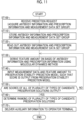
- the CPU 52 of the pharmaceutical support server 10 functions as the receiving unit 65, the RW control unit 66, the feature amount derivation unit 67, the prediction unit 68, and the delivery control unit 69 as illustrated in Fig. 5 .
- the information input screen 100 illustrated in Fig. 9 is displayed on the display 13 of the operator terminal 11.
- the operator inputs the desired antibody information 16, prescription information 18, and measurement data 19 to the information input screen 100 and then selects the prediction button 136. Then, the prediction request 15 is transmitted from the operator terminal 11 to the pharmaceutical support server 10.
- the prediction request 15 is received by the receiving unit 65. Therefore, the antibody information 16 and the prescription information and measurement data set group 17 (the prescription information 18 and the measurement data 19) are acquired (Step ST100).
- the antibody information 16 and the prescription information and measurement data set group 17 are output from the receiving unit 65 to the RW control unit 66 and are stored in the storage 50 under the control of the RW control unit 66 (Step ST110).
- the RW control unit 66 reads out the antibody information 16 and the prescription information and measurement data set group 17 from the storage 50 (Step ST120).
- the antibody information 16 and the prescription information 18 are output from the RW control unit 66 to the feature amount derivation unit 67.
- the measurement data 19 is output from the RW control unit 66 to the prediction unit 68.
- the feature amount derivation unit 67 derives the feature amount 75 on the basis of the antibody information 16 and the prescription information 18 using the molecular dynamics method (Step ST130).
- the feature amount 75 is output from the feature amount derivation unit 67 to the prediction unit 68.
- Step ST140 the measurement data 19 and the feature amount 75 are input to the preservation stability prediction model 61, and the score 76 is output from the preservation stability prediction model 61 (Step ST140).
- the score 76 is output from the prediction unit 68 to the delivery control unit 69.
- the processes in Steps ST130 and ST140 are repeatedly continued while the scores 76 of all of the plurality of types of candidate preservation solutions 35 are not output (NO in Step ST150).
- the delivery control unit 69 determines the ranking of the candidate preservation solutions 35 on the basis of a plurality of scores 76 of the plurality of types of candidate preservation solutions 35 as illustrated in Fig. 8 (Step ST160).
- the determination result of the ranking is delivered as the auxiliary information 20 to the operator terminal 11, which is the transmission source of the prediction request 15, under the control of the delivery control unit 69 (Step ST170).
- the auxiliary information display screen 140 illustrated in Fig. 10 is displayed on the display 13 of the operator terminal 11.
- the operator views the auxiliary information display screen 140 and selects one candidate preservation solution 35 to be adopted as the preservation solution for the biopharmaceutical.
- the CPU 52 of the pharmaceutical support server 10 comprises the receiving unit 65, the feature amount derivation unit 67, and the prediction unit 68.
- the receiving unit 65 receives the prediction request 15 to acquire the antibody information 16 related to the antibody 37 included in the biopharmaceutical to be preserved, the prescription information 18 related to the prescription of the candidate preservation solution 35 which is a candidate for the preservation solution for the biopharmaceutical to be preserved, and the measurement data 19 indicating the preservation stability of the candidate preservation solution 35 measured by the actual test.
- the feature amount derivation unit 67 derives the feature amount 75 related to the preservation stability of the candidate preservation solution 35 on the basis of the antibody information 16 and the prescription information 18.
- the prediction unit 68 inputs the measurement data 19 and the feature amount 75 to the preservation stability prediction model 61 such that the score 76 indicating the preservation stability of the candidate preservation solution 35 is output from the preservation stability prediction model 61.
- the score 76 is output on the basis of the measurement data 19 measured by the actual test. Therefore, it is possible to improve the prediction accuracy of the preservation stability of the candidate preservation solution 35 as compared to a case where the measurement data 19 is not used.
- Fig. 12 illustrates a procedure according to the related art as a comparative example.
- the stress test was performed on each of 30 types of candidate preservation solutions 35 for four weeks, and measurement data 19_1 in the first week, measurement data 19_2 in the second week, measurement data 19_3 in the third week, and measurement data 19_4 in the fourth week were actually measured.
- the operator analyzed the preservation stability of each candidate preservation solution 35 on the basis of the measurement data 19 and selected one candidate preservation solution 35 to be adopted as the preservation solution for the biopharmaceutical from the 30 types of candidate preservation solutions 35.
- the operator finishes the stress test in two weeks that is half of four weeks.
- the score 76 indicating the preservation stability of the candidate preservation solution 35 is derived from the measurement data 19_1 in the first week and the measurement data 19_2 in the second week measured by the stress test for the two weeks and the feature amount 75 derived from the antibody information 16 and the prescription information 18.
- the auxiliary information 20 corresponding to the score 76 is presented to the operator.
- the measurement data 19_1 in the first week and the measurement data 19_2 in the second week are the results in the middle of the stress test for four weeks.
- the operator analyzes the preservation stability of each candidate preservation solution 35 on the basis of the auxiliary information 20 and selects one candidate preservation solution 35 to be adopted as the preservation solution for the biopharmaceutical from the 30 types of candidate preservation solutions 35.
- the stress test can be completed in two weeks in the procedure according to this example. Therefore, it is possible to reduce a complicated operation of preparing a plurality of types of candidate preservation solutions 35 and checking the preservation stability of each candidate preservation solution 35 with the actual test.
- the procedure according to the related art there is a method that determines the prescription of the preservation solution step by step by, for example, narrowing down the type and concentration of the buffer solution in a first stage, narrowing down the type and concentration of the additive in a second stage, ..., narrowing down the numerical range of the hydrogen ion exponent in an N-th stage.
- the procedure of this example it is possible to reduce the operation in each stage.
- the stage can be omitted.
- the first stage is omitted, and the method starts from the second stage.
- the antibody information 16 includes the amino acid sequence 25 of the antibody 37 and the three-dimensional structure 26 of the antibody 37. Therefore, it is possible to derive the feature amount 75 that more accurately indicates the preservation stability of the candidate preservation solution 35. In addition, it is sufficient that the antibody information 16 includes at least one of the amino acid sequence 25 of the antibody 37 or the three-dimensional structure 26 of the antibody 37.
- the prescription information 18 includes the types and concentrations 30 to 32 of each of the buffer solution, the additive, and the surfactant included in the candidate preservation solution 35 and the hydrogen ion exponent 33 of the candidate preservation solution 35. Therefore, it is possible to derive the feature amount 75 that more accurately indicates the preservation stability of the candidate preservation solution 35.
- the feature amount derivation unit 67 derives the feature amount 75 using the molecular dynamics method.
- the molecular dynamics method is a computer simulation method that is popular in the field of biotechnology and can be introduced without any particular barriers. Therefore, it is possible to easily derive the feature amount 75 without requiring a lot of time and effort.
- the feature amount 75 includes the SASA 80, the SAP 81, and the SCM 82 of the antibody 37.
- the feature amount 75 includes the PIC 83 which is an indicator showing the compatibility between the antibody 37 and the additive included in the candidate preservation solution 35. Therefore, the score 76 that more accurately indicates the preservation stability of the candidate preservation solution 35 (the stability of the antibody 37) can be output from the preservation stability prediction model 61.
- the feature amount 75 may include at least one of the SASA 80, the SAP 81, or the SCM 82 of the antibody 37.
- the measurement data 19 includes the SVP aggregation analysis data 40, the DLS analysis data 41, the SEC analysis data 42, and the DSC analysis data 43 of the antibody 37 in the candidate preservation solution 35. Therefore, the score 76 that more accurately indicates the preservation stability of the candidate preservation solution 35 (the stability of the antibody 37) can be output from the preservation stability prediction model 61. It is sufficient that the measurement data 19 includes at least one of the SVP aggregation analysis data 40, the DLS analysis data 41, the SEC analysis data 42, or the DSC analysis data 43.
- the prediction unit 68 outputs a plurality of scores 76 for a plurality of types of candidate preservation solutions 35.
- the delivery control unit 69 determines the ranking of the candidate preservation solutions 35 on the basis of the plurality of scores 76, and delivers and presents the determination result of the ranking as the auxiliary information 20 to the operator terminal 11. Therefore, the operator selects the candidate preservation solution 35 to be adopted as the preservation solution for the biopharmaceutical.
- the biopharmaceutical including the antibody 37 as the protein is called an antibody drug and is widely used not only for the treatment of chronic diseases, such as cancer, diabetes, and rheumatoid arthritis, but also for the treatment of rare diseases such as hemophilia and a Crohn's disease. Therefore, according to the example in which the protein is the antibody 37, it is possible to further promote the development of antibody drugs widely used for the treatment of various diseases.
- the prescription information 18 is input to the preservation stability prediction model 150.
- the numerical values of the concentrations are input without any change.
- the types of the buffer solution, the additive, and the surfactant numerical values set in advance for each type are input. Since the prescription information 18 is added to the input data of the preservation stability prediction model 150, it is possible to further improve the prediction accuracy of the score 76. Further, the antibody information 16 may be further input. Even in this case, for the amino acid sequence 25 and the three-dimensional structure 26, preset numerical values are input.
- a third embodiment in addition to the determination result of the ranking of the candidate preservation solutions 35 based on a plurality of scores 76, whether or not the score 76 satisfies a preset selection condition 155 is presented as the auxiliary information 20.
- the selection condition 155 is stored in the storage 50.
- the RW control unit 66 reads out the selection condition 155 from the storage 50 and outputs the selection condition 155 to the delivery control unit 69.
- the delivery control unit 69 determines whether or not the score 76 satisfies the selection condition 155.
- the delivery control unit 69 delivers the determination result of whether or not the score 76 satisfies the selection condition 155 as the auxiliary information 20 to the operator terminal 11, in addition to the score 76 and the determination result of the ranking based on the score 76.
- Fig. 15 illustrates an example in which the auxiliary information 20 of five types of candidate preservation solutions 35 having candidate preservation solution IDs of PS0001 to PS0005 is generated, as in the case illustrated in Fig. 8 .
- the scores 76 of PS0001, PS0002, PS0003, PS0004, and PS0005 are 75 points, 62 points, 89 points, 47 points, and 82 points, respectively.
- the content of the selection condition 155 is that "the score is equal to or greater than 75 points".
- Fig. 16 illustrates an example of the auxiliary information display screen 140 in the case of the example illustrated in Fig. 15 .
- a table 160 showing the ranking and score 76 of each candidate preservation solution 35 and the determination result of whether or not the score 76 satisfies the selection condition 155 is displayed in the display region 142.
- "OK" is displayed as the determination result in a case where the score 76 satisfies the selection condition 155
- "NG" is displayed as the determination result in a case where the score 76 does not satisfy the selection condition 155.
- the delivery control unit 69 presents the determination result of whether or not the score 76 satisfies the selection condition 155 as the auxiliary information 20. Therefore, the operator selects the candidate preservation solution 35 to be adopted as the preservation solution for the biopharmaceutical.
- the selection condition is not limited to the content in which a threshold value is set for the score 76 like the selection condition 155 illustrated in Fig. 15 in which "the score is equal to or greater than 75 points".
- the content of the selection condition may be related to the ranking of the scores 76.
- the content of the selection condition 165 is "first place and second place". Therefore, the determination results for PS0003 that is in first place and PS0005 that is in second place show that the selection condition is "satisfied", and the determination results for PS0001, PS0002, and PS0004 that are in third to fifth places (not in first and second places) show that the selection condition is "not satisfied”.
- the content of the selection condition related to the ranking may be, for example, "top 20%”.
- the protein is not limited to the antibody 37 given as an example.
- the protein include cytokine (interferon, interleukin, or the like), hormone (insulin, glucagon, follicle-stimulating hormone, erythropoietin, or the like), a growth factor (insulin-like growth factor (IGF)-1, basic fibroblast growth factor (bFGF), or the like), a blood coagulation factor (a seventh factor, an eighth factor, a ninth factor, or the like), an enzyme (a lysosomal enzyme, a deoxyribonucleic acid (DNA) degrading enzyme, or the like), a fragment crystallizable (Fc) fusion protein, a receptor, albumin, and a protein vaccine.
- the antibody include a bispecific antibody, an antibody-drug conjugate, a low-molecular-weight antibody, and a sugar-chain-modified antibody.
- screen data of the auxiliary information display screen 140 illustrated in Fig. 10 may be delivered from the pharmaceutical support server 10 to the operator terminal 11.
- auxiliary information 20 is provided to be viewed by the operator is not limited to the auxiliary information display screen 140.
- a printed matter of the auxiliary information 20 may be provided to the operator, or an e-mail to which the auxiliary information 20 has been attached may be transmitted to a portable terminal of the operator.
- the pharmaceutical support server 10 may be installed in each pharmaceutical facility or may be installed in a data center independent of the pharmaceutical facility.
- the operator terminal 11 may be configured to have some or all of the functions of each of the processing units 65 to 68 of the pharmaceutical support server 10.
- the hardware configuration of the computer constituting the pharmaceutical support server 10 can be modified in various ways.
- the pharmaceutical support server 10 may be configured by a plurality of computers separated as hardware in order to improve processing capacity and reliability.
- the functions of the receiving unit 65 and the RW control unit 66 and the functions of the feature amount derivation unit 67, the prediction unit 68, and the delivery control unit 69 are distributed to two computers.
- the pharmaceutical support server 10 is configured by two computers.
- the hardware configuration of the computer of the pharmaceutical support server 10 can be appropriately changed according to required performances, such as processing capacity, safety, and reliability. Further, not only the hardware but also an application program, such as the operation program 60, can be duplicated or can be dispersively stored in a plurality of storages in order to ensure safety and reliability.
- the following various processors can be used as a hardware structure of processing units performing various processes, such as the receiving unit 65, the RW control unit 66, the feature amount derivation unit 67, the prediction unit 68, and the delivery control unit 69.
- the various processors include, for example, the CPU 52 which is a general-purpose processor executing software (operation program 60) to function as various processing units as described above, a programmable logic device (PLD), such as a field programmable gate array (FPGA), which is a processor whose circuit configuration can be changed after manufacture, and a dedicated electric circuit, such as an application specific integrated circuit (ASIC), which is a processor having a dedicated circuit configuration designed to perform a specific process.
- PLD programmable logic device
- FPGA field programmable gate array
- ASIC application specific integrated circuit
- One processing unit may be configured by one of the various processors or by a combination of two or more processors of the same type or different types (for example, a combination of a plurality of FPGAs and/or a combination of a CPU and an FPGA). Further, a plurality of processing units may be configured by one processor.
- a first example of the configuration in which a plurality of processing units are configured by one processor is an aspect in which one processor is configured by a combination of one or more CPUs and software and functions as a plurality of processing units.
- a representative example of this aspect is a client computer or a server computer.
- a second example of the configuration is an aspect in which a processor that implements the functions of the entire system including a plurality of processing units using one integrated circuit (IC) chip is used.
- IC integrated circuit
- a representative example of this aspect is a system-on-chip (SoC).
- SoC system-on-chip
- the various processing units are configured by using one or more of the above various processors as the hardware structure.
- circuitry in which circuit elements, such as semiconductor elements, are combined can be used as the hardware structure of these various processors.
- a pharmaceutical support device comprising a processor.
- the processor is configured to:
- the protein information includes at least one of an amino acid sequence of the protein or a three-dimensional structure of the protein.
- the prescription information includes a type and concentration of each of a buffer solution, an additive, and a surfactant included in the candidate preservation solution and a hydrogen ion exponent of the candidate preservation solution.
- the processor is configured to derive the feature amount using a molecular dynamics method.
- the feature amount includes at least one of a solvent accessible surface area, a spatial aggregation propensity, or a space charge map of the protein.
- the feature amount includes an indicator showing compatibility between the protein and the additive included in the candidate preservation solution.
- the measurement data includes at least one of aggregation analysis data of sub-visible particles of the protein in the candidate preservation solution, analysis data of the protein in the candidate preservation solution by a dynamic light scattering method, analysis data of the protein in the candidate preservation solution by size exclusion chromatography, or analysis data of the protein in the candidate preservation solution by differential scanning calorimetry.
- the processor is configured to present auxiliary information that is based on the score and that assists determination of whether or not the candidate preservation solution is adoptable.
- the processor is configured to:
- the processor is configured to:
- the processor is configured to input the prescription information to the machine learning model in addition to the measurement data and the feature amount.
- the protein is an antibody.
- the above-described various embodiments and/or various modification examples may be combined with each other as appropriate.
- the present disclosure is not limited to each of the above-described embodiments, and various configurations can be used without departing from the gist of the present disclosure.
- the technology of the present disclosure extends to a storage medium that non-temporarily stores a program, in addition to the program.
- a and/or B is synonymous with “at least one of A or B”. That is, “A and/or B” means only A, only B, or a combination of A and B. Further, in the specification, the same concept as “A and/or B” is applied to a case in which the connection of three or more matters is expressed by "and/or”.
Landscapes
- Health & Medical Sciences (AREA)
- Engineering & Computer Science (AREA)
- Life Sciences & Earth Sciences (AREA)
- Chemical & Material Sciences (AREA)
- Bioinformatics & Cheminformatics (AREA)
- Physics & Mathematics (AREA)
- Spectroscopy & Molecular Physics (AREA)
- General Health & Medical Sciences (AREA)
- Biotechnology (AREA)
- Medicinal Chemistry (AREA)
- Medical Informatics (AREA)
- Theoretical Computer Science (AREA)
- Evolutionary Biology (AREA)
- Bioinformatics & Computational Biology (AREA)
- Crystallography & Structural Chemistry (AREA)
- Biophysics (AREA)
- Organic Chemistry (AREA)
- Zoology (AREA)
- Wood Science & Technology (AREA)
- Pharmacology & Pharmacy (AREA)
- Genetics & Genomics (AREA)
- Biochemistry (AREA)
- General Engineering & Computer Science (AREA)
- Microbiology (AREA)
- Biomedical Technology (AREA)
- Sustainable Development (AREA)
- Epidemiology (AREA)
- Primary Health Care (AREA)
- Public Health (AREA)
- Investigating Or Analysing Biological Materials (AREA)
- Medical Treatment And Welfare Office Work (AREA)
Abstract
Description
- The technology of the present disclosure relates to a pharmaceutical support device, a method for operating a pharmaceutical support device, and a program for operating a pharmaceutical support device.
- In recent years, biopharmaceuticals have attracted attention due to high drug efficacy and low side effects. The biopharmaceutical has, for example, a protein, such as interferon or an antibody, as an active ingredient. The biopharmaceutical is preserved in a preservation solution. It is important to prescribe a preservation solution (also referred to as a formulation prescription) suitable for the biopharmaceutical in order to stably maintain the quality of the biopharmaceutical.
- The preservation solution includes a buffer solution, an additive, and a surfactant. The prescription of the preservation solution is, for example, the type and concentration of each of the buffer solution, the additive, and the surfactant and a hydrogen ion exponent (Potential of Hydrogen (pH) value) of the preservation solution.
- In the related art, in a case where the prescription of the preservation solution is determined, a plurality of types of preservation solutions are prepared, for example, while changing a combination of the buffer solution, the additive, and the surfactant, and the preservation stability of each preservation solution is checked by an actual test. However, it takes a lot of time and effort to perform this operation. Therefore, for example, as in
WO2021/041384A and "Theresa K. Cloutier, etc., Machine Learning Models of Antibody-Excipient Preferential Interactions for Use in Computational Formulation Design, Mol. Pharmaceutics, 17, 9, 3589-3599, 2020." (hereinafter, referred to as Document 1), a technique has been proposed that predicts preservation stability of a preservation solution on the basis of information of a protein in a biopharmaceutical or information of an additive in the preservation solution, using a molecular dynamics (MD) method or a machine learning model, without performing any test. - In the technique disclosed in
WO2021/041384A andDocument 1, the preservation stability of the preservation solution is not checked by the actual test. Therefore, there is a risk that a prediction result that is far from the original preservation stability will be obtained. - An embodiment according to the technology of the present disclosure provides a pharmaceutical support device, a method for operating a pharmaceutical support device, and a program for operating a pharmaceutical support device that can improve prediction accuracy of preservation stability of a preservation solution.
- According to the present disclosure, there is provided a pharmaceutical support device comprising a processor. The processor is configured to: acquire protein information related to a protein included in a biopharmaceutical to be preserved, prescription information related to a prescription of a candidate preservation solution, which is a candidate for a preservation solution for the biopharmaceutical to be preserved, and measurement data indicating preservation stability of the candidate preservation solution measured by an actual test; derive a feature amount related to the preservation stability of the candidate preservation solution on the basis of the protein information and the prescription information; and input the measurement data and the feature amount to a machine learning model such that a score indicating the preservation stability of the candidate preservation solution is output from the machine learning model.
- Preferably, the protein information includes at least one of an amino acid sequence of the protein or a three-dimensional structure of the protein.
- Preferably, the prescription information includes a type and concentration of each of a buffer solution, an additive, and a surfactant included in the candidate preservation solution and a hydrogen ion exponent of the candidate preservation solution.
- Preferably, the processor is configured to derive the feature amount using a molecular dynamics method.
- Preferably, the feature amount includes at least one of a solvent accessible surface area, a spatial aggregation propensity, or a space charge map of the protein.
- Preferably, the feature amount includes an indicator showing compatibility between the protein and the additive included in the candidate preservation solution.
- Preferably, the measurement data includes at least one of aggregation analysis data of sub-visible particles of the protein in the candidate preservation solution, analysis data of the protein in the candidate preservation solution by a dynamic light scattering method, analysis data of the protein in the candidate preservation solution by size exclusion chromatography, or analysis data of the protein in the candidate preservation solution by differential scanning calorimetry.
- Preferably, the processor is configured to present auxiliary information that is based on the score and that assists determination of whether or not the candidate preservation solution is adoptable.
- Preferably, the processor is configured to: determine whether or not the score satisfies a selection condition that has been set in advance; and present a determination result as the auxiliary information.
- Preferably, the processor is configured to: output a plurality of the scores for a plurality of types of the candidate preservation solutions; determine ranking of the candidate preservation solutions on the basis of the plurality of scores; and present a determination result of the ranking as the auxiliary information.
- Preferably, the processor is configured to input the prescription information to the machine learning model in addition to the measurement data and the feature amount.
- Preferably, the protein is an antibody.
- According to the present disclosure, there is provided a method for operating a pharmaceutical support device. The method comprises: acquiring protein information related to a protein included in a biopharmaceutical to be preserved, prescription information related to a prescription of a candidate preservation solution, which is a candidate for a preservation solution for the biopharmaceutical to be preserved, and measurement data indicating preservation stability of the candidate preservation solution measured by an actual test; deriving a feature amount related to the preservation stability of the candidate preservation solution on the basis of the protein information and the prescription information; and inputting the measurement data and the feature amount to a machine learning model such that a score indicating the preservation stability of the candidate preservation solution is output from the machine learning model.
- According to the present disclosure, there is provided a program for operating a pharmaceutical support device. The program causes a computer to execute a process comprising: acquiring protein information related to a protein included in a biopharmaceutical to be preserved, prescription information related to a prescription of a candidate preservation solution, which is a candidate for a preservation solution for the biopharmaceutical to be preserved, and measurement data indicating preservation stability of the candidate preservation solution measured by an actual test; deriving a feature amount related to the preservation stability of the candidate preservation solution on the basis of the protein information and the prescription information; and inputting the measurement data and the feature amount to a machine learning model such that a score indicating the preservation stability of the candidate preservation solution is output from the machine learning model.
- According to the technology of the present disclosure, it is possible to provide a pharmaceutical support device, a method for operating a pharmaceutical support device, and a program for operating a pharmaceutical support device that can improve prediction accuracy of preservation stability of a preservation solution.
-
-
Fig. 1 is a diagram illustrating a pharmaceutical support server and an operator terminal. -
Fig. 2 is a diagram illustrating antibody information. -
Fig. 3 is a diagram illustrating a series of flows of preparation of a candidate preservation solution, addition of an antibody, a stress test, and measurement of measurement data, prescription information, and measurement data. -
Fig. 4 is a block diagram illustrating a computer constituting the pharmaceutical support server. -
Fig. 5 is a block diagram illustrating processing units of a CPU of the pharmaceutical support server. -
Fig. 6 is a diagram illustrating a process of a feature amount derivation unit. -
Fig. 7 is a diagram illustrating a process of a prediction unit. -
Fig. 8 is a diagram illustrating processes of the prediction unit and a delivery control unit. -
Fig. 9 is a diagram illustrating an information input screen. -
Fig. 10 is a diagram illustrating an auxiliary information display screen. -
Fig. 11 is a flowchart illustrating a processing procedure of the pharmaceutical support server. -
Fig. 12 is a diagram illustrating a procedure according to the related art which selects a preservation solution suitable for a biopharmaceutical to be preserved from a plurality of types of candidate preservation solutions. -
Fig. 13 is a diagram illustrating a procedure according to this example which selects a preservation solution suitable for a biopharmaceutical to be preserved from a plurality of types of candidate preservation solutions. -
Fig. 14 is a diagram illustrating a process of a prediction unit according to a second embodiment. -
Fig. 15 is a diagram illustrating processes of a prediction unit and a delivery control unit according to a third embodiment. -
Fig. 16 is a diagram illustrating an auxiliary information display screen according to the third embodiment. -
Fig. 17 is a diagram illustrating another example of a selection condition. - As illustrated in
Fig. 1 as an example, apharmaceutical support server 10 is connected to anoperator terminal 11 through anetwork 12. Thepharmaceutical support server 10 is an example of a "pharmaceutical support device" according to the technology of the present disclosure. Theoperator terminal 11 is installed, for example, in a pharmaceutical facility and is operated by an operator, such as a pharmacist, who is involved in the production of biopharmaceuticals in the pharmaceutical facility. Theoperator terminal 11 has adisplay 13 and aninput device 14 such as a keyboard and a mouse. Thenetwork 12 is, for example, a wide area network (WAN) such as the Internet or a public communication network. In addition, inFig. 1 , only oneoperator terminal 11 is connected to thepharmaceutical support server 10. However, in practice, a plurality ofoperator terminals 11 in a plurality of pharmaceutical facilities are connected to thepharmaceutical support server 10. - The
operator terminal 11 transmits aprediction request 15 to thepharmaceutical support server 10. Theprediction request 15 is a request for thepharmaceutical support server 10 to predict preservation stability of a candidate preservation solution 35 (seeFig. 3 ), which is a candidate for a preservation solution for the biopharmaceutical. Theprediction request 15 includesantibody information 16 and a prescription information and measurement data setgroup 17. Theantibody information 16 is information related to an antibody 37 (seeFig. 3 ) which is an active ingredient of the biopharmaceutical. The operator operates theinput device 14 to input theantibody information 16. Theantibody 37 is an example of a "protein" according to the technology of the present disclosure, and theantibody information 16 is an example of "protein information" according to the technology of the present disclosure. - The prescription information and measurement data set
group 17 includes a plurality of sets ofprescription information 18 andmeasurement data 19. The set of theprescription information 18 and themeasurement data 19 is registered for each of a plurality of types, for example, several to several tens of types ofcandidate preservation solutions 35. Theprescription information 18 is information related to the prescription of thecandidate preservation solution 35. Themeasurement data 19 is data indicating the preservation stability of thecandidate preservation solution 35 measured by an actual test. The operator also operates theinput device 14 to input theprescription information 18 and themeasurement data 19. In addition, theprediction request 15 also includes terminal identification data (ID) for uniquely identifying theoperator terminal 11 which is a transmission source of theprediction request 15, which is not illustrated. - In a case where the
prediction request 15 is received, thepharmaceutical support server 10 derivesauxiliary information 20 that assists the determination of whether or not thecandidate preservation solution 35 can be adopted. Thepharmaceutical support server 10 delivers theauxiliary information 20 to theoperator terminal 11 which is the transmission source of theprediction request 15. In a case where theauxiliary information 20 is received, theoperator terminal 11 displays theauxiliary information 20 on thedisplay 13 such that the operator views theauxiliary information 20. - As illustrated in
Fig. 2 as an example, theantibody information 16 includes anamino acid sequence 25 of theantibody 37 and a three-dimensional structure 26 of theantibody 37. Theantibody information 16 is obtained by analyzing theantibody 37 with a well-known technique such as mass spectrometry, X-ray crystal structure analysis, or electron microscopy. In theamino acid sequence 25, the order of peptide bonds of amino acids constituting theantibody 37, such as asparagine (abbreviated to ASn), glutamine (abbreviated to Glu), and arginine (abbreviated to Arg), is described from an amino terminal to a carboxyl terminal. Theamino acid sequence 25 is also referred to as a primary structure. The three-dimensional structure 26 indicates the secondary structure, tertiary structure, and quaternary structure of the amino acids constituting theantibody 37. Examples of the secondary structure include a β-sheet and a β-turn in addition to α-helix given as an example. The tertiary structure is, for example, a dimer coiled coil structure given as an example. Examples of the quaternary structure include a dimer, a trimer, and a tetramer. Someantibodies 37 do not have the quaternary structure (that is, someantibodies 37 are monomers). In this case, the quaternary structure is not registered as described in the example. The three-dimensional structure 26 can also be obtained by inputting theamino acid sequence 25 to "AlphaFold2" which is a three-dimensional protein structure prediction program developed by DeepMind Technologies Limited. - As illustrated in
Fig. 3 as an example, theprescription information 18 includes a type andconcentration 30 of a buffer solution, a type andconcentration 31 of an additive, and a type andconcentration 32 of a surfactant in thecandidate preservation solution 35. The operator creates theprescription information 18, relying on theantibody information 16, his/her own experience, and the like. In some cases, a plurality of types of buffer solutions, additives, and surfactants are used as can be seen from L-arginine hydrochloride and purified white sugar which are the additives given as an example. In this case, a type and a concentration are registered for each of the plurality of types. Further, theprescription information 18 also includes ahydrogen ion exponent 33 of thecandidate preservation solution 35. Furthermore, a molecular formula of each of the buffer solution, the additive, and the surfactant may be added to theprescription information 18. - The operator actually prepares the
candidate preservation solution 35 in atest tube 36 on the basis of theprescription information 18. Then, theantibody 37 is added to the preparedcandidate preservation solution 35. Then, a stress test including the repetition of freezing and thawing and stirring is performed for 2 weeks. During the stress test for two weeks, themeasurement data 19 is actually measured by ameasurement device 38.Fig. 3 illustrates an example in which measurement data 19_1 and measurement data 19_2 are measured in the first week and the second week of the stress test, respectively. Themeasurement device 38 transmits themeasurement data 19 to theoperator terminal 11. - The
measurement data 19 includes aggregation analysis data (hereinafter, referred to as SVP aggregation analysis data) 40 of sub-visible particles (SVPs) of theantibody 37 in thecandidate preservation solution 35 and analysis data (hereinafter, referred to as DLS analysis data) 41 of theantibody 37 in thecandidate preservation solution 35 by a dynamic light scattering (DLS) method as illustrated in the measurement data 19_1 in the first week. The SVPaggregation analysis data 40 indicates the amount of SVPs of theantibody 37 in thecandidate preservation solution 35 that causes a reduction in the drug efficacy of the biopharmaceutical. Similarly, theDLS analysis data 41 indicates the amount of nanoparticles of theantibody 37 in thecandidate preservation solution 35 that causes the reduction in the drug efficacy of the biopharmaceutical. - In addition, the
measurement data 19 includes analysis data (hereinafter, referred to as SEC analysis data) 42 of theantibody 37 in thecandidate preservation solution 35 by size exclusion chromatography (SEC) and analysis data (hereinafter, referred to as DSC analysis data) 43 of theantibody 37 in thecandidate preservation solution 35 by differential scanning calorimetry (DSC). TheSEC analysis data 42 indicates a molecular weight distribution of theantibody 37 in thecandidate preservation solution 35. TheDSC analysis data 43 indicates values related to thermophysical property values such as the glass transition point and crystallization temperature of theantibody 37 in thecandidate preservation solution 35. In addition, inFig. 3 , for convenience, only onemeasurement device 38 is illustrated. However, in practice,various measurement devices 38 that measure theseanalysis data items 40 to 43 are prepared. - A common candidate preservation solution ID is given to the
prescription information 18 and themeasurement data 19 of onecandidate preservation solution 35. Theprescription information 18 and themeasurement data 19 are associated with each other by the candidate preservation solution ID. Further, inFig. 3 , only the preparation of onecandidate preservation solution 35, the addition of theantibody 37, the stress test, and the measurement of themeasurement data 19 are illustrated. However, in practice, the preparation, the addition, the stress test, and the measurement of themeasurement data 19 are performed for each of a plurality of types ofcandidate preservation solutions 35. - As illustrated in
Fig. 4 as an example, a computer constituting thepharmaceutical support server 10 comprises astorage 50, amemory 51, a central processing unit (CPU) 52, acommunication unit 53, adisplay 54, and aninput device 55. These units are connected to one another through abus line 56. - The
storage 50 is a hard disk drive that is provided in the computer constituting thepharmaceutical support server 10 or that is connected to the computer through a cable or a network. Alternatively, thestorage 50 is a disk array in which a plurality of hard disk drives are connected. Thestorage 50 stores, for example, a control program, such as an operating system, various application programs, and various types of data associated with these programs. In addition, a solid state drive may be used instead of the hard disk drive. - The
memory 51 is a work memory used by theCPU 52 to perform processes. TheCPU 52 loads the program stored in thestorage 50 to thememory 51 and performs a process corresponding to the program. Therefore, theCPU 52 controls the overall operation of each unit of the computer. TheCPU 52 is an example of a "processor" according to the technology of the present disclosure. In addition, thememory 51 may be provided in theCPU 52. - The
communication unit 53 controls the transmission of various types of information to an external device such as theoperator terminal 11. Thedisplay 54 displays various screens. The various screens have operation functions by a graphical user interface (GUI). The computer constituting thepharmaceutical support server 10 receives an input of an operation instruction from theinput device 55 through the various screens. Theinput device 55 is, for example, a keyboard, a mouse, a touch panel, and a microphone for voice input. - As illustrated in
Fig. 5 as an example, anoperation program 60 is stored in thestorage 50 of thepharmaceutical support server 10. Theoperation program 60 is an application program for causing the computer to function as thepharmaceutical support server 10. That is, theoperation program 60 is an example of "a program for operating a pharmaceutical support device" according to the technology of the present disclosure. Thestorage 50 also stores theantibody information 16 and the prescription information and measurement data setgroup 17. In addition, thestorage 50 also stores a preservationstability prediction model 61. The preservationstability prediction model 61 is an example of a "machine learning model" according to the technology of the present disclosure. - In a case where the
operation program 60 is started, theCPU 52 of the computer constituting thepharmaceutical support server 10 functions as a receivingunit 65, a read and write (hereinafter, abbreviated to RW)control unit 66, a featureamount derivation unit 67, aprediction unit 68, and adelivery control unit 69 in cooperation with thememory 51 and the like. - The receiving
unit 65 receives theprediction request 15 from theoperator terminal 11. As described above, theprediction request 15 includes theantibody information 16 and the prescription information and measurement data setgroup 17, and the prescription information and measurement data setgroup 17 includes theprescription information 18 and themeasurement data 19. Therefore, in a case where theprediction request 15 is received, the receivingunit 65 acquires theantibody information 16, theprescription information 18, and themeasurement data 19. The receivingunit 65 outputs theantibody information 16 and the prescription information and measurement data setgroup 17 to theRW control unit 66. In addition, the receivingunit 65 outputs the terminal ID of the operator terminal 11 (not illustrated) to thedelivery control unit 69. - The
RW control unit 66 controls the storage of various types of data in thestorage 50 and the reading-out of various types of data in thestorage 50. For example, theRW control unit 66 stores theantibody information 16 and the prescription information and measurement data setgroup 17 from the receivingunit 65 in thestorage 50. Further, theRW control unit 66 reads out theantibody information 16 and the prescription information and measurement data setgroup 17 from thestorage 50, outputs theantibody information 16 and theprescription information 18 to the featureamount derivation unit 67, and outputs themeasurement data 19 to theprediction unit 68. Furthermore, theRW control unit 66 reads out the preservationstability prediction model 61 from thestorage 50 and outputs the preservationstability prediction model 61 to theprediction unit 68. - The feature
amount derivation unit 67 derives afeature amount 75 related to the preservation stability of thecandidate preservation solution 35 on the basis of theantibody information 16 and theprescription information 18. The featureamount derivation unit 67 outputs the derivedfeature amount 75 to theprediction unit 68. - The
prediction unit 68 derives ascore 76 indicating the preservation stability of thecandidate preservation solution 35 from themeasurement data 19 and thefeature amount 75, using the preservationstability prediction model 61. Theprediction unit 68 outputs the derivedscore 76 to thedelivery control unit 69. - The
delivery control unit 69 generates theauxiliary information 20 on the basis of thescore 76. Thedelivery control unit 69 controls the delivery of theauxiliary information 20 to theoperator terminal 11 which is the transmission source of theprediction request 15. In this case, thedelivery control unit 69 specifies theoperator terminal 11, which is the transmission source of theprediction request 15, on the basis of the terminal ID from the receivingunit 65. - As illustrated in
Fig. 6 as an example, the featureamount derivation unit 67 derives thefeature amount 75 using a molecular dynamics method. Thefeature amount 75 includes a hydrophobic solvent accessible surface area (hereinafter, abbreviated to SASA) 80, a spatial aggregation propensity (hereinafter, abbreviated to SAP) 81, and a spatial charge map (hereinafter, abbreviated to SCM) 82 of theantibody 37. As theSASA 80 is larger and theSAP 81 is larger, the stability of theantibody 37 is lower. TheSCM 82 indicates the degree of charge of theantibody 37 for each region of theantibody 37. TheSASA 80, theSAP 81, and theSCM 82 are derived on the basis of only theantibody information 16 without referring to theprescription information 18. Therefore, theSASA 80, theSAP 81, and theSCM 82 are common to eachcandidate preservation solution 35. - Further, the
feature amount 75 also includes a preferential interaction coefficient (hereinafter, abbreviated to PIC) 83 described inDocument 1. ThePIC 83 indicates, for each region of theantibody 37, the ease of the binding between theantibody 37 and the additive, more specifically, the degree to which the surface of theantibody 37 is covered by the additive. Therefore, thePIC 83 is an indicator showing the compatibility between theantibody 37 and the additive. ThePIC 83 makes it possible to know the possibility that the aggregation of theantibody 37 causing a reduction in the drug efficacy of the biopharmaceutical will occur. ThePIC 83 is derived on the basis of both theantibody information 16 and theprescription information 18 unlike theSASA 80, theSAP 81, and theSCM 82. Therefore, thePIC 83 is different in eachcandidate preservation solution 35. Therefore, a plurality of feature amounts 75 of eachcandidate preservation solution 35 have theSASA 80, theSAP 81, and theSCM 82 in common and havedifferent PICs 83. ThePIC 83 may be derived using a machine learning model, such as a support vector machine (SVM), instead of the molecular dynamics method. In addition, similarly to theprescription information 18 and themeasurement data 19, thefeature amount 75 is given the candidate preservation solution ID. - As illustrated in
Fig. 7 as an example, theprediction unit 68 inputs themeasurement data 19 and thefeature amount 75 to the preservationstability prediction model 61. Then, thescore 76 is output from the preservationstability prediction model 61. Thescore 76 is represented by, for example, a continuous numerical value of 0 points to 100 points. The preservationstability prediction model 61 is a machine learning model using, for example, a support vector regression (SVR) algorithm that predicts thescore 76 which is a continuous numerical value. In addition, similarly to thefeature amount 75 and the like, thescore 76 is given the candidate preservation solution ID. - The preservation
stability prediction model 61 may be trained in thepharmaceutical support server 10 or may be trained by a device other than thepharmaceutical support server 10. In addition, the preservationstability prediction model 61 may be continuously trained even after the operation. - As illustrated in
Fig. 8 as an example, theprediction unit 68 directs the preservationstability prediction model 61 to output a plurality ofscores 76 for a plurality of types ofcandidate preservation solutions 35. Thedelivery control unit 69 determines ranking on the basis of the plurality ofscores 76 of the plurality of types ofcandidate preservation solutions 35 as illustrated in a table 90. Thedelivery control unit 69 delivers a determination result of the ranking illustrated in the table 90 as theauxiliary information 20 to theoperator terminal 11. -
Fig. 8 illustrates an example in which the ranking of five types ofcandidate preservation solutions 35 having candidate preservation solution IDs of PS0001 to PS0005 is determined. Thescores 76 of PS0001, PS0002, PS0003, PS0004, and PS0005 are 75 points, 62 points, 89 points, 47 points, and 82 points, respectively. For the ranking, PS0003 with the highest score of 89 points is in first place, PS0005 with the second highest score of 82 points is in second place, PS0001 with 75 points is in third place, PS0002 with 62 points is in fourth place, and PS0004 with the lowest score of 47 points is in fifth place. -
Fig. 9 illustrates an example of aninformation input screen 100 that is displayed on thedisplay 13 of theoperator terminal 11. Theinformation input screen 100 has aninput region 101 for theantibody information 16 and aninput region 102 for the information of thecandidate preservation solution 35. Theinput region 102 has aninput region 103 for theprescription information 18, an input region 104_1 for the measurement data 19_1 in the first week, and an input region 104_2 for the measurement data 19_2 in the second week. - An
input box 110 for theamino acid sequence 25 and aninput box 111 for the three-dimensional structure 26 are provided in theinput region 101 for theantibody information 16. - The
input region 103 for theprescription information 18 is provided with a pull-down menu 112 for selecting the type of the buffer solution, aninput box 113 for the concentration of the buffer solution, a pull-down menu 114 for selecting the type of the additive, aninput box 115 for the concentration of the additive, a pull-down menu 116 for selecting the type of the surfactant, and aninput box 117 for the concentration of the surfactant. - An add
button 118 for the buffer solution is provided below the pull-down menu 112 and theinput box 113 for the buffer solution. In a case where theadd button 118 is selected, the pull-down menu 112 and theinput box 113 for the buffer solution are added. An addbutton 119 for the additive is provided below the pull-down menu 114 and theinput box 115 for the additive. In a case where theadd button 119 is selected, the pull-down menu 114 and theinput box 115 for the additive are added. An addbutton 120 for the surfactant is provided below the pull-down menu 116 and theinput box 117 for the surfactant. In a case where theadd button 120 is selected, the pull-down menu 116 and theinput box 117 for the surfactant are added. Further, aninput box 121 for the hydrogen ion exponent is provided in a lower portion of theinput region 103. - The input region 104 for the
measurement data 19 is provided with afile selection button 125 for selecting a file of the SVPaggregation analysis data 40 and afile selection button 126 for selecting a file of theDLS analysis data 41. In addition, the input region 104 for themeasurement data 19 is provided with afile selection button 127 for selecting a file of theSEC analysis data 42 and afile selection button 128 for selecting a file of theDSC analysis data 43. - In a case where the file of each of the
analysis data items 40 to 43 is selected, fileicons file selection buttons 125 to 128, respectively. Thefile icons 129 to 132 are not displayed in a case where no files are selected. - An add
button 135 for thecandidate preservation solution 35 is provided in a lower portion of theinput region 102 for the information of thecandidate preservation solution 35. In a case where theadd button 135 is selected, theinput region 102 for the information of thecandidate preservation solution 35 is added. - A
prediction button 136 is provided below theadd button 135 for thecandidate preservation solution 35. In a case where theprediction button 136 is selected, theprediction request 15 including theantibody information 16 and the prescription information and measurement data setgroup 17 is transmitted from theoperator terminal 11 to thepharmaceutical support server 10. Theantibody information 16 includes contents that have been input to theinput boxes group 17 includes contents selected by the pull-downmenus input boxes analysis data items 40 to 43 selected by thefile selection buttons 125 to 128. -
Fig. 10 illustrates an example of an auxiliaryinformation display screen 140 that is displayed on thedisplay 13 of theoperator terminal 11 in a case where theauxiliary information 20 is received from thepharmaceutical support server 10. The auxiliaryinformation display screen 140 has adisplay region 141 for theantibody information 16 and adisplay region 142 for theauxiliary information 20. Theamino acid sequence 25 and the three-dimensional structure 26 are displayed in thedisplay region 141 for theantibody information 16. A table 143 showing the ranking and thescore 76 of eachcandidate preservation solution 35 is displayed in thedisplay region 142 for theauxiliary information 20. Adisplay button 144 for theprescription information 18 is provided in the table 143. In a case where thedisplay button 144 is selected, a display screen for theprescription information 18 of thecandidate preservation solution 35 is displayed on the auxiliaryinformation display screen 140 in a popup manner. The auxiliaryinformation display screen 140 is removed by the selection of aconfirm button 145. - Next, the operation of the above-mentioned configuration will be described with reference to a flowchart illustrated in
Fig. 11 . First, in a case where theoperation program 60 is started in thepharmaceutical support server 10, theCPU 52 of thepharmaceutical support server 10 functions as the receivingunit 65, theRW control unit 66, the featureamount derivation unit 67, theprediction unit 68, and thedelivery control unit 69 as illustrated inFig. 5 . - The
information input screen 100 illustrated inFig. 9 is displayed on thedisplay 13 of theoperator terminal 11. The operator inputs the desiredantibody information 16,prescription information 18, andmeasurement data 19 to theinformation input screen 100 and then selects theprediction button 136. Then, theprediction request 15 is transmitted from theoperator terminal 11 to thepharmaceutical support server 10. - In the
pharmaceutical support server 10, theprediction request 15 is received by the receivingunit 65. Therefore, theantibody information 16 and the prescription information and measurement data set group 17 (theprescription information 18 and the measurement data 19) are acquired (Step ST100). Theantibody information 16 and the prescription information and measurement data setgroup 17 are output from the receivingunit 65 to theRW control unit 66 and are stored in thestorage 50 under the control of the RW control unit 66 (Step ST110). - The
RW control unit 66 reads out theantibody information 16 and the prescription information and measurement data setgroup 17 from the storage 50 (Step ST120). Theantibody information 16 and theprescription information 18 are output from theRW control unit 66 to the featureamount derivation unit 67. Themeasurement data 19 is output from theRW control unit 66 to theprediction unit 68. - As illustrated in
Fig. 6 , the featureamount derivation unit 67 derives thefeature amount 75 on the basis of theantibody information 16 and theprescription information 18 using the molecular dynamics method (Step ST130). Thefeature amount 75 is output from the featureamount derivation unit 67 to theprediction unit 68. - Then, as illustrated in
Fig. 7 , in theprediction unit 68, themeasurement data 19 and thefeature amount 75 are input to the preservationstability prediction model 61, and thescore 76 is output from the preservation stability prediction model 61 (Step ST140). Thescore 76 is output from theprediction unit 68 to thedelivery control unit 69. The processes in Steps ST130 and ST140 are repeatedly continued while thescores 76 of all of the plurality of types ofcandidate preservation solutions 35 are not output (NO in Step ST150). - In a case where the
scores 76 of all of the plurality of types ofcandidate preservation solutions 35 are output (YES in Step ST150), thedelivery control unit 69 determines the ranking of thecandidate preservation solutions 35 on the basis of a plurality ofscores 76 of the plurality of types ofcandidate preservation solutions 35 as illustrated inFig. 8 (Step ST160). The determination result of the ranking is delivered as theauxiliary information 20 to theoperator terminal 11, which is the transmission source of theprediction request 15, under the control of the delivery control unit 69 (Step ST170). - The auxiliary
information display screen 140 illustrated inFig. 10 is displayed on thedisplay 13 of theoperator terminal 11. The operator views the auxiliaryinformation display screen 140 and selects onecandidate preservation solution 35 to be adopted as the preservation solution for the biopharmaceutical. - As described above, the
CPU 52 of thepharmaceutical support server 10 comprises the receivingunit 65, the featureamount derivation unit 67, and theprediction unit 68. The receivingunit 65 receives theprediction request 15 to acquire theantibody information 16 related to theantibody 37 included in the biopharmaceutical to be preserved, theprescription information 18 related to the prescription of thecandidate preservation solution 35 which is a candidate for the preservation solution for the biopharmaceutical to be preserved, and themeasurement data 19 indicating the preservation stability of thecandidate preservation solution 35 measured by the actual test. The featureamount derivation unit 67 derives thefeature amount 75 related to the preservation stability of thecandidate preservation solution 35 on the basis of theantibody information 16 and theprescription information 18. Theprediction unit 68 inputs themeasurement data 19 and thefeature amount 75 to the preservationstability prediction model 61 such that thescore 76 indicating the preservation stability of thecandidate preservation solution 35 is output from the preservationstability prediction model 61. Thescore 76 is output on the basis of themeasurement data 19 measured by the actual test. Therefore, it is possible to improve the prediction accuracy of the preservation stability of thecandidate preservation solution 35 as compared to a case where themeasurement data 19 is not used. - In addition, as illustrated in
Figs. 12 and13 as an example, it is also possible to reduce a complicated operation of preparing a plurality of types ofcandidate preservation solutions 35 and checking the preservation stability of eachcandidate preservation solution 35 with the actual test. -
Figs. 12 and13 illustrate an example in which the hydrogen ion exponent is divided into 6 levels of 5.0, 5.5, 6.0, 6.5, 7.0, and 7.5 at an interval of 0.5, any one of five types of additives of sorbitol, sucrose, trehalose, proline, and L-arginine hydrochloride is used as the additive, and onecandidate preservation solution 35 to be adopted as the preservation solution for the biopharmaceutical is selected from 30 (= 6 × 5) types ofcandidate preservation solutions 35. -
Fig. 12 illustrates a procedure according to the related art as a comparative example. In the related art, the stress test was performed on each of 30 types ofcandidate preservation solutions 35 for four weeks, and measurement data 19_1 in the first week, measurement data 19_2 in the second week, measurement data 19_3 in the third week, and measurement data 19_4 in the fourth week were actually measured. The operator analyzed the preservation stability of eachcandidate preservation solution 35 on the basis of themeasurement data 19 and selected onecandidate preservation solution 35 to be adopted as the preservation solution for the biopharmaceutical from the 30 types ofcandidate preservation solutions 35. - In contrast, in the procedure according to this example, as illustrated in
Fig. 13 , the operator finishes the stress test in two weeks that is half of four weeks. Thescore 76 indicating the preservation stability of thecandidate preservation solution 35 is derived from the measurement data 19_1 in the first week and the measurement data 19_2 in the second week measured by the stress test for the two weeks and thefeature amount 75 derived from theantibody information 16 and theprescription information 18. Then, theauxiliary information 20 corresponding to thescore 76 is presented to the operator. The measurement data 19_1 in the first week and the measurement data 19_2 in the second week are the results in the middle of the stress test for four weeks. The operator analyzes the preservation stability of eachcandidate preservation solution 35 on the basis of theauxiliary information 20 and selects onecandidate preservation solution 35 to be adopted as the preservation solution for the biopharmaceutical from the 30 types ofcandidate preservation solutions 35. - As described above, while it is necessary to perform the stress test for four weeks in the procedure according to the related art, the stress test can be completed in two weeks in the procedure according to this example. Therefore, it is possible to reduce a complicated operation of preparing a plurality of types of
candidate preservation solutions 35 and checking the preservation stability of eachcandidate preservation solution 35 with the actual test. - Further, as the procedure according to the related art, there is a method that determines the prescription of the preservation solution step by step by, for example, narrowing down the type and concentration of the buffer solution in a first stage, narrowing down the type and concentration of the additive in a second stage, ..., narrowing down the numerical range of the hydrogen ion exponent in an N-th stage. According to the procedure of this example, it is possible to reduce the operation in each stage. In addition, in some cases, the stage can be omitted. For example, the first stage is omitted, and the method starts from the second stage.
- As illustrated in
Fig. 2 , theantibody information 16 includes theamino acid sequence 25 of theantibody 37 and the three-dimensional structure 26 of theantibody 37. Therefore, it is possible to derive thefeature amount 75 that more accurately indicates the preservation stability of thecandidate preservation solution 35. In addition, it is sufficient that theantibody information 16 includes at least one of theamino acid sequence 25 of theantibody 37 or the three-dimensional structure 26 of theantibody 37. - As illustrated in
Fig. 3 , theprescription information 18 includes the types andconcentrations 30 to 32 of each of the buffer solution, the additive, and the surfactant included in thecandidate preservation solution 35 and thehydrogen ion exponent 33 of thecandidate preservation solution 35. Therefore, it is possible to derive thefeature amount 75 that more accurately indicates the preservation stability of thecandidate preservation solution 35. - As illustrated in
Fig. 6 , the featureamount derivation unit 67 derives thefeature amount 75 using the molecular dynamics method. The molecular dynamics method is a computer simulation method that is popular in the field of biotechnology and can be introduced without any particular barriers. Therefore, it is possible to easily derive thefeature amount 75 without requiring a lot of time and effort. - As illustrated in
Fig. 6 , thefeature amount 75 includes theSASA 80, theSAP 81, and theSCM 82 of theantibody 37. In addition, thefeature amount 75 includes thePIC 83 which is an indicator showing the compatibility between theantibody 37 and the additive included in thecandidate preservation solution 35. Therefore, thescore 76 that more accurately indicates the preservation stability of the candidate preservation solution 35 (the stability of the antibody 37) can be output from the preservationstability prediction model 61. Further, thefeature amount 75 may include at least one of theSASA 80, theSAP 81, or theSCM 82 of theantibody 37. - As illustrated in
Fig. 3 , themeasurement data 19 includes the SVPaggregation analysis data 40, theDLS analysis data 41, theSEC analysis data 42, and theDSC analysis data 43 of theantibody 37 in thecandidate preservation solution 35. Therefore, thescore 76 that more accurately indicates the preservation stability of the candidate preservation solution 35 (the stability of the antibody 37) can be output from the preservationstability prediction model 61. It is sufficient that themeasurement data 19 includes at least one of the SVPaggregation analysis data 40, theDLS analysis data 41, theSEC analysis data 42, or theDSC analysis data 43. - As illustrated in
Fig. 8 , theprediction unit 68 outputs a plurality ofscores 76 for a plurality of types ofcandidate preservation solutions 35. Thedelivery control unit 69 determines the ranking of thecandidate preservation solutions 35 on the basis of the plurality ofscores 76, and delivers and presents the determination result of the ranking as theauxiliary information 20 to theoperator terminal 11. Therefore, the operator selects thecandidate preservation solution 35 to be adopted as the preservation solution for the biopharmaceutical. - The biopharmaceutical including the
antibody 37 as the protein is called an antibody drug and is widely used not only for the treatment of chronic diseases, such as cancer, diabetes, and rheumatoid arthritis, but also for the treatment of rare diseases such as hemophilia and a Crohn's disease. Therefore, according to the example in which the protein is theantibody 37, it is possible to further promote the development of antibody drugs widely used for the treatment of various diseases. - In a second embodiment illustrated in
Fig. 14 as an example, in addition to themeasurement data 19 and thefeature amount 75, theprescription information 18 is input to the preservationstability prediction model 150. For the concentrations of the buffer solution, the additive, and the surfactant, the numerical values of the concentrations are input without any change. Meanwhile, for the types of the buffer solution, the additive, and the surfactant, numerical values set in advance for each type are input. Since theprescription information 18 is added to the input data of the preservationstability prediction model 150, it is possible to further improve the prediction accuracy of thescore 76. Further, theantibody information 16 may be further input. Even in this case, for theamino acid sequence 25 and the three-dimensional structure 26, preset numerical values are input. - As illustrated in
Fig. 15 as an example, in a third embodiment, in addition to the determination result of the ranking of thecandidate preservation solutions 35 based on a plurality ofscores 76, whether or not thescore 76 satisfies apreset selection condition 155 is presented as theauxiliary information 20. - The
selection condition 155 is stored in thestorage 50. In addition, theRW control unit 66 reads out theselection condition 155 from thestorage 50 and outputs theselection condition 155 to thedelivery control unit 69. As illustrated in a table 156, thedelivery control unit 69 determines whether or not thescore 76 satisfies theselection condition 155. Thedelivery control unit 69 delivers the determination result of whether or not thescore 76 satisfies theselection condition 155 as theauxiliary information 20 to theoperator terminal 11, in addition to thescore 76 and the determination result of the ranking based on thescore 76. -
Fig. 15 illustrates an example in which theauxiliary information 20 of five types ofcandidate preservation solutions 35 having candidate preservation solution IDs of PS0001 to PS0005 is generated, as in the case illustrated inFig. 8 . As in the case illustrated inFig. 8 , thescores 76 of PS0001, PS0002, PS0003, PS0004, and PS0005 are 75 points, 62 points, 89 points, 47 points, and 82 points, respectively. The content of theselection condition 155 is that "the score is equal to or greater than 75 points". Therefore, the determination results for PS0003, PS0005, and PS0001 whosescores 76 are equal to or greater than 75 points show that the selection condition is "satisfied", and the determination results for PS0002 and PS0004 whosescores 76 are less than 75 points show that the selection condition is "not satisfied". -
Fig. 16 illustrates an example of the auxiliaryinformation display screen 140 in the case of the example illustrated inFig. 15 . A table 160 showing the ranking and score 76 of eachcandidate preservation solution 35 and the determination result of whether or not thescore 76 satisfies theselection condition 155 is displayed in thedisplay region 142. In the table 160, "OK" is displayed as the determination result in a case where thescore 76 satisfies theselection condition 155, and "NG" is displayed as the determination result in a case where thescore 76 does not satisfy theselection condition 155. - As described above, in the third embodiment, the
delivery control unit 69 presents the determination result of whether or not thescore 76 satisfies theselection condition 155 as theauxiliary information 20. Therefore, the operator selects thecandidate preservation solution 35 to be adopted as the preservation solution for the biopharmaceutical. - The selection condition is not limited to the content in which a threshold value is set for the
score 76 like theselection condition 155 illustrated inFig. 15 in which "the score is equal to or greater than 75 points". Like aselection condition 165 illustrated inFig. 17 as an example, the content of the selection condition may be related to the ranking of thescores 76. - The content of the
selection condition 165 is "first place and second place". Therefore, the determination results for PS0003 that is in first place and PS0005 that is in second place show that the selection condition is "satisfied", and the determination results for PS0001, PS0002, and PS0004 that are in third to fifth places (not in first and second places) show that the selection condition is "not satisfied". In addition, the content of the selection condition related to the ranking may be, for example, "top 20%". - In each of the above-described embodiments, the description has been made on the premise that there are a plurality of types of
candidate preservation solutions 35. However, the present disclosure is not limited thereto, and one type ofcandidate preservation solution 35 may be provided. - The protein is not limited to the
antibody 37 given as an example. Examples of the protein include cytokine (interferon, interleukin, or the like), hormone (insulin, glucagon, follicle-stimulating hormone, erythropoietin, or the like), a growth factor (insulin-like growth factor (IGF)-1, basic fibroblast growth factor (bFGF), or the like), a blood coagulation factor (a seventh factor, an eighth factor, a ninth factor, or the like), an enzyme (a lysosomal enzyme, a deoxyribonucleic acid (DNA) degrading enzyme, or the like), a fragment crystallizable (Fc) fusion protein, a receptor, albumin, and a protein vaccine. In addition, examples of the antibody include a bispecific antibody, an antibody-drug conjugate, a low-molecular-weight antibody, and a sugar-chain-modified antibody. - Instead of delivering the
auxiliary information 20 from thepharmaceutical support server 10 to theoperator terminal 11, screen data of the auxiliaryinformation display screen 140 illustrated inFig. 10 may be delivered from thepharmaceutical support server 10 to theoperator terminal 11. - The aspect in which the
auxiliary information 20 is provided to be viewed by the operator is not limited to the auxiliaryinformation display screen 140. A printed matter of theauxiliary information 20 may be provided to the operator, or an e-mail to which theauxiliary information 20 has been attached may be transmitted to a portable terminal of the operator. - The
pharmaceutical support server 10 may be installed in each pharmaceutical facility or may be installed in a data center independent of the pharmaceutical facility. In addition, theoperator terminal 11 may be configured to have some or all of the functions of each of theprocessing units 65 to 68 of thepharmaceutical support server 10. - The hardware configuration of the computer constituting the
pharmaceutical support server 10 according to the technology of the present disclosure can be modified in various ways. For example, thepharmaceutical support server 10 may be configured by a plurality of computers separated as hardware in order to improve processing capacity and reliability. For example, the functions of the receivingunit 65 and theRW control unit 66 and the functions of the featureamount derivation unit 67, theprediction unit 68, and thedelivery control unit 69 are distributed to two computers. In this case, thepharmaceutical support server 10 is configured by two computers. - As described above, the hardware configuration of the computer of the
pharmaceutical support server 10 can be appropriately changed according to required performances, such as processing capacity, safety, and reliability. Further, not only the hardware but also an application program, such as theoperation program 60, can be duplicated or can be dispersively stored in a plurality of storages in order to ensure safety and reliability. - In each of the above-described embodiments, for example, the following various processors can be used as a hardware structure of processing units performing various processes, such as the receiving
unit 65, theRW control unit 66, the featureamount derivation unit 67, theprediction unit 68, and thedelivery control unit 69. The various processors include, for example, theCPU 52 which is a general-purpose processor executing software (operation program 60) to function as various processing units as described above, a programmable logic device (PLD), such as a field programmable gate array (FPGA), which is a processor whose circuit configuration can be changed after manufacture, and a dedicated electric circuit, such as an application specific integrated circuit (ASIC), which is a processor having a dedicated circuit configuration designed to perform a specific process. - One processing unit may be configured by one of the various processors or by a combination of two or more processors of the same type or different types (for example, a combination of a plurality of FPGAs and/or a combination of a CPU and an FPGA). Further, a plurality of processing units may be configured by one processor.
- A first example of the configuration in which a plurality of processing units are configured by one processor is an aspect in which one processor is configured by a combination of one or more CPUs and software and functions as a plurality of processing units. A representative example of this aspect is a client computer or a server computer. A second example of the configuration is an aspect in which a processor that implements the functions of the entire system including a plurality of processing units using one integrated circuit (IC) chip is used. A representative example of this aspect is a system-on-chip (SoC). As described above, the various processing units are configured by using one or more of the above various processors as the hardware structure.
- In addition, more specifically, an electric circuit (circuitry) in which circuit elements, such as semiconductor elements, are combined can be used as the hardware structure of these various processors.
- It is possible to understand the techniques described in the following supplementary notes from the above description.
- There is provided a pharmaceutical support device comprising a processor.
- The processor is configured to:
- acquire protein information related to a protein included in a biopharmaceutical to be preserved, prescription information related to a prescription of a candidate preservation solution, which is a candidate for a preservation solution for the biopharmaceutical to be preserved, and measurement data indicating preservation stability of the candidate preservation solution measured by an actual test;
- derive a feature amount related to the preservation stability of the candidate preservation solution on the basis of the protein information and the prescription information; and
- input the measurement data and the feature amount to a machine learning model such that a score indicating the preservation stability of the candidate preservation solution is output from the machine learning model.
- In the pharmaceutical support device according to
Supplementary Note 1, the protein information includes at least one of an amino acid sequence of the protein or a three-dimensional structure of the protein. - In the pharmaceutical support device according to
Supplementary Note - In the pharmaceutical support device according to any one of
Supplementary Notes 1 to 3, the processor is configured to derive the feature amount using a molecular dynamics method. - In the pharmaceutical support device according to
Supplementary Note 4, the feature amount includes at least one of a solvent accessible surface area, a spatial aggregation propensity, or a space charge map of the protein. - In the pharmaceutical support device according to any one of
Supplementary Notes 1 to 5, the feature amount includes an indicator showing compatibility between the protein and the additive included in the candidate preservation solution. - In the pharmaceutical support device according to any one of
Supplementary Notes 1 to 6, the measurement data includes at least one of aggregation analysis data of sub-visible particles of the protein in the candidate preservation solution, analysis data of the protein in the candidate preservation solution by a dynamic light scattering method, analysis data of the protein in the candidate preservation solution by size exclusion chromatography, or analysis data of the protein in the candidate preservation solution by differential scanning calorimetry. - In the pharmaceutical support device according to any one of
Supplementary Notes 1 to 7, the processor is configured to present auxiliary information that is based on the score and that assists determination of whether or not the candidate preservation solution is adoptable. - In the pharmaceutical support device according to Supplementary Note 8, the processor is configured to:
- determine whether or not the score satisfies a selection condition that has been set in advance; and
- present a determination result as the auxiliary information.
- In the pharmaceutical support device according to Supplementary Note 8 or 9, the processor is configured to:
- output a plurality of the scores for a plurality of types of the candidate preservation solutions;
- determine ranking of the candidate preservation solutions on the basis of the plurality of scores; and
- present a determination result of the ranking as the auxiliary information.
- In the pharmaceutical support device according to any one of
Supplementary Notes 1 to 10, the processor is configured to input the prescription information to the machine learning model in addition to the measurement data and the feature amount. - In the pharmaceutical support device according to any one of
Supplementary Notes 1 to 11, the protein is an antibody. - In the technology of the present disclosure, the above-described various embodiments and/or various modification examples may be combined with each other as appropriate. In addition, the present disclosure is not limited to each of the above-described embodiments, and various configurations can be used without departing from the gist of the present disclosure. Furthermore, the technology of the present disclosure extends to a storage medium that non-temporarily stores a program, in addition to the program.
- The above descriptions and illustrations are detailed descriptions of portions related to the technology of the present disclosure and are merely examples of the technology of the present disclosure. For example, the above description of the configurations, functions, operations, and effects is the description of examples of the configurations, functions, operations, and effects of portions related to the technology of the present disclosure. Therefore, unnecessary portions may be deleted or new elements may be added or replaced in the above descriptions and illustrations without departing from the gist of the technology of the present disclosure. In addition, in the above descriptions and illustrations, the description of, for example, common technical knowledge that does not need to be particularly described to enable the implementation of the technology of the present disclosure is omitted in order to avoid confusion and facilitate the understanding of portions related to the technology of the present disclosure.
- In the specification, "A and/or B" is synonymous with "at least one of A or B". That is, "A and/or B" means only A, only B, or a combination of A and B. Further, in the specification, the same concept as "A and/or B" is applied to a case in which the connection of three or more matters is expressed by "and/or".
- All of the publications, the patent applications, and the technical standards described in the specification are incorporated by reference herein to the same extent as each individual document, each patent application, and each technical standard are specifically and individually stated to be incorporated by reference.
Claims (14)
- A pharmaceutical support device comprising:a processor,wherein the processor is configured to:acquire protein information related to a protein included in a biopharmaceutical to be preserved, prescription information related to a prescription of a candidate preservation solution, which is a candidate for a preservation solution for the biopharmaceutical to be preserved, and measurement data indicating preservation stability of the candidate preservation solution measured by an actual test;derive a feature amount related to the preservation stability of the candidate preservation solution on the basis of the protein information and the prescription information; andinput the measurement data and the feature amount to a machine learning model such that a score indicating the preservation stability of the candidate preservation solution is output from the machine learning model.
- The pharmaceutical support device according to claim 1,
wherein the protein information includes at least one of an amino acid sequence of the protein or a three-dimensional structure of the protein. - The pharmaceutical support device according to claim 1,
wherein the prescription information includes a type and concentration of each of a buffer solution, an additive, and a surfactant included in the candidate preservation solution and a hydrogen ion exponent of the candidate preservation solution. - The pharmaceutical support device according to claim 1,
wherein the processor is configured to derive the feature amount using a molecular dynamics method. - The pharmaceutical support device according to claim 4,
wherein the feature amount includes at least one of a solvent accessible surface area, a spatial aggregation propensity, or a space charge map of the protein. - The pharmaceutical support device according to claim 1,
wherein the feature amount includes an indicator showing compatibility between the protein and the additive included in the candidate preservation solution. - The pharmaceutical support device according to claim 1,
wherein the measurement data includes at least one of aggregation analysis data of sub-visible particles of the protein in the candidate preservation solution, analysis data of the protein in the candidate preservation solution by a dynamic light scattering method, analysis data of the protein in the candidate preservation solution by size exclusion chromatography, or analysis data of the protein in the candidate preservation solution by differential scanning calorimetry. - The pharmaceutical support device according to claim 1,
wherein the processor is configured to:
present auxiliary information that is based on the score and that assists determination of whether or not the candidate preservation solution is adoptable. - The pharmaceutical support device according to claim 8,
wherein the processor is configured to:determine whether or not the score satisfies a selection condition that has been set in advance; andpresent a determination result as the auxiliary information. - The pharmaceutical support device according to claim 8,
wherein the processor is configured to:output a plurality of the scores for a plurality of types of the candidate preservation solutions;determine ranking of the candidate preservation solutions on the basis of the plurality of scores; andpresent a determination result of the ranking as the auxiliary information. - The pharmaceutical support device according to claim 1,
wherein the processor is configured to input the prescription information to the machine learning model in addition to the measurement data and the feature amount. - The pharmaceutical support device according to claim 1,
wherein the protein is an antibody. - A method for operating a pharmaceutical support device, the method comprising:acquiring protein information related to a protein included in a biopharmaceutical to be preserved, prescription information related to a prescription of a candidate preservation solution, which is a candidate for a preservation solution for the biopharmaceutical to be preserved, and measurement data indicating preservation stability of the candidate preservation solution measured by an actual test;deriving a feature amount related to the preservation stability of the candidate preservation solution on the basis of the protein information and the prescription information; andinputting the measurement data and the feature amount to a machine learning model such that a score indicating the preservation stability of the candidate preservation solution is output from the machine learning model.
- A program for operating a pharmaceutical support device, the program causing a computer to execute a process comprising:acquiring protein information related to a protein included in a biopharmaceutical to be preserved, prescription information related to a prescription of a candidate preservation solution, which is a candidate for a preservation solution for the biopharmaceutical to be preserved, and measurement data indicating preservation stability of the candidate preservation solution measured by an actual test;deriving a feature amount related to the preservation stability of the candidate preservation solution on the basis of the protein information and the prescription information; andinputting the measurement data and the feature amount to a machine learning model such that a score indicating the preservation stability of the candidate preservation solution is output from the machine learning model.
Applications Claiming Priority (3)
| Application Number | Priority Date | Filing Date | Title |
|---|---|---|---|
| JP2021159998 | 2021-09-29 | ||
| JP2022077237 | 2022-05-09 | ||
| PCT/JP2022/033703 WO2023053891A1 (en) | 2021-09-29 | 2022-09-08 | Pharmaceutical assistance device, operation method for pharmaceutical assistance device, and operation program for pharmaceutical assistance device |
Publications (2)
| Publication Number | Publication Date |
|---|---|
| EP4390951A1 true EP4390951A1 (en) | 2024-06-26 |
| EP4390951A4 EP4390951A4 (en) | 2024-12-04 |
Family
ID=85782351
Family Applications (1)
| Application Number | Title | Priority Date | Filing Date |
|---|---|---|---|
| EP22875763.9A Pending EP4390951A4 (en) | 2021-09-29 | 2022-09-08 | PHARMACEUTICAL ASSISTANCE DEVICE, OPERATING METHOD FOR A PHARMACEUTICAL ASSISTANCE DEVICE, AND OPERATING PROGRAM FOR A PHARMACEUTICAL ASSISTANCE DEVICE |
Country Status (4)
| Country | Link |
|---|---|
| US (1) | US20240233862A1 (en) |
| EP (1) | EP4390951A4 (en) |
| JP (1) | JP7851946B2 (en) |
| WO (1) | WO2023053891A1 (en) |
Cited By (1)
| Publication number | Priority date | Publication date | Assignee | Title |
|---|---|---|---|---|
| WO2024238332A1 (en) * | 2023-05-12 | 2024-11-21 | Genentech, Inc. | Methods and compositions for reducing antibody viscosity |
Families Citing this family (2)
| Publication number | Priority date | Publication date | Assignee | Title |
|---|---|---|---|---|
| WO2025142130A1 (en) * | 2023-12-25 | 2025-07-03 | 富士フイルム株式会社 | Pharmaceutical product development assistance device, operation method for pharmaceutical product development assistance device, and operation program for pharmaceutical product development assistance device |
| WO2025225366A1 (en) * | 2024-04-26 | 2025-10-30 | 富士フイルム株式会社 | Drug development assistance device, operation method for drug development assistance device, and operation program for drug development assistance device |
Family Cites Families (2)
| Publication number | Priority date | Publication date | Assignee | Title |
|---|---|---|---|---|
| JP7046814B2 (en) * | 2015-12-30 | 2022-04-04 | ジェネンテック, インコーポレイテッド | Use of tryptophan derivatives for protein formulations |
| EP4022622B1 (en) | 2019-08-26 | 2025-10-01 | Amgen Inc. | Systems and methods for prediction of protein formulation properties |
-
2022
- 2022-09-08 WO PCT/JP2022/033703 patent/WO2023053891A1/en not_active Ceased
- 2022-09-08 EP EP22875763.9A patent/EP4390951A4/en active Pending
- 2022-09-08 JP JP2023550512A patent/JP7851946B2/en active Active
-
2024
- 2024-03-20 US US18/611,231 patent/US20240233862A1/en active Pending
Cited By (1)
| Publication number | Priority date | Publication date | Assignee | Title |
|---|---|---|---|---|
| WO2024238332A1 (en) * | 2023-05-12 | 2024-11-21 | Genentech, Inc. | Methods and compositions for reducing antibody viscosity |
Also Published As
| Publication number | Publication date |
|---|---|
| JPWO2023053891A1 (en) | 2023-04-06 |
| US20240233862A1 (en) | 2024-07-11 |
| WO2023053891A1 (en) | 2023-04-06 |
| EP4390951A4 (en) | 2024-12-04 |
| JP7851946B2 (en) | 2026-04-27 |
Similar Documents
| Publication | Publication Date | Title |
|---|---|---|
| US20240233862A1 (en) | Pharmaceutical support device, method for operating pharmaceutical support device, and program for operating pharmaceutical support device | |
| US20240233863A1 (en) | Pharmaceutical support device, method for operating pharmaceutical support device, and program for operating pharmaceutical support device | |
| US20250068803A1 (en) | Pharmaceutical support device, operation method of pharmaceutical support device, and operation program of pharmaceutical support device | |
| US20240242096A1 (en) | Pharmaceutical support device, method for operating pharmaceutical support device, and program for operating pharmaceutical support device | |
| Whiteman et al. | Development of idursulfase therapy for mucopolysaccharidosis type II (Hunter syndrome): the past, the present and the future | |
| Zarbin et al. | Vascular safety of ranibizumab in patients with diabetic macular edema: a pooled analysis of patient-level data from randomized clinical trials | |
| Liu et al. | Subangstrom accuracy in pHLA-I modeling by Rosetta FlexPepDock refinement protocol | |
| US20250061253A1 (en) | Pharmaceutical support device, operation method of pharmaceutical support device, and operation program of pharmaceutical support device | |
| Badaczewska-Dawid et al. | Docking of peptides to GPCRs using a combination of CABS-dock with FlexPepDock refinement | |
| CN114300039A (en) | Bioactive component screening system based on virus structural protein | |
| Zhang et al. | The pulsatile gonadorelin pump induces earlier spermatogenesis than cyclical gonadotropin therapy in congenital hypogonadotropic hypogonadism men | |
| Puławski et al. | Clues to the design of aggregation-resistant insulin from proline scanning of highly amyloidogenic peptides derived from the N-terminal segment of the A-chain | |
| Kutlesic et al. | Prolactin and hyperprolactinaemia in endometriosis-related infertility: are there clinically significant connections? | |
| B. da Silva et al. | Rational design of chymotrypsin inhibitor 2 by optimizing non-native interactions | |
| CN118120020A (en) | Pharmaceutical support device, method for operating pharmaceutical support device, and program for operating pharmaceutical support device | |
| Voros et al. | CART (Cocaine-and Amphetamine-Regulated Transcript): A New Identified Intrafollicular Mediator in Ovulation Induction Protocols | |
| WO2025142130A1 (en) | Pharmaceutical product development assistance device, operation method for pharmaceutical product development assistance device, and operation program for pharmaceutical product development assistance device | |
| Menzen et al. | To platform or not to platform: Strategic considerations for antibody formulation in early clinical development | |
| Antobreh et al. | Molecular modeling and docking studies of the oxytocin receptor | |
| CN120299744B (en) | Medication effect determining method for An Luoti Ni and related device | |
| WO2025023110A1 (en) | Medicine development support device, operation method for medicine development support device, operation program for medicine development support device, learning device, operation method for learning device, and operation program for learning device | |
| Chen et al. | Development of a Minimum Dataset for the Global Monitoring of the Safety and Efficacy of Growth Hormone Replacement in Adults With Growth Hormone Deficiency (AGHD) | |
| WO2025028372A1 (en) | Cell characteristic property prediction device, method for operating cell characteristic property prediction device, and operation program for cell characteristic property prediction device | |
| Kitchen et al. | Homology model for oncostatin M based on NMR structural data | |
| US20240136013A1 (en) | Quantification of rna mutation expression |
Legal Events
| Date | Code | Title | Description |
|---|---|---|---|
| STAA | Information on the status of an ep patent application or granted ep patent |
Free format text: STATUS: THE INTERNATIONAL PUBLICATION HAS BEEN MADE |
|
| PUAI | Public reference made under article 153(3) epc to a published international application that has entered the european phase |
Free format text: ORIGINAL CODE: 0009012 |
|
| STAA | Information on the status of an ep patent application or granted ep patent |
Free format text: STATUS: REQUEST FOR EXAMINATION WAS MADE |
|
| 17P | Request for examination filed |
Effective date: 20240321 |
|
| AK | Designated contracting states |
Kind code of ref document: A1 Designated state(s): AL AT BE BG CH CY CZ DE DK EE ES FI FR GB GR HR HU IE IS IT LI LT LU LV MC MK MT NL NO PL PT RO RS SE SI SK SM TR |
|
| A4 | Supplementary search report drawn up and despatched |
Effective date: 20241105 |
|
| RIC1 | Information provided on ipc code assigned before grant |
Ipc: G16B 15/00 20190101ALI20241029BHEP Ipc: G16B 30/00 20190101ALI20241029BHEP Ipc: G16B 40/20 20190101ALI20241029BHEP Ipc: C12M 1/00 20060101ALI20241029BHEP Ipc: C07K 14/00 20060101ALI20241029BHEP Ipc: G16H 20/10 20180101AFI20241029BHEP |
|
| DAV | Request for validation of the european patent (deleted) | ||
| DAX | Request for extension of the european patent (deleted) |