EP4390894A1 - Method for generating an information on an obstacle behind a curve, method for preventing an interference of a second vehicle with an obstacle behind a curve, method for operating a second vehicle, data processing apparatuses, traffic control system, computer program, and computer-readable storage medium - Google Patents
Method for generating an information on an obstacle behind a curve, method for preventing an interference of a second vehicle with an obstacle behind a curve, method for operating a second vehicle, data processing apparatuses, traffic control system, computer program, and computer-readable storage medium Download PDFInfo
- Publication number
- EP4390894A1 EP4390894A1 EP22215377.7A EP22215377A EP4390894A1 EP 4390894 A1 EP4390894 A1 EP 4390894A1 EP 22215377 A EP22215377 A EP 22215377A EP 4390894 A1 EP4390894 A1 EP 4390894A1
- Authority
- EP
- European Patent Office
- Prior art keywords
- obstacle
- vehicle
- information
- curve
- data processing
- Prior art date
- Legal status (The legal status is an assumption and is not a legal conclusion. Google has not performed a legal analysis and makes no representation as to the accuracy of the status listed.)
- Granted
Links
Images

Classifications
-
- G—PHYSICS
- G08—SIGNALLING
- G08G—TRAFFIC CONTROL SYSTEMS
- G08G1/00—Traffic control systems for road vehicles
- G08G1/09—Arrangements for giving variable traffic instructions
- G08G1/0962—Arrangements for giving variable traffic instructions having an indicator mounted inside the vehicle, e.g. giving voice messages
- G08G1/09623—Systems involving the acquisition of information from passive traffic signs by means mounted on the vehicle
-
- G—PHYSICS
- G08—SIGNALLING
- G08G—TRAFFIC CONTROL SYSTEMS
- G08G1/00—Traffic control systems for road vehicles
- G08G1/09—Arrangements for giving variable traffic instructions
- G08G1/0962—Arrangements for giving variable traffic instructions having an indicator mounted inside the vehicle, e.g. giving voice messages
- G08G1/09626—Arrangements for giving variable traffic instructions having an indicator mounted inside the vehicle, e.g. giving voice messages where the origin of the information is within the own vehicle, e.g. a local storage device, digital map
-
- G—PHYSICS
- G08—SIGNALLING
- G08G—TRAFFIC CONTROL SYSTEMS
- G08G1/00—Traffic control systems for road vehicles
- G08G1/09—Arrangements for giving variable traffic instructions
- G08G1/0962—Arrangements for giving variable traffic instructions having an indicator mounted inside the vehicle, e.g. giving voice messages
- G08G1/0967—Systems involving transmission of highway information, e.g. weather, speed limits
- G08G1/096708—Systems involving transmission of highway information, e.g. weather, speed limits where the received information might be used to generate an automatic action on the vehicle control
- G08G1/096725—Systems involving transmission of highway information, e.g. weather, speed limits where the received information might be used to generate an automatic action on the vehicle control where the received information generates an automatic action on the vehicle control
-
- G—PHYSICS
- G08—SIGNALLING
- G08G—TRAFFIC CONTROL SYSTEMS
- G08G1/00—Traffic control systems for road vehicles
- G08G1/09—Arrangements for giving variable traffic instructions
- G08G1/0962—Arrangements for giving variable traffic instructions having an indicator mounted inside the vehicle, e.g. giving voice messages
- G08G1/0967—Systems involving transmission of highway information, e.g. weather, speed limits
- G08G1/096733—Systems involving transmission of highway information, e.g. weather, speed limits where a selection of the information might take place
- G08G1/096741—Systems involving transmission of highway information, e.g. weather, speed limits where a selection of the information might take place where the source of the transmitted information selects which information to transmit to each vehicle
-
- G—PHYSICS
- G08—SIGNALLING
- G08G—TRAFFIC CONTROL SYSTEMS
- G08G1/00—Traffic control systems for road vehicles
- G08G1/09—Arrangements for giving variable traffic instructions
- G08G1/0962—Arrangements for giving variable traffic instructions having an indicator mounted inside the vehicle, e.g. giving voice messages
- G08G1/0967—Systems involving transmission of highway information, e.g. weather, speed limits
- G08G1/096766—Systems involving transmission of highway information, e.g. weather, speed limits where the system is characterised by the origin of the information transmission
- G08G1/096775—Systems involving transmission of highway information, e.g. weather, speed limits where the system is characterised by the origin of the information transmission where the origin of the information is a central station
-
- G—PHYSICS
- G08—SIGNALLING
- G08G—TRAFFIC CONTROL SYSTEMS
- G08G1/00—Traffic control systems for road vehicles
- G08G1/16—Anti-collision systems
- G08G1/161—Decentralised systems, e.g. inter-vehicle communication
- G08G1/162—Decentralised systems, e.g. inter-vehicle communication event-triggered
-
- G—PHYSICS
- G08—SIGNALLING
- G08G—TRAFFIC CONTROL SYSTEMS
- G08G1/00—Traffic control systems for road vehicles
- G08G1/16—Anti-collision systems
- G08G1/164—Centralised systems, e.g. external to vehicles
-
- G—PHYSICS
- G08—SIGNALLING
- G08G—TRAFFIC CONTROL SYSTEMS
- G08G1/00—Traffic control systems for road vehicles
- G08G1/16—Anti-collision systems
- G08G1/165—Anti-collision systems for passive traffic, e.g. including static obstacles, trees
-
- G—PHYSICS
- G08—SIGNALLING
- G08G—TRAFFIC CONTROL SYSTEMS
- G08G1/00—Traffic control systems for road vehicles
- G08G1/16—Anti-collision systems
- G08G1/166—Anti-collision systems for active traffic, e.g. moving vehicles, pedestrians, bikes
-
- G—PHYSICS
- G08—SIGNALLING
- G08G—TRAFFIC CONTROL SYSTEMS
- G08G1/00—Traffic control systems for road vehicles
- G08G1/16—Anti-collision systems
- G08G1/167—Driving aids for lane monitoring, lane changing, e.g. blind spot detection
-
- G—PHYSICS
- G08—SIGNALLING
- G08G—TRAFFIC CONTROL SYSTEMS
- G08G1/00—Traffic control systems for road vehicles
- G08G1/09—Arrangements for giving variable traffic instructions
- G08G1/0962—Arrangements for giving variable traffic instructions having an indicator mounted inside the vehicle, e.g. giving voice messages
- G08G1/0967—Systems involving transmission of highway information, e.g. weather, speed limits
- G08G1/096766—Systems involving transmission of highway information, e.g. weather, speed limits where the system is characterised by the origin of the information transmission
- G08G1/096791—Systems involving transmission of highway information, e.g. weather, speed limits where the system is characterised by the origin of the information transmission where the origin of the information is another vehicle
Definitions
- the present disclosure relates to a method for generating an information on an obstacle behind a curve.
- the present disclosure is further directed to a corresponding data processing apparatus comprising means for carrying out the method for generating an information on an obstacle behind a curve.
- the present disclosure is additionally directed to a method for preventing an interference of a second vehicle with an obstacle behind a curve.
- the present disclosure is further directed to a corresponding data processing apparatus comprising means for carrying out the method for preventing an interference of a second vehicle with an obstacle behind a curve.
- the present disclosure relates to a method for operating a second vehicle.
- the present disclosure is further directed to a corresponding data processing apparatus comprising means for carrying out the method for operating a second vehicle.
- the present disclosure also is directed to a traffic control system comprising at least one data processing apparatus comprising means for carrying out the method for generating an information on an obstacle behind a curve, at least one data processing apparatus comprising means for carrying out the method for preventing an interference of a second vehicle with an obstacle behind a curve, and at least one data processing apparatus comprising means for carrying out the method for operating a second vehicle
- the present disclosure is further directed to a computer program and a computer-readable storage medium.
- Obstacles behind curves present a danger for vehicles travelling along this curve, since the obstacle may be located such that it is not visible for the vehicle or from the vehicle when SE:TOP approaching the curve. This is due to the curvature of the curve. Consequently, the obstacle can only be seen once the vehicle is very close to the obstacle i.e. in a situation in which a distance between the obstacle and the vehicle is rather short. The vehicle or a driver of the vehicle are, thus, have only a comparatively short time for reacting to the obstacle. This is the case for both fully or partially autonomous vehicles and vehicles having a human driver.
- a method for generating an information on an obstacle behind a curve for a second vehicle by a first vehicle comprising:
- the first vehicle is able to determine the presence of an obstacle on a lane other than the lane on which the first vehicle is traveling.
- the obstacle information may be provided to other vehicles, especially a second vehicle, for which the obstacle may be located behind the curve, i.e. in a blind spot.
- an information on an obstacle which otherwise is not visible to the second vehicle may be provided. Consequently, the second vehicle is able to react to this obstacle although it cannot see the obstacle. Consequently, road safety is enhanced.
- the method for generating an information on an obstacle behind a curve for a second vehicle by a first vehicle may be performed on a first vehicle or from the perspective of the first vehicle.
- determining that the first vehicle is approaching a curve may comprise receiving a stream of location information describing a location of the first vehicle. Moreover, a map information describing a roadway infrastructure may be received. Consequently, a location and a traveling direction of the first vehicle may be determined based on the map. Based thereon, one can determine whether the first vehicle is approaching the curve.
- determining the presence of an obstacle comprises receiving a detection information from an environment detection system of the first vehicle.
- the environment detection system for example comprises a camera. Consequently, the detection information is an image or a stream of images potentially showing the obstacle.
- the environment detection system comprises a radar unit. Consequently, the detection information is a radar detection information potentially showing the obstacle.
- the environment detection system comprises a lidar unit. Consequently, the detection information is a lidar detection information potentially showing the obstacle.
- an object detection technique needs to be applied to the detection information, i.e. the image, the radar detection information or the lidar detection information. Using such a technique, obstacles may be detected with high reliability.
- known methods may be used in order to determine an obstacle location based on the detection information.
- the method may be abandoned in a case in which no obstacle is determined.
- the first vehicle may determine the presence of obstacles on the first lane, i.e. obstacles on the lane on which it is traveling.
- determining that the first vehicle is approaching a curve comprises receiving at least one road sign information indicating an upcoming curve and/or receiving a map information and deriving from the map information that the first vehicle is located in proximity to the curve and travelling towards the curve.
- the first vehicle may use a road sign detection technique in order to determine that it is approaching the curve.
- detected road signs are compared to the specific road signs and, based thereon, the vehicle can determine which road sign it has detected.
- an upcoming curve can be derived from a map in combination with a location of the first vehicle and a traveling direction of the first vehicle as indicated above. Altogether, it may be determined with high reliability that the first vehicle is approaching a curve.
- determining the obstacle location comprises determining a starting point of the curve and/or a distance between the obstacle and the starting point of the curve.
- the obstacle location can also be provided relative to a starting point of the curve. It is understood that the starting point of the curve from the perspective of the first vehicle is an end point of the curve from a perspective of a vehicle traveling in an opposite direction, e.g. the second vehicle.
- the obstacle location may be provided in a reliable and computationally efficient manner.
- determining the presence of the obstacle further comprises determining an obstacle type, wherein the obstacle information further comprises an obstacle type information. Additionally or alternatively, determining the presence of the obstacle further comprises determining an obstacle movement property, wherein the obstacle information further comprises an obstacle movement property information. Further alternatively or additionally, determining the presence of the obstacle further comprises determining an obstacle danger indicator, wherein the obstacle information further comprises an obstacle danger information.
- the determinable obstacle type is at least one of an animal, a rock, a person, a biker, a vehicle, and an unknown type.
- the determinable obstacle movement property is at least one of an obstacle movement status, i.e. an indication whether the obstacle is moving or not, an obstacle movement capability, i.e. an indication whether the obstacle is generally capable of moving or not, an obstacle movement type, i.e. an indication whether the obstacle is moving in an unpredictable, a predictable, or an unknown manner, an obstacle movement direction, i.e. an indication in which direction the obstacle is moving, and an obstacle movement speed, i.e. an indication of the speed at which the obstacle is moving.
- an obstacle movement status i.e. an indication whether the obstacle is moving or not
- an obstacle movement capability i.e. an indication whether the obstacle is generally capable of moving or not
- an obstacle movement type i.e. an indication whether the obstacle is moving in an unpredictable, a predictable, or an unknown manner
- an obstacle movement direction i.e. an indication in which direction the obstacle is moving
- an obstacle movement speed i.e. an indication of the speed at which the obstacle is moving.
- the obstacle danger indicator is determined as a function of the obstacle type information and the obstacle movement property information.
- a data processing apparatus comprising means for carrying out the method of the present disclosure for generating an information on an obstacle behind a curve for a second vehicle by a first vehicle.
- an obstacle information may be provided to a central traffic control entity and, based thereon, to the second vehicle. This enhances road safety.
- a method for preventing an interference of a second vehicle with an obstacle behind a curve comprising:
- the obstacle information is received from a first vehicle and distributed to a second vehicle for which the obstacle information is potentially relevant.
- the second vehicle has an information about an obstacle that is not visible for the second vehicle or from the second vehicle. This enhances road safety.
- determining that the second vehicle is located in proximity to the obstacle location and is travelling towards the obstacle location comprises searching for second vehicles being located in proximity to the obstacle location and being traveling towards the obstacle location.
- Such a search may be performed on a central traffic control entity.
- the warning information may be pushed to the one or more second vehicles determined by the search.
- determining that the second vehicle is located in proximity to the obstacle location and is travelling towards the obstacle location comprises receiving a request from one or more second vehicles, wherein the request comprises a current location of the second vehicle and a traveling direction of the second vehicle. Based on the request, relevant obstacle information is determined. If relevant obstacle information is found, this information is provided to the second vehicle as a response to the request.
- the method for preventing an interference of a second vehicle with an obstacle behind a curve may be performed on a central traffic control entity or from the perspective of the central traffic control entity.
- the method for preventing an interference of a second vehicle with an obstacle behind a curve further comprises storing the received obstacle information. Consequently, obstacle information having been received from one or more first vehicles, is available at least for a certain time span after the point in time at which the obstacle information has been received. Thus, a list or map of received obstacle information may be provided. This is especially helpful for obstacles that are not moving. Consequently, each second vehicle may be provided with the relevant obstacle information. This improves road safety.
- the method for preventing an interference of a second vehicle with an obstacle behind a curve further comprising evaluating a validity of the stored obstacle information.
- the validity of stored obstacle information may be evaluated using validity criteria.
- the validity criteria may relate to time span between a point in time at which the obstacle information has been received and a current point in time. In this context, a comparatively old obstacle information may be considered to be invalid. It is noted that different time thresholds may be used for obstacles of different types. Additionally or alternatively, validity may be evaluated in that contradictions between obstacle information are searched and evaluated. If a contradiction is found, the related obstacle information is considered to be invalid.
- the validity of the stored obstacle information is evaluated regularly.
- a data processing apparatus comprising means for carrying out the method of the present disclosure for preventing an interference of a second vehicle with an obstacle behind a curve.
- the obstacle information having been received from a first vehicle may be distributed to a second vehicle for which the obstacle information is potentially relevant.
- the second vehicle has an information about an obstacle that is not visible for the second vehicle. This enhances road safety.
- a method for operating a second vehicle comprising:
- the second vehicle receives a warning information comprising the obstacle information describing an obstacle which is not visible from the position of the second vehicle.
- the warning information may be received as a push message or a pull message.
- the second vehicle is able to react to the obstacle described by the obstacle information in that it triggers a collision mitigation maneuver.
- the collision mitigation maneuver may be triggered early enough such that an abrupt breaking activity or an abrupt steering activity can be avoided. This enhances road safety.
- the collision mitigation maneuver comprises at least one of reducing a travelling speed, increasing a level of attention of a human driver, preparing a steering maneuver, and performing a steering maneuver. It is noted that the traveling speed may be reduced until the second vehicle is at a standstill. All of these collision mitigation maneuvers have the effect that a collision between the second vehicle and the obstacle is avoided or at least reduced in its intensity.
- the method for operating a second vehicle may be executed on the second vehicle or from the perspective of the second vehicle.
- the method for operating a second vehicle further comprises:
- the second vehicle may evaluate whether the obstacle is present on the lane on which it is travelling or whether no obstacle is located on this lane. If the presence of the obstacle is determined, the second vehicle may confirm the presence of the obstacle to the central traffic control entity. In the opposite case, i.e. if the presence of the obstacle may not be determined, the confirmation information may comprise an information that the obstacle could not be detected. Based thereon, the central traffic control entity is able to update a list of obstacle information, e.g. in the context of evaluating the validity of obstacle information as has been explained above.
- the confirmation information additionally comprises a location information describing a location of the determined obstacle. Consequently, the central traffic control entity can update a location information of the obstacle, i.e. if a location of the obstacle has changed, the obstacle information can be updated accordingly.
- a data processing apparatus comprising means for carrying out the method for operating a second vehicle.
- the second vehicle may receive a warning information comprising the obstacle information describing an obstacle which is not visible from the position of the second vehicle.
- the second vehicle is able to react to the obstacle described by the obstacle information. This enhances road safety.
- a traffic control system comprising at least one data processing apparatus of the present disclosure comprising means for carrying out the method for generating an information on an obstacle behind a curve for a second vehicle by a first vehicle, at least one data processing apparatus of the present disclosure comprising means for carrying out the method for preventing an interference of a second vehicle with an obstacle behind a curve, and at least one data processing apparatus of the present disclosure comprising means for carrying out the method for operating a second vehicle.
- the data processing apparatus comprising means for carrying out the method for generating an information on an obstacle behind a curve for a second vehicle by a first vehicle is communicatively connected to the data processing apparatus comprising means for carrying out the method for preventing an interference of a second vehicle with an obstacle behind a curve.
- the data processing apparatus comprising means for carrying out the method for operating a second vehicle is communicatively connected to the data processing apparatus comprising means for carrying out the method for preventing an interference of a second vehicle with an obstacle behind a curve.
- obstacle information is shared. This enhances road safety.
- a computer program comprising instructions which, when the program is executed by a computer, cause the computer to carry out at least one of the method of the present disclosure for generating an information on an obstacle behind a curve, the method of the present disclosure for preventing an interference of a second vehicle with an obstacle behind a curve and the method of the present disclosure for operating a second vehicle.
- road safety may be enhanced since obstacle information is shared.
- a computer-readable storage medium comprising instructions which, when executed by a computer, cause the computer to carry out at least one of the method of the present disclosure for generating an information on an obstacle behind a curve, the method of the present disclosure for preventing an interference of a second vehicle with an obstacle behind a curve and the method of the present disclosure for operating a second vehicle.
- Each of the methods of the present disclosure may be at least partly computer-implemented, and may be implemented in software or in hardware, or in software and hardware. Further, the method may be carried out by computer program instructions running on means that provide data processing functions.
- the data processing means may be a suitable computing means, such as an electronic control module etc., which may also be a distributed computer system.
- the data processing means or the computer respectively, may comprise one or more of a processor, a memory, a data interface, or the like.
- Figure 1 shows a traffic situation
- the traffic situation comprises a road 10 with a curve 12.
- the road 10 comprises a first lane 14 with a standard traveling direction D 1 and a second lane 16 having a standard traveling direction D2.
- the standard traveling directions D 1 and D2 are opposing each other.
- a first vehicle 18 is traveling on the first lane 14 along the corresponding standard traveling direction D1. Moreover, the first vehicle 18 is approaching the curve 12.
- an obstacle 20 is located on the second lane 16.
- the obstacle 20 is arranged on the same side of the curve 12 as the first vehicle 18.
- the obstacle 20 is represented as a cow. However it is understood, that this is just an example.
- Other examples of obstacles include a different animal, a cyclist, a stone, another vehicle being at a standing still.
- the second vehicle 22 is traveling on the second lane 16 along the corresponding standard traveling direction D2. Also the second vehicle 22 is approaching the curve 12. Consequently, the second vehicle 22 is located on an opposite side of the curve 12 as compared to the first vehicle 18 and the obstacle 20.
- the road 10 is located in a mountainous area. This is illustrated by an exemplary mountain 24.
- the portion of the road 10 which lies behind the curve 12 from the perspective of the second vehicle 22 is not visible from the perspective of the vehicle 22. This means, that the obstacle 20 is not visible or detectable for the second vehicle 22.
- the first vehicle 18 comprises an environment detection system 26.
- the environment detection system 26 comprises a camera unit and a corresponding data processing apparatus. Consequently, using the environment detection system 26, the first vehicle 18 is able to detect obstacles in its environment.
- the first vehicle 18 comprises a navigation system 28.
- the navigation system 28 comprises a map including a representation of the road 10 and the curve 12.
- the navigation system 28 is configured to determine a position of the first vehicle 18 on this map.
- the first vehicle 18 is equipped with a road sign detection unit 30.
- the first vehicle 18 comprises a data processing apparatus 32.
- the data processing apparatus 32 is communicatively connected to the environment detection system 26, the navigation system 28 and the road sign detection unit 30.
- the data processing apparatus 32 comprises a data processing unit 34 and a data storage unit 36.
- the data storage unit 36 comprises a computer-readable storage medium 38.
- the computer program 40 and thus also the computer-readable storage medium 38, comprise instructions which, when the computer program 40 is executed by the data processing unit 34 or, more generally, a computer, cause the computer or the data processing unit 34 to carry out a method for generating an information on an obstacle behind a curve.
- the data processing unit 34 and the data storage unit 36 form means 42 for carrying out the method for generating an information on an obstacle behind a curve.
- the method for generating an information on an obstacle behind a curve is performed on the first vehicle 18.
- Steps of the method will be denoted S1x.
- a first step S11 of the method for generating an information on an obstacle behind a curve it is determined that the first vehicle 18 is approaching the curve 12. This is done using the road sign detection unit 30.
- the road sign detection unit 30 detects road sign 44 indicating an upcoming curve, i.e. curve 12.
- a road sign information indicating an upcoming curve is received at the data processing apparatus 32.
- the fact that the first vehicle 18 is approaching the curve 12 may be determined using the navigation system 28.
- a second step S12 of the method for generating an information on an obstacle behind a curve comprises determining the presence of the obstacle 20 on the second lane 16, i.e. on a lane of the road 10 other than the first lane 14.
- the obstacle 20 is not only detected in the sense that a presence of the obstacle 20 is determined. Additionally, an obstacle location is determined. This is done by the environment detection system 26. Thus, an obstacle presence status indicating the presence of the obstacle 20 and an obstacle location information are provided to the data processing apparatus 32 by the environment detection system 26.
- the obstacle location is determined as a distance between the obstacle 20 and the starting point of the curve 12, i.e. the point of the road 10 where the radius of the curve 12 starts.
- an obstacle type is determined and a corresponding obstacle type information is provided to the data processing apparatus 32.
- the obstacle type is "animal".
- an obstacle movement property is determined and a corresponding obstacle movement property information is provided to the data processing apparatus 32.
- the obstacle movement property is "moving in a non-predictable manner".
- an obstacle danger indicator is calculated by the data processing apparatus 32.
- an obstacle information OI is provided to a central traffic control entity 46.
- the obstacle information OI comprises an obstacle presence information describing the presence of the obstacle 20, the obstacle location information describing the obstacle location, the obstacle type information describing the obstacle type, the obstacle movement property information describing the obstacle movement property and the obstacle danger indicator describing a danger resulting from the obstacle 20.
- the central traffic control entity 46 also comprises a data processing apparatus 48.
- the data processing apparatus 48 comprises a data processing unit 50 and a data storage unit 52.
- the data storage unit 52 comprises a computer-readable storage medium 54.
- the computer program 56 and thus also the computer-readable storage medium 54, comprise instructions which, when the computer program 56 is executed by the data processing unit 50 or, more generally, a computer, cause the computer or the data processing unit 50 to carry out a method for preventing an interference of the second vehicle 22 with the obstacle 20 behind the curve 12.
- the data processing unit 50 and the data storage unit 52 form means 58 for carrying out the method for preventing an interference of a second vehicle with an obstacle behind a curve.
- Steps of the method for preventing an interference of a second vehicle with an obstacle behind a curve will be designated with reference signs S2x.
- a first step S21 the obstacle information OI is received at the data processing apparatus 48.
- the obstacle information OI is stored on the data storage unit 52.
- a third step S23 it is determined that the second vehicle 22 is located in proximity to the obstacle location and is travelling towards the obstacle location.
- This step may be performed since in the present example the second vehicle 22 regularly sends a position information describing its position to the central traffic control entity 46.
- the central traffic control entity 46 more precisely the data processing apparatus 48, analyzes the stream of position information and compares it to the obstacle location information forming part of stored obstacle information OI.
- a warning information WI is provided to the second vehicle 22.
- the warning information WI comprises the obstacle information OI.
- the method for preventing an interference of a second vehicle with an obstacle behind a curve comprises evaluating a validity of the stored obstacle information OI. In the present example this is done in a timely regular manner.
- a predefined lifetime is assigned to each obstacle information OI and after the lapse of the predefined lifetime, the obstacle information OI is deleted unless it has been otherwise confirmed.
- the second vehicle 22 comprises a data processing apparatus 60.
- the data processing apparatus 60 comprises a data processing unit 62 and a data storage unit 64.
- the data storage unit comprises a computer-readable storage medium 66.
- the computer program 68 and thus also the computer-readable storage medium 66, comprise instructions which, when the computer program 68 is executed by the data processing unit 62 or, more generally, a computer, cause the computer or the data processing unit 62 to carry out a method for operating a second vehicle.
- the data processing unit 62 and the data storage unit 64 form means 70 for carrying out the method for operating a second vehicle.
- This method will be explained in the following.
- the steps of the method will be designated S3x.
- the warning information WI is received at the second vehicle 22, more generally at the data processing apparatus 60, from the central traffic control entity 46.
- the warning information WI comprises the obstacle information OI.
- a collision mitigation maneuver of the second vehicle 22 is triggered.
- the collision mitigation maneuver consists in decelerating the second vehicle 22 to walking speed.
- the decision for this collision mitigation maneuver is based on the obstacle type information and the danger indicator which has been derived therefrom.
- the second vehicle 22 is able to react to the obstacle 22 even though it is not able to see or visually detect the obstacle 22.
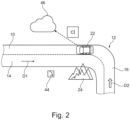
- Figure 2 shows the road 10 of the traffic situation of Figure 1 at a later point in time.
- the obstacle 22 being a cow in the present example is not located on the road 10 anymore.
- the first vehicle 18 has been traveling further such that it is not represented in Figure 2 .
- the second vehicle 22 has been traveling along the curve 12. Thus, when considering the traveling direction D2 of the second vehicle 22, the second vehicle 22 is located behind the curve 12.
- the second vehicle 22 comprises an environment detection system 72 which is communicatively connected to the data processing apparatus 60.
- a third step S33 of the method for operating a second vehicle may be performed. This step comprises evaluating the presence of the obstacle 20 on the second lane 16.
- an obstacle confirmation information CI is provided to the central traffic control entity 46.
- the obstacle confirmation information CI indicates the absence of the obstacle 20.
- the central traffic control entity 46 will delete the obstacle information OI relating to the obstacle 20.
- the data processing apparatus 32 of the first vehicle 18, the data processing apparatus 48 of the central traffic control entity 46 and the data processing apparatus 60 of the second vehicle 22 together form a traffic control system 74.
- the data processing apparatus 32 of the first vehicle 18 and the data processing apparatus 48 of the central traffic control entity 46 are communicatively connected.
- the data processing apparatus 60 of the second vehicle 22 and the data processing apparatus 48 of the central traffic control entity 46 are communicatively connected.
- a computer program may be stored/distributed on a suitable medium such as an optical storage medium or a solid-state medium supplied together with or as part of other hardware, but may also be distributed in other forms, such as via the Internet or other wired or wireless telecommunication systems. Any reference signs in the claims should not be construed as limiting the scope of the claims.
Landscapes
- Physics & Mathematics (AREA)
- General Physics & Mathematics (AREA)
- Life Sciences & Earth Sciences (AREA)
- Atmospheric Sciences (AREA)
- Traffic Control Systems (AREA)
Abstract
Description
- The present disclosure relates to a method for generating an information on an obstacle behind a curve. The present disclosure is further directed to a corresponding data processing apparatus comprising means for carrying out the method for generating an information on an obstacle behind a curve.
- The present disclosure is additionally directed to a method for preventing an interference of a second vehicle with an obstacle behind a curve. The present disclosure is further directed to a corresponding data processing apparatus comprising means for carrying out the method for preventing an interference of a second vehicle with an obstacle behind a curve.
- Moreover, the present disclosure relates to a method for operating a second vehicle. The present disclosure is further directed to a corresponding data processing apparatus comprising means for carrying out the method for operating a second vehicle.
- The present disclosure also is directed to a traffic control system comprising at least one data processing apparatus comprising means for carrying out the method for generating an information on an obstacle behind a curve, at least one data processing apparatus comprising means for carrying out the method for preventing an interference of a second vehicle with an obstacle behind a curve, and at least one data processing apparatus comprising means for carrying out the method for operating a second vehicle
- The present disclosure is further directed to a computer program and a computer-readable storage medium.
- Obstacles behind curves present a danger for vehicles travelling along this curve, since the obstacle may be located such that it is not visible for the vehicle or from the vehicle when SE:TOP approaching the curve. This is due to the curvature of the curve. Consequently, the obstacle can only be seen once the vehicle is very close to the obstacle i.e. in a situation in which a distance between the obstacle and the vehicle is rather short. The vehicle or a driver of the vehicle are, thus, have only a comparatively short time for reacting to the obstacle. This is the case for both fully or partially autonomous vehicles and vehicles having a human driver.
- It is an objective of the present disclosure to improve such situations, i.e. to mitigate or eliminate the danger resulting from obstacles behind curves.
- The problem is at least partially solved or alleviated by the subject matter of the independent claims of the present disclosure, wherein further examples are incorporated in the dependent claims.
- According to a first aspect, there is provided a method for generating an information on an obstacle behind a curve for a second vehicle by a first vehicle. The first vehicle is travelling on a first lane of a road. The method comprises:
- determining that the first vehicle is approaching the curve,
- determining the presence of the obstacle on a lane of the road other than the first lane and determining an obstacle location, and
- providing an obstacle information to a central traffic control entity, wherein the obstacle information comprises at least an obstacle location information describing the obstacle location and an obstacle presence information describing the presence of the obstacle at the obstacle location.
- Consequently, the first vehicle is able to determine the presence of an obstacle on a lane other than the lane on which the first vehicle is traveling. In a situation in which the first vehicle is approaching a curve, such an obstacle is easily detectable for the first vehicle. By providing the obstacle information to a central traffic control entity, the obstacle information may be provided to other vehicles, especially a second vehicle, for which the obstacle may be located behind the curve, i.e. in a blind spot. Thus, using the present method, an information on an obstacle which otherwise is not visible to the second vehicle, may be provided. Consequently, the second vehicle is able to react to this obstacle although it cannot see the obstacle. Consequently, road safety is enhanced.
- It is noted that the method for generating an information on an obstacle behind a curve for a second vehicle by a first vehicle may be performed on a first vehicle or from the perspective of the first vehicle.
- In an example, determining that the first vehicle is approaching a curve may comprise receiving a stream of location information describing a location of the first vehicle. Moreover, a map information describing a roadway infrastructure may be received. Consequently, a location and a traveling direction of the first vehicle may be determined based on the map. Based thereon, one can determine whether the first vehicle is approaching the curve.
- In an example, determining the presence of an obstacle comprises receiving a detection information from an environment detection system of the first vehicle. The environment detection system for example comprises a camera. Consequently, the detection information is an image or a stream of images potentially showing the obstacle. In another example, the environment detection system comprises a radar unit. Consequently, the detection information is a radar detection information potentially showing the obstacle. In a further example, the environment detection system comprises a lidar unit. Consequently, the detection information is a lidar detection information potentially showing the obstacle. In all of the above examples, an object detection technique needs to be applied to the detection information, i.e. the image, the radar detection information or the lidar detection information. Using such a technique, obstacles may be detected with high reliability. Moreover, if a location of the first vehicle is known as described above, known methods may be used in order to determine an obstacle location based on the detection information.
- It is noted that the method may be abandoned in a case in which no obstacle is determined.
- It is further noted, that it is not excluded that in addition to determining the presence of an obstacle on a lane of the road other than the first lane, the first vehicle may determine the presence of obstacles on the first lane, i.e. obstacles on the lane on which it is traveling.
- In an example, determining that the first vehicle is approaching a curve comprises receiving at least one road sign information indicating an upcoming curve and/or receiving a map information and deriving from the map information that the first vehicle is located in proximity to the curve and travelling towards the curve. In other words, the first vehicle may use a road sign detection technique in order to determine that it is approaching the curve. In every country, there are specific road signs for indicating an upcoming curve. When executing a road sign detection technique, detected road signs are compared to the specific road signs and, based thereon, the vehicle can determine which road sign it has detected. Additionally or alternatively, an upcoming curve can be derived from a map in combination with a location of the first vehicle and a traveling direction of the first vehicle as indicated above. Altogether, it may be determined with high reliability that the first vehicle is approaching a curve.
- In an example, determining the obstacle location comprises determining a starting point of the curve and/or a distance between the obstacle and the starting point of the curve. This means that as an alternative to providing an obstacle location in global coordinates, the obstacle location can also be provided relative to a starting point of the curve. It is understood that the starting point of the curve from the perspective of the first vehicle is an end point of the curve from a perspective of a vehicle traveling in an opposite direction, e.g. the second vehicle. Thus, the obstacle location may be provided in a reliable and computationally efficient manner.
- In an example, determining the presence of the obstacle further comprises determining an obstacle type, wherein the obstacle information further comprises an obstacle type information. Additionally or alternatively, determining the presence of the obstacle further comprises determining an obstacle movement property, wherein the obstacle information further comprises an obstacle movement property information. Further alternatively or additionally, determining the presence of the obstacle further comprises determining an obstacle danger indicator, wherein the obstacle information further comprises an obstacle danger information. By determining at least one of the obstacle type, the obstacle movement property and the obstacle danger indicator and by providing this information to the central traffic control entity, the second vehicle is in a situation to have this information available. Consequently, the second vehicle may react to the obstacle in a highly appropriate manner.
- In an example, the determinable obstacle type is at least one of an animal, a rock, a person, a biker, a vehicle, and an unknown type.
- In an example, the determinable obstacle movement property is at least one of an obstacle movement status, i.e. an indication whether the obstacle is moving or not, an obstacle movement capability, i.e. an indication whether the obstacle is generally capable of moving or not, an obstacle movement type, i.e. an indication whether the obstacle is moving in an unpredictable, a predictable, or an unknown manner, an obstacle movement direction, i.e. an indication in which direction the obstacle is moving, and an obstacle movement speed, i.e. an indication of the speed at which the obstacle is moving.
- In an example, the obstacle danger indicator is determined as a function of the obstacle type information and the obstacle movement property information.
- According to a second aspect, there is provided a data processing apparatus comprising means for carrying out the method of the present disclosure for generating an information on an obstacle behind a curve for a second vehicle by a first vehicle. Thus, an obstacle information may be provided to a central traffic control entity and, based thereon, to the second vehicle. This enhances road safety.
- According to a third aspect, there is provided a method for preventing an interference of a second vehicle with an obstacle behind a curve. The second vehicle is travelling on a second lane of the road. The method comprises:
- receiving an obstacle information from the first vehicle, wherein the obstacle information comprises at least an obstacle location information describing the obstacle location and an obstacle presence information describing the presence of the obstacle at the obstacle location,
- determining that the second vehicle is located in proximity to the obstacle location and is travelling towards the obstacle location, and
- providing a warning information to the second vehicle, wherein the warning information comprises at least the obstacle information.
- Thus, the obstacle information is received from a first vehicle and distributed to a second vehicle for which the obstacle information is potentially relevant. Thus, the second vehicle has an information about an obstacle that is not visible for the second vehicle or from the second vehicle. This enhances road safety.
- In an example, determining that the second vehicle is located in proximity to the obstacle location and is travelling towards the obstacle location comprises searching for second vehicles being located in proximity to the obstacle location and being traveling towards the obstacle location. Such a search may be performed on a central traffic control entity. In this context, the warning information may be pushed to the one or more second vehicles determined by the search.
- In another example, determining that the second vehicle is located in proximity to the obstacle location and is travelling towards the obstacle location comprises receiving a request from one or more second vehicles, wherein the request comprises a current location of the second vehicle and a traveling direction of the second vehicle. Based on the request, relevant obstacle information is determined. If relevant obstacle information is found, this information is provided to the second vehicle as a response to the request.
- It is noted that the method for preventing an interference of a second vehicle with an obstacle behind a curve may be performed on a central traffic control entity or from the perspective of the central traffic control entity.
- In an example, the method for preventing an interference of a second vehicle with an obstacle behind a curve further comprises storing the received obstacle information. Consequently, obstacle information having been received from one or more first vehicles, is available at least for a certain time span after the point in time at which the obstacle information has been received. Thus, a list or map of received obstacle information may be provided. This is especially helpful for obstacles that are not moving. Consequently, each second vehicle may be provided with the relevant obstacle information. This improves road safety.
- In an example, the method for preventing an interference of a second vehicle with an obstacle behind a curve, further comprising evaluating a validity of the stored obstacle information. The validity of stored obstacle information may be evaluated using validity criteria. The validity criteria may relate to time span between a point in time at which the obstacle information has been received and a current point in time. In this context, a comparatively old obstacle information may be considered to be invalid. It is noted that different time thresholds may be used for obstacles of different types. Additionally or alternatively, validity may be evaluated in that contradictions between obstacle information are searched and evaluated. If a contradiction is found, the related obstacle information is considered to be invalid.
- In an example, the validity of the stored obstacle information is evaluated regularly.
- According to a fourth aspect, there is provided a data processing apparatus comprising means for carrying out the method of the present disclosure for preventing an interference of a second vehicle with an obstacle behind a curve. Using such a data processing apparatus, the obstacle information having been received from a first vehicle may be distributed to a second vehicle for which the obstacle information is potentially relevant. Thus, the second vehicle has an information about an obstacle that is not visible for the second vehicle. This enhances road safety.
- According to a fifth aspect, there is provided a method for operating a second vehicle. The second vehicle is travelling on a second lane of the road. The method comprises:
- receiving a warning information from the central traffic control entity, wherein the warning information comprises at least the obstacle information, and
- triggering a collision mitigation maneuver of the second vehicle.
- Consequently, the second vehicle receives a warning information comprising the obstacle information describing an obstacle which is not visible from the position of the second vehicle. The warning information may be received as a push message or a pull message. Thus, the second vehicle is able to react to the obstacle described by the obstacle information in that it triggers a collision mitigation maneuver. In this context, the collision mitigation maneuver may be triggered early enough such that an abrupt breaking activity or an abrupt steering activity can be avoided. This enhances road safety.
- In an example, the collision mitigation maneuver comprises at least one of reducing a travelling speed, increasing a level of attention of a human driver, preparing a steering maneuver, and performing a steering maneuver. It is noted that the traveling speed may be reduced until the second vehicle is at a standstill. All of these collision mitigation maneuvers have the effect that a collision between the second vehicle and the obstacle is avoided or at least reduced in its intensity.
- It is noted that the method for operating a second vehicle may be executed on the second vehicle or from the perspective of the second vehicle.
- In an example, the method for operating a second vehicle further comprises:
- evaluating the presence of the obstacle on the second lane, and
- providing an obstacle confirmation information to the central traffic control entity.
- Thus, the second vehicle may evaluate whether the obstacle is present on the lane on which it is travelling or whether no obstacle is located on this lane. If the presence of the obstacle is determined, the second vehicle may confirm the presence of the obstacle to the central traffic control entity. In the opposite case, i.e. if the presence of the obstacle may not be determined, the confirmation information may comprise an information that the obstacle could not be detected. Based thereon, the central traffic control entity is able to update a list of obstacle information, e.g. in the context of evaluating the validity of obstacle information as has been explained above.
- In an example, the confirmation information additionally comprises a location information describing a location of the determined obstacle. Consequently, the central traffic control entity can update a location information of the obstacle, i.e. if a location of the obstacle has changed, the obstacle information can be updated accordingly.
- According to a sixth aspect, there is provided a data processing apparatus comprising means for carrying out the method for operating a second vehicle. Using such a data processing apparatus, the second vehicle may receive a warning information comprising the obstacle information describing an obstacle which is not visible from the position of the second vehicle. Thus, the second vehicle is able to react to the obstacle described by the obstacle information. This enhances road safety.
- According to a seventh aspect, there is provided a traffic control system comprising at least one data processing apparatus of the present disclosure comprising means for carrying out the method for generating an information on an obstacle behind a curve for a second vehicle by a first vehicle, at least one data processing apparatus of the present disclosure comprising means for carrying out the method for preventing an interference of a second vehicle with an obstacle behind a curve, and at least one data processing apparatus of the present disclosure comprising means for carrying out the method for operating a second vehicle. The data processing apparatus comprising means for carrying out the method for generating an information on an obstacle behind a curve for a second vehicle by a first vehicle is communicatively connected to the data processing apparatus comprising means for carrying out the method for preventing an interference of a second vehicle with an obstacle behind a curve. Moreover, the data processing apparatus comprising means for carrying out the method for operating a second vehicle is communicatively connected to the data processing apparatus comprising means for carrying out the method for preventing an interference of a second vehicle with an obstacle behind a curve. Thus, in the traffic control system, obstacle information is shared. This enhances road safety.
- According to an eighth aspect, there is provided a computer program comprising instructions which, when the program is executed by a computer, cause the computer to carry out at least one of the method of the present disclosure for generating an information on an obstacle behind a curve, the method of the present disclosure for preventing an interference of a second vehicle with an obstacle behind a curve and the method of the present disclosure for operating a second vehicle. Using such a computer program, road safety may be enhanced since obstacle information is shared.
- According to a ninth aspect, there is provided a computer-readable storage medium comprising instructions which, when executed by a computer, cause the computer to carry out at least one of the method of the present disclosure for generating an information on an obstacle behind a curve, the method of the present disclosure for preventing an interference of a second vehicle with an obstacle behind a curve and the method of the present disclosure for operating a second vehicle. Using such a computer-readable storage medium, road safety may be enhanced since obstacle information is shared.
- Each of the methods of the present disclosure may be at least partly computer-implemented, and may be implemented in software or in hardware, or in software and hardware. Further, the method may be carried out by computer program instructions running on means that provide data processing functions. The data processing means may be a suitable computing means, such as an electronic control module etc., which may also be a distributed computer system. The data processing means or the computer, respectively, may comprise one or more of a processor, a memory, a data interface, or the like.
- It should be noted that the above examples may be combined with each other irrespective of the aspect involved.
- These and other aspects of the present disclosure will become apparent from and elucidated with reference to the examples described hereinafter.
- Examples of the disclosure will be described in the following with reference to the following drawings.
- Figure 1
- shows a traffic situation and a traffic system according to the present disclosure at a first point in time, and
- Figure 2
- shows a road of the traffic situation of
Figure 1 at a later point in time. - The Figures are merely schematic representations and serve only to illustrate examples of the disclosure. Identical or equivalent elements are in principle provided with the same reference signs.
-
Figure 1 shows a traffic situation. - The traffic situation comprises a
road 10 with acurve 12. Theroad 10 comprises afirst lane 14 with a standard traveling direction D 1 and asecond lane 16 having a standard traveling direction D2. The standard traveling directions D 1 and D2 are opposing each other. - A
first vehicle 18 is traveling on thefirst lane 14 along the corresponding standard traveling direction D1. Moreover, thefirst vehicle 18 is approaching thecurve 12. - Moreover, an
obstacle 20 is located on thesecond lane 16. Theobstacle 20 is arranged on the same side of thecurve 12 as thefirst vehicle 18. In the present example, theobstacle 20 is represented as a cow. However it is understood, that this is just an example. Other examples of obstacles include a different animal, a cyclist, a stone, another vehicle being at a standing still. - The
second vehicle 22 is traveling on thesecond lane 16 along the corresponding standard traveling direction D2. Also thesecond vehicle 22 is approaching thecurve 12. Consequently, thesecond vehicle 22 is located on an opposite side of thecurve 12 as compared to thefirst vehicle 18 and theobstacle 20. - This means that from the perspective of the
second vehicle 22, theobstacle 20 is located behind thecurve 12. - Moreover, in the present example, the
road 10 is located in a mountainous area. This is illustrated by anexemplary mountain 24. - Due to the
mountain 24, the portion of theroad 10 which lies behind thecurve 12 from the perspective of thesecond vehicle 22 is not visible from the perspective of thevehicle 22. This means, that theobstacle 20 is not visible or detectable for thesecond vehicle 22. - The
first vehicle 18 comprises anenvironment detection system 26. In the present example, theenvironment detection system 26 comprises a camera unit and a corresponding data processing apparatus. Consequently, using theenvironment detection system 26, thefirst vehicle 18 is able to detect obstacles in its environment. - Moreover, the
first vehicle 18 comprises anavigation system 28. Thenavigation system 28 comprises a map including a representation of theroad 10 and thecurve 12. Moreover, thenavigation system 28 is configured to determine a position of thefirst vehicle 18 on this map. - Additionally, the
first vehicle 18 is equipped with a roadsign detection unit 30. - Beyond that, the
first vehicle 18 comprises a data processing apparatus 32. - The data processing apparatus 32 is communicatively connected to the
environment detection system 26, thenavigation system 28 and the roadsign detection unit 30. - Moreover, the data processing apparatus 32 comprises a data processing unit 34 and a data storage unit 36.
- The data storage unit 36 comprises a computer-readable storage medium 38.
- On the computer-readable storage medium 38, there is provided a computer program 40.
- The computer program 40, and thus also the computer-readable storage medium 38, comprise instructions which, when the computer program 40 is executed by the data processing unit 34 or, more generally, a computer, cause the computer or the data processing unit 34 to carry out a method for generating an information on an obstacle behind a curve.
- Consequently, the data processing unit 34 and the data storage unit 36 form means 42 for carrying out the method for generating an information on an obstacle behind a curve.
- Thus, the method for generating an information on an obstacle behind a curve is performed on the
first vehicle 18. - In the following, the method for generating an information on an obstacle behind a curve will be explained. Steps of the method will be denoted S1x.
- In a first step S11 of the method for generating an information on an obstacle behind a curve, it is determined that the
first vehicle 18 is approaching thecurve 12. This is done using the roadsign detection unit 30. In the present example, the roadsign detection unit 30 detectsroad sign 44 indicating an upcoming curve, i.e.curve 12. Thus, a road sign information indicating an upcoming curve is received at the data processing apparatus 32. - It is noted that alternatively, the fact that the
first vehicle 18 is approaching thecurve 12 may be determined using thenavigation system 28. - A second step S12 of the method for generating an information on an obstacle behind a curve comprises determining the presence of the
obstacle 20 on thesecond lane 16, i.e. on a lane of theroad 10 other than thefirst lane 14. - In the present example, the
obstacle 20 is not only detected in the sense that a presence of theobstacle 20 is determined. Additionally, an obstacle location is determined. This is done by theenvironment detection system 26. Thus, an obstacle presence status indicating the presence of theobstacle 20 and an obstacle location information are provided to the data processing apparatus 32 by theenvironment detection system 26. - In the present example, the obstacle location is determined as a distance between the
obstacle 20 and the starting point of thecurve 12, i.e. the point of theroad 10 where the radius of thecurve 12 starts. - Beyond that, using the
environment detection system 26, an obstacle type is determined and a corresponding obstacle type information is provided to the data processing apparatus 32. In the present example, the obstacle type is "animal". - Additionally, again using the
environment detection system 26, an obstacle movement property is determined and a corresponding obstacle movement property information is provided to the data processing apparatus 32. In the present example, the obstacle movement property is "moving in a non-predictable manner". - Based on the obstacle type information and the obstetrical movement property information, an obstacle danger indicator is calculated by the data processing apparatus 32.
- Subsequently, in a third step S13 of the method for generating an information on an obstacle behind a curve, an obstacle information OI is provided to a central
traffic control entity 46. - In the present example, the obstacle information OI comprises an obstacle presence information describing the presence of the
obstacle 20, the obstacle location information describing the obstacle location, the obstacle type information describing the obstacle type, the obstacle movement property information describing the obstacle movement property and the obstacle danger indicator describing a danger resulting from theobstacle 20. - The central
traffic control entity 46 also comprises adata processing apparatus 48. - The
data processing apparatus 48 comprises a data processing unit 50 and a data storage unit 52. - The data storage unit 52 comprises a computer-readable storage medium 54.
- On the computer-readable storage medium 54, there is provided a
computer program 56. - The
computer program 56, and thus also the computer-readable storage medium 54, comprise instructions which, when thecomputer program 56 is executed by the data processing unit 50 or, more generally, a computer, cause the computer or the data processing unit 50 to carry out a method for preventing an interference of thesecond vehicle 22 with theobstacle 20 behind thecurve 12. - Consequently, the data processing unit 50 and the data storage unit 52 form means 58 for carrying out the method for preventing an interference of a second vehicle with an obstacle behind a curve.
- This method will be explained in the following. Steps of the method for preventing an interference of a second vehicle with an obstacle behind a curve will be designated with reference signs S2x.
- In a first step S21, the obstacle information OI is received at the
data processing apparatus 48. - In a second step S22, the obstacle information OI is stored on the data storage unit 52.
- In a third step S23, it is determined that the
second vehicle 22 is located in proximity to the obstacle location and is travelling towards the obstacle location. - This step may be performed since in the present example the
second vehicle 22 regularly sends a position information describing its position to the centraltraffic control entity 46. Thus, the centraltraffic control entity 46, more precisely thedata processing apparatus 48, analyzes the stream of position information and compares it to the obstacle location information forming part of stored obstacle information OI. - Thereafter, in a fourth step S24, a warning information WI is provided to the
second vehicle 22. The warning information WI comprises the obstacle information OI. - In an optional further step, the method for preventing an interference of a second vehicle with an obstacle behind a curve comprises evaluating a validity of the stored obstacle information OI. In the present example this is done in a timely regular manner. In this context, a predefined lifetime is assigned to each obstacle information OI and after the lapse of the predefined lifetime, the obstacle information OI is deleted unless it has been otherwise confirmed.
- The
second vehicle 22 comprises a data processing apparatus 60. - The data processing apparatus 60 comprises a data processing unit 62 and a data storage unit 64. The data storage unit comprises a computer-
readable storage medium 66. - On the computer-
readable storage medium 66, there is provided acomputer program 68. - The
computer program 68, and thus also the computer-readable storage medium 66, comprise instructions which, when thecomputer program 68 is executed by the data processing unit 62 or, more generally, a computer, cause the computer or the data processing unit 62 to carry out a method for operating a second vehicle. - Consequently, the data processing unit 62 and the data storage unit 64 form means 70 for carrying out the method for operating a second vehicle. This method will be explained in the following. The steps of the method will be designated S3x.
- In a first step S31 the warning information WI is received at the
second vehicle 22, more generally at the data processing apparatus 60, from the centraltraffic control entity 46. As has been mentioned before, the warning information WI comprises the obstacle information OI. - In a second step S32, a collision mitigation maneuver of the
second vehicle 22 is triggered. In the present example, the collision mitigation maneuver consists in decelerating thesecond vehicle 22 to walking speed. - The decision for this collision mitigation maneuver is based on the obstacle type information and the danger indicator which has been derived therefrom.
- Altogether, the
second vehicle 22 is able to react to theobstacle 22 even though it is not able to see or visually detect theobstacle 22. -
Figure 2 shows theroad 10 of the traffic situation ofFigure 1 at a later point in time. - At this later point in time, the
obstacle 22 being a cow in the present example, is not located on theroad 10 anymore. Thefirst vehicle 18 has been traveling further such that it is not represented inFigure 2 . - The
second vehicle 22 has been traveling along thecurve 12. Thus, when considering the traveling direction D2 of thesecond vehicle 22, thesecond vehicle 22 is located behind thecurve 12. - Also, the
second vehicle 22 comprises anenvironment detection system 72 which is communicatively connected to the data processing apparatus 60. - Using the
environment detection system 72, a third step S33 of the method for operating a second vehicle may be performed. This step comprises evaluating the presence of theobstacle 20 on thesecond lane 16. - In the present example, this results in determining that no obstacle is located on the
second lane 16 anymore. - Thereafter, in a fourth step S34 of the method for operating a second vehicle, an obstacle confirmation information CI is provided to the central
traffic control entity 46. In the present example, the obstacle confirmation information CI indicates the absence of theobstacle 20. - Following the obstacle confirmation information CI, the central
traffic control entity 46 will delete the obstacle information OI relating to theobstacle 20. - It is noted that the data processing apparatus 32 of the
first vehicle 18, thedata processing apparatus 48 of the centraltraffic control entity 46 and the data processing apparatus 60 of thesecond vehicle 22 together form atraffic control system 74. - As has been explained above, the data processing apparatus 32 of the
first vehicle 18 and thedata processing apparatus 48 of the centraltraffic control entity 46 are communicatively connected. Moreover, as has also been explained above, the data processing apparatus 60 of thesecond vehicle 22 and thedata processing apparatus 48 of the centraltraffic control entity 46 are communicatively connected. - Other variations to the disclosed examples can be understood and effected by those skilled in the art in practicing the claimed disclosure, from the study of the drawings, the disclosure, and the appended claims. In the claims the word "comprising" does not exclude other elements or steps and the indefinite article "a" or "an" does not exclude a plurality. A single processor or other unit may fulfill the functions of several items or steps recited in the claims. The mere fact that certain measures are recited in mutually different dependent claims does not indicate that a combination of these measures cannot be used to advantage. A computer program may be stored/distributed on a suitable medium such as an optical storage medium or a solid-state medium supplied together with or as part of other hardware, but may also be distributed in other forms, such as via the Internet or other wired or wireless telecommunication systems. Any reference signs in the claims should not be construed as limiting the scope of the claims.
-
- 10
- road
- 12
- curve
- 14
- first lane
- 16
- second lane
- 18
- first vehicle
- 20
- obstacle
- 22
- second vehicle
- 24
- mountain
- 26
- environment detection system of the first vehicle
- 28
- navigation system
- 30
- road sign detection unit
- 32
- data processing apparatus of the first vehicle
- 34
- data processing unit
- 36
- data storage unit
- 38
- computer-readable storage medium
- 40
- computer program
- 42
- means for carrying out the method for generating an information on an obstacle behind a curve
- 44
- road sign
- 46
- central traffic control entity
- 48
- data processing apparatus of the central traffic control entity
- 50
- data processing unit
- 52
- data storage unit
- 54
- computer-readable storage medium
- 56
- computer program
- 58
- means for carrying out the method for preventing an interference of a second vehicle with an obstacle behind a curve
- 60
- data processing apparatus of the second vehicle
- 62
- data processing unit
- 64
- data storage unit
- 66
- computer-readable storage medium
- 68
- computer program
- 70
- means for carrying out the method for operating a second vehicle
- 72
- environment detection system of the second vehicle
- 74
- traffic control system
- CI
- obstacle confirmation information
- D 1
- standard travelling direction of the first lane
- D2
- standard travelling direction of the second lane
- OI
- obstacle information
- WI
- warning information
Claims (15)
- A method for generating an information on an obstacle (20) behind a curve (12) for a second vehicle (22) by a first vehicle (18) travelling on a first lane (14) of a road (10), comprising- determining that the first vehicle (18) is approaching the curve (12) (S11),- determining the presence of the obstacle (20) on a lane of the road (10) other than the first lane (14) and determining an obstacle location (S12), and- providing an obstacle information (OI) to a central traffic control entity (46), wherein the obstacle information (OI) comprises at least an obstacle location information describing the obstacle location and an obstacle presence information describing the presence of the obstacle (20) at the obstacle location (S13).
- The method of claim 1, wherein determining that the first vehicle (18) is approaching the curve (12) comprises receiving at least one road sign information indicating an upcoming curve and/or receiving a map information and deriving from the map information that the first vehicle (18) is located in proximity to the curve (12) and travelling towards the curve (12).
- The method of claim 1 or 2, wherein determining the obstacle location comprises determining a starting point of the curve (12) and/or a distance between the obstacle (20) and the starting point of the curve (12).
- The method of any one of the preceding claims, whereindetermining the presence of the obstacle (20) further comprises determining an obstacle type, wherein the obstacle information (OI) further comprises an obstacle type information, and/ordetermining the presence of the obstacle (20) further comprises determining an obstacle movement property, wherein the obstacle information (OI) further comprises an obstacle movement property information, and/ordetermining the presence of the obstacle (20) further comprises determining an obstacle danger indicator, wherein the obstacle information (OI) further comprises an obstacle danger information.
- A data processing apparatus (32) comprising means (42) for carrying out the method of any one of the preceding claims.
- A method for preventing an interference of a second vehicle (22) with an obstacle (20) behind a curve (12), wherein the second vehicle (22) is travelling on a second lane (16) of a road (10), comprising- receiving an obstacle information (OI) from the first vehicle (18), wherein the obstacle information (OI) comprises at least an obstacle location information describing the obstacle location and an obstacle presence information describing the presence of the obstacle (20) at the obstacle location (S21),- determining that the second vehicle (22) is located in proximity to the obstacle location and is travelling towards the obstacle location (S23), and- providing a warning information (WI) to the second vehicle (22), wherein the warning information (WI) comprises at least the obstacle information (OI) (S24).
- The method of claim 6, further comprising storing the received obstacle information (OI) (S22).
- The method of claim 7, further comprising evaluating a validity of the stored obstacle information (OI).
- A data processing apparatus (48) comprising means (58) for carrying out the method of any one of claims 6 to 8.
- A method for operating a second vehicle (22), wherein the second vehicle (22) is travelling on a second lane (16) of a road (10), comprising:- receiving a warning information (WI) from the central traffic control entity (46), wherein the warning information (WI) comprises at least the obstacle information (OI) (S31), and- triggering a collision mitigation maneuver of the second vehicle (22) (S32).
- The method of claim 10, further comprising- evaluating the presence of the obstacle (20) on the second lane (16) (S33), and- providing an obstacle confirmation information (CI) to the central traffic control entity (46) (S34).
- A data processing apparatus (60) comprising means (70) for carrying out the method of any one of claims 10 and 11.
- A traffic control system (74) comprising at least one data processing apparatus (32) of claim 5, at least one data processing apparatus (48) of claim 9, and at least one data processing apparatus (60) of claim 12, wherein the data processing apparatus (32) of claim 5 is communicatively connected to the data processing apparatus (48) of claim 9 and wherein the data processing apparatus (60) of claim 12 is communicatively connected to the data processing apparatus (48) of claim 9.
- A computer program (40, 56, 68) comprising instructions which, when the computer program (40, 56, 68) is executed by a computer, cause the computer to carry out at least one of the method of claims 1 to 4, the method of claims 6 to 8 and the method of claims 10 and 11.
- A computer-readable storage medium (38, 54, 66) comprising instructions which, when executed by a computer, cause the computer to carry out at least one of the method of claims 1 to 4, the method of claims 6 to 8 and the method of claims 10 and 11.
Priority Applications (1)
| Application Number | Priority Date | Filing Date | Title |
|---|---|---|---|
| EP22215377.7A EP4390894B1 (en) | 2022-12-21 | 2022-12-21 | Method for generating an information on an obstacle behind a curve, method for preventing an interference of a second vehicle with an obstacle behind a curve, method for operating a second vehicle, data processing apparatuses, traffic control system, computer program, and computer-readable storage medium |
Applications Claiming Priority (1)
| Application Number | Priority Date | Filing Date | Title |
|---|---|---|---|
| EP22215377.7A EP4390894B1 (en) | 2022-12-21 | 2022-12-21 | Method for generating an information on an obstacle behind a curve, method for preventing an interference of a second vehicle with an obstacle behind a curve, method for operating a second vehicle, data processing apparatuses, traffic control system, computer program, and computer-readable storage medium |
Publications (2)
| Publication Number | Publication Date |
|---|---|
| EP4390894A1 true EP4390894A1 (en) | 2024-06-26 |
| EP4390894B1 EP4390894B1 (en) | 2024-12-11 |
Family
ID=84568950
Family Applications (1)
| Application Number | Title | Priority Date | Filing Date |
|---|---|---|---|
| EP22215377.7A Active EP4390894B1 (en) | 2022-12-21 | 2022-12-21 | Method for generating an information on an obstacle behind a curve, method for preventing an interference of a second vehicle with an obstacle behind a curve, method for operating a second vehicle, data processing apparatuses, traffic control system, computer program, and computer-readable storage medium |
Country Status (1)
| Country | Link |
|---|---|
| EP (1) | EP4390894B1 (en) |
Citations (7)
| Publication number | Priority date | Publication date | Assignee | Title |
|---|---|---|---|---|
| US20170043717A1 (en) * | 2015-08-10 | 2017-02-16 | Arie Heiman | System and Apparatus that Alert Car Drivers Approaching Obstacles in the Road |
| US20170253182A1 (en) * | 2014-08-27 | 2017-09-07 | Honda Motor Co., Ltd. | Drive assistance device and drive assistance method |
| US10096249B2 (en) * | 2015-10-22 | 2018-10-09 | Xiaomi Inc. | Method, apparatus and storage medium for providing collision alert |
| US20210001882A1 (en) * | 2018-02-28 | 2021-01-07 | Nissan North America, Inc. | Transportation Network Infrastructure for Autonomous Vehicle Decision Making |
| US20210020048A1 (en) * | 2017-07-17 | 2021-01-21 | Uatc, Llc | Systems and Methods for Directing Another Computing System to Aid in Autonomous Navigation |
| GB2605201A (en) * | 2021-03-26 | 2022-09-28 | Nigel Warren Thomas | Road user protection system |
| US11513519B1 (en) * | 2019-09-05 | 2022-11-29 | Zoox, Inc. | Sharing occlusion data |
-
2022
- 2022-12-21 EP EP22215377.7A patent/EP4390894B1/en active Active
Patent Citations (7)
| Publication number | Priority date | Publication date | Assignee | Title |
|---|---|---|---|---|
| US20170253182A1 (en) * | 2014-08-27 | 2017-09-07 | Honda Motor Co., Ltd. | Drive assistance device and drive assistance method |
| US20170043717A1 (en) * | 2015-08-10 | 2017-02-16 | Arie Heiman | System and Apparatus that Alert Car Drivers Approaching Obstacles in the Road |
| US10096249B2 (en) * | 2015-10-22 | 2018-10-09 | Xiaomi Inc. | Method, apparatus and storage medium for providing collision alert |
| US20210020048A1 (en) * | 2017-07-17 | 2021-01-21 | Uatc, Llc | Systems and Methods for Directing Another Computing System to Aid in Autonomous Navigation |
| US20210001882A1 (en) * | 2018-02-28 | 2021-01-07 | Nissan North America, Inc. | Transportation Network Infrastructure for Autonomous Vehicle Decision Making |
| US11513519B1 (en) * | 2019-09-05 | 2022-11-29 | Zoox, Inc. | Sharing occlusion data |
| GB2605201A (en) * | 2021-03-26 | 2022-09-28 | Nigel Warren Thomas | Road user protection system |
Also Published As
| Publication number | Publication date |
|---|---|
| EP4390894B1 (en) | 2024-12-11 |
Similar Documents
| Publication | Publication Date | Title |
|---|---|---|
| US11796344B2 (en) | Map information system | |
| US9889847B2 (en) | Method and system for driver assistance for a vehicle | |
| CN111746511B (en) | Vehicle control system | |
| US10982961B2 (en) | Vehicle control system and vehicle control device | |
| US11597385B2 (en) | Autonomous vehicle and vehicle running control method using the same | |
| US10583839B2 (en) | Method of lane change decision-making and path planning | |
| CN113178097B (en) | Method for establishing probability map of unoccupied space comprising static target and dynamic target | |
| JP6128059B2 (en) | Evacuation support device | |
| EP2002210B1 (en) | A driving aid system for creating a model of surroundings of a vehicle | |
| US11054832B2 (en) | Vehicle control device for setting vehicle offset spacing | |
| US20030204299A1 (en) | Ramp identification in adaptive cruise control | |
| CN113853640A (en) | Electronic control device | |
| JP7167732B2 (en) | map information system | |
| CN115867475B (en) | Method and device for automatic driving operation of vehicle and vehicle | |
| JP2016527602A (en) | How to distinguish between true and apparent obstacles in driver assistance systems for cars | |
| CN115443234A (en) | Vehicle behavior estimation method, vehicle control method, and vehicle behavior estimation device | |
| EP4016497B1 (en) | Vehicle behavior determination method and vehicle behavior determination device | |
| EP4372715A1 (en) | Vehicle collision threat assessment | |
| JP2019101854A (en) | Trajectory designation system | |
| EP4390894B1 (en) | Method for generating an information on an obstacle behind a curve, method for preventing an interference of a second vehicle with an obstacle behind a curve, method for operating a second vehicle, data processing apparatuses, traffic control system, computer program, and computer-readable storage medium | |
| CN118613849A (en) | Vehicle Controls | |
| EP4360998A1 (en) | Driving assistance device, driving assistance method, and non-transitory storage medium | |
| JP7506999B2 (en) | Driving support method and driving support device | |
| US20240416904A1 (en) | Vehicle and method for the operation thereof | |
| US20250224238A1 (en) | Traveling route estimation apparatus |
Legal Events
| Date | Code | Title | Description |
|---|---|---|---|
| STAA | Information on the status of an ep patent application or granted ep patent |
Free format text: STATUS: EXAMINATION IS IN PROGRESS |
|
| PUAI | Public reference made under article 153(3) epc to a published international application that has entered the european phase |
Free format text: ORIGINAL CODE: 0009012 |
|
| 17P | Request for examination filed |
Effective date: 20230913 |
|
| AK | Designated contracting states |
Kind code of ref document: A1 Designated state(s): AL AT BE BG CH CY CZ DE DK EE ES FI FR GB GR HR HU IE IS IT LI LT LU LV MC ME MK MT NL NO PL PT RO RS SE SI SK SM TR |
|
| GRAP | Despatch of communication of intention to grant a patent |
Free format text: ORIGINAL CODE: EPIDOSNIGR1 |
|
| STAA | Information on the status of an ep patent application or granted ep patent |
Free format text: STATUS: GRANT OF PATENT IS INTENDED |
|
| INTG | Intention to grant announced |
Effective date: 20240730 |
|
| GRAS | Grant fee paid |
Free format text: ORIGINAL CODE: EPIDOSNIGR3 |
|
| GRAA | (expected) grant |
Free format text: ORIGINAL CODE: 0009210 |
|
| STAA | Information on the status of an ep patent application or granted ep patent |
Free format text: STATUS: THE PATENT HAS BEEN GRANTED |
|
| AK | Designated contracting states |
Kind code of ref document: B1 Designated state(s): AL AT BE BG CH CY CZ DE DK EE ES FI FR GB GR HR HU IE IS IT LI LT LU LV MC ME MK MT NL NO PL PT RO RS SE SI SK SM TR |
|
| REG | Reference to a national code |
Ref country code: GB Ref legal event code: FG4D |
|
| REG | Reference to a national code |
Ref country code: CH Ref legal event code: EP |
|
| REG | Reference to a national code |
Ref country code: DE Ref legal event code: R096 Ref document number: 602022008596 Country of ref document: DE |
|
| P01 | Opt-out of the competence of the unified patent court (upc) registered |
Free format text: CASE NUMBER: APP_62642/2024 Effective date: 20241125 |
|
| REG | Reference to a national code |
Ref country code: IE Ref legal event code: FG4D |
|
| REG | Reference to a national code |
Ref country code: LT Ref legal event code: MG9D |
|
| PG25 | Lapsed in a contracting state [announced via postgrant information from national office to epo] |
Ref country code: HR Free format text: LAPSE BECAUSE OF FAILURE TO SUBMIT A TRANSLATION OF THE DESCRIPTION OR TO PAY THE FEE WITHIN THE PRESCRIBED TIME-LIMIT Effective date: 20241211 |
|
| PG25 | Lapsed in a contracting state [announced via postgrant information from national office to epo] |
Ref country code: FI Free format text: LAPSE BECAUSE OF FAILURE TO SUBMIT A TRANSLATION OF THE DESCRIPTION OR TO PAY THE FEE WITHIN THE PRESCRIBED TIME-LIMIT Effective date: 20241211 |
|
| PG25 | Lapsed in a contracting state [announced via postgrant information from national office to epo] |
Ref country code: BG Free format text: LAPSE BECAUSE OF FAILURE TO SUBMIT A TRANSLATION OF THE DESCRIPTION OR TO PAY THE FEE WITHIN THE PRESCRIBED TIME-LIMIT Effective date: 20241211 |
|
| REG | Reference to a national code |
Ref country code: NL Ref legal event code: MP Effective date: 20241211 |
|
| PG25 | Lapsed in a contracting state [announced via postgrant information from national office to epo] |
Ref country code: ES Free format text: LAPSE BECAUSE OF FAILURE TO SUBMIT A TRANSLATION OF THE DESCRIPTION OR TO PAY THE FEE WITHIN THE PRESCRIBED TIME-LIMIT Effective date: 20241211 |
|
| PG25 | Lapsed in a contracting state [announced via postgrant information from national office to epo] |
Ref country code: NO Free format text: LAPSE BECAUSE OF FAILURE TO SUBMIT A TRANSLATION OF THE DESCRIPTION OR TO PAY THE FEE WITHIN THE PRESCRIBED TIME-LIMIT Effective date: 20250311 |
|
| PG25 | Lapsed in a contracting state [announced via postgrant information from national office to epo] |
Ref country code: LV Free format text: LAPSE BECAUSE OF FAILURE TO SUBMIT A TRANSLATION OF THE DESCRIPTION OR TO PAY THE FEE WITHIN THE PRESCRIBED TIME-LIMIT Effective date: 20241211 Ref country code: GR Free format text: LAPSE BECAUSE OF FAILURE TO SUBMIT A TRANSLATION OF THE DESCRIPTION OR TO PAY THE FEE WITHIN THE PRESCRIBED TIME-LIMIT Effective date: 20250312 |
|
| PG25 | Lapsed in a contracting state [announced via postgrant information from national office to epo] |
Ref country code: RS Free format text: LAPSE BECAUSE OF FAILURE TO SUBMIT A TRANSLATION OF THE DESCRIPTION OR TO PAY THE FEE WITHIN THE PRESCRIBED TIME-LIMIT Effective date: 20250311 |
|
| PG25 | Lapsed in a contracting state [announced via postgrant information from national office to epo] |
Ref country code: NL Free format text: LAPSE BECAUSE OF FAILURE TO SUBMIT A TRANSLATION OF THE DESCRIPTION OR TO PAY THE FEE WITHIN THE PRESCRIBED TIME-LIMIT Effective date: 20241211 |
|
| REG | Reference to a national code |
Ref country code: AT Ref legal event code: MK05 Ref document number: 1751018 Country of ref document: AT Kind code of ref document: T Effective date: 20241211 |
|
| PG25 | Lapsed in a contracting state [announced via postgrant information from national office to epo] |
Ref country code: SM Free format text: LAPSE BECAUSE OF FAILURE TO SUBMIT A TRANSLATION OF THE DESCRIPTION OR TO PAY THE FEE WITHIN THE PRESCRIBED TIME-LIMIT Effective date: 20241211 |
|
| PG25 | Lapsed in a contracting state [announced via postgrant information from national office to epo] |
Ref country code: PL Free format text: LAPSE BECAUSE OF FAILURE TO SUBMIT A TRANSLATION OF THE DESCRIPTION OR TO PAY THE FEE WITHIN THE PRESCRIBED TIME-LIMIT Effective date: 20241211 |
|
| PG25 | Lapsed in a contracting state [announced via postgrant information from national office to epo] |
Ref country code: IS Free format text: LAPSE BECAUSE OF FAILURE TO SUBMIT A TRANSLATION OF THE DESCRIPTION OR TO PAY THE FEE WITHIN THE PRESCRIBED TIME-LIMIT Effective date: 20250411 |
|
| PG25 | Lapsed in a contracting state [announced via postgrant information from national office to epo] |
Ref country code: PT Free format text: LAPSE BECAUSE OF FAILURE TO SUBMIT A TRANSLATION OF THE DESCRIPTION OR TO PAY THE FEE WITHIN THE PRESCRIBED TIME-LIMIT Effective date: 20250411 |
|
| PG25 | Lapsed in a contracting state [announced via postgrant information from national office to epo] |
Ref country code: EE Free format text: LAPSE BECAUSE OF FAILURE TO SUBMIT A TRANSLATION OF THE DESCRIPTION OR TO PAY THE FEE WITHIN THE PRESCRIBED TIME-LIMIT Effective date: 20241211 |
|
| PG25 | Lapsed in a contracting state [announced via postgrant information from national office to epo] |
Ref country code: AT Free format text: LAPSE BECAUSE OF FAILURE TO SUBMIT A TRANSLATION OF THE DESCRIPTION OR TO PAY THE FEE WITHIN THE PRESCRIBED TIME-LIMIT Effective date: 20241211 Ref country code: RO Free format text: LAPSE BECAUSE OF FAILURE TO SUBMIT A TRANSLATION OF THE DESCRIPTION OR TO PAY THE FEE WITHIN THE PRESCRIBED TIME-LIMIT Effective date: 20241211 |
|
| PG25 | Lapsed in a contracting state [announced via postgrant information from national office to epo] |
Ref country code: SK Free format text: LAPSE BECAUSE OF FAILURE TO SUBMIT A TRANSLATION OF THE DESCRIPTION OR TO PAY THE FEE WITHIN THE PRESCRIBED TIME-LIMIT Effective date: 20241211 |
|
| PG25 | Lapsed in a contracting state [announced via postgrant information from national office to epo] |
Ref country code: CZ Free format text: LAPSE BECAUSE OF FAILURE TO SUBMIT A TRANSLATION OF THE DESCRIPTION OR TO PAY THE FEE WITHIN THE PRESCRIBED TIME-LIMIT Effective date: 20241211 |
|
| PG25 | Lapsed in a contracting state [announced via postgrant information from national office to epo] |
Ref country code: IT Free format text: LAPSE BECAUSE OF FAILURE TO SUBMIT A TRANSLATION OF THE DESCRIPTION OR TO PAY THE FEE WITHIN THE PRESCRIBED TIME-LIMIT Effective date: 20241211 |
|
| PG25 | Lapsed in a contracting state [announced via postgrant information from national office to epo] |
Ref country code: LU Free format text: LAPSE BECAUSE OF NON-PAYMENT OF DUE FEES Effective date: 20241221 |
|
| PG25 | Lapsed in a contracting state [announced via postgrant information from national office to epo] |
Ref country code: SE Free format text: LAPSE BECAUSE OF FAILURE TO SUBMIT A TRANSLATION OF THE DESCRIPTION OR TO PAY THE FEE WITHIN THE PRESCRIBED TIME-LIMIT Effective date: 20241211 |
|
| REG | Reference to a national code |
Ref country code: DE Ref legal event code: R097 Ref document number: 602022008596 Country of ref document: DE |
|
| PG25 | Lapsed in a contracting state [announced via postgrant information from national office to epo] |
Ref country code: MC Free format text: LAPSE BECAUSE OF FAILURE TO SUBMIT A TRANSLATION OF THE DESCRIPTION OR TO PAY THE FEE WITHIN THE PRESCRIBED TIME-LIMIT Effective date: 20241211 |
|
| REG | Reference to a national code |
Ref country code: BE Ref legal event code: MM Effective date: 20241231 |
|
| PG25 | Lapsed in a contracting state [announced via postgrant information from national office to epo] |
Ref country code: DK Free format text: LAPSE BECAUSE OF FAILURE TO SUBMIT A TRANSLATION OF THE DESCRIPTION OR TO PAY THE FEE WITHIN THE PRESCRIBED TIME-LIMIT Effective date: 20241211 |
|
| PG25 | Lapsed in a contracting state [announced via postgrant information from national office to epo] |
Ref country code: BE Free format text: LAPSE BECAUSE OF NON-PAYMENT OF DUE FEES Effective date: 20241231 |
|
| PLBE | No opposition filed within time limit |
Free format text: ORIGINAL CODE: 0009261 |
|
| STAA | Information on the status of an ep patent application or granted ep patent |
Free format text: STATUS: NO OPPOSITION FILED WITHIN TIME LIMIT |
|
| PG25 | Lapsed in a contracting state [announced via postgrant information from national office to epo] |
Ref country code: IE Free format text: LAPSE BECAUSE OF NON-PAYMENT OF DUE FEES Effective date: 20241221 |
|
| 26N | No opposition filed |
Effective date: 20250912 |
|
| PGFP | Annual fee paid to national office [announced via postgrant information from national office to epo] |
Ref country code: DE Payment date: 20251126 Year of fee payment: 4 |
|
| PGFP | Annual fee paid to national office [announced via postgrant information from national office to epo] |
Ref country code: FR Payment date: 20251119 Year of fee payment: 4 |
|
| PG25 | Lapsed in a contracting state [announced via postgrant information from national office to epo] |
Ref country code: CY Free format text: LAPSE BECAUSE OF FAILURE TO SUBMIT A TRANSLATION OF THE DESCRIPTION OR TO PAY THE FEE WITHIN THE PRESCRIBED TIME-LIMIT Effective date: 20241211 |