EP4390862A1 - User authentication based on stream and periocular images - Google Patents
User authentication based on stream and periocular images Download PDFInfo
- Publication number
- EP4390862A1 EP4390862A1 EP23207887.3A EP23207887A EP4390862A1 EP 4390862 A1 EP4390862 A1 EP 4390862A1 EP 23207887 A EP23207887 A EP 23207887A EP 4390862 A1 EP4390862 A1 EP 4390862A1
- Authority
- EP
- European Patent Office
- Prior art keywords
- user
- learning model
- eye
- images
- periocular
- Prior art date
- Legal status (The legal status is an assumption and is not a legal conclusion. Google has not performed a legal analysis and makes no representation as to the accuracy of the status listed.)
- Withdrawn
Links
Images








Classifications
-
- G—PHYSICS
- G06—COMPUTING OR CALCULATING; COUNTING
- G06V—IMAGE OR VIDEO RECOGNITION OR UNDERSTANDING
- G06V40/00—Recognition of biometric, human-related or animal-related patterns in image or video data
- G06V40/10—Human or animal bodies, e.g. vehicle occupants or pedestrians; Body parts, e.g. hands
- G06V40/16—Human faces, e.g. facial parts, sketches or expressions
- G06V40/168—Feature extraction; Face representation
- G06V40/171—Local features and components; Facial parts ; Occluding parts, e.g. glasses; Geometrical relationships
-
- G—PHYSICS
- G06—COMPUTING OR CALCULATING; COUNTING
- G06F—ELECTRIC DIGITAL DATA PROCESSING
- G06F21/00—Security arrangements for protecting computers, components thereof, programs or data against unauthorised activity
- G06F21/30—Authentication, i.e. establishing the identity or authorisation of security principals
- G06F21/31—User authentication
- G06F21/32—User authentication using biometric data, e.g. fingerprints, iris scans or voiceprints
-
- G—PHYSICS
- G06—COMPUTING OR CALCULATING; COUNTING
- G06F—ELECTRIC DIGITAL DATA PROCESSING
- G06F3/00—Input arrangements for transferring data to be processed into a form capable of being handled by the computer; Output arrangements for transferring data from processing unit to output unit, e.g. interface arrangements
- G06F3/01—Input arrangements or combined input and output arrangements for interaction between user and computer
- G06F3/011—Arrangements for interaction with the human body, e.g. for user immersion in virtual reality
-
- G—PHYSICS
- G06—COMPUTING OR CALCULATING; COUNTING
- G06V—IMAGE OR VIDEO RECOGNITION OR UNDERSTANDING
- G06V10/00—Arrangements for image or video recognition or understanding
- G06V10/70—Arrangements for image or video recognition or understanding using pattern recognition or machine learning
- G06V10/764—Arrangements for image or video recognition or understanding using pattern recognition or machine learning using classification, e.g. of video objects
-
- G—PHYSICS
- G06—COMPUTING OR CALCULATING; COUNTING
- G06V—IMAGE OR VIDEO RECOGNITION OR UNDERSTANDING
- G06V10/00—Arrangements for image or video recognition or understanding
- G06V10/70—Arrangements for image or video recognition or understanding using pattern recognition or machine learning
- G06V10/82—Arrangements for image or video recognition or understanding using pattern recognition or machine learning using neural networks
-
- G—PHYSICS
- G06—COMPUTING OR CALCULATING; COUNTING
- G06V—IMAGE OR VIDEO RECOGNITION OR UNDERSTANDING
- G06V40/00—Recognition of biometric, human-related or animal-related patterns in image or video data
- G06V40/10—Human or animal bodies, e.g. vehicle occupants or pedestrians; Body parts, e.g. hands
- G06V40/16—Human faces, e.g. facial parts, sketches or expressions
- G06V40/172—Classification, e.g. identification
-
- G—PHYSICS
- G06—COMPUTING OR CALCULATING; COUNTING
- G06V—IMAGE OR VIDEO RECOGNITION OR UNDERSTANDING
- G06V40/00—Recognition of biometric, human-related or animal-related patterns in image or video data
- G06V40/10—Human or animal bodies, e.g. vehicle occupants or pedestrians; Body parts, e.g. hands
- G06V40/18—Eye characteristics, e.g. of the iris
- G06V40/197—Matching; Classification
-
- G—PHYSICS
- G06—COMPUTING OR CALCULATING; COUNTING
- G06V—IMAGE OR VIDEO RECOGNITION OR UNDERSTANDING
- G06V40/00—Recognition of biometric, human-related or animal-related patterns in image or video data
- G06V40/40—Spoof detection, e.g. liveness detection
Definitions
- This disclosure generally relates to artificial reality, such as virtual reality and augmented reality.
- Artificial reality is a form of reality that has been adjusted in some manner before presentation to a user, which may include, e.g., a virtual reality (VR), an augmented reality (AR), a mixed reality (MR), an extended reality (ER), a hybrid reality, or some combination and/or derivatives thereof.
- Artificial reality content may include completely generated content or generated content combined with captured content (e.g., real-world photographs).
- the artificial reality content may include video, audio, haptic feedback, or some combination thereof, and any of which may be presented in a single channel or in multiple channels (such as stereo video that produces a three-dimensional effect to the viewer).
- Artificial reality may be associated with applications, products, accessories, services, or some combination thereof, that are, e.g., used to create content in an artificial reality and/or used in (e.g., perform activities in) an artificial reality.
- the artificial reality system that provides the artificial reality content may be implemented on various platforms, including a head-mounted display (HMD) connected to a host computer system, a standalone HMD, a mobile device or computing system, or any other hardware platform capable of providing artificial reality content to one or more viewers.
- HMD head-mounted display
- a method comprising, by a computing system of an artificial reality (AR) device: obtaining, from a camera of the AR device, a plurality of first periocular images of a user during a first time period; generating, using a deep-learning model, a plurality of first embeddings based on the plurality of first periocular images; generating a registered signature of the user based on the plurality of first embeddings; obtaining, from the camera, a plurality of second periocular images of the user during a second time period; generating, using the deep-learning model, a plurality of second embeddings based on the plurality of second periocular images; generating a test signature of the user based on the plurality of second embeddings; and performing authentication based on a comparison between the test signature and the registered signature.
- AR artificial reality
- the method may further comprise: determining, using a knowledge distillation algorithm, a spoof likelihood of presentation attacks based on the plurality of second embeddings for the plurality of second periocular images; determining, using the deep-learning model, a similarity score between the plurality of first embeddings for the registered signature and the plurality of second embeddings for the test signature; and in response to determining that the similarity score is greater than a predetermined similarity threshold and the spoof likelihood of presentation attacks is below a predetermined spoof threshold, authenticating the user.
- the method may further comprise: in response to determining that the similarity score is smaller than the predetermined similarity threshold, rejecting the user.
- the method may further comprise: in response to determining that the spoof likelihood of presentation attacks is greater than the predetermined spoof threshold, rejecting the user.
- the knowledge distillation algorithm may include a presentation detection loss based on a standard cross-entropy classification loss to classify a given image as a spoof image and a distillation loss as a regularization term.
- the authentication of the user may occur in conjunction with predetermined time periods.
- the authentication of the user may be triggered when the user navigates into a new virtual environment.
- the deep-learning model may be a metric learning model using a shared convolutional encoder which includes Conv-Relu-Conv blocks and may not share weights for the plurality of first periocular images and the plurality of second periocular images.
- the method may further comprise: calculating a user-user distance matrix based on similarity scores between a plurality of users; identifying a user from the plurality of users using a Nearest Neighbor algorithm and the user-user distance matrix; and evaluating the performance of the deep-learning model based on True Acceptance Rate at False Acceptance Rate and the user-user distance matrix.
- one or more computer-readable storage media embodying software that is operable when executed to carry out the method of the first aspect.
- the media may be non-transitory.
- a system comprising: one or more processors; and one or more computer-readable storage media coupled to one or more of the processors and comprising instructions operable when executed by one or more of the processors to cause the system to carry out the method of the first aspect.
- the media may be non-transitory.
- a computer program product comprising instructions which, when the program is executed by a computer, cause the computer to carry out the method of the first aspect.
- Particular embodiments described herein relate to systems and methods of a device-unlock approach using a deep neural network to perform eye re-authentication and presentation attack detection (PAD) in a joint framework based on user signatures to authenticate a user against a wearable AR/VR device.
- the user signatures can include biometric features determined using a plurality of periocular images of the user captured at different time periods by a camera of the wearable AR/VR device.
- the camera can capture the periocular images in the facial region in the vicinity of the user's eyes, including eyelids, eyelashes, and eyebrows, etc.
- the user can opt-in or approve the wearable AR/VR device from capturing images of the eyes and using them for security/authentication purposes.
- the periocular images are captured by one or more internal-facing eye tracking cameras of the wearable AR/VR device when the user wears the AR/VR device.
- the number of internal-facing eye tracking cameras depends on the wearable AR/VR device, such as 2 cameras, 4 cameras, or 5 cameras.
- the AR/VR systems can include user facing cameras for use cases like foveated rendering, such as eye cameras, or social presence avatars, such as eye and face cameras.
- the wearable AR/VR device can be equipped with five user facing cameras to capture various parts from a periocular region of the user, such as left eye, right eye, left side of the mouth, right side of the mouth, and forehead.
- the eye identification and PAD associated with the AR/VR systems are configurated to be passively on when in use for entertainment and productivity.
- the AR/VR systems in response to a request to authenticate the user, can access one or more frames of highly personal and sensitive recording data live-captured by the cameras in a short period of time, such as 1.5 seconds (s), when the user is forward-gazing during this time. Based on the recording data, the AR/VR systems can determine a live-captured testing signature of the user to match a previously determined signature of the user, such as a registered signature of the user, stored in a database. In response to determining a match between the registered signature and testing signature of the user, the AR/VR systems can authenticate the user. Likewise, in response to determining a mismatch between the registered signature and testing signature of the user, the AR/VR systems can reject the user.
- the AR/VR systems may include an authorization server (or other suitable component(s)) that allows users to opt in to or opt out of having their actions logged by the AR/VR systems or shared with other systems (e.g., third-party systems), for example, by setting appropriate privacy settings.
- a privacy setting of a user may determine what information associated with the user may be logged, how information associated with the user may be logged, when information associated with the user may be logged, who may log information associated with the user, whom information associated with the user may be shared with, and for what purposes information associated with the user may be logged or shared.
- Authorization servers may be used to enforce one or more privacy settings of the users of the AR/VR systems through blocking, data hashing, anonymization, or other suitable techniques as appropriate.
- the AR/VR systems can be programmed to perform a frictionless eye re-authentication and PAD with low latency in an energy efficient manner.
- the AR/VR systems can perform eye re-authentication and PAD when the user navigates into a new virtual environment.
- the AR/VR systems can perform eye re-authentication and PAD periodically for a predetermined amount of time, such as 30 minutes.
- Conventional user authentication methods can use usernames and/or passwords entered via keyboards to authenticate a user.
- conventional eye-based frameworks can apply significant pre-processing steps to extract the iris region to perform eye re-authentication and PAD independently.
- a deep Multitask Learning (MTL) network can generate a model for both eye re-authentication and PAD using disjoint eye re-authentication and PAD datasets.
- the generated MTL network suffers from the effect of forgetting which is a challenging problem for training an artificial neural network (ANN) due to the tendency for knowledge of the first machine learning task, such as eye authentication, to be abruptly lost as information relevant to of the second machine learning task, such as PAD, is incorporated. Therefore, it is desired to train a model to perform both eye re-authentication and PAD in a joint framework by reducing the effect of forgetting.
- the joint framework can be applied to identify input video streams belonging to a real user while rejecting other users deliberately trying to impersonate the true user.
- the AR/VR systems are programmed to train a metric learning model using a shared convolutional encoder, such as a convolutional neural network (CNN).
- the eye re-authentication method can apply a metric learning model which includes Conv-Relu-Conv blocks and does not share weights for the plurality of periocular images.
- the metric learning model is trained using a batch hard triplet loss function which is averaged over one or more individual batch hard triplet loss functions for the plurality of periocular images.
- the AR/VR systems are programmed to apply a knowledge distillation algorithm to determine if the presenting periocular image is a bona fide user or an attacker based on time-varying image parameters, artificial intelligence, hardware features (e.g., pairing illuminator and capture settings, combining info from other sensors with the eye images, etc.).
- the AR/VR systems can use the metric learning model for eye re-authentication as a reference model M eye and further train the metric learning model M eye_pad using a knowledge distillation algorithm to minimize a presentation attack detection loss L pad based on a standard cross-entropy classification loss to classify a given image as a real image or a spoof image.
- the AR/VR systems can use a distillation loss term L diss as a regularization term to minimize a cosine distance between the biometric features for the reference model M eye and the updated metric learning model M eye_pad . Therefore, the joint eye re-authentication and PAD framework is robust to authentication attacks which try to present artificial eye images to interfere eye re-authentication for the user.
- Embodiments disclosed herein are only examples, and the scope of this disclosure is not limited to them. Particular embodiments may include all, some, or none of the components, elements, features, functions, operations, or steps of the embodiments disclosed herein.
- Embodiments according to the invention are in particular disclosed in the attached claims directed to a method, a storage medium, a system and a computer program product, wherein any feature mentioned in one claim category, e.g. method, can be claimed in another claim category, e.g. system, as well.
- the dependencies or references back in the attached claims are chosen for formal reasons only.
- any subject matter resulting from a deliberate reference back to any previous claims can be claimed as well, so that any combination of claims and the features thereof are disclosed and can be claimed regardless of the dependencies chosen in the attached claims.
- the subject-matter which can be claimed comprises not only the combinations of features as set out in the attached claims but also any other combination of features in the claims, wherein each feature mentioned in the claims can be combined with any other feature or combination of other features in the claims.
- any of the embodiments and features described or depicted herein can be claimed in a separate claim and/or in any combination with any embodiment or feature described or depicted herein or with any of the features of the attached claims.
- a low friction authentication experience is important for security and personalization of AR/VR systems.
- the configuration of the AR/VR systems is designed to perform eye re-authentication and PAD in a joint framework to determine user signatures, such as a registered signature and a testing signature, using input video streams for a plurality of periocular images of the user captured at different time periods by a camera associated with the AR/VR systems.
- the AR/VR systems can determine a registered signature for a new user in an enrollment process at an initial time of the use of the AR/VR systems.
- the AR/VR systems can determine a testing signature of the user in a re-authentication process at a different time of the use of the AR/VR systems.
- the AR/VR systems can include one or more internal-facing eye tracking cameras to capture a plurality of periocular images of the user during different time periods.
- the user can opt-in or approve the AR/VR systems from capturing a plurality of periocular images of the user and using them for security/authentication purposes.
- the periocular images can include images captured by the camera for a facial region in the vicinity of the user's eyes, such as eyelids, eyelashes, eyebrows, tear duct, eye shape, skin texture, eye color, etc.
- the periocular images provide important biometric information of the face and iris of the user which can be used for user identification.
- the AR/VR systems may be poorly adapted for use of conventional user authentication methods such as usernames and/or passwords entered via keyboards.
- the conventional eye re-authentication method can apply a disjoint framework which includes significant pre-processing steps to extract the iris region to perform eye re-authentication and PAD independently based on disjoint eye re-authentication and PAD datasets. Because of the disjoint training datasets, the conventional eye re-authentication method can suffer from the effect of forgetting which is a difficult problem for training an ANN due to the tendency for knowledge of the first machine learning task, such as eye authentication, to be abruptly lost as information relevant to of the second machine learning task, such as PAD, is incorporated.
- the ANN can generate a degraded model without a generalization ability because the second machine learning task can easily override the weights of the ANN from the first machine learning task. Therefore, it is desired to train a model to perform both eye re-authentication and PAD in a joint framework to determine user signatures, such as the registered signature and the testing signature of the user at a different times of the use of the AR/VR systems.
- the AR/VR systems can compare the testing signature to the register signature to identify input video streams belonging to a real user while rejecting other users deliberately trying to impersonate the true user.
- the AR/VR systems is programmed to train a metric learning model to perform eye re-authentication using a shared convolutional encoder and a triplet loss function, such as a batch hard triplet loss function.
- the eye re-authentication method can apply a metric learning model which includes Conv-Relu-Conv blocks and does not share weights for the plurality of periocular images.
- the AR/VR systems can apply a knowledge distillation algorithm to determine authentication attacks which try to present artificial eye images to interfere eye re-authentication for the user.
- the AR/VR systems can apply the metric leaming model to determine a plurality of first embeddings associated with the registered signature of a user based on a plurality of first periocular images of the user during a first time period.
- the AR/VR systems may apply the metric learning model to determine a plurality of second embeddings associated with the test signature of the user based on a plurality of second periocular images of the user during a second time period.
- the AR/VR systems can determine a similarity score and a spoof likelihood of presentation attacks between the plurality of first embeddings for the registered signature of the user and the plurality of second embeddings for the test signature of the user.
- the AR/VR systems can approve the user.
- the AR/VR systems can reject the user.
- FIG. 1A illustrates an example artificial reality system 100A.
- the artificial reality system 100A may comprise a headset 104, a controller 106, and a computing system 108, etc.
- a user 102 may wear the headset 104 that could display visual artificial reality content to the user 102.
- the headset 104 may include an audio device that could provide audio artificial reality content to the user 102.
- the headset 104 may include one or more cameras which can capture images and videos of environments. The number of cameras depends on the hardware of the wearable AR/VR device, such as 2 cameras, 4 cameras, or 5 cameras.
- the headset 104 may include two cameras to capture two images for left eye and right eye of the user, respectively.
- the headset 104 may include five cameras to capture various parts from a periocular region of the user, such as left eye, right eye, left side of the mouth, right side of the mouth, and forehead.
- the headset 104 may include an eye tracking system to determine the vergence distance of the user 102.
- the headset 104 may be referred as a head-mounted display (HDM).
- the controller 106 may comprise a trackpad and one or more buttons.
- the controller 106 may receive inputs from the user 102 and relay the inputs to the computing system 108.
- the controller 106 may also provide haptic feedback to the user 102.
- the computing system 108 may be connected to the headset 104 and the controller 106 through cables or wireless connections.
- the computing system 108 may control the headset 104 and the controller 106 to provide the artificial reality content to and receive inputs from the user 102.
- the computing system 108 may be a standalone host computer system, an on-board computer system integrated with the headset 104, a mobile device, or any other hardware platform capable of providing artificial reality content to and receiving inputs from the user 102.
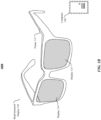
- FIG. 1B illustrates an example augmented reality system 100B.
- the augmented reality system 100B may include a head-mounted display (HMD) 110 (e.g., glasses) comprising a frame 112, one or more displays 114, and a computing system 120.
- the displays 114 may be transparent or translucent allowing a user wearing the HMD 110 to look through the displays 114 to see the real world and displaying visual artificial reality content to the user at the same time.
- the HMD 110 may include an audio device that may provide audio artificial reality content to users.
- the HMD 110 may include one or more cameras which can capture images and videos of environments.
- the HMD 110 may include an eye tracking system to track the vergence movement of the user wearing the HMD 110.
- the augmented reality system 100B may further include a controller comprising a trackpad and one or more buttons.
- the controller may receive inputs from users and relay the inputs to the computing system 120.
- the controller may also provide haptic feedback to users.
- the computing system 120 may be connected to the HMD 110 and the controller through cables or wireless connections.
- the computing system 120 may control the HMD 110 and the controller to provide the augmented reality content to and receive inputs from users.
- the computing system 120 may be a standalone host computer system, an on-board computer system integrated with the HMD 110, a mobile device, or any other hardware platform capable of providing artificial reality content to and receiving inputs from users.
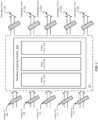
- FIG. 2 illustrates an example user identification architecture 200 of the AR/VR systems.
- the user identification architecture 200 may include an enrollment manager 230 and a re-authentication manager 280.
- the enrollment manager 230 and the re-authentication manager 280 are programmed to apply on-device computation to determine a registered signature and a testing signature for the user, respectively.
- the enrollment manager 230 and the re-authentication manager 280 are programmed to use an external source of edge compute to determine a registered signature and a testing signature for the user, respectively.
- the enrollment manager 230 can be applied to enroll a user during a first time period, such user A 202, against the headset 104 by generating the registered signature of the user, such as registered signature 216, when the user initiates the use of the headset 104 in a virtual environment for entertainment or business operations.
- the enrollment manager 230 can store the registered signature of the user in a database 296.
- the re-authentication manager 280 can be applied to perform eye re-authentication for the user during a second time period, such as user B 252, by generating the testing signature of the user, such as user biometric signature data B 290, when the user attempt to use the headset 104 to enter another virtual environment for entertainment or business operations.
- the re-authentication manager 280 can apply a matching module 240 to determine a similarity score 242 and a spoof likelihood 244 by comparing the registered signature of the user, such as registered signature 216, with the testing signature of the user, such as testing signature 266.
- the AR/VR systems can authenticate the user.
- the AR/VR can reject the user.
- one or more of the content objects of the user identification architecture 200 of the AR/VR systems may be associated with a privacy setting.
- the privacy settings (or "access settings") for an object such as the periocular images of a user, may be stored in any suitable manner, such as, for example, in association with the object, in the enrollment manager 230 and re-authorization manager 280, in another suitable manner, or any combination thereof.
- a privacy setting of an object may specify how the object (or particular information associated with an object) can be accessed (e.g., viewed or shared) using the user identification architecture 200 of the AR/VR systems. Where the privacy settings for an object allow a particular user to access that object, the object may be described as being "visible" with respect to that user.
- a user of the user identification architecture 200 of the AR/VR systems may specify privacy settings for a user-profile page that identify a set of users that may access the work experience information on the user-profile page, thus excluding other users from accessing the information.
- the privacy settings may specify a "blocked list" of users that should not be allowed to access certain information associated with the object.
- the blocked list may specify one or more users or entities for which an object is not visible.
- a user may specify a set of users that may not access the periocular images associated with the user, thus excluding those users from accessing the periocular images associated with the user (while also possibly allowing certain users not within the set of users to access the periocular images associated with the user).
- privacy settings may be associated with particular periocular images. Privacy settings of periocular images may specify how the periocular images, information associated with the periocular images, or content objects associated with the periocular images can be accessed using the user identification architecture 200 of the AR/VR systems.
- the enrollment manager 230 corresponding to a particular periocular image may have a privacy setting specifying that the periocular image may only be accessed by the user in the particular periocular image.
- privacy settings may allow users to opt in or opt out of having their actions logged by the user identification architecture 200 of the AR/VR systems.
- the privacy settings associated with an object may specify any suitable granularity of permitted access or denial of access.
- access or denial of access may be specified for particular users (e.g., only me, my roommates, and my boss), users within a particular degrees-of-separation (e.g., friends, or friends-of-friends), user groups (e.g., the gaming club, my family), user networks (e.g., employees of particular employers, students or alumni of particular university), all users ("public"), no users ("private"), users of the AR/VR systems, particular applications (e.g., third-party applications, external websites), other suitable users or entities, or any combination thereof.
- this disclosure describes using particular privacy settings in a particular manner, this disclosure contemplates using any suitable privacy settings in any suitable manner.
- the enrollment manager 230 and the re-authentication manager 280 may be authorization/privacy servers for enforcing privacy settings.
- the user identification architecture 200 of the AR/VR systems may send a request to the database 296 for the object.
- the request may identify the user associated with the request and may only be sent to the user if the authorization server determines that the user is authorized to access the object based on the privacy settings associated with the object. If the requesting user is not authorized to access the object, the authorization server may prevent the requested object from being retrieved from the database 296, or may prevent the requested object from being sent to the user.
- an object may only be generated as a search result if the querying user is authorized to access the object. In other words, the object must have a visibility that is visible to the querying user. If the object has a visibility that is not visible to the user, the object may be excluded from the search results.
- the AR/VR systems can obtain a first recording of input video stream data, such as image data A 204, which includes a plurality of frames, such as N frames, of periocular images of the user during a first time period.
- the N frames of periocular images are encoded, such as camera A1 206, camera A2 208, camera A3 210, camera A4 212, and camera A5 214.
- the plurality of frames of periocular images are encoded, such as camera A1 206, camera A2 208, camera A3 210, camera A4 212, and camera A5 214, by the one or more cameras of the headset 104 which capture the image data from a periocular region of the user.
- the headset 104 has five inward facing infrared cameras that capture different parts of the face of the user, such as left eye and right eye, left and right sides of the mouth, and forehead.
- the first recording is collected in 1.5 s when the user is forward-gazing during this time. The recording is collected at 72 fps and each frame has a resolution of 400 x 400 pixels.
- Each frame of the encoded periocular images has multiple images, one from each camera included in the headset 104.
- camera A1 206 can store the N frames of periocular images of user A 202 obtained from the first camera of the headset 104.
- Camera A2 208 can store the N frames of periocular images of user A 202 obtained from the second camera of the headset 104.
- Camera A3 210 can store the N frames of periocular images of user A 202 obtained from the third camera of the headset 104.
- Camera A4 212 can store the N frames of periocular images of user A 202 obtained from the fourth camera of the headset 104.
- Camera A5 214 can store the N frames of periocular images of user A 202 obtained from the fifth camera of the headset 104.
- the enrollment manager 230 is programmed to assess the obtained image data for the user, such as image data A 204, using a machine learning algorithm to determine the registered signature of the user.
- the enrollment manager 230 can include a machine learning module A 232 to generate one or more machine learnings models A 234 based on one or more machine learning algorithms A 236.
- the machine learning models A 234 can be a metric learning model based on a shared convolutional encoder.
- the machine learning models A 234 can include Conv-Relu-Conv blocks that do not share weights for the plurality of periocular images.
- the machine learning model is trained based on biometric features from all input images that feed into a shared convolutional encoder to determine the registered signature 216 for the user.
- the registered signature 216 of the user can include one or more first embedding vectors, such as embedding vector A1 218, embedding vector A2 220, embedding vector A3 222, embedding vector A4 224, and embedding vector A5 226 for the plurality of periocular images captured by the one or more cameras of the headset 104.
- embedding vector A1 218 is determined using the metric learning model based on the input periocular images associated with camera A1 206.
- Embedding vector A2 220 is determined using the metric learning model based on the input periocular images associated with camera A2 208.
- Embedding vector A3 222 is determined using the metric learning model based on the input periocular images associated with camera A3 210.
- Embedding vector A4 224 is determined using the metric learning model based on the input periocular images associated with camera A4 212.
- Embedding vector A5 226 is determined using the metric learning model based on the input periocular images associated with camera A5 214.
- Each of the first embedding vectors in the registered signature is L2 normalized to calculate a loss function, such as a batch hard triplet loss function.
- the enrollment manager 230 is programmed to determine a total loss function by summing the individual loss functions associated with each of the first embedding vectors. Likewise, the enrollment manager 230 can train different machine learning models for a plurality of periocular images associated with the left eye only or right eye only for the user. As a result, the enrollment manager 230 can determine a total loss function based on the one or more first embedding vectors associated with the left eye and/or the right eye of the user. The enrollment manager 230 can store the determined registered signature 216 in a database 296 for eye authentication.
- the enrollment manager 230 is programmed to train machine learnings models A 234 using a historical dataset which includes a plurality of periocular images captured by one or more cameras of headset 104 from many users. For example, each user has several video stream recordings of periocular images collected at 72 fps in 1.5 s.
- the AR/VR systems can use a simple data split technique to separate the recorded periocular images for all the users used for the training, validation, and testing of the metric learning model.
- An example of the data split technique considers 70% of the users for model training (e.g., tuning of the model parameters), 10% of the users for validation (e.g., performance validation for each different set of model parameters), and 20% of the users for testing the final model.
- the data split technique may result in the over-fitting problem of the metric learning model with limited generalization capabilities.
- the deployed model will underperform when predicting unseen samples.
- FIG. 3 illustrates an example neural network 300.
- the neural network models A 234 is trained using one or more machine learning algorithms A 236 for determining embedding data, such as embedding vector A1 218, embedding vector A2 220, embedding vector A3 222, embedding vector A4 224, and embedding vector A5 226, of the registered signature 216 of the user.
- the neural network 300 can be a metric learning model using a convolutional encoder based on a plurality of periocular images, such as camera A1 206, camera A2 208, camera A3 210, camera A4 212, and camera A5 214, collected by eye tracking cameras of the headset 104 to determine the embedding data associated with the user.
- the neural network 300 includes three hidden layers, such as hidden layer A 310, hidden layer B 312, and hidden layer C 314, which may be a convolutional layer, a pooling layer, a rectified linear unit (ReLU) layer, a softmax layer, a regressor layer, a dropout layer, and/or various other hidden layer types. These hidden layers can be arranged in any order as long as they satisfy the input/output size criteria.
- Each layer comprises of a set number of image filters. The output of filters from each layer is stacked together in the third dimension. This filter response stack then serves as the input to the next layer(s).
- each hidden layer is a combination of a convolutional layer, a pooling layer, and a ReLU layer in a multilayer architecture.
- each hidden layer such as hidden layer A 310, hidden layer B 312, and hidden layer C 314, has a convolutional layer, a pooling layer, and a ReLU layer.
- the hidden layer A 310 may be down-sampling blocks to extract high-level features from the input data set.
- the hidden layer C 314 may be up-sampling blocks to output the classified or predicted output data set.
- the hidden layer B 312 may perform residual stacking as bottleneck between down-sampling blocks, such as hidden layer A 310, and up-sampling blocks, such as hidden layer C 314.
- the hidden layer C 314 may include a softmax layer or a regressor layer to classify or predict a predetermined class or a value based on input attributes.
- the input data set is convolved with a set of learned filters, designed to highlight specific characteristics of the input data set.
- a pooling layer produces a scaled down version of the output. This is achieved by considering small neighborhood regions and applying the desired operation filter (e.g. min, max, mean, etc.) across the neighborhood.
- a ReLU layer enhances the nonlinear property of the network by introducing a non-saturating activation function. One example of such a function is to threshold out negative responses (set negative values to zero).
- a fully connected layer provides a high-level reasoning by connecting each node in the layer to all activation nodes in the previous layer.
- a softmax layer maps the inputs from the previous layer into a value between 0 and 1 which allows for interpreting the outputs as probabilities and selection of classified facie with highest probability.
- a dropout layer offers a regularization technique for reducing network over-fitting on the training data by dropping out individual nodes with a certain probability.
- a loss layer (utilized in training) defines the weight dependent cost function that needs to be optimized (bring cost down to zero) for improved accuracy.
- the re-authentication manager 280 is programmed to perform eye re-authentication for the user, such as user B 252, who can be a current user of the headset 104.
- the re-authentication of the user can occur when the user navigates into a new virtual environment.
- the re-authentication of the user can occur periodically for a predetermined amount of time, such as 30 minutes.
- the AR/VR systems can send a request to the re-authentication manager 280 to obtain a recording of input video stream data, such as image data B 254, which can include a plurality of frames, such M frames, of periocular images of the user during a second time period.
- the M frames of periocular images are encoded, such as camera B1 256, camera B2 258, camera B3 260, camera B4 262, and camera B5 264, by the one or more cameras of the headset 104 which capture the image data B 254 from a periocular region of the user.
- Each frame of the encoded periocular images has multiple images, one from each camera included in the headset 104.
- camera B1 256 can store M frames of periocular images of user B 252 obtained from the first camera of the headset 104.
- Camera B2 258 can store M frames periocular images of user B 252 obtained from the second camera of the headset 104.
- Camera B3 260 can store M frames periocular images of user B 252 obtained from the third camera of the headset 104.
- Camera B4 262 can store M frames periocular images of user B 252 obtained from the fourth camera of the headset 104.
- Camera B5 264 can store M frames periocular images of user B 252 obtained from the fifth camera of the headset 104.
- the re-authentication manager 280 is programmed to assess the image data B 254 for the user using one or more machine learning algorithms B 286 to determine a testing signature of the user.
- the re-authentication manager 280 can include a machine learning module B 282 to generate one or more machine learnings models B 284 using one or more machine learning algorithms B 286.
- the machine learning models B 284 can include a metric learning model based on a shared convolutional encoder.
- the machine learning models B 284 can include Conv-Relu-Conv blocks that do not share weights for the plurality of periocular images.
- the machine learning model is trained based on biometric features from all input images that feed into a shared convolutional encoder to determine the testing signature 266 of the user.
- the testing signature 266 of the user can include one or more second embedding vectors, such as embedding vector B1 268, embedding vector B2 270, embedding vector B3 272, embedding vector B4 274, and embedding vector B5 276 for the one or more cameras of the headset 104.
- embedding vector B1 268 is determined using the metric learning model based on the input periocular images associated with camera B1 256.
- Embedding vector B2 270 is determined using the metric learning model based on the input periocular images associated with camera B2 258.
- Embedding vector B3 272 is determined using the metric learning model based on the input periocular images associated with camera B3 260.
- Embedding vector B4 274 is determined using the metric learning model based on the input periocular images associated with camera B4 262.
- Embedding vector B5 276 is determined using the metric learning model based on the input periocular images associated with camera B5 264.
- Each of the second embedding vectors in the testing signature 266 is L2 normalized to calculate a loss function, such as a batch hard triplet loss function.
- the re-authentication manager 280 is programmed to determine a total loss function by summing the individual loss functions associated with each of the second embedding vectors. Likewise, the re-authentication manager 280 can train different machine learning models for the plurality of periocular images associated with the left eye only or right eye only for the user. As a result, the re-authentication manager 280 can determine the one or more second embedding vectors associated with the left eye or the right eye of the user to calculate a total loss function.
- the re-authentication manager 280 can apply a matching module 240 to determine a similarity score 248 between user A 202 and user B 252 based on equation 1 using the registered signature 216 of user A 202 and the testing signature 266 of user B 252. For example, a similarity score 248 can be calculated based on the first and second embedding vectors for user A 202 and user B 252.
- the re-authentication manager 280 can apply a knowledge distillation algorithm 288 to update the metric learning model to determine a spoof likelihood 244 of presentation attacks.
- the re-authentication manager 280 can apply a joint framework to perform reliable classification for both eye identification and presentation attacks by reducing the effect of forgetting which is a challenge for a conventional artificial neural network for eye identification and PAD, such as a deep MTL network.
- the joint framework can be applied to identify input video streams belonging to a real user while rejecting other users deliberately trying to impersonate the true user.
- the re-authentication manager 280 can use a trained metric learning model M eye for eye re-authentication as a starting model to train a machine learning model M eye_pad based on a presentation attack detection dataset, such presentation attack data 290.
- the re-authentication manager 280 can use a loss function L pad_diss associated with presentation attack detection based on a knowledge distillation algorithm 288 to generate a machine learning model B 284 for performing both eye identification and presentation attack detection.
- the loss function L pad_diss has a presentation attack detection loss L pad and a distillation loss L diss based on equation 2.
- the re-authentication manager 280 can determine the machine learning model M eye_pad by minimizing the presentation attack detection loss L pad based on a standard cross-entropy classification loss to classify a given image as a real image or a spoof image. Further, the re-authentication manager 280 can use a distillation loss term L diss as a regularization term to minimize a cosine distance between the obtained embedding vectors from the trained metric learning model M eye and the machine learning model M eye_pad based on equation 3.
- L pad_diss is a loss function associated with presentation attack detection based on a knowledge distillation algorithm
- L pad is a loss function associated with presentation attack detection
- L diss is a distillation loss function
- ⁇ is a regularization term
- emb M eye is the embedding vector determined by the trained metric learning model M eye for eye authentication
- emb M pad_eye is the embedding vector determined by the machine leaming model M eye_pad based on the presentation attack detection dataset.
- the re-authentication manager 280 can use the trained metric leaming model M eye_pad for presentation attack detection as a starting model to train a machine learning model M' eye_pad for eye identification and PAD in an MTL fashion using eye re-authentication and PAD datasets.
- the training for the metric learning model M' eye-pad for eye identification and PAD is alternated after every iteration.
- the metric learning model M' eye-pad is trained to mimic the starting model M eye_pad to reduce the effect of forgetting using the same knowledge distillation algorithm 288.
- the re-authentication manager 280 can use a loss function L multi id or L multi pad for eye identification and PAD in joint framework based on a knowledge distillation algorithm 288 to generate a machine learning model B 284 for performing both eye identification and presentation attack detection.
- the re-authentication manager 280 can feed the eye re-authentication dataset to both M eye_pad and M' eye-pad and obtain features emb M pad _ eye and emb M' pad _ eye respectively.
- M eye_pad remains frozen in this step.
- the loss function L multi id or L multi pad includes a distillation loss term L' diss as a regularization term to minimize a cosine distance between the obtained embedding vectors from the trained metric learning model M' eye-pad and the machine learning model M eye_pad based on equation 4.
- the re-authentication manager 280 can use the eye re-authentication dataset to train M' eye_pad for eye re-authentication with a loss function L multi id at iteration i based on equation 5.
- the re-authentication manager 280 can use the PAD dataset to train M' eye_pad for PAD with a loss function L multi pad at iteration i+1 based on equation 6.
- the re-authentication manager 280 can alternatively use the loss function L multi id and L multi pad to determine the machine learning model M' eye _ pad .
- L ′ diss 1 ⁇ emb M ped _ eye ⁇ emb M ′ pad _ eye ⁇ emb M pad _ eye ⁇ ⁇ emb M ′ pad _ eye ⁇
- L multi id L id + ⁇ 2 L ′ diss
- L multi pad L pad + ⁇ 2 L ′ diss
- L multi id is a loss function associated with eye re-authentication
- L multi pad is a loss function associated with presentation attack detection based on a knowledge distillation algorithm
- L id is a triplet loss function associated with eye re-authentication
- L pad is a standard loss function associated with presentation attack detection
- L' diss is a distillation loss function
- ⁇ 2 is a regularization term
- emb M pad _ eye is the embedding vector determined by the metric learning model M eye_Pad
- the user identification architecture 200 can evaluate a machine learning model for the validation users based on a True Acceptance Rate (TAR) at False Acceptance Rate (FAR).
- TAR True Acceptance Rate
- FAR False Acceptance Rate
- the TAR at FAR can be 2e-5.
- the user identification architecture 200 can apply an offline evaluation to increase model robustness for real-time implementation as all the frames are captured within about 10 millisecond interval.
- the user identification architecture 200 can determine a user-user distance matrix 248 using video stream recordings for the validation users. Based on the user-user distance matrix 248, the user identification architecture 200 can identify the user identity using a Nearest Neighbor algorithm 250. As a result, the user identification architecture 200 can determine a TAR@FAR to evaluate the performance of the machine learning model.
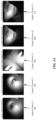
- FIGs. 4A and 4B illustrate example periocular images from five internal-facing eye tracking cameras of headset 104.
- the headset 104 has five internal-facing eye tracking cameras for use cases such as foveated rendering and dynamic uniformity correction.
- FIG. 4 shows a frame of periocular images comprising five camera images coming in at one timestamp, such as image (camera 1) 402, image (camera 2) 404, image (camera 3) 406, image (camera 4) 408, and image (camera 5) 410, that focus on different parts of a periocular region of a user.
- each camera image can be captured by one of five user facing cameras which look at various parts of the face, such as left and right eyes, left and right sides of mouth, and forehead.
- these five user facing cameras can be 850 nanometers (nm) infrared cameras with a resolution of 400x400 pixels.
- Each of these five tracking cameras can use near infrared (NIR) light-emitting diode (LED) to illuminate each region of the face of the user.
- NIR near infrared
- LED light-emitting diode
- FIG. 4B shows an example periocular region of the user which may include an eye 422, a pupil 424, an eyelid 426, an eyebrow 428, and an iris 430.
- the five cameras associated with headset 104 can record a plurality of frames of periocular images for a predetermined time period, such as 1.5 seconds, at a predetermined frame rate, such 72 fps when the user is forward-gazing during this time. It is preferred that the user looks right into the camera to record high quality periocular images for the user when the AR/VR systems perform eye re-authentication and presentation attack detection.
- the periocular images can have a low signal to noise ratio when the user looks in various directions during eye re-authentication and presentation attack detection because the captured periocular images can include less eye information.
- the AR/VR systems can record multiple frames of periocular images to determine a signature of the user.
- the AR/VR systems can determine a registered signature of a user using a plurality of live-captured recordings of periocular images of the user during a first time period.
- the determined registered signature of the user can be stored in a database.
- the AR/VR systems can determine a testing signature of the user based on a plurality of live-captured recordings of periocular images of the user during a second time period.
- the AR/VR systems can perform eye re-authentication and presentation attack detection for the user by comparing stored registered signature to the live-captured testing signature of the user.
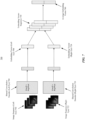
- FIG. 5 illustrates an example metric learning model training for eye re-authentication based on a plurality of periocular images from five internal-facing eye tracking cameras of headset 104.
- the metric learning model is trained using recorded periocular images from the selected users for model training.
- the AR/VR systems can choose about ten recordings for each user in the training set and extract two camera images for all frames in the first 1.5 seconds of the recording when the user is forward-gazing during this time.
- FIG. 5 shows the AR/VR systems can train the metric learning model 500 using an encoded image batch 504 of the plurality of frames 502 of periocular images. Each frame can include two periocular images for left eye and right eye from a particular user.
- the AR/VR systems can train the metric learning model 500 to determine high-dimensional features at both high- and low-levels based on texture, color, and shape using the input encoded image batch 504.
- the determined high-dimensional features include shape, texture, and color associated with eye, eyelashes, eyebrows, eye-lid, and other discriminative periocular characteristics for personal identification.
- the metric learning model 500 can assess the generated high-dimensional features using a shared convolutional encoder 506 to determine an embedding vector 508 for each image.
- the shared convolutional encoder 506 can be based on a convolutional neural network using Conv-Relu-Conv blocks that do not share weights for the plurality of periocular images.
- a separate embedding head is attached to the determined embedding vector 508 per image which is L2 normalized.
- the metric learning model 500 can calculate a loss function for each head separately using the determined L-2 normalized embedding vectors 508.
- the metric learning model 500 can calculate a batch hard triplet loss 510 for each image and sum both the individual camera losses to determine a total loss for the training dataset.
- FIG. 6A illustrates an example metric learning model 600 based on a triplet loss using an anchor, a positive image, and a negative image.
- a conventional metric learning model can learn a similarity degree between two images through network learning.
- the metric learning model 600 can use images from three categories, such as anchor data 602, positive data 604, and negative data 606.
- the anchor data 602 is a sample image chosen from a training set of images.
- the positive data 604 is an image which is similar to anchor 602.
- the negative data 606 is an image which is different from anchor 602.
- the metric learning model 600 can apply an encoder (anchor) 612 to determine an embedding vector (anchor) 622 based on the input anchor data 602.
- the metric learning model 600 can apply an encoder (positive) 614 to determine an embedding vector (positive) 624 based on the input positive data 604.
- the metric learning model 600 can apply an encoder (negative) 616 to determine an embedding vector (negative) 626 based on the input negative data 606.
- the metric learning model 600 can determine a distance between each two images in the input data sets based on the embedding vector (anchor) 6222, the embedding vector (positive) 624, and the embedding vector (negative) 626.
- the metric learning model 600 can also use a hard mining algorithm to find the hardest sample to train the model.
- the hard mining algorithm can calculate pairwise distances for embedding vectors of all periocular images of all training users. For all training users, the hard mining algorithm can evaluate all the determined pairwise distances and apply a random hardest negative sampling strategy to find the hardest triplets from the embedded feature space, which ensures that all triplets are valid.
- the metric learning model 600 can determine a hard triplet loss 630 based on equation 7 using a distance d ( a i , p i ) between the anchor data 602 and the positive data 604, a distance d ( a i , n i ) between the anchor data 602 and the negative data 604, and a margin ⁇ .
- the metric learning model 600 can apply the hard triplet loss 630 to adjust weights of the metric learning model, such as encoder (anchor) 612, encoder (positive) 614, and encoder (negative) 616, to minimize the distance d ( a i , p i ) between the anchor data 602 and the positive data 604 and maximize the distance d ( a i , n i ) between the anchor data 602 and the negative data 604 until the difference between d ( a i , n i ) and d ( a i , n i ) is greater than the margin ⁇ .
- the metric learning model such as encoder (anchor) 612, encoder (positive) 614, and encoder (negative) 616, to minimize the distance d ( a i , p i ) between the anchor data 602 and the positive data 604 and maximize the distance d ( a i , n i ) between the anchor data 602 and the negative
- L a p n max d a i p i ⁇ d a i n i + ⁇ , 0
- L ( a, p, n ) is a triplet loss for anchor a , positive p, and negative n.
- d ( a i , p i ) is a distance between the i -th anchor and the i -th positive sample.
- d ( a i , n i ) is a distance between the i -th anchor and the i -th negative sample, ⁇ is a margin.
- max ⁇ a , b ⁇ is a function to output a is a is greater than b, otherwise output b.
- FIG. 6B illustrates an example embedding space 650 based on an anchor, a positive image, and a negative image.
- the metric learning model 600 can map the determined high-dimensional embeddings to a multi-dimensional embedding space 650.
- FIG. 6B shows a 3D embedding space 650 which includes three three-dimensional (3D) embeddings, such as embedding vector (anchor) 622, embedding vector (positive) 624, and embedding vector (negative) 626.
- the weights in the metric learning model are determined to minimize the distance between the feature vectors of anchor and positive and maximize the distance between anchor and negative until the differences of these two distances is larger than a margin ⁇ .
- the metric learning model is optimized to pull positive images of the identity closer in a natural cluster and push negative images of different identities away from each other.
- the triplet loss based metric learning model can evaluate the nature cluster of positive images of the identity closer for eye re-authentication.
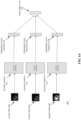
- FIG. 7 illustrates an example metric learning model 700 for both left and right eyes of a user.
- the metric learning model 700 can be trained on both left eye and right eye images from a user.
- FIG. 7 shows the AR/VR systems obtain a sequence of left eye images, such as image sequence (left eye) 702, and a sequence of right eye images, such as image sequence (right eye) 722.
- Each sequence includes a plurality of frames captured from the incoming video stream of infrared cameras of the headset 104.
- the AR/VR systems can train a metric learning model 700 based on a shared convolution encoder (left eye) 704 to determine an embedding vector (left eye) 706 for each image.
- the AR/VR systems can train another metric learning model based on a shared convolution encoder (right eye) 724 to determine an embedding vector (right eye) 726 for each image.
- the shared convolution encoder (left eye) 704 and the shared convolution encoder (right eye) 724 can use the same weights for the same image.
- the AR/VR systems can determine an embedding vector sequence 750 by combining the determined embedding vectors for the plurality of frames in the sequences of left and right eye images.
- the AR/VR systems can determine an average embedding vector 760 by averaging the embedding vector sequence 750 over all the frames in the input image sequences.
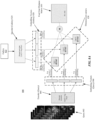
- FIG. 8A illustrates an example offline evaluation 800 of a metric learning model.
- the AR/VR systems can apply the offline evaluation 800 to increase model robustness for real-time implementation of the metric learning model.
- the AR/VR systems can split recordings into query and gallery recordings for each test user.
- the AR/VR systems can extract all camera images for all frames in the first 1.5 s of each recording to create a query 802 and a gallery 822.
- the query 802 can be a collection of randomly selected N frames from all query recordings for the test users.
- the gallery 822 can be a collection of randomly selected M frames from all gallery recordings for the test users.
- the AR/VR systems can determine one or more embedding vectors (gallery) 826 for each image of the headset 104 based on a metric learning model, such as encoder (gallery) 824.
- the AR/VR systems can determine one or more embedding vectors (query) 820 for each image of the headset 104 based on a metric learning model, such as encoder (query) 804.
- the AR/VR systems can calculate a distance per camera 830 between the test users in the query 802 and the test users in the gallery 822 based on equation 1 using embedding vectors (query) 806 and embedding vectors (gallery) 826 for each image.
- the AR/VR systems can determine a similarity score between the test users in the query 802 and in the gallery 822 for constructing a user-user distance matrix 850 which includes similarity scores between the test users in the query 802 and in the gallery 826.
- the AR/VR systems can apply a Nearest Neighbor algorithm to identify a user in the query 802 from all the users in the gallery 822.
- the AR/VR systems can evaluate the performance of the trained metric learning model, such as encoder (query) 804, based on a predetermined TAR @ FAR. For example, the AR/VR systems can identify a similarity threshold such that a wrong user is given access only 1 in 50,000 times for a TAR@FAR 2e-5. The AR/VR systems can apply the identified similarity threshold as a decision engine on the similarity scores to determine TAR based on how many times the correct user is admitted. The AR/VR systems can use the offline evaluation to train the metric learning model to maximize the TAR@FAR value. The AR/VR systems can also apply this approach for real-time implementation as all the frames are captured within about a 10 millisecond (ms) interval.
- ms millisecond
- FIG. 8B illustrates an example metric learning model performance associated with the effect of averaging over multiple frames.
- the AR/VR systems can determine embedding vectors using a plurality of frames of periocular images.
- FIG. 8B shows the number of frames that embedding vectors are averaged over has an effect on the TAR@FAR 2e-5 performance of the metric learning model.
- the metric learning model has a TAR@FAR 2e-5 performance, such as 1 gallery frame (2 cameras) with varying query frames 810, in the range of 0.8481-0.8601 for 1-10 query frames of periocular images.
- the metric learning model has a TAR@FAR 2e-5 performance, such as 1 query frame (2 cameras) with varying gallery frames 812, which increases from 0.8481 for 1 gallery frame to 0.9406 for 10 gallery frames.
- the metric learning model has a TAR@FAR 2e-5 performance, such as 1 gallery frame (5 cameras) with varying query frames 814, in the range of 0.9790-0.9833 for 1-10 query frames.
- the metric learning model has a TAR@FAR 2e-5 performance, such as 1 query frame (5 cameras) with varying gallery frames 816, which increases from 0.9833 for 1 gallery frame to 0.9948 for 10 gallery frames. It is clear that averaging over multiple gallery frames can help more than averaging over multiple query frames because query frames are temporally correlated.
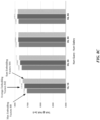
- FIG. 8C illustrates an example metric learning model performance associated with the effect of the aggregating function for a two camera model.
- the AR/VR systems can determine embedding vectors using a plurality of frames of periocular images based on an aggregating function. For example, the embedding vectors can be determined by choosing the maximum embedding vector for the plurality of frames of periocular images. The embedding vectors can be determined by choosing the average embedding vector over the plurality of frames of periocular images. The embedding vectors can be determined by choosing the sum embedding vector over the plurality of frames of periocular images.
- FIG. 8C shows the comparison of the effect of three aggregating functions on the TAR@FAR 2e-5 performance of a metric learning model.
- the metric learning model has a TAR@FAR 2e-5 performance of 0.7666 for maximum embedding vectors 840, 0.8149 for average embedding vectors 842, and 0.8481 for sum embedding vectors 844.
- the comparison result is very similar for other query-gallery frame pairs, such as two query frames and 2 gallery frames (2Q, 2G), two query frames and 5 gallery frames (2Q, 5G), and five query frames and five gallery frames (5Q, 5G). It is clear that the sum embedding aggregating function has an overall good performance regardless of how many frames are involved.
- FIGS. 9A and 9B illustrate example presentation attacks for presentation attack detection.
- the presentation attacks seek to fool the authentication system by presenting artificial eye images, such as printed iris images of an individual or cosmetic contacts.
- FIG. 9A shows presentation attacks with paper glasses, funny eyes glasses, print, replay, and fake head from left to right.
- FIG. 9B shows presentation attacks with rigid Obama plastic Halloween mask, rigid transparent plastic mask, rigid custom make realistic mask, flexible custom made realistic mask, paper mask and from left to right.
- the user identification architecture 200 can apply a knowledge distillation algorithm 288 to learn both presentation attack detection and eye re-authentication to help with the effect of forgetting in a joint framework which is superior to multitask learning.
- the user identification architecture 200 can use a trained metric learning model M eye as a teacher model for eye re-authentication as a starting model to update a machine learning model M eye_pad as a student model based on a presentation attack detection dataset.
- the user identification architecture 200 can minimize a knowledge distillation loss defined as a difference between the pairwise teacher similarity matrix and the pairwise student similarity matrix.
- the knowledge distillation algorithm can be applied to supervise the training of the student model by capturing and transferring the knowledge of a more expensive teacher model.
- the knowledge distillation algorithm can be applied to reduce the effect of forgetting to identify input video streams belonging to a real user while rejecting other users deliberately trying to impersonate the true user.
- the AR/VR systems can determine an optimized machine learning model M eye_pad with a Spoof Acceptance Rate (SAR) below a predetermined SAR threshold, such as 7%, to detect spoof associated with presentation attacks and a net False Rejection Rate (FRR) below a predetermined FRR threshold, such as 10%.
- SAR Spoof Acceptance Rate
- FRR False Rejection Rate
- the Spoof Acceptance Rate is a measure of how many times presentation attacks are accepted as true users.
- the net False Rejection Rate is based on the total number of users rejected during eye re-authentication and presentation attack detection and the total number of users in the input dataset.
- FIG. 10 illustrates an example method 1000 for performing eye re-authentication and presentation attack detection using periocular images.
- the method 1000 may begin at step 1005, where the computing system can obtain a plurality of first periocular images of a user during a first time period from a camera of an artificial reality device.
- the plurality of first periocular images can be video streams live-captured by the camera of a wearable AR/VR device.
- the camera can be an internal-facing eye tracking camera of the wearable AR/VR device.
- the plurality of first periocular images can be stored in a database.
- the plurality of first periocular images can include a plurality of frames, such as N frames, of periocular images for various parts of a periocular region of the user during the first time period.
- the method may use a deep-learning model to generate a plurality of first embeddings based on the plurality of first periocular images.
- the deep-learning model can be a metric learning model based on a shared convolutional encoder.
- the metric learning model can include Conv-Relu-Conv blocks that do not share weights for the plurality of periocular images.
- the method can generate a registered signature of the user based on the plurality of first embeddings.
- the method can obtain a plurality of second periocular images of the user during a second time period, from the camera.
- the plurality of second periocular images can be video streams live-captured by the camera of the wearable AR/VR device.
- the plurality of second periocular images can include a plurality of frames, such as M frames, of periocular images for various parts of a periocular region of the user during the second time period.
- the method can use the deep-learning model to generate a plurality of second embeddings based on the plurality of second periocular images.
- the method can generate a test signature of the user based on the plurality of second embeddings.
- the method can determine a spoof likelihood of presentation attacks using a knowledge distillation algorithm for the user based on the plurality of second embeddings.
- the method can update the deep learning model using the knowledge distillation algorithm to detect spoof associated with presentation attacks based on the plurality of second embeddings.
- the method can make a determination whether the spoof likelihood of presentation attacks is below a predetermined spoof threshold. Where the spoof likelihood of presentation attacks is below a predetermined likelihood threshold, the process may proceed to step 1045 to perform user authentication.
- the process may proceed to step 1060 to reject the user.
- the method can perform authentication based on a comparison between the test signature and the registered signature. The method can determine, using the updated deep learning model, a similarity score based on the test signature and the registered signature.
- the method can make a determination whether the test signature matches the registered signature using the similarity score. Where the similarity score is larger than a similarity threshold, the process may proceed to step 1055 to approve the user. Where the similarity score is smaller than a similarity threshold, the process may proceed to step 1060 to reject the user.
- Particular embodiments may repeat one or more steps of the method of FIG. 10 , where appropriate.
- this disclosure describes and illustrates particular steps of the method of FIG. 10 as occurring in a particular order, this disclosure contemplates any suitable steps of the method of FIG. 10 occurring in any suitable order.
- this disclosure describes and illustrates an example method for performing eye-reauthentication and presentation attack detection including the particular steps of the method of FIG. 10
- this disclosure contemplates any suitable method for performing eye-reauthentication and presentation attack detection including any suitable steps, which may include all, some, or none of the steps of the method of FIG. 10 , where appropriate.
- this disclosure describes and illustrates particular components, devices, or systems carrying out particular steps of the method of FIG. 10
- this disclosure contemplates any suitable combination of any suitable components, devices, or systems carrying out any suitable steps of the method of FIG. 10 .
- FIG. 11 illustrates an example computer system 1100.
- one or more computer systems 1100 perform one or more steps of one or more methods described or illustrated herein.
- one or more computer systems 1100 provide functionality described or illustrated herein.
- software running on one or more computer systems 1100 performs one or more steps of one or more methods described or illustrated herein or provides functionality described or illustrated herein.
- Particular embodiments include one or more portions of one or more computer systems 1100.
- reference to a computer system may encompass a computing device, and vice versa, where appropriate.
- reference to a computer system may encompass one or more computer systems, where appropriate.
- computer system 1100 may be an embedded computer system, a system-on-chip (SOC), a single-board computer system (SBC) (such as, for example, a computer-on-module (COM) or system-on-module (SOM)), a desktop computer system, a laptop or notebook computer system, an interactive kiosk, a mainframe, a mesh of computer systems, a mobile telephone, a personal digital assistant (PDA), a server, a tablet computer system, an augmented/virtual reality device, or a combination of two or more of these.
- SOC system-on-chip
- SBC single-board computer system
- COM computer-on-module
- SOM system-on-module
- computer system 1100 may include one or more computer systems 1100; be unitary or distributed; span multiple locations; span multiple machines; span multiple data centers; or reside in a cloud, which may include one or more cloud components in one or more networks.
- one or more computer systems 1100 may perform without substantial spatial or temporal limitation one or more steps of one or more methods described or illustrated herein.
- one or more computer systems 1100 may perform in real time or in batch mode one or more steps of one or more methods described or illustrated herein.
- One or more computer systems 1100 may perform at different times or at different locations one or more steps of one or more methods described or illustrated herein, where appropriate.
- computer system 1100 includes a processor 1102, memory 1104, storage 1106, an input/output (I/O) interface 1108, a communication interface 1110, and a bus 1112.
- processor 1102 memory 1104, storage 1106, an input/output (I/O) interface 1108, a communication interface 1110, and a bus 1112.
- I/O input/output
- this disclosure describes and illustrates a particular computer system having a particular number of particular components in a particular arrangement, this disclosure contemplates any suitable computer system having any suitable number of any suitable components in any suitable arrangement.
- processor 1102 includes hardware for executing instructions, such as those making up a computer program.
- processor 1102 may retrieve (or fetch) the instructions from an internal register, an internal cache, memory 1104, or storage 1106; decode and execute them; and then write one or more results to an internal register, an internal cache, memory 1104, or storage 1106.
- processor 1102 may include one or more internal caches for data, instructions, or addresses. This disclosure contemplates processor 1102 including any suitable number of any suitable internal caches, where appropriate.
- processor 1102 may include one or more instruction caches, one or more data caches, and one or more translation lookaside buffers (TLBs).
- TLBs translation lookaside buffers
- Instructions in the instruction caches may be copies of instructions in memory 1104 or storage 1106, and the instruction caches may speed up retrieval of those instructions by processor 1102.
- Data in the data caches may be copies of data in memory 1104 or storage 1106 for instructions executing at processor 1102 to operate on; the results of previous instructions executed at processor 1102 for access by subsequent instructions executing at processor 1102 or for writing to memory 1104 or storage 1106; or other suitable data.
- the data caches may speed up read or write operations by processor 1102.
- the TLBs may speed up virtual-address translation for processor 1102.
- processor 1102 may include one or more internal registers for data, instructions, or addresses. This disclosure contemplates processor 1102 including any suitable number of any suitable internal registers, where appropriate. Where appropriate, processor 1102 may include one or more arithmetic logic units (ALUs); be a multi-core processor; or include one or more processors 1102.
- memory 1104 includes main memory for storing instructions for processor 1102 to execute or data for processor 1102 to operate on.
- computer system 1100 may load instructions from storage 1106 or another source (such as, for example, another computer system 1100) to memory 1104.
- Processor 1102 may then load the instructions from memory 1104 to an internal register or internal cache.
- processor 1102 may retrieve the instructions from the internal register or internal cache and decode them.
- processor 1102 may write one or more results (which may be intermediate or final results) to the internal register or internal cache.
- Processor 1102 may then write one or more of those results to memory 1104.
- processor 1102 executes only instructions in one or more internal registers or internal caches or in memory 1104 (as opposed to storage 1106 or elsewhere) and operates only on data in one or more internal registers or internal caches or in memory 1104 (as opposed to storage 1106 or elsewhere).
- One or more memory buses (which may each include an address bus and a data bus) may couple processor 1102 to memory 1104.
- Bus 1112 may include one or more memory buses, as described below.
- one or more memory management units reside between processor 1102 and memory 1104 and facilitate accesses to memory 1104 requested by processor 1102.
- memory 1104 includes random access memory (RAM). This RAM may be volatile memory, where appropriate.
- this RAM may be dynamic RAM (DRAM) or static RAM (SRAM). Moreover, where appropriate, this RAM may be single-ported or multi-ported RAM. This disclosure contemplates any suitable RAM.
- Memory 1104 may include one or more memories 1104, where appropriate. Although this disclosure describes and illustrates particular memory, this disclosure contemplates any suitable memory.
- storage 1106 includes mass storage for data or instructions.
- storage 1106 may include a hard disk drive (HDD), a floppy disk drive, flash memory, an optical disc, a magneto-optical disc, magnetic tape, or a Universal Serial Bus (USB) drive or a combination of two or more of these.
- Storage 1106 may include removable or non-removable (or fixed) media, where appropriate.
- Storage 1106 may be internal or external to computer system 1100, where appropriate.
- storage 1106 is non-volatile, solid-state memory.
- storage 1106 includes read-only memory (ROM).
- this ROM may be mask-programmed ROM, programmable ROM (PROM), erasable PROM (EPROM), electrically erasable PROM (EEPROM), electrically alterable ROM (EAROM), or flash memory or a combination of two or more of these.
- This disclosure contemplates mass storage 1106 taking any suitable physical form.
- Storage 1106 may include one or more storage control units facilitating communication between processor 1102 and storage 1106, where appropriate.
- storage 1106 may include one or more storages 1106.
- this disclosure describes and illustrates particular storage, this disclosure contemplates any suitable storage.
- I/O interface 1108 includes hardware, software, or both, providing one or more interfaces for communication between computer system 1100 and one or more I/O devices.
- Computer system 1100 may include one or more of these I/O devices, where appropriate.
- One or more of these I/O devices may enable communication between a person and computer system 1100.
- an I/O device may include a keyboard, keypad, microphone, monitor, mouse, printer, scanner, speaker, still camera, stylus, tablet, touch screen, trackball, video camera, another suitable I/O device or a combination of two or more of these.
- An I/O device may include one or more sensors. This disclosure contemplates any suitable I/O devices and any suitable I/O interfaces 1108 for them.
- I/O interface 1108 may include one or more device or software drivers enabling processor 1102 to drive one or more of these I/O devices.
- I/O interface 1108 may include one or more I/O interfaces 1108, where appropriate. Although this disclosure describes and illustrates a particular I/O interface, this disclosure contemplates any suitable I/O interface.
- communication interface 1110 includes hardware, software, or both providing one or more interfaces for communication (such as, for example, packet-based communication) between computer system 1100 and one or more other computer systems 1100 or one or more networks.
- communication interface 1110 may include a network interface controller (NIC) or network adapter for communicating with an Ethernet or other wire-based network or a wireless NIC (WNIC) or wireless adapter for communicating with a wireless network, such as a WI-FI network.
- NIC network interface controller
- WNIC wireless NIC
- WI-FI network wireless network
- computer system 1100 may communicate with an ad hoc network, a personal area network (PAN), a local area network (LAN), a wide area network (WAN), a metropolitan area network (MAN), or one or more portions of the Internet or a combination of two or more of these.
- PAN personal area network
- LAN local area network
- WAN wide area network
- MAN metropolitan area network
- computer system 1100 may communicate with a wireless PAN (WPAN) (such as, for example, a BLUETOOTH WPAN), a WI-FI network, a WI-MAX network, a cellular telephone network (such as, for example, a Global System for Mobile Communications (GSM) network), or other suitable wireless network or a combination of two or more of these.
- Computer system 1100 may include any suitable communication interface 1110 for any of these networks, where appropriate.
- Communication interface 1110 may include one or more communication interfaces 1110, where appropriate.
- bus 1112 includes hardware, software, or both coupling components of computer system 1100 to each other.
- bus 1112 may include an Accelerated Graphics Port (AGP) or other graphics bus, an Enhanced Industry Standard Architecture (EISA) bus, a front-side bus (FSB), a HYPERTRANSPORT (HT) interconnect, an Industry Standard Architecture (ISA) bus, an INFINIBAND interconnect, a low-pin-count (LPC) bus, a memory bus, a Micro Channel Architecture (MCA) bus, a Peripheral Component Interconnect (PCI) bus, a PCI-Express (PCIe) bus, a serial advanced technology attachment (SATA) bus, a Video Electronics Standards Association local (VLB) bus, or another suitable bus or a combination of two or more of these.
- Bus 1112 may include one or more buses 1112, where appropriate.
- a computer-readable non-transitory storage medium or media may include one or more semiconductor-based or other integrated circuits (ICs) (such, as for example, field-programmable gate arrays (FPGAs) or application-specific ICs (ASICs)), hard disk drives (HDDs), hybrid hard drives (HHDs), optical discs, optical disc drives (ODDs), magneto-optical discs, magneto-optical drives, floppy diskettes, floppy disk drives (FDDs), magnetic tapes, solid-state drives (SSDs), RAM-drives, SECURE DIGITAL cards or drives, any other suitable computer-readable non-transitory storage media, or any suitable combination of two or more of these, where appropriate.
- ICs such, as for example, field-programmable gate arrays (FPGAs) or application-specific ICs (ASICs)
- HDDs hard disk drives
- HHDs hybrid hard drives
- ODDs optical disc drives
- magneto-optical discs magneto-optical drives
- references in the appended claims to an apparatus or system or a component of an apparatus or system being adapted to, arranged to, capable of, configured to, enabled to, operable to, or operative to perform a particular function encompasses that apparatus, system, component, whether or not it or that particular function is activated, turned on, or unlocked, as long as that apparatus, system, or component is so adapted, arranged, capable, configured, enabled, operable, or operative. Additionally, although this disclosure describes or illustrates particular embodiments as providing particular advantages, particular embodiments may provide none, some, or all of these advantages.
Landscapes
- Engineering & Computer Science (AREA)
- Theoretical Computer Science (AREA)
- Physics & Mathematics (AREA)
- General Physics & Mathematics (AREA)
- Health & Medical Sciences (AREA)
- Multimedia (AREA)
- General Health & Medical Sciences (AREA)
- Human Computer Interaction (AREA)
- Oral & Maxillofacial Surgery (AREA)
- Evolutionary Computation (AREA)
- Computer Vision & Pattern Recognition (AREA)
- Software Systems (AREA)
- Databases & Information Systems (AREA)
- Computing Systems (AREA)
- Medical Informatics (AREA)
- General Engineering & Computer Science (AREA)
- Artificial Intelligence (AREA)
- Computer Security & Cryptography (AREA)
- Ophthalmology & Optometry (AREA)
- Computer Hardware Design (AREA)
- Collating Specific Patterns (AREA)
Abstract
In one embodiment, a method may obtain a plurality of first periocular images of a user during a first time period from a camera of an AR device. The method can use a deep-learning model to generate a plurality of first embeddings based on the plurality of first periocular images and a registered signature of the user based on the plurality of first embeddings. The method can obtain a plurality of second periocular images of the user during a second time period from the camera. The method can use the deep-learning model to generate a plurality of second embeddings based on the plurality of second periocular images and a test signature of the user based on the plurality of second embeddings. The method can perform authentication using the test signature and the registered signature.
Description
- This disclosure generally relates to artificial reality, such as virtual reality and augmented reality.
- Artificial reality is a form of reality that has been adjusted in some manner before presentation to a user, which may include, e.g., a virtual reality (VR), an augmented reality (AR), a mixed reality (MR), an extended reality (ER), a hybrid reality, or some combination and/or derivatives thereof. Artificial reality content may include completely generated content or generated content combined with captured content (e.g., real-world photographs). The artificial reality content may include video, audio, haptic feedback, or some combination thereof, and any of which may be presented in a single channel or in multiple channels (such as stereo video that produces a three-dimensional effect to the viewer). Artificial reality may be associated with applications, products, accessories, services, or some combination thereof, that are, e.g., used to create content in an artificial reality and/or used in (e.g., perform activities in) an artificial reality. The artificial reality system that provides the artificial reality content may be implemented on various platforms, including a head-mounted display (HMD) connected to a host computer system, a standalone HMD, a mobile device or computing system, or any other hardware platform capable of providing artificial reality content to one or more viewers.
- According to a first aspect, there is provided a method comprising, by a computing system of an artificial reality (AR) device: obtaining, from a camera of the AR device, a plurality of first periocular images of a user during a first time period; generating, using a deep-learning model, a plurality of first embeddings based on the plurality of first periocular images; generating a registered signature of the user based on the plurality of first embeddings; obtaining, from the camera, a plurality of second periocular images of the user during a second time period; generating, using the deep-learning model, a plurality of second embeddings based on the plurality of second periocular images; generating a test signature of the user based on the plurality of second embeddings; and performing authentication based on a comparison between the test signature and the registered signature.
- The method may further comprise: determining, using a knowledge distillation algorithm, a spoof likelihood of presentation attacks based on the plurality of second embeddings for the plurality of second periocular images; determining, using the deep-learning model, a similarity score between the plurality of first embeddings for the registered signature and the plurality of second embeddings for the test signature; and in response to determining that the similarity score is greater than a predetermined similarity threshold and the spoof likelihood of presentation attacks is below a predetermined spoof threshold, authenticating the user.
- The method may further comprise: in response to determining that the similarity score is smaller than the predetermined similarity threshold, rejecting the user.
- The method may further comprise: in response to determining that the spoof likelihood of presentation attacks is greater than the predetermined spoof threshold, rejecting the user.
- The knowledge distillation algorithm may include a presentation detection loss based on a standard cross-entropy classification loss to classify a given image as a spoof image and a distillation loss as a regularization term.
- The authentication of the user may occur in conjunction with predetermined time periods. The authentication of the user may be triggered when the user navigates into a new virtual environment.
- The deep-learning model may be a metric learning model using a shared convolutional encoder which includes Conv-Relu-Conv blocks and may not share weights for the plurality of first periocular images and the plurality of second periocular images.
- The method may further comprise: calculating a user-user distance matrix based on similarity scores between a plurality of users; identifying a user from the plurality of users using a Nearest Neighbor algorithm and the user-user distance matrix; and evaluating the performance of the deep-learning model based on True Acceptance Rate at False Acceptance Rate and the user-user distance matrix.
- According to a second aspect, there is provided one or more computer-readable storage media embodying software that is operable when executed to carry out the method of the first aspect. The media may be non-transitory.
- According to a third aspect, there is provided a system comprising: one or more processors; and one or more computer-readable storage media coupled to one or more of the processors and comprising instructions operable when executed by one or more of the processors to cause the system to carry out the method of the first aspect. The media may be non-transitory.
- According to a fourth aspect, there is provided a computer program product comprising instructions which, when the program is executed by a computer, cause the computer to carry out the method of the first aspect.
- Particular embodiments described herein relate to systems and methods of a device-unlock approach using a deep neural network to perform eye re-authentication and presentation attack detection (PAD) in a joint framework based on user signatures to authenticate a user against a wearable AR/VR device. The user signatures can include biometric features determined using a plurality of periocular images of the user captured at different time periods by a camera of the wearable AR/VR device. In particular, the camera can capture the periocular images in the facial region in the vicinity of the user's eyes, including eyelids, eyelashes, and eyebrows, etc. The user can opt-in or approve the wearable AR/VR device from capturing images of the eyes and using them for security/authentication purposes. For example, the periocular images are captured by one or more internal-facing eye tracking cameras of the wearable AR/VR device when the user wears the AR/VR device. The number of internal-facing eye tracking cameras depends on the wearable AR/VR device, such as 2 cameras, 4 cameras, or 5 cameras. As another example, the AR/VR systems can include user facing cameras for use cases like foveated rendering, such as eye cameras, or social presence avatars, such as eye and face cameras. In particular, the wearable AR/VR device can be equipped with five user facing cameras to capture various parts from a periocular region of the user, such as left eye, right eye, left side of the mouth, right side of the mouth, and forehead. In particular embodiments, the eye identification and PAD associated with the AR/VR systems are configurated to be passively on when in use for entertainment and productivity. In particular embodiments, in response to a request to authenticate the user, the AR/VR systems can access one or more frames of highly personal and sensitive recording data live-captured by the cameras in a short period of time, such as 1.5 seconds (s), when the user is forward-gazing during this time. Based on the recording data, the AR/VR systems can determine a live-captured testing signature of the user to match a previously determined signature of the user, such as a registered signature of the user, stored in a database. In response to determining a match between the registered signature and testing signature of the user, the AR/VR systems can authenticate the user. Likewise, in response to determining a mismatch between the registered signature and testing signature of the user, the AR/VR systems can reject the user.
- In particular embodiments, the AR/VR systems may include an authorization server (or other suitable component(s)) that allows users to opt in to or opt out of having their actions logged by the AR/VR systems or shared with other systems (e.g., third-party systems), for example, by setting appropriate privacy settings. A privacy setting of a user may determine what information associated with the user may be logged, how information associated with the user may be logged, when information associated with the user may be logged, who may log information associated with the user, whom information associated with the user may be shared with, and for what purposes information associated with the user may be logged or shared. Authorization servers may be used to enforce one or more privacy settings of the users of the AR/VR systems through blocking, data hashing, anonymization, or other suitable techniques as appropriate.
- Furthermore, the AR/VR systems can be programmed to perform a frictionless eye re-authentication and PAD with low latency in an energy efficient manner. For example, the AR/VR systems can perform eye re-authentication and PAD when the user navigates into a new virtual environment. As another example, the AR/VR systems can perform eye re-authentication and PAD periodically for a predetermined amount of time, such as 30 minutes. Conventional user authentication methods can use usernames and/or passwords entered via keyboards to authenticate a user. Likewise, conventional eye-based frameworks can apply significant pre-processing steps to extract the iris region to perform eye re-authentication and PAD independently. In particular, a deep Multitask Learning (MTL) network can generate a model for both eye re-authentication and PAD using disjoint eye re-authentication and PAD datasets. As a result, the generated MTL network suffers from the effect of forgetting which is a challenging problem for training an artificial neural network (ANN) due to the tendency for knowledge of the first machine learning task, such as eye authentication, to be abruptly lost as information relevant to of the second machine learning task, such as PAD, is incorporated. Therefore, it is desired to train a model to perform both eye re-authentication and PAD in a joint framework by reducing the effect of forgetting. As a result, the joint framework can be applied to identify input video streams belonging to a real user while rejecting other users deliberately trying to impersonate the true user.
- Furthermore, the AR/VR systems are programmed to train a metric learning model using a shared convolutional encoder, such as a convolutional neural network (CNN). The eye re-authentication method can apply a metric learning model which includes Conv-Relu-Conv blocks and does not share weights for the plurality of periocular images. In particular, the metric learning model is trained using a batch hard triplet loss function which is averaged over one or more individual batch hard triplet loss functions for the plurality of periocular images. Likewise, the AR/VR systems are programmed to apply a knowledge distillation algorithm to determine if the presenting periocular image is a bona fide user or an attacker based on time-varying image parameters, artificial intelligence, hardware features (e.g., pairing illuminator and capture settings, combining info from other sensors with the eye images, etc.). In particular, the AR/VR systems can use the metric learning model for eye re-authentication as a reference model Meye and further train the metric learning model Meye_pad using a knowledge distillation algorithm to minimize a presentation attack detection loss Lpad based on a standard cross-entropy classification loss to classify a given image as a real image or a spoof image. Likewise, the AR/VR systems can use a distillation loss term Ldiss as a regularization term to minimize a cosine distance between the biometric features for the reference model Meye and the updated metric learning model Meye_pad. Therefore, the joint eye re-authentication and PAD framework is robust to authentication attacks which try to present artificial eye images to interfere eye re-authentication for the user.
- The embodiments disclosed herein are only examples, and the scope of this disclosure is not limited to them. Particular embodiments may include all, some, or none of the components, elements, features, functions, operations, or steps of the embodiments disclosed herein. Embodiments according to the invention are in particular disclosed in the attached claims directed to a method, a storage medium, a system and a computer program product, wherein any feature mentioned in one claim category, e.g. method, can be claimed in another claim category, e.g. system, as well. The dependencies or references back in the attached claims are chosen for formal reasons only. However any subject matter resulting from a deliberate reference back to any previous claims (in particular multiple dependencies) can be claimed as well, so that any combination of claims and the features thereof are disclosed and can be claimed regardless of the dependencies chosen in the attached claims. The subject-matter which can be claimed comprises not only the combinations of features as set out in the attached claims but also any other combination of features in the claims, wherein each feature mentioned in the claims can be combined with any other feature or combination of other features in the claims. Furthermore, any of the embodiments and features described or depicted herein can be claimed in a separate claim and/or in any combination with any embodiment or feature described or depicted herein or with any of the features of the attached claims.
-
-
FIG. 1A illustrates an example artificial reality system. -
FIG. 1B illustrates an example augmented reality system. -
FIG. 2 illustrates an example user identification architecture of the AR/VR systems. -
FIG. 3 illustrates an example neural network. -
FIGs. 4A and4B illustrate example periocular images from five internal-facing eye tracking cameras of headset. -
FIG. 5 illustrates an example metric learning model training for eye re-authentication based on a plurality of periocular images from two internal-facing eye tracking cameras of headset. -
FIG. 6A illustrates an example metric learning model based on a triplet loss using an anchor, a positive image, and a negative image. -
FIG. 6B illustrates an example embedding space based on an anchor, a positive image, and a negative image. -
FIG. 7 illustrates an example metric learning model for both left and right eyes of a user. -
FIG. 8A illustrates an example offline evaluation of a metric learning model. -
FIG. 8B illustrates an example metric learning model performance associated with the effect of averaging over multiple frames. -
FIG. 8C illustrates an example metric learning model performance associated with the effect of the aggregating function for a two camera model. -
FIGS. 9A and 9B illustrate example presentation attacks for presentation attack detection. -
FIG. 10 illustrates an example method for performing eye re-authentication and presentation attack detection using periocular images. -
FIG. 11 illustrates an example computer system. - A low friction authentication experience is important for security and personalization of AR/VR systems. The configuration of the AR/VR systems is designed to perform eye re-authentication and PAD in a joint framework to determine user signatures, such as a registered signature and a testing signature, using input video streams for a plurality of periocular images of the user captured at different time periods by a camera associated with the AR/VR systems. For example, the AR/VR systems can determine a registered signature for a new user in an enrollment process at an initial time of the use of the AR/VR systems. As another example, the AR/VR systems can determine a testing signature of the user in a re-authentication process at a different time of the use of the AR/VR systems. In particular, the AR/VR systems can include one or more internal-facing eye tracking cameras to capture a plurality of periocular images of the user during different time periods. The user can opt-in or approve the AR/VR systems from capturing a plurality of periocular images of the user and using them for security/authentication purposes. For example, the periocular images can include images captured by the camera for a facial region in the vicinity of the user's eyes, such as eyelids, eyelashes, eyebrows, tear duct, eye shape, skin texture, eye color, etc. The periocular images provide important biometric information of the face and iris of the user which can be used for user identification.
- The AR/VR systems may be poorly adapted for use of conventional user authentication methods such as usernames and/or passwords entered via keyboards. Likewise, the conventional eye re-authentication method can apply a disjoint framework which includes significant pre-processing steps to extract the iris region to perform eye re-authentication and PAD independently based on disjoint eye re-authentication and PAD datasets. Because of the disjoint training datasets, the conventional eye re-authentication method can suffer from the effect of forgetting which is a difficult problem for training an ANN due to the tendency for knowledge of the first machine learning task, such as eye authentication, to be abruptly lost as information relevant to of the second machine learning task, such as PAD, is incorporated. Thus, the ANN can generate a degraded model without a generalization ability because the second machine learning task can easily override the weights of the ANN from the first machine learning task. Therefore, it is desired to train a model to perform both eye re-authentication and PAD in a joint framework to determine user signatures, such as the registered signature and the testing signature of the user at a different times of the use of the AR/VR systems. The AR/VR systems can compare the testing signature to the register signature to identify input video streams belonging to a real user while rejecting other users deliberately trying to impersonate the true user.
- The AR/VR systems is programmed to train a metric learning model to perform eye re-authentication using a shared convolutional encoder and a triplet loss function, such as a batch hard triplet loss function. For example, the eye re-authentication method can apply a metric learning model which includes Conv-Relu-Conv blocks and does not share weights for the plurality of periocular images. Likewise, the AR/VR systems can apply a knowledge distillation algorithm to determine authentication attacks which try to present artificial eye images to interfere eye re-authentication for the user. For example, the AR/VR systems can apply the metric leaming model to determine a plurality of first embeddings associated with the registered signature of a user based on a plurality of first periocular images of the user during a first time period. As another example, the AR/VR systems may apply the metric learning model to determine a plurality of second embeddings associated with the test signature of the user based on a plurality of second periocular images of the user during a second time period. The AR/VR systems can determine a similarity score and a spoof likelihood of presentation attacks between the plurality of first embeddings for the registered signature of the user and the plurality of second embeddings for the test signature of the user. When the similarity score is greater than a predetermined similarity threshold and the spoof likelihood of presentation attacks is smaller than a predetermined spoof threshold, the AR/VR systems can approve the user. When the similarity score is smaller than the predetermined similarity threshold or the spoof likelihood is greater than the predetermined spoof threshold, the AR/VR systems can reject the user.
-
FIG. 1A illustrates an exampleartificial reality system 100A. In particular embodiments, theartificial reality system 100A may comprise aheadset 104, acontroller 106, and acomputing system 108, etc. A user 102 may wear theheadset 104 that could display visual artificial reality content to the user 102. Theheadset 104 may include an audio device that could provide audio artificial reality content to the user 102. Theheadset 104 may include one or more cameras which can capture images and videos of environments. The number of cameras depends on the hardware of the wearable AR/VR device, such as 2 cameras, 4 cameras, or 5 cameras. For example, theheadset 104 may include two cameras to capture two images for left eye and right eye of the user, respectively. As another example, theheadset 104 may include five cameras to capture various parts from a periocular region of the user, such as left eye, right eye, left side of the mouth, right side of the mouth, and forehead. Theheadset 104 may include an eye tracking system to determine the vergence distance of the user 102. Theheadset 104 may be referred as a head-mounted display (HDM). Thecontroller 106 may comprise a trackpad and one or more buttons. Thecontroller 106 may receive inputs from the user 102 and relay the inputs to thecomputing system 108. Thecontroller 106 may also provide haptic feedback to the user 102. Thecomputing system 108 may be connected to theheadset 104 and thecontroller 106 through cables or wireless connections. Thecomputing system 108 may control theheadset 104 and thecontroller 106 to provide the artificial reality content to and receive inputs from the user 102. Thecomputing system 108 may be a standalone host computer system, an on-board computer system integrated with theheadset 104, a mobile device, or any other hardware platform capable of providing artificial reality content to and receiving inputs from the user 102. -
FIG. 1B illustrates an exampleaugmented reality system 100B. Theaugmented reality system 100B may include a head-mounted display (HMD) 110 (e.g., glasses) comprising aframe 112, one ormore displays 114, and acomputing system 120. Thedisplays 114 may be transparent or translucent allowing a user wearing theHMD 110 to look through thedisplays 114 to see the real world and displaying visual artificial reality content to the user at the same time. TheHMD 110 may include an audio device that may provide audio artificial reality content to users. TheHMD 110 may include one or more cameras which can capture images and videos of environments. TheHMD 110 may include an eye tracking system to track the vergence movement of the user wearing theHMD 110. Theaugmented reality system 100B may further include a controller comprising a trackpad and one or more buttons. The controller may receive inputs from users and relay the inputs to thecomputing system 120. The controller may also provide haptic feedback to users. Thecomputing system 120 may be connected to theHMD 110 and the controller through cables or wireless connections. Thecomputing system 120 may control theHMD 110 and the controller to provide the augmented reality content to and receive inputs from users. Thecomputing system 120 may be a standalone host computer system, an on-board computer system integrated with theHMD 110, a mobile device, or any other hardware platform capable of providing artificial reality content to and receiving inputs from users. -
FIG. 2 illustrates an exampleuser identification architecture 200 of the AR/VR systems. In particular embodiments, theuser identification architecture 200 may include anenrollment manager 230 and are-authentication manager 280. For example, theenrollment manager 230 and there-authentication manager 280 are programmed to apply on-device computation to determine a registered signature and a testing signature for the user, respectively. As another example, theenrollment manager 230 and there-authentication manager 280 are programmed to use an external source of edge compute to determine a registered signature and a testing signature for the user, respectively. In particular embodiments, theenrollment manager 230 can be applied to enroll a user during a first time period, such user A 202, against theheadset 104 by generating the registered signature of the user, such as registeredsignature 216, when the user initiates the use of theheadset 104 in a virtual environment for entertainment or business operations. Theenrollment manager 230 can store the registered signature of the user in adatabase 296. In particular embodiments, there-authentication manager 280 can be applied to perform eye re-authentication for the user during a second time period, such as user B 252, by generating the testing signature of the user, such as user biometricsignature data B 290, when the user attempt to use theheadset 104 to enter another virtual environment for entertainment or business operations. In particular embodiments, there-authentication manager 280 can apply amatching module 240 to determine asimilarity score 242 and aspoof likelihood 244 by comparing the registered signature of the user, such as registeredsignature 216, with the testing signature of the user, such astesting signature 266. In response to determining thesimilarity score 242 is above a predetermined similarity threshold inthreshold data 246 and thespoof likelihood 244 is below a predetermined spoof threshold in thethreshold data 246, the AR/VR systems can authenticate the user. In response to determining thesimilarity score 242 is below the predetermined similarity threshold or thespoof likelihood 244 is above the predetermined spoof threshold, the AR/VR can reject the user. - In particular embodiments, one or more of the content objects of the
user identification architecture 200 of the AR/VR systems may be associated with a privacy setting. The privacy settings (or "access settings") for an object, such as the periocular images of a user, may be stored in any suitable manner, such as, for example, in association with the object, in theenrollment manager 230 andre-authorization manager 280, in another suitable manner, or any combination thereof. A privacy setting of an object may specify how the object (or particular information associated with an object) can be accessed (e.g., viewed or shared) using theuser identification architecture 200 of the AR/VR systems. Where the privacy settings for an object allow a particular user to access that object, the object may be described as being "visible" with respect to that user. As an example and not by way of limitation, a user of theuser identification architecture 200 of the AR/VR systems may specify privacy settings for a user-profile page that identify a set of users that may access the work experience information on the user-profile page, thus excluding other users from accessing the information. In particular embodiments, the privacy settings may specify a "blocked list" of users that should not be allowed to access certain information associated with the object. In other words, the blocked list may specify one or more users or entities for which an object is not visible. As an example and not by way of limitation, a user may specify a set of users that may not access the periocular images associated with the user, thus excluding those users from accessing the periocular images associated with the user (while also possibly allowing certain users not within the set of users to access the periocular images associated with the user). In particular embodiments, privacy settings may be associated with particular periocular images. Privacy settings of periocular images may specify how the periocular images, information associated with the periocular images, or content objects associated with the periocular images can be accessed using theuser identification architecture 200 of the AR/VR systems. As an example and not by way of limitation, theenrollment manager 230 corresponding to a particular periocular image may have a privacy setting specifying that the periocular image may only be accessed by the user in the particular periocular image. In particular embodiments, privacy settings may allow users to opt in or opt out of having their actions logged by theuser identification architecture 200 of the AR/VR systems. In particular embodiments, the privacy settings associated with an object may specify any suitable granularity of permitted access or denial of access. As an example and not by way of limitation, access or denial of access may be specified for particular users (e.g., only me, my roommates, and my boss), users within a particular degrees-of-separation (e.g., friends, or friends-of-friends), user groups (e.g., the gaming club, my family), user networks (e.g., employees of particular employers, students or alumni of particular university), all users ("public"), no users ("private"), users of the AR/VR systems, particular applications (e.g., third-party applications, external websites), other suitable users or entities, or any combination thereof. Although this disclosure describes using particular privacy settings in a particular manner, this disclosure contemplates using any suitable privacy settings in any suitable manner. - In particular embodiments, the
enrollment manager 230 and there-authentication manager 280 may be authorization/privacy servers for enforcing privacy settings. In response to a request from a user (or other entity) for a particular object stored in adatabase 296, theuser identification architecture 200 of the AR/VR systems may send a request to thedatabase 296 for the object. The request may identify the user associated with the request and may only be sent to the user if the authorization server determines that the user is authorized to access the object based on the privacy settings associated with the object. If the requesting user is not authorized to access the object, the authorization server may prevent the requested object from being retrieved from thedatabase 296, or may prevent the requested object from being sent to the user. In the search query context, an object may only be generated as a search result if the querying user is authorized to access the object. In other words, the object must have a visibility that is visible to the querying user. If the object has a visibility that is not visible to the user, the object may be excluded from the search results. Although this disclosure describes enforcing privacy settings in a particular manner, this disclosure contemplates enforcing privacy settings in any suitable manner. - In an embodiment, when the
enrollment manager 230 enrolls user A 202 against theheader 104 during the first time period, the AR/VR systems can obtain a first recording of input video stream data, such asimage data A 204, which includes a plurality of frames, such as N frames, of periocular images of the user during a first time period. In particular, the N frames of periocular images are encoded, such ascamera A1 206,camera A2 208,camera A3 210,camera A4 212, andcamera A5 214. In particular, the plurality of frames of periocular images are encoded, such ascamera A1 206,camera A2 208,camera A3 210,camera A4 212, andcamera A5 214, by the one or more cameras of theheadset 104 which capture the image data from a periocular region of the user. For example, theheadset 104 has five inward facing infrared cameras that capture different parts of the face of the user, such as left eye and right eye, left and right sides of the mouth, and forehead. As another example, the first recording is collected in 1.5 s when the user is forward-gazing during this time. The recording is collected at 72 fps and each frame has a resolution of 400 x 400 pixels. Each frame of the encoded periocular images has multiple images, one from each camera included in theheadset 104. In particular,camera A1 206 can store the N frames of periocular images of user A 202 obtained from the first camera of theheadset 104.Camera A2 208 can store the N frames of periocular images of user A 202 obtained from the second camera of theheadset 104.Camera A3 210 can store the N frames of periocular images of user A 202 obtained from the third camera of theheadset 104.Camera A4 212 can store the N frames of periocular images of user A 202 obtained from the fourth camera of theheadset 104.Camera A5 214 can store the N frames of periocular images of user A 202 obtained from the fifth camera of theheadset 104. - Furthermore, the
enrollment manager 230 is programmed to assess the obtained image data for the user, such asimage data A 204, using a machine learning algorithm to determine the registered signature of the user. For example, theenrollment manager 230 can include a machinelearning module A 232 to generate one or more machine learnings models A 234 based on one or more machine learning algorithms A 236. The machine learning models A 234 can be a metric learning model based on a shared convolutional encoder. In particular, the machine learning models A 234 can include Conv-Relu-Conv blocks that do not share weights for the plurality of periocular images. The machine learning model is trained based on biometric features from all input images that feed into a shared convolutional encoder to determine the registeredsignature 216 for the user. The registeredsignature 216 of the user can include one or more first embedding vectors, such as embeddingvector A1 218, embeddingvector A2 220, embeddingvector A3 222, embeddingvector A4 224, and embeddingvector A5 226 for the plurality of periocular images captured by the one or more cameras of theheadset 104. In particular, embeddingvector A1 218 is determined using the metric learning model based on the input periocular images associated withcamera A1 206. Embeddingvector A2 220 is determined using the metric learning model based on the input periocular images associated withcamera A2 208. Embeddingvector A3 222 is determined using the metric learning model based on the input periocular images associated withcamera A3 210. Embeddingvector A4 224 is determined using the metric learning model based on the input periocular images associated withcamera A4 212. Embeddingvector A5 226 is determined using the metric learning model based on the input periocular images associated withcamera A5 214. - Each of the first embedding vectors in the registered signature is L2 normalized to calculate a loss function, such as a batch hard triplet loss function. The
enrollment manager 230 is programmed to determine a total loss function by summing the individual loss functions associated with each of the first embedding vectors. Likewise, theenrollment manager 230 can train different machine learning models for a plurality of periocular images associated with the left eye only or right eye only for the user. As a result, theenrollment manager 230 can determine a total loss function based on the one or more first embedding vectors associated with the left eye and/or the right eye of the user. Theenrollment manager 230 can store the determinedregistered signature 216 in adatabase 296 for eye authentication. - Furthermore, the
enrollment manager 230 is programmed to train machine learnings models A 234 using a historical dataset which includes a plurality of periocular images captured by one or more cameras ofheadset 104 from many users. For example, each user has several video stream recordings of periocular images collected at 72 fps in 1.5 s. The AR/VR systems can use a simple data split technique to separate the recorded periocular images for all the users used for the training, validation, and testing of the metric learning model. An example of the data split technique considers 70% of the users for model training (e.g., tuning of the model parameters), 10% of the users for validation (e.g., performance validation for each different set of model parameters), and 20% of the users for testing the final model. However, the data split technique may result in the over-fitting problem of the metric learning model with limited generalization capabilities. For example, the deployed model will underperform when predicting unseen samples. Although only an example embodiment has been described in detail above, those skilled in the art will readily appreciate that many modifications are possible in the example embodiments without materially departing from this invention. - Turning to
FIG. 3, FIG. 3 illustrates an exampleneural network 300. The neural network models A 234 is trained using one or more machine learning algorithms A 236 for determining embedding data, such as embeddingvector A1 218, embeddingvector A2 220, embeddingvector A3 222, embeddingvector A4 224, and embeddingvector A5 226, of the registeredsignature 216 of the user. In particular, theneural network 300 can be a metric learning model using a convolutional encoder based on a plurality of periocular images, such ascamera A1 206,camera A2 208,camera A3 210,camera A4 212, andcamera A5 214, collected by eye tracking cameras of theheadset 104 to determine the embedding data associated with the user. - The
neural network 300 includes three hidden layers, such as hiddenlayer A 310, hiddenlayer B 312, and hiddenlayer C 314, which may be a convolutional layer, a pooling layer, a rectified linear unit (ReLU) layer, a softmax layer, a regressor layer, a dropout layer, and/or various other hidden layer types. These hidden layers can be arranged in any order as long as they satisfy the input/output size criteria. Each layer comprises of a set number of image filters. The output of filters from each layer is stacked together in the third dimension. This filter response stack then serves as the input to the next layer(s). In an embodiment, each hidden layer is a combination of a convolutional layer, a pooling layer, and a ReLU layer in a multilayer architecture. For example, each hidden layer, such as hiddenlayer A 310, hiddenlayer B 312, and hiddenlayer C 314, has a convolutional layer, a pooling layer, and a ReLU layer. The hiddenlayer A 310 may be down-sampling blocks to extract high-level features from the input data set. The hiddenlayer C 314 may be up-sampling blocks to output the classified or predicted output data set. The hiddenlayer B 312 may perform residual stacking as bottleneck between down-sampling blocks, such as hiddenlayer A 310, and up-sampling blocks, such as hiddenlayer C 314. The hiddenlayer C 314 may include a softmax layer or a regressor layer to classify or predict a predetermined class or a value based on input attributes. - Furthermore, in a convolutional layer, the input data set is convolved with a set of learned filters, designed to highlight specific characteristics of the input data set. A pooling layer produces a scaled down version of the output. This is achieved by considering small neighborhood regions and applying the desired operation filter (e.g. min, max, mean, etc.) across the neighborhood. A ReLU layer enhances the nonlinear property of the network by introducing a non-saturating activation function. One example of such a function is to threshold out negative responses (set negative values to zero). A fully connected layer provides a high-level reasoning by connecting each node in the layer to all activation nodes in the previous layer. A softmax layer maps the inputs from the previous layer into a value between 0 and 1 which allows for interpreting the outputs as probabilities and selection of classified facie with highest probability. A dropout layer offers a regularization technique for reducing network over-fitting on the training data by dropping out individual nodes with a certain probability. A loss layer (utilized in training) defines the weight dependent cost function that needs to be optimized (bring cost down to zero) for improved accuracy.
- Turning back to
FIG. 2 , there-authentication manager 280 is programmed to perform eye re-authentication for the user, such as user B 252, who can be a current user of theheadset 104. For example, the re-authentication of the user can occur when the user navigates into a new virtual environment. As another example, the re-authentication of the user can occur periodically for a predetermined amount of time, such as 30 minutes. When the re-authentication of the user occurs, the AR/VR systems can send a request to there-authentication manager 280 to obtain a recording of input video stream data, such asimage data B 254, which can include a plurality of frames, such M frames, of periocular images of the user during a second time period. In particular, the M frames of periocular images are encoded, such ascamera B1 256,camera B2 258, camera B3 260, camera B4 262, andcamera B5 264, by the one or more cameras of theheadset 104 which capture theimage data B 254 from a periocular region of the user. Each frame of the encoded periocular images has multiple images, one from each camera included in theheadset 104. In particular,camera B1 256 can store M frames of periocular images of user B 252 obtained from the first camera of theheadset 104.Camera B2 258 can store M frames periocular images of user B 252 obtained from the second camera of theheadset 104. Camera B3 260 can store M frames periocular images of user B 252 obtained from the third camera of theheadset 104. Camera B4 262 can store M frames periocular images of user B 252 obtained from the fourth camera of theheadset 104.Camera B5 264 can store M frames periocular images of user B 252 obtained from the fifth camera of theheadset 104. - Furthermore, the
re-authentication manager 280 is programmed to assess theimage data B 254 for the user using one or more machinelearning algorithms B 286 to determine a testing signature of the user. For example, there-authentication manager 280 can include a machinelearning module B 282 to generate one or more machinelearnings models B 284 using one or more machinelearning algorithms B 286. The machinelearning models B 284 can include a metric learning model based on a shared convolutional encoder. In particular, the machinelearning models B 284 can include Conv-Relu-Conv blocks that do not share weights for the plurality of periocular images. The machine learning model is trained based on biometric features from all input images that feed into a shared convolutional encoder to determine thetesting signature 266 of the user. Thetesting signature 266 of the user can include one or more second embedding vectors, such as embeddingvector B1 268, embeddingvector B2 270, embedding vector B3 272, embedding vector B4 274, and embeddingvector B5 276 for the one or more cameras of theheadset 104. In particular, embeddingvector B1 268 is determined using the metric learning model based on the input periocular images associated withcamera B1 256. Embeddingvector B2 270 is determined using the metric learning model based on the input periocular images associated withcamera B2 258. Embedding vector B3 272 is determined using the metric learning model based on the input periocular images associated with camera B3 260. Embedding vector B4 274 is determined using the metric learning model based on the input periocular images associated with camera B4 262. Embeddingvector B5 276 is determined using the metric learning model based on the input periocular images associated withcamera B5 264. - Each of the second embedding vectors in the
testing signature 266 is L2 normalized to calculate a loss function, such as a batch hard triplet loss function. There-authentication manager 280 is programmed to determine a total loss function by summing the individual loss functions associated with each of the second embedding vectors. Likewise, there-authentication manager 280 can train different machine learning models for the plurality of periocular images associated with the left eye only or right eye only for the user. As a result, there-authentication manager 280 can determine the one or more second embedding vectors associated with the left eye or the right eye of the user to calculate a total loss function. There-authentication manager 280 can apply amatching module 240 to determine a similarity score 248 between user A 202 and user B 252 based onequation 1 using the registeredsignature 216 of user A 202 and thetesting signature 266 of user B 252. For example, a similarity score 248 can be calculated based on the first and second embedding vectors for user A 202 and user B 252.
- Furthermore, the
re-authentication manager 280 can apply aknowledge distillation algorithm 288 to update the metric learning model to determine aspoof likelihood 244 of presentation attacks. There-authentication manager 280 can apply a joint framework to perform reliable classification for both eye identification and presentation attacks by reducing the effect of forgetting which is a challenge for a conventional artificial neural network for eye identification and PAD, such as a deep MTL network. As a result, the joint framework can be applied to identify input video streams belonging to a real user while rejecting other users deliberately trying to impersonate the true user. - In particular, the
re-authentication manager 280 can use a trained metric learning model Meye for eye re-authentication as a starting model to train a machine learning model Meye_pad based on a presentation attack detection dataset, suchpresentation attack data 290. There-authentication manager 280 can use a loss function Lpad_diss associated with presentation attack detection based on aknowledge distillation algorithm 288 to generate a machinelearning model B 284 for performing both eye identification and presentation attack detection. The loss function Lpad_diss has a presentation attack detection loss Lpad and a distillation loss Ldiss based onequation 2. There-authentication manager 280 can determine the machine learning model Meye_pad by minimizing the presentation attack detection loss Lpad based on a standard cross-entropy classification loss to classify a given image as a real image or a spoof image. Further, there-authentication manager 280 can use a distillation loss term Ldiss as a regularization term to minimize a cosine distance between the obtained embedding vectors from the trained metric learning model Meye and the machine learning model Meye_pad based onequation 3.

eye is the embedding vector determined by the trained metric learning model Meye for eye authentication, and embMpad_eye is the embedding vector determined by the machine leaming model Meye_pad based on the presentation attack detection dataset. - Furthermore, the
re-authentication manager 280 can use the trained metric leaming model Meye_pad for presentation attack detection as a starting model to train a machine learning model M'eye_pad for eye identification and PAD in an MTL fashion using eye re-authentication and PAD datasets. The training for the metric learning model M'eye-pad for eye identification and PAD is alternated after every iteration. In particular, the metric learning model M'eye-pad is trained to mimic the starting model Meye_pad to reduce the effect of forgetting using the sameknowledge distillation algorithm 288. There-authentication manager 280 can use a loss function

knowledge distillation algorithm 288 to generate a machinelearning model B 284 for performing both eye identification and presentation attack detection. There-authentication manager 280 can feed the eye re-authentication dataset to both Meye_pad and M'eye-pad and obtain features emb Mpad_eye and emb M'pad_eye respectively. Meye_pad remains frozen in this step. The loss function
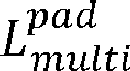
equation 4. There-authentication manager 280 can use the eye re-authentication dataset to train M'eye_pad for eye re-authentication with a loss function
equation 5. There-authentication manager 280 can use the PAD dataset to train M'eye_pad for PAD with a loss function
re-authentication manager 280 can alternatively use the loss function


pad_eye is the embedding vector determined by the metric learning model Meye_Pad , and emb M'pad_eye is the embedding vector determined by the metric learning model M'eye_pad. - Furthermore, the
user identification architecture 200 can evaluate a machine learning model for the validation users based on a True Acceptance Rate (TAR) at False Acceptance Rate (FAR). For example, the TAR at FAR can be 2e-5. In particular, theuser identification architecture 200 can apply an offline evaluation to increase model robustness for real-time implementation as all the frames are captured within about 10 millisecond interval. For example, theuser identification architecture 200 can determine a user-user distance matrix 248 using video stream recordings for the validation users. Based on the user-user distance matrix 248, theuser identification architecture 200 can identify the user identity using a Nearest Neighbor algorithm 250. As a result, theuser identification architecture 200 can determine a TAR@FAR to evaluate the performance of the machine learning model. -
FIGs. 4A and4B illustrate example periocular images from five internal-facing eye tracking cameras ofheadset 104. Theheadset 104 has five internal-facing eye tracking cameras for use cases such as foveated rendering and dynamic uniformity correction.FIG. 4 shows a frame of periocular images comprising five camera images coming in at one timestamp, such as image (camera 1) 402, image (camera 2) 404, image (camera 3) 406, image (camera 4) 408, and image (camera 5) 410, that focus on different parts of a periocular region of a user. For example, each camera image can be captured by one of five user facing cameras which look at various parts of the face, such as left and right eyes, left and right sides of mouth, and forehead. In particular, these five user facing cameras can be 850 nanometers (nm) infrared cameras with a resolution of 400x400 pixels. Each of these five tracking cameras can use near infrared (NIR) light-emitting diode (LED) to illuminate each region of the face of the user.FIG. 4B shows an example periocular region of the user which may include aneye 422, apupil 424, aneyelid 426, aneyebrow 428, and aniris 430. - As another example, the five cameras associated with
headset 104 can record a plurality of frames of periocular images for a predetermined time period, such as 1.5 seconds, at a predetermined frame rate, such 72 fps when the user is forward-gazing during this time. It is preferred that the user looks right into the camera to record high quality periocular images for the user when the AR/VR systems perform eye re-authentication and presentation attack detection. The periocular images can have a low signal to noise ratio when the user looks in various directions during eye re-authentication and presentation attack detection because the captured periocular images can include less eye information. Thus, the AR/VR systems can record multiple frames of periocular images to determine a signature of the user. For example, the AR/VR systems can determine a registered signature of a user using a plurality of live-captured recordings of periocular images of the user during a first time period. The determined registered signature of the user can be stored in a database. Likewise, the AR/VR systems can determine a testing signature of the user based on a plurality of live-captured recordings of periocular images of the user during a second time period. As a result, the AR/VR systems can perform eye re-authentication and presentation attack detection for the user by comparing stored registered signature to the live-captured testing signature of the user. -
FIG. 5 illustrates an example metric learning model training for eye re-authentication based on a plurality of periocular images from five internal-facing eye tracking cameras ofheadset 104. The metric learning model is trained using recorded periocular images from the selected users for model training. For example, the AR/VR systems can choose about ten recordings for each user in the training set and extract two camera images for all frames in the first 1.5 seconds of the recording when the user is forward-gazing during this time.FIG. 5 shows the AR/VR systems can train themetric learning model 500 using an encodedimage batch 504 of the plurality offrames 502 of periocular images. Each frame can include two periocular images for left eye and right eye from a particular user. The AR/VR systems can train themetric learning model 500 to determine high-dimensional features at both high- and low-levels based on texture, color, and shape using the input encodedimage batch 504. For example, the determined high-dimensional features include shape, texture, and color associated with eye, eyelashes, eyebrows, eye-lid, and other discriminative periocular characteristics for personal identification. Themetric learning model 500 can assess the generated high-dimensional features using a sharedconvolutional encoder 506 to determine an embeddingvector 508 for each image. For example, the sharedconvolutional encoder 506 can be based on a convolutional neural network using Conv-Relu-Conv blocks that do not share weights for the plurality of periocular images. As another example, a separate embedding head is attached to the determined embeddingvector 508 per image which is L2 normalized. Themetric learning model 500 can calculate a loss function for each head separately using the determined L-2 normalized embeddingvectors 508. As a result, themetric learning model 500 can calculate a batchhard triplet loss 510 for each image and sum both the individual camera losses to determine a total loss for the training dataset. -
FIG. 6A illustrates an examplemetric learning model 600 based on a triplet loss using an anchor, a positive image, and a negative image. A conventional metric learning model can learn a similarity degree between two images through network learning. Themetric learning model 600 can use images from three categories, such asanchor data 602,positive data 604, andnegative data 606. For example, theanchor data 602 is a sample image chosen from a training set of images. Thepositive data 604 is an image which is similar toanchor 602. Thenegative data 606 is an image which is different fromanchor 602. Themetric learning model 600 can apply an encoder (anchor) 612 to determine an embedding vector (anchor) 622 based on theinput anchor data 602. Likewise, themetric learning model 600 can apply an encoder (positive) 614 to determine an embedding vector (positive) 624 based on the inputpositive data 604. Themetric learning model 600 can apply an encoder (negative) 616 to determine an embedding vector (negative) 626 based on the inputnegative data 606. Thus, themetric learning model 600 can determine a distance between each two images in the input data sets based on the embedding vector (anchor) 6222, the embedding vector (positive) 624, and the embedding vector (negative) 626. - The
metric learning model 600 can also use a hard mining algorithm to find the hardest sample to train the model. In particular, the hard mining algorithm can calculate pairwise distances for embedding vectors of all periocular images of all training users. For all training users, the hard mining algorithm can evaluate all the determined pairwise distances and apply a random hardest negative sampling strategy to find the hardest triplets from the embedded feature space, which ensures that all triplets are valid. As a result, themetric learning model 600 can determine ahard triplet loss 630 based onequation 7 using a distance d(ai, pi ) between theanchor data 602 and thepositive data 604, a distance d(ai, ni ) between theanchor data 602 and thenegative data 604, and a margin α. Themetric learning model 600 can apply thehard triplet loss 630 to adjust weights of the metric learning model, such as encoder (anchor) 612, encoder (positive) 614, and encoder (negative) 616, to minimize the distance d(ai, pi ) between theanchor data 602 and thepositive data 604 and maximize the distance d(ai, ni ) between theanchor data 602 and thenegative data 604 until the difference between d(ai, ni ) and d(ai, ni ) is greater than the margin α.
-
FIG. 6B illustrates anexample embedding space 650 based on an anchor, a positive image, and a negative image. Themetric learning model 600 can map the determined high-dimensional embeddings to a multi-dimensional embeddingspace 650. For example,FIG. 6B shows a3D embedding space 650 which includes three three-dimensional (3D) embeddings, such as embedding vector (anchor) 622, embedding vector (positive) 624, and embedding vector (negative) 626. The weights in the metric learning model are determined to minimize the distance between the feature vectors of anchor and positive and maximize the distance between anchor and negative until the differences of these two distances is larger than a margin α. As a result, the metric learning model is optimized to pull positive images of the identity closer in a natural cluster and push negative images of different identities away from each other. In the end, the triplet loss based metric learning model can evaluate the nature cluster of positive images of the identity closer for eye re-authentication. -
FIG. 7 illustrates an examplemetric learning model 700 for both left and right eyes of a user. Themetric learning model 700 can be trained on both left eye and right eye images from a user. In particular,FIG. 7 shows the AR/VR systems obtain a sequence of left eye images, such as image sequence (left eye) 702, and a sequence of right eye images, such as image sequence (right eye) 722. Each sequence includes a plurality of frames captured from the incoming video stream of infrared cameras of theheadset 104. The AR/VR systems can train ametric learning model 700 based on a shared convolution encoder (left eye) 704 to determine an embedding vector (left eye) 706 for each image. Likewise, the AR/VR systems can train another metric learning model based on a shared convolution encoder (right eye) 724 to determine an embedding vector (right eye) 726 for each image. In particular, the shared convolution encoder (left eye) 704 and the shared convolution encoder (right eye) 724 can use the same weights for the same image. The AR/VR systems can determine an embeddingvector sequence 750 by combining the determined embedding vectors for the plurality of frames in the sequences of left and right eye images. As a result, the AR/VR systems can determine an average embedding vector 760 by averaging the embeddingvector sequence 750 over all the frames in the input image sequences. -
FIG. 8A illustrates an exampleoffline evaluation 800 of a metric learning model. The AR/VR systems can apply theoffline evaluation 800 to increase model robustness for real-time implementation of the metric learning model. The AR/VR systems can split recordings into query and gallery recordings for each test user. The AR/VR systems can extract all camera images for all frames in the first 1.5 s of each recording to create aquery 802 and agallery 822. Thequery 802 can be a collection of randomly selected N frames from all query recordings for the test users. Thegallery 822 can be a collection of randomly selected M frames from all gallery recordings for the test users. For each test user from thegallery 822, the AR/VR systems can determine one or more embedding vectors (gallery) 826 for each image of theheadset 104 based on a metric learning model, such as encoder (gallery) 824. Likewise, for each user from thequery 802, the AR/VR systems can determine one or more embedding vectors (query) 820 for each image of theheadset 104 based on a metric learning model, such as encoder (query) 804. - Furthermore, the AR/VR systems can calculate a distance per
camera 830 between the test users in thequery 802 and the test users in thegallery 822 based onequation 1 using embedding vectors (query) 806 and embedding vectors (gallery) 826 for each image. As a result, the AR/VR systems can determine a similarity score between the test users in thequery 802 and in thegallery 822 for constructing a user-user distance matrix 850 which includes similarity scores between the test users in thequery 802 and in thegallery 826. The AR/VR systems can apply a Nearest Neighbor algorithm to identify a user in thequery 802 from all the users in thegallery 822. - The AR/VR systems can evaluate the performance of the trained metric learning model, such as encoder (query) 804, based on a predetermined TAR @ FAR. For example, the AR/VR systems can identify a similarity threshold such that a wrong user is given access only 1 in 50,000 times for a
TAR@FAR 2e-5. The AR/VR systems can apply the identified similarity threshold as a decision engine on the similarity scores to determine TAR based on how many times the correct user is admitted. The AR/VR systems can use the offline evaluation to train the metric learning model to maximize the TAR@FAR value. The AR/VR systems can also apply this approach for real-time implementation as all the frames are captured within about a 10 millisecond (ms) interval. -
FIG. 8B illustrates an example metric learning model performance associated with the effect of averaging over multiple frames. The AR/VR systems can determine embedding vectors using a plurality of frames of periocular images.FIG. 8B shows the number of frames that embedding vectors are averaged over has an effect on theTAR@FAR 2e-5 performance of the metric learning model. For a two camera model, when the input data has one gallery frame, the metric learning model has aTAR@FAR 2e-5 performance, such as 1 gallery frame (2 cameras) with varying query frames 810, in the range of 0.8481-0.8601 for 1-10 query frames of periocular images. However, when the input data has one query frame, the metric learning model has aTAR@FAR 2e-5 performance, such as 1 query frame (2 cameras) with varying gallery frames 812, which increases from 0.8481 for 1 gallery frame to 0.9406 for 10 gallery frames. Likewise, for a five camera model, the metric learning model has aTAR@FAR 2e-5 performance, such as 1 gallery frame (5 cameras) with varying query frames 814, in the range of 0.9790-0.9833 for 1-10 query frames. However, when the input data has one query frame, the metric learning model has aTAR@FAR 2e-5 performance, such as 1 query frame (5 cameras) with varying gallery frames 816, which increases from 0.9833 for 1 gallery frame to 0.9948 for 10 gallery frames. It is clear that averaging over multiple gallery frames can help more than averaging over multiple query frames because query frames are temporally correlated. -
FIG. 8C illustrates an example metric learning model performance associated with the effect of the aggregating function for a two camera model. The AR/VR systems can determine embedding vectors using a plurality of frames of periocular images based on an aggregating function. For example, the embedding vectors can be determined by choosing the maximum embedding vector for the plurality of frames of periocular images. The embedding vectors can be determined by choosing the average embedding vector over the plurality of frames of periocular images. The embedding vectors can be determined by choosing the sum embedding vector over the plurality of frames of periocular images.FIG. 8C shows the comparison of the effect of three aggregating functions on theTAR@FAR 2e-5 performance of a metric learning model. In particular, when the input data has one query frame and one gallery frame (1Q, 1G), the metric learning model has aTAR@FAR 2e-5 performance of 0.7666 formaximum embedding vectors 840, 0.8149 for average embedding vectors 842, and 0.8481 for sum embedding vectors 844. The comparison result is very similar for other query-gallery frame pairs, such as two query frames and 2 gallery frames (2Q, 2G), two query frames and 5 gallery frames (2Q, 5G), and five query frames and five gallery frames (5Q, 5G). It is clear that the sum embedding aggregating function has an overall good performance regardless of how many frames are involved. -
FIGS. 9A and 9B illustrate example presentation attacks for presentation attack detection. The presentation attacks seek to fool the authentication system by presenting artificial eye images, such as printed iris images of an individual or cosmetic contacts.FIG. 9A shows presentation attacks with paper glasses, funny eyes glasses, print, replay, and fake head from left to right.FIG. 9B shows presentation attacks with rigid Obama plastic Halloween mask, rigid transparent plastic mask, rigid custom make realistic mask, flexible custom made realistic mask, paper mask and from left to right. Theuser identification architecture 200 can apply aknowledge distillation algorithm 288 to learn both presentation attack detection and eye re-authentication to help with the effect of forgetting in a joint framework which is superior to multitask learning. In particular, theuser identification architecture 200 can use a trained metric learning model Meye as a teacher model for eye re-authentication as a starting model to update a machine learning model Meye_pad as a student model based on a presentation attack detection dataset. Theuser identification architecture 200 can minimize a knowledge distillation loss defined as a difference between the pairwise teacher similarity matrix and the pairwise student similarity matrix. - As a result, the knowledge distillation algorithm can be applied to supervise the training of the student model by capturing and transferring the knowledge of a more expensive teacher model. The knowledge distillation algorithm can be applied to reduce the effect of forgetting to identify input video streams belonging to a real user while rejecting other users deliberately trying to impersonate the true user. In particular, the AR/VR systems can determine an optimized machine learning model Meye_pad with a Spoof Acceptance Rate (SAR) below a predetermined SAR threshold, such as 7%, to detect spoof associated with presentation attacks and a net False Rejection Rate (FRR) below a predetermined FRR threshold, such as 10%. The Spoof Acceptance Rate is a measure of how many times presentation attacks are accepted as true users. The net False Rejection Rate is based on the total number of users rejected during eye re-authentication and presentation attack detection and the total number of users in the input dataset.
-
FIG. 10 illustrates anexample method 1000 for performing eye re-authentication and presentation attack detection using periocular images. Themethod 1000 may begin atstep 1005, where the computing system can obtain a plurality of first periocular images of a user during a first time period from a camera of an artificial reality device. In particular embodiments, the plurality of first periocular images can be video streams live-captured by the camera of a wearable AR/VR device. In particular embodiments, the camera can be an internal-facing eye tracking camera of the wearable AR/VR device. In particular embodiments, the plurality of first periocular images can be stored in a database. In particular embodiments, the plurality of first periocular images can include a plurality of frames, such as N frames, of periocular images for various parts of a periocular region of the user during the first time period. Atstep 1010, the method may use a deep-learning model to generate a plurality of first embeddings based on the plurality of first periocular images. The deep-learning model can be a metric learning model based on a shared convolutional encoder. In particular, the metric learning model can include Conv-Relu-Conv blocks that do not share weights for the plurality of periocular images. Atstep 1015, the method can generate a registered signature of the user based on the plurality of first embeddings. - At
step 1020, the method can obtain a plurality of second periocular images of the user during a second time period, from the camera. In particular embodiments, the plurality of second periocular images can be video streams live-captured by the camera of the wearable AR/VR device. In particular embodiments, the plurality of second periocular images can include a plurality of frames, such as M frames, of periocular images for various parts of a periocular region of the user during the second time period. Atstep 1025, the method can use the deep-learning model to generate a plurality of second embeddings based on the plurality of second periocular images. Atstep 1030, the method can generate a test signature of the user based on the plurality of second embeddings. Atstep 1035, the method can determine a spoof likelihood of presentation attacks using a knowledge distillation algorithm for the user based on the plurality of second embeddings. The method can update the deep learning model using the knowledge distillation algorithm to detect spoof associated with presentation attacks based on the plurality of second embeddings. Atstep 1040, the method can make a determination whether the spoof likelihood of presentation attacks is below a predetermined spoof threshold. Where the spoof likelihood of presentation attacks is below a predetermined likelihood threshold, the process may proceed to step 1045 to perform user authentication. Where the spoof likelihood of presentation attacks is above the predetermined likelihood threshold, the process may proceed to step 1060 to reject the user. Atstep 1045, the method can perform authentication based on a comparison between the test signature and the registered signature. The method can determine, using the updated deep learning model, a similarity score based on the test signature and the registered signature. Atstep 1050, the method can make a determination whether the test signature matches the registered signature using the similarity score. Where the similarity score is larger than a similarity threshold, the process may proceed to step 1055 to approve the user. Where the similarity score is smaller than a similarity threshold, the process may proceed to step 1060 to reject the user. - Particular embodiments may repeat one or more steps of the method of
FIG. 10 , where appropriate. Although this disclosure describes and illustrates particular steps of the method ofFIG. 10 as occurring in a particular order, this disclosure contemplates any suitable steps of the method ofFIG. 10 occurring in any suitable order. Moreover, although this disclosure describes and illustrates an example method for performing eye-reauthentication and presentation attack detection including the particular steps of the method ofFIG. 10 , this disclosure contemplates any suitable method for performing eye-reauthentication and presentation attack detection including any suitable steps, which may include all, some, or none of the steps of the method ofFIG. 10 , where appropriate. Furthermore, although this disclosure describes and illustrates particular components, devices, or systems carrying out particular steps of the method ofFIG. 10 , this disclosure contemplates any suitable combination of any suitable components, devices, or systems carrying out any suitable steps of the method ofFIG. 10 . -
FIG. 11 illustrates anexample computer system 1100. In particular embodiments, one ormore computer systems 1100 perform one or more steps of one or more methods described or illustrated herein. In particular embodiments, one ormore computer systems 1100 provide functionality described or illustrated herein. In particular embodiments, software running on one ormore computer systems 1100 performs one or more steps of one or more methods described or illustrated herein or provides functionality described or illustrated herein. Particular embodiments include one or more portions of one ormore computer systems 1100. Herein, reference to a computer system may encompass a computing device, and vice versa, where appropriate. Moreover, reference to a computer system may encompass one or more computer systems, where appropriate. - This disclosure contemplates any suitable number of
computer systems 1100. This disclosure contemplatescomputer system 1100 taking any suitable physical form. As example and not by way of limitation,computer system 1100 may be an embedded computer system, a system-on-chip (SOC), a single-board computer system (SBC) (such as, for example, a computer-on-module (COM) or system-on-module (SOM)), a desktop computer system, a laptop or notebook computer system, an interactive kiosk, a mainframe, a mesh of computer systems, a mobile telephone, a personal digital assistant (PDA), a server, a tablet computer system, an augmented/virtual reality device, or a combination of two or more of these. Where appropriate,computer system 1100 may include one ormore computer systems 1100; be unitary or distributed; span multiple locations; span multiple machines; span multiple data centers; or reside in a cloud, which may include one or more cloud components in one or more networks. Where appropriate, one ormore computer systems 1100 may perform without substantial spatial or temporal limitation one or more steps of one or more methods described or illustrated herein. As an example and not by way of limitation, one ormore computer systems 1100 may perform in real time or in batch mode one or more steps of one or more methods described or illustrated herein. One ormore computer systems 1100 may perform at different times or at different locations one or more steps of one or more methods described or illustrated herein, where appropriate. - In particular embodiments,
computer system 1100 includes aprocessor 1102,memory 1104,storage 1106, an input/output (I/O)interface 1108, acommunication interface 1110, and abus 1112. Although this disclosure describes and illustrates a particular computer system having a particular number of particular components in a particular arrangement, this disclosure contemplates any suitable computer system having any suitable number of any suitable components in any suitable arrangement. - In particular embodiments,
processor 1102 includes hardware for executing instructions, such as those making up a computer program. As an example and not by way of limitation, to execute instructions,processor 1102 may retrieve (or fetch) the instructions from an internal register, an internal cache,memory 1104, orstorage 1106; decode and execute them; and then write one or more results to an internal register, an internal cache,memory 1104, orstorage 1106. In particular embodiments,processor 1102 may include one or more internal caches for data, instructions, or addresses. This disclosure contemplatesprocessor 1102 including any suitable number of any suitable internal caches, where appropriate. As an example and not by way of limitation,processor 1102 may include one or more instruction caches, one or more data caches, and one or more translation lookaside buffers (TLBs). Instructions in the instruction caches may be copies of instructions inmemory 1104 orstorage 1106, and the instruction caches may speed up retrieval of those instructions byprocessor 1102. Data in the data caches may be copies of data inmemory 1104 orstorage 1106 for instructions executing atprocessor 1102 to operate on; the results of previous instructions executed atprocessor 1102 for access by subsequent instructions executing atprocessor 1102 or for writing tomemory 1104 orstorage 1106; or other suitable data. The data caches may speed up read or write operations byprocessor 1102. The TLBs may speed up virtual-address translation forprocessor 1102. In particular embodiments,processor 1102 may include one or more internal registers for data, instructions, or addresses. This disclosure contemplatesprocessor 1102 including any suitable number of any suitable internal registers, where appropriate. Where appropriate,processor 1102 may include one or more arithmetic logic units (ALUs); be a multi-core processor; or include one ormore processors 1102. Although this disclosure describes and illustrates a particular processor, this disclosure contemplates any suitable processor. - In particular embodiments,
memory 1104 includes main memory for storing instructions forprocessor 1102 to execute or data forprocessor 1102 to operate on. As an example and not by way of limitation,computer system 1100 may load instructions fromstorage 1106 or another source (such as, for example, another computer system 1100) tomemory 1104.Processor 1102 may then load the instructions frommemory 1104 to an internal register or internal cache. To execute the instructions,processor 1102 may retrieve the instructions from the internal register or internal cache and decode them. During or after execution of the instructions,processor 1102 may write one or more results (which may be intermediate or final results) to the internal register or internal cache.Processor 1102 may then write one or more of those results tomemory 1104. In particular embodiments,processor 1102 executes only instructions in one or more internal registers or internal caches or in memory 1104 (as opposed tostorage 1106 or elsewhere) and operates only on data in one or more internal registers or internal caches or in memory 1104 (as opposed tostorage 1106 or elsewhere). One or more memory buses (which may each include an address bus and a data bus) may coupleprocessor 1102 tomemory 1104.Bus 1112 may include one or more memory buses, as described below. In particular embodiments, one or more memory management units (MMUs) reside betweenprocessor 1102 andmemory 1104 and facilitate accesses tomemory 1104 requested byprocessor 1102. In particular embodiments,memory 1104 includes random access memory (RAM). This RAM may be volatile memory, where appropriate. Where appropriate, this RAM may be dynamic RAM (DRAM) or static RAM (SRAM). Moreover, where appropriate, this RAM may be single-ported or multi-ported RAM. This disclosure contemplates any suitable RAM.Memory 1104 may include one ormore memories 1104, where appropriate. Although this disclosure describes and illustrates particular memory, this disclosure contemplates any suitable memory. - In particular embodiments,
storage 1106 includes mass storage for data or instructions. As an example and not by way of limitation,storage 1106 may include a hard disk drive (HDD), a floppy disk drive, flash memory, an optical disc, a magneto-optical disc, magnetic tape, or a Universal Serial Bus (USB) drive or a combination of two or more of these.Storage 1106 may include removable or non-removable (or fixed) media, where appropriate.Storage 1106 may be internal or external tocomputer system 1100, where appropriate. In particular embodiments,storage 1106 is non-volatile, solid-state memory. In particular embodiments,storage 1106 includes read-only memory (ROM). Where appropriate, this ROM may be mask-programmed ROM, programmable ROM (PROM), erasable PROM (EPROM), electrically erasable PROM (EEPROM), electrically alterable ROM (EAROM), or flash memory or a combination of two or more of these. This disclosure contemplatesmass storage 1106 taking any suitable physical form.Storage 1106 may include one or more storage control units facilitating communication betweenprocessor 1102 andstorage 1106, where appropriate. Where appropriate,storage 1106 may include one ormore storages 1106. Although this disclosure describes and illustrates particular storage, this disclosure contemplates any suitable storage. - In particular embodiments, I/
O interface 1108 includes hardware, software, or both, providing one or more interfaces for communication betweencomputer system 1100 and one or more I/O devices.Computer system 1100 may include one or more of these I/O devices, where appropriate. One or more of these I/O devices may enable communication between a person andcomputer system 1100. As an example and not by way of limitation, an I/O device may include a keyboard, keypad, microphone, monitor, mouse, printer, scanner, speaker, still camera, stylus, tablet, touch screen, trackball, video camera, another suitable I/O device or a combination of two or more of these. An I/O device may include one or more sensors. This disclosure contemplates any suitable I/O devices and any suitable I/O interfaces 1108 for them. Where appropriate, I/O interface 1108 may include one or more device or softwaredrivers enabling processor 1102 to drive one or more of these I/O devices. I/O interface 1108 may include one or more I/O interfaces 1108, where appropriate. Although this disclosure describes and illustrates a particular I/O interface, this disclosure contemplates any suitable I/O interface. - In particular embodiments,
communication interface 1110 includes hardware, software, or both providing one or more interfaces for communication (such as, for example, packet-based communication) betweencomputer system 1100 and one or moreother computer systems 1100 or one or more networks. As an example and not by way of limitation,communication interface 1110 may include a network interface controller (NIC) or network adapter for communicating with an Ethernet or other wire-based network or a wireless NIC (WNIC) or wireless adapter for communicating with a wireless network, such as a WI-FI network. This disclosure contemplates any suitable network and anysuitable communication interface 1110 for it. As an example and not by way of limitation,computer system 1100 may communicate with an ad hoc network, a personal area network (PAN), a local area network (LAN), a wide area network (WAN), a metropolitan area network (MAN), or one or more portions of the Internet or a combination of two or more of these. One or more portions of one or more of these networks may be wired or wireless. As an example,computer system 1100 may communicate with a wireless PAN (WPAN) (such as, for example, a BLUETOOTH WPAN), a WI-FI network, a WI-MAX network, a cellular telephone network (such as, for example, a Global System for Mobile Communications (GSM) network), or other suitable wireless network or a combination of two or more of these.Computer system 1100 may include anysuitable communication interface 1110 for any of these networks, where appropriate.Communication interface 1110 may include one ormore communication interfaces 1110, where appropriate. Although this disclosure describes and illustrates a particular communication interface, this disclosure contemplates any suitable communication interface. - In particular embodiments,
bus 1112 includes hardware, software, or both coupling components ofcomputer system 1100 to each other. As an example and not by way of limitation,bus 1112 may include an Accelerated Graphics Port (AGP) or other graphics bus, an Enhanced Industry Standard Architecture (EISA) bus, a front-side bus (FSB), a HYPERTRANSPORT (HT) interconnect, an Industry Standard Architecture (ISA) bus, an INFINIBAND interconnect, a low-pin-count (LPC) bus, a memory bus, a Micro Channel Architecture (MCA) bus, a Peripheral Component Interconnect (PCI) bus, a PCI-Express (PCIe) bus, a serial advanced technology attachment (SATA) bus, a Video Electronics Standards Association local (VLB) bus, or another suitable bus or a combination of two or more of these.Bus 1112 may include one ormore buses 1112, where appropriate. Although this disclosure describes and illustrates a particular bus, this disclosure contemplates any suitable bus or interconnect. - Herein, a computer-readable non-transitory storage medium or media may include one or more semiconductor-based or other integrated circuits (ICs) (such, as for example, field-programmable gate arrays (FPGAs) or application-specific ICs (ASICs)), hard disk drives (HDDs), hybrid hard drives (HHDs), optical discs, optical disc drives (ODDs), magneto-optical discs, magneto-optical drives, floppy diskettes, floppy disk drives (FDDs), magnetic tapes, solid-state drives (SSDs), RAM-drives, SECURE DIGITAL cards or drives, any other suitable computer-readable non-transitory storage media, or any suitable combination of two or more of these, where appropriate. A computer-readable non-transitory storage medium may be volatile, non-volatile, or a combination of volatile and non-volatile, where appropriate.
- Herein, "or" is inclusive and not exclusive, unless expressly indicated otherwise or indicated otherwise by context. Therefore, herein, "A or B" means "A, B, or both," unless expressly indicated otherwise or indicated otherwise by context. Moreover, "and" is both joint and several, unless expressly indicated otherwise or indicated otherwise by context. Therefore, herein, "A and B" means "A and B, jointly or severally," unless expressly indicated otherwise or indicated otherwise by context.
- The scope of this disclosure encompasses all changes, substitutions, variations, alterations, and modifications to the example embodiments described or illustrated herein that a person having ordinary skill in the art would comprehend. The scope of this disclosure is not limited to the example embodiments described or illustrated herein. Moreover, although this disclosure describes and illustrates respective embodiments herein as including particular components, elements, feature, functions, operations, or steps, any of these embodiments may include any combination or permutation of any of the components, elements, features, functions, operations, or steps described or illustrated anywhere herein that a person having ordinary skill in the art would comprehend. Furthermore, reference in the appended claims to an apparatus or system or a component of an apparatus or system being adapted to, arranged to, capable of, configured to, enabled to, operable to, or operative to perform a particular function encompasses that apparatus, system, component, whether or not it or that particular function is activated, turned on, or unlocked, as long as that apparatus, system, or component is so adapted, arranged, capable, configured, enabled, operable, or operative. Additionally, although this disclosure describes or illustrates particular embodiments as providing particular advantages, particular embodiments may provide none, some, or all of these advantages.
Claims (11)
- A method comprising, by a computing system of an artificial reality, AR, device:obtaining, from a camera of the AR device, a plurality of first periocular images of a user during a first time period;generating, using a deep-learning model, a plurality of first embeddings based on the plurality of first periocular images;generating a registered signature of the user based on the plurality of first embeddings;obtaining, from the camera, a plurality of second periocular images of the user during a second time period;generating, using the deep-learning model, a plurality of second embeddings based on the plurality of second periocular images;generating a test signature of the user based on the plurality of second embeddings; andperforming authentication based on a comparison between the test signature and the registered signature.
- The method of claim 1, further comprising:determining, using a knowledge distillation algorithm, a spoof likelihood of presentation attacks based on the plurality of second embeddings for the plurality of second periocular images;determining, using the deep-learning model, a similarity score between the plurality of first embeddings for the registered signature and the plurality of second embeddings for the test signature; andin response to determining that the similarity score is greater than a predetermined similarity threshold and the spoof likelihood of presentation attacks is below a predetermined spoof threshold, authenticating the user.
- The method of claim 2, further comprising:
in response to determining that the similarity score is smaller than the predetermined similarity threshold, rejecting the user. - The method of claim 2 or 3, further comprising:
in response to determining that the spoof likelihood of presentation attacks is greater than the predetermined spoof threshold, rejecting the user. - The method of any of claims 2 to 4,
wherein the knowledge distillation algorithm includes a presentation detection loss based on a standard cross-entropy classification loss to classify a given image as a spoof image and a distillation loss as a regularization term. - The method of any preceding claim,wherein the authentication of the user occurs in conjunction with predetermined time periods, andwherein the authentication of the user is triggered when the user navigates into a new virtual environment.
- The method of any preceding claim,
wherein the deep-learning model is a metric learning model using a shared convolutional encoder which includes Conv-Relu-Conv blocks and does not share weights for the plurality of first periocular images and the plurality of second periocular images. - The method of any preceding claim, further comprising:calculating a user-user distance matrix based on similarity scores between a plurality of users;identifying a user from the plurality of users using a Nearest Neighbor algorithm and the user-user distance matrix; andevaluating the performance of the deep-learning model based on True Acceptance Rate at False Acceptance Rate and the user-user distance matrix.
- One or more computer-readable storage media embodying software that is operable when executed to carry out the method of any preceding claim.
- A system comprising:one or more processors; andone or more computer-readable storage media coupled to one or more of the processors and comprising instructions operable when executed by one or more of the processors to cause the system to carry out the method of any of claims 1 to 8.
- A computer program product comprising instructions which, when the program is executed by a computer, cause the computer to carry out the method of any of claims 1 to 8.
Applications Claiming Priority (1)
| Application Number | Priority Date | Filing Date | Title |
|---|---|---|---|
| US202218068790A | 2022-12-20 | 2022-12-20 |
Publications (1)
| Publication Number | Publication Date |
|---|---|
| EP4390862A1 true EP4390862A1 (en) | 2024-06-26 |
Family
ID=88697619
Family Applications (1)
| Application Number | Title | Priority Date | Filing Date |
|---|---|---|---|
| EP23207887.3A Withdrawn EP4390862A1 (en) | 2022-12-20 | 2023-11-06 | User authentication based on stream and periocular images |
Country Status (2)
| Country | Link |
|---|---|
| EP (1) | EP4390862A1 (en) |
| CN (1) | CN118228231A (en) |
Cited By (1)
| Publication number | Priority date | Publication date | Assignee | Title |
|---|---|---|---|---|
| CN120853063A (en) * | 2025-09-11 | 2025-10-28 | 西安工业大学 | A SAR image aircraft target detection method, system and medium |
-
2023
- 2023-11-06 EP EP23207887.3A patent/EP4390862A1/en not_active Withdrawn
- 2023-12-19 CN CN202311757149.XA patent/CN118228231A/en active Pending
Non-Patent Citations (3)
| Title |
|---|
| BOUTROS FADI ET AL: "Iris and periocular biometrics for head mounted displays: Segmentation, recognition, and synthetic data generation", IMAGE AND VISION COMPUTING, ELSEVIER, GUILDFORD, GB, vol. 104, 22 August 2020 (2020-08-22), XP086372022, ISSN: 0262-8856, [retrieved on 20200822], DOI: 10.1016/J.IMAVIS.2020.104007 * |
| DHAR PRITHVIRAJ ET AL: "EyePAD++: A Distillation-based approach for joint Eye Authentication and Presentation Attack Detection using Periocular Images", 2022 IEEE/CVF CONFERENCE ON COMPUTER VISION AND PATTERN RECOGNITION (CVPR), IEEE, 18 June 2022 (2022-06-18), pages 20186 - 20195, XP034194933, DOI: 10.1109/CVPR52688.2022.01958 * |
| HUANG GAO ET AL: "Densely Connected Convolutional Networks", 2017 IEEE CONFERENCE ON COMPUTER VISION AND PATTERN RECOGNITION (CVPR), IEEE COMPUTER SOCIETY, US, 21 July 2017 (2017-07-21), pages 2261 - 2269, XP033249569, ISSN: 1063-6919, [retrieved on 20171106], DOI: 10.1109/CVPR.2017.243 * |
Cited By (1)
| Publication number | Priority date | Publication date | Assignee | Title |
|---|---|---|---|---|
| CN120853063A (en) * | 2025-09-11 | 2025-10-28 | 西安工业大学 | A SAR image aircraft target detection method, system and medium |
Also Published As
| Publication number | Publication date |
|---|---|
| CN118228231A (en) | 2024-06-21 |
Similar Documents
| Publication | Publication Date | Title |
|---|---|---|
| Zhang | Deepfake generation and detection, a survey | |
| KR20230021043A (en) | Method and apparatus for recognizing object, and method and apparatus for learning recognizer | |
| US20190278894A1 (en) | Multiple-tiered facial recognition | |
| Ahuja et al. | Convolutional neural networks for ocular smartphone-based biometrics | |
| US12236717B2 (en) | Spoof detection based on challenge response analysis | |
| US11734570B1 (en) | Training a network to inhibit performance of a secondary task | |
| US11335094B2 (en) | Detecting fake videos | |
| US20230343050A1 (en) | Systems and Methods for Providing User Experiences on AR/VR Systems | |
| Mittal et al. | GOTCHA: Real-time video deepfake detection via challenge-response | |
| Yu et al. | Salience-aware face presentation attack detection via deep reinforcement learning | |
| JP2023530893A (en) | Data processing and trading decision system | |
| Shende et al. | Deep learning based authentication schemes for smart devices in different modalities: progress, challenges, performance, datasets and future directions | |
| Chou | Presentation attack detection based on score level fusion and challenge-response technique: C.-L. Chou | |
| Akhdan et al. | Face recognition with anti spoofing eye blink detection | |
| Bharadwaj et al. | Reliable human authentication using AI-based multibiometric image sensor fusion: Assessment of performance in information security | |
| Akrout | Deep facial emotion recognition model using optimal feature extraction and dual‐attention residual U‐Net classifier | |
| Nosrati et al. | Machine Learning and Metaheuristic Algorithms for Voice-Based Authentication: A Mobile Banking Case Study | |
| Yuvasini et al. | Enhancing societal security: a multimodal deep learning approach for a public person identification and tracking system | |
| RU2316051C2 (en) | Method and system for automatically checking presence of a living human face in biometric safety systems | |
| CN118228231A (en) | User authentication based on flow and periocular images | |
| WO2023068956A1 (en) | Method and system for identifying synthetically altered face images in a video | |
| US12619695B2 (en) | Systems and methods for AI assisted biometric authentication | |
| Chatterjee et al. | Identity Verification in Real Time Proctoring: An Integrated Approach with Face Recognition and Eye Tracking | |
| Favorskaya | Face presentation attack detection: Research opportunities and perspectives | |
| Tapu et al. | Face recognition in video streams for mobile assistive devices dedicated to visually impaired |
Legal Events
| Date | Code | Title | Description |
|---|---|---|---|
| PUAI | Public reference made under article 153(3) epc to a published international application that has entered the european phase |
Free format text: ORIGINAL CODE: 0009012 |
|
| STAA | Information on the status of an ep patent application or granted ep patent |
Free format text: STATUS: THE APPLICATION HAS BEEN PUBLISHED |
|
| AK | Designated contracting states |
Kind code of ref document: A1 Designated state(s): AL AT BE BG CH CY CZ DE DK EE ES FI FR GB GR HR HU IE IS IT LI LT LU LV MC ME MK MT NL NO PL PT RO RS SE SI SK SM TR |
|
| STAA | Information on the status of an ep patent application or granted ep patent |
Free format text: STATUS: THE APPLICATION IS DEEMED TO BE WITHDRAWN |
|
| 18D | Application deemed to be withdrawn |
Effective date: 20250103 |