EP4389861A1 - Household and/or commercial cleaning article - Google Patents
Household and/or commercial cleaning article Download PDFInfo
- Publication number
- EP4389861A1 EP4389861A1 EP22216429.5A EP22216429A EP4389861A1 EP 4389861 A1 EP4389861 A1 EP 4389861A1 EP 22216429 A EP22216429 A EP 22216429A EP 4389861 A1 EP4389861 A1 EP 4389861A1
- Authority
- EP
- European Patent Office
- Prior art keywords
- household
- spore
- biofilm
- cleaning article
- microorganism
- Prior art date
- Legal status (The legal status is an assumption and is not a legal conclusion. Google has not performed a legal analysis and makes no representation as to the accuracy of the status listed.)
- Pending
Links
- 238000004140 cleaning Methods 0.000 title claims abstract description 81
- 244000005700 microbiome Species 0.000 claims abstract description 87
- 230000002503 metabolic effect Effects 0.000 claims abstract description 40
- 238000000034 method Methods 0.000 claims abstract description 17
- 239000006260 foam Substances 0.000 claims abstract description 15
- 239000004753 textile Substances 0.000 claims abstract description 9
- 230000000694 effects Effects 0.000 claims description 81
- 238000012360 testing method Methods 0.000 claims description 72
- 239000004382 Amylase Substances 0.000 claims description 45
- 102000013142 Amylases Human genes 0.000 claims description 45
- 108010065511 Amylases Proteins 0.000 claims description 45
- 235000019418 amylase Nutrition 0.000 claims description 45
- 108091005804 Peptidases Proteins 0.000 claims description 42
- 239000004365 Protease Substances 0.000 claims description 42
- 102100037486 Reverse transcriptase/ribonuclease H Human genes 0.000 claims description 42
- 239000011159 matrix material Substances 0.000 claims description 35
- 238000005406 washing Methods 0.000 claims description 33
- 230000000813 microbial effect Effects 0.000 claims description 26
- 229920000642 polymer Polymers 0.000 claims description 17
- 239000004814 polyurethane Substances 0.000 claims description 16
- 229920002472 Starch Polymers 0.000 claims description 15
- 239000008107 starch Substances 0.000 claims description 15
- 235000019698 starch Nutrition 0.000 claims description 15
- 229920002635 polyurethane Polymers 0.000 claims description 13
- 239000011148 porous material Substances 0.000 claims description 13
- 235000014469 Bacillus subtilis Nutrition 0.000 claims description 12
- 229920002689 polyvinyl acetate Polymers 0.000 claims description 12
- 239000011118 polyvinyl acetate Substances 0.000 claims description 12
- 239000000126 substance Substances 0.000 claims description 12
- 229920002678 cellulose Polymers 0.000 claims description 11
- 239000001913 cellulose Substances 0.000 claims description 11
- -1 polyacrylic Substances 0.000 claims description 10
- 229920000297 Rayon Polymers 0.000 claims description 9
- VYPSYNLAJGMNEJ-UHFFFAOYSA-N Silicium dioxide Chemical compound O=[Si]=O VYPSYNLAJGMNEJ-UHFFFAOYSA-N 0.000 claims description 9
- 244000063299 Bacillus subtilis Species 0.000 claims description 8
- 229920000742 Cotton Polymers 0.000 claims description 8
- 239000011521 glass Substances 0.000 claims description 8
- 229920000728 polyester Polymers 0.000 claims description 8
- 239000004952 Polyamide Substances 0.000 claims description 7
- 239000011230 binding agent Substances 0.000 claims description 7
- 239000000463 material Substances 0.000 claims description 7
- 239000000203 mixture Substances 0.000 claims description 7
- 229920002647 polyamide Polymers 0.000 claims description 7
- 241000193830 Bacillus <bacterium> Species 0.000 claims description 6
- 241000195576 Bacillus subtilis group Species 0.000 claims description 6
- 108010010803 Gelatin Proteins 0.000 claims description 6
- 244000043261 Hevea brasiliensis Species 0.000 claims description 6
- 239000004372 Polyvinyl alcohol Substances 0.000 claims description 6
- 239000008273 gelatin Substances 0.000 claims description 6
- 229920000159 gelatin Polymers 0.000 claims description 6
- 235000019322 gelatine Nutrition 0.000 claims description 6
- 235000011852 gelatine desserts Nutrition 0.000 claims description 6
- 229920003052 natural elastomer Polymers 0.000 claims description 6
- 229920001194 natural rubber Polymers 0.000 claims description 6
- 229920002451 polyvinyl alcohol Polymers 0.000 claims description 6
- 241000193744 Bacillus amyloliquefaciens Species 0.000 claims description 5
- 244000025254 Cannabis sativa Species 0.000 claims description 5
- 239000003082 abrasive agent Substances 0.000 claims description 5
- 239000000835 fiber Substances 0.000 claims description 5
- 239000002245 particle Substances 0.000 claims description 5
- 230000008569 process Effects 0.000 claims description 5
- 235000018102 proteins Nutrition 0.000 claims description 5
- 102000004169 proteins and genes Human genes 0.000 claims description 5
- 108090000623 proteins and genes Proteins 0.000 claims description 5
- 241000194108 Bacillus licheniformis Species 0.000 claims description 4
- 235000012766 Cannabis sativa ssp. sativa var. sativa Nutrition 0.000 claims description 4
- 235000012765 Cannabis sativa ssp. sativa var. spontanea Nutrition 0.000 claims description 4
- PNEYBMLMFCGWSK-UHFFFAOYSA-N aluminium oxide Inorganic materials [O-2].[O-2].[O-2].[Al+3].[Al+3] PNEYBMLMFCGWSK-UHFFFAOYSA-N 0.000 claims description 4
- 235000009120 camo Nutrition 0.000 claims description 4
- 235000005607 chanvre indien Nutrition 0.000 claims description 4
- 238000001035 drying Methods 0.000 claims description 4
- 239000011487 hemp Substances 0.000 claims description 4
- 229920000747 poly(lactic acid) Polymers 0.000 claims description 4
- 239000004626 polylactic acid Substances 0.000 claims description 4
- 239000000377 silicon dioxide Substances 0.000 claims description 4
- 229920002994 synthetic fiber Polymers 0.000 claims description 4
- 210000002268 wool Anatomy 0.000 claims description 4
- LUEWUZLMQUOBSB-FSKGGBMCSA-N (2s,3s,4s,5s,6r)-2-[(2r,3s,4r,5r,6s)-6-[(2r,3s,4r,5s,6s)-4,5-dihydroxy-2-(hydroxymethyl)-6-[(2r,4r,5s,6r)-4,5,6-trihydroxy-2-(hydroxymethyl)oxan-3-yl]oxyoxan-3-yl]oxy-4,5-dihydroxy-2-(hydroxymethyl)oxan-3-yl]oxy-6-(hydroxymethyl)oxane-3,4,5-triol Chemical compound O[C@H]1[C@@H](O)[C@H](O)[C@@H](CO)O[C@H]1O[C@@H]1[C@@H](CO)O[C@@H](O[C@@H]2[C@H](O[C@@H](OC3[C@H](O[C@@H](O)[C@@H](O)[C@H]3O)CO)[C@@H](O)[C@H]2O)CO)[C@H](O)[C@H]1O LUEWUZLMQUOBSB-FSKGGBMCSA-N 0.000 claims description 3
- NIXOWILDQLNWCW-UHFFFAOYSA-M Acrylate Chemical compound [O-]C(=O)C=C NIXOWILDQLNWCW-UHFFFAOYSA-M 0.000 claims description 3
- 244000198134 Agave sisalana Species 0.000 claims description 3
- 241000193410 Bacillus atrophaeus Species 0.000 claims description 3
- 241000266830 Bacillus sonorensis Species 0.000 claims description 3
- 241000315694 Bacillus tequilensis Species 0.000 claims description 3
- 241001249119 Bacillus vallismortis Species 0.000 claims description 3
- OKTJSMMVPCPJKN-UHFFFAOYSA-N Carbon Chemical compound [C] OKTJSMMVPCPJKN-UHFFFAOYSA-N 0.000 claims description 3
- BVKZGUZCCUSVTD-UHFFFAOYSA-L Carbonate Chemical compound [O-]C([O-])=O BVKZGUZCCUSVTD-UHFFFAOYSA-L 0.000 claims description 3
- 244000146553 Ceiba pentandra Species 0.000 claims description 3
- 235000003301 Ceiba pentandra Nutrition 0.000 claims description 3
- 229920002101 Chitin Polymers 0.000 claims description 3
- 229920001661 Chitosan Polymers 0.000 claims description 3
- 102000008186 Collagen Human genes 0.000 claims description 3
- 108010035532 Collagen Proteins 0.000 claims description 3
- 229920002581 Glucomannan Polymers 0.000 claims description 3
- 240000006240 Linum usitatissimum Species 0.000 claims description 3
- 235000004431 Linum usitatissimum Nutrition 0.000 claims description 3
- 229920000877 Melamine resin Polymers 0.000 claims description 3
- 239000004743 Polypropylene Substances 0.000 claims description 3
- 229920001807 Urea-formaldehyde Polymers 0.000 claims description 3
- 229910052799 carbon Inorganic materials 0.000 claims description 3
- 235000010980 cellulose Nutrition 0.000 claims description 3
- 229920001436 collagen Polymers 0.000 claims description 3
- 229940046240 glucomannan Drugs 0.000 claims description 3
- 230000002401 inhibitory effect Effects 0.000 claims description 3
- 229920005610 lignin Polymers 0.000 claims description 3
- JDSHMPZPIAZGSV-UHFFFAOYSA-N melamine Chemical compound NC1=NC(N)=NC(N)=N1 JDSHMPZPIAZGSV-UHFFFAOYSA-N 0.000 claims description 3
- 229920001277 pectin Polymers 0.000 claims description 3
- 239000001814 pectin Substances 0.000 claims description 3
- 235000010987 pectin Nutrition 0.000 claims description 3
- ISWSIDIOOBJBQZ-UHFFFAOYSA-N phenol group Chemical group C1(=CC=CC=C1)O ISWSIDIOOBJBQZ-UHFFFAOYSA-N 0.000 claims description 3
- 229920001568 phenolic resin Polymers 0.000 claims description 3
- 229920000515 polycarbonate Polymers 0.000 claims description 3
- 239000004417 polycarbonate Substances 0.000 claims description 3
- 229920000098 polyolefin Polymers 0.000 claims description 3
- 235000013824 polyphenols Nutrition 0.000 claims description 3
- 229920001155 polypropylene Polymers 0.000 claims description 3
- 239000008262 pumice Substances 0.000 claims description 3
- 229920005989 resin Polymers 0.000 claims description 3
- 239000011347 resin Substances 0.000 claims description 3
- 229920003048 styrene butadiene rubber Polymers 0.000 claims description 3
- 229920003051 synthetic elastomer Polymers 0.000 claims description 3
- 239000012209 synthetic fiber Substances 0.000 claims description 3
- 239000005061 synthetic rubber Substances 0.000 claims description 3
- 229920001864 tannin Polymers 0.000 claims description 3
- 235000018553 tannin Nutrition 0.000 claims description 3
- 239000001648 tannin Substances 0.000 claims description 3
- 241001249117 Bacillus mojavensis Species 0.000 claims description 2
- 241000194103 Bacillus pumilus Species 0.000 claims description 2
- 239000003124 biologic agent Substances 0.000 claims description 2
- 238000003490 calendering Methods 0.000 claims description 2
- 238000007598 dipping method Methods 0.000 claims description 2
- 235000013305 food Nutrition 0.000 claims description 2
- 238000007639 printing Methods 0.000 claims description 2
- 230000002829 reductive effect Effects 0.000 claims description 2
- 238000012502 risk assessment Methods 0.000 claims description 2
- 238000005507 spraying Methods 0.000 claims description 2
- 238000000151 deposition Methods 0.000 claims 1
- 210000004215 spore Anatomy 0.000 description 93
- 238000002835 absorbance Methods 0.000 description 29
- XLYOFNOQVPJJNP-UHFFFAOYSA-N water Chemical compound O XLYOFNOQVPJJNP-UHFFFAOYSA-N 0.000 description 27
- 230000007774 longterm Effects 0.000 description 25
- 239000000243 solution Substances 0.000 description 24
- 239000002609 medium Substances 0.000 description 23
- 239000000523 sample Substances 0.000 description 13
- FAPWRFPIFSIZLT-UHFFFAOYSA-M Sodium chloride Chemical compound [Na+].[Cl-] FAPWRFPIFSIZLT-UHFFFAOYSA-M 0.000 description 12
- 108010041102 azocasein Proteins 0.000 description 11
- 239000008367 deionised water Substances 0.000 description 11
- 229910021641 deionized water Inorganic materials 0.000 description 11
- 108091092584 GDNA Proteins 0.000 description 10
- 239000000872 buffer Substances 0.000 description 10
- 239000007788 liquid Substances 0.000 description 10
- 239000000843 powder Substances 0.000 description 10
- 239000011780 sodium chloride Substances 0.000 description 9
- 238000011534 incubation Methods 0.000 description 7
- 239000004006 olive oil Substances 0.000 description 7
- 235000008390 olive oil Nutrition 0.000 description 7
- 235000020183 skimmed milk Nutrition 0.000 description 7
- PEDCQBHIVMGVHV-UHFFFAOYSA-N Glycerine Chemical compound OCC(O)CO PEDCQBHIVMGVHV-UHFFFAOYSA-N 0.000 description 6
- 238000011081 inoculation Methods 0.000 description 6
- 239000006228 supernatant Substances 0.000 description 6
- 241000894006 Bacteria Species 0.000 description 5
- 229920005830 Polyurethane Foam Polymers 0.000 description 5
- 238000006243 chemical reaction Methods 0.000 description 5
- 239000000047 product Substances 0.000 description 5
- 241000894007 species Species 0.000 description 5
- 230000035882 stress Effects 0.000 description 5
- 238000011282 treatment Methods 0.000 description 5
- 241001465754 Metazoa Species 0.000 description 4
- 239000003153 chemical reaction reagent Substances 0.000 description 4
- 239000012634 fragment Substances 0.000 description 4
- 238000010438 heat treatment Methods 0.000 description 4
- 238000002156 mixing Methods 0.000 description 4
- 239000013595 supernatant sample Substances 0.000 description 4
- 238000012546 transfer Methods 0.000 description 4
- 101100439426 Bradyrhizobium diazoefficiens (strain JCM 10833 / BCRC 13528 / IAM 13628 / NBRC 14792 / USDA 110) groEL4 gene Proteins 0.000 description 3
- 102000004190 Enzymes Human genes 0.000 description 3
- 108090000790 Enzymes Proteins 0.000 description 3
- 102000004139 alpha-Amylases Human genes 0.000 description 3
- 108090000637 alpha-Amylases Proteins 0.000 description 3
- 229940024171 alpha-amylase Drugs 0.000 description 3
- 230000008901 benefit Effects 0.000 description 3
- 239000007853 buffer solution Substances 0.000 description 3
- 229940041514 candida albicans extract Drugs 0.000 description 3
- 239000003599 detergent Substances 0.000 description 3
- 230000002255 enzymatic effect Effects 0.000 description 3
- 229940088598 enzyme Drugs 0.000 description 3
- 230000008029 eradication Effects 0.000 description 3
- 238000011049 filling Methods 0.000 description 3
- 101150077981 groEL gene Proteins 0.000 description 3
- 230000036541 health Effects 0.000 description 3
- 238000011835 investigation Methods 0.000 description 3
- 230000001954 sterilising effect Effects 0.000 description 3
- 230000003746 surface roughness Effects 0.000 description 3
- 239000000725 suspension Substances 0.000 description 3
- 239000006150 trypticase soy agar Substances 0.000 description 3
- 239000012138 yeast extract Substances 0.000 description 3
- QKNYBSVHEMOAJP-UHFFFAOYSA-N 2-amino-2-(hydroxymethyl)propane-1,3-diol;hydron;chloride Chemical compound Cl.OCC(N)(CO)CO QKNYBSVHEMOAJP-UHFFFAOYSA-N 0.000 description 2
- 108010077805 Bacterial Proteins Proteins 0.000 description 2
- 108010076119 Caseins Proteins 0.000 description 2
- 102000016911 Deoxyribonucleases Human genes 0.000 description 2
- 108010053770 Deoxyribonucleases Proteins 0.000 description 2
- MHAJPDPJQMAIIY-UHFFFAOYSA-N Hydrogen peroxide Chemical compound OO MHAJPDPJQMAIIY-UHFFFAOYSA-N 0.000 description 2
- 102000016943 Muramidase Human genes 0.000 description 2
- 108010014251 Muramidase Proteins 0.000 description 2
- 108010062010 N-Acetylmuramoyl-L-alanine Amidase Proteins 0.000 description 2
- PLXBWHJQWKZRKG-UHFFFAOYSA-N Resazurin Chemical compound C1=CC(=O)C=C2OC3=CC(O)=CC=C3[N+]([O-])=C21 PLXBWHJQWKZRKG-UHFFFAOYSA-N 0.000 description 2
- 229910000831 Steel Inorganic materials 0.000 description 2
- 238000010521 absorption reaction Methods 0.000 description 2
- 238000013459 approach Methods 0.000 description 2
- 238000003556 assay Methods 0.000 description 2
- 239000005018 casein Substances 0.000 description 2
- BECPQYXYKAMYBN-UHFFFAOYSA-N casein, tech. Chemical compound NCCCCC(C(O)=O)N=C(O)C(CC(O)=O)N=C(O)C(CCC(O)=N)N=C(O)C(CC(C)C)N=C(O)C(CCC(O)=O)N=C(O)C(CC(O)=O)N=C(O)C(CCC(O)=O)N=C(O)C(C(C)O)N=C(O)C(CCC(O)=N)N=C(O)C(CCC(O)=N)N=C(O)C(CCC(O)=N)N=C(O)C(CCC(O)=O)N=C(O)C(CCC(O)=O)N=C(O)C(COP(O)(O)=O)N=C(O)C(CCC(O)=N)N=C(O)C(N)CC1=CC=CC=C1 BECPQYXYKAMYBN-UHFFFAOYSA-N 0.000 description 2
- 235000021240 caseins Nutrition 0.000 description 2
- 230000001332 colony forming effect Effects 0.000 description 2
- 239000002537 cosmetic Substances 0.000 description 2
- 238000001514 detection method Methods 0.000 description 2
- 239000000975 dye Substances 0.000 description 2
- 238000006911 enzymatic reaction Methods 0.000 description 2
- 230000005284 excitation Effects 0.000 description 2
- 230000005802 health problem Effects 0.000 description 2
- 239000002054 inoculum Substances 0.000 description 2
- 229960000274 lysozyme Drugs 0.000 description 2
- 239000004325 lysozyme Substances 0.000 description 2
- 235000010335 lysozyme Nutrition 0.000 description 2
- SQQMAOCOWKFBNP-UHFFFAOYSA-L manganese(II) sulfate Chemical compound [Mn+2].[O-]S([O-])(=O)=O SQQMAOCOWKFBNP-UHFFFAOYSA-L 0.000 description 2
- 229910000357 manganese(II) sulfate Inorganic materials 0.000 description 2
- 229910052751 metal Inorganic materials 0.000 description 2
- 239000002184 metal Substances 0.000 description 2
- 229920003023 plastic Polymers 0.000 description 2
- 239000004033 plastic Substances 0.000 description 2
- 239000006041 probiotic Substances 0.000 description 2
- 235000018291 probiotics Nutrition 0.000 description 2
- 238000000751 protein extraction Methods 0.000 description 2
- 238000009991 scouring Methods 0.000 description 2
- 239000010959 steel Substances 0.000 description 2
- 239000000758 substrate Substances 0.000 description 2
- 230000004083 survival effect Effects 0.000 description 2
- 239000012085 test solution Substances 0.000 description 2
- 229910052582 BN Inorganic materials 0.000 description 1
- 241001112741 Bacillaceae Species 0.000 description 1
- 241000197014 Bacillus mojavensis subgroup Species 0.000 description 1
- PZNSFCLAULLKQX-UHFFFAOYSA-N Boron nitride Chemical compound N#B PZNSFCLAULLKQX-UHFFFAOYSA-N 0.000 description 1
- 102000016938 Catalase Human genes 0.000 description 1
- 108010053835 Catalase Proteins 0.000 description 1
- 241000195493 Cryptophyta Species 0.000 description 1
- 241000588724 Escherichia coli Species 0.000 description 1
- 241000233866 Fungi Species 0.000 description 1
- 244000068988 Glycine max Species 0.000 description 1
- 235000010469 Glycine max Nutrition 0.000 description 1
- 101710118538 Protease Proteins 0.000 description 1
- 229920001131 Pulp (paper) Polymers 0.000 description 1
- 241000282849 Ruminantia Species 0.000 description 1
- 108010056079 Subtilisins Proteins 0.000 description 1
- 102000005158 Subtilisins Human genes 0.000 description 1
- 230000009471 action Effects 0.000 description 1
- 150000001413 amino acids Chemical class 0.000 description 1
- 239000012298 atmosphere Substances 0.000 description 1
- 210000003578 bacterial chromosome Anatomy 0.000 description 1
- 210000004666 bacterial spore Anatomy 0.000 description 1
- WQZGKKKJIJFFOK-VFUOTHLCSA-N beta-D-glucose Chemical compound OC[C@H]1O[C@@H](O)[C@H](O)[C@@H](O)[C@@H]1O WQZGKKKJIJFFOK-VFUOTHLCSA-N 0.000 description 1
- 230000003115 biocidal effect Effects 0.000 description 1
- 239000003139 biocide Substances 0.000 description 1
- 230000015572 biosynthetic process Effects 0.000 description 1
- 239000001045 blue dye Substances 0.000 description 1
- 230000015556 catabolic process Effects 0.000 description 1
- 210000004027 cell Anatomy 0.000 description 1
- 230000024245 cell differentiation Effects 0.000 description 1
- 238000005119 centrifugation Methods 0.000 description 1
- 239000000919 ceramic Substances 0.000 description 1
- UOUJSJZBMCDAEU-UHFFFAOYSA-N chromium(3+);oxygen(2-) Chemical class [O-2].[O-2].[O-2].[Cr+3].[Cr+3] UOUJSJZBMCDAEU-UHFFFAOYSA-N 0.000 description 1
- 239000003086 colorant Substances 0.000 description 1
- 238000007796 conventional method Methods 0.000 description 1
- 229910052593 corundum Inorganic materials 0.000 description 1
- 239000010431 corundum Substances 0.000 description 1
- 239000000645 desinfectant Substances 0.000 description 1
- 239000010432 diamond Substances 0.000 description 1
- 229910003460 diamond Inorganic materials 0.000 description 1
- ZPWVASYFFYYZEW-UHFFFAOYSA-L dipotassium hydrogen phosphate Chemical compound [K+].[K+].OP([O-])([O-])=O ZPWVASYFFYYZEW-UHFFFAOYSA-L 0.000 description 1
- 229910001651 emery Inorganic materials 0.000 description 1
- 230000007613 environmental effect Effects 0.000 description 1
- 239000004744 fabric Substances 0.000 description 1
- 238000001917 fluorescence detection Methods 0.000 description 1
- 239000006261 foam material Substances 0.000 description 1
- 239000002223 garnet Substances 0.000 description 1
- 210000001035 gastrointestinal tract Anatomy 0.000 description 1
- 229960001031 glucose Drugs 0.000 description 1
- 239000003292 glue Substances 0.000 description 1
- 239000008187 granular material Substances 0.000 description 1
- 230000008642 heat stress Effects 0.000 description 1
- 229910052500 inorganic mineral Inorganic materials 0.000 description 1
- 238000002955 isolation Methods 0.000 description 1
- 230000005923 long-lasting effect Effects 0.000 description 1
- 239000006210 lotion Substances 0.000 description 1
- 238000005259 measurement Methods 0.000 description 1
- 239000011707 mineral Substances 0.000 description 1
- 238000012544 monitoring process Methods 0.000 description 1
- 239000004745 nonwoven fabric Substances 0.000 description 1
- 239000002304 perfume Substances 0.000 description 1
- 238000007747 plating Methods 0.000 description 1
- 229920005594 polymer fiber Polymers 0.000 description 1
- 239000002861 polymer material Substances 0.000 description 1
- 229920000307 polymer substrate Polymers 0.000 description 1
- 229920001184 polypeptide Polymers 0.000 description 1
- 239000011496 polyurethane foam Substances 0.000 description 1
- 230000000529 probiotic effect Effects 0.000 description 1
- 102000004196 processed proteins & peptides Human genes 0.000 description 1
- 108090000765 processed proteins & peptides Proteins 0.000 description 1
- 230000001681 protective effect Effects 0.000 description 1
- 239000010453 quartz Substances 0.000 description 1
- 230000010076 replication Effects 0.000 description 1
- HSSLDCABUXLXKM-UHFFFAOYSA-N resorufin Chemical compound C1=CC(=O)C=C2OC3=CC(O)=CC=C3N=C21 HSSLDCABUXLXKM-UHFFFAOYSA-N 0.000 description 1
- 230000003678 scratch resistant effect Effects 0.000 description 1
- 238000007789 sealing Methods 0.000 description 1
- HBMJWWWQQXIZIP-UHFFFAOYSA-N silicon carbide Chemical compound [Si+]#[C-] HBMJWWWQQXIZIP-UHFFFAOYSA-N 0.000 description 1
- 229910010271 silicon carbide Inorganic materials 0.000 description 1
- 239000002689 soil Substances 0.000 description 1
- 239000007787 solid Substances 0.000 description 1
- 229910001220 stainless steel Inorganic materials 0.000 description 1
- 239000010935 stainless steel Substances 0.000 description 1
- 238000010561 standard procedure Methods 0.000 description 1
- 230000003068 static effect Effects 0.000 description 1
- 239000004575 stone Substances 0.000 description 1
- 239000010902 straw Substances 0.000 description 1
- 230000008685 targeting Effects 0.000 description 1
- 210000001519 tissue Anatomy 0.000 description 1
- GPRLSGONYQIRFK-MNYXATJNSA-N triton Chemical compound [3H+] GPRLSGONYQIRFK-MNYXATJNSA-N 0.000 description 1
- 239000012137 tryptone Substances 0.000 description 1
- 239000002699 waste material Substances 0.000 description 1
- 239000002023 wood Substances 0.000 description 1
- 239000002759 woven fabric Substances 0.000 description 1
Images

Classifications
-
- C—CHEMISTRY; METALLURGY
- C11—ANIMAL OR VEGETABLE OILS, FATS, FATTY SUBSTANCES OR WAXES; FATTY ACIDS THEREFROM; DETERGENTS; CANDLES
- C11D—DETERGENT COMPOSITIONS; USE OF SINGLE SUBSTANCES AS DETERGENTS; SOAP OR SOAP-MAKING; RESIN SOAPS; RECOVERY OF GLYCEROL
- C11D17/00—Detergent materials or soaps characterised by their shape or physical properties
- C11D17/04—Detergent materials or soaps characterised by their shape or physical properties combined with or containing other objects
- C11D17/049—Cleaning or scouring pads; Wipes
-
- A—HUMAN NECESSITIES
- A01—AGRICULTURE; FORESTRY; ANIMAL HUSBANDRY; HUNTING; TRAPPING; FISHING
- A01N—PRESERVATION OF BODIES OF HUMANS OR ANIMALS OR PLANTS OR PARTS THEREOF; BIOCIDES, e.g. AS DISINFECTANTS, AS PESTICIDES OR AS HERBICIDES; PEST REPELLANTS OR ATTRACTANTS; PLANT GROWTH REGULATORS
- A01N65/00—Biocides, pest repellants or attractants, or plant growth regulators containing material from algae, lichens, bryophyta, multi-cellular fungi or plants, or extracts thereof
- A01N65/08—Magnoliopsida [dicotyledons]
- A01N65/20—Fabaceae or Leguminosae [Pea or Legume family], e.g. pea, lentil, soybean, clover, acacia, honey locust, derris or millettia
-
- A—HUMAN NECESSITIES
- A01—AGRICULTURE; FORESTRY; ANIMAL HUSBANDRY; HUNTING; TRAPPING; FISHING
- A01N—PRESERVATION OF BODIES OF HUMANS OR ANIMALS OR PLANTS OR PARTS THEREOF; BIOCIDES, e.g. AS DISINFECTANTS, AS PESTICIDES OR AS HERBICIDES; PEST REPELLANTS OR ATTRACTANTS; PLANT GROWTH REGULATORS
- A01N65/00—Biocides, pest repellants or attractants, or plant growth regulators containing material from algae, lichens, bryophyta, multi-cellular fungi or plants, or extracts thereof
- A01N65/08—Magnoliopsida [dicotyledons]
- A01N65/22—Lamiaceae or Labiatae [Mint family], e.g. thyme, rosemary, skullcap, selfheal, lavender, perilla, pennyroyal, peppermint or spearmint
-
- A—HUMAN NECESSITIES
- A01—AGRICULTURE; FORESTRY; ANIMAL HUSBANDRY; HUNTING; TRAPPING; FISHING
- A01P—BIOCIDAL, PEST REPELLANT, PEST ATTRACTANT OR PLANT GROWTH REGULATORY ACTIVITY OF CHEMICAL COMPOUNDS OR PREPARATIONS
- A01P1/00—Disinfectants; Antimicrobial compounds or mixtures thereof
-
- C—CHEMISTRY; METALLURGY
- C11—ANIMAL OR VEGETABLE OILS, FATS, FATTY SUBSTANCES OR WAXES; FATTY ACIDS THEREFROM; DETERGENTS; CANDLES
- C11D—DETERGENT COMPOSITIONS; USE OF SINGLE SUBSTANCES AS DETERGENTS; SOAP OR SOAP-MAKING; RESIN SOAPS; RECOVERY OF GLYCEROL
- C11D3/00—Other compounding ingredients of detergent compositions covered in group C11D1/00
- C11D3/0005—Other compounding ingredients characterised by their effect
- C11D3/0068—Deodorant compositions
-
- C—CHEMISTRY; METALLURGY
- C11—ANIMAL OR VEGETABLE OILS, FATS, FATTY SUBSTANCES OR WAXES; FATTY ACIDS THEREFROM; DETERGENTS; CANDLES
- C11D—DETERGENT COMPOSITIONS; USE OF SINGLE SUBSTANCES AS DETERGENTS; SOAP OR SOAP-MAKING; RESIN SOAPS; RECOVERY OF GLYCEROL
- C11D3/00—Other compounding ingredients of detergent compositions covered in group C11D1/00
- C11D3/16—Organic compounds
- C11D3/38—Products with no well-defined composition, e.g. natural products
- C11D3/381—Microorganisms
-
- C—CHEMISTRY; METALLURGY
- C11—ANIMAL OR VEGETABLE OILS, FATS, FATTY SUBSTANCES OR WAXES; FATTY ACIDS THEREFROM; DETERGENTS; CANDLES
- C11D—DETERGENT COMPOSITIONS; USE OF SINGLE SUBSTANCES AS DETERGENTS; SOAP OR SOAP-MAKING; RESIN SOAPS; RECOVERY OF GLYCEROL
- C11D3/00—Other compounding ingredients of detergent compositions covered in group C11D1/00
- C11D3/16—Organic compounds
- C11D3/38—Products with no well-defined composition, e.g. natural products
- C11D3/386—Preparations containing enzymes, e.g. protease or amylase
-
- C—CHEMISTRY; METALLURGY
- C11—ANIMAL OR VEGETABLE OILS, FATS, FATTY SUBSTANCES OR WAXES; FATTY ACIDS THEREFROM; DETERGENTS; CANDLES
- C11D—DETERGENT COMPOSITIONS; USE OF SINGLE SUBSTANCES AS DETERGENTS; SOAP OR SOAP-MAKING; RESIN SOAPS; RECOVERY OF GLYCEROL
- C11D3/00—Other compounding ingredients of detergent compositions covered in group C11D1/00
- C11D3/48—Medical, disinfecting agents, disinfecting, antibacterial, germicidal or antimicrobial compositions
Definitions
- household and/or commercial cleaning articles often comprise microorganisms, such as bacteria, fungi and algae which can develop biofilms on surfaces. Some of these biofilms can cause discomfort in the environment (such as for example malodour) or even cause health problems in animals and/or humans. This is particularly problematic in the case of household and/or commercial cleaning articles, the task of which is to keep other articles and/or surfaces clean. In this way, the household and/or commercial cleaning article can even transfer the negative effects of a biofilm to other surfaces that it is supposed to clean.
- microorganisms such as bacteria, fungi and algae which can develop biofilms on surfaces.
- the disclosure pertains to a household and/or commercial cleaning article having a textile layer, and/or a foam or sponge layer, and/or an abrasive layer comprising at least one microorganism, or spore thereof, wherein the microorganism, or spore thereof is capable of forming a metabolic biofilm on a surface of the household and/or commercial cleaning article.
- the microorganism, or spore thereof shares the abilities to withstand heat or chemical treatments as well as multiple washing steps with the other microorganisms in the biofilm on the household and/or commercial cleaning article, the treatment has a long-lasting, self-renewable property, which cannot be achieved by conventional methods and prolongs the usability of the household and/or commercial cleaning article.
- the disclosure pertains to a method of producing a household and/or commercial cleaning article having a textile layer, and/or a foam or sponge layer, and/or an abrasive layer comprising at least one microorganism, or spore thereof, wherein the microorganism, or spore thereof, is deposited onto the article before the article is brought into use.
- the disclosure pertains to a use of at least one microorganism, or spore thereof, being capable of forming a metabolic biofilm on a surface of the household and/or commercial cleaning article, for inhibiting or reducing malodour in and/or on the article.
- a further advantage of using the household and/or commercial cleaning article comprising at least one microorganism, or spore thereof, capable of forming a metabolic biofilm on a surface of the household and/or commercial cleaning article is that during the cleaning process parts of the microorganism, or spore thereof, may be transferred to the cleaned surface, which then may expand its biofilm even to the cleaned areas and prevents malodour even on the cleaned surface for a longer time-period.
- the present disclosure relates to uses of the household and/or commercial cleaning article, for inhibiting or reducing malodour on a surface as compared to a household and/or commercial cleaning article not comprising the metabolic biofilm, corresponding to an odour difference of at least 0.3 grades, preferably of at least 0.5 grades, or most preferably of at least 1.0 grade in the VDA odour test.
- the microorganism, or spore thereof may be selected from a group consisting of at least one member of the Bacillus subtilis group, wherein the member of the Bacillus subtilis group is selected from the group consisting of Bacillus amyloliquefaciens, Bacillus tequilensis, Bacillus subtilis, Bacillus atrophaeus, Bacillus vallismortis, Bacillus licheniformis, Bacillus sonorensis, and Bacillus mojavensis; and/or a member of the Priestia (former Bacillus ) megaterium, and/or a member of Bacillus velezensis, and/or a member of Bacillus pumilus, and/or a combination thereof.
- the member of the Bacillus subtilis group is selected from the group consisting of Bacillus amyloliquefaciens, Bacillus tequilensis, Bacillus subtilis, Bacillus atrophae
- Bacillus subtilis group means a sub-genus of the family Bacillaceae, genus Bacillus, comprising the species Bacillus amyloliquefaciens, Bacillus tequilensis, Bacillus licheniformis, Bacillus subtilis, Bacillus atrophaeus, Bacillus vallismortis, Bacillus licheniformis, Bacillus sonorensis and Bacillus mojavensis subgroup.
- Bacillus subtilis known also as the hay bacillus or grass bacillus, a Gram-positive, catalase-positive bacterium, found in soil and the gastrointestinal tract of ruminants and humans.
- B. subtilis is rod-shaped, and can form a tough, protective endospore, allowing it to tolerate extreme environmental conditions.
- B. subtilis has historically been classified as an obligate aerobe organism, though evidence exists that it is a facultative anaerobe.
- B. subtilis is considered the best studied Gram-positive bacterium and a model organism to study bacterial chromosome replication and cell differentiation.
- the microbial organism of the present disclosure may be used in a vegetative form and/or as spores. Spores are resistant structures used by microorganisms for survival under unfavorable conditions. The ability to prepare spores and vegetative cells is considered routine in the art ( Probiotics Antimicrob. Proteins, 2019 Sep; 11 (3):731-747 ).
- the term "spore” or “spore thereof” is used hereinafter for bacterial spores which are resistant structures used for survival under unfavourable conditions by the bacteria. In some publications the synonym "endospore” may be used.
- the microorganism, or spore thereof may be probiotic.
- the microorganism, or spore thereof is included in the list of QPS status recommended biological agents for safety risk assessments by the European food safety authority (ESA) as QPS-EFSA List 10.2903/j.efsa.2022.7408.
- ESA European food safety authority
- the microorganism itself does not represent any health risk and may be even used on surfaces of food-contact materials or in other health-sensitive areas.
- the microorganism, or spore thereof may fulfil the requirements necessary to be included in the QPS list.
- the microorganism, or spore thereof is heat-resistant, resistant to washing-drying cycles, hot washing, heat and/or to chemical stresses.
- it passes at least one, at least two, at least three, or all four tests selected from:
- the microorganism, or spore thereof passes the hot washing test to the extent that the ratio is less than 100, less than 50, or less than 20.
- the microorganism, or spore thereof passes the heat test to the extent that the ratio is less than 100, less than 50, or less than 20.
- the microorganism, or spore thereof passes the chemical stress test to the extent that the ratio is less than 100, less than 50, or less than 20.
- the microorganism, or spore thereof passes the amylase long-term polymer matrix test to the extent that the ratio is at least 1.5, at least 4, or at least 8.
- the microorganism, or spore thereof passes the protease long-term polymer matrix test to the extent that the ratio is at least 1.5, at least 4, or at least 8.
- a biofilm with metabolic activity is determined by the increased activity to convert resazurin to fluorescent resorufin as compared to a standard biofilm-forming microorganism Bacillus subtilis (Ehrenberg 1835) Cohn 1872; DSM-No. 402.
- the metabolic activity in the biofilm is increased by at least 2 times, at least 3 times, at least 4 times, 5 times, at least 10 times, as compared to the standard microorganism Bacillus subtilis (Ehrenberg 1835) Cohn 1872; DSM-No. 402 ("DSM402" hereinafter).
- microorganism, or spore thereof as disclosed herein is defined to be capable of forming a metabolic biofilm, if the microorganism or spore scores a fluorescence which is at least twice as high as a fluorescence scored by DSM402 under the same experimental conditions.
- the experimental conditions include
- MV mean values of fluorescence (arbitrary fluorescence units) are determined for each microorganism or spore and for control; MV of non-inoculated control is subtracted. Microorganisms and spores under investigation scoring at least twice the fluorescence value of DSM402 are capable of forming a metabolic biofilm.
- Amylase activity is based on absorbance detection of a product of the underlying enzymatic reaction. Absolute and relative amylase activity can be determined.
- the absolute amylase activity score is determined by an absorbance at 620 nm (cf. table 1 below).
- the test (Phadebas AB, Sweden) is based on a water-insoluble, cross-linked starch polymer substrate which is hydrolyzed by ⁇ -amylase in the biofilm to form water-soluble blue fragments.
- the absorbance of the blue solution is a function of the ⁇ -amylase activity in the sample.
- amylase activity test may be performed as follows:
- Figure 1 shows that there is a linear relationship between absorbance and enzymatic activity.
- the absolute amylase activity score is determined in accordance with Table 1.
- Table 1 Comparison of absorbance and amylase activity score Absorbance amylase activity score 0 - 0.25 0 0.25 - 0.349 1 0.35 - 0.449 2 0.45 - 0.549 3 0.55 - 0.649 4 0.65 - 1 5
- the relative amylase activity is determined by calculating the ratio of the absorbance-result of the microorganism or spore under investigation and that of DSM402 For example, an absorbance-result of 0.25 of the sample and an absorbance-result of 0.05 of DSM402 will result in 0.25/0.05, i.e., a relative amylase activity of 5:1.
- the PU foam cubes used in this and the other tests discussed herein may be selected from standard household sponges, e.g. made of soft polyurethane having a spatial weight 20 kg/m 3 and having about 20 pores cm -1 .
- Protease activity is based on absorbance detection of a product of the underlying enzymatic reaction. Absolute and relative protease activity can be determined.
- the absolute protease activity score is determined by an absorbance at 440 nm of (cf. table 3 below).
- the test (Azocasein-test; Megazyme, Ireland) is based on an azocasein (azo-casein) substrate solution.
- the substrate is hydrolyzed by all endo-proteases which are active on casein to form a blue dye.
- the absorbance of the blue solution is a function of the protease activity in the sample.
- the protease activity test may be performed as follows:
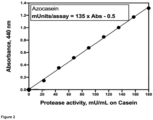
- Figure 2 shows that there is a linear relationship between absorbance and enzymatic activity.
- the absolute protease activity score is determined in accordance with Table 2.
- protease activity score then can be deduced from table 2.
- Table 2 Comparison of absorbance and protease activity score absorbance protease activity score 0 - 0.25 0 0.25 - 0.349 1 0.35 - 0.449 2 0.45 - 0.549 3 0.55 - 0.649 4 0.65 - 1 5
- the relative protease activity is determined by calculating the ratio of the absorbance-result of the microorganism or spore under investigation and that of DSM402 For example, an absorbance-result of 0.25 of the sample and an absorbance-result of 0.05 of DSM402 will result in 0.25/0.05, i.e., a relative protease activity of 5:1.
- CFU colony forming units
- the CFU/cm 2 can be determined by plating the 10 ml PBS-buffer on sterile tryptic soy agar plates (e.g. TSA-standard-plates) and incubating at 37°C for 24h. Colonies can then be counted and the CFU/cm 2 can be determined for each of the sections on that surface.
- sterile tryptic soy agar plates e.g. TSA-standard-plates
- microbial organisms or spores thereof, are sampled from the article by immersing a section of 1 cm 3 of the article in 10 ml PBS-buffer.
- the collected buffer solution is heat treated in a water bath at 80°C for 5 minutes.
- the 10 ml PBS-buffer solution is then plated on ready-to-use tryptic soy agar monitoring contact plates, e.g. TSA with LTH-Thio cont.-ICR+ (Merck-Millipore, USA) at 37°C for 24h. Colonies can then be counted and the CFU/cm 3 can be determined for each of the sections of that article.
- the specific strain of the microbial organisms, or spores thereof, can be determined by the gDNA determination described below.
- colonies are harvested for identification with sterile 10 ⁇ l inoculating loops (Neolab Migge GmbH, Germany) and resuspended in 20 ⁇ l bacterial protein extraction reagent, e.g. aqueous nonionic detergent solution comprising 20 mM Tris-HCl at pH 7.5 including lysozyme and DNase (e.g. B-Per reagent, FisherScientific, USA).
- 20 bacterial protein extraction reagent e.g. aqueous nonionic detergent solution comprising 20 mM Tris-HCl at pH 7.5 including lysozyme and DNase (e.g. B-Per reagent, FisherScientific, USA).
- the 1.1 kb PCR product is subsequently sequenced for strain identification. By doing so, gDNA per cm 3 or per cm 2 as well as strain diversity can be determined.
- the number of CFUs/cm 2 of the microbial organism, or spores thereof, on a surface of 1 cm 2 ; or CFUs/cm 3 of the microbial organism, or spores thereof, in volume of 1 cm 3 is determined according to the CFU-determination explained above.
- the surface or volume comprising the microbial organism, or spores thereof, is then washed in 10 ml PBS-buffer with a temperature of 80°C for 5 minutes.
- the number of CFUs/cm 2 (or CFUs/cm 3 ) of the microbial organism, or spores thereof, is determined as shown above.
- the ratio between CFUs before and after the washing step is calculated.
- Ratio CFUs/cm 2 (or CFUs/cm 3 ) before washing step / CFUs/cm 2 (or CFUs/cm 3 ) after washing step.
- the ratio is less than 100, less than 50, or less than 20 the microbial organism, or spores thereof, has passed the hot washing test.
- the number of CFUs/cm 2 of the microbial organism, or spores thereof, on a surface of 1 cm 2 ; or CFUs/cm 3 of the microbial organism, or spores thereof, in volume of 1 cm 3 is determined according to the CFU-determination explained above.
- the surface or volume comprising the microbial organism, or spores thereof, is then heated in a microwave for 5 minutes at 1000 Watt.
- the number of CFUs/cm 2 (or CFUs/cm 3 ) of the microbial organism, or spores thereof, is determined again according to the CFU-determination explained above.
- the ratio between CFUs before and after the heating step is calculated.
- Ratio CFUs/cm 2 (or CFUs/cm 3 ) before the heating step / CFUs/cm 2 (or CFUs/cm 3 ) after the heating step.
- the ratio is less than 100, less than 50, or less than 20 the microbial organism, or spores thereof, has passed the heat test.
- the number of CFUs/cm 2 of the microbial organism, or spores thereof, on a surface of 1 cm 2 or CFUs/cm 3 of the microbial organism, or spores thereof, in volume of 1 cm 3 is determined according to the CFU-determination explained above.
- the surface or volume comprising the microbial organism, or spores thereof, is then washed in 10 ml of PBS with 1 wt.-% hydrogen peroxide for 5 minutes.
- the number of CFUs/cm 2 (or CFUs/cm 3 ) of the microbial organism, or spores thereof, is determined again according to the CFU-determination explained above.
- the ratio between CFUs before and after the washing step is calculated.
- Ratio CFUs/cm 2 (or CFUs/cm 3 ) before washing step / CFUs/cm 2 (or CFUs/cm 3 ) after washing step.
- the ratio is less than 100, less than 50, or less than 20 the microbial organism, or spores thereof, has passed the chemical stress test.
- the "long-term polymer-matrix test” is performed to evaluate whether a microorganism or spore therof is capable of maintaining amylase or protease activity even after a treatment that resembles actual use of an article, i.e. including multiple wet and dry cycles.
- the test is performed using cubes of 20 g of a sponge polymer-material made from soft polyurethane (PUR) foam material (spatial weight 20 kg/m 3 , having 20 pores cm-').
- PUR soft polyurethane
- one half of the sponge polymer-matrix cubes is treated with 10 ml of a PBS-solution comprising about 1 * 10 5 CFU/cm 3 of the microbial organism, or spores thereof, (" sample ") , the other half of the sponge polymer-matrix cubes is not inoculated (“ control ”) .
- each of the sponge polymer-matrix cubes (sample as well as control) is subjected to 45 wash and dry cycles.
- the washing liquid consists of 5 L water, 3 ml Triton ® X 100 (4-(1,1,3,3-Tetramethylbutyl)-phenyl-polyethylenglykol), and 25 ml of a standard broth medium comprising:
- samples of the sponge polymer cubes are directly transferred into deep well plates and amylase and protease activity both of the "sample” as well as the "control” is determined as explained above.
- the ratio of the long-term polymer-matrix test is then calculated from the resulting activity values as follows:
- a microbial organism, or spore thereof, is considered to pass the amylase long-term polymer-matrix test if the ratio is at least 1.5, at least 2, at least 3, at least 4, at least 5, at least 6, at least 7, at least 8, at least 9, at least 10.
- a microbial organism, or spore thereof, is considered to pass the protease long-term polymer-matrix test if the ratio is at least 1.5, at least 2, at least 3, at least 4, at least 5, at least 6, at least 7, at least 8, at least 9, at least 10.
- Samples are prepared according to the procedure described above for the long-term polymer matrix test. This means that the sponges have undergone the wash and dry cycles as described above, including step d. After that, the odour test is performed.
- the odour test is performed at temperatures of 23°C +- 2°C. At least 24 hours before the test the dried sponges are kept at the same temperature in closed glass jars.
- a sample passes the VDA-odour test when the arithmetic median of the grades given to the sample by the at least 3 subjects show a grading of 3 or better (i.e., between grade 1 and 3).
- more than 3 subjects take part in the test, e.g. at least 6, at least 12, at least 24, at least 48 or at least 96.
- the Shannon index also known as Shannon's diversity index, Shannon-Wiener index, and (erroneously) Shannon-Weaver index is a measure originally proposed by Claude Shannon in 1948 to quantify the entropy (hence Shannon entropy) in strings of text. In present times, the Shannon-index is widely used in the area of ecology to describe the diversity of biomes.
- PAST software v.3.01 can be used to calculate the Shannon index as published in H, Harper D, Ryan P. PAST-Palaeontological Statistics, ver. 1.89. Palaeontol Electron. 2001;4(1):1-9 .
- surface roughness is a component of surface texture. It is quantified by the deviations in the direction of the normal vector of a real surface from its ideal form. If these deviations are large, the surface is rough; if they are small, the surface is smooth. In surface metrology, roughness is typically considered to be the high-frequency, short-wavelength component of a measured surface. When dealing with the roughness profile, Ra is referred to as defined in DIN EN ISO 4287:2010-07.
- water contact angle quantifies the wettability of a solid surface by a liquid via the Young equation.
- the water contact angle can be measured according to DIN 55660-2:2011-12, chapter 5.2.2. using a static method with a drop volume of 2 ⁇ l.
- surface denotes an area forming the outside part or uppermost layer of an article, i.e. usually the interface of the article and the surrounding atmosphere.
- the surface area of particulate surfaces (e.g. powders or granules) or of porous surfaces may be measured by B.E.T.-measurement according to DIN ISO 9277:2022.
- the microorganism, or spore thereof, and/or the metabolic biofilm has amylase activity, i.e., shows the conversion of starch into sugar by the action of enzymes such as amylase.
- Amylase activity can be measured using the well-known Phadebas test.
- Amylase activity can be represented by an absolute amylase activity score and/or a relative amylase activity ratio.
- the microorganism, or spore thereof, and/or the metabolic biofilm has an absolute amylase activity score of at least 1, at least 2, at least 3, or at least 4.
- the absolute amylase activity score may range up to 5, or up to 4.
- the relative amylase activity ratio may range from 1 to 5, from 2 to 5, from 3 to 4, or it may be about 3.
- the microorganism, or spore thereof, and/or the metabolic biofilm may have an amylase activity larger than an amylase activity of DSM402.
- the relative amylase activity ratio of at least 5:1, at least 6:1, at least 7:1, or at least 8:1.
- the relative amylase activity ratio may range up to 100:1, up to 50:1, up to 30:1, or up to 20:1.
- the relative amylase activity ratio may range from 5:1 to 100:1, from 6:1 to 50:1, from 7:1 to 30:1, or from 8:1 to 20:1.
- the microorganism, or spore thereof, and/or the metabolic biofilm has protease activity, i.e., has the activity to breakdown proteins into smaller polypeptides or amino acids.
- Protease activity can be measured using well-known protease tests. This property can be represented by an absolute protease activity score and/or a relative protease activity ratio.
- the microorganism, or spore thereof, and/or the metabolic biofilm has an absolute protease activity score of at least 1, at least 2, at least 3, or at least 4.
- the absolute protease activity score may range up to 5, or up to 4.
- the relative amylase activity ratio may range from 1 to 5, from 2 to 5, from 3 to 4, or it may be about 3 or about 4.
- the microorganism, or spore thereof, and/or the metabolic biofilm may have a protease activity larger than a protease activity of DSM402.
- the metabolic biofilm has a relative protease activity ratio of at least 1.2:1, at least 1.5:1, at least 2:1, at least 2.5:1, at least 3:1, at least 4:1, or at least 5:1.
- the relative protease activity ratio may range up to 100:1, up to 40:1, up to 20:1, or up to 13:1.
- the relative amylase activity ratio may range from 1.2:1 to 100:1, from 1.5:1 to 40:1, from 2:1 to 20:1, or from 4:1 to 13:1.
- the microorganism, or spore thereof does not have a negative impact on the diversity of the microbiome of the biofilm and is not a biocide. This is reflected by the alpha-diversity according to the Shannon-index, wherein a Shannon-index above 1.5 or higher shows a good diversity of microorganisms. This means that a metabolic biofilm as formed by the microorganism or spore thereof may have a Shannon index of more than 1.5.
- the microorganism or spore thereof having a Shannon index of more than X it is meant that the Shannon index of a biofilm as obtained after the wash and dry cycles according to the long-term polymer matrix test described hereinabove.
- the microorganism, or spore thereof, and/or the metabolic biofilm has an alpha-diversity reflected by a Shannon-index of at least 1.5, of at least 1.8, of at least 2.25, of at least 2.8, of at least 3, of at least 4, of at least 5, or of at least 6.
- the diversity and the type of the individual microorganism may be determined by CFU and gDNA determination.
- the household and/or commercial cleaning articles according to the present disclosure are selected from the group of cleaning sponges, cleaning pads (hand pads, machine pads), cleaning wipes, cleaning tissues, cleaning blocks, dirt erasers, etc.
- the household and/or commercial cleaning articles according to the present disclosure do not encompass cleaning articles for cosmetic use, such as make-up sponges, make-up cleaning pads (cosmetic pads), cotton swabs, etc.
- the household and/or commercial cleaning article refers to a modern cleaning sponge.
- a modern cleaning sponge is a tool or cleaning aid made of soft, porous material.
- sponges are especially good at absorbing water and water-based solutions.
- Cleaning sponges were originally made from natural sea sponges, however, they are most commonly made from synthetic materials today.
- Modern cleaning sponges are made of open-cell foams that can be foamed from various plastics, i.e., polymers, such as polyurethane, polyester, and the like.
- the household and/or commercial cleaning articles of the present disclosure comprise soft surfaces (such as for example sponges, or fabrics), or hard surfaces (such as for example plastic, glass, wood, metal, stone or ceramic); and combinations thereof. In one embodiment any surface which can be found on a household and/or commercial cleaning article is encompassed.
- the "household and/or commercial cleaning articles” has a textile layer, a foam or sponge layer, and/or an abrasive layer.
- the term "textile layer” as used herein encompasses woven and non-woven fabrics.
- a "foam or sponge layer” is made of cellulose or polyurethane foam.
- the density of the foam or sponge layer may range from 10 to 50 kg/m 3 , from 15 to 45 kg/m 3 , or from 20 to 30 kg/m 3 , in one embodiment about 20 kg/m 3 .
- the porosity ranges from 5 to 90; from 15 to 75, from 20 to 50, or from 20 to 35.
- the number of pores per cm may be from 1 to 50 cm -1 , from 5 to 40 cm -1 , from 10 to 30 cm -1 , or in one embodiment about 20 cm -1 .
- the porosity is opened to allow sponge to absorb and release water easily and allow cleaning and rinsing.
- the sponges of the present disclosure are made of biobased and or biodegradable materials such as those selected from wood pulp, cellulose, hemp fibers, cotton and combinations thereof.
- the sponges of the present disclosure comprise and/or are made of metal meshs, such as scratch-resistant steel wool from steel straw (120 G) or made from stainless steel.
- the sponges may further comprise an "abrasive layer" (i.e., a scouring fleece) to loosen hard in-crustations.
- the abrasive layer often consists of polymer fibers that can also be coated with hard mineral particles also called “abrasives” that are optionally fixed with the help of a binder and/or glue.
- abrasives may be selected from the group consisting of flint, quartz, corundum, emery, garnet, diamond, silicon carbide, chromium oxides, cubic boron nitride, and combinations thereof.
- the "abrasive layer” is made of abrasive nonwoven material.
- the weight of the nonwoven material may be from 100 g/m 2 to 1000 g/m 2 , from 200 g/m 2 to 800 g/m 2 , from 300 g/m 2 to 700 g/m 2 , or about 350 g/m 2 .
- the thickness may range from 2 mm to 15 mm, from 5 mm to 10 mm, or about 7.5 mm.
- the abrasive layer consists in one embodiment of fibers (polyamide/polyester) glued together with polymer matrix and containing abrasive particles (generally silica or alumina) to allow dirt scouring and cleaning.
- the household and/or commercial cleaning article comprises or consists of
- the dimensions of the sponge may range from 50 mm to 150 mm (length), from 80 mm to 110 mm (length); and/or optionally from 25 mm to 120 mm (width) or from 50 mm to 80 mm (width); and/or optionally from 5 mm to 100 mm (thickness); or from 15 mm to 50 mm (thickness).
- the length may be the longest extension, and the width may be the second longest in a direction perpendicular to the length.
- the foam can be cut in special nail guard shape to protect fingers.
- the features such as colors, shapes, dimensions, abrasivities, etc. may be adapted to the needs of the applications, customers and suppliers.
- the disclosure pertains to a household and/or commercial cleaning article wherein the article comprises at least one microorganism, or spore thereof, capable of forming a biofilm with metabolic activity on a surface of the household and/or commercial cleaning article.
- a sponge can be a medium for the growth of harmful bacteria, especially when it is allowed to remain wet between uses.
- the household and/or commercial cleaning article according to the disclosure comprises a surface.
- the household and/or commercial cleaning article according to the disclosure has at least one surface with a textile layer, a foam or sponge layer, and/or an abrasive layer.
- the microorganism, or spore thereof is applied to or disposed on a surface of the article, wherein preferably the surface may be characterized by a surface roughness of at least 1 ⁇ m Ra, at least 2 ⁇ m Ra, at least 3 ⁇ m Ra, at least 5 ⁇ m Ra, at least 8 ⁇ m Ra, at least 10 ⁇ m Ra, at least 12 ⁇ m Ra, or at least 15 ⁇ m Ra.
- the microorganism, or spore thereof is applied to or disposed on a surface of the household and/or commercial cleaning article which has a minimum hydrophilicity defined by a water contact angle of less than 80°. In other embodiments a water contact angle of less than 60°, a water contact angle of less than 45°, a water contact angle of less than 30°, a water contact angle of less than 15° or less. In one embodiment the water contact angle is 0° and the surface is considered hydrophilic.
- the surface of the household and/or commercial cleaning article may be selected from a material comprising or consisting of
- the article may be a kitchen sponge, or kitchen towel.
- the disclosure pertains to a household and/or commercial cleaning article comprising the microorganism, or spore thereof, capable of forming a metabolic biofilm, wherein the microorganism, or spore thereof, is optionally
- the concentration of the microorganism, or spore thereof, on the household and/or commercial cleaning article is determined.
- microorganism, or spore thereof may be present on the surface of the household and/or commercial cleaning article in a concentration of about 1 ⁇ 10 2 to 1 ⁇ 10 10 "colony forming units per surface" i.e., in CFU/cm 2 .
- the microorganism, or spore thereof is present on the surface of the household and/or commercial cleaning article in a concentration of about 1 * 10 2 to 1 * 10 9 CFU/cm 2 , optionally in a concentration of about 1 * 10 4 to 1 * 10 8 CFU/cm 2 , or in a concentration of about 1 * 10 6 to 1 * 10 8 CFU/cm 2 , in yet further embodiment in a concentration of about 1 ⁇ 10 7 CFU/cm 2 .
- the microorganism, or spore thereof is determined within a volume of household and/or commercial cleaning article.
- the microorganism, or spore thereof is better characterized by the CFU per volume of the article, i.e., in CFU/cm 3 .
- the microorganism, or spore thereof may be present in these cases in the household and/or commercial cleaning article in a concentration of about 1 ⁇ 10 2 to 1 ⁇ 10 10 CFU/cm 3 .
- the microorganism, or spore thereof is present in a concentration of about 1 * 10 3 to 1 * 10 9 CFU/cm 3 , preferably in a concentration of about 1 * 10 4 to 1 * 10 8 CFU/cm 3 , or in a concentration of about 1 * 10 6 to 1 * 10 8 CFU/cm 3 , in yet further embodiment in a concentration of about 1 ⁇ 10 7 CFU/cm 3 .
- the concentration of the microorganism, or spore thereof, on the household and/or commercial cleaning article can be described in ng gDNA / cm 3 .
- the microorganism, or spore thereof is present with at least 1 ng gDNA / cm 3 , at least 5 ng gDNA / cm 3 , at least 10 ng gDNA / cm 3 , at least 15 ng gDNA / cm 3 , or at least 25 ng gDNA / cm 3 .
- PU foam cubes (1x1x1 cm, ca. 25 mg) were distributed into single wells of 24-deepwell plates (DWP) and sterilized by autoclaving for 20 min at 121°C. Each well was subsequently filled with 2 ml medium (skim milk powder 0.8 g/L, soluble starch 4 g/L, olive oil 0.6 g/L, sterilized by autoclaving). After 5 min. incubation, each cube was then picked up with tweezers and transferred into an empty well of a new DWP.
- DWP 24-deepwell plates
- Each cube was subsequently inoculated (4 replicates per candidate strain) by pipetting 10 ⁇ l spores suspension (1E+05 CFU, in PBS buffer) onto the surface, non-inoculated cubes served as control. Inoculated cubes are incubated at 20°C for 7 days. After 2 and 4 days within the 7 day period, medium was again applied to each well as above and cubes were subsequently transferred to a new DWP.
- Metabolic activity of biofilms was assessed by transferring 150 ⁇ l of each well into a microtitre plate (e.g., Costar 3904, Corning) and fluorescence detection (Fluostar, BMG) with the following parameters: Excitation wavelength 440-412 nm, emission wavelength 590 nm, gain 15, prior mixing (5 sec, 1 mm orbital).
- the mean values (MV) obtained (arbitrary fluorescence units) of suitable candidates should reach a minimum of 30.000 (after subtraction of MV of non-inoculated control) or a minimum of 2 ⁇ mean values obtained for control strain (DSM402) treated in the same way.
- Microorganisms scoring at least 2x mean values obtained for control strain (DSM402) are considered capable of forming a metabolic biofilm.
- PU foam cubes (1x1x1cm, ca. 25 mg) were distributed into single wells of 24 well deepwell plates (DWP) and sterilized by autoclaving for 20 min at 121°C. Each well was subsequently filled with 2 ml medium (Bacto Tryptone 10 g/L, NaCl 5 g/L, Bacto Yeast Extract 5 g/L, sterilized by autoclaving; glycerol 1%, MnSO 4 0.1 mM, filter sterilized and supplemented after autoclaving). After 5 min incubation, each cube was then picked up with tweezers and transferred into an empty well of a new DWP.
- 2 ml medium Bacto Tryptone 10 g/L, NaCl 5 g/L, Bacto Yeast Extract 5 g/L, sterilized by autoclaving; glycerol 1%, MnSO 4 0.1 mM, filter sterilized and supplemented after autoclaving.
- Each cube was subsequently inoculated (4 replicates per candidate strain) by pipetting 10 ⁇ l spores suspension (1E+05 CFU, in PBS buffer) onto the surface, non-inoculated cubes served as sterile control. Inoculated cubes were incubated at 20°C. After 72 hours, cubes were washed by applying 4 ml saline (0.9%) into each well and subsequent transfer with tweezers into a new DWP. This step was repeated two times. After washing, 2.5 ml of Phadebas solution (9 Phadebas tablets were dissolved in 65 ml of a 2.4 g/L starch solution, sterilized by autoclaving) are added to each well.
- Phadebas solution Phadebas tablets were dissolved in 65 ml of a 2.4 g/L starch solution, sterilized by autoclaving
- the DWP is incubated at 37°C on a Titramax at shaking speed 7 for 2 hours. From each well 200 ⁇ l samples are subsequently transferred into 1.5 ml reaction tubes and centrifuged (5 min, 1500 g). Supernatant samples (100 ⁇ l) were transferred into a 96 well microtitre plate (MTP) and the absorbance is measured at 620 nm against deionized water (when absorbance exceeds the measuring capability of the photometer, supernatant is diluted 10-fold using deionized water).
- MTP microtitre plate
- PU foam cubes (1x1x1cm, ca. 25 mg) were distributed into single wells of 24 well deepwell plates (DWP) and sterilized by autoclaving for 20 min at 121°C. Each well was subsequently filled with 2 ml medium (skim milk powder 0.8 g/L, soluble starch 4 g/L, olive oil 0.6 g/L, sterilized by autoclaving). After 5 min incubation, each cube was then picked up with tweezers and transferred into an empty well of a new DWP.
- DWP deepwell plates
- Each cube was subsequently inoculated (4 replicates per candidate strain) by pipetting 10 ⁇ l spores suspension (1E05 CFU, in PBS buffer) onto the surface, non-inoculated cubes served as control. Inoculated cubes were incubated at 20°C for 7 days. After 2 and 4 days, medium was again applied to each well as above and cubes were subsequently transferred to a new DWP. After 7 days, cubes were washed by applying 4 ml saline (0.9%) into each well and subsequent transfer with tweezers into a new DWP. This step was repeated two times. After washing, 2.5 ml of Azo-Casein (Megazyme, Ireland) solution were added to each well.
- Azo-Casein solution was prepared by mixing 26 ml medium (as above) and 39 ml Azo-Casein (0.8 g Azo-Casein powder reconstituted according to Manufacturer's instructions). The DWP was incubated at 37°C on a Titramax at shaking speed 7 for 6 hours. From each well 150 ⁇ l samples were subsequently transferred into 1.5 ml reaction tubes, 450 ⁇ l TCA (5%) were added, mixed by inverting and the tubes were centrifuged (5 min, 1500 g).
- a long-term polymer matrix test was performed in order to evaluate the presence of amylase activity after simulated use of the article, e.g. in the context of a household article with repeated wet and dry cycles. Initially, the long-term polymer matrix test was performed as described hereinabove, i.e. steps a. through d. After step d., sponges were harvested from the long-term polymer-matrix test by letting them dry completely without washing for 2 days at 22-25°C. Sponges can subsequently be stored in an airtight container for up to 4 weeks.
- a long-term polymer matrix test was performed in order to evaluate the presence of protease activity after simulated use of the article, e.g. in the context of a household article with repeated wet and dry cycles. Initially, the long-term polymer matrix test was performed as described hereinabove, i.e. steps a. through d. After step d., sponges were harvested from the long-term polymer-matrix test by letting them dry completely without washing for 2 days at 22-25°C. Sponges can subsequently be stored in an airtight container for up to 4 weeks.
Landscapes
- Life Sciences & Earth Sciences (AREA)
- Chemical & Material Sciences (AREA)
- Engineering & Computer Science (AREA)
- Wood Science & Technology (AREA)
- Health & Medical Sciences (AREA)
- Chemical Kinetics & Catalysis (AREA)
- Oil, Petroleum & Natural Gas (AREA)
- Organic Chemistry (AREA)
- General Health & Medical Sciences (AREA)
- Natural Medicines & Medicinal Plants (AREA)
- Plant Pathology (AREA)
- Microbiology (AREA)
- Zoology (AREA)
- Environmental Sciences (AREA)
- Biotechnology (AREA)
- Dentistry (AREA)
- Mycology (AREA)
- Agronomy & Crop Science (AREA)
- General Chemical & Material Sciences (AREA)
- Pest Control & Pesticides (AREA)
- Measuring Or Testing Involving Enzymes Or Micro-Organisms (AREA)
- Cleaning Implements For Floors, Carpets, Furniture, Walls, And The Like (AREA)
- Micro-Organisms Or Cultivation Processes Thereof (AREA)
Abstract
A household and/or commercial cleaning article having a textile layer, a foam or sponge layer, and/or an abrasive layer comprising at least one microorganism, or spore thereof, is disclosed wherein the microorganism, or spore thereof is capable of forming a metabolic biofilm on a surface of the household and/or commercial cleaning article. Also methods of producing said household and/or commercial cleaning article and uses thereof are disclosed.
Description
- After use, household and/or commercial cleaning articles often comprise microorganisms, such as bacteria, fungi and algae which can develop biofilms on surfaces. Some of these biofilms can cause discomfort in the environment (such as for example malodour) or even cause health problems in animals and/or humans. This is particularly problematic in the case of household and/or commercial cleaning articles, the task of which is to keep other articles and/or surfaces clean. In this way, the household and/or commercial cleaning article can even transfer the negative effects of a biofilm to other surfaces that it is supposed to clean.
- Conventional countermeasures against such harmful biofilms on household and/or commercial cleaning articles mostly focus on the eradication of the microorganisms including their biofilm, which, however, results in a tedious cleaning process due to the resistance of some microorganisms to chemicals, heat and other eradication methods. The cleaning process has to be repeated on a regular basis and the successful cleaning cannot be controlled easily due to the invisibility of the microorganisms and the biofilm.
- Furthermore, household and/or commercial cleaning articles sometimes are not easily accessible on all surfaces such that retreats for the microorganisms are formed (e.g., when having a textile layer, a foam or sponge layer, and/or an abrasive layer), so that an accelerated regrowth from those niches occurs and a full eradication of the biofilm becomes impossible.
- The only remaining solution is then often the disposal of the household and/or commercial cleaning article, which of course contradicts a sustainable way of life and is economically unreasonable. Another attempted solutions is to resort to ever more aggressive cleaning methods, which of course has negative effects on the environment and in itself may cause harm to animals or humans which come in contact with the household and/or commercial cleaning article.
- Therefore, the need existed to provide effective means and/or methods for preventing the negative effects of microorganisms, such as for example malodour or health risks, on household and/or commercial cleaning articles, which are less damaging to the environment and harmless to animals and humans. These means and/or methods are provided by the present disclosure.
- In a first aspect, the disclosure pertains to a household and/or commercial cleaning article having a textile layer, and/or a foam or sponge layer, and/or an abrasive layer comprising at least one microorganism, or spore thereof, wherein the microorganism, or spore thereof is capable of forming a metabolic biofilm on a surface of the household and/or commercial cleaning article.
- Surprisingly, it has been found that household and/or commercial cleaning articles comprising certain microorganisms, or spores thereof, are capable of forming a metabolic biofilm, i.e., a biofilm which can quickly degrade microbial waste products within the biofilm, which otherwise would cause discomfort (e.g., malodour) or even health problems. The advantage of this approach is that the biofilm stays on the surface for a long time, once the microorganisms, or spores thereof, are applied; and disinfectants, detergents or other for animals or humans potentially harmful substances are not needed. Furthermore, since in an optional embodiment the microorganism, or spore thereof, shares the abilities to withstand heat or chemical treatments as well as multiple washing steps with the other microorganisms in the biofilm on the household and/or commercial cleaning article, the treatment has a long-lasting, self-renewable property, which cannot be achieved by conventional methods and prolongs the usability of the household and/or commercial cleaning article.
- In a second aspect, the disclosure pertains to a method of producing a household and/or commercial cleaning article having a textile layer, and/or a foam or sponge layer, and/or an abrasive layer comprising at least one microorganism, or spore thereof, wherein the microorganism, or spore thereof, is deposited onto the article before the article is brought into use.
- In a third aspect, the disclosure pertains to a use of at least one microorganism, or spore thereof, being capable of forming a metabolic biofilm on a surface of the household and/or commercial cleaning article, for inhibiting or reducing malodour in and/or on the article.
- In one embodiment a further advantage of using the household and/or commercial cleaning article comprising at least one microorganism, or spore thereof, capable of forming a metabolic biofilm on a surface of the household and/or commercial cleaning article is that during the cleaning process parts of the microorganism, or spore thereof, may be transferred to the cleaned surface, which then may expand its biofilm even to the cleaned areas and prevents malodour even on the cleaned surface for a longer time-period.
- In a further aspect, the present disclosure relates to uses of the household and/or commercial cleaning article, for inhibiting or reducing malodour on a surface as compared to a household and/or commercial cleaning article not comprising the metabolic biofilm, corresponding to an odour difference of at least 0.3 grades, preferably of at least 0.5 grades, or most preferably of at least 1.0 grade in the VDA odour test.
- The microorganism, or spore thereof, may be selected from a group consisting of at least one member of the Bacillus subtilis group, wherein the member of the Bacillus subtilis group is selected from the group consisting of Bacillus amyloliquefaciens, Bacillus tequilensis, Bacillus subtilis, Bacillus atrophaeus, Bacillus vallismortis, Bacillus licheniformis, Bacillus sonorensis, and Bacillus mojavensis; and/or a member of the Priestia (former Bacillus) megaterium, and/or a member of Bacillus velezensis, and/or a member of Bacillus pumilus, and/or a combination thereof.
- The term "Bacillus subtilis group" as used herein means a sub-genus of the family Bacillaceae, genus Bacillus, comprising the species Bacillus amyloliquefaciens, Bacillus tequilensis, Bacillus licheniformis, Bacillus subtilis, Bacillus atrophaeus, Bacillus vallismortis, Bacillus licheniformis, Bacillus sonorensis and Bacillus mojavensis subgroup.
- One of the microbial organisms of the Bacillus subtilis group is Bacillus subtilis, known also as the hay bacillus or grass bacillus, a Gram-positive, catalase-positive bacterium, found in soil and the gastrointestinal tract of ruminants and humans. As member of the genus Bacillus, B. subtilis is rod-shaped, and can form a tough, protective endospore, allowing it to tolerate extreme environmental conditions. B. subtilis has historically been classified as an obligate aerobe organism, though evidence exists that it is a facultative anaerobe. B. subtilis is considered the best studied Gram-positive bacterium and a model organism to study bacterial chromosome replication and cell differentiation.
- The microbial organism of the present disclosure may be used in a vegetative form and/or as spores. Spores are resistant structures used by microorganisms for survival under unfavorable conditions. The ability to prepare spores and vegetative cells is considered routine in the art (Probiotics Antimicrob. Proteins, 2019 Sep; 11 (3):731-747). The term "spore" or "spore thereof" is used hereinafter for bacterial spores which are resistant structures used for survival under unfavourable conditions by the bacteria. In some publications the synonym "endospore" may be used. The microorganism, or spore thereof, may be probiotic.
- Optionally, the microorganism, or spore thereof, is included in the list of QPS status recommended biological agents for safety risk assessments by the European food safety authority (ESA) as QPS-EFSA List 10.2903/j.efsa.2022.7408. This has the advantage that the microorganism itself does not represent any health risk and may be even used on surfaces of food-contact materials or in other health-sensitive areas. Alternatively, the microorganism, or spore thereof may fulfil the requirements necessary to be included in the QPS list.
- In a further embodiment, the microorganism, or spore thereof, is heat-resistant, resistant to washing-drying cycles, hot washing, heat and/or to chemical stresses. Optionally, it passes at least one, at least two, at least three, or all four tests selected from:
- a. a hot washing test with a ratio of less than 100,
- b. a heat test with a ratio of less than 100,
- c. a chemical stress test with a ratio of less than 100,
- d. an amylase long-term polymer matrix test with a ratio of at least 1.5, and/or
- e. a protease long-term polymer matrix test with a ratio of at least 1.5.
- In an embodiment, the microorganism, or spore thereof passes the hot washing test to the extent that the ratio is less than 100, less than 50, or less than 20.
- In an embodiment, the microorganism, or spore thereof passes the heat test to the extent that the ratio is less than 100, less than 50, or less than 20.
- In an embodiment, the microorganism, or spore thereof passes the chemical stress test to the extent that the ratio is less than 100, less than 50, or less than 20.
- In an embodiment, the microorganism, or spore thereof passes the amylase long-term polymer matrix test to the extent that the ratio is at least 1.5, at least 4, or at least 8.
- In an embodiment, the microorganism, or spore thereof passes the protease long-term polymer matrix test to the extent that the ratio is at least 1.5, at least 4, or at least 8.
- These and other standardized tests are further defined hereinafter:
- A biofilm with metabolic activity is determined by the increased activity to convert resazurin to fluorescent resorufin as compared to a standard biofilm-forming microorganism Bacillus subtilis (Ehrenberg 1835) Cohn 1872; DSM-No. 402. Optionally, the metabolic activity in the biofilm is increased by at least 2 times, at least 3 times, at least 4 times, 5 times, at least 10 times, as compared to the standard microorganism Bacillus subtilis (Ehrenberg 1835) Cohn 1872; DSM-No. 402 ("DSM402" hereinafter).
- The microorganism, or spore thereof as disclosed herein is defined to be capable of forming a metabolic biofilm, if the microorganism or spore scores a fluorescence which is at least twice as high as a fluorescence scored by DSM402 under the same experimental conditions.
- The experimental conditions include
- sterilizing polyurethane (PU) foam cubes (1x1x1 cm, 25 mg) in an autoclave at 121°C for 20 minutes;
- putting the cubes into a deep well plate (DWP), one cube per well;
- filling 2 ml of sterilized medium into each of the wells that contain a cube, wherein the medium is composed of skim milk powder 0.8 g/L, soluble starch 4 g/L and olive oil 0.6 g/L;
- after 5 minutes, taking out cubes from DWP and transferring them to empty well of new DWP;
- inoculating each cube with 10 µl of inoculation solution, i.e. containing microorganisms or spores in PBS buffer (e.g. 105 CFU of microorganism or spore under examination and the same amount of DSM402 [Bacillus subtilis (Ehrenberg 1835) Cohn 1872; DSM-No. 402]; at least 4 cubes each); additionally, leaving four cubes without inoculation as control;
- incubating the inoculated cubes for 7 days at 20°C;
- after 48 hours and 96 hours within those 7 days, applying additional 2 ml of medium to each well and transferring each cube to new well;
- after the 7 days, transferring cubes to a new DWP and washing by application of 4 ml saline (0.9%) to each well; transferring cubes into new DWP; repeat washing and transferring step an additional two times (three times in total);
- after washing, adding 2 ml of a resazurin-containing solution (e.g. PrestoBlue by Thermo Fisher Scientific, 10 % in medium) dye solution to the cubes in each well and incubating for 6 hours at 37°C;
- transferring 150 µl of each well into a microtitre plate (e.g., Costar 3904, Corning) and detecting fluorescence (e.g. using Fluostar, BMG) with the following parameters: excitation wavelength 440-412 nm, emission wavelength 590 nm, gain 15, prior mixing (5 sec, 1 mm orbital).
- The mean values (MV) of fluorescence (arbitrary fluorescence units) are determined for each microorganism or spore and for control; MV of non-inoculated control is subtracted. Microorganisms and spores under investigation scoring at least twice the fluorescence value of DSM402 are capable of forming a metabolic biofilm.
- Amylase activity is based on absorbance detection of a product of the underlying enzymatic reaction. Absolute and relative amylase activity can be determined.
- The absolute amylase activity score is determined by an absorbance at 620 nm (cf. table 1 below). The test (Phadebas AB, Sweden) is based on a water-insoluble, cross-linked starch polymer substrate which is hydrolyzed by α-amylase in the biofilm to form water-soluble blue fragments. The absorbance of the blue solution is a function of the α-amylase activity in the sample.
- The amylase activity test may be performed as follows:
- sterilizing polyurethane (PU) foam cubes (1x1x1 cm, 25 mg) in an autoclave at 121°C for 20 minutes;
- putting the cubes into a deep well plate (DWP), one cube per well;
- filling 2 ml of sterilized medium into each of the wells that contain a cube, wherein the medium is composed of pancreatic casein digest 10 g/L (e.g. Bacto Trypton, Thermo Fisher Scientific), NaCl 5 g/L, yeast extract 5 g/L (e.g. Bacto Yeast Extract, Thermo Fisher Scientific);
glycerol 1%, MnSO4 0.1 mM (filter sterilized and supplemented after autoclaving); - after 5 minutes, taking out cubes from DWP and transferring them to empty well of new DWP;
- inoculating each cube with 10 µl of inoculation solution, i.e. containing microorganisms or spores in PBS buffer (e.g. 105 CFU of microorganism or spore under examination and the same amount of DSM402; at least 4 cubes each); additionally, leaving four cubes without inoculation as control;
- incubating the inoculated cubes for 20°C;
- after the 72 hours, transferring cubes to a new DWP and washing by application of 4 ml saline (0.9%) to each well; transferring cubes into new DWP; repeat washing and transferring step an additional two times (three times in total);
- after washing, adding 2.5 ml of an amylase-test-solution (e.g. Phadebas test solution; e.g. 9 Phasebas tablets dissolved in 65 ml of 2.4 g/L starch solution, sterilized by autoclaving) to the cubes in each well and incubating in a shaker for 2 hours at 37°C (e.g. Titramax, e.g. at shaking speed 7);
- transferring 200 µl of each well into 1.5 ml reaction tubes and centrifuging (5 min, 1500xg);
- transferring supernatant samples (100 µl) into 96 well microtitre plate (MTP) and measuring absorbance at 620 nm against deionized water; subtracting values measured for non-inoculated samples.
-
Figure 1 shows that there is a linear relationship between absorbance and enzymatic activity. - The absolute amylase activity score is determined in accordance with Table 1.
Table 1 - Comparison of absorbance and amylase activity score Absorbance amylase activity score 0 - 0.25 0 0.25 - 0.349 1 0.35 - 0.449 2 0.45 - 0.549 3 0.55 - 0.649 4 0.65 - 1 5 - The relative amylase activity is determined by calculating the ratio of the absorbance-result of the microorganism or spore under investigation and that of DSM402 For example, an absorbance-result of 0.25 of the sample and an absorbance-result of 0.05 of DSM402 will result in 0.25/0.05, i.e., a relative amylase activity of 5:1.
- The PU foam cubes used in this and the other tests discussed herein, may be selected from standard household sponges, e.g. made of soft polyurethane having a
spatial weight 20 kg/m3 and having about 20 pores cm-1. - Protease activity is based on absorbance detection of a product of the underlying enzymatic reaction. Absolute and relative protease activity can be determined.
- The absolute protease activity score is determined by an absorbance at 440 nm of (cf. table 3 below). The test (Azocasein-test; Megazyme, Ireland) is based on an azocasein (azo-casein) substrate solution. The substrate is hydrolyzed by all endo-proteases which are active on casein to form a blue dye. The absorbance of the blue solution is a function of the protease activity in the sample.
- The protease activity test may be performed as follows:
- sterilizing polyurethane (PU) foam cubes (1x1x1 cm, 25 mg) in an autoclave at 121°C for 20 minutes;
- putting the cubes into a deep well plate (DWP), one cube per well;
- filling 2 ml of sterilized medium into each of the wells that contain a cube, wherein the medium is composed of skim milk powder 0.8 g/L, soluble starch 4 g/L and olive oil 0.6 g/L;
- after 5 minutes, taking out cubes from DWP and transferring them to empty well of new DWP;
- inoculating each cube with 10 µl of inoculation solution, i.e. containing microorganisms or spores in PBS buffer (e.g. 105 CFU of microorganism or spore under examination and the same amount of DSM402; at least 4 cubes each); additionally, leaving four cubes without inoculation as control;
- incubating the inoculated cubes for 7 days at 20°C;
- after 48 hours and 96 hours within those 7 days, applying additional 2 ml of medium to each well and transferring each cube to new well;
- after the 7 days, transferring cubes to a new DWP and washing by application of 4 ml saline (0.9%) to each well; transferring cubes into new DWP; repeat washing and transferring step an additional two times (three times in total);
- after washing, adding 2.5 ml of Azo-Casein (Megazyme, Ireland) solution to the cubes in each well, e.g. azo-casein solution may be prepared by mixing 26 ml medium (as above) and 39 ml azo-casein (0.8 g Azo-Casein powder reconstituted according to Manufacturer's instructions);
- incubating in a shaker for 6 hours at 37°C (e.g. Titramax, e.g. at shaking speed 7);
- transferring 150 µl of each well into 1.5 ml reaction tubes, adding 450 µl of TCA (5%) and centrifuging (5 min, 1500xg);
- transferring supernatant samples (150 µl) into 96 well microtitre plate (MTP) and measuring absorbance at 440 nm against deionized water; subtracting values measured for non-inoculated samples.
-
Figure 2 shows that there is a linear relationship between absorbance and enzymatic activity. - The absolute protease activity score is determined in accordance with Table 2.
- The protease activity score then can be deduced from table 2.
Table 2. Comparison of absorbance and protease activity score absorbance protease activity score 0 - 0.25 0 0.25 - 0.349 1 0.35 - 0.449 2 0.45 - 0.549 3 0.55 - 0.649 4 0.65 - 1 5 - The relative protease activity is determined by calculating the ratio of the absorbance-result of the microorganism or spore under investigation and that of DSM402 For example, an absorbance-result of 0.25 of the sample and an absorbance-result of 0.05 of DSM402 will result in 0.25/0.05, i.e., a relative protease activity of 5:1.
- To measure the concentration of colony forming units (CFU) on surfaces of an article, the microorganisms, or spores thereof, are sampled from the surface of the article by washing sections the surface of the article in 10 ml PBS-buffer per 1 cm2 surface area. The collected buffer solution is heat treated in a water bath at 80°C for 5 minutes.
- The CFU/cm2 can be determined by plating the 10 ml PBS-buffer on sterile tryptic soy agar plates (e.g. TSA-standard-plates) and incubating at 37°C for 24h. Colonies can then be counted and the CFU/cm2 can be determined for each of the sections on that surface.
- To measure the CFU in volumes of an article, microbial organisms, or spores thereof, are sampled from the article by immersing a section of 1 cm3 of the article in 10 ml PBS-buffer. The collected buffer solution is heat treated in a water bath at 80°C for 5 minutes.
- The 10 ml PBS-buffer solution is then plated on ready-to-use tryptic soy agar monitoring contact plates, e.g. TSA with LTH-Thio cont.-ICR+ (Merck-Millipore, USA) at 37°C for 24h. Colonies can then be counted and the CFU/cm3 can be determined for each of the sections of that article.
- The specific strain of the microbial organisms, or spores thereof, can be determined by the gDNA determination described below.
- After isolation and incubation of the contact plates for 24 h at 37°C as described before, colonies are harvested for identification with sterile 10 µl inoculating loops (Neolab Migge GmbH, Germany) and resuspended in 20 µl bacterial protein extraction reagent, e.g. aqueous nonionic detergent solution comprising 20 mM Tris-HCl at pH 7.5 including lysozyme and DNase (e.g. B-Per reagent, FisherScientific, USA).
- After incubation for 15 min at 37°C, 30 µl MilliQ water are added and 1 µl of the mixture applied in a colony PCR targeting the groEL locus (Biosci Biotechnol Biochem.; 1992 Dec;56(12):1995-2002; doi: 10.1271/bbb.56.1995) as follows:
- 7.5 µL PCR Master Mix, e.g. Phusion Flash Mastermix (FisherScientific, Germany)
- 1 µL Primer groEL 60-A, 10 pmol/µl (5'-ACCCTGGGCCCGAGGGCCGCAACGTCGT) (Seq ID. No. 1)
- 1 µL Primer groEL 160-B, 10 pmol/µl (5'-TGACCGCGACGCCGCCCGCCAGCTTCGC) (Seq ID. No. 2)
- 4.5 µL MilliQ-Wasser
- 1 µL bacterial protein extraction reagent, e.g. aqueous nonionic detergent solution comprising 20 mM Tris-HCl at pH 7.5 including lysozyme and DNase (e.g. B-Per reagent, FisherScientific, USA)
- The following PCR-protocol is used:
PCR-Cycles Temperature Minutes 94°C 01:00 -----30 cycles of------ 94°C 00:10 55°C 00:20 72°C 00:20 ---------------------- 72°C 01:00 10°C hold - The 1.1 kb PCR product is subsequently sequenced for strain identification. By doing so, gDNA per cm3 or per cm2 as well as strain diversity can be determined.
- The number of CFUs/cm2 of the microbial organism, or spores thereof, on a surface of 1 cm2; or CFUs/cm3 of the microbial organism, or spores thereof, in volume of 1 cm3 is determined according to the CFU-determination explained above. The surface or volume comprising the microbial organism, or spores thereof, is then washed in 10 ml PBS-buffer with a temperature of 80°C for 5 minutes.
- Then the number of CFUs/cm2 (or CFUs/cm3) of the microbial organism, or spores thereof, is determined as shown above. The ratio between CFUs before and after the washing step is calculated.
- Ratio = CFUs/cm2 (or CFUs/cm3) before washing step / CFUs/cm2 (or CFUs/cm3) after washing step.
- If the ratio is less than 100, less than 50, or less than 20 the microbial organism, or spores thereof, has passed the hot washing test.
- The number of CFUs/cm2 of the microbial organism, or spores thereof, on a surface of 1 cm2; or CFUs/cm3 of the microbial organism, or spores thereof, in volume of 1 cm3 is determined according to the CFU-determination explained above.
- The surface or volume comprising the microbial organism, or spores thereof, is then heated in a microwave for 5 minutes at 1000 Watt.
- Then the number of CFUs/cm2 (or CFUs/cm3) of the microbial organism, or spores thereof, is determined again according to the CFU-determination explained above. The ratio between CFUs before and after the heating step is calculated.
- Ratio = CFUs/cm2 (or CFUs/cm3) before the heating step / CFUs/cm2 (or CFUs/cm3) after the heating step.
- If the ratio is less than 100, less than 50, or less than 20 the microbial organism, or spores thereof, has passed the heat test.
- The number of CFUs/cm2 of the microbial organism, or spores thereof, on a surface of 1 cm2 or CFUs/cm3 of the microbial organism, or spores thereof, in volume of 1 cm3 is determined according to the CFU-determination explained above. The surface or volume comprising the microbial organism, or spores thereof, is then washed in 10 ml of PBS with 1 wt.-% hydrogen peroxide for 5 minutes.
- Then the number of CFUs/cm2 (or CFUs/cm3) of the microbial organism, or spores thereof, is determined again according to the CFU-determination explained above. The ratio between CFUs before and after the washing step is calculated.
- Ratio = CFUs/cm2 (or CFUs/cm3) before washing step / CFUs/cm2 (or CFUs/cm3) after washing step.
- If the ratio is less than 100, less than 50, or less than 20 the microbial organism, or spores thereof, has passed the chemical stress test.
- The "long-term polymer-matrix test" is performed to evaluate whether a microorganism or spore therof is capable of maintaining amylase or protease activity even after a treatment that resembles actual use of an article, i.e. including multiple wet and dry cycles. The test is performed using cubes of 20 g of a sponge polymer-material made from soft polyurethane (PUR) foam material (
spatial weight 20 kg/m3, having 20 pores cm-'). The test compares amylase or protease activity after the cycles with the activity of non-inoculated cubes. - For the long-term polymer-matrix test ratio of the microbial organism, or spores thereof, one half of the sponge polymer-matrix cubes is treated with 10 ml of a PBS-solution comprising about 1 * 105 CFU/cm3 of the microbial organism, or spores thereof, ("sample"), the other half of the sponge polymer-matrix cubes is not inoculated ("control").
- Then each of the sponge polymer-matrix cubes (sample as well as control) is subjected to 45 wash and dry cycles.
- Each wash and dry cycle consists of the following consecutive steps:
- a. submerging the sponge polymer-matrix cube for 2 minutes in washing liquid (composition below) at a temperature of 45°C;
- b. squeezing the sponge polymer-matrix cube three times while submerged in the washing liquid; wherein the cube is squeezed so far that the volume is reduced during squeezing by at least 50% of the volume of the material in "relaxed" (i.e., "un-squeezed" condition);
- c. squeezing the polymer-matrix cube one time outside the liquid; (squeezing outside the liquid is done until the cube has a weight that exceeds its dry weight before having been submerged in washing liquid by more than 100%, but less than 150%;
- d. placing the sponge polymer-matrix cube on a draining rack at 20°C for 24 hours.
- The washing liquid, as mentioned above, consists of 5 L water, 3 ml Triton® X 100 (4-(1,1,3,3-Tetramethylbutyl)-phenyl-polyethylenglykol), and 25 ml of a standard broth medium comprising:
- enzymatic digest of soybean 3.0 g/L (tryptic digest)
- sodium chloride 5.0 g/L
- dipotassium hydrogen phosphate 2.5 g/L
- glucose monohydrate 2.5 g/L
- wherein the standard broth medium is autoclaved before use at 121°C for 15 minutes;
- and is adjusted to a final pH: 7.3 ± 0.2 at 25°C.
- At the end (after the last drying step) of the long-term polymer-matrix test, samples of the sponge polymer cubes are directly transferred into deep well plates and amylase and protease activity both of the "sample" as well as the "control" is determined as explained above.
- The ratio of the long-term polymer-matrix test is then calculated from the resulting activity values as follows:
- ratio of the amylase long-term polymer-matrix test = amylase activity ("sample") / amylase activity ("control")
- ratio of the protease long-term polymer-matrix test = protease activity ("sample") / protease activity ("control").
- A microbial organism, or spore thereof, is considered to pass the amylase long-term polymer-matrix test if the ratio is at least 1.5, at least 2, at least 3, at least 4, at least 5, at least 6, at least 7, at least 8, at least 9, at least 10.
- A microbial organism, or spore thereof, is considered to pass the protease long-term polymer-matrix test if the ratio is at least 1.5, at least 2, at least 3, at least 4, at least 5, at least 6, at least 7, at least 8, at least 9, at least 10.
- Articles or surfaces, for example sponges, with or without the microbial organism, or spores thereof, were evaluated using an odour test which was performed essentially as described in the standard procedure VDA 270 ("Bestimmung des Geruchsverhaltens von Werkstoffen der Kraftfahrceug-Innenausstattung").
- Samples are prepared according to the procedure described above for the long-term polymer matrix test. This means that the sponges have undergone the wash and dry cycles as described above, including step d. After that, the odour test is performed.
- The odour test is performed at temperatures of 23°C +- 2°C. At least 24 hours before the test the dried sponges are kept at the same temperature in closed glass jars.
- The procedure may be summarized as follows:
- Articles or surfaces, for example sponges, are placed in 250 ml clean glass jars with odourless sealing and screw cap
- Odour test is performed by at least 3 subjects (non-smoker, use of perfume or scented hand lotion precluded on that day) within one week; the same samples are tested by all subjects
- at least 3 reference samples are included in the test to assure that smelling capability of subjects are not restricted and to enable comparison between different odour tests.
- The at least 3 subjects then grade the samples with grades from 1 to 6 (1 being the best), wherein the following grading principle is applied:
- Grade 1: smell not recognizable
- Grade 2: recognizable smell, but non-disturbing
- Grade 3: clearly recognizable smell, but still non-disturbing
- Grade 4: disturbing smell
- Grade 5: strong disturbing smell
- Grade 6: unbearable smell
- A sample passes the VDA-odour test when the arithmetic median of the grades given to the sample by the at least 3 subjects show a grading of 3 or better (i.e., between
grade 1 and 3). - In embodiments, more than 3 subjects take part in the test, e.g. at least 6, at least 12, at least 24, at least 48 or at least 96.
- The Shannon index, also known as Shannon's diversity index, Shannon-Wiener index, and (erroneously) Shannon-Weaver index is a measure originally proposed by Claude Shannon in 1948 to quantify the entropy (hence Shannon entropy) in strings of text. In present times, the Shannon-index is widely used in the area of ecology to describe the diversity of biomes.
- The initial idea of the Shannon index was that the more letters there are, and the closer their proportional abundances in the string of interest, the more difficult it is to correctly predict which letter will be the next one in the string. The Shannon entropy quantifies the uncertainty (entropy or degree of surprise) associated with this prediction. It is most often calculated (including in this disclosure) as follows:

- In ecology, p i is the proportion of individuals belonging to the i-th species in the dataset of interest. Thus, the Shannon entropy simply quantifies the uncertainty in predicting the species identity of an individual that is taken at random from the dataset. The higher this "uncertainty", the more diverse is the microbiome.
- When all types in the dataset of interest are equally common, all p i values equal 1 / R, and the Shannon index hence takes the value In(R). The more unequal the abundances of the types, the larger the weighted geometric mean of the p i values, and the smaller the corresponding Shannon entropy. If practically all abundance is concentrated to one type, and the other types are very rare (even if there are many of them), Shannon entropy approaches zero. When there is only one type in the dataset, Shannon entropy exactly equals zero (there is no uncertainty in predicting the type of the next randomly chosen entity).
- PAST software v.3.01 can be used to calculate the Shannon index as published in H, Harper D, Ryan P. PAST-Palaeontological Statistics, ver. 1.89. Palaeontol Electron. 2001;4(1):1-9.
- The term "surface roughness" as used herein is a component of surface texture. It is quantified by the deviations in the direction of the normal vector of a real surface from its ideal form. If these deviations are large, the surface is rough; if they are small, the surface is smooth. In surface metrology, roughness is typically considered to be the high-frequency, short-wavelength component of a measured surface. When dealing with the roughness profile, Ra is referred to as defined in DIN EN ISO 4287:2010-07.
- The term "water contact angle" quantifies the wettability of a solid surface by a liquid via the Young equation. The water contact angle can be measured according to DIN 55660-2:2011-12, chapter 5.2.2. using a static method with a drop volume of 2 µl.
- The term "surface" as used in this disclosure denotes an area forming the outside part or uppermost layer of an article, i.e. usually the interface of the article and the surrounding atmosphere. The surface area of particulate surfaces (e.g. powders or granules) or of porous surfaces may be measured by B.E.T.-measurement according to DIN ISO 9277:2022.
- In one embodiment, the microorganism, or spore thereof, and/or the metabolic biofilm has amylase activity, i.e., shows the conversion of starch into sugar by the action of enzymes such as amylase. Amylase activity can be measured using the well-known Phadebas test. Amylase activity can be represented by an absolute amylase activity score and/or a relative amylase activity ratio. Optionally, the microorganism, or spore thereof, and/or the metabolic biofilm has an absolute amylase activity score of at least 1, at least 2, at least 3, or at least 4. In an embodiment, the absolute amylase activity score may range up to 5, or up to 4. For example, the relative amylase activity ratio may range from 1 to 5, from 2 to 5, from 3 to 4, or it may be about 3.
- Alternatively, or in addition, the microorganism, or spore thereof, and/or the metabolic biofilm may have an amylase activity larger than an amylase activity of DSM402. Optionally, the relative amylase activity ratio of at least 5:1, at least 6:1, at least 7:1, or at least 8:1. In an embodiment, the relative amylase activity ratio may range up to 100:1, up to 50:1, up to 30:1, or up to 20:1. For example, the relative amylase activity ratio may range from 5:1 to 100:1, from 6:1 to 50:1, from 7:1 to 30:1, or from 8:1 to 20:1.
- In one embodiment, the microorganism, or spore thereof, and/or the metabolic biofilm has protease activity, i.e., has the activity to breakdown proteins into smaller polypeptides or amino acids. Protease activity can be measured using well-known protease tests. This property can be represented by an absolute protease activity score and/or a relative protease activity ratio. Optionally, the microorganism, or spore thereof, and/or the metabolic biofilm has an absolute protease activity score of at least 1, at least 2, at least 3, or at least 4. In an embodiment, the absolute protease activity score may range up to 5, or up to 4. For example, the relative amylase activity ratio may range from 1 to 5, from 2 to 5, from 3 to 4, or it may be about 3 or about 4.
- Alternatively, or in addition, the microorganism, or spore thereof, and/or the metabolic biofilm may have a protease activity larger than a protease activity of DSM402. Optionally, the metabolic biofilm has a relative protease activity ratio of at least 1.2:1, at least 1.5:1, at least 2:1, at least 2.5:1, at least 3:1, at least 4:1, or at least 5:1. In an embodiment, the relative protease activity ratio may range up to 100:1, up to 40:1, up to 20:1, or up to 13:1. For example, the relative amylase activity ratio may range from 1.2:1 to 100:1, from 1.5:1 to 40:1, from 2:1 to 20:1, or from 4:1 to 13:1.
- In an embodiment, the microorganism, or spore thereof, does not have a negative impact on the diversity of the microbiome of the biofilm and is not a biocide. This is reflected by the alpha-diversity according to the Shannon-index, wherein a Shannon-index above 1.5 or higher shows a good diversity of microorganisms. This means that a metabolic biofilm as formed by the microorganism or spore thereof may have a Shannon index of more than 1.5. When referring to the microorganism or spore thereof having a Shannon index of more than X, it is meant that the Shannon index of a biofilm as obtained after the wash and dry cycles according to the long-term polymer matrix test described hereinabove. Thus, in a further embodiment, the microorganism, or spore thereof, and/or the metabolic biofilm has an alpha-diversity reflected by a Shannon-index of at least 1.5, of at least 1.8, of at least 2.25, of at least 2.8, of at least 3, of at least 4, of at least 5, or of at least 6. The diversity and the type of the individual microorganism may be determined by CFU and gDNA determination.
- The household and/or commercial cleaning articles according to the present disclosure are selected from the group of cleaning sponges, cleaning pads (hand pads, machine pads), cleaning wipes, cleaning tissues, cleaning blocks, dirt erasers, etc. However, the household and/or commercial cleaning articles according to the present disclosure do not encompass cleaning articles for cosmetic use, such as make-up sponges, make-up cleaning pads (cosmetic pads), cotton swabs, etc. In an embodiment the household and/or commercial cleaning article refers to a modern cleaning sponge. A modern cleaning sponge is a tool or cleaning aid made of soft, porous material.
- Typically used for cleaning impervious surfaces, sponges are especially good at absorbing water and water-based solutions. Cleaning sponges were originally made from natural sea sponges, however, they are most commonly made from synthetic materials today. Modern cleaning sponges are made of open-cell foams that can be foamed from various plastics, i.e., polymers, such as polyurethane, polyester, and the like.
- In some embodiments the household and/or commercial cleaning articles of the present disclosure comprise soft surfaces (such as for example sponges, or fabrics), or hard surfaces (such as for example plastic, glass, wood, metal, stone or ceramic); and combinations thereof. In one embodiment any surface which can be found on a household and/or commercial cleaning article is encompassed.
- The "household and/or commercial cleaning articles" according to the present disclosure has a textile layer, a foam or sponge layer, and/or an abrasive layer. The term "textile layer" as used herein encompasses woven and non-woven fabrics.
- In one embodiment a "foam or sponge layer" is made of cellulose or polyurethane foam. The density of the foam or sponge layer may range from 10 to 50 kg/m3, from 15 to 45 kg/m3, or from 20 to 30 kg/m3, in one embodiment about 20 kg/m3.
- The "porosity" is defined herein as the pore fraction of the article. That is, the ratio of pore space volume to bulk volume of the article. Porosity has no dimension and is usually expressed as a percentage:

- The porosity ranges from 5 to 90; from 15 to 75, from 20 to 50, or from 20 to 35. The number of pores per cm may be from 1 to 50 cm-1, from 5 to 40 cm-1, from 10 to 30 cm-1, or in one embodiment about 20 cm-1. The porosity is opened to allow sponge to absorb and release water easily and allow cleaning and rinsing.
- In other embodiments the sponges of the present disclosure are made of biobased and or biodegradable materials such as those selected from wood pulp, cellulose, hemp fibers, cotton and combinations thereof.
- In yet another embodiment the sponges of the present disclosure comprise and/or are made of metal meshs, such as scratch-resistant steel wool from steel straw (120 G) or made from stainless steel.
- The sponges may further comprise an "abrasive layer" (i.e., a scouring fleece) to loosen hard in-crustations. The abrasive layer often consists of polymer fibers that can also be coated with hard mineral particles also called "abrasives" that are optionally fixed with the help of a binder and/or glue. Such abrasives may be selected from the group consisting of flint, quartz, corundum, emery, garnet, diamond, silicon carbide, chromium oxides, cubic boron nitride, and combinations thereof.
- In one embodiment the "abrasive layer" is made of abrasive nonwoven material. The weight of the nonwoven material may be from 100 g/m2 to 1000 g/m2, from 200 g/m2 to 800 g/m2, from 300 g/m2 to 700 g/m2, or about 350 g/m2. The thickness may range from 2 mm to 15 mm, from 5 mm to 10 mm, or about 7.5 mm. The abrasive layer consists in one embodiment of fibers (polyamide/polyester) glued together with polymer matrix and containing abrasive particles (generally silica or alumina) to allow dirt scouring and cleaning.
- In yet another embodiment the household and/or commercial cleaning article comprises or consists of
- synthetic fibers, including polyamide, polyester, polyvinyl alcohol, polyvinyl acetate, polyolefines, polycarbonates, glass, carbon, polylactic acid, polyacrylic, polyhydroxyal-canoates;
- natural fibers, such as flax, linen, cotton, sisal, viscose, wool, kapok, hemp, chitosan, chitin; synthetic porous materials, such as polyurethane, polyvinyl acetate, polyvinyl alcohol, melamine, synthetic rubber; natural porous materials, such as cellulose, viscose, collagen, gelatin, glucomannan, natural rubber;
- chemical binders, such as polyacrylic, polyvinyl acetate, phenol formaldehyde resins, urea formaldehyde resins, styrene butadiene rubbers;
- natural binders, such as lignin, tannins, proteins, pectins, natural rubber, starch, gelatin, cellulose derivatives;
- synthetic abrasives, such as acrylate, polyurethane, phenolic based resins;
- natural particles, such as grinded nutshells, silica, alumina, carbonate, pumice
- viscose, polyester, polyamide, polyvinyl acetate, polypropylene, cotton, cellulose or mixtures thereof; and/or
- combinations thereof.
- The dimensions of the sponge may range from 50 mm to 150 mm (length), from 80 mm to 110 mm (length); and/or optionally from 25 mm to 120 mm (width) or from 50 mm to 80 mm (width); and/or optionally from 5 mm to 100 mm (thickness); or from 15 mm to 50 mm (thickness). The length may be the longest extension, and the width may be the second longest in a direction perpendicular to the length. The foam can be cut in special nail guard shape to protect fingers. The features such as colors, shapes, dimensions, abrasivities, etc. may be adapted to the needs of the applications, customers and suppliers.
- In one aspect the disclosure pertains to a household and/or commercial cleaning article wherein the article comprises at least one microorganism, or spore thereof, capable of forming a biofilm with metabolic activity on a surface of the household and/or commercial cleaning article.
- A sponge can be a medium for the growth of harmful bacteria, especially when it is allowed to remain wet between uses.
- Several methods have been used to clean sponges. Studies have investigated the use of the microwave to clean non-metallic domestic sponges that have been thoroughly moistened. A 2006 study found that microwaving wet sponges for two minutes (at 1000-watt power) killed 99% of coliforms, E. coli, and MS2 phages, but other species survived. Unfortunately, species producing harmful waste-products are among the species surviving such a treatment. It is a surprising finding of the present disclosure that also the microorganisms, or spores thereof, disclosed herein, survive both heat treatments as well as regular washing and rinsing treatments. Thus, they are particularly suitable to facilitate the formation of a metabolic biofilm in the household and/or commercial cleaning article.
- The household and/or commercial cleaning article according to the disclosure comprises a surface. Optionally, the household and/or commercial cleaning article according to the disclosure has at least one surface with a textile layer, a foam or sponge layer, and/or an abrasive layer.
- In general, all surfaces which are susceptible to having biofilms are included. In one embodiment the microorganism, or spore thereof, is applied to or disposed on a surface of the article, wherein preferably the surface may be characterized by a surface roughness of at least 1 µm Ra, at least 2 µm Ra, at least 3 µm Ra, at least 5 µm Ra, at least 8 µm Ra, at least 10 µm Ra, at least 12 µm Ra, or at least 15 µm Ra.
- In one embodiment, the microorganism, or spore thereof, is applied to or disposed on a surface of the household and/or commercial cleaning article which has a minimum hydrophilicity defined by a water contact angle of less than 80°. In other embodiments a water contact angle of less than 60°, a water contact angle of less than 45°, a water contact angle of less than 30°, a water contact angle of less than 15° or less. In one embodiment the water contact angle is 0° and the surface is considered hydrophilic.
- The surface of the household and/or commercial cleaning article may be selected from a material comprising or consisting of
- synthetic fibers, including polyamide, polyester, polyvinyl alcohol, polyvinyl acetate, polyolefines, polycarbonates, glass, carbon, polylactic acid, polyacrylic, polyhydroxyal-canoates, polylacticacid;
- natural fibers, such as flax, linen, cotton, sisal, viscose, wool, kapok, hemp, chitosan, chitin; synthetic porous materials, such as polyurethane, polyvinyl acetate, polyvinyl alcohol, melamine, synthetic rubber; natural porous materials, such as cellulose, viscose, collagen, gelatin, glucomannan, natural rubber;
- chemical binders, such as polyacrylic, polyvinylacetate, phenol formaldehyde resins, urea formaldehyde resins, styrene butadiene rubbers;
- natural binders, such as lignin, tannins, proteins, pectins, natural rubber, starch, gelatin, cellulose derivatives;
- synthetic abrasives, such as acrylate, polyurethane, phenolic based resins;
- natural particles, such as grinded nutshells, silica, alumina, carbonate, pumice
- viscose, polyester, polyamide, polyvinyl acetate, polypropylene, cotton, cellulose or mixtures thereof; and/or
- combinations thereof.
- The article may be a kitchen sponge, or kitchen towel.
- Thus, in a further embodiment the disclosure pertains to a household and/or commercial cleaning article comprising the microorganism, or spore thereof, capable of forming a metabolic biofilm, wherein the microorganism, or spore thereof, is optionally
- a. applied to or disposed on a surface that is susceptible to having biofilms,
- b. applied to or disposed on a surface having a surface roughness of at least 1 µm Ra;
- c. applied to or disposed on a surface that has a minimum hydrophilicity defined by a water contact angle of less than 80°;
- d. applied to or disposed on a surface that is selected from the group consisting of biologic, polymeric, organic or inorganic surface, and/or
- e. applied to or disposed on a surface by injecting, impregnating, immersing, spraying, printing, calendaring, and/or dipping process followed by drying.
- In another embodiment, the concentration of the microorganism, or spore thereof, on the household and/or commercial cleaning article is determined.
- The microorganism, or spore thereof, may be present on the surface of the household and/or commercial cleaning article in a concentration of about 1 × 10² to 1 × 10¹⁰ "colony forming units per surface" i.e., in CFU/cm2. In a further embodiment, the microorganism, or spore thereof, is present on the surface of the household and/or commercial cleaning article in a concentration of about 1 * 102 to 1 * 109 CFU/cm2, optionally in a concentration of about 1 * 104 to 1 * 108 CFU/cm2, or in a concentration of about 1 * 106 to 1 * 108 CFU/cm2, in yet further embodiment in a concentration of about 1 × 10⁷ CFU/cm2.
- In another embodiment, the microorganism, or spore thereof, is determined within a volume of household and/or commercial cleaning article. For example, in case of very porous articles, such as kitchen-sponges, the microorganism, or spore thereof, is better characterized by the CFU per volume of the article, i.e., in CFU/cm3. The microorganism, or spore thereof, may be present in these cases in the household and/or commercial cleaning article in a concentration of about 1 × 10² to 1 × 10¹⁰ CFU/cm3. In a further embodiment the microorganism, or spore thereof, is present in a concentration of about 1 * 103 to 1 * 109 CFU/cm3, preferably in a concentration of about 1 * 104 to 1 * 108 CFU/cm3, or in a concentration of about 1 * 106 to 1 * 108 CFU/cm3, in yet further embodiment in a concentration of about 1 × 10⁷ CFU/cm3.
- In one embodiment the concentration of the microorganism, or spore thereof, on the household and/or commercial cleaning article can be described in ng gDNA / cm3. In preferred embodiments the microorganism, or spore thereof, is present with at least 1 ng gDNA / cm3, at least 5 ng gDNA / cm3, at least 10 ng gDNA / cm3, at least 15 ng gDNA / cm3, or at least 25 ng gDNA / cm3.
-
- Figure 1 -
- Standard curve depicting the relationship of α-amylase activity (U/I) and absorption in an amylase activity test.
- Figure 2 -
- Standard curve depicting the relationship of Subtilisin A activity and absorption in a protease test, the standard curve is linear up to an absorbance of 1.00.
- Multiple candidate microorganisms and spores thereof were investigated for their capability of forming a metabolic biofilm. Except #18 (Priestia megaterium), all candidates were B. subtilis.
- PU foam cubes (1x1x1 cm, ca. 25 mg) were distributed into single wells of 24-deepwell plates (DWP) and sterilized by autoclaving for 20 min at 121°C. Each well was subsequently filled with 2 ml medium (skim milk powder 0.8 g/L, soluble starch 4 g/L, olive oil 0.6 g/L, sterilized by autoclaving). After 5 min. incubation, each cube was then picked up with tweezers and transferred into an empty well of a new DWP. Each cube was subsequently inoculated (4 replicates per candidate strain) by pipetting 10 µl spores suspension (1E+05 CFU, in PBS buffer) onto the surface, non-inoculated cubes served as control. Inoculated cubes are incubated at 20°C for 7 days. After 2 and 4 days within the 7 day period, medium was again applied to each well as above and cubes were subsequently transferred to a new DWP.
- After 7 days, cubes were washed by applying 4 ml saline (0.9%) into each well and subsequent transfer with tweezers into a new DWP. This step was repeated two times. After washing, 2 ml of PrestoBlue (Thermo Fisher Scientific) dye solution (10 % in medium) was applied to the cubes in each well and the DWP was incubated for 6 hours at 37°C. Metabolic activity of biofilms was assessed by transferring 150 µl of each well into a microtitre plate (e.g., Costar 3904, Corning) and fluorescence detection (Fluostar, BMG) with the following parameters: Excitation wavelength 440-412 nm, emission wavelength 590 nm, gain 15, prior mixing (5 sec, 1 mm orbital). The mean values (MV) obtained (arbitrary fluorescence units) of suitable candidates should reach a minimum of 30.000 (after subtraction of MV of non-inoculated control) or a minimum of 2× mean values obtained for control strain (DSM402) treated in the same way. Microorganisms scoring at least 2x mean values obtained for control strain (DSM402) are considered capable of forming a metabolic biofilm.
Table 3: Fluorescence intensities (arbitrary units, AU) of biofilms inoculated from spores and grown in PU cubes for 7 days Strain #18 (AU) - (ratio) #50 (AU) - (ratio) #46 (AU) - (ratio) DSM402 (AU) - (ratio) Replicate 1 39868 16.7 13799 5.8 30947 13 2397 1 Replicate 2 52591 5.1 35926 3.5 52772 5.2 10240 1 Replicate 3 39302 4.3 41076 45 35054 3.9 9082 1 Replicate 4 38357 6.3 40917 6.7 3289 0.5 6104 1 MV 42530 6.1 32930 4.7 30516 4.4 6956 1 Strains #18, #50 and #46 develop biofilms with an average metabolic activity of a fluorescence of at least 2-times higher intensity as compared to DSM-402. - PU foam cubes (1x1x1cm, ca. 25 mg) were distributed into single wells of 24 well deepwell plates (DWP) and sterilized by autoclaving for 20 min at 121°C. Each well was subsequently filled with 2 ml medium (Bacto Tryptone 10 g/L, NaCl 5 g/L, Bacto Yeast Extract 5 g/L, sterilized by autoclaving;
glycerol 1%, MnSO4 0.1 mM, filter sterilized and supplemented after autoclaving). After 5 min incubation, each cube was then picked up with tweezers and transferred into an empty well of a new DWP. Each cube was subsequently inoculated (4 replicates per candidate strain) by pipetting 10 µl spores suspension (1E+05 CFU, in PBS buffer) onto the surface, non-inoculated cubes served as sterile control. Inoculated cubes were incubated at 20°C. After 72 hours, cubes were washed by applying 4 ml saline (0.9%) into each well and subsequent transfer with tweezers into a new DWP. This step was repeated two times. After washing, 2.5 ml of Phadebas solution (9 Phadebas tablets were dissolved in 65 ml of a 2.4 g/L starch solution, sterilized by autoclaving) are added to each well. The DWP is incubated at 37°C on a Titramax at shaking speed 7 for 2 hours. From each well 200 µl samples are subsequently transferred into 1.5 ml reaction tubes and centrifuged (5 min, 1500 g). Supernatant samples (100 µl) were transferred into a 96 well microtitre plate (MTP) and the absorbance is measured at 620 nm against deionized water (when absorbance exceeds the measuring capability of the photometer, supernatant is diluted 10-fold using deionized water).Table 4: Absorbance values (620nm) of amylase assays using biofilms inoculated from spores and grown in PU cubes for 72 hours. Strain #50 (Abs.) #50 (ratio) DSM402 (Abs.) DSM402 (ratio) Replicate 1 0.501 6.5 0.077 1 Replicate 2 0.394 13.1 0.030 1 Replicate 3 0.529 6.8 0.078 1 Replicate 4 0.443 13 0.034 1 MV 0.467 8.5 0.055 1 - PU foam cubes (1x1x1cm, ca. 25 mg) were distributed into single wells of 24 well deepwell plates (DWP) and sterilized by autoclaving for 20 min at 121°C. Each well was subsequently filled with 2 ml medium (skim milk powder 0.8 g/L, soluble starch 4 g/L, olive oil 0.6 g/L, sterilized by autoclaving). After 5 min incubation, each cube was then picked up with tweezers and transferred into an empty well of a new DWP. Each cube was subsequently inoculated (4 replicates per candidate strain) by pipetting 10 µl spores suspension (1E05 CFU, in PBS buffer) onto the surface, non-inoculated cubes served as control. Inoculated cubes were incubated at 20°C for 7 days. After 2 and 4 days, medium was again applied to each well as above and cubes were subsequently transferred to a new DWP. After 7 days, cubes were washed by applying 4 ml saline (0.9%) into each well and subsequent transfer with tweezers into a new DWP. This step was repeated two times. After washing, 2.5 ml of Azo-Casein (Megazyme, Ireland) solution were added to each well. Azo-Casein solution was prepared by mixing 26 ml medium (as above) and 39 ml Azo-Casein (0.8 g Azo-Casein powder reconstituted according to Manufacturer's instructions). The DWP was incubated at 37°C on a Titramax at shaking speed 7 for 6 hours. From each well 150 µl samples were subsequently transferred into 1.5 ml reaction tubes, 450 µl TCA (5%) were added, mixed by inverting and the tubes were centrifuged (5 min, 1500 g). Supernatant samples (150 µl) were transferred into a 96 well microtitre plate (MTP) and the absorbance was measured at 440 nm against deionized water (when absorbance exceeds the measuring capability of the photometer, supernatant is diluted 10-fold using deionized water).
Table 5: Absorbance values (440 nm) of protease assays using biofilms inoculated from spores and grown in PU cubes for 7 days. Strain #18 (Abs.) #18 (ratio) DSM402 (Abs.) #DSM402 (ratio) Replicate 1 0.509 4.3 0.119 1 Replicate 2 0.520 4.4 0.118 1 Replicate 3 0.409 4.17 0.098 1 Replicate 4 0.629 10 0.063 1 MV 0.517 5.17 0.100 1 - A long-term polymer matrix test was performed in order to evaluate the presence of amylase activity after simulated use of the article, e.g. in the context of a household article with repeated wet and dry cycles. Initially, the long-term polymer matrix test was performed as described hereinabove, i.e. steps a. through d. After step d., sponges were harvested from the long-term polymer-matrix test by letting them dry completely without washing for 2 days at 22-25°C. Sponges can subsequently be stored in an airtight container for up to 4 weeks.
- For enzyme assessment, dried sponges were divided into 8 equal parts and each 1/8 fragment was reactivated by immersing in 50 ml medium (skim milk powder 0.8 g/L, soluble starch 4 g/L, olive oil 0.6 g/L, sterilized by autoclaving). After incubation for 5 min, sponges were squeezed and air dried for 2 days at 22-25°C. Each 1/8 fragment was cut into 4 equal parts which were transferred into a 100 ml glass shake flask. Each shake flask was filled with 15 ml deionized water, 10 ml soluble starch solution (4 g/L, sterilized by autoclaving) and 3 Phadebas tablets (Phadebas AB, Sweden) were added. Shake flasks were incubated at 37°C, 250 rpm for 16 hours. From each shake flask, 500 µl liquid was transferred into a 1.5 ml tube and centrifuged at 16000xg for 2 min. 100 µl of supernatant was transferred into a 96-well microtitre plate (MTP) and the absorbance was measured at 620 nm against deionized water (when absorbance exceeds the measuring capability of the photometer, supernatant is diluted 10-fold using deionized water). The relative activities of sponges inoculated with candidates are calculated as follows: absorbance (inoculated sponge) / absorbance (non-inoculated sponge).
Table 6: Relative amylase activities Control (non-inoculated sample) = 1, candidates #14, #18, #38, #42, #46, #50 inoculated before the start of test, harvested after 6 weeks for long-term polymer matrix test. Strain Inoculum Control #14 #18 #38 #42 #46 #50 MV 100 1.53 3.86 2.93 1.62 1.23 20.68 - A long-term polymer matrix test was performed in order to evaluate the presence of protease activity after simulated use of the article, e.g. in the context of a household article with repeated wet and dry cycles. Initially, the long-term polymer matrix test was performed as described hereinabove, i.e. steps a. through d. After step d., sponges were harvested from the long-term polymer-matrix test by letting them dry completely without washing for 2 days at 22-25°C. Sponges can subsequently be stored in an airtight container for up to 4 weeks.
- For enzyme assessment, dried sponges were divided into 8 equal parts and each 1/8 fragment was reactivated by immersing in 50 ml medium (skim milk powder 0.8 g/L, soluble starch 4 g/L, olive oil 0.6 g/L, sterilized by autoclaving). After incubation for 5 min, sponges were squeezed and air dried for 2 days at 22-25°C. Each 1/8 fragment was cut into 4 equal parts which were transferred into a 100 ml glass shake flask. Each shake flask was filled with 25 ml medium (skim milk powder 0.8 g/L, soluble starch 4 g/L, olive oil 0.6 g/L, sterilized by autoclaving) and incubated at 28°C 250 rpm for 16 hours. 15 ml of the liquid was removed from each shake flask and 15 ml azo-casein solution (2% prepared according to Manufacturer's instructions, Megazyme, Ireland) were added. The shake flasks were incubated at 37°C 250 rpm for 2 hours. 150 µl liquid from each shake flask was subsequently filled into a 1.5 ml tube, 450 µl TCA (5%) were added and samples were incubated for 5 min at room temperature. After centrifugation at 16000xg for 2 min, 200 µl supernatant were transferred into a 96-well microtitre plate (MTP) and the absorbance measured at 440 nm against deionized water (when absorbance exceeds the measuring capability of the photometer, supernatant is diluted 10-fold using deionized water). The relative activities of sponges inoculated with candidates are calculated as follows: absorbance (inoculated sponge) / absorbance (non-inoculated sponge).
Table 7: Relative protease activities Control (non-inoculated sample) = 1; candidates #14, #18, #38, #42, #46, #50 inoculated before the start of test, harvested after 6 weeks for long-term polymer matrix test. Strain Inoculum Control #14 #18 #38 #42 #46 #50 MW 100 0.67 2.56 1.09 1.45 1.71 1.18
Claims (14)
- A household and/or commercial cleaning article having a textile layer, and/or a foam or sponge layer, and/or an abrasive layer comprising at least one microorganism, or spore thereof,
wherein the microorganism, or spore thereof is capable of forming a metabolic biofilm on a surface of the household and/or commercial cleaning article. - The household and/or commercial cleaning article according to claim 1, wherein the metabolic biofilm has a metabolic activity of at least 2-fold as compared to a standard organism Bacillus subtilis DSM-No. 402.
- The household and/or commercial cleaning article according to any of claims 1 or 2, wherein the metabolic biofilm has amylase activity, wherein optionallya. the metabolic biofilm has an absolute amylase activity score of at least 1 and/orb. the metabolic biofilm has a relative amylase activity ratio of at least 5:1.
- The household and/or commercial cleaning article according to any of the previous claims, wherein the metabolic biofilm has protease activity, wherein preferablya. the metabolic biofilm has an absolute protease activity score of at least 1, and/orb. the metabolic biofilm has a relative protease activity ratio of at least 1.2:1.
- The household and/or commercial cleaning article according to any of the previous claims, wherein the metabolic biofilm has an alpha-diversity reflected by a Shannon-index of at least 1.5, at least 1.8, or at least 2.
- The household and/or commercial cleaning article according to any of the previous claims, wherein the article comprises at least one microorganism, or spore thereof, is selected of a group consisting of
at least one member of the Bacillus subtilis group, wherein the member Bacillus subtilis group is selected from a member of the group consisting of Bacillus amyloliquefaciens, Bacillus tequilensis, Bacillus subtilis, Bacillus atrophaeus, Bacillus vallismortis, Bacillus licheniformis, Bacillus sonorensis and Bacillus mojavensis;
and/or a member of the Priestia (former Bacillus) megaterium, and/or a member of Bacillus velezensis, and/or a member of Bacillus pumilus, and/or a mixture or combination thereof. - The household and/or commercial cleaning article according to claim 6 wherein the at least one microorganism, or spore thereof, is either included in the list of QPS status recommended biological agents for safety risk assessments as published by the European food safety authority as QPS-EFSA List 10.2903/j.efsa.2022.7408, or fulfils all the requirements to be included in said list.
- The household and/or commercial cleaning article according to any of any of the previous claims, having the metabolic biofilm resulting in an odor difference as compared to a household and/or commercial cleaning article without the metabolic biofilm of at least 0.3 grades, at least 0.5 grades, or at least 1.0 grade in the VDA odour test.
- The household and/or commercial cleaning article according to any of the previous claims, wherein the microbial organism, or spore thereof, passes at least one test selected froma. a hot washing test with a ratio of less than 100,b. a heat test with a ratio of less than 100,c. a chemical stress test with a ratio of less than 100,d. an amylase polymer matrix test with a ratio of at least 1.5, and/ore. a protease polymer matrix test with a ratio of at least 1.5.
- The household and/or commercial cleaning article according to any of the previous claims, wherein the microorganism, or spore thereof, is present on at least one surface-section of 1 cm2 of the surface of the article in a concentration of about 1 * 102 to 1 * 1010 CFU/cm2 and/or in at least one volume-section of 1 cm3 of the article in a concentration of about 1 * 102 to 1 * 1010 CFU/cm3.
- The household and/or commercial cleaning article according to any of the previous claims, wherein the material of the cleaning article comprises or consists ofsynthetic fibers, including polyamide, polyester, polyvinyl alcohol, polyvinyl acetate, polyolefines, polycarbonates, glass, carbon, polylactic acid, polyacrylic, polyhydroxyal-canoates;natural fibers, such as flax, linen, cotton, sisal, viscose, wool, kapok, hemp, chitosan, chitin; synthetic porous materials, such as polyurethane, polyvinyl acetate, polyvinyl alcohol, melamine, synthetic rubber; natural porous materials, such as cellulose, viscose, collagen, gelatin, glucomannan, natural rubber;chemical binders, such as polyacrylic, polyvinylacetate, phenol formaldehyde resins, urea formaldehyde resins, styrene butadiene rubbers;natural binders, such as lignin, tannins, proteins, pectins, natural rubber, starch, gelatin, cellulose derivatives;synthetic abrasives, such as acrylate, polyurethane, phenolic based resins;natural particles, such as grinded nutshells, silica, alumina, carbonate, pumiceviscose, polyester, polyamide, polyvinyl acetate, polypropylene, cotton, cellulose or mixtures thereof; and/orcombinations thereof.
- Method of producing a household and/or commercial cleaning article having a textile layer, and/or a foam or sponge layer, and/or an abrasive layer comprising at least one microorganism, or spore thereof, including depositing the microorganism, or spore thereof, onto the article or to parts of the article before the article is brought into use.
- The method according to claim 12, wherein the at least one microorganism, or spore thereof, is applied to the household and/or commercial cleaning article by injecting, impregnating, immersing, spraying, printing, calendaring, and/or dipping process, optionally followed by drying.
- Use of at least one microorganism, or spore thereof, being capable of forming a metabolic biofilm on a surface of the household and/or commercial cleaning article according to one of claims 1 to 11, for inhibiting or reducing malodour in and/or on the article and/or wherein the malodour is inhibited or reduced by at least 0.3 grades, at least 0.5 grades, or at least 1.0 grade in the VDA odour test.
Priority Applications (5)
| Application Number | Priority Date | Filing Date | Title |
|---|---|---|---|
| EP22216429.5A EP4389861A1 (en) | 2022-12-23 | 2022-12-23 | Household and/or commercial cleaning article |
| CN202380086888.2A CN120418400A (en) | 2022-12-23 | 2023-12-21 | Household and/or commercial cleaning article |
| AU2023410016A AU2023410016A1 (en) | 2022-12-23 | 2023-12-21 | Household and/or commercial cleaning article |
| PCT/EP2023/087461 WO2024133797A1 (en) | 2022-12-23 | 2023-12-21 | Household and/or commercial cleaning article |
| MX2025007130A MX2025007130A (en) | 2022-12-23 | 2025-06-18 | Household and/or commercial cleaning article |
Applications Claiming Priority (1)
| Application Number | Priority Date | Filing Date | Title |
|---|---|---|---|
| EP22216429.5A EP4389861A1 (en) | 2022-12-23 | 2022-12-23 | Household and/or commercial cleaning article |
Publications (2)
| Publication Number | Publication Date |
|---|---|
| EP4389861A1 true EP4389861A1 (en) | 2024-06-26 |
| EP4389861A9 EP4389861A9 (en) | 2024-10-30 |
Family
ID=84689195
Family Applications (1)
| Application Number | Title | Priority Date | Filing Date |
|---|---|---|---|
| EP22216429.5A Pending EP4389861A1 (en) | 2022-12-23 | 2022-12-23 | Household and/or commercial cleaning article |
Country Status (5)
| Country | Link |
|---|---|
| EP (1) | EP4389861A1 (en) |
| CN (1) | CN120418400A (en) |
| AU (1) | AU2023410016A1 (en) |
| MX (1) | MX2025007130A (en) |
| WO (1) | WO2024133797A1 (en) |
Citations (6)
| Publication number | Priority date | Publication date | Assignee | Title |
|---|---|---|---|---|
| US20130210061A1 (en) * | 2010-09-21 | 2013-08-15 | Kao Corporation | Method of Screening Damp-Dry Malodor Inhibitor and Method of Evaluating Damp-Dry Malodor Inhibitor |
| WO2013171343A2 (en) * | 2012-05-18 | 2013-11-21 | Edmire Bvba | Disposable wipe product for cleansing surfaces |
| WO2017157773A1 (en) * | 2016-03-14 | 2017-09-21 | Henkel Ag & Co. Kgaa | Process for controlling malodors using inactivated bacterial spores capable of inhibiting or preventing the production of malodor |
| US20180325117A1 (en) * | 2015-10-30 | 2018-11-15 | Zprobiotics Inc. Dba Zbioscience Inc. | Probiotic compositions and uses thereof |
| CN111808778A (en) * | 2020-07-29 | 2020-10-23 | 东北农业大学 | A strain of Bacillus wilfordii for preventing and treating Verticillium wilt, its culture method, inoculum and its preparation method and application |
| WO2022268985A1 (en) * | 2021-06-24 | 2022-12-29 | Carl Freudenberg Kg | Household and commercial cleaning articles with moraxella sp. inhibiting activity |
-
2022
- 2022-12-23 EP EP22216429.5A patent/EP4389861A1/en active Pending
-
2023
- 2023-12-21 WO PCT/EP2023/087461 patent/WO2024133797A1/en not_active Ceased
- 2023-12-21 AU AU2023410016A patent/AU2023410016A1/en active Pending
- 2023-12-21 CN CN202380086888.2A patent/CN120418400A/en active Pending
-
2025
- 2025-06-18 MX MX2025007130A patent/MX2025007130A/en unknown
Patent Citations (6)
| Publication number | Priority date | Publication date | Assignee | Title |
|---|---|---|---|---|
| US20130210061A1 (en) * | 2010-09-21 | 2013-08-15 | Kao Corporation | Method of Screening Damp-Dry Malodor Inhibitor and Method of Evaluating Damp-Dry Malodor Inhibitor |
| WO2013171343A2 (en) * | 2012-05-18 | 2013-11-21 | Edmire Bvba | Disposable wipe product for cleansing surfaces |
| US20180325117A1 (en) * | 2015-10-30 | 2018-11-15 | Zprobiotics Inc. Dba Zbioscience Inc. | Probiotic compositions and uses thereof |
| WO2017157773A1 (en) * | 2016-03-14 | 2017-09-21 | Henkel Ag & Co. Kgaa | Process for controlling malodors using inactivated bacterial spores capable of inhibiting or preventing the production of malodor |
| CN111808778A (en) * | 2020-07-29 | 2020-10-23 | 东北农业大学 | A strain of Bacillus wilfordii for preventing and treating Verticillium wilt, its culture method, inoculum and its preparation method and application |
| WO2022268985A1 (en) * | 2021-06-24 | 2022-12-29 | Carl Freudenberg Kg | Household and commercial cleaning articles with moraxella sp. inhibiting activity |
Non-Patent Citations (3)
| Title |
|---|
| BIOSCI BIOTECHNOL BIOCHEM., vol. 56, no. 12, December 1992 (1992-12-01), pages 1995 - 2002 |
| H, HARPER DRYAN P.: "PAST-Palaeontological Statistics, ver. 1.89", PALAEONTOL ELECTRON, vol. 4, no. 1, 2001, pages 1 - 9 |
| PROBIOTICS ANTIMICROB. PROTEINS, vol. 11, no. 3, September 2019 (2019-09-01), pages 731 - 747 |
Also Published As
| Publication number | Publication date |
|---|---|
| EP4389861A9 (en) | 2024-10-30 |
| WO2024133797A1 (en) | 2024-06-27 |
| AU2023410016A1 (en) | 2025-07-03 |
| MX2025007130A (en) | 2025-09-02 |
| CN120418400A (en) | 2025-08-01 |
Similar Documents
| Publication | Publication Date | Title |
|---|---|---|
| Novak Babič et al. | Microorganisms populating the water-related indoor biome | |
| JP5902674B2 (en) | Bacillus amyloliquefaciens (Bacillus amyloliquefaciens) strain | |
| Blackman et al. | Growth of Listeria monocytogenes as a biofilm on various food-processing surfaces | |
| Jeong et al. | Growth of Listeria monocytogenes at 10 C in biofilms with microorganisms isolated from meat and dairy processing environments | |
| Kempf et al. | Recurrent isolation of hydrogen peroxide-resistant spores of Bacillus pumilus from a spacecraft assembly facility | |
| Rodriguez et al. | Effect of surface roughness and stainless steel finish on Listeria monocytogenes attachment and biofilm formation | |
| Oulahal‐Lagsir et al. | “Escherichia coli‐milk” biofilm removal from stainless steel surfaces: synergism between ultrasonic waves and enzymes | |
| Jeong et al. | Growth of Listeria monocytogenes at 21 C in biofilms with micro-organisms isolated from meat and dairy processing environments | |
| Frank et al. | Effectiveness of sanitation with quaternary ammonium compound or chlorine on stainless steel and other domestic food-preparation surfaces | |
| Das et al. | Influence of cell surface hydrophobicity in colonization and biofilm formation on LDPE biodegradation | |
| Rios-Castillo et al. | Long-term antibacterial efficacy of disinfectants based on benzalkonium chloride and sodium hypochlorite tested on surfaces against resistant gram-positive bacteria | |
| Guo et al. | Identification of a new Bacillus licheniformis strain producing a bacteriocin-like substance | |
| Kusumaningrum et al. | Tolerance of Salmonella Enteritidis and Staphylococcus aureus to surface cleaning and household bleach | |
| Faille et al. | Comparison of the performance of the biofilm sampling methods (swab, sponge, contact agar) in the recovery of Listeria monocytogenes populations considering the seafood environment conditions | |
| EP3686266B1 (en) | Synbiotic surface treatment composition | |
| Schwab et al. | Alternative sigma factor σB is not essential for Listeria monocytogenes surface attachment | |
| US20240301327A1 (en) | Household and commercial cleaning articles with moraxella sp. inhibiting activity | |
| EP4389861A9 (en) | Household and/or commercial cleaning article | |
| EP4388877A1 (en) | Microorganism capable of forming a metabolic biofilm and methods for producing the same and of using it | |
| Shrestha et al. | Antagonistic effect of Lactobacillus sp. strain KLF01 against plant pathogenic bacteria Ralstonia solanacearum | |
| CN113563986A (en) | Down jacket cleaning agent with anti-fouling function | |
| Assanta et al. | Importance of mechanical action in a terminal disinfection process for decontamination of Clostridium difficile spores on hospital inert contact surfaces | |
| Chen et al. | Antibacterial properties of Lactobacillus plantarum isolated from fermented mustards against Streptococcus mutans | |
| Inglis et al. | Cutinolytic esterase activity of bacteria isolated from mixed-plant compost and characterization of a cutinase gene from Pseudomonas pseudoalcaligenes | |
| EP4358724A1 (en) | Microbial agent with moraxella sp. inhibiting activity |
Legal Events
| Date | Code | Title | Description |
|---|---|---|---|
| PUAI | Public reference made under article 153(3) epc to a published international application that has entered the european phase |
Free format text: ORIGINAL CODE: 0009012 |
|
| STAA | Information on the status of an ep patent application or granted ep patent |
Free format text: STATUS: THE APPLICATION HAS BEEN PUBLISHED |
|
| AK | Designated contracting states |
Kind code of ref document: A1 Designated state(s): AL AT BE BG CH CY CZ DE DK EE ES FI FR GB GR HR HU IE IS IT LI LT LU LV MC ME MK MT NL NO PL PT RO RS SE SI SK SM TR |
|
| STAA | Information on the status of an ep patent application or granted ep patent |
Free format text: STATUS: REQUEST FOR EXAMINATION WAS MADE |
|
| 17P | Request for examination filed |
Effective date: 20241220 |