EP4389470A1 - Machine for the insertion/removal of toroids into/from wheels of special vehicles - Google Patents
Machine for the insertion/removal of toroids into/from wheels of special vehicles Download PDFInfo
- Publication number
- EP4389470A1 EP4389470A1 EP23217527.3A EP23217527A EP4389470A1 EP 4389470 A1 EP4389470 A1 EP 4389470A1 EP 23217527 A EP23217527 A EP 23217527A EP 4389470 A1 EP4389470 A1 EP 4389470A1
- Authority
- EP
- European Patent Office
- Prior art keywords
- deformation means
- configuration
- close
- machine
- deformation
- Prior art date
- Legal status (The legal status is an assumption and is not a legal conclusion. Google has not performed a legal analysis and makes no representation as to the accuracy of the status listed.)
- Granted
Links
Images






Classifications
-
- B—PERFORMING OPERATIONS; TRANSPORTING
- B60—VEHICLES IN GENERAL
- B60C—VEHICLE TYRES; TYRE INFLATION; TYRE CHANGING; CONNECTING VALVES TO INFLATABLE ELASTIC BODIES IN GENERAL; DEVICES OR ARRANGEMENTS RELATED TO TYRES
- B60C25/00—Apparatus or tools adapted for mounting, removing or inspecting tyres
- B60C25/01—Apparatus or tools adapted for mounting, removing or inspecting tyres for removing tyres from or mounting tyres on wheels
- B60C25/05—Machines
- B60C25/0509—Machines for inserting additional parts, e.g. support rings, sensors
Definitions
- the present invention relates to a machine for the insertion/removal of toroids into/from wheels of special vehicles, particularly of the military vehicle type.
- the toroid is a specific supporting body that, when installed inside the wheels of special vehicles, allows the latter to move even with flat and/or punctured tires and thus to reach the nearest workshop, skipping a possible dangerous situation.
- machines differing from each other in structure and construction, share the common feature of having one or more tire gripping spindles, configured to block the tire in place, and a toroid insertion/removal assembly into/from the tire itself.
- the aforementioned machines also comprise deformation means of the toroid, e.g., of the type of hydraulic actuators, which are inserted by one or more operators inside the toroid itself for the purpose of giving the latter an elongated-ellipsoidal conformation that facilitates the insertion and removal thereof.
- the operators disassemble the tire from the rim and clamp the tire by means of the gripping spindles.
- the insertion/removal assembly grabs the latter and, tugging it vigorously, pulls it repeatedly to itself; in this way, the toroid progressively comes out of the tire and is, finally, extracted from the same.
- the operators clamp the latter with the gripping spindles and place the deformation means inside them so that the toroid can be inserted inside the tire in the longitudinal direction.
- the insertion/removal assembly is operated to grasp the tire, dilate the central hole thereof and forcefully push the toroid within the latter, gradually introducing it into the tire.
- the insertion/removal assembly rotates the toroid itself with respect to the longitudinal insertion position, specifically arranging the outer surface thereof in contact with the inner perimeter of the tire.
- the main aim of the present invention is to devise a machine for the insertion/removal of toroids into/from wheels of special vehicles that is safe to use and does not require the direct intervention of workers to carry out the insertion/removal of the toroid into/from the wheels.
- One object of the present invention is to devise a machine for the insertion/removal of toroids into/from wheels of special vehicles which allows the toroid to be removed/inserted from/into the wheel of a military vehicle in a precise, repeatable manner and in less time than the prior art mentioned above.
- Another object of the present invention is to devise a machine for the insertion/removal of toroids into/from wheels of special vehicles that does not involve excessive stress on the tire and on the toroid during its own use.
- Another object of the present invention is to devise a machine for the insertion/removal of toroids into/from wheels of special vehicles which can overcome the aforementioned drawbacks of the prior art within the framework of a simple, rational, easy and effective to use as well as affordable solution.
- reference numeral 1 globally denotes a machine for the insertion/removal of toroids into/from wheels of special vehicles.
- the machine 1 for the insertion/removal of toroids into/from wheels of special vehicles comprises, first of all, at least one base frame 2 for resting on the ground and gripping and retaining means 3 of a reinforced tire P associated with the base frame 2.
- forced tire means a tire specifically constructed to contain within it a supporting toroid such as, e.g., a military vehicle tire.
- forced tire refers to any tire internally provided with a toroid or in which a toroid can be installed.
- the gripping and retaining means 3 comprise at least one gripping and retaining structure 4 movable between a retaining configuration of the reinforced tire P ( Figures 2-14 ) and a release configuration of the reinforced tire P ( Figure 1 ).
- the gripping and retaining structure 4 preferably comprises at least one pair of gripping and retaining members 4a associated with the base frame 2 and movable close to/away from each other at the transition from the release/retaining configuration to the retaining/release configuration.
- the gripping and retaining members 4a are associated with the base frame 2 in a rotatable manner, so they are rotated in a first way to be displaced from the release configuration to the retaining configuration and in a second way, opposite the previous one, to be displaced from the retaining configuration to the release configuration.
- the gripping and retaining means 3 comprise at least one blocking mechanism 5 associated with the gripping and retaining structure 4 and adapted to block the latter in the retaining configuration, thus preventing the transition thereof to the release configuration.
- the blocking mechanism 5 can be selectively activated and deactivated.
- the blocking mechanism 5 is of the type of a cogwheel ratchet gear. So, in order to remove the reinforced tire P from the gripping and retaining means 3, it is sufficient to deactivate the blocking mechanism 5, arrange the gripping and retaining members 4a from the retaining position to the release position and move, at this point, the reinforced tire P away from the machine 1.
- the machine 1 comprises at least one insertion/removal assembly 6 of a toroid T into/from the reinforced tire P.
- the insertion/removal assembly 6 comprises deformation means 7 of the toroid T and close/away movement means 8 of the deformation means 7 for moving them close to/away from the gripping and retaining means 3 along a direction of close/away movement D.
- the deformation means 7 are extendable/compressible along a first vertical axis A1 and a second horizontal axis A2 between a configuration of vertical extension, wherein they are elongated along the first axis Al, an intermediate configuration, wherein they have a substantially circular conformation, and a configuration of horizontal extension wherein they are elongated along the second axis A2.
- the deformation means 7 have a substantially ellipsoidal conformation in the configuration of vertical extension and in the configuration of horizontal extension; in the former case, the major axis is aligned with the first axis A1, while in the latter case it is aligned with the second axis A2.
- the extension of the deformation means 7 along one of either the first axis A1 or the second axis A2 involves, at the same time, the compression of the deformation means 7 along the other of either the first axis A1 or the second axis A2.
- the deformation means 7 are, in addition, rotatable around the first axis A1 between an aligned position, wherein the second axis A2 is substantially parallel to the direction of close/away movement D, and a transverse position, wherein the second axis A2 is substantially perpendicular to the direction of close/away movement D.
- deformation means 7 are rotatable substantially by 90° around the first axis A1.
- the insertion/removal assembly 6 is configured to be moved for the removal of the toroid T from the reinforced tire P among a plurality of operational positions comprising:
- the procedure to insert the toroid T into the reinforced tire P begins by placing the deformation means 7 inside the toroid itself.
- the insertion/removal assembly 6 is configured to be moved for the insertion of the toroid T into the reinforced tire P among a plurality of operational positions comprising:
- the performance by the deformation means 7 of the work phases listed above gives the machine 1 high precision, reliability and repeatability of operation, resulting in greatly reducing the time required for the insertion/removal of the toroid T into/from the reinforced tire P and, therefore, increasing the production output of the machine 1 compared with known machines.
- the accuracy of the machine 1 also allows lower stresses to be exerted on the toroid T and on the reinforced tire P, thus averting the possibility of damage to them during the operation of the machine 1.
- the deformation means 7 preferably comprise a plurality of articulated arms 7a mutually connected to each other and movable with respect to each other in the transition between the configuration of vertical extension, the intermediate configuration and the configuration of horizontal extension.
- the deformation means 7 comprise four articulated arms 7a.
- the articulated arms 7a are arranged in a lozenge pattern.
- deformation means 7 cannot however be ruled out wherein, e.g., they comprise a different number of articulated arms 7a (e.g., eight) and/or wherein the latter are arranged differently (e.g., rectangular).
- the close/away movement means 8 they preferably comprise:
- the supporting body 8b is configured to shift along the direction of close/away movement D when the deformation means 7 are in the first position and in the sixth position.
- the supporting body 8b is configured to shift along the direction of close/away movement D when the deformation means 7 are in the first position and in the sixth position.
- the insertion/removal assembly 6 comprises movement means 9 associated with the deformation means 7.
- the movement means 9 are adapted to:
- the movement means 9 comprise at least one pair of movement arms 9a with which the deformation means 7 are associated in a rotatable manner.
- the movement arms 9a are movable in mutual close/away movement along the first axis A1.
- the movement arms 9a are associated with the supporting body 8b. More specifically, the movement arms 9a are constrained to the supporting body 8b.
- the movement arms 9a are moved one with respect to the other in the second position, in the fourth position and in the sixth position.
- the movement arms 9a are moved away from each other in the second position (where they arrange the deformation means 7 from the configuration of horizontal extension to the intermediate configuration) and in the fourth position (where they arrange the deformation means 7 from the intermediate configuration to the configuration of vertical extension).
- the movement arms 9a are moved in mutual close movement in the sixth position (where they arrange the deformation means 7 from the configuration of vertical extension to the configuration of horizontal extension).
- the movement arms 9a are also moved the one with respect to the other in the second position, in the fourth position and in the sixth position.
- the movement arms 9a are moved in mutual away movement from each other in the second position (where they arrange the deformation means 7 from the configuration of horizontal extension to the configuration of vertical extension).
- the movement arms 9a are moved in mutual close movement in the fourth position (where they arrange the deformation means 7 from the configuration of vertical extension to the intermediate configuration) and in the sixth position (where they arrange the deformation means 7 from the intermediate configuration to the configuration of horizontal extension).
- the insertion/removal assembly 6 comprises lifting/lowering means, not shown in the figures, that are operationally associated with the deformation means 7 and are adapted to move the latter parallel to the first axis A1.
- the deformation means according to the invention make it possible to obtain a machine with perfectly safe use for the operators, in which no direct intervention by the operatores is required to carry out the insertion/removal of the toroid into/from the wheels.
- this expedient also allows reducing the time required to complete these operations compared with the aforementioned prior art, thus increasing the production output of the machine.
- the special operation of the insertion/removal assembly according to the invention allows the toroid to be inserted/removed into/from the tire absolutely accurately and precisely, that is, without resulting in any damage to either the tire or the toroid itself.
Landscapes
- Engineering & Computer Science (AREA)
- Mechanical Engineering (AREA)
- Tyre Moulding (AREA)
Abstract
Description
- The present invention relates to a machine for the insertion/removal of toroids into/from wheels of special vehicles, particularly of the military vehicle type.
- As is well known, the toroid is a specific supporting body that, when installed inside the wheels of special vehicles, allows the latter to move even with flat and/or punctured tires and thus to reach the nearest workshop, skipping a possible dangerous situation.
- In this regard, it is well known that both the installation and the removal of the toroid into/from the wheels of special vehicles are operations marked by high executive complexity and particularly long work timelines.
- This fact is not surprising when one considers that the wheels of special vehicles have quite considerable size and stiffness, which in practice result in major obstacles against the performance of the aforementioned operations.
- What's more, it should be kept in mind that, typically, the insertion/removal of the toroid into/from the tire is carried out completely manually, e.g. by the passengers of the special vehicles themselves, and through the use of tools of rather rudimentary construction.
- It is evident to appreciate that such a working methodology, in addition to exacerbating the drawbacks discussed above, also poses a serious risk to the integrity of the wheel onto/from which the toroid is to be installed/removed, as well as to the safety of the users of such unsuitable tools.
- In this regard, in order to fix at least part of the aforementioned drawbacks, machines are known which are specially designed to install/remove the toroid into/from the wheel.
- These machines, differing from each other in structure and construction, share the common feature of having one or more tire gripping spindles, configured to block the tire in place, and a toroid insertion/removal assembly into/from the tire itself. In addition, the aforementioned machines also comprise deformation means of the toroid, e.g., of the type of hydraulic actuators, which are inserted by one or more operators inside the toroid itself for the purpose of giving the latter an elongated-ellipsoidal conformation that facilitates the insertion and removal thereof.
- So, in order to remove the toroid from the wheel, the operators disassemble the tire from the rim and clamp the tire by means of the gripping spindles.
- Having done so, once the deformation means have been inserted into the toroid, the insertion/removal assembly grabs the latter and, tugging it vigorously, pulls it repeatedly to itself; in this way, the toroid progressively comes out of the tire and is, finally, extracted from the same.
- Similarly, to reinsert the toroid within the tire, the operators clamp the latter with the gripping spindles and place the deformation means inside them so that the toroid can be inserted inside the tire in the longitudinal direction.
- At this point, the insertion/removal assembly is operated to grasp the tire, dilate the central hole thereof and forcefully push the toroid within the latter, gradually introducing it into the tire.
- As the toroid is made to enter the tire, the insertion/removal assembly rotates the toroid itself with respect to the longitudinal insertion position, specifically arranging the outer surface thereof in contact with the inner perimeter of the tire. It is evident to appreciate, at this point, how the use of the aforementioned machines may be flawed by major drawbacks that concern, first and foremost, their crude and inaccurate methodology of operation.
- In fact, such well-known machines require numerous and complex manual interventions by the operators in order to remove/insert the toroid, with the risk of causing injuries to the latter (e.g., crushing their hands) and even endangering their own safety in case of sudden movements of the toroid or unexpected situations.
- In this regard, it is worth reflecting on the fact that the force required to pull the toroid often results in the toroid being ejected out of the tire at the moment of its removal, with obvious and very high danger to workers in the vicinity.
- This possibility turns out to be so frequent in practice that many purchasers of such well-known machines are forced to install protective barriers around the machine itself, thus greatly increasing the overall expense and dimensions.
- Due to the lack of precision and repeatability of this procedure, moreover, workers must continuously and meticulously supervise the machine during its use, scrupulously checking its proper operation and proceeding with extreme caution during the entire insertion/removal process of the toroid.
- These circumstances result, therefore, in the operations of removal/insertion of the toroid from/into the tire being quite time-consuming, thus ending up severely penalizing business production output.
- Not least, such machines are not always able to insert/remove the toroid into/from the tire efficiently, often ending up damaging the latter, sometimes irreparably, in this attempt.
- In sum, from what has been said so far it is easy to infer that known machines are flawed by problems quite similar to those that distinguish manual removal/insertion and that, therefore, even the latter do not allow any remedy for the drawbacks of the prior art previously complained of.
- The main aim of the present invention is to devise a machine for the insertion/removal of toroids into/from wheels of special vehicles that is safe to use and does not require the direct intervention of workers to carry out the insertion/removal of the toroid into/from the wheels.
- One object of the present invention is to devise a machine for the insertion/removal of toroids into/from wheels of special vehicles which allows the toroid to be removed/inserted from/into the wheel of a military vehicle in a precise, repeatable manner and in less time than the prior art mentioned above.
- Another object of the present invention is to devise a machine for the insertion/removal of toroids into/from wheels of special vehicles that does not involve excessive stress on the tire and on the toroid during its own use.
- Another object of the present invention is to devise a machine for the insertion/removal of toroids into/from wheels of special vehicles which can overcome the aforementioned drawbacks of the prior art within the framework of a simple, rational, easy and effective to use as well as affordable solution.
- The aforementioned objects are achieved by this machine for the insertion/removal of toroids into/from wheels of special vehicles having the characteristics of claim 1.
- Other characteristics and advantages of the present invention will become more apparent from the description of a preferred, but not exclusive, embodiment of a machine for the insertion/removal of toroids into/from wheels of special vehicles, illustrated by way of an indicative, yet non-limiting example, in the accompanying tables of drawings in which:
-
Figure 1 is an axonometric, overall view of the machine according to the invention; -
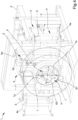
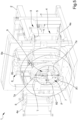
Figures 2 through 8 show, in sequence, the removal of the toroid from the reinforced tire by the insertion/removal assembly; -
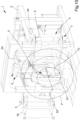
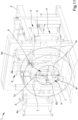
Figures 9 to 14 shown, in sequence, the insertion of the toroid into the reinforced tire by the insertion/removal assembly. - With particular reference to these figures, reference numeral 1 globally denotes a machine for the insertion/removal of toroids into/from wheels of special vehicles. The machine 1 for the insertion/removal of toroids into/from wheels of special vehicles comprises, first of all, at least one
base frame 2 for resting on the ground and gripping and retaining means 3 of a reinforced tire P associated with thebase frame 2. - In this regard, it is specified that, in the context of this disclosure, "reinforced tire" means a tire specifically constructed to contain within it a supporting toroid such as, e.g., a military vehicle tire.
- In other words, "reinforced tire" refers to any tire internally provided with a toroid or in which a toroid can be installed.
- That being said, the gripping and retaining means 3 comprise at least one gripping and retaining
structure 4 movable between a retaining configuration of the reinforced tire P (Figures 2-14 ) and a release configuration of the reinforced tire P (Figure 1 ). - As visible in
Figure 1 , the gripping andretaining structure 4 preferably comprises at least one pair of gripping and retainingmembers 4a associated with thebase frame 2 and movable close to/away from each other at the transition from the release/retaining configuration to the retaining/release configuration. - In particular, the gripping and retaining
members 4a are associated with thebase frame 2 in a rotatable manner, so they are rotated in a first way to be displaced from the release configuration to the retaining configuration and in a second way, opposite the previous one, to be displaced from the retaining configuration to the release configuration. - To fasten the reinforced tire P, it is, therefore, sufficient to arrange the gripping and retaining
members 4a in the release position, place the reinforced tire P between them and move, at this point, the gripping and retaining members themselves from the release position to the retaining position. - In order to prevent an unexpected release of the reinforced tire P during the operation of the machine 1, the gripping and retaining means 3 comprise at least one
blocking mechanism 5 associated with the gripping and retainingstructure 4 and adapted to block the latter in the retaining configuration, thus preventing the transition thereof to the release configuration. - In particular, the
blocking mechanism 5 can be selectively activated and deactivated. - In this way, it is possible to allow blocking the gripping and retaining
structure 4 in the retaining configuration and the free movement of the gripping and retainingstructure 4 between the retaining configuration and the release configuration, respectively. - Preferably, the
blocking mechanism 5 is of the type of a cogwheel ratchet gear. So, in order to remove the reinforced tire P from the gripping and retaining means 3, it is sufficient to deactivate theblocking mechanism 5, arrange the gripping and retainingmembers 4a from the retaining position to the release position and move, at this point, the reinforced tire P away from the machine 1. - In addition, the machine 1 comprises at least one insertion/
removal assembly 6 of a toroid T into/from the reinforced tire P. - According to the invention, the insertion/
removal assembly 6 comprises deformation means 7 of the toroid T and close/away movement means 8 of the deformation means 7 for moving them close to/away from the gripping and retaining means 3 along a direction of close/away movement D. - Specifically, the deformation means 7 are extendable/compressible along a first vertical axis A1 and a second horizontal axis A2 between a configuration of vertical extension, wherein they are elongated along the first axis Al, an intermediate configuration, wherein they have a substantially circular conformation, and a configuration of horizontal extension wherein they are elongated along the second axis A2.
- Specifically, the deformation means 7 have a substantially ellipsoidal conformation in the configuration of vertical extension and in the configuration of horizontal extension; in the former case, the major axis is aligned with the first axis A1, while in the latter case it is aligned with the second axis A2.
- In this regard, the use of the expression "extendable/retractable" is intended to refer to the fact that:
- when the deformation means 7 are extended along the first axis A1 they are simultaneously contracted along the second axis A2; and that
- when the deformation means 7 are extended along the second axis A2 they are simultaneously contracted along the first axis A1.
- In other words, the extension of the deformation means 7 along one of either the first axis A1 or the second axis A2 involves, at the same time, the compression of the deformation means 7 along the other of either the first axis A1 or the second axis A2.
- The deformation means 7 are, in addition, rotatable around the first axis A1 between an aligned position, wherein the second axis A2 is substantially parallel to the direction of close/away movement D, and a transverse position, wherein the second axis A2 is substantially perpendicular to the direction of close/away movement D.
- This means that the deformation means 7 are rotatable substantially by 90° around the first axis A1.
- Conveniently, the insertion/
removal assembly 6 is configured to be moved for the removal of the toroid T from the reinforced tire P among a plurality of operational positions comprising: - a first position wherein the deformation means 7 are arranged in the configuration of horizontal extension and rotated to the aligned position, and wherein the close/away movement means 8 are adapted to move the deformation means 7 along the direction of close/away movement D until the deformation means 7 are fitted within the reinforced tire P (
Figure 2 ); - a second position wherein the deformation means 7 are arranged in the intermediate configuration (
Figure 3 ); - a third position wherein the deformation means 7 are rotated to the transverse position and adhere peripherally to the inner surface of the toroid (
Figure 4 ); - a fourth position wherein the deformation means 7 are arranged in the configuration of vertical extension. In this case, the deformation means 7 deform the toroid T to give it an ellipsoidal conformation having a major axis coincident with the first axis A1 (
Figure 5 ); - a fifth position wherein the deformation means 7 are rotated to the aligned position (
Figure 6 ); - a sixth position wherein the deformation means 7 are arranged in the configuration of horizontal extension (
Figure 7 ). In this case, the deformation means 7 deform the toroid T to give it an ellipsoidal shape having a major axis coincident with the second axis A2. Having longitudinal development extending along the direction of close/away movement D and its extension along the first axis A1 being small, the toroid T can be easily removed from the reinforced tire P. In this regard, in the sixth position, the close/away movement means 8 are adapted to move the deformation means 7 along the direction of close/away movement D until the deformation means 7 are removed from the reinforced tire P (Figure 8 ). - In contrast, the procedure to insert the toroid T into the reinforced tire P begins by placing the deformation means 7 inside the toroid itself.
- In this sense, the insertion/
removal assembly 6 is configured to be moved for the insertion of the toroid T into the reinforced tire P among a plurality of operational positions comprising: - a first position wherein the deformation means 7 are arranged in the configuration of horizontal extension and rotated to the aligned position. In the first position, the close/away movement means 8 are adapted to move the deformation means 7 along the direction of close/away movement D until the deformation means 7 and, therefore, the toroid T are inserted within the reinforced tire P (
Figure 9 ); - a second position wherein the deformation means 7 are arranged in the configuration of vertical extension. In this case, the deformation means 7 deform the toroid T to give it an ellipsoidal shape having a major axis coincident with the first axis A1 (
Figure 10 ); - a third position wherein the deformation means 7 are rotated to the transverse position (
Figure 11 ); - a fourth position wherein the deformation means 7 are arranged in the intermediate configuration and the toroid T is substantially concentric to the reinforced tire P (
Figure 12 ); - a fifth position wherein the deformation means 7 are rotated to the aligned position (
Figure 13 ); - a sixth position wherein the deformation means 7 are arranged in the configuration of horizontal extension. In this position, the vertical extension of the deformation means 7 is reduced and, therefore, the same can be removed from the reinforced tire P. In this sense, the close/away movement means 8 are adapted to move, in the sixth position, the deformation means 7 along the direction of close/away movement D until the deformation means 7 are removed from the reinforced tire P (
Figure 14 ). - It is important to specify that the fact of providing deformation means 7 operable to insert/remove the toroid T according to the mode of operation just described proves to be extremely advantageous in remedying the drawbacks of the prior art previously complained of.
- First of all, such deformation means 7 do not require any manual intervention by the operators while operating the machine, thus drastically increasing the overall safety compared to the mentioned state of the art.
- Again, the performance by the deformation means 7 of the work phases listed above gives the machine 1 high precision, reliability and repeatability of operation, resulting in greatly reducing the time required for the insertion/removal of the toroid T into/from the reinforced tire P and, therefore, increasing the production output of the machine 1 compared with known machines.
- Last but not least, the accuracy of the machine 1 also allows lower stresses to be exerted on the toroid T and on the reinforced tire P, thus averting the possibility of damage to them during the operation of the machine 1.
- Having specified these advantages, it is also specified that the deformation means 7 preferably comprise a plurality of articulated
arms 7a mutually connected to each other and movable with respect to each other in the transition between the configuration of vertical extension, the intermediate configuration and the configuration of horizontal extension. - Specifically, the deformation means 7 comprise four articulated
arms 7a. - Preferably, the articulated
arms 7a are arranged in a lozenge pattern. - Different embodiments of the deformation means 7 cannot however be ruled out wherein, e.g., they comprise a different number of articulated
arms 7a (e.g., eight) and/or wherein the latter are arranged differently (e.g., rectangular). - As for, however, the close/away movement means 8, they preferably comprise:
- at least one
guide 8a associated with thebase frame 2 and developing along the direction of close/away movement D; and - at least one supporting
body 8b associated with theguide 8a in a sliding manner and adapted to support the deformation means 7 by shifting along the direction of close/away movement D. - With reference to the procedure of removal of the toroid T from the reinforced tire P, the supporting
body 8b is configured to shift along the direction of close/away movement D when the deformation means 7 are in the first position and in the sixth position. - More specifically:
- in the first position, the supporting
body 8b shift, together with the deformation means 7, along a first way of the direction of close/away movement D; - in the second position, in the third position, in the fourth position and in the fifth position, the supporting
body 8b remains stationary with respect to the direction of close/away movement D; and - in the sixth position the supporting
body 8b shifts, together with the deformation means 7, along a second way of the direction of close/away movement D opposite the first way. - Similarly, with reference to the procedure of inserting the toroid T into the reinforced tire P, the supporting
body 8b is configured to shift along the direction of close/away movement D when the deformation means 7 are in the first position and in the sixth position. - More specifically:
- in the first position, the supporting
body 8b shifts, together with the deformation means 7, along the first way of the direction of close/away movement D; - in the second position, in the third position, in the fourth position and in the fifth position, the supporting
body 8b remains stationary with respect to the direction of close/away movement D; and - in the sixth position, the supporting
body 8b shifts, together with the deformation means 7, along the second way of the direction of close/away movement D. - Conveniently, the insertion/
removal assembly 6 comprises movement means 9 associated with the deformation means 7. - Specifically, the movement means 9 are adapted to:
- arrange the deformation means 7 in one of the configuration of vertical extension, the intermediate configuration or the configuration of horizontal extension; and to
- rotate the deformation means 7 to one of either the aligned position or the transverse position.
- In accordance with the preferred embodiment shown in the figures, the movement means 9 comprise at least one pair of
movement arms 9a with which the deformation means 7 are associated in a rotatable manner. - In particular, the
movement arms 9a are movable in mutual close/away movement along the first axis A1. - Conveniently, the
movement arms 9a are associated with the supportingbody 8b. More specifically, themovement arms 9a are constrained to the supportingbody 8b. - This means that the shift of the supporting
body 8b along the direction of close/away movement D results in the shifts along the same direction of both the deformation means 7 and the movement means 9. - Referring to the procedure of removing the toroid T from the reinforced tire P, the
movement arms 9a are moved one with respect to the other in the second position, in the fourth position and in the sixth position. - Specifically, the
movement arms 9a are moved away from each other in the second position (where they arrange the deformation means 7 from the configuration of horizontal extension to the intermediate configuration) and in the fourth position (where they arrange the deformation means 7 from the intermediate configuration to the configuration of vertical extension). - Instead, the
movement arms 9a are moved in mutual close movement in the sixth position (where they arrange the deformation means 7 from the configuration of vertical extension to the configuration of horizontal extension). - Through this sequence of actions it is, therefore, possible to remove the toroid T from the tire P in an effective, smooth and absolutely repeatable manner.
- Similarly, in the procedure of insertion of the toroid T, the
movement arms 9a are also moved the one with respect to the other in the second position, in the fourth position and in the sixth position. - Specifically, the
movement arms 9a are moved in mutual away movement from each other in the second position (where they arrange the deformation means 7 from the configuration of horizontal extension to the configuration of vertical extension). - Instead, the
movement arms 9a are moved in mutual close movement in the fourth position (where they arrange the deformation means 7 from the configuration of vertical extension to the intermediate configuration) and in the sixth position (where they arrange the deformation means 7 from the intermediate configuration to the configuration of horizontal extension). - Through this sequence of actions it is, therefore, possible to insert the toroid T into the tire P effectively, smoothly and absolutely repeatably.
- Conveniently, the insertion/
removal assembly 6 comprises lifting/lowering means, not shown in the figures, that are operationally associated with the deformation means 7 and are adapted to move the latter parallel to the first axis A1. - This makes it possible to adjust the height of the deformation means 7 by lifting and lowering them according to, e.g., the size of the reinforced tire P within which they are to be inserted.
- This further allows increasing the versatility of the machine 1, which can, therefore, be used to insert and remove the toroids T into/from the reinforced tires P of even very different sizes.
- It has in practice been ascertained that the described invention achieves the intended objects.
- In particular, the fact is highlighted that the deformation means according to the invention make it possible to obtain a machine with perfectly safe use for the operators, in which no direct intervention by the operatores is required to carry out the insertion/removal of the toroid into/from the wheels.
- This same expedient, among other things, makes it possible to remove/insert the toroid from/into the wheel of a military vehicle in a particularly precise and repeatable manner.
- Still, this expedient also allows reducing the time required to complete these operations compared with the aforementioned prior art, thus increasing the production output of the machine.
- Finally, the special operation of the insertion/removal assembly according to the invention allows the toroid to be inserted/removed into/from the tire absolutely accurately and precisely, that is, without resulting in any damage to either the tire or the toroid itself.
Claims (11)
- Machine (1) for the insertion/removal of toroids into/from wheels of special vehicles, comprising:- at least one base frame (2) for resting on the ground;- gripping and retaining means (3) of a reinforced tire (P) associated with said base frame (2);- at least one insertion/removal assembly (6) of a toroid (T) into/from said reinforced tire (P);characterized by the fact that said insertion/removal assembly (6) comprises deformation means (7) of said toroid (T) and close/away movement means (8) of said deformation means (7) for moving them close to/away from said gripping and retaining means (3) along a direction of close/away movement (D), wherein said deformation means (7) are extendable/compressible along a first vertical axis (A1) and a second horizontal axis (A2) between a configuration of vertical extension, wherein they are elongated along said first axis (A1), an intermediate configuration, wherein they have a substantially circular conformation, and a configuration of horizontal extension, wherein they are elongated along said second axis (A2), and wherein said deformation means (7) are rotatable around said first axis (A1) between an aligned position, wherein said second axis (A2) is substantially parallel to said direction of close/away movement (D), and a transverse position, wherein said second axis (A2) is substantially perpendicular to said direction of close/away movement (D).
- Machine (1) according to claim 1, characterized by the fact that said insertion/removal assembly (6) is configured to be moved for the removal of said toroid (T) from said reinforced tire (P) among a plurality of operational positions comprising:- a first position wherein said deformation means (7) are arranged in said configuration of horizontal extension and rotated to said aligned position, and wherein said close/away movement means (8) are adapted to move said deformation means (7) along said direction of close/away movement (D) until said deformation means (7) are fitted within said reinforced tire (P);- a second position wherein said deformation means (7) are arranged in said intermediate configuration;- a third position wherein said deformation means (7) are rotated to said transverse position;- a fourth position wherein said deformation means (7) are arranged in said configuration of vertical extension;- a fifth position wherein said deformation means (7) are rotated to said aligned position;- a sixth position wherein said deformation means (7) are arranged in said configuration of horizontal extension and wherein said close/away movement means (8) are adapted to move said deformation means (7) along said direction of close/away movement (D) until said deformation means (7) are removed from said reinforced tire (P).
- Machine (1) according to one or more of the preceding claims, characterized by the fact that said insertion/removal assembly (6) is configured to be moved for the insertion of said toroid (T) into said reinforced tire (P) among a plurality of operational positions comprising:- a first position wherein said deformation means (7) are arranged in said configuration of horizontal extension and rotated to said aligned position, and wherein said close/away movement means (8) are adapted to move said deformation means (7) along said direction of close/away movement (D) until said deformation means (7) are fitted within said reinforced tire (P);- a second position wherein said deformation means (7) are arranged in said configuration of vertical extension;- a third position wherein said deformation means (7) are rotated to said transverse position;- a fourth position wherein said deformation means (7) are arranged in said intermediate configuration;- a fifth position wherein said deformation means (7) are rotated to said aligned position;- a sixth position wherein said deformation means (7) are arranged in said configuration of horizontal extension and wherein said close/away movement means (8) are adapted to move said deformation means (7) along said direction of close/away movement (D) until said deformation means (7) are removed from said reinforced tire (P).
- Machine (1) according to one or more of the preceding claims, characterized by the fact that said deformation means (7) comprise a plurality of articulated arms (7a) mutually connected to each other and movable with respect to each other in the transition between said configuration of vertical extension, said intermediate configuration and said configuration of horizontal extension.
- Machine (1) according to claim 4, characterized by the fact that said articulated arms (7a) are arranged in a lozenge pattern.
- Machine (1) according to claim 4 or 5, characterized by the fact that said deformation means (7) comprise four of said articulated arms (7a).
- Machine (1) according to one or more of the preceding claims, characterized by the fact that said close/away movement means (8) comprise:- at least one guide (8a) associated with said base frame (2) and developing along said direction of close/away movement (D); and- at least one supporting body (8b) associated with said guide (8a) in a sliding manner and adapted to support said deformation means (7) by shifting along said direction of close/away movement (D).
- Machine (1) according to one or more of the preceding claims, characterized by the fact that said insertion/removal assembly (6) comprises movement means (9) associated with said deformation means (7) and adapted to:- arrange said deformation means (7) in one of said configuration of vertical extension, said intermediate configuration or said configuration of horizontal extension; and to- rotate said deformation means (7) to one of either said aligned position or said transverse position.
- Machine (1) according to claim 8, characterized by the fact that said movement means (9) comprise at least one pair of movement arms (9a) which are movable in mutual close/away movement along said first axis (A1) and with which said deformation means (7) are associated in a rotatable manner.
- Machine (1) according to one or more of the preceding claims, characterized by the fact that said gripping and retaining means (3) comprise:- at least one gripping and retaining structure (4) movable between a retaining configuration of said reinforced tire (P) and a release configuration of said reinforced tire (P); and- at least one blocking mechanism (5) associated with said gripping and retaining structure (4) and adapted to block the latter in said retaining configuration, preventing the transition thereof to said release configuration.
- Machine (1) according to claim 10, characterized by the fact that said blocking mechanism (5) is of the type of a cogwheel ratchet gear.
Applications Claiming Priority (1)
| Application Number | Priority Date | Filing Date | Title |
|---|---|---|---|
| IT102022000026691A IT202200026691A1 (en) | 2022-12-23 | 2022-12-23 | MACHINE FOR INSERTING/EXTRACTING TOROIDS IN/FROM SPECIAL VEHICLE WHEELS |
Publications (2)
| Publication Number | Publication Date |
|---|---|
| EP4389470A1 true EP4389470A1 (en) | 2024-06-26 |
| EP4389470B1 EP4389470B1 (en) | 2025-07-09 |
Family
ID=85726609
Family Applications (1)
| Application Number | Title | Priority Date | Filing Date |
|---|---|---|---|
| EP23217527.3A Active EP4389470B1 (en) | 2022-12-23 | 2023-12-18 | Machine for the insertion/removal of toroids into/from wheels of special vehicles |
Country Status (5)
| Country | Link |
|---|---|
| US (1) | US20240208281A1 (en) |
| EP (1) | EP4389470B1 (en) |
| ES (1) | ES3042201T3 (en) |
| IT (1) | IT202200026691A1 (en) |
| PL (1) | PL4389470T3 (en) |
Citations (4)
| Publication number | Priority date | Publication date | Assignee | Title |
|---|---|---|---|---|
| US1535382A (en) * | 1924-01-15 | 1925-04-28 | Fisk Rubber Co | Air-bag puller |
| US4251906A (en) * | 1978-10-10 | 1981-02-24 | Etablissements M. Muller & Cie. | Method of and apparatus for fitting and removing unpuncturable inner tubes |
| EP1354730A1 (en) * | 2002-04-15 | 2003-10-22 | BUTLER ENGINEERING & MARKETING S.r.l. | Method and apparatus for assembling/disassembling a flexible ring to in or from a tired wheel |
| US20070256794A1 (en) * | 2006-05-05 | 2007-11-08 | Michelin Recherche Et Technique S.A., Switzerland | Method for extracting a foam support ring from a tire |
Family Cites Families (6)
| Publication number | Priority date | Publication date | Assignee | Title |
|---|---|---|---|---|
| DE3411635A1 (en) * | 1984-03-29 | 1985-10-03 | Continental Gummi-Werke Ag, 3000 Hannover | Device for premounting pneumatic vehicle tyres |
| WO1999022953A1 (en) * | 1997-10-30 | 1999-05-14 | Hutchinson | Device for motor vehicle running flat and method for mounting |
| IT1319474B1 (en) * | 2000-06-23 | 2003-10-10 | Corghi Spa | DEVICE FOR OPERATING ON SYSTEM PAX AND SIMILAR TIRES |
| ITMO20010234A1 (en) * | 2001-11-27 | 2003-05-27 | G S Srl Unipersonale | DEVICE FOR THE INSERTION AND EXTRACTION OF A SUPPORT RING IN A TIRE |
| ITTO20060285A1 (en) * | 2006-04-14 | 2007-10-15 | Bridgestone Corp | MACHINE FOR ASSEMBLY AND DISASSEMBLY OF A TIRE EQUIPPED WITH AN ANTI-APPIACTIVE INTERNAL RIGID RING |
| ITUB20153777A1 (en) * | 2015-09-21 | 2017-03-21 | Butler Eng And Marketing S P A | ASSEMBLY-DISASSEMBLY DEVICE OF A RING SUPPORT IN OR FROM A TIRE, AS WELL AS THE MACHINE INCLUDING THIS DEVICE |
-
2022
- 2022-12-23 IT IT102022000026691A patent/IT202200026691A1/en unknown
-
2023
- 2023-12-18 ES ES23217527T patent/ES3042201T3/en active Active
- 2023-12-18 EP EP23217527.3A patent/EP4389470B1/en active Active
- 2023-12-18 PL PL23217527.3T patent/PL4389470T3/en unknown
- 2023-12-22 US US18/394,373 patent/US20240208281A1/en active Pending
Patent Citations (4)
| Publication number | Priority date | Publication date | Assignee | Title |
|---|---|---|---|---|
| US1535382A (en) * | 1924-01-15 | 1925-04-28 | Fisk Rubber Co | Air-bag puller |
| US4251906A (en) * | 1978-10-10 | 1981-02-24 | Etablissements M. Muller & Cie. | Method of and apparatus for fitting and removing unpuncturable inner tubes |
| EP1354730A1 (en) * | 2002-04-15 | 2003-10-22 | BUTLER ENGINEERING & MARKETING S.r.l. | Method and apparatus for assembling/disassembling a flexible ring to in or from a tired wheel |
| US20070256794A1 (en) * | 2006-05-05 | 2007-11-08 | Michelin Recherche Et Technique S.A., Switzerland | Method for extracting a foam support ring from a tire |
Also Published As
| Publication number | Publication date |
|---|---|
| ES3042201T3 (en) | 2025-11-19 |
| PL4389470T3 (en) | 2025-11-03 |
| US20240208281A1 (en) | 2024-06-27 |
| IT202200026691A1 (en) | 2024-06-23 |
| EP4389470B1 (en) | 2025-07-09 |
Similar Documents
| Publication | Publication Date | Title |
|---|---|---|
| CN105235455B (en) | Machine and method for fit and remove tire | |
| EP1314584B1 (en) | Bead releasing and removing head for a tire-fitting machine | |
| CN105235456B (en) | Machine and method for fit and remove tire | |
| EP2629992A1 (en) | A tyre demounting machine | |
| JP5478024B2 (en) | Bead press device for tire attaching / detaching device | |
| JP5563742B2 (en) | Mount press device for tire attaching / detaching device | |
| EP1897709B1 (en) | Machine for fitting and removing vehicle tyres | |
| EP2233325A1 (en) | Machine for fitting and removing the wheel tyres of vehicle | |
| US7341090B2 (en) | Assembling-disassembling machine provided with a overturnable mounting-dismounting tool | |
| JP5486794B2 (en) | Vehicle wheel tire mounting / removal device | |
| ITMO990098A1 (en) | MULTIFUNCTIONAL STATION FOR THE ASSEMBLY AND DISASSEMBLY OF TIRES BOTH CONVENTIONAL AND SPECIAL. | |
| EP2338705B1 (en) | Bead breaking unit for tyre changing machines | |
| IT202000002920A1 (en) | EQUIPMENT AND PROCEDURE FOR THE ASSEMBLY AND DISASSEMBLY OF TIRES | |
| US20150224833A1 (en) | Tyre-changing machine | |
| EP4389470A1 (en) | Machine for the insertion/removal of toroids into/from wheels of special vehicles | |
| US9944136B2 (en) | Machine for removing and fitting wheel tyres for vehicles | |
| ITMO20100305A1 (en) | ORIENTATION DEVICE FOR A WORKING TOOL IN A TIRE CHANGER MACHINE | |
| ITMO20090130A1 (en) | TOOL FOR REMOVAL TIRE MACHINES | |
| EP2756969B1 (en) | Machine for removing/ fitting a tyre from/ on the rim of a vehicle vehicles | |
| US9610812B2 (en) | Tire bead extraction device for tire-changing machines | |
| EP3197808B1 (en) | Reel drive assembly | |
| US2521149A (en) | Tire handling device | |
| JP2005239145A (en) | Tire attaching/detaching machine for vehicle wheel | |
| ITMO20090209A1 (en) | GROUP FOR THE TALLONING OF TIRES IN TIRE DISMANTLING MACHINES OR SIMILAR | |
| EP4532231B1 (en) | Device for fitting/removing tires |
Legal Events
| Date | Code | Title | Description |
|---|---|---|---|
| PUAI | Public reference made under article 153(3) epc to a published international application that has entered the european phase |
Free format text: ORIGINAL CODE: 0009012 |
|
| STAA | Information on the status of an ep patent application or granted ep patent |
Free format text: STATUS: THE APPLICATION HAS BEEN PUBLISHED |
|
| AK | Designated contracting states |
Kind code of ref document: A1 Designated state(s): AL AT BE BG CH CY CZ DE DK EE ES FI FR GB GR HR HU IE IS IT LI LT LU LV MC ME MK MT NL NO PL PT RO RS SE SI SK SM TR |
|
| STAA | Information on the status of an ep patent application or granted ep patent |
Free format text: STATUS: REQUEST FOR EXAMINATION WAS MADE |
|
| 17P | Request for examination filed |
Effective date: 20241220 |
|
| GRAP | Despatch of communication of intention to grant a patent |
Free format text: ORIGINAL CODE: EPIDOSNIGR1 |
|
| STAA | Information on the status of an ep patent application or granted ep patent |
Free format text: STATUS: GRANT OF PATENT IS INTENDED |
|
| RIC1 | Information provided on ipc code assigned before grant |
Ipc: B60C 25/05 20060101AFI20250122BHEP |
|
| INTG | Intention to grant announced |
Effective date: 20250204 |
|
| GRAS | Grant fee paid |
Free format text: ORIGINAL CODE: EPIDOSNIGR3 |
|
| GRAA | (expected) grant |
Free format text: ORIGINAL CODE: 0009210 |
|
| STAA | Information on the status of an ep patent application or granted ep patent |
Free format text: STATUS: THE PATENT HAS BEEN GRANTED |
|
| AK | Designated contracting states |
Kind code of ref document: B1 Designated state(s): AL AT BE BG CH CY CZ DE DK EE ES FI FR GB GR HR HU IE IS IT LI LT LU LV MC ME MK MT NL NO PL PT RO RS SE SI SK SM TR |
|
| REG | Reference to a national code |
Ref country code: GB Ref legal event code: FG4D |
|
| REG | Reference to a national code |
Ref country code: CH Ref legal event code: EP |
|
| REG | Reference to a national code |
Ref country code: IE Ref legal event code: FG4D |
|
| REG | Reference to a national code |
Ref country code: DE Ref legal event code: R096 Ref document number: 602023004712 Country of ref document: DE |
|
| P01 | Opt-out of the competence of the unified patent court (upc) registered |
Free format text: CASE NUMBER: UPC_APP_0645_4389470/2025 Effective date: 20250721 |
|
| REG | Reference to a national code |
Ref country code: NL Ref legal event code: MP Effective date: 20250709 |
|
| REG | Reference to a national code |
Ref country code: ES Ref legal event code: FG2A Ref document number: 3042201 Country of ref document: ES Kind code of ref document: T3 Effective date: 20251119 |
|
| PG25 | Lapsed in a contracting state [announced via postgrant information from national office to epo] |
Ref country code: PT Free format text: LAPSE BECAUSE OF FAILURE TO SUBMIT A TRANSLATION OF THE DESCRIPTION OR TO PAY THE FEE WITHIN THE PRESCRIBED TIME-LIMIT Effective date: 20251110 |
|
| PG25 | Lapsed in a contracting state [announced via postgrant information from national office to epo] |
Ref country code: NL Free format text: LAPSE BECAUSE OF FAILURE TO SUBMIT A TRANSLATION OF THE DESCRIPTION OR TO PAY THE FEE WITHIN THE PRESCRIBED TIME-LIMIT Effective date: 20250709 |
|
| REG | Reference to a national code |
Ref country code: AT Ref legal event code: MK05 Ref document number: 1811545 Country of ref document: AT Kind code of ref document: T Effective date: 20250709 |
|
| PG25 | Lapsed in a contracting state [announced via postgrant information from national office to epo] |
Ref country code: IS Free format text: LAPSE BECAUSE OF FAILURE TO SUBMIT A TRANSLATION OF THE DESCRIPTION OR TO PAY THE FEE WITHIN THE PRESCRIBED TIME-LIMIT Effective date: 20251109 |
|
| PG25 | Lapsed in a contracting state [announced via postgrant information from national office to epo] |
Ref country code: NO Free format text: LAPSE BECAUSE OF FAILURE TO SUBMIT A TRANSLATION OF THE DESCRIPTION OR TO PAY THE FEE WITHIN THE PRESCRIBED TIME-LIMIT Effective date: 20251009 |
|
| REG | Reference to a national code |
Ref country code: LT Ref legal event code: MG9D |
|
| PG25 | Lapsed in a contracting state [announced via postgrant information from national office to epo] |
Ref country code: AT Free format text: LAPSE BECAUSE OF FAILURE TO SUBMIT A TRANSLATION OF THE DESCRIPTION OR TO PAY THE FEE WITHIN THE PRESCRIBED TIME-LIMIT Effective date: 20250709 |
|
| PG25 | Lapsed in a contracting state [announced via postgrant information from national office to epo] |
Ref country code: FI Free format text: LAPSE BECAUSE OF FAILURE TO SUBMIT A TRANSLATION OF THE DESCRIPTION OR TO PAY THE FEE WITHIN THE PRESCRIBED TIME-LIMIT Effective date: 20250709 |
|
| PG25 | Lapsed in a contracting state [announced via postgrant information from national office to epo] |
Ref country code: HR Free format text: LAPSE BECAUSE OF FAILURE TO SUBMIT A TRANSLATION OF THE DESCRIPTION OR TO PAY THE FEE WITHIN THE PRESCRIBED TIME-LIMIT Effective date: 20250709 |
|
| PGFP | Annual fee paid to national office [announced via postgrant information from national office to epo] |
Ref country code: FR Payment date: 20251226 Year of fee payment: 3 |
|
| PG25 | Lapsed in a contracting state [announced via postgrant information from national office to epo] |
Ref country code: GR Free format text: LAPSE BECAUSE OF FAILURE TO SUBMIT A TRANSLATION OF THE DESCRIPTION OR TO PAY THE FEE WITHIN THE PRESCRIBED TIME-LIMIT Effective date: 20251010 |
|
| PGFP | Annual fee paid to national office [announced via postgrant information from national office to epo] |
Ref country code: TR Payment date: 20251216 Year of fee payment: 3 |
|
| PG25 | Lapsed in a contracting state [announced via postgrant information from national office to epo] |
Ref country code: SE Free format text: LAPSE BECAUSE OF FAILURE TO SUBMIT A TRANSLATION OF THE DESCRIPTION OR TO PAY THE FEE WITHIN THE PRESCRIBED TIME-LIMIT Effective date: 20250709 |
|
| PG25 | Lapsed in a contracting state [announced via postgrant information from national office to epo] |
Ref country code: LV Free format text: LAPSE BECAUSE OF FAILURE TO SUBMIT A TRANSLATION OF THE DESCRIPTION OR TO PAY THE FEE WITHIN THE PRESCRIBED TIME-LIMIT Effective date: 20250709 |
|
| PG25 | Lapsed in a contracting state [announced via postgrant information from national office to epo] |
Ref country code: BG Free format text: LAPSE BECAUSE OF FAILURE TO SUBMIT A TRANSLATION OF THE DESCRIPTION OR TO PAY THE FEE WITHIN THE PRESCRIBED TIME-LIMIT Effective date: 20250709 |
|
| PGFP | Annual fee paid to national office [announced via postgrant information from national office to epo] |
Ref country code: PL Payment date: 20251202 Year of fee payment: 3 |
|
| PG25 | Lapsed in a contracting state [announced via postgrant information from national office to epo] |
Ref country code: RS Free format text: LAPSE BECAUSE OF FAILURE TO SUBMIT A TRANSLATION OF THE DESCRIPTION OR TO PAY THE FEE WITHIN THE PRESCRIBED TIME-LIMIT Effective date: 20251009 |
|
| PG25 | Lapsed in a contracting state [announced via postgrant information from national office to epo] |
Ref country code: RO Free format text: LAPSE BECAUSE OF FAILURE TO SUBMIT A TRANSLATION OF THE DESCRIPTION OR TO PAY THE FEE WITHIN THE PRESCRIBED TIME-LIMIT Effective date: 20250709 |
|
| PG25 | Lapsed in a contracting state [announced via postgrant information from national office to epo] |
Ref country code: SM Free format text: LAPSE BECAUSE OF FAILURE TO SUBMIT A TRANSLATION OF THE DESCRIPTION OR TO PAY THE FEE WITHIN THE PRESCRIBED TIME-LIMIT Effective date: 20250709 |
|
| PGFP | Annual fee paid to national office [announced via postgrant information from national office to epo] |
Ref country code: ES Payment date: 20260102 Year of fee payment: 3 |
|
| PG25 | Lapsed in a contracting state [announced via postgrant information from national office to epo] |
Ref country code: DK Free format text: LAPSE BECAUSE OF FAILURE TO SUBMIT A TRANSLATION OF THE DESCRIPTION OR TO PAY THE FEE WITHIN THE PRESCRIBED TIME-LIMIT Effective date: 20250709 |
|
| PGFP | Annual fee paid to national office [announced via postgrant information from national office to epo] |
Ref country code: DE Payment date: 20251229 Year of fee payment: 3 |
|
| PGFP | Annual fee paid to national office [announced via postgrant information from national office to epo] |
Ref country code: IT Payment date: 20251231 Year of fee payment: 3 |
|
| PG25 | Lapsed in a contracting state [announced via postgrant information from national office to epo] |
Ref country code: CZ Free format text: LAPSE BECAUSE OF FAILURE TO SUBMIT A TRANSLATION OF THE DESCRIPTION OR TO PAY THE FEE WITHIN THE PRESCRIBED TIME-LIMIT Effective date: 20250709 |
|
| PG25 | Lapsed in a contracting state [announced via postgrant information from national office to epo] |
Ref country code: SK Free format text: LAPSE BECAUSE OF FAILURE TO SUBMIT A TRANSLATION OF THE DESCRIPTION OR TO PAY THE FEE WITHIN THE PRESCRIBED TIME-LIMIT Effective date: 20250709 Ref country code: EE Free format text: LAPSE BECAUSE OF FAILURE TO SUBMIT A TRANSLATION OF THE DESCRIPTION OR TO PAY THE FEE WITHIN THE PRESCRIBED TIME-LIMIT Effective date: 20250709 |