EP4389415A1 - Boron nitride aerogel interface coating precursor for ceramic matrix composites - Google Patents
Boron nitride aerogel interface coating precursor for ceramic matrix composites Download PDFInfo
- Publication number
- EP4389415A1 EP4389415A1 EP23212892.6A EP23212892A EP4389415A1 EP 4389415 A1 EP4389415 A1 EP 4389415A1 EP 23212892 A EP23212892 A EP 23212892A EP 4389415 A1 EP4389415 A1 EP 4389415A1
- Authority
- EP
- European Patent Office
- Prior art keywords
- fibrous material
- sheet
- depositing
- ifc
- aerogel
- Prior art date
- Legal status (The legal status is an assumption and is not a legal conclusion. Google has not performed a legal analysis and makes no representation as to the accuracy of the status listed.)
- Granted
Links
Images


Classifications
-
- C—CHEMISTRY; METALLURGY
- C04—CEMENTS; CONCRETE; ARTIFICIAL STONE; CERAMICS; REFRACTORIES
- C04B—LIME, MAGNESIA; SLAG; CEMENTS; COMPOSITIONS THEREOF, e.g. MORTARS, CONCRETE OR LIKE BUILDING MATERIALS; ARTIFICIAL STONE; CERAMICS; REFRACTORIES; TREATMENT OF NATURAL STONE
- C04B35/00—Shaped ceramic products characterised by their composition; Ceramics compositions; Processing powders of inorganic compounds preparatory to the manufacturing of ceramic products
- C04B35/622—Forming processes; Processing powders of inorganic compounds preparatory to the manufacturing of ceramic products
- C04B35/626—Preparing or treating the powders individually or as batches ; preparing or treating macroscopic reinforcing agents for ceramic products, e.g. fibres; mechanical aspects section B
- C04B35/628—Coating the powders or the macroscopic reinforcing agents
- C04B35/62844—Coating fibres
- C04B35/62857—Coating fibres with non-oxide ceramics
- C04B35/62865—Nitrides
- C04B35/62868—Boron nitride
-
- B—PERFORMING OPERATIONS; TRANSPORTING
- B32—LAYERED PRODUCTS
- B32B—LAYERED PRODUCTS, i.e. PRODUCTS BUILT-UP OF STRATA OF FLAT OR NON-FLAT, e.g. CELLULAR OR HONEYCOMB, FORM
- B32B18/00—Layered products essentially comprising ceramics, e.g. refractory products
-
- C—CHEMISTRY; METALLURGY
- C04—CEMENTS; CONCRETE; ARTIFICIAL STONE; CERAMICS; REFRACTORIES
- C04B—LIME, MAGNESIA; SLAG; CEMENTS; COMPOSITIONS THEREOF, e.g. MORTARS, CONCRETE OR LIKE BUILDING MATERIALS; ARTIFICIAL STONE; CERAMICS; REFRACTORIES; TREATMENT OF NATURAL STONE
- C04B35/00—Shaped ceramic products characterised by their composition; Ceramics compositions; Processing powders of inorganic compounds preparatory to the manufacturing of ceramic products
- C04B35/515—Shaped ceramic products characterised by their composition; Ceramics compositions; Processing powders of inorganic compounds preparatory to the manufacturing of ceramic products based on non-oxide ceramics
- C04B35/56—Shaped ceramic products characterised by their composition; Ceramics compositions; Processing powders of inorganic compounds preparatory to the manufacturing of ceramic products based on non-oxide ceramics based on carbides or oxycarbides
- C04B35/565—Shaped ceramic products characterised by their composition; Ceramics compositions; Processing powders of inorganic compounds preparatory to the manufacturing of ceramic products based on non-oxide ceramics based on carbides or oxycarbides based on silicon carbide
- C04B35/573—Shaped ceramic products characterised by their composition; Ceramics compositions; Processing powders of inorganic compounds preparatory to the manufacturing of ceramic products based on non-oxide ceramics based on carbides or oxycarbides based on silicon carbide obtained by reaction sintering or recrystallisation
-
- C—CHEMISTRY; METALLURGY
- C04—CEMENTS; CONCRETE; ARTIFICIAL STONE; CERAMICS; REFRACTORIES
- C04B—LIME, MAGNESIA; SLAG; CEMENTS; COMPOSITIONS THEREOF, e.g. MORTARS, CONCRETE OR LIKE BUILDING MATERIALS; ARTIFICIAL STONE; CERAMICS; REFRACTORIES; TREATMENT OF NATURAL STONE
- C04B35/00—Shaped ceramic products characterised by their composition; Ceramics compositions; Processing powders of inorganic compounds preparatory to the manufacturing of ceramic products
- C04B35/622—Forming processes; Processing powders of inorganic compounds preparatory to the manufacturing of ceramic products
- C04B35/626—Preparing or treating the powders individually or as batches ; preparing or treating macroscopic reinforcing agents for ceramic products, e.g. fibres; mechanical aspects section B
- C04B35/62605—Treating the starting powders individually or as mixtures
- C04B35/62645—Thermal treatment of powders or mixtures thereof other than sintering
- C04B35/62655—Drying, e.g. freeze-drying, spray-drying, microwave or supercritical drying
-
- C—CHEMISTRY; METALLURGY
- C04—CEMENTS; CONCRETE; ARTIFICIAL STONE; CERAMICS; REFRACTORIES
- C04B—LIME, MAGNESIA; SLAG; CEMENTS; COMPOSITIONS THEREOF, e.g. MORTARS, CONCRETE OR LIKE BUILDING MATERIALS; ARTIFICIAL STONE; CERAMICS; REFRACTORIES; TREATMENT OF NATURAL STONE
- C04B35/00—Shaped ceramic products characterised by their composition; Ceramics compositions; Processing powders of inorganic compounds preparatory to the manufacturing of ceramic products
- C04B35/622—Forming processes; Processing powders of inorganic compounds preparatory to the manufacturing of ceramic products
- C04B35/626—Preparing or treating the powders individually or as batches ; preparing or treating macroscopic reinforcing agents for ceramic products, e.g. fibres; mechanical aspects section B
- C04B35/628—Coating the powders or the macroscopic reinforcing agents
- C04B35/62844—Coating fibres
- C04B35/62857—Coating fibres with non-oxide ceramics
- C04B35/6286—Carbides
- C04B35/62863—Silicon carbide
-
- C—CHEMISTRY; METALLURGY
- C04—CEMENTS; CONCRETE; ARTIFICIAL STONE; CERAMICS; REFRACTORIES
- C04B—LIME, MAGNESIA; SLAG; CEMENTS; COMPOSITIONS THEREOF, e.g. MORTARS, CONCRETE OR LIKE BUILDING MATERIALS; ARTIFICIAL STONE; CERAMICS; REFRACTORIES; TREATMENT OF NATURAL STONE
- C04B35/00—Shaped ceramic products characterised by their composition; Ceramics compositions; Processing powders of inorganic compounds preparatory to the manufacturing of ceramic products
- C04B35/622—Forming processes; Processing powders of inorganic compounds preparatory to the manufacturing of ceramic products
- C04B35/626—Preparing or treating the powders individually or as batches ; preparing or treating macroscopic reinforcing agents for ceramic products, e.g. fibres; mechanical aspects section B
- C04B35/628—Coating the powders or the macroscopic reinforcing agents
- C04B35/62844—Coating fibres
- C04B35/62857—Coating fibres with non-oxide ceramics
- C04B35/62873—Carbon
-
- C—CHEMISTRY; METALLURGY
- C04—CEMENTS; CONCRETE; ARTIFICIAL STONE; CERAMICS; REFRACTORIES
- C04B—LIME, MAGNESIA; SLAG; CEMENTS; COMPOSITIONS THEREOF, e.g. MORTARS, CONCRETE OR LIKE BUILDING MATERIALS; ARTIFICIAL STONE; CERAMICS; REFRACTORIES; TREATMENT OF NATURAL STONE
- C04B35/00—Shaped ceramic products characterised by their composition; Ceramics compositions; Processing powders of inorganic compounds preparatory to the manufacturing of ceramic products
- C04B35/622—Forming processes; Processing powders of inorganic compounds preparatory to the manufacturing of ceramic products
- C04B35/626—Preparing or treating the powders individually or as batches ; preparing or treating macroscopic reinforcing agents for ceramic products, e.g. fibres; mechanical aspects section B
- C04B35/628—Coating the powders or the macroscopic reinforcing agents
- C04B35/62884—Coating the powders or the macroscopic reinforcing agents by gas phase techniques
-
- C—CHEMISTRY; METALLURGY
- C04—CEMENTS; CONCRETE; ARTIFICIAL STONE; CERAMICS; REFRACTORIES
- C04B—LIME, MAGNESIA; SLAG; CEMENTS; COMPOSITIONS THEREOF, e.g. MORTARS, CONCRETE OR LIKE BUILDING MATERIALS; ARTIFICIAL STONE; CERAMICS; REFRACTORIES; TREATMENT OF NATURAL STONE
- C04B35/00—Shaped ceramic products characterised by their composition; Ceramics compositions; Processing powders of inorganic compounds preparatory to the manufacturing of ceramic products
- C04B35/622—Forming processes; Processing powders of inorganic compounds preparatory to the manufacturing of ceramic products
- C04B35/626—Preparing or treating the powders individually or as batches ; preparing or treating macroscopic reinforcing agents for ceramic products, e.g. fibres; mechanical aspects section B
- C04B35/628—Coating the powders or the macroscopic reinforcing agents
- C04B35/62886—Coating the powders or the macroscopic reinforcing agents by wet chemical techniques
-
- C—CHEMISTRY; METALLURGY
- C04—CEMENTS; CONCRETE; ARTIFICIAL STONE; CERAMICS; REFRACTORIES
- C04B—LIME, MAGNESIA; SLAG; CEMENTS; COMPOSITIONS THEREOF, e.g. MORTARS, CONCRETE OR LIKE BUILDING MATERIALS; ARTIFICIAL STONE; CERAMICS; REFRACTORIES; TREATMENT OF NATURAL STONE
- C04B35/00—Shaped ceramic products characterised by their composition; Ceramics compositions; Processing powders of inorganic compounds preparatory to the manufacturing of ceramic products
- C04B35/622—Forming processes; Processing powders of inorganic compounds preparatory to the manufacturing of ceramic products
- C04B35/626—Preparing or treating the powders individually or as batches ; preparing or treating macroscopic reinforcing agents for ceramic products, e.g. fibres; mechanical aspects section B
- C04B35/628—Coating the powders or the macroscopic reinforcing agents
- C04B35/62894—Coating the powders or the macroscopic reinforcing agents with more than one coating layer
-
- C—CHEMISTRY; METALLURGY
- C04—CEMENTS; CONCRETE; ARTIFICIAL STONE; CERAMICS; REFRACTORIES
- C04B—LIME, MAGNESIA; SLAG; CEMENTS; COMPOSITIONS THEREOF, e.g. MORTARS, CONCRETE OR LIKE BUILDING MATERIALS; ARTIFICIAL STONE; CERAMICS; REFRACTORIES; TREATMENT OF NATURAL STONE
- C04B35/00—Shaped ceramic products characterised by their composition; Ceramics compositions; Processing powders of inorganic compounds preparatory to the manufacturing of ceramic products
- C04B35/622—Forming processes; Processing powders of inorganic compounds preparatory to the manufacturing of ceramic products
- C04B35/626—Preparing or treating the powders individually or as batches ; preparing or treating macroscopic reinforcing agents for ceramic products, e.g. fibres; mechanical aspects section B
- C04B35/63—Preparing or treating the powders individually or as batches ; preparing or treating macroscopic reinforcing agents for ceramic products, e.g. fibres; mechanical aspects section B using additives specially adapted for forming the products, e.g.. binder binders
- C04B35/632—Organic additives
- C04B35/634—Polymers
- C04B35/63404—Polymers obtained by reactions only involving carbon-to-carbon unsaturated bonds
- C04B35/63416—Polyvinylalcohols [PVA]; Polyvinylacetates
-
- C—CHEMISTRY; METALLURGY
- C04—CEMENTS; CONCRETE; ARTIFICIAL STONE; CERAMICS; REFRACTORIES
- C04B—LIME, MAGNESIA; SLAG; CEMENTS; COMPOSITIONS THEREOF, e.g. MORTARS, CONCRETE OR LIKE BUILDING MATERIALS; ARTIFICIAL STONE; CERAMICS; REFRACTORIES; TREATMENT OF NATURAL STONE
- C04B35/00—Shaped ceramic products characterised by their composition; Ceramics compositions; Processing powders of inorganic compounds preparatory to the manufacturing of ceramic products
- C04B35/622—Forming processes; Processing powders of inorganic compounds preparatory to the manufacturing of ceramic products
- C04B35/626—Preparing or treating the powders individually or as batches ; preparing or treating macroscopic reinforcing agents for ceramic products, e.g. fibres; mechanical aspects section B
- C04B35/63—Preparing or treating the powders individually or as batches ; preparing or treating macroscopic reinforcing agents for ceramic products, e.g. fibres; mechanical aspects section B using additives specially adapted for forming the products, e.g.. binder binders
- C04B35/632—Organic additives
- C04B35/634—Polymers
- C04B35/63404—Polymers obtained by reactions only involving carbon-to-carbon unsaturated bonds
- C04B35/6342—Polyvinylacetals, e.g. polyvinylbutyral [PVB]
-
- C—CHEMISTRY; METALLURGY
- C04—CEMENTS; CONCRETE; ARTIFICIAL STONE; CERAMICS; REFRACTORIES
- C04B—LIME, MAGNESIA; SLAG; CEMENTS; COMPOSITIONS THEREOF, e.g. MORTARS, CONCRETE OR LIKE BUILDING MATERIALS; ARTIFICIAL STONE; CERAMICS; REFRACTORIES; TREATMENT OF NATURAL STONE
- C04B35/00—Shaped ceramic products characterised by their composition; Ceramics compositions; Processing powders of inorganic compounds preparatory to the manufacturing of ceramic products
- C04B35/71—Ceramic products containing macroscopic reinforcing agents
- C04B35/78—Ceramic products containing macroscopic reinforcing agents containing non-metallic materials
- C04B35/80—Fibres, filaments, whiskers, platelets, or the like
-
- C—CHEMISTRY; METALLURGY
- C04—CEMENTS; CONCRETE; ARTIFICIAL STONE; CERAMICS; REFRACTORIES
- C04B—LIME, MAGNESIA; SLAG; CEMENTS; COMPOSITIONS THEREOF, e.g. MORTARS, CONCRETE OR LIKE BUILDING MATERIALS; ARTIFICIAL STONE; CERAMICS; REFRACTORIES; TREATMENT OF NATURAL STONE
- C04B41/00—After-treatment of mortars, concrete, artificial stone or ceramics; Treatment of natural stone
- C04B41/0072—Heat treatment
-
- C—CHEMISTRY; METALLURGY
- C04—CEMENTS; CONCRETE; ARTIFICIAL STONE; CERAMICS; REFRACTORIES
- C04B—LIME, MAGNESIA; SLAG; CEMENTS; COMPOSITIONS THEREOF, e.g. MORTARS, CONCRETE OR LIKE BUILDING MATERIALS; ARTIFICIAL STONE; CERAMICS; REFRACTORIES; TREATMENT OF NATURAL STONE
- C04B41/00—After-treatment of mortars, concrete, artificial stone or ceramics; Treatment of natural stone
- C04B41/45—Coating or impregnating, e.g. injection in masonry, partial coating of green or fired ceramics, organic coating compositions for adhering together two concrete elements
- C04B41/4584—Coating or impregnating of particulate or fibrous ceramic material
-
- C—CHEMISTRY; METALLURGY
- C04—CEMENTS; CONCRETE; ARTIFICIAL STONE; CERAMICS; REFRACTORIES
- C04B—LIME, MAGNESIA; SLAG; CEMENTS; COMPOSITIONS THEREOF, e.g. MORTARS, CONCRETE OR LIKE BUILDING MATERIALS; ARTIFICIAL STONE; CERAMICS; REFRACTORIES; TREATMENT OF NATURAL STONE
- C04B41/00—After-treatment of mortars, concrete, artificial stone or ceramics; Treatment of natural stone
- C04B41/45—Coating or impregnating, e.g. injection in masonry, partial coating of green or fired ceramics, organic coating compositions for adhering together two concrete elements
- C04B41/46—Coating or impregnating, e.g. injection in masonry, partial coating of green or fired ceramics, organic coating compositions for adhering together two concrete elements with organic materials
- C04B41/48—Macromolecular compounds
- C04B41/4857—Other macromolecular compounds obtained by reactions only involving carbon-to-carbon unsaturated bonds
- C04B41/4869—Polyvinylalcohols, polyvinylacetates
-
- C—CHEMISTRY; METALLURGY
- C04—CEMENTS; CONCRETE; ARTIFICIAL STONE; CERAMICS; REFRACTORIES
- C04B—LIME, MAGNESIA; SLAG; CEMENTS; COMPOSITIONS THEREOF, e.g. MORTARS, CONCRETE OR LIKE BUILDING MATERIALS; ARTIFICIAL STONE; CERAMICS; REFRACTORIES; TREATMENT OF NATURAL STONE
- C04B41/00—After-treatment of mortars, concrete, artificial stone or ceramics; Treatment of natural stone
- C04B41/45—Coating or impregnating, e.g. injection in masonry, partial coating of green or fired ceramics, organic coating compositions for adhering together two concrete elements
- C04B41/50—Coating or impregnating, e.g. injection in masonry, partial coating of green or fired ceramics, organic coating compositions for adhering together two concrete elements with inorganic materials
- C04B41/5053—Coating or impregnating, e.g. injection in masonry, partial coating of green or fired ceramics, organic coating compositions for adhering together two concrete elements with inorganic materials non-oxide ceramics
- C04B41/5057—Carbides
- C04B41/5059—Silicon carbide
-
- C—CHEMISTRY; METALLURGY
- C04—CEMENTS; CONCRETE; ARTIFICIAL STONE; CERAMICS; REFRACTORIES
- C04B—LIME, MAGNESIA; SLAG; CEMENTS; COMPOSITIONS THEREOF, e.g. MORTARS, CONCRETE OR LIKE BUILDING MATERIALS; ARTIFICIAL STONE; CERAMICS; REFRACTORIES; TREATMENT OF NATURAL STONE
- C04B2235/00—Aspects relating to ceramic starting mixtures or sintered ceramic products
- C04B2235/02—Composition of constituents of the starting material or of secondary phases of the final product
- C04B2235/30—Constituents and secondary phases not being of a fibrous nature
- C04B2235/38—Non-oxide ceramic constituents or additives
- C04B2235/3817—Carbides
- C04B2235/3826—Silicon carbides
-
- C—CHEMISTRY; METALLURGY
- C04—CEMENTS; CONCRETE; ARTIFICIAL STONE; CERAMICS; REFRACTORIES
- C04B—LIME, MAGNESIA; SLAG; CEMENTS; COMPOSITIONS THEREOF, e.g. MORTARS, CONCRETE OR LIKE BUILDING MATERIALS; ARTIFICIAL STONE; CERAMICS; REFRACTORIES; TREATMENT OF NATURAL STONE
- C04B2235/00—Aspects relating to ceramic starting mixtures or sintered ceramic products
- C04B2235/02—Composition of constituents of the starting material or of secondary phases of the final product
- C04B2235/30—Constituents and secondary phases not being of a fibrous nature
- C04B2235/38—Non-oxide ceramic constituents or additives
- C04B2235/3852—Nitrides, e.g. oxynitrides, carbonitrides, oxycarbonitrides, lithium nitride, magnesium nitride
- C04B2235/386—Boron nitrides
-
- C—CHEMISTRY; METALLURGY
- C04—CEMENTS; CONCRETE; ARTIFICIAL STONE; CERAMICS; REFRACTORIES
- C04B—LIME, MAGNESIA; SLAG; CEMENTS; COMPOSITIONS THEREOF, e.g. MORTARS, CONCRETE OR LIKE BUILDING MATERIALS; ARTIFICIAL STONE; CERAMICS; REFRACTORIES; TREATMENT OF NATURAL STONE
- C04B2235/00—Aspects relating to ceramic starting mixtures or sintered ceramic products
- C04B2235/02—Composition of constituents of the starting material or of secondary phases of the final product
- C04B2235/50—Constituents or additives of the starting mixture chosen for their shape or used because of their shape or their physical appearance
- C04B2235/52—Constituents or additives characterised by their shapes
- C04B2235/5208—Fibers
- C04B2235/5252—Fibers having a specific pre-form
-
- C—CHEMISTRY; METALLURGY
- C04—CEMENTS; CONCRETE; ARTIFICIAL STONE; CERAMICS; REFRACTORIES
- C04B—LIME, MAGNESIA; SLAG; CEMENTS; COMPOSITIONS THEREOF, e.g. MORTARS, CONCRETE OR LIKE BUILDING MATERIALS; ARTIFICIAL STONE; CERAMICS; REFRACTORIES; TREATMENT OF NATURAL STONE
- C04B2235/00—Aspects relating to ceramic starting mixtures or sintered ceramic products
- C04B2235/60—Aspects relating to the preparation, properties or mechanical treatment of green bodies or pre-forms
- C04B2235/614—Gas infiltration of green bodies or pre-forms
-
- C—CHEMISTRY; METALLURGY
- C04—CEMENTS; CONCRETE; ARTIFICIAL STONE; CERAMICS; REFRACTORIES
- C04B—LIME, MAGNESIA; SLAG; CEMENTS; COMPOSITIONS THEREOF, e.g. MORTARS, CONCRETE OR LIKE BUILDING MATERIALS; ARTIFICIAL STONE; CERAMICS; REFRACTORIES; TREATMENT OF NATURAL STONE
- C04B2235/00—Aspects relating to ceramic starting mixtures or sintered ceramic products
- C04B2235/60—Aspects relating to the preparation, properties or mechanical treatment of green bodies or pre-forms
- C04B2235/616—Liquid infiltration of green bodies or pre-forms
Definitions
- the present invention relates to ceramic matrix composites, and more particularly to the formation of corrosion-resistant coatings therein.
- Fiber-reinforced ceramic matrix composites are known and used for components that are exposed to high temperatures and corrosive conditions that can degrade other kinds of materials. Under such severe conditions, such as the operating conditions in aerospace applications, even ceramic materials are vulnerable to degradation. Over time, ceramic composites can form microcracks that further expose the ceramic material to oxygen or other corrosive elements, which form undesirable phases to the detriment of the properties of the ceramic matrix composite component.
- Fibers can be coated with a layer of boron nitride (BN) to form a weak interface between the fibers and matrix material to enable desired composite characteristics.
- BN boron nitride
- the thickness of this interface coating (IFC) layer influences fiber sliding stresses and IFC oxidation resistance. As such, it is important to control and optimize IFC layer thickness uniformity throughout the CMC. However, it can be difficult to achieve uniform thickness through chemical vapor infiltration (CVI) because reactant gases have to diffuse through a highly tortuous fiber pore network, which can lead to uneven deposition of BN. Thus, a need exists for means of improving BN IFC deposition.
- CVI chemical vapor infiltration
- a method of forming a ceramic matrix composite that comprises applying a boron nitride (BN) aerogel to a fibrous material to form a pretreated fibrous material, depositing, using chemical vapor infiltration (CVI), a BN interface coating (IFC) on the pretreated fibrous material, and depositing a matrix on the BN IFC and the pretreated fibrous material.
- CVI chemical vapor infiltration
- IFC BN interface coating
- FIG. 1 is a method flowchart illustrating select steps of method 10 for fabricating a CMC with a pretreated sheet formed from fibers 24.
- FIG. 2 is a simplified cross-sectional view of an individual fiber 24 after pretreatment.
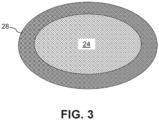
- FIG. 3 is a simplified cross-sectional view of fiber 24 after application of BN IFC layer (28). Method 10 is discussed together with FIGS. 1-3 .
- BN aerogel can be applied to a sheet of fibers 24.
- Fibers 24 can be formed from silicon carbide (SiC) or other suitable ceramic material. In some embodiments, multiple fibers 24 can be bundled to form individual tows. Fibers 24 can be incorporated into a cloth/sheet and arranged in one of various two or three-dimensional woven architectures such as plain, harness (e.g., 3, 5, 8, etc.), twill, braid, or non-symmetric to name a few non-limiting examples. Nonwoven architectures (e.g., chopped, felted, etc.) are also contemplated herein. Plies can be formed from sheets and laid up into a fibrous preform structure.
- Application of BN aerogel can be a two-step process in which a slurry of BN is applied to fibers 24 followed by freeze-drying of the applied BN.
- the slurry can be prepared by ball milling a hexagonal BN (h-BN) powder, adding the h-BN to a water bath, and dispersing the h-BN in the water bath using ultrasonication.
- h-BN hexagonal BN
- a sheet of fibers 24 can be pulled through the water bath such that a slurry of h-BN coats the sheet forming a slurry-coated sheet.
- the sheet can be taken from a spool and pulled through the bath under tension created by a series of rollers.
- the slurry-coated sheet is subsequently freeze-dried to form BN aerogel layer 26 ( FIG. 2 ).
- the BN aerogel includes a mixture of BN nanotubes and h-BN nanosheets, and has a high surface area and low density. After freeze-drying, the sheet can be considered a pretreated sheet with respect to the application of the BN aerogel.
- Step 14 can be a pre-impregnation (“pre-pregging") step in which the pretreated sheet is injected with a polymeric resin and cured.
- exemplary resins can include polyvinyl alcohol (PVA) with water or polyvinyl butyral (PVB) with alcohol.
- Backing films can optionally be applied to each side of the pre-preg sheet to protect it during subsequent storage and/or handling.
- Step 16 is a preforming step in which the pre-preg sheet is cut into plies and laid up in a an end-to-end and/or layer-by-layer fashion to form a multidimensional preform.
- the preform can be supported by one or more sets of rigid tooling, formed from materials such as plastic, steel, aluminum, and or graphite.
- the preform need not be exclusively formed from pretreated fabrics, and can include both pretreated and untreated plies in some examples.
- Step 18 is an optional heating/sintering step that can be carried out on the preform to promote volumetric consolidation of the aerogel phase such that BN aerogel layer 26 tightens/contracts to form a slightly denser BN phase that preferentially adheres to fiber 24 surfaces.
- a suitable consolidation temperature can range from 1200°C to 1500°C in an exemplary embodiment. The temperature can be selected, along with heating duration, to sufficiently consolidate BN aerogel layer 26 while minimizing fiber-to-fiber sintering.
- Step 18 can be considered distinct from other heating processes that might be carried out, for example, to decompose the polymer resin within the preform.
- the preform can undergo CVI to form BN IFC layer 28 ( FIG. 3 ).
- Layer 28 includes BN from both the aerogel pretreatment (i.e., layer 26) and additional BN deposited during CVI.
- the CVI cycle time can be reduced because there is already an amount of BN on fibers 24 from pretreatment.
- the BN nanostructures (i.e., nanotubes and nanosheets) of BN aerogel layer 26 can also act as can act as a template for epitaxial growth of additional h-BN deposited via CVI.
- the h-BN includes basal planes of covalently bonded B and N atoms aligned with the fiber axis.
- Step 20 can additionally and/or alternatively include the formation of other oxidation resistant coatings via CVI, such as silicon-doped BN (Si-BN), SiC, and carbon, to name a few non-limiting examples.
- a ceramic (e.g., SiC) matrix can be deposited on BN IFC layer 28 and fiber 24, The matrix can be deposited using CVI, which can be carried out until the resulting CMC has reached the desired residual porosity.
- CVI chemical vapor deposition
- Other techniques for matrix formation are contemplated herein, such as one or a combination of slurry infiltration, melt infiltration, and polymer infiltration and pyrolysis. Such techniques can supplement the CVI process.
- Protective coatings for the CMC e.g., thermal barrier coatings, environmental barrier coatings, etc.
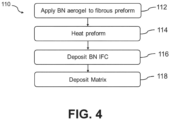
- FIG. 4 is a method flowchart illustrating select steps of first alternative method 110 for pretreating a fibrous preform with a BN aerogel to form a CMC.
- the preform can be formed from sheets, plies, etc., of ceramic fibers (e.g., fibers 24).
- the fiber preform can be immersed in a water bath of ultrasonicated milled h-BN to form a slurry-coated preform.
- the preform can be mounted within perforated tooling or basket during immersion.
- the preform can subsequently be freeze-dried to complete a BN aerogel layer (e.g., layer 26) to form a pretreated preform.
- the size of the water bath can be scaled such that multiple (e.g., up to one dozen) preforms can be immersed at once.
- step 112 is followed by step 114, which is an optional heat treatment on the preform to consolidate the BN aerogel that is substantially similar to step 18 above.
- Step 114 is followed by step 116 which is the CVI deposition of a BN IFC layer (e.g., layer 28) substantially similar to step 20 above.
- a ceramic matrix can be deposited in step 118, which is substantially similar to step 22 above.
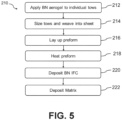
- FIG. 5 is a method flowchart illustrating select steps of second alternative method 210 for pretreating individual tows (e.g., bundles of fibers 24) with a BN aerogel to form a CMC.
- individual tows e.g., bundles of fibers 24
- individual tows can be pulled through a water bath of ultrasonicated milled h-BN to form a slurry-coated fiber.
- Tows can be pulled through one at a time, or multiple individual tows can be pulled through together, in either case, being coated individually.
- the tows can be pulled under tension by rollers similar to step 12, and subsequently be freeze-dried to complete a BN aerogel layer (e.g., layer 26) to form a pretreated tow.
- Pretreated tows can be sized and woven into a sheet with other pretreated or untreated tows in step 214.
- the sheet can be made into a pre-preg, similar to step 14, or directly cut into plies.
- Subsequent steps 216, 218, 220, and 222 can be analogous to the preforming, heating, IFC deposition, and matrix deposition steps of steps 16, 18, 20, and 22, respectively.
- a CMC component formed with the disclosed pretreated fibrous materials can be incorporated into aerospace, maritime, or industrial equipment, to name a few, non-limiting examples.
- a method of forming a ceramic matrix composite comprises applying a boron nitride (BN) aerogel to a fibrous material to form a pretreated fibrous material, depositing, using chemical vapor infiltration (CVI), a BN interface coating (IFC) on the pretreated fibrous material, and depositing a matrix on the BN IFC and the pretreated fibrous material.
- BN boron nitride
- CVI chemical vapor infiltration
- IFC BN interface coating
- the step of applying the BN aerogel can include immersing the fibrous material in a bath of water and hexagonal BN (h-BN) to form a slurry-coated fibrous material, and freeze-drying the slurry coated fibrous material.
- h-BN hexagonal BN
- the fibrous material can include a sheet of ceramic fibers.
- the step of immersing the fibrous material can include pulling the sheet through the bath of water and h-BN under tension.
- Any of the above methods can further include forming a pre-preg sheet by injecting the sheet with a polymer resin and curing the sheet.
- the polymer resin can include one of polyvinyl alcohol and polyvinyl butyral.
- Any of the above methods can further include forming plies from the pre-preg sheet, and laying up the plies into a preform.
- Any of the above methods can further include prior to depositing the BN IFC, consolidating the BN aerogel by heating the preform to a temperature ranging from 1200°C to 1500°C.
- the fibrous ceramic material can include a preform.
- Any of the above methods can further include prior to depositing the BN IFC, consolidating the BN aerogel by heating the preform to a temperature ranging from 1200°C to 1500°C.
- the fibrous material can include an individual tow.
- the step of immersing the fibrous material can include pulling the tow through the bath of water and h-BN under tension.
- Any of the above methods can further include sizing the tow, and weaving the tow into a sheet.
- Any of the above methods can further include forming plies from the sheet, and laying up the plies into a preform.
- Any of the above methods can further include prior to depositing the BN IFC, consolidating the BN aerogel by heating the preform to a temperature ranging from 1200°C to 1500°C.
- the BN aerogel can include BN nanotubes and BN nanosheets.
- the BN IFC can include h-BN.
- the step of depositing the matrix can include at least one of chemical vapor infiltration, slurry infiltration, melt infiltration, and polymer infiltration and pyrolysis.
- the matrix can include silicon carbide (SiC).
- Any of the above methods can further include prior to the step of depositing the matrix, depositing, using CVI, an oxidation resistant coating on the pretreated fibrous material, the oxidation resistant coating including at least one of silicon-doped BN, SiC, and carbon.
Landscapes
- Chemical & Material Sciences (AREA)
- Engineering & Computer Science (AREA)
- Ceramic Engineering (AREA)
- Manufacturing & Machinery (AREA)
- Organic Chemistry (AREA)
- Structural Engineering (AREA)
- Materials Engineering (AREA)
- Inorganic Chemistry (AREA)
- Chemical Kinetics & Catalysis (AREA)
- Physics & Mathematics (AREA)
- Thermal Sciences (AREA)
- General Chemical & Material Sciences (AREA)
- Chemical Or Physical Treatment Of Fibers (AREA)
- Ceramic Products (AREA)
- Chemical Vapour Deposition (AREA)
Abstract
Description
- The present invention relates to ceramic matrix composites, and more particularly to the formation of corrosion-resistant coatings therein.
- Fiber-reinforced ceramic matrix composites (CMCs) are known and used for components that are exposed to high temperatures and corrosive conditions that can degrade other kinds of materials. Under such severe conditions, such as the operating conditions in aerospace applications, even ceramic materials are vulnerable to degradation. Over time, ceramic composites can form microcracks that further expose the ceramic material to oxygen or other corrosive elements, which form undesirable phases to the detriment of the properties of the ceramic matrix composite component.
- Fibers can be coated with a layer of boron nitride (BN) to form a weak interface between the fibers and matrix material to enable desired composite characteristics. The thickness of this interface coating (IFC) layer influences fiber sliding stresses and IFC oxidation resistance. As such, it is important to control and optimize IFC layer thickness uniformity throughout the CMC. However, it can be difficult to achieve uniform thickness through chemical vapor infiltration (CVI) because reactant gases have to diffuse through a highly tortuous fiber pore network, which can lead to uneven deposition of BN. Thus, a need exists for means of improving BN IFC deposition.
- Form one aspect, there is provided a method of forming a ceramic matrix composite (CMC) that comprises applying a boron nitride (BN) aerogel to a fibrous material to form a pretreated fibrous material, depositing, using chemical vapor infiltration (CVI), a BN interface coating (IFC) on the pretreated fibrous material, and depositing a matrix on the BN IFC and the pretreated fibrous material.
- Features of embodiments are set forth in the dependent claims.
-
-
FIG. 1 is a flowchart illustrating a method of forming a CMC from pretreated fibrous sheets. -
FIG. 2 is a simplified cross-sectional illustration of a fiber coated with BN aerogel. -
FIG. 3 is a simplified cross-sectional illustration of a fiber coated with a BN IFC. -
FIG. 4 is a flowchart illustrating a method of forming a CMC from a pretreated fibrous preform. -
FIG. 5 is a flowchart illustrating a method of forming a CMC from pretreated fiber tows. - While the above-identified figures set forth one or more embodiments of the present disclosure, other embodiments are also contemplated, as noted in the discussion. In all cases, this disclosure presents the invention by way of representation and not limitation. It should be understood that numerous other modifications and embodiments can be devised by those skilled in the art, which fall within the scope and spirit of the principles of the invention. The figures may not be drawn to scale, and applications and embodiments of the present invention may include features and components not specifically shown in the drawings.
- This disclosure presents a method of pretreating a fibrous material with BN aerogel prior to applying a BN IFC layer via chemical vapor infiltration (CVI). The BN aerogel facilitates deposition of a more uniform BN IFC layer and can promote favorable formation of h-BN.
-
FIG. 1 is a method flowchart illustrating select steps ofmethod 10 for fabricating a CMC with a pretreated sheet formed fromfibers 24.FIG. 2 is a simplified cross-sectional view of anindividual fiber 24 after pretreatment.FIG. 3 is a simplified cross-sectional view offiber 24 after application of BN IFC layer (28).Method 10 is discussed together withFIGS. 1-3 . - At
step 12, BN aerogel can be applied to a sheet offibers 24.Fibers 24 can be formed from silicon carbide (SiC) or other suitable ceramic material. In some embodiments,multiple fibers 24 can be bundled to form individual tows.Fibers 24 can be incorporated into a cloth/sheet and arranged in one of various two or three-dimensional woven architectures such as plain, harness (e.g., 3, 5, 8, etc.), twill, braid, or non-symmetric to name a few non-limiting examples. Nonwoven architectures (e.g., chopped, felted, etc.) are also contemplated herein. Plies can be formed from sheets and laid up into a fibrous preform structure. - Application of BN aerogel can be a two-step process in which a slurry of BN is applied to
fibers 24 followed by freeze-drying of the applied BN. The slurry can be prepared by ball milling a hexagonal BN (h-BN) powder, adding the h-BN to a water bath, and dispersing the h-BN in the water bath using ultrasonication. In one example, a sheet offibers 24 can be pulled through the water bath such that a slurry of h-BN coats the sheet forming a slurry-coated sheet. The sheet can be taken from a spool and pulled through the bath under tension created by a series of rollers. The slurry-coated sheet is subsequently freeze-dried to form BN aerogel layer 26 (FIG. 2 ). The BN aerogel includes a mixture of BN nanotubes and h-BN nanosheets, and has a high surface area and low density. After freeze-drying, the sheet can be considered a pretreated sheet with respect to the application of the BN aerogel. -
Step 14 can be a pre-impregnation ("pre-pregging") step in which the pretreated sheet is injected with a polymeric resin and cured. Exemplary resins can include polyvinyl alcohol (PVA) with water or polyvinyl butyral (PVB) with alcohol. Backing films can optionally be applied to each side of the pre-preg sheet to protect it during subsequent storage and/or handling. -
Step 16 is a preforming step in which the pre-preg sheet is cut into plies and laid up in a an end-to-end and/or layer-by-layer fashion to form a multidimensional preform. In many cases, the preform can be supported by one or more sets of rigid tooling, formed from materials such as plastic, steel, aluminum, and or graphite. The preform need not be exclusively formed from pretreated fabrics, and can include both pretreated and untreated plies in some examples. -
Step 18 is an optional heating/sintering step that can be carried out on the preform to promote volumetric consolidation of the aerogel phase such thatBN aerogel layer 26 tightens/contracts to form a slightly denser BN phase that preferentially adheres tofiber 24 surfaces. A suitable consolidation temperature can range from 1200°C to 1500°C in an exemplary embodiment. The temperature can be selected, along with heating duration, to sufficiently consolidateBN aerogel layer 26 while minimizing fiber-to-fiber sintering.Step 18 can be considered distinct from other heating processes that might be carried out, for example, to decompose the polymer resin within the preform. - At
step 20, the preform can undergo CVI to form BN IFC layer 28 (FIG. 3 ).Layer 28 includes BN from both the aerogel pretreatment (i.e., layer 26) and additional BN deposited during CVI. In some cases, the CVI cycle time can be reduced because there is already an amount of BN onfibers 24 from pretreatment. The BN nanostructures (i.e., nanotubes and nanosheets) ofBN aerogel layer 26 can also act as can act as a template for epitaxial growth of additional h-BN deposited via CVI. The h-BN includes basal planes of covalently bonded B and N atoms aligned with the fiber axis. In an operational environment, such nanostructure facilitates matrix sliding, relative tofiber 24, within BNIFC layer 28, and debonding ofIFC layer 28 to protectfiber 24.Step 20 can additionally and/or alternatively include the formation of other oxidation resistant coatings via CVI, such as silicon-doped BN (Si-BN), SiC, and carbon, to name a few non-limiting examples. - At
step 22, a ceramic (e.g., SiC) matrix can be deposited onBN IFC layer 28 andfiber 24, The matrix can be deposited using CVI, which can be carried out until the resulting CMC has reached the desired residual porosity. Other techniques for matrix formation are contemplated herein, such as one or a combination of slurry infiltration, melt infiltration, and polymer infiltration and pyrolysis. Such techniques can supplement the CVI process. Protective coatings for the CMC (e.g., thermal barrier coatings, environmental barrier coatings, etc.) can optionally be applied afterstep 22. -
FIG. 4 is a method flowchart illustrating select steps of firstalternative method 110 for pretreating a fibrous preform with a BN aerogel to form a CMC. The preform can be formed from sheets, plies, etc., of ceramic fibers (e.g., fibers 24). - At
step 112, the fiber preform can be immersed in a water bath of ultrasonicated milled h-BN to form a slurry-coated preform. The preform can be mounted within perforated tooling or basket during immersion. The preform can subsequently be freeze-dried to complete a BN aerogel layer (e.g., layer 26) to form a pretreated preform. The size of the water bath can be scaled such that multiple (e.g., up to one dozen) preforms can be immersed at once. Step 112 is followed bystep 114, which is an optional heat treatment on the preform to consolidate the BN aerogel that is substantially similar to step 18 above. Step 114 is followed bystep 116 which is the CVI deposition of a BN IFC layer (e.g., layer 28) substantially similar to step 20 above. A ceramic matrix can be deposited instep 118, which is substantially similar to step 22 above. -
FIG. 5 is a method flowchart illustrating select steps of secondalternative method 210 for pretreating individual tows (e.g., bundles of fibers 24) with a BN aerogel to form a CMC. - At
step 212, individual tows can be pulled through a water bath of ultrasonicated milled h-BN to form a slurry-coated fiber. Tows can be pulled through one at a time, or multiple individual tows can be pulled through together, in either case, being coated individually. The tows can be pulled under tension by rollers similar to step 12, and subsequently be freeze-dried to complete a BN aerogel layer (e.g., layer 26) to form a pretreated tow. Pretreated tows can be sized and woven into a sheet with other pretreated or untreated tows instep 214. The sheet can be made into a pre-preg, similar to step 14, or directly cut into plies.Subsequent steps steps - A CMC component formed with the disclosed pretreated fibrous materials can be incorporated into aerospace, maritime, or industrial equipment, to name a few, non-limiting examples.
- The following are non-exclusive descriptions of possible embodiments of the present invention.
- A method of forming a ceramic matrix composite (CMC) comprises applying a boron nitride (BN) aerogel to a fibrous material to form a pretreated fibrous material, depositing, using chemical vapor infiltration (CVI), a BN interface coating (IFC) on the pretreated fibrous material, and depositing a matrix on the BN IFC and the pretreated fibrous material.
- The method of the preceding paragraph can optionally include, additionally and/or alternatively, any one or more of the following features, configurations and/or additional components:
In the above method, the step of applying the BN aerogel can include immersing the fibrous material in a bath of water and hexagonal BN (h-BN) to form a slurry-coated fibrous material, and freeze-drying the slurry coated fibrous material. - In any of the above methods, the fibrous material can include a sheet of ceramic fibers.
- In any of the above methods, the step of immersing the fibrous material can include pulling the sheet through the bath of water and h-BN under tension.
- Any of the above methods can further include forming a pre-preg sheet by injecting the sheet with a polymer resin and curing the sheet.
- In any of the above methods, the polymer resin can include one of polyvinyl alcohol and polyvinyl butyral.
- Any of the above methods can further include forming plies from the pre-preg sheet, and laying up the plies into a preform.
- Any of the above methods can further include prior to depositing the BN IFC, consolidating the BN aerogel by heating the preform to a temperature ranging from 1200°C to 1500°C.
- In any of the above methods, the fibrous ceramic material can include a preform.
- Any of the above methods can further include prior to depositing the BN IFC, consolidating the BN aerogel by heating the preform to a temperature ranging from 1200°C to 1500°C.
- In any of the above methods, the fibrous material can include an individual tow.
- In any of the above methods, the step of immersing the fibrous material can include pulling the tow through the bath of water and h-BN under tension.
- Any of the above methods can further include sizing the tow, and weaving the tow into a sheet.
- Any of the above methods can further include forming plies from the sheet, and laying up the plies into a preform.
- Any of the above methods can further include prior to depositing the BN IFC, consolidating the BN aerogel by heating the preform to a temperature ranging from 1200°C to 1500°C.
- In any of the above methods, the BN aerogel can include BN nanotubes and BN nanosheets.
- In any of the above methods, the BN IFC can include h-BN.
- In any of the above methods, the step of depositing the matrix can include at least one of chemical vapor infiltration, slurry infiltration, melt infiltration, and polymer infiltration and pyrolysis.
- In any of the above methods, the matrix can include silicon carbide (SiC).
- Any of the above methods can further include prior to the step of depositing the matrix, depositing, using CVI, an oxidation resistant coating on the pretreated fibrous material, the oxidation resistant coating including at least one of silicon-doped BN, SiC, and carbon.
- While the invention has been described with reference to an exemplary embodiment(s), it will be understood by those skilled in the art that various changes may be made and equivalents may be substituted for elements thereof without departing from the scope of the invention. In addition, many modifications may be made to adapt a particular situation or material to the teachings of the invention without departing from the essential scope thereof. Therefore, it is intended that the invention not be limited to the particular embodiment(s) disclosed, but that the invention will include all embodiments falling within the scope of the appended claims.
Claims (15)
- A method of forming a ceramic matrix composite (CMC), the method comprising:applying a boron nitride (BN) aerogel (26) to a fibrous material (24) to form a pretreated fibrous material;depositing, using chemical vapor infiltration (CVI), a BN interface coating (IFC) (28) on the pretreated fibrous material; anddepositing a matrix on the BN IFC (28) and the pretreated fibrous material.
- The method of claim 1, wherein the step of applying the BN aerogel (26) comprises:immersing the fibrous material (24) in a bath of water and hexagonal BN (h-BN) to form a slurry-coated fibrous material; andfreeze-drying the slurry coated fibrous material.
- The method of claim 2, wherein the fibrous material comprises a sheet of ceramic fibers (24), optionally wherein the step of immersing the fibrous material comprises pulling the sheet through the bath of water and h-BN under tension.
- The method of claim 3 and further comprising:
forming a pre-preg sheet by injecting the sheet with a polymer resin and curing the sheet, optionally wherein the polymer resin comprises one of polyvinyl alcohol and polyvinyl butyral. - The method of claim 4 and further comprising:forming plies from the pre-preg sheet; andlaying up the plies into a preform; and optionallyprior to depositing the BN IFC (28), consolidating the BN aerogel (26) by heating the preform to a temperature ranging from 1200°C to 1500°C.
- The method of claim 2, wherein the fibrous ceramic material comprises a preform, optionally, wherein the method further comprises prior to depositing the BN IFC (28), consolidating the BN aerogel (26) by heating the preform to a temperature ranging from 1200°C to 1500°C.
- The method of claim 2, wherein the fibrous material (24) comprises an individual tow (24).
- The method of claim 7, wherein the step of immersing the fibrous material (24)comprises:
pulling the tow (24) through the bath of water and h-BN under tension. - The method of claim 8 and further comprising:sizing the tow (24); andweaving the tow (24) into a sheet.
- The method of claim 9 and further comprising:forming plies from the sheet; andlaying up the plies into a preform; and optionallyprior to depositing the BN IFC (28), consolidating the BN aerogel (26) by heating the preform to a temperature ranging from 1200°C to 1500°C.
- The method of any preceding claim, wherein the BN aerogel (26) comprises BN nanotubes and BN nanosheets.
- The method of any preceding claim, wherein the BN IFC (28) comprises h-BN.
- The method of any preceding claim, wherein the step of depositing the matrix comprises at least one of chemical vapor infiltration, slurry infiltration, melt infiltration, and polymer infiltration and pyrolysis.
- The method of any preceding claim, wherein the matrix comprises silicon carbide (SiC).
- The method of any preceding claim and further comprising:
prior to the step of depositing the matrix, depositing, using CVI, an oxidation resistant coating on the pretreated fibrous material, the oxidation resistant coating comprising at least one of silicon-doped BN, SiC, and carbon.
Applications Claiming Priority (1)
| Application Number | Priority Date | Filing Date | Title |
|---|---|---|---|
| US18/084,932 US12157704B2 (en) | 2022-12-20 | 2022-12-20 | Boron nitride aerogel interface coating precursor for ceramic matrix composites |
Publications (2)
| Publication Number | Publication Date |
|---|---|
| EP4389415A1 true EP4389415A1 (en) | 2024-06-26 |
| EP4389415B1 EP4389415B1 (en) | 2025-06-25 |
Family
ID=89029516
Family Applications (1)
| Application Number | Title | Priority Date | Filing Date |
|---|---|---|---|
| EP23212892.6A Active EP4389415B1 (en) | 2022-12-20 | 2023-11-29 | Boron nitride aerogel interface coating precursor for ceramic matrix composites |
Country Status (2)
| Country | Link |
|---|---|
| US (1) | US12157704B2 (en) |
| EP (1) | EP4389415B1 (en) |
Families Citing this family (2)
| Publication number | Priority date | Publication date | Assignee | Title |
|---|---|---|---|---|
| CN117090045B (en) * | 2023-02-13 | 2025-08-08 | 电子科技大学长三角研究院(衢州) | Adiabatic SiC-BN aerogel felt and preparation method and application thereof |
| CN120271332B (en) * | 2025-06-09 | 2025-08-15 | 湖南荣岚复合材料股份有限公司 | A gradient aerogel composite material and preparation method thereof |
Citations (3)
| Publication number | Priority date | Publication date | Assignee | Title |
|---|---|---|---|---|
| CN112479691A (en) * | 2020-12-02 | 2021-03-12 | 中南大学 | Preparation method of high-temperature-resistant reinforced toughened Ox/Ox composite material |
| US20220144714A1 (en) * | 2019-02-01 | 2022-05-12 | The Regents Of The University Of California | Double-negative-index ceramic aerogels for thermal superinsulation |
| CN114804895A (en) * | 2022-06-02 | 2022-07-29 | 中国航发北京航空材料研究院 | High-temperature self-healing BN/SiC fiber interface coating and preparation method thereof |
Family Cites Families (6)
| Publication number | Priority date | Publication date | Assignee | Title |
|---|---|---|---|---|
| US8146282B2 (en) | 2009-01-16 | 2012-04-03 | Prototype Productions, Inc. | System for providing electrical power to accessories mounted on the powered rail of a weapon |
| CN102272419A (en) * | 2009-03-09 | 2011-12-07 | 斯奈克玛 | Turbine Ring Assembly |
| US20140287641A1 (en) * | 2013-03-15 | 2014-09-25 | Aerogel Technologies, Llc | Layered aerogel composites, related aerogel materials, and methods of manufacture |
| US9815736B2 (en) | 2015-11-25 | 2017-11-14 | General Electric Company | Apparatus and methods for processing ceramic fiber |
| KR102282019B1 (en) | 2019-10-23 | 2021-07-29 | 한국과학기술연구원 | A porous composite comprising boron nitride nanomaterial and a manufacturing method thereof |
| CN114471739B (en) | 2022-01-28 | 2023-11-21 | 吉林大学 | Preparation method of boron nitride nanosheet-graphene composite material |
-
2022
- 2022-12-20 US US18/084,932 patent/US12157704B2/en active Active
-
2023
- 2023-11-29 EP EP23212892.6A patent/EP4389415B1/en active Active
Patent Citations (3)
| Publication number | Priority date | Publication date | Assignee | Title |
|---|---|---|---|---|
| US20220144714A1 (en) * | 2019-02-01 | 2022-05-12 | The Regents Of The University Of California | Double-negative-index ceramic aerogels for thermal superinsulation |
| CN112479691A (en) * | 2020-12-02 | 2021-03-12 | 中南大学 | Preparation method of high-temperature-resistant reinforced toughened Ox/Ox composite material |
| CN114804895A (en) * | 2022-06-02 | 2022-07-29 | 中国航发北京航空材料研究院 | High-temperature self-healing BN/SiC fiber interface coating and preparation method thereof |
Non-Patent Citations (2)
| Title |
|---|
| JIN CHEN: "Cellulose Nanofiber Supported 3D Interconnected BN Nanosheets for Epoxy Nanocomposites with Ultrahigh Thermal Management Capability", ADVANCED FUNCTIONAL MATERIALS, vol. 27, no. 5, 19 February 2017 (2017-02-19), DE, XP093162107, ISSN: 1616-301X, Retrieved from the Internet <URL:https://api.wiley.com/onlinelibrary/tdm/v1/articles/10.1002%2Fadfm.201604754> DOI: 10.1002/adfm.201604754 * |
| WANG XIU ET AL: "Boosting the thermal conductivity of CNF-based composites by cross-linked lignin nanoparticle and BN-OH: Dual construction of 3D thermally conductive pathways", COMPOSITES SCIENCE AND TECHNOLOGY, ELSEVIER, AMSTERDAM, NL, vol. 204, 30 December 2020 (2020-12-30), XP086487349, ISSN: 0266-3538, [retrieved on 20201230], DOI: 10.1016/J.COMPSCITECH.2020.108641 * |
Also Published As
| Publication number | Publication date |
|---|---|
| US20240199498A1 (en) | 2024-06-20 |
| EP4389415B1 (en) | 2025-06-25 |
| US12157704B2 (en) | 2024-12-03 |
Similar Documents
| Publication | Publication Date | Title |
|---|---|---|
| EP4389415B1 (en) | Boron nitride aerogel interface coating precursor for ceramic matrix composites | |
| EP3222601B1 (en) | Ceramic matrix composites having monomodal pore size distribution and low fiber volume fraction | |
| US5439627A (en) | Process for manufacturing reinforced composites | |
| CA2598223C (en) | A method of fabricating a ceramic matrix composite material part, and a part obtained thereby | |
| JP5301769B2 (en) | Method of manufacturing a ceramic matrix composite article and article formed by the method | |
| CN108794040B (en) | A composite material based on molten siliconizing process, carbon/carbon porous body and preparation method thereof | |
| US20110171452A1 (en) | Procedure for making pre-impregnated reinforced composite, as well as fiber reinforced composite, and their application | |
| US6627312B1 (en) | Reinforcing fibers and fiber bundles, especially for fiber composites, methods for the production thereof, and a fiber composite having reinforcing fibers | |
| EP3173393B1 (en) | Methods for processing ceramic fiber | |
| CN113307643B (en) | SiC based on one-way belt f Preparation method of/SiC composite material | |
| US20250320640A1 (en) | Pressurized stabilization of plies for improved interlaminar properties | |
| CN115677358B (en) | System and method for coating ceramic fibers | |
| CA2936679A1 (en) | Improved uniformity of fiber spacing in cmc materials | |
| CN110156485A (en) | A short-cycle, low-cost method for preparing high-performance carbon/carbon composites | |
| JP7752004B2 (en) | Method for making ceramic matrix composites that exhibit moisture and environmental resistance | |
| EP1640352B1 (en) | Low cost manufacturing process for high performance ceramic matrix composites | |
| US20090239434A1 (en) | Method for producing a fiber-reinforced carbide ceramic component and carbide ceramic component | |
| EP4512789A1 (en) | Polymer towpreg for ceramic matrix composites | |
| EP4197987A2 (en) | Pva based binder application for cmcs | |
| CN121941671A (en) | Ceramic matrix composite | |
| US12428756B2 (en) | Particle-imbedded serving yarn for CMC applications | |
| US20240425422A1 (en) | Method of forming a smooth as-fabricated ceramic matrix composite (cmc) surface | |
| CN121517215B (en) | A heterogeneous layup melt infiltration process for CMC composite material components and its preparation method | |
| US20240308927A1 (en) | Three-dimensional weave with sacrificial z-fibers for improved ceramic matrix composite microstructure | |
| US20240400467A1 (en) | Particle enhanced ceramic matrix composite with no particles on surface plies |
Legal Events
| Date | Code | Title | Description |
|---|---|---|---|
| PUAI | Public reference made under article 153(3) epc to a published international application that has entered the european phase |
Free format text: ORIGINAL CODE: 0009012 |
|
| STAA | Information on the status of an ep patent application or granted ep patent |
Free format text: STATUS: THE APPLICATION HAS BEEN PUBLISHED |
|
| AK | Designated contracting states |
Kind code of ref document: A1 Designated state(s): AL AT BE BG CH CY CZ DE DK EE ES FI FR GB GR HR HU IE IS IT LI LT LU LV MC ME MK MT NL NO PL PT RO RS SE SI SK SM TR |
|
| STAA | Information on the status of an ep patent application or granted ep patent |
Free format text: STATUS: REQUEST FOR EXAMINATION WAS MADE |
|
| 17P | Request for examination filed |
Effective date: 20241211 |
|
| GRAP | Despatch of communication of intention to grant a patent |
Free format text: ORIGINAL CODE: EPIDOSNIGR1 |
|
| STAA | Information on the status of an ep patent application or granted ep patent |
Free format text: STATUS: GRANT OF PATENT IS INTENDED |
|
| RIC1 | Information provided on ipc code assigned before grant |
Ipc: C04B 35/80 20060101ALI20250110BHEP Ipc: C04B 35/634 20060101ALI20250110BHEP Ipc: C04B 35/628 20060101ALI20250110BHEP Ipc: C04B 35/626 20060101ALI20250110BHEP Ipc: C04B 35/573 20060101ALI20250110BHEP Ipc: B32B 18/00 20060101AFI20250110BHEP |
|
| INTG | Intention to grant announced |
Effective date: 20250130 |
|
| GRAS | Grant fee paid |
Free format text: ORIGINAL CODE: EPIDOSNIGR3 |
|
| GRAA | (expected) grant |
Free format text: ORIGINAL CODE: 0009210 |
|
| STAA | Information on the status of an ep patent application or granted ep patent |
Free format text: STATUS: THE PATENT HAS BEEN GRANTED |
|
| AK | Designated contracting states |
Kind code of ref document: B1 Designated state(s): AL AT BE BG CH CY CZ DE DK EE ES FI FR GB GR HR HU IE IS IT LI LT LU LV MC ME MK MT NL NO PL PT RO RS SE SI SK SM TR |
|
| REG | Reference to a national code |
Ref country code: GB Ref legal event code: FG4D |
|
| REG | Reference to a national code |
Ref country code: CH Ref legal event code: EP |
|
| REG | Reference to a national code |
Ref country code: CH Ref legal event code: EP |
|
| REG | Reference to a national code |
Ref country code: IE Ref legal event code: FG4D |
|
| REG | Reference to a national code |
Ref country code: DE Ref legal event code: R096 Ref document number: 602023004306 Country of ref document: DE |
|
| PG25 | Lapsed in a contracting state [announced via postgrant information from national office to epo] |
Ref country code: FI Free format text: LAPSE BECAUSE OF FAILURE TO SUBMIT A TRANSLATION OF THE DESCRIPTION OR TO PAY THE FEE WITHIN THE PRESCRIBED TIME-LIMIT Effective date: 20250625 |
|
| REG | Reference to a national code |
Ref country code: LT Ref legal event code: MG9D |
|
| PG25 | Lapsed in a contracting state [announced via postgrant information from national office to epo] |
Ref country code: NO Free format text: LAPSE BECAUSE OF FAILURE TO SUBMIT A TRANSLATION OF THE DESCRIPTION OR TO PAY THE FEE WITHIN THE PRESCRIBED TIME-LIMIT Effective date: 20250925 Ref country code: GR Free format text: LAPSE BECAUSE OF FAILURE TO SUBMIT A TRANSLATION OF THE DESCRIPTION OR TO PAY THE FEE WITHIN THE PRESCRIBED TIME-LIMIT Effective date: 20250926 |
|
| PG25 | Lapsed in a contracting state [announced via postgrant information from national office to epo] |
Ref country code: BG Free format text: LAPSE BECAUSE OF FAILURE TO SUBMIT A TRANSLATION OF THE DESCRIPTION OR TO PAY THE FEE WITHIN THE PRESCRIBED TIME-LIMIT Effective date: 20250625 |
|
| PG25 | Lapsed in a contracting state [announced via postgrant information from national office to epo] |
Ref country code: HR Free format text: LAPSE BECAUSE OF FAILURE TO SUBMIT A TRANSLATION OF THE DESCRIPTION OR TO PAY THE FEE WITHIN THE PRESCRIBED TIME-LIMIT Effective date: 20250625 |
|
| PG25 | Lapsed in a contracting state [announced via postgrant information from national office to epo] |
Ref country code: RS Free format text: LAPSE BECAUSE OF FAILURE TO SUBMIT A TRANSLATION OF THE DESCRIPTION OR TO PAY THE FEE WITHIN THE PRESCRIBED TIME-LIMIT Effective date: 20250925 |
|
| PG25 | Lapsed in a contracting state [announced via postgrant information from national office to epo] |
Ref country code: LV Free format text: LAPSE BECAUSE OF FAILURE TO SUBMIT A TRANSLATION OF THE DESCRIPTION OR TO PAY THE FEE WITHIN THE PRESCRIBED TIME-LIMIT Effective date: 20250625 |
|
| REG | Reference to a national code |
Ref country code: NL Ref legal event code: MP Effective date: 20250625 |
|
| PG25 | Lapsed in a contracting state [announced via postgrant information from national office to epo] |
Ref country code: NL Free format text: LAPSE BECAUSE OF FAILURE TO SUBMIT A TRANSLATION OF THE DESCRIPTION OR TO PAY THE FEE WITHIN THE PRESCRIBED TIME-LIMIT Effective date: 20250625 |
|
| PG25 | Lapsed in a contracting state [announced via postgrant information from national office to epo] |
Ref country code: PT Free format text: LAPSE BECAUSE OF FAILURE TO SUBMIT A TRANSLATION OF THE DESCRIPTION OR TO PAY THE FEE WITHIN THE PRESCRIBED TIME-LIMIT Effective date: 20251027 |
|
| REG | Reference to a national code |
Ref country code: AT Ref legal event code: MK05 Ref document number: 1806079 Country of ref document: AT Kind code of ref document: T Effective date: 20250625 |
|
| PG25 | Lapsed in a contracting state [announced via postgrant information from national office to epo] |
Ref country code: IS Free format text: LAPSE BECAUSE OF FAILURE TO SUBMIT A TRANSLATION OF THE DESCRIPTION OR TO PAY THE FEE WITHIN THE PRESCRIBED TIME-LIMIT Effective date: 20251025 |
|
| PGFP | Annual fee paid to national office [announced via postgrant information from national office to epo] |
Ref country code: DE Payment date: 20251022 Year of fee payment: 3 |
|
| PG25 | Lapsed in a contracting state [announced via postgrant information from national office to epo] |
Ref country code: AT Free format text: LAPSE BECAUSE OF FAILURE TO SUBMIT A TRANSLATION OF THE DESCRIPTION OR TO PAY THE FEE WITHIN THE PRESCRIBED TIME-LIMIT Effective date: 20250625 Ref country code: SM Free format text: LAPSE BECAUSE OF FAILURE TO SUBMIT A TRANSLATION OF THE DESCRIPTION OR TO PAY THE FEE WITHIN THE PRESCRIBED TIME-LIMIT Effective date: 20250625 |
|
| PGFP | Annual fee paid to national office [announced via postgrant information from national office to epo] |
Ref country code: FR Payment date: 20251022 Year of fee payment: 3 |
|
| PG25 | Lapsed in a contracting state [announced via postgrant information from national office to epo] |
Ref country code: CZ Free format text: LAPSE BECAUSE OF FAILURE TO SUBMIT A TRANSLATION OF THE DESCRIPTION OR TO PAY THE FEE WITHIN THE PRESCRIBED TIME-LIMIT Effective date: 20250625 |
|
| PG25 | Lapsed in a contracting state [announced via postgrant information from national office to epo] |
Ref country code: PL Free format text: LAPSE BECAUSE OF FAILURE TO SUBMIT A TRANSLATION OF THE DESCRIPTION OR TO PAY THE FEE WITHIN THE PRESCRIBED TIME-LIMIT Effective date: 20250625 |
|
| PG25 | Lapsed in a contracting state [announced via postgrant information from national office to epo] |
Ref country code: EE Free format text: LAPSE BECAUSE OF FAILURE TO SUBMIT A TRANSLATION OF THE DESCRIPTION OR TO PAY THE FEE WITHIN THE PRESCRIBED TIME-LIMIT Effective date: 20250625 |
|
| PG25 | Lapsed in a contracting state [announced via postgrant information from national office to epo] |
Ref country code: SK Free format text: LAPSE BECAUSE OF FAILURE TO SUBMIT A TRANSLATION OF THE DESCRIPTION OR TO PAY THE FEE WITHIN THE PRESCRIBED TIME-LIMIT Effective date: 20250625 |
|
| PG25 | Lapsed in a contracting state [announced via postgrant information from national office to epo] |
Ref country code: ES Free format text: LAPSE BECAUSE OF FAILURE TO SUBMIT A TRANSLATION OF THE DESCRIPTION OR TO PAY THE FEE WITHIN THE PRESCRIBED TIME-LIMIT Effective date: 20250625 |
|
| PG25 | Lapsed in a contracting state [announced via postgrant information from national office to epo] |
Ref country code: RO Free format text: LAPSE BECAUSE OF FAILURE TO SUBMIT A TRANSLATION OF THE DESCRIPTION OR TO PAY THE FEE WITHIN THE PRESCRIBED TIME-LIMIT Effective date: 20250625 |
|
| PG25 | Lapsed in a contracting state [announced via postgrant information from national office to epo] |
Ref country code: DK Free format text: LAPSE BECAUSE OF FAILURE TO SUBMIT A TRANSLATION OF THE DESCRIPTION OR TO PAY THE FEE WITHIN THE PRESCRIBED TIME-LIMIT Effective date: 20250625 |
|
| PG25 | Lapsed in a contracting state [announced via postgrant information from national office to epo] |
Ref country code: IT Free format text: LAPSE BECAUSE OF FAILURE TO SUBMIT A TRANSLATION OF THE DESCRIPTION OR TO PAY THE FEE WITHIN THE PRESCRIBED TIME-LIMIT Effective date: 20250625 |
|
| PLBE | No opposition filed within time limit |
Free format text: ORIGINAL CODE: 0009261 |
|
| STAA | Information on the status of an ep patent application or granted ep patent |
Free format text: STATUS: NO OPPOSITION FILED WITHIN TIME LIMIT |
|
| REG | Reference to a national code |
Ref country code: CH Ref legal event code: L10 Free format text: ST27 STATUS EVENT CODE: U-0-0-L10-L00 (AS PROVIDED BY THE NATIONAL OFFICE) Effective date: 20260507 |