EP4387156A1 - Efficient fault countermeasure through polynomial evaluation - Google Patents
Efficient fault countermeasure through polynomial evaluation Download PDFInfo
- Publication number
- EP4387156A1 EP4387156A1 EP23214876.7A EP23214876A EP4387156A1 EP 4387156 A1 EP4387156 A1 EP 4387156A1 EP 23214876 A EP23214876 A EP 23214876A EP 4387156 A1 EP4387156 A1 EP 4387156A1
- Authority
- EP
- European Patent Office
- Prior art keywords
- polynomial
- results
- produce
- evaluation points
- evaluating
- Prior art date
- Legal status (The legal status is an assumption and is not a legal conclusion. Google has not performed a legal analysis and makes no representation as to the accuracy of the status listed.)
- Granted
Links
Images

Classifications
-
- H—ELECTRICITY
- H04—ELECTRIC COMMUNICATION TECHNIQUE
- H04L—TRANSMISSION OF DIGITAL INFORMATION, e.g. TELEGRAPHIC COMMUNICATION
- H04L9/00—Cryptographic mechanisms or cryptographic arrangements for secret or secure communications; Network security protocols
- H04L9/002—Countermeasures against attacks on cryptographic mechanisms
- H04L9/004—Countermeasures against attacks on cryptographic mechanisms for fault attacks
-
- G—PHYSICS
- G06—COMPUTING OR CALCULATING; COUNTING
- G06F—ELECTRIC DIGITAL DATA PROCESSING
- G06F17/00—Digital computing or data processing equipment or methods, specially adapted for specific functions
- G06F17/10—Complex mathematical operations
-
- G—PHYSICS
- G06—COMPUTING OR CALCULATING; COUNTING
- G06F—ELECTRIC DIGITAL DATA PROCESSING
- G06F7/00—Methods or arrangements for processing data by operating upon the order or content of the data handled
- G06F7/38—Methods or arrangements for performing computations using exclusively denominational number representation, e.g. using binary, ternary, decimal representation
- G06F7/48—Methods or arrangements for performing computations using exclusively denominational number representation, e.g. using binary, ternary, decimal representation using non-contact-making devices, e.g. tube, solid state device; using unspecified devices
- G06F7/4806—Computations with complex numbers
- G06F7/4812—Complex multiplication
-
- H—ELECTRICITY
- H04—ELECTRIC COMMUNICATION TECHNIQUE
- H04L—TRANSMISSION OF DIGITAL INFORMATION, e.g. TELEGRAPHIC COMMUNICATION
- H04L9/00—Cryptographic mechanisms or cryptographic arrangements for secret or secure communications; Network security protocols
- H04L9/30—Public key, i.e. encryption algorithm being computationally infeasible to invert or user's encryption keys not requiring secrecy
- H04L9/3093—Public key, i.e. encryption algorithm being computationally infeasible to invert or user's encryption keys not requiring secrecy involving Lattices or polynomial equations, e.g. NTRU scheme
Definitions
- Various exemplary embodiments disclosed herein relate generally to efficient fault countermeasure through polynomial evaluation.
- Polynomial arithmetic is a building block of many cryptographic schemes.
- One promising direction that uses this building block is lattice-based cryptography, that is poised to be an essential part of the future standard for post-quantum cryptography, e.g., the digital signature scheme Dilithium.
- lattice-based cryptography that is poised to be an essential part of the future standard for post-quantum cryptography, e.g., the digital signature scheme Dilithium.
- implementations of lattice-based cryptography are vulnerable to physical attacks, in particular to faults injected by an attacker in the computation path.
- Contemporary countermeasures often require a high investment in either area, runtime or memory to provide sufficient fault protection.
- Various embodiments relate to a data processing system including instructions embodied in a non-transitory computer readable medium, the instructions for a fault detection in polynomial operations in a processor, the instructions, including: selecting a plurality of evaluation points; evaluating a first polynomial at the plurality of evaluation points to produce first results; applying a first function to the first polynomial to produce a second polynomial; evaluating the second polynomial at the plurality of evaluation points to produce second results; evaluating a second scalar function on the first results to produce third results; comparing the second results to the third results; and performing a polynomial operation using the second polynomial when the second results match the third results.
- Various embodiments are described, further including: evaluating a third polynomial at the plurality of evaluation points to produce fourth results, wherein applying a first function to the first polynomial to produce a second polynomial includes adding the first polynomial to the third polynomial, and wherein evaluating a second scalar function on the first results to produce third results includes adding the first results to the fourth results.
- Various embodiments are described, further including: evaluating a third polynomial at the plurality of evaluation points to produce fourth results; wherein applying a first function to the first polynomial to produce a second polynomial includes multiplying the first polynomial and the third polynomial; and wherein evaluating a second scalar function on the first results to produce third results includes multiplying the first results by the fourth results.
- Various embodiments are described, further including: selecting a plurality of coefficients for a third polynomial; evaluating the third polynomial at the plurality of evaluation points to produce fourth results; updating the first polynomial by adding the third polynomial to the first polynomial; and updating the first results by adding the fourth results to the first results.
- Various embodiments are described, further including: applying a third function to the third polynomial, wherein the third function is based upon the first function to produce a fourth polynomial; evaluating the fourth polynomial at the plurality of evaluation points to produce fifth results; updating the first polynomial by subtracting the fourth polynomial from the first polynomial; and updating the first results by subtracting the fifth results to the first results.
- selecting a plurality of evaluation points includes randomly selecting the plurality of evaluation points.
- selecting a plurality of evaluation points includes deterministically selecting the plurality of evaluation points.
- first and second polynomials are defined over a ring R [ X ]/( f ( X )) .
- first and second polynomials are defined over a ring R [ X ]/( X n + 1) and wherein selecting a plurality of evaluation points include selecting roots of unities.
- FIG. 1 For various embodiments, relate to a method of detecting faults in a polynomial operation, including: selecting a plurality of evaluation points; evaluating a first polynomial at the plurality of evaluation points to produce first results; applying a first function to the first polynomial to produce a second polynomial; evaluating the second polynomial at the plurality of evaluation points to produce second results; evaluating a second scalar function on the first results to produce third results; comparing the second results to the third results; and performing a polynomial operation using the second polynomial when the second results match the third results.
- Various embodiments are described, further including: evaluating a third polynomial at the plurality of evaluation points to produce fourth results, wherein applying a first function to the first polynomial to produce a second polynomial includes adding the first polynomial to the third polynomial, and wherein evaluating a second scalar function on the first results to produce third results includes adding the first results to the fourth results.
- Various embodiments are described, further including: evaluating a third polynomial at the plurality of evaluation points to produce fourth results; wherein applying a first function to the first polynomial to produce a second polynomial includes multiplying the first polynomial and the third polynomial; and wherein evaluating a second scalar function on the first results to produce third results includes multiplying the first results by the fourth results.
- Various embodiments are described, further including: selecting a plurality of coefficients for a third polynomial; evaluating the third polynomial at the plurality of evaluation points to produce fourth results; updating the first polynomial by adding the third polynomial to the first polynomial; and updating the first results by adding the fourth results to the first results.
- Various embodiments are described, further including: applying a third function to the third polynomial, wherein the third function is based upon the first function to produce a fourth polynomial; evaluating the fourth polynomial at the plurality of evaluation points to produce fifth results; updating the first polynomial by subtracting the fourth polynomial from the first polynomial; and updating the first results by subtracting the fifth results to the first results.
- selecting a plurality of evaluation points includes randomly selecting the plurality of evaluation points.
- selecting a plurality of evaluation points includes deterministically selecting the plurality of evaluation points.
- first and second polynomials are defined over a ring R [ X ]/( f ( X )) .
- first and second polynomials are defined over a ring R [ X ]/( X n + 1) and wherein selecting a plurality of evaluation points include selecting roots of unities.
- a data processing system including instructions embodied in a non-transitory computer readable medium, the instructions for a fault detection in polynomial operations in a processor, the instructions, including: selecting a plurality of evaluation points; evaluating a first polynomial at the plurality of evaluation points to produce first results; decomposing the first polynomial into a second polynomial and a third polynomial wherein the first polynomial equals the second polynomial plus alpha times the third polynomial wherein alpha is an integer; evaluating the second polynomial at the plurality of evaluation points to produce second results; evaluating the third polynomial at the plurality of evaluation points to produce third results; calculating fourth results by adding the second results to alpha times the third results; comparing the first results to the fourth results; and performing a polynomial operation using the second polynomial and third polynomial when the first results match the fourth results.
- Polynomial arithmetic is a building block of many cryptographic schemes.
- lattice-based cryptography that is poised to be an essential part of the future standard for post-quantum cryptography, e.g., the digital signature scheme Dilithium.
- implementations of lattice-based cryptography are vulnerable to physical attacks, in particular to faults injected by an attacker in the computation path.
- Contemporary countermeasures often require a high investment in either area, runtime, or memory to provide sufficient fault protection.
- an efficient fault detection mechanism based on polynomial evaluation is proposed that introduces an overhead that is significantly lower than the state-of-the-art. This enables the efficient and fault-protected implementation of lattice-based cryptography.
- Typical countermeasures against implementation attacks are expensive. For instance, re-computation, which is the ad hoc countermeasure against fault injection attacks, implies doubling the cost of the operations to achieve full protection against single faults. When generalized to protect against multiple fault injections, its overhead is linear in the number of faults. Still, a factor that grows linearly can be quite significant when considering arithmetic of large polynomials, e.g., for lattice-based cryptography, resulting in expensive implementations.
- Countermeasures include control flow integrity measures which do not protect against value based faults. Countermeasures aiming to randomize the order of operations such as shuffling or the location of the fault such as random delays do not thwart random faults aimed to perform differential fault attacks. Consistency checks can also be used to check the sparseness, the distribution, or the structure of intermediates, but this does not apply to all intermediates and to random faults. Recent proposals make use of the Chinese remainder theorem or residue number systems to detect faults, however these countermeasures are significantly more expensive than the embodiments described herein.
- the fault detection embodiments described herein detect injected faults with a significantly lower overhead in both runtime and memory consumption than the current state-of-the-art.
- This underlying structure is used for the protected gadgets for polynomial addition and polynomial multiplication.
- the input evaluation set is instead predicted based on the outputs.
- a fault detection algorithm is described that relies on similar ideas, but requires two phases to produce the correct results, i.e., in the first phase the refresh mask is added and in the second phase a corrected mask is removed to produce the correct intermediate result.
- fault detection embodiments described herein improves over the current state-of-the-art based on re-computation by not requiring storing and computing on complete redundant polynomials. Instead, fault detection embodiments described herein works with only evaluations which improves both runtime and memory consumption. In addition, the scaling to multiple faults is also linear, but with significantly smaller factors and constants than re-computation.
- the substitution of X with the evaluation point x in P is called the evaluation y of P at x .
- Both of these sets have a cardinality of k, which is one of the main parameters that affects the overhead and fault coverage.
- the important property of the function F is the existence of a corresponding scalar function F y which can predict the evaluation set of the output polynomial(s) up to a certain degree.
- FIG. 1 illustrates an example of a sequence of functions F (0) , F (1) , ... applied to a polynomial P ( X ), or their corresponding scalar functions F y 0 , F y 1 , ... applied after evaluating P at x .
- the evaluation at x can either be done at the very end after applying all functions on P, or at the beginning before applying all scalar functions. For appropriate choices of scalar functions, the result will be the same.
- the computation of scalar functions (the bottom arrows) is the additional redundancy.
- protection schemes for concrete instantiations of F including polynomial addition, polynomial multiplication, and polynomial decomposition.
- P, Q ⁇ R [ X ] be two polynomials of degree n with coefficients [ p 0 , p 1 , ... , p n ] and [ q 0 , q 1 , ..., q n ] , respectively.
- an addition of two degree n polynomials is computed using n + 1 additions over R.
- the straightforward multiplication of 2 degree n polynomials is computed using (n + 1) 2 multiplications and n 2 additions.
- the cost of the decomposition operation depends on the ring R and the decomposition base ⁇ but is in general linear in the degree n.
- Horner's rule the evaluation of a polynomial with degree n at one evaluation point requires only n multiplications and n additions.
- the scalar function F y is applied to y P to compute y Q at line 4.
- the polynomial Q ( X ) is also evaluated at the evaluation points x to produce y Q ' at line 5, which is then compared to the predicted evaluation set y Q at line 6. If the comparison is true, Q(X) is returned at line 7. Otherwise, the algorithm returns a notification that a fault has been detected at line 8. Note that the exact same structure applies to instantiations of F with multiple input and output polynomials. In that case, multiple evaluation sets need to be predicted and compared before the output can be safely returned.
- Algorithm 2 In addition to the generic approach described in Algorithm 1, specific Algorithms for fault-protected polynomial addition, polynomial multiplication, and polynomial decomposition functions are now provided. The algorithmic description for the three functions is provided in Algorithm 2, Algorithm 3, and Algorithm 4, respectively.
- Algorithm 2 is for protected polynomial addition and follows Algorithm 1 closely.
- function F applied to the input polynomials is simply the addition of the polynomials.
- the scalar function F y is simply the addition of the y 1 and y 2 values.
- Algorithm 3 is for protected polynomial multiplication and follows Algorithm 1 closely.
- function F applied to the input polynomials is simply the multiplication of the polynomials.
- the scalar function F y is simply the multiplication of the y 1 and y 2 values.
- Algorithm 4 is for protected polynomial decomposition.
- the evaluation set of the output based on the evaluation set of the input cannot be reliably predicted. Therefore, a slightly different approach is used, in which instead the evaluation set of the input is predicted based on the outputs and compared to the original.
- the polynomial P ( X ) is decomposed into P 1 ( X ) and P 0 ( X ) at line 3. Then P 1 ( x ) and P 0 ( x ) are evaluated at line 4. Then the scalar function F y of ⁇ ⁇ y 1 ' + y 0 ' is applied at line 5.
- this approach comes with the drawback that it always needs to include a fault check which has some implications in compositions of multiple gadgets.
- the protected polynomial multiplication suffers from 0 entries in the evaluation sets which mask certain errors and can reduce the fault coverage. This property becomes even more pronounced in the compositions of multiple multiplication algorithms to implement more complex functions and can accumulate to a point where this approach no longer provides sufficient fault protection in certain scenarios.
- a new refresh approach is proposed. The approach first adds a random mask to the target polynomial to refresh it before the critical operation, and later removes the mask to produce the correct result.
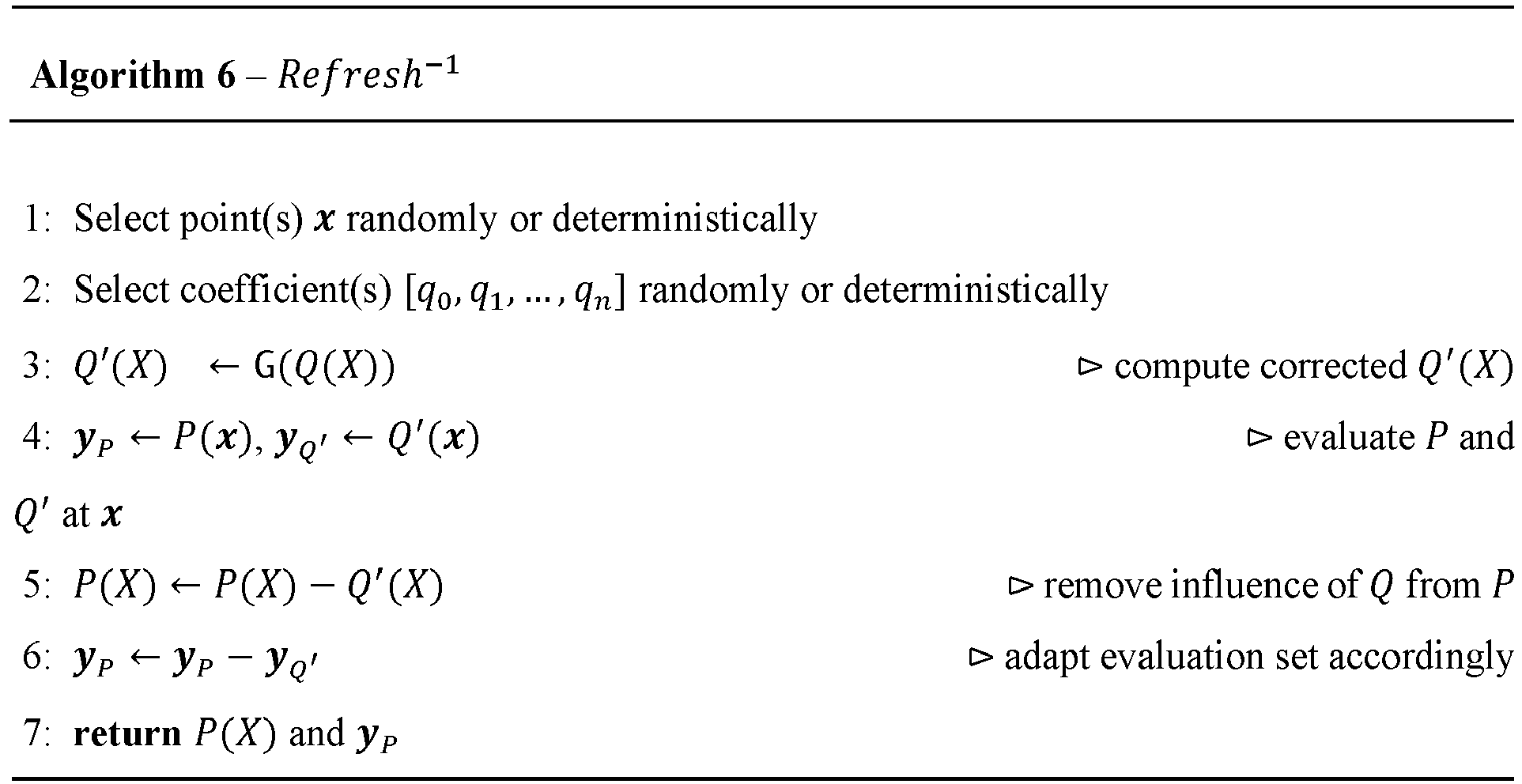
- Refresh (Algorithm 5) first samples a random polynomial Q ( X ) either with completely random coefficients, or as a polynomial with a specific form to improve performance, e.g., all coefficients are set to the same random value at line 2. This polynomial is evaluated at the same evaluation points x as P ( X ) at line 3, and then both P ( X ) and y P are refreshed by adding Q ( X ) and y Q , respectively, at lines 4 and 5.
- the refreshed polynomial P ( X ) and evaluation set y P are returned at line 6.
- Refresh -1 Algorithm 6
- the function G applied in line 3 is used to implement any functions applied after the Refresh function and before the Refresh -1 function.
- Refresh -1 is called directly after Refresh
- Q' ( X ) Q ( X )
- the function G is just the identity function.
- the probability of evaluating a random evaluation point to 0 might be low, e.g., 256 q ⁇ 2 ⁇ 15 for the prime modulus q and degree 256 of Dilithium. In that case, it might be preferable to rather extend the evaluation set by a few points than to rely on explicit Refresh and Refresh -1 gadgets. This might result in a more efficient implementation, while providing a probabilistic fault coverage.
- the scheme's parameters e.g., cardinality k or frequency of checks) affecting the coverage need to be chosen such that the probability of a successful attack is negligible.
- the gadgets then only take the input polynomials and corresponding evaluation sets as input, compute the polynomial and corresponding scalar function on the polynomials and evaluation sets, and return the output polynomials and their corresponding evaluation sets.
- An exemplary composition of two gadgets, one addition and one multiplication, is provided in Algorithm 7. Lines 3 and 4 correspond to the addition algorithm, and Lines 5 and 6 correspond to the multiplication algorithm. Then a final single check is performed at line 8.
- FIG. 2 illustrates a more complex calculation involving refresh algorithms.
- P 6 ( X ) ( P 1 ( X ) - P 2 ( X ) ⁇ P 3 ( X ) + P 4 ( X )) ⁇ P 5 ( X ) .
- the calculation 200 begins by multiplying P 1 ( X ) and P 2 ( X ) 205. Then a Refresh is applied to the results of step 205 using Q 1 ( X ) 210. Next, P 3 ( X ) is multiplied 215 with the refreshed output of step 210. Then Refresh -1 is applied at step 220.
- Refresh -1 would compute Q 1 ( X ) ⁇ P 3 ( X ) as part of G to correct the mask.
- the calculation 200 then adds the output of step 220 to P 4 ( X ) 225.
- the calculation 200 then multiplies the output of step 225 by P 5 ( X ) . to produce the output P 6 ( X ) 230.
- the fault does not propagate to the output due to lack of an output prediction function. Instead, it is required that these modules always implement the fault check, even if they are part of a larger composition. As decomposition is sparsely used compared to addition and multiplication in the envisioned use cases in post-quantum cryptography, this caveat does not come with a significant overhead for larger compositions.
- the fault detection embodiments described herein assume polynomials in R [X].
- the proposed fault protection scheme may be easily combined with masking schemes to thwart side-channel attacks.
- Standard arithmetic masking works by adding a random polynomial, similar to the refresh algorithms. It also comes with the advantage of reducing the threat of the 0 propagation problem, e.g., by requiring regular refresh operations. Masked additions and multiplications are implemented similar to before and just need to apply the corresponding masked operations on the evaluation sets.
- fault checks can be done share-wise and do not require additional attention, e.g., no Refresh -1 before the check.
- Another approach uses multiplicative masking, i.e., multiplying a random polynomial instead of adding. This type of masking does not help against the 0 value problem of the multiplication but comes with a linear overhead for protected multiplications.
- the number of scalar comparisons is provided in the worst-case (when the fault is detected at the last comparison). Recomputing the target operation m times offers similar security to using m distinct evaluation points.
- the memory column provides the number of scalar values to store/use. Table 1 Cost Multiplications Additions Comp. Memory Unprotected poly. mul. n 2 + 2 n + 1 n 0 3 n w/ double comp. 2 n 2 + 4 n + 2 2 n n 4 n w/ our inv. (1 point) n 2 + 5 n + 2 4n 1 3 n + 3 w/ m recomp.
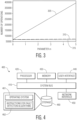
- FIG. 3 illustrates a comparison between the embodiments disclosed herein and a re-computation based fault countermeasure for different values of the parameter m which corresponds to the detection of m faults.
- the plot 315 is for an unprotected polynomial multiplication.
- Plot 310 is for polynomial multiplication using the algorithm embodiments disclosed herein.
- Plot 305 is for polynomial multiplication using re-computation.
- FIG. 4 illustrates an exemplary hardware diagram 400 for implementing the various fault detection algorithms disclosed herein.
- the device 400 includes a processor 420, memory 430, user interface 440, network interface 450, and storage 460 interconnected via one or more system buses 410. It will be understood that FIG. 4 constitutes, in some respects, an abstraction and that the actual organization of the components of the device 400 may be more complex than illustrated.
- the processor 420 may be any hardware device capable of executing instructions stored in memory 430 or storage 460 or otherwise processing data.
- the processor may include a microprocessor, microcontroller, graphics processing unit (GPU), neural network processor, field programmable gate array (FPGA), application-specific integrated circuit (ASIC), or other similar devices.
- the memory 430 may include various memories such as, for example L1, L2, or L3 cache or system memory. As such, the memory 430 may include static random-access memory (SRAM), dynamic RAM (DRAM), flash memory, read only memory (ROM), or other similar memory devices.
- SRAM static random-access memory
- DRAM dynamic RAM
- ROM read only memory
- the user interface 440 may include one or more devices for enabling communication with a user.
- the user interface 440 may include a display, a touch interface, a mouse, and/or a keyboard for receiving user commands.
- the user interface 440 may include a command line interface or graphical user interface that may be presented to a remote terminal via the network interface 450.
- the network interface 450 may include one or more devices for enabling communication with other hardware devices.
- the network interface 450 may include a network interface card (NIC) configured to communicate according to the Ethernet protocol or other communications protocols, including wireless protocols.
- NIC network interface card
- the network interface 450 may implement a TCP/IP stack for communication according to the TCP/IP protocols.
- TCP/IP protocols Various alternative or additional hardware or configurations for the network interface 450 will be apparent.
- the storage 460 may include one or more machine-readable storage media such as read-only memory (ROM), random-access memory (RAM), magnetic disk storage media, optical storage media, flash-memory devices, or similar storage media.
- the storage 460 may store instructions for execution by the processor 420 or data upon with the processor 420 may operate.
- the storage 460 may store a base operating system 461 for controlling various basic operations of the hardware 400.
- the storage 460 may include instructions for carrying out the fault detection algorithms 462.
- the memory 430 may also be considered to constitute a “storage device” and the storage 460 may be considered a “memory.”
- the memory 430 and storage 460 may both be considered to be “non-transitory machine-readable media.” As used herein, the term “non-transitory” will be understood to exclude transitory signals but to include all forms of storage, including both volatile and non-volatile memories.
- the system bus 410 allows communication between the processor 420, memory 430, user interface 440, storage 460, and network interface 450.
- the various components may be duplicated in various embodiments.
- the processor 420 may include multiple microprocessors that are configured to independently execute the methods described herein or are configured to perform steps or subroutines of the methods described herein such that the multiple processors cooperate to achieve the functionality described herein.
- the various hardware components may belong to separate physical systems.
- the processor 420 may include a first processor in a first server and a second processor in a second server.
- non-transitory machine-readable storage medium will be understood to exclude a transitory propagation signal but to include all forms of volatile and non-volatile memory.
- software is implemented on a processor, the combination of software and processor becomes a single specific machine.
Landscapes
- Engineering & Computer Science (AREA)
- Physics & Mathematics (AREA)
- General Physics & Mathematics (AREA)
- Theoretical Computer Science (AREA)
- Mathematical Analysis (AREA)
- Mathematical Optimization (AREA)
- Pure & Applied Mathematics (AREA)
- Computational Mathematics (AREA)
- Mathematical Physics (AREA)
- Computing Systems (AREA)
- Computer Security & Cryptography (AREA)
- General Engineering & Computer Science (AREA)
- Data Mining & Analysis (AREA)
- Algebra (AREA)
- Computer Networks & Wireless Communication (AREA)
- Signal Processing (AREA)
- Databases & Information Systems (AREA)
- Software Systems (AREA)
- Detection And Correction Of Errors (AREA)
Abstract
Description
- Various exemplary embodiments disclosed herein relate generally to efficient fault countermeasure through polynomial evaluation.
- Polynomial arithmetic is a building block of many cryptographic schemes. One promising direction that uses this building block is lattice-based cryptography, that is poised to be an essential part of the future standard for post-quantum cryptography, e.g., the digital signature scheme Dilithium. As for any cryptographic scheme, implementations of lattice-based cryptography are vulnerable to physical attacks, in particular to faults injected by an attacker in the computation path. Contemporary countermeasures often require a high investment in either area, runtime or memory to provide sufficient fault protection.
- A summary of various exemplary embodiments is presented below. Some simplifications and omissions may be made in the following summary, which is intended to highlight and introduce some aspects of the various exemplary embodiments, but not to limit the scope of the invention. Detailed descriptions of an exemplary embodiment adequate to allow those of ordinary skill in the art to make and use the inventive concepts will follow in later sections.
- Various embodiments relate to a data processing system including instructions embodied in a non-transitory computer readable medium, the instructions for a fault detection in polynomial operations in a processor, the instructions, including: selecting a plurality of evaluation points; evaluating a first polynomial at the plurality of evaluation points to produce first results; applying a first function to the first polynomial to produce a second polynomial; evaluating the second polynomial at the plurality of evaluation points to produce second results; evaluating a second scalar function on the first results to produce third results; comparing the second results to the third results; and performing a polynomial operation using the second polynomial when the second results match the third results.
- Various embodiments are described, further including indicating a fault when the second results do not match the third results.
- Various embodiments are described, further including: evaluating a third polynomial at the plurality of evaluation points to produce fourth results, wherein applying a first function to the first polynomial to produce a second polynomial includes adding the first polynomial to the third polynomial, and wherein evaluating a second scalar function on the first results to produce third results includes adding the first results to the fourth results.
- Various embodiments are described, further including: evaluating a third polynomial at the plurality of evaluation points to produce fourth results; wherein applying a first function to the first polynomial to produce a second polynomial includes multiplying the first polynomial and the third polynomial; and wherein evaluating a second scalar function on the first results to produce third results includes multiplying the first results by the fourth results.
- Various embodiments are described, further including: selecting a plurality of coefficients for a third polynomial; evaluating the third polynomial at the plurality of evaluation points to produce fourth results; updating the first polynomial by adding the third polynomial to the first polynomial; and updating the first results by adding the fourth results to the first results.
- Various embodiments are described, further including: applying a third function to the third polynomial, wherein the third function is based upon the first function to produce a fourth polynomial; evaluating the fourth polynomial at the plurality of evaluation points to produce fifth results; updating the first polynomial by subtracting the fourth polynomial from the first polynomial; and updating the first results by subtracting the fifth results to the first results.
- Various embodiments are described, wherein selecting a plurality of evaluation points includes randomly selecting the plurality of evaluation points.
- Various embodiments are described, wherein selecting a plurality of evaluation points includes deterministically selecting the plurality of evaluation points.
- Various embodiments are described, wherein the first and second polynomials are defined over a ring R[X]/(f(X)).
- Various embodiments are described, wherein the first and second polynomials are defined over a ring R[X]/(Xn + 1) and wherein selecting a plurality of evaluation points include selecting roots of unities.
- Further various embodiments relate to a method of detecting faults in a polynomial operation, including: selecting a plurality of evaluation points; evaluating a first polynomial at the plurality of evaluation points to produce first results; applying a first function to the first polynomial to produce a second polynomial; evaluating the second polynomial at the plurality of evaluation points to produce second results; evaluating a second scalar function on the first results to produce third results; comparing the second results to the third results; and performing a polynomial operation using the second polynomial when the second results match the third results.
- Various embodiments are described, further including indicating a fault when the second results do not match the third results.
- Various embodiments are described, further including: evaluating a third polynomial at the plurality of evaluation points to produce fourth results, wherein applying a first function to the first polynomial to produce a second polynomial includes adding the first polynomial to the third polynomial, and wherein evaluating a second scalar function on the first results to produce third results includes adding the first results to the fourth results.
- Various embodiments are described, further including: evaluating a third polynomial at the plurality of evaluation points to produce fourth results; wherein applying a first function to the first polynomial to produce a second polynomial includes multiplying the first polynomial and the third polynomial; and wherein evaluating a second scalar function on the first results to produce third results includes multiplying the first results by the fourth results.
- Various embodiments are described, further including: selecting a plurality of coefficients for a third polynomial; evaluating the third polynomial at the plurality of evaluation points to produce fourth results; updating the first polynomial by adding the third polynomial to the first polynomial; and updating the first results by adding the fourth results to the first results.
- Various embodiments are described, further including: applying a third function to the third polynomial, wherein the third function is based upon the first function to produce a fourth polynomial; evaluating the fourth polynomial at the plurality of evaluation points to produce fifth results; updating the first polynomial by subtracting the fourth polynomial from the first polynomial; and updating the first results by subtracting the fifth results to the first results.
- Various embodiments are described, wherein selecting a plurality of evaluation points includes randomly selecting the plurality of evaluation points.
- Various embodiments are described, wherein selecting a plurality of evaluation points includes deterministically selecting the plurality of evaluation points.
- Various embodiments are described, wherein the first and second polynomials are defined over a ring R[X]/(f(X)).
- Various embodiments are described, wherein the first and second polynomials are defined over a ring R[X]/(Xn + 1) and wherein selecting a plurality of evaluation points include selecting roots of unities.
- Further various embodiments relate to a data processing system including instructions embodied in a non-transitory computer readable medium, the instructions for a fault detection in polynomial operations in a processor, the instructions, including: selecting a plurality of evaluation points; evaluating a first polynomial at the plurality of evaluation points to produce first results; decomposing the first polynomial into a second polynomial and a third polynomial wherein the first polynomial equals the second polynomial plus alpha times the third polynomial wherein alpha is an integer; evaluating the second polynomial at the plurality of evaluation points to produce second results; evaluating the third polynomial at the plurality of evaluation points to produce third results; calculating fourth results by adding the second results to alpha times the third results; comparing the first results to the fourth results; and performing a polynomial operation using the second polynomial and third polynomial when the first results match the fourth results.
- Various embodiments are described, further including indicating a fault when the first results do not match the fourth results.
- In order to better understand various exemplary embodiments, reference is made to the accompanying drawings, wherein:
-
FIG. 1 illustrates an example of a sequence of functions F (0), F(1), ... applied to a polynomial P(X), or their corresponding scalarfunctions 
-
FIG. 2 illustrates a more complex calculation involving refresh algorithms; -
FIG. 3 illustrates a comparison between the embodiments disclosed herein and a re-computation based fault countermeasure for different values of the parameter m which corresponds to the detection of m faults; and -
FIG. 4 illustrates an exemplary hardware diagram for implementing the various fault detection algorithms disclosed herein. - To facilitate understanding, identical reference numerals have been used to designate elements having substantially the same or similar structure and/or substantially the same or similar function.
- The description and drawings illustrate the principles of the invention. It will thus be appreciated that those skilled in the art will be able to devise various arrangements that, although not explicitly described or shown herein, embody the principles of the invention and are included within its scope. Furthermore, all examples recited herein are principally intended expressly to be for pedagogical purposes to aid the reader in understanding the principles of the invention and the concepts contributed by the inventor(s) to furthering the art and are to be construed as being without limitation to such specifically recited examples and conditions. Additionally, the term, "or," as used herein, refers to a non-exclusive or (i.e., and/or), unless otherwise indicated (e.g., "or else" or "or in the alternative"). Also, the various embodiments described herein are not necessarily mutually exclusive, as some embodiments can be combined with one or more other embodiments to form new embodiments.
- Polynomial arithmetic is a building block of many cryptographic schemes. One promising direction that uses this building block is lattice-based cryptography, that is poised to be an essential part of the future standard for post-quantum cryptography, e.g., the digital signature scheme Dilithium. As for any cryptographic scheme, implementations of lattice-based cryptography are vulnerable to physical attacks, in particular to faults injected by an attacker in the computation path. Contemporary countermeasures often require a high investment in either area, runtime, or memory to provide sufficient fault protection. In the embodiments described herein, an efficient fault detection mechanism based on polynomial evaluation is proposed that introduces an overhead that is significantly lower than the state-of-the-art. This enables the efficient and fault-protected implementation of lattice-based cryptography.
- Typical countermeasures against implementation attacks are expensive. For instance, re-computation, which is the ad hoc countermeasure against fault injection attacks, implies doubling the cost of the operations to achieve full protection against single faults. When generalized to protect against multiple fault injections, its overhead is linear in the number of faults. Still, a factor that grows linearly can be quite significant when considering arithmetic of large polynomials, e.g., for lattice-based cryptography, resulting in expensive implementations.
- Other countermeasures include control flow integrity measures which do not protect against value based faults. Countermeasures aiming to randomize the order of operations such as shuffling or the location of the fault such as random delays do not thwart random faults aimed to perform differential fault attacks. Consistency checks can also be used to check the sparseness, the distribution, or the structure of intermediates, but this does not apply to all intermediates and to random faults. Recent proposals make use of the Chinese remainder theorem or residue number systems to detect faults, however these countermeasures are significantly more expensive than the embodiments described herein.
- Besides algorithmic countermeasures, there are also proposals that rely on physical shielding or sensors to prevent or detect injected faults. This direction is orthogonal to the embodiments described herein and may be straight-forwardly combined with the embodiments described herein, if required.
- The fault detection embodiments described herein detect injected faults with a significantly lower overhead in both runtime and memory consumption than the current state-of-the-art.
- In the fault detection embodiments described herein, an efficient fault detection mechanism using polynomial evaluation is proposed. This is achieved by removing the need to store and re-compute on polynomials and instead makes use of their evaluations, which does not require costly polynomial arithmetic and only scalar operations. Initially, the application of any polynomial function F, which has a corresponding scalar function F y as defined in the following section, to a polynomial P(X) (or multiple polynomials) is considered, and a generic protection scheme based on evaluations is provided. Afterwards, concrete instantiations for arithmetic operations (i.e., polynomial addition, polynomial multiplication, polynomial decomposition) common in lattice-based cryptography are provided, a new refresh scheme to overcome the 0 propagation property of the multiplication scheme is proposed, and how these gadgets can be composed securely to enable the implementation of larger, more complex circuits is described.
- The core idea is to evaluate the input polynomials Pi (X) at a set of evaluation points x to produce evaluation sets y i = Pi ( x ), to apply the corresponding scalar function F y to the resulting scalars y i and to compare the results to the evaluation set of the output polynomial F(Pi (X)) at the same evaluations points x. If no fault was injected, this comparison should return true, i.e., the values are the same. This underlying structure is used for the protected gadgets for polynomial addition and polynomial multiplication. For generic polynomial decomposition, the input evaluation set is instead predicted based on the outputs. A fault detection algorithm is described that relies on similar ideas, but requires two phases to produce the correct results, i.e., in the first phase the refresh mask is added and in the second phase a corrected mask is removed to produce the correct intermediate result.
- Overall, the fault detection embodiments described herein improves over the current state-of-the-art based on re-computation by not requiring storing and computing on complete redundant polynomials. Instead, fault detection embodiments described herein works with only evaluations which improves both runtime and memory consumption. In addition, the scaling to multiple faults is also linear, but with significantly smaller factors and constants than re-computation.
- An embodiment of a fault injection attack countermeasure for polynomial arithmetic will now be described. Accordingly, some background related to polynomial arithmetic and the cost of polynomial operations is provided.
- The polynomial ring R[X] in X over a ring R is a defined as the set of polynomials of the form:

- A generic fault injection attack countermeasure scheme considers any polynomial function F that has a corresponding scalar function F y with

-
FIG. 1 illustrates an example of a sequence of functions F (0), F(1), ... applied to a polynomial P(X), or their corresponding scalarfunctions 
- In this disclosure, protection schemes for concrete instantiations of F are provided, including polynomial addition, polynomial multiplication, and polynomial decomposition. Let P, Q ∈ R[X] be two polynomials of degree n with coefficients [p 0 , p 1 , ... , pn ] and [q 0 , q 1 , ..., qn ], respectively. The sum of P and Q is a polynomial defined by:


- The generic decomposition Decompose α of a polynomial P into two polynomials A and B in base α is defined as:

- Regarding computation costs, an addition of two degree n polynomials is computed using n + 1 additions over R. The straightforward multiplication of 2 degree n polynomials is computed using (n + 1)2 multiplications and n 2 additions. The cost of the decomposition operation depends on the ring R and the decomposition base α but is in general linear in the degree n. By using Horner's rule, the evaluation of a polynomial with degree n at one evaluation point requires only n multiplications and n additions.
- In this section, a generic approach for an efficient fault detection mechanism is proposed using polynomial evaluation for a given function F. The algorithmic description of this scheme is given in
Algorithm 1 below. First, a set with cardinality k of evaluation points x is sampled atline 1. This may be done either completely randomly, or deterministically to improve performance, e.g., the evaluation of certain points combinations can be efficiently computed as detailed later. Next, the input polynomial P(X) is evaluated at the sampled evaluations points x to produce the evaluation set y P atline 2. Afterwards, the polynomial function F is applied to P(X) (resp. y P ) to compute Q(X) atline 3. Then, the scalar function F y is applied to y P to compute y Q atline 4. Before outputting Q(X), the polynomial Q(X) is also evaluated at the evaluation points x to produce y Q ' atline 5, which is then compared to the predicted evaluation set y Q at line 6. If the comparison is true, Q(X) is returned at line 7. Otherwise, the algorithm returns a notification that a fault has been detected at line 8. Note that the exact same structure applies to instantiations of F with multiple input and output polynomials. In that case, multiple evaluation sets need to be predicted and compared before the output can be safely returned.
- In addition to the generic approach described in
Algorithm 1, specific Algorithms for fault-protected polynomial addition, polynomial multiplication, and polynomial decomposition functions are now provided. The algorithmic description for the three functions is provided inAlgorithm 2,Algorithm 3, andAlgorithm 4, respectively. -
Algorithm 2 is for protected polynomial addition and followsAlgorithm 1 closely. Here function F applied to the input polynomials is simply the addition of the polynomials. Further, the scalar function F y is simply the addition of the y 1 and y 2 values. -
Algorithm 3 is for protected polynomial multiplication and followsAlgorithm 1 closely. Here function F applied to the input polynomials is simply the multiplication of the polynomials. Further, the scalar function F y is simply the multiplication of the y 1 and y 2 values. -
Algorithm 4 is for protected polynomial decomposition. In the case of polynomial decomposition, the evaluation set of the output based on the evaluation set of the input cannot be reliably predicted. Therefore, a slightly different approach is used, in which instead the evaluation set of the input is predicted based on the outputs and compared to the original. The polynomial P(X) is decomposed into P 1(X) and P 0(X) atline 3. Then P 1(x) and P 0(x) are evaluated atline 4. Then the scalar function F y of α · y 1' + y 0' is applied atline 5. As will be discussed later, this approach comes with the drawback that it always needs to include a fault check which has some implications in compositions of multiple gadgets.


- The protected polynomial multiplication suffers from 0 entries in the evaluation sets which mask certain errors and can reduce the fault coverage. This property becomes even more pronounced in the compositions of multiple multiplication algorithms to implement more complex functions and can accumulate to a point where this approach no longer provides sufficient fault protection in certain scenarios. To overcome this issue, a new refresh approach is proposed. The approach first adds a random mask to the target polynomial to refresh it before the critical operation, and later removes the mask to produce the correct result.
- Generic algorithmic descriptions of the two steps (i.e., Refresh and Refresh -1) are provided in
Algorithm 5 and Algorithm 6. Refresh (Algorithm 5) first samples a random polynomial Q(X) either with completely random coefficients, or as a polynomial with a specific form to improve performance, e.g., all coefficients are set to the same random value atline 2. This polynomial is evaluated at the same evaluation points x as P(X) atline 3, and then both P(X) and y P are refreshed by adding Q(X) and y Q, respectively, atlines line 3 is used to implement any functions applied after the Refresh function and before the Refresh -1 function. In the trivial case, i.e., Refresh -1 is called directly after Refresh, Q'(X) = Q(X) and the function G is just the identity function. However, usually there is one or multiple other calculations between the two refresh calls. In that case, it is required to correct Q(X), i.e., the calculations in between need to be applied on this mask as well, and this is computed using the function G to produce the corrected Q'(X). For example, if there is a multiplication with another polynomial P 2(X) in between the calls, then G would compute the product of Q(X) and P 2(X). Note that if Q(X) is a polynomial with a specific form, this multiplication is much cheaper than a complete polynomial multiplication. After Q(X) has been corrected to Q'(X) using the appropriate G atline 3, the refresh mask is removed from P(X) atline 5 and the corresponding evaluation set y P at line 6 before P(X) and y P are returned. - Note that in some use cases, the probability of evaluating a random evaluation point to 0 might be low, e.g.,


- For practical use cases, multiple calculations will be composed into a larger, more complex calculations, e.g., a matrix multiplication using a sequence of polynomial additions and polynomial multiplications. The algorithms described herein may be used for this purpose, however, it is necessary to slightly adapt them. For one, the evaluation points are sampled once at the beginning of the composition and not for each calculation. In addition, the computation of the evaluation sets is done once initially for all inputs to the composition and not freshly for each calculation. Furthermore, the error check can be done for each gadget, however, it is more efficient to implement it more sparsely throughout the composition, e.g., only for the output polynomials of the complete calculation. Overall, the gadgets then only take the input polynomials and corresponding evaluation sets as input, compute the polynomial and corresponding scalar function on the polynomials and evaluation sets, and return the output polynomials and their corresponding evaluation sets. An exemplary composition of two gadgets, one addition and one multiplication, is provided in Algorithm 7.
Lines Lines 5 and 6 correspond to the multiplication algorithm. Then a final single check is performed at line 8.

-
FIG. 2 illustrates a more complex calculation involving refresh algorithms. InFIG. 2 the following calculation is carried out: P 6(X) = (P 1(X) - P 2(X) · P 3(X) + P 4(X)) · P 5(X). Thecalculation 200 begins by multiplying P 1(X) and P 2(X) 205. Then a Refresh is applied to the results ofstep 205 using Q 1(X) 210. Next, P 3(X) is multiplied 215 with the refreshed output ofstep 210. Then Refresh -1 is applied atstep 220. Note that Refresh -1 would compute Q 1(X) · P 3(X) as part of G to correct the mask. Thecalculation 200 then adds the output ofstep 220 to P 4(X) 225. Thecalculation 200 then multiplies the output ofstep 225 by P 5(X). to produce the output P 6(X) 230. - Note that for the generic polynomial decomposition, the fault does not propagate to the output due to lack of an output prediction function. Instead, it is required that these modules always implement the fault check, even if they are part of a larger composition. As decomposition is sparsely used compared to addition and multiplication in the envisioned use cases in post-quantum cryptography, this caveat does not come with a significant overhead for larger compositions.
- So far, the fault detection embodiments described herein assume polynomials in R [X]. However, for many relevant applications of the embodiments, the polynomials are defined over a ring R[X]/(f(X)) with typically f(X) = Xn + 1. While this does not impact the correctness of disclosed algorithms for polynomial addition and decomposition, the algorithm for polynomial multiplication does not produce the correct result for arbitrary evaluation points and polynomial rings. The reduction required after the multiplication impacts the prediction function of the evaluation set. To overcome this issue for the multiplication, it is necessary to select the evaluation points such that they are roots of unities, i.e., x 2n = 1.
- The proposed fault protection scheme may be easily combined with masking schemes to thwart side-channel attacks. Standard arithmetic masking works by adding a random polynomial, similar to the refresh algorithms. It also comes with the advantage of reducing the threat of the 0 propagation problem, e.g., by requiring regular refresh operations. Masked additions and multiplications are implemented similar to before and just need to apply the corresponding masked operations on the evaluation sets. Depending on the implementation, fault checks can be done share-wise and do not require additional attention, e.g., no Refresh -1 before the check. Another approach uses multiplicative masking, i.e., multiplying a random polynomial instead of adding. This type of masking does not help against the 0 value problem of the multiplication but comes with a linear overhead for protected multiplications.
- An example of a standard polynomial multiplication and a comparison to state-of-the-art fault detection mechanisms based on re-computation is provided in Table 1. As previously mentioned, the multiplication of two polynomials P and Q requires (n + 1)2 multiplications and n additions. A standard re-computation implies an additional overhead of (n + 1)2 multiplications, n additions and n scalar comparisons. Instead, the algorithm embodiments disclosed herein include an additional cost of 3 polynomials evaluations, 1 scalar multiplication and 1 scalar comparison, which only corresponds to 3n + 1 multiplications, 3n additions, and 1 scalar comparison. A summary and the overheads to protect against m faults are provided in Table 1. The number of scalar comparisons is provided in the worst-case (when the fault is detected at the last comparison). Recomputing the target operation m times offers similar security to using m distinct evaluation points. The memory column provides the number of scalar values to store/use.
Table 1 Cost Multiplications Additions Comp. Memory Unprotected poly. mul. n 2 + 2n + 1 n 0 3n w/ double comp. 2n 2 + 4n + 2 2n n 4n w/ our inv. (1 point) n 2 + 5n + 2 4n 1 3n + 3 w/ m recomp. (m + 1) · (n 2 + 2n + 1) (m + 1) · n m · n 3 · (m + 1) · n w/ our inv. (m points) n 2 + (3m + 2) · n + m + 1 (3m + 1) · n m 3n + 3m -
FIG. 3 illustrates a comparison between the embodiments disclosed herein and a re-computation based fault countermeasure for different values of the parameter m which corresponds to the detection of m faults.FIG. 3 is provided for polynomials with 256 coefficients i.e., of degree n = 256, which is an exemplary value for post-quantum lattice-based cryptography schemes using polynomial arithmetic. Theplot 315 is for an unprotected polynomial multiplication.Plot 310 is for polynomial multiplication using the algorithm embodiments disclosed herein.Plot 305 is for polynomial multiplication using re-computation. - As previously mentioned, the evaluation of a polynomial with degree n at one evaluation point requires only n multiplications and n additions. However, specific evaluation points can be selected to speed up the evaluation. A simple example is the evaluation of any polynomial P at x = 1, which only requires n additions (instead of n multiplications and n additions) to add all its coefficients.
- In some cases, it is preferable to rely on specific combinations of evaluation points to simplify their joint evaluation, e.g., x = {0,1}. Then the attacker has the advantage of knowing the evaluation points before injecting the fault, which might make some attacks easier to mount, e.g., adaptively cancel out injections to avoid detection. For non-prime qM, the choice of the evaluation points also heavily impacts the fault coverage. Assume a power-of-two qM = 16 and x = 4, then all coefficients with xi, i ≤ 2 = 0 mod qM are masked in the sum and faults in them are not detectable.
-
FIG. 4 illustrates an exemplary hardware diagram 400 for implementing the various fault detection algorithms disclosed herein. As shown, thedevice 400 includes aprocessor 420,memory 430,user interface 440,network interface 450, andstorage 460 interconnected via one ormore system buses 410. It will be understood thatFIG. 4 constitutes, in some respects, an abstraction and that the actual organization of the components of thedevice 400 may be more complex than illustrated. - The
processor 420 may be any hardware device capable of executing instructions stored inmemory 430 orstorage 460 or otherwise processing data. As such, the processor may include a microprocessor, microcontroller, graphics processing unit (GPU), neural network processor, field programmable gate array (FPGA), application-specific integrated circuit (ASIC), or other similar devices. - The
memory 430 may include various memories such as, for example L1, L2, or L3 cache or system memory. As such, thememory 430 may include static random-access memory (SRAM), dynamic RAM (DRAM), flash memory, read only memory (ROM), or other similar memory devices. - The
user interface 440 may include one or more devices for enabling communication with a user. For example, theuser interface 440 may include a display, a touch interface, a mouse, and/or a keyboard for receiving user commands. In some embodiments, theuser interface 440 may include a command line interface or graphical user interface that may be presented to a remote terminal via thenetwork interface 450. - The
network interface 450 may include one or more devices for enabling communication with other hardware devices. For example, thenetwork interface 450 may include a network interface card (NIC) configured to communicate according to the Ethernet protocol or other communications protocols, including wireless protocols. Additionally, thenetwork interface 450 may implement a TCP/IP stack for communication according to the TCP/IP protocols. Various alternative or additional hardware or configurations for thenetwork interface 450 will be apparent. - The
storage 460 may include one or more machine-readable storage media such as read-only memory (ROM), random-access memory (RAM), magnetic disk storage media, optical storage media, flash-memory devices, or similar storage media. In various embodiments, thestorage 460 may store instructions for execution by theprocessor 420 or data upon with theprocessor 420 may operate. For example, thestorage 460 may store abase operating system 461 for controlling various basic operations of thehardware 400. Thestorage 460 may include instructions for carrying out thefault detection algorithms 462. - It will be apparent that various information described as stored in the
storage 460 may be additionally or alternatively stored in thememory 430. In this respect, thememory 430 may also be considered to constitute a "storage device" and thestorage 460 may be considered a "memory." Various other arrangements will be apparent. Further, thememory 430 andstorage 460 may both be considered to be "non-transitory machine-readable media." As used herein, the term "non-transitory" will be understood to exclude transitory signals but to include all forms of storage, including both volatile and non-volatile memories. - The
system bus 410 allows communication between theprocessor 420,memory 430,user interface 440,storage 460, andnetwork interface 450. - While the
host device 400 is shown as including one of each described component, the various components may be duplicated in various embodiments. For example, theprocessor 420 may include multiple microprocessors that are configured to independently execute the methods described herein or are configured to perform steps or subroutines of the methods described herein such that the multiple processors cooperate to achieve the functionality described herein. Further, where thedevice 400 is implemented in a cloud computing system, the various hardware components may belong to separate physical systems. For example, theprocessor 420 may include a first processor in a first server and a second processor in a second server. - As used herein, the term "non-transitory machine-readable storage medium" will be understood to exclude a transitory propagation signal but to include all forms of volatile and non-volatile memory. When software is implemented on a processor, the combination of software and processor becomes a single specific machine. Although the various embodiments have been described in detail, it should be understood that the invention is capable of other embodiments and its details are capable of modifications in various obvious respects.
- Because the data processing implementing the present invention is, for the most part, composed of electronic components and circuits known to those skilled in the art, circuit details will not be explained in any greater extent than that considered necessary as illustrated above, for the understanding and appreciation of the underlying concepts of the present invention and in order not to obfuscate or distract from the teachings of the present invention.
- Although the invention is described herein with reference to specific embodiments, various modifications and changes can be made without departing from the scope of the present invention as set forth in the claims below. Accordingly, the specification and figures are to be regarded in an illustrative rather than a restrictive sense, and all such modifications are intended to be included within the scope of the present invention. Any benefits, advantages, or solutions to problems that are described herein with regard to specific embodiments are not intended to be construed as a critical, required, or essential feature or element of any or all the claims.
- Furthermore, the terms "a" or "an," as used herein, are defined as one or more than one. Also, the use of introductory phrases such as "at least one" and "one or more" in the claims should not be construed to imply that the introduction of another claim element by the indefinite articles "a" or "an" limits any particular claim containing such introduced claim element to inventions containing only one such element, even when the same claim includes the introductory phrases "one or more" or "at least one" and indefinite articles such as "a" or "an." The same holds true for the use of definite articles.
- Unless stated otherwise, terms such as "first" and "second" are used to arbitrarily distinguish between the elements such terms describe. Thus, these terms are not necessarily intended to indicate temporal or other prioritization of such elements.
- Any combination of specific software running on a processor to implement the embodiments of the invention, constitute a specific dedicated machine.
- It should be appreciated by those skilled in the art that any block diagrams herein represent conceptual views of illustrative circuitry embodying the principles of the invention.
Claims (15)
- A data processing system comprising instructions embodied in a non-transitory computer readable medium, the instructions for a fault detection in polynomial operations in a processor, the instructions comprising:selecting a plurality of evaluation points;evaluating a first polynomial at the plurality of evaluation points to produce first results;applying a first function to the first polynomial to produce a second polynomial;evaluating the second polynomial at the plurality of evaluation points to produce second results;evaluating a second scalar function on the first results to produce third results;comparing the second results to the third results; andperforming a polynomial operation using the second polynomial when the second results match the third results.
- The data processing system of claim 1, further comprising indicating a fault when the second results do not match the third results.
- The data processing system of claim 1 or 2, further comprising:evaluating a third polynomial at the plurality of evaluation points to produce fourth results,wherein applying a first function to the first polynomial to produce a second polynomial includes adding the first polynomial to the third polynomial, andwherein evaluating a second scalar function on the first results to produce third results includes adding the first results to the fourth results.
- The data processing system of any preceding claim, further comprising:evaluating a third polynomial at the plurality of evaluation points to produce fourth results;wherein applying a first function to the first polynomial to produce a second polynomial includes multiplying the first polynomial and the third polynomial; andwherein evaluating a second scalar function on the first results to produce third results includes multiplying the first results by the fourth results.
- The data processing system of any preceding claim, further comprising:selecting a plurality of coefficients for a third polynomial;evaluating the third polynomial at the plurality of evaluation points to produce fourth results;updating the first polynomial by adding the third polynomial to the first polynomial; andupdating the first results by adding the fourth results to the first results.
- The data processing system of claim 5, further comprising:applying a third function to the third polynomial, wherein the third function is based upon the first function to produce a fourth polynomial;evaluating the fourth polynomial at the plurality of evaluation points to produce fifth results;updating the first polynomial by subtracting the fourth polynomial from the first polynomial; andupdating the first results by subtracting the fifth results to the first results.
- The data processing system of any preceding claim, wherein selecting a plurality of evaluation points includes randomly selecting the plurality of evaluation points.
- The data processing system of any preceding claim, wherein selecting a plurality of evaluation points includes deterministically selecting the plurality of evaluation points.
- The data processing system of any preceding claim, wherein the first and second polynomials are defined over a ring R[X]/(f(X)).
- The data processing system of any preceding claim, wherein the first and second polynomials are defined over a ring R[X]/(Xn + 1) and wherein selecting a plurality of evaluation points include selecting roots of unities.
- A method of detecting faults in a polynomial operation, comprising:selecting a plurality of evaluation points;evaluating a first polynomial at the plurality of evaluation points to produce first results;applying a first function to the first polynomial to produce a second polynomial;evaluating the second polynomial at the plurality of evaluation points to produce second results;evaluating a second scalar function on the first results to produce third results;comparing the second results to the third results; andperforming a polynomial operation using the second polynomial when the second results match the third results.
- The method of claim 11, further comprising indicating a fault when the second results do not match the third results.
- The method of claim 11 or 12, further comprising:evaluating a third polynomial at the plurality of evaluation points to produce fourth results,wherein applying a first function to the first polynomial to produce a second polynomial includes adding the first polynomial to the third polynomial, andwherein evaluating a second scalar function on the first results to produce third results includes adding the first results to the fourth results.
- The method of any one of claims 11 to 13, further comprising:evaluating a third polynomial at the plurality of evaluation points to produce fourth results;wherein applying a first function to the first polynomial to produce a second polynomial includes multiplying the first polynomial and the third polynomial; andwherein evaluating a second scalar function on the first results to produce third results includes multiplying the first results by the fourth results.
- A data processing system comprising instructions embodied in a non-transitory computer readable medium, the instructions for a fault detection in polynomial operations in a processor, the instructions, comprising:selecting a plurality of evaluation points;evaluating a first polynomial at the plurality of evaluation points to produce first results;decomposing the first polynomial into a second polynomial and a third polynomial wherein the first polynomial equals the second polynomial plus alpha times the third polynomial wherein alpha is an integer;evaluating the second polynomial at the plurality of evaluation points to produce second results;evaluating the third polynomial at the plurality of evaluation points to produce third results;calculating fourth results by adding the second results to alpha times the third results;comparing the first results to the fourth results; andperforming a polynomial operation using the second polynomial and third polynomial when the first results match the fourth results.
Applications Claiming Priority (1)
| Application Number | Priority Date | Filing Date | Title |
|---|---|---|---|
| US18/066,862 US20240202273A1 (en) | 2022-12-15 | 2022-12-15 | Efficient fault countermeasure through polynomial evaluation |
Publications (2)
| Publication Number | Publication Date |
|---|---|
| EP4387156A1 true EP4387156A1 (en) | 2024-06-19 |
| EP4387156B1 EP4387156B1 (en) | 2026-02-25 |
Family
ID=89121966
Family Applications (1)
| Application Number | Title | Priority Date | Filing Date |
|---|---|---|---|
| EP23214876.7A Active EP4387156B1 (en) | 2022-12-15 | 2023-12-07 | Efficient fault countermeasure through polynomial evaluation |
Country Status (2)
| Country | Link |
|---|---|
| US (1) | US20240202273A1 (en) |
| EP (1) | EP4387156B1 (en) |
Citations (1)
| Publication number | Priority date | Publication date | Assignee | Title |
|---|---|---|---|---|
| US11139971B2 (en) * | 2017-08-07 | 2021-10-05 | Infineon Technologies Ag | Conducting a cryptographic operation |
-
2022
- 2022-12-15 US US18/066,862 patent/US20240202273A1/en active Pending
-
2023
- 2023-12-07 EP EP23214876.7A patent/EP4387156B1/en active Active
Patent Citations (1)
| Publication number | Priority date | Publication date | Assignee | Title |
|---|---|---|---|---|
| US11139971B2 (en) * | 2017-08-07 | 2021-10-05 | Infineon Technologies Ag | Conducting a cryptographic operation |
Non-Patent Citations (1)
| Title |
|---|
| DANIEL HEINZ ET AL: "Combined Fault and DPA Protection for Lattice-Based Cryptography", vol. 20210225:122259, 25 February 2021 (2021-02-25), pages 1 - 30, XP061052217, Retrieved from the Internet <URL:https://eprint.iacr.org/2021/101.pdf> [retrieved on 20210225] * |
Also Published As
| Publication number | Publication date |
|---|---|
| US20240202273A1 (en) | 2024-06-20 |
| EP4387156B1 (en) | 2026-02-25 |
Similar Documents
| Publication | Publication Date | Title |
|---|---|---|
| Fan et al. | An updated survey on secure ECC implementations: Attacks, countermeasures and cost | |
| EP2523098B1 (en) | Finite field crytographic arithmetic resistant to fault attacks | |
| EP4344122A1 (en) | Protecting polynomial rejection through masked compressed comparison | |
| Akdemir et al. | Design of cryptographic devices resilient to fault injection attacks using nonlinear robust codes | |
| EP4287556A1 (en) | Masked decomposition of polynomials for lattice-based cryptography | |
| EP4033692B1 (en) | Efficient masked polynomial comparison | |
| US11824986B2 (en) | Device and method for protecting execution of a cryptographic operation | |
| US7227947B2 (en) | Cryptographic method and cryptographic device | |
| Mondal et al. | ZKFault: Fault attack analysis on zero-knowledge based post-quantum digital signature schemes | |
| US20110029784A1 (en) | Method of processing data protected against fault injection attacks and associated device | |
| EP4418606B1 (en) | Fault detection of differential fault attack in lattice based cryptography | |
| EP2535804A1 (en) | Fault-resistant exponentiation algorithm | |
| Reviriego et al. | A novel concurrent error detection technique for the fast Fourier transform | |
| EP4387156B1 (en) | Efficient fault countermeasure through polynomial evaluation | |
| US20240015012A1 (en) | Rejection of masked polynomials | |
| US12476786B2 (en) | Statistical ineffective fault analysis protection of Sbox | |
| Fournaris | Fault and power analysis attack protection techniques for standardized public key cryptosystems | |
| US12621150B2 (en) | Bit-rotation to prevent single-bit leakage in lattice based cryptography | |
| Kim et al. | Bit-flip faults on elliptic curve base fields, revisited | |
| Maistri | Countermeasures against fault attacks: The good, the bad, and the ugly | |
| Thenmozhi et al. | Balancing Quantum and Classical Security: Side-Channel Challenges in NIST PQC Finalist | |
| US20250094529A1 (en) | Fault detection for the ntt | |
| Karaklajić et al. | Low-cost fault detection method for ECC using Montgomery powering ladder | |
| US20240137214A1 (en) | Fault detection in post-quantum cyptography | |
| EP4633080A1 (en) | Method for validating the security of an operation, computer-program product and industrial device |
Legal Events
| Date | Code | Title | Description |
|---|---|---|---|
| PUAI | Public reference made under article 153(3) epc to a published international application that has entered the european phase |
Free format text: ORIGINAL CODE: 0009012 |
|
| STAA | Information on the status of an ep patent application or granted ep patent |
Free format text: STATUS: THE APPLICATION HAS BEEN PUBLISHED |
|
| AK | Designated contracting states |
Kind code of ref document: A1 Designated state(s): AL AT BE BG CH CY CZ DE DK EE ES FI FR GB GR HR HU IE IS IT LI LT LU LV MC ME MK MT NL NO PL PT RO RS SE SI SK SM TR |
|
| STAA | Information on the status of an ep patent application or granted ep patent |
Free format text: STATUS: REQUEST FOR EXAMINATION WAS MADE |
|
| 17P | Request for examination filed |
Effective date: 20241219 |
|
| GRAP | Despatch of communication of intention to grant a patent |
Free format text: ORIGINAL CODE: EPIDOSNIGR1 |
|
| STAA | Information on the status of an ep patent application or granted ep patent |
Free format text: STATUS: GRANT OF PATENT IS INTENDED |
|
| RIC1 | Information provided on ipc code assigned before grant |
Ipc: H04L 9/00 20220101AFI20251106BHEP Ipc: H04L 9/30 20060101ALI20251106BHEP |
|
| INTG | Intention to grant announced |
Effective date: 20251114 |
|
| GRAS | Grant fee paid |
Free format text: ORIGINAL CODE: EPIDOSNIGR3 |
|
| GRAA | (expected) grant |
Free format text: ORIGINAL CODE: 0009210 |
|
| STAA | Information on the status of an ep patent application or granted ep patent |
Free format text: STATUS: THE PATENT HAS BEEN GRANTED |
|
| AK | Designated contracting states |
Kind code of ref document: B1 Designated state(s): AL AT BE BG CH CY CZ DE DK EE ES FI FR GB GR HR HU IE IS IT LI LT LU LV MC ME MK MT NL NO PL PT RO RS SE SI SK SM TR |
|
| REG | Reference to a national code |
Ref country code: CH Ref legal event code: F10 Free format text: ST27 STATUS EVENT CODE: U-0-0-F10-F00 (AS PROVIDED BY THE NATIONAL OFFICE) Effective date: 20260225 Ref country code: GB Ref legal event code: FG4D |
|
| REG | Reference to a national code |
Ref country code: DE Ref legal event code: R096 Ref document number: 602023012571 Country of ref document: DE |
|
| REG | Reference to a national code |
Ref country code: IE Ref legal event code: FG4D |
|
| REG | Reference to a national code |
Ref country code: NL Ref legal event code: MP Effective date: 20260225 |
|
| PG25 | Lapsed in a contracting state [announced via postgrant information from national office to epo] |
Ref country code: RS Free format text: LAPSE BECAUSE OF FAILURE TO SUBMIT A TRANSLATION OF THE DESCRIPTION OR TO PAY THE FEE WITHIN THE PRESCRIBED TIME-LIMIT Effective date: 20260525 |
|
| PG25 | Lapsed in a contracting state [announced via postgrant information from national office to epo] |
Ref country code: ES Free format text: LAPSE BECAUSE OF FAILURE TO SUBMIT A TRANSLATION OF THE DESCRIPTION OR TO PAY THE FEE WITHIN THE PRESCRIBED TIME-LIMIT Effective date: 20260225 |
|
| PG25 | Lapsed in a contracting state [announced via postgrant information from national office to epo] |
Ref country code: PL Free format text: LAPSE BECAUSE OF FAILURE TO SUBMIT A TRANSLATION OF THE DESCRIPTION OR TO PAY THE FEE WITHIN THE PRESCRIBED TIME-LIMIT Effective date: 20260225 |
|
| PG25 | Lapsed in a contracting state [announced via postgrant information from national office to epo] |
Ref country code: GR Free format text: LAPSE BECAUSE OF FAILURE TO SUBMIT A TRANSLATION OF THE DESCRIPTION OR TO PAY THE FEE WITHIN THE PRESCRIBED TIME-LIMIT Effective date: 20260526 |
|
| REG | Reference to a national code |
Ref country code: LT Ref legal event code: MG9D |
|
| PG25 | Lapsed in a contracting state [announced via postgrant information from national office to epo] |
Ref country code: LT Free format text: LAPSE BECAUSE OF FAILURE TO SUBMIT A TRANSLATION OF THE DESCRIPTION OR TO PAY THE FEE WITHIN THE PRESCRIBED TIME-LIMIT Effective date: 20260225 |
|
| PG25 | Lapsed in a contracting state [announced via postgrant information from national office to epo] |
Ref country code: NO Free format text: LAPSE BECAUSE OF FAILURE TO SUBMIT A TRANSLATION OF THE DESCRIPTION OR TO PAY THE FEE WITHIN THE PRESCRIBED TIME-LIMIT Effective date: 20260525 |
|
| PG25 | Lapsed in a contracting state [announced via postgrant information from national office to epo] |
Ref country code: AT Free format text: LAPSE BECAUSE OF FAILURE TO SUBMIT A TRANSLATION OF THE DESCRIPTION OR TO PAY THE FEE WITHIN THE PRESCRIBED TIME-LIMIT Effective date: 20260225 Ref country code: SE Free format text: LAPSE BECAUSE OF FAILURE TO SUBMIT A TRANSLATION OF THE DESCRIPTION OR TO PAY THE FEE WITHIN THE PRESCRIBED TIME-LIMIT Effective date: 20260225 Ref country code: FI Free format text: LAPSE BECAUSE OF FAILURE TO SUBMIT A TRANSLATION OF THE DESCRIPTION OR TO PAY THE FEE WITHIN THE PRESCRIBED TIME-LIMIT Effective date: 20260225 |
|
| REG | Reference to a national code |
Ref country code: AT Ref legal event code: MK05 Ref document number: 1892247 Country of ref document: AT Kind code of ref document: T Effective date: 20260225 |
|
| PG25 | Lapsed in a contracting state [announced via postgrant information from national office to epo] |
Ref country code: HR Free format text: LAPSE BECAUSE OF FAILURE TO SUBMIT A TRANSLATION OF THE DESCRIPTION OR TO PAY THE FEE WITHIN THE PRESCRIBED TIME-LIMIT Effective date: 20260225 |
|
| PG25 | Lapsed in a contracting state [announced via postgrant information from national office to epo] |
Ref country code: IS Free format text: LAPSE BECAUSE OF FAILURE TO SUBMIT A TRANSLATION OF THE DESCRIPTION OR TO PAY THE FEE WITHIN THE PRESCRIBED TIME-LIMIT Effective date: 20260625 Ref country code: PT Free format text: LAPSE BECAUSE OF FAILURE TO SUBMIT A TRANSLATION OF THE DESCRIPTION OR TO PAY THE FEE WITHIN THE PRESCRIBED TIME-LIMIT Effective date: 20260625 |
|
| PG25 | Lapsed in a contracting state [announced via postgrant information from national office to epo] |
Ref country code: NL Free format text: LAPSE BECAUSE OF FAILURE TO SUBMIT A TRANSLATION OF THE DESCRIPTION OR TO PAY THE FEE WITHIN THE PRESCRIBED TIME-LIMIT Effective date: 20260225 |
|
| PG25 | Lapsed in a contracting state [announced via postgrant information from national office to epo] |
Ref country code: LV Free format text: LAPSE BECAUSE OF FAILURE TO SUBMIT A TRANSLATION OF THE DESCRIPTION OR TO PAY THE FEE WITHIN THE PRESCRIBED TIME-LIMIT Effective date: 20260225 |
|
| PG25 | Lapsed in a contracting state [announced via postgrant information from national office to epo] |
Ref country code: BG Free format text: LAPSE BECAUSE OF FAILURE TO SUBMIT A TRANSLATION OF THE DESCRIPTION OR TO PAY THE FEE WITHIN THE PRESCRIBED TIME-LIMIT Effective date: 20260225 |