EP4387155A1 - Method and system for a lattice-based homomorphic proxy re-encryption scheme - Google Patents
Method and system for a lattice-based homomorphic proxy re-encryption scheme Download PDFInfo
- Publication number
- EP4387155A1 EP4387155A1 EP23207228.0A EP23207228A EP4387155A1 EP 4387155 A1 EP4387155 A1 EP 4387155A1 EP 23207228 A EP23207228 A EP 23207228A EP 4387155 A1 EP4387155 A1 EP 4387155A1
- Authority
- EP
- European Patent Office
- Prior art keywords
- public
- ciphertext
- key
- encryption
- client machine
- Prior art date
- Legal status (The legal status is an assumption and is not a legal conclusion. Google has not performed a legal analysis and makes no representation as to the accuracy of the status listed.)
- Granted
Links
Images


Classifications
-
- H—ELECTRICITY
- H04—ELECTRIC COMMUNICATION TECHNIQUE
- H04L—TRANSMISSION OF DIGITAL INFORMATION, e.g. TELEGRAPHIC COMMUNICATION
- H04L63/00—Network architectures or network communication protocols for network security
- H04L63/04—Network architectures or network communication protocols for network security for providing a confidential data exchange among entities communicating through data packet networks
- H04L63/0428—Network architectures or network communication protocols for network security for providing a confidential data exchange among entities communicating through data packet networks wherein the data content is protected, e.g. by encrypting or encapsulating the payload
- H04L63/0471—Network architectures or network communication protocols for network security for providing a confidential data exchange among entities communicating through data packet networks wherein the data content is protected, e.g. by encrypting or encapsulating the payload applying encryption by an intermediary, e.g. receiving clear information at the intermediary and encrypting the received information at the intermediary before forwarding
-
- H—ELECTRICITY
- H04—ELECTRIC COMMUNICATION TECHNIQUE
- H04L—TRANSMISSION OF DIGITAL INFORMATION, e.g. TELEGRAPHIC COMMUNICATION
- H04L63/00—Network architectures or network communication protocols for network security
- H04L63/04—Network architectures or network communication protocols for network security for providing a confidential data exchange among entities communicating through data packet networks
- H04L63/0428—Network architectures or network communication protocols for network security for providing a confidential data exchange among entities communicating through data packet networks wherein the data content is protected, e.g. by encrypting or encapsulating the payload
-
- H—ELECTRICITY
- H04—ELECTRIC COMMUNICATION TECHNIQUE
- H04L—TRANSMISSION OF DIGITAL INFORMATION, e.g. TELEGRAPHIC COMMUNICATION
- H04L9/00—Cryptographic mechanisms or cryptographic arrangements for secret or secure communications; Network security protocols
- H04L9/008—Cryptographic mechanisms or cryptographic arrangements for secret or secure communications; Network security protocols involving homomorphic encryption
-
- H—ELECTRICITY
- H04—ELECTRIC COMMUNICATION TECHNIQUE
- H04L—TRANSMISSION OF DIGITAL INFORMATION, e.g. TELEGRAPHIC COMMUNICATION
- H04L9/00—Cryptographic mechanisms or cryptographic arrangements for secret or secure communications; Network security protocols
- H04L9/14—Cryptographic mechanisms or cryptographic arrangements for secret or secure communications; Network security protocols using a plurality of keys or algorithms
-
- H—ELECTRICITY
- H04—ELECTRIC COMMUNICATION TECHNIQUE
- H04L—TRANSMISSION OF DIGITAL INFORMATION, e.g. TELEGRAPHIC COMMUNICATION
- H04L9/00—Cryptographic mechanisms or cryptographic arrangements for secret or secure communications; Network security protocols
- H04L9/30—Public key, i.e. encryption algorithm being computationally infeasible to invert or user's encryption keys not requiring secrecy
- H04L9/3093—Public key, i.e. encryption algorithm being computationally infeasible to invert or user's encryption keys not requiring secrecy involving Lattices or polynomial equations, e.g. NTRU scheme
-
- H—ELECTRICITY
- H04—ELECTRIC COMMUNICATION TECHNIQUE
- H04L—TRANSMISSION OF DIGITAL INFORMATION, e.g. TELEGRAPHIC COMMUNICATION
- H04L2209/00—Additional information or applications relating to cryptographic mechanisms or cryptographic arrangements for secret or secure communication H04L9/00
- H04L2209/76—Proxy, i.e. using intermediary entity to perform cryptographic operations
Definitions
- the disclosure herein generally relates to the field of cryptography and, more particularly, to a method and system for a lattice-based homomorphic proxy re-encryption scheme.
- Proxy Re-encryption allows a semi-trusted third party called proxy to transform a ciphertext encrypted under a public key of a first party termed as delegator into a ciphertext decryptable under a new public key of the second party termed as delegatee, without revealing any information about the underlying message.
- the proxy is entrusted with a special information termed as re-encryption key or rekey that enables such a transformation.
- PRE has extensive applications cloud environment, distributed storage in blockchain-based systems, encrypted email forwarding, digital rights management, outsourced filtering of encrypted spam, revocation systems, network security among others. Because of the intrinsic key-switching property, PRE seems to be a natural solution towards enabling seamless sharing of encrypted data evaluated using Fully Homomorphic Encryption (FHE).
- FHE Fully Homomorphic Encryption
- a method for A lattice-based homomorphic proxy re-encryption scheme includes receiving, by a first client machine and a second client machine via corresponding one or more hardware processors, a plurality of public parameters from a trusted third party server, wherein the plurality of public parameters comprises a security parameter, a number of encryption levels and a bit value.
- the method includes generating via one or more hardware processors of the first client machine, a first public-private key pair of a first user based on the plurality of public parameters and a user index using a probabilistic key generation algorithm. Furthermore, the method includes simultaneously generating via one or more hardware processors of a second client machine, a second public-private key pair of a second user based on the plurality of public parameters and the user index using the probabilistic key generation algorithm. Furthermore, the method includes generating via the one or more hardware processors of the first client machine, a ciphertext based on a plaintext associated with the first user, the public key from the first public-private key pair and the plurality of public parameters using a probabilistic encryption algorithm.
- the method includes transmitting via the one or more hardware processors of the first client machine, the ciphertext to a proxy server machine, wherein the ciphertext is received by the proxy server machine. Furthermore, the method includes performing a computation via one or more hardware processors of the proxy server machine, on the ciphertext using a Fully Homomorphic Encryption (FHE) based technique. Furthermore, the method includes generating via the one or more hardware processors of the first client machine, a re-encryption key based on the first public-private key pair of the first user, a public key of the second user and the plurality of public parameter using a probabilistic re-encryption key generation algorithm.
- FHE Fully Homomorphic Encryption
- the method includes transmitting via the one or more hardware processors of the first client machine, the generated re-encryption key to the proxy server machine, wherein the re-encryption key is received by the proxy server machine. Furthermore, the method includes generating via the one or more hardware processors of the proxy server machine, a re-encrypted ciphertext based on the re-encryption key, the ciphertext and the plurality of public parameters using a probabilistic re-encryption algorithm. Furthermore, the method includes transmitting via the one or more hardware processors of the proxy server machine, the re-encrypted ciphertext to the second client machine, wherein the re-encrypted ciphertext is received by the second client machine.
- the method includes generating by the one or more hardware processors of the second client machine, a resultant plaintext based on the re-encrypted ciphertext, and a private key of the second public-private key pair of the second user using a probabilistic decryption algorithm.
- a system for a lattice-based homomorphic proxy re-encryption scheme includes a first client machine, a second client machine, a proxy server machine and a trusted third party server 108, wherein the proxy server machine, the first client machine and the second client machine comprises at least one memory storing programmed instructions; one or more Input /Output (I/O) interfaces; and one or more hardware processors of the proxy server machine, the first client machine and the second client machine are operatively coupled to a corresponding at least one memory, wherein the system is configured to receive, by a first client machine and a second client machine via corresponding one or more hardware processors, a plurality of public parameters from a trusted third party server, wherein the plurality of public parameters comprises a security parameter, a number of encryption levels and a bit value.
- the system is configured to generate, via one or more hardware processors of the first client machine, a first public-private key pair of a first user based on the plurality of public parameters and a user index using a probabilistic key generation algorithm. Furthermore, the system is configured to simultaneously generate, via one or more hardware processors of a second client machine, a second public-private key pair of a second user based on the plurality of public parameters and the user index using the probabilistic key generation algorithm. Furthermore, the system is configured to generate, via the one or more hardware processors of the first client machine, a ciphertext based on a plaintext associated with the first user, the public key from the first public-private key pair and the plurality of public parameters using a probabilistic encryption algorithm.
- the system is configured to transmit, via the one or more hardware processors of the first client machine, the ciphertext to a proxy server machine, wherein the ciphertext is received by the proxy server machine. Furthermore, the system is configured to perform a computation, via one or more hardware processors of the proxy server machine, on the ciphertext using a Fully Homomorphic Encryption (FHE) based technique. Furthermore, the system is configured to generate, via the one or more hardware processors of the first client machine, a re-encryption key based on the first public-private key pair of the first user, a public key of the second user and the plurality of public parameter using a probabilistic re-encryption key generation algorithm.
- FHE Fully Homomorphic Encryption
- system is configured to transmit, via the one or more hardware processors of the first client machine, the generated re-encryption key to the proxy server machine, wherein the re-encryption key is received by the proxy server machine. Furthermore, the system is configured to generate, via the one or more hardware processors of the proxy server machine, a re-encrypted ciphertext based on the re-encryption key, the ciphertext and the plurality of public parameters using a probabilistic re-encryption algorithm.
- system is configured to transmit, via the one or more hardware processors of the proxy server machine, the re-encrypted ciphertext to the second client machine, wherein the re-encrypted ciphertext is received by the second client machine.
- system is configured to generate, by the one or more hardware processors of the second client machine, a resultant plaintext based on the re-encrypted ciphertext, and a private key of the second public-private key pair of the second user using a probabilistic decryption algorithm.
- a computer program product including a non-transitory computer-readable medium having embodied therein a computer program for a lattice-based homomorphic proxy re-encryption scheme.
- the computer readable program when executed on a computing device, causes the computing device to receive by a first client machine and a second client machine via corresponding one or more hardware processors, a plurality of public parameters from a trusted third party server, wherein the plurality of public parameters comprises a security parameter, a number of encryption levels and a bit value.
- the computer readable program when executed on a computing device, causes the computing device to generate, via one or more hardware processors of the first client machine, a first public-private key pair of a first user based on the plurality of public parameters and a user index using a probabilistic key generation algorithm. Furthermore, the computer readable program, when executed on a computing device, causes the computing device to simultaneously generate, via one or more hardware processors of a second client machine, a second public-private key pair of a second user based on the plurality of public parameters and the user index using the probabilistic key generation algorithm.
- the computer readable program when executed on a computing device, causes the computing device to generate, via the one or more hardware processors of the first client machine, a ciphertext based on a plaintext associated with the first user, the public key from the first public-private key pair and the plurality of public parameters using a probabilistic encryption algorithm. Furthermore, the computer readable program, when executed on a computing device, causes the computing device to transmit, via the one or more hardware processors of the first client machine, the ciphertext to a proxy server machine, wherein the ciphertext is received by the proxy server machine.
- the computer readable program when executed on a computing device, causes the computing device to perform a computation, via one or more hardware processors of the proxy server machine, on the ciphertext using a Fully Homomorphic Encryption (FHE) based technique. Furthermore, the computer readable program, when executed on a computing device, causes the computing device to generate, via the one or more hardware processors of the first client machine, a re-encryption key based on the first public-private key pair of the first user, a public key of the second user and the plurality of public parameter using a probabilistic re-encryption key generation algorithm.
- FHE Fully Homomorphic Encryption
- the computer readable program when executed on a computing device, causes the computing device to transmit, via the one or more hardware processors of the first client machine, the generated re-encryption key to the proxy server machine, wherein the re-encryption key is received by the proxy server machine. Furthermore, the computer readable program, when executed on a computing device, causes the computing device to generate, via the one or more hardware processors of the proxy server machine, a re-encrypted ciphertext based on the re-encryption key, the ciphertext and the plurality of public parameters using a probabilistic re-encryption algorithm.
- the computer readable program when executed on a computing device, causes the computing device to transmit, via the one or more hardware processors of the proxy server machine, the re-encrypted ciphertext to the second client machine, wherein the re-encrypted ciphertext is received by the second client machine.
- the computer readable program when executed on a computing device, causes the computing device to generate, by the one or more hardware processors of the second client machine, a resultant plaintext based on the re-encrypted ciphertext, and a private key of the second public-private key pair of the second user using a probabilistic decryption algorithm.
- Homomorphic Proxy Re-Encryption allows a delegator to encrypt his/her data with his/her own public key while enabling homomorphic evaluations and conversions of the ciphertexts towards different public keys. Furthermore, by applying a re-encryption operation on the evaluated ciphertext, the receiver can decrypt it only with his own secret key. The re-encryption is done with re-encryption keys generated by the delegators and sent to the cloud server in advance.
- a use-case scenario of a HPRE including a private inference application is explained herein to better understand the challenges and limitations of conventional approaches.
- the scenario explaining the conventional approach is from a healthcare domain, where a user Alice (a patient), Bob (hospital server with a trained Machine Learning model for disease identification) and Charlie (Medical Insurance provider).
- PII Personal Identification Information
- PII Personal Identification Information
- she can encrypt her inputs using FHE and send to Bob for private inference.
- the output of Bob will still remain encrypted under Alice's public keys. Hence, this requires that the result obtained by Bob is sent to Alice for decryption, who then forwards the result to Charlie for further processing.
- the present disclosure utilizes an enhanced Homomorphic Proxy Re-encryption, where in the re-encryption keys can be stored with Bob. After performing private inference on Alice's inputs, Bob can now re-encrypt the resulting ciphertext towards Charlie's keys.
- the lattice based HPRE approach disclosed herein enables the output to be directly sent to Charlie for decryption and further processing.
- Embodiments herein provide a method and system for a lattice-based homomorphic proxy re-encryption scheme.
- a first client machine and a second client machine receive a plurality of public parameters from a trusted third party server.
- the plurality of public parameters comprises a security parameter, a number of encryption levels and a bit value.
- a first public-private key pair of a first user is generated by the first client machine based on the plurality of public parameters and a user index using a probabilistic key generation algorithm.
- a second public-private key pair of a second user is generated by a second client machine based on the plurality of public parameters and the user index using the probabilistic key generation algorithm.
- the first client machine Post generating the public-private key pair of the first and second client machine, the first client machine generates a ciphertext based on a plaintext associated with the first user, the public key from the first public-private key pair and the plurality of public parameters using a probabilistic encryption algorithm. Further, the ciphertext is transmitted by the first client machine to the proxy server machine and the ciphertext is received by the proxy server machine. After receiving the ciphertext, the proxy server machine performs a computation on the ciphertext using a Fully Homomorphic Encryption (FHE) based technique.
- FHE Fully Homomorphic Encryption
- a re-encryption key is generated by the first client machine, based on the first public-private key pair of the first user, a public key of the second user and the plurality of public parameter using a probabilistic re-encryption key generation algorithm.
- the generated re-encryption key is transmitted by the first client machine to the proxy server.
- the proxy server receives the re-encryption key and generates a re-encrypted ciphertext based on the re-encryption key, the ciphertext and the plurality of public parameters using a probabilistic re-encryption algorithm.
- the proxy server further transmits the re-encrypted ciphertext to the second client machine and the second client machine generates a resultant plaintext based on the re-encrypted ciphertext, and a private key of the second public-private key pair of the second user using a probabilistic decryption algorithm.
- the lattice based HPRE technique of the present disclosure is designed for Brakerski-Gentry-Vaikunathan (BGV) protocol.
- BGV protocol belongs to the second generation of FHE schemes.
- Security of BGV stems from the hardness of the Ring-Learning with Errors (RLWE) problem.
- RLWE Ring-Learning with Errors
- BGV encodes plaintext and ciphertext as polynomials where each coefficient of polynomial belongs to a Ring R.
- the encryption procedure maps input from plaintext space to output from ciphertext space. Broadly speaking, encryption is done by concealing the plaintext message with an almost random mask that is computed using the public key.
- the output of encryption is typically two elements of the ciphertext space; the first of which contains the masked plaintext data whereas the second contains auxiliary information that can be used in the decryption procedure.
- Decryption uses the secret key and the auxiliary information in the ciphertext to remove the mask and recover the plaintext message.
- FIGS. 1A through 3 where similar reference characters denote corresponding features consistently throughout the figures, there are shown preferred embodiments and these embodiments are described in the context of the following exemplary system and/or method.
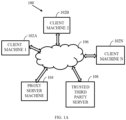
- FIG. 1A is a functional block diagram of a system 100 for the lattice-based homomorphic proxy re-encryption scheme, according to some embodiments of the present disclosure.
- the system 100 includes a plurality of client machines 102A, 102B through 102N, a proxy server machine 104, a network 106, and a trusted third party server 108.
- the plurality of client machines 102A through 102N, the proxy server machine 104 and the trusted third party server 108 connected by the network 106.
- the network 106 can be a wireless or a wired network, or a combination thereof.
- the network 106 can be implemented as a computer network, as one of the different types of networks, such as virtual private network (VPN), intranet, local area network (LAN), wide area network (WAN), the internet, and such.
- the network 106 may either be a dedicated network or a shared network, which represents an association of the different types of networks that use a variety of protocols, for example, Hypertext Transfer Protocol (HTTP), Transmission Control Protocol/Internet Protocol (TCP/IP), and Wireless Application Protocol (WAP), to communicate with each other.
- the network 106 may include a variety of network devices, including routers, bridges, servers, computing devices, storage devices. The network devices within the network 106 may interact with the system 102 through communication links.
- the plurality of client machines 102A through 102N, the proxy server machine 104, and the trusted third party server 108 may be implemented in a computing device as shown in FIG. 1B .
- the plurality of client machine 102A through 102N, the proxy server machine 104, and the trusted third party server 108 can be a hand-held device, a laptop or other portable computer, a tablet computer, a mobile phone, a PDA, a smartphone, and a desktop computer.
- the client machine 102 and the proxy server machine 104 may also be implemented in a workstation, a mainframe computer, a server, and a network server.
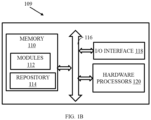
- FIG. 1B is a functional block diagram of the computing device 109 associated with the system of FIG. 1A implementing the proxy server machine 104, according to some embodiments of the present disclosure.
- the computing device 107 is otherwise in communication with hardware processors 120, at least one memory such as a memory 110, an I/O interface 118.
- the hardware processors 120, memory 110, and the Input /Output (I/O) interface 118 may be coupled by a system bus such as a system bus 116 or a similar mechanism.
- the hardware processors 120 can be one or more hardware processors.
- the I/O interface 118 may include a variety of software and hardware interfaces, for example, a web interface, a graphical user interface, and the like.
- the I/O interface 118 may include a variety of software and hardware interfaces, for example, interfaces for peripheral device(s), such as a keyboard, a mouse, an external memory, a printer and the like. Further, the interface 118 may enable the server machine 104 to communicate with other devices, such the client machine 102 via the network 106, web servers and external databases and the like.
- the I/O interface 118 can facilitate multiple communications within a wide variety of networks and protocol types, including wired networks, for example, local area network (LAN), cable, etc., and wireless networks, such as Wireless LAN (WLAN), cellular, or satellite.
- the I/O interface 118 may include one or more ports for connecting a number of computing systems with one another or to another server computer.
- the I/O interface 118 may include one or more ports for connecting a number of devices to one another or to another server.
- the one or more hardware processors 120 may be implemented as one or more microprocessors, microcomputers, microcontrollers, digital signal processors, central processing units, state machines, logic circuitries, and/or any devices that manipulate signals based on operational instructions. Among other capabilities, the one or more hardware processors 120 is configured to fetch and execute computer-readable instructions stored in the memory 110.
- the memory 110 may include any computer-readable medium known in the art including, for example, volatile memory, such as static random access memory (SRAM) and dynamic random access memory (DRAM), and/or non-volatile memory, such as read only memory (ROM), erasable programmable ROM, flash memories, hard disks, optical disks, and magnetic tapes.
- volatile memory such as static random access memory (SRAM) and dynamic random access memory (DRAM)
- non-volatile memory such as read only memory (ROM), erasable programmable ROM, flash memories, hard disks, optical disks, and magnetic tapes.
- ROM read only memory
- erasable programmable ROM erasable programmable ROM
- flash memories hard disks
- optical disks optical disks
- magnetic tapes such as magnetic tapes.
- the memory 110 includes a plurality of modules 112.
- the memory 110 also includes a data repository 114 for storing data processed, received, and generated by the plurality of modules 112.
- the plurality of modules 112 include programs or coded instructions that supplement applications or functions performed by the server machine 104 for the lattice-based homomorphic proxy re-encryption scheme.
- the plurality of modules 112 can include routines, programs, objects, components, and data structures, which performs particular tasks or implement particular abstract data types.
- the plurality of modules 112 may also be used as, signal processor(s), state machine(s), logic circuitries, and/or any other device or component that manipulates signals based on operational instructions.
- the plurality of modules 112 can be used by hardware, by computer-readable instructions executed by the one or more hardware processors 120, or by a combination thereof.
- the plurality of modules 112 can include various sub-modules (not shown).
- the plurality of modules 112 may include computer-readable instructions that supplement applications or functions performed by the system 100 for the lattice-based homomorphic proxy re-encryption scheme.
- the data repository 114 may include a plurality of abstracted piece of code for refinement and data that is processed, received, or generated as a result of the execution of the plurality of modules in the module(s) 112.
- the data repository 114 is shown internal to the system 100, it will be noted that, in alternate embodiments, the data repository 114 can also be implemented external to the system 100, where the data repository 114 may be stored within a database (not shown in FIG. 1 ) communicatively coupled to the system 100.
- the data contained within such external database may be periodically updated. For example, new data may be added into the database (not shown in FIG. 1 ) and/or existing data may be modified and/or non-useful data may be deleted from the database (not shown in FIG. 1 ).
- the data may be stored in an external system, such as a Lightweight Directory Access Protocol (LDAP) directory and a Relational Database Management System (RDBMS).
- LDAP Lightweight Directory Access Protocol
- RDBMS Relational Database Management System
- the client machines 102A through 102N has functional components similar to functional components of the proxy server machine 104 and the trusted third party server machine 108 as depicted by computing device 107 in FIG. 2 and not repeated herein for brevity.
- the components perform functions in accordance with instructions stored in memory block of the client device enabling the client device to communicate with the server 104.
- FIGS. 2A and 2B are exemplary flow diagrams for a processor implemented method for the lattice-based homomorphic proxy re-encryption scheme implemented by the system of FIG. 1A and FIG. 1B according to some embodiments of the present disclosure.
- the computing device 107 implementing the server 104, comprises one or more data storage devices or the memory 110 operatively coupled to the one or more hardware processor(s) 120 and is configured to store instructions for execution of steps of the method 200 by the one or more hardware processors 120.
- the steps of the method 200 of the present disclosure will now be explained with reference to the components or blocks of the system 107 as depicted in FIG. 1B and the steps of flow diagram as depicted in FIG. 2A and FIG. 2B .
- the method 200 may be described in the general context of computer executable instructions.
- computer executable instructions can include routines, programs, objects, components, data structures, procedures, modules, functions, etc., that perform particular functions or implement particular abstract data types.
- the method 200 may also be practiced in a distributed computing environment where functions are performed by remote processing devices that are linked through a communication network.
- the order in which the method 200 is described is not intended to be construed as a limitation, and any number of the described method blocks can be combined in any order to implement the method 200, or an alternative method.
- the method 200 can be implemented in any suitable hardware, software, firmware, or combination thereof.
- the one or more hardware processors of corresponding to the first client machine (any client machine from 102A through N) and the second client machine (any client machine from 102A through N other than the first client machine) receives the plurality of public parameters from the trusted third party server.
- the plurality of public parameters includes the security parameter, the number of encryption levels and the bit value.
- the bit value indicates a learning scheme associated with a Homomorphic Proxy Re-Encryption (HPRE) scheme, wherein the learning scheme is one of a) Learning With Errors (LWE) and b) Ring Learning With Errors (RLWE).
- HPRE Homomorphic Proxy Re-Encryption
- the present disclosure includes a Setup ( K ) function which takes the security parameter K as input and returns a set of public parameters params, shared by a plurality of users.
- a Setup ( K ) function which takes the security parameter K as input and returns a set of public parameters params, shared by a plurality of users.
- the pseudocode for the Setup ( k ) is given below.
- the one or more hardware processors of the first client machine generates the first public-private key pair of a first user (for example, Alice) based on the plurality of public parameters and the user index using the probabilistic key generation algorithm.
- the probabilistic key generation algorithm is a Fully Homomorphic Encryption (FHE) based technique.
- the one or more hardware processors of the second client machine simultaneously generating the second public-private key pair of the second user (for example, Charlie) based on the plurality of public parameters and the user index using the probabilistic key generation algorithm.
- the first and second public-private key pair corresponding to the first user/ the first client machine and the second user/ second client machine are generated using the function KeyGen ( i,params ).
- the said function is a probabilistic function which takes as input a user index i and the plurality of public parameters params and returns the public-private key pair ( pk i , sk i ) of user i .
- the pseudocode for key generation function is given below.
- the one or more hardware processors of the first client machine generates the ciphertext based on the plaintext associated with the first user, the public key from the first public-private key pair and the plurality of public parameters using the probabilistic encryption algorithm.
- the probabilistic encryption algorithm is a FHE based algorithm.
- the first client machine generates the ciphertext using the function Encrypt ( m, pk i , params ).
- the said encryption function is a probabilistic function which takes as input a plaintext m ⁇ M , the public key pk i of a user i and public parameters params and returns a ciphertext C i corresponding to m which is allowed to be re-encrypted towards another user.
- the ciphertext C i is termed as original ciphertext.
- the pseudocode for encryption function is given below.
- the one or more hardware processors of the first client machine transmits the ciphertext to the proxy server machine and the ciphertext is received by the proxy server machine.
- the one or more hardware processors of the proxy server machine performing the computation on the ciphertext using the FHE based technique.
- the one or more hardware processors of the first client machine generates the re-encryption key based on the first public-private key pair of the first user, the public key of the second user and the plurality of public parameter using the probabilistic re-encryption key generation algorithm.
- the re-encryption key generation algorithm is an FHE based technique.
- the method of generating the re-encryption key by the first client machine based on the private-public key pair of the first user, the public key of the second user and the plurality of public parameter using the probabilistic re-encryption key generation algorithm includes the following steps. Initially, a plurality of random matrices are generated using a random matrix generation technique. For example, the plurality of random matrices comprises a first random matrix, a second random matrix and a third random matrix. Further, powers of two for the first random matrix is computed by multiplying each element of the first random matrix with increasing powers of two.
- a first key component is generated based on a public key from the second public-private key pair of the second user and powers of two matrix corresponding to the first random matrix.
- a second key component is generated by encrypting the second random matrix using the public key from the first public-private key pair of the first user and the third random matrix.
- the re-encryption key is generated by combining the first key component and the second key component.
- the re-encryption key is generated using the function ReKeyGen ( sk i , pk i , pk j , params ).
- the re-encryption key generation function is a probabilistic function which takes as input the private-public key pair sk i , pk i of the delegator i , the public key pk j of delegatee j and public parameter params, and returns a re-encryption key RK i ⁇ j that can re-encrypt ciphertexts from user i towards user j.
- the pseudocode for the ReKeyGen ( sk i , pk i , pk j , params ) is given below:
- the one or more hardware processors of the first client machine transmits the generated re-encryption key to the proxy server, wherein the re-encryption key is received by the proxy server (for example, Bob).
- the proxy server for example, Bob
- the one or more hardware processors of the proxy server machine 104 generates the re-encrypted ciphertext based on the re-encryption key, the ciphertext and the plurality of public parameters using the probabilistic re-encryption algorithm.
- the probabilistic re-encryption algorithm is an FHE based technique.
- the method of generating the re-encrypted ciphertext by the proxy server machine 104 based on the re-encryption key, the ciphertext and the plurality of public parameters using the probabilistic re-encryption algorithm includes the following steps. Initially, a Bit Decomposition Ciphertext (BDC) is computed based on the ciphertext. The bit decomposition converts each element of a matrix into a corresponding binary value. After, computing the BDC, a first ciphertext component is computed by multiplying the computed BDC with the first key component associated with the re-encryption key.
- BDC Bit Decomposition Ciphertext
- a second ciphertext component is computed by multiplying the ciphertext with the second key component associated with the re-encryption key.
- the re-encrypted ciphertext is generated by combining the first ciphertext component and the second ciphertext component.
- the re-encrypted ciphertext is generated using the function Re - Encrypt ( RK i ⁇ j , C i , params ).
- the re-encryption function is a probabilistic function which takes as input the re-encryption key RK i ⁇ j , original ciphertext C i encrypted under pk i and public parameters params and returns ciphertext C j encrypted under the public key pk j .
- the ciphertext C j is termed as re-encrypted ciphertext.
- the pseudocode for the re Re-Encrypt() is given below in pseudocode 5. Referring to the pseudocode 5, Scale() method changes the modulus of ciphertext from q i to q i -1 .
- the one or more hardware processors of the proxy server machine 104 transmits the re-encrypted ciphertext to the second client machine and is received by the second client machine.
- the one or more hardware processors of the second client machine generates the resultant plaintext based on the re-encrypted ciphertext, and the private key of the second public-private key pair of the second user using a probabilistic decryption algorithm, for example an FHE based technique.
- a probabilistic decryption algorithm for example an FHE based technique.
- the resultant plaintext is generated using the function Decrypt ( C i , sk i , params).
- the decryption function is a deterministic algorithm which takes as input the private key sk j of a user j, an original ciphertext C j , and public parameters params and returns a plaintext m or the error symbol ⁇ if the ciphertext is invalid.
- NTL Number Theory Library
- the performance of FHE schemes (measured in milliseconds) and the security level mostly depend on parameters n and q, as can be seen in Table I.
- NTL provides SetNumThreads() method which can be used to enable parallelism during the computation.
- the present implementation was tested in Intel i5 - 10310U CPU with 8 cores with max frequency of 4.4Ghz and 16GB of RAM.
- the computational complexity of the present disclosure is compared with the existing techniques and is identified that the computational complexity of the present disclosure is very less and hence the present disclosure is highly efficient than the existing approaches.
- the present disclosure performs homomorphic evaluation of two ciphertexts associated with a used based on the corresponding public key, two ciphertexts encrypted under the public key of the user and the plurality of public parameters, wherein the homomorphic evaluation comprises multiplication and addition.
- the homomorphic evaluation using addition is performed using the function Eval - Add ( pk i , C 1 , C 2 , params).
- the said summation function is a deterministic algorithm which takes as input a public key pk i , two ciphertexts C 1 and C 2 encrypted under public key of user i and public parameters params and returns the summation of the two ciphertexts as C sum , evaluated homomorphically.
- the pseudocode for Eval - Add ( pk i , C 1 , C 2 , params)function is given below.
- the homomorphic evaluation using multiplication is performed using the function Eval - Mul ( pk i , C 1 , C 2 , params ).
- the said multiplication algorithm is a deterministic algorithm which takes as input a public key pk i , two ciphertexts C 1 and C 2 encrypted under public key of user i and public parameters params and returns the product of the two ciphertexts as C mult , evaluated homomorphically.
- the pseudocode for Eval - Mul ( pk i , C 1 , C 2 , params ) function is given below.
- the present disclosure performs batch evaluation of a plurality of ciphertexts of a plurality of users based on the plurality of ciphertexts, a plurality of public keys and the plurality of public parameters using a deterministic homomorphic batch evaluation algorithm.
- the batch evaluation of the present disclosure is performed using the function Batch - Eval ( pk i , • • • , pk j , C i , • • • , C j , pk t , params ):
- the said batch evaluation function is a deterministic algorithm which takes as input public keys pk i , • • • , pk j , ciphertexts C i • • • C j encrypted under the corresponding public keys of users i to j and public parameters params.
- the proof of correctness of the ecrypt ( C i , sk i , params ) is given below.
- the dot product of BitDecomp ( C 1 ) and e 2 is small, since BitDecomp ( C 1 ) is in R 2 N .
- the dot product of C 1 and re-encryption key's term A T r' . is small since r' is in R 2 N .
- C 2 be a re-encrypted ciphertext under public key pk j .
- the algorithm decrypts as below: ⁇ C 2 , s 2 ⁇
- the present disclosure provides sematic security, collision resistance, enables fine grained access and optimization using Bootstrapping.
- Semantic security provides protection from extracting plaintext from ciphertext by an intruder.
- Collision resistance means intruder/attacker cannot generate a ciphertext which can be replaced with the re encrypted ciphertext
- fine grained access control means the re encrypted ciphertext can only be decrypted by a particular user for whom it was meant and cannot be decrypted by any other user.
- Optimization using bootstrapping means, if the re encryption procedure requires a certain number of multiplications, this can be optimized using bootstrapping procedure to get fresh ciphertext.
- the embodiments of present disclosure herein address the unresolved problem of a lattice-based homomorphic proxy re-encryption scheme.
- the present disclosure provides a unidirectional, single-hop HPRE scheme from the LWE assumption which is Chosen Plaintext Attack (CPA) secure.
- CPA is an attack model for cryptanalysis which presumes that the attacker can obtain the ciphertexts for arbitrary plaintexts.
- the goal of the attack is to gain information that reduces the security of the encryption scheme.
- the present disclosure is based on the widely accepted BGV algorithm that supports both levelled FHE operations as well as arbitrary number of ciphertexts with unique and secure re-encryption key generation. Further, the present disclosure provides batch evaluation of ciphertexts, in order to enable re-encryption and evaluation of multiple ciphertexts (supporting both features where all ciphertexts are encrypted under a single public key, as well as ciphertexts being encrypted under distinct public keys). The batch-evaluation technique would enable batch processing.
- the hardware device can be any kind of device which can be programmed including e.g. any kind of computer like a server or a personal computer, or the like, or any combination thereof.
- the device may also include means which could be e.g. hardware means like e.g. an application-specific integrated circuit (ASIC), a field-programmable gate array (FPGA), or a combination of hardware and software means, e.g.
- ASIC application-specific integrated circuit
- FPGA field-programmable gate array
- the means can include both hardware means and software means.
- the method embodiments described herein could be implemented in hardware and software.
- the device may also include software means.
- the embodiments may be implemented on different hardware devices, e.g. using a plurality of CPUs, GPUs and edge computing devices.
- the embodiments herein can comprise hardware and software elements.
- the embodiments that are implemented in software include but are not limited to, firmware, resident software, microcode, etc.
- the functions performed by various modules described herein may be implemented in other modules or combinations of other modules.
- a computer-usable or computer readable medium can be any apparatus that can comprise, store, communicate, propagate, or transport the program for use by or in connection with the instruction execution system, apparatus, or device.
- the illustrated steps are set out to explain the exemplary embodiments shown, and it should be anticipated that ongoing technological development will change the manner in which particular functions are performed. These examples are presented herein for purposes of illustration, and not limitation. Further, the boundaries of the functional building blocks have been arbitrarily defined herein for the convenience of the description.
- a computer-readable storage medium refers to any type of physical memory on which information or data readable by a processor may be stored.
- a computer-readable storage medium may store instructions for execution by one or more processors, including instructions for causing the processor(s) to perform steps or stages consistent with the embodiments described herein.
- the term "computer-readable medium” should be understood to include tangible items and exclude carrier waves and transient signals, i.e. non-transitory. Examples include random access memory (RAM), read-only memory (ROM), volatile memory, nonvolatile memory, hard drives, CD ROMs, DVDs, flash drives, disks, and any other known physical storage media.
Landscapes
- Engineering & Computer Science (AREA)
- Computer Security & Cryptography (AREA)
- Computer Networks & Wireless Communication (AREA)
- Signal Processing (AREA)
- Computing Systems (AREA)
- Algebra (AREA)
- General Engineering & Computer Science (AREA)
- Physics & Mathematics (AREA)
- Computer Hardware Design (AREA)
- General Physics & Mathematics (AREA)
- Mathematical Analysis (AREA)
- Mathematical Optimization (AREA)
- Mathematical Physics (AREA)
- Pure & Applied Mathematics (AREA)
- Theoretical Computer Science (AREA)
- Storage Device Security (AREA)
Abstract
Description
- The present application claims priority to
Indian application no. 202221071716, filed on December 12, 2022 - The disclosure herein generally relates to the field of cryptography and, more particularly, to a method and system for a lattice-based homomorphic proxy re-encryption scheme.
- Proxy Re-encryption (PRE) allows a semi-trusted third party called proxy to transform a ciphertext encrypted under a public key of a first party termed as delegator into a ciphertext decryptable under a new public key of the second party termed as delegatee, without revealing any information about the underlying message. The proxy is entrusted with a special information termed as re-encryption key or rekey that enables such a transformation. PRE has extensive applications cloud environment, distributed storage in blockchain-based systems, encrypted email forwarding, digital rights management, outsourced filtering of encrypted spam, revocation systems, network security among others. Because of the intrinsic key-switching property, PRE seems to be a natural solution towards enabling seamless sharing of encrypted data evaluated using Fully Homomorphic Encryption (FHE).
- Conventional methods are identity based, and the attribute-based encryption schemes employ very expensive operations and generate long ciphertexts and secret keys (whose sizes also increase linearly with the size of the access policy), which makes them hard to implement in real-life applications. Further, the conventional systems do not support fine-grained operations on ciphertext and batch evaluation of ciphertexts.
- Embodiments of the present disclosure present technological improvements as solutions to one or more of the above-mentioned technical problems recognized by the inventors in conventional systems. For example, in one embodiment, a method for A lattice-based homomorphic proxy re-encryption scheme is provided. The method includes receiving, by a first client machine and a second client machine via corresponding one or more hardware processors, a plurality of public parameters from a trusted third party server, wherein the plurality of public parameters comprises a security parameter, a number of encryption levels and a bit value. Further, the method includes generating via one or more hardware processors of the first client machine, a first public-private key pair of a first user based on the plurality of public parameters and a user index using a probabilistic key generation algorithm. Furthermore, the method includes simultaneously generating via one or more hardware processors of a second client machine, a second public-private key pair of a second user based on the plurality of public parameters and the user index using the probabilistic key generation algorithm. Furthermore, the method includes generating via the one or more hardware processors of the first client machine, a ciphertext based on a plaintext associated with the first user, the public key from the first public-private key pair and the plurality of public parameters using a probabilistic encryption algorithm. Furthermore, the method includes transmitting via the one or more hardware processors of the first client machine, the ciphertext to a proxy server machine, wherein the ciphertext is received by the proxy server machine. Furthermore, the method includes performing a computation via one or more hardware processors of the proxy server machine, on the ciphertext using a Fully Homomorphic Encryption (FHE) based technique. Furthermore, the method includes generating via the one or more hardware processors of the first client machine, a re-encryption key based on the first public-private key pair of the first user, a public key of the second user and the plurality of public parameter using a probabilistic re-encryption key generation algorithm. Furthermore, the method includes transmitting via the one or more hardware processors of the first client machine, the generated re-encryption key to the proxy server machine, wherein the re-encryption key is received by the proxy server machine. Furthermore, the method includes generating via the one or more hardware processors of the proxy server machine, a re-encrypted ciphertext based on the re-encryption key, the ciphertext and the plurality of public parameters using a probabilistic re-encryption algorithm. Furthermore, the method includes transmitting via the one or more hardware processors of the proxy server machine, the re-encrypted ciphertext to the second client machine, wherein the re-encrypted ciphertext is received by the second client machine. Finally, the method includes generating by the one or more hardware processors of the second client machine, a resultant plaintext based on the re-encrypted ciphertext, and a private key of the second public-private key pair of the second user using a probabilistic decryption algorithm.
- In another aspect, a system for a lattice-based homomorphic proxy re-encryption scheme is provided. The system includes a first client machine, a second client machine, a proxy server machine and a trusted
third party server 108, wherein the proxy server machine, the first client machine and the second client machine comprises at least one memory storing programmed instructions; one or more Input /Output (I/O) interfaces; and one or more hardware processors of the proxy server machine, the first client machine and the second client machine are operatively coupled to a corresponding at least one memory, wherein the system is configured to receive, by a first client machine and a second client machine via corresponding one or more hardware processors, a plurality of public parameters from a trusted third party server, wherein the plurality of public parameters comprises a security parameter, a number of encryption levels and a bit value. Further, the system is configured to generate, via one or more hardware processors of the first client machine, a first public-private key pair of a first user based on the plurality of public parameters and a user index using a probabilistic key generation algorithm. Furthermore, the system is configured to simultaneously generate, via one or more hardware processors of a second client machine, a second public-private key pair of a second user based on the plurality of public parameters and the user index using the probabilistic key generation algorithm. Furthermore, the system is configured to generate, via the one or more hardware processors of the first client machine, a ciphertext based on a plaintext associated with the first user, the public key from the first public-private key pair and the plurality of public parameters using a probabilistic encryption algorithm. Furthermore, the system is configured to transmit, via the one or more hardware processors of the first client machine, the ciphertext to a proxy server machine, wherein the ciphertext is received by the proxy server machine. Furthermore, the system is configured to perform a computation, via one or more hardware processors of the proxy server machine, on the ciphertext using a Fully Homomorphic Encryption (FHE) based technique. Furthermore, the system is configured to generate, via the one or more hardware processors of the first client machine, a re-encryption key based on the first public-private key pair of the first user, a public key of the second user and the plurality of public parameter using a probabilistic re-encryption key generation algorithm. Furthermore, the system is configured to transmit, via the one or more hardware processors of the first client machine, the generated re-encryption key to the proxy server machine, wherein the re-encryption key is received by the proxy server machine. Furthermore, the system is configured to generate, via the one or more hardware processors of the proxy server machine, a re-encrypted ciphertext based on the re-encryption key, the ciphertext and the plurality of public parameters using a probabilistic re-encryption algorithm. Furthermore, the system is configured to transmit, via the one or more hardware processors of the proxy server machine, the re-encrypted ciphertext to the second client machine, wherein the re-encrypted ciphertext is received by the second client machine. Finally, the system is configured to generate, by the one or more hardware processors of the second client machine, a resultant plaintext based on the re-encrypted ciphertext, and a private key of the second public-private key pair of the second user using a probabilistic decryption algorithm. - In yet another aspect, a computer program product including a non-transitory computer-readable medium having embodied therein a computer program for a lattice-based homomorphic proxy re-encryption scheme is provided. The computer readable program, when executed on a computing device, causes the computing device to receive by a first client machine and a second client machine via corresponding one or more hardware processors, a plurality of public parameters from a trusted third party server, wherein the plurality of public parameters comprises a security parameter, a number of encryption levels and a bit value. Further, the computer readable program, when executed on a computing device, causes the computing device to generate, via one or more hardware processors of the first client machine, a first public-private key pair of a first user based on the plurality of public parameters and a user index using a probabilistic key generation algorithm. Furthermore, the computer readable program, when executed on a computing device, causes the computing device to simultaneously generate, via one or more hardware processors of a second client machine, a second public-private key pair of a second user based on the plurality of public parameters and the user index using the probabilistic key generation algorithm. Furthermore, the computer readable program, when executed on a computing device, causes the computing device to generate, via the one or more hardware processors of the first client machine, a ciphertext based on a plaintext associated with the first user, the public key from the first public-private key pair and the plurality of public parameters using a probabilistic encryption algorithm. Furthermore, the computer readable program, when executed on a computing device, causes the computing device to transmit, via the one or more hardware processors of the first client machine, the ciphertext to a proxy server machine, wherein the ciphertext is received by the proxy server machine. Furthermore, the computer readable program, when executed on a computing device, causes the computing device to perform a computation, via one or more hardware processors of the proxy server machine, on the ciphertext using a Fully Homomorphic Encryption (FHE) based technique. Furthermore, the computer readable program, when executed on a computing device, causes the computing device to generate, via the one or more hardware processors of the first client machine, a re-encryption key based on the first public-private key pair of the first user, a public key of the second user and the plurality of public parameter using a probabilistic re-encryption key generation algorithm. Furthermore, the computer readable program, when executed on a computing device, causes the computing device to transmit, via the one or more hardware processors of the first client machine, the generated re-encryption key to the proxy server machine, wherein the re-encryption key is received by the proxy server machine. Furthermore, the computer readable program, when executed on a computing device, causes the computing device to generate, via the one or more hardware processors of the proxy server machine, a re-encrypted ciphertext based on the re-encryption key, the ciphertext and the plurality of public parameters using a probabilistic re-encryption algorithm. Furthermore, the computer readable program, when executed on a computing device, causes the computing device to transmit, via the one or more hardware processors of the proxy server machine, the re-encrypted ciphertext to the second client machine, wherein the re-encrypted ciphertext is received by the second client machine. Finally, the computer readable program, when executed on a computing device, causes the computing device to generate, by the one or more hardware processors of the second client machine, a resultant plaintext based on the re-encrypted ciphertext, and a private key of the second public-private key pair of the second user using a probabilistic decryption algorithm.
- It is to be understood that both the foregoing general description and the following detailed description are exemplary and explanatory only and are not restrictive of the invention, as claimed.
- The accompanying drawings, which are incorporated in and constitute a part of this disclosure, illustrate exemplary embodiments and, together with the description, serve to explain the disclosed principles:
-
FIG. 1A is a functional block diagram of a system for a lattice-based homomorphic proxy re-encryption scheme, according to some embodiments of the present disclosure. -
FIG. 1B is a functional block diagram of a computing device associated with the system ofFIG. 1A , according to some embodiments of the present disclosure. -
FIGS. 2A and2B are exemplary flow diagrams for a method for a lattice-based homomorphic proxy re-encryption scheme implemented by the system ofFIG. 1A , in accordance with some embodiments of the present disclosure. -
FIG. 3 illustrates a swim lane diagram illustrating the method for the lattice-based homomorphic proxy re-encryption scheme, in accordance with some embodiments of the present disclosure. - Exemplary embodiments are described with reference to the accompanying drawings. In the figures, the left-most digit(s) of a reference number identifies the figure in which the reference number first appears. Wherever convenient, the same reference numbers are used throughout the drawings to refer to the same or like parts. While examples and features of disclosed principles are described herein, modifications, adaptations, and other implementations are possible without departing from the scope of the disclosed embodiments.
- Generally, Homomorphic Proxy Re-Encryption (HPRE) allows a delegator to encrypt his/her data with his/her own public key while enabling homomorphic evaluations and conversions of the ciphertexts towards different public keys. Furthermore, by applying a re-encryption operation on the evaluated ciphertext, the receiver can decrypt it only with his own secret key. The re-encryption is done with re-encryption keys generated by the delegators and sent to the cloud server in advance.
- A use-case scenario of a HPRE including a private inference application is explained herein to better understand the challenges and limitations of conventional approaches. The scenario explaining the conventional approach is from a healthcare domain, where a user Alice (a patient), Bob (hospital server with a trained Machine Learning model for disease identification) and Charlie (Medical Insurance provider). For patient Alice to claim medical insurance for her undergoing medical treatment at the hospital, she needs to send her information (reports with her Personal Identification Information or PII) to the hospital server Bob, who can perform inference on her inputs and help in identification of the disease. This output is then sent to Charlie, who acknowledges the output and provides the insurance coverage accordingly. To avoid any leakage of Alice's PII, she can encrypt her inputs using FHE and send to Bob for private inference. The output of Bob will still remain encrypted under Alice's public keys. Hence, this requires that the result obtained by Bob is sent to Alice for decryption, who then forwards the result to Charlie for further processing. To avoid such multiple rounds of communication as in conventional approaches, the present disclosure utilizes an enhanced Homomorphic Proxy Re-encryption, where in the re-encryption keys can be stored with Bob. After performing private inference on Alice's inputs, Bob can now re-encrypt the resulting ciphertext towards Charlie's keys. Thus, the lattice based HPRE approach disclosed herein enables the output to be directly sent to Charlie for decryption and further processing.
- Embodiments herein provide a method and system for a lattice-based homomorphic proxy re-encryption scheme. Initially, a first client machine and a second client machine receive a plurality of public parameters from a trusted third party server. The plurality of public parameters comprises a security parameter, a number of encryption levels and a bit value. Further, a first public-private key pair of a first user is generated by the first client machine based on the plurality of public parameters and a user index using a probabilistic key generation algorithm. simultaneously, a second public-private key pair of a second user is generated by a second client machine based on the plurality of public parameters and the user index using the probabilistic key generation algorithm. Post generating the public-private key pair of the first and second client machine, the first client machine generates a ciphertext based on a plaintext associated with the first user, the public key from the first public-private key pair and the plurality of public parameters using a probabilistic encryption algorithm. Further, the ciphertext is transmitted by the first client machine to the proxy server machine and the ciphertext is received by the proxy server machine. After receiving the ciphertext, the proxy server machine performs a computation on the ciphertext using a Fully Homomorphic Encryption (FHE) based technique. Further, a re-encryption key is generated by the first client machine, based on the first public-private key pair of the first user, a public key of the second user and the plurality of public parameter using a probabilistic re-encryption key generation algorithm. The generated re-encryption key is transmitted by the first client machine to the proxy server. The proxy server receives the re-encryption key and generates a re-encrypted ciphertext based on the re-encryption key, the ciphertext and the plurality of public parameters using a probabilistic re-encryption algorithm. The proxy server further transmits the re-encrypted ciphertext to the second client machine and the second client machine generates a resultant plaintext based on the re-encrypted ciphertext, and a private key of the second public-private key pair of the second user using a probabilistic decryption algorithm.
- In an embodiment, the lattice based HPRE technique of the present disclosure is designed for Brakerski-Gentry-Vaikunathan (BGV) protocol. The BGV protocol belongs to the second generation of FHE schemes. Security of BGV stems from the hardness of the Ring-Learning with Errors (RLWE) problem. BGV encodes plaintext and ciphertext as polynomials where each coefficient of polynomial belongs to a Ring R. In BGV, the encryption procedure maps input from plaintext space to output from ciphertext space. Broadly speaking, encryption is done by concealing the plaintext message with an almost random mask that is computed using the public key. The output of encryption is typically two elements of the ciphertext space; the first of which contains the masked plaintext data whereas the second contains auxiliary information that can be used in the decryption procedure. Decryption uses the secret key and the auxiliary information in the ciphertext to remove the mask and recover the plaintext message.
- Referring now to the drawings, and more particularly to
FIGS. 1A through 3 , where similar reference characters denote corresponding features consistently throughout the figures, there are shown preferred embodiments and these embodiments are described in the context of the following exemplary system and/or method. -
FIG. 1A is a functional block diagram of asystem 100 for the lattice-based homomorphic proxy re-encryption scheme, according to some embodiments of the present disclosure. Thesystem 100 includes a plurality ofclient machines proxy server machine 104, anetwork 106, and a trustedthird party server 108. The plurality ofclient machines 102A through 102N, theproxy server machine 104 and the trustedthird party server 108 connected by thenetwork 106. - In an embodiment, the
network 106 can be a wireless or a wired network, or a combination thereof. In an example, thenetwork 106 can be implemented as a computer network, as one of the different types of networks, such as virtual private network (VPN), intranet, local area network (LAN), wide area network (WAN), the internet, and such. Thenetwork 106 may either be a dedicated network or a shared network, which represents an association of the different types of networks that use a variety of protocols, for example, Hypertext Transfer Protocol (HTTP), Transmission Control Protocol/Internet Protocol (TCP/IP), and Wireless Application Protocol (WAP), to communicate with each other. Further, thenetwork 106 may include a variety of network devices, including routers, bridges, servers, computing devices, storage devices. The network devices within thenetwork 106 may interact with the system 102 through communication links. - In an embodiment, the plurality of
client machines 102A through 102N, theproxy server machine 104, and the trustedthird party server 108 may be implemented in a computing device as shown inFIG. 1B . The plurality ofclient machine 102A through 102N, theproxy server machine 104, and the trustedthird party server 108 can be a hand-held device, a laptop or other portable computer, a tablet computer, a mobile phone, a PDA, a smartphone, and a desktop computer. The client machine 102 and theproxy server machine 104 may also be implemented in a workstation, a mainframe computer, a server, and a network server. -
FIG. 1B is a functional block diagram of thecomputing device 109 associated with the system ofFIG. 1A implementing theproxy server machine 104, according to some embodiments of the present disclosure. The computing device 107 is otherwise in communication withhardware processors 120, at least one memory such as amemory 110, an I/O interface 118. Thehardware processors 120,memory 110, and the Input /Output (I/O)interface 118 may be coupled by a system bus such as asystem bus 116 or a similar mechanism. In an embodiment, thehardware processors 120 can be one or more hardware processors. - The I/
O interface 118 may include a variety of software and hardware interfaces, for example, a web interface, a graphical user interface, and the like. The I/O interface 118 may include a variety of software and hardware interfaces, for example, interfaces for peripheral device(s), such as a keyboard, a mouse, an external memory, a printer and the like. Further, theinterface 118 may enable theserver machine 104 to communicate with other devices, such the client machine 102 via thenetwork 106, web servers and external databases and the like. - The I/
O interface 118 can facilitate multiple communications within a wide variety of networks and protocol types, including wired networks, for example, local area network (LAN), cable, etc., and wireless networks, such as Wireless LAN (WLAN), cellular, or satellite. For the purpose, the I/O interface 118 may include one or more ports for connecting a number of computing systems with one another or to another server computer. The I/O interface 118 may include one or more ports for connecting a number of devices to one another or to another server. - The one or
more hardware processors 120 may be implemented as one or more microprocessors, microcomputers, microcontrollers, digital signal processors, central processing units, state machines, logic circuitries, and/or any devices that manipulate signals based on operational instructions. Among other capabilities, the one ormore hardware processors 120 is configured to fetch and execute computer-readable instructions stored in thememory 110. - The
memory 110 may include any computer-readable medium known in the art including, for example, volatile memory, such as static random access memory (SRAM) and dynamic random access memory (DRAM), and/or non-volatile memory, such as read only memory (ROM), erasable programmable ROM, flash memories, hard disks, optical disks, and magnetic tapes. In an embodiment, thememory 110 includes a plurality ofmodules 112. Thememory 110 also includes adata repository 114 for storing data processed, received, and generated by the plurality ofmodules 112. - The plurality of
modules 112 include programs or coded instructions that supplement applications or functions performed by theserver machine 104 for the lattice-based homomorphic proxy re-encryption scheme. The plurality ofmodules 112, amongst other things, can include routines, programs, objects, components, and data structures, which performs particular tasks or implement particular abstract data types. The plurality ofmodules 112 may also be used as, signal processor(s), state machine(s), logic circuitries, and/or any other device or component that manipulates signals based on operational instructions. Further, the plurality ofmodules 112 can be used by hardware, by computer-readable instructions executed by the one ormore hardware processors 120, or by a combination thereof. The plurality ofmodules 112 can include various sub-modules (not shown). The plurality ofmodules 112 may include computer-readable instructions that supplement applications or functions performed by thesystem 100 for the lattice-based homomorphic proxy re-encryption scheme. - The
data repository 114 may include a plurality of abstracted piece of code for refinement and data that is processed, received, or generated as a result of the execution of the plurality of modules in the module(s) 112. - Although the
data repository 114 is shown internal to thesystem 100, it will be noted that, in alternate embodiments, thedata repository 114 can also be implemented external to thesystem 100, where thedata repository 114 may be stored within a database (not shown inFIG. 1 ) communicatively coupled to thesystem 100. The data contained within such external database may be periodically updated. For example, new data may be added into the database (not shown inFIG. 1 ) and/or existing data may be modified and/or non-useful data may be deleted from the database (not shown inFIG. 1 ). In one example, the data may be stored in an external system, such as a Lightweight Directory Access Protocol (LDAP) directory and a Relational Database Management System (RDBMS). - As understood by ordinary person skilled in the art, the
client machines 102A through 102N has functional components similar to functional components of theproxy server machine 104 and the trusted thirdparty server machine 108 as depicted by computing device 107 inFIG. 2 and not repeated herein for brevity. The components perform functions in accordance with instructions stored in memory block of the client device enabling the client device to communicate with theserver 104. -
FIGS. 2A and2B are exemplary flow diagrams for a processor implemented method for the lattice-based homomorphic proxy re-encryption scheme implemented by the system ofFIG. 1A andFIG. 1B according to some embodiments of the present disclosure. In an embodiment, the computing device 107, implementing theserver 104, comprises one or more data storage devices or thememory 110 operatively coupled to the one or more hardware processor(s) 120 and is configured to store instructions for execution of steps of themethod 200 by the one ormore hardware processors 120. The steps of themethod 200 of the present disclosure will now be explained with reference to the components or blocks of the system 107 as depicted inFIG. 1B and the steps of flow diagram as depicted inFIG. 2A andFIG. 2B . Themethod 200 may be described in the general context of computer executable instructions. Generally, computer executable instructions can include routines, programs, objects, components, data structures, procedures, modules, functions, etc., that perform particular functions or implement particular abstract data types. Themethod 200 may also be practiced in a distributed computing environment where functions are performed by remote processing devices that are linked through a communication network. The order in which themethod 200 is described is not intended to be construed as a limitation, and any number of the described method blocks can be combined in any order to implement themethod 200, or an alternative method. Furthermore, themethod 200 can be implemented in any suitable hardware, software, firmware, or combination thereof. - At
step 202 of themethod 200, the one or more hardware processors of corresponding to the first client machine (any client machine from 102A through N) and the second client machine (any client machine from 102A through N other than the first client machine) receives the plurality of public parameters from the trusted third party server. The plurality of public parameters includes the security parameter, the number of encryption levels and the bit value. For example, the bit value indicates a learning scheme associated with a Homomorphic Proxy Re-Encryption (HPRE) scheme, wherein the learning scheme is one of a) Learning With Errors (LWE) and b) Ring Learning With Errors (RLWE). For example, the present disclosure includes a Setup(K) function which takes the security parameter K as input and returns a set of public parameters params, shared by a plurality of users. For example, the pseudocode for the Setup(k) is given below.
- At
step 204 of themethod 200, the one or more hardware processors of the first client machine generates the first public-private key pair of a first user (for example, Alice) based on the plurality of public parameters and the user index using the probabilistic key generation algorithm. In an embodiment, the probabilistic key generation algorithm is a Fully Homomorphic Encryption (FHE) based technique. - At
step 206 of themethod 200, the one or more hardware processors of the second client machine simultaneously generating the second public-private key pair of the second user (for example, Charlie) based on the plurality of public parameters and the user index using the probabilistic key generation algorithm. - In an embodiment, the first and second public-private key pair corresponding to the first user/ the first client machine and the second user/ second client machine are generated using the function KeyGen(i,params). The said function is a probabilistic function which takes as input a user index i and the plurality of public parameters params and returns the public-private key pair (pki , ski ) of user i. For example, the pseudocode for key generation function is given below.

- At
step 208 of themethod 200, the one or more hardware processors of the first client machine generates the ciphertext based on the plaintext associated with the first user, the public key from the first public-private key pair and the plurality of public parameters using the probabilistic encryption algorithm. In an embodiment, the probabilistic encryption algorithm is a FHE based algorithm. - In an embodiment, the first client machine generates the ciphertext using the function Encrypt(m, pki, params). The said encryption function is a probabilistic function which takes as input a plaintext m ∈ M, the public key pki of a user i and public parameters params and returns a ciphertext Ci corresponding to m which is allowed to be re-encrypted towards another user. The ciphertext Ci is termed as original ciphertext. For example, the pseudocode for encryption function is given below.


- At
step 210 of themethod 200, the one or more hardware processors of the first client machine transmits the ciphertext to the proxy server machine and the ciphertext is received by the proxy server machine. - At
step 212 of themethod 200, the one or more hardware processors of the proxy server machine performing the computation on the ciphertext using the FHE based technique. In an embodiment, the computation is to perform a private inference on the data of the first user or theclient machine 1. For example, when a server which computes a linear regression model for a given input x, wherein the server has a pre-trained linear regression model containing weights W and bias term b. So, for a given encrypted input x, the server computes res = wx + b, where x is encrypted and hence res is also encrypted. - At
step 214 of themethod 200, the one or more hardware processors of the first client machine generates the re-encryption key based on the first public-private key pair of the first user, the public key of the second user and the plurality of public parameter using the probabilistic re-encryption key generation algorithm. In an embodiment, the re-encryption key generation algorithm is an FHE based technique. - In an embodiment, the method of generating the re-encryption key by the first client machine based on the private-public key pair of the first user, the public key of the second user and the plurality of public parameter using the probabilistic re-encryption key generation algorithm includes the following steps. Initially, a plurality of random matrices are generated using a random matrix generation technique. For example, the plurality of random matrices comprises a first random matrix, a second random matrix and a third random matrix. Further, powers of two for the first random matrix is computed by multiplying each element of the first random matrix with increasing powers of two. After computing powers of two, a first key component is generated based on a public key from the second public-private key pair of the second user and powers of two matrix corresponding to the first random matrix. Further, a second key component is generated by encrypting the second random matrix using the public key from the first public-private key pair of the first user and the third random matrix. Finally, the re-encryption key is generated by combining the first key component and the second key component.
- In an embodiment, the re-encryption key is generated using the function ReKeyGen(ski , pki, pkj , params). The re-encryption key generation function is a probabilistic function which takes as input the private-public key pair ski, pki of the delegator i, the public key pkj of delegatee j and public parameter params, and returns a re-encryption key RK i→j that can re-encrypt ciphertexts from user i towards user j. For example, the pseudocode for the ReKeyGen(ski , pki, pkj , params) is given below:

- At
step 216 of themethod 200, the one or more hardware processors of the first client machine transmits the generated re-encryption key to the proxy server, wherein the re-encryption key is received by the proxy server (for example, Bob). - At
step 218 of themethod 200, the one or more hardware processors of theproxy server machine 104 generates the re-encrypted ciphertext based on the re-encryption key, the ciphertext and the plurality of public parameters using the probabilistic re-encryption algorithm. For example, the probabilistic re-encryption algorithm is an FHE based technique. - In an embodiment, the method of generating the re-encrypted ciphertext by the
proxy server machine 104 based on the re-encryption key, the ciphertext and the plurality of public parameters using the probabilistic re-encryption algorithm includes the following steps. Initially, a Bit Decomposition Ciphertext (BDC) is computed based on the ciphertext. The bit decomposition converts each element of a matrix into a corresponding binary value. After, computing the BDC, a first ciphertext component is computed by multiplying the computed BDC with the first key component associated with the re-encryption key. Further, a second ciphertext component is computed by multiplying the ciphertext with the second key component associated with the re-encryption key. Finally, the re-encrypted ciphertext is generated by combining the first ciphertext component and the second ciphertext component. - In an embodiment, the re-encrypted ciphertext is generated using the function Re - Encrypt(RK i→j , Ci , params). The re-encryption function is a probabilistic function which takes as input the re-encryption key RK i→j , original ciphertext Ci encrypted under pki and public parameters params and returns ciphertext Cj encrypted under the public key pkj. The ciphertext Cj is termed as re-encrypted ciphertext. For example, the pseudocode for the re Re-Encrypt() is given below in
pseudocode 5. Referring to thepseudocode 5, Scale() method changes the modulus of ciphertext from qi to q i-1.
- At
step 220 of themethod 200, the one or more hardware processors of theproxy server machine 104 transmits the re-encrypted ciphertext to the second client machine and is received by the second client machine. - At
step 220 of themethod 200, the one or more hardware processors of the second client machine generates the resultant plaintext based on the re-encrypted ciphertext, and the private key of the second public-private key pair of the second user using a probabilistic decryption algorithm, for example an FHE based technique. - In an embodiment, the resultant plaintext is generated using the function Decrypt(Ci , ski, params). The decryption function is a deterministic algorithm which takes as input the private key skj of a user j, an original ciphertext Cj , and public parameters params and returns a plaintext m or the error symbol ⊥ if the ciphertext is invalid. For example, the formula for computing the resultant plaintext is m = [〈C,s〉 q ]2.
- In an embodiment, the present disclosure is experimented using Number Theory Library (NTL), which provides support for arithmetic in Rings/Fields. For example, the system is initialized with security parameters like plaintext modulus p (for example, p= 2), ciphertext modulus q (which is set according to security level), dimension of the vector n= 512, N= (n + 1). log q, and level L= 1. The performance of FHE schemes (measured in milliseconds) and the security level mostly depend on parameters n and q, as can be seen in Table I. Now referring to Table I, SL denotes Security Level parameter and q is the modulus and the value of n=152.
- In an embodiment, If the value of n is fixed and the value of q is decreased, the security level increases, and performance improves (time decreases). Methods like AddMod, MulMod, SubMod are used with parameter q to mimic the ciphertext modulus during the computations. NTL provides SetNumThreads() method which can be used to enable parallelism during the computation. To make full use of this parallelism, the present disclosure utilizes NTL EXEC RANGE to parallelize the implementation wherever necessary. NTL was compiled with NTL THREADS=on and NTL SAFE V ECTORS=on options to ensure that parallel computations happen correctly. The present implementation was tested in Intel i5 - 10310U CPU with 8 cores with max frequency of 4.4Ghz and 16GB of RAM.
Table I Module SL=128, q=1909091 SL=192, q=174763 SL=256, q=32553 Setup 0.1 0.1 0.1 KeyGen 1602 1455 1198 ReKeyGen 425 364 337 Encrypt 306 257 226 ReEncrypt 1 1 1 Decrypt 0.11 0.11 0.11 - In an embodiment, the computational complexity of the present disclosure is compared with the existing techniques and is identified that the computational complexity of the present disclosure is very less and hence the present disclosure is highly efficient than the existing approaches.
- In an embodiment, the present disclosure performs homomorphic evaluation of two ciphertexts associated with a used based on the corresponding public key, two ciphertexts encrypted under the public key of the user and the plurality of public parameters, wherein the homomorphic evaluation comprises multiplication and addition.
- In an embodiment, the homomorphic evaluation using addition is performed using the function Eval - Add(pki , C1, C2, params). The said summation function is a deterministic algorithm which takes as input a public key pki, two ciphertexts C 1 and C 2 encrypted under public key of user i and public parameters params and returns the summation of the two ciphertexts as Csum, evaluated homomorphically. For example, the pseudocode for Eval - Add(pki , C 1, C 2, params)function is given below.

- In an embodiment, the homomorphic evaluation using multiplication is performed using the function Eval - Mul(pki , C1, C 2, params). The said multiplication algorithm is a deterministic algorithm which takes as input a public key pki, two ciphertexts C 1 and C 2 encrypted under public key of user i and public parameters params and returns the product of the two ciphertexts as Cmult , evaluated homomorphically. For example, the pseudocode for Eval - Mul(pki , C1, C 2, params) function is given below.

- In an embodiment, the present disclosure performs batch evaluation of a plurality of ciphertexts of a plurality of users based on the plurality of ciphertexts, a plurality of public keys and the plurality of public parameters using a deterministic homomorphic batch evaluation algorithm.
- In an embodiment, the batch evaluation of the present disclosure is performed using the function Batch - Eval(pki , • • • , pkj , Ci, • • • , Cj , pkt , params): The said batch evaluation function is a deterministic algorithm which takes as input public keys pki, • • • , pkj , ciphertexts Ci • • • Cj encrypted under the corresponding public keys of users i to j and public parameters params. It evaluates the ciphertexts as per the operation specified, re-encrypts the evaluated ciphertext to the delegatee pkt and returns the re-encrypted ciphertext Ct. For example, the pseudocode for Batch - Eval(pki , • • • , pkj , C1, • • • , Cj , pkt, params) function is given below.

- In an embodiment, the proof of correctness of the ecrypt(Ci , ski, params) is given below. Here, the dot product of BitDecomp(C 1) and e 2 is small, since BitDecomp(C 1) is in


-

- Let C 2 be a re-encrypted ciphertext under public key pkj. The algorithm decrypts as below: 〈C 2, s 2 〉
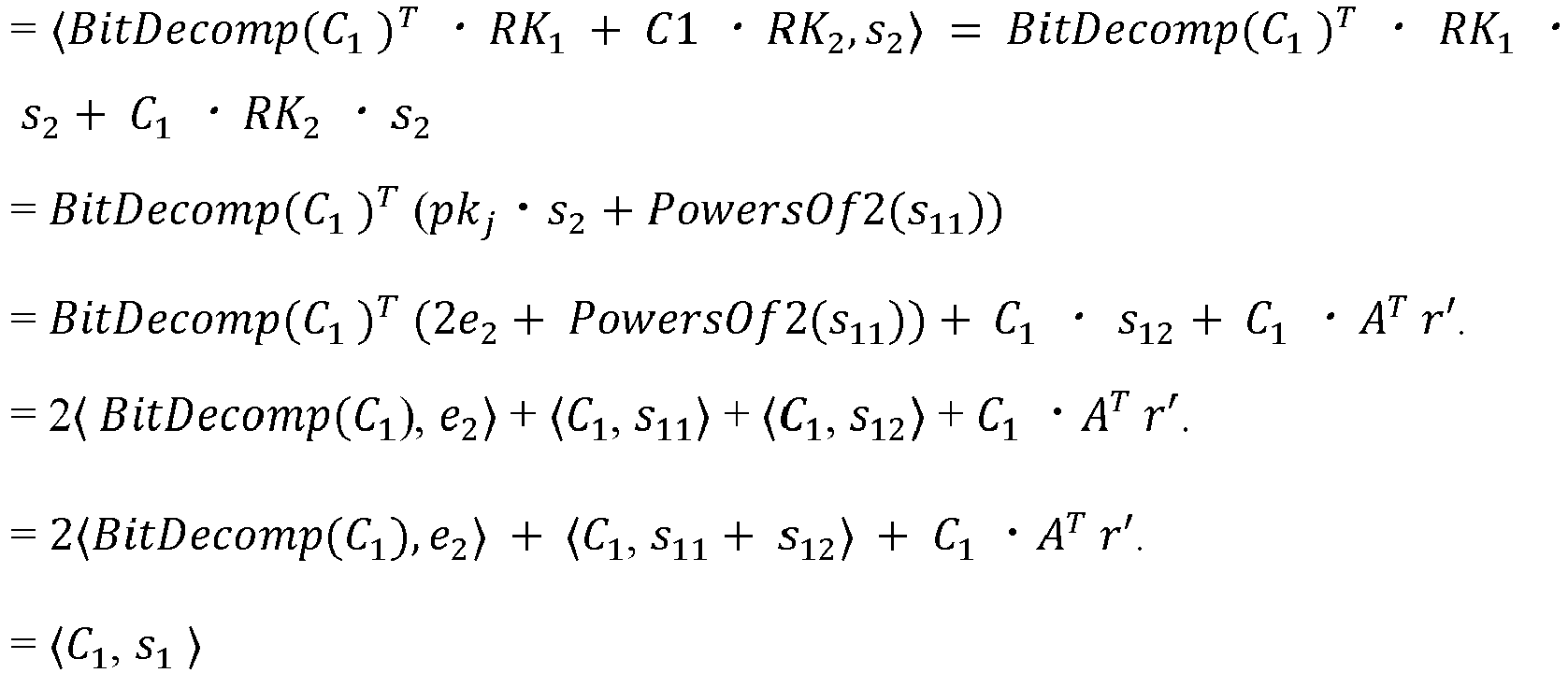
- In an embodiment, the present disclosure provides sematic security, collision resistance, enables fine grained access and optimization using Bootstrapping. Semantic security provides protection from extracting plaintext from ciphertext by an intruder. Collision resistance means intruder/attacker cannot generate a ciphertext which can be replaced with the re encrypted ciphertext fine grained access control means the re encrypted ciphertext can only be decrypted by a particular user for whom it was meant and cannot be decrypted by any other user. Optimization using bootstrapping means, if the re encryption procedure requires a certain number of multiplications, this can be optimized using bootstrapping procedure to get fresh ciphertext.
- The written description describes the subject matter herein to enable any person skilled in the art to make and use the embodiments. The scope of the subject matter embodiments is defined by the claims and may include other modifications that occur to those skilled in the art. Such other modifications are intended to be within the scope of the claims if they have similar elements that do not differ from the literal language of the claims or if they include equivalent elements with insubstantial differences from the literal language of the claims.
- The embodiments of present disclosure herein address the unresolved problem of a lattice-based homomorphic proxy re-encryption scheme. The present disclosure provides a unidirectional, single-hop HPRE scheme from the LWE assumption which is Chosen Plaintext Attack (CPA) secure. CPA is an attack model for cryptanalysis which presumes that the attacker can obtain the ciphertexts for arbitrary plaintexts. The goal of the attack is to gain information that reduces the security of the encryption scheme.
- Further, the present disclosure is based on the widely accepted BGV algorithm that supports both levelled FHE operations as well as arbitrary number of ciphertexts with unique and secure re-encryption key generation. Further, the present disclosure provides batch evaluation of ciphertexts, in order to enable re-encryption and evaluation of multiple ciphertexts (supporting both features where all ciphertexts are encrypted under a single public key, as well as ciphertexts being encrypted under distinct public keys). The batch-evaluation technique would enable batch processing.
- It is to be understood that the scope of the protection is extended to such a program and in addition to a computer-readable means having a message therein such computer-readable storage means contain program-code means for implementation of one or more steps of the method when the program runs on a server or mobile device or any suitable programmable device. The hardware device can be any kind of device which can be programmed including e.g. any kind of computer like a server or a personal computer, or the like, or any combination thereof. The device may also include means which could be e.g. hardware means like e.g. an application-specific integrated circuit (ASIC), a field-programmable gate array (FPGA), or a combination of hardware and software means, e.g. an ASIC and an FPGA, or at least one microprocessor and at least one memory with software modules located therein. Thus, the means can include both hardware means and software means. The method embodiments described herein could be implemented in hardware and software. The device may also include software means. Alternatively, the embodiments may be implemented on different hardware devices, e.g. using a plurality of CPUs, GPUs and edge computing devices.
- The embodiments herein can comprise hardware and software elements. The embodiments that are implemented in software include but are not limited to, firmware, resident software, microcode, etc. The functions performed by various modules described herein may be implemented in other modules or combinations of other modules. For the purposes of this description, a computer-usable or computer readable medium can be any apparatus that can comprise, store, communicate, propagate, or transport the program for use by or in connection with the instruction execution system, apparatus, or device. The illustrated steps are set out to explain the exemplary embodiments shown, and it should be anticipated that ongoing technological development will change the manner in which particular functions are performed. These examples are presented herein for purposes of illustration, and not limitation. Further, the boundaries of the functional building blocks have been arbitrarily defined herein for the convenience of the description. Alternative boundaries can be defined so long as the specified functions and relationships thereof are appropriately performed. Alternatives (including equivalents, extensions, variations, deviations, etc., of those described herein) will be apparent to persons skilled in the relevant art(s) based on the teachings contained herein. Such alternatives fall within the scope of the disclosed embodiments. Also, the words "comprising," "having," "containing," and "including," and other similar forms are intended to be equivalent in meaning and be open ended in that an item or items following any one of these words is not meant to be an exhaustive listing of such item or items, or meant to be limited to only the listed item or items. It must also be noted that as used herein and in the appended claims, the singular forms "a," "an," and "the" include plural references unless the context clearly dictates otherwise. Furthermore, one or more computer-readable storage media may be utilized in implementing embodiments consistent with the present disclosure. A computer-readable storage medium refers to any type of physical memory on which information or data readable by a processor may be stored. Thus, a computer-readable storage medium may store instructions for execution by one or more processors, including instructions for causing the processor(s) to perform steps or stages consistent with the embodiments described herein. The term "computer-readable medium" should be understood to include tangible items and exclude carrier waves and transient signals, i.e. non-transitory. Examples include random access memory (RAM), read-only memory (ROM), volatile memory, nonvolatile memory, hard drives, CD ROMs, DVDs, flash drives, disks, and any other known physical storage media.
- It is intended that the disclosure and examples be considered as exemplary only, with a true scope of disclosed embodiments being indicated by the following claims.
Claims (15)
- A processor implemented method (200), the method further comprising:receiving (202), by a first client machine and a second client machine via corresponding one or more hardware processors, a plurality of public parameters from a trusted third party server, wherein the plurality of public parameters comprises a security parameter, a number of encryption levels and a bit value;generating (204), via one or more hardware processors of the first client machine, a first public-private key pair of a first user based on the plurality of public parameters and a user index using a probabilistic key generation algorithm;simultaneously generating (206), via one or more hardware processors of a second client machine, a second public-private key pair of a second user based on the plurality of public parameters and the user index using the probabilistic key generation algorithm;generating (208), via the one or more hardware processors of the first client machine, a ciphertext based on a plaintext associated with the first user, the public key from the first public-private key pair and the plurality of public parameters using a probabilistic encryption algorithm;transmitting (210), via the one or more hardware processors of the first client machine, the ciphertext to a proxy server machine, wherein the ciphertext is received by the proxy server machine;performing a computation (212), via one or more hardware processors of the proxy server machine, on the ciphertext using a Fully Homomorphic Encryption (FHE) based technique;generating (214), via the one or more hardware processors of the first client machine, a re-encryption key based on the first public-private key pair of the first user, a public key of the second user and the plurality of public parameter using a probabilistic re-encryption key generation algorithm;transmitting (216), via the one or more hardware processors of the first client machine, the generated re-encryption key to the proxy server machine, wherein the re-encryption key is received by the proxy server machine;generating (218), via the one or more hardware processors of the proxy server machine, a re-encrypted ciphertext based on the re-encryption key, the ciphertext and the plurality of public parameters using a probabilistic re-encryption algorithm;transmitting (220), via the one or more hardware processors of the proxy server machine, the re-encrypted ciphertext to the second client machine, wherein the re-encrypted ciphertext is received by the second client machine; andgenerating (222), by the one or more hardware processors of the second client machine, a resultant plaintext based on the re-encrypted ciphertext, and a private key of the second public-private key pair of the second user using a probabilistic decryption algorithm.
- The method of claim 1, wherein the steps for generating the re-encryption key by the first client machine based on the private-public key pair of the first user, the public key of the second user and the plurality of public parameter using the probabilistic re-encryption key generation algorithm comprises:generating a plurality of random matrices using a random matrix generation technique, wherein the plurality of random matrices comprises a first random matrix, a second random matrix and a third random matrix;computing powers of two of the first random matrix by multiplying each element of the first random matrix with increasing powers of two;generating a first key component based on a public key from the second public-private key pair of the second user and powers of two of the first random matrix;generating a second key component by encrypting the second random matrix using the public key from the first public-private key pair of the first user and the third random matrix; andgenerating the re-encryption key by combining the first key component and the second key component.
- The processor implemented method of claim 1, wherein the steps for generating the re-encrypted ciphertext by the proxy server machine based on the re-encryption key, the ciphertext and the plurality of public parameters using the probabilistic re-encryption algorithm comprises:computing a Bit Decomposition Ciphertext (BDC) based on the ciphertext, wherein bit decomposition converts each element of a matrix into a corresponding binary value;computing a first ciphertext component by multiplying the computed BDC with the first key component associated with the re-encryption key;computing a second ciphertext component by multiplying the ciphertext with the second key component associated with the re-encryption key; andgenerating the re-encrypted ciphertext by combining the first ciphertext component and the second ciphertext component.
- The processor implemented method of claim 1, comprises performing homomorphic evaluation of two ciphertexts associated with a used based on the corresponding public key, two ciphertexts encrypted under the public key of the user and the plurality of public parameters, wherein the homomorphic evaluation comprises multiplication and addition.
- The processor implemented method of claim 1, comprises performing batch evaluation of a plurality of ciphertexts of a plurality of users based on the plurality of ciphertexts, a plurality of public keys and the plurality of public parameters using a deterministic homomorphic batch evaluation algorithm.
- The processor implemented method of claim 1, wherein the probabilistic key generation algorithm, the probabilistic encryption algorithm and the probabilistic decryption algorithm are based on the FHE techniques.
- The processor implemented method of claim 1, wherein the bit value indicates a learning scheme associated with a Homomorphic Proxy Re-Encryption (HPRE) scheme, wherein the learning scheme is one of a) Learning With Errors (LWE) and b) Ring Learning With Errors (RLWE).
- A system (100) further comprising:a first client machines (102A), a second client machine (102B), a proxy server machine (104) and a trusted third party server 108, wherein the proxy server machine (104), the first client machine (102A) and the second client machine 102B comprises at least one memory (110) storing programmed instructions;one or more Input /Output (I/O) interfaces (118); and one or more hardware processors of the proxy server machine (104), the first client machine (102A) and the second client machine (102B) are operatively coupled to a corresponding at least one memory (110), wherein the system (100) is configured to:receive, by a first client machine and a second client machine via corresponding one or more hardware processors, a plurality of public parameters from a trusted third party server, wherein the plurality of public parameters comprises a security parameter, a number of encryption levels and a bit value;generate, via the one or more hardware processors of the first client machine, a first public-private key pair of a first user based on the plurality of public parameters and a user index using a probabilistic key generation algorithm;simultaneously generate, via the one or more hardware processors of a second client machine, a second public-private key pair of a second user based on the plurality of public parameters and the user index using the probabilistic key generation algorithm;generate, via the one or more hardware processors of the first client machine, a ciphertext based on a plaintext associated with the first user, the public key from the first public-private key pair and the plurality of public parameters using a probabilistic encryption algorithm;transmit, via the one or more hardware processors of the first client machine, the ciphertext to a proxy server machine, wherein the ciphertext is received by the proxy server machine;perform a computation, via one or more hardware processors of the proxy server machine, on the ciphertext using a Fully Homomorphic Encryption (FHE) based technique;generate, via the one or more hardware processors of the first client machine, a re-encryption key based on the first public-private key pair of the first user, a public key of the second user and the plurality of public parameter using a probabilistic re-encryption key generation algorithm;transmit, via the one or more hardware processors of the first client machine, the generated re-encryption key to the proxy server machine, wherein the re-encryption key is received by the proxy server machine;generate, via the one or more hardware processors of the proxy server machine, a re-encrypted ciphertext based on the re-encryption key, the ciphertext and the plurality of public parameters using a probabilistic re-encryption algorithm;transmit, via the one or more hardware processors of the proxy server machine, the re-encrypted ciphertext to the second client machine, wherein the re-encrypted ciphertext is received by the second client machine; andgenerate, by the one or more hardware processors of the second client machine, a resultant plaintext based on the re-encrypted ciphertext, and a private key of the second public-private key pair of the second user using a probabilistic decryption algorithm.
- The system of claim 8, wherein the first client machine is configured to generate the re-encryption key based on the private-public key pair of the first user, the public key of the second user and the plurality of public parameter using the probabilistic re-encryption key generation algorithm, wherein the steps for generating the re-encryption key using the probabilistic re-encryption key generation algorithm comprises:generating a plurality of random matrices using a random matrix generation technique, wherein the plurality of random matrices comprises a first random matrix, a second random matrix and a third random matrix;computing powers of two of the first random matrix by multiplying each element of the first random matrix with increasing powers of two;generating a first key component based on a public key from the second public-private key pair of the second user and powers of two of the first random matrix;generating a second key component by encrypting the second random matrix using the public key from the first public-private key pair of the first user and the third random matrix; andgenerating the re-encryption key by combining the first key component and the second key component.
- The system of claim 8, wherein the proxy server machine is configured to generate the re-encrypted ciphertext based on the re-encryption key, the ciphertext and the plurality of public parameters using the probabilistic re-encryption algorithm, wherein the steps for generating the re-encrypted ciphertext based on the re-encryption key, the ciphertext and the plurality of public parameters using the probabilistic re-encryption algorithm comprises:computing a Bit Decomposition Ciphertext (BDC) based on the ciphertext, wherein bit decomposition converts each element of a matrix into a corresponding binary value;computing a first ciphertext component by multiplying the computed BDC with the first key component associated with the re-encryption key;computing a second ciphertext component by multiplying the ciphertext with the second key component associated with the re-encryption key; andgenerating the re-encrypted ciphertext by combining the first ciphertext component and the second ciphertext component.
- The system of claim 8, is configured to perform homomorphic evaluation of two ciphertexts associated with a used based on the corresponding public key, two ciphertexts encrypted under the public key of the user and the plurality of public parameters, wherein the homomorphic evaluation comprises multiplication and addition.
- The system of claim 8, is configured to perform batch evaluation of a plurality of ciphertexts of a plurality of users based on the plurality of ciphertexts, a plurality of public keys and the plurality of public parameters using a deterministic homomorphic batch evaluation algorithm.
- The system of claim 8, wherein the probabilistic key generation algorithm, the probabilistic encryption algorithm and the probabilistic decryption algorithm are based on the FHE techniques.
- The system of claim 8, wherein the bit value indicates a learning scheme associated with a Homomorphic Proxy Re-Encryption (HPRE) scheme, wherein the learning scheme is one of a) Learning With Errors (LWE) and b) Ring Learning With Errors (RLWE).
- One or more non-transitory machine-readable information storage mediums comprising one or more instructions to:receive by a first client machine and a second client machine via corresponding one or more hardware processors, a plurality of public parameters from a trusted third party server, wherein the plurality of public parameters comprises a security parameter, a number of encryption levels and a bit value;generate via one or more hardware processors of the first client machine, a first public-private key pair of a first user based on the plurality of public parameters and a user index using a probabilistic key generation algorithm;simultaneously generate via one or more hardware processors of a second client machine, a second public-private key pair of a second user based on the plurality of public parameters and the user index using the probabilistic key generation algorithm;generate via the one or more hardware processors of the first client machine, a ciphertext based on a plaintext associated with the first user, the public key from the first public-private key pair and the plurality of public parameters using a probabilistic encryption algorithm;transmit via the one or more hardware processors of the first client machine, the ciphertext to a proxy server machine, wherein the ciphertext is received by the proxy server machine;perform a computation , via one or more hardware processors of the proxy server machine, on the ciphertext using a Fully Homomorphic Encryption (FHE) based technique;generate via the one or more hardware processors of the first client machine, a re-encryption key based on the first public-private key pair of the first user, a public key of the second user and the plurality of public parameter using a probabilistic re-encryption key generation algorithm;transmit via the one or more hardware processors of the first client machine, the generated re-encryption key to the proxy server machine, wherein the re-encryption key is received by the proxy server machine;generate via the one or more hardware processors of the proxy server machine, a re-encrypted ciphertext based on the re-encryption key, the ciphertext and the plurality of public parameters using a probabilistic re-encryption algorithm;transmit via the one or more hardware processors of the proxy server machine, the re-encrypted ciphertext to the second client machine, wherein the re-encrypted ciphertext is received by the second client machine; andgenerate by the one or more hardware processors of the second client machine, a resultant plaintext based on the re-encrypted ciphertext, and a private key of the second public-private key pair of the second user using a probabilistic decryption algorithm.
Applications Claiming Priority (1)
| Application Number | Priority Date | Filing Date | Title |
|---|---|---|---|
| IN202221071716 | 2022-12-12 |
Publications (3)
| Publication Number | Publication Date |
|---|---|
| EP4387155A1 true EP4387155A1 (en) | 2024-06-19 |
| EP4387155B1 EP4387155B1 (en) | 2025-12-31 |
| EP4387155C0 EP4387155C0 (en) | 2025-12-31 |
Family
ID=88647285
Family Applications (1)
| Application Number | Title | Priority Date | Filing Date |
|---|---|---|---|
| EP23207228.0A Active EP4387155B1 (en) | 2022-12-12 | 2023-11-01 | METHOD AND SYSTEM FOR A DIAPER-BASED HOMOMORPHIC RE-ENCRYPTION SCHEME |
Country Status (2)
| Country | Link |
|---|---|
| US (1) | US12438858B2 (en) |
| EP (1) | EP4387155B1 (en) |
Families Citing this family (10)
| Publication number | Priority date | Publication date | Assignee | Title |
|---|---|---|---|---|
| US12401507B2 (en) * | 2021-12-29 | 2025-08-26 | International Business Machines Corporation | Future asset reclamation via blockchain |
| US12388622B2 (en) * | 2023-02-09 | 2025-08-12 | International Business Machines Corporation | Masking ciphertexts using random elements for secure decryption |
| US12619745B2 (en) * | 2023-04-27 | 2026-05-05 | Samsung Electronics Co., Ltd. | Homomorphic operation system and operating method thereof |
| US12413619B2 (en) * | 2023-06-11 | 2025-09-09 | Parry Labs Llc | Enterprise protection via identification and mitigation of bad actors at the edge |
| US12476788B2 (en) * | 2024-04-08 | 2025-11-18 | International Business Machines Corporation | Tournament-league mechanisms for comparison based computer operations |
| CN118984216B (en) * | 2024-07-31 | 2025-07-29 | 暨南大学 | Medical data secure sharing method based on-grid updatable agent re-encryption |
| CN119402185B (en) * | 2024-10-29 | 2025-08-19 | 长春吉大正元信息技术股份有限公司 | Data encryption method, device, equipment and storage medium based on hash algorithm |
| CN119766480B (en) * | 2024-11-26 | 2025-10-31 | 北京计算机技术及应用研究所 | Cloud computing service platform based on lattice agent re-encryption |
| CN120050021B (en) * | 2025-02-21 | 2025-12-12 | 西安电子科技大学 | A Parameter Evaluation Method for CKKS-type Fully Homomorphic Encryption Schemes Based on Error Analysis |
| CN120705917B (en) * | 2025-08-18 | 2025-11-18 | 同盾科技有限公司 | Target user prediction method and device, storage medium and electronic equipment |
Citations (1)
| Publication number | Priority date | Publication date | Assignee | Title |
|---|---|---|---|---|
| JP6189788B2 (en) * | 2014-05-02 | 2017-08-30 | 日本電信電話株式会社 | Key generation device, re-encryption device, and program |
Family Cites Families (8)
| Publication number | Priority date | Publication date | Assignee | Title |
|---|---|---|---|---|
| WO2012149395A1 (en) * | 2011-04-29 | 2012-11-01 | International Business Machines Corporation | Fully homomorphic encryption |
| US9252942B2 (en) * | 2012-04-17 | 2016-02-02 | Futurewei Technologies, Inc. | Method and system for secure multiparty cloud computation |
| JP2016012111A (en) * | 2014-06-30 | 2016-01-21 | 富士通株式会社 | Encryption processing method, encryption processing device, and encryption processing program |
| US10581812B2 (en) * | 2015-12-01 | 2020-03-03 | Duality Technologies, Inc. | Device, system and method for fast and secure proxy re-encryption |
| US20200313856A1 (en) * | 2019-03-29 | 2020-10-01 | 0Chain, LLC | Systems and methods of blockchain platform for intermediaries and passwordless login |
| CN111586000B (en) | 2020-04-28 | 2020-12-18 | 北京物资学院 | A full-agent homomorphic re-encryption transmission system and its operating mechanism |
| CN112152779B (en) | 2020-09-29 | 2022-05-06 | 黑龙江大学 | Lattice-based homomorphic proxy re-encryption method for resisting strong collusion attack |
| US12219043B1 (en) * | 2024-06-28 | 2025-02-04 | Semen Konstantinovich Rososhek | Method and system for homomorphic encryption |
-
2023
- 2023-11-01 EP EP23207228.0A patent/EP4387155B1/en active Active
- 2023-11-07 US US18/503,796 patent/US12438858B2/en active Active
Patent Citations (1)
| Publication number | Priority date | Publication date | Assignee | Title |
|---|---|---|---|---|
| JP6189788B2 (en) * | 2014-05-02 | 2017-08-30 | 日本電信電話株式会社 | Key generation device, re-encryption device, and program |
Non-Patent Citations (1)
| Title |
|---|
| ANJA LEHMANN ET AL: "Updatable Encryption with Post-Compromise Security", vol. 20180216:141352, 16 February 2018 (2018-02-16), pages 1 - 48, XP061024243, Retrieved from the Internet <URL:http://eprint.iacr.org/2018/118.pdf> [retrieved on 20180216] * |
Also Published As
| Publication number | Publication date |
|---|---|
| EP4387155B1 (en) | 2025-12-31 |
| US12438858B2 (en) | 2025-10-07 |
| US20240195618A1 (en) | 2024-06-13 |
| EP4387155C0 (en) | 2025-12-31 |
Similar Documents
| Publication | Publication Date | Title |
|---|---|---|
| EP4387155B1 (en) | METHOD AND SYSTEM FOR A DIAPER-BASED HOMOMORPHIC RE-ENCRYPTION SCHEME | |
| Hu et al. | Maskcrypt: Federated learning with selective homomorphic encryption | |
| US10635824B1 (en) | Methods and apparatus for private set membership using aggregation for reduced communications | |
| EP3979552A1 (en) | Method and system for privacy preserving multifactor biometric authentication | |
| US20210209247A1 (en) | Privacy-preserving machine learning in the three-server model | |
| US11569985B2 (en) | Preserving inter-party data privacy in global data relationships | |
| US12316741B1 (en) | Adaptive homomorphic encryption method based on trusted execution environment | |
| Tran et al. | A novel privacy-preserving federated learning model based on secure multi-party computation | |
| WO2019121384A1 (en) | Evaluation of events using a function | |
| Zhang et al. | SecureTrain: An approximation-free and computationally efficient framework for privacy-preserved neural network training | |
| CN111143862B (en) | Data processing method, query method, device, electronic device and system | |
| EP4500800A1 (en) | Private-set intersection of unbalanced datasets | |
| Cheng et al. | Manto: A practical and secure inference service of convolutional neural networks for IoT | |
| Pan et al. | PNAS: A privacy preserving framework for neural architecture search services | |
| Yang et al. | Privacy-preserving machine learning in cloud–edge–end collaborative environments | |
| Espiritu et al. | Synq: Public policy analytics over encrypted data | |
| Zhao et al. | ePMLF: Efficient and Privacy‐Preserving Machine Learning Framework Based on Fog Computing | |
| CN111046431B (en) | Data processing method, query method, device, electronic device and system | |
| Ruan et al. | Efficient Private Set Intersection Using Point‐Value Polynomial Representation | |
| CN118312486A (en) | Data security circulation method based on cross-domain data communication sharing platform | |
| CN111159730A (en) | Data processing method, query method, device, electronic device and system | |
| Gaddam | AI-Powered Data Masking for Privacy-Preserving Cloud Data Sharing | |
| CN111046408A (en) | Judgment result processing method, query method, device, electronic equipment and system | |
| Alex et al. | Energy efficient and secure neural network–based disease detection framework for mobile healthcare network | |
| US11907392B2 (en) | System and method utilizing function secret sharing with conditional disclosure of secrets |
Legal Events
| Date | Code | Title | Description |
|---|---|---|---|
| PUAI | Public reference made under article 153(3) epc to a published international application that has entered the european phase |
Free format text: ORIGINAL CODE: 0009012 |
|
| STAA | Information on the status of an ep patent application or granted ep patent |
Free format text: STATUS: THE APPLICATION HAS BEEN PUBLISHED |
|
| AK | Designated contracting states |
Kind code of ref document: A1 Designated state(s): AL AT BE BG CH CY CZ DE DK EE ES FI FR GB GR HR HU IE IS IT LI LT LU LV MC ME MK MT NL NO PL PT RO RS SE SI SK SM TR |
|
| STAA | Information on the status of an ep patent application or granted ep patent |
Free format text: STATUS: REQUEST FOR EXAMINATION WAS MADE |
|
| 17P | Request for examination filed |
Effective date: 20240718 |
|
| RBV | Designated contracting states (corrected) |
Designated state(s): AL AT BE BG CH CY CZ DE DK EE ES FI FR GB GR HR HU IE IS IT LI LT LU LV MC ME MK MT NL NO PL PT RO RS SE SI SK SM TR |
|
| GRAP | Despatch of communication of intention to grant a patent |
Free format text: ORIGINAL CODE: EPIDOSNIGR1 |
|
| STAA | Information on the status of an ep patent application or granted ep patent |
Free format text: STATUS: GRANT OF PATENT IS INTENDED |
|
| RIC1 | Information provided on ipc code assigned before grant |
Ipc: H04L 9/00 20220101AFI20250715BHEP Ipc: H04L 9/30 20060101ALI20250715BHEP |
|
| INTG | Intention to grant announced |
Effective date: 20250808 |
|
| GRAS | Grant fee paid |
Free format text: ORIGINAL CODE: EPIDOSNIGR3 |
|
| GRAA | (expected) grant |
Free format text: ORIGINAL CODE: 0009210 |
|
| STAA | Information on the status of an ep patent application or granted ep patent |
Free format text: STATUS: THE PATENT HAS BEEN GRANTED |
|
| AK | Designated contracting states |
Kind code of ref document: B1 Designated state(s): AL AT BE BG CH CY CZ DE DK EE ES FI FR GB GR HR HU IE IS IT LI LT LU LV MC ME MK MT NL NO PL PT RO RS SE SI SK SM TR |
|
| REG | Reference to a national code |
Ref country code: CH Ref legal event code: F10 Free format text: ST27 STATUS EVENT CODE: U-0-0-F10-F00 (AS PROVIDED BY THE NATIONAL OFFICE) Effective date: 20251231 Ref country code: GB Ref legal event code: FG4D |
|
| REG | Reference to a national code |
Ref country code: DE Ref legal event code: R096 Ref document number: 602023010372 Country of ref document: DE |
|
| REG | Reference to a national code |
Ref country code: CH Ref legal event code: R17 Free format text: ST27 STATUS EVENT CODE: U-0-0-R10-R17 (AS PROVIDED BY THE NATIONAL OFFICE) Effective date: 20260116 |
|
| REG | Reference to a national code |
Ref country code: IE Ref legal event code: FG4D |
|
| U01 | Request for unitary effect filed |
Effective date: 20251231 |
|
| U07 | Unitary effect registered |
Designated state(s): AT BE BG DE DK EE FI FR IT LT LU LV MT NL PT RO SE SI Effective date: 20260107 |
|
| PG25 | Lapsed in a contracting state [announced via postgrant information from national office to epo] |
Ref country code: NO Free format text: LAPSE BECAUSE OF FAILURE TO SUBMIT A TRANSLATION OF THE DESCRIPTION OR TO PAY THE FEE WITHIN THE PRESCRIBED TIME-LIMIT Effective date: 20260331 |
|
| PG25 | Lapsed in a contracting state [announced via postgrant information from national office to epo] |
Ref country code: HR Free format text: LAPSE BECAUSE OF FAILURE TO SUBMIT A TRANSLATION OF THE DESCRIPTION OR TO PAY THE FEE WITHIN THE PRESCRIBED TIME-LIMIT Effective date: 20251231 |
|
| PG25 | Lapsed in a contracting state [announced via postgrant information from national office to epo] |
Ref country code: RS Free format text: LAPSE BECAUSE OF FAILURE TO SUBMIT A TRANSLATION OF THE DESCRIPTION OR TO PAY THE FEE WITHIN THE PRESCRIBED TIME-LIMIT Effective date: 20260331 |