EP4386714A1 - Machine-learning based airport data forecasting - Google Patents
Machine-learning based airport data forecasting Download PDFInfo
- Publication number
- EP4386714A1 EP4386714A1 EP23213288.6A EP23213288A EP4386714A1 EP 4386714 A1 EP4386714 A1 EP 4386714A1 EP 23213288 A EP23213288 A EP 23213288A EP 4386714 A1 EP4386714 A1 EP 4386714A1
- Authority
- EP
- European Patent Office
- Prior art keywords
- airport
- data
- forecast
- parameters
- model
- Prior art date
- Legal status (The legal status is an assumption and is not a legal conclusion. Google has not performed a legal analysis and makes no representation as to the accuracy of the status listed.)
- Granted
Links
Images


Classifications
-
- G—PHYSICS
- G06—COMPUTING OR CALCULATING; COUNTING
- G06Q—INFORMATION AND COMMUNICATION TECHNOLOGY [ICT] SPECIALLY ADAPTED FOR ADMINISTRATIVE, COMMERCIAL, FINANCIAL, MANAGERIAL OR SUPERVISORY PURPOSES; SYSTEMS OR METHODS SPECIALLY ADAPTED FOR ADMINISTRATIVE, COMMERCIAL, FINANCIAL, MANAGERIAL OR SUPERVISORY PURPOSES, NOT OTHERWISE PROVIDED FOR
- G06Q10/00—Administration; Management
- G06Q10/06—Resources, workflows, human or project management; Enterprise or organisation planning; Enterprise or organisation modelling
- G06Q10/063—Operations research, analysis or management
- G06Q10/0631—Resource planning, allocation, distributing or scheduling for enterprises or organisations
-
- G—PHYSICS
- G06—COMPUTING OR CALCULATING; COUNTING
- G06N—COMPUTING ARRANGEMENTS BASED ON SPECIFIC COMPUTATIONAL MODELS
- G06N20/00—Machine learning
-
- G—PHYSICS
- G06—COMPUTING OR CALCULATING; COUNTING
- G06N—COMPUTING ARRANGEMENTS BASED ON SPECIFIC COMPUTATIONAL MODELS
- G06N3/00—Computing arrangements based on biological models
- G06N3/02—Neural networks
- G06N3/08—Learning methods
-
- G—PHYSICS
- G06—COMPUTING OR CALCULATING; COUNTING
- G06Q—INFORMATION AND COMMUNICATION TECHNOLOGY [ICT] SPECIALLY ADAPTED FOR ADMINISTRATIVE, COMMERCIAL, FINANCIAL, MANAGERIAL OR SUPERVISORY PURPOSES; SYSTEMS OR METHODS SPECIALLY ADAPTED FOR ADMINISTRATIVE, COMMERCIAL, FINANCIAL, MANAGERIAL OR SUPERVISORY PURPOSES, NOT OTHERWISE PROVIDED FOR
- G06Q10/00—Administration; Management
- G06Q10/04—Forecasting or optimisation specially adapted for administrative or management purposes, e.g. linear programming or "cutting stock problem"
-
- G—PHYSICS
- G08—SIGNALLING
- G08G—TRAFFIC CONTROL SYSTEMS
- G08G5/00—Traffic control systems for aircraft
- G08G5/20—Arrangements for acquiring, generating, sharing or displaying traffic information
- G08G5/22—Arrangements for acquiring, generating, sharing or displaying traffic information located on the ground
-
- G—PHYSICS
- G08—SIGNALLING
- G08G—TRAFFIC CONTROL SYSTEMS
- G08G5/00—Traffic control systems for aircraft
- G08G5/50—Navigation or guidance aids
- G08G5/56—Navigation or guidance aids for two or more aircraft
-
- G—PHYSICS
- G06—COMPUTING OR CALCULATING; COUNTING
- G06Q—INFORMATION AND COMMUNICATION TECHNOLOGY [ICT] SPECIALLY ADAPTED FOR ADMINISTRATIVE, COMMERCIAL, FINANCIAL, MANAGERIAL OR SUPERVISORY PURPOSES; SYSTEMS OR METHODS SPECIALLY ADAPTED FOR ADMINISTRATIVE, COMMERCIAL, FINANCIAL, MANAGERIAL OR SUPERVISORY PURPOSES, NOT OTHERWISE PROVIDED FOR
- G06Q50/00—Information and communication technology [ICT] specially adapted for implementation of business processes of specific business sectors, e.g. utilities or tourism
- G06Q50/40—Business processes related to the transportation industry
Definitions
- the present disclosure is generally related to forecasting airport data using one or more machine-learning models.
- Alternative aviation fuels e.g., non-petroleum-based fuels, such as hydrogen, electricity, and sustainable hydrocarbons
- non-petroleum-based fuels such as hydrogen, electricity, and sustainable hydrocarbons
- adding new fuel sources generally entails costly infrastructure changes and implementation of new procedures. Often, such changes are instituted locally (e.g., airport-by-airport), resulting in a patchwork of availability.
- aircraft operators may find it challenging to switch to alternative fuels, since such fuels may not be available at each airport that the operator uses. Accordingly, there is a need to facilitate information exchange to enable aircraft operators to utilize alternative fuels.
- a system includes one or more processors configured to obtain airport baseline data associated with an airport.
- the airport baseline data is descriptive of operational characteristics of the airport, infrastructure of the airport, or both.
- the one or more processors are further configured to modify one or more first parameters of the airport baseline data to generate first candidate modification data.
- the one or more processors are also configured to provide first model input data based on the first candidate modification data as input to a trained machine learning model to generate first forecast data indicating a predicted result of modification of the one or more first parameters.
- the one or more processors are further configured to compare the first forecast data to one or more target values and to generate a notification if the first forecast data fails to satisfy the one or more target values.
- a method in another particular example, includes obtaining airport baseline data associated with an airport.
- the airport baseline data is descriptive of operational characteristics of the airport, infrastructure of the airport, or both.
- the method also includes modifying one or more first parameters of the airport baseline data to generate first candidate modification data.
- the method further includes providing first model input data based on the first candidate modification data as input to a trained machine learning model to generate first forecast data indicating a predicted result of modification of the one or more first parameters.
- the method also includes comparing the first forecast data to one or more target values and generating a notification if the first forecast data fails to satisfy the one or more target values.
- a non-transitory computer-readable storage device stores instructions that are executable by one or more processors to cause the one or more processors to obtain airport baseline data associated with an airport.
- the airport baseline data is descriptive of operational characteristics of the airport, infrastructure of the airport, or both.
- the instructions are further executable to cause the one or more processors to modify one or more first parameters of the airport baseline data to generate first candidate modification data.
- the instructions are further executable to cause the one or more processors to provide first model input data based on the first candidate modification data as input to a trained machine learning model to generate first forecast data indicating a predicted result of modification of the one or more first parameters.
- the instructions are further executable to cause the one or more processors to compare the first forecast data to one or more target values and generate a notification if the first forecast data fails to satisfy the one or more target values.
- Examples disclosed herein present systems and methods for forecasting airport data using one or more machine-learning models.
- the machine-learning model(s) enable forecasting effects of various infrastructure changes, operational changes, or both.
- the effects of providing various alternative aviation fuels at an airport can be forecast and compared to target values, such as target environmental impact metrics.
- the airport database enables training, updating, and use of machine-learning models to forecast the impact of various changes at individual airports. For example, when an airport is going through a capital expenditure planning process, the airport may have specific targets to meet (e.g., environmental metrics), but it may not be clear which changes (and corresponding capital expenditures) the airport should make to meet these targets. Forecasts generated by the machine-learning model(s) enable the airport to estimate the impact of various changes and thereby to select the most beneficial projects and most efficient allocation of funds. To illustrate, by using the machine-learning model(s) iteratively, a list of changes that would enable the airport to meet the targets can be generated. Similarly, when the airport is considering a particular change, the forecasts generated by the machine-learning model(s) can help to see whether the change will cause the airport to miss one or more of its targets.
- targets e.g., environmental metrics
- Forecasts generated by the machine-learning model(s) enable the airport to estimate the impact of various changes and thereby to select the most beneficial projects and most efficient allocation
- FIG. 1 depicts a system 100 including one or more trained machine-learning models ("trained machine-learning model(s)" 154 in FIG. 1 ), which indicates that in some examples the system 100 includes a single trained machine-learning model 154 and in other examples the system 100 includes multiple trained machine-learning models 154.
- trained machine-learning model(s) 154 in FIG. 1
- such features are generally introduced as “one or more” features and are subsequently referred to in the singular or optional plural (as indicated by “(s)”) unless examples related to multiple of the features are being described.
- generating,” “calculating,” “using,” “selecting,” “accessing,” and “determining” are interchangeable unless context indicates otherwise.
- generating,” “calculating,” or “determining” a parameter (or a signal) can refer to actively generating, calculating, or determining the parameter (or the signal) or can refer to using, selecting, or accessing the parameter (or signal) that is already generated, such as by another component or device.
- “coupled” can include “communicatively coupled,” “electrically coupled,” or “physically coupled,” and can also (or alternatively) include any combinations thereof.
- Two devices can be coupled (e.g., communicatively coupled, electrically coupled, or physically coupled) directly or indirectly via one or more other devices, components, wires, buses, networks (e.g., a wired network, a wireless network, or a combination thereof), etc.
- Two devices (or components) that are electrically coupled can be included in the same device or in different devices and can be connected via electronics, one or more connectors, or inductive coupling, as illustrative, non-limiting examples.
- two devices (or components) that are communicatively coupled, such as in electrical communication can send and receive electrical signals (digital signals or analog signals) directly or indirectly, such as via one or more wires, buses, networks, etc.
- directly coupled is used to describe two devices that are coupled (e.g., communicatively coupled, electrically coupled, or physically coupled) without intervening components.
- machine learning should be understood to have any of its usual and customary meanings within the fields of computer science and data science, such meanings including, for example, processes or techniques by which one or more computers can learn to perform some operation or function without being explicitly programmed to do so.
- machine learning can be used to enable one or more computers to analyze data to identify patterns in data and generate a result based on the analysis.
- the results that are generated include a data model (also referred to as a "machine-learning model” or simply a "model”).
- a model is generated using a first data set to facilitate analysis of a second data set. For example, a set of historical data can be used to generate a model that can be used to analyze future data.
- the model can be used to evaluate a set of data that is distinct from the data used to generate the model, the model can be viewed as a type of software (e.g., instructions, parameters, or both) that is automatically generated by the computer(s) during the machine learning process.
- the model can be portable (e.g., can be generated at a first computer, and subsequently moved to a second computer for further training, for use, or both).
- machine-learning models include, without limitation, perceptrons, neural networks, support vector machines, regression models, decision trees, Bayesian models, Boltzmann machines, adaptive neuro-fuzzy inference systems, as well as combinations, ensembles and variants of these and other types of models.
- Variants of neural networks include, for example and without limitation, prototypical networks, autoencoders, transformers, self-attention networks, convolutional neural networks, deep neural networks, deep belief networks, etc.
- Variants of decision trees include, for example and without limitation, random forests, boosted decision trees, etc.
- machine-learning models are generated by computer(s) based on input data
- machine-learning models can be discussed in terms of at least two distinct time windows - a creation/training phase and a runtime phase.
- a model is created, trained, adapted, validated, or otherwise configured by the computer based on the input data (which in the creation/training phase, is generally referred to as "training data").
- the trained model corresponds to software that has been generated and/or refined during the creation/training phase to perform particular operations, such as classification, prediction, encoding, or other data analysis or data synthesis operations.
- the runtime phase or "inference” phase
- the model is used to analyze input data to generate model output.
- the content of the model output depends on the type of model.
- a model can be trained to perform classification tasks or regression tasks, as non-limiting examples.
- a previously generated model is trained (or re-trained) using a machine-learning technique.
- training refers to adapting the model or parameters of the model to a particular data set.
- training includes “re-training” or refining a model for a specific data set.
- training may include so-called “transfer learning.”
- transfer learning a base model may be trained using a generic or typical data set, and the base model may be subsequently refined (e.g., re-trained or further trained) using a more specific data set.
- Training a model based on a training data set involves changing parameters of the model with a goal of causing the output of the model to have particular characteristics based on data input to the model.
- model training may be referred to herein as optimization or optimization training.
- optimization refers to improving a metric, and does not mean finding an ideal (e.g., global maximum or global minimum) value of the metric.
- optimization trainers include, without limitation, backpropagation trainers, derivative free optimizers (DFOs), and extreme learning machines (ELMs).
- DFOs derivative free optimizers
- ELMs extreme learning machines
- FIG. 1 depicts an example of a system 100 that is configured to forecast airport data using one or more machine-learning models according to particular examples disclosed herein.
- the system 100 includes an airport database 102, one or more trained machine-learning models 154, and various optional components to facilitate use of the trained machine-learning model(s) 154, such as a pre-processor 150, a comparator 160, and a notification engine 166.
- the airport database 102 includes information about a plurality of airports.
- the airport database 102 may include a global database that includes records for many airports around the world.
- the airport database 102 may be generated and maintained by an airport data service provider, by one or more aircraft operators, by one or more industry consortiums, by one or more government or regulatory agencies, or by another interested party.
- the airport database 102 is a distributed database, in which case, different records of the airport database 102 may be stored at different locations, such as at local or regional computing devices.
- an exemplary data record of the airport database 102 is illustrated.
- the data record is associated with a particular airport indicated by an airport identifier 106.
- the data record in the example illustrated in FIG. 1 includes fixed airport data 130, infrastructure data 114, and data descriptive of operational characteristics 108 of the airport.
- the data record for an airport includes more, fewer, or different information than illustrated in FIG. 1 .
- the information in a data record is grouped in a different manner than illustrated in FIG. 1 .
- the fixed airport data 130 includes information descriptive of examples of the airport that are not readily subject to change by the operators and users of the airport.
- the fixed airport data 130 includes information descriptive of geophysical characteristics 132 of the airport, such as a location 134 of the airport (e.g., coordinates or other descriptors), an altitude 136 of the airport, geography 138 of the airport, surroundings 140 of the airport (e.g., geography of surroundings of the airport, whether an area around the airport is urban or rural, etc.), other information descriptive of the geophysical characteristics of the airport, or any combination thereof.
- the fixed airport data 130 also includes regulations 142 and/or procedures 144 applicable to the airport, and prevailing weather characteristics 146 of the airport.
- the operational characteristics 108 include configuration data 110, traffic condition data 112, and values of one or more environmental impact metrics 120.
- the configuration data 110 includes, for example, data descriptive of runway use, such as typical or available runway direction(s), length(s), etc. In some examples, the configuration data 110 may also include information descriptive of typical approach patterns, or other information related to operation of the airport.
- the traffic condition data 112 includes information descriptive of the typical number and/or type of aircraft that use the airport during some specified period (e.g., daily), information descriptive of the typical taxi times, delays, and/or other information indicative of how busy the airport is and why.
- the environmental impact metric(s) 120 include any metric of interest to the airport or other parties (e.g., advocacy groups, government entities, trade associations, aircraft operators, consumers, etc.). As one example, the environmental impact metric(s) 120 may quantify or estimate emissions of one or more chemicals of interest, such as green house gases, petrochemical byproducts, or other regulated or unregulated chemicals. To illustrate, the environmental impact metric(s) 120 may quantify or estimate carbon dioxide emissions, carbon dioxide equivalent emissions, or both, due to activities associated with the airport.
- the environmental impact metric(s) 120 may quantify or estimate emissions of one or more chemicals of interest, such as green house gases, petrochemical byproducts, or other regulated or unregulated chemicals.
- the environmental impact metric(s) 120 may quantify or estimate carbon dioxide emissions, carbon dioxide equivalent emissions, or both, due to activities associated with the airport.
- the infrastructure data 114 includes fuel source data 116.
- the fuel source data 116 indicates, for example, types of fuels available at the airport and capacities associated with each fuel type.
- the fuel source data 116 may indicate details such as fuel blends (e.g., blends of petroleum-based fuels, blends of non-petroleum-based fuels, and/or blends of petroleum-based and non-petroleum-based fuels).
- the fuel source data 116 may also include information related to refueling rates, such as the number and type of available refueling stations.
- the fuel source data 116 may indicate the specific number, type, and locations of available recharging connectors and possibly other relevant electrical information, such as voltages available.
- the fuel source data 116 may indicate which available fuels are from sustainable sources.
- certain fuel types, such as electricity can be supplied from sustainable or non-sustainable sources, and the fuel source data 116 may indicate whether such fuels are from sustainable sources.
- hydrocarbon-based fuels can be derived from non-sustainable sources, such as petroleum, or from sustainable sources, such as non-petroleum sources (e.g., switchgrass, biodiesel, etc.).
- the pre-processor 150 is configured to generate model input data 152 based on data from the airport database 102 and based on candidate modification data 148.
- the pre-processor 150 obtains the candidate modification data 148 from an external source.
- a user evaluating a particular change at an airport may input, to the system 100, an airport identifier of the airport to cause the pre-processor 150 to obtain airport baseline data 104 associated with the airport from the airport database 102.
- the airport baseline data 104 is descriptive of operational characteristics of the airport, infrastructure of the airport, or both.
- the airport baseline data 104 may include information from any combination of the fixed airport data 130, the operational characteristics 108, and the infrastructure data 114 associated with the airport.
- the user can modify one or more parameters of the airport baseline data 104 to generate the candidate modification data 148.
- the candidate modification data 148 does not indicate changes to the fixed airport data 130; however, in principle, there is no reason that the system 100 could not be used to evaluate such changes.
- a user may use the system 100 to model the environmental impact (e.g., change to the value(s) of the environmental impact metric(s) 120) due to potential future climate change effects on the weather characteristics 146 of the airport.
- the candidate modification data 148 includes more than one candidate change to a particular parameter. For example, a user may indicate that a set (or a range) of parameter values are to be evaluated. To illustrate, the candidate modification data 148 may indicate that availability of hydrogen fuel at two or more different refueling flowrates is to be evaluated. In some such examples, the candidate modification data 148 includes two or more candidate changes to two or more different parameters. For example, a user may indicate that a set (or a range) of parameter values are to be evaluated for each of two or more different parameters. In such circumstances, the system 100 may model and evaluate the various changes sequentially or in parallel. To illustrate, the pre-processor 150 can generate candidate modification data 148 representing each change.
- the pre-processor 150 can provide the model input data 152 based on each set of candidate modification data 148 to the trained machine-learning model(s) 154 sequentially (e.g., one at a time to the same trained machine-learning model(s) 154).
- the pre-processor 150 can instantiate multiple copies of the trained machine-learning model(s) 154 and provide each set of the model input data 152 to a respective copy of the multiple copies of the trained machine-learning model(s) 154 to evaluate the candidate modification data 148 in parallel.
- the system 100 may model and evaluate the various changes specified in the candidate modification data 148 independently, collectively, or both.
- the trained machine-learning model(s) 154 are configured and trained to generate model output data 156 based on the model input data 152.
- the model output data 156 includes or corresponds to forecast data 158.
- the forecast data 158 indicates a predicted result of modification of the one or more parameters specified in the candidate modification data 148.
- the forecast data 158 may indicate predicted value(s) of one of the environmental impact metric(s) 120 as a result of the candidate modification data 148.
- the trained machine-learning model(s) 154 include one or more airport-specific models.
- a base model may be trained using training data derived from the airport database 102 and including information for a large number of different airports.
- the training data for the base model may include a large set of different circumstances, such as a variety of weather characteristics 146, operational characteristics 108, and geophysical characteristics 132.
- the base model can be refined (e.g. using transfer learning techniques) to be specific to a particular airport, such as fixing one or more values based on the fixed airport data 130 of the airport.
- the base model can be used to model a variety of airports, in which case, fixed airport data 130 for a particular airport to be modeled is included in the model input data 152.
- the model output data 156 (e.g., the forecast data 158) is provided to the comparator 160.
- the comparator 160 is configured to compare one or more elements (e.g. one or more values) of the model output data 156 to one or more target values 162.
- the target value(s) 162 may indicate or include target values of the environmental impact metric(s) 120.
- the environmental impact metric(s) 120 may include an estimate of greenhouse gas emissions measured as tons of carbon dioxide equivalent emissions, and the target value(s) 162 indicate a target or desired number of tons of carbon dioxide equivalent emissions.
- comparison result(s) 164 generated by the comparator 160 are provided to the notification engine 166.
- the notification engine 166 may include a graphical user interface (GUI) engine or instructions or circuitry configured to provide output of notification(s) 170 or other information to one or more users.
- the notifications 170 indicate whether the forecast data 158 satisfy the target value(s) 162. In this context, whether a particular value of the forecast data 158 satisfies a corresponding target value of the target value(s) 162 depends on a satisfaction criterion associated with the target value.
- a target value associated with greenhouse gas emissions may be satisfied when the forecast data 158 is less than (or less than or equal to) the target value; however, a target value associated with sustainable fuel utilization may be satisfied when the forecast data 158 is greater than (or greater than or equal to) the target value.
- the notification(s) 170 output by the notification engine 166 indicate whether each proposed change of the candidate modification data 148 results in forecast data 158 that satisfies the target value(s) 162.
- the notification(s) 170 include a list of viable modifications 172, where each viable modification corresponds to a particular proposed change of the candidate modification data 148 that results in forecast data 158 that satisfies the target value(s) 162.
- the pre-processor 150 may automatically generate the candidate modification data 148 based on specified limitations.
- user input or a configuration file may indicate that several different alternative aviation fuel sources are to be evaluated to determine which, if any, to make available at the airport.
- each of the alternative aviation fuel sources may be made available at different locations (e.g., gates or refueling stations) at the airport, at different numbers of locations, and with different capacities.
- a large number of different individual changes and combinations of changes that are to be evaluated as candidate modifications can be specified efficiently by indicating which alternative aviation fuel sources are to be considered and any limitations on such considerations (e.g., a maximum capacity), and the pre-processor 150 can automatically generate specific sets of candidate modification data 148 to evaluate based on results of model output data 156 associated with prior evaluations (e.g., prior model output data 156) in order to determine, for example, one or more lists of viable modifications 172.
- the pre-processor 150, the trained machine-learning model 154, and the comparator 160 operate iteratively to evaluate a large number of possible changes to determine the list(s) of viable modifications 172.
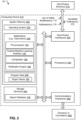
- FIG. 2 is a block diagram of a particular example of the system of FIG. 1 according to particular examples disclosed herein.
- FIG. 2 illustrates a block diagram of a computing environment 200 including a computing device 210 configured to support examples of computer-implemented methods and computer-executable program instructions (or code) according to the present disclosure.
- the computing device 210 or portions thereof, is configured to execute instructions to initiate, perform, or control one or more operations described with reference to the airport database 102, the pre-processor 150, the trained machine-learning model 154, the comparator 160, or the notification engine 166 of FIG. 1 .
- the computing device 210 includes one or more processors 220.
- the processor(s) 220 are configured to communicate with system memory 230, one or more storage devices 240, one or more input/output interfaces 250, one or more communications interfaces 260, or any combination thereof.
- the system memory 230 includes volatile memory devices (e.g., random access memory (RAM) devices), non-volatile memory devices (e.g., read-only memory (ROM) devices, programmable read-only memory, and flash memory), or both.
- the system memory 230 stores an operating system 232, which may include a basic input/output system for booting the computing device 210 as well as a full operating system to enable the computing device 210 to interact with users, other programs, and other devices.
- the system memory 230 stores system (program) data 236, such as the target values 162, the airport database 102 (or a portion thereof), or a combination thereof.
- the system memory 230 includes one or more applications 234 (e.g., sets of instructions) executable by the processor(s) 220.
- the one or more applications 234 include instructions executable by the processor(s) 220 to initiate, control, or perform one or more operations described with reference to FIG. 1 or FIGS. 3 and 4 .
- the one or more applications 234 include instructions executable by the processor(s) 220 to initiate, control, or perform one or more operations described with reference to the pre-processor 150, the trained machine-learning model(s) 154, the comparator 160, the notification engine 166, or a combination thereof.
- the system memory 230 includes a non-transitory, computer readable medium storing the instructions that, when executed by the processor(s) 220, cause the processor(s) 220 to initiate, perform, or control operations to forecast airport data using one or more machine-learning models.
- the operations include obtaining airport baseline data associated with an airport, where the airport baseline data is descriptive of operational characteristics of the airport, infrastructure of the airport, or both.
- the operations also include modifying one or more first parameters of the airport baseline data to generate first candidate modification data.
- the operations further include providing first model input data based on the first candidate modification data as input to a trained machine learning model to generate first forecast data indicating a predicted result of modification of the one or more first parameters.
- the operations also include comparing the first forecast data to one or more target values and generating a notification if the first forecast data fails to satisfy the one or more target values.
- the one or more storage devices 240 include non-volatile storage devices, such as magnetic disks, optical disks, or flash memory devices. In some particular examples, the storage devices 240 include both removable and non-removable memory devices. The storage devices 240 are configured to store an operating system, images of operating systems, applications (e.g., one or more of the applications 234), and program data (e.g., the program data 236). In some particular examples, the system memory 230, the storage devices 240, or both, include tangible computer-readable media (e.g., non-transitory computer-readable media). In some particular examples, one or more of the storage devices 240 are external to the computing device 210.
- the one or more input/output interfaces 250 enable the computing device 210 to communicate with one or more input/output devices 270 to facilitate user interaction.
- the input/output interface(s) 250 include a display interface, an input interface, or both.
- the input/output interface(s) 250 are adapted to receive input from a user, to receive input from another computing device, or a combination thereof.
- the input/output interface(s) 250 can receive candidate indicators 272 from the input/output device(s) 270, where the candidate indicators 272 include parameters, configuration files, or other data that specifies the candidate modification data 148 of FIG. 1 or particular data that the pre-processor 150 uses to determine the candidate modification data 148.
- the input/output interface(s) 250 can send to the input/output device(s) 270 the notification 170, the list of viable modifications 172, or both, of FIG. 1 .
- the input/output interface(s) 250 conform to one or more standard interface protocols, including serial interfaces (e.g., universal serial bus (USB) interfaces or Institute of Electrical and Electronics Engineers (IEEE) interface standards), parallel interfaces, display adapters, audio adapters, or custom interfaces ("IEEE” is a registered trademark of The Institute of Electrical and Electronics Engineers, Inc. of Piscataway, New Jersey).
- the input/output device(s) 270 include one or more user interface devices and displays, including some combination of buttons, keyboards, pointing devices, displays, speakers, microphones, touch screens, and other devices.
- the processor(s) 220 are configured to communicate with devices or controllers 280 via the one or more communications interfaces 260.
- the one or more communications interfaces 260 can include a network interface.
- the devices or controllers 280 can include, for example, one or more distributed servers storing portions of the airport database 102, one or more other devices, or any combination thereof.
- FIG. 2 illustrates a single computing device 210
- the computing environment 200 may include more than one computing device 210.
- the computing environment 200 can include two or more computing devices 210, which are configured (e.g., programmed and/or interconnected) to operate in parallel or in series to perform various operations described with reference to the system 100 of FIG. 1 .
- FIG. 3 is a flow chart of an example of a method 300 of forecasting airport data using one or more machine-learning models according to particular examples disclosed herein.
- the system 100 of FIG. 1 , the computing environment 200 of FIG. 2 , or both, are configured to initiate, perform, or control one or more of the operations of the method 300 of FIG. 3 .
- the method 300 includes, at block 302, obtaining airport baseline data associated with an airport, where the airport baseline data is descriptive of operational characteristics of the airport, infrastructure of the airport, or both.
- the airport baseline data 104 may be obtained from the airport database 102 of FIG. 1 , such as by searching the airport database 102 using an airport identifier 106.
- the operational characteristics of the airport described by the airport baseline data include an estimated or measured value of an environmental impact metric associated with operations at the airport.
- the environmental impact metric may include estimated or measured emissions of one or more chemicals of interest.
- the environmental impact metric may include an estimated or measured value of carbon dioxide emissions, carbon dioxide equivalent emissions, or both.
- the airport baseline data also specifies one or more target values, of the environmental impact metric.
- the operational characteristics of the airport may also, or alternatively, include operational configuration data, traffic condition data, or both.
- the operational characteristics 108 of the airport database 102 of FIG. 1 include the configuration data 110 and the traffic condition data 112 (in addition to the environmental impact metric(s) 120).
- the configuration data 110 may include, for example, characteristic (e.g., representative) airport configuration, such as information describing usually active runways and directions.
- the traffic condition data 112 may include, for example, characteristic (e.g., representative) airport traffic conditions, such as rate of inbound/outbound flights, type of flights, etc.
- the method 300 includes, at block 304, modifying one or more first parameters of the airport baseline data to generate first candidate modification data.
- the candidate modification data 148 of FIG. 1 may specify changes to one or more parameters of the airport baseline data 104.
- the one or more first parameters of the airport baseline data are modified to represent modifying fuel source availability at the airport.
- modifying fuel source availability at the airport may include making one or more sustainable fuels available at the airport, changing a sustainable fuel capacity at the airport, making one or more non-petroleum fuels available at the airport, changing a non-petroleum fuel capacity at the airport, or a combination thereof.
- the one or more first parameters of the airport baseline data are modified to represent other changes to the airport baseline data, such as locations that are capable of providing alternative aviation fuels, blends of alternative aviation fuels, etc.
- the method 300 includes, at block 306, providing first model input data based on the first candidate modification data as input to a trained machine learning model to generate first forecast data indicating a predicted result of modification of the one or more first parameters.
- the pre-processor 150 provides the model input data 152 to the trained machine-learning model(s) 154.
- the model input data 152 is based on the airport baseline data 104 derived from the airport database 102 and based on the candidate modification data 148.
- the model input data 152 may include one or more elements of the fixed airport data 130, such as data descriptive of geophysical characteristics 132 of the airport, regulations 142 governing the airport, procedures 144 associated with the airport, weather characteristics 146 of the airport, or a combination thereof.
- the method 300 includes, at block 308, comparing the first forecast data to one or more target values.
- the comparator 160 of FIG. 1 is configured to compare the forecast data 158 generated by the trained machine-learning model(s) 154 to the target value(s) 162 to generate the comparison result(s) 164.
- the method 300 includes, at block 310, generating a notification if the first forecast data fails to satisfy the one or more target values.
- the notification engine 166 of FIG. 1 is configured to generate the notification(s) 170 based on the comparison result(s) 164.
- the notification(s) 170 indicate whether the forecast data 158 satisfy the target value(s) 162.
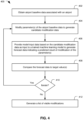
- FIG. 4 is a flow chart of another example of a method 400 of forecasting airport data using one or more machine-learning models according to particular examples disclosed herein.
- the system 100 of FIG. 1 , the computing environment 200 of FIG. 2 , or both are configured to initiate, perform, or control one or more of the operations of the method 400 of FIG. 4 .
- the method 400 includes, at block 402, obtaining airport baseline data associated with an airport.
- the airport baseline data is descriptive of operational characteristics of the airport, infrastructure of the airport, or both.
- the airport baseline data 104 may be obtained from the airport database 102 of FIG. 1 , such as by searching the airport database 102 using an airport identifier 106.
- the method 400 includes, at block 404, modifying one or more parameters of the airport baseline data to generate candidate modification data.
- the candidate modification data 148 of FIG. 1 may specify changes to one or more parameters of the airport baseline data 104.
- the method 400 includes, at block 406, providing model input data based on the candidate modification data as input to a trained machine learning model to generate forecast data indicating a predicted result of modification of the one or more parameters.
- the pre-processor 150 provides the model input data 152 to the trained machine-learning model(s) 154.
- the model input data 152 is based on airport baseline data 104 derived from the airport database 102 and based on the candidate modification data 148.
- the trained machine-learning model(s) 154 are configured (and trained) to generate the model output data 156 based on the model input data.
- the model output data 156 includes or corresponds to the forecast data 158.
- the method 400 includes, at block 408, comparing the forecast data to one or more target values.
- the comparator 160 of FIG. 1 is configured to compare the forecast data 158 generated by the trained machine-learning model(s) 154 to the target value(s) 162 to generate the comparison result(s) 164.
- the method 400 includes, at block 410, determining whether to perform one or more additional iterations.
- the pre-processor 150 of FIG. 1 may be configured to generate multiple sets of candidate modifications, such as first candidate modification data indicating changes to one or more first parameters of the airport baseline data, and second candidate modification data indicating changes to one or more second parameters of the airport baseline data.
- the method 400 may include performing two or more iterations.
- the method 400 may include modifying the one or more first parameters of the airport baseline data to generate the first candidate modification data, providing first model input data based on the first candidate modification data as input to the trained machine learning model to generate first forecast data indicating a predicted result of modification of the one or more first parameters, and comparing the first forecast data to one or more target values.
- the method 400 may subsequently include performing another iteration that includes modifying one or more second parameters of the airport baseline data to generate second candidate modification data (where the second candidate modification data is different from the first candidate modification data), providing second model input data based on the second candidate modification data as input to the trained machine learning model to generate second forecast data indicating a predicted result of modification of the one or more second parameters, and comparing the second forecast data to the one or more target values.
- the method 400 may also include performing one or more additional iterations.
- the method 400 includes, at block 412, generating a list of viable modifications.
- the notification engine 166 of FIG. 1 is configured to generate the list of viable modifications 172 based on the comparison result(s) 164.
- Each viable modification of the list of viable modifications 172 corresponds to candidate modification data 148 associated with forecast data 158 that satisfies the one or more target values 162.
- a non-transitory, computer readable medium stores instructions that, when executed by one or more processors, cause the one or more processors to initiate, perform, or control operations to perform part or all of the functionality described above.
- the instructions may be executable to implement one or more of the operations or methods of FIGS. 1-4 .
- part or all of one or more of the operations or methods of FIGS. 1-4 may be implemented by one or more processors (e.g., one or more central processing units (CPUs), one or more graphics processing units (GPUs), one or more digital signal processors (DSPs)) executing instructions, by dedicated hardware circuitry, or any combination thereof.
- processors e.g., one or more central processing units (CPUs), one or more graphics processing units (GPUs), one or more digital signal processors (DSPs)
- a method includes obtaining airport baseline data associated with an airport, wherein the airport baseline data is descriptive of operational characteristics of the airport, infrastructure of the airport, or both; modifying one or more first parameters of the airport baseline data to generate first candidate modification data; providing first model input data based on the first candidate modification data as input to a trained machine learning model to generate first forecast data indicating a predicted result of modification of the one or more first parameters; comparing the first forecast data to one or more target values; and generating a notification if the first forecast data fails to satisfy the one or more target values.
- Example 2 includes the method of Example 1, wherein the first model input data also includes fixed airport data, wherein the fixed airport data is descriptive of geophysical characteristics of the airport, regulations governing the airport, procedures associated with the airport, weather characteristics of the airport, or a combination thereof.
- Example 3 includes the method of Example 2, wherein the geophysical characteristics include a location of the airport, an altitude of the airport, geography of the airport, geography of an area surrounding the airport, or a combination thereof.
- Example 4 includes the method of Example 2 or Example 3, wherein the fixed airport data, the airport baseline data, or both, are obtained from an airport database based on an airport identifier.
- Example 5 includes the method of any of Examples 1-4, wherein the operational characteristics of the airport include one or more of operational configuration data, traffic condition data, or both.
- Example 6 includes the method of any of Examples 1-5, further including, iteratively: modifying one or more second parameters of the airport baseline data to generate second candidate modification data, wherein the second candidate modification data is different from the first candidate modification data; providing second model input data based on the second candidate modification data as input to the trained machine learning model to generate second forecast data indicating a predicted result of modification of the one or more second parameters; and comparing the second forecast data to one or more target values.
- Example 7 includes the method of Example 6, further including, after a plurality of iterations, generating a list of viable modifications, wherein each viable modification of the list of viable modifications corresponds to candidate modification data associated with forecast data that satisfies the one or more target values.
- Example 8 includes the method of any of Examples 1-7, wherein the operational characteristics of the airport described by the airport baseline data include an estimated or measured value of an environmental impact metric associated with operations at the airport, and wherein the first forecast data include a predicted value of the environmental impact metric.
- Example 9 includes the method of Example 8, wherein the environmental impact metric includes emissions of one or more chemicals of interest.
- Example 10 includes the method of Example 8 or Example 9, wherein the environmental impact metric includes carbon dioxide emissions, carbon dioxide equivalent emissions, or both.
- Example 11 includes the method of any of Examples 8-10, wherein the one or more target values include a target value of the environmental impact metric.
- Example 12 includes the method of any of Examples 1-11, wherein the one or more first parameters of the airport baseline data are modified to represent modifying fuel source availability at the airport.
- Example 13 includes the method of Example 12, wherein modifying fuel source availability at the airport includes making one or more sustainable fuels available at the airport, changing a sustainable fuel capacity at the airport, making one or more non-petroleum fuels available at the airport, changing a non-petroleum fuel capacity at the airport, or a combination thereof.
- a device includes one or more processors configured to: obtain airport baseline data associated with an airport, wherein the airport baseline data is descriptive of operational characteristics of the airport, infrastructure of the airport, or both; modify one or more first parameters of the airport baseline data to generate first candidate modification data; provide first model input data based on the first candidate modification data as input to a trained machine learning model to generate first forecast data indicating a predicted result of modification of the one or more first parameters; compare the first forecast data to one or more target values; and generate a notification if the first forecast data fails to satisfy the one or more target values.
- Example 15 includes the device of Example 14, wherein the first model input data also includes fixed airport data, wherein the fixed airport data is descriptive of geophysical characteristics of the airport, regulations governing the airport, procedures associated with the airport, weather characteristics of the airport, or a combination thereof.
- Example 16 includes the device of Example 15, wherein the geophysical characteristics include a location of the airport, an altitude of the airport, geography of the airport, geography of an area surrounding the airport, or a combination thereof.
- Example 17 includes the device of Example 15 or Example 16, wherein the fixed airport data, the airport baseline data, or both, are obtained from an airport database based on an airport identifier.
- Example 18 includes the device of any of Examples 14-17, wherein the operational characteristics of the airport include one or more of characteristic airport operational configuration, characteristic airport traffic conditions, or both.
- Example 19 includes the device of any of Examples 14-18, wherein the one or more processors are further configured to iteratively: modify one or more second parameters of the airport baseline data to generate second candidate modification data, wherein the second candidate modification data is different from the first candidate modification data; provide second model input data based on the second candidate modification data as input to the trained machine learning model to generate second forecast data indicating a predicted result of modification of the one or more second parameters; and compare the second forecast data to one or more target values.
- Example 20 includes the device of Example 19, wherein the one or more processors are further configured to, after a plurality of iterations, generate a list of viable modifications, wherein each viable modification of the list of viable modifications corresponds to candidate modification data associated with forecast data that satisfies the one or more target values.
- Example 21 includes the device of any of Examples 14-20, wherein the operational characteristics of the airport described by the airport baseline data include an estimated or measured value of an environmental impact metric associated with operations at the airport, and wherein the first forecast data include a predicted value of the environmental impact metric.
- Example 22 includes the device of Example 21, wherein the environmental impact metric includes emissions of one or more chemicals of interest.
- Example 23 includes the device of Example 21 or Example 22, wherein the environmental impact metric includes carbon dioxide emissions, carbon dioxide equivalent emissions, or both.
- Example 24 includes the device of any of Examples 21-23, wherein the one or more target values include a target value of the environmental impact metric.
- Example 25 includes the device of any of Examples 14-24, wherein the one or more first parameters of the airport baseline data are modified to represent modifying fuel source availability at the airport.
- Example 26 includes the device of Example 25, wherein modifying fuel source availability at the airport includes making one or more sustainable fuels available at the airport, changing a sustainable fuel capacity at the airport, making one or more non-petroleum fuels available at the airport, changing a non-petroleum fuel capacity at the airport, or a combination thereof.
- a non-transitory computer-readable storage device stores instructions that are executable by one or more processors to cause the one or more processors to: obtain airport baseline data associated with an airport, wherein the airport baseline data is descriptive of operational characteristics of the airport, infrastructure of the airport, or both; modify one or more first parameters of the airport baseline data to generate first candidate modification data; provide first model input data based on the first candidate modification data as input to a trained machine learning model to generate first forecast data indicating a predicted result of modification of the one or more first parameters; compare the first forecast data to one or more target values; and generate a notification if the first forecast data fails to satisfy the one or more target values.
- Example 28 includes the non-transitory computer-readable storage device of Example 27, wherein the first model input data also includes fixed airport data, wherein the fixed airport data is descriptive of geophysical characteristics of the airport, regulations governing the airport, procedures associated with the airport, weather characteristics of the airport, or a combination thereof.
- Example 29 includes the non-transitory computer-readable storage device of Example 28, wherein the geophysical characteristics include a location of the airport, an altitude of the airport, geography of the airport, geography of an area surrounding the airport, or a combination thereof.
- Example 30 includes the non-transitory computer-readable storage device of Example 28 or Example 29, wherein the fixed airport data, the airport baseline data, or both, are obtained from an airport database based on an airport identifier.
- Example 31 includes the non-transitory computer-readable storage device of any of Examples 27-30, wherein the operational characteristics of the airport include one or more of characteristic airport operational configuration, characteristic airport traffic conditions, or both.
- Example 32 includes the non-transitory computer-readable storage device of any of Examples 27-31, wherein the instructions are further executable to cause the one or more processors to iteratively: modify one or more second parameters of the airport baseline data to generate second candidate modification data, wherein the second candidate modification data is different from the first candidate modification data; provide second model input data based on the second candidate modification data as input to the trained machine learning model to generate second forecast data indicating a predicted result of modification of the one or more second parameters; and compare the second forecast data to one or more target values.
- Example 33 includes the non-transitory computer-readable storage device of Example 32, wherein the instructions are further executable to cause the one or more processors to, after a plurality of iterations, generate a list of viable modifications, wherein each viable modification of the list of viable modifications corresponds to candidate modification data associated with forecast data that satisfies the one or more target values.
- Example 34 includes the non-transitory computer-readable storage device of any of Examples 27-33, wherein the operational characteristics of the airport described by the airport baseline data include an estimated or measured value of an environmental impact metric associated with operations at the airport, and wherein the first forecast data include a predicted value of the environmental impact metric.
- Example 35 includes the non-transitory computer-readable storage device of Example 34, wherein the environmental impact metric includes emissions of one or more chemicals of interest.
- Example 36 includes the non-transitory computer-readable storage device of Example 34 or Example 35, wherein the environmental impact metric includes carbon dioxide emissions, carbon dioxide equivalent emissions, or both.
- Example 37 includes the non-transitory computer-readable storage device of any of Examples 34-36, wherein the one or more target values include a target value of the environmental impact metric.
- Example 38 includes the non-transitory computer-readable storage device of any of Examples 27-37, wherein the one or more first parameters of the airport baseline data are modified to represent modifying fuel source availability at the airport.
- Example 39 includes the non-transitory computer-readable storage device of Example 38, wherein modifying fuel source availability at the airport includes making one or more sustainable fuels available at the airport, changing a sustainable fuel capacity at the airport, making one or more non-petroleum fuels available at the airport, changing a non-petroleum fuel capacity at the airport, or a combination thereof.
Landscapes
- Engineering & Computer Science (AREA)
- Business, Economics & Management (AREA)
- Theoretical Computer Science (AREA)
- Physics & Mathematics (AREA)
- Human Resources & Organizations (AREA)
- General Physics & Mathematics (AREA)
- Economics (AREA)
- Strategic Management (AREA)
- Software Systems (AREA)
- Entrepreneurship & Innovation (AREA)
- Development Economics (AREA)
- Game Theory and Decision Science (AREA)
- Marketing (AREA)
- Operations Research (AREA)
- Quality & Reliability (AREA)
- Tourism & Hospitality (AREA)
- General Business, Economics & Management (AREA)
- Data Mining & Analysis (AREA)
- Artificial Intelligence (AREA)
- Evolutionary Computation (AREA)
- Computing Systems (AREA)
- General Engineering & Computer Science (AREA)
- Mathematical Physics (AREA)
- Computer Vision & Pattern Recognition (AREA)
- Medical Informatics (AREA)
- Aviation & Aerospace Engineering (AREA)
- Health & Medical Sciences (AREA)
- Life Sciences & Earth Sciences (AREA)
- Biomedical Technology (AREA)
- Biophysics (AREA)
- Computational Linguistics (AREA)
- General Health & Medical Sciences (AREA)
- Molecular Biology (AREA)
- Educational Administration (AREA)
- Management, Administration, Business Operations System, And Electronic Commerce (AREA)
Abstract
Description
- The present disclosure is generally related to forecasting airport data using one or more machine-learning models.
- Alternative aviation fuels (e.g., non-petroleum-based fuels, such as hydrogen, electricity, and sustainable hydrocarbons) are expected to change the aviation landscape in the years to come. However, adding new fuel sources generally entails costly infrastructure changes and implementation of new procedures. Often, such changes are instituted locally (e.g., airport-by-airport), resulting in a patchwork of availability. As a result, aircraft operators may find it challenging to switch to alternative fuels, since such fuels may not be available at each airport that the operator uses. Accordingly, there is a need to facilitate information exchange to enable aircraft operators to utilize alternative fuels.
- Further, one common driver for the switch to alternative fuels is the environmental impact of petroleum-based fuels. While governments, regulatory agencies, environmental advocates, aircraft operators, and many others may support the switch to alternative fuels in general, it can be difficult to determine which specific changes are likely to have long-term benefit.
- In a particular example, a system includes one or more processors configured to obtain airport baseline data associated with an airport. The airport baseline data is descriptive of operational characteristics of the airport, infrastructure of the airport, or both. The one or more processors are further configured to modify one or more first parameters of the airport baseline data to generate first candidate modification data. The one or more processors are also configured to provide first model input data based on the first candidate modification data as input to a trained machine learning model to generate first forecast data indicating a predicted result of modification of the one or more first parameters. The one or more processors are further configured to compare the first forecast data to one or more target values and to generate a notification if the first forecast data fails to satisfy the one or more target values.
- In another particular example, a method includes obtaining airport baseline data associated with an airport. The airport baseline data is descriptive of operational characteristics of the airport, infrastructure of the airport, or both. The method also includes modifying one or more first parameters of the airport baseline data to generate first candidate modification data. The method further includes providing first model input data based on the first candidate modification data as input to a trained machine learning model to generate first forecast data indicating a predicted result of modification of the one or more first parameters. The method also includes comparing the first forecast data to one or more target values and generating a notification if the first forecast data fails to satisfy the one or more target values.
- In another particular example, a non-transitory computer-readable storage device stores instructions that are executable by one or more processors to cause the one or more processors to obtain airport baseline data associated with an airport. The airport baseline data is descriptive of operational characteristics of the airport, infrastructure of the airport, or both. The instructions are further executable to cause the one or more processors to modify one or more first parameters of the airport baseline data to generate first candidate modification data. The instructions are further executable to cause the one or more processors to provide first model input data based on the first candidate modification data as input to a trained machine learning model to generate first forecast data indicating a predicted result of modification of the one or more first parameters. The instructions are further executable to cause the one or more processors to compare the first forecast data to one or more target values and generate a notification if the first forecast data fails to satisfy the one or more target values.
- The features, functions, and advantages described herein can be achieved independently in various examples or may be combined in yet other examples, further details of which can be found with reference to the following description and drawings.
-
-
FIG. 1 is a diagram that illustrates a system configured to forecast airport data using one or more machine-learning models. -
FIG. 2 is a block diagram of a particular example of the system ofFIG. 1 . -
FIG. 3 is a flow chart of an example of a method of forecasting airport data using one or more machine-learning models. -
FIG. 4 is a flow chart of another example of a method of forecasting airport data using one or more machine-learning models. - Examples disclosed herein present systems and methods for forecasting airport data using one or more machine-learning models. In a particular example, the machine-learning model(s) enable forecasting effects of various infrastructure changes, operational changes, or both. For example, the effects of providing various alternative aviation fuels at an airport can be forecast and compared to target values, such as target environmental impact metrics.
- The transition to alternative aviation fuels has the potential to significantly reduce the environmental impact of aircraft operations. For example, many alternative aviation fuels generate exhaust that does not contribute to global warming. To illustrate, combustion of hydrogen generates water vapor, rather than, for example carbon dioxide and other carbon byproducts generated by combustion of petroleum-based fuels. Additionally, some alternative aviation fuels are renewable, such as electrical power derived from solar or wind generation.
- Unfortunately, the conversion to alternative aviation fuels will be gradual since no single alternative fuel is clearly superior to all others in all respects and since providing and using alternative fuels can entail significant capital expenditures and operational challenges. As a result, it is expected that different airports and/or different regions will offer different alternative fuels at different times. This can lead to challenges for aircraft operators who need to know in advance which fuel sources will be available at each airport they fly to. Examples disclosed herein include an airport database to track information about alternative aviation fuels available at various airports. The airport database enables aircraft operators to prepare flight plans that take advantage of the available alternative aviation fuels.
- Additionally, the airport database enables training, updating, and use of machine-learning models to forecast the impact of various changes at individual airports. For example, when an airport is going through a capital expenditure planning process, the airport may have specific targets to meet (e.g., environmental metrics), but it may not be clear which changes (and corresponding capital expenditures) the airport should make to meet these targets. Forecasts generated by the machine-learning model(s) enable the airport to estimate the impact of various changes and thereby to select the most beneficial projects and most efficient allocation of funds. To illustrate, by using the machine-learning model(s) iteratively, a list of changes that would enable the airport to meet the targets can be generated. Similarly, when the airport is considering a particular change, the forecasts generated by the machine-learning model(s) can help to see whether the change will cause the airport to miss one or more of its targets.
- The figures and the following description illustrate specific examples. It will be appreciated that those skilled in the art will be able to devise various arrangements that, although not explicitly described or shown herein, embody the principles described herein and are included within the scope of the claims that follow this description. Furthermore, any examples described herein are intended to aid in understanding the principles of the disclosure and are to be construed as being without limitation. As a result, this disclosure is not limited to the specific examples described below, but by the claims and their equivalents. Particular examples are described herein with reference to the drawings. In the description, common features are designated by common reference numbers throughout the drawings.
- As used herein, various terminology is used for the purpose of describing particular examples only and is not intended to be limiting. For example, the singular forms "a," "an," and "the" are intended to include the plural forms as well, unless the context clearly indicates otherwise. Further, some features described herein are singular in some examples and plural in other examples. To illustrate,
FIG. 1 depicts asystem 100 including one or more trained machine-learning models ("trained machine-learning model(s)" 154 inFIG. 1 ), which indicates that in some examples thesystem 100 includes a single trained machine-learning model 154 and in other examples thesystem 100 includes multiple trained machine-learning models 154. For ease of reference herein, such features are generally introduced as "one or more" features and are subsequently referred to in the singular or optional plural (as indicated by "(s)") unless examples related to multiple of the features are being described. - The terms "comprise," "comprises," and "comprising" are used interchangeably with "include," "includes," or "including." Additionally, the term "wherein" is used interchangeably with the term "where." As used herein, "exemplary" indicates an example and should not be construed as limiting or as indicating a preference or a preferred example. As used herein, an ordinal term (e.g., "first," "second," "third," etc.) used to modify an element, such as a structure, a component, an operation, etc., does not by itself indicate any priority or order of the element with respect to another element, but rather merely distinguishes the element from another element having a same name (but for use of the ordinal term). As used herein, the term "set" refers to a grouping of one or more elements, and the term "plurality" refers to multiple elements.
- As used herein, "generating," "calculating," "using," "selecting," "accessing," and "determining" are interchangeable unless context indicates otherwise. For example, "generating," "calculating," or "determining" a parameter (or a signal) can refer to actively generating, calculating, or determining the parameter (or the signal) or can refer to using, selecting, or accessing the parameter (or signal) that is already generated, such as by another component or device. As used herein, "coupled" can include "communicatively coupled," "electrically coupled," or "physically coupled," and can also (or alternatively) include any combinations thereof. Two devices (or components) can be coupled (e.g., communicatively coupled, electrically coupled, or physically coupled) directly or indirectly via one or more other devices, components, wires, buses, networks (e.g., a wired network, a wireless network, or a combination thereof), etc. Two devices (or components) that are electrically coupled can be included in the same device or in different devices and can be connected via electronics, one or more connectors, or inductive coupling, as illustrative, non-limiting examples. In some examples, two devices (or components) that are communicatively coupled, such as in electrical communication, can send and receive electrical signals (digital signals or analog signals) directly or indirectly, such as via one or more wires, buses, networks, etc. As used herein, "directly coupled" is used to describe two devices that are coupled (e.g., communicatively coupled, electrically coupled, or physically coupled) without intervening components.
- As used herein, the term "machine learning" should be understood to have any of its usual and customary meanings within the fields of computer science and data science, such meanings including, for example, processes or techniques by which one or more computers can learn to perform some operation or function without being explicitly programmed to do so. As a typical example, machine learning can be used to enable one or more computers to analyze data to identify patterns in data and generate a result based on the analysis.
- For certain types of machine learning, the results that are generated include a data model (also referred to as a "machine-learning model" or simply a "model"). Typically, a model is generated using a first data set to facilitate analysis of a second data set. For example, a set of historical data can be used to generate a model that can be used to analyze future data.
- Since a model can be used to evaluate a set of data that is distinct from the data used to generate the model, the model can be viewed as a type of software (e.g., instructions, parameters, or both) that is automatically generated by the computer(s) during the machine learning process. As such, the model can be portable (e.g., can be generated at a first computer, and subsequently moved to a second computer for further training, for use, or both).
- Examples of machine-learning models include, without limitation, perceptrons, neural networks, support vector machines, regression models, decision trees, Bayesian models, Boltzmann machines, adaptive neuro-fuzzy inference systems, as well as combinations, ensembles and variants of these and other types of models. Variants of neural networks include, for example and without limitation, prototypical networks, autoencoders, transformers, self-attention networks, convolutional neural networks, deep neural networks, deep belief networks, etc. Variants of decision trees include, for example and without limitation, random forests, boosted decision trees, etc.
- Since machine-learning models are generated by computer(s) based on input data, machine-learning models can be discussed in terms of at least two distinct time windows - a creation/training phase and a runtime phase. During the creation/training phase, a model is created, trained, adapted, validated, or otherwise configured by the computer based on the input data (which in the creation/training phase, is generally referred to as "training data"). Note that the trained model corresponds to software that has been generated and/or refined during the creation/training phase to perform particular operations, such as classification, prediction, encoding, or other data analysis or data synthesis operations. During the runtime phase (or "inference" phase), the model is used to analyze input data to generate model output. The content of the model output depends on the type of model. For example, a model can be trained to perform classification tasks or regression tasks, as non-limiting examples.
- In some examples, a previously generated model is trained (or re-trained) using a machine-learning technique. In this context, "training" refers to adapting the model or parameters of the model to a particular data set. Unless otherwise clear from the specific context, the term "training" as used herein includes "re-training" or refining a model for a specific data set. For example, training may include so-called "transfer learning." In transfer learning, a base model may be trained using a generic or typical data set, and the base model may be subsequently refined (e.g., re-trained or further trained) using a more specific data set.
- Training a model based on a training data set involves changing parameters of the model with a goal of causing the output of the model to have particular characteristics based on data input to the model. To distinguish from model generation operations, model training may be referred to herein as optimization or optimization training. In this context, "optimization" refers to improving a metric, and does not mean finding an ideal (e.g., global maximum or global minimum) value of the metric. Examples of optimization trainers include, without limitation, backpropagation trainers, derivative free optimizers (DFOs), and extreme learning machines (ELMs). As one example of training a model, during supervised training of a neural network, an input data sample is associated with a label. When the input data sample is provided to the model, the model generates output data, which is compared to the label associated with the input data sample to generate an error value. Parameters of the model are modified in an attempt to reduce (e.g., optimize) the error value.
-
FIG. 1 depicts an example of asystem 100 that is configured to forecast airport data using one or more machine-learning models according to particular examples disclosed herein. Thesystem 100 includes anairport database 102, one or more trained machine-learningmodels 154, and various optional components to facilitate use of the trained machine-learning model(s) 154, such as apre-processor 150, acomparator 160, and anotification engine 166. - The
airport database 102 includes information about a plurality of airports. For example, theairport database 102 may include a global database that includes records for many airports around the world. Theairport database 102 may be generated and maintained by an airport data service provider, by one or more aircraft operators, by one or more industry consortiums, by one or more government or regulatory agencies, or by another interested party. In particular examples, theairport database 102 is a distributed database, in which case, different records of theairport database 102 may be stored at different locations, such as at local or regional computing devices. - With reference to
FIG. 1 , an exemplary data record of theairport database 102 is illustrated. The data record is associated with a particular airport indicated by anairport identifier 106. The data record in the example illustrated inFIG. 1 includes fixedairport data 130,infrastructure data 114, and data descriptive ofoperational characteristics 108 of the airport. In other examples, the data record for an airport includes more, fewer, or different information than illustrated inFIG. 1 . Furthermore, in other examples, the information in a data record is grouped in a different manner than illustrated inFIG. 1 . - In
FIG. 1 , the fixedairport data 130 includes information descriptive of examples of the airport that are not readily subject to change by the operators and users of the airport. For example, the fixedairport data 130 includes information descriptive ofgeophysical characteristics 132 of the airport, such as alocation 134 of the airport (e.g., coordinates or other descriptors), analtitude 136 of the airport,geography 138 of the airport,surroundings 140 of the airport (e.g., geography of surroundings of the airport, whether an area around the airport is urban or rural, etc.), other information descriptive of the geophysical characteristics of the airport, or any combination thereof. InFIG. 1 , the fixedairport data 130 also includesregulations 142 and/orprocedures 144 applicable to the airport, and prevailingweather characteristics 146 of the airport. - In
FIG. 1 , theoperational characteristics 108 include configuration data 110,traffic condition data 112, and values of one or moreenvironmental impact metrics 120. The configuration data 110 includes, for example, data descriptive of runway use, such as typical or available runway direction(s), length(s), etc. In some examples, the configuration data 110 may also include information descriptive of typical approach patterns, or other information related to operation of the airport. Thetraffic condition data 112 includes information descriptive of the typical number and/or type of aircraft that use the airport during some specified period (e.g., daily), information descriptive of the typical taxi times, delays, and/or other information indicative of how busy the airport is and why. - The environmental impact metric(s) 120 include any metric of interest to the airport or other parties (e.g., advocacy groups, government entities, trade associations, aircraft operators, consumers, etc.). As one example, the environmental impact metric(s) 120 may quantify or estimate emissions of one or more chemicals of interest, such as green house gases, petrochemical byproducts, or other regulated or unregulated chemicals. To illustrate, the environmental impact metric(s) 120 may quantify or estimate carbon dioxide emissions, carbon dioxide equivalent emissions, or both, due to activities associated with the airport.
- In
FIG. 1 , theinfrastructure data 114 includesfuel source data 116. Thefuel source data 116 indicates, for example, types of fuels available at the airport and capacities associated with each fuel type. For particular types of fuels, thefuel source data 116 may indicate details such as fuel blends (e.g., blends of petroleum-based fuels, blends of non-petroleum-based fuels, and/or blends of petroleum-based and non-petroleum-based fuels). In some examples, thefuel source data 116 may also include information related to refueling rates, such as the number and type of available refueling stations. As one example, for airports that have the capability to recharge batteries of electric or hybrid electric aircraft, thefuel source data 116 may indicate the specific number, type, and locations of available recharging connectors and possibly other relevant electrical information, such as voltages available. In some examples, thefuel source data 116 may indicate which available fuels are from sustainable sources. For example, certain fuel types, such as electricity can be supplied from sustainable or non-sustainable sources, and thefuel source data 116 may indicate whether such fuels are from sustainable sources. As another example, hydrocarbon-based fuels can be derived from non-sustainable sources, such as petroleum, or from sustainable sources, such as non-petroleum sources (e.g., switchgrass, biodiesel, etc.). - In
FIG. 1 , thepre-processor 150 is configured to generatemodel input data 152 based on data from theairport database 102 and based oncandidate modification data 148. In some particular examples, thepre-processor 150 obtains thecandidate modification data 148 from an external source. For example, a user evaluating a particular change at an airport may input, to thesystem 100, an airport identifier of the airport to cause the pre-processor 150 to obtainairport baseline data 104 associated with the airport from theairport database 102. In this and selected other examples, theairport baseline data 104 is descriptive of operational characteristics of the airport, infrastructure of the airport, or both. To illustrate, theairport baseline data 104 may include information from any combination of the fixedairport data 130, theoperational characteristics 108, and theinfrastructure data 114 associated with the airport. In this example, the user can modify one or more parameters of theairport baseline data 104 to generate thecandidate modification data 148. In general, thecandidate modification data 148 does not indicate changes to the fixedairport data 130; however, in principle, there is no reason that thesystem 100 could not be used to evaluate such changes. To illustrate, a user may use thesystem 100 to model the environmental impact (e.g., change to the value(s) of the environmental impact metric(s) 120) due to potential future climate change effects on theweather characteristics 146 of the airport. - In some examples, the
candidate modification data 148 includes more than one candidate change to a particular parameter. For example, a user may indicate that a set (or a range) of parameter values are to be evaluated. To illustrate, thecandidate modification data 148 may indicate that availability of hydrogen fuel at two or more different refueling flowrates is to be evaluated. In some such examples, thecandidate modification data 148 includes two or more candidate changes to two or more different parameters. For example, a user may indicate that a set (or a range) of parameter values are to be evaluated for each of two or more different parameters. In such circumstances, thesystem 100 may model and evaluate the various changes sequentially or in parallel. To illustrate, the pre-processor 150 can generatecandidate modification data 148 representing each change. In this illustrative example, the pre-processor 150 can provide themodel input data 152 based on each set ofcandidate modification data 148 to the trained machine-learning model(s) 154 sequentially (e.g., one at a time to the same trained machine-learning model(s) 154). Alternatively, in this illustrative example, the pre-processor 150 can instantiate multiple copies of the trained machine-learning model(s) 154 and provide each set of themodel input data 152 to a respective copy of the multiple copies of the trained machine-learning model(s) 154 to evaluate thecandidate modification data 148 in parallel. Additionally or alternatively, thesystem 100 may model and evaluate the various changes specified in thecandidate modification data 148 independently, collectively, or both. - The trained machine-learning model(s) 154 are configured and trained to generate
model output data 156 based on themodel input data 152. In some particular examples, themodel output data 156 includes or corresponds to forecastdata 158. Theforecast data 158 indicates a predicted result of modification of the one or more parameters specified in thecandidate modification data 148. For example, theforecast data 158 may indicate predicted value(s) of one of the environmental impact metric(s) 120 as a result of thecandidate modification data 148. - In some particular examples, the trained machine-learning model(s) 154 include one or more airport-specific models. To illustrate, a base model may be trained using training data derived from the
airport database 102 and including information for a large number of different airports. As a result, the training data for the base model may include a large set of different circumstances, such as a variety ofweather characteristics 146,operational characteristics 108, andgeophysical characteristics 132. In this and selected other examples, after the base model is trained based on the training data, the base model can be refined (e.g. using transfer learning techniques) to be specific to a particular airport, such as fixing one or more values based on the fixedairport data 130 of the airport. Alternatively, the base model can be used to model a variety of airports, in which case, fixedairport data 130 for a particular airport to be modeled is included in themodel input data 152. - In the example illustrated in
FIG. 1 , the model output data 156 (e.g., the forecast data 158) is provided to thecomparator 160. Thecomparator 160 is configured to compare one or more elements (e.g. one or more values) of themodel output data 156 to one or more target values 162. For example, the target value(s) 162 may indicate or include target values of the environmental impact metric(s) 120. To illustrate, the environmental impact metric(s) 120 may include an estimate of greenhouse gas emissions measured as tons of carbon dioxide equivalent emissions, and the target value(s) 162 indicate a target or desired number of tons of carbon dioxide equivalent emissions. - In the example illustrated in
FIG. 1 , comparison result(s) 164 generated by thecomparator 160 are provided to thenotification engine 166. Thenotification engine 166 may include a graphical user interface (GUI) engine or instructions or circuitry configured to provide output of notification(s) 170 or other information to one or more users. In some examples, thenotifications 170 indicate whether theforecast data 158 satisfy the target value(s) 162. In this context, whether a particular value of theforecast data 158 satisfies a corresponding target value of the target value(s) 162 depends on a satisfaction criterion associated with the target value. To illustrate, a target value associated with greenhouse gas emissions may be satisfied when theforecast data 158 is less than (or less than or equal to) the target value; however, a target value associated with sustainable fuel utilization may be satisfied when theforecast data 158 is greater than (or greater than or equal to) the target value. - In some examples, the notification(s) 170 output by the
notification engine 166 indicate whether each proposed change of thecandidate modification data 148 results inforecast data 158 that satisfies the target value(s) 162. In examples in which thecandidate modification data 148 includes proposed changes to multiple parameters, the notification(s) 170 include a list ofviable modifications 172, where each viable modification corresponds to a particular proposed change of thecandidate modification data 148 that results inforecast data 158 that satisfies the target value(s) 162. - Although the
candidate modification data 148 is described above as received from a user, in some examples, the pre-processor 150 may automatically generate thecandidate modification data 148 based on specified limitations. To illustrate, user input or a configuration file may indicate that several different alternative aviation fuel sources are to be evaluated to determine which, if any, to make available at the airport. In this and other selected illustrative examples, each of the alternative aviation fuel sources may be made available at different locations (e.g., gates or refueling stations) at the airport, at different numbers of locations, and with different capacities. As such, a large number of different individual changes and combinations of changes that are to be evaluated as candidate modifications can be specified efficiently by indicating which alternative aviation fuel sources are to be considered and any limitations on such considerations (e.g., a maximum capacity), and the pre-processor 150 can automatically generate specific sets ofcandidate modification data 148 to evaluate based on results ofmodel output data 156 associated with prior evaluations (e.g., prior model output data 156) in order to determine, for example, one or more lists ofviable modifications 172. In such examples, thepre-processor 150, the trained machine-learning model 154, and thecomparator 160 operate iteratively to evaluate a large number of possible changes to determine the list(s) ofviable modifications 172. -
FIG. 2 is a block diagram of a particular example of the system ofFIG. 1 according to particular examples disclosed herein. In particular,FIG. 2 illustrates a block diagram of acomputing environment 200 including acomputing device 210 configured to support examples of computer-implemented methods and computer-executable program instructions (or code) according to the present disclosure. For example, thecomputing device 210, or portions thereof, is configured to execute instructions to initiate, perform, or control one or more operations described with reference to theairport database 102, thepre-processor 150, the trained machine-learning model 154, thecomparator 160, or thenotification engine 166 ofFIG. 1 . - The
computing device 210 includes one ormore processors 220. The processor(s) 220 are configured to communicate withsystem memory 230, one ormore storage devices 240, one or more input/output interfaces 250, one ormore communications interfaces 260, or any combination thereof. Thesystem memory 230 includes volatile memory devices (e.g., random access memory (RAM) devices), non-volatile memory devices (e.g., read-only memory (ROM) devices, programmable read-only memory, and flash memory), or both. Thesystem memory 230 stores anoperating system 232, which may include a basic input/output system for booting thecomputing device 210 as well as a full operating system to enable thecomputing device 210 to interact with users, other programs, and other devices. Thesystem memory 230 stores system (program)data 236, such as the target values 162, the airport database 102 (or a portion thereof), or a combination thereof. - The
system memory 230 includes one or more applications 234 (e.g., sets of instructions) executable by the processor(s) 220. As an example, the one or more applications 234 include instructions executable by the processor(s) 220 to initiate, control, or perform one or more operations described with reference toFIG. 1 orFIGS. 3 and4 . To illustrate, the one or more applications 234 include instructions executable by the processor(s) 220 to initiate, control, or perform one or more operations described with reference to thepre-processor 150, the trained machine-learning model(s) 154, thecomparator 160, thenotification engine 166, or a combination thereof. - In some particular examples, the
system memory 230 includes a non-transitory, computer readable medium storing the instructions that, when executed by the processor(s) 220, cause the processor(s) 220 to initiate, perform, or control operations to forecast airport data using one or more machine-learning models. The operations include obtaining airport baseline data associated with an airport, where the airport baseline data is descriptive of operational characteristics of the airport, infrastructure of the airport, or both. The operations also include modifying one or more first parameters of the airport baseline data to generate first candidate modification data. The operations further include providing first model input data based on the first candidate modification data as input to a trained machine learning model to generate first forecast data indicating a predicted result of modification of the one or more first parameters. The operations also include comparing the first forecast data to one or more target values and generating a notification if the first forecast data fails to satisfy the one or more target values. - The one or
more storage devices 240 include non-volatile storage devices, such as magnetic disks, optical disks, or flash memory devices. In some particular examples, thestorage devices 240 include both removable and non-removable memory devices. Thestorage devices 240 are configured to store an operating system, images of operating systems, applications (e.g., one or more of the applications 234), and program data (e.g., the program data 236). In some particular examples, thesystem memory 230, thestorage devices 240, or both, include tangible computer-readable media (e.g., non-transitory computer-readable media). In some particular examples, one or more of thestorage devices 240 are external to thecomputing device 210. - The one or more input/
output interfaces 250 enable thecomputing device 210 to communicate with one or more input/output devices 270 to facilitate user interaction. In some particular examples, the input/output interface(s) 250 include a display interface, an input interface, or both. For example, the input/output interface(s) 250 are adapted to receive input from a user, to receive input from another computing device, or a combination thereof. For example, the input/output interface(s) 250 can receivecandidate indicators 272 from the input/output device(s) 270, where thecandidate indicators 272 include parameters, configuration files, or other data that specifies thecandidate modification data 148 ofFIG. 1 or particular data that the pre-processor 150 uses to determine thecandidate modification data 148. Additionally, or alternatively, the input/output interface(s) 250 can send to the input/output device(s) 270 thenotification 170, the list ofviable modifications 172, or both, ofFIG. 1 . In some examples, the input/output interface(s) 250 conform to one or more standard interface protocols, including serial interfaces (e.g., universal serial bus (USB) interfaces or Institute of Electrical and Electronics Engineers (IEEE) interface standards), parallel interfaces, display adapters, audio adapters, or custom interfaces ("IEEE" is a registered trademark of The Institute of Electrical and Electronics Engineers, Inc. of Piscataway, New Jersey). In some examples, the input/output device(s) 270 include one or more user interface devices and displays, including some combination of buttons, keyboards, pointing devices, displays, speakers, microphones, touch screens, and other devices. - The processor(s) 220 are configured to communicate with devices or
controllers 280 via the one or more communications interfaces 260. For example, the one ormore communications interfaces 260 can include a network interface. The devices orcontrollers 280 can include, for example, one or more distributed servers storing portions of theairport database 102, one or more other devices, or any combination thereof. - Although
FIG. 2 illustrates asingle computing device 210, in other examples, thecomputing environment 200 may include more than onecomputing device 210. For example, thecomputing environment 200 can include two ormore computing devices 210, which are configured (e.g., programmed and/or interconnected) to operate in parallel or in series to perform various operations described with reference to thesystem 100 ofFIG. 1 . -
FIG. 3 is a flow chart of an example of amethod 300 of forecasting airport data using one or more machine-learning models according to particular examples disclosed herein. In some particular examples, thesystem 100 ofFIG. 1 , thecomputing environment 200 ofFIG. 2 , or both, are configured to initiate, perform, or control one or more of the operations of themethod 300 ofFIG. 3 . - The
method 300 includes, atblock 302, obtaining airport baseline data associated with an airport, where the airport baseline data is descriptive of operational characteristics of the airport, infrastructure of the airport, or both. For example, theairport baseline data 104 may be obtained from theairport database 102 ofFIG. 1 , such as by searching theairport database 102 using anairport identifier 106. In some examples, the operational characteristics of the airport described by the airport baseline data include an estimated or measured value of an environmental impact metric associated with operations at the airport. For example, the environmental impact metric may include estimated or measured emissions of one or more chemicals of interest. As another example, the environmental impact metric may include an estimated or measured value of carbon dioxide emissions, carbon dioxide equivalent emissions, or both. In some examples, the airport baseline data also specifies one or more target values, of the environmental impact metric. - The operational characteristics of the airport may also, or alternatively, include operational configuration data, traffic condition data, or both. For example, the
operational characteristics 108 of theairport database 102 ofFIG. 1 include the configuration data 110 and the traffic condition data 112 (in addition to the environmental impact metric(s) 120). The configuration data 110 may include, for example, characteristic (e.g., representative) airport configuration, such as information describing usually active runways and directions. Thetraffic condition data 112 may include, for example, characteristic (e.g., representative) airport traffic conditions, such as rate of inbound/outbound flights, type of flights, etc. - The
method 300 includes, atblock 304, modifying one or more first parameters of the airport baseline data to generate first candidate modification data. For example, thecandidate modification data 148 ofFIG. 1 may specify changes to one or more parameters of theairport baseline data 104. As one example, the one or more first parameters of the airport baseline data are modified to represent modifying fuel source availability at the airport. To illustrate, modifying fuel source availability at the airport may include making one or more sustainable fuels available at the airport, changing a sustainable fuel capacity at the airport, making one or more non-petroleum fuels available at the airport, changing a non-petroleum fuel capacity at the airport, or a combination thereof. In other examples, the one or more first parameters of the airport baseline data are modified to represent other changes to the airport baseline data, such as locations that are capable of providing alternative aviation fuels, blends of alternative aviation fuels, etc. - The
method 300 includes, atblock 306, providing first model input data based on the first candidate modification data as input to a trained machine learning model to generate first forecast data indicating a predicted result of modification of the one or more first parameters. For example, inFIG. 1 , thepre-processor 150 provides themodel input data 152 to the trained machine-learning model(s) 154. In this and other selected examples, themodel input data 152 is based on theairport baseline data 104 derived from theairport database 102 and based on thecandidate modification data 148. To illustrate, themodel input data 152 may include one or more elements of the fixedairport data 130, such as data descriptive ofgeophysical characteristics 132 of the airport,regulations 142 governing the airport,procedures 144 associated with the airport,weather characteristics 146 of the airport, or a combination thereof. - The
method 300 includes, atblock 308, comparing the first forecast data to one or more target values. For example, thecomparator 160 ofFIG. 1 is configured to compare theforecast data 158 generated by the trained machine-learning model(s) 154 to the target value(s) 162 to generate the comparison result(s) 164. - The
method 300 includes, atblock 310, generating a notification if the first forecast data fails to satisfy the one or more target values. For example, thenotification engine 166 ofFIG. 1 is configured to generate the notification(s) 170 based on the comparison result(s) 164. In this example the notification(s) 170 indicate whether theforecast data 158 satisfy the target value(s) 162. -
FIG. 4 is a flow chart of another example of amethod 400 of forecasting airport data using one or more machine-learning models according to particular examples disclosed herein. In some particular examples, thesystem 100 ofFIG. 1 , thecomputing environment 200 ofFIG. 2 , or both, are configured to initiate, perform, or control one or more of the operations of themethod 400 ofFIG. 4 . - The
method 400 includes, atblock 402, obtaining airport baseline data associated with an airport. As described with reference to block 302 ofFIG. 3 , the airport baseline data is descriptive of operational characteristics of the airport, infrastructure of the airport, or both. For example, theairport baseline data 104 may be obtained from theairport database 102 ofFIG. 1 , such as by searching theairport database 102 using anairport identifier 106. - The
method 400 includes, atblock 404, modifying one or more parameters of the airport baseline data to generate candidate modification data. For example, thecandidate modification data 148 ofFIG. 1 may specify changes to one or more parameters of theairport baseline data 104. - The
method 400 includes, atblock 406, providing model input data based on the candidate modification data as input to a trained machine learning model to generate forecast data indicating a predicted result of modification of the one or more parameters. For example, inFIG. 1 , thepre-processor 150 provides themodel input data 152 to the trained machine-learning model(s) 154. In this and other selected examples, themodel input data 152 is based onairport baseline data 104 derived from theairport database 102 and based on thecandidate modification data 148. The trained machine-learning model(s) 154 are configured (and trained) to generate themodel output data 156 based on the model input data. For example, themodel output data 156 includes or corresponds to theforecast data 158. - The
method 400 includes, atblock 408, comparing the forecast data to one or more target values. For example, thecomparator 160 ofFIG. 1 is configured to compare theforecast data 158 generated by the trained machine-learning model(s) 154 to the target value(s) 162 to generate the comparison result(s) 164. - The
method 400 includes, atblock 410, determining whether to perform one or more additional iterations. For example, thepre-processor 150 ofFIG. 1 may be configured to generate multiple sets of candidate modifications, such as first candidate modification data indicating changes to one or more first parameters of the airport baseline data, and second candidate modification data indicating changes to one or more second parameters of the airport baseline data. In this and other selected examples, themethod 400 may include performing two or more iterations. To illustrate, during a first iteration, themethod 400 may include modifying the one or more first parameters of the airport baseline data to generate the first candidate modification data, providing first model input data based on the first candidate modification data as input to the trained machine learning model to generate first forecast data indicating a predicted result of modification of the one or more first parameters, and comparing the first forecast data to one or more target values. Themethod 400 may subsequently include performing another iteration that includes modifying one or more second parameters of the airport baseline data to generate second candidate modification data (where the second candidate modification data is different from the first candidate modification data), providing second model input data based on the second candidate modification data as input to the trained machine learning model to generate second forecast data indicating a predicted result of modification of the one or more second parameters, and comparing the second forecast data to the one or more target values. Themethod 400 may also include performing one or more additional iterations. - After a plurality of iterations or when no more iterations are to be performed, the
method 400 includes, atblock 412, generating a list of viable modifications. For example, thenotification engine 166 ofFIG. 1 is configured to generate the list ofviable modifications 172 based on the comparison result(s) 164. Each viable modification of the list ofviable modifications 172 corresponds tocandidate modification data 148 associated withforecast data 158 that satisfies the one or more target values 162. - In some examples, a non-transitory, computer readable medium stores instructions that, when executed by one or more processors, cause the one or more processors to initiate, perform, or control operations to perform part or all of the functionality described above. For example, the instructions may be executable to implement one or more of the operations or methods of
FIGS. 1-4 . In some examples, part or all of one or more of the operations or methods ofFIGS. 1-4 may be implemented by one or more processors (e.g., one or more central processing units (CPUs), one or more graphics processing units (GPUs), one or more digital signal processors (DSPs)) executing instructions, by dedicated hardware circuitry, or any combination thereof. - Particular examples of the disclosure are described below in sets of interrelated Examples:
According to Example 1, a method includes obtaining airport baseline data associated with an airport, wherein the airport baseline data is descriptive of operational characteristics of the airport, infrastructure of the airport, or both; modifying one or more first parameters of the airport baseline data to generate first candidate modification data; providing first model input data based on the first candidate modification data as input to a trained machine learning model to generate first forecast data indicating a predicted result of modification of the one or more first parameters; comparing the first forecast data to one or more target values; and generating a notification if the first forecast data fails to satisfy the one or more target values. - Example 2 includes the method of Example 1, wherein the first model input data also includes fixed airport data, wherein the fixed airport data is descriptive of geophysical characteristics of the airport, regulations governing the airport, procedures associated with the airport, weather characteristics of the airport, or a combination thereof.
- Example 3 includes the method of Example 2, wherein the geophysical characteristics include a location of the airport, an altitude of the airport, geography of the airport, geography of an area surrounding the airport, or a combination thereof.
- Example 4 includes the method of Example 2 or Example 3, wherein the fixed airport data, the airport baseline data, or both, are obtained from an airport database based on an airport identifier.
- Example 5 includes the method of any of Examples 1-4, wherein the operational characteristics of the airport include one or more of operational configuration data, traffic condition data, or both.
- Example 6 includes the method of any of Examples 1-5, further including, iteratively: modifying one or more second parameters of the airport baseline data to generate second candidate modification data, wherein the second candidate modification data is different from the first candidate modification data; providing second model input data based on the second candidate modification data as input to the trained machine learning model to generate second forecast data indicating a predicted result of modification of the one or more second parameters; and comparing the second forecast data to one or more target values.
- Example 7 includes the method of Example 6, further including, after a plurality of iterations, generating a list of viable modifications, wherein each viable modification of the list of viable modifications corresponds to candidate modification data associated with forecast data that satisfies the one or more target values.
- Example 8 includes the method of any of Examples 1-7, wherein the operational characteristics of the airport described by the airport baseline data include an estimated or measured value of an environmental impact metric associated with operations at the airport, and wherein the first forecast data include a predicted value of the environmental impact metric.
- Example 9 includes the method of Example 8, wherein the environmental impact metric includes emissions of one or more chemicals of interest.
- Example 10 includes the method of Example 8 or Example 9, wherein the environmental impact metric includes carbon dioxide emissions, carbon dioxide equivalent emissions, or both.
- Example 11 includes the method of any of Examples 8-10, wherein the one or more target values include a target value of the environmental impact metric.
- Example 12 includes the method of any of Examples 1-11, wherein the one or more first parameters of the airport baseline data are modified to represent modifying fuel source availability at the airport.
- Example 13 includes the method of Example 12, wherein modifying fuel source availability at the airport includes making one or more sustainable fuels available at the airport, changing a sustainable fuel capacity at the airport, making one or more non-petroleum fuels available at the airport, changing a non-petroleum fuel capacity at the airport, or a combination thereof.
- According to Example 14, a device includes one or more processors configured to: obtain airport baseline data associated with an airport, wherein the airport baseline data is descriptive of operational characteristics of the airport, infrastructure of the airport, or both; modify one or more first parameters of the airport baseline data to generate first candidate modification data; provide first model input data based on the first candidate modification data as input to a trained machine learning model to generate first forecast data indicating a predicted result of modification of the one or more first parameters; compare the first forecast data to one or more target values; and generate a notification if the first forecast data fails to satisfy the one or more target values.
- Example 15 includes the device of Example 14, wherein the first model input data also includes fixed airport data, wherein the fixed airport data is descriptive of geophysical characteristics of the airport, regulations governing the airport, procedures associated with the airport, weather characteristics of the airport, or a combination thereof.
- Example 16 includes the device of Example 15, wherein the geophysical characteristics include a location of the airport, an altitude of the airport, geography of the airport, geography of an area surrounding the airport, or a combination thereof.
- Example 17 includes the device of Example 15 or Example 16, wherein the fixed airport data, the airport baseline data, or both, are obtained from an airport database based on an airport identifier.
- Example 18 includes the device of any of Examples 14-17, wherein the operational characteristics of the airport include one or more of characteristic airport operational configuration, characteristic airport traffic conditions, or both.
- Example 19 includes the device of any of Examples 14-18, wherein the one or more processors are further configured to iteratively: modify one or more second parameters of the airport baseline data to generate second candidate modification data, wherein the second candidate modification data is different from the first candidate modification data; provide second model input data based on the second candidate modification data as input to the trained machine learning model to generate second forecast data indicating a predicted result of modification of the one or more second parameters; and compare the second forecast data to one or more target values.
- Example 20 includes the device of Example 19, wherein the one or more processors are further configured to, after a plurality of iterations, generate a list of viable modifications, wherein each viable modification of the list of viable modifications corresponds to candidate modification data associated with forecast data that satisfies the one or more target values.
- Example 21 includes the device of any of Examples 14-20, wherein the operational characteristics of the airport described by the airport baseline data include an estimated or measured value of an environmental impact metric associated with operations at the airport, and wherein the first forecast data include a predicted value of the environmental impact metric.
- Example 22 includes the device of Example 21, wherein the environmental impact metric includes emissions of one or more chemicals of interest.
- Example 23 includes the device of Example 21 or Example 22, wherein the environmental impact metric includes carbon dioxide emissions, carbon dioxide equivalent emissions, or both.
- Example 24 includes the device of any of Examples 21-23, wherein the one or more target values include a target value of the environmental impact metric.
- Example 25 includes the device of any of Examples 14-24, wherein the one or more first parameters of the airport baseline data are modified to represent modifying fuel source availability at the airport.
- Example 26 includes the device of Example 25, wherein modifying fuel source availability at the airport includes making one or more sustainable fuels available at the airport, changing a sustainable fuel capacity at the airport, making one or more non-petroleum fuels available at the airport, changing a non-petroleum fuel capacity at the airport, or a combination thereof.
- According to Example 27, a non-transitory computer-readable storage device stores instructions that are executable by one or more processors to cause the one or more processors to: obtain airport baseline data associated with an airport, wherein the airport baseline data is descriptive of operational characteristics of the airport, infrastructure of the airport, or both; modify one or more first parameters of the airport baseline data to generate first candidate modification data; provide first model input data based on the first candidate modification data as input to a trained machine learning model to generate first forecast data indicating a predicted result of modification of the one or more first parameters; compare the first forecast data to one or more target values; and generate a notification if the first forecast data fails to satisfy the one or more target values.
- Example 28 includes the non-transitory computer-readable storage device of Example 27, wherein the first model input data also includes fixed airport data, wherein the fixed airport data is descriptive of geophysical characteristics of the airport, regulations governing the airport, procedures associated with the airport, weather characteristics of the airport, or a combination thereof.
- Example 29 includes the non-transitory computer-readable storage device of Example 28, wherein the geophysical characteristics include a location of the airport, an altitude of the airport, geography of the airport, geography of an area surrounding the airport, or a combination thereof.
- Example 30 includes the non-transitory computer-readable storage device of Example 28 or Example 29, wherein the fixed airport data, the airport baseline data, or both, are obtained from an airport database based on an airport identifier.
- Example 31 includes the non-transitory computer-readable storage device of any of Examples 27-30, wherein the operational characteristics of the airport include one or more of characteristic airport operational configuration, characteristic airport traffic conditions, or both.
- Example 32 includes the non-transitory computer-readable storage device of any of Examples 27-31, wherein the instructions are further executable to cause the one or more processors to iteratively: modify one or more second parameters of the airport baseline data to generate second candidate modification data, wherein the second candidate modification data is different from the first candidate modification data; provide second model input data based on the second candidate modification data as input to the trained machine learning model to generate second forecast data indicating a predicted result of modification of the one or more second parameters; and compare the second forecast data to one or more target values.
- Example 33 includes the non-transitory computer-readable storage device of Example 32, wherein the instructions are further executable to cause the one or more processors to, after a plurality of iterations, generate a list of viable modifications, wherein each viable modification of the list of viable modifications corresponds to candidate modification data associated with forecast data that satisfies the one or more target values.
- Example 34 includes the non-transitory computer-readable storage device of any of Examples 27-33, wherein the operational characteristics of the airport described by the airport baseline data include an estimated or measured value of an environmental impact metric associated with operations at the airport, and wherein the first forecast data include a predicted value of the environmental impact metric.
- Example 35 includes the non-transitory computer-readable storage device of Example 34, wherein the environmental impact metric includes emissions of one or more chemicals of interest.
- Example 36 includes the non-transitory computer-readable storage device of Example 34 or Example 35, wherein the environmental impact metric includes carbon dioxide emissions, carbon dioxide equivalent emissions, or both.
- Example 37 includes the non-transitory computer-readable storage device of any of Examples 34-36, wherein the one or more target values include a target value of the environmental impact metric.
- Example 38 includes the non-transitory computer-readable storage device of any of Examples 27-37, wherein the one or more first parameters of the airport baseline data are modified to represent modifying fuel source availability at the airport.
- Example 39 includes the non-transitory computer-readable storage device of Example 38, wherein modifying fuel source availability at the airport includes making one or more sustainable fuels available at the airport, changing a sustainable fuel capacity at the airport, making one or more non-petroleum fuels available at the airport, changing a non-petroleum fuel capacity at the airport, or a combination thereof.
- The illustrations of the examples described herein are intended to provide a general understanding of the structure of the various examples. The examples are not intended to serve as a complete description of all of the elements and features of apparatus and systems that utilize the structures or methods described herein. Many other examples may be apparent to those of skill in the art upon reviewing the disclosure. Other examples may be utilized and derived from the disclosure, such that structural and logical substitutions and changes may be made without departing from the scope of the claims. For example, method operations may be performed in a different order than shown in the figures or one or more method operations may be omitted. Accordingly, the disclosure and the figures are to be regarded as illustrative rather than restrictive.
- Moreover, although specific examples have been illustrated and described herein, it should be appreciated that any subsequent arrangement designed to achieve the same or similar results may be substituted for the specific examples shown. This disclosure is intended to cover any and all subsequent adaptations or variations of various examples. Combinations of the above examples, and other examples not specifically described herein, will be apparent to those of skill in the art upon reviewing the description.
- In addition, in the foregoing Detailed Description, various features may be grouped together or described in a single example for the purpose of streamlining the disclosure. Examples described above illustrate but do not limit the disclosure. It should also be understood that numerous modifications and variations are possible in accordance with the principles of the present disclosure. As the following claims reflect, the claimed subject matter may be directed to less than all of the features of any of the disclosed examples. Accordingly, the scope of the disclosure is defined by the following claims.
Claims (15)
- A method (300) comprising:obtaining (302) airport baseline data (104) associated with an airport, wherein the airport baseline data is descriptive of operational characteristics (108) of the airport, infrastructure (114) of the airport, or both;modifying (304) one or more first parameters of the airport baseline data to generate first candidate modification data (148);providing (306) first model input data (152) based on the first candidate modification data as input to a trained machine learning model to generate first forecast data (158) indicating a predicted result of modification of the one or more first parameters;comparing (308) the first forecast data to one or more target values (162); andgenerating (310) a notification (170) if the first forecast data fails to satisfy the one or more target values.
- The method of claim 1, wherein the first model input data also includes fixed airport data (130), wherein the fixed airport data is descriptive of geophysical characteristics (132) of the airport, regulations (142) governing the airport, procedures (144) associated with the airport, weather characteristics (146) of the airport, or any combination thereof.
- The method of claim 2, wherein the geophysical characteristics include a location (134) of the airport, an altitude (136) of the airport, geography (138) of the airport, geography of an area surrounding (140) the airport, or any combination thereof.
- The method of claim 2 or 3, wherein the fixed airport data, the airport baseline data, or both, are obtained from an airport database (102) based on an airport identifier (106).
- The method of any preceding claim, wherein the operational characteristics of the airport include one or more of operational configuration data (110), traffic condition data (112), or both.
- The method of any preceding claim, further comprising, iteratively:modifying one or more second parameters of the airport baseline data to generate second candidate modification data, wherein the second candidate modification data is different from the first candidate modification data;providing second model input data based on the second candidate modification data as input to the trained machine learning model to generate second forecast data indicating a predicted result of modification of the one or more second parameters; andcomparing the second forecast data to one or more target values.
- The method of claim 6, further comprising, after a plurality of iterations, generating (412) a list of viable modifications (172), wherein each viable modification of the list of viable modifications corresponds to candidate modification data associated with forecast data that satisfies the one or more target values.
- The method of any preceding claim, wherein the operational characteristics of the airport described by the airport baseline data include an estimated or measured value of an environmental impact metric (120) associated with operations at the airport, and wherein the first forecast data include a predicted value of the environmental impact metric.
- The method of claim 8, wherein the environmental impact metric includes emissions of one or more chemicals of interest.
- The method of claim 8 or 9, wherein the environmental impact metric includes carbon dioxide emissions, carbon dioxide equivalent emissions, or both.
- The method of any of claims 8 to 10, wherein the one or more target values include a target value of the environmental impact metric.
- The method of any preceding claim, wherein the one or more first parameters of the airport baseline data are modified to represent modifying fuel source availability at the airport.
- The method of claim 12, wherein modifying fuel source availability at the airport includes making one or more sustainable fuels available at the airport, changing a sustainable fuel capacity at the airport, making one or more non-petroleum fuels available at the airport, changing a non-petroleum fuel capacity at the airport, or a combination thereof.
- A computing system (210) comprising:
one or more computer processors (220) and computer memory storing computer program instructions that, when executed by the one or more computer processors, cause the computer system to perform the method of any preceding claim. - A computer program comprising computer program instructions that, when executed by one or more computer processors of a computer system, cause the computer system to perform the method of any preceding claim, or a non-transitory computer-readable storage device (230) having stored thereon such a computer program.
Applications Claiming Priority (1)
| Application Number | Priority Date | Filing Date | Title |
|---|---|---|---|
| US18/066,621 US20240202610A1 (en) | 2022-12-15 | 2022-12-15 | Machine-learning based airport data forecasting |
Publications (2)
| Publication Number | Publication Date |
|---|---|
| EP4386714A1 true EP4386714A1 (en) | 2024-06-19 |
| EP4386714B1 EP4386714B1 (en) | 2026-04-08 |
Family
ID=89029955
Family Applications (1)
| Application Number | Title | Priority Date | Filing Date |
|---|---|---|---|
| EP23213288.6A Active EP4386714B1 (en) | 2022-12-15 | 2023-11-30 | Machine-learning based airport data forecasting |
Country Status (3)
| Country | Link |
|---|---|
| US (1) | US20240202610A1 (en) |
| EP (1) | EP4386714B1 (en) |
| CN (1) | CN118211672A (en) |
Families Citing this family (1)
| Publication number | Priority date | Publication date | Assignee | Title |
|---|---|---|---|---|
| US20250297862A1 (en) * | 2024-03-21 | 2025-09-25 | Honeywell International Inc. | Systems, apparatuses, methods, and computer program products for emissions impact mitigation |
Citations (4)
| Publication number | Priority date | Publication date | Assignee | Title |
|---|---|---|---|---|
| US20110082597A1 (en) * | 2009-10-01 | 2011-04-07 | Edsa Micro Corporation | Microgrid model based automated real time simulation for market based electric power system optimization |
| US20140257760A1 (en) * | 2013-03-11 | 2014-09-11 | McFarland-Johnson, Inc. | Dynamic aviation planning tool |
| US20210383706A1 (en) * | 2020-06-05 | 2021-12-09 | Apijet Llc | System and methods for improving aircraft flight planning |
| US20220297854A1 (en) * | 2021-03-19 | 2022-09-22 | Revima Group | Method for optimizing the energy management of an aeronautical assembly to reduce greenhouse gas emissions and associated digital platform |
-
2022
- 2022-12-15 US US18/066,621 patent/US20240202610A1/en active Pending
-
2023
- 2023-11-30 EP EP23213288.6A patent/EP4386714B1/en active Active
- 2023-12-11 CN CN202311694530.6A patent/CN118211672A/en active Pending
Patent Citations (4)
| Publication number | Priority date | Publication date | Assignee | Title |
|---|---|---|---|---|
| US20110082597A1 (en) * | 2009-10-01 | 2011-04-07 | Edsa Micro Corporation | Microgrid model based automated real time simulation for market based electric power system optimization |
| US20140257760A1 (en) * | 2013-03-11 | 2014-09-11 | McFarland-Johnson, Inc. | Dynamic aviation planning tool |
| US20210383706A1 (en) * | 2020-06-05 | 2021-12-09 | Apijet Llc | System and methods for improving aircraft flight planning |
| US20220297854A1 (en) * | 2021-03-19 | 2022-09-22 | Revima Group | Method for optimizing the energy management of an aeronautical assembly to reduce greenhouse gas emissions and associated digital platform |
Also Published As
| Publication number | Publication date |
|---|---|
| CN118211672A (en) | 2024-06-18 |
| EP4386714B1 (en) | 2026-04-08 |
| US20240202610A1 (en) | 2024-06-20 |
Similar Documents
| Publication | Publication Date | Title |
|---|---|---|
| US20220147897A1 (en) | Machine learning for predictive optmization | |
| Çınarer et al. | Application of various machine learning algorithms in view of predicting the CO2 emissions in the transportation sector | |
| EP4004794A1 (en) | Performance based system configuration as preprocessing for system peformance simulation | |
| US11493475B2 (en) | Methods and systems for machine-learning-assisted discovery of dark electrocatalysts and photo-electrocatalysts | |
| WO2024226848A2 (en) | Ai-based energy edge platform, systems, and methods | |
| KR101732319B1 (en) | IRIS: Goal-oriented big data business analytics framework | |
| CN110348622A (en) | A kind of Time Series Forecasting Methods based on machine learning, system and electronic equipment | |
| Kumar et al. | Enhancing EV charging predictions: a comprehensive analysis using K-nearest neighbours and ensemble stack generalization | |
| US11709485B2 (en) | Generating forecasted emissions value modifications and monitoring for physical emissions sources utilizing machine-learning models | |
| US20240169129A1 (en) | Iterative bootstrapping neurosymbolic method for generating system designs | |
| US12411486B2 (en) | Asset health identification from multi-modality data analysis | |
| CN111832869A (en) | Vehicle scheduling method and device, electronic equipment and storage medium | |
| Zomerdijk et al. | On future power system digital twins: A vision towards a standard architecture | |
| US20220269838A1 (en) | Conversational design bot for system design | |
| EP4386714B1 (en) | Machine-learning based airport data forecasting | |
| Shaji et al. | Joint clustering and prediction approach for travel time prediction | |
| Mishra et al. | Hybrid LSTM-GBRT based machine learning technique implementation for electric vehicle sales prediction analysis | |
| CN116109007A (en) | Generation power determination method, server and storage medium | |
| Zhang et al. | Novel artificial intelligence applications in energy: A systematic review | |
| Pandey | Artificial Intelligence (AI) in Electric Vehicle Ecosystems: Challenges, Opportunities, and Models for Accelerated Adoption | |
| Daniel et al. | Advanced research directions on AI for energy | |
| Wolbertus | Identifying factors that influence electric vehicle charging station performance in expanding networks | |
| CN117455330A (en) | Truck path selection analysis method based on inverse reinforcement learning | |
| Mutian et al. | Big Data-Driven Charging Network Optimization: Forecasting Electric Vehicle Distribution in Malaysia to Enhance Infrastructure Planning. | |
| EP4478333A1 (en) | Systems and methods for terminal procedure prediction for flight planning |
Legal Events
| Date | Code | Title | Description |
|---|---|---|---|
| PUAI | Public reference made under article 153(3) epc to a published international application that has entered the european phase |
Free format text: ORIGINAL CODE: 0009012 |
|
| STAA | Information on the status of an ep patent application or granted ep patent |
Free format text: STATUS: THE APPLICATION HAS BEEN PUBLISHED |
|
| AK | Designated contracting states |
Kind code of ref document: A1 Designated state(s): AL AT BE BG CH CY CZ DE DK EE ES FI FR GB GR HR HU IE IS IT LI LT LU LV MC ME MK MT NL NO PL PT RO RS SE SI SK SM TR |
|
| STAA | Information on the status of an ep patent application or granted ep patent |
Free format text: STATUS: REQUEST FOR EXAMINATION WAS MADE |
|
| 17P | Request for examination filed |
Effective date: 20241219 |
|
| STAA | Information on the status of an ep patent application or granted ep patent |
Free format text: STATUS: EXAMINATION IS IN PROGRESS |
|
| 17Q | First examination report despatched |
Effective date: 20250411 |
|
| GRAP | Despatch of communication of intention to grant a patent |
Free format text: ORIGINAL CODE: EPIDOSNIGR1 |
|
| STAA | Information on the status of an ep patent application or granted ep patent |
Free format text: STATUS: GRANT OF PATENT IS INTENDED |
|
| INTG | Intention to grant announced |
Effective date: 20251023 |
|
| P01 | Opt-out of the competence of the unified patent court (upc) registered |
Free format text: CASE NUMBER: UPC_APP_0011940_4386714/2025 Effective date: 20251103 |
|
| GRAS | Grant fee paid |
Free format text: ORIGINAL CODE: EPIDOSNIGR3 |
|
| GRAA | (expected) grant |
Free format text: ORIGINAL CODE: 0009210 |
|
| STAA | Information on the status of an ep patent application or granted ep patent |
Free format text: STATUS: THE PATENT HAS BEEN GRANTED |
|
| AK | Designated contracting states |
Kind code of ref document: B1 Designated state(s): AL AT BE BG CH CY CZ DE DK EE ES FI FR GB GR HR HU IE IS IT LI LT LU LV MC ME MK MT NL NO PL PT RO RS SE SI SK SM TR |
|
| REG | Reference to a national code |
Ref country code: CH Ref legal event code: F10 Free format text: ST27 STATUS EVENT CODE: U-0-0-F10-F00 (AS PROVIDED BY THE NATIONAL OFFICE) Effective date: 20260408 Ref country code: GB Ref legal event code: FG4D |
|
| REG | Reference to a national code |
Ref country code: DE Ref legal event code: R096 Ref document number: 602023014833 Country of ref document: DE |