EP4386697A1 - Information processing apparatus and control method - Google Patents
Information processing apparatus and control method Download PDFInfo
- Publication number
- EP4386697A1 EP4386697A1 EP23202136.0A EP23202136A EP4386697A1 EP 4386697 A1 EP4386697 A1 EP 4386697A1 EP 23202136 A EP23202136 A EP 23202136A EP 4386697 A1 EP4386697 A1 EP 4386697A1
- Authority
- EP
- European Patent Office
- Prior art keywords
- captured
- image
- data
- processing
- processor
- Prior art date
- Legal status (The legal status is an assumption and is not a legal conclusion. Google has not performed a legal analysis and makes no representation as to the accuracy of the status listed.)
- Pending
Links
Images



Classifications
-
- G—PHYSICS
- G06—COMPUTING OR CALCULATING; COUNTING
- G06V—IMAGE OR VIDEO RECOGNITION OR UNDERSTANDING
- G06V20/00—Scenes; Scene-specific elements
- G06V20/60—Type of objects
-
- G—PHYSICS
- G06—COMPUTING OR CALCULATING; COUNTING
- G06V—IMAGE OR VIDEO RECOGNITION OR UNDERSTANDING
- G06V40/00—Recognition of biometric, human-related or animal-related patterns in image or video data
- G06V40/10—Human or animal bodies, e.g. vehicle occupants or pedestrians; Body parts, e.g. hands
- G06V40/16—Human faces, e.g. facial parts, sketches or expressions
- G06V40/172—Classification, e.g. identification
-
- H—ELECTRICITY
- H04—ELECTRIC COMMUNICATION TECHNIQUE
- H04N—PICTORIAL COMMUNICATION, e.g. TELEVISION
- H04N23/00—Cameras or camera modules comprising electronic image sensors; Control thereof
- H04N23/60—Control of cameras or camera modules
-
- G—PHYSICS
- G06—COMPUTING OR CALCULATING; COUNTING
- G06V—IMAGE OR VIDEO RECOGNITION OR UNDERSTANDING
- G06V10/00—Arrangements for image or video recognition or understanding
- G06V10/10—Image acquisition
- G06V10/12—Details of acquisition arrangements; Constructional details thereof
- G06V10/14—Optical characteristics of the device performing the acquisition or on the illumination arrangements
- G06V10/147—Details of sensors, e.g. sensor lenses
-
- G—PHYSICS
- G06—COMPUTING OR CALCULATING; COUNTING
- G06V—IMAGE OR VIDEO RECOGNITION OR UNDERSTANDING
- G06V10/00—Arrangements for image or video recognition or understanding
- G06V10/20—Image preprocessing
- G06V10/24—Aligning, centring, orientation detection or correction of the image
-
- H—ELECTRICITY
- H04—ELECTRIC COMMUNICATION TECHNIQUE
- H04N—PICTORIAL COMMUNICATION, e.g. TELEVISION
- H04N23/00—Cameras or camera modules comprising electronic image sensors; Control thereof
- H04N23/60—Control of cameras or camera modules
- H04N23/61—Control of cameras or camera modules based on recognised objects
-
- H—ELECTRICITY
- H04—ELECTRIC COMMUNICATION TECHNIQUE
- H04N—PICTORIAL COMMUNICATION, e.g. TELEVISION
- H04N23/00—Cameras or camera modules comprising electronic image sensors; Control thereof
- H04N23/60—Control of cameras or camera modules
- H04N23/61—Control of cameras or camera modules based on recognised objects
- H04N23/611—Control of cameras or camera modules based on recognised objects where the recognised objects include parts of the human body
-
- H—ELECTRICITY
- H04—ELECTRIC COMMUNICATION TECHNIQUE
- H04N—PICTORIAL COMMUNICATION, e.g. TELEVISION
- H04N23/00—Cameras or camera modules comprising electronic image sensors; Control thereof
- H04N23/70—Circuitry for compensating brightness variation in the scene
- H04N23/741—Circuitry for compensating brightness variation in the scene by increasing the dynamic range of the image compared to the dynamic range of the electronic image sensors
-
- H—ELECTRICITY
- H04—ELECTRIC COMMUNICATION TECHNIQUE
- H04N—PICTORIAL COMMUNICATION, e.g. TELEVISION
- H04N25/00—Circuitry of solid-state image sensors [SSIS]; Control thereof
- H04N25/10—Circuitry of solid-state image sensors [SSIS]; Control thereof for transforming different wavelengths into image signals
- H04N25/11—Arrangement of colour filter arrays [CFA]; Filter mosaics
-
- H—ELECTRICITY
- H04—ELECTRIC COMMUNICATION TECHNIQUE
- H04N—PICTORIAL COMMUNICATION, e.g. TELEVISION
- H04N25/00—Circuitry of solid-state image sensors [SSIS]; Control thereof
- H04N25/10—Circuitry of solid-state image sensors [SSIS]; Control thereof for transforming different wavelengths into image signals
- H04N25/11—Arrangement of colour filter arrays [CFA]; Filter mosaics
- H04N25/13—Arrangement of colour filter arrays [CFA]; Filter mosaics characterised by the spectral characteristics of the filter elements
- H04N25/134—Arrangement of colour filter arrays [CFA]; Filter mosaics characterised by the spectral characteristics of the filter elements based on three different wavelength filter elements
-
- H—ELECTRICITY
- H04—ELECTRIC COMMUNICATION TECHNIQUE
- H04N—PICTORIAL COMMUNICATION, e.g. TELEVISION
- H04N25/00—Circuitry of solid-state image sensors [SSIS]; Control thereof
- H04N25/50—Control of the SSIS exposure
- H04N25/53—Control of the integration time
- H04N25/533—Control of the integration time by using differing integration times for different sensor regions
Definitions
- the present invention relates to an information processing apparatus and a control method.
- An image sensor included in a camera captures an image with proper brightness by controlling the exposure time. It is common to set the exposure time longer in a dark area and shorter in a bright area.
- a camera that can change the exposure (exposure time) every line of pixels arranged on the image sensor to synthesize images with different exposures in order to create an HDR (High Dynamic Range) image (for example, see Vladimir Koifman/Atul Ingle, "Image Sensors World News and discussions about image sensors", [online], [searched on October 19, 2022], on the internet ⁇ URL:http://image-sensors-world.blogspot.com/2013/01/sony-explains-hdr-video-mode-in-its.html> ).
- CV Computer Vision
- HPD Human Presence Detection
- the above-described HPD processing is performed regardless of whether or not a system is using a camera function.
- an image captured with camera settings controlled by the system is used in the HPD processing.
- captured images used in HPD processing are also images different in exposure (exposure time) line by line. In this case, if the HDR image is created from images different in exposure (exposure time) line by line even on the HPD processing side to detect the presence of a person, it will be unfavorable because the impact on the processing load costs increases.
- the present invention has been made in view of the above circumstances, and it is an object thereof to provide an information processing apparatus and a control method capable of performing HPD processing using a captured image properly regardless of the usage state of a camera function while reducing the impact on the processing load and costs.
- an information processing apparatus includes: an imaging unit which outputs data of a captured image captured using multiple pixels arranged on an image sensor; a memory which temporarily stores the data of the captured image output from the imaging unit; and a first processor and a second processor which execute processing using the data of the captured image stored in the memory, wherein the first processor controls the imaging unit to control the multiple pixels arranged on the image sensor to capture images under imaging conditions different for each of preset plural kinds of pixel groups in order to execute first processing using data of the captured images each of which is captured from each of the plural kinds of pixel groups, and the second processor executes second processing using data of a captured image of one kind of pixel group among data of the captured images each of which is captured from each of the plural kinds of pixel groups captured by the imaging unit under the control of the first processor.
- the above information processing apparatus may be such that the second processor executes, as the second processing, processing to detect presence of a person from a captured image using the data of the captured image of one kind of pixel group among the data of the captured images each of which is captured from each of the plural kinds of pixel groups.
- the above information processing apparatus may also be such that when repeatedly executing the second processing, the second processor switches the kind of pixel group of the data of the captured image used in the second processing among the data of the captured images each of which is captured from each of the plural kinds of pixel groups.
- the above information processing apparatus may further be such that wherein when detecting the presence of a person in the second processing, the second processor uses data of a captured image of the same kind of pixel group as the data of the captured image from which the presence of the person is detected next time when executing the second processing.
- the above information processing apparatus may be such that when not detecting the presence of a person in the second processing, the second processor switches to data of a captured image of a kind of pixel group different from the data of the captured image of the pixel group from which the presence of a person is not detected next time when executing the second processing.
- the above information processing apparatus may be such that the first processor controls the imaging unit to control the multiple pixels to capture images at exposure times different for each of the plural kinds of pixel groups.
- the above information processing apparatus may be such that, as the first processing, the first processor synthesizes the data of the captured images captured at the exposure times different for each of the plural kinds of pixel groups to generate data of an image with extended dynamic range.
- the above information processing apparatus may be such that the multiple pixels are arranged in a matrix on the image sensor, and the plural kinds of pixel groups are pixel groups in units of one or more rows among the multiple pixels arranged on the image sensor.
- a control method is a control method for an information processing apparatus including: an imaging unit which outputs data of a captured image captured using multiple pixels arranged on an image sensor; a memory which temporarily stores the data of the captured image output from the imaging unit; and a first processor and a second processor which execute processing using the data of the captured image stored in the memory, the control method including: a step of causing the first processor to control the imaging unit to control the multiple pixels arranged on the image sensor to capture images under imaging conditions different for each of preset plural kinds of pixel groups; a step of causing the first processor to execute first processing using data of the captured images each of which is captured from each of the plural kinds of pixel groups; and a step of causing the second processor to execute second processing using data of a captured image of one kind of pixel group among data of the captured images each of which is captured from each of the plural kinds of pixel groups captured by the imaging unit under the control of the first processor.
- the above-described aspects of the present invention can perform HPD processing using a captured image properly regardless of the usage state of a camera function while reducing the impact on the processing load and costs.
- An information processing apparatus 1 is, for example, a laptop PC (Personal Computer). Note that the information processing apparatus 1 may also be any other form of information processing apparatus such as a desktop PC, a tablet terminal, or a smartphone.
- FIG. 1 is a perspective view illustrating the appearance of the information processing apparatus according to the present embodiment.
- the information processing apparatus 1 illustrated is a clamshell type laptop PC (Personal Computer).
- the information processing apparatus 1 includes a first chassis 101, a second chassis 102, and a hinge mechanism 103.
- the first chassis 101 and the second chassis 102 are chassis having a substantially rectangular plate shape (for example, a flat plate shape).
- One of the sides of the first chassis 101 and one of the sides of the second chassis 102 are joined (coupled) through the hinge mechanism 103 in such a manner that the first chassis 101 and the second chassis 102 are rotatable relative to each other around the rotation axis of the hinge mechanism 103.
- a state where an open angle ⁇ (hinge angle) between the first chassis 101 and the second chassis 102 around the rotation axis is substantially 0° is a state where the first chassis 101 and the second chassis 102 are closed to overlap each other (called “closed state”).
- Surfaces of the first chassis 101 and the second chassis 102 on the sides to face each other in the closed state are called “inner surfaces,” and surfaces on the other sides of the inner surfaces are called “outer surfaces,” respectively.
- the open angle ⁇ can also be called an angle between the inner surface of the first chassis 101 and the inner surface of the second chassis 102.
- the open state is a state where the first chassis 101 and the second chassis 102 are rotated relative to each other until the open angle ⁇ exceeds a preset threshold value (for example, 10°). Note that in typical usage states of the information processing apparatus 1, the open angle ⁇ is often about 90° to 140°.
- a display unit 140 is provided on the inner surface of the first chassis 101.
- the display unit 140 displays images based on processing executed in the information processing apparatus 1.
- a keyboard 130 is provided on the inner surface of the second chassis 102.
- the keyboard 130 is provided as an input device to accept user operations. In the closed state, the display unit 140 is made invisible and operations on the keyboard 130 are disabled. On the other hand, in the open state, the display unit 140 is made visible and operations on the keyboard 130 are enabled (that is, the information processing apparatus 1 is usable).
- a camera 110 is provided in a peripheral area of the display unit 140 on the inner surface of the first chassis 101.
- the camera 110 is provided in a position capable of imaging a direction to face the inner surface of the first chassis 101 (the display screen of the display unit 140).
- the camera 110 is provided in a position capable of imaging a user who uses the information processing apparatus 1.
- the information processing apparatus 1 detects a person from an image captured by the camera 110 to detect the presence or absence of the user who uses the information processing apparatus 1.
- FIG. 2 is a diagram illustrating an example of a person detection range of the information processing apparatus 1 according to the present embodiment.
- a detection range FoV Field of View: detection viewing angle
- the detection range FoV corresponds to an imaging angle of view of the camera 110.
- the direction to face the inner surface of the first chassis 101 in the open state is called the front of the information processing apparatus 1.
- the information processing apparatus 1 detects an image area with a person or a face of the person captured therein from a captured image captured by the camera 110 to detect whether or not the person is present in front of the information processing apparatus 1.
- HPD Human Presence Detection
- the information processing apparatus 1 controls the operating state of a system based on the detection result of the presence of the person by the HPD processing.
- operating states of the system there are at least a normal operating state (power-on state) and a standby state.
- the normal operating state is an operating state capable of executing processing without being particularly limited, which corresponds, for example, to S0 state defined in the ACPI (Advanced Configuration and Power Interface) specification.
- the standby state is a state in which at least part of system processing is limited.
- the standby state may be the standby state or a sleep state, modern standby in Windows (registered trademark), or a state corresponding to S3 state (sleep state) defined in the ACPI specification.
- a state in which at least the display of the display unit appears to be OFF (screen OFF), or a screen lock state may be included as the standby state.
- the screen lock is a state in which an image preset to make a content being processed invisible (for example, an image for the screen lock) is displayed on the display unit, that is, an unusable state until the lock is released (for example, until the user is authenticated).
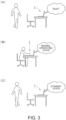
- FIG. 3 is a diagram for describing the outline of HPD processing of the information processing apparatus 1 according to the present embodiment.
- the information processing apparatus 1 detects the presence or absence of a person by the HPD processing to control the operating state of the system of the information processing apparatus 1 based on the detection result. For example, as illustrated in FIG. 3(A) , when detecting a change from a state where no person is present in front of the information processing apparatus 1 (Absence) to a state where a person is present (Presence) in the standby state, that is, when detecting that a person has approached the information processing apparatus 1 (Approach), the information processing apparatus 1 automatically boots the system to make a transition to the normal operating state.
- Absence a state where no person is present in front of the information processing apparatus 1
- Presence a state where a person is present
- the information processing apparatus 1 automatically boots the system to make a transition to the normal operating state.
- the information processing apparatus 1 when detecting a state where a person is present in front of the information processing apparatus 1 (Presence) in the normal operating state as illustrated in FIG. 3(B) , the information processing apparatus 1 continues the normal operating state. Then, as illustrated in FIG. 3(C) , when detecting a change from the state where the person is present in front of the information processing apparatus 1 (Presence) to a state where no person is present (Absence) in the normal operating state, that is, when detecting that the person has left the information processing apparatus 1 (Leave), the information processing apparatus 1 automatically causes the system to make a transition to the standby state.
- the camera 110 is not only used in the HPD processing described above, but also used to obtain a captured image (shot image) such as a still image or video as a camera function of the system.
- An image sensor provided in the camera 110 can control the exposure time (for example, electronic shutter control) to capture an image with proper brightness. It is common that the image sensor controls the exposure time to a long exposure time in a dark scene and a short exposure time in a bright scene. Further, the image sensor provided in the camera 110 can create an HDR (High Dynamic Range) image by dividing multiple pixels arranged on the image sensor into two kinds of pixel groups, capturing images of respective pixel groups at two different exposure times, and synthesizing the images.
- HDR High Dynamic Range
- FIG. 4 is a schematic diagram for describing exposure time control on the image sensor according to the present embodiment.
- FIG. 4 illustrates part of multiple pixels arranged on an image sensor 112.
- R pixels with color filters that allow light in an R (red) wavelength band to pass through, G pixels with color filters that allow light in a G (green) wavelength band to pass through, and B pixels with color filters that allow light in a B (blue) wavelength band to pass through are arranged in a matrix.
- the image sensor 112 outputs an RGB image (visible light image) signal obtained by photoelectrically converting visible light incident through the RGB color filters.
- RGB image visible light image
- the image sensor 112 is a Bayer array image sensor on which an RG column of R and G pixels and a GB column of G and B pixels are alternately repeated. Combinations of adjacent RG columns and GB columns construct one line of a pixel group on a line-by-line basis.
- multiple pixels arranged on the image sensor 112 are controlled by the same exposure time.
- A) in FIG. 4 illustrates normal shooting under low-illuminance conditions (dark scene), where the pixels are controlled by a long exposure time.
- (B) in FIG. 4 illustrates normal shooting under standard-illuminance conditions (scene with normal brightness), where the pixels are controlled by an exposure time shorter than that at (A) of FIG. 4 .
- the pixels are controlled by two kinds of exposure times different line by line (on a line-by-line basis) as illustrated at (C) of FIG. 4 .
- odd lines are controlled by the short exposure time to adjust the exposure by giving priority to bright parts.
- Even lines are controlled by the long exposure time to adjust the exposure by giving priority to dark parts.
- the HDR image can be created by synthesizing an image captured on the odd lines at the short exposure time and an image captured on the even lines at the long exposure time.
- the camera 110 described above may be controlled by the two kinds of exposure times different line by line to create an HDR image. From images different line by line in exposure time, a person cannot be detected in the HPD processing. If the images different line by line in exposure time are synthesized into an HDR image even in the HPD processing, it will have a greater impact on the processing load and costs. Therefore, in the HPD processing according to the present embodiment, only either one of the image captured on the odd lines and the image captured on the even lines is used to generate an image for person detection.
- FIG. 5 is a schematic diagram for describing a method of generating a detection image in the HPD processing according to the present embodiment.
- the HPD processing only either one of the image captured on the odd lines and the image captured on the even lines is used to generate a detection image for every frame, and the odd lines and the even lines are alternately switched for every frame.
- N frame where N is a positive integer
- only the image captured on the odd lines is used for N frame (where N is a positive integer) to generate a detection image
- N+1 frame is a positive integer
- the image captured on the even lines is used for N+1 frame to generate a detection image
- only the image captured on the odd lines is used for N+2 frame to generate a detection image
- only the image captured on the even lines is used for N+3 frame to generate a detection image.
- the odd lines and the even lines are alternately switched for every frame.
- the image controlled to be captured at the same exposure time becomes the detection image, a person is detectable.
- the odd lines and the even lines are different in exposure time, the odd lines with the short exposure time are more suitable for person detection than the even lines in the bright scene, and the even lines with the long exposure time are more suitable for person detection than the odd lines in the dark scene.
- the person can be detected in either or both of the detection image on the odd lines and the detection image on the even lines depending on the brightness of the scene.
- the detection image is an image thinned out line by line using only either one of the odd lines and the even lines, the resolution is lowered compared to that of an image using both lines (all lines).
- the image since the image has only to detect a person, a face outline, face eyes, or the like, the person can be detected without any problem from a commonly used number of pixels on the image sensor.
- the information processing apparatus 1 performs HPD processing using only either one of the image captured on the odd lines and the image captured on the even lines regardless of whether or not the system is using the camera 110 as the camera function.
- the information processing apparatus 1 can perform the HPD processing using the captured image properly without being aware of whether or not the system is using the camera function or an HDR function and without impact on the processing load and costs to create an HDR image.
- the information processing apparatus 1 when repeatedly executing the HPD processing, the information processing apparatus 1 alternately switches between the odd lines and the even lines each time the HPD processing is executed (for example, for every frame). Therefore, even when a person cannot be detected due to the fact that the exposure of either one of the odd lines and the even lines cannot be performed properly, the person can be detected by the exposure of the other of the odd lines and the even lines.
- FIG. 6 is a block diagram illustrating an example of the configuration of the information processing apparatus 1 according to the present embodiment.
- the information processing apparatus 1 includes the camera 110, an HPD processing unit 120, the keyboard 130, the display unit 140, a system processing unit 150, a storage unit 160, an EC 170, a power supply circuit 180, and a battery 190.
- the camera 110 includes a lens 111 and the image sensor 112. Light from a shooting subject is focused by the lens 111 and incident on the image sensor 112.
- the image sensor 112 is an image sensor on which R pixels, G pixels, and B pixels are arranged as described with reference to FIG. 4 and FIG. 5 .
- the camera 110 outputs data of a captured image (RGB image) captured based on the light incident from the shooting subject onto the image sensor 112 through the lens 111.
- the HPD processing unit 120 is an example of a processor for executing so-called CV (Computer Vision) processing using information in a captured image detected by performing image processing on the captured image captured by the camera 110.
- CV Computer Vision
- the HPD processing unit 120 executes HPD processing for detecting the presence of a person using data of the captured image captured by the camera 110, and transmits the detection result to the system processing unit 150.
- the HPD processing unit 120 executes HPD processing using data of a captured image of one kind of pixel group among data of captured images of plural kinds of pixel groups captured by the camera 110.
- the plural kinds of pixel groups are pixel groups for every one or more lines (on a line-by-line basis) among the multiple pixels arranged on the image sensor 112.
- the HPD processing unit 120 generates a detection image for person detection using only either one of the image captured by the pixel group of odd lines and the image captured by the pixel group of even lines. Then, the HPD processing unit 120 detects an image area with a person or a face of the person captured therein from the generated detection image to execute the HPD processing. Further, the HPD processing unit 120 generates a detection image by alternatingly switching between the odd lines and the even lines for every frame to execute the HPD processing using the generated detection image.
- the keyboard 130 is an input device with multiple keys (operating elements) arranged thereon to accept user operations. As illustrated in FIG. 1 , the keyboard 130 is provided on the inner surface of the second chassis 102. The keyboard 130 outputs, to the EC 170, input information (for example, operation signals indicative of operated keys) input by the user operations.
- input information for example, operation signals indicative of operated keys
- the display unit 140 is configured, for example, to include a liquid crystal display or an organic EL (Electro Luminescence) display, which displays a display image based on processing executed by the system processing unit 150.
- a liquid crystal display or an organic EL (Electro Luminescence) display which displays a display image based on processing executed by the system processing unit 150.
- the system processing unit 150 includes a CPU (Central Processing Unit) 151, a GPU (Graphic Processing Unit) 152, a memory controller 153, an I/O (Input-Output) controller 154, a system memory 155, and an image processing unit 156.
- CPU Central Processing Unit
- GPU Graphic Processing Unit
- I/O Input-Output
- the CPU 151 executes processing by the system such as a BIOS and an OS and processing by application programs running on the OS. For example, the CPU 151 controls the operating state of the system based on the detection result of the presence of a person by the HPD processing unit 120.
- the GPU 152 generates data of a display image to be displayed on the display unit 140 under the control of the CPU 151, and outputs the generated display image data to the display unit 140.
- the memory controller 153 controls reading and writing of data from the system memory 155 or the storage unit 160 under the control of the CPU 151 and the GPU 152.
- the I/O controller 154 controls input/output of data from the display unit 140 and the EC 170.
- the system memory 155 is used as a reading area of a program executed by the processor and a working area to write processed data. Further, the system memory 155 temporarily stores data of a captured image captured by the camera 110, data as a result of performing image processing on the captured image, and the like.
- the image processing unit 156 is an example of an IPU (Image Processing Unit) for controlling the camera 110 to acquire data of a captured image captured under predetermined imaging conditions in order to execute image processing on the acquired data of the captured image. For example, during normal shooting, the image processing unit 156 controls the multiple pixels arranged on the image sensor 112 to capture an image under the same imaging conditions (for example, at the same exposure time) in order to perform image processing for generating one shot image using data of the captured image.
- IPU Image Processing Unit
- the image processing unit 156 controls the multiple pixels to capture images under imaging conditions different for each of preset plural kinds of pixel groups in order to perform image processing for creating one HDR image (HDR shot image) using data of the captured images each of which is captured from each of the plural kinds of pixel groups.
- the multiple pixels arranged on the image sensor 112 are controlled to capture images at exposure times different between the odd lines and the even lines in order to create an HDR image by synthesizing data of a captured image on the odd lines and data of a captured image on the even lines.
- the storage unit 160 is configured to include storage media, such as an HDD (Hard Disk Drive) or an SDD (Solid State Drive), a secure NVRAM (Non-Volatile RAM), and a ROM (Read Only Memory).
- the HDD or the SSD stores the OS, device drivers, various programs such as applications, and various data.
- data of a shot image (or an HDR shot image) generated by the image processing unit 156 performing image processing on a captured image(s) captured by the camera 110 is stored in a predetermined file format (such as JPEG).
- the EC 170 is a one-chip microcomputer for monitoring various devices (peripheral devices, sensors, and the like) to control the various devices.
- the EC 170 includes a CPU, a ROM, a RAM, multi-channel A/D input terminal and D/A output terminal, a timer, and digital input/output terminals, which are not illustrated.
- the keyboard 130, the power supply circuit 180, and the like are connected to the digital input/output terminals of the EC 170.
- the EC 170 receives input information (operation signals) from the keyboard 130. Further, the EC 170 controls the operation of the power supply circuit 180 and the like.
- the power supply circuit 180 is configured to include, for example, a DC/DC converter, a charge/discharge unit, and the like.
- the power supply circuit 180 converts DC voltage, supplied from an external power supply such as an AC adapter (not illustrated) or the battery 190, to plural voltages required for operating the information processing apparatus 1 to supply power to each unit of the information processing apparatus 1 under the control of the EC 170.
- the battery 190 is, for example, a lithium battery, which is charged through the power supply circuit 180 when being powered from an external power supply or discharges the power charged through the power supply circuit 180 as power for operating each unit of the information processing apparatus 1 when not being powered from the external power supply.
- FIG. 7 is a flowchart illustrating an example of the HPD processing according to the present embodiment.
- step S101 The HPD processing unit 120 selects odd lines as a detection image, and proceeds to a process in step S103.
- Step S103 The HPD processing unit 120 generates a detection image from an image captured by a pixel group of selected lines (odd lines) to execute HPD processing using the generated detection image. Then, the HPD processing unit 120 proceeds to a process in step S105.
- Step S109 When determining in step S105 that the presence of a person is not detected from the detection image on the odd lines, the HPD processing unit 120 switches the selected lines for a detection image in the next frame (for example, switches from the odd lines to the even lines). Then, the HPD processing unit 120 proceeds to a process in step Sill.
- Step Sill In the next frame, the HPD processing unit 120 generates a detection image from an image captured by the pixel group of even lines to execute HPD processing using the generated detection image. Then, the HPD processing unit 120 proceeds to a process in step S113.
- HPD False
- the HPD processing unit 120 determines that a person (user) is present in front of the information processing apparatus 1.
- the HPD processing unit 120 determines that no person (user) is present in front of the information processing apparatus 1.
- the information processing apparatus 1 includes: the camera 110 (an example of an imaging unit) which outputs data of a captured image captured using multiple pixels arranged on the image sensor 112; the system memory 155 (an example of a memory) which temporarily stores the data of the captured image output from the camera 110; and the image processing unit 156 (an example of a first processor) and the HPD processing unit 120 (an example of a second processor) which execute processing using the data of the captured image stored in the system memory 155.
- the camera 110 an example of an imaging unit
- the system memory 155 an example of a memory
- the image processing unit 156 an example of a first processor
- the HPD processing unit 120 an example of a second processor
- the image processing unit 156 controls the camera 110 to control the multiple pixels arranged on the image sensor 112 to capture images under imaging conditions different for each of preset plural kinds of pixel groups (for example, two kinds of pixel groups of the odd lines and the even lines) in order to execute image processing (an example of first processing) for creating an HDR image using data of the captured images each of which is captured from each of the plural kinds of pixel groups.
- image processing an example of first processing
- the HPD processing unit 120 executes HPD processing (an example of second processing) to detect the presence of a person from a captured image using data of the captured image of one kind of pixel group (for example, either one of the odd lines and the even lines) among data of images each of which is captured from each of the plural kinds of pixel groups captured by the camera 110 under the control of the image processing unit 156.
- HPD processing an example of second processing
- the information processing apparatus 1 since the information processing apparatus 1 performs HPD processing using data of a captured image of one kind of pixel group even when the camera 110 is capturing images under imaging conditions different for each of the plural kinds of pixel groups by the function of the system, the HPD processing using the captured image can be performed properly regardless of the usage state of the camera function while reducing the impact on the processing load and costs. In other words, the information processing apparatus 1 can perform the HPD processing using the captured image properly without being aware of whether or not the system is using the camera function or the HDR function and without impact on the processing load and costs to create an HDR image.
- the HPD processing unit 120 switches the kind of pixel group for data of a captured image to be used in the HPD processing between data of captured images each of which is captured from each of two kinds of pixel groups of the odd lines and the even lines.
- the information processing apparatus 1 switches between captured images by the plural kinds of pixel groups captured under different imaging conditions to execute the HPD processing, the detection accuracy of the HPD processing in various scenes can be increased.
- the image processing unit 156 controls the camera 110 to control the multiple pixels to capture images at exposure times different for each of the plural kinds of pixel groups (for example, for each of the two kinds of pixel groups of the odd lines and the even lines).
- the information processing apparatus 1 switches between captured images by the plural kinds of pixel groups (for example, two kinds of pixel groups of the odd lines and the even lines) captured at different exposure times to execute the HPD processing, the detection accuracy of the HPD processing in various scenes can be increased.
- the image processing unit 156 synthesizes data of captured images each of which is captured from each of the plural kinds of pixel groups (for example, from each of the two kinds of pixel groups of the odd lines and the even lines) captured at different exposure times to create data of an HDR image with extended dynamic range.
- the information processing apparatus 1 can perform the HPD processing properly using the captured images captured by the camera 110.
- a control method for the information processing apparatus 1 includes: a step of causing the image processing unit 156 (the example of the first processor) to control the camera 110 to control the multiple pixels arranged on the image sensor 112 to capture images under imaging conditions different for each of preset plural kinds of pixel groups (for example, for each of the two kinds of pixel groups of the odd lines and the even lines); a step of causing the image processing unit 156 to execute image processing (the example of the first processing) to create an HDR image using data of the captured images each of which is captured from each of the plural kinds of pixel groups; and a step of causing the HPD processing unit 120 (the example of the second processor) to execute HPD processing (the example of the second processing) to detect the presence of a person from a captured image using data of a captured image of one kind of pixel group (for example, either one of the odd lines and the even lines) among data of the captured images each of which is captured from each of plural kinds of pixel groups captured by the camera 110 under the control of
- the information processing apparatus 1 since the information processing apparatus 1 performs HPD processing using data of a captured image of one kind of pixel group even when the camera 110 is capturing images under imaging conditions different for each of the plural kinds of pixel groups by the function of the system, the HPD processing using the captured image can be performed properly regardless of the usage state of the camera function while reducing the impact on the processing load and costs. In other words, the information processing apparatus 1 can perform the HPD processing using the captured image properly without being aware of whether or not the system is using the camera function or the HDR function and without impact on the processing load and costs to create an HDR image.
- the example of generating a detection image by alternately switching between the odd lines and the even lines for every frame to execute HPD processing using the generated detection image is described.
- the detection image on the same lines may also be used to execute the HPD processing for the next frame.
- FIG. 8 is a flowchart illustrating an example of a line switching process in HPD processing according to the present embodiment.
- Step S201 The HPD processing unit 120 generates a detection image from an image captured by a pixel group of the selected lines (odd lines or even lines) to execute HPD processing using the generated detection image. Then, the HPD processing unit 120 proceeds to a process in step S203.
- HPD True
- Step S205 The HPD processing unit 120 switches the selected lines and returns to the process in step S201 to execute the HPD processing using a detection image on different selected lines in the next frame.
- the HPD processing unit 120 uses data of a captured image of the same kind of pixel group as data of a captured image from which the presence of a person is detected next time when executing the HPD processing (for example, in the next frame). For example, when the presence of a person is detected in the HPD processing using the detection image on the odd lines, the HPD processing unit 120 uses the detection image on the odd lines next time when executing the HPD processing (for example, in the next frame). Further, when the presence of a person is detected in the HPD processing using a detection image on the even lines, the HPD processing unit 120 uses the detection image on the even lines next time when executing the HPD processing (for example, in the next frame).
- the information processing apparatus 1 can suppress the occurrence of such a phenomenon that the presence of a person cannot be normally detected under imaging conditions of either the odd lines or the even lines (for example, at either one of exposure times) (False negative).
- the HPD processing unit 120 switches to data of a captured image of a pixel group different in kind from data of a captured image of a pixel group by which the presence of a person is not detected next time when executing the HPD processing (for example, in the next frame). For example, when the presence of a person is not detected in the HPD processing using the detection image on the odd lines, the HPD processing unit 120 switches to HPD processing using a detection image on the even lines next time when executing the HPD processing (for example, in the next frame).
- the HPD processing unit 120 switches to HPD processing using a detection image on the odd lines next time when executing the HPD processing (for example, in the next frame).
- the information processing apparatus 1 can execute the HPD processing using the detection image captured under the proper imaging conditions (for example, at the proper exposure time).
- the description is made by taking, as an example, two kinds of pixel groups of the odd lines and the even lines, but the plural kinds of pixel groups may also be pixel groups of three or more kinds.
- the pixel groups to be controlled to different imaging conditions are not limited to line-by-line pixel groups.
- the pixel groups may also be pixel groups constructed on a block-by-block basis such as a block of 2 ⁇ 2 pixels, 3 ⁇ 3 pixels, 4 ⁇ 4 pixels, or the like, or pixel groups constructed in units of pixels that are not adjacent to each other.
- the exposure time is taken as the imaging condition when the plural kinds of pixel groups are controlled to different imaging conditions
- the imaging condition is not limited to the exposure time, and the sensitivity may also be made different.
- the HPD processing may also be executed every plural frames (every two frames, every three frames, or the like).
- the HPD processing is executed every plural frames, the plural kinds of pixel groups (for example, the two kinds of pixel groups of the odd lines and the even lines) are switched in units of frames in each of which the HPD processing is executed.
- the configuration of executing HPD processing using data of a captured image of one kind of pixel group for example, either one of the odd lines or the even lines
- data of captured images each of which is captured from each of the plural kinds of pixel groups captured by the camera 110 regardless of the usage state of the camera function by the system
- the information processing apparatus 1 may also execute the HPD processing using data of a captured image of one kind of pixel group (for example, either one of the odd lines and the even lines) only when creating an HDR image (HDR shooting).
- the HPD processing may also be executed by using, as a detection image, at least part of a captured image captured on the image sensor 112 without splitting the multiple pixels into plural kinds of pixel groups.
- the HPD processing is performed in the same way regardless of the usage state of the camera function by the system, since there is no need to change the processing by detecting the usage state of the camera function, the impact on the processing load and costs can be more suppressed.
- processing for detecting the presence of an object other than a person may be performed instead of the HPD processing (the example of the second processing).
- the second processing executed by using data of a captured image of one kind of pixel group (for example, either one of the odd lines or the even lines) among data of captured images each of which is captured from each of the plural kinds of pixel groups captured by the camera 110 under the control of the image processing unit 156 may be processing for detecting part of a person (a face, eyes, a hand, a leg, or the like), or may be processing for detecting an animal or an object other than the person.
- this second processing may be processing for detecting the quality, any result, or the like of goods or a product from a captured image captured by the camera 110.
- this second processing can be any processing for detecting any information from a captured image captured by the camera 110.
- the camera 110 includes, as the image sensor 112, an RGB sensor (visible light sensor) to capture an RGB image is described, but the present invention is not limited to this example.
- the camera 110 may further include, as the image sensor 112, an IR sensor to capture an IR (InfraRed) image.
- the camera 110 may include the RGB sensor and the IR sensor separately as the image sensor 112, or may include a hybrid sensor with the RGB sensor and the IR sensor integrated therein.
- respective components included in the system processing unit 150 may be integrated on one chip as an SoC (System-on- ⁇ -Chip) or configured as plural chips.
- the image processing unit 156 may be integrated, as one chip, with any other component included in the system processing unit 150, or may be configured as another chip (processor).
- the HPD processing unit 120 and the image processing unit 156 may be integrated as one chip (one processor).
- a hibernation state, a power-off state, and the like may be included as the standby state described above.
- the hibernation state corresponds, for example, to S4 state defined in the ACPI specification.
- the power-off state corresponds, for example, to S5 state (shutdown state) defined in the ACPI specification.
- the standby state, the sleep state, the hibernation state, the power-off state, and the like as the standby state are states lower in power consumption than the normal operating state (states of reducing power consumption).
- the information processing apparatus 1 described above has a computer system therein. Then, a program for implementing the function of each component included in the information processing apparatus 1 described above may be recorded on a computer-readable recording medium so that the program recorded on this recording medium is read into the computer system and executed to perform processing in each component included in the information processing apparatus 1 described above.
- the fact that "the program recorded on the recording medium is read into the computer system and executed” includes installing the program on the computer system.
- the "computer system” here includes the OS and hardware such as peripheral devices and the like.
- the "computer system” may also include two or more computers connected through networks including the Internet, WAN, LAN, and a communication line such as a dedicated line.
- the "computer-readable recording medium” means a storage medium such as a flexible disk, a magneto-optical disk, a portable medium like a flash ROM or a CD-ROM, or a hard disk incorporated in the computer system.
- the recording medium with the program stored thereon may be a non-transitory recording medium such as the CD-ROM.
- a recording medium internally or externally provided to be accessible from a delivery server for delivering the program is included as the recording medium.
- the program may be divided into plural pieces, downloaded at different timings, respectively, and then united in each component included in the information processing apparatus 1, or delivery servers for delivering respective divided pieces of the program may be different from one another.
- the "computer-readable recording medium” includes a medium on which the program is held for a given length of time, such as a volatile memory (RAM) inside a computer system as a server or a client when the program is transmitted through a network.
- the above-mentioned program may also be to implement some of the functions described above.
- the program may be a so-called differential file (differential program) capable of implementing the above-described functions in combination with a program(s) already recorded in the computer system.
- LSI Large Scale Integration
- Each function may be implemented by a processor individually, or some or all of the functions may be integrated as a processor.
- the method of circuit integration is not limited to LSI, and it may be realized by a dedicated circuit or a general-purpose processor. Further, if integrated circuit technology replacing the LSI appears with the progress of semiconductor technology, an integrated circuit according to the technology may be used.
- the information processing apparatus 1 in the aforementioned embodiments is not limited to the PC, which may also be a tablet terminal, a smartphone, a game machine, a multi-media terminal, or the like. Description of Symbols
Landscapes
- Engineering & Computer Science (AREA)
- Multimedia (AREA)
- Signal Processing (AREA)
- Physics & Mathematics (AREA)
- General Physics & Mathematics (AREA)
- Theoretical Computer Science (AREA)
- Health & Medical Sciences (AREA)
- General Health & Medical Sciences (AREA)
- Oral & Maxillofacial Surgery (AREA)
- Human Computer Interaction (AREA)
- Spectroscopy & Molecular Physics (AREA)
- Vascular Medicine (AREA)
- Image Processing (AREA)
- Studio Devices (AREA)
Abstract
Description
- The present invention relates to an information processing apparatus and a control method.
- An image sensor included in a camera (imaging unit) captures an image with proper brightness by controlling the exposure time. It is common to set the exposure time longer in a dark area and shorter in a bright area. In recent years, there has been a camera that can change the exposure (exposure time) every line of pixels arranged on the image sensor to synthesize images with different exposures in order to create an HDR (High Dynamic Range) image (for example, see Vladimir Koifman/Atul Ingle, "Image Sensors World News and discussions about image sensors", [online], [searched on October 19, 2022], on the internet <URL:http://image-sensors-world.blogspot.com/2013/01/sony-explains-hdr-video-mode-in-its.html>).
- Further, technology (so-called CV (Computer Vision)) to detect and use information in captured images by performing image processing on the images captured by a camera (imaging unit) is becoming common (for example, see
Japanese Unexamined Patent Application Publication No. 2019-185349 - For example, in an information processing apparatus such as a PC (Personal Computer), the above-described HPD processing is performed regardless of whether or not a system is using a camera function. When the system is using the camera function, an image captured with camera settings controlled by the system is used in the HPD processing. For example, when an HDR image is created using the camera function by the system, since the HDR image is controlled by exposures (exposure times) different every line of pixels arranged on an image sensor of the camera (imaging unit), captured images used in HPD processing are also images different in exposure (exposure time) line by line. In this case, if the HDR image is created from images different in exposure (exposure time) line by line even on the HPD processing side to detect the presence of a person, it will be unfavorable because the impact on the processing load costs increases.
- The present invention has been made in view of the above circumstances, and it is an object thereof to provide an information processing apparatus and a control method capable of performing HPD processing using a captured image properly regardless of the usage state of a camera function while reducing the impact on the processing load and costs.
- The present invention has been made to solve the above problem, and an information processing apparatus according to the first aspect of the present invention includes: an imaging unit which outputs data of a captured image captured using multiple pixels arranged on an image sensor; a memory which temporarily stores the data of the captured image output from the imaging unit; and a first processor and a second processor which execute processing using the data of the captured image stored in the memory, wherein the first processor controls the imaging unit to control the multiple pixels arranged on the image sensor to capture images under imaging conditions different for each of preset plural kinds of pixel groups in order to execute first processing using data of the captured images each of which is captured from each of the plural kinds of pixel groups, and the second processor executes second processing using data of a captured image of one kind of pixel group among data of the captured images each of which is captured from each of the plural kinds of pixel groups captured by the imaging unit under the control of the first processor.
- The above information processing apparatus may be such that the second processor executes, as the second processing, processing to detect presence of a person from a captured image using the data of the captured image of one kind of pixel group among the data of the captured images each of which is captured from each of the plural kinds of pixel groups.
- The above information processing apparatus may also be such that when repeatedly executing the second processing, the second processor switches the kind of pixel group of the data of the captured image used in the second processing among the data of the captured images each of which is captured from each of the plural kinds of pixel groups.
- The above information processing apparatus may further be such that wherein when detecting the presence of a person in the second processing, the second processor uses data of a captured image of the same kind of pixel group as the data of the captured image from which the presence of the person is detected next time when executing the second processing.
- Further, the above information processing apparatus may be such that when not detecting the presence of a person in the second processing, the second processor switches to data of a captured image of a kind of pixel group different from the data of the captured image of the pixel group from which the presence of a person is not detected next time when executing the second processing.
- Further, the above information processing apparatus may be such that the first processor controls the imaging unit to control the multiple pixels to capture images at exposure times different for each of the plural kinds of pixel groups.
- Further, the above information processing apparatus may be such that, as the first processing, the first processor synthesizes the data of the captured images captured at the exposure times different for each of the plural kinds of pixel groups to generate data of an image with extended dynamic range.
- Further, the above information processing apparatus may be such that the multiple pixels are arranged in a matrix on the image sensor, and the plural kinds of pixel groups are pixel groups in units of one or more rows among the multiple pixels arranged on the image sensor.
- A control method according to the second aspect of the present invention is a control method for an information processing apparatus including: an imaging unit which outputs data of a captured image captured using multiple pixels arranged on an image sensor; a memory which temporarily stores the data of the captured image output from the imaging unit; and a first processor and a second processor which execute processing using the data of the captured image stored in the memory, the control method including: a step of causing the first processor to control the imaging unit to control the multiple pixels arranged on the image sensor to capture images under imaging conditions different for each of preset plural kinds of pixel groups; a step of causing the first processor to execute first processing using data of the captured images each of which is captured from each of the plural kinds of pixel groups; and a step of causing the second processor to execute second processing using data of a captured image of one kind of pixel group among data of the captured images each of which is captured from each of the plural kinds of pixel groups captured by the imaging unit under the control of the first processor.
- The above-described aspects of the present invention can perform HPD processing using a captured image properly regardless of the usage state of a camera function while reducing the impact on the processing load and costs.
-
-
FIG. 1 is a perspective view illustrating the appearance of an information processing apparatus according to a first embodiment. -
FIG. 2 is a diagram illustrating an example of a person detection range of the information processing apparatus according to the first embodiment. -
FIG. 3 is a diagram for describing an outline of HPD processing of the information processing apparatus according to the first embodiment. -
FIG. 4 is a schematic diagram for describing exposure time control on an image sensor according to the first embodiment. -
FIG. 5 is a schematic diagram for describing a method of generating a detection image in HPD processing according to the first embodiment. -
FIG. 6 is a block diagram illustrating an example of the configuration of the information processing apparatus according to the first embodiment. -
FIG. 7 is a flowchart illustrating HPD processing according to the first embodiment. -
FIG. 8 is a flowchart illustrating HPD processing according to a second embodiment. - Embodiments of the present invention will be described below with reference to the accompanying drawings.
- First, a first embodiment of the present invention will be described.
- An
information processing apparatus 1 according to the present embodiment is, for example, a laptop PC (Personal Computer). Note that theinformation processing apparatus 1 may also be any other form of information processing apparatus such as a desktop PC, a tablet terminal, or a smartphone. -
FIG. 1 is a perspective view illustrating the appearance of the information processing apparatus according to the present embodiment. Theinformation processing apparatus 1 illustrated is a clamshell type laptop PC (Personal Computer). Theinformation processing apparatus 1 includes afirst chassis 101, asecond chassis 102, and ahinge mechanism 103. Thefirst chassis 101 and thesecond chassis 102 are chassis having a substantially rectangular plate shape (for example, a flat plate shape). One of the sides of thefirst chassis 101 and one of the sides of thesecond chassis 102 are joined (coupled) through thehinge mechanism 103 in such a manner that thefirst chassis 101 and thesecond chassis 102 are rotatable relative to each other around the rotation axis of thehinge mechanism 103. - A state where an open angle θ (hinge angle) between the
first chassis 101 and thesecond chassis 102 around the rotation axis is substantially 0° is a state where thefirst chassis 101 and thesecond chassis 102 are closed to overlap each other (called "closed state"). Surfaces of thefirst chassis 101 and thesecond chassis 102 on the sides to face each other in the closed state are called "inner surfaces," and surfaces on the other sides of the inner surfaces are called "outer surfaces," respectively. The open angle θ can also be called an angle between the inner surface of thefirst chassis 101 and the inner surface of thesecond chassis 102. A state opposite to the closed state, where thefirst chassis 101 and thesecond chassis 102 are open, is called an "open state." The open state is a state where thefirst chassis 101 and thesecond chassis 102 are rotated relative to each other until the open angle θ exceeds a preset threshold value (for example, 10°). Note that in typical usage states of theinformation processing apparatus 1, the open angle θ is often about 90° to 140°. - A
display unit 140 is provided on the inner surface of thefirst chassis 101. Thedisplay unit 140 displays images based on processing executed in theinformation processing apparatus 1. Further, akeyboard 130 is provided on the inner surface of thesecond chassis 102. Thekeyboard 130 is provided as an input device to accept user operations. In the closed state, thedisplay unit 140 is made invisible and operations on thekeyboard 130 are disabled. On the other hand, in the open state, thedisplay unit 140 is made visible and operations on thekeyboard 130 are enabled (that is, theinformation processing apparatus 1 is usable). - Further, a
camera 110 is provided in a peripheral area of thedisplay unit 140 on the inner surface of thefirst chassis 101. Thecamera 110 is provided in a position capable of imaging a direction to face the inner surface of the first chassis 101 (the display screen of the display unit 140). In other words, thecamera 110 is provided in a position capable of imaging a user who uses theinformation processing apparatus 1. For example, theinformation processing apparatus 1 detects a person from an image captured by thecamera 110 to detect the presence or absence of the user who uses theinformation processing apparatus 1. -
FIG. 2 is a diagram illustrating an example of a person detection range of theinformation processing apparatus 1 according to the present embodiment. In the illustrated example, a detection range FoV (Field of View: detection viewing angle) in a direction to face the inner surface of thefirst chassis 101 is a person-detectable range. The detection range FoV corresponds to an imaging angle of view of thecamera 110. In the following, the direction to face the inner surface of thefirst chassis 101 in the open state is called the front of theinformation processing apparatus 1. Theinformation processing apparatus 1 detects an image area with a person or a face of the person captured therein from a captured image captured by thecamera 110 to detect whether or not the person is present in front of theinformation processing apparatus 1. Here, processing for detecting the presence of a person is called HPD (Human Presence Detection) processing. - Further, the
information processing apparatus 1 controls the operating state of a system based on the detection result of the presence of the person by the HPD processing. As operating states of the system, there are at least a normal operating state (power-on state) and a standby state. The normal operating state is an operating state capable of executing processing without being particularly limited, which corresponds, for example, to S0 state defined in the ACPI (Advanced Configuration and Power Interface) specification. The standby state is a state in which at least part of system processing is limited. For example, the standby state may be the standby state or a sleep state, modern standby in Windows (registered trademark), or a state corresponding to S3 state (sleep state) defined in the ACPI specification. Further, a state in which at least the display of the display unit appears to be OFF (screen OFF), or a screen lock state may be included as the standby state. The screen lock is a state in which an image preset to make a content being processed invisible (for example, an image for the screen lock) is displayed on the display unit, that is, an unusable state until the lock is released (for example, until the user is authenticated). -
FIG. 3 is a diagram for describing the outline of HPD processing of theinformation processing apparatus 1 according to the present embodiment. Theinformation processing apparatus 1 detects the presence or absence of a person by the HPD processing to control the operating state of the system of theinformation processing apparatus 1 based on the detection result. For example, as illustrated inFIG. 3(A) , when detecting a change from a state where no person is present in front of the information processing apparatus 1 (Absence) to a state where a person is present (Presence) in the standby state, that is, when detecting that a person has approached the information processing apparatus 1 (Approach), theinformation processing apparatus 1 automatically boots the system to make a transition to the normal operating state. Further, when detecting a state where a person is present in front of the information processing apparatus 1 (Presence) in the normal operating state as illustrated inFIG. 3(B) , theinformation processing apparatus 1 continues the normal operating state. Then, as illustrated inFIG. 3(C) , when detecting a change from the state where the person is present in front of the information processing apparatus 1 (Presence) to a state where no person is present (Absence) in the normal operating state, that is, when detecting that the person has left the information processing apparatus 1 (Leave), theinformation processing apparatus 1 automatically causes the system to make a transition to the standby state. - The
camera 110 is not only used in the HPD processing described above, but also used to obtain a captured image (shot image) such as a still image or video as a camera function of the system. An image sensor provided in thecamera 110 can control the exposure time (for example, electronic shutter control) to capture an image with proper brightness. It is common that the image sensor controls the exposure time to a long exposure time in a dark scene and a short exposure time in a bright scene. Further, the image sensor provided in thecamera 110 can create an HDR (High Dynamic Range) image by dividing multiple pixels arranged on the image sensor into two kinds of pixel groups, capturing images of respective pixel groups at two different exposure times, and synthesizing the images. -
FIG. 4 is a schematic diagram for describing exposure time control on the image sensor according to the present embodiment.FIG. 4 illustrates part of multiple pixels arranged on animage sensor 112. On theimage sensor 112, R pixels with color filters that allow light in an R (red) wavelength band to pass through, G pixels with color filters that allow light in a G (green) wavelength band to pass through, and B pixels with color filters that allow light in a B (blue) wavelength band to pass through are arranged in a matrix. Theimage sensor 112 outputs an RGB image (visible light image) signal obtained by photoelectrically converting visible light incident through the RGB color filters. - For example, the
image sensor 112 is a Bayer array image sensor on which an RG column of R and G pixels and a GB column of G and B pixels are alternately repeated. Combinations of adjacent RG columns and GB columns construct one line of a pixel group on a line-by-line basis. During normal shooting without creating any HDR image, multiple pixels arranged on theimage sensor 112 are controlled by the same exposure time. (A) inFIG. 4 illustrates normal shooting under low-illuminance conditions (dark scene), where the pixels are controlled by a long exposure time. (B) inFIG. 4 illustrates normal shooting under standard-illuminance conditions (scene with normal brightness), where the pixels are controlled by an exposure time shorter than that at (A) ofFIG. 4 . - On the other hand, when creating an HDR image, the pixels are controlled by two kinds of exposure times different line by line (on a line-by-line basis) as illustrated at (C) of
FIG. 4 . For example, odd lines are controlled by the short exposure time to adjust the exposure by giving priority to bright parts. Even lines are controlled by the long exposure time to adjust the exposure by giving priority to dark parts. The HDR image can be created by synthesizing an image captured on the odd lines at the short exposure time and an image captured on the even lines at the long exposure time. - Here, when performing the HPD processing regardless of whether or not the system is using the
camera 110 as the camera function, thecamera 110 described above may be controlled by the two kinds of exposure times different line by line to create an HDR image. From images different line by line in exposure time, a person cannot be detected in the HPD processing. If the images different line by line in exposure time are synthesized into an HDR image even in the HPD processing, it will have a greater impact on the processing load and costs. Therefore, in the HPD processing according to the present embodiment, only either one of the image captured on the odd lines and the image captured on the even lines is used to generate an image for person detection. -
FIG. 5 is a schematic diagram for describing a method of generating a detection image in the HPD processing according to the present embodiment. For example, in the HPD processing, only either one of the image captured on the odd lines and the image captured on the even lines is used to generate a detection image for every frame, and the odd lines and the even lines are alternately switched for every frame. In the illustrated example, only the image captured on the odd lines is used for N frame (where N is a positive integer) to generate a detection image, only the image captured on the even lines is used for N+1 frame to generate a detection image, only the image captured on the odd lines is used for N+2 frame to generate a detection image, and only the image captured on the even lines is used for N+3 frame to generate a detection image. After that, the odd lines and the even lines are alternately switched for every frame. - Thus, since the image controlled to be captured at the same exposure time becomes the detection image, a person is detectable. Further, since the odd lines and the even lines are different in exposure time, the odd lines with the short exposure time are more suitable for person detection than the even lines in the bright scene, and the even lines with the long exposure time are more suitable for person detection than the odd lines in the dark scene. When a person is present in front of the
information processing apparatus 1, the person can be detected in either or both of the detection image on the odd lines and the detection image on the even lines depending on the brightness of the scene. - Note that since the detection image is an image thinned out line by line using only either one of the odd lines and the even lines, the resolution is lowered compared to that of an image using both lines (all lines). However, for person detection, since the image has only to detect a person, a face outline, face eyes, or the like, the person can be detected without any problem from a commonly used number of pixels on the image sensor.
- For example, the
information processing apparatus 1 performs HPD processing using only either one of the image captured on the odd lines and the image captured on the even lines regardless of whether or not the system is using thecamera 110 as the camera function. Thus, theinformation processing apparatus 1 can perform the HPD processing using the captured image properly without being aware of whether or not the system is using the camera function or an HDR function and without impact on the processing load and costs to create an HDR image. - Further, when repeatedly executing the HPD processing, the
information processing apparatus 1 alternately switches between the odd lines and the even lines each time the HPD processing is executed (for example, for every frame). Therefore, even when a person cannot be detected due to the fact that the exposure of either one of the odd lines and the even lines cannot be performed properly, the person can be detected by the exposure of the other of the odd lines and the even lines. - Next, the configuration of the
information processing apparatus 1 according to the present embodiment will be described in detail. -
FIG. 6 is a block diagram illustrating an example of the configuration of theinformation processing apparatus 1 according to the present embodiment. InFIG. 6 , components corresponding to respective units inFIG. 1 and FIG. 2 are given the same reference numerals. Theinformation processing apparatus 1 includes thecamera 110, anHPD processing unit 120, thekeyboard 130, thedisplay unit 140, asystem processing unit 150, astorage unit 160, anEC 170, apower supply circuit 180, and abattery 190. - The
camera 110 includes a lens 111 and theimage sensor 112. Light from a shooting subject is focused by the lens 111 and incident on theimage sensor 112. For example, theimage sensor 112 is an image sensor on which R pixels, G pixels, and B pixels are arranged as described with reference toFIG. 4 andFIG. 5 . Thecamera 110 outputs data of a captured image (RGB image) captured based on the light incident from the shooting subject onto theimage sensor 112 through the lens 111. - The
HPD processing unit 120 is an example of a processor for executing so-called CV (Computer Vision) processing using information in a captured image detected by performing image processing on the captured image captured by thecamera 110. For example, theHPD processing unit 120 executes HPD processing for detecting the presence of a person using data of the captured image captured by thecamera 110, and transmits the detection result to thesystem processing unit 150. - Specifically, the
HPD processing unit 120 executes HPD processing using data of a captured image of one kind of pixel group among data of captured images of plural kinds of pixel groups captured by thecamera 110. As an example, the plural kinds of pixel groups are pixel groups for every one or more lines (on a line-by-line basis) among the multiple pixels arranged on theimage sensor 112. For example, as described with reference toFIG. 5 , theHPD processing unit 120 generates a detection image for person detection using only either one of the image captured by the pixel group of odd lines and the image captured by the pixel group of even lines. Then, theHPD processing unit 120 detects an image area with a person or a face of the person captured therein from the generated detection image to execute the HPD processing. Further, theHPD processing unit 120 generates a detection image by alternatingly switching between the odd lines and the even lines for every frame to execute the HPD processing using the generated detection image. - The
keyboard 130 is an input device with multiple keys (operating elements) arranged thereon to accept user operations. As illustrated inFIG. 1 , thekeyboard 130 is provided on the inner surface of thesecond chassis 102. Thekeyboard 130 outputs, to theEC 170, input information (for example, operation signals indicative of operated keys) input by the user operations. - The
display unit 140 is configured, for example, to include a liquid crystal display or an organic EL (Electro Luminescence) display, which displays a display image based on processing executed by thesystem processing unit 150. - The
system processing unit 150 includes a CPU (Central Processing Unit) 151, a GPU (Graphic Processing Unit) 152, amemory controller 153, an I/O (Input-Output)controller 154, asystem memory 155, and animage processing unit 156. - The
CPU 151 executes processing by the system such as a BIOS and an OS and processing by application programs running on the OS. For example, theCPU 151 controls the operating state of the system based on the detection result of the presence of a person by theHPD processing unit 120. - The
GPU 152 generates data of a display image to be displayed on thedisplay unit 140 under the control of theCPU 151, and outputs the generated display image data to thedisplay unit 140. - The
memory controller 153 controls reading and writing of data from thesystem memory 155 or thestorage unit 160 under the control of theCPU 151 and theGPU 152. - The I/
O controller 154 controls input/output of data from thedisplay unit 140 and theEC 170. - The
system memory 155 is used as a reading area of a program executed by the processor and a working area to write processed data. Further, thesystem memory 155 temporarily stores data of a captured image captured by thecamera 110, data as a result of performing image processing on the captured image, and the like. - The
image processing unit 156 is an example of an IPU (Image Processing Unit) for controlling thecamera 110 to acquire data of a captured image captured under predetermined imaging conditions in order to execute image processing on the acquired data of the captured image. For example, during normal shooting, theimage processing unit 156 controls the multiple pixels arranged on theimage sensor 112 to capture an image under the same imaging conditions (for example, at the same exposure time) in order to perform image processing for generating one shot image using data of the captured image. - On the other hand, when creating an HDR image (during HDR shooting), the
image processing unit 156 controls the multiple pixels to capture images under imaging conditions different for each of preset plural kinds of pixel groups in order to perform image processing for creating one HDR image (HDR shot image) using data of the captured images each of which is captured from each of the plural kinds of pixel groups. For example, the multiple pixels arranged on theimage sensor 112 are controlled to capture images at exposure times different between the odd lines and the even lines in order to create an HDR image by synthesizing data of a captured image on the odd lines and data of a captured image on the even lines. - The
storage unit 160 is configured to include storage media, such as an HDD (Hard Disk Drive) or an SDD (Solid State Drive), a secure NVRAM (Non-Volatile RAM), and a ROM (Read Only Memory). For example, the HDD or the SSD stores the OS, device drivers, various programs such as applications, and various data. For example, data of a shot image (or an HDR shot image) generated by theimage processing unit 156 performing image processing on a captured image(s) captured by thecamera 110 is stored in a predetermined file format (such as JPEG). - The
EC 170 is a one-chip microcomputer for monitoring various devices (peripheral devices, sensors, and the like) to control the various devices. TheEC 170 includes a CPU, a ROM, a RAM, multi-channel A/D input terminal and D/A output terminal, a timer, and digital input/output terminals, which are not illustrated. For example, thekeyboard 130, thepower supply circuit 180, and the like are connected to the digital input/output terminals of theEC 170. TheEC 170 receives input information (operation signals) from thekeyboard 130. Further, theEC 170 controls the operation of thepower supply circuit 180 and the like. - The
power supply circuit 180 is configured to include, for example, a DC/DC converter, a charge/discharge unit, and the like. For example, thepower supply circuit 180 converts DC voltage, supplied from an external power supply such as an AC adapter (not illustrated) or thebattery 190, to plural voltages required for operating theinformation processing apparatus 1 to supply power to each unit of theinformation processing apparatus 1 under the control of theEC 170. - The
battery 190 is, for example, a lithium battery, which is charged through thepower supply circuit 180 when being powered from an external power supply or discharges the power charged through thepower supply circuit 180 as power for operating each unit of theinformation processing apparatus 1 when not being powered from the external power supply. - Referring next to
FIG. 7 , the operation of HPD processing executed by theHPD processing unit 120 will be described.FIG. 7 is a flowchart illustrating an example of the HPD processing according to the present embodiment. - (step S101) The
HPD processing unit 120 selects odd lines as a detection image, and proceeds to a process in step S103. - (Step S103) The
HPD processing unit 120 generates a detection image from an image captured by a pixel group of selected lines (odd lines) to execute HPD processing using the generated detection image. Then, theHPD processing unit 120 proceeds to a process in step S105. - (Step S105) Based on the detection result by the HPD processing in step S103, the
HPD processing unit 120 determines whether or not the presence of a person is detected (HPD = True) from the detection image on the odd lines. When determining that the presence of a person is detected from the detection image on the odd lines (YES), theHPD processing unit 120 proceeds to a process in step S107. On the other hand, when determining that the presence of a person is not detected from the detection image on the odd lines (NO), theHPD processing unit 120 proceeds to a process in step S109. - (Step S107) When determining in step S105 that the presence of a person is detected from the detection image on the odd lines, the
HPD processing unit 120 determines that a person (user) is present in front of theinformation processing apparatus 1 as a result of adopting the detection result (HPD = True). Then, theHPD processing unit 120 proceeds to a process in step S119. In step S119, theHPD processing unit 120 switches the selected lines for a detection image in the next frame (for example, switches from the odd lines to the even lines). Then, theHPD processing unit 120 returns to the process in step S103 in which theHPD processing unit 120 generates a detection image from an image captured by the pixel group of even lines in the next frame to execute the HPD processing. - (Step S109) When determining in step S105 that the presence of a person is not detected from the detection image on the odd lines, the
HPD processing unit 120 switches the selected lines for a detection image in the next frame (for example, switches from the odd lines to the even lines). Then, theHPD processing unit 120 proceeds to a process in step Sill. - (Step Sill) In the next frame, the
HPD processing unit 120 generates a detection image from an image captured by the pixel group of even lines to execute HPD processing using the generated detection image. Then, theHPD processing unit 120 proceeds to a process in step S113. - (Step S113) Based on the detection result by the HPD processing in step Sill, the
HPD processing unit 120 determines whether or not the presence of a person is detected from the detection image on the even lines (HPD = True). When determining that the presence of a person is detected from the detection image on the even lines (YES), theHPD processing unit 120 proceeds to a process in step S115. On the other hand, when determining that the presence of a person is not detected from the detection image on the even lines (NO), theHPD processing unit 120 proceeds to a process in step S117. - (Step S115) When determining in step S113 that the presence of a person is detected from the detection image on the even lines, the
HPD processing unit 120 adopts the detection result to determine that a person (user) is present in front of the information processing apparatus 1 (HPD = True). Then, theHPD processing unit 120 proceeds to the process in step S119 to switch the selected lines for a detection image in the next frame (for example, to switch from the even lines to the odd lines), and returns to the process in step S103. - (Step S117) When determining in step S113 that the presence of a person is not detected from the detection image on the even lines, since the presence of a person is not detected from both of the detection images on the odd lines and the even lines, the
HPD processing unit 120 determines that a person (user) is not present in front of the information processing apparatus 1 (HPD = False). Then, theHPD processing unit 120 proceeds to the process in step S119 to switch the selected lines for a detection image in the next frame (for example, to switch from the even lines to the odd lines), and returns to the process in step S103. - Thus, when the presence of a person is detected from at least either one of the detection image on the odd lines and the detection image on the even lines, the
HPD processing unit 120 determines that a person (user) is present in front of theinformation processing apparatus 1. On the other hand, when the presence of a person is not detected from both of the detection image on the odd lines and the detection image on the even lines, theHPD processing unit 120 determines that no person (user) is present in front of theinformation processing apparatus 1. - As described above, the
information processing apparatus 1 according to the present embodiment includes: the camera 110 (an example of an imaging unit) which outputs data of a captured image captured using multiple pixels arranged on theimage sensor 112; the system memory 155 (an example of a memory) which temporarily stores the data of the captured image output from thecamera 110; and the image processing unit 156 (an example of a first processor) and the HPD processing unit 120 (an example of a second processor) which execute processing using the data of the captured image stored in thesystem memory 155. Theimage processing unit 156 controls thecamera 110 to control the multiple pixels arranged on theimage sensor 112 to capture images under imaging conditions different for each of preset plural kinds of pixel groups (for example, two kinds of pixel groups of the odd lines and the even lines) in order to execute image processing (an example of first processing) for creating an HDR image using data of the captured images each of which is captured from each of the plural kinds of pixel groups. TheHPD processing unit 120 executes HPD processing (an example of second processing) to detect the presence of a person from a captured image using data of the captured image of one kind of pixel group (for example, either one of the odd lines and the even lines) among data of images each of which is captured from each of the plural kinds of pixel groups captured by thecamera 110 under the control of theimage processing unit 156. - Thus, since the
information processing apparatus 1 performs HPD processing using data of a captured image of one kind of pixel group even when thecamera 110 is capturing images under imaging conditions different for each of the plural kinds of pixel groups by the function of the system, the HPD processing using the captured image can be performed properly regardless of the usage state of the camera function while reducing the impact on the processing load and costs. In other words, theinformation processing apparatus 1 can perform the HPD processing using the captured image properly without being aware of whether or not the system is using the camera function or the HDR function and without impact on the processing load and costs to create an HDR image. - For example, when repeatedly executing the HPD processing, the
HPD processing unit 120 switches the kind of pixel group for data of a captured image to be used in the HPD processing between data of captured images each of which is captured from each of two kinds of pixel groups of the odd lines and the even lines. - Thus, since the
information processing apparatus 1 switches between captured images by the plural kinds of pixel groups captured under different imaging conditions to execute the HPD processing, the detection accuracy of the HPD processing in various scenes can be increased. - The
image processing unit 156 controls thecamera 110 to control the multiple pixels to capture images at exposure times different for each of the plural kinds of pixel groups (for example, for each of the two kinds of pixel groups of the odd lines and the even lines). - Thus, even when the
camera 110 is capturing images at exposure times different for each of the plural kinds of pixel groups by the function of the system, since theinformation processing apparatus 1 switches between captured images by the plural kinds of pixel groups (for example, two kinds of pixel groups of the odd lines and the even lines) captured at different exposure times to execute the HPD processing, the detection accuracy of the HPD processing in various scenes can be increased. - As image processing, the
image processing unit 156 synthesizes data of captured images each of which is captured from each of the plural kinds of pixel groups (for example, from each of the two kinds of pixel groups of the odd lines and the even lines) captured at different exposure times to create data of an HDR image with extended dynamic range. - Thus, even when the
camera 110 is capturing images at exposure times different for each of the plural kinds of pixel groups by the function of the system to create an HDR image, theinformation processing apparatus 1 can perform the HPD processing properly using the captured images captured by thecamera 110. - Further, a control method for the
information processing apparatus 1 according to the present embodiment includes: a step of causing the image processing unit 156 (the example of the first processor) to control thecamera 110 to control the multiple pixels arranged on theimage sensor 112 to capture images under imaging conditions different for each of preset plural kinds of pixel groups (for example, for each of the two kinds of pixel groups of the odd lines and the even lines); a step of causing theimage processing unit 156 to execute image processing (the example of the first processing) to create an HDR image using data of the captured images each of which is captured from each of the plural kinds of pixel groups; and a step of causing the HPD processing unit 120 (the example of the second processor) to execute HPD processing (the example of the second processing) to detect the presence of a person from a captured image using data of a captured image of one kind of pixel group (for example, either one of the odd lines and the even lines) among data of the captured images each of which is captured from each of plural kinds of pixel groups captured by thecamera 110 under the control of theimage processing unit 156. - Thus, since the
information processing apparatus 1 performs HPD processing using data of a captured image of one kind of pixel group even when thecamera 110 is capturing images under imaging conditions different for each of the plural kinds of pixel groups by the function of the system, the HPD processing using the captured image can be performed properly regardless of the usage state of the camera function while reducing the impact on the processing load and costs. In other words, theinformation processing apparatus 1 can perform the HPD processing using the captured image properly without being aware of whether or not the system is using the camera function or the HDR function and without impact on the processing load and costs to create an HDR image. - Next, a second embodiment of the present invention will be described.
- In the first embodiment, the example of generating a detection image by alternately switching between the odd lines and the even lines for every frame to execute HPD processing using the generated detection image is described. However, when the presence of a person is detected (HPD = True) from the detection image, the detection image on the same lines may also be used to execute the HPD processing for the next frame.
- This can suppress such a phenomenon that the presence of a person cannot be normally detected on one kind of lines (at one exposure time) (False negative). Further, when it is determined that the presence of a person is not detected (HPD = False) from the detection image, a detection image can be generated by alternately switching between the odd lines and the even lines again to execute HPD processing. Thus, the HPD processing can be executed using a detection image captured at a proper exposure time.
-
FIG. 8 is a flowchart illustrating an example of a line switching process in HPD processing according to the present embodiment. - (Step S201) The
HPD processing unit 120 generates a detection image from an image captured by a pixel group of the selected lines (odd lines or even lines) to execute HPD processing using the generated detection image. Then, theHPD processing unit 120 proceeds to a process in step S203. - (Step S203) Based on the detection result by the HPD processing in step S201, the
HPD processing unit 120 determines whether or not the presence of a person is detected (HPD = True) from the detection image on the selected lines. When determining that the presence of a person is detected from the detection image on the selected lines (YES), theHPD processing unit 120 returns to the process in step S201 to execute the HPD processing using the detection image on the same selected lines in the next frame as well. On the other hand, when determining that the presence of a person is not detected from the detection image on the selected lines (NO), theHPD processing unit 120 proceeds to a process in step S205. - (Step S205) The
HPD processing unit 120 switches the selected lines and returns to the process in step S201 to execute the HPD processing using a detection image on different selected lines in the next frame. - Thus, in the
information processing apparatus 1 according to the present embodiment, when the presence of a person is detected in the HPD processing, theHPD processing unit 120 uses data of a captured image of the same kind of pixel group as data of a captured image from which the presence of a person is detected next time when executing the HPD processing (for example, in the next frame). For example, when the presence of a person is detected in the HPD processing using the detection image on the odd lines, theHPD processing unit 120 uses the detection image on the odd lines next time when executing the HPD processing (for example, in the next frame). Further, when the presence of a person is detected in the HPD processing using a detection image on the even lines, theHPD processing unit 120 uses the detection image on the even lines next time when executing the HPD processing (for example, in the next frame). - Thus, the
information processing apparatus 1 can suppress the occurrence of such a phenomenon that the presence of a person cannot be normally detected under imaging conditions of either the odd lines or the even lines (for example, at either one of exposure times) (False negative). - Further, when the presence of a person is not detected in the HPD processing, the
HPD processing unit 120 switches to data of a captured image of a pixel group different in kind from data of a captured image of a pixel group by which the presence of a person is not detected next time when executing the HPD processing (for example, in the next frame). For example, when the presence of a person is not detected in the HPD processing using the detection image on the odd lines, theHPD processing unit 120 switches to HPD processing using a detection image on the even lines next time when executing the HPD processing (for example, in the next frame). Further, when the presence of a person is not detected in HPD processing using a detection image on the even lines, theHPD processing unit 120 switches to HPD processing using a detection image on the odd lines next time when executing the HPD processing (for example, in the next frame). - Thus, the
information processing apparatus 1 can execute the HPD processing using the detection image captured under the proper imaging conditions (for example, at the proper exposure time). - While the embodiments of this invention have been described in detail above with reference to the accompanying drawings, the specific configurations are not limited to the above-described embodiments, and design changes are included without departing from the scope of this invention. For example, the respective configurations in the respective embodiments described above can be combined arbitrarily.
- Further, in the aforementioned embodiments, as the plural kinds of pixel groups to be controlled to different imaging conditions (for example, different exposure times), the description is made by taking, as an example, two kinds of pixel groups of the odd lines and the even lines, but the plural kinds of pixel groups may also be pixel groups of three or more kinds.
- Further, in the aforementioned embodiments, the example in which the plural kinds of pixel groups are controlled to imaging conditions (for example, exposure times) different line by line between the odd lines and the even lines is described, but the pixel groups to be controlled to different imaging conditions (for example, different exposure times) are not limited to line-by-line pixel groups. The pixel groups may also be pixel groups constructed on a block-by-block basis such as a block of 2×2 pixels, 3×3 pixels, 4×4 pixels, or the like, or pixel groups constructed in units of pixels that are not adjacent to each other.
- Further, in the aforementioned embodiments, the example in which the exposure time is taken as the imaging condition when the plural kinds of pixel groups are controlled to different imaging conditions is described, but the imaging condition is not limited to the exposure time, and the sensitivity may also be made different.
- Further, in the aforementioned embodiments, the example in which the HPD processing is executed one frame by one frame is described, but the HPD processing may also be executed every plural frames (every two frames, every three frames, or the like). When the HPD processing is executed every plural frames, the plural kinds of pixel groups (for example, the two kinds of pixel groups of the odd lines and the even lines) are switched in units of frames in each of which the HPD processing is executed.
- Further, in the aforementioned embodiments, the configuration of executing HPD processing using data of a captured image of one kind of pixel group (for example, either one of the odd lines or the even lines) among data of captured images each of which is captured from each of the plural kinds of pixel groups captured by the
camera 110 regardless of the usage state of the camera function by the system is described. However, theinformation processing apparatus 1 may also execute the HPD processing using data of a captured image of one kind of pixel group (for example, either one of the odd lines and the even lines) only when creating an HDR image (HDR shooting). During normal shooting without creating any HDR image (HDR shooting), since theinformation processing apparatus 1 controls the multiple pixels arranged on theimage sensor 112 to the same imaging conditions (for example, the same exposure time), the HPD processing may also be executed by using, as a detection image, at least part of a captured image captured on theimage sensor 112 without splitting the multiple pixels into plural kinds of pixel groups. However, when the HPD processing is performed in the same way regardless of the usage state of the camera function by the system, since there is no need to change the processing by detecting the usage state of the camera function, the impact on the processing load and costs can be more suppressed. - Further, processing for detecting the presence of an object other than a person may be performed instead of the HPD processing (the example of the second processing). For example, the second processing executed by using data of a captured image of one kind of pixel group (for example, either one of the odd lines or the even lines) among data of captured images each of which is captured from each of the plural kinds of pixel groups captured by the
camera 110 under the control of theimage processing unit 156 may be processing for detecting part of a person (a face, eyes, a hand, a leg, or the like), or may be processing for detecting an animal or an object other than the person. Further, this second processing may be processing for detecting the quality, any result, or the like of goods or a product from a captured image captured by thecamera 110. In other words, this second processing can be any processing for detecting any information from a captured image captured by thecamera 110. - Further, in the aforementioned embodiments, the example in which the
camera 110 includes, as theimage sensor 112, an RGB sensor (visible light sensor) to capture an RGB image is described, but the present invention is not limited to this example. For example, thecamera 110 may further include, as theimage sensor 112, an IR sensor to capture an IR (InfraRed) image. For example, thecamera 110 may include the RGB sensor and the IR sensor separately as theimage sensor 112, or may include a hybrid sensor with the RGB sensor and the IR sensor integrated therein. - Further, respective components included in the
system processing unit 150 may be integrated on one chip as an SoC (System-on-α-Chip) or configured as plural chips. For example, theimage processing unit 156 may be integrated, as one chip, with any other component included in thesystem processing unit 150, or may be configured as another chip (processor). Further, theHPD processing unit 120 and theimage processing unit 156 may be integrated as one chip (one processor). - Further, a hibernation state, a power-off state, and the like may be included as the standby state described above. The hibernation state corresponds, for example, to S4 state defined in the ACPI specification. The power-off state corresponds, for example, to S5 state (shutdown state) defined in the ACPI specification. Note that the standby state, the sleep state, the hibernation state, the power-off state, and the like as the standby state are states lower in power consumption than the normal operating state (states of reducing power consumption).
- Note that the
information processing apparatus 1 described above has a computer system therein. Then, a program for implementing the function of each component included in theinformation processing apparatus 1 described above may be recorded on a computer-readable recording medium so that the program recorded on this recording medium is read into the computer system and executed to perform processing in each component included in theinformation processing apparatus 1 described above. Here, the fact that "the program recorded on the recording medium is read into the computer system and executed" includes installing the program on the computer system. It is assumed that the "computer system" here includes the OS and hardware such as peripheral devices and the like. Further, the "computer system" may also include two or more computers connected through networks including the Internet, WAN, LAN, and a communication line such as a dedicated line. Further, the "computer-readable recording medium" means a storage medium such as a flexible disk, a magneto-optical disk, a portable medium like a flash ROM or a CD-ROM, or a hard disk incorporated in the computer system. The recording medium with the program stored thereon may be a non-transitory recording medium such as the CD-ROM. - Further, a recording medium internally or externally provided to be accessible from a delivery server for delivering the program is included as the recording medium. Note that the program may be divided into plural pieces, downloaded at different timings, respectively, and then united in each component included in the
information processing apparatus 1, or delivery servers for delivering respective divided pieces of the program may be different from one another. Further, it is assumed that the "computer-readable recording medium" includes a medium on which the program is held for a given length of time, such as a volatile memory (RAM) inside a computer system as a server or a client when the program is transmitted through a network. The above-mentioned program may also be to implement some of the functions described above. Further, the program may be a so-called differential file (differential program) capable of implementing the above-described functions in combination with a program(s) already recorded in the computer system. - Further, some or all of the functions of the
information processing apparatus 1 in the above-described embodiment may be realized as an integrated circuit such as LSI (Large Scale Integration). Each function may be implemented by a processor individually, or some or all of the functions may be integrated as a processor. Further, the method of circuit integration is not limited to LSI, and it may be realized by a dedicated circuit or a general-purpose processor. Further, if integrated circuit technology replacing the LSI appears with the progress of semiconductor technology, an integrated circuit according to the technology may be used. - Further, the
information processing apparatus 1 in the aforementioned embodiments is not limited to the PC, which may also be a tablet terminal, a smartphone, a game machine, a multi-media terminal, or the like. Description of Symbols - 1
- information processing apparatus
- 110
- camera
- 120
- HPD processing unit
- 130
- keyboard
- 140
- display unit
- 150
- system processing unit
- 151
- CPU
- 152
- GPU
- 153
- memory controller
- 154
- I/O controller
- 155
- system memory
- 156
- image processing unit
- 160
- storage unit
- 170
- EC
- 180
- power supply circuit
- 190
- battery
Claims (9)
- An information processing apparatus comprising:an imaging unit which outputs data of a captured image captured using multiple pixels arranged on an image sensor;a memory which temporarily stores the data of the captured image output from the imaging unit; anda first processor and a second processor which execute processing using the data of the captured image stored in the memory, whereinthe first processor controls the imaging unit to control the multiple pixels arranged on the image sensor to capture images under imaging conditions different for each of preset plural kinds of pixel groups in order to execute first processing using data of the captured images each of which is captured from each of the plural kinds of pixel groups, andthe second processor executes second processing using data of a captured image of one kind of pixel group among data of the captured images each of which is captured from each of the plural kinds of pixel groups captured by the imaging unit under the control of the first processor.
- The information processing apparatus according to claim 1, wherein the second processor executes, as the second processing, processing for detecting presence of a person from a captured image using the data of the captured image of one kind of pixel group among the data of the captured images each of which is captured from each of the plural kinds of pixel groups.
- The information processing apparatus according to claim 2, wherein when repeatedly executing the second processing, the second processor switches the kind of pixel group of the data of the captured image used in the second processing among the data of the captured images each of which is captured from each of the plural kinds of pixel groups.
- The information processing apparatus according to claim 3, wherein when detecting the presence of a person in the second processing, the second processor uses data of a captured image of the same kind of pixel group as the data of the captured image from which the presence of the person is detected next time when executing the second processing.
- The information processing apparatus according to claim 4, wherein when not detecting the presence of a person in the second processing, the second processor switches to data of a captured image of a kind of pixel group different from the data of the captured image of the pixel group from which the presence of a person is not detected next time when executing the second processing.
- The information processing apparatus according to any one of claims 1 to 5, wherein the first processor controls the imaging unit to control the multiple pixels to capture images at exposure times different for each of the plural kinds of pixel groups.
- The information processing apparatus according to claim 6, wherein, as the first processing, the first processor synthesizes the data of the captured images captured at the exposure times different for each of the plural kinds of pixel groups to generate data of an image with extended dynamic range.
- The information processing apparatus according to any preceding claim, whereinthe multiple pixels are arranged in a matrix on the image sensor, andthe plural kinds of pixel groups are pixel groups in units of one or more rows among the multiple pixels arranged on the image sensor.
- A control method for an information processing apparatus including: an imaging unit which outputs data of a captured image captured using multiple pixels arranged on an image sensor; a memory which temporarily stores the data of the captured image output from the imaging unit; and a first processor and a second processor which execute processing using the data of the captured image stored in the memory, the control method comprising:a step of causing the first processor to control the imaging unit to control the multiple pixels arranged on the image sensor to capture images under imaging conditions different for each of preset plural kinds of pixel groups;a step of causing the first processor to execute first processing using data of the captured images each of which is captured from each of the plural kinds of pixel groups; anda step of causing the second processor to execute second processing using data of a captured image of one kind of pixel group among data of the captured images each of which is captured from each of the plural kinds of pixel groups captured by the imaging unit under the control of the first processor.
Applications Claiming Priority (1)
| Application Number | Priority Date | Filing Date | Title |
|---|---|---|---|
| JP2022197918A JP7444958B1 (en) | 2022-12-12 | 2022-12-12 | Information processing device and control method |
Publications (1)
| Publication Number | Publication Date |
|---|---|
| EP4386697A1 true EP4386697A1 (en) | 2024-06-19 |
Family
ID=88295653
Family Applications (1)
| Application Number | Title | Priority Date | Filing Date |
|---|---|---|---|
| EP23202136.0A Pending EP4386697A1 (en) | 2022-12-12 | 2023-10-06 | Information processing apparatus and control method |
Country Status (4)
| Country | Link |
|---|---|
| US (1) | US20240193989A1 (en) |
| EP (1) | EP4386697A1 (en) |
| JP (1) | JP7444958B1 (en) |
| CN (1) | CN118200711A (en) |
Citations (2)
| Publication number | Priority date | Publication date | Assignee | Title |
|---|---|---|---|---|
| JP2019185349A (en) | 2018-04-09 | 2019-10-24 | キヤノン株式会社 | Search device, search method, and program |
| US20220272262A1 (en) * | 2017-05-23 | 2022-08-25 | Google Llc | Systems and Methods for Automatic Exposure in High Dynamic Range Video Capture Systems |
Family Cites Families (16)
| Publication number | Priority date | Publication date | Assignee | Title |
|---|---|---|---|---|
| EP2153641B2 (en) * | 2007-04-13 | 2021-10-27 | Ari M. Presler | Digital cinema camera system for recording, editing and visualizing images |
| JP6159105B2 (en) * | 2013-03-06 | 2017-07-05 | キヤノン株式会社 | Imaging apparatus and control method thereof |
| JP5889247B2 (en) * | 2013-07-02 | 2016-03-22 | キヤノン株式会社 | Image processing apparatus, image processing method, image processing program, and imaging apparatus |
| JP6547266B2 (en) * | 2013-10-01 | 2019-07-24 | 株式会社ニコン | Electronic device, control method of electronic device, and control program electronic device |
| KR102149187B1 (en) * | 2014-02-21 | 2020-08-28 | 삼성전자주식회사 | Electronic device and control method of the same |
| US12401911B2 (en) * | 2014-11-07 | 2025-08-26 | Duelight Llc | Systems and methods for generating a high-dynamic range (HDR) pixel stream |
| KR102570305B1 (en) * | 2016-05-04 | 2023-08-24 | 삼성전자주식회사 | Electronic apparatus and controlling method thereof |
| JP2018056944A (en) * | 2016-09-30 | 2018-04-05 | 株式会社ニコン | Imaging device and imaging device |
| CN110705336B (en) * | 2018-07-10 | 2022-09-09 | 福州瑞芯微电子股份有限公司 | Image processing method, system, electronic device and readable storage medium |
| US11412154B2 (en) * | 2018-09-07 | 2022-08-09 | Dolby Laboratories Licensing Corporation | Auto exposure of spatially-multiplexed-exposure high-dynamic-range image sensor metric and adjustment |
| WO2020051361A1 (en) * | 2018-09-07 | 2020-03-12 | Dolby Laboratories Licensing Corporation | Auto exposure of image sensors based upon entropy variance |
| US11778333B2 (en) * | 2019-02-19 | 2023-10-03 | Sony Semiconductor Solutions Corporation | Signal processing method and imaging apparatus |
| JP7263053B2 (en) * | 2019-02-28 | 2023-04-24 | キヤノン株式会社 | IMAGING DEVICE, IMAGE PROCESSING DEVICE, CONTROL METHOD THEREOF, AND PROGRAM |
| JP2020198470A (en) * | 2019-05-30 | 2020-12-10 | ソニーセミコンダクタソリューションズ株式会社 | Image recognition device and image recognition method |
| JP7275239B1 (en) * | 2021-12-08 | 2023-05-17 | レノボ・シンガポール・プライベート・リミテッド | Electronic device and control method |
| US20250272792A1 (en) * | 2024-02-28 | 2025-08-28 | Cista System Corp. | Light-emitting diode (led) flicker detection based on structured differential motion estimation under high dynamic range (hdr) images |
-
2022
- 2022-12-12 JP JP2022197918A patent/JP7444958B1/en active Active
-
2023
- 2023-10-06 EP EP23202136.0A patent/EP4386697A1/en active Pending
- 2023-10-25 US US18/494,107 patent/US20240193989A1/en active Pending
- 2023-11-30 CN CN202311622798.9A patent/CN118200711A/en active Pending
Patent Citations (2)
| Publication number | Priority date | Publication date | Assignee | Title |
|---|---|---|---|---|
| US20220272262A1 (en) * | 2017-05-23 | 2022-08-25 | Google Llc | Systems and Methods for Automatic Exposure in High Dynamic Range Video Capture Systems |
| JP2019185349A (en) | 2018-04-09 | 2019-10-24 | キヤノン株式会社 | Search device, search method, and program |
Also Published As
| Publication number | Publication date |
|---|---|
| US20240193989A1 (en) | 2024-06-13 |
| CN118200711A (en) | 2024-06-14 |
| JP7444958B1 (en) | 2024-03-06 |
| JP2024083858A (en) | 2024-06-24 |
Similar Documents
| Publication | Publication Date | Title |
|---|---|---|
| EP3404508B1 (en) | Terminal control method and terminal | |
| US9509910B2 (en) | Power efficient image sensing apparatus, method of operating the same and eye/gaze tracking system | |
| KR101796481B1 (en) | Method of eliminating shutter-lags with low power consumption, camera module, and mobile device having the same | |
| KR102943206B1 (en) | Apparatus, method of controlling the same, and storage medium | |
| WO2015037742A1 (en) | Image capturing apparatus and method of controlling the same | |
| CN108492266B (en) | Image processing method, device, storage medium and electronic device | |
| TW201902204A (en) | Power reduction in a multi-sensor camera device by on-demand sensors activation | |
| CN112333382B (en) | Shooting method and device and electronic equipment | |
| US12288496B2 (en) | Information processing apparatus and control method | |
| CN116243780A (en) | Electronic device and control method | |
| CN110868533A (en) | HDR mode determination method, device, storage medium and terminal | |
| US9258483B2 (en) | Multi-purpose camera system supporting normal camera functionality and additional user input functionality | |
| US20130229337A1 (en) | Electronic device, electronic device controlling method, computer program product | |
| CN118200717A (en) | Information processing device and control method | |
| US10122937B2 (en) | Method and apparatus for processing image obtained by camera | |
| EP4386697A1 (en) | Information processing apparatus and control method | |
| US20200412972A1 (en) | Sensor low power mode techniques | |
| JP5133202B2 (en) | Information processing apparatus, color adjustment method thereof, and computer-executable program | |
| CN117392947A (en) | Information processing device and control method | |
| CN115665562A (en) | Image processing method, circuit, device and medium | |
| US20230262300A1 (en) | Information processing apparatus and control method | |
| JP2021061463A (en) | Information processing device and control method | |
| JP7637720B2 (en) | Information processing device and control method | |
| US12457397B2 (en) | Image capture apparatus and control method thereof | |
| US11394887B2 (en) | Imaging apparatus having viewpoint detection function, method of controlling imaging apparatus, and storage medium |
Legal Events
| Date | Code | Title | Description |
|---|---|---|---|
| PUAI | Public reference made under article 153(3) epc to a published international application that has entered the european phase |
Free format text: ORIGINAL CODE: 0009012 |
|
| STAA | Information on the status of an ep patent application or granted ep patent |
Free format text: STATUS: THE APPLICATION HAS BEEN PUBLISHED |
|
| AK | Designated contracting states |
Kind code of ref document: A1 Designated state(s): AL AT BE BG CH CY CZ DE DK EE ES FI FR GB GR HR HU IE IS IT LI LT LU LV MC ME MK MT NL NO PL PT RO RS SE SI SK SM TR |
|
| STAA | Information on the status of an ep patent application or granted ep patent |
Free format text: STATUS: REQUEST FOR EXAMINATION WAS MADE |
|
| 17P | Request for examination filed |
Effective date: 20241118 |
|
| RBV | Designated contracting states (corrected) |
Designated state(s): AL AT BE BG CH CY CZ DE DK EE ES FI FR GB GR HR HU IE IS IT LI LT LU LV MC ME MK MT NL NO PL PT RO RS SE SI SK SM TR |
|
| GRAP | Despatch of communication of intention to grant a patent |
Free format text: ORIGINAL CODE: EPIDOSNIGR1 |
|
| STAA | Information on the status of an ep patent application or granted ep patent |
Free format text: STATUS: GRANT OF PATENT IS INTENDED |