EP4385995A1 - Vectorized nhc iridium(iii) complexes and use thereof in photodynamic therapy and/or diagnostic - Google Patents
Vectorized nhc iridium(iii) complexes and use thereof in photodynamic therapy and/or diagnostic Download PDFInfo
- Publication number
- EP4385995A1 EP4385995A1 EP22306855.2A EP22306855A EP4385995A1 EP 4385995 A1 EP4385995 A1 EP 4385995A1 EP 22306855 A EP22306855 A EP 22306855A EP 4385995 A1 EP4385995 A1 EP 4385995A1
- Authority
- EP
- European Patent Office
- Prior art keywords
- iii
- group
- iridium
- complex
- cancer
- Prior art date
- Legal status (The legal status is an assumption and is not a legal conclusion. Google has not performed a legal analysis and makes no representation as to the accuracy of the status listed.)
- Pending
Links
- MILUBEOXRNEUHS-UHFFFAOYSA-N iridium(3+) Chemical class [Ir+3] MILUBEOXRNEUHS-UHFFFAOYSA-N 0.000 title claims abstract description 92
- 238000002428 photodynamic therapy Methods 0.000 title abstract description 12
- 206010028980 Neoplasm Diseases 0.000 claims abstract description 72
- JUJWROOIHBZHMG-UHFFFAOYSA-N pyridine Substances C1=CC=NC=C1 JUJWROOIHBZHMG-UHFFFAOYSA-N 0.000 claims abstract description 25
- 239000008194 pharmaceutical composition Substances 0.000 claims abstract description 14
- 238000003745 diagnosis Methods 0.000 claims abstract description 12
- -1 halide anion Chemical class 0.000 claims description 99
- 150000003254 radicals Chemical class 0.000 claims description 55
- 239000003446 ligand Substances 0.000 claims description 49
- 201000011510 cancer Diseases 0.000 claims description 43
- YBJHBAHKTGYVGT-ZKWXMUAHSA-N (+)-Biotin Chemical compound N1C(=O)N[C@@H]2[C@H](CCCCC(=O)O)SC[C@@H]21 YBJHBAHKTGYVGT-ZKWXMUAHSA-N 0.000 claims description 30
- 102100041003 Glutamate carboxypeptidase 2 Human genes 0.000 claims description 30
- 101000892862 Homo sapiens Glutamate carboxypeptidase 2 Proteins 0.000 claims description 30
- 208000000236 Prostatic Neoplasms Diseases 0.000 claims description 27
- WUILNKCFCLNXOK-CFBAGHHKSA-N salirasib Chemical compound CC(C)=CCC\C(C)=C\CC\C(C)=C\CSC1=CC=CC=C1C(O)=O WUILNKCFCLNXOK-CFBAGHHKSA-N 0.000 claims description 25
- 206010060862 Prostate cancer Diseases 0.000 claims description 24
- 125000000217 alkyl group Chemical group 0.000 claims description 24
- 125000003118 aryl group Chemical group 0.000 claims description 24
- 230000008685 targeting Effects 0.000 claims description 24
- 208000007097 Urinary Bladder Neoplasms Diseases 0.000 claims description 22
- 206010005003 Bladder cancer Diseases 0.000 claims description 20
- 201000005112 urinary bladder cancer Diseases 0.000 claims description 20
- 125000004435 hydrogen atom Chemical group [H]* 0.000 claims description 18
- 229960002685 biotin Drugs 0.000 claims description 14
- 235000020958 biotin Nutrition 0.000 claims description 14
- 239000011616 biotin Substances 0.000 claims description 14
- KTWOOEGAPBSYNW-UHFFFAOYSA-N ferrocene Chemical compound [Fe+2].C=1C=C[CH-]C=1.C=1C=C[CH-]C=1 KTWOOEGAPBSYNW-UHFFFAOYSA-N 0.000 claims description 14
- 238000011282 treatment Methods 0.000 claims description 14
- 229910052739 hydrogen Inorganic materials 0.000 claims description 13
- 125000004093 cyano group Chemical group *C#N 0.000 claims description 11
- 239000003814 drug Substances 0.000 claims description 11
- 125000005843 halogen group Chemical group 0.000 claims description 11
- LPCWDYWZIWDTCV-UHFFFAOYSA-N 1-phenylisoquinoline Chemical compound C1=CC=CC=C1C1=NC=CC2=CC=CC=C12 LPCWDYWZIWDTCV-UHFFFAOYSA-N 0.000 claims description 10
- VQGHOUODWALEFC-UHFFFAOYSA-N 2-phenylpyridine Chemical compound C1=CC=CC=C1C1=CC=CC=N1 VQGHOUODWALEFC-UHFFFAOYSA-N 0.000 claims description 10
- XBHOUXSGHYZCNH-UHFFFAOYSA-N 2-phenyl-1,3-benzothiazole Chemical compound C1=CC=CC=C1C1=NC2=CC=CC=C2S1 XBHOUXSGHYZCNH-UHFFFAOYSA-N 0.000 claims description 9
- FSEXLNMNADBYJU-UHFFFAOYSA-N 2-phenylquinoline Chemical compound C1=CC=CC=C1C1=CC=C(C=CC=C2)C2=N1 FSEXLNMNADBYJU-UHFFFAOYSA-N 0.000 claims description 9
- 125000002877 alkyl aryl group Chemical group 0.000 claims description 9
- 150000001450 anions Chemical class 0.000 claims description 9
- 125000003710 aryl alkyl group Chemical group 0.000 claims description 9
- UMJSCPRVCHMLSP-UHFFFAOYSA-N pyridine Natural products COC1=CC=CN=C1 UMJSCPRVCHMLSP-UHFFFAOYSA-N 0.000 claims description 9
- 125000006850 spacer group Chemical group 0.000 claims description 9
- WZJYKHNJTSNBHV-UHFFFAOYSA-N benzo[h]quinoline Chemical compound C1=CN=C2C3=CC=CC=C3C=CC2=C1 WZJYKHNJTSNBHV-UHFFFAOYSA-N 0.000 claims description 8
- 229910052731 fluorine Inorganic materials 0.000 claims description 8
- 125000000449 nitro group Chemical group [O-][N+](*)=O 0.000 claims description 8
- NRSBAUDUBWMTGL-UHFFFAOYSA-N 2-(1-benzothiophen-2-yl)pyridine Chemical compound S1C2=CC=CC=C2C=C1C1=CC=CC=N1 NRSBAUDUBWMTGL-UHFFFAOYSA-N 0.000 claims description 7
- 206010006187 Breast cancer Diseases 0.000 claims description 7
- 208000026310 Breast neoplasm Diseases 0.000 claims description 7
- 125000004419 alkynylene group Chemical group 0.000 claims description 7
- 125000000732 arylene group Chemical group 0.000 claims description 7
- 239000003112 inhibitor Substances 0.000 claims description 7
- JNCMHMUGTWEVOZ-UHFFFAOYSA-N F[CH]F Chemical compound F[CH]F JNCMHMUGTWEVOZ-UHFFFAOYSA-N 0.000 claims description 6
- 206010061902 Pancreatic neoplasm Diseases 0.000 claims description 6
- 125000004450 alkenylene group Chemical group 0.000 claims description 6
- 125000002947 alkylene group Chemical group 0.000 claims description 6
- 208000020816 lung neoplasm Diseases 0.000 claims description 6
- 208000015486 malignant pancreatic neoplasm Diseases 0.000 claims description 6
- 208000008443 pancreatic carcinoma Diseases 0.000 claims description 6
- IYMAXBFPHPZYIK-BQBZGAKWSA-N Arg-Gly-Asp Chemical compound NC(N)=NCCC[C@H](N)C(=O)NCC(=O)N[C@@H](CC(O)=O)C(O)=O IYMAXBFPHPZYIK-BQBZGAKWSA-N 0.000 claims description 5
- 206010058467 Lung neoplasm malignant Diseases 0.000 claims description 5
- 125000003277 amino group Chemical group 0.000 claims description 5
- 125000001033 ether group Chemical group 0.000 claims description 5
- 201000005202 lung cancer Diseases 0.000 claims description 5
- 201000002528 pancreatic cancer Diseases 0.000 claims description 5
- 206010009944 Colon cancer Diseases 0.000 claims description 4
- AFVFQIVMOAPDHO-UHFFFAOYSA-N Methanesulfonic acid Chemical compound CS(O)(=O)=O AFVFQIVMOAPDHO-UHFFFAOYSA-N 0.000 claims description 4
- 239000000427 antigen Substances 0.000 claims description 4
- 108091007433 antigens Proteins 0.000 claims description 4
- 102000036639 antigens Human genes 0.000 claims description 4
- 125000003262 carboxylic acid ester group Chemical group [H]C([H])([*:2])OC(=O)C([H])([H])[*:1] 0.000 claims description 4
- 229910052757 nitrogen Inorganic materials 0.000 claims description 4
- VLTRZXGMWDSKGL-UHFFFAOYSA-M perchlorate Inorganic materials [O-]Cl(=O)(=O)=O VLTRZXGMWDSKGL-UHFFFAOYSA-M 0.000 claims description 4
- 125000000101 thioether group Chemical group 0.000 claims description 4
- JOXIMZWYDAKGHI-UHFFFAOYSA-N toluene-4-sulfonic acid Chemical compound CC1=CC=C(S(O)(=O)=O)C=C1 JOXIMZWYDAKGHI-UHFFFAOYSA-N 0.000 claims description 4
- ITMCEJHCFYSIIV-UHFFFAOYSA-M triflate Chemical compound [O-]S(=O)(=O)C(F)(F)F ITMCEJHCFYSIIV-UHFFFAOYSA-M 0.000 claims description 4
- SSABEFIRGJISFH-UHFFFAOYSA-N 2-(2,4-difluorophenyl)pyridine Chemical compound FC1=CC(F)=CC=C1C1=CC=CC=N1 SSABEFIRGJISFH-UHFFFAOYSA-N 0.000 claims description 3
- KJNZQKYSNAQLEO-UHFFFAOYSA-N 2-(4-methylphenyl)pyridine Chemical compound C1=CC(C)=CC=C1C1=CC=CC=N1 KJNZQKYSNAQLEO-UHFFFAOYSA-N 0.000 claims description 3
- DLFLQXUYRFIFOK-UHFFFAOYSA-N 6-phenylpyridine-3-carboxylic acid Chemical compound N1=CC(C(=O)O)=CC=C1C1=CC=CC=C1 DLFLQXUYRFIFOK-UHFFFAOYSA-N 0.000 claims description 3
- 208000001333 Colorectal Neoplasms Diseases 0.000 claims description 3
- 229910002651 NO3 Inorganic materials 0.000 claims description 3
- NHNBFGGVMKEFGY-UHFFFAOYSA-N Nitrate Chemical compound [O-][N+]([O-])=O NHNBFGGVMKEFGY-UHFFFAOYSA-N 0.000 claims description 3
- 206010061535 Ovarian neoplasm Diseases 0.000 claims description 3
- 208000005017 glioblastoma Diseases 0.000 claims description 3
- 125000002887 hydroxy group Chemical group [H]O* 0.000 claims description 3
- 201000007270 liver cancer Diseases 0.000 claims description 3
- 208000014018 liver neoplasm Diseases 0.000 claims description 3
- WSFNTSUFRZCBNQ-UHFFFAOYSA-N methyl 3-pyridin-2-ylbenzoate Chemical compound COC(=O)C1=CC=CC(C=2N=CC=CC=2)=C1 WSFNTSUFRZCBNQ-UHFFFAOYSA-N 0.000 claims description 3
- WNUOEXYOJHXGAX-UHFFFAOYSA-N methyl 4-pyridin-2-ylbenzoate Chemical compound C1=CC(C(=O)OC)=CC=C1C1=CC=CC=N1 WNUOEXYOJHXGAX-UHFFFAOYSA-N 0.000 claims description 3
- DXHZSBAEWGPUKI-UHFFFAOYSA-N methyl 6-phenylpyridine-3-carboxylate Chemical compound N1=CC(C(=O)OC)=CC=C1C1=CC=CC=C1 DXHZSBAEWGPUKI-UHFFFAOYSA-N 0.000 claims description 3
- NFHFRUOZVGFOOS-UHFFFAOYSA-N palladium;triphenylphosphane Chemical compound [Pd].C1=CC=CC=C1P(C=1C=CC=CC=1)C1=CC=CC=C1.C1=CC=CC=C1P(C=1C=CC=CC=1)C1=CC=CC=C1.C1=CC=CC=C1P(C=1C=CC=CC=1)C1=CC=CC=C1.C1=CC=CC=C1P(C=1C=CC=CC=1)C1=CC=CC=C1 NFHFRUOZVGFOOS-UHFFFAOYSA-N 0.000 claims description 3
- 125000000538 pentafluorophenyl group Chemical group FC1=C(F)C(F)=C(*)C(F)=C1F 0.000 claims description 3
- 230000002265 prevention Effects 0.000 claims description 3
- 125000003396 thiol group Chemical group [H]S* 0.000 claims description 3
- ZXMGHDIOOHOAAE-UHFFFAOYSA-N 1,1,1-trifluoro-n-(trifluoromethylsulfonyl)methanesulfonamide Chemical compound FC(F)(F)S(=O)(=O)NS(=O)(=O)C(F)(F)F ZXMGHDIOOHOAAE-UHFFFAOYSA-N 0.000 claims description 2
- 208000007766 Kaposi sarcoma Diseases 0.000 claims description 2
- 102100035486 Nectin-4 Human genes 0.000 claims description 2
- 101710043865 Nectin-4 Proteins 0.000 claims description 2
- 206010033128 Ovarian cancer Diseases 0.000 claims description 2
- 239000004480 active ingredient Substances 0.000 claims description 2
- 125000003172 aldehyde group Chemical group 0.000 claims description 2
- 150000004645 aluminates Chemical class 0.000 claims description 2
- 108010072041 arginyl-glycyl-aspartic acid Proteins 0.000 claims description 2
- 229940077388 benzenesulfonate Drugs 0.000 claims description 2
- SRSXLGNVWSONIS-UHFFFAOYSA-M benzenesulfonate Chemical compound [O-]S(=O)(=O)C1=CC=CC=C1 SRSXLGNVWSONIS-UHFFFAOYSA-M 0.000 claims description 2
- UORVGPXVDQYIDP-BJUDXGSMSA-N borane Chemical group [10BH3] UORVGPXVDQYIDP-BJUDXGSMSA-N 0.000 claims description 2
- 229910052796 boron Inorganic materials 0.000 claims description 2
- 125000005620 boronic acid group Chemical group 0.000 claims description 2
- 125000005392 carboxamide group Chemical group NC(=O)* 0.000 claims description 2
- 229910001914 chlorine tetroxide Inorganic materials 0.000 claims description 2
- 208000029742 colonic neoplasm Diseases 0.000 claims description 2
- XLJMAIOERFSOGZ-UHFFFAOYSA-M cyanate group Chemical group [O-]C#N XLJMAIOERFSOGZ-UHFFFAOYSA-M 0.000 claims description 2
- 125000004122 cyclic group Chemical group 0.000 claims description 2
- 229940022353 herceptin Drugs 0.000 claims description 2
- CBOIHMRHGLHBPB-UHFFFAOYSA-N hydroxymethyl Chemical compound O[CH2] CBOIHMRHGLHBPB-UHFFFAOYSA-N 0.000 claims description 2
- IQPQWNKOIGAROB-UHFFFAOYSA-N isocyanate group Chemical group [N-]=C=O IQPQWNKOIGAROB-UHFFFAOYSA-N 0.000 claims description 2
- 125000000468 ketone group Chemical group 0.000 claims description 2
- 201000001441 melanoma Diseases 0.000 claims description 2
- 201000011519 neuroendocrine tumor Diseases 0.000 claims description 2
- VLTRZXGMWDSKGL-UHFFFAOYSA-N perchloric acid Chemical compound OCl(=O)(=O)=O VLTRZXGMWDSKGL-UHFFFAOYSA-N 0.000 claims description 2
- XYFCBTPGUUZFHI-UHFFFAOYSA-N phosphine group Chemical group P XYFCBTPGUUZFHI-UHFFFAOYSA-N 0.000 claims description 2
- 229960000575 trastuzumab Drugs 0.000 claims description 2
- CWMFRHBXRUITQE-UHFFFAOYSA-N trimethylsilylacetylene Chemical group C[Si](C)(C)C#C CWMFRHBXRUITQE-UHFFFAOYSA-N 0.000 claims description 2
- BTBUEUYNUDRHOZ-UHFFFAOYSA-N Borate Chemical compound [O-]B([O-])[O-] BTBUEUYNUDRHOZ-UHFFFAOYSA-N 0.000 claims 1
- OKKJLVBELUTLKV-UHFFFAOYSA-N Methanol Chemical compound OC OKKJLVBELUTLKV-UHFFFAOYSA-N 0.000 description 141
- 210000004027 cell Anatomy 0.000 description 100
- HEDRZPFGACZZDS-MICDWDOJSA-N Trichloro(2H)methane Chemical compound [2H]C(Cl)(Cl)Cl HEDRZPFGACZZDS-MICDWDOJSA-N 0.000 description 92
- YMWUJEATGCHHMB-UHFFFAOYSA-N Dichloromethane Chemical compound ClCCl YMWUJEATGCHHMB-UHFFFAOYSA-N 0.000 description 88
- 238000005160 1H NMR spectroscopy Methods 0.000 description 60
- 239000007787 solid Substances 0.000 description 57
- OKKJLVBELUTLKV-VMNATFBRSA-N methanol-d1 Chemical compound [2H]OC OKKJLVBELUTLKV-VMNATFBRSA-N 0.000 description 56
- 238000004896 high resolution mass spectrometry Methods 0.000 description 53
- 238000001644 13C nuclear magnetic resonance spectroscopy Methods 0.000 description 52
- NDVLTYZPCACLMA-UHFFFAOYSA-N silver oxide Chemical compound [O-2].[Ag+].[Ag+] NDVLTYZPCACLMA-UHFFFAOYSA-N 0.000 description 46
- 238000003786 synthesis reaction Methods 0.000 description 32
- 230000015572 biosynthetic process Effects 0.000 description 30
- 239000003480 eluent Substances 0.000 description 30
- 239000000203 mixture Substances 0.000 description 26
- 239000000243 solution Substances 0.000 description 24
- 229910001923 silver oxide Inorganic materials 0.000 description 23
- IAZDPXIOMUYVGZ-WFGJKAKNSA-N Dimethyl sulfoxide Chemical compound [2H]C([2H])([2H])S(=O)C([2H])([2H])[2H] IAZDPXIOMUYVGZ-WFGJKAKNSA-N 0.000 description 22
- 150000002503 iridium Chemical class 0.000 description 21
- 229910000108 silver(I,III) oxide Inorganic materials 0.000 description 21
- WEVYAHXRMPXWCK-UHFFFAOYSA-N Acetonitrile Chemical compound CC#N WEVYAHXRMPXWCK-UHFFFAOYSA-N 0.000 description 20
- ZMANZCXQSJIPKH-UHFFFAOYSA-N Triethylamine Chemical compound CCN(CC)CC ZMANZCXQSJIPKH-UHFFFAOYSA-N 0.000 description 20
- 150000001875 compounds Chemical class 0.000 description 20
- 238000000034 method Methods 0.000 description 18
- VLKZOEOYAKHREP-UHFFFAOYSA-N n-Hexane Chemical compound CCCCCC VLKZOEOYAKHREP-UHFFFAOYSA-N 0.000 description 18
- 230000002165 photosensitisation Effects 0.000 description 17
- RTZKZFJDLAIYFH-UHFFFAOYSA-N Diethyl ether Chemical compound CCOCC RTZKZFJDLAIYFH-UHFFFAOYSA-N 0.000 description 16
- 231100000135 cytotoxicity Toxicity 0.000 description 16
- 230000003013 cytotoxicity Effects 0.000 description 16
- 239000003504 photosensitizing agent Substances 0.000 description 16
- 230000001173 tumoral effect Effects 0.000 description 16
- ADFXKUOMJKEIND-UHFFFAOYSA-N 1,3-dicyclohexylurea Chemical compound C1CCCCC1NC(=O)NC1CCCCC1 ADFXKUOMJKEIND-UHFFFAOYSA-N 0.000 description 14
- LFQSCWFLJHTTHZ-UHFFFAOYSA-N Ethanol Chemical compound CCO LFQSCWFLJHTTHZ-UHFFFAOYSA-N 0.000 description 13
- 238000010521 absorption reaction Methods 0.000 description 13
- 230000000694 effects Effects 0.000 description 13
- 102000016914 ras Proteins Human genes 0.000 description 13
- MIJZSNMJNBVCEB-UHFFFAOYSA-N 2-imidazol-1-ylpyridine Chemical compound C1=NC=CN1C1=CC=CC=N1 MIJZSNMJNBVCEB-UHFFFAOYSA-N 0.000 description 12
- UHOVQNZJYSORNB-UHFFFAOYSA-N Benzene Chemical compound C1=CC=CC=C1 UHOVQNZJYSORNB-UHFFFAOYSA-N 0.000 description 12
- 125000004432 carbon atom Chemical group C* 0.000 description 12
- 238000006862 quantum yield reaction Methods 0.000 description 12
- XLYOFNOQVPJJNP-UHFFFAOYSA-N water Substances O XLYOFNOQVPJJNP-UHFFFAOYSA-N 0.000 description 12
- 101100377855 Artemia franciscana ABDA gene Proteins 0.000 description 11
- 108020005497 Nuclear hormone receptor Proteins 0.000 description 11
- VYPSYNLAJGMNEJ-UHFFFAOYSA-N Silicium dioxide Chemical compound O=[Si]=O VYPSYNLAJGMNEJ-UHFFFAOYSA-N 0.000 description 11
- 210000001519 tissue Anatomy 0.000 description 11
- 210000004881 tumor cell Anatomy 0.000 description 11
- 102000007399 Nuclear hormone receptor Human genes 0.000 description 10
- 239000000047 product Substances 0.000 description 10
- 229910001868 water Inorganic materials 0.000 description 10
- IAZDPXIOMUYVGZ-UHFFFAOYSA-N Dimethylsulphoxide Chemical compound CS(C)=O IAZDPXIOMUYVGZ-UHFFFAOYSA-N 0.000 description 9
- MYMOFIZGZYHOMD-UHFFFAOYSA-N Dioxygen Chemical compound O=O MYMOFIZGZYHOMD-UHFFFAOYSA-N 0.000 description 9
- 241000282414 Homo sapiens Species 0.000 description 9
- ZMXDDKWLCZADIW-UHFFFAOYSA-N N,N-dimethylformamide Substances CN(C)C=O ZMXDDKWLCZADIW-UHFFFAOYSA-N 0.000 description 9
- 125000004429 atom Chemical group 0.000 description 9
- 238000006243 chemical reaction Methods 0.000 description 9
- 238000004440 column chromatography Methods 0.000 description 9
- KBPLFHHGFOOTCA-UHFFFAOYSA-N caprylic alcohol Natural products CCCCCCCCO KBPLFHHGFOOTCA-UHFFFAOYSA-N 0.000 description 8
- 125000000956 methoxy group Chemical group [H]C([H])([H])O* 0.000 description 8
- 125000002496 methyl group Chemical group [H]C([H])([H])* 0.000 description 8
- 210000004882 non-tumor cell Anatomy 0.000 description 8
- 239000000460 chlorine Substances 0.000 description 7
- 238000001816 cooling Methods 0.000 description 7
- 238000002474 experimental method Methods 0.000 description 7
- 125000005842 heteroatom Chemical group 0.000 description 7
- XEKOWRVHYACXOJ-UHFFFAOYSA-N Ethyl acetate Chemical compound CCOC(C)=O XEKOWRVHYACXOJ-UHFFFAOYSA-N 0.000 description 6
- GPRSOIDYHMXAGW-UHFFFAOYSA-N cyclopenta-1,3-diene cyclopentanecarboxylic acid iron Chemical compound [CH-]1[CH-][CH-][C-]([CH-]1)C(=O)O.[CH-]1C=CC=C1.[Fe] GPRSOIDYHMXAGW-UHFFFAOYSA-N 0.000 description 6
- IXWXFSGSTGXUFO-UHFFFAOYSA-N ditert-butyl 2-[[6-amino-1-[(2-methylpropan-2-yl)oxy]-1-oxohexan-2-yl]carbamoylamino]pentanedioate Chemical compound CC(C)(C)OC(=O)CCC(C(=O)OC(C)(C)C)NC(=O)NC(C(=O)OC(C)(C)C)CCCCN IXWXFSGSTGXUFO-UHFFFAOYSA-N 0.000 description 6
- 230000001965 increasing effect Effects 0.000 description 6
- 231100000956 nontoxicity Toxicity 0.000 description 6
- 239000012071 phase Substances 0.000 description 6
- 108010014186 ras Proteins Proteins 0.000 description 6
- 229950008669 salirasib Drugs 0.000 description 6
- 239000000126 substance Substances 0.000 description 6
- 239000000725 suspension Substances 0.000 description 6
- 108091003079 Bovine Serum Albumin Proteins 0.000 description 5
- 210000000481 breast Anatomy 0.000 description 5
- 230000003833 cell viability Effects 0.000 description 5
- 239000012043 crude product Substances 0.000 description 5
- 229940079593 drug Drugs 0.000 description 5
- 239000012091 fetal bovine serum Substances 0.000 description 5
- 230000014509 gene expression Effects 0.000 description 5
- 210000004072 lung Anatomy 0.000 description 5
- 238000004519 manufacturing process Methods 0.000 description 5
- 108091033319 polynucleotide Proteins 0.000 description 5
- 102000040430 polynucleotide Human genes 0.000 description 5
- 239000002157 polynucleotide Substances 0.000 description 5
- 210000002307 prostate Anatomy 0.000 description 5
- 239000003642 reactive oxygen metabolite Substances 0.000 description 5
- 239000002904 solvent Substances 0.000 description 5
- IJGRMHOSHXDMSA-UHFFFAOYSA-N Atomic nitrogen Chemical compound N#N IJGRMHOSHXDMSA-UHFFFAOYSA-N 0.000 description 4
- ZAMOUSCENKQFHK-UHFFFAOYSA-N Chlorine atom Chemical compound [Cl] ZAMOUSCENKQFHK-UHFFFAOYSA-N 0.000 description 4
- SIKJAQJRHWYJAI-UHFFFAOYSA-N Indole Chemical compound C1=CC=C2NC=CC2=C1 SIKJAQJRHWYJAI-UHFFFAOYSA-N 0.000 description 4
- JGFZNNIVVJXRND-UHFFFAOYSA-N N,N-Diisopropylethylamine (DIPEA) Chemical compound CCN(C(C)C)C(C)C JGFZNNIVVJXRND-UHFFFAOYSA-N 0.000 description 4
- MASVCBBIUQRUKL-UHFFFAOYSA-N POPOP Chemical compound C=1N=C(C=2C=CC(=CC=2)C=2OC(=CN=2)C=2C=CC=CC=2)OC=1C1=CC=CC=C1 MASVCBBIUQRUKL-UHFFFAOYSA-N 0.000 description 4
- 238000002835 absorbance Methods 0.000 description 4
- MWPLVEDNUUSJAV-UHFFFAOYSA-N anthracene Chemical compound C1=CC=CC2=CC3=CC=CC=C3C=C21 MWPLVEDNUUSJAV-UHFFFAOYSA-N 0.000 description 4
- 239000003242 anti bacterial agent Substances 0.000 description 4
- 229940088710 antibiotic agent Drugs 0.000 description 4
- 239000002246 antineoplastic agent Substances 0.000 description 4
- 125000003178 carboxy group Chemical group [H]OC(*)=O 0.000 description 4
- 230000007541 cellular toxicity Effects 0.000 description 4
- 230000004700 cellular uptake Effects 0.000 description 4
- 210000003679 cervix uteri Anatomy 0.000 description 4
- 239000003795 chemical substances by application Substances 0.000 description 4
- 229910052801 chlorine Inorganic materials 0.000 description 4
- 239000008367 deionised water Substances 0.000 description 4
- 229910021641 deionized water Inorganic materials 0.000 description 4
- 238000001514 detection method Methods 0.000 description 4
- ZUOUZKKEUPVFJK-UHFFFAOYSA-N diphenyl Chemical compound C1=CC=CC=C1C1=CC=CC=C1 ZUOUZKKEUPVFJK-UHFFFAOYSA-N 0.000 description 4
- 201000010099 disease Diseases 0.000 description 4
- 208000037265 diseases, disorders, signs and symptoms Diseases 0.000 description 4
- IOYOMUARSVCYMB-LBPRGKRZSA-N ditert-butyl (2s)-2-(imidazole-1-carbonylamino)pentanedioate Chemical compound CC(C)(C)OC(=O)CC[C@@H](C(=O)OC(C)(C)C)NC(=O)N1C=CN=C1 IOYOMUARSVCYMB-LBPRGKRZSA-N 0.000 description 4
- 239000011737 fluorine Substances 0.000 description 4
- LZYXPFZBAZTOCH-UHFFFAOYSA-N hexyl 5-amino-4-oxopentanoate;hydron;chloride Chemical compound Cl.CCCCCCOC(=O)CCC(=O)CN LZYXPFZBAZTOCH-UHFFFAOYSA-N 0.000 description 4
- 238000003384 imaging method Methods 0.000 description 4
- 125000002140 imidazol-4-yl group Chemical group [H]N1C([H])=NC([*])=C1[H] 0.000 description 4
- 238000005259 measurement Methods 0.000 description 4
- 239000002609 medium Substances 0.000 description 4
- 125000001160 methoxycarbonyl group Chemical group [H]C([H])([H])OC(*)=O 0.000 description 4
- TVMXDCGIABBOFY-UHFFFAOYSA-N n-Octanol Natural products CCCCCCCC TVMXDCGIABBOFY-UHFFFAOYSA-N 0.000 description 4
- 239000003921 oil Substances 0.000 description 4
- 235000019198 oils Nutrition 0.000 description 4
- 229910052760 oxygen Inorganic materials 0.000 description 4
- 229910052698 phosphorus Inorganic materials 0.000 description 4
- 239000000741 silica gel Substances 0.000 description 4
- 229910002027 silica gel Inorganic materials 0.000 description 4
- 238000003756 stirring Methods 0.000 description 4
- 125000000999 tert-butyl group Chemical group [H]C([H])([H])C(*)(C([H])([H])[H])C([H])([H])[H] 0.000 description 4
- 230000001225 therapeutic effect Effects 0.000 description 4
- ADLVDYMTBOSDFE-UHFFFAOYSA-N 5-chloro-6-nitroisoindole-1,3-dione Chemical compound C1=C(Cl)C([N+](=O)[O-])=CC2=C1C(=O)NC2=O ADLVDYMTBOSDFE-UHFFFAOYSA-N 0.000 description 3
- PNEYBMLMFCGWSK-UHFFFAOYSA-N Alumina Chemical compound [O-2].[O-2].[O-2].[Al+3].[Al+3] PNEYBMLMFCGWSK-UHFFFAOYSA-N 0.000 description 3
- WKBOTKDWSSQWDR-UHFFFAOYSA-N Bromine atom Chemical compound [Br] WKBOTKDWSSQWDR-UHFFFAOYSA-N 0.000 description 3
- VEXZGXHMUGYJMC-UHFFFAOYSA-M Chloride anion Chemical compound [Cl-] VEXZGXHMUGYJMC-UHFFFAOYSA-M 0.000 description 3
- 102000004190 Enzymes Human genes 0.000 description 3
- 108090000790 Enzymes Proteins 0.000 description 3
- PXGOKWXKJXAPGV-UHFFFAOYSA-N Fluorine Chemical compound FF PXGOKWXKJXAPGV-UHFFFAOYSA-N 0.000 description 3
- DNIAPMSPPWPWGF-UHFFFAOYSA-N Propylene glycol Chemical compound CC(O)CO DNIAPMSPPWPWGF-UHFFFAOYSA-N 0.000 description 3
- 102100027046 Sodium-dependent multivitamin transporter Human genes 0.000 description 3
- DTQVDTLACAAQTR-UHFFFAOYSA-N Trifluoroacetic acid Chemical compound OC(=O)C(F)(F)F DTQVDTLACAAQTR-UHFFFAOYSA-N 0.000 description 3
- 238000000862 absorption spectrum Methods 0.000 description 3
- 230000004913 activation Effects 0.000 description 3
- 239000008346 aqueous phase Substances 0.000 description 3
- 239000007864 aqueous solution Substances 0.000 description 3
- 230000004071 biological effect Effects 0.000 description 3
- GDTBXPJZTBHREO-UHFFFAOYSA-N bromine Substances BrBr GDTBXPJZTBHREO-UHFFFAOYSA-N 0.000 description 3
- 229910052794 bromium Inorganic materials 0.000 description 3
- 125000001495 ethyl group Chemical group [H]C([H])([H])C([H])([H])* 0.000 description 3
- 230000005284 excitation Effects 0.000 description 3
- 230000005281 excited state Effects 0.000 description 3
- JVZRCNQLWOELDU-UHFFFAOYSA-N gamma-Phenylpyridine Natural products C1=CC=CC=C1C1=CC=NC=C1 JVZRCNQLWOELDU-UHFFFAOYSA-N 0.000 description 3
- 238000005286 illumination Methods 0.000 description 3
- RAXXELZNTBOGNW-UHFFFAOYSA-N imidazole Natural products C1=CNC=N1 RAXXELZNTBOGNW-UHFFFAOYSA-N 0.000 description 3
- 238000001727 in vivo Methods 0.000 description 3
- 229910052741 iridium Inorganic materials 0.000 description 3
- GKOZUEZYRPOHIO-UHFFFAOYSA-N iridium atom Chemical compound [Ir] GKOZUEZYRPOHIO-UHFFFAOYSA-N 0.000 description 3
- 239000010410 layer Substances 0.000 description 3
- 238000004020 luminiscence type Methods 0.000 description 3
- 229910052751 metal Inorganic materials 0.000 description 3
- 239000002184 metal Substances 0.000 description 3
- 231100001224 moderate toxicity Toxicity 0.000 description 3
- 230000035772 mutation Effects 0.000 description 3
- 150000007523 nucleic acids Chemical group 0.000 description 3
- 239000002773 nucleotide Substances 0.000 description 3
- 125000003729 nucleotide group Chemical group 0.000 description 3
- 230000003287 optical effect Effects 0.000 description 3
- 230000001582 osteoblastic effect Effects 0.000 description 3
- CTSLXHKWHWQRSH-UHFFFAOYSA-N oxalyl chloride Chemical compound ClC(=O)C(Cl)=O CTSLXHKWHWQRSH-UHFFFAOYSA-N 0.000 description 3
- 239000001301 oxygen Substances 0.000 description 3
- 210000000496 pancreas Anatomy 0.000 description 3
- 238000005192 partition Methods 0.000 description 3
- 238000001556 precipitation Methods 0.000 description 3
- 108090000623 proteins and genes Proteins 0.000 description 3
- 239000011541 reaction mixture Substances 0.000 description 3
- PYWVYCXTNDRMGF-UHFFFAOYSA-N rhodamine B Chemical compound [Cl-].C=12C=CC(=[N+](CC)CC)C=C2OC2=CC(N(CC)CC)=CC=C2C=1C1=CC=CC=C1C(O)=O PYWVYCXTNDRMGF-UHFFFAOYSA-N 0.000 description 3
- 229940043267 rhodamine b Drugs 0.000 description 3
- 239000000523 sample Substances 0.000 description 3
- 150000003384 small molecules Chemical class 0.000 description 3
- 238000006467 substitution reaction Methods 0.000 description 3
- 230000001988 toxicity Effects 0.000 description 3
- 231100000419 toxicity Toxicity 0.000 description 3
- 238000012546 transfer Methods 0.000 description 3
- 230000007704 transition Effects 0.000 description 3
- NQPDZGIKBAWPEJ-UHFFFAOYSA-N valeric acid Chemical compound CCCCC(O)=O NQPDZGIKBAWPEJ-UHFFFAOYSA-N 0.000 description 3
- 239000013598 vector Substances 0.000 description 3
- 239000003981 vehicle Substances 0.000 description 3
- 229940088594 vitamin Drugs 0.000 description 3
- 229930003231 vitamin Natural products 0.000 description 3
- 235000013343 vitamin Nutrition 0.000 description 3
- 239000011782 vitamin Substances 0.000 description 3
- GHOKWGTUZJEAQD-ZETCQYMHSA-N (D)-(+)-Pantothenic acid Chemical compound OCC(C)(C)[C@@H](O)C(=O)NCCC(O)=O GHOKWGTUZJEAQD-ZETCQYMHSA-N 0.000 description 2
- PQIYSSSTRHVOBW-UHFFFAOYSA-N 3-bromopropan-1-amine;hydron;bromide Chemical compound Br.NCCCBr PQIYSSSTRHVOBW-UHFFFAOYSA-N 0.000 description 2
- DHXNZYCXMFBMHE-UHFFFAOYSA-N 3-bromopropanoic acid Chemical compound OC(=O)CCBr DHXNZYCXMFBMHE-UHFFFAOYSA-N 0.000 description 2
- VHYFNPMBLIVWCW-UHFFFAOYSA-N 4-Dimethylaminopyridine Chemical compound CN(C)C1=CC=NC=C1 VHYFNPMBLIVWCW-UHFFFAOYSA-N 0.000 description 2
- CPELXLSAUQHCOX-UHFFFAOYSA-M Bromide Chemical compound [Br-] CPELXLSAUQHCOX-UHFFFAOYSA-M 0.000 description 2
- KAKZBPTYRLMSJV-UHFFFAOYSA-N Butadiene Chemical group C=CC=C KAKZBPTYRLMSJV-UHFFFAOYSA-N 0.000 description 2
- 108020004414 DNA Proteins 0.000 description 2
- 102000053602 DNA Human genes 0.000 description 2
- OKKJLVBELUTLKV-MZCSYVLQSA-N Deuterated methanol Chemical compound [2H]OC([2H])([2H])[2H] OKKJLVBELUTLKV-MZCSYVLQSA-N 0.000 description 2
- 239000006144 Dulbecco’s modified Eagle's medium Substances 0.000 description 2
- YLQBMQCUIZJEEH-UHFFFAOYSA-N Furan Chemical compound C=1C=COC=1 YLQBMQCUIZJEEH-UHFFFAOYSA-N 0.000 description 2
- 101001012157 Homo sapiens Receptor tyrosine-protein kinase erbB-2 Proteins 0.000 description 2
- 101000693890 Homo sapiens Sodium-dependent multivitamin transporter Proteins 0.000 description 2
- 229910021135 KPF6 Inorganic materials 0.000 description 2
- 241001465754 Metazoa Species 0.000 description 2
- NQTADLQHYWFPDB-UHFFFAOYSA-N N-Hydroxysuccinimide Chemical compound ON1C(=O)CCC1=O NQTADLQHYWFPDB-UHFFFAOYSA-N 0.000 description 2
- 229910017673 NH4PF6 Inorganic materials 0.000 description 2
- UFWIBTONFRDIAS-UHFFFAOYSA-N Naphthalene Chemical compound C1=CC=CC2=CC=CC=C21 UFWIBTONFRDIAS-UHFFFAOYSA-N 0.000 description 2
- 108091028043 Nucleic acid sequence Chemical group 0.000 description 2
- 229910019142 PO4 Inorganic materials 0.000 description 2
- SMWDFEZZVXVKRB-UHFFFAOYSA-N Quinoline Chemical compound N1=CC=CC2=CC=CC=C21 SMWDFEZZVXVKRB-UHFFFAOYSA-N 0.000 description 2
- 102100030086 Receptor tyrosine-protein kinase erbB-2 Human genes 0.000 description 2
- PMZURENOXWZQFD-UHFFFAOYSA-L Sodium Sulfate Chemical compound [Na+].[Na+].[O-]S([O-])(=O)=O PMZURENOXWZQFD-UHFFFAOYSA-L 0.000 description 2
- 208000005718 Stomach Neoplasms Diseases 0.000 description 2
- RAHZWNYVWXNFOC-UHFFFAOYSA-N Sulphur dioxide Chemical compound O=S=O RAHZWNYVWXNFOC-UHFFFAOYSA-N 0.000 description 2
- NKANXQFJJICGDU-QPLCGJKRSA-N Tamoxifen Chemical compound C=1C=CC=CC=1C(/CC)=C(C=1C=CC(OCCN(C)C)=CC=1)/C1=CC=CC=C1 NKANXQFJJICGDU-QPLCGJKRSA-N 0.000 description 2
- YTPLMLYBLZKORZ-UHFFFAOYSA-N Thiophene Chemical compound C=1C=CSC=1 YTPLMLYBLZKORZ-UHFFFAOYSA-N 0.000 description 2
- 239000002253 acid Substances 0.000 description 2
- 230000003213 activating effect Effects 0.000 description 2
- 238000010171 animal model Methods 0.000 description 2
- 230000001093 anti-cancer Effects 0.000 description 2
- 239000012298 atmosphere Substances 0.000 description 2
- QVGXLLKOCUKJST-UHFFFAOYSA-N atomic oxygen Chemical compound [O] QVGXLLKOCUKJST-UHFFFAOYSA-N 0.000 description 2
- 230000008901 benefit Effects 0.000 description 2
- 235000010290 biphenyl Nutrition 0.000 description 2
- 239000004305 biphenyl Substances 0.000 description 2
- 239000008366 buffered solution Substances 0.000 description 2
- 239000000298 carbocyanine Substances 0.000 description 2
- 230000015556 catabolic process Effects 0.000 description 2
- 230000003197 catalytic effect Effects 0.000 description 2
- 150000001768 cations Chemical class 0.000 description 2
- 230000030833 cell death Effects 0.000 description 2
- 230000010261 cell growth Effects 0.000 description 2
- 239000003153 chemical reaction reagent Substances 0.000 description 2
- 238000002512 chemotherapy Methods 0.000 description 2
- VTDVIWPHJXANHZ-UHFFFAOYSA-M chloro(cyclopenta-2,4-dien-1-ylidene)methanolate;cyclopenta-1,3-diene;iron(2+) Chemical compound [Fe+2].C=1C=C[CH-]C=1.[O-]C(Cl)=C1C=CC=C1 VTDVIWPHJXANHZ-UHFFFAOYSA-M 0.000 description 2
- 229910052681 coesite Inorganic materials 0.000 description 2
- 229910052906 cristobalite Inorganic materials 0.000 description 2
- 229940127089 cytotoxic agent Drugs 0.000 description 2
- 238000006731 degradation reaction Methods 0.000 description 2
- YMWUJEATGCHHMB-DICFDUPASA-N dichloromethane-d2 Chemical compound [2H]C([2H])(Cl)Cl YMWUJEATGCHHMB-DICFDUPASA-N 0.000 description 2
- 230000005518 electrochemistry Effects 0.000 description 2
- 238000000132 electrospray ionisation Methods 0.000 description 2
- 238000000921 elemental analysis Methods 0.000 description 2
- 239000000839 emulsion Substances 0.000 description 2
- 210000002950 fibroblast Anatomy 0.000 description 2
- 230000003328 fibroblastic effect Effects 0.000 description 2
- 239000000706 filtrate Substances 0.000 description 2
- 238000001914 filtration Methods 0.000 description 2
- 125000002485 formyl group Chemical class [H]C(*)=O 0.000 description 2
- JFCQEDHGNNZCLN-UHFFFAOYSA-N glutaric acid Chemical compound OC(=O)CCCC(O)=O JFCQEDHGNNZCLN-UHFFFAOYSA-N 0.000 description 2
- 150000004676 glycans Chemical class 0.000 description 2
- 229910052736 halogen Inorganic materials 0.000 description 2
- 150000002367 halogens Chemical class 0.000 description 2
- 150000002430 hydrocarbons Chemical group 0.000 description 2
- 238000011534 incubation Methods 0.000 description 2
- PZOUSPYUWWUPPK-UHFFFAOYSA-N indole Natural products CC1=CC=CC2=C1C=CN2 PZOUSPYUWWUPPK-UHFFFAOYSA-N 0.000 description 2
- RKJUIXBNRJVNHR-UHFFFAOYSA-N indolenine Natural products C1=CC=C2CC=NC2=C1 RKJUIXBNRJVNHR-UHFFFAOYSA-N 0.000 description 2
- 239000003701 inert diluent Substances 0.000 description 2
- 230000001404 mediated effect Effects 0.000 description 2
- 239000012528 membrane Substances 0.000 description 2
- 102000006240 membrane receptors Human genes 0.000 description 2
- 108020004084 membrane receptors Proteins 0.000 description 2
- 230000001394 metastastic effect Effects 0.000 description 2
- 206010061289 metastatic neoplasm Diseases 0.000 description 2
- HZVOZRGWRWCICA-UHFFFAOYSA-N methanediyl Chemical compound [CH2] HZVOZRGWRWCICA-UHFFFAOYSA-N 0.000 description 2
- 231100000324 minimal toxicity Toxicity 0.000 description 2
- 125000001624 naphthyl group Chemical group 0.000 description 2
- 125000004433 nitrogen atom Chemical group N* 0.000 description 2
- 239000012044 organic layer Substances 0.000 description 2
- 239000012074 organic phase Substances 0.000 description 2
- 230000003647 oxidation Effects 0.000 description 2
- 238000007254 oxidation reaction Methods 0.000 description 2
- 108010013121 palladium-bacteriopheophorbide Proteins 0.000 description 2
- YNPNZTXNASCQKK-UHFFFAOYSA-N phenanthrene Chemical compound C1=CC=C2C3=CC=CC=C3C=CC2=C1 YNPNZTXNASCQKK-UHFFFAOYSA-N 0.000 description 2
- 125000001997 phenyl group Chemical group [H]C1=C([H])C([H])=C(*)C([H])=C1[H] 0.000 description 2
- 150000005359 phenylpyridines Chemical class 0.000 description 2
- NBIIXXVUZAFLBC-UHFFFAOYSA-K phosphate Chemical compound [O-]P([O-])([O-])=O NBIIXXVUZAFLBC-UHFFFAOYSA-K 0.000 description 2
- 239000010452 phosphate Substances 0.000 description 2
- 208000017983 photosensitivity disease Diseases 0.000 description 2
- 231100000434 photosensitization Toxicity 0.000 description 2
- BWHMMNNQKKPAPP-UHFFFAOYSA-L potassium carbonate Chemical compound [K+].[K+].[O-]C([O-])=O BWHMMNNQKKPAPP-UHFFFAOYSA-L 0.000 description 2
- 239000000843 powder Substances 0.000 description 2
- 239000002244 precipitate Substances 0.000 description 2
- 125000002924 primary amino group Chemical group [H]N([H])* 0.000 description 2
- 108090000765 processed proteins & peptides Proteins 0.000 description 2
- 230000035755 proliferation Effects 0.000 description 2
- 102000004169 proteins and genes Human genes 0.000 description 2
- 238000000746 purification Methods 0.000 description 2
- BBEAQIROQSPTKN-UHFFFAOYSA-N pyrene Chemical compound C1=CC=C2C=CC3=CC=CC4=CC=C1C2=C43 BBEAQIROQSPTKN-UHFFFAOYSA-N 0.000 description 2
- 238000010791 quenching Methods 0.000 description 2
- 230000000171 quenching effect Effects 0.000 description 2
- 102000005962 receptors Human genes 0.000 description 2
- 108020003175 receptors Proteins 0.000 description 2
- BOLDJAUMGUJJKM-LSDHHAIUSA-N renifolin D Natural products CC(=C)[C@@H]1Cc2c(O)c(O)ccc2[C@H]1CC(=O)c3ccc(O)cc3O BOLDJAUMGUJJKM-LSDHHAIUSA-N 0.000 description 2
- 210000003079 salivary gland Anatomy 0.000 description 2
- 239000000377 silicon dioxide Substances 0.000 description 2
- 210000000813 small intestine Anatomy 0.000 description 2
- 229910052938 sodium sulfate Inorganic materials 0.000 description 2
- 235000011152 sodium sulphate Nutrition 0.000 description 2
- 230000003595 spectral effect Effects 0.000 description 2
- 229910052682 stishovite Inorganic materials 0.000 description 2
- 239000011550 stock solution Substances 0.000 description 2
- UCSJYZPVAKXKNQ-HZYVHMACSA-N streptomycin Chemical compound CN[C@H]1[C@H](O)[C@@H](O)[C@H](CO)O[C@H]1O[C@@H]1[C@](C=O)(O)[C@H](C)O[C@H]1O[C@@H]1[C@@H](NC(N)=N)[C@H](O)[C@@H](NC(N)=N)[C@H](O)[C@H]1O UCSJYZPVAKXKNQ-HZYVHMACSA-N 0.000 description 2
- 125000000547 substituted alkyl group Chemical group 0.000 description 2
- 238000002560 therapeutic procedure Methods 0.000 description 2
- 229910052905 tridymite Inorganic materials 0.000 description 2
- 238000002371 ultraviolet--visible spectrum Methods 0.000 description 2
- 239000000080 wetting agent Substances 0.000 description 2
- AGBQKNBQESQNJD-SSDOTTSWSA-N (R)-lipoic acid Chemical compound OC(=O)CCCC[C@@H]1CCSS1 AGBQKNBQESQNJD-SSDOTTSWSA-N 0.000 description 1
- 108091032973 (ribonucleotides)n+m Proteins 0.000 description 1
- 102000040650 (ribonucleotides)n+m Human genes 0.000 description 1
- DNUYOWCKBJFOGS-UHFFFAOYSA-N 2-[[10-(2,2-dicarboxyethyl)anthracen-9-yl]methyl]propanedioic acid Chemical compound C1=CC=C2C(CC(C(=O)O)C(O)=O)=C(C=CC=C3)C3=C(CC(C(O)=O)C(O)=O)C2=C1 DNUYOWCKBJFOGS-UHFFFAOYSA-N 0.000 description 1
- IMRWILPUOVGIMU-UHFFFAOYSA-N 2-bromopyridine Chemical compound BrC1=CC=CC=N1 IMRWILPUOVGIMU-UHFFFAOYSA-N 0.000 description 1
- PJRGDKFLFAYRBV-UHFFFAOYSA-N 2-phenylthiophene Chemical compound C1=CSC(C=2C=CC=CC=2)=C1 PJRGDKFLFAYRBV-UHFFFAOYSA-N 0.000 description 1
- 238000012573 2D experiment Methods 0.000 description 1
- AZKSAVLVSZKNRD-UHFFFAOYSA-M 3-(4,5-dimethylthiazol-2-yl)-2,5-diphenyltetrazolium bromide Chemical compound [Br-].S1C(C)=C(C)N=C1[N+]1=NC(C=2C=CC=CC=2)=NN1C1=CC=CC=C1 AZKSAVLVSZKNRD-UHFFFAOYSA-M 0.000 description 1
- 229960000549 4-dimethylaminophenol Drugs 0.000 description 1
- MBVFRSJFKMJRHA-UHFFFAOYSA-N 4-fluoro-1-benzofuran-7-carbaldehyde Chemical compound FC1=CC=C(C=O)C2=C1C=CO2 MBVFRSJFKMJRHA-UHFFFAOYSA-N 0.000 description 1
- NIYKEZIDZFLYKJ-UHFFFAOYSA-N 5-bromo-n-[(1,3-dimethylpyrazol-4-yl)methyl]furan-2-carboxamide Chemical compound CC1=NN(C)C=C1CNC(=O)C1=CC=C(Br)O1 NIYKEZIDZFLYKJ-UHFFFAOYSA-N 0.000 description 1
- ZCYVEMRRCGMTRW-UHFFFAOYSA-N 7553-56-2 Chemical compound [I] ZCYVEMRRCGMTRW-UHFFFAOYSA-N 0.000 description 1
- 108091023037 Aptamer Proteins 0.000 description 1
- 241000283690 Bos taurus Species 0.000 description 1
- 241000282472 Canis lupus familiaris Species 0.000 description 1
- 241000283707 Capra Species 0.000 description 1
- 201000009030 Carcinoma Diseases 0.000 description 1
- 108010078791 Carrier Proteins Proteins 0.000 description 1
- 241000700198 Cavia Species 0.000 description 1
- GHOKWGTUZJEAQD-UHFFFAOYSA-N Chick antidermatitis factor Natural products OCC(C)(C)C(O)C(=O)NCCC(O)=O GHOKWGTUZJEAQD-UHFFFAOYSA-N 0.000 description 1
- BBVIQHLJRNEBBW-UHFFFAOYSA-L Cl[Ir]Cl Chemical class Cl[Ir]Cl BBVIQHLJRNEBBW-UHFFFAOYSA-L 0.000 description 1
- RYGMFSIKBFXOCR-UHFFFAOYSA-N Copper Chemical class [Cu] RYGMFSIKBFXOCR-UHFFFAOYSA-N 0.000 description 1
- 102000004127 Cytokines Human genes 0.000 description 1
- 108090000695 Cytokines Proteins 0.000 description 1
- 239000006145 Eagle's minimal essential medium Substances 0.000 description 1
- 239000004593 Epoxy Substances 0.000 description 1
- 241000283086 Equidae Species 0.000 description 1
- 102000010834 Extracellular Matrix Proteins Human genes 0.000 description 1
- 108010037362 Extracellular Matrix Proteins Proteins 0.000 description 1
- 241000282326 Felis catus Species 0.000 description 1
- KRHYYFGTRYWZRS-UHFFFAOYSA-M Fluoride anion Chemical compound [F-] KRHYYFGTRYWZRS-UHFFFAOYSA-M 0.000 description 1
- 102000007563 Galectins Human genes 0.000 description 1
- 108010046569 Galectins Proteins 0.000 description 1
- 101150012162 H-RAS gene Proteins 0.000 description 1
- 241000282412 Homo Species 0.000 description 1
- 206010021143 Hypoxia Diseases 0.000 description 1
- 102000008394 Immunoglobulin Fragments Human genes 0.000 description 1
- 108010021625 Immunoglobulin Fragments Proteins 0.000 description 1
- 108010047852 Integrin alphaVbeta3 Proteins 0.000 description 1
- VQTUBCCKSQIDNK-UHFFFAOYSA-N Isobutene Chemical group CC(C)=C VQTUBCCKSQIDNK-UHFFFAOYSA-N 0.000 description 1
- 208000008839 Kidney Neoplasms Diseases 0.000 description 1
- 101100193693 Kirsten murine sarcoma virus K-RAS gene Proteins 0.000 description 1
- 102000016267 Leptin Human genes 0.000 description 1
- 108010092277 Leptin Proteins 0.000 description 1
- 239000002879 Lewis base Substances 0.000 description 1
- 231100000002 MTT assay Toxicity 0.000 description 1
- 238000000134 MTT assay Methods 0.000 description 1
- 241000124008 Mammalia Species 0.000 description 1
- 102000018697 Membrane Proteins Human genes 0.000 description 1
- 108010052285 Membrane Proteins Proteins 0.000 description 1
- 108090000301 Membrane transport proteins Proteins 0.000 description 1
- 102000003939 Membrane transport proteins Human genes 0.000 description 1
- 241001529936 Murinae Species 0.000 description 1
- 108091034117 Oligonucleotide Chemical group 0.000 description 1
- 241000283973 Oryctolagus cuniculus Species 0.000 description 1
- KDLHZDBZIXYQEI-UHFFFAOYSA-N Palladium on carbon Substances [Pd] KDLHZDBZIXYQEI-UHFFFAOYSA-N 0.000 description 1
- 241001494479 Pecora Species 0.000 description 1
- 229930182555 Penicillin Natural products 0.000 description 1
- JGSARLDLIJGVTE-MBNYWOFBSA-N Penicillin G Chemical compound N([C@H]1[C@H]2SC([C@@H](N2C1=O)C(O)=O)(C)C)C(=O)CC1=CC=CC=C1 JGSARLDLIJGVTE-MBNYWOFBSA-N 0.000 description 1
- ATTZFSUZZUNHBP-UHFFFAOYSA-N Piperonyl sulfoxide Chemical compound CCCCCCCCS(=O)C(C)CC1=CC=C2OCOC2=C1 ATTZFSUZZUNHBP-UHFFFAOYSA-N 0.000 description 1
- 108010029485 Protein Isoforms Proteins 0.000 description 1
- 102000001708 Protein Isoforms Human genes 0.000 description 1
- 239000012979 RPMI medium Substances 0.000 description 1
- 229940078123 Ras inhibitor Drugs 0.000 description 1
- 241000283984 Rodentia Species 0.000 description 1
- 108091006272 SLC5A6 Proteins 0.000 description 1
- XUIMIQQOPSSXEZ-UHFFFAOYSA-N Silicon Chemical compound [Si] XUIMIQQOPSSXEZ-UHFFFAOYSA-N 0.000 description 1
- 108020004682 Single-Stranded DNA Proteins 0.000 description 1
- UIIMBOGNXHQVGW-UHFFFAOYSA-M Sodium bicarbonate Chemical class [Na+].OC([O-])=O UIIMBOGNXHQVGW-UHFFFAOYSA-M 0.000 description 1
- 241000282887 Suidae Species 0.000 description 1
- NINIDFKCEFEMDL-UHFFFAOYSA-N Sulfur Chemical compound [S] NINIDFKCEFEMDL-UHFFFAOYSA-N 0.000 description 1
- 239000005864 Sulphur Substances 0.000 description 1
- 229940123237 Taxane Drugs 0.000 description 1
- 208000007536 Thrombosis Diseases 0.000 description 1
- 208000024770 Thyroid neoplasm Diseases 0.000 description 1
- HWCIETDQUHYHGQ-YHVCZDCZSA-N Tubulysin B Chemical compound C([C@@H](C[C@H](C)C(O)=O)NC(=O)C=1N=C(SC=1)[C@H](OC(C)=O)C[C@@H](N(COC(=O)CCC)C(=O)[C@@H](NC(=O)[C@@H]1N(CCCC1)C)[C@@H](C)CC)C(C)C)C1=CC=C(O)C=C1 HWCIETDQUHYHGQ-YHVCZDCZSA-N 0.000 description 1
- 208000006105 Uterine Cervical Neoplasms Diseases 0.000 description 1
- 241000700605 Viruses Species 0.000 description 1
- 229930003571 Vitamin B5 Natural products 0.000 description 1
- 229930003756 Vitamin B7 Natural products 0.000 description 1
- DGEZNRSVGBDHLK-UHFFFAOYSA-N [1,10]phenanthroline Chemical compound C1=CN=C2C3=NC=CC=C3C=CC2=C1 DGEZNRSVGBDHLK-UHFFFAOYSA-N 0.000 description 1
- 238000009825 accumulation Methods 0.000 description 1
- 150000007513 acids Chemical class 0.000 description 1
- 125000002252 acyl group Chemical group 0.000 description 1
- 239000002671 adjuvant Substances 0.000 description 1
- 239000000443 aerosol Substances 0.000 description 1
- 125000001931 aliphatic group Chemical group 0.000 description 1
- IYABWNGZIDDRAK-UHFFFAOYSA-N allene Chemical group C=C=C IYABWNGZIDDRAK-UHFFFAOYSA-N 0.000 description 1
- AGBQKNBQESQNJD-UHFFFAOYSA-N alpha-Lipoic acid Natural products OC(=O)CCCCC1CCSS1 AGBQKNBQESQNJD-UHFFFAOYSA-N 0.000 description 1
- 150000001408 amides Chemical class 0.000 description 1
- 150000001412 amines Chemical class 0.000 description 1
- 238000005902 aminomethylation reaction Methods 0.000 description 1
- VZTDIZULWFCMLS-UHFFFAOYSA-N ammonium formate Chemical compound [NH4+].[O-]C=O VZTDIZULWFCMLS-UHFFFAOYSA-N 0.000 description 1
- 238000004458 analytical method Methods 0.000 description 1
- 210000003484 anatomy Anatomy 0.000 description 1
- 238000005349 anion exchange Methods 0.000 description 1
- 239000005557 antagonist Substances 0.000 description 1
- 125000002178 anthracenyl group Chemical group C1(=CC=CC2=CC3=CC=CC=C3C=C12)* 0.000 description 1
- 125000004653 anthracenylene group Chemical group 0.000 description 1
- 239000003430 antimalarial agent Substances 0.000 description 1
- 229910052787 antimony Inorganic materials 0.000 description 1
- 230000001640 apoptogenic effect Effects 0.000 description 1
- 229910052785 arsenic Inorganic materials 0.000 description 1
- 238000006254 arylation reaction Methods 0.000 description 1
- 230000004900 autophagic degradation Effects 0.000 description 1
- JXLHNMVSKXFWAO-UHFFFAOYSA-N azane;7-fluoro-2,1,3-benzoxadiazole-4-sulfonic acid Chemical compound N.OS(=O)(=O)C1=CC=C(F)C2=NON=C12 JXLHNMVSKXFWAO-UHFFFAOYSA-N 0.000 description 1
- 230000001580 bacterial effect Effects 0.000 description 1
- 239000002585 base Substances 0.000 description 1
- 230000006399 behavior Effects 0.000 description 1
- 125000001797 benzyl group Chemical group [H]C1=C([H])C([H])=C(C([H])=C1[H])C([H])([H])* 0.000 description 1
- 239000012620 biological material Substances 0.000 description 1
- 238000001574 biopsy Methods 0.000 description 1
- 230000002051 biphasic effect Effects 0.000 description 1
- 125000002529 biphenylenyl group Chemical group C1(=CC=CC=2C3=CC=CC=C3C12)* 0.000 description 1
- 229910052797 bismuth Inorganic materials 0.000 description 1
- 201000008275 breast carcinoma Diseases 0.000 description 1
- 239000012267 brine Substances 0.000 description 1
- 125000005569 butenylene group Chemical group 0.000 description 1
- 125000000484 butyl group Chemical group [H]C([*])([H])C([H])([H])C([H])([H])C([H])([H])[H] 0.000 description 1
- 125000005622 butynylene group Chemical group 0.000 description 1
- 239000006227 byproduct Substances 0.000 description 1
- STIAPHVBRDNOAJ-UHFFFAOYSA-N carbamimidoylazanium;carbonate Chemical compound NC(N)=N.NC(N)=N.OC(O)=O STIAPHVBRDNOAJ-UHFFFAOYSA-N 0.000 description 1
- 125000000609 carbazolyl group Chemical group C1(=CC=CC=2C3=CC=CC=C3NC12)* 0.000 description 1
- 230000023852 carbohydrate metabolic process Effects 0.000 description 1
- 150000001720 carbohydrates Chemical class 0.000 description 1
- 239000011203 carbon fibre reinforced carbon Substances 0.000 description 1
- 238000001460 carbon-13 nuclear magnetic resonance spectrum Methods 0.000 description 1
- 150000007942 carboxylates Chemical class 0.000 description 1
- 238000004113 cell culture Methods 0.000 description 1
- 210000000170 cell membrane Anatomy 0.000 description 1
- 238000001516 cell proliferation assay Methods 0.000 description 1
- 238000003570 cell viability assay Methods 0.000 description 1
- 230000001413 cellular effect Effects 0.000 description 1
- 230000033077 cellular process Effects 0.000 description 1
- 230000006364 cellular survival Effects 0.000 description 1
- 201000010881 cervical cancer Diseases 0.000 description 1
- 230000008859 change Effects 0.000 description 1
- 238000012512 characterization method Methods 0.000 description 1
- 229930002875 chlorophyll Natural products 0.000 description 1
- 235000019804 chlorophyll Nutrition 0.000 description 1
- ATNHDLDRLWWWCB-AENOIHSZSA-M chlorophyll a Chemical compound C1([C@@H](C(=O)OC)C(=O)C2=C3C)=C2N2C3=CC(C(CC)=C3C)=[N+]4C3=CC3=C(C=C)C(C)=C5N3[Mg-2]42[N+]2=C1[C@@H](CCC(=O)OC\C=C(/C)CCC[C@H](C)CCC[C@H](C)CCCC(C)C)[C@H](C)C2=C5 ATNHDLDRLWWWCB-AENOIHSZSA-M 0.000 description 1
- 239000011248 coating agent Substances 0.000 description 1
- 238000000576 coating method Methods 0.000 description 1
- 239000005515 coenzyme Substances 0.000 description 1
- 239000003086 colorant Substances 0.000 description 1
- 238000007398 colorimetric assay Methods 0.000 description 1
- 239000012230 colorless oil Substances 0.000 description 1
- 238000010668 complexation reaction Methods 0.000 description 1
- 229920000547 conjugated polymer Polymers 0.000 description 1
- 230000021615 conjugation Effects 0.000 description 1
- 229910052802 copper Inorganic materials 0.000 description 1
- 239000010949 copper Substances 0.000 description 1
- ARUVKPQLZAKDPS-UHFFFAOYSA-L copper(II) sulfate Chemical compound [Cu+2].[O-][S+2]([O-])([O-])[O-] ARUVKPQLZAKDPS-UHFFFAOYSA-L 0.000 description 1
- 229910000366 copper(II) sulfate Inorganic materials 0.000 description 1
- 239000006071 cream Substances 0.000 description 1
- 239000013058 crude material Substances 0.000 description 1
- 239000013078 crystal Substances 0.000 description 1
- 125000006165 cyclic alkyl group Chemical group 0.000 description 1
- 150000001923 cyclic compounds Chemical class 0.000 description 1
- 125000005725 cyclohexenylene group Chemical group 0.000 description 1
- 125000004956 cyclohexylene group Chemical group 0.000 description 1
- WGZWXARAMMXBKD-UHFFFAOYSA-N cyclopenta-1,3-diene iron(2+) N,N,5-trimethylcyclopenta-1,3-dien-1-amine Chemical compound [Fe++].c1cc[cH-]c1.CN(C)[c-]1cccc1C WGZWXARAMMXBKD-UHFFFAOYSA-N 0.000 description 1
- 125000000058 cyclopentadienyl group Chemical group C1(=CC=CC1)* 0.000 description 1
- 125000004979 cyclopentylene group Chemical group 0.000 description 1
- 231100000433 cytotoxic Toxicity 0.000 description 1
- 239000002254 cytotoxic agent Substances 0.000 description 1
- 231100000599 cytotoxic agent Toxicity 0.000 description 1
- 230000001472 cytotoxic effect Effects 0.000 description 1
- 238000002784 cytotoxicity assay Methods 0.000 description 1
- 231100000263 cytotoxicity test Toxicity 0.000 description 1
- 229940068840 d-biotin Drugs 0.000 description 1
- 230000034994 death Effects 0.000 description 1
- 238000010511 deprotection reaction Methods 0.000 description 1
- 238000013461 design Methods 0.000 description 1
- 238000011161 development Methods 0.000 description 1
- 229940039227 diagnostic agent Drugs 0.000 description 1
- 239000000032 diagnostic agent Substances 0.000 description 1
- 150000004985 diamines Chemical class 0.000 description 1
- 230000004069 differentiation Effects 0.000 description 1
- 238000009792 diffusion process Methods 0.000 description 1
- 239000000539 dimer Substances 0.000 description 1
- 229910001882 dioxygen Inorganic materials 0.000 description 1
- 231100000673 dose–response relationship Toxicity 0.000 description 1
- 239000003937 drug carrier Substances 0.000 description 1
- 238000001035 drying Methods 0.000 description 1
- 230000009977 dual effect Effects 0.000 description 1
- 238000000295 emission spectrum Methods 0.000 description 1
- 239000003995 emulsifying agent Substances 0.000 description 1
- ZSWFCLXCOIISFI-UHFFFAOYSA-N endo-cyclopentadiene Natural products C1C=CC=C1 ZSWFCLXCOIISFI-UHFFFAOYSA-N 0.000 description 1
- 238000001839 endoscopy Methods 0.000 description 1
- 230000002708 enhancing effect Effects 0.000 description 1
- 239000002532 enzyme inhibitor Substances 0.000 description 1
- 229940125532 enzyme inhibitor Drugs 0.000 description 1
- 102000006966 enzyme regulator activity proteins Human genes 0.000 description 1
- 108040000578 enzyme regulator activity proteins Proteins 0.000 description 1
- 210000002919 epithelial cell Anatomy 0.000 description 1
- 230000001856 erectile effect Effects 0.000 description 1
- 150000002148 esters Chemical class 0.000 description 1
- 230000007717 exclusion Effects 0.000 description 1
- 239000003889 eye drop Substances 0.000 description 1
- 229940012356 eye drops Drugs 0.000 description 1
- GVEPBJHOBDJJJI-UHFFFAOYSA-N fluoranthrene Natural products C1=CC(C2=CC=CC=C22)=C3C2=CC=CC3=C1 GVEPBJHOBDJJJI-UHFFFAOYSA-N 0.000 description 1
- 125000001153 fluoro group Chemical group F* 0.000 description 1
- 235000003599 food sweetener Nutrition 0.000 description 1
- 239000012634 fragment Substances 0.000 description 1
- 125000000524 functional group Chemical group 0.000 description 1
- 125000002541 furyl group Chemical group 0.000 description 1
- 229910052733 gallium Inorganic materials 0.000 description 1
- 230000002496 gastric effect Effects 0.000 description 1
- 230000000762 glandular Effects 0.000 description 1
- 230000005283 ground state Effects 0.000 description 1
- 230000012010 growth Effects 0.000 description 1
- 239000003102 growth factor Substances 0.000 description 1
- 125000003187 heptyl group Chemical group [H]C([*])([H])C([H])([H])C([H])([H])C([H])([H])C([H])([H])C([H])([H])C([H])([H])[H] 0.000 description 1
- 125000004836 hexamethylene group Chemical group [H]C([H])([*:2])C([H])([H])C([H])([H])C([H])([H])C([H])([H])C([H])([H])[*:1] 0.000 description 1
- 229940097294 hexaminolevulinate hydrochloride Drugs 0.000 description 1
- 125000004051 hexyl group Chemical group [H]C([H])([H])C([H])([H])C([H])([H])C([H])([H])C([H])([H])C([H])([H])* 0.000 description 1
- BHEPBYXIRTUNPN-UHFFFAOYSA-N hydridophosphorus(.) (triplet) Chemical compound [PH] BHEPBYXIRTUNPN-UHFFFAOYSA-N 0.000 description 1
- 238000007327 hydrogenolysis reaction Methods 0.000 description 1
- 230000007954 hypoxia Effects 0.000 description 1
- 150000002460 imidazoles Chemical class 0.000 description 1
- 125000002883 imidazolyl group Chemical group 0.000 description 1
- 230000006872 improvement Effects 0.000 description 1
- 238000011065 in-situ storage Methods 0.000 description 1
- 230000000415 inactivating effect Effects 0.000 description 1
- 230000010354 integration Effects 0.000 description 1
- 230000031146 intracellular signal transduction Effects 0.000 description 1
- 238000010253 intravenous injection Methods 0.000 description 1
- XMBWDFGMSWQBCA-UHFFFAOYSA-M iodide Chemical compound [I-] XMBWDFGMSWQBCA-UHFFFAOYSA-M 0.000 description 1
- 229910052740 iodine Inorganic materials 0.000 description 1
- 239000011630 iodine Substances 0.000 description 1
- 230000001678 irradiating effect Effects 0.000 description 1
- 208000028867 ischemia Diseases 0.000 description 1
- 125000000959 isobutyl group Chemical group [H]C([H])([H])C([H])(C([H])([H])[H])C([H])([H])* 0.000 description 1
- 239000012948 isocyanate Substances 0.000 description 1
- 150000002513 isocyanates Chemical class 0.000 description 1
- 125000001972 isopentyl group Chemical group [H]C([H])([H])C([H])(C([H])([H])[H])C([H])([H])C([H])([H])* 0.000 description 1
- 125000001449 isopropyl group Chemical group [H]C([H])([H])C([H])(*)C([H])([H])[H] 0.000 description 1
- 125000002183 isoquinolinyl group Chemical group C1(=NC=CC2=CC=CC=C12)* 0.000 description 1
- 210000003734 kidney Anatomy 0.000 description 1
- 210000004561 lacrimal apparatus Anatomy 0.000 description 1
- NRYBAZVQPHGZNS-ZSOCWYAHSA-N leptin Chemical compound O=C([C@H](CO)NC(=O)[C@H](CC(C)C)NC(=O)[C@H](CC(O)=O)NC(=O)[C@H](CC(C)C)NC(=O)[C@H](CCC(N)=O)NC(=O)[C@H](CC=1C2=CC=CC=C2NC=1)NC(=O)[C@H](CC(C)C)NC(=O)[C@@H](NC(=O)[C@H](CC(O)=O)NC(=O)[C@H](CCC(N)=O)NC(=O)[C@H](CC(C)C)NC(=O)[C@H](CO)NC(=O)CNC(=O)[C@H](CCC(N)=O)NC(=O)[C@@H](N)CC(C)C)CCSC)N1CCC[C@H]1C(=O)NCC(=O)N[C@@H](CS)C(O)=O NRYBAZVQPHGZNS-ZSOCWYAHSA-N 0.000 description 1
- 229940039781 leptin Drugs 0.000 description 1
- 150000007527 lewis bases Chemical class 0.000 description 1
- 230000031700 light absorption Effects 0.000 description 1
- 230000037356 lipid metabolism Effects 0.000 description 1
- 235000019136 lipoic acid Nutrition 0.000 description 1
- 239000007788 liquid Substances 0.000 description 1
- 210000004185 liver Anatomy 0.000 description 1
- 239000006210 lotion Substances 0.000 description 1
- 231100000053 low toxicity Toxicity 0.000 description 1
- 239000000314 lubricant Substances 0.000 description 1
- OHSVLFRHMCKCQY-NJFSPNSNSA-N lutetium-177 Chemical compound [177Lu] OHSVLFRHMCKCQY-NJFSPNSNSA-N 0.000 description 1
- 239000000463 material Substances 0.000 description 1
- 230000007246 mechanism Effects 0.000 description 1
- 230000002503 metabolic effect Effects 0.000 description 1
- OIRDBPQYVWXNSJ-UHFFFAOYSA-N methyl trifluoromethansulfonate Chemical compound COS(=O)(=O)C(F)(F)F OIRDBPQYVWXNSJ-UHFFFAOYSA-N 0.000 description 1
- 238000002324 minimally invasive surgery Methods 0.000 description 1
- 239000007758 minimum essential medium Substances 0.000 description 1
- 230000004048 modification Effects 0.000 description 1
- 238000012986 modification Methods 0.000 description 1
- 238000012544 monitoring process Methods 0.000 description 1
- 239000002324 mouth wash Substances 0.000 description 1
- 210000003205 muscle Anatomy 0.000 description 1
- VMGAPWLDMVPYIA-HIDZBRGKSA-N n'-amino-n-iminomethanimidamide Chemical compound N\N=C\N=N VMGAPWLDMVPYIA-HIDZBRGKSA-N 0.000 description 1
- 125000004123 n-propyl group Chemical group [H]C([H])([H])C([H])([H])C([H])([H])* 0.000 description 1
- 125000004957 naphthylene group Chemical group 0.000 description 1
- 239000007923 nasal drop Substances 0.000 description 1
- 229940100662 nasal drops Drugs 0.000 description 1
- 230000001338 necrotic effect Effects 0.000 description 1
- 230000035407 negative regulation of cell proliferation Effects 0.000 description 1
- 210000005036 nerve Anatomy 0.000 description 1
- 239000002858 neurotransmitter agent Substances 0.000 description 1
- 230000007935 neutral effect Effects 0.000 description 1
- XWXYUMMDTVBTOU-UHFFFAOYSA-N nilutamide Chemical compound O=C1C(C)(C)NC(=O)N1C1=CC=C([N+]([O-])=O)C(C(F)(F)F)=C1 XWXYUMMDTVBTOU-UHFFFAOYSA-N 0.000 description 1
- 229960002653 nilutamide Drugs 0.000 description 1
- 239000012457 nonaqueous media Substances 0.000 description 1
- 125000001400 nonyl group Chemical group [H]C([*])([H])C([H])([H])C([H])([H])C([H])([H])C([H])([H])C([H])([H])C([H])([H])C([H])([H])C([H])([H])[H] 0.000 description 1
- 102000006255 nuclear receptors Human genes 0.000 description 1
- 108020004017 nuclear receptors Proteins 0.000 description 1
- 108020004707 nucleic acids Proteins 0.000 description 1
- 102000039446 nucleic acids Human genes 0.000 description 1
- HGASFNYMVGEKTF-UHFFFAOYSA-N octan-1-ol;hydrate Chemical compound O.CCCCCCCCO HGASFNYMVGEKTF-UHFFFAOYSA-N 0.000 description 1
- 125000002347 octyl group Chemical group [H]C([*])([H])C([H])([H])C([H])([H])C([H])([H])C([H])([H])C([H])([H])C([H])([H])C([H])([H])[H] 0.000 description 1
- 238000011275 oncology therapy Methods 0.000 description 1
- 210000000056 organ Anatomy 0.000 description 1
- 239000003960 organic solvent Substances 0.000 description 1
- 150000002902 organometallic compounds Chemical class 0.000 description 1
- 210000000963 osteoblast Anatomy 0.000 description 1
- 230000002611 ovarian Effects 0.000 description 1
- 230000002018 overexpression Effects 0.000 description 1
- 125000002971 oxazolyl group Chemical group 0.000 description 1
- 125000005564 oxazolylene group Chemical group 0.000 description 1
- 230000004792 oxidative damage Effects 0.000 description 1
- 201000008129 pancreatic ductal adenocarcinoma Diseases 0.000 description 1
- 235000019161 pantothenic acid Nutrition 0.000 description 1
- 239000011713 pantothenic acid Substances 0.000 description 1
- 229940055726 pantothenic acid Drugs 0.000 description 1
- 238000007911 parenteral administration Methods 0.000 description 1
- 229940049954 penicillin Drugs 0.000 description 1
- 125000004817 pentamethylene group Chemical group [H]C([H])([*:2])C([H])([H])C([H])([H])C([H])([H])C([H])([H])[*:1] 0.000 description 1
- 125000001147 pentyl group Chemical group C(CCCC)* 0.000 description 1
- 125000000843 phenylene group Chemical group C1(=C(C=CC=C1)*)* 0.000 description 1
- UEZVMMHDMIWARA-UHFFFAOYSA-M phosphonate Chemical compound [O-]P(=O)=O UEZVMMHDMIWARA-UHFFFAOYSA-M 0.000 description 1
- 238000005424 photoluminescence Methods 0.000 description 1
- 239000006187 pill Substances 0.000 description 1
- 229920001481 poly(stearyl methacrylate) Polymers 0.000 description 1
- 229920001184 polypeptide Polymers 0.000 description 1
- 229920001282 polysaccharide Polymers 0.000 description 1
- 239000005017 polysaccharide Substances 0.000 description 1
- 229920000123 polythiophene Polymers 0.000 description 1
- 238000002600 positron emission tomography Methods 0.000 description 1
- 229910000027 potassium carbonate Inorganic materials 0.000 description 1
- 239000002243 precursor Substances 0.000 description 1
- 238000002360 preparation method Methods 0.000 description 1
- 102000004196 processed proteins & peptides Human genes 0.000 description 1
- 125000001436 propyl group Chemical group [H]C([*])([H])C([H])([H])C([H])([H])[H] 0.000 description 1
- 125000004805 propylene group Chemical group [H]C([H])([H])C([H])([*:1])C([H])([H])[*:2] 0.000 description 1
- 210000000064 prostate epithelial cell Anatomy 0.000 description 1
- 125000004309 pyranyl group Chemical group O1C(C=CC=C1)* 0.000 description 1
- 125000003373 pyrazinyl group Chemical group 0.000 description 1
- 125000005550 pyrazinylene group Chemical group 0.000 description 1
- 125000003226 pyrazolyl group Chemical group 0.000 description 1
- 125000001725 pyrenyl group Chemical group 0.000 description 1
- 125000005548 pyrenylene group Chemical group 0.000 description 1
- 125000004076 pyridyl group Chemical group 0.000 description 1
- 125000005551 pyridylene group Chemical group 0.000 description 1
- 125000000714 pyrimidinyl group Chemical group 0.000 description 1
- 125000005576 pyrimidinylene group Chemical group 0.000 description 1
- ALSCEGDXFJIYES-UHFFFAOYSA-N pyrrolidine-2-carbonitrile Chemical compound N#CC1CCCN1 ALSCEGDXFJIYES-UHFFFAOYSA-N 0.000 description 1
- 125000000168 pyrrolyl group Chemical group 0.000 description 1
- 239000002096 quantum dot Substances 0.000 description 1
- 239000010453 quartz Substances 0.000 description 1
- 238000005956 quaternization reaction Methods 0.000 description 1
- 125000002943 quinolinyl group Chemical group N1=C(C=CC2=CC=CC=C12)* 0.000 description 1
- 239000000018 receptor agonist Substances 0.000 description 1
- 229940044601 receptor agonist Drugs 0.000 description 1
- 239000002464 receptor antagonist Substances 0.000 description 1
- 229940044551 receptor antagonist Drugs 0.000 description 1
- 102000027426 receptor tyrosine kinases Human genes 0.000 description 1
- 108091008598 receptor tyrosine kinases Proteins 0.000 description 1
- 238000010992 reflux Methods 0.000 description 1
- 208000016691 refractory malignant neoplasm Diseases 0.000 description 1
- 238000000611 regression analysis Methods 0.000 description 1
- 230000001105 regulatory effect Effects 0.000 description 1
- 238000011160 research Methods 0.000 description 1
- 230000004044 response Effects 0.000 description 1
- 150000003839 salts Chemical class 0.000 description 1
- 229920006395 saturated elastomer Polymers 0.000 description 1
- 125000002914 sec-butyl group Chemical group [H]C([H])([H])C([H])([H])C([H])(*)C([H])([H])[H] 0.000 description 1
- 229910052711 selenium Inorganic materials 0.000 description 1
- MABNMNVCOAICNO-UHFFFAOYSA-N selenophene Chemical compound C=1C=C[se]C=1 MABNMNVCOAICNO-UHFFFAOYSA-N 0.000 description 1
- 230000011664 signaling Effects 0.000 description 1
- 229910052710 silicon Inorganic materials 0.000 description 1
- 239000010703 silicon Substances 0.000 description 1
- 229940100890 silver compound Drugs 0.000 description 1
- 150000003379 silver compounds Chemical class 0.000 description 1
- 239000000878 small molecule-drug conjugate Substances 0.000 description 1
- 230000000391 smoking effect Effects 0.000 description 1
- HPALAKNZSZLMCH-UHFFFAOYSA-M sodium;chloride;hydrate Chemical compound O.[Na+].[Cl-] HPALAKNZSZLMCH-UHFFFAOYSA-M 0.000 description 1
- 239000008247 solid mixture Substances 0.000 description 1
- 238000005063 solubilization Methods 0.000 description 1
- 230000007928 solubilization Effects 0.000 description 1
- 238000004611 spectroscopical analysis Methods 0.000 description 1
- 238000001228 spectrum Methods 0.000 description 1
- 210000000952 spleen Anatomy 0.000 description 1
- 150000003431 steroids Chemical class 0.000 description 1
- 229960005322 streptomycin Drugs 0.000 description 1
- 125000001424 substituent group Chemical group 0.000 description 1
- 125000003107 substituted aryl group Chemical group 0.000 description 1
- 239000000758 substrate Substances 0.000 description 1
- BDHFUVZGWQCTTF-UHFFFAOYSA-N sulfonic acid Chemical compound OS(=O)=O BDHFUVZGWQCTTF-UHFFFAOYSA-N 0.000 description 1
- 229910052717 sulfur Inorganic materials 0.000 description 1
- 208000014794 superficial urinary bladder carcinoma Diseases 0.000 description 1
- 230000004083 survival effect Effects 0.000 description 1
- 239000003765 sweetening agent Substances 0.000 description 1
- 208000024891 symptom Diseases 0.000 description 1
- 239000006188 syrup Substances 0.000 description 1
- 235000020357 syrup Nutrition 0.000 description 1
- 239000003826 tablet Substances 0.000 description 1
- 229960001603 tamoxifen Drugs 0.000 description 1
- 229910052714 tellurium Inorganic materials 0.000 description 1
- LCZVKKUAUWQDPX-UHFFFAOYSA-N tert-butyl 2-[(2-acetyloxyphenyl)methyl-[2-[(2-acetyloxyphenyl)methyl-[2-[(2-methylpropan-2-yl)oxy]-2-oxoethyl]amino]ethyl]amino]acetate Chemical compound CC(=O)OC1=CC=CC=C1CN(CC(=O)OC(C)(C)C)CCN(CC(=O)OC(C)(C)C)CC1=CC=CC=C1OC(C)=O LCZVKKUAUWQDPX-UHFFFAOYSA-N 0.000 description 1
- 125000001712 tetrahydronaphthyl group Chemical group C1(CCCC2=CC=CC=C12)* 0.000 description 1
- 125000000383 tetramethylene group Chemical group [H]C([H])([*:1])C([H])([H])C([H])([H])C([H])([H])[*:2] 0.000 description 1
- 229940124597 therapeutic agent Drugs 0.000 description 1
- 125000000335 thiazolyl group Chemical group 0.000 description 1
- 125000005557 thiazolylene group Chemical group 0.000 description 1
- 239000002562 thickening agent Substances 0.000 description 1
- 125000001544 thienyl group Chemical group 0.000 description 1
- 229960002663 thioctic acid Drugs 0.000 description 1
- 229930192474 thiophene Natural products 0.000 description 1
- 125000005730 thiophenylene group Chemical group 0.000 description 1
- NBOMNTLFRHMDEZ-UHFFFAOYSA-N thiosalicylic acid Chemical compound OC(=O)C1=CC=CC=C1S NBOMNTLFRHMDEZ-UHFFFAOYSA-N 0.000 description 1
- 229940103494 thiosalicylic acid Drugs 0.000 description 1
- 201000002510 thyroid cancer Diseases 0.000 description 1
- 238000001161 time-correlated single photon counting Methods 0.000 description 1
- 230000019432 tissue death Effects 0.000 description 1
- 238000011200 topical administration Methods 0.000 description 1
- 231100000816 toxic dose Toxicity 0.000 description 1
- 238000001890 transfection Methods 0.000 description 1
- 230000005945 translocation Effects 0.000 description 1
- 102000035160 transmembrane proteins Human genes 0.000 description 1
- 108091005703 transmembrane proteins Proteins 0.000 description 1
- 125000001425 triazolyl group Chemical group 0.000 description 1
- 125000005559 triazolylene group Chemical group 0.000 description 1
- HWCIETDQUHYHGQ-UHFFFAOYSA-N tubulysin B Natural products C1CCCN(C)C1C(=O)NC(C(C)CC)C(=O)N(COC(=O)CCC)C(C(C)C)CC(OC(C)=O)C(SC=1)=NC=1C(=O)NC(CC(C)C(O)=O)CC1=CC=C(O)C=C1 HWCIETDQUHYHGQ-UHFFFAOYSA-N 0.000 description 1
- 108010061146 tubulysin B Proteins 0.000 description 1
- 230000005747 tumor angiogenesis Effects 0.000 description 1
- 229910052721 tungsten Inorganic materials 0.000 description 1
- 238000002604 ultrasonography Methods 0.000 description 1
- 238000000870 ultraviolet spectroscopy Methods 0.000 description 1
- 150000003672 ureas Chemical class 0.000 description 1
- 235000015112 vegetable and seed oil Nutrition 0.000 description 1
- 239000008158 vegetable oil Substances 0.000 description 1
- 125000000391 vinyl group Chemical group [H]C([*])=C([H])[H] 0.000 description 1
- 229920002554 vinyl polymer Polymers 0.000 description 1
- 235000019156 vitamin B Nutrition 0.000 description 1
- 239000011720 vitamin B Substances 0.000 description 1
- 239000011675 vitamin B5 Substances 0.000 description 1
- 235000009492 vitamin B5 Nutrition 0.000 description 1
- 235000011912 vitamin B7 Nutrition 0.000 description 1
- 239000011735 vitamin B7 Substances 0.000 description 1
- 238000010792 warming Methods 0.000 description 1
- 239000003643 water by type Substances 0.000 description 1
Images




Classifications
-
- C—CHEMISTRY; METALLURGY
- C07—ORGANIC CHEMISTRY
- C07F—ACYCLIC, CARBOCYCLIC OR HETEROCYCLIC COMPOUNDS CONTAINING ELEMENTS OTHER THAN CARBON, HYDROGEN, HALOGEN, OXYGEN, NITROGEN, SULFUR, SELENIUM OR TELLURIUM
- C07F15/00—Compounds containing elements of Groups 8, 9, 10 or 18 of the Periodic Table
- C07F15/0006—Compounds containing elements of Groups 8, 9, 10 or 18 of the Periodic Table compounds of the platinum group
- C07F15/0033—Iridium compounds
-
- A—HUMAN NECESSITIES
- A61—MEDICAL OR VETERINARY SCIENCE; HYGIENE
- A61P—SPECIFIC THERAPEUTIC ACTIVITY OF CHEMICAL COMPOUNDS OR MEDICINAL PREPARATIONS
- A61P35/00—Antineoplastic agents
-
- C—CHEMISTRY; METALLURGY
- C07—ORGANIC CHEMISTRY
- C07F—ACYCLIC, CARBOCYCLIC OR HETEROCYCLIC COMPOUNDS CONTAINING ELEMENTS OTHER THAN CARBON, HYDROGEN, HALOGEN, OXYGEN, NITROGEN, SULFUR, SELENIUM OR TELLURIUM
- C07F17/00—Metallocenes
- C07F17/02—Metallocenes of metals of Groups 8, 9 or 10 of the Periodic Table
Definitions
- the present invention relates to the general technical field of photodynamic molecules useful as therapeutic agents and/or as in vivo or ex vivo diagnosis agents.
- the present invention proposes iridium(III) complexes with particular C ⁇ N ligands and specific entities capable of vectoring the complexes to targets of interest and linked to the N-heterocyclic carbene (NHC) which is carbene-pyridine.
- N-heterocyclic carbene N-heterocyclic carbene
- PDT photodynamic therapy
- PDT is a modern and rapidly developing method for the treatment of a wide range of diseases.
- the method is based on selective accumulation of photodynamic compound (PDC) (or photosensitizer (PS)) in the tumor tissue, which is capable of generating cytotoxic agents that cause the death of tumor cells under local exposure to light.
- PDC photodynamic compound
- PS photosensitizer
- PDT requires the simultaneous presence of three essential components: 1) a photosensitizer, 2) oxygen, and 3) light.
- Absorption of light excites the photosensitizer from the ground electronic state to an excited singlet state, which is converted to a long-lived triplet excited state by intersystem crossing (ISC).
- ISC intersystem crossing
- the clinical photosensitizers actually proposed are difficult to synthetize and purify, present a low solubility, a low absorption and a poor reactive oxygen species (ROS) production.
- ROS reactive oxygen species
- the prostate cancer is the most common cancer in non-smoking men and bladder cancer is one of the most expensive to treat.
- Hexvix ® that is hexaminolevulinate hydrochloride or hexyl 5-amino-4-oxopentanoate hydrochloride requires instillation one hour before rigid endoscopy in the bladder cavity. As it does not have true selectivity for cancer cells, it is subject to frequent false positives. Relatively expensive, it requires special optical equipment to reveal the fluorescence it induces.
- Tookad ® is a palladium-metalated bacteriopherophorbide derived from BChl, the bacterial equivalent of plant chlorophyll. After intravenous injection, this photosensitizer diffuses throughout the anatomy without any organ selectivity. It is in fact the secondary illumination of the prostatic tissue by means of vectors inserted under ultrasound control through the trans-perineal route that ensures the activation of the drug and the thrombosis of the small vessels thus illuminated. Tissue death occurs by ischemia without selectivity for either the glandular component or for the tumor cells that would have originated from it.
- PDC photodynamic compounds
- the present inventors have proposed particular cyclometalated complexes in order to solve the drawbacks of the prior art photosensitizers.
- the present inventors have designed modulable, more specific and more efficient cyclometalated cationic iridium(III) complexes in which the lipophilic/hydrophilic balance of the complexes can vary by modulating the ligands coordinated to the metal (hereinafter designated as "C ⁇ N ligands”), and in which the specificity can be adapted to the cancer cells and the excitation wavelengths can be varied for activation, which often represents a major problem in PDT.
- C ⁇ N ligands the ligands coordinated to the metal
- the iridium(III) complexes of the invention comprises (i) a targeting vector directly or indirectly linked to the N-heterocyclic carbene-pyridine (NHC-pyridine) thanks to which the selectivity towards cancer cells and, in particular, prostate cancer cells and bladder cancer cells is increased and (ii) C ⁇ N ligands, the chemical structure may differ in order to modulate the photophysical and biological properties of the resulting complexes.
- N-heterocyclic carbene-pyridine N-heterocyclic carbene-pyridine
- the targeting vector when the targeting vector is capable of targeting the iridium(III) complexes of the invention to prostate cancer cells, the selectivity of these complexes, compared to the effects on the epithelial cells at the origin of prostate cancer and the fibroblasts that surround them, makes it possible to preserve the architecture of the prostate and the erectile nerves that run in contact with it, thus limiting the consequences of focused ablative treatments on continence and erection.
- the cyclometalated iridium(III) complexes of the invention have excellent phosphorescence performance particularly useful for diagnosis, large Stokes shift, long-life phosphorescence, and excellent color adjustment ability.
- the photophysical and biological properties of iridium(III) complexes can be easily adjusted by the C ⁇ N ligands. Therefore, the integration of the anticancer and phosphorescent properties of cyclometalated iridium(III) complexes provides an opportunity to construct a new therapeutic and diagnostic platform that may be useful not only in bladder cancers and prostate cancers but also in any type of cancers.
- the cyclometalated iridium(III) complexes of the invention can present a good selectivity depending on their charge and targeting entities, adaptable for different types of cancers.
- cyclometalated iridium(III) complexes of the invention are easily obtained by a few-steps-synthesis well-known by the one skilled in the art and easy purification with high yields.
- the present invention concerns an iridium(III) complex of formula (I) in which
- Z - may represent a halide anion such as a chloride anion, a fluoride anion, a bromide anion or an iodide anion.
- Z- represents a chloride anion or a bromide anion.
- Z- represents a chloride anion.
- Z - may represent a nitrate anion (-NO 3 - ).
- Z - may be a non-coordinating anion
- non-coordinating anion is used interchangeably with the term “weakly coordinating anion” and means an anion that either does not coordinate to a cation or is only weakly coordinated to a cation thus remaining sufficiently labile to be displaced by a neutral Lewis base. Any non-coordinating anion known to the person skilled in the art can be used in the context of the present invention.
- this non-coordinating anion may be selected from the group consisting of tetrafluoroborate (BF 4 - ), hexafluorophosphate (PF 6 - ), benzenesulfonate (CH 5 SO 3 - ), bis(trifluoromethanesulfonyl)imide ((N[SO 2 (CF 3 )] 2 ) - ), methanesulfonate (mesylate, CH 3 SO 3 - ), perchlorate (ClO 4 - ), tetrachloroaluminate (AlCl 4 - ), tetrakis[3,5-bis(trifluoromethyl)phenyl]borate (B[3,5-(CF 3 ) 2 C 6 H 3 ] 4 - ), tetrakis(hexafluoroisopropyl)aluminate (Al[OC(CF 3 ) 3 ] 4 - ), tetrakis(penta
- Alkyl group is taken to mean, within the scope of the present invention, a linear, branched or cyclic alkyl group, comprising from 1 to 15 carbon atoms, particularly from 1 to 10 carbon atoms and in particular, from 1 to 6 carbon atoms, which can optionally comprise at least one heteroatom and/or at least one carbon-carbon double bonds or triple bonds, such as, for example, a methyl, ethyl, n-propyl, isopropyl, butyl, isobutyl, sec-butyl, tert-butyl, pentyl, isopentyl, hexyl, heptyl, octyl or nonyl group.
- Aryl group is taken to mean, within the scope of the present invention, any functional group or substituent derived from at least one simple aromatic ring wherein an aromatic ring corresponds to any planar cyclic compound having a delocalized ⁇ system in which each atom of the ring comprises a p-orbital, said p-orbitals overlapping themselves.
- An aryl group comprises one aromatic ring or several aromatic rings, identical or different, joined or connected by a single bond or by a hydrocarbon group, each ring having from 4 to 20 carbon atoms, particularly from 4 to 14 carbon atoms, in particular, from 4 to 8 carbon atoms and which can optionally comprise at least one heteroatom.
- aryl groups phenyl, biphenyl, naphthyl, anthracenyl, cyclopentadienyl, pyrenyl, tetrahydronaphthyl, furanyl, pyrrolyl, thiophenyl, oxazolyl, pyrazolyl, isoquinolinyl, thiazolyl, imidazolyl, triazolyl, pyridinyl, pyranyl, quinolinyl, pyrazinyl and pyrimidinyl groups may be cited.
- Alkylaryl group is taken to mean, within the scope of the present invention, any group derived from an aryl group as defined above wherein a hydrogen atom is replaced by an alkyl group as defined above.
- Arylalkyl group is taken to mean, within the scope of the present invention, any group derived from an alkyl group as defined above wherein a hydrogen atom is replaced by an aryl group as defined above.
- Substituted alkyl group is taken to mean, within the scope of the present invention, an alkyl, aryl, alkylaryl or arylalkyl group as defined previously substituted by a group or several groups, identical or different, selected from the group consisting of a halogen atom; an amine; a diamine; a cyano; a carboxyl; a carboxylate; an aldehyde; an ester; an ether; a hydroxyl; an aryl optionally substituted as defined previously and particularly such as a phenyl, a benzyl or a naphthyl; an alkyl optionally substituted as defined previously and particularly such as a methyl, an ethyl, a propyl or a hydroxypropyl; an amide; a sulphonyl;
- substituted alkyl group that may be used in the present invention, one can cite an alkyl group substituted by at least one halogen atom, a perhalogenated alkyl group, an alkyl group substituted by at least one ether group, an alkyl group substituted by at least one amine group, and an alkyl group substituted by at least one cyano group.
- Heteroatom is taken to mean, within the scope of the present invention, an atom chosen from the group consisting of nitrogen, oxygen, phosphorous, sulphur, silicon, fluorine, chlorine and bromine.
- Halogen is taken to mean, within the scope of the present invention, an atom chosen from the group consisting of fluorine, chlorine, iodine and bromine.
- a halogen is implemented in the present invention, it is a fluorine or a chlorine.
- Conjugated system of delocalized electrons is taken to mean, within the scope of the present invention, a system of alternating pi- and sigma bonds.
- one or more two-atom structural units having the pi-bond between its atoms can be replaced by an atom bearing at least one lone electron pair, typically by a divalent atom selected from O, S, Se and Te or by a trivalent atom selected from N, P, As, Sb and Bi.
- the conjugated system of delocalized electrons in the complex of the invention comprises at least one aromatic ring adhering to the Hückel rule. It is clear that the aryl groups as previously defined belong to the conjugated systems of delocalized electrons.
- the conjugated system of delocalized electrons in the complex of the invention may comprise or consist of a condensed aromatic skeleton comprising at least 6 delocalized electrons, such as, for example, a benzene, naphthalene, anthracene, phenanthrene, pyrene, quinoline, indole or carbazole skeleton.
- the conjugated system of delocalized electrons in the complex of the invention may comprise or consist of at least two aromatic rings, identical or different, directly attached or connected by a single bond or by a spacer segment as hereinafter defined.
- a spacer segment as hereinafter defined.
- -R 1 - as defined in formula (I) represents a covalent link which means that the targeting entity is covalently linked to one of the nitrogen atoms of the N-heterocyclic carbene-pyridine entity (i.e. NHC-pyridine) of the complex.
- -R 1 - as defined in formula (I) represents a spacer segment.
- a first atom of this spacer segment is covalently linked to one of the nitrogen atoms of the NHC-pyridine of the complex and a second atom of this spacer segment, different from the first one, is covalently linked to the targeting entity.
- this spacer segment is selected from the group consisting of an alkylene chain optionally substituted, an alkenylene chain optionally substituted, an alkynylene chain optionally substituted and an arylene chain optionally substituted.
- Alkylene chain is taken to mean, within the scope of the present invention, a linear, branched or cyclic alkylene chain, comprising from 1 to 40 carbon atoms, particularly from 2 to 30 carbon atoms and which can optionally comprise at least one heteroatom.
- alkylene chains that may be used, methylene, ethylene, n-propylene, isopropylene, butylene, isobutylene, sec-butylene, tert-butylene, pentylene, isopentylene, hexylene, cyclopentylene, cyclohexylene, -(CH 2 ) n -O-(CH 2 ) m -, -(CH 2 ) n -S-(CH 2 ) m -, -(CH 2 ) n -S-S-(CH 2 ) m -, -(CH 2 ) n -C(O)O-(CH 2 ) m -, -(CH 2 ) n -N(R 25 )-(CH 2 ) m -, -(CH 2 ) n -C(O)-N(R 25 )-(CH 2 ) m -, -(CH 2 ) n
- Alkenylene or alkynylene chain is taken to mean, within the scope of the present invention, a linear, branched or cyclic alkenylene or alkynylene chain, comprising from 4 to 40 carbon atoms and particularly from 4 to 30 carbon atoms and which can optionally comprise at least one heteroatom.
- alkenylene or alkynylene chains that may be used, butenylene or butynylene, isobutenylene or isobutynylene, sec -butenylene or sec- butynylene, tert butenylene or tert -butynylene, pentenylene or pentynylene, isopentenylene or isopentynylene, cyclopentenylene or cyclopentynylene, cyclohexenylene or cyclohexynylene groups may be cited.
- Arylene chain is taken to mean, within the scope of the present invention, an arylene chain with one ring or several rings joined or connected by a single bond or by a hydrocarbon group, each ring having from 4 to 50 carbon atoms and particularly from 4 to 40 carbon atoms and which can comprise optionally at least one heteroatom.
- arylene chains examples include phenylene, biphenylene, naphthylene, anthracenylene, cyclopentadienylene, pyrenylene, tetrahydronaphthylene, furanylene, pyrrolylene, thiophenylene, selenophenylene, oxazolylene, pyrazolylene, isoquinolinylene, thiazolylene, imidazolylene, triazolylene, pyridinylene, pyranylene, quinolinylene, pyrazinylene and pyrimidinylene groups may be cited.
- Substituted alkylene chain "substituted alkenylene or alkynylene chain” or “substituted arylene chain” are taken to mean, within the scope of the present invention, an alkylene chain, an alkenylene or an alkynylene chain or arylene chain as defined previously having one substitution or several substitutions, identical or different, this or these substitutions corresponding, preferably, to halogen atoms or to aliphatic groups optionally comprising at least one heteroatom such as, for example, a -COOR 27 , -CHO, -OR 27 , -SR 27 , -SCOR 27 , -SO 2 R 27 , -NR 28 R 29 , -CONR 28 R 29 , -C(Hal) 3 , -OC(Hal) 3 , -C(O)Hal or -CN group in which R 27 , R 28 and R 29 , identical or different, represent a hydrogen atom, an alkyl group optionally substitute
- -R 2 as defined in formula (I) is either a ferrocene or a targeting entity.
- a “targeting entity” is taken to mean, within the scope of the present invention, an entity capable of targeting the iridium(III) complex according to the invention to a binding site.
- the targeting implemented involves molecular recognition between the targeting entity and the binding site.
- the binding site may be located or produced in an animal or plant organism such as a cell, cell type, tissue, or virus. It may be present on a protein such as an enzyme, a membrane protein such as Ras, a membrane receptor, a membrane transporter, an antibody or it may be present on a polynucleotide.
- the targeting entity implemented in the iridium(III) complex of the invention is selected from a protein; a polypeptide; a peptide; a steroid; a cytokine; a neurotransmitter; an antigen; an antibody; an antibody fragment such as a Fab, F(ab')2, Fv, scFv and diabody fragment; a membrane or nuclear receptor; a receptor agonist; a receptor antagonist; a small molecule; a sugar or polysaccharide; a glycan; a leptin; a polynucleotide; an enzyme; an enzyme substrate; an enzyme modulator; an enzyme inhibitor and a growth factor.
- polynucleotide means, within the present invention, a nucleic acid, nucleic acid sequence, nucleic acid sequence, oligonucleotide, polynucleotide sequence, nucleotide sequence, single-stranded DNA, doublestranded DNA, RNA or aptamer.
- a polynucleotide in the context of the present invention may comprise natural nucleotides and unnatural nucleotides.
- the targeting entity implemented in the iridium(III) complex of the invention targets this iridium(III) complex to a binding site present on or within cancer cells.
- the targeting entity implemented in the complex of the invention is selected from the group consisting in
- the targeting entity implemented in the complex of the invention is selected from the group consisting in PSMA inhibitor, biotin and FTS.
- the radicals R 3 and R 4 as defined in formula (I) i.e. the radicals substituting the carbene of the N-heterocyclic carbene-pyridine may be any one of the combinations defined in the below Table 1 with R, R', R", R′′′ and R ⁇ , identical or different, representing a hydrogen atom or an alkyl group optionally substituted.
- radicals CRR'R As particular examples of radicals CRR'R", one can cite -CH 3 , -CH 2 CH 3 , - CH(CH 3 ) 2 , -C(CH 3 ) 3 , -CH 2 (C 2 H 5 ), -CH(CH 3 )(C 2 H 5 ), -C(CH 3 ) 2 (C 2 H 5 ), -CH(C 2 H 5 ) 2 , and - C(C 2 H 5 ) 3 .
- radicals SR, SR" or SR"' one can cite SH, SCH 3 , and SC 2 H 5 .
- radicals NR'R" or NR"'R" one can cite -NH 2 , - NHCH 3 , -N(CH 3 ) 2 , -NH(C 2 H 5 ), -N(CH 3 )(C 2 H 5 ), and -N(C 2 H 5 ) 2 .
- radicals OR, OR' or OR"' one can cite -OH, OCH 3 , -OC 2 H 5 .
- radicals PRR' or PR"R"' one can cite -PH 2 , - PHCH 3 , -P(CH 3 ) 2 , -PH(C 2 H 5 ), -P(CH 3 )(C 2 H 5 ), and -P(C 2 H 5 ) 2 .
- radicals BRR' one can cite -BH 2 , -BHCH 3 , - B(CH 3 ) 2 , -BH(C 2 H 5 ), -B(CH 3 )(C 2 H 5 ), and -B(C 2 H 5 ) 2 .
- the radicals R 5 , R 6 , R 7 , and R 8 as defined in formula (I) i.e. the radicals substituting the pyridine of the N-heterocyclic carbene-pyridine may be any one of the combinations defined in the below Table 2 with R and R', identical or different, representing a hydrogen atom or an alkyl group optionally substituted.
- radicals C(O)R one can cite -C(O)H, -C(O)CH 3 , and -C(O)(C 2 H 5 ).
- radicals COOR one can cite -COOH, -COOCH 3 , and -COOC 2 H 5 .
- radicals CH 2 OR one can cite -CH 2 OH, - CH 2 OCH 3 , and -CH 2 OC 2 H 5 .
- radicals NHR one can cite -NH 2 , -NHCH 3 , and - NH(C 2 H 5 ).
- radicals CH 2 NHR one can cite -CH 2 NH 2 , - CH 2 NHCH 3 , and -CH 2 NH(C 2 H 5 ).
- radicals C(O)NHR one can cite -C(O)NH 2 , - C(O)NHCH 3 , and -C(O)NH(C 2 H 5 ).
- radicals B(OR) 2 one can cite -B(OH) 2 , - B(OCH 3 ) 2 , and -B(OC 2 H 5 ).
- radicals CRF 2 one can cite -CHF 2 , -C(CH 3 )F 2 , and -C(C 2 H 5 )F 2 .
- radicals C(NR)SR' one can cite -C(NH)SH, - C(NCH 3 )SH, -C(NH)SCH 3 , -C(NCH 3 )SCH 3 , -C(NC 2 H 5 )SH, -C(NH)SC 2 H 5 , -C(NCH 3 )SC 2 H 5 , -C(NC 2 H 5 )SCH 3 and -C(NC 2 H 5 )SC 2 H 5 .
- any combination from the combinations 1 to 16 of Table 1 can be associated to any combination from the combinations 20 to 45 of Table 2.
- the iridium(III) complex according to the invention is of any one of the following formulae (IV), (V), (VI) and (VII):
- the formula (IV) corresponds to an iridium(III) complex according to the invention in which the targeting entity is biotin.
- the formula (V) corresponds to an iridium(III) complex according to the invention in which the targeting entity is FTS.
- the formula (VI) corresponds to an iridium(III) complex according to the invention in which the targeting entity is Lys-urea-Glu.
- the formula (VII) corresponds to an iridium(III) complex according to the invention comprising a ferrocene.
- the ligands C ⁇ N may be any ligands C ⁇ N such as previously defined.
- ligands C ⁇ N for the iridium(III) complex of the invention one can cite the following ligands:
- the iridium(III) complex according to the invention may be any one of the complexes synthetized and tested in the detailed description of particular embodiments.
- the present invention relates to an iridium(III) complex according to the present invention for use as a medicament.
- a drug is usable not only in human medicine but also in veterinary medicine.
- subjects susceptible to receiving such a medicament particularly in the treatment of cancers include animals, including mammals and, in particular, human beings. More particular examples of such subjects include human beings, non-human primates, dogs, cats, horses, cows, goats, pigs, sheep, rabbits, guinea pigs or rodents.
- the present invention relates to a pharmaceutical composition
- a pharmaceutical composition comprising, as active ingredient, an iridium(III) complex according to the invention and a pharmaceutically acceptable vehicle.
- pharmaceutically acceptable carrier any substance which is added to an iridium(III) complex according to the present invention to promote its transport, avoid its substantial degradation in said composition and/or increase its half-life.
- a pharmaceutically acceptable vehicle is sterile and pyrogen-free. It is selected according to the type of application of the pharmaceutical composition of the invention and in particular according to its mode of administration.
- the pharmaceutical composition according to the invention thus consists of at least one iridium(III) complex according to the present invention, in free form or in the form of an addition salt with a pharmaceutically acceptable acid, in the pure state or in the form of a composition in which it is associated with any other pharmaceutically compatible product.
- the pharmaceutical compositions according to the invention can be used systemically; parenterally, for example intravenously, intra-arterially, intraperitoneally, intrathecally, intraventricularly, intrasternally, intracranially, intramuscularly or subcutaneously; topically; orally; rectally; intranasally or by inhalation.
- compositions for oral administration tablets, pills, powders, etc. may be used in which at least one iridium(III) complex according to the invention is mixed with one or more classically used inert diluents, and optionally with other substances such as, for example, a lubricant, a colorant, a coating, etc.
- compositions for oral or ocular administration pharmaceutically acceptable suspensions, solutions, emulsions, syrups containing conventionally used inert diluents, and optionally other substances such as wetting agents, sweeteners, thickeners, etc., can be used.
- Sterile compositions for parenteral administration can be aqueous or non-aqueous solutions, suspensions or emulsions.
- a solvent or vehicle water, propylene glycol, vegetable oils or other suitable organic solvents may be used.
- These compositions may also contain adjuvants, such as wetting agents, isotonizing agents, emulsifiers, etc.
- compositions for topical administration may be, for example, creams, lotions, mouthwashes, nasal or eye drops or aerosols.
- the amount of an iridium(III) complex according to the invention to be administered will be an amount that is sufficient to induce an improvement of the undesirable symptoms to be treated. Such an amount may vary depending on such factors as age, weight, general physical condition of the subject, etc., and may be determined on a case-by-case basis. The amount may also vary depending on the other components of a treatment protocol. The one skilled in the art will recognize that these parameters are normally developed during clinical trials. Such an amount is defined hereinafter as "pharmaceutically effective amount”. Furthermore, administration of an iridium(III) complex according to the present invention can be done in single or divided doses.
- the iridium(III) complex according to the invention is useful as an anticancer agent and more particularly as anti-cancer agent for photodynamic therapy.
- photodynamic therapy shall mean a treatment for destroying cancerous cells or tissues or cells or tissues suspected to become cancerous through use of a drug that can be activated by light of a certain wavelength and dose.
- the drug is an iridium(III) complex according to the invention.
- the present invention thus relates to an iridium(III) complex or a pharmaceutical composition as previously defined for use in the treatment and/or prevention of cancer.
- Illustrative and non-limiting cancers include melanoma, colorectal cancer, colon cancer, Kaposi's sarcoma, glioblastoma, ovarian cancer, breast cancer, liver cancer, pancreatic cancer, lung cancer, bladder cancer, prostate cancer, or neuroendocrine tumors.
- the iridium(III) complex is of formula (IV) as previously defined in which the C ⁇ N ligands are either 2-phenylquinolines (pq ( g )) or 2-phenylbenzothiazoles (pbt ( k )) and the cancer to be treated and/or prevented is bladder cancer.
- the iridium(III) complex is of formula (V) as previously defined in which the C ⁇ N ligands are selected in the group consisting of 1-phenylisoquinolines (piq ( h )), 2-(2-pyridyl)benzothiophenes (thpy (j)) and 2-phenylbenzothiazoles (pbt ( k )) and the cancer to be treated and/or prevented is bladder cancer.
- the iridium(III) complex is of formula (VI) as previously defined in which the C ⁇ N ligands are either 1-phenylisoquinolines (piq ( h )) or 2-phenylbenzothiazoles (pbt ( k )) and the cancer to be treated and/or prevented is prostate cancer.
- the iridium(III) complex is of formula (VII) as previously defined in which the C ⁇ N ligands are either 1-phenylisoquinolines (piq ( h )) or 2-(2-pyridyl)benzothiophenes (thpy ( j )) and the cancer to be treated and/or prevented is bladder cancer or prostate cancer.
- the present invention relates to a method for treating and/or preventing a cancer as previously defined.
- This method comprises administering to a subject in need a pharmaceutically effective amount of an iridium(III) complex according to the present invention or a pharmaceutical composition according to the present invention and irradiating the cells or tissue of said subject in need at an appropriate wavelength and dose.
- the cells or tissue irradiated in the treatment or prevention method of the invention are cancerous cells or tissue or cells or tissue suspected to be cancerous.
- the appropriate wavelength and dose will depend on the iridium(III) complex implemented and will be selected by the one skilled in the art without inventive step.
- this wavelength may be between about 450 nm and 495 nm (blue light) and in particular will be of about 458 nm (i.e. 458 nm ⁇ 5 nm).
- the dose may be between 9 W and 10 W and in particular of about 9.6 W (i.e. 9.6 W ⁇ 0.3 W) with an irradiance between 3 and 6 mW/cm 2 and in particular of about 4.5 mW/cm 2 (i.e. 4.5 mW/cm 2 ⁇ 0.5 mW/cm 2 ).
- the duration of illumination may be between 5 min and 30 min and, in particular, of about 10 min (i.e. 10 min ⁇ 3 min).
- the present invention concerns an iridium(III) complex or a pharmaceutical composition as previously defined for use in diagnosis and, in particular, in photodynamic diagnosis.
- the present invention relates to a method for diagnosing a cancer as previously defined.
- This method comprises administering to a subject in need a pharmaceutically effective amount of an iridium(III) complex according to the present invention or a pharmaceutical composition according to the present invention and detecting the luminescence in vivo i.e.at the level of cells or tissue of the subject in need or ex vivo i.e. on cell or tissue biopsy taken from the subject in need.
- iridium(III) complexes above disclosed as particular embodiments for treating and/or preventing bladder cancer or prostate cancers are also useful in diagnosis such cancers.
- the substituted imidazolium salts 1-(3-aminopropyl)-3-(pyridin-2-yl)-1 H- imidazol-3-ium bromide hydrobromide ( 2 ) and 1-(2-carboxyethyl)-3-(pyridin-2-yl)-1 H -imidazol-3-ium bromide ( 3 ) were easily obtained by a quaternization step of 2-(1 H -imidazol-1-yl)pyridine ( 1 ) [1], with 3-bromopropylamine hydrobromide for ( 2 ) and 3-bromopropionic acid for ( 3 ) (below Scheme 1).
- the proligand containing a biotin moiety 3-(3-(5-((3 ⁇ S ,4 S ,6 ⁇ R )-2-oxohexahydro-1 H -thieno[3,4- d ]imidazol-4-yl)pentanamido)propyl)-1-(pyridin-2-ylmethyl)-1 H -imidazol-3-ium bromide ( I ), was prepared by reacting ( 2 ) with 2,5-dioxopyrrolidin-1-yl-5-((3 ⁇ S ,4 S ,6 ⁇ R )-2-oxohexahydro-1 H -thieno[3,4- d ]imidazol-4-yl)pentanoate ( 4 ) [2] under the mild alkaline condition of DIPEA (above Scheme 1).
- FTS farnesyl thiosalicylic acid
- the proligand containing a prostate specific membrane antigen (PSMA) inhibitor derivative 3-((7 S ,11 S )-7,11-bis( tert -butoxycarbonyl)-2,2-dimethyl-4,9,17-trioxo-3-oxa-8,10,16-triazanonadecan-19-yl)-1-(pyridin-2-yl)-1 H -imidazol-3-ium bromide ( III ) was obtained by reaction of ( 8 ) [4] activated by NHS/DCC and ( 3 ) in the presence of triethylamine, followed by deprotection of the acids with trifluoroacetic acid (Scheme 2).
- PSMA prostate specific membrane antigen
- C ⁇ N-proligands including 2-phenylpyridine (ppy ( a )), 2- p -tolylpyridine (4-Me-ppy ( b )), methyl 4-(pyridin-2-yl)benzoate (4-COOMe-ppy ( c )), methyl 3-(pyridin-2-yl)benzoate (3-COOMe-ppy ( d )), methyl 6-phenylnicotinate ( p -3-COOMe-ppy ( e )), 6-phenylnicotinic acid ( p -3-COOH-ppy ( f )), 2-phenylquinoline (pq ( g )), 1-phenylisoquinoline (piq ( h )), 7,8-benzoquinoline (bzq ( i )), 2-(2-pyridyl)benzothiophene (thpy ( j )), 2-phenylbenzothiazole (pbt ( k )), and 2-(2,
- the vectorized iridium(III) complexes ( I-a ) to ( I-l ), ( II-a-e ) to ( II-g-l ), ( III-a-b ), ( III-d-e ) to ( III-g-l ) and (IV-a) to ( IV-l ) were prepared by reacting the suitable iridium dimer [IrCl(C ⁇ N) 2 ] 2 with the suitable proligand ( I ), ( II ), ( III ) or ( IV ) in the presence of the mild base Ag 2 O, followed by an anion exchange with an excess of KPF 6 or NH 4 PF 6 (Schemes 4 and 5).
- Complex ( I-f ) was a byproduct of ( I-e ).
- the iridium(III) dimers [(C ⁇ N) 2 IrCl] 2 were prepared according to literature procedures [6,7].
- the iridium(III) dimers [(C ⁇ N) 2 IrCl] 2 were prepared according to literature procedures [6,7].
- the octanol-water partition coefficients (P) of all the complexes were determined using a shake-flask method 8 .
- Water 100 mL, distilled after milli-Q purification
- n-octanol 100 mL, Sigma Aldrich, ACS spectrophotometric grade, ⁇ 99%
- Stock solutions of the compounds 50 ⁇ M were prepared in the aqueous phase. Aliquots (2 mL) of each of these stock solutions were then added to an equal volume of the n-octanol phase.
- the resultant biphasic solution was mixed for 15 min and then centrifuged (3000 tr/min, 5 min) to separate the phases.
- concentrations of the complex in the organic and aqueous phases were then determined using UV absorbance spectroscopy (260 nm).
- the blank is the water saturated with n-octanol.
- Log P was defined as logarithm of the ratio of the concentrations of the complex in the organic and aqueous phases (values reported are the means of at least three separated determinations).
- Log P Ir org Ir aq
- the lipophilicity which refers to the partition coefficient of the compound in n-octanol/water, has been measured for all the vectorized iridium(III) complexes (Table 3).
- the Log P values have been determined by a classical shake-flask method [8].
- the Log P values of iridium(III) complexes range from -0.78 to 1.26 for biotin vectorized iridium(III) complexes, 1.08 to 2.06 for FTS vectorized iridium(III) complexes, -0.52 to 0.88 for PSMA vectorized iridium(III) complexes, and 0.61 to 2.73 for Fc vectorized iridium(III) complexes.
- the lipophilicity is mainly regulated by modification of the structures of the C ⁇ N ligands.
- the complexes containing deprotonated 3- or 4-COOMe substituted phenylpyridine ligands and p-3-COOH substituted phenylpyridine ligand are the most hydrophilic.
- the complexes with extended ⁇ -conjugation ligands, in particular containing deprotonated 2-phenylquinoline, 1-phenylisoquinoline and 7,8-benzoquinoline ligands or containing F groups show lipophilic character, the most lipophilic one being ( II-l ) with a Log P value of 2.06.
- Table 3 Lipophilicity of vectorized iridium(III) complexes ( I-a ) to ( I-l ), ( II-a-e ) and ( II-g-l ), ( III-a-b ), ( III-d-e ) and ( III-g-l ) and ( IV-a ) and ( IV-l ).
- UV/Vis absorption spectra were recorded at RT on solutions contained in quartz cuvettes (optical pathlength 1 cm, Hellma ® ) with a PerkinElmer ® UV/VIS/NIR spectrophotometer Lambda 950 and a PerkinElmer ® detector UV/VIS/NIR Accessory 2D Detector Module.
- Fluorescence and phosphorescence emission spectra were obtained with a HORIBA JOBIN YVON, fluromax-4 and spectrofluorometer.
- Luminescence quantum yields were measured according to the method of Demas and Crosby [9], on solution samples at RT.
- ⁇ P is the quantum yield of the sample
- ⁇ R is the know quantum yield of the reference standard.
- ⁇ is the refractive index of the solvent used for the preparation of the solution.
- a s (related to the sample) and A r (related to the reference) must be excitation wavelength.
- Fluorescence lifetime measurements were performed by an Edinburgh FLS920 spectrofluorimeter equipped with a TCC900 card for data acquisition in time-correlated single-photon counting experiments (0.5 ns time resolution) with a D2 lamp and an LDH-P-C-405 pulsed diode laser.
- the estimated experimental error is 2 nm on the band maximum (5% on the lifetime, 10% on the fluorescence quantum yield).
- the structureless bands at 300-360 nm were attributed both to phenyl-to-pyridine ⁇ - ⁇ ⁇ (C ⁇ N) ligand-to-ligand charge transfer ( 1 LLCT) and metal-to-ligand charge transfer d ⁇ (Ir) ⁇ ⁇ (C ⁇ N) with a predominant singlet spin multiplicity ( 1 MLCT) 9-14 .
- the weak and broad lowest-lying bands in the visible region over 360 nm corresponds to both singlet and triplet metal-to-ligand charge transfer d ⁇ (Ir) ⁇ ⁇ (C ⁇ N) ( 1 MLCT and 3 MLCT) transitions [10-15].
- the complexes bearing C ⁇ N ligands such as 2,4-F-ppy (complexes ( I-l ), ( II-l ), ( III-l ), ( IV-l )) show maximum absorption ranging from 356-361 nm
- 3-COOMe-ppy complexes ( I-d ) , ( II-d ), ( III-d ), ( IV-d )) show maximum absorption around 370 nm
- ppy complexes (( I-a ), ( II-a ), ( III-a ), ( IV-a )) and 4-Me-ppy (complexes ( I-b ), ( II-b), ( III-b ), (IV-b)) show maximum absorption around 380 nm.
- the complexes bearing C ⁇ N ligands such as 4-COOMe-ppy (complexes ( I-c ), ( II-c ), ( III-c ), (IV-c)), bzq (complexes ( I-i ), ( II-i ), ( III-i ), (IV-i)) and pbt (complexes ( I-k ), ( II-k ), ( III-k ), (IV-k)) show maximum absorption ranging from 398-413 nm.
- the complexes with C ⁇ N ligands such as p-3-COOMe-ppy (complexes ( I-e ), ( II-e ), ( III-e ), (IV-e)), pq (complexes ( I-g ), ( II-g ), ( III-g ), (IV-g)), piq (complexes ( I-h ), ( II-h ), ( III-h ), (IV-h)), and thpy (complexes ( I-j ), ( II-j ), ( III-j ), (IV-j)) exhibit a maximum ranging from 428-438 nm absorption in the visible region corresponding to the blue area.
- Table 4 Selected UV-visible properties of vectorized iridium(III) complexes ( I-a-e ) to ( I-g-l ), ( II-a-e ) and ( II-g-l ) , ( III-a-b ), ( III-d-e ) and ( III-g-l ) and (IV-a) and ( IV-l ).
- biotin- or FTS-vectorized iridium complexes ( II-h ) and ( I-j ), ( II-j ) display orange to red phosphorescent emission with two maximum wavelengths ranging from 586-593 nm to 626-633 nm and complexes ( I-g ), ( II-g ), ( I-h ) show a broad band from 593 to 652 nm and from 554 to 637 nm, respectively.
- PSMA-vectorized iridium complex ( III-l ) When excited at 365 nm, PSMA-vectorized iridium complex ( III-l ) displays blue phosphorescent emission with two maximum wavelengths at 453 to 479 nm, PSMA-vectorized complexes ( III-b ) and ( III-d ) exhibit blue-green phosphorescent emission with three maximum wavelengths ranging from 476 to 546 nm for ( III-b ) and one maximum wavelength at 498 nm for ( III-d ), PSMA-vectorized complexes ( III-a ) and ( III-e ) display green phosphorescent emission with one maximum wavelength ranging from 528 to 542 nm, and PSMA-vectorized complex ( III-k ) display green phosphorescent emission with two maximum wavelengths at 520 to 558 nm.
- PSMA-vectorized complex ( III-i ) When excited at 470 nm, PSMA-vectorized complex ( III-i ) displays green-yellow phosphorescent emission with one maximum wavelength at 548 nm, PSMA-vectorized complex ( III-j ) displays yellow-orange phosphorescent emission with two maximum wavelengths at 584 to 635 nm, and PSMA-vectorized complexes ( III-g ) and ( III-h ) exhibit orange phosphorescent emission with one maximum wavelength at 593 and 628 nm, respectively.
- Fc-vectorized iridium complexes (IV-a), (IV-b), (IV-d), and ( IV-l ) When excited at 365 nm, Fc-vectorized iridium complexes (IV-a), (IV-b), (IV-d), and ( IV-l ) exhibit blue-green phosphorescence emission with two maximum wavelengths ranging from 461-475 nm to 490-536 nm for (IV-a), ( I-Vb ), and (IV-d) and four maximum wavelengths at 452, 477, 515 and 547 nm for ( IV-l ), whereas Fc-vectorized iridium complexes (IV-c), (IV-e), (IV-f), (IV-k) display green phosphorescent emissions with two maximum wavelengths ranging from 445-518 nm to 536-558 nm for (IV-c), (IV-f), (IV-k) and with one maximum wavelength at 528 nm for complex (IV-e).
- Fc-vectorized complexes (IV-g), (IV-h), (IV-i), and (IV-j) When excited at 470 nm, Fc-vectorized complexes (IV-g), (IV-h), (IV-i), and (IV-j) show orange phosphorescent emission with two maximum wavelengths ranging from 574-615 nm to 626-668 nm for complexes ( IV-h ), ( IV-i ), and ( IV-j ) and one maximum wavelength at 579 nm for complex (IV-g).
- the quantum yields of biotin vectorized complexes ( I-a-b ), ( I-d ) , ( I-g ), ( I-i-j ), ( I-l ) are low (below 1%); for the biotin vectorized complexes ( I-c ), ( I-e ), ( I-h ), ( I-k ), they are higher with values of 5.9, 3.7, 3.0, and 7.0% respectively (Table 5).
- the quantum yields of FTS-vectorized complexes ( II-a-b ), ( II-d ), ( II-g ), ( II-j ), ( II-l ) are below 1%; for the FTS-vectorized complexes ( II-c ), ( II-e ), ( II-h ), ( II-k ) they are higher with values of 4.6, 4.6, 3.0, and 6.1%, respectively (Table 2).
- the emission lifetime of all iridium complexes which refer to the average time that the compound stays in its excited state before emitting a photon, are showed in Table 4.
- the emission lifetimes of biotin-vectorized complexes ( I-a ) to ( I-l ) range from 138 ns to 411 ns, among them, the lifetime of biotin-vectorized complexes ( I-c ), ( I-e ), ( I-k ) are 411, 224, and 322 ns respectively.
- the emission lifetimes of FTS-vectorized complexes ( II-a ) to ( II-l ) range from 167 ns to 486 ns, among them, the lifetime of FTS-vectorized complexes (II-c) and ( II-k ) are 319 and 486 ns respectively.
- the emission lifetimes of PSMA-vectorized complexes ( III-a ) to ( III-l ) are in the range of 159-649 ns, among them, the lifetime of complexes ( III-a ) and ( III-k ) were 248 and 649 ns, respectively.
- the emission lifetimes of Fc-vectorized complexes (IV-a) to ( IV-l ) are in the range of 178-228 ns.
- Table 5 Photophysical properties of vectorized iridium(III) complexes ( I-a-e ) to ( I-g-l ), ( II-a-e ) and ( II-g-l ) , ( III-a-b ), ( III-d-e ) and ( III-g-l ) and (IV-a) to ( IV-l ).
- the samples were irradiated with a blue custom-made LED plate (458 nm, 4.5 mWcm -2 ). During irradiation UV-vis absorption spectra were recorded at 5, 10, 15, 20, 30 and 45 min. The 1 O 2 generation was followed by monitoring the absorption spectral change at 380 nm of ABDA versus time.
- complexes ( I-j ), ( III-h ), ( III-j ) and (IV-j) show fast depletion of the ABDA absorbance at 380 nm with a fast complete consumption of ABDA for complexes ( III-j ) and (IV-j) ( Figure 1 ).
- Murine MC3T3 osteoblast and NIH-3T3 fibroblast cells - used as non-tumor cell models - were cultured in ⁇ -MEM medium and DMEM medium supplemented with 10% fetal bovine serum (FBS) and 1% Penicillin/Streptomycin (P/S) antibiotics, respectively.
- FBS fetal bovine serum
- P/S Penicillin/Streptomycin
- Human T24 bladder, MGHU3 bladder, Scaber bladder, A549 lung, MCF7 breast, MiaPaCa2 pancreas cancer cells were cultured in DMEM medium supplemented with 10% FBS and 1% P/S antibiotics.
- Human ASPC-1 pancreas, PC-3 prostate, DU-145 prostate, C4-2B prostate and 22rV1 prostate cancer cells were cultured in RPMI medium supplemented with 10% FBS and 1% P/S antibiotics.
- Human HeLa cervix and HepG2 liver cancer cells were cultured EMEM medium supplemented with 10% FBS and 1% P/S antibiotics.
- MTT assay Cell Viability assay
- MTT reagent (3-(4,5-dimethylthiazol-2-yl)-2,5-diphenyltetrazolium bromide) was used to determine cell death as originally described by Mosmann [18]. Briefly, cells were seeded from 5,000 to 10,000 cells/well in 24-well plates (1 mL) depending on the cell type and allowed to attach overnight. The complexes were prepared in DMSO. The concentration of the complexes was calculated based on the elemental composition of the complexes determined by the elemental analyses. All cell viability experiments were carried out with a fixed concentration of 0.1% (v/v) DMSO.
- Irradiation was conducted using an in-house device, a series of blue light LEDs selected according to the absorption spectra of the compounds at 458 nm wavelength with an emitted power of 9.6 Watts.
- the light fluence was measured at 458 nm with an optical power meter Thorlabs PM100A at different distances between the cell layer and the light source (5 and 10 cm). The data are presented in Figure 2A .
- Biotin is an essential B vitamin that acts as an important coenzyme in carbohydrate and lipid metabolism. With their rapid growth, cancer cells exhibit high metabolic activity, which is accompanied by a high utilization of essential vitamins. Consequently, receptors and/or transporters involved in the absorption of vitamins are overexpressed on the surface of cancer cells. For biotin, its cellular uptake is mediated by the sodium dependent multivitamin transporter also known as "SMVT" that is responsible for the translocation of hydrosoluble vitamins (pantothenic acid or Vit B5, Biotin or Vitamin B7 and ⁇ -lipoic acid).
- SMVT sodium dependent multivitamin transporter
- GI 50 values under dark and light irradiation conditions are summarized in Table 6.
- the complexes showed no toxicity toward NIH-3T3 cells with GI 50 values ranging from 67 to over 250 ⁇ M), and showed moderate to no toxicity (GI 50 values ranging from 11.5 to 96 ⁇ M) against T24 cells.
- RAS proteins function as binary molecular switches that control intracellular signaling pathways involved in cellular processes such as proliferation, differentiation, or survival, in response to extracellular signals activating receptor tyrosine kinases.
- RAS proteins cycle between an inactive GDP-bound conformation and an active GTP-bound conformation.
- Mutations of RAS family genes ( K-RAS, N-RAS and H-RAS ) render the RAS protein constitutively active. Activating point mutations of RAS are not uncommon and comprise up to nearly one-third of all human cancers, including 90% of pancreatic ductal adenocarcinomas. The association of RAS proteins with membranes is absolutely required for their function.
- the RAS antagonist salirasib also known as farnesylthiosalicylate (FTS) was designed to competitively inhibit the binding of GTP-bound RAS to its plasma membrane-anchorage domain (galectin), thereby inactivating RAS signaling by facilitating its degradation.
- FTS farnesylthiosalicylate
- Salirasib inhibits all isoforms of RAS and inhibits RAS-induced cell growth in several cell and animal models. Although salirasib did not show sufficient efficacy in Phase I and II clinical trials in humans, recent work has shown that it can be conjugated to improve its bioavailability.
- conjugated with heptamethine carbocyanine dyes Salirasib has shown its interest as a tumor-targeting delivery system usable for tumor imaging in pancreatic animal models [19].
- complexes (II-e) and (II-j) showed moderate toxicity toward NIH-3T3 and MC3T3 cells with Gl 50 values ranging from 7 to 12 ⁇ M, whereas the remaining compounds showed higher cytotoxicity (Gl 50 values ranging from 4 to 5.8 ⁇ M for complexes (II-g) and (II-k) and Gl 50 values ranging from 2 to 3.6 ⁇ M for complex (II-k).
- complex (II-g) was the only one to display zero photosensitizing effect on non-tumor as well as on tumor cells, as shown in Table 9 (PI values ranging from 0.8 to 1 and from to 0.7 to 1.6, respectively).
- the photosensitizing effect was significantly higher on cancer cells than on non-tumor models (PI values ranging from 1.1 to 5.0 and from 4 to 43.6, respectively).
- Complexes (II-h) and (II-j) showed the highest photosensitizing effect on cancer cells (PI values ranging from 18.1 to 37.8 and from 22.3 to 43.6, respectively) with minor to moderate effect on non-tumor models (PI values ranging from 2.6 to 2.9 and from 4.8 to 5.0, respectively).
- Table 8 Cytotoxicity (Gl 50 values in ⁇ M) and selectivity index (SI) of the salarisib-vectorized complexes.
- PSMA-vectorized complexes are to be understood “PSMA inhibitor-vectorized complexes” or “Lys-urea-Glu-vectorized complexes”.
- PSMA Prostate-specific membrane antigen
- PSMA is a transmembrane protein, which upon binding of a ligand is internalized into the cell. PSMA is mainly expressed in prostate tissue but can be found in lacrimal and salivary glands, kidneys, liver, spleen and small intestine. Its expression can also be detected in the neovasculature of some solid tumors including glioblastoma, thyroid cancer, gastric, breast, renal and colorectal cancers.
- NIH-3T3 non-tumor cell model
- PC-3 that does not express PSMA
- C4-2b C4-2b expressing PSMA.
- Gl 50 values under dark and light irradiation conditions are summarized in Table 10. In the dark, all compounds showed no toxicity toward NIH-3T3 cells with Gl 50 values above 100 ⁇ M, and moderate to no toxicity in PC-3 (Gl 50 values ranging from 9.6 to >100 ⁇ M) and C4-2b (Gl 50 values ranging from 4.0 to >100 ⁇ M) cells.
- Complexes (III-a), (III-b), (III-d), and (III-l) did not show any photosensitizing effect on non-tumoral NIH-3T3 and on PC-3 and C4-2b tumor cells as shown in Table 11.
- Complexes (III-e) and (III-g) showed photosensitizing effect on non-tumoral NIH-3T3 and a small photosensitizing effect against PC-3 (PI values from >2.1 to >7.0) and C4-2b (PI values from >1.2 to >3.8) tumor cells in contrast to complexes (III-h), (III-l), (III-j), and (III-k) (PI values ranging from 4.6 to 31.2 in PC-3 cells and from 5.5 to 21.7 in C4-2b).
- Ferrocene is the prototype of metallocenes with (i) low toxicity, (ii) excellent stability, and (iii) remarkable platform capabilities for the development of new organometallic compounds to treat a variety of diseases including cancer.
- the ability of ferrocene to induce ROS production via in situ oxidation (Fe(II)-Fe(III)) is the most important feature of ferrocene in its anticancer effects. Ferrocene has been shown to improve the profile of several anti-cancer agents including tamoxifen, nilutamide or taxanes.
- the cytotoxicity and photodynamic activities of the twelve ferrocene-vectorized complexes were first examined in two cell models (non-tumor fibroblastic NIH-3T3 and PC3 protate cancer).
- Gl 50 values obtained under dark and light irradiation conditions are summarized in Table 12.
- compounds (IV-h), (IV-i), (IV-j), and (IV-k) were further evaluated in an additional non-tumor cell line (osteoblastic MC3T3) and four additional cancer cell models (T24 bladder, A549 lung, MCF7 breast and MiaPaCa2 pancreatic).
Landscapes
- Chemical & Material Sciences (AREA)
- Organic Chemistry (AREA)
- Health & Medical Sciences (AREA)
- General Chemical & Material Sciences (AREA)
- Medicinal Chemistry (AREA)
- Nuclear Medicine, Radiotherapy & Molecular Imaging (AREA)
- Chemical Kinetics & Catalysis (AREA)
- Pharmacology & Pharmacy (AREA)
- Life Sciences & Earth Sciences (AREA)
- Animal Behavior & Ethology (AREA)
- General Health & Medical Sciences (AREA)
- Public Health (AREA)
- Veterinary Medicine (AREA)
Abstract
Description
- The present invention relates to the general technical field of photodynamic molecules useful as therapeutic agents and/or as in vivo or ex vivo diagnosis agents.
- More particularly, the present invention proposes iridium(III) complexes with particular C^N ligands and specific entities capable of vectoring the complexes to targets of interest and linked to the N-heterocyclic carbene (NHC) which is carbene-pyridine. These new complexes are particularly useful in the treatment of cancers.
- In the context of the global surge in cancer, chemotherapy is an effective and widespread way of cancer treatment worldwide. Despite the wide use of the metal-based compounds, the lack of clear distinction between the therapeutic and toxic doses was a major challenge in cancer chemotherapy. More and more researches are thus trying to develop therapeutic procedures with minimal negative consequences. Therefore, photodynamic therapy (PDT) agents for cancer therapy have been widely used due to their various molecular structures, fascinating biological activity and enhanced cancer-targeting ability.
- PDT is a modern and rapidly developing method for the treatment of a wide range of diseases. The method is based on selective accumulation of photodynamic compound (PDC) (or photosensitizer (PS)) in the tumor tissue, which is capable of generating cytotoxic agents that cause the death of tumor cells under local exposure to light. PDT requires the simultaneous presence of three essential components: 1) a photosensitizer, 2) oxygen, and 3) light. Absorption of light excites the photosensitizer from the ground electronic state to an excited singlet state, which is converted to a long-lived triplet excited state by intersystem crossing (ISC). Quenching of this state by biomolecules (type I reaction) or directly by molecular oxygen 3O2 (type II reactions, the main photosensitization mechanism in PDT) produces oxygen radicals and singlet oxygen (1O2), respectively. Both these reactive oxygen species (ROS) can induce severe oxidative damage to cellular biological molecules, resulting in an apoptotic, autophagy, and/or necrotic mode of cell death. Importantly, the photosensitizer returns to the ground state upon quenching and becomes newly available for another cycle. Therefore, in principle, only a small amount of photosensitizer is required to achieve therapeutic efficacy. In addition, it should be noted that several types of photosensitizers can be used not only for treatment purposes but also for diagnosis purposes for tumors which is known as photodynamic diagnosis (PDD).
- The clinical photosensitizers actually proposed are difficult to synthetize and purify, present a low solubility, a low absorption and a poor reactive oxygen species (ROS) production.
- Amongst the cancers, the prostate cancer is the most common cancer in non-smoking men and bladder cancer is one of the most expensive to treat.
- Two drugs approved by the FDA and the EMA use light for therapeutic purposes in urology, the first for photodynamic diagnosis of bladder cancer (Hexvix®) and the second for photodynamic treatment of prostate cancer (Tookad®).
- Despite a high level of medical evidence, both are struggling to find their market. Indeed, Hexvix® that is hexaminolevulinate hydrochloride or hexyl 5-amino-4-oxopentanoate hydrochloride requires instillation one hour before rigid endoscopy in the bladder cavity. As it does not have true selectivity for cancer cells, it is subject to frequent false positives. Relatively expensive, it requires special optical equipment to reveal the fluorescence it induces.
- Moreover Tookad® is a palladium-metalated bacteriopherophorbide derived from BChl, the bacterial equivalent of plant chlorophyll. After intravenous injection, this photosensitizer diffuses throughout the anatomy without any organ selectivity. It is in fact the secondary illumination of the prostatic tissue by means of vectors inserted under ultrasound control through the trans-perineal route that ensures the activation of the drug and the thrombosis of the small vessels thus illuminated. Tissue death occurs by ischemia without selectivity for either the glandular component or for the tumor cells that would have originated from it. The complexity of implementation, the side effects such as photosensitization when exposed to daylight for 12 hours and the lack of selectivity limit the diffusion of this rather elegant procedure.
- There is a need for photodynamic compounds (PDC) that are useful as photosensitizers for PDT that are both disease-modifying and effective in treating patients suffering from prostate cancers or with bladder cancers. There is also a need for PDC that are useful as in vivo or ex vivo diagnostic agents for such cancers. Moreover, it is desired to provide PDCs having: (1) increased photostability, (2) increased absorption at activation wavelength, (3) red-light absorption, (4) a poor cytotoxicity associated with a high photocytotoxicity and (5) a high selectivity for cancer cells.
- The present inventors have proposed particular cyclometalated complexes in order to solve the drawbacks of the prior art photosensitizers. In particular, the present inventors have designed modulable, more specific and more efficient cyclometalated cationic iridium(III) complexes in which the lipophilic/hydrophilic balance of the complexes can vary by modulating the ligands coordinated to the metal (hereinafter designated as "C^N ligands"), and in which the specificity can be adapted to the cancer cells and the excitation wavelengths can be varied for activation, which often represents a major problem in PDT.
- Indeed, the iridium(III) complexes of the invention comprises (i) a targeting vector directly or indirectly linked to the N-heterocyclic carbene-pyridine (NHC-pyridine) thanks to which the selectivity towards cancer cells and, in particular, prostate cancer cells and bladder cancer cells is increased and (ii) C^N ligands, the chemical structure may differ in order to modulate the photophysical and biological properties of the resulting complexes.
- More particularly, when the targeting vector is capable of targeting the iridium(III) complexes of the invention to prostate cancer cells, the selectivity of these complexes, compared to the effects on the epithelial cells at the origin of prostate cancer and the fibroblasts that surround them, makes it possible to preserve the architecture of the prostate and the erectile nerves that run in contact with it, thus limiting the consequences of focused ablative treatments on continence and erection.
- In addition, combining two minimally invasive procedures, intravesical instillation of the iridium(III) complexes of the invention and illumination with a flexible video-endoscope, our solution is particularly adapted to a fragile population with a disease that often recurs, such as bladder cancer that does not invade the bladder muscle (formerly called superficial bladder cancer).
- The cyclometalated iridium(III) complexes of the invention have excellent phosphorescence performance particularly useful for diagnosis, large Stokes shift, long-life phosphorescence, and excellent color adjustment ability. In addition, the photophysical and biological properties of iridium(III) complexes can be easily adjusted by the C^N ligands. Therefore, the integration of the anticancer and phosphorescent properties of cyclometalated iridium(III) complexes provides an opportunity to construct a new therapeutic and diagnostic platform that may be useful not only in bladder cancers and prostate cancers but also in any type of cancers. Indeed, the cyclometalated iridium(III) complexes of the invention can present a good selectivity depending on their charge and targeting entities, adaptable for different types of cancers.
- Moreover, the cyclometalated iridium(III) complexes of the invention, are easily obtained by a few-steps-synthesis well-known by the one skilled in the art and easy purification with high yields.
- The present invention concerns an iridium(III) complex of formula (I)

- Z- represents a halide anion, a nitrate anion (-NO3 -) or a non-coordinating anion,
- -R1- represents a covalent link or a spacer segment,
- the radical R2 represents a targeting entity or ferrocene,
- the radicals R3 and R4, identical or different, represent a hydrogen atom, a halogen atom, an alkyl group optionally substituted, an aryl group optionally substituted, an alkylaryl group optionally substituted, an arylalkyl group optionally substituted, an ether group (-OR), an amine group (-NRR'), a borane group (-BRR'), a thioether group (-SR), and a phosphine group (-PRR');
- the radicals R5, R6, R7 and R8, identical or different, represent a hydrogen atom, a halogen atom, a cyano group (-CN), a nitro group (-NO2), a carboxylic group or a carboxylic acid ester group (-C(=O)OR), an alkyl group optionally substituted, an aryl group optionally substituted, an alkylaryl group optionally substituted, an arylalkyl group optionally substituted, a hydroxyl group or an ether group (-OR), an aldehyde group or a ketone group (-C(=O)R), an amine group (-NRR'), a cyanate group (-OC≡N), an isocyanate group (-N=C=O), a carboxamide group (-NRR'), a boronic acid group (-B(OR)2), a sulfhydryl group or a thioether group (-SR), an iminothiol group (-C(NR)SR') and a trimethylsilylacetylene group (-CCSiMe3);
- the ligands


- (X1, X2) represents either (N, CΘ) or (CΘ, N),
- the radicals R9 to R24, identical or different, represent a hydrogen atom, a halogen atom, a cyano group (-CN), a nitro group (-NO2), a carboxylic group (-COOH), a carboxylic acid ester group (-COOR), an alkyl group optionally substituted, an aryl group optionally substituted, an alkylaryl group optionally substituted or an arylalkyl group optionally substituted;
- the radicals R9 and R10, the radicals R10 and R11, the radicals R11 and R12, the radicals R12 and R13, the radicals R13 and R14, the radicals R14 and R15, the radicals R15 and R16, the radicals R17 and R18, the radicals R18 and R19, the radicals R19 and R20, the radicals R21 and R22, the radicals R22 and R23 and the radicals R23 and R24 may form with the carbons to which they are attached a conjugated system of delocalized electrons,
- R and R', identical or different, representing a hydrogen atom or an alkyl group optionally substituted.
- In the iridium(III) complex of the invention, Z- may represent a halide anion such as a chloride anion, a fluoride anion, a bromide anion or an iodide anion. Advantageously, Z- represents a chloride anion or a bromide anion. In particular, Z- represents a chloride anion.
- In the iridium(III) complex of the invention, Z- may represent a nitrate anion (-NO3 -).
- In the iridium(III) complex of the invention, Z- may be a non-coordinating anion.
- As used herein, the term "non-coordinating anion" is used interchangeably with the term "weakly coordinating anion" and means an anion that either does not coordinate to a cation or is only weakly coordinated to a cation thus remaining sufficiently labile to be displaced by a neutral Lewis base. Any non-coordinating anion known to the person skilled in the art can be used in the context of the present invention. Advantageously, this non-coordinating anion may be selected from the group consisting of tetrafluoroborate (BF4 -), hexafluorophosphate (PF6 -), benzenesulfonate (CH5SO3 -), bis(trifluoromethanesulfonyl)imide ((N[SO2(CF3)]2)-), methanesulfonate (mesylate, CH3SO3 -), perchlorate (ClO4 -), tetrachloroaluminate (AlCl4 -), tetrakis[3,5-bis(trifluoromethyl)phenyl]borate (B[3,5-(CF3)2C6H3]4 -), tetrakis(hexafluoroisopropyl)aluminate (Al[OC(CF3)3]4 -), tetrakis(pentafluorophenyl)borate (B[C6F5]4 -), p-toluene sulfonate (tosylate, CH3C6H4SO2 -) and trifluoromethanesulfonate (triflate, CF3SO3 -).
- "Alkyl group" is taken to mean, within the scope of the present invention, a linear, branched or cyclic alkyl group, comprising from 1 to 15 carbon atoms, particularly from 1 to 10 carbon atoms and in particular, from 1 to 6 carbon atoms, which can optionally comprise at least one heteroatom and/or at least one carbon-carbon double bonds or triple bonds, such as, for example, a methyl, ethyl, n-propyl, isopropyl, butyl, isobutyl, sec-butyl, tert-butyl, pentyl, isopentyl, hexyl, heptyl, octyl or nonyl group.
- "Aryl group" is taken to mean, within the scope of the present invention, any functional group or substituent derived from at least one simple aromatic ring wherein an aromatic ring corresponds to any planar cyclic compound having a delocalized π system in which each atom of the ring comprises a p-orbital, said p-orbitals overlapping themselves. An aryl group comprises one aromatic ring or several aromatic rings, identical or different, joined or connected by a single bond or by a hydrocarbon group, each ring having from 4 to 20 carbon atoms, particularly from 4 to 14 carbon atoms, in particular, from 4 to 8 carbon atoms and which can optionally comprise at least one heteroatom. As examples of aryl groups, phenyl, biphenyl, naphthyl, anthracenyl, cyclopentadienyl, pyrenyl, tetrahydronaphthyl, furanyl, pyrrolyl, thiophenyl, oxazolyl, pyrazolyl, isoquinolinyl, thiazolyl, imidazolyl, triazolyl, pyridinyl, pyranyl, quinolinyl, pyrazinyl and pyrimidinyl groups may be cited.
- "Alkylaryl group" is taken to mean, within the scope of the present invention, any group derived from an aryl group as defined above wherein a hydrogen atom is replaced by an alkyl group as defined above.
- "Arylalkyl group" is taken to mean, within the scope of the present invention, any group derived from an alkyl group as defined above wherein a hydrogen atom is replaced by an aryl group as defined above.
- "Substituted alkyl group", "substituted aryl group", "substituted alkylaryl group" or "substituted arylalkyl group" are taken to mean, within the scope of the present invention, an alkyl, aryl, alkylaryl or arylalkyl group as defined previously substituted by a group or several groups, identical or different, selected from the group consisting of a halogen atom; an amine; a diamine; a cyano; a carboxyl; a carboxylate; an aldehyde; an ester; an ether; a hydroxyl; an aryl optionally substituted as defined previously and particularly such as a phenyl, a benzyl or a naphthyl; an alkyl optionally substituted as defined previously and particularly such as a methyl, an ethyl, a propyl or a hydroxypropyl; an amide; a sulphonyl; a sulphoxide; a sulphonic acid; a sulphonate; an acyl; a vinyl; an epoxy; a phosphonate; an isocyanate; a sulfhydryl; a glycidoxy; an acryloxy; a thiophene; a furan; or a selenophene.
- As particular examples of substituted alkyl group that may be used in the present invention, one can cite an alkyl group substituted by at least one halogen atom, a perhalogenated alkyl group, an alkyl group substituted by at least one ether group, an alkyl group substituted by at least one amine group, and an alkyl group substituted by at least one cyano group.
- "Heteroatom" is taken to mean, within the scope of the present invention, an atom chosen from the group consisting of nitrogen, oxygen, phosphorous, sulphur, silicon, fluorine, chlorine and bromine.
- "Halogen" is taken to mean, within the scope of the present invention, an atom chosen from the group consisting of fluorine, chlorine, iodine and bromine. Advantageously, when a halogen is implemented in the present invention, it is a fluorine or a chlorine.
- "Conjugated system of delocalized electrons" is taken to mean, within the scope of the present invention, a system of alternating pi- and sigma bonds. Optionally, one or more two-atom structural units having the pi-bond between its atoms can be replaced by an atom bearing at least one lone electron pair, typically by a divalent atom selected from O, S, Se and Te or by a trivalent atom selected from N, P, As, Sb and Bi.
- Advantageously, the conjugated system of delocalized electrons in the complex of the invention comprises at least one aromatic ring adhering to the Hückel rule. It is clear that the aryl groups as previously defined belong to the conjugated systems of delocalized electrons.
- In a particular embodiment, the conjugated system of delocalized electrons in the complex of the invention may comprise or consist of a condensed aromatic skeleton comprising at least 6 delocalized electrons, such as, for example, a benzene, naphthalene, anthracene, phenanthrene, pyrene, quinoline, indole or carbazole skeleton.
- In another particular embodiment, the conjugated system of delocalized electrons in the complex of the invention may comprise or consist of at least two aromatic rings, identical or different, directly attached or connected by a single bond or by a spacer segment as hereinafter defined. As examples of such systems, one can cite a biphenyl, bithienyl, phenylthiophene, phenylpyridine, and polythiophene.
- In the iridium(III) complex of the invention, -R1- as defined in formula (I) represents a covalent link which means that the targeting entity is covalently linked to one of the nitrogen atoms of the N-heterocyclic carbene-pyridine entity (i.e. NHC-pyridine) of the complex.
- Alternatively, -R1- as defined in formula (I) represents a spacer segment. In this alternative, a first atom of this spacer segment is covalently linked to one of the nitrogen atoms of the NHC-pyridine of the complex and a second atom of this spacer segment, different from the first one, is covalently linked to the targeting entity.
- In this alternative, this spacer segment is selected from the group consisting of an alkylene chain optionally substituted, an alkenylene chain optionally substituted, an alkynylene chain optionally substituted and an arylene chain optionally substituted.
- "Alkylene chain" is taken to mean, within the scope of the present invention, a linear, branched or cyclic alkylene chain, comprising from 1 to 40 carbon atoms, particularly from 2 to 30 carbon atoms and which can optionally comprise at least one heteroatom. By way of examples of alkylene chains that may be used, methylene, ethylene, n-propylene, isopropylene, butylene, isobutylene, sec-butylene, tert-butylene, pentylene, isopentylene, hexylene, cyclopentylene, cyclohexylene, -(CH2)n-O-(CH2)m-, -(CH2)n-S-(CH2)m-, -(CH2)n-S-S-(CH2)m-, -(CH2)n-C(O)O-(CH2)m-, -(CH2)n-N(R25)-(CH2)m-, -(CH2)n-C(O)-N(R25)-(CH2)m-, -(CH2)n-N(R25)-(CH2)p-N(R26)-(CH2)m- and -[-O-(CH2)2-]n-O- groups may be cited with R25 and R26, identical or different, representing a hydrogen atom, an alkyl group optionally substituted or an aryl group optionally substituted and n, m and p, identical or different, representing a whole number comprised between 0 and 20.
- "Alkenylene or alkynylene chain" is taken to mean, within the scope of the present invention, a linear, branched or cyclic alkenylene or alkynylene chain, comprising from 4 to 40 carbon atoms and particularly from 4 to 30 carbon atoms and which can optionally comprise at least one heteroatom. As examples of alkenylene or alkynylene chains that may be used, butenylene or butynylene, isobutenylene or isobutynylene, sec-butenylene or sec-butynylene, tertbutenylene or tert-butynylene, pentenylene or pentynylene, isopentenylene or isopentynylene, cyclopentenylene or cyclopentynylene, cyclohexenylene or cyclohexynylene groups may be cited.
- "Arylene chain" is taken to mean, within the scope of the present invention, an arylene chain with one ring or several rings joined or connected by a single bond or by a hydrocarbon group, each ring having from 4 to 50 carbon atoms and particularly from 4 to 40 carbon atoms and which can comprise optionally at least one heteroatom. As examples of arylene chains that may be used, phenylene, biphenylene, naphthylene, anthracenylene, cyclopentadienylene, pyrenylene, tetrahydronaphthylene, furanylene, pyrrolylene, thiophenylene, selenophenylene, oxazolylene, pyrazolylene, isoquinolinylene, thiazolylene, imidazolylene, triazolylene, pyridinylene, pyranylene, quinolinylene, pyrazinylene and pyrimidinylene groups may be cited.
- "Substituted alkylene chain", "substituted alkenylene or alkynylene chain" or "substituted arylene chain" are taken to mean, within the scope of the present invention, an alkylene chain, an alkenylene or an alkynylene chain or arylene chain as defined previously having one substitution or several substitutions, identical or different, this or these substitutions corresponding, preferably, to halogen atoms or to aliphatic groups optionally comprising at least one heteroatom such as, for example, a -COOR27, -CHO, -OR27, -SR27, -SCOR27, -SO2R27, -NR28R29, -CONR28R29, -C(Hal)3, -OC(Hal)3, -C(O)Hal or -CN group in which R27, R28 and R29, identical or different, represent a hydrogen atom, an alkyl group optionally substituted or an aryl group optionally substituted and Hal represents a halogen atom, particularly fluorine, chlorine or bromine.
- As spacer segment which can be more particularly implemented within the scope of the present invention, one may cite
- a chain -(CH2)n-N(R25)-(CH2)m- with n, R25 and m as previously defined and, in particular, a chain -(CH2)n-N(R25)-(CH2)m- in which n is 3, R25 is an hydrogen atom and m is 0; and
- a chain -(CH2)n-C(O)-N(R25)-(CH2)m- with n, R25 and m as previously defined and, in particular, a chain -(CH2)n-C(O)-N(R25)-(CH2)m- in which n is 0, R25 is an hydrogen atom and m is 3.
- In the iridium(III) complex of the invention, -R2 as defined in formula (I) is either a ferrocene or a targeting entity.
- A "targeting entity" is taken to mean, within the scope of the present invention, an entity capable of targeting the iridium(III) complex according to the invention to a binding site. The targeting implemented involves molecular recognition between the targeting entity and the binding site. The binding site may be located or produced in an animal or plant organism such as a cell, cell type, tissue, or virus. It may be present on a protein such as an enzyme, a membrane protein such as Ras, a membrane receptor, a membrane transporter, an antibody or it may be present on a polynucleotide.
- Advantageously, the targeting entity implemented in the iridium(III) complex of the invention is selected from a protein; a polypeptide; a peptide; a steroid; a cytokine; a neurotransmitter; an antigen; an antibody; an antibody fragment such as a Fab, F(ab')2, Fv, scFv and diabody fragment; a membrane or nuclear receptor; a receptor agonist; a receptor antagonist; a small molecule; a sugar or polysaccharide; a glycan; a leptin; a polynucleotide; an enzyme; an enzyme substrate; an enzyme modulator; an enzyme inhibitor and a growth factor.
- The term "polynucleotide" means, within the present invention, a nucleic acid, nucleic acid sequence, nucleic acid sequence, oligonucleotide, polynucleotide sequence, nucleotide sequence, single-stranded DNA, doublestranded DNA, RNA or aptamer. A polynucleotide in the context of the present invention may comprise natural nucleotides and unnatural nucleotides.
- In particular, the targeting entity implemented in the iridium(III) complex of the invention targets this iridium(III) complex to a binding site present on or within cancer cells.
- More particularly, the targeting entity implemented in the complex of the invention is selected from the group consisting in
- PSMA (for "Prostate Specific Membrane Antigen") inhibitor such as any antibody specifically binding PSMA or the molecule Lys-urea-Glu,
- the cyclic tripeptide Arg-Gly-Asp (RGD) (the integrin αvβ3 plays a significant role in tumor angiogenesis, and is a receptor for the extracellular matrix proteins with the exposed arginine-glycine-aspartic (RGD) tripeptide sequence),
- Herceptin, humanized antibody specifically binding to the extracellular domain of the human Epidermal growth factor receptor 2 (HER2) which is overexpressed on the cell surface of many human carcinomas, including breast, ovarian, lung and gastric cancers,
- Trastuzumab, another humanized antibody specifically binding to the extracellular domain of the human Epidermal growth factor receptor 2 (HER2),
- antibody specifically binding to the
nectin 4 antigen that is a tumorassociated antigen for breast carcinoma, - biotin (see hereinafter paragraph 111.2 for more information) and
- FTS (for "Farnesyl Thiosalicylic Acid" also known as salirasib that is a RAS inhibitor).
- Even more particularly, the targeting entity implemented in the complex of the invention is selected from the group consisting in PSMA inhibitor, biotin and FTS.
- In the iridium(III) complex of the invention, the radicals R3 and R4 as defined in formula (I) i.e. the radicals substituting the carbene of the N-heterocyclic carbene-pyridine may be any one of the combinations defined in the below Table 1 with R, R', R", R‴ and Rʺʺ, identical or different, representing a hydrogen atom or an alkyl group optionally substituted.
Table 1 Combination R3 R4 1 H H 2 Me Me 3 CRR'R" H, SR‴, NR‴Rʺʺ, OR‴ 4 OR H, OR' 5 NR'R" H, NR‴Rʺʺ 6 SR H, SR' 7 PRR' H, PR"R‴ 8 F H 9 BRR' H 10 H, SR‴, NR‴Rʺʺ, OR‴ CRR'R" 11 H, OR', OR 12 H, NR‴Rʺʺ NR'R" 13 H, SR' SR 14 H, PR"R‴ PRR' 15 H F 16 H BRR' - As particular examples of radicals CRR'R", one can cite -CH3, -CH2CH3, - CH(CH3)2, -C(CH3)3, -CH2(C2H5), -CH(CH3)(C2H5), -C(CH3)2(C2H5), -CH(C2H5)2, and - C(C2H5)3.
- As particular examples of radicals SR, SR" or SR"', one can cite SH, SCH3, and SC2H5.
- As particular examples of radicals NR'R" or NR"'R"", one can cite -NH2, - NHCH3, -N(CH3)2, -NH(C2H5), -N(CH3)(C2H5), and -N(C2H5)2.
- As particular examples of radicals OR, OR' or OR"', one can cite -OH, OCH3, -OC2H5.
- As particular examples of radicals PRR' or PR"R"', one can cite -PH2, - PHCH3, -P(CH3)2, -PH(C2H5), -P(CH3)(C2H5), and -P(C2H5)2.
- As particular examples of radicals BRR', one can cite -BH2, -BHCH3, - B(CH3)2, -BH(C2H5), -B(CH3)(C2H5), and -B(C2H5)2.
- In the iridium(III) complex of the invention, the radicals R5, R6, R7, and R8 as defined in formula (I) i.e. the radicals substituting the pyridine of the N-heterocyclic carbene-pyridine may be any one of the combinations defined in the below Table 2 with R and R', identical or different, representing a hydrogen atom or an alkyl group optionally substituted.
Table 2 Combination R5 R6 R7 R8 20 H H H H 21 H H H Me, CN, OMe, CF3, C(O)R, CH2OH, CHF2, NHR, pyridine, COOR, NR2, F, B(OR)2 22 H H Me, CN, OMe, CF3, C(O)R, CH2OR, CHF2, NHR, pyridine, H COOR, NR2, F, CH2NHR, B(OR)2, CH2CN, NCO, NO2, CCSiMe3, SMe, C(NR)SR' 23 H Me, Et, CN, OMe, CF3, C(O)R, CH2OR, CRF2, NHR, pyridine, COOR, NR2, F, CH2NHR, B(OR)2, CH2CN, NCO, NO2, CCSiMe3, SMe, C(NR)SR', C(O)NHR H H 24 Me, CN, OMe, CF3, C(O)R, CH2OR, CHF2, NHR, pyridine, COOR, NR2, F, CH2NHR, B(OR)2, CH2CN, NCO, NO2, CCSiMe3, SMe, C(NR)SR' H H H 25 Me, NH2, C(O)H H F H 26 NH2, NO2 H Me H 27 F, H COOR H 28 Me, CN H NO2 H 29 C(O)R H F, CF3, Ph H 30 H H NH2, COOR NH2 31 H H Me, F, COOR Me 32 H H C(O)H F 33 H H OMe, B(OR)2, COOR, C(O)R OMe 34 H H Me C(O)R 35 NH2 NH2, Me, CF3 H H 36 CF3 F, COOR H H 37 COOR NHR H H 38 CN B(OR)2 H H 39 F C(O)R H H 40 NO2 Me H H 41 NO2 H H OMe 42 COOR H H CF3 43 NHR H H CH2OR, COOR 44 H Me, COOR NHR H 45 H Me NO2 H - As particular examples of radicals C(O)R, one can cite -C(O)H, -C(O)CH3, and -C(O)(C2H5).
- As particular examples of radicals COOR, one can cite -COOH, -COOCH3, and -COOC2H5.
- As particular examples of radicals CH2OR, one can cite -CH2OH, - CH2OCH3, and -CH2OC2H5.
- As particular examples of radicals NHR, one can cite -NH2, -NHCH3, and - NH(C2H5).
- As particular examples of radicals CH2NHR, one can cite -CH2NH2, - CH2NHCH3, and -CH2NH(C2H5).
- As particular examples of radicals C(O)NHR, one can cite -C(O)NH2, - C(O)NHCH3, and -C(O)NH(C2H5).
- As particular examples of radicals B(OR)2, one can cite -B(OH)2, - B(OCH3)2, and -B(OC2H5).
- As particular examples of radicals CRF2, one can cite -CHF2, -C(CH3)F2, and -C(C2H5)F2.
- As particular examples of radicals C(NR)SR', one can cite -C(NH)SH, - C(NCH3)SH, -C(NH)SCH3, -C(NCH3)SCH3, -C(NC2H5)SH, -C(NH)SC2H5, -C(NCH3)SC2H5, -C(NC2H5)SCH3 and -C(NC2H5)SC2H5.
- Within the scope of the invention, any combination from the
combinations 1 to 16 of Table 1 can be associated to any combination from thecombinations 20 to 45 of Table 2. A particular example of such an association is the association ofcombination 1 of Table 1 with thecombination 20 of Table 2 i.e. the case in which R3 = R4 = R5 = R6 = R7 = R8 = H. - In a particular embodiment, the iridium(III) complex according to the invention is of any one of the following formulae (IV), (V), (VI) and (VII):


- The formula (IV) corresponds to an iridium(III) complex according to the invention in which the targeting entity is biotin.
- The formula (V) corresponds to an iridium(III) complex according to the invention in which the targeting entity is FTS.
- The formula (VI) corresponds to an iridium(III) complex according to the invention in which the targeting entity is Lys-urea-Glu.
- The formula (VII) corresponds to an iridium(III) complex according to the invention comprising a ferrocene.
- In these formulae, the ligands C^N may be any ligands C^N such as previously defined.
- As particular ligands C^N for the iridium(III) complex of the invention, one can cite the following ligands:
- 2-phenylpyridine (ppy (a)) : ligand of formula (II) as previously defined in which R9 = R10 = R11 = R12 = R13 = R14 = R15 = R16 = H;
- 2-p-tolylpyridine (4-Me-ppy (b)) : ligand of formula (II) as previously defined in which R9 = R10 = R11 = R12 = R13 = R14 = R16 = H and R15 = -CH3,
- methyl 4-(pyridin-2-yl)benzoate (4-COOMe-ppy (c)) : ligand of formula (II) as previously defined in which R9 = R10 = R11 = R12 = R13 = R14 = R16 = H and R15 = -COOCH3,
- methyl 3-(pyridin-2-yl)benzoate (3-COOMe-ppy (d)) : ligand of formula (II) as previously defined in which R9 = R10 = R11 = R12 = R13 = R14 = R15 = H and R16 = -COOCH3,
- methyl 6-phenylnicotinate (p-3-COOMe-ppy (e)) : ligand of formula (II) as previously defined in which R9 = R11 = R12 = R13 = R14 = R15 = R16 = H and R10 = - COOCH3,
- 6-phenylnicotinic acid (p-3-COOH-ppy (f)) : ligand of formula (II) as previously defined in which R9 = R11 = R12 = R13 = R14 = R15 = R16 = H and R10 = - COOH,
- 2-phenylquinoline (pq (g)) : ligand of formula (II) as previously defined in which R11 = R12 = R13 = R14 = R15 = R16 = H and R9 and R10 form with the carbons to which they are attached a benzene,
- 1-phenylisoquinoline (piq (h)) : ligand of formula (II) as previously defined in which R9 = R10 = R13 = R14 = R15 = R16 = H and R11 and R12 form with the carbons to which they are attached a benzene,
- 7,8-benzoquinoline (bzq (i)) : ligand of formula (II) as previously defined in which R9 = R10 = R11 = R14 = R15 = R16 = H and R12 and R13 form with the carbons to which they are attached a benzene,
- 2-(2-pyridyl)benzothiophene (thpy (j)) : ligand of formula (III) as previously defined in which (X1, X2) = (CΘ, N) and R17 = R18 = R19 = R20 = R21 = R22 = R23 = R24 = H,
- 2-phenylbenzothiazole (pbt (k)) : ligand of formula (III) as previously defined in which (X1, X2) = (N, CΘ) and R17 = R18 = R19 = R20 = R21 = R22 = R23 = R24 = H, and
- 2-(2,4-difluorophenyl)pyridine (2,4-F-ppy (I)) : ligand of formula (II) as previously defined in which R9 = R10 = R11 = R12 = R14 = R16 = H and R13 = R15 = F.
- Typically, the iridium(III) complex according to the invention may be any one of the complexes synthetized and tested in the detailed description of particular embodiments.
- The present invention relates to an iridium(III) complex according to the present invention for use as a medicament. Such a drug is usable not only in human medicine but also in veterinary medicine. Accordingly, subjects susceptible to receiving such a medicament particularly in the treatment of cancers include animals, including mammals and, in particular, human beings. More particular examples of such subjects include human beings, non-human primates, dogs, cats, horses, cows, goats, pigs, sheep, rabbits, guinea pigs or rodents.
- Thus, the present invention relates to a pharmaceutical composition comprising, as active ingredient, an iridium(III) complex according to the invention and a pharmaceutically acceptable vehicle.
- By "pharmaceutically acceptable carrier" is meant according to the present invention any substance which is added to an iridium(III) complex according to the present invention to promote its transport, avoid its substantial degradation in said composition and/or increase its half-life. Advantageously, such a pharmaceutically acceptable vehicle is sterile and pyrogen-free. It is selected according to the type of application of the pharmaceutical composition of the invention and in particular according to its mode of administration.
- The pharmaceutical composition according to the invention thus consists of at least one iridium(III) complex according to the present invention, in free form or in the form of an addition salt with a pharmaceutically acceptable acid, in the pure state or in the form of a composition in which it is associated with any other pharmaceutically compatible product. The pharmaceutical compositions according to the invention can be used systemically; parenterally, for example intravenously, intra-arterially, intraperitoneally, intrathecally, intraventricularly, intrasternally, intracranially, intramuscularly or subcutaneously; topically; orally; rectally; intranasally or by inhalation.
- As solid compositions for oral administration, tablets, pills, powders, etc. may be used in which at least one iridium(III) complex according to the invention is mixed with one or more classically used inert diluents, and optionally with other substances such as, for example, a lubricant, a colorant, a coating, etc.
- As liquid compositions for oral or ocular administration, pharmaceutically acceptable suspensions, solutions, emulsions, syrups containing conventionally used inert diluents, and optionally other substances such as wetting agents, sweeteners, thickeners, etc., can be used.
- Sterile compositions for parenteral administration can be aqueous or non-aqueous solutions, suspensions or emulsions. As a solvent or vehicle, water, propylene glycol, vegetable oils or other suitable organic solvents may be used. These compositions may also contain adjuvants, such as wetting agents, isotonizing agents, emulsifiers, etc.
- The compositions for topical administration may be, for example, creams, lotions, mouthwashes, nasal or eye drops or aerosols.
- The person skilled in the art will recognize that the amount of an iridium(III) complex according to the invention to be administered will be an amount that is sufficient to induce an improvement of the undesirable symptoms to be treated. Such an amount may vary depending on such factors as age, weight, general physical condition of the subject, etc., and may be determined on a case-by-case basis. The amount may also vary depending on the other components of a treatment protocol. The one skilled in the art will recognize that these parameters are normally developed during clinical trials. Such an amount is defined hereinafter as "pharmaceutically effective amount". Furthermore, administration of an iridium(III) complex according to the present invention can be done in single or divided doses.
- The iridium(III) complex according to the invention is useful as an anticancer agent and more particularly as anti-cancer agent for photodynamic therapy. The expression "photodynamic therapy" shall mean a treatment for destroying cancerous cells or tissues or cells or tissues suspected to become cancerous through use of a drug that can be activated by light of a certain wavelength and dose. In the present case, the drug is an iridium(III) complex according to the invention.
- The present invention thus relates to an iridium(III) complex or a pharmaceutical composition as previously defined for use in the treatment and/or prevention of cancer. Illustrative and non-limiting cancers include melanoma, colorectal cancer, colon cancer, Kaposi's sarcoma, glioblastoma, ovarian cancer, breast cancer, liver cancer, pancreatic cancer, lung cancer, bladder cancer, prostate cancer, or neuroendocrine tumors.
- In a particular embodiment, the iridium(III) complex is of formula (IV) as previously defined in which the C^N ligands are either 2-phenylquinolines (pq (g)) or 2-phenylbenzothiazoles (pbt (k)) and the cancer to be treated and/or prevented is bladder cancer.
- In another particular embodiment, the iridium(III) complex is of formula (V) as previously defined in which the C^N ligands are selected in the group consisting of 1-phenylisoquinolines (piq (h)), 2-(2-pyridyl)benzothiophenes (thpy (j)) and 2-phenylbenzothiazoles (pbt (k)) and the cancer to be treated and/or prevented is bladder cancer.
- In another particular embodiment, the iridium(III) complex is of formula (VI) as previously defined in which the C^N ligands are either 1-phenylisoquinolines (piq (h)) or 2-phenylbenzothiazoles (pbt (k)) and the cancer to be treated and/or prevented is prostate cancer.
- In another particular embodiment, the iridium(III) complex is of formula (VII) as previously defined in which the C^N ligands are either 1-phenylisoquinolines (piq (h)) or 2-(2-pyridyl)benzothiophenes (thpy (j)) and the cancer to be treated and/or prevented is bladder cancer or prostate cancer.
- In other words, the present invention relates to a method for treating and/or preventing a cancer as previously defined. This method comprises administering to a subject in need a pharmaceutically effective amount of an iridium(III) complex according to the present invention or a pharmaceutical composition according to the present invention and irradiating the cells or tissue of said subject in need at an appropriate wavelength and dose.
- Clearly the cells or tissue irradiated in the treatment or prevention method of the invention are cancerous cells or tissue or cells or tissue suspected to be cancerous.
- The appropriate wavelength and dose will depend on the iridium(III) complex implemented and will be selected by the one skilled in the art without inventive step. In particular, this wavelength may be between about 450 nm and 495 nm (blue light) and in particular will be of about 458 nm (i.e. 458 nm ± 5 nm). The dose may be between 9 W and 10 W and in particular of about 9.6 W (i.e. 9.6 W ± 0.3 W) with an irradiance between 3 and 6 mW/cm2 and in particular of about 4.5 mW/cm2 (i.e. 4.5 mW/cm2 ± 0.5 mW/cm2). The duration of illumination may be between 5 min and 30 min and, in particular, of about 10 min (i.e. 10 min ± 3 min).
- Finally, the present invention concerns an iridium(III) complex or a pharmaceutical composition as previously defined for use in diagnosis and, in particular, in photodynamic diagnosis.
- In other words, the present invention relates to a method for diagnosing a cancer as previously defined. This method comprises administering to a subject in need a pharmaceutically effective amount of an iridium(III) complex according to the present invention or a pharmaceutical composition according to the present invention and detecting the luminescence in vivo i.e.at the level of cells or tissue of the subject in need or ex vivo i.e. on cell or tissue biopsy taken from the subject in need.
- The particular iridium(III) complexes above disclosed as particular embodiments for treating and/or preventing bladder cancer or prostate cancers are also useful in diagnosis such cancers.
- Further features and advantages of the present invention will become apparent to the person skilled in the art from the following illustrative and non-limiting examples, with reference to the attached Figures.
-
-
Figure 1 presents plot of the absorbance at 380 nm as a function of light irradiation time in phosphate buffered solution (PBS, pH 7.4) containing a) complexes (I-e), (I-g), (I-h), (I-j) and (I-k), b) complexes (II-e), (II-g), (II-h), (II-j) and (II-k), c) complexes (III-h), (III-i), (III-j) and (III-k) and d) complexes (IV-h), (IV-i), (IV-j) and (IV-k) with ABDA. Ru(bipγ)3Cl2 was used as a reference. -
Figure 2A presents the light fluence. Light fluence was quantified at 458 nm, and expressed per unit surface area and per unit time (mW/min/cm2). -
Figure 2B presents the effect of blue light (time and distance of irradiation) on cell viability. NIH3T3, T24 and PC3 cell lines were incubated for 72 h without complex according to the invention, with and without irradiation for 5 min or 10 min, at 5 cm or 10 cm of distance. Data are expressed as percentage (%) of cell viability compared to non-irradiated cells (control). -
Figure 3 presents the heatmap of Gl50 values at 458 nm for the series of biotin-vectorized complexes according to the invention. -
Figure 4 presents the heatmap of Gl50 values at 458 nm for the series of salarisib-vectorized complexes according to the invention. -
Figure 5 presents the heatmap of Gl50 values at 458 nm for the series of PSMA inhibitor-vectorized complexes according to the invention. -
Figure 6 presents the heatmap of Gl50 values at 458 nm for the series of ferrocene-vectorized complexes according to the invention. - All complexation reactions were performed under an inert atmosphere of dry nitrogen by using standard vacuum line and Schlenk tube techniques. Reactions involving silver compounds were performed with the exclusion of light. 2-(1H-imidazol-1-yl)pyridine (1) [1], 2,5-dioxopyrrolidin-1-yl-5-((3αS,4S,6αR)-2-oxohexahydro-1H-thieno[3,4-d]imidazol-4-yl)pentanoate (4) [2], 2-(((2E,6E)-3,7,11-trimethyldodeca-2,6,10-trien-1-yl)thio)benzoic acid (5) [3], (S)-2-[(imidazole-1-carbonyl)amino]pentanedioic acid di-tert-butyl ester (6) [4], (S)-2-[3(S)-(5-benzyloxycarbonylamino)-1-tert-butyl ester] (7) [4], 2-[3-(5-amino-1-tert-butoxycarbonylpentyl)ureido]pentanedioic acid di-tert-butyl ester (8) [4], ferrocenecarboxylic acid (10) [5] and dichloro iridium dimers [6,7] were synthesized according modified literature procedures. All other reagents were used as received from commercial suppliers. 1H (300 or 400 MHz) and 13C NMR spectra (75 or 101 MHz) and 2D experiments were recorded at 298 K on Bruker AV300, Bruker AV400 or Bruker Avance 600 spectrometers in CDCl3, CD3OD and DMSO-d 6 as solvent. All chemical shifts for 1H and 13C are relative to TMS using 1H (residual) or 13C chemical shifts of the solvent as a secondary standard. High-Resolution Mass Spectrometry (HRMS) analyses were performed with a Xévo G2 QTOF Waters spectrometer using electrospray ionization (ESI) by the "Service de Spectrométrie de Masse de Chimie UPS-CNRS (Toulouse)". Elemental analyses were carried out by the "Service de Microanalyse du Laboratoire de Chimie de Coordination (Toulouse)".
- A. Synthesis of substituted imidazoles.
- The substituted imidazolium salts 1-(3-aminopropyl)-3-(pyridin-2-yl)-1H-imidazol-3-ium bromide hydrobromide (2) and 1-(2-carboxyethyl)-3-(pyridin-2-yl)-1H-imidazol-3-ium bromide (3) were easily obtained by a quaternization step of 2-(1H-imidazol-1-yl)pyridine (1) [1], with 3-bromopropylamine hydrobromide for (2) and 3-bromopropionic acid for (3) (below Scheme 1).

- Imidazole (500 mg, 7.35 mmol), 2-bromopyridine (0.35 mL, 3.68 mmol), K2CO3 (530 mg, 3.68 mmol) and a catalytic amount of CuSO4 were stirred in a pressure flask at 175°C for 2 days. After cooling down to room temperature, the crude product was extracted by CH2Cl2, filtered and evaporated to dryness. The resulting residue was purified by column chromatography on silica gel with CH2Cl2 and MeOH (50:1) as eluent to give a colorless oil (530 mg, 98% yield). 1H NMR (300 MHz, CDCl3): δ 8.49 (ddd, J = 4.9, 1.9, 0.9 Hz, 1H), 8.37 (s, 1H), 7.83 (ddd, J = 8.2, 7.4, 1.9 Hz, 1H), 7.66 (s, 1H), 7.37 (dd, J = 8.2, 0.9 Hz, 1H), 7.29-7.24 (m, 1H), 7.24-7.19 (m, 1H).
-
- (1) (500 mg, 3.43 mmol) and 3-bromopropylamine hydrobromide (750 mg, 3.43 mmol) were dissolved in 5 mL of dry MeCN in a pressure flask. The mixture was stirred at 80°C for 1 day. After cooling down to room temperature, the crude product was filtered and washed by MeOH, the filtrate was evaporated to give a white solid (1 g, 80% yield). Anal. Calcd. For C11H16Br2N4: C, 36.29; H, 4.43; N, 15.39. Found: C, 35.96; H; 4.62; N, 15.28. 1H NMR (400 MHz, DMSO-d6 ): δ 10.22 (t, J = 1.6 Hz, 1H), 8.66 (ddd, J = 4.9, 1.9, 0.8 Hz, 1H), 8.59 (dd, J = 1.9 Hz, 1H), 8.24 (ddd, J = 8.3, 7.5, 1.8 Hz, 1H), 8.13 (dd, J = 1.9 Hz, 1H), 8.10 (dd, J = 8.2, 1.0 Hz, 1H), 7.99 (s, 2H), 7.66 (ddd, J = 7.5, 4.8, 0.9 Hz, 1H), 4.46 (t, J = 6.7 Hz, 2H), 2.96-2.83 (m, 2H), 2.29-2.17 (m, 2H). 13C NMR (101 MHz, MeOD): δ 149.3 (1C), 146.6 (1C), 140.2 (1C), 135.0 (1C), 125.1 (1C), 123.3 (1C), 119.5 (1C), 113.9 (1C), 47.6 (1C), 36.3 (1C), 27.6 (1C). HRMS (ES+): calcd. for C11H15N4 203.1291; found 203.1297 [M-Br-]+.
- To a mixture of 2-(1H-imidazol-1-yl)pyridine (1) (0.5 g, 3.43 mmol) in MeCN was added 3-bromopropionic acid (0.53 g, 3.43 mmol) in a sealed flask and stirred at 85°C for 24 h. After cooling down to room temperature, the solution was filtered out the precipitate and washed with DCM (3 × 10 mL) and diethyl ether (3 × 10 mL), and then dried under vacuum to afford the desired product as a white solid (0.66 g, 66%). Anal. Calcd. For C11H12BrN3O2: C, 44.31; H, 4.06; N, 14.09. Found: C, 44.19; H, 4.32; N, 14.25. 1H NMR (400 MHz, DMSO-d6 ): δ 12.69 (s, 1H), 10.09 (dd, J = 1.7 Hz, 1H), 8.66 (ddd, J = 4.8, 1.8, 0.8 Hz, 1H), 8.52 (dd, J = 1.9 Hz, 1H), 8.23 (ddd, J = 8.2, 7.5, 1.9 Hz, 1H), 8.05-8.01 (m, 2H), 7.66 (ddd, J = 7.5, 4.8, 0.9 Hz, 1H), 4.50 (t, J = 6.7 Hz, 2H), 3.02 (t, J = 6.7 Hz, 2H). 13C NMR (101 MHz, DMSO-d6 ): δ 172.1 (1C), 149.7 (1C), 146.8 (1C), 141.1 (1C), 135.9 (1C), 125.7 (1C), 124.3 (1C), 119.5 (1C), 114.7 (1C), 45.9 (1C), 34.0 (1C). HRMS (ES+): calcd. for C11H12N3O2 218.0930; found 218.0935 [M-Br-]+.
- The proligand containing a biotin moiety, 3-(3-(5-((3αS,4S,6αR)-2-oxohexahydro-1H-thieno[3,4-d]imidazol-4-yl)pentanamido)propyl)-1-(pyridin-2-ylmethyl)-1H-imidazol-3-ium bromide (I), was prepared by reacting (2) with 2,5-dioxopyrrolidin-1-yl-5-((3αS,4S,6αR)-2-oxohexahydro-1H-thieno[3,4-d]imidazol-4-yl)pentanoate (4) [2] under the mild alkaline condition of DIPEA (above Scheme 1).
- d-Biotin (500 mg, 2.05 mmol) and N-hydroxysuccinimide (236 mg, 2.05 mmol) were dissolved in 10 mL of hot anhydrous DMF. DCC (550 mg, 2.67 mmol) was added to the flask, the solution was stirred for 12 h at room temperature. The formed dicyclohexylurea was filtered off and the residue was precipitated into diethyl ether, filtered and dried under vacuum to give a white powder (562 mg, 80% yield). 1H NMR (400 MHz, DMSO-d6 ): δ 6.41 (s, 1H), 6.36 (s, 1H), 4.36-4.25 (m, 1H), 4.15 (m, 1H), 3.15-3.03 (m, 1H), 2.85(J = 5.1 Hz, 1H), 2.83-2.78 (m, 4H), 2.67 (t, J = 7.3 Hz, 2H), 2.58 (d, J = 12.4 Hz, 1H), 1.77-1.30 (m, 6H).
- (2) (746 mg, 2.05 mmol) and (4) (700 mg, 2.05 mmol) were dissolved in 10 mL of DMF. Then DIPEA (1.41 mL, 10.25 mmol) was added, the mixture was stirred at room temperature for 12 h. The reaction mixture was concentrated under vacuum and the residue was purified by column chromatography on silica gel with CH2Cl2 and MeOH (5:1) as eluent to give a yellow oil (439 mg, 42% yield). Anal. Calcd. For C21H29BrN6O2S: C, 49.51; H, 5.74; N, 16.50. Found: C, 49.46; H; 5.64; N, 16.65. 1H NMR (600 MHz, DMSO-d6 ): δ 10.20 (s, 1H), 8.65 (d, J = 4.8 Hz, 1H), 8.55 (s, 1H), 8.21 (dd, J = 7.9, 1.8 Hz, 1H), 8.11 (s, 1H), 8.08 (m, 2H), 7.64 (dd, J = 7.5, 4.9 Hz, 1H), 6.40 (s, 1H), 6.37 (s, 1H), 4.35-4.30 (m, 3H), 4.13 (m, 1H), 3.10 (m, 3H), 2.81 (d, J = 12.4 Hz, 1H), 2.57 (d, J = 12.4 Hz, 1H), 2.09 (t, J = 22.3, 7.0 Hz, 2H), 2.05 (m, 2H), 1.51 (m, 2H), 1.61-1.45 (m, 2H), 1.30 (m, 2H). 13C NMR (151 MHz, DMSO-d6 ): δ 172.8 (1C), 163.2 (1C), 149.7 (1C), 146.9 (1C), 141.1 (1C), 135.8 (1C), 125.7 (1C), 124.1 (1C), 119.6 (1C), 114.1 (1C), 61.6 (1C), 59.7 (1C), 55.9 (1C), 47.9 (1C), 40.3 (1C), 35.6 (1C), 35.5 (1C), 30.0 (1C), 28.7 (1C), 28.5 (1C), 25.7 (1C). HRMS (ES+): calcd. for C21H29N6O2S 429.2067; found 429.2079 [M-Br-]+.
- The proligand containing a farnesyl thiosalicylic acid (FTS) derivative, 3-(pyridin-2-yl)-1-(3-(2-(((2E,6E)-3,7,11-trimethyldodeca-2,6,10-trien-1-yl)thio)benzamido)propyl) -1H-imidazol-3-ium bromide (II), was obtained by reaction of 2-(((2E,6E)-3,7,11-trimethyldodeca-2,6,10-trien-1-yl)thio)benzoic acid (5) [3] activated by NHS/DCC and (2) in the presence of triethylamine (above Scheme 1).
- Thiosalicylic acid (300 mg, 1.95 mmol) was dissolved in 3 mL of anhydrous THF under constant stirring and inert atmosphere. Then, guanidinium carbonate (175.7 mg, 1.95 mmol) and trans,trans-farnesyl bromide (529 µL, 1.95 mmol) were added. The reaction mixture was stirred under reflux for 8h. After cooling to room temperature, a solution of HCl 1M was added, and the crude product was extracted with ethyl ether (3 × 50 mL). The combined organic layers were dried with sodium sulfate, filtered and evaporated. The product was purified by column chromatography in silica gel with increasing hexane/ethyl acetate gradients to give a grey solid (690 mg, 99% yield). 1H NMR (400 MHz, DMSO-d6 ): δ 7.86 (dd, J = 7.8, 1.6 Hz, 1H), 7.49 (dd, J = 7.6, 1.6 Hz, 1H), 7.38 (d, J = 8.1 Hz, 1H), 7.20 (dd, J = 7.5 Hz, 1H), 5.27 (t, J = 7.6 Hz, 1H), 5.05 (m, 2H), 3.57 (d, J = 7.6 Hz, 2H), 2.09-1.87 (m, 8H), 1.69 (d, J = 1.3 Hz, 3H), 1.63 (d, J = 1.5 Hz, 3H), 1.55 (m, 6H).
- (5) (700 mg, 1.95 mmol) and N-hydroxysuccinimide (224 mg, 1.95 mmol) were dissolved in 20 mL of hot anhydrous CH2Cl2. DCC (523 mg, 2.54 mmol) was added and the resulting mixture was stirred for 12 h at room temperature. After filtration of the formed dicyclohexylurea, (2) (710 mg, 1.95 mmol) dissolved in 5 mL of DMF and triethylamine (1.41 mL, 10.25 mmol) were added at 0°C. The mixture was stirred at room temperature for 12 h. The solvents were evaporated and the residue was purified by column chromatography on silica gel with CH2Cl2 and MeOH (10:1) as eluent to give a yellow oil (1.1 g, 85% yield). Anal. Calcd. For C33H43BrN4OS: C, 63.55; H, 6.95; N, 8.98. Found: C, 63.44; H, 6.84; N, 8.88. 1H NMR (400 MHz, DMSO-d6 ): δ 10.16 (d, J = 1.8 Hz, 1H,), 8.66 (dd, J = 4.9, 2.1 Hz, 1H), 8.59 (dd, J = 7.8, 1.9 Hz, 1H), 8.47 (t, J = 5.8 Hz, 1H), 8.23 (td, J = 7.8, 1.9 Hz, 1H), 8.13 (dd, J = 7.2, 1.9 Hz, 1H), 8.07 (d, J = 8.3 Hz, 1H), 7.66 (dd, J = 7.5, 4.9 Hz, 1H), 7.46-7.34 (m, 3H), 7.24 (ddd, J = 8.5, 5.9, 2.7 Hz, 1H), 5.25 (m, 1H), 5.05 (m, 2H), 4.42 (t, J = 6.9 Hz, 2H), 3.60-3.53 (m, 2H), 3.33-3.25 (m, 2H), 2.16 (tt, J = 6.6 Hz, 2H), 2.01-1.86 (m, 8H), 1.65-1.57 (m, 6H), 1.57-1.51 (m, 6H). 13C NMR (101 MHz, DMSO-d6 ): δ 168.6 (1C), 150.0 (1C), 147.0 (1C), 141.1 (1C), 140.2 (1C), 137.7 (1C), 136.0 (1C), 135.8 (1C), 135.1 (1C), 131.1 (1C), 130.3 (1C), 129.2 (1C), 128.0 (1C), 125.6 (2C), 124.6 (1C), 124.1 (2C), 119.8 (1C), 119.3 (1C), 114.7 (1C), 47.9 (1C), 39.7 (2C), 36.1 (1C), 31.5 (1C), 29.9 (1C), 26.6 (2C), 26.0 (1C), 18.0 (1C), 16.3 (2C). HRMS (ES+): calcd. for C33H43N4OS 543.3152; found 543.3166 [M-Br-]+.
- The proligand containing a prostate specific membrane antigen (PSMA) inhibitor derivative, 3-((7S,11S)-7,11-bis(tert-butoxycarbonyl)-2,2-dimethyl-4,9,17-trioxo-3-oxa-8,10,16-triazanonadecan-19-yl)-1-(pyridin-2-yl)-1H-imidazol-3-ium bromide (III) was obtained by reaction of (8) [4] activated by NHS/DCC and (3) in the presence of triethylamine, followed by deprotection of the acids with trifluoroacetic acid (Scheme 2).

- To a suspension of L-di-tert-butyl glutamate hydrochloride (1.0 g, 3.40 mmol) in DCM (10 mL) cooled to 0°C were added TEA (1.5 mL) and DMAP (17 mg). After the mixture was stirred for 5 min, CDI (0.6 g, 3.74 mmol) was added and the mixture was stirred overnight with warming to room temperature. The mixture was diluted with DCM (20 mL) and washed with saturated sodium bicarbonate (60 mL), water (2 × 100 mL), and brine (100 mL). The organic layer was dried over sodium sulfate and concentrated to afford the crude product as semisolid, which slowly solidified upon standing. The crude material was triturated with hexane/ethyl acetate to afford a white solid which was filtered, washed with hexane (100 mL), and dried under vacuum to afford the desired product (1.06 g, 2.99 mmol, 88%). 1H NMR (300 MHz, CDCl3): δ 8.19 (s, 1H), 7.55 (d, J = 6.7 Hz, 1H), 7.43 (dd, J = 1.5 Hz, 1H), 7.10 (dd, J = 1.6, 0.9 Hz, 1H), 4.46 (m, 1H), 2.44 (m, 2H), 2.16 (m, 2H), 1.45 (s, 9H), 1.50 (s, 9H).
- To a solution of (6) (1.0 g, 2.82 mmol) in DCE (10 mL) at 0°C were added MeOTf (0.47 g, 2.85 mmol) and TEA (0.57 g, 5.65 mmol). After the solution was stirred for 30 min, Cbz-Lys-Ot-Bu (1.06 g, 2.82 mmol) was added in one portion and allowed to stir for 1 h at 40°C. The mixture was concentrated to dryness and purified by column chromatography (SiO2) with CH2Cl2/MeOH (50:1) as the eluent to afford the desired product as a white solid (1.37 g, 78%). 1H NMR (300 MHz, CDCl3): δ 7.28 (m, 5H), 5.26-5.09 (m, 3H), 5.08 (d, J = 7.4 Hz, 2H), 4.26 (m, 2H), 3.09 (m, 2H), 2.22 (m, 2H), 2.08-1.45 (m, 8H), 1.39-1.34 (m, 27H).
- To a solution of (7) (630 mg, 1.00 mmol) in ethanol (20 mL) was added ammonium formate (630 mg, 10 eqv.) followed by 10% Pd-C, and the suspension was stirred overnight until the hydrogenolysis was complete. The reaction was followed by TLC. The mixture was filtered through a pad of celite and concentrated to dryness to afford the desired product (479 mg, 0.98 mmol, 98%) as a waxy solid. 1H NMR (400 MHz, CDCl3): δ 7.06-5.03 (bm, 4H), 4.33 (m, 2H), 3.02 (m, 2H), 2.33 (m, 2H), 2.16-1.52 (m, 8H), 1.50-1.41 (m, 27H).
- (3) (1.0 g, 3.36 mmol), NHS (0.38 g, 3.36 mmol) and DCC (0.9 g, 4.36 mmol) in DMF (10 mL) were stirred at r.t.. After one night, the solution was filtered and cold diethyl ether (100 mL) was added to the filtrate, affording precipitation. The crude was filtered out and washed with DCM (3 × 10 mL) and cold diethyl ether (3 × 10 mL) to afford the NHS-activated intermediate as a white solid. To a solution of this intermediate, (8) (1.5 g, 3.08 mmol) and TEA (2 mL, 14.64 mmol) in DCM (10 mL) were added and the resulting mixture was stirred at r.t.. After one night, the solution was concentrated to dryness and purified by column chromatography (Al2O3) with CH2Cl2/MeOH (50:1) as the eluent to afford the desired product as a pale-yellow oil (1.0 g, 43%). Anal. Calcd. For C35H55BrN6O8: C, 54.75; H, 7.22; N, 10.95. Found: C, 54.53; H, 7.16; N, 10.81. 1H NMR (300 MHz, CDCl3): δ 10.80 (s, 1H), 8.48 (ddd, J = 4.8, 1.9, 0.8 Hz, 1H), 8.44-8.38 (m, 1H), 8.35 (dd, J = 1.9 Hz, 1H), 8.31 (ddd, J = 8.3, 0.9 Hz, 1H), 8.02 (ddd, J = 8.3, 7.5, 1.9 Hz, 1H), 7.97-7.94 (m, 1H), 7.41 (ddd, J = 7.5, 4.8, 0.8 Hz, 1H), 6.68 (d, J = 7.5 Hz, 1H), 6.49 (d, J = 8.2 Hz, 1H), 4.76 (t, J = 6.5 Hz, 2H), 4.31 (td, J = 8.4, 5.0 Hz, 1H), 4.00 (td, J = 7.5, 4.6 Hz, 1H), 3.28 (dd, J = 6.2 Hz, 2H), 3.21-2.99 (m, 2H), 2.36-2.28 (m, 2H), 2.09-1.93 (m, 2H), 1.80 (dtd, J = 13.7, 8.8, 7.0 Hz, 2H), 1.54 (ddd, J = 14.6, 8.2, 4.5 Hz, 2H), 1.38 (s, 9H), 1.37 (s, 9H), 1.35 (s, 9H), 1.20-1.14 (m, 2H). 13C NMR (101 MHz, CDCl3): δ 173.3 (1C), 172.5 (1C), 172.4 (1C), 169.0 (1C), 158.1 (1C), 149.0 (1C), 146.0 (1C), 140.9 (1C), 134.7 (1C), 125.2 (1C), 124.2 (1C), 118.9 (1C), 114.7 (1C), 81.3 (1C), 80.7 (1C), 80.3 (1C), 53.5 (1C), 52.9 (1C), 47.8 (1C), 37.8 (1C), 35.5 (1C), 31.9 (1C), 30.4 (1C), 28.2 (1C), 28.1 (3C), 28.0 (6C), 27.9 (1C), 21.4 (1C). (ES+): calcd. for C35H55N6O8 687.4081; found 687.4066 [M-Br-]+.
- To a solution of (9) (0.83 g, 1.078 mmol) in DCM (10 mL) cooled to 0°C was added TFA (1 mL). After the mixture was stirred for 5 min, the solution was warmed to room temperature and stirred for 3 h. The solution was concentrated to dryness and washed with DCM (3 × 10 mL) and dried under vacuum to afford the desired product as a pale-yellow oil (0.63 g, 98%). Anal. Calcd. For C23H31BrN6O8: C, 46.08; H, 5.21; N, 14.02. Found: C, 46.14; H, 5.03; N, 14.74. 1H NMR (400 MHz, MeOD): δ 9.89 (s, 1H), 8,65 (dd, J = 4.9, 1.8 Hz, 1H), 8.41 (dd, J = 1.9 Hz, 1H), 8.15 (td, J = 7.9, 1.8 Hz, 1H), 7.94 (d, J = 8.2 Hz, 1H), 7.87 (dd, J = 1.9 Hz, 1H), 7.61 (dd, J = 7.9, 4.9 Hz, 1H), 4.66 (t, J = 6.3 Hz, 2H), 4.33 (dd, J = 8.7, 5.0 Hz, 1H), 4.21 (dd, J = 8.6, 4.8 Hz, 1H), 3.23-3.13 (m, 2H), 2.93 (t, J = 6.3 Hz, 2H), 2.54-2.32 (m, 2H), 2.24-2.08 (m, 1H), 1.94-1.85 (m, 1H), 1.84-1.75 (m, 1H), 1.64-1.54 (m, 1H), 1.54-1.42 (m, 2H), 1.42-1.30 (m, 2H). 13C NMR (151 MHz, MeOD): δ 175.1 (1C), 175.0 (1C), 174.6 (1C), 169.9 (1C), 158.7 (1C), 149.4 (1C), 146.5 (1C), 140.3 (1C), 135.1 (1C), 125.1 (1C), 123.5 (1C), 119.2 (1C), 113.6 (1C), 52.5 (1C), 52.2 (1C), 46.3 (1C), 38.7 (1C), 34.9 (1C), 31.8 (1C), 29.8 (1C), 28.3 (1C), 27.4 (1C), 22.5 (1C). HRMS (ES+): calcd. for C23H31N6O8 519.2203; found 519.2216 [M-Br-]+.
- The proligand containing a ferrocene (Fc) moiety 1-(3-((ferrocenylcarbonyl)amino)propyl)-3-(pyridin-2-yl)-1H-imidazol-3-ium bromide (IV), was obtained by reaction of ferrocenoyl chloride (obtained from (10) [5] and oxalyl chloride) and (2) in the presence of triethylamine (Scheme 3).

- A mixture of ferrocene carboxaldehyde (1.0 g, 4.67 mmol) and KOH (4.0 g, 71 mmol) in MeOH (4 mL) was stirred at 60°C overnight. After cooling down to room temperature, DCM (20 mL) was poured into the crude and the product was extracted with deionized water (3 × 20 mL). The water layer was concentrated to remove MeOH, acidified by HCl (1 M) to pH = 5 in an ice bath, resulting in precipitation. After filtration and drying under vacuum, the desired product was obtained as a yellow solid (0.48 g, 47%). 1H NMR (400 MHz, CDCl3): δ 4.88 (s, 2H), 4.49 (s, 2H), 4.28 (s, 5H).
- To a solution of (10) (1.0 g, 4.3 mmol) in DCM (8 mL) stirred at 0°C for 5 min, was added slowly (COCl)2 (0.74 mL, 8.6 mmoL) in DCM (2 mL) at 0°C. The resulting mixture was stirred overnight at r.t. and dried under vacuum to afford the intermediate ferrocenoyl chloride (FcCOCI), which was then reacted with (2) (1.5 g, 4 mmol), and TEA (2.2 mL, 16 mmol) in DCM (10 mL) at r.t.. After one night, the solution was concentrated to dryness and purified by column chromatography on Al2O3 with CH2Cl2/MeOH (50:1) as the eluent, yielding a brown waxy solid (1.30 g, 75%). Anal. Calcd. For C22H23BrFeN4O: C, 53.36; H, 4.68; N, 11.31. Found: C, 53.11; H, 4.74; N, 11.28. 1H NMR (400 MHz, CDCl3): δ 12.09 (s, 1H), 8.53-8.49 (m, 3H), 8.24 (dd, J = 1.9 Hz, 1H), 8.13-7.91 (m, 1H), 7.60 (dd, J = 1.8 Hz, 1H), 7.47 (dd, J = 7.7, 5.1 Hz, 1H), 5.09 (dd, J = 2.0 Hz, 2H), 4.74-4.53 (m, 2H), 4.26-4.18 (m, 7H), 3.57-3.48 (m, 2H), 2.50-2.28 (m, 2H). 13C NMR (101 MHz, CDCl3): δ 171.7 (1C), 148.9 (1C), 145.9 (1C), 140.6 (1C), 136.5 (1C), 125.1 (1C), 122.3 (1C), 118.8 (1C), 114.9 (1C), 75.7 (1C), 70.4 (2C), 69.7 (5C), 68.7 (2C), 48.3 (1C), 35.7 (1C), 29.5 (1C). HRMS (ES+): calcd. for C22H23N4OFe 415.1221; found 415.1223 [M-Br-]+.
- Commercially available C^N-proligands including 2-phenylpyridine (ppy (a)), 2-p-tolylpyridine (4-Me-ppy (b)), methyl 4-(pyridin-2-yl)benzoate (4-COOMe-ppy (c)), methyl 3-(pyridin-2-yl)benzoate (3-COOMe-ppy (d)), methyl 6-phenylnicotinate (p-3-COOMe-ppy (e)), 6-phenylnicotinic acid (p-3-COOH-ppy (f)), 2-phenylquinoline (pq (g)), 1-phenylisoquinoline (piq (h)), 7,8-benzoquinoline (bzq (i)), 2-(2-pyridyl)benzothiophene (thpy (j)), 2-phenylbenzothiazole (pbt (k)), and 2-(2,4-difluorophenyl)pyridine (2,4-F-ppy (I)) (
Schemes 4 and 5) were incorporated into the Ir(III) center of the vectorized iridium complexes, in order to modulate the lipophilic/hydrophilic balance and the excitation wavelengths of the corresponding iridium complexes. The dichloro-bridged dimers [IrCl(C^N)2]2 [6,7] were prepared according to the literature (Schemes 4 and 5). - The vectorized iridium(III) complexes (I-a) to (I-l), (II-a-e) to (II-g-l), (III-a-b), (III-d-e) to (III-g-l) and (IV-a) to (IV-l) were prepared by reacting the suitable iridium dimer [IrCl(C^N)2]2 with the suitable proligand (I), (II), (III) or (IV) in the presence of the mild base Ag2O, followed by an anion exchange with an excess of KPF6 or NH4PF6 (
Schemes 4 and 5). Complex (I-f) was a byproduct of (I-e).


- The iridium(III) dimers [(C^N)2IrCl]2were prepared according to literature procedures [6,7].
- A mixture of one equivalent of [(C^N)2IrCl]2, two equivalents of (I) or (II) and two equivalents of Ag2O in MeOH or DMF or MeCN was heated at 85°C overnight. After cooling down, the mixture was filtered through a pad of celite and evaporated to dryness. The resulting residue was purified by column chromatography on aluminium oxide with a mixture of CH2Cl2 and MeOH as eluent to give a solid. The solid was dissolved in 5 mL MeOH, an aqueous solution of KPF6 (200 mg in 10 mL deionized water) was slowly added under stirring, affording precipitation of the complex. The resulting solid was filtered and dried under vacuum.
- From [(ppy)2IrCl]2 (105 mg, 0.1 mmol), (I) (100 mg, 0.2 mmol) and Ag2O (44 mg, 0.2 mmol) in 5 mL of MeOH. Eluent CH2Cl2 and MeOH (10:1). Yellow solid (119 mg, 56% yield). Anal. Calcd. For C43H44F6IrN8O2PS: C, 48.08; H, 4.13; N, 10.43. Found: C,48.27; H; 4.31; N, 10.31. 1H NMR (600 MHz, DMSO-d6 ): δ 8.61 (s, 1H), 8.41 (d, J = 8.4 Hz, 1H), 8.28-8.20 (m, 2H), 8.21 (m, 1H), 7.95 (m, 3H), 7.90 (d, J = 8.0 Hz, 2H), 7.75 (s, 1H), 7.71 (s, 1H), 7.65 (d, J = 6.0 Hz, 1H), 7.61 (d, J = 5.6 Hz, 1H), 7.44 (dd, J = 6.1 Hz, 1H), 7.16 (m, 2H), 7.03 (dd, J = 7.1, 4.4 Hz, 1H), 6.94 (m, 2H), 6.83 (dd, J = 7.8 Hz, 1H), 6.42 (s, 1H), 6.38 (s, 1H), 6.28 (d, J = 7.6 Hz, 1H), 6.12 (d, J = 7.4 Hz, 1H), 4.31 (t, J = 6.3 Hz, 1H), 4.12 (t, J = 5.7 Hz, 1H), 3.35-3.46 (m, 2H), 3.08 (s, 1H), 2.85-2.75 (m, 1H), 2.58 (m, 3H), 2.02 (t, J =12.2 Hz, 2H), 1.45-1.60 (s, 2H), 1.47 (m, 2H), 1.29 (m, 2H), 1.17-1.30 (m, 2H). 13C NMR (151 MHz, DMSO-d6 ): δ 178.1 (1C), 172.5 (1C), 168.3 (1C), 167.0 (1C), 164.1 (1C), 163.2 (1C), 153.7 (1C), 153.6 (1C), 149.6 (1C), 149.4 (1C), 149.4 (1C), 145.0 (1C), 143.4 (1C), 142.2 (1C), 139.0 (1C), 138.3 (1C), 130.9 (2C), 130.8 (1C), 130.1 (1C), 125.4 (2C), 125.0 (1C), 124.8 (2C), 124.0 (1C), 123.3 (1C), 121.8 (1C), 120.7 (1C), 120.4 (1C), 118.9 (1C), 113.4 (1C), 61.5 (1C), 59.7 (1C), 55.9 (1C), 47.6 (1C), 40.5 (1C), 35.8 (1C), 35.5 (1C), 32.0 (1C), 28.7 (1C), 28.5 (1C), 25.7 (1C). HRMS (ES+): calcd. for C43H44IrN8O2S 929.2937; found 929.2933 [M-PF6 -]+.
- From [(4-Me-ppy)zlrCl]z (199 mg, 0.18 mmol), (I) (180 mg, 0.35 mmol) and Ag2O (81 mg, 0.35 mmol) in 5 mL of MeOH. Eluent CH2Cl2 and MeOH (10:1). Yellow solid (106 mg, 27% yield). Anal. Calcd. For C45H48F6IrN8O2PS: C, 49.04; H, 4.39; N, 10.17. Found: C, 48.85; H; 4.56; N, 10.27. 1H NMR (400 MHz, MeOD): δ 8.27 (d, J = 2.2 Hz, 1H), 8.18-8.05 (m, 3H), 8.01 (d, J = 8.1 Hz, 1H), 7.94 (d, J = 5.8 Hz, 1H), 7.88-7.77 (m, 3H), 7.70 (dd, J = 9.7, 8.0 Hz, 2H), 7.62 (d, J = 5.9 Hz, 1H), 7.50 (d, J = 2.2 Hz, 1H), 7.28 (ddd, J = 7.1, 5.6, 1.5 Hz, 1H), 7.04 (m, 2H), 6.85 (dd, J = 8.2, 1.4 Hz, 1H), 6.80 (dd, J = 8.1, 1.6 Hz, 1H), 6.25 (s, 1H), 6.06 (s, 1H), 4.53-4.48 (m, 1H), 4.33-4.28 (m, 1H), 3.68-3.48 (m, 2H), 3.24-3.16 (m, 1H), 2.92 (dd, J = 12.8 Hz, 5.0 Hz, 1H), 2.73-2.63 (m, 3H), 2.18 (t, J = 7.2 Hz, 2H), 2.07 (s, 6H), 1.80-1.70 (m, 1H), 1.70-1.49 (m, 4H), 1.47-1.37 (m, 2H), 1.37-1.37 (m, 1H). 13C NMR (101 MHz, MeOD): δ 179.5 (1C), 174.5 (1C), 169.0 (1C), 167.4 (1C), 164.7 (1C), 163.7 (1C), 153.5 (1C), 152.7 (1C), 149.6 (1C), 149.1 (1C), 148.6 (1C), 141.9 (1C), 141.3 (1C), 140.4 (1C), 140.4 (1C), 140.0 (1C), 137.9 (1C), 137.2 (1C), 131.4 (1C), 131.4 (1C), 124.6 (1C), 124.6 (1C), 123.8 (1C), 123.7 (2C), 123.2 (1C), 122.3 (1C), 122.2 (1C), 119.5 (1C), 119.3 (1C), 117.6 (1C), 112.3 (1C), 62.0 (1C), 60.2 (1C), 55.7 (1C), 47.4 (1C), 39.7 (1C), 35.8 (1C), 35.2 (1C), 31.5 (1C), 28.4 (1C), 28.1 (1C), 25.4 (1C), 20.5 (2C). HRMS (ES+): calcd. for C45H48IrN8O2S 957.3290; found 957.3246 [M-PF6 -]+.
- From [(4-COOMe-ppy)zlrCl]z (156.5 mg, 0.12 mmol), (I) (121 mg, 0.24 mmol) and Ag2O (55.6 mg, 0.24 mmol) in 5 mL of DMF. Eluent CH2Cl2 and MeOH (10:1). Yellow solid (156 mg, 55% yield). Anal. Calcd. For C47H48F6IrN8O6PS: C, 47.43; H, 4.07; N, 9.41. Found: C, 47.23; H, 4.12; N, 9.38. 1H NMR (400 MHz, MeOD): δ 8.33 (d, J = 2.2 Hz, 1H), 8.30 (d, J = 8.3 Hz, 1H), 8.26-8.12 (m, 3H), 8.07 (d, J = 5.7 Hz, 1H), 8.04-7.96 (m, 2H), 7.96-7.85 (m, 2H), 7.81-7.74 (m, 2H), 7.64 (dd, J = 8.2, 2.4 Hz, 1H), 7.59 (dd, J = 8.2, 2.1 Hz, 1H), 7.55 (d, J = 2.2 Hz, 1H), 7.33 (ddd, J = 7.1, 5.6, 1.2 Hz, 1H), 7.24 (m, 2H), 7.04 (d, J = 1.7 Hz, 1H), 6.88 (d, J = 1.7 Hz, 1H), 4.64-4.46 (m, 1H), 4.35-4.23 (m, 1H), 3.72 (s, 6H), 3.64-3.49 (m, 2H), 3.21 (m, 1H), 2.93 (ddd, J = 12.7, 5.0, 1.5 Hz, 1H), 2.71 (dd, J = 12.7, 3.3 Hz, 1H), 2.70-2.54 (m, 2H), 2.16 (t, J = 7.3 Hz, 2H), 1.79-1.52 (m, 5H), 1.52-1.39 (m, 2H), 1.34-1.20 (m, 1H). 13C NMR (101 MHz, MeOD): δ 177.9 (1C), 174.5 (1C), 167.3 (2C), 167.1 (1C), 165.9 (1C), 164.6 (1C), 162.3 (1C), 153.5 (1C), 153.4 (1C), 149.7 (1C), 149.4 (1C), 149.3 (1C), 147.8 (1C), 147.7 (1C), 141.7 (1C), 138.6 (1C), 137.9 (1C), 131.3 (2C), 130.7 (1C), 130.3 (1C), 125.2 (1C), 124.5 (1C), 124.4 (1C), 124.3 (2C), 124.1 (1C), 123.9 (1C), 122.7 (1C), 121.2 (1C), 121.0 (1C), 117.9 (1C), 112.7 (1C), 62.0 (1C), 60.2 (1C), 55.7 (1C), 51.0 (2C), 47.4 (1C), 39.7 (1C), 35.7 (1C), 35.2 (1C), 31.4 (1C), 28.3 (1C), 28.1 (1C), 25.4 (1C). HRMS (ES+): calcd. for C47H48IrN8O6S 1045.3047; found 1045.3037 [M-PF6 -]+.
- From [(3-COOMe-ppy)zlrCl]z (189 mg, 0.15 mmol), (I) (146 mg, 0.29 mmol) and Ag2O (67.2 mg, 0.29 mmol) in 5 mL of DMF. Eluent CH2Cl2 and MeOH (10:1). Yellow solid (75 mg, 17% yield). Anal. Calcd. For C47H48F6IrN8O6PS: C, 47.43; H, 4.07; N, 9.41. Found: C, 47.25; H, 4.04; N, 9.55. 1H NMR (400 MHz, MeOD): δ 8.54-8.44 (m, 2H), 8.38-8.30 (m, 2H), 8.24 (d, J = 7.9 Hz, 2H), 8.22-8.14 (m, 1H), 8.07-7.93 (m, 3H), 7.77-7.69 (m, 2H), 7.60-7.52 (m, 2H), 7.52-7.43 (m, 1H), 7.36-7.27 (m, 1H), 7.21 (m, 2H), 6.56 (dd, J = 8.1, 1.9 Hz, 1H), 6.36 (d, J = 7.8 Hz, 1H), 4.51 (dd, J = 7.9, 4.9 Hz, 1H), 4.31 (dd, J = 7.9, 4.5 Hz, 1H), 3.87-3.82 (m, 6H), 3.65-3.46 (m, 2H), 3.21 (m, 1H), 2.92 (dd, J = 12.7, 5.0 Hz, 1H), 2.78-2.57 (m, 3H), 2.15 (t, J = 7.2 Hz, 2H), 1.79-1.54 (m, 4H), 1.54-1.25 (m, 4H). 13C NMR (101 MHz, MeOD): δ 177.8 (1C), 174.5 (1C), 171.4 (1C), 167.8 (2C), 167.5 (1C), 166.1 (1C), 164.7 (1C), 158.0 (1C), 153.4 (1C), 153.3 (1C), 149.5 (1C), 149.3 (1C), 145.3 (1C), 143.8 (1C), 141.9 (1C), 138.9 (1C), 138.2 (1C), 131.0 (2C), 130.7 (1C), 130.1 (1C), 125.3 (1C), 125.2 (1C), 125.1 (1C), 124.9 (1C), 124.2 (1C), 124.1 (1C), 123.9 (1C), 123.7 (1C), 120.5 (1C), 120.3 (1C), 118.0 (1C), 112.8 (1C), 62.0 (1C), 60.2 (1C), 55.7 (1C), 51.1 (2C), 47.9 (1C), 39.7 (1C), 35.7 (1C), 35.2 (1C), 31.4 (1C), 28.4 (1C), 28.1 (1C), 25.4 (1C). HRMS (ES+): calcd. for C47H48IrN8O6S 1045.3047; found 1045.3040 [M-PF6 -]+.
- From [(p-3-COOMe-ppy)zlrCl]z (215 mg, 0.17 mmol), (I) (169 mg, 0.33 mmol) and Ag2O (76.5 mg, 0.33 mmol) in 5 mL of DMF. Eluent CH2Cl2 and MeOH (10:1) and CH2Cl2 and MeOH (5:1). Yellow solids ((I-e): 133 mg, 17% yield, ((I-f): 128 mg, 17%).
- (I-e): Anal. Calcd. For C47H48F6IrN8O6PS: C, 47.43; H, 4.07; N, 9.41. Found: C, 47.34; H; 4.18; N, 9.51. 1H NMR (400 MHz, MeOD): δ 8.47 (m, 1H), 8.42-8.34 (m, 3H), 8.29-8.19 (m, 4H), 8.15 (m, 1H), 7.99-7.90 (m, 2H), 7.84 (d, J = 5.3, 1H), 7.61 (d, J = 2.2 Hz, 1H), 7.40 (ddd, J = 7.1, 5.6, 1.5 Hz, 1H), 7.10 (dd, J = 7.5, 1.3 Hz, 1H), 7.04 (m, 2H), 6.95 (dd, J = 7.3, 1.2 Hz, 1H), 6.46 (d, J = 7.8 Hz, 1H), 6.28 (dd, J = 7.5, 1.3 Hz, 1H), 4.51 (m, 1H), 4.31 (m, 1H), 3.89 (s, 3H), 3.82 (s, 3H), 3.69-3.45 (m, 2H), 3.20 (m, 1H), 2.92 (d, J =12.7 Hz, 1H), 2.82-2.66 (m, 3H), 2.17 (t, J = 4.3 Hz, 2H), 1.78-1.68 (m, 1H), 1.68-1.52 (m, 4H), 1.52-1.36 (m, 3H). 13C NMR (101 MHz, MeOD): δ 178.2 (1C), 174.6 (1C), 172.5 (1C), 171.0 (1C), 164.7 (1C), 164.6 (1C), 163.5 (2C), 154.1 (1C), 153.6 (1C), 150.8 (1C), 150.0 (1C), 143.4 (1C), 142.0 (1C), 141.8 (1C), 138.7 (1C), 138.6 (1C), 137.8 (1C), 131.7 (1C), 131.3 (1C), 131.0 (2C), 126.4 (2C), 125.9 (1C), 125.0 (1C), 124.2 (1C), 124.0 (1C), 123.3 (1C), 121.8 (1C), 119.6 (1C), 119.3 (1C), 118.2 (1C), 112.8 (1C), 62.0 (1C), 60.2 (1C), 55.7 (1C), 52.0 (1C), 51.8 (1C), 47.5 (1C), 39.7 (1C), 35.8 (1C), 35.2 (1C), 31.4 (1C), 28.3 (1C), 28.1 (1C), 25.4 (1C). HRMS (ES+): calcd. for C47H48IrN8O6S 1045.3047; found 1045.3060 [M-PF6 -]+.
- (I-f): Anal. Calcd. For C45H44F6IrN8O6PS: C, 46.51; H, 3.82; N, 9.64. Found: C, 46.33; H; 3.90; N, 9.55. 1H NMR (400 MHz, MeOD): δ 8.55 (d, J = 1.7 Hz, 1H), 8.37-8.29 (m, 2H), 8.25 (d, J = 2.3 Hz, 1H), 8.22 (m, 1H), 8.19-8.06 (m, 4H), 7.86 (ddd, J = 8.5, 4.4, 2.8 Hz, 2H), 7.79 (m, 1H), 7.42 (d, J = 2.2 Hz, 1H), 7.27 (ddd, J = 7.1, 5.6, 1.4 Hz, 1H), 7.04 (dd, J = 7.5, 1.3 Hz, 1H), 7.00-6.91 (m, 2H), 6.84 (dd, J = 7.4, 1.4 Hz, 1H), 6.42 (dd, J = 7.8, 1.2 Hz, 1H), 6.26 (dd, J = 7.4, 1.3 Hz, 1H), 4.47 (dd, J = 7.9, 4.8 Hz, 1H), 4.28 (ddd, J = 7.8, 4.5, 3.1 Hz, 1H), 3.64-3.41 (m, 2H), 3.17 (m, 1H), 2.89 (ddd, J = 12.8, 9.9, 5.0 Hz, 1H), 2.83-2.62 (m, 3H), 2.17 (t, J = 7.4 Hz, 2H), 1.77-1.50 (m, 6H), 1.40 (m, 2H). 13C NMR (101 MHz, MeOD): δ 178.9 (1C), 174.6 (1C), 169.8 (1C), 169.1 (1C), 168.9 (1C), 168.4 (1C), 164.7 (1C), 164.1 (1C), 154.6 (1C), 153.7 (1C), 150.3 (1C), 149.7 (1C), 149.5 (1C), 144.1 (1C), 142.6 (1C), 141.1 (1C), 138.5 (1C), 137.7 (1C), 133.3 (1C), 132.5 (1C), 131.1 (2C), 130.5 (1C), 130.0 (1C), 125.1 (2C), 123.6 (2C), 122.7 (1C), 121.2 (1C), 118.8 (1C), 118.4 (1C), 117.7 (1C), 112.6 (1C), 62.0 (1C), 60.2 (1C), 55.6 (1C), 47.5 (1C), 39.6 (1C), 36.0 (1C), 35.3 (1C), 31.3 (1C), 28.3 (1C), 28.0 (1C), 25.4 (1C). HRMS (ES+): calcd. for C45H44IrN8O6S 1017.2812; found 1017.2709 [M-PF6 -]+.
- From [(pq)zlrCl]z (178.1 mg, 0.14 mmol), (I) (143 mg, 0.28 mmol) and Ag2O (64.9 mg, 0.28 mmol) in 5 mL of MeOH. Eluent CH2Cl2 and MeOH (20:1). Orange solid (94 mg, 42% yield). Anal. Calcd. For C51H48F6IrN8O2PS: C, 52.17; H, 4.12; N, 9.54. Found: C, 52.27; H; 4.36; N, 9.67. 1H NMR (400 MHz, MeOD): δ 8.48 (m, 2H), 8.33-8.29 (m, 2H), 8.18-8.11 (m, 1H), 8.08-8.00 (m, 2H), 7.95-7.89 (m, 2H), 7.85-7.77 (m, 3H), 7.71 (d, J = 8.8 Hz, 1H), 7.52-7.35 (m, 4H), 7.23-7.14 (m, 2H), 7.03 (m, 3H), 6.77 (dd, J = 7.4, 1.2 Hz, 1H), 6.70 (dd, J = 7.0, 1.6 Hz, 1H), 6.63 (dd, J = 7.9, 1.3 Hz, 1H), 6.23 (dd, J = 7.4, 1.3 Hz, 1H), 4.45 (m, 1H), 4.28 (dd, J = 7.9, 3.9 Hz, 1H), 3.67 (m, 1H), 3.47 (ddd, J = 13.2, 10.5, 5.6 Hz, 1H), 3.16 (m, 1H), 2.86 (ddd, J = 15.7, 12.7, 5.0 Hz, 2H), 2.74 (ddd, J = 13.8, 8.1, 6.2 Hz, 1H), 2.65 (d, J = 12.7 Hz, 1H), 2.20 (t, J = 7.2 Hz, 2H), 1.78-1.50 (m, 5H), 1.42 (m, 2H), 1.23 (m, 1H). 13C NMR (101 MHz, MeOD): δ 179.8 (1C), 174.6 (1C), 171.6 (1C), 170.7 (1C), 164.7 (1C), 164.0 (1C), 152.6 (1C), 149.8 (1C),148.3 (1C), 147.0 (2C), 146.8 (1C), 144.8 (1C), 141.4 (1C), 140.2 (1C), 139.5 (1C), 132.5 (2C), 131.0 (1C), 130.7 (2C), 130.6 (1C), 129.2 (2C), 128.0 (2C), 127.1 (1C), 127.0 (1C), 126.6 (2C), 126.3 (1C), 124.5 (1C), 123.7 (1C), 123.5 (1C), 123.3 (1C), 121.6 (1C), 118.0 (1C), 117.7 (1C), 117.5 (1C), 112.1 (1C), 62.0 (1C), 60.2 (1C), 55.7 (1C), 47.5 (1C), 39.7 (1C), 36.0 (1C), 35.3 (1C), 30.7 (1C), 28.4 (1C), 28.1 (1C), 25.4 (1C). HRMS (ES+): calcd. for C51H48IrN8O2S 1029.3250; found 1029.3259 [M-PF6 -]+.
- From [(piq)zlrCl]z (184.5 mg, 0.15 mmol), (I) (114 mg, 0.29 mmol) and Ag2O (67.2 mg, 0.29 mmol) in 5 mL of MeOH. Eluent CH2Cl2 and MeOH (20:1). Orange solid (147 mg, 43% yield). Anal. Calcd. For C51H48F6IrN8O2PS: C, 52.17; H, 4.12; N, 9.54. Found: C, 52.25; H; 4.27; N, 9.69. 1H NMR (400 MHz, MeOD): δ 9.04 (m, 1H), 8.95 (d, J = 8.2 Hz, 1H), 8.42 (d, J = 8.1 Hz, 1H), 8.36 (d, J = 2.2 Hz, 1H), 8.28 (d, J = 8.0 Hz, 1H), 8.23 (d, J = 8.3 Hz, 1H), 8.14 (ddd, J = 8.4, 7.5, 1.7 Hz, 1H), 8.06-7.99 (m, 2H), 7.91-7.74 (m, 5H), 7.60 (m, 1H), 7.55 (dd, J = 6.5, 1.2 Hz, 1H), 7.53-7.43 (m, 3H), 7.28 (ddd, J = 7.3, 5.7, 1.2 Hz, 1H), 7.12 (m, 2H), 6.94 (dd, J = 7.4, 1.2 Hz, 1H), 6.82 (m, 1H), 6.40 (dd, J = 7.8, 1.5 Hz, 1H), 6.26 (dd, J = 7.5, 1.3 Hz, 1H), 4.47 (m, 1H), 4.25 (ddd, J = 11.1, 7.9, 4.5 Hz, 1H), 3.59-3.48 (m, 1H), 3.46-3.36 (m, 1H), 3.21-3.02 (m, 1H), 2.87 (ddd, J = 16.6, 12.8, 5.0 Hz, 1H), 2.69 (ddd, J = 16.8, 10.7, 4.9 Hz, 3H), 2.16-2.05 (m, 2H), 1.75-1.42 (m, 5H), 1.35 (m, 3H). 13C NMR (101 MHz, MeOD): δ 179.9 (1C), 174.5 (1C), 170.1 (1C), 167.8 (1C), 165.6 (1C), 164.6 (1C), 153.5 (1C), 152.5 (1C), 149.4 (1C), 146.0 (1C), 144.7 (1C), 144.4 (1C), 141.4 (1C), 140.8 (1C), 137.0 (1C), 136.6 (1C), 131.7 (1C), 131.4 (1C), 131.3 (1C), 131.2 (1C), 130.7 (1C), 130.4 (2C), 130.0 (1C), 128.7 (2C), 127.4 (1C), 127.2 (1C), 126.9 (1C), 126.3 (3C), 123.8 (2C), 122.4 (1C), 122.1 (1C), 121.2 (1C), 121.0 (1C), 117.8 (1C), 112.5 (1C), 62.0 (1C), 60.2 (1C), 55.7 (1C), 47.5 (1C), 39.6 (1C), 35.8 (1C), 35.2 (1C), 31.4 (1C), 28.5 (1C), 28.1 (1C), 25.4 (1C). HRMS (ES+): calcd. for C51H48IrN8O2S 1029.3250; found 1029.3257 [M-PF6 -]+.
- From [(bzq)zlrCl]z (245.3 mg, 0.21 mmol), (I) (216.5 mg, 0.42 mmol) and Ag2O (97.3 mg, 0.42 mmol) in 5 mL of MeOH. Eluent CH2Cl2 and MeOH (20:1). Orange solid (189 mg, 40% yield). Anal. Calcd. For C47H44F6IrN8O2PS: C, 50.31; H, 3.95; N, 9.99. Found: C, 50.33; H, 4.02; N, 9.84. 1H NMR (400 MHz, MeOD): δ 8.47-8.40 (m, 3H), 8.30 (d, J = 1.95 Hz, 1H), 8.18 (d, J = 8.3 Hz, 1H), 8.11-8.04 (m, 2H), 7.86 (dd, J = 8.8, 2.5 Hz, 2H), 7.78 (dd, J = 8.9, 1.1 Hz, 1H), 7.76-7.70 (m, 2H), 7.51 (m, 2H), 7.48-7.44 (m, 2H), 7.41 (d, J = 7.8 Hz, 1H), 7.18-7.12 (m, 2H), 7.07 (dd, J = 7.6, 1.7 Hz, 1H), 6.38 (d, J = 7.3 Hz, 1H), 6.25 (d, J = 6.91 Hz, 1H), 4.48 (dd, J = 7.4, 4.5 Hz, 1H), 4.28 (dd, J = 7.9, 4.5 Hz, 1H), 3.56-3.31 (m, 2H), 3.22-3.10 (m, 1H), 2.90 (dt, J = 12.8, 5.2 Hz, 1H), 2.72-2.63 (m, 1H), 2.35 (dd, J = 13.9, 6.9 Hz, 1H), 2.23 (dd, J = 13.9, 7.2 Hz, 1H), 2.10 (t, J = 7.0, 2H), 1.77-1.49 (m, 4H), 1.44-1.31 (m, 2H), 1.30-1.17 (m, 1H), 0.83-0.71 (m, 1H). 13C NMR (101 MHz, MeOD): δ 178.2 (1C), 174.3 (1C), 164.7 (1C), 160.8 (1C), 158.1 (1C), 156.9 (1C), 153.9 (1C), 152.1 (1C), 150.1 (1C), 148.1 (1C), 145.4 (1C), 141.4 (1C), 141.0 (1C), 140.1 (1C), 137.2 (1C), 136.3 (1C), 134.6 (1C), 134.4 (1C), 129.8 (1C), 129.7 (1C), 129.6 (1C), 129.2 (1C), 128.4 (1C), 127.9 (1C), 127.6 (1C), 127.3 (1C), 123.8 (2C), 123.6 (1C), 123.5 (1C), 122.6 (1C), 121.8 (1C), 120.7 (1C), 119.1 (1C), 117.7 (1C), 112.4 (1C), 62.0 (1C), 60.2 (1C), 55.7 (1C), 47.6 (1C), 39.7 (1C), 35.5 (1C), 35.2 (1C), 31.2 (1C), 28.4 (1C), 28.1 (1C), 25.4 (1C). HRMS (ES+): calcd. for C47H44IrN8O2S 977.2937; found 977.2927 [M-PF6 -]+.
- From [(thpy)zlrCl]z (195 mg, 0.15 mmol), (I) (153 mg, 0.30 mmol) and Ag2O (69.5 mg, 0.30 mmol) in 5 mL of MeOH. Eluent CH2Cl2 and MeOH (20:1). Orange solid (164 mg, 46% yield). Anal. Calcd. For C47H44F6IrN8O2PS3: C, 47.59; H, 3.74; N, 9.45. Found: C, 47.39; H, 3.69; N, 9.34. 1H NMR (400 MHz, MeOD): δ 8.32 (d, J = 2.2 Hz, 1H), 8.18 (d, J = 8.5 Hz, 1H), 8.04 (ddd, J = 8.5, 7.6, 1.7 Hz, 1H), 7.97-7.84 (m, 3H), 7.82-7.75 (m, 1H), 7.75-7.66 (m, 5H), 7.53 (d, J = 2.2 Hz, 1H), 7.18-7.06 (m, 3H), 6.98 (m, 2H), 6.89 (m, 1H), 6.81 (dd, J = 8.1, 7.1 Hz, 1H), 6.15 (m, 1H), 5.96 (d, J = 8.2 Hz, 1H), 4.48 (dd, J = 8.0, 4.8 Hz, 1H), 4.28 (ddd, J = 8.0, 4.5, 1.6 Hz, 1H), 3.48 (d, J = 7.2 Hz, 2H), 3.18 (m, 1H), 2.91 (dd, J = 12.7, 4.8 Hz, 1H), 2.69 (dd, J = 12.7, 2.7 Hz, 1H), 2.49-2.31 (m, 2H), 2.11 (t, J = 7.2 Hz, 2H), 1.78-1.48 (m, 4H), 1.37 (m, 4H). 13C NMR (101 MHz, MeOD): δ 174.4 (1C), 173.6 (1C), 165.4 (1C), 164.6 (1C), 164.5 (1C), 162.3 (1C), 153.7 (1C), 153.4 (1C), 149.8 (2C), 146.5 (1C), 146.2 (1C), 145.5 (1C), 143.6 (1C), 142.6 (1C), 142.0 (1C), 139.6 (1C), 138.7 (1C), 138.6 (1C), 134.2 (1C), 125.7 (1C), 125.3 (1C), 125.0 (2C), 124.3 (1C), 124.2 (1C), 124.0 (1C), 123.8 (1C), 123.0 (1C), 122.7 (1C), 122.0 (1C), 120.4 (1C), 119.8 (1C), 119.4.0 (1C), 118.1 (1C), 112.7 (1C), 62.0 (1C), 60.2 (1C), 55.7 (1C), 47.6 (1C), 39.7 (1C), 35.6 (1C), 35.1 (1C), 31.4 (1C), 28.4 (1C), 28.1 (1C), 25.4 (1C). HRMS (ES+): calcd. for C47H44IrN8O2S3 1041.2379; found 1041.2366 [M-PF6 -]+.
- From [(pbt)zlrCl]z (213.9 mg, 0.17 mmol), (I) (168 mg, 0.33 mmol) and Ag2O (76.5 mg, 0.33 mmol) in 5 mL of MeOH. Eluent CH2Cl2 and MeOH (20:1). Yellow solid (142 mg, 36% yield). Anal. Calcd. For C47H44F6IrN8O2PS3: C, 47.59; H, 3.74; N, 9.45. Found: C, 47.66; H, 3.75; N, 9.37. 1H NMR (400 MHz, MeOD): δ 8.42 (d, J = 2.2 Hz, 1H), 8.22 (d, J = 8.4 Hz, 1H), 8.13 (m, H, 1H), 8.08 (ddd, J = 8.2, 3.2, 1.2 Hz, 1H), 8.01 (dd, J = 8.0, 1.7 Hz, 1H), 7.90-7.82 (m, 3H), 7.68 (d, J = 2.2 Hz, 1H), 7.48-7.34 (m, 3H), 7.30 (ddd, J = 7.2, 5.6, 1.2 Hz, 1H), 7.14 (ddd, J = 8.5, 7.2, 1.2 Hz, 1H), 7.01 (dd, J = 7.5, 1.2 Hz, 1H), 6.95 (dd, J = 7.5, 1.0 Hz, 1H), 6.89 (dd, J = 7.4, 1.3 Hz, 1H), 6.76 (dd, J = 7.5, 1.4 Hz, 1H), 6.44 (ddd, J = 8.9, 7.7, 1.7 Hz, 2H), 6.37 (d, J = 7.9 Hz, 1H), 6.18 (d, J = 8.4 Hz, 1H), 4.46 (dd, J = 8.2, 4.1 Hz, 1H), 4.28 (dd, J = 7.5, 4.4 Hz, 1H), 3.69-3.51 (m, 2H), 3.17 (m, 1H), 2.86 (ddd, J = 12.7, 11.0, 4.9 Hz, 1H), 2.80-2.61 (m, 3H), 2.17 (t, J = 7.2 Hz, 2H), 1.79-1.51 (m, 5H), 1.39 (m, 3H). 13C NMR (101 MHz, MeOD): δ 183.2 (1C), 180.0 (1C), 175.6 (1C), 174.5 (1C), 164.6 (1C), 163.7 (1C), 153.9 (1C), 150.0 (1C), 149.7 (1C), 149.3 (1C), 149.0 (1C), 142.1 (1C), 140.8 (1C), 139.3 (1C), 132.3 (1C), 132.1 (1C), 132.0 (1C), 131.5 (2C), 128.0 (1C), 127.7 (1C), 126.5 (1C), 126.2 (2C), 126.0 (1C), 124.3 (1C), 124.1 (1C), 123.9 (2C), 123.6 (1C), 122.2 (1C), 118.0 (1C), 118,0 (2C), 117.2 (1C), 112.5 (1C), 62.0 (1C), 60.2 (1C), 55.8 (1C), 47.6 (1C), 39.8 (1C), 36.0 (1C), 35.2 (1C), 31.2 (1C), 28.4 (1C), 28.1 (1C), 25.4 (1C). HRMS (ES+): calcd. for C47H44IrN8O2S3 1041.2379; found 1041.2385 [M-PF6 -]+.
- From [(2,4-F-ppy)zlrCl]z (218.9 mg, 0.18 mmol), (I) (184.5 mg, 0.36 mmol) and Ag2O (83.4 mg, 0.36 mmol) in 5 mL of MeOH. Eluent CH2Cl2 and MeOH (20:1). Yellow solid (187 mg, 45% yield). Anal. Calcd. For C43H40F10IrN8O2PS: C, 45.06; H, 3.52; N, 9.78. Found: C, 45.17; H, 3.63; N, 9.68. 1H NMR (400 MHz, MeOD): δ 8.43-8.38 (m, 2H, H), 8.36-8.28 (m, 2H), 8.23 (dd, J = 8.4, 7.9 Hz, 1H), 8.07-8.02 (m, 1H), 8.01-7.92 (m, 2H), 7.84-7.80 (m, 1H), 7.77-7.71 (m, 1H), 7.64 (dd, J = 6.5, 1.9 Hz, 1H), 7.41 (ddd, J = 7.1, 5.6, 1.2 Hz, 1H), 7.19 (m, 2H), 6.62 (m, 2H), 5.84 (dd, J = 8.7, 2.4 Hz, 1H), 5.68 (dd, J = 7.9, 2.3 Hz, 1H), 4.49 (dd, J = 8.2, 4.1 Hz, 1H), 4.32 (td, J = 7.5, 4.4 Hz, 1H), 3.73-3.60 (m, 2H), 3.21 (m, 1H), 2.93 (ddd, J = 12.7, 11.0, 4.9 Hz, 1H), 2.82 (m, 2H), 2.71 (dd, J = 12.8, 3.9 Hz, 1H), 2.20 (t, J = 7.2 Hz, 2H), 1.81-1.36 (m, 5H), 1.39 (m, 3H). 13C NMR (101 MHz, MeOD): δ 176.4 (1C), 174.6 (1C), 167.4 (1C), 164.4 (dd, JC-F = 230, 11 Hz, 1C), 164.8 (d, JC-F = 7 Hz, 1C), 164.7 (1C), 163.6 (d, JC-F = 7 Hz, 1C), 163.5 (dd, JC-F = 235, 12 Hz, 1C), 161.8 (dd, JC-F = 239, 11 Hz, 1C), 161.5 (dd, JC-F = 240, 12 Hz, 1C), 153.6 (1C), 153.4 (1C), 153.0 (d, JC-F = 7 Hz, 1C), 149.6 (1C), 149.4 (1C), 142.1 (1C), 139.2 (1C), 138.6 (1C), 127.9 (1C), 127.1 (1C), 124.5 (1C), 124.4 (1C), 124.2 (1C), 123.5 (2C), 123.5 (1C), 118.2 (1C), 113.0 (1C), 112.7 (d, JC-F = 21 Hz, 1C), 112.5 (d, JC-F = 21 Hz, 1C), 99.0 (t, JC-F = 27 Hz, 1C), 97.5 (t, JC-F = 27 Hz, 1C), 62.0 (2C), 60.2 (1C), 55.7 (1C), 47.7 (1C), 39.8 (1C), 35.8 (1C), 35.3 (1C), 31.4 (1C), 28.4 (1C), 28.1 (1C), 25.4 (1C). HRMS (ES+): calcd. for C43H40F4IrN8O2S 1001.2560; found 1101.2551 [M-PF6 -]+.
- From [(ppy)zlrCl]z (172 mg, 0.16 mmol), (II) (200 mg, 0.32 mmol) and Ag2O (74 mg, 0.32 mmol) in 5 mL of MeCN. Eluent CH2Cl2 and MeOH (10:1). Yellow solid (116 mg, 31% yield). Anal. Calcd. For C55H58F6IrN6OPS: C, 55.59; H, 4.92; N, 7.07. Found: C, 55.52; H, 4.81; N, 7.08. 1H NMR (400 MHz, CDCl3): δ 8.04-7.86 (m, 6H), 7.80-7.72 (m, 2H), 7.71-7.66 (m, 3H), 7.55-7.46 (m, 2H), 7.42-7.28 (m, 2H), 7.28-7.19 (m, 2H), 7.16 (ddd, J = 7.1, 5.6, 1.4 Hz, 1H), 7.09 (ddd, J = 7.4, 5.8, 1.5 Hz, 1H), 7.08-6.98 (m, 2H), 6.95 (dd, J = 7.3, 1.3 Hz, 1H), 6.85 (dd, J = 7.5, 1.3 Hz, 1H), 6.76 (dd, J = 7.4, 1.4 Hz, 1H), 6.43 (t, J = 6.0 Hz, 1H), 6.39 (dd, J = 7.7, 1.2 Hz, 1H), 6.22 (dd, J = 7.4, 1.3 Hz, 1H), 5.33-5.22 (m, 1H), 5.09 (m, 2H), 3.67-3.51 (m, 4H), 2.97 (m, 2H), 2.06 (m, 4H), 1.99 (m, 4H), 1.69 (m, 4H), 1.67-1.54 (m, 9H), 1.47-1.33 (m, 1H). 13C NMR (101 MHz, CDCl3) δ 179.0 (1C), 168.6 (1C), 168.3 (1C), 167.3 (1C),163.2 (1C), 153.3 (2C), 149.8 (1C), 148.7 (2C), 144.3 (1C), 142.6 (1C), 141.7 (1C), 141.0 (1C), 138.0 (1C), 137.3 (1C), 136.5 (1C,), 135.4 (1C), 135.0 (1C), 131.1 (1C), 131.1 (2C), 130.9 (1C), 130.6 (1C), 130.4 (2C), 128.7 (1C), 126.3 (1C), 124.8 (2C), 124.3 (2C), 124.0 (2C), 123.7 (1C), 123.1 (2C), 121.6 (1C), 119.8 (2C), 118.5 (1C), 117.9 (1C), 112.8 (1C), 48.1 (1C), 39.7 (2C), 36.7 (1C), 32.6 (1C), 31.8 (1C), 26.6 (2C), 25.7 (1C), 17.7 (1C), 16.1 (2C). HRMS (ES+): calcd. for C55H58IrN6OS 1043.4022; found 1043.4005 [M-PF6 -]+.
- From [(4-Me-ppy)zlrCl]z (90 mg, 0.08 mmol), (II) (100 mg, 0.16 mmol) and Ag2O (37 mg, 0.16 mmol) in 5 mL of MeCN. Eluent CH2Cl2 and MeOH (30:1). Yellow solid (101 mg, 52% yield). Anal. Calcd. For C57H62F6IrN6OPS: C, 56.28; H, 5.14; N, 6.91. Found: C, 56.13; H, 5.21; N, 7.05. 1H NMR (400 MHz, CDCl3): δ 8.00 (ddd, J = 8.0, 7.4, 1.8 Hz, 1H), 7.96-7.90 (m, 3H), 7.89-7.80 (m, 2H), 7.72 (m, 3H), 7.57 (m, 2H), 7.53 (dd, J = 7.7, 1.5 Hz, 1H), 7.48 (dd, J = 5.9, 1.5 Hz, 1H), 7.40-7.30 (m, 2H), 7.27-7.20 (m, 2H), 7.17 (ddd, J = 7.0, 5.6, 1.3 Hz, 1H), 7.03 (ddd, J = 7.3, 5.8, 1.5 Hz, 1H), 6.96 (ddd, J = 7.3, 5.8, 1.4 Hz, 1H), 6.84 (dd, J = 8.0, 1.7 Hz, 1H), 6.70 (dd, J = 8.1, 1.7 Hz, 1H), 6.48 (t, J = 6.0 Hz, 1H), 6.21 (d, J = 1.7 Hz, 1H), 6.02 (d, J = 1.7 Hz, 1H), 5.33-5.17 (m, 1H), 5.10 (m, 2H), 3.55 (m, 4H), 3.00 (m, 2H), 2.08 (m, 6H), 2.04-1.89 (m, 8H), 1.69 (d, J = 1.5 Hz, 3H), 1.65-1.52 (m, 10H), 1.43 (m, 1H). 13C NMR (101 MHz, CDCl3): δ 179.2 (1C), 168.6 (1C), 168.4 (1C), 167.4 (1C), 163.5 (1C), 153.2 (1C), 153.0 (1C), 149.8 (1C), 148.9 (1C), 148.6 (1C), 141.6 (2C), 140.9 (2C), 140.5 (1C), 140.1 (1C), 137.9 (1C), 137.1 (1C), 136.5 (1C), 135.4 (1C), 135.0 (1C), 131.9 (1C), 131.7 (1C), 131.4 (1C), 130.4 (2C), 128.6 (1C), 126.2 (1C), 124.8 (2C), 124.3 (1C), 124.2 (1C), 123.9 (2C), 123.8 (2C), 122.9 (1C), 122.4 (1C), 119.5 (2C), 118.5 (1C), 117.8 (1C), 112.6 (1C), 48.0 (1C), 39.7 (2C), 36.7 (1C), 32.6 (1C), 31.8 (1C), 26.8 (2C), 25.7 (1C), 21.9 (2C), 17.7 (1C), 16.11 (2C). HRMS (ES+): calcd. for C57H62IrN6OS 1071.4335; found 1071.4344 [M-PF6 -]+.
- From [(4-COOMe-ppy)zlrCl]z (137 mg, 0.11 mmol), (II) (130 mg, 0.21 mmol) and Ag2O (48.7 mg, 0.21 mmol) in 5 mL of MeCN. Eluent CH2Cl2 and MeOH (20:1). Orange solid (115 mg, 42% yield). Anal. Calcd. For C59H62F6IrN6O5PS: C, 54.33; H, 4.79; N, 6.44. Found: C, 54.18; H, 4.77; N, 6.23. 1H NMR (400 MHz, MeOD): δ 8.35 (d, J = 2.2 Hz, 1H), 8.24 (m, 2H), 8.19-8.07 (m, 3H), 7.95 (m, 2H), 7.88 (d, J = 8.2 Hz, 1H), 7.79 (m, 3H), 7.55 (m, 2H), 7.49 (dd, J = 8.2, 1.7 Hz, 1H), 7.43 (dd, J = 7.9, 1.3 Hz, 1H), 7.34 (m, 3H), 7.24 (m, 3H), 7.08 (d, J = 1.7 Hz, 1H), 6.91 (d, J = 1.7 Hz, 1H), 5.25 (t, J = 6.4 Hz, 1H), 5.07 (m, 2H), 3.66 (m, 8H), 3.55 (d, J = 7.7 Hz, 2H), 2.84 (m, 2H), 2.09-1.88 (m, 8H), 1.65 (d, J = 1.5 Hz, 3H), 1.62-1.51 (m, 10H), 1.42 (m, 1H). 13C NMR (101 MHz, MeOD): δ 177.9 (1C), 170.0 (1C), 167.3 (2C), 167.0 (1C), 165.9 (1C), 162.3 (1C), 153.5 (2C), 149.7 (1C), 149.4 (2C), 147.8 (2C), 141.8 (1C), 140.2 (1C), 138.7 (1C), 138.0 (1C), 137.7 (1C), 134.9 (2C), 131.3 (2C), 130.8 (1C), 130.3 (1C), 130.1 (1C), 129.9 (1C), 127.2 (1C), 125.7 (1C), 125.3 (1C), 124.6 (1C), 124.5 (1C), 124.4 (2C), 124.1 (1C), 124.0 (2C), 123.7 (2C), 122.8 (1C), 121.3 (1C), 121.1 (1C), 118.9 (1C), 118.0 (1C), 112.8 (1C), 51.2 (2C), 48.1 (1C), 39.4 (1C), 39.3 (1C), 36.2 (1C), 32.0 (1C), 31.5 (1C), 26.4 (1C), 26.0 (1C), 24.6 (1C), 16.5 (1C), 15.0 (2C). HRMS (ES+): calcd. for C59H62IrN6O5S 1159.4123; found 1159.4130 [M-PF6 -]+.
- From [(3-COOMe-ppy)zlrCl]z (137 mg, 0.11 mmol), (II) (130 mg, 0.21 mmol) and Ag2O (48.7 mg, 0.21 mmol) in 5 mL of MeCN. Eluent CH2Cl2 and MeOH (30:1). Yellow solid was filtered and dried under vacuum (57.2 mg, 21% yield). Anal. Calcd. For C59H62F6IrN6O5PS: C, 54.33; H, 4.79; N, 6.44. Found: C, 54.59; H, 4.60; N, 6.35. 1H NMR (400 MHz, CDCl3): δ 8.43-8.33 (m, 2H), 8.18-7.96 (m, 6H), 7.85 (m, 2H), 7.66-7.61 (m, 1H), 7.58 (m, 2H), 7.51 (dd, J = 7.6, 1.4 Hz, 1H), 7.45 (dd, J = 8.1, 1.8 Hz, 1H), 7.40-7.30 (m, 3H), 7.22 (m, 3H), 7.14 (ddd, J = 7.4, 5.8, 1.4 Hz, 1H), 6.64 (m, 1H), 6.49 (d, J = 8.1 Hz, 1H), 6.29 (d, J = 7.8 Hz, 1H), 5.31-5.16 (m, 1H), 5.13-4.97 (m, 2H), 3.88 (s, 3H), 3.84 (s, 3H), 3.60 (m, 2H), 3.51 (d, J = 7.6 Hz, 2H), 2.97 (m, 2H), 2.00 (m, 8H), 1.68 (d, J = 1.5 Hz, 3H), 1.62 (m, 10H), 1.51-1.40 (m, 1H). 13C NMR (101 MHz, CDCl3): δ 177.7 (1C), 171.0 (1C), 168.4 (1C), 167.5 (1C), 167.4 (2C), 166.1 (1C), 157.5 (1C), 153.6 (1C), 153.2 (1C), 149.5 (1C), 149.1 (1C), 144.8 (1C), 143.2 (1C), 142.2 (1C), 140.9 (1C), 138.6 (1C), 138.0 (1C), 136.2 (1C), 135.4 (1C), 134.9 (1C), 131.4 (2C), 131.2 (2C), 130.8 (1C), 130.6 (1C), 130.5 (1C), 128.6 (1C), 126.3 (1C), 125.5 (2C), 125.3 (1C), 124.3 (4C), 124.0 (2C), 123.7 (1C), 120.3 (2C), 118.5 (1C), 118.2 (1C), 113.3 (1C), 52.0 (2C), 48.1 (1C), 40.0 (2C), 36.6 (1C), 32.5 (1C), 31.8 (1C), 26.6 (2C), 25.7 (1C), 17.7 (1C), 16.1 (2C). HRMS (ES+): calcd. for C59H62IrN6O5S 1159.4123; found 1159.4109 [M-PF6 -]+.
- From [(p-3-COOMe-ppy2IrCl]2 (137 mg, 0.11 mmol), (II) (130 mg, 0.21 mmol) and Ag2O (48.7 mg, 0.21 mmol) in 5 mL of MeCN. Eluent CH2Cl2 and MeOH (30:1). Orange solid (105 mg, 38% yield). Anal. Calcd. For C59H62F6IrN6O5PS: C, 54.33; H, 4.79; N, 6.44. Found: C, 54.19; H, 4.90; N, 6.53. 1H NMR (400 MHz, MeOD): δ 8.51 (d, J = 1.9 Hz, 1H), 8.42-8.30 (m, 3H), 8.28 (d, J = 8.5 Hz, 2H), 8.22 (m, 2H), 8.16 (d, J = 1.8 Hz, 1H), 7.93 (m, 2H), 7.84 (dd, J = 5.6, 1.6 Hz, 1H), 7.64 (d, J = 2.2 Hz, 1H), 7.45 (dd, J = 7.9, 1.2 Hz, 1H), 7.42-7.31 (m, 3H), 7.26 (dd, J = 7.4, 1.2 Hz, 1H), 7.08 (dd, J = 7.5, 1.3 Hz, 1H), 7.01 (m, 2H), 6.90 (dd, J = 7.5, 1.4 Hz, 1H), 6.48 (dd, J = 7.7, 1.2 Hz, 1H), 6.29 (dd, J = 7.4, 1.3 Hz, 1H), 5.23 (m, 1H), 5.05 (m, 2H), 3.83 (m, 6H), 3.78-3.69 (m, 1H), 3.73-3.56 (m, 1H), 3.56 (d, J = 7.6 Hz, 2H), 2.99 (m, 2H), 1.97 (m, 8H), 1.74 (m, 1H), 1.64 (d, J = 1.5 Hz, 3H), 1.55 (m, 10H). 13C NMR (101 MHz, MeOD): δ 178.2 (1C), 172.5 (1C), 171.0 (1C), 170.1 (1C), 164.6 (1C), 163.5 (2C), 154.2 (1C), 153.5 (1C), 150.4 (1C), 149.7 (2C), 143.4 (1C), 142.0 (1C), 141.8 (1C), 140.2 (1C), 138.7 (1C), 137.9 (2C), 134.9 (1C), 134.9 (1C), 131.8 (1C), 131.3 (1C), 131.0 (2C), 130.8 (1C), 130.2 (1C), 129.9 (1C), 127.2 (1C), 126.5 (2C), 125.9 (1C), 125.8 (1C), 125.0 (1C), 124.3 (2C), 124.0 (1C), 123.6 (1C), 123.4 (1C), 121.9 (1C), 119.7 (1C), 119.4 (1C), 118.9 (1C), 118.2 (1C), 112.9 (1C), 52.0 (2C), 47.5 (1C), 39.4 (2C), 36.2 (1C), 32.0 (1C), 31.4 (1C), 26.4 (2C), 24.6 (1C), 16.5 (1C), 15.0 (2C). HRMS (ES+): calcd. for C59H62IrN6O5S 1159.4123; found 1159.4119 [M-PF6 -]+.
- From [(pq)zlrCl]z (133.6 mg, 0.11 mmol), (II) (130 mg, 0.21 mmol) and Ag2O (48.7 mg, 0.21 mmol) in 5 mL of MeCN. Eluent CH2Cl2 and MeOH (10:1). Orange solid (115 mg, 43% yield). Anal. Calcd. For C63H62F6IrN6OPS: C, 58.73; H, 4.85; N, 6.52. Found: C, 58.62; H, 4.87; N, 6.40. 1H NMR (400 MHz, CDCl3): δ 8.40 (d, J = 8.9 Hz, 1H), 8.30 (d, J = 8.8 Hz, 1H), 8.18 (d, J = 8.8 Hz, 1H), 8.13-8.03 (m, 2H), 7.93 (d, J = 7.9 Hz, 1H), 7.84 (dd, J = 7.9, 1.7 Hz, 1H), 7.80-7.73 (m, 2H), 7.68 (dd, J = 8.0, 1.7 Hz, 1H), 7.62 (d, J = 8.7 Hz, 1H), 7.58-7.48 (m, 3H), 7.40-7.29 (m, 5H), 7.24-7.16 (m, 2H), 7.15-7.03 (m, 3H), 7.00-6.93 (m, 2H), 6.82 (dd, J = 7.4, 1.2 Hz, 1H), 6.68-6.57 (m, 2H), 6.51 (t, J = 6.1 Hz, 1H), 6.30 (dd, J = 7.6, 1.2 Hz, 1H), 5.34-5.22 (m, 1H), 5.09 (m, 2H), 3.66 (m, 1H), 3.55 (d, J = 7.7 Hz, 2H), 3.45 (m, 1H), 3.23 (m, 1H), 2.98 (m, 1H), 2.02 (m, 8H), 1.68 (m, 4H), 1.64-1.54 (m, 9H), 1.41-1.33 (m, 1H). 13C NMR (101 MHz, CDCl3): δ 179.6 (1C), 171.3 (1C), 170.7 (1C), 168.4 (1C), 164.0 (1C), 152.4 (1C), 149.4 (1C), 148.3 (1C), 147.1 (2C), 146.7 (1C), 144.7 (1C), 141.5 (1C), 140.9 (1C), 140.1 (1 C), 139.5 (1C), 136.2 (1C), 135.4 (2C), 133.2 (1C), 132.8 (1C), 131.5 (1C), 131.4 (1C), 131.2 (1C), 131.1 (2C), 130.5 (1C), 130.0 (1C), 129.2 (2C), 128.5 (1C), 127.8 (2C), 127.5 (1C), 127.0 (1C), 126.9 (1C), 126.7 (1C), 126.4 (1C), 126.0 (1C), 124.7 (1C), 124.3 (1C), 123.7 (2C), 123.5 (2C), 122.0 (1C), 118.5 (1C), 118.1 (1C), 117.8 (1C), 117.4 (1C), 112.3 (1C), 47.2 (1C), 39.7 (2C), 36.7 (1C), 32.4 (1C), 31.3 (1C), 26.8 (2C), 25.7 (1C), 17.7 (1C), 16.1 (2C). HRMS (ES+): calcd. for C63H62IrN6OS 1143.4335; found 1143.4332 [M-PF6 -]+.
- From [(piq)2IrCl]2 (102 mg, 0.08 mmol), (II) (100 mg, 0.16 mmol) and AgzO (37 mg, 0.16 mmol) in 5 mL of MeCN. Eluent CH2Cl2 and MeOH (10:1). Yellow solid (85 mg, 41% yield). Anal. Calcd. For C63H62F6IrN6OPS: C, 58.73; H, 4.85; N, 6.52. Found: C, 58.58; H, 4.88; N, 6.39. 1H NMR (400 MHz, CDCl3): δ 8.94 (d, J = 7.6 Hz, 1H), 8.88 (d, J = 7.5 Hz, 1H), 8.29 (d, J = 8.1 Hz, 1H), 8.21 (d, J = 8.0 Hz, 1H), 8.11-8.04 (m, 3H), 7.92 (m, 2H), 7.80-7.70 (m, 6H), 7.50-7.29 (m, 8H), 7.20 (m, 1H), 7.17-7.10 (m, 2H), 7.05-6.93 (m, 2H), 6.77 (m, 1H), 6.36 (d, J = 7.7 Hz, 1H), 6.26 (d, J = 7.4 Hz, 1H), 5.20 (t, J = 7.7 Hz, 1H), 5.08 (m, 2H), 3.58-3.33 (m, 4H), 3.07-2.96 (m, 2H), 2.08-1.89 (m, 8H), 1.68-1.49 (m, 12H), 1.34-1.24 (m, 2H). 13C NMR (101 MHz, CDCl3): δ 179.6 (1C), 170.2 (1C), 168.3 (1C), 167.9 (1C), 165.5 (1C), 153.2 (1C), 152.3 (1C), 149.5 (1C), 146.1 (1C), 145.0 (1C), 144.36 (1C), 141.7 (1C), 140.8 (2C), 136.9 (2C,), 136.5 (1C), 134.7 (1C), 131.6 (4C), 131.4 (2C), 131.0 (1C), 130.9 (2C), 130.5 (2C), 130.3 (1C), 128.7-128.6 (3C), 127.6 (1C), 127.5 (1C), 127.3 (1C), 126.7 (1C), 126.4 (2C), 126.3 (1C), 124.3 (1C), 124.0 (1C), 123.9 (1C), 123.7 (1C), 122.8 (1C), 122.7 (1C), 121.6 (1C), 121.5 (1C), 118.5 (1C), 118.2 (1C), 113.0 (1C), 47.9 (1C), 39.6 (2C), 36.7 (1C), 32.7 (1C), 31.7 (1C), 26.7 (1C), 26.4 (1C), 25.7 (1C), 17.7 (1C), 16.1 (2C). HRMS (ES+): calcd. for C63H62IrN6OS 1143.4338; found 1143.4335 [M-PF6 -]+.
- From [(bzq)2IrCl]2 (93.5 mg, 0.08 mmol), (II) (100 mg, 0.16 mmol) and AgzO (37 mg, 0.16 mmol) in 5 mL of MeCN. Eluent CH2Cl2 and MeOH (10:1). Yellow solid (101 mg, 51% yield). Anal. Calcd. For C59H58F6IrN6OPS: C, 57.32; H, 4.73; N, 6.80. Found: C, 57.24; H, 4.75; N, 6.69. 1H NMR (400 MHz, CDCl3): δ 8.36 (dd, J = 5.4, 1.3 Hz, 1H), 8.25 (m, 2H), 7.94-7.86 (m, 4H), 7.79 (d, J = 8.8 Hz, 1H), 7.73 (d, J = 8.8 Hz, 1H), 7.66 (dd, J = 5.5, 1.3 Hz, 1H), 7.61 (m, 2H), 7.53-7.48 (m, 1H), 7.47-7.40 (m, 3H), 7.37-7.30 (m, 2H), 7.26 (d, J = 7.9 Hz, 1H), 7.22 (m, 1H), 7.18-7.11 (m, 2H), 7.05-6.93 (m, 2H), 6.39 (dd, J = 7.3, 0.8 Hz, 1H), 6.25 (dd, J = 7.0, 1.0 Hz, 1H), 6.15 (t, J = 6.0 Hz, 1H), 5.24 (m, 1H), 5.09 (m, 2H), 3.57-3.35 (m, 4H), 2.61 (m, 2H), 2.13-1.93 (m, 8H), 1.74-1.66 (m, 3H), 1.63-1.52 (m, 9H), 1.41-1.32 (m, 1H), 0.80-0.66 (m, 1H). 13C NMR (101 MHz, CDCl3): δ 178.0 (1C,), 168.2 (1C), 160.6 (1C), 158.1 (1C), 156.9 (1C), 153.5 (1C), 152.2 (1C), 150.2 (1C), 147.8 (1C), 145.3 (1C), 141.7 (1C), 141.1 (1C), 140.9 (1C), 140.0 (1C), 137.1 (1C), 136.4 (2C), 135.4 (1C), 134.9 (1C), 134.4 (1C), 134.1 (1C), 131.4 (1C), 130.5 (2C), 130.1 (3C), 130.0 (1C), 128.7 (1C), 128.6 (1C), 128.4 (1C), 127.5 (1C), 127.1 (1C), 126.2 (1C), 124.3 (1C), 123.8 (5C), 123.1 (1C), 122.1 (1C), 121.1 (1C), 119.5 (1C), 118.5 (1C), 117.8 (1C), 112.7 (1C), 48.1 (1C), 39.7 (2C), 36.4 (1C), 32.5 (1C), 31.6 (1C), 26.8 (2C), 25.7 (1C), 17.7 (1C), 16.1 (2C). HRMS (ES+): calcd. for C59H58IrN6OS 1091.4022; found 1091.4025 [M-PF6 -]+.
-

- From [(thpy)2IrCl]2 (103 mg, 0.08 mmol), (II) (100 mg, 0.16 mmol) and AgzO (37 mg, 0.16 mmol) in 5 mL of MeCN. Eluent CH2Cl2 and MeOH (20:1). Yellow solid (63 mg, 30% yield). Anal. Calcd. For C59H58F6IrN6OPS3: C, 54.49; H, 4.50; N, 6.46. Found: C, 54.32; H, 4.67; N, 6.38. 1H NMR (400 MHz, MeOD) 1H NMR (400 MHz, CDCl3): δ 8.14-7.99 (m, 3H), 7.89-7.76 (m, 6H), 7.66-7.57 (m, 3H), 7.41-7.30 (m, 2H), 7.26 (m, 2H), 7.21-7.08 (m, 3H), 7.04 (m, 1H), 6.94 (m, 1H), 6.86 (m, 2H), 6.21-6.11 (m, 2H), 5.92 (dd, J = 8.2, 3.8 Hz, 1H), 5.25 (t, J = 7.7 Hz, 1H), 5.09 (m, 2H), 3.58-3.33 (m), 2.78-2.48 (m, 2H), 2.02 (m, 8H), 1.70-1.67 (s, 3H), 1.65-1.51 (m, 9H), 1.31-1.25 (m, 2H). 13C NMR (101 MHz, CDCl3): δ 177.1 (1C), 168.4 (1C), 165.4 (2C), 164.5 (1C), 153.8 (1C), 153.3 (1C), 150.5 (2C), 149.7 (1C), 146.6 (1C), 146.2 (1C), 145.5 (1C), 143.7 (1C), 142.5 (1C), 139.3 (2C), 138.8 (1C), 138.4 (1C), 134.4 (1C), 134.2 (1C), 133.3 (1C), 132.1 (1C), 129.7 (1C), 126.6 (1C), 126.1 (1C), 125.7 (1C), 125.6 (2C), 125.2 (3C), 124.7 (1C), 124.4 (1C), 124.3 (2C), 124.0 (1C), 123.4 (1C), 123.1 (2C), 122.3 (1C), 120.6 (1C), 120.5 (1C), 119.9 (1C), 119.5 (1C), 119.0 (1C), 113.7 (1C), 47.9 (1C), 40.5 (2C), 38.3 (1C), 32.6 (1C), 31.8 (1C), 29.7 (2C), 29.4 (1C), 22.7 (1C), 14.1 (2C). HRMS (ES+): calcd. for C59H58IrN6OS3 1155.3463; found 1155.3479 [M-PF6 -]+.
-

- From [(pbt)zlrCl]z (155.6 mg, 0.12 mmol), (II) (150 mg, 0.24 mmol) and Ag2O (55.6 mg, 0.24 mmol) in 5 mL of MeCN. Eluent CH2Cl2 and MeOH (20:1). Yellow solid (97 mg, 31% yield). Anal. Calcd. For C59H58F6IrN6OPS3: C, 54.49; H, 4.50; N, 6.46. Found: C, 54.36; H, 4.62; N, 6.35. 1H NMR (400 MHz, CDCl3): δ 8.11 (m, 3H), 7.93-7.84 (m, 2H), 7.84-7.74 (m, 3H), 7.56-7.29 (m, 7H), 7.26-7.18 (m, 2H), 7.17-7.03 (m, 2H), 7.01-6.89 (m, 2H), 6.79-6.69 (m, 1H), 6.55 (s, 1H), 6.38 (m, 3H), 6.06 (d, J = 8.4 Hz, 1H), 5.29-5.19 (m, 1H), 5.16-5.02 (m, 2H), 3.67-3.54 (m, 2H), 3.50 (d, J = 7.6 Hz, 2H), 3.05-2.95 (m, 2H), 2.11-1.89 (m, 8H), 1.77-1.65 (m, 4H), 1.65-1.43 (m, 10H). 13C NMR (101 MHz, CDCl3): δ 182.7 (1C), 179.6 (1C), 175.5 (1C), 168.4 (1C), 163.6 (1C), 153.8 (1C), 150.1 (1C), 149.7 (1C), 149.1 (2C), 142.3 (1C), 140.6 (1C), 139.1 (1C), 132.4 (3C), 131.8 (1C), 131.0 (2C), 130.4 (1C), 128.7 (1C), 128.3 (1C), 126.7 (1C), 126.4 (2C), 126.1 (1C), 124.3 (1C), 124.0 (1C), 123.7 (2C), 123.5 (2C), 122.5 (1C), 118.4 (2C), 117.6 (1C), 113.0 (1C), 48.0 (1C), 39.7 (2C), 36.6 (1C), 32.7 (1C), 31.5 (1C), 26.8 (2C), 25.7 (1C), 17.7 (1C), 16.1 (2C). HRMS (ES+): calcd. for C59H58IrN6OS3 1155.3463; found 1155.3483 [M-PF6 -]+.
- From [(2,4-F-ppy)zlrCl]z (146 mg, 0.12 mmol), (II) (150 mg, 0.24 mmol) and Ag2O (55.6 mg, 0.24 mmol) in 5 mL of MeCN. Eluent CH2Cl2 and MeOH (10:1). Yellow solid (108 mg, 36% yield). Anal. Calcd. For C55H54F10IrN6OPS: C, 52.42; H, 4.32; N, 6.67. Found: C, 52.32; H, 4.45; N, 6.53. 1H NMR (400 MHz, CDCl3) δ 8.38-8.32 (m, 1H), 8.32-8.27 (m, 1H), 8.18-8.06 (m, 2H), 8.04 (d, J = 2.2 Hz, 1H), 7.94 (dd, J = 6.0, 1.6 Hz, 1H), 7.82 (m, 2H), 7.71 (dd, J = 5.6, 1.2 Hz, 1H), 7.60-7.50 (m, 2H), 7.40-7.31 (m, 3H), 7.30-7.21 (m, 2H), 7.17 (ddd, J = 7.4, 5.8, 1.4 Hz, 1H), 7.09 (ddd, J = 7.4, 5.9, 1.4 Hz, 1H), 6.72 (t, J = 6.0 Hz, 1H), 6.56 (ddd, J = 12.6, 8.9, 2.4 Hz, 1H), 6.47 (ddd, J = 12.4, 9.0, 2.4 Hz, 1H), 5.79 (dd, J = 8.5, 2.3 Hz, 1H), 5.63 (dd, J = 7.7, 2.4 Hz, 1H), 5.25 (t, J = 7.1 Hz, 1H), 5.14-5.04 (m, 2H), 3.66 (d, J = 6.7, Hz, 2H), 3.52 (d, J = 7.7 Hz, 2H), 3.12 (dd, J = 13.3, 6.7 Hz, 2H), 2.01 (m, 8H), 1.69 (d, J = 1.4 Hz, 3H), 1.63-1.51 (m, 11H). 13C NMR (101 MHz, CDCl3): δ 176.4 (1C), 168.4 (1C), 167.4 (1C), 164.9 (d, JC-F = 7 Hz, 1C), 164.3 (dd, JC-F = 259, 11 Hz, 1C), 163.8 (d, JC-F = 7 Hz, 1C), 163.5 (dd, JC-F = 258, 11 Hz, 1C), 161.7 (dd, JC-F = 263, 11 Hz, 1C), 161.4 (dd, JC-F = 261, 13 Hz, 1C), 153.5 (1C), 153.1 (1C), 152.4 (d, JC-F = 7 Hz, 1C), 149.4 (1C), 149.0 (1C), 142.4 (1C), 140.9 (1C), 138.9 (1C), 138.3 (1C), 136.2 (1C), 135.4 (1C), 134.8 (1C), 131.4 (1C), 130.8 (1C), 130.5 (1C), 128.8 (1C), 127.9 (1C), 126.9 (1C), 126.4 (1C), 124.8 (1C), 124.4 (1C), 124.4 (1C), 124.3 (1C), 124.0 (1C), 123.8 (1C), 123.7 (1C), 123.5 (1C), 118.5 (1C), 118.3 (1C), 113.5 (1C), 113.1 (d, JC-F = 17 Hz, 1C), 113.0 (d, JC-F = 17 Hz, 1C), 99.7 (t, JC-F = 27 Hz, 1C), 98.2 (t, JC-F = 27 Hz, 1C), 48.2 (1C), 39.7 (1C), 39.6 (1C), 36.7 (1C), 32.7 (1C), 31.9 (1C), 26.7 (1C), 26.4 (1C), 25.7 (1C), 17.7 (1C), 16.1 (1C), 16.0 (1C). HRMS (ES+): calcd. for C55H54IrN6OS 1115.3645; found 1115.3660 [M-PF6 -]+.
- The iridium(III) dimers [(C^N)2IrCl]2were prepared according to literature procedures [6,7].
- A mixture of two equivalents of (III) or (IV), two equivalents of silver oxide and one equivalent of [(C^N)2IrCl]2 in MeOH for (III) or MeCN for (IV) (10 mL) was refluxed for 12 h. After cooling down to room temperature, an aqueous solution of NH4PF6 (200 mg in 10 mL deionized water) was slowly added into the reaction mixture under stirring, resulting in a yellow suspension. The suspension was then filtered and the resulting precipitate was washed with deionized water and dried under vacuum at 70°C for 12 h. The crude product was purified by column chromatography (SiO2) with CH2Cl2/MeOH (10:1) as the eluent, yielding a solid.
- From (III) (0.100 g, 0.167 mmol), silver oxide (0.039 g, 0.167 mmol) and [(ppy)zlrCl]z (0.089 g, 0.083 mmol). Yellow solid (0.041 g, 21%). Anal. Calcd. For C45H46F6IrN8O8P: C, 46.43; H, 3.98; N, 9.63. Found: C, 46.21; H, 4.02; N, 9.51. 1H NMR (600 MHz, MeOD + CD2Cl2): δ 8.25 (d, J = 2.2 Hz, 1H), 8.19-8.14 (m, 2H), 8.12 (dd, J = 13.7, 6.2 Hz, 1H), 8.08 (d, J = 4.4 Hz, 1H), 8.07 (s, 1H), 7.90 (dd, J = 4.5, 2.9 Hz, 1H), 7.88 (d, J = 7.9 Hz, 1H), 7.81 (d, J = 7.7 Hz, 2H), 7.79-7.73 (m, 1H), 7.65 (dd, J = 8.8, 5.1 Hz, 1H), 7.42-7.35 (m, 1H), 7.27 (t, J = 6.5 Hz, 1H), 7.11 (ddd, J = 6.0, 4.4, 2.7 Hz, 1H), 7.10-7.06 (m, 1H), 7.05-7.01 (m, 1H), 6.97-6.91 (m, 2H), 6.85-6.80 (m, 1H), 6.45 (dd, J = 7.5, 4.4 Hz, 1H), 6.23 (d, J = 7.4 Hz, 1H), 4.41-4.28 (m, 1H), 4.19-4.06 (m, 1H), 3.81 (m, 2H), 3.23-2.79 (m, 2H), 2.70-2.35 (m, 2H), 2.32-2.06 (m, 4H), 1.96-1.65 (m, 2H), 1.54-1.42 (m, 2H), 1.42-1.30 (m, 2H). 13C NMR (151 MHz, MeOD): δ 179.4 (1C), 179.3 (1C), 175.5 (1C), 175.0 (1C), 170.3 (1C), 168.8 (1C), 167.5 (1C), 163.0 (1C), 158.2 (1C), 153.6 (1C), 153.4 (1C), 149.4 (1C), 148.7 (1C), 148.6 (1C), 144.6 (1C), 142.8 (1C), 141.4 (1C), 138.9 (1C), 137.4 (1C), 130.9 (1C), 130.7 (1C), 130.2 (1C), 129.8 (1C), 127.8 (1C), 124.6 (1C), 124.6 (1C), 123.9 (1C), 123.8 (1C), 123.7 (1C), 122.7 (1C), 121.3 (1C), 119.7 (1C), 119.7 (1C), 117.7 (1C), 117.5 (1C), 56.6 (1C), 55.3 (1C), 45.8 (1C), 38.7 (1C), 36.6 (1C), 34.9 (1C), 30.5 (1C), 28.5 (1C), 25.5 (1C), 21.3 (1C). HRMS (ES+): calcd. for C45H44N8O7Ir 1001.2965; found 1001.2946 [M-PF6 --H2O]+.
- From (III) (0.100 g, 0.167 mmol), silver oxide (0.039 g, 0.167 mmol) and [(4-Me-ppy)zlrCl]z (0.094 g, 0.083 mmol). Yellow solid (0.038 g, 19%). Anal. Calcd. For C47H50F6IrN8O8P: C, 47.35; H, 4.23; N, 9.40. Found: C, 47.21; H, 4.23; N, 9.26. 1H NMR (400 MHz, MeOD): δ 8.25 (d, J = 2.2 Hz, 1H), 8.12-8.03 (m, 3H), 7.99 (m, 2H), 7.9-7.80 (m, 2H), 7.78 (d, J = 5.3 Hz, 1H), 7.70-7.63 (m, 2H), 7.60 (d, J = 5.4 Hz, 1H), 7.35 (d, J = 2.2 Hz, 1H), 7.28 (ddd, J = 7.0, 5.5, 1.3 Hz, 1H), 7.04 (dd, J = 14.2, 7.0 Hz, 2H), 6.86 (d, J = 8.0 Hz, 1H), 6.77 (d, J = 7.8 Hz, 1H), 6.25 (s, 1H), 6.04 (s, 1H), 4.30-4.15 (m, 2H), 3.94-3.70 (m, 2H), 3.15-3.03 (m, 2H), 2.49-2.34 (m, 2H), 2.13 (t, J = 6.2 Hz, 2H), 2.05 (s, 3H), 2.04 (s, 3H), 1.98-1.87 (m, 2H), 1.85-1.58 (m, 2H), 1.51-1.42 (m, 2H), 1.42-1.32 (m, 2H). 13C NMR (151 MHz, MeOD): δ 179.6 (1C), 176.2 (1C), 175.8 (2C), 170.2 (1C), 168.8 (1C), 167.4 (1C), 163.7 (1C), 158.8 (1C), 153.5 (1C), 153.1 (1C), 149.5 (1C), 148.9 (1C), 148.6 (1C), 142.0 (1C), 141.3 (1C), 140.4 (1C), 140.3 (1C), 140.0 (1C), 137.9 (1C), 137.2 (1C), 131.5 (1C), 131.4 (1C), 124.6 (2C), 123.8 (1C), 123.7 (1C), 123.7 (1C), 123.3 (1C), 122.3 (1C), 122.2 (1C), 119.4 (2C), 117.5 (1C), 112.4 (1C), 53.4 (1C), 53.1 (1C), 45.7 (1C), 38.8 (1C), 36.6 (1C), 32.1 (1C), 30.2 (1C), 28.5 (1C), 28.1 (1C), 22.8 (1C), 20.5 (2C). HRMS (ES+): calcd. for C47H50N8O8Ir 1047.3384; found 1047.3405 [M-PF6 -]+.
- From (III) (0.100 g, 0.167 mmol), silver oxide (0.039 g, 0.167 mmol) and [(3-COOMe-ppy)zlrCl]z (0.108 g, 0.083 mmol). Yellow solid (0.082 g, 39%). Anal. Calcd. For C49H50F6IrN8O12P: C, 45.97; H, 3.94; N, 8.75. Found: C, 46.09; H, 4.01; N, 8.83. 1H NMR (600 MHz, MeOD): δ 8.50-8.43 (m, 2H), 8.34-8.29 (m, 2H), 8.26-8.19 (m, 2H), 8.18-8.14 (m, 1H), 8.13-8.06 (m, 1H), 8.03-7.93 (m, 2H), 7.74-7.68 (m, 2H), 7.59-7.53 (m, 1H), 7.46-7.41 (m, 2H), 7.33-7.26 (m, 1H), 7.24-7.16 (m, 2H), 6.61-6.53 (m, 1H), 6.38-6.30 (m, 1H), 4.65-4.05 (m, 2H), 3.86 (s, 2H), 3.84-3.70 (m, 3H), 3.37 (s, 3H), 3.13-2.98 (m, 2H), 2.67-1.58 (m, 8H), 1.48-1.40 (m, 2H), 1.40-1.28 (m, 2H). 13C NMR (151 MHz, MeOD): δ 178.0 (1C), 175.8 (2C), 171.5 (1C), 169.9-169.8 (2C), 167.8 (2C), 167.4 (1C), 166.2 (1C), 158.7 (1C), 157.8 (1C), 153.4 (2C), 149.2-149.4 (2C), 145.3 (1C), 143.6 (1C), 141.8 (1C), 138.8 (1C), 138.2 (1C), 131.1(2C), 130.6 (1C), 130.1(1C), 125.0 (3C), 124.9 (1C), 124.1-124.1 (2C), 123.8 (1C), 123.6 (1C), 120.4 (2C), 117.9 (1C), 112.9 (1C), 54.0 (1C), 53.2 (1C), 51.1 (1C), 48.5 (1C), 45.9 (1C), 38.7 (1C), 36.2 (1C), 32.5 (1C), 30.2 (1C), 28.4 (1C), 28.1 (1C), 22.6 (1C). HRMS (ES+): calcd. for C49H50N8O12Ir 1135.3154; found 1135.3181 [M-PF6 -]+.
- From (III) (0.100 g, 0.167 mmol), silver oxide (0.039 g, 0.167 mmol) and [(p-3-COOMe-ppy)zlrCl]z (0.108 g, 0.083 mmol). Yellow solid (0.092 g, 43%). Anal. Calcd. For C49H50F6IrN8O12P: C, 45.97; H, 3.94; N, 8.75. Found: C, 45.88; H, 3.75; N, 8.57. 1H NMR (600 MHz, MeOD): δ 8.48-8.34 (m, 5H), 8.34-8.28 (m, 2H), 8.24-8.18 (m, 1H), 8.16-8.11 (m, 1H), 7.97-7.91 (m, 2H), 7.84-7.80 (m, 1H), 7.51-7.42 (m, 1H), 7.41-7.33 (m, 1H), 7.14-7.08 (m, 1H), 7.05-6.98 (m, 2H), 6.94-6.84 (m, 1H), 6.48-6.42 (m, 1H), 6.28-6.24 (m, 1H), 4.62-4.26 (m, 2H), 3.91 (s, 3H), 3.82 (s, 3H), 3.79-3.60 (m, 2H), 3.20-2.99 (m, 2H), 2.68-1.65 (m, 8H), 1.57-1.07 (m, 4H). 13C NMR (151 MHz, MeOD): δ 179.2 (1C), 178.2 (1C), 177.6 (2C), 172.5 (1C), 171.0 (2C), 169.9 (1C), 164.8 (1C), 163.8 (2C), 154.3 (1C), 153.6 (1C), 152.3 (1C), 150.2 (1C), 149.7 (2C), 143.4 (1C), 142.0 (2C), 138.5 (1C), 137.8 (1C), 131.8 (1C), 131.1 (1C), 130.9 (1C), 130.7 (1C), 126.2 (2C), 125.9 (1C), 124.9 (1C), 124.2 (1C), 123.2 (1C), 121.8 (1C), 119.3 (1C), 118.2 (2C), 113.1 (1C), 60.8 (1C), 55.2 (1C), 51.8 (1C), 48.5 (1C), 45.8 (1C), 39.0 (1C), 36.9 (1C), 34.7 (1C), 32.7 (1C), 30.6 (1C), 28.4 (1C), 22.1 (1C). HRMS (ES+): calcd. for C49H48N8O11Ir 1117.3075; found 1117.3080 [M-PF6 --H2O]+.
- From (III) (0.100 g, 0.167 mmol), silver oxide (0.039 g, 0.167 mmol) and [(pq)zlrCl]z (0.106 g, 0.083 mmol). Yellow solid (0.084 g, 40%). Anal. Calcd. For C53H50F6IrN8O8P: C, 50.35; H, 3.99; N, 8.86. Found: C, 50.45; H, 4.09; N, 8.71. 1H NMR (600 MHz, MeOD): δ 8.55-8.49 (m, 1H), 8.46-8.42 (m, 1H), 8.30 (d, J = 8.8 Hz, 1H), 8.24 (d, J = 8.8 Hz, 1H), 8.07 (dd, J = 8.4, 5.6 Hz, 1H), 8.03-7.98 (m, 2H), 7.94 - 7.91 (m, 2H), 7.81-7.76 (m, 3H), 7.74-7.66 (m, 1H), 7.46-7.40 (m, 3H), 7.36 (m, 1H), 7.19-7.13 (m, 2H), 7.06-6.96 (m, 3H), 6.76 (m, 1H), 6.71-6.65 (m, 1H), 6.63 (dd, J = 7.8, 2.2 Hz, 1H), 6.21 (dd, J = 7.6, 5.2 Hz, 1H), 4.63-4.07 (m, 2H), 3.92-3.64 (m, 2H), 3.13-2.99 (m, 2H), 2.64-1.60 (m, 8H), 1.48-1.32 (m, 4H). 13C NMR (151 MHz, MeOD): δ 179.9 (1C), 177.8 (1C), 177.5 (2C), 171.6 (1C), 170.8 (1C), 169.8 (1C), 164.1 (1C), 152.7 (1C), 152.6 (1C), 149.4 (1C), 148.3 (1C), 147.1 (1C), 147.0 (1C), 146.8 (1C), 144.8 (1C), 141.4 (1C), 140.1 (1C), 139.7 (1C), 132.6 (1C), 132.4 (1C), 131.3 (1C), 130.7 (1C), 130.6 (1C), 130.5 (1C), 129.2 (1C), 129.1 (1C), 128.0 (1C), 127.9 (1C), 127.1 (1C), 126.8 (1C,), 126.7 (1C), 126.5 (1C), 126.4 (1C), 124.6 (1C), 123.7 (1C), 123.4 (1C), 123.2 (1C), 121.6 (1C), 117.9 (1C), 117.8 (1C), 117.5 (1C), 112.2 (1C), 55.2 (1C), 54.7 (1C), 45.1 (1C), 38.9 (1C), 35.6 (1C), 32.4 (1C), 31.9 (1C), 28.6 (1C), 22.7 (1C), 22.0 (1C). HRMS (ES+): calcd. for C53H50N8O8Ir 1119.3385; found 1119.3365 [M-PF6 -]+.
- From (III) (0.100 g, 0.167 mmol), silver oxide (0.039 g, 0.167 mmol) and [(piq)2IrCl]2 (0.106 g, 0.083 mmol). Yellow solid (0.078 g, 37%). Anal. Calcd. For C53H50F6IrN8O8P: C, 50.35; H, 3.99; N, 8.86. Found: C, 50.41; H, 3.75; N, 8.49. 1H NMR (400 MHz, MeOD): δ 9.03 (d, J = 7.0 Hz, 1H), 8.95 (d, J = 8.5 Hz, 1H), 8.38 (d, J = 8.2 Hz, 1H), 8.30 (m, 1H), 8.28 (d, J = 8.0 Hz, 1H), 8.25-8.20 (m, 1H), 8.13 (m, 1H), 8.02 (d, J = 7.7 Hz, 2H), 7.91-7.77 (m, 5H), 7.59 (d, J = 6.9 Hz, 1H), 7.54 (d, J = 6.2 Hz, 1H), 7.50 (dd, J = 6.6, 2.5 Hz, 1H), 7.47 (d, J = 6.5 Hz, 1H), 7.43-7.36 (m, 1H), 7.29-7.22 (m, 1H), 7.13 (dd, J = 7.8 Hz, 1H), 7.06 (dd, J = 7.8 Hz, 1H), 6.93 (dd, J = 7.5 Hz, 1H), 6.80 (dd, J = 7.5 Hz, 1H), 6.43 (d, J = 7.5 Hz, 1H), 6.20 (d, J = 7.5 Hz, 1H), 4.36-4.10 (m, 2H), 3.78-3.57 (m, 2H), 3.09-2.98 (m, 2H), 2.47-2.32 (m, 2H), 2.20-2.11 (m, 2H), 2.09-1.98 (m, 2H), 1.93-1.53 (m, 2H), 1.45-1.38 (m, 2H), 1.35-1.29 (m, 2H). 13C NMR (151 MHz, MeOD): δ 179.9 (2C), 176.2 (1C), 175.8 (2C), 170.1 (1C), 170.07 (1C), 168.0 (1C), 165.6 (1C), 158.8 (1C), 153.5 (1C), 152.2 (1C), 149.3 (1C), 146.1 (1C), 144.8 (1C), 144.2 (1C), 141.4 (1C), 140.9 (1C), 137.0 (1C), 136.6 (1C), 131.6 (1C), 131.4 (2C), 131.1 (1C), 130.6 (1C), 130.4 (2C), 129.7 (1C), 128.6 (2C), 127.3 (1C), 127.2 (1C), 126.9 (1C), 126.4 (2C), 126.3 (1C), 123.9 (1C), 123.7 (1C), 122.4 (1C), 122.3 (1C), 121.1 (1C), 120.9 (1C), 117.3 (1C), 112.6 (1C), 53.0 (2C), 45.6 (1C), 38.6 (1C), 36.8 (1C), 32.1 (1C), 30.1 (1C), 28.3 (1C), 22.5 (1C). HRMS (ES+): calcd. for C53H50N8O8Ir 1119.3385; found 1119.3390 [M-PF6 -]+.
- From (III) (0.100 g, 0.167 mmol), silver oxide (0.039 g, 0.167 mmol) and [(bzq)zlrCl]z (0.097 g, 0.083 mmol). Yellow solid (0.075 g, 37%). Anal. Calcd. For C49H46F6IrN8O8P: C, 48.55; H, 3.83; N, 9.24. Found: C, 48.57; H, 3.77; N, 9.36. 1H NMR (400 MHz, MeOD): δ 8.56-8.43 (m, 3H), 8.37-8.19 (m, 2H), 8.14-8.05 (m, 2H), 7.88 (dd, J = 8.9, 4.0 Hz, 2H), 7.83-7.78 (m, 1H), 7.73 (m, 2H), 7.65-7.47 (m, 3H), 7.41 (dd, J = 7.7, 3.0 Hz, 1H), 7.39-7.31 (m, 1H), 7.17 (m, 2H), 7.07 (dd, J = 7.5, 3.6 Hz, 1H), 6.41 (d, J = 7.0 Hz, 1H), 6.23 (d, J = 7.0 Hz, 1H), 4.45-4.01 (m, 2H), 3.73-3.51 (m, 2H), 3.20-2.95 (m, 2H), 2.57-1.58 (m, 8H), 1.50-1.38 (m, 2H), 1.38-1.23 (m, 2H). 13C NMR (151 MHz, MeOD): δ 178.3 (1C), 177.3 (1C), 175.3 (1C), 174.0 (1C), 170.2 (1C), 160.9 (1C), 158.0 (1C), 158.0 (1C), 156.9 (1C), 154.0 (1C), 152.4 (1C), 150.0 (1C), 148.1 (1C), 145.1 (1C), 141.4 (1C), 141.1 (1C), 139.9 (1C), 137.1 (1C), 136.3 (1C), 134.6 (1C), 134.4 (1C), 129.7 (1C), 129.6 (2C), 129.2 (1C), 128.3 (1C), 128.0 (1C), 127.6 (1C), 127.4 (1C,), 123.8, 123.7, 123.6, 123.5 (4C), 122.7 (1C), 121.7 (1C), 120.7 (1C), 119.1 (1C), 117.8 (1C), 112.6 (1C), 56.5 (1C), 54.8 (1C), 45.7 (1C), 38.8 (1C), 36.3 (1C), 32.1 (1C), 30.5 (1C), 28.3 (1C), 24.6 (1C), 22.5 (1C). HRMS (ES+): calcd. for C49H46N8O8Ir 1067.3071; found 1067.3074 [M-PF6 -]+.
- From (III) (0.100 g, 0.167 mmol), silver oxide (0.039 g, 0.167 mmol) and [(thpy)2IrCl]2 (0.108 g, 0.083 mmol). Yellow solid (0.098 g, 46%). Anal. Calcd. For C49H46F6IrN8O8PS2: C, 46.11; H, 3.63; N, 8.78. Found: C, 46.21; H, 3.79; N, 8.63. 1H NMR (400 MHz, MeOD): δ 8.39-8.36 (d, J = 2.4 Hz, 1H), 8.33-8.19 (m, 1H), 8.12-8.04 (m, 2H), 7.98-7.88 (m, 2H), 7.81 (d, J = 8.2 Hz, 1H), 7.76-7.68 (m, 5H), 7.44-7.37 (m, 1H), 7.18-7.10 (m, 3H), 7.10-6.95 (m, 2H), 6.89-6.84 (m, 1H), 6.81 (dd, J = 7.7 Hz, 1H), 6.21-6.15 (m, 1H), 5.98-5.94 (m, 1H), 4.63-4.57 (m, 1H), 4.26-4.04 (m, 1H), 3.82-3.65 (m, 2H), 3.09-2.91 (m, 2H), 2.69-1.48 (m, 8H), 1.45-1.37 (m, 2H), 1.31-1.29 (m, 2H). 13C NMR (151 MHz, MeOD): δ 177.7, 177.6, 177.4 (3C), 173.7 (1C), 169.9 (1C), 165.3 (1C), 164.6 (1C), 162.4 (1C), 154.3 (1C), 153.5 (1C), 152.6 (1C), 150.1, 149.6 (2C), 146.2 (2C), 145.4 (1C), 143.6 (1C), 142.6 (1C), 142.0 (1C), 139.5 (1C), 138.7 (2C), 134.1 (1C), 125.5 (1C), 125.2 (1C), 125.0 (2C), 124.2 (2C), 123.9 (1C), 123.7 (1C), 122.8 (1C), 122.6 (1C), 122.0 (1C), 120.4 (1C), 119.5 (1C), 119.4 (1C), 118.2 (1C), 113.1 (1C), 60.9 (1C), 55.3 (1C), 46.2 (1C), 38.7 (1C), 36.2 (1C), 32.6 (1C), 32.0 (1C), 28.3 (1C), 22.4 (1C), 22.1 (1C). HRMS (ES+): calcd. for C49H46N8O8S2Ir 1131.2404; found 1131.2510 [M-PF6 -]+.
- From (III) (0.100 g, 0.167 mmol), silver oxide (0.039 g, 0.167 mmol) and [(pbt)2IrCl]2 (0.108 g, 0.083 mmol). Yellow solid (0.108 g, 51%). Anal. Calcd. For C49H46F6IrN8O8PS2: C, 46.11; H, 3.63; N, 8.78. Found: C, 46.22; H, 3.79; N, 8.63. 1H NMR (400 MHz, MeOD): δ 8.40 (d, J = 2.4 Hz, 1H), 8.24 (ddd, J = 7.7, 7.1, 3.9 Hz, 1H), 8.19- 8.14 (m, 1H), 8.11 (d, J = 8.1 Hz, 1H), 8.03 (dd, J = 8.1, 3.9 Hz, 1H), 7.91 (dd, J = 7.7, 3.3 Hz, 1H), 7.89-7.84 (m, 2H), 7.62-7.54 (m, 1H), 7.50-7.41 (m, 2H), 7.41-7.32 (m, 2H), 7.17-7.07 (m, 2H), 7.00 (dd, J = 7.5 Hz, 1H), 6.94 (dd, J = 7.4 Hz, 1H), 6.80 (dd, J = 7.5 Hz, 1H), 6.48-6.40 (m, 2H), 6.34 (d, J = 7.5 Hz, 1H), 6.17 (dd, J = 8.5, 5.4 Hz, 1H), 4.13 (m, 2H), 3.93-3.74 (m, 2H), 3.01 (m, 2H), 2.32 (m, 2H), 2.29-2.10 (m, 2H), 2.10-1.82 (m, 2H), 1.67 (m, 2H), 1.35-1.21 (m, 4H). 13C NMR (151 MHz, MeOD): δ 183.1 (1C), 180.2 (1C), 178.4 (1C), 175.8 (1C), 169.8 (3C), 163.8 (1C), 158.6 (1C), 154.0 (1C), 149.9 (1C), 149.7 (1C), 149.0 (2C), 142.0 (1C), 140.8 (1C), 139.3 (1C), 132.2 (1C), 132.1 (1C), 131.9 (1C), 131.6 (1C), 131.4 (1C), 131.3 (1C), 128.2 (1C), 127.5 (1C), 126.4 (1C), 126.1 (1C), 126.0 (1C), 125.7 (1C), 123.9 (1C), 123.7 (2C), 123.6 (1C), 123.5 (1C), 122.1 (1C), 118.1 (1C), 117.2 (2C), 112.6 (1C), 55.2 (2C), 45.8 (1C), 38.8 (1C), 35.9 (1C), 33.2 (1C), 33.0 (1C), 29.9 (1C), 28.6 (1C), 22.6 (1C). HRMS (ES+): calcd. for C49H46N8O8IrS2 1131.2510; found 1131.2511 [M-PF6 -]+.
- From (III) (0.100 g, 0.167 mmol), silver oxide (0.039 g, 0.167 mmol) and [(2,4-F-ppy)zlrCl]z (0.101 g, 0.083 mmol). Yellow solid (0.115 g, 56%). Anal. Calcd. For C45H42F10IrN8O8P: C, 43.73; H, 3.43; N, 9.07. Found: C, 43.63; H, 3.38; N, 8.94. 1H NMR (600 MHz, MeOD): δ 8.41 (d, J = 8.6 Hz, 1H), 8.37-8.31 (m, 2H), 8.29-8.18 (m, 2H), 8.12-8.06 (m, 1H), 7.96 (m, 2H), 7.82-7.78 (m, 1H), 7.72 (dd, J = 6.5, 2.9 Hz, 1H), 7.49 (m, 1H), 7.41-7.36 (m, 1H), 7.22-7.13 (m, 2H), 6.66-6.60 (m, 1H), 6.60-6.52 (m, 1H), 5.85 (dd, J = 8.3, 2.5 Hz, 1H), 5.65 (dd, J = 8.0, 1.9 Hz, 1H), 4.56-4.48 (m, 1H), 4.30-4.18 (m, 1H), 3.92-3.81 (m, 2H), 3.17-3.03 (m, 2H), 2.70-2.35 (m, 2H), 2.34-2.19 (m, 2H), 2.18-2.01 (m, 2H), 1.97-1.57 (m, 2H), 1.50-1.41 (m, 2H), 1.40-1.30 (m, 2H). 13C NMR (151 MHz, MeOD): 176.6 (1C), 175.8 (1C), 175.4 (1C), 175.1 (1C), 169.8 (1C), 168.1 (1C), 164.7 (d, JC-F = 6 Hz, 1C), 164.2 (dd, JC-F = 258, 11 Hz, 1C), 163.7 (d, JC-F = 6 Hz, 1C), 163.5 (dd, JC-F = 258, 11 Hz, 1C), 161.9 (dd, JC-F = 260, 12 Hz, 1C), 161.6 (dd, JC-F = 260, 12 Hz, 1C), 158.7 (1C), 153.7 (1C), 153.4 (1C), 152.7 (1C), 149.5 (1C), 149.4 (1C), 142.1 (1C), 139.1 (1C), 138.4 (1C), 127.9 (1C), 127.0 (1C), 124.5 (1C), 124.3 (1C), 124.0 (1C), 123.6 (2C), 123.4 (1C), 118.1 (1C), 113.0 (1C), 112.7 (d, JC-F = 18 Hz, 1C), 112.4 (d, JC-F = 18 Hz, 1C), 98.9 (t, JC-F = 27 Hz, 1C), 97.5 (t, JC-F = 27 Hz, 1C), 56.6 (1C), 52.9 (1C), 46.0 (1C), 38.7 (1C), 36.2 (1C), 32.1 (1C), 30.1 (1C), 28.3 (1C), 28.0 (1C), 22.6 (1C). HRMS (ES+): calcd. for C45H40N8O7F4Ir 1073.2562; found 1073.2584 [M-PF6 --H2O]+.
- From (IV) (0.06 g, 0.12 mmol), silver oxide (0.028 g, 0.12 mmol) and [(ppy)zlrCl]z (0.078 g, 0.06 mmol). Yellow solid (0.077 g, 61%). Anal. Calcd. For C44H38F6FeIrN6OP: C, 49.86; H, 3.61; N, 7.93. Found: C, 49.69; H, 3.47; N, 7.81. 1H NMR (400 MHz, CDCl3): δ 8.95 (s, 1H), 8.87 (d, J = 8.3 Hz, 1H), 8.39 (s, 1H), 8.23 (t, J = 5.7 Hz, 1H), 8.02 (td, J = 7.8, 1.7 Hz, 1H), 7.95 (d, J = 8.2 Hz, 1H), 7.91-7.85 (m, 2H), 7.78-7.71 (m, 2H), 7.71-7.64 (m, 3H), 7.46 (d, J = 5.8 Hz, 1H), 7.15-7.08 (m, 1H), 7.08-7.00 (m, 2H), 7.00-6.91 (m, 3H), 6.90-6.81 (m, 1H), 6.35 (d, J = 7.7 Hz, 1H), 6.26 (d, J = 7.3 Hz, 1H), 5.21 (d, J = 1.2 Hz, 1H), 5.16 (d, J = 1.3 Hz, 1H), 4.24 (dd, J = 3.2 Hz, 2H), 4.14 (s, 5H), 3.75 (t, J = 7.1 Hz, 2H), 3.11-2.90 (m, 2H), 1.60-1.43 (m, 2H). 13C NMR (101 MHz, CDCl3): δ 178.2 (1C), 170.9 (1C), 168.9 (1C), 167.7 (1C), 163.7 (1C), 153.9 (1C), 153.1 (1C), 149.5 (1C), 148.6 (1C), 148.4 (1C), 144.2 (1C), 142.3 (1C), 141.5 (1C), 137.7 (1C), 137.0 (1C), 131.1 (1C), 130.9 (2C), 130.6 (1C), 125.7 (1C), 124.9 (1C), 124.7 (1C), 124.0 (1C), 123.4 (1C), 123.0 (1C), 122.6 (1C), 121.9 (1C), 119.8 (1C), 119.6 (1C), 118.6 (1C), 114.0 (1C), 76.4 (1C), 70.3 (1C), 70.2 (1C), 69.7 (5C), 69.1 (2C), 47.8 (1C), 36.1 (1C), 32.1 (1C). HRMS (ES+): calcd. for C44H38N6OFeIr 915.2086; found 915.2093 [M-PF6 -]+.
- From (IV) (0.06 g, 0.12 mmol), silver oxide (0.028 g, 0.12 mmol) and [(4-Me-ppy)zlrCl]z (0.067 g, 0.06 mmol). Yellow solid (0.083 g, 63%). Anal. Calcd. For C46H42F6FeIrN6OP: C, 50.79; H, 3.89; N, 7.73. Found: C, 50.64; H, 3.71; N, 7.65. 1H NMR (400 MHz, CDCl3): δ 8.86 (d, J = 2.1 Hz, 1H), 8.79 (d, J = 8.3 Hz, 1H), 8.35 (d, J = 1.9 Hz, 1H), 8.21 (t, J = 5.5 Hz, 1H), 8.06-7.99 (m, 1H), 7.89 (d, J = 8.3 Hz, 1H), 7.87-7.79 (m, 2H), 7.76-7.64 (m, 3H), 7.62-7.55 (m, 2H), 7.43 (dd, J = 5.7, 1.5 Hz, 1H), 7.13 (dd, J = 7.4, 5.5 Hz, 1H), 6.99 (ddd, J = 7.4, 5.8, 1.5 Hz, 1H), 6.90 (ddd, J = 7.4, 5.8, 1.4 Hz, 1H), 6.87-6.79 (m, 2H), 6.18-6.13 (m, 1H), 6.07-6.02 (m, 1H), 5.22 (d, J = 1.4 Hz, 1H), 5.16 (d, J = 1.3 Hz, 1H), 4.24 (dd, J = 3.5 Hz, 2H), 4.14 (s, 5H), 3.75 (t, J = 7.0 Hz, 2H), 3.14-2.92 (m, 2H), 2.12 (s, 3H), 2.09 (s, 3H), 1.62-1.43 (m, 2H). 13C NMR (101 MHz, CDCl3): δ 178.4 (1C), 170.9 (1C), 168.9 (1C), 167.8 (1C), 164.0 (1C), 153.9 (1C), 152.9 (1C), 149.6 (1C), 148.8 (1C), 148.3 (1C), 141.6 (1C), 141.3 (1C), 140.9 (1C), 140.8 (1C), 139.8 (1C), 137.6 (1C), 136.8 (1C), 132.0 (1C), 131.6 (1Cl), 125.6 (1C), 124.8 (1C), 124.6 (1C), 124.1 (1C), 123.4 (1C), 123.4 (1C), 123.1 (1C), 122.0 (1C), 119.4 (1C), 119.3 (1C), 118.5 (1C), 113.8 (1C), 76.4 (1C), 70.3 (1C), 70.2 (1C), 69.7 (5C), 69.1 (1C), 69.1 (1C), 47.8 (1C), 36.1 (1C), 32.1 (1C), 21.9 (2C). HRMS (ES+): calcd. for C46H42N6OFeIr 943.2402; found 943.2379 [M-PF6 -]+.
- From (IV) (0.06 g, 0.12 mmol), silver oxide (0.028 g, 0.12 mmol) and [(4-COOMe-ppy)2IrCl]2 (0.078 g, 0.06 mmol). Yellow solid (0.081 g, 57%). Anal. Calcd. For C48H42F6FeIrN6O5P: C, 49.03; H, 3.60; N, 7.15. Found: C, 49.21; H, 3.53; N, 7.22. 1H NMR (400 MHz, CDCl3): δ 8.14-8.06 (m, 2H), 8.03 (d, J = 2.3 Hz, 1H), 8.00-7.95 (m, 3H), 7.90-7.80 (m, 3H), 7.75-7.70 (m, 3H), 7.66 (dd, J = 8.2, 1.7 Hz, 1H), 7.62 (dd, J = 5.6, 1.2 Hz, 1H), 7.33 (d, J = 2.2 Hz, 1H), 7.23-7.12 (m, 3H), 7.04 (d, J = 1.6 Hz, 1H), 6.87 (d, J = 1.6 Hz, 1H), 6.20 (t, J = 6.1 Hz, 1H), 4.72 ( d, J = 4.1 Hz, 2H), 4.32 (dd, J = 1.9 Hz, 2H), 4.19-4.15 (m, 5H), 3.78 (s, 3H), 3.77 (s, 3H), 3.55-3.39 (m, 2H), 3.04-2.92 (m, 1H), 2.64-2.55 (m, 1H), 1.60-1.50 (m, 2H). 13C NMR (101 MHz, CDCl3): δ 177.8 (1C), 170.7 (1C), 167.4 (1C), 167.3 (1C), 167.3 (1C), 165.9 (1C), 162.2 (1C), 153.5 (1C), 153.4 (1C), 149.8 (1C), 149.3 (1C), 148.8 (1C), 147.2 (1C), 147.1 (1C), 141.8 (1C), 138.4 (1C), 137.8 (1C), 131.8 (1C), 131.4 (1C), 131.2 (1C), 130.8 (1C), 125.6 (1C), 124.8 (1C), 124.7 (1C), 124.5 (1C), 124.3 (1C), 124.3 (1C), 124.0 (1C), 123.2 (1C), 121.1 (2C), 118.1 (1C), 113.0 (1C), 75.7 (1C), 70.5 (2C), 69.8 (5C), 68.4 (1C), 68.1 (1C), 52.2 (1C), 52.0 (1C), 48.1 (1C), 36.1 (1C), 32.0 (1C). HRMS (ES+): calcd. for C48H42N6O5FeIr 1031.2195; found 1031.2220 [M-PF6 -]+.
- From (IV) (0.06 g, 0.12 mmol), silver oxide (0.028 g, 0.12 mmol) and [(3-COOMe-ppy)2IrCl]2 (0.078 g, 0.06 mmol). Yellow solid (0.045 g, 32%). Anal. Calcd. For C48H42F6FeIrN6O5P: C, 49.03; H, 3.60; N, 7.15. Found: C, 49.17; H, 3.42; N, 7.28. 1H NMR (400 MHz, CDCl3): δ 8.39 (d, J = 1.8 Hz, 1H), 8.35 (d, J = 1.7 Hz, 1H), 8.17-7.92 (m, 6H), 7.85 (dd, J = 7.9 Hz, 2H), 7.66 (d, J = 5.6 Hz, 1H), 7.59 (dd, J = 7.8, 1.6 Hz, 1H), 7.54 (d, J = 5.6 Hz, 1H), 7.49 (dd, J = 8.1, 1.7 Hz 1H), 7.35 (d, J = 2.2 Hz, 1H), 7.26-7.15 (m, 2H), 7.11 (dd, J = 6.3 Hz, 1H), 6.48 (d, J = 7.9 Hz, 1H), 6.29 (d, J = 7.8 Hz, 1H), 6.14 (t, J = 6.0 Hz, 1H), 4.78 (s, 2H), 4.38 (s, 2H), 4.24 (s, 5H), 3.88 (s, 3H), 3.86 (s, 3H), 3.51 (t, J = 6.9 Hz, 2H) 2.92-2.85 (m, 2H), 1.59-1.37 (m, 2H). 13C NMR (101 MHz, CDCl3): δ 177.8 (1C), 171.0 (1C), 170.8 (1C), 167.5 (1C), 167.5 (1C), 167.4 (1C), 166.3 (1C), 157.2 (1C), 153.6 (1C), 153.2 (1C), 149.6 (1C), 149.0 (1C), 144.8 (1C), 143.1 (1C), 142.0 (1C), 138.6 (1C), 137.9 (1C), 131.4 (1C), 131.2 (1C), 131.1 (1C), 130.9 (1C), 125.6 (1C), 125.6 (1C), 125.4 (1C), 125.3 (1C), 124.4 (1C), 124.1 (2C), 123.9 (1C), 120.4 (1C), 120.3 (1C), 118.0 (1C), 113.1 (1C), 76.1 (1C), 71.3 (2C), 70.4 (5C), 68.9 (2C), 52.0 (1C), 52.0 (1C), 48.1 (1C), 36.2 (1C), 31.7 (1C). HRMS (ES+): calcd. for C48H42N6O5FeIr 1031.2195; found 1031.2218 [M-PF6 -]+.
- From (IV) (0.06 g, 0.12 mmol), silver oxide (0.028 g, 0.12 mmol) and [(p-3-COOMe-ppy)zlrCl]z (0.078 g, 0.06 mmol). Yellow solid (0.056 g, 40%). Anal. Calcd. For C48H42F6FeIrN6O5P: C, 49.03; H, 3.60; N, 7.15. Found: C, 49.22; H, 3.64; N, 7.27. 1H NMR (400 MHz, CDCl3): δ 9.02 (d, J = 2.3 Hz, 1H), 8.96 (d, J = 8.4 Hz, 1H), 8.49 (d, J = 2.2 Hz, 1H), 8.46 (d, J = 1.9 Hz, 1H), 8.34-8.26 (m, 2H,), 8.20 (t, J = 5.6 Hz, 1H), 8.14 (ddd, J = 8.7, 7.6, 1.7 Hz, 1H), 8.04 (d, J = 2.0 Hz, 1H), 8.01 (d, J = 8.7 Hz, 1H), 7.97 (d, J = 8.6 Hz, 1H), 7.80-7.74 (m, 2H), 7.71 (dd, J = 5.5, 1.8 Hz, 1H), 7.26-7.15 (m, 1H), 7.14-6.99 (m, 3H), 6.97-6.91 (m, 1H), 6.38 (dd, J = 7.8, 1.1 Hz, 1H), 6.26 (dd, J = 7.5, 1.3 Hz, 1H), 5.22-5.07 (m, 2H), 4.21 (dd, J = 2.0 Hz, 2H), 4.13 (s, 5H), 3.93-3.78 (m, 7H), 3.56-3.46 (m, 1H), 3.15-3.06 (m, 2H), 1.77-1.65 (m, 2H). 13C NMR (101 MHz, CDCl3): δ 176.7 (1C), 172.5 (1C), 171.1 (1C), 171.0 (1C), 165.1 (1C), 163.6 (1C), 163.2 (1C), 154.5 (1C), 153.9 (1C), 150.4 (1C), 149.9 (1C), 149.6 (1C), 143.0 (1C), 142.0 (1C), 141.1 (1C), 138.7 (1C), 137.8 (1C), 132.3 (1C), 132.0 (1C), 131.4 (1C), 131.1 (1C), 126.5 (1C), 126.3 (1C), 126.0 (1C), 126.0 (1C), 124.7 (1C), 123.8 (1C), 123.5 (1C), 122.5 (1C), 119.3 (1C), 119.1 (2C), 114.5 (1C), 76.3 (1C), 70.2 (1C), 70.2 (1C), 69.6 (5C), 69.2 (1C), 69.0 (1C), 53.1 (1C), 52.8 (1C), 47.7 (1C), 36.0 (1C), 31.7 (1C). HRMS (ES+): calcd. for C48H42N6O5FeIr 1031.2195; found 1031.2192 [M-PF6 -]+.
- From (IV) (0.06 g, 0.12 mmol), silver oxide (0.028 g, 0.12 mmol) and [(p-3-COOH-ppy)zlrCl]z (0.078 g, 0.06 mmol). Yellow solid (0.052 g, 37%). Anal. Calcd. For C46H38F6FeIrN6O5P: C, 48.13; H, 3.34; N, 7.32. Found: C, 48.33; H, 3.28; N, 7.25. 1H NMR (400 MHz, MeOD): δ 8.65 (d, J = 1.8 Hz, 1H), 8.37 (dd, J = 8.4, 1.8 Hz, 1H), 8.32 (dd, J = 8.4, 1.8 Hz, 1H), 8.27 (d, J = 2.2 Hz, 1H), 8.23 (d, J = 1.8 Hz, 1H), 8.20-8.06 (m, 4H), 7.88-7.82 (m, 2H), 7.81 (dd, J = 5.6, 1.6 Hz, 1H), 7.44 (d, J = 2.2 Hz, 1H), 7.28 (ddd, J = 7.1, 5.6, 1.3 Hz, 1H), 7.03 (ddd, J = 7.2, 5.3, 1.3 Hz, 1H), 6.99-6.90 (m, 2H), 6.77 (ddd, J = 7.2, 5.3, 1.3 Hz, 1H), 6.42 (dd, J = 7.7, 1.2 Hz, 1H), 6.27 (dd, J = 7.4, 1.3 Hz, 1H), 4.96-4.90 (m, 1H), 4.81-4.72 (m, 1H), 4.42-4.36 (m, 2H), 4.13 (s, 5H), 3.71-3.58 (m, 1H), 3.53-3.43 (m, 1H), 3.23-3.10 (m, 1H), 2.96-2.85 (m, 1H), 1.81-1.56 (m, 2H). 13C NMR (101 MHz, MeOD): δ 178.9 (1C), 172.1 (1C), 169.9 (1C), 169.1 (1C), 168.8 (1C), 168.4 (1C), 164.1 (1C), 154.8 (1C), 153.7 (1C), 150.2 (1C), 149.6 (1C), 149.6 (1C), 144.1 (1C), 142.5 (1C), 141.1 (1C), 138.5 (1C), 137.7 (1C), 133.4 (1C), 132.5 (1C), 131.0 (1C), 130.9 (1C), 130.5 (1C), 129.9 (1C), 125.1 (1C), 125.0 (1C), 124.0 (1C), 123.7 (1C), 122.7 (1C), 121.2 (1C), 118.8 (1C), 118.4 (1C), 117.6 (1C), 112.6 (1C), 74.9 (1C), 70.6 (1C), 70.3 (1C), 69.4 (5C), 68.3 (1C), 68.1 (1C), 47.5 (1C), 36.3 (1C), 31.7 (1C). HRMS (ES+): calcd. for C46H38N6O5FeIr 1003.1882; found 1003.1898 [M-PF6 -]+.
- From (IV) (0.06 g, 0.12 mmol), silver oxide (0.028 g, 0.12 mmol) and [(pq)zlrCl]z (0.078 g, 0.06 mmol). Yellow solid (0.070 g, 50%). Anal. Calcd. For C52H42F6FeIrN6OP: C, 53.84; H, 3.65; N, 7.25. Found: C, 53.77; H, 3.89; N, 7.14. 1H NMR (400 MHz, CDCl3): δ 8.37 (d, J = 2.1 Hz, 1H), 8.33-8.20 (m, 4H), 8.17 (d, J = 2.1 Hz, 1H), 8.12 (d, J = 8.7 Hz, 1H), 8.09-8.00 (m, 2H), 7.94-7.87 (m, 1H), 7.87-7.80 (m, 1H), 7.79-7.70 (m, 2H), 7.67-7.60 (m, 2H), 7.38-7.22 (m, 3H), 7.13-7.01 (m, 4H), 6.92 (ddd, J = 8.7, 6.8, 1.5 Hz, 1H), 6.83 (ddd, J = 8.5, 6.4, 1.2 Hz, 1H), 6.72 (ddd, J = 8.4, 6.5, 1.3 Hz, 1H), 6.58 (dd, J = 7.9, 1.2 Hz, 1H), 6.28 (dd, J = 7.6, 1.2 Hz, 1H), 5.24-5.15 (m, 2H), 4.25-4.19 (m, 2H), 4.14 (s, 5H), 3.86-3.71 (m, 1H), 3.62-3.48 (m, 1H), 3.1-3.00 (m, 2H), 1.81-1.66 (m, 1H), 1.5-1.40 (m, 1H).13C NMR (101 MHz, CDCl3): δ 178.5 (1C), 171.2 (1C), 170.9 (1C), 170.7 (1C), 164.5 (1C), 152.9 (1C), 149.5 (1C), 148.3 (1C), 147.1 (1C), 146.7 (1C), 146.7 (1C), 144.4 (1C), 141.1 (1C), 139.8 (1C), 139.2 (1C), 133.2 (1C), 132.6 (1C), 131.5 (1C), 131.1 (1C), 131.1 (1C), 130.9 (1C), 129.1 (1C), 128.9 (1C), 127.6 (1C), 127.5 (1C), 127.2 (1C), 126.9 (1C), 126.7 (1C), 126.6 (1C), 126.5 (1C), 125.2 (1C), 124.7 (1C), 123.3 (1C), 122.8 (1C), 122.1 (1C), 118.1 (1C), 117.7 (1C), 117.5 (1C), 113.5 (1C), 76.4 (1C), 70.2 (1C), 70.2 (1C), 69.6 (5C), 69.2 (1C), 69.0 (1C), 47.1 (1C), 36.3 (1C), 30.6 (1C). HRMS (ES+): calcd. for C52H42N6OFeIr 1015.2404; found 1015.2403 [M-PF6 -]+.
- From (IV) (0.06 g, 0.12 mmol), silver oxide (0.028 g, 0.12 mmol) and [(piq)2IrCl]2 (0.078 g, 0.06 mmol) in MeCN (10 mL). Yellow solid (0.048 g, 35%). Anal. Calcd. For C52H42F6FeIrN6OP: C, 53.84; H, 3.65; N, 7.25. Found: C, 53.77; H, 3.89; N, 7.14. 1H NMR (400 MHz, MeOD): δ 9.08-9.01 (m, 1H), 8.99-8.92 (m, 1H), 8.43 (d, J = 8.1 Hz, 1H), 8.37 (d, J = 2.2 Hz, 1H), 8.29 (d, J = 7.9 Hz, 1H), 8.24 (d, J = 8.4 Hz, 1H), 8.22-8.11 (m, 1H), 8.05-7.97 (m, 2H), 7.88-7.80 (m, 5H), 7.62 (dd, J = 5.6, 1.6 Hz, 1H), 7.58-7.50 (m, 3H), 7.46 (d, J = 6.5 Hz, 1H), 7.33-7.25 (m, 1H), 7.25-7.07 (m, 2H), 6.95 (ddd, J = 8.3, 6.3, 1.1 Hz, 1H), 6.88-6.80 (ddd, J = 8.4, 6.3, 1.1 Hz, 1H), 6.41 (dd, J = 7.7, 1.2 Hz, 1H), 6.25 (dd, J = 7.5, 1.3 Hz, 1H), 4.71 (dd, J = 1.9 Hz, 2H), 4.38 (dd, J = 2.0 Hz, 2H), 4.08 (s, 5H), 3.67-3.41 (m, 2H), 2.95-2.72 (m, 2H), 1.60-1.39 (m, 2H).13C NMR (101 MHz, MeOD): δ 180.0 (1C), 171.9 (1C), 170.2 (1C), 167.9 (1C), 165.6 (1C), 153.5 (1C), 152.5 (1C), 149.4 (1C), 146.0 (1C), 144.7 (1C), 144.4 (1C), 141.4 (1C), 140.8 (1C), 136.9 (1C), 136.6 (1C), 131.7 (1C), 131.4 (1C), 131.3 (1C), 131.1 (1C), 130.7 (1C), 130.5 (1C), 130.4 (1C), 129.9 (1C), 128.7 (1C), 128.6 (1C), 127.4 (1C), 127.2 (1C), 126.9 (1C), 126.4 (1C), 126.4 (1C), 126.3 (1C), 123.8 (1C), 123.8 (1C), 122.5 (1C), 122.2 (1C), 121.2 (1C), 121.0 (1C), 117.8 (1C), 112.5 (1C), 75.0 (1C), 70.4 (1C), 70.4 (1C), 69.4 (5C), 68.0 (1C), 67.9 (1C), 47.2 (1C), 36.1 (1C), 31.8 (1C). HRMS (ES+): calcd. for C52H42N6OFeIr 1015.2404; found 1015.2426 [M-PF6 -]+.
- From (IV) (0.06 g, 0.12 mmol), silver oxide (0.028 g, 0.12 mmol) and [(bzq)zlrCl]z (0.078 g, 0.06 mmol) in MeCN (10 mL). Yellow solid (0.041 g, 31%). Anal. Calcd. For C48H38F6FeIrN6OP: C, 52.04; H, 3.46; N, 7.59. Found: C, 52.18; H, 3.34; N, 7.72. 1H NMR (400 MHz, CDCl3): δ 8.96 (s, 1H), 8.88 (d, J = 8.2 Hz, 1H), 8.35-8.29 (m, 1H), 8.29-8.21 (m, 3H), 8.02 (t, J = 5.3 Hz, 1H), 7.99-7.93 (m, 1H), 7.86-7.79 (m, 3H), 7.72-7.59 (m, 3H), 7.50-7.41 (m, 3H), 7.37 (dd, J = 8.0, 5.4 Hz, 1H), 7.19 (dd, J = 7.4 Hz, 1H), 7.10 (dd, J = 7.6 Hz, 1H), 6.99 (dd, J = 6.5 Hz, 1H), 6.38-6.28 (m, 2H), 5.18-5.09 (m, 2H), 4.23-4.17 (m, 2H), 4.10 (s, 5H), 3.59 (t, J = 7.0 Hz, 2H), 2.8-2.64 (m, 2H), 1.33-120 (m, 1H), 0.92-0.79 (m, 1H). 13C NMR (101 MHz, CDCl3): δ 177.1 (1C), 170.8 (1C), 161.1 (1C), 158.4 (1C), 157.2 (1C), 154.2 (1C), 152.0 (1C), 150.0 (1C), 147.1 (1C), 145.0 (1C), 141.5 (1C), 141.2 (1C), 139.9 (1C), 136.9 (1C), 136.1 (1C), 134.4 (1C), 134.3 (1C), 130.4 (1C), 130.3 (1C), 130.1 (1C), 129.8 (1C), 128.9 (1C), 128.3 (1C), 127.4 (1C), 127.1 (1C), 125.5 (1C), 123.6 (1C), 123.4 (1C), 123.4 (1C), 122.8 (1C), 121.5 (1C), 121.0 (1C), 119.8 (1C), 118.7 (1C), 114.0 (1C), 76.3 (1C), 70.2 (2C), 69.6 (5C), 69.1 (2C), 47.8 (1C), 35.9 (1C), 31.7 (1C). HRMS (ES+): calcd. for C48H38N6OFeIr 963.2086; found 963.2069 [M-PF6 -]+.
- From (IV) (0.06 g, 0.12 mmol), silver oxide (0.028 g, 0.12 mmol) and [(thpy)zlrCl]z (0.078 g, 0.06 mmol) in MeCN (10 mL). Yellow solid (0.056 g, 40%). Anal. Calcd. For C48H38F6FeIrN6OPS2: C, 49.19; H, 3.27; N, 7.17. Found: C, 49.34; H, 3.18; N, 7.09. 1H NMR (400 MHz, CDCl3): δ 9.24 (d, J = 2.2 Hz, 1H), 9.12 (d, J = 8.4 Hz, 1H), 8.38 (d, J = 2.1 Hz, 1H), 8.03 (t, J = 7.1 Hz, 1H), 7.85-7.72 (m, 6H), 7.72-7.64 (m, 2H), 7.61 (d, J = 8.0 Hz, 1H), 7.51 (d, J = 5.9 Hz, 1H), 7.21-7.13 (m, 2H), 7.09 (ddd, J = 7.4, 5.8 Hz, 1H), 6.97 (ddd, J = 7.4, 5.8, 1.5 Hz, 1H), 6.90-6.79 (m, 3H), 6.08 (d, J = 8.2 Hz, 1H), 5.95 (d, J = 8.1 Hz, 1H), 5.12-5.07 (m, 1H), 5.06-5.01 (m, 1H), 4.23-.17 (m, 2H), 4.08 (s, 5H), 3.74-3.55 (m, 2H), 2.84-2.61 (m, 2H), 1.69-1.54 (m, 1H), 1.32-1.20 (m, 1H). 13C NMR (101 MHz, CDCl3): δ 173.5 (1C), 171.7 (1C), 165.5 (1C), 164.5 (1C), 162.2 (1C), 153.4 (1C), 153.2 (1C), 150.7 (1C), 149.3 (1C), 146.4 (1C), 146.0 (1C), 145.4 (1C), 143.6 (1C), 142.3 (1C), 139.4 (1C), 138.7 (1C), 138.5 (1C), 134.1 (1C), 125.8 (1C), 125.6 (1C), 125.0 (3C), 124.7 (1C), 124.5 (1C), 124.3 (1C), 124.2 (1C), 123.3 (1C), 123.0 (1C), 121.9 (1C), 120.3 (1C), 120.0 (1C), 119.5 (1C), 118.3 (1C), 113.0 (1C), 74.9 (1C), 70.6 (2C), 69.6 (5C), 68.1 (1C), 68.0 (1C), 48.0 (1C), 36.1 (1C), 31.7 (1C). HRMS (ES+): calcd. for C48H38N6OS2FeIr 1027.1527; found 1027.1531 [M-PF6 -]+.
- From (IV) (0.06 g, 0.12 mmol), silver oxide (0.028 g, 0.12 mmol) and [(pbt)zlrCl]z (0.078 g, 0.06 mmol) in MeCN (10 mL). Yellow solid (0.092 g, 66%). Anal. Calcd. For C48H38F6FeIrN6OPS2: C, 49.19; H, 3.27; N, 7.17. Found: C, 49.32; H, 3.14; N, 7.11. 1H NMR (400 MHz, CDCl3): δ 8.99 (s, 1H), 8.95-8.84 (m, 1H), 8.69 (s, 1H), 8.22-8.12 (m, 1H), 8.11-8.00 (m, 1H), 7.94-7.69 (m, 5H), 7.40-7.32 (m, 2H), 7.29-7.26 (m, 1H), 7.16 (dd, J = 6.4, 6.3 Hz, 1H), 7.12-7.01 (m, 3H), 6.94 (t, J = 7.4 Hz, 1H), 6.82 (t, J = 7.5 Hz, 1H), 6.41-6.35 (m, 3H), 6.05 (d, J = 8.3 Hz, 1H), 5.25-5.13 (m, 2H), 4.26-4.18 (m, 2H), 4.12 (s, 5H), 3.90-3.75 (m, 1H), 3.72-3.58 (m, 1H), 3.09-2.95 (m, 2H), 1.97-1.75 (m, 2H). 13C NMR (101 MHz, CDCl3): δ 182.6 (1C), 179.8 (1C), 174.5 (1C), 171.0 (1C), 164.2 (1C), 154.4 (1C), 150.0 (1C), 149.8 (1C), 149.1 (1C), 148.9 (1C), 141.8 (1C), 140.7 (1C), 138.9 (1C), 132.7 (1C), 132.5 (1C), 132.3 (1C), 132.1 (1C), 131.3 (1C), 131.0 (1C), 128.6 (1C), 127.9 (1C), 126.7 (1C), 126.3 (2C), 126.1 (1C), 125.8 (1C), 123.6 (1C), 123.5 (1C), 123.3 (1C), 123.3 (1C), 122.7 (1C), 118.6 (1C), 118.6 (1C), 117.5 (1C), 113.9 (1C), 76.3 (1C), 70.2 (2C), 69.6 (5C), 69.2 (1C), 69.1 (1C), 47.8 (1C), 36.2 (1C), 31.1 (1C). HRMS (ES+): calcd. for C48H38N6OS2FeIr 1027.1527; found 1027.1517 [M-PF6 -]+.
- From (IV) (0.06 g, 0.12 mmol), silver oxide (0.028 g, 0.12 mmol) and [(2,4-F-ppy)zlrCl]z (0.078 g, 0.06 mmol). Yellow solid (0.076 g, 56%). Anal. Calcd. For C44H34F10FeIrN6OP: C, 46.69; H, 3.03; N, 7.43. Found: C, 46.54; H, 3.25; N, 7.32. 1H NMR (400 MHz, MeOD): δ 8.50-8.31 (m, 3H), 8.31-8.18 (m, 2H), 8.11-8.03 (m, 1H), 8.02-7.92 (m, 2H), 7.85-7.79 (m, 1H), 7.77-7.70 (m, 1H), 7.62 (d, J = 2.3 Hz, 1H), 7.45-7.40 (m, 1H), 7.27-7.11 (m, 2H), 6.73-6.61 (m, 2H), 5.83 (dd, J = 8.7, 2.5 Hz, 1H), 5.65 (dd, J = 8.0, 2.4 Hz, 1H), 4.80-4.71 (m, 2H), 4.42 (dd, J = 2.0 Hz, 2H), 4.17 (s, 5H), 3.85-3.57 (m, 2H), 3.10-2.81 (m, 2H), 1.64-1.51 (m, 2H).13C NMR (101 MHz, MeOD): δ 176.4 (1C), 172.0 (1C), 168.0 (1C), 164.7 (d, J = 7.0 Hz, 1C), 164.4 (dd, J = 257, 12 Hz, 1C), 163.5 (dd, J = 236, 13 Hz, 1C), 162.2 (d, J = 7 Hz, 1C), 161.6 (dd, J = 240, 11 Hz, 1C), 161.8 (dd, J = 260, 13 Hz, 1C), 153.6 (1C), 153.4 (1C), 153.0 (d, J = 7 Hz, 1C), 149.6 (1C), 149.5 (1C), 142.1 (1C), 139.1 (1C), 138.5 (1C), 127.9 (1C), 127.1 (1C), 124.5 (1C), 124.4 (1C), 124.2 (1C), 123.8 (1C), 123.5 (1C), 123.3 (1C), 118.2 (1C), 113.0 (1C), 112.7 (dd, J = 25, 3 Hz, 1C), 112.6 (dd, J = 25, 3 Hz, 1C), 99.0 (t, J = 27 Hz, 1C), 97.6 (t, J = 27 Hz, 1C), 75.1 (1C), 70.5 (2C), 69.5 (5C), 68.2 (1C), 68.1 (1C), 47.8 (1C), 36.1 (1C), 31.7 (1C). HRMS (ES+): calcd. for C44H34N6OF4FeIr 987.1709; found 987.1716 [M-PF6 -]+.
- The octanol-water partition coefficients (P) of all the complexes were determined using a shake-flask method8. Water (100 mL, distilled after milli-Q purification) and n-octanol (100 mL, Sigma Aldrich, ACS spectrophotometric grade, ≥ 99%) were shaken together for 24 h to allow saturation of both phases. Stock solutions of the compounds (50 µM) were prepared in the aqueous phase. Aliquots (2 mL) of each of these stock solutions were then added to an equal volume of the n-octanol phase. The resultant biphasic solution was mixed for 15 min and then centrifuged (3000 tr/min, 5 min) to separate the phases. The concentrations of the complex in the organic and aqueous phases were then determined using UV absorbance spectroscopy (260 nm). The blank is the water saturated with n-octanol. Log P was defined as logarithm of the ratio of the concentrations of the complex in the organic and aqueous phases (values reported are the means of at least three separated determinations).

- The lipophilicity, which refers to the partition coefficient of the compound in n-octanol/water, has been measured for all the vectorized iridium(III) complexes (Table 3). The Log P values have been determined by a classical shake-flask method [8]. The Log P values of iridium(III) complexes range from -0.78 to 1.26 for biotin vectorized iridium(III) complexes, 1.08 to 2.06 for FTS vectorized iridium(III) complexes, -0.52 to 0.88 for PSMA vectorized iridium(III) complexes, and 0.61 to 2.73 for Fc vectorized iridium(III) complexes. In a given family of vectorized iridium(III) complexes, the lipophilicity is mainly regulated by modification of the structures of the C^N ligands. As expected, the complexes containing deprotonated 3- or 4-COOMe substituted phenylpyridine ligands and p-3-COOH substituted phenylpyridine ligand are the most hydrophilic. In contrary, the complexes with extended π-conjugation ligands, in particular containing deprotonated 2-phenylquinoline, 1-phenylisoquinoline and 7,8-benzoquinoline ligands or containing F groups show lipophilic character, the most lipophilic one being (II-l) with a Log P value of 2.06.
Table 3 : Lipophilicity of vectorized iridium(III) complexes (I-a) to (I-l), (II-a-e) and (II-g-l), (III-a-b), (III-d-e) and (III-g-l) and (IV-a) and (IV-l). Entry Complex Log P Entry Complex Log P 1 (I-a) 0.09±0.07 24 (III-a) -0.52±0.04 2 (I-b) 0.43±0.01 25 (III-b) -0.14±0.04 3 (I-c) -0.78 ±0.01 26 (III-d) -0.52±0.01 4 (I-d) -0.10±0.01 27 (III-e) -033±0.03 5 (I-e) 0.25±0.04 28 (III-g) 0.33±0.01 6 (I-f) -0.68±0.07 29 (III-h) 0.88±0.02 7 (I-g) 1.26±0.04 30 (III-i) 0.60±0.01 8 (I-h) 0.87±0.02 31 (III-j) -0.38±0.03 9 (I-i) 0.60±0.06 32 (III-k) -0.14±0.01 10 (I-j) 0.24±0.05 33 (III-l) 0.29±0.05 11 (I-k) 0.87±0.03 34 (IV-a) 0.61±0.07 12 (I-l) 0.50±0.02 35 (IV-b) 1.63±0.02 13 (II-a) 1.70±0.08 36 (IV-c) 0.72±0.03 14 (II-b) 1.68 ±0.02 37 (IV-d) 0.77±0.01 15 (II-c) 1.08 ±0.01 38 (IV-e) 1.37±0.05 16 (II-d) 1.40±0.02 39 (IV-f) 1.08±0.03 17 (II-e) 1.30±0.02 40 (IV-g) 1.42±0.06 18 (II-g) 1.95±0.05 41 (IV-h) 0.81±0.07 19 (II-h) 2.06±0.07 42 (IV-i) 0.74±0.02 20 (II-i) 1.82±0.01 43 (IV-j) 1.07±0.07 21 (II-j) 1.94±0.06 44 (IV-k) 0.74±0.05 22 (II-k) 1.60±0.01 45 (IV-l) 1.14±0.02 23 (II-l) 2.06±0.06 - UV/Vis absorption spectra were recorded at RT on solutions contained in quartz cuvettes (
optical pathlength 1 cm, Hellma®) with a PerkinElmer® UV/VIS/NIR spectrophotometer Lambda 950 and a PerkinElmer® detector UV/VIS/NIR Accessory 2D Detector Module. - Fluorescence and phosphorescence emission spectra were obtained with a HORIBA JOBIN YVON, fluromax-4 and spectrofluorometer.
- Luminescence quantum yields were measured according to the method of Demas and Crosby [9], on solution samples at RT. The quantum yield is defined as:

- Where Φ P is the quantum yield of the sample, Φ R is the know quantum yield of the reference standard. At the area subtended by the emission band (on a wavelength scale) and η is the refractive index of the solvent used for the preparation of the solution. As (related to the sample) and Ar (related to the reference) must be excitation wavelength. Different standards were selected depending on the spectral region of the interest: POPOP in hexane (Φ = 97%) and rhodamine B in ethanol (Φ = 65%).
- Fluorescence lifetime measurements were performed by an Edinburgh FLS920 spectrofluorimeter equipped with a TCC900 card for data acquisition in time-correlated single-photon counting experiments (0.5 ns time resolution) with a D2 lamp and an LDH-P-C-405 pulsed diode laser. The estimated experimental error is 2 nm on the band maximum (5% on the lifetime, 10% on the fluorescence quantum yield).
- The absorption spectra of vectorized iridium(III) complexes were determined in CH2Cl2 or in CH2Cl2/MeOH (1:1) solutions at room temperature (Table 4). All the complexes displayed intense absorption bands below 300 nm, which can be assigned to spin-allowed 1 π → π ∗ (C^N) electronic ligand-centered (1LC) transitions [10-15]. The structureless bands at 300-360 nm were attributed both to phenyl-to-pyridine π-π∗ (C^N) ligand-to-ligand charge transfer (1LLCT) and metal-to-ligand charge transfer dπ(Ir)→π∗(C^N) with a predominant singlet spin multiplicity (1MLCT)9-14. The weak and broad lowest-lying bands in the visible region over 360 nm corresponds to both singlet and triplet metal-to-ligand charge transfer dπ(Ir)→π∗(C^N) (1MLCT and 3MLCT) transitions [10-15]. In this area, the complexes bearing C^N ligands such as 2,4-F-ppy (complexes (I-l), (II-l), (III-l), (IV-l)) show maximum absorption ranging from 356-361 nm, 3-COOMe-ppy (complexes (I-d), (II-d), (III-d), (IV-d)) show maximum absorption around 370 nm, and ppy (complexes ((I-a), (II-a), (III-a), (IV-a)) and 4-Me-ppy (complexes (I-b), (II-b), (III-b), (IV-b)) show maximum absorption around 380 nm. the complexes bearing C^N ligands such as 4-COOMe-ppy (complexes (I-c), (II-c), (III-c), (IV-c)), bzq (complexes (I-i), (II-i), (III-i), (IV-i)) and pbt (complexes (I-k), (II-k), (III-k), (IV-k)) show maximum absorption ranging from 398-413 nm. The complexes with C^N ligands such as p-3-COOMe-ppy (complexes (I-e), (II-e), (III-e), (IV-e)), pq (complexes (I-g), (II-g), (III-g), (IV-g)), piq (complexes (I-h), (II-h), (III-h), (IV-h)), and thpy (complexes (I-j), (II-j), (III-j), (IV-j)) exhibit a maximum ranging from 428-438 nm absorption in the visible region corresponding to the blue area. The relatively weak ferrocene-based bands that generally appear around 450 nm and correspond to spin allowed d-d transitions are masked by the MLCT ones.
Table 4 : Selected UV-visible properties of vectorized iridium(III) complexes (I-a-e) to (I-g-l), (II-a-e) and (II-g-l), (III-a-b), (III-d-e) and (III-g-l) and (IV-a) and (IV-l). Entry Complex λmax (nm) a ε (M-1.cm-1) 1 (I-a) 308 (sh) (16690), 380 (5560) 2 (I-b) 314 (sh) (18240), 382 (6150) 3 (I-c) 310 (sh) (16860), 358 (4090), 400 (3295) 4 (I-d) 373 (4260) 5 (I-e) 310 (sh) (19500), 365 (sh) (4690), 432 (4155) 6 (I-g) 336 (19000), 437 (4600) 7 (I-h) 337 (sh) (12520), 352 (sh) (11890), 380 (sh) (8100), 436 (4855) 8 (I-i) 320 (13840), 410 (3920) 9 (I-j) 324 (sh) (15070), 342 (sh) (13570), 430 (5960) 10 (I-k) 321 (25835), 372 (sh) (7480), 406 (6130) 11 (I-l) 300 (sh) (14510), 359 (4820) 12 (II-a) 308 (sh) (14540), 380 (4505) 13 (II-b) 306 (sh) (15875), 382 (4560) 14 (II-c) 310 (sh) (21710), 355 (5105), 398 (3925) 15 (II-d) 372 (4535) 16 (II-e) 310 (sh) (24540), 363 (sh) (5975), 432 (5280) 17 (II-g) 333 (20560), 438 (4735) 18 (II-h) 332 (sh) (12380), 353 (sh) (11525), 380 (sh) (8040), 436 (4810) 19 (II-i) 315 (16900), 412 (4615) 20 (II-j) 324 (16000), 341 (sh) (14300), 430 (6205) 21 (II-k) 321 (32250), 372 (sh) (9520), 406 (7855) 22 (II-l) 300 (sh) (21325), 361 (6610) 24 (III-a) 303 (sh) (37760), 380 (14610), 462 (sh) (570) 25 (III-b) 310 (sh) (23310), 379 (7615) 26 (III-d) 370 (13650), 452 (sh) (565) 27 (III-e) 308 (sh) (35630), 363 (sh) (8950), 429 (8065) 28 (III-g) 334 (18100), 436 (4280) 29 (III-h) 336 (sh) (23695), 352 (sh) (22270), 378 (sh) (15520), 435 (9310) 30 (III-i) 317 (19830), 412 (5510) 31 (III-j) 324 (26900), 343 (sh) b (24560), 428 (10800) 32 (III-k) 321 (39070), 370 (sh) (12560), 406 (10170) 33 (III-l) 300 (sh) (17230), 360 (5740) 34 (IV-a) 304 (sh) (25840), 381 (8080) 35 (IV-b) 308 (sh) (27820), 379 (8620) 36 (IV-c) 304 (sh) (28570), 353 (sh) (7050), 399 (5315), 427 (sh) (3660) 37 (IV-d) 335 (sh) (9725), 372 (6540) 38 (IV-e) 312 (sh) (27925), 363 (sh) (7290), 434 (6530) 39 (IV-f) 304 (sh) (22560), 410 (4150) 40 (IV-g) 334 (17135), 436 (4150) 41 (IV-h) 334 (sh) (19440), 351 (sh) (18355), 380 (12745), 435 (7870) 42 (IV-i) 318 (25600), 413 (7410) 43 (IV-j) 322 (15400), 342 (sh) (14040), 434 (6150) 44 (IV-k) 321 (24910), 371 (sh) (7200), 407 (5940) 45 (IV-I) 305 (sh) (21345), 356 (sh) (8645), 412 (3395) a UV-Visible spectra were recorded at room temperature in air-saturated CH2Cl2 solutions (50 µM) for complexes (I-a-e) and (I-g-l), (II-a-e) and (II-g-l) and (IV-a-e) and (IV-g-l), and in CH2Cl2/MeOH (1:1) solutions (50 µM) for complexes (III-a-b), (III-d-e) and (III-g-l) and (IV-f).
b (sh) for shoulder. - The luminescence spectra of vectorized iridium(III) complexes were determined in CH2Cl2 at room temperature (Table 3). When excited at 365 nm, biotin- or FTS-vectorized iridium complexes (I-a), (II-a), (I-b), (II-b), (I-d), (II-d and (I-l), (II-l) exhibit blue-green phosphorescent emission with two maximum wavelengths ranging from 452-475 nm to 478-505 nm; biotin- or FTS-vectorized iridium complexes (II-e), (I-c), (II-c), (II-i) and (I-k), (II-k) display green to orange phosphorescent emission with two maximum wavelengths from 500-524 nm to 534-558 nm, except complexes (I-e) and (I-i) which show a broad band from 511 to 550 nm and from 522 to 567 nm, respectively. When excited at 470 nm, biotin- or FTS-vectorized iridium complexes (II-h) and (I-j), (II-j) display orange to red phosphorescent emission with two maximum wavelengths ranging from 586-593 nm to 626-633 nm and complexes (I-g), (II-g), (I-h) show a broad band from 593 to 652 nm and from 554 to 637 nm, respectively.
- When excited at 365 nm, PSMA-vectorized iridium complex (III-l) displays blue phosphorescent emission with two maximum wavelengths at 453 to 479 nm, PSMA-vectorized complexes (III-b) and (III-d) exhibit blue-green phosphorescent emission with three maximum wavelengths ranging from 476 to 546 nm for (III-b) and one maximum wavelength at 498 nm for (III-d), PSMA-vectorized complexes (III-a) and (III-e) display green phosphorescent emission with one maximum wavelength ranging from 528 to 542 nm, and PSMA-vectorized complex (III-k) display green phosphorescent emission with two maximum wavelengths at 520 to 558 nm. When excited at 470 nm, PSMA-vectorized complex (III-i) displays green-yellow phosphorescent emission with one maximum wavelength at 548 nm, PSMA-vectorized complex (III-j) displays yellow-orange phosphorescent emission with two maximum wavelengths at 584 to 635 nm, and PSMA-vectorized complexes (III-g) and (III-h) exhibit orange phosphorescent emission with one maximum wavelength at 593 and 628 nm, respectively.
- When excited at 365 nm, Fc-vectorized iridium complexes (IV-a), (IV-b), (IV-d), and (IV-l) exhibit blue-green phosphorescence emission with two maximum wavelengths ranging from 461-475 nm to 490-536 nm for (IV-a), (I-Vb), and (IV-d) and four maximum wavelengths at 452, 477, 515 and 547 nm for (IV-l), whereas Fc-vectorized iridium complexes (IV-c), (IV-e), (IV-f), (IV-k) display green phosphorescent emissions with two maximum wavelengths ranging from 445-518 nm to 536-558 nm for (IV-c), (IV-f), (IV-k) and with one maximum wavelength at 528 nm for complex (IV-e). When excited at 470 nm, Fc-vectorized complexes (IV-g), (IV-h), (IV-i), and (IV-j) show orange phosphorescent emission with two maximum wavelengths ranging from 574-615 nm to 626-668 nm for complexes (IV-h), (IV-i), and (IV-j) and one maximum wavelength at 579 nm for complex (IV-g).
- In addition, the relative emission quantum yields (ΦP) of iridium complexes (I-a-e), (I-i), (I-k), (II-a-e), (II-i), (II-k), (II-l), (III-a-b), (III-d-e), (III-k-l) and (IV-a) to (IV-l) were measured at room temperature by using 1,4-bis(5-phenyloxazole-2-yl)benzene (POPOP) in hexane as a reference standard (ΦP = 97%), and those of complexes (I-g-h), (I-j), (II-g-h), (II-j), (III-g-j) were measured by using rhodamine B in ethanol as a reference standard (ΦP = 65%). The quantum yields of biotin vectorized complexes (I-a-b), (I-d), (I-g), (I-i-j), (I-l) are low (below 1%); for the biotin vectorized complexes (I-c), (I-e), (I-h), (I-k), they are higher with values of 5.9, 3.7, 3.0, and 7.0% respectively (Table 5). The quantum yields of FTS-vectorized complexes (II-a-b), (II-d), (II-g), (II-j), (II-l) are below 1%; for the FTS-vectorized complexes (II-c), (II-e), (II-h), (II-k) they are higher with values of 4.6, 4.6, 3.0, and 6.1%, respectively (Table 2). The quantum yields of PSMA-vectorized complexes (III-g) and (III-i) were below 1%, while PSMA-vectorized complexes (III-a), (III-e), (III-h), (III-j), and (III-k) gave values as high as 9.6, 4.0, 3.0, 3.0, and 6.1%, respectively (Table 5). The quantum yields of all the Fc-vectorized complexes (IV-a) to (IV-l) are below 1% (Table 5).
- The emission lifetime of all iridium complexes, which refer to the average time that the compound stays in its excited state before emitting a photon, are showed in Table 4. The emission lifetimes of biotin-vectorized complexes (I-a) to (I-l) range from 138 ns to 411 ns, among them, the lifetime of biotin-vectorized complexes (I-c), (I-e), (I-k) are 411, 224, and 322 ns respectively. The emission lifetimes of FTS-vectorized complexes (II-a) to (II-l) range from 167 ns to 486 ns, among them, the lifetime of FTS-vectorized complexes (II-c) and (II-k) are 319 and 486 ns respectively. The emission lifetimes of PSMA-vectorized complexes (III-a) to (III-l) are in the range of 159-649 ns, among them, the lifetime of complexes (III-a) and (III-k) were 248 and 649 ns, respectively. The emission lifetimes of Fc-vectorized complexes (IV-a) to (IV-l) are in the range of 178-228 ns.
Table 5 : Photophysical properties of vectorized iridium(III) complexes (I-a-e) to (I-g-l), (II-a-e) and (II-g-l), (III-a-b), (III-d-e) and (III-g-l) and (IV-a) to (IV-l). Complex λem(nm) a ΦP(%) b τ1(ns) Complex λem(nm) a ΦP( %) b τ1(ns ) (I-a) 472,501 0.5 179 (III-a) 528 9.6 248 (I-b) 475,505 0.5 177 (III-b) 476,516,546 1.8 194 (I-c) 502, 535 5.9 411 (III-d) 498 2.1 219 (I-d) 461,490 0.7 184 (III-e) 542 4.0 208 (I-e) 511-550 3.7 224 (III-g) 593 0.1 191 (I-g) 593-652 <0.1 203 (III-h) 628 3.0 215 (I-h) 589, 627 3.0 202 (III-i) 548 0.3 227 (I-i) 522-567 <0.1 210 (III-j) 584,635 3.0 197 (I-j) 586, 633 1.0 214 (III-k) 520, 558 6.1 649 (I-k) 518, 555 7.0 322 (III-l) 453,479 1.7 159 (I-l) 453, 480 1.0 138 (IV-a) 473,499 0.04 197 (II-a) 472, 500 0.5 210 (IV-b) 475, 502 0.03 197 (II-b) 475, 503 0.4 167 (IV-c) 504, 536 0.04 195 (II-c) 500, 534 4.6 319 (IV-d) 463, 491 0.03 228 (II-d) 461,489 0.9 201 (IV-e) 528 0.17 200 (II-e) 514, 533 4.6 182 (IV-f) 445, 536 0.12 202 (II-h) 554-637 <0.1 185 (IV-g) 579 0.02 214 (II-i) 588, 629 3.0 199 (IV-h) 588,626 0.07 178 (II-j) 524, 558 0.1 215 (IV-i) 615, 668 0.02 205 (II-k) 586, 632 1.0 206 (IV-j) 574, 648 0.01 196 (II-l) 517,556 6.1 486 (IV-k) 518, 558 0.08 212 (II-h) 452,478 0.8 209 (IV-I) 452,477, 0.01 191 515, 547 a λem were measured in CH2Cl2 at room temperature (λexc = 365 nm for complexes (I-a-e), (I-i), (I-k), (II-a-e), (II-i), (II-k), (III-a-e), (III-k-l) and (IV-a-l), 470 nm for complexes (I-g-h), (I-j), (II-g-h), (II-j), and (III-g-j).
b The emission phosphorescence quantum yields (Φp) were determined at room temperature using POPOP in hexane (Φp = 97%) as the reference for complexes (I-a-e), (I-i), (I-k), (II-a-e), (II-i), (II-k), (III-a-e), (III-k-l) and (IV-a-m), and using Rhodamine B in ethanol (Φp = 65%) as the reference (I-g-h), (I-j), (II-g-h), (II-j), and (III-g-j). - The detection of 1O2 generation of iridium complexes was measured with 9,10-anthracenediyl-bis(methylene)dimalonic acid (ABDA) as an 1O2 indicator and Ru(bpy)3Cl2 as a standard according to a modified reported method [16,17]. Experiments were conducted using ABDA (50 µM) in phosphate buffered solution (PBS, pH 7.4), the respective iridium complex, i.e. (I-e), (I-g), (I-h), (I-j), (II-e), (II-g), (II-h), (II-j), (III-i), (III-j), (III-k), (III-h), (IV-i), (IV-j), (IV-k), (IV-h) and Ru(bpy)3Cl2 (5 µM) in a mixture of H2O/CH3CN (50/50) with a ratio ABDA/complex of 1/10 and a final volume of 3 mL. ABDA oxidation was monitored by UV-vis spectrophotometry. The samples were irradiated with a blue custom-made LED plate (458 nm, 4.5 mWcm-2). During irradiation UV-vis absorption spectra were recorded at 5, 10, 15, 20, 30 and 45 min. The 1O2 generation was followed by monitoring the absorption spectral change at 380 nm of ABDA versus time.
- The ability of vectorized iridium complexes to produce singlet oxygen 1O2 upon light irradiation (blue custom-made LED plate (458 nm, 4.5 mWcm-2) was examined using the commonly applied singlet oxygen detection agent ABDA in PBS [16,17]. ABDA selectively reacts with 1O2 to give an endoperoxide which loses the characteristic anthracene absorption bands at around 350 to 410 nm. In order to evaluate the singlet oxygen production, the decrease of the ABDA absorption band at 380 nm was plotted versus time at 5, 10, 15, 20, 30 and 45 min. Upon irradiation with blue light, complexes (I-j), (III-h), (III-j) and (IV-j) show fast depletion of the ABDA absorbance at 380 nm with a fast complete consumption of ABDA for complexes (III-j) and (IV-j) (
Figure 1 ). - Cells were grown in humidified incubators at 37°C in 5% CO2. Murine MC3T3 osteoblast and NIH-3T3 fibroblast cells - used as non-tumor cell models - were cultured in α-MEM medium and DMEM medium supplemented with 10% fetal bovine serum (FBS) and 1% Penicillin/Streptomycin (P/S) antibiotics, respectively. Human T24 bladder, MGHU3 bladder, Scaber bladder, A549 lung, MCF7 breast, MiaPaCa2 pancreas cancer cells were cultured in DMEM medium supplemented with 10% FBS and 1% P/S antibiotics. Human ASPC-1 pancreas, PC-3 prostate, DU-145 prostate, C4-2B prostate and 22rV1 prostate cancer cells were cultured in RPMI medium supplemented with 10% FBS and 1% P/S antibiotics. Human HeLa cervix and HepG2 liver cancer cells were cultured EMEM medium supplemented with 10% FBS and 1% P/S antibiotics.
- MTT reagent (3-(4,5-dimethylthiazol-2-yl)-2,5-diphenyltetrazolium bromide) was used to determine cell death as originally described by Mosmann [18]. Briefly, cells were seeded from 5,000 to 10,000 cells/well in 24-well plates (1 mL) depending on the cell type and allowed to attach overnight. The complexes were prepared in DMSO. The concentration of the complexes was calculated based on the elemental composition of the complexes determined by the elemental analyses. All cell viability experiments were carried out with a fixed concentration of 0.1% (v/v) DMSO. After 72 h of treatment, cells were incubated at 37°C and 5% CO2 with 25 µL of MTT solution (5 mg/ml; Sigma-Aldrich) in 24-well plates for 3 to 4 h. After solubilization with 500 µL of DMSO, formazan was quantified spectrophotometrically with a microplate reader at 570 nm absorbance (ClarioSTAR, BMG LabTech). GI50 values corresponding to the concentration that causes 50% inhibition of cell proliferation were calculated from dose-response curves obtained by nonlinear regression analysis (Prism 9.0, Graphpad Software). All the results were calculated from data obtained in at least three independent experiments performed in triplicate.
- Irradiation was conducted using an in-house device, a series of blue light LEDs selected according to the absorption spectra of the compounds at 458 nm wavelength with an emitted power of 9.6 Watts. The light fluence was measured at 458 nm with an optical power meter Thorlabs PM100A at different distances between the cell layer and the light source (5 and 10 cm). The data are presented in
Figure 2A . - A series of cell viability experiments were performed to evaluate the cytotoxic effect of light itself in three cell line models (non-tumor NIH-3T3, PC3 prostate cancer and T24 bladder cancer). For this purpose, cells were irradiated or not at 458 nm for different times (5 and 10 min) at different distances between the cell layer and the light source (5 and 10 cm). Cell viability was measured after 72 h of incubation. As shown in
Figure 2B , minimal toxicity was observed for a distance of 10 cm between the light source and the cells, with no significant difference in toxicity between 5 or 10 min of irradiation. - Based on these results, all further experiments were conducted with the following irradiation conditions: 10 min of irradiation at a distance of 10 cm. Two sets of experiments were conducted in parallel for each complex to be studied:
- 1. The cells were incubated with the different complexes (in the dark) for 72 h.
- 2. The cells were incubated for 8 h with the different complexes (in the dark), then irradiated for 10 min, followed by an incubation in the dark up to 72 h.
- Biotin is an essential B vitamin that acts as an important coenzyme in carbohydrate and lipid metabolism. With their rapid growth, cancer cells exhibit high metabolic activity, which is accompanied by a high utilization of essential vitamins. Consequently, receptors and/or transporters involved in the absorption of vitamins are overexpressed on the surface of cancer cells. For biotin, its cellular uptake is mediated by the sodium dependent multivitamin transporter also known as "SMVT" that is responsible for the translocation of hydrosoluble vitamins (pantothenic acid or Vit B5, Biotin or Vitamin B7 and α-lipoic acid). A number of studies have taken advantage of the overexpression of SMVT in a number of cancer cells and the simple structure of biotin to design effective tumor-targeting molecules conjugated to biotin, notably chemotherapeutic agents that showed superior cellular uptake and increased specificity.
- The cytotoxicity and photodynamic activities of the eleven biotin-vectorized compounds were first examined in two cell models (non-tumor fibroblastic NIH-3T3 and T24 bladder cancer). GI50 values under dark and light irradiation conditions are summarized in Table 6. In the dark, the complexes showed no toxicity toward NIH-3T3 cells with GI50 values ranging from 67 to over 250 µM), and showed moderate to no toxicity (GI50 values ranging from 11.5 to 96 µM) against T24 cells. Complexes (I-a), (I-b), (I-c), (I-d), (I-i), and (I-l) did not show marked photosensitizing effects on tumor cells as shown in Table 7 (PI values ranging from 1.0 to 8.2, median = 1.4-fold, mean = 2.4-fold) in contrast to complexes (I-e), (I-g), (I-h), (I-j), and (I-k) (PI values ranging from 16.9 to 24.0, median = 19.3-fold, mean = 19.6-fold). Therefore, only complexes (I-e), (I-g), (I-h), (I-j), and (I-k) were evaluated in an additional non-tumor cell line (osteoblastic MC3T3) and five additional cancer cell lines (Scaber bladder, MGHU3 bladder, A549 lung, MCF7 breast and HeLa cervix). In the dark (Table 6), these complexes showed no toxicity toward non-tumor MC3T3 cells (GI50 values ranging from 25.8 to 56.8 µM). Complex (I-e) showed no activity in the dark on all tumor cell lines tested (GI50 values ranging from 96.4 to 221 µM) and its selectivity was low (SI values ranging from <1 vs. MC3T3 to >2.6 vs. NIH-3T3) (Table 6). In some cancer cell models (including Scaber and MGHU3 bladder, and HeLa cervix), complexes (I-j) and (I-k) had higher GI50 values than in non-tumor MC3T3 cells (Table 6). Complexes (I-g) (GI50 values ranging from 9.1 to 25.4 µM) and (I-h) (GI50 values ranging from 11.9 to 26.7 µM) showed a better selectivity (SI values ranging from 3.8 vs. MC3T3 to 7.6 vs NIH-3T3 for I-g and from 2.6 vs. MC3T3 to 6.3 vs NIH-3T3 for I-h) in all cancer cell models (with the exception of HeLa cervix) compared with non-tumor control cells (Table 6). In non-tumor cells (Table 7), the photosensitizing effects were low for complexes (I-e), (I-g), and (I-k) (PI values ranging from 1.2 to 2.4, median = 1.8-fold, average = 1.6-fold) yet quite significant for complexes (I-h) and (I-j) (PI values ranging from 6.0 to 26.2, median = 9-fold, mean = 12.5-fold). In all cancer cells, photosensitizing effects were markedly increased with PI values ranging from 3.7 to 17.2, median = 6.2-fold, mean = 8.4-fold for complex (I-e), PI values ranging from 4.6 to 16.9, median = 6.0-fold, mean = 7.5-fold for complex (I-g), PI values ranging from 12 to 24.8, median = 19.3-fold, mean = 19.0-fold for complex (I-h), PI values ranging from 18.9 to 49, median = 24.9-fold, mean = 28.0-fold for complex (I-j), and PI values ranging from 7.8 to 19.3, median = 12.2-fold, mean = 12.9-fold for complex (I-k) (Table 7). In conclusion, complex (I-g) and complex (I-k) showed the most selective effects under irradiated conditions, while complex (I-g) showed the highest selectivity under both dark and irradiated conditions and complex (I-k) showed little toxicity against tumor cells under dark conditions (Table 6 and
Figure 3 ).Table 6 : Cytotoxicity (GI50 values in µM) and selectivity index (SI) of the series of biotin-vectorized compounds (I). I-a I-b I-c I-d I-e I-g I-h I-i I-j I-k I-l Dark Blue Dark Blue Dark Blue Dark Blue Dark Blue Dark Blue Dark Blue Dark Blue Dark Blue Dark Blue Dark Blue Non Tumoral Cells NIH-3T3 >100 32.6 >100 >100 >100 >100 >100 >100 > 250 135 110 61.7 101 10.4 >100 >100 207 7.9 75.8 31.1 66.6 55.2 MC3T3 56.8 41.1 55.2 31.4 42.2 5.0 27.7 4.6 25.8 19.2 Bladder Cancer T24 11.5 1.4 13.1 8.3 26.9 24.5 26.3 26.9 96.4 5.6 18.8 1.1 13.9 0.58 50.2 35.4 14.7 0.71 18.7 0.97 13.9 8.4 SI (vs NIH-3T3) >8.7 23.3 >7.3 >12 >3.7 >4.1 >3.8 >3.7 >2.6 24.1 5.9 56.1 7.3 17.9 >2.0 >2.8 14.1 11.1 4.1 32.1 4.8 6.6 SI (vs MC3T3) 0.6 7.3 3.0 28.5 3.0 8.6 1.9 6.5 1.4 19.8 Bladder Cancer Scaber >100 14.7 14.1 2.5 24.8 1.0 58.8 1.2 25.9 1.8 SI (vs NIH-3T3) >2.5 8.2 7.8 24.7 4.1 10.4 3.5 6.6 2.9 17.3 SI (vs MC3T3) <1 2.8 3.9 12.6 1.7 5.0 <1 3.8 1.0 10.7 Bladder Cancer MGHU3 >100 17.8 25.4 4.3 26.7 1.6 37.8 2.0 46.1 2.9 SI (vs NIH-3T3) >2.5 7.6 4.3 14.3 3.8 6.5 5.5 4.0 1.6 10.7 SI (vs MC3T3) <1 2.3 2.2 7.3 1.6 3.1 <1 2.3 0.6 6.6 Lung Cancer A549 107 21.6 9.1 1.5 13.1 0.60 15.4 0.62 12.2 1.2 SI (vs NIH-3T3) >2.3 6.3 12.1 41.1 7.7 17.3 13.4 12.7 6.2 25.9 SI (vs MC3T3) 0.5 1.9 6.1 20.9 3.2 8.3 1.8 7.4 2.1 16.0 Breast Cancer MCF7 145 12.2 13.8 2.2 11.9 0.99 29.9 1.2 14.9 1.5 SI (vs NIH-3T3) >1.7 11.1 8.0 28.0 8.5 10.5 6.9 6.6 5.1 20.7 SI (vs MC3T3) 0.4 3.4 4.0 14.3 3.5 5.1 <1 3.8 1.7 12.8 Cervix Cancer HeLa 221 59.0 44.3 10.8 41.8 2.86 77.7 2.63 50.6 6.50 SI (vs NIH-3T3) >1.1 2.3 2.5 5.7 2.4 3.6 2.7 3.0 1.5 4.8 SI (vs MC3T3) 0.3 0.7 1.2 2.9 1.0 1.7 0.4 1.7 0.5 3.0 Table 7 : Photosensitizing index (PI) of the series of biotin-vectorized complex. Non Tumoral Cells Tumoral Cells NIH-3T3 MC3T3 T24 Scaber MGHU3 A549 MCF7 HeLa I-a Dark >100 11.5 Blue 32.6 1.4 PI >3.1 8.2 I-b Dark >100 13.7 Blue >100 8.3 PI 1.0 1.7 I-c Dark >100 26.9 Blue >100 24.5 PI 1.0 1.1 I-d Dark >100 26.3 Blue >100 26.9 PI 1.0 1.0 I-e Dark >250 56.8 96 >100 >100 107 145 221 Blue 135 41.1 5.6 14.7 17.8 21.6 12.2 59.0 PI >1.9 1.4 17.2 >6.8 >5.6 5.0 11.9 3.7 I-g Dark 110 55.2 18.6 14.1 25.4 9.1 13.8 44.3 Blue 61.7 31.4 1.1 2.5 4.3 1.5 2.2 10.8 PI 1.8 1.8 16.9 5.6 5.9 6.1 6.3 4.1 I-h Dark 101 42.2 13.9 24.8 26.7 13.1 11.9 41.8 Blue 10.4 5.0 0.58 1.0 1.6 0.60 0.99 2.86 PI 9.7 8.4 24.0 24.8 16.7 21.8 12.0 14.6 I-i Dark >100 50.2 Blue >100 35.4 PI >1 1.4 I-j Dark Blue 207 27.7 14.7 58.8 37.8 15.4 29.9 77.7 PI 7.9 4.6 0.71 1.2 2.0 0.62 1.2 2.6 26.2 6.0 20.7 49.0 18.9 24.8 24.9 29.9 I-k Dark 75.8 25.8 18.7 25.9 46.1 12.2 14.9 50.6 Blue 31.1 19.2 0.97 1.80 2.9 1.2 1.5 6.5 PI 2.4 1.3 19.3 14.4 15.9 10.2 9.9 7.8 I-l Dark 66.6 13.9 Blue 55.2 8.4 PI 1.2 1.7 - RAS proteins function as binary molecular switches that control intracellular signaling pathways involved in cellular processes such as proliferation, differentiation, or survival, in response to extracellular signals activating receptor tyrosine kinases. RAS proteins cycle between an inactive GDP-bound conformation and an active GTP-bound conformation. Mutations of RAS family genes (K-RAS, N-RAS and H-RAS) render the RAS protein constitutively active. Activating point mutations of RAS are not uncommon and comprise up to nearly one-third of all human cancers, including 90% of pancreatic ductal adenocarcinomas. The association of RAS proteins with membranes is absolutely required for their function. The RAS antagonist salirasib, also known as farnesylthiosalicylate (FTS), was designed to competitively inhibit the binding of GTP-bound RAS to its plasma membrane-anchorage domain (galectin), thereby inactivating RAS signaling by facilitating its degradation. Salirasib inhibits all isoforms of RAS and inhibits RAS-induced cell growth in several cell and animal models. Although salirasib did not show sufficient efficacy in Phase I and II clinical trials in humans, recent work has shown that it can be conjugated to improve its bioavailability. Thus, conjugated with heptamethine carbocyanine dyes, Salirasib has shown its interest as a tumor-targeting delivery system usable for tumor imaging in pancreatic animal models [19].
- The cytotoxicity and photodynamic activities of the five salarisib-vectorized compounds were examined in two non-tumor cell models (NIH-3T3 and MC3T3) and four cancer cell lines carrying various Ras mutations (H-Ras-mutated T24 bladder, K-Ras-mutated MiaPaCa2 pancreas, K-Ras-mutated ASPC-1 pancreas, and K-Ras-mutated A549 lung). Gl50 values under dark and light irradiation conditions are summarized in Table 8. In the dark, complexes (II-e) and (II-j) showed moderate toxicity toward NIH-3T3 and MC3T3 cells with Gl50 values ranging from 7 to 12 µM, whereas the remaining compounds showed higher cytotoxicity (Gl50 values ranging from 4 to 5.8 µM for complexes (II-g) and (II-k) and Gl50 values ranging from 2 to 3.6 µM for complex (II-k). In cancer cells, specificity was moderate for complex (II-e) (SI values ranging from 2.2 to 6.1, median = 4.1-fold, mean = 4.1-fold), complex (II-h) (SI values ranging from 1.6 to 4.1, median = 2.7-fold, mean = 2.7-fold), complex (II-j) (SI values ranging from 0.6 to 3.6, median = 2.0-fold, mean = 2.0-fold), and complex (II-k) (SI values ranging from 2.0 to 4.7, median = 3.3-fold, mean = 3.1-fold) regardless of the cell type (Table 8). Compound complex (II-g) showed the highest selectivity toward cancer cells compared to non-tumor cells with SI values ranging from 5.8 to 14.4 (median = 10.3-fold, mean = 10.2-fold).
- Under blue light, complex (II-g) was the only one to display zero photosensitizing effect on non-tumor as well as on tumor cells, as shown in Table 9 (PI values ranging from 0.8 to 1 and from to 0.7 to 1.6, respectively). For all other compounds, the photosensitizing effect was significantly higher on cancer cells than on non-tumor models (PI values ranging from 1.1 to 5.0 and from 4 to 43.6, respectively). Complexes (II-h) and (II-j) showed the highest photosensitizing effect on cancer cells (PI values ranging from 18.1 to 37.8 and from 22.3 to 43.6, respectively) with minor to moderate effect on non-tumor models (PI values ranging from 2.6 to 2.9 and from 4.8 to 5.0, respectively).
- Collectively, complex (II-h) showed the most selective effects under irradiated conditions with a 25-fold increase in cell toxicity in cancer cells (Gl50 values ranging from 37 to 103 nM, mean = 66 nM) compared to non-tumor models (Gl50 values ranging from 1.37 to 1.85 µM, mean = 1.61 µM) as shown in Table 8 and
Figure 4 .Table 8 : Cytotoxicity (Gl50 values in µM) and selectivity index (SI) of the salarisib-vectorized complexes. II-e II-g II-h II-j II-k Dark Blue Dark Blue Dark Blue Dark Blue Dark Blue Non Tumoral Cells NIH-3T3 12 5.2 4.3 5.1 4.1 1.4 12 2.5 3.6 1.7 MC3T3 11.0 10.1 5.8 5.9 4.9 1.9 7.0 1.4 2.0 1.7 Bladder Cancer T24 2.2 0.26 0.47 0.64 1.2 0.064 3.7 0.17 0.77 0.10 SI (vs NIH-3T3) 5.5 20.0 9.1 8.0 3.4 21.9 3.2 15.1 4.7 16.3 SI (vs MC3T3) 5.0 38.8 12.3 9.2 4.1 29.7 1.9 8.4 2.6 16.3 Pancreatic Cancer MiaPaCa2 2.0 0.18 0.40 0.25 1.4 0.037 3.3 0.095 0.80 0.054 SI (vs NIH-3T3) 6.1 29.7 10.7 20.7 3.0 37.8 3.6 26.3 4.5 31.5 SI (vs MC3T3) 5.6 57.7 14.4 24.0 3.6 51.4 2.1 14.7 2.5 31.5 Pancreatic Cancer ASPC-1 5.1 1.3 0.74 0.47 3.0 0.10 10.9 0.25 1.00 0.15 SI (vs NIH-3T3) 2.3 4.1 5.8 10.9 1.4 13.6 1.1 10.0 3.6 11.7 SI (vs MC3T3) 2.2 7.9 7.8 12.6 1.6 18.4 0.6 5.6 2.0 11.7 Lung Cancer A549 3.80 0.69 0.45 0.39 2.1 0.061 5.1 0.23 0.88 0.11 SI (vs NIH-3T3) 3.2 7.5 9.6 13.2 1.9 23.0 2.3 11.0 4.1 15.7 SI (vs MC3T3) 2.9 14.6 12.9 15.2 2.3 31.1 1.4 6.1 2.3 15.7 Table 9 : Photosensitizing index (PI) of the salarisib-vectorized complexes. Non Tumoral Cells Tumoral Cells NIH-3T3 MC3T3 T24 MiaPaCa2 ASPC-1 A549 II-e Dark 12.0 11.0 2.2 2.0 5.1 3.8 Blue 5.2 10.1 0.26 0.18 1.3 0.69 PI 2.3 1.1 8.6 11.2 4.0 5.5 II-g Dark 4.3 5.8 0.47 0.40 0.74 0.45 Blue 5.1 5.9 0.65 0.25 0.47 0.39 PI 0.8 1.0 0.7 1.6 1.6 1.2 II-h Dark 4.1 4.9 1.2 1.40 3.00 2.10 Blue 1.4 1.9 0.064 0.037 0.10 0.061 PI 2.9 2.6 18.1 37.8 29.1 34.4 II-j Dark 11.9 7.0 3.7 3.3 10.90 5.1 Blue 2.5 1.4 0.17 0.095 0.25 0.23 PI 4.8 5.0 22.3 35.1 43.6 22.3 II-k Dark 3.6 2.0 0.77 0.80 1.00 0.88 Blue 1.7 1.7 0.11 0.054 0.15 0.11 PI 2.1 1.2 7.2 14.7 6.9 8.2 - In what follows, the expression "PSMA-vectorized complexes" is to be understood "PSMA inhibitor-vectorized complexes" or "Lys-urea-Glu-vectorized complexes".
- Prostate-specific membrane antigen (PSMA) is a transmembrane protein, which upon binding of a ligand is internalized into the cell. PSMA is mainly expressed in prostate tissue but can be found in lacrimal and salivary glands, kidneys, liver, spleen and small intestine. Its expression can also be detected in the neovasculature of some solid tumors including glioblastoma, thyroid cancer, gastric, breast, renal and colorectal cancers. Yet, its expression is dramatically increase (100- to 1,000-fold) on the cell membrane of nearly all prostatic cancer cells compared with normal non-target expression (on normal prostate epithelial cells, in the small intestine, renal tubular cells and the salivary glands), and increases in higher grades, metastatic, and castration-resistant cancers, potentially enabling PSMA to be used for diagnosis and therapy for prostate cancer.
- Several antibodies or small molecules targeting PSMA with very high affinity and specificity have been developed (i) for imaging, especially for biological recurrence or detection of oligometastases (e.g., PSMA small-molecule inhibitor HBED-CC, a class of urea-based PSMA inhibitors, labelled with 68Gallium for positron emission tomography (FDA Approved), or (ii) for the potential treatment of metastatic castration-resistant prostate cancer (e.g., ongoing phase III trial with 177Lutetium radiolabeled antibody HuJ591 or phase I with an anti-PSMA small-molecule drug conjugate with tubulysin B).
- The cytotoxicity and photodynamic activities of the ten PSMA-vectorized complexes were examined in the non-tumor cell model (NIH-3T3) and two prostate cancer cell models : PC-3 (that does not express PSMA) and C4-2b expressing PSMA. Gl50 values under dark and light irradiation conditions are summarized in Table 10. In the dark, all compounds showed no toxicity toward NIH-3T3 cells with Gl50 values above 100 µM, and moderate to no toxicity in PC-3 (Gl50 values ranging from 9.6 to >100 µM) and C4-2b (Gl50 values ranging from 4.0 to >100 µM) cells. Compounds (III-h), (III-l), (III-j), and (III-k) showed the highest selectivity index in both PC-3 (SI values ranging from >1.7 to >10.4, median = 3.2-fold, mean = 4.6-fold) and C4-2b cells (SI values ranging from >6.7 to 25, median = 13.9-fold, mean = 14.9-fold), whereas compounds (III-a), (III-b), (III-d), (III-e), (III-g), and (III-l) no selectivity against PSMA-negative PC-3 cells and little selectivity (SI values ranging from 1 to 4.7, median = 2.2-fold, mean = 2.6-fold) against PSMA-positive C4-2b cells.
- Complexes (III-a), (III-b), (III-d), and (III-l) did not show any photosensitizing effect on non-tumoral NIH-3T3 and on PC-3 and C4-2b tumor cells as shown in Table 11. Complexes (III-e) and (III-g) showed photosensitizing effect on non-tumoral NIH-3T3 and a small photosensitizing effect against PC-3 (PI values from >2.1 to >7.0) and C4-2b (PI values from >1.2 to >3.8) tumor cells in contrast to complexes (III-h), (III-l), (III-j), and (III-k) (PI values ranging from 4.6 to 31.2 in PC-3 cells and from 5.5 to 21.7 in C4-2b). Therefore, only complexes (III-h), (III-l), (III-j), and (III-k) were evaluated in an additional non-tumor cell line (osteoblastic MC3T3) and two additional prostate cancer cell lines (the PSMA-negative DU145 and the PSMA-positive 22Rv1).
- Similar to NIH-3T3, complexes (III-h), (III-l), (III-j), and (III-k) showed low to no toxicity toward MC3T3 cells (Gl50 values ranging from 52.4 to > 250 µM). As shown in Table 10, SI values were higher in PSMA-negative cells (PC-3 and DU145) than in PSMA-positive cells (C4-2b and 22Rv1) when compared to both NIH-3T3 and MC3T3 cells in the dark with SI values ranging from >0.5 to 10.4-fold in PSMA-negative cells (median = 2.4-fold, mean = 4.1-fold) versus SI values ranging from 8 to >25.2-fold in PSMA-positive cells (median = 15-fold, mean = 16.8-fold). As shown in Table 11, under blue light, the photosensitizing effect on non-tumoral cells was moderate with PI values ranging from 1.8 to > 20-fold (median = 5.8-fold, mean = 6.9-fold), but much higher in cancer cells regardless of their PSMA status with PI values ranging from 4.6 to 146.4-fold (median = 20.1-fold, mean = 24.2-fold).
- Overall, complexes (III-h), and (III-k) showed the most selective effects under irradiated conditions with a >70-fold increase in cell toxicity in PSMA-positive cancer cells (Gl50 values ranging from 140 to 410 nM, mean = 310 nM), and >14-fold increase in cell toxicity in PSMA-neagtive cancer cells (Gl50 values ranging from 0.679 to 2.2 µM, mean = 1.6 µM) compared to non-tumor models (Gl50 values ranging from 8.3 to 33.8 µM, mean = 22.8 µM) as shown in Table 10 and
Figure 5 .Table 10 : Cytotoxicity (Gl50 values in µM) and selectivity index (SI) of the PSMA-vectorized complexes. III-a III-b III-c III-d III-e | III-g III-h | III-i III-j III-k III-l Dark Blue Dark Blue Dark Blue Dark Blue Dark Blue Dark Blue Dark Blue Dark Blue Dark Blue Dark Blue Dark Blue Non Tumoral Cell: NIH-3T3 >100 >100 >100 >100 >100 >100 >100 >100 >100 >100 >100 19.0 >100 55.8 >100 10.8 >100 30.0 >100 >100 MC3T3 52.4 8.3 250 40.6 >250 12.5 95.1 33.8 Prostate Cancer PC-3 >100 >100 >100 >100 >100 >100 >100 14.3 100 48.7 21.2 0.68 57.2 8.7 58.2 1.9 9.6 2.1 >100 >100 SI (vs NIH-3T3) 1.0 1.0 1.0 1.0 1.0 1.0 1.0 >7.0 >1.0 >2.1 >4.7 28.0 >1.7 6.4 >1.7 5.7 >10.4 14.3 1.0 1.0 SI (vs MC3T3) 2.5 12.2 4.4 4.7 >4.3 6.6 9.9 16.1 Prostate Cancer DU145 26.1 1.41 45.3 8.2 205 1.4 16.3 2.2 SI (vs NIH-3T3) >3.8 13.5 >2.2 6.8 >0.5 8.0 >6.1 13.8 SI (vs MC3T3) 2.0 5.9 5.5 5.0 >1.2 9.3 5.8 15.5 Prostate Cancer C4-2b >100 26.4 21.3 17.6 4.0 0.31 14.8 2.7 11.3 0.52 5.3 0.41 44.7 >50 SI (vs NIH-3T3) 1.0 >3.8 >4.7 >5.7 >25 61.9 >6.7 20.7 >8.8 20.7 >18.9 73.9 >2.2 >2.0 SI (vs MC3T3) 13.0 27.0 16.9 15.1 >22.1 24.0 17.9 83.3 Prostate Cancer 22Rv1 4.1 0.14 12.5 2.0 9.9 0.28 5.1 0.39 SI (vs NIH-3T3) >25 131.9 >8 28.5 >10.1 38.0 >19.6 77.3 SI (vs MC3T3) 12.9 57.6 20.0 20.7 >25.2 44.0 18.8 87.1 Table 11 : Photosensitizing index (PI) of the PSMA-vectorized complexes. Non Tumoral Cells Tumoral Cells | NIH-3T3 MC3T3 PC3 DU145 C4-2b 22Rv1 III-a Dark >100 >100 Blue >100 >100 PI 1.0 1.0 III-b Dark >100 >100 Blue >100 >100 PI 1.0 1.0 III-c Dark Blue PI III-d Dark >100 >100 Blue >100 >100 PI 1.0 1.0 III-e Dark >100 >100 >100 Blue >100 14.3 26.4 PI 1.0 >7.0 >3.8 III-g Dark >100 >100 21.3 Blue >100 48.7 17.6 PI 1.0 >2.1 1.2 III-h Dark >100 52.4 21.2 26.1 4.0 4.1 Blue 19.0 8.3 0.68 1.41 0.31 0.14 PI >5.3 6.3 31.2 18.5 12.9 29.3 III-i Dark >100 250 57.2 45.3 14.8 12.5 Blue 55.8 40.6 8.72 8.16 2.69 1.96 PI >1.8 6.2 6.6 5.6 5.5 6.4 III-j Dark >100 >250 58.2 205.0 11.3 9.9 Blue 10.8 12.5 1.94 1.35 0.52 0.28 PI >9.3 >20 30.0 151.9 21.7 35.4 III-k Dark >100 95.1 9.6 16.30 5.3 5.1 Blue 30.0 33.8 2.10 2.18 0.41 0.39 PI >3.3 2.8 4.6 7.5 12.9 13.1 III-l Dark >100 >100 44.7 Blue >100 >100 >50 PI 1.0 1.0 <1 - Ferrocene is the prototype of metallocenes with (i) low toxicity, (ii) excellent stability, and (iii) remarkable platform capabilities for the development of new organometallic compounds to treat a variety of diseases including cancer. The ability of ferrocene to induce ROS production via in situ oxidation (Fe(II)-Fe(III)) is the most important feature of ferrocene in its anticancer effects. Ferrocene has been shown to improve the profile of several anti-cancer agents including tamoxifen, nilutamide or taxanes.
- The cytotoxicity and photodynamic activities of the twelve ferrocene-vectorized complexes were first examined in two cell models (non-tumor fibroblastic NIH-3T3 and PC3 protate cancer). Gl50 values obtained under dark and light irradiation conditions are summarized in Table 12. Under dark conditions, the complexes showed a minimal toxicity toward NIH-3T3 cells with Gl50 values ranging from 11.8 to 62.8 µM (mean = 26.8 µM, median = 25.8 µM), and significant to moderate toxicity (Gl50 values ranging from 850 nM to 21.6 µM, mean = 6.1 µM, median = 3.9 µM) against PC3 cells. Under irradiation conditions, complexes (IV-h), (IV-i), (IV-j), and (IV-k) showed the highest specificity towards PC3 cells (SI values ranging from 65.7 to 233.3, median = 80-fold, mean = 114.7-fold) as shown in Table 12. Complex (IV-b) showed a good specificity (SI value = 33.8) while the other compounds showed a lower specificity (SI values ranging from 2.8 to 13.7, median = 7.8-fold, average = 8.6-fold) as shown in Table 12. Based on these results, compounds (IV-h), (IV-i), (IV-j), and (IV-k) were further evaluated in an additional non-tumor cell line (osteoblastic MC3T3) and four additional cancer cell models (T24 bladder, A549 lung, MCF7 breast and MiaPaCa2 pancreatic). As for NIH3T3, the compounds showed limited toxicity in the dark against the non-tumor MC3T3 cell model with Gl50 values ranging from 10.0 to 17.1 µM (mean = 13.8 µM), and significant to moderate toxicity (Gl50 values ranging from 890 nM to 7.3 µM, mean = 3.8 µM) against the five tumor cell models. The photosensitizing effects of complexes (IV-h), (IV-i), (IV-j), and (IV-k) were low and similar in NIH-3T3 and MC3T3 non-tumoral cells with a mean PI value of 2.8-fold (Table 13). In tumor cells, complexes (IV-h) and (IV-j) showed high photosensitizing effect with PI values ranging from 13.0 to 24.6 (mean = 20.1-fold) and from 15.7 to 121.7 (mean = 39.8-fold), respectively. In contrast, complexes (IV-i) and (IV-k) showed very low photosensitizing effect in tumor cells (mean PI values of 1.6-fold and 1.8-fold, respectively).
- Collectively, complexes (IV-h) and (IV-j) showed the most selective effects under irradiated conditions with 29-fold and 39-fold increases in cell toxicity in cancer cells (Gl50 values ranging from 58 to 277 nM, mean = 155 nM for complex (IV-h); and from 60 to 421 nM, mean = 228 nM for complex (IV-j)), respectively compared to non-tumor models (Gl50 values ranging from 4.44 to 4.46 µM, mean = 4.45 µM and from 5.1 to 11.6 µM, mean = 8.4 µM, respectively) as shown in
Figure 6 .Table 12 : Cytotoxicity (Gl50 values in µM) and selectivity index (SI) of the ferrocene-vectorized complexes. IV-a IV-b IV-c IV-d IV-e IV-g IV-h IV-i IV-j IV-k IV-l IV-m Dark Blue Dark Blue Dark Blue Dark Blue Dark Blue Dark Blue Dark Blue Dark Blue Dark Blue Dark Blue Dark Blue Dark Blue Non Tumoral Cell: NIH-3T3 28.2 6.7 13.9 13.2 32.3 9.3 28.9 15.3 32.3 4.2 11.8 3.6 13.3 4.4 41.3 17.8 62.8 14.0 18.7 11.6 66.6 55.2 66.6 55.2 MC3T3 117.1 4.5 10.0 9.6 16.4 3.9 10.2 5.1 Prostate Cancer PC3 2.9 2.4 0.85 0.39 14.6 0.87 21.6 1.3 9.9 0.54 1.5 0.26 1.3 0.058 5.9 0.27 7.3 0.060 1.1 0.14 13.9 8.4 13.9 8.4 SI (vs NIH-3T3) 9.9 2.8 16.4 33.8 2.2 10.7 1.3 12.0 3.3 7.8 7.9 13.7 10.2 75.9 7.0 65.7 8.6 233.3 17.3 84.1 4.8 6.6 4.8 6.6 SI (vs MC3T3) 13.2 77.6 1.7 35.4 2.2 65.0 9.4 37.0 Bladder Cancer T24 1.3 0.10 1.8 0.35 2.8 0.13 0.89 0.19 SI (vs NIH-3T3) 10.2 44.0 23.2 50.4 22.7 108.5 20.9 61.4 SI (vs MC3T3) 13.2 45.0 5.6 27.2 5.9 30.2 11.4 27.0 Lung Cancer A549 5.1 0.27 4.6 1.0 6.5 0.37 3.8 0.34 SI (vs NIH-3T3) 2.6 16.3 9.0 17.8 9.7 37.8 4.9 34.2 SI (vs MC3T3) 3.4 16.7 2.2 9.6 2.5 10.5 2.7 15.0 Breast Cancer MCF7 6.0 0.28 5.3 0.62 6.6 0.42 5.8 0.62 SI (vs NIH-3T3) 2.2 15.7 7.8 28.7 9.5 33.3 3.2 18.7 SI (vs MC3T3) 2.9 16.1 1.9 15.5 2.5 9.3 1.8 8.2 Pancreatic Cance MiapaCa2 1.7 0.069 1.9 0.37 3.5 0.16 2.2 0.32 SI (vs NIH-3T3) 7.8 63.8 21.7 48.1 17.9 87.5 8.5 36.3 SI (vs MC3T3) 10.1 65.2 5.3 25.9 4.7 24.4 4.6 15.9 Table 13 : Photosensitizing index (PI) of the ferrocene-vectorized complexes. Non Tumoral Cells Tumoral Cells NIH-3T3 MC3T3 PC3 T24 A549 MCF7 MiaPaCa2 IV-a Dark 28.2 2.9 Blue 6.7 2.4 PI 4.2 1.2 IV-b Dark 13.9 0.85 Blue 13.2 0.39 PI 1.1 2.2 IV-c Dark 32.3 14.6 Blue 9.3 0.87 PI 3.5 16.8 IV-d Dark 28.9 21.6 Blue 15.3 1.3 PI 1.9 17.0 IV-e Dark 32.3 9.9 Blue 4.2 0.54 PI 7.7 18.3 IV-g Dark 11.8 1.5 Blue 3.6 0.26 PI 3.3 5.8 IV-h Dark 13.3 17.1 1.3 1.3 5.1 6.0 1.7 Blue 4.4 5 0.058 0.10 0.27 0.28 0.069 PI 3.0 3.8 22.4 13.0 18.9 21.4 24.6 IV-i Dark 41.3 10.0 5.9 1.8 4.6 5.3 1.9 Blue 17.8 10 0.27 0.35 1.00 0.62 0.37 PI 2.3 1.0 21.9 5.1 4.6 8.5 5.1 IV-j Dark 62.8 16.4 7.3 2.8 6.5 6.6 3.5 Blue 14.0 3.9 0.060 0.13 0.37 0.42 0.16 PI 4.5 4.2 121.7 21.5 17.6 15.7 21.9 IV-k Dark 18.7 11.6 1.1 0.89 3.8 5.8 2.2 Blue 11.6 5.1 0.14 0.19 0.34 0.62 0.32 PI 1.6 2.3 7.9 4.7 11.2 9.4 6.9 IV-I Dark 23.4 1.6 Blue 4.3 0.5 PI 5.4 3.2 IV-m Dark 15.1 4.9 Blue 14.3 4.5 PI 1.1 1.1 -
- [1] Zhu et al, 2007, "Simple Copper Salt-Catalyzed N-Arylation of Nitrogen-Containing Heterocycles with Aryl and Heteroaryl Halides", J. Org. Chem., vol. 72, pages 8535-8538.
- [2] Susumu et al, 2007, "Enhancing the Stability and Biological Functionalities of Quantum Dots via Compact Multifunctional Ligands", J. Am. Chem. Soc., vol. 129, pages 13987-13996.
- [3] Porta et al, 2019, "Repositioning Salirasib as a New Antimalarial Agent", Med. Chem. Commun., vol. 10, pages 1599-1605.
- [4] Maresca et al, 2009, "A Series of Halogenated Heterodimeric Inhibitors of Prostate Specific Membrane Antigen (PSMA) as Radiolabeled Probes for Targeting Prostate Cancer", J. Med. Chem., vol. 52, pages 347-357.
- [5] Lindsay & Hauser, 1957, "Aminomethylation of Ferrocene to Form N,N-Dimethylaminomethylferrocene and Its Conversion to the Corresponding Alcohol and Aldehyde", C. R. J. Org. Chem., vol. 22, pages 355-358.
- [6] Garces et al, 1988, "Synthesis, Structure, Electrochemistry, and Photophysics of Methyl-Substituted Phenylpyridine Ortho-Metalated Iridium(III) Complexes", Inorg. Chem, vol. 27, pages 3464-3471.
- [7] King & Watts, 1987, "Dual Emission from an Ortho-Metalated Ir(III) Complex", J. Am. Chem. Soc, vol. 109, pages 1589-1590.
- [8] Leo et al, 1971, "Partition coefficients and their uses", Chem. Rev., vol. 71, pages 525-616.
- [9] Demas & Crosby, 1971, "The Measurement of Photoluminescence Quantum Yields", J. Phys. Chem., vol. 75, pages 991-1024.
- [10] Wu et al, 2010, "Dynamics of the Excited States of [Ir(Ppy)2bpy]+ with Triple Phosphorescence", J. Phys. Chem. A, vol. 114, pages 10339-10344.
- [11] Sauvageot et al, 2014, "Iridium(III) Dipyridylamine Complexes: Synthesis, Characterization and Catalytic Activities in Photoredox Reactions", Org. Chem. Front., vol. 1, pages 639-644.
- [12] Lau et al, 2009, "Luminescent Cyclometalated Iridium(III) Polypyridine Indole Complexes-Synthesis, Photophysics, Electrochemistry, Protein-Binding Properties, Cytotoxicity, and Cellular Uptake", Inorg. Chem., vol. 48, pages 708-718.
- [13] Li et al, 2012, "Cyclometalated Iridium(III)-Polyamine Complexes with Intense and Long-Lived Multicolor Phosphorescence: Synthesis, Crystal Structure, Photophysical Behavior, Cellular Uptake, and Transfection Properties", Chem. Eur. J., vol. 18, pages 13342-13354.
- [14] Yang et al, 2010, "Iridium Metal Complexes Containing N-Heterocyclic Carbene Ligands for Blue-Light-Emitting Electrochemical Cells", Inorg. Chem., vol. 49, pages 9891-9901.
- [15] Monti et al, 2013, "Charged Bis-Cyclometalated Iridium(III) Complexes with Carbene-Based Ancillary Ligands", Inorg. Chem., vol. 52, pages 10292-10305.
- [16] Yang et al, 2020, "Electron Storage Capability and Singlet Oxygen Productivity of a Rull Photosensitizer Containing a Fused Naphthaloylenebenzene Moiety at the 1,10-Phenanthroline Ligand", Chem. Eur. J., vol. 26, pages 17027-17034.
- [17] Feng et al, 2017, "Hyperbranched Phosphorescent Conjugated Polymer Dots with Iridium(III) Complex as the Core for Hypoxia Imaging and Photodynamic Therapy", ACS Appl. Mater. Interfaces, vol. 9, pages 28319-28330.
- [18] Mosmann, 1983, "Rapid colorimetric assay for cellular growth and survival: application to proliferation and cytotoxicity assays", J Immunol Methods, vol. 65, pages 55-63.
- [19] Zhao et al, 2020, "Mediated Imaging and Improved Targeting of Farnesylthiosalicylic Acid Delivery for Pancreatic Cancer via Conjugation with Near-Infrared Fluorescence Heptamethine Carbocyanine Dye", ACS Applied Biomaterials, vol. 2, pages 1129-1138.
Claims (14)
- An iridium(III) complex of formula (I)
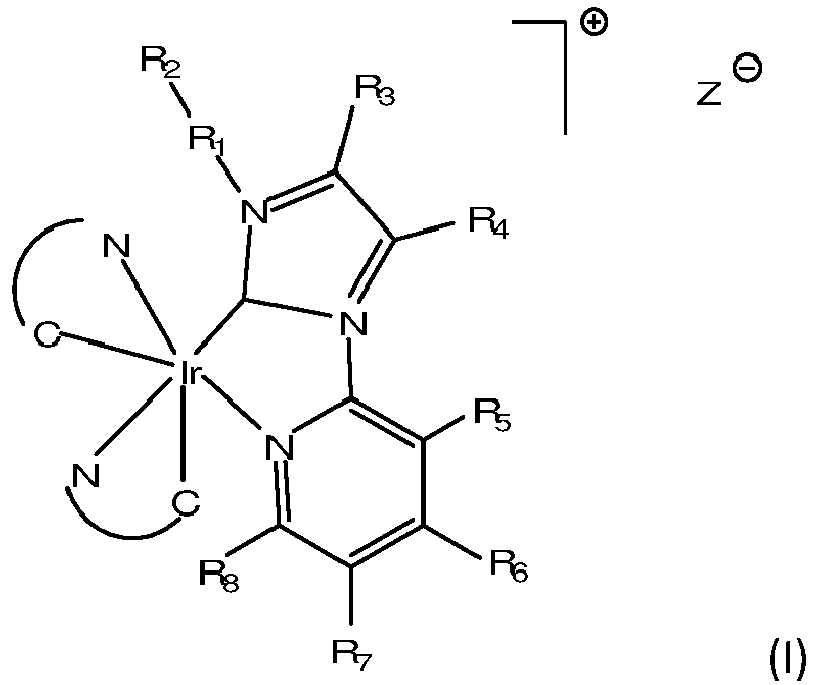 Z- represents a halide anion, a nitrate anion (-NO3 -) or a non-coordinating anion,-R1- represents a covalent link or a spacer segment,the radical R2 represents a targeting entity or ferrocene,the radicals R3 and R4, identical or different, represent a hydrogen atom, a halogen atom, an alkyl group optionally substituted, an aryl group optionally substituted, an alkylaryl group optionally substituted, an arylalkyl group optionally substituted, an ether group (-OR), an amine group (-NRR'), a borane group (-BRR'), a thioether group (-SR), and a phosphine group (-PRR');the radicals R5, R6, R7 and R8, identical or different, represent a hydrogen atom, a halogen atom, a hydroxyl group or an ether group (-OR), a cyano group (-CN), a nitro group (-NO2), a carboxylic group or a carboxylic acid ester group (-C(=O)OR), an alkyl group optionally substituted, an aryl group optionally substituted, an alkylaryl group optionally substituted, an arylalkyl group optionally substituted, an aldehyde group or a ketone group (-C(=O)R), an amine group (-NRR'), a cyanate group (-OC≡N), an isocyanate group (-N=C=O), a carboxamide group (-C(=O)NRR'), a boronic acid group (-B(OR)2), a sulfhydryl group or a thioether group (-SR), an iminothiol group (-C(NR)SR') and a trimethylsilylacetylene group (-CCSiMe3);the ligands
 (X1, X2) represents either (N, CΘ) or (CΘ, N),the radicals R9 to R24, identical or different, represent a hydrogen atom, a halogen atom, a cyano group (-CN), a nitro group (-NO2), a carboxylic group or a carboxylic acid ester group (-COOR), an alkyl group optionally substituted, an aryl group optionally substituted, an alkylaryl group optionally substituted or an arylalkyl group optionally substituted;the radicals R9 and R10, the radicals R10 and R11, the radicals R11 and R12, the radicals R12 and R13, the radicals R13 and R14, the radicals R14 and R15, the radicals R15 and R16, the radicals R17 and R18, the radicals R18 and R19, the radicals R19 and R20, the radicals R21 and R22, the radicals R22 and R23 and the radicals R23 and R24 may form with the carbons to which they are attached a conjugated system of delocalized electrons,R and R', identical or different, representing a hydrogen atom or an alkyl group optionally substituted.
 - The iridium(III) complex according to claim 1, wherein said non-coordinating anion is selected from the group consisting of tetrafluoroborate (BF4 -), hexafluorophosphate (PF6 -), benzenesulfonate (CH5SO3 -), bis(trifluoromethanesulfonyl)imide ((N[SO2(CF3)]2)-), methanesulfonate (mesylate, CH3SO3 -), perchlorate (ClO4 -), tetrachloroaluminate (AlCl4 -), tetrakis[3,5-bis(trifluoromethyl)phenyl]borate (B[3,5-(CF3)2C6H3]4 -), tetrakis (hexafluoroisopropyl)aluminate (Al[OC(CF3)3]4 -), tetrakis(pentafluorophenyl) borate (B[C6F5]4 -), p-toluene sulfonate (tosylate, CH3C6H4SO2 -) and trifluoromethanesulfonate (triflate, CF3SO3 -).
- The iridium(III) complex according to claim 1 or 2, wherein said spacer segment is selected from the group consisting of an alkylene chain optionally substituted, an alkenylene chain optionally substituted, an alkynylene chain optionally substituted and an arylene chain optionally substituted.
- The iridium(III) complex according to any one of claims 1 to 3, wherein said targeting entity is selected from the group consisting in PSMA (for "Prostate Specific Membrane Antigen") inhibitor such as any antibody specifically binding PSMA or the molecule Lys-urea-Glu; the cyclic tripeptide Arg-Gly-Asp (RGD); Herceptin; Trastuzumab; antibody specifically binding to the nectin 4 antigen; biotin and FTS (for "Farnesyl Thiosalicylic Acid").
- The iridium(III) complex according to any one of claims 1 to 4, wherein said radicals R3 and R4 are any one of the combinations defined in the below Table 1 with R, R', R", R‴ and Rʺʺ, identical or different, representing a hydrogen atom or an alkyl group optionally substituted.
Table 1 Combination R3 R4 1 H H 2 Me Me 3 CRR'R" H, SR"', NR‴ Rʺʺ, OR"' 4 OR H, OR' 5 NR'R" H, N R‴ R"" 6 SR H, SR' 7 PRR' H, PRʺR‴ 8 F H 9 BRR' H 10 H, SR"', NR‴Rʺʺ, OR"' CRR'R" 11 H, OR', OR 12 H, NR‴Rʺʺ NR'R" 13 H, SR' SR 14 H, PRʺR‴ PRR' 15 H F 16 H BRR' - The iridium(III) complex according to any one of claims 1 to 5, wherein said radicals R5, R6, R7, and R8 are any one of the combinations defined in the below Table 2 with R and R', identical or different, representing a hydrogen atom or an alkyl group optionally substituted.
Table 2 Combination R5 R6 R7 R8 20 H H H H 21 H H H Me, CN, OMe, CF3, C(O)R, CH2OH, CHF2, NHR, pyridine, COOR, NR2, F, B(OR)2 22 H H Me, CN, OMe, CF3, C(O)R, CH2OR, CHF2, NHR, pyridine, COOR, NR2, F, CH2NHR, B(OR)2, CH2CN, NCO, NO2, H CCSiMe3, SMe, C(NR)SR' 23 H Me, Et, CN, OMe, CF3, C(O)R, CH2OR, CRF2, NHR, pyridine, COOR, NR2, F, CH2NHR, B(OR)2, CH2CN, NCO, NO2, CCSiMe3, SMe, C(NR)SR', C(O)NHR H H 24 Me, CN, OMe, CF3, C(O)R, CH2OR, CHF2, NHR, pyridine, COOR, NR2, F, CH2NHR, B(OR)2, CH2CN, NCO, NO2, CCSiMe3, SMe, C(NR)SR' H H H 25 Me, NH2, C(O)H H F H 26 NH2, NO2 H Me H 27 F, H COOR H 28 Me, CN H NO2 H 29 C(O)R H F, CF3, Ph H 30 H H NH2, COOR NH2 31 H H Me, F, COOR Me 32 H H C(O)H F 33 H H OMe, B(OR)2, COOR, C(O)R OMe 34 H H Me C(O)R 35 NH2 NH2, Me, CF3 H H 36 CF3 F, COOR H H 37 COOR NHR H H 38 CN B(OR)2 H H 39 F C(O)R H H 40 NO2 Me H H 41 NO2 H H OMe 42 COOR H H CF3 43 NHR H H CH2OR, COOR 44 H Me, COOR NHR H 45 H Me NO2 H - The iridium(III) complex according to any one of claims 1 to 6, wherein said iridium(III) complex is of any one of the following formulae (IV), (V), (VI) and (VII):


- The iridium(III) complex according to any one of claims 1 to 7, wherein said ligands C^N is selected from the group consisting of 2-phenylpyridine (ppy (a)), 2-p-tolylpyridine (4-Me-ppy (b)), methyl 4-(pyridin-2-yl)benzoate (4-COOMe-ppy (c)), methyl 3-(pyridin-2-yl)benzoate (3-COOMe-ppy (d)), methyl 6-phenylnicotinate (p-3-COOMe-ppy (e)), 6-phenylnicotinic acid (p-3-COOH-ppy (f)), 2-phenylquinoline (pq (g)), 1-phenylisoquinoline (piq (h)), 7,8-benzoquinoline (bzq (i)), 2-(2-pyridyl)benzothiophene (thpy (j)), 2-phenylbenzothiazole (pbt (k)), and 2-(2,4-difluorophenyl)pyridine (2,4-F-ppy (I)).
- The iridium(III) complex according to any one of claims 1 to 8, for use as a medicament.
- A pharmaceutical composition comprising, as active ingredient, an iridium(III) complex according to any one of claims 1 to 8 and a pharmaceutically acceptable vehicle.
- The iridium(III) complex according to any one of claims 1 to 8 or the pharmaceutical composition according to claim 10, for use in the treatment and/or prevention of cancer.
- The iridium(III) complex or the pharmaceutical composition, for use according to claim 11, wherein said cancer is selected from the group consisting of melanoma, colorectal cancer, colon cancer, Kaposi's sarcoma, glioblastoma, ovarian cancer, breast cancer, liver cancer, pancreatic cancer, lung cancer, bladder cancer, prostate cancer, or neuroendocrine tumors.
- The iridium(III) complex or the pharmaceutical composition, for use according to claim 11 or 12, wherein- the iridium(III) complex is of formula (IV) as defined in claim 8 in which the C^N ligands are either 2-phenylquinolines (pq (g)) or 2-phenylbenzothiazoles (pbt (k)) and the cancer to be treated and/or prevented is bladder cancer, or- the iridium(III) complex is of formula (V) as defined in claim 8 in which the C^N ligands are selected in the group consisting of 1-phenylisoquinolines (piq (h)), 2-(2-pyridyl)benzothiophenes (thpy (j)) and 2-phenylbenzothiazoles (pbt (k)) and the cancer to be treated and/or prevented is bladder cancer, or- the iridium(III) complex is of formula (VI) as defined in claim 8 in which the C^N ligands are either 1-phenylisoquinolines (piq (h)) or 2-phenylbenzothiazoles (pbt (k)) and the cancer to be treated and/or prevented is prostate cancer, or- the iridium(III) complex is of formula (VII) as defined in claim 8 in which the C^N ligands are either 1-phenylisoquinolines (piq (h)) or 2-(2-pyridyl)benzothiophenes (thpy (j)) and the cancer to be treated and/or prevented is bladder cancer or prostate cancer.
- The iridium(III) complex according to any one of claims 1 to 8 or the pharmaceutical composition according to claim 10, for use in diagnosis and, in particular, in photodynamic diagnosis.
Priority Applications (2)
| Application Number | Priority Date | Filing Date | Title |
|---|---|---|---|
| EP22306855.2A EP4385995A1 (en) | 2022-12-12 | 2022-12-12 | Vectorized nhc iridium(iii) complexes and use thereof in photodynamic therapy and/or diagnostic |
| PCT/EP2023/085167 WO2024126392A1 (en) | 2022-12-12 | 2023-12-11 | Vectorized nhc iridium(iii) complexes and use thereof in photodynamic therapy and/or diagnostic |
Applications Claiming Priority (1)
| Application Number | Priority Date | Filing Date | Title |
|---|---|---|---|
| EP22306855.2A EP4385995A1 (en) | 2022-12-12 | 2022-12-12 | Vectorized nhc iridium(iii) complexes and use thereof in photodynamic therapy and/or diagnostic |
Publications (1)
| Publication Number | Publication Date |
|---|---|
| EP4385995A1 true EP4385995A1 (en) | 2024-06-19 |
Family
ID=84785326
Family Applications (1)
| Application Number | Title | Priority Date | Filing Date |
|---|---|---|---|
| EP22306855.2A Pending EP4385995A1 (en) | 2022-12-12 | 2022-12-12 | Vectorized nhc iridium(iii) complexes and use thereof in photodynamic therapy and/or diagnostic |
Country Status (2)
| Country | Link |
|---|---|
| EP (1) | EP4385995A1 (en) |
| WO (1) | WO2024126392A1 (en) |
-
2022
- 2022-12-12 EP EP22306855.2A patent/EP4385995A1/en active Pending
-
2023
- 2023-12-11 WO PCT/EP2023/085167 patent/WO2024126392A1/en not_active Ceased
Non-Patent Citations (20)
Also Published As
| Publication number | Publication date |
|---|---|
| WO2024126392A1 (en) | 2024-06-20 |
Similar Documents
| Publication | Publication Date | Title |
|---|---|---|
| Sarkar et al. | Mixed-ligand cobalt (III) complexes of a naturally occurring coumarin and phenanthroline bases as mitochondria-targeted dual-purpose photochemotherapeutics | |
| Sankarganesh et al. | Gold (III) complex from pyrimidine and morpholine analogue Schiff base ligand: synthesis, characterization, DFT, TDDFT, catalytic, anticancer, molecular modeling with DNA and BSA and DNA binding studies | |
| Chatzisideri et al. | Synthesis and biological evaluation of a Platinum (II)-c (RGDyK) conjugate for integrin-targeted photodynamic therapy | |
| EP2431366B1 (en) | New chlorin e6-folic acid conjugated compound, preparation method thereof, and pharmaceutical composition containing the same for treatment of cancer | |
| Mitra et al. | Biotinylated platinum (II) ferrocenylterpyridine complexes for targeted photoinduced cytotoxicity | |
| Malik et al. | Probing the antibacterial and anticancer potential of tryptamine based mixed ligand Schiff base Ruthenium (III) complexes | |
| Sarkar et al. | Significant photocytotoxic effect of an iron (iii) complex of a Schiff base ligand derived from vitamin B 6 and thiosemicarbazide in visible light | |
| Basu et al. | Carbohydrate-appended tumor targeting iron (III) complexes showing photocytotoxicity in red light | |
| Wu et al. | Metalloporphyrin–indomethacin conjugates as new photosensitizers for photodynamic therapy | |
| Chand et al. | 2D Extended supramolecular structures via π–π interactions of 1D coordination polymers of cadmium (II) complexes of arylazoimidazole using azido and thiocyanato bridging ligands | |
| JP2015155442A (en) | Compounds and biological materials and uses thereof | |
| Göksel et al. | Amino-functionalized water-soluble zinc phthalocyanines: Synthesis, photophysical, photochemical and protein binding properties | |
| Polevaya et al. | Linear conjuncted porphyrin trimer synthesis via" click" reaction | |
| Zobi et al. | Reactivity of 17 e− complex [ReIIBr4 (CO) 2] 2− with bridging aromatic ligands. Characterization and CO-releasing properties | |
| Das et al. | Exploring the phototoxicity of GSH-resistant 2-(5, 6-dichloro-1 H-benzo [d] imidazol-2-yl) quinoline-based Ir (III)-PTA complexes in MDA-MB-231 cancer cells | |
| Munoz-Patino et al. | Synthesis, structure, and biological activity of bis (benzimidazole) amino thio-and selenoether nickel complexes | |
| Li et al. | White light increases anticancer effectiveness of iridium (III) complexes toward lung cancer A549 cells | |
| Sahu et al. | Unexpected structural preference with metallophilic Ag–Au contacts in silver (i)-N-heterocyclic carbene cluster; experimental and theoretical approach | |
| Kar et al. | Photostimulated Anticancer Activity of Mitochondria Localized Rhenium (I) Tricarbonyl Complexes Bearing 1H‐imidazo [4, 5‐f][1, 10] phenanthroline Ligands Against MDA‐MB‐231 Cancer Cells | |
| EP4385995A1 (en) | Vectorized nhc iridium(iii) complexes and use thereof in photodynamic therapy and/or diagnostic | |
| US20220296711A1 (en) | Ruthenium (II) Complexes and Conjugates Thereof for Use as Photosensitizer Agent in Photodynamic Therapy | |
| WO2011158176A2 (en) | Gold complexes | |
| US6482949B1 (en) | Colormetric sensor compositions and methods | |
| Bhardwaj et al. | Design and synthesis of novel heterocyclic pivalamide ligands and their copper (II) complexes: Structure, BSA/DNA interactions and SOD synzyme activity | |
| Richter et al. | Platinum (ii/iv) complexes with N-substituted carboxylate ethylenediamine/propylenediamine ligands: preparation, characterization and in vitro activity |
Legal Events
| Date | Code | Title | Description |
|---|---|---|---|
| PUAI | Public reference made under article 153(3) epc to a published international application that has entered the european phase |
Free format text: ORIGINAL CODE: 0009012 |
|
| STAA | Information on the status of an ep patent application or granted ep patent |
Free format text: STATUS: THE APPLICATION HAS BEEN PUBLISHED |
|
| AK | Designated contracting states |
Kind code of ref document: A1 Designated state(s): AL AT BE BG CH CY CZ DE DK EE ES FI FR GB GR HR HU IE IS IT LI LT LU LV MC ME MK MT NL NO PL PT RO RS SE SI SK SM TR |
|
| STAA | Information on the status of an ep patent application or granted ep patent |
Free format text: STATUS: REQUEST FOR EXAMINATION WAS MADE |
|
| 17P | Request for examination filed |
Effective date: 20241213 |
|
| STAA | Information on the status of an ep patent application or granted ep patent |
Free format text: STATUS: EXAMINATION IS IN PROGRESS |
|
| 17Q | First examination report despatched |
Effective date: 20250124 |