EP4385587A1 - Shock absorber device applied to rackets for padel, beach tennis and similar sports - Google Patents
Shock absorber device applied to rackets for padel, beach tennis and similar sports Download PDFInfo
- Publication number
- EP4385587A1 EP4385587A1 EP21786522.9A EP21786522A EP4385587A1 EP 4385587 A1 EP4385587 A1 EP 4385587A1 EP 21786522 A EP21786522 A EP 21786522A EP 4385587 A1 EP4385587 A1 EP 4385587A1
- Authority
- EP
- European Patent Office
- Prior art keywords
- padel
- racket
- rackets
- section
- shock absorber
- Prior art date
- Legal status (The legal status is an assumption and is not a legal conclusion. Google has not performed a legal analysis and makes no representation as to the accuracy of the status listed.)
- Pending
Links
Images

Classifications
-
- A—HUMAN NECESSITIES
- A63—SPORTS; GAMES; AMUSEMENTS
- A63B—APPARATUS FOR PHYSICAL TRAINING, GYMNASTICS, SWIMMING, CLIMBING, OR FENCING; BALL GAMES; TRAINING EQUIPMENT
- A63B59/00—Bats, rackets, or the like, not covered by groups A63B49/00 - A63B57/00
- A63B59/40—Rackets or the like with flat striking surfaces for hitting a ball in the air, e.g. for table tennis
- A63B59/48—Rackets or the like with flat striking surfaces for hitting a ball in the air, e.g. for table tennis with perforated surfaces
-
- A—HUMAN NECESSITIES
- A63—SPORTS; GAMES; AMUSEMENTS
- A63B—APPARATUS FOR PHYSICAL TRAINING, GYMNASTICS, SWIMMING, CLIMBING, OR FENCING; BALL GAMES; TRAINING EQUIPMENT
- A63B60/00—Details or accessories of golf clubs, bats, rackets or the like
- A63B60/54—Details or accessories of golf clubs, bats, rackets or the like with means for damping vibrations
-
- A—HUMAN NECESSITIES
- A63—SPORTS; GAMES; AMUSEMENTS
- A63B—APPARATUS FOR PHYSICAL TRAINING, GYMNASTICS, SWIMMING, CLIMBING, OR FENCING; BALL GAMES; TRAINING EQUIPMENT
- A63B2102/00—Application of clubs, bats, rackets or the like to the sporting activity ; particular sports involving the use of balls and clubs, bats, rackets, or the like
- A63B2102/08—Paddle tennis, padel tennis or platform tennis
-
- A—HUMAN NECESSITIES
- A63—SPORTS; GAMES; AMUSEMENTS
- A63B—APPARATUS FOR PHYSICAL TRAINING, GYMNASTICS, SWIMMING, CLIMBING, OR FENCING; BALL GAMES; TRAINING EQUIPMENT
- A63B2209/00—Characteristics of used materials
Definitions
- the present invention discloses a shock absorber device applied to rackets for padel, beach tennis and similar sports which employ a racket, enabling the vibrations produced by the impacts of the racket against the ball to be reduced, while also assisting with the balance of the racket.
- Sports rackets sometimes simply termed “rackets” or “bats”, are designed for use in several different sports, in the form of bats designed specifically for padel or table tennis or rackets designed specifically for tennis, badminton, squash and racketball.
- Sports rackets typically include a body element and a handle element which is connected to and/or extends from the body.
- the body element normally includes a head and neck, with the neck extending between the head and handle and connecting them.
- anti-vibrators In bats employed for sports like padel and beach tennis, to prevent injury, devices known as anti-vibrators are used, which are small accessories manufactured in resin in the form of a cylinder. These cylinders have a precise circumference in order to fit within the holes of a padel racket, with the main benefit being that vibrations are reduced to the minimum possible at the moment of impact, enabling both the sensation and performance while playing to be improved. They also furnish greater stability, because reducing the vibrations yields a more stable stroke. The racket is perceived as more rigid, with more weight and greater stability. When striking the ball, the bat structure stops vibrating, thus enhancing comfort and control. Anti-vibrator devices avoid elbow conditions, as one of their most important benefits and one of the principal reasons for which players use them. The vibrations generated when striking the ball can advance up to the elbow joint. Over time, this creates problems and joint pains. Anti-vibrators halt the advance of this vibration, making them a fundamental accessory for players suffering from elbow problems.
- a second reinforced medium is employed to cover the portion bounding the other end of the bridge medium and casing, as well as the surface adjacent to the bridge medium and casing. Therefore, the shockwave generated in the head is absorbed and dampened effectively by the absorber part. Nevertheless, in addition to being complex, these structures cannot be adapted in general to the rackets existing today, as the design is applicable only to a particular structure.
- the devices to reduce vibration known in the prior art are introduced into orifices situated in the striking face and are not very practical for players. In one of these, a large part of the material remains outside the hole and above the impact surface. This is highly disadvantageous as it hampers the rebound of the ball severely, making it irregular when it strikes around the anti-vibrator. There also exists another type which remains hidden inside the hole, but once introduced it is complicated to remove it. making it impossible to change its position or remove it definitively.
- the present invention solves the problem existing satisfactorily, as the device of the invention does not affect the rebound of the ball and it can be removed and inserted into the different holes of the bats as often as is desired, enabling the centre of gravity of the bat to be modified and reducing vibrations, while the device of the invention is of such a weight as to change the balance of the racket, depending on the zone where it is deployed. If the device is fitted in the upper holes of the racket, this will give it a very high balance, increasing the power of the stroke. If it is fitted in the lower holes, the balance is directed towards the wrist, enhancing control and manoeuvrability.
- Another advantage offered by this device is that if it is fitted to the lateral holes of the bat, it improves the torsion. During play, it is common for the ball to be struck by the outer part of the bat. Anti-vibrators, as columns which unite the two faces, enhance the torsion of impacts outside the central area at such moments.
- the present invention refers to the creation of certain devices in the form of inserts for rackets, padel bats or for any other sport in which a bat with a number of holes is used, and with the main characteristic that the inserts are fitted into the holes of the bat itself. In this way, the vibrations of play itself are successfully absorbed, while the "sweet spot" of the bat is improved, and it is possible to vary the balance of the bat and improve its torsion when it receives impacts.
- the device described in the invention is an insert of variable dimensions, which will be fitted into the hole in the bat below the striking face. The latter is usually made of carbon fibre or glass fibre, and the insert will be fitted below it.
- the device (1) of the invention can be fitted into the holes (4) of a racket (10) for padel or similar sports, to avert vibrations in the hand due to the a ball striking the padel racket (10), in which the cited device (1) presents a geometry with an initial cylindrical section topped by a conical section which is hollow, manufactured of a flexible material, where the transversal surface of smaller diameter (2) of the cylindrical section shall be the same as or similar to the surface diameter of the holes (4) of the padel racket (10) where it is to be fitted.
- the transversal section of larger diameter (3) o the conical section will lie just below the striking surface of the padel racket (10), and this diameter (3) greater than that of the hole (4) will prevent the device (1) from being expelled by successive impacts against the ball.
- the device (1) also has at least one orifice (5) bored in the longitudinal section of the cylindrical section, whose function is to facilitate the extraction of the device (1) using a utensil in the form of or similar to a hook, so that, by introducing the end of the utensil into the hollow part of the device (1), this end of the utensil will match the orifice (5), and will dislodge the device (1) inserted into the hole (4) of the padel racket (10) simply and without much effort with an outward movement.
- the device (1) can have a longitudinal section which lets it occupy the entire interior of the hole (4), from one end to the other.
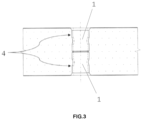
- devices (1) can be manufactured whose longitudinal section is half of the internal length of each hole (4), so that they are housed in the hole (4) in pairs, where each device (1) matches the hole at both ends, thus facilitating their extraction by taking out one from each side of the hole (4). (See figure 3 .)
- the device (1) can be manufactured in different sizes, colours and materials, to match the racket sport which requires it.
- the device (1) is manufactured in rubber or injectable resin, or any flexible material.
- Padel rackets (10) made from rigid materials such as carbon generally give rise to a structure that is much more stable and has fewer vibrations than rackets manufactured from other materials. If the device (1) of the invention is added to these, a vibration-free racket will be obtained.
- the resin of the device (1) is very important for the level of vibrations. The softer the resin of the device (1) is, the greater will be the absorption of vibrations because of damping.
- Fitting these devices is simple and rapid.
- the devices (1) are fitted by introducing them into the holes (4) the user prefers, and pressing gently upon the zone of greater diameter for it to lodge completely hidden below the surface.
- the position and distance at which the inserts (1) are fitted is very important, because the place will depend on the needs of the user.
- the devices (1) situated in the upper holes (4) of the padel racket (10) will furnish it with better balance and enhance the power of the strokes. If inserted into the lower holes (4), the balance will be redirected towards the wrist, enhancing the control and manoeuvrability.
Landscapes
- Health & Medical Sciences (AREA)
- General Health & Medical Sciences (AREA)
- Physical Education & Sports Medicine (AREA)
- Vibration Dampers (AREA)
- Vibration Prevention Devices (AREA)
Abstract
Description
- The present invention discloses a shock absorber device applied to rackets for padel, beach tennis and similar sports which employ a racket, enabling the vibrations produced by the impacts of the racket against the ball to be reduced, while also assisting with the balance of the racket.
- Sports rackets, sometimes simply termed "rackets" or "bats", are designed for use in several different sports, in the form of bats designed specifically for padel or table tennis or rackets designed specifically for tennis, badminton, squash and racketball.
- Sports rackets typically include a body element and a handle element which is connected to and/or extends from the body. The body element normally includes a head and neck, with the neck extending between the head and handle and connecting them. When designing these sports rackets, it is desired to furnish certain characteristics and features which enhance sensation, power and control (speed, direction, turn) for the user.
- In bats employed for sports like padel and beach tennis, to prevent injury, devices known as anti-vibrators are used, which are small accessories manufactured in resin in the form of a cylinder. These cylinders have a precise circumference in order to fit within the holes of a padel racket, with the main benefit being that vibrations are reduced to the minimum possible at the moment of impact, enabling both the sensation and performance while playing to be improved. They also furnish greater stability, because reducing the vibrations yields a more stable stroke. The racket is perceived as more rigid, with more weight and greater stability. When striking the ball, the bat structure stops vibrating, thus enhancing comfort and control. Anti-vibrator devices avoid elbow conditions, as one of their most important benefits and one of the principal reasons for which players use them. The vibrations generated when striking the ball can advance up to the elbow joint. Over time, this creates problems and joint pains. Anti-vibrators halt the advance of this vibration, making them a fundamental accessory for players suffering from elbow problems.
- There exist means in the prior art which also enable impacts to be reduced in racket sports, as can be seen in the invention patent
EP0550121 which shows a racket frame of plastic material reinforced with fibres which strongly dampen impacts, whose casing is made of laminae of fabric pre-impregnated with epoxy resin and fibre composite laid out with a certain orientation. The casing of the head, shaft and grip of the racket is provided with at least one impact absorber, where the portion is fitted inside a tubular bridge medium in such a way that it is attached securely. A first reinforced medium is used to cover the edge of one end of the bridge medium and casing, as well as the surface adjacent to the bridge medium and casing. A second reinforced medium is employed to cover the portion bounding the other end of the bridge medium and casing, as well as the surface adjacent to the bridge medium and casing. Therefore, the shockwave generated in the head is absorbed and dampened effectively by the absorber part. Nevertheless, in addition to being complex, these structures cannot be adapted in general to the rackets existing today, as the design is applicable only to a particular structure. - The devices to reduce vibration known in the prior art are introduced into orifices situated in the striking face and are not very practical for players. In one of these, a large part of the material remains outside the hole and above the impact surface. This is highly disadvantageous as it hampers the rebound of the ball severely, making it irregular when it strikes around the anti-vibrator. There also exists another type which remains hidden inside the hole, but once introduced it is complicated to remove it. making it impossible to change its position or remove it definitively.
- The present invention solves the problem existing satisfactorily, as the device of the invention does not affect the rebound of the ball and it can be removed and inserted into the different holes of the bats as often as is desired, enabling the centre of gravity of the bat to be modified and reducing vibrations, while the device of the invention is of such a weight as to change the balance of the racket, depending on the zone where it is deployed. If the device is fitted in the upper holes of the racket, this will give it a very high balance, increasing the power of the stroke. If it is fitted in the lower holes, the balance is directed towards the wrist, enhancing control and manoeuvrability.
- Another advantage offered by this device is that if it is fitted to the lateral holes of the bat, it improves the torsion. During play, it is common for the ball to be struck by the outer part of the bat. Anti-vibrators, as columns which unite the two faces, enhance the torsion of impacts outside the central area at such moments.
- The present invention refers to the creation of certain devices in the form of inserts for rackets, padel bats or for any other sport in which a bat with a number of holes is used, and with the main characteristic that the inserts are fitted into the holes of the bat itself. In this way, the vibrations of play itself are successfully absorbed, while the "sweet spot" of the bat is improved, and it is possible to vary the balance of the bat and improve its torsion when it receives impacts. The device described in the invention is an insert of variable dimensions, which will be fitted into the hole in the bat below the striking face. The latter is usually made of carbon fibre or glass fibre, and the insert will be fitted below it.
- To complement the description which is being given and to assist with understanding the characteristics of the invention, in accordance with a preferred embodiment for the same, a set of drawings for the purposes of illustration but without limitation is attached as an integral part of the present description, and representing the following:
-
Figure 1 .- This shows a frontal view of a padel racket or bat (10) with a number of holes, where the section A-A denotes a particular hole (4). -
Figure 2 .- This shows a view of the device (1) of the invention, identifying the smaller diameter (2), the larger diameter (3) and the orifice (4) bored in the longitudinal section of the device (1). -
Figure 3 .- This shows an internal view of one of the devices (1) introduced into the longitudinal section of one of the holes (4) of a padel racket (10). - The device (1) of the invention can be fitted into the holes (4) of a racket (10) for padel or similar sports, to avert vibrations in the hand due to the a ball striking the padel racket (10), in which the cited device (1) presents a geometry with an initial cylindrical section topped by a conical section which is hollow, manufactured of a flexible material, where the transversal surface of smaller diameter (2) of the cylindrical section shall be the same as or similar to the surface diameter of the holes (4) of the padel racket (10) where it is to be fitted. The transversal section of larger diameter (3) o the conical section will lie just below the striking surface of the padel racket (10), and this diameter (3) greater than that of the hole (4) will prevent the device (1) from being expelled by successive impacts against the ball. The device (1) also has at least one orifice (5) bored in the longitudinal section of the cylindrical section, whose function is to facilitate the extraction of the device (1) using a utensil in the form of or similar to a hook, so that, by introducing the end of the utensil into the hollow part of the device (1), this end of the utensil will match the orifice (5), and will dislodge the device (1) inserted into the hole (4) of the padel racket (10) simply and without much effort with an outward movement.
- The device (1) can have a longitudinal section which lets it occupy the entire interior of the hole (4), from one end to the other. However, to facilitate fitting and removal, devices (1) can be manufactured whose longitudinal section is half of the internal length of each hole (4), so that they are housed in the hole (4) in pairs, where each device (1) matches the hole at both ends, thus facilitating their extraction by taking out one from each side of the hole (4). (See
figure 3 .) - The device (1) can be manufactured in different sizes, colours and materials, to match the racket sport which requires it. The device (1) is manufactured in rubber or injectable resin, or any flexible material.
- Padel rackets (10) made from rigid materials such as carbon generally give rise to a structure that is much more stable and has fewer vibrations than rackets manufactured from other materials. If the device (1) of the invention is added to these, a vibration-free racket will be obtained. The resin of the device (1) is very important for the level of vibrations. The softer the resin of the device (1) is, the greater will be the absorption of vibrations because of damping.
- Fitting these devices is simple and rapid. The devices (1) are fitted by introducing them into the holes (4) the user prefers, and pressing gently upon the zone of greater diameter for it to lodge completely hidden below the surface. The position and distance at which the inserts (1) are fitted is very important, because the place will depend on the needs of the user.
- The devices (1) situated in the upper holes (4) of the padel racket (10) will furnish it with better balance and enhance the power of the strokes. If inserted into the lower holes (4), the balance will be redirected towards the wrist, enhancing the control and manoeuvrability.
Claims (5)
- Shock absorber device applied to rackets for padel, beach tennis and similar sports, in such a way that the cited device (1) can be inserted into the holes of a padel racket (10), and which is characterised by the fact that the device (1) presents a geometry with an initial cylindrical section topped by a conical section which is hollow, where the transversal surface of smaller diameter (2) of the cylindrical section is equal or similar to the surface diameter of the holes (4) of the padel racket (10) in which it is to be housed and the transversal section of greater diameter (3) of the conical section shall remain just below the impact surface of the padel racket (10) and in which the cited device (1) has at least one orifice (5) bored in the longitudinal section of the cylindrical section, whose function is to facilitate the extraction of that device (1).
- Shock absorber device applied to rackets for padel, beach tennis and similar sports according to claim 1, which is characterised by the fact that the device (1) has a longitudinal section which will let it occupy the entire internal length of the hole (4) of the padel racket (10).
- Shock absorber device applied to rackets for padel, beach tennis and similar sports according to claim 1, which is characterised by the fact that the device (1) has a longitudinal section which will let it occupy half of the internal length of the hole (4) of the padel racket (10).
- Shock absorber device applied to rackets for padel, beach tennis and similar sports according to claim 1, which is characterised by the fact that the device (1) is manufactured of rubber.
- Shock absorber device applied to rackets for padel, beach tennis and similar sports according to claim 1, which is characterised by the fact that the device (1) is manufactured of resin.
Applications Claiming Priority (1)
| Application Number | Priority Date | Filing Date | Title |
|---|---|---|---|
| PCT/ES2021/070592 WO2023017192A1 (en) | 2021-08-10 | 2021-08-10 | Shock absorber device applied to rackets for padel, beach tennis and similar sports |
Publications (1)
| Publication Number | Publication Date |
|---|---|
| EP4385587A1 true EP4385587A1 (en) | 2024-06-19 |
Family
ID=78078277
Family Applications (1)
| Application Number | Title | Priority Date | Filing Date |
|---|---|---|---|
| EP21786522.9A Pending EP4385587A1 (en) | 2021-08-10 | 2021-08-10 | Shock absorber device applied to rackets for padel, beach tennis and similar sports |
Country Status (2)
| Country | Link |
|---|---|
| EP (1) | EP4385587A1 (en) |
| WO (1) | WO2023017192A1 (en) |
Citations (2)
| Publication number | Priority date | Publication date | Assignee | Title |
|---|---|---|---|---|
| US7530910B1 (en) * | 2007-06-14 | 2009-05-12 | Gene Niksich | Vibration dampening device for a strung sports racquet |
| ES2577577A1 (en) * | 2015-01-15 | 2016-07-15 | Ángel David CALAMARDO CARRIÓN | External vibration damper for paddle (Machine-translation by Google Translate, not legally binding) |
Family Cites Families (3)
| Publication number | Priority date | Publication date | Assignee | Title |
|---|---|---|---|---|
| EP0550121B1 (en) | 1992-01-08 | 1995-12-20 | Chin-San You | Racket frame |
| ES1063187Y (en) * | 2006-06-14 | 2007-01-01 | Alvarado Gabriel Gavina | PADDLE SHOVEL WITH EXTERNAL KICKING PANEL OR FIXED OR REPLACABLE IMPACT |
| ES1262074Y (en) * | 2020-08-14 | 2021-05-28 | Novo Alvaro Garcia | Dampener and balance modifier for blades |
-
2021
- 2021-08-10 WO PCT/ES2021/070592 patent/WO2023017192A1/en not_active Ceased
- 2021-08-10 EP EP21786522.9A patent/EP4385587A1/en active Pending
Patent Citations (2)
| Publication number | Priority date | Publication date | Assignee | Title |
|---|---|---|---|---|
| US7530910B1 (en) * | 2007-06-14 | 2009-05-12 | Gene Niksich | Vibration dampening device for a strung sports racquet |
| ES2577577A1 (en) * | 2015-01-15 | 2016-07-15 | Ángel David CALAMARDO CARRIÓN | External vibration damper for paddle (Machine-translation by Google Translate, not legally binding) |
Non-Patent Citations (1)
| Title |
|---|
| See also references of WO2023017192A1 * |
Also Published As
| Publication number | Publication date |
|---|---|
| WO2023017192A1 (en) | 2023-02-16 |
Similar Documents
| Publication | Publication Date | Title |
|---|---|---|
| US5294119A (en) | Vibration-damping device for a golf club | |
| US5692971A (en) | Shock absorbing insert and other sporting goods improvements | |
| US5865694A (en) | Tennis racket with vibration damping and torsional elasticity | |
| CN101646531B (en) | Changeable golf grip | |
| KR101408484B1 (en) | Variable Mass Grip | |
| EP0747098B1 (en) | Golf club having vibration damping device and method for making same | |
| US5203561A (en) | Vibration dampening handle having metal particles and a viscus fluid | |
| US7044871B2 (en) | Tubular baseball bats with full length core shafts | |
| US5842933A (en) | Implement grip with built-in shock absorber | |
| US5165686A (en) | Wooden baseball bat | |
| US20020198071A1 (en) | Ball bat | |
| US20150273295A1 (en) | Bat With Performance Governing Barrel And Vibration Dampening Connection | |
| US20040029660A1 (en) | Laminated sport bat with internal chamber | |
| US5718643A (en) | Vibration dampening insert for golf clubs | |
| US5076583A (en) | Racket frame with circular cross section and variable thickness | |
| US6354958B1 (en) | Vibration damper for a golf club | |
| US20150157909A1 (en) | Vibration damper end knob for baseball and softball bats | |
| US5728008A (en) | Ball striking device with means of imparting enhanced forward momentum to the ball | |
| US6565463B2 (en) | Shock-absorbing racket body | |
| US20080274842A1 (en) | Sports racket | |
| EP4385587A1 (en) | Shock absorber device applied to rackets for padel, beach tennis and similar sports | |
| US20090124408A1 (en) | Vibration Reduction Grip for Golf Clubs | |
| US5788586A (en) | Golf club having vibration damping device and method for making same | |
| US6663515B1 (en) | Racket with a head and a handle both made of different materials | |
| JP2853926B2 (en) | Impact vibration absorbing member and grip end of sports equipment, grip end of tool and grip end of motorcycle using the same |
Legal Events
| Date | Code | Title | Description |
|---|---|---|---|
| STAA | Information on the status of an ep patent application or granted ep patent |
Free format text: STATUS: UNKNOWN |
|
| STAA | Information on the status of an ep patent application or granted ep patent |
Free format text: STATUS: THE INTERNATIONAL PUBLICATION HAS BEEN MADE |
|
| PUAI | Public reference made under article 153(3) epc to a published international application that has entered the european phase |
Free format text: ORIGINAL CODE: 0009012 |
|
| STAA | Information on the status of an ep patent application or granted ep patent |
Free format text: STATUS: REQUEST FOR EXAMINATION WAS MADE |
|
| 17P | Request for examination filed |
Effective date: 20240202 |
|
| AK | Designated contracting states |
Kind code of ref document: A1 Designated state(s): AL AT BE BG CH CY CZ DE DK EE ES FI FR GB GR HR HU IE IS IT LI LT LU LV MC MK MT NL NO PL PT RO RS SE SI SK SM TR |
|
| DAV | Request for validation of the european patent (deleted) | ||
| DAX | Request for extension of the european patent (deleted) | ||
| STAA | Information on the status of an ep patent application or granted ep patent |
Free format text: STATUS: EXAMINATION IS IN PROGRESS |
|
| 17Q | First examination report despatched |
Effective date: 20250312 |