EP4385396A1 - Apparatus and method of providing service according to status of passenger in aircraft during autonomous flight - Google Patents
Apparatus and method of providing service according to status of passenger in aircraft during autonomous flight Download PDFInfo
- Publication number
- EP4385396A1 EP4385396A1 EP23197123.5A EP23197123A EP4385396A1 EP 4385396 A1 EP4385396 A1 EP 4385396A1 EP 23197123 A EP23197123 A EP 23197123A EP 4385396 A1 EP4385396 A1 EP 4385396A1
- Authority
- EP
- European Patent Office
- Prior art keywords
- passenger
- state
- aircraft
- captured image
- module
- Prior art date
- Legal status (The legal status is an assumption and is not a legal conclusion. Google has not performed a legal analysis and makes no representation as to the accuracy of the status listed.)
- Granted
Links
Images


Classifications
-
- G—PHYSICS
- G16—INFORMATION AND COMMUNICATION TECHNOLOGY [ICT] SPECIALLY ADAPTED FOR SPECIFIC APPLICATION FIELDS
- G16H—HEALTHCARE INFORMATICS, i.e. INFORMATION AND COMMUNICATION TECHNOLOGY [ICT] SPECIALLY ADAPTED FOR THE HANDLING OR PROCESSING OF MEDICAL OR HEALTHCARE DATA
- G16H50/00—ICT specially adapted for medical diagnosis, medical simulation or medical data mining; ICT specially adapted for detecting, monitoring or modelling epidemics or pandemics
- G16H50/30—ICT specially adapted for medical diagnosis, medical simulation or medical data mining; ICT specially adapted for detecting, monitoring or modelling epidemics or pandemics for calculating health indices; for individual health risk assessment
-
- A—HUMAN NECESSITIES
- A61—MEDICAL OR VETERINARY SCIENCE; HYGIENE
- A61B—DIAGNOSIS; SURGERY; IDENTIFICATION
- A61B5/00—Measuring for diagnostic purposes; Identification of persons
- A61B5/02—Detecting, measuring or recording for evaluating the cardiovascular system, e.g. pulse, heart rate, blood pressure or blood flow
- A61B5/0205—Simultaneously evaluating both cardiovascular conditions and different types of body conditions, e.g. heart and respiratory condition
-
- G—PHYSICS
- G06—COMPUTING OR CALCULATING; COUNTING
- G06Q—INFORMATION AND COMMUNICATION TECHNOLOGY [ICT] SPECIALLY ADAPTED FOR ADMINISTRATIVE, COMMERCIAL, FINANCIAL, MANAGERIAL OR SUPERVISORY PURPOSES; SYSTEMS OR METHODS SPECIALLY ADAPTED FOR ADMINISTRATIVE, COMMERCIAL, FINANCIAL, MANAGERIAL OR SUPERVISORY PURPOSES, NOT OTHERWISE PROVIDED FOR
- G06Q50/00—Information and communication technology [ICT] specially adapted for implementation of business processes of specific business sectors, e.g. utilities or tourism
- G06Q50/40—Business processes related to the transportation industry
-
- A—HUMAN NECESSITIES
- A61—MEDICAL OR VETERINARY SCIENCE; HYGIENE
- A61B—DIAGNOSIS; SURGERY; IDENTIFICATION
- A61B5/00—Measuring for diagnostic purposes; Identification of persons
- A61B5/0002—Remote monitoring of patients using telemetry, e.g. transmission of vital signals via a communication network
-
- A—HUMAN NECESSITIES
- A61—MEDICAL OR VETERINARY SCIENCE; HYGIENE
- A61B—DIAGNOSIS; SURGERY; IDENTIFICATION
- A61B5/00—Measuring for diagnostic purposes; Identification of persons
- A61B5/0002—Remote monitoring of patients using telemetry, e.g. transmission of vital signals via a communication network
- A61B5/0015—Remote monitoring of patients using telemetry, e.g. transmission of vital signals via a communication network characterised by features of the telemetry system
-
- A—HUMAN NECESSITIES
- A61—MEDICAL OR VETERINARY SCIENCE; HYGIENE
- A61B—DIAGNOSIS; SURGERY; IDENTIFICATION
- A61B5/00—Measuring for diagnostic purposes; Identification of persons
- A61B5/0059—Measuring for diagnostic purposes; Identification of persons using light, e.g. diagnosis by transillumination, diascopy, fluorescence
- A61B5/0077—Devices for viewing the surface of the body, e.g. camera, magnifying lens
-
- B—PERFORMING OPERATIONS; TRANSPORTING
- B64—AIRCRAFT; AVIATION; COSMONAUTICS
- B64C—AEROPLANES; HELICOPTERS
- B64C13/00—Control systems or transmitting systems for actuating flying-control surfaces, lift-increasing flaps, air brakes, or spoilers
- B64C13/02—Initiating means
- B64C13/16—Initiating means actuated automatically, e.g. responsive to gust detectors
- B64C13/18—Initiating means actuated automatically, e.g. responsive to gust detectors using automatic pilot
-
- B—PERFORMING OPERATIONS; TRANSPORTING
- B64—AIRCRAFT; AVIATION; COSMONAUTICS
- B64D—EQUIPMENT FOR FITTING IN OR TO AIRCRAFT; FLIGHT SUITS; PARACHUTES; ARRANGEMENT OR MOUNTING OF POWER PLANTS OR PROPULSION TRANSMISSIONS IN AIRCRAFT
- B64D45/00—Aircraft indicators or protectors not otherwise provided for
- B64D45/0015—Devices specially adapted for the protection against criminal attack, e.g. anti-hijacking systems
- B64D45/0051—Devices specially adapted for the protection against criminal attack, e.g. anti-hijacking systems by monitoring passengers or crew on aircraft
-
- G—PHYSICS
- G05—CONTROLLING; REGULATING
- G05D—SYSTEMS FOR CONTROLLING OR REGULATING NON-ELECTRIC VARIABLES
- G05D1/00—Control of position, course, altitude or attitude of land, water, air or space vehicles, e.g. using automatic pilots
- G05D1/04—Control of altitude or depth
- G05D1/06—Rate of change of altitude or depth
- G05D1/0607—Rate of change of altitude or depth specially adapted for aircraft
- G05D1/0653—Rate of change of altitude or depth specially adapted for aircraft during a phase of take-off or landing
- G05D1/0676—Rate of change of altitude or depth specially adapted for aircraft during a phase of take-off or landing specially adapted for landing
-
- G—PHYSICS
- G05—CONTROLLING; REGULATING
- G05D—SYSTEMS FOR CONTROLLING OR REGULATING NON-ELECTRIC VARIABLES
- G05D1/00—Control of position, course, altitude or attitude of land, water, air or space vehicles, e.g. using automatic pilots
- G05D1/10—Simultaneous control of position or course in three dimensions
- G05D1/101—Simultaneous control of position or course in three dimensions specially adapted for aircraft
-
- G—PHYSICS
- G05—CONTROLLING; REGULATING
- G05D—SYSTEMS FOR CONTROLLING OR REGULATING NON-ELECTRIC VARIABLES
- G05D1/00—Control of position, course, altitude or attitude of land, water, air or space vehicles, e.g. using automatic pilots
- G05D1/40—Control within particular dimensions
- G05D1/43—Control of position or course in two dimensions [2D]
- G05D1/437—Control of position or course in two dimensions [2D] for aircraft during their ground movement, e.g. taxiing
- G05D1/439—Control of position or course in two dimensions [2D] for aircraft during their ground movement, e.g. taxiing on the runway during take-off or landing
-
- G—PHYSICS
- G05—CONTROLLING; REGULATING
- G05D—SYSTEMS FOR CONTROLLING OR REGULATING NON-ELECTRIC VARIABLES
- G05D1/00—Control of position, course, altitude or attitude of land, water, air or space vehicles, e.g. using automatic pilots
- G05D1/60—Intended control result
- G05D1/654—Landing
- G05D1/6546—Emergency landing
-
- G—PHYSICS
- G06—COMPUTING OR CALCULATING; COUNTING
- G06Q—INFORMATION AND COMMUNICATION TECHNOLOGY [ICT] SPECIALLY ADAPTED FOR ADMINISTRATIVE, COMMERCIAL, FINANCIAL, MANAGERIAL OR SUPERVISORY PURPOSES; SYSTEMS OR METHODS SPECIALLY ADAPTED FOR ADMINISTRATIVE, COMMERCIAL, FINANCIAL, MANAGERIAL OR SUPERVISORY PURPOSES, NOT OTHERWISE PROVIDED FOR
- G06Q50/00—Information and communication technology [ICT] specially adapted for implementation of business processes of specific business sectors, e.g. utilities or tourism
- G06Q50/10—Services
-
- G—PHYSICS
- G06—COMPUTING OR CALCULATING; COUNTING
- G06Q—INFORMATION AND COMMUNICATION TECHNOLOGY [ICT] SPECIALLY ADAPTED FOR ADMINISTRATIVE, COMMERCIAL, FINANCIAL, MANAGERIAL OR SUPERVISORY PURPOSES; SYSTEMS OR METHODS SPECIALLY ADAPTED FOR ADMINISTRATIVE, COMMERCIAL, FINANCIAL, MANAGERIAL OR SUPERVISORY PURPOSES, NOT OTHERWISE PROVIDED FOR
- G06Q50/00—Information and communication technology [ICT] specially adapted for implementation of business processes of specific business sectors, e.g. utilities or tourism
- G06Q50/50—Business processes related to the communications industry
-
- G—PHYSICS
- G06—COMPUTING OR CALCULATING; COUNTING
- G06V—IMAGE OR VIDEO RECOGNITION OR UNDERSTANDING
- G06V10/00—Arrangements for image or video recognition or understanding
-
- G—PHYSICS
- G06—COMPUTING OR CALCULATING; COUNTING
- G06V—IMAGE OR VIDEO RECOGNITION OR UNDERSTANDING
- G06V10/00—Arrangements for image or video recognition or understanding
- G06V10/70—Arrangements for image or video recognition or understanding using pattern recognition or machine learning
- G06V10/764—Arrangements for image or video recognition or understanding using pattern recognition or machine learning using classification, e.g. of video objects
-
- G—PHYSICS
- G06—COMPUTING OR CALCULATING; COUNTING
- G06V—IMAGE OR VIDEO RECOGNITION OR UNDERSTANDING
- G06V20/00—Scenes; Scene-specific elements
- G06V20/50—Context or environment of the image
- G06V20/59—Context or environment of the image inside of a vehicle, e.g. relating to seat occupancy, driver state or inner lighting conditions
-
- G—PHYSICS
- G06—COMPUTING OR CALCULATING; COUNTING
- G06V—IMAGE OR VIDEO RECOGNITION OR UNDERSTANDING
- G06V40/00—Recognition of biometric, human-related or animal-related patterns in image or video data
- G06V40/10—Human or animal bodies, e.g. vehicle occupants or pedestrians; Body parts, e.g. hands
- G06V40/16—Human faces, e.g. facial parts, sketches or expressions
-
- G—PHYSICS
- G06—COMPUTING OR CALCULATING; COUNTING
- G06V—IMAGE OR VIDEO RECOGNITION OR UNDERSTANDING
- G06V40/00—Recognition of biometric, human-related or animal-related patterns in image or video data
- G06V40/10—Human or animal bodies, e.g. vehicle occupants or pedestrians; Body parts, e.g. hands
- G06V40/16—Human faces, e.g. facial parts, sketches or expressions
- G06V40/174—Facial expression recognition
-
- G—PHYSICS
- G06—COMPUTING OR CALCULATING; COUNTING
- G06V—IMAGE OR VIDEO RECOGNITION OR UNDERSTANDING
- G06V40/00—Recognition of biometric, human-related or animal-related patterns in image or video data
- G06V40/20—Movements or behaviour, e.g. gesture recognition
-
- G—PHYSICS
- G08—SIGNALLING
- G08G—TRAFFIC CONTROL SYSTEMS
- G08G5/00—Traffic control systems for aircraft
- G08G5/20—Arrangements for acquiring, generating, sharing or displaying traffic information
-
- G—PHYSICS
- G08—SIGNALLING
- G08G—TRAFFIC CONTROL SYSTEMS
- G08G5/00—Traffic control systems for aircraft
- G08G5/30—Flight plan management
-
- G—PHYSICS
- G16—INFORMATION AND COMMUNICATION TECHNOLOGY [ICT] SPECIALLY ADAPTED FOR SPECIFIC APPLICATION FIELDS
- G16H—HEALTHCARE INFORMATICS, i.e. INFORMATION AND COMMUNICATION TECHNOLOGY [ICT] SPECIALLY ADAPTED FOR THE HANDLING OR PROCESSING OF MEDICAL OR HEALTHCARE DATA
- G16H50/00—ICT specially adapted for medical diagnosis, medical simulation or medical data mining; ICT specially adapted for detecting, monitoring or modelling epidemics or pandemics
- G16H50/20—ICT specially adapted for medical diagnosis, medical simulation or medical data mining; ICT specially adapted for detecting, monitoring or modelling epidemics or pandemics for computer-aided diagnosis, e.g. based on medical expert systems
-
- H—ELECTRICITY
- H04—ELECTRIC COMMUNICATION TECHNIQUE
- H04H—BROADCAST COMMUNICATION
- H04H20/00—Arrangements for broadcast or for distribution combined with broadcast
- H04H20/53—Arrangements specially adapted for specific applications, e.g. for traffic information or for mobile receivers
- H04H20/59—Arrangements specially adapted for specific applications, e.g. for traffic information or for mobile receivers for emergency or urgency
-
- H—ELECTRICITY
- H04—ELECTRIC COMMUNICATION TECHNIQUE
- H04H—BROADCAST COMMUNICATION
- H04H20/00—Arrangements for broadcast or for distribution combined with broadcast
- H04H20/53—Arrangements specially adapted for specific applications, e.g. for traffic information or for mobile receivers
- H04H20/61—Arrangements specially adapted for specific applications, e.g. for traffic information or for mobile receivers for local area broadcast, e.g. instore broadcast
- H04H20/62—Arrangements specially adapted for specific applications, e.g. for traffic information or for mobile receivers for local area broadcast, e.g. instore broadcast for transportation systems, e.g. in vehicles
-
- G—PHYSICS
- G05—CONTROLLING; REGULATING
- G05D—SYSTEMS FOR CONTROLLING OR REGULATING NON-ELECTRIC VARIABLES
- G05D2101/00—Details of software or hardware architectures used for the control of position
- G05D2101/10—Details of software or hardware architectures used for the control of position using artificial intelligence [AI] techniques
-
- G—PHYSICS
- G05—CONTROLLING; REGULATING
- G05D—SYSTEMS FOR CONTROLLING OR REGULATING NON-ELECTRIC VARIABLES
- G05D2109/00—Types of controlled vehicles
- G05D2109/20—Aircraft, e.g. drones
Definitions
- the present disclosure relates to an apparatus and method of providing a service according to a state of a passenger in an aircraft during an autonomous flight.
- Exemplary embodiments provide an apparatus and method for providing a service according to a state of a passenger in an aircraft during an autonomous flight, capable of promptly providing a service for a passenger in a nervous or emergency state.
- a service providing apparatus of providing a service according to a state of a passenger in aircraft during autonomous flight includes: a processor; and a storage medium recording one or more programs configured to be executable by the processor, wherein the one or more programs include instructions for an input/output (I/O) module receiving biometric data and a captured image of a passenger in real time; a determination module determining a state of the passenger based on the biometric data and the captured image of a passenger; and a control module performing a preset process according to the state of the passenger, wherein the preset process includes: a first process for adjusting a flight path of the aircraft when the state of the passenger is an emergency state or a second process for relieving tension when the state of the passenger is a state of tension.
- I/O input/output
- a method of providing a service according to a state of a passenger in aircraft during autonomous flight includes: a first operation in which an input/output (I/O) module receives biometric data and a captured image of a passenger in real time; a second operation in which a determination module determines a state of the passenger based on the biometric data and the captured image of a passenger; and a third operation in which a control module performs a preset process according to the state of the passenger, wherein the preset process includes: a first process for adjusting a flight path of the aircraft when the state of the passenger is an emergency state or a second process for relieving tension when the state of the passenger is a state of tension.
- I/O input/output
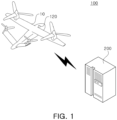
- FIG. 1 is a configuration diagram of an entire system including an aircraft and a control device according to an exemplary embodiment in the present disclosure.
- FIG. 2 is an internal block diagram of a service providing apparatus and a control device mounted on an aircraft according to an exemplary embodiment in the present disclosure.
- an overall system 100 may include an aircraft 10 and a control device 200, and the aircraft 10 may include a service providing apparatus 120 according to an exemplary embodiment in the present disclosure.
- the aforementioned service providing apparatus 120 may include an input/output (I/O) module 121, a determination module 122, a machine learning model 123, a control module 124, a driving module 125, a global positioning system (GPS) module 126, and a convenience device 127, a storage module 128, and a communication module 129, and the machine learning model 123 may include a first machine learning model 123a and a second machine learning model 123b.
- I/O input/output
- GPS global positioning system
- the service providing apparatus 120 may include a processor (e.g., computer, microprocessor, CPU, ASIC, circuitry, logic circuits, etc.) and an associated non-transitory memory storing software instructions which, when executed by the processor, provides the functionalities of the input/output (I/O) module 121, the determination module 122, the machine learning model 123, the control module 124, the driving module 125, the global positioning system (GPS) module 126, the convenience device 127, the storage module 128, and the communication module 129.
- the memory and the processor may be implemented as separate semiconductor circuits.
- the memory and the processor may be implemented as a single integrated semiconductor circuit.
- the processor may embody one or more processor (s) .
- the aircraft 10 may refer to a mobility vehicle that may move by flying in the sky. That is, aircraft may include vehicles capable of flying on the ground with wheels separated from the ground, while moving on the ground using wheels, in addition to referring to helicopters, drones, fixed-wing airplanes, etc.
- the aircraft 10 may include manned aircraft and unmanned aerial vehicles.
- a manned aircraft may include a body capable of operating autonomously in addition to a body controlled by a pilot.
- a crew may not board the aircraft 10.
- control device 200 may include a control module 210, a communication module 220, and a storage module 230.
- the control device 200 may include a processor (e.g., computer, microprocessor, CPU, ASIC, circuitry, logic circuits, etc.) and an associated non-transitory memory storing software instructions which, when executed by the processor, provides the functionalities of the control module 210 and the communication module 220.
- a processor e.g., computer, microprocessor, CPU, ASIC, circuitry, logic circuits, etc.
- the memory and the processor may be implemented as separate semiconductor circuits.
- the memory and the processor may be implemented as a single integrated semiconductor circuit.
- the processor may embody one or more processor (s) .
- the service providing apparatus 120 providing a service according to a state of a passenger in an aircraft during autonomous flight and the control device 200 according to an exemplary embodiment in the present disclosure will be described in detail with reference to FIGS. 1 and 2 .
- the I/O module 121 of the service providing apparatus 120 may receive biometric data and a captured image of a passenger in real time.
- the received biometric data and the captured image of a passenger may be transmitted to the determination module 122.
- the biometric data of the passenger may include at least one of a heart rate, a sweat output, a grip strength, a blood pressure, a body temperature, and a respiration rate of the passenger, and the biometric data may be measured through the sensor module 111.
- the sensor module 111 may include a heart rate sensor for measuring a heart rate, a sweat sensor for measuring sweat output, a pressure sensor for measuring grip strength, and a blood pressure sensor for measuring blood pressure, a body temperature sensor for measuring a body temperature, a respiration rate sensor for measuring a respiration rate, and the like may be included. This sensor module 111 may be a wearable device worn by passengers.
- the captured image is an image obtained by imaging the face and body parts (arms, legs, etc.) of the passenger sitting in the seat, and such captured image may be captured by the camera 112.
- the I/O module 121 may relieve passengers' tension by providing a video or music for tension.
- the I/O module 121 may include a touchscreen, a speaker device, a display device, a projector, headphones, and the like.
- the determination module 122 of the service providing apparatus 120 may determine a state of the passenger based on the biometric data and the captured image.
- the state of the passenger may be an emergency state or a state of tension.
- the determination module 122 may determine whether a state of the passenger is an emergency state based on a combination of classification result from the machine learning model 123 to which the captured image of a passenger is input and comparison result between at least one of a heart rate, a sweat output, a grip strength, a blood pressure, and a respiration rate of the passenger with each preset reference value.
- the aforementioned reference value may vary depending on the gender, age, etc. of the passenger, but is not limited to a specific value here.
- the machine learning model 123 described above may include a first machine learning model 123a for classifying a facial expression of the passenger in the captured image and a second machine learning model 123b for classifying a body posture of the passenger in the captured image.
- the machine learning model 123 described above may be a model using a convolution neural network (CNN) as a representative example, but it should be appreciated that the machine learning model 123 may be any device without being thereto, as long as the device is able to classify the facial expression or body posture of the passenger.
- CNN convolution neural network
- the first machine learning model 123a may classify the facial expression of the passenger as pain, fear, tension, disgust, stuffiness, discomfort, and others.
- the others may include facial expressions other than pain, fear, tension, disgust, stuffiness, and discomfort.
- the second machine learning model 123b may classify the body posture of the passenger as one of a posture with eyes closed, a posture with hands put on the head, a posture in which the face is lowered down forwardly and is not visible, and others.
- the others may be body postures other than the posture with eyes closed, the posture with hands put on the head, and the posture in which the face is lowered down forwardly and is not visible.
- the type and classification result of biometric data used when determining such an emergency state may be different for each disease.
- a symptom of an increase in heart rate may appear as biometric data
- the facial expression of a passenger during capturing an image may appear as an expression of pain, stuffiness, or discomfort.
- the passenger's body posture in the captured image may appear as a symptom, such as the posture with hands put on the head due to a headache or a drooping arm, and a facial expression in the captured image may appear as an expression of discomfort.
- whether the state of the passenger is an emergency state maybe be determined based on a combination of classification result from the machine learning model 123 to which the captured image of a passenger is input and comparison result between at least one of a heart rate, a sweat output, a grip strength, a blood pressure, and a respiration rate of the passenger with each preset reference value
- the determination module 122 may further estimate a disease based on the combination of classification result from the machine learning model 123 to which the captured image is input and comparison result between at least one of the heart rate, sweat output, grip strength, blood pressure, and respiration rate of the passenger with each preset reference value. However, when there are multiple estimated diseases, the determination module 122 may estimate a disease by considering a disease according to the underlying disease of the passenger or family history as a priority.
- the determination module 122 may determine whether the state of the passenger is a state of tension based on a classification result from the first machine learning model 123a to which the captured image of a passenger is input or the comparison result between at least one of the heart rate, sweat output, grip strength, blood pressure, and respiration rate of the passenger with each preset reference value.
- the determination module 122 may determine whether the passenger is in a state of tension.
- control module 124 of the service providing apparatus 120 may perform a preset process according to the state of the passenger.
- the preset process may include a first process for adjusting a flight path of the aircraft 10 when the passenger's state is an emergency state or a second process for relieving tension when the passenger's state is a state of tension.
- the control module 124 may control the communication module 129 to transmit an ID of the aircraft 10, a flight path of the aircraft 10, current location information of the aircraft 10, information of the passenger, biometric data of the passenger, and the captured image of the passenger to the control device 200 and to receive landing location information of a landing point of an adjacent hospital based on the current location information from the control device 200. Thereafter, the control module 124 may control the driving module 125 to land the aircraft 10 at the landing point by adjusting the flight path according to the received landing location information.
- control module 124 may control the communication module 129 to receive a first aid process from the control device 200 and control the I/O module 121 to broadcast information on the emergency state, the first aid process, and a location of medical supplies.
- control module 124 may control the driving module 125 to ascend or descend the altitude of the aircraft 10.
- control module 124 may control the I/O module 121 to provide music or images for relieving tension or control the convenience device 127 to induce a comfortable posture of the passenger.
- the driving module 125 of the service providing apparatus 120 may be a module for driving the aircraft 10 so that the aircraft 10 may fly along a preset path or may land under the control of the control module 124 and may be, for example, a driving motor, a propeller, and the like.
- the GPS module 126 of the service providing apparatus 120 is a module for receiving location information of the aircraft 10, and the received location information may be transmitted to the control module 124.
- the convenience device 127 of the service providing apparatus 120 may include various devices, such as a variable bolster which may decrease or increase the volume of a pillow supporting the head so that the passenger's head is in a comfortable posture, footrests which may be adjusted in angle so that the passenger's legs are comfortable.
- a variable bolster which may decrease or increase the volume of a pillow supporting the head so that the passenger's head is in a comfortable posture
- footrests which may be adjusted in angle so that the passenger's legs are comfortable.
- the storage module 128 of the service providing apparatus 120 may be a module for storing various programs for implementing functions performed by the control module 124 described above.
- the storage module 128 may store the ID of the aircraft 10, the flight path of the aircraft 10, the current location information of the aircraft 10, the information of the passenger, the biometric data of the passenger, the captured image of a passenger, the underlying disease of the passenger or disease according to family history, an estimated disease, and the like.
- the communication module 129 of the service providing apparatus 120 may be a module for transmitting and receiving various types of data to and from the control device 200.
- control device 200 may include a control module 210, a communication module 220, and a storage module 230.
- the control module 210 of the control device 200 may monitor a location of the aircraft 10 on the flight path. Also, when an emergency state is received from the service providing apparatus 120 of the aircraft 10, the control module 210 may transmit landing location information to the service providing apparatus 120 of the aircraft 10.
- the landing location information described above may be landing location information of a landing point of a nearby hospital based on the current location information of the aircraft 10.
- the emergency state may include the ID of the aircraft 10, the flight path of the aircraft 10, the current location information of the aircraft 10, the information of the passenger in an emergency state, the biometric data, the captured image, the underlying disease or the disease according to family history, the estimated disease, etc.
- the control module 210 of the control device 200 may further transmit a first aid process.
- the communication module 220 of the control device 200 may be a module for transmitting and receiving various data to and from the service providing apparatus 120 of the aircraft 10.
- the storage module 230 of the control device 200 may be a module for storing various programs for implementing functions performed by the control module 210.
- the storage module 230 may store landing location information of a landing point of an adjacent hospital based on the current location information of the aircraft 10 and a first aid process for each disease.
- the storage module 230 stores the ID of the aircraft 10, the flight path of the aircraft 10, the current location information of the aircraft 10, the information of the passenger in the emergency situation, the biometric data, the captured image, the underlying disease or the disease according to family history, and the estimated disease received from the service providing apparatus 120 of the aircraft 10.
- the state of the passenger may be determined based on the biometric data and the captured image of a passenger, and an appropriate process may be performed according to the determined state of the passenger, thereby rapidly providing a service for the passenger in the state of tension or an emergency state.
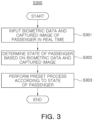
- FIG. 3 is a flowchart illustrating a method of providing a service according to a state of a passenger in an aircraft during an autonomous flight according to an exemplary embodiment in the present disclosure.
- FIG. 4 is a flowchart illustrating the first process performed in operation S303 of FIG. 3
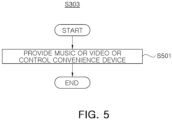
- FIG. 5 is a flowchart illustrating the second process performed in operation S303 of FIG. 3 .
- the method (S300) of providing a service according to a state of a passenger in an aircraft during an autonomous flight may start as the I/O module 121 receives biometric data and a captured image of a passenger in real time (S301). The input biometric data and captured image of the passenger may be transmitted to the determination module 122.
- the biometric data of the passenger may include at least one of a heart rate, a sweat output, a grip strength, a blood pressure, a body temperature, and a respiration rate of the passenger.
- biometric data may be measured through the sensor module 111, the captured image may be captured through the camera 112 as described above.
- the determination module 122 may determine a state of the passenger based on the biometric data and the captured image (S302).
- the state of the passenger may be an emergency state or a state of tension.
- the determination module 122 may determine whether a state of the passenger is an emergency state based on a combination of classification result from the machine learning model 123 to which the captured image of a passenger is input and comparison result between at least one of a heart rate, a sweat output, a grip strength, a blood pressure, and a respiration rate of the passenger with each preset reference value.
- the aforementioned reference value may vary depending on the gender, age, etc. of the passenger, but is not limited to a specific value here.
- the machine learning model 123 described above may include a first machine learning model 123a for classifying a facial expression of the passenger in the captured image and a second machine learning model 123b for classifying a body posture of the passenger in the captured image.
- the first machine learning model 123a may classify the facial expression of the passenger as pain, fear, tension, disgust, stuffiness, discomfort, and others.
- the others may include facial expressions other than pain, fear, tension, disgust, stuffiness, and discomfort.
- the second machine learning model 123b may classify the body posture of the passenger as one of a posture with eyes closed, a posture with hands put on the head, a posture in which the face is lowered down forwardly and is not visible, and others.
- the others may be body postures other than the posture with eyes closed, the posture with hands put on the head, and the posture in which the face is lowered down forwardly and is not visible.
- the type and classification result of biometric data used when determining such an emergency state may be different for each disease.
- whether the state of the passenger is an emergency state maybe be determined based on a combination of classification result from the machine learning model 123 to which the captured image of a passenger is input and comparison result between at least one of a heart rate, a sweat output, a grip strength, a blood pressure, and a respiration rate of the passenger with each preset reference value.
- the determination module 122 may further estimate a disease. However, when there are multiple estimated diseases, the determination module 122 may estimate a disease by considering a disease according to the underlying disease of the passenger or family history as a priority.
- the determination module 122 may determine whether the passenger is in a state of tension and the classification result from the first machine learning model 123a may be tension.
- the determination module 122 may determine whether the passenger is in a state of tension.
- the control module 124 may perform a preset process according to the state of the passenger (S303).
- the preset process may include a first process for adjusting a flight path of the aircraft 10 when the passenger's state is an emergency state or a second process for relieving tension when the passenger's state is a state of tension, as described above.
- FIG. 4 is a flowchart illustrating the first process performed in operation S303 of FIG. 3 .
- the service providing apparatus 120 may transmit an emergency state to the control device 200 (S401).
- the emergency state described above may include the ID of the aircraft 10, the flight path of the aircraft 10, the current location information of the aircraft 10, the information of the passenger in an emergency state, the biometric data, the captured image, the underlying disease or the disease according to family history, the estimated disease, etc. as described above.
- control device 200 may transmit landing location information to the service providing apparatus 120.
- a first aid process may be further transmitted according to an exemplary embodiment of the present disclosure.
- the service providing apparatus 120 may control the driving module 125 to land the aircraft at the landing point by adjusting the flight path according to the received landing location information (S403).
- the service providing apparatus 120 may control the communication module 129 to receive a first aid process from the control device 200, and may control the input/output module 121 to broadcast information on the emergency state, the first aid process, and a location of medical supplies, as described above.
- the service providing apparatus 120 may control the driving module 125 to ascend or descend the altitude of the aircraft 10 as described above.
- FIG. 5 is a flowchart illustrating the second process performed in operation S303 of FIG. 3 .
- the service providing apparatus 120 may control the I/O module 121 to provide music or images for relieving tension or control the convenience device 127 to induce a comfortable posture of the passenger (S501).
- a state of a passenger may be determined based on biometric data and a captured image of the passenger, and an appropriate process may be performed according to the determined state of the passenger, thereby quickly providing a service for the passenger's tension or emergency state.
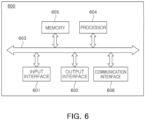
- FIG. 6 is a block diagram of a computer device which may fully or partially implement a service providing apparatus or a control device according to an exemplary embodiment in the present disclosure, and may be applied to the service providing apparatus 120 and the control device 200 illustrated in FIG. 2 .
- a computer device 600 may include an input interface 601, an output interface 602, a processor 604, a memory 605, and a communication interface 606, and the input interface 601, the output interface 602, the processor 604, the memory 605, and the communication interface 606 may be interconnected through a system bus 603.
- the memory 605 may be used to store programs, instructions, or codes, and the processor 604 may execute the programs, instructions, or codes stored in the memory 605, may receive a signal by controlling the input interface 601, and may transmit a signal by controlling the output interface 602.
- the aforementioned memory 605 may include read-only memory and random access memory, and may provide instructions and data to the processor 604.
- the processor 604 may be a central processing unit (CPU) and may be understood as being another general-purpose processor, a digital signal processor (DSP), an application specific integrated circuit (ASIC), a field programmable gate array (FPGA) or other programmable logic devices, discrete gate or transistor logic device, discrete hardware component, etc.
- the general-purpose processor may be a microprocessor, or the corresponding processor may be any conventional processor or the like.
- the method performed in each device of FIG. 2 may be achieved by an integrated logic circuit of hardware in the processor 604 or an instruction in the form of software.
- Contents of a method disclosed in relation to an exemplary embodiment in the present disclosure may be implemented to be performed and completed by a hardware processor or may be implemented to be performed and completed by a combination of hardware and software modules of a processor.
- the software module may be disposed in a storage medium, such as random access memory, flash memory, read-only memory, programmable read-only memory or electrically erasable programmable memory, registers, or the like.
- the corresponding storage medium is located in the memory 605, and the processor 604 reads the information of the memory 605, and implements the contents of the above method in combination with hardware. To avoid redundancy, detailed descriptions are omitted here.
- ' ⁇ module' may be implemented in various manners, for example, a processor, program instructions executed by the processor, software modules, microcodes, computer program products, logic circuits, application-specific integrated circuits, firmware, etc.
Landscapes
- Engineering & Computer Science (AREA)
- Health & Medical Sciences (AREA)
- Physics & Mathematics (AREA)
- General Physics & Mathematics (AREA)
- General Health & Medical Sciences (AREA)
- Life Sciences & Earth Sciences (AREA)
- Theoretical Computer Science (AREA)
- Medical Informatics (AREA)
- Aviation & Aerospace Engineering (AREA)
- Public Health (AREA)
- Business, Economics & Management (AREA)
- Biomedical Technology (AREA)
- Multimedia (AREA)
- Pathology (AREA)
- Automation & Control Theory (AREA)
- Primary Health Care (AREA)
- Tourism & Hospitality (AREA)
- Remote Sensing (AREA)
- Radar, Positioning & Navigation (AREA)
- Heart & Thoracic Surgery (AREA)
- Veterinary Medicine (AREA)
- Animal Behavior & Ethology (AREA)
- Surgery (AREA)
- Molecular Biology (AREA)
- Biophysics (AREA)
- Databases & Information Systems (AREA)
- General Business, Economics & Management (AREA)
- Strategic Management (AREA)
- Economics (AREA)
- Human Resources & Organizations (AREA)
- Marketing (AREA)
- Human Computer Interaction (AREA)
- Data Mining & Analysis (AREA)
- Computer Networks & Wireless Communication (AREA)
- Epidemiology (AREA)
- Oral & Maxillofacial Surgery (AREA)
- Computer Vision & Pattern Recognition (AREA)
- Signal Processing (AREA)
- Cardiology (AREA)
- Physiology (AREA)
Abstract
Description
- This application claims the benefit of a priority to
Korean Patent Application No. 10-2022-0172998 filed on December 12, 2022 - The present disclosure relates to an apparatus and method of providing a service according to a state of a passenger in an aircraft during an autonomous flight.
- Recently, research and development of aircraft capable of autonomous flight has steadily progressed, and by using such aircraft, passengers may be transported to a desired destination.
- However, in the case of an aircraft without an inflight crew, there is a problem in that it may be difficult to provide a prompt service when a passenger complains of tension or an emergency occurs during autonomous flight.
- Exemplary embodiments provide an apparatus and method for providing a service according to a state of a passenger in an aircraft during an autonomous flight, capable of promptly providing a service for a passenger in a nervous or emergency state.
- According to an exemplary embodiment, a service providing apparatus of providing a service according to a state of a passenger in aircraft during autonomous flight includes: a processor; and a storage medium recording one or more programs configured to be executable by the processor, wherein the one or more programs include instructions for an input/output (I/O) module receiving biometric data and a captured image of a passenger in real time; a determination module determining a state of the passenger based on the biometric data and the captured image of a passenger; and a control module performing a preset process according to the state of the passenger, wherein the preset process includes: a first process for adjusting a flight path of the aircraft when the state of the passenger is an emergency state or a second process for relieving tension when the state of the passenger is a state of tension.
- According to another exemplary embodiment, a method of providing a service according to a state of a passenger in aircraft during autonomous flight includes: a first operation in which an input/output (I/O) module receives biometric data and a captured image of a passenger in real time; a second operation in which a determination module determines a state of the passenger based on the biometric data and the captured image of a passenger; and a third operation in which a control module performs a preset process according to the state of the passenger, wherein the preset process includes: a first process for adjusting a flight path of the aircraft when the state of the passenger is an emergency state or a second process for relieving tension when the state of the passenger is a state of tension.
- The above and other aspects, features, and advantages of the present inventive concept will be more clearly understood from the following detailed description, taken in conjunction with the accompanying drawings, in which:
-
FIG. 1 is a configuration diagram of an entire system including an aircraft and a control device according to an exemplary embodiment in the present disclosure; -
FIG. 2 is an internal block diagram of a service providing apparatus and a control device mounted on an aircraft according to an exemplary embodiment in the present disclosure; -
FIG. 3 is a flowchart illustrating a method of providing a service according to a state of a passenger in an aircraft during autonomous flight according to an exemplary embodiment in the present disclosure; -
FIG. 4 is a flowchart illustrating a first process performed in operation S303 ofFIG. 3 ; -
FIG. 5 is a flowchart illustrating a second process performed in operation S303 ofFIG. 3 ; and -
FIG. 6 is a block diagram of a computer device which may fully or partially implement a service providing apparatus or a control device according to an exemplary embodiment in the present disclosure. - Hereinafter, exemplary embodiments in the present disclosure will be described with reference to the accompanying drawings. However, the exemplary embodiments of the present disclosure may be modified in various other forms, and the scope of the present disclosure is not limited only to the exemplary embodiments described below. The shapes and sizes of elements in the drawings may be exaggerated for clarity, and elements indicated by the same reference numerals in the drawings are the same elements.
-
FIG. 1 is a configuration diagram of an entire system including an aircraft and a control device according to an exemplary embodiment in the present disclosure. Also,FIG. 2 is an internal block diagram of a service providing apparatus and a control device mounted on an aircraft according to an exemplary embodiment in the present disclosure. - Referring to
FIGS. 1 to 2 , anoverall system 100 may include anaircraft 10 and acontrol device 200, and theaircraft 10 may include aservice providing apparatus 120 according to an exemplary embodiment in the present disclosure. The aforementionedservice providing apparatus 120 may include an input/output (I/O)module 121, adetermination module 122, amachine learning model 123, acontrol module 124, adriving module 125, a global positioning system (GPS)module 126, and aconvenience device 127, astorage module 128, and acommunication module 129, and themachine learning model 123 may include a firstmachine learning model 123a and a secondmachine learning model 123b. - According to an exemplary embodiment of the present disclosure, the
service providing apparatus 120 may include a processor (e.g., computer, microprocessor, CPU, ASIC, circuitry, logic circuits, etc.) and an associated non-transitory memory storing software instructions which, when executed by the processor, provides the functionalities of the input/output (I/O)module 121, thedetermination module 122, themachine learning model 123, thecontrol module 124, thedriving module 125, the global positioning system (GPS)module 126, theconvenience device 127, thestorage module 128, and thecommunication module 129. Herein, the memory and the processor may be implemented as separate semiconductor circuits. Alternatively, the memory and the processor may be implemented as a single integrated semiconductor circuit. The processor may embody one or more processor (s) . - In the present disclosure, the
aircraft 10 may refer to a mobility vehicle that may move by flying in the sky. That is, aircraft may include vehicles capable of flying on the ground with wheels separated from the ground, while moving on the ground using wheels, in addition to referring to helicopters, drones, fixed-wing airplanes, etc. - Also, the
aircraft 10 may include manned aircraft and unmanned aerial vehicles. A manned aircraft may include a body capable of operating autonomously in addition to a body controlled by a pilot. In addition, in the present disclosure, a crew may not board theaircraft 10. - Meanwhile, the
control device 200 may include acontrol module 210, acommunication module 220, and astorage module 230. - According to an exemplary embodiment of the present disclosure, the
control device 200 may include a processor (e.g., computer, microprocessor, CPU, ASIC, circuitry, logic circuits, etc.) and an associated non-transitory memory storing software instructions which, when executed by the processor, provides the functionalities of thecontrol module 210 and thecommunication module 220. Herein, the memory and the processor may be implemented as separate semiconductor circuits. Alternatively, the memory and the processor may be implemented as a single integrated semiconductor circuit. The processor may embody one or more processor (s) . - Hereinafter, the
service providing apparatus 120 providing a service according to a state of a passenger in an aircraft during autonomous flight and thecontrol device 200 according to an exemplary embodiment in the present disclosure will be described in detail with reference toFIGS. 1 and2 . - First, the I/
O module 121 of theservice providing apparatus 120 may receive biometric data and a captured image of a passenger in real time. The received biometric data and the captured image of a passenger may be transmitted to thedetermination module 122. - The biometric data of the passenger may include at least one of a heart rate, a sweat output, a grip strength, a blood pressure, a body temperature, and a respiration rate of the passenger, and the biometric data may be measured through the
sensor module 111. Thesensor module 111 may include a heart rate sensor for measuring a heart rate, a sweat sensor for measuring sweat output, a pressure sensor for measuring grip strength, and a blood pressure sensor for measuring blood pressure, a body temperature sensor for measuring a body temperature, a respiration rate sensor for measuring a respiration rate, and the like may be included. Thissensor module 111 may be a wearable device worn by passengers. - In addition, the captured image is an image obtained by imaging the face and body parts (arms, legs, etc.) of the passenger sitting in the seat, and such captured image may be captured by the
camera 112. - In addition, the I/
O module 121 may relieve passengers' tension by providing a video or music for tension. In order to provide images or music, the I/O module 121 may include a touchscreen, a speaker device, a display device, a projector, headphones, and the like. - The
determination module 122 of theservice providing apparatus 120 may determine a state of the passenger based on the biometric data and the captured image. Here, the state of the passenger may be an emergency state or a state of tension. - Specifically, the
determination module 122 may determine whether a state of the passenger is an emergency state based on a combination of classification result from themachine learning model 123 to which the captured image of a passenger is input and comparison result between at least one of a heart rate, a sweat output, a grip strength, a blood pressure, and a respiration rate of the passenger with each preset reference value. The aforementioned reference value may vary depending on the gender, age, etc. of the passenger, but is not limited to a specific value here. - Meanwhile, the
machine learning model 123 described above may include a firstmachine learning model 123a for classifying a facial expression of the passenger in the captured image and a secondmachine learning model 123b for classifying a body posture of the passenger in the captured image. - The
machine learning model 123 described above may be a model using a convolution neural network (CNN) as a representative example, but it should be appreciated that themachine learning model 123 may be any device without being thereto, as long as the device is able to classify the facial expression or body posture of the passenger. - Specifically, the first
machine learning model 123a may classify the facial expression of the passenger as pain, fear, tension, disgust, stuffiness, discomfort, and others. Here, the others may include facial expressions other than pain, fear, tension, disgust, stuffiness, and discomfort. - In addition, the second
machine learning model 123b may classify the body posture of the passenger as one of a posture with eyes closed, a posture with hands put on the head, a posture in which the face is lowered down forwardly and is not visible, and others. Here, the others may be body postures other than the posture with eyes closed, the posture with hands put on the head, and the posture in which the face is lowered down forwardly and is not visible. - Although the present disclosure described above specifically limits the facial expression and body posture of the passenger, this is to help understanding of the present disclosure, and it is obvious to those skilled in the art that various facial expressions and various body postures may be further included depending on the type of disease.
- The type and classification result of biometric data used when determining such an emergency state may be different for each disease.
- For example, when an emergency state is caused by a passenger's panic attack, various symptoms may appear. For example, a symptom of an increase in heart rate, a symptom of sweating, a symptom of an increase in body temperature, etc. may appear as biometric data, and the facial expression of a passenger during capturing an image may appear as an expression of pain, stuffiness, or discomfort.
- In addition, when the emergency state is caused by a stroke of a passenger, the passenger's body posture in the captured image may appear as a symptom, such as the posture with hands put on the head due to a headache or a drooping arm, and a facial expression in the captured image may appear as an expression of discomfort.
- Therefore, according to an exemplary embodiment in the present disclosure, whether the state of the passenger is an emergency state maybe be determined based on a combination of classification result from the
machine learning model 123 to which the captured image of a passenger is input and comparison result between at least one of a heart rate, a sweat output, a grip strength, a blood pressure, and a respiration rate of the passenger with each preset reference value - In addition, the
determination module 122 may further estimate a disease based on the combination of classification result from themachine learning model 123 to which the captured image is input and comparison result between at least one of the heart rate, sweat output, grip strength, blood pressure, and respiration rate of the passenger with each preset reference value. However, when there are multiple estimated diseases, thedetermination module 122 may estimate a disease by considering a disease according to the underlying disease of the passenger or family history as a priority. - In addition, the
determination module 122 may determine whether the state of the passenger is a state of tension based on a classification result from the firstmachine learning model 123a to which the captured image of a passenger is input or the comparison result between at least one of the heart rate, sweat output, grip strength, blood pressure, and respiration rate of the passenger with each preset reference value. - According to an exemplary embodiment in the present disclosure, based on the classification result from the first
machine learning model 123a to which the captured image is input and the comparison result between at least one of the heart rate, sweat output, grip strength, blood pressure, and respiration rate of the passenger with each preset reference value, thedetermination module 122 may determine whether the passenger is in a state of tension. - Meanwhile, the
control module 124 of theservice providing apparatus 120 may perform a preset process according to the state of the passenger. - Here, the preset process may include a first process for adjusting a flight path of the
aircraft 10 when the passenger's state is an emergency state or a second process for relieving tension when the passenger's state is a state of tension. - Specifically, in the first process according to an exemplary embodiment in the present disclosure, the
control module 124 may control thecommunication module 129 to transmit an ID of theaircraft 10, a flight path of theaircraft 10, current location information of theaircraft 10, information of the passenger, biometric data of the passenger, and the captured image of the passenger to thecontrol device 200 and to receive landing location information of a landing point of an adjacent hospital based on the current location information from thecontrol device 200. Thereafter, thecontrol module 124 may control thedriving module 125 to land theaircraft 10 at the landing point by adjusting the flight path according to the received landing location information. - In addition, in the first process according to an exemplary embodiment in the present disclosure, the
control module 124 may control thecommunication module 129 to receive a first aid process from thecontrol device 200 and control the I/O module 121 to broadcast information on the emergency state, the first aid process, and a location of medical supplies. - Alternatively, in the first process according to an exemplary embodiment in the present disclosure, the
control module 124 may control thedriving module 125 to ascend or descend the altitude of theaircraft 10. - Meanwhile, in the second process according to an exemplary embodiment in the present disclosure, the
control module 124 may control the I/O module 121 to provide music or images for relieving tension or control theconvenience device 127 to induce a comfortable posture of the passenger. - The
driving module 125 of theservice providing apparatus 120 may be a module for driving theaircraft 10 so that theaircraft 10 may fly along a preset path or may land under the control of thecontrol module 124 and may be, for example, a driving motor, a propeller, and the like. - The
GPS module 126 of theservice providing apparatus 120 is a module for receiving location information of theaircraft 10, and the received location information may be transmitted to thecontrol module 124. - The
convenience device 127 of theservice providing apparatus 120 may include various devices, such as a variable bolster which may decrease or increase the volume of a pillow supporting the head so that the passenger's head is in a comfortable posture, footrests which may be adjusted in angle so that the passenger's legs are comfortable. - The
storage module 128 of theservice providing apparatus 120 may be a module for storing various programs for implementing functions performed by thecontrol module 124 described above. In addition, thestorage module 128 may store the ID of theaircraft 10, the flight path of theaircraft 10, the current location information of theaircraft 10, the information of the passenger, the biometric data of the passenger, the captured image of a passenger, the underlying disease of the passenger or disease according to family history, an estimated disease, and the like. - The
communication module 129 of theservice providing apparatus 120 may be a module for transmitting and receiving various types of data to and from thecontrol device 200. - Meanwhile, the
control device 200 may include acontrol module 210, acommunication module 220, and astorage module 230. - Specifically, the
control module 210 of thecontrol device 200 may monitor a location of theaircraft 10 on the flight path. Also, when an emergency state is received from theservice providing apparatus 120 of theaircraft 10, thecontrol module 210 may transmit landing location information to theservice providing apparatus 120 of theaircraft 10. The landing location information described above may be landing location information of a landing point of a nearby hospital based on the current location information of theaircraft 10. In addition, the emergency state may include the ID of theaircraft 10, the flight path of theaircraft 10, the current location information of theaircraft 10, the information of the passenger in an emergency state, the biometric data, the captured image, the underlying disease or the disease according to family history, the estimated disease, etc. Thecontrol module 210 of thecontrol device 200 may further transmit a first aid process. - The
communication module 220 of thecontrol device 200 may be a module for transmitting and receiving various data to and from theservice providing apparatus 120 of theaircraft 10. - The
storage module 230 of thecontrol device 200 may be a module for storing various programs for implementing functions performed by thecontrol module 210. - In addition, the
storage module 230 may store landing location information of a landing point of an adjacent hospital based on the current location information of theaircraft 10 and a first aid process for each disease. - In addition, the
storage module 230 stores the ID of theaircraft 10, the flight path of theaircraft 10, the current location information of theaircraft 10, the information of the passenger in the emergency situation, the biometric data, the captured image, the underlying disease or the disease according to family history, and the estimated disease received from theservice providing apparatus 120 of theaircraft 10. - As described above, according to an exemplary embodiment in the present disclosure, the state of the passenger may be determined based on the biometric data and the captured image of a passenger, and an appropriate process may be performed according to the determined state of the passenger, thereby rapidly providing a service for the passenger in the state of tension or an emergency state.
- Hereinafter, a method of providing a service according to a state of a passenger in an aircraft during an autonomous flight according to an exemplary embodiment in the present disclosure will be described with reference to
FIGS. 3 to 5 . - First,
FIG. 3 is a flowchart illustrating a method of providing a service according to a state of a passenger in an aircraft during an autonomous flight according to an exemplary embodiment in the present disclosure. Also,FIG. 4 is a flowchart illustrating the first process performed in operation S303 ofFIG. 3 , andFIG. 5 is a flowchart illustrating the second process performed in operation S303 ofFIG. 3 . - First, as illustrated in
FIG. 3 , the method (S300) of providing a service according to a state of a passenger in an aircraft during an autonomous flight according to an exemplary embodiment in the present disclosure may start as the I/O module 121 receives biometric data and a captured image of a passenger in real time (S301). The input biometric data and captured image of the passenger may be transmitted to thedetermination module 122. - The biometric data of the passenger may include at least one of a heart rate, a sweat output, a grip strength, a blood pressure, a body temperature, and a respiration rate of the passenger. Such biometric data may be measured through the
sensor module 111, the captured image may be captured through thecamera 112 as described above. - Next, the
determination module 122 may determine a state of the passenger based on the biometric data and the captured image (S302). Here, the state of the passenger may be an emergency state or a state of tension. - Specifically, when the
determination module 122 may determine whether a state of the passenger is an emergency state based on a combination of classification result from themachine learning model 123 to which the captured image of a passenger is input and comparison result between at least one of a heart rate, a sweat output, a grip strength, a blood pressure, and a respiration rate of the passenger with each preset reference value. The aforementioned reference value may vary depending on the gender, age, etc. of the passenger, but is not limited to a specific value here. - In addition, the
machine learning model 123 described above may include a firstmachine learning model 123a for classifying a facial expression of the passenger in the captured image and a secondmachine learning model 123b for classifying a body posture of the passenger in the captured image. - Specifically, the first
machine learning model 123a may classify the facial expression of the passenger as pain, fear, tension, disgust, stuffiness, discomfort, and others. Here, the others may include facial expressions other than pain, fear, tension, disgust, stuffiness, and discomfort. - In addition, the second
machine learning model 123b may classify the body posture of the passenger as one of a posture with eyes closed, a posture with hands put on the head, a posture in which the face is lowered down forwardly and is not visible, and others. Here, the others may be body postures other than the posture with eyes closed, the posture with hands put on the head, and the posture in which the face is lowered down forwardly and is not visible. - As described above, the type and classification result of biometric data used when determining such an emergency state may be different for each disease.
- Therefore, according to an exemplary embodiment in the present disclosure, whether the state of the passenger is an emergency state maybe be determined based on a combination of classification result from the
machine learning model 123 to which the captured image of a passenger is input and comparison result between at least one of a heart rate, a sweat output, a grip strength, a blood pressure, and a respiration rate of the passenger with each preset reference value. - In addition, based on the combination of classification results from the
machine learning model 123 to which the captured image is input and the comparison result between at least one of the heart rate, sweat output, grip strength, blood pressure, and respiration rate of the passenger with each preset reference value, thedetermination module 122 may further estimate a disease. However, when there are multiple estimated diseases, thedetermination module 122 may estimate a disease by considering a disease according to the underlying disease of the passenger or family history as a priority. - In addition, based on the classification result from the first
machine learning model 123a to which the captured image is input or the comparison result between at least one of the heart rate, sweat output, grip strength, blood pressure, and respiration rate of the passenger with each preset reference value, thedetermination module 122 may determine whether the passenger is in a state of tension and the classification result from the firstmachine learning model 123a may be tension. - According to an exemplary embodiment in the present disclosure, based on the classification result from the first
machine learning model 123a to which the captured image is input and the comparison result between at least one of the heart rate, sweat output, grip strength, blood pressure, and respiration rate of the passenger with each preset reference value, thedetermination module 122 may determine whether the passenger is in a state of tension. - Referring back to
FIG. 3 , thecontrol module 124 may perform a preset process according to the state of the passenger (S303). Here, the preset process may include a first process for adjusting a flight path of theaircraft 10 when the passenger's state is an emergency state or a second process for relieving tension when the passenger's state is a state of tension, as described above. -
FIG. 4 is a flowchart illustrating the first process performed in operation S303 ofFIG. 3 . - Referring to
FIG. 4 , theservice providing apparatus 120 may transmit an emergency state to the control device 200 (S401). The emergency state described above may include the ID of theaircraft 10, the flight path of theaircraft 10, the current location information of theaircraft 10, the information of the passenger in an emergency state, the biometric data, the captured image, the underlying disease or the disease according to family history, the estimated disease, etc. as described above. - Thereafter, the
control device 200 may transmit landing location information to theservice providing apparatus 120. As described above, a first aid process may be further transmitted according to an exemplary embodiment of the present disclosure. - Thereafter, the
service providing apparatus 120 may control thedriving module 125 to land the aircraft at the landing point by adjusting the flight path according to the received landing location information (S403). - Meanwhile, according to the first process according to an exemplary embodiment in the present disclosure, the
service providing apparatus 120 may control thecommunication module 129 to receive a first aid process from thecontrol device 200, and may control the input/output module 121 to broadcast information on the emergency state, the first aid process, and a location of medical supplies, as described above. - Alternatively, according to the first process according to an exemplary embodiment in the present disclosure, the
service providing apparatus 120 may control thedriving module 125 to ascend or descend the altitude of theaircraft 10 as described above. - Meanwhile,
FIG. 5 is a flowchart illustrating the second process performed in operation S303 ofFIG. 3 . - As illustrated in
FIG. 5 , according to the second process according to an exemplary embodiment in the present disclosure, theservice providing apparatus 120 may control the I/O module 121 to provide music or images for relieving tension or control theconvenience device 127 to induce a comfortable posture of the passenger (S501). - As described above, according to an exemplary embodiment in the present disclosure, a state of a passenger may be determined based on biometric data and a captured image of the passenger, and an appropriate process may be performed according to the determined state of the passenger, thereby quickly providing a service for the passenger's tension or emergency state.
- Meanwhile,
FIG. 6 is a block diagram of a computer device which may fully or partially implement a service providing apparatus or a control device according to an exemplary embodiment in the present disclosure, and may be applied to theservice providing apparatus 120 and thecontrol device 200 illustrated inFIG. 2 . - As illustrated in
FIG. 6 , acomputer device 600 may include aninput interface 601, anoutput interface 602, aprocessor 604, amemory 605, and acommunication interface 606, and theinput interface 601, theoutput interface 602, theprocessor 604, thememory 605, and thecommunication interface 606 may be interconnected through asystem bus 603. - In an exemplary embodiment of the disclosure, the
memory 605 may be used to store programs, instructions, or codes, and theprocessor 604 may execute the programs, instructions, or codes stored in thememory 605, may receive a signal by controlling theinput interface 601, and may transmit a signal by controlling theoutput interface 602. Theaforementioned memory 605 may include read-only memory and random access memory, and may provide instructions and data to theprocessor 604. - In an exemplary embodiment in the present disclosure, the
processor 604 may be a central processing unit (CPU) and may be understood as being another general-purpose processor, a digital signal processor (DSP), an application specific integrated circuit (ASIC), a field programmable gate array (FPGA) or other programmable logic devices, discrete gate or transistor logic device, discrete hardware component, etc. The general-purpose processor may be a microprocessor, or the corresponding processor may be any conventional processor or the like. - In an implementation process, the method performed in each device of
FIG. 2 may be achieved by an integrated logic circuit of hardware in theprocessor 604 or an instruction in the form of software. Contents of a method disclosed in relation to an exemplary embodiment in the present disclosure may be implemented to be performed and completed by a hardware processor or may be implemented to be performed and completed by a combination of hardware and software modules of a processor. The software module may be disposed in a storage medium, such as random access memory, flash memory, read-only memory, programmable read-only memory or electrically erasable programmable memory, registers, or the like. The corresponding storage medium is located in thememory 605, and theprocessor 604 reads the information of thememory 605, and implements the contents of the above method in combination with hardware. To avoid redundancy, detailed descriptions are omitted here. - Meanwhile, in the present disclosure, '~ module' may be implemented in various manners, for example, a processor, program instructions executed by the processor, software modules, microcodes, computer program products, logic circuits, application-specific integrated circuits, firmware, etc.
- While exemplary embodiments have been illustrated and described above, it will be apparent to those skilled in the art that modifications and variations could be made without departing from the scope of the present disclosure as defined by the appended claims.
Claims (15)
- A service providing apparatus of providing a service according to a state of a passenger in aircraft during autonomous flight, the apparatus comprising:a processor; anda storage medium recording one or more programs configured to be executable by the processor,whereinthe one or more programs include instructions foran input/output (I/O) module receiving biometric data and a captured image of a passenger in real time;a determination module determining a state of the passenger based on the biometric data and the captured image of the passenger; anda control module performing a preset process according to the state of the passenger,wherein the preset process includes:
a first process for adjusting a flight path of the aircraft when the state of the passenger is an emergency state or a second process for relieving tension when the state of the passenger is a state of tension. - The service providing apparatus of claim 1, wherein the biometric data includes at least one of a heart rate, a sweat output, a grip strength, a blood pressure, a body temperature, and a respiration rate of the passenger.
- The service providing apparatus of claim 2, whereinthe determination module determines whether the state of the passenger is the emergency state based on a combination of classification result from a machine learning model to which the captured image of the passenger is input and comparison result between at least one of the heart rate, the sweat output, the grip strength, the blood pressure, and the respiration rate of the passenger with each preset reference value, anda type of biometric data and a classification result used in determining the emergency state are different for each disease.
- The service providing apparatus of claim 3, wherein
the machine learning model includes:a first machine learning model for classifying a facial expression of the passenger in the captured image of the passenger; anda second machine learning model for classifying a body posture of the passenger in the captured image of the passenger. - The service providing apparatus of claim 4, wherein the first machine learning model classifies the facial expression of the passenger as pain, fear, tension, disgust, stuffiness, discomfort, and others.
- The service providing apparatus of claim 4 or 5, wherein the second machine learning model classifies the body posture of the passenger as one of a posture with eyes closed, a posture with hands put on the head, a posture in which a face is lowered down forwardly and is not visible, and others.
- The service providing apparatus of any one of claims 3 to 6, whereinthe determination module estimates the disease based on the combination of classification result from the machine learning model to which the captured image of the passenger is input and comparison result between at least one of the heart rate, the sweat output, the grip strength, the blood pressure, and the respiration rate of the passenger with each preset reference value, andwhen there are multiple estimated diseases, the determination module considers a disease according to an underlying disease of the passenger or family history as a priority among the multiple estimated diseases.
- The service providing apparatus of any one of claims 4 to 7, whereinthe determination module determines whether the state of the passenger is a state of tension based on a classification result from the machine learning model to which the captured image of the passenger is input or comparison result between at least one of the heart rate, the sweat output, the grip strength, the blood pressure, and the respiration rate of the passenger with each preset reference value, andthe classification result from the first machine learning model is tension.
- The service providing apparatus of any one of the preceding claims, whereinthe first process is a process of controlling a communication module to transmit an ID of the aircraft, a flight path of the aircraft, current location information of the aircraft, information of the passenger, biometric data of the passenger, and the captured image of the passenger to a control device and to receive landing location information of a landing point of an adjacent hospital based on the current location information from the control device, andcontrolling a driving module to land the aircraft at the landing point by adjusting the flight path according to the received landing location information.
- The service providing apparatus of any one of the preceding claims, whereinthe first process is a process of controlling a communication module to receive a first aid process from a control device, andcontrolling the I/O module to broadcast information on the emergency state, the first aid process, and a location of medical supplies.
- The service providing apparatus of any one of the preceding claims, wherein the first process further includes a process of controlling a driving module to ascend or descend an altitude of the aircraft.
- The service providing apparatus of any one of the preceding claims, whereinthe second process includes a process of controlling the I/O module to provide music or video for relieving the tension anda process of controlling a convenience device for inducing a comfortable posture of the passenger.
- A method of providing a service according to a state of a passenger in aircraft during autonomous flight, the method comprising:a first operation in which an input/output (I/O) module receives biometric data and a captured image of a passenger in real time;a second operation in which a determination module determines a state of the passenger based on the biometric data and the captured image of the passenger; anda third operation in which a control module performs a preset process according to the state of the passenger,wherein the preset process includes:
a first process for adjusting a flight path of the aircraft when the state of the passenger is an emergency state or a second process for relieving tension when the state of the passenger is a state of tension. - The method of claim 13, wherein the biometric data includes at least one of a heart rate, a sweat output, a grip strength, a blood pressure, a body temperature, and a respiration rate of the passenger.
- The method of claim 14, wherein,
in the second operation,determining whether the state of the passenger is an emergency state based on a combination of classification result from the machine learning model to which the captured image of the passenger is input and comparison result between at least one of the heart rate, the sweat output, the grip strength, the blood pressure, and the respiration rate of the passenger with each preset reference value, anda type of biometric data and a classification result used in determining the emergency state are different for each disease.
Applications Claiming Priority (1)
| Application Number | Priority Date | Filing Date | Title |
|---|---|---|---|
| KR1020220172998A KR20240087927A (en) | 2022-12-12 | 2022-12-12 | Apparatus and method of providing service according to status of passenger in aircraft during autonomous flight |
Publications (2)
| Publication Number | Publication Date |
|---|---|
| EP4385396A1 true EP4385396A1 (en) | 2024-06-19 |
| EP4385396B1 EP4385396B1 (en) | 2025-12-31 |
Family
ID=88068771
Family Applications (1)
| Application Number | Title | Priority Date | Filing Date |
|---|---|---|---|
| EP23197123.5A Active EP4385396B1 (en) | 2022-12-12 | 2023-09-13 | DEVICE AND METHOD FOR PROVIDING SERVICES ACCORDING TO THE CONDITION OF THE PASSENGER IN AN AIRCRAFT DURING AUTONOMOUS FLIGHT |
Country Status (3)
| Country | Link |
|---|---|
| US (1) | US12347565B2 (en) |
| EP (1) | EP4385396B1 (en) |
| KR (1) | KR20240087927A (en) |
Citations (8)
| Publication number | Priority date | Publication date | Assignee | Title |
|---|---|---|---|---|
| KR20060022935A (en) * | 2004-09-08 | 2006-03-13 | 한민홍 | Eye image based drowsiness detection method and device |
| US20150287187A1 (en) * | 2012-11-11 | 2015-10-08 | Kenkou Gmbh | Method and device for determining vital parameters |
| WO2017197208A1 (en) * | 2016-05-11 | 2017-11-16 | Flynxx.Com | Travel management |
| WO2019125222A1 (en) * | 2017-12-19 | 2019-06-27 | Федеральное государственное бюджетное образовательное учреждение высшего образования "Московский государственный университет имени М.В. Ломоносова" | Portable and transportable isolated robotic medical evacuation module |
| US20200026309A1 (en) * | 2016-09-06 | 2020-01-23 | Tao Ma | Method and system for controlling safe takeoff and landing of pilotless vertical takeoff and landing (vtol) aircraft |
| US20200128383A1 (en) * | 2006-05-16 | 2020-04-23 | Nicholas M. Maier | Method and system for an emergency location information service (e-lis) for water-based network devices |
| DE102019204954A1 (en) * | 2019-04-08 | 2020-10-08 | Volkswagen Aktiengesellschaft | Autonomous aircraft to rescue the injured |
| US20220306143A1 (en) * | 2021-03-03 | 2022-09-29 | United States Of America As Represented By The Administrator Of Nasa | Method and System for Collaborative Task-Based Allocation Between Human and Autonomous Systems |
Family Cites Families (13)
| Publication number | Priority date | Publication date | Assignee | Title |
|---|---|---|---|---|
| US7379795B2 (en) * | 2003-06-26 | 2008-05-27 | Michael Arnouse | Apparatus, system and method for aircraft security and anti-hijacking intervention |
| EP2614003B1 (en) * | 2010-09-10 | 2016-04-20 | Panasonic Avionics Corporation | Chair with an integrated user interface system and method |
| US20130338857A1 (en) | 2012-06-15 | 2013-12-19 | The Boeing Company | Aircraft Passenger Health Management |
| CA2819853A1 (en) | 2012-06-28 | 2013-12-28 | Frederik Hoffmann | Passenger service unit with gesture control |
| US9310222B1 (en) | 2014-06-16 | 2016-04-12 | Sean Patrick Suiter | Flight assistant with automatic configuration and landing site selection method and apparatus |
| DE102016212150A1 (en) | 2016-07-04 | 2018-01-04 | Airbus Defence and Space GmbH | Method for operating an at least temporarily unmanned aerial or spacecraft and such an aircraft or spacecraft |
| US20180374368A1 (en) * | 2017-06-27 | 2018-12-27 | Ge Aviation Systems Llc | Aerial vehicle medical management system |
| US11847548B2 (en) | 2018-02-23 | 2023-12-19 | Rockwell Collins, Inc. | Universal passenger seat system and data interface |
| US20190391581A1 (en) * | 2018-06-26 | 2019-12-26 | Uber Technologies, Inc. | Passenger Health Monitoring and Intervention for Autonomous Vehicles |
| KR102184598B1 (en) | 2018-11-29 | 2020-12-03 | (주)제인모터스 | Driving Prediction and Safety Driving System Based on Judgment of Driver Emergency Situation of Autonomous Driving Vehicle |
| KR102303416B1 (en) | 2019-07-04 | 2021-09-27 | 한양대학교 에리카산학협력단 | Emergency management system for autonomous vehicle, autonomous vehicle apparatus |
| KR102324231B1 (en) | 2020-01-28 | 2021-11-08 | 연세대학교 산학협력단 | Apparatus for Detecting Emergency Situation while Driving through Facial Expression Classification |
| CN113656609A (en) * | 2021-08-13 | 2021-11-16 | 阿波罗智联(北京)科技有限公司 | Method and device for recommending multimedia information, electronic equipment and storage medium |
-
2022
- 2022-12-12 KR KR1020220172998A patent/KR20240087927A/en active Pending
-
2023
- 2023-04-25 US US18/138,897 patent/US12347565B2/en active Active
- 2023-09-13 EP EP23197123.5A patent/EP4385396B1/en active Active
Patent Citations (8)
| Publication number | Priority date | Publication date | Assignee | Title |
|---|---|---|---|---|
| KR20060022935A (en) * | 2004-09-08 | 2006-03-13 | 한민홍 | Eye image based drowsiness detection method and device |
| US20200128383A1 (en) * | 2006-05-16 | 2020-04-23 | Nicholas M. Maier | Method and system for an emergency location information service (e-lis) for water-based network devices |
| US20150287187A1 (en) * | 2012-11-11 | 2015-10-08 | Kenkou Gmbh | Method and device for determining vital parameters |
| WO2017197208A1 (en) * | 2016-05-11 | 2017-11-16 | Flynxx.Com | Travel management |
| US20200026309A1 (en) * | 2016-09-06 | 2020-01-23 | Tao Ma | Method and system for controlling safe takeoff and landing of pilotless vertical takeoff and landing (vtol) aircraft |
| WO2019125222A1 (en) * | 2017-12-19 | 2019-06-27 | Федеральное государственное бюджетное образовательное учреждение высшего образования "Московский государственный университет имени М.В. Ломоносова" | Portable and transportable isolated robotic medical evacuation module |
| DE102019204954A1 (en) * | 2019-04-08 | 2020-10-08 | Volkswagen Aktiengesellschaft | Autonomous aircraft to rescue the injured |
| US20220306143A1 (en) * | 2021-03-03 | 2022-09-29 | United States Of America As Represented By The Administrator Of Nasa | Method and System for Collaborative Task-Based Allocation Between Human and Autonomous Systems |
Also Published As
| Publication number | Publication date |
|---|---|
| EP4385396B1 (en) | 2025-12-31 |
| KR20240087927A (en) | 2024-06-20 |
| US12347565B2 (en) | 2025-07-01 |
| US20240190570A1 (en) | 2024-06-13 |
Similar Documents
| Publication | Publication Date | Title |
|---|---|---|
| US10426393B2 (en) | Systems and methods for monitoring pilot health | |
| US9849979B2 (en) | Providing services using unmanned aerial vehicles | |
| US8289172B2 (en) | Method and system of aircraft pilot assessment and for remedial action upon pilot impairment | |
| US8164464B2 (en) | Method and system of aircraft pilot assessment | |
| US11847548B2 (en) | Universal passenger seat system and data interface | |
| US12494134B2 (en) | System and method of adjusting a pilot workload | |
| JP2020185378A (en) | Systems and methods for mitigating motion sickness | |
| CN110155349A (en) | Peripheral vision in human-computer interfaces | |
| BR112016004262B1 (en) | UNMANNED AERIAL VEHICLE (UAV), ITS METHOD AND NON-TRANSITORY COMPUTER-READY MEANS FOR EXECUTION OF SUCH METHOD | |
| WO2021217430A1 (en) | System and method for operating a movable object based on human body indications | |
| JP7281733B2 (en) | MOBILE SYSTEM, MOBILE, MONITORING METHOD AND PROGRAM | |
| EP3422357A1 (en) | Aerial vehicle medical management system | |
| US20190106209A1 (en) | Aerial system including foldable frame architecture | |
| US12347565B2 (en) | Apparatus and method of providing service according to status of passenger in aircraft during autonomous flight | |
| WO2021072733A1 (en) | Unmanned aerial vehcile control method and apparatus, and unmanned aerial vehicle | |
| US5121744A (en) | Physiological G-suit modulator | |
| US11415980B2 (en) | Moving object operation system, operation signal transmission system, moving object operation method, program, and recording medium | |
| Martin et al. | Objective measures of pilot workload | |
| US20240190440A1 (en) | Systems and methods for in-flight health monitoring and comfort tracking | |
| EP4292933A1 (en) | Vibrotactile systems and methods for aircraft seats | |
| GB2604716A (en) | Aircraft and method of adjusting a pilot workload | |
| US20220324354A1 (en) | Method of controlling passenger posture of autonomous vehicle and apparatus using the same | |
| CN114007938B (en) | Manipulation support device, manipulation support method, and computer-readable recording medium | |
| EP4656462A1 (en) | Control method and apparatus, and transport | |
| JP2026045493A (en) | system |
Legal Events
| Date | Code | Title | Description |
|---|---|---|---|
| PUAI | Public reference made under article 153(3) epc to a published international application that has entered the european phase |
Free format text: ORIGINAL CODE: 0009012 |
|
| STAA | Information on the status of an ep patent application or granted ep patent |
Free format text: STATUS: THE APPLICATION HAS BEEN PUBLISHED |
|
| AK | Designated contracting states |
Kind code of ref document: A1 Designated state(s): AL AT BE BG CH CY CZ DE DK EE ES FI FR GB GR HR HU IE IS IT LI LT LU LV MC ME MK MT NL NO PL PT RO RS SE SI SK SM TR |
|
| STAA | Information on the status of an ep patent application or granted ep patent |
Free format text: STATUS: REQUEST FOR EXAMINATION WAS MADE |
|
| 17P | Request for examination filed |
Effective date: 20240717 |
|
| RBV | Designated contracting states (corrected) |
Designated state(s): AL AT BE BG CH CY CZ DE DK EE ES FI FR GB GR HR HU IE IS IT LI LT LU LV MC ME MK MT NL NO PL PT RO RS SE SI SK SM TR |
|
| P01 | Opt-out of the competence of the unified patent court (upc) registered |
Free format text: CASE NUMBER: APP_17646/2025 Effective date: 20250410 |
|
| GRAP | Despatch of communication of intention to grant a patent |
Free format text: ORIGINAL CODE: EPIDOSNIGR1 |
|
| STAA | Information on the status of an ep patent application or granted ep patent |
Free format text: STATUS: GRANT OF PATENT IS INTENDED |
|
| INTG | Intention to grant announced |
Effective date: 20250829 |
|
| GRAS | Grant fee paid |
Free format text: ORIGINAL CODE: EPIDOSNIGR3 |
|
| GRAA | (expected) grant |
Free format text: ORIGINAL CODE: 0009210 |
|
| STAA | Information on the status of an ep patent application or granted ep patent |
Free format text: STATUS: THE PATENT HAS BEEN GRANTED |
|
| AK | Designated contracting states |
Kind code of ref document: B1 Designated state(s): AL AT BE BG CH CY CZ DE DK EE ES FI FR GB GR HR HU IE IS IT LI LT LU LV MC ME MK MT NL NO PL PT RO RS SE SI SK SM TR |
|
| REG | Reference to a national code |
Ref country code: CH Ref legal event code: F10 Free format text: ST27 STATUS EVENT CODE: U-0-0-F10-F00 (AS PROVIDED BY THE NATIONAL OFFICE) Effective date: 20251231 Ref country code: GB Ref legal event code: FG4D |
|
| REG | Reference to a national code |
Ref country code: DE Ref legal event code: R096 Ref document number: 602023010338 Country of ref document: DE |
|
| REG | Reference to a national code |
Ref country code: IE Ref legal event code: FG4D |
|
| REG | Reference to a national code |
Ref country code: LT Ref legal event code: MG9D |
|
| PG25 | Lapsed in a contracting state [announced via postgrant information from national office to epo] |
Ref country code: NO Free format text: LAPSE BECAUSE OF FAILURE TO SUBMIT A TRANSLATION OF THE DESCRIPTION OR TO PAY THE FEE WITHIN THE PRESCRIBED TIME-LIMIT Effective date: 20260331 |
|
| PG25 | Lapsed in a contracting state [announced via postgrant information from national office to epo] |
Ref country code: FI Free format text: LAPSE BECAUSE OF FAILURE TO SUBMIT A TRANSLATION OF THE DESCRIPTION OR TO PAY THE FEE WITHIN THE PRESCRIBED TIME-LIMIT Effective date: 20251231 Ref country code: HR Free format text: LAPSE BECAUSE OF FAILURE TO SUBMIT A TRANSLATION OF THE DESCRIPTION OR TO PAY THE FEE WITHIN THE PRESCRIBED TIME-LIMIT Effective date: 20251231 |
|
| PG25 | Lapsed in a contracting state [announced via postgrant information from national office to epo] |
Ref country code: RS Free format text: LAPSE BECAUSE OF FAILURE TO SUBMIT A TRANSLATION OF THE DESCRIPTION OR TO PAY THE FEE WITHIN THE PRESCRIBED TIME-LIMIT Effective date: 20260331 |
|
| PG25 | Lapsed in a contracting state [announced via postgrant information from national office to epo] |
Ref country code: LV Free format text: LAPSE BECAUSE OF FAILURE TO SUBMIT A TRANSLATION OF THE DESCRIPTION OR TO PAY THE FEE WITHIN THE PRESCRIBED TIME-LIMIT Effective date: 20251231 |
|
| PG25 | Lapsed in a contracting state [announced via postgrant information from national office to epo] |
Ref country code: BG Free format text: LAPSE BECAUSE OF FAILURE TO SUBMIT A TRANSLATION OF THE DESCRIPTION OR TO PAY THE FEE WITHIN THE PRESCRIBED TIME-LIMIT Effective date: 20251231 |
|
| REG | Reference to a national code |
Ref country code: NL Ref legal event code: MP Effective date: 20251231 |