EP4384445B1 - Electric vehicle port - Google Patents
Electric vehicle port Download PDFInfo
- Publication number
- EP4384445B1 EP4384445B1 EP22764614.8A EP22764614A EP4384445B1 EP 4384445 B1 EP4384445 B1 EP 4384445B1 EP 22764614 A EP22764614 A EP 22764614A EP 4384445 B1 EP4384445 B1 EP 4384445B1
- Authority
- EP
- European Patent Office
- Prior art keywords
- zone
- electric vehicle
- charging
- loading
- aircraft
- Prior art date
- Legal status (The legal status is an assumption and is not a legal conclusion. Google has not performed a legal analysis and makes no representation as to the accuracy of the status listed.)
- Active
Links
Images







Classifications
-
- B—PERFORMING OPERATIONS; TRANSPORTING
- B64—AIRCRAFT; AVIATION; COSMONAUTICS
- B64F—GROUND OR AIRCRAFT-CARRIER-DECK INSTALLATIONS SPECIALLY ADAPTED FOR USE IN CONNECTION WITH AIRCRAFT; DESIGNING, MANUFACTURING, ASSEMBLING, CLEANING, MAINTAINING OR REPAIRING AIRCRAFT, NOT OTHERWISE PROVIDED FOR; HANDLING, TRANSPORTING, TESTING OR INSPECTING AIRCRAFT COMPONENTS, NOT OTHERWISE PROVIDED FOR
- B64F1/00—Ground or aircraft-carrier-deck installations
- B64F1/30—Ground or aircraft-carrier-deck installations for embarking or disembarking passengers
-
- B—PERFORMING OPERATIONS; TRANSPORTING
- B60—VEHICLES IN GENERAL
- B60L—PROPULSION OF ELECTRICALLY-PROPELLED VEHICLES; SUPPLYING ELECTRIC POWER FOR AUXILIARY EQUIPMENT OF ELECTRICALLY-PROPELLED VEHICLES; ELECTRODYNAMIC BRAKE SYSTEMS FOR VEHICLES IN GENERAL; MAGNETIC SUSPENSION OR LEVITATION FOR VEHICLES; MONITORING OPERATING VARIABLES OF ELECTRICALLY-PROPELLED VEHICLES; ELECTRIC SAFETY DEVICES FOR ELECTRICALLY-PROPELLED VEHICLES
- B60L53/00—Methods of charging batteries, specially adapted for electric vehicles; Charging stations or on-board charging equipment therefor; Exchange of energy storage elements in electric vehicles
- B60L53/10—Methods of charging batteries, specially adapted for electric vehicles; Charging stations or on-board charging equipment therefor; Exchange of energy storage elements in electric vehicles characterised by the energy transfer between the charging station and the vehicle
- B60L53/12—Inductive energy transfer
-
- B—PERFORMING OPERATIONS; TRANSPORTING
- B60—VEHICLES IN GENERAL
- B60L—PROPULSION OF ELECTRICALLY-PROPELLED VEHICLES; SUPPLYING ELECTRIC POWER FOR AUXILIARY EQUIPMENT OF ELECTRICALLY-PROPELLED VEHICLES; ELECTRODYNAMIC BRAKE SYSTEMS FOR VEHICLES IN GENERAL; MAGNETIC SUSPENSION OR LEVITATION FOR VEHICLES; MONITORING OPERATING VARIABLES OF ELECTRICALLY-PROPELLED VEHICLES; ELECTRIC SAFETY DEVICES FOR ELECTRICALLY-PROPELLED VEHICLES
- B60L53/00—Methods of charging batteries, specially adapted for electric vehicles; Charging stations or on-board charging equipment therefor; Exchange of energy storage elements in electric vehicles
- B60L53/10—Methods of charging batteries, specially adapted for electric vehicles; Charging stations or on-board charging equipment therefor; Exchange of energy storage elements in electric vehicles characterised by the energy transfer between the charging station and the vehicle
- B60L53/14—Conductive energy transfer
- B60L53/18—Cables specially adapted for charging electric vehicles
-
- B—PERFORMING OPERATIONS; TRANSPORTING
- B60—VEHICLES IN GENERAL
- B60L—PROPULSION OF ELECTRICALLY-PROPELLED VEHICLES; SUPPLYING ELECTRIC POWER FOR AUXILIARY EQUIPMENT OF ELECTRICALLY-PROPELLED VEHICLES; ELECTRODYNAMIC BRAKE SYSTEMS FOR VEHICLES IN GENERAL; MAGNETIC SUSPENSION OR LEVITATION FOR VEHICLES; MONITORING OPERATING VARIABLES OF ELECTRICALLY-PROPELLED VEHICLES; ELECTRIC SAFETY DEVICES FOR ELECTRICALLY-PROPELLED VEHICLES
- B60L53/00—Methods of charging batteries, specially adapted for electric vehicles; Charging stations or on-board charging equipment therefor; Exchange of energy storage elements in electric vehicles
- B60L53/30—Constructional details of charging stations
- B60L53/302—Cooling of charging equipment
-
- B—PERFORMING OPERATIONS; TRANSPORTING
- B60—VEHICLES IN GENERAL
- B60L—PROPULSION OF ELECTRICALLY-PROPELLED VEHICLES; SUPPLYING ELECTRIC POWER FOR AUXILIARY EQUIPMENT OF ELECTRICALLY-PROPELLED VEHICLES; ELECTRODYNAMIC BRAKE SYSTEMS FOR VEHICLES IN GENERAL; MAGNETIC SUSPENSION OR LEVITATION FOR VEHICLES; MONITORING OPERATING VARIABLES OF ELECTRICALLY-PROPELLED VEHICLES; ELECTRIC SAFETY DEVICES FOR ELECTRICALLY-PROPELLED VEHICLES
- B60L53/00—Methods of charging batteries, specially adapted for electric vehicles; Charging stations or on-board charging equipment therefor; Exchange of energy storage elements in electric vehicles
- B60L53/30—Constructional details of charging stations
- B60L53/35—Means for automatic or assisted adjustment of the relative position of charging devices and vehicles
- B60L53/36—Means for automatic or assisted adjustment of the relative position of charging devices and vehicles by positioning the vehicle
-
- B—PERFORMING OPERATIONS; TRANSPORTING
- B60—VEHICLES IN GENERAL
- B60L—PROPULSION OF ELECTRICALLY-PROPELLED VEHICLES; SUPPLYING ELECTRIC POWER FOR AUXILIARY EQUIPMENT OF ELECTRICALLY-PROPELLED VEHICLES; ELECTRODYNAMIC BRAKE SYSTEMS FOR VEHICLES IN GENERAL; MAGNETIC SUSPENSION OR LEVITATION FOR VEHICLES; MONITORING OPERATING VARIABLES OF ELECTRICALLY-PROPELLED VEHICLES; ELECTRIC SAFETY DEVICES FOR ELECTRICALLY-PROPELLED VEHICLES
- B60L53/00—Methods of charging batteries, specially adapted for electric vehicles; Charging stations or on-board charging equipment therefor; Exchange of energy storage elements in electric vehicles
- B60L53/30—Constructional details of charging stations
- B60L53/35—Means for automatic or assisted adjustment of the relative position of charging devices and vehicles
- B60L53/38—Means for automatic or assisted adjustment of the relative position of charging devices and vehicles specially adapted for charging by inductive energy transfer
- B60L53/39—Means for automatic or assisted adjustment of the relative position of charging devices and vehicles specially adapted for charging by inductive energy transfer with position-responsive activation of primary coils
-
- B—PERFORMING OPERATIONS; TRANSPORTING
- B60—VEHICLES IN GENERAL
- B60L—PROPULSION OF ELECTRICALLY-PROPELLED VEHICLES; SUPPLYING ELECTRIC POWER FOR AUXILIARY EQUIPMENT OF ELECTRICALLY-PROPELLED VEHICLES; ELECTRODYNAMIC BRAKE SYSTEMS FOR VEHICLES IN GENERAL; MAGNETIC SUSPENSION OR LEVITATION FOR VEHICLES; MONITORING OPERATING VARIABLES OF ELECTRICALLY-PROPELLED VEHICLES; ELECTRIC SAFETY DEVICES FOR ELECTRICALLY-PROPELLED VEHICLES
- B60L53/00—Methods of charging batteries, specially adapted for electric vehicles; Charging stations or on-board charging equipment therefor; Exchange of energy storage elements in electric vehicles
- B60L53/50—Charging stations characterised by energy-storage or power-generation means
-
- B—PERFORMING OPERATIONS; TRANSPORTING
- B64—AIRCRAFT; AVIATION; COSMONAUTICS
- B64F—GROUND OR AIRCRAFT-CARRIER-DECK INSTALLATIONS SPECIALLY ADAPTED FOR USE IN CONNECTION WITH AIRCRAFT; DESIGNING, MANUFACTURING, ASSEMBLING, CLEANING, MAINTAINING OR REPAIRING AIRCRAFT, NOT OTHERWISE PROVIDED FOR; HANDLING, TRANSPORTING, TESTING OR INSPECTING AIRCRAFT COMPONENTS, NOT OTHERWISE PROVIDED FOR
- B64F1/00—Ground or aircraft-carrier-deck installations
- B64F1/22—Ground or aircraft-carrier-deck installations for handling aircraft
-
- B—PERFORMING OPERATIONS; TRANSPORTING
- B64—AIRCRAFT; AVIATION; COSMONAUTICS
- B64F—GROUND OR AIRCRAFT-CARRIER-DECK INSTALLATIONS SPECIALLY ADAPTED FOR USE IN CONNECTION WITH AIRCRAFT; DESIGNING, MANUFACTURING, ASSEMBLING, CLEANING, MAINTAINING OR REPAIRING AIRCRAFT, NOT OTHERWISE PROVIDED FOR; HANDLING, TRANSPORTING, TESTING OR INSPECTING AIRCRAFT COMPONENTS, NOT OTHERWISE PROVIDED FOR
- B64F1/00—Ground or aircraft-carrier-deck installations
- B64F1/35—Ground or aircraft-carrier-deck installations for supplying electrical power to stationary aircraft
-
- E—FIXED CONSTRUCTIONS
- E01—CONSTRUCTION OF ROADS, RAILWAYS, OR BRIDGES
- E01F—ADDITIONAL WORK, SUCH AS EQUIPPING ROADS OR THE CONSTRUCTION OF PLATFORMS, HELICOPTER LANDING STAGES, SIGNS, SNOW FENCES, OR THE LIKE
- E01F3/00—Landing stages for helicopters, e.g. located above buildings
-
- B—PERFORMING OPERATIONS; TRANSPORTING
- B60—VEHICLES IN GENERAL
- B60L—PROPULSION OF ELECTRICALLY-PROPELLED VEHICLES; SUPPLYING ELECTRIC POWER FOR AUXILIARY EQUIPMENT OF ELECTRICALLY-PROPELLED VEHICLES; ELECTRODYNAMIC BRAKE SYSTEMS FOR VEHICLES IN GENERAL; MAGNETIC SUSPENSION OR LEVITATION FOR VEHICLES; MONITORING OPERATING VARIABLES OF ELECTRICALLY-PROPELLED VEHICLES; ELECTRIC SAFETY DEVICES FOR ELECTRICALLY-PROPELLED VEHICLES
- B60L2200/00—Type of vehicles
- B60L2200/10—Air crafts
-
- Y—GENERAL TAGGING OF NEW TECHNOLOGICAL DEVELOPMENTS; GENERAL TAGGING OF CROSS-SECTIONAL TECHNOLOGIES SPANNING OVER SEVERAL SECTIONS OF THE IPC; TECHNICAL SUBJECTS COVERED BY FORMER USPC CROSS-REFERENCE ART COLLECTIONS [XRACs] AND DIGESTS
- Y02—TECHNOLOGIES OR APPLICATIONS FOR MITIGATION OR ADAPTATION AGAINST CLIMATE CHANGE
- Y02T—CLIMATE CHANGE MITIGATION TECHNOLOGIES RELATED TO TRANSPORTATION
- Y02T10/00—Road transport of goods or passengers
- Y02T10/60—Other road transportation technologies with climate change mitigation effect
- Y02T10/70—Energy storage systems for electromobility, e.g. batteries
-
- Y—GENERAL TAGGING OF NEW TECHNOLOGICAL DEVELOPMENTS; GENERAL TAGGING OF CROSS-SECTIONAL TECHNOLOGIES SPANNING OVER SEVERAL SECTIONS OF THE IPC; TECHNICAL SUBJECTS COVERED BY FORMER USPC CROSS-REFERENCE ART COLLECTIONS [XRACs] AND DIGESTS
- Y02—TECHNOLOGIES OR APPLICATIONS FOR MITIGATION OR ADAPTATION AGAINST CLIMATE CHANGE
- Y02T—CLIMATE CHANGE MITIGATION TECHNOLOGIES RELATED TO TRANSPORTATION
- Y02T10/00—Road transport of goods or passengers
- Y02T10/60—Other road transportation technologies with climate change mitigation effect
- Y02T10/7072—Electromobility specific charging systems or methods for batteries, ultracapacitors, supercapacitors or double-layer capacitors
-
- Y—GENERAL TAGGING OF NEW TECHNOLOGICAL DEVELOPMENTS; GENERAL TAGGING OF CROSS-SECTIONAL TECHNOLOGIES SPANNING OVER SEVERAL SECTIONS OF THE IPC; TECHNICAL SUBJECTS COVERED BY FORMER USPC CROSS-REFERENCE ART COLLECTIONS [XRACs] AND DIGESTS
- Y02—TECHNOLOGIES OR APPLICATIONS FOR MITIGATION OR ADAPTATION AGAINST CLIMATE CHANGE
- Y02T—CLIMATE CHANGE MITIGATION TECHNOLOGIES RELATED TO TRANSPORTATION
- Y02T90/00—Enabling technologies or technologies with a potential or indirect contribution to GHG emissions mitigation
- Y02T90/10—Technologies relating to charging of electric vehicles
- Y02T90/14—Plug-in electric vehicles
Definitions
- This disclosure generally relates to electric vehicles, and more specifically to electrical vertical take-off and landing aircraft.
- VTOL Vertical take-off and landing
- Helicopters are VTOL aircraft that generate lift entirely through their rotors.
- Some VTOL aircraft have wings and propulsion systems that enable the wings to provide the lift required during forward flight.
- Some winged VTOL aircraft can be sufficiently efficient in forward flight that the aircraft can be battery powered.
- Electric VTOL aircraft may require battery charging or battery swapping between flights. Thus, the availability of electric VTOL aircraft may be less than hydrocarbon powered aircraft.
- a port for electric vehicles is defined in claim 1.
- a method for off-loading and loading passengers of electric vehicles is defined in claim 8.
- a port for electric vehicles to load and unload passengers is configured for high throughput and availability of electric vehicles.
- the port includes an unloading zone, a loading zone spaced from the unloading zone, and a charging zone located between the unloading and loading zones in which the electric vehicle can be charged when moving from the unloading zone to the loading zone.
- the port includes multiple lanes, each including its own unloading zone, loading zone, and charging zone. Electric vehicles that have arrived at the port can be routed to a particular lane based on a charging time for the electric vehicle such that vehicles that require less charge can be cycled quickly through a fast lane while longer charging vehicles can be charged through a slower lane.
- the electric vehicles can be electric vertical take-off and landing aircraft that may land at a landing zone and then may be directed to the unloading zone.
- the aircraft may be moved to the unloading zone via a separate tug vehicle such that the aircraft does not move under its own power to the unloading zone.
- the tug vehicle may move the aircraft from the unloading zone and through the charging zone to the loading zone. Once passengers are loaded on the aircraft, the tug vehicle may move the aircraft to a take-off zone.
- the port may have a single landing zone and a single take-off zone and multiple lanes for unloading, charging, and loading.
- a port for electric vehicles includes an off-loading zone for off-loading one or more passengers from an electric vehicle; a loading zone for loading one or more passengers onto the electric vehicle; and a charging zone for charging the electric vehicle while the electric vehicle is moving from the off-loading zone to the loading zone.
- the port includes multiple lanes, each lane comprising a respective off-loading zone, loading zone, and charging zone.
- the electric vehicle is an electric aircraft.
- the port include a landing zone for aircraft to land and a take-off zone for aircraft to take-off, wherein the charging zone is located in a facility and the facility is located between the landing zone and the take-off zone.
- the port includes at least one tug vehicle for moving the electric aircraft from the landing zone to the off-loading zone.
- the at least one tug vehicle is autonomous.
- the port includes separate access ramps for passengers to access the off-loading zone and the loading zone.
- the port includes a tether for connecting to the electric vehicle to provide electricity while the electric vehicle is moving through the charging zone.
- the tether is configured to automatically connect to the electric vehicle.
- the tether is configured to cool the electric vehicle during charging.
- a method for off-loading and loading passengers of electric vehicles includes positioning the electric vehicle at an off-loading zone and off-loading at least one arriving passenger; moving the electric vehicle through a charging zone toward a loading zone and charging the electric vehicle while the electric vehicle is moving toward the loading zone; and loading at least one departing passenger on the electric vehicle while the electric vehicle is located in the loading zone.
- the method includes routing the electric vehicle to a particular off-loading zone based on a required amount of charging.
- the method includes moving the electric vehicle toward the loading zone by a tug vehicle.
- the tug vehicle is autonomous.
- the electric vehicle is an electric aircraft
- the method includes directing the electric aircraft to land at a landing zone before off-loading the at least one arriving passenger and directing the electric aircraft to take-off from a take-off zone after loading the at least one departing passenger, wherein the landing zone and the take-off zone are separate zones located on opposite sides of the charging zone.
- the method includes cooling the electric vehicle while the electric vehicle is charging.
- the method includes flowing coolant to the electric vehicle for cooling the electric vehicle while charging the electric vehicle.
- the method includes automatically connecting a charging tether to the electric vehicle.
- the method includes charging multiple electric vehicles simultaneously in adjacent charging zones.
- the electric vehicle moves in a single direction from the off-loading zone to the loading zone.
- Ports are configured with multiple charging lanes for simultaneously charging multiple onboard batteries of multiple electric vehicles.
- Ports may include landing and take-off zones that are spaced from one another, which reduces congestion and can increase throughput through the port.
- Electric vehicles may move through the port from arrival, through charging lanes, and to departure in the same direction, which can avoid delays associated with electric vehicles crossing paths.
- Ports may include spaced apart zones for passenger unloading and loading, which can provide non-crossing paths for passenger movement through the port.
- Electric vehicles may be charged in a charging zone located between the unloading and loading zones. Electric vehicles charge while moving through the charging zone.
- the charging zone may include a tether system that may manually or automatically connect to a port of the aircraft.
- the tether system may provide electricity to the electric vehicle for charging.
- a tether connected to the electric vehicle may be movable with the aircraft as the electric vehicle moves through the charging zone, so that the aircraft can charge as it is moving through the charging zone.
- the tether system may be configured to provide cooling fluid to the electric vehicle for cooling the batteries during charging.
- the electric vehicle may by moved through the port between the landing and take-off zones by a tug vehicle.
- the tug vehicle may be an autonomous, semi-autonomous, or manually operated vehicle.
- the electric vehicle may move through at least a portion of the port under its own power.
- Electric vehicles are routed to different charging lanes of the port based on a desired charging time for the electric vehicle. For example, electric vehicles that require shorter charging times (e.g., the vehicles just completed a relative short trip) may be routed to a different lane than vehicles requiring longer charging times. For example, charging lanes can be designated for 10 minute charging, 20 minute charging, and 30 minute charging. An arriving vehicle that will require 20 minutes to charge (to fully charge or to charge to a level required for a next trip) may be routed to the 20 minute charge lane. By directing vehicle to different lanes based on charging, vehicles that need less charging time are not stuck behind vehicles that need more charging time, which can increase the throughput of electric vehicles through the port.
- FIGS. 1A-H illustrate a port 100 for VTOL aircraft 102.
- FIGS. 1A-D are perspective views of the port 100
- FIG. 1E is a front view of the port 100
- FIG. 1F is a rear view of the port 100
- FIG. 1G is a side of the port 100
- FIG. 1H is a top view of the port 100.
- the port 100 provides terminals for passengers embarking and disembarking the aircraft 102.
- the port 100 may be located on the top of a building 104, such as a parking structure.
- the building is a pre-existing, such as a pre-existing parking structure, that is retrofitted with the port 100.
- the port 100 includes a runway level 106 that includes a landing zone 108 at one side and a take-off zone 110 located at an opposite side. Located between the landing and take-off zones is a lounge level 112 that provides passenger access to the runway level 106.
- the lounge level 112 may have a waiting area 114 where departing passengers may wait for their aircraft to be ready for loading.
- the waiting area 114 may include a check-in area, restaurants, shops, etc.
- the lounge level 112 is supported above the runway level 106 such that aircraft 102 can move under the lounge level 112.
- the aircraft 102 lands at the landing zone 108 and moves to the lounge level 112 for passengers to disembark. After passengers disembark, the aircraft 102 moves through the lounge level 112 to a loading zone where departing passengers get onto the aircraft. As the aircraft 102 is moving through the lounge level 112, the aircraft 102 is charged. Once the aircraft 102 is charged and departing passengers have been loaded, the aircraft moves to the take-off zone 110 from which the aircraft departs once cleared.
- the port 100 includes multiple lanes 116a-c for aircraft to move through the port 100.
- Each lane 116a-c may begin at the same landing zone and end at the same take-off zone or there may be multiple landing zones and/or multiple take-off zones.
- the port can handle multiple arriving/departing aircraft at the same time.
- a port can include any number of lanes depending on the available space and expected throughput of the port. In some cases, a port may include just a single lane.
- a port may include at least two lanes, at least three lanes, at least four lanes, at least five lanes, or more.
- a port may include multiple different lounge levels that may each include multiple lanes.
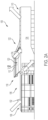
- FIGS. 2A and 2B illustrate the movement of an electric aircraft 102 through the port 100, according to various embodiments.
- FIG. 2A is a side view of the port 100.
- FIG. 2B is a plan view of the port 100 with the lounge level 112 not shown.
- the aircraft 102 lands at the landing zone 108.
- the aircraft 102 then moves or is moved to an unloading zone 118.
- the aircraft may move to the unloading zone 118 under its own power or may be towed to the unloading zone, such as via a tug vehicle that moves out to the loading zone, latches to the aircraft 102 and tows the aircraft 102 to the unloading zone 118.
- the tug vehicle could be, for example, an electric vehicle.
- the tug vehicle operates autonomously.
- any passengers on the aircraft 102 disembark and exit the runway level 106.
- the passengers may exit the port 100 in a downward direction through the building 104.
- the aircraft 102 moves through a charging zone 120 toward a loading zone 122. While in the charging zone 120, the aircraft 102 may be tethered to charging lines that provide charging energy to the aircraft 102 for charging the batteries of the aircraft 102.
- the charging zone 120 may include an overhead structure 122 for supporting a charging tether that connects to the aircraft from above, which can ensure that power lines are not running along the floor of the runway level 106.
- the aircraft 102 may be moved through the charging zone 120 by a tug vehicle.
- the aircraft 102 may move continuously through the charging zone 120 to the loading zone 122 or may stop within the charging zone 120.
- the aircraft 102 may charge as the aircraft 102 moves through the charging zone 120, may charge when the aircraft 102 is stationary within the charging zone 120, or both.
- the aircraft 102 charges for an amount of time sufficient to reach a desired charge level, which may be a desired charge level for the next flight or can be a threshold charge level that is not based on the next flight (i.e., all aircraft charge to the same predetermined level regardless of their next flight plan).
- the aircraft 102 moves through the charging zone 120 to the loading zone 122. While in the loading zone 122, the aircraft 102 may not be tethered to the charging system. While the aircraft 102 is in the loading zone 122, departing passengers can move from the lounge level 112 to the runway level 106 and move onboard the aircraft 102. The departing passengers may move downward from the lounge level 112 to the runway level 106, such as via one or more ramps, staircases, elevators, etc. The pathway for departing passengers to access the runway may be different than the pathway for arriving passengers such that departing passengers and arriving passengers remain separate while in the port 100.
- the aircraft 102 moves to the take-off zone 110.
- the aircraft 102 may be moved to the take-off zone 110 by a tug vehicle.
- the aircraft 102 may then power on its propulsion system and take-off when cleared.
- a port 100 includes multiple unloading/loading/charging lanes.
- the example illustrated in FIGS. 2B includes three lanes, indicated by reference numerals 116a-c.
- An aircraft 102 that has landed at the landing zone 108 is routed to one of the lanes 116a-c.
- Lanes are designated based on charging time, such that aircraft that require less charging may be routed to a different lane than aircraft that require more charging.
- the three lanes illustrated in FIGS. 2B and 2C may be divided into short, medium, and long charging times.
- the aircraft 102 may provide battery level information to the port 100, such as prior to arrival or upon arrival, and the port 100 may determine which lane to route the aircraft based on a determined amount of charging time for the aircraft 102 to be able to accomplish its next flight.
- a tug vehicle may come out to the aircraft 102 at the landing zone 108, attached to the aircraft 102, and tow the aircraft 102 to the appropriate lane 126a-c.
- FIG. 3 illustrates the reversal of the movement of aircraft 102 through the port 100 relative to that shown in FIG. 2B , which may be used depending on weather conditions.
- the take-off and landing zone locations are swapped, the loading and unloading zones are swapped, and the direction of movement through the charging zone is reversed relative to the flow illustrated in FIGS. 2A-B .
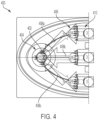
- FIG. 4 illustrates a configuration of a port 400 that may be used in confined spaces that are not large enough to accommodate port 100. Relative to port 100, port 400 can be about half the size.
- the aircraft 402 land and take-off at the same zone 404.
- An arriving aircraft 402 move to an unloading zone 406 of a designated lane 408a-c for passengers to offload.
- the aircraft 402 then moves to the charging zone 410 where it charges and turns around to face the opposite direction.
- the aircraft 402 then moves back to the same zone 406 used for unloading, at which point passengers may board the aircraft 402.
- the aircraft 402 then moves to the landing/take-off zone 404 for take-off.
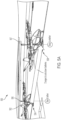
- FIGS. 5A and 5B illustrate aspects of a charging zone 500, according to various aspects.
- the aircraft 502 may move to a starting zone 504 of the charging zone 500 at which time a charging tether 506 may be connected to the aircraft 502.
- the charging tether 506 may be mounted to a support structure 507 above the aircraft 502 and may connect to an upper portion of the aircraft 502.
- the charging tether 506 may be manually connected to a charging port of the aircraft 502 or may automatically connect to a charging port of the aircraft 502.
- the charging tether 506 may be telescopic and may telescope downward to connect to the aircraft 502 and retract upward once charging is complete.
- the charging tether 506 may be movable along the support structure 507 so that the charging tether 506 can remain connected to the aircraft 502 as the aircraft 502 moves through the charging zone 500 to an ending zone 508 of the charging zone 500.
- the aircraft 502 may remain stationary while charging.
- the charging zone 500 may be configured to cool the aircraft 502 during charging.
- the charging tether 506 may include a cooling line 510 in addition to a charging line 512.
- the cooling line 510 may flow a cooling fluid (e.g., air or a coolant) that may move through the aircraft 502.
- the aircraft 502 may include a cooling pathway that routes cooling fluid through the aircraft, such as through heat exchangers for the battery packs 514. Cooling may be beneficial while charging due to the increase in temperature caused by charging and the lack of air cooling that would otherwise be available while the aircraft is flying.
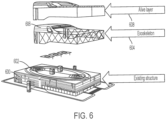
- FIG. 6 illustrates an example of retrofitting a port to an existing structure.
- the runway level 602 of the port is formed on or built atop the top of the existing structure 600.
- An exoskeleton 604 that includes the lounge level 606 is built onto the existing structure 600.
- the exoskeleton 604 may support operation components such as elevators, power units, storage, etc.
- An outer structure 608 is then built around the exoskeleton 604.
- the outer structure 608 can include an "alive" layer formed of plants, making the port both aesthetically and technically "greener.”
- Existing stairways, ramps, and/or elevators in the existing structure 600 may be used for passengers to access and exit the port. New or additional stairways, ramps, and/or elevators may be added.
- FIGS. 7A-I illustrate a port 700 installed at a remote location, such as a desert, forest, or other non-urban location.
- the port 700 may be configured in similar fashion to port 100 or port 400, discussed above, with respect to the movement of aircraft through the port 700.
- port 700 is configured in similar fashion to port 400, with a single landing/take-off zone 710.
- the port 700 may include sloping sides 720 that be designed to blend in with the surrounding environment.
- a solar energy harvesting farm 702 may be installed nearby the port 700 to provide energy to the port for charging aircraft.
- the solar farm 702 and/or port 700 may include energy storage for storing energy harvested by the solar farm 702. As shown in FIG.
- the port 700 may include tunnels 704 for passengers to safely access and leave the port 700 to and from outside networks, such as train stations, roads, trails, etc., while preserving the surrounding environment.
- the tunnels 704 may open to the natural surroundings such that an arriving passenger leaves the port 700 directing to the surrounding environment.
Landscapes
- Engineering & Computer Science (AREA)
- Mechanical Engineering (AREA)
- Power Engineering (AREA)
- Transportation (AREA)
- Aviation & Aerospace Engineering (AREA)
- Architecture (AREA)
- Civil Engineering (AREA)
- Structural Engineering (AREA)
- Charge And Discharge Circuits For Batteries Or The Like (AREA)
- Electric Propulsion And Braking For Vehicles (AREA)
Description
- This application claims the benefit of
U.S. Provisional Application No. 63/232,096, filed August 11, 2021 - This disclosure generally relates to electric vehicles, and more specifically to electrical vertical take-off and landing aircraft.
- Vertical take-off and landing (VTOL) aircraft are aircraft that can take-off and land vertically and hover, providing the ability to carry travelers directly to their destination. Helicopters are VTOL aircraft that generate lift entirely through their rotors. Some VTOL aircraft have wings and propulsion systems that enable the wings to provide the lift required during forward flight. Some winged VTOL aircraft can be sufficiently efficient in forward flight that the aircraft can be battery powered. Electric VTOL aircraft may require battery charging or battery swapping between flights. Thus, the availability of electric VTOL aircraft may be less than hydrocarbon powered aircraft.
- A port for electric vehicles is defined in
claim 1. A method for off-loading and loading passengers of electric vehicles is defined in claim 8. According to various aspects, a port for electric vehicles to load and unload passengers is configured for high throughput and availability of electric vehicles. The port includes an unloading zone, a loading zone spaced from the unloading zone, and a charging zone located between the unloading and loading zones in which the electric vehicle can be charged when moving from the unloading zone to the loading zone. The port includes multiple lanes, each including its own unloading zone, loading zone, and charging zone. Electric vehicles that have arrived at the port can be routed to a particular lane based on a charging time for the electric vehicle such that vehicles that require less charge can be cycled quickly through a fast lane while longer charging vehicles can be charged through a slower lane. - The electric vehicles can be electric vertical take-off and landing aircraft that may land at a landing zone and then may be directed to the unloading zone. The aircraft may be moved to the unloading zone via a separate tug vehicle such that the aircraft does not move under its own power to the unloading zone. The tug vehicle may move the aircraft from the unloading zone and through the charging zone to the loading zone. Once passengers are loaded on the aircraft, the tug vehicle may move the aircraft to a take-off zone. Optionally, the port may have a single landing zone and a single take-off zone and multiple lanes for unloading, charging, and loading.
- According to an aspect, a port for electric vehicles includes an off-loading zone for off-loading one or more passengers from an electric vehicle; a loading zone for loading one or more passengers onto the electric vehicle; and a charging zone for charging the electric vehicle while the electric vehicle is moving from the off-loading zone to the loading zone.
- The port includes multiple lanes, each lane comprising a respective off-loading zone, loading zone, and charging zone.
- Optionally, the electric vehicle is an electric aircraft.
- Optionally, the port include a landing zone for aircraft to land and a take-off zone for aircraft to take-off, wherein the charging zone is located in a facility and the facility is located between the landing zone and the take-off zone.
- Optionally, the port includes at least one tug vehicle for moving the electric aircraft from the landing zone to the off-loading zone.
- Optionally, the at least one tug vehicle is autonomous.
- Optionally, the port includes separate access ramps for passengers to access the off-loading zone and the loading zone.
- Optionally, the port includes a tether for connecting to the electric vehicle to provide electricity while the electric vehicle is moving through the charging zone.
- Optionally, the tether is configured to automatically connect to the electric vehicle.
- Optionally, the tether is configured to cool the electric vehicle during charging.
- According to an aspect, a method for off-loading and loading passengers of electric vehicles includes positioning the electric vehicle at an off-loading zone and off-loading at least one arriving passenger; moving the electric vehicle through a charging zone toward a loading zone and charging the electric vehicle while the electric vehicle is moving toward the loading zone; and loading at least one departing passenger on the electric vehicle while the electric vehicle is located in the loading zone.
- The method includes routing the electric vehicle to a particular off-loading zone based on a required amount of charging.
- Optionally, the method includes moving the electric vehicle toward the loading zone by a tug vehicle.
- Optionally, the tug vehicle is autonomous.
- Optionally, the electric vehicle is an electric aircraft, and the method includes directing the electric aircraft to land at a landing zone before off-loading the at least one arriving passenger and directing the electric aircraft to take-off from a take-off zone after loading the at least one departing passenger, wherein the landing zone and the take-off zone are separate zones located on opposite sides of the charging zone.
- Optionally, the method includes cooling the electric vehicle while the electric vehicle is charging.
- Optionally, the method includes flowing coolant to the electric vehicle for cooling the electric vehicle while charging the electric vehicle.
- Optionally, the method includes automatically connecting a charging tether to the electric vehicle.
- Optionally, the method includes charging multiple electric vehicles simultaneously in adjacent charging zones.
- Optionally, the electric vehicle moves in a single direction from the off-loading zone to the loading zone.
- The invention will now be described, by way of example only, with reference to the accompanying drawings, in which:
-
FIGS. 1A-1D are perspective views of a port for electric vertical take-off andlanding aircraft 100, according to various embodiments; -
FIG. 1E is a front view of the port ofFIGS. 1A-1D ,FIG. 1F is a rear view of the port,FIG. 1G is a side of the port, andFIG. 1H is a top view of the port, according to various embodiments; -
FIGS. 2A and2B illustrate the movement of an electric aircraft through a port, according to various embodiments; -
FIG. 3 illustrates the reversal of the movement of aircraft through the port relative to that shown inFIG. 2B , according to various embodiments; -
FIG. 4 illustrates a configuration of a port that may be used in confined spaces, according to various embodiments; -
FIGS. 5A and5B illustrate aspects of a charging zone, according to various embodiments; -
FIG. 6 illustrates an example of retrofitting a port to an existing structure; and -
FIGS. 7A-7I illustrate a port installed at a non-urban location, according to various embodiments. - Described herein are various aspects of ports configured for high throughput of electric vehicles, such as electric VTOL aircraft, electric buses, electric boats, and electric cars. Ports are configured with multiple charging lanes for simultaneously charging multiple onboard batteries of multiple electric vehicles. Ports may include landing and take-off zones that are spaced from one another, which reduces congestion and can increase throughput through the port. Electric vehicles may move through the port from arrival, through charging lanes, and to departure in the same direction, which can avoid delays associated with electric vehicles crossing paths. Ports may include spaced apart zones for passenger unloading and loading, which can provide non-crossing paths for passenger movement through the port. Electric vehicles may be charged in a charging zone located between the unloading and loading zones. Electric vehicles charge while moving through the charging zone.
- The charging zone may include a tether system that may manually or automatically connect to a port of the aircraft. The tether system may provide electricity to the electric vehicle for charging. A tether connected to the electric vehicle may be movable with the aircraft as the electric vehicle moves through the charging zone, so that the aircraft can charge as it is moving through the charging zone. The tether system may be configured to provide cooling fluid to the electric vehicle for cooling the batteries during charging.
- The electric vehicle may by moved through the port between the landing and take-off zones by a tug vehicle. The tug vehicle may be an autonomous, semi-autonomous, or manually operated vehicle. In some variations, the electric vehicle may move through at least a portion of the port under its own power.
- Electric vehicles are routed to different charging lanes of the port based on a desired charging time for the electric vehicle. For example, electric vehicles that require shorter charging times (e.g., the vehicles just completed a relative short trip) may be routed to a different lane than vehicles requiring longer charging times. For example, charging lanes can be designated for 10 minute charging, 20 minute charging, and 30 minute charging. An arriving vehicle that will require 20 minutes to charge (to fully charge or to charge to a level required for a next trip) may be routed to the 20 minute charge lane. By directing vehicle to different lanes based on charging, vehicles that need less charging time are not stuck behind vehicles that need more charging time, which can increase the throughput of electric vehicles through the port.
- In the following description of the disclosure and embodiments, reference is made to the accompanying drawings in which are shown, by way of illustration, specific embodiments that can be practiced. It is to be understood that other embodiments and examples can be practiced, and changes can be made, without departing from the scope of the claims.
- In addition, it is also to be understood that the singular forms "a," "an," and "the" used in the following description are intended to include the plural forms as well, unless the context clearly indicates otherwise. It is also to be understood that the term "and/or"," as used herein, refers to and encompasses any and all possible combinations of one or more of the associated listed items. It is further to be understood that the terms "includes, "including," "comprises," and/or "comprising," when used herein, specify the presence of stated features, integers, steps, operations, elements, components, and/or units, but do not preclude the presence or addition of one or more other features, integers, steps, operations, elements, components, units, and/or groups thereof.
-
FIGS. 1A-H illustrate aport 100 forVTOL aircraft 102.FIGS. 1A-D are perspective views of theport 100,FIG. 1E is a front view of theport 100,FIG. 1F is a rear view of theport 100,FIG. 1G is a side of theport 100, andFIG. 1H is a top view of theport 100. Theport 100 provides terminals for passengers embarking and disembarking theaircraft 102. Theport 100 may be located on the top of abuilding 104, such as a parking structure. In some embodiments, the building is a pre-existing, such as a pre-existing parking structure, that is retrofitted with theport 100. - The
port 100 includes arunway level 106 that includes alanding zone 108 at one side and a take-off zone 110 located at an opposite side. Located between the landing and take-off zones is alounge level 112 that provides passenger access to therunway level 106. Thelounge level 112 may have a waitingarea 114 where departing passengers may wait for their aircraft to be ready for loading. The waitingarea 114 may include a check-in area, restaurants, shops, etc. Thelounge level 112 is supported above therunway level 106 such thataircraft 102 can move under thelounge level 112. - The
aircraft 102 lands at thelanding zone 108 and moves to thelounge level 112 for passengers to disembark. After passengers disembark, theaircraft 102 moves through thelounge level 112 to a loading zone where departing passengers get onto the aircraft. As theaircraft 102 is moving through thelounge level 112, theaircraft 102 is charged. Once theaircraft 102 is charged and departing passengers have been loaded, the aircraft moves to the take-off zone 110 from which the aircraft departs once cleared. - The
port 100 includesmultiple lanes 116a-c for aircraft to move through theport 100. Eachlane 116a-c may begin at the same landing zone and end at the same take-off zone or there may be multiple landing zones and/or multiple take-off zones. Withmultiple lanes 116a-c, the port can handle multiple arriving/departing aircraft at the same time. Although three lane are shown, a port can include any number of lanes depending on the available space and expected throughput of the port. In some cases, a port may include just a single lane. A port may include at least two lanes, at least three lanes, at least four lanes, at least five lanes, or more. A port may include multiple different lounge levels that may each include multiple lanes. -
FIGS. 2A and2B illustrate the movement of anelectric aircraft 102 through theport 100, according to various embodiments.FIG. 2A is a side view of theport 100.FIG. 2B is a plan view of theport 100 with thelounge level 112 not shown. Theaircraft 102 lands at thelanding zone 108. Theaircraft 102 then moves or is moved to anunloading zone 118. The aircraft may move to theunloading zone 118 under its own power or may be towed to the unloading zone, such as via a tug vehicle that moves out to the loading zone, latches to theaircraft 102 and tows theaircraft 102 to theunloading zone 118. The tug vehicle could be, for example, an electric vehicle. Optionally, the tug vehicle operates autonomously. - When the aircraft is at the
unloading zone 118, any passengers on theaircraft 102 disembark and exit therunway level 106. The passengers may exit theport 100 in a downward direction through thebuilding 104. - After passengers have left the
aircraft 102, theaircraft 102 moves through a chargingzone 120 toward aloading zone 122. While in the chargingzone 120, theaircraft 102 may be tethered to charging lines that provide charging energy to theaircraft 102 for charging the batteries of theaircraft 102. The chargingzone 120 may include anoverhead structure 122 for supporting a charging tether that connects to the aircraft from above, which can ensure that power lines are not running along the floor of therunway level 106. - The
aircraft 102 may be moved through the chargingzone 120 by a tug vehicle. Theaircraft 102 may move continuously through the chargingzone 120 to theloading zone 122 or may stop within the chargingzone 120. Theaircraft 102 may charge as theaircraft 102 moves through the chargingzone 120, may charge when theaircraft 102 is stationary within the chargingzone 120, or both. Theaircraft 102 charges for an amount of time sufficient to reach a desired charge level, which may be a desired charge level for the next flight or can be a threshold charge level that is not based on the next flight (i.e., all aircraft charge to the same predetermined level regardless of their next flight plan). - The
aircraft 102 moves through the chargingzone 120 to theloading zone 122. While in theloading zone 122, theaircraft 102 may not be tethered to the charging system. While theaircraft 102 is in theloading zone 122, departing passengers can move from thelounge level 112 to therunway level 106 and move onboard theaircraft 102. The departing passengers may move downward from thelounge level 112 to therunway level 106, such as via one or more ramps, staircases, elevators, etc. The pathway for departing passengers to access the runway may be different than the pathway for arriving passengers such that departing passengers and arriving passengers remain separate while in theport 100. - Once departing passengers are loaded on the
aircraft 102, theaircraft 102 moves to the take-off zone 110. Theaircraft 102 may be moved to the take-off zone 110 by a tug vehicle. Theaircraft 102 may then power on its propulsion system and take-off when cleared. - A
port 100 includes multiple unloading/loading/charging lanes. The example illustrated inFIGS. 2B includes three lanes, indicated byreference numerals 116a-c. Anaircraft 102 that has landed at thelanding zone 108 is routed to one of thelanes 116a-c. Lanes are designated based on charging time, such that aircraft that require less charging may be routed to a different lane than aircraft that require more charging. For example, the three lanes illustrated inFIGS. 2B and 2C may be divided into short, medium, and long charging times. Theaircraft 102 may provide battery level information to theport 100, such as prior to arrival or upon arrival, and theport 100 may determine which lane to route the aircraft based on a determined amount of charging time for theaircraft 102 to be able to accomplish its next flight. A tug vehicle may come out to theaircraft 102 at thelanding zone 108, attached to theaircraft 102, and tow theaircraft 102 to the appropriate lane 126a-c. - As illustrated by the arrows in
FIG. 2B , electric aircraft move through theport 100, from thelanding zone 108, through the chargingzones 120, to the take-off zone 110 in the same direction (left-to-right inFIG. 2B ). This streamlined movement of aircraft through theport 100 can increase the throughput of aircraft through the port by minimizing the changes of aircraft crossing paths. -
FIG. 3 illustrates the reversal of the movement ofaircraft 102 through theport 100 relative to that shown inFIG. 2B , which may be used depending on weather conditions. In the reversal condition, the take-off and landing zone locations are swapped, the loading and unloading zones are swapped, and the direction of movement through the charging zone is reversed relative to the flow illustrated inFIGS. 2A-B . -
FIG. 4 illustrates a configuration of aport 400 that may be used in confined spaces that are not large enough to accommodateport 100. Relative toport 100,port 400 can be about half the size. Theaircraft 402 land and take-off at thesame zone 404. An arrivingaircraft 402 move to anunloading zone 406 of a designatedlane 408a-c for passengers to offload. Theaircraft 402 then moves to the chargingzone 410 where it charges and turns around to face the opposite direction. Theaircraft 402 then moves back to thesame zone 406 used for unloading, at which point passengers may board theaircraft 402. Theaircraft 402 then moves to the landing/take-off zone 404 for take-off. -
FIGS. 5A and5B illustrate aspects of a chargingzone 500, according to various aspects. Theaircraft 502 may move to astarting zone 504 of the chargingzone 500 at which time a chargingtether 506 may be connected to theaircraft 502. The chargingtether 506 may be mounted to asupport structure 507 above theaircraft 502 and may connect to an upper portion of theaircraft 502. The chargingtether 506 may be manually connected to a charging port of theaircraft 502 or may automatically connect to a charging port of theaircraft 502. The chargingtether 506 may be telescopic and may telescope downward to connect to theaircraft 502 and retract upward once charging is complete. The chargingtether 506 may be movable along thesupport structure 507 so that the chargingtether 506 can remain connected to theaircraft 502 as theaircraft 502 moves through the chargingzone 500 to an endingzone 508 of the chargingzone 500. In some variations, theaircraft 502 may remain stationary while charging. One theaircraft 502 is located in the endingzone 508 and done charging, the chargingtether 506 may disconnect (automatically or manually) from theaircraft 502. - In addition to charging the
aircraft 502, the chargingzone 500 may be configured to cool theaircraft 502 during charging. For example, the chargingtether 506 may include acooling line 510 in addition to acharging line 512. Thecooling line 510 may flow a cooling fluid (e.g., air or a coolant) that may move through theaircraft 502. Theaircraft 502 may include a cooling pathway that routes cooling fluid through the aircraft, such as through heat exchangers for the battery packs 514. Cooling may be beneficial while charging due to the increase in temperature caused by charging and the lack of air cooling that would otherwise be available while the aircraft is flying. - As noted above, a port can be retrofitted to an existing building, such as a parking garage.
FIG. 6 illustrates an example of retrofitting a port to an existing structure. Therunway level 602 of the port is formed on or built atop the top of the existingstructure 600. Anexoskeleton 604 that includes thelounge level 606 is built onto the existingstructure 600. Theexoskeleton 604 may support operation components such as elevators, power units, storage, etc. Anouter structure 608 is then built around theexoskeleton 604. Theouter structure 608 can include an "alive" layer formed of plants, making the port both aesthetically and technically "greener." Existing stairways, ramps, and/or elevators in the existingstructure 600 may be used for passengers to access and exit the port. New or additional stairways, ramps, and/or elevators may be added. -
FIGS. 7A-I illustrate aport 700 installed at a remote location, such as a desert, forest, or other non-urban location. Theport 700 may be configured in similar fashion to port 100 orport 400, discussed above, with respect to the movement of aircraft through theport 700. In the illustrated example,port 700 is configured in similar fashion toport 400, with a single landing/take-off zone 710. Theport 700 may include slopingsides 720 that be designed to blend in with the surrounding environment. A solarenergy harvesting farm 702 may be installed nearby theport 700 to provide energy to the port for charging aircraft. Thesolar farm 702 and/orport 700 may include energy storage for storing energy harvested by thesolar farm 702. As shown inFIG. 7I , theport 700 may includetunnels 704 for passengers to safely access and leave theport 700 to and from outside networks, such as train stations, roads, trails, etc., while preserving the surrounding environment. Thetunnels 704 may open to the natural surroundings such that an arriving passenger leaves theport 700 directing to the surrounding environment. - The foregoing description, for the purpose of explanation, has been described with reference to specific embodiments. However, the illustrative discussions above are not intended to be exhaustive or to limit the invention to the precise forms disclosed. Many modifications and variations are possible in view of the above teachings. The embodiments were chosen and described in order to best explain the principles of the techniques and their practical applications. Others skilled in the art are thereby enabled to best utilize the techniques and various embodiments with various modifications as are suited to the particular use contemplated, and if included within the scope of the claims.
- Although the disclosure and examples have been fully described with reference to the accompanying figures, it is to be noted that various changes and modifications will become apparent to those skilled in the art. Such changes and modifications are to be understood as being included within the scope of the disclosure if within the scope of the appended claims.
Claims (15)
- A port (100) for electric vehicles comprising:multiple lanes (116a, 116b, 116c) to which the electric vehicles are routed, each lane comprisingan off-loading zone (118) for off-loading one or more passengers from an electric vehicle,a loading zone (122) for loading one or more passengers onto the electric vehicle, anda charging zone (120) for charging the electric vehicle while the electric vehicle is moving from the off-loading zone to the loading zone,wherein the lanes are designated for routing of each electric vehicle based on a required charging time of each electric vehicle.
- The port of claim 1, wherein the electric vehicle is an electric aircraft.
- The port of claim 2, wherein the port comprises a landing zone (108) for aircraft to land and a take-off zone (110) for aircraft to take-off, wherein the charging zone is located in a facility and the facility (124) is located between the landing zone and the take-off zone.
- The port of claim 3, further comprising at least one tug vehicle for moving the electric aircraft from the landing zone to the off-loading zone.
- The port of claim 4, wherein the at least one tug vehicle is autonomous.
- The port of any of the preceding claims, wherein the port comprises separate access ramps for passengers to access the off-loading zones and the loading zones.
- The port of any of the preceding claims, comprising a tether (506) for connecting to the electric vehicle to provide electricity while the electric vehicle is moving through the charging zone, and optionally:wherein the tether is configured to automatically connect to the electric vehicle, and/orwherein the tether is configured to cool the electric vehicle during charging.
- A method for off-loading and loading passengers of electric vehicles comprising:positioning the electric vehicle at an off-loading zone (118) and off-loading at least one arriving passenger;moving the electric vehicle through a charging zone (120) toward a loading zone (122) and charging the electric vehicle while the electric vehicle is moving toward the loading zone;loading at least one departing passenger on the electric vehicle while the electric vehicle is located in the loading zone,wherein the method comprises routing the electric vehicle to a particular off-loading zone based on a required amount of charging.
- The method of claim 8, comprising moving the electric vehicle toward the loading zone by a tug vehicle, optionally:
wherein the tug vehicle is autonomous. - The method of any one of claims 8-9, wherein the electric vehicle is an electric aircraft, and the method comprises directing the electric aircraft to land at a landing zone before off-loading the at least one arriving passenger and directing the electric aircraft to take-off from a take-off zone after loading the at least one departing passenger, wherein the landing zone and the take-off zone are separate zones located on opposite sides of the charging zone.
- The method of any one of claims 8-10, comprising cooling the electric vehicle while the electric vehicle is charging.
- The method of claim 11, comprising flowing coolant to the electric vehicle for cooling the electric vehicle while charging the electric vehicle.
- The method of any one of claims 8-12, comprising automatically connecting a charging tether (506) to the electric vehicle.
- The method of any one of claims 8-13, comprising charging multiple electric vehicles simultaneously in adjacent charging zones.
- The method of any one of claims 8-14, wherein the electric vehicle moves in a single direction from the off-loading zone to the loading zone.
Applications Claiming Priority (2)
| Application Number | Priority Date | Filing Date | Title |
|---|---|---|---|
| US202163232096P | 2021-08-11 | 2021-08-11 | |
| PCT/US2022/074745 WO2023019159A1 (en) | 2021-08-11 | 2022-08-10 | Electric vehicle port |
Publications (2)
| Publication Number | Publication Date |
|---|---|
| EP4384445A1 EP4384445A1 (en) | 2024-06-19 |
| EP4384445B1 true EP4384445B1 (en) | 2024-11-06 |
Family
ID=83188451
Family Applications (1)
| Application Number | Title | Priority Date | Filing Date |
|---|---|---|---|
| EP22764614.8A Active EP4384445B1 (en) | 2021-08-11 | 2022-08-10 | Electric vehicle port |
Country Status (5)
| Country | Link |
|---|---|
| US (1) | US12179621B2 (en) |
| EP (1) | EP4384445B1 (en) |
| AU (1) | AU2022328323B2 (en) |
| CA (1) | CA3228613A1 (en) |
| WO (1) | WO2023019159A1 (en) |
Families Citing this family (2)
| Publication number | Priority date | Publication date | Assignee | Title |
|---|---|---|---|---|
| USD1045129S1 (en) * | 2021-08-11 | 2024-10-01 | Archer Aviation, Inc. | Airport for vertical take-off and landing aircraft |
| KR20250080337A (en) * | 2023-11-28 | 2025-06-05 | 현대자동차주식회사 | Vertiport system including transfer device using cables |
Family Cites Families (8)
| Publication number | Priority date | Publication date | Assignee | Title |
|---|---|---|---|---|
| FR2937776B1 (en) | 2008-10-23 | 2016-10-21 | Airbus Sas | METHOD FOR MOVING AN AIRCRAFT MANEUVER IN AN AIRPORT AREA |
| WO2018198126A1 (en) * | 2017-04-27 | 2018-11-01 | Flyon Advanced Transportation Systems Ltd. | Integrated ground-aerial transportation system |
| US11603210B2 (en) | 2017-04-27 | 2023-03-14 | Flyon Aerosystems Ltd. | High traffic-rate aerial transportation system with low-footprint Vertiport |
| WO2019020162A1 (en) | 2017-07-24 | 2019-01-31 | Volocopter Gmbh | STARTING AND LANDING DEVICE FOR PASSENGERS TRANSPORTING AIRPLANES |
| WO2019020158A1 (en) | 2017-07-24 | 2019-01-31 | Volocopter Gmbh | DEPOSIT AND PROCEDURE FOR PASSENGERS CONVEYING AIRPLANES |
| EP3891070B1 (en) | 2018-12-03 | 2024-10-23 | Bruno Mombrinie | Skyport for estol |
| US11648843B2 (en) | 2019-12-30 | 2023-05-16 | Oliver Crispin Robotics Limited | Robotic systems and methods for vehicle fueling and charging |
| CA3196506A1 (en) | 2020-11-09 | 2022-05-12 | James Joseph Tighe | Compact vertiport with efficient space utilization |
-
2022
- 2022-08-10 CA CA3228613A patent/CA3228613A1/en active Pending
- 2022-08-10 AU AU2022328323A patent/AU2022328323B2/en active Active
- 2022-08-10 US US17/885,110 patent/US12179621B2/en active Active
- 2022-08-10 EP EP22764614.8A patent/EP4384445B1/en active Active
- 2022-08-10 WO PCT/US2022/074745 patent/WO2023019159A1/en not_active Ceased
Also Published As
| Publication number | Publication date |
|---|---|
| CA3228613A1 (en) | 2023-02-16 |
| WO2023019159A1 (en) | 2023-02-16 |
| AU2022328323B2 (en) | 2024-05-02 |
| EP4384445A1 (en) | 2024-06-19 |
| US12179621B2 (en) | 2024-12-31 |
| AU2022328323A1 (en) | 2024-03-14 |
| US20230048651A1 (en) | 2023-02-16 |
Similar Documents
| Publication | Publication Date | Title |
|---|---|---|
| US12103671B2 (en) | Method for operating a vertiport | |
| US11142318B2 (en) | Two vehicle transportation system | |
| US9836065B2 (en) | Distributed airborne transportation system | |
| US11951867B2 (en) | Charge related processing for a personal transportation system with removable battery | |
| US10946964B2 (en) | Modular personal transportation system | |
| US11939069B2 (en) | Vertiport with handling robots and a turntable | |
| US12162625B2 (en) | Compact vertiport with efficient space utilization | |
| AU2022328323B2 (en) | Electric vehicle port | |
| WO2019135791A2 (en) | Vertical takeoff and landing transportation system | |
| HK40112019B (en) | Electric vehicle port | |
| HK40112019A (en) | Electric vehicle port | |
| US20250145306A1 (en) | Rotatable surface for headwind alignment and vertiport alignment |
Legal Events
| Date | Code | Title | Description |
|---|---|---|---|
| STAA | Information on the status of an ep patent application or granted ep patent |
Free format text: STATUS: UNKNOWN |
|
| STAA | Information on the status of an ep patent application or granted ep patent |
Free format text: STATUS: THE INTERNATIONAL PUBLICATION HAS BEEN MADE |
|
| PUAI | Public reference made under article 153(3) epc to a published international application that has entered the european phase |
Free format text: ORIGINAL CODE: 0009012 |
|
| STAA | Information on the status of an ep patent application or granted ep patent |
Free format text: STATUS: REQUEST FOR EXAMINATION WAS MADE |
|
| REG | Reference to a national code |
Ref country code: DE Ref legal event code: R079 Free format text: PREVIOUS MAIN CLASS: B64F0001360000 Ipc: B64F0001220000 Ref document number: 602022007550 Country of ref document: DE |
|
| GRAP | Despatch of communication of intention to grant a patent |
Free format text: ORIGINAL CODE: EPIDOSNIGR1 |
|
| STAA | Information on the status of an ep patent application or granted ep patent |
Free format text: STATUS: GRANT OF PATENT IS INTENDED |
|
| 17P | Request for examination filed |
Effective date: 20240213 |
|
| AK | Designated contracting states |
Kind code of ref document: A1 Designated state(s): AL AT BE BG CH CY CZ DE DK EE ES FI FR GB GR HR HU IE IS IT LI LT LU LV MC MK MT NL NO PL PT RO RS SE SI SK SM TR |
|
| RIC1 | Information provided on ipc code assigned before grant |
Ipc: B60L 53/39 20190101ALI20240527BHEP Ipc: B60L 53/12 20190101ALI20240527BHEP Ipc: B60L 53/50 20190101ALI20240527BHEP Ipc: B64F 1/35 20240101ALI20240527BHEP Ipc: B64F 1/30 20060101ALI20240527BHEP Ipc: B64F 1/22 20060101AFI20240527BHEP |
|
| DAV | Request for validation of the european patent (deleted) | ||
| DAX | Request for extension of the european patent (deleted) | ||
| INTG | Intention to grant announced |
Effective date: 20240619 |
|
| GRAS | Grant fee paid |
Free format text: ORIGINAL CODE: EPIDOSNIGR3 |
|
| GRAA | (expected) grant |
Free format text: ORIGINAL CODE: 0009210 |
|
| STAA | Information on the status of an ep patent application or granted ep patent |
Free format text: STATUS: THE PATENT HAS BEEN GRANTED |
|
| AK | Designated contracting states |
Kind code of ref document: B1 Designated state(s): AL AT BE BG CH CY CZ DE DK EE ES FI FR GB GR HR HU IE IS IT LI LT LU LV MC MK MT NL NO PL PT RO RS SE SI SK SM TR |
|
| REG | Reference to a national code |
Ref country code: GB Ref legal event code: FG4D |
|
| REG | Reference to a national code |
Ref country code: CH Ref legal event code: EP |
|
| REG | Reference to a national code |
Ref country code: DE Ref legal event code: R096 Ref document number: 602022007550 Country of ref document: DE |
|
| REG | Reference to a national code |
Ref country code: IE Ref legal event code: FG4D |
|
| P01 | Opt-out of the competence of the unified patent court (upc) registered |
Free format text: CASE NUMBER: APP_62119/2024 Effective date: 20241121 |
|
| REG | Reference to a national code |
Ref country code: HK Ref legal event code: DE Ref document number: 40112019 Country of ref document: HK |
|
| REG | Reference to a national code |
Ref country code: LT Ref legal event code: MG9D |
|
| REG | Reference to a national code |
Ref country code: NL Ref legal event code: MP Effective date: 20241106 |
|
| PG25 | Lapsed in a contracting state [announced via postgrant information from national office to epo] |
Ref country code: PT Free format text: LAPSE BECAUSE OF FAILURE TO SUBMIT A TRANSLATION OF THE DESCRIPTION OR TO PAY THE FEE WITHIN THE PRESCRIBED TIME-LIMIT Effective date: 20250306 Ref country code: HR Free format text: LAPSE BECAUSE OF FAILURE TO SUBMIT A TRANSLATION OF THE DESCRIPTION OR TO PAY THE FEE WITHIN THE PRESCRIBED TIME-LIMIT Effective date: 20241106 Ref country code: IS Free format text: LAPSE BECAUSE OF FAILURE TO SUBMIT A TRANSLATION OF THE DESCRIPTION OR TO PAY THE FEE WITHIN THE PRESCRIBED TIME-LIMIT Effective date: 20250306 |
|
| PG25 | Lapsed in a contracting state [announced via postgrant information from national office to epo] |
Ref country code: FI Free format text: LAPSE BECAUSE OF FAILURE TO SUBMIT A TRANSLATION OF THE DESCRIPTION OR TO PAY THE FEE WITHIN THE PRESCRIBED TIME-LIMIT Effective date: 20241106 Ref country code: NL Free format text: LAPSE BECAUSE OF FAILURE TO SUBMIT A TRANSLATION OF THE DESCRIPTION OR TO PAY THE FEE WITHIN THE PRESCRIBED TIME-LIMIT Effective date: 20241106 |
|
| REG | Reference to a national code |
Ref country code: AT Ref legal event code: MK05 Ref document number: 1739146 Country of ref document: AT Kind code of ref document: T Effective date: 20241106 |
|
| PG25 | Lapsed in a contracting state [announced via postgrant information from national office to epo] |
Ref country code: BG Free format text: LAPSE BECAUSE OF FAILURE TO SUBMIT A TRANSLATION OF THE DESCRIPTION OR TO PAY THE FEE WITHIN THE PRESCRIBED TIME-LIMIT Effective date: 20241106 |
|
| PG25 | Lapsed in a contracting state [announced via postgrant information from national office to epo] |
Ref country code: ES Free format text: LAPSE BECAUSE OF FAILURE TO SUBMIT A TRANSLATION OF THE DESCRIPTION OR TO PAY THE FEE WITHIN THE PRESCRIBED TIME-LIMIT Effective date: 20241106 |
|
| PG25 | Lapsed in a contracting state [announced via postgrant information from national office to epo] |
Ref country code: NO Free format text: LAPSE BECAUSE OF FAILURE TO SUBMIT A TRANSLATION OF THE DESCRIPTION OR TO PAY THE FEE WITHIN THE PRESCRIBED TIME-LIMIT Effective date: 20250206 |
|
| PG25 | Lapsed in a contracting state [announced via postgrant information from national office to epo] |
Ref country code: LV Free format text: LAPSE BECAUSE OF FAILURE TO SUBMIT A TRANSLATION OF THE DESCRIPTION OR TO PAY THE FEE WITHIN THE PRESCRIBED TIME-LIMIT Effective date: 20241106 Ref country code: GR Free format text: LAPSE BECAUSE OF FAILURE TO SUBMIT A TRANSLATION OF THE DESCRIPTION OR TO PAY THE FEE WITHIN THE PRESCRIBED TIME-LIMIT Effective date: 20250207 Ref country code: AT Free format text: LAPSE BECAUSE OF FAILURE TO SUBMIT A TRANSLATION OF THE DESCRIPTION OR TO PAY THE FEE WITHIN THE PRESCRIBED TIME-LIMIT Effective date: 20241106 |
|
| PG25 | Lapsed in a contracting state [announced via postgrant information from national office to epo] |
Ref country code: PL Free format text: LAPSE BECAUSE OF FAILURE TO SUBMIT A TRANSLATION OF THE DESCRIPTION OR TO PAY THE FEE WITHIN THE PRESCRIBED TIME-LIMIT Effective date: 20241106 |
|
| PG25 | Lapsed in a contracting state [announced via postgrant information from national office to epo] |
Ref country code: RS Free format text: LAPSE BECAUSE OF FAILURE TO SUBMIT A TRANSLATION OF THE DESCRIPTION OR TO PAY THE FEE WITHIN THE PRESCRIBED TIME-LIMIT Effective date: 20250206 |
|
| PG25 | Lapsed in a contracting state [announced via postgrant information from national office to epo] |
Ref country code: SM Free format text: LAPSE BECAUSE OF FAILURE TO SUBMIT A TRANSLATION OF THE DESCRIPTION OR TO PAY THE FEE WITHIN THE PRESCRIBED TIME-LIMIT Effective date: 20241106 |
|
| PG25 | Lapsed in a contracting state [announced via postgrant information from national office to epo] |
Ref country code: DK Free format text: LAPSE BECAUSE OF FAILURE TO SUBMIT A TRANSLATION OF THE DESCRIPTION OR TO PAY THE FEE WITHIN THE PRESCRIBED TIME-LIMIT Effective date: 20241106 |
|
| PG25 | Lapsed in a contracting state [announced via postgrant information from national office to epo] |
Ref country code: EE Free format text: LAPSE BECAUSE OF FAILURE TO SUBMIT A TRANSLATION OF THE DESCRIPTION OR TO PAY THE FEE WITHIN THE PRESCRIBED TIME-LIMIT Effective date: 20241106 |
|
| PG25 | Lapsed in a contracting state [announced via postgrant information from national office to epo] |
Ref country code: RO Free format text: LAPSE BECAUSE OF FAILURE TO SUBMIT A TRANSLATION OF THE DESCRIPTION OR TO PAY THE FEE WITHIN THE PRESCRIBED TIME-LIMIT Effective date: 20241106 |
|
| PG25 | Lapsed in a contracting state [announced via postgrant information from national office to epo] |
Ref country code: SK Free format text: LAPSE BECAUSE OF FAILURE TO SUBMIT A TRANSLATION OF THE DESCRIPTION OR TO PAY THE FEE WITHIN THE PRESCRIBED TIME-LIMIT Effective date: 20241106 |
|
| PG25 | Lapsed in a contracting state [announced via postgrant information from national office to epo] |
Ref country code: CZ Free format text: LAPSE BECAUSE OF FAILURE TO SUBMIT A TRANSLATION OF THE DESCRIPTION OR TO PAY THE FEE WITHIN THE PRESCRIBED TIME-LIMIT Effective date: 20241106 |
|
| PG25 | Lapsed in a contracting state [announced via postgrant information from national office to epo] |
Ref country code: IT Free format text: LAPSE BECAUSE OF FAILURE TO SUBMIT A TRANSLATION OF THE DESCRIPTION OR TO PAY THE FEE WITHIN THE PRESCRIBED TIME-LIMIT Effective date: 20241106 |
|
| REG | Reference to a national code |
Ref country code: DE Ref legal event code: R097 Ref document number: 602022007550 Country of ref document: DE |
|
| PG25 | Lapsed in a contracting state [announced via postgrant information from national office to epo] |
Ref country code: SE Free format text: LAPSE BECAUSE OF FAILURE TO SUBMIT A TRANSLATION OF THE DESCRIPTION OR TO PAY THE FEE WITHIN THE PRESCRIBED TIME-LIMIT Effective date: 20241106 |
|
| PLBE | No opposition filed within time limit |
Free format text: ORIGINAL CODE: 0009261 |
|
| STAA | Information on the status of an ep patent application or granted ep patent |
Free format text: STATUS: NO OPPOSITION FILED WITHIN TIME LIMIT |
|
| PGFP | Annual fee paid to national office [announced via postgrant information from national office to epo] |
Ref country code: DE Payment date: 20250806 Year of fee payment: 4 |
|
| 26N | No opposition filed |
Effective date: 20250807 |
|
| PGFP | Annual fee paid to national office [announced via postgrant information from national office to epo] |
Ref country code: FR Payment date: 20250801 Year of fee payment: 4 |
|
| REG | Reference to a national code |
Ref country code: CH Ref legal event code: H13 Free format text: ST27 STATUS EVENT CODE: U-0-0-H10-H13 (AS PROVIDED BY THE NATIONAL OFFICE) Effective date: 20260324 |
|
| PG25 | Lapsed in a contracting state [announced via postgrant information from national office to epo] |
Ref country code: MC Free format text: LAPSE BECAUSE OF FAILURE TO SUBMIT A TRANSLATION OF THE DESCRIPTION OR TO PAY THE FEE WITHIN THE PRESCRIBED TIME-LIMIT Effective date: 20241106 |
|
| PG25 | Lapsed in a contracting state [announced via postgrant information from national office to epo] |
Ref country code: LU Free format text: LAPSE BECAUSE OF NON-PAYMENT OF DUE FEES Effective date: 20250810 |
|
| PG25 | Lapsed in a contracting state [announced via postgrant information from national office to epo] |
Ref country code: CH Free format text: LAPSE BECAUSE OF NON-PAYMENT OF DUE FEES Effective date: 20250831 |