EP4383436A1 - Separator for secondary battery and manufacturing method thereof - Google Patents
Separator for secondary battery and manufacturing method thereof Download PDFInfo
- Publication number
- EP4383436A1 EP4383436A1 EP23214897.3A EP23214897A EP4383436A1 EP 4383436 A1 EP4383436 A1 EP 4383436A1 EP 23214897 A EP23214897 A EP 23214897A EP 4383436 A1 EP4383436 A1 EP 4383436A1
- Authority
- EP
- European Patent Office
- Prior art keywords
- redox
- separator
- surfactant
- electrolyte
- sealed
- Prior art date
- Legal status (The legal status is an assumption and is not a legal conclusion. Google has not performed a legal analysis and makes no representation as to the accuracy of the status listed.)
- Pending
Links
- 238000004519 manufacturing process Methods 0.000 title claims abstract description 23
- 239000004094 surface-active agent Substances 0.000 claims abstract description 54
- 238000000034 method Methods 0.000 claims abstract description 52
- 239000012528 membrane Substances 0.000 claims abstract description 46
- 239000011259 mixed solution Substances 0.000 claims abstract description 24
- 239000011347 resin Substances 0.000 claims abstract description 19
- 229920005989 resin Polymers 0.000 claims abstract description 19
- 239000003960 organic solvent Substances 0.000 claims abstract description 11
- 239000003792 electrolyte Substances 0.000 claims description 162
- 150000002500 ions Chemical class 0.000 claims description 49
- 239000004693 Polybenzimidazole Substances 0.000 claims description 29
- 229920002480 polybenzimidazole Polymers 0.000 claims description 29
- -1 polypropylene Polymers 0.000 claims description 19
- 239000004698 Polyethylene Substances 0.000 claims description 16
- 229920000573 polyethylene Polymers 0.000 claims description 16
- 239000002904 solvent Substances 0.000 claims description 15
- 229920000642 polymer Polymers 0.000 claims description 14
- 229910001456 vanadium ion Inorganic materials 0.000 claims description 14
- 238000001035 drying Methods 0.000 claims description 10
- ZWEHNKRNPOVVGH-UHFFFAOYSA-N 2-Butanone Chemical compound CCC(C)=O ZWEHNKRNPOVVGH-UHFFFAOYSA-N 0.000 claims description 9
- CSCPPACGZOOCGX-UHFFFAOYSA-N Acetone Chemical compound CC(C)=O CSCPPACGZOOCGX-UHFFFAOYSA-N 0.000 claims description 9
- LFQSCWFLJHTTHZ-UHFFFAOYSA-N Ethanol Chemical compound CCO LFQSCWFLJHTTHZ-UHFFFAOYSA-N 0.000 claims description 9
- OKKJLVBELUTLKV-UHFFFAOYSA-N Methanol Chemical compound OC OKKJLVBELUTLKV-UHFFFAOYSA-N 0.000 claims description 9
- 229920001296 polysiloxane Polymers 0.000 claims description 8
- KFZMGEQAYNKOFK-UHFFFAOYSA-N Isopropanol Chemical compound CC(C)O KFZMGEQAYNKOFK-UHFFFAOYSA-N 0.000 claims description 6
- LRHPLDYGYMQRHN-UHFFFAOYSA-N N-Butanol Chemical compound CCCCO LRHPLDYGYMQRHN-UHFFFAOYSA-N 0.000 claims description 6
- 239000004743 Polypropylene Substances 0.000 claims description 6
- ZXEKIIBDNHEJCQ-UHFFFAOYSA-N isobutanol Chemical compound CC(C)CO ZXEKIIBDNHEJCQ-UHFFFAOYSA-N 0.000 claims description 6
- 229920001155 polypropylene Polymers 0.000 claims description 6
- 239000007788 liquid Substances 0.000 claims description 4
- 239000002736 nonionic surfactant Substances 0.000 claims description 4
- NTIZESTWPVYFNL-UHFFFAOYSA-N Methyl isobutyl ketone Chemical compound CC(C)CC(C)=O NTIZESTWPVYFNL-UHFFFAOYSA-N 0.000 claims description 3
- UIHCLUNTQKBZGK-UHFFFAOYSA-N Methyl isobutyl ketone Natural products CCC(C)C(C)=O UIHCLUNTQKBZGK-UHFFFAOYSA-N 0.000 claims description 3
- 230000002378 acidificating effect Effects 0.000 claims description 3
- 239000007864 aqueous solution Substances 0.000 claims description 3
- 239000002563 ionic surfactant Substances 0.000 claims description 3
- 239000003014 ion exchange membrane Substances 0.000 description 34
- 239000010408 film Substances 0.000 description 25
- 239000000243 solution Substances 0.000 description 24
- 230000000052 comparative effect Effects 0.000 description 19
- 238000006243 chemical reaction Methods 0.000 description 18
- 230000008569 process Effects 0.000 description 17
- 238000004891 communication Methods 0.000 description 13
- 238000004146 energy storage Methods 0.000 description 13
- ZMXDDKWLCZADIW-UHFFFAOYSA-N N,N-Dimethylformamide Chemical compound CN(C)C=O ZMXDDKWLCZADIW-UHFFFAOYSA-N 0.000 description 12
- 230000008901 benefit Effects 0.000 description 12
- 230000002829 reductive effect Effects 0.000 description 12
- 238000003487 electrochemical reaction Methods 0.000 description 11
- OKTJSMMVPCPJKN-UHFFFAOYSA-N Carbon Chemical compound [C] OKTJSMMVPCPJKN-UHFFFAOYSA-N 0.000 description 10
- HBBGRARXTFLTSG-UHFFFAOYSA-N Lithium ion Chemical compound [Li+] HBBGRARXTFLTSG-UHFFFAOYSA-N 0.000 description 10
- 238000007599 discharging Methods 0.000 description 10
- 238000005516 engineering process Methods 0.000 description 10
- 229910001416 lithium ion Inorganic materials 0.000 description 10
- 238000002156 mixing Methods 0.000 description 10
- LEONUFNNVUYDNQ-UHFFFAOYSA-N vanadium atom Chemical compound [V] LEONUFNNVUYDNQ-UHFFFAOYSA-N 0.000 description 10
- FXHOOIRPVKKKFG-UHFFFAOYSA-N N,N-Dimethylacetamide Chemical compound CN(C)C(C)=O FXHOOIRPVKKKFG-UHFFFAOYSA-N 0.000 description 9
- 230000000694 effects Effects 0.000 description 9
- 239000000463 material Substances 0.000 description 9
- 239000000126 substance Substances 0.000 description 9
- 230000001965 increasing effect Effects 0.000 description 8
- 229910052799 carbon Inorganic materials 0.000 description 6
- 238000013461 design Methods 0.000 description 6
- 238000012983 electrochemical energy storage Methods 0.000 description 6
- 230000006870 function Effects 0.000 description 6
- 229910052751 metal Inorganic materials 0.000 description 6
- 239000002184 metal Substances 0.000 description 6
- 239000000203 mixture Substances 0.000 description 6
- QAOWNCQODCNURD-UHFFFAOYSA-N Sulfuric acid Chemical compound OS(O)(=O)=O QAOWNCQODCNURD-UHFFFAOYSA-N 0.000 description 5
- 239000011149 active material Substances 0.000 description 5
- 238000013459 approach Methods 0.000 description 5
- 230000006872 improvement Effects 0.000 description 5
- 239000000758 substrate Substances 0.000 description 5
- IAZDPXIOMUYVGZ-UHFFFAOYSA-N Dimethylsulphoxide Chemical compound CS(C)=O IAZDPXIOMUYVGZ-UHFFFAOYSA-N 0.000 description 4
- SECXISVLQFMRJM-UHFFFAOYSA-N N-Methylpyrrolidone Chemical compound CN1CCCC1=O SECXISVLQFMRJM-UHFFFAOYSA-N 0.000 description 4
- 239000002253 acid Substances 0.000 description 4
- 150000001450 anions Chemical class 0.000 description 4
- 150000001768 cations Chemical class 0.000 description 4
- 229920001940 conductive polymer Polymers 0.000 description 4
- 230000002209 hydrophobic effect Effects 0.000 description 4
- 230000010354 integration Effects 0.000 description 4
- 238000012423 maintenance Methods 0.000 description 4
- 238000006479 redox reaction Methods 0.000 description 4
- YCKRFDGAMUMZLT-UHFFFAOYSA-N Fluorine atom Chemical compound [F] YCKRFDGAMUMZLT-UHFFFAOYSA-N 0.000 description 3
- 238000005260 corrosion Methods 0.000 description 3
- 230000007797 corrosion Effects 0.000 description 3
- 238000011161 development Methods 0.000 description 3
- 230000005611 electricity Effects 0.000 description 3
- 239000011737 fluorine Substances 0.000 description 3
- 229910052731 fluorine Inorganic materials 0.000 description 3
- 229910002804 graphite Inorganic materials 0.000 description 3
- 239000010439 graphite Substances 0.000 description 3
- 230000003647 oxidation Effects 0.000 description 3
- 238000007254 oxidation reaction Methods 0.000 description 3
- 238000012546 transfer Methods 0.000 description 3
- GKQHIYSTBXDYNQ-UHFFFAOYSA-M 1-dodecylpyridin-1-ium;chloride Chemical compound [Cl-].CCCCCCCCCCCC[N+]1=CC=CC=C1 GKQHIYSTBXDYNQ-UHFFFAOYSA-M 0.000 description 2
- 239000004215 Carbon black (E152) Substances 0.000 description 2
- CXRFDZFCGOPDTD-UHFFFAOYSA-M Cetrimide Chemical compound [Br-].CCCCCCCCCCCCCC[N+](C)(C)C CXRFDZFCGOPDTD-UHFFFAOYSA-M 0.000 description 2
- LZZYPRNAOMGNLH-UHFFFAOYSA-M Cetrimonium bromide Chemical compound [Br-].CCCCCCCCCCCCCCCC[N+](C)(C)C LZZYPRNAOMGNLH-UHFFFAOYSA-M 0.000 description 2
- DBMJMQXJHONAFJ-UHFFFAOYSA-M Sodium laurylsulphate Chemical compound [Na+].CCCCCCCCCCCCOS([O-])(=O)=O DBMJMQXJHONAFJ-UHFFFAOYSA-M 0.000 description 2
- BNOODXBBXFZASF-UHFFFAOYSA-N [Na].[S] Chemical compound [Na].[S] BNOODXBBXFZASF-UHFFFAOYSA-N 0.000 description 2
- 239000005456 alcohol based solvent Substances 0.000 description 2
- 229910052782 aluminium Inorganic materials 0.000 description 2
- XAGFODPZIPBFFR-UHFFFAOYSA-N aluminium Chemical compound [Al] XAGFODPZIPBFFR-UHFFFAOYSA-N 0.000 description 2
- 150000001408 amides Chemical group 0.000 description 2
- 239000003945 anionic surfactant Substances 0.000 description 2
- 230000004888 barrier function Effects 0.000 description 2
- 230000015572 biosynthetic process Effects 0.000 description 2
- 239000003575 carbonaceous material Substances 0.000 description 2
- 239000003054 catalyst Substances 0.000 description 2
- 239000003093 cationic surfactant Substances 0.000 description 2
- 230000008859 change Effects 0.000 description 2
- 239000011651 chromium Substances 0.000 description 2
- 239000011248 coating agent Substances 0.000 description 2
- 238000000576 coating method Methods 0.000 description 2
- 239000002322 conducting polymer Substances 0.000 description 2
- 238000001816 cooling Methods 0.000 description 2
- 229920001577 copolymer Polymers 0.000 description 2
- 230000002950 deficient Effects 0.000 description 2
- 229940113088 dimethylacetamide Drugs 0.000 description 2
- XJWSAJYUBXQQDR-UHFFFAOYSA-M dodecyltrimethylammonium bromide Chemical compound [Br-].CCCCCCCCCCCC[N+](C)(C)C XJWSAJYUBXQQDR-UHFFFAOYSA-M 0.000 description 2
- 239000008151 electrolyte solution Substances 0.000 description 2
- 238000004880 explosion Methods 0.000 description 2
- 229930195733 hydrocarbon Natural products 0.000 description 2
- 150000002430 hydrocarbons Chemical class 0.000 description 2
- 238000009434 installation Methods 0.000 description 2
- 239000005453 ketone based solvent Substances 0.000 description 2
- 230000000670 limiting effect Effects 0.000 description 2
- 239000011572 manganese Substances 0.000 description 2
- 229920000172 poly(styrenesulfonic acid) Polymers 0.000 description 2
- 229920006393 polyether sulfone Polymers 0.000 description 2
- 229920002530 polyetherether ketone Polymers 0.000 description 2
- 229920001721 polyimide Polymers 0.000 description 2
- 230000008439 repair process Effects 0.000 description 2
- 230000002441 reversible effect Effects 0.000 description 2
- 230000002123 temporal effect Effects 0.000 description 2
- 239000010936 titanium Substances 0.000 description 2
- 229910052720 vanadium Inorganic materials 0.000 description 2
- UUUGYDOQQLOJQA-UHFFFAOYSA-L vanadyl sulfate Chemical compound [V+2]=O.[O-]S([O-])(=O)=O UUUGYDOQQLOJQA-UHFFFAOYSA-L 0.000 description 2
- 229910000352 vanadyl sulfate Inorganic materials 0.000 description 2
- 125000001140 1,4-phenylene group Chemical group [H]C1=C([H])C([*:2])=C([H])C([H])=C1[*:1] 0.000 description 1
- WKBOTKDWSSQWDR-UHFFFAOYSA-N Bromine atom Chemical compound [Br] WKBOTKDWSSQWDR-UHFFFAOYSA-N 0.000 description 1
- 229920000049 Carbon (fiber) Polymers 0.000 description 1
- 229910052684 Cerium Inorganic materials 0.000 description 1
- VYZAMTAEIAYCRO-UHFFFAOYSA-N Chromium Chemical compound [Cr] VYZAMTAEIAYCRO-UHFFFAOYSA-N 0.000 description 1
- RYGMFSIKBFXOCR-UHFFFAOYSA-N Copper Chemical compound [Cu] RYGMFSIKBFXOCR-UHFFFAOYSA-N 0.000 description 1
- XEEYBQQBJWHFJM-UHFFFAOYSA-N Iron Chemical compound [Fe] XEEYBQQBJWHFJM-UHFFFAOYSA-N 0.000 description 1
- PWHULOQIROXLJO-UHFFFAOYSA-N Manganese Chemical compound [Mn] PWHULOQIROXLJO-UHFFFAOYSA-N 0.000 description 1
- 239000004696 Poly ether ether ketone Substances 0.000 description 1
- 239000004695 Polyether sulfone Substances 0.000 description 1
- 239000004642 Polyimide Substances 0.000 description 1
- 239000004793 Polystyrene Substances 0.000 description 1
- RTAQQCXQSZGOHL-UHFFFAOYSA-N Titanium Chemical compound [Ti] RTAQQCXQSZGOHL-UHFFFAOYSA-N 0.000 description 1
- 239000013504 Triton X-100 Substances 0.000 description 1
- 229920004890 Triton X-100 Polymers 0.000 description 1
- 239000003929 acidic solution Substances 0.000 description 1
- 239000004676 acrylonitrile butadiene styrene Substances 0.000 description 1
- 239000000654 additive Substances 0.000 description 1
- 239000003011 anion exchange membrane Substances 0.000 description 1
- GDTBXPJZTBHREO-UHFFFAOYSA-N bromine Substances BrBr GDTBXPJZTBHREO-UHFFFAOYSA-N 0.000 description 1
- 229910052794 bromium Inorganic materials 0.000 description 1
- 239000006229 carbon black Substances 0.000 description 1
- 239000004917 carbon fiber Substances 0.000 description 1
- 238000005341 cation exchange Methods 0.000 description 1
- GWXLDORMOJMVQZ-UHFFFAOYSA-N cerium Chemical compound [Ce] GWXLDORMOJMVQZ-UHFFFAOYSA-N 0.000 description 1
- 229910052804 chromium Inorganic materials 0.000 description 1
- 239000010941 cobalt Substances 0.000 description 1
- 229910017052 cobalt Inorganic materials 0.000 description 1
- GUTLYIVDDKVIGB-UHFFFAOYSA-N cobalt atom Chemical compound [Co] GUTLYIVDDKVIGB-UHFFFAOYSA-N 0.000 description 1
- 230000002860 competitive effect Effects 0.000 description 1
- 239000002131 composite material Substances 0.000 description 1
- 238000010276 construction Methods 0.000 description 1
- 238000011109 contamination Methods 0.000 description 1
- 230000008602 contraction Effects 0.000 description 1
- 229910052802 copper Inorganic materials 0.000 description 1
- 239000010949 copper Substances 0.000 description 1
- 238000012864 cross contamination Methods 0.000 description 1
- 230000007547 defect Effects 0.000 description 1
- 238000009792 diffusion process Methods 0.000 description 1
- USIUVYZYUHIAEV-UHFFFAOYSA-N diphenyl ether Natural products C=1C=CC=CC=1OC1=CC=CC=C1 USIUVYZYUHIAEV-UHFFFAOYSA-N 0.000 description 1
- YRIUSKIDOIARQF-UHFFFAOYSA-N dodecyl benzenesulfonate Chemical compound CCCCCCCCCCCCOS(=O)(=O)C1=CC=CC=C1 YRIUSKIDOIARQF-UHFFFAOYSA-N 0.000 description 1
- 230000002708 enhancing effect Effects 0.000 description 1
- 230000007613 environmental effect Effects 0.000 description 1
- 238000011156 evaluation Methods 0.000 description 1
- 230000001747 exhibiting effect Effects 0.000 description 1
- 238000002474 experimental method Methods 0.000 description 1
- 239000004744 fabric Substances 0.000 description 1
- 238000011049 filling Methods 0.000 description 1
- UQSQSQZYBQSBJZ-UHFFFAOYSA-N fluorosulfonic acid Chemical compound OS(F)(=O)=O UQSQSQZYBQSBJZ-UHFFFAOYSA-N 0.000 description 1
- 239000011888 foil Substances 0.000 description 1
- 239000000446 fuel Substances 0.000 description 1
- 125000000524 functional group Chemical group 0.000 description 1
- 229910021389 graphene Inorganic materials 0.000 description 1
- 230000002452 interceptive effect Effects 0.000 description 1
- 230000007774 longterm Effects 0.000 description 1
- 229910052748 manganese Inorganic materials 0.000 description 1
- 229910021645 metal ion Inorganic materials 0.000 description 1
- VNWKTOKETHGBQD-UHFFFAOYSA-N methane Chemical compound C VNWKTOKETHGBQD-UHFFFAOYSA-N 0.000 description 1
- 238000013508 migration Methods 0.000 description 1
- 230000005012 migration Effects 0.000 description 1
- 230000000116 mitigating effect Effects 0.000 description 1
- 238000012986 modification Methods 0.000 description 1
- 230000004048 modification Effects 0.000 description 1
- 230000003204 osmotic effect Effects 0.000 description 1
- 230000001151 other effect Effects 0.000 description 1
- 230000001590 oxidative effect Effects 0.000 description 1
- 229920003023 plastic Polymers 0.000 description 1
- 239000004033 plastic Substances 0.000 description 1
- 229920006260 polyaryletherketone Polymers 0.000 description 1
- 239000004417 polycarbonate Substances 0.000 description 1
- 229920000515 polycarbonate Polymers 0.000 description 1
- 229920000098 polyolefin Polymers 0.000 description 1
- 229920000136 polysorbate Polymers 0.000 description 1
- 239000004800 polyvinyl chloride Substances 0.000 description 1
- 229920006316 polyvinylpyrrolidine Polymers 0.000 description 1
- 230000003449 preventive effect Effects 0.000 description 1
- 238000005086 pumping Methods 0.000 description 1
- 150000003254 radicals Chemical class 0.000 description 1
- 230000009467 reduction Effects 0.000 description 1
- 230000001105 regulatory effect Effects 0.000 description 1
- 239000002990 reinforced plastic Substances 0.000 description 1
- 238000009877 rendering Methods 0.000 description 1
- 238000012827 research and development Methods 0.000 description 1
- 230000004044 response Effects 0.000 description 1
- 238000000926 separation method Methods 0.000 description 1
- HFQQZARZPUDIFP-UHFFFAOYSA-M sodium;2-dodecylbenzenesulfonate Chemical compound [Na+].CCCCCCCCCCCCC1=CC=CC=C1S([O-])(=O)=O HFQQZARZPUDIFP-UHFFFAOYSA-M 0.000 description 1
- 239000007787 solid Substances 0.000 description 1
- 238000003756 stirring Methods 0.000 description 1
- 125000000542 sulfonic acid group Chemical group 0.000 description 1
- 239000003115 supporting electrolyte Substances 0.000 description 1
- 230000003746 surface roughness Effects 0.000 description 1
- JBQYATWDVHIOAR-UHFFFAOYSA-N tellanylidenegermanium Chemical compound [Te]=[Ge] JBQYATWDVHIOAR-UHFFFAOYSA-N 0.000 description 1
- 239000010409 thin film Substances 0.000 description 1
- 229910052719 titanium Inorganic materials 0.000 description 1
- 238000012549 training Methods 0.000 description 1
- 229940041260 vanadyl sulfate Drugs 0.000 description 1
- 238000010792 warming Methods 0.000 description 1
Images



Classifications
-
- H—ELECTRICITY
- H01—ELECTRIC ELEMENTS
- H01M—PROCESSES OR MEANS, e.g. BATTERIES, FOR THE DIRECT CONVERSION OF CHEMICAL ENERGY INTO ELECTRICAL ENERGY
- H01M8/00—Fuel cells; Manufacture thereof
- H01M8/02—Details
- H01M8/0202—Collectors; Separators, e.g. bipolar separators; Interconnectors
- H01M8/023—Porous and characterised by the material
- H01M8/0239—Organic resins; Organic polymers
-
- H—ELECTRICITY
- H01—ELECTRIC ELEMENTS
- H01M—PROCESSES OR MEANS, e.g. BATTERIES, FOR THE DIRECT CONVERSION OF CHEMICAL ENERGY INTO ELECTRICAL ENERGY
- H01M8/00—Fuel cells; Manufacture thereof
- H01M8/10—Fuel cells with solid electrolytes
- H01M8/1016—Fuel cells with solid electrolytes characterised by the electrolyte material
- H01M8/1018—Polymeric electrolyte materials
- H01M8/1069—Polymeric electrolyte materials characterised by the manufacturing processes
- H01M8/1081—Polymeric electrolyte materials characterised by the manufacturing processes starting from solutions, dispersions or slurries exclusively of polymers
-
- H—ELECTRICITY
- H01—ELECTRIC ELEMENTS
- H01M—PROCESSES OR MEANS, e.g. BATTERIES, FOR THE DIRECT CONVERSION OF CHEMICAL ENERGY INTO ELECTRICAL ENERGY
- H01M50/00—Constructional details or processes of manufacture of the non-active parts of electrochemical cells other than fuel cells, e.g. hybrid cells
- H01M50/40—Separators; Membranes; Diaphragms; Spacing elements inside cells
- H01M50/403—Manufacturing processes of separators, membranes or diaphragms
-
- H—ELECTRICITY
- H01—ELECTRIC ELEMENTS
- H01M—PROCESSES OR MEANS, e.g. BATTERIES, FOR THE DIRECT CONVERSION OF CHEMICAL ENERGY INTO ELECTRICAL ENERGY
- H01M50/00—Constructional details or processes of manufacture of the non-active parts of electrochemical cells other than fuel cells, e.g. hybrid cells
- H01M50/40—Separators; Membranes; Diaphragms; Spacing elements inside cells
- H01M50/409—Separators, membranes or diaphragms characterised by the material
- H01M50/411—Organic material
- H01M50/414—Synthetic resins, e.g. thermoplastics or thermosetting resins
-
- H—ELECTRICITY
- H01—ELECTRIC ELEMENTS
- H01M—PROCESSES OR MEANS, e.g. BATTERIES, FOR THE DIRECT CONVERSION OF CHEMICAL ENERGY INTO ELECTRICAL ENERGY
- H01M50/00—Constructional details or processes of manufacture of the non-active parts of electrochemical cells other than fuel cells, e.g. hybrid cells
- H01M50/40—Separators; Membranes; Diaphragms; Spacing elements inside cells
- H01M50/409—Separators, membranes or diaphragms characterised by the material
- H01M50/411—Organic material
- H01M50/414—Synthetic resins, e.g. thermoplastics or thermosetting resins
- H01M50/417—Polyolefins
-
- H—ELECTRICITY
- H01—ELECTRIC ELEMENTS
- H01M—PROCESSES OR MEANS, e.g. BATTERIES, FOR THE DIRECT CONVERSION OF CHEMICAL ENERGY INTO ELECTRICAL ENERGY
- H01M8/00—Fuel cells; Manufacture thereof
- H01M8/02—Details
- H01M8/0202—Collectors; Separators, e.g. bipolar separators; Interconnectors
- H01M8/023—Porous and characterised by the material
- H01M8/0241—Composites
- H01M8/0243—Composites in the form of mixtures
-
- H—ELECTRICITY
- H01—ELECTRIC ELEMENTS
- H01M—PROCESSES OR MEANS, e.g. BATTERIES, FOR THE DIRECT CONVERSION OF CHEMICAL ENERGY INTO ELECTRICAL ENERGY
- H01M8/00—Fuel cells; Manufacture thereof
- H01M8/10—Fuel cells with solid electrolytes
- H01M8/1016—Fuel cells with solid electrolytes characterised by the electrolyte material
- H01M8/1018—Polymeric electrolyte materials
- H01M8/102—Polymeric electrolyte materials characterised by the chemical structure of the main chain of the ion-conducting polymer
- H01M8/103—Polymeric electrolyte materials characterised by the chemical structure of the main chain of the ion-conducting polymer having nitrogen, e.g. sulfonated polybenzimidazoles [S-PBI], polybenzimidazoles with phosphoric acid, sulfonated polyamides [S-PA] or sulfonated polyphosphazenes [S-PPh]
-
- H—ELECTRICITY
- H01—ELECTRIC ELEMENTS
- H01M—PROCESSES OR MEANS, e.g. BATTERIES, FOR THE DIRECT CONVERSION OF CHEMICAL ENERGY INTO ELECTRICAL ENERGY
- H01M8/00—Fuel cells; Manufacture thereof
- H01M8/10—Fuel cells with solid electrolytes
- H01M8/1016—Fuel cells with solid electrolytes characterised by the electrolyte material
- H01M8/1018—Polymeric electrolyte materials
- H01M8/1041—Polymer electrolyte composites, mixtures or blends
- H01M8/1046—Mixtures of at least one polymer and at least one additive
-
- H—ELECTRICITY
- H01—ELECTRIC ELEMENTS
- H01M—PROCESSES OR MEANS, e.g. BATTERIES, FOR THE DIRECT CONVERSION OF CHEMICAL ENERGY INTO ELECTRICAL ENERGY
- H01M8/00—Fuel cells; Manufacture thereof
- H01M8/10—Fuel cells with solid electrolytes
- H01M8/1016—Fuel cells with solid electrolytes characterised by the electrolyte material
- H01M8/1018—Polymeric electrolyte materials
- H01M8/1058—Polymeric electrolyte materials characterised by a porous support having no ion-conducting properties
- H01M8/106—Polymeric electrolyte materials characterised by a porous support having no ion-conducting properties characterised by the chemical composition of the porous support
-
- H—ELECTRICITY
- H01—ELECTRIC ELEMENTS
- H01M—PROCESSES OR MEANS, e.g. BATTERIES, FOR THE DIRECT CONVERSION OF CHEMICAL ENERGY INTO ELECTRICAL ENERGY
- H01M8/00—Fuel cells; Manufacture thereof
- H01M8/10—Fuel cells with solid electrolytes
- H01M8/1016—Fuel cells with solid electrolytes characterised by the electrolyte material
- H01M8/1018—Polymeric electrolyte materials
- H01M8/1058—Polymeric electrolyte materials characterised by a porous support having no ion-conducting properties
- H01M8/1062—Polymeric electrolyte materials characterised by a porous support having no ion-conducting properties characterised by the physical properties of the porous support, e.g. its porosity or thickness
-
- H—ELECTRICITY
- H01—ELECTRIC ELEMENTS
- H01M—PROCESSES OR MEANS, e.g. BATTERIES, FOR THE DIRECT CONVERSION OF CHEMICAL ENERGY INTO ELECTRICAL ENERGY
- H01M8/00—Fuel cells; Manufacture thereof
- H01M8/18—Regenerative fuel cells, e.g. redox flow batteries or secondary fuel cells
- H01M8/184—Regeneration by electrochemical means
- H01M8/188—Regeneration by electrochemical means by recharging of redox couples containing fluids; Redox flow type batteries
-
- H—ELECTRICITY
- H01—ELECTRIC ELEMENTS
- H01M—PROCESSES OR MEANS, e.g. BATTERIES, FOR THE DIRECT CONVERSION OF CHEMICAL ENERGY INTO ELECTRICAL ENERGY
- H01M8/00—Fuel cells; Manufacture thereof
- H01M8/10—Fuel cells with solid electrolytes
- H01M2008/1095—Fuel cells with polymeric electrolytes
-
- H—ELECTRICITY
- H01—ELECTRIC ELEMENTS
- H01M—PROCESSES OR MEANS, e.g. BATTERIES, FOR THE DIRECT CONVERSION OF CHEMICAL ENERGY INTO ELECTRICAL ENERGY
- H01M2300/00—Electrolytes
- H01M2300/0002—Aqueous electrolytes
- H01M2300/0005—Acid electrolytes
-
- Y—GENERAL TAGGING OF NEW TECHNOLOGICAL DEVELOPMENTS; GENERAL TAGGING OF CROSS-SECTIONAL TECHNOLOGIES SPANNING OVER SEVERAL SECTIONS OF THE IPC; TECHNICAL SUBJECTS COVERED BY FORMER USPC CROSS-REFERENCE ART COLLECTIONS [XRACs] AND DIGESTS
- Y02—TECHNOLOGIES OR APPLICATIONS FOR MITIGATION OR ADAPTATION AGAINST CLIMATE CHANGE
- Y02E—REDUCTION OF GREENHOUSE GAS [GHG] EMISSIONS, RELATED TO ENERGY GENERATION, TRANSMISSION OR DISTRIBUTION
- Y02E60/00—Enabling technologies; Technologies with a potential or indirect contribution to GHG emissions mitigation
- Y02E60/10—Energy storage using batteries
Definitions
- the present disclosure relates to a separator for a secondary battery, a manufacturing method thereof, and a secondary battery including the separator.
- ESS energy storage systems
- electrochemical energy e.g., rechargeable or secondary batteries
- the electrochemical energy storage system is a secondary battery in a broad sense. Examples of electrochemical energy storage systems include lithium-ion, lead-acid, sodium-sulfur and redox-flow batteries.
- the secondary battery includes two electrodes, an electrolyte, and a separator (or ion exchange membrane). Each of the above components may affect the performance of the secondary battery.
- a purpose of the present disclosure is to provide a separator manufacturing method that may improve the mechanical strength of the separator and increase process efficiency without using a base substrate in manufacturing of the separator for a secondary battery.
- a purpose of the present disclosure is to provide a separator manufacturing method to solve this problem.
- the secondary battery is embodied as a redox flow battery or a sealed redox battery using a redox couple.
- the secondary battery which the separator in accordance with the present disclosure is applied is not limited thereto.
- a first aspect of the present disclosure provides a method for manufacturing a separator for a secondary battery, the method comprising: dissolving an ion conductive resin and a surfactant in an organic solvent to produce a mixed solution; and impregnating at least one surface of a porous membrane with the mixed solution.
- the porous membrane not impregnated with the mixed solution exhibits hydrophobicity, wherein the at least one surface of the porous membrane is impregnated with the mixed solution such that the porous membrane becomes hydrophilic.
- the surfactant is contained in a content in a range of 0.1% by weight exclusive to 5.0% by weight exclusive based on 100% by weight of the mixed solution.
- the surfactant includes at least one of an ionic surfactant, a non-ionic surfactant, or an organic surfactant.
- the organic surfactant includes a silicone-based organic surfactant.
- the ion conductive resin includes a polybenzimidazole-based polymer.
- the porous membrane is made of polypropylene, polyethylene, or a combination thereof.
- producing the mixed solution includes dissolving the ion conductive resin and the surfactant in a viscosity control solvent and the organic solvent to produce the mixed solution, wherein a content of the viscosity control solvent is in a range of 10% to 25% by weight based on 100% by weight of the mixed solution.
- the viscosity control solvent includes at least one of acetone, methyl ethyl ketone, methyl isobutyl ketone, methanol, ethanol, isopropanol, butanol, or isobutanol.
- the method further comprises, after impregnating the at least one surface of the porous membrane with the mixed solution, drying the porous membrane.
- the secondary battery employs an aqueous electrolyte as a liquid electrode.
- the aqueous electrolyte contains vanadium ions and an acidic aqueous solution.
- a second aspect of the present disclosure provides a separator for a secondary battery manufactured according to the manufacturing method as described above.
- a third aspect of the present disclosure provides a secondary battery including the separator manufactured according to the manufacturing method as described above.
- the manufacturing method of the separator for the secondary battery according to the present disclosure may maximize the effect of efficiently and uniformly making the porous membrane hydrophilic. Accordingly, the manufactured separator may solve the problem of poor contact with the electrolyte, thereby contributing to improving the performance of the secondary battery.
- the drying speed in the later drying step may be increased, such that the process efficiency of the film formation process for the separator may be increased.
- a shape, a size, a ratio, an angle, a number, etc. disclosed in the drawings for illustrating embodiments of the present disclosure are illustrative, and the present disclosure is not limited thereto.
- a layer, film, region, plate, or the like when a layer, film, region, plate, or the like is disposed "on” or “on a top” of another layer, film, region, plate, or the like, the former may directly contact the latter or still another layer, film, region, plate, or the like may be disposed between the former and the latter.
- the former when a layer, film, region, plate, or the like is directly disposed “on” or “on a top” of another layer, film, region, plate, or the like, the former directly contacts the latter and still another layer, film, region, plate, or the like is not disposed between the former and the latter.
- the former when a layer, film, region, plate, or the like is disposed “below” or “under” another layer, film, region, plate, or the like, the former may directly contact the latter or still another layer, film, region, plate, or the like may be disposed between the former and the latter.
- the former when a layer, film, region, plate, or the like is directly disposed “below” or “under” another layer, film, region, plate, or the like, the former directly contacts the latter and still another layer, film, region, plate, or the like is not disposed between the former and the latter.
- temporal precedent relationships between two events such as “after”, “subsequent to”, “before”, etc., another event may occur therebetween unless “directly after”, “directly subsequent” or “directly before” is not indicated.
- a function or an operation specified in a specific block may occur in a different order from an order specified in a flowchart.
- two blocks in succession may be actually performed substantially concurrently, or the two blocks may be performed in a reverse order depending on a function or operation involved.
- spatially relative terms such as “beneath,” “below,” “lower,” “under,” “above,” “upper,” and the like, may be used herein for ease of explanation to describe one element or feature's relationship to another element or feature as illustrated in the figures. It will be understood that the spatially relative terms are intended to encompass different orientations of the device in use or in operation, in addition to the orientation depicted in the figures. For example, when the device in the drawings may be turned over, elements described as “below” or “beneath” or “under” other elements or features would then be oriented “above” the other elements or features. Thus, the example terms “below” and “under” may encompass both an orientation of above and below. The device may be otherwise oriented for example, rotated 90 degrees or at other orientations, and the spatially relative descriptors used herein should be interpreted accordingly.
- 'or' means 'inclusive or' rather than 'exclusive or'. That is, unless otherwise stated or clear from the context, the expression that 'x uses a or b' means any one of natural inclusive permutations.
- RFBs redox flow batteries
- DOD depth of discharge
- Various batteries use a bus bar to electrically connect the battery cells and/or the batteries themselves.
- a bus bar to electrically connect the battery cells and/or the batteries themselves.
- electrically connecting the battery cells and batteries there is a separate need for physically and mechanically holding the battery cells or batteries together in an efficient manner.
- various embodiments disclosed herein provide bus bars to enable high-density integration of the battery cells and/or batteries, and an energy storage device including the same.
- embodiments disclosed herein provide a battery that is easy to maintain after installation and an energy storage device including the same.
- FIG. 1 is a schematic illustration of an example redox flow battery (RFB).
- the RFB 100 includes a battery cell 104.
- the battery cell 104 has a first half cell 104A and a second half cell 104B separated from each other by a separator or an ion exchange membrane 112.
- the first half cell 104A includes a positive electrolyte reservoir 106A having disposed therein a first or positive electrolyte and a positive electrode
- the second half cell 104B includes a negative electrolyte reservoir 106B having disposed therein a second or negative electrolyte and a negative electrode.
- the positive electrode is electrically connected to a positive-electrode current collector 108A and the negative electrode is electrically connected to a negative-electrode current collector 108B.
- the positive electrolyte reservoir 106A is in fluidic communication with and physically connected to a positive electrolyte tank 116A
- the negative electrolyte reservoir 106B is in fluidic communication with and physically connected to a negative electrolyte tank 116B.
- the positive electrolyte is circulated between the positive electrolyte tank 116A and the positive electrolyte reservoir 106A via outlet and inlet conduits 120A and 124B, as shown by arrows using a positive electrolyte pump 128A.
- the negative electrolyte is circulated between the negative electrolyte tank 116B and the negative electrolyte reservoir 106B via outlet and inlet conduits 120B and 124B as shown by arrows using a negative electrolyte pump 128B.
- a plurality of battery cells 104-1, 104-2,..., 104-n are stacked to constitute a RFB cell 150, where each cell is configured in a similar manner as the battery cell 104.
- the plurality of battery cells 104-1, 104-2,..., 104-n include respective positive electrolyte reservoirs 106A which may be in fluidic communication with each other, and respective negative electrolyte reservoirs 106B which may be in fluidic communication with each other.
- the positive electrolyte reservoirs 106A are connected to each other and in turn are in fluidic communication with the positive electrolyte tank 116A, and the negative electrolyte reservoirs 106B are connected to each other and in turn are in fluidic communication with the negative electrolyte tank 116B.
- RFBs Compared to other electrochemical storage technologies such as lithium-ion, lead-acid and sodium-sulfur batteries, RFBs offer several advantages including separation of power conversion from energy storage, thus allowing for independent power and energy scaling.
- RFBs may be adapted in a flexible and decentralized manner depending on the application, and be scaled to provide power and energy ranging from a few kW/kWh for e.g., domestic storage, up to systems of several to tens of MW/MWh for grid storage.
- reactions in RFBs are reversible, thereby enabling the same cell to operate as converter of electricity into chemical energy and vice-versa.
- RFBs operate by changing the metal ion valence, without consuming ion metals, thereby allowing for long cycle service life.
- Cell temperature may be controlled relatively easily by regulating the electrolyte flow, in part due to the relatively high thermal mass of electrolytes.
- the state of charge (SOC) may be easily monitored through the cell voltage while very deep depth of discharge (DOD) may be achieved.
- RFBs include multiple conduits 120A, 120B, 124A, and 124B for transferring and receiving the electrolytes to and from the battery cell 104, the pumps 128A and 128B for circulating the electrolytes, and the tanks 116A, and 116B for storing therein the electrolytes. Due to the relatively high complexity, various connection points associated with the conduits 120A, 120B, 124A, and 124B between the battery cell 104 and the tanks 116A, and116B may lead to reliability failures, e.g., leakage.
- the electrolyte for vanadium-based RFBs includes sulfuric acid, which may have relatively high viscosity. Circulating an electrolyte, especially an electrolyte having a relatively high viscosity, through fine porous structure of randomly oriented carbon fiber felt-based electrode may expend relatively high amounts of external energy, thereby lowering the extrinsic efficiency of the RFBs.
- the lower extrinsic efficiency of the RFB system is one of the main reasons for lower commercial competitiveness relative to competing secondary battery technologies such as lithium-ion battery (LIB) technology.
- LIB lithium-ion battery
- power and energy densities refer to the power output and energy storage, respectively, of a storage device relative to the total volume of the energy storage device.
- the power and energy densities refer to ratios of power output and energy storage to the total volume including the cell volume, the tank volumes and the volumes of conduits for transferring the electrolytes.
- RFBs often have cell active areas and membranes that are relatively large, resulting in increased cell dimensions, which may in turn cause high transverse gradients of electrolytes inside the electrolyte reservoirs 116A and 116B. Consequently, the average current density and nominal current of RFBs may be substantially lower compared to the maximum theoretical values based on uniform maximum current density.
- the overall system-level space efficiency is further reduced by the need for a circulation system including separate tanks and conduits.
- RFBs Fourth obstacle to widespread commercialization of RFBs relates to the system complexity, which may be comparable to that of a chemical plant.
- the complexity of designing the RFB systems is high, which in turn increases the development cycle, which in turn results in significantly slow technology development.
- the system complexity is labor- and capital-intensive and requires a high level of expertise in installation, maintenance and demolition at an ESS site.
- the system complexity deters consumers due to the potential need for increased staffing and training required to build and maintain the systems, as well as the accompanying increase in the overall cost.
- the present disclosure is directed to a sealed redox battery which may not be connected to a separate electrolyte tank.
- the present disclosure is additionally directed to a secondary battery including a bus bar that enables efficient integration of a plurality of redox battery cells which may be sealed.
- the present disclosure is not limited to an example in which the secondary battery is embodied as the battery type as described above. Further, it will be appreciated that the inventive concepts including the sealed redox battery and the bus bar may be practiced individually or in combination with each other.
- various embodiments of a redox battery disclosed herein are directed to a redox battery.
- the redox battery retain the advantages of RFBs while at least partly overcoming or mitigating some of all of the commercialization obstacles of RFBs as discussed above.
- embodiments of a redox battery disclosed herein include a sealed redox battery cell and do not have a separate electrolyte tank connected to the redox battery cell, nor an electrolyte circulating device such as a pump for supplying the electrolyte from outside of the redox battery cell.
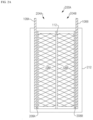
- FIG. 2A is a schematic illustration of a sealed redox battery, according to some embodiments.
- the illustrated sealed redox battery 200A includes a first half cell 204A and a second half cell 204B.
- the first half cell 204A includes a positive electrolyte reservoir 106A having disposed therein a first or positive electrolyte contacting a positive electrode.
- the first electrolyte has dissolved therein a first redox couple configured to undergo a first redox half reaction.
- the second half cell 204B includes a negative electrolyte reservoir 106B having disposed therein a second or negative electrolyte contacting a negative electrode.
- the second electrolyte has dissolved therein a second redox couple configured to undergo a second redox half reaction.
- the positive and negative electrolyte reservoirs 106A and 106B respectively define reaction spaces for the respective half reactions.
- the sealed redox battery 200A additionally includes an ion exchange membrane or separator 112 separating the positive electrolyte reservoir 106A and the negative electrolyte reservoir 106B from each other.
- the positive electrode is electrically connected to the positive-electrode current collector 108A and the negative electrode is electrically connected to a negative-electrode current collector 108B.
- a first bipolar plate 208A is interposed between the positive-electrode current collector 108A and the positive electrolyte reservoir 106A, and a second bipolar plate 208B is interposed between the negative-electrode current collector 108B and the negative electrolyte reservoir 106B.
- the first half cell 204A, the second half cell 204B and the ion exchange membrane or separator 112 define a redox battery cell that is enclosed or sealed in part by a casing or a frame 212 surrounding at least four sides of the battery cell.
- the illustrated sealed redox battery 200A depicts a cross-sectional view and therefore only upper and lower sides of the casing 212 are shown. However, it will be understood that the casing 212 continuously surrounds the upper, lower, front and back sides of the illustrated battery cell.
- first and second bipolar plates 208A and 208B contact the casing 212 at left and right edges or lips thereof, respectively, to enclose and/or seal the battery cell in the sealed space defined by the casing 212 and the first and second bipolar plates 208A and 208B.
- the enclosed and/or sealed frame or casing 212, the first bipolar plate 208A and the second bipolar plate 208B define an enclosed or sealed volume, which is divided into two spaces via the separator 112, namely the negative electrolyte reservoir 106B accommodating the negative electrode therein and the positive electrolyte reservoir 106A accommodating the positive electrode therein.
- the volume sealed by the casing 212 and the first and second bipolar plates 208A and 208B is such that under normal operation, internal contents thereof may not be physically accessible from the outside. That is, the positive and negative electrolytes are not in fluidic communication with external containers such as electrolyte tanks.
- the casing 212 and the first and second bipolar plates 208A and 208B may seal the redox battery 200A hermetically and/or permanently. Such configuration is in contrast to conventional redox flow batteries, in which the redox battery cell is in fluidic communication with external tanks. That is, in the sealed redox battery 200A, unlike the RFB 100 as described above with respect to FIG.
- neither of the positive electrolyte reservoir 106A or the negative electrolyte reservoir 106B in the enclosed cell is in fluidic communication with or physically connected to a separate electrolyte tank that stores a respective one of the first or second electrolytes.
- substantially the entire volume of the positive and negative electrolytes is stored within the redox battery cell and sealed and enclosed by the casing 212 and the first and second bipolar plates 208A and 208B. That is, the first electrolyte reservoir 106A stores substantially the entire volume of the first electrolyte for the first half cell 204A, and the second electrolyte reservoir 106B stores substantially the entire volume of the second electrolyte for the second half cell 204B.
- the sealed redox battery 200A is not connected to a separate storage tank, unlike the RFB 100 as illustrated in FIG. 1 , the sealed redox battery 200A advantageously does not include the conduits 120A, 120B, 124A, and 124B ( FIG. 1 ) for transferring and receiving the electrolytes to and from the redox battery cell, nor the pumps 128A and 128B ( FIG. 1 ) for circulating the electrolytes.
- the sealed redox battery 200A As described above, a notable structural distinction of the sealed redox battery 200A is the omission of the pumps 128A and 128B ( FIG. 1 ). Instead, the sealed redox battery 200A according to some embodiments are configured such that the first and second electrolytes self-circulate within respective ones of the positive electrolyte reservoir 106A of the first half cell 204A and the negative electrolyte reservoir 106B of the second half cell 204B.
- self-circulation of the first and second electrolytes is caused by one or more of: an osmotic pressure difference between the first and second electrolyte reservoirs; a density change in one or both of the first and second electrolytes; diffusion or migration of one or both of the first and second electrolytes; an affinity of one or both of the first and second electrolytes toward a respective ones of the first and second electrodes; the first and second redox half reactions; and thermal expansion or contraction of one or both of the first and second electrolytes.
- each of the positive and negative electrolyte reservoirs 106A and 106B in the cross-sectional view of FIG. 2A does not exceed 20 cm, 15 cm, 10 cm, 5 cm, 2 cm, 1 cm or a value in a range defined by any of these values.
- the casing 212 is made of a suitable corrosion resistant material to accommodate the positive and negative electrolytes, which may be highly acidic.
- the casing 212 may be a rigid casing to provide mechanical support for the sealed redox battery 200A.
- at least portions of the casing 212 may be made of a flexible material that is configured to deform to cope with changes in internal pressure within the positive and negative electrolyte reservoirs 106A and 106B. The increase in internal pressure may be caused, e.g., due to various effects described infra with respect to pressure-controlled sealed redox batteries.
- the flexible portions may be configured to, e.g., expand in response to an increase in pressure such that one or both of the positive and negative electrolyte reservoirs 106A and 106B may cope with increase in respective volume that is greater than 0.1%, 0.2%, 0.5%, 1%, 2%, 5%, 10%, 20%, or 50%.
- the suitable material of the casing 212 may include polyvinyl chloride (PVC), polyethylene (PE), polystyrene (PS), polypropylene (PP), polycarbonate (PC), ABS, reinforced plastics, and the like.
- the sealed redox battery 200A as configured as described above provides various technical and commercial advantages. For example, various reliability failures associated with the conduits, e.g., pipe joints, between the redox battery cell and the tanks, as well as pumps for circulating the electrolytes, are substantially reduced or eliminated, which in turn reduces unscheduled repairs as well as safety hazard and operational cost associated with operation of the sealed redox battery 200A. In addition, extrinsic efficiency is substantially improved by obviating a need to circulate the electrolyte between the redox battery cell and the tanks using pumps, as described above with respect to the RFB 100 ( FIG. 1 ).
- the sealed redox battery 200A may improve the power or energy density by up to 2 to 50 times compared to conventional RFBs by obviating a need to circulate the electrolyte between the cell and the electrolyte tanks.
- a power or energy density refers to the power or energy output of a storage device relative to the total volume of the energy storage device, respectively.
- the power or energy density refers to a ratio of the power or energy output to the total volume of the sealed the redox battery, respectively.
- the space efficiency is greatly improved by the omission of a circulation system including separate tanks, pumps and conduits.
- the system complexity is greatly reduced, thereby greatly reducing the barrier to commercial implementation of the sealed redox battery 200A.
- the sealed redox battery 200A may be manufactured in packs similar to lithium-ion batteries for modularized implementation, rendering them more adapted for automation and mass production, without a need for intrusive construction that may be needed for installing conventional RFBs.
- sealed redox battery 200A an example of a sealed vanadium (V) redox battery, which is based on vanadium-based redox pairs.
- V vanadium
- embodiments are not limited thereto, and the principles described herein may be applied to redox batteries according to various other redox pairs.
- the first redox couple dissolved in the first or positive electrolyte of the first half cell 204A may be a V 4+ /V 5+ redox couple
- the second redox couple dissolved in the second or negative electrolyte of the second half cell 204B may be a V 2+ /V 3+ redox couple.
- tetravalent vanadium ions V 4+ is oxidized to pentavalent vanadium ions V 5+
- trivalent ions V 3+ are reduced to bivalent ions V 2+
- pentavalent vanadium ions V 5+ is reduced to tetravalent vanadium ions V 4+
- bivalent ions V 2+ are oxidized to trivalent ions V 3+ . While these redox reactions occur, electrons are transferred through an external circuit and certain ions diffuse across the ion exchange membrane or separator 112 to balance electrical neutrality of positive and negative half cells, respectively.
- the first redox couple or the second redox couple includes ions of one or more of vanadium (V), zinc (Zn), bromine (Br), chromium (Cr), manganese (Mn), titanium (Ti), iron (Fe), cerium (Ce) and cobalt (Co).
- the first and second redox couples include ions of the same metal, as in the sealed V redox battery as described above. In these embodiments, advantageously, mixing of the positive and negative electrolytes does not lead to cross-contamination of the electrolytes.
- an electrolyte of a redox battery is a solution that conducts current through ionization.
- the electrolyte serves to support the reduced and oxidized forms of a redox couple and also supports the corresponding cations and anions in order to balance the charge of the ions in solution during the oxidation and reduction of the redox couple.
- the positive and negative electrolytes according to some embodiments comprise an aqueous acidic solution.
- the concentration of V ions relates to the energy density of the electrolytes. Higher energy density may advantageously serve to reduce the volume of the positive and negative electrolyte reservoirs 106A and 106B needed for a given amount of energy and power output.
- V ions dissolved in the one or both of the first and second electrolyte may be greater than 1.0 M, 1.5 M, 2.0 M, 2.5 M or a value in a range defined by any of these values.
- V ion concentrations that are lower than 1.0 M may result in energy levels that are not suitable for some applications.
- V ion concentrations that are greater than 2.5 M may result in lower stability of the V 5+ ions, e.g., at operating temperatures above 50 °C, and may approach the solubility limit of V 2+ and V 3+ ions in the electrolyte, e.g., at operating temperatures below -20 °C.
- the positive and negative electrolytes may include the same solvent(s) and/or ions of the same metal.
- mixing of the positive and negative electrolytes through the ion exchange membrane or separator 112 does not result in contamination of the respective half cells.
- the positive and negative electrolytes may be prepared from the same starting solvent(s) and solute(s).
- both the positive and negative electrolytes comprise sulfuric acid.
- the electrolytes may be prepared by, e.g., dissolving 0.1 M to 2.5 M VOSO 4 (vanadyl sulfate) in 0.1 M to 6 M H 2 SO 4 in aqueous solution, to form tetravalent vanadium ions (V 4+ ) and/or trivalent vanadium ions (V 3+ ).
- the tetravalent/trivalent vanadium ions may be electrochemically oxidized to form the positive electrolyte (catholyte), which contains a solution of pentavalent vanadium ions (V 5+ ).
- the tetravalent/trivalent vanadium ions may be electrochemically reduced to form the negative electrolyte (anolyte), which contains a solution of a divalent vanadium ions (V 2+ ).
- the positive and negative electrodes disposed in the positive and negative electrolyte reservoirs 106A and 106B, respectively, include carbon-based materials, such as carbon or graphite felts, carbon cloth, carbon black, graphite powder and graphene, to name a few.
- the carbon-based materials advantageously provide relatively high operation range, good stability and a high reversibility.
- the electrodes are optimized for relatively high electrochemical activity, low bulk resistivity and large specific area.
- the improvement of the electrochemical activity of the electrode increases the energy efficiency of the sealed redox battery 200A.
- the surfaces of the electrode may be modified, e.g., by coating with a metal, increasing surface roughness, or doping with additives.
- the positive and negative electrolyte reservoirs 106A and 106B defining the reaction spaces are partly or entirely filled with respective electrodes between the ion exchange membrane or separator 112 and the first and second bipolar plates 208A and 208B respectively when present, or between the ion exchange membrane or separator 112 and the positive and negative-electrode current collectors 108A and 108B respectively.
- the remaining spaces of the positive and negative electrolyte reservoirs 106A and 106B after filling with respective electrodes are partly or entirely filled with respective electrolytes between the ion exchange membrane or separator 112 and the first and second bipolar plates 208A and 208B when present, or between the ion exchange membrane or separator 112 and the positive and negative-electrode current collectors 108A and 108B.
- the ion exchange membrane or separator 112 serves to substantially separate the two half-cells, and to substantially prevent the mixing of the two electrolytes and the redox couples, while allowing the transport of ions such as H + to balance the charge between the two half cells to complete the circuit during passage of current.
- the ion exchange membrane or separator 112 may be an anion exchange membrane or a cation exchange membrane.
- ion exchange membrane or separator 112 may be selective to a particular type of ion, e.g., a cation or an anion
- ion exchange membrane or separator 112 may be a non-selective membrane, e.g., a porous membrane.
- the output power may be scaled by connecting a number of single redox battery cells to each other, e.g., in a series manner to form a cell stack.
- the first and second bipolar plates 208A and 208B may facilitate the series connection of the single cells and the current collectors 108A and 108B between adjacent bipolar plates may be removed.
- the first and second bipolar plates 208A and 208B may be made of a suitable material such as graphite, carbon, carbon plastic or the like to provide high electrical conductivity and low internal resistance of the cell stack.
- first and second bipolar plates 208A and 208B support the contact pressure to which they are subjected when pressed against the electrodes to increase electrical conductivity.
- first and second bipolar plates 208A and 208B are provided to have high acid resistance to prevent corrosion or oxidation of the current collectors 108A and 108B.
- Each of the positive and negative-electrode current collectors 108A and 108B includes a metal having high electrical conductivity, such as copper or aluminum, and serves to flow electrical current during the charging and discharging processes.
- additional cells may be connected to each other in electrical series or in electrical parallel to achieve higher voltages and currents, respectively, as described herein.
- FIG. 2B is a schematic illustration of a sealed redox battery including a plurality of sealed redox battery cells in a stacked structure, according to some embodiments.
- the illustrated sealed redox battery 200B includes a plurality of redox battery cells 200B-1, 200B-2,..., 200B-n, which may be stacked, where each cell is configured in a similar manner as the sealed redox battery 200A ( FIG. 2A ).
- Each of the plurality of redox battery cells 200B-1, 200B-2,..., 200B-n includes the positive electrolyte reservoir 106A, the negative electrolyte reservoir 106B and the ion exchange membrane or separator 112.
- each of the plurality of redox battery cells 200B-1, 200B-2,..., 200B-n is enclosed by a separate casing 212.
- the plurality of redox battery cells 200B-1, 200B-2,..., 200B-n may be connected to each other in electrical series to increase the output voltage.
- FIG. 2C is a schematic illustration of sealed redox battery including a plurality of sealed redox battery cells in a stacked structure, according to some further embodiments.
- the illustrated sealed redox battery 200C includes a plurality of redox battery cells 200C-1, 200C-2,..., 200C-n, which may be stacked, where each of the plurality of redox battery cells 200C-1, 200C-2,..., 200C-n is configured in a similar manner as the sealed redox battery 200A ( FIG. 2A ) including the positive electrolyte reservoir 106A, the negative electrolyte reservoir 106B and the ion exchange membrane or separator 112.
- the sealed redox battery 200B FIG.
- the plurality of redox battery cells 200C-1, 200C-2,..., 200C-n are enclosed by a common casing 222.
- the plurality of redox battery cells 200C-1, 200C-2,..., 200C-n may be connected to each other in electrical series to increase the output voltage.
- the positive electrolyte reservoirs 106A of the plurality of redox battery cells 200C-1, 200C-2,...200C-n may be in fluidic communication with each other
- the negative electrolyte reservoirs 106B of the plurality of redox battery cells 200C-1, 200C-2,..., 200C-n may be in fluidic communication with each other.
- the sealed redox battery 200C may be embodied as a pouch type redox battery or a rigid case type redox battery.
- FIG. 2D is a schematic illustration of a sealed redox battery including a plurality of sealed redox battery cells in a cylindrically stacked structure, according to some still further embodiments.
- the illustrated sealed redox battery 200D includes a plurality of redox battery cells 200D-1, 200D-2,..., 200D-n, which may be cylindrically stacked, where each of the plurality of redox battery cells 200D-1, 200D-2,..., 200D-n is configured in a similar manner as the sealed redox battery 200A ( FIG. 2A ), including the positive electrolyte reservoir 106A, the negative electrolyte reservoir 106B and the ion exchange membrane or separator 112.
- the plurality of redox battery cells 200D-1, 200D-2,..., 200C-n may individually be enclosed in a casing in a similar manner as described above with respect to the sealed redox battery 200B ( FIG. 2B ).
- the plurality of redox battery cells 200D-1, 200D-2,..., 200C-n may be enclosed by a common casing 222 in a similar manner as described above with respect to the sealed redox battery 200C ( FIG. 2C ).
- the plurality of redox battery cells 200D-1, 200D-2,..., 200D-n may be connected to each other in electrical series to increase the output voltage.
- the positive electrolyte reservoirs 106A of the plurality of redox battery cells 200D-1, 200D-2,..., 200D-n may be in fluidic communication with each other, and the negative electrolyte reservoirs 106B of the plurality of redox battery cells 200D-1, 200D-2,..., 200D-n may be in fluidic communication with each other.
- some or all of the plurality of redox battery cells in each of the stacked structures as described above with respect to FIGS. 2B to 2C may be connected to each other in an electrical series manner, by suitably electrically connecting current collectors of opposite polarities of some or all of the cells to each other, or may be connected to each other in an electrical parallel manner, by suitably electrically connecting current collectors of the same polarity of some of all of the cells to each other.
- sealed redox batteries 200A to 200D retain some of the unique design flexibility available in conventional RFBs.
- the design of cell geometry is substantially more flexible compared to conventional secondary batteries.
- the power and energy storage capacity may be decoupled and scaled independently to a limited extent, e.g., by adjusting the ratio of electrolyte volume relative to the electrode surface area.
- the ratio may be adjusted using, e.g., the thickness of the positive and negative electrolyte reservoirs 106A and 106B, as described above.
- the sealed redox batteries according to some embodiments also share major advantages of conventional batteries, because they are completely sealed to enable modularized implementation. While sealed redox batteries according to some embodiments and conventional secondary batteries, e.g., LIBs, may have components referred to using similar terminologies, it will be appreciated that the components of the sealed redox batteries according to some embodiments and their operational principles are distinguishable from those of conventional secondary batteries, as described herein.
- the structure, functional role and operational principle of the electrolytes in the sealed redox battery are distinguishable from those of conventional secondary batteries, e.g., LIBs.
- LIBs the electrolyte does not itself store energy nor participate in the electrochemical reactions in the charge/discharge processes. Instead, the electrolyte in LIBs primarily serves to provide a path for lithium ions to be transported between the positive electrode and the negative electrode during the charging/discharging process. Therefore, the movement of the electrolyte is not substantially restricted by the separator.
- the sealed redox battery 200A in contrast, in the sealed redox battery 200A according to some embodiments, electrochemical energy is stored in the electrolytes in the form of dissolved active material, e.g., respective redox pairs dissolved in the positive and negative electrolytes that undergo electrochemical reactions during the charge/discharge processes.
- the electrolytes may be said to be the medium which stores the energy in the sealed redox batteries according to some embodiments.
- the oxidation states of V ion species dissolved in the positive and negative electrolytes are changed by the respective half reactions.
- the chemical compositions of the positive and negative electrolytes in sealed redox batteries are different from the electrolyte of LIBs.
- the structure, functional role and operational principle of the electrodes in the sealed redox battery according to some embodiments are distinguishable from those of conventional secondary batteries, e.g., LIBs.
- LIBs the active materials, which are included in the electrodes, directly participate electrochemical reactions.
- lithium ions move between an active material of the positive electrode and an active material of the negative electrode to achieve electrochemical equilibrium, and the electrodes themselves serve as the main media for energy storage.
- the electrodes of the sealed redox battery according to some embodiments serve a very different role.
- the positive electrode of a sealed redox battery does not participate in the first redox half reaction and the negative electrode of the sealed redox battery does not participate in the second redox half reaction.
- an electrode that does not participate in a redox half reaction does not preclude the electrode's function of providing a physical site for the electrochemical reaction in an analogous manner as a catalyst.
- the electrodes themselves are not involved in the electrochemical reactions and redox ions do not move between positive and negative electrodes during charging and discharging of the redox battery.
- a functional group acting as a catalyst may exist on the surface. However, this is distinguishable from the electrodes actively participating in the electrochemical reaction as in the case with LIBs. Rather, the electrodes substantially passively transport electrons generated by the electrochemical reactions.
- the structure, functional role, and operational principle of the ion exchange membrane in the sealed redox battery are distinguishable from those of a separator in conventional secondary batteries, e.g., LIBs.
- a separator in conventional secondary batteries, e.g., LIBs.
- the active materials of electrodes where the electrochemical reactions take place are generally in the solid state, and a separator disposed between positive and negative electrodes primarily serves to prevent an electrical short therebetween.
- the separator serves to prevent an electrical contact between the positive and negative electrodes
- the separator is not specifically designed to restrict the transport of lithium ions therethrough nor to restrict the electrochemical reactions therebetween.
- the separator in a LIB primarily serves to electrically insulate the positive and negative electrodes from each other without interfering the transport of ions as part of the electrochemical reactions for charging and discharging.
- a separator for a LIB is designed to freely transport the lithium ions between the electrodes.
- the redox active species are dissolved in the electrolyte, and the ion exchange membrane or separator 112 ( FIG. 2A ) serves to electrically separate the positive and negative electrolytes from each other and to prevent them from mixing with each other.
- the ion exchange membrane or separator 112 includes a selective permeable membrane in which cations or anions are transported therebetween to balance the charge between the two half cells.
- the ion exchange membrane may be configured to selectively pass therethrough cations or anions.
- the first and second redox half reactions occur without substantial transfer of ions of the first redox couple or the second redox couple across the ion exchange membrane or separator 112 separating the positive electrolyte reservoir 106A and the negative electrolyte reservoir 106B.
- an ion exchange membrane or separator 112 that substantially does not transfer ions of the redox couples refers an ion exchange membrane or separator 112 that serves to substantially prevent the crossover of the electrolytes between the positive and negative electrolyte reservoirs 106A and 106B ( FIG. 2A ).
- a base material for the ion exchange membrane or separator 112 may desirably be a membrane that blocks the movement of the redox species in the electrolyte, e.g., the V ions in a V redox battery, while selectively permitting the movement of other ions, e.g., H + ions in a V redox battery for the charge balance between the half cells.
- an ion exchange membrane or separator 112 that substantially does not transfer ions of the redox couples may still permit unintended crossover, or limited intended mixing to relieve internal pressure build-up.
- the ion exchange membranes or separators serve the functions of, among other functions, conducting ions of the supporting electrolyte between positive and negative electrolyte reservoirs while substantially suppressing passage of redox-active ions, e.g., vanadium ions.
- redox-active ions e.g., vanadium ions.
- these improvements should desirably be achieved while remaining cost competitive to existing membrane technologies.
- the separator as one of the key elements in the secondary battery that employs the electrolyte as an aqueous electrolyte acts as an ion exchange membrane to mediate the reaction and performs the function of separating the cathode and the anode from each other to prevent shunting therebetween.
- the conditions required for the separator include high ion conductivity and ion selectivity. Furthermore, excellent mechanical properties that may withstand the pressure under which the electrolyte circulates, high chemical stability against a strong acid environment, the oxidizing power of the redox couple of the electrolyte, and radicals generated in the aqueous electrolyte, and high efficiency in terms of process and cost are requirements of the separator.
- Such a separator may be made of an ion-conducting polymer or may be manufactured by coating an ion-conducting polymer on a substrate.
- an ion-exchange membrane or separator (e.g., ion exchange membrane or separator 112 in FIG. 2A ) includes the ion-conducting resin, and has the structure and composition exhibiting superior chemical resistance, heat resistance and mechanical strength, among other advantages, compared to various membranes that may be commercially available.
- the ion exchange membrane or separator as disclosed herein are particularly effective when being integrated into the sealed redox battery as a part thereof (e.g., the ion exchange membrane or separator 112 in FIG. 2A ).
- sealed redox batteries may be subject to harsher conditions including higher internal pressure, which existing membranes may not be adapted to withstand effectively and reliably.
- separators are not limited to use in sealed redox batteries, and the ion exchange membrane or separator disclosed herein may advantageously be integrated into redox flow batteries, e.g., a redox flow battery 100 as described above with respect to FIG. 1 , as well as any suitable secondary battery including lithium ion batteries.
- a process of forming the separator by impregnating a porous membrane with a solution containing an ion conductive resin and then drying the porous membrane is employed.
- this approach there is no base substrate removal process and a drying process time is shortened, compared to the approach of using the base substrate.
- an excellent separator may be manufactured by suppressing formation of an air layer between the base substrate and the separator.
- the manufacturing method of the separator for the secondary battery according to the present disclosure includes steps of dissolving an ion conductive resin and a surfactant in an organic solvent to produce a mixed solution; and impregnating at least one surface of a porous membrane with the mixed solution.
- the porous membrane may become hydrophilic most efficiently and uniformly, compared to the case of not using the surfactant, pre-applying the surfactant to the porous membrane, or treating the separator with the surfactant after manufacturing the separator, etc.
- the method of the present disclosure may solve the problem of defects in the electrode in charging and discharging of the secondary battery, and may allow the drying speed to be increased in the subsequent drying step, thereby increasing process efficiency.
- the organic solvent is an amide-based organic solvent.
- the organic solvent is an amide-based organic solvent.
- N,N-dimethylacetamide (DMAc) and dimethylformamide (DMF) can be used, and preferably N,N-dimethylacetamide is used.
- a fluorine-based polymer or a hydrocarbon-based polymer may be selected as the ion conductive polymer.
- the ion conductive polymer containing an sulfonic acid group as the fluorine-based polymer may include at least one of perfluorosulfonic acid, poly(styrene sulfonic acid) (PSSA), sulfonated poly(ether ether ketones) (SPEEK), sulfonated poly(ether sulfone) (SPES), sulfonated poly(aryl ether ketone) (SPAEK), sulfonated polybenzimidazole (SPBI), sulfonated poly(phenylen oxide) (SPPO), and sulfonated polyimide (SPI).
- PSSA poly(styrene sulfonic acid)
- SPEEK poly(ether ether ketones)
- SPES sulfonated poly(ether sulfone)
- SPAEK sulfonated poly(aryl ether ketone)
- SPBI sulfonated polybenzimidazole
- the hydrocarbon-based polymer may include polyimide-based polymers, polyetheretherketone-based polymers, polyethersulfone-based polymers, and polybenzimidazole (PBI)-based polymers.
- PBI polybenzimidazole
- the polybenzimidazole-based polymer in accordance with the present disclosure may be a single type of polybenzimidazole polymer, or may be a mixture or copolymer of different polybenzimidazole polymers.
- the polybenzimidazole polymer may be ab-PBI (Poly(2,5-benzimidazole)), oPBI (Poly[2,2'-(4,4'-oxybis(1,4-phenylene))-5,5'-bibenzimidazole), m-PBI (meta-polybenzimidazole), pPBI (para-polybenzimidazole), s-PBI (sulfonated polybenzimidazole), f-PBI (fluorine-containing polybenzimidazole), 2OH-PBI (Dihydroxy polybenzimidazole), PIPBI (Phenylindane-polybenzimidazole), PBI-OO (poly[(1-(4,4'-diphenylether)-5-
- the separator containing the polybenzimidazole-based polymer may exhibit excellent mechanical strength, heat resistance, chemical resistance, and durability even in increasingly harsh operating environments of secondary batteries.
- the porous membrane may be made of at least one type of a polyolefin-based material.
- the porous membrane of the present disclosure may be made of polypropylene (PP), polyethylene (PE), or a combination thereof.
- PP polypropylene
- PE polyethylene
- the present disclosure is not necessarily limited thereto.
- a viscosity of the solution comprising the ion conductive resin may be lowered by further adding a viscosity control solvent to the solution.
- a viscosity control solvent in addition to the organic solvent for dissolving the ion conductive resin therein.
- the viscosity control solvent may be contained, for example, in an amount of 10% by weight to 25% by weight, for example, in a range of 12% by weight to 20% by weight, for example, in a range of 15% by weight to 18% by weight.
- the present disclosure is not necessarily limited thereto.
- the viscosity control solvent may be at least one of a ketone-based solvent or an alcohol-based solvent.
- the ketone-based solvent may be acetone, methyl ethyl ketone, methyl isobutyl ketone, etc.
- the alcohol-based solvent may be methanol, ethanol, isopropanol, butanol, isobutanol, etc.
- the surfactant according to one embodiment of the present disclosure may effectively hydrophilize the porous membrane.
- a silicone-based surfactant an ionic surfactant, a cationic surfactant, an anionic surfactant, a non-ionic surfactant, an organic surfactant, or combinations thereof may be used as the surfactant.
- the surfactant in accordance with the present disclosure may include Triton X-100° and Tween° as the non-ionic surfactant, SDS (Sodium Dodecyl Sulfate) and SDBS (Dodecylbenzenesulphonate) as the anionic surfactant, DTAB (dodecyltrimethylammonium bromide), TTAB (tetradecyltrimethylammonium bromide), CTAB (Cetyltrimethylammonium Bromide) and DPC (dodecylpyridinium chloride) as the cationic surfactant, PVP (Poly(vinylpolypyrrolidone)) as the organic surfactant, or Silwet° as the silicone-based organic surfactant, etc.
- SDS sodium Dodecyl Sulfate
- SDBS Dodecylbenzenesulphonate
- DTAB dodecyltrimethylammonium bromide
- TTAB te
- a content of the surfactant may be, for example, in a range of 0.1% by weight exclusive to 5.0% by weight exclusive, for example, in a range of 0.2% by weight inclusive to 4.0% by weight inclusive, for example, in a range of 0.5% by weight inclusive to 2.0% by weight inclusive, or for example, in a range of 0.5% by weight inclusive to 1.0% by weight inclusive.
- the present disclosure is not necessarily limited thereto, and the content of the surfactant may be appropriately adjusted depending on the type of each of the ion conductive resin and the surfactant as used.
- the silicone-based nonionic organic surfactant may be selected as the surfactant.
- the manufacturing method of the separator for the secondary battery according to the present disclosure may be performed without substantially increasing manufacturing costs, reducing efficiency, and/or reducing the performance of the resulting separator, which are problems known to occur when the surface of the porous membrane is made hydrophilic using other approaches.
- the electrode assembly using the separator for the secondary battery in accordance with the present disclosure may have improvement in the charging and discharging performance, thereby improving the performance of the secondary battery.
- PE polyethylene
- the separator was manufactured in the same manner as Present Example 1 above, except that the PBI solution was free of the surfactant.
- a surfactant solution (Silwet concentration being 5% by weight) was prepared by mixing "Silwet TM Hydrostable 212 Silicone Surfactant (available from Momentive)" as the surfactant with the DMAc solvent, and then was applied to the separator manufactured in Comparative Example 1, and was dried at a temperature of 50°C to obtain a separator with a thickness of 27 ⁇ m.
- PE polyethylene
- a surfactant solution (Silwet concentration being 5% by weight) was prepared by mixing "Silwet TM Hydrostable 212 Silicone Surfactant (available from Momentive)" as the surfactant with the DMAc solvent, and then was applied to a polyethylene (PE) film (thickness: 20 ⁇ m) and then dried with hot air for 2 minutes at a temperature of 50°C. Thus, a separator with a thickness of 20 ,um was obtained.
- Two current collectors were manufactured, wherein each thereof was manufactured by stacking a carbon current collector (graphite composite, thickness: 0.2 mm) and a metal current collector (aluminum foil, thickness: 0.2 mm). The two current collectors were used as a positive electrode current collector and a negative electrode current collector, respectively.
- the separator manufactured in each of Present Example 1 and Comparative Examples 1 to 7 was used to manufacture a unit cell including a positive electrolyte receiving portion and a negative electrolyte receiving portion.
- a V 3.5+ electrolyte solution (available from Standard Energy) with a concentration of 1.7M was poured into each of the positive electrolyte receiving portion and the negative electrolyte receiving portion. Then, the cell was charged at a constant current of 1 C until the voltage reached 1.55 V, and then, the cell was discharged at a constant current of 1 C until the voltage reached 1.10 V. At this time, energy efficiency (EE) was calculated based on a following equation, and is shown in Table 1 below.
- Present Example 1 is characterized by manufacturing the separator by mixing the surfactant with the PBI solution to prepare the mixed solution and then impregnating the PE film with the mixed solution. It is identified that Present Example 1 has significantly improved energy efficiency compared to Comparative Example 1 in which no surfactant is mixed therewith.
- Comparative Example 2 differs from Present Example 1 in that the separator is manufactured in the same way as in Comparative Example 1, and then the surfactant solution is additionally applied to the surface of the separator.
- the process efficiency of Comparative Example 2 is reduced because the number of film treatment times increases. Further, it is identified that EE of Comparative Example 2 is reduced compared to Present Example 1.
- Comparative Example 3 the bare PE film is used as the separator. In this case, the cell cannot be charged, thus making it impossible to evaluate the energy efficiency of the battery cell.
- Comparative Example 4 in which the PE film is treated only with the surfactant and without the PBI, energy efficiency is significantly reduced compared to Present Example 1.
- the separator was manufactured in the same manner as in Present Example 1, while the content (concentration) of the surfactant was varied as shown in Table 2 below.
- the energy efficiency (EE) (%) was calculated based on the above Equation, and was shown in the Table 2 below.
- Table 2 No. Surfactant concentration (% by weight) Energy Efficiency (EE) (%) 1 0 82.3 2 0.1 84.9 3 0.2 89.2 4 0.5 90.6 5 1.0 90.5 6 2.0 90.4 7 3.0 89.7 8 4.0 89.4 9 5.0 88.6
- No. 1 in Table 2 is the same as Comparative Example 1, and No. 4 in Table 2 is the same as Present Example 1. It was experimentally identified that No. 4 in Table 2 had the highest energy efficiency. As the concentration of the surfactant changed, the value of the energy efficiency changed. When the surfactant concentration became 0.1% by weight or smaller or became 5.0% by weight, energy efficiency was greatly reduced.
Landscapes
- Chemical & Material Sciences (AREA)
- General Chemical & Material Sciences (AREA)
- Engineering & Computer Science (AREA)
- Manufacturing & Machinery (AREA)
- Chemical Kinetics & Catalysis (AREA)
- Electrochemistry (AREA)
- Sustainable Development (AREA)
- Sustainable Energy (AREA)
- Life Sciences & Earth Sciences (AREA)
- Composite Materials (AREA)
- Crystallography & Structural Chemistry (AREA)
- Dispersion Chemistry (AREA)
- Fuel Cell (AREA)
Abstract
Disclosed is a method for manufacturing a separator for a secondary battery, the method including: dissolving an ion conductive resin and a surfactant in an organic solvent to produce a mixed solution; and impregnating at least one surface of a porous membrane with the mixed solution.
Description
- The present disclosure relates to a separator for a secondary battery, a manufacturing method thereof, and a secondary battery including the separator.
- The global economic growth accompanied by global warming continues increase the urgency of a need for renewable and sustainable energy systems based on renewable energy, e.g., solar and wind energy. To enhance the stability of grid networks against fluctuations due to intermittent availability such forms of energy, advances in energy storage systems (ESS) are used for storing surplus electricity, which may be delivered to end customers or to power grids when needed. Among others, ESS based on electrochemical energy, e.g., rechargeable or secondary batteries, may provide cost effective and clean forms of energy storage solutions. The electrochemical energy storage system is a secondary battery in a broad sense. Examples of electrochemical energy storage systems include lithium-ion, lead-acid, sodium-sulfur and redox-flow batteries. Different storage times are needed for different applications: short-term storage, medium-term storage and long-term storage. The different types of electrochemical energy storage systems have different physical and/or chemical properties. Factors that determine the suitability for a particular application of the electrochemical energy storage systems include investment cost, power, energy, lifetime, recyclability, efficiency, scalability and maintenance cost, to name a few. Competing factors are weighed in the selection and design of a suitable electrochemical storage system. Generally, the secondary battery includes two electrodes, an electrolyte, and a separator (or ion exchange membrane). Each of the above components may affect the performance of the secondary battery.
- A purpose of the present disclosure is to provide a separator manufacturing method that may improve the mechanical strength of the separator and increase process efficiency without using a base substrate in manufacturing of the separator for a secondary battery.
- Furthermore, in a process of forming a separator by impregnating a porous membrane with a solution containing an ion conductive resin and then drying the porous membrane, when the porous membrane is hydrophobic and the electrolyte used in an electrode assembly is hydrophilic, there is an area in which the hydrophilic electrolyte does not come into contact with the hydrophobic porous membrane, that is, the separator, causing defective charging and discharging of the secondary battery. Thus, a purpose of the present disclosure is to provide a separator manufacturing method to solve this problem.
- In the present disclosure, an example in which the secondary battery is embodied as a redox flow battery or a sealed redox battery using a redox couple is described. However, the secondary battery which the separator in accordance with the present disclosure is applied is not limited thereto.
- Purposes according to the present disclosure are not limited to the above-mentioned purpose. Other purposes and advantages according to the present disclosure that are not mentioned may be understood based on following descriptions, and may be more clearly understood based on embodiments according to the present disclosure. Further, it will be easily understood that the purposes and advantages according to the present disclosure may be realized using means shown in the claims or combinations thereof.
- A first aspect of the present disclosure provides a method for manufacturing a separator for a secondary battery, the method comprising: dissolving an ion conductive resin and a surfactant in an organic solvent to produce a mixed solution; and impregnating at least one surface of a porous membrane with the mixed solution.
- According to some embodiments of the method, the porous membrane not impregnated with the mixed solution exhibits hydrophobicity, wherein the at least one surface of the porous membrane is impregnated with the mixed solution such that the porous membrane becomes hydrophilic.
- According to some embodiments of the method, the surfactant is contained in a content in a range of 0.1% by weight exclusive to 5.0% by weight exclusive based on 100% by weight of the mixed solution.
- According to some embodiments of the method, the surfactant includes at least one of an ionic surfactant, a non-ionic surfactant, or an organic surfactant.
- According to some embodiments of the method, the organic surfactant includes a silicone-based organic surfactant.
- According to some embodiments of the method, the ion conductive resin includes a polybenzimidazole-based polymer.
- According to some embodiments of the method, the porous membrane is made of polypropylene, polyethylene, or a combination thereof.
- According to some embodiments of the method, producing the mixed solution includes dissolving the ion conductive resin and the surfactant in a viscosity control solvent and the organic solvent to produce the mixed solution, wherein a content of the viscosity control solvent is in a range of 10% to 25% by weight based on 100% by weight of the mixed solution.
- According to some embodiments of the method, the viscosity control solvent includes at least one of acetone, methyl ethyl ketone, methyl isobutyl ketone, methanol, ethanol, isopropanol, butanol, or isobutanol.
- According to some embodiments of the method, the method further comprises, after impregnating the at least one surface of the porous membrane with the mixed solution, drying the porous membrane.
- According to some embodiments of the method, the secondary battery employs an aqueous electrolyte as a liquid electrode.
- According to some embodiments of the method, the aqueous electrolyte contains vanadium ions and an acidic aqueous solution.
- A second aspect of the present disclosure provides a separator for a secondary battery manufactured according to the manufacturing method as described above.
- A third aspect of the present disclosure provides a secondary battery including the separator manufactured according to the manufacturing method as described above.
- The manufacturing method of the separator for the secondary battery according to the present disclosure may maximize the effect of efficiently and uniformly making the porous membrane hydrophilic. Accordingly, the manufactured separator may solve the problem of poor contact with the electrolyte, thereby contributing to improving the performance of the secondary battery.
- Furthermore, according to the manufacturing method of the separator for the secondary battery according to the present disclosure, the drying speed in the later drying step may be increased, such that the process efficiency of the film formation process for the separator may be increased.
- Effects of the present disclosure are not limited to the effects mentioned above, and other effects not mentioned will be clearly understood by those skilled in the art from the description below.
- In addition to the above effects, specific effects of the present disclosure are described together while describing specific details for carrying out the present disclosure.
-
-
FIG. 1 is a schematic illustration of an example redox flow battery. -
FIG. 2A is a schematic illustration of a sealed redox battery, according to some embodiments. -
FIG. 2B is a schematic illustration of a sealed redox battery including a plurality of sealed redox battery cells in a stacked structure, according to some embodiments. -
FIG. 2C is a schematic illustration of a sealed redox battery including a plurality of sealed redox battery cells in a stacked structure, according to some further embodiments. -
FIG. 2D is a schematic illustration of a sealed redox battery including a plurality of sealed redox battery cells in a cylindrically stacked structure, according to some still further embodiments. - Advantages and features of the present disclosure, and a method of achieving the advantages and features will become apparent with reference to embodiments described later in detail together with the accompanying drawings. However, the present disclosure is not limited to the embodiments as disclosed under, but may be embodied in various different forms. Thus, these embodiments are set forth only to make the present disclosure complete, and to completely inform the scope of the present disclosure to those of ordinary skill in the technical field to which the present disclosure belongs, and the present disclosure is only defined by the scope of the claims.
- For simplicity and clarity of illustration, elements in the drawings are not necessarily drawn to scale. The same reference numbers in different drawings represent the same or similar elements, and as such perform similar functionality. Further, descriptions and details of well-known steps and elements are omitted for simplicity of the description. Furthermore, in the following detailed description of the present disclosure, numerous specific details are set forth in order to provide a thorough understanding of the present disclosure. However, it will be understood that the present disclosure may be practiced without these specific details. In other instances, well-known methods, procedures, components, and circuits have not been described in detail so as not to unnecessarily obscure aspects of the present disclosure. Examples of various embodiments are illustrated and described further below. It will be understood that the description herein is not intended to limit the claims to the specific embodiments described. On the contrary, it is intended to cover alternatives, modifications, and equivalents as may be included within the spirit and scope of the present disclosure as defined by the appended claims.
- A shape, a size, a ratio, an angle, a number, etc. disclosed in the drawings for illustrating embodiments of the present disclosure are illustrative, and the present disclosure is not limited thereto.
- The terminology used herein is directed to the purpose of describing particular embodiments only and is not intended to be limiting of the present disclosure. As used herein, the singular constitutes "a" and "an" are intended to include the plural constitutes as well, unless the context clearly indicates otherwise. It will be further understood that the terms "comprise", "comprising", "include", and "including" when used in this specification, specify the presence of the stated features, integers, operations, elements, and/or components, but do not preclude the presence or addition of one or more other features, integers, operations, elements, components, and/or portions thereof. As used herein, the term "and/or" includes any and all combinations of one or more of associated listed items. Expression such as "at least one of" when preceding a list of elements may modify the entire list of elements and may not modify the individual elements of the list. In interpretation of numerical values, an error or tolerance therein may occur even when there is no explicit description thereof.
- It will be understood that when an element or layer is referred to as being "connected to", or "connected to" another element or layer, it may be directly on, connected to, or connected to the other element or layer, or one or more intervening elements or layers may be present. In addition, it will also be understood that when an element or layer is referred to as being "between" two elements or layers, it may be the only element or layer between the two elements or layers, or one or more intervening elements or layers may also be present.
- Further, as used herein, when a layer, film, region, plate, or the like is disposed "on" or "on a top" of another layer, film, region, plate, or the like, the former may directly contact the latter or still another layer, film, region, plate, or the like may be disposed between the former and the latter. As used herein, when a layer, film, region, plate, or the like is directly disposed "on" or "on a top" of another layer, film, region, plate, or the like, the former directly contacts the latter and still another layer, film, region, plate, or the like is not disposed between the former and the latter. Further, as used herein, when a layer, film, region, plate, or the like is disposed "below" or "under" another layer, film, region, plate, or the like, the former may directly contact the latter or still another layer, film, region, plate, or the like may be disposed between the former and the latter. As used herein, when a layer, film, region, plate, or the like is directly disposed "below" or "under" another layer, film, region, plate, or the like, the former directly contacts the latter and still another layer, film, region, plate, or the like is not disposed between the former and the latter.
- In descriptions of temporal relationships, for example, temporal precedent relationships between two events such as "after", "subsequent to", "before", etc., another event may occur therebetween unless "directly after", "directly subsequent" or "directly before" is not indicated.
- When a certain embodiment may be embodied differently, a function or an operation specified in a specific block may occur in a different order from an order specified in a flowchart. For example, two blocks in succession may be actually performed substantially concurrently, or the two blocks may be performed in a reverse order depending on a function or operation involved.
- It will be understood that, although the terms "first", "second", "third", and so on may be used herein to describe various elements, components, regions, layers and/or sections, these elements, components, regions, layers and/or sections should not be limited by these terms. These terms are used to distinguish one element, component, region, layer or section from another element, component, region, layer or section. Thus, a first element, component, region, layer or section described below could be termed a second element, component, region, layer or section, without departing from the spirit and scope of the present disclosure.
- Spatially relative terms, such as "beneath," "below," "lower," "under," "above," "upper," and the like, may be used herein for ease of explanation to describe one element or feature's relationship to another element or feature as illustrated in the figures. It will be understood that the spatially relative terms are intended to encompass different orientations of the device in use or in operation, in addition to the orientation depicted in the figures. For example, when the device in the drawings may be turned over, elements described as "below" or "beneath" or "under" other elements or features would then be oriented "above" the other elements or features. Thus, the example terms "below" and "under" may encompass both an orientation of above and below. The device may be otherwise oriented for example, rotated 90 degrees or at other orientations, and the spatially relative descriptors used herein should be interpreted accordingly.
- The features of the various embodiments of the present disclosure may be partially or entirely combined with each other, and may be technically associated with each other or operate with each other. The embodiments may be embodied independently of each other and may be embodied together in an association relationship.
- In interpreting a numerical value, the value is interpreted as including an error range unless there is no separate explicit description thereof.
- Unless otherwise defined, all terms including technical and scientific terms used herein have the same meaning as commonly understood by one of ordinary skill in the art to which this inventive concept belongs. It will be further understood that terms, such as those defined in commonly used dictionaries, should be interpreted as having a meaning that is consistent with their meaning in the context of the relevant art and will not be interpreted in an idealized or overly formal sense unless expressly so defined herein.
- As used herein, "embodiments," "examples," "aspects, and the like should not be construed such that any aspect or design as described is superior to or advantageous over other aspects or designs.
- Further, the term 'or' means 'inclusive or' rather than 'exclusive or'. That is, unless otherwise stated or clear from the context, the expression that 'x uses a or b' means any one of natural inclusive permutations.
- The terms used in the description below have been selected as being general and universal in the related technical field. However, there may be other terms than the terms depending on the development and/or change of technology, convention, preference of technicians, etc. Therefore, the terms used in the description below should not be understood as limiting technical ideas, but should be understood as examples of the terms for illustrating embodiments.
- Further, in a specific case, a term may be arbitrarily selected by the applicant, and in this case, the detailed meaning thereof will be described in a corresponding description section. Therefore, the terms used in the description below should be understood based on not simply the name of the terms, but the meaning of the terms and the contents throughout the Detailed Descriptions.
- As discussed above, competing factors that are weighed in the selection and design of a suitable electrochemical energy storage system for a particular application includes investment cost, power, energy, lifetime, recyclability, efficiency, scalability and maintenance costs, among others. Among various electrochemical energy storage systems, redox flow batteries (RFBs) are considered to be promising for stationary energy storage. RFBs are electrochemical energy conversion devices, that exploit redox processes of redox species dissolved in a solution. The solution is stored in external tanks and introduced into the RFB cell when needed. Some of the advantageous features of the RFB technology are: independent scalability of power and energy, high depth of discharge (DOD), and reduced environmental impact. Such features allow for wide ranges of operational powers and discharge times, making RFBs desirable for storage of electricity generated from renewable sources.
- Particular disadvantages of some secondary batteries known in the art, such as a lithium-ion batteries, include excessive heat and internal pressure generation during operation thereof. To mitigate these effects, some secondary batteries employ a gap between the battery cells and/or a separate cooling device. Advantageously, in batteries according to some embodiments disclosed herein, heat and pressure generation is significantly lower, which in turn lowers the risk of an explosion, such that a gap or a cooling device between the battery cells may not be needed, thereby enabling compact integration of the battery cells and batteries themselves.
- Various batteries use a bus bar to electrically connect the battery cells and/or the batteries themselves. For compact integration, there is a need to reduce the amount of space occupied by the bus bars by efficiently disposing them. In addition to electrically connecting the battery cells and batteries, there is a separate need for physically and mechanically holding the battery cells or batteries together in an efficient manner. To address these and other needs, various embodiments disclosed herein provide bus bars to enable high-density integration of the battery cells and/or batteries, and an energy storage device including the same. In addition, embodiments disclosed herein provide a battery that is easy to maintain after installation and an energy storage device including the same.
-
FIG. 1 is a schematic illustration of an example redox flow battery (RFB). TheRFB 100 includes abattery cell 104. Thebattery cell 104 has a firsthalf cell 104A and a secondhalf cell 104B separated from each other by a separator or anion exchange membrane 112. The firsthalf cell 104A includes apositive electrolyte reservoir 106A having disposed therein a first or positive electrolyte and a positive electrode, and the secondhalf cell 104B includes anegative electrolyte reservoir 106B having disposed therein a second or negative electrolyte and a negative electrode. The positive electrode is electrically connected to a positive-electrodecurrent collector 108A and the negative electrode is electrically connected to a negative-electrodecurrent collector 108B. Thepositive electrolyte reservoir 106A is in fluidic communication with and physically connected to apositive electrolyte tank 116A, and thenegative electrolyte reservoir 106B is in fluidic communication with and physically connected to a negative electrolyte tank 116B. In operation, the positive electrolyte is circulated between thepositive electrolyte tank 116A and thepositive electrolyte reservoir 106A via outlet andinlet conduits positive electrolyte pump 128A. Similarly, the negative electrolyte is circulated between the negative electrolyte tank 116B and thenegative electrolyte reservoir 106B via outlet andinlet conduits - In some configurations, a plurality of battery cells 104-1, 104-2,..., 104-n are stacked to constitute a
RFB cell 150, where each cell is configured in a similar manner as thebattery cell 104. The plurality of battery cells 104-1, 104-2,..., 104-n include respectivepositive electrolyte reservoirs 106A which may be in fluidic communication with each other, and respectivenegative electrolyte reservoirs 106B which may be in fluidic communication with each other. Thepositive electrolyte reservoirs 106A are connected to each other and in turn are in fluidic communication with thepositive electrolyte tank 116A, and thenegative electrolyte reservoirs 106B are connected to each other and in turn are in fluidic communication with the negative electrolyte tank 116B. - Compared to other electrochemical storage technologies such as lithium-ion, lead-acid and sodium-sulfur batteries, RFBs offer several advantages including separation of power conversion from energy storage, thus allowing for independent power and energy scaling. For example, RFBs may be adapted in a flexible and decentralized manner depending on the application, and be scaled to provide power and energy ranging from a few kW/kWh for e.g., domestic storage, up to systems of several to tens of MW/MWh for grid storage. In addition, unlike fuel cells, reactions in RFBs are reversible, thereby enabling the same cell to operate as converter of electricity into chemical energy and vice-versa. RFBs operate by changing the metal ion valence, without consuming ion metals, thereby allowing for long cycle service life. Cell temperature may be controlled relatively easily by regulating the electrolyte flow, in part due to the relatively high thermal mass of electrolytes. The state of charge (SOC) may be easily monitored through the cell voltage while very deep depth of discharge (DOD) may be achieved.
- Despite various advantages of RFBs, their commercialization has not been widespread relative to other electrochemical storage technologies, despite relatively large capital, research and development investments that have been made in the technology through several decades. In particular, notwithstanding the recent surge in battery demand for ESS application and the apparent fitness of RFBs for such application including higher safety against fire and explosion, a widespread commercialization has yet to be realized, suggesting that there remain long felt need but substantial obstacles to commercialization of RFBs. The inventors have recognized several such obstacles, including relatively low reliability, low efficiency, large system footprint and high system complexity.
- First obstacle to widespread commercialization of RFBs relates to relatively high complexity and the associated reliability issues of RFBs such as the
RFB 100 as described above with respect toFIG. 1 . As described above, RFBs includemultiple conduits battery cell 104, thepumps 128A and 128B for circulating the electrolytes, and thetanks 116A, and 116B for storing therein the electrolytes. Due to the relatively high complexity, various connection points associated with theconduits battery cell 104 and thetanks 116A, and116B may lead to reliability failures, e.g., leakage. The likelihood and frequency of failures increases proportionally with the number of such conduits, which scales with the size of the ESS. When they occur, the failures lead to unscheduled repairs as well as safety hazard. In addition, reducing the likelihood of such failures and ensuring uninterrupted operation through preventive maintenance leads to added operating cost. - Second obstacle to widespread commercialization of RFBs relates to relatively low efficiency of RFBs. One cause of the relatively low efficiency relates to the energy expended in circulating the electrolytes. For example, the electrolyte for vanadium-based RFBs includes sulfuric acid, which may have relatively high viscosity. Circulating an electrolyte, especially an electrolyte having a relatively high viscosity, through fine porous structure of randomly oriented carbon fiber felt-based electrode may expend relatively high amounts of external energy, thereby lowering the extrinsic efficiency of the RFBs. The lower extrinsic efficiency of the RFB system is one of the main reasons for lower commercial competitiveness relative to competing secondary battery technologies such as lithium-ion battery (LIB) technology.
- Third obstacle to widespread commercialization of RFBs relates to relatively lower power density and energy density compared to other electrochemical storage technologies, hindering their mobile applications. As described herein, power and energy densities refer to the power output and energy storage, respectively, of a storage device relative to the total volume of the energy storage device. Thus, for an RFB, the power and energy densities refer to ratios of power output and energy storage to the total volume including the cell volume, the tank volumes and the volumes of conduits for transferring the electrolytes. To partly compensate the lower power and energy densities, RFBs often have cell active areas and membranes that are relatively large, resulting in increased cell dimensions, which may in turn cause high transverse gradients of electrolytes inside the
electrolyte reservoirs 116A and 116B. Consequently, the average current density and nominal current of RFBs may be substantially lower compared to the maximum theoretical values based on uniform maximum current density. In addition, the overall system-level space efficiency is further reduced by the need for a circulation system including separate tanks and conduits. - Fourth obstacle to widespread commercialization of RFBs relates to the system complexity, which may be comparable to that of a chemical plant. The complexity of designing the RFB systems is high, which in turn increases the development cycle, which in turn results in significantly slow technology development. In addition, the system complexity is labor- and capital-intensive and requires a high level of expertise in installation, maintenance and demolition at an ESS site. The system complexity deters consumers due to the potential need for increased staffing and training required to build and maintain the systems, as well as the accompanying increase in the overall cost.
- To address these and other limitations while retaining most of the benefits conferred by the RFBs, the present disclosure is directed to a sealed redox battery which may not be connected to a separate electrolyte tank. In addition, the present disclosure is additionally directed to a secondary battery including a bus bar that enables efficient integration of a plurality of redox battery cells which may be sealed. However, the present disclosure is not limited to an example in which the secondary battery is embodied as the battery type as described above. Further, it will be appreciated that the inventive concepts including the sealed redox battery and the bus bar may be practiced individually or in combination with each other.
- In an aspect of the present disclosure, various embodiments of a redox battery disclosed herein are directed to a redox battery. The redox battery according to some embodiments retain the advantages of RFBs while at least partly overcoming or mitigating some of all of the commercialization obstacles of RFBs as discussed above. In particular, while using redox couples that participate in redox reactions, unlike some RFBs, embodiments of a redox battery disclosed herein include a sealed redox battery cell and do not have a separate electrolyte tank connected to the redox battery cell, nor an electrolyte circulating device such as a pump for supplying the electrolyte from outside of the redox battery cell.
-
FIG. 2A is a schematic illustration of a sealed redox battery, according to some embodiments. The illustrated sealedredox battery 200A includes a firsthalf cell 204A and a secondhalf cell 204B. The firsthalf cell 204A includes apositive electrolyte reservoir 106A having disposed therein a first or positive electrolyte contacting a positive electrode. The first electrolyte has dissolved therein a first redox couple configured to undergo a first redox half reaction. The secondhalf cell 204B includes anegative electrolyte reservoir 106B having disposed therein a second or negative electrolyte contacting a negative electrode. The second electrolyte has dissolved therein a second redox couple configured to undergo a second redox half reaction. The positive andnegative electrolyte reservoirs redox battery 200A additionally includes an ion exchange membrane orseparator 112 separating thepositive electrolyte reservoir 106A and thenegative electrolyte reservoir 106B from each other. The positive electrode is electrically connected to the positive-electrodecurrent collector 108A and the negative electrode is electrically connected to a negative-electrodecurrent collector 108B. In some implementations, a firstbipolar plate 208A is interposed between the positive-electrodecurrent collector 108A and thepositive electrolyte reservoir 106A, and a secondbipolar plate 208B is interposed between the negative-electrodecurrent collector 108B and thenegative electrolyte reservoir 106B. - Unlike conventional RFBs, in the sealed
redox battery 200A according to some embodiments, the firsthalf cell 204A, the secondhalf cell 204B and the ion exchange membrane orseparator 112 define a redox battery cell that is enclosed or sealed in part by a casing or aframe 212 surrounding at least four sides of the battery cell. The illustrated sealedredox battery 200A depicts a cross-sectional view and therefore only upper and lower sides of thecasing 212 are shown. However, it will be understood that thecasing 212 continuously surrounds the upper, lower, front and back sides of the illustrated battery cell. In addition, the first and secondbipolar plates casing 212 at left and right edges or lips thereof, respectively, to enclose and/or seal the battery cell in the sealed space defined by thecasing 212 and the first and secondbipolar plates casing 212, the firstbipolar plate 208A and the secondbipolar plate 208B define an enclosed or sealed volume, which is divided into two spaces via theseparator 112, namely thenegative electrolyte reservoir 106B accommodating the negative electrode therein and thepositive electrolyte reservoir 106A accommodating the positive electrode therein. The volume sealed by thecasing 212 and the first and secondbipolar plates casing 212 and the first and secondbipolar plates redox battery 200A hermetically and/or permanently. Such configuration is in contrast to conventional redox flow batteries, in which the redox battery cell is in fluidic communication with external tanks. That is, in the sealedredox battery 200A, unlike theRFB 100 as described above with respect toFIG. 1 , neither of thepositive electrolyte reservoir 106A or thenegative electrolyte reservoir 106B in the enclosed cell is in fluidic communication with or physically connected to a separate electrolyte tank that stores a respective one of the first or second electrolytes. As such, substantially the entire volume of the positive and negative electrolytes is stored within the redox battery cell and sealed and enclosed by thecasing 212 and the first and secondbipolar plates first electrolyte reservoir 106A stores substantially the entire volume of the first electrolyte for the firsthalf cell 204A, and thesecond electrolyte reservoir 106B stores substantially the entire volume of the second electrolyte for the secondhalf cell 204B. In part because the sealedredox battery 200A is not connected to a separate storage tank, unlike theRFB 100 as illustrated inFIG. 1 , the sealedredox battery 200A advantageously does not include theconduits FIG. 1 ) for transferring and receiving the electrolytes to and from the redox battery cell, nor thepumps 128A and 128B (FIG. 1 ) for circulating the electrolytes. - As described above, a notable structural distinction of the sealed
redox battery 200A is the omission of thepumps 128A and 128B (FIG. 1 ). Instead, the sealedredox battery 200A according to some embodiments are configured such that the first and second electrolytes self-circulate within respective ones of thepositive electrolyte reservoir 106A of the firsthalf cell 204A and thenegative electrolyte reservoir 106B of the secondhalf cell 204B. In various configurations, self-circulation of the first and second electrolytes is caused by one or more of: an osmotic pressure difference between the first and second electrolyte reservoirs; a density change in one or both of the first and second electrolytes; diffusion or migration of one or both of the first and second electrolytes; an affinity of one or both of the first and second electrolytes toward a respective ones of the first and second electrodes; the first and second redox half reactions; and thermal expansion or contraction of one or both of the first and second electrolytes. - The inventors have discovered that self-circulation is effective to provide stability of the power and energy output when the thickness of each of the positive and
negative electrolyte reservoirs FIG. 2A does not exceed 20 cm, 15 cm, 10 cm, 5 cm, 2 cm, 1 cm or a value in a range defined by any of these values. - Still referring to
FIG. 2A , thecasing 212 is made of a suitable corrosion resistant material to accommodate the positive and negative electrolytes, which may be highly acidic. In addition to providing corrosion resistance, thecasing 212 may be a rigid casing to provide mechanical support for the sealedredox battery 200A. In some embodiments, at least portions of thecasing 212 according to some embodiments may be made of a flexible material that is configured to deform to cope with changes in internal pressure within the positive andnegative electrolyte reservoirs negative electrolyte reservoirs casing 212 may include polyvinyl chloride (PVC), polyethylene (PE), polystyrene (PS), polypropylene (PP), polycarbonate (PC), ABS, reinforced plastics, and the like. - The sealed
redox battery 200A as configured as described above provides various technical and commercial advantages. For example, various reliability failures associated with the conduits, e.g., pipe joints, between the redox battery cell and the tanks, as well as pumps for circulating the electrolytes, are substantially reduced or eliminated, which in turn reduces unscheduled repairs as well as safety hazard and operational cost associated with operation of the sealedredox battery 200A. In addition, extrinsic efficiency is substantially improved by obviating a need to circulate the electrolyte between the redox battery cell and the tanks using pumps, as described above with respect to the RFB 100 (FIG. 1 ). The inventors have realized that depending on the size of the system, the sealedredox battery 200A may improve the power or energy density by up to 2 to 50 times compared to conventional RFBs by obviating a need to circulate the electrolyte between the cell and the electrolyte tanks. As described above, a power or energy density refers to the power or energy output of a storage device relative to the total volume of the energy storage device, respectively. Thus, for a sealed redox battery, the power or energy density refers to a ratio of the power or energy output to the total volume of the sealed the redox battery, respectively. In addition, the space efficiency is greatly improved by the omission of a circulation system including separate tanks, pumps and conduits. Furthermore, the system complexity is greatly reduced, thereby greatly reducing the barrier to commercial implementation of the sealedredox battery 200A. For example, unlike conventional RFBs, the sealedredox battery 200A may be manufactured in packs similar to lithium-ion batteries for modularized implementation, rendering them more adapted for automation and mass production, without a need for intrusive construction that may be needed for installing conventional RFBs. - Hereinafter, the operating principle and aspects of the sealed
redox battery 200A are described using an example of a sealed vanadium (V) redox battery, which is based on vanadium-based redox pairs. However, it will be understood that embodiments are not limited thereto, and the principles described herein may be applied to redox batteries according to various other redox pairs. - In a sealed V redox battery according to some embodiments, the first redox couple dissolved in the first or positive electrolyte of the first
half cell 204A may be a V4+/V5+ redox couple, and the second redox couple dissolved in the second or negative electrolyte of the secondhalf cell 204B may be a V2+/V3+ redox couple. The redox reactions during charging and discharging may be described using the following equations, where 4 denotes a discharge reaction direction and <-- denotes a charging reaction direction: - Second half cell / Negative electrode: V2+ ←→V3+ + e-
- First half cell / Positive electrode: V5+ + e- <-- 4 V4+
- Overall reaction: V2+ + V5+ <-- 4 V3+ + V4+
- During charging, in the first
half cell 204A, tetravalent vanadium ions V4+ is oxidized to pentavalent vanadium ions V5+, while in the secondhalf cell 204B, trivalent ions V3+ are reduced to bivalent ions V2+. During discharging, in the firsthalf cell 204A, pentavalent vanadium ions V5+ is reduced to tetravalent vanadium ions V4+, while in the secondhalf cell 204B, bivalent ions V2+ are oxidized to trivalent ions V3+. While these redox reactions occur, electrons are transferred through an external circuit and certain ions diffuse across the ion exchange membrane orseparator 112 to balance electrical neutrality of positive and negative half cells, respectively. - Other redox reactions may be implemented in the sealed
redox battery 200A according to some embodiments. According to various embodiments, the first redox couple or the second redox couple includes ions of one or more of vanadium (V), zinc (Zn), bromine (Br), chromium (Cr), manganese (Mn), titanium (Ti), iron (Fe), cerium (Ce) and cobalt (Co). In some embodiments, the first and second redox couples include ions of the same metal, as in the sealed V redox battery as described above. In these embodiments, advantageously, mixing of the positive and negative electrolytes does not lead to cross-contamination of the electrolytes. - As described herein, an electrolyte of a redox battery is a solution that conducts current through ionization. The electrolyte serves to support the reduced and oxidized forms of a redox couple and also supports the corresponding cations and anions in order to balance the charge of the ions in solution during the oxidation and reduction of the redox couple. The positive and negative electrolytes according to some embodiments comprise an aqueous acidic solution. For a sealed V redox battery, the concentration of V ions relates to the energy density of the electrolytes. Higher energy density may advantageously serve to reduce the volume of the positive and
negative electrolyte reservoirs - Advantageously, according to some embodiments, the positive and negative electrolytes may include the same solvent(s) and/or ions of the same metal. In these embodiments, mixing of the positive and negative electrolytes through the ion exchange membrane or
separator 112 does not result in contamination of the respective half cells. In addition, the positive and negative electrolytes may be prepared from the same starting solvent(s) and solute(s). For example, for a sealed V redox battery according to some embodiments, both the positive and negative electrolytes comprise sulfuric acid. The electrolytes may be prepared by, e.g., dissolving 0.1 M to 2.5 M VOSO4 (vanadyl sulfate) in 0.1 M to 6 M H2SO4 in aqueous solution, to form tetravalent vanadium ions (V4+) and/or trivalent vanadium ions (V3+). The tetravalent/trivalent vanadium ions may be electrochemically oxidized to form the positive electrolyte (catholyte), which contains a solution of pentavalent vanadium ions (V5+). Conversely, the tetravalent/trivalent vanadium ions may be electrochemically reduced to form the negative electrolyte (anolyte), which contains a solution of a divalent vanadium ions (V2+). - Still referring to
FIG. 2A , in various embodiments, the positive and negative electrodes disposed in the positive andnegative electrolyte reservoirs redox battery 200A. To improve the performance of the sealedredox battery 200A, the surfaces of the electrode may be modified, e.g., by coating with a metal, increasing surface roughness, or doping with additives. - The positive and
negative electrolyte reservoirs separator 112 and the first and secondbipolar plates separator 112 and the positive and negative-electrodecurrent collectors negative electrolyte reservoirs separator 112 and the first and secondbipolar plates separator 112 and the positive and negative-electrodecurrent collectors separator 112 serves to substantially separate the two half-cells, and to substantially prevent the mixing of the two electrolytes and the redox couples, while allowing the transport of ions such as H+ to balance the charge between the two half cells to complete the circuit during passage of current. The ion exchange membrane orseparator 112 may be an anion exchange membrane or a cation exchange membrane. - While various illustrated embodiments include an ion exchange membrane or
separator 112 that may be selective to a particular type of ion, e.g., a cation or an anion, embodiments are not so limited. For example, in various embodiments, the ion exchange membrane orseparator 112 may be a non-selective membrane, e.g., a porous membrane. - Still referring to
FIG. 2A , in some embodiments, the output power may be scaled by connecting a number of single redox battery cells to each other, e.g., in a series manner to form a cell stack. In these configurations, the first and secondbipolar plates current collectors bipolar plates bipolar plates bipolar plates current collectors - Each of the positive and negative-electrode
current collectors - As a single sealed
redox battery 200A as described above has an output voltage that is characteristic of the electrochemical reaction, e.g., about 1.65 V or lower, additional cells may be connected to each other in electrical series or in electrical parallel to achieve higher voltages and currents, respectively, as described herein. -
FIG. 2B is a schematic illustration of a sealed redox battery including a plurality of sealed redox battery cells in a stacked structure, according to some embodiments. The illustrated sealedredox battery 200B includes a plurality ofredox battery cells 200B-1, 200B-2,..., 200B-n, which may be stacked, where each cell is configured in a similar manner as the sealedredox battery 200A (FIG. 2A ). Each of the plurality ofredox battery cells 200B-1, 200B-2,..., 200B-n includes thepositive electrolyte reservoir 106A, thenegative electrolyte reservoir 106B and the ion exchange membrane orseparator 112. In the illustrated embodiment, each of the plurality ofredox battery cells 200B-1, 200B-2,..., 200B-n is enclosed by aseparate casing 212. The plurality ofredox battery cells 200B-1, 200B-2,..., 200B-n may be connected to each other in electrical series to increase the output voltage. -
FIG. 2C is a schematic illustration of sealed redox battery including a plurality of sealed redox battery cells in a stacked structure, according to some further embodiments. The illustrated sealed redox battery 200C includes a plurality of redox battery cells 200C-1, 200C-2,..., 200C-n, which may be stacked, where each of the plurality of redox battery cells 200C-1, 200C-2,..., 200C-n is configured in a similar manner as the sealedredox battery 200A (FIG. 2A ) including thepositive electrolyte reservoir 106A, thenegative electrolyte reservoir 106B and the ion exchange membrane orseparator 112. However, unlike the sealedredox battery 200B (FIG. 2B ), in the illustrated embodiment, the plurality of redox battery cells 200C-1, 200C-2,..., 200C-n are enclosed by acommon casing 222. In a similar manner as the sealedredox battery 200B (FIG. 2B ), the plurality of redox battery cells 200C-1, 200C-2,..., 200C-n may be connected to each other in electrical series to increase the output voltage. Furthermore, in some embodiments, thepositive electrolyte reservoirs 106A of the plurality of redox battery cells 200C-1, 200C-2,...200C-n may be in fluidic communication with each other, and thenegative electrolyte reservoirs 106B of the plurality of redox battery cells 200C-1, 200C-2,..., 200C-n may be in fluidic communication with each other. The sealed redox battery 200C may be embodied as a pouch type redox battery or a rigid case type redox battery. -
FIG. 2D is a schematic illustration of a sealed redox battery including a plurality of sealed redox battery cells in a cylindrically stacked structure, according to some still further embodiments. The illustrated sealedredox battery 200D includes a plurality ofredox battery cells 200D-1, 200D-2,..., 200D-n, which may be cylindrically stacked, where each of the plurality ofredox battery cells 200D-1, 200D-2,..., 200D-n is configured in a similar manner as the sealedredox battery 200A (FIG. 2A ), including thepositive electrolyte reservoir 106A, thenegative electrolyte reservoir 106B and the ion exchange membrane orseparator 112. The plurality ofredox battery cells 200D-1, 200D-2,..., 200C-n may individually be enclosed in a casing in a similar manner as described above with respect to the sealedredox battery 200B (FIG. 2B ). Alternatively, the plurality ofredox battery cells 200D-1, 200D-2,..., 200C-n may be enclosed by acommon casing 222 in a similar manner as described above with respect to the sealed redox battery 200C (FIG. 2C ). In a similar manner as the sealedredox batteries 200B (FIG. 2B ), the plurality ofredox battery cells 200D-1, 200D-2,..., 200D-n may be connected to each other in electrical series to increase the output voltage. Furthermore, in some embodiments, thepositive electrolyte reservoirs 106A of the plurality ofredox battery cells 200D-1, 200D-2,..., 200D-n may be in fluidic communication with each other, and thenegative electrolyte reservoirs 106B of the plurality ofredox battery cells 200D-1, 200D-2,..., 200D-n may be in fluidic communication with each other. - It will be appreciated that some or all of the plurality of redox battery cells in each of the stacked structures as described above with respect to
FIGS. 2B to 2C may be connected to each other in an electrical series manner, by suitably electrically connecting current collectors of opposite polarities of some or all of the cells to each other, or may be connected to each other in an electrical parallel manner, by suitably electrically connecting current collectors of the same polarity of some of all of the cells to each other. - The distinctions and advantages of sealed redox batteries according to some embodiments against conventional RFBs have been as described above, including the omission of electrolyte tanks, a pumping system and a network of conduits, which have contributed to the slow commercial implementation of conventional RFBs. While no separate electrolyte tanks may be present, the sealed
redox batteries 200A to 200D (FIGS. 2A to 2D ) retain some of the unique design flexibility available in conventional RFBs. For example, due to the intrinsic conformability of liquids, the design of cell geometry is substantially more flexible compared to conventional secondary batteries. Moreover, the power and energy storage capacity may be decoupled and scaled independently to a limited extent, e.g., by adjusting the ratio of electrolyte volume relative to the electrode surface area. The ratio may be adjusted using, e.g., the thickness of the positive andnegative electrolyte reservoirs - Hereinafter, while comparisons may be made between sealed redox batteries according to some embodiments and LIBs, it will be understood that the comparisons are applicable to other conventional secondary batteries.
- First, the structure, functional role and operational principle of the electrolytes in the sealed redox battery according to some embodiments are distinguishable from those of conventional secondary batteries, e.g., LIBs. In operation, in LIBs, the electrolyte does not itself store energy nor participate in the electrochemical reactions in the charge/discharge processes. Instead, the electrolyte in LIBs primarily serves to provide a path for lithium ions to be transported between the positive electrode and the negative electrode during the charging/discharging process. Therefore, the movement of the electrolyte is not substantially restricted by the separator. In contrast, in the sealed
redox battery 200A according to some embodiments, electrochemical energy is stored in the electrolytes in the form of dissolved active material, e.g., respective redox pairs dissolved in the positive and negative electrolytes that undergo electrochemical reactions during the charge/discharge processes. Thus, the electrolytes may be said to be the medium which stores the energy in the sealed redox batteries according to some embodiments. In the example of V redox battery, as described above, the oxidation states of V ion species dissolved in the positive and negative electrolytes are changed by the respective half reactions. Thus, the chemical compositions of the positive and negative electrolytes in sealed redox batteries are different from the electrolyte of LIBs. Further unlike LIBs, in sealed redox batteries according to some embodiments, since the electromotive force resulting from the difference in the chemical compositions of the positive electrolyte and the negative electrolyte leads to energy storage, mixing of the positive and negative electrolytes leads to a loss of stored energy. - Second, the structure, functional role and operational principle of the electrodes in the sealed redox battery according to some embodiments are distinguishable from those of conventional secondary batteries, e.g., LIBs. In LIBs, the active materials, which are included in the electrodes, directly participate electrochemical reactions. In operation, in a LIB, lithium ions move between an active material of the positive electrode and an active material of the negative electrode to achieve electrochemical equilibrium, and the electrodes themselves serve as the main media for energy storage. In contrast, the electrodes of the sealed redox battery according to some embodiments serve a very different role. The positive electrode of a sealed redox battery does not participate in the first redox half reaction and the negative electrode of the sealed redox battery does not participate in the second redox half reaction. As described herein, an electrode that does not participate in a redox half reaction does not preclude the electrode's function of providing a physical site for the electrochemical reaction in an analogous manner as a catalyst. However, the electrodes themselves are not involved in the electrochemical reactions and redox ions do not move between positive and negative electrodes during charging and discharging of the redox battery. Depending on the composition, a functional group acting as a catalyst may exist on the surface. However, this is distinguishable from the electrodes actively participating in the electrochemical reaction as in the case with LIBs. Rather, the electrodes substantially passively transport electrons generated by the electrochemical reactions.
- Third, the structure, functional role, and operational principle of the ion exchange membrane in the sealed redox battery according to some embodiments are distinguishable from those of a separator in conventional secondary batteries, e.g., LIBs. In a LIB, the active materials of electrodes where the electrochemical reactions take place are generally in the solid state, and a separator disposed between positive and negative electrodes primarily serves to prevent an electrical short therebetween. Thus, while the separator serves to prevent an electrical contact between the positive and negative electrodes, in a LIB the separator is not specifically designed to restrict the transport of lithium ions therethrough nor to restrict the electrochemical reactions therebetween. In other words, the separator in a LIB primarily serves to electrically insulate the positive and negative electrodes from each other without interfering the transport of ions as part of the electrochemical reactions for charging and discharging. Thus, a separator for a LIB is designed to freely transport the lithium ions between the electrodes. In contrast, in the sealed redox battery according to some embodiments, the redox active species are dissolved in the electrolyte, and the ion exchange membrane or separator 112 (
FIG. 2A ) serves to electrically separate the positive and negative electrolytes from each other and to prevent them from mixing with each other. - In general, the ion exchange membrane or
separator 112 includes a selective permeable membrane in which cations or anions are transported therebetween to balance the charge between the two half cells. For example, the ion exchange membrane may be configured to selectively pass therethrough cations or anions. Thus, in sealed redox batteries according to some embodiments, since the electrolytes that store energy are liquids, without the ion exchange membrane orseparator 112, an electrical short by mixing of the positive and negative electrolytes occurs, regardless of whether the positive and negative electrodes contact each other. - Therefore, in the sealed redox battery according to some embodiments, the first and second redox half reactions occur without substantial transfer of ions of the first redox couple or the second redox couple across the ion exchange membrane or
separator 112 separating thepositive electrolyte reservoir 106A and thenegative electrolyte reservoir 106B. - As described herein, an ion exchange membrane or
separator 112 that substantially does not transfer ions of the redox couples refers an ion exchange membrane orseparator 112 that serves to substantially prevent the crossover of the electrolytes between the positive andnegative electrolyte reservoirs FIG. 2A ). Thus, a base material for the ion exchange membrane orseparator 112 may desirably be a membrane that blocks the movement of the redox species in the electrolyte, e.g., the V ions in a V redox battery, while selectively permitting the movement of other ions, e.g., H+ ions in a V redox battery for the charge balance between the half cells. However, an ion exchange membrane orseparator 112 that substantially does not transfer ions of the redox couples may still permit unintended crossover, or limited intended mixing to relieve internal pressure build-up. - As described above, the ion exchange membranes or separators serve the functions of, among other functions, conducting ions of the supporting electrolyte between positive and negative electrolyte reservoirs while substantially suppressing passage of redox-active ions, e.g., vanadium ions. To further enhance the performance of redox battery cells, there is a need for further improvement in membranes or separators to achieve, among other improvements, one or more of lowering the ionic resistance to enable operation at higher current densities, improving the barrier properties, balancing net electrolyte transport to minimize capacity imbalance, and enhancing the chemical stability of the membrane or separator material. Of course, these improvements should desirably be achieved while remaining cost competitive to existing membrane technologies.
- The separator as one of the key elements in the secondary battery that employs the electrolyte as an aqueous electrolyte acts as an ion exchange membrane to mediate the reaction and performs the function of separating the cathode and the anode from each other to prevent shunting therebetween. The conditions required for the separator include high ion conductivity and ion selectivity. Furthermore, excellent mechanical properties that may withstand the pressure under which the electrolyte circulates, high chemical stability against a strong acid environment, the oxidizing power of the redox couple of the electrolyte, and radicals generated in the aqueous electrolyte, and high efficiency in terms of process and cost are requirements of the separator.
- Such a separator may be made of an ion-conducting polymer or may be manufactured by coating an ion-conducting polymer on a substrate.
- According to various embodiments, an ion-exchange membrane or separator (e.g., ion exchange membrane or
separator 112 inFIG. 2A ) includes the ion-conducting resin, and has the structure and composition exhibiting superior chemical resistance, heat resistance and mechanical strength, among other advantages, compared to various membranes that may be commercially available. In particular, it will be appreciated that various embodiments of the ion exchange membrane or separator as disclosed herein are particularly effective when being integrated into the sealed redox battery as a part thereof (e.g., the ion exchange membrane orseparator 112 inFIG. 2A ). This is because, among other things, sealed redox batteries may be subject to harsher conditions including higher internal pressure, which existing membranes may not be adapted to withstand effectively and reliably. However, it will be understood that embodiments of separators are not limited to use in sealed redox batteries, and the ion exchange membrane or separator disclosed herein may advantageously be integrated into redox flow batteries, e.g., aredox flow battery 100 as described above with respect toFIG. 1 , as well as any suitable secondary battery including lithium ion batteries. - In accordance with the present disclosure, a process of forming the separator by impregnating a porous membrane with a solution containing an ion conductive resin and then drying the porous membrane is employed. In this approach, there is no base substrate removal process and a drying process time is shortened, compared to the approach of using the base substrate. Furthermore, in this approach, an excellent separator may be manufactured by suppressing formation of an air layer between the base substrate and the separator.
- However, in the process of forming the separator by impregnating the porous membrane with the solution containing the ion conductive resin and then drying the porous membrane, when the porous membrane is hydrophobic and the electrolyte used in an electrode assembly is hydrophilic, there is an area in which the hydrophilic electrolyte does not come into contact with the hydrophobic porous membrane, that is, the separator, causing defective charging and discharging of the secondary battery.
- In order to solve the above problem, the manufacturing method of the separator for the secondary battery according to the present disclosure includes steps of dissolving an ion conductive resin and a surfactant in an organic solvent to produce a mixed solution; and impregnating at least one surface of a porous membrane with the mixed solution. According to the method of the present disclosure, the porous membrane may become hydrophilic most efficiently and uniformly, compared to the case of not using the surfactant, pre-applying the surfactant to the porous membrane, or treating the separator with the surfactant after manufacturing the separator, etc. Thus, the method of the present disclosure may solve the problem of defects in the electrode in charging and discharging of the secondary battery, and may allow the drying speed to be increased in the subsequent drying step, thereby increasing process efficiency.
- According to the present disclosure, for example, at least one of N,N-dimethylacetamide (DMAc), dimethylformamide (DMF), dimethyl sulfoxide (DMSO) and N-methyl-2-pyrrolidone (NMP) can be used as the organic solvent. Preferably, the organic solvent is an amide-based organic solvent. For example, as an amide-based organic solvent, at least one of N,N-dimethylacetamide (DMAc) and dimethylformamide (DMF) can be used, and preferably N,N-dimethylacetamide is used.
- According to one embodiment of the present disclosure, a fluorine-based polymer or a hydrocarbon-based polymer may be selected as the ion conductive polymer.
- For example, the ion conductive polymer containing an sulfonic acid group as the fluorine-based polymer may include at least one of perfluorosulfonic acid, poly(styrene sulfonic acid) (PSSA), sulfonated poly(ether ether ketones) (SPEEK), sulfonated poly(ether sulfone) (SPES), sulfonated poly(aryl ether ketone) (SPAEK), sulfonated polybenzimidazole (SPBI), sulfonated poly(phenylen oxide) (SPPO), and sulfonated polyimide (SPI). However, the present disclosure is not limited thereto.
- For example, the hydrocarbon-based polymer may include polyimide-based polymers, polyetheretherketone-based polymers, polyethersulfone-based polymers, and polybenzimidazole (PBI)-based polymers.
- The polybenzimidazole-based polymer in accordance with the present disclosure may be a single type of polybenzimidazole polymer, or may be a mixture or copolymer of different polybenzimidazole polymers. For example, the polybenzimidazole polymer may be ab-PBI (Poly(2,5-benzimidazole)), oPBI (Poly[2,2'-(4,4'-oxybis(1,4-phenylene))-5,5'-bibenzimidazole), m-PBI (meta-polybenzimidazole), pPBI (para-polybenzimidazole), s-PBI (sulfonated polybenzimidazole), f-PBI (fluorine-containing polybenzimidazole), 2OH-PBI (Dihydroxy polybenzimidazole), PIPBI (Phenylindane-polybenzimidazole), PBI-OO (poly[(1-(4,4'-diphenylether)-5-oxybenzimidazole)-benzimidazole]), etc., or a mixture or co-polymer of two or more thereof. However, the present disclosure is not limited thereto.
- In accordance with the present disclosure, the separator containing the polybenzimidazole-based polymer may exhibit excellent mechanical strength, heat resistance, chemical resistance, and durability even in increasingly harsh operating environments of secondary batteries.
- According to one embodiment of the present disclosure, the porous membrane may be made of at least one type of a polyolefin-based material. For example, the porous membrane of the present disclosure may be made of polypropylene (PP), polyethylene (PE), or a combination thereof. However, the present disclosure is not necessarily limited thereto.
- According to one embodiment of the present disclosure, a viscosity of the solution comprising the ion conductive resin may be lowered by further adding a viscosity control solvent to the solution. In a film forming process using the solution as in the present disclosure, when the viscosity of the solution is high, fluidity of the solution during the film forming process becomes low, thereby making it difficult to form a thin film, and to achieve precise control thereof. Therefore, film forming performance and precision may be improved by further adding the viscosity control solvent in addition to the organic solvent for dissolving the ion conductive resin therein.
- Therefore, based on 100% by weight of the solution, the viscosity control solvent may be contained, for example, in an amount of 10% by weight to 25% by weight, for example, in a range of 12% by weight to 20% by weight, for example, in a range of 15% by weight to 18% by weight. However, the present disclosure is not necessarily limited thereto.
- According to one embodiment of the present disclosure, the viscosity control solvent may be at least one of a ketone-based solvent or an alcohol-based solvent. In a more specific example, the ketone-based solvent may be acetone, methyl ethyl ketone, methyl isobutyl ketone, etc., and the alcohol-based solvent may be methanol, ethanol, isopropanol, butanol, isobutanol, etc.
- The surfactant according to one embodiment of the present disclosure may effectively hydrophilize the porous membrane. Thus, depending on the type of each of the ion conductive resin, the porous membrane, and the electrolyte solution as used, a silicone-based surfactant, an ionic surfactant, a cationic surfactant, an anionic surfactant, a non-ionic surfactant, an organic surfactant, or combinations thereof may be used as the surfactant. Specific examples of the surfactant in accordance with the present disclosure may include Triton X-100° and Tween° as the non-ionic surfactant, SDS (Sodium Dodecyl Sulfate) and SDBS (Dodecylbenzenesulphonate) as the anionic surfactant, DTAB (dodecyltrimethylammonium bromide), TTAB (tetradecyltrimethylammonium bromide), CTAB (Cetyltrimethylammonium Bromide) and DPC (dodecylpyridinium chloride) as the cationic surfactant, PVP (Poly(vinylpolypyrrolidone)) as the organic surfactant, or Silwet° as the silicone-based organic surfactant, etc. However, the present disclosure is not necessarily limited thereto.
- When the solution containing the ion conductive resin is 100% by weight, a content of the surfactant may be, for example, in a range of 0.1% by weight exclusive to 5.0% by weight exclusive, for example, in a range of 0.2% by weight inclusive to 4.0% by weight inclusive, for example, in a range of 0.5% by weight inclusive to 2.0% by weight inclusive, or for example, in a range of 0.5% by weight inclusive to 1.0% by weight inclusive. However, the present disclosure is not necessarily limited thereto, and the content of the surfactant may be appropriately adjusted depending on the type of each of the ion conductive resin and the surfactant as used.
- According to specific examples of the present disclosure, when polybenzimidazole is used as the ion-conducting resin and the polyethylene film is selected as the porous membrane, the silicone-based nonionic organic surfactant may be selected as the surfactant.
- The manufacturing method of the separator for the secondary battery according to the present disclosure may be performed without substantially increasing manufacturing costs, reducing efficiency, and/or reducing the performance of the resulting separator, which are problems known to occur when the surface of the porous membrane is made hydrophilic using other approaches.
- Furthermore, due to the improved contact ability of the separator for the secondary battery in accordance with the present disclosure with the electrolyte, the electrode assembly using the separator for the secondary battery in accordance with the present disclosure may have improvement in the charging and discharging performance, thereby improving the performance of the secondary battery.
- Hereinafter, an example of the present disclosure is described. However, the following example is merely an implementation of the present disclosure, and the present disclosure is not limited thereto.
- m-PBI (poly[2,2-(m-phenylene)-5,5bibenzimidazole]) as the ion conductive resin, and "Silwet™ Hydrostable 212 Silicone Surfactant (available from Momentive)" as the surfactant were input to dimethyl acetamide (DMAC) as the solvent, and then were dissolved therein via stirring for 24 hours at a temperature of 160°C and at an atmospheric pressure. Thus, a PBI solution of Present Example 1 with a PBI concentration of 12% by weight and a surfactant concentration of 5% by weight was prepared. Then, a polyethylene (PE) film (thickness: 20 µm) was impregnated with the PBI solution of Present Example 1, and then dried with hot air at a temperature of 50°C for 2 minutes to obtain a separator with a thickness of 27 µm.
- The separator was manufactured in the same manner as Present Example 1 above, except that the PBI solution was free of the surfactant.
- A surfactant solution (Silwet concentration being 5% by weight) was prepared by mixing "Silwet™ Hydrostable 212 Silicone Surfactant (available from Momentive)" as the surfactant with the DMAc solvent, and then was applied to the separator manufactured in Comparative Example 1, and was dried at a temperature of 50°C to obtain a separator with a thickness of 27 µm.
- A polyethylene (PE) film (thickness: 20 µm) was prepared, and was not subjected to any treatment, and was used as a separator in Comparative Example 3.
- A surfactant solution (Silwet concentration being 5% by weight) was prepared by mixing "Silwet™ Hydrostable 212 Silicone Surfactant (available from Momentive)" as the surfactant with the DMAc solvent, and then was applied to a polyethylene (PE) film (thickness: 20 µm) and then dried with hot air for 2 minutes at a temperature of 50°C. Thus, a separator with a thickness of 20 ,um was obtained.
- Two current collectors were manufactured, wherein each thereof was manufactured by stacking a carbon current collector (graphite composite, thickness: 0.2 mm) and a metal current collector (aluminum foil, thickness: 0.2 mm). The two current collectors were used as a positive electrode current collector and a negative electrode current collector, respectively. The separator manufactured in each of Present Example 1 and Comparative Examples 1 to 7 was used to manufacture a unit cell including a positive electrolyte receiving portion and a negative electrolyte receiving portion.
- A V3.5+ electrolyte solution (available from Standard Energy) with a concentration of 1.7M was poured into each of the positive electrolyte receiving portion and the negative electrolyte receiving portion. Then, the cell was charged at a constant current of 1 C until the voltage reached 1.55 V, and then, the cell was discharged at a constant current of 1 C until the voltage reached 1.10 V. At this time, energy efficiency (EE) was calculated based on a following equation, and is shown in Table 1 below.

Table 1 Example Energy Efficiency (EE) (%) Number of film treatment times Present Example 1 90.6 1 Comparative Example 1 82.3 1 Comparative Example 2 89.7 2 Comparative Example 3 - - Comparative Example 4 37.2 1 - As may be identified in Table 1 above, Present Example 1 is characterized by manufacturing the separator by mixing the surfactant with the PBI solution to prepare the mixed solution and then impregnating the PE film with the mixed solution. It is identified that Present Example 1 has significantly improved energy efficiency compared to Comparative Example 1 in which no surfactant is mixed therewith.
- Comparative Example 2 differs from Present Example 1 in that the separator is manufactured in the same way as in Comparative Example 1, and then the surfactant solution is additionally applied to the surface of the separator. The process efficiency of Comparative Example 2 is reduced because the number of film treatment times increases. Further, it is identified that EE of Comparative Example 2 is reduced compared to Present Example 1.
- In Comparative Example 3, the bare PE film is used as the separator. In this case, the cell cannot be charged, thus making it impossible to evaluate the energy efficiency of the battery cell. In Comparative Example 4 in which the PE film is treated only with the surfactant and without the PBI, energy efficiency is significantly reduced compared to Present Example 1.
- The separator was manufactured in the same manner as in Present Example 1, while the content (concentration) of the surfactant was varied as shown in Table 2 below. The energy efficiency (EE) (%) was calculated based on the above Equation, and was shown in the Table 2 below.
Table 2 No. Surfactant concentration (% by weight) Energy Efficiency (EE) (%) 1 0 82.3 2 0.1 84.9 3 0.2 89.2 4 0.5 90.6 5 1.0 90.5 6 2.0 90.4 7 3.0 89.7 8 4.0 89.4 9 5.0 88.6 - No. 1 in Table 2 is the same as Comparative Example 1, and No. 4 in Table 2 is the same as Present Example 1. It was experimentally identified that No. 4 in Table 2 had the highest energy efficiency. As the concentration of the surfactant changed, the value of the energy efficiency changed. When the surfactant concentration became 0.1% by weight or smaller or became 5.0% by weight, energy efficiency was greatly reduced.
- In addition, as may be seen in Table 2, energy efficiency was good when the concentration of the surfactant was in a range of 0.1% by weight exclusive to 5.0% by weight exclusive. The energy efficiency was better when the concentration of the surfactant was in a range of 0.2 wt% to 4.0 wt%. The energy efficiency was much better when the concentration of the surfactant was in a range of 0.5 wt% to 2.0 wt%. The energy efficiency was the best when the concentration of the surfactant was in a range of 0.5 wt% to 1.0 wt%.
- Although the embodiments of the present disclosure have been described in more detail with reference to the accompanying drawings, the present disclosure is not necessarily limited to these embodiments, and may be modified in a various manner within the scope of the technical spirit of the present disclosure. Accordingly, the embodiments as disclosed in the present disclosure are intended to describe rather than limit the technical idea of the present disclosure, and the scope of the technical idea of the present disclosure is not limited by these embodiments. Therefore, it should be understood that the embodiments described above are not restrictive but illustrative in all respects.
Claims (14)
- A method for manufacturing a separator for a secondary battery, the method comprising:dissolving an ion conductive resin and a surfactant in an organic solvent to produce a mixed solution; andimpregnating at least one surface of a porous membrane with the mixed solution.
- The method according to claim 1, wherein the porous membrane not impregnated with the mixed solution exhibits hydrophobicity,
wherein the at least one surface of the porous membrane is impregnated with the mixed solution such that the porous membrane becomes hydrophilic. - The method according to claim 1 or claim 2, wherein the surfactant is contained in a content in a range of 0.1% by weight exclusive to 5.0% by weight exclusive based on 100% by weight of the mixed solution.
- The method according to any one of claims 1 to 3, wherein the surfactant includes at least one of an ionic surfactant, a non-ionic surfactant, or an organic surfactant.
- The method according to claim 4, wherein the organic surfactant includes a silicone-based organic surfactant.
- The method according to any one of claims 1 to 5, wherein the ion conductive resin includes a polybenzimidazole-based polymer.
- The method according to any one of claims 1 to 6, wherein the porous membrane is made of polypropylene, polyethylene, or a combination thereof.
- The method according to any one of claims 1 to 7, wherein producing the mixed solution includes dissolving the ion conductive resin and the surfactant in a viscosity control solvent and the organic solvent to produce the mixed solution,
wherein a content of the viscosity control solvent is in a range of 10% to 25% by weight based on 100% by weight of the mixed solution. - The method according to claim 8, wherein the viscosity control solvent includes at least one of acetone, methyl ethyl ketone, methyl isobutyl ketone, methanol, ethanol, isopropanol, butanol, or isobutanol.
- The method according to any one of claims 1 to 9, wherein the method further comprises, after impregnating the at least one surface of the porous membrane with the mixed solution, drying the porous membrane.
- The method according to any one of claims 1 to 10, wherein the secondary battery employs an aqueous electrolyte as a liquid electrode.
- The method according to claim 11, wherein the aqueous electrolyte contains vanadium ions and an acidic aqueous solution.
- A separator for a secondary battery manufactured according to the manufacturing method of one of claims 1 to 12.
- A secondary battery including the separator manufactured according to the manufacturing method of one of claims 1 to 12.
Applications Claiming Priority (2)
| Application Number | Priority Date | Filing Date | Title |
|---|---|---|---|
| US202263386463P | 2022-12-07 | 2022-12-07 | |
| US18/526,229 US20240194901A1 (en) | 2022-12-07 | 2023-12-01 | Separator for secondary battery and method of fabricating same |
Publications (1)
| Publication Number | Publication Date |
|---|---|
| EP4383436A1 true EP4383436A1 (en) | 2024-06-12 |
Family
ID=89122084
Family Applications (1)
| Application Number | Title | Priority Date | Filing Date |
|---|---|---|---|
| EP23214897.3A Pending EP4383436A1 (en) | 2022-12-07 | 2023-12-07 | Separator for secondary battery and manufacturing method thereof |
Country Status (3)
| Country | Link |
|---|---|
| US (1) | US20240194901A1 (en) |
| EP (1) | EP4383436A1 (en) |
| KR (1) | KR20240085195A (en) |
Families Citing this family (1)
| Publication number | Priority date | Publication date | Assignee | Title |
|---|---|---|---|---|
| KR20250179949A (en) * | 2024-06-24 | 2025-12-31 | 스탠다드에너지(주) | Battery |
Citations (3)
| Publication number | Priority date | Publication date | Assignee | Title |
|---|---|---|---|---|
| WO2017160961A1 (en) * | 2016-03-17 | 2017-09-21 | 3M Innovative Properties Company | Membrane assemblies, electrode assemblies, membrane-electrode assemblies and electrochemical cells and liquid flow batteries therefrom |
| US20200266406A1 (en) * | 2017-10-09 | 2020-08-20 | Shanghai Energy New Materials Technology Co., Ltd. | Separators, electrochemical devices comprising the separator, and methods for making the separator |
| WO2022065960A1 (en) * | 2020-09-25 | 2022-03-31 | 주식회사 엘지화학 | Separator for lithium secondary battery and method for manufacturing same |
-
2023
- 2023-12-01 US US18/526,229 patent/US20240194901A1/en active Pending
- 2023-12-05 KR KR1020230174823A patent/KR20240085195A/en active Pending
- 2023-12-07 EP EP23214897.3A patent/EP4383436A1/en active Pending
Patent Citations (3)
| Publication number | Priority date | Publication date | Assignee | Title |
|---|---|---|---|---|
| WO2017160961A1 (en) * | 2016-03-17 | 2017-09-21 | 3M Innovative Properties Company | Membrane assemblies, electrode assemblies, membrane-electrode assemblies and electrochemical cells and liquid flow batteries therefrom |
| US20200266406A1 (en) * | 2017-10-09 | 2020-08-20 | Shanghai Energy New Materials Technology Co., Ltd. | Separators, electrochemical devices comprising the separator, and methods for making the separator |
| WO2022065960A1 (en) * | 2020-09-25 | 2022-03-31 | 주식회사 엘지화학 | Separator for lithium secondary battery and method for manufacturing same |
Non-Patent Citations (2)
| Title |
|---|
| LIN H-L ET AL: "Effect of Triton-X on the preparation of Nafion/PTFE composite membranes", JOURNAL OF MEMBRANE SCIENCE, ELSEVIER BV, NL, vol. 237, no. 1-2, 1 July 2004 (2004-07-01), pages 1 - 7, XP004508988, ISSN: 0376-7388, DOI: 10.1016/J.MEMSCI.2004.01.021 * |
| TANG ET AL: "Fabrication and characterization of improved PFSA/ePTFE composite polymer electrolyte membranes", JOURNAL OF MEMBRANE SCIENCE, ELSEVIER BV, NL, vol. 306, no. 1-2, 7 November 2007 (2007-11-07), pages 298 - 306, XP022335841, ISSN: 0376-7388, DOI: 10.1016/J.MEMSCI.2007.09.008 * |
Also Published As
| Publication number | Publication date |
|---|---|
| US20240194901A1 (en) | 2024-06-13 |
| KR20240085195A (en) | 2024-06-14 |
Similar Documents
| Publication | Publication Date | Title |
|---|---|---|
| US12068513B2 (en) | Sealed redox battery | |
| US12592405B2 (en) | Connections for redox battery integration | |
| EP4383436A1 (en) | Separator for secondary battery and manufacturing method thereof | |
| EP2800181A1 (en) | Use of proton exchange membrane in iron-chromium liquid fluid battery | |
| EP4383382A1 (en) | Method for manufacturing polybenzimidazole-based separator, polybenzimidazole-based separator manufactured thereby, and secondary battery including the same | |
| EP4383383A1 (en) | Method for post-treating polybenzimidazole-based separator for secondary battery and post-treated polybenzimidazole-based separator | |
| EP4383437A1 (en) | Polybenzimidazole-based separator for secondary battery and manufacturing method thereof | |
| US20240194902A1 (en) | Polybenzimidazole-based separator for secondary battery, and method of preparing fabricating same and secondary battery comprising the same | |
| KR102829049B1 (en) | Process of improving perfomance of vanadium redox flow battery | |
| AU2023389719A1 (en) | Polybenzimidazole-based separator for secondary battery and method for manufacturing same | |
| JP2026503368A (en) | Separator for secondary battery and method for manufacturing same | |
| WO2024123068A1 (en) | Post-treatment method for secondary battery polybenzimidazole-based separator, and post-treated polybenzimidazole-based separator | |
| WO2024123071A1 (en) | Method for manufacturing polybenzimidazole-based separator, polybenzimidazole-based separator manufactured thereby, and secondary battery comprising same | |
| KR20220146891A (en) | PBI-based membrane doped with a sulfur-containing acid solution having improved performance, preparation method thereof and use thereof |
Legal Events
| Date | Code | Title | Description |
|---|---|---|---|
| PUAI | Public reference made under article 153(3) epc to a published international application that has entered the european phase |
Free format text: ORIGINAL CODE: 0009012 |
|
| STAA | Information on the status of an ep patent application or granted ep patent |
Free format text: STATUS: REQUEST FOR EXAMINATION WAS MADE |
|
| 17P | Request for examination filed |
Effective date: 20240107 |
|
| AK | Designated contracting states |
Kind code of ref document: A1 Designated state(s): AL AT BE BG CH CY CZ DE DK EE ES FI FR GB GR HR HU IE IS IT LI LT LU LV MC ME MK MT NL NO PL PT RO RS SE SI SK SM TR |
|
| RBV | Designated contracting states (corrected) |
Designated state(s): AL AT BE BG CH CY CZ DE DK EE ES FI FR GB GR HR HU IE IS IT LI LT LU LV MC ME MK MT NL NO PL PT RO RS SE SI SK SM TR |