EP4383415A1 - Battery pack - Google Patents
Battery pack Download PDFInfo
- Publication number
- EP4383415A1 EP4383415A1 EP23207566.3A EP23207566A EP4383415A1 EP 4383415 A1 EP4383415 A1 EP 4383415A1 EP 23207566 A EP23207566 A EP 23207566A EP 4383415 A1 EP4383415 A1 EP 4383415A1
- Authority
- EP
- European Patent Office
- Prior art keywords
- frame
- battery pack
- battery module
- venting
- battery
- Prior art date
- Legal status (The legal status is an assumption and is not a legal conclusion. Google has not performed a legal analysis and makes no representation as to the accuracy of the status listed.)
- Pending
Links
Images




Classifications
-
- H—ELECTRICITY
- H01—ELECTRIC ELEMENTS
- H01M—PROCESSES OR MEANS, e.g. BATTERIES, FOR THE DIRECT CONVERSION OF CHEMICAL ENERGY INTO ELECTRICAL ENERGY
- H01M50/00—Constructional details or processes of manufacture of the non-active parts of electrochemical cells other than fuel cells, e.g. hybrid cells
- H01M50/30—Arrangements for facilitating escape of gases
- H01M50/35—Gas exhaust passages comprising elongated, tortuous or labyrinth-shaped exhaust passages
-
- H—ELECTRICITY
- H01—ELECTRIC ELEMENTS
- H01M—PROCESSES OR MEANS, e.g. BATTERIES, FOR THE DIRECT CONVERSION OF CHEMICAL ENERGY INTO ELECTRICAL ENERGY
- H01M50/00—Constructional details or processes of manufacture of the non-active parts of electrochemical cells other than fuel cells, e.g. hybrid cells
- H01M50/20—Mountings; Secondary casings or frames; Racks, modules or packs; Suspension devices; Shock absorbers; Transport or carrying devices; Holders
- H01M50/204—Racks, modules or packs for multiple batteries or multiple cells
- H01M50/207—Racks, modules or packs for multiple batteries or multiple cells characterised by their shape
-
- A—HUMAN NECESSITIES
- A62—LIFE-SAVING; FIRE-FIGHTING
- A62C—FIRE-FIGHTING
- A62C3/00—Fire prevention, containment or extinguishing specially adapted for particular objects or places
- A62C3/16—Fire prevention, containment or extinguishing specially adapted for particular objects or places in electrical installations, e.g. cableways
-
- H—ELECTRICITY
- H01—ELECTRIC ELEMENTS
- H01M—PROCESSES OR MEANS, e.g. BATTERIES, FOR THE DIRECT CONVERSION OF CHEMICAL ENERGY INTO ELECTRICAL ENERGY
- H01M50/00—Constructional details or processes of manufacture of the non-active parts of electrochemical cells other than fuel cells, e.g. hybrid cells
- H01M50/20—Mountings; Secondary casings or frames; Racks, modules or packs; Suspension devices; Shock absorbers; Transport or carrying devices; Holders
- H01M50/204—Racks, modules or packs for multiple batteries or multiple cells
-
- H—ELECTRICITY
- H01—ELECTRIC ELEMENTS
- H01M—PROCESSES OR MEANS, e.g. BATTERIES, FOR THE DIRECT CONVERSION OF CHEMICAL ENERGY INTO ELECTRICAL ENERGY
- H01M50/00—Constructional details or processes of manufacture of the non-active parts of electrochemical cells other than fuel cells, e.g. hybrid cells
- H01M50/20—Mountings; Secondary casings or frames; Racks, modules or packs; Suspension devices; Shock absorbers; Transport or carrying devices; Holders
- H01M50/218—Mountings; Secondary casings or frames; Racks, modules or packs; Suspension devices; Shock absorbers; Transport or carrying devices; Holders characterised by the material
- H01M50/22—Mountings; Secondary casings or frames; Racks, modules or packs; Suspension devices; Shock absorbers; Transport or carrying devices; Holders characterised by the material of the casings or racks
- H01M50/222—Inorganic material
-
- H—ELECTRICITY
- H01—ELECTRIC ELEMENTS
- H01M—PROCESSES OR MEANS, e.g. BATTERIES, FOR THE DIRECT CONVERSION OF CHEMICAL ENERGY INTO ELECTRICAL ENERGY
- H01M50/00—Constructional details or processes of manufacture of the non-active parts of electrochemical cells other than fuel cells, e.g. hybrid cells
- H01M50/20—Mountings; Secondary casings or frames; Racks, modules or packs; Suspension devices; Shock absorbers; Transport or carrying devices; Holders
- H01M50/218—Mountings; Secondary casings or frames; Racks, modules or packs; Suspension devices; Shock absorbers; Transport or carrying devices; Holders characterised by the material
- H01M50/22—Mountings; Secondary casings or frames; Racks, modules or packs; Suspension devices; Shock absorbers; Transport or carrying devices; Holders characterised by the material of the casings or racks
- H01M50/222—Inorganic material
- H01M50/224—Metals
-
- H—ELECTRICITY
- H01—ELECTRIC ELEMENTS
- H01M—PROCESSES OR MEANS, e.g. BATTERIES, FOR THE DIRECT CONVERSION OF CHEMICAL ENERGY INTO ELECTRICAL ENERGY
- H01M50/00—Constructional details or processes of manufacture of the non-active parts of electrochemical cells other than fuel cells, e.g. hybrid cells
- H01M50/20—Mountings; Secondary casings or frames; Racks, modules or packs; Suspension devices; Shock absorbers; Transport or carrying devices; Holders
- H01M50/233—Mountings; Secondary casings or frames; Racks, modules or packs; Suspension devices; Shock absorbers; Transport or carrying devices; Holders characterised by physical properties of casings or racks, e.g. dimensions
-
- H—ELECTRICITY
- H01—ELECTRIC ELEMENTS
- H01M—PROCESSES OR MEANS, e.g. BATTERIES, FOR THE DIRECT CONVERSION OF CHEMICAL ENERGY INTO ELECTRICAL ENERGY
- H01M50/00—Constructional details or processes of manufacture of the non-active parts of electrochemical cells other than fuel cells, e.g. hybrid cells
- H01M50/20—Mountings; Secondary casings or frames; Racks, modules or packs; Suspension devices; Shock absorbers; Transport or carrying devices; Holders
- H01M50/244—Secondary casings; Racks; Suspension devices; Carrying devices; Holders characterised by their mounting method
-
- H—ELECTRICITY
- H01—ELECTRIC ELEMENTS
- H01M—PROCESSES OR MEANS, e.g. BATTERIES, FOR THE DIRECT CONVERSION OF CHEMICAL ENERGY INTO ELECTRICAL ENERGY
- H01M50/00—Constructional details or processes of manufacture of the non-active parts of electrochemical cells other than fuel cells, e.g. hybrid cells
- H01M50/20—Mountings; Secondary casings or frames; Racks, modules or packs; Suspension devices; Shock absorbers; Transport or carrying devices; Holders
- H01M50/262—Mountings; Secondary casings or frames; Racks, modules or packs; Suspension devices; Shock absorbers; Transport or carrying devices; Holders with fastening means, e.g. locks
-
- H—ELECTRICITY
- H01—ELECTRIC ELEMENTS
- H01M—PROCESSES OR MEANS, e.g. BATTERIES, FOR THE DIRECT CONVERSION OF CHEMICAL ENERGY INTO ELECTRICAL ENERGY
- H01M50/00—Constructional details or processes of manufacture of the non-active parts of electrochemical cells other than fuel cells, e.g. hybrid cells
- H01M50/30—Arrangements for facilitating escape of gases
-
- H—ELECTRICITY
- H01—ELECTRIC ELEMENTS
- H01M—PROCESSES OR MEANS, e.g. BATTERIES, FOR THE DIRECT CONVERSION OF CHEMICAL ENERGY INTO ELECTRICAL ENERGY
- H01M50/00—Constructional details or processes of manufacture of the non-active parts of electrochemical cells other than fuel cells, e.g. hybrid cells
- H01M50/30—Arrangements for facilitating escape of gases
- H01M50/35—Gas exhaust passages comprising elongated, tortuous or labyrinth-shaped exhaust passages
- H01M50/358—External gas exhaust passages located on the battery cover or case
-
- H—ELECTRICITY
- H01—ELECTRIC ELEMENTS
- H01M—PROCESSES OR MEANS, e.g. BATTERIES, FOR THE DIRECT CONVERSION OF CHEMICAL ENERGY INTO ELECTRICAL ENERGY
- H01M50/00—Constructional details or processes of manufacture of the non-active parts of electrochemical cells other than fuel cells, e.g. hybrid cells
- H01M50/30—Arrangements for facilitating escape of gases
- H01M50/35—Gas exhaust passages comprising elongated, tortuous or labyrinth-shaped exhaust passages
- H01M50/367—Internal gas exhaust passages forming part of the battery cover or case; Double cover vent systems
-
- H—ELECTRICITY
- H01—ELECTRIC ELEMENTS
- H01M—PROCESSES OR MEANS, e.g. BATTERIES, FOR THE DIRECT CONVERSION OF CHEMICAL ENERGY INTO ELECTRICAL ENERGY
- H01M50/00—Constructional details or processes of manufacture of the non-active parts of electrochemical cells other than fuel cells, e.g. hybrid cells
- H01M50/30—Arrangements for facilitating escape of gases
- H01M50/383—Flame arresting or ignition-preventing means
-
- Y—GENERAL TAGGING OF NEW TECHNOLOGICAL DEVELOPMENTS; GENERAL TAGGING OF CROSS-SECTIONAL TECHNOLOGIES SPANNING OVER SEVERAL SECTIONS OF THE IPC; TECHNICAL SUBJECTS COVERED BY FORMER USPC CROSS-REFERENCE ART COLLECTIONS [XRACs] AND DIGESTS
- Y02—TECHNOLOGIES OR APPLICATIONS FOR MITIGATION OR ADAPTATION AGAINST CLIMATE CHANGE
- Y02E—REDUCTION OF GREENHOUSE GAS [GHG] EMISSIONS, RELATED TO ENERGY GENERATION, TRANSMISSION OR DISTRIBUTION
- Y02E60/00—Enabling technologies; Technologies with a potential or indirect contribution to GHG emissions mitigation
- Y02E60/10—Energy storage using batteries
Definitions
- the technology and implementations disclosed in this patent document generally relate to a battery pack.
- secondary batteries are conveniently charged and discharged, and thus, have come to prominence as a power source for various types of mobile devices and electric vehicles.
- a type of secondary battery using a non-aqueous electrolyte with high energy density has good power, so a plurality of such secondary batteries may be connected in series or in parallel to be used to drive a motor of an electric vehicle.
- Battery modules applied to electric vehicles, etc. are modularized by electrically connecting a plurality of battery cells due to the need for high power and high capacity, and electric vehicles include a battery pack in which a plurality of such battery modules are arranged to obtain high power.
- the disclosed technology may be implemented in some exemplary embodiments to provide a battery pack having a pack housing structure capable of preventing dust occurring during a thermal runaway situation from blocking a gas flow path.
- the disclosed technology may be implemented in some exemplary embodiments to provide a battery pack capable of effectively emitting heat or flames occurring in a battery cell or battery module to the outside of the battery pack, thereby preventing chain ignition or explosion.
- the disclosed technology may be implemented in some exemplary embodiments to provide a battery pack including a reinforcing member having strong resistance to heat or flames to prevent a structure of the battery pack from collapsing due to flames occurring in a battery cell or battery module.
- a battery pack includes: a lower frame on which a battery module is disposed; and a side frame assembly connected to the lower frame and facing at least one side of the battery module, wherein the side frame assembly includes a first frame forming an outer surface of the side frame assembly; and a second frame partitioning a dust loading portion in which dust discharged from the battery module is loaded and a venting flow path portion along which gas discharged from the battery module flows, and facing the battery module.
- the battery module may include a venting hole through which gas is discharged, and the second frame may be disposed between the venting hole and the first frame.
- the second frame may be coupled to the first frame, and the dust loading portion may be formed between the first frame and the second frame.
- the venting path portion may be formed on at least one surface of the second frame in a longitudinal direction of the second frame.
- the second frame may include: a partition partitioning the venting path portion and the dust loading portion; and a plurality of openings arranged in the partition and communicating with the venting path portion and the dust loading portion.
- the plurality of openings may be arranged in a longitudinal direction of the second frame.
- the venting path portion may face the venting hole in a first direction, and the dust loading portion may face the venting path portion in a second direction, perpendicular to the first direction.
- the second frame may be coupled to the first frame in the first direction.
- One side of the venting path portion may face the venting hole, and the dust loading portion may be disposed to face the other side opposite to the one side of the venting path portion.
- the battery pack may further include: a fastening member coupling the first frame and the second frame to each other.
- the fastening member may be provided in plural, and the plurality of fastening members may be arranged in a longitudinal direction of the second frame and are fastened to the first frame through the second frame.
- the second frame may include a material having a melting point higher than that of a material forming the first frame.
- the second frame may include at least one of iron, stainless steel, and mica.
- FIG. 1 is an exploded perspective view of a battery pack 1 according to exemplary embodiments.
- the battery pack 1 may include a pack housing 20 and one or more battery modules 10 accommodated in an internal space of the pack housing 20.
- the battery module 10 may include one or more battery cells (for example, 110 in FIG. 4 ) that may be charged or discharged to store or emit electrical energy.
- the battery module 10 may include a plurality of battery cells 110 formed of secondary batteries, such as lithium ion batteries or nickel-hydrogen batteries.
- the battery module 10 may include a plurality of battery cells 110, a bus bar assembly (not shown) electrically connected to the battery cells 110, and an external case. As illustrated in FIG. 1 , the battery module 10 may have a hexahedral shape. However, the external shape of the battery module 10 is not limited thereto and may be provided in various shapes.
- the battery cell 110 included in the battery module 10 may include an electrode assembly (not shown) and an outer casing (not shown) accommodating the electrode assembly.
- the battery cell 110 may be a pouch-type battery cell in which an electrode assembly (not shown) is accommodated inside an aluminum-coated pouch (not shown).
- the battery cell 110 may be a prismatic battery cell in which an electrode assembly (not shown) is accommodated inside a metal may (not shown).
- the specific shape of the battery cell 110 is not limited to the above, and the battery cell 110 may be provided to have any shape as long as the battery cell 110 may be accommodated inside the battery module 10.
- the battery module 10 may include a module housing 120 having an internal space in which the battery cell 110 is accommodated.
- the module housing 120 may include a rigid material and may protect the battery cell 110 from an external environment of the battery module 10.
- a venting hole 121 which is a hole through which gas may be emitted, may be provided on one side of the module housing 120. Gas or flames inside the module housing 120 may be emitted to the outside of the battery module through the venting hole 121.
- the battery module 10 may also be formed of an assembly of battery cells without a separate module housing.
- the battery module may be a battery cell assembly in which battery cells are stacked and fixed.
- various components may be accommodated in the internal space of the battery pack 1.
- a connection member (not shown) connecting the plurality of battery modules 10 to each other may be accommodated in the internal space of the battery pack 1, or a sensing member (not shown) detecting a temperature of the battery pack 1 or input/output voltage of the battery pack 1 may be accommodated in the internal space of the battery pack 1.
- the pack housing 20 of the battery pack 1 may include a lower frame 200 on which the battery module 10 is disposed and a plurality of side frame assemblies 300 coupled to the lower frame 200 to provide rigidity of the pack housing 20 in a height direction.
- the pack housing 20 may further include an upper frame coupled to the side frame assembly 300 to cover the internal space of the pack housing 20.
- Flames or high-temperature gas emitted from the battery module 10 may reach the side frame assembly 300 around the battery module 10, and accordingly, high thermal energy may be applied to the side frame assembly 300.
- small dust discharged from the battery module 10 together with high-temperature gas may accumulate in the side frame assembly 300 and narrow the venting path.
- FIG. 2 is a perspective view of the side frame assembly 300 included in the battery pack.
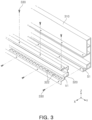
- FIG. 3 is an exploded perspective view of the side frame assembly 300.
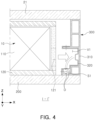
- FIG. 4 is a cross-sectional view taken along line I-I' of FIG. 1 .
- FIG. 5 illustrates a venting path and a dust loading portion formed in the side frame assembly 300.
- the side frame assembly 300 described with reference to FIGS. 2 to 5 and the battery pack 1 including the same correspond to the side frame assembly 300 described above with reference to FIG. 1 and the battery pack 1 including the same, and thus, redundant descriptions may be omitted.
- the first frame 310 may be coupled to the lower frame 200 and may form an outer wall of the pack housing 20.
- the first frame 310 may be formed of a rigid material to support a load applied in a height direction (e.g., a Z-axis direction) of the battery pack 1 and various other directions.
- the side frame assembly 300 may further include the second frame 320 coupled to the first frame 310.
- the second frame 320 may be configured to protect the first frame 310 from flames or high temperature gas emitted from the battery module 10.
- the second frame 320 may be disposed on the side of the first frame 310 facing the battery module 10, and accordingly, high-temperature gas or flames, emitted from the battery module 10, reaching the first frame 310 may be minimized.
- the second frame 320 may be formed by bending a plate-shaped member several times.
- the second frame 320 may cover at least a portion of an inner surface (that is, the surface facing the battery module 10) of the first frame 310.
- the second frame 320 may have a shape corresponding to a shape of the inner surface of the first frame 310.
- the second frame 320 may be disposed between the battery module 10 and the first frame 310.
- the battery module 10 and the first frame 310 may be arranged to face each other in the first direction (the X-axis direction), and the second frame 320 is disposed therebetween to prevent or minimize gas or flames emitted from the battery module 10 from reaching the first frame 310.
- the second frame 320 may be coupled to the first frame 310 in the first direction (the X-axis direction). In this coupling direction, even if an impact is applied to the frame 320 due to gas or flames emitted from the battery module 10, the second frame 320 may not be easily detached from the first frame 310.
- the second frame 320 may be disposed so that at least one surface thereof faces the venting hole 121 of the battery module 10. High-temperature gas or flames emitted into the pack housing 20 through the venting hole 121 may first reach the second frame 320.
- the second frame 320 may be formed of a material that may withstand high temperature thermal energy.
- the second frame 320 may be formed of a high heat-resistant and high fire-resistant material that melts at a temperature of 700°C or higher.
- high heat-resistant materials included in the second frame 320 may include inorganic materials, such as steel, stainless steel, and mica, but without being limited thereto, any material that does not melt at a temperature below 700°Cmay be used.
- the second frame 320 may be formed of a material having a melting point higher than that of the first frame 310.
- the first frame 310 is formed of aluminum
- the second frame 320 may be formed of a material having a melting point higher than a melting point (about 660 degrees Celsius) of aluminum.
- the venting path portion V1 may be formed in a region of the second frame 320 facing the venting hole 121.
- the venting path portion V1 may be a space provided for gas or flames to flow in a predetermined direction.
- the venting path portion V1 may be disposed to face the venting hole 121 of the battery module 10 in the first direction (the X-axis direction).
- the venting path portion V1 may extend in the longitudinal direction (the Y-axis direction) on one surface of the second frame 320. Gas or flames emitted from the battery module 10 may move to the front or rear of the pack housing 20 along the venting path portion V1 and then be emitted to the outside of the battery pack 1.
- Gas emitted from the battery module 10 may include large and small dust particles D.
- a dust loading portion S1 which is a space in which the dust D may accumulate, may be formed on one side of the venting path portion V1.
- the dust loading portion S1 may be provided as a separate space that is distinct from the venting path portion V1.
- the dust loading portion S1 may be provided below the venting path portion V1 and may extend in a direction, parallel to the extension direction of the venting path portion V1.
- the second frame 320 may partition the dust loading portion S1 and the venting path portion V1.
- the second frame 320 may further include a partition 321 partitioning the dust loading portion S1 and the venting path portion V1.
- the partition 321 may constitute at least a portion of the second frame 320 and may be configured to extend between the venting path portion V1 and the dust loading portion S1.
- the venting path portion V1 may be formed above the partition 321, and the dust loading portion S1 may be formed below the partition 321.
- the partition 321 may be provided with a plurality of openings 322 communicating with the venting path portion V1 and the dust loading portion S1.
- the plurality of openings 322 may be arranged in the longitudinal direction of the second frame 320 on the partition 321.
- the venting path portion V1 and the dust loading portion S1 may communicate with each other through the opening portion 322. Accordingly, at least some of the dust particles D discharged from the battery module 10 to the venting path portion V1 may flow into the dust loading portion S1 through the opening 322.
- high-temperature gas or flames may occur in the battery cell 110.
- the battery module 10 may discharge high-temperature gas or flames occurring in the battery cell 110 through the venting hole 121. At this time, gas or flames may be emitted from the battery module 10 in a direction facing the side frame assembly 300.
- the gas and dust D discharged from the battery module 10 flow into the venting path portion V1 disposed to face the venting hole 121 and hit a wall (e.g., one surface of the second frame 320) facing the venting hole 121 in the side frame assembly 300. Due to the collision, kinetic energy of the dust D is reduced, and the dust particles D having weight fall into the dust loading portion S1 provided at a lower end of the venting path portion V1 by gravity.
- the dust loading portion S1 and the venting path portion V1 may communicate with each other through the opening 322 of the second frame 320.
- the dust D that falls down may enter the dust loading portion S1 through the opening 322.
- the dust D falling into the dust loading portion S1 may be blocked by the partition 321 of the second frame 320 and may not rise again to the venting path portion V1.
- gas and small and light dust particles may flow in a predetermined direction (e.g., the Y-axis direction) in an upper portion of the partition 321 (i.e., the venting path portion V1), and heavy dust particles D are loaded in a lower portion of the partition 321 (i.e., the dust loading portion S1).
- a predetermined direction e.g., the Y-axis direction
- heavy dust particles D are loaded in a lower portion of the partition 321 (i.e., the dust loading portion S1).
- the side frame assembly 300 may further include a fastening member 330 coupling the first frame 310 to the second frame 320.
- the fastening member 330 may be provided as a screw, bolt, or nut, and may penetrate through the second frame 320 to be fastened to the first frame 310.
- a plurality of fastening members 330 may be provided.
- a plurality of fastening members 330 may be provided in the longitudinal direction (the Y-axis direction) of the side frame assembly 300.
- the first frame 310 and the second frame 320 may be mechanically firmly fastened through the fastening member 330, and the coupled state may be stably maintained even when high-temperature thermal energy or explosive energy is applied.
- FIGS. 2 to 5 illustrate the venting path portion V1 and the dust loading portion S1 arranged in a vertical direction, but the arrangement structure of the venting path portion V1 and the dust loading portion S1 is limited thereto.
- the venting path portion V1 and the dust loading portion S1 may be arranged to face each other in a direction, horizontal to the lower frame 200.
- FIGS. 6 and 7 a battery pack having a side frame assembly 400 according to another exemplary embodiment will be described with reference to FIGS. 6 and 7 .
- FIG. 6 is a partial cross-sectional view of a battery pack 1' according to another exemplary embodiment.
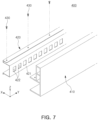
- FIG. 7 is an exploded perspective view of the side frame assembly 400 according to another exemplary embodiment.
- all components e.g., the battery module 10, the lower frame 200, the upper frame, etc.
- the side frame assembly 400 have the same characteristics as those of the battery pack 1 described above with reference to FIGS. 1 to 5 , and thus, redundant descriptions may be omitted.
- the side frame assembly 400 may include a first frame 410 and a second frame 420 coupled to each other.
- the first frame 410 may be coupled with the lower frame 200 to form an outer surface of the battery pack 1' and may provide rigidity in the height direction (the Z-axis direction) of the battery pack 1'.
- a material constituting the first frame 410 or a method of coupling the lower frame 200 and the first frame 410 may refer to the description of the first frame 310 of FIGS. 1 to 5 .
- the second frame 420 may be formed by bending a plate-shaped member multiple times and may be coupled to the first frame 410 in a first direction.
- the second frame 420 may partition the venting path portion V2 and the dust loading portion S2.
- a venting path portion V2 may be formed on one side of the second frame 420 opposite to the venting hole of the battery module 10, and a dust loading portion S2 may be formed on the other side opposite to one side.
- the dust loading portion S2 may be formed in a space between the first frame 410 and the second frame 420.
- the second frame 420 may be formed of a material that may withstand high-temperature thermal energy to protect the first frame from high-temperature gas or flames discharged from the battery module 10.
- the second frame 420 may be formed of a high heat-resistant and high fire-resistant material that melts at a temperature of 700°Cor higher.
- high heat-resistant materials included in the second frame 420 may include inorganic materials, such as steel, stainless steel, and mica, but without being limited thereto, any material that does not melt at a temperature below 700°Cmay be used.
- the second frame 420 may be formed of a material having a melting point higher than that of the first frame 410.
- the first frame 410 is formed of aluminum
- the second frame 420 may be formed of a material having a melting point higher than a melting point (about 660 degrees Celsius) of aluminum.
- the venting path portion V2 may be formed in a region of the second frame 420 facing the venting hole 121.
- the venting path portion V2 may be a space provided for gas or flames to flow in a predetermined direction (e.g., the Y-axis direction).
- the venting path portion V2 may be disposed to face the venting hole 121 of the battery module 10 in the first direction (the X-axis direction).
- the venting path portion V2 may extend in the longitudinal direction (the Y-axis direction) on one surface of the second frame 420. Gas or flames emitted from the battery module 10 may move to the front or rear of the pack housing 20 along the venting path portion V2 and then be emitted to the outside of the battery pack 1'.
- the venting path portion V2 and the dust loading portion S2 of the side frame assembly 400 may be arranged to face each other in the horizontal direction.
- the horizontal direction may be parallel to the upper surface of the lower frame 200.
- the horizontal direction may be a direction, perpendicular to the direction of gravity.
- the battery module 10, the venting path portion V2, and the dust loading portion S2 may be arranged in the first direction (the X-axis direction).
- one side of the venting path portion V2 faces the venting hole 121 of the battery module 10 in the first direction (the X-axis direction), and the other side opposite to the one side may be disposed to face the dust loading portion S2 in the first direction (the X-axis direction).
- the second frame 420 may further include a partition 421 partitioning the dust loading portion S2 and the venting path portion V2.
- the partition 421 may constitute at least a portion of the second frame 420 and may be configured to extend across between the venting path portion V2 and the dust loading portion S2.
- the partition 421 of the second frame 420 may be disposed to face the venting hole 121 of the battery module 10 in the first direction (the X-axis direction).
- the venting path portion V2 may be formed on one side of the partition 421, and the dust loading portion S2 may be formed between the other surface of the partition 421 and the first frame 410.
- a plurality of openings 422 may be provided in the partition 421, so that the venting path portion V2 and the dust loading portion S2 may communicate with each other.
- the side frame assembly 400 may further include a fastening member 430 that couples the first frame 410 and the second frame 420.
- the fastening member 430 may be provided as a screw, bolt, or nut, and may penetrate through the second frame 420 to be fastened to the first frame 410.
- a plurality of fastening members 430 may be provided.
- a plurality of fastening members 430 may be provided in the longitudinal direction (the Y-axis direction) of the side frame assembly 400.
- the first frame 410 and the second frame 420 may be mechanically firmly fastened through the fastening member 430, and the coupled state may be stably maintained even when high-temperature thermal energy or explosive energy is applied.
- gas and large or small dust particles occurring in the battery cell 110 may be discharged to the outside of the battery module 10 through the venting hole 121 of the battery module 10.
- gas and flames may be discharged in the first direction (the X-axis direction) through the venting hole 121 to reach the side frame assembly 400 facing the battery module 10 in the first direction (the X-axis direction).
- Gas and dust particles discharged from the battery module 10 may pass through the opening 422 of the second frame 420 and hit the side surface of the first frame 410. Due to this collision, kinetic energy of the dust is reduced and dust particles D having weight fall to and collect in the lower portion of the dust loading portion S2 by gravity.
- small dust particles and gas that are relatively light in weight may move toward the front or rear of the pack housing 20 along the venting path portion V2 on the second frame 420, and large and heavy dust particles D may be trapped in the dust loading portion S2 and may not block the venting path portion V2.
- the battery pack according to exemplary embodiments may have a pack housing structure that prevents dust occurring in a thermal runaway situation from blocking the gas flow path.
- the battery pack according to exemplary embodiments may effectively discharge heat or flames occurring in the battery cell or battery module to the outside of the battery pack to prevent chain ignition or explosion.
Landscapes
- Chemical & Material Sciences (AREA)
- Chemical Kinetics & Catalysis (AREA)
- Electrochemistry (AREA)
- General Chemical & Material Sciences (AREA)
- Inorganic Chemistry (AREA)
- Health & Medical Sciences (AREA)
- Public Health (AREA)
- Business, Economics & Management (AREA)
- Emergency Management (AREA)
- Battery Mounting, Suspending (AREA)
Abstract
A battery pack is disclosed.In some implementations, the battery pack includes a lower frame on which a battery module is disposed and a side frame assembly connected to the lower frame and facing at least one side of the battery module, wherein the side frame assembly includes a first frame forming an outer surface of the side frame assembly and a second frame partitioning a dust loading portion in which dust discharged from the battery module is loaded and a venting flow path portion along which gas discharged from the battery module flows, and facing the battery module.
Description
- The technology and implementations disclosed in this patent document generally relate to a battery pack.
- Unlike primary batteries, secondary batteries are conveniently charged and discharged, and thus, have come to prominence as a power source for various types of mobile devices and electric vehicles. For example, a type of secondary battery using a non-aqueous electrolyte with high energy density has good power, so a plurality of such secondary batteries may be connected in series or in parallel to be used to drive a motor of an electric vehicle.
- Battery modules applied to electric vehicles, etc. are modularized by electrically connecting a plurality of battery cells due to the need for high power and high capacity, and electric vehicles include a battery pack in which a plurality of such battery modules are arranged to obtain high power.
- In a conventional battery pack, in a thermal runaway situation, high-temperature gas or flames occurring as any one battery module accommodated inside a battery pack ignites flow along a venting path provided inside the battery pack to be discharged to the outside of the battery pack.
- Here, since the gas or flames occurring due to ignition of the battery module have a very high temperature, there may be a risk of damaging a housing structure of the battery pack.
- In addition, as large and small dust particles emitted along with gas or flames enter the venting path along with gas, there is a risk that the dust may block the venting path or narrow a width thereof. If dust blocks the venting path like this, gas cannot be emitted smoothly to the outside of the battery pack, causing a temperature and pressure inside the battery pack to rise, which may cause secondary ignition and a chain thermal runaway phenomenon.
- The disclosed technology may be implemented in some exemplary embodiments to provide a battery pack having a pack housing structure capable of preventing dust occurring during a thermal runaway situation from blocking a gas flow path.
- The disclosed technology may be implemented in some exemplary embodiments to provide a battery pack capable of effectively emitting heat or flames occurring in a battery cell or battery module to the outside of the battery pack, thereby preventing chain ignition or explosion.
- The disclosed technology may be implemented in some exemplary embodiments to provide a battery pack including a reinforcing member having strong resistance to heat or flames to prevent a structure of the battery pack from collapsing due to flames occurring in a battery cell or battery module.
- In some exemplary embodiments of the disclosed technology, a battery pack includes: a lower frame on which a battery module is disposed; and a side frame assembly connected to the lower frame and facing at least one side of the battery module, wherein the side frame assembly includes a first frame forming an outer surface of the side frame assembly; and a second frame partitioning a dust loading portion in which dust discharged from the battery module is loaded and a venting flow path portion along which gas discharged from the battery module flows, and facing the battery module.
- The battery module may include a venting hole through which gas is discharged, and the second frame may be disposed between the venting hole and the first frame.
- The second frame may be coupled to the first frame, and the dust loading portion may be formed between the first frame and the second frame.
- The second frame may be disposed so that at least one surface thereof faces the venting hole.
- The venting path portion may be formed on at least one surface of the second frame in a longitudinal direction of the second frame.
- The second frame may include: a partition partitioning the venting path portion and the dust loading portion; and a plurality of openings arranged in the partition and communicating with the venting path portion and the dust loading portion.
- The plurality of openings may be arranged in a longitudinal direction of the second frame.
- The venting path portion may face the venting hole in a first direction, and the dust loading portion may face the venting path portion in a second direction, perpendicular to the first direction.
- The second frame may be coupled to the first frame in the first direction.
- One side of the venting path portion may face the venting hole, and the dust loading portion may be disposed to face the other side opposite to the one side of the venting path portion.
- The battery pack may further include: a fastening member coupling the first frame and the second frame to each other.
- The fastening member may be provided in plural, and the plurality of fastening members may be arranged in a longitudinal direction of the second frame and are fastened to the first frame through the second frame.
- The second frame may include a material having a melting point higher than that of a material forming the first frame.
- The second frame may include at least one of iron, stainless steel, and mica.
- Certain aspects, features, and advantages of the disclosed technology are illustrated by the following detailed description with reference to the accompanying drawings.
-
FIG. 1 is an exploded perspective view of a battery pack according to exemplary embodiments. -
FIG. 2 is a perspective view of a side frame assembly included in a battery pack. -
FIG. 3 is an exploded perspective view of the side frame assembly. -
FIG. 4 is a cross-sectional view taken along line I-I' ofFIG. 1 . -
FIG. 5 illustrates a venting path portion and a dust loading portion formed in a side frame assembly. -
FIG. 6 is a partial cross-sectional view of a battery pack according to another exemplary embodiment. -
FIG. 7 is an exploded perspective view of a side frame assembly according to another exemplary embodiment. -
FIG. 1 is an exploded perspective view of abattery pack 1 according to exemplary embodiments. - The
battery pack 1 may include apack housing 20 and one ormore battery modules 10 accommodated in an internal space of thepack housing 20. - The
battery module 10 may include one or more battery cells (for example, 110 inFIG. 4 ) that may be charged or discharged to store or emit electrical energy. For example, thebattery module 10 may include a plurality ofbattery cells 110 formed of secondary batteries, such as lithium ion batteries or nickel-hydrogen batteries. - In exemplary embodiments, the
battery module 10 may include a plurality ofbattery cells 110, a bus bar assembly (not shown) electrically connected to thebattery cells 110, and an external case. As illustrated inFIG. 1 , thebattery module 10 may have a hexahedral shape. However, the external shape of thebattery module 10 is not limited thereto and may be provided in various shapes. - The
battery cell 110 included in thebattery module 10 may include an electrode assembly (not shown) and an outer casing (not shown) accommodating the electrode assembly. For example, thebattery cell 110 may be a pouch-type battery cell in which an electrode assembly (not shown) is accommodated inside an aluminum-coated pouch (not shown). Alternatively, thebattery cell 110 may be a prismatic battery cell in which an electrode assembly (not shown) is accommodated inside a metal may (not shown). However, the specific shape of thebattery cell 110 is not limited to the above, and thebattery cell 110 may be provided to have any shape as long as thebattery cell 110 may be accommodated inside thebattery module 10. - The
battery module 10 may include amodule housing 120 having an internal space in which thebattery cell 110 is accommodated. Themodule housing 120 may include a rigid material and may protect thebattery cell 110 from an external environment of thebattery module 10. - A
venting hole 121, which is a hole through which gas may be emitted, may be provided on one side of themodule housing 120. Gas or flames inside themodule housing 120 may be emitted to the outside of the battery module through theventing hole 121. - However, the
battery module 10 may also be formed of an assembly of battery cells without a separate module housing. For example, the battery module may be a battery cell assembly in which battery cells are stacked and fixed. - Meanwhile, in addition to one or
more battery modules 10, various components may be accommodated in the internal space of thebattery pack 1. For example, a connection member (not shown) connecting the plurality ofbattery modules 10 to each other may be accommodated in the internal space of thebattery pack 1, or a sensing member (not shown) detecting a temperature of thebattery pack 1 or input/output voltage of thebattery pack 1 may be accommodated in the internal space of thebattery pack 1. - The pack housing 20 of the
battery pack 1 according to exemplary embodiments may include alower frame 200 on which thebattery module 10 is disposed and a plurality ofside frame assemblies 300 coupled to thelower frame 200 to provide rigidity of thepack housing 20 in a height direction. In addition, thepack housing 20 may further include an upper frame coupled to theside frame assembly 300 to cover the internal space of thepack housing 20. - The
lower frame 200 forms a lower surface of thepack housing 20. Thelower frame 200 may be formed as a plate-shaped member provided with a seating surface on which the plurality ofbattery modules 10 are disposed. For example, thelower frame 200 may be provided as a quadrangular plate-shaped member or a polygonal plate-shaped member. However, the specific shape of thelower frame 200 is not limited to the above. - The
lower frame 200 may be formed of a metal material having a certain level of rigidity. For example, at least a portion of thelower frame 200 may include aluminum. When thelower frame 200 includes aluminum, thermal energy generated in thebattery module 10 may be expected to be quickly dissipated to the outside of thebattery pack 1 due to the excellent thermal conductivity of aluminum. In exemplary embodiments, to increase the heat dissipation effect, thelower frame 200 may further include a heat dissipation member (not shown) or a cooling member (not shown). For example, a heat dissipation member (not shown) may be disposed on an upper surface of thelower frame 200 on which thebattery module 10 is disposed to quickly transfer thermal energy generated by thebattery module 10 toward thelower frame 200. - One or more
side frame assemblies 300 may be coupled to thelower frame 200. Theside frame assembly 300 may partition the internal space of thepack housing 20 to form accommodation spaces in which the plurality ofbattery modules 10 are accommodated. Theside frame assembly 300 may be formed of a metal material having a certain level of rigidity or higher. For example, a portion of theside frame assembly 300 may be formed of aluminum for high heat dissipation effect. - In exemplary embodiments, one
side frame assembly 300 may be provided to extend along one edge of thelower frame 200. Accordingly, theside frame assembly 300 may be a side partition member forming a side surface of thepack housing 20. - As the
battery cell 110 included in thebattery module 10 is charged and discharged under harsh conditions, flames or high-temperature gas may occur in thebattery cell 110. In order to smoothly emit such flames or gas to the outside of thebattery module 10, thebattery module 10 according to exemplary embodiments may include one or more venting holes. Through the venting hole, thermal energy or gas occurring in thebattery cell 110 may be emitted to the outside of thebattery module 10 in a certain direction. - The
side frame assembly 300 may be disposed to face theventing hole 121 of thebattery module 10, and accordingly, a venting path through which gas or flames flow in a longitudinal direction (e.g., a Y-axis direction) of theside frame assembly 300 may be formed. Here, the longitudinal direction (the Y-axis direction) of theside frame assembly 300 may be perpendicular to the direction (an X-axis direction) in which theside frame assembly 300 and thebattery module 10 face each other. - Flames or high-temperature gas emitted from the
battery module 10 may reach theside frame assembly 300 around thebattery module 10, and accordingly, high thermal energy may be applied to theside frame assembly 300. In addition, small dust discharged from thebattery module 10 together with high-temperature gas may accumulate in theside frame assembly 300 and narrow the venting path. - The
side frame assembly 300 according to exemplary embodiments is provided with a reinforcing structure (e.g., asecond frame 320 ofFIGS. 2 to 5 ) to prevent flames or high-temperature gas occurring in thebattery module 10 from damaging theside frame assembly 300. In addition, theside frame assembly 300 may include a space in which dust discharged together with gas from thebattery module 10 may be loaded, thereby preventing dust from blocking the venting path. - Hereinafter, the
side frame assembly 300 according to exemplary embodiments will be described in detail with reference toFIGS. 2 to 5 . -
FIG. 2 is a perspective view of theside frame assembly 300 included in the battery pack.FIG. 3 is an exploded perspective view of theside frame assembly 300.FIG. 4 is a cross-sectional view taken along line I-I' ofFIG. 1 .FIG. 5 illustrates a venting path and a dust loading portion formed in theside frame assembly 300. - The
side frame assembly 300 described with reference toFIGS. 2 to 5 and thebattery pack 1 including the same correspond to theside frame assembly 300 described above with reference toFIG. 1 and thebattery pack 1 including the same, and thus, redundant descriptions may be omitted. - The
side frame assembly 300 according to exemplary embodiments may include afirst frame 310 and thesecond frame 320. Thefirst frame 310 and thesecond frame 320 may be coupled to each other to form a venting path portion V1 and a dust loading portion S1. - The
first frame 310 may be coupled to thelower frame 200 and may form an outer wall of thepack housing 20. Thefirst frame 310 may be formed of a rigid material to support a load applied in a height direction (e.g., a Z-axis direction) of thebattery pack 1 and various other directions. - The
first frame 310 may have a shape of a beam extending in one direction (e.g., the Y-axis direction). For example, thefirst frame 310 may be provided to extend along a partial edge of thelower frame 200. - The
first frame 310 may be coupled to thelower frame 200 in various manners. For example, thefirst frame 310 may be welded and coupled to thelower frame 200. In this case, in order to secure sufficient welding force, thefirst frame 310 may be formed of the same material as that of thelower frame 200. However, the material of thefirst frame 310 is not limited thereto, and thefirst frame 310 may be formed of a material, different from that of thelower frame 200. - The
side frame assembly 300 may further include thesecond frame 320 coupled to thefirst frame 310. - The
second frame 320 may be configured to protect thefirst frame 310 from flames or high temperature gas emitted from thebattery module 10. For example, thesecond frame 320 may be disposed on the side of thefirst frame 310 facing thebattery module 10, and accordingly, high-temperature gas or flames, emitted from thebattery module 10, reaching thefirst frame 310 may be minimized. - The
second frame 320 may be formed by bending a plate-shaped member several times. Thesecond frame 320 may cover at least a portion of an inner surface (that is, the surface facing the battery module 10) of thefirst frame 310. Thesecond frame 320 may have a shape corresponding to a shape of the inner surface of thefirst frame 310. - The
second frame 320 may be disposed between thebattery module 10 and thefirst frame 310. For example, thebattery module 10 and thefirst frame 310 may be arranged to face each other in the first direction (the X-axis direction), and thesecond frame 320 is disposed therebetween to prevent or minimize gas or flames emitted from thebattery module 10 from reaching thefirst frame 310. - The
second frame 320 may be coupled to thefirst frame 310 in the first direction (the X-axis direction). In this coupling direction, even if an impact is applied to theframe 320 due to gas or flames emitted from thebattery module 10, thesecond frame 320 may not be easily detached from thefirst frame 310. - The
second frame 320 may be disposed so that at least one surface thereof faces theventing hole 121 of thebattery module 10. High-temperature gas or flames emitted into thepack housing 20 through theventing hole 121 may first reach thesecond frame 320. - The
second frame 320 may be formed of a material that may withstand high temperature thermal energy. For example, thesecond frame 320 may be formed of a high heat-resistant and high fire-resistant material that melts at a temperature of 700°C or higher. Examples of high heat-resistant materials included in thesecond frame 320 may include inorganic materials, such as steel, stainless steel, and mica, but without being limited thereto, any material that does not melt at a temperature below 700°Cmay be used. - The
second frame 320 may be formed of a material having a melting point higher than that of thefirst frame 310. For example, when thefirst frame 310 is formed of aluminum, thesecond frame 320 may be formed of a material having a melting point higher than a melting point (about 660 degrees Celsius) of aluminum. - The venting path portion V1 may be formed in a region of the
second frame 320 facing the ventinghole 121. The venting path portion V1 may be a space provided for gas or flames to flow in a predetermined direction. - The venting path portion V1 may be disposed to face the
venting hole 121 of thebattery module 10 in the first direction (the X-axis direction). The venting path portion V1 may extend in the longitudinal direction (the Y-axis direction) on one surface of thesecond frame 320. Gas or flames emitted from thebattery module 10 may move to the front or rear of thepack housing 20 along the venting path portion V1 and then be emitted to the outside of thebattery pack 1. - Gas emitted from the
battery module 10 may include large and small dust particles D. In order to prevent the dust D from blocking the venting path portion V1, a dust loading portion S1, which is a space in which the dust D may accumulate, may be formed on one side of the venting path portion V1. - The dust loading portion S1 may be provided as a separate space that is distinct from the venting path portion V1. For example, as illustrated in
FIG. 2 orFIG. 4 , the dust loading portion S1 may be provided below the venting path portion V1 and may extend in a direction, parallel to the extension direction of the venting path portion V1. - The
second frame 320 may partition the dust loading portion S1 and the venting path portion V1. Thesecond frame 320 may further include apartition 321 partitioning the dust loading portion S1 and the venting path portion V1. For example, as illustrated inFIG. 2 , thepartition 321 may constitute at least a portion of thesecond frame 320 and may be configured to extend between the venting path portion V1 and the dust loading portion S1. The venting path portion V1 may be formed above thepartition 321, and the dust loading portion S1 may be formed below thepartition 321. Thepartition 321 may be provided with a plurality ofopenings 322 communicating with the venting path portion V1 and the dust loading portion S1. The plurality ofopenings 322 may be arranged in the longitudinal direction of thesecond frame 320 on thepartition 321. The venting path portion V1 and the dust loading portion S1 may communicate with each other through theopening portion 322. Accordingly, at least some of the dust particles D discharged from thebattery module 10 to the venting path portion V1 may flow into the dust loading portion S1 through theopening 322. - A configuration in which dust D discharged with gas is loaded into the dust loading portion S1 is described with reference to
FIGS. 4 and5 . - As a thermal runaway situation occurs, high-temperature gas or flames may occur in the
battery cell 110. Thebattery module 10 may discharge high-temperature gas or flames occurring in thebattery cell 110 through theventing hole 121. At this time, gas or flames may be emitted from thebattery module 10 in a direction facing theside frame assembly 300. - The gas and dust D discharged from the
battery module 10 flow into the venting path portion V1 disposed to face theventing hole 121 and hit a wall (e.g., one surface of the second frame 320) facing the ventinghole 121 in theside frame assembly 300. Due to the collision, kinetic energy of the dust D is reduced, and the dust particles D having weight fall into the dust loading portion S1 provided at a lower end of the venting path portion V1 by gravity. - For example, when it is assumed that the venting path portion V1 formed on one surface of the
second frame 320 faces theventing hole 121 in the first direction (the X-axis direction), the dust loading portion S1 may be disposed to face the venting path portion V1 in the second direction (the Z-axis direction), perpendicular to the first direction (the X-axis direction). In this case, the dust loading portion S1 may be located to be lower than the venting path portion V1 in the direction of gravity. - The dust loading portion S1 and the venting path portion V1 may communicate with each other through the
opening 322 of thesecond frame 320. The dust D that falls down may enter the dust loading portion S1 through theopening 322. - The dust D falling into the dust loading portion S1 may be blocked by the
partition 321 of thesecond frame 320 and may not rise again to the venting path portion V1. - Accordingly, based on the
partition 321 of thesecond frame 320, gas and small and light dust particles may flow in a predetermined direction (e.g., the Y-axis direction) in an upper portion of the partition 321 (i.e., the venting path portion V1), and heavy dust particles D are loaded in a lower portion of the partition 321 (i.e., the dust loading portion S1). - In this manner, among the dust particles discharged to the outside of the
battery module 10 together with gas, heavy and large dust particles may be loaded in the dust loading portion S1, and only dust particles having relatively small or light particle size may remain inside the venting path portion V1. As large and heavy dust particles D are removed, a gas flow in the venting path portion V1 becomes smooth, allowing high-temperature gas to be quickly and smoothly discharged to the outside of thebattery pack 1. In addition, it is possible to prevent dust D from blocking the venting path portion V1, increasing the temperature and pressure inside thepack housing 20, and causing chain ignition. - In particular, according to the structure of the
battery pack 1 of the exemplary embodiments, large and heavy dust particles D naturally fall down, while gas and dust hit the wall surface of theside frame assembly 300 to lose energy, so that dust D in the gas may be easily filtered without a separate filtering device. - Meanwhile, the
side frame assembly 300 may further include afastening member 330 coupling thefirst frame 310 to thesecond frame 320. For example, thefastening member 330 may be provided as a screw, bolt, or nut, and may penetrate through thesecond frame 320 to be fastened to thefirst frame 310. - A plurality of
fastening members 330 may be provided. For example, as illustrated inFIG. 3 , a plurality offastening members 330 may be provided in the longitudinal direction (the Y-axis direction) of theside frame assembly 300. - The
first frame 310 and thesecond frame 320 may be mechanically firmly fastened through thefastening member 330, and the coupled state may be stably maintained even when high-temperature thermal energy or explosive energy is applied. -
FIGS. 2 to 5 illustrate the venting path portion V1 and the dust loading portion S1 arranged in a vertical direction, but the arrangement structure of the venting path portion V1 and the dust loading portion S1 is limited thereto. For example, as illustrated inFIGS. 6 and7 , the venting path portion V1 and the dust loading portion S1 may be arranged to face each other in a direction, horizontal to thelower frame 200. - Hereinafter, a battery pack having a
side frame assembly 400 according to another exemplary embodiment will be described with reference toFIGS. 6 and7 . -
FIG. 6 is a partial cross-sectional view of a battery pack 1' according to another exemplary embodiment.FIG. 7 is an exploded perspective view of theside frame assembly 400 according to another exemplary embodiment. - In the battery pack 1' illustrated in
FIGS. 6 and7 , all components (e.g., thebattery module 10, thelower frame 200, the upper frame, etc.), except theside frame assembly 400, have the same characteristics as those of thebattery pack 1 described above with reference toFIGS. 1 to 5 , and thus, redundant descriptions may be omitted. - In exemplary embodiments, the
side frame assembly 400 may include afirst frame 410 and asecond frame 420 coupled to each other. Thefirst frame 410 may be coupled with thelower frame 200 to form an outer surface of the battery pack 1' and may provide rigidity in the height direction (the Z-axis direction) of the battery pack 1'. In this case, a material constituting thefirst frame 410 or a method of coupling thelower frame 200 and thefirst frame 410 may refer to the description of thefirst frame 310 ofFIGS. 1 to 5 . - The
second frame 420 may be formed by bending a plate-shaped member multiple times and may be coupled to thefirst frame 410 in a first direction. - The
second frame 420 may partition the venting path portion V2 and the dust loading portion S2. For example, a venting path portion V2 may be formed on one side of thesecond frame 420 opposite to the venting hole of thebattery module 10, and a dust loading portion S2 may be formed on the other side opposite to one side. In this case, the dust loading portion S2 may be formed in a space between thefirst frame 410 and thesecond frame 420. - As described above with reference to
FIGS. 1 to 5 , thesecond frame 420 may be formed of a material that may withstand high-temperature thermal energy to protect the first frame from high-temperature gas or flames discharged from thebattery module 10. - For example, the
second frame 420 may be formed of a high heat-resistant and high fire-resistant material that melts at a temperature of 700°Cor higher. Examples of high heat-resistant materials included in thesecond frame 420 may include inorganic materials, such as steel, stainless steel, and mica, but without being limited thereto, any material that does not melt at a temperature below 700°Cmay be used. - The
second frame 420 may be formed of a material having a melting point higher than that of thefirst frame 410. For example, when thefirst frame 410 is formed of aluminum, thesecond frame 420 may be formed of a material having a melting point higher than a melting point (about 660 degrees Celsius) of aluminum. - The venting path portion V2 may be formed in a region of the
second frame 420 facing the ventinghole 121. The venting path portion V2 may be a space provided for gas or flames to flow in a predetermined direction (e.g., the Y-axis direction). - The venting path portion V2 may be disposed to face the
venting hole 121 of thebattery module 10 in the first direction (the X-axis direction). The venting path portion V2 may extend in the longitudinal direction (the Y-axis direction) on one surface of thesecond frame 420. Gas or flames emitted from thebattery module 10 may move to the front or rear of thepack housing 20 along the venting path portion V2 and then be emitted to the outside of the battery pack 1'. - The venting path portion V2 and the dust loading portion S2 of the
side frame assembly 400 may be arranged to face each other in the horizontal direction. Here, the horizontal direction may be parallel to the upper surface of thelower frame 200. Alternatively, the horizontal direction may be a direction, perpendicular to the direction of gravity. - The
battery module 10, the venting path portion V2, and the dust loading portion S2 may be arranged in the first direction (the X-axis direction). For example, one side of the venting path portion V2 faces theventing hole 121 of thebattery module 10 in the first direction (the X-axis direction), and the other side opposite to the one side may be disposed to face the dust loading portion S2 in the first direction (the X-axis direction). - The
second frame 420 may further include apartition 421 partitioning the dust loading portion S2 and the venting path portion V2. For example, as illustrated inFIG. 7 , thepartition 421 may constitute at least a portion of thesecond frame 420 and may be configured to extend across between the venting path portion V2 and the dust loading portion S2. Thepartition 421 of thesecond frame 420 may be disposed to face theventing hole 121 of thebattery module 10 in the first direction (the X-axis direction). The venting path portion V2 may be formed on one side of thepartition 421, and the dust loading portion S2 may be formed between the other surface of thepartition 421 and thefirst frame 410. A plurality ofopenings 422 may be provided in thepartition 421, so that the venting path portion V2 and the dust loading portion S2 may communicate with each other. - The
side frame assembly 400 may further include afastening member 430 that couples thefirst frame 410 and thesecond frame 420. For example, thefastening member 430 may be provided as a screw, bolt, or nut, and may penetrate through thesecond frame 420 to be fastened to thefirst frame 410. - A plurality of
fastening members 430 may be provided. For example, as illustrated inFIG. 7 , a plurality offastening members 430 may be provided in the longitudinal direction (the Y-axis direction) of theside frame assembly 400. - The
first frame 410 and thesecond frame 420 may be mechanically firmly fastened through thefastening member 430, and the coupled state may be stably maintained even when high-temperature thermal energy or explosive energy is applied. - In a thermal runaway situation, gas and large or small dust particles occurring in the
battery cell 110 may be discharged to the outside of thebattery module 10 through theventing hole 121 of thebattery module 10. For example, gas and flames may be discharged in the first direction (the X-axis direction) through theventing hole 121 to reach theside frame assembly 400 facing thebattery module 10 in the first direction (the X-axis direction). - Gas and dust particles discharged from the
battery module 10 may pass through theopening 422 of thesecond frame 420 and hit the side surface of thefirst frame 410. Due to this collision, kinetic energy of the dust is reduced and dust particles D having weight fall to and collect in the lower portion of the dust loading portion S2 by gravity. - Accordingly, small dust particles and gas that are relatively light in weight may move toward the front or rear of the
pack housing 20 along the venting path portion V2 on thesecond frame 420, and large and heavy dust particles D may be trapped in the dust loading portion S2 and may not block the venting path portion V2. - In this manner, among dust particles discharged to the outside of the
battery module 10 together with the gas, heavy and large dust particles may be loaded in the dust loading portion S2, and only dust particles having relatively small or light particle size may remain inside the venting path portion V2. Since large and heavy dust particles D are removed, gas flow in the venting path portion V2 becomes smooth, allowing high-temperature gas to be quickly and smoothly discharged to the outside of the battery pack 1'. In addition, it is possible to prevent dust D from blocking the venting path V2, increasing the temperature and pressure inside thepack housing 20, and causing chain ignition. - The battery pack according to exemplary embodiments may have a pack housing structure that prevents dust occurring in a thermal runaway situation from blocking the gas flow path.
- In addition, the battery pack according to exemplary embodiments may effectively discharge heat or flames occurring in the battery cell or battery module to the outside of the battery pack to prevent chain ignition or explosion.
Claims (14)
- A battery pack comprising:a lower frame on which a battery module is disposed; anda side frame assembly connected to the lower frame and facing at least one side of the battery module,wherein the side frame assembly includes:a first frame forming an outer surface of the side frame assembly; anda second frame partitioning a dust loading portion in which dust discharged from the battery module is loaded and a venting flow path portion along which gas discharged from the battery module flows, and facing the battery module.
- The battery pack of claim 1, whereinthe battery module includes a venting hole through which gas is discharged, andthe second frame is disposed between the venting hole and the first frame.
- The battery pack of claim 2, whereinthe second frame is coupled to the first frame, andthe dust loading portion is formed between the first frame and the second frame.
- The battery pack of claim 2, wherein the second frame is disposed so that at least one surface thereof faces the venting hole.
- The battery pack of claim 4, wherein the venting path portion is formed on at least one surface of the second frame in a longitudinal direction of the second frame.
- The battery pack of claim 2, wherein
the second frame includes:a partition partitioning the venting path portion and the dust loading portion; anda plurality of openings arranged in the partition and communicating with the venting path portion and the dust loading portion. - The battery pack of claim 6, wherein the plurality of openings are arranged in a longitudinal direction of the second frame.
- The battery pack of claim 6, whereinthe venting path portion faces the venting hole in a first direction, andthe dust loading portion faces the venting path portion in a second direction, perpendicular to the first direction.
- The battery pack of claim 8, wherein the second frame is coupled to the first frame in the first direction.
- The battery pack of claim 6, whereinone side of the venting path portion faces the venting hole, andthe dust loading portion is disposed to face the other side opposite to the one side of the venting path portion.
- The battery pack of claim 3, further comprising a fastening member coupling the first frame and the second frame to each other.
- The battery pack of claim 11, wherein the fastening member is provided in plural, and the plurality of fastening members are arranged in a longitudinal direction of the second frame and are fastened to the first frame through the second frame.
- The battery pack of claim 1, wherein the second frame includes a material having a melting point higher than that of a material forming the first frame.
- The battery pack of claim 13, wherein the second frame includes at least one of iron, stainless steel, and mica.
Applications Claiming Priority (1)
| Application Number | Priority Date | Filing Date | Title |
|---|---|---|---|
| KR1020220169925A KR20240084976A (en) | 2022-12-07 | 2022-12-07 | Battery Pack |
Publications (1)
| Publication Number | Publication Date |
|---|---|
| EP4383415A1 true EP4383415A1 (en) | 2024-06-12 |
Family
ID=88690038
Family Applications (1)
| Application Number | Title | Priority Date | Filing Date |
|---|---|---|---|
| EP23207566.3A Pending EP4383415A1 (en) | 2022-12-07 | 2023-11-02 | Battery pack |
Country Status (4)
| Country | Link |
|---|---|
| US (1) | US20240195006A1 (en) |
| EP (1) | EP4383415A1 (en) |
| KR (1) | KR20240084976A (en) |
| CN (1) | CN118156724A (en) |
Cited By (1)
| Publication number | Priority date | Publication date | Assignee | Title |
|---|---|---|---|---|
| EP4439799A3 (en) * | 2023-03-31 | 2025-01-22 | Eve Energy Co., Ltd. | Lower battery mounting box and battery pack |
Families Citing this family (2)
| Publication number | Priority date | Publication date | Assignee | Title |
|---|---|---|---|---|
| CN115249861A (en) * | 2021-04-27 | 2022-10-28 | Sk新能源株式会社 | Battery pack |
| CN115249852A (en) | 2021-04-27 | 2022-10-28 | Sk新能源株式会社 | Battery |
Citations (3)
| Publication number | Priority date | Publication date | Assignee | Title |
|---|---|---|---|---|
| US20210066690A1 (en) * | 2018-03-12 | 2021-03-04 | Panasonic Intellectual Property Management Co., Ltd. | Battery pack exhaust duct and battery pack |
| DE102021100659A1 (en) * | 2021-01-14 | 2021-03-18 | Daimler Ag | Battery case and battery |
| EP4020693A1 (en) * | 2020-04-29 | 2022-06-29 | Lg Energy Solution, Ltd. | Battery pack and device including same |
-
2022
- 2022-12-07 KR KR1020220169925A patent/KR20240084976A/en active Pending
-
2023
- 2023-10-23 US US18/491,800 patent/US20240195006A1/en active Pending
- 2023-10-24 CN CN202311381647.9A patent/CN118156724A/en active Pending
- 2023-11-02 EP EP23207566.3A patent/EP4383415A1/en active Pending
Patent Citations (3)
| Publication number | Priority date | Publication date | Assignee | Title |
|---|---|---|---|---|
| US20210066690A1 (en) * | 2018-03-12 | 2021-03-04 | Panasonic Intellectual Property Management Co., Ltd. | Battery pack exhaust duct and battery pack |
| EP4020693A1 (en) * | 2020-04-29 | 2022-06-29 | Lg Energy Solution, Ltd. | Battery pack and device including same |
| DE102021100659A1 (en) * | 2021-01-14 | 2021-03-18 | Daimler Ag | Battery case and battery |
Cited By (1)
| Publication number | Priority date | Publication date | Assignee | Title |
|---|---|---|---|---|
| EP4439799A3 (en) * | 2023-03-31 | 2025-01-22 | Eve Energy Co., Ltd. | Lower battery mounting box and battery pack |
Also Published As
| Publication number | Publication date |
|---|---|
| KR20240084976A (en) | 2024-06-14 |
| US20240195006A1 (en) | 2024-06-13 |
| CN118156724A (en) | 2024-06-07 |
Similar Documents
| Publication | Publication Date | Title |
|---|---|---|
| EP4050718B1 (en) | Battery pack having improved fixing structure and gas discharge structure, and electronic device and vehicle including same | |
| EP4383415A1 (en) | Battery pack | |
| JP2024507463A (en) | Battery pack with pack case fitted with cooling fins | |
| KR102856968B1 (en) | Battery pack and Vehicle comprising the Same | |
| JP7456661B2 (en) | Battery module and battery pack containing it | |
| KR20230134660A (en) | Battery module and battery pack including the same | |
| EP4167361A1 (en) | Battery pack | |
| EP4246665A1 (en) | Battery pack | |
| JP7387904B2 (en) | Battery modules, battery packs containing them, and automobiles | |
| US12482895B2 (en) | Battery pack | |
| EP4535512A2 (en) | Battery pack and vehicle including same | |
| KR20240046898A (en) | Methods and equipment for manufacturing batteries, electrical devices, and batteries | |
| JP7447279B2 (en) | Battery packs, electronic devices containing them, and automobiles | |
| EP4730487A1 (en) | Battery module, and battery pack and vehicle including same | |
| EP4576383A1 (en) | Battery pack and vehicle comprising battery pack | |
| EP4668454A1 (en) | Battery pack and vehicle including same | |
| EP4730529A1 (en) | Battery module, and battery pack and vehicle including same | |
| EP4557466A1 (en) | Battery pack and device including same | |
| EP4718612A1 (en) | Battery pack and vehicle including same | |
| EP4697473A1 (en) | Battery module and battery pack including same | |
| EP4654365A1 (en) | Battery pack and vehicle including same | |
| KR20230099542A (en) | Battery module, battery pack the battery module, energy storage system and vehicle comprising the battery pack | |
| KR20240012295A (en) | Battery pack and device including the same | |
| KR20260005630A (en) | Battery module and battery pack and vehicle | |
| KR20250131088A (en) | Battery pack and vehicle including the same |
Legal Events
| Date | Code | Title | Description |
|---|---|---|---|
| PUAI | Public reference made under article 153(3) epc to a published international application that has entered the european phase |
Free format text: ORIGINAL CODE: 0009012 |
|
| STAA | Information on the status of an ep patent application or granted ep patent |
Free format text: STATUS: THE APPLICATION HAS BEEN PUBLISHED |
|
| AK | Designated contracting states |
Kind code of ref document: A1 Designated state(s): AL AT BE BG CH CY CZ DE DK EE ES FI FR GB GR HR HU IE IS IT LI LT LU LV MC ME MK MT NL NO PL PT RO RS SE SI SK SM TR |
|
| STAA | Information on the status of an ep patent application or granted ep patent |
Free format text: STATUS: REQUEST FOR EXAMINATION WAS MADE |
|
| 17P | Request for examination filed |
Effective date: 20241212 |