EP4383160A1 - A method for handling state machines of production assets - Google Patents
A method for handling state machines of production assets Download PDFInfo
- Publication number
- EP4383160A1 EP4383160A1 EP22211636.0A EP22211636A EP4383160A1 EP 4383160 A1 EP4383160 A1 EP 4383160A1 EP 22211636 A EP22211636 A EP 22211636A EP 4383160 A1 EP4383160 A1 EP 4383160A1
- Authority
- EP
- European Patent Office
- Prior art keywords
- production
- asset
- assets
- operating state
- production asset
- Prior art date
- Legal status (The legal status is an assumption and is not a legal conclusion. Google has not performed a legal analysis and makes no representation as to the accuracy of the status listed.)
- Granted
Links
Images

Classifications
-
- G—PHYSICS
- G06—COMPUTING OR CALCULATING; COUNTING
- G06Q—INFORMATION AND COMMUNICATION TECHNOLOGY [ICT] SPECIALLY ADAPTED FOR ADMINISTRATIVE, COMMERCIAL, FINANCIAL, MANAGERIAL OR SUPERVISORY PURPOSES; SYSTEMS OR METHODS SPECIALLY ADAPTED FOR ADMINISTRATIVE, COMMERCIAL, FINANCIAL, MANAGERIAL OR SUPERVISORY PURPOSES, NOT OTHERWISE PROVIDED FOR
- G06Q10/00—Administration; Management
- G06Q10/06—Resources, workflows, human or project management; Enterprise or organisation planning; Enterprise or organisation modelling
- G06Q10/063—Operations research, analysis or management
- G06Q10/0631—Resource planning, allocation, distributing or scheduling for enterprises or organisations
- G06Q10/06312—Adjustment or analysis of established resource schedule, e.g. resource or task levelling, or dynamic rescheduling
-
- G—PHYSICS
- G06—COMPUTING OR CALCULATING; COUNTING
- G06Q—INFORMATION AND COMMUNICATION TECHNOLOGY [ICT] SPECIALLY ADAPTED FOR ADMINISTRATIVE, COMMERCIAL, FINANCIAL, MANAGERIAL OR SUPERVISORY PURPOSES; SYSTEMS OR METHODS SPECIALLY ADAPTED FOR ADMINISTRATIVE, COMMERCIAL, FINANCIAL, MANAGERIAL OR SUPERVISORY PURPOSES, NOT OTHERWISE PROVIDED FOR
- G06Q10/00—Administration; Management
- G06Q10/06—Resources, workflows, human or project management; Enterprise or organisation planning; Enterprise or organisation modelling
- G06Q10/063—Operations research, analysis or management
- G06Q10/0633—Workflow analysis
Definitions
- the invention relates to a control unit and a method for handling respective state machines for a plurality of production assets.
- the invention further relates to a computer program, and a computer program product.
- the invention can be applied for heavy-duty vehicles, such as trucks, buses and construction equipment.
- An object of the invention is to improve the productivity of a production process.
- the above object is achieved by a method according to claim 1.
- a computer implemented method for handling respective state machines of a plurality of production assets comprising:
- a state machine for a production asset with a lower maturity such as the first production asset
- Inheriting the operating state data is done by performing an override of the operating state data of the first production asset with operating state data of the second production asset.
- the operating state data from the improved state machine may be used to improve the productivity of the production process shared by all production assets sharing the same production process.
- to override an operating state comprises generating a digital sibling of the operating state of the second production asset and applying the digital sibling of the operating state of the second production asset to a corresponding operating state of the first production asset, wherein the first production asset inherits operating state data from the second production asset.
- the state machine of the first production asset is improved. This since the operating state that has inherited operating state data now comprises additional operating state data. This may result in improved feedback of the productivity of the first production asset.
- the digital sibling of the operating state of the second production asset comprises at least a part of the operating state of the second production asset, and wherein overriding an operating state comprises applying the digital sibling of the operating state of the second production asset to the corresponding parts of the corresponding operating state of the first production assets.
- the method further comprises maintaining the respective state machines of the plurality of production assets by obtaining operating state data from the plurality of production assets, and updating the respective state machines of the plurality of production assets with the obtained operating state data. Maintaining may e.g., mean keeping the respective state machines updated with the latest available operating state data. By maintaining the respective state machines, a current productivity level may always be obtained from the operating state data. Thus, the productivity of a production asset may be monitored at all times.
- the operating state data is obtained according to a configuration in the respective production asset of plurality of production assets, which configuration is based on any one or more out of:
- a production process is related to a route of a respective production assets.
- a maturity level of a production asset of the plurality of production assets is associated to one or more capabilities of the production asset.
- a higher maturity level may be associated with more, or more advanced/comprehensive, capabilities than a lower maturity level.
- a production asset associated with a lower maturity level may benefit from a production asset with a higher maturity level e.g., by overriding an operating state with operating state data from the more mature production asset.
- the one or more capabilities is the capability to report operating state data to a control unit, wherein a higher maturity level is associated to more comprehensive reporting capability than a lower maturity level, and wherein the state data comprises any one or more out of:
- the state may comprise any one or more out of:
- a state machine of production asset associated with a lower maturity level will be improved when inheriting data from an operating state of a state machine of a production asset associated with a higher maturity level.
- an energy consumption of certain route segment may be estimated for the first production asset based operating state data e.g., inherited from the second production asset. This may make it possible to optimize a production process, e.g., based on when a production asset needs to charge batteries or refill a fuel tank.
- the method further comprises generating, based on operating state data obtained from the respective state machines of the plurality of production assets, production process data for the plurality of production assets. Since the first production asset, which is associated with lower maturity level than the second production asset, has had an operating state overridden with an operating state of the second production asset, this may result in an improved production process data of the first production asset. This since the operating state data from the second production asset may be more comprehensive than the operating state data of the first production asset.
- control unit to perform the method according to the first aspect.
- the control unit may be an electronic control unit.
- a computer program comprising program code means for performing the method according to the first aspect, when said program is run on a computer.
- a computer program medium carrying a computer program comprising program code means for performing the method according to the first aspect, when said program is run on a computer.
- production asset monitoring system for handling respective state machines of a plurality of production assets, wherein each state machine implements a plurality of operating states, in a production process
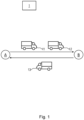
- Fig.1 is schematic overview of a plurality of production assets 11, 12, 13 in accordance with embodiments herein.
- a production asset of the plurality of production assets may be any vehicle or machine, e.g., a dump truck which may be used to transport material away from a mass excavation site (A), for instance as part of a larger infrastructure project such as a road construction project, a tunnel construction project, or a building site.
- An excavator, wheel loader or other form of loading asset (not shown) may be used to load material on the dump truck, which then transports the material away to a destination where the material is unloaded (B).
- vehicles or machinery such as dump trucks, excavators and wheel loaders are referred to as production assets herein.
- a production asset e.g., any one of the plurality of production assets 11, 12, 13, such as dump truck
- a dump truck may be associated with a transporting state, a loading state, an unloading state, and a returning state.
- the transporting state may be when the dump truck is transporting material from one site (A), e.g., a loading site, to another site (B), e.g., an unloading and/or dumping site.
- the loading and unloading states may be states where the dump truck is loaded and unloaded respectively.
- the returning state may be when the dump truck is returning from site (B) to site (A), such as after unloading material at the unloading and/or dump site.
- Other operating states may e.g., be queuing, such waiting in line at either of site (A) or site (B), a blocked state where the dump truck is prevented from operating or is forced to operate at a reduced speed due to traffic, on-site personnel, or other form of blockage.
- production asset 13 is returning from site (B) to site (A), e.g., returning from the dump site (B) after being unloaded to the loading site (A) where it may be loaded again.
- production assets 11, 12 are moving from site (A) to site (B), e.g., moving to dump site (B) after being loaded at the loading site (A).
- This disclosure relates to various implementations of a respective state machine associated to the plurality of production assets where operating state data may be obtained from the respective predication assets.
- the state machine of a given production asset may be continuously updated as the production asset is performing different task, or prevented from performing different tasks due to external circumstances, such as a traffic jam, equipment service and maintenance, and equipment failure.
- Operating state data obtained from the state machines may be used, e.g., by the control unit, for generating production process data.
- the production process data may e.g., be used for evaluating performance and utilization on both a production asset level and production process level.
- the production process data obtained from the control unit may be analysed and presented to relevant stakeholders, e.g., as part of a production monitoring human-machine interface (HMI).
- relevant stakeholders may then use the data as a base for decisions for corrective actions and optimizations of the value adding operation that is being analysed.
- the HMI may also be integrated into a production planning software package, where it may be used to provide important data for improving efficiency of a given project plan.
- the plurality of production assets may be configured to report data related that is used by the respective state machines of the plurality of assets to update the respective state machines.
- the data is also referred to as operating state data.
- the operating state data is obtained from the plurality of assets. What operating state data that is obtained from a production asset may depend on the maturity level of the production asset. The higher maturity level, the more comprehensive the obtained operating state data may be.
- the respective state machines of the plurality of production assets may differ in the amount of operating state data they hold. This may be problem when e.g., stakeholders want to evaluate the production process of the plurality of production assets.
- a solution is to let state machines associated to production assets with a lower maturity level inherit operating state data from state machines associated to production assets with a higher maturity level, as long as the production assets shares the same production process.
- the operating state of the production asset with lower maturity level is overridden with the operating state of the higher maturity level production asset.
- This may, e.g., mean that the more comprehensive operating state data obtained from the higher maturity level production asset is added to, and/or at least partly replacing, the operating state data of the lower maturity level production asset.
- the respective state machines of the plurality of production assets comprises operating state data of the same level as the production asset with the highest maturity level.
- respective state machines of a plurality of production assets are handled by performing an override to override an operating state of first production asset with the operating state of a second production asset, where the first and the second production assets share the same production process and where the first production asset is associated with a lower maturity level than the second production asset.
- Embodiments herein may be performed by a control unit 1.
- the control unit 1 may be comprised in a remote server or cloud environment.
- the control unit 1 may be comprised in any other suitable location communicatively coupled remote server or cloud environment, e.g., one of the plurality of production assets 11, 12, 13.
- Fig. 2 illustrates computer implemented method for handling respective state machines of a plurality of production assets 11, 12, 13. Each state machine implements a plurality of operating states, in a production process.
- the computer implemented method may e.g., be executed in a production asset monitoring system.
- the method comprises the following actions described below, which actions may be taken in any suitable order. Optional actions are indicated by dashed boxes in Fig. 2 .
- the method comprises determining a respective production process for the plurality of production assets 11, 12, 13 by monitoring the plurality of production assets 11, 12, 13, and associating a respective state machine to the plurality of production assets 11, 12, 13 based on the determined respective production process.
- This may mean that the state machine associated to a production asset, e.g., any one of the plurality of production assets 11, 12, 13, may differ from the state machine associated to another production asset when determined that the respective production processes are different.
- a production process is related to a route of a respective production assets 11, 12, 13.
- the method comprises detecting that at least two of the plurality of production assets 11, 12, 13 shares the same production process. Detecting that at least two of the plurality of production assets 11, 12, 13 shares the same production process may, in some embodiments, comprise comparing the respective state machines associated to the plurality of production assets 11, 12, 13. When at least two of the plurality of production assets have identical respective state machines associated to them, it may be determined that the at least two production assets share the same production process.
- the method comprises performing an override, based on a respective maturity level of the at least two production asset 11, 12, to override an operating state of a first production assets 11 of the at least two production assets 11, 12 with an operating state of a second production asset 12.
- the second production asset 12 is associated with a higher maturity level than the first production asset 11.
- Override an operating state of the first production assets 11 of the at least two production assets 11, 12 with an operating state of the second production asset 12 may e.g., mean that operating state data of an operating state of the state machine associated to the second production asset 12 is added to, and/or a least partly replacing, operating state data of an operating state of the state machine associated to the first production asset 11.
- At least one, e.g., the first production asset 11, of the more than two production assets, may be associated with the other of the more than two production assets, e.g., the second production assets 12, and a third production asset 13.
- to perform an override of the operating state of the first production asset 11 may comprise to override the operating state of the first production asset 11 with the operating state of both the second production asset 12 and the third production asset 13.
- the second production asset 12 and the third production asset 13 may by associated with the same maturity level, or they may be associated with different maturity levels.
- This may mean that operating state data from both the second production asset 12 and the third production asset 13 is added to, and/or a least partly replacing, operating state data of an operating state of the state machine associated to the first production asset 11.
- at least two, e.g., the first production asset and the third production asset 13 are associated with a lower maturity level than the second production asset.
- to perform an override of the operating state of the first production asset 11 may comprise to override the operating state of the first production asset 11 and the third production asset with the operating state of the second production asset 12.
- This may mean that operating state data from the second production asset 12 is added to, and/or a least partly replacing, operating state data of an operating state of the state machine associated to the first production asset 11 and of an operating state of the state machine associated to the third production asset 13.
- the two previous examples may be combined, e.g., when the first production asset 11, the second production asset 12 and the third production asset 13 are all associated to different maturity levels.
- the first production asset 11 may be associated with the lowest maturity level, the second production asset 12 with the highest maturity level and the third production asset 13 with a maturity level between the highest and the lowest.
- to perform the override may comprise to override the operating state of the first production asset 11 with an operating state of the second production asset 12 and the third production asset 13, and further to override the operating state of the third production asset 13 with an operating state the second production asset 12.
- This may mean that operating state data from both the second production asset 12 and the third production asset 13 is added to, and/or a least partly replacing, operating state data of an operating state of the state machine associated to the first production asset 11, and further that operating state data of an operating state of the state machine associated to the second production asset 12 is added to, and/or a least partly replacing, operating state data of an operating state of the state machine associated to the third production asset 13.
- to override an operating state comprises generating a digital sibling of the operating state of the second production asset 12 and applying the digital sibling of the operating state of the second production assets 12 to a corresponding operating state of the first production assets 11.
- the first production assets 11 inherit operating state data from the second production assets 12.
- the digital sibling is a digital sibling of the state machine of the second production asset 12. That is, the digital sibling comprises all the operating states of the state machine associated to the second production asset 12. Further, the digital sibling may be update when be updated when the state machine is updated, and thus the updates may my further by applied to the corresponding operating state of the state machine associated to the first production asset 11.
- a digital sibling may mean a copy, or duplicate, of an operating state of a state machine.
- a copy of all operating states in a state machine may be generated.
- generating a digital sibling an operating state, or operating state data of an operating state, of the state machine associated to the second production asset 12 may by applied to a corresponding operating state of the state machine associated to the first production asset 11.
- This may mean that only parts of the operating state, or operating state data of an operating state, is applied to the corresponding operating state of the state machine associated to the first production asset 11. That is, e.g., only parts of the operating state data that is missing from the corresponding operating state of the state machine associated to the production asset 11 is applied to the corresponding state.
- a maturity level of a production asset of the plurality of production assets 11, 12, 13 is associated to one or more capabilities of the production asset.
- the one or more capabilities is the capability to report operating state data to a control unit (1).
- a higher maturity level is associated to more comprehensive reporting capability than a lower maturity level.
- the operating state data may e.g., comprise any one or more out of an operation currently performed, a position, a route, a fuel level, and a current velocity.
- the method may comprise maintaining the respective state machines of the plurality of production assets 11, 12, 13 by obtaining operating state data from the plurality of production assets 11, 12, 13, and updating the respective state machines of the plurality of production assets 11, 12, 13 with the obtained operating state data.
- the operating state data may be obtained e.g., by wireless communications. This may mean that operating state data is received from the plurality of production assets 11, 12, 13 as wireless messages and/or signalling over a wireless communications network.
- Any suitable wireless communications technique may be used, such as e.g., Wi-Fi, Long Term Evolution (LTE), LTE-Advanced, 5G, New Radio (NR), 6G, Wideband Code Division Multiple Access (WCDMA), Global System for Mobile communications/enhanced Data rate for GSM Evolution (GSM/EDGE), or Ultra Mobile Broadband (UMB), just to mention a few possible implementations.
- LTE Long Term Evolution
- NR New Radio
- WCDMA Wideband Code Division Multiple Access
- GSM/EDGE Global System for Mobile communications/enhanced Data rate for GSM Evolution
- UMB Ultra Mobile Broadband
- the operating state data is obtained according to a reporting configuration in the respective production assets of plurality of production assets 11, 12, 13.
- the configuration may e.g., be based on any one or more out of the maturity level of the respective production assets, the production process of the respective production assets, and the type of production asset.
- the reporting configuration may e.g., comprise a reporting periodicity and/or a type of operating state data to report.
- the type of operating state data may depend on a capabilities production asset, meaning what type of operating state data a production asset has the capability to collect and report. Alternatively, or additionally,
- the method may comprise generating, based on operating state data obtained from the respective state machines of the plurality of production assets 11, 12, 13, production process data for the plurality of production assets 11, 12, 13.
- the production process data obtained from the control unit may be analysed and presented to relevant stakeholders, e.g., as part of a production monitoring human-machine interface (HMI).
- HMI production monitoring human-machine interface
- the relevant stakeholders may then use the data as a base for decisions for corrective actions and optimizations of the value adding operation that is being analysed.
- the HMI may also be integrated into a production planning software package, where it may be used to provide important data for improving efficiency of a given project plan.
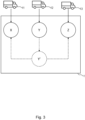
- Fig. 3 illustrates a plurality of production assets 11, 12, 13.
- the plurality of production assets 11, 12, 13 may in the below example referred to as the first production asset 11, second production asset 12 and third production asset 13.
- Each of the first production asset 11, second production asset 12 and third production asset 13 is associated with a respective state machine X, Y, Z in the control unit 1.
- the control unit 1 determines the production process of the each of the first production asset 11, second production asset 12 and third production asset 13.
- the control unit 1 detect that the first production asset 11, second production asset 12 and third production asset 13 share the same production process. This may e.g., be performed by correlating the determined production processes, and when they are the same, the first production asset 11, second production asset 12 and third production asset 13 are determined to share the same production process.
- control unit 1 further determines the maturity level of the first production asset 11, second production asset 12 and third production asset 13, e.g., by obtaining production asset data from a memory located in the control unit 1, and/or in a remote server or cloud system.
- a higher maturity level may be associated with more comprehensive reporting capability, and/or operating state data obtaining capability, than a lower maturity level.
- the second production asset 12 may have a more comprehensive reporting capability than the first production asset 11 and the third production asset 13.
- the second production asset 12 may be able to report an operation currently performed, a position, fuel level, a road inclination, and an altitude of the second production asset 12.
- the first production asset 11 and the third production asset 13 may be able to respectively report a position and a fuel level.
- Operation state data for the respective state machine X, Y, Z may be obtained by the control unit 1.
- the operational state data may e.g., by obtained from the first production asset 11, second production asset 12 and third production asset 13 by wireless communication between the control unit 1 and respective first production asset 11, second production asset 12 and third production asset 13.
- the obtained operation state data may be used to update the respective state machine X, Y, Z.
- control unit 1 has determined that the second production asset 12 is associated with a maturity level that is higher than the maturity level associated with the first production asset 11 and the third production asset 13. Further, it has been determined that the first production asset 11 and the third production asset 13 is associated with the same maturity level.
- the digital sibling Y' is a copy of the state machine Y, and thus comprises the same operating states and operating state data as the state machine Y.
- the control unit since the first production asset 11 and the third production asset 13 are associated with a lower maturity level than the second production asset 12, the control unit overrides operating state data of the respective state machines X, Z with operating state data of the digital sibling Y'. Thus, operating state data of an operating state from the digital sibling Y' is applied to the corresponding operating state of the respective state machines X, Z. Further, the control unit 1 may maintain, such as e.g., update, the respective state machines X, Y, Z whenever new operating state data is obtained from the first production asset 11, the second production asset 12 and/or the third production asset 13. Then, the control unit 1 may further update the digital sibling Y' and again perform the override of the operating state of the respective state machines X, Z.
- control unit 1 may be configured to perform any one or more of the above actions 201-205 or any of the other examples or embodiments herein.
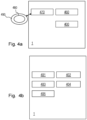
- the control unit 1 may for example comprise an arrangement depicted in Figs. 4a and 4b .
- the control unit 1 may comprise an input and output interface 400 configured to communicate with any necessary components or entities of embodiments herein.
- the input and output interface 400 may comprise a wireless and/or wired receiver (not shown) and a wireless and/or wired transmitter (not shown).
- the control unit 1 may be arranged in any suitable location, e.g., a remote server and/or a cloud service.
- the control unit 1 may use the input and output interface 400 to control and communicate with the plurality of production assets 11, 12, 13 by using any one or more out of: cellular communications network, Wi-Fi, Bluetooth, and/or other network interfaces.
- the control unit 1 may be configured to, e.g., by means of a determining unit 401 in the control unit 1, determine a respective production process for the plurality of production assets 11, 12, 13 by monitoring the plurality of production assets 11, 12, 13, and associate a respective state machine to the plurality of production assets 11, 12, 13 based on the determined respective production process.
- the control unit 1 may be configured to, e.g., by means of a detecting unit 402 in the control unit 1, detect that at least two of the plurality of production assets 11, 12, 13 share the same production process.
- the control unit 1 may be configured to, e.g. by means of a performing unit 403 in the control unit 1, perform an override, based on a respective maturity level of the at least two production assets 11, 12, to override an operating state of a first production assets 11 of the at least two production assets 11, 12 with an operating state of a second production asset 12, which second production asset 12 is associated with a higher maturity level than the first production asset 11.
- the control unit 1 may be configured to, e.g., by means of a maintaining unit 404 in the control unit 1, maintain the respective state machines of the plurality of production assets 11, 12, 13 by obtaining operating state data from the plurality of production assets 11, 12, 13, and updating the respective state machines of the plurality of production assets 11, 12, 13 with the obtained operating state data.
- the control unit 1 may be configured to, e.g., by means of a generating unit 405 in the control unit 1, generate, based on operating state data obtained from the respective state machines of the plurality of production assets 11, 12, 13, production process data for the plurality of production assets 11, 12, 13.
- the embodiments herein may be implemented through a processor or one or more processors, such as the processor 460 of a processing circuitry in the control unit 1 depicted in Fig. 4a , together with computer program code for performing the functions and actions of the embodiments herein.
- the program code mentioned above may also be provided as a computer program medium, for instance in the form of a data computer readable medium carrying computer program code for performing the embodiments herein when being loaded into the control unit 1.
- One such computer readable medium may be in the form of a memory stick.
- the computer program code may furthermore be provided as pure program code on a server and downloaded to the control unit 1.
- the control unit 70 may further comprise a memory 470 comprising one or more memory units.
- the memory 470 comprises instructions executable by the processor in control unit 1.
- the memory 470 is arranged to be used to store e.g., information, indications, data, configurations, state machines, operating states, digital sibling, operating state data, and applications to perform the methods herein when being executed in the control unit 1.
- a computer program 480 comprises instructions, which when executed by a computer, e.g., the at least one processor 460, cause the at least one processor of the control unit 1 to perform the actions 201-205 above.
- a computer-readable storage medium 490 comprises the respective computer program 480.
- the computer-readable storage medium 490 may comprise program code for performing the steps of any one of actions 201-205 above when said program product is run on a computer, e.g., the at least one processor 460.
- control unit 1 may refer to a combination of analogue and digital circuits, and/or one or more processors configured with software and/or firmware, e.g., stored in the control unit 1, that when executed by the respective one or more processors such as the processors described above.
- processors as well as the other digital hardware, may be included in a single Application-Specific Integrated Circuitry (ASIC), or several processors and various digital hardware may be distributed among several separate components, whether individually packaged or assembled into a system-on-a-chip (SoC).
- ASIC Application-Specific Integrated Circuitry
- SoC system-on-a-chip
Landscapes
- Business, Economics & Management (AREA)
- Human Resources & Organizations (AREA)
- Engineering & Computer Science (AREA)
- Strategic Management (AREA)
- Entrepreneurship & Innovation (AREA)
- Economics (AREA)
- Operations Research (AREA)
- Game Theory and Decision Science (AREA)
- Development Economics (AREA)
- Marketing (AREA)
- Educational Administration (AREA)
- Quality & Reliability (AREA)
- Tourism & Hospitality (AREA)
- Physics & Mathematics (AREA)
- General Business, Economics & Management (AREA)
- General Physics & Mathematics (AREA)
- Theoretical Computer Science (AREA)
- Management, Administration, Business Operations System, And Electronic Commerce (AREA)
Abstract
Description
- The invention relates to a control unit and a method for handling respective state machines for a plurality of production assets. The invention further relates to a computer program, and a computer program product.
- The invention can be applied for heavy-duty vehicles, such as trucks, buses and construction equipment.
- Larger infrastructure projects and distribution systems for goods normally involve many different entities which perform respective subtasks in complex interdependency. For instance, in a mass excavation project excavators dig out material which is then transported away from the work site to a material deposit site by dump trucks. The deposit site, the dump trucks, and the excavators all have their respective capacities which need to the matched to each other in order to maintain a high project efficiency.
- There is desire to monitor the degree of efficiency that is currently being achieved in a given project, both on the production asset level as well as on application task level and project level, and to present the analysis results to the relevant stakeholder. Some example projects where this is desirable include, e.g., large construction projects, mass excavation projects, and large-scale mining operations. As we are moving towards an increasing number of connected devices, the so-called Internet of Things (loT), more operational data will be able to be delivered from equipment's. Management systems for this purpose that are easy to use, and which do not require extensive production asset upgrades are therefore desired. Since large infrastructure projects often involve equipment for different manufacturers and of different age, it is furthermore desired that the management systems are agnostic to the equipment type and the brand that are used in a given project.
- An object of the invention is to improve the productivity of a production process.
- According to a first aspect, the above object is achieved by a method according to
claim 1. - Hence, there is provided a computer implemented method for handling respective state machines of a plurality of production assets. Each state machine implements a plurality of operating states in a production process. The method comprising:
- determining a respective production process for the plurality of production assets by monitoring the plurality of production assets, and associating a respective state machine to the plurality of production assets based on the determined respective production process,
- detecting that at least two of the plurality of production assets shares the same production process,
- performing an override, based on a respective maturity level of the at least two production assets, to override an operating state of a first production asset of the at least two production assets with an operating state of a second production asset or the at least two production assets, which second production asset is associated with a higher maturity level than the first production asset.
- This results in an improved state machine for production assets with a lower maturity. A state machine for a production asset with a lower maturity, such as the first production asset, may benefit from state machines for production assets with a higher maturity level, such as the second production asset, by inheriting operating state data from said state machines, as long as the production assets shares the same production process. Inheriting the operating state data is done by performing an override of the operating state data of the first production asset with operating state data of the second production asset. Thus, the state machine of the first production asset benefits from the higher maturity level of the second production asset, and an improved state machine is achieved. The operating state data from the improved state machine may be used to improve the productivity of the production process shared by all production assets sharing the same production process.
- Optionally, to override an operating state comprises generating a digital sibling of the operating state of the second production asset and applying the digital sibling of the operating state of the second production asset to a corresponding operating state of the first production asset, wherein the first production asset inherits operating state data from the second production asset. By inheriting operating state data from the second production asset, the state machine of the first production asset is improved. This since the operating state that has inherited operating state data now comprises additional operating state data. This may result in improved feedback of the productivity of the first production asset.
- Optionally, the digital sibling of the operating state of the second production asset comprises at least a part of the operating state of the second production asset, and wherein overriding an operating state comprises applying the digital sibling of the operating state of the second production asset to the corresponding parts of the corresponding operating state of the first production assets.
- Optionally, the method further comprises maintaining the respective state machines of the plurality of production assets by obtaining operating state data from the plurality of production assets, and updating the respective state machines of the plurality of production assets with the obtained operating state data. Maintaining may e.g., mean keeping the respective state machines updated with the latest available operating state data. By maintaining the respective state machines, a current productivity level may always be obtained from the operating state data. Thus, the productivity of a production asset may be monitored at all times.
- Optionally, the operating state data is obtained according to a configuration in the respective production asset of plurality of production assets, which configuration is based on any one or more out of:
- the maturity level of the respective production asset,
- the production process of the respective production asset, and
- the type of production asset.
- Optionally, a production process is related to a route of a respective production assets.
- Optionally, a maturity level of a production asset of the plurality of production assets is associated to one or more capabilities of the production asset. E.g., a higher maturity level may be associated with more, or more advanced/comprehensive, capabilities than a lower maturity level. Thus, a production asset associated with a lower maturity level may benefit from a production asset with a higher maturity level e.g., by overriding an operating state with operating state data from the more mature production asset.
- Optionally, the one or more capabilities is the capability to report operating state data to a control unit, wherein a higher maturity level is associated to more comprehensive reporting capability than a lower maturity level, and wherein the state data comprises any one or more out of:
- an operation currently performed,
- a position,
- a route, and
- a fuel level.
- Additionally, or alternatively, the state may comprise any one or more out of:
- a weight, e.g., weight of the production asset and/or weight of goods carried,
- a volume related to cargo carried by the production asset, e.g., the currently carried volume and/or the amount of available volume,
- a temperature, e.g., a temperature of the environment surrounding the production asset, and/or a temperature of carried cargo,
- an acceleration,
- a charge level of a battery,
- an altitude,
- an inclination of the road,
- a curvature of the road,
- one or more parameters related to road conditions, e.g., friction, vibration, and/or suspension movements, and
- pictures, e.g., to enable generation of a geospatial map.
- As can be seen above, there is many different types of operating state data. Since a higher maturity level may associated with more, or more advanced/comprehensive, capabilities, e.g., capabilities to report operating state data, than a lower maturity level, a state machine of production asset associated with a lower maturity level will be improved when inheriting data from an operating state of a state machine of a production asset associated with a higher maturity level. E.g., an energy consumption of certain route segment may be estimated for the first production asset based operating state data e.g., inherited from the second production asset. This may make it possible to optimize a production process, e.g., based on when a production asset needs to charge batteries or refill a fuel tank.
- Optionally, the method further comprises generating, based on operating state data obtained from the respective state machines of the plurality of production assets, production process data for the plurality of production assets. Since the first production asset, which is associated with lower maturity level than the second production asset, has had an operating state overridden with an operating state of the second production asset, this may result in an improved production process data of the first production asset. This since the operating state data from the second production asset may be more comprehensive than the operating state data of the first production asset.
- According to a second aspect, there is provided a control unit to perform the method according to the first aspect. The control unit may be an electronic control unit.
- According to a third aspect, there is provided a computer program comprising program code means for performing the method according to the first aspect, when said program is run on a computer.
- According to a fourth aspect, there is provided a computer program medium carrying a computer program comprising program code means for performing the method according to the first aspect, when said program is run on a computer.
- According to a fourth aspect, there is provided production asset monitoring system, for handling respective state machines of a plurality of production assets, wherein each state machine implements a plurality of operating states, in a production process,
- where the production asset monitoring system is arranged to determine a respective production process for the plurality of production assets by monitoring the plurality of production assets, and associating a respective state machine to the plurality of production assets based on the determined respective production process,
- detect that at least two of the plurality of production assets shares the same production process, and
- perform an override, based on a respective maturity level of the at least two production assets, to override an operating state of a first production asset of the at least two production assets with an operating state of a second production asset, which second production asset is associated with a higher maturity level than the first production asset.
- Further advantages and advantageous features of the invention are disclosed in the following description and in the dependent claims.
- With reference to the appended drawings, below follows a more detailed description of embodiments of the invention cited as examples.
- In the drawings:
- Fig. 1
- is a schematic overview of a production assets in a production process.
- Fig. 2
- is a flowchart illustrating a method according to embodiments herein.
- Fig. 3
- are illustrations of an example scenario according to embodiments herein.
- Fig. 4a-4b
- are schematic block diagrams illustrating a control unit according to embodiments herein.
- The invention will now be described more fully hereinafter with reference to the accompanying drawings, in which certain aspects of the invention are shown. This invention may, however, be embodied in many different forms and should not be construed as limited to the embodiments and aspects set forth herein; rather, these embodiments are provided by way of example so that the disclosure will be thorough and complete, and will fully convey the scope of the invention to those skilled in the art. Like numbers refer to like elements throughout the description.
- It is to be understood that the present invention is not limited to the embodiments described herein and illustrated in the drawings; rather, the skilled person will recognize that many changes and modifications may be made within the scope of the appended claims.
-
Fig.1 is schematic overview of a plurality ofproduction assets - A production asset, e.g., any one of the plurality of
production assets Fig. 1 ,production asset 13 is returning from site (B) to site (A), e.g., returning from the dump site (B) after being unloaded to the loading site (A) where it may be loaded again. Further,production assets - This disclosure relates to various implementations of a respective state machine associated to the plurality of production assets where operating state data may be obtained from the respective predication assets. The state machine of a given production asset may be continuously updated as the production asset is performing different task, or prevented from performing different tasks due to external circumstances, such as a traffic jam, equipment service and maintenance, and equipment failure. Operating state data obtained from the state machines may be used, e.g., by the control unit, for generating production process data. The production process data may e.g., be used for evaluating performance and utilization on both a production asset level and production process level.
- The production process data obtained from the control unit may be analysed and presented to relevant stakeholders, e.g., as part of a production monitoring human-machine interface (HMI). The relevant stakeholders may then use the data as a base for decisions for corrective actions and optimizations of the value adding operation that is being analysed. The HMI may also be integrated into a production planning software package, where it may be used to provide important data for improving efficiency of a given project plan.
- The plurality of production assets may be configured to report data related that is used by the respective state machines of the plurality of assets to update the respective state machines. The data is also referred to as operating state data. Thus, the operating state data is obtained from the plurality of assets. What operating state data that is obtained from a production asset may depend on the maturity level of the production asset. The higher maturity level, the more comprehensive the obtained operating state data may be. Thus, the respective state machines of the plurality of production assets may differ in the amount of operating state data they hold. This may be problem when e.g., stakeholders want to evaluate the production process of the plurality of production assets. A solution, according to this disclosure, is to let state machines associated to production assets with a lower maturity level inherit operating state data from state machines associated to production assets with a higher maturity level, as long as the production assets shares the same production process. Thus, the operating state of the production asset with lower maturity level is overridden with the operating state of the higher maturity level production asset. This may, e.g., mean that the more comprehensive operating state data obtained from the higher maturity level production asset is added to, and/or at least partly replacing, the operating state data of the lower maturity level production asset. This way the respective state machines of the plurality of production assets comprises operating state data of the same level as the production asset with the highest maturity level.
- In other words, in embodiments herein, respective state machines of a plurality of production assets are handled by performing an override to override an operating state of first production asset with the operating state of a second production asset, where the first and the second production assets share the same production process and where the first production asset is associated with a lower maturity level than the second production asset.
- Embodiments herein may be performed by a
control unit 1. Thecontrol unit 1 may be comprised in a remote server or cloud environment. Alternatively, thecontrol unit 1 may be comprised in any other suitable location communicatively coupled remote server or cloud environment, e.g., one of the plurality ofproduction assets -
Fig. 2 illustrates computer implemented method for handling respective state machines of a plurality ofproduction assets Fig. 2 . - The method comprises determining a respective production process for the plurality of
production assets production assets production assets production assets - In some embodiments, a production process is related to a route of a
respective production assets - The method comprises detecting that at least two of the plurality of
production assets production assets production assets - The method comprises performing an override, based on a respective maturity level of the at least two
production asset first production assets 11 of the at least twoproduction assets second production asset 12. Thesecond production asset 12 is associated with a higher maturity level than thefirst production asset 11. Override an operating state of thefirst production assets 11 of the at least twoproduction assets second production asset 12 may e.g., mean that operating state data of an operating state of the state machine associated to thesecond production asset 12 is added to, and/or a least partly replacing, operating state data of an operating state of the state machine associated to thefirst production asset 11. When detected that more than two production assets of the plurality ofproduction assets first production asset 11, of the more than two production assets, may be associated with the other of the more than two production assets, e.g., thesecond production assets 12, and athird production asset 13. In such an example, to perform an override of the operating state of thefirst production asset 11 may comprise to override the operating state of thefirst production asset 11 with the operating state of both thesecond production asset 12 and thethird production asset 13. Further, according to this example, thesecond production asset 12 and thethird production asset 13 may by associated with the same maturity level, or they may be associated with different maturity levels. This may mean that operating state data from both thesecond production asset 12 and thethird production asset 13 is added to, and/or a least partly replacing, operating state data of an operating state of the state machine associated to thefirst production asset 11. Alternatively, or additionally, when detected that more than two production assets of the plurality ofproduction assets third production asset 13, are associated with a lower maturity level than the second production asset. In such an example, to perform an override of the operating state of thefirst production asset 11 may comprise to override the operating state of thefirst production asset 11 and the third production asset with the operating state of thesecond production asset 12. This may mean that operating state data from thesecond production asset 12 is added to, and/or a least partly replacing, operating state data of an operating state of the state machine associated to thefirst production asset 11 and of an operating state of the state machine associated to thethird production asset 13. Alternatively, or additionally, the two previous examples may be combined, e.g., when thefirst production asset 11, thesecond production asset 12 and thethird production asset 13 are all associated to different maturity levels. In such an example, thefirst production asset 11 may be associated with the lowest maturity level, thesecond production asset 12 with the highest maturity level and thethird production asset 13 with a maturity level between the highest and the lowest. Then, to perform the override may comprise to override the operating state of thefirst production asset 11 with an operating state of thesecond production asset 12 and thethird production asset 13, and further to override the operating state of thethird production asset 13 with an operating state thesecond production asset 12. This may mean that operating state data from both thesecond production asset 12 and thethird production asset 13 is added to, and/or a least partly replacing, operating state data of an operating state of the state machine associated to thefirst production asset 11, and further that operating state data of an operating state of the state machine associated to thesecond production asset 12 is added to, and/or a least partly replacing, operating state data of an operating state of the state machine associated to thethird production asset 13. - In some embodiments, to override an operating state comprises generating a digital sibling of the operating state of the
second production asset 12 and applying the digital sibling of the operating state of thesecond production assets 12 to a corresponding operating state of thefirst production assets 11. Thefirst production assets 11 inherit operating state data from thesecond production assets 12. Additionally, or alternatively, the digital sibling is a digital sibling of the state machine of thesecond production asset 12. That is, the digital sibling comprises all the operating states of the state machine associated to thesecond production asset 12. Further, the digital sibling may be update when be updated when the state machine is updated, and thus the updates may my further by applied to the corresponding operating state of the state machine associated to thefirst production asset 11. A digital sibling may mean a copy, or duplicate, of an operating state of a state machine. Or as mentioned, a copy of all operating states in a state machine. In other words, by generating a digital sibling an operating state, or operating state data of an operating state, of the state machine associated to thesecond production asset 12 may by applied to a corresponding operating state of the state machine associated to thefirst production asset 11. - In some embodiments, the digital sibling of the operating state of the
second production assets 12 comprises at least a part of the operating state of thesecond production assets 12. Overriding an operating state may comprise applying the digital sibling of the operating state of thesecond production assets 12 to the corresponding parts of the corresponding operating state of thefirst production assets 11. - This may mean that only parts of the operating state, or operating state data of an operating state, is applied to the corresponding operating state of the state machine associated to the
first production asset 11. That is, e.g., only parts of the operating state data that is missing from the corresponding operating state of the state machine associated to theproduction asset 11 is applied to the corresponding state. - In some embodiments, a maturity level of a production asset of the plurality of
production assets - In some embodiments, the one or more capabilities is the capability to report operating state data to a control unit (1). A higher maturity level is associated to more comprehensive reporting capability than a lower maturity level. The operating state data may e.g., comprise any one or more out of an operation currently performed, a position, a route, a fuel level, and a current velocity.
- The method may comprise maintaining the respective state machines of the plurality of
production assets production assets production assets production assets - In some embodiments, the operating state data is obtained according to a reporting configuration in the respective production assets of plurality of
production assets - The method may comprise generating, based on operating state data obtained from the respective state machines of the plurality of
production assets production assets - The methods will now be further explained and exemplified in below. These below examples may be combined with any suitable embodiment as described above.
-
Fig. 3 illustrates a plurality ofproduction assets production assets first production asset 11,second production asset 12 andthird production asset 13. Each of thefirst production asset 11,second production asset 12 andthird production asset 13 is associated with a respective state machine X, Y, Z in thecontrol unit 1. Thecontrol unit 1 determines the production process of the each of thefirst production asset 11,second production asset 12 andthird production asset 13. Thecontrol unit 1 detect that thefirst production asset 11,second production asset 12 andthird production asset 13 share the same production process. This may e.g., be performed by correlating the determined production processes, and when they are the same, thefirst production asset 11,second production asset 12 andthird production asset 13 are determined to share the same production process. In some examples, thecontrol unit 1 further determines the maturity level of thefirst production asset 11,second production asset 12 andthird production asset 13, e.g., by obtaining production asset data from a memory located in thecontrol unit 1, and/or in a remote server or cloud system. As mentioned above, a higher maturity level may be associated with more comprehensive reporting capability, and/or operating state data obtaining capability, than a lower maturity level. E.g., a production asset with a maturity level, such as thesecond production asset 12, that is higher than the respective maturity levels of other production assets, such as thefirst production asset 11 and thethird production asset 13. According to such an example, thesecond production asset 12 may have a more comprehensive reporting capability than thefirst production asset 11 and thethird production asset 13. As an example, thesecond production asset 12 may be able to report an operation currently performed, a position, fuel level, a road inclination, and an altitude of thesecond production asset 12. Thefirst production asset 11 and thethird production asset 13 may be able to respectively report a position and a fuel level. Operation state data for the respective state machine X, Y, Z may be obtained by thecontrol unit 1. The operational state data may e.g., by obtained from thefirst production asset 11,second production asset 12 andthird production asset 13 by wireless communication between thecontrol unit 1 and respectivefirst production asset 11,second production asset 12 andthird production asset 13. The obtained operation state data may be used to update the respective state machine X, Y, Z. In the present example, thecontrol unit 1 has determined that thesecond production asset 12 is associated with a maturity level that is higher than the maturity level associated with thefirst production asset 11 and thethird production asset 13. Further, it has been determined that thefirst production asset 11 and thethird production asset 13 is associated with the same maturity level. Thecontrol unit 1, after determining the respective maturity levels of thefirst production asset 11,second production asset 12 andthird production asset 13, may generate a digital sibling Y' of the state machine Y associated to thesecond production asset 12. The digital sibling Y' is a copy of the state machine Y, and thus comprises the same operating states and operating state data as the state machine Y. Since thefirst production asset 11 and thethird production asset 13 are associated with a lower maturity level than thesecond production asset 12, the control unit overrides operating state data of the respective state machines X, Z with operating state data of the digital sibling Y'. Thus, operating state data of an operating state from the digital sibling Y' is applied to the corresponding operating state of the respective state machines X, Z. Further, thecontrol unit 1 may maintain, such as e.g., update, the respective state machines X, Y, Z whenever new operating state data is obtained from thefirst production asset 11, thesecond production asset 12 and/or thethird production asset 13. Then, thecontrol unit 1 may further update the digital sibling Y' and again perform the override of the operating state of the respective state machines X, Z. - To perform the method actions described herein, the
control unit 1 may be configured to perform any one or more of the above actions 201-205 or any of the other examples or embodiments herein. Thecontrol unit 1 may for example comprise an arrangement depicted inFigs. 4a and 4b . - The
control unit 1 may comprise an input andoutput interface 400 configured to communicate with any necessary components or entities of embodiments herein. The input andoutput interface 400 may comprise a wireless and/or wired receiver (not shown) and a wireless and/or wired transmitter (not shown). Thecontrol unit 1 may be arranged in any suitable location, e.g., a remote server and/or a cloud service. Thecontrol unit 1 may use the input andoutput interface 400 to control and communicate with the plurality ofproduction assets - The
control unit 1 may be configured to, e.g., by means of a determiningunit 401 in thecontrol unit 1, determine a respective production process for the plurality ofproduction assets production assets production assets - The
control unit 1 may be configured to, e.g., by means of a detectingunit 402 in thecontrol unit 1, detect that at least two of the plurality ofproduction assets - The
control unit 1 may be configured to, e.g. by means of a performingunit 403 in thecontrol unit 1, perform an override, based on a respective maturity level of the at least twoproduction assets first production assets 11 of the at least twoproduction assets second production asset 12, whichsecond production asset 12 is associated with a higher maturity level than thefirst production asset 11. - The
control unit 1 may be configured to, e.g., by means of a maintainingunit 404 in thecontrol unit 1, maintain the respective state machines of the plurality ofproduction assets production assets production assets - The
control unit 1 may be configured to, e.g., by means of agenerating unit 405 in thecontrol unit 1, generate, based on operating state data obtained from the respective state machines of the plurality ofproduction assets production assets - The embodiments herein may be implemented through a processor or one or more processors, such as the
processor 460 of a processing circuitry in thecontrol unit 1 depicted inFig. 4a , together with computer program code for performing the functions and actions of the embodiments herein. The program code mentioned above may also be provided as a computer program medium, for instance in the form of a data computer readable medium carrying computer program code for performing the embodiments herein when being loaded into thecontrol unit 1. One such computer readable medium may be in the form of a memory stick. The computer program code may furthermore be provided as pure program code on a server and downloaded to thecontrol unit 1. - The control unit 70 may further comprise a
memory 470 comprising one or more memory units. Thememory 470 comprises instructions executable by the processor incontrol unit 1. Thememory 470 is arranged to be used to store e.g., information, indications, data, configurations, state machines, operating states, digital sibling, operating state data, and applications to perform the methods herein when being executed in thecontrol unit 1. - In some embodiments, a
computer program 480 comprises instructions, which when executed by a computer, e.g., the at least oneprocessor 460, cause the at least one processor of thecontrol unit 1 to perform the actions 201-205 above. - In some embodiments, a computer-
readable storage medium 490 comprises therespective computer program 480. The computer-readable storage medium 490 may comprise program code for performing the steps of any one of actions 201-205 above when said program product is run on a computer, e.g., the at least oneprocessor 460. - Those skilled in the art will appreciate that the units in the
control unit 1 described above may refer to a combination of analogue and digital circuits, and/or one or more processors configured with software and/or firmware, e.g., stored in thecontrol unit 1, that when executed by the respective one or more processors such as the processors described above. One or more of these processors, as well as the other digital hardware, may be included in a single Application-Specific Integrated Circuitry (ASIC), or several processors and various digital hardware may be distributed among several separate components, whether individually packaged or assembled into a system-on-a-chip (SoC). - It is to be understood that the present invention is not limited to the embodiments described above and illustrated in the drawings; rather, the skilled person will recognize that many changes and modifications may be made within the scope of the appended claims.
Claims (13)
- A computer implemented method for handling respective state machines of a plurality of production assets (11, 12, 13), wherein each state machine implements a plurality of operating states, in a production process, the method comprising:determining (201) a respective production process for the plurality of production assets (11, 12, 13) by monitoring the plurality of production assets (11, 12, 13), and associating a respective state machine to the plurality of production assets (11, 12, 13) based on the determined respective production process,detecting (202) that at least two of the plurality of production assets (11, 12, 13) share the same production process, andperforming an override (203), based on a respective maturity level of the at least two production assets (11, 12), to override an operating state of a first production asset (11) of the at least two production assets (11, 12) with an operating state of a second production asset (12), which second production asset (12) is associated with a higher maturity level than the first production asset (11).
- The method according to claim 1, wherein to override an operating state comprises generating a digital sibling of the operating state of the second production asset (12) and applying the digital sibling of the operating state of the second production asset (12) to a corresponding operating state of the first production asset (11), wherein the first production asset (11) inherits operating state data from the second production asset (12).
- The method according to claim 2, wherein the digital sibling of the operating state of the second production asset (12) comprises at least a part of the operating state of the second production asset (12), and wherein overriding an operating state comprises applying the digital sibling of the operating state of the second production asset (12) to the corresponding parts of the corresponding operating state of the first production asset (11).
- The method according to any one of claims 1-3, further comprising:
maintaining (204) the respective state machines of the plurality of production assets (11, 12, 13) by obtaining operating state data from the plurality of production assets (11, 12, 13), and updating the respective state machines of the plurality of production assets (11, 12, 13) with the obtained operating state data. - The method according to claim 4, wherein the operating state data is obtained according to a reporting configuration in the respective production assets of plurality of production assets (11, 12, 13), which configuration is based on any or more out of:- the maturity level of the respective production assets,- the production process of the respective production assets, and- the type of production asset.
- The method according to any one of claims 1-5, wherein a production process is related to a route of a respective production assets (11, 12, 13).
- The method according to any one of claims 1-6, wherein a maturity level of a production asset of the plurality of production assets (11, 12, 13) is associated to one or more capabilities of the production asset.
- The method according to claim 7, wherein the one or more capabilities is the capability to report operating state data to a control unit (1), wherein a higher maturity level is associated to more comprehensive reporting capability than a lower maturity level, and wherein the operating state data comprises any one or more out of:- an operation currently performed,- a position,- a route, and- a fuel level.
- The method according to any one of claims 1-8, further comprising:
generating (205), based on operating state data obtained from the respective state machines of the plurality of production assets (11, 12, 13), production process data for the plurality of production assets (11, 12, 13). - A control unit (1) comprising processing circuitry (460) configured to perform the method according to claims 1-9.
- A computer program (480) comprising program code means for performing the steps of any one of claims 1-9 when said program is run on a computer or on processing circuitry (460) of a control unit (1).
- A computer program medium (490) carrying a computer program comprising program code means for performing the steps of any one of claims 1-8 when said program is run on a computer computer or on processing circuitry (460) of a control unit (1).
- A production asset monitoring system, for handling respective state machines of a plurality of production assets (11, 12, 13), wherein each state machine implements a plurality of operating states, in a production process,where the production asset monitoring system is arranged to determine a respective production process for the plurality of production assets (11, 12, 13) by monitoring the plurality of production assets (11, 12, 13), and associating a respective state machine to the plurality of production assets (11, 12, 13) based on the determined respective production process,detect that at least two of the plurality of production assets (11, 12, 13) shares the same production process, andperform an override, based on a respective maturity level of the at least two production assets (11, 12), to override an operating state of a first production asset (11) of the at least two production assets (11, 12) with an operating state of a second production asset (12), which second production asset (12) is associated with a higher maturity level than the first production asset (11).
Priority Applications (2)
| Application Number | Priority Date | Filing Date | Title |
|---|---|---|---|
| EP22211636.0A EP4383160B1 (en) | 2022-12-06 | 2022-12-06 | A method for handling state machines of production assets |
| US18/519,428 US20240185148A1 (en) | 2022-12-06 | 2023-11-27 | method for handling state machines of production assets |
Applications Claiming Priority (1)
| Application Number | Priority Date | Filing Date | Title |
|---|---|---|---|
| EP22211636.0A EP4383160B1 (en) | 2022-12-06 | 2022-12-06 | A method for handling state machines of production assets |
Publications (2)
| Publication Number | Publication Date |
|---|---|
| EP4383160A1 true EP4383160A1 (en) | 2024-06-12 |
| EP4383160B1 EP4383160B1 (en) | 2025-09-24 |
Family
ID=84421425
Family Applications (1)
| Application Number | Title | Priority Date | Filing Date |
|---|---|---|---|
| EP22211636.0A Active EP4383160B1 (en) | 2022-12-06 | 2022-12-06 | A method for handling state machines of production assets |
Country Status (2)
| Country | Link |
|---|---|
| US (1) | US20240185148A1 (en) |
| EP (1) | EP4383160B1 (en) |
Citations (2)
| Publication number | Priority date | Publication date | Assignee | Title |
|---|---|---|---|---|
| US8666936B2 (en) * | 2006-10-05 | 2014-03-04 | Trimble Navigation Limited | System and method for asset management |
| US10324433B2 (en) * | 2015-04-01 | 2019-06-18 | Caterpillar Inc. | System and method for determination of machine state based on video and audio analytics |
Family Cites Families (34)
| Publication number | Priority date | Publication date | Assignee | Title |
|---|---|---|---|---|
| US7099770B2 (en) * | 2003-09-08 | 2006-08-29 | Axonn L.L.C. | Location monitoring and transmitting device, method, and computer program product using a simplex satellite transmitter |
| US7479875B2 (en) * | 2006-05-12 | 2009-01-20 | Oracle International Corporation | Method of and system for managing data in a sensor network |
| US9519876B2 (en) * | 2006-10-05 | 2016-12-13 | Trimble Navigation Limited | Method for providing maintenance to an asset |
| US8004397B2 (en) * | 2006-10-05 | 2011-08-23 | Trimble Navigation Limited | Receiving information pertaining to a construction project |
| US20080086391A1 (en) * | 2006-10-05 | 2008-04-10 | Kurt Maynard | Impromptu asset tracking |
| US9536405B2 (en) * | 2006-10-05 | 2017-01-03 | Trimble Inc. | Unreported event status change determination and alerting |
| US8255358B2 (en) * | 2006-10-05 | 2012-08-28 | Trimble Navigation Limited | System and method for providing asset management information to a customer |
| US9041561B2 (en) * | 2006-10-05 | 2015-05-26 | Trimble Navigation Limited | Method for controlling power usage of a reporting device |
| US9811949B2 (en) * | 2006-10-05 | 2017-11-07 | Trimble Inc. | Method for providing status information pertaining to an asset |
| US9773222B2 (en) * | 2006-10-05 | 2017-09-26 | Trimble Inc. | Externally augmented asset management |
| US20080086685A1 (en) * | 2006-10-05 | 2008-04-10 | James Janky | Method for delivering tailored asset information to a device |
| US9747329B2 (en) * | 2006-10-05 | 2017-08-29 | Trimble Inc. | Limiting access to asset management information |
| US8965841B2 (en) * | 2006-10-05 | 2015-02-24 | Trimble Navigation Limited | Method for automatic asset classification |
| US9747571B2 (en) * | 2006-10-05 | 2017-08-29 | Trimble Inc. | Integrated asset management |
| US9111234B2 (en) * | 2006-10-05 | 2015-08-18 | Trimble Navigation Limited | Enabling notifications pertaining to an asset |
| US8600932B2 (en) * | 2007-05-07 | 2013-12-03 | Trimble Navigation Limited | Telematic asset microfluidic analysis |
| US20100145865A1 (en) * | 2008-05-16 | 2010-06-10 | Berger Thomas R | Managing and securing construction and rental equipment |
| US9760685B2 (en) * | 2011-05-16 | 2017-09-12 | Trimble Inc. | Telematic microfluidic analysis using handheld device |
| US20150046229A1 (en) * | 2013-08-06 | 2015-02-12 | Pinc Solutions | Managing trailers and shipments |
| US11436544B2 (en) * | 2014-09-03 | 2022-09-06 | CloudLeaf, Inc. | System for managing an industrial workflow |
| US10681490B2 (en) * | 2014-09-03 | 2020-06-09 | CloudLeaf, Inc. | Events based asset location and management system |
| US10942251B2 (en) * | 2014-09-03 | 2021-03-09 | CloudLeaf, Inc. | Asset location and management system with distributed processing |
| US9641964B2 (en) * | 2014-09-03 | 2017-05-02 | CloudLeaf, Inc. | Systems, methods and devices for asset status determination |
| US9487931B2 (en) * | 2014-09-12 | 2016-11-08 | Caterpillar Inc. | Excavation system providing machine cycle training |
| US9483863B2 (en) * | 2014-12-05 | 2016-11-01 | Caterpillar Inc. | Terrain mapping system using moved material estimation |
| US11001230B2 (en) * | 2017-06-14 | 2021-05-11 | Blackberry Limited | Load status of transport chassis |
| US11086315B2 (en) * | 2017-10-26 | 2021-08-10 | 2KR Systems, LLC | Building rooftop intelligence gathering, decision-support and snow load removal system for protecting buildings from excessive snow load conditions, and automated methods for carrying out the same |
| AU2018370534A1 (en) * | 2017-11-15 | 2020-06-04 | Technological Resources Pty. Limited | Mining system |
| AU2019336235A1 (en) * | 2018-09-07 | 2021-04-29 | Uptake Technologies, Inc. | Computer system and method for recommending an operating mode of an asset |
| US11475680B2 (en) * | 2018-12-12 | 2022-10-18 | Spireon, Inc. | Cargo sensor system implemented using neural network |
| EP3908807B1 (en) * | 2020-03-17 | 2023-11-29 | Freeport-McMoRan Inc. | Methods and systems for deploying equipment required to meet defined production targets |
| US12032350B2 (en) * | 2020-04-13 | 2024-07-09 | Caterpillar Global Mining Llc | Multi-phase material blend monitoring and control |
| DE102021206027A1 (en) * | 2021-06-14 | 2022-12-15 | Robert Bosch Gesellschaft mit beschränkter Haftung | Method for assisting a driver of a transport vehicle when assuming a loading position |
| US11714927B2 (en) * | 2021-08-20 | 2023-08-01 | International Business Machines Corporation | Virtual physical digital twin ecosystem |
-
2022
- 2022-12-06 EP EP22211636.0A patent/EP4383160B1/en active Active
-
2023
- 2023-11-27 US US18/519,428 patent/US20240185148A1/en active Pending
Patent Citations (2)
| Publication number | Priority date | Publication date | Assignee | Title |
|---|---|---|---|---|
| US8666936B2 (en) * | 2006-10-05 | 2014-03-04 | Trimble Navigation Limited | System and method for asset management |
| US10324433B2 (en) * | 2015-04-01 | 2019-06-18 | Caterpillar Inc. | System and method for determination of machine state based on video and audio analytics |
Also Published As
| Publication number | Publication date |
|---|---|
| US20240185148A1 (en) | 2024-06-06 |
| EP4383160B1 (en) | 2025-09-24 |
Similar Documents
| Publication | Publication Date | Title |
|---|---|---|
| US12032350B2 (en) | Multi-phase material blend monitoring and control | |
| US8364189B2 (en) | Fleet communication network | |
| AU2002300598B2 (en) | Multi-stage truck assignment system and method | |
| US20160342915A1 (en) | Autonomous Fleet Size Management | |
| US10643159B2 (en) | System and method for mining site production planning | |
| CN112703294B (en) | Construction management system | |
| US20210216889A1 (en) | Predicting Worksite Activities of Standard Machines Using Intelligent Machine Data | |
| AU2025234285A1 (en) | Mining System | |
| AU2017201789A1 (en) | System and method for worksite management | |
| EP4383160B1 (en) | A method for handling state machines of production assets | |
| CN111259518A (en) | Bucket wheel machine stacker-reclaimer path optimizing method and related equipment | |
| CN116157820A (en) | System and method for tracking activity of multiple machines | |
| CN117999192A (en) | System and method for identifying devices | |
| EP4227869B1 (en) | Management systems for evaluation and continuous improvement of workflows involving heavy-duty vehicles | |
| AU2023251738B2 (en) | Avoiding prohibited sequences of materials processing at a crusher using predictive analytics | |
| US12493292B2 (en) | Network system, a user device and methods therein for enabling management of a mass excavation project | |
| US20240012430A1 (en) | Balanced transport cycles in mass excavation operations | |
| US20230186207A1 (en) | Production forecast methods for mass excavation projects | |
| CA3247651C (en) | Avoiding prohibited sequences of materials processing at a crusher using predictive analytics | |
| US20250043546A1 (en) | Material selection for a loading operation performed by a machine |
Legal Events
| Date | Code | Title | Description |
|---|---|---|---|
| PUAI | Public reference made under article 153(3) epc to a published international application that has entered the european phase |
Free format text: ORIGINAL CODE: 0009012 |
|
| STAA | Information on the status of an ep patent application or granted ep patent |
Free format text: STATUS: THE APPLICATION HAS BEEN PUBLISHED |
|
| AK | Designated contracting states |
Kind code of ref document: A1 Designated state(s): AL AT BE BG CH CY CZ DE DK EE ES FI FR GB GR HR HU IE IS IT LI LT LU LV MC ME MK MT NL NO PL PT RO RS SE SI SK SM TR |
|
| STAA | Information on the status of an ep patent application or granted ep patent |
Free format text: STATUS: REQUEST FOR EXAMINATION WAS MADE |
|
| 17P | Request for examination filed |
Effective date: 20241211 |
|
| GRAP | Despatch of communication of intention to grant a patent |
Free format text: ORIGINAL CODE: EPIDOSNIGR1 |
|
| STAA | Information on the status of an ep patent application or granted ep patent |
Free format text: STATUS: GRANT OF PATENT IS INTENDED |
|
| RIC1 | Information provided on ipc code assigned before grant |
Ipc: G06Q 10/0633 20230101AFI20250505BHEP |
|
| INTG | Intention to grant announced |
Effective date: 20250523 |
|
| GRAS | Grant fee paid |
Free format text: ORIGINAL CODE: EPIDOSNIGR3 |
|
| GRAA | (expected) grant |
Free format text: ORIGINAL CODE: 0009210 |
|
| STAA | Information on the status of an ep patent application or granted ep patent |
Free format text: STATUS: THE PATENT HAS BEEN GRANTED |
|
| AK | Designated contracting states |
Kind code of ref document: B1 Designated state(s): AL AT BE BG CH CY CZ DE DK EE ES FI FR GB GR HR HU IE IS IT LI LT LU LV MC ME MK MT NL NO PL PT RO RS SE SI SK SM TR |
|
| REG | Reference to a national code |
Ref country code: GB Ref legal event code: FG4D |
|
| REG | Reference to a national code |
Ref country code: CH Ref legal event code: EP |
|
| REG | Reference to a national code |
Ref country code: DE Ref legal event code: R096 Ref document number: 602022021897 Country of ref document: DE |
|
| REG | Reference to a national code |
Ref country code: IE Ref legal event code: FG4D |
|
| PGFP | Annual fee paid to national office [announced via postgrant information from national office to epo] |
Ref country code: DE Payment date: 20250925 Year of fee payment: 4 |
|
| PG25 | Lapsed in a contracting state [announced via postgrant information from national office to epo] |
Ref country code: NO Free format text: LAPSE BECAUSE OF FAILURE TO SUBMIT A TRANSLATION OF THE DESCRIPTION OR TO PAY THE FEE WITHIN THE PRESCRIBED TIME-LIMIT Effective date: 20251224 |
|
| REG | Reference to a national code |
Ref country code: LT Ref legal event code: MG9D |
|
| PGFP | Annual fee paid to national office [announced via postgrant information from national office to epo] |
Ref country code: AT Payment date: 20260113 Year of fee payment: 4 |
|
| PG25 | Lapsed in a contracting state [announced via postgrant information from national office to epo] |
Ref country code: FI Free format text: LAPSE BECAUSE OF FAILURE TO SUBMIT A TRANSLATION OF THE DESCRIPTION OR TO PAY THE FEE WITHIN THE PRESCRIBED TIME-LIMIT Effective date: 20250924 |
|
| PG25 | Lapsed in a contracting state [announced via postgrant information from national office to epo] |
Ref country code: HR Free format text: LAPSE BECAUSE OF FAILURE TO SUBMIT A TRANSLATION OF THE DESCRIPTION OR TO PAY THE FEE WITHIN THE PRESCRIBED TIME-LIMIT Effective date: 20250924 |
|
| PG25 | Lapsed in a contracting state [announced via postgrant information from national office to epo] |
Ref country code: GR Free format text: LAPSE BECAUSE OF FAILURE TO SUBMIT A TRANSLATION OF THE DESCRIPTION OR TO PAY THE FEE WITHIN THE PRESCRIBED TIME-LIMIT Effective date: 20251225 |
|
| PG25 | Lapsed in a contracting state [announced via postgrant information from national office to epo] |
Ref country code: SE Free format text: LAPSE BECAUSE OF FAILURE TO SUBMIT A TRANSLATION OF THE DESCRIPTION OR TO PAY THE FEE WITHIN THE PRESCRIBED TIME-LIMIT Effective date: 20250924 |
|
| PG25 | Lapsed in a contracting state [announced via postgrant information from national office to epo] |
Ref country code: LV Free format text: LAPSE BECAUSE OF FAILURE TO SUBMIT A TRANSLATION OF THE DESCRIPTION OR TO PAY THE FEE WITHIN THE PRESCRIBED TIME-LIMIT Effective date: 20250924 |
|
| PG25 | Lapsed in a contracting state [announced via postgrant information from national office to epo] |
Ref country code: BG Free format text: LAPSE BECAUSE OF FAILURE TO SUBMIT A TRANSLATION OF THE DESCRIPTION OR TO PAY THE FEE WITHIN THE PRESCRIBED TIME-LIMIT Effective date: 20250924 |
|
| PG25 | Lapsed in a contracting state [announced via postgrant information from national office to epo] |
Ref country code: RS Free format text: LAPSE BECAUSE OF FAILURE TO SUBMIT A TRANSLATION OF THE DESCRIPTION OR TO PAY THE FEE WITHIN THE PRESCRIBED TIME-LIMIT Effective date: 20251224 |
|
| REG | Reference to a national code |
Ref country code: NL Ref legal event code: MP Effective date: 20250924 |
|
| PG25 | Lapsed in a contracting state [announced via postgrant information from national office to epo] |
Ref country code: NL Free format text: LAPSE BECAUSE OF FAILURE TO SUBMIT A TRANSLATION OF THE DESCRIPTION OR TO PAY THE FEE WITHIN THE PRESCRIBED TIME-LIMIT Effective date: 20250924 |
|
| REG | Reference to a national code |
Ref country code: AT Ref legal event code: MK05 Ref document number: 1840950 Country of ref document: AT Kind code of ref document: T Effective date: 20250924 |
|
| PG25 | Lapsed in a contracting state [announced via postgrant information from national office to epo] |
Ref country code: SM Free format text: LAPSE BECAUSE OF FAILURE TO SUBMIT A TRANSLATION OF THE DESCRIPTION OR TO PAY THE FEE WITHIN THE PRESCRIBED TIME-LIMIT Effective date: 20250924 |
|
| PG25 | Lapsed in a contracting state [announced via postgrant information from national office to epo] |
Ref country code: ES Free format text: LAPSE BECAUSE OF FAILURE TO SUBMIT A TRANSLATION OF THE DESCRIPTION OR TO PAY THE FEE WITHIN THE PRESCRIBED TIME-LIMIT Effective date: 20250924 |
|
| PG25 | Lapsed in a contracting state [announced via postgrant information from national office to epo] |
Ref country code: AT Free format text: LAPSE BECAUSE OF FAILURE TO SUBMIT A TRANSLATION OF THE DESCRIPTION OR TO PAY THE FEE WITHIN THE PRESCRIBED TIME-LIMIT Effective date: 20250924 |
|
| PG25 | Lapsed in a contracting state [announced via postgrant information from national office to epo] |
Ref country code: IT Free format text: LAPSE BECAUSE OF FAILURE TO SUBMIT A TRANSLATION OF THE DESCRIPTION OR TO PAY THE FEE WITHIN THE PRESCRIBED TIME-LIMIT Effective date: 20250924 Ref country code: RO Free format text: LAPSE BECAUSE OF FAILURE TO SUBMIT A TRANSLATION OF THE DESCRIPTION OR TO PAY THE FEE WITHIN THE PRESCRIBED TIME-LIMIT Effective date: 20250924 |
|
| PG25 | Lapsed in a contracting state [announced via postgrant information from national office to epo] |
Ref country code: IS Free format text: LAPSE BECAUSE OF FAILURE TO SUBMIT A TRANSLATION OF THE DESCRIPTION OR TO PAY THE FEE WITHIN THE PRESCRIBED TIME-LIMIT Effective date: 20260124 |
|
| PG25 | Lapsed in a contracting state [announced via postgrant information from national office to epo] |
Ref country code: PT Free format text: LAPSE BECAUSE OF FAILURE TO SUBMIT A TRANSLATION OF THE DESCRIPTION OR TO PAY THE FEE WITHIN THE PRESCRIBED TIME-LIMIT Effective date: 20260126 Ref country code: CZ Free format text: LAPSE BECAUSE OF FAILURE TO SUBMIT A TRANSLATION OF THE DESCRIPTION OR TO PAY THE FEE WITHIN THE PRESCRIBED TIME-LIMIT Effective date: 20250924 |
|
| PG25 | Lapsed in a contracting state [announced via postgrant information from national office to epo] |
Ref country code: PL Free format text: LAPSE BECAUSE OF FAILURE TO SUBMIT A TRANSLATION OF THE DESCRIPTION OR TO PAY THE FEE WITHIN THE PRESCRIBED TIME-LIMIT Effective date: 20250924 |
|
| PG25 | Lapsed in a contracting state [announced via postgrant information from national office to epo] |
Ref country code: EE Free format text: LAPSE BECAUSE OF FAILURE TO SUBMIT A TRANSLATION OF THE DESCRIPTION OR TO PAY THE FEE WITHIN THE PRESCRIBED TIME-LIMIT Effective date: 20250924 Ref country code: SK Free format text: LAPSE BECAUSE OF FAILURE TO SUBMIT A TRANSLATION OF THE DESCRIPTION OR TO PAY THE FEE WITHIN THE PRESCRIBED TIME-LIMIT Effective date: 20250924 |