EP4383106A1 - Shuffling and sliding subgroup techniques to process - Google Patents
Shuffling and sliding subgroup techniques to process Download PDFInfo
- Publication number
- EP4383106A1 EP4383106A1 EP22306812.3A EP22306812A EP4383106A1 EP 4383106 A1 EP4383106 A1 EP 4383106A1 EP 22306812 A EP22306812 A EP 22306812A EP 4383106 A1 EP4383106 A1 EP 4383106A1
- Authority
- EP
- European Patent Office
- Prior art keywords
- subgroup
- data blocks
- data
- entry
- value
- Prior art date
- Legal status (The legal status is an assumption and is not a legal conclusion. Google has not performed a legal analysis and makes no representation as to the accuracy of the status listed.)
- Pending
Links
Images



Classifications
-
- G—PHYSICS
- G06—COMPUTING OR CALCULATING; COUNTING
- G06F—ELECTRIC DIGITAL DATA PROCESSING
- G06F21/00—Security arrangements for protecting computers, components thereof, programs or data against unauthorised activity
- G06F21/50—Monitoring users, programs or devices to maintain the integrity of platforms, e.g. of processors, firmware or operating systems
- G06F21/52—Monitoring users, programs or devices to maintain the integrity of platforms, e.g. of processors, firmware or operating systems during program execution, e.g. stack integrity ; Preventing unwanted data erasure; Buffer overflow
-
- G—PHYSICS
- G06—COMPUTING OR CALCULATING; COUNTING
- G06F—ELECTRIC DIGITAL DATA PROCESSING
- G06F7/00—Methods or arrangements for processing data by operating upon the order or content of the data handled
- G06F7/76—Arrangements for rearranging, permuting or selecting data according to predetermined rules, independently of the content of the data
-
- G—PHYSICS
- G06—COMPUTING OR CALCULATING; COUNTING
- G06F—ELECTRIC DIGITAL DATA PROCESSING
- G06F21/00—Security arrangements for protecting computers, components thereof, programs or data against unauthorised activity
- G06F21/50—Monitoring users, programs or devices to maintain the integrity of platforms, e.g. of processors, firmware or operating systems
- G06F21/55—Detecting local intrusion or implementing counter-measures
- G06F21/556—Detecting local intrusion or implementing counter-measures involving covert channels, i.e. data leakage between processes
-
- G—PHYSICS
- G06—COMPUTING OR CALCULATING; COUNTING
- G06F—ELECTRIC DIGITAL DATA PROCESSING
- G06F5/00—Methods or arrangements for data conversion without changing the order or content of the data handled
- G06F5/01—Methods or arrangements for data conversion without changing the order or content of the data handled for shifting, e.g. justifying, scaling, normalising
-
- H—ELECTRICITY
- H04—ELECTRIC COMMUNICATION TECHNIQUE
- H04L—TRANSMISSION OF DIGITAL INFORMATION, e.g. TELEGRAPHIC COMMUNICATION
- H04L9/00—Cryptographic mechanisms or cryptographic arrangements for secret or secure communications; Network security protocols
- H04L9/002—Countermeasures against attacks on cryptographic mechanisms
- H04L9/003—Countermeasures against attacks on cryptographic mechanisms for power analysis, e.g. differential power analysis [DPA] or simple power analysis [SPA]
-
- H—ELECTRICITY
- H04—ELECTRIC COMMUNICATION TECHNIQUE
- H04L—TRANSMISSION OF DIGITAL INFORMATION, e.g. TELEGRAPHIC COMMUNICATION
- H04L9/00—Cryptographic mechanisms or cryptographic arrangements for secret or secure communications; Network security protocols
- H04L9/06—Cryptographic mechanisms or cryptographic arrangements for secret or secure communications; Network security protocols the encryption apparatus using shift registers or memories for block-wise or stream coding, e.g. DES systems or RC4; Hash functions; Pseudorandom sequence generators
- H04L9/0618—Block ciphers, i.e. encrypting groups of characters of a plain text message using fixed encryption transformation
- H04L9/0631—Substitution permutation network [SPN], i.e. cipher composed of a number of stages or rounds each involving linear and nonlinear transformations, e.g. AES algorithms
Definitions
- the present disclosure relates generally to data processing and to mechanisms for shuffling an order of data blocks in a data processing system.
- Data processing systems can be subject to side-channel attacks that aim to obtain sensitive data. These attacks monitor the behavior (e.g., execution timing, power consumption) of a target device such as a microcontroller to gather information that is used to extract the sensitive data.
- a target device such as a microcontroller to gather information that is used to extract the sensitive data.
- the target device implements countermeasures by manipulating the processing of the sensitive data. These countermeasures may include, for example, shuffling techniques that randomize the order of executing data operations associated with the data. However, sometimes these countermeasures can have a noticeable impact on system performance or memory, which are often critical in embedded systems.
- Shuffling One countermeasure employed against side-channel attacks is known as shuffling, wherein independent data operations associated with a plurality of data blocks in a data block array are reordered from an initial order to a shuffled order for execution.
- Shuffling is an effective countermeasure against side-channel attacks when there are a substantial number of data operations (also referred to as processing operations or operations) associated with the data blocks to rearrange due to the higher quantity of potential permutations in the shuffled order.
- the shuffling and sliding subgroup techniques described herein include an on-the-fly sliding subgroup mechanism applied to a random starting index algorithm with a random step size to generate a shuffled order that includes all of the plurality of data blocks from a data block array regardless of size. For example, for any given data block array with a plurality of data blocks in an initial order, randomly selecting one of the data blocks as a first entry in the shuffled order and randomly selecting a step size to add other data blocks as subsequent entries to the shuffled order will likely fail to include all of the data blocks in the shuffled order.
- the shuffling and sliding subgroup technique includes receiving a plurality of data blocks in an initial order and selecting two random values (a first value and a second value) based on the number, N, of the plurality of data blocks.
- the first value, E indicates a starting index position in the plurality of data blocks to be selected as a first entry in the shuffled order
- the second value, S indicates a step size for adding additional entries to the shuffled order.
- the technique includes performing a first iteration to generate a first subgroup of the shuffled order.
- This first iteration includes selecting a data block as the first entry of the first subgroup based on the first value, E, and adding additional data blocks as subsequent entries to the first subgroup utilizing a step size based on the second value, S.
- This process of adding subsequent entries to the first subgroup continues until the next entry to be added is a data block that has already been added to the first subgroup, i.e., the next entry would be a repeat entry. Once this repeat entry is detected, the technique includes determining whether all of the plurality of data blocks have been added in the first subgroup which would indicate that all the associated data operations have been executed. If all the data blocks have been added in the first subgroup (i.e., the shuffled order up to this point), then the process is terminated.
- the next entry is shifted by one index position, and the data block corresponding to this shifted index position is set as the first entry for a second subgroup in a second iteration.
- the second iteration then generates the rest of the second subgroup based on the data block at the shifted index position and the step size based on the second value, S. This process of performing additional iterations to generate additional subgroups is repeated until all of the data blocks in the plurality of data blocks have been added to a respective subgroup.
- the shuffling and sliding subgroup technique ensures that all of the data blocks are added as entries to the shuffled order in a randomized manner regardless of the selected step size and data block array size.
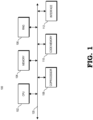
- FIG. 1 illustrates a data processing system 100 in accordance with an embodiment.
- Data processing system 100 includes a system bus 120, central processing unit (CPU) 102, memory 104, random number generator (RNG) 106, coprocessor 108, code memory 110, and interface 112.
- system bus 120 is any type of system bus for communicating data and instructions.
- interface 112 is communicably coupled to the system bus 120 and is configured to allow data processing system 100 to transmit and receive data with one or more other devices located outside of the data processing system 100.
- CPU102 is bi-directionally connected to system bus 120 and is one or more of any type of processor, or processor core, such as a microprocessor, microcontroller, digital system processor, or the like.
- memory 104 is bi-directionally connected to system bus 120 and is any suitable type of volatile or non-volatile memory for storing instructions in, for example, an instruction queue for CPU 102.
- RNG 106 is bi-directionally connected to system bus 120 and is one or more of any type of RNG or pseudo-RNG for generating the random numbers (e.g., the first value, E, and the second value, S) used in the disclosed embodiments.
- CPU 102 is used to control the methods for shuffling a plurality of data blocks into a shuffled order by selecting first and second values for generating a plurality of subgroups in multiple iterations with a shift of one index position value between the iterations and forming the shuffled order based on the generated subgroups.
- coprocessor 108 is bi-directionally connected to system bus 120 and is any type of data processor or processor core.
- coprocessor 108 includes one or more microprocessor, microcontroller, digital system processor, or the like.
- one or both of CPU 102 and coprocessor 108 is used for implementing the methods described in FIGS.
- CPU 102 or coprocessor 108 is characterized as a secure processor or includes a secure element for securely storing or processing information. Accordingly, in some embodiments, the term "secure processor” refers to one or both of CPU 102 and/or coprocessor 108 in data processing system 100.
- code memory 110 is bi-directionally connected to system bus 120 and is any type of volatile or non-volatile memory for storing data and/or instructions.
- memories 104 and 110 are implemented as portions of the same memory array.
- the described shuffling and sliding subgroup techniques may be implemented in data processing system 100 as hardware, software, or a combination of hardware and software.
- the hardware may be implemented as electrical or electronic circuits, which can be collectively referred to as "a circuit arrangement" or “circuitry.”
- FIG. 2 shows a flowchart 200 describing a shuffling and sliding subgroup method according to various embodiments.
- the shuffling and sliding subgroup method includes shuffling the plurality of data blocks in a data block array from an initial order into a plurality of subgroups to form a shuffled order.
- one or both of CPU 102 or coprocessor 108 (i.e., a secure processor) of FIG. 1 performs the shuffling and sliding subgroup method shown in flowchart 200 for executing operations associated with data stored in a memory, such as memory 104, or associated with data received from an external source via interface 112.
- the shuffling and sliding subgroup method shown in flowchart 200 requires little or no memory storage overhead or conditional branches, thereby reducing the memory resources and the computational complexity for implementation.
- the shuffling and sliding subgroup method described in flowchart 200 provides a strong resistance to side-channel attacks in memory constrained systems.
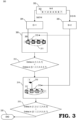
- FIG. 3 illustrating an accompanying flowchart 300 that shows an example of the shuffling and sliding subgroup method described in FIG. 2 .
- the method includes receiving a data block array with a plurality of data blocks, N , where N is any positive integer.
- a secure processor in a data processing system (such as CPU 102 or coprocessor 108 in data processing system 100 of FIG. 1 ) can receive the data block array from an external source or retrieve the data block array from an internal source (such as memory 104 in data processing system 100 of FIG. 1 ).
- the plurality of data blocks, N is in an initial order with each of the plurality of data blocks having an index position in the initial order. Referring to 302 in FIG.
- the method includes the secure processor selecting a first value, E.
- a secure processor such as CPU 102 or coprocessor 108 in data processing system 100 in FIG. 1 selects the first value based on an output from RNG 106.
- the secure processor uses the first value, E, to set the first entry of the shuffled order.
- the secure processor selects the first value, E, at least in part based on the number of the plurality of data blocks, N, in the data block array. For example, referring to 304 in FIG.
- the first value, E is a random integer between 0 (inclusive) and N (non-inclusive), i.e., 0 ⁇ E ⁇ N, and corresponds to any of the data blocks with one of the eight index positions in the initial order for data block array 303.
- the method includes the secure processor selecting a second value, S.
- a secure processor such as CPU 102 or coprocessor 108 in data processing system 100 in FIG. 1 selects the second value based on an output from RNG 106.
- the secure processor uses the second value, S, to set the step size for adding subsequent entries to the shuffled order.
- the secure processor selects the second value, S, at least in part based on the quantity of the data blocks in the plurality of data blocks, N, in the data block array. Referring to 306 in FIG.
- the second value, S is a random integer between 0 (non-inclusive) and N (non-inclusive), i.e., 0 ⁇ S ⁇ N, and corresponds to a step size to add subsequent entries to the shuffled order.
- the shuffling and sliding subgroup techniques described herein do not require further restrictions to select the first and second values (E and S, respectively) other than that the first and second values must be a positive integer value less than or equal to the total number of data blocks in the data block array.
- the method includes the secure processor performing a first iteration to generate a first subgroup in the shuffled order and executing associated data operations until a repeat is detected.
- a secure processor such as CPU 102 or coprocessor 108 in data processing system 100 in FIG. 1 generates the first subgroup in the shuffled order by performing the first iteration based on the first value, E, and the second value, S.
- this includes the secure processor selecting a data block as the first entry of the first subgroup based on the first value, E, and adding additional entries to the first subgroup based on the second value, S.
- the data blocks added during this first iteration 208 are collectively referred to as the "first subgroup.”
- the secure processor adds data blocks to this first subgroup until a repeat entry to the first subgroup is detected. For example, in some embodiments, this repeat entry corresponds to the first entry of the first subgroup. Referring to FIG. 3 at 308, this first iteration to generate the first subgroup is illustrated.
- the secure processor adds subsequent entries (i.e., data blocks 3, 5, and 7) to the first subgroup.
- the step size is based on modular reduction to account for wrapping around the end of the plurality of data blocks.
- the secure processor detects a repeat entry when the next entry to be added to the first subgroup is data block 1. Once the secure processor detects this repeat, the secure processor stops the addition of data blocks as entries to the first subgroup.
- the secure processor determines whether all of the data blocks have been added to the shuffled order 212. If all of the data blocks have been added to the shuffled order (YES at 212), then this signals that all of the associated data operations have been executed or are in queue to be executed and the process is terminated at 220. If all of the data blocks have not yet been added to the shuffled order (NO at 212), then the secure processor shifts the next entry by one index position and sets the data block corresponding to this shifted index position as the first entry of the subsequent subgroup and executes the associated data operations until a repeat is detected in 214.
- the first entry of the second subgroup is a data block that is shifted by one index position value compared with the first entry in the first subgroup. Then, the secure processor adds the rest of the entries in the subsequent subgroup based on the data block corresponding to this shifted index position and the step size based on the second value, S. In some embodiments, in each subsequent iteration, the secure processor generates a corresponding subgroup with a first entry that is shifted by one index position compared to the first entry in the previously generated subgroup. In some embodiments, in each subsequent iteration, the secure processor continues to add data blocks as entries to its corresponding subgroup until it detects a repeat for a next entry to be added to the corresponding subgroup. Referring to FIG.
- the data blocks that were added to the shuffled order in the first iteration 308 are compared to the total number of data blocks of the plurality of data blocks in 302.
- the number of entries generated in the first iteration is four (i.e., four entries of first subset ⁇ 1, 3, 5, 7 ⁇ ) which is less than the entries in the plurality of data blocks of 302 (i.e., eight data blocks ⁇ 0, 1, 2, 3, 4, 5, 6, 7, ⁇ .
- the number of entries in the shuffled order (composed of the first subgroup from the first iteration 308 up to this point) is not equal to the entries in the plurality of data blocks in 302.
- the secure processor determines that not all the data blocks have been added to the shuffled order at 312, the secure processor proceeds to block 314.
- the secure processor detects a repeat entry when the next entry to be added to the second subgroup is the data block at the index position 2. Once the secure processor detects this repeat entry, the secure processor stops the addition of data blocks as entries to the second subgroup.
- the secure processor determines whether all of the data blocks of the plurality of data blocks have been added to subgroups in the shuffled order. In some embodiments, the secure processor makes this determination of whether all of the data blocks have been added based on whether the total number of entries in the generated subgroups that make up the shuffled order corresponds to the total number of data blocks in the plurality of data blocks, N.
- the secure processor makes this determination of whether all of the data blocks have been added based on detecting that the data block at the next shifted entry corresponds to a data block that is already in one of the generated subgroups, e.g., the next shifted entry corresponds to a data block that is an entry of the first generated subgroup.
- the secure processor determines that all of the data blocks have been added as entries to the shuffled order in one of the generated subgroups (YES at 218), which indicates that all of the associated data operations have been executed or are scheduled for execution, the process of adding data blocks to the shuffled order is terminated 220.
- the secure processor determines that all of the plurality of data blocks have been added to the shuffled order.
- the shuffled order of data blocks based on the first subgroup generated in 308 and the second subgroup generated in 314 is ⁇ 1, 3, 5, 7, 2, 4, 6, 0 ⁇ and has eight entries. This is equal to the total number of data blocks received at 302. Therefore, the secure processor determines that all of the data blocks have been added to the shuffled order, and the secure processor terminates the addition of data blocks to the shuffled order at 320.
- the first subgroup generated in the first iteration 308 includes a first subset of data blocks ⁇ 1, 3, 5, 7 ⁇ and the second subgroup generated in the second iteration 312 includes a second subset of data blocks ⁇ 2, 4, 6, 0 ⁇ .
- Each of the first subset and the second subset include only unique entries. That is, based on the techniques described herein, there are no repeat entries in the first subgroup 317 and the second subgroup 318.
- a secure processor implementing the shuffling and sliding subgroup method described herein generates a random, shuffled order including every data block of the data block array. Furthermore, the secure processor can repeat this process for additional iterations based on the size of the data block array and the step size.
- the shuffling and sliding subgroup method ensures that all of the data blocks of the plurality of data blocks are added to the shuffled order without having to compute the greatest common divisor of the number of the plurality of data blocks (N) and the step size (S) or without having to select a step size (S) coprime with the number of the plurality of data blocks (N). Additionally, the data operations associated with the data blocks are executed whilst the shuffled order is generated. This reduces the computational complexity for implementation and increases the number of possible permutations.
- the secure processor performs the shuffling and sliding subgroup method by executing instructions according to algorithm Shuffle 1, shown below.
- a secure processor of a data processing system such as CPU 102 or coprocessor 108 in data processing system 100 of FIG. 1 ) retrieves instructions for Shuffle 1 from a memory (such as code memory 110, memory 104, or other embedded memory) and executes Shuffle 1 to shuffle the order of executing data operations associated with a data block array in a randomized manner that is more resistant to side-channel attacks.
- t is the first entry of the current subgroup.
- the condition " If Index t " is true when the current computed Index is equal to the first entry of the current subgroup. In some embodiments, this indicates that every unique entry of the current subgroup has been added, and the next subgroup needs to be shifted by one position. Shifting the next subgroup by one position and keeping the step size the same ensures that the next subgroup will include entries that did not belong to the previous subgroup. This process is repeated until all of the elements (N) of the data block array have been added to respective subgroups, which together constitute the shuffled order.
- the shuffled order is a pseudo-random order defined by the random numbers E and S that are selected between 0 and N. Accordingly, the shuffling and sliding subgroup method described herein is able to produce a shuffled order with a full range of permutations defined by the expression N*(N-1). This wide range of possible permutations strongly protects against side-channel attacks.
- the secure processor can perform the shifting of one index position (e.g., described at block 214 of FIG. 2 and illustrated by arrow 315 in block 314 of FIG. 3 ) to generate each subsequent subgroup in the positive direction or in the negative direction. That is, the shift of the index position is either +1 or -1.
- the shift 315 shown in FIG. 3 is a +1 shift from data block 1 to data block 2.
- this shift can instead be a -1 shift from data block 1 to data block 0. This feature of selecting either a positive or negative shift, in effect, doubles the number of possible permutations.
- the shuffling and sliding subgroup method based on this additional feature of selecting between a positive index shift or a negative index shift is described according to the algorithm Shuffle 2, shown below.
- a secure processor of a data processing system retrieves instructions for the algorithm Shuffle 2 from a memory (such as code memory 110, memory 104, or other embedded memory) and executes Shuffle 2 to shuffle the order of executing data operations associated with a data block array in a randomized manner that is more resistant to side-channel attacks.
- the introduction of the random binary bit, B provides the secure processor with an extra parameter that doubles the possible number of permutations of the shuffled order.
- this random binary bit, B adds an additional option for the direction of the index position shift for generating subsequent subgroups, the number of total possible permutations of the shuffled order is, in effect, doubled. This increases the resistance to side-channel attacks.
- the modular reductions shown in Shuffle 1 and Shuffle 2 can be replaced since the number to reduce is the result of an addition with small parameters.
- the modular reductions can be replaced by conditional subtractions.
- the shuffling and sliding subgroup method without modular reduction is described by the algorithm Shuffle 3, shown below.
- a secure processor of a data processing system retrieves instructions for the algorithm Shuffle 3 from a memory (such as code memory 110, memory 104, or other embedded memory) and executes Shuffle 3 to shuffle the order of executing data operations associated with a data block array in a randomized manner that is more resistant to side-channel attacks.
- FIG. 4 shows a diagram 400 illustrating the process by which a secure processor, such as CPU 102 or coprocessor 108 in data processing system 100 of FIG. 1 , generates a first subgroup 420 in a shuffled order for executing operations in a randomized manner to increase the resistance to side-channel attacks according to various embodiments.
- Each of the data blocks are marked by a corresponding index position (0, 1, ..., 9).
- the shuffling and sliding subgroup method utilizes a first value (E) of zero and a second value (S) of four. It is appreciated that the values for N, E, and S are nonlimiting in nature and selected for clarity purposes of the ensuing explanation.
- the first subgroup 420 includes a first data block with an index position corresponding to the first value and additional data blocks that are offset from the first data block with step sizes based on the second value.
- the second entry of the first subgroup is based on the step shown by arrow 402 and corresponds to data block 4.
- the third entry of the first subgroup is based on the step shown by arrow 404 and corresponds to data block 8.
- the fourth entry of the first subgroup is based on the step shown by arrow 406 and corresponds to data block 2.
- the fifth entry of the first subgroup is based on the step shown by arrow 408 and corresponds to data block 6.
- the next entry would be based on the step shown by 410. However, the secure processor detects this next entry would be a repeat entry since data block 0 is the first entry of the first subgroup 420.
- the secure processor closes the first subgroup 420 with a first subset of data blocks of ⁇ 0, 4, 8, 2, 6 ⁇ in the shuffled order and, since all of the data blocks have not yet been added to the shuffled order, triggers a shift in an index position to generate a subsequent (in this case, second) subgroup.
- FIG. 5 shows a block diagram 500 illustrating the process by which a secure processor, such as CPU 102 or coprocessor 108 in data processing system 100 of FIG. 1 , generates a second subgroup 520 in the shuffled order after the first subgroup shown in FIG. 4 for executing operations in a randomized manner to increase the resistance to side-channel attacks.
- a secure processor such as CPU 102 or coprocessor 108 in data processing system 100 of FIG. 1
- FIG. 5 shows a second iteration after the first iteration of the shuffling and sliding subgroup method described in FIG. 4 .
- the second subgroup 520 includes a first data block with an index position corresponding to the first value shifted by one position and additional data blocks that are offset from the data block at this shifted position with step sizes based on the second value.
- the second entry of the second subgroup is based on the step shown by arrow 504 and corresponds to data block 5.
- the third entry of the second subgroup is based on the step shown by arrow 506 and corresponds to data block 9.
- the fourth entry of the second subgroup is based on the step shown by arrow 508 and corresponds to data block 3.
- the fifth entry of the second subgroup is based on the step shown by arrow 510 and corresponds to data block 7.
- the next entry would be based on the step shown by 512.
- the secure processor detects this next entry to be a repeat entry since data block 1 is the first entry of the second subgroup 520. Accordingly, upon this detection of a potential repeat entry to the second subgroup, the secure processor closes the second subgroup 520 with a second subset of data blocks of ⁇ 1, 5, 9, 3, 7 ⁇ .
- the secure processor determines that all of the plurality of data blocks in the data block array (data blocks 0, 1, ..., 9) have been added in subgroups (either in the first subgroup 420 or the second subgroup 520) and terminates the process of adding data blocks to the shuffled order, which is based on the first and second generated subgroups and is shown at 530. In some embodiments, the secure processor makes this determination based on the total number of elements in the generated subgroups being equal to the number of the plurality of data blocks in the data block array.
- the secure processor makes this determination based the next shifted index position (corresponding to dashed arrow 514) corresponding to a data block that has already been added to a subgroup (in this case, data blocks 2 as the fourth entry in the first subgroup 420).
- shuffled order 530 is one possible permutation of many possible permutations covered by the shuffling and sliding subgroup method described herein.
- shuffled order 530 is one of 180 possible permutations covered by the shuffling and sliding subgroup method of the present disclosure when the additional feature of shifting the index position in either the positive or the negative direction is implemented (e.g., according to the algorithm described in Shuffle 2).
- the shuffling and sliding subgroup mechanism shown in FIGs. 4 and 5 increases the resistance to side-channel attacks.
- FIGs. 6 and 7 show additional examples of how a secure processor, such as CPU 102 or coprocessor 108 in FIG. 1 , generates a shuffled order utilizing the shuffling and sliding subgroup method according to various embodiments.
- N 15
- FIG. 6 shows the shuffling and sliding subgroup mechanism based on a positive shift of one index position
- FIG. 7 shows the shuffling and sliding subgroup mechanism based on a negative shift of one index position.
- Block 610 illustrates the method by which a secure processor executes a first iteration to generate a first subgroup 650 of data blocks in the shuffled order for executing data operations associated therewith.
- first subgroup 650 includes a first subset of data blocks (3, 6, 9, 12, 0) from the plurality of data blocks as entries and, in some embodiments, the associated data operations are executed as the first subgroup 650 is generated.
- Block 620 illustrates the method by which a secure processor executes a second iteration to generate a second subgroup 660 of data blocks in the shuffled order for executing data operations associated therewith.
- the secure processor Based on the shifted index position shown by 619, the secure processor sets data block 4 as the first entry of the second subgroup. Then, the secure processor adds the subsequent entries (data blocks 7, 10, 13, 1) in the second subgroup 660 at steps 621, 623, 625, 627, respectively, based on the same step size (i.e., 3) used in the first iteration.
- the next entry shown by dashed arrow 628) after data block 1 is added to the second subgroup 660 would be data block 4.
- second subgroup 660 includes a second subset of data blocks (4, 7, 10, 13, 1) from the plurality of data blocks as entries and, in some embodiments, the associated data operations are executed as the second subgroup 660 is generated. Since the generated subgroups (first subgroup 650 and second subgroup 660 up to this point) do not include all of the data blocks of the plurality of data blocks, the secure processor triggers a third iteration based on index shift 629.
- Block 630 illustrates the method by which a secure processor executes a third iteration to generate a third subgroup 670 of data blocks in the shuffled order for executing data operations associated therewith.
- the secure processor Based on the shifted index position shown by 629, the secure processor sets data block 5 as the first entry of the third subgroup. Then, the secure processor adds subsequent entries (data blocks 8, 11, 14, 2) in the third subgroup 670 at steps 531, 533, 535, 537, respectively, based on the same step size (i.e., 3) used in the first and second iterations.
- the next entry shown by dashed arrow 638) after data block 2 is added to the third subgroup 670 would be data block 5.
- third subgroup 670 includes a third subset of data blocks (5, 8, 11, 14, 2) from the plurality of data blocks as entries and, in some embodiments, the associated data operations are executed as the third subgroup 670 is generated.
- the closing of the third subgroup 670 signals that all of the plurality of data blocks have been added to a respective subgroup to form the final shuffled order 680 that provides the order of executing the data operations associated with the plurality of data blocks.
- shuffled order 680 is one permutation of many possible permutations covered by the shuffling and sliding subgroup method described herein.
- shuffled order 680 is one of 420 possible permutations covered by the shuffling and sliding subgroup method of the present disclosure when the additional feature of shifting the index position in either the positive or the negative direction is implemented (e.g., according to the algorithm described in Shuffle 2).
- this high number of possible permutations for the shuffled order 680 increases the resistance to side-channel attacks.
- Block 710 illustrates the method by which a secure processor executes a first iteration to generate the first subgroup 750 of data blocks in the shuffled order for executing data operations associated therewith.
- the next entry shown by dashed arrow 718) after data block 12 is added to the first subgroup 750 would be data block 0. However, the secure processor detects this next entry of data block 0 would be a repeat entry.
- first subgroup 750 includes a first subset of data blocks (0, 3, 6, 9, 12) from the plurality of data blocks as entries and, in some embodiments, the associated data operations are executed as the first subgroup 750 is generated.
- Block 720 illustrates the method by which a secure processor executes a second iteration to generate the second subgroup 760 of data blocks in the shuffled order for executing data operations associated therewith.
- the secure processor Based on the shifted index position shown by 719, the secure processor sets data block 14 as the first entry of the second subgroup 760. Then, the secure processor adds the subsequent entries (data blocks 2, 5, 8, 11) in the second subgroup 760 at steps 721, 723, 725, 727, respectively, based on the same step size (i.e., 3) used in the first iteration.
- the next entry shown by dashed arrow 728) after data block 11 is added to the second subgroup 760 would be data block 14.
- second subgroup 760 includes a second subset of data blocks (14, 2, 5, 8, 11) from the plurality of data blocks as entries and, in some embodiments, the associated data operations are executed as the second subgroup 760 is generated. Since the generated subgroups (first subgroup 750 and second subgroup 760 up to this point) do not include all of the data blocks of the plurality of data blocks, a third iteration is triggered based on index shift 729.
- Block 730 illustrates the method by which a secure processor executes a third iteration to generate a third subgroup 770 of data blocks in the shuffled order for executing data operations associated therewith.
- the secure processor Based on the shifted index position shown by 729, the secure processor sets data block 13 as the first entry of the third subgroup 770. Then, the secure processor adds the subsequent entries (data blocks 1, 4, 7, 10) in the third subgroup 770 at steps 731, 733, 735, 737, respectively, based on the same step size used in the first and second iterations. The next entry (shown by dashed arrow 738) after data block 10 is added to the third subgroup 770 would be data block 13.
- third subgroup 770 includes a third subset of data blocks (13, 1, 4, 7, 10) from the plurality of data blocks as entries and, in some embodiments, the associated data operations are executed as the third subgroup 770 is generated.
- the closing of the third subgroup 770 signals that all of the data blocks have been added to one of the generated subgroups to form the final shuffled order 780 that provides the order of executing the data operations associated with the plurality of data blocks.
- shuffled order 780 is one permutation of many possible permutations covered by the shuffling and sliding subgroup method described herein.
- shuffled order 780 is one of 420 possible permutations covered by the shuffling and sliding subgroup method of the present disclosure when the additional feature of shifting the index position in either the positive or the negative direction is implemented (e.g., according to the algorithm described in Shuffle 2).
- this high number of possible permutations for the shuffled order 780 increases the resistance to side-channel attacks.
- certain aspects of the techniques described above may be implemented by one or more processors of a processing system executing software.
- the software comprises one or more sets of executable instructions stored or otherwise tangibly embodied on a non-transitory computer readable storage medium.
- the software can include the instructions and certain data that, when executed by the one or more processors, manipulate the one or more processors to perform one or more aspects of the techniques described above.
- the non-transitory computer readable storage medium can include, for example, a magnetic or optical disk storage device, solid state storage devices such as Flash memory, a cache, random access memory (RAM) or other non-volatile memory device or devices, and the like.
- the executable instructions stored on the non-transitory computer readable storage medium may be in source code, assembly language code, object code, or other instruction format that is interpreted or otherwise executable by one or more processors.
- a computer readable storage medium may include any storage medium, or combination of storage media, accessible by a computer system during use to provide instructions and/or data to the computer system.
- Such storage media can include, but is not limited to, optical media (e.g., compact disc (CD), digital versatile disc (DVD), Blu-Ray disc), magnetic media (e.g., floppy disc , magnetic tape, or magnetic hard drive), volatile memory (e.g., random access memory (RAM) or cache), non-volatile memory (e.g., read-only memory (ROM) or Flash memory), or microelectromechanical systems (MEMS)-based storage media.
- optical media e.g., compact disc (CD), digital versatile disc (DVD), Blu-Ray disc
- magnetic media e.g., floppy disc , magnetic tape, or magnetic hard drive
- volatile memory e.g., random access memory (RAM) or cache
- non-volatile memory e.g., read-only memory (ROM) or Flash memory
- MEMS microelect
- the computer readable storage medium may be embedded in the computing system (e.g., system RAM or ROM), fixedly attached to the computing system (e.g., a magnetic hard drive), removably attached to the computing system (e.g., an optical disc or Universal Serial Bus (USB)-based Flash memory) or coupled to the computer system via a wired or wireless network (e.g., network accessible storage (NAS)).
- system RAM or ROM system RAM or ROM
- USB Universal Serial Bus
- NAS network accessible storage
Landscapes
- Engineering & Computer Science (AREA)
- Theoretical Computer Science (AREA)
- Computer Security & Cryptography (AREA)
- Physics & Mathematics (AREA)
- General Engineering & Computer Science (AREA)
- General Physics & Mathematics (AREA)
- Software Systems (AREA)
- Computer Hardware Design (AREA)
- Computer Networks & Wireless Communication (AREA)
- Signal Processing (AREA)
- Signal Processing For Digital Recording And Reproducing (AREA)
- Information Retrieval, Db Structures And Fs Structures Therefor (AREA)
Abstract
Description
- The present disclosure relates generally to data processing and to mechanisms for shuffling an order of data blocks in a data processing system.
- Data processing systems can be subject to side-channel attacks that aim to obtain sensitive data. These attacks monitor the behavior (e.g., execution timing, power consumption) of a target device such as a microcontroller to gather information that is used to extract the sensitive data. In some cases, to protect against such attacks, the target device implements countermeasures by manipulating the processing of the sensitive data. These countermeasures may include, for example, shuffling techniques that randomize the order of executing data operations associated with the data. However, sometimes these countermeasures can have a noticeable impact on system performance or memory, which are often critical in embedded systems.
- The present disclosure may be better understood, and its numerous features and advantages made apparent to those skilled in the art by referencing the accompanying drawings. The use of the same reference symbols in different drawings indicates similar or identical items.
-
FIG. 1 shows a data processing system in accordance with various embodiments. -
FIG. 2 is a method flowchart of a shuffling and sliding subgroup mechanism in accordance with some embodiments. -
FIG. 3 is a flowchart illustrating an example of generating a shuffled order for a plurality of data blocks according to the shuffling and sliding subgroup mechanism illustrated inFIG. 2 in accordance with some embodiments. -
FIGs. 4 and 5 show examples of a first iteration for forming a first subgroup and of a second iteration for forming a second subgroup, respectively, in accordance with some embodiments. -
FIGs. 6 and7 show various examples for forming a shuffled order using the shuffling and sliding subgroup mechanism in accordance with various embodiments. - One countermeasure employed against side-channel attacks is known as shuffling, wherein independent data operations associated with a plurality of data blocks in a data block array are reordered from an initial order to a shuffled order for execution. Shuffling is an effective countermeasure against side-channel attacks when there are a substantial number of data operations (also referred to as processing operations or operations) associated with the data blocks to rearrange due to the higher quantity of potential permutations in the shuffled order. However, conventional shuffling countermeasures against side-channel attacks have numerous drawbacks, including requiring a precomputed table to implement the shuffling techniques, strict conditional requirements on the number of data blocks to implement the shuffling techniques, and central processing unit (CPU) instructions that are highly inefficient or computationally complex (e.g., instructions including division or remainder). These drawbacks of conventional shuffling techniques increase the computational complexity and the memory requirements for implementation and provide fewer possible permutations, thereby reducing the resistance to side-channel attacks.
FIGs. 1-7 describe techniques that provide a shuffling and sliding subgroup mechanism that can be securely implemented in memory constrained microcontrollers in a data processing system, thereby delivering an improved resistance against side-channel attacks with little or no memory storage overhead compared with conventional shuffling countermeasures. - The shuffling and sliding subgroup techniques described herein include an on-the-fly sliding subgroup mechanism applied to a random starting index algorithm with a random step size to generate a shuffled order that includes all of the plurality of data blocks from a data block array regardless of size. For example, for any given data block array with a plurality of data blocks in an initial order, randomly selecting one of the data blocks as a first entry in the shuffled order and randomly selecting a step size to add other data blocks as subsequent entries to the shuffled order will likely fail to include all of the data blocks in the shuffled order. This is due to the high probability that randomly selecting a step size without any additional conditional requirements (e.g., having the step size be coprime with the total number of the plurality of data blocks) will only add a fraction (i.e., subgroup) of the plurality of blocks before the next entry to be added to the shuffled order is a repeat entry. The shuffling and sliding subgroup method described herein recognizes this and shifts the next entry by one index position to continue to add additional entries to the shuffled order in multiple iterations until all of the data blocks have been added. The data operations associated with the shuffled order of data blocks (which includes one or more subgroups generated in each iteration) are executed whilst the shuffle order is generated. This ensures that the operations associated with the plurality of data blocks are executed in a random order regardless of the size of the data block array and the randomly selected step size. This increases the possible number of permutations for executing operations associated with the data blocks, thus providing greater resistance to side-channel attacks.
- To illustrate, the shuffling and sliding subgroup technique includes receiving a plurality of data blocks in an initial order and selecting two random values (a first value and a second value) based on the number, N, of the plurality of data blocks. The first value, E, indicates a starting index position in the plurality of data blocks to be selected as a first entry in the shuffled order and the second value, S, indicates a step size for adding additional entries to the shuffled order. In some embodiments, the technique includes performing a first iteration to generate a first subgroup of the shuffled order. This first iteration includes selecting a data block as the first entry of the first subgroup based on the first value, E, and adding additional data blocks as subsequent entries to the first subgroup utilizing a step size based on the second value, S. This process of adding subsequent entries to the first subgroup continues until the next entry to be added is a data block that has already been added to the first subgroup, i.e., the next entry would be a repeat entry. Once this repeat entry is detected, the technique includes determining whether all of the plurality of data blocks have been added in the first subgroup which would indicate that all the associated data operations have been executed. If all the data blocks have been added in the first subgroup (i.e., the shuffled order up to this point), then the process is terminated. If all of the data blocks from the plurality of data blocks have not been added yet, the next entry is shifted by one index position, and the data block corresponding to this shifted index position is set as the first entry for a second subgroup in a second iteration. The second iteration then generates the rest of the second subgroup based on the data block at the shifted index position and the step size based on the second value, S. This process of performing additional iterations to generate additional subgroups is repeated until all of the data blocks in the plurality of data blocks have been added to a respective subgroup. By detecting the next entry is a repeat and shifting the starting index position by one index position, the shuffling and sliding subgroup technique ensures that all of the data blocks are added as entries to the shuffled order in a randomized manner regardless of the selected step size and data block array size.
- The techniques described herein have numerous advantages compared with conventional shuffling mechanisms. For example, these advantages include reducing or eliminating memory storage overhead, improving computational efficiency, and providing stronger resistance to side-channel attacks due to a higher number of random permutations.
-
FIG. 1 illustrates adata processing system 100 in accordance with an embodiment.Data processing system 100 includes asystem bus 120, central processing unit (CPU) 102,memory 104, random number generator (RNG) 106,coprocessor 108,code memory 110, andinterface 112. In some embodiments,system bus 120 is any type of system bus for communicating data and instructions. In some embodiments,interface 112 is communicably coupled to thesystem bus 120 and is configured to allowdata processing system 100 to transmit and receive data with one or more other devices located outside of thedata processing system 100. In some embodiments, CPU102 is bi-directionally connected tosystem bus 120 and is one or more of any type of processor, or processor core, such as a microprocessor, microcontroller, digital system processor, or the like. In some embodiments,memory 104 is bi-directionally connected tosystem bus 120 and is any suitable type of volatile or non-volatile memory for storing instructions in, for example, an instruction queue forCPU 102. In some embodiments, RNG 106 is bi-directionally connected tosystem bus 120 and is one or more of any type of RNG or pseudo-RNG for generating the random numbers (e.g., the first value, E, and the second value, S) used in the disclosed embodiments. In some embodiment,CPU 102 is used to control the methods for shuffling a plurality of data blocks into a shuffled order by selecting first and second values for generating a plurality of subgroups in multiple iterations with a shift of one index position value between the iterations and forming the shuffled order based on the generated subgroups. In some embodiments,coprocessor 108 is bi-directionally connected tosystem bus 120 and is any type of data processor or processor core. For example,coprocessor 108 includes one or more microprocessor, microcontroller, digital system processor, or the like. In some embodiments, one or both ofCPU 102 andcoprocessor 108 is used for implementing the methods described inFIGS. 2-7 and/or the algorithms described in one or more of algorithms Shuffle 1, Shuffle 2, or Shuffle 3. In some embodiments,CPU 102 orcoprocessor 108 is characterized as a secure processor or includes a secure element for securely storing or processing information. Accordingly, in some embodiments, the term "secure processor" refers to one or both ofCPU 102 and/orcoprocessor 108 indata processing system 100. In some embodiments,code memory 110 is bi-directionally connected tosystem bus 120 and is any type of volatile or non-volatile memory for storing data and/or instructions. In some embodiments,memories data processing system 100 as hardware, software, or a combination of hardware and software. In some embodiments, the hardware may be implemented as electrical or electronic circuits, which can be collectively referred to as "a circuit arrangement" or "circuitry." -
FIG. 2 shows aflowchart 200 describing a shuffling and sliding subgroup method according to various embodiments. The shuffling and sliding subgroup method includes shuffling the plurality of data blocks in a data block array from an initial order into a plurality of subgroups to form a shuffled order. In some embodiments, one or both ofCPU 102 or coprocessor 108 (i.e., a secure processor) ofFIG. 1 performs the shuffling and sliding subgroup method shown inflowchart 200 for executing operations associated with data stored in a memory, such asmemory 104, or associated with data received from an external source viainterface 112. In some embodiments, the shuffling and sliding subgroup method shown inflowchart 200 requires little or no memory storage overhead or conditional branches, thereby reducing the memory resources and the computational complexity for implementation. Thus, the shuffling and sliding subgroup method described inflowchart 200 provides a strong resistance to side-channel attacks in memory constrained systems. For purposes of this explanation, reference is also made toFIG. 3 illustrating an accompanyingflowchart 300 that shows an example of the shuffling and sliding subgroup method described inFIG. 2 . - At 202, in some embodiments, the method includes receiving a data block array with a plurality of data blocks, N , where N is any positive integer. For example, a secure processor in a data processing system (such as
CPU 102 orcoprocessor 108 indata processing system 100 ofFIG. 1 ) can receive the data block array from an external source or retrieve the data block array from an internal source (such asmemory 104 indata processing system 100 ofFIG. 1 ). In some embodiments, the plurality of data blocks, N, is in an initial order with each of the plurality of data blocks having an index position in the initial order. Referring to 302 inFIG. 3 , thedata block array 303 includes eight data blocks (N=8), where each data block has a corresponding index position (0, 1, 2, 3, 4, 5, 6, 7). While eight data blocks are shown inFIG. 3 , it is appreciated that this amount is for purposes of simplifying this explanation and may be scalable to larger quantities. - Referring back to
FIG. 2 at 204, in some embodiments, the method includes the secure processor selecting a first value, E. For example, in some embodiments, a secure processor such asCPU 102 orcoprocessor 108 indata processing system 100 inFIG. 1 selects the first value based on an output fromRNG 106. In some embodiments, the secure processor uses the first value, E, to set the first entry of the shuffled order. In some embodiments, the secure processor selects the first value, E, at least in part based on the number of the plurality of data blocks, N, in the data block array. For example, referring to 304 inFIG. 3 , the first value, E, is a random integer between 0 (inclusive) and N (non-inclusive), i.e., 0 ≤ E < N, and corresponds to any of the data blocks with one of the eight index positions in the initial order fordata block array 303. In this example illustrated inFIG. 3 at 304, the secure processor selects the first value to be 1 (i.e., E=1). - Referring back to
FIG. 2 at 206, in some embodiments, the method includes the secure processor selecting a second value, S. For example, in some embodiments, a secure processor such asCPU 102 orcoprocessor 108 indata processing system 100 inFIG. 1 selects the second value based on an output fromRNG 106. In some embodiments, the secure processor uses the second value, S, to set the step size for adding subsequent entries to the shuffled order. In some embodiments, the secure processor selects the second value, S, at least in part based on the quantity of the data blocks in the plurality of data blocks, N, in the data block array. Referring to 306 inFIG. 3 , the second value, S, is a random integer between 0 (non-inclusive) and N (non-inclusive), i.e., 0<S<N, and corresponds to a step size to add subsequent entries to the shuffled order. In some embodiments, the addition of subsequent entries is based on modular reduction and can be described by the equation: Next Entry= Previous Entry + S mod (N). As illustrated inFIG. 3 at 306, the secure processor selects the second value to be 2 (i.e., S=2). - Contrary to conventional shuffling countermeasures based on random starting index and random step size, the shuffling and sliding subgroup techniques described herein do not require further restrictions to select the first and second values (E and S, respectively) other than that the first and second values must be a positive integer value less than or equal to the total number of data blocks in the data block array. For example, some conventional shuffling countermeasures require that the step size (second value, S) be co-prime with the number of the plurality of data blocks (N) in the data block array. This condition is not a requirement for the shuffling and sliding subgroup method described herein, which therefore reduces the computational complexity for implementation and increases the possible number of permutations. For example, as shown in
FIG. 3 , the second value (S=2) and the number of plurality of data blocks (N=8) are not coprime. - Referring back to
FIG. 2 at 208, in some embodiments, the method includes the secure processor performing a first iteration to generate a first subgroup in the shuffled order and executing associated data operations until a repeat is detected. For example, in some embodiments, a secure processor such asCPU 102 orcoprocessor 108 indata processing system 100 inFIG. 1 generates the first subgroup in the shuffled order by performing the first iteration based on the first value, E, and the second value, S. In some embodiments, this includes the secure processor selecting a data block as the first entry of the first subgroup based on the first value, E, and adding additional entries to the first subgroup based on the second value, S. In some embodiments, the data blocks added during thisfirst iteration 208 are collectively referred to as the "first subgroup." The secure processor adds data blocks to this first subgroup until a repeat entry to the first subgroup is detected. For example, in some embodiments, this repeat entry corresponds to the first entry of the first subgroup. Referring toFIG. 3 at 308, this first iteration to generate the first subgroup is illustrated. The secure processor sets the initial entry of the first subgroup based on the first value (E=1) and is shown byarrow 309. In this example, this first entry corresponds todata block 1. Then, using the second value (S=2) to set the magnitude of the step size at two shown by 310 (only the first step from 1 to 3 is marked 310 for clarity purposes), the secure processor adds subsequent entries (i.e., data blocks 3, 5, and 7) to the first subgroup. In some embodiments, the step size is based on modular reduction to account for wrapping around the end of the plurality of data blocks. As shown by dashedarrow 311, the secure processor detects a repeat entry when the next entry to be added to the first subgroup isdata block 1. Once the secure processor detects this repeat, the secure processor stops the addition of data blocks as entries to the first subgroup. - Referring back to
FIG. 2 , after detecting that the next entry in the first iteration would be a repeat entry in 208, then the secure processor determines whether all of the data blocks have been added to the shuffledorder 212. If all of the data blocks have been added to the shuffled order (YES at 212), then this signals that all of the associated data operations have been executed or are in queue to be executed and the process is terminated at 220. If all of the data blocks have not yet been added to the shuffled order (NO at 212), then the secure processor shifts the next entry by one index position and sets the data block corresponding to this shifted index position as the first entry of the subsequent subgroup and executes the associated data operations until a repeat is detected in 214. For example, in some embodiments, the first entry of the second subgroup is a data block that is shifted by one index position value compared with the first entry in the first subgroup. Then, the secure processor adds the rest of the entries in the subsequent subgroup based on the data block corresponding to this shifted index position and the step size based on the second value, S. In some embodiments, in each subsequent iteration, the secure processor generates a corresponding subgroup with a first entry that is shifted by one index position compared to the first entry in the previously generated subgroup. In some embodiments, in each subsequent iteration, the secure processor continues to add data blocks as entries to its corresponding subgroup until it detects a repeat for a next entry to be added to the corresponding subgroup. Referring toFIG. 3 at 312, the data blocks that were added to the shuffled order in thefirst iteration 308 are compared to the total number of data blocks of the plurality of data blocks in 302. In this case, the number of entries generated in the first iteration is four (i.e., four entries of first subset {1, 3, 5, 7}) which is less than the entries in the plurality of data blocks of 302 (i.e., eight data blocks {0, 1, 2, 3, 4, 5, 6, 7,}. In other words, the number of entries in the shuffled order (composed of the first subgroup from thefirst iteration 308 up to this point) is not equal to the entries in the plurality of data blocks in 302. Since the secure processor determines that not all the data blocks have been added to the shuffled order at 312, the secure processor proceeds to block 314. Inblock 314, since the secure processor detected that data block 1 would have been the repeat entry in the previous iteration (i.e., first iteration in block 308), the secure processor shifts the index position of this detected repeat entry by one value as shown byarrow 315 todata block 2. Accordingly, the secure processor sets data block 2 as the first entry of the second subgroup. Then, the secure processor adds subsequent entries to the second subgroup based on the step size of the second value (S = 2) 316. For example, the subsequent entries in the second subgroup are the data blocks 4, 6, and 0. As shown by dashedarrow 317, the secure processor detects a repeat entry when the next entry to be added to the second subgroup is the data block at theindex position 2. Once the secure processor detects this repeat entry, the secure processor stops the addition of data blocks as entries to the second subgroup. - Referring back to
FIG. 2 at 218, in some embodiments, the secure processor then determines whether all of the data blocks of the plurality of data blocks have been added to subgroups in the shuffled order. In some embodiments, the secure processor makes this determination of whether all of the data blocks have been added based on whether the total number of entries in the generated subgroups that make up the shuffled order corresponds to the total number of data blocks in the plurality of data blocks, N. In other embodiments, the secure processor makes this determination of whether all of the data blocks have been added based on detecting that the data block at the next shifted entry corresponds to a data block that is already in one of the generated subgroups, e.g., the next shifted entry corresponds to a data block that is an entry of the first generated subgroup. Once the secure processor determines that all of the data blocks have been added as entries to the shuffled order in one of the generated subgroups (YES at 218), which indicates that all of the associated data operations have been executed or are scheduled for execution, the process of adding data blocks to the shuffled order is terminated 220. - Referring to
FIG. 3 at 318, the secure processor determines that all of the plurality of data blocks have been added to the shuffled order. For example, the shuffled order of data blocks based on the first subgroup generated in 308 and the second subgroup generated in 314 is {1, 3, 5, 7, 2, 4, 6, 0} and has eight entries. This is equal to the total number of data blocks received at 302. Therefore, the secure processor determines that all of the data blocks have been added to the shuffled order, and the secure processor terminates the addition of data blocks to the shuffled order at 320. As a note, the first subgroup generated in thefirst iteration 308 includes a first subset of data blocks {1, 3, 5, 7} and the second subgroup generated in thesecond iteration 312 includes a second subset of data blocks {2, 4, 6, 0}. Each of the first subset and the second subset include only unique entries. That is, based on the techniques described herein, there are no repeat entries in thefirst subgroup 317 and thesecond subgroup 318. - As shown by
FIGs. 2 and3 , by assembling the entries of the first subgroup and then the elements of the shifted second subgroup, a secure processor implementing the shuffling and sliding subgroup method described herein generates a random, shuffled order including every data block of the data block array. Furthermore, the secure processor can repeat this process for additional iterations based on the size of the data block array and the step size. Accordingly, the shuffling and sliding subgroup method ensures that all of the data blocks of the plurality of data blocks are added to the shuffled order without having to compute the greatest common divisor of the number of the plurality of data blocks (N) and the step size (S) or without having to select a step size (S) coprime with the number of the plurality of data blocks (N). Additionally, the data operations associated with the data blocks are executed whilst the shuffled order is generated. This reduces the computational complexity for implementation and increases the number of possible permutations. - In some embodiments, the secure processor performs the shuffling and sliding subgroup method by executing instructions according to
algorithm Shuffle 1, shown below. For example, a secure processor of a data processing system (such asCPU 102 orcoprocessor 108 indata processing system 100 ofFIG. 1 ) retrieves instructions forShuffle 1 from a memory (such ascode memory 110,memory 104, or other embedded memory) and executesShuffle 1 to shuffle the order of executing data operations associated with a data block array in a randomized manner that is more resistant to side-channel attacks. -

- In this algorithm, t is the first entry of the current subgroup. In some embodiments, the condition "If Index = t" is true when the current computed Index is equal to the first entry of the current subgroup. In some embodiments, this indicates that every unique entry of the current subgroup has been added, and the next subgroup needs to be shifted by one position. Shifting the next subgroup by one position and keeping the step size the same ensures that the next subgroup will include entries that did not belong to the previous subgroup. This process is repeated until all of the elements (N) of the data block array have been added to respective subgroups, which together constitute the shuffled order.
- The shuffled order is a pseudo-random order defined by the random numbers E and S that are selected between 0 and N. Accordingly, the shuffling and sliding subgroup method described herein is able to produce a shuffled order with a full range of permutations defined by the expression N*(N-1). This wide range of possible permutations strongly protects against side-channel attacks.
- In some embodiments, after detecting that a next entry to be added to a respective subgroup is a repeat entry, the secure processor can perform the shifting of one index position (e.g., described at
block 214 ofFIG. 2 and illustrated byarrow 315 inblock 314 ofFIG. 3 ) to generate each subsequent subgroup in the positive direction or in the negative direction. That is, the shift of the index position is either +1 or -1. For example, theshift 315 shown inFIG. 3 is a +1 shift from data block 1 todata block 2. However, this shift can instead be a -1 shift from data block 1 todata block 0. This feature of selecting either a positive or negative shift, in effect, doubles the number of possible permutations. In some embodiments, the shuffling and sliding subgroup method based on this additional feature of selecting between a positive index shift or a negative index shift is described according to thealgorithm Shuffle 2, shown below. In some embodiments, a secure processor of a data processing system (such asCPU 102 orcoprocessor 108 indata processing system 100 ofFIG. 1 ) retrieves instructions for thealgorithm Shuffle 2 from a memory (such ascode memory 110,memory 104, or other embedded memory) and executesShuffle 2 to shuffle the order of executing data operations associated with a data block array in a randomized manner that is more resistant to side-channel attacks. -

- In this
Shuffle 2 algorithm, the introduction of the random binary bit, B, provides the secure processor with an extra parameter that doubles the possible number of permutations of the shuffled order. In other words, because this random binary bit, B, adds an additional option for the direction of the index position shift for generating subsequent subgroups, the number of total possible permutations of the shuffled order is, in effect, doubled. This increases the resistance to side-channel attacks. - In some embodiments, the modular reductions shown in
Shuffle 1 andShuffle 2 can be replaced since the number to reduce is the result of an addition with small parameters. Thus, the modular reductions can be replaced by conditional subtractions. For example, in some embodiments, the shuffling and sliding subgroup method without modular reduction is described by thealgorithm Shuffle 3, shown below. In some embodiments, a secure processor of a data processing system (such asCPLIE 102 orcoprocessor 108 indata processing system 100 ofFIG. 1 ) retrieves instructions for thealgorithm Shuffle 3 from a memory (such ascode memory 110,memory 104, or other embedded memory) and executesShuffle 3 to shuffle the order of executing data operations associated with a data block array in a randomized manner that is more resistant to side-channel attacks. -

-
FIG. 4 shows a diagram 400 illustrating the process by which a secure processor, such asCPU 102 orcoprocessor 108 indata processing system 100 ofFIG. 1 , generates afirst subgroup 420 in a shuffled order for executing operations in a randomized manner to increase the resistance to side-channel attacks according to various embodiments. In this example, the plurality of data blocks (N) in the data block array is ten, i.e., N = 10. Each of the data blocks are marked by a corresponding index position (0, 1, ..., 9). In the example shown inFIG. 4 , the shuffling and sliding subgroup method utilizes a first value (E) of zero and a second value (S) of four. It is appreciated that the values for N, E, and S are nonlimiting in nature and selected for clarity purposes of the ensuing explanation. - The secure processor selects the first entry of the
first subgroup 420 as the data block with an index position corresponding to the first value (E=0), i.e., the first entry isdata block 0. Then, the secure processor adds subsequent entries to thefirst subgroup 420 based on the second value (S=4) indicating the step size and executes the data operations associated with the data blocks as they are added to thefirst subgroup 420. In this manner, thefirst subgroup 420 includes a first data block with an index position corresponding to the first value and additional data blocks that are offset from the first data block with step sizes based on the second value. To illustrate, the second entry of the first subgroup is based on the step shown byarrow 402 and corresponds todata block 4. The third entry of the first subgroup is based on the step shown byarrow 404 and corresponds todata block 8. The fourth entry of the first subgroup is based on the step shown byarrow 406 and corresponds todata block 2. The fifth entry of the first subgroup is based on the step shown byarrow 408 and corresponds todata block 6. The next entry would be based on the step shown by 410. However, the secure processor detects this next entry would be a repeat entry since data block 0 is the first entry of thefirst subgroup 420. Accordingly, upon this detection of a potential repeat entry to the first subgroup, the secure processor closes thefirst subgroup 420 with a first subset of data blocks of {0, 4, 8, 2, 6} in the shuffled order and, since all of the data blocks have not yet been added to the shuffled order, triggers a shift in an index position to generate a subsequent (in this case, second) subgroup. -
FIG. 5 shows a block diagram 500 illustrating the process by which a secure processor, such asCPU 102 orcoprocessor 108 indata processing system 100 ofFIG. 1 , generates asecond subgroup 520 in the shuffled order after the first subgroup shown inFIG. 4 for executing operations in a randomized manner to increase the resistance to side-channel attacks. Thus,FIG. 5 shows a second iteration after the first iteration of the shuffling and sliding subgroup method described inFIG. 4 . - After detecting the repeat entry in the previous iteration shown at 410 in
FIG. 4 , the secure processor shifts the index position of the first entry of the second subgroup by one index position with respect to this detected repeat entry. This shift is illustrated byarrow 502. Since the detected repeat entry from the previous iteration corresponds todata block 0, the index position is shifted by one position, in this case +1, todata block 1. Accordingly, this shifted index position sets the corresponding data block (in this case, data block 1) to be the first entry in thesecond subgroup 520. Then, the secure processor uses the same step size (S=4) that it used in the first iteration shown inFIG. 4 to add data blocks as subsequent entries to thesecond subgroup 520 and executes the data operations associated with the data blocks as they are added to thesecond subgroup 520. In this manner, thesecond subgroup 520 includes a first data block with an index position corresponding to the first value shifted by one position and additional data blocks that are offset from the data block at this shifted position with step sizes based on the second value. To illustrate, the second entry of the second subgroup is based on the step shown byarrow 504 and corresponds todata block 5. The third entry of the second subgroup is based on the step shown byarrow 506 and corresponds todata block 9. The fourth entry of the second subgroup is based on the step shown byarrow 508 and corresponds todata block 3. The fifth entry of the second subgroup is based on the step shown byarrow 510 and corresponds todata block 7. The next entry would be based on the step shown by 512. However, the secure processor detects this next entry to be a repeat entry since data block 1 is the first entry of thesecond subgroup 520. Accordingly, upon this detection of a potential repeat entry to the second subgroup, the secure processor closes thesecond subgroup 520 with a second subset of data blocks of {1, 5, 9, 3, 7}. - After closing the second subgroup, the secure processor determines that all of the plurality of data blocks in the data block array (data blocks 0, 1, ..., 9) have been added in subgroups (either in the
first subgroup 420 or the second subgroup 520) and terminates the process of adding data blocks to the shuffled order, which is based on the first and second generated subgroups and is shown at 530. In some embodiments, the secure processor makes this determination based on the total number of elements in the generated subgroups being equal to the number of the plurality of data blocks in the data block array. In other embodiments, the secure processor makes this determination based the next shifted index position (corresponding to dashed arrow 514) corresponding to a data block that has already been added to a subgroup (in this case, data blocks 2 as the fourth entry in the first subgroup 420). It is appreciated that shuffledorder 530 is one possible permutation of many possible permutations covered by the shuffling and sliding subgroup method described herein. For example, in some embodiments, shuffledorder 530 is one possible permutation of 10*(10-1) = 90 possible permutations according to the algorithms described inShuffle 1 orShuffle 3. In other embodiments, shuffledorder 530 is one of 180 possible permutations covered by the shuffling and sliding subgroup method of the present disclosure when the additional feature of shifting the index position in either the positive or the negative direction is implemented (e.g., according to the algorithm described in Shuffle 2). Thus, based on this high number of possible permutations, the shuffling and sliding subgroup mechanism shown inFIGs. 4 and 5 increases the resistance to side-channel attacks. -
FIGs. 6 and7 show additional examples of how a secure processor, such asCPU 102 orcoprocessor 108 inFIG. 1 , generates a shuffled order utilizing the shuffling and sliding subgroup method according to various embodiments. InFIGs. 6 and7 , the data block array has a size of 15 data blocks (N = 15) with the data blocks at corresponding index positions (0, 1, ..., 14). However, it is appreciated that this number is an example and may thus be scalable to other quantities (e.g., larger than 15).FIG. 6 shows the shuffling and sliding subgroup mechanism based on a positive shift of one index position, andFIG. 7 shows the shuffling and sliding subgroup mechanism based on a negative shift of one index position. - Referring to the example shown in
FIG. 6 , the secure processor randomly selects the first value (E) and the second value (S) to be 3. For example, these values are randomly selected based on the size of the data block array (i.e., N=15) and based on the output of a RNG, such asRNG 106 indata processing system 100 ofFIG. 1 . It is appreciated that the selection of 3 for both of these values is an example since E can be any integer value between 0 and 15 (0 ≤ E <15) and S can be any integer value between 0 and 15 (0 < S < 15).Block 610 illustrates the method by which a secure processor executes a first iteration to generate afirst subgroup 650 of data blocks in the shuffled order for executing data operations associated therewith. Based on the first value (E=3), the secure processor sets data block 3 as the first entry of thefirst subgroup 650. Then, the secure processor adds the subsequent entries (data blocks 6, 9, 12, 0) in thefirst subgroup 650 atsteps step 617 has a step size of 3 from 12 to 0 based on modular reduction. The next entry (shown by dashed arrow 618) after data block 0 is added to thefirst subgroup 650 would be data block 3. However, the secure processor detects this next entry of data block 3 would be a repeat entry. Accordingly, the secure processor ends the addition of entries to thefirst subgroup 650 and triggersindex shift 619. As shown inFIG. 5 ,first subgroup 650 includes a first subset of data blocks (3, 6, 9, 12, 0) from the plurality of data blocks as entries and, in some embodiments, the associated data operations are executed as thefirst subgroup 650 is generated. -
Block 620 illustrates the method by which a secure processor executes a second iteration to generate asecond subgroup 660 of data blocks in the shuffled order for executing data operations associated therewith. Based on the shifted index position shown by 619, the secure processor sets data block 4 as the first entry of the second subgroup. Then, the secure processor adds the subsequent entries (data blocks 7, 10, 13, 1) in thesecond subgroup 660 atsteps second subgroup 660 would be data block 4. However, the secure processor detects that this next entry of data block 4 would be a repeat entry. Accordingly, the secure processor ends the addition of entries to thesecond subgroup 660. As shown inFIG. 6 ,second subgroup 660 includes a second subset of data blocks (4, 7, 10, 13, 1) from the plurality of data blocks as entries and, in some embodiments, the associated data operations are executed as thesecond subgroup 660 is generated. Since the generated subgroups (first subgroup 650 andsecond subgroup 660 up to this point) do not include all of the data blocks of the plurality of data blocks, the secure processor triggers a third iteration based onindex shift 629. -
Block 630 illustrates the method by which a secure processor executes a third iteration to generate athird subgroup 670 of data blocks in the shuffled order for executing data operations associated therewith. Based on the shifted index position shown by 629, the secure processor sets data block 5 as the first entry of the third subgroup. Then, the secure processor adds subsequent entries (data blocks 8, 11, 14, 2) in thethird subgroup 670 at steps 531, 533, 535, 537, respectively, based on the same step size (i.e., 3) used in the first and second iterations. The next entry (shown by dashed arrow 638) after data block 2 is added to thethird subgroup 670 would be data block 5. However, the secure processor detects that this next entry of data block 5 would be a repeat entry. Accordingly, the secure processor ends the addition of entries to thethird subgroup 670. As shown inFIG. 6 ,third subgroup 670 includes a third subset of data blocks (5, 8, 11, 14, 2) from the plurality of data blocks as entries and, in some embodiments, the associated data operations are executed as thethird subgroup 670 is generated. In addition, the closing of thethird subgroup 670 signals that all of the plurality of data blocks have been added to a respective subgroup to form the final shuffledorder 680 that provides the order of executing the data operations associated with the plurality of data blocks. - It is appreciated that the permutation shown in shuffled
order 680 is one permutation of many possible permutations covered by the shuffling and sliding subgroup method described herein. For example, in some embodiments, shuffledorder 680 is one of a possible 15*(15-1)= 210 permutations according to the algorithms described inShuffle 1 orShuffle 3. In other embodiments, shuffledorder 680 is one of 420 possible permutations covered by the shuffling and sliding subgroup method of the present disclosure when the additional feature of shifting the index position in either the positive or the negative direction is implemented (e.g., according to the algorithm described in Shuffle 2). Thus, this high number of possible permutations for the shuffledorder 680 increases the resistance to side-channel attacks. - Referring to the example shown in
FIG. 7 , the secure processor randomly selects the first value (E) to be 0 and the second value (S) to be 3. For example, these values are randomly selected based on the size of the data block array (i.e., N=15) and based on the output of a RNG, such asRNG 106 indata processing system 100 ofFIG. 1 . It is appreciated that these values are examples and E can be any integer value between 0 and 15 (0 ≤ E <15) and S can be any integer value between 0 and 15 (0 < S < 15). Moreover, in the example shown inFIG. 7 , the secure processor implements a negative shift for shifting the index position between the illustrated iterations. This negative shift, in some embodiments, is based on a random binary bit, B, such as discussed above inalgorithm Shuffle 2. -
Block 710 illustrates the method by which a secure processor executes a first iteration to generate thefirst subgroup 750 of data blocks in the shuffled order for executing data operations associated therewith. Based on the first value (E=0), the secure processor sets data block 0 as the first entry of thefirst subgroup 750. Then, the secure processor adds the subsequent entries (data blocks 3, 6, 9, 12) in thefirst subgroup 750 atsteps first subgroup 750 would be data block 0. However, the secure processor detects this next entry of data block 0 would be a repeat entry. This closes the addition of entries to thefirst subgroup 750 and triggersindex shift 719. As shown inFIG. 7 ,first subgroup 750 includes a first subset of data blocks (0, 3, 6, 9, 12) from the plurality of data blocks as entries and, in some embodiments, the associated data operations are executed as thefirst subgroup 750 is generated. And, in the example shown inFIG. 7 , the index shift is by one position in the negative direction (i.e., shift = -1) to data block 14 based on modular reduction. -
Block 720 illustrates the method by which a secure processor executes a second iteration to generate thesecond subgroup 760 of data blocks in the shuffled order for executing data operations associated therewith. Based on the shifted index position shown by 719, the secure processor sets data block 14 as the first entry of thesecond subgroup 760. Then, the secure processor adds the subsequent entries (data blocks 2, 5, 8, 11) in thesecond subgroup 760 atsteps second subgroup 760 would be data block 14. However, the secure processor detects that this next entry of data block 14 would be a repeat entry. Accordingly, the secure processor ends the addition of entries to thesecond subgroup 760. As shown inFIG. 7 ,second subgroup 760 includes a second subset of data blocks (14, 2, 5, 8, 11) from the plurality of data blocks as entries and, in some embodiments, the associated data operations are executed as thesecond subgroup 760 is generated. Since the generated subgroups (first subgroup 750 andsecond subgroup 760 up to this point) do not include all of the data blocks of the plurality of data blocks, a third iteration is triggered based onindex shift 729. Since thefirst index shift 719 from thefirst iteration 710 to thesecond iteration 720 was by one index position in the negative direction, theindex shift 729 from thesecond iteration 720 to thethird iteration 730 remains the same (i.e., shift = -1). -
Block 730 illustrates the method by which a secure processor executes a third iteration to generate athird subgroup 770 of data blocks in the shuffled order for executing data operations associated therewith. Based on the shifted index position shown by 729, the secure processor sets data block 13 as the first entry of thethird subgroup 770. Then, the secure processor adds the subsequent entries (data blocks 1, 4, 7, 10) in thethird subgroup 770 atsteps third subgroup 770 would be data block 13. However, the secure processor detects that this next entry of data block 13 would be a repeat entry. Accordingly, the secure processor ends the addition of entries to thethird subgroup 770. As shown inFIG. 7 ,third subgroup 770 includes a third subset of data blocks (13, 1, 4, 7, 10) from the plurality of data blocks as entries and, in some embodiments, the associated data operations are executed as thethird subgroup 770 is generated. The closing of thethird subgroup 770 signals that all of the data blocks have been added to one of the generated subgroups to form the final shuffledorder 780 that provides the order of executing the data operations associated with the plurality of data blocks. - It is appreciated that the permutation shown in shuffled
order 780 is one permutation of many possible permutations covered by the shuffling and sliding subgroup method described herein. For example, in some embodiments, shuffledorder 780 is one of 420 possible permutations covered by the shuffling and sliding subgroup method of the present disclosure when the additional feature of shifting the index position in either the positive or the negative direction is implemented (e.g., according to the algorithm described in Shuffle 2). Thus, this high number of possible permutations for the shuffledorder 780 increases the resistance to side-channel attacks. - In some embodiments, certain aspects of the techniques described above may be implemented by one or more processors of a processing system executing software. The software comprises one or more sets of executable instructions stored or otherwise tangibly embodied on a non-transitory computer readable storage medium. The software can include the instructions and certain data that, when executed by the one or more processors, manipulate the one or more processors to perform one or more aspects of the techniques described above. The non-transitory computer readable storage medium can include, for example, a magnetic or optical disk storage device, solid state storage devices such as Flash memory, a cache, random access memory (RAM) or other non-volatile memory device or devices, and the like. The executable instructions stored on the non-transitory computer readable storage medium may be in source code, assembly language code, object code, or other instruction format that is interpreted or otherwise executable by one or more processors.
- A computer readable storage medium may include any storage medium, or combination of storage media, accessible by a computer system during use to provide instructions and/or data to the computer system. Such storage media can include, but is not limited to, optical media (e.g., compact disc (CD), digital versatile disc (DVD), Blu-Ray disc), magnetic media (e.g., floppy disc , magnetic tape, or magnetic hard drive), volatile memory (e.g., random access memory (RAM) or cache), non-volatile memory (e.g., read-only memory (ROM) or Flash memory), or microelectromechanical systems (MEMS)-based storage media. The computer readable storage medium may be embedded in the computing system (e.g., system RAM or ROM), fixedly attached to the computing system (e.g., a magnetic hard drive), removably attached to the computing system (e.g., an optical disc or Universal Serial Bus (USB)-based Flash memory) or coupled to the computer system via a wired or wireless network (e.g., network accessible storage (NAS)).
- Note that not all of the activities or elements described above in the general description are required, that a portion of a specific activity or device may not be required, and that one or more further activities may be performed, or elements included, in addition to those described. Still further, the order in which activities are listed are not necessarily the order in which they are performed. Also, the concepts have been described with reference to specific embodiments. However, one of ordinary skill in the art appreciates that various modifications and changes can be made without departing from the scope of the present disclosure as set forth in the claims below. Accordingly, the specification and figures are to be regarded in an illustrative rather than a restrictive sense, and all such modifications are intended to be included within the scope of the present disclosure.
- Benefits, other advantages, and solutions to problems have been described above with regard to specific embodiments. However, the benefits, advantages, solutions to problems, and any feature(s) that may cause any benefit, advantage, or solution to occur or become more pronounced are not to be construed as a critical, required, or essential feature of any or all the claims. Moreover, the particular embodiments disclosed above are illustrative only, as the disclosed subject matter may be modified and practiced in different but equivalent manners apparent to those skilled in the art having the benefit of the teachings herein. No limitations are intended to the details of construction or design herein shown, other than as described in the claims below. It is therefore evident that the particular embodiments disclosed above may be altered or modified and all such variations are considered within the scope of the disclosed subject matter. Accordingly, the protection sought herein is as set forth in the claims below.
Claims (15)
- A method comprising:selecting a first value indicative of a starting index position and selecting a second value indicative of a step size based on a plurality of data blocks associated with a set of data operations;in a first iteration, generating a first subgroup in a shuffled order that includes entries associated with a first subset of data blocks of the plurality of data blocks based on the first value and the second value, and executing data operations associated with the first subgroup;upon detecting that a next entry to be added to the first subgroup in the shuffled order would be a repeat entry, determining whether all data blocks in the plurality of data blocks have been added to the shuffled order; andbased on determining that all of the plurality of blocks have not been added to the shuffled order, triggering one or more subsequent iterations, each subsequent iteration to generate a subsequent subgroup added to the shuffled order that includes entries associated with a different subset of data blocks of the plurality of data blocks that are shifted by one index position with respect to data blocks from a previously generated subgroup, and executing data operations associated with each of the subsequent subgroups.
- The method of claim 1, further comprising, based on determining that all of the plurality of data blocks have been added to the shuffled order, terminating the method.
- The method of claim 1 or 2, wherein the plurality of data blocks each have a unique index position according to an initial order of the plurality of data blocks.
- The method of any preceding claim, wherein the first value is a randomly selected integer value between zero and a number of the plurality of data blocks, and wherein the second value is a second randomly selected integer value between one and the number of the plurality of data blocks.
- The method of any preceding claim, wherein generating the first subgroup in the first iteration comprises:selecting, as a first entry for the first subgroup, a data block of the plurality of data blocks having an index position corresponding to the first value; andadding, as additional entries to the first subgroup, other data blocks of the plurality of data blocks with corresponding index positions that are offset from the first entry based on the second value.
- The method of claim 5, where generating the first subgroup in the first iteration comprises:
detecting that a next entry to be added to the first subgroup corresponds to a repeat entry in the first subgroup and stopping the addition of entries to the first subgroup. - The method of claim 6, further comprising triggering a second iteration, the second iteration belonging to the one or more subsequent iterations, by shifting an index position associated with the next entry by one index position, wherein the one index position is randomly selected to be in a negative index direction or in a positive index direction.
- The method of claim 7, wherein generating a second subgroup in the second generation comprises:selecting, as a first entry for the second subgroup, a data block of the plurality of data blocks having an index position corresponding to shifted index position; andadding, as additional entries to the second subgroup, other data blocks of the plurality of data blocks with corresponding index positions that are offset from the first entry of the second subgroup based on the second value.
- The method of claim 8, where generating the second subgroup in the second iteration comprises:detecting that a next entry to be added to the second subgroup corresponds to a repeat entry in the second subgroup and stopping the addition of entries to the second subgroup; anddetermining whether all of the data blocks from the plurality of data blocks have been added as entries to the first subgroup or to the second subgroup.
- The method of claim 9, wherein based on determining that all of the data blocks from the plurality of data blocks have not been added as entries to the first subgroup or to the second subgroup, triggering at least one further iteration, the at least one further iteration belonging to the one or more subsequent iterations, by shifting an index position associated with the next entry to be added to the second subgroup by one index position.
- A data processing system comprising a processor configured to:select a first value indicative of a starting index position and selecting a second value indicative of a step size based on a plurality of data blocks associated with a set of data operations;in a first iteration, generate a first subgroup in a shuffled order that includes entries associated with a first subset of data blocks of the plurality of data blocks based on the first value and the second value, and execute data operations associated with the first subgroup;upon detecting that a next entry to be added to the first subgroup in the shuffled order would be a repeat entry, determine whether all data blocks in the plurality of data blocks have been added to the shuffled order; andbased on determining that all of the plurality of blocks have not been added to the shuffled order, trigger one or more subsequent iterations, each subsequent iteration to generate a subsequent subgroup added to the shuffled order that includes entries associated with a different subset of data blocks of the plurality of data blocks that are shifted by one index position with respect to data blocks from a previously generated subgroup, and execute data operations associated with each of the subsequent subgroups.
- The data processing system of claim 11, the processor further configured to, based on determining that all of the plurality of data blocks have been added to the shuffled order, terminate adding entries to the shuffled order.
- The data processing system of claim 11 or 12, wherein the plurality of data blocks each have a unique index position according to an initial order of the plurality of data blocks, and wherein the first value is a randomly selected integer value between zero and a number of the plurality of data blocks and the second value is a second randomly selected integer value between one and the number of the plurality of data blocks.
- The data processing system of claim 13, the processor configured to:select, as a first entry for the first subgroup, a data block of the plurality of data blocks having an index position corresponding to the first value;add, as additional entries to the first subgroup, other data blocks of the plurality of data blocks with corresponding index positions that are offset from the first entry based on the second value;detect that a next entry to be added to the first subgroup corresponds to a repeat entry in the first subgroup and stop the addition of entries to the first subgroup; andtrigger a second iteration, the second iteration belonging to the one or more subsequent iterations, by shifting an index position associated with the next entry by one index position.
- A non-transitory computer readable medium storing a set of executable instructions, the set of executable instructions to manipulate at least one processor to carry out the method of any one of claims 1 to 10.
Priority Applications (2)
| Application Number | Priority Date | Filing Date | Title |
|---|---|---|---|
| EP22306812.3A EP4383106A1 (en) | 2022-12-07 | 2022-12-07 | Shuffling and sliding subgroup techniques to process |
| US18/503,494 US20240192924A1 (en) | 2022-12-07 | 2023-11-07 | Shuffling and sliding subgroup techniques to process data |
Applications Claiming Priority (1)
| Application Number | Priority Date | Filing Date | Title |
|---|---|---|---|
| EP22306812.3A EP4383106A1 (en) | 2022-12-07 | 2022-12-07 | Shuffling and sliding subgroup techniques to process |
Publications (1)
| Publication Number | Publication Date |
|---|---|
| EP4383106A1 true EP4383106A1 (en) | 2024-06-12 |
Family
ID=85410269
Family Applications (1)
| Application Number | Title | Priority Date | Filing Date |
|---|---|---|---|
| EP22306812.3A Pending EP4383106A1 (en) | 2022-12-07 | 2022-12-07 | Shuffling and sliding subgroup techniques to process |
Country Status (2)
| Country | Link |
|---|---|
| US (1) | US20240192924A1 (en) |
| EP (1) | EP4383106A1 (en) |
Citations (2)
| Publication number | Priority date | Publication date | Assignee | Title |
|---|---|---|---|---|
| EP3379765A1 (en) * | 2017-03-23 | 2018-09-26 | Gemalto Sa | Permutation generation |
| EP3591889B1 (en) * | 2018-07-05 | 2021-10-20 | Nxp B.V. | Shuffling mechanism for shuffling an order of data blocks in a data processing system |
-
2022
- 2022-12-07 EP EP22306812.3A patent/EP4383106A1/en active Pending
-
2023
- 2023-11-07 US US18/503,494 patent/US20240192924A1/en active Pending
Patent Citations (2)
| Publication number | Priority date | Publication date | Assignee | Title |
|---|---|---|---|---|
| EP3379765A1 (en) * | 2017-03-23 | 2018-09-26 | Gemalto Sa | Permutation generation |
| EP3591889B1 (en) * | 2018-07-05 | 2021-10-20 | Nxp B.V. | Shuffling mechanism for shuffling an order of data blocks in a data processing system |
Also Published As
| Publication number | Publication date |
|---|---|
| US20240192924A1 (en) | 2024-06-13 |
Similar Documents
| Publication | Publication Date | Title |
|---|---|---|
| Pessl et al. | To BLISS-B or not to be: Attacking strongSwan's Implementation of Post-Quantum Signatures | |
| Bindel et al. | Lattice-based signature schemes and their sensitivity to fault attacks | |
| Groß et al. | Domain-oriented masking: Compact masked hardware implementations with arbitrary protection order | |
| US8966264B2 (en) | Signature generation apparatus, signature method, non-transitory computer readable medium storing signature generation program | |
| KR101255393B1 (en) | Elliptic curve point multiplication | |
| Von Maurich et al. | Towards side-channel resistant implementations of QC-MDPC McEliece encryption on constrained devices | |
| EP3432137B1 (en) | Random number generation and acquisition method and device | |
| Luo et al. | Side-channel timing attack of RSA on a GPU | |
| CN103559458B (en) | Data hash acquisition method and system | |
| US12177327B2 (en) | Encryption device and operation method thereof | |
| KR20090017637A (en) | Computer-readable storage media, systems, and computer implemented methods | |
| US20170180114A1 (en) | Countermeasure method for an electronic component implementing an elliptic curve cryptography algorithm | |
| EP2437160A1 (en) | Blinding of modular exponentiation | |
| KR101731645B1 (en) | Method of processing data protected against fault injection attacks and associated device | |
| US20240192924A1 (en) | Shuffling and sliding subgroup techniques to process data | |
| US20230077946A1 (en) | Methods and ip cores for reducing vulnerability to hardware attacks and/or improving processor performance | |
| EP3591889B1 (en) | Shuffling mechanism for shuffling an order of data blocks in a data processing system | |
| CN103636159A (en) | Method for generating a random output bit sequence | |
| EP3379765A1 (en) | Permutation generation | |
| Schmidt et al. | Combined implementation attack resistant exponentiation | |
| KR20230088200A (en) | Method and apparatus for single-byte fault based differential fault attack on lightweight block cipher pipo | |
| Sepulveda et al. | Cache attacks and countermeasures for ntruencrypt on mpsocs: Post-quantum resistance for the iot | |
| Rebeiro et al. | Cryptanalysis of CLEFIA using differential methods with cache trace patterns | |
| Takahashi et al. | Highly accurate key extraction method for access-driven cache attacks using correlation coefficient | |
| RU2708439C1 (en) | Computing device and method |
Legal Events
| Date | Code | Title | Description |
|---|---|---|---|
| PUAI | Public reference made under article 153(3) epc to a published international application that has entered the european phase |
Free format text: ORIGINAL CODE: 0009012 |
|
| STAA | Information on the status of an ep patent application or granted ep patent |
Free format text: STATUS: THE APPLICATION HAS BEEN PUBLISHED |
|
| AK | Designated contracting states |
Kind code of ref document: A1 Designated state(s): AL AT BE BG CH CY CZ DE DK EE ES FI FR GB GR HR HU IE IS IT LI LT LU LV MC ME MK MT NL NO PL PT RO RS SE SI SK SM TR |
|
| STAA | Information on the status of an ep patent application or granted ep patent |
Free format text: STATUS: REQUEST FOR EXAMINATION WAS MADE |
|
| 17P | Request for examination filed |
Effective date: 20241212 |
|
| STAA | Information on the status of an ep patent application or granted ep patent |
Free format text: STATUS: EXAMINATION IS IN PROGRESS |
|
| 17Q | First examination report despatched |
Effective date: 20250912 |
|
| GRAP | Despatch of communication of intention to grant a patent |
Free format text: ORIGINAL CODE: EPIDOSNIGR1 |
|
| RIC1 | Information provided on ipc code assigned before grant |
Ipc: G06F 21/55 20130101AFI20260316BHEP Ipc: G06F 21/52 20130101ALI20260316BHEP Ipc: G06F 7/58 20060101ALI20260316BHEP Ipc: H04L 9/00 20220101ALI20260316BHEP Ipc: H04L 9/06 20060101ALI20260316BHEP |
|
| STAA | Information on the status of an ep patent application or granted ep patent |
Free format text: STATUS: GRANT OF PATENT IS INTENDED |