EP4382878A1 - System for reading pressure of a pressure sensor and method therefor - Google Patents
System for reading pressure of a pressure sensor and method therefor Download PDFInfo
- Publication number
- EP4382878A1 EP4382878A1 EP23208993.8A EP23208993A EP4382878A1 EP 4382878 A1 EP4382878 A1 EP 4382878A1 EP 23208993 A EP23208993 A EP 23208993A EP 4382878 A1 EP4382878 A1 EP 4382878A1
- Authority
- EP
- European Patent Office
- Prior art keywords
- pressure
- pressure sensor
- acceleration
- reading
- output
- Prior art date
- Legal status (The legal status is an assumption and is not a legal conclusion. Google has not performed a legal analysis and makes no representation as to the accuracy of the status listed.)
- Pending
Links
Images



Classifications
-
- G—PHYSICS
- G01—MEASURING; TESTING
- G01L—MEASURING FORCE, STRESS, TORQUE, WORK, MECHANICAL POWER, MECHANICAL EFFICIENCY, OR FLUID PRESSURE
- G01L17/00—Devices or apparatus for measuring tyre pressure or the pressure in other inflated bodies
-
- B—PERFORMING OPERATIONS; TRANSPORTING
- B60—VEHICLES IN GENERAL
- B60C—VEHICLE TYRES; TYRE INFLATION; TYRE CHANGING; CONNECTING VALVES TO INFLATABLE ELASTIC BODIES IN GENERAL; DEVICES OR ARRANGEMENTS RELATED TO TYRES
- B60C23/00—Devices for measuring, signalling, controlling, or distributing tyre pressure or temperature, specially adapted for mounting on vehicles; Arrangement of tyre inflating devices on vehicles, e.g. of pumps or of tanks; Tyre cooling arrangements
- B60C23/02—Signalling devices actuated by tyre pressure
- B60C23/04—Signalling devices actuated by tyre pressure mounted on the wheel or tyre
- B60C23/0408—Signalling devices actuated by tyre pressure mounted on the wheel or tyre transmitting the signals by non-mechanical means from the wheel or tyre to a vehicle body mounted receiver
- B60C23/0474—Measurement control, e.g. setting measurement rate or calibrating of sensors; Further processing of measured values, e.g. filtering, compensating or slope monitoring
-
- B—PERFORMING OPERATIONS; TRANSPORTING
- B60—VEHICLES IN GENERAL
- B60C—VEHICLE TYRES; TYRE INFLATION; TYRE CHANGING; CONNECTING VALVES TO INFLATABLE ELASTIC BODIES IN GENERAL; DEVICES OR ARRANGEMENTS RELATED TO TYRES
- B60C23/00—Devices for measuring, signalling, controlling, or distributing tyre pressure or temperature, specially adapted for mounting on vehicles; Arrangement of tyre inflating devices on vehicles, e.g. of pumps or of tanks; Tyre cooling arrangements
- B60C23/02—Signalling devices actuated by tyre pressure
- B60C23/04—Signalling devices actuated by tyre pressure mounted on the wheel or tyre
- B60C23/0486—Signalling devices actuated by tyre pressure mounted on the wheel or tyre comprising additional sensors in the wheel or tyre mounted monitoring device, e.g. movement sensors, microphones or earth magnetic field sensors
- B60C23/0488—Movement sensor, e.g. for sensing angular speed, acceleration or centripetal force
-
- G—PHYSICS
- G01—MEASURING; TESTING
- G01L—MEASURING FORCE, STRESS, TORQUE, WORK, MECHANICAL POWER, MECHANICAL EFFICIENCY, OR FLUID PRESSURE
- G01L19/00—Details of, or accessories for, apparatus for measuring steady or quasi-steady pressure of a fluent medium insofar as such details or accessories are not special to particular types of pressure gauges
- G01L19/02—Arrangements for preventing, or for compensating for, effects of inclination or acceleration of the measuring device; Zero-setting means
-
- G—PHYSICS
- G01—MEASURING; TESTING
- G01L—MEASURING FORCE, STRESS, TORQUE, WORK, MECHANICAL POWER, MECHANICAL EFFICIENCY, OR FLUID PRESSURE
- G01L27/00—Testing or calibrating of apparatus for measuring fluid pressure
- G01L27/002—Calibrating, i.e. establishing true relation between transducer output value and value to be measured, zeroing, linearising or span error determination
- G01L27/005—Apparatus for calibrating pressure sensors
Definitions
- Embodiments of the subject matter described herein relate generally to pressure sensors and methods for measuring pressure with pressure sensors.
- Pressure sensor devices find application in a wide variety of applications and systems.
- pressure sensors may be exposed to various environments that may affect their accuracy. Accordingly, there is a need for pressure sensors and methods for measuring pressure with increased accuracy.
- an embodiment may include a method for reading pressure of a pressure sensor that is configured to read a pressure.
- the method may include reading, by a first device coupled to the pressure sensor subjected to an acceleration, a measured acceleration of the pressure sensor, wherein the pressure sensor may include a sensing element encapsulated in a medium, according to an embodiment, and wherein the acceleration may alter a measured pressure of the pressure sensor, according to an embodiment.
- the method may include reading, by a second device, a measured pressure from the pressure sensor, according to an embodiment.
- the method may also include adjusting the measured pressure of the pressure sensor based on the measured acceleration to produce an adjusted pressure reading, according to an embodiment.
- the method may include outputting, by an output device, an output pressure reading.
- adjusting the measured pressure of the pressure sensor based on the measured acceleration to produce an adjusted pressure reading may occur if an output criteria is met.
- the first device may include one of a wheel speed sensor, an engine control unit, a braking control system, an engine control system, a stability control system, and an airbag control system.
- the pressure sensor may be included in a tire pressure monitoring system.
- the first device may include an accelerometer.
- reading the acceleration of the pressure sensor may include measuring and calibrating the acceleration of the pressure sensor.
- measuring and calibrating the acceleration of the pressure sensor may include storing the acceleration in a memory device.
- adjusting the measured pressure of the pressure sensor may be based on a height of the medium above a sensing element of the pressure sensor ( h ), a density of the medium ( ⁇ ), and the acceleration of the pressure sensor ( a ) , and an angle of the acceleration with respect to a normal direction above the sensing element of the pressure sensor ( ⁇ ).
- adjusting the measured pressure of the pressure sensor may be estimated by a correction factor of ⁇ *a*h* cos( ⁇ ) .
- the output criteria may include whether an enable signal is present, and wherein if the output criteria is met, the output pressure reading includes the adjusted pressure reading, and wherein the output pressure reading includes an unadjusted pressure reading if the output criteria is not met.
- the output criteria may include whether a most recent measured acceleration of a pre-determined number of measured accelerations is within a required range of acceleration values, and wherein the output pressure reading includes the adjusted pressure reading, and wherein the output pressure includes an unadjusted pressure if the output criteria is not met.
- reading the acceleration of the pressure sensor may include reading the acceleration of the pressure sensor includes, triggering the reading of the pressure sensor when an acceleration reading criteria is met, wherein the acceleration reading criteria includes whether reading a pre-determined number of acceleration readings of the pressure sensor.
- an embodiment may include a pressure sensor encapsulated in a medium.
- a first device may be coupled to the pressure sensor and configured to read an acceleration of the pressure sensor, wherein the acceleration may alter a measured pressure from the pressure sensor, according to an embodiment.
- a second device may be configured to read a pressure from the pressure sensor wherein, if an output criteria is met, to adjust the measured pressure of the pressure sensor, based on a measured acceleration, to produce an adjusted pressure reading, according to an embodiment.
- an output device configured to receive an output of the second device and configured to output an output pressure reading.
- the first device may include a wheel speed sensor, an engine control unit, a braking control system, an engine control system, a stability control system, and an airbag control system, according to an embodiment.
- the first device may include an accelerometer, according to an embodiment.
- the pressure sensor is included in a tire pressure monitoring system, according to an embodiment.
- the second device may be selected from the group consisting of a micro-controller, a microprocessor, and a state machine.
- the second device may be configured to adjust the measured pressure of the pressure sensor based on a height of the medium above a sensing element of the pressure sensor ( h ), a density of the medium ( ⁇ ), and the acceleration of the pressure sensor ( a ) , and an angle of the acceleration with respect to a normal component above the sensing element of the pressure sensor ( ⁇ ), according to an embodiment.
- the second device may adjust the pressure reading of the pressure sensor by an estimate given by ⁇ *a*h* cos( ⁇ ) .
- the output device may be selected from a radio-frequency transmitter and a wired connection, according to an embodiment.
- FIGs 1A and 1B are a cross-sectional, side views of a pressure sensor 100, according to an embodiment.
- the pressure sensor 100 may include a membrane 110 (i.e., "sensing element") having an upper surface 112 and lower surface 114 mounted onto a package flange 120.
- the membrane 110 may modulate an electrical signal through a change in resistance or capacitance when subjected to mechanical forces, according to an embodiment.
- a bonding layer 116 may be used to attach the membrane 110 to the package flange 120, according to an embodiment.
- the membrane 110 may be bonded to the package flange 120 within recessed opening 122 within the package flange 120 using bonding layer 116.
- a gel layer 130 i.e., "material” may encapsulate the membrane 110 within the package flange 120, according to an embodiment.
- a lower portion 106 of the pressure sensor 100 may be sealed from the environment the upper portion 108 pressure sensor 100 is exposed to.
- the differential in pressure between the ambient environment and the sealed portion may cause pressure force 140 to be exerted against the membrane, changing the current of an electrical voltage applied to the membrane, according to an embodiment.
- pre-processing circuitry (depicted as sensors pre-processing circuitry 370 in FIG. 3 ) may be electrically coupled to the membrane 110 through leads 124 to measure and amplify the electrical modulated by the pressure sensor 100.
- the pressure sensor 100 may be mounted in a tire pressure monitoring system (TPMS) module wherein the lower portion 106 is mounted to a portion of the TPMS module and sealed from the pressure environment, according to an embodiment.
- TPMS tire pressure monitoring system
- the membrane 110 of the pressure sensor 100 may be subject to an acceleration force 150, according to an embodiment.
- the acceleration force 150 may act as an additional "pressure” that alters the electrical signal modulated by the membrane 110 in response to the pressure force 140.
- a normal force component 154 may be used to characterize the sensitivity of a pressure reading of the pressure sensor 100, according to an embodiment.
- a magnitude of normal force component 154 may be calculated using the relationship a *cos( ⁇ ) where a is the magnitude of acceleration force 150 and ⁇ is the angle 155 given in radians between the acceleration force 150 and the normal force component 154.
- the density of the gel layer, ⁇ may be between about 1.5grams per cubic centimeter (g/cm 3 ) and about 2.5 g/cm 3 , though higher or lower values may be used in other applications. In other embodiments, the density of the gel layer, ⁇ may be between about 0.5 g/cm 3 and about 5 g/cm 3 , though higher or lower values may be used in other applications.
- the height 132, h may be between about 100 micrometers and about 300 micrometers, though other higher or lower values may be used in other applications and within the scope of the inventive subject matter.
- the reading of a pressure reading by the pressure sensor 100 may be corrected by the effective pressure, based on the relationship by P eff .
- FIG. 2 is a graphical representation 200 of pressure in kilopascals versus the magnitude of a magnitude of normal force component 154 in standard gravity unis, according to an embodiment.
- FIG. 2 depicts an ordinate 210 of pressure in kilopascals versus an abscissa 220 of standard gravity units, g where 1 g is defined at approximately 9.8065 meters per second squared (m/s 2 ).
- Traces 230 and 234 represent the calculation of P eff described in connection with FIG. 1 .
- Traces 240 and 244 represent the measurements of actual pressure measured in a pressure sensor 100 that is subjected to various acceleration levels in the context of a TPMS module.
- the error in pressure due to acceleration force at a 100 mile-per-hour wheel speed is shown.
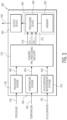
- FIG. 3 is a block diagram of a system 300 for measuring pressure from a pressure sensor, according to an embodiment.
- the system 300 may include a pressure sensor 100 configured to read a pressure force 140, an acceleration measurement system 310 (i.e., "first device") coupled to the pressure sensor 100 and may be configured to read an acceleration force 150 of the pressure sensor 100 and produce a measured acceleration 350, wherein the measured acceleration 350 may be used to adjust a measured pressure 340 at a processing device 380.
- the term "measured acceleration” means an acceleration that may be measured directly or indirectly or estimated.
- measured acceleration may be determined by a direct measurement using, e.g., an accelerometer or other system configured to measure acceleration directly.
- acceleration may be measured indirectly, e.g., by estimating acceleration from calculations based on a wheel speed, e.g., from a wheel speed sensor, an engine control unit, or other device that may be used to estimate the acceleration of the pressure sensor 100.
- a temperature sensor 360 may be configured to measure a temperature 362 and output a measured temperature 364 may be coupled to the pressure sensor 100.
- sensors pre-processing circuitry 370 may be used to amplify measured pressure 340.
- sensor pre-processing circuitry 370 may amplify measured one or more of measured acceleration 350 and measured temperature 364.
- a pre-processed output 372 may be fed to a processing device 380 (i.e., "second device").
- pre-processed output 372 may include pre-processed pressure output 374, pre-processed temperature output 375, and pre-processed acceleration output 376, according to an embodiment.
- pre-processed output 372 may include a signal bus that includes pre-processed output 372 may include pre-processed pressure output 374, pre-processed temperature output 375, and pre-processed acceleration output 376.
- Processing device 380 may be coupled to a memory device 382. Processing device 380 may be configured to read a measured pressure 340 from the pressure sensor 100.
- Processing device 380 may be further configured to adjust the measured pressure 340 of the pressure sensor if a pressure measurement output criteria (i.e., "output criteria") is met based on the measured acceleration 350, to produce an adjusted pressure reading 384, according to an embodiment.
- a pressure measurement output criteria i.e., "output criteria”
- an output device 390 may be configured to receive an output of the second device and may be configured to output an output pressure reading 392.
- Acceleration measurement system 310 may include a system for measuring an acceleration applied to pressure sensor 100, according to an embodiment.
- the acceleration measurement system 310 may include an accelerometer (e.g., a micro-electro-mechanical system (MEMs)-based inertial sensor).
- the accelerometer may be incorporated into a tire pressure monitoring system.
- the accelerometer may be located separately from the pressure sensor.
- the acceleration measurement system 310 may include one or more of an engine control unit, a braking control system, an engine control system, a stability control system, and an airbag control system (not shown).
- acceleration of the pressure sensor 100 may be determined similarly.
- engine revolutions per minute may be determined from an ECU and used with the gear ratio and wheel dimension, obtained from the ECU, body controller, or elsewhere to determine the wheel speed from which the acceleration force 150 may be estimated.
- wheel speed may be determined from a speedometer in a vehicle and used with the wheel dimension, obtained from the ECU, body controller, or elsewhere to estimate the acceleration force 150.
- Temperature sensor 360 may output measured temperature 364, according to an embodiment.
- Output measured temperature 364 may serve as an input to sensors pre-processing circuitry 370, according to an embodiment.
- measured temperature 364 may be used by processing device 380 to estimate changes in one or more properties of membrane 110, package flange 120, and/or gel layer 130 which may then be used to further correct estimates of the pressure force 140.
- the one or more properties may include stiffness of the membrane 110, stiffness of the gel layer 130, density of the gel layer 130, temperature-dependent stress of membrane 110, temperature-dependent stress of package flange 120, and any other temperature dependencies in the system, without limitation.
- the output of temperature sensor 360 may be used to calibrate the measured acceleration 350.
- processing device 380 may be used to calibrate the measured acceleration 350.
- Sensors pre-processing circuitry 370 may include circuitry for receiving measured pressure 340, measured acceleration 350, measured temperature 364, and then amplifying and conditioning these signals into pre-processed output 372 that may be read by processing device 380, according to an embodiment.
- sensors pre-processing circuit 370 may include amplifier circuitry.
- Pre-processed output 372 may include 4, pre-processed pressure output 374, pre-processed temperature output 375, and pre-processed acceleration output 376, according to an embodiment.
- sensor pre-processing circuitry 370 may also include analog-to-digital converter circuitry such that pre-processed output 372 includes a digital signal that may be processed by processing device 380. In other embodiments, pre-processed output 372 includes an analog signal.
- processing device 380 may be coupled to sensors pre-processing circuitry 370 and receives pre-processed output 372.
- processing device means any device or means that may be used to process or respond to pre-processed output 372.
- processing device 380 may include one or more of a microprocessor, a state machine, a micro-controller, an application-specific integrated circuit (ASIC), general-purpose computer, computing device, or other suitable device without limitation.
- processing device 380 may be coupled to a memory device 382.
- processing device 380 may be configured to adjust the measured pressure 340 of the pressure sensor 100 based on a height 132 of the gel layer 130 above the membrane 110 (i.e., "sensing element" of the pressure sensor, the density of the medium, and the acceleration of the pressure sensor, and the angle 155 of the acceleration with respect to a normal component above the sensing element of the pressure sensor ( ⁇ ).
- Output device 390 may be coupled to the output device 390 and may receive adjusted pressure reading 384, according to an embodiment.
- output device 390 may include one or more of a radio frequency (RF) transmitter, a wired connection, or other suitable means for producing an output pressure reading 392, according to an embodiment.
- RF radio frequency
- FIG. 4 is a flow diagram for a method 400 for measuring pressure of pressure sensor 100, according to an embodiment.
- FIG. 4 is best understood by viewing it together with FIG. 3 , described previously.
- the method may include reading, by the acceleration measurement system 310 of FIG. 3 (i.e., "first device"), the acceleration 150 of pressure sensor 110.
- the acceleration force 150 may alter a reading of the pressure sensor 100 due to the acceleration force 150, according to an embodiment.
- an embodiment of the method may include reading the acceleration of the pressure sensor 100 that may include, triggering the reading of the pressure sensor when an acceleration reading criteria is met, wherein the acceleration reading criteria includes whether reading a pre-determined number of acceleration readings of the pressure sensor.
- determining whether the acceleration reading criteria is met may include setting a counter to zero and setting a fixed number of acceleration measurements, N A . After setting the counter to zero, in sub-block 414, a delay may be taken before measuring and calibrating acceleration in sub-block 416, according to an embodiment.
- decision sub-block 418 it may be determined whether the fixed number of acceleration measurements, N A , has been met, according to an embodiment. In an embodiment, if the fixed number of acceleration measurements, N A , have been met, the pressure reading may be triggered in sub-block 420 and the counter may be reset in sub-block 421. However, if the fixed number of acceleration measurements, N A , has not been met, the counter may be incremented in sub-block 422.
- an embodiment of the method 400 may include reading, by the sensors pre-processing circuitry 370 and processing device 380 (i.e. "second device"), the measured pressure 340 from the pressure sensor 100 wherein, if a pressure measurement output criteria (i.e., "output criteria") is met, adjusting, the measured pressure 340 of the pressure sensor 100 based on the measured acceleration 350 to produce an adjusted pressure reading 384.
- a pressure measurement output criteria i.e., "output criteria”
- the pressure may be read according to an embodiment.
- the pressure measurement output criteria may include testing whether an enable signal is present, and wherein if the enable signal is present in decision sub-block 444 and if the most recent reading of measured acceleration 350 is in a specified range of acceleration values in decision sub-block 446, the pressure reading is adjusted in sub-block 448 and the output pressure reading includes the adjusted pressure reading in sub-block 476.
- the enable bit is not set in decision sub-block 444, and, according to sub-block 472, the pressure reading 384 includes an unadjusted pressure reading, according to an embodiment.
- the pressure reading 384 includes an unadjusted pressure reading in addition to a flag indicating that acceleration is out of range according to sub-block 474.
- the method 400 may include outputting, by output device 390, an output pressure reading 392, according to an embodiment.
Landscapes
- Physics & Mathematics (AREA)
- General Physics & Mathematics (AREA)
- Engineering & Computer Science (AREA)
- Mechanical Engineering (AREA)
- Chemical & Material Sciences (AREA)
- Analytical Chemistry (AREA)
- Measuring Fluid Pressure (AREA)
Abstract
Description
- Embodiments of the subject matter described herein relate generally to pressure sensors and methods for measuring pressure with pressure sensors.
- Pressure sensor devices find application in a wide variety of applications and systems. In particular, pressure sensors may be exposed to various environments that may affect their accuracy. Accordingly, there is a need for pressure sensors and methods for measuring pressure with increased accuracy.
- A more complete understanding of the subject matter may be derived by referring to the detailed description and claims when considered in conjunction with the following figures, wherein like reference numbers refer to similar elements throughout the figures.
-
FIGs 1A and 1B are cross-sectional, side views of an exemplary pressure sensor. -
FIG. 2 is a graphical representation of pressure in kilopascals versus acceleration in standard gravity units. -
FIG. 3 is a block diagram of a system for measuring pressure from a pressure sensor, according to an embodiment. -
FIG. 4 is a flow diagram for a method for measuring pressure of a pressure sensor, according to an embodiment. - In one aspect, an embodiment may include a method for reading pressure of a pressure sensor that is configured to read a pressure. The method may include reading, by a first device coupled to the pressure sensor subjected to an acceleration, a measured acceleration of the pressure sensor, wherein the pressure sensor may include a sensing element encapsulated in a medium, according to an embodiment, and wherein the acceleration may alter a measured pressure of the pressure sensor, according to an embodiment. The method may include reading, by a second device, a measured pressure from the pressure sensor, according to an embodiment. The method may also include adjusting the measured pressure of the pressure sensor based on the measured acceleration to produce an adjusted pressure reading, according to an embodiment. The method may include outputting, by an output device, an output pressure reading.
- In an embodiment, adjusting the measured pressure of the pressure sensor based on the measured acceleration to produce an adjusted pressure reading may occur if an output criteria is met.
- In an embodiment, the first device may include one of a wheel speed sensor, an engine control unit, a braking control system, an engine control system, a stability control system, and an airbag control system.
- In an embodiment, the pressure sensor may be included in a tire pressure monitoring system.
- In an embodiment, the first device may include an accelerometer.
- In an embodiment, reading the acceleration of the pressure sensor may include measuring and calibrating the acceleration of the pressure sensor.
- In an embodiment, measuring and calibrating the acceleration of the pressure sensor may include storing the acceleration in a memory device.
- In an embodiment, adjusting the measured pressure of the pressure sensor may be based on a height of the medium above a sensing element of the pressure sensor (h), a density of the medium (ρ), and the acceleration of the pressure sensor (a), and an angle of the acceleration with respect to a normal direction above the sensing element of the pressure sensor (θ).
- In an embodiment, adjusting the measured pressure of the pressure sensor may be estimated by a correction factor of ρ*a*h*cos(θ).
- In an embodiment, the output criteria may include whether an enable signal is present, and wherein if the output criteria is met, the output pressure reading includes the adjusted pressure reading, and wherein the output pressure reading includes an unadjusted pressure reading if the output criteria is not met.
- In an embodiment, the output criteria may include whether a most recent measured acceleration of a pre-determined number of measured accelerations is within a required range of acceleration values, and wherein the output pressure reading includes the adjusted pressure reading, and wherein the output pressure includes an unadjusted pressure if the output criteria is not met.
- In an embodiment, reading the acceleration of the pressure sensor may include reading the acceleration of the pressure sensor includes, triggering the reading of the pressure sensor when an acceleration reading criteria is met, wherein the acceleration reading criteria includes whether reading a pre-determined number of acceleration readings of the pressure sensor.
- In another aspect, an embodiment may include a pressure sensor encapsulated in a medium. A first device may be coupled to the pressure sensor and configured to read an acceleration of the pressure sensor, wherein the acceleration may alter a measured pressure from the pressure sensor, according to an embodiment. A second device may be configured to read a pressure from the pressure sensor wherein, if an output criteria is met, to adjust the measured pressure of the pressure sensor, based on a measured acceleration, to produce an adjusted pressure reading, according to an embodiment. In an embodiment, an output device configured to receive an output of the second device and configured to output an output pressure reading.
- The first device may include a wheel speed sensor, an engine control unit, a braking control system, an engine control system, a stability control system, and an airbag control system, according to an embodiment.
- The first device may include an accelerometer, according to an embodiment.
- The pressure sensor is included in a tire pressure monitoring system, according to an embodiment.
- In an embodiment, the second device may be selected from the group consisting of a micro-controller, a microprocessor, and a state machine.
- The second device may be configured to adjust the measured pressure of the pressure sensor based on a height of the medium above a sensing element of the pressure sensor (h), a density of the medium (ρ), and the acceleration of the pressure sensor (a), and an angle of the acceleration with respect to a normal component above the sensing element of the pressure sensor (θ), according to an embodiment.
- In an embodiment, the second device may adjust the pressure reading of the pressure sensor by an estimate given by ρ*a*h*cos(θ).
- The output device may be selected from a radio-frequency transmitter and a wired connection, according to an embodiment.
- The following detailed description is merely illustrative in nature and is not intended to limit the embodiments of the subject matter or the application and uses of such embodiments. As used herein, the words "exemplary" and "example" mean "serving as an example, instance, or illustration." Any implementation described herein as exemplary, or an example is not necessarily to be construed as preferred or advantageous over other implementations. Furthermore, there is no intention to be bound by any expressed or implied theory presented in the preceding technical field, background, or the following detailed description.
-
FIGs 1A and 1B , referred to collectively asFIG. 1 , are a cross-sectional, side views of apressure sensor 100, according to an embodiment. In an embodiment, thepressure sensor 100 may include a membrane 110 (i.e., "sensing element") having anupper surface 112 andlower surface 114 mounted onto apackage flange 120. Themembrane 110 may modulate an electrical signal through a change in resistance or capacitance when subjected to mechanical forces, according to an embodiment. Abonding layer 116 may be used to attach themembrane 110 to thepackage flange 120, according to an embodiment. In an embodiment, themembrane 110 may be bonded to thepackage flange 120 withinrecessed opening 122 within thepackage flange 120 usingbonding layer 116. A gel layer 130 (i.e., "material") may encapsulate themembrane 110 within thepackage flange 120, according to an embodiment. - In an embodiment, a
lower portion 106 of thepressure sensor 100 may be sealed from the environment theupper portion 108pressure sensor 100 is exposed to. The differential in pressure between the ambient environment and the sealed portion may causepressure force 140 to be exerted against the membrane, changing the current of an electrical voltage applied to the membrane, according to an embodiment. In an embodiment, pre-processing circuitry (depicted as sensors pre-processingcircuitry 370 inFIG. 3 ) may be electrically coupled to themembrane 110 throughleads 124 to measure and amplify the electrical modulated by thepressure sensor 100. For example, thepressure sensor 100 may be mounted in a tire pressure monitoring system (TPMS) module wherein thelower portion 106 is mounted to a portion of the TPMS module and sealed from the pressure environment, according to an embodiment. - In many applications, e.g., TPMS applications, the
membrane 110 of thepressure sensor 100 may be subject to anacceleration force 150, according to an embodiment. Theacceleration force 150 may act as an additional "pressure" that alters the electrical signal modulated by themembrane 110 in response to thepressure force 140. Because themembrane 110 has the greatest sensitivity to forces normal (i.e., 90 degrees) to theupper surface 112 of themembrane 110, anormal force component 154 may be used to characterize the sensitivity of a pressure reading of thepressure sensor 100, according to an embodiment. In an embodiment, a magnitude ofnormal force component 154 may be calculated using the relationship a*cos(θ) where a is the magnitude ofacceleration force 150 and θ is theangle 155 given in radians between theacceleration force 150 and thenormal force component 154. The normal force component may be combined with the product of the density of the gel layer, ρ and aheight 132, h, of the gel layer above theupper surface 112 ofmembrane 110, to produce an estimate of the effective pressure exerted onmembrane 110 byacceleration force 150 given by the Puff =ρ*a*h*cos(θ). In an embodiment, the density of the gel layer, ρ may be between about 1.5grams per cubic centimeter (g/cm3) and about 2.5 g/cm3, though higher or lower values may be used in other applications. In other embodiments, the density of the gel layer, ρ may be between about 0.5 g/cm3 and about 5 g/cm3, though higher or lower values may be used in other applications. Theheight 132, h, may be between about 100 micrometers and about 300 micrometers, though other higher or lower values may be used in other applications and within the scope of the inventive subject matter. In an embodiment, the reading of a pressure reading by thepressure sensor 100 may be corrected by the effective pressure, based on the relationship by Peff . -
FIG. 2 is agraphical representation 200 of pressure in kilopascals versus the magnitude of a magnitude ofnormal force component 154 in standard gravity unis, according to an embodiment.FIG. 2 , depicts anordinate 210 of pressure in kilopascals versus anabscissa 220 of standard gravity units, g where 1 g is defined at approximately 9.8065 meters per second squared (m/s2).Traces FIG. 1 .Traces pressure sensor 100 that is subjected to various acceleration levels in the context of a TPMS module. In this example, the values of ρ and h are 1.825 g/cm3 and 230 micrometers, respectively. Comparison oftraces traces FIG. 1 . InFIG. 2 , traces 234 and 244 represent operation of theupper surface 112 ofmembrane 110 facing away from the center of rotation (θ=180 degrees). Furthermore traces 230 and 240 represent operation with theupper surface 112 ofmembrane 110 facing the center of rotation the center of rotation (θ=0 degrees). At anexample point 250, the error in pressure due to acceleration force at a 100 mile-per-hour wheel speed is shown. -
FIG. 3 is a block diagram of asystem 300 for measuring pressure from a pressure sensor, according to an embodiment. In an embodiment, thesystem 300 may include apressure sensor 100 configured to read apressure force 140, an acceleration measurement system 310 (i.e., "first device") coupled to thepressure sensor 100 and may be configured to read anacceleration force 150 of thepressure sensor 100 and produce a measuredacceleration 350, wherein the measuredacceleration 350 may be used to adjust a measuredpressure 340 at aprocessing device 380. As used herein, the term "measured acceleration" means an acceleration that may be measured directly or indirectly or estimated. For example, in some embodiments, measured acceleration may be determined by a direct measurement using, e.g., an accelerometer or other system configured to measure acceleration directly. In other embodiments, acceleration may be measured indirectly, e.g., by estimating acceleration from calculations based on a wheel speed, e.g., from a wheel speed sensor, an engine control unit, or other device that may be used to estimate the acceleration of thepressure sensor 100. In some embodiments, atemperature sensor 360 may be configured to measure atemperature 362 and output a measuredtemperature 364 may be coupled to thepressure sensor 100. According to an embodiment,sensors pre-processing circuitry 370 may be used to amplify measuredpressure 340. In other embodiments,sensor pre-processing circuitry 370 may amplify measured one or more of measuredacceleration 350 and measuredtemperature 364. Apre-processed output 372 may be fed to a processing device 380 (i.e., "second device"). In some embodiments,pre-processed output 372 may includepre-processed pressure output 374,pre-processed temperature output 375, andpre-processed acceleration output 376, according to an embodiment. In an embodiment,pre-processed output 372 may include a signal bus that includespre-processed output 372 may includepre-processed pressure output 374,pre-processed temperature output 375, andpre-processed acceleration output 376.Processing device 380 may be coupled to amemory device 382.Processing device 380 may be configured to read a measuredpressure 340 from thepressure sensor 100.Processing device 380 may be further configured to adjust the measuredpressure 340 of the pressure sensor if a pressure measurement output criteria (i.e., "output criteria") is met based on the measuredacceleration 350, to produce an adjusted pressure reading 384, according to an embodiment. In an embodiment, anoutput device 390 may be configured to receive an output of the second device and may be configured to output an output pressure reading 392. -
Acceleration measurement system 310 may include a system for measuring an acceleration applied topressure sensor 100, according to an embodiment. In an embodiment, theacceleration measurement system 310 may include an accelerometer (e.g., a micro-electro-mechanical system (MEMs)-based inertial sensor). In these embodiments, the accelerometer may be incorporated into a tire pressure monitoring system. In other embodiments the accelerometer may be located separately from the pressure sensor. In other embodiments in automotive applications, theacceleration measurement system 310 may include one or more of an engine control unit, a braking control system, an engine control system, a stability control system, and an airbag control system (not shown). In these embodiments, estimates of theacceleration force 150 may be obtained by calculating theacceleration force 150 ofpressure sensor 100 in the context of a rotating environment, e.g., a tire pressure monitoring system or other application where the pressure sensor may rotate at a wheel speed, theacceleration force 150 may be computed using the relationship a=v 2/r where v is the tangential velocity of the wheel and r is the radius of the location of thepressure sensor 100 in relationship to the center of the wheel. In other embodiments, e.g., industrial machinery, engines, wherein thepressure sensor 100 may be located in a rotating environment, acceleration of thepressure sensor 100 may be determined similarly. For example, in an automotive application, engine revolutions per minute (RPM's) may be determined from an ECU and used with the gear ratio and wheel dimension, obtained from the ECU, body controller, or elsewhere to determine the wheel speed from which theacceleration force 150 may be estimated. In another example, wheel speed may be determined from a speedometer in a vehicle and used with the wheel dimension, obtained from the ECU, body controller, or elsewhere to estimate theacceleration force 150. -
Temperature sensor 360 may output measuredtemperature 364, according to an embodiment. Output measuredtemperature 364 may serve as an input tosensors pre-processing circuitry 370, according to an embodiment. In an embodiment, measuredtemperature 364 may be used by processingdevice 380 to estimate changes in one or more properties ofmembrane 110,package flange 120, and/orgel layer 130 which may then be used to further correct estimates of thepressure force 140. In an embodiment, the one or more properties may include stiffness of themembrane 110, stiffness of thegel layer 130, density of thegel layer 130, temperature-dependent stress ofmembrane 110, temperature-dependent stress ofpackage flange 120, and any other temperature dependencies in the system, without limitation. In an embodiment, the output oftemperature sensor 360 may be used to calibrate the measuredacceleration 350. In an embodiment,processing device 380 may be used to calibrate the measuredacceleration 350. -
Sensors pre-processing circuitry 370 may include circuitry for receiving measuredpressure 340, measuredacceleration 350, measuredtemperature 364, and then amplifying and conditioning these signals intopre-processed output 372 that may be read by processingdevice 380, according to an embodiment. In an embodiment,sensors pre-processing circuit 370 may include amplifier circuitry.Pre-processed output 372 may include 4,pre-processed pressure output 374,pre-processed temperature output 375, andpre-processed acceleration output 376, according to an embodiment. In some embodiments,sensor pre-processing circuitry 370 may also include analog-to-digital converter circuitry such thatpre-processed output 372 includes a digital signal that may be processed by processingdevice 380. In other embodiments,pre-processed output 372 includes an analog signal. - In an embodiment,
processing device 380 may be coupled tosensors pre-processing circuitry 370 and receivespre-processed output 372. As used herein, the term, "processing device" means any device or means that may be used to process or respond topre-processed output 372. In an embodiment,processing device 380 may include one or more of a microprocessor, a state machine, a micro-controller, an application-specific integrated circuit (ASIC), general-purpose computer, computing device, or other suitable device without limitation. In an embodiment,processing device 380 may be coupled to amemory device 382. In an embodiment,processing device 380 may be configured to adjust the measuredpressure 340 of thepressure sensor 100 based on aheight 132 of thegel layer 130 above the membrane 110 (i.e., "sensing element") of the pressure sensor, the density of the medium, and the acceleration of the pressure sensor, and theangle 155 of the acceleration with respect to a normal component above the sensing element of the pressure sensor (θ). In an embodiment, thememory device 382 of theoutput device 390 may store the parameters ρ, a, h, θ and adjust the pressure reading 340 of the pressure sensor by an estimate given by Peff=ρ*a*h*cos(θ). The estimate Peff may then be used to correct the measuredpressure 340 to arrive at adjusted pressure reading 384, according to an embodiment. -
Output device 390 may be coupled to theoutput device 390 and may receive adjusted pressure reading 384, according to an embodiment. In an embodiment,output device 390 may include one or more of a radio frequency (RF) transmitter, a wired connection, or other suitable means for producing an output pressure reading 392, according to an embodiment. -
FIG. 4 is a flow diagram for amethod 400 for measuring pressure ofpressure sensor 100, according to an embodiment.FIG. 4 is best understood by viewing it together withFIG. 3 , described previously. - Referring simultaneously to
FIG. 4 , block 410 andFIG. 3 , in an embodiment, the method may include reading, by theacceleration measurement system 310 ofFIG. 3 (i.e., "first device"), theacceleration 150 ofpressure sensor 110. In an embodiment, theacceleration force 150 may alter a reading of thepressure sensor 100 due to theacceleration force 150, according to an embodiment. - Referring simultaneously to
FIG. 4 , block 410 and sub-blocks 412-418, an embodiment of the method may include reading the acceleration of thepressure sensor 100 that may include, triggering the reading of the pressure sensor when an acceleration reading criteria is met, wherein the acceleration reading criteria includes whether reading a pre-determined number of acceleration readings of the pressure sensor. Referring to sub-block 412, in an embodiment, determining whether the acceleration reading criteria is met may include setting a counter to zero and setting a fixed number of acceleration measurements, NA. After setting the counter to zero, insub-block 414, a delay may be taken before measuring and calibrating acceleration insub-block 416, according to an embodiment. Indecision sub-block 418, it may be determined whether the fixed number of acceleration measurements, NA, has been met, according to an embodiment. In an embodiment, if the fixed number of acceleration measurements, NA, have been met, the pressure reading may be triggered insub-block 420 and the counter may be reset insub-block 421. However, if the fixed number of acceleration measurements, NA, has not been met, the counter may be incremented insub-block 422. - Referring simultaneously to
FIG. 4 , blocks 440 and 470 andFIG. 3 , an embodiment of themethod 400 may include reading, by thesensors pre-processing circuitry 370 and processing device 380 (i.e. "second device"), the measuredpressure 340 from thepressure sensor 100 wherein, if a pressure measurement output criteria (i.e., "output criteria") is met, adjusting, the measuredpressure 340 of thepressure sensor 100 based on the measuredacceleration 350 to produce an adjusted pressure reading 384. Insub-block 442, in an embodiment of the method, the pressure may be read according to an embodiment. Indecision sub-blocks decision sub-block 444 and if the most recent reading of measuredacceleration 350 is in a specified range of acceleration values indecision sub-block 446, the pressure reading is adjusted insub-block 448 and the output pressure reading includes the adjusted pressure reading insub-block 476. However, if the enable bit is not set indecision sub-block 444, and, according tosub-block 472, the pressure reading 384 includes an unadjusted pressure reading, according to an embodiment. Further, and in an embodiment, if the enable bit is set indecision sub-block 444 and the most recent reading of measuredacceleration 350 is out of the specified range indecision sub-block 446, the pressure reading 384 includes an unadjusted pressure reading in addition to a flag indicating that acceleration is out of range according tosub-block 474. Themethod 400 may include outputting, byoutput device 390, an output pressure reading 392, according to an embodiment. - While at least one exemplary embodiment has been presented in the foregoing detailed description, it should be appreciated that a vast number of variations exist. It should also be appreciated that the exemplary embodiment or embodiments described herein are not intended to limit the scope, applicability, or configuration of the claimed subject matter in any way. Rather, the foregoing detailed description will provide those skilled in the art with a convenient road map for implementing the described embodiment or embodiments. It should be understood that various changes can be made in the function and arrangement of elements without departing from the scope defined by the claims, which includes known equivalents and foreseeable equivalents at the time of filing this patent application.
- For the sake of brevity, conventional semiconductor fabrication techniques may not be described in detail herein. In addition, certain terminology may also be used herein for reference only, and thus are not intended to be limiting, and the terms "first", "second" and other such numerical terms referring to structures do not imply a sequence or order unless clearly indicated by the context.
- The foregoing description refers to elements or nodes or features being "connected" or "coupled" together. As used herein, unless expressly stated otherwise, "connected" means that one element is directly joined to (or directly communicates with) another element, and not necessarily mechanically. Likewise, unless expressly stated otherwise, "coupled" means that one element is directly or indirectly joined to (or directly or indirectly communicates with) another element, and not necessarily mechanically. Thus, although the schematic shown in the figures depict one exemplary arrangement of elements, additional intervening elements, devices, features, or components may be present in an embodiment of the depicted subject matter.
Claims (15)
- A method for reading pressure of a pressure sensor, the method comprising:reading, by a first device coupled to a pressure sensor subjected to an acceleration, a measured acceleration of the pressure sensor, wherein the pressure sensor that includes a sensing element encapsulated in a medium, and wherein the acceleration alters a measure pressure of the pressure sensor;reading, by a second device, a measured pressure from the pressure sensor;adjusting the measured pressure of the pressure sensor based on the measured acceleration to produce an adjusted pressure reading; andoutputting, by an output device, an output pressure reading.
- The method of claim 1, wherein adjusting the measured pressure of the pressure sensor based on the measured acceleration to produce an adjusted pressure reading occurs if an output criteria is met.
- The method of any of claims 1 to 2, wherein the first device is selected from the group consisting of a wheel speed sensor, an engine control unit, a braking control system, an engine control system, a stability control system, and an airbag control system.
- The method of any of claims 1 to 3, wherein the pressure sensor is included in a tire pressure monitoring system.
- The method of any of claims 1 to 4, wherein the first device includes an accelerometer.
- The method of any of claims 1 to 5, wherein reading the acceleration of the pressure sensor includes measuring and calibrating the acceleration of the pressure sensor.
- The method of claim 6, wherein measuring and calibrating the acceleration of the pressure sensor includes storing the acceleration in a memory device.
- The method of claim 7, wherein adjusting the measured pressure of the pressure sensor is based on a height of the medium above a sensing element of the pressure sensor (h), a density of the medium (ρ), and the acceleration of the pressure sensor (a), and an angle of the acceleration with respect to a normal direction above the sensing element of the pressure sensor (θ).
- The method of claim 8, wherein adjusting the measured pressure of the pressure sensor is estimated by a correction factor of ρ*a*h*cos(θ).
- The method of claim 2, wherein the output criteria comprises whether an enable signal is present, and wherein if the output criteria is met, the output pressure reading includes the adjusted pressure reading, and wherein the output pressure reading includes an unadjusted pressure reading if the output criteria is not met.
- The method of claim 10, wherein the output criteria further comprises whether a most recent measured acceleration of a pre-determined number of measured accelerations is within a required range of acceleration values, and wherein the output pressure reading includes the adjusted pressure reading, and wherein the output pressure includes an unadjusted pressure if the output criteria is not met.
- The method of any of claims 1 to 11, wherein reading the acceleration of the pressure sensor includes, triggering the reading of the pressure sensor when an acceleration reading criteria is met, wherein the acceleration reading criteria includes whether reading a pre-determined number of acceleration readings of the pressure sensor.
- A system comprising:
a pressure sensor encapsulated in a medium:a first device coupled to the pressure sensor and configured to read an acceleration of the pressure sensor, wherein the acceleration alters a measured pressure from the pressure sensor;a second device configured to read a pressure from the pressure sensor wherein, if an output criteria is met, to adjust the measured pressure of the pressure sensor, based on a measured acceleration, to produce an adjusted pressure reading; andan output device configured to receive an output of the second device and configured to output an output pressure reading. - The system of claim 13, wherein the second device is configured to adjust the measured pressure of the pressure sensor based on a height of the medium above a sensing element of the pressure sensor (h), a density of the medium (ρ), and the acceleration of the pressure sensor (a), and an angle of the acceleration with respect to a normal component above the sensing element of the pressure sensor (θ).
- The system of any of claims 13 to 14, wherein the second device adjusts the pressure reading of the pressure sensor by an estimate given by ρ*a*h*cos(θ).
Applications Claiming Priority (1)
| Application Number | Priority Date | Filing Date | Title |
|---|---|---|---|
| US18/063,388 US20240192072A1 (en) | 2022-12-08 | 2022-12-08 | System for reading pressure of a pressure sensor and method therefor |
Publications (1)
| Publication Number | Publication Date |
|---|---|
| EP4382878A1 true EP4382878A1 (en) | 2024-06-12 |
Family
ID=88778219
Family Applications (1)
| Application Number | Title | Priority Date | Filing Date |
|---|---|---|---|
| EP23208993.8A Pending EP4382878A1 (en) | 2022-12-08 | 2023-11-10 | System for reading pressure of a pressure sensor and method therefor |
Country Status (3)
| Country | Link |
|---|---|
| US (1) | US20240192072A1 (en) |
| EP (1) | EP4382878A1 (en) |
| CN (1) | CN118168709A (en) |
Citations (2)
| Publication number | Priority date | Publication date | Assignee | Title |
|---|---|---|---|---|
| US20050000293A1 (en) * | 2003-07-01 | 2005-01-06 | Infineon Technologies Ag | Pressure sensor and method for detecting an effective pressure |
| WO2009101566A1 (en) * | 2008-02-15 | 2009-08-20 | Koninklijke Philips Electronics N.V. | Compensating pressure sensor measurements |
Family Cites Families (7)
| Publication number | Priority date | Publication date | Assignee | Title |
|---|---|---|---|---|
| US2808545A (en) * | 1955-01-24 | 1957-10-01 | Walter J Hirtreiter | Pressure pick-up-differential-type acceleration-free |
| US3962921A (en) * | 1972-02-04 | 1976-06-15 | The Garrett Corporation | Compensated pressure transducer |
| US6536287B2 (en) * | 2001-08-16 | 2003-03-25 | Honeywell International, Inc. | Simplified capacitance pressure sensor |
| JPWO2005019790A1 (en) * | 2003-08-26 | 2006-10-19 | 松下電工株式会社 | Sensor device |
| US7331209B2 (en) * | 2004-10-04 | 2008-02-19 | Mts Systems Corporation | Transducer acceleration compensation with frequency domain amplitude and/or phase compensation |
| EP3640600B1 (en) * | 2018-10-16 | 2023-03-29 | Infineon Technologies AG | Device and method for self-correcting a sensed physical parameter in a drone or unmanned aerial vehicle |
| US11359985B2 (en) * | 2019-08-12 | 2022-06-14 | Kulite Semiconductor Products, Inc. | Oil filled transducers with isolated compensating capsule |
-
2022
- 2022-12-08 US US18/063,388 patent/US20240192072A1/en active Pending
-
2023
- 2023-11-10 EP EP23208993.8A patent/EP4382878A1/en active Pending
- 2023-11-16 CN CN202311532632.8A patent/CN118168709A/en active Pending
Patent Citations (2)
| Publication number | Priority date | Publication date | Assignee | Title |
|---|---|---|---|---|
| US20050000293A1 (en) * | 2003-07-01 | 2005-01-06 | Infineon Technologies Ag | Pressure sensor and method for detecting an effective pressure |
| WO2009101566A1 (en) * | 2008-02-15 | 2009-08-20 | Koninklijke Philips Electronics N.V. | Compensating pressure sensor measurements |
Non-Patent Citations (1)
| Title |
|---|
| ZYGMUNT SZCZERBA: "Sensitivity of Piezoresistive Pressure Sensors to Acceleration", vol. 15, no. 2, 11 January 2022 (2022-01-11), CH, pages 493, XP093153915, ISSN: 1996-1073, Retrieved from the Internet <URL:http://www.mdpi.org/energies/index-200809.htm> [retrieved on 20240422], DOI: 10.3390/en15020493 * |
Also Published As
| Publication number | Publication date |
|---|---|
| CN118168709A (en) | 2024-06-11 |
| US20240192072A1 (en) | 2024-06-13 |
Similar Documents
| Publication | Publication Date | Title |
|---|---|---|
| CN102341712B (en) | Method for automatically calibrating acceleration sensors mounted on wheels of a vehicle while the vehicle is moving | |
| CN115335242B (en) | Tread depth is determined using data from tire mounting sensors. | |
| US7359816B2 (en) | Sensor calibration method and apparatus | |
| KR101741234B1 (en) | System and method for inertial sensor offset compensation | |
| US9977047B2 (en) | Method and device for calibrating an acceleration sensor in a motor vehicle | |
| WO1997046889A1 (en) | Vehicle information and control system | |
| US11874291B2 (en) | Method for temperature compensation of a microelectromechanical sensor, and microelectromechanical sensor | |
| WO1997046889A9 (en) | Vehicle information and control system | |
| US20140208849A1 (en) | Teeter Totter Accelerometer with Unbalanced Mass | |
| CN111164372B (en) | Method for determining the thickness of a motor vehicle tire | |
| US20220260610A1 (en) | Safe measurement of tire characteristics | |
| EP4382878A1 (en) | System for reading pressure of a pressure sensor and method therefor | |
| JP6741913B2 (en) | Magnetic sensor Rotation detector using this | |
| US5698785A (en) | Self-compensating accelerometer | |
| CN111649871A (en) | Detect contamination of pressure sensors based on cross-sensitivity to acceleration | |
| CN114076830A (en) | Sensor system and method for operating a sensor system | |
| JP2000074931A (en) | Vehicle speed detection device | |
| JPH09159691A (en) | Acceleration sensor | |
| JP2005526249A (en) | Method and sensor device for detecting movement of element | |
| WO2002059627A1 (en) | System and method for calibrating an accelerometer assembly | |
| US12153063B2 (en) | Micromechanical inertial sensor | |
| JP5097438B2 (en) | Tire dynamic load radius reference value initialization method and apparatus, and tire dynamic load radius reference value initialization program | |
| August et al. | Acceleration sensitivity of micromachined pressure sensors | |
| SE2550459A1 (en) | High accuracy estimation of wheel angle using wheel mounted imu and wheel encoder for slow speed driving | |
| Schier et al. | Micromechanical sensors for vehicle dynamics control systems |
Legal Events
| Date | Code | Title | Description |
|---|---|---|---|
| PUAI | Public reference made under article 153(3) epc to a published international application that has entered the european phase |
Free format text: ORIGINAL CODE: 0009012 |
|
| STAA | Information on the status of an ep patent application or granted ep patent |
Free format text: STATUS: THE APPLICATION HAS BEEN PUBLISHED |
|
| AK | Designated contracting states |
Kind code of ref document: A1 Designated state(s): AL AT BE BG CH CY CZ DE DK EE ES FI FR GB GR HR HU IE IS IT LI LT LU LV MC ME MK MT NL NO PL PT RO RS SE SI SK SM TR |
|
| STAA | Information on the status of an ep patent application or granted ep patent |
Free format text: STATUS: REQUEST FOR EXAMINATION WAS MADE |
|
| 17P | Request for examination filed |
Effective date: 20241212 |
|
| STAA | Information on the status of an ep patent application or granted ep patent |
Free format text: STATUS: EXAMINATION IS IN PROGRESS |
|
| RAP1 | Party data changed (applicant data changed or rights of an application transferred) |
Owner name: STMICROELECTRONICS INTERNATIONAL N.V. |