EP4382558A1 - Film having methacrylic acid ester-based resin as main component thereof - Google Patents
Film having methacrylic acid ester-based resin as main component thereof Download PDFInfo
- Publication number
- EP4382558A1 EP4382558A1 EP22852828.7A EP22852828A EP4382558A1 EP 4382558 A1 EP4382558 A1 EP 4382558A1 EP 22852828 A EP22852828 A EP 22852828A EP 4382558 A1 EP4382558 A1 EP 4382558A1
- Authority
- EP
- European Patent Office
- Prior art keywords
- film
- based resin
- acid ester
- mass
- parts
- Prior art date
- Legal status (The legal status is an assumption and is not a legal conclusion. Google has not performed a legal analysis and makes no representation as to the accuracy of the status listed.)
- Withdrawn
Links
- 239000011347 resin Substances 0.000 title claims abstract description 188
- 229920005989 resin Polymers 0.000 title claims abstract description 188
- 125000005397 methacrylic acid ester group Chemical group 0.000 title claims abstract description 62
- 239000002245 particle Substances 0.000 claims abstract description 90
- BQCIDUSAKPWEOX-UHFFFAOYSA-N 1,1-Difluoroethene Chemical compound FC(F)=C BQCIDUSAKPWEOX-UHFFFAOYSA-N 0.000 claims abstract description 54
- CERQOIWHTDAKMF-UHFFFAOYSA-N Methacrylic acid Chemical compound CC(=C)C(O)=O CERQOIWHTDAKMF-UHFFFAOYSA-N 0.000 claims abstract description 47
- 229920001577 copolymer Polymers 0.000 claims description 10
- 230000003287 optical effect Effects 0.000 claims description 8
- HCDGVLDPFQMKDK-UHFFFAOYSA-N hexafluoropropylene Chemical group FC(F)=C(F)C(F)(F)F HCDGVLDPFQMKDK-UHFFFAOYSA-N 0.000 claims description 7
- 239000002033 PVDF binder Substances 0.000 claims description 5
- 229920002981 polyvinylidene fluoride Polymers 0.000 claims description 5
- 230000000903 blocking effect Effects 0.000 abstract description 14
- 239000010410 layer Substances 0.000 description 47
- 229910052751 metal Inorganic materials 0.000 description 32
- 239000002184 metal Substances 0.000 description 32
- 238000000034 method Methods 0.000 description 31
- 239000002344 surface layer Substances 0.000 description 24
- 239000000463 material Substances 0.000 description 21
- 239000011342 resin composition Substances 0.000 description 17
- 230000003746 surface roughness Effects 0.000 description 16
- 239000000203 mixture Substances 0.000 description 14
- 239000000178 monomer Substances 0.000 description 14
- 238000000465 moulding Methods 0.000 description 13
- 238000006116 polymerization reaction Methods 0.000 description 13
- 239000002356 single layer Substances 0.000 description 11
- 239000006097 ultraviolet radiation absorber Substances 0.000 description 11
- 229920001971 elastomer Polymers 0.000 description 9
- 238000009472 formulation Methods 0.000 description 9
- SOGAXMICEFXMKE-UHFFFAOYSA-N Butylmethacrylate Chemical compound CCCCOC(=O)C(C)=C SOGAXMICEFXMKE-UHFFFAOYSA-N 0.000 description 8
- VVQNEPGJFQJSBK-UHFFFAOYSA-N Methyl methacrylate Chemical compound COC(=O)C(C)=C VVQNEPGJFQJSBK-UHFFFAOYSA-N 0.000 description 8
- 239000000126 substance Substances 0.000 description 8
- 239000004925 Acrylic resin Substances 0.000 description 7
- 229920000178 Acrylic resin Polymers 0.000 description 7
- 230000000052 comparative effect Effects 0.000 description 7
- 238000001125 extrusion Methods 0.000 description 7
- -1 ethylene, propylene, isobutylene Chemical group 0.000 description 6
- 229920001519 homopolymer Polymers 0.000 description 6
- 150000001875 compounds Chemical class 0.000 description 5
- 238000002844 melting Methods 0.000 description 5
- 230000008018 melting Effects 0.000 description 5
- KAKZBPTYRLMSJV-UHFFFAOYSA-N Butadiene Chemical compound C=CC=C KAKZBPTYRLMSJV-UHFFFAOYSA-N 0.000 description 4
- YCKRFDGAMUMZLT-UHFFFAOYSA-N Fluorine atom Chemical compound [F] YCKRFDGAMUMZLT-UHFFFAOYSA-N 0.000 description 4
- PPBRXRYQALVLMV-UHFFFAOYSA-N Styrene Chemical compound C=CC1=CC=CC=C1 PPBRXRYQALVLMV-UHFFFAOYSA-N 0.000 description 4
- 239000012790 adhesive layer Substances 0.000 description 4
- 238000001816 cooling Methods 0.000 description 4
- 239000000498 cooling water Substances 0.000 description 4
- 229910052731 fluorine Inorganic materials 0.000 description 4
- 239000011737 fluorine Substances 0.000 description 4
- 238000001864 heat-flux differential scanning calorimetry Methods 0.000 description 4
- 238000003475 lamination Methods 0.000 description 4
- 239000011159 matrix material Substances 0.000 description 4
- 239000000155 melt Substances 0.000 description 4
- 238000002834 transmittance Methods 0.000 description 4
- RSWGJHLUYNHPMX-UHFFFAOYSA-N 1,4a-dimethyl-7-propan-2-yl-2,3,4,4b,5,6,10,10a-octahydrophenanthrene-1-carboxylic acid Chemical compound C12CCC(C(C)C)=CC2=CCC2C1(C)CCCC2(C)C(O)=O RSWGJHLUYNHPMX-UHFFFAOYSA-N 0.000 description 3
- NIXOWILDQLNWCW-UHFFFAOYSA-M Acrylate Chemical compound [O-]C(=O)C=C NIXOWILDQLNWCW-UHFFFAOYSA-M 0.000 description 3
- MUBZPKHOEPUJKR-UHFFFAOYSA-N Oxalic acid Chemical compound OC(=O)C(O)=O MUBZPKHOEPUJKR-UHFFFAOYSA-N 0.000 description 3
- NIXOWILDQLNWCW-UHFFFAOYSA-N acrylic acid group Chemical group C(C=C)(=O)O NIXOWILDQLNWCW-UHFFFAOYSA-N 0.000 description 3
- 239000000853 adhesive Substances 0.000 description 3
- 230000001070 adhesive effect Effects 0.000 description 3
- CQEYYJKEWSMYFG-UHFFFAOYSA-N butyl acrylate Chemical compound CCCCOC(=O)C=C CQEYYJKEWSMYFG-UHFFFAOYSA-N 0.000 description 3
- 238000013461 design Methods 0.000 description 3
- 238000009826 distribution Methods 0.000 description 3
- 229920003229 poly(methyl methacrylate) Polymers 0.000 description 3
- 239000004926 polymethyl methacrylate Substances 0.000 description 3
- 238000010526 radical polymerization reaction Methods 0.000 description 3
- JYEUMXHLPRZUAT-UHFFFAOYSA-N 1,2,3-triazine Chemical compound C1=CN=NN=C1 JYEUMXHLPRZUAT-UHFFFAOYSA-N 0.000 description 2
- MYRTYDVEIRVNKP-UHFFFAOYSA-N 1,2-Divinylbenzene Chemical compound C=CC1=CC=CC=C1C=C MYRTYDVEIRVNKP-UHFFFAOYSA-N 0.000 description 2
- NLHHRLWOUZZQLW-UHFFFAOYSA-N Acrylonitrile Chemical compound C=CC#N NLHHRLWOUZZQLW-UHFFFAOYSA-N 0.000 description 2
- 238000003855 Adhesive Lamination Methods 0.000 description 2
- QIGBRXMKCJKVMJ-UHFFFAOYSA-N Hydroquinone Chemical compound OC1=CC=C(O)C=C1 QIGBRXMKCJKVMJ-UHFFFAOYSA-N 0.000 description 2
- RRHGJUQNOFWUDK-UHFFFAOYSA-N Isoprene Chemical compound CC(=C)C=C RRHGJUQNOFWUDK-UHFFFAOYSA-N 0.000 description 2
- 239000004820 Pressure-sensitive adhesive Substances 0.000 description 2
- 239000006096 absorbing agent Substances 0.000 description 2
- 125000000217 alkyl group Chemical group 0.000 description 2
- 239000003963 antioxidant agent Substances 0.000 description 2
- 239000012964 benzotriazole Substances 0.000 description 2
- 229920001400 block copolymer Polymers 0.000 description 2
- 239000002981 blocking agent Substances 0.000 description 2
- 239000003795 chemical substances by application Substances 0.000 description 2
- UUAGAQFQZIEFAH-UHFFFAOYSA-N chlorotrifluoroethylene Chemical group FC(F)=C(F)Cl UUAGAQFQZIEFAH-UHFFFAOYSA-N 0.000 description 2
- 239000003086 colorant Substances 0.000 description 2
- 239000002826 coolant Substances 0.000 description 2
- 239000003484 crystal nucleating agent Substances 0.000 description 2
- 238000001938 differential scanning calorimetry curve Methods 0.000 description 2
- 230000000694 effects Effects 0.000 description 2
- 238000007720 emulsion polymerization reaction Methods 0.000 description 2
- 239000003063 flame retardant Substances 0.000 description 2
- XUCNUKMRBVNAPB-UHFFFAOYSA-N fluoroethene Chemical compound FC=C XUCNUKMRBVNAPB-UHFFFAOYSA-N 0.000 description 2
- 239000004088 foaming agent Substances 0.000 description 2
- 230000009477 glass transition Effects 0.000 description 2
- 125000003055 glycidyl group Chemical group C(C1CO1)* 0.000 description 2
- 229920000578 graft copolymer Polymers 0.000 description 2
- 239000012760 heat stabilizer Substances 0.000 description 2
- 238000010438 heat treatment Methods 0.000 description 2
- 239000012948 isocyanate Substances 0.000 description 2
- 150000002513 isocyanates Chemical class 0.000 description 2
- 238000004898 kneading Methods 0.000 description 2
- 238000010030 laminating Methods 0.000 description 2
- 238000007561 laser diffraction method Methods 0.000 description 2
- 239000004611 light stabiliser Substances 0.000 description 2
- 238000004519 manufacturing process Methods 0.000 description 2
- 238000005259 measurement Methods 0.000 description 2
- 239000006082 mold release agent Substances 0.000 description 2
- 239000000049 pigment Substances 0.000 description 2
- 239000004014 plasticizer Substances 0.000 description 2
- 229920000058 polyacrylate Polymers 0.000 description 2
- 229920005862 polyol Polymers 0.000 description 2
- 238000002360 preparation method Methods 0.000 description 2
- 230000009993 protective function Effects 0.000 description 2
- 239000011241 protective layer Substances 0.000 description 2
- 238000000790 scattering method Methods 0.000 description 2
- 229910001220 stainless steel Inorganic materials 0.000 description 2
- 239000010935 stainless steel Substances 0.000 description 2
- 238000010557 suspension polymerization reaction Methods 0.000 description 2
- 238000012360 testing method Methods 0.000 description 2
- BFKJFAAPBSQJPD-UHFFFAOYSA-N tetrafluoroethene Chemical group FC(F)=C(F)F BFKJFAAPBSQJPD-UHFFFAOYSA-N 0.000 description 2
- 238000009823 thermal lamination Methods 0.000 description 2
- 238000012546 transfer Methods 0.000 description 2
- 238000007740 vapor deposition Methods 0.000 description 2
- 229920002554 vinyl polymer Polymers 0.000 description 2
- DTCCVIYSGXONHU-CJHDCQNGSA-N (z)-2-(2-phenylethenyl)but-2-enedioic acid Chemical compound OC(=O)\C=C(C(O)=O)\C=CC1=CC=CC=C1 DTCCVIYSGXONHU-CJHDCQNGSA-N 0.000 description 1
- NVZWEEGUWXZOKI-UHFFFAOYSA-N 1-ethenyl-2-methylbenzene Chemical compound CC1=CC=CC=C1C=C NVZWEEGUWXZOKI-UHFFFAOYSA-N 0.000 description 1
- VZSRBBMJRBPUNF-UHFFFAOYSA-N 2-(2,3-dihydro-1H-inden-2-ylamino)-N-[3-oxo-3-(2,4,6,7-tetrahydrotriazolo[4,5-c]pyridin-5-yl)propyl]pyrimidine-5-carboxamide Chemical compound C1C(CC2=CC=CC=C12)NC1=NC=C(C=N1)C(=O)NCCC(N1CC2=C(CC1)NN=N2)=O VZSRBBMJRBPUNF-UHFFFAOYSA-N 0.000 description 1
- QMIWYOZFFSLIAK-UHFFFAOYSA-N 3,3,3-trifluoro-2-(trifluoromethyl)prop-1-ene Chemical group FC(F)(F)C(=C)C(F)(F)F QMIWYOZFFSLIAK-UHFFFAOYSA-N 0.000 description 1
- DXIJHCSGLOHNES-UHFFFAOYSA-N 3,3-dimethylbut-1-enylbenzene Chemical compound CC(C)(C)C=CC1=CC=CC=C1 DXIJHCSGLOHNES-UHFFFAOYSA-N 0.000 description 1
- JLBJTVDPSNHSKJ-UHFFFAOYSA-N 4-Methylstyrene Chemical compound CC1=CC=C(C=C)C=C1 JLBJTVDPSNHSKJ-UHFFFAOYSA-N 0.000 description 1
- DEXFNLNNUZKHNO-UHFFFAOYSA-N 6-[3-[4-[2-(2,3-dihydro-1H-inden-2-ylamino)pyrimidin-5-yl]piperidin-1-yl]-3-oxopropyl]-3H-1,3-benzoxazol-2-one Chemical compound C1C(CC2=CC=CC=C12)NC1=NC=C(C=N1)C1CCN(CC1)C(CCC1=CC2=C(NC(O2)=O)C=C1)=O DEXFNLNNUZKHNO-UHFFFAOYSA-N 0.000 description 1
- 229920001651 Cyanoacrylate Polymers 0.000 description 1
- VGGSQFUCUMXWEO-UHFFFAOYSA-N Ethene Chemical compound C=C VGGSQFUCUMXWEO-UHFFFAOYSA-N 0.000 description 1
- JIGUQPWFLRLWPJ-UHFFFAOYSA-N Ethyl acrylate Chemical compound CCOC(=O)C=C JIGUQPWFLRLWPJ-UHFFFAOYSA-N 0.000 description 1
- JOYRKODLDBILNP-UHFFFAOYSA-N Ethyl urethane Chemical compound CCOC(N)=O JOYRKODLDBILNP-UHFFFAOYSA-N 0.000 description 1
- 239000005977 Ethylene Substances 0.000 description 1
- 229920000028 Gradient copolymer Polymers 0.000 description 1
- 101000642347 Homo sapiens Splicing factor 45 Proteins 0.000 description 1
- 229920009370 Kynar® 1000 HD Polymers 0.000 description 1
- MWCLLHOVUTZFKS-UHFFFAOYSA-N Methyl cyanoacrylate Chemical compound COC(=O)C(=C)C#N MWCLLHOVUTZFKS-UHFFFAOYSA-N 0.000 description 1
- GYCMBHHDWRMZGG-UHFFFAOYSA-N Methylacrylonitrile Chemical compound CC(=C)C#N GYCMBHHDWRMZGG-UHFFFAOYSA-N 0.000 description 1
- 239000000020 Nitrocellulose Substances 0.000 description 1
- 229920002319 Poly(methyl acrylate) Polymers 0.000 description 1
- OFOBLEOULBTSOW-UHFFFAOYSA-N Propanedioic acid Natural products OC(=O)CC(O)=O OFOBLEOULBTSOW-UHFFFAOYSA-N 0.000 description 1
- 102100036374 Splicing factor 45 Human genes 0.000 description 1
- XTXRWKRVRITETP-UHFFFAOYSA-N Vinyl acetate Chemical compound CC(=O)OC=C XTXRWKRVRITETP-UHFFFAOYSA-N 0.000 description 1
- 229920000800 acrylic rubber Polymers 0.000 description 1
- 239000000654 additive Substances 0.000 description 1
- 150000001336 alkenes Chemical class 0.000 description 1
- XYLMUPLGERFSHI-UHFFFAOYSA-N alpha-Methylstyrene Chemical compound CC(=C)C1=CC=CC=C1 XYLMUPLGERFSHI-UHFFFAOYSA-N 0.000 description 1
- 150000001412 amines Chemical class 0.000 description 1
- 238000010539 anionic addition polymerization reaction Methods 0.000 description 1
- 230000008901 benefit Effects 0.000 description 1
- RWCCWEUUXYIKHB-UHFFFAOYSA-N benzophenone Chemical compound C=1C=CC=CC=1C(=O)C1=CC=CC=C1 RWCCWEUUXYIKHB-UHFFFAOYSA-N 0.000 description 1
- 239000012965 benzophenone Substances 0.000 description 1
- QRUDEWIWKLJBPS-UHFFFAOYSA-N benzotriazole Chemical compound C1=CC=C2N[N][N]C2=C1 QRUDEWIWKLJBPS-UHFFFAOYSA-N 0.000 description 1
- 230000000740 bleeding effect Effects 0.000 description 1
- 238000012662 bulk polymerization Methods 0.000 description 1
- 125000000484 butyl group Chemical group [H]C([*])([H])C([H])([H])C([H])([H])C([H])([H])[H] 0.000 description 1
- 150000001732 carboxylic acid derivatives Chemical class 0.000 description 1
- 230000008859 change Effects 0.000 description 1
- 239000011248 coating agent Substances 0.000 description 1
- 238000000576 coating method Methods 0.000 description 1
- 239000000470 constituent Substances 0.000 description 1
- 239000006071 cream Substances 0.000 description 1
- 239000013078 crystal Substances 0.000 description 1
- 230000001186 cumulative effect Effects 0.000 description 1
- 229920000359 diblock copolymer Polymers 0.000 description 1
- 150000001993 dienes Chemical class 0.000 description 1
- 230000009977 dual effect Effects 0.000 description 1
- MEGHWIAOTJPCHQ-UHFFFAOYSA-N ethenyl butanoate Chemical compound CCCC(=O)OC=C MEGHWIAOTJPCHQ-UHFFFAOYSA-N 0.000 description 1
- SUPCQIBBMFXVTL-UHFFFAOYSA-N ethyl 2-methylprop-2-enoate Chemical compound CCOC(=O)C(C)=C SUPCQIBBMFXVTL-UHFFFAOYSA-N 0.000 description 1
- 238000011156 evaluation Methods 0.000 description 1
- 238000010528 free radical solution polymerization reaction Methods 0.000 description 1
- 125000000524 functional group Chemical group 0.000 description 1
- 230000004927 fusion Effects 0.000 description 1
- PBZROIMXDZTJDF-UHFFFAOYSA-N hepta-1,6-dien-4-one Chemical compound C=CCC(=O)CC=C PBZROIMXDZTJDF-UHFFFAOYSA-N 0.000 description 1
- 230000006872 improvement Effects 0.000 description 1
- 229910052738 indium Inorganic materials 0.000 description 1
- APFVFJFRJDLVQX-UHFFFAOYSA-N indium atom Chemical compound [In] APFVFJFRJDLVQX-UHFFFAOYSA-N 0.000 description 1
- 238000010551 living anionic polymerization reaction Methods 0.000 description 1
- 238000010552 living cationic polymerization reaction Methods 0.000 description 1
- 239000002932 luster Substances 0.000 description 1
- VZCYOOQTPOCHFL-UPHRSURJSA-N maleic acid Chemical compound OC(=O)\C=C/C(O)=O VZCYOOQTPOCHFL-UPHRSURJSA-N 0.000 description 1
- 239000011976 maleic acid Substances 0.000 description 1
- FPYJFEHAWHCUMM-UHFFFAOYSA-N maleic anhydride Chemical compound O=C1OC(=O)C=C1 FPYJFEHAWHCUMM-UHFFFAOYSA-N 0.000 description 1
- 238000000691 measurement method Methods 0.000 description 1
- 229910044991 metal oxide Inorganic materials 0.000 description 1
- 150000004706 metal oxides Chemical class 0.000 description 1
- 150000002739 metals Chemical class 0.000 description 1
- 229920003145 methacrylic acid copolymer Polymers 0.000 description 1
- 238000002156 mixing Methods 0.000 description 1
- 150000004767 nitrides Chemical class 0.000 description 1
- 229920001220 nitrocellulos Polymers 0.000 description 1
- 229910052755 nonmetal Inorganic materials 0.000 description 1
- 150000002843 nonmetals Chemical class 0.000 description 1
- JRZJOMJEPLMPRA-UHFFFAOYSA-N olefin Natural products CCCCCCCC=C JRZJOMJEPLMPRA-UHFFFAOYSA-N 0.000 description 1
- 235000006408 oxalic acid Nutrition 0.000 description 1
- PNJWIWWMYCMZRO-UHFFFAOYSA-N pent‐4‐en‐2‐one Natural products CC(=O)CC=C PNJWIWWMYCMZRO-UHFFFAOYSA-N 0.000 description 1
- 229920001483 poly(ethyl methacrylate) polymer Polymers 0.000 description 1
- 229920001225 polyester resin Polymers 0.000 description 1
- 229920000120 polyethyl acrylate Polymers 0.000 description 1
- 229920000642 polymer Polymers 0.000 description 1
- 150000003077 polyols Chemical class 0.000 description 1
- 239000004814 polyurethane Substances 0.000 description 1
- 229920002635 polyurethane Polymers 0.000 description 1
- 230000008569 process Effects 0.000 description 1
- QQONPFPTGQHPMA-UHFFFAOYSA-N propylene Natural products CC=C QQONPFPTGQHPMA-UHFFFAOYSA-N 0.000 description 1
- 125000004805 propylene group Chemical group [H]C([H])([H])C([H])([*:1])C([H])([H])[*:2] 0.000 description 1
- 229920005604 random copolymer Polymers 0.000 description 1
- 230000009467 reduction Effects 0.000 description 1
- 238000011160 research Methods 0.000 description 1
- 229940058287 salicylic acid derivative anticestodals Drugs 0.000 description 1
- 150000003872 salicylic acid derivatives Chemical class 0.000 description 1
- 238000003860 storage Methods 0.000 description 1
- 230000000475 sunscreen effect Effects 0.000 description 1
- 239000000516 sunscreening agent Substances 0.000 description 1
- VZCYOOQTPOCHFL-UHFFFAOYSA-N trans-butenedioic acid Natural products OC(=O)C=CC(O)=O VZCYOOQTPOCHFL-UHFFFAOYSA-N 0.000 description 1
- 229920000428 triblock copolymer Polymers 0.000 description 1
- 238000007666 vacuum forming Methods 0.000 description 1
- 125000000391 vinyl group Chemical group [H]C([*])=C([H])[H] 0.000 description 1
- FUSUHKVFWTUUBE-UHFFFAOYSA-N vinyl methyl ketone Natural products CC(=O)C=C FUSUHKVFWTUUBE-UHFFFAOYSA-N 0.000 description 1
- 230000037303 wrinkles Effects 0.000 description 1
Images
Classifications
-
- B—PERFORMING OPERATIONS; TRANSPORTING
- B32—LAYERED PRODUCTS
- B32B—LAYERED PRODUCTS, i.e. PRODUCTS BUILT-UP OF STRATA OF FLAT OR NON-FLAT, e.g. CELLULAR OR HONEYCOMB, FORM
- B32B27/00—Layered products comprising a layer of synthetic resin
-
- B—PERFORMING OPERATIONS; TRANSPORTING
- B29—WORKING OF PLASTICS; WORKING OF SUBSTANCES IN A PLASTIC STATE IN GENERAL
- B29C—SHAPING OR JOINING OF PLASTICS; SHAPING OF MATERIAL IN A PLASTIC STATE, NOT OTHERWISE PROVIDED FOR; AFTER-TREATMENT OF THE SHAPED PRODUCTS, e.g. REPAIRING
- B29C48/00—Extrusion moulding, i.e. expressing the moulding material through a die or nozzle which imparts the desired form; Apparatus therefor
- B29C48/03—Extrusion moulding, i.e. expressing the moulding material through a die or nozzle which imparts the desired form; Apparatus therefor characterised by the shape of the extruded material at extrusion
- B29C48/12—Articles with an irregular circumference when viewed in cross-section, e.g. window profiles
-
- B—PERFORMING OPERATIONS; TRANSPORTING
- B29—WORKING OF PLASTICS; WORKING OF SUBSTANCES IN A PLASTIC STATE IN GENERAL
- B29C—SHAPING OR JOINING OF PLASTICS; SHAPING OF MATERIAL IN A PLASTIC STATE, NOT OTHERWISE PROVIDED FOR; AFTER-TREATMENT OF THE SHAPED PRODUCTS, e.g. REPAIRING
- B29C48/00—Extrusion moulding, i.e. expressing the moulding material through a die or nozzle which imparts the desired form; Apparatus therefor
- B29C48/16—Articles comprising two or more components, e.g. co-extruded layers
- B29C48/18—Articles comprising two or more components, e.g. co-extruded layers the components being layers
- B29C48/21—Articles comprising two or more components, e.g. co-extruded layers the components being layers the layers being joined at their surfaces
-
- B—PERFORMING OPERATIONS; TRANSPORTING
- B32—LAYERED PRODUCTS
- B32B—LAYERED PRODUCTS, i.e. PRODUCTS BUILT-UP OF STRATA OF FLAT OR NON-FLAT, e.g. CELLULAR OR HONEYCOMB, FORM
- B32B15/00—Layered products comprising a layer of metal
- B32B15/04—Layered products comprising a layer of metal comprising metal as the main or only constituent of a layer, which is next to another layer of the same or of a different material
- B32B15/08—Layered products comprising a layer of metal comprising metal as the main or only constituent of a layer, which is next to another layer of the same or of a different material of synthetic resin
- B32B15/082—Layered products comprising a layer of metal comprising metal as the main or only constituent of a layer, which is next to another layer of the same or of a different material of synthetic resin comprising vinyl resins; comprising acrylic resins
-
- B—PERFORMING OPERATIONS; TRANSPORTING
- B32—LAYERED PRODUCTS
- B32B—LAYERED PRODUCTS, i.e. PRODUCTS BUILT-UP OF STRATA OF FLAT OR NON-FLAT, e.g. CELLULAR OR HONEYCOMB, FORM
- B32B27/00—Layered products comprising a layer of synthetic resin
- B32B27/06—Layered products comprising a layer of synthetic resin as the main or only constituent of a layer, which is next to another layer of the same or of a different material
- B32B27/08—Layered products comprising a layer of synthetic resin as the main or only constituent of a layer, which is next to another layer of the same or of a different material of synthetic resin
-
- B—PERFORMING OPERATIONS; TRANSPORTING
- B32—LAYERED PRODUCTS
- B32B—LAYERED PRODUCTS, i.e. PRODUCTS BUILT-UP OF STRATA OF FLAT OR NON-FLAT, e.g. CELLULAR OR HONEYCOMB, FORM
- B32B27/00—Layered products comprising a layer of synthetic resin
- B32B27/18—Layered products comprising a layer of synthetic resin characterised by the use of special additives
-
- B—PERFORMING OPERATIONS; TRANSPORTING
- B32—LAYERED PRODUCTS
- B32B—LAYERED PRODUCTS, i.e. PRODUCTS BUILT-UP OF STRATA OF FLAT OR NON-FLAT, e.g. CELLULAR OR HONEYCOMB, FORM
- B32B27/00—Layered products comprising a layer of synthetic resin
- B32B27/18—Layered products comprising a layer of synthetic resin characterised by the use of special additives
- B32B27/20—Layered products comprising a layer of synthetic resin characterised by the use of special additives using fillers, pigments, thixotroping agents
-
- B—PERFORMING OPERATIONS; TRANSPORTING
- B32—LAYERED PRODUCTS
- B32B—LAYERED PRODUCTS, i.e. PRODUCTS BUILT-UP OF STRATA OF FLAT OR NON-FLAT, e.g. CELLULAR OR HONEYCOMB, FORM
- B32B27/00—Layered products comprising a layer of synthetic resin
- B32B27/30—Layered products comprising a layer of synthetic resin comprising vinyl (co)polymers; comprising acrylic (co)polymers
-
- B—PERFORMING OPERATIONS; TRANSPORTING
- B32—LAYERED PRODUCTS
- B32B—LAYERED PRODUCTS, i.e. PRODUCTS BUILT-UP OF STRATA OF FLAT OR NON-FLAT, e.g. CELLULAR OR HONEYCOMB, FORM
- B32B27/00—Layered products comprising a layer of synthetic resin
- B32B27/30—Layered products comprising a layer of synthetic resin comprising vinyl (co)polymers; comprising acrylic (co)polymers
- B32B27/302—Layered products comprising a layer of synthetic resin comprising vinyl (co)polymers; comprising acrylic (co)polymers comprising aromatic vinyl (co)polymers, e.g. styrenic (co)polymers
-
- B—PERFORMING OPERATIONS; TRANSPORTING
- B32—LAYERED PRODUCTS
- B32B—LAYERED PRODUCTS, i.e. PRODUCTS BUILT-UP OF STRATA OF FLAT OR NON-FLAT, e.g. CELLULAR OR HONEYCOMB, FORM
- B32B27/00—Layered products comprising a layer of synthetic resin
- B32B27/30—Layered products comprising a layer of synthetic resin comprising vinyl (co)polymers; comprising acrylic (co)polymers
- B32B27/304—Layered products comprising a layer of synthetic resin comprising vinyl (co)polymers; comprising acrylic (co)polymers comprising vinyl halide (co)polymers, e.g. PVC, PVDC, PVF, PVDF
-
- B—PERFORMING OPERATIONS; TRANSPORTING
- B32—LAYERED PRODUCTS
- B32B—LAYERED PRODUCTS, i.e. PRODUCTS BUILT-UP OF STRATA OF FLAT OR NON-FLAT, e.g. CELLULAR OR HONEYCOMB, FORM
- B32B27/00—Layered products comprising a layer of synthetic resin
- B32B27/30—Layered products comprising a layer of synthetic resin comprising vinyl (co)polymers; comprising acrylic (co)polymers
- B32B27/308—Layered products comprising a layer of synthetic resin comprising vinyl (co)polymers; comprising acrylic (co)polymers comprising acrylic (co)polymers
-
- B—PERFORMING OPERATIONS; TRANSPORTING
- B32—LAYERED PRODUCTS
- B32B—LAYERED PRODUCTS, i.e. PRODUCTS BUILT-UP OF STRATA OF FLAT OR NON-FLAT, e.g. CELLULAR OR HONEYCOMB, FORM
- B32B27/00—Layered products comprising a layer of synthetic resin
- B32B27/32—Layered products comprising a layer of synthetic resin comprising polyolefins
-
- B—PERFORMING OPERATIONS; TRANSPORTING
- B32—LAYERED PRODUCTS
- B32B—LAYERED PRODUCTS, i.e. PRODUCTS BUILT-UP OF STRATA OF FLAT OR NON-FLAT, e.g. CELLULAR OR HONEYCOMB, FORM
- B32B27/00—Layered products comprising a layer of synthetic resin
- B32B27/36—Layered products comprising a layer of synthetic resin comprising polyesters
-
- B—PERFORMING OPERATIONS; TRANSPORTING
- B32—LAYERED PRODUCTS
- B32B—LAYERED PRODUCTS, i.e. PRODUCTS BUILT-UP OF STRATA OF FLAT OR NON-FLAT, e.g. CELLULAR OR HONEYCOMB, FORM
- B32B27/00—Layered products comprising a layer of synthetic resin
- B32B27/36—Layered products comprising a layer of synthetic resin comprising polyesters
- B32B27/365—Layered products comprising a layer of synthetic resin comprising polyesters comprising polycarbonates
-
- B—PERFORMING OPERATIONS; TRANSPORTING
- B32—LAYERED PRODUCTS
- B32B—LAYERED PRODUCTS, i.e. PRODUCTS BUILT-UP OF STRATA OF FLAT OR NON-FLAT, e.g. CELLULAR OR HONEYCOMB, FORM
- B32B7/00—Layered products characterised by the relation between layers; Layered products characterised by the relative orientation of features between layers, or by the relative values of a measurable parameter between layers, i.e. products comprising layers having different physical, chemical or physicochemical properties; Layered products characterised by the interconnection of layers
- B32B7/02—Physical, chemical or physicochemical properties
- B32B7/023—Optical properties
-
- B—PERFORMING OPERATIONS; TRANSPORTING
- B32—LAYERED PRODUCTS
- B32B—LAYERED PRODUCTS, i.e. PRODUCTS BUILT-UP OF STRATA OF FLAT OR NON-FLAT, e.g. CELLULAR OR HONEYCOMB, FORM
- B32B7/00—Layered products characterised by the relation between layers; Layered products characterised by the relative orientation of features between layers, or by the relative values of a measurable parameter between layers, i.e. products comprising layers having different physical, chemical or physicochemical properties; Layered products characterised by the interconnection of layers
- B32B7/04—Interconnection of layers
- B32B7/12—Interconnection of layers using interposed adhesives or interposed materials with bonding properties
-
- C—CHEMISTRY; METALLURGY
- C08—ORGANIC MACROMOLECULAR COMPOUNDS; THEIR PREPARATION OR CHEMICAL WORKING-UP; COMPOSITIONS BASED THEREON
- C08J—WORKING-UP; GENERAL PROCESSES OF COMPOUNDING; AFTER-TREATMENT NOT COVERED BY SUBCLASSES C08B, C08C, C08F, C08G or C08H
- C08J5/00—Manufacture of articles or shaped materials containing macromolecular substances
- C08J5/18—Manufacture of films or sheets
-
- C—CHEMISTRY; METALLURGY
- C08—ORGANIC MACROMOLECULAR COMPOUNDS; THEIR PREPARATION OR CHEMICAL WORKING-UP; COMPOSITIONS BASED THEREON
- C08L—COMPOSITIONS OF MACROMOLECULAR COMPOUNDS
- C08L27/00—Compositions of homopolymers or copolymers of compounds having one or more unsaturated aliphatic radicals, each having only one carbon-to-carbon double bond, and at least one being terminated by a halogen; Compositions of derivatives of such polymers
- C08L27/02—Compositions of homopolymers or copolymers of compounds having one or more unsaturated aliphatic radicals, each having only one carbon-to-carbon double bond, and at least one being terminated by a halogen; Compositions of derivatives of such polymers not modified by chemical after-treatment
- C08L27/12—Compositions of homopolymers or copolymers of compounds having one or more unsaturated aliphatic radicals, each having only one carbon-to-carbon double bond, and at least one being terminated by a halogen; Compositions of derivatives of such polymers not modified by chemical after-treatment containing fluorine atoms
- C08L27/16—Homopolymers or copolymers or vinylidene fluoride
-
- C—CHEMISTRY; METALLURGY
- C08—ORGANIC MACROMOLECULAR COMPOUNDS; THEIR PREPARATION OR CHEMICAL WORKING-UP; COMPOSITIONS BASED THEREON
- C08L—COMPOSITIONS OF MACROMOLECULAR COMPOUNDS
- C08L33/00—Compositions of homopolymers or copolymers of compounds having one or more unsaturated aliphatic radicals, each having only one carbon-to-carbon double bond, and only one being terminated by only one carboxyl radical, or of salts, anhydrides, esters, amides, imides or nitriles thereof; Compositions of derivatives of such polymers
- C08L33/04—Homopolymers or copolymers of esters
- C08L33/06—Homopolymers or copolymers of esters of esters containing only carbon, hydrogen and oxygen, which oxygen atoms are present only as part of the carboxyl radical
- C08L33/10—Homopolymers or copolymers of methacrylic acid esters
-
- B—PERFORMING OPERATIONS; TRANSPORTING
- B29—WORKING OF PLASTICS; WORKING OF SUBSTANCES IN A PLASTIC STATE IN GENERAL
- B29K—INDEXING SCHEME ASSOCIATED WITH SUBCLASSES B29B, B29C OR B29D, RELATING TO MOULDING MATERIALS OR TO MATERIALS FOR MOULDS, REINFORCEMENTS, FILLERS OR PREFORMED PARTS, e.g. INSERTS
- B29K2027/00—Use of polyvinylhalogenides or derivatives thereof as moulding material
- B29K2027/12—Use of polyvinylhalogenides or derivatives thereof as moulding material containing fluorine
- B29K2027/16—PVDF, i.e. polyvinylidene fluoride
-
- B—PERFORMING OPERATIONS; TRANSPORTING
- B29—WORKING OF PLASTICS; WORKING OF SUBSTANCES IN A PLASTIC STATE IN GENERAL
- B29K—INDEXING SCHEME ASSOCIATED WITH SUBCLASSES B29B, B29C OR B29D, RELATING TO MOULDING MATERIALS OR TO MATERIALS FOR MOULDS, REINFORCEMENTS, FILLERS OR PREFORMED PARTS, e.g. INSERTS
- B29K2033/00—Use of polymers of unsaturated acids or derivatives thereof as moulding material
- B29K2033/04—Polymers of esters
- B29K2033/12—Polymers of methacrylic acid esters, e.g. PMMA, i.e. polymethylmethacrylate
-
- B—PERFORMING OPERATIONS; TRANSPORTING
- B29—WORKING OF PLASTICS; WORKING OF SUBSTANCES IN A PLASTIC STATE IN GENERAL
- B29K—INDEXING SCHEME ASSOCIATED WITH SUBCLASSES B29B, B29C OR B29D, RELATING TO MOULDING MATERIALS OR TO MATERIALS FOR MOULDS, REINFORCEMENTS, FILLERS OR PREFORMED PARTS, e.g. INSERTS
- B29K2105/00—Condition, form or state of moulded material or of the material to be shaped
- B29K2105/0088—Blends of polymers
-
- B—PERFORMING OPERATIONS; TRANSPORTING
- B29—WORKING OF PLASTICS; WORKING OF SUBSTANCES IN A PLASTIC STATE IN GENERAL
- B29K—INDEXING SCHEME ASSOCIATED WITH SUBCLASSES B29B, B29C OR B29D, RELATING TO MOULDING MATERIALS OR TO MATERIALS FOR MOULDS, REINFORCEMENTS, FILLERS OR PREFORMED PARTS, e.g. INSERTS
- B29K2105/00—Condition, form or state of moulded material or of the material to be shaped
- B29K2105/06—Condition, form or state of moulded material or of the material to be shaped containing reinforcements, fillers or inserts
- B29K2105/16—Fillers
- B29K2105/162—Nanoparticles
-
- B—PERFORMING OPERATIONS; TRANSPORTING
- B29—WORKING OF PLASTICS; WORKING OF SUBSTANCES IN A PLASTIC STATE IN GENERAL
- B29K—INDEXING SCHEME ASSOCIATED WITH SUBCLASSES B29B, B29C OR B29D, RELATING TO MOULDING MATERIALS OR TO MATERIALS FOR MOULDS, REINFORCEMENTS, FILLERS OR PREFORMED PARTS, e.g. INSERTS
- B29K2995/00—Properties of moulding materials, reinforcements, fillers, preformed parts or moulds
- B29K2995/0018—Properties of moulding materials, reinforcements, fillers, preformed parts or moulds having particular optical properties, e.g. fluorescent or phosphorescent
- B29K2995/0026—Transparent
-
- B—PERFORMING OPERATIONS; TRANSPORTING
- B29—WORKING OF PLASTICS; WORKING OF SUBSTANCES IN A PLASTIC STATE IN GENERAL
- B29K—INDEXING SCHEME ASSOCIATED WITH SUBCLASSES B29B, B29C OR B29D, RELATING TO MOULDING MATERIALS OR TO MATERIALS FOR MOULDS, REINFORCEMENTS, FILLERS OR PREFORMED PARTS, e.g. INSERTS
- B29K2995/00—Properties of moulding materials, reinforcements, fillers, preformed parts or moulds
- B29K2995/0037—Other properties
- B29K2995/0094—Geometrical properties
-
- B—PERFORMING OPERATIONS; TRANSPORTING
- B29—WORKING OF PLASTICS; WORKING OF SUBSTANCES IN A PLASTIC STATE IN GENERAL
- B29L—INDEXING SCHEME ASSOCIATED WITH SUBCLASS B29C, RELATING TO PARTICULAR ARTICLES
- B29L2009/00—Layered products
- B29L2009/005—Layered products coated
-
- B—PERFORMING OPERATIONS; TRANSPORTING
- B32—LAYERED PRODUCTS
- B32B—LAYERED PRODUCTS, i.e. PRODUCTS BUILT-UP OF STRATA OF FLAT OR NON-FLAT, e.g. CELLULAR OR HONEYCOMB, FORM
- B32B2250/00—Layers arrangement
- B32B2250/02—2 layers
-
- B—PERFORMING OPERATIONS; TRANSPORTING
- B32—LAYERED PRODUCTS
- B32B—LAYERED PRODUCTS, i.e. PRODUCTS BUILT-UP OF STRATA OF FLAT OR NON-FLAT, e.g. CELLULAR OR HONEYCOMB, FORM
- B32B2250/00—Layers arrangement
- B32B2250/24—All layers being polymeric
-
- B—PERFORMING OPERATIONS; TRANSPORTING
- B32—LAYERED PRODUCTS
- B32B—LAYERED PRODUCTS, i.e. PRODUCTS BUILT-UP OF STRATA OF FLAT OR NON-FLAT, e.g. CELLULAR OR HONEYCOMB, FORM
- B32B2255/00—Coating on the layer surface
- B32B2255/10—Coating on the layer surface on synthetic resin layer or on natural or synthetic rubber layer
-
- B—PERFORMING OPERATIONS; TRANSPORTING
- B32—LAYERED PRODUCTS
- B32B—LAYERED PRODUCTS, i.e. PRODUCTS BUILT-UP OF STRATA OF FLAT OR NON-FLAT, e.g. CELLULAR OR HONEYCOMB, FORM
- B32B2255/00—Coating on the layer surface
- B32B2255/20—Inorganic coating
- B32B2255/205—Metallic coating
-
- B—PERFORMING OPERATIONS; TRANSPORTING
- B32—LAYERED PRODUCTS
- B32B—LAYERED PRODUCTS, i.e. PRODUCTS BUILT-UP OF STRATA OF FLAT OR NON-FLAT, e.g. CELLULAR OR HONEYCOMB, FORM
- B32B2264/00—Composition or properties of particles which form a particulate layer or are present as additives
- B32B2264/02—Synthetic macromolecular particles
- B32B2264/0214—Particles made of materials belonging to B32B27/00
- B32B2264/025—Acrylic resin particles, e.g. polymethyl methacrylate or ethylene-acrylate copolymers
-
- B—PERFORMING OPERATIONS; TRANSPORTING
- B32—LAYERED PRODUCTS
- B32B—LAYERED PRODUCTS, i.e. PRODUCTS BUILT-UP OF STRATA OF FLAT OR NON-FLAT, e.g. CELLULAR OR HONEYCOMB, FORM
- B32B2307/00—Properties of the layers or laminate
- B32B2307/40—Properties of the layers or laminate having particular optical properties
- B32B2307/406—Bright, glossy, shiny surface
-
- B—PERFORMING OPERATIONS; TRANSPORTING
- B32—LAYERED PRODUCTS
- B32B—LAYERED PRODUCTS, i.e. PRODUCTS BUILT-UP OF STRATA OF FLAT OR NON-FLAT, e.g. CELLULAR OR HONEYCOMB, FORM
- B32B2307/00—Properties of the layers or laminate
- B32B2307/40—Properties of the layers or laminate having particular optical properties
- B32B2307/414—Translucent
-
- B—PERFORMING OPERATIONS; TRANSPORTING
- B32—LAYERED PRODUCTS
- B32B—LAYERED PRODUCTS, i.e. PRODUCTS BUILT-UP OF STRATA OF FLAT OR NON-FLAT, e.g. CELLULAR OR HONEYCOMB, FORM
- B32B2451/00—Decorative or ornamental articles
-
- C—CHEMISTRY; METALLURGY
- C08—ORGANIC MACROMOLECULAR COMPOUNDS; THEIR PREPARATION OR CHEMICAL WORKING-UP; COMPOSITIONS BASED THEREON
- C08J—WORKING-UP; GENERAL PROCESSES OF COMPOUNDING; AFTER-TREATMENT NOT COVERED BY SUBCLASSES C08B, C08C, C08F, C08G or C08H
- C08J2333/00—Characterised by the use of homopolymers or copolymers of compounds having one or more unsaturated aliphatic radicals, each having only one carbon-to-carbon double bond, and only one being terminated by only one carboxyl radical, or of salts, anhydrides, esters, amides, imides, or nitriles thereof; Derivatives of such polymers
- C08J2333/04—Characterised by the use of homopolymers or copolymers of compounds having one or more unsaturated aliphatic radicals, each having only one carbon-to-carbon double bond, and only one being terminated by only one carboxyl radical, or of salts, anhydrides, esters, amides, imides, or nitriles thereof; Derivatives of such polymers esters
- C08J2333/06—Characterised by the use of homopolymers or copolymers of compounds having one or more unsaturated aliphatic radicals, each having only one carbon-to-carbon double bond, and only one being terminated by only one carboxyl radical, or of salts, anhydrides, esters, amides, imides, or nitriles thereof; Derivatives of such polymers esters of esters containing only carbon, hydrogen, and oxygen, the oxygen atom being present only as part of the carboxyl radical
- C08J2333/10—Homopolymers or copolymers of methacrylic acid esters
-
- C—CHEMISTRY; METALLURGY
- C08—ORGANIC MACROMOLECULAR COMPOUNDS; THEIR PREPARATION OR CHEMICAL WORKING-UP; COMPOSITIONS BASED THEREON
- C08J—WORKING-UP; GENERAL PROCESSES OF COMPOUNDING; AFTER-TREATMENT NOT COVERED BY SUBCLASSES C08B, C08C, C08F, C08G or C08H
- C08J2433/00—Characterised by the use of homopolymers or copolymers of compounds having one or more unsaturated aliphatic radicals, each having only one carbon-to-carbon double bond, and only one being terminated by only one carboxyl radical, or of salts, anhydrides, esters, amides, imides, or nitriles thereof; Derivatives of such polymers
- C08J2433/04—Characterised by the use of homopolymers or copolymers of compounds having one or more unsaturated aliphatic radicals, each having only one carbon-to-carbon double bond, and only one being terminated by only one carboxyl radical, or of salts, anhydrides, esters, amides, imides, or nitriles thereof; Derivatives of such polymers esters
- C08J2433/06—Characterised by the use of homopolymers or copolymers of compounds having one or more unsaturated aliphatic radicals, each having only one carbon-to-carbon double bond, and only one being terminated by only one carboxyl radical, or of salts, anhydrides, esters, amides, imides, or nitriles thereof; Derivatives of such polymers esters of esters containing only carbon, hydrogen, and oxygen, the oxygen atom being present only as part of the carboxyl radical
- C08J2433/10—Homopolymers or copolymers of methacrylic acid esters
- C08J2433/12—Homopolymers or copolymers of methyl methacrylate
-
- C—CHEMISTRY; METALLURGY
- C08—ORGANIC MACROMOLECULAR COMPOUNDS; THEIR PREPARATION OR CHEMICAL WORKING-UP; COMPOSITIONS BASED THEREON
- C08L—COMPOSITIONS OF MACROMOLECULAR COMPOUNDS
- C08L2203/00—Applications
- C08L2203/16—Applications used for films
-
- C—CHEMISTRY; METALLURGY
- C08—ORGANIC MACROMOLECULAR COMPOUNDS; THEIR PREPARATION OR CHEMICAL WORKING-UP; COMPOSITIONS BASED THEREON
- C08L—COMPOSITIONS OF MACROMOLECULAR COMPOUNDS
- C08L2205/00—Polymer mixtures characterised by other features
- C08L2205/02—Polymer mixtures characterised by other features containing two or more polymers of the same C08L -group
- C08L2205/025—Polymer mixtures characterised by other features containing two or more polymers of the same C08L -group containing two or more polymers of the same hierarchy C08L, and differing only in parameters such as density, comonomer content, molecular weight, structure
Definitions
- the present invention relates to a single layer film or a multilayer film comprising a film containing a methacrylic acid ester-based resin as a main component.
- the present invention relates to a single layer film or a multilayer film that can be applied as the outermost layer of a metallic decorative film.
- resin films containing vinylidene fluoride-based resins have excellent weather resistance and chemical resistance, so they have been suitably used as the outermost layer (generally referred to as a "protective layer") of decorative films used for the interior or exterior of automobiles, electrical appliance parts, and the like.
- Decorative films are generally manufactured through a process of bonding a decorative layer to the film of the outermost layer. Common methods for bonding include lamination using an adhesive and thermal lamination.
- Patent Literature 1 proposes a film comprising a vinylidene fluoride-based resin (A) and an acrylic resin (B), wherein an arithmetic mean roughness of at least one surface is 0.1 to 20 nm, a heat of crystal fusion measured by differential scanning calorimeter is 18 to 40 J/g, and a haze value is 3.5 or less.
- Patent Literature 2 Japanese Patent Application Publication No. 2012-187934 describes a new fluororesin film that can be used for vehicle interior and exterior parts and has excellent transparency, surface hardness, chemical resistance, and stain resistance was successfully produced by using a fluorine-based (meth)acrylic resin comprising a fluorine-containing alkyl (meth)acrylate component.
- this literature specifically discloses a fluororesin laminated acrylic resin film in which a fluororesin film layer is laminated on at least one side of a film layer of acrylic resin (A), wherein the fluororesin film layer is formed by molding a fluororesin (C) comprising a fluorine-based (meth)acrylic resin (B) containing a fluorine-containing alkyl (meth)acrylate polymer component.
- an object of the present invention is to provide a resin film that has both high transparency and excellent blocking resistance.
- the present inventors have found it is effective to add crosslinked (meth)acrylic acid ester-based resin particles of a predetermined size to a film that contains methacrylic acid ester-based resin as a main component and does not contain vinylidene fluoride-based resin.
- the present invention has been achieved accordingly, and is exemplified as below.
- a single layer film or a multilayer film having both high transparency and excellent blocking resistance can be obtained.
- the single-layer film or multilayer film can be used by being attached to a base material, and can be suitably used, for example, as the outermost layer of a decorative film, especially a metallic decorative film.
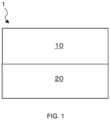
- FIG. 1 is a schematic cross-sectional view showing a laminated structure of a film according to a second embodiment of the present invention.
- the film according to the first embodiment can be composed of a resin composition comprising crosslinked (meth)acrylic acid ester-based resin particles, and comprising methacrylic acid ester-based resin as the main component.
- methacrylic acid ester-based resin refers to a homopolymer of methacrylic acid ester such as methyl methacrylate, and a copolymer of methacrylic acid ester with a monomer that is copolymerizable with the methacrylic acid ester, whose particle diameter in the film is less than 0.2 ⁇ m (including particles so fine that the particle diameter cannot be specified and particles forming a matrix phase).
- resin particles having a particle diameter of 0.2 ⁇ m or more in the film are not included in the methacrylic acid ester-based resin in this specification.
- Monomers that is copolymerizable with methacrylic acid ester include: (meth)acrylic acid esters such as butyl acrylate, butyl methacrylate, ethyl acrylate, and ethyl methacrylate; aromatic vinyl monomers such as styrene, ⁇ -methylstyrene, p-methylstyrene, o-methylstyrene, t-butylstyrene, divinylbenzene, tristyrene; vinyl cyanide monomers such as acrylonitrile and methacrylonitrile; glycidyl group-containing monomers such as glycidyl (meth)acrylate; vinyl carboxylate-based monomers such as vinyl acetate and vinyl butyrate; olefin-based monomers such as ethylene, propylene, isobutylene; diene-based monomers such as 1 ,3-butadiene and isoprene; unsaturated
- a homopolymer of methyl methacrylate, or an acrylic rubber-modified methacrylic copolymer obtained by copolymerizing an acrylic rubber containing butyl (meth)acrylate with a monomer mainly composed of methyl methacrylate is preferred.
- copolymers examples include random copolymers, graft copolymers, block copolymers (for example, diblock copolymers, triblock copolymers, linear types such as gradient copolymers, star-shaped copolymers polymerized by the arm-first method or core-first method, and the like), and copolymers obtained by polymerization using macromonomers, which are polymeric compounds with polymerizable functional groups (macromonomer copolymers), and mixtures thereof.
- macromonomers which are polymeric compounds with polymerizable functional groups
- Examples of the polymerization reaction for obtaining the methacrylic acid ester-based resin include known polymerization reactions such as radical polymerization, living radical polymerization, living anionic polymerization, and living cationic polymerization. Further, examples of the polymerization method include known polymerization methods such as bulk polymerization, suspension polymerization, emulsion polymerization, and solution polymerization. The mechanical properties of the resulting resin vary depending on the polymerization reaction and polymerization method.
- the film according to the first embodiment comprises a methacrylic acid ester-based resin as the main component
- the methacrylic acid ester-based resin is the component with the largest mass proportion among the constituent components of the film.
- the formulation amount of the methacrylic acid ester-based resin in the film is preferably 50% by mass or more, more preferably 70% by mass or more, even more preferably 90% by mass or more, and even more preferably 95% by mass or more. For example, it can be 50 to 99% by mass.
- the film according to the first embodiment contains crosslinked (meth)acrylic acid-based resin particles in addition to the methacrylic acid ester-based resin.
- the crosslinked (meth)acrylic acid ester-based resin particles are present in a dispersed state in a matrix of methacrylic acid ester-based resin.
- Crosslinked (meth)acrylic acid ester-based resin particles have a refractive index similar to that of the methacrylic acid ester-based resin that is the main component, so even if they are dispersed in the methacrylic acid ester-based resin, they have the characteristic that it does not easily impair the transparency of the film.
- crosslinked (meth)acrylic acid ester-based resin particles refer to those having a particle diameter of 0.2 ⁇ m or more in the film.
- the particle diameter of the resin particles refers to the diameter of the smallest circle that can surround the resin particles when the film is observed by the method described above. Therefore, even if there is a particulate crosslinked (meth)acrylic acid ester-based resin, if its particle diameter in the film is less than 0.2 ⁇ m, it belongs to the methacrylic acid ester-based resin as long as it satisfies the above definition regarding the methacrylic acid ester-based resin.
- the crosslinked (meth)acrylic acid-based resin particles in the film preferably have an average particle diameter of 1% or more and 10% or less with respect to the average thickness of the film.
- the crosslinked (meth)acrylic acid ester-based resin particles preferably have an average particle diameter of 1% or more, more preferably 2% or more, and even more preferably 3% or more with respect to the average thickness of the film, thereby imparting appropriate unevenness to the film surface and improving blocking resistance.
- the crosslinked (meth)acrylic acid ester-based resin particles preferably have an average particle diameter of 10% or less, more preferably 9% or less, even more preferably 8% or less, even more preferably 7% or less, and even more preferably 6% or less, with respect to the average thickness of the film, so that the clarity of the film can be improved without excessively increasing unevenness on the film surface.
- the suitable range of the average particle diameter of the crosslinked (meth)acrylic acid ester-based resin particles be determined in relation to the average thickness of the film.
- the average particle diameter of the crosslinked (meth)acrylic acid ester-based resin particles itself is not so important, but considering the normally assumed thickness of the film, the average particle diameter of the crosslinked (meth)acrylic acid ester-based resin particles is preferably 0.5 to 5 ⁇ m, more preferably 0.5 to 2 ⁇ m.
- the average particle diameter of crosslinked (meth)acrylic acid ester-based resin particles refers to the D50 value (volume basis) of the particle diameter distribution measured by a laser diffraction / scattering method.
- the average thickness of the film according to the first embodiment is preferably 10 to 100 ⁇ m, more preferably 15 to 90 ⁇ m, even more preferably 20 to 85 ⁇ m, and particularly preferably 25 to 80 ⁇ m.
- the film according to the first embodiment may be formed in a single layer or in multiple layers, but it is desirable that the total average thickness falls within the above-mentioned average thickness.
- the average thickness of the film can be calculated as the average value obtained by measuring the thickness at multiple locations by observing the cross-section of the film using a confocal laser microscope.
- crosslinked (meth)acrylic acid ester-based resin particles include, but are not limited to, crosslinked polymethyl acrylate, crosslinked polyethyl acrylate, crosslinked polymethyl methacrylate, crosslinked polyethyl methacrylate, crosslinked polynormal butyl methacrylate, and the like. These can be used alone or in combination of two or more. Among these, it is preferable to contain crosslinked polymethyl methacrylate because the difference in refractive index with the methacrylic acid ester-based resin constituting the matrix is small. Even when heat is applied during film production, the crosslinked (meth)acrylic acid ester-based resin particles tend to be maintained without being compatible with the methacrylic acid ester-based resin constituting the matrix due to the crosslinked structure.
- the formulation amount of the crosslinked (meth)acrylic acid ester-based resin particles is preferably 0.1 parts by mass or more and 2 parts by mass or less, more preferably 0.3 parts by mass or more and 1.5 parts by mass or less, and even more preferably 0.5 parts by mass or more and 1 part by mass or less, with respect to 100 parts by mass of the methacrylic acid ester-based resin.
- the lower limit of the glass transition point (Tg) of the methacrylic acid ester-based resin is preferably 70 °C or higher, more preferably 80 °C or higher.
- the upper limit of Tg of the methacrylic acid ester-based resin is preferably 120 °C or lower.
- the Tg of the methacrylic acid ester-based resin can be measured by heat flux differential scanning calorimetry (heat flux DSC).
- heat flux DSC heat flux differential scanning calorimetry
- DSC3100SA manufactured by Bruker AXS
- the haze of the film according to the first embodiment measured based on JIS K7136: 2000 is preferably 5% or less, more preferably 4% or less, and for example, it can be in the range of 1 to 5%.
- the film according to the first embodiment has a clarity (CLR) calculated from the following formula of 97% or more, preferably 98% or more, more preferably 99% or more, and for example, it can be 97 to 99.5%.
- CLR 100 ⁇ lc ⁇ lr / lc + lr
- Ic represents the amount of light that travels straight with respect to the optical axis of parallel light that is incident perpendicularly to the surface of the film, out of the light that passes through the film
- Ir represents an amount of narrow-angle scattered light whose angle with respect to the optical axis of parallel light is within ⁇ 2.5°.
- a CIE-D65 light source is used as a light source.
- Clarity is a parameter similar to haze, but good haze does not necessarily mean good clarity (CLR).
- Haze is a parameter that evaluates the optical properties of a film perceived by an observer using wide-angle scattered light (transmitted light that is deviated by 2.5° or more from the incident light due to forward scattering).
- clarity is a parameter that evaluates the optical properties of a film perceived by an observer using narrow-angle scattered light. For this reason, it can be said that haze evaluates the degree of turbidity of a film, whereas clarity evaluates the degree of sharpness of the outline of an article when it is visually recognized through a film.
- high clarity as well as haze means that when a film is used by being attached to the surface of an article, the design expressed on the surface of the article can be viewed faithfully.
- the article is a base material of a metallic decorative film
- the metallic luster on the surface of the base material can be clearly seen even after the film is attached.
- the total light transmittance of the film according to the first embodiment measured based on JIS K7361-1: 1997 is preferably 80% or more, more preferably 85% or more, even more preferably 90% or more, and for example, it can be 80 to 95%.
- the film according to the first embodiment can appropriately comprise ultraviolet absorbers, other resins, plasticizers, heat stabilizers, antioxidants, light stabilizers, crystal nucleating agents, anti-blocking agents, sealability improvers, mold release agents, colorants, pigments, foaming agents, flame retardants, and the like, within a range that does not impair the object of the present invention.
- the total amount of the methacrylic acid ester-based resin and the crosslinked (meth)acrylic acid-based resin particles in the film according to the first embodiment is 90% by mass or more, typically 95% by mass or more, more typically 97% by mass or more, and can even be 100% by mass. Further, from the viewpoint of improving transparency, especially clarity, it is desirable that the film according to the first embodiment does not contain vinylidene fluoride-based resin.
- the film according to the first embodiment preferably comprises an ultraviolet absorber.
- ultraviolet absorbers include, but are not limited to, hydroquinone, triazine, benzotriazole, benzophenone, cyanoacrylate, oxalic acid, hindered amine, salicylic acid derivatives, and the like. These can be used alone or in combination of two or more. Among these, it is preferable to contain a triazine compound, a benzotriazole compound, or a mixture thereof, from the viewpoint of sustainability of the ultraviolet blocking effect.
- the formulation amount of the ultraviolet absorber in the film according to the first embodiment is preferably 0.1 to 10 parts by mass, with respect to 100 parts by mass of the methacrylic acid ester-based resin.
- the formulation amount of the ultraviolet absorber in the resin composition is preferably 0.1 to 10 parts by mass, with respect to 100 parts by mass of the methacrylic acid ester-based resin.
- the formulation amount of the ultraviolet absorber in the resin composition to 10 parts by mass or less, preferably 5 parts by mass or less, with respect to 100 parts by mass of the methacrylic acid ester-based resin, it is possible to prevent the ultraviolet absorber from bleeding out onto the film surface and realize cost reduction.
- the film according to the first embodiment can be manufactured by, for example, performing the following steps.
- Step 1 a step in which a resin composition containing a methacrylic acid ester-based resin and 0.1 parts by mass or more and 2 parts by mass or less of crosslinked (meth)acrylic acid ester-based resin particles with respect to 100 parts by mass of the methacrylic acid ester-based resin is melt extrusion molded into a film with an average thickness of 10 to 100 ⁇ m using a T-die at a temperature of 200 to 260 °C.
- Step 2 after extrusion from the exit of the T-die, a step of cooling at least one surface of the melt extrusion molded film by bringing it into contact with the surface of a metal roll whose temperature is controlled to 30 to 60 °C.
- the film transport speed is set to 3 to 7 m/min. Further, from the viewpoint of removing foreign matter, when a screen mesh is installed in the extruder, the opening of the mesh needs to be adjusted to a size that allows the crosslinked (meth)acrylic acid ester-based resin particles to pass through.
- Examples of methods for controlling the temperature on the surface of the metal roll include a method of circulating a cooling medium such as cooling water inside the metal roll.
- melt extrusion molding method examples include a T-die method for forming a film using a T-die, and a method using an inflation die.
- a rubber touch roll is placed opposite the metal roll, and the molten resin composition extruded from the exit of the die is pinched between the metal roll (cast roll) and the touch roll, from the viewpoint of transferring the smooth surface of the metal roll to the film.
- the surface temperature of the rubber touch roll is preferably 0 to 70 °C, more preferably 0 to 30 °C, from the viewpoint of suppressing transfer of the surface shape of the rubber roll.
- the surface roughness of the metal roll is small, and it is further desirable that the surface roughness of the touch roll is also small. Reducing the surface roughness of the film is advantageous in reducing the haze value and increasing the clarity of the film. This is because the surface roughness of the metal roll and touch roll is reflected in the surface roughness of the film.
- the arithmetic mean roughness Ra on the surface of the metal roll measured based on JIS B0601: 2001 is preferably 100 nm or less, more preferably 80 nm or less, even more preferably 60 nm or less, even more preferably 40 nm or less, even more preferably 20 nm or less, and for example, it can be 10 to 100 nm.
- the arithmetic mean roughness Ra on the surface of the touch roll measured based on JIS B0601: 2001 is preferably 150 nm or less, more preferably 120 nm or less, and for example, it can be set to 100 to 150 nm.
- FIG. 1 shows a schematic cross-sectional view showing the laminated structure of a film 1 according to the second embodiment.
- the film 1 has a laminated structure including at least a surface layer 10 and a back layer 20 laminated on the surface layer 10 in this order.
- the surface layer 10 and the back layer 20 are directly bonded to each other without any other resin layer interposed between them.
- the surface layer is composed of a film comprising vinylidene fluoride-based resin.
- the film constituting the surface layer preferably comprises a vinylidene fluoride-based resin and a methacrylic acid ester-based resin.
- the vinylidene fluoride-based resin is 50 parts by mass or more with respect to a total of 100 parts by mass of the vinylidene fluoride-based resin and the methacrylic acid ester-based resin, properties such as chemical resistance, weather resistance, and stain resistance can be improved.
- adhesiveness and adhesion with the back layer can be improved.
- the vinylidene fluoride-based resin refers to a homopolymer of vinylidene fluoride, as well as a copolymer of vinylidene fluoride with a monomer that is copolymerizable with vinylidene fluoride.
- monomers that is copolymerizable with vinylidene fluoride include vinyl fluoride, tetrafluoroethylene, hexafluoropropylene, hexafluoroisobutylene, chlorotrifluoroethylene, various fluorinated alkyl vinyl ethers, as well as known vinyl monomers such as styrene, ethylene, butadiene, and propylene, and the like.
- At least one selected from vinyl fluoride, tetrafluoroethylene, hexafluoropropylene, and chlorotrifluoroethylene is preferred, and hexafluoropropylene is more preferred.
- the film constituting the surface layer preferably comprises (A) one or two selected from a copolymer of vinylidene fluoride with hexafluoropropylene, and polyvinylidene fluoride (PVDF homopolymer), and (B) a methacrylic acid ester-based resin; wherein with respect to 100 parts by mass of the total of (A) and (B), the total of (A) is 50 parts by mass or more and 80 parts by mass or less, (B) is 20 parts by mass or more and 50 parts by mass or less, and more preferably the total of (A) is 60 parts by mass or more and 75 parts by mass or less, (B) is 25 parts by mass or more and 40 parts by mass or less.
- PVDF homopolymer polyvinylidene fluoride
- Examples of the polymerization reaction for obtaining the vinylidene fluoride-based resin include known polymerization reactions such as radical polymerization and anionic polymerization. Further, examples of the polymerization method include known polymerization methods such as suspension polymerization and emulsion polymerization. The mechanical properties of the resulting resin vary depending on the polymerization reaction and/or polymerization method.
- the lower limit of the melting point of the vinylidene fluoride-based resin is preferably 150 °C or higher, more preferably 160 °C or higher.
- the upper limit of the melting point of the vinylidene fluoride-based resin is preferably 170 °C or lower, which is equal to the melting point of polyvinylidene fluoride (PVDF).
- the lower limit of the glass transition point (Tg) of the methacrylic acid ester-based resin is preferably 70 °C or higher, more preferably 80 °C or higher.
- the upper limit of Tg of the methacrylic acid ester-based resin is preferably 120 °C or lower.
- the melting point of the vinylidene fluoride-based resin and the Tg of the methacrylic acid ester-based resin can be measured by heat flux differential scanning calorimetry (heat flux DSC).
- heat flux DSC heat flux differential scanning calorimetry
- DSC3100SA manufactured by Bruker AXS
- the film constituting the surface layer can appropriately comprise other resins, plasticizers, heat stabilizers, antioxidants, light stabilizers, crystal nucleating agents, anti-blocking agents, sealability improvers, mold release agents, colorants, pigments, foaming agents, flame retardants, and the like, within a range that does not impair the object of the present invention.
- the total amount of the vinylidene fluoride-based resin and methacrylic acid ester-based resin in the film constituting the surface layer is 80% by mass or more, typically 90% by mass or more, more typically 95% by mass or more, and can even be 100% by mass.
- the film constituting the surface layer may comprise (A) one or two selected from a copolymer of vinylidene fluoride with hexafluoropropylene, and polyvinylidene fluoride (PVDF homopolymer), and (B) a methacrylic acid ester-based resin; wherein the total of (A) and (B) is 80% by mass or more, typically 90% by mass or more, more typically 95% by mass or more, and can even be 100% by mass.
- PVDF homopolymer polyvinylidene fluoride
- an ultraviolet absorber may be added to the film constituting the surface layer, it is preferable not to add it from the viewpoint of cost and bleed-out.
- the average thickness of the film constituting the surface layer is preferably 1 to 40 ⁇ m, more preferably 5 to 35 ⁇ m, even more preferably 8 to 30 ⁇ m, and particularly preferably 10 to 20 ⁇ m.
- the film constituting the surface layer may be formed as a single layer or as a plurality of layers, but it is desirable that the total average thickness falls within the above-mentioned average thickness.
- the average thickness of the film can be calculated as the average value obtained by measuring the thickness at multiple locations by observing the cross-section of the film using a confocal laser microscope.
- the haze of the film according to the second embodiment measured based on JIS K7136: 2000 is preferably 5% or less, more preferably 4% or less, and for example, it can be in the range of 1 to 5%.
- the film according to the second embodiment has a clarity (CLR), which has been explained for the film according to the first embodiment, of 97% or more, preferably 98% or more, more preferably 99% or more, and for example, it can be 97 to 99.5%.
- CLR clarity
- the 60° specular gloss on the outer surface side of the surface layer (the film containing vinylidene fluoride-based resin) of the film according to the second embodiment as measured based on JIS Z8741: 1997 is preferably 100 or more, more preferably 110 or more, even more preferably 120 or more, and can be, for example, 100 to 130.
- a multilayer film in which a surface layer and a back layer are laminated can be manufactured, for example, by a melt coextrusion molding method in which a plurality of resins is adhesively laminated in a molten state using a plurality of extrusion molding machines.
- the melt coextrusion molding method includes a multi-manifold die method in which a plurality of resins is made into sheets and then each layer is bonded in contact at the tip inside a T-die; a feed block die method in which a plurality of resins is bonded together in a merging device (feedblock) and then spread into a sheet; and a dual slot die method in which a plurality of resins is molded into a sheet, and then each layer is contacted and bonded at the tip of the outside of a T-die.
- it can also be manufactured by an inflation molding method using a round die.
- the film according to the second embodiment can be manufactured by, for example, performing the following steps.
- Step 1 a step of melt-coextrusion molding a first resin composition and a second resin composition into a film from a T-die at a temperature of 200 to 260 °C, such that the average thickness of the first resin composition is 1 to 40 ⁇ m, and the average thickness of the second resin composition is 10 to 100 ⁇ m,
- Step 2 after extrusion from the exit of the T-die, a step of cooling at least one surface of the melt-coextrusion molded film on the first resin composition side by bringing it into contact with the surface of a metal roll whose temperature is controlled to 30 to 60 °C.
- the film transport speed When manufacturing a film with a thickness of about 30 to 50 ⁇ m under the above conditions, it is appropriate to set the film transport speed to 5 to 9 m/min. Further, from the viewpoint of removing foreign matter, when a screen mesh is installed in the extruder, the opening of the mesh needs to be adjusted to a size that allows crosslinked (meth)acrylic acid ester-based resin particles to pass through.
- Examples of methods for controlling the temperature on the surface of the metal roll include a method of circulating a cooling medium such as cooling water inside the metal roll.
- a rubber touch roll is placed opposite the metal roll, and the laminate of the first resin composition and the second resin composition in a molten state extruded from the outlet of the T-die is pinched between the metal roll (cast roll) and the touch roll, from the viewpoint of transferring the smooth surface of the metal roll to the film.
- the surface temperature of the rubber touch roll is preferably 0 to 70 °C, more preferably 0 to 30 °C, from the viewpoint of suppressing transfer of the surface shape of the rubber roll.
- the surface roughness of the metal roll is small, and it is further desirable that the surface roughness of the touch roll is also small. Reducing the surface roughness of the film is advantageous in reducing the haze value and increasing the clarity of the film. This is because the surface roughness of the metal roll and touch roll reflects the surface roughness of the film.
- the arithmetic mean roughness Ra on the surface of the metal roll measured based on JIS B0601: 2001 is preferably 100 nm or less, more preferably 80 nm or less, even more preferably 60 nm or less, even more preferably 40 nm or less, even more preferably 20 nm or less, and for example, it can be 10 to 100 nm.
- the arithmetic mean roughness Ra on the surface of the touch roll measured based on JIS B0601: 2001 is preferably 150 nm or less, more preferably 120 nm or less, and for example, it can be set to 100 to 150 nm.
- a base material may be laminated on each of the films according to the first embodiment and the second embodiment. Therefore, in one embodiment of the present invention, a film is provided in which a base material is laminated on either side of the film according to the first embodiment. In another embodiment, the present invention provides a film in which a base material is laminated on the surface layer and/or the back layer of the film according to the second embodiment. It is preferable that the average total thickness of the film on which the base material is laminated is 50 to 1000 ⁇ m, from the viewpoint of workability and cost of adhesion to automobile interior parts.
- the base material examples include layers such as a decorative layer, a protective layer, an adhesive layer, a printed layer, and a metal vapor deposited layer.
- One type of base material may be used in a single layer, or two or more types may be used in combination and laminated.
- the films according to the first embodiment and the second embodiment can have high transparency. Therefore, by applying the film to the surface of a base material with high gloss, this property can be effectively utilized. Therefore, in a preferred embodiment, the 60° specular gloss measured based on JIS Z8741: 1997 on the surface of the base material to which the film is bonded is 100 to 600, typically 300 to 550, and L* at an acceptance angle of 15° in the L*a*b* color space based on JIS Z8781-4: 2013 on the surface is 0 to 20, typically 0 to 5.
- a metallic decorative film in which the film according to the first embodiment is laminated as the outermost layer, or a metallic decorative film in which the film according to the second embodiment is laminated as the outermost layer with the surface layer (the film containing vinylidene fluoride-based resin) on the outside is provided.
- a metallic decorative film comprises the film according to the first embodiment, an anchor layer, a metal vapor deposited layer, and an adhesive layer in this order, and the film according to the first embodiment constitutes the outermost layer.
- a metallic decorative film comprises the film according to the second embodiment, an anchor layer, a metal vapor deposited layer, and an adhesive layer in this order, and the film according to the second embodiment constitutes the outermost layer with the surface layer (the film containing vinylidene fluoride-based resin) on the outside.
- the anchor layer may be, but is not limited to, acrylic resin, nitrocellulose-based resin, polyurethane-based resin (including those cured with polyol resin as the main resin and isocyanate-based resin as curing agent), acrylic urethane-based resins (including those cured with acrylic polyol resin as the main resin and isocyanate-based resin as a curing agent), polyester-based resin, styrene-maleic acid-based resin, chlorinated PP-based resin, and the like.
- the anchor layer contains an acrylic resin since the resulting film has better adhesion.
- the metal vapor deposited layer can include a metal such as, but not limited to, indium.
- the metal vapor deposition layer may include various nonmetals, metals, metal oxides, and metal nitrides.
- the adhesive layer can contain various adhesives, adhesives, pressure sensitive adhesives (PSA), and the like.
- PSA pressure sensitive adhesives
- Examples of methods for laminating a base material on the films according to the first embodiment and the second embodiment include adhesive lamination and thermal lamination. Other known lamination methods may also be employed. Further, the films according to the first embodiment and the second embodiment can be subjected to heat forming. Examples of the heat forming method include a method in which a base material is bonded to one or both sides of the film, and then vacuum forming, pressure forming, or vacuum pressure forming is carried out.
- Methods for coating a surface of articles such as automobile interior parts with decorative films, especially metallic decorative films include, for example, film insert molding, in-mold molding, and vacuum lamination molding (including vacuum / pressure molding such as TOM molding).
- film insert molding has the advantage that the decorative film can follow parts with more complex shapes, achieving good surface coverage, since the decorative film is heated and preformed.
- the following materials were prepared as the methacrylic acid ester-based resin.
- the following materials were prepared as the crosslinked (meth)acrylic acid ester-based resin particles.
- the average particle diameter refers to the D50 value (volume basis) of the particle diameter distribution measured using the laser diffraction / scattering method.
- the D50 value is also referred to as the median diameter, and is the particle diameter at which the cumulative particle diameter distribution from the smaller particle diameter side is 50%.
- Examples of the measuring device include Mastersizer 2000 (manufactured by Malvern Panalytical).
- the following materials was prepared as the ultraviolet absorber.
- each compound was obtained after kneading using a ⁇ 30 mm twin-screw extruder according to the formulation shown in Table 1.
- Each of the obtained compounds was melt-extrusion molded using a T-die single screw extruder with a diameter of 40 mm. While conveying at a transport speed of 4.5 m/min, the extruded film-like resin composition was cooled by sandwiching it between a metal roll (surface temperature: about 40 °C) through which cooling water was flowed and a rubber touch roll (surface temperature: about 20 °C), thereby obtaining a film having the average thickness shown in Table 1.
- PVDF vinylidene fluoride-based resin
- the following material was prepared as the methacrylic acid ester-based resins.
- the same materials as the single layer film were prepared for the methacrylic acid ester-based resin, crosslinked (meth)acrylic acid-based resin particles, and ultraviolet absorber.
- each compound for the surface layer and for the back layer was obtained after kneading using a twin-screw extruder with a diameter of 30 mm according to the formulations listed in Table 2.
- the compound for the surface layer and the compound for the back layer were melt-coextrusion molded using two single-screw extruders with a diameter of 40 mm and a feed block type T-die multilayer extruder equipped with a feed block and a T-die at the tip.
- the extruded film-like resin composition was cooled by sandwiching it between a metal roll (surface temperature: about 20 °C) through which cooling water was flowed and a rubber touch roll (surface temperature: about 40 °C), thereby obtaining a laminated film having the average thickness shown in Table 2.
- a metal roll surface temperature: about 20 °C
- a rubber touch roll surface temperature: about 40 °C
- Table 2 a laminated film having the average thickness shown in Table 2.
- the arithmetic mean roughness Ra of the surface of the metal roll was measured based on JIS B0601: 2001 using a contact type surface roughness meter (Mitutoyo Co., Ltd., SJ210), it was 0.013 ⁇ m.
- the cross-section of the film was observed at a magnification of 2000 times using a confocal laser microscope (manufactured by Keyence Corporation, VK-X100) and the thickness of the film (in the case of a multilayer film, the thickness of the surface layer and the back layer) was measured based on the distance between two points. Measurements were performed at any one location in the machine direction (MD) for 17 points at 50 mm intervals in the film transverse direction (TD), and the average value was taken as the measured value. The results are shown in Tables 1 and 2.
- both the composition of the resin constituting the film and the size of the crosslinked (meth)acrylic acid ester-based resin particles were appropriate, so they had high transparency (low haze, high clarity) and excellent blocking resistance were obtained.
- the film of Comparative Example 1-1 had poor blocking resistance because it did not contain crosslinked (meth)acrylic acid ester-based resin particles.
- the films of Comparative Examples 1-2 to 1-4 contained crosslinked (meth)acrylic acid ester-based resin particles, but their transparency was insufficient because the size of the particles was inappropriate.
- both the composition of the resin constituting the film and the size of the crosslinked (meth)acrylic acid ester-based resin particles were appropriate, so they had high transparency and excellent blocking resistance was obtained. Furthermore, by laminating the film containing vinylidene fluoride-based resin, chemical resistance was improved compared to a single layer film.
- the films of Comparative Examples 2-1 and 2-2 had poor blocking resistance because they did not contain crosslinked (meth)acrylic acid-based resin particles.
- the films of Comparative Examples 2-3 to 2-4 contained crosslinked (meth)acrylic acid ester-based resin particles, but the content was inappropriate and the transparency was insufficient.
- the back layer (film containing methacrylic acid ester-based resin as the main component) was made of a vinylidene fluoride-based resin whose refractive index was significantly different from that of the crosslinked (meth)acrylic acid ester-based resin particles. As a result, transparency was insufficient.
- the films of Comparative Examples 2-6 to 2-9 contained crosslinked (meth)acrylic acid ester-based resin particles, but their transparency was insufficient because the size of the particles was inappropriate.
Landscapes
- Chemical & Material Sciences (AREA)
- Engineering & Computer Science (AREA)
- Health & Medical Sciences (AREA)
- Chemical Kinetics & Catalysis (AREA)
- Medicinal Chemistry (AREA)
- Polymers & Plastics (AREA)
- Organic Chemistry (AREA)
- Manufacturing & Machinery (AREA)
- Mechanical Engineering (AREA)
- Materials Engineering (AREA)
- Laminated Bodies (AREA)
- Manufacture Of Macromolecular Shaped Articles (AREA)
Abstract
Description
- The present invention relates to a single layer film or a multilayer film comprising a film containing a methacrylic acid ester-based resin as a main component. In particular, the present invention relates to a single layer film or a multilayer film that can be applied as the outermost layer of a metallic decorative film.
- Conventionally, resin films containing vinylidene fluoride-based resins have excellent weather resistance and chemical resistance, so they have been suitably used as the outermost layer (generally referred to as a "protective layer") of decorative films used for the interior or exterior of automobiles, electrical appliance parts, and the like. Decorative films are generally manufactured through a process of bonding a decorative layer to the film of the outermost layer. Common methods for bonding include lamination using an adhesive and thermal lamination.
- In recent years, designs have become more diversified and complex, especially for automobile interiors, and the outermost layer of decorative films is required to have high transparency so as not to impair color and texture. Particularly, among decorative films, a metallic decorative film produced by performing metal vapor deposition on a resin film for the purpose of imparting a metallic design is required to have an outermost layer with high transparency. For this reason, techniques have been developed to improve the transparency of resin films containing vinylidene fluoride-based resins.
- In order to provide a film with high crystallinity, transparency, and surface smoothness, Patent Literature 1 (
WO 2011/142453 ) proposes a film comprising a vinylidene fluoride-based resin (A) and an acrylic resin (B), wherein an arithmetic mean roughness of at least one surface is 0.1 to 20 nm, a heat of crystal fusion measured by differential scanning calorimeter is 18 to 40 J/g, and a haze value is 3.5 or less. - Patent Literature 2 (
Japanese Patent Application Publication No. 2012-187934 -
- [Patent Literature 1]
WO 2011/142453 - [Patent Literature 2]
Japanese Patent Application Publication No. 2012-187934 - As described above, techniques for improving the transparency and the like of a resin film used as the outermost layer of a decorative film are known. However, since the resin film is often provided as a film roll wound up into a roll, there is a problem in that the films tend to stick to each other (blocking) during storage. When the resin film is fed out from the film roll, if the resin films are peeled off from each other, the surface of the resin film becomes rough. Therefore, considering the application to decorative films that require an excellent appearance, especially metallic decorative films (for example, metallic decorative films with a metallic mirror-like appearance), conventional resin films still have room for improvement.
- The present invention has been created in view of the above circumstances, and in one embodiment, an object of the present invention is to provide a resin film that has both high transparency and excellent blocking resistance.
- As a result of intensive research in order to solve the above problem, the present inventors have found it is effective to add crosslinked (meth)acrylic acid ester-based resin particles of a predetermined size to a film that contains methacrylic acid ester-based resin as a main component and does not contain vinylidene fluoride-based resin. The present invention has been achieved accordingly, and is exemplified as below.
- [1] A film, comprising crosslinked (meth)acrylic acid ester-based resin particles and comprising methacrylic acid ester-based resin as a main component,
- wherein the crosslinked (meth)acrylic acid-based resin particles have an average particle diameter of 1% or more and 10% or less with respect to an average thickness of the film,
- wherein the film does not comprise vinylidene fluoride-based resin,
- wherein a haze of the film measured based on JIS K7136: 2000 is 5% or less, and
- wherein a clarity (CLR) of the film calculated from the following formula is 97% or more,

- [2] The film according to [1], wherein an amount of the crosslinked (meth)acrylic acid ester-based resin particles is 0.1 parts by mass or more and 2 parts by mass or less with respect to 100 parts by mass of the methacrylic acid ester-based resin.
- [3] A multilayer film, comprising:
- the film according to [1] or [2], and
- a film comprising vinylidene fluoride-based resin laminated on one side of the film;
- wherein a haze measured based on JIS K7136: 2000 is 5% or less, a clarity (CLR) is 97% or more, and a 60° specular gloss measured based on JIS Z8741: 1997 of an outer surface side of the film comprising vinylidene fluoride-based resin is 100 or more.
- [4] The multilayer film according to [3], wherein the film comprising the vinylidene fluoride-based resin comprises:
- (A) one or two selected from a copolymer of vinylidene fluoride with hexafluoropropylene, and polyvinylidene fluoride, and
- (B) a methacrylic acid ester-based resin;
- [5] A metallic decorative film, in which the film according to [1] or [2] is laminated as an outermost layer, or a metallic decorative film, in which the multilayer film according to [3] or [4] is laminated as an outermost layer with the film containing vinylidene fluoride-based resin on an outside.
- According to one embodiment of the present invention, a single layer film or a multilayer film having both high transparency and excellent blocking resistance can be obtained. The single-layer film or multilayer film can be used by being attached to a base material, and can be suitably used, for example, as the outermost layer of a decorative film, especially a metallic decorative film.
-
FIG. 1 is a schematic cross-sectional view showing a laminated structure of a film according to a second embodiment of the present invention. - Hereinafter, embodiments of the present invention will now be described. The embodiments described below are illustrative examples of typical embodiments of the present invention, and are not intended to narrow the technical scope of the present invention.
- The film according to the first embodiment can be composed of a resin composition comprising crosslinked (meth)acrylic acid ester-based resin particles, and comprising methacrylic acid ester-based resin as the main component.
- In this specification, methacrylic acid ester-based resin refers to a homopolymer of methacrylic acid ester such as methyl methacrylate, and a copolymer of methacrylic acid ester with a monomer that is copolymerizable with the methacrylic acid ester, whose particle diameter in the film is less than 0.2 µm (including particles so fine that the particle diameter cannot be specified and particles forming a matrix phase). In other words, resin particles having a particle diameter of 0.2 µm or more in the film are not included in the methacrylic acid ester-based resin in this specification. When the film is pinched and fixed in a small metal vise, and cut with a single-edged knife such that the cross-section of the film is smooth, and the cross-section of the film is observed at a magnification of 2000x using a confocal laser microscope (for example, VK-X1 10 manufactured by Keyence Corporation) with the film pinched in the vise, the particle diameter of a resin particle refers to the diameter of the smallest circle that can surround the resin particle.
- Monomers that is copolymerizable with methacrylic acid ester include: (meth)acrylic acid esters such as butyl acrylate, butyl methacrylate, ethyl acrylate, and ethyl methacrylate; aromatic vinyl monomers such as styrene, α-methylstyrene, p-methylstyrene, o-methylstyrene, t-butylstyrene, divinylbenzene, tristyrene; vinyl cyanide monomers such as acrylonitrile and methacrylonitrile; glycidyl group-containing monomers such as glycidyl (meth)acrylate; vinyl carboxylate-based monomers such as vinyl acetate and vinyl butyrate; olefin-based monomers such as ethylene, propylene, isobutylene; diene-based monomers such as 1 ,3-butadiene and isoprene; unsaturated carboxylic acid-based monomers such as maleic acid, maleic anhydride, (meth)acrylic acid; enone-based monomers such as vinyl methyl ketone; and the like. These can be used alone or in combination of two or more. Among these, from the viewpoint of film strength and flexibility, a homopolymer of methyl methacrylate, or an acrylic rubber-modified methacrylic copolymer obtained by copolymerizing an acrylic rubber containing butyl (meth)acrylate with a monomer mainly composed of methyl methacrylate is preferred.
- Examples of copolymers include random copolymers, graft copolymers, block copolymers (for example, diblock copolymers, triblock copolymers, linear types such as gradient copolymers, star-shaped copolymers polymerized by the arm-first method or core-first method, and the like), and copolymers obtained by polymerization using macromonomers, which are polymeric compounds with polymerizable functional groups (macromonomer copolymers), and mixtures thereof. Among these, graft copolymers and block copolymers are preferred from the viewpoint of resin productivity.
- Examples of the polymerization reaction for obtaining the methacrylic acid ester-based resin include known polymerization reactions such as radical polymerization, living radical polymerization, living anionic polymerization, and living cationic polymerization. Further, examples of the polymerization method include known polymerization methods such as bulk polymerization, suspension polymerization, emulsion polymerization, and solution polymerization. The mechanical properties of the resulting resin vary depending on the polymerization reaction and polymerization method.
- The fact that the film according to the first embodiment comprises a methacrylic acid ester-based resin as the main component means that the methacrylic acid ester-based resin is the component with the largest mass proportion among the constituent components of the film. The formulation amount of the methacrylic acid ester-based resin in the film is preferably 50% by mass or more, more preferably 70% by mass or more, even more preferably 90% by mass or more, and even more preferably 95% by mass or more. For example, it can be 50 to 99% by mass.
- The film according to the first embodiment contains crosslinked (meth)acrylic acid-based resin particles in addition to the methacrylic acid ester-based resin. In a typical embodiment, the crosslinked (meth)acrylic acid ester-based resin particles are present in a dispersed state in a matrix of methacrylic acid ester-based resin. Crosslinked (meth)acrylic acid ester-based resin particles have a refractive index similar to that of the methacrylic acid ester-based resin that is the main component, so even if they are dispersed in the methacrylic acid ester-based resin, they have the characteristic that it does not easily impair the transparency of the film.
- In this specification, crosslinked (meth)acrylic acid ester-based resin particles refer to those having a particle diameter of 0.2 µm or more in the film. The particle diameter of the resin particles refers to the diameter of the smallest circle that can surround the resin particles when the film is observed by the method described above. Therefore, even if there is a particulate crosslinked (meth)acrylic acid ester-based resin, if its particle diameter in the film is less than 0.2 µm, it belongs to the methacrylic acid ester-based resin as long as it satisfies the above definition regarding the methacrylic acid ester-based resin.
- The crosslinked (meth)acrylic acid-based resin particles in the film preferably have an average particle diameter of 1% or more and 10% or less with respect to the average thickness of the film. The crosslinked (meth)acrylic acid ester-based resin particles preferably have an average particle diameter of 1% or more, more preferably 2% or more, and even more preferably 3% or more with respect to the average thickness of the film, thereby imparting appropriate unevenness to the film surface and improving blocking resistance. In addition, the crosslinked (meth)acrylic acid ester-based resin particles preferably have an average particle diameter of 10% or less, more preferably 9% or less, even more preferably 8% or less, even more preferably 7% or less, and even more preferably 6% or less, with respect to the average thickness of the film, so that the clarity of the film can be improved without excessively increasing unevenness on the film surface.
- As mentioned above, it is desirable that the suitable range of the average particle diameter of the crosslinked (meth)acrylic acid ester-based resin particles be determined in relation to the average thickness of the film. For this reason, the average particle diameter of the crosslinked (meth)acrylic acid ester-based resin particles itself is not so important, but considering the normally assumed thickness of the film, the average particle diameter of the crosslinked (meth)acrylic acid ester-based resin particles is preferably 0.5 to 5 µm, more preferably 0.5 to 2 µm. In this specification, the average particle diameter of crosslinked (meth)acrylic acid ester-based resin particles refers to the D50 value (volume basis) of the particle diameter distribution measured by a laser diffraction / scattering method.
- The average thickness of the film according to the first embodiment is preferably 10 to 100 µm, more preferably 15 to 90 µm, even more preferably 20 to 85 µm, and particularly preferably 25 to 80 µm. When the average thickness of the film is 10 µm or more, film formability is improved and the protective function when used as the outermost layer of a multilayer film can be improved, and by setting the thickness to 100 µm or less, improved transparency and processability can be achieved. The film according to the first embodiment may be formed in a single layer or in multiple layers, but it is desirable that the total average thickness falls within the above-mentioned average thickness. The average thickness of the film can be calculated as the average value obtained by measuring the thickness at multiple locations by observing the cross-section of the film using a confocal laser microscope.
- Examples of crosslinked (meth)acrylic acid ester-based resin particles include, but are not limited to, crosslinked polymethyl acrylate, crosslinked polyethyl acrylate, crosslinked polymethyl methacrylate, crosslinked polyethyl methacrylate, crosslinked polynormal butyl methacrylate, and the like. These can be used alone or in combination of two or more. Among these, it is preferable to contain crosslinked polymethyl methacrylate because the difference in refractive index with the methacrylic acid ester-based resin constituting the matrix is small. Even when heat is applied during film production, the crosslinked (meth)acrylic acid ester-based resin particles tend to be maintained without being compatible with the methacrylic acid ester-based resin constituting the matrix due to the crosslinked structure.
- In the film according to the first embodiment, regarding the formulation amount of the crosslinked (meth)acrylic acid ester-based resin particles, a smaller amount can improve transparency, while a larger amount can improve blocking resistance. Therefore, from the viewpoint of achieving both transparency and blocking resistance, the formulation amount of the crosslinked (meth)acrylic acid ester-based resin particles is preferably 0.1 parts by mass or more and 2 parts by mass or less, more preferably 0.3 parts by mass or more and 1.5 parts by mass or less, and even more preferably 0.5 parts by mass or more and 1 part by mass or less, with respect to 100 parts by mass of the methacrylic acid ester-based resin.
- The lower limit of the glass transition point (Tg) of the methacrylic acid ester-based resin is preferably 70 °C or higher, more preferably 80 °C or higher. The upper limit of Tg of the methacrylic acid ester-based resin is preferably 120 °C or lower.
- The Tg of the methacrylic acid ester-based resin can be measured by heat flux differential scanning calorimetry (heat flux DSC). For example, using a differential scanning calorimeter DSC3100SA manufactured by Bruker AXS, it can be determined from the DSC curve (first run) obtained when a sample mass of 1.5 mg is heated from room temperature to 200 °C at a heating rate of 10 °C/min.
- From the viewpoint of increasing transparency, the haze of the film according to the first embodiment measured based on JIS K7136: 2000 is preferably 5% or less, more preferably 4% or less, and for example, it can be in the range of 1 to 5%.
- In one embodiment, the film according to the first embodiment has a clarity (CLR) calculated from the following formula of 97% or more, preferably 98% or more, more preferably 99% or more, and for example, it can be 97 to 99.5%.

- Clarity is a parameter similar to haze, but good haze does not necessarily mean good clarity (CLR). Haze is a parameter that evaluates the optical properties of a film perceived by an observer using wide-angle scattered light (transmitted light that is deviated by 2.5° or more from the incident light due to forward scattering). On the other hand, clarity is a parameter that evaluates the optical properties of a film perceived by an observer using narrow-angle scattered light. For this reason, it can be said that haze evaluates the degree of turbidity of a film, whereas clarity evaluates the degree of sharpness of the outline of an article when it is visually recognized through a film. In other words, high clarity as well as haze means that when a film is used by being attached to the surface of an article, the design expressed on the surface of the article can be viewed faithfully. For example, when the article is a base material of a metallic decorative film, the metallic luster on the surface of the base material can be clearly seen even after the film is attached.
- From the viewpoint of increasing transparency, the total light transmittance of the film according to the first embodiment measured based on JIS K7361-1: 1997 is preferably 80% or more, more preferably 85% or more, even more preferably 90% or more, and for example, it can be 80 to 95%.
- In addition to the methacrylic acid ester-based resin and the crosslinked (meth)acrylic acid ester-based resin particles, the film according to the first embodiment can appropriately comprise ultraviolet absorbers, other resins, plasticizers, heat stabilizers, antioxidants, light stabilizers, crystal nucleating agents, anti-blocking agents, sealability improvers, mold release agents, colorants, pigments, foaming agents, flame retardants, and the like, within a range that does not impair the object of the present invention. However, in general, the total amount of the methacrylic acid ester-based resin and the crosslinked (meth)acrylic acid-based resin particles in the film according to the first embodiment is 90% by mass or more, typically 95% by mass or more, more typically 97% by mass or more, and can even be 100% by mass. Further, from the viewpoint of improving transparency, especially clarity, it is desirable that the film according to the first embodiment does not contain vinylidene fluoride-based resin.
- The film according to the first embodiment preferably comprises an ultraviolet absorber. When the resin composition comprises an ultraviolet absorber, ultraviolet rays are blocked and weather resistance can be effectively improved. Examples of ultraviolet absorbers include, but are not limited to, hydroquinone, triazine, benzotriazole, benzophenone, cyanoacrylate, oxalic acid, hindered amine, salicylic acid derivatives, and the like. These can be used alone or in combination of two or more. Among these, it is preferable to contain a triazine compound, a benzotriazole compound, or a mixture thereof, from the viewpoint of sustainability of the ultraviolet blocking effect.
- The formulation amount of the ultraviolet absorber in the film according to the first embodiment is preferably 0.1 to 10 parts by mass, with respect to 100 parts by mass of the methacrylic acid ester-based resin. By setting the formulation amount of the ultraviolet absorber in the resin composition to 0.1 parts by mass or more, preferably 1 part by mass or more, and more preferably 2 parts by mass or more, with respect to 100 parts by mass of the methacrylic acid ester-based resin, it is possible to expect an effect of improving weather resistance as well as an effect of absorbing ultraviolet rays. In addition, by setting the formulation amount of the ultraviolet absorber in the resin composition to 10 parts by mass or less, preferably 5 parts by mass or less, with respect to 100 parts by mass of the methacrylic acid ester-based resin, it is possible to prevent the ultraviolet absorber from bleeding out onto the film surface and realize cost reduction.
- The film according to the first embodiment can be manufactured by, for example, performing the following steps.
- Step 1: a step in which a resin composition containing a methacrylic acid ester-based resin and 0.1 parts by mass or more and 2 parts by mass or less of crosslinked (meth)acrylic acid ester-based resin particles with respect to 100 parts by mass of the methacrylic acid ester-based resin is melt extrusion molded into a film with an average thickness of 10 to 100 µm using a T-die at a temperature of 200 to 260 °C.
- Step 2: after extrusion from the exit of the T-die, a step of cooling at least one surface of the melt extrusion molded film by bringing it into contact with the surface of a metal roll whose temperature is controlled to 30 to 60 °C.
- When producing a film with a thickness of about 30 to 50 µm under the above conditions, it is appropriate to set the film transport speed to 3 to 7 m/min. Further, from the viewpoint of removing foreign matter, when a screen mesh is installed in the extruder, the opening of the mesh needs to be adjusted to a size that allows the crosslinked (meth)acrylic acid ester-based resin particles to pass through.
- Examples of methods for controlling the temperature on the surface of the metal roll include a method of circulating a cooling medium such as cooling water inside the metal roll.
- Examples of the melt extrusion molding method include a T-die method for forming a film using a T-die, and a method using an inflation die. During cooling, it is more preferred that a rubber touch roll is placed opposite the metal roll, and the molten resin composition extruded from the exit of the die is pinched between the metal roll (cast roll) and the touch roll, from the viewpoint of transferring the smooth surface of the metal roll to the film. The surface temperature of the rubber touch roll is preferably 0 to 70 °C, more preferably 0 to 30 °C, from the viewpoint of suppressing transfer of the surface shape of the rubber roll.
- From the viewpoint of reducing the surface roughness of the film, it is desirable that the surface roughness of the metal roll is small, and it is further desirable that the surface roughness of the touch roll is also small. Reducing the surface roughness of the film is advantageous in reducing the haze value and increasing the clarity of the film. This is because the surface roughness of the metal roll and touch roll is reflected in the surface roughness of the film. Therefore, the arithmetic mean roughness Ra on the surface of the metal roll measured based on JIS B0601: 2001 is preferably 100 nm or less, more preferably 80 nm or less, even more preferably 60 nm or less, even more preferably 40 nm or less, even more preferably 20 nm or less, and for example, it can be 10 to 100 nm. The arithmetic mean roughness Ra on the surface of the touch roll measured based on JIS B0601: 2001 is preferably 150 nm or less, more preferably 120 nm or less, and for example, it can be set to 100 to 150 nm.
-
FIG. 1 shows a schematic cross-sectional view showing the laminated structure of afilm 1 according to the second embodiment. Thefilm 1 has a laminated structure including at least asurface layer 10 and aback layer 20 laminated on thesurface layer 10 in this order. Typically, thesurface layer 10 and theback layer 20 are directly bonded to each other without any other resin layer interposed between them. - In one embodiment, the surface layer is composed of a film comprising vinylidene fluoride-based resin. The film constituting the surface layer preferably comprises a vinylidene fluoride-based resin and a methacrylic acid ester-based resin.
- The mixing ratio of vinylidene fluoride-based resin and methacrylic acid ester-based resin in the film constituting the surface layer is preferably vinylidene fluoride-based resin : methacrylic acid ester-based resin = 50 to 80 parts by mass : 20 to 50 parts by mass, more preferably 60 to 75 parts by mass : 25 to 40 parts by mass, for a total of 100 parts by mass of both. When the vinylidene fluoride-based resin is 50 parts by mass or more with respect to a total of 100 parts by mass of the vinylidene fluoride-based resin and the methacrylic acid ester-based resin, properties such as chemical resistance, weather resistance, and stain resistance can be improved. Furthermore, by containing a small amount of methacrylic acid ester-based resin in the film constituting the surface layer, adhesiveness and adhesion with the back layer can be improved.
- In this specification, the vinylidene fluoride-based resin refers to a homopolymer of vinylidene fluoride, as well as a copolymer of vinylidene fluoride with a monomer that is copolymerizable with vinylidene fluoride. Examples of monomers that is copolymerizable with vinylidene fluoride include vinyl fluoride, tetrafluoroethylene, hexafluoropropylene, hexafluoroisobutylene, chlorotrifluoroethylene, various fluorinated alkyl vinyl ethers, as well as known vinyl monomers such as styrene, ethylene, butadiene, and propylene, and the like. These can be used alone or in combination of two or more. Among these, at least one selected from vinyl fluoride, tetrafluoroethylene, hexafluoropropylene, and chlorotrifluoroethylene is preferred, and hexafluoropropylene is more preferred.
- Therefore, the film constituting the surface layer preferably comprises (A) one or two selected from a copolymer of vinylidene fluoride with hexafluoropropylene, and polyvinylidene fluoride (PVDF homopolymer), and (B) a methacrylic acid ester-based resin; wherein with respect to 100 parts by mass of the total of (A) and (B), the total of (A) is 50 parts by mass or more and 80 parts by mass or less, (B) is 20 parts by mass or more and 50 parts by mass or less, and more preferably the total of (A) is 60 parts by mass or more and 75 parts by mass or less, (B) is 25 parts by mass or more and 40 parts by mass or less.
- Examples of the polymerization reaction for obtaining the vinylidene fluoride-based resin include known polymerization reactions such as radical polymerization and anionic polymerization. Further, examples of the polymerization method include known polymerization methods such as suspension polymerization and emulsion polymerization. The mechanical properties of the resulting resin vary depending on the polymerization reaction and/or polymerization method.
- The lower limit of the melting point of the vinylidene fluoride-based resin is preferably 150 °C or higher, more preferably 160 °C or higher. The upper limit of the melting point of the vinylidene fluoride-based resin is preferably 170 °C or lower, which is equal to the melting point of polyvinylidene fluoride (PVDF).
- The lower limit of the glass transition point (Tg) of the methacrylic acid ester-based resin is preferably 70 °C or higher, more preferably 80 °C or higher. The upper limit of Tg of the methacrylic acid ester-based resin is preferably 120 °C or lower.
- The melting point of the vinylidene fluoride-based resin and the Tg of the methacrylic acid ester-based resin can be measured by heat flux differential scanning calorimetry (heat flux DSC). For example, using a differential scanning calorimeter DSC3100SA manufactured by Bruker AXS, it can be determined from the DSC curve (first run) obtained when a sample mass of 1.5 mg is heated from room temperature to 200 °C at a heating rate of 10 °C/min.
- In addition to the vinylidene fluoride-based resin and methacrylic acid ester-based resin, the film constituting the surface layer can appropriately comprise other resins, plasticizers, heat stabilizers, antioxidants, light stabilizers, crystal nucleating agents, anti-blocking agents, sealability improvers, mold release agents, colorants, pigments, foaming agents, flame retardants, and the like, within a range that does not impair the object of the present invention. However, in general, the total amount of the vinylidene fluoride-based resin and methacrylic acid ester-based resin in the film constituting the surface layer is 80% by mass or more, typically 90% by mass or more, more typically 95% by mass or more, and can even be 100% by mass.
- In a preferred embodiment, the film constituting the surface layer may comprise (A) one or two selected from a copolymer of vinylidene fluoride with hexafluoropropylene, and polyvinylidene fluoride (PVDF homopolymer), and (B) a methacrylic acid ester-based resin; wherein the total of (A) and (B) is 80% by mass or more, typically 90% by mass or more, more typically 95% by mass or more, and can even be 100% by mass.
- Although an ultraviolet absorber may be added to the film constituting the surface layer, it is preferable not to add it from the viewpoint of cost and bleed-out.
- The average thickness of the film constituting the surface layer is preferably 1 to 40 µm, more preferably 5 to 35 µm, even more preferably 8 to 30 µm, and particularly preferably 10 to 20 µm. When the average thickness of the film is 1 µm or more, film formability is improved and the protective function when used as the outermost layer can be improved, and when it is 40 µm or less, transparency can be improved and costs can be reduced. The film constituting the surface layer may be formed as a single layer or as a plurality of layers, but it is desirable that the total average thickness falls within the above-mentioned average thickness. The average thickness of the film can be calculated as the average value obtained by measuring the thickness at multiple locations by observing the cross-section of the film using a confocal laser microscope.
- On the other hand, regarding the embodiments of the film constituting the back layer, the same description as in the film embodiment according to the first embodiment, including the composition, average particle diameter of crosslinked (meth)acrylic acid-based resin particles, average thickness, haze, clarity, and total light transmittance, is applied. Therefore, the description is omitted here.
- From the viewpoint of increasing transparency, the haze of the film according to the second embodiment measured based on JIS K7136: 2000 is preferably 5% or less, more preferably 4% or less, and for example, it can be in the range of 1 to 5%.
- In one embodiment, the film according to the second embodiment has a clarity (CLR), which has been explained for the film according to the first embodiment, of 97% or more, preferably 98% or more, more preferably 99% or more, and for example, it can be 97 to 99.5%.
- From the viewpoint of increasing transparency, the 60° specular gloss on the outer surface side of the surface layer (the film containing vinylidene fluoride-based resin) of the film according to the second embodiment as measured based on JIS Z8741: 1997 is preferably 100 or more, more preferably 110 or more, even more preferably 120 or more, and can be, for example, 100 to 130.
- A multilayer film in which a surface layer and a back layer are laminated can be manufactured, for example, by a melt coextrusion molding method in which a plurality of resins is adhesively laminated in a molten state using a plurality of extrusion molding machines. The melt coextrusion molding method includes a multi-manifold die method in which a plurality of resins is made into sheets and then each layer is bonded in contact at the tip inside a T-die; a feed block die method in which a plurality of resins is bonded together in a merging device (feedblock) and then spread into a sheet; and a dual slot die method in which a plurality of resins is molded into a sheet, and then each layer is contacted and bonded at the tip of the outside of a T-die. In addition, it can also be manufactured by an inflation molding method using a round die.
- The film according to the second embodiment can be manufactured by, for example, performing the following steps.
- Step 1: a step of melt-coextrusion molding a first resin composition and a second resin composition into a film from a T-die at a temperature of 200 to 260 °C, such that the average thickness of the first resin composition is 1 to 40 µm, and the average thickness of the second resin composition is 10 to 100 µm,
- wherein the first resin composition comprises vinylidene fluoride-based resin, and
- the second resin composition comprises a methacrylic acid ester-based resin, and 0.1 parts by mass or more and 2 parts by mass or less of crosslinked (meth)acrylic acid ester-based resin particles with respect to 100 parts by mass of the methacrylic acid ester-based resin.
- Step 2: after extrusion from the exit of the T-die, a step of cooling at least one surface of the melt-coextrusion molded film on the first resin composition side by bringing it into contact with the surface of a metal roll whose temperature is controlled to 30 to 60 °C.
- When manufacturing a film with a thickness of about 30 to 50 µm under the above conditions, it is appropriate to set the film transport speed to 5 to 9 m/min. Further, from the viewpoint of removing foreign matter, when a screen mesh is installed in the extruder, the opening of the mesh needs to be adjusted to a size that allows crosslinked (meth)acrylic acid ester-based resin particles to pass through.
- Examples of methods for controlling the temperature on the surface of the metal roll include a method of circulating a cooling medium such as cooling water inside the metal roll.
- During cooling, it is more preferred that a rubber touch roll is placed opposite the metal roll, and the laminate of the first resin composition and the second resin composition in a molten state extruded from the outlet of the T-die is pinched between the metal roll (cast roll) and the touch roll, from the viewpoint of transferring the smooth surface of the metal roll to the film. The surface temperature of the rubber touch roll is preferably 0 to 70 °C, more preferably 0 to 30 °C, from the viewpoint of suppressing transfer of the surface shape of the rubber roll.
- From the viewpoint of reducing the surface roughness of the film, it is desirable that the surface roughness of the metal roll is small, and it is further desirable that the surface roughness of the touch roll is also small. Reducing the surface roughness of the film is advantageous in reducing the haze value and increasing the clarity of the film. This is because the surface roughness of the metal roll and touch roll reflects the surface roughness of the film. Therefore, the arithmetic mean roughness Ra on the surface of the metal roll measured based on JIS B0601: 2001 is preferably 100 nm or less, more preferably 80 nm or less, even more preferably 60 nm or less, even more preferably 40 nm or less, even more preferably 20 nm or less, and for example, it can be 10 to 100 nm. The arithmetic mean roughness Ra on the surface of the touch roll measured based on JIS B0601: 2001 is preferably 150 nm or less, more preferably 120 nm or less, and for example, it can be set to 100 to 150 nm.
- A base material may be laminated on each of the films according to the first embodiment and the second embodiment. Therefore, in one embodiment of the present invention, a film is provided in which a base material is laminated on either side of the film according to the first embodiment. In another embodiment, the present invention provides a film in which a base material is laminated on the surface layer and/or the back layer of the film according to the second embodiment. It is preferable that the average total thickness of the film on which the base material is laminated is 50 to 1000 µm, from the viewpoint of workability and cost of adhesion to automobile interior parts.
- Examples of the base material include layers such as a decorative layer, a protective layer, an adhesive layer, a printed layer, and a metal vapor deposited layer. One type of base material may be used in a single layer, or two or more types may be used in combination and laminated.
- As mentioned above, the films according to the first embodiment and the second embodiment can have high transparency. Therefore, by applying the film to the surface of a base material with high gloss, this property can be effectively utilized. Therefore, in a preferred embodiment, the 60° specular gloss measured based on JIS Z8741: 1997 on the surface of the base material to which the film is bonded is 100 to 600, typically 300 to 550, and L* at an acceptance angle of 15° in the L*a*b* color space based on JIS Z8781-4: 2013 on the surface is 0 to 20, typically 0 to 5.
- In a preferred embodiment, a metallic decorative film in which the film according to the first embodiment is laminated as the outermost layer, or a metallic decorative film in which the film according to the second embodiment is laminated as the outermost layer with the surface layer (the film containing vinylidene fluoride-based resin) on the outside is provided.
- In one embodiment, a metallic decorative film comprises the film according to the first embodiment, an anchor layer, a metal vapor deposited layer, and an adhesive layer in this order, and the film according to the first embodiment constitutes the outermost layer. In another embodiment, a metallic decorative film comprises the film according to the second embodiment, an anchor layer, a metal vapor deposited layer, and an adhesive layer in this order, and the film according to the second embodiment constitutes the outermost layer with the surface layer (the film containing vinylidene fluoride-based resin) on the outside.
- The anchor layer may be, but is not limited to, acrylic resin, nitrocellulose-based resin, polyurethane-based resin (including those cured with polyol resin as the main resin and isocyanate-based resin as curing agent), acrylic urethane-based resins (including those cured with acrylic polyol resin as the main resin and isocyanate-based resin as a curing agent), polyester-based resin, styrene-maleic acid-based resin, chlorinated PP-based resin, and the like. Among these, it is preferable that the anchor layer contains an acrylic resin since the resulting film has better adhesion.
- The metal vapor deposited layer can include a metal such as, but not limited to, indium. In addition, the metal vapor deposition layer may include various nonmetals, metals, metal oxides, and metal nitrides.
- The adhesive layer can contain various adhesives, adhesives, pressure sensitive adhesives (PSA), and the like.
- Examples of methods for laminating a base material on the films according to the first embodiment and the second embodiment include adhesive lamination and thermal lamination. Other known lamination methods may also be employed. Further, the films according to the first embodiment and the second embodiment can be subjected to heat forming. Examples of the heat forming method include a method in which a base material is bonded to one or both sides of the film, and then vacuum forming, pressure forming, or vacuum pressure forming is carried out.
- Methods for coating a surface of articles such as automobile interior parts with decorative films, especially metallic decorative films include, for example, film insert molding, in-mold molding, and vacuum lamination molding (including vacuum / pressure molding such as TOM molding). Among these, compared to in-mold molding and vacuum lamination molding, film insert molding has the advantage that the decorative film can follow parts with more complex shapes, achieving good surface coverage, since the decorative film is heated and preformed.
- Hereinafter, the present invention will be described in detail based on Examples and in comparison with Comparative Examples.
- The following materials were prepared as the methacrylic acid ester-based resin.
- "Hipet HBS000" manufactured by Mitsubishi Chemical Corporation (methacrylic acid ester-based resin with Tg of 97 °C containing rubber components of butyl acrylate (n-BA) and butyl methacrylate (BMA))
- The following materials were prepared as the crosslinked (meth)acrylic acid ester-based resin particles.
- "GM-0105" manufactured by Aica Kogyo Co., Ltd. (crosslinked methyl methacrylate-based resin particles) (average particle diameter = 2.5 µm)
- "MX-80H3wT" manufactured by Soken Kagaku Co., Ltd. (crosslinked methyl methacrylate-based resin particles) (average particle diameter = 0.81 µm)
- "MR-1HG" manufactured by Soken Kagaku Co., Ltd. (crosslinked methyl methacrylate-based resin particles) (average particle diameter = 1.2 µm)
- "GM-0449S-2" manufactured by Aica Kogyo Co., Ltd. (crosslinked methyl methacrylate-based resin particles) (average particle diameter = 3.7 µm)
- "GM-0806S" manufactured by Aica Kogyo Co., Ltd. (crosslinked methyl methacrylate-based resin particles) (average particle diameter = 8.2 µm)
- In addition, since there was virtually no particle with a particle diameter of less than 0.2 µm in any of the above types of particles, it was possible to assume that the entire amount in the formulation constituted the crosslinked (meth)acrylic acid ester-based resin particles in the film.
- The average particle diameter refers to the D50 value (volume basis) of the particle diameter distribution measured using the laser diffraction / scattering method. The D50 value is also referred to as the median diameter, and is the particle diameter at which the cumulative particle diameter distribution from the smaller particle diameter side is 50%. Examples of the measuring device include Mastersizer 2000 (manufactured by Malvern Panalytical).
- The following materials was prepared as the ultraviolet absorber.
- Triazine-based ultraviolet absorber "Tinuvin (registered trademark) 1600" manufactured by BASF
- According to the test numbers, each compound was obtained after kneading using a ϕ30 mm twin-screw extruder according to the formulation shown in Table 1. Each of the obtained compounds was melt-extrusion molded using a T-die single screw extruder with a diameter of 40 mm. While conveying at a transport speed of 4.5 m/min, the extruded film-like resin composition was cooled by sandwiching it between a metal roll (surface temperature: about 40 °C) through which cooling water was flowed and a rubber touch roll (surface temperature: about 20 °C), thereby obtaining a film having the average thickness shown in Table 1. Here, when the arithmetic mean roughness Ra of the surface of the metal roll was measured based on JIS B0601: 2001 using a contact type surface roughness meter (Mitutoyo Co., Ltd., SJ210), it was 0.013 µm. When the arithmetic mean roughness Ra of the surface of the touch roll was measured based on JIS B0601: 2001 using a contact type surface roughness meter (Mitutoyo Co., Ltd., SJ210), it was 0.116 µm.
- The following material was prepared as the vinylidene fluoride-based resin (PVDF).
- "Kynar1000HD" manufactured by Arkema (PVDF homopolymer with a melting point of 168 °C)
- The following material was prepared as the methacrylic acid ester-based resins.
- "Sumipex MGSS" manufactured by Sumitomo Chemical Co., Ltd. (polymethyl methacrylate with a Tg of 101 °C)
- The same materials as the single layer film were prepared for the methacrylic acid ester-based resin, crosslinked (meth)acrylic acid-based resin particles, and ultraviolet absorber.
- According to the test numbers, each compound for the surface layer and for the back layer was obtained after kneading using a twin-screw extruder with a diameter of 30 mm according to the formulations listed in Table 2. The compound for the surface layer and the compound for the back layer were melt-coextrusion molded using two single-screw extruders with a diameter of 40 mm and a feed block type T-die multilayer extruder equipped with a feed block and a T-die at the tip. While conveying at a transport speed of 6.7 m/min, the extruded film-like resin composition was cooled by sandwiching it between a metal roll (surface temperature: about 20 °C) through which cooling water was flowed and a rubber touch roll (surface temperature: about 40 °C), thereby obtaining a laminated film having the average thickness shown in Table 2. Here, when the arithmetic mean roughness Ra of the surface of the metal roll was measured based on JIS B0601: 2001 using a contact type surface roughness meter (Mitutoyo Co., Ltd., SJ210), it was 0.013 µm. When the arithmetic mean roughness Ra of the surface of the touch roll was measured based on JIS B0601: 2001 using a contact type surface roughness meter (Mitutoyo Co., Ltd., SJ210), it was 0.116 µm.
- For each film (widthwise length 800 mm) prepared under the above conditions, the cross-section of the film was observed at a magnification of 2000 times using a confocal laser microscope (manufactured by Keyence Corporation, VK-X100) and the thickness of the film (in the case of a multilayer film, the thickness of the surface layer and the back layer) was measured based on the distance between two points. Measurements were performed at any one location in the machine direction (MD) for 17 points at 50 mm intervals in the film transverse direction (TD), and the average value was taken as the measured value. The results are shown in Tables 1 and 2.
- For each film produced prepared the above conditions, the total light transmittance at 25 °C was determined based on JIS K7361-1: 1997 using a haze meter NDH7000 (manufactured by Nippon Denshoku Industries Co., Ltd.). The results are shown in Tables 1 and 2.
- For each film prepared under the above conditions, the haze value based on JIS K7136: 2000 at 25 °C was measured using a haze meter NDH7000 (manufactured by Nippon Denshoku Industries Co., Ltd.). The results are shown in Tables 1 and 2.
- For each film prepared under the above conditions, the clarity (CLR) was measured using a haze / transparency measuring device ("Haze-Gard i" manufactured by BYK Additives & Instruments) according to the measurement method described above. In addition, a CIE-D65 light source was used as the light source. The results are shown in Tables 1 and 2.
- For each film prepared under the above conditions, the 60° specular gloss of the outer surface side of the film containing vinylidene fluoride-based resin was measured based on JIS Z8741: 1997. The results are shown in Tables 1 and 2.
- For each film prepared under the above conditions, 10 A4 size sample films were cut out. Ten sheets of the cut sample films were stacked with the same side facing up, a stainless-steel plate was placed on top of the stack, and a 1 kg weight was placed on top of the stainless-steel plate. In this state, it was left at a temperature of 50 °C for 24 hours. Thereafter, the weight was removed, and the edge of the topmost sample film was held with one hand and peeled off in a 90° direction. The blocking resistance was evaluated using the following criteria. The results are shown in Tables 1 and 2.
- Double circle: The second and subsequent films from the top do not lift up and can be peeled off smoothly with one hand.
- Circle: The second and subsequent films from the top can be peeled off without being lifted up, but there is a peeling sound.
- Cross: The second and subsequent films from the top are lifted up.
- Each film prepared under the above conditions was cut into 10 cm square pieces, 5 g of a chemical (sunscreen cream, product name: Neutrogena Ultra Sheer SPF45) was applied to one side of the film (if a film containing vinylidene fluoride-based resin was laminated, the side of the film containing vinylidene fluoride-based resin). After left at 55 °C for 4 hours, the chemical was wiped off and the appearance was checked. Evaluation was performed based on the following criteria. The results are shown in Tables 1 and 2.
- Double circle: No change in appearance.
- Circle: Slight wrinkles appeared.
- Cross: The film became cloudy or significantly deformed.
- In the films of Examples 1-1 to 1-4, both the composition of the resin constituting the film and the size of the crosslinked (meth)acrylic acid ester-based resin particles were appropriate, so they had high transparency (low haze, high clarity) and excellent blocking resistance were obtained.
- The film of Comparative Example 1-1 had poor blocking resistance because it did not contain crosslinked (meth)acrylic acid ester-based resin particles.
- The films of Comparative Examples 1-2 to 1-4 contained crosslinked (meth)acrylic acid ester-based resin particles, but their transparency was insufficient because the size of the particles was inappropriate.
- In the films of Examples 2-1 to 2-13, both the composition of the resin constituting the film and the size of the crosslinked (meth)acrylic acid ester-based resin particles were appropriate, so they had high transparency and excellent blocking resistance was obtained. Furthermore, by laminating the film containing vinylidene fluoride-based resin, chemical resistance was improved compared to a single layer film.
- The films of Comparative Examples 2-1 and 2-2 had poor blocking resistance because they did not contain crosslinked (meth)acrylic acid-based resin particles.
- The films of Comparative Examples 2-3 to 2-4 contained crosslinked (meth)acrylic acid ester-based resin particles, but the content was inappropriate and the transparency was insufficient.
- In the film of Comparative Example 2-5, the back layer (film containing methacrylic acid ester-based resin as the main component) was made of a vinylidene fluoride-based resin whose refractive index was significantly different from that of the crosslinked (meth)acrylic acid ester-based resin particles. As a result, transparency was insufficient.
- The films of Comparative Examples 2-6 to 2-9 contained crosslinked (meth)acrylic acid ester-based resin particles, but their transparency was insufficient because the size of the particles was inappropriate.
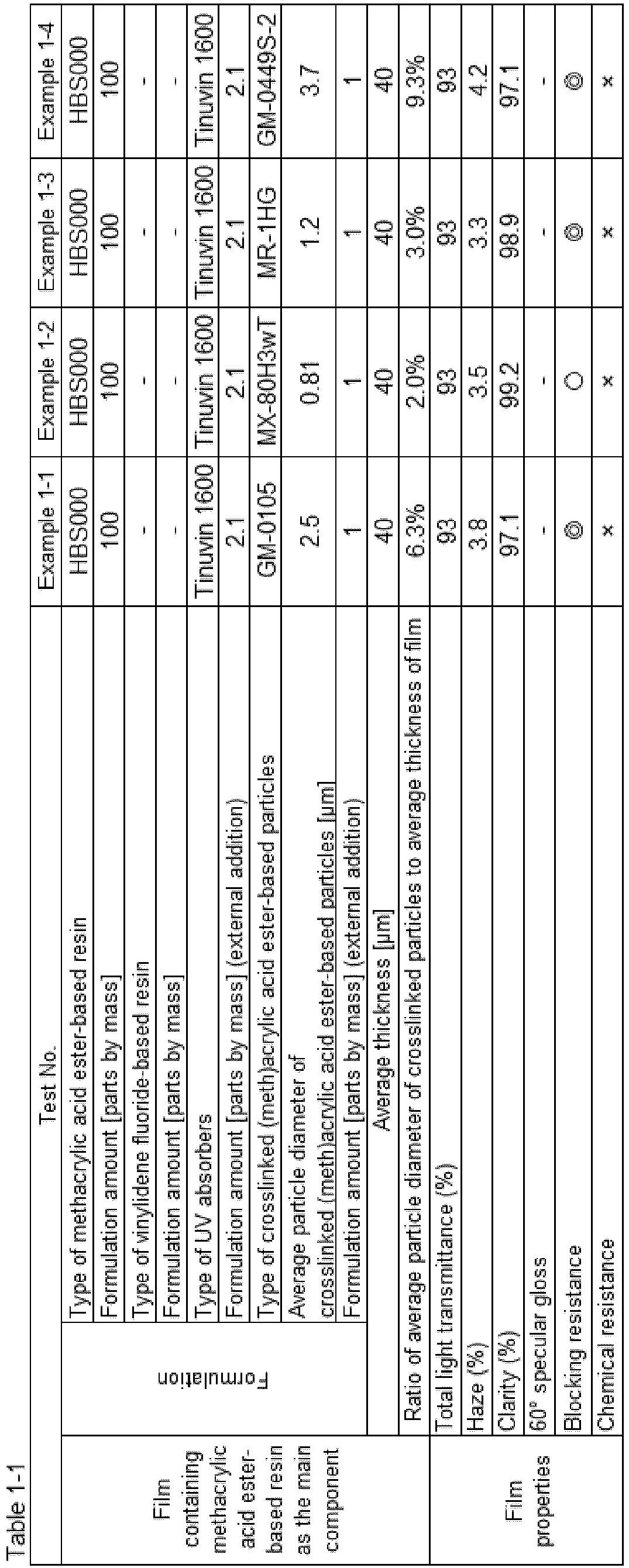


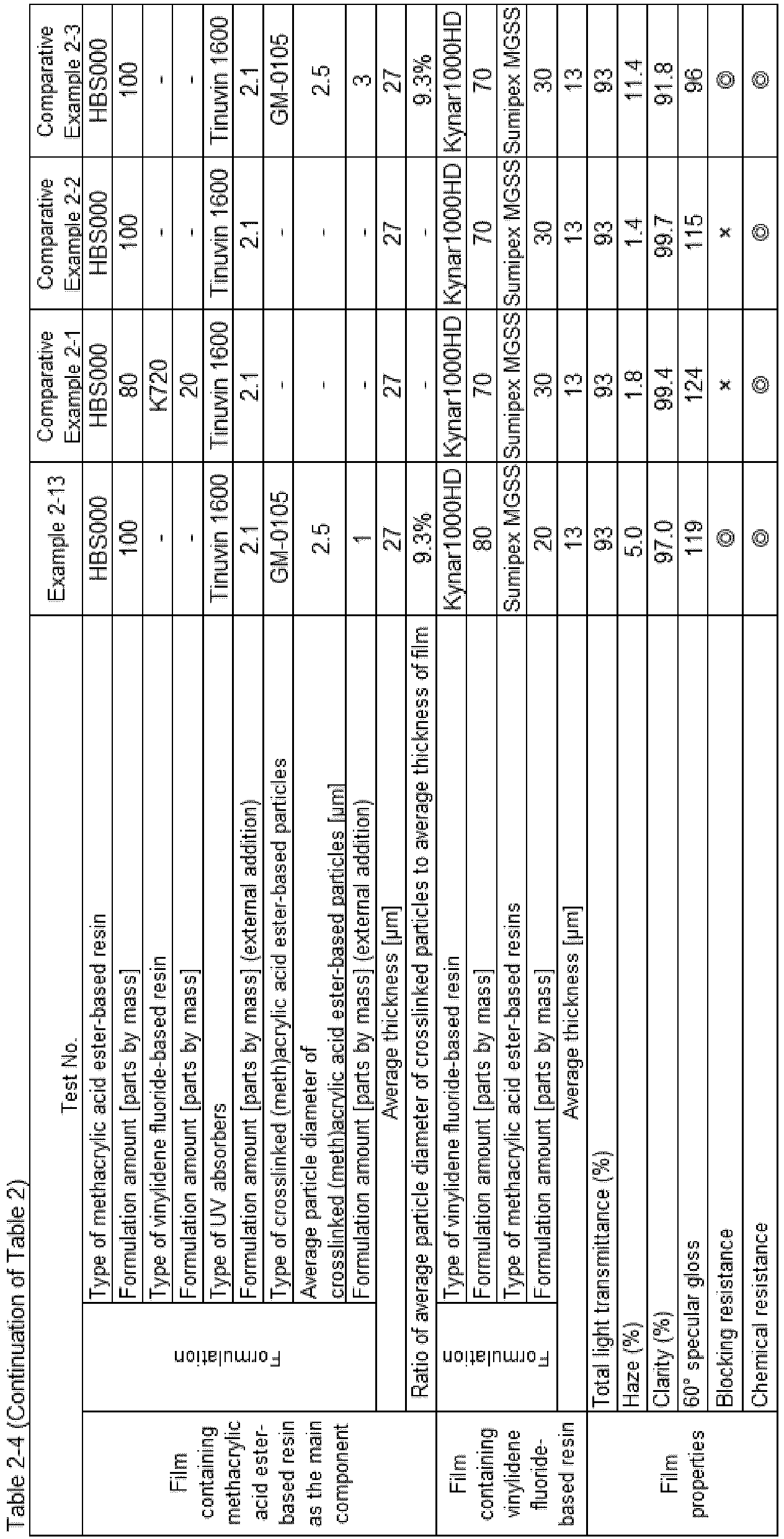

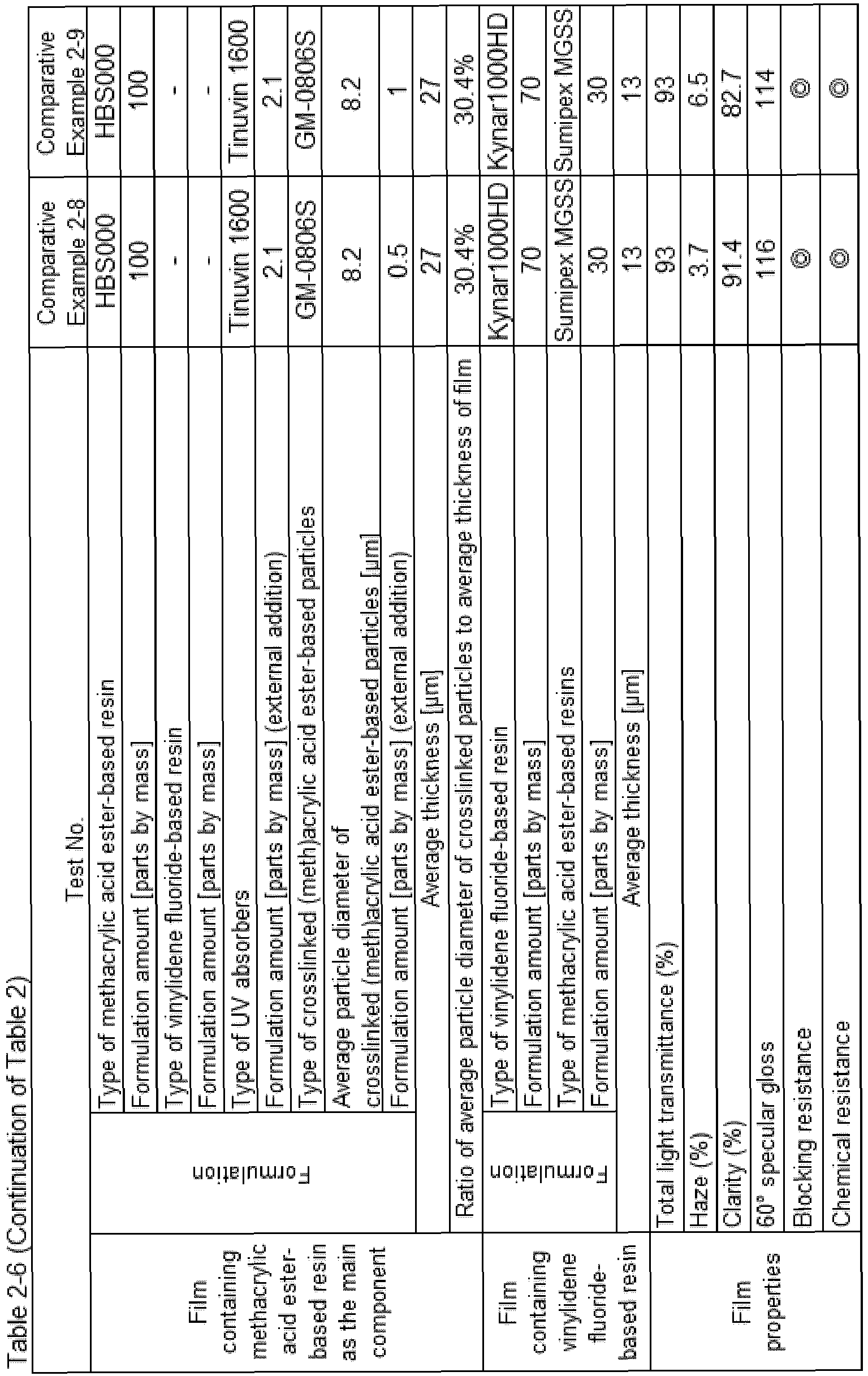
- Description of Reference Numerals
- 1 Film
- 10 Surface layer
- 20 Back layer
Claims (5)
- A film, comprising crosslinked (meth)acrylic acid ester-based resin particles and comprising methacrylic acid ester-based resin as a main component,wherein the crosslinked (meth)acrylic acid-based resin particles have an average particle diameter of 1% or more and 10% or less with respect to an average thickness of the film,wherein the film does not comprise vinylidene fluoride-based resin,wherein a haze of the film measured based on JIS K7136: 2000 is 5% or less, andwherein a clarity (CLR) of the film calculated from the following formula is 97% or more,

- The film according to claim 1, wherein an amount of the crosslinked (meth)acrylic acid ester-based resin particles is 0.1 parts by mass or more and 2 parts by mass or less with respect to 100 parts by mass of the methacrylic acid ester-based resin.
- A multilayer film, comprising:the film according to claim 1 or 2, anda film comprising vinylidene fluoride-based resin laminated on one side of the film;wherein a haze measured based on JIS K7136: 2000 is 5% or less, a clarity (CLR) is 97% or more, and a 60° specular gloss measured based on JIS Z8741: 1997 of an outer surface side of the film comprising vinylidene fluoride-based resin is 100 or more.
- The multilayer film according to claim 3, wherein the film comprising the vinylidene fluoride-based resin comprises:(A) one or two selected from a copolymer of vinylidene fluoride with hexafluoropropylene, and polyvinylidene fluoride, and(B) a methacrylic acid ester-based resin;wherein a total of (A) is 50 parts by mass or more and 80 parts by mass or less, and (B) is 20 parts by mass or more and 50 parts by mass or less, with respect to 100 parts by mass of a total of (A) and (B).
- A metallic decorative film, in which the film according to claim 1 or 2 is laminated as an outermost layer, or a metallic decorative film, in which the multilayer film according to claim 3 or 4 is laminated as an outermost layer with the film containing vinylidene fluoride-based resin on an outside.
Applications Claiming Priority (3)
| Application Number | Priority Date | Filing Date | Title |
|---|---|---|---|
| JP2021130097 | 2021-08-06 | ||
| JP2022063103 | 2022-04-05 | ||
| PCT/JP2022/028095 WO2023013404A1 (en) | 2021-08-06 | 2022-07-19 | Film having methacrylic acid ester-based resin as main component thereof |
Publications (2)
| Publication Number | Publication Date |
|---|---|
| EP4382558A1 true EP4382558A1 (en) | 2024-06-12 |
| EP4382558A4 EP4382558A4 (en) | 2024-11-20 |
Family
ID=85155917
Family Applications (2)
| Application Number | Title | Priority Date | Filing Date |
|---|---|---|---|
| EP22852830.3A Withdrawn EP4382292A4 (en) | 2021-08-06 | 2022-07-19 | MULTILAYER FILM |
| EP22852828.7A Withdrawn EP4382558A4 (en) | 2021-08-06 | 2022-07-19 | FILM WITH A METHACRYLIC ACID ESTER-BASED RESIN AS THE MAIN COMPONENT THEREOF |
Family Applications Before (1)
| Application Number | Title | Priority Date | Filing Date |
|---|---|---|---|
| EP22852830.3A Withdrawn EP4382292A4 (en) | 2021-08-06 | 2022-07-19 | MULTILAYER FILM |
Country Status (5)
| Country | Link |
|---|---|
| US (2) | US20240342973A1 (en) |
| EP (2) | EP4382292A4 (en) |
| JP (2) | JPWO2023013404A1 (en) |
| TW (2) | TW202317698A (en) |
| WO (2) | WO2023013406A1 (en) |
Family Cites Families (12)
| Publication number | Priority date | Publication date | Assignee | Title |
|---|---|---|---|---|
| JP4580066B2 (en) * | 2000-07-10 | 2010-11-10 | 株式会社クレハ | Fluororesin laminate and molded body comprising the same |
| JP2005112971A (en) * | 2003-10-07 | 2005-04-28 | Sumitomo Chemical Co Ltd | Resin composition and laminated resin plate |
| JP2005112972A (en) * | 2003-10-07 | 2005-04-28 | Sumitomo Chemical Co Ltd | Resin composition and laminated resin plate |
| JP5681488B2 (en) * | 2008-06-10 | 2015-03-11 | 株式会社カネカ | Fluororesin film and molded product including the same |
| EP2397519B1 (en) * | 2009-02-13 | 2015-11-25 | Denki Kagaku Kogyo Kabushiki Kaisha | Vinylidene fluoride-based resin film |
| JP5424717B2 (en) * | 2009-05-29 | 2014-02-26 | 株式会社日本触媒 | Manufacturing method of optical film |
| CN102892816B (en) | 2010-05-14 | 2014-10-01 | 三菱丽阳株式会社 | Film, method for producing same, laminated film or sheet, and laminate |
| JP6414054B2 (en) * | 2014-03-13 | 2018-10-31 | 三菱ケミカル株式会社 | Acrylic resin film |
| JP6503767B2 (en) * | 2014-08-20 | 2019-04-24 | 三菱ケミカル株式会社 | Acrylic resin film for retroreflective sheeting and retroreflective sheet and retroreflective article using the same |
| JP6764669B2 (en) * | 2016-03-31 | 2020-10-07 | 株式会社カネカ | Optical film and its manufacturing method |
| EP4105021A4 (en) * | 2020-02-10 | 2023-07-19 | Denka Company Limited | RESIN FILM AND METHOD OF PRODUCING THEREOF |
| JP7244879B2 (en) * | 2020-02-10 | 2023-03-23 | 尾池工業株式会社 | Metal-like decorative film, metal-like vehicle interior and exterior parts, metal-like molding |
-
2022
- 2022-07-19 WO PCT/JP2022/028097 patent/WO2023013406A1/en not_active Ceased
- 2022-07-19 JP JP2023540234A patent/JPWO2023013404A1/ja active Pending
- 2022-07-19 JP JP2023540235A patent/JPWO2023013406A1/ja active Pending
- 2022-07-19 US US18/292,552 patent/US20240342973A1/en active Pending
- 2022-07-19 EP EP22852830.3A patent/EP4382292A4/en not_active Withdrawn
- 2022-07-19 US US18/293,470 patent/US20240343899A1/en active Pending
- 2022-07-19 WO PCT/JP2022/028095 patent/WO2023013404A1/en not_active Ceased
- 2022-07-19 EP EP22852828.7A patent/EP4382558A4/en not_active Withdrawn
- 2022-08-03 TW TW111129047A patent/TW202317698A/en unknown
- 2022-08-03 TW TW111129077A patent/TW202308851A/en unknown
Also Published As
| Publication number | Publication date |
|---|---|
| TW202308851A (en) | 2023-03-01 |
| EP4382292A4 (en) | 2024-11-20 |
| EP4382292A1 (en) | 2024-06-12 |
| EP4382558A4 (en) | 2024-11-20 |
| US20240342973A1 (en) | 2024-10-17 |
| TW202317698A (en) | 2023-05-01 |
| WO2023013404A1 (en) | 2023-02-09 |
| US20240343899A1 (en) | 2024-10-17 |
| JPWO2023013404A1 (en) | 2023-02-09 |
| JPWO2023013406A1 (en) | 2023-02-09 |
| WO2023013406A1 (en) | 2023-02-09 |
Similar Documents
| Publication | Publication Date | Title |
|---|---|---|
| EP1890869B1 (en) | Optical bodies including rough strippable boundary layers and asymmetric surface structures | |
| US11685815B2 (en) | Vinylidene-fluoride resin film | |
| KR102566588B1 (en) | Acrylic resin film and manufacturing method thereof | |
| WO2018142983A1 (en) | Biaxially oriented polypropylene-based film | |
| KR20190143362A (en) | Laminated steel plate, preparation method thereof, and sheet used therefor | |
| JP2021143308A (en) | Thermoplastic resin film | |
| JP7559039B2 (en) | Resin film and method for producing same | |
| US20240343899A1 (en) | Film having methacrylic acid ester-based resin as main component | |
| JP2012236381A (en) | Laminate and method for producing the same | |
| JP4449688B2 (en) | Acrylic laminated film | |
| JP2008207554A (en) | Laminated film | |
| JPWO2020149254A1 (en) | Extruded resin laminate and extruded resin laminate with cured film | |
| CN117794987A (en) | Methacrylate resin-based film | |
| JP7513722B2 (en) | Laminated film and its manufacturing method | |
| JP5805229B2 (en) | the film | |
| JP2012245662A (en) | Laminate and method for manufacturing the same | |
| KR20080071914A (en) | Laminate film | |
| WO2024214794A1 (en) | Resin composition, laminated film, and decorative film | |
| JP2013184466A (en) | Laminate and method of manufacturing the same | |
| JP7585803B2 (en) | Resin composition, film and molded article | |
| JP2002019051A (en) | Fluororesin laminate and molding made of the same | |
| JP2010249928A (en) | Light diffusion film | |
| JP2013144365A (en) | Method of manufacturing laminate | |
| JP2013111765A (en) | Laminate and method for manufacturing the same |
Legal Events
| Date | Code | Title | Description |
|---|---|---|---|
| STAA | Information on the status of an ep patent application or granted ep patent |
Free format text: STATUS: THE INTERNATIONAL PUBLICATION HAS BEEN MADE |
|
| PUAI | Public reference made under article 153(3) epc to a published international application that has entered the european phase |
Free format text: ORIGINAL CODE: 0009012 |
|
| STAA | Information on the status of an ep patent application or granted ep patent |
Free format text: STATUS: REQUEST FOR EXAMINATION WAS MADE |
|
| 17P | Request for examination filed |
Effective date: 20240223 |
|
| AK | Designated contracting states |
Kind code of ref document: A1 Designated state(s): AL AT BE BG CH CY CZ DE DK EE ES FI FR GB GR HR HU IE IS IT LI LT LU LV MC MK MT NL NO PL PT RO RS SE SI SK SM TR |
|
| DAV | Request for validation of the european patent (deleted) | ||
| DAX | Request for extension of the european patent (deleted) | ||
| A4 | Supplementary search report drawn up and despatched |
Effective date: 20241018 |
|
| RIC1 | Information provided on ipc code assigned before grant |
Ipc: C08F 220/14 20060101ALI20241014BHEP Ipc: B32B 27/30 20060101ALI20241014BHEP Ipc: C08J 5/18 20060101AFI20241014BHEP |
|
| STAA | Information on the status of an ep patent application or granted ep patent |
Free format text: STATUS: THE APPLICATION HAS BEEN WITHDRAWN |
|
| 18W | Application withdrawn |
Effective date: 20250212 |