EP4381960A1 - Method for suppressing foaming in carbonated beverage, method for producing carbonated beverage, and carbonated beverage in which foaming is suppressed - Google Patents
Method for suppressing foaming in carbonated beverage, method for producing carbonated beverage, and carbonated beverage in which foaming is suppressed Download PDFInfo
- Publication number
- EP4381960A1 EP4381960A1 EP22852980.6A EP22852980A EP4381960A1 EP 4381960 A1 EP4381960 A1 EP 4381960A1 EP 22852980 A EP22852980 A EP 22852980A EP 4381960 A1 EP4381960 A1 EP 4381960A1
- Authority
- EP
- European Patent Office
- Prior art keywords
- carbonated beverage
- foaming
- glycerin
- ppm
- flavor
- Prior art date
- Legal status (The legal status is an assumption and is not a legal conclusion. Google has not performed a legal analysis and makes no representation as to the accuracy of the status listed.)
- Granted
Links
Images
Classifications
-
- A—HUMAN NECESSITIES
- A23—FOODS OR FOODSTUFFS; TREATMENT THEREOF, NOT COVERED BY OTHER CLASSES
- A23L—FOODS, FOODSTUFFS OR NON-ALCOHOLIC BEVERAGES, NOT OTHERWISE PROVIDED FOR; PREPARATION OR TREATMENT THEREOF
- A23L2/00—Non-alcoholic beverages; Dry compositions or concentrates therefor; Preparation or treatment thereof
-
- A—HUMAN NECESSITIES
- A23—FOODS OR FOODSTUFFS; TREATMENT THEREOF, NOT COVERED BY OTHER CLASSES
- A23L—FOODS, FOODSTUFFS OR NON-ALCOHOLIC BEVERAGES, NOT OTHERWISE PROVIDED FOR; PREPARATION OR TREATMENT THEREOF
- A23L2/00—Non-alcoholic beverages; Dry compositions or concentrates therefor; Preparation or treatment thereof
- A23L2/52—Adding ingredients
- A23L2/56—Flavouring or bittering agents
-
- A—HUMAN NECESSITIES
- A23—FOODS OR FOODSTUFFS; TREATMENT THEREOF, NOT COVERED BY OTHER CLASSES
- A23L—FOODS, FOODSTUFFS OR NON-ALCOHOLIC BEVERAGES, NOT OTHERWISE PROVIDED FOR; PREPARATION OR TREATMENT THEREOF
- A23L2/00—Non-alcoholic beverages; Dry compositions or concentrates therefor; Preparation or treatment thereof
- A23L2/52—Adding ingredients
-
- A—HUMAN NECESSITIES
- A23—FOODS OR FOODSTUFFS; TREATMENT THEREOF, NOT COVERED BY OTHER CLASSES
- A23L—FOODS, FOODSTUFFS OR NON-ALCOHOLIC BEVERAGES, NOT OTHERWISE PROVIDED FOR; PREPARATION OR TREATMENT THEREOF
- A23L2/00—Non-alcoholic beverages; Dry compositions or concentrates therefor; Preparation or treatment thereof
- A23L2/52—Adding ingredients
- A23L2/54—Mixing with gases
Definitions
- the present invention relates to a method for suppressing foaming in a carbonated beverage, a method for producing a carbonated beverage, and a carbonated beverage with suppressed foaming.
- Carbonated beverages are often drunk for the unique stimulation in the oral cavity caused by the carbon dioxide gas therein, and are popular in new lifestyles currently because of refreshing one's pent-up feelings and making one feel positive.
- carbonated water there has been an increase in the number of consumers seeking healthy refreshment through the stimulation of carbonated water, and many products featuring strong carbonation, which have a higher amount of dissolved carbon dioxide gas than regular carbonated water, have been released.
- Patent Literature 1 discloses a technique for suppressing spillage during filling by blending a polysaccharide of three or more saccharides.
- Patent Literature 2 discloses an antifoaming agent for beverages in which a food emulsifier is used, which is less likely to cause oil floating or influence flavors, and which has excellent antifoaming performance.
- Patent Literature 1 does not focus on flavors, and depending on the concentration added, the amount to be used may be limited in carbonated beverages characterized by being sugar-free.
- Patent Literature 2 since the technique disclosed in Patent Literature 2 uses an emulsifier, it may cause turbidity depending on the concentration added, and the amount to be used may be limited in transparent carbonated beverages.
- the present inventors have focused on a solvent that accounts for a large proportion in a flavor composition and has the role of dissolving a flavor while intensively studying on providing a carbonated beverage that suppresses spillage of the carbonated beverage during production.
- the present invention has been completed. More specifically, the present invention relates to the following ⁇ 1> to ⁇ 7>.
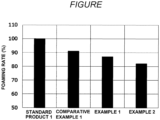
- the FIGURE is a diagram showing evaluation results regarding a foaming suppression test in Examples.
- proportions (percentages, parts, etc.) on a weight basis are the same as proportions (percentages, parts, etc.) on a mass basis.
- ppm means 0.001 mg/g.
- a carbonated beverage according to the present invention contains glycerin in an amount of 120 ppm to 1800 ppm.
- glycerin in an amount of 120 ppm to 1800 ppm.
- the carbonated beverage according to the present invention is preferably a carbonated beverage with suppressed foaming. That is, the carbonated beverage according to the present invention is preferably a carbonated beverage with suppressed foaming in which the concentration of glycerin is adjusted to 120 ppm to 1800 ppm, and is particularly preferably a carbonated beverage with suppressed foaming that occurs during production, such as when filling containers with carbonated beverages.
- foaming means formation of foam in a carbonated beverage.
- the concentration of glycerin in the carbonated beverage can be measured by a liquid chromatogram mass spectrometer.
- the proportion of glycerin in a carbonated beverage flavor composition for suppressing foaming according to the present invention is preferably 60% to 90% on a mass basis.
- the proportion of glycerin in the flavor composition according to the present invention is more preferably 70% to 90%, and still more preferably 80% to 90%, on a mass basis.
- the flavor composition according to the present invention can be used in a method for producing a carbonated beverage or a method for suppressing foaming in a carbonated beverage, which will be described later.
- the flavor composition may contain commonly used retention agents and solvents.
- Examples of the carbonated beverage flavor composition according to the present invention also include a flavor composition in which the proportion of glycerin is 60% to 90%.
- the concentration of glycerin in the flavor composition can be measured by gas chromatograph and a gas chromatograph mass spectrometer.
- the flavor composition according to the present invention is contained in the carbonated beverage in an amount of preferably 0.02% to 0.2%, and more preferably 0.02% to 0.1%, on a mass basis.
- Examples of the carbonated beverage containing the flavor composition according to the present invention also include a carbonated beverage in which the proportion of glycerin in the flavor composition is 60% to 90% on a mass basis.
- the carbonated beverage is preferably a carbonated beverage with suppressed foaming.
- Examples of the carbonated beverage containing the flavor composition according to the present invention also include a carbonated beverage with suppressed foaming in which the proportion of glycerin in the flavor composition is 60% to 90%.
- the carbonated beverage in the present invention can be, for example, a carbonated beverage containing only water, a flavor, and the carbon dioxide gas, or a beverage containing various carbon dioxide gases, such as a colored carbonated beverage containing a coloring agent or the like.
- a fruit flavor As the flavor in the carbonated beverage, common flavors such as natural flavors, synthetic flavors, and mixtures of natural flavors and synthetic flavors can be used.
- a fruit flavor, a yogurt flavor, a ramune flavor, or a mixture thereof can be used.
- the fruit flavor include: citrus fruits (oranges, lemons, grapefruits, citrus unshiu, Buntan, Natsumikan, Hassaku, limes, citrons, yuzu, sweeties, sudachi, kabosu, kumquats, etc.); berries (for example, rubus such as raspberries, blackberries, loganberries, young berries, boysenberries, tayberries, cloudberries, salmonberries, arctic raspberries, and mayberries, bilberries such as blueberries, cranberries, and cowberries, currants such as gooseberries, red currants, and black currants, berries, mulberries, strawberries, wolfberries, elderberries, etc.); pears (pear, Japanese pear, Chinese pear
- These flavors may be used alone or in combination of two or more thereof. From the viewpoint of efficiently obtaining the foaming suppressing effect in the carbonated beverage, it is preferable to use a natural flavor such as citrus fruits or a flavor that is abundantly contained in citrus fruits. The above flavor may be contained in the flavor composition.
- the carbonated beverage, the flavor composition or the method according to the present invention is used in combination with a carbonated beverage containing a flavor component in an amount of 1 ppm to 160 ppm with a LogP of 2.8 to 8.0 calculated by "United States Environmental Protection Agency ver. 4.11" or the like, a further foaming suppressing effect can be obtained.
- Specific examples of the above flavor component with a LogP of 2.8 to 8.0 include benzyl benzoate, isoamyl benzoate, benzyl phenyl acetate, benzyl salicylate, octanol, nonanol, decanol, and menthyl 3-hydroxybutyrate.
- Benzyl benzoate, menthyl 3-hydroxybutyrate, ethyl myristate, methyl myristate, and ethyl palmitate are preferred in that they have little influence on flavor tone.
- These flavor components may be used alone or in combination of two or more thereof.
- Examples of a sweetener contained in the carbonated beverage include a fructose corn syrup, sugar (including sucrose and granulated sugar), fructose, high fructose corn syrup, glucose, oligosaccharide, lactose, honey, starch syrup, sugar alcohol, and a high-intensity sweetener.
- high-intensity sweetener examples include aspartame, acesulfame potassium, xylitol, glycyrrhizin, disodium glycyrrhizinate, saccharin, saccharin calcium, saccharin sodium, sucralose, alitame, neotame, arabinose, a licorice extract, xylose, stevia, thaumatin, a licorice extract, rhamnose, and ribose. These sweeteners may be used alone or in combination of two or more thereof.
- the carbonated beverage contains substantially no fruit juice, since the foaming suppressing effect can be efficiently obtained.
- the gas volume (carbon dioxide gas pressure) of the carbonated beverage may be adjusted as appropriate depending on the purpose. According to the present invention, it is possible to suppress foaming at a high gas volume of 3.0 to 5.0. However, the present invention is not particularly limited thereto, and for example, the gas volume of the carbonated beverage may be set to a low gas volume such as 0.1 to 3.0.
- a known method can be used for press-injecting the carbon dioxide gas.
- the gas volume in the carbonated beverage can be measured by a known method. For example, it can be measured using a commercially available measuring device (such as gas volume measuring device GVA-500 manufactured by KYOTO ELECTRONICS MANUFACTURING CO., LTD.).
- the gas volume represents the ratio of the volume of the carbon dioxide gas dissolved in the carbonated beverage to the volume of the entire carbonated beverage under standard conditions (1 atm, 0°C).
- the carbonated beverage according to the present invention may contain other components to the extent that the effects of the present invention are not impaired.
- Other components can be added as an additive.
- a colorant, an antioxidant, a seasoning, a fortifying agent such as vitamins and minerals, a pH adjuster, an emulsifier, a stabilizer, dietary fibers, or dextrin can be used. These components may be used alone or in combination of two or more thereof.
- the method for suppressing foaming in a carbonated beverage according to the present invention include a step of adjusting a concentration of glycerin in a carbonated beverage to 120 ppm to 1800 ppm.
- a method for suppressing foaming in a carbonated beverage containing a flavor composition according to the present invention include a step of using a flavor composition in which a proportion of glycerin is 60% to 90% on a mass basis.
- Examples of the method according to the present invention also include a method for suppressing foaming in a carbonated beverage, which uses a flavor composition in which a proportion of glycerin is 60% to 90% in a carbonated beverage containing the perfume composition.
- the foaming in the carbonated beverage can be effectively suppressed, and in particular, the foaming in the carbonated beverage that occurs during production, such as when filling containers with carbonated beverages, can be effectively suppressed.
- the method for producing a carbonated beverage according to the present invention include a step of adjusting a concentration of glycerin in a carbonated beverage to 120 ppm to 1800 ppm.
- a method for producing a carbonated beverage containing a flavor composition according to the present invention include a step of using a flavor composition in which a proportion of glycerin is 60% to 90% on a mass basis.
- the produced carbonated beverage is preferably a carbonated beverage with suppressed foaming.
- Examples of the method according to the present invention also include a method for producing a carbonated beverage with suppressed foaming in which the proportion of glycerin in the perfume composition is 60% to 90% in a carbonated beverage containing the flavor composition.
- the foaming can be effectively suppressed, and in particular, the foaming in the carbonated beverage that occurs during production, such as when filling containers with carbonated beverages, can be effectively suppressed.
- Reference Product 1 The following grape flavor mixture (Reference Product 1) was prepared.
- Table 1 shows the blending formulation of Reference Product 1.
- Table 1 Name of flavor compound Weight ratio Ethyl acetate 16 Linalool 4 Ethyl butyrate 10 Acetic acid 1 Ethyl isovalerate 10 Methyl anthranilate 50 Ethyl caproate 2 Vanillin 2 Isoamyl alcohol 4 Maltol 1 Total 100
- a flavor composition was prepared by mixing Reference Product 1, water, and ethanol and glycerin that can be used as solvents.
- a sample was prepared by adding a flavor composition to a commercially available plain strongly carbonated water (gas volume: 5.0) cooled to 5°C or lower such that the amount was 0.02% on a mass basis based on the total amount of the carbonated beverage.
- Values of Reference Product 1, water, ethanol, and glycerin in Table 2 indicate weight ratios of each component in the flavor compositions contained in Standard Product 1, Comparative Example 1, and Examples 1 and 2.
- a foaming rate of 90% or less was determined to have a foaming suppressing effect.
- Standard Product 1 is a carbonated beverage containing a flavor composition using only ethanol as a solvent.
- Comparative Example 1 and Examples 1 and 2 use ethanol and glycerin as solvents, and are carbonated beverages containing flavor compositions with different proportions of these solvents.
- Table 3 and FIGURE show the foaming rate (%) calculated by performing a foaming property evaluation test using these formulations.
- Carbonated beverages with glycerin adjusted to less than 120 ppm (Standard Product 1, Comparative Example 1) have no foaming suppressing effect, while the foaming suppressing effect is confirmed in carbonated beverages containing glycerin in an amount of 120 ppm or more (Examples 1 and 2). Therefore, the present method is shown to be a useful method for solving the problem.
Landscapes
- Health & Medical Sciences (AREA)
- Nutrition Science (AREA)
- Life Sciences & Earth Sciences (AREA)
- Chemical & Material Sciences (AREA)
- Engineering & Computer Science (AREA)
- Food Science & Technology (AREA)
- Polymers & Plastics (AREA)
- Non-Alcoholic Beverages (AREA)
Abstract
Description
- The present invention relates to a method for suppressing foaming in a carbonated beverage, a method for producing a carbonated beverage, and a carbonated beverage with suppressed foaming.
- Carbonated beverages are often drunk for the unique stimulation in the oral cavity caused by the carbon dioxide gas therein, and are popular in new lifestyles currently because of refreshing one's pent-up feelings and making one feel positive. In recent years, there has been an increase in the number of consumers seeking healthy refreshment through the stimulation of carbonated water, and many products featuring strong carbonation, which have a higher amount of dissolved carbon dioxide gas than regular carbonated water, have been released.
- On the other hand, the carbonated beverages contain the dissolved carbon dioxide gas in a supersaturated state, which can cause troubles such as carbonated beverages spilling out when filling containers such as a plastic bottle or when consumers open the bottle. Therefore, for example,
Patent Literature 1 discloses a technique for suppressing spillage during filling by blending a polysaccharide of three or more saccharides. In addition,Patent Literature 2 discloses an antifoaming agent for beverages in which a food emulsifier is used, which is less likely to cause oil floating or influence flavors, and which has excellent antifoaming performance. -
- Patent Literature 1:
JP2014-226073A - Patent Literature 2:
JP2016-116515A - However, the technique disclosed in
Patent Literature 1 does not focus on flavors, and depending on the concentration added, the amount to be used may be limited in carbonated beverages characterized by being sugar-free. In addition, since the technique disclosed inPatent Literature 2 uses an emulsifier, it may cause turbidity depending on the concentration added, and the amount to be used may be limited in transparent carbonated beverages. - Therefore, the present inventors have focused on a solvent that accounts for a large proportion in a flavor composition and has the role of dissolving a flavor while intensively studying on providing a carbonated beverage that suppresses spillage of the carbonated beverage during production. Thus, the present invention has been completed. More specifically, the present invention relates to the following <1> to <7>.
- <1> A carbonated beverage containing:
glycerin in an amount of 120 ppm to 1800 ppm. - <2> The carbonated beverage according to the above <1>, further containing:
a flavor composition in which a proportion of the glycerin is 60% to 90% on a mass basis. - <3> A method for producing a carbonated beverage, containing:
adjusting a concentration of glycerin in the carbonated beverage to 120 ppm to 1800 ppm. - <4> The method for producing a carbonated beverage according to the above <3>, further containing:
using a flavor composition in which a proportion of the glycerin is 60% to 90% on a mass basis. - <5> A method for suppressing foaming in a carbonated beverage, containing:
adjusting a concentration of glycerin in the carbonated beverage to 120 ppm to 1800 ppm. - <6> The method for suppressing foaming in a carbonated beverage according to the above <5>, further containing:
using a flavor composition in which a proportion of the glycerin is 60% to 90% on a mass basis. - <7> A carbonated beverage flavor composition for suppressing foaming in a carbonated beverage, which is used in the method according to the above <3> or <5>,
in which a proportion of the glycerin is 60% to 90% on a mass basis. - According to the present invention, spillage of a carbonated beverage during filling can be suppressed.
- The FIGURE is a diagram showing evaluation results regarding a foaming suppression test in Examples.
- Hereinafter, the present invention will be described in detail. In the present description, proportions (percentages, parts, etc.) on a weight basis are the same as proportions (percentages, parts, etc.) on a mass basis. In the present description, ppm means 0.001 mg/g.
- A carbonated beverage according to the present invention contains glycerin in an amount of 120 ppm to 1800 ppm. When the content of glycerin in the carbonated beverage is within the above range, a foaming suppressing effect in the carbonated beverage can be obtained.
- The carbonated beverage according to the present invention is preferably a carbonated beverage with suppressed foaming. That is, the carbonated beverage according to the present invention is preferably a carbonated beverage with suppressed foaming in which the concentration of glycerin is adjusted to 120 ppm to 1800 ppm, and is particularly preferably a carbonated beverage with suppressed foaming that occurs during production, such as when filling containers with carbonated beverages.
- In the present description, "foaming" means formation of foam in a carbonated beverage.
- The concentration of glycerin in the carbonated beverage can be measured by a liquid chromatogram mass spectrometer.
- The proportion of glycerin in a carbonated beverage flavor composition for suppressing foaming according to the present invention is preferably 60% to 90% on a mass basis. The proportion of glycerin in the flavor composition according to the present invention is more preferably 70% to 90%, and still more preferably 80% to 90%, on a mass basis. The flavor composition according to the present invention can be used in a method for producing a carbonated beverage or a method for suppressing foaming in a carbonated beverage, which will be described later. When the content of glycerin in the flavor composition is within the above range, a foaming suppressing effect in a carbonated beverage containing the above flavor composition can be obtained. In addition to flavor components described below, the flavor composition may contain commonly used retention agents and solvents. Examples of the carbonated beverage flavor composition according to the present invention also include a flavor composition in which the proportion of glycerin is 60% to 90%.
- The concentration of glycerin in the flavor composition can be measured by gas chromatograph and a gas chromatograph mass spectrometer.
- The flavor composition according to the present invention is contained in the carbonated beverage in an amount of preferably 0.02% to 0.2%, and more preferably 0.02% to 0.1%, on a mass basis.
- Examples of the carbonated beverage containing the flavor composition according to the present invention also include a carbonated beverage in which the proportion of glycerin in the flavor composition is 60% to 90% on a mass basis. The carbonated beverage is preferably a carbonated beverage with suppressed foaming. Examples of the carbonated beverage containing the flavor composition according to the present invention also include a carbonated beverage with suppressed foaming in which the proportion of glycerin in the flavor composition is 60% to 90%.
- The carbonated beverage in the present invention can be, for example, a carbonated beverage containing only water, a flavor, and the carbon dioxide gas, or a beverage containing various carbon dioxide gases, such as a colored carbonated beverage containing a coloring agent or the like.
- As the flavor in the carbonated beverage, common flavors such as natural flavors, synthetic flavors, and mixtures of natural flavors and synthetic flavors can be used. For example, a fruit flavor, a yogurt flavor, a ramune flavor, or a mixture thereof can be used. Examples of the fruit flavor include: citrus fruits (oranges, lemons, grapefruits, citrus unshiu, Buntan, Natsumikan, Hassaku, limes, citrons, yuzu, sweeties, sudachi, kabosu, kumquats, etc.); berries (for example, rubus such as raspberries, blackberries, loganberries, young berries, boysenberries, tayberries, cloudberries, salmonberries, arctic raspberries, and mayberries, bilberries such as blueberries, cranberries, and cowberries, currants such as gooseberries, red currants, and black currants, berries, mulberries, strawberries, wolfberries, elderberries, etc.); pears (pear, Japanese pear, Chinese pear, etc.); apple; grape; pineapple; fig; melon; mango; pomegranate; passion fruit; lychee; banana; peach; watermelon; tomato; papaya; guava; and loquat. These flavors may be used alone or in combination of two or more thereof. From the viewpoint of efficiently obtaining the foaming suppressing effect in the carbonated beverage, it is preferable to use a natural flavor such as citrus fruits or a flavor that is abundantly contained in citrus fruits. The above flavor may be contained in the flavor composition.
- When the carbonated beverage, the flavor composition or the method according to the present invention is used in combination with a carbonated beverage containing a flavor component in an amount of 1 ppm to 160 ppm with a LogP of 2.8 to 8.0 calculated by "United States Environmental Protection Agency ver. 4.11" or the like, a further foaming suppressing effect can be obtained.
- Specific examples of the above flavor component with a LogP of 2.8 to 8.0 include benzyl benzoate, isoamyl benzoate, benzyl phenyl acetate, benzyl salicylate, octanol, nonanol, decanol, and menthyl 3-hydroxybutyrate. Benzyl benzoate, menthyl 3-hydroxybutyrate, ethyl myristate, methyl myristate, and ethyl palmitate are preferred in that they have little influence on flavor tone. These flavor components may be used alone or in combination of two or more thereof.
- Examples of a sweetener contained in the carbonated beverage include a fructose corn syrup, sugar (including sucrose and granulated sugar), fructose, high fructose corn syrup, glucose, oligosaccharide, lactose, honey, starch syrup, sugar alcohol, and a high-intensity sweetener. Examples of the high-intensity sweetener include aspartame, acesulfame potassium, xylitol, glycyrrhizin, disodium glycyrrhizinate, saccharin, saccharin calcium, saccharin sodium, sucralose, alitame, neotame, arabinose, a licorice extract, xylose, stevia, thaumatin, a licorice extract, rhamnose, and ribose. These sweeteners may be used alone or in combination of two or more thereof.
- In the present invention, it is preferable that the carbonated beverage contains substantially no fruit juice, since the foaming suppressing effect can be efficiently obtained.
- The gas volume (carbon dioxide gas pressure) of the carbonated beverage may be adjusted as appropriate depending on the purpose. According to the present invention, it is possible to suppress foaming at a high gas volume of 3.0 to 5.0. However, the present invention is not particularly limited thereto, and for example, the gas volume of the carbonated beverage may be set to a low gas volume such as 0.1 to 3.0.
- A known method can be used for press-injecting the carbon dioxide gas. The gas volume in the carbonated beverage can be measured by a known method. For example, it can be measured using a commercially available measuring device (such as gas volume measuring device GVA-500 manufactured by KYOTO ELECTRONICS MANUFACTURING CO., LTD.).
- Note that, the gas volume represents the ratio of the volume of the carbon dioxide gas dissolved in the carbonated beverage to the volume of the entire carbonated beverage under standard conditions (1 atm, 0°C).
- In addition to the flavor and the sweetener, the carbonated beverage according to the present invention may contain other components to the extent that the effects of the present invention are not impaired. Other components can be added as an additive. As such an additive, for example, a colorant, an antioxidant, a seasoning, a fortifying agent such as vitamins and minerals, a pH adjuster, an emulsifier, a stabilizer, dietary fibers, or dextrin can be used. These components may be used alone or in combination of two or more thereof.
- The method for suppressing foaming in a carbonated beverage according to the present invention include a step of adjusting a concentration of glycerin in a carbonated beverage to 120 ppm to 1800 ppm. In addition, a method for suppressing foaming in a carbonated beverage containing a flavor composition according to the present invention include a step of using a flavor composition in which a proportion of glycerin is 60% to 90% on a mass basis. Examples of the method according to the present invention also include a method for suppressing foaming in a carbonated beverage, which uses a flavor composition in which a proportion of glycerin is 60% to 90% in a carbonated beverage containing the perfume composition.
- According to such a method for suppressing foaming in a carbonated beverage, the foaming in the carbonated beverage can be effectively suppressed, and in particular, the foaming in the carbonated beverage that occurs during production, such as when filling containers with carbonated beverages, can be effectively suppressed.
- The method for producing a carbonated beverage according to the present invention include a step of adjusting a concentration of glycerin in a carbonated beverage to 120 ppm to 1800 ppm. In addition, a method for producing a carbonated beverage containing a flavor composition according to the present invention include a step of using a flavor composition in which a proportion of glycerin is 60% to 90% on a mass basis. The produced carbonated beverage is preferably a carbonated beverage with suppressed foaming. Examples of the method according to the present invention also include a method for producing a carbonated beverage with suppressed foaming in which the proportion of glycerin in the perfume composition is 60% to 90% in a carbonated beverage containing the flavor composition.
- According to such a method for producing a carbonated beverage, the foaming can be effectively suppressed, and in particular, the foaming in the carbonated beverage that occurs during production, such as when filling containers with carbonated beverages, can be effectively suppressed.
- Hereinafter, the present invention will be described in more detail with reference to Examples, but the present invention is not limited thereto.
- The following grape flavor mixture (Reference Product 1) was prepared. Table 1 shows the blending formulation of
Reference Product 1.[Table 1] Name of flavor compound Weight ratio Ethyl acetate 16 Linalool 4 Ethyl butyrate 10 Acetic acid 1 Ethyl isovalerate 10 Methyl anthranilate 50 Ethyl caproate 2 Vanillin 2 Isoamyl alcohol 4 Maltol 1 Total 100 - As shown in Table 2 below, a flavor composition was prepared by mixing
Reference Product 1, water, and ethanol and glycerin that can be used as solvents. A sample was prepared by adding a flavor composition to a commercially available plain strongly carbonated water (gas volume: 5.0) cooled to 5°C or lower such that the amount was 0.02% on a mass basis based on the total amount of the carbonated beverage. Values ofReference Product 1, water, ethanol, and glycerin in Table 2 indicate weight ratios of each component in the flavor compositions contained inStandard Product 1, Comparative Example 1, and Examples 1 and 2.[Table 2] Standard Product 1Comparative Example 1 Example 1 Example 2 Reference Product 11 1 1 1 Water 9 9 9 9 Ethanol 90 40 30 10 Glycerin 0 50 60 80 Total 100 100 100 100 Concentration (ppm) of glycerin in carbonated beverage 0 100 120 160 - A funnel (diameter: 150 mm) was installed such that the tip thereof was 5 mm above a mouth portion of a 1 L measuring cylinder (height: 420 mm, outer diameter: 7 cm). 10 seconds after pouring 500 mL of the sample into the funnel, the sample was poured at a rate of 10 L/min with care such that it fell into the center of the measuring cylinder, and the highest height (maximum total height) reached before bubbles disappeared was measured. From the obtained results, a foaming rate was calculated based on the following equation.
Foaming rate (%) = (maximum total height of sample for which foaming rate is calculated) × 100/(maximum total height of Standard Product 1) - Note that, as a criterion for determining the foaming suppressing effect, a foaming rate of 90% or less was determined to have a foaming suppressing effect.
-
Standard Product 1 is a carbonated beverage containing a flavor composition using only ethanol as a solvent. On the other hand, Comparative Example 1 and Examples 1 and 2 use ethanol and glycerin as solvents, and are carbonated beverages containing flavor compositions with different proportions of these solvents. - Table 3 and FIGURE show the foaming rate (%) calculated by performing a foaming property evaluation test using these formulations.
[Table 3] Standard Product 1Comparative Example 1 Example 1 Example 2 100 91 87 82 - Carbonated beverages with glycerin adjusted to less than 120 ppm (
Standard Product 1, Comparative Example 1) have no foaming suppressing effect, while the foaming suppressing effect is confirmed in carbonated beverages containing glycerin in an amount of 120 ppm or more (Examples 1 and 2). Therefore, the present method is shown to be a useful method for solving the problem. - Although the present invention has been described in detail with reference to specific embodiments, it will be apparent to those skilled in the art that various changes and modifications can be made without departing from the spirit and scope of the present invention. Note that, this application is based on a Japanese patent application (
Japanese Patent Application No. 2021-127898) filed on August 4, 2021
Claims (7)
- A carbonated beverage comprising:
glycerin in an amount of 120 ppm to 1800 ppm. - The carbonated beverage according to claim 1, further comprising:
a flavor composition in which a proportion of the glycerin is 60% to 90% on a mass basis. - A method for producing a carbonated beverage, comprising:
adjusting a concentration of glycerin in the carbonated beverage to 120 ppm to 1800 ppm. - The method for producing a carbonated beverage according to claim 3, further comprising:
using a flavor composition in which a proportion of the glycerin is 60% to 90% on a mass basis. - A method for suppressing foaming in a carbonated beverage, comprising:
adjusting a concentration of glycerin in the carbonated beverage to 120 ppm to 1800 ppm. - The method for suppressing foaming in a carbonated beverage according to claim 5, further comprising:
using a flavor composition in which a proportion of the glycerin is 60% to 90% on a mass basis. - A carbonated beverage flavor composition for suppressing foaming in a carbonated beverage, which is used in the method according to claim 3 or 5,
wherein a proportion of the glycerin is 60% to 90% on a mass basis.
Applications Claiming Priority (2)
| Application Number | Priority Date | Filing Date | Title |
|---|---|---|---|
| JP2021127898 | 2021-08-04 | ||
| PCT/JP2022/029387 WO2023013561A1 (en) | 2021-08-04 | 2022-07-29 | Method for suppressing foaming in carbonated beverage, method for producing carbonated beverage, and carbonated beverage in which foaming is suppressed |
Publications (3)
| Publication Number | Publication Date |
|---|---|
| EP4381960A1 true EP4381960A1 (en) | 2024-06-12 |
| EP4381960A4 EP4381960A4 (en) | 2025-07-09 |
| EP4381960B1 EP4381960B1 (en) | 2026-04-22 |
Family
ID=85154711
Family Applications (1)
| Application Number | Title | Priority Date | Filing Date |
|---|---|---|---|
| EP22852980.6A Active EP4381960B1 (en) | 2021-08-04 | 2022-07-29 | Method for suppressing foaming in carbonated beverage, method for producing carbonated beverage, and carbonated beverage in which foaming is suppressed |
Country Status (5)
| Country | Link |
|---|---|
| US (1) | US20240341329A1 (en) |
| EP (1) | EP4381960B1 (en) |
| JP (1) | JPWO2023013561A1 (en) |
| CN (1) | CN117813014A (en) |
| WO (1) | WO2023013561A1 (en) |
Family Cites Families (8)
| Publication number | Priority date | Publication date | Assignee | Title |
|---|---|---|---|---|
| JP3502812B2 (en) * | 2000-06-09 | 2004-03-02 | アサヒ飲料株式会社 | Carbonated beverage with emulsified flavor |
| US20080226795A1 (en) * | 2007-03-14 | 2008-09-18 | Concentrate Manufacturing Company Of Ireland | Non-nutritive sweetened beverages with glycerine |
| JP6510745B2 (en) | 2013-05-21 | 2019-05-08 | アサヒ飲料株式会社 | Container-packed carbonated beverage, method of defoaming carbonated beverage, and defoamer for carbonated beverage |
| GB201315738D0 (en) * | 2013-09-04 | 2013-10-16 | Thos Bentley & Son Ltd | Improvements in or relating to carbonated beverages |
| US9907326B2 (en) * | 2014-09-30 | 2018-03-06 | Suntory Beverage & Food Limited | Carbonated beverage, syrup used for preparing carbonated beverage, method for manufacturing carbonated beverage, and method for suppressing foaming in carbonated beverage |
| JP6732445B2 (en) | 2014-12-22 | 2020-07-29 | 理研ビタミン株式会社 | Antifoam for beverages |
| JP7421945B2 (en) | 2020-02-17 | 2024-01-25 | シャープ株式会社 | Air blower |
| JP6790295B1 (en) * | 2020-02-25 | 2020-11-25 | アサヒ飲料株式会社 | A method for producing sugar-free carbonated beverages, sugar-free carbonated beverages, and a method for improving the run-out of sugar-free beverages |
-
2022
- 2022-07-29 US US18/294,732 patent/US20240341329A1/en active Pending
- 2022-07-29 EP EP22852980.6A patent/EP4381960B1/en active Active
- 2022-07-29 JP JP2023540318A patent/JPWO2023013561A1/ja active Pending
- 2022-07-29 WO PCT/JP2022/029387 patent/WO2023013561A1/en not_active Ceased
- 2022-07-29 CN CN202280053179.XA patent/CN117813014A/en active Pending
Also Published As
| Publication number | Publication date |
|---|---|
| CN117813014A (en) | 2024-04-02 |
| EP4381960B1 (en) | 2026-04-22 |
| WO2023013561A1 (en) | 2023-02-09 |
| JPWO2023013561A1 (en) | 2023-02-09 |
| US20240341329A1 (en) | 2024-10-17 |
| EP4381960A4 (en) | 2025-07-09 |
Similar Documents
| Publication | Publication Date | Title |
|---|---|---|
| JP6244016B2 (en) | Rebaudioside sweetener composition and food product sweetened using the rebaudioside sweetener composition | |
| JP2018046870A (en) | Compositions and food products | |
| TWI657135B (en) | Empower or enhance a wine-like beverage | |
| JP6184028B2 (en) | Sweetened beverage | |
| JP2012143243A (en) | Diet beverage products comprising rebaudioside a, erythritol or tagatose and acidulant | |
| CA2198554C (en) | Use of erythritol in soft drinks | |
| EP4381960B1 (en) | Method for suppressing foaming in carbonated beverage, method for producing carbonated beverage, and carbonated beverage in which foaming is suppressed | |
| US20090022851A1 (en) | Method of using oligomeric polyphenol compounds and bioflavonoids to alter bubble size of soft drinks | |
| TWI681723B (en) | Low-calorie fruit juice beverage | |
| JP6321955B2 (en) | Non-alcoholic beverages containing weakly acidic polymer dyes | |
| TWI828744B (en) | Stabilizer of pyrroloquinoline quinone, composition comprising the same and method for stabilization | |
| JPWO2017171023A1 (en) | Beverages with reduced hesperidin precipitation | |
| JP7394141B2 (en) | Carbonated beverage, method for producing the same, and method for improving refreshing feeling of carbonated beverage | |
| CN115968258B (en) | Carbonated beverage, method for preparing flavor composition, and method for suppressing foaming of carbonated beverage | |
| JP5774761B1 (en) | Bottled fruit juice-containing beverage and method for producing the same | |
| JP2001524328A (en) | Beverage containing an effective amount of the sweetness reducing composition | |
| JP2001524327A (en) | Beverage containing an effective amount of flavanols as a sweetness reducing composition | |
| JP2023071222A (en) | Beverage containing acetic acid | |
| JP2016086809A (en) | Packed fruit juice containing beverage and production method thereof |
Legal Events
| Date | Code | Title | Description |
|---|---|---|---|
| STAA | Information on the status of an ep patent application or granted ep patent |
Free format text: STATUS: THE INTERNATIONAL PUBLICATION HAS BEEN MADE |
|
| PUAI | Public reference made under article 153(3) epc to a published international application that has entered the european phase |
Free format text: ORIGINAL CODE: 0009012 |
|
| STAA | Information on the status of an ep patent application or granted ep patent |
Free format text: STATUS: REQUEST FOR EXAMINATION WAS MADE |
|
| 17P | Request for examination filed |
Effective date: 20240131 |
|
| AK | Designated contracting states |
Kind code of ref document: A1 Designated state(s): AL AT BE BG CH CY CZ DE DK EE ES FI FR GB GR HR HU IE IS IT LI LT LU LV MC MK MT NL NO PL PT RO RS SE SI SK SM TR |
|
| DAV | Request for validation of the european patent (deleted) | ||
| DAX | Request for extension of the european patent (deleted) | ||
| A4 | Supplementary search report drawn up and despatched |
Effective date: 20250610 |
|
| RIC1 | Information provided on ipc code assigned before grant |
Ipc: A23L 2/00 20060101ALI20250603BHEP Ipc: A23L 2/52 20060101AFI20250603BHEP |
|
| GRAP | Despatch of communication of intention to grant a patent |
Free format text: ORIGINAL CODE: EPIDOSNIGR1 |
|
| STAA | Information on the status of an ep patent application or granted ep patent |
Free format text: STATUS: GRANT OF PATENT IS INTENDED |
|
| INTG | Intention to grant announced |
Effective date: 20251201 |
|
| RIN1 | Information on inventor provided before grant (corrected) |
Inventor name: KAMINO, TAKUYA Inventor name: WATARI, YUMI |
|
| GRAS | Grant fee paid |
Free format text: ORIGINAL CODE: EPIDOSNIGR3 |
|
| GRAA | (expected) grant |
Free format text: ORIGINAL CODE: 0009210 |
|
| STAA | Information on the status of an ep patent application or granted ep patent |
Free format text: STATUS: THE PATENT HAS BEEN GRANTED |
|
| P01 | Opt-out of the competence of the unified patent court (upc) registered |
Free format text: CASE NUMBER: UPC_APP_0008316_4381960/2026 Effective date: 20260227 |
|
| AK | Designated contracting states |
Kind code of ref document: B1 Designated state(s): AL AT BE BG CH CY CZ DE DK EE ES FI FR GB GR HR HU IE IS IT LI LT LU LV MC MK MT NL NO PL PT RO RS SE SI SK SM TR |
|
| REG | Reference to a national code |
Ref country code: CH Ref legal event code: F10 Free format text: ST27 STATUS EVENT CODE: U-0-0-F10-F00 (AS PROVIDED BY THE NATIONAL OFFICE) Effective date: 20260422 Ref country code: GB Ref legal event code: FG4D |
|
| REG | Reference to a national code |
Ref country code: CH Ref legal event code: R17 Free format text: ST27 STATUS EVENT CODE: U-0-0-R10-R17 (AS PROVIDED BY THE NATIONAL OFFICE) Effective date: 20260428 |
|
| REG | Reference to a national code |
Ref country code: DE Ref legal event code: R096 Ref document number: 602022035226 Country of ref document: DE |