EP4380830B1 - Cable-linked brake pedal assembly - Google Patents
Cable-linked brake pedal assembly Download PDFInfo
- Publication number
- EP4380830B1 EP4380830B1 EP22803111.8A EP22803111A EP4380830B1 EP 4380830 B1 EP4380830 B1 EP 4380830B1 EP 22803111 A EP22803111 A EP 22803111A EP 4380830 B1 EP4380830 B1 EP 4380830B1
- Authority
- EP
- European Patent Office
- Prior art keywords
- cable
- assembly
- brake pedal
- bell crank
- connecting rod
- Prior art date
- Legal status (The legal status is an assumption and is not a legal conclusion. Google has not performed a legal analysis and makes no representation as to the accuracy of the status listed.)
- Active
Links
Images



Classifications
-
- G—PHYSICS
- G05—CONTROLLING; REGULATING
- G05G—CONTROL DEVICES OR SYSTEMS INSOFAR AS CHARACTERISED BY MECHANICAL FEATURES ONLY
- G05G1/00—Controlling members, e.g. knobs or handles; Assemblies or arrangements thereof; Indicating position of controlling members
- G05G1/30—Controlling members actuated by foot
- G05G1/34—Double foot controls, e.g. for instruction vehicles
-
- B—PERFORMING OPERATIONS; TRANSPORTING
- B60—VEHICLES IN GENERAL
- B60T—VEHICLE BRAKE CONTROL SYSTEMS OR PARTS THEREOF; BRAKE CONTROL SYSTEMS OR PARTS THEREOF, IN GENERAL; ARRANGEMENT OF BRAKING ELEMENTS ON VEHICLES IN GENERAL; PORTABLE DEVICES FOR PREVENTING UNWANTED MOVEMENT OF VEHICLES; VEHICLE MODIFICATIONS TO FACILITATE COOLING OF BRAKES
- B60T11/00—Transmitting braking action from initiating means to ultimate brake actuator without power assistance or drive or where such assistance or drive is irrelevant
- B60T11/04—Transmitting braking action from initiating means to ultimate brake actuator without power assistance or drive or where such assistance or drive is irrelevant transmitting mechanically
- B60T11/046—Using cables
-
- B—PERFORMING OPERATIONS; TRANSPORTING
- B60—VEHICLES IN GENERAL
- B60T—VEHICLE BRAKE CONTROL SYSTEMS OR PARTS THEREOF; BRAKE CONTROL SYSTEMS OR PARTS THEREOF, IN GENERAL; ARRANGEMENT OF BRAKING ELEMENTS ON VEHICLES IN GENERAL; PORTABLE DEVICES FOR PREVENTING UNWANTED MOVEMENT OF VEHICLES; VEHICLE MODIFICATIONS TO FACILITATE COOLING OF BRAKES
- B60T11/00—Transmitting braking action from initiating means to ultimate brake actuator without power assistance or drive or where such assistance or drive is irrelevant
- B60T11/04—Transmitting braking action from initiating means to ultimate brake actuator without power assistance or drive or where such assistance or drive is irrelevant transmitting mechanically
- B60T11/06—Equalising arrangements
-
- B—PERFORMING OPERATIONS; TRANSPORTING
- B60—VEHICLES IN GENERAL
- B60T—VEHICLE BRAKE CONTROL SYSTEMS OR PARTS THEREOF; BRAKE CONTROL SYSTEMS OR PARTS THEREOF, IN GENERAL; ARRANGEMENT OF BRAKING ELEMENTS ON VEHICLES IN GENERAL; PORTABLE DEVICES FOR PREVENTING UNWANTED MOVEMENT OF VEHICLES; VEHICLE MODIFICATIONS TO FACILITATE COOLING OF BRAKES
- B60T7/00—Brake-action initiating means
- B60T7/02—Brake-action initiating means for personal initiation
- B60T7/04—Brake-action initiating means for personal initiation foot actuated
- B60T7/06—Disposition of pedal
-
- B—PERFORMING OPERATIONS; TRANSPORTING
- B64—AIRCRAFT; AVIATION; COSMONAUTICS
- B64C—AEROPLANES; HELICOPTERS
- B64C13/00—Control systems or transmitting systems for actuating flying-control surfaces, lift-increasing flaps, air brakes, or spoilers
- B64C13/02—Initiating means
- B64C13/04—Initiating means actuated personally
- B64C13/044—Initiating means actuated personally operated by feet, e.g. pedals
-
- B—PERFORMING OPERATIONS; TRANSPORTING
- B64—AIRCRAFT; AVIATION; COSMONAUTICS
- B64C—AEROPLANES; HELICOPTERS
- B64C13/00—Control systems or transmitting systems for actuating flying-control surfaces, lift-increasing flaps, air brakes, or spoilers
- B64C13/02—Initiating means
- B64C13/04—Initiating means actuated personally
- B64C13/12—Dual control apparatus
-
- B—PERFORMING OPERATIONS; TRANSPORTING
- B64—AIRCRAFT; AVIATION; COSMONAUTICS
- B64C—AEROPLANES; HELICOPTERS
- B64C25/00—Alighting gear
- B64C25/32—Alighting gear characterised by elements which contact the ground or similar surface
- B64C25/42—Arrangement or adaptation of brakes
- B64C25/44—Actuating mechanisms
-
- G—PHYSICS
- G05—CONTROLLING; REGULATING
- G05G—CONTROL DEVICES OR SYSTEMS INSOFAR AS CHARACTERISED BY MECHANICAL FEATURES ONLY
- G05G1/00—Controlling members, e.g. knobs or handles; Assemblies or arrangements thereof; Indicating position of controlling members
- G05G1/04—Controlling members for hand actuation by pivoting movement, e.g. levers
Definitions
- This invention generally relates to a cable-linked brake pedal assembly for control of an airplane.
- piloted airplanes have certain control surfaces including horizontal stabilizers or ailerons, and vertical stabilizers or rudders to control movement of the airplane during flight. These control surfaces are also used to trim, or stabilize, the airplane during flight. Also, like automobiles, airplanes also include braking systems to control movement of the plane while on the ground.
- these conventional braking and control surfaces including the rudder, are operated by various mechanical links and connecting rods or hydraulic or electromechanical actuators, which are operated by the pilot and allow the pilot to control the airplane's flight path. For various reasons, it is often desirable to link the rudder and braking controls of the pilot and co-pilot.
- the aforementioned conventional rudder and braking system are typically operated by pedals located under the cockpit instrument panel. In conventional systems, these mechanical linkages typically contain bell cranks and connecting rods, and extend under the floor of the flight deck.
- US 5,797,564 describes a system for backdriving the flight deck controllers of a fly-by-wire aircraft that is under autopilot control to provide a pilot with tactile and visual feedback of autopilot activity.
- the system distributed between the aircraft primary flight computers and the autopilot flight computer, uses actuators mechanically coupled to each flight deck controller to position the flight deck controller to mimic manual operation of the flight control surfaces.
- CN 210455200 U describes a light airplane pedal device which comprises a main rotating shaft, a main rotating shaft sleeve, an auxiliary rotating shaft, an auxiliary rotating shaft sleeve, a left main pedal, a left auxiliary pedal, a right main pedal and a right auxiliary pedal.
- the main rotating shaft is arranged in the main rotating shaft sleeve in a rotating fit mode
- the auxiliary rotating shaft is arranged in the auxiliary rotating shaft sleeve in a rotating fit mode
- the main rotating shaft sleeve and the auxiliary rotating shaft sleeve are hinged to a rudder pull rod through insertion lugs respectively.
- US 2017/0166297 describes an aircraft control that comprises a mobile pedal and comprises a cylinder coupled to the pedal such that a displacement of the pedal according to at least a first direction reduces the volume of a first chamber of the cylinder.
- DE 4116924 describes dual driving controls for a road vehicle with an elongate transmission element providing coordinated movement of both sets of pedals.
- the invention as defined in appended claim 1 provides a cable-linked brake pedal assembly for an airplane.
- the assembly includes a first cable assembly with a first end attached to a pilot-side brake pedal and a second end attached to a first bell crank assembly, and a second cable assembly with a first end attached to a copilot-side brake pedal and a second end attached to a second bell crank assembly.
- a first connecting rod with a first rod end is attached to the first bell crank assembly and a second rod end is attached to the second bell crank assembly.
- connection between the first and second cable assemblies, first and second bell crank assemblies, and first connecting rod is configured such that depressing the pilot-side brake pedal moves the first cable assembly, first connecting rod, and second cable assembly in such a way as to cause a corresponding depression of the copilot-side brake pedal.
- connection between the first and second cable assemblies, first and second bell crank assemblies, and (first) connecting rod is configured such that depressing the copilot-side brake pedal moves the second cable assembly, first connecting rod, and first cable assembly in such a way as to cause a corresponding depression of the pilot-side brake pedal.
- the cable-linked brake pedal assembly also includes a third cable assembly with a first end attached to a second pilot-side brake pedal and a second end attached to a third bell crank assembly, a fourth cable assembly with a first end attached to a second copilot-side brake pedal and a second end attached to a fourth bell crank assembly, and a second connecting rod with a first rod end attached to the third bell crank assembly and a second rod end attached to the fourth bell crank assembly.
- the connection between the third and fourth cable assemblies, third and fourth bell crank assemblies, and second connecting rod being configured such that depressing the second pilot-side brake pedal moves the third cable assembly, second connecting rod, and fourth cable assembly in such a way as to cause a corresponding depression of the second copilot-side brake pedal.
- connection between the third and fourth cable assemblies, third and fourth bell crank assemblies, and second connecting rod is configured such that depressing the second copilot-side brake pedal moves the fourth cable assembly, second connecting rod, and third cable assembly in such a way as to cause a corresponding depression of the second pilot-side brake pedal.
- the first bell crank assembly includes an inner bell crank and an outer bell crank, each configured as a wheel member, the inner bell crank attached to an end of the first cable assembly.
- the outer bell crank may be attached to the first rod end of the first connecting rod.
- the inner and outer bell cranks are coupled by a jam alleviation mechanism such that the inner and outer bell cranks move in unison.
- the jam alleviation mechanism comprises a spring-loaded detent mechanism configured to uncouple the inner and outer bell cranks so that the inner bell crank can move independently of the outer bell crank.
- the spring-loaded detent mechanism is configured to displace a pin that couples the inner and outer bell cranks when a predetermined amount of torque is applied to the first bell crank assembly.
- Embodiments of the first cable assembly include an inner core, which is drawn in tension when the pilot-side brake pedal is depressed.
- the first cable assembly may also include an outer conduit, which provides a flexible service loop.
- the first cable assembly further includes an end fitting to facilitate attachment to the first bell crank assembly.
- the first cable assembly may include an end ferrule configured for attachment to a bell crank of the first bell crank assembly.
- FIG. 1 is a perspective view of a cable linked brake pedal assembly 100 for an airplane, constructed in accordance with an embodiment of the invention.
- a pilot-side brake pedal assembly 102 is connected to a co-pilot-side brake pedal assembly 104 via a cable system, which will be described in more detail below.
- a first pilot-side pedal 106 is coupled to a first co-pilot-side pedal 108 via a first pilot-side cable pair 110, a first connecting rod 112, and a first co-pilot-side cable pair 114.
- a second pilot-side pedal 116 is coupled to a second co-pilot-side pedal 118 via a second pilot-side cable pair 120, a second connecting rod 122, and a second co-pilot-side cable pair 124.
- FIG. 2 is a plan view of the cable member 200 in accordance with an embodiment of the invention.
- the cable member 200 includes an outer conduit 202 and an end fitting 208 for attachment and tensioning.
- the inner core 206 of the cable assembly is drawn in tension when the brake pedal 106, 108, 116, 118 is actuated and pulls on the cable end ferrule 204.
- the tension in the cable inner core 206 transfers motion to a bell crank assembly (shown 130, 132 in FIG. 1 ) through wheel members attached to the brake pedal 106, 108, 116, 118, similar to the wheel on a pulley system.
- the assembly 100 is designed such that the cable tension transmits an identical motion back to the opposite station pedal through the cable end ferrule 204 of the cable member 200 for the opposite station pedal.
- the pilot-side bell crank assembly 130 includes a first pilot-side bell crank 134 and a second pilot-side bell crank 136.
- the co-pilot-side bell crank assembly 132 includes a first co-pilot-side bell crank 138 and a second co-pilot-side bell crank 140.
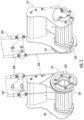
- FIG. 3 is a perspective view showing a close up view of two of the pedals 106, 116, shown in FIG. 1 , as coupled to their respective cable members 200.
- Each pedal 106, 116 has an integral wheel member 144, similar to the wheel member for a pulley system.
- activating or depressing the brake pedal 106, 116, 108, 118 rotates the wheel member 144 and operates the wheel brakes of the airplane.
- the wheel member 144 may have a groove to seat the inner core 206 of the cable member 200.
- the cable member 200 is assembled onto the wheel member 144, which includes an element configured to hold on to the cable end ferrule 204.
- the wheel member 144 is assembled to two cable members 200 such that the wheel member 144 is configured to hold on to two cable end ferrules 204.
- rotation of the wheel member 144 in a first direction places tension on one of the two cable members 200
- rotation of the wheel member 144 in a second direction opposite the first direction places tension on the other of the two cable members 200.
- embodiments of the invention include those in which the wheel member 144 has only one cable member 200, which reacts to tensile and compressive loads, and one attached end ferrule 204.
- the wheel member 144 When the pilot, for example, presses down on one of the pedals 116 (shown in FIG. 1 ), the wheel member 144 is rotated in the aforementioned first direction. Through its attachment to the end ferrule 204, the rotation of the wheel member 144 tensions one of the cable members 200 displacing the inner core 206 of the cable through the arcuate distance of the wheel member rotation. In this example, the pilot-side pedal 106, 116 is depressed. The opposite end of the displaced cable member 200 is attached to a wheel member 146 (shown in FIG. 1 ) on one of the pilot-side bell cranks 134, 136.
- the wheel member 146 is similar to the wheel member 144 on the pedals 106, 108, 116, 118, and are attached to the end ferrule 204 of one or two cable members 200. As such, the aforementioned displacement of the wheel member 144 is transferred, via the cable member 200, to the wheel member 146.
- the wheel member 146 is also attached to one end of the first or second connecting rod 112, 122.
- the other end of the connecting rod 112, 122 is attached to a wheel member 148 (shown in FIG. 1 ) on one of the co-pilot-side bell cranks 138, 140.
- the aforementioned rotation of the pilot-side wheel member 146 causes the connecting rod 112, 122, to which it is attached, to move linearly in a horizontal direction. Movement of this connecting rod 112, 122 causes the co-pilot side wheel member 146 to rotate in correspondence with the rotation of wheel member 146.
- Rotation of the co-pilot-side wheel member 146 displaces its respective cable member 200, which rotates the wheel member 144 on the co-pilot-side pedal 108, 118, which, in turn, causes the co-pilot-side pedal 108, 118 to depress in concert with the pilot-side pedal 106, 116.
- the copilot depresses a copilot-side pedal 108, 118
- the aforementioned system of cable members 200, bell crank assemblies 130, 132, and connecting rods 112, 122 is configured to transmit motion from the copilot-side pedal 108, 118 through its respective connecting rod 112, 122 to the bell crank 134, 136, 138, 140 in the opposite bell crank assembly 130, 132.
- the driven bell crank assembly 130, 132 applies tension similarly to the opposing cable assembly 200 in the opposite station. In so doing, the cable tension transmits an identical motion back to the pedal 106, 116 of the opposite station.
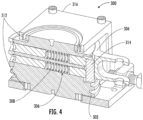
- FIG. 4 is a perspective view of one of the bell crank assembly 300 represented by any of the four bell crank assemblies 134, 136, 138, 140 in the cable linked brake pedal assembly 100 of FIG. 1 , and constructed in accordance with an embodiment of the invention.
- the bell crank assembly 300 includes two separate members: an inner bell crank 302 and an outer bell crank 304 which are coupled together by a jam alleviation mechanism 306 that has a specific amount of torque preload that can be transferred.
- one or both of the inner and outer bell cranks 302, 304 are configured as wheel members similar to the wheel in a pulley system.
- FIG. 5 is a perspective view of the bell crank assembly 300 of FIG. 4 showing attached cable members 200.
- the inner bell crank 302 is similar to the wheel member 144, 146 described above.
- embodiments of the inner bell crank 302 may be grooved to help seat the inner core 206 and end ferrule 204 of the cable member 200.
- the inner bell crank 302 is attached to two cable members 200, though it is envisioned that, in alternate embodiments, the inner bell crank 302 may be attached to only one cable member 200.
- the end fittings 208 of the two cable members 200 are secured within openings in a bell crank assembly housing 316.
- the outer conduit 202 which provides a flexible service loop.
- the flexible service loop allows for adjustments to the pedal position and transfer of displacement without additional linkages.
- the flexibility also allows the assembly 100 to avoid interferences within the tight confines of the cockpit.
- the inner core 206 and end ferrule 204 are attached to the inner bell crank 302.
- the outer bell crank 304 includes a clevis 310 with an opening to facilitate the attachment of the outer bell crank 304 to the connecting rod 112, 122.
- the connecting rod 112, 122 may be attached to the clevis 310 of the outer bell crank 304 using a mechanical fastener, or the end of the connecting rod 112, 122 may be inserted through the opening in the clevis 310.
- the inner bell crank 302 and outer bell crank 304 are coupled by the jam alleviation mechanism 306 such that the bell cranks 302, 304 move in unison.
- the inner bell crank 302 and outer bell crank 304 each rotate on a respective set of bearings 312.
- the inner bell crank 302 is attached to two cable members 200, and seats two inner cores 206 and two end ferrules 204.
- the inner bell crank 302 may be attached to one cable member 200.
- one feature that may be incorporated in the jam alleviation mechanism 306 is the ability to limit the torque load that may be transmitted through the bell crank assembly 300.
- One advantage of such a feature could be reduced cable sizing and improved flexibility and force contributions for the cable assembly 200.
- FIGS. 4 and 5 show the jam alleviation mechanism 306 with a spring-loaded detent mechanism 308 to limit the torque load.
- the jam alleviation mechanism 306 may be provided by a clutch, or a shear pin, or a torsional spring preload mechanism.
- a particular embodiment of the jam alleviation mechanism 306 includes a clutch with a rotary friction disc assembly that is preloaded by a spring load to establish a prescribed amount of torque transmission capability.
- the jam alleviation mechanism 306 will allow movement beyond the position at which the control is jammed. The exercised control may not return after load application depending on the nature of the jam.
- the jam alleviation mechanism 306 includes a shear pin in which a rotary coupling that contains the shear pin or necked down section of torsion shaft that is designed to fracture at prescribed amount of torque transmission capability. In the event of a system jam when a pedal load above the load that exceeds the prescribed shear torque is applied, the jam alleviation mechanism 306 will break free and allow free movement of the control station (pilot or copilot) that is not jammed.
- the jam alleviation mechanism 306 includes a torsion spring pre-load that utilizes a rotary sprung return-to-center device that is preloaded by a spring load to establish a prescribed amount of torque transmission capability. In the event of a system jam when a pedal load above the load that exceeds the prescribed friction torque is applied, the jam alleviation mechanism 306 will allow movement beyond the position at which the control is jammed and the controls will return to alignment at the jammed position upon removal of the load.
- the jam alleviation mechanism 306 could also be incorporated in the connecting rod 112, 122 in a linear fashion.
- the connecting rod 112, 122 could be removed altogether and all of the cable connections could be made through a single bell crank.
- both bell cranks assemblies 130, 132 and both connecting rods 112, 122 could be removed, such that a simple connection from the pilot pedal 106, 116 to the copilot pedal 108, 118 is made through a direct cable linkage between the two pedals.
- the jam alleviation mechanism 306 could be incorporated in a linkage segment within the direct cable linkage.
Landscapes
- Engineering & Computer Science (AREA)
- Mechanical Engineering (AREA)
- Transportation (AREA)
- Aviation & Aerospace Engineering (AREA)
- Automation & Control Theory (AREA)
- Physics & Mathematics (AREA)
- General Physics & Mathematics (AREA)
- Mechanical Control Devices (AREA)
Description
- This invention generally relates to a cable-linked brake pedal assembly for control of an airplane.
- Typically, piloted airplanes have certain control surfaces including horizontal stabilizers or ailerons, and vertical stabilizers or rudders to control movement of the airplane during flight. These control surfaces are also used to trim, or stabilize, the airplane during flight. Also, like automobiles, airplanes also include braking systems to control movement of the plane while on the ground. Generally, these conventional braking and control surfaces, including the rudder, are operated by various mechanical links and connecting rods or hydraulic or electromechanical actuators, which are operated by the pilot and allow the pilot to control the airplane's flight path. For various reasons, it is often desirable to link the rudder and braking controls of the pilot and co-pilot. The aforementioned conventional rudder and braking system are typically operated by pedals located under the cockpit instrument panel. In conventional systems, these mechanical linkages typically contain bell cranks and connecting rods, and extend under the floor of the flight deck.
-
US 1,874,493 describes dual pedal controls for wheel brakes. -
US 5,797,564 describes a system for backdriving the flight deck controllers of a fly-by-wire aircraft that is under autopilot control to provide a pilot with tactile and visual feedback of autopilot activity. The system, distributed between the aircraft primary flight computers and the autopilot flight computer, uses actuators mechanically coupled to each flight deck controller to position the flight deck controller to mimic manual operation of the flight control surfaces. -
CN 210455200 U describes a light airplane pedal device which comprises a main rotating shaft, a main rotating shaft sleeve, an auxiliary rotating shaft, an auxiliary rotating shaft sleeve, a left main pedal, a left auxiliary pedal, a right main pedal and a right auxiliary pedal. The main rotating shaft is arranged in the main rotating shaft sleeve in a rotating fit mode, the auxiliary rotating shaft is arranged in the auxiliary rotating shaft sleeve in a rotating fit mode, and the main rotating shaft sleeve and the auxiliary rotating shaft sleeve are hinged to a rudder pull rod through insertion lugs respectively. -
US 2017/0166297 describes an aircraft control that comprises a mobile pedal and comprises a cylinder coupled to the pedal such that a displacement of the pedal according to at least a first direction reduces the volume of a first chamber of the cylinder. -
DE 4116924 describes dual driving controls for a road vehicle with an elongate transmission element providing coordinated movement of both sets of pedals. - Embodiments of the invention detailed below represent an improvement to the state of the art with respect to airplane control systems. These and other advantages of the invention, as well as additional inventive features, will be apparent from the description of the invention provided herein.
- In one aspect, the invention as defined in appended claim 1 provides a cable-linked brake pedal assembly for an airplane. The assembly includes a first cable assembly with a first end attached to a pilot-side brake pedal and a second end attached to a first bell crank assembly, and a second cable assembly with a first end attached to a copilot-side brake pedal and a second end attached to a second bell crank assembly. A first connecting rod with a first rod end is attached to the first bell crank assembly and a second rod end is attached to the second bell crank assembly. The connection between the first and second cable assemblies, first and second bell crank assemblies, and first connecting rod is configured such that depressing the pilot-side brake pedal moves the first cable assembly, first connecting rod, and second cable assembly in such a way as to cause a corresponding depression of the copilot-side brake pedal.
- In a particular embodiment, the connection between the first and second cable assemblies, first and second bell crank assemblies, and (first) connecting rod is configured such that depressing the copilot-side brake pedal moves the second cable assembly, first connecting rod, and first cable assembly in such a way as to cause a corresponding depression of the pilot-side brake pedal.
- In a further embodiment, the cable-linked brake pedal assembly also includes a third cable assembly with a first end attached to a second pilot-side brake pedal and a second end attached to a third bell crank assembly, a fourth cable assembly with a first end attached to a second copilot-side brake pedal and a second end attached to a fourth bell crank assembly, and a second connecting rod with a first rod end attached to the third bell crank assembly and a second rod end attached to the fourth bell crank assembly. The connection between the third and fourth cable assemblies, third and fourth bell crank assemblies, and second connecting rod being configured such that depressing the second pilot-side brake pedal moves the third cable assembly, second connecting rod, and fourth cable assembly in such a way as to cause a corresponding depression of the second copilot-side brake pedal.
- In a particular embodiment, the connection between the third and fourth cable assemblies, third and fourth bell crank assemblies, and second connecting rod is configured such that depressing the second copilot-side brake pedal moves the fourth cable assembly, second connecting rod, and third cable assembly in such a way as to cause a corresponding depression of the second pilot-side brake pedal.
- In certain embodiments, the first bell crank assembly includes an inner bell crank and an outer bell crank, each configured as a wheel member, the inner bell crank attached to an end of the first cable assembly. The outer bell crank may be attached to the first rod end of the first connecting rod. In a particular embodiment, the inner and outer bell cranks are coupled by a jam alleviation mechanism such that the inner and outer bell cranks move in unison. In particular embodiments, the jam alleviation mechanism comprises a spring-loaded detent mechanism configured to uncouple the inner and outer bell cranks so that the inner bell crank can move independently of the outer bell crank. In more particular embodiments, the spring-loaded detent mechanism is configured to displace a pin that couples the inner and outer bell cranks when a predetermined amount of torque is applied to the first bell crank assembly.
- Embodiments of the first cable assembly include an inner core, which is drawn in tension when the pilot-side brake pedal is depressed. The first cable assembly may also include an outer conduit, which provides a flexible service loop. In some embodiments, the first cable assembly further includes an end fitting to facilitate attachment to the first bell crank assembly. Additionally, the first cable assembly may include an end ferrule configured for attachment to a bell crank of the first bell crank assembly.
- Other aspects, objectives and advantages of the invention will become more apparent from the following detailed description when taken in conjunction with the accompanying drawings.
- The accompanying drawings incorporated in and forming a part of the specification illustrate several aspects of the present invention and, together with the description, serve to explain the principles of the invention. In the drawings:
-
FIG. 1 is a perspective view of a cable linked brake pedal assembly for an airplane, constructed in accordance with an embodiment of the invention; -
FIG. 2 is a plan view of the cable member in accordance with an embodiment of the invention; -
FIG. 3 is a perspective view showing a close up view of two of the pedals shown inFIG. 1 ; -
FIG. 4 is a perspective view of one of the bell crank assemblies, constructed in accordance with an embodiment of the invention; and -
FIG. 5 is a perspective view of the bell crank assembly ofFIG. 4 showing attached cable members, according to embodiments of the invention. - While the invention will be described in connection with certain preferred embodiments, there is no intent to limit it to those embodiments. On the contrary, the scope of the invention is defined by the appended claims.
-
FIG. 1 is a perspective view of a cable linkedbrake pedal assembly 100 for an airplane, constructed in accordance with an embodiment of the invention. In the embodiment shown, a pilot-sidebrake pedal assembly 102 is connected to a co-pilot-sidebrake pedal assembly 104 via a cable system, which will be described in more detail below. As can be seen inFIG. 1 , a first pilot-side pedal 106 is coupled to a first co-pilot-side pedal 108 via a first pilot-side cable pair 110, a first connectingrod 112, and a first co-pilot-side cable pair 114. Similarly, a second pilot-side pedal 116 is coupled to a second co-pilot-side pedal 118 via a second pilot-side cable pair 120, a second connectingrod 122, and a second co-pilot-side cable pair 124. -
FIG. 2 is a plan view of thecable member 200 in accordance with an embodiment of the invention. Thecable member 200 includes anouter conduit 202 and an end fitting 208 for attachment and tensioning. Theinner core 206 of the cable assembly is drawn in tension when thebrake pedal cable end ferrule 204. The tension in the cableinner core 206 transfers motion to a bell crank assembly (shown 130, 132 inFIG. 1 ) through wheel members attached to thebrake pedal assembly 100 is designed such that the cable tension transmits an identical motion back to the opposite station pedal through thecable end ferrule 204 of thecable member 200 for the opposite station pedal. - Referring again to
FIG. 1 , the pilot-sidebell crank assembly 130 includes a first pilot-side bell crank 134 and a second pilot-side bell crank 136. The co-pilot-sidebell crank assembly 132 includes a first co-pilot-side bell crank 138 and a second co-pilot-side bell crank 140.FIG. 3 is a perspective view showing a close up view of two of thepedals FIG. 1 , as coupled to theirrespective cable members 200. Eachpedal integral wheel member 144, similar to the wheel member for a pulley system. In a certain embodiment, activating or depressing thebrake pedal wheel member 144 and operates the wheel brakes of the airplane. - In particular embodiments of the invention, the
wheel member 144 may have a groove to seat theinner core 206 of thecable member 200. Thecable member 200 is assembled onto thewheel member 144, which includes an element configured to hold on to thecable end ferrule 204. - In particular embodiments such as that shown in
FIG. 3 , thewheel member 144 is assembled to twocable members 200 such that thewheel member 144 is configured to hold on to twocable end ferrules 204. In this arrangement, rotation of thewheel member 144 in a first direction places tension on one of the twocable members 200, and rotation of thewheel member 144 in a second direction opposite the first direction places tension on the other of the twocable members 200. However, it is envisioned that embodiments of the invention include those in which thewheel member 144 has only onecable member 200, which reacts to tensile and compressive loads, and one attachedend ferrule 204. - When the pilot, for example, presses down on one of the pedals 116 (shown in
FIG. 1 ), thewheel member 144 is rotated in the aforementioned first direction. Through its attachment to theend ferrule 204, the rotation of thewheel member 144 tensions one of thecable members 200 displacing theinner core 206 of the cable through the arcuate distance of the wheel member rotation. In this example, the pilot-side pedal cable member 200 is attached to a wheel member 146 (shown inFIG. 1 ) on one of the pilot-side bell cranks 134, 136. Thewheel member 146 is similar to thewheel member 144 on thepedals end ferrule 204 of one or twocable members 200. As such, the aforementioned displacement of thewheel member 144 is transferred, via thecable member 200, to thewheel member 146. - The
wheel member 146 is also attached to one end of the first or second connectingrod rod FIG. 1 ) on one of the co-pilot-side bell cranks 138, 140. As such, the aforementioned rotation of the pilot-side wheel member 146 causes the connectingrod rod side wheel member 146 to rotate in correspondence with the rotation ofwheel member 146. Rotation of the co-pilot-side wheel member 146 displaces itsrespective cable member 200, which rotates thewheel member 144 on the co-pilot-side pedal side pedal side pedal - Conversely, if the copilot depresses a copilot-
side pedal cable members 200, bell crankassemblies rods side pedal rod assembly assembly cable assembly 200 in the opposite station. In so doing, the cable tension transmits an identical motion back to thepedal -
FIG. 4 is a perspective view of one of the bell crankassembly 300 represented by any of the four bell crankassemblies brake pedal assembly 100 ofFIG. 1 , and constructed in accordance with an embodiment of the invention. In the embodiment shown, the bell crankassembly 300 includes two separate members: an inner bell crank 302 and an outer bell crank 304 which are coupled together by ajam alleviation mechanism 306 that has a specific amount of torque preload that can be transferred. In a particular embodiment, one or both of the inner and outer bell cranks 302, 304 are configured as wheel members similar to the wheel in a pulley system. -
FIG. 5 is a perspective view of the bell crankassembly 300 ofFIG. 4 showing attachedcable members 200. In a particular embodiment ofFIG. 5 , the inner bell crank 302 is similar to thewheel member inner core 206 andend ferrule 204 of thecable member 200. In the embodiment shown, the inner bell crank 302 is attached to twocable members 200, though it is envisioned that, in alternate embodiments, the inner bell crank 302 may be attached to only onecable member 200. In the embodiments shown, theend fittings 208 of the twocable members 200 are secured within openings in a bell crankassembly housing 316. Outside of the bell crankassembly housing 316, theouter conduit 202, which provides a flexible service loop. The flexible service loop allows for adjustments to the pedal position and transfer of displacement without additional linkages. The flexibility also allows theassembly 100 to avoid interferences within the tight confines of the cockpit. Within the bell crankassembly housing 316, theinner core 206 andend ferrule 204 are attached to the inner bell crank 302. - In
FIG. 5 , the outer bell crank 304 includes aclevis 310 with an opening to facilitate the attachment of the outer bell crank 304 to the connectingrod rod clevis 310 of the outer bell crank 304 using a mechanical fastener, or the end of the connectingrod clevis 310. The inner bell crank 302 and outer bell crank 304 are coupled by thejam alleviation mechanism 306 such that the bell cranks 302, 304 move in unison. In the particular embodiment ofFIG. 5 , the inner bell crank 302 and outer bell crank 304 each rotate on a respective set ofbearings 312. In certain embodiments, such as shown inFIG. 5 , the inner bell crank 302 is attached to twocable members 200, and seats twoinner cores 206 and twoend ferrules 204. However, in alternate embodiments, the inner bell crank 302 may be attached to onecable member 200. - As referenced above, one feature that may be incorporated in the
jam alleviation mechanism 306 is the ability to limit the torque load that may be transmitted through the bell crankassembly 300. One advantage of such a feature could be reduced cable sizing and improved flexibility and force contributions for thecable assembly 200.FIGS. 4 and5 show thejam alleviation mechanism 306 with a spring-loadeddetent mechanism 308 to limit the torque load. In the event that a jam prevents the proper rotation of either the inner or outer bell cranks 302, 304, when a sufficient amount of torque is applied to one of thebrake pedals detent mechanism 308 displaces apin 314 which breaks the connection between the inner and outer bell cranks 302, 304 allowing the inner bell crank 302 to rotate independently of the outer bell crank 304 and vice-versa. In this way, the jamming of one brake pedal does not affect the brake pedal of the opposite station. - In alternate embodiments of the invention, the
jam alleviation mechanism 306 may be provided by a clutch, or a shear pin, or a torsional spring preload mechanism. For example, a particular embodiment of thejam alleviation mechanism 306 includes a clutch with a rotary friction disc assembly that is preloaded by a spring load to establish a prescribed amount of torque transmission capability. In the event of a system jam when a pedal load above the load that exceeds the prescribed friction torque is applied, thejam alleviation mechanism 306 will allow movement beyond the position at which the control is jammed. The exercised control may not return after load application depending on the nature of the jam. - In another embodiment, the
jam alleviation mechanism 306 includes a shear pin in which a rotary coupling that contains the shear pin or necked down section of torsion shaft that is designed to fracture at prescribed amount of torque transmission capability. In the event of a system jam when a pedal load above the load that exceeds the prescribed shear torque is applied, thejam alleviation mechanism 306 will break free and allow free movement of the control station (pilot or copilot) that is not jammed. - In yet another embodiment, the
jam alleviation mechanism 306 includes a torsion spring pre-load that utilizes a rotary sprung return-to-center device that is preloaded by a spring load to establish a prescribed amount of torque transmission capability. In the event of a system jam when a pedal load above the load that exceeds the prescribed friction torque is applied, thejam alleviation mechanism 306 will allow movement beyond the position at which the control is jammed and the controls will return to alignment at the jammed position upon removal of the load. - In another embodiment, the
jam alleviation mechanism 306 could also be incorporated in the connectingrod rod bell cranks assemblies rods pilot pedal copilot pedal jam alleviation mechanism 306 could be incorporated in a linkage segment within the direct cable linkage. - The use of the terms "a" and "an" and "the" and similar referents in the context of describing the invention (especially in the context of the following claims) is to be construed to cover both the singular and the plural, unless otherwise indicated herein or clearly contradicted by context. The terms "comprising," "having," "including," and "containing" are to be construed as open-ended terms (i.e., meaning "including, but not limited to,") unless otherwise noted. Recitation of ranges of values herein are merely intended to serve as a shorthand method of referring individually to each separate value falling within the range, unless otherwise indicated herein, and each separate value is incorporated into the specification as if it were individually recited herein. All methods described herein can be performed in any suitable order unless otherwise indicated herein or otherwise clearly contradicted by context. The use of any and all examples, or exemplary language (e.g., "such as") provided herein, is intended merely to better illuminate the invention and does not pose a limitation on the scope of the invention unless otherwise claimed. No language in the specification should be construed as indicating any non-claimed element as essential to the practice of the invention.
- Preferred embodiments of this invention are described herein, including the best mode known to the inventors for carrying out the invention. Variations of those preferred embodiments within scope of the appended claims may become apparent to those of ordinary skill in the art upon reading the foregoing description.
Claims (13)
- A cable-linked brake pedal assembly (100) for an airplane, the cable-linked brake pedal assembly comprising:a first cable assembly (200) with a first end attached to a pilot-side brake pedal (106, 116) and a second end attached to a first bell crank assembly (130);a second cable assembly (200) with a first end attached to a copilot-side brake pedal (108, 118) and a second end attached to a second bell crank assembly (132);a first connecting rod (112, 122) with a first rod end attached to the first bell crank assembly (130) and a second rod end attached to the second bell crank assembly (132);the connection between the first and second cable assemblies, first and second bell crank assemblies, and first connecting rod being configured such that depressing the pilot-side brake pedal (106, 116) moves the first cable assembly (200), first connecting rod, and second cable assembly (200) in such a way as to cause a corresponding depression of the copilot-side brake pedal (108, 118).
- The cable-linked brake pedal assembly of claim 1, wherein the connection between the first and second cable assemblies, first and second bell crank assemblies, and first connecting rod is configured such that depressing the copilot-side brake pedal (108, 118) moves the second cable assembly, first connecting rod, and first cable assembly in such a way as to cause a corresponding depression of the pilot-side brake pedal (106, 116).
- The cable-linked brake pedal assembly of any preceding claim, further comprising:a third cable assembly (200) with a first end attached to a second pilot-side brake pedal (106, 116) and a second end attached to a third bell crank assembly;a fourth cable assembly (200) with a first end attached to a second copilot-side brake pedal (108, 118) and a second end attached to a fourth bell crank assembly;a second connecting rod (112, 122) with a first rod end attached to the third bell crank assembly and a second rod end attached to the fourth bell crank assembly;the connection between the third and fourth cable assemblies, third and fourth bell crank assemblies, and second connecting rod being configured such that depressing the second pilot-side brake pedal (106, 116) moves the third cable assembly, second connecting rod, and fourth cable assembly in such a way as to cause a corresponding depression of the second copilot-side brake pedal (108, 118).
- The cable-linked brake pedal assembly of claim 3, wherein the connection between the third and fourth cable assemblies, third and fourth bell crank assemblies, and second connecting rod is configured such that depressing the second copilot-side brake pedal (108, 118) moves the fourth cable assembly (200), second connecting rod, and third cable assembly (200) in such a way as to cause a corresponding depression of the second pilot-side brake pedal (106, 116).
- The cable-linked brake pedal assembly of any preceding claim, wherein the first bell crank assembly includes an inner bell crank (302) and an outer bell crank (304), each configured as a wheel member, the inner bell crank attached to an end of the first cable assembly.
- The cable-linked brake pedal assembly of claim 5, wherein the outer bell crank (304) is attached to the first rod end of the first connecting rod.
- The cable-linked brake pedal assembly of claim 5, wherein the inner and outer bell cranks are coupled by a jam alleviation mechanism (306) such that the inner and outer bell cranks move in unison.
- The cable-linked brake pedal assembly of claim 7, wherein the jam alleviation mechanism (306) comprises a spring-loaded detent mechanism (308) configured to uncouple the inner and outer bell cranks so that the inner bell crank can move independently of the outer bell crank (304).
- The cable-linked brake pedal assembly of claim 8, wherein the spring-loaded detent mechanism (308) is configured to displace a pin (314) that couples the inner and outer bell cranks when a predetermined amount of torque is applied to the first bell crank assembly.
- The cable-linked brake pedal assembly of any preceding claim, wherein the first cable assembly (200) includes an inner core (206) which is drawn in tension when the pilot-side brake pedal (106, 116) is depressed.
- The cable-linked brake pedal assembly of any preceding claim, wherein the first cable assembly (200) further includes an outer conduit (202) with a flexible service loop.
- The cable-linked brake pedal assembly of any preceding claim, wherein the first cable assembly (200) further includes an end fitting (208) to facilitate attachment to the first bell crank assembly.
- The cable-linked brake pedal assembly of any preceding claim, wherein the first cable assembly (200) further includes an end ferrule configured for attachment to a bell crank of the first bell crank assembly (204).
Applications Claiming Priority (2)
| Application Number | Priority Date | Filing Date | Title |
|---|---|---|---|
| US17/513,178 US11467617B1 (en) | 2021-10-28 | 2021-10-28 | Cable-linked brake pedal assemblies |
| PCT/US2022/046882 WO2023076060A1 (en) | 2021-10-28 | 2022-10-17 | Cable-linked brake pedal assembly |
Publications (2)
| Publication Number | Publication Date |
|---|---|
| EP4380830A1 EP4380830A1 (en) | 2024-06-12 |
| EP4380830B1 true EP4380830B1 (en) | 2025-04-16 |
Family
ID=83547246
Family Applications (1)
| Application Number | Title | Priority Date | Filing Date |
|---|---|---|---|
| EP22803111.8A Active EP4380830B1 (en) | 2021-10-28 | 2022-10-17 | Cable-linked brake pedal assembly |
Country Status (3)
| Country | Link |
|---|---|
| US (1) | US11467617B1 (en) |
| EP (1) | EP4380830B1 (en) |
| WO (1) | WO2023076060A1 (en) |
Families Citing this family (3)
| Publication number | Priority date | Publication date | Assignee | Title |
|---|---|---|---|---|
| US20220119031A1 (en) * | 2020-10-21 | 2022-04-21 | Jonathan Kermit Dodrill | Vehicle auxiliary control kit |
| FR3133172A1 (en) * | 2022-03-07 | 2023-09-08 | Dassault Aviation | Aircraft rudder frame |
| CN121511181A (en) * | 2023-08-02 | 2026-02-10 | 赛峰电子防务美国航空电子有限责任公司 | Integrated brake pedal for passenger vehicles |
Family Cites Families (21)
| Publication number | Priority date | Publication date | Assignee | Title |
|---|---|---|---|---|
| US1874493A (en) * | 1930-09-09 | 1932-08-30 | Curtiss Aeroplane & Motor Co | Dual control brakes |
| DE819047C (en) * | 1948-11-10 | 1951-10-29 | Hans Keller | Double control device on automobiles |
| US4192476A (en) | 1978-07-14 | 1980-03-11 | Northrop Corporation | Rudder pedal adjustment system |
| JPS6473134A (en) * | 1987-09-14 | 1989-03-17 | Mazda Motor | Throttle valve opening control device for vehicle |
| US5056742A (en) | 1987-11-13 | 1991-10-15 | The Boeing Company | Modular rudder pedal and brake control assembly for aircraft |
| DE4116924A1 (en) * | 1991-05-24 | 1992-11-26 | Delta Ingenieur Technik Gmbh | Dual driving controls for road vehicle - with elongate transmission element providing coordinated movement of both sets of pedals |
| US5797564A (en) * | 1995-05-15 | 1998-08-25 | The Boeing Company | System for backdrive of flight deck controls during autopilot operation |
| KR0156339B1 (en) | 1995-06-01 | 1999-02-18 | 배문한 | Brake Ladder Pedal Device |
| US5806806A (en) * | 1996-03-04 | 1998-09-15 | Mcdonnell Douglas Corporation | Flight control mechanical backup system |
| US5878981A (en) * | 1997-04-14 | 1999-03-09 | Dewey; Daniel L. | Flight console for radio controlled aircraft |
| KR100369119B1 (en) | 2000-04-04 | 2003-01-24 | 국방과학연구소 | Aircraft's rudder and brake pedal device |
| WO2003095259A2 (en) * | 2002-05-08 | 2003-11-20 | Zhide Feng | Auxiliary brake control system |
| US6981409B2 (en) * | 2003-08-01 | 2006-01-03 | The Boeing Company | Control surface controller force measurement system |
| US6929222B2 (en) * | 2003-09-08 | 2005-08-16 | Mihailo P. Djuric | Non-jamming, fail safe flight control system with non-symmetric load alleviation capability |
| US6913226B2 (en) * | 2003-10-30 | 2005-07-05 | The Boeing Company | Methods and systems for redundant control and/or failure detection |
| CA2891096C (en) | 2012-11-09 | 2017-09-26 | Mason Electric Co. | Above-the-floor rudder and brake control system |
| FR3045007B1 (en) * | 2015-12-14 | 2017-11-24 | Airbus Operations Sas | CONTROL OF AN AIRCRAFT COMPRISING A PEDAL FITTED TO A CYLINDER AND CONTROL DEVICE THEREFOR |
| US10894595B1 (en) * | 2017-07-25 | 2021-01-19 | Rockwell Collins, Inc. | Spring detent for over-ridable interconnect |
| CN210455200U (en) * | 2019-09-02 | 2020-05-05 | 重庆恩斯特龙通用航空技术研究院有限公司 | Light aircraft pedal device |
| CN110654531B (en) * | 2019-09-19 | 2022-05-03 | 中国商用飞机有限责任公司 | Pedal system for controlling rudder of airplane and control method thereof |
| US11396362B2 (en) | 2019-11-01 | 2022-07-26 | Woodward, Inc. | Rudder and brake pedal assembly |
-
2021
- 2021-10-28 US US17/513,178 patent/US11467617B1/en active Active
-
2022
- 2022-10-17 WO PCT/US2022/046882 patent/WO2023076060A1/en not_active Ceased
- 2022-10-17 EP EP22803111.8A patent/EP4380830B1/en active Active
Also Published As
| Publication number | Publication date |
|---|---|
| WO2023076060A1 (en) | 2023-05-04 |
| EP4380830A1 (en) | 2024-06-12 |
| US11467617B1 (en) | 2022-10-11 |
Similar Documents
| Publication | Publication Date | Title |
|---|---|---|
| EP4380830B1 (en) | Cable-linked brake pedal assembly | |
| EP4025495B1 (en) | Rudder and brake pedal assembly | |
| US5806806A (en) | Flight control mechanical backup system | |
| CN103241375B (en) | The method of rotor craft, pedal assembly and adjustment aircraft pedal assembly | |
| CN103241372B (en) | Rotor craft and integrated aircraft trim assembly | |
| CN103241374B (en) | Rotor craft and control assembly | |
| EP2415669B1 (en) | Control system | |
| US9352824B2 (en) | Line replaceable, fly-by-wire control column and control wheel assemblies with a centrally connected line replaceable disconnect and autopilot assembly | |
| US20050103932A1 (en) | Methods and systems for redundant control and/or failure detection | |
| CA2778058A1 (en) | Tactile cueing apparatus | |
| CN103241371B (en) | Rotor craft and control assembly | |
| US8886370B2 (en) | Simplified flight control system including a declutchable friction device | |
| US20220153072A1 (en) | Foot Control In A Vehicle Capable Of Flying In Air | |
| US7890222B1 (en) | Mechanical flight control auxiliary power assist system | |
| CN113460288A (en) | Active rudder foot pedal assembly for controlling aircraft and aircraft | |
| US7668627B2 (en) | Mechanical flight control auxiliary power assist system | |
| EP4173946A1 (en) | Flight simulator | |
| EP3809234A1 (en) | Test apparatus for actuator | |
| CN114394227A (en) | Force-sensing brake device, brake system, brake control method and airplane | |
| CN111559493A (en) | Brake control device for helicopter landing gear wheels | |
| WO2023073629A1 (en) | Electromechanical drive system for an aircraft |
Legal Events
| Date | Code | Title | Description |
|---|---|---|---|
| STAA | Information on the status of an ep patent application or granted ep patent |
Free format text: STATUS: UNKNOWN |
|
| STAA | Information on the status of an ep patent application or granted ep patent |
Free format text: STATUS: THE INTERNATIONAL PUBLICATION HAS BEEN MADE |
|
| PUAI | Public reference made under article 153(3) epc to a published international application that has entered the european phase |
Free format text: ORIGINAL CODE: 0009012 |
|
| STAA | Information on the status of an ep patent application or granted ep patent |
Free format text: STATUS: REQUEST FOR EXAMINATION WAS MADE |
|
| 17P | Request for examination filed |
Effective date: 20240308 |
|
| AK | Designated contracting states |
Kind code of ref document: A1 Designated state(s): AL AT BE BG CH CY CZ DE DK EE ES FI FR GB GR HR HU IE IS IT LI LT LU LV MC ME MK MT NL NO PL PT RO RS SE SI SK SM TR |
|
| GRAP | Despatch of communication of intention to grant a patent |
Free format text: ORIGINAL CODE: EPIDOSNIGR1 |
|
| STAA | Information on the status of an ep patent application or granted ep patent |
Free format text: STATUS: GRANT OF PATENT IS INTENDED |
|
| DAV | Request for validation of the european patent (deleted) | ||
| DAX | Request for extension of the european patent (deleted) | ||
| INTG | Intention to grant announced |
Effective date: 20241203 |
|
| GRAS | Grant fee paid |
Free format text: ORIGINAL CODE: EPIDOSNIGR3 |
|
| GRAA | (expected) grant |
Free format text: ORIGINAL CODE: 0009210 |
|
| STAA | Information on the status of an ep patent application or granted ep patent |
Free format text: STATUS: THE PATENT HAS BEEN GRANTED |
|
| AK | Designated contracting states |
Kind code of ref document: B1 Designated state(s): AL AT BE BG CH CY CZ DE DK EE ES FI FR GB GR HR HU IE IS IT LI LT LU LV MC ME MK MT NL NO PL PT RO RS SE SI SK SM TR |
|
| REG | Reference to a national code |
Ref country code: GB Ref legal event code: FG4D |
|
| P01 | Opt-out of the competence of the unified patent court (upc) registered |
Free format text: CASE NUMBER: APP_13548/2025 Effective date: 20250319 |
|
| REG | Reference to a national code |
Ref country code: CH Ref legal event code: EP |
|
| REG | Reference to a national code |
Ref country code: IE Ref legal event code: FG4D |
|
| REG | Reference to a national code |
Ref country code: DE Ref legal event code: R096 Ref document number: 602022013331 Country of ref document: DE |
|
| REG | Reference to a national code |
Ref country code: DE Ref legal event code: R082 Ref document number: 602022013331 Country of ref document: DE Representative=s name: COHAUSZ & FLORACK PATENT- UND RECHTSANWAELTE P, DE |
|
| REG | Reference to a national code |
Ref country code: NL Ref legal event code: MP Effective date: 20250416 |
|
| PG25 | Lapsed in a contracting state [announced via postgrant information from national office to epo] |
Ref country code: NL Free format text: LAPSE BECAUSE OF FAILURE TO SUBMIT A TRANSLATION OF THE DESCRIPTION OR TO PAY THE FEE WITHIN THE PRESCRIBED TIME-LIMIT Effective date: 20250416 |
|
| REG | Reference to a national code |
Ref country code: AT Ref legal event code: MK05 Ref document number: 1785414 Country of ref document: AT Kind code of ref document: T Effective date: 20250416 |
|
| PG25 | Lapsed in a contracting state [announced via postgrant information from national office to epo] |
Ref country code: PT Free format text: LAPSE BECAUSE OF FAILURE TO SUBMIT A TRANSLATION OF THE DESCRIPTION OR TO PAY THE FEE WITHIN THE PRESCRIBED TIME-LIMIT Effective date: 20250818 Ref country code: ES Free format text: LAPSE BECAUSE OF FAILURE TO SUBMIT A TRANSLATION OF THE DESCRIPTION OR TO PAY THE FEE WITHIN THE PRESCRIBED TIME-LIMIT Effective date: 20250416 Ref country code: FI Free format text: LAPSE BECAUSE OF FAILURE TO SUBMIT A TRANSLATION OF THE DESCRIPTION OR TO PAY THE FEE WITHIN THE PRESCRIBED TIME-LIMIT Effective date: 20250416 |
|
| REG | Reference to a national code |
Ref country code: LT Ref legal event code: MG9D |
|
| PG25 | Lapsed in a contracting state [announced via postgrant information from national office to epo] |
Ref country code: GR Free format text: LAPSE BECAUSE OF FAILURE TO SUBMIT A TRANSLATION OF THE DESCRIPTION OR TO PAY THE FEE WITHIN THE PRESCRIBED TIME-LIMIT Effective date: 20250717 Ref country code: NO Free format text: LAPSE BECAUSE OF FAILURE TO SUBMIT A TRANSLATION OF THE DESCRIPTION OR TO PAY THE FEE WITHIN THE PRESCRIBED TIME-LIMIT Effective date: 20250716 |
|
| PG25 | Lapsed in a contracting state [announced via postgrant information from national office to epo] |
Ref country code: PL Free format text: LAPSE BECAUSE OF FAILURE TO SUBMIT A TRANSLATION OF THE DESCRIPTION OR TO PAY THE FEE WITHIN THE PRESCRIBED TIME-LIMIT Effective date: 20250416 |
|
| PG25 | Lapsed in a contracting state [announced via postgrant information from national office to epo] |
Ref country code: BG Free format text: LAPSE BECAUSE OF FAILURE TO SUBMIT A TRANSLATION OF THE DESCRIPTION OR TO PAY THE FEE WITHIN THE PRESCRIBED TIME-LIMIT Effective date: 20250416 |
|
| PG25 | Lapsed in a contracting state [announced via postgrant information from national office to epo] |
Ref country code: HR Free format text: LAPSE BECAUSE OF FAILURE TO SUBMIT A TRANSLATION OF THE DESCRIPTION OR TO PAY THE FEE WITHIN THE PRESCRIBED TIME-LIMIT Effective date: 20250416 |
|
| PG25 | Lapsed in a contracting state [announced via postgrant information from national office to epo] |
Ref country code: AT Free format text: LAPSE BECAUSE OF FAILURE TO SUBMIT A TRANSLATION OF THE DESCRIPTION OR TO PAY THE FEE WITHIN THE PRESCRIBED TIME-LIMIT Effective date: 20250416 |
|
| PG25 | Lapsed in a contracting state [announced via postgrant information from national office to epo] |
Ref country code: RS Free format text: LAPSE BECAUSE OF FAILURE TO SUBMIT A TRANSLATION OF THE DESCRIPTION OR TO PAY THE FEE WITHIN THE PRESCRIBED TIME-LIMIT Effective date: 20250716 |
|
| PG25 | Lapsed in a contracting state [announced via postgrant information from national office to epo] |
Ref country code: IS Free format text: LAPSE BECAUSE OF FAILURE TO SUBMIT A TRANSLATION OF THE DESCRIPTION OR TO PAY THE FEE WITHIN THE PRESCRIBED TIME-LIMIT Effective date: 20250816 |
|
| PG25 | Lapsed in a contracting state [announced via postgrant information from national office to epo] |
Ref country code: LV Free format text: LAPSE BECAUSE OF FAILURE TO SUBMIT A TRANSLATION OF THE DESCRIPTION OR TO PAY THE FEE WITHIN THE PRESCRIBED TIME-LIMIT Effective date: 20250416 |
|
| PGFP | Annual fee paid to national office [announced via postgrant information from national office to epo] |
Ref country code: DE Payment date: 20251029 Year of fee payment: 4 |
|
| PG25 | Lapsed in a contracting state [announced via postgrant information from national office to epo] |
Ref country code: SM Free format text: LAPSE BECAUSE OF FAILURE TO SUBMIT A TRANSLATION OF THE DESCRIPTION OR TO PAY THE FEE WITHIN THE PRESCRIBED TIME-LIMIT Effective date: 20250416 Ref country code: DK Free format text: LAPSE BECAUSE OF FAILURE TO SUBMIT A TRANSLATION OF THE DESCRIPTION OR TO PAY THE FEE WITHIN THE PRESCRIBED TIME-LIMIT Effective date: 20250416 |
|
| PGFP | Annual fee paid to national office [announced via postgrant information from national office to epo] |
Ref country code: FR Payment date: 20251027 Year of fee payment: 4 |
|
| REG | Reference to a national code |
Ref country code: DE Ref legal event code: R097 Ref document number: 602022013331 Country of ref document: DE |
|
| PG25 | Lapsed in a contracting state [announced via postgrant information from national office to epo] |
Ref country code: CZ Free format text: LAPSE BECAUSE OF FAILURE TO SUBMIT A TRANSLATION OF THE DESCRIPTION OR TO PAY THE FEE WITHIN THE PRESCRIBED TIME-LIMIT Effective date: 20250416 |
|
| PG25 | Lapsed in a contracting state [announced via postgrant information from national office to epo] |
Ref country code: EE Free format text: LAPSE BECAUSE OF FAILURE TO SUBMIT A TRANSLATION OF THE DESCRIPTION OR TO PAY THE FEE WITHIN THE PRESCRIBED TIME-LIMIT Effective date: 20250416 |
|
| PG25 | Lapsed in a contracting state [announced via postgrant information from national office to epo] |
Ref country code: SK Free format text: LAPSE BECAUSE OF FAILURE TO SUBMIT A TRANSLATION OF THE DESCRIPTION OR TO PAY THE FEE WITHIN THE PRESCRIBED TIME-LIMIT Effective date: 20250416 |
|
| PG25 | Lapsed in a contracting state [announced via postgrant information from national office to epo] |
Ref country code: IT Free format text: LAPSE BECAUSE OF FAILURE TO SUBMIT A TRANSLATION OF THE DESCRIPTION OR TO PAY THE FEE WITHIN THE PRESCRIBED TIME-LIMIT Effective date: 20250416 |
|
| PLBE | No opposition filed within time limit |
Free format text: ORIGINAL CODE: 0009261 |
|
| STAA | Information on the status of an ep patent application or granted ep patent |
Free format text: STATUS: NO OPPOSITION FILED WITHIN TIME LIMIT |
|
| REG | Reference to a national code |
Ref country code: CH Ref legal event code: L10 Free format text: ST27 STATUS EVENT CODE: U-0-0-L10-L00 (AS PROVIDED BY THE NATIONAL OFFICE) Effective date: 20260225 |
|
| PG25 | Lapsed in a contracting state [announced via postgrant information from national office to epo] |
Ref country code: RO Free format text: LAPSE BECAUSE OF FAILURE TO SUBMIT A TRANSLATION OF THE DESCRIPTION OR TO PAY THE FEE WITHIN THE PRESCRIBED TIME-LIMIT Effective date: 20250416 |
|
| 26N | No opposition filed |
Effective date: 20260119 |