EP4380099A1 - Quantum cryptographic communication control device, quantum cryptographic communication control method, and program - Google Patents
Quantum cryptographic communication control device, quantum cryptographic communication control method, and program Download PDFInfo
- Publication number
- EP4380099A1 EP4380099A1 EP23213028.6A EP23213028A EP4380099A1 EP 4380099 A1 EP4380099 A1 EP 4380099A1 EP 23213028 A EP23213028 A EP 23213028A EP 4380099 A1 EP4380099 A1 EP 4380099A1
- Authority
- EP
- European Patent Office
- Prior art keywords
- amount
- key
- global key
- link
- global
- Prior art date
- Legal status (The legal status is an assumption and is not a legal conclusion. Google has not performed a legal analysis and makes no representation as to the accuracy of the status listed.)
- Pending
Links
Images



Classifications
-
- H—ELECTRICITY
- H04—ELECTRIC COMMUNICATION TECHNIQUE
- H04L—TRANSMISSION OF DIGITAL INFORMATION, e.g. TELEGRAPHIC COMMUNICATION
- H04L9/00—Cryptographic mechanisms or cryptographic arrangements for secret or secure communications; Network security protocols
- H04L9/08—Key distribution or management, e.g. generation, sharing or updating, of cryptographic keys or passwords
- H04L9/0816—Key establishment, i.e. cryptographic processes or cryptographic protocols whereby a shared secret becomes available to two or more parties, for subsequent use
- H04L9/0852—Quantum cryptography
- H04L9/0855—Quantum cryptography involving additional nodes, e.g. quantum relays, repeaters, intermediate nodes or remote nodes
Definitions
- Arrangements of the present invention relate to a quantum cryptographic communication control device, a quantum cryptographic communication control method, and a program.
- the conventional technology has the problem that it is not always possible to guarantee the quality of service (QoS) originally expected by the application.
- QoS quality of service
- a quantum cryptographic communication control device includes a collection unit, a calculation unit, a guarantee unit, and a selection unit.
- the collection unit collects link information of a link for which a local key is generated by quantum key distribution and a global key guaranteed amount (a guaranteed amount of the global key) expected for a pair of applications that perform cryptographic communication by using a global key.
- the calculation unit calculates a link cost used for selecting a route of the global key based on the link information.
- the guarantee unit calculates an amount that can be guaranteed for a local key used in the link so as to satisfy the global key guaranteed amount.
- the selection unit selects the route of the global key based on the link cost and the amount that can be guaranteed.
- FIG. 1 is a diagram illustrating an example of the configuration of a quantum cryptographic communication system 1 according to an arrangement.
- the quantum cryptographic communication system 1 of the arrangement includes nodes 100a to 100e, applications 200a to 200b, an application network 501, and a key sharing network (QKD network) 502.
- QKD network key sharing network
- the node 100a is connected to the nodes 100b, 100c, and 100d via a link.
- the node 100a shares a local key (quantum key) 301a by quantum key distribution (QKD) via a link with the node 100b.
- QKD quantum key distribution
- the node 100a also generates an encryption key, which is a random number, as a global key 401a independently of the encryption key (quantum key) generation by QKD, and provides the encryption key to the application 200a.
- the node 100e is connected to the nodes 100b, 100c, and 100d via a link.
- the node 100e shares a local key 301b by QKD via link with node 100c.
- the node 100e also generates an encryption key, which is a random number, as a global key 401b independently of the encryption key generation by QKD, and provides the encryption key to the application 200b.
- the nodes 100a to 100e are simply referred to as a node 100 when not distinguished.
- the applications 200a and 200b are simply referred to as an application 200 when not distinguished.
- the local keys 301a to 301b are simply referred to as a local key 301 when not distinguished.
- the global keys 401a to 401b are simply referred to as a global key 401 when not distinguished.
- the application 200 performs cryptographic communication using the global key 401 via the application network 501.
- the application network 501 is a network through which data encrypted with the global key 401 is transmitted and received.
- the key sharing network 502 is a network in which the local key 301 is shared among the nodes 100 connected by a link.
- the number of nodes 100 is five in the example of FIG. 1 , the number of nodes 100 is not limited to five. Further, although the number of applications 200 is two in the example of FIG. 1 , the number of applications 200 is not limited to two.
- FIG. 2 is a diagram illustrating an example of sharing processing of the global key 401 according to the arrangement.
- the node 100 is equipped with QKD functionality. Specifically, the node 100 has a function of generating and sharing a random number between the nodes 100 connected via a link, and a function of performing cryptographic communication on the key sharing network 502 by using the generated random number as the local key 301.
- the specific node 100 (nodes 100a and 100e in the example of FIG. 2 ) has a function of generating a random number (global key 401 in the example of FIG. 2 ) independently of the QKD functionality, and a function of transmitting the random number generated by the function to the opposite device.
- Each node 100 performs routing to share the global key 401.
- Each node 100 shares (relays) the global key 401 by using the path determined by routing.
- the global key 401 is encrypted by One Time Pad (OTP) communication using the local key 301 shared between the opposite nodes 100 connected via a link, and is safely relayed to the opposite node 100.
- OTP One Time Pad
- the global key 401 is shared between the nodes 100a and 100e, and the global key 401 is provided to the applications 200a and 200b.
- FIG. 3 is a diagram illustrating an example of the configuration of the minimum unit key sharing network 502.
- the example of FIG. 3 shows a case where the nodes 100f and 100g are connected by a link and QKD is performed by the link.
- the configuration of the minimum unit key sharing network 502 includes a pair of nodes 100f and 100g.
- FIG. 4 is a diagram illustrating an example of the functional configuration of the node 100 of the arrangement.
- the node 100 (an example of a quantum cryptographic communication control device) according to the arrangement includes a control unit 101, a management unit 102, a platform unit 103, a communication unit 104, and a routing processing unit 110.
- the control unit 101 controls processing performed by the node 100.
- the control unit 101 for example, starts up each component.
- the control unit 101 also controls the timing of route calculation (route recalculation) performed by the routing processing unit 110.
- the control unit 101 calculates the link cost used for selecting the relay route of the global key 401 and the amount of the local key 301 that can be used for relaying the global key 401 , and selects the relay route.
- the global key guaranteed amount may be, for example, the global key amount required by the application 200 per unit time.
- control unit 101 periodically calculates the link cost and the amount that can be guaranteed for the local key 301 and selects the relay route. By periodically recalculating the global key relay route, the local key consumption amount of each link can be optimized as a whole.
- the control unit 101 calculates the link cost and the amount that can be guaranteed for the local key 301, and selects the relay route. For example, when the local key generation amount decreases due to changes in the environment, presence of an eavesdropper, and the like, the local key storage amount also decreases. Since there is a possibility that the global key guaranteed amount cannot be guaranteed when the local key storage amount decreases, the amount of the global key 401 can be guaranteed by recalculating the global key relay route.
- the management unit 102 manages key resources such as the key of the link to which the node 100 is connected, the key generation speed, and the amount of stored key.
- the platform unit 103 provides computer operating system functions, basic network functions, security functions, and the like necessary for managing and operating other components of the node 100.
- the communication unit 104 communicates with another node 100 to which the node 100 is connected.
- the communication unit 104 is provided for each link and includes a quantum communication unit 105 and a classical communication unit 106, respectively.
- the example of FIG. 4 shows a case where the opposite node 100 is connected to the quantum communication unit 105 and the classical communication unit 106 by each of three links.
- the quantum communication unit 105 is connected to another node 100 via a quantum communication channel and performs quantum communication with the other node 100.
- the quantum communication unit 105 uses quantum cryptography (QKD) to share a photon bit string (random number) for generating a local key (encryption key) with the node 100 connected by a link.
- QKD quantum cryptography
- the classical communication unit 106 is connected to another node 100 via a classical communication channel and performs classical communication with the other node 100.
- Data exchanged between the nodes 100 via the classical communication unit 106 includes data such as the global key 401.
- Data such as the global key 401 is normally transmitted via the classical communication unit 106 by cryptographic communication using the local key 301 managed by the node 100.
- the routing processing unit 110 executes routing (routing control) of the global key 401.
- the routing processing unit 110 includes a collection unit 111, a calculation unit 112, a guarantee unit 113, a selection unit 114, and a storage unit 115.
- the collection unit 111 collects link information (see FIG. 7 described later) via the classical communication unit 106.
- the link information includes the status of the link to which the node 100 is connected, the network address of the link, the cost for each link, network information, and the like.
- the collection unit 111 also collects application pair information (see FIG. 6 described later) connected to the node 100.
- the collection unit 111 stores the collected link information and application pair information in the storage unit 115.
- the calculation unit 112 uses the local key generation amount, the local key storage amount, and a local key reserved amount (an amount of the local key that has been reserved) of the link connected to the node 100 to calculate a link capacity (the amount of a local key that can be sent to the link) and the link cost based on the link capacity.
- the calculation unit 112 may further use the status and the QKD performance to calculate a link capacity and the link cost based on the link capacity.
- the guarantee unit 113 calculates the amount that can be guaranteed for the local key 301 of each route from the link capacity and the link cost calculated by the calculation unit 112 and the global key guaranteed amount collected by the collection unit 111.
- the guarantee unit 113 may further use the global key storage amount, a global key consumption amount (an amount of a consumed global key), and the global key generation amount to calculate the amount that can be guaranteed for the local key 301.
- the selection unit 114 creates an optimum path tree by selecting the optimum path with the optimum metric based on the link cost (metric) of the path candidates from among a plurality of path candidates reaching the destination node 100.
- the selection unit 114 creates a routing table from the optimum path tree and stores the routing table in the storage unit 115.
- the storage unit 115 stores a database of link information (for example, local key generation amount, local key storage amount, a local key reservation amount (an amount of the local key to be used), status, and QKD performance), a database of application pair information (for example, global key guaranteed amount, global key storage amount, global key consumption amount, and global key generation amount), a routing table created by the selection unit 114, and the like.
- a database of link information for example, local key generation amount, local key storage amount, a local key reservation amount (an amount of the local key to be used), status, and QKD performance
- a database of application pair information for example, global key guaranteed amount, global key storage amount, global key consumption amount, and global key generation amount
- routing table created by the selection unit 114 and the like.
- FIG. 5 is a flowchart illustrating an example of a quantum cryptographic communication control method of the arrangement.
- the collection unit 111 collects link information and application pair information, and stores the link information and application pair information in the storage unit 115 (step S1).
- the calculation unit 112 acquires application pair information (for example, global key guaranteed amount, global key storage amount, global key consumption amount, and global key generation amount) from the storage unit 115 (step S2).
- the calculation unit 112 may directly receive a request for application pair information (for example, global key guaranteed amount, global key storage amount, global key consumption amount, and global key generation amount) from the application 200 without acquiring the application pair information from the storage unit 115.
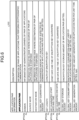
- FIG. 6 is a diagram illustrating an example of application pair information according to the arrangement.
- the application pair information of the arrangement includes an application pair, a domain, a source node 100, a destination node 100, a global key guaranteed amount, key length, key guarantee start date and time, key guarantee end date and time, a global key storage amount, a global key consumption amount, and a global key generation amount.
- the application pair is information indicating a pair of applications 200 that perform cryptographic communication.
- the domain is information indicating an administrator (owner) of an application pair.
- the source node 100 is information indicating the base node 100 where the transmission side of the application pair is disposed.
- the destination node 100 is information indicating the base node 100 where the reception side of the application pair is disposed.
- the source and the destination are used as start and end points in route calculation.
- the global key guaranteed amount is the guaranteed amount (bytes) of an encryption key (global key) per unit time (for example, 1 day, 1 hour, 1 minute, and the like) expected (required) by a user of an application pair (for example, administrator of the application pair and the like).
- the global key guaranteed amount is accepted by registration from the application 200 or a pair of applications 200.
- the global key guaranteed amount may be accepted by registration from a user who uses a pair of applications 200.
- an amount of required global key may be estimated based on global key information other than the global key guaranteed amount (global key consumption amount and global key generation amount).
- the global key requirement amount may be estimated based on global key information (global key consumption amount and global key generation amount) other than the global key guaranteed amount.
- the global key guaranteed amount or global key requirement amount is used as a parameter of the link cost.
- the key length is the length of an encryption key (global key).
- the key guarantee start date and time is the guarantee start date and time of an encryption key (global key).
- the key guarantee end date and time is the guarantee end date and time of an encryption key (global key).
- the global key storage amount is the storage amount (bytes) of an encryption key (global key) used in an application pair.
- the global key consumption amount is the consumption amount (bytes, bps) of an encryption key (global key) per unit time (for example, 1 day, 1 hour, 1 minute, and the like) used by an application pair.
- the global key generation amount is the amount (bytes, bps) of an encryption key (global key) generated per unit time (for example, 1 day, 1 hour, 1 minute, and the like) generated for an application pair.
- Exemplary application pair information is illustrated in FIG. 6 .
- the domain, key length, key guarantee start date and time, and key guarantee end date and time are optional, and the application pair information does not need to include, for example, the domain, key length, key guarantee start date and time, or key guarantee end date and time.
- the calculation unit 112 acquires link information (for example, local key generation amount, local key storage amount, local key reserved amount, status, and QKD performance) from the storage unit 115 (step S3).
- link information for example, local key generation amount, local key storage amount, local key reserved amount, status, and QKD performance
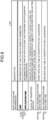
- FIG. 7 is a diagram illustrating an example of link information according to the arrangement.
- the link information of the arrangement includes a link status, network information, maximum local key storage amount, local key storage amount, local key generation amount, local key consumption amount, local key reserved amount, time, and QKD performance.
- the link is information indicating a link to which the node 100 is connected.
- the status is the operating status of a link and the operating status of the nodes 100 forming the link.
- the network information is information (for example, transmission speed, reception speed, and the like) of the transmission base and reception base of the link.
- the maximum local key storage amount is the maximum storage amount (bytes) of an encryption key (local key) of the link, and indicates the storage capacity of an encryption key (local key) of the link.
- the local key storage amount is the storage amount (bytes) of an encryption key (local key) of the link, and indicates the storage amount of an encryption key (local key) currently stored.
- the local key generation amount is the cumulative generation amount (bytes, bps) of an encryption key (local key) of the link.
- the local key consumption amount is the cumulative consumption amount (bytes, bps) of an encryption key (local key) of the link.
- the local key reserved amount is the total value (bytes) of the amount of a local key reserved for the link in order to satisfy the guaranteed amount of the global key 401 expected by each application pair.
- the local key consumption amount and the local key reserved amount are updated when a new relay route of the global key 401 is determined.
- the time is a time stamp indicating the time when the link information is recorded.
- the QKD performance is the performance of a QKD device (node 100 in the example of FIG. 1 ).
- the QKD performance is secure key generation amount, secure key rate, and error rate.
- the secure key is a key before the local key 301 is generated, and differs from the local key 301 in terms of not being divided into encryption and decryption.
- Exemplary link information is illustrated in FIG. 7 .
- the status is optional, and the link information may not include, for example, the status.
- the calculation unit 112 calculates the link capacity and the link cost based on the link capacity by using the link information acquired in step S3 (step S4).
- the link cost is used to calculate the amount that can be guaranteed for the local key 301 and select (extract)the relay route of the global key 401.
- the following parameters included in the link information are used.
- the calculation unit 112 estimates the future local key generation amount N gen from the past local key generation amount in order to take into consideration the fluctuation in the key generation amount of each link by QKD, and uses the local key generation amount N gen to calculate the link cost.
- the calculation unit 112 uses the local key reserved amount N rsv to calculate the link cost in order to prevent the local key reserved for guaranteeing the QoS of the application pair (for example, communication speed when the expected encryption strength is satisfied) from being consumed.
- the calculation unit 112 uses the current local key storage amount N cur to calculate the link cost.
- the calculation unit 112 selects the following formula of a linear function, an inverse proportional function, or an exponential function as a link cost calculation formula depending on the degree of influence on the link cost by the magnitude of the input parameter.
- N max is the maximum local key storage amount
- N is the link capacity described above
- ⁇ and ⁇ are weighting factors.
- the linear function may be used when it is desired to increase the link cost as the local key amount decreases.
- the inverse proportional function may be used when it is desired to reduce the cost as the amount of a local key is large and increase the cost as the amount of a local key is small.
- Exponential function C ⁇ N + ⁇ (0 ⁇ ⁇ ⁇ 1)
- the exponential function may be used when it is desired to increase the contribution to the link cost in order to avoid exhaustion when the amount of a local key is small compared to when the amount of a local key is large.
- the calculation unit 112 calculates a link cost C to be smaller as the link capacity N is larger, for example, by using the above linear function.
- the selection unit 114 can preferentially select a relay route in which more of the global key 401 can be relayed, based on the link cost C, it is possible to distribute the load of the local key consumption amount of each link and reduce the risk of a local key being exhausted.
- the following parameters included in the link information may be used.
- the calculation unit 112 directly uses an error rate e (%), which is one of the QKD performances.
- an error rate q is equal to or greater than a threshold
- the calculation unit 112 sets the link cost to a large value such as infinity.
- the threshold is 10
- the calculation unit 112 may use the above-described secure key generation amount (rate) K gen , which is one of the QKD performances, instead of the above-described local key generation amount N gen.
- the calculation unit 112 sets the link cost to a large value such as infinity when the link is not in operation. Further, even when one of the two nodes 100 forming a link is not in operation, the calculation unit 112 sets the link evaluation value of the link to a large value such as infinity.
- a link cost C 2 may be calculated by introducing an additional parameter to the link cost calculation formula C illustrated in 1. to 3. described above in step S4.
- the following formulas in 4. to 6. are not limited to one, and may be used in combination.
- Eavesdropping is detected at an error rate e, and the above link cost is multiplied by the error rate e. This formula may be used when it is desired to increase the link cost as the error rate e increases.
- This formula may be used when it is desired to reduce the link cost as the amount (rate) of secure key generation increases.
- This formula may be used when it is desired to increase the link cost when the link is not in operation.
- the calculation unit 112 may calculate the link cost further based on the global key storage amount, the global key consumption amount, and the global key generation amount.
- the calculation unit 112 uses a storage amount G cur u,v (current storage amount) of an encryption key (global key 401) of the application pair between a base u and a base v. Since the already stored global key 401 can be used as part of the global key guaranteed amount by using the global key storage amount G cur u,v , the global key requirement amount, which will be described later, can be set smaller. Alternatively, the calculation unit 112 introduces the global key storage amount G cur u,v into the link cost calculation formula.
- the calculation unit 112 uses the consumption amount (actually used amount) of an encryption key (global key 401) of the application pair between the base u and the base v. By using the global key consumption amount G used u,v , it is possible to quantify the usage tendency of the global key 401 so far and estimate the global key requirement amount, which will be described later. Alternatively, the calculation unit 112 introduces the global key consumption amount G used u,v into the link cost calculation formula.
- the calculation unit 112 uses the generation amount (generated amount) of an encryption key (global key 401) of the application pair between the base u and the base v. By using the global key generation amount G gen u,v , it is possible to quantify the generation tendency of the global key 401 so far and estimate the global key requirement amount, which will be described later. Alternatively, the calculation unit 112 introduces the global key generation amount G gen u,v into the link cost calculation formula.
- a link cost C 3 may be calculated by introducing an additional parameter to the link cost calculation formula C illustrated in formulas 1 to 3 described above in step S4.
- the following formulas in 7 to 9 are not limited to one, and may be used in combination.
- k indicates any base (node 100), and i and j indicate either the base u or v (node 100).
- C ik indicates the link cost between bases i and k, and C kj indicates the link cost between bases k and j.
- This formula may be used when it is desired to subtract a value based on the already stored global key storage amount C cur u,v (value multiplied by weighting factor ⁇ ) in an application pair between the base u and the base v from the link cost of the link connecting the start point base u and the end point base v of the application pair.
- This formula may be used when it is desired to add a value based on the past global key consumption amount G used u,v (value multiplied by weighting factor ⁇ ) in an application pair between the base u and the base v to the link cost of the link connecting the start point base u and the end point base v of the application pair.
- This formula may be used when it is desired to add a value based on the past global key generation amount G gen u,v (value multiplied by weighting factor ⁇ ) in the application pair between the base u and the base v to the link cost of the link connecting the start point base u and the end point base v of the application pair.
- the calculation unit 112 may estimate the global key requirement amount that actually needs to be generated.
- An example of estimating a global key requirement amount H is given below. When the estimated global key requirement amount H is a negative value, the global key requirement amount is set to zero.
- the calculation unit 112 estimates the global key requirement amount H from the past global key consumption amount G used and the global key storage amount G cur .
- the calculation unit 112 estimates the global key requirement amount H from the past global key generation amount G gen and the global key storage amount G cur .
- the calculation unit 112 calculates the global key amount estimated to be required from the difference between the global key generation amount G gen and the global key consumption amount G used . Then, the calculation unit 112 estimates the global key requirement amount H by further subtracting the global key storage amount G cur from the difference between the registered global key guaranteed amount H in and the global key amount estimated to be required.
- the guarantee unit 113 calculates the amount that can be guaranteed for a local key of each route by using the global key guaranteed amount H in acquired in step S2, the amount of a local key that can be used in the link calculated from the link information (for example, local key generation amount, local key storage amount, local key reserved amount, status, and QKD performance) acquired in step S3, and the link cost calculated in step S4 (step S5).
- the link information for example, local key generation amount, local key storage amount, local key reserved amount, status, and QKD performance
- the above-described global key requirement amount H estimated by using the global key storage amount, the global key consumption amount, and the global key generation amount may be used. That is, when the global key requirement amount H is estimated, the guarantee unit 113 may calculate the amount that can be guaranteed for the local key 301 used in the link so as to satisfy the global key requirement amount.
- the selection unit 114 selects a route, calculates the maximum flow that can flow for each route (equivalent to the minimum local key amount among the capacities of all the links existing in the route), and calculates the local key reservation amount of each link (step S6).
- the selection unit 114 first prioritizes the routes by listing the routes in ascending order of the link cost calculated in step S4.
- the selection unit 114 selects, from the prioritized routes, the utilization route that takes the maximum flow from the amount that can be guaranteed for a local key of each route calculated in step S5 (selection of the minimum cost maximum flow). That is, the selection unit 114 calculates a minimum cost maximum flow problem for the start point node 100 and the end point node 100. Then, the selection unit 114 calculates the local key reservation amount of each link so as to satisfy the global key guaranteed amount acquired in step S2.
- FIG. 8 is a diagram illustrating an example of application pair-link information according to the arrangement.
- the application pair-link information of the arrangement includes a link, the application pair, the local key reserved amount, the key reservation start date and time, and the key reservation end date and time. Links and application pairs are the same as described above. The link and application pair are used as a composite key to identify the data contained in the application pair-link information.
- the local key reserved amount is the local key amount (bytes) reserved in order to satisfy the global key guaranteed amount expected by one application pair for the link.
- the key reservation start date and time is the guarantee (reservation) start date and time of the encryption key (global key 401).
- the key reservation end date and time is the guarantee (reservation) end date and time of the encryption key (global key 401).
- Exemplary application pair-link information is illustrated in FIG. 8 .
- the key reservation start date and time and the key reservation end date and time are optional, and the application pair-link information does not need to include, for example, the key reservation start date and time and the key reservation end date and time.
- the collection unit 111 collects link information of a link for which a local key is generated by quantum key distribution and a global key guaranteed amount expected for a pair of applications 200 that perform cryptographic communication by using a global key.
- the calculation unit 112 calculates a link cost used for selecting a relay route of the global key based on the link information.
- the guarantee unit 113 calculates the amount that can be guaranteed for a local key used in the link so as to satisfy the global key guaranteed amount. Then, the selection unit 114 selects a relay route of the global key based on the link cost and the amount that can be guaranteed for the local key.
- the QoS originally expected by the application 200 can be guaranteed. That is, it is possible to guarantee the supply of an encryption key (global key 401) expected by each application 200.
- the global key relay route can be determined so as to satisfy the pre-registered global key guaranteed amount, it is possible to guarantee the supply of the global key (QoS) in the amount necessary for communication encryption of the application 200 to users of the QKD service.
- QoS global key
- the node 100 of the arrangement holds the local key reserved amount to be consumed in each link when determining a relay route that satisfies the global key guaranteed amount, and uses the local key reserved amount to calculate the link cost of each link. As a result, it is possible to determine a relay route so as not to hinder the supply of the global key 401 (QoS) to other users of the QKD service.
- QoS global key 401
- Modification Example 1 of the arrangement will be described.
- descriptions that are the same as those of the arrangement will be omitted, and portions that are different from the arrangement will be described.
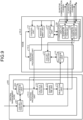
- FIG. 9 is a diagram illustrating an example of the configuration of Modification Example 1 of the arrangement.
- the node 100 of the arrangement described above is separated into a node 100-2 and a central management node 600.
- the node 100-2 includes a control unit 101, a management unit 102, a platform unit 103, a communication unit 104, and a routing processing unit 110-2.
- the routing processing unit 110-2 includes a collection unit 111 and a storage unit 115.
- the central management node 600 (an example of a quantum cryptographic communication control device) includes a collection unit 601, a storage unit 602, and a routing processing unit 110-3.
- the routing processing unit 110-3 includes a calculation unit 112, a guarantee unit 113, and a selection unit 114.
- the central management node 600 may perform route calculation processing by the calculation unit 112, the guarantee unit 113, and the selection unit 114.
- Modification Example 2 of the arrangement will be described.
- descriptions that are the same as those of the arrangement will be omitted, and portions that are different from the arrangement will be described.
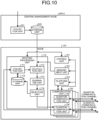
- FIG. 10 is a diagram illustrating an example of the configuration of Modification Example 2 of the arrangement.
- the node 100 of the arrangement described above is separated into a node 100 and a central management node 600-2.
- the configuration of the node 100 (an example of a quantum cryptographic communication control device) of Modification Example 2 is the same as that of the arrangement.
- the central management node 600-2 includes a collection unit 601 and a storage unit 602.
- each node 100 may perform route calculation processing to perform distributed processing of the route calculation, and the storage unit 602 of the central management node 600 may store the route calculation results performed by each node 100.
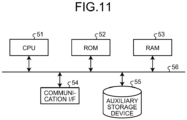
- FIG. 11 is a diagram illustrating an example of the hardware configuration of the node 100 of the arrangement.
- the node 100 includes a central processing unit (CPU) 51, a read only memory (ROM) 52, a random access memory (RAM) 53, a communication I/F 54, and an auxiliary storage device 55.
- the CPU 51, ROM 52, RAM 53, communication I/F 54, and auxiliary storage device 55 are connected via a bus 56.
- the CPU 51 executes programs read from the ROM 52 (an example of a main storage device), the auxiliary storage device 55, and the like in the RAM 53.
- the auxiliary storage device 55 is a hard disk drive (HDD), a memory card, or the like.
- the node 100 may further include a display device for displaying the status of the node 100, an input device for receiving input from a user, and the like.
- the communication I/F 54 includes a quantum communication I/F and a classical communication I/F.
- the quantum communication I/F is an interface for connecting to the quantum communication channel (optical fiber link).
- the classical communication I/F is an interface for connecting to the classical communication channel.
- a program executed by the node 100 is stored in a computer-readable storage medium such as a CD-ROM, a memory card, a CD-R, a digital versatile disc (DVD), or the like, as a file in an installable format or an executable format to be provided as a computer program product.
- a computer-readable storage medium such as a CD-ROM, a memory card, a CD-R, a digital versatile disc (DVD), or the like
- the program executed by the node 100 may be configured to be stored on a computer connected to a network such as the Internet so as to be provided by being downloaded via the network.
- the program executed by the node 100 may be configured to be provided via a network such as the Internet without being downloaded.
- the program to be executed by the node 100 may be configured to be pre-installed in a ROM or the like and provided.
- the program executed by the node 100 may have a module configuration including functions that can be implemented by the program among the functional configurations of the node 100 described above.
- the functions implemented by the program are loaded into the RAM 53 by the CPU 51 reading the program from a storage medium such as the auxiliary storage device 55 and executing the program. That is, the functions implemented by the program are generated on the RAM 53.
- the node 100 may be implemented by hardware such as an integrated circuit (IC).
- IC integrated circuit
- the IC may be, for example, a processor that executes dedicated processing.
- each processor may implement one of each function, or may implement two or more of each function.
Landscapes
- Engineering & Computer Science (AREA)
- Physics & Mathematics (AREA)
- Electromagnetism (AREA)
- Theoretical Computer Science (AREA)
- Computer Security & Cryptography (AREA)
- Computer Networks & Wireless Communication (AREA)
- Signal Processing (AREA)
- Data Exchanges In Wide-Area Networks (AREA)
Abstract
A quantum cryptographic communication control device includes a collection unit, a calculation unit, a guarantee unit, and a selection unit. The collection unit collects link information of a link for which a local key is generated by quantum key distribution and a global key guaranteed amount expected for a pair of applications that perform cryptographic communication by using a global key. The calculation unit calculates a link cost used for selecting a route of the global key based on the link information. The guarantee unit calculates an amount that can be guaranteed for a local key used in the link so as to satisfy the global key guaranteed amount. The selection unit selects the route of the global key based on the link cost and the amount that can be guaranteed.
Description
- Arrangements of the present invention relate to a quantum cryptographic communication control device, a quantum cryptographic communication control method, and a program.
- In cryptographically protected networks, methods are known in the prior art that route important data traffic away from dangerous or slow links, and the like, based on the remaining cryptographic capacity of a link. In addition, network routing devices (for example, routers and the like) are known in the prior art that perform "flow control" based on the remaining cryptographic capacity of a link.
- Examples of related art include
US7,392,378B andUS7,441,267B . -
-
FIG. 1 is a diagram illustrating an example of a configuration of a quantum cryptographic communication system according to an arrangement; -
FIG. 2 is a diagram illustrating an example of global key sharing processing according to the arrangement; -
FIG. 3 is a diagram illustrating an example of a configuration of a minimum unit key sharing network; -
FIG. 4 is a diagram illustrating an example of a functional configuration of a node according to the arrangement; -
FIG. 5 is a flowchart illustrating an example of a quantum cryptographic communication control method according to the arrangement; -
FIG. 6 is a diagram illustrating an example of application pair information according to the arrangement; -
FIG. 7 is a diagram illustrating an example of link information according to the arrangement; -
FIG. 8 is a diagram illustrating an example of application pair-link information according to the arrangement; -
FIG. 9 is a diagram illustrating an example of a configuration of Modification Example 1 of the arrangement; -
FIG. 10 is a diagram illustrating an example of a configuration of Modification Example 2 of the arrangement; and -
FIG. 11 is a diagram illustrating an example of a hardware configuration of the node according to the arrangement. - The conventional technology has the problem that it is not always possible to guarantee the quality of service (QoS) originally expected by the application.
- A quantum cryptographic communication control device according to an arrangement includes a collection unit, a calculation unit, a guarantee unit, and a selection unit.
- The collection unit collects link information of a link for which a local key is generated by quantum key distribution and a global key guaranteed amount (a guaranteed amount of the global key) expected for a pair of applications that perform cryptographic communication by using a global key. The calculation unit calculates a link cost used for selecting a route of the global key based on the link information. The guarantee unit calculates an amount that can be guaranteed for a local key used in the link so as to satisfy the global key guaranteed amount. The selection unit selects the route of the global key based on the link cost and the amount that can be guaranteed.
- Arrangements of a quantum cryptographic communication control device, a quantum cryptographic communication control method, and a program will be described in detail below with reference to the accompanying drawings.
- First, an example of the configuration of the quantum cryptographic communication system according to an arrangement will be described.
FIG. 1 is a diagram illustrating an example of the configuration of a quantum cryptographic communication system 1 according to an arrangement. The quantum cryptographic communication system 1 of the arrangement includesnodes 100a to 100e,applications 200a to 200b, anapplication network 501, and a key sharing network (QKD network) 502. - For example, the
node 100a is connected to thenodes node 100a shares a local key (quantum key) 301a by quantum key distribution (QKD) via a link with thenode 100b. Thenode 100a also generates an encryption key, which is a random number, as aglobal key 401a independently of the encryption key (quantum key) generation by QKD, and provides the encryption key to theapplication 200a. - Also, for example, the
node 100e is connected to thenodes node 100e shares alocal key 301b by QKD via link withnode 100c. Thenode 100e also generates an encryption key, which is a random number, as aglobal key 401b independently of the encryption key generation by QKD, and provides the encryption key to theapplication 200b. - Hereinafter, the
nodes 100a to 100e are simply referred to as anode 100 when not distinguished. Theapplications local keys 301a to 301b are simply referred to as alocal key 301 when not distinguished. Theglobal keys 401a to 401b are simply referred to as aglobal key 401 when not distinguished. - The application 200 performs cryptographic communication using the
global key 401 via theapplication network 501. - The
application network 501 is a network through which data encrypted with theglobal key 401 is transmitted and received. - The
key sharing network 502 is a network in which thelocal key 301 is shared among thenodes 100 connected by a link. - Although the number of
nodes 100 is five in the example ofFIG. 1 , the number ofnodes 100 is not limited to five. Further, although the number of applications 200 is two in the example ofFIG. 1 , the number of applications 200 is not limited to two. -
FIG. 2 is a diagram illustrating an example of sharing processing of theglobal key 401 according to the arrangement. As described above, thenode 100 is equipped with QKD functionality. Specifically, thenode 100 has a function of generating and sharing a random number between thenodes 100 connected via a link, and a function of performing cryptographic communication on thekey sharing network 502 by using the generated random number as thelocal key 301. - The specific node 100 (
nodes FIG. 2 ) has a function of generating a random number (global key 401 in the example ofFIG. 2 ) independently of the QKD functionality, and a function of transmitting the random number generated by the function to the opposite device. - Each
node 100 performs routing to share theglobal key 401. Eachnode 100 shares (relays) theglobal key 401 by using the path determined by routing. Theglobal key 401 is encrypted by One Time Pad (OTP) communication using thelocal key 301 shared between theopposite nodes 100 connected via a link, and is safely relayed to theopposite node 100. - In the example of
FIG. 2 , theglobal key 401 is shared between thenodes global key 401 is provided to theapplications -
FIG. 3 is a diagram illustrating an example of the configuration of the minimum unitkey sharing network 502. The example ofFIG. 3 shows a case where thenodes FIG. 3 , the configuration of the minimum unitkey sharing network 502 includes a pair ofnodes -
FIG. 4 is a diagram illustrating an example of the functional configuration of thenode 100 of the arrangement. The node 100 (an example of a quantum cryptographic communication control device) according to the arrangement includes acontrol unit 101, amanagement unit 102, aplatform unit 103, acommunication unit 104, and arouting processing unit 110. - The
control unit 101 controls processing performed by thenode 100. Thecontrol unit 101, for example, starts up each component. Thecontrol unit 101 also controls the timing of route calculation (route recalculation) performed by therouting processing unit 110. - For example, when the global key guaranteed amount requested by a pair of new applications 200 is added, when the global key guaranteed amount of a pair of the existing applications 200 is deleted, when the global key guaranteed amount of a pair of the existing applications 200 is changed, or when the global key guaranteed amount can no longer be guaranteed on a current relay route (distribution route), the
control unit 101 calculates the link cost used for selecting the relay route of theglobal key 401 and the amount of thelocal key 301 that can be used for relaying theglobal key 401 , and selects the relay route. Here, the global key guaranteed amount may be, for example, the global key amount required by the application 200 per unit time. - Further, for example, the
control unit 101 periodically calculates the link cost and the amount that can be guaranteed for thelocal key 301 and selects the relay route. By periodically recalculating the global key relay route, the local key consumption amount of each link can be optimized as a whole. - Further, for example, when at least one of a local key generation amount (an amount of a generated local key) and a local key storage amount (an amount of a stored local key) is smaller than a threshold, the
control unit 101 calculates the link cost and the amount that can be guaranteed for thelocal key 301, and selects the relay route. For example, when the local key generation amount decreases due to changes in the environment, presence of an eavesdropper, and the like, the local key storage amount also decreases. Since there is a possibility that the global key guaranteed amount cannot be guaranteed when the local key storage amount decreases, the amount of theglobal key 401 can be guaranteed by recalculating the global key relay route. - The
management unit 102 manages key resources such as the key of the link to which thenode 100 is connected, the key generation speed, and the amount of stored key. - The
platform unit 103 provides computer operating system functions, basic network functions, security functions, and the like necessary for managing and operating other components of thenode 100. - The
communication unit 104 communicates with anothernode 100 to which thenode 100 is connected. Thecommunication unit 104 is provided for each link and includes aquantum communication unit 105 and aclassical communication unit 106, respectively. The example ofFIG. 4 shows a case where theopposite node 100 is connected to thequantum communication unit 105 and theclassical communication unit 106 by each of three links. - The
quantum communication unit 105 is connected to anothernode 100 via a quantum communication channel and performs quantum communication with theother node 100. Thequantum communication unit 105 uses quantum cryptography (QKD) to share a photon bit string (random number) for generating a local key (encryption key) with thenode 100 connected by a link. - The
classical communication unit 106 is connected to anothernode 100 via a classical communication channel and performs classical communication with theother node 100. Data exchanged between thenodes 100 via theclassical communication unit 106 includes data such as theglobal key 401. Data such as theglobal key 401 is normally transmitted via theclassical communication unit 106 by cryptographic communication using thelocal key 301 managed by thenode 100. - The
routing processing unit 110 executes routing (routing control) of theglobal key 401. Therouting processing unit 110 includes acollection unit 111, acalculation unit 112, aguarantee unit 113, aselection unit 114, and astorage unit 115. - The
collection unit 111 collects link information (seeFIG. 7 described later) via theclassical communication unit 106. The link information includes the status of the link to which thenode 100 is connected, the network address of the link, the cost for each link, network information, and the like. Thecollection unit 111 also collects application pair information (seeFIG. 6 described later) connected to thenode 100. Thecollection unit 111 stores the collected link information and application pair information in thestorage unit 115. - The
calculation unit 112 uses the local key generation amount, the local key storage amount, and a local key reserved amount (an amount of the local key that has been reserved) of the link connected to thenode 100 to calculate a link capacity (the amount of a local key that can be sent to the link) and the link cost based on the link capacity. Thecalculation unit 112 may further use the status and the QKD performance to calculate a link capacity and the link cost based on the link capacity. - The
guarantee unit 113 calculates the amount that can be guaranteed for thelocal key 301 of each route from the link capacity and the link cost calculated by thecalculation unit 112 and the global key guaranteed amount collected by thecollection unit 111. Theguarantee unit 113 may further use the global key storage amount, a global key consumption amount (an amount of a consumed global key), and the global key generation amount to calculate the amount that can be guaranteed for thelocal key 301. - The
selection unit 114 creates an optimum path tree by selecting the optimum path with the optimum metric based on the link cost (metric) of the path candidates from among a plurality of path candidates reaching thedestination node 100. Theselection unit 114 creates a routing table from the optimum path tree and stores the routing table in thestorage unit 115. - The
storage unit 115 stores a database of link information (for example, local key generation amount, local key storage amount, a local key reservation amount (an amount of the local key to be used), status, and QKD performance), a database of application pair information (for example, global key guaranteed amount, global key storage amount, global key consumption amount, and global key generation amount), a routing table created by theselection unit 114, and the like. -
FIG. 5 is a flowchart illustrating an example of a quantum cryptographic communication control method of the arrangement. First, thecollection unit 111 collects link information and application pair information, and stores the link information and application pair information in the storage unit 115 (step S1). Next, thecalculation unit 112 acquires application pair information (for example, global key guaranteed amount, global key storage amount, global key consumption amount, and global key generation amount) from the storage unit 115 (step S2). Thecalculation unit 112 may directly receive a request for application pair information (for example, global key guaranteed amount, global key storage amount, global key consumption amount, and global key generation amount) from the application 200 without acquiring the application pair information from thestorage unit 115. -
FIG. 6 is a diagram illustrating an example of application pair information according to the arrangement. The application pair information of the arrangement includes an application pair, a domain, asource node 100, adestination node 100, a global key guaranteed amount, key length, key guarantee start date and time, key guarantee end date and time, a global key storage amount, a global key consumption amount, and a global key generation amount. - The application pair is information indicating a pair of applications 200 that perform cryptographic communication. The domain is information indicating an administrator (owner) of an application pair. The
source node 100 is information indicating thebase node 100 where the transmission side of the application pair is disposed. Thedestination node 100 is information indicating thebase node 100 where the reception side of the application pair is disposed. The source and the destination are used as start and end points in route calculation. - The global key guaranteed amount is the guaranteed amount (bytes) of an encryption key (global key) per unit time (for example, 1 day, 1 hour, 1 minute, and the like) expected (required) by a user of an application pair (for example, administrator of the application pair and the like). For example, the global key guaranteed amount is accepted by registration from the application 200 or a pair of applications 200. Also, for example, the global key guaranteed amount may be accepted by registration from a user who uses a pair of applications 200. When the global key guaranteed amount is not registered from the application 200 or a pair of applications 200, an amount of required global key may be estimated based on global key information other than the global key guaranteed amount (global key consumption amount and global key generation amount). Also, for example, when the global key guaranteed amount is not registered from a user, the global key requirement amount may be estimated based on global key information (global key consumption amount and global key generation amount) other than the global key guaranteed amount. The global key guaranteed amount or global key requirement amount is used as a parameter of the link cost.
- The key length is the length of an encryption key (global key). The key guarantee start date and time is the guarantee start date and time of an encryption key (global key). The key guarantee end date and time is the guarantee end date and time of an encryption key (global key).
- The global key storage amount is the storage amount (bytes) of an encryption key (global key) used in an application pair. The global key consumption amount is the consumption amount (bytes, bps) of an encryption key (global key) per unit time (for example, 1 day, 1 hour, 1 minute, and the like) used by an application pair. The global key generation amount is the amount (bytes, bps) of an encryption key (global key) generated per unit time (for example, 1 day, 1 hour, 1 minute, and the like) generated for an application pair.
- Exemplary application pair information is illustrated in
FIG. 6 . In the application pair information illustrated inFIG. 6 , for example, the domain, key length, key guarantee start date and time, and key guarantee end date and time are optional, and the application pair information does not need to include, for example, the domain, key length, key guarantee start date and time, or key guarantee end date and time. - Returning to
FIG. 5 , subsequently, thecalculation unit 112 acquires link information (for example, local key generation amount, local key storage amount, local key reserved amount, status, and QKD performance) from the storage unit 115 (step S3). -
FIG. 7 is a diagram illustrating an example of link information according to the arrangement. The link information of the arrangement includes a link status, network information, maximum local key storage amount, local key storage amount, local key generation amount, local key consumption amount, local key reserved amount, time, and QKD performance. - The link is information indicating a link to which the
node 100 is connected. The status is the operating status of a link and the operating status of thenodes 100 forming the link. The network information is information (for example, transmission speed, reception speed, and the like) of the transmission base and reception base of the link. - The maximum local key storage amount is the maximum storage amount (bytes) of an encryption key (local key) of the link, and indicates the storage capacity of an encryption key (local key) of the link. The local key storage amount is the storage amount (bytes) of an encryption key (local key) of the link, and indicates the storage amount of an encryption key (local key) currently stored. The local key generation amount is the cumulative generation amount (bytes, bps) of an encryption key (local key) of the link.
- The local key consumption amount is the cumulative consumption amount (bytes, bps) of an encryption key (local key) of the link. The local key reserved amount is the total value (bytes) of the amount of a local key reserved for the link in order to satisfy the guaranteed amount of the
global key 401 expected by each application pair. The local key consumption amount and the local key reserved amount are updated when a new relay route of theglobal key 401 is determined. - The time is a time stamp indicating the time when the link information is recorded. The QKD performance is the performance of a QKD device (
node 100 in the example ofFIG. 1 ). For example, the QKD performance is secure key generation amount, secure key rate, and error rate. The secure key is a key before thelocal key 301 is generated, and differs from thelocal key 301 in terms of not being divided into encryption and decryption. - Exemplary link information is illustrated in
FIG. 7 . In the link information illustrated inFIG. 7 , for example, the status is optional, and the link information may not include, for example, the status. - Returning to
FIG. 5 , subsequently, thecalculation unit 112 calculates the link capacity and the link cost based on the link capacity by using the link information acquired in step S3 (step S4). The link cost is used to calculate the amount that can be guaranteed for thelocal key 301 and select (extract)the relay route of theglobal key 401. - In the calculation of the link capacity in step S4 and the link cost using the link capacity, for example, the following parameters included in the link information are used.
- Local key generation amount per unit time: Ngen
- The
calculation unit 112 estimates the future local key generation amount Ngen from the past local key generation amount in order to take into consideration the fluctuation in the key generation amount of each link by QKD, and uses the local key generation amount Ngen to calculate the link cost. - Local key reserved amount per unit time: Nrsv
- The
calculation unit 112 uses the local key reserved amount Nrsv to calculate the link cost in order to prevent the local key reserved for guaranteeing the QoS of the application pair (for example, communication speed when the expected encryption strength is satisfied) from being consumed. - Current local key storage amount Ncur
- The
calculation unit 112 uses the current local key storage amount Ncur to calculate the link cost. - The
calculation unit 112 calculates the link cost by using a link capacity N = Ngen + Ncur - Nrsv. That is, in the calculation of the link cost, the link capacity N is used, which is a value obtained by adding the current local key storage amount Ncur to the local key generation amount Ngen to be generated in the future and subtracting the local key reserved amount Nrsv. By subtracting the local key reserved amount Nrsv, it is possible to calculate a route so that the key reserved for other applications 200 is not used. - In the link information, at least one of the local key generation amount Ngen of the
local key 301 generated in the link and the local key storage amount Ncur of thelocal key 301 used in the link, and the local key reserved amount Nrsv reserved in the link may be included. For example, when there is the local key generation amount Ngen, thecalculation unit 112 calculates the link capacity N = Ngen - Nrsv of the link, and calculates the link cost based on the link capacity N. Further, for example, when there is the local key storage amount Ncur, thecalculation unit 112 calculates the link capacity N = Ncur - Nrsv of the link, and calculates the link cost based on the link capacity N. - Next, an example of the formula for calculating the link cost in step S4 will be given.
- The
calculation unit 112 selects the following formula of a linear function, an inverse proportional function, or an exponential function as a link cost calculation formula depending on the degree of influence on the link cost by the magnitude of the input parameter. - Here, Nmax is the maximum local key storage amount, N is the link capacity described above, and α and β are weighting factors. The linear function may be used when it is desired to increase the link cost as the local key amount decreases.
- The inverse proportional function may be used when it is desired to reduce the cost as the amount of a local key is large and increase the cost as the amount of a local key is small.
- The exponential function may be used when it is desired to increase the contribution to the link cost in order to avoid exhaustion when the amount of a local key is small compared to when the amount of a local key is large.
- The
calculation unit 112 calculates a link cost C to be smaller as the link capacity N is larger, for example, by using the above linear function. As a result, since theselection unit 114 can preferentially select a relay route in which more of theglobal key 401 can be relayed, based on the link cost C, it is possible to distribute the load of the local key consumption amount of each link and reduce the risk of a local key being exhausted. - Also, for example, in the calculation of the link capacity in step S4 and the link cost using the link capacity, the following parameters included in the link information may be used.
- The
calculation unit 112 directly uses an error rate e (%), which is one of the QKD performances. Alternatively, when an error rate q is equal to or greater than a threshold, thecalculation unit 112 sets the link cost to a large value such as infinity. For example, when the threshold is 10, the error rate q is as follows. Variable e = ∞ (when q ≥ 10 (%)) based on error rate q (%),
e = q (when q < 10 (%)) - Secure key generation amount per unit time (rate): Kgen
- The
calculation unit 112 may use the above-described secure key generation amount (rate) Kgen, which is one of the QKD performances, instead of the above-described local key generation amount Ngen. - The
calculation unit 112 sets the link cost to a large value such as infinity when the link is not in operation. Further, even when one of the twonodes 100 forming a link is not in operation, thecalculation unit 112 sets the link evaluation value of the link to a large value such as infinity. - Variable s = 1 based on link operating status (when the link is in operation),
s = ∞ (when the link is not in operation) . - By introducing parameters for evaluating the link status and link performance described above, it is possible to perform route calculation for transferring the
global key 401 in consideration of a route with a better status. - Further, for example, a link cost C2 may be calculated by introducing an additional parameter to the link cost calculation formula C illustrated in 1. to 3. described above in step S4. The following formulas in 4. to 6. are not limited to one, and may be used in combination.
- Eavesdropping is detected at an error rate e, and the above link cost is multiplied by the error rate e. This formula may be used when it is desired to increase the link cost as the error rate e increases.
- This formula may be used when it is desired to reduce the link cost as the amount (rate) of secure key generation increases.
- This formula may be used when it is desired to increase the link cost when the link is not in operation.
- Also, for example, in the calculation of the link capacity in step S4 and the link cost using the link capacity, the following parameters included in the application pair information may be used. That is, the
calculation unit 112 may calculate the link cost further based on the global key storage amount, the global key consumption amount, and the global key generation amount. - The
calculation unit 112 uses a storage amount Gcur u,v (current storage amount) of an encryption key (global key 401) of the application pair between a base u and a base v. Since the already storedglobal key 401 can be used as part of the global key guaranteed amount by using the global key storage amount Gcur u,v, the global key requirement amount, which will be described later, can be set smaller. Alternatively, thecalculation unit 112 introduces the global key storage amount Gcur u,v into the link cost calculation formula. - The
calculation unit 112 uses the consumption amount (actually used amount) of an encryption key (global key 401) of the application pair between the base u and the base v. By using the global key consumption amount Gused u,v, it is possible to quantify the usage tendency of theglobal key 401 so far and estimate the global key requirement amount, which will be described later. Alternatively, thecalculation unit 112 introduces the global key consumption amount Gused u,v into the link cost calculation formula. - The
calculation unit 112 uses the generation amount (generated amount) of an encryption key (global key 401) of the application pair between the base u and the base v. By using the global key generation amount Ggen u,v, it is possible to quantify the generation tendency of theglobal key 401 so far and estimate the global key requirement amount, which will be described later. Alternatively, thecalculation unit 112 introduces the global key generation amount Ggen u,v into the link cost calculation formula. - By estimating the global key requirement amount or calculating the link cost by using the parameters related to the
global key 401 described above, it is possible to set a route that efficiently guarantees the global key guaranteed amount described later without waste. - Further, for example, a link cost C3 may be calculated by introducing an additional parameter to the link cost calculation formula C illustrated in formulas 1 to 3 described above in step S4. The following formulas in 7 to 9 are not limited to one, and may be used in combination.
-

- Here, k indicates any base (node 100), and i and j indicate either the base u or v (node 100). Cik indicates the link cost between bases i and k, and Ckj indicates the link cost between bases k and j. This formula may be used when it is desired to subtract a value based on the already stored global key storage amount Ccur u,v (value multiplied by weighting factor α) in an application pair between the base u and the base v from the link cost of the link connecting the start point base u and the end point base v of the application pair.
-

- This formula may be used when it is desired to add a value based on the past global key consumption amount Gused u,v (value multiplied by weighting factor α) in an application pair between the base u and the base v to the link cost of the link connecting the start point base u and the end point base v of the application pair.
-

- This formula may be used when it is desired to add a value based on the past global key generation amount Ggen u,v (value multiplied by weighting factor α) in the application pair between the base u and the base v to the link cost of the link connecting the start point base u and the end point base v of the application pair.
- Further, in step S4, the
calculation unit 112 may estimate the global key requirement amount that actually needs to be generated. An example of estimating a global key requirement amount H is given below. When the estimated global key requirement amount H is a negative value, the global key requirement amount is set to zero. -

- The
calculation unit 112 estimates the global key requirement amount H from the past global key consumption amount Gused and the global key storage amount Gcur. -

- The
calculation unit 112 estimates the global key requirement amount H from the past global key generation amount Ggen and the global key storage amount Gcur. -

- The
calculation unit 112 calculates the global key amount estimated to be required from the difference between the global key generation amount Ggen and the global key consumption amount Gused. Then, thecalculation unit 112 estimates the global key requirement amount H by further subtracting the global key storage amount Gcur from the difference between the registered global key guaranteed amount Hin and the global key amount estimated to be required. - Subsequently, the
guarantee unit 113 calculates the amount that can be guaranteed for a local key of each route by using the global key guaranteed amount Hin acquired in step S2, the amount of a local key that can be used in the link calculated from the link information (for example, local key generation amount, local key storage amount, local key reserved amount, status, and QKD performance) acquired in step S3, and the link cost calculated in step S4 (step S5). - Instead of the global key guaranteed amount Hin, the above-described global key requirement amount H estimated by using the global key storage amount, the global key consumption amount, and the global key generation amount may be used. That is, when the global key requirement amount H is estimated, the
guarantee unit 113 may calculate the amount that can be guaranteed for thelocal key 301 used in the link so as to satisfy the global key requirement amount. - Subsequently, the
selection unit 114 selects a route, calculates the maximum flow that can flow for each route (equivalent to the minimum local key amount among the capacities of all the links existing in the route), and calculates the local key reservation amount of each link (step S6). - Specifically, the
selection unit 114 first prioritizes the routes by listing the routes in ascending order of the link cost calculated in step S4. Theselection unit 114 selects, from the prioritized routes, the utilization route that takes the maximum flow from the amount that can be guaranteed for a local key of each route calculated in step S5 (selection of the minimum cost maximum flow). That is, theselection unit 114 calculates a minimum cost maximum flow problem for thestart point node 100 and theend point node 100. Then, theselection unit 114 calculates the local key reservation amount of each link so as to satisfy the global key guaranteed amount acquired in step S2. - It becomes possible to select a route for distributing the amount of the
global key 401 expected by the application pair by selecting a route so as to satisfy the global key guaranteed amount requested by the application pair (by giving the global key guaranteed amount as a parameter of the maximum flow problem to solve the problem). At this time, routes may be selected to satisfy the global key requirement amount H instead of the global key guaranteed amount. - Subsequently, the
selection unit 114 updates the link information and the application pair-link information (step S7). Specifically, theselection unit 114 calculates the local key reserved amount Nrsv = Σnrsv of all application pairs of each link from the local key reservation amount nrsv of each application pair of each link calculated in step S6, and updates the local key reserved amount Nrsv included in the link information managed by thestorage unit 115. In addition, theselection unit 114 updates the local key reserved amount included in the application pair-link information using the local key reservation amount nrsv of each application pair of each link calculated in step S6. - By setting (updating) the local key reserved amount Nrsv for each link, when calculating a next key relay (distribution) route, it is possible to determine the relay route of the
global key 401 so as not to violate the amount of a local key used by other application pairs. -
FIG. 8 is a diagram illustrating an example of application pair-link information according to the arrangement. The application pair-link information of the arrangement includes a link, the application pair, the local key reserved amount, the key reservation start date and time, and the key reservation end date and time. Links and application pairs are the same as described above. The link and application pair are used as a composite key to identify the data contained in the application pair-link information. - The local key reserved amount is the local key amount (bytes) reserved in order to satisfy the global key guaranteed amount expected by one application pair for the link. The key reservation start date and time is the guarantee (reservation) start date and time of the encryption key (global key 401). The key reservation end date and time is the guarantee (reservation) end date and time of the encryption key (global key 401).
- Exemplary application pair-link information is illustrated in
FIG. 8 . In the application pair-link information illustrated inFIG. 8 , for example, the key reservation start date and time and the key reservation end date and time are optional, and the application pair-link information does not need to include, for example, the key reservation start date and time and the key reservation end date and time. - As described above, in the
node 100 of the arrangement, thecollection unit 111 collects link information of a link for which a local key is generated by quantum key distribution and a global key guaranteed amount expected for a pair of applications 200 that perform cryptographic communication by using a global key. Thecalculation unit 112 calculates a link cost used for selecting a relay route of the global key based on the link information. Theguarantee unit 113 calculates the amount that can be guaranteed for a local key used in the link so as to satisfy the global key guaranteed amount. Then, theselection unit 114 selects a relay route of the global key based on the link cost and the amount that can be guaranteed for the local key. - As a result, according to the
node 100 of the arrangement, the QoS originally expected by the application 200 can be guaranteed. That is, it is possible to guarantee the supply of an encryption key (global key 401) expected by each application 200. - For example, since the global key relay route can be determined so as to satisfy the pre-registered global key guaranteed amount, it is possible to guarantee the supply of the global key (QoS) in the amount necessary for communication encryption of the application 200 to users of the QKD service.
- Further, the
node 100 of the arrangement holds the local key reserved amount to be consumed in each link when determining a relay route that satisfies the global key guaranteed amount, and uses the local key reserved amount to calculate the link cost of each link. As a result, it is possible to determine a relay route so as not to hinder the supply of the global key 401 (QoS) to other users of the QKD service. - Next, Modification Example 1 of the arrangement will be described. In the description of Modification Example 1, descriptions that are the same as those of the arrangement will be omitted, and portions that are different from the arrangement will be described.
-
FIG. 9 is a diagram illustrating an example of the configuration of Modification Example 1 of the arrangement. In Modification Example 1, thenode 100 of the arrangement described above is separated into a node 100-2 and acentral management node 600. - The node 100-2 includes a
control unit 101, amanagement unit 102, aplatform unit 103, acommunication unit 104, and a routing processing unit 110-2. The routing processing unit 110-2 includes acollection unit 111 and astorage unit 115. - The central management node 600 (an example of a quantum cryptographic communication control device) includes a
collection unit 601, astorage unit 602, and a routing processing unit 110-3. The routing processing unit 110-3 includes acalculation unit 112, aguarantee unit 113, and aselection unit 114. - As illustrated in
FIG. 9 , thecentral management node 600 may perform route calculation processing by thecalculation unit 112, theguarantee unit 113, and theselection unit 114. - Next, Modification Example 2 of the arrangement will be described. In the description of Modification Example 2, descriptions that are the same as those of the arrangement will be omitted, and portions that are different from the arrangement will be described.
-
FIG. 10 is a diagram illustrating an example of the configuration of Modification Example 2 of the arrangement. In Modification Example 2, thenode 100 of the arrangement described above is separated into anode 100 and a central management node 600-2. - The configuration of the node 100 (an example of a quantum cryptographic communication control device) of Modification Example 2 is the same as that of the arrangement. The central management node 600-2 includes a
collection unit 601 and astorage unit 602. - As illustrated in
FIG. 10 , eachnode 100 may perform route calculation processing to perform distributed processing of the route calculation, and thestorage unit 602 of thecentral management node 600 may store the route calculation results performed by eachnode 100. - Finally, an example of the hardware configuration of the
node 100 and thecentral management node 600 of the arrangement will be described. Since thenode 100 and thecentral management node 600 have the same hardware configuration, the case of thenode 100 will be described as an example. -
FIG. 11 is a diagram illustrating an example of the hardware configuration of thenode 100 of the arrangement. Thenode 100 includes a central processing unit (CPU) 51, a read only memory (ROM) 52, a random access memory (RAM) 53, a communication I/F 54, and anauxiliary storage device 55. The CPU 51, ROM 52, RAM 53, communication I/F 54, andauxiliary storage device 55 are connected via abus 56. - The CPU 51 (an example of a processor) executes programs read from the ROM 52 (an example of a main storage device), the
auxiliary storage device 55, and the like in the RAM 53. Theauxiliary storage device 55 is a hard disk drive (HDD), a memory card, or the like. - The
node 100 may further include a display device for displaying the status of thenode 100, an input device for receiving input from a user, and the like. - The communication I/
F 54 includes a quantum communication I/F and a classical communication I/F. The quantum communication I/F is an interface for connecting to the quantum communication channel (optical fiber link). The classical communication I/F is an interface for connecting to the classical communication channel. - A program executed by the
node 100 is stored in a computer-readable storage medium such as a CD-ROM, a memory card, a CD-R, a digital versatile disc (DVD), or the like, as a file in an installable format or an executable format to be provided as a computer program product. - Alternatively, the program executed by the
node 100 may be configured to be stored on a computer connected to a network such as the Internet so as to be provided by being downloaded via the network. - Alternatively, the program executed by the
node 100 may be configured to be provided via a network such as the Internet without being downloaded. - Alternatively, the program to be executed by the
node 100 may be configured to be pre-installed in a ROM or the like and provided. - The program executed by the
node 100 may have a module configuration including functions that can be implemented by the program among the functional configurations of thenode 100 described above. The functions implemented by the program are loaded into the RAM 53 by the CPU 51 reading the program from a storage medium such as theauxiliary storage device 55 and executing the program. That is, the functions implemented by the program are generated on the RAM 53. - Some or all of the functions of the
node 100 may be implemented by hardware such as an integrated circuit (IC). The IC may be, for example, a processor that executes dedicated processing. - Further, when each function is implemented by using a plurality of processors, each processor may implement one of each function, or may implement two or more of each function.
- While certain arrangements have been described, these arrangements have been presented by way of example only, and are not intended to limit the scope of the claims. Indeed, the apparatuses described herein may be embodied in a variety of other forms; furthermore various omissions, substitutions and changes in the form of the apparatuses described herein may be made.
Claims (13)
- A quantum cryptographic communication control device (100) comprising:a collection unit (111) that collects link information of a link for which a local key is generated by quantum key distribution and a global key guaranteed amount expected for a pair of applications that perform cryptographic communication by using a global key;a calculation unit (112) that calculates a link cost used for selecting a route of the global key based on the link information;a guarantee unit (113) that calculates an amount that can be guaranteed for a local key used in the link so as to satisfy the global key guaranteed amount; anda selection unit (114) that selects the route of the global key based on the link cost and the amount that can be guaranteed.
- The quantum cryptographic communication control device (100) according to claim 1, whereinthe link information includes at least one of a local key generation amount of the local key generated in the link and a local key storage amount of the local key used in the link, and a local key reserved amount reserved in the link, andthe calculation unit (112) calculates a link capacity of the link from at least one of the local key generation amount and the local key storage amount, and the local key reserved amount, and calculates the link cost based on the link capacity.
- The quantum cryptographic communication control device (100) according to claim 2, whereinthe calculation unit (112) calculates the link cost so that the link cost decreases as the link capacity increases, andthe selection unit (114) preferentially selects a route in which more of the global key can be relayed, based on the link cost.
- The quantum cryptographic communication control device (100) according to claim 2 or 3, further comprising:
a control unit (101) that controls timing for calculating the link cost and the amount that can be guaranteed, and selecting the route. - The quantum cryptographic communication control device (100) according to claim 4, wherein
when a global key guaranteed amount requested by a pair of new applications is added, when a global key guaranteed amount of a pair of existing applications is deleted, when the global key guaranteed amount of the pair of existing applications is changed, or when the global key guaranteed amount can no longer be guaranteed in a current route, the control unit (101) calculates the link cost and the amount that can be guaranteed and selects the route. - The quantum cryptographic communication control device (100) according to claim 4, wherein
the control unit (101) periodically calculates the link cost and the amount that can be guaranteed and selects the route. - The quantum cryptographic communication control device (100) according to claim 4, wherein
when at least one of the local key generation amount and the local key storage amount is smaller than a threshold, the control unit (101) calculates the link cost and the amount that can be guaranteed and selects the route. - The quantum cryptographic communication control device (100) according to claim 2 or 3, whereinthe global key guaranteed amount is a global key amount required by the applications per unit time, andthe global key guaranteed amount is accepted by registration from a user using the pair of applications.
- The quantum cryptographic communication control device (100) according to claim 2 or 3, whereinthe collection unit (111) further collects a global key storage amount of a global key used in the pair of applications, a global key consumption amount of the global key used in the pair of applications, and a global key generation amount of the global key used in the pair of applications, andthe calculation unit (112) calculates the link cost further based on the global key storage amount, the global key consumption amount, and the global key generation amount.
- The quantum cryptographic communication control device (100) according to any one of claims 1 to 3, whereinthe collection unit (111) further collects a global key storage amount of a global key used in the pair of applications, a global key consumption amount of the global key used in the pair of applications, and a global key generation amount of the global key used in the pair of applications,the calculation unit (112) estimates a global key requirement amount based on at least one of the global key storage amount, the global key consumption amount, and the global key generation amount, andwhen the global key requirement amount is estimated, the guarantee unit (113) calculates the amount that can be guaranteed for the local key used in the link so as to satisfy the global key requirement amount.
- The quantum cryptographic communication control device (100) according to any one of claims 1 to 3, whereinthe collection unit (111) further collects a global key storage amount of a global key used in the pair of applications, a global key consumption amount of the global key used in the pair of applications, and a global key generation amount of the global key used in the pair of applications,the calculation unit (112) calculates an actual global key amount from a difference between the global key generation amount and the global key consumption amount, and estimates a global key requirement amount by further subtracting the global key storage amount from a difference between the global key guaranteed amount and the actual global key amount, andwhen the global key requirement amount is estimated, the guarantee unit (113) calculates the amount that can be guaranteed for the local key used in the link so as to satisfy the global key requirement amount.
- A quantum cryptographic communication control method comprising:a step of collecting, via a quantum cryptographic communication control device (100), link information of a link for which a local key is generated by quantum key distribution and a global key guaranteed amount expected for a pair of applications that perform cryptographic communication by using a global key;a step of calculating, via the quantum cryptographic communication control device (100), a link cost used for selecting a route of the global key based on the link information;a step of calculating, via the quantum cryptographic communication control device (100), an amount that can be guaranteed for a local key used in the link so as to satisfy the global key guaranteed amount; anda step of selecting, via the quantum cryptographic communication control device (100), the route of the global key based on the link cost and the amount that can be guaranteed.
- A computer-readable storage medium storing a program causing a computer to function as:a collection unit (111) that collects link information of a link for which a local key is generated by quantum key distribution and a global key guaranteed amount expected for a pair of applications that perform cryptographic communication by using a global key;a calculation unit (112) that calculates a link cost used for selecting a route of the global key based on the link information;a guarantee unit (113) that calculates an amount that can be guaranteed for a local key used in the link so as to satisfy the global key guaranteed amount; anda selection unit (114) that selects the route of the global key based on the link cost and the amount that can be guaranteed.
Applications Claiming Priority (1)
| Application Number | Priority Date | Filing Date | Title |
|---|---|---|---|
| JP2022192202A JP7757267B2 (en) | 2022-11-30 | 2022-11-30 | Quantum cryptography communication control device, quantum cryptography communication control method and program |
Publications (1)
| Publication Number | Publication Date |
|---|---|
| EP4380099A1 true EP4380099A1 (en) | 2024-06-05 |
Family
ID=89030109
Family Applications (1)
| Application Number | Title | Priority Date | Filing Date |
|---|---|---|---|
| EP23213028.6A Pending EP4380099A1 (en) | 2022-11-30 | 2023-11-29 | Quantum cryptographic communication control device, quantum cryptographic communication control method, and program |
Country Status (3)
| Country | Link |
|---|---|
| US (1) | US20240178995A1 (en) |
| EP (1) | EP4380099A1 (en) |
| JP (1) | JP7757267B2 (en) |
Citations (2)
| Publication number | Priority date | Publication date | Assignee | Title |
|---|---|---|---|---|
| US7392378B1 (en) | 2003-03-19 | 2008-06-24 | Verizon Corporate Services Group Inc. | Method and apparatus for routing data traffic in a cryptographically-protected network |
| US7441267B1 (en) | 2003-03-19 | 2008-10-21 | Bbn Technologies Corp. | Method and apparatus for controlling the flow of data across a network interface |
Family Cites Families (9)
| Publication number | Priority date | Publication date | Assignee | Title |
|---|---|---|---|---|
| US7706535B1 (en) * | 2003-03-21 | 2010-04-27 | Bbn Technologies Corp. | Systems and methods for implementing routing protocols and algorithms for quantum cryptographic key transport |
| US8798034B2 (en) * | 2009-03-31 | 2014-08-05 | Motorola Solutions, Inc. | System and method for selecting a route based on link metrics incorporating channel bandwidth, spatial streams and/or guard interval in a multiple-input multiple-output (MIMO) network |
| JP6192998B2 (en) | 2013-06-11 | 2017-09-06 | 株式会社東芝 | COMMUNICATION DEVICE, COMMUNICATION METHOD, PROGRAM, AND COMMUNICATION SYSTEM |
| JP6244733B2 (en) * | 2013-08-14 | 2017-12-13 | 富士通株式会社 | Node device, communication system, communication program, and communication method |
| JP6426477B2 (en) * | 2015-01-06 | 2018-11-21 | 株式会社東芝 | Communication device, communication system and program |
| CN112217637B (en) * | 2016-11-04 | 2024-03-15 | 华为技术有限公司 | A quantum key relay method and device based on centralized management and control network |
| CA3167141A1 (en) * | 2020-01-06 | 2021-07-15 | Alarm.Com Incorporated | Mesh network connection quality |
| JP7282713B2 (en) * | 2020-04-16 | 2023-05-29 | 株式会社東芝 | Quantum Cryptography Device, Quantum Cryptography Communication Charge Calculation System, and Quantum Cryptography Communication Charge Calculation Method |
| JP7693596B2 (en) * | 2022-03-17 | 2025-06-17 | 株式会社東芝 | Key management device, quantum cryptography communication system and program |
-
2022
- 2022-11-30 JP JP2022192202A patent/JP7757267B2/en active Active
-
2023
- 2023-11-29 EP EP23213028.6A patent/EP4380099A1/en active Pending
- 2023-11-29 US US18/523,062 patent/US20240178995A1/en active Pending
Patent Citations (2)
| Publication number | Priority date | Publication date | Assignee | Title |
|---|---|---|---|---|
| US7392378B1 (en) | 2003-03-19 | 2008-06-24 | Verizon Corporate Services Group Inc. | Method and apparatus for routing data traffic in a cryptographically-protected network |
| US7441267B1 (en) | 2003-03-19 | 2008-10-21 | Bbn Technologies Corp. | Method and apparatus for controlling the flow of data across a network interface |
Non-Patent Citations (2)
| Title |
|---|
| CHEN LI-QUAN ET AL: "ADA-QKDN: a new quantum key distribution network routing scheme based on application demand adaptation", QUANTUM INFORMATION PROCESSING, SPRINGER US, NEW YORK, vol. 20, no. 9, 1 September 2021 (2021-09-01), XP037563685, ISSN: 1570-0755, [retrieved on 20210914], DOI: 10.1007/S11128-021-03246-2 * |
| YANG CHAO ET AL: "Quantum key distribution network: Optimal secret-key-aware routing method for trust relaying", CHINA COMMUNICATIONS, CHINA INSTITUTE OF COMMUNICATIONS, PISCATAWAY, NJ, USA, vol. 15, no. 2, 1 February 2018 (2018-02-01), pages 33 - 45, XP011678189, ISSN: 1673-5447, [retrieved on 20180221], DOI: 10.1109/CC.2018.8300270 * |
Also Published As
| Publication number | Publication date |
|---|---|
| JP2024079325A (en) | 2024-06-11 |
| JP7757267B2 (en) | 2025-10-21 |
| US20240178995A1 (en) | 2024-05-30 |
Similar Documents
| Publication | Publication Date | Title |
|---|---|---|
| EP4246875A1 (en) | Key management device, quantum cryptography communication system, and computer program product | |
| EP3896897B1 (en) | Quantum cryptographic device, quantum cryptographic communication fee calculation system, and quantum cryptographic communication fee calculation method | |
| JP5624526B2 (en) | Key sharing apparatus, key sharing method, and key sharing program | |
| JP6426477B2 (en) | Communication device, communication system and program | |
| JP6192998B2 (en) | COMMUNICATION DEVICE, COMMUNICATION METHOD, PROGRAM, AND COMMUNICATION SYSTEM | |
| US7392378B1 (en) | Method and apparatus for routing data traffic in a cryptographically-protected network | |
| CN1756233B (en) | Routing method and device in telecommunication network | |
| He et al. | Rethinking Internet traffic management: From multiple decompositions to a practical protocol | |
| US9755828B2 (en) | Communication device, communication method, computer program product, and communication system | |
| JP5694247B2 (en) | Key generation apparatus, communication method, and communication system | |
| US8477601B2 (en) | Network management station, network control system, and network management method | |
| JP6814094B2 (en) | Consensus building system, program, and generation method | |
| US20100182909A1 (en) | Conjestion control system | |
| CN102404194A (en) | Transport control server, transport control system, and transport control method | |
| JP2014241463A (en) | Communication device, communication method, program and communication system | |
| Maity et al. | TAQNet: Traffic-aware minimum-cost quantum communication network planning | |
| US20240178995A1 (en) | Quantum cryptographic communication control device, quantum cryptographic communication control method, and program | |
| Callaway et al. | An autonomic service delivery platform for service-oriented network environments | |
| JP2015185883A (en) | Management system and management method | |
| JP2023071515A (en) | Quantum cryptographic storage system, distributed control device, and program | |
| Cheng et al. | Adaptive QoS provisioning by pricing incentive QoS routing for next generation networks | |
| US20240323004A1 (en) | Key manager, qkdn control device, quantum cryptographic communication system, information processing device, key management method, qkdn control method, information processing method, and program product | |
| JP2026054853A (en) | QKDN control device, quantum cryptography communication system, information processing device, QKDN control method, information processing method and program | |
| Junqueira et al. | Exploring Key Pre-provisioning in Quantum Key Distribution Networks | |
| De Guibert et al. | Navigating the LEO Network: A Routing Optimisation Approach |
Legal Events
| Date | Code | Title | Description |
|---|---|---|---|
| PUAI | Public reference made under article 153(3) epc to a published international application that has entered the european phase |
Free format text: ORIGINAL CODE: 0009012 |
|
| STAA | Information on the status of an ep patent application or granted ep patent |
Free format text: STATUS: REQUEST FOR EXAMINATION WAS MADE |
|
| 17P | Request for examination filed |
Effective date: 20231129 |
|
| AK | Designated contracting states |
Kind code of ref document: A1 Designated state(s): AL AT BE BG CH CY CZ DE DK EE ES FI FR GB GR HR HU IE IS IT LI LT LU LV MC ME MK MT NL NO PL PT RO RS SE SI SK SM TR |