EP4380090A1 - An apparatus for communication and sensing - Google Patents
An apparatus for communication and sensing Download PDFInfo
- Publication number
- EP4380090A1 EP4380090A1 EP22211209.6A EP22211209A EP4380090A1 EP 4380090 A1 EP4380090 A1 EP 4380090A1 EP 22211209 A EP22211209 A EP 22211209A EP 4380090 A1 EP4380090 A1 EP 4380090A1
- Authority
- EP
- European Patent Office
- Prior art keywords
- sense
- symbol
- data
- symbols
- slots
- Prior art date
- Legal status (The legal status is an assumption and is not a legal conclusion. Google has not performed a legal analysis and makes no representation as to the accuracy of the status listed.)
- Pending
Links
- 238000004891 communication Methods 0.000 title description 16
- 230000005540 biological transmission Effects 0.000 claims abstract description 14
- 238000000034 method Methods 0.000 claims description 21
- 238000004590 computer program Methods 0.000 description 3
- 239000000470 constituent Substances 0.000 description 3
- 230000001052 transient effect Effects 0.000 description 3
- 238000004519 manufacturing process Methods 0.000 description 2
- 239000000463 material Substances 0.000 description 2
- 238000012986 modification Methods 0.000 description 2
- 230000004048 modification Effects 0.000 description 2
- 230000002123 temporal effect Effects 0.000 description 2
- 230000008878 coupling Effects 0.000 description 1
- 238000010168 coupling process Methods 0.000 description 1
- 238000005859 coupling reaction Methods 0.000 description 1
- 125000004122 cyclic group Chemical group 0.000 description 1
- 230000001419 dependent effect Effects 0.000 description 1
- 230000000694 effects Effects 0.000 description 1
- 230000006870 function Effects 0.000 description 1
- 230000008569 process Effects 0.000 description 1
- 230000008054 signal transmission Effects 0.000 description 1
Images

Classifications
-
- H—ELECTRICITY
- H04—ELECTRIC COMMUNICATION TECHNIQUE
- H04L—TRANSMISSION OF DIGITAL INFORMATION, e.g. TELEGRAPHIC COMMUNICATION
- H04L5/00—Arrangements affording multiple use of the transmission path
- H04L5/0001—Arrangements for dividing the transmission path
- H04L5/0003—Two-dimensional division
- H04L5/0005—Time-frequency
-
- H—ELECTRICITY
- H04—ELECTRIC COMMUNICATION TECHNIQUE
- H04W—WIRELESS COMMUNICATION NETWORKS
- H04W72/00—Local resource management
- H04W72/04—Wireless resource allocation
- H04W72/044—Wireless resource allocation based on the type of the allocated resource
- H04W72/0446—Resources in time domain, e.g. slots or frames
-
- G—PHYSICS
- G01—MEASURING; TESTING
- G01S—RADIO DIRECTION-FINDING; RADIO NAVIGATION; DETERMINING DISTANCE OR VELOCITY BY USE OF RADIO WAVES; LOCATING OR PRESENCE-DETECTING BY USE OF THE REFLECTION OR RERADIATION OF RADIO WAVES; ANALOGOUS ARRANGEMENTS USING OTHER WAVES
- G01S13/00—Systems using the reflection or reradiation of radio waves, e.g. radar systems; Analogous systems using reflection or reradiation of waves whose nature or wavelength is irrelevant or unspecified
- G01S13/02—Systems using reflection of radio waves, e.g. primary radar systems; Analogous systems
- G01S13/50—Systems of measurement based on relative movement of target
- G01S13/58—Velocity or trajectory determination systems; Sense-of-movement determination systems
- G01S13/581—Velocity or trajectory determination systems; Sense-of-movement determination systems using transmission of interrupted pulse modulated waves and based upon the Doppler effect resulting from movement of targets
- G01S13/582—Velocity or trajectory determination systems; Sense-of-movement determination systems using transmission of interrupted pulse modulated waves and based upon the Doppler effect resulting from movement of targets adapted for simultaneous range and velocity measurements
-
- G—PHYSICS
- G01—MEASURING; TESTING
- G01S—RADIO DIRECTION-FINDING; RADIO NAVIGATION; DETERMINING DISTANCE OR VELOCITY BY USE OF RADIO WAVES; LOCATING OR PRESENCE-DETECTING BY USE OF THE REFLECTION OR RERADIATION OF RADIO WAVES; ANALOGOUS ARRANGEMENTS USING OTHER WAVES
- G01S7/00—Details of systems according to groups G01S13/00, G01S15/00, G01S17/00
- G01S7/003—Transmission of data between radar, sonar or lidar systems and remote stations
- G01S7/006—Transmission of data between radar, sonar or lidar systems and remote stations using shared front-end circuitry, e.g. antennas
-
- H—ELECTRICITY
- H04—ELECTRIC COMMUNICATION TECHNIQUE
- H04L—TRANSMISSION OF DIGITAL INFORMATION, e.g. TELEGRAPHIC COMMUNICATION
- H04L27/00—Modulated-carrier systems
- H04L27/26—Systems using multi-frequency codes
- H04L27/2601—Multicarrier modulation systems
- H04L27/2602—Signal structure
-
- H—ELECTRICITY
- H04—ELECTRIC COMMUNICATION TECHNIQUE
- H04L—TRANSMISSION OF DIGITAL INFORMATION, e.g. TELEGRAPHIC COMMUNICATION
- H04L27/00—Modulated-carrier systems
- H04L27/26—Systems using multi-frequency codes
- H04L27/2601—Multicarrier modulation systems
- H04L27/2602—Signal structure
- H04L27/2605—Symbol extensions, e.g. Zero Tail, Unique Word [UW]
-
- H—ELECTRICITY
- H04—ELECTRIC COMMUNICATION TECHNIQUE
- H04L—TRANSMISSION OF DIGITAL INFORMATION, e.g. TELEGRAPHIC COMMUNICATION
- H04L5/00—Arrangements affording multiple use of the transmission path
- H04L5/0001—Arrangements for dividing the transmission path
- H04L5/0003—Two-dimensional division
- H04L5/0005—Time-frequency
- H04L5/0007—Time-frequency the frequencies being orthogonal, e.g. OFDM(A) or DMT
- H04L5/001—Time-frequency the frequencies being orthogonal, e.g. OFDM(A) or DMT the frequencies being arranged in component carriers
-
- H—ELECTRICITY
- H04—ELECTRIC COMMUNICATION TECHNIQUE
- H04L—TRANSMISSION OF DIGITAL INFORMATION, e.g. TELEGRAPHIC COMMUNICATION
- H04L5/00—Arrangements affording multiple use of the transmission path
- H04L5/003—Arrangements for allocating sub-channels of the transmission path
- H04L5/0044—Allocation of payload; Allocation of data channels, e.g. PDSCH or PUSCH
-
- H—ELECTRICITY
- H04—ELECTRIC COMMUNICATION TECHNIQUE
- H04L—TRANSMISSION OF DIGITAL INFORMATION, e.g. TELEGRAPHIC COMMUNICATION
- H04L5/00—Arrangements affording multiple use of the transmission path
- H04L5/003—Arrangements for allocating sub-channels of the transmission path
- H04L5/0048—Allocation of pilot signals, i.e. of signals known to the receiver
-
- H—ELECTRICITY
- H04—ELECTRIC COMMUNICATION TECHNIQUE
- H04L—TRANSMISSION OF DIGITAL INFORMATION, e.g. TELEGRAPHIC COMMUNICATION
- H04L5/00—Arrangements affording multiple use of the transmission path
- H04L5/003—Arrangements for allocating sub-channels of the transmission path
- H04L5/0058—Allocation criteria
- H04L5/0069—Allocation based on distance or geographical location
-
- H—ELECTRICITY
- H04—ELECTRIC COMMUNICATION TECHNIQUE
- H04L—TRANSMISSION OF DIGITAL INFORMATION, e.g. TELEGRAPHIC COMMUNICATION
- H04L5/00—Arrangements affording multiple use of the transmission path
- H04L5/003—Arrangements for allocating sub-channels of the transmission path
- H04L5/0078—Timing of allocation
- H04L5/0082—Timing of allocation at predetermined intervals
- H04L5/0083—Timing of allocation at predetermined intervals symbol-by-symbol
-
- H—ELECTRICITY
- H04—ELECTRIC COMMUNICATION TECHNIQUE
- H04L—TRANSMISSION OF DIGITAL INFORMATION, e.g. TELEGRAPHIC COMMUNICATION
- H04L5/00—Arrangements affording multiple use of the transmission path
- H04L5/0091—Signalling for the administration of the divided path, e.g. signalling of configuration information
- H04L5/0092—Indication of how the channel is divided
-
- H—ELECTRICITY
- H04—ELECTRIC COMMUNICATION TECHNIQUE
- H04W—WIRELESS COMMUNICATION NETWORKS
- H04W24/00—Supervisory, monitoring or testing arrangements
- H04W24/08—Testing, supervising or monitoring using real traffic
-
- H—ELECTRICITY
- H04—ELECTRIC COMMUNICATION TECHNIQUE
- H04W—WIRELESS COMMUNICATION NETWORKS
- H04W72/00—Local resource management
- H04W72/04—Wireless resource allocation
- H04W72/044—Wireless resource allocation based on the type of the allocated resource
- H04W72/0453—Resources in frequency domain, e.g. a carrier in FDMA
Definitions
- the present disclosure relates to an apparatus configured to control a transmitter.
- the disclosure also relates to a method and an electronic device including the apparatus, a transmitter and a receiver.
- Communication standards may use carrier frequencies that are sufficiently high to be used for discerning information about the environment that surrounds a transmitter by analyzing a signal that has reflected from the environment.
- an apparatus configured to control a transmitter, the apparatus comprising a processor configured to:
- the predetermined number of slots in each sub-frame comprises at least two and each sense-slot excludes data-symbols that represent the data stream.
- the processor being configured to generate data-symbols that represent said data stream comprises: the generation of the data-symbols that represent the data stream in the respective symbol time periods of the communication-slots and the symbol time periods of the sense-slots that are not occupied by the predetermined sense-symbol.
- the time period between consecutive sense-symbols is constant.
- the processor is configured such that the position of the at least one symbol time period in the at least one sense-slot of each sub-frame during which the sense-symbol is generated is selected to provide said constant time period between consecutive sense-symbols.
- the sense-symbol has a duration that extends over at least two consecutive symbol time periods in the sense-slots.
- each sub-frame includes at least one guard interval as well as said predetermined number of slots.
- the processor is configured to define the at least one sense-slot per sub-frame as one of the slots directly subsequent said guard interval, and wherein said processor is configured to, in the sense-slots that are directly subsequent said guard interval, generate said sense-symbol such that it extends over said guard interval and a first of the symbol time periods.
- the sense-symbols generated by said processor have a duration of at least two symbol time periods and comprise a first symbol time period comprising a symbol time period having a data-symbol therein and at least a second symbol time period directly adjacent the first symbol time period and comprising a copy of the data-symbol in the first symbol time period.
- the processor is configured to define the at least one sense-slot per sub-frame as one of the slots directly subsequent said guard interval, and
- the apparatus comprises a receiver configured to:
- a processor that is configured to control a transmitter, the method comprising:
- the method comprises defining the position of the at least one symbol time period in the at least one sense-slots of each sub-frame during which the sense-symbol is generated to provide a constant time period between consecutive sense-symbols.
- the method comprises: generating the data-symbols that represent the data stream in the respective symbol time periods of the communication-slots and the symbol time periods of the sense-slots that are not occupied by the predetermined sense-symbol.
- a electronic device including the apparatus the first aspect.
- a computer program or a computer readable medium comprising a computer program configured to perform the method of the second aspect.
- the present examples relate to a time-division-multiple-access (TDMA) based method and apparatus for transmitting information that comprises both symbols for the purpose of communication and for the purpose of sensing the environment around a transmitter.
- Communication standards such as 5G-New Radio, 5GNR, use carrier frequencies that can be as high as 60 or 70 GHz. These and other frequencies may be effectively used to sense the environment, that is detect the range and/or velocity of objects around the transmitter.
- the present examples relate to how to provide sense-symbols, that is the part of a signal used for the purpose of sensing the environment, alongside data-symbols, that is the part of the signal used for the purpose of conveying information, such as for calls, control or transferring data, such as to and/or from the Internet, for example.
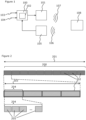
- Example figure 1 also shows a receiver 105 configured to receive signals 106 that were transmitted 107 by the transmitter 101 and have reflected from one or more objects 108 in the environment surrounding the transmitter 101.
- the examples that follow describe the actions of the apparatus 100 and processor 102. However, in other examples, those actions may be performed by a combination of the apparatus 100 and the transmitter 101. Further, the actions may be performed by a combination of the apparatus 100, the transmitter 101 and the receiver 105.
- Example figure 2 shows an example data frame format used for conveying information.
- Figure 2 shows a data frame 200 for transmission by the transmitter 101 at a selected one of a plurality of predetermined carrier frequencies.
- the data frame may be provided at a number of different carrier frequencies.
- the data frame 200 has a fixed predetermined frame length, which in this example comprises 10 ms represented by arrow 201.
- Each data frame 200 comprises fixed predetermined number of sub-frames 202.
- each data frame 200 comprises ten sub-frames 202.
- each sub-frame 202 has a fixed predetermined duration of, in the present example, 1 ms represented by arrow 203.
- each sub-frame 202 may comprise a predetermined number of slots 204.
- the number of slots in a sub-frame 202 is based on which of the plurality of predetermined carrier frequencies is selected for the present data frame 200. However, in other examples, the number of slots may be fixed.
- the sub-frame 202 comprises at least one slot, but the number of slots per sub-frame 202 may be between at least 2, 4, 8, 16 or more.
- the temporal length of the slots may decrease as carrier frequency increases.
- each slot 204 includes a fixed number of symbol time periods 205.
- a symbol time period comprises the period of time during a slot 204 in which a single symbol is to be transmitted.
- Each symbol may comprise a particular signal pattern and cyclic prefix, in one or more examples.
- there may comprise designated symbols used for communication namely data-symbols.
- there may be designated symbols used for sensing namely sense-symbols.
- the sense-symbols may comprise a waveform, such as a chirp, for use in sensing the environment.
- a sense-symbol may not be restricted to a single symbol time period and may extend over a plurality of symbol time periods in some examples.
- the sense-symbol has or the sense-symbols have a duration that extends over at least two consecutive symbol time periods in the sense-slots.
- the sense-symbols may be the same duration as the data-symbols or may have a duration longer than the data-symbols.
- each slot 204 includes a fixed number of symbol time periods, such as fourteen. As will be appreciated, given that the slots 204 may have a variable duration depending on the carrier frequency, the fixed number of symbol time periods per slot results in the symbol time periods having a duration dependent on the carrier frequency.
- the processor 100 thus receives the data stream 103 for transmission.
- the processor is configured to designate, for the slots 204 of each sub-frame 202, at least one communication-slot and at least one sense-slot which are provided in a TDMA scheme.
- the communication-slots comprise slots for use in transmitting of data-symbols that represent said data stream 103 (which may or may not include control data for network control purposes).
- the data-symbols available for use may be predefined and the processor may therefore translate the data stream 103 into the data-symbols.
- the processor 100 may be configured to generate the instructions for the transmitter 101 to generate the data-symbols that represent the data stream 103 in the respective symbol time periods of the communication-slots according to a predetermined encoding protocol.
- the sense-slots comprise slots that each include one or more predetermined sense-symbols for use in sensing the environment.
- the sense-slots may comprise only the sense-symbols, and therefore exclude data-symbols that represent the data stream, or a combination of sense-symbols and data-symbols.
- the processor 100 may be configured to generate the instructions for the transmitter 101 to generate the predetermined sense-symbol(s) in at least one symbol time period of the at least one sense-slot.
- the time-division-multiple-access provision of data-symbols and sense-symbols may be advantageous and allow for substantially simultaneous communication and sensing without requiring a dedicated carrier frequency for sensing.
- each sub-frame 202 may comprise at least one, at least two or at least four sense-symbols or groups of consecutive sense-symbols. In one or more examples, at least every other slot 204 or every slot may include at least one sense-symbol or at least one group of consecutive sense-symbols.
- the time period between consecutive sense-symbols may constant at least over two adjacent sub-frames 202.
- the provision of a constant frequency of sense-symbols i.e. constant time period between consecutive sense-symbols at least for a predetermined minimum time) may provide for accurate determination of the velocity of the object 108 in the environment.
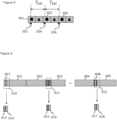
- Figure 3 shows a sub-frame of four or more slots 204 (as an example - the sub-frame may have fewer slots).
- Sense-symbols 301 are provided at regular times over the slots 204 to provide the sensing capability.
- the receiver 105 may be configured to identify the sense symbols in the received signal 106 in order to perform said sensing, as will be known to those skilled in the art. The identification of the sense symbols may be based on a correlation of the received signal 106 with the transmitted signal.
- the processor 102 may receive the received signal from the receiver 105 to perform the sensing.
- the processor 102 may inform the receiver 105 what form the sense symbols take in the transmitted signal 107 so that a processor associated therewith may identify them in the received signal 106.
- the form of the sense-symbols may be known to the receiver 105.
- a "sense-slot" in this embodiment, comprises a slot 204 in which a sense-symbol(s) is present as well as data-symbols representing the data stream.
- Figure 4 shows a plurality of slots 204 of a sub-frame 202.
- Slots 204 that are designated communication-slots are provided with a triangle symbol therein.
- Slots 204 that are designated sense-slots are provided with a circle symbol therein for ease of reference.
- the sense-slots may include data-symbols as well as sense-symbols.
- each sub-frame 202 includes at least one guard interval 401, 402 (two per sub-frame are shown in this example) as well as said predetermined number of slots 204.
- the total time period provided for the guard intervals 401, 402 and the slots 204 may be 1 ms.
- one guard interval 401 is provided at the beginning of the sub-frame 202 and one guard interval 402 is provided after half the subframe 202, i.e. immediately after 0.5 ms shown by arrow 403. It will be appreciated that in other examples guard intervals are not part of the frame structure.
- a first slot 404 comprises a sense-slot, and is designated by the circle symbol.
- a second slot 405 also comprises a sense-slot, also designated by the circle symbol.
- the remaining slots 204 of the sub-frame 202 comprise communication-slots, as designated by the triangle symbols.
- Beneath the sense-slots 404, 405 comprises an expanded view of the fourteen (in this example) symbol time periods for each slot and the types of symbols transmitted during those symbol time periods is indicated based on the shading.
- the processor 102 may be configured to select a different two symbol time periods (e.g. fourth and fifth, or eighth to tenth) for the sense-symbols based on a requirement to provide the sense-symbols at regular intervals, which is advantageous when determining the velocity of objects 108.
- a different two symbol time periods e.g. fourth and fifth, or eighth to tenth
- the processor 102 may be configured to provide one or at least one sense-slot each half sub-frame or each sub-frame for at least some or all of the sub-frames 202.
- Example figure 5 shows a plurality of slots in which every other slot is sense-slot.
- the first sense-slot 501 includes two symbol time periods designated to carry the one or more sense symbols, designated by the pair of arrows 502.
- the second sense-slot 503 includes two symbol time periods designated to carry the one or more sense symbols, designated by the pair of arrows 504.
- the two symbol time periods 504 occur slightly earlier in the second sense-slot 503.
- the third sense-slot 505 includes two symbol time periods designated to carry the one or more sense symbols, designated by the pair of arrows 506.
- the two symbol time periods 506 occur slightly earlier in the third sense-slot 505 compared to the second sense-slot 503.
- the processor 102 adjusts the location of the sense symbols in respective time slots to provide a regular sense-symbol(s) which may improve the accuracy of velocity determination.
- the sense-symbol may comprise a single symbol or signal or a plurality of symbols that extend for the duration of the symbol time periods, and optionally the guard interval 401, designated to carry it/them.
- the sense symbol(s) is therefore distinct from the data-symbols that provide the representation of the data stream used for communication.
- Such a TDMA based scheme is advantageous but provides a limit on the throughput in terms of communication because some time in the slots 204 is reserved for sense-symbols with only the remainder available for data-symbols.
- an example form of the sense-symbol(s) will be described to improve communication throughput further.
- the form of the sense-symbol may be based on the data stream.
- the data-symbols themselves may be used for sensing as well as representing the data stream.
- Example figure 6 shows a plurality of slots 601, 602, 603, 604, 605. There are sense symbols 610, 611, 612 provided in a TDMA manner in those slots.
- the sense symbols are provided in a first symbol time period 615 and a directly subsequent second symbol time period 616 of the slot 603.
- the second symbol time period 616 is designated to carry a data-symbol that represents the data stream.
- the processor 102 is configured such that the first symbol time period 615 comprises a copy of the data-symbol in the second symbol time period 616.
- the sense-symbol actually comprises a data-symbol, in symbol time period 616, and a copy of the data symbol from symbol time period 616 in the symbol time period 615.
- communication throughput is improved.
- the sense-symbols generated by said processor 102 have a duration of at least two symbol time periods comprising the first symbol time period and the second symbol time period 616, wherein the second symbol time period 616 comprises a symbol time period having a data-symbol therein and at least the first symbol time period 615 directly adjacent the second symbol time period 616 comprises a copy of the data-symbol in the second symbol time period 616.
- Example figure 6 also illustrates a further embodiment that still further improves communication throughput.
- the sub-frames may include one or more guard intervals 607, 608 between one, some or all of the slots 601-605 in the sub-frame.
- the sense-symbol 610 takes the form of the data symbol that occupies the first symbol time period 614 and a repeat thereof in the guard interval 607.
- the sense-symbol 612 takes the form of the data symbol that occupies the first symbol time period 618 and a repeat thereof in the guard interval 608.
- the receiver 105 and any associated processor 102 is configured to detect the sense-symbols 502, 504, 506, 610, 611, 612 in the received signal 106 and determine one or both of a range to or a velocity of the object 108.
- range-Doppler processing of said sense-symbols may be utilised to determine said one or both of range or velocity.
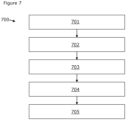
- Figure 7 shows an example method 700.
- the method comprises: providing 701 for generation of a data frame for transmission by the transmitter at a selected one of a plurality of predetermined carrier frequencies, the data frames having a format comprising a fixed predetermined frame length, wherein each data frame comprises a fixed predetermined number of sub-frames, and each sub-frame comprises a predetermined number of slots based on which of the plurality of predetermined carrier frequencies is selected, and wherein each slot includes a fixed number of symbol time periods; receiving 702 a data stream for transmission; defining 703, for the slots of each sub-frame, at least one communication-slot for transmitting of data-symbols that represent said data stream and at least one sense-slot for transmitting a predetermined sense-symbol for use in sensing an environment proximal said transmitter; wherein the providing for generation of the data frame further comprises: generating 704 the data-symbols that represent the data stream, in the respective symbol time periods of the communication-slots, according to a
- the set of instructions/method steps described above are implemented as functional and software instructions embodied as a set of executable instructions which are effected on a computer or machine which is programmed with and controlled by said executable instructions. Such instructions are loaded for execution on a processor (such as one or more CPUs).
- processor includes microprocessors, microcontrollers, processor modules or subsystems (including one or more microprocessors or microcontrollers), or other control or computing devices.
- a processor can refer to a single component or to plural components.
- the set of instructions/methods illustrated herein and data and instructions associated therewith are stored in respective storage devices, which are implemented as one or more non-transient machine or computer-readable or computer-usable storage media or mediums.
- Such computer-readable or computer usable storage medium or media is (are) considered to be part of an article (or article of manufacture).
- An article or article of manufacture can refer to any manufactured single component or multiple components.
- the non-transient machine or computer usable media or mediums as defined herein excludes signals, but such media or mediums may be capable of receiving and processing information from signals and/or other transient mediums.
Landscapes
- Engineering & Computer Science (AREA)
- Signal Processing (AREA)
- Computer Networks & Wireless Communication (AREA)
- Radar, Positioning & Navigation (AREA)
- Remote Sensing (AREA)
- Physics & Mathematics (AREA)
- General Physics & Mathematics (AREA)
- Time-Division Multiplex Systems (AREA)
- Mobile Radio Communication Systems (AREA)
Abstract
An apparatus configured to control a transmitter to provide for generation of a data frame, the data frame having a fixed length and fixed predetermined number of sub-frames, and each sub-frame comprises a predetermined number of slots based on a carrier frequencies, and each slot includes a fixed number of symbol time periods; receive a data stream for transmission; define at least one communication-slot for transmitting of data-symbols that represent said data stream and at least one sense-slot for transmitting a predetermined sense-symbol for use in sensing an environment; wherein the generation of the data frame further comprises: the generation of the data-symbols, in the respective symbol time periods of the at least one communication-slot, according to a predetermined encoding protocol, and the generation of the predetermined sense-symbol in at least one symbol time period of the respective at least one sense-slot.
Description
- The present disclosure relates to an apparatus configured to control a transmitter. The disclosure also relates to a method and an electronic device including the apparatus, a transmitter and a receiver.
- Communication standards may use carrier frequencies that are sufficiently high to be used for discerning information about the environment that surrounds a transmitter by analyzing a signal that has reflected from the environment.
- According to a first aspect of the present disclosure there is provided an apparatus configured to control a transmitter, the apparatus comprising a processor configured to:
- provide for generation of a data frame for transmission by the transmitter at a selected one of a plurality of predetermined carrier frequencies, the data frames having a fixed predetermined frame length, wherein each data frame comprises fixed predetermined number of sub-frames, and each sub-frame comprises a predetermined number of slots based on which of the plurality of predetermined carrier frequencies is selected, and wherein each slot includes a fixed number of symbol time periods;
- receive a data stream for transmission;
- define, for the predetermined number of slots of each sub-frame, at least one communication-slot for transmitting of data-symbols that represent said data stream and at least one sense-slot for transmitting a predetermined sense-symbol for use in sensing an environment proximal said transmitter;
- wherein the generation of the data frame further comprises:
- the generation of the data-symbols that represent the data stream, in the respective symbol time periods of the at least one communication-slot, according to a predetermined encoding protocol, and
- the generation of the predetermined sense-symbol in at least one symbol time period of the respective at least one sense-slot.
- In one or more embodiments, the predetermined number of slots in each sub-frame comprises at least two and each sense-slot excludes data-symbols that represent the data stream.
- In one or more embodiments, the processor being configured to generate data-symbols that represent said data stream comprises:
the generation of the data-symbols that represent the data stream in the respective symbol time periods of the communication-slots and the symbol time periods of the sense-slots that are not occupied by the predetermined sense-symbol. - In one or more embodiments, the time period between consecutive sense-symbols is constant.
- In one or more embodiments, the processor is configured such that the position of the at least one symbol time period in the at least one sense-slot of each sub-frame during which the sense-symbol is generated is selected to provide said constant time period between consecutive sense-symbols.
- In one or more embodiments, the sense-symbol has a duration that extends over at least two consecutive symbol time periods in the sense-slots.
- In one or more embodiments, each sub-frame includes at least one guard interval as well as said predetermined number of slots.
- In one or more embodiments, the processor is configured to define the at least one sense-slot per sub-frame as one of the slots directly subsequent said guard interval, and
wherein said processor is configured to, in the sense-slots that are directly subsequent said guard interval, generate said sense-symbol such that it extends over said guard interval and a first of the symbol time periods. - In one or more embodiments, the sense-symbols generated by said processor have a duration of at least two symbol time periods and comprise a first symbol time period comprising a symbol time period having a data-symbol therein and at least a second symbol time period directly adjacent the first symbol time period and comprising a copy of the data-symbol in the first symbol time period.
- In one or more embodiments, the processor is configured to define the at least one sense-slot per sub-frame as one of the slots directly subsequent said guard interval, and
- wherein said processor is configured to, in the sense-slots that are directly subsequent said guard interval, generate said sense-symbol such that it extends over said guard interval and a first of the symbol time periods, and
- wherein the first of the symbol time periods comprises a data-symbol and the guard interval comprises a copy of the data-symbol in the first of the symbol time periods, and
- wherein the processor is configured to record sense-symbol-description information that is indicative of the form of the sense-symbols and provide the sense-symbol-description information to a receiver for use in detecting the sense-symbols in a received signal that was transmitted by the transmitter and reflected from the environment.
- In one or more embodiments, the apparatus comprises a receiver configured to:
- receive a signal that was transmitted by the transmitter and reflected from an environment proximal the transmitter and proximal the receiver;
- detect the sense-symbols in said received signal;
- determine one or both of a range to or a velocity of an object in said environment based at least on range-Doppler processing of said sense-symbols.
- According to a second aspect of the present disclosure there is provided a method for an apparatus, such as the apparatus of the first aspect, comprising a processor that is configured to control a transmitter, the method comprising:
- providing for generation of a data frame for transmission by the transmitter at a selected one of a plurality of predetermined carrier frequencies, the data frames having a fixed predetermined frame length, wherein each data frame comprises fixed predetermined number of sub-frames, and each sub-frame comprises a predetermined number of slots based on which of the plurality of predetermined carrier frequencies is selected, and wherein each slot includes a fixed number of symbol time periods;
- receiving a data stream for transmission;
- defining, for the predetermined number of slots of each sub-frame, at least one communication-slot for transmitting of data-symbols that represent said data stream and at least one sense-slot for transmitting a predetermined sense-symbol for use in sensing an environment proximal said transmitter;
- wherein the providing for generation of the data frame further comprises:
- generating the data-symbols that represent the data stream, in the respective symbol time periods of the at least one communication-slot, according to a predetermined encoding protocol, and
- generating the predetermined sense-symbol in at least one symbol time period of the respective at least one sense-slot.
- In one or more embodiments, the method comprises defining the position of the at least one symbol time period in the at least one sense-slots of each sub-frame during which the sense-symbol is generated to provide a constant time period between consecutive sense-symbols.
- In one or more embodiments, the method comprises:
generating the data-symbols that represent the data stream in the respective symbol time periods of the communication-slots and the symbol time periods of the sense-slots that are not occupied by the predetermined sense-symbol. - According to a third aspect of the present disclosure there is provided a electronic device including the apparatus the first aspect.
- According to a fourth aspect of the present disclosure there is provided a computer program or a computer readable medium comprising a computer program configured to perform the method of the second aspect.
- While the disclosure is amenable to various modifications and alternative forms, specifics thereof have been shown by way of example in the drawings and will be described in detail. It should be understood, however, that other embodiments, beyond the particular embodiments described, are possible as well. All modifications, equivalents, and alternative embodiments falling within the spirit and scope of the appended claims are covered as well.
- The above discussion is not intended to represent every example embodiment or every implementation within the scope of the current or future Claim sets. The figures and Detailed Description that follow also exemplify various example embodiments. Various example embodiments may be more completely understood in consideration of the following Detailed Description in connection with the accompanying Drawings.
- One or more embodiments will now be described by way of example only with reference to the accompanying drawings in which:
-
Figure 1 shows an example embodiment of an apparatus for controlling a transmitter along with a transmitter and a receiver; -
Figure 2 shows a data frame, constituent sub-frames and constituent slots and constituent symbol time periods; -
Figure 3 shows a first example sub-frame having a plurality of data-symbols for carrying the data content of the data frame, such as for communication, and a plurality of sense-symbols for use in measuring the environment proximal the transmitter; -
Figure 4 shows a second example of a plurality of slots wherein one or more slots include one or more sense-symbols and the remainder of the slots include data-symbols; -
Figure 5 shows equidistant sense-symbols for use in accurate velocity estimation of an object in the environment proximal the transmitter; -
Figure 6 shows a third example of a plurality of slots in which one or more of the slots include sense-symbols of a particular format to provide for efficient communication throughput; and -
Figure 7 shows a flowchart illustrating an example method. - The present examples relate to a time-division-multiple-access (TDMA) based method and apparatus for transmitting information that comprises both symbols for the purpose of communication and for the purpose of sensing the environment around a transmitter. Communication standards such as 5G-New Radio, 5GNR, use carrier frequencies that can be as high as 60 or 70 GHz. These and other frequencies may be effectively used to sense the environment, that is detect the range and/or velocity of objects around the transmitter.
- Thus, apparatuses may be configured to sense the distance to one or more objects in the physical environment around a transmitter by processing signals that have been transmitted by the transmitter, reflected from said one or more objects and then received. In one or more examples, it may be possible to sense the velocity of one or more objects in the physical environment around the transmitter by processing signals that have been transmitted by the transmitter, reflected from said one or more moving objects and then received. The methods required to sense the environment may be known to those skilled in the art. The present examples relate to how to provide sense-symbols, that is the part of a signal used for the purpose of sensing the environment, alongside data-symbols, that is the part of the signal used for the purpose of conveying information, such as for calls, control or transferring data, such as to and/or from the Internet, for example.
- Example
figure 1 shows anapparatus 100 configured to control atransmitter 101. Theapparatus 100 comprises aprocessor 102 for providing instructions to thetransmitter 101 to cause it to transmit a desired sequence of symbols. Theprocessor 102 may comprise one or more processing devices and associated memory loaded with computer program code for providing the functions of theprocessor 102. Theapparatus 100 may be configured to receive adata stream 103 comprising data to be transmitted and may represent that data as data-symbols and instruct the transmitter to transmit those data-symbols. Theapparatus 100 may be configured to receivesensing information 104 for representing as sense-symbols and instruct the transmitter to transmit those sense-symbols. For example, thesensing information 104 may define the waveform desired for sensing for representing by the sense symbols. In other examples, the sense-symbols may be predetermined and therefore the receipt of thesensing information 104 may not be necessary. - Example
figure 1 also shows areceiver 105 configured to receivesignals 106 that were transmitted 107 by thetransmitter 101 and have reflected from one ormore objects 108 in the environment surrounding thetransmitter 101. The examples that follow describe the actions of theapparatus 100 andprocessor 102. However, in other examples, those actions may be performed by a combination of theapparatus 100 and thetransmitter 101. Further, the actions may be performed by a combination of theapparatus 100, thetransmitter 101 and thereceiver 105. - Example
figure 2 shows an example data frame format used for conveying information.Figure 2 shows a data frame 200 for transmission by thetransmitter 101 at a selected one of a plurality of predetermined carrier frequencies. Thus, depending on the standard or protocol, the data frame may be provided at a number of different carrier frequencies. - In one or more examples, the data frame 200 has a fixed predetermined frame length, which in this example comprises 10 ms represented by
arrow 201. - Each data frame 200 comprises fixed predetermined number of
sub-frames 202. In the present example, each data frame 200 comprises tensub-frames 202. Thus, eachsub-frame 202 has a fixed predetermined duration of, in the present example, 1 ms represented byarrow 203. - In one or more examples, each
sub-frame 202 may comprise a predetermined number ofslots 204. In one or more examples, the number of slots in asub-frame 202 is based on which of the plurality of predetermined carrier frequencies is selected for the present data frame 200. However, in other examples, the number of slots may be fixed. In the examples that follow, thesub-frame 202 comprises at least one slot, but the number of slots persub-frame 202 may be between at least 2, 4, 8, 16 or more. - In examples where the number of slots is based on the selected carrier frequency, it will be appreciated that the temporal length of the slots may decrease as carrier frequency increases.
- In the present example, each
slot 204 includes a fixed number ofsymbol time periods 205. A symbol time period comprises the period of time during aslot 204 in which a single symbol is to be transmitted. Each symbol may comprise a particular signal pattern and cyclic prefix, in one or more examples. As mentioned above, there may comprise designated symbols used for communication, namely data-symbols. In one or more examples, there may be designated symbols used for sensing, namely sense-symbols. The sense-symbols may comprise a waveform, such as a chirp, for use in sensing the environment. A sense-symbol may not be restricted to a single symbol time period and may extend over a plurality of symbol time periods in some examples. In one or more examples, the sense-symbol has or the sense-symbols have a duration that extends over at least two consecutive symbol time periods in the sense-slots. Thus, the sense-symbols may be the same duration as the data-symbols or may have a duration longer than the data-symbols. - In the present examples, each
slot 204 includes a fixed number of symbol time periods, such as fourteen. As will be appreciated, given that theslots 204 may have a variable duration depending on the carrier frequency, the fixed number of symbol time periods per slot results in the symbol time periods having a duration dependent on the carrier frequency. - Examples will now be described in which the frame format as described will be configured to carry both data-symbols and sense-symbols in a TDMA manner.
- Thus, in general, the
processor 100 may be configured to provide instructions to thetransmitter 101 such that thetransmitter 101, possibly based on further instructions and/or signals from one or more other sources, generates the symbols in the format of the aforementioned data frame 200 for transmission at a particular predetermined carrier frequency. - The
processor 100 thus receives thedata stream 103 for transmission. In order to provide for transmission of signals representing the data stream along with signals to provide said sensing of the environment, the processor is configured to designate, for theslots 204 of eachsub-frame 202, at least one communication-slot and at least one sense-slot which are provided in a TDMA scheme. The communication-slots comprise slots for use in transmitting of data-symbols that represent said data stream 103 (which may or may not include control data for network control purposes). In one or more examples, the data-symbols available for use may be predefined and the processor may therefore translate thedata stream 103 into the data-symbols. Thus, theprocessor 100 may be configured to generate the instructions for thetransmitter 101 to generate the data-symbols that represent thedata stream 103 in the respective symbol time periods of the communication-slots according to a predetermined encoding protocol. - The sense-slots comprise slots that each include one or more predetermined sense-symbols for use in sensing the environment. Thus, in the examples that follow, the sense-slots may comprise only the sense-symbols, and therefore exclude data-symbols that represent the data stream, or a combination of sense-symbols and data-symbols. Thus, the
processor 100 may be configured to generate the instructions for thetransmitter 101 to generate the predetermined sense-symbol(s) in at least one symbol time period of the at least one sense-slot. In examples where a sub-frame comprises one slot, it will be appreciated that in order for sensing and communication to occur that one slot may need to be a sense-slot also having data-symbols therein such that it may be, in effect, both a sense-slot and a communication-slot. Alternatively, only a subset of the sub-frames may comprise communication-slots and wherein the sub-frames outside the subset include sense-slot(s). - The time-division-multiple-access provision of data-symbols and sense-symbols may be advantageous and allow for substantially simultaneous communication and sensing without requiring a dedicated carrier frequency for sensing.
- In one or more examples, each
sub-frame 202 may comprise at least one, at least two or at least four sense-symbols or groups of consecutive sense-symbols. In one or more examples, at least everyother slot 204 or every slot may include at least one sense-symbol or at least one group of consecutive sense-symbols. - In one or more examples, the time period between consecutive sense-symbols may constant at least over two
adjacent sub-frames 202. The provision of a constant frequency of sense-symbols (i.e. constant time period between consecutive sense-symbols at least for a predetermined minimum time) may provide for accurate determination of the velocity of theobject 108 in the environment. - Examples in which the sense-slots exclude data-symbols may be advantageous because the
apparatus 100 may reserveslots 204 for sensing and the position of the sense-symbols in the "reserved" sense-slot may be freely selected without affecting the data-symbols. For example, in some examples, the free positioning of the sense-symbols in the sense-slot may be advantageous in ensuring the time period between consecutive sense-symbols is constant at least over the twoadjacent sub-frames 202 or data frame 200. -
Figure 3 shows a sub-frame of four or more slots 204 (as an example - the sub-frame may have fewer slots). Sense-symbols 301 are provided at regular times over theslots 204 to provide the sensing capability. It will be appreciated that thereceiver 105 may be configured to identify the sense symbols in the receivedsignal 106 in order to perform said sensing, as will be known to those skilled in the art. The identification of the sense symbols may be based on a correlation of the receivedsignal 106 with the transmitted signal. In some examples, theprocessor 102 may receive the received signal from thereceiver 105 to perform the sensing. In other examples, theprocessor 102 may inform thereceiver 105 what form the sense symbols take in the transmittedsignal 107 so that a processor associated therewith may identify them in the receivedsignal 106. In other examples, the form of the sense-symbols may be known to thereceiver 105. - A further example of a TDMA based sense-symbol and communication-symbol scheme will be described with reference to example
Figure 4 . - In the following example the
processor 102 is configured to generate instructions that provide for generation of the data-symbols not only in the respective symbol time periods of the communication-slots but also in the symbol time periods of the sense-slots that are not occupied by the predetermined sense-symbol(s). Thus, a "sense-slot", in this embodiment, comprises aslot 204 in which a sense-symbol(s) is present as well as data-symbols representing the data stream. -
Figure 4 shows a plurality ofslots 204 of asub-frame 202.Slots 204 that are designated communication-slots are provided with a triangle symbol therein.Slots 204 that are designated sense-slots are provided with a circle symbol therein for ease of reference. As mentioned before, the sense-slots may include data-symbols as well as sense-symbols. In the present example eachsub-frame 202 includes at least oneguard interval 401, 402 (two per sub-frame are shown in this example) as well as said predetermined number ofslots 204. The total time period provided for theguard intervals slots 204 may be 1 ms. Further, in the present example, oneguard interval 401 is provided at the beginning of thesub-frame 202 and oneguard interval 402 is provided after half thesubframe 202, i.e. immediately after 0.5 ms shown byarrow 403. It will be appreciated that in other examples guard intervals are not part of the frame structure. - In the
sub-frame 202 shown inFigure 4 , afirst slot 404 comprises a sense-slot, and is designated by the circle symbol. Asecond slot 405 also comprises a sense-slot, also designated by the circle symbol. The remainingslots 204 of thesub-frame 202 comprise communication-slots, as designated by the triangle symbols. Beneath the sense-slots - The second sense-
slot 405 provides an example of providing sense-symbols and data-symbols in the same slot. Thus, one or more examples may comprise providing sense-slots of this format independent of the first sense-slot 404 described later. Thus, the first twosymbol time periods symbol time periods 408 include data-symbols. This may be advantageous because all the symbol time periods are utilised and the time division multiplexing of the sense-symbols and the data-symbols provides an effective way of providing sensing and communication together. Further, although the first twosymbol time periods processor 102 may be configured to select a different two symbol time periods (e.g. fourth and fifth, or eighth to tenth) for the sense-symbols based on a requirement to provide the sense-symbols at regular intervals, which is advantageous when determining the velocity ofobjects 108. - In one or more examples, the
processor 102 may be configured to provide one or at least one sense-slot each half sub-frame or each sub-frame for at least some or all of the sub-frames 202. - In one or more examples, the
guard intervals - The first sense-
slot 404 provides an example of providing sense-symbols and data-symbols in the same slot as well as using the time provided for the guard interval. Thus, in the first sense-slot 404, a first of the symbol time periods is designated to include the one or more sense-symbols. Further, theguard interval 401 is also designated to include the one or more sense-symbols. Thus, a contiguous time period of theguard interval 401 and the first symbol time period of the sense-slot 404 that follows theguard interval 401 is configured to include the one or more sense-symbols. This may be advantageous because fewer symbol time periods are required for the sense symbols compared to, for example, the second sense-slot 405. Accordingly throughput of data is improved by using theguard interval 401 to provide time in the data frame for sense symbols. - Accordingly, the
processor 102 is configured to, in the sense-slots 404 that are directly subsequent saidguard interval 401, generate said sense-symbol such that it extends over said guard interval and at least a first of the symbol time periods. In one or more examples, theprocessor 102 may be configured to control the temporal size of theguard interval 401 such that it may accommodate the sense-symbol. - Example
figure 5 shows a plurality of slots in which every other slot is sense-slot. The first sense-slot 501 includes two symbol time periods designated to carry the one or more sense symbols, designated by the pair ofarrows 502. The second sense-slot 503 includes two symbol time periods designated to carry the one or more sense symbols, designated by the pair ofarrows 504. The twosymbol time periods 504 occur slightly earlier in the second sense-slot 503. The third sense-slot 505 includes two symbol time periods designated to carry the one or more sense symbols, designated by the pair ofarrows 506. The twosymbol time periods 506 occur slightly earlier in the third sense-slot 505 compared to the second sense-slot 503. However, the time between the twosymbol time periods 502 and the twosymbol time periods 504, as well as the time between the twosymbol time periods 504 and the twosymbol time periods 506 is constant as shown by TSRI. Thus, theprocessor 102 adjusts the location of the sense symbols in respective time slots to provide a regular sense-symbol(s) which may improve the accuracy of velocity determination. - In the examples described thus far the sense-symbol may comprise a single symbol or signal or a plurality of symbols that extend for the duration of the symbol time periods, and optionally the
guard interval 401, designated to carry it/them. The sense symbol(s) is therefore distinct from the data-symbols that provide the representation of the data stream used for communication. Such a TDMA based scheme is advantageous but provides a limit on the throughput in terms of communication because some time in theslots 204 is reserved for sense-symbols with only the remainder available for data-symbols. In the example that follows, an example form of the sense-symbol(s) will be described to improve communication throughput further. - In one or more examples, the form of the sense-symbol may be based on the data stream. Thus, the data-symbols themselves may be used for sensing as well as representing the data stream.
- Example
figure 6 shows a plurality ofslots sense symbols - Considering the second sense-symbol(s) 611, the sense symbols are provided in a first
symbol time period 615 and a directly subsequent secondsymbol time period 616 of theslot 603. The secondsymbol time period 616 is designated to carry a data-symbol that represents the data stream. Theprocessor 102 is configured such that the firstsymbol time period 615 comprises a copy of the data-symbol in the secondsymbol time period 616. Thus, in this example embodiment, the sense-symbol actually comprises a data-symbol, insymbol time period 616, and a copy of the data symbol fromsymbol time period 616 in thesymbol time period 615. In this example, despite the sense symbols requiring two symbol time periods, because they are formed of a copy of the data-symbol in one of the two symbol time periods, communication throughput is improved. - Thus, put another way, the sense-symbols generated by said
processor 102 have a duration of at least two symbol time periods comprising the first symbol time period and the secondsymbol time period 616, wherein the secondsymbol time period 616 comprises a symbol time period having a data-symbol therein and at least the firstsymbol time period 615 directly adjacent the secondsymbol time period 616 comprises a copy of the data-symbol in the secondsymbol time period 616. - In such an example, the form of the sense-symbol(s) are dictated by whatever data is present in the data stream and is translated to data-symbols. The
processor 102 may therefore record sense-symbol-description information that is indicative of the form of the sense-symbols 611 and provide the sense-symbol-description information to thereceiver 105 for use in detecting the sense-symbols 611 in the receivedsignal 106 that was transmitted by thetransmitter 101 and reflected fromobjects 108 in the environment. This enables thereceiver 105 to identify the sense-symbols in the receivedsignal 106. - Example
figure 6 also illustrates a further embodiment that still further improves communication throughput. As mentioned previously, the sub-frames may include one ormore guard intervals - If we consider the
sense symbols symbols symbol time period guard interval symbol time periods - Thus, the sense-
symbol 610 takes the form of the data symbol that occupies the firstsymbol time period 614 and a repeat thereof in theguard interval 607. The sense-symbol 612 takes the form of the data symbol that occupies the firstsymbol time period 618 and a repeat thereof in theguard interval 608. - Thus, while the
slots slots - Again, the
processor 102 may record sense-symbol-description information that is indicative of the form of the sense-symbols receiver 105 for use in detecting the sense-symbols signal 106 that was transmitted by thetransmitter 101 and reflected fromobjects 108 in the environment. This enables thereceiver 105 to identify the sense-symbols in the receivedsignal 106. - Turning to the
receiver 105, thereceiver 105 and any associatedprocessor 102 is configured to detect the sense-symbols signal 106 and determine one or both of a range to or a velocity of theobject 108. As will be known to those skilled in the art, range-Doppler processing of said sense-symbols may be utilised to determine said one or both of range or velocity. -
Figure 7 shows anexample method 700. The method comprises: providing 701 for generation of a data frame for transmission by the transmitter at a selected one of a plurality of predetermined carrier frequencies, the data frames having a format comprising a fixed predetermined frame length, wherein each data frame comprises a fixed predetermined number of sub-frames, and each sub-frame comprises a predetermined number of slots based on which of the plurality of predetermined carrier frequencies is selected, and wherein each slot includes a fixed number of symbol time periods; receiving 702 a data stream for transmission; defining 703, for the slots of each sub-frame, at least one communication-slot for transmitting of data-symbols that represent said data stream and at least one sense-slot for transmitting a predetermined sense-symbol for use in sensing an environment proximal said transmitter; wherein the providing for generation of the data frame further comprises: generating 704 the data-symbols that represent the data stream, in the respective symbol time periods of the communication-slots, according to a predetermined encoding protocol, and generating 705 the predetermined sense-symbol in at least one symbol time period of the respective at least one sense-slot. - The instructions and/or flowchart steps in the above figures can be executed in any order, unless a specific order is explicitly stated. Also, those skilled in the art will recognize that while one example set of instructions/method has been discussed, the material in this specification can be combined in a variety of ways to yield other examples as well, and are to be understood within a context provided by this detailed description.
- In some example embodiments the set of instructions/method steps described above are implemented as functional and software instructions embodied as a set of executable instructions which are effected on a computer or machine which is programmed with and controlled by said executable instructions. Such instructions are loaded for execution on a processor (such as one or more CPUs). The term processor includes microprocessors, microcontrollers, processor modules or subsystems (including one or more microprocessors or microcontrollers), or other control or computing devices. A processor can refer to a single component or to plural components.
- In other examples, the set of instructions/methods illustrated herein and data and instructions associated therewith are stored in respective storage devices, which are implemented as one or more non-transient machine or computer-readable or computer-usable storage media or mediums. Such computer-readable or computer usable storage medium or media is (are) considered to be part of an article (or article of manufacture). An article or article of manufacture can refer to any manufactured single component or multiple components. The non-transient machine or computer usable media or mediums as defined herein excludes signals, but such media or mediums may be capable of receiving and processing information from signals and/or other transient mediums.
- Example embodiments of the material discussed in this specification can be implemented in whole or in part through network, computer, or data based devices and/or services. These may include cloud, internet, intranet, mobile, desktop, processor, look-up table, microcontroller, consumer equipment, infrastructure, or other enabling devices and services. As may be used herein and in the claims, the following non-exclusive definitions are provided.
- In one example, one or more instructions or steps discussed herein are automated. The terms automated or automatically (and like variations thereof) mean controlled operation of an apparatus, system, and/or process using computers and/or mechanical/electrical devices without the necessity of human intervention, observation, effort and/or decision.
- It will be appreciated that any components said to be coupled may be coupled or connected either directly or indirectly. In the case of indirect coupling, additional components may be located between the two components that are said to be coupled.
- In this specification, example embodiments have been presented in terms of a selected set of details. However, a person of ordinary skill in the art would understand that many other example embodiments may be practiced which include a different selected set of these details. It is intended that the following claims cover all possible example embodiments.
Claims (15)
- An apparatus configured to control a transmitter, the apparatus comprising a processor configured to:provide for generation of a data frame for transmission by the transmitter at a selected one of a plurality of predetermined carrier frequencies, the data frames having a fixed predetermined frame length, wherein each data frame comprises fixed predetermined number of sub-frames, and each sub-frame comprises a predetermined number of slots based on which of the plurality of predetermined carrier frequencies is selected, and wherein each slot includes a fixed number of symbol time periods;receive a data stream for transmission;define, for the predetermined number of slots of each sub-frame, at least one communication-slot for transmitting of data-symbols that represent said data stream and at least one sense-slot for transmitting a predetermined sense-symbol for use in sensing an environment proximal said transmitter;wherein the generation of the data frame further comprises:the generation of the data-symbols that represent the data stream, in the respective symbol time periods of the at least one communication-slot, according to a predetermined encoding protocol, andthe generation of the predetermined sense-symbol in at least one symbol time period of the respective at least one sense-slot.
- The apparatus of claim 1, wherein the predetermined number of slots in each sub-frame comprises at least two and each sense-slot excludes data-symbols that represent the data stream.
- The apparatus of claim 1, wherein the processor being configured to generate data-symbols that represent said data stream comprises:
the generation of the data-symbols that represent the data stream in the respective symbol time periods of the communication-slots and the symbol time periods of the sense-slots that are not occupied by the predetermined sense-symbol. - The apparatus of claim 1, wherein the time period between consecutive sense-symbols is constant.
- The apparatus of claim 4, wherein the processor is configured such that the position of the at least one symbol time period in the at least one sense-slot of each sub-frame during which the sense-symbol is generated is selected to provide said constant time period between consecutive sense-symbols.
- The apparatus of any preceding claim, wherein the sense-symbol has a duration that extends over at least two consecutive symbol time periods in the sense-slots.
- The apparatus of any preceding claim, wherein each sub-frame includes at least one guard interval as well as said predetermined number of slots.
- The apparatus of claim 7, wherein the processor is configured to define the at least one sense-slot per sub-frame as one of the slots directly subsequent said guard interval, and
wherein said processor is configured to, in the sense-slots that are directly subsequent said guard interval, generate said sense-symbol such that it extends over said guard interval and a first of the symbol time periods. - The apparatus of any preceding claim, wherein the sense-symbols generated by said processor have a duration of at least two symbol time periods and comprise a first symbol time period comprising a symbol time period having a data-symbol therein and at least a second symbol time period directly adjacent the first symbol time period and comprising a copy of the data-symbol in the first symbol time period.
- The apparatus of any preceding claim, wherein the processor is configured to define the at least one sense-slot per sub-frame as one of the slots directly subsequent said guard interval, andwherein said processor is configured to, in the sense-slots that are directly subsequent said guard interval, generate said sense-symbol such that it extends over said guard interval and a first of the symbol time periods, andwherein the first of the symbol time periods comprises a data-symbol and the guard interval comprises a copy of the data-symbol in the first of the symbol time periods, andwherein the processor is configured to record sense-symbol-description information that is indicative of the form of the sense-symbols and provide the sense-symbol-description information to a receiver for use in detecting the sense-symbols in a received signal that was transmitted by the transmitter and reflected from the environment.
- The apparatus of any preceding claims comprising a receiver configured to:receive a signal that was transmitted by the transmitter and reflected from an environment proximal the transmitter and proximal the receiver;detect the sense-symbols in said received signal;determine one or both of a range to or a velocity of an object in said environment based at least on range-Doppler processing of said sense-symbols.
- A method for an apparatus comprising a processor that is configured to control a transmitter, the method comprising:providing for generation of a data frame for transmission by the transmitter at a selected one of a plurality of predetermined carrier frequencies, the data frames having a fixed predetermined frame length, wherein each data frame comprises fixed predetermined number of sub-frames, and each sub-frame comprises a predetermined number of slots based on which of the plurality of predetermined carrier frequencies is selected, and wherein each slot includes a fixed number of symbol time periods;receiving a data stream for transmission;defining, for the predetermined number of slots of each sub-frame, at least one communication-slot for transmitting of data-symbols that represent said data stream and at least one sense-slot for transmitting a predetermined sense-symbol for use in sensing an environment proximal said transmitter;wherein the providing for generation of the data frame further comprises:generating the data-symbols that represent the data stream, in the respective symbol time periods of the at least one communication-slot, according to a predetermined encoding protocol, andgenerating the predetermined sense-symbol in at least one symbol time period of the respective at least one sense-slot.
- The method of claim 12, wherein the method comprises defining the position of the at least one symbol time period in the at least one sense-slots of each sub-frame during which the sense-symbol is generated to provide a constant time period between consecutive sense-symbols.
- The method of claim 12, wherein the method comprises:
generating the data-symbols that represent the data stream in the respective symbol time periods of the communication-slots and the symbol time periods of the sense-slots that are not occupied by the predetermined sense-symbol. - An electronic device including the apparatus of claims 1 to 11.
Priority Applications (3)
| Application Number | Priority Date | Filing Date | Title |
|---|---|---|---|
| EP22211209.6A EP4380090A1 (en) | 2022-12-02 | 2022-12-02 | An apparatus for communication and sensing |
| US18/476,397 US20240187158A1 (en) | 2022-12-02 | 2023-09-28 | Apparatus for communication and sensing |
| CN202311610612.8A CN118139176A (en) | 2022-12-02 | 2023-11-28 | Devices for communication and sensing |
Applications Claiming Priority (1)
| Application Number | Priority Date | Filing Date | Title |
|---|---|---|---|
| EP22211209.6A EP4380090A1 (en) | 2022-12-02 | 2022-12-02 | An apparatus for communication and sensing |
Publications (1)
| Publication Number | Publication Date |
|---|---|
| EP4380090A1 true EP4380090A1 (en) | 2024-06-05 |
Family
ID=84389000
Family Applications (1)
| Application Number | Title | Priority Date | Filing Date |
|---|---|---|---|
| EP22211209.6A Pending EP4380090A1 (en) | 2022-12-02 | 2022-12-02 | An apparatus for communication and sensing |
Country Status (3)
| Country | Link |
|---|---|
| US (1) | US20240187158A1 (en) |
| EP (1) | EP4380090A1 (en) |
| CN (1) | CN118139176A (en) |
Citations (1)
| Publication number | Priority date | Publication date | Assignee | Title |
|---|---|---|---|---|
| US20210286045A1 (en) * | 2020-03-13 | 2021-09-16 | Huawei Technologies Co., Ltd. | Method and apparatus for communication and sensing in wireless communication network operating in half-duplex mode |
Family Cites Families (3)
| Publication number | Priority date | Publication date | Assignee | Title |
|---|---|---|---|---|
| KR102193118B1 (en) * | 2013-11-08 | 2020-12-18 | 삼성전자주식회사 | Method and apparatus for transmitting control information in device-to-device communication in wireless communication system |
| CN115462112B (en) * | 2020-05-25 | 2025-03-11 | 高通股份有限公司 | Environmental Sensing Using RF |
| US11800376B2 (en) * | 2020-06-11 | 2023-10-24 | Qualcomm Incorporated | Wireless communications-based sensing for location detection across carriers |
-
2022
- 2022-12-02 EP EP22211209.6A patent/EP4380090A1/en active Pending
-
2023
- 2023-09-28 US US18/476,397 patent/US20240187158A1/en active Pending
- 2023-11-28 CN CN202311610612.8A patent/CN118139176A/en active Pending
Patent Citations (1)
| Publication number | Priority date | Publication date | Assignee | Title |
|---|---|---|---|---|
| US20210286045A1 (en) * | 2020-03-13 | 2021-09-16 | Huawei Technologies Co., Ltd. | Method and apparatus for communication and sensing in wireless communication network operating in half-duplex mode |
Non-Patent Citations (5)
| Title |
|---|
| JUN WU ET AL: "Optimisation of virtual cooperative spectrum sensing for UAV-based interweave cognitive radio system", IET COMMUNICATIONS, THE INSTITUTION OF ENGINEERING AND TECHNOLOGY, GB, vol. 15, no. 10, 29 January 2021 (2021-01-29), pages 1368 - 1379, XP006105702, ISSN: 1751-8628, DOI: 10.1049/CMU2.12103 * |
| SAMSUNG: "Discussion on Resource Allocation Mechanisms for NR V2X", vol. RAN WG1, no. Spokane, USA; 20181112 - 20181116, 11 November 2018 (2018-11-11), XP051554966, Retrieved from the Internet <URL:http://www.3gpp.org/ftp/Meetings%5F3GPP%5FSYNC/RAN1/Docs/R1%2D1812987%2Ezip> [retrieved on 20181111] * |
| TLOUYAMMA JOSEPH ET AL: "Modelling and theoretical analysis of cooperative spectrum sensing performance", 2016 INTERNATIONAL CONFERENCE ON ADVANCES IN COMPUTING AND COMMUNICATION ENGINEERING (ICACCE), IEEE, 28 November 2016 (2016-11-28), pages 81 - 84, XP033229135, DOI: 10.1109/ICACCE.2016.8073727 * |
| ZHOU FUHUI ET AL: "Energy-Efficient NOMA Enabled Heterogeneous Cloud Radio Access Networks", IEEE NETWORK, IEEE SERVICE CENTER, NEW YORK, NY, US, vol. 32, no. 2, 1 March 2018 (2018-03-01), pages 152 - 160, XP011680246, ISSN: 0890-8044, [retrieved on 20180402], DOI: 10.1109/MNET.2017.1700208 * |
| ZTE ET AL: "Mode 2 resource allocation schemes on sidelink", vol. RAN WG1, no. Prague, CZ; 20190826 - 20190830, 17 August 2019 (2019-08-17), XP051765403, Retrieved from the Internet <URL:http://www.3gpp.org/ftp/tsg_ran/WG1_RL1/TSGR1_98/Docs/R1-1908795.zip> [retrieved on 20190817] * |
Also Published As
| Publication number | Publication date |
|---|---|
| CN118139176A (en) | 2024-06-04 |
| US20240187158A1 (en) | 2024-06-06 |
Similar Documents
| Publication | Publication Date | Title |
|---|---|---|
| EP4195564B1 (en) | Resource set configuration method, detection method, service node, terminal, and storage medium | |
| US20190029046A1 (en) | Method and apparatus for sending and receiving uplink data, terminal, and base station | |
| JP2023521847A5 (en) | ||
| US20210242994A1 (en) | Positioning reference signal generation method and device, base station, and readable storage medium | |
| CN104796920A (en) | Data transmission method, base station and terminal equipment | |
| JP2020074603A5 (en) | ||
| EP3258615B1 (en) | Antenna calibration method and apparatus | |
| CN110557826B (en) | A clock synchronization method and device | |
| CN107926023A (en) | Communication method and network device | |
| US11871247B2 (en) | Downlink control channel transmission and reception methods, terminal, and network side device | |
| EP4064589B1 (en) | Ethernet time synchronization method and apparatus | |
| CN111800246A (en) | A method and device for sending downlink control information DCI | |
| EP4542889A2 (en) | Method and device for processing interference, storage medium and electronic device | |
| CN115379536B (en) | CCO frequency sweeping method and device based on HPLC dual-mode wireless system | |
| EP4156817A1 (en) | Method and apparatus for determining information transmission position | |
| US20240187158A1 (en) | Apparatus for communication and sensing | |
| CN111147207A (en) | Signal sending method and terminal | |
| CN107666713B (en) | sPDCCH transmission method and device in sTTI | |
| CN110662263B (en) | Apparatus and method for transmitting secure ranging packets with phase tracking | |
| CN115379537B (en) | STA frequency sweeping method and device based on HPLC dual-mode wireless system | |
| CN115399047A (en) | Communication method and communication device | |
| US12058685B2 (en) | Uplink information transmission method, user terminal and computer-readable storage medium | |
| WO2019047766A1 (en) | Timing advance indicating method, base station, terminal, and device | |
| CN110831176B (en) | Signal sending method, signal detection method, device and base station | |
| CN112788773B (en) | Uplink synchronization method, device, computer equipment and storage medium |
Legal Events
| Date | Code | Title | Description |
|---|---|---|---|
| PUAI | Public reference made under article 153(3) epc to a published international application that has entered the european phase |
Free format text: ORIGINAL CODE: 0009012 |
|
| STAA | Information on the status of an ep patent application or granted ep patent |
Free format text: STATUS: THE APPLICATION HAS BEEN PUBLISHED |
|
| AK | Designated contracting states |
Kind code of ref document: A1 Designated state(s): AL AT BE BG CH CY CZ DE DK EE ES FI FR GB GR HR HU IE IS IT LI LT LU LV MC ME MK MT NL NO PL PT RO RS SE SI SK SM TR |
|
| STAA | Information on the status of an ep patent application or granted ep patent |
Free format text: STATUS: REQUEST FOR EXAMINATION WAS MADE |
|
| 17P | Request for examination filed |
Effective date: 20241205 |