EP4379900A1 - Lithium ion secondary battery - Google Patents
Lithium ion secondary battery Download PDFInfo
- Publication number
- EP4379900A1 EP4379900A1 EP22849067.8A EP22849067A EP4379900A1 EP 4379900 A1 EP4379900 A1 EP 4379900A1 EP 22849067 A EP22849067 A EP 22849067A EP 4379900 A1 EP4379900 A1 EP 4379900A1
- Authority
- EP
- European Patent Office
- Prior art keywords
- positive electrode
- negative electrode
- aqueous
- lithium
- secondary battery
- Prior art date
- Legal status (The legal status is an assumption and is not a legal conclusion. Google has not performed a legal analysis and makes no representation as to the accuracy of the status listed.)
- Pending
Links
Images

Classifications
-
- H—ELECTRICITY
- H01—ELECTRIC ELEMENTS
- H01M—PROCESSES OR MEANS, e.g. BATTERIES, FOR THE DIRECT CONVERSION OF CHEMICAL ENERGY INTO ELECTRICAL ENERGY
- H01M50/00—Constructional details or processes of manufacture of the non-active parts of electrochemical cells other than fuel cells, e.g. hybrid cells
- H01M50/40—Separators; Membranes; Diaphragms; Spacing elements inside cells
- H01M50/409—Separators, membranes or diaphragms characterised by the material
- H01M50/411—Organic material
- H01M50/414—Synthetic resins, e.g. thermoplastics or thermosetting resins
-
- H—ELECTRICITY
- H01—ELECTRIC ELEMENTS
- H01M—PROCESSES OR MEANS, e.g. BATTERIES, FOR THE DIRECT CONVERSION OF CHEMICAL ENERGY INTO ELECTRICAL ENERGY
- H01M10/00—Secondary cells; Manufacture thereof
- H01M10/24—Alkaline accumulators
- H01M10/26—Selection of materials as electrolytes
-
- H—ELECTRICITY
- H01—ELECTRIC ELEMENTS
- H01M—PROCESSES OR MEANS, e.g. BATTERIES, FOR THE DIRECT CONVERSION OF CHEMICAL ENERGY INTO ELECTRICAL ENERGY
- H01M10/00—Secondary cells; Manufacture thereof
- H01M10/05—Accumulators with non-aqueous electrolyte
- H01M10/052—Li-accumulators
- H01M10/0525—Rocking-chair batteries, i.e. batteries with lithium insertion or intercalation in both electrodes; Lithium-ion batteries
-
- H—ELECTRICITY
- H01—ELECTRIC ELEMENTS
- H01M—PROCESSES OR MEANS, e.g. BATTERIES, FOR THE DIRECT CONVERSION OF CHEMICAL ENERGY INTO ELECTRICAL ENERGY
- H01M4/00—Electrodes
- H01M4/02—Electrodes composed of, or comprising, active material
- H01M4/36—Selection of substances as active materials, active masses, active liquids
- H01M4/38—Selection of substances as active materials, active masses, active liquids of elements or alloys
- H01M4/381—Alkaline or alkaline earth metals elements
- H01M4/382—Lithium
-
- H—ELECTRICITY
- H01—ELECTRIC ELEMENTS
- H01M—PROCESSES OR MEANS, e.g. BATTERIES, FOR THE DIRECT CONVERSION OF CHEMICAL ENERGY INTO ELECTRICAL ENERGY
- H01M4/00—Electrodes
- H01M4/02—Electrodes composed of, or comprising, active material
- H01M4/36—Selection of substances as active materials, active masses, active liquids
- H01M4/38—Selection of substances as active materials, active masses, active liquids of elements or alloys
- H01M4/387—Tin or alloys based on tin
-
- H—ELECTRICITY
- H01—ELECTRIC ELEMENTS
- H01M—PROCESSES OR MEANS, e.g. BATTERIES, FOR THE DIRECT CONVERSION OF CHEMICAL ENERGY INTO ELECTRICAL ENERGY
- H01M4/00—Electrodes
- H01M4/02—Electrodes composed of, or comprising, active material
- H01M4/36—Selection of substances as active materials, active masses, active liquids
- H01M4/48—Selection of substances as active materials, active masses, active liquids of inorganic oxides or hydroxides
- H01M4/50—Selection of substances as active materials, active masses, active liquids of inorganic oxides or hydroxides of manganese
- H01M4/505—Selection of substances as active materials, active masses, active liquids of inorganic oxides or hydroxides of manganese of mixed oxides or hydroxides containing manganese for inserting or intercalating light metals, e.g. LiMn2O4 or LiMn2OxFy
-
- H—ELECTRICITY
- H01—ELECTRIC ELEMENTS
- H01M—PROCESSES OR MEANS, e.g. BATTERIES, FOR THE DIRECT CONVERSION OF CHEMICAL ENERGY INTO ELECTRICAL ENERGY
- H01M4/00—Electrodes
- H01M4/02—Electrodes composed of, or comprising, active material
- H01M4/36—Selection of substances as active materials, active masses, active liquids
- H01M4/48—Selection of substances as active materials, active masses, active liquids of inorganic oxides or hydroxides
- H01M4/52—Selection of substances as active materials, active masses, active liquids of inorganic oxides or hydroxides of nickel, cobalt or iron
- H01M4/525—Selection of substances as active materials, active masses, active liquids of inorganic oxides or hydroxides of nickel, cobalt or iron of mixed oxides or hydroxides containing iron, cobalt or nickel for inserting or intercalating light metals, e.g. LiNiO2, LiCoO2 or LiCoOxFy
-
- H—ELECTRICITY
- H01—ELECTRIC ELEMENTS
- H01M—PROCESSES OR MEANS, e.g. BATTERIES, FOR THE DIRECT CONVERSION OF CHEMICAL ENERGY INTO ELECTRICAL ENERGY
- H01M4/00—Electrodes
- H01M4/02—Electrodes composed of, or comprising, active material
- H01M4/36—Selection of substances as active materials, active masses, active liquids
- H01M4/58—Selection of substances as active materials, active masses, active liquids of inorganic compounds other than oxides or hydroxides, e.g. sulfides, selenides, tellurides, halogenides or LiCoFy; of polyanionic structures, e.g. phosphates, silicates or borates
- H01M4/583—Carbonaceous material, e.g. graphite-intercalation compounds or CFx
- H01M4/587—Carbonaceous material, e.g. graphite-intercalation compounds or CFx for inserting or intercalating light metals
-
- H—ELECTRICITY
- H01—ELECTRIC ELEMENTS
- H01M—PROCESSES OR MEANS, e.g. BATTERIES, FOR THE DIRECT CONVERSION OF CHEMICAL ENERGY INTO ELECTRICAL ENERGY
- H01M50/00—Constructional details or processes of manufacture of the non-active parts of electrochemical cells other than fuel cells, e.g. hybrid cells
- H01M50/40—Separators; Membranes; Diaphragms; Spacing elements inside cells
- H01M50/409—Separators, membranes or diaphragms characterised by the material
- H01M50/431—Inorganic material
-
- H—ELECTRICITY
- H01—ELECTRIC ELEMENTS
- H01M—PROCESSES OR MEANS, e.g. BATTERIES, FOR THE DIRECT CONVERSION OF CHEMICAL ENERGY INTO ELECTRICAL ENERGY
- H01M50/00—Constructional details or processes of manufacture of the non-active parts of electrochemical cells other than fuel cells, e.g. hybrid cells
- H01M50/40—Separators; Membranes; Diaphragms; Spacing elements inside cells
- H01M50/409—Separators, membranes or diaphragms characterised by the material
- H01M50/446—Composite material consisting of a mixture of organic and inorganic materials
-
- H—ELECTRICITY
- H01—ELECTRIC ELEMENTS
- H01M—PROCESSES OR MEANS, e.g. BATTERIES, FOR THE DIRECT CONVERSION OF CHEMICAL ENERGY INTO ELECTRICAL ENERGY
- H01M10/00—Secondary cells; Manufacture thereof
- H01M10/05—Accumulators with non-aqueous electrolyte
- H01M10/052—Li-accumulators
-
- H—ELECTRICITY
- H01—ELECTRIC ELEMENTS
- H01M—PROCESSES OR MEANS, e.g. BATTERIES, FOR THE DIRECT CONVERSION OF CHEMICAL ENERGY INTO ELECTRICAL ENERGY
- H01M10/00—Secondary cells; Manufacture thereof
- H01M10/05—Accumulators with non-aqueous electrolyte
- H01M10/056—Accumulators with non-aqueous electrolyte characterised by the materials used as electrolytes, e.g. mixed inorganic/organic electrolytes
- H01M10/0564—Accumulators with non-aqueous electrolyte characterised by the materials used as electrolytes, e.g. mixed inorganic/organic electrolytes the electrolyte being constituted of organic materials only
- H01M10/0565—Polymeric materials, e.g. gel-type or solid-type
-
- H—ELECTRICITY
- H01—ELECTRIC ELEMENTS
- H01M—PROCESSES OR MEANS, e.g. BATTERIES, FOR THE DIRECT CONVERSION OF CHEMICAL ENERGY INTO ELECTRICAL ENERGY
- H01M10/00—Secondary cells; Manufacture thereof
- H01M10/05—Accumulators with non-aqueous electrolyte
- H01M10/056—Accumulators with non-aqueous electrolyte characterised by the materials used as electrolytes, e.g. mixed inorganic/organic electrolytes
- H01M10/0564—Accumulators with non-aqueous electrolyte characterised by the materials used as electrolytes, e.g. mixed inorganic/organic electrolytes the electrolyte being constituted of organic materials only
- H01M10/0566—Liquid materials
-
- H—ELECTRICITY
- H01—ELECTRIC ELEMENTS
- H01M—PROCESSES OR MEANS, e.g. BATTERIES, FOR THE DIRECT CONVERSION OF CHEMICAL ENERGY INTO ELECTRICAL ENERGY
- H01M2300/00—Electrolytes
- H01M2300/0002—Aqueous electrolytes
- H01M2300/0005—Acid electrolytes
-
- H—ELECTRICITY
- H01—ELECTRIC ELEMENTS
- H01M—PROCESSES OR MEANS, e.g. BATTERIES, FOR THE DIRECT CONVERSION OF CHEMICAL ENERGY INTO ELECTRICAL ENERGY
- H01M2300/00—Electrolytes
- H01M2300/0017—Non-aqueous electrolytes
- H01M2300/002—Inorganic electrolyte
- H01M2300/0022—Room temperature molten salts
-
- H—ELECTRICITY
- H01—ELECTRIC ELEMENTS
- H01M—PROCESSES OR MEANS, e.g. BATTERIES, FOR THE DIRECT CONVERSION OF CHEMICAL ENERGY INTO ELECTRICAL ENERGY
- H01M2300/00—Electrolytes
- H01M2300/0017—Non-aqueous electrolytes
- H01M2300/0025—Organic electrolyte
- H01M2300/0045—Room temperature molten salts comprising at least one organic ion
-
- H—ELECTRICITY
- H01—ELECTRIC ELEMENTS
- H01M—PROCESSES OR MEANS, e.g. BATTERIES, FOR THE DIRECT CONVERSION OF CHEMICAL ENERGY INTO ELECTRICAL ENERGY
- H01M2300/00—Electrolytes
- H01M2300/0017—Non-aqueous electrolytes
- H01M2300/0065—Solid electrolytes
-
- H—ELECTRICITY
- H01—ELECTRIC ELEMENTS
- H01M—PROCESSES OR MEANS, e.g. BATTERIES, FOR THE DIRECT CONVERSION OF CHEMICAL ENERGY INTO ELECTRICAL ENERGY
- H01M2300/00—Electrolytes
- H01M2300/0017—Non-aqueous electrolytes
- H01M2300/0065—Solid electrolytes
- H01M2300/0082—Organic polymers
-
- H—ELECTRICITY
- H01—ELECTRIC ELEMENTS
- H01M—PROCESSES OR MEANS, e.g. BATTERIES, FOR THE DIRECT CONVERSION OF CHEMICAL ENERGY INTO ELECTRICAL ENERGY
- H01M2300/00—Electrolytes
- H01M2300/0085—Immobilising or gelification of electrolyte
-
- H—ELECTRICITY
- H01—ELECTRIC ELEMENTS
- H01M—PROCESSES OR MEANS, e.g. BATTERIES, FOR THE DIRECT CONVERSION OF CHEMICAL ENERGY INTO ELECTRICAL ENERGY
- H01M2300/00—Electrolytes
- H01M2300/0088—Composites
-
- H—ELECTRICITY
- H01—ELECTRIC ELEMENTS
- H01M—PROCESSES OR MEANS, e.g. BATTERIES, FOR THE DIRECT CONVERSION OF CHEMICAL ENERGY INTO ELECTRICAL ENERGY
- H01M2300/00—Electrolytes
- H01M2300/0088—Composites
- H01M2300/0091—Composites in the form of mixtures
-
- Y—GENERAL TAGGING OF NEW TECHNOLOGICAL DEVELOPMENTS; GENERAL TAGGING OF CROSS-SECTIONAL TECHNOLOGIES SPANNING OVER SEVERAL SECTIONS OF THE IPC; TECHNICAL SUBJECTS COVERED BY FORMER USPC CROSS-REFERENCE ART COLLECTIONS [XRACs] AND DIGESTS
- Y02—TECHNOLOGIES OR APPLICATIONS FOR MITIGATION OR ADAPTATION AGAINST CLIMATE CHANGE
- Y02E—REDUCTION OF GREENHOUSE GAS [GHG] EMISSIONS, RELATED TO ENERGY GENERATION, TRANSMISSION OR DISTRIBUTION
- Y02E60/00—Enabling technologies; Technologies with a potential or indirect contribution to GHG emissions mitigation
- Y02E60/10—Energy storage using batteries
-
- Y—GENERAL TAGGING OF NEW TECHNOLOGICAL DEVELOPMENTS; GENERAL TAGGING OF CROSS-SECTIONAL TECHNOLOGIES SPANNING OVER SEVERAL SECTIONS OF THE IPC; TECHNICAL SUBJECTS COVERED BY FORMER USPC CROSS-REFERENCE ART COLLECTIONS [XRACs] AND DIGESTS
- Y02—TECHNOLOGIES OR APPLICATIONS FOR MITIGATION OR ADAPTATION AGAINST CLIMATE CHANGE
- Y02P—CLIMATE CHANGE MITIGATION TECHNOLOGIES IN THE PRODUCTION OR PROCESSING OF GOODS
- Y02P70/00—Climate change mitigation technologies in the production process for final industrial or consumer products
- Y02P70/50—Manufacturing or production processes characterised by the final manufactured product
Definitions
- the present disclosure relates to a lithium ion secondary battery.
- lithium ion secondary batteries that include a positive electrode, a negative electrode, and an electrolyte liquid and perform charge and discharge by allowing lithium ions to travel between the positive electrode and the negative electrode are widely used.
- an organic solvent-based electrolyte liquid is used for achieving the high energy density.
- organic solvents are generally flammable, and have an important problem of ensuring safety.
- organic solvents have a lower ion conductivity than aqueous solutions, and have a problem that the rapid charge-discharge characteristics are insufficient.
- Patent Literature 1 proposes a lithium ion secondary battery in which an aqueous solution containing a high-concentration alkali salt is used as an aqueous liquid electrolyte.
- Patent Literature 2 proposes a lithium ion secondary battery including a negative electrode filled with a non-aqueous solid electrolyte, a positive electrode, a separator disposed between the negative electrode and the positive electrode and filled with a non-aqueous solid electrolyte, and an aqueous liquid electrolyte.
- Non Patent Literature 1 discloses a method of producing a non-porous membrane of a solid electrolyte with a phase inversion method using a poor solvent.
- Non Patent Literature 1 Electrochimica Acta 49, (2004), 3339-3345
- An object of the present disclosure is to improve an initial discharge capacity in a lithium ion secondary battery using an aqueous electrolyte.
- An aspect of the present disclosure is a lithium ion secondary battery including: a negative electrode; a positive electrode; an aqueous electrolyte containing a lithium salt; and a partition layer disposed between the negative electrode and the positive electrode, in which the aqueous electrolyte is in contact with only the positive electrode out of the negative electrode and the positive electrode, and the partition layer contains a non-aqueous solid electrolyte A in which a matrix polymer, a lithium salt, and a hydrophobic ionic liquid are combined.
- an initial discharge capacity can be improved.
- a lithium ion secondary battery of an aspect of the present disclosure includes a negative electrode; a positive electrode; an aqueous electrolyte containing a lithium salt; and a partition layer disposed between the negative electrode and the positive electrode, in which the aqueous electrolyte is in contact with only the positive electrode out of the negative electrode and the positive electrode, and the partition layer contains a non-aqueous solid electrolyte A in which a matrix polymer, a lithium salt, and a hydrophobic ionic liquid are combined.
- the partition layer containing the non-aqueous solid electrolyte A in which a matrix polymer, a lithium salt, and a hydrophobic ionic liquid are combined by using the partition layer containing the non-aqueous solid electrolyte A in which a matrix polymer, a lithium salt, and a hydrophobic ionic liquid are combined, the movement of moisture in the aqueous electrolyte on the positive electrode side to the negative electrode side is suppressed, so that the side reaction of water is suppressed, and the initial discharge capacity can be improved.
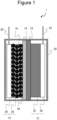
- FIG. 1 is a schematic sectional view showing an example of the lithium ion secondary battery of the present embodiment.
- a lithium ion secondary battery 1 shown in FIG. 1 includes a positive electrode 10, a negative electrode 12, a partition layer 14, an aqueous electrolyte 16, a separator 18 containing a non-aqueous electrolyte, a positive electrode lead 20, a negative electrode lead 22, and a battery case 24 housing these components.
- the positive electrode 10 includes a positive electrode current collector 26 and a positive electrode mixture layer 28 disposed on the positive electrode current collector 26.
- a positive electrode lead 20 is connected to the positive electrode current collector 26.
- the positive electrode lead 20 is housed in the battery case 24 so that a tip of the positive electrode lead 20 protrudes to the outside of the battery case 24.
- the negative electrode 12 includes a negative electrode current collector 30 and a negative electrode mixture layer 32 disposed on the negative electrode current collector 30.
- a negative electrode lead 22 is connected to the negative electrode current collector 30.
- the negative electrode lead 22 is housed in the battery case 24 so that the tip of the negative electrode lead 22 protrudes to the outside of the battery case 24.
- the aqueous electrolyte 16 is impregnated in the positive electrode mixture layer 28, and is in contact with only the positive electrode 10 out of the positive electrode 10 and the negative electrode 12.
- the partition layer 14 is disposed between the positive electrode 11 and the negative electrode 12.
- the partition layer 14 may be wound around the negative electrode 12.
- the separator 18 containing a non-aqueous electrolyte is disposed between the partition layer 14 and the negative electrode 12. That is, the non-aqueous electrolyte is disposed between the partition layer 14 and the negative electrode 12, and is in contact with the negative electrode mixture layer 32 of the negative electrode 12.
- a non-carbon material such as a metal such as Si, Sn or Li, a Li-containing alloy, or a Li-containing metal oxide is used as the negative electrode active material constituting the negative electrode mixture layer 32
- the separator 18 containing a non-aqueous electrolyte may not be provided.
- the separator 18 containing a non-aqueous electrolyte in order to advance the charge-discharge reaction.
- the negative electrode mixture layer 32 may be coated with the non-aqueous electrolyte in a gel state or a solid state, or the negative electrode mixture layer 32 may be impregnated with the non-aqueous electrolyte in a liquid state. In these cases, the separator 18 is not necessarily provided.
- the positive electrode current collector 26 for example, a foil of a metal electrochemically and chemically stable within the potential range of the positive electrode 10 or a film having such a metal disposed on its surface layer can be used.
- the form of the positive electrode current collector 26 is not particularly limited.
- a porous body of the metal such as a mesh, a punching sheet, or an expanded metal, may be used.
- Examples of a material of the positive electrode current collector 26 include stainless steel, Al, an aluminum alloy, and Ti.
- the positive electrode current collector 26 preferably has a thickness of, for example, greater than or equal to 3 ⁇ m and less than or equal to 50 ⁇ m from the viewpoints of current collectability, mechanical strength, and the like.
- the positive electrode mixture layer 28 includes a positive electrode active material 34.
- the positive electrode mixture layer 28 may include a binder, a conductive agent, and the like.
- the positive electrode 10 can be manufactured by, for example, applying a positive electrode mixture slurry containing a positive electrode active material 34, a binder, a conductive agent, and the like to the positive electrode current collector 26, and drying and rolling the applied film to form the positive electrode mixture layer 28 on the positive electrode current collector 26.
- Examples of the positive electrode active material 34 include lithium-containing transition metal oxides containing lithium (Li) and a transition metal element such as cobalt (Co), manganese (Mn), or nickel (Ni).
- examples of the positive electrode active material 34 include transition metal sulfides, metal oxides, lithium-containing polyanion-based compounds containing one or more transition metals such as lithium iron phosphate (LiFePO 4 ) and lithium iron pyrophosphate (Li 2 FeP 2 O 7 ), a sulfur-based compound (Li 2 S), oxygen, and oxygen-containing metal salts such as lithium oxide.
- the lithium-containing transition metal oxide preferably contains at least any one element of Ni, Co, Mn, or aluminum (Al), for example, from the viewpoints of charge-discharge efficiency and the like.
- at least a Ni element, at least a Co element, at least two elements of Ni and Mn, at least three elements of Ni, Co, and Mn, or at least three elements of Ni, Co, and Al are preferably contained.
- the lithium-containing transition metal oxide may contain an additional element other than these elements, and for example, may contain zirconium (Zr), boron (B), magnesium (Mg), scandium (Sc), yttrium (Y), titanium (Ti), iron (Fe), copper (Cu), zinc (Zn), chromium (Cr), lead (Pb), tin (Sn), sodium (Na), potassium (K), barium (Ba), strontium (Sr), calcium (Ca), tungsten (W), molybdenum (Mo), niobium (Nb), and silicon (Si).
- lithium-containing transition metal oxide examples include Li x CoO 2 , Li x NiO 2 , Li x MnO 2 , Li x Co y Ni 1-y O 2 , Li x Co y M 1-y O z , Li x Ni 1-y M y O z , Li x Mn 2 O 4 , Li x Mn 2-y M y O 4 , LiMPO 4 , and Li 2 MPO 4 F (in each chemical formula, M is at least one of Na, Mg, Sc, Y, Mn, Fe, Co, Ni, Cu, Zn, Al, Cr, Pb, Sb, and B, 0 ⁇ x ⁇ 1.2, 0 ⁇ y ⁇ 0.9, and 2.0 ⁇ z ⁇ 2.3).
- the lithium-containing transition metal oxides may be used singly or in combination of two or more kinds thereof.
- the lithium-containing transition metal oxide preferably contains 80 mol% or more of Ni based on the total amount of the transition metals other than lithium from the viewpoint of increasing the capacity.
- the lithium-containing transition metal oxide may be a Li-rich transition metal oxide, a lithium-containing transition metal halogen oxide, or the like.
- the Li-rich transition metal oxide is represented by, for example, the general formula Li 1+x Me 1-x O 2 (0 ⁇ x) (Me represents a metal element such as a transition metal element).
- the lithium-containing transition metal halogen oxide is not particularly limited as long as it is a lithium-containing transition metal oxide containing a halogen atom, but a lithium-containing transition metal oxide containing a fluorine atom is preferably included, for example, from the viewpoints of structural stability of the lithium-containing transition metal oxide, and the like.
- the conductive agent a known conductive agent that enhances the electrical conductivity of the positive electrode mixture layer 28 can be used, and examples of the conductive agent include carbon materials such as carbon black, acetylene black, Ketjenblack, graphite, carbon nanofibers, carbon nanotubes, and graphene.
- the binder a known binder that maintains good contact states of the positive electrode active material 34 and the conductive agent and enhances the adhesiveness of the positive electrode active material 34 and the like to the surface of the positive electrode current collector 26 can be used, and examples of the binder include fluoro resins such as polytetrafluoroethylene (PTFE) and polyvinylidene fluoride (PVDF), polyacrylonitrile (PAN), polyimides, acrylic resins, polyolefins, carboxymethyl celluloses (CMCs) and salts thereof, styrene-butadiene rubber (SBR), polyethylene oxide (PEO), polyvinyl alcohol (PVA), and polyvinylpyrrolidone (PVP).
- fluoro resins such as polytetrafluoroethylene (PTFE) and polyvinylidene fluoride (PVDF), polyacrylonitrile (PAN), polyimides, acrylic resins, polyolefins, carboxymethyl celluloses (CMCs)
- the negative electrode current collector 30 for example, a foil of a metal electrochemically and chemically stable within the potential range of the negative electrode 12 or a film having such a metal disposed on its surface layer can be used.
- the form of the negative electrode current collector 30 is not particularly limited.
- a porous body of the metal such as a mesh, a punching sheet, or an expanded metal, may be used.
- Examples of a material of the negative electrode current collector 30 include Al, Ti, Mg, Zn, Pb, Sn, Zr, In, Cu, and the like. These metals may be used singly, or may be used as an alloy or the like of two or more kinds thereof, and the material of the negative electrode current collector 30 only needs to include at least one such metal as a main component.
- the negative electrode current collector 30 preferably has a thickness of, for example, greater than or equal to 3 ⁇ m and less than or equal to 50 ⁇ m from the viewpoints of current collectability, mechanical strength, and the like.
- the negative electrode mixture layer 32 includes a negative electrode active material.
- the negative electrode mixture layer 32 may include a binder, a conductive agent, a thickener, and the like.
- As the conductive agent and the binder ones similar to those on the positive electrode 10 side can be used.
- the negative electrode 12 can be manufactured by, for example, applying a negative electrode mixture slurry containing a negative electrode active material, a binder, a conductive agent, and the like to the negative electrode current collector 30, and drying and rolling the applied film to form the negative electrode mixture layer 32 on the negative electrode current collector 30.
- thickener examples include cellulose derivatives (for example, cellulose ethers) such as carboxymethyl celluloses (CMCs), modified products thereof (including salts such as Na salts), and methyl cellulose, saponified products of a polymer having a vinyl acetate unit such as polyvinyl alcohol, and polyethers (for example, polyalkylene oxides such as polyethylene oxide). These may be used singly or in combination of two or more kinds thereof.
- CMCs carboxymethyl celluloses
- modified products thereof including salts such as Na salts
- methyl cellulose saponified products of a polymer having a vinyl acetate unit such as polyvinyl alcohol
- polyethers for example, polyalkylene oxides such as polyethylene oxide
- the negative electrode active material is not particularly limited as long as it is a material that can be used as a negative electrode active material of a conventional lithium ion secondary battery, and examples of the material include carbon materials such as artificial graphite, natural graphite, hard carbon, soft carbon, carbon nanotubes, and activated carbon, and non-carbon materials such as metals such as Si, Sn, and Li, alloys of such metals, and metal compounds such as metal oxides, metal sulfides, and metal nitrides.
- the alloys include Li-containing alloys such as a lithium-aluminum alloy, a lithium-tin alloy, a lithium-lead alloy, and a lithium-silicon alloy.
- metal oxides examples include Li-containing metal oxides such as a lithium titanate (such as Li 4 Ti 5 O 12 ).
- metal nitrides examples include Li-containing nitrides such as lithium-cobalt nitrides, lithium-iron nitrides, and lithium-manganese nitrides. Sulfur-based compounds may also be exemplified.
- the negative electrode 12 formed of the negative electrode active material layer 32 obtained by molding a metal or an alloy of Si, Sn, Li or the like into a plate shape may be used without providing the negative electrode current collector 30.
- the aqueous electrolyte 16 contains a lithium salt.
- the aqueous electrolyte 16 containing a lithium salt is, for example, an aqueous liquid electrolyte containing a lithium salt and an aqueous solvent, or an aqueous solid electrolyte in which a lithium salt, an aqueous solvent, and a matrix polymer are combined.
- the aqueous solid electrolyte is obtained by, for example, dissolving the lithium salt in the aqueous solvent, further mixing or dissolving the matrix polymer to obtain a precursor solution, and drying the precursor solution.
- the aqueous electrolyte 16 may be a liquid or solid, and is preferably an aqueous liquid electrolyte from the viewpoint of further improving the battery characteristics.
- the aqueous solvent is a solvent containing water, and may be water alone, or may contain water and a solvent other than water.
- the content of water based on the total amount of the aqueous solvent is preferably greater than or equal to 50% in terms of volume ratio, for example, from the viewpoints of enhancing the safety of the lithium ion secondary battery 1, and the like.
- the amount of water with respect to the lithium salt contained in the aqueous electrolyte 16 is such that the molar ratio of the lithium salt to water is preferably less than or equal to 1 : 4, more preferably in the range of greater than or equal to 1 : 0.5 and less than or equal to 1 : 4, and still more preferably in the range of greater than or equal to 1 : 0.5 and less than or equal to 1 : 3 mol.
- the potential window of the aqueous electrolyte 16 may be enlarged as compared with the case of the water amount out of the above range, and thus the voltage applied to the lithium ion secondary battery 1 may be further increased.
- Examples of the solvent other than water contained in the aqueous solvent include organic solvents such as esters, ethers, nitriles, alcohols, ketones, amines, amides, sulfur compounds, and hydrocarbons.
- organic solvents such as esters, ethers, nitriles, alcohols, ketones, amines, amides, sulfur compounds, and hydrocarbons.
- a halogen-substituted product obtained by substituting at least a part of hydrogen in these solvents with a halogen atom such as fluorine may be used.
- the solvent other than water is preferably, for example, a cyclic carbonic acid ester such as ethylene carbonate, propylene carbonate, vinylidene carbonate, or butylene carbonate, a chain carbonic acid ester such as dimethyl carbonate, methyl ethyl carbonate, or diethyl carbonate, or a fluorinated carbonic acid ester including fluorine as a constitution element such as fluoroethylene carbonate, fluorodimethyl carbonate, or methyl fluoropropionate.
- a cyclic carbonic acid ester such as ethylene carbonate, propylene carbonate, vinylidene carbonate, or butylene carbonate
- a chain carbonic acid ester such as dimethyl carbonate, methyl ethyl carbonate, or diethyl carbonate
- a fluorinated carbonic acid ester including fluorine as a constitution element such as fluoroethylene carbonate, fluorodimethyl carbonate, or methyl fluoropropionate.
- the cyclic carbonic acid ester and the fluorinated carbonic acid ester including fluorine as a constitution element are particularly preferable, for example, from the viewpoints of suppressing self-discharge of the battery, and the like.
- fluorinated carbonic acid esters in the above examples fluoroethylene carbonate is preferable.
- These organic solvents may be used singly or in combination of two or more kinds thereof.
- the amount of the organic solvent with respect to the lithium salt contained in the aqueous electrolyte 16 is such that the molar ratio of the lithium salt to the organic solvent is preferably in the range of greater than or equal to 1 : 0 and less than or equal to 1 : 2.5, and more preferably in the range of greater than or equal to 1 : 0 and less than or equal to 1 : 2.
- the battery characteristics of the lithium ion secondary battery may be improved as compared with the case of the organic solvent amount out of the above range.
- any compound can be used as long as it can be dissolved and dissociated in an aqueous solvent to provide lithium ions in the aqueous electrolyte 16.
- a lithium salt include salts with an inorganic acid such as perchloric acid, sulfuric acid, or nitric acid, salts with a halide ion such as a chloride ion or a bromide ion, and salts with an organic anion including a carbon atom in its structure.
- Examples of the organic anion constituting the lithium salt include anions represented by the following general formulas (i) to (vi). (R 1 SO 2 )(R 2 SO 2 )N - (i) (R 1 and R 2 are each independently selected from an alkyl group or a halogen-substituted alkyl group.
- R 1 and R 2 may be bonded to each other to form a ring.
- R 3 SO 3 - (ii) (R 3 is selected from an alkyl group or a halogen-substituted alkyl group.)
- R 4 CO 2 - (iii) (R 4 is selected from an alkyl group or a halogen-substituted alkyl group.)
- R 5 SO 2 ) 3 C - (iv) (R 5 is selected from an alkyl group or a halogen-substituted alkyl group.
- R 6 and R 7 are selected from an alkyl group or a halogen-substituted alkyl group.
- the number of carbon atoms in the alkyl group or the halogen-substituted alkyl group is preferably 1 to 6, more preferably 1 to 3, and still more preferably 1 to 2.
- the halogen in the halogen-substituted alkyl group is preferably fluorine.
- the substitution number of the halogen in the halogen-substituted alkyl group is equal to or smaller than the number of hydrogen atoms in the original alkyl group.
- R 1 to R 9 is, for example, a group represented by the following general formula (vii).
- C n H a F b Cl c Br d I e (vii) (n is an integer of greater than or equal to 1, a, b, c, d, and e are integers of greater than or equal to 0, and 2n + 1 a + b + c + d + e is satisfied.)
- organic anion represented by the general formula (i) include bis(trifluoromethanesulfonyl)imide (TFSI; [N(CF 3 SO 2 ) 2 ] - ), bis(perfluoroethanesulfonyl)imide (BETI; [N(C 2 F 5 SO 2 ) 2 ] - ), and (perfluoroethanesulfonyl)(trifluoromethanesulfonyl)imide ([N(C 2 F 5 SO 2 )(CF 3 SO 2 )] - ).
- organic anion represented by the general formula (ii) include CF 3 SO 3 - and C 2 F 5 SO 3 - .
- organic anion represented by the general formula (iii) include CF 3 CO 2 - and C 2 F 5 CO 2 - .
- organic anion represented by the general formula (iv) include tris(trifluoromethanesulfonyl)carbon acid ([(CF 3 SO2) 3 C] - ) and tris(perfluoroethanesulfonyl)carbon acid ([(C 2 F 5 SO 2 ) 3 C] - ).
- organic anion represented by the general formula (v) include sulfonyl bis(trifluoromethanesulfonyl)imide ([(CF 3 SO 2 )N(SO 2 )N(CF 3 SO 2 )] 2- ), sulfonyl bis(perfluoroethanesulfonyl)imide ([(C 2 F 5 SO 2 )N(SO 2 )N(C 2 F 5 SO 2 )] 2- ), and sulfonyl (perfluoroethanesulfonyl)(trifluoromethanesulfonyl)imide ([(C 2 F 5 SO 2 )N(SO 2 )N(CF 3 SO 2 )] 2- ).
- organic anion represented by the general formula (vi) include carbonyl bis(trifluoromethanesulfonyl)imide ([(CF 3 SO 2 )N(CO)N(CF 3 SO 2 )] 2- ), carbonyl bis(perfluoroethanesulfonyl)imide ([(C 2 F 5 SO 2 )N(CO)N(C 2 F 5 SO 2 )] 2- ), and carbonyl (perfluoroethanesulfonyl)(trifluoromethanesulfonyl)imide ([(C 2 F 5 SO 2 )N(CO)N(CF 3 SO 2 )] 2 ).
- organic anions other than the organic anions of the general formulas (i) to (vi) include anions such as bis(1,2-benzenediolate(2-)-O,O')borate, bis(2,3-naphthalenediolate(2-)-O,O')borate, bis(2,2'-biphenyldiolate(2-)-O,O')borate, and bis(5-fluoro-2-ol ate-1-b enzene sulfonate-O, O')b orate.
- anions such as bis(1,2-benzenediolate(2-)-O,O')borate, bis(2,3-naphthalenediolate(2-)-O,O')borate, bis(2,2'-biphenyldiolate(2-)-O,O')borate, and bis(5-fluoro-2-ol ate-1-b enzene sulfonate-O, O')b orate.
- the anion constituting the lithium salt is preferably an imide anion.
- the imide anion include, in addition to the imide anions exemplified as the organic anions represented by the general formula (i), bis(fluorosulfonyl)imide (FSI; [N(FSO 2 ) 2 ] - ) and (fluorosulfonyl)(trifluoromethanesulfonyl)imide (FTI; [N(FSO 2 )(CF 3 SO 2 )] - ).
- the lithium salt having a lithium ion and an imide anion is, for example, preferably lithium bis(trifluoromethanesulfonyl)imide (LiTFSI), lithium bis(perfluoroethanesulfonyl)imide (LiBETI), lithium (perfluoroethanesulfonyl)(trifluoromethanesulfonyl)imide, lithium bis(fluorosulfonyl)imide (LiFSI), or lithium (fluorosulfonyl)(trifluoromethanesulfonyl)imide (LiFTI), and more preferably lithium bis(trifluoromethanesulfonyl)imide (LiTFSI), from the viewpoint of, for example, effectively suppressing self-discharge of the battery.
- These lithium salts may be used singly or in combination of two or more kinds thereof.
- lithium salts include CF 3 SO 3 Li, C 2 F 5 SO 3 Li, CF 3 CO 2 Li, C 2 F 5 CO 2 Li, (CF 3 SO 2 ) 3 CLi, (C 2 F 5 SO 2 ) 3 CLi, (C 2 F 5 SO 2 ) 2 (CF 3 SO 2 )CLi, (C 2 F 5 SO 2 )(CF 3 SO 2 ) 2 CLi, [(CF 3 SO 2 )N(SO 2 )N(CF 3 SO 2 )]Li 2 , [(C 2 F 5 SO 2 )N(SO 2 )N(C 2 F 5 SO 2 )]Li 2 , [(C 2 F 5 SO 2 )N(SO 2 )N(CF 3 SO 2 )]Li 2 , [(CF 3 SO 2 )N(CO)N(CF 3 SO 2 )]Li 2 , [(C 2 F 5 SO 2 )N(CO)N(CF 3 SO 2 )]Li 2 , [(C 2 F 5 SO 2 )N(
- the lithium salt contained in the aqueous electrolyte 16 preferably contains a lithium ion and an imide anion, and the concentration of the lithium salt in the aqueous electrolyte is preferably greater than or equal to 4.5 mol/L and less than or equal to 6 mol/L, for example, from the viewpoint of improving the battery characteristics of the lithium ion secondary battery.
- Examples of the matrix polymer contained in a case where the aqueous electrolyte 16 is an aqueous solid electrolyte include polyvinylidene fluoride-hexafluoropropylene (PVDF-HFP), polyacrylonitrile (PAN), polyvinyl alcohol (PVA), polytetrafluoroethylene (PTFE), polyethylene oxide (PEO), and polymethyl methacrylate (PMMA).
- Examples of the matrix polymer may further include polymers obtained by mixing acrylonitrile and acrylic acid as monomers and thermally polymerizing the mixture.
- the content of the matrix polymer is, for example, preferably greater than or equal to 1 mass% and less than or equal to 15.0 mass%, and more preferably greater than or equal to 3 mass% and less than or equal to 10 mass% based on the total amount of the aqueous electrolyte 16.
- the aqueous electrolyte 16 easily gels or solidifies.
- the aqueous electrolyte 16 may coat the entire positive electrode 10, or may coat at least the positive electrode mixture layer 28.
- the aqueous solid electrolyte is obtained by, for example, dissolving a lithium salt in an aqueous solvent, further mixing or dissolving a matrix polymer to obtain a precursor solution, applying the precursor solution to the positive electrode 10 or immersing the positive electrode 10 in the precursor solution to coat the positive electrode 10 with the precursor solution, and then drying the resulting product.
- the entire positive electrode 10 may be immersed in the aqueous liquid electrolyte, but it is sufficient that only the positive electrode mixture layer 28 is impregnated with the aqueous liquid electrolyte.
- the non-aqueous electrolyte contained in the separator 18 disposed between the negative electrode 12 and the partition layer 14 contains a lithium salt.
- the non-aqueous electrolyte containing a lithium salt is, for example, a non-aqueous liquid electrolyte including a lithium salt and an organic solvent, or a non-aqueous solid electrolyte in which a lithium salt, an organic solvent, and a matrix polymer are combined.
- the non-aqueous solid electrolyte is prepared by, for example, dissolving a lithium salt in an organic solvent, further mixing or dissolving a matrix polymer to obtain a precursor solution, and heating and drying the precursor solution.
- the separator 18 may be impregnated with the precursor solution and then heated and dried.
- the non-aqueous electrolyte may be a liquid or solid, and is preferably a non-aqueous liquid electrolyte from the viewpoint of further improving the battery characteristics.
- the separator 18 may be immersed in the non-aqueous liquid electrolyte.
- organic solvent examples include known organic solvents used in conventional non-aqueous secondary batteries, such as esters, ethers, nitriles, alcohols, ketones, amines, amides, sulfur compounds, and hydrocarbons described above.
- organic solvents esters, ethers, nitriles, amides, mixed solvents of two or more thereof, and the like are preferably used from the viewpoint of, for example, improving battery characteristics.
- esters examples include cyclic carbonic acid esters such as ethylene carbonate, propylene carbonate, and butylene carbonate, chain carbonic acid esters such as dimethyl carbonate, methyl ethyl carbonate, diethyl carbonate, methyl propyl carbonate, ethyl propyl carbonate, and methyl isopropyl carbonate, and carboxylic acid esters such as methyl acetate, ethyl acetate, propyl acetate, methyl propionate, ethyl propionate, and ⁇ -butyrolactone.
- cyclic carbonic acid esters such as ethylene carbonate, propylene carbonate, and butylene carbonate
- chain carbonic acid esters such as dimethyl carbonate, methyl ethyl carbonate, diethyl carbonate, methyl propyl carbonate, ethyl propyl carbonate, and methyl isopropyl carbonate
- carboxylic acid esters such as methyl acetate,
- ethers examples include cyclic ethers such as 1,3-dioxolane, 4-methyl-1,3-dioxolane, tetrahydrofuran, 2-methyltetrahydrofuran, propylene oxide, 1,2-butylene oxide, 1,3-dioxane, 1,4-dioxane, 1,3,5-trioxane, furan, 2-methylfuran, 1,8-cineol, and crown ethers, and chain ethers such as 1,2-dimethoxyethane, diethyl ether, dipropyl ether, diisopropyl ether, dibutyl ether, dihexyl ether, ethyl vinyl ether, butyl vinyl ether, methyl phenyl ether, ethyl phenyl ether, butyl phenyl ether, pentyl phenyl ether, methoxytoluene, benzyl ethyl ether, di
- the organic solvent preferably contains a halogen-substituted product in which hydrogen in the solvent described above is substituted with a halogen atom such as fluorine.
- the halogen-substituted solvent is particularly preferably at least one of a fluorinated cyclic carbonic acid ester, a fluorinated chain carbonic acid ester, or a fluorinated ether.
- Preferred examples of the fluorinated cyclic carbonic acid ester include 4-fluoroethylene carbonate, 4,5-difluoroethylene carbonate, 4,4-difluoroethylene carbonate, 4,4,5-trifluoroethylene carbonate, and 4,4,5,5-tetrafluoroethylene carbonate.
- fluorinated chain carbonic acid ester examples include ethyl 2,2,2-trifluoroacetate, methyl 3,3,3-trifluoropropionate, and methyl pentafluoropropionate.
- fluorinated ether examples include 1,1,2,2-tetrafluoroethyl 2,2,2-trifluoroethyl ether and 1,1,2,2-tetrafluoroethyl 2,2,3,3-tetrafluoropropyl ether.
- the organic solvent preferably contains a cyclic organic solvent such as a cyclic carbonic acid ester, for example, from the viewpoints of suppressing deterioration of the lithium ion conductivity of the non-aqueous electrolyte, and the like.
- a cyclic organic solvent such as a cyclic carbonic acid ester
- lithium salt examples include known lithium salts used in conventional non-aqueous secondary batteries, such as LiPF 6 , LiBF 4 , LiAsF 6 , LiClO 4 , LiCF 3 SO 3 , LiN(FSO 2 ) 2 , LiN(ClF 2l+1 SO 2 )(C m F 2m+1 SO 2 ) (l and m are integers of greater than or equal to 1), LiC(C p F 2p+1 SO 2 )(C q F 2q+1 SO 2 )(C r F 2r+1 SO 2 ) (p, q, and r are integers of greater than or equal to 1), Li[B(C 2 O 4 ) 2 ] (lithium bis(oxalate)borate (LiBOB)), Li[B(C 2 O 4 )F 2 ], Li[P(C 2 O 4 )F 4 ], Li[P(C 2 O 4 ) 2 F 2 ], and LiPO 2 F 2 .
- the lithium salt may be, for
- the matrix polymer ones similar to those in the aqueous electrolyte 16 can be used.
- the content of the matrix polymer is, for example, preferably greater than or equal to 1 mass% and less than or equal to 15.0 mass%, and more preferably greater than or equal to 3 mass% and less than or equal to 10 mass% based on the total amount of the non-aqueous electrolyte. Within the above range, for example, the non-aqueous electrolyte easily solidifies.
- the non-aqueous electrolyte is a non-aqueous solid electrolyte
- the non-aqueous electrolyte preferably has hydrophobicity so as to have a solubility of less than or equal to 2 g in 100 g of water at 25°C, for example, from the viewpoints of effectively suppressing contact between the negative electrode 12 and water, and the like.
- the hydrophobicity of the non-aqueous electrolyte can be enhanced by, for example, increasing the ratio of the organic solvent having a hydrophobic substituent or the fluorinated organic solvent.
- the non-aqueous electrolyte may be provided between the negative electrode 12 and the partition layer 14, but since the side reaction of water also occurs on the negative electrode current collector 30 and the negative electrode lead 22, it is preferable to coat the entire negative electrode 12 with the non-aqueous solid electrolyte, and it is more preferable to coat the negative electrode lead 22 (excluding the portion protruding from the battery case 24).
- a precursor solution obtained by dissolving a lithium salt in an organic solvent and further mixing or dissolving matrix polymers is applied to the negative electrode 12, or the negative electrode 12 to which the negative electrode lead 22 is attached is immersed in the precursor solution to coat the negative electrode 12 or the like with the precursor solution, and then the precursor solution is dried, whereby the non-aqueous solid electrolyte can be coated on the negative electrode 12 or the like.
- the separator 18 may be a conventionally known separator or the like used for a lithium ion secondary battery.
- the partition layer 14 contains a non-aqueous solid electrolyte A in which a matrix polymer, a lithium salt, and a hydrophobic ionic liquid are combined.
- the partition layer 14 transmits, for example, lithium ions, but has a function of electrically separating the positive electrode 10 and the negative electrode 12.
- the partition layer 14 of the present embodiment contains the hydrophobic ionic liquid to suppress water permeation, and thus movement of water from the positive electrode 10 side to the negative electrode 12 side via the partition layer 14 is suppressed. As a result, a side reaction of water on the negative electrode 12 side is suppressed, and the initial discharge capacity can be improved.
- the matrix polymer preferably contains at least one of polyvinylidene fluoride-propylene hexafluoride (PVDF-HFP), polyvinylidene fluoride (PVDF), polyacrylonitrile (PAN), polyvinyl alcohol (PVA), polytetrafluoroethylene (PTFE), polyethylene oxide (PEO), and polymethyl methacrylate (PMMA) from the viewpoint of being able to densify the non-aqueous solid electrolyte A and suppress water permeability in the partition layer 14.
- PVDF-HFP polyvinylidene fluoride-propylene hexafluoride
- PVDF polyvinylidene fluoride
- PAN polyacrylonitrile
- PVA polyvinyl alcohol
- PTFE polytetrafluoroethylene
- PEO polyethylene oxide
- PMMA polymethyl methacrylate
- the content of the matrix polymer is preferably in the range of greater than or equal to 5 mass% and less than or equal to 30 mass%, and more preferably in the range of greater than or equal to 10 mass% and less than or equal to 25 mass% based on the total amount of the non-aqueous solid electrolyte A.
- the denseness of the non-aqueous solid electrolyte A is improved, and water permeability in the partition layer 14 may be further suppressed.
- Examples of other matrix polymers include methyl methacrylate, methyl acrylate, and vinyl acetate.
- the lithium salt may be any known lithium salt used for a lithium ion secondary battery, and for example, those exemplified for the non-aqueous electrolyte described above can be used.
- the ionic liquid contained in the partition layer 14 is a salt that is composed of a cation and an anion and is liquid at room temperature.
- the ionic liquid preferably has hydrophobicity.
- Hydrophobic ionic liquids are ionic liquids that are sparingly soluble or insoluble in water.
- the hydrophobic ionic liquid preferably has a solubility of less than 1 g in 100 g of pure water at 20°C, for example.
- the cation preferably has the following structure from the viewpoint of having hydrophobicity.
- Y is an N atom or a P atom
- R1 to R4 are each independently an alkyl group, an ether group, an ester group, or a carbonic acid ester group
- Rn and Rn+1 (n is an integer of 1 to 3) may form a cyclic structure bonded to each other.
- Y represents an N atom or a P atom
- R5 and R7 each represent an alkyl group, an ether group, an ester group, or a carbonic acid ester group
- R6 represents hydrogen or a methyl group.
- R1 to R4, R5, and R7 is not particularly limited, but is preferably in the range of 1 to 10, and more preferably in the range of 1 to 5 from the viewpoint of exhibiting hydrophobicity.
- R1 to R4 and R5 to R7 in the formulae (1) and (2) are each an alkyl group, an ether group, an ester group, or a carbonic acid ester group, and may contain a halogen-substituted product obtained by substituting a hydrogen atom with a halogen atom such as fluorine, chlorine, or bromine.
- Examples of the alkyl group include a methyl group, an ethyl group, a propyl group, an isopropyl group, and a butyl group.
- Examples of the ether group include a methoxymethyl group, a methoxyethyl group, a methoxypropyl group, an ethoxymethyl group, and an ethoxyethyl group.
- Examples of the ester group include a methoxycarbonylmethyl group, a methoxycarbonylethyl group, an ethoxycarbonylmethyl group, an acetylmethyl group, an acetylethyl group, and a propionylmethyl group.
- Examples of the carbonic acid ester group include chain -CH 2 OCOOCH 3 , - CH 2 CH 2 OCOOCH 3 , -CH 2 OCOOCH 2 CH 3 , and a carbonic acid ester group having a cyclic structure. or and the like.
- anion examples include PF 6 - , BF 4 - , CF 3 SO 3 - , PhSO 3 - , [(SO 2 F) 2 N] - , [(SO 2 CF 3 ) 2 N] - , [PF 3 (C 2 F 5 ) 3 ] - , [PF 3 (CF 3 ) 3 ] - , [BF 2 (CF 3 ) 2 ] - , [BF 2 (C 2 F 5 ) 2 ] - , [BF 3 (CF 3 )] - , [BF 3 (C 2 F 5 )] - , [B(COOCOO) 2 ] - , C 4 F 9 SO 3 - , [(CF 3 SO 2 ) 2 N] - (TFSI - ), [(C 2 F 5 SO 2 ) 2 N] - (BETI - ), [(CF 3 SO 2 )(C 4 F 9 SO 2 )N] - , [(CN) 2 N] ,
- PF 6 - , BF 4 - , CF 3 SO 3 - , PhSO 3 - , [(SO 2 F) 2 N] - , and [(SO 2 CF 3 ) 2 N] - are preferable from the viewpoint of having hydrophobicity.
- the ionic liquid examples include N-methyl-N-propylpiperidinium bis(trifluoromethanesulfonyl)imide, 1-butyl-1-methylpyrrolidinium bis(trifluoromethanesulfonyl)imide, N,N,N-trimethyl-N-propylammonium bis(trifluoromethanesulfonyl)imide, N-(2-methoxyethyl)-N-methylpyrrolidinium bis(trifluoromethanesulfonyl)imide, N,N-diethyl-N-methyl-N-(2-methoxydiethyl)ammonium bis(trifluoromethanesulfonyl)imide, and trihexyltetradecylphosphonium bis(trifluoromethylsulfonyl)amide.
- the matrix polymer is dissolved in a diluent solvent such as acetone or tetrahydrofuran by heating and stirring.
- a precursor solution obtained by adding a lithium salt and an ionic liquid to this solution is applied to a glass substrate, and heated and dried at a temperature of 40 to 80°C for 1 to 5 hours to evaporate the diluent solvent.
- a film of the non-aqueous solid electrolyte A formed on the glass substrate is obtained.
- the obtained film of the non-aqueous solid electrolyte A is in a gel state or a solid state.
- a partition layer containing the non-aqueous solid electrolyte A is obtained.
- a porous sheet such as a separator may be used instead of the glass substrate. By using the porous sheet, it is possible to form a partition layer in which the porous sheet and the non-aqueous solid electrolyte A are integrated.
- porous sheet examples include fine porous thin films, woven fabrics, and nonwoven fabrics.
- material of the porous sheet include olefin-based resins such as polyethylene and polypropylene, resins such as polyamides, polyamideimides, and cellulose, and glass and ceramics such as borosilicate glass, silica, alumina, and titania.
- the porous sheet may be a laminate including a cellulose fiber layer and a thermoplastic resin fiber layer such as an olefin-based resin.
- the porous sheet may be a laminate including a polyethylene layer and a polypropylene layer, and a porous sheet that has a surface to which a material such as an aramid-based resin or a ceramic is applied may be used.
- the non-aqueous solid electrolyte A may be produced by, for example, a phase inversion method.
- a production example of the non-aqueous solid electrolyte A by the phase inversion method will be described.
- a solution is obtained in which the matrix polymer is dissolved in an organic solvent.
- the organic solvent is desirably a solvent in which the matrix polymer is easily dissolved, and examples of the organic solvent include dimethylformamide.
- the solution in which the matrix polymer is dissolved is applied to a substrate such as a glass plate or an aluminum foil. Then, a poor solvent (for example, water) is added to the applied film on the substrate to solidify the matrix polymer, and thus a polymer skeleton (that is, polymer film) is formed. Next, the polymer skeleton taken out from the substrate is immersed in a poor solvent for a predetermined time or dried by heat treatment such as vacuum heating.
- a poor solvent for example, water
- the obtained polymer skeleton is immersed in an ionic liquid containing a lithium salt for a predetermined time, and dried by heating for a predetermined time.
- a film of the non-aqueous solid electrolyte A in which the matrix polymer composed of the polymer skeleton, the lithium salt, and the ionic liquid are combined is obtained.
- the obtained film of the non-aqueous solid electrolyte A is in a gel state or a solid state.
- the thickness of the partition layer 14 may be, for example, in the range of greater than or equal to 10 ⁇ m and less than or equal to 50 ⁇ m, and may be in the range of greater than or equal to 15 ⁇ m and less than or equal to 30 ⁇ m.
- the partition layer 14 is not limited to a partition layer containing only the non-aqueous solid electrolyte A, and may contain the non-aqueous solid electrolyte A and a non-aqueous solid electrolyte B including a component different from components of the non-aqueous solid electrolyte A.
- the partition layer 14 may be a single partition layer in which the non-aqueous solid electrolytes A and B are integrated, or a laminated structure in which a first partition layer containing the non-aqueous solid electrolyte A and a second partition layer containing the non-aqueous solid electrolyte B are layered.
- FIG. 2 is a schematic sectional view showing another example of the lithium ion secondary battery of the present embodiment.
- a constituent similar to that of the lithium ion secondary battery 1 shown in FIG. 1 is denoted by the same reference sign as in FIG. 1 .
- the lithium ion secondary battery 2 shown in FIG. 2 includes a partition layer 17 including a first partition layer 14 and a second partition layer 15 between a positive electrode 10 and a negative electrode 12.
- the first partition layer 14 is a partition layer containing the non-aqueous solid electrolyte A in which a matrix polymer, a lithium salt, and a hydrophobic ionic liquid are combined, and has the same configuration as the partition layer 14 described above.
- the second partition layer 15 is a partition layer containing the non-aqueous solid electrolyte B including a component different from components of the non-aqueous solid electrolyte A.
- the second partition layer 15 may or may not contain an ionic liquid.
- the second partition layer 15 is obtained, for example, by applying a precursor solution of the non-aqueous solid electrolyte B to a porous sheet such as a separator and drying the applied solution.
- a precursor solution of the non-aqueous solid electrolyte B the precursor solution described above for the non-aqueous electrolyte can be used.
- the matrix polymer in the precursor solution of the non-aqueous solid electrolyte B that is, the matrix polymer included in the non-aqueous solid electrolyte B preferably includes a fluorine-based matrix polymer, and preferably includes polyvinylidene fluoride (PVDF), for example, from the viewpoint of suppressing water permeability in the second partition layer 15.
- PVDF polyvinylidene fluoride
- the non-aqueous solid electrolyte B contains an organic solvent.
- the organic solvent contained in the non-aqueous solid electrolyte B preferably contains a cyclic organic solvent such as a cyclic carbonic acid ester, for example, from the viewpoints of suppressing deterioration of the lithium ion conductivity, and the like.
- the cyclic organic solvent is preferably contained in an amount of greater than or equal to 30 vol%, more preferably greater than or equal to 50 vol%, and still more preferably greater than or equal to 80 vol% based on the total volume of the organic solvent in the non-aqueous solid electrolyte B.
- the first partition layer 14 containing the non-aqueous solid electrolyte A is disposed on the positive electrode 10 side
- the second partition layer 15 containing the non-aqueous solid electrolyte B is disposed on the negative electrode 12 side.
- the disposition of the partition layers is not limited to the above-described disposition, and the first partition layer 14 containing the non-aqueous solid electrolyte A may be disposed on the negative electrode 12 side, and the second partition layer 15 containing the non-aqueous solid electrolyte B may be disposed on the positive electrode 10 side.
- the thickness of the first partition layer 14 may be, for example, in the range of greater than or equal to 10 ⁇ m and less than or equal to 50 ⁇ m, and may be in the range of greater than or equal to 15 ⁇ m and less than or equal to 30 ⁇ m.
- the thickness of the second partition layer 15 may be, for example, in the range of greater than or equal to 10 ⁇ m and less than or equal to 50 ⁇ m, and may be in the range of greater than or equal to 15 ⁇ m and less than or equal to 30 ⁇ m. If the first partition layer 14 and the second partition layer 15 are too thick, for example, the battery resistance may increase and the battery performance may deteriorate. If the first partition layer 14 and the second partition layer 15 are too thin, for example, the mechanical strength may be reduced.
- the partition layer 17 in which the first partition layer 14 containing the non-aqueous solid electrolyte A and the second partition layer 15 containing the non-aqueous solid electrolyte B are layered can be produced, for example, by producing the non-aqueous solid electrolytes A and B, respectively, then placing the non-aqueous solid electrolyte A on the non-aqueous solid electrolyte B, and heating (drying) the non-aqueous solid electrolyte A.
- the single partition layer in which the non-aqueous solid electrolytes A and B are integrated can be produced, for example, by adding a precursor solution of the non-aqueous solid electrolyte B to a precursor solution used in producing the non-aqueous solid electrolyte A, or immersing the produced non-aqueous solid electrolyte A in the precursor solution of the non-aqueous solid electrolyte B.
- a separator 18 containing the above-described non-aqueous electrolyte containing a lithium salt may be disposed between the negative electrode 12 and the partition layer 17.
- Examples of the battery case 24 include metal cases, resin cases, and laminate film cases.
- Examples of a material of the metal cases include nickel, iron, and stainless steel.
- Examples of a material of the resin cases include polyethylene and polypropylene.
- the laminate film is, for example, a multilayer film in which a stainless foil is coated with a resin film.
- Examples of a material of the resin film include polypropylene, polyethylene, nylon, and polyethylene terephthalate.
- the lithium ion secondary battery of the present embodiment is used in various forms having a shape such as a square, cylindrical, flat, thin, coin, or laminate shape.
- a Li metal plate was cut into a predetermined electrode size and used as a negative electrode.
- LiNi 0.82 Co 0.15 Al 0.03 O 2 as a positive electrode active material, carbon black as a conductive agent, and PVDF as a binder were mixed at a mass ratio of 98 : 1 : 1, and N-methyl-2-pyrrolidone (NMP) was added to prepare a positive electrode mixture slurry.
- NMP N-methyl-2-pyrrolidone
- the positive electrode mixture slurry was applied to a positive electrode current collector made of a Ti foil, and the applied film was dried and then rolled with a roller.
- the resulting product was cut into a predetermined electrode size to obtain a positive electrode.
- the amount of the applied positive electrode mixture slurry was 234 g/cm 2 , and the packing density of the positive electrode mixture layer was 3.7 gcm -3 .
- LiTFSI, LiBETI, and water were mixed at a molar ratio of 0.7 : 0.3 : 2.0 to prepare an aqueous liquid electrolyte in which the LiTFSI and the LiBETI were dissolved in the water.
- PVDF-HFP polyvinylidene fluoride-propylene hexafluoride
- a matrix polymer 1.2 g was completely dissolved in acetone as a diluent solvent by heating and stirring at 50°C.
- LiTFSI lithium bis[trifluoromethanesulfonylimide]
- 0.8 g of N-(2-methoxyethyl)-N-methylpyrrolidinium bis(trifluoromethanesulfonyl)imide as an ionic liquid were added to this solution, and completely dissolved by heating and stirring at 50°C to obtain a precursor solution.
- This precursor solution was applied to a glass plate, heated in a thermostatic bath at 60°C for 1 hour to evaporate the diluent solvent, and the obtained transparent film-like sheet was used as the first partition layer.
- a negative electrode lead was attached to the negative electrode.
- a positive electrode lead was attached to the positive electrode, and the positive electrode attached with the positive electrode lead was immersed in the aqueous liquid electrolyte to obtain a positive electrode impregnated with the aqueous liquid electrolyte.
- An electrode assembly in which the first partition layer was disposed between the negative electrode and the positive electrode was housed in a laminate type battery case to produce a test cell.
- LiTFSI, LiBETI, and water were mixed at a molar ratio of 0.7 : 0.3 : 2.0 to prepare an aqueous liquid electrolyte in which the LiTFSI and the LiBETI were dissolved in the water. Thereafter, 8 wt% of PVA (polyvinyl alcohol) was added while heating to 80°C, and heating was continued for 1.5 hours. The mixture was applied to the positive electrode and dried at room temperature for 30 minutes to obtain a gel-like aqueous solid electrolyte coated on the positive electrode.
- PVA polyvinyl alcohol
- a test cell was prepared in the same manner as in Example 1 except that a positive electrode coated with an aqueous solid electrolyte was used instead of immersing the positive electrode in the aqueous liquid electrolyte.
- the electrolyte liquid was mixed with the resulting solution to prepare a precursor solution of a non-aqueous solid electrolyte. Then, the separator was coated with the precursor solution and then dried at 60°C for 1 hour to obtain a porous sheet coated with the non-aqueous solid electrolyte. This sheet was used as a second partition layer.
- a test cell was prepared in the same manner as in Example 1 except that the positive electrode coated with the aqueous solid electrolyte used in Example 2 was used, and the positive electrode side was disposed as a first partition layer and the negative electrode side was disposed as a second partition layer between the positive electrode and the negative electrode.
- a test cell was prepared in the same manner as in Example 1 except that a first partition layer was prepared using N-methyl-N-propylpiperidinium bis(trifluoromethanesulfonyl)imide as an ionic liquid.
- a test cell was prepared in the same manner as in Example 1 except that a first partition layer was prepared using trihexyltetradecylphosphonium bis(trifluoromethanesulfonyl) as an ionic liquid.
- a test cell was prepared in the same manner as in Example 1 except that no partition layer was disposed between the positive electrode and the negative electrode.
- a test cell was prepared in the same manner as in Example 1 except that the positive electrode coated with the aqueous solid electrolyte used in Example 2 was used and the partition layer was not disposed between the positive electrode and the negative electrode.
- a test cell was prepared in the same manner as in Example 1 except that only the second partition layer was disposed between the positive electrode and the negative electrode.
- a test cell was prepared in the same manner as in Example 1 except that the positive electrode coated with the aqueous solid electrolyte used in Example 2 was used and only the second partition layer was disposed between the positive electrode and the negative electrode.
- Table 1 summarizes the discharge capacity and the charge-discharge efficiency at the third cycle in each Example and each Comparative Example.
- the discharge capacity in Table 1 represents the discharge capacities of other Examples and Comparative Examples as relative values with the discharge capacity of Example 2 set as 100 (used as a reference).
- [Table 1] Aqueous electrolyte Partition layer Discharge capacity Charge-discharge efficiency Example 1 Liquid First partition layer 92 99% Example 2 Gel First partition layer 100 99% Example 3 Gel First partition layer + Second partition layer 90 97% Comparative Example 1 Liquid None 0 0% Comparative Example 2 Gel None 0 0% Comparative Example 3 Liquid Second partition layer 76 96% Comparative Example 4 Gel Second partition layer 77 91% Comparative Example 4 Gel First partition layer 90 99%
Landscapes
- Chemical & Material Sciences (AREA)
- Chemical Kinetics & Catalysis (AREA)
- General Chemical & Material Sciences (AREA)
- Electrochemistry (AREA)
- Engineering & Computer Science (AREA)
- Inorganic Chemistry (AREA)
- Materials Engineering (AREA)
- Manufacturing & Machinery (AREA)
- Physics & Mathematics (AREA)
- General Physics & Mathematics (AREA)
- Dispersion Chemistry (AREA)
- Condensed Matter Physics & Semiconductors (AREA)
- Composite Materials (AREA)
- Secondary Cells (AREA)
Abstract
Description
- The present disclosure relates to a lithium ion secondary battery.
- As secondary batteries with a high output and a high energy density, lithium ion secondary batteries that include a positive electrode, a negative electrode, and an electrolyte liquid and perform charge and discharge by allowing lithium ions to travel between the positive electrode and the negative electrode are widely used. In the conventional secondary batteries, an organic solvent-based electrolyte liquid is used for achieving the high energy density.
- However, organic solvents are generally flammable, and have an important problem of ensuring safety. In addition, organic solvents have a lower ion conductivity than aqueous solutions, and have a problem that the rapid charge-discharge characteristics are insufficient.
- In view of such problems, a secondary battery has been studied in which an aqueous electrolyte containing water is used (see, for example, Patent Literature 1 to 4). For example, Patent Literature 1 proposes a lithium ion secondary battery in which an aqueous solution containing a high-concentration alkali salt is used as an aqueous liquid electrolyte.
Patent Literature 2 proposes a lithium ion secondary battery including a negative electrode filled with a non-aqueous solid electrolyte, a positive electrode, a separator disposed between the negative electrode and the positive electrode and filled with a non-aqueous solid electrolyte, and an aqueous liquid electrolyte. - Non Patent Literature 1 discloses a method of producing a non-porous membrane of a solid electrolyte with a phase inversion method using a poor solvent.
-
- Patent Literature 1:
JP 6423453 B - Patent Literature 2:
JP 2018-198131 A - Patent Literature 3:
JP 2018-156895 A - Patent Literature 4:
JP 2018-156837 A - Non Patent Literature 1: Electrochimica Acta 49, (2004), 3339-3345
- An object of the present disclosure is to improve an initial discharge capacity in a lithium ion secondary battery using an aqueous electrolyte.
- An aspect of the present disclosure is a lithium ion secondary battery including: a negative electrode; a positive electrode; an aqueous electrolyte containing a lithium salt; and a partition layer disposed between the negative electrode and the positive electrode, in which the aqueous electrolyte is in contact with only the positive electrode out of the negative electrode and the positive electrode, and the partition layer contains a non-aqueous solid electrolyte A in which a matrix polymer, a lithium salt, and a hydrophobic ionic liquid are combined.
- According to the present disclosure, in a lithium ion secondary battery using an aqueous electrolyte, an initial discharge capacity can be improved.
-
-
FIG. 1 is a schematic sectional view showing an example of a lithium ion secondary battery of the present embodiment. -
FIG. 2 is a schematic sectional view showing another example of the lithium ion secondary battery of the present embodiment. - A lithium ion secondary battery of an aspect of the present disclosure includes a negative electrode; a positive electrode; an aqueous electrolyte containing a lithium salt; and a partition layer disposed between the negative electrode and the positive electrode, in which the aqueous electrolyte is in contact with only the positive electrode out of the negative electrode and the positive electrode, and the partition layer contains a non-aqueous solid electrolyte A in which a matrix polymer, a lithium salt, and a hydrophobic ionic liquid are combined. By using the lithium ion secondary battery according to the aspect of the present disclosure, the initial discharge capacity can be improved. Although the mechanism of exerting the effect is not sufficiently clear, the following is presumed.
- Bringing the aqueous electrolyte into contact with only the positive electrode suppresses a side reaction of water at the negative electrode and thus a charge-discharge reaction can proceed. However, when moisture in the aqueous electrolyte on the positive electrode side moves to the negative electrode side through the partition layer between the positive electrode and the negative electrode, a side reaction of water occurs, and the discharge capacity decreases. However, as in the present disclosure, by using the partition layer containing the non-aqueous solid electrolyte A in which a matrix polymer, a lithium salt, and a hydrophobic ionic liquid are combined, the movement of moisture in the aqueous electrolyte on the positive electrode side to the negative electrode side is suppressed, so that the side reaction of water is suppressed, and the initial discharge capacity can be improved.
- Hereinafter, an example of an embodiment of the lithium ion secondary battery according to the present disclosure will be described in detail.
-
FIG. 1 is a schematic sectional view showing an example of the lithium ion secondary battery of the present embodiment. A lithium ion secondary battery 1 shown inFIG. 1 includes apositive electrode 10, anegative electrode 12, apartition layer 14, anaqueous electrolyte 16, aseparator 18 containing a non-aqueous electrolyte, apositive electrode lead 20, anegative electrode lead 22, and abattery case 24 housing these components. - The
positive electrode 10 includes a positive electrodecurrent collector 26 and a positiveelectrode mixture layer 28 disposed on the positive electrodecurrent collector 26. Apositive electrode lead 20 is connected to the positive electrodecurrent collector 26. Thepositive electrode lead 20 is housed in thebattery case 24 so that a tip of the positive electrode lead 20 protrudes to the outside of thebattery case 24. - The
negative electrode 12 includes a negative electrodecurrent collector 30 and a negativeelectrode mixture layer 32 disposed on the negative electrodecurrent collector 30. Anegative electrode lead 22 is connected to the negative electrodecurrent collector 30. Thenegative electrode lead 22 is housed in thebattery case 24 so that the tip of the negative electrode lead 22 protrudes to the outside of thebattery case 24. - For example, the
aqueous electrolyte 16 is impregnated in the positiveelectrode mixture layer 28, and is in contact with only thepositive electrode 10 out of thepositive electrode 10 and thenegative electrode 12. - The
partition layer 14 is disposed between the positive electrode 11 and thenegative electrode 12. Thepartition layer 14 may be wound around thenegative electrode 12. - The
separator 18 containing a non-aqueous electrolyte is disposed between thepartition layer 14 and thenegative electrode 12. That is, the non-aqueous electrolyte is disposed between thepartition layer 14 and thenegative electrode 12, and is in contact with the negativeelectrode mixture layer 32 of thenegative electrode 12. When a non-carbon material such as a metal such as Si, Sn or Li, a Li-containing alloy, or a Li-containing metal oxide is used as the negative electrode active material constituting the negativeelectrode mixture layer 32, theseparator 18 containing a non-aqueous electrolyte may not be provided. However, when a carbon material is used as the negative electrode active material, it is preferable to provide theseparator 18 containing a non-aqueous electrolyte in order to advance the charge-discharge reaction. In addition, the negativeelectrode mixture layer 32 may be coated with the non-aqueous electrolyte in a gel state or a solid state, or the negativeelectrode mixture layer 32 may be impregnated with the non-aqueous electrolyte in a liquid state. In these cases, theseparator 18 is not necessarily provided. - As the positive electrode
current collector 26, for example, a foil of a metal electrochemically and chemically stable within the potential range of thepositive electrode 10 or a film having such a metal disposed on its surface layer can be used. The form of the positive electrodecurrent collector 26 is not particularly limited. For example, a porous body of the metal, such as a mesh, a punching sheet, or an expanded metal, may be used. Examples of a material of the positive electrodecurrent collector 26 include stainless steel, Al, an aluminum alloy, and Ti. The positive electrodecurrent collector 26 preferably has a thickness of, for example, greater than or equal to 3 µm and less than or equal to 50 µm from the viewpoints of current collectability, mechanical strength, and the like. - The positive
electrode mixture layer 28 includes a positive electrodeactive material 34. The positiveelectrode mixture layer 28 may include a binder, a conductive agent, and the like. Thepositive electrode 10 can be manufactured by, for example, applying a positive electrode mixture slurry containing a positive electrodeactive material 34, a binder, a conductive agent, and the like to the positive electrodecurrent collector 26, and drying and rolling the applied film to form the positiveelectrode mixture layer 28 on the positiveelectrode current collector 26. - Examples of the positive electrode
active material 34 include lithium-containing transition metal oxides containing lithium (Li) and a transition metal element such as cobalt (Co), manganese (Mn), or nickel (Ni). In addition, examples of the positive electrodeactive material 34 include transition metal sulfides, metal oxides, lithium-containing polyanion-based compounds containing one or more transition metals such as lithium iron phosphate (LiFePO4) and lithium iron pyrophosphate (Li2FeP2O7), a sulfur-based compound (Li2S), oxygen, and oxygen-containing metal salts such as lithium oxide. - The lithium-containing transition metal oxide preferably contains at least any one element of Ni, Co, Mn, or aluminum (Al), for example, from the viewpoints of charge-discharge efficiency and the like. Among these elements, at least a Ni element, at least a Co element, at least two elements of Ni and Mn, at least three elements of Ni, Co, and Mn, or at least three elements of Ni, Co, and Al are preferably contained. The lithium-containing transition metal oxide may contain an additional element other than these elements, and for example, may contain zirconium (Zr), boron (B), magnesium (Mg), scandium (Sc), yttrium (Y), titanium (Ti), iron (Fe), copper (Cu), zinc (Zn), chromium (Cr), lead (Pb), tin (Sn), sodium (Na), potassium (K), barium (Ba), strontium (Sr), calcium (Ca), tungsten (W), molybdenum (Mo), niobium (Nb), and silicon (Si).
- Specific examples of the lithium-containing transition metal oxide include LixCoO2, LixNiO2, LixMnO2, LixCoyNi1-yO2, LixCoyM1-yOz, LixNi1-yMyOz, LixMn2O4, LixMn2-yMyO4, LiMPO4, and Li2MPO4F (in each chemical formula, M is at least one of Na, Mg, Sc, Y, Mn, Fe, Co, Ni, Cu, Zn, Al, Cr, Pb, Sb, and B, 0 < x ≤ 1.2, 0 < y ≤ 0.9, and 2.0 ≤ z ≤ 2.3). The lithium-containing transition metal oxides may be used singly or in combination of two or more kinds thereof. The lithium-containing transition metal oxide preferably contains 80 mol% or more of Ni based on the total amount of the transition metals other than lithium from the viewpoint of increasing the capacity. From the viewpoint of stability of the crystal structure, the lithium-containing transition metal oxide is more preferably LiaNibCocAldO2 (0 < a ≤ 1.2, 0.8 ≤ b < 1, 0 < c < 0.2, 0 < d ≤ 0.1, and b + c + d = 1).
- The lithium-containing transition metal oxide may be a Li-rich transition metal oxide, a lithium-containing transition metal halogen oxide, or the like. The Li-rich transition metal oxide is represented by, for example, the general formula Li1+xMe1-xO2 (0 < x) (Me represents a metal element such as a transition metal element). The lithium-containing transition metal halogen oxide is not particularly limited as long as it is a lithium-containing transition metal oxide containing a halogen atom, but a lithium-containing transition metal oxide containing a fluorine atom is preferably included, for example, from the viewpoints of structural stability of the lithium-containing transition metal oxide, and the like.
- As the conductive agent, a known conductive agent that enhances the electrical conductivity of the positive
electrode mixture layer 28 can be used, and examples of the conductive agent include carbon materials such as carbon black, acetylene black, Ketjenblack, graphite, carbon nanofibers, carbon nanotubes, and graphene. As the binder, a known binder that maintains good contact states of the positive electrodeactive material 34 and the conductive agent and enhances the adhesiveness of the positive electrodeactive material 34 and the like to the surface of the positive electrodecurrent collector 26 can be used, and examples of the binder include fluoro resins such as polytetrafluoroethylene (PTFE) and polyvinylidene fluoride (PVDF), polyacrylonitrile (PAN), polyimides, acrylic resins, polyolefins, carboxymethyl celluloses (CMCs) and salts thereof, styrene-butadiene rubber (SBR), polyethylene oxide (PEO), polyvinyl alcohol (PVA), and polyvinylpyrrolidone (PVP). - As the negative electrode
current collector 30, for example, a foil of a metal electrochemically and chemically stable within the potential range of thenegative electrode 12 or a film having such a metal disposed on its surface layer can be used. The form of the negative electrodecurrent collector 30 is not particularly limited. For example, a porous body of the metal, such as a mesh, a punching sheet, or an expanded metal, may be used. Examples of a material of the negative electrodecurrent collector 30 include Al, Ti, Mg, Zn, Pb, Sn, Zr, In, Cu, and the like. These metals may be used singly, or may be used as an alloy or the like of two or more kinds thereof, and the material of the negative electrodecurrent collector 30 only needs to include at least one such metal as a main component. In the case of including two or more elements, the material is not necessarily required to be alloyed. The negative electrodecurrent collector 30 preferably has a thickness of, for example, greater than or equal to 3 µm and less than or equal to 50 µm from the viewpoints of current collectability, mechanical strength, and the like. - The negative
electrode mixture layer 32 includes a negative electrode active material. The negativeelectrode mixture layer 32 may include a binder, a conductive agent, a thickener, and the like. As the conductive agent and the binder, ones similar to those on thepositive electrode 10 side can be used. Thenegative electrode 12 can be manufactured by, for example, applying a negative electrode mixture slurry containing a negative electrode active material, a binder, a conductive agent, and the like to the negative electrodecurrent collector 30, and drying and rolling the applied film to form the negativeelectrode mixture layer 32 on the negative electrodecurrent collector 30. - Examples of the thickener include cellulose derivatives (for example, cellulose ethers) such as carboxymethyl celluloses (CMCs), modified products thereof (including salts such as Na salts), and methyl cellulose, saponified products of a polymer having a vinyl acetate unit such as polyvinyl alcohol, and polyethers (for example, polyalkylene oxides such as polyethylene oxide). These may be used singly or in combination of two or more kinds thereof.
- The negative electrode active material is not particularly limited as long as it is a material that can be used as a negative electrode active material of a conventional lithium ion secondary battery, and examples of the material include carbon materials such as artificial graphite, natural graphite, hard carbon, soft carbon, carbon nanotubes, and activated carbon, and non-carbon materials such as metals such as Si, Sn, and Li, alloys of such metals, and metal compounds such as metal oxides, metal sulfides, and metal nitrides. Examples of the alloys include Li-containing alloys such as a lithium-aluminum alloy, a lithium-tin alloy, a lithium-lead alloy, and a lithium-silicon alloy. Examples of the metal oxides include Li-containing metal oxides such as a lithium titanate (such as Li4Ti5O12). Examples of the metal nitrides include Li-containing nitrides such as lithium-cobalt nitrides, lithium-iron nitrides, and lithium-manganese nitrides. Sulfur-based compounds may also be exemplified.
- When a metal or an alloy of Si, Sn, Li or the like is used as the negative electrode active material because the metal or the alloy of Si, Sn, Li or the like has high electrical conductivity and is easily molded into a plate shape, the
negative electrode 12 formed of the negative electrodeactive material layer 32 obtained by molding a metal or an alloy of Si, Sn, Li or the like into a plate shape may be used without providing the negative electrodecurrent collector 30. - The
aqueous electrolyte 16 contains a lithium salt. Theaqueous electrolyte 16 containing a lithium salt is, for example, an aqueous liquid electrolyte containing a lithium salt and an aqueous solvent, or an aqueous solid electrolyte in which a lithium salt, an aqueous solvent, and a matrix polymer are combined. The aqueous solid electrolyte is obtained by, for example, dissolving the lithium salt in the aqueous solvent, further mixing or dissolving the matrix polymer to obtain a precursor solution, and drying the precursor solution. Theaqueous electrolyte 16 may be a liquid or solid, and is preferably an aqueous liquid electrolyte from the viewpoint of further improving the battery characteristics. - The aqueous solvent is a solvent containing water, and may be water alone, or may contain water and a solvent other than water. The content of water based on the total amount of the aqueous solvent is preferably greater than or equal to 50% in terms of volume ratio, for example, from the viewpoints of enhancing the safety of the lithium ion secondary battery 1, and the like.
- The amount of water with respect to the lithium salt contained in the
aqueous electrolyte 16 is such that the molar ratio of the lithium salt to water is preferably less than or equal to 1 : 4, more preferably in the range of greater than or equal to 1 : 0.5 and less than or equal to 1 : 4, and still more preferably in the range of greater than or equal to 1 : 0.5 and less than or equal to 1 : 3 mol. In a case where the amount of water with respect to the lithium salt contained in theaqueous electrolyte 16 is within the above range, for example, the potential window of theaqueous electrolyte 16 may be enlarged as compared with the case of the water amount out of the above range, and thus the voltage applied to the lithium ion secondary battery 1 may be further increased. - Examples of the solvent other than water contained in the aqueous solvent include organic solvents such as esters, ethers, nitriles, alcohols, ketones, amines, amides, sulfur compounds, and hydrocarbons. In addition, a halogen-substituted product obtained by substituting at least a part of hydrogen in these solvents with a halogen atom such as fluorine may be used. Specifically, from the viewpoint of, for example, improving the battery characteristics of the lithium ion secondary battery 1, the solvent other than water is preferably, for example, a cyclic carbonic acid ester such as ethylene carbonate, propylene carbonate, vinylidene carbonate, or butylene carbonate, a chain carbonic acid ester such as dimethyl carbonate, methyl ethyl carbonate, or diethyl carbonate, or a fluorinated carbonic acid ester including fluorine as a constitution element such as fluoroethylene carbonate, fluorodimethyl carbonate, or methyl fluoropropionate. Among the above examples, the cyclic carbonic acid ester and the fluorinated carbonic acid ester including fluorine as a constitution element are particularly preferable, for example, from the viewpoints of suppressing self-discharge of the battery, and the like. Among the fluorinated carbonic acid esters in the above examples, fluoroethylene carbonate is preferable. These organic solvents may be used singly or in combination of two or more kinds thereof.
- The amount of the organic solvent with respect to the lithium salt contained in the
aqueous electrolyte 16 is such that the molar ratio of the lithium salt to the organic solvent is preferably in the range of greater than or equal to 1 : 0 and less than or equal to 1 : 2.5, and more preferably in the range of greater than or equal to 1 : 0 and less than or equal to 1 : 2. In a case where the amount of the organic solvent with respect to the lithium salt is within the above range, the battery characteristics of the lithium ion secondary battery may be improved as compared with the case of the organic solvent amount out of the above range. - As the lithium salt, any compound can be used as long as it can be dissolved and dissociated in an aqueous solvent to provide lithium ions in the
aqueous electrolyte 16. Examples of such a lithium salt include salts with an inorganic acid such as perchloric acid, sulfuric acid, or nitric acid, salts with a halide ion such as a chloride ion or a bromide ion, and salts with an organic anion including a carbon atom in its structure. - Examples of the organic anion constituting the lithium salt include anions represented by the following general formulas (i) to (vi).
(R1SO2)(R2SO2)N- (i)
(R1 and R2 are each independently selected from an alkyl group or a halogen-substituted alkyl group. R1 and R2 may be bonded to each other to form a ring.)
R3SO3 - (ii)
(R3 is selected from an alkyl group or a halogen-substituted alkyl group.)
R4CO2 - (iii)
(R4 is selected from an alkyl group or a halogen-substituted alkyl group.)
(R5SO2)3C- (iv)
(R5 is selected from an alkyl group or a halogen-substituted alkyl group.)
[(R6SO2)N(SO2)N(R7SO2)]2- (v)
(R6 and R7 are selected from an alkyl group or a halogen-substituted alkyl group.)
[(R8SO2)N(CO)N(R9SO2)]2- (vi)
(R8 and R9 are selected from an alkyl group or a halogen-substituted alkyl group.) - In the general formulas (i) to (vi), the number of carbon atoms in the alkyl group or the halogen-substituted alkyl group is preferably 1 to 6, more preferably 1 to 3, and still more preferably 1 to 2. The halogen in the halogen-substituted alkyl group is preferably fluorine. The substitution number of the halogen in the halogen-substituted alkyl group is equal to or smaller than the number of hydrogen atoms in the original alkyl group.
- Each of R1 to R9 is, for example, a group represented by the following general formula (vii).
CnHaFbClcBrdIe (vii)
(n is an integer of greater than or equal to 1, a, b, c, d, and e are integers of greater than or equal to 0, and 2n + 1 = a + b + c + d + e is satisfied.) - Specific examples of the organic anion represented by the general formula (i) include bis(trifluoromethanesulfonyl)imide (TFSI; [N(CF3SO2)2]-), bis(perfluoroethanesulfonyl)imide (BETI; [N(C2F5SO2)2]-), and (perfluoroethanesulfonyl)(trifluoromethanesulfonyl)imide ([N(C2F5SO2)(CF3SO2)]-). Specific examples of the organic anion represented by the general formula (ii) include CF3SO3 - and C2F5SO3 -. Specific examples of the organic anion represented by the general formula (iii) include CF3CO2 - and C2F5CO2 -. Specific examples of the organic anion represented by the general formula (iv) include tris(trifluoromethanesulfonyl)carbon acid ([(CF3SO2)3C]-) and tris(perfluoroethanesulfonyl)carbon acid ([(C2F5SO2)3C]-). Specific examples of the organic anion represented by the general formula (v) include sulfonyl bis(trifluoromethanesulfonyl)imide ([(CF3SO2)N(SO2)N(CF3SO2)]2-), sulfonyl bis(perfluoroethanesulfonyl)imide ([(C2F5SO2)N(SO2)N(C2F5SO2)]2-), and sulfonyl (perfluoroethanesulfonyl)(trifluoromethanesulfonyl)imide ([(C2F5SO2)N(SO2)N(CF3SO2)]2-). Specific examples of the organic anion represented by the general formula (vi) include carbonyl bis(trifluoromethanesulfonyl)imide ([(CF3SO2)N(CO)N(CF3SO2)]2-), carbonyl bis(perfluoroethanesulfonyl)imide ([(C2F5SO2)N(CO)N(C2F5SO2)]2-), and carbonyl (perfluoroethanesulfonyl)(trifluoromethanesulfonyl)imide ([(C2F5SO2)N(CO)N(CF3SO2)]2).
- Examples of organic anions other than the organic anions of the general formulas (i) to (vi) include anions such as bis(1,2-benzenediolate(2-)-O,O')borate, bis(2,3-naphthalenediolate(2-)-O,O')borate, bis(2,2'-biphenyldiolate(2-)-O,O')borate, and bis(5-fluoro-2-ol ate-1-b enzene sulfonate-O, O')b orate.
- The anion constituting the lithium salt is preferably an imide anion. Preferred specific examples of the imide anion include, in addition to the imide anions exemplified as the organic anions represented by the general formula (i), bis(fluorosulfonyl)imide (FSI; [N(FSO2)2]-) and (fluorosulfonyl)(trifluoromethanesulfonyl)imide (FTI; [N(FSO2)(CF3SO2)]-).
- The lithium salt having a lithium ion and an imide anion is, for example, preferably lithium bis(trifluoromethanesulfonyl)imide (LiTFSI), lithium bis(perfluoroethanesulfonyl)imide (LiBETI), lithium (perfluoroethanesulfonyl)(trifluoromethanesulfonyl)imide, lithium bis(fluorosulfonyl)imide (LiFSI), or lithium (fluorosulfonyl)(trifluoromethanesulfonyl)imide (LiFTI), and more preferably lithium bis(trifluoromethanesulfonyl)imide (LiTFSI), from the viewpoint of, for example, effectively suppressing self-discharge of the battery. These lithium salts may be used singly or in combination of two or more kinds thereof.
- Specific examples of other lithium salts include CF3SO3Li, C2F5SO3Li, CF3CO2Li, C2F5CO2Li, (CF3SO2)3CLi, (C2F5SO2)3CLi, (C2F5SO2)2(CF3SO2)CLi, (C2F5SO2)(CF3SO2)2CLi, [(CF3SO2)N(SO2)N(CF3SO2)]Li2, [(C2F5SO2)N(SO2)N(C2F5SO2)]Li2, [(C2F5SO2)N(SO2)N(CF3SO2)]Li2, [(CF3SO2)N(CO)N(CF3SO2)]Li2, [(C2F5SO2)N(CO)N(C2F5SO2)]Li2, [(C2F5SO2)N(CO)N(CF3SO2)]Li2, lithium bis(1,2-benzenediolate(2-)-O,O')borate, lithium bis(2,3-naphthalenediolate(2-)-O,O')borate, lithium bis(2,2'-biphenyldiolate(2-)-O,O')borate, lithium bis(5-fluoro-2-olate-1-benzenesulfonate-O,O')borate, lithium perchlorate (LiClO4), lithium chloride (LiCl), lithium bromide (LiBr), lithium hydroxide (LiOH), lithium nitrate (LiNO3), lithium sulfate (Li2SO4), lithium sulfide (Li2S), and lithium hydroxide (LiOH). These may be used singly or in combination of two or more kinds thereof.
- The lithium salt contained in the
aqueous electrolyte 16 preferably contains a lithium ion and an imide anion, and the concentration of the lithium salt in the aqueous electrolyte is preferably greater than or equal to 4.5 mol/L and less than or equal to 6 mol/L, for example, from the viewpoint of improving the battery characteristics of the lithium ion secondary battery. - Examples of the matrix polymer contained in a case where the
aqueous electrolyte 16 is an aqueous solid electrolyte include polyvinylidene fluoride-hexafluoropropylene (PVDF-HFP), polyacrylonitrile (PAN), polyvinyl alcohol (PVA), polytetrafluoroethylene (PTFE), polyethylene oxide (PEO), and polymethyl methacrylate (PMMA). Examples of the matrix polymer may further include polymers obtained by mixing acrylonitrile and acrylic acid as monomers and thermally polymerizing the mixture. - The content of the matrix polymer is, for example, preferably greater than or equal to 1 mass% and less than or equal to 15.0 mass%, and more preferably greater than or equal to 3 mass% and less than or equal to 10 mass% based on the total amount of the
aqueous electrolyte 16. Within the above range, for example, theaqueous electrolyte 16 easily gels or solidifies. - In a case where the
aqueous electrolyte 16 is an aqueous solid electrolyte, theaqueous electrolyte 16 may coat the entirepositive electrode 10, or may coat at least the positiveelectrode mixture layer 28. The aqueous solid electrolyte is obtained by, for example, dissolving a lithium salt in an aqueous solvent, further mixing or dissolving a matrix polymer to obtain a precursor solution, applying the precursor solution to thepositive electrode 10 or immersing thepositive electrode 10 in the precursor solution to coat thepositive electrode 10 with the precursor solution, and then drying the resulting product. In a case where theaqueous electrolyte 16 is an aqueous liquid electrolyte, the entirepositive electrode 10 may be immersed in the aqueous liquid electrolyte, but it is sufficient that only the positiveelectrode mixture layer 28 is impregnated with the aqueous liquid electrolyte. - The non-aqueous electrolyte contained in the
separator 18 disposed between thenegative electrode 12 and thepartition layer 14 contains a lithium salt. The non-aqueous electrolyte containing a lithium salt is, for example, a non-aqueous liquid electrolyte including a lithium salt and an organic solvent, or a non-aqueous solid electrolyte in which a lithium salt, an organic solvent, and a matrix polymer are combined. The non-aqueous solid electrolyte is prepared by, for example, dissolving a lithium salt in an organic solvent, further mixing or dissolving a matrix polymer to obtain a precursor solution, and heating and drying the precursor solution. For example, when the non-aqueous solid electrolyte is contained in theseparator 18, for example, theseparator 18 may be impregnated with the precursor solution and then heated and dried. The non-aqueous electrolyte may be a liquid or solid, and is preferably a non-aqueous liquid electrolyte from the viewpoint of further improving the battery characteristics. When the non-aqueous liquid electrolyte is contained in theseparator 18, for example, theseparator 18 may be immersed in the non-aqueous liquid electrolyte. - Examples of the organic solvent include known organic solvents used in conventional non-aqueous secondary batteries, such as esters, ethers, nitriles, alcohols, ketones, amines, amides, sulfur compounds, and hydrocarbons described above. Among these organic solvents, esters, ethers, nitriles, amides, mixed solvents of two or more thereof, and the like are preferably used from the viewpoint of, for example, improving battery characteristics.
- Examples of the esters include cyclic carbonic acid esters such as ethylene carbonate, propylene carbonate, and butylene carbonate, chain carbonic acid esters such as dimethyl carbonate, methyl ethyl carbonate, diethyl carbonate, methyl propyl carbonate, ethyl propyl carbonate, and methyl isopropyl carbonate, and carboxylic acid esters such as methyl acetate, ethyl acetate, propyl acetate, methyl propionate, ethyl propionate, and γ-butyrolactone.
- Examples of the ethers include cyclic ethers such as 1,3-dioxolane, 4-methyl-1,3-dioxolane, tetrahydrofuran, 2-methyltetrahydrofuran, propylene oxide, 1,2-butylene oxide, 1,3-dioxane, 1,4-dioxane, 1,3,5-trioxane, furan, 2-methylfuran, 1,8-cineol, and crown ethers, and chain ethers such as 1,2-dimethoxyethane, diethyl ether, dipropyl ether, diisopropyl ether, dibutyl ether, dihexyl ether, ethyl vinyl ether, butyl vinyl ether, methyl phenyl ether, ethyl phenyl ether, butyl phenyl ether, pentyl phenyl ether, methoxytoluene, benzyl ethyl ether, diphenyl ether, dibenzyl ether, o-dimethoxybenzene, 1,2-diethoxyethane, 1,2-dibutoxyethane, diethylene glycol dimethyl ether, diethylene glycol diethyl ether, diethylene glycol dibutyl ether, 1,1-dimethoxymethane, 1,1-diethoxyethane, triethylene glycol dimethyl ether, and tetraethylene glycol dimethyl.
- The organic solvent preferably contains a halogen-substituted product in which hydrogen in the solvent described above is substituted with a halogen atom such as fluorine. The halogen-substituted solvent is particularly preferably at least one of a fluorinated cyclic carbonic acid ester, a fluorinated chain carbonic acid ester, or a fluorinated ether. Preferred examples of the fluorinated cyclic carbonic acid ester include 4-fluoroethylene carbonate, 4,5-difluoroethylene carbonate, 4,4-difluoroethylene carbonate, 4,4,5-trifluoroethylene carbonate, and 4,4,5,5-tetrafluoroethylene carbonate. Preferred examples of the fluorinated chain carbonic acid ester include
ethyl tetrafluoroethyl tetrafluoroethyl - The organic solvent preferably contains a cyclic organic solvent such as a cyclic carbonic acid ester, for example, from the viewpoints of suppressing deterioration of the lithium ion conductivity of the non-aqueous electrolyte, and the like.
- Examples of the lithium salt include known lithium salts used in conventional non-aqueous secondary batteries, such as LiPF6, LiBF4, LiAsF6, LiClO4, LiCF3SO3, LiN(FSO2)2, LiN(ClF2l+1SO2)(CmF2m+1SO2) (l and m are integers of greater than or equal to 1), LiC(CpF2p+1SO2)(CqF2q+1SO2)(CrF2r+1SO2) (p, q, and r are integers of greater than or equal to 1), Li[B(C2O4)2] (lithium bis(oxalate)borate (LiBOB)), Li[B(C2O4)F2], Li[P(C2O4)F4], Li[P(C2O4)2F2], and LiPO2F2. The lithium salt may be, for example, the above-exemplified lithium salt to be used in the
aqueous electrolyte 16. - As the matrix polymer, ones similar to those in the
aqueous electrolyte 16 can be used. The content of the matrix polymer is, for example, preferably greater than or equal to 1 mass% and less than or equal to 15.0 mass%, and more preferably greater than or equal to 3 mass% and less than or equal to 10 mass% based on the total amount of the non-aqueous electrolyte. Within the above range, for example, the non-aqueous electrolyte easily solidifies. - In a case where the non-aqueous electrolyte is a non-aqueous solid electrolyte, the non-aqueous electrolyte preferably has hydrophobicity so as to have a solubility of less than or equal to 2 g in 100 g of water at 25°C, for example, from the viewpoints of effectively suppressing contact between the
negative electrode 12 and water, and the like. The hydrophobicity of the non-aqueous electrolyte can be enhanced by, for example, increasing the ratio of the organic solvent having a hydrophobic substituent or the fluorinated organic solvent. - The non-aqueous electrolyte may be provided between the
negative electrode 12 and thepartition layer 14, but since the side reaction of water also occurs on the negative electrodecurrent collector 30 and thenegative electrode lead 22, it is preferable to coat the entirenegative electrode 12 with the non-aqueous solid electrolyte, and it is more preferable to coat the negative electrode lead 22 (excluding the portion protruding from the battery case 24). For example, a precursor solution obtained by dissolving a lithium salt in an organic solvent and further mixing or dissolving matrix polymers is applied to thenegative electrode 12, or thenegative electrode 12 to which thenegative electrode lead 22 is attached is immersed in the precursor solution to coat thenegative electrode 12 or the like with the precursor solution, and then the precursor solution is dried, whereby the non-aqueous solid electrolyte can be coated on thenegative electrode 12 or the like. - The
separator 18 may be a conventionally known separator or the like used for a lithium ion secondary battery. - The
partition layer 14 contains a non-aqueous solid electrolyte A in which a matrix polymer, a lithium salt, and a hydrophobic ionic liquid are combined. Thepartition layer 14 transmits, for example, lithium ions, but has a function of electrically separating thepositive electrode 10 and thenegative electrode 12. Thepartition layer 14 of the present embodiment contains the hydrophobic ionic liquid to suppress water permeation, and thus movement of water from thepositive electrode 10 side to thenegative electrode 12 side via thepartition layer 14 is suppressed. As a result, a side reaction of water on thenegative electrode 12 side is suppressed, and the initial discharge capacity can be improved. - As the matrix polymer, those similar to the
aqueous electrolyte 16 and the non-aqueous electrolyte described above may be used. The matrix polymer preferably contains at least one of polyvinylidene fluoride-propylene hexafluoride (PVDF-HFP), polyvinylidene fluoride (PVDF), polyacrylonitrile (PAN), polyvinyl alcohol (PVA), polytetrafluoroethylene (PTFE), polyethylene oxide (PEO), and polymethyl methacrylate (PMMA) from the viewpoint of being able to densify the non-aqueous solid electrolyte A and suppress water permeability in thepartition layer 14. The content of the matrix polymer is preferably in the range of greater than or equal to 5 mass% and less than or equal to 30 mass%, and more preferably in the range of greater than or equal to 10 mass% and less than or equal to 25 mass% based on the total amount of the non-aqueous solid electrolyte A. Within the above range, for example, the denseness of the non-aqueous solid electrolyte A is improved, and water permeability in thepartition layer 14 may be further suppressed. Examples of other matrix polymers include methyl methacrylate, methyl acrylate, and vinyl acetate. - The lithium salt may be any known lithium salt used for a lithium ion secondary battery, and for example, those exemplified for the non-aqueous electrolyte described above can be used.
- The ionic liquid contained in the
partition layer 14 is a salt that is composed of a cation and an anion and is liquid at room temperature. The ionic liquid preferably has hydrophobicity. Hydrophobic ionic liquids are ionic liquids that are sparingly soluble or insoluble in water. The hydrophobic ionic liquid preferably has a solubility of less than 1 g in 100 g of pure water at 20°C, for example. - The cation preferably has the following structure from the viewpoint of having hydrophobicity.
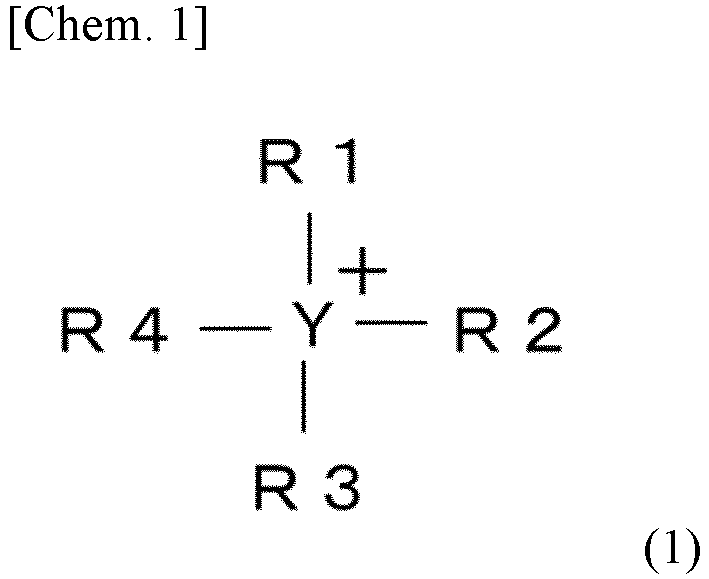

- In the formula (1), Y is an N atom or a P atom, R1 to R4 are each independently an alkyl group, an ether group, an ester group, or a carbonic acid ester group, or Rn and Rn+1 (n is an integer of 1 to 3) may form a cyclic structure bonded to each other. In the formula (2), Y represents an N atom or a P atom, R5 and R7 each represent an alkyl group, an ether group, an ester group, or a carbonic acid ester group, and R6 represents hydrogen or a methyl group. The number of carbon atoms in R1 to R4, R5, and R7 is not particularly limited, but is preferably in the range of 1 to 10, and more preferably in the range of 1 to 5 from the viewpoint of exhibiting hydrophobicity. R1 to R4 and R5 to R7 in the formulae (1) and (2) are each an alkyl group, an ether group, an ester group, or a carbonic acid ester group, and may contain a halogen-substituted product obtained by substituting a hydrogen atom with a halogen atom such as fluorine, chlorine, or bromine.
- Examples of the alkyl group include a methyl group, an ethyl group, a propyl group, an isopropyl group, and a butyl group. Examples of the ether group include a methoxymethyl group, a methoxyethyl group, a methoxypropyl group, an ethoxymethyl group, and an ethoxyethyl group. Examples of the ester group include a methoxycarbonylmethyl group, a methoxycarbonylethyl group, an ethoxycarbonylmethyl group, an acetylmethyl group, an acetylethyl group, and a propionylmethyl group. Examples of the carbonic acid ester group include chain -CH2OCOOCH3, - CH2CH2OCOOCH3, -CH2OCOOCH2CH3, and a carbonic acid ester group having a cyclic structure.


- Examples of the anion include PF6 -, BF4 -, CF3SO3 -, PhSO3 -, [(SO2F)2N]-, [(SO2CF3)2N]-, [PF3(C2F5)3]-, [PF3(CF3)3]-, [BF2(CF3)2]-, [BF2(C2F5)2]-, [BF3(CF3)]-, [BF3(C2F5)]-, [B(COOCOO)2]-, C4F9SO3 -, [(CF3SO2)2N]-(TFSI-), [(C2F5SO2)2N]-(BETI-), [(CF3SO2)(C4F9SO2)N]-, [(CN)2N]-, [(CF3SO2)3C]-, [(CN)3C]-. One kind of them may be used, or a plurality of kinds of them may be mixed and used. Among them, PF6 -, BF4 -, CF3SO3 -, PhSO3 -, [(SO2F)2N]-, and [(SO2CF3)2N]- are preferable from the viewpoint of having hydrophobicity.
- Specific examples of the ionic liquid include N-methyl-N-propylpiperidinium bis(trifluoromethanesulfonyl)imide, 1-butyl-1-methylpyrrolidinium bis(trifluoromethanesulfonyl)imide, N,N,N-trimethyl-N-propylammonium bis(trifluoromethanesulfonyl)imide, N-(2-methoxyethyl)-N-methylpyrrolidinium bis(trifluoromethanesulfonyl)imide, N,N-diethyl-N-methyl-N-(2-methoxydiethyl)ammonium bis(trifluoromethanesulfonyl)imide, and trihexyltetradecylphosphonium bis(trifluoromethylsulfonyl)amide.
- An example of a method for producing the non-aqueous solid electrolyte A will be described. For example, the matrix polymer is dissolved in a diluent solvent such as acetone or tetrahydrofuran by heating and stirring. A precursor solution obtained by adding a lithium salt and an ionic liquid to this solution is applied to a glass substrate, and heated and dried at a temperature of 40 to 80°C for 1 to 5 hours to evaporate the diluent solvent. As a result, a film of the non-aqueous solid electrolyte A formed on the glass substrate is obtained. The obtained film of the non-aqueous solid electrolyte A is in a gel state or a solid state. By peeling the film of the non-aqueous solid electrolyte A from the glass substrate, a partition layer containing the non-aqueous solid electrolyte A is obtained. Although the glass substrate is used in the above description, a porous sheet such as a separator may be used instead of the glass substrate. By using the porous sheet, it is possible to form a partition layer in which the porous sheet and the non-aqueous solid electrolyte A are integrated.
- Specific examples of the porous sheet include fine porous thin films, woven fabrics, and nonwoven fabrics. Examples of the material of the porous sheet include olefin-based resins such as polyethylene and polypropylene, resins such as polyamides, polyamideimides, and cellulose, and glass and ceramics such as borosilicate glass, silica, alumina, and titania. The porous sheet may be a laminate including a cellulose fiber layer and a thermoplastic resin fiber layer such as an olefin-based resin. The porous sheet may be a laminate including a polyethylene layer and a polypropylene layer, and a porous sheet that has a surface to which a material such as an aramid-based resin or a ceramic is applied may be used.
- The non-aqueous solid electrolyte A may be produced by, for example, a phase inversion method. Hereinafter, a production example of the non-aqueous solid electrolyte A by the phase inversion method will be described. First, a solution is obtained in which the matrix polymer is dissolved in an organic solvent. The organic solvent is desirably a solvent in which the matrix polymer is easily dissolved, and examples of the organic solvent include dimethylformamide.
- The solution in which the matrix polymer is dissolved is applied to a substrate such as a glass plate or an aluminum foil. Then, a poor solvent (for example, water) is added to the applied film on the substrate to solidify the matrix polymer, and thus a polymer skeleton (that is, polymer film) is formed. Next, the polymer skeleton taken out from the substrate is immersed in a poor solvent for a predetermined time or dried by heat treatment such as vacuum heating.
- The obtained polymer skeleton is immersed in an ionic liquid containing a lithium salt for a predetermined time, and dried by heating for a predetermined time. As a result, a film of the non-aqueous solid electrolyte A in which the matrix polymer composed of the polymer skeleton, the lithium salt, and the ionic liquid are combined is obtained. The obtained film of the non-aqueous solid electrolyte A is in a gel state or a solid state.
- The thickness of the
partition layer 14 may be, for example, in the range of greater than or equal to 10 µm and less than or equal to 50 µm, and may be in the range of greater than or equal to 15 µm and less than or equal to 30 µm. - The
partition layer 14 is not limited to a partition layer containing only the non-aqueous solid electrolyte A, and may contain the non-aqueous solid electrolyte A and a non-aqueous solid electrolyte B including a component different from components of the non-aqueous solid electrolyte A. In a case where the non-aqueous solid electrolytes A and B are included, thepartition layer 14 may be a single partition layer in which the non-aqueous solid electrolytes A and B are integrated, or a laminated structure in which a first partition layer containing the non-aqueous solid electrolyte A and a second partition layer containing the non-aqueous solid electrolyte B are layered. -
FIG. 2 is a schematic sectional view showing another example of the lithium ion secondary battery of the present embodiment. In a lithium ionsecondary battery 2 shown inFIG. 2 , a constituent similar to that of the lithium ion secondary battery 1 shown inFIG. 1 is denoted by the same reference sign as inFIG. 1 . The lithium ionsecondary battery 2 shown inFIG. 2 includes apartition layer 17 including afirst partition layer 14 and asecond partition layer 15 between apositive electrode 10 and anegative electrode 12. - The
first partition layer 14 is a partition layer containing the non-aqueous solid electrolyte A in which a matrix polymer, a lithium salt, and a hydrophobic ionic liquid are combined, and has the same configuration as thepartition layer 14 described above. - The
second partition layer 15 is a partition layer containing the non-aqueous solid electrolyte B including a component different from components of the non-aqueous solid electrolyte A. Thesecond partition layer 15 may or may not contain an ionic liquid. Thesecond partition layer 15 is obtained, for example, by applying a precursor solution of the non-aqueous solid electrolyte B to a porous sheet such as a separator and drying the applied solution. As the precursor solution of the non-aqueous solid electrolyte B, the precursor solution described above for the non-aqueous electrolyte can be used. - The matrix polymer in the precursor solution of the non-aqueous solid electrolyte B, that is, the matrix polymer included in the non-aqueous solid electrolyte B preferably includes a fluorine-based matrix polymer, and preferably includes polyvinylidene fluoride (PVDF), for example, from the viewpoint of suppressing water permeability in the
second partition layer 15. - The non-aqueous solid electrolyte B contains an organic solvent. As the organic solvent contained in the non-aqueous solid electrolyte B, the above-described examples for the non-aqueous electrolyte can be used. The non-aqueous solid electrolyte B preferably contains a cyclic organic solvent such as a cyclic carbonic acid ester, for example, from the viewpoints of suppressing deterioration of the lithium ion conductivity, and the like. The cyclic organic solvent is preferably contained in an amount of greater than or equal to 30 vol%, more preferably greater than or equal to 50 vol%, and still more preferably greater than or equal to 80 vol% based on the total volume of the organic solvent in the non-aqueous solid electrolyte B.
- In the lithium ion
secondary battery 2 shown inFIG. 2 , thefirst partition layer 14 containing the non-aqueous solid electrolyte A is disposed on thepositive electrode 10 side, and thesecond partition layer 15 containing the non-aqueous solid electrolyte B is disposed on thenegative electrode 12 side. The disposition of the partition layers is not limited to the above-described disposition, and thefirst partition layer 14 containing the non-aqueous solid electrolyte A may be disposed on thenegative electrode 12 side, and thesecond partition layer 15 containing the non-aqueous solid electrolyte B may be disposed on thepositive electrode 10 side. - The thickness of the
first partition layer 14 may be, for example, in the range of greater than or equal to 10 µm and less than or equal to 50 µm, and may be in the range of greater than or equal to 15 µm and less than or equal to 30 µm. The thickness of thesecond partition layer 15 may be, for example, in the range of greater than or equal to 10 µm and less than or equal to 50 µm, and may be in the range of greater than or equal to 15 µm and less than or equal to 30 µm. If thefirst partition layer 14 and thesecond partition layer 15 are too thick, for example, the battery resistance may increase and the battery performance may deteriorate. If thefirst partition layer 14 and thesecond partition layer 15 are too thin, for example, the mechanical strength may be reduced. - The
partition layer 17 in which thefirst partition layer 14 containing the non-aqueous solid electrolyte A and thesecond partition layer 15 containing the non-aqueous solid electrolyte B are layered can be produced, for example, by producing the non-aqueous solid electrolytes A and B, respectively, then placing the non-aqueous solid electrolyte A on the non-aqueous solid electrolyte B, and heating (drying) the non-aqueous solid electrolyte A. In addition, the single partition layer in which the non-aqueous solid electrolytes A and B are integrated can be produced, for example, by adding a precursor solution of the non-aqueous solid electrolyte B to a precursor solution used in producing the non-aqueous solid electrolyte A, or immersing the produced non-aqueous solid electrolyte A in the precursor solution of the non-aqueous solid electrolyte B. - Although not illustrated in the drawings, a
separator 18 containing the above-described non-aqueous electrolyte containing a lithium salt may be disposed between thenegative electrode 12 and thepartition layer 17. - Examples of the
battery case 24 include metal cases, resin cases, and laminate film cases. Examples of a material of the metal cases include nickel, iron, and stainless steel. Examples of a material of the resin cases include polyethylene and polypropylene. The laminate film is, for example, a multilayer film in which a stainless foil is coated with a resin film. Examples of a material of the resin film include polypropylene, polyethylene, nylon, and polyethylene terephthalate. - The lithium ion secondary battery of the present embodiment is used in various forms having a shape such as a square, cylindrical, flat, thin, coin, or laminate shape.
- Hereinafter, the present disclosure will be further described with reference to Examples, but the present disclosure is not limited to these Examples.
- A Li metal plate was cut into a predetermined electrode size and used as a negative electrode.
- LiNi0.82Co0.15Al0.03O2 as a positive electrode active material, carbon black as a conductive agent, and PVDF as a binder were mixed at a mass ratio of 98 : 1 : 1, and N-methyl-2-pyrrolidone (NMP) was added to prepare a positive electrode mixture slurry. Next, the positive electrode mixture slurry was applied to a positive electrode current collector made of a Ti foil, and the applied film was dried and then rolled with a roller. The resulting product was cut into a predetermined electrode size to obtain a positive electrode. The amount of the applied positive electrode mixture slurry was 234 g/cm2, and the packing density of the positive electrode mixture layer was 3.7 gcm-3.
- LiTFSI, LiBETI, and water were mixed at a molar ratio of 0.7 : 0.3 : 2.0 to prepare an aqueous liquid electrolyte in which the LiTFSI and the LiBETI were dissolved in the water.
- 1.2 g of PVDF-HFP (polyvinylidene fluoride-propylene hexafluoride) as a matrix polymer was completely dissolved in acetone as a diluent solvent by heating and stirring at 50°C. 0.2 g of LiTFSI (lithium bis[trifluoromethanesulfonylimide]) and 0.8 g of N-(2-methoxyethyl)-N-methylpyrrolidinium bis(trifluoromethanesulfonyl)imide as an ionic liquid were added to this solution, and completely dissolved by heating and stirring at 50°C to obtain a precursor solution. This precursor solution was applied to a glass plate, heated in a thermostatic bath at 60°C for 1 hour to evaporate the diluent solvent, and the obtained transparent film-like sheet was used as the first partition layer.
- A negative electrode lead was attached to the negative electrode. In addition, a positive electrode lead was attached to the positive electrode, and the positive electrode attached with the positive electrode lead was immersed in the aqueous liquid electrolyte to obtain a positive electrode impregnated with the aqueous liquid electrolyte. An electrode assembly in which the first partition layer was disposed between the negative electrode and the positive electrode was housed in a laminate type battery case to produce a test cell.
- LiTFSI, LiBETI, and water were mixed at a molar ratio of 0.7 : 0.3 : 2.0 to prepare an aqueous liquid electrolyte in which the LiTFSI and the LiBETI were dissolved in the water. Thereafter, 8 wt% of PVA (polyvinyl alcohol) was added while heating to 80°C, and heating was continued for 1.5 hours. The mixture was applied to the positive electrode and dried at room temperature for 30 minutes to obtain a gel-like aqueous solid electrolyte coated on the positive electrode.
- A test cell was prepared in the same manner as in Example 1 except that a positive electrode coated with an aqueous solid electrolyte was used instead of immersing the positive electrode in the aqueous liquid electrolyte.
- In a mixed solution obtained by mixing fluoroethylene carbonate (FEC) and methyl 3,3,3-trifluoropropionate (FMP) at a volume ratio of 9 : 1, 1 M LiTFSI was dissolved to prepare an electrolyte liquid. Next, with respect to the electrolyte liquid, 4 mass% of polymethyl methacrylate (PMMA) and 8 mass% of polyvinylidene fluoride-hexafluoropropylene (PVDF-HFP) were prepared and dissolved in a solvent obtained by mixing tetrahydrofuran (THF) in an
amount 10 times that of PMMA and acetone in anamount 10 times that of PMMA. The electrolyte liquid was mixed with the resulting solution to prepare a precursor solution of a non-aqueous solid electrolyte. Then, the separator was coated with the precursor solution and then dried at 60°C for 1 hour to obtain a porous sheet coated with the non-aqueous solid electrolyte. This sheet was used as a second partition layer. - A test cell was prepared in the same manner as in Example 1 except that the positive electrode coated with the aqueous solid electrolyte used in Example 2 was used, and the positive electrode side was disposed as a first partition layer and the negative electrode side was disposed as a second partition layer between the positive electrode and the negative electrode.
- A test cell was prepared in the same manner as in Example 1 except that a first partition layer was prepared using N-methyl-N-propylpiperidinium bis(trifluoromethanesulfonyl)imide as an ionic liquid.
- A test cell was prepared in the same manner as in Example 1 except that a first partition layer was prepared using trihexyltetradecylphosphonium bis(trifluoromethanesulfonyl) as an ionic liquid.
- A test cell was prepared in the same manner as in Example 1 except that no partition layer was disposed between the positive electrode and the negative electrode.
- A test cell was prepared in the same manner as in Example 1 except that the positive electrode coated with the aqueous solid electrolyte used in Example 2 was used and the partition layer was not disposed between the positive electrode and the negative electrode.
- A test cell was prepared in the same manner as in Example 1 except that only the second partition layer was disposed between the positive electrode and the negative electrode.
- A test cell was prepared in the same manner as in Example 1 except that the positive electrode coated with the aqueous solid electrolyte used in Example 2 was used and only the second partition layer was disposed between the positive electrode and the negative electrode.
- The test cell of each Example and each Comparative Example was charged at a constant current of 0.05 C to 4.3 V, charged at a constant voltage of 4.3 V to 0.02 C, and paused for 20 minutes. Then, the test cell was discharged at a constant current of 0.05 C to 3.0 V and rested for 20 minutes. This charge-discharge cycle was repeated three times, and the discharge capacity and charge-discharge efficiency at the third cycle were measured. The charge-discharge efficiency was determined by the following formula.
Charge-discharge efficiency (%) = (discharge capacity at the third cycle ÷ charge capacity at the third cycle) × 100 - Table 1 summarizes the discharge capacity and the charge-discharge efficiency at the third cycle in each Example and each Comparative Example. The discharge capacity in Table 1 represents the discharge capacities of other Examples and Comparative Examples as relative values with the discharge capacity of Example 2 set as 100 (used as a reference).
[Table 1] Aqueous electrolyte Partition layer Discharge capacity Charge-discharge efficiency Example 1 Liquid First partition layer 92 99% Example 2 Gel First partition layer 100 99% Example 3 Gel First partition layer + Second partition layer 90 97% Comparative Example 1 Liquid None 0 0% Comparative Example 2 Gel None 0 0% Comparative Example 3 Liquid Second partition layer 76 96% Comparative Example 4 Gel Second partition layer 77 91% Example 4 Gel First partition layer 90 99% Example 5 Gel First partition layer 80 97% - As can be seen from Table 1, the discharge capacity of Examples 1 to 5 at the third cycle was higher than that of Comparative Examples 1 to 4. From this result, it can be said that according to Examples 1 to 5 using the partition layer containing the non-aqueous solid electrolyte in which the matrix polymer, the lithium salt, and the hydrophobic ionic liquid are combined, the initial discharge capacity of the lithium ion secondary battery using the aqueous electrolyte can be improved.
-
- 1, 2
- Lithium ion secondary battery
- 10
- Positive electrode
- 12
- Negative electrode
- 14
- Partition layer or first partition layer
- 15
- Second partition layer
- 16
- Aqueous electrolyte
- 17
- Partition layer
- 18
- Separator
- 20
- Positive electrode lead
- 22
- Negative electrode lead
- 24
- Battery case
- 26
- Positive electrode current collector
- 28
- Positive electrode mixture layer
- 30
- Negative electrode current collector
- 32
- Negative electrode mixture layer
- 34
- Positive electrode active material
Claims (9)
- A lithium ion secondary battery comprising: a negative electrode; a positive electrode; an aqueous electrolyte containing a lithium salt; and a partition layer disposed between the negative electrode and the positive electrode, whereinthe aqueous electrolyte is in contact with only the positive electrode out of the negative electrode and the positive electrode, andthe partition layer contains a non-aqueous solid electrolyte A wherein a matrix polymer, a lithium salt, and a hydrophobic ionic liquid are combined.
- The lithium ion secondary battery according to claim 1, wherein a non-aqueous electrolyte containing a lithium salt is present between the partition layer and the negative electrode.
- The lithium ion secondary battery according to claim 1 or 2, wherein the ionic liquid has at least one anion of PF6 -, BF4 -, CF3SO3 -, [(SO2F)2N]-, and [(SO2CF3)2N]-, and PhSO3 -.
- The lithium ion secondary battery according to any one of claims 1 to 3, wherein the ionic liquid has a cation represented by the following formula (1):

- The lithium ion secondary battery according to any one of claims 1 to 4, wherein the matrix polymers of the non-aqueous solid electrolyte A include at least one selected from polyvinylidene fluoride-propylene hexafluoride (PVDF-HFP), polyvinylidene fluoride (PVDF), polyacrylonitrile (PAN), polyvinyl alcohol (PVA), polytetrafluoroethylene (PTFE), polyethylene oxide (PEO), and polymethyl methacrylate (PMMA).
- The lithium ion secondary battery according to claim 5, wherein the partition layer includes a non-aqueous solid electrolyte B including a component different from components of the non-aqueous solid electrolyte A.
- The lithium ion secondary battery according to claim 6, wherein the non-aqueous solid electrolyte B contains polyvinylidene fluoride (PVDF).
- The lithium ion secondary battery according to any one of claims 1 to 7, whereinthe negative electrode contains a negative electrode active material, andthe negative electrode active material contains at least any one of a carbon material, Si, Sn or Li metal, a Li-containing alloy, or a Li-containing metal oxide.
- The lithium ion secondary battery according to any one of claims 1 to 8, whereinthe positive electrode contains a positive electrode active material, andthe positive electrode active material contains at least any one of a lithium-containing transition metal oxide containing at least any one element of Ni, Co, Mn, or Al, a Li-rich transition metal oxide, or a lithium-containing transition metal halogen oxide.
Applications Claiming Priority (2)
| Application Number | Priority Date | Filing Date | Title |
|---|---|---|---|
| JP2021124562 | 2021-07-29 | ||
| PCT/JP2022/024730 WO2023007991A1 (en) | 2021-07-29 | 2022-06-21 | Lithium ion secondary battery |
Publications (2)
| Publication Number | Publication Date |
|---|---|
| EP4379900A1 true EP4379900A1 (en) | 2024-06-05 |
| EP4379900A4 EP4379900A4 (en) | 2025-07-09 |
Family
ID=85086645
Family Applications (1)
| Application Number | Title | Priority Date | Filing Date |
|---|---|---|---|
| EP22849067.8A Pending EP4379900A4 (en) | 2021-07-29 | 2022-06-21 | LITHIUM-ION SECONDARY BATTERY |
Country Status (5)
| Country | Link |
|---|---|
| US (1) | US20250015363A1 (en) |
| EP (1) | EP4379900A4 (en) |
| JP (1) | JP7821995B2 (en) |
| CN (1) | CN117616614A (en) |
| WO (1) | WO2023007991A1 (en) |
Family Cites Families (10)
| Publication number | Priority date | Publication date | Assignee | Title |
|---|---|---|---|---|
| AU2010271483A1 (en) * | 2010-01-22 | 2011-08-04 | Toyota Jidosha Kabushiki Kaisha | Negative electrode structure for aqueous electrolyte batteries and aqueous electrolyte battery comprising the negative electrode structure |
| DE112016000412T8 (en) | 2015-01-14 | 2017-11-09 | The University Of Tokyo | AQUEOUS ELECTROLYTE SOLUTION FOR THE ENERGY STORAGE DEVICE AND THE ENERGY STORAGE DEVICE CONTAINING THE AQUEOUS ELECTROLYTE SOLUTION |
| US10573933B2 (en) * | 2015-05-15 | 2020-02-25 | Samsung Electronics Co., Ltd. | Lithium metal battery |
| KR102626915B1 (en) | 2016-08-02 | 2024-01-18 | 삼성전자주식회사 | Composite membrane, preparing method thereof, and lithium secondary battery including the anode structure |
| JP6873767B2 (en) | 2017-03-17 | 2021-05-19 | 株式会社東芝 | Rechargeable batteries, battery packs and vehicles |
| JP6659608B2 (en) | 2017-03-21 | 2020-03-04 | 株式会社東芝 | Rechargeable batteries, battery packs and vehicles |
| EP3610522A1 (en) * | 2017-04-10 | 2020-02-19 | AB Systems, Inc. (US) | Secondary battery with long cycle life |
| JP6774378B2 (en) | 2017-05-23 | 2020-10-21 | 本田技研工業株式会社 | Lithium ion secondary battery |
| FR3068831B1 (en) * | 2017-07-04 | 2021-11-26 | Commissariat Energie Atomique | METHODS OF REALIZING AN ELECTROCHEMICAL BEAM OF A METAL-ION ACCUMULATOR BY MEANS OF A MEMBRANE WITH GELIFIED POLYMER ELECTROLYTE, ASSOCIATED ACCUMULATORS |
| JP6889125B2 (en) * | 2018-03-16 | 2021-06-18 | 株式会社東芝 | Separator, electrode group, secondary battery, battery pack, vehicle, and stationary power supply |
-
2022
- 2022-06-21 US US18/291,342 patent/US20250015363A1/en active Pending
- 2022-06-21 EP EP22849067.8A patent/EP4379900A4/en active Pending
- 2022-06-21 JP JP2023538329A patent/JP7821995B2/en active Active
- 2022-06-21 WO PCT/JP2022/024730 patent/WO2023007991A1/en not_active Ceased
- 2022-06-21 CN CN202280048247.3A patent/CN117616614A/en active Pending
Also Published As
| Publication number | Publication date |
|---|---|
| EP4379900A4 (en) | 2025-07-09 |
| US20250015363A1 (en) | 2025-01-09 |
| JP7821995B2 (en) | 2026-03-02 |
| JPWO2023007991A1 (en) | 2023-02-02 |
| WO2023007991A1 (en) | 2023-02-02 |
| CN117616614A (en) | 2024-02-27 |
Similar Documents
| Publication | Publication Date | Title |
|---|---|---|
| CN111052485B (en) | Non-aqueous electrolytic solution for lithium secondary battery and lithium secondary battery containing same | |
| EP3742537B1 (en) | Non-aqueous electrolyte solution for lithium secondary battery and lithium secondary battery including the same | |
| EP3512028B1 (en) | Electrolyte additive and non-aqueous electrolyte solution for lithium secondary battery containing the same | |
| KR101288125B1 (en) | Lithium battery and method for operating the lithium battery | |
| CN105794035B (en) | Electrolyte for secondary battery and secondary battery using the same | |
| CN113728483B (en) | Nonaqueous electrolyte solution additive, nonaqueous electrolyte solution for lithium secondary battery comprising same, and lithium secondary battery | |
| KR102812062B1 (en) | Electrode material comprising layered potassium metal oxide, electrode comprising the electrode material and use of the electrode material in electrochemistry | |
| US20200014066A1 (en) | Nonaqueous electrolyte secondary battery | |
| KR20160117961A (en) | Electrolyte composition for secondary cell and secondary cell comprising same | |
| EP4318727A1 (en) | Lithium ion secondary battery | |
| CN116057750B (en) | lithium-ion secondary batteries | |
| JP2004079335A (en) | Electrolytic solution for secondary battery and secondary battery using it | |
| EP4379900A1 (en) | Lithium ion secondary battery | |
| KR102721825B1 (en) | Electrolyte for lithium secondary battery and lithium secondary battery comprising the same | |
| CN116325217B (en) | Lithium ion secondary battery | |
| KR102721824B1 (en) | Electrolyte for lithium secondary battery and lithium secondary battery comprising the same | |
| JP2003297418A (en) | Non-aqueous electrolyte secondary battery |
Legal Events
| Date | Code | Title | Description |
|---|---|---|---|
| STAA | Information on the status of an ep patent application or granted ep patent |
Free format text: STATUS: THE INTERNATIONAL PUBLICATION HAS BEEN MADE |
|
| PUAI | Public reference made under article 153(3) epc to a published international application that has entered the european phase |
Free format text: ORIGINAL CODE: 0009012 |
|
| STAA | Information on the status of an ep patent application or granted ep patent |
Free format text: STATUS: REQUEST FOR EXAMINATION WAS MADE |
|
| 17P | Request for examination filed |
Effective date: 20240111 |
|
| AK | Designated contracting states |
Kind code of ref document: A1 Designated state(s): AL AT BE BG CH CY CZ DE DK EE ES FI FR GB GR HR HU IE IS IT LI LT LU LV MC MK MT NL NO PL PT RO RS SE SI SK SM TR |
|
| DAV | Request for validation of the european patent (deleted) | ||
| DAX | Request for extension of the european patent (deleted) | ||
| A4 | Supplementary search report drawn up and despatched |
Effective date: 20250606 |
|
| RIC1 | Information provided on ipc code assigned before grant |
Ipc: H01M 50/431 20210101ALI20250603BHEP Ipc: H01M 50/446 20210101ALI20250603BHEP Ipc: H01M 50/426 20210101ALI20250603BHEP Ipc: H01M 50/42 20210101ALI20250603BHEP Ipc: H01M 50/417 20210101ALI20250603BHEP Ipc: H01M 10/36 20100101ALI20250603BHEP Ipc: H01M 4/587 20100101ALI20250603BHEP Ipc: H01M 4/525 20100101ALI20250603BHEP Ipc: H01M 4/505 20100101ALI20250603BHEP Ipc: H01M 4/485 20100101ALI20250603BHEP Ipc: H01M 4/40 20060101ALI20250603BHEP Ipc: H01M 4/38 20060101ALI20250603BHEP Ipc: H01M 10/38 20060101AFI20250603BHEP |