EP4379539A1 - Method and apparatus for determining dependency relationship between services, electronic device, and computer readable storage medium - Google Patents
Method and apparatus for determining dependency relationship between services, electronic device, and computer readable storage medium Download PDFInfo
- Publication number
- EP4379539A1 EP4379539A1 EP22863023.2A EP22863023A EP4379539A1 EP 4379539 A1 EP4379539 A1 EP 4379539A1 EP 22863023 A EP22863023 A EP 22863023A EP 4379539 A1 EP4379539 A1 EP 4379539A1
- Authority
- EP
- European Patent Office
- Prior art keywords
- services
- parameter
- statement
- code
- call
- Prior art date
- Legal status (The legal status is an assumption and is not a legal conclusion. Google has not performed a legal analysis and makes no representation as to the accuracy of the status listed.)
- Withdrawn
Links
Images


Classifications
-
- G—PHYSICS
- G06—COMPUTING OR CALCULATING; COUNTING
- G06F—ELECTRIC DIGITAL DATA PROCESSING
- G06F9/00—Arrangements for program control, e.g. control units
- G06F9/06—Arrangements for program control, e.g. control units using stored programs, i.e. using an internal store of processing equipment to receive or retain programs
- G06F9/46—Multiprogramming arrangements
- G06F9/54—Interprogram communication
-
- G—PHYSICS
- G06—COMPUTING OR CALCULATING; COUNTING
- G06F—ELECTRIC DIGITAL DATA PROCESSING
- G06F8/00—Arrangements for software engineering
- G06F8/40—Transformation of program code
- G06F8/41—Compilation
- G06F8/43—Checking; Contextual analysis
- G06F8/433—Dependency analysis; Data or control flow analysis
-
- G—PHYSICS
- G06—COMPUTING OR CALCULATING; COUNTING
- G06F—ELECTRIC DIGITAL DATA PROCESSING
- G06F8/00—Arrangements for software engineering
- G06F8/70—Software maintenance or management
- G06F8/75—Structural analysis for program understanding
Definitions
- the present application relates to communication technologies, and in particular, to a method for determining a dependency relationship between services, an apparatus for determining a dependency relationship between services, an electronic device, and a computer readable storage medium.
- a micro-service In order to solve a pain point of a monolithic application, a micro-service has become an important definition of a cloud native system, and a scale of the micro-service is increased explosively. Some security issues are raised as an increase of a scale of micro-service architecture and its applications. For example, there are three services A, B and C in a certain cloud native system, and A is only dependent on B and C in services, and B is dependent on C in services, access rights corresponding to the three services should be respectively set as: A cannot be accessed by others, B can only be accessed by A, and C can be accessed by A, B.
- a following manner is generally used to determine a dependency relationship between micro-services: acquiring micro-service code files of a plurality of micro services, recognizing initialization information of each micro-service in the plurality of the micro-services from the micro-service code files, and extracting a target service dependency relationship from the initialization information.
- the initialization information may include: a dependency package for service operation and a micro-service associated with service initialization.
- the integrity of a resulted dependency relationship between services is not very high.
- an embodiment of the present application provides a method for determining a dependency relationship between services, including: performing semantic recognition on a micro-service code file to determine a target code fragment, the target code fragment including a code statement representing a call request between services; extracting a target parameter representing the call request between services from the code statement; and determining the dependency relationship between services according to the target parameter.
- an embodiment of the present application provides an apparatus for determining a dependency relationship between services, including: a code fragment determination module configured to perform semantic recognition on a micro-service code file to determine a target code fragment, the target code fragment including a code statement representing a call request between services; a parameter extraction module configured to extract a target parameter representing the call request between services from the code statement; and a dependency relationship determination module configured to determine the dependency relationship between services according to the target parameter.
- an embodiment of the present application provides an electronic device, including: at least one processor; a storage device storing at least one computer program thereon, the at least one computer program, executed by the at least one processor, causes the at least one processor to perform the method for determining the dependency relationship between services described in the first aspect; and at least one I/O interface connected between the processor and the storage device, and configured to implement information interaction between the processor and the storage device.
- an embodiment of the present application provides a computer readable storage medium storing a computer program thereon, the computer program, executed by a processor, causes the processor to perform the method for determining the dependency relationship between services described in the first aspect.
- Fig. 1 is a flowchart of a method for determining a dependency relationship between services according to an embodiment of the present application
- an execution subject of the method is an apparatus for determining a dependency relationship between services provided in an embodiment of the present application
- the apparatus may be integrated in a terminal device (e.g., a mobile terminal, a tablet computer, or a desktop computer) or a server.
- the method for determining the dependency relationship between services includes following operations S101 to S103.
- the micro-service code file may be obtained in a non-intrusive destruction and non-message interception manner during a source code and an initialization file being output by a project, and a relatively complete dependency relationship between services can be obtained through the micro-service code file.
- a code file of a micro-service application program may be of many forms, and may be, for example, source code, byte code, or binary code.
- a form of the micro-service code file in the embodiment of the present application is related to an execution process of a programming language employed by the micro-service application program. Different programming languages have different forms of code files, and correspondingly, most suitable forms of the code files for semantic recognition and analysis are also different for different programming languages.
- Table 1 Programming Language Java Python Go JavaScript Ruby C# Source Code ⁇ ⁇ ⁇ ⁇ ⁇ ⁇ ⁇ Byte Code ⁇ ⁇ ⁇ ⁇ ⁇ ⁇ Binary Code ⁇ ⁇ ⁇ ⁇ ⁇ ⁇ ⁇ ⁇
- a byte code file may be used as the code file in the embodiment of the present disclosure.
- a source code file or a binary code file may be used as the code file in the embodiment of the present disclosure.
- some external files e.g., proto files and service deployment files
- contain important information related to the call request between the services and thus each may also be used as the code file to be parsed and processed.
- code statements useful for determining the dependency relationship between services may be recognized from the micro-service code file, the code statements may represent the call request between services, and since calls between services in one micro-service application are limited, i.e., there are a relatively small number of calls between services in one micro-service application, and there is also a limited number of code statements representing the call request between the services, and further, the dependency relationship between services can be determined quickly and accurately according to the small number of code statements.
- the code statement is a code expression representing the call request between services, and the code expression contains a target parameter representing a call relationship between services.
- the target parameter corresponding to the call request between services varies as a type of the call requests between services. That is, different target parameters are for different types of call requests between services. For example, the target parameters corresponding to different call requests between services are shown in Table 2 below. Table 2 Type Target Parameter HTTP Call Target Service, Method, Path gRPC Call Target Service, Path TCP Call Target Service, Port
- the target parameter includes a call relationship between services.
- the target parameter Path of the HTTP call or the gRPC call is a call path indicating the call relationship between services, so that the dependency relationship between services can be determined according to the target parameter Path.
- the target parameter Port of the TCP call is a call port indicating the call relationship between services, so that the dependency relationship between services can be determined according to the target parameter Port.
- target parameter can be extracted based on the above target code fragment:
- a path of a called service can be determined as follows: http:// reviews:9080/reviews/*, and the called service can further be determined according to the above path of the service.
- unified extraction may be performed based on determined target code fragments, so as to generate one manifest file, such as JSON manifest file, and the dependency relationships between services are described by the manifest file.
- each target code fragment may be scanned in a taint propagation manner, and then the target parameter is determined according to the scanned result.
- the micro-service code file for determining the dependency relationship between services, on one hand, the micro-service code file is used, and since the micro-service code file contains all call relationships between services, the integrity of the dependency relationship between the services determined according to the micro-service code file can be ensured; on the other hand, the target code fragment representing the call request between services is determined by performing semantic recognition on the micro-service code file, so that an effective code fragment can be accurately positioned, a search space is reduced and analysis is optimized, and the processing efficiency is further improved.
- the operation S101 specifically includes following operations A and B.
- a pre-created semantic model is used to perform semantic recognition on the micro-service code file to determine the network call statement for initiating the call request between services.
- the semantic model may be created based on an internal communication mode between services in the micro-service application, and a specific creation process for creating the semantic model is described in following implementations.
- a called code statement may be determined based on the network call statement, and the code statement representing the call request between services may be obtained based on the called code statement.
- a parameter reviews in the call statement url reviews['name'] + "/" + reviews['endpoint'] + "/" + str(product_id) is a method parameter, so that a call statement corresponding to the parameter reviews is further determined as follows:
- the operation S101 further includes an operation S104.
- the semantic model is enhanced based on semantic information, the semantic information describes the call type of the call request between services, and indicates a key parameter (i.e., the second parameter) to be concerned in a subsequent process of obtaining the code statement.
- the semantic model may be a type of method, and based on the above example of the source code, the following type of method may be set as the semantic model, in an example of the type of method, the semantic model includes the first parameter, i.e., a type HTTP of the call request between services, second parameters Method and url.
- semantic model i.e., the type of method
- the operation B may specifically include: acquiring the code statement representing the call request between services according to the network call statement and the second parameter.
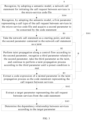
- the code statement forming the target code fragment may be determined by means of taint propagation, and as shown in Fig. 3 , the operation B specifically includes following operations B1 to B3.
- the taint propagation performed along a reverse direction or a forward direction of the control flow depends on whether the network call statement is a call statement or a called statement, if the network call statement is the call statement, the taint propagation is performed along the reverse direction of the control flow, if the network call statement is the called statement, the taint propagation is performed along the forward direction of the control flow. Based on the above example of the source code, the taint propagation is performed along the reverse direction of the control flow.
- the preset condition for ending the taint propagation is a parameter assigned by a constant or comes from an input parameter.
- the taint propagation process includes: transferring the taint from a tainted parameter in a left side expression of the assignment statement to a parameter in a right side expression of the assignment statement.
- the taint propagation process includes: transferring the taint from a tainted method parameter to a parameter in a call statement calling a method corresponding to the method parameter.
- the taint propagation process includes: if the return value is tainted, starting from a return statement of a corresponding method of the return value, performing taint propagation in a method body of the corresponding method.
- the target code fragment may be finally determined as follows:
- the method for determining the dependency relationship between services further includes a process of creating the semantic model, the process includes: acquiring a call library between services according to an internal communication mode between services in the micro-service application; and creating the semantic model according to the call library between services.
- the code fragment determination module 201 is configured to perform semantic recognition on a micro-service code file to determine a target code fragment, the target code fragment including a code statement representing a call request between services.
- the parameter extraction module 202 is configured to extract a target parameter representing the call request between services from the code statement.
- the dependency relationship determination module 203 is configured to determine the dependency relationship between services according to the target parameter.
- the code fragment determination module 201 includes a network call statement recognition component 2011 and a code fragment determination component 2012.
- the network call statement recognition component 2011 is configured to recognize, by adopting a semantic model, a network call statement for initiating the call request between services in the micro-service code file.
- the code fragment determination component 2012 is configured to acquire the code statement representing the call request between services according to the network call statement, the code statement forming the target code fragment.
- the code fragment determination module 201 further includes a parameter recognition component 2013.
- the parameter recognition component 2013 is configured to recognize, by adopting the semantic model, a first parameter representing a call type of the call request between services in the micro-service code file and acquire a second parameter to be concerned by the code statement.
- the code fragment determination component 2012 is specifically configured to acquire the code statement representing the call request between services according to the network call statement and the second parameter.
- the code fragment determination component 2012 is specifically configured to take the network call statement as a starting point, and take the second parameter contained in the network call statement as a taint; perform taint propagation along a control flow according to the second parameter, recognize a third parameter related to the second parameter, take the third parameter as the taint, and continue to perform a taint propagation process according to the third parameter until a preset condition is met; and extract a code expression of a tainted parameter in the taint propagation process as the code statement representing the call request between services.
- the code fragment determination component 2012 is specifically configured to transfer the taint from a tainted parameter in a left side expression of an assignment statement to a parameter in a right side expression of the assignment statement according to the assignment statement in the micro service code file.
- the code fragment determination component 2012 is specifically configured to transfer the taint from a tainted method parameter to a parameter in a call statement calling a method corresponding to the method parameter according to the call statement in the micro-service code file.
- the code fragment determination component 2012 is specifically configured to perform, according to a return value in the micro-service code file, taint propagation in a method body of a corresponding method by starting from a return statement of the corresponding method of the return value, in response to that the return value is tainted.
- the apparatus for determining the dependency relationship between services further includes a semantic model creation module 204.
- the semantic model creation module 204 is configured to acquire a call library between services according to an internal communication mode between services in the micro-service application, and create the semantic model according to the call library between services.
- each module may refer to corresponding description in the method, and are not repeated herein.
- An embodiment of the present application further provides an electronic device, referring to Fig. 5 , including: at least one processor 301; a storage device 302 storing at least one computer program thereon, the at least one computer program, executed by the at least one processor 301, causes the at least one processor 301 to implement the method for determining the dependency relationship between services described above; and at least one I/O interface 303 connected between the processor 301 and the storage device 302, and configured to implement information interaction between the processor 301 and the storage device 302.
- the processor 301 is a device having a capability of processing data, includes, but is not limited to, a Central Processing Unit (CPU), and the like;
- the memory 302 is a device having a capability of storing data, includes, but is not limited to, a random access memory (RAM, in particular, SDRAM, DDR, and the like), a read only memory (ROM), an electrically erasable programmable read only memory (EEPROM), and a FLASH;
- the I/O interface 303 is connected between the processor 301 and the storage device 302, can implement information interaction between the processor 301 and the storage device 302, and includes, but is not limited to, a data Bus, and the like.
- the processor 301, the memory 302, and the I/O interface 303 are connected together through a bus, and are further connected to other components of a computing device.
- An embodiment of the present application further provides a computer readable storage medium storing a computer program thereon, the computer program, executed by a processor, causes the processor to perform the method for determining the dependency relationship between services described above.
- the functional modules/components in the apparatuses described above may be implemented as software, firmware, hardware, or suitable combinations thereof.
- the division between the functional modules/components stated above does not correspond to the division of physical components; for example, one physical component may have a plurality of functions, or one function or operation may be performed through a cooperation of several physical components.
- Some or all of the physical components may be implemented as software executed by a processor, such as a central processing unit, a digital signal processor or a microprocessor, or may be implemented as hardware, or may be implemented as an integrated circuit, such as an application specific integrated circuit.
- Such software may be allocated on a computer-readable medium
- the computer-readable medium may include computer storage medium (or non-transitory medium) and communication medium (or transitory medium).
- the computer storage medium includes volatile/nonvolatile or removable/non-removable medium used in any method or technology for storing information (such as computer-readable instructions, data structures, program modules and other data).
- the computer storage medium includes, but is not limited to, a Random Access Memory (RAM), a Read-Only Memory (ROM), an Electrically Erasable Programmable Read-Only Memory (EEPROM), a flash memory or other memory techniques, a Compact Disc Read-Only Memory (CD-ROM), a Digital Video Disk (DVD) or other optical discs, magnetic cassettes, magnetic tapes, magnetic disks or other magnetic storage devices, or any other medium which can be used to store the desired information and can be accessed by a computer.
- the communication medium generally includes computer-readable instructions, data structures, program modules or other data in a modulated data signal, such as a carrier wave or other transmission mechanism, and may include any information delivery medium.
Landscapes
- Engineering & Computer Science (AREA)
- Theoretical Computer Science (AREA)
- General Engineering & Computer Science (AREA)
- Software Systems (AREA)
- Physics & Mathematics (AREA)
- General Physics & Mathematics (AREA)
- Stored Programmes (AREA)
Abstract
Description
- The present application claims the priority of
Chinese Patent Application No. 202111005086.3, filed on August 30, 2021 - The present application relates to communication technologies, and in particular, to a method for determining a dependency relationship between services, an apparatus for determining a dependency relationship between services, an electronic device, and a computer readable storage medium.
- In order to solve a pain point of a monolithic application, a micro-service has become an important definition of a cloud native system, and a scale of the micro-service is increased explosively. Some security issues are raised as an increase of a scale of micro-service architecture and its applications. For example, there are three services A, B and C in a certain cloud native system, and A is only dependent on B and C in services, and B is dependent on C in services, access rights corresponding to the three services should be respectively set as: A cannot be accessed by others, B can only be accessed by A, and C can be accessed by A, B.
- In some related arts, a following manner is generally used to determine a dependency relationship between micro-services: acquiring micro-service code files of a plurality of micro services, recognizing initialization information of each micro-service in the plurality of the micro-services from the micro-service code files, and extracting a target service dependency relationship from the initialization information. The initialization information may include: a dependency package for service operation and a micro-service associated with service initialization. However, the integrity of a resulted dependency relationship between services is not very high.
- In a first aspect, an embodiment of the present application provides a method for determining a dependency relationship between services, including: performing semantic recognition on a micro-service code file to determine a target code fragment, the target code fragment including a code statement representing a call request between services; extracting a target parameter representing the call request between services from the code statement; and determining the dependency relationship between services according to the target parameter.
- In a second aspect, an embodiment of the present application provides an apparatus for determining a dependency relationship between services, including: a code fragment determination module configured to perform semantic recognition on a micro-service code file to determine a target code fragment, the target code fragment including a code statement representing a call request between services; a parameter extraction module configured to extract a target parameter representing the call request between services from the code statement; and a dependency relationship determination module configured to determine the dependency relationship between services according to the target parameter.
- In a third aspect, an embodiment of the present application provides an electronic device, including: at least one processor; a storage device storing at least one computer program thereon, the at least one computer program, executed by the at least one processor, causes the at least one processor to perform the method for determining the dependency relationship between services described in the first aspect; and at least one I/O interface connected between the processor and the storage device, and configured to implement information interaction between the processor and the storage device.
- In a fourth aspect, an embodiment of the present application provides a computer readable storage medium storing a computer program thereon, the computer program, executed by a processor, causes the processor to perform the method for determining the dependency relationship between services described in the first aspect.
-
-
Fig. 1 is a flowchart of a method for determining a dependency relationship between services according to an embodiment of the present application; -
Fig. 2 is a flowchart of a method for determining a dependency relationship between services according to an embodiment of the present application; -
Fig. 3 is a flowchart of a method for determining a dependency relationship between services according to an embodiment of the present application; -
Fig. 4 is a schematic structural diagram of an apparatus for determining a dependency relationship between services according to an embodiment of the present application; and -
Fig. 5 is a schematic structural diagram of an electronic device according to an embodiment of the present application. - In order to make those skilled in the art better understand the technical solutions of the present application, a method for determining a dependency relationship between services, an apparatus for determining a dependency relationship between services, an electronic device, and a computer readable storage medium are described in detail below with reference to the accompanying drawings.
- Exemplary embodiments are described in detail below with reference to the accompanying drawings, but the present application may be embodied in different forms, and should not be construed as limited to the embodiments set forth herein. The embodiments are illustrated to make the present application more thorough and complete, and for those skilled in the art more fully understanding the scope of the present application.
- As used herein, a term "and/or" includes any and all combinations of at least one of listed items.
- The terms used in the present application are for a purpose of describing particular embodiments only, and are not intended to limit the present application. As used in the present application, singular forms "a" and "the" are intended to include plural forms as well, i.e., to represent at least one, unless the context clearly defines otherwise. It should further be understood that terms "includes/comprises" and/or "made of/consisted of" in the present application are used to specify a presence of at least one of recited features, integers, steps, operations, elements or components, but do not preclude a presence or an addition of at least one of other features, integers, steps, operations, elements, components or groups thereof.
- The embodiments of the present application may be described with reference to plan and/or cross-sectional views with the help of idealized schematic illustrations of the present application. Therefore, the example illustrations may be modified in accordance with manufacturing techniques and/or tolerances. The embodiments of the present application are not limited to those shown in the accompanying drawings, but include modifications of any configuration formed based on a manufacturing process. Therefore, areas illustrated in the accompanying drawings have schematic properties, and shapes of the areas illustrated in the accompanying drawings illustrate specific shapes of the areas of elements, but are not limiting.
- Unless otherwise defined, meanings of all terms (including technical terms and scientific terms) used herein are the same as meanings commonly understood by one of ordinary skill in the art. It should further be understood that terms, such as those defined in common dictionaries, should be construed as having a meaning that is consistent with that in background of the existing art and the present application, and should not be construed as having an idealized or over-formal meaning, unless expressly defined in the present application.
-
Fig. 1 is a flowchart of a method for determining a dependency relationship between services according to an embodiment of the present application, an execution subject of the method is an apparatus for determining a dependency relationship between services provided in an embodiment of the present application, and the apparatus may be integrated in a terminal device (e.g., a mobile terminal, a tablet computer, or a desktop computer) or a server. As shown inFig. 1 , the method for determining the dependency relationship between services includes following operations S101 to S103. - At operation S101, performing semantic recognition on a micro-service code file to determine a target code fragment, the target code fragment including a code statement representing a call request between services.
- In some implementations, the micro-service code file may be obtained in a non-intrusive destruction and non-message interception manner during a source code and an initialization file being output by a project, and a relatively complete dependency relationship between services can be obtained through the micro-service code file. A code file of a micro-service application program may be of many forms, and may be, for example, source code, byte code, or binary code. A form of the micro-service code file in the embodiment of the present application is related to an execution process of a programming language employed by the micro-service application program. Different programming languages have different forms of code files, and correspondingly, most suitable forms of the code files for semantic recognition and analysis are also different for different programming languages.
- For example, for different programming languages, the most suitable forms of the code files for semantic recognition and analysis are shown in Table 1 below.
Table 1 Programming Language Java Python Go JavaScript Ruby C# Source Code √ √ √ √ √ √ Byte Code √ √ × × √ √ Binary Code × × √ × × × - For example, for Java language, there are many mature static analysis tools operating at a byte code level, and in order to facilitate analysis, a byte code file may be used as the code file in the embodiment of the present disclosure. For example, for Go language, a source code file or a binary code file may be used as the code file in the embodiment of the present disclosure. In addition to the source code, some external files (e.g., proto files and service deployment files) contain important information related to the call request between the services, and thus each may also be used as the code file to be parsed and processed.
- Since an amount of code corresponding to one micro-service application program is relatively huge, and if all corresponding amounts of code are scanned and analyzed, much time and resources are consumed, therefore, in the embodiment of the present disclosure, in order to reduce a search range and optimize the analysis, code statements useful for determining the dependency relationship between services may be recognized from the micro-service code file, the code statements may represent the call request between services, and since calls between services in one micro-service application are limited, i.e., there are a relatively small number of calls between services in one micro-service application, and there is also a limited number of code statements representing the call request between the services, and further, the dependency relationship between services can be determined quickly and accurately according to the small number of code statements.
- At operation S102, extracting a target parameter representing the call request between services from the code statement.
- The code statement is a code expression representing the call request between services, and the code expression contains a target parameter representing a call relationship between services. The target parameter corresponding to the call request between services varies as a type of the call requests between services. That is, different target parameters are for different types of call requests between services. For example, the target parameters corresponding to different call requests between services are shown in Table 2 below.
Table 2 Type Target Parameter HTTP Call Target Service, Method, Path gRPC Call Target Service, Path TCP Call Target Service, Port - At operation S103, determining the dependency relationship between services according to the target parameter.
- The target parameter includes a call relationship between services. For example, the target parameter Path of the HTTP call or the gRPC call is a call path indicating the call relationship between services, so that the dependency relationship between services can be determined according to the target parameter Path. For example, the target parameter Port of the TCP call is a call port indicating the call relationship between services, so that the dependency relationship between services can be determined according to the target parameter Port.
- Following target code fragment is illustrated as an example:

- Following target parameter can be extracted based on the above target code fragment:
 {
 "type": "HTTP",
 "url": "http://reviews:9080/reviews/*",
 "path": "/reviews/*",
 "method": "GET"
 }.

 3 reviews = {
 4 "name" : "http://reviews:9080",
 5 "endpoint" : "reviews"
 6 }.

- Library: requests
- Method: get(url, params=None, **kwargs)
- Semantics: HTTP-GET
- Key parameters: url (Semantics: HTTP-URL).

Claims (11)
- A method for determining a dependency relationship between services, comprising:performing semantic recognition on a micro-service code file to determine a target code fragment, with the target code fragment comprising a code statement representing a call request between services;extracting a target parameter representing the call request between services from the code statement; anddetermining the dependency relationship between services according to the target parameter.
- The method of claim 1, wherein the performing semantic recognition on a micro-service code file to determine a target code fragment comprises:recognizing, by adopting a semantic model, a network call statement for initiating the call request between services in the micro-service code file; andacquiring the code statement representing the call request between services according to the network call statement, with the code statement forming the target code fragment.
- The method of claim 2, further comprising:recognizing, by adopting the semantic model, a first parameter representing a call type of the call request between services in the micro-service code file and acquiring a second parameter to be concerned by the code statement;the acquiring the code statement representing the call request between services according to the network call statement comprises:
acquiring the code statement representing the call request between services according to the network call statement and the second parameter. - The method of claim 3, wherein the acquiring the code statement representing the call request between services according to the network call statement and the second parameter comprises:taking the network call statement as a starting point, and taking the second parameter contained in the network call statement as a taint;performing taint propagation along a control flow according to the second parameter, recognizing a third parameter related to the second parameter, taking the third parameter as the taint, and continuing to perform a taint propagation process according to the third parameter until a preset condition is met; andextracting a code expression of a tainted parameter in the taint propagation process as the code statement representing the call request between services.
- The method of claim 4, wherein the taint propagation process comprises:
transferring the taint from a tainted parameter in a left side expression of an assignment statement to a parameter in a right side expression of the assignment statement according to the assignment statement in the micro service code file. - The method of claim 4, wherein the taint propagation process comprises:
transferring the taint from a tainted method parameter to a parameter in a call statement calling a method corresponding to the method parameter according to the call statement in the micro-service code file. - The method of claim 4, wherein the taint propagation process comprises:
according to a return value in the micro-service code file, in response to that the return value is tainted, starting from a return statement of a corresponding method of the return value, performing taint propagation in a method body of the corresponding method. - The method of any of claims 1 to 7, further comprising:acquiring a call library between services according to an internal communication mode between services in a micro-service application; andcreating the semantic model according to the call library between services.
- An apparatus for determining a dependency relationship between services, comprising:a code fragment determination module configured to perform semantic recognition on a micro-service code file to determine a target code fragment, with the target code fragment comprising a code statement representing a call request between services;a parameter extraction module configured to extract a target parameter representing the call request between services from the code statement; anda dependency relationship determination module configured to determine the dependency relationship between services according to the target parameter.
- An electronic device, comprising:at least one processor;a storage device storing at least one computer program thereon, the at least one computer program, executed by the at least one processor, causes the at least one processor to perform the method for determining the dependency relationship between services according to any of claims 1 to 8; andat least one I/O interface connected between the processor and the storage device, and configured to implement information interaction between the processor and the storage device.
- A computer readable storage medium storing a computer program thereon, the computer program, executed by a processor, causes the processor to perform the method for determining the dependency relationship between services according to any of claims 1 to 8.
Applications Claiming Priority (2)
| Application Number | Priority Date | Filing Date | Title |
|---|---|---|---|
| CN202111005086.3A CN115729553A (en) | 2021-08-30 | 2021-08-30 | Method and device for determining dependencies between services |
| PCT/CN2022/110599 WO2023029882A1 (en) | 2021-08-30 | 2022-08-05 | Method and apparatus for determining dependency relationship between services, electronic device, and computer readable storage medium |
Publications (2)
| Publication Number | Publication Date |
|---|---|
| EP4379539A1 true EP4379539A1 (en) | 2024-06-05 |
| EP4379539A4 EP4379539A4 (en) | 2024-11-20 |
Family
ID=85290890
Family Applications (1)
| Application Number | Title | Priority Date | Filing Date |
|---|---|---|---|
| EP22863023.2A Withdrawn EP4379539A4 (en) | 2021-08-30 | 2022-08-05 | METHOD AND APPARATUS FOR DETERMINING DEPENDENCE RELATIONSHIP BETWEEN SERVICES, ELECTRONIC DEVICE AND COMPUTER READABLE STORAGE MEDIUM |
Country Status (5)
| Country | Link |
|---|---|
| US (1) | US20250123825A1 (en) |
| EP (1) | EP4379539A4 (en) |
| JP (1) | JP2024536709A (en) |
| CN (1) | CN115729553A (en) |
| WO (1) | WO2023029882A1 (en) |
Families Citing this family (1)
| Publication number | Priority date | Publication date | Assignee | Title |
|---|---|---|---|---|
| CN116521767B (en) * | 2023-03-29 | 2026-03-10 | 青岛海尔科技有限公司 | Methods and apparatus for determining data information, storage media and electronic devices |
Family Cites Families (16)
| Publication number | Priority date | Publication date | Assignee | Title |
|---|---|---|---|---|
| US8181167B2 (en) * | 2008-01-09 | 2012-05-15 | Kan Zhao | Method and system for presenting and analyzing software source code through intermediate representation |
| JP6409638B2 (en) * | 2015-03-20 | 2018-10-24 | 富士通株式会社 | Compiler, compiling device, and compiling method |
| US9411556B1 (en) * | 2015-09-30 | 2016-08-09 | Semmle Limited | Template dependency inlining |
| JP2017219972A (en) * | 2016-06-06 | 2017-12-14 | 富士通株式会社 | Node and information processing system processing nodes |
| US10606672B2 (en) * | 2017-05-04 | 2020-03-31 | Microsoft Technology Licensing, Llc | Micro-service framework derived from third-party apps |
| CN108614707B (en) * | 2018-04-27 | 2023-05-02 | 深圳市腾讯网络信息技术有限公司 | Static code checking method, device, storage medium and computer equipment |
| CN109240666B (en) * | 2018-06-22 | 2020-08-25 | 北京大学 | Method and system for function call code generation based on call stack and dependency path |
| US10983769B2 (en) * | 2019-05-16 | 2021-04-20 | Citrix Systems, Inc. | Systems and methods for using a call chain to identify dependencies among a plurality of microservices |
| CN111142852B (en) * | 2019-12-30 | 2023-10-27 | 亚信科技(中国)有限公司 | Interface conversion function generation method and device |
| CN111831548B (en) * | 2020-05-29 | 2024-04-05 | 微民保险代理有限公司 | Dependency relationship topological graph drawing method and device |
| CN112000398B (en) * | 2020-08-17 | 2022-10-28 | 苏州达家迎信息技术有限公司 | Method and device for determining bottom layer interface call link, computer equipment and medium |
| CN111966718B (en) * | 2020-09-09 | 2024-03-15 | 支付宝(杭州)信息技术有限公司 | System and method for data dissemination tracking of application systems |
| US11714615B2 (en) * | 2020-09-18 | 2023-08-01 | International Business Machines Corporation | Application migration using cost-aware code dependency graph |
| CN113094082B (en) * | 2021-04-07 | 2024-02-13 | 北京字跳网络技术有限公司 | Method, device and storage medium for determining micro-service dependency relationship |
| US12061538B2 (en) * | 2022-03-23 | 2024-08-13 | Red Hat, Inc. | Systems and methods for continuous testing of microservice applications |
| CN116521767B (en) * | 2023-03-29 | 2026-03-10 | 青岛海尔科技有限公司 | Methods and apparatus for determining data information, storage media and electronic devices |
-
2021
- 2021-08-30 CN CN202111005086.3A patent/CN115729553A/en not_active Withdrawn
-
2022
- 2022-08-05 WO PCT/CN2022/110599 patent/WO2023029882A1/en not_active Ceased
- 2022-08-05 EP EP22863023.2A patent/EP4379539A4/en not_active Withdrawn
- 2022-08-05 US US18/682,152 patent/US20250123825A1/en active Pending
- 2022-08-05 JP JP2024513463A patent/JP2024536709A/en active Pending
Also Published As
| Publication number | Publication date |
|---|---|
| WO2023029882A1 (en) | 2023-03-09 |
| CN115729553A (en) | 2023-03-03 |
| US20250123825A1 (en) | 2025-04-17 |
| JP2024536709A (en) | 2024-10-08 |
| EP4379539A4 (en) | 2024-11-20 |
Similar Documents
| Publication | Publication Date | Title |
|---|---|---|
| US20220147696A1 (en) | Enhanced links in curation and collaboration applications | |
| CN111414403B (en) | Data access method and device and data storage method and device | |
| CN113132267B (en) | Distributed system, data aggregation method and computer readable storage medium | |
| CN109359237B (en) | A method and apparatus for searching for a boarding program | |
| US10754628B2 (en) | Extracting web API endpoint data from source code to identify potential security threats | |
| JP2019520624A (en) | Page component dynamic layout | |
| US12001450B2 (en) | Distributed table storage processing method, device and system | |
| CN109871251B (en) | Response data processing method and device, storage medium and terminal equipment | |
| US20090063618A1 (en) | Method and Apparatus for Client-Side Aggregation of Asynchronous Fragmented Requests | |
| EP4379539A1 (en) | Method and apparatus for determining dependency relationship between services, electronic device, and computer readable storage medium | |
| CN110909022A (en) | A data query method and device | |
| CN112613271A (en) | Data paging method and device, computer equipment and storage medium | |
| CN113553214A (en) | Idempotent checking method and device | |
| CN110413354A (en) | It is a kind of to realize the method, equipment and storage medium interacted with third-party platform | |
| CN115543996A (en) | Message parsing and warehousing method and device | |
| KR102116176B1 (en) | Semantic Resource Discovery Method in M2M System | |
| CN112818710A (en) | Method and device for processing asynchronous network machine translation request | |
| CN111291299B (en) | Method for directly obtaining local command execution result and local server | |
| EP3948575B1 (en) | Parallelized parsing of data in cloud storage | |
| CN111309765A (en) | Method and device for directly querying structured data | |
| CN105657473A (en) | Data processing method and device | |
| CN117424950A (en) | Communication message analysis method, device, equipment and storage medium | |
| CN110955856B (en) | Webpage loading method and device, server and storage medium | |
| CN115051933A (en) | Database interface calling frequency statistical method, device, system and medium | |
| US8788483B2 (en) | Method and apparatus for searching in a memory-efficient manner for at least one query data element |
Legal Events
| Date | Code | Title | Description |
|---|---|---|---|
| STAA | Information on the status of an ep patent application or granted ep patent |
Free format text: STATUS: THE INTERNATIONAL PUBLICATION HAS BEEN MADE |
|
| PUAI | Public reference made under article 153(3) epc to a published international application that has entered the european phase |
Free format text: ORIGINAL CODE: 0009012 |
|
| STAA | Information on the status of an ep patent application or granted ep patent |
Free format text: STATUS: REQUEST FOR EXAMINATION WAS MADE |
|
| 17P | Request for examination filed |
Effective date: 20240301 |
|
| AK | Designated contracting states |
Kind code of ref document: A1 Designated state(s): AL AT BE BG CH CY CZ DE DK EE ES FI FR GB GR HR HU IE IS IT LI LT LU LV MC MK MT NL NO PL PT RO RS SE SI SK SM TR |
|
| A4 | Supplementary search report drawn up and despatched |
Effective date: 20241021 |
|
| RIC1 | Information provided on ipc code assigned before grant |
Ipc: G06F 9/54 20060101ALI20241015BHEP Ipc: G06F 8/75 20180101ALI20241015BHEP Ipc: G06F 8/41 20180101AFI20241015BHEP |
|
| DAV | Request for validation of the european patent (deleted) | ||
| DAX | Request for extension of the european patent (deleted) | ||
| STAA | Information on the status of an ep patent application or granted ep patent |
Free format text: STATUS: THE APPLICATION IS DEEMED TO BE WITHDRAWN |
|
| 18D | Application deemed to be withdrawn |
Effective date: 20250509 |