EP4379442A2 - Target support tool - Google Patents
Target support tool Download PDFInfo
- Publication number
- EP4379442A2 EP4379442A2 EP24171116.7A EP24171116A EP4379442A2 EP 4379442 A2 EP4379442 A2 EP 4379442A2 EP 24171116 A EP24171116 A EP 24171116A EP 4379442 A2 EP4379442 A2 EP 4379442A2
- Authority
- EP
- European Patent Office
- Prior art keywords
- target
- support tool
- arm
- attachment
- support part
- Prior art date
- Legal status (The legal status is an assumption and is not a legal conclusion. Google has not performed a legal analysis and makes no representation as to the accuracy of the status listed.)
- Withdrawn
Links
Images









Classifications
-
- G—PHYSICS
- G01—MEASURING; TESTING
- G01C—MEASURING DISTANCES, LEVELS OR BEARINGS; SURVEYING; NAVIGATION; GYROSCOPIC INSTRUMENTS; PHOTOGRAMMETRY OR VIDEOGRAMMETRY
- G01C15/00—Surveying instruments or accessories not provided for in groups G01C1/00 - G01C13/00
- G01C15/02—Means for marking measuring points
-
- F—MECHANICAL ENGINEERING; LIGHTING; HEATING; WEAPONS; BLASTING
- F16—ENGINEERING ELEMENTS AND UNITS; GENERAL MEASURES FOR PRODUCING AND MAINTAINING EFFECTIVE FUNCTIONING OF MACHINES OR INSTALLATIONS; THERMAL INSULATION IN GENERAL
- F16M—FRAMES, CASINGS OR BEDS OF ENGINES, MACHINES OR APPARATUS, NOT SPECIFIC TO ENGINES, MACHINES OR APPARATUS PROVIDED FOR ELSEWHERE; STANDS; SUPPORTS
- F16M13/00—Other supports for positioning apparatus or articles; Means for steadying hand-held apparatus or articles
- F16M13/02—Other supports for positioning apparatus or articles; Means for steadying hand-held apparatus or articles for supporting on, or attaching to, an object, e.g. tree, gate, window-frame, cycle
-
- F—MECHANICAL ENGINEERING; LIGHTING; HEATING; WEAPONS; BLASTING
- F16—ENGINEERING ELEMENTS AND UNITS; GENERAL MEASURES FOR PRODUCING AND MAINTAINING EFFECTIVE FUNCTIONING OF MACHINES OR INSTALLATIONS; THERMAL INSULATION IN GENERAL
- F16B—DEVICES FOR FASTENING OR SECURING CONSTRUCTIONAL ELEMENTS OR MACHINE PARTS TOGETHER, e.g. NAILS, BOLTS, CIRCLIPS, CLAMPS, CLIPS OR WEDGES; JOINTS OR JOINTING
- F16B1/00—Devices for securing together, or preventing relative movement between, constructional elements or machine parts
-
- G—PHYSICS
- G02—OPTICS
- G02B—OPTICAL ELEMENTS, SYSTEMS OR APPARATUS
- G02B5/00—Optical elements other than lenses
- G02B5/12—Reflex reflectors
-
- G—PHYSICS
- G02—OPTICS
- G02B—OPTICAL ELEMENTS, SYSTEMS OR APPARATUS
- G02B7/00—Mountings, adjusting means, or light-tight connections, for optical elements
- G02B7/18—Mountings, adjusting means, or light-tight connections, for optical elements for prisms; for mirrors
-
- F—MECHANICAL ENGINEERING; LIGHTING; HEATING; WEAPONS; BLASTING
- F16—ENGINEERING ELEMENTS AND UNITS; GENERAL MEASURES FOR PRODUCING AND MAINTAINING EFFECTIVE FUNCTIONING OF MACHINES OR INSTALLATIONS; THERMAL INSULATION IN GENERAL
- F16B—DEVICES FOR FASTENING OR SECURING CONSTRUCTIONAL ELEMENTS OR MACHINE PARTS TOGETHER, e.g. NAILS, BOLTS, CIRCLIPS, CLAMPS, CLIPS OR WEDGES; JOINTS OR JOINTING
- F16B2200/00—Constructional details of connections not covered for in other groups of this subclass
- F16B2200/83—Use of a magnetic material
Definitions
- the present disclosure relates to a target support tool, which might be used in construction sites of buildings where steel columns are built.
- a structure construction requires erection adjustment work of column members or pillar members such as steel columns after the column members or pillar members are roughly assembled and erected.
- the erection adjustment work adjusts column members or pillar members, so that they become upright and untilted to the horizontal plane.
- one of the techniques is disclosed in Japanese Unexamined Patent Publication No. 2019-39274 , describing a system to measure the position of a pillar member by attaching a retroreflective member on the pillar and utilizing a surveying apparatus. This technique determines a tilt amount of the column member by measuring the position of the retroreflective member with the surveying apparatus.
- Such a retroreflective member is assumed to be attached to targets (such as pillars) in various shapes or designs. Therefore, for attaching such a retroreflective member, different support tools are adopted in accordance with the shapes or locations of the attachment targets. This requires cumbersome management or placement works for using different support tools for various targets.
- an object of the present disclosure is to provide a highly convenient target support tool.
- a target support tool includes: a base member including a first arm and a second arm connectable to each other to form a bent therebetween; a magnetic support part at least on the first arm; and a retroreflector at the bent of the base member.
- the present disclosure provides a highly convenient target support tool.
- a target support tool 1 illustrated in FIG. 1 can support a retroreflector 31 that is a measurement target (target) usable for measuring or surveying the shape of spaces, which may be the shape of structures.
- the target support tool 1 can be used to acquire the position (spatial coordinates) of a structure as follows.
- the target support tool 1 is attached to an attachment target 101.
- the attachment target 101 may be a columnar object (e.g., a steel frame) at a construction site or a corner (e.g., a projected corner or a recessed corner) between inner walls in an indoor space.
- the target support tool 1 attached to the attachment target 101 is then measured using a surveying device 102, such as a total station.
- projected corner refers to a corner, which is formed by two walls placed together to project out, and which may be referred to as an external corner in general
- recessed corner refers to a corner, which is formed by two walls placed together to recess in, and which may be referred to as internal corner in general.
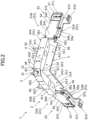
- the target support tool 1 illustrated in FIGS. 2 and 3 includes a base member 2 and a retroreflective member 3.
- the base member 2 includes a first arm 21A (21) and a second arm 21B (21) connectable to each other to form a bent 22 therebetween.
- the retroreflective member 3 is placed at the outside corner of the bent 22 of the base member 2.
- the first and second arms 21A and 21B are connectable to form a right angle at the bent 22.
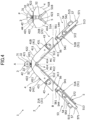
- the base member 2 illustrated is substantially in an L-shape as a whole in a plan view (see FIG. 4 ).
- the first and second arms 21A and 21B are connectable to form a right angle (in other words, connectable to form a right angle).
- the base member 2 includes a first base body 4 and a second base body 5.
- the first base body 4 is provided with the retroreflective member 3.
- the second base body 5 includes magnets M2.
- the magnets M2 serve as magnetic support parts to allow an attachment target to attach and detach from and to themselves.
- the first base body 4 can be detachably fixed to the second base bodies 5 in such a way that the outside corner of a bent 52 (22) of the second base body 5 faces the inside corner of the first base body 4.
- the first base body 4 is also detachably fixed to the second base body 5 (which is a magnetic body such as a metal) using magnets (i.e., magnetic support parts) M1 placed on one surfaces of the first and second arms 41A and 41B of the first base body 4.
- the one surfaces of the first and second arms 41A and 41B may be inner surfaces 412 forming the inside corner of a bent 42 (22) as in this embodiment.
- the first base body 4 includes the first and second arms 41A (41) and 41B (41) connected to form a right angle at the bent 42, so as to form a substantially L-shape as a whole.
- the first and second arms 41A and 41B according to this embodiment are symmetric in shapes and geometries with respect to the axis A of symmetry, which passes through the bent 42.
- the first and second arms 41A and 41B each have a quadrangular prism shape, which has a substantially square cross- section.
- the bent 42 has outer surfaces 411, which form the outside corner.
- the outer surfaces 411 include an inner slope 421 and outer slopes 422, respectively.
- the inner slope 421 is located on the axis A of symmetry in the plan view (see FIG.
- each outer slope 422 is interposed between the inner slope 421 and one of the outer surfaces 411 and form a flat surface chamfering the boundary of the inner slope 421 and the one of the outer surfaces 411.
- the inner surface 412 of the first arm 41A and the inner surface 412 of the second arm 41B also form a right angle.
- the first base body 4 includes the inner slope 421 above which the retroreflector 31 is located and further includes the outer slopes 422 on both sides of the inner slope 421. This configuration provides a wider solid angle range, within which the surveying device 102 or any other suitable device can attain collimation with the retroreflector 31.
- the distal end surface 413 of the first arm 41A and the distal end surface 413 of the second arm 41B form the same plane B.
- the distal end surface 413 of the first arm 41A tilts at an acute angle of 45 degrees from outer surfaces 411 of the first arm 41A.
- the distal end surface 413 of the second arm 41B also tilts at an acute angle of 45 degrees from the outer surface 411 of the second arm 41B. That is, the distal end surfaces 413 tilt from the longitudinal directions (i.e., the directions of extension) of the first and second arms 41A and 41B in such a way that each distal end surface 413 makes an angle of 45 degrees with the longitudinal direction of the first and second arm 41A or 41B corresponding thereto.
- the first base body 4 includes suspension point parts 43 on upper surfaces 414 of the first and second arms 41A and 41B, respectively.
- the suspension point parts 43 each include an annular member 431.
- the annular member 431 is pivotably attached to corresponding one of the upper surfaces 414.
- the annular member 431 might be used to secure thereto a suspender (not illustrated), such as a carabiner or a rope-like tool to hold the first base body 4 or the target support tool 1. This can help to prevent the first base body 4 or the target support tool 1 from falling down.
- the first base body 4 includes a recess 423 at the inside corner of the bent 42.
- the recess 423 extends vertically (i.e., in the direction orthogonal to the longitudinal directions of the first and second arms 41A and 41B).
- the recess 423 has an inner surface recessed in an arc as illustrated in the plan view of FIG. 4 .
- the recess 423 functions as a relief for reducing the inference with the outside corner of the bent 52 of the second base body 5 when the second base body 5 is placed on the inner surfaces 412 of the first base body 4.
- the magnets M1 are also located on the inner surfaces 412 of the first and second arms 41A and 41B.
- the magnets M1 may be, for example, magnetic members, such as a neodymium magnet.
- the magnets M1 are embedded in the first and second arms 41A and 41B. In this manner, the magnetic force exerted by the magnets M1 can detachably attach the first base body 4 to the second base body 5.
- the magnetically attached first and second base bodies 4 and 5 are easily detachable by moving the first base body 4 in a direction going apart from the second base body 5, for example, with fingers or other means hooking the first base body 4 on the distal end surfaces 413.
- the retroreflective member 3 includes the retroreflector 31 and a support part 32 connected to the retroreflector 31.
- the retroreflector 31 may be, for example, a prism with retroreflective characteristics.
- the support part 32 is formed in the shape of a long bar.
- the retroreflector 31 is located at the outside corner of the bent 22 (42) and offset from the base member 2 on a bisector of an internal angle between the first and second arms 21A and 21B, the bisector being coaxial with the axis A of symmetry.
- the inner slope 421 described above has a support hole 44 that is a through-hole for receiving and holding the support part 32 therein.
- the retroreflective member 3 is fixed to the first base body 4 with the support part 32 inserted into the support hole 44 at a predetermined depth.
- the second base body 5 includes the first and second arms 51A (51) and 51B (51) connected to form a right angle at the bent 52 so as to form the shape of a substantially L-shaped plate as a whole.
- the first and second arms 51A and 51B according to this embodiment are symmetric in shapes and geometries with respect to the axis A of symmetry.
- the second base body 5 is a plate member with a substantially uniform thickness.
- the outer surfaces 511 of the first arm and second arms 51A and 51B form a right angle.
- the inner surfaces 512 of the first arm and second arms 51A and 51B also form a right angle.
- the edges of the distal ends 513, 513 of the first arm 51A and the second arm 51B are parallel to each other on the same plane.
- the first and second arms 51A and 51B include a plurality of openings 514 that are through-holes symmetrically located with respect to the axis A of symmetry.
- the first and second arms 51A and 51B each include a detachable part 53 at its distal end.
- the detachable part 53 includes a magnet support part 54, a hole 55 that guides the magnet support part 54, and a pivotable support part 561 that pivotably supports the magnet support part 54.
- the first and second arms 51A and 51B each include notches 56 recessed rectangularly in shape from both lateral edges opposite to each other in a width direction.
- Each pivotable support part 561 extends to bend in an L-shape from the inner edge corresponding to the bottom of one of these notches 56 beyond the corresponding outer surface 511.
- the distal ends of the pivotable support parts 561 of the detachable parts 53 are substantially parallel to each other.
- FIG. 5 is a perspective view of each magnet support part 54 and corresponding one of releasers 57 according to the first embodiment.
- the magnet support part 54 is formed in the shape of a long rectangular thick plate.
- the magnet support part 54 includes a proximal part 541 provided with a bearing 541a, and a main body 542 thicker than the proximal part 541.
- the main body 542 includes, on one surface thereof, a long rectangular magnetic attachment surface 542a provided with the magnets M2.
- the magnets M2 are placed to be flush with the magnetic attachment surface 542a in this embodiment.
- the magnet(s) M2 may be embedded in the magnet support part 54 so that the magnet(s) M2 can have a predetermined distance (offset) from the magnetic attachment surface 542a.
- the magnets M2 are provided at least on the inner surfaces (i.e., the inner surfaces 512) of the first and second arms 21A and 21B when the magnet support part 54 is pivoted in such a way that the magnetic attachment surface 542a will be located inside the hole 55 (see also FIG. 7 ).
- the inner surfaces 512 are ones on the internal corner side of the bent.
- the main body 542 includes a taper 543 along the outer peripheral edge of the magnetic attachment surface 542a.
- the taper 543 is formed by tapers 543a, 543b, 543c, and 543a at each of the edge around, it is formed like a rectangular loop in a plan view as viewed from the magnetic attachment surface 542a.
- the tapers 543a extend along the edges of the main body 542 in the lateral direction (i.e., the axial direction along a pivot C) while the tapers 543b and 543c extend along the edges located in a radial direction D perpendicular to the pivot C of corresponding one of the pivotable support parts 561.
- the tapers 543a and 543b are chamfered surfaces with substantially the same tilt angle.
- the taper 543c near the proximal part 541 is tilted with a concave shape.
- the magnet support part 54 includes projections 544 on both sides in the direction along the pivot C.
- Each projection 544 includes a relief portion 544a and a regulating portion 544b at its outer edge away from the pivot C in the radial direction D (i.e., at the distal edge).
- the relief portion 544a is a concave shape in a side view, and the relief portion 544a is located closer to a handle 571 of the releaser 57 (at a pivot E).
- the regulating portion 544b a part of which closer to the magnetic attachment surface 542a is adjacent to the relief portion 544a, projects toward the handle 571.
- the releaser 57 is formed substantially in a U-shape and includes the handle 571 and support rails 572, which extend from both ends of the handle 571 in the same direction.
- the releaser 57 is pivotable about the pivot E with the support rails 572, which are connected to the side surfaces of the main body 542.
- Each support rail 572 includes a release projection 572a projecting in the shape of a semi-circular arc plate at an end opposite to the handle 571 with respect to the pivot E.
- the pivoting of the releaser 57 is regulated within a predetermined angle range by the release projection 572a and the regulating portion 544b abutting on each other.
- Each hole 55 is an opening penetrating the second base body 5 in the thickness direction of its plate-like shape thereof, and is formed substantially in a long rectangular shape (see also FIG. 3 ).
- the hole 55 is shaped conformably to the outer peripheral shape of the magnetic attachment surface 542a, which projects on a surface of the magnet support part 54.
- the hole 55 guides the insertion and extraction of the magnet support part 54 in such a way that the tapers 543 of the magnet support part 54 abut or slide on an intern edge of the hole 55.
- the corresponding pivotable support part 561 described above pivotably supports the magnet support part 54 with the magnetic attachment surface 542a, which is exposed through the hole 55 (see also a target support tool 1-1 in FIG. 7 ).
- the first and second arms 51A and 51B each include a suspendable part 515 formed in the shape of a substantially L-shape plate and placed near the distal end.
- the suspendable part 515 includes a substantially rectangular opening penetrating the suspendable part 515 in the thickness direction of its plate-like shape thereof.
- the suspendable part 515 is for securing thereto a suspender (not illustrated), such as a carabiner or a rope-like tool, to hold the first base body 4 or the target support tool 1. This can help to prevent the target support tool 1 from falling down.
- FIG. 6 is an enlarged schematic view of the target support tool 1 attached to the attachment target 101 in FIG. 1 as viewed downward from above (in a Q-direction).
- the attachment target 101 according to this embodiment has a substantially square outer shape in a cross-sectional view. Since the attachment target 101 has magnetic characteristics, the first arm 51A (21A) is attached to one of the outer surfaces 101a by the magnetic force of the magnets M2 (see FIG. 3 ) placed in the detachable part 53, while the second arm 51B (21B) is attached to the other outer surface 101a by the magnetic force as well.
- the target support tool 1 magnetically attaches to the attachment target 101, of which each attachment surface 542a and one of the inner surfaces 512 abut on one of the outer surfaces 101a on the same surface. In this manner, the target support tool 1 is at least partially in surface contact with each outer surface 101a, so that the target support tool 1 can stably attach to the attachment target 101.
- the taper 543 allows them to stably attach each other, because the inner edge of the hole 55 abuts on and is supported by the magnet support part 54 magnetically attached and fixed to the attachment target 101. This can help to prevent the base member 2 (i.e., the whole target support tool 1) from falling down and being displaced. As a result, the retroreflector 31 becomes more stably fixed to the base member 2, and the retroreflector 31 can be stably supported with respect to the attachment target 101.
- a first direction e.g., the horizontal direction in FIG. 6
- second direction e.g., the vertical direction in FIG. 6
- the distance X2 between the retroreflector 31 of the target support tool 1 and one of the outer surfaces 101a of the attachment target 101 (i.e., the inner surface 512 of the second arm 51B) in the first direction (i.e., the horizontal direction in FIG. 6 ) is a design value, which is given in advance and known.
- the point for attaching the retroreflector 31 may be set by a user (i.e., an operator) of the surveying device 102.
- the position of the center O of the attachment target 101, at which the retroreflector 31 is attached can be acquired by offsetting the coordinate in the first direction from the position 311 by the sum of the distances X1 and X2 and offsetting the coordinate in the second direction from the position 311 by the sum of the distances Y1 and Y2. Note that the procedure of calculating the position of the center O is not limited to this.
- the base member 2 In order to attach the target support tool 1 to the attachment target 101, first, the base member 2 is put to abut on any corner 101b of the attachment target 101, to which the target support tool 1 is intended to attach. Accordingly, the first arm 21A is substantially in surface contact with one of the outer surfaces 101a, while so is the second arm 21B with the other outer surface 101a. This allows the target support tool 1 to be placed at a temporary position easily but stably.
- each detachable part 53 pivots about the pivot C in order to insert a part of the projection of the corresponding magnet support part 54 including the magnetic attachment surface 542a into the corresponding hole 55.
- the inner edge of the hole 55 guides the taper 543 of the magnet support part 54 on the outer periphery of the magnetic attachment surface 542a; the detachable part 53 magnetically attaches to the attachment target 101 through the hole 55 at the planned attachment point at which the target support tool 1 is temporarily positioned, thereby stably supporting the target support tool 1.
- using the target support tool 1 allows to perform, at different timings, the positioning by abutting on the attachment target 101 (e.g., a steel frame) and the magnetically attaching to the attachment target 101, so that the retroreflector 31 can attach to the intended position precisely.
- the attachment target 101 e.g., a steel frame
- the target support tool 1-1 illustrated in FIG. 7 is magnetically attached to the attachment target 101.
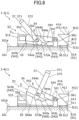
- the release projection 572a of the releaser 57 will abut on an abutting target 55a (illustrated in FIG. 2 as well), which is the outer peripheral edge (surface) of the hole 55.
- the magnet support part 54 including the magnets M2 will be moved in the direction away from the attachment target 101 against the magnetic force.
- the point at which the release projection 572a abuts on the abutting target 55a serves as a fulcrum
- the handle 571 serves as an effort
- the pivot E serves as a load (what is called a "second-class lever").
- the releaser 57 includes the fulcrum part (i.e., the pivot E) supported pivotably with respect to the magnet support part 54, the effort part (i.e., the handle 571) on one side of the fulcrum part, and the load part (i.e., the release projection 572a) on the other side of the fulcrum part.
- the load part can press the abutting target 55a which is the opening edge of the hole 55.
- the pivot E functions such that the release projection 572a receives the reaction force from the abutting target 55a and is pushed back by the reaction force, so that the magnet support part 54 will move in the direction away from the attachment target 101.
- the magnet support part 54 will pivot about the pivot C and move in the direction away from the attachment target 101. In this manner, the user can easily detach the target support tool 1 from the attachment target 101 by releasing the detachable part 53 using the releaser 57 for the first arms 41A and 51A (21A) and the second arms 41B and 51B (21B).
- the target support tool 1 is configured such that the inner surfaces 512 formed at a right angle are abuttable on the corresponding right-angled outer surfaces 101a. Accordingly, as illustrated in FIG. 9 , a plurality of retroreflectors 31 can be attached at some positions at a predetermined corner 101b of the attachment target 101 while being easily aligned in the vertical direction (along the axis) of the attachment target 101, without the need of performing any extra measurement. Since the retroreflectors 31 fixed to the same attachment target 101 is parallel to the axis of the center O of the attachment target 101, the tilt of the attachment target 101 can be acquired by measuring the coordinates of the retroreflectors 31.
- FIG. 10 is a perspective view of a target support tool 1a according to a second embodiment as viewed from the lower front
- FIG. 11 is a perspective view of the target support tool 1a as viewed from the upper back.
- the same reference numbers and characters as those of the target support tool 1 are used to represent equivalent configurations, and the detailed explanation thereof will be omitted or simplified.
- a base member 2a of the target support tool 1a includes a second base body 5a in place of the second base body 5 of the target support tool 1 according to the first embodiment.
- the first base body 4 has the same or similar configuration to the target support tool 1 according to the first embodiment.
- the second base body 5a includes first and second arms 51Aa (51a) and 51Ba (51a) connected to form a right angle at the bent 52, thereby being substantially in the shape of an L-shaped plate as a whole.
- the distal end 513 of the first arm 51Aa and the distal end 513 of the second arm 51Ba are parallel to each other and are thus located on the same plane.
- the first and second arms 51Aa and 51Ba include long-rectangular openings 516 that are through-holes parallel to the second base body 5a at symmetric locations with respect to the axis of symmetry (corresponding to the axis A of symmetry illustrated in FIG. 4 ) at the bent 52.
- the first and second arms 51Aa and 51Ba each include, at its distal end, a detachable part 53a in place of the detachable part 53 illustrated in the first embodiment.
- Each detachable part 53a includes a magnet support part 58, and a guide 517 that guides the magnet support part 58.
- the magnet support part 58 is formed in the shape of a long rectangular thick plate. The longitudinal direction of the magnet support part 58 extends in the lateral directions of the first and second arms 51Aa and 51Ba.
- Each magnet support part 58 includes, on one surface thereof, a long rectangular magnetic attachment surface 58a provided with a plurality of magnets (i.e., a magnetic support parts) M3.
- the magnets M3 are placed to be flush with the magnetic attachment surface 58a in this embodiment.
- the magnets M3 may be embedded in the magnet support part 58, so that the magnet(s) is/are provided with a predetermined distance (offset) from the magnetic attachment surface 58a.
- the magnets M3 are provided at least on the inner surfaces (i.e., the inner surfaces 512) of the first arm 21Aa (21a) and the second arm 21Ba (21a), where the inner surfaces are on the internal corner side of the bent.
- the magnet support part 58 is placed in the guide 517, which is formed by bending a part of the corresponding arm 51a.
- the guide 517 includes a first sidewall 517a, a second sidewall 517b, and a third sidewall 517c.
- the first sidewall 517a is a sidewall proximal to the bent 52 with respect to the magnet support part 58.
- the second sidewall 517b faces a reverse side of the magnetic attachment surface 58a.
- the third sidewall 517c is an other sidewall along the width direction of the arm 51a.
- the first to third sidewalls 517a to 517c each have a flat surface and are substantially perpendicular to each other.
- the detachable part 53a includes a releaser 59.
- the releaser 59 includes a nob 591 and a connector 592.
- the nob 591 is formed in the shape of a short cylindrical column knurled on the outer periphery.
- the connector 592 which is slidably inserted into a through hole of the second sidewall 517b, connects the nob 591 and the magnet support part 58 with each other.
- the magnet support part 58 is thus movable, for a predetermined distance, in directions toward and away from the second sidewall 517b (i.e., in directions toward and away from the attachment target 101 when being attached with the target support tool 1a) (see also FIG. 12 ).
- first and third sidewalls 517a and 517c are formed close to or in sliding contact with a side surface of the magnet support part 58, so that the first and third sidewalls 517a and 517c can function as a guide wall that helps to prevent from unexpected pivoting of the magnet support part 58.
- the first sidewall 517a includes, at one end, a suspendable part 518, which has the shape of a rectangular plate and projects at the end.
- the suspendable part 518 has a substantially rectangular opening penetrating the suspendable part 518 in the thickness direction of its plate-like shape.
- the suspendable part 518 is for securing thereto a suspender (not illustrated), such as a carabiner or a rope-like tool, to hold the first base body 4 or the target support tool 1. This can help to prevent the target support tool 1 from falling down.
- the third sidewall 517c includes a brim 519 formed in the shape of a rectangular plate on the other side opposite to the suspendable part 518.
- the brim 519 has a flat surface substantially on the same plane as the inner surface 512 of the second base body 5a, thereby facilitating stable support for the target support tool 1a with the brim 519 and the magnet support part 58a together abutting on the attachment target 101.
- FIG. 12 is a cross-sectional view of a target support tool 1a-1, which has abutted on (or has attached to) the attachment target 101, taken along line XII-XII in FIG. 11 .
- the first arm 21Aa attaches to one of the outer surfaces 101a at the corner 101b by the magnetic force of the magnets M3 of the detachable part 53a, while the second arm 21Ba (not illustrated) also attaches to the other outer surface 101a by the magnetic force of the magnets M3 of the detachable part 53a.
- the target support tool 1 magnetically attaches to the attachment target 101 with each magnetic attachment surface 58a, one of the inner surfaces 512, and the brim 519 of the target support tool 1, on the same plane, in surface contact with one of the outer surfaces 101a of the attachment target 101.
- each magnet support part 58 magnetically attached to the attachment target 101 is in the shape of a quadrangular short column and includes four flat outer peripheral side surfaces.
- One of the outer peripheral side surfaces abuts on the first sidewall 517a so as to restrict the movement of the base member 2a with respect to the attachment target 101 (i.e., restrict the movement to the left in FIG. 12 ).
- Another one of the outer peripheral side surfaces abuts on the third sidewall 517c so as to restrict the movement of the base member 2a with respect to the attachment target 101 (i.e., restrict the movement to the front in FIG. 12 ).
- the retroreflector 31 fixed to the base member 2a is prevented from positional displacement and stably supported with respect to the attachment target 101.
- the base member 2a is put to abut on a corner 101b of the attachment target 101, to which the target support tool 1 is to attach.
- the first arm 21Aa is substantially in surface contact with one of the outer surfaces 101a, while so is the other, second arm 21Ba with the other outer surface 101a.
- each detachable part 53a is operated to move closer to the attachment target 101. This allows the corresponding magnet support part 58 including the magnetic attachment surface 58a to abut on the outer surface 101a.
- the detachable part 53a magnetically attaches to the attachment target 101 so that the target support tool 1a could stably place on an intended position to be fixed from the temporary position.
- using the target support tool 1a allows to perform, at different timings, the positioning by abutting on the attachment target 101 (e.g., a steel frame) and the magnetically attaching to the attachment target 101, so that the retroreflector 31 can attach to the intended position precisely.
- the user releases the detachable part 53a using the releaser 59 for the first arms 41Aa and 51Aa (21Aa) and the second arms 41Ba and 51Ba (21Ba).
- the target support tool 1a-1 with each magnet support part 58 in FIG. 12 abutting on the attachment target 101 is released in such a way that the user holds the nob 591 of the releaser 59 and moves the magnet support part 58 in the direction away from the attachment target 101 against the magnetic force. Accordingly, as illustrated in the target support tool 1a-2, the magnet support part 58 easily detaches from the attachment target 101.
- the movement of the magnet support part 58 is restricted by wider dimensional parts, which are provided on both sides (i.e., above and below the 517b in FIG. 12 ) in the axial direction of the connector 592, and which would abut on the opening edge of the through hole in the second sidewall 517b.
- the detachable part 53a can be configured with the magnets M3 so that the detachable part 53a will be easily attachable to and detachable from the attachment target 101.
- FIG. 13 is a schematic view of the check mechanism 6.
- the check mechanism 6 is placed, for example, in an arm 51 (one or each of the first and second arms 51A and 51B) of the second base body 5.
- the check mechanism 6 allows the user to easily check whether the target support tool 1 surely attaches to the attachment target 101.
- the check mechanism 6 is placed in such a part of the target support tool 1 that moves closer to the attachment target 101 when the target support tool 1 attaches to the attachment target 101 and moves away from the attachment target 101 when the target support tool 1 detaches from the attachment target 101.
- the check mechanism 6 includes a housing 61 and a movable member 62.
- the housing 61 is an opening hole penetrating the second base body 5 in the thickness direction of its plate-like shape.
- the movable member 62 is received in the housing 61 movably back and forth along the plate thickness of the second base body 5.
- the housing 61 includes a smaller-diameter part 611 on the corresponding outer surface 511, and a counterbore 612 around the opening edge at one end of the smaller-diameter part 611 on the inner surface 512.
- the movable member 62 includes a columnar main body 621 to be housed in the smaller-diameter part 611, and a flange 622 at one end of the main body 621.
- the movement of the movable member 62 toward the outer surface 511 is restricted with the flange 622 abutting on the bottom of the counterbore 612, while the movement of the movable member 62 away from the outer surface 511 is also restricted, for example, with a regulating portion (not illustrated) of the housing 61 abutting on a regulated part (not illustrated) of the movable member 62.
- the regulated part may be a projection
- the regulating portion may be a groove that guides the projection within a movement range.
- the movable member 62 is biased toward the inner surface 512 by an elastic member (not illustrated), such as a spring.
- an elastic member such as a spring.
- the movable member 62 will project beyond the inner surface 512 with a predetermined amount of projection (see a movable member 62-1).
- the movable member 62 is pressed from the inner surface 512 toward the housing 61 to move against the elastic force of the elastic member.
- the flange 622 of the movable member 62 moved into the housing 61 is received in the counterbore 612, and then the movable member 62 dose not project beyond the inner surface 512.
- the movable member 62 moves toward the outer surface 511 of the second base body 5, so that the distal end of the main body 621 will become substantially flush with the outer surface 511.
- this configuration allows the user to check whether the movable member 62 is flush with the outer surface visually by seeing the outer surface 511, or tactually by touching the outer surface 511, so that the user can easily determine whether the target support tool 1 surely attaches to the attachment target 101, or not.
- the check mechanism 6 changes in state in accordance with the attachment and detachment of the base member 2 to and from the attachment target 101 to allow to check of the attachment and detachment of the base member 2 using one or both of the visual and tactile senses. Accordingly, this configuration makes it possible for the user to easily check the attachment of the target support tool 1.
- the check mechanism 6 may be placed in the target support tool 1a or any arm 41 of the first base body 4. One or more check mechanisms 6 may be provided.
- FIG. 14 illustrates a target support tool 1b including a base member 2 with the first base body 4, but without the second base body 5, 5a.
- the target support tool 1b includes first and second arms 21A and 21B, and which are configured shorter for the total length of the each arm than those in the target support tool 1 including the second base body 5, 5a.
- This second variation is suitable for, for example, a case where the attachment target 101 has a relatively small curvature radius at the corner 101b, a wider contact area can be secured between each inner surface 412 and the corresponding outer surface 101a can be secured. Accordingly, the target support tool 1b stably magnetically can attach to the attachment target 101 despite having no second base body 5, 5a.
- the retroreflector 31 of the target support tool 1b and one of the outer surfaces 101a of the attachment target 101 are placed at a distance X3 in-between in the first direction (i.e., the horizontal direction in FIG. 14 ), while the distance Y3 is between the retroreflector 31 and the other outer surface 101a of the attachment target 101 (i.e., the inner surface 412 of the first arm 41A) in the second direction (i.e., the vertical direction in FIG. 14 ).
- the distances X3 and Y3 each are a design value, which have been given in advance and known.
- the position of the center O of the attachment target 101, at which the retroreflector 31 is attached can be worked out by measuring the position (i.e., in the spatial coordinates) 311 of the retroreflector 31 with the surveying device 102, and offsetting the coordinate in the first direction from the position 311 by the sum of the distances X1 and X3 and offsetting the coordinate in the second direction from the position 311 by the sum of the distances Y1 and Y3. See FIG. 6 for the positional relationship between the center O and the distances X1 and Y1.
- the target support tool 1b illustrated in FIG. 14 is easily moved away from the attachment target 101, for example, with a hand holding the respective distal end surfaces 413 of the first and second arms 41A and 41B. That is, each distal end surface 413 also functions as a releaser.
- the target support tool 1b can also measure the position of the attachment target 101 by attaching the respective distal end surfaces 413 of the first and second arms 41A and 41B to the outer surfaces 101a of the attachment target 101 in face-to-face relationship.
- the target support tool 1b can magnetically attach to the attachment target 101 by the magnetic force of the magnets M1 with each distal end surface (one surface) 413 thereof on the attachment target 101, each distal end surface 413 serving as a magnetic attachment surface with the magnets M1.
- the distance R1 between the retroreflector 31 of the target support tool 1b and the same plane B including the distal end surface 413 is given as a design value in advance.
- the distance (e.g., the distance X1 or Y1 in FIG. 6 ) between the center O of the attachment target 101 (not illustrated in FIG. 15 ) to the outer surface 101a is given in advance from design information.
- the direction F from the retroreflector 31 to the center O of the attachment target 101 can be set in advance based on the design information.
- the position of the center O of the attachment target 101 can be acquired, at which the retroreflector 31 is attached.
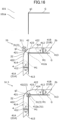
- FIG. 16 illustrates another example use case of the target support tool 1b.
- This figure is a side view of the attachment target 101 in the normal line of the outer surfaces 101a.
- Two lines are drawn on the outer surfaces 101a as a guide index G, working as a guide to place the attachment target 101, which will be described in the following paragraphs.
- the guide index G in this figure are illustrated as being drawn with two straight lines intersecting each other at a right angle, which form an L-shape.
- the target support tool 1b When the target support tool 1b is being placed on the attachment target 101, it will be placed at a position, for example, a place at which a reference position 412a would coincide with a reference point g1, where the reference position 412a is the imaginary intersection between the inner surfaces 412, and the reference point g1 is the intersection between the guide indexes G.
- the guide index G are straight lines forming a right angle.
- the inner surfaces 412 of the first base body 4 i.e., the base member 2b
- the inner surfaces 412 of the first base body 4 i.e., the base member 2b
- the target support tool 1b is widely open around the reference position 412a with the recess 423, which will allow the user to easily see the positions of the guide index G and the relative positions between the target support tool 1b and the guide index G. Accordingly, the recess 423 can function as a relief to allow to see the guide index G, the intersection (i.e., the corner 101b) of the lines drawn on the attachment target 101, this will allow the user to easily check where the target support tool 1b should be placed on with respect to the attachment target 101.
- the target support tool 1b i.e., the relative position of the retroreflector 31 with respect to the attachment target 101
- the target support tool 1b can easily be attached at the same position as before, even when the target support tool 1 is repeatedly attached to and detached from the attachment target 101.
- a target support tool 1c-1 illustrated in FIG. 16 is an example configuration in which the retroreflector 31 is located at a position where the center position 311 in a plan view from the inside of the bent 42 (22) and the upper surfaces 414 will coincide with the reference position 412a (i.e., the imaginary intersection between the inner surfaces 412).
- the retroreflector 31 of the target support tool 1c-1 may form in a pyramid shape (i.e., a regular quadrangular pyramid) which is a half of a regular octahedron, and may be provided to be seeable at least in a direction of one of the upper surfaces 414.
- the guide index G may be drawn with an obtuse or acute angle, and the reference point g1 may be indicated with a point or a dot, or a tilted line or lines. Alternatively, the guide index G may be drawn with lines intersecting each other into a cross shape.
- the retroreflector 31 is transparent or translucent enough to see the reference point g1 on the outer surfaces 101a through; Although the target support tool 1c is leaningly attached to the outer surfaces 101a at a tilt, the retroreflector 31 will be easily and highly accurately re-attached to the attachment target 101 at a planned attachment point.
- FIG. 17 illustrates an example use case of the target support tool 1c according to the third variation.
- the target support tool 1c includes the retroreflector 31 at the internal corner (i.e., the inside or recessed corner) of the bent 42 of the base member 2 (i.e., the first base body 4), where the bent 42 form in an L-shape.
- the retroreflective member 3 is attached to the first base body 4 with the support part 32 engaged to the support hole 44 of the first base body 4 (see FIG. 4 ) from the inner side.
- the target support tool 1c can attach to the attachment target 101 by attaching to a recessed corner of inner walls in an indoor space, or a recessed corner of building materials at a construction, etc.
- the retroreflector 31 of the target support tool 1c and one of the outer surfaces 101a of the attachment target 101 are placed at a distance X4 in-between in the first direction (i.e., the horizontal direction in FIG. 17 ), while the distance Y4 is between the retroreflector 31 and the other outer surface 101a of the attachment target 101 (i.e., the outer surface 411 of the first arm 41A) in the second direction (i.e., the vertical direction in FIG. 17 ).
- the distances X4 and Y4 each are a design value, which have been given in advance and known.
- the position of the corner 101e of the attachment target 101, at which the retroreflector 31 is attached can be worked out by measuring the position (i.e., the spatial coordinates) 311 of the retroreflector 31 with the surveying device 102 (see FIG. 1 ).
- the base member 2 of the target support tool 1c in FIG. 17 includes the first base body 4 alone
- the base member 2 may include the first base body 4 and the second base body 5, 5a as in the first and second embodiments.
- the first base body 4 may be provided on the outer surfaces 511 or the inner surfaces 512 of the second base body 5, 5a.
- the bent 52 of the second base body 5, 5a has an opening that has a common axis with the support hole 44 of the first base body 4 (see FIG. 4 ) and that allows the support part 32 of the retroreflective member 3 to insert and extract from the inner side. Accordingly, this enables the retroreflector 31 to be placed at the internal corner of the bent of the base member 2 including the first base body 4 and the second base body 5, 5a.
- the second base body 5, 5a may be magnetically attached to the attachment target 101 by the magnets M1 on the first base body 4.
- the second base body 5, 5a may be magnetically attached to the attachment target 101 by the magnets M2, M3 on the second base body 5, 5a, with the configuration of each detachable part 53, 53a exchanged between the outer and inner surfaces 511 and 512.
- the second base body 5, 5a may be magnetically attached to the attachment target 101 by the magnets M2, M3 on the second base body 5, 5a, with the configurations of each detachable part 53, 53a exchanged between the outer and inner surfaces 511 and 512.
- FIG. 18 is a perspective view of a target support tool 1d according to a third embodiment.
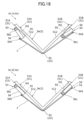
- the first and second arms 21A and 21B of the base member 2 described in the first and other embodiments connects to form various angles including a right angle with a hinge 23, which is a pivotable bent in place of the bent 22, which is provided in the first and the second embodiments.
- the first and second arms 21A and 21B are configured to pivot on the hinge 23, for example, within an angle range of 180° from +90° to -90°.
- the target support tool 1d can be used to measure the position of a corner formed by wall surfaces with any of various angles, including a recessed corner 101a1 or a projected corner 101a2, as an attachment target 101.
- the retroreflector 31 of the target support tool 1d is placed at the pivot center of the hinge 23.
- An example measurement of the attachment target 101 using the target support tool 1d will be described: First, measure the positions of the retroreflectors 31 attached to three or more corners (e.g., the projected corner 101a2 in a section S and the recessed corners 101a1 adjacent to the projected corner 101a2 on both sides in the example in FIG. 18 ). Measured three points each at the three corners can be connected to draw two imaginary straight lines L, which are parallel to the outer surfaces 101a of the attachment target 101. The imaginary straight lines L will also form an angle with both sides of the inner measurement point (at the position 311 in an enlarged view of the section S).
- an angle of the projected corner 101a2 By measuring the angle between the imaginary straight lines L, an angle of the projected corner 101a2 can determined. Since the angle of the projected corner 101a2 is equal to the sum of the angles of the first and second arms 21A and 21B, and a distance R2 between the imaginary straight lines L and the inner surface 412 is a known value, which is used as an offset between the projected corner 101a2 and the position of the retroreflector 31, then the position of the projected corner 101a2 can be calculated.
- the retroreflector 31 may be placed at a position with an offset in the direction of the pivot axis of the hinge 23 (which is the upward or backward direction with respect to the target support tool 1d) by a predetermined distance in order to allow easy positional checking performed with the surveying device 102. While the configurations described above so far are such that the target support tool 1d includes the first base body 4 alone, the target support tool 1d may include the first base body 4 and the second base body 5, 5a that are pivotable by the hinge 23.
- FIG. 19 is a schematic view showing a configuration of a target support tool 1e according to a fourth embodiment.
- the same reference characters as those of the target support tool 1 are used to represent equivalent configurations, and the detailed explanation thereof will be omitted or simplified.
- FIG. 19 illustrates a configuration of a second base body 5e but no first base body 4.
- each pivotable support part 561 supporting the corresponding magnet support part 54 proximal to the bent 52.
- each pivotable support part 561 supporting the corresponding magnet support part 54 is located at one end (on the left in FIG. 19 ). Specifically, the pivotable support part 561 of one of the magnet support parts 54 corresponding to the first arm 51A is located distally from the bent 52, while the pivotable support part 561 of the other magnet support part 54 corresponding to the second arm 51B is located proximally to the bent 52.
- the target support tool 1e includes a string link member 7 connecting the magnet support part 54 on the first arm 51A and the magnet support part 54 on the second arm 51B.
- the string link member 7 is a long flexible string article, such as a wire.
- the string link member 7 is connected to a connector 545 located at the pivotable end of each magnet support part 54.
- the string link member 7 passes through the outside corner (the projection) of the bent 52.
- the string link member 7 operates the magnet support part 54 on the first arm 51A in the closing direction (i.e., the state of a target support tool 1e-1).
- the string link member 7 operates the magnet support part 54 on the second arm 51B in the opening direction (i.e., the state of a target support tool 1e-2).
- the target support tool 1e is configured such that the magnets M2 (i.e., the magnetic support part) on the first arm 51A and the magnets M2 (i.e., the magnetic support part) on the second arm 51B are attached and detached in coordination with each other.
- Each magnet support part 54 includes a releaser (e.g., the releaser 57) that causes the magnet support part 54 to pivot in the opening direction against the magnetic force of the magnets M2 (the details are not illustrated).
- the target support tool 1e is also magnetically attached by causing the second base body 5e to abut on the attachment target 101 at a planned attachment point and then causing each magnet support part 54 to pivot.
- Using the target support tool 1e allows to perform, at different timings, the positioning by abutting on the attachment target 101 and the magnetically attaching to the attachment target 101, so that the retroreflector 31 can attach to the intended position precisely.
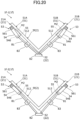
- FIG. 20 is a schematic view showing a configuration of a target support tool 1f according to a fifth embodiment.
- the same reference characters as those of the target support tool 1 are used to represent equivalent configurations, and the detailed explanation thereof will be omitted or simplified.
- FIG. 20 illustrates a configuration of a second base body 5f but no first base body 4.
- the target support tool 1f includes link members 81 and an operatable part 82.
- Each link member 81 is in the shape of a long bar and is pivotably connected to one of the first arm 51A or the second arm 51B.
- the operatable part 82 can press and operate one end of the link member 81.
- the link member 81 is pivotably connected to and supported by a support part 83 on each of the first and second arms 51A and 51B of the second base body 5f.
- the operatable part 82 is located near the bent 52 and is movable in a direction toward and away from the second base body 5f by a guide (not illustrated).
- the operatable part 82 is biased in a direction away from the second base body 5f by a bias member (not illustrated) (e.g., a coil spring).
- the operatable part 82 is connected to (abuts on in the example in FIG. 20 ) one end (closer to the bent 52) of each link member 81 at a point closer to the second base body 5f.
- each magnet support part 54 moves in the opening or closing direction in accordance with the position of the link member 81 engaged with the engageable part 546. Note that the detailed configuration of each engageable part 546 is not illustrated.
- each magnet support part 54 pivots in the closing direction by the magnetic force of the magnets M2 acting onto the attachment target 101 (i.e., the state of a target support tool 1f-2).
- the operatable part 82 described above may be able to operate one end of each link member 81 by pulling.
- the operatable part 82 and each link member 81 may be configured such that one end of the link member 81 moves in a direction away from the second base body 5f in accordance with the movement of the operatable part 82.
- the target support tool 1f may be configured such that each link member 81 and the operatable part 82, and the link member 81 and each magnet support part 54 are connected by hinges using bearings with long holes and shaft cores.
- the present disclosure is not limited to the configurations that have been described above.
- the operatable part 82 may be biased toward the second base body 5f by a bias member (not illustrated). In this case, with no external force applied, each magnet support part 54 is moved in the opening direction by the corresponding link member 81 (i.e., the state of the target support tool 1f-1). By operating (pressing or pulling) the operatable part 82 in a direction away from the second base body 5f, the magnet support part 54 is operated in the closing direction toward the attachment target 101 (the state of the target support tool 1 f-2).
- the operatable part 82 moves each link member 81, the other end of the link member 81 then operates the corresponding magnet support part 54 in the opening or closing direction.
- This provides such an effect that the magnets M2 (i.e., the magnetic support part) on the first arm 51A and the magnets M2 (i.e., the magnetic support part) on the second arm 51B can be attached and detached in coordination with each other.
- the target support tool 1f is also magnetically attached by causing the second base body 5f to abut on the attachment target 101 at a planned attachment point and then causing each magnet support part 54 to pivot.
- Using the target support tool 1f allows to perform, at different timings, the positioning by abutting on the attachment target (e.g., a steel frame) 101 and the magnetically attaching to the attachment target 101, so that the retroreflector 31 can attach to the intended position precisely.
- the attachment target e.g., a steel frame
- FIG. 21 illustrates an example use case of a target support tool 1g attached to the attachment target 101 using arm members 9.
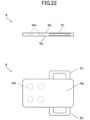
- FIG. 22 illustrates the arm members 9 of the target support tool 1g according to the sixth embodiment.
- the same reference numbers and characters as those of the target support tool 1 are used to represent equivalent configurations, and the detailed explanation thereof will be omitted or simplified.
- the target support tool 1g includes the arm members 9 (i.e., a first arm member 9A and a second arm member 9B) instead of the second base body 5 according to the first embodiment.
- the arm members 9 are extension members (i.e., a third base body) that interpose between the first base body 4 and the attachment target 101, and attach the first base body 4 to the attachment target 101 in a fixed manner. That is, a base member 2g includes the first base body 4 and the arm members (i.e., the third base body) 9.
- each arm member 9 is formed in the shape of a substantially rectangular flat surface, and includes a first flat surface 9a and a second flat surface 9b opposite to the first flat surface 9a.
- Each arm member 9 is made of a magnetic material.
- the first and second flat surfaces 9a and 9b are parallel to each other.
- the distance (thickness of the plate-like shape) R3 between the first and second flat surfaces 9a and 9b is given in advance and known.
- Each arm member 9 includes a plurality of magnets (a magnetic support part) M4 on the second flat surface 9b.
- Each arm member 9 includes an operatable part 91 substantially in a U-shape at each long side edge.
- the arm members 9 are attached to different adjacent outer surfaces 101a of the attachment target 101 by the magnetic force of the magnets M4, where each outer surface 101a faces the second flat surface 9b corresponding thereto.
- the arm members 9 are placed to form a substantially right angle. Accordingly, each outer surface 101a of the attachment target 101 will be extended by the corresponding first flat surface 9a at the corner 101b.
- the first base body 4 is attached to the first flat surface 9a of each arm member 9 by the magnetic force of the magnet M1 with the first flat surface 9a facing the corresponding inner surface 412. Accordingly, the arm member 9 located on the first arm 41A of the first base body 4 functions as the first arm member 9A that is the first arm, while the arm member 9 located on the second arm 41B of the first base body 4 functions as the second arm member 9B that is the second arm.
- the base member 2g includes the first and second arms 21A and 21B indirectly connected via the first base body 4 to form the bent 22 at which the retroreflector 31 can be placed. In this regard, base member 2g is different from the base member 2 etc. including the first and second arms 21A and 21B integrally and directly connected by the second base body 5.
- the separate arm members 9 are used for the first and second arms 21A and 21B.
- the first flat surfaces 9a extend orthogonally to each other at the corner 101b without being influenced by the tilt.
- the first and second arms 41A and 41B of the first base body 4 can or cannot abut on sufficient areas of the outer surfaces 101a.
- the target support tool 1g since the base member 2g of the target support tool 1g includes the first base body 4 and the plurality of arm members 9, the target support tool 1g can be compact as a whole.
- the position of the center O of the attachment target 101 can be calculated as follows.
- the retroreflector 31 of the target support tool 1g and the inner surface 412 of the second arm 41B place at a distance X3 in-between in the first direction (i.e., the horizontal direction in FIG. 21 ), while a distance Y3 is between the retroreflector 31 and the outer surface 411 of the first arm 41A (i.e., the first flat surface 9a) in the second direction (i.e., the vertical direction in FIG. 21 ).
- the distances X3 and Y3 each are a design value, which has been given in advance and known.
- a distance R3 corresponds to the thickness of the plate-like shape of each arm member 9, between the first and second flat surfaces 9a and 9b.
- the distance R3 is also a design value, which is given and known.
- the position of the center O of the attachment target 101 can be determined by measuring the position (i.e., in the spatial coordinates) 311 of the retroreflector 31 with the surveying device 102 (see FIG. 1 ), and offsetting the coordinate in the first direction is offset from the position 311 by the sum of the distances X1, R3, and X3 and offsetting the coordinate in the second direction is offset from the position 311 by the sum of the distances Y1, R3, and Y3.
- the target support tool according to the seventh embodiment includes, instead of the magnets M1 to M4, electromagnets as magnetic support parts magnetically attachable to the attachment target 101 in the first to six embodiments and the first to third variations. Some certain kinds of the electromagnets lose their magnetic force when powered on (when a current flows), and generate magnetic force when powered off. When these kinds of the electromagnets are applied in place of the magnets M1 to M4, each member may include a power source such as a battery, a driver that controls the power supply to the electromagnets, and a receiver that receives a control instruction to the driver.
- a power source such as a battery
- driver that controls the power supply to the electromagnets
- a receiver that receives a control instruction to the driver.
- the electromagnets (i.e., the magnetic support part) on the first arm 21A (41A, 51A, 51Aa) and the electromagnets (i.e., the magnetic support part) on the second arm 21B (41B, 51B, 51Ba) are electrically controllable to be attached and detached in coordinate with each other.
- the pivotable mechanism of the magnet support parts 54 can be excluded or omitted, which will simplify the configuration of the target support tool.
- the target support tools 1 and 1a to 1g each include the base member 2 including the first and second arms 21A and 21B connectable to each other to form the bent 22 therebetween; the magnetic support part (i.e., the magnets M1 to M4 or the electromagnets) on at least the first arm 21A; and the retroreflector 31 at the bent 22 (or the hinge 23) of the base member 2.
- the base member 2 including the first and second arms 21A and 21B connectable to each other to form the bent 22 therebetween; the magnetic support part (i.e., the magnets M1 to M4 or the electromagnets) on at least the first arm 21A; and the retroreflector 31 at the bent 22 (or the hinge 23) of the base member 2.
- the configurations of the target support tools 1 and 1a to 1g have been described, each of which includes: the base member 2, 2a, 2g including the first and second arms 21A and 21B directly or indirectly connected to form the bent 22 at which the retroreflector 31 can be placed; and the magnetic support parts (i.e., the magnets M1 to M4 or electromagnets) on the first and second arms 21A and 21B. Accordingly, the retroreflector 31 is stably attachable to and detachable from any attachment target 101 using the magnetic support part(s). As a result, highly convenient target support tools 1 and 1a to 1d can be configured.
- the distal ends 513 of the first and second arms 51A and 51B of the second base body 5 may bend to tilt the inner surfaces 512.
- the distal ends 513 each may form a flat surface on the distal end with area large enough to stably abut on the flat surfaces of the attachment target 101, as well as the distal ends 513 form flat on the same plane.
- first and second base bodies 4 and 5, 5a of the target support tools 1 and 1a according to the first and second embodiments are attachable and detachable
- the first and second base bodies 4 and 5, 5a may be configured inseparably and integrally as a whole.
- Each check mechanism 6 may have the following configuration: Once the target support tool 1 is attached to the attachment target 101, the main body 621 of the movable member 62 will project beyond the corresponding outer surface 511. Once the target support tool 1 is detached from the attachment target 101, the movable member 62 will become substantially flush with the outer surface 511 or will enter and go into the housing 61.
- Each check mechanism 6 may include an electrical mechanism to detect the attachment target 101 attaching the target support tools 1 and 1a to 1d, and then perform notification electrically, such as light turning-on or illumination and slight electric shocks.
- the target support tools 1 and 1a to 1d may include a power source (e.g., a battery or a solar panel).
- the magnets M1 to M3 may be on at least either one of the first or second arms 21A or 21B. In this sense, the one with the magnets M1 to M3 may be defined as the first arm 21A.
- first and second arms 21A and 21B have been described in different names for the sake of convenience, the configurations and names may be exchangeable between the first and second arms 21A and 21B in each of the target support tools 1 and 1a to 1d.
- each arm may partially or fully include a curve. That is, the first and second arms 21A and 21B each may form in other shapes, which are suitable to be attachable in accordance with the corresponding outer surface 101a of the attachment target 101.
- the inner surfaces of the first and second arms 21A and 21B each may include a curved arc region.
- the retroreflector 31 may include the position 311, which is the measurement point, at the intersection between the center lines (i.e., the imaginary straight lines L) of the first and second arms 21A and 21B as illustrated in the target support tool 1d in FIG. 18 .
- each base body may be attachable and detachable by other attachment and detachment mechanisms, such as screw fastening, recess-and-protrusion mating, or an engagement and disengagement mechanism using engagement claws.
- the configurations according to the first to seventh embodiments and the first to third variations are modifiable by replacing a part of their configurations with another one from the other embodiment or variations or adding a part of a configuration of the other embodiment or variations.
- This description also relates to the following items:
Landscapes
- Engineering & Computer Science (AREA)
- Physics & Mathematics (AREA)
- General Engineering & Computer Science (AREA)
- General Physics & Mathematics (AREA)
- Mechanical Engineering (AREA)
- Optics & Photonics (AREA)
- Radar, Positioning & Navigation (AREA)
- Remote Sensing (AREA)
- Road Signs Or Road Markings (AREA)
- A Measuring Device Byusing Mechanical Method (AREA)
- Conveying And Assembling Of Building Elements In Situ (AREA)
Abstract
Description
- The present disclosure relates to a target support tool, which might be used in construction sites of buildings where steel columns are built.
- A structure construction requires erection adjustment work of column members or pillar members such as steel columns after the column members or pillar members are roughly assembled and erected. The erection adjustment work adjusts column members or pillar members, so that they become upright and untilted to the horizontal plane. Regarding measuring the uprightness or tilting of column members, one of the techniques is disclosed in
Japanese Unexamined Patent Publication No. 2019-39274 - Such a retroreflective member is assumed to be attached to targets (such as pillars) in various shapes or designs. Therefore, for attaching such a retroreflective member, different support tools are adopted in accordance with the shapes or locations of the attachment targets. This requires cumbersome management or placement works for using different support tools for various targets.
- In view of the forgoing issues described, an object of the present disclosure is to provide a highly convenient target support tool.
- In order to achieve the object, a target support tool according to the present disclosure includes: a base member including a first arm and a second arm connectable to each other to form a bent therebetween; a magnetic support part at least on the first arm; and a retroreflector at the bent of the base member.
- The present disclosure provides a highly convenient target support tool.
-
-
FIG. 1 illustrates an example use case of a target support tool according to a first embodiment of the present disclosure. -
FIG. 2 is a perspective view of the target support tool according to the first embodiment as viewed from the lower front. -
FIG. 3 is a perspective view of the target support tool according to the first embodiment as viewed from the upper back. -
FIG. 4 is a plan view of the target support tool according to the first embodiment as viewed from above. -
FIG. 5 is a perspective view of a magnet support part and a releaser according to the first embodiment. -
FIG. 6 is an enlarged schematic view of a target support tool attached to an attachment target inFIG. 1 as viewed in a Q-direction. -
FIG. 7 is a side view showing an example operation of a detachable part according to the first embodiment. -
FIG. 8 is a side view showing the example operation of the detachable part according to the first embodiment. -
FIG. 9 illustrates an example where a plurality of target support tools, each being the target support tools according to the first embodiment, are attached to an attachment target. -
FIG. 10 is a perspective view of a target support tool according to a second embodiment of the present disclosure as viewed from the lower front. -
FIG. 11 is a perspective view of the target support tool according to the second embodiment as viewed from the upper back. -
FIG. 12 is a cross-sectional view taken along line XII-XII, illustrating an example operation of a detachable part according to the second embodiment. -
FIG. 13 is a schematic view of a check mechanism according to a first variation. -
FIG. 14 illustrates an example use case of a target support tool according to a second variation. -
FIG. 15 illustrates another example use case of the target support tool according to the second variation. -
FIG. 16 illustrates a yet another example use case of the target support tool according to the second variation. -
FIG. 17 illustrates an example use case of a target support tool according to a third variation. -
FIG. 18 is a schematic view showing an example use case and a configuration of a target support tool according to a third embodiment. -
FIG. 19 is a schematic view showing a configuration of a target support tool according to a fourth embodiment. -
FIG. 20 is a schematic view showing a configuration of a target support tool according to a fifth embodiment. -
FIG. 21 illustrates an example use case of a target support tool according to a sixth embodiment. -
FIG. 22 illustrates an arm member of the target support tool according to the sixth embodiment. - A first embodiment of the present disclosure is described below with reference to the drawings. A
target support tool 1 illustrated inFIG. 1 can support aretroreflector 31 that is a measurement target (target) usable for measuring or surveying the shape of spaces, which may be the shape of structures. Thetarget support tool 1 can be used to acquire the position (spatial coordinates) of a structure as follows. Thetarget support tool 1 is attached to anattachment target 101. Theattachment target 101 may be a columnar object (e.g., a steel frame) at a construction site or a corner (e.g., a projected corner or a recessed corner) between inner walls in an indoor space. Thetarget support tool 1 attached to theattachment target 101 is then measured using asurveying device 102, such as a total station. In this Description, the term "projected corner" refers to a corner, which is formed by two walls placed together to project out, and which may be referred to as an external corner in general, and the term "recessed corner" refers to a corner, which is formed by two walls placed together to recess in, and which may be referred to as internal corner in general. - The
target support tool 1 illustrated inFIGS. 2 and3 includes abase member 2 and aretroreflective member 3. Thebase member 2 includes afirst arm 21A (21) and asecond arm 21B (21) connectable to each other to form abent 22 therebetween. Theretroreflective member 3 is placed at the outside corner of thebent 22 of thebase member 2. The first andsecond arms bent 22. Here, thebase member 2 illustrated is substantially in an L-shape as a whole in a plan view (seeFIG. 4 ). In thetarget support tool 1 according to the first embodiment andtarget support tools 1a to 1c in other examples, which will be described later, the first andsecond arms first arms second arms - The
base member 2 includes afirst base body 4 and asecond base body 5. Thefirst base body 4 is provided with theretroreflective member 3. Thesecond base body 5 includes magnets M2. The magnets M2 serve as magnetic support parts to allow an attachment target to attach and detach from and to themselves. Thefirst base body 4 can be detachably fixed to thesecond base bodies 5 in such a way that the outside corner of a bent 52 (22) of thesecond base body 5 faces the inside corner of thefirst base body 4. Thefirst base body 4 is also detachably fixed to the second base body 5 (which is a magnetic body such as a metal) using magnets (i.e., magnetic support parts) M1 placed on one surfaces of the first andsecond arms first base body 4. The one surfaces of the first andsecond arms inner surfaces 412 forming the inside corner of a bent 42 (22) as in this embodiment. - The
first base body 4 includes the first andsecond arms 41A (41) and 41B (41) connected to form a right angle at thebent 42, so as to form a substantially L-shape as a whole. As illustrated inFIG. 4 , the first andsecond arms bent 42. The first andsecond arms bent 42 hasouter surfaces 411, which form the outside corner. Theouter surfaces 411 include aninner slope 421 andouter slopes 422, respectively. Theinner slope 421 is located on the axis A of symmetry in the plan view (seeFIG. 4 ) and forms a flat surface tilting at 45 degrees from theouter surfaces 411 of the first andsecond arms outer slope 422 is interposed between theinner slope 421 and one of theouter surfaces 411 and form a flat surface chamfering the boundary of theinner slope 421 and the one of theouter surfaces 411. Theinner surface 412 of thefirst arm 41A and theinner surface 412 of thesecond arm 41B also form a right angle. - The
first base body 4 includes theinner slope 421 above which theretroreflector 31 is located and further includes theouter slopes 422 on both sides of theinner slope 421. This configuration provides a wider solid angle range, within which thesurveying device 102 or any other suitable device can attain collimation with theretroreflector 31. - As illustrated in
FIG. 4 , thedistal end surface 413 of thefirst arm 41A and thedistal end surface 413 of thesecond arm 41B form the same plane B. Thedistal end surface 413 of thefirst arm 41A tilts at an acute angle of 45 degrees fromouter surfaces 411 of thefirst arm 41A. Thedistal end surface 413 of thesecond arm 41B also tilts at an acute angle of 45 degrees from theouter surface 411 of thesecond arm 41B. That is, the distal end surfaces 413 tilt from the longitudinal directions (i.e., the directions of extension) of the first andsecond arms distal end surface 413 makes an angle of 45 degrees with the longitudinal direction of the first andsecond arm FIG. 3 , thefirst base body 4 includessuspension point parts 43 onupper surfaces 414 of the first andsecond arms suspension point parts 43 each include anannular member 431. Theannular member 431 is pivotably attached to corresponding one of the upper surfaces 414. Theannular member 431 might be used to secure thereto a suspender (not illustrated), such as a carabiner or a rope-like tool to hold thefirst base body 4 or thetarget support tool 1. This can help to prevent thefirst base body 4 or thetarget support tool 1 from falling down. - The
first base body 4 includes arecess 423 at the inside corner of the bent 42. Therecess 423 extends vertically (i.e., in the direction orthogonal to the longitudinal directions of the first andsecond arms recess 423 has an inner surface recessed in an arc as illustrated in the plan view ofFIG. 4 . Therecess 423 functions as a relief for reducing the inference with the outside corner of the bent 52 of thesecond base body 5 when thesecond base body 5 is placed on theinner surfaces 412 of thefirst base body 4. - The magnets M1 are also located on the
inner surfaces 412 of the first andsecond arms second arms first base body 4 to thesecond base body 5. Note that the magnetically attached first andsecond base bodies first base body 4 in a direction going apart from thesecond base body 5, for example, with fingers or other means hooking thefirst base body 4 on the distal end surfaces 413. - The
retroreflective member 3 includes theretroreflector 31 and asupport part 32 connected to theretroreflector 31. Theretroreflector 31 may be, for example, a prism with retroreflective characteristics. Thesupport part 32 is formed in the shape of a long bar. Theretroreflector 31 is located at the outside corner of the bent 22 (42) and offset from thebase member 2 on a bisector of an internal angle between the first andsecond arms - The
inner slope 421 described above has asupport hole 44 that is a through-hole for receiving and holding thesupport part 32 therein. Theretroreflective member 3 is fixed to thefirst base body 4 with thesupport part 32 inserted into thesupport hole 44 at a predetermined depth. - The
second base body 5 includes the first andsecond arms 51A (51) and 51B (51) connected to form a right angle at the bent 52 so as to form the shape of a substantially L-shaped plate as a whole. As illustrated inFIG. 4 , the first andsecond arms second base body 5 is a plate member with a substantially uniform thickness. Theouter surfaces 511 of the first arm andsecond arms inner surfaces 512 of the first arm andsecond arms - The edges of the distal ends 513, 513 of the
first arm 51A and thesecond arm 51B are parallel to each other on the same plane. The first andsecond arms openings 514 that are through-holes symmetrically located with respect to the axis A of symmetry. - As illustrated in
FIG. 3 and other figures, the first andsecond arms detachable part 53 at its distal end. Thedetachable part 53 includes amagnet support part 54, ahole 55 that guides themagnet support part 54, and apivotable support part 561 that pivotably supports themagnet support part 54. - The first and
second arms notches 56 recessed rectangularly in shape from both lateral edges opposite to each other in a width direction. Eachpivotable support part 561 extends to bend in an L-shape from the inner edge corresponding to the bottom of one of thesenotches 56 beyond the correspondingouter surface 511. The distal ends of thepivotable support parts 561 of thedetachable parts 53 are substantially parallel to each other. -
FIG. 5 is a perspective view of eachmagnet support part 54 and corresponding one ofreleasers 57 according to the first embodiment. Themagnet support part 54 is formed in the shape of a long rectangular thick plate. Themagnet support part 54 includes aproximal part 541 provided with abearing 541a, and amain body 542 thicker than theproximal part 541. Themain body 542 includes, on one surface thereof, a long rectangularmagnetic attachment surface 542a provided with the magnets M2. The magnets M2 are placed to be flush with themagnetic attachment surface 542a in this embodiment. However, the magnet(s) M2 may be embedded in themagnet support part 54 so that the magnet(s) M2 can have a predetermined distance (offset) from themagnetic attachment surface 542a. The magnets M2 are provided at least on the inner surfaces (i.e., the inner surfaces 512) of the first andsecond arms magnet support part 54 is pivoted in such a way that themagnetic attachment surface 542a will be located inside the hole 55 (see alsoFIG. 7 ). In this context, theinner surfaces 512 are ones on the internal corner side of the bent. - The
main body 542 includes ataper 543 along the outer peripheral edge of themagnetic attachment surface 542a. Thetaper 543 is formed bytapers magnetic attachment surface 542a. Thetapers 543a extend along the edges of themain body 542 in the lateral direction (i.e., the axial direction along a pivot C) while thetapers pivotable support parts 561. Thetapers taper 543c near theproximal part 541 is tilted with a concave shape. - The
magnet support part 54 includesprojections 544 on both sides in the direction along the pivot C. Eachprojection 544 includes arelief portion 544a and a regulatingportion 544b at its outer edge away from the pivot C in the radial direction D (i.e., at the distal edge). Therelief portion 544a is a concave shape in a side view, and therelief portion 544a is located closer to ahandle 571 of the releaser 57 (at a pivot E). The regulatingportion 544b, a part of which closer to themagnetic attachment surface 542a is adjacent to therelief portion 544a, projects toward thehandle 571. - The
releaser 57 is formed substantially in a U-shape and includes thehandle 571 andsupport rails 572, which extend from both ends of thehandle 571 in the same direction. Thereleaser 57 is pivotable about the pivot E with the support rails 572, which are connected to the side surfaces of themain body 542. Eachsupport rail 572 includes arelease projection 572a projecting in the shape of a semi-circular arc plate at an end opposite to thehandle 571 with respect to the pivot E. The pivoting of thereleaser 57 is regulated within a predetermined angle range by therelease projection 572a and the regulatingportion 544b abutting on each other. - Each
hole 55 is an opening penetrating thesecond base body 5 in the thickness direction of its plate-like shape thereof, and is formed substantially in a long rectangular shape (see alsoFIG. 3 ). Thehole 55 is shaped conformably to the outer peripheral shape of themagnetic attachment surface 542a, which projects on a surface of themagnet support part 54. Thehole 55 guides the insertion and extraction of themagnet support part 54 in such a way that thetapers 543 of themagnet support part 54 abut or slide on an intern edge of thehole 55. The correspondingpivotable support part 561 described above pivotably supports themagnet support part 54 with themagnetic attachment surface 542a, which is exposed through the hole 55 (see also a target support tool 1-1 inFIG. 7 ). - The first and
second arms suspendable part 515 formed in the shape of a substantially L-shape plate and placed near the distal end. Thesuspendable part 515 includes a substantially rectangular opening penetrating thesuspendable part 515 in the thickness direction of its plate-like shape thereof. Thesuspendable part 515 is for securing thereto a suspender (not illustrated), such as a carabiner or a rope-like tool, to hold thefirst base body 4 or thetarget support tool 1. This can help to prevent thetarget support tool 1 from falling down. - Here, an example use case of the
target support tool 1 will be described.FIG. 6 is an enlarged schematic view of thetarget support tool 1 attached to theattachment target 101 inFIG. 1 as viewed downward from above (in a Q-direction). Theattachment target 101 according to this embodiment has a substantially square outer shape in a cross-sectional view. Since theattachment target 101 has magnetic characteristics, thefirst arm 51A (21A) is attached to one of theouter surfaces 101a by the magnetic force of the magnets M2 (seeFIG. 3 ) placed in thedetachable part 53, while thesecond arm 51B (21B) is attached to the otherouter surface 101a by the magnetic force as well. - As illustrated in the target support tool 1-1 in
FIG. 7 , thetarget support tool 1 magnetically attaches to theattachment target 101, of which eachattachment surface 542a and one of theinner surfaces 512 abut on one of theouter surfaces 101a on the same surface. In this manner, thetarget support tool 1 is at least partially in surface contact with eachouter surface 101a, so that thetarget support tool 1 can stably attach to theattachment target 101. - Even if rattling (e.g., caused by a dimensional deviation from a design value) is occurred between any
hole 55 and the inserted part (i.e., the projection having themagnetic attachment surface 542a) of the correspondingmagnet support part 54, thetaper 543 allows them to stably attach each other, because the inner edge of thehole 55 abuts on and is supported by themagnet support part 54 magnetically attached and fixed to theattachment target 101. This can help to prevent the base member 2 (i.e., the whole target support tool 1) from falling down and being displaced. As a result, theretroreflector 31 becomes more stably fixed to thebase member 2, and theretroreflector 31 can be stably supported with respect to theattachment target 101. - Referring back to
FIG. 6 , since theattachment target 101 has the outer shape substantially in a regular square shape in a cross-sectional view, a distance X1 is equal to a distance Y1 (i.e., X1 = Y1), where the distance X1 is measured from the center O of theattachment target 101 to one of theouter surfaces 101a in a first direction (e.g., the horizontal direction inFIG. 6 ), and the distance Y1 is measured from the center O to the otherouter surface 101a in another, second direction (e.g., the vertical direction inFIG. 6 ) orthogonal to the first direction. - On the other hand, the distance X2 between the
retroreflector 31 of thetarget support tool 1 and one of theouter surfaces 101a of the attachment target 101 (i.e., theinner surface 512 of thesecond arm 51B) in the first direction (i.e., the horizontal direction inFIG. 6 ) is a design value, which is given in advance and known. For example, the point for attaching theretroreflector 31 may be set by a user (i.e., an operator) of thesurveying device 102. The distance Y2 between theretroreflector 31 and the otherouter surface 101a of the attachment target 101 (i.e., theinner surface 512 of thefirst arm 51A) in the second direction (i.e., the vertical direction inFIG. 6 ) is a design value, which is given in advance and known. By measuring the position (i.e., the spatial coordinates) 311 of theretroreflector 31 using the surveying device 102 (seeFIG. 1 ), the position of the center O of theattachment target 101, at which theretroreflector 31 is attached, can be acquired by offsetting the coordinate in the first direction from theposition 311 by the sum of the distances X1 and X2 and offsetting the coordinate in the second direction from theposition 311 by the sum of the distances Y1 and Y2. Note that the procedure of calculating the position of the center O is not limited to this. - In order to attach the
target support tool 1 to theattachment target 101, first, thebase member 2 is put to abut on anycorner 101b of theattachment target 101, to which thetarget support tool 1 is intended to attach. Accordingly, thefirst arm 21A is substantially in surface contact with one of theouter surfaces 101a, while so is thesecond arm 21B with the otherouter surface 101a. This allows thetarget support tool 1 to be placed at a temporary position easily but stably. - Next, as illustrated in the target support tool 1-1 in
FIG. 7 , eachdetachable part 53 pivots about the pivot C in order to insert a part of the projection of the correspondingmagnet support part 54 including themagnetic attachment surface 542a into the correspondinghole 55. At this time, the inner edge of thehole 55 guides thetaper 543 of themagnet support part 54 on the outer periphery of themagnetic attachment surface 542a; thedetachable part 53 magnetically attaches to theattachment target 101 through thehole 55 at the planned attachment point at which thetarget support tool 1 is temporarily positioned, thereby stably supporting thetarget support tool 1. As described above, using thetarget support tool 1 allows to perform, at different timings, the positioning by abutting on the attachment target 101 (e.g., a steel frame) and the magnetically attaching to theattachment target 101, so that theretroreflector 31 can attach to the intended position precisely. - Next, an example operation of detaching each
detachable part 53 will be described with reference toFIGS. 7 and8 . The target support tool 1-1 illustrated inFIG. 7 is magnetically attached to theattachment target 101. In order to detach thetarget support tool 1 from theattachment target 101, when thehandle 571 of thereleaser 57 is pivoted about pivot E in a direction away from theattachment target 101 by holding thehandle 571 as illustrated in a target support tool 1-2, therelease projection 572a of thereleaser 57 will abut on anabutting target 55a (illustrated inFIG. 2 as well), which is the outer peripheral edge (surface) of thehole 55. - As illustrated in a target support tool 1-3 in
FIG. 8 , by operating thehandle 571 in the direction away from theattachment target 101, themagnet support part 54 including the magnets M2 will be moved in the direction away from theattachment target 101 against the magnetic force. At this time, the point at which therelease projection 572a abuts on theabutting target 55a serves as a fulcrum, thehandle 571 serves as an effort, and the pivot E serves as a load (what is called a "second-class lever"). In other words, thereleaser 57 includes the fulcrum part (i.e., the pivot E) supported pivotably with respect to themagnet support part 54, the effort part (i.e., the handle 571) on one side of the fulcrum part, and the load part (i.e., therelease projection 572a) on the other side of the fulcrum part. The load part can press theabutting target 55a which is the opening edge of thehole 55. The pivot E functions such that therelease projection 572a receives the reaction force from theabutting target 55a and is pushed back by the reaction force, so that themagnet support part 54 will move in the direction away from theattachment target 101. - As illustrated in a target support tool 1-4, once the
handle 571 is further pulled in the direction away from theattachment target 101, themagnet support part 54 will pivot about the pivot C and move in the direction away from theattachment target 101. In this manner, the user can easily detach thetarget support tool 1 from theattachment target 101 by releasing thedetachable part 53 using thereleaser 57 for thefirst arms second arms - The
target support tool 1 according to this embodiment is configured such that theinner surfaces 512 formed at a right angle are abuttable on the corresponding right-angledouter surfaces 101a. Accordingly, as illustrated inFIG. 9 , a plurality ofretroreflectors 31 can be attached at some positions at apredetermined corner 101b of theattachment target 101 while being easily aligned in the vertical direction (along the axis) of theattachment target 101, without the need of performing any extra measurement. Since theretroreflectors 31 fixed to thesame attachment target 101 is parallel to the axis of the center O of theattachment target 101, the tilt of theattachment target 101 can be acquired by measuring the coordinates of theretroreflectors 31. - Next, a second embodiment will be described.
FIG. 10 is a perspective view of atarget support tool 1a according to a second embodiment as viewed from the lower front, whileFIG. 11 is a perspective view of thetarget support tool 1a as viewed from the upper back. In the description of thetarget support tool 1a according to the second embodiment, the same reference numbers and characters as those of thetarget support tool 1 are used to represent equivalent configurations, and the detailed explanation thereof will be omitted or simplified. - A
base member 2a of thetarget support tool 1a includes asecond base body 5a in place of thesecond base body 5 of thetarget support tool 1 according to the first embodiment. Thefirst base body 4 has the same or similar configuration to thetarget support tool 1 according to the first embodiment. - The
second base body 5a includes first and second arms 51Aa (51a) and 51Ba (51a) connected to form a right angle at the bent 52, thereby being substantially in the shape of an L-shaped plate as a whole. Thedistal end 513 of the first arm 51Aa and thedistal end 513 of the second arm 51Ba are parallel to each other and are thus located on the same plane. The first and second arms 51Aa and 51Ba include long-rectangular openings 516 that are through-holes parallel to thesecond base body 5a at symmetric locations with respect to the axis of symmetry (corresponding to the axis A of symmetry illustrated inFIG. 4 ) at the bent 52. - The first and second arms 51Aa and 51Ba each include, at its distal end, a
detachable part 53a in place of thedetachable part 53 illustrated in the first embodiment. Eachdetachable part 53a includes amagnet support part 58, and aguide 517 that guides themagnet support part 58. Themagnet support part 58 is formed in the shape of a long rectangular thick plate. The longitudinal direction of themagnet support part 58 extends in the lateral directions of the first and second arms 51Aa and 51Ba. - Each
magnet support part 58 includes, on one surface thereof, a long rectangularmagnetic attachment surface 58a provided with a plurality of magnets (i.e., a magnetic support parts) M3. The magnets M3 are placed to be flush with themagnetic attachment surface 58a in this embodiment. However, the magnets M3 may be embedded in themagnet support part 58, so that the magnet(s) is/are provided with a predetermined distance (offset) from themagnetic attachment surface 58a. The magnets M3 are provided at least on the inner surfaces (i.e., the inner surfaces 512) of the first arm 21Aa (21a) and the second arm 21Ba (21a), where the inner surfaces are on the internal corner side of the bent. - The
magnet support part 58 is placed in theguide 517, which is formed by bending a part of thecorresponding arm 51a. Theguide 517 includes afirst sidewall 517a, asecond sidewall 517b, and athird sidewall 517c. Thefirst sidewall 517a is a sidewall proximal to the bent 52 with respect to themagnet support part 58. Thesecond sidewall 517b faces a reverse side of themagnetic attachment surface 58a. Thethird sidewall 517c is an other sidewall along the width direction of thearm 51a. The first tothird sidewalls 517a to 517c each have a flat surface and are substantially perpendicular to each other. - The
detachable part 53a includes areleaser 59. Thereleaser 59 includes anob 591 and aconnector 592. Thenob 591 is formed in the shape of a short cylindrical column knurled on the outer periphery. Theconnector 592, which is slidably inserted into a through hole of thesecond sidewall 517b, connects thenob 591 and themagnet support part 58 with each other. Themagnet support part 58 is thus movable, for a predetermined distance, in directions toward and away from thesecond sidewall 517b (i.e., in directions toward and away from theattachment target 101 when being attached with thetarget support tool 1a) (see alsoFIG. 12 ). In addition, the first andthird sidewalls magnet support part 58, so that the first andthird sidewalls magnet support part 58. - The
first sidewall 517a includes, at one end, asuspendable part 518, which has the shape of a rectangular plate and projects at the end. Thesuspendable part 518 has a substantially rectangular opening penetrating thesuspendable part 518 in the thickness direction of its plate-like shape. Thesuspendable part 518 is for securing thereto a suspender (not illustrated), such as a carabiner or a rope-like tool, to hold thefirst base body 4 or thetarget support tool 1. This can help to prevent thetarget support tool 1 from falling down. - The
third sidewall 517c includes abrim 519 formed in the shape of a rectangular plate on the other side opposite to thesuspendable part 518. Thebrim 519 has a flat surface substantially on the same plane as theinner surface 512 of thesecond base body 5a, thereby facilitating stable support for thetarget support tool 1a with thebrim 519 and themagnet support part 58a together abutting on theattachment target 101. - Here, an example use case of the
target support tool 1a will be described with reference toFIG. 12. FIG. 12 is a cross-sectional view of atarget support tool 1a-1, which has abutted on (or has attached to) theattachment target 101, taken along line XII-XII inFIG. 11 . - Since the
attachment target 101 has magnetically attachable, the first arm 21Aa attaches to one of theouter surfaces 101a at thecorner 101b by the magnetic force of the magnets M3 of thedetachable part 53a, while the second arm 21Ba (not illustrated) also attaches to the otherouter surface 101a by the magnetic force of the magnets M3 of thedetachable part 53a. Thetarget support tool 1 magnetically attaches to theattachment target 101 with eachmagnetic attachment surface 58a, one of theinner surfaces 512, and thebrim 519 of thetarget support tool 1, on the same plane, in surface contact with one of theouter surfaces 101a of theattachment target 101. In this manner, thetarget support tool 1a is also at least partially in surface contact with eachouter surface 101a, so that thetarget support tool 1a is also stably attached to theattachment target 101. Eachmagnet support part 58 magnetically attached to theattachment target 101 is in the shape of a quadrangular short column and includes four flat outer peripheral side surfaces. One of the outer peripheral side surfaces abuts on thefirst sidewall 517a so as to restrict the movement of thebase member 2a with respect to the attachment target 101 (i.e., restrict the movement to the left inFIG. 12 ). Another one of the outer peripheral side surfaces abuts on thethird sidewall 517c so as to restrict the movement of thebase member 2a with respect to the attachment target 101 (i.e., restrict the movement to the front inFIG. 12 ). As a result, theretroreflector 31 fixed to thebase member 2a is prevented from positional displacement and stably supported with respect to theattachment target 101. - In order to attach the
target support tool 1a to theattachment target 101, first, thebase member 2a is put to abut on acorner 101b of theattachment target 101, to which thetarget support tool 1 is to attach. At this time, the first arm 21Aa is substantially in surface contact with one of theouter surfaces 101a, while so is the other, second arm 21Ba with the otherouter surface 101a. As a result of this, this allows thetarget support tool 1 to place at a temporary position easily but stably. Next, as illustrated in thetarget support tool 1a-1 inFIG. 12 , eachdetachable part 53a is operated to move closer to theattachment target 101. This allows the correspondingmagnet support part 58 including themagnetic attachment surface 58a to abut on theouter surface 101a. Accordingly, thedetachable part 53a magnetically attaches to theattachment target 101 so that thetarget support tool 1a could stably place on an intended position to be fixed from the temporary position. As described above, using thetarget support tool 1a allows to perform, at different timings, the positioning by abutting on the attachment target 101 (e.g., a steel frame) and the magnetically attaching to theattachment target 101, so that theretroreflector 31 can attach to the intended position precisely. - In order to detach the
detachable part 53a, the user releases thedetachable part 53a using thereleaser 59 for the first arms 41Aa and 51Aa (21Aa) and the second arms 41Ba and 51Ba (21Ba). Thetarget support tool 1a-1 with eachmagnet support part 58 inFIG. 12 abutting on theattachment target 101 is released in such a way that the user holds thenob 591 of thereleaser 59 and moves themagnet support part 58 in the direction away from theattachment target 101 against the magnetic force. Accordingly, as illustrated in thetarget support tool 1a-2, themagnet support part 58 easily detaches from theattachment target 101. Note that the movement of themagnet support part 58 is restricted by wider dimensional parts, which are provided on both sides (i.e., above and below the 517b inFIG. 12 ) in the axial direction of theconnector 592, and which would abut on the opening edge of the through hole in thesecond sidewall 517b. Once themagnet support part 58 is away from the correspondingouter surface 101a, thetarget support tool 1a will easily detach from theattachment target 101. - In this manner, according to the second embodiment, the
detachable part 53a, can be configured with the magnets M3 so that thedetachable part 53a will be easily attachable to and detachable from theattachment target 101. - Next, a first variation of the present disclosure will be described. Described in the first variation is a configuration with a
check mechanism 6, which can be provided in the target support tool 1 (including thetarget support tool 1a) described above.FIG. 13 is a schematic view of thecheck mechanism 6. Thecheck mechanism 6 is placed, for example, in an arm 51 (one or each of the first andsecond arms second base body 5. Thecheck mechanism 6 allows the user to easily check whether thetarget support tool 1 surely attaches to theattachment target 101. Thecheck mechanism 6 is placed in such a part of thetarget support tool 1 that moves closer to theattachment target 101 when thetarget support tool 1 attaches to theattachment target 101 and moves away from theattachment target 101 when thetarget support tool 1 detaches from theattachment target 101. - The
check mechanism 6 includes ahousing 61 and amovable member 62. Thehousing 61 is an opening hole penetrating thesecond base body 5 in the thickness direction of its plate-like shape. Themovable member 62 is received in thehousing 61 movably back and forth along the plate thickness of thesecond base body 5. Thehousing 61 includes a smaller-diameter part 611 on the correspondingouter surface 511, and acounterbore 612 around the opening edge at one end of the smaller-diameter part 611 on theinner surface 512. Themovable member 62 includes a columnarmain body 621 to be housed in the smaller-diameter part 611, and aflange 622 at one end of themain body 621. The movement of themovable member 62 toward theouter surface 511 is restricted with theflange 622 abutting on the bottom of thecounterbore 612, while the movement of themovable member 62 away from theouter surface 511 is also restricted, for example, with a regulating portion (not illustrated) of thehousing 61 abutting on a regulated part (not illustrated) of themovable member 62. For example, the regulated part may be a projection, and the regulating portion may be a groove that guides the projection within a movement range. - The
movable member 62 is biased toward theinner surface 512 by an elastic member (not illustrated), such as a spring. When thetarget support tool 1 is unattached to theattachment target 101, themovable member 62 will project beyond theinner surface 512 with a predetermined amount of projection (see a movable member 62-1). - On the other hand, when the
target support tool 1 is attached to the attachment target 101 (i.e., when eachinner surface 512 abuts on the attachment target 101), themovable member 62 is pressed from theinner surface 512 toward thehousing 61 to move against the elastic force of the elastic member. Theflange 622 of themovable member 62 moved into thehousing 61 is received in thecounterbore 612, and then themovable member 62 dose not project beyond theinner surface 512. When moving into thehousing 61, themovable member 62 moves toward theouter surface 511 of thesecond base body 5, so that the distal end of themain body 621 will become substantially flush with theouter surface 511. Accordingly, this configuration allows the user to check whether themovable member 62 is flush with the outer surface visually by seeing theouter surface 511, or tactually by touching theouter surface 511, so that the user can easily determine whether thetarget support tool 1 surely attaches to theattachment target 101, or not. - In this manner, the
check mechanism 6 changes in state in accordance with the attachment and detachment of thebase member 2 to and from theattachment target 101 to allow to check of the attachment and detachment of thebase member 2 using one or both of the visual and tactile senses. Accordingly, this configuration makes it possible for the user to easily check the attachment of thetarget support tool 1. Note that thecheck mechanism 6 may be placed in thetarget support tool 1a or anyarm 41 of thefirst base body 4. One ormore check mechanisms 6 may be provided. - Next, a second variation of the present disclosure will be described. The
target support tools first base body 4 alone.FIG. 14 illustrates atarget support tool 1b including abase member 2 with thefirst base body 4, but without thesecond base body target support tool 1b includes first andsecond arms target support tool 1 including thesecond base body attachment target 101 has a relatively small curvature radius at thecorner 101b, a wider contact area can be secured between eachinner surface 412 and the correspondingouter surface 101a can be secured. Accordingly, thetarget support tool 1b stably magnetically can attach to theattachment target 101 despite having nosecond base body - The
retroreflector 31 of thetarget support tool 1b and one of theouter surfaces 101a of the attachment target 101 (i.e., theinner surface 412 of thesecond arm 41B) are placed at a distance X3 in-between in the first direction (i.e., the horizontal direction inFIG. 14 ), while the distance Y3 is between theretroreflector 31 and the otherouter surface 101a of the attachment target 101 (i.e., theinner surface 412 of thefirst arm 41A) in the second direction (i.e., the vertical direction inFIG. 14 ). The distances X3 and Y3 each are a design value, which have been given in advance and known. By utilizing the known design values, the position of the center O of theattachment target 101, at which theretroreflector 31 is attached, can be worked out by measuring the position (i.e., in the spatial coordinates) 311 of theretroreflector 31 with thesurveying device 102, and offsetting the coordinate in the first direction from theposition 311 by the sum of the distances X1 and X3 and offsetting the coordinate in the second direction from theposition 311 by the sum of the distances Y1 and Y3. SeeFIG. 6 for the positional relationship between the center O and the distances X1 and Y1. - The
target support tool 1b illustrated inFIG. 14 is easily moved away from theattachment target 101, for example, with a hand holding the respective distal end surfaces 413 of the first andsecond arms distal end surface 413 also functions as a releaser. - As illustrated in
FIG. 15 , thetarget support tool 1b can also measure the position of theattachment target 101 by attaching the respective distal end surfaces 413 of the first andsecond arms outer surfaces 101a of theattachment target 101 in face-to-face relationship. Thetarget support tool 1b can magnetically attach to theattachment target 101 by the magnetic force of the magnets M1 with each distal end surface (one surface) 413 thereof on theattachment target 101, eachdistal end surface 413 serving as a magnetic attachment surface with the magnets M1. - The distance R1 between the
retroreflector 31 of thetarget support tool 1b and the same plane B including thedistal end surface 413 is given as a design value in advance. The distance (e.g., the distance X1 or Y1 inFIG. 6 ) between the center O of the attachment target 101 (not illustrated inFIG. 15 ) to theouter surface 101a is given in advance from design information. The direction F from theretroreflector 31 to the center O of theattachment target 101 can be set in advance based on the design information. By measuring the position (i.e., the spatial coordinates) 311 of theretroreflector 31 by using the surveying device 102 (seeFIG. 1 ), the position of the center O of theattachment target 101 can be acquired, at which theretroreflector 31 is attached. -
FIG. 16 illustrates another example use case of thetarget support tool 1b. This figure is a side view of theattachment target 101 in the normal line of theouter surfaces 101a. Two lines are drawn on theouter surfaces 101a as a guide index G, working as a guide to place theattachment target 101, which will be described in the following paragraphs. The guide index G in this figure are illustrated as being drawn with two straight lines intersecting each other at a right angle, which form an L-shape. - When the
target support tool 1b is being placed on theattachment target 101, it will be placed at a position, for example, a place at which areference position 412a would coincide with a reference point g1, where thereference position 412a is the imaginary intersection between theinner surfaces 412, and the reference point g1 is the intersection between the guide indexes G. In the example inFIG. 16 , the guide index G are straight lines forming a right angle. Referring to the guide index G, theinner surfaces 412 of the first base body 4 (i.e., thebase member 2b) are adjusted to be along the two lines of the guide index G, so that thereference position 412a and the reference point g1 will coincide with each other. - The
target support tool 1b is widely open around thereference position 412a with therecess 423, which will allow the user to easily see the positions of the guide index G and the relative positions between thetarget support tool 1b and the guide index G. Accordingly, therecess 423 can function as a relief to allow to see the guide index G, the intersection (i.e., thecorner 101b) of the lines drawn on theattachment target 101, this will allow the user to easily check where thetarget support tool 1b should be placed on with respect to theattachment target 101. With therecess 423 to see the guide indexes G, thetarget support tool 1b (i.e., the relative position of theretroreflector 31 with respect to the attachment target 101) can easily be attached at the same position as before, even when thetarget support tool 1 is repeatedly attached to and detached from theattachment target 101. - A
target support tool 1c-1 illustrated inFIG. 16 is an example configuration in which theretroreflector 31 is located at a position where thecenter position 311 in a plan view from the inside of the bent 42 (22) and theupper surfaces 414 will coincide with thereference position 412a (i.e., the imaginary intersection between the inner surfaces 412). Theretroreflector 31 of thetarget support tool 1c-1, for example, may form in a pyramid shape (i.e., a regular quadrangular pyramid) which is a half of a regular octahedron, and may be provided to be seeable at least in a direction of one of the upper surfaces 414. - An example attachment of the
target support tool 1c-1 to theattachment target 101 will be described: First, abut the lower surfaces 415 (see alsoFIG. 2 ) of thetarget support tool 1c-1 on theouter surfaces 101a of theattachment target 101. At this time, by adjusting theinner surfaces 412 to be along the two lines of the guide index G respectively, thecenter position 311 of theretroreflector 31 can automatically coincide with the reference point g1. Thus, the user can easily position theretroreflector 31 on thetarget support tool 1c-1 by checking whether thecenter position 311 of theretroreflector 31 overlaps with the guide index G (i.e., whether thecenter position 311 of theretroreflector 31 overlaps the normal line of theouter surfaces 101a at the reference point g1). - As long as the position of the reference point g1 is determined, the guide index G may be drawn with an obtuse or acute angle, and the reference point g1 may be indicated with a point or a dot, or a tilted line or lines. Alternatively, the guide index G may be drawn with lines intersecting each other into a cross shape. The
retroreflector 31 is transparent or translucent enough to see the reference point g1 on theouter surfaces 101a through; Although thetarget support tool 1c is leaningly attached to theouter surfaces 101a at a tilt, theretroreflector 31 will be easily and highly accurately re-attached to theattachment target 101 at a planned attachment point. - Next, a third variation of the present disclosure will be described.
FIG. 17 illustrates an example use case of thetarget support tool 1c according to the third variation. Thetarget support tool 1c includes theretroreflector 31 at the internal corner (i.e., the inside or recessed corner) of the bent 42 of the base member 2 (i.e., the first base body 4), where the bent 42 form in an L-shape. Theretroreflective member 3 is attached to thefirst base body 4 with thesupport part 32 engaged to thesupport hole 44 of the first base body 4 (seeFIG. 4 ) from the inner side. Thetarget support tool 1c can attach to theattachment target 101 by attaching to a recessed corner of inner walls in an indoor space, or a recessed corner of building materials at a construction, etc. - The
retroreflector 31 of thetarget support tool 1c and one of theouter surfaces 101a of the attachment target 101 (i.e., theouter surface 411 of thesecond arm 41B) are placed at a distance X4 in-between in the first direction (i.e., the horizontal direction inFIG. 17 ), while the distance Y4 is between theretroreflector 31 and the otherouter surface 101a of the attachment target 101 (i.e., theouter surface 411 of thefirst arm 41A) in the second direction (i.e., the vertical direction inFIG. 17 ). The distances X4 and Y4 each are a design value, which have been given in advance and known. By utilizing the known design values, the position of thecorner 101e of theattachment target 101, at which theretroreflector 31 is attached, can be worked out by measuring the position (i.e., the spatial coordinates) 311 of theretroreflector 31 with the surveying device 102 (seeFIG. 1 ). - While such an example described above so far is such that the
base member 2 of thetarget support tool 1c inFIG. 17 includes thefirst base body 4 alone, thebase member 2 may include thefirst base body 4 and thesecond base body first base body 4 may be provided on theouter surfaces 511 or theinner surfaces 512 of thesecond base body - When the
first base body 4 is located on theouter surfaces 511 of thesecond base body second base body support hole 44 of the first base body 4 (seeFIG. 4 ) and that allows thesupport part 32 of theretroreflective member 3 to insert and extract from the inner side. Accordingly, this enables theretroreflector 31 to be placed at the internal corner of the bent of thebase member 2 including thefirst base body 4 and thesecond base body second base body attachment target 101 by the magnets M1 on thefirst base body 4. As an alternative, thesecond base body attachment target 101 by the magnets M2, M3 on thesecond base body detachable part inner surfaces - When the
first base body 4 is located on theinner surfaces 512 of thesecond base body second base body attachment target 101 by the magnets M2, M3 on thesecond base body detachable part inner surfaces - Next, a third embodiment of the present disclosure will be described.
FIG. 18 is a perspective view of atarget support tool 1d according to a third embodiment. In thetarget support tool 1d according to the third embodiment, the first andsecond arms base member 2 described in the first and other embodiments connects to form various angles including a right angle with ahinge 23, which is a pivotable bent in place of the bent 22, which is provided in the first and the second embodiments. The first andsecond arms hinge 23, for example, within an angle range of 180° from +90° to -90°. For example, in anindoor space 103 inFIG. 18 , thetarget support tool 1d can be used to measure the position of a corner formed by wall surfaces with any of various angles, including a recessed corner 101a1 or a projected corner 101a2, as anattachment target 101. - The
retroreflector 31 of thetarget support tool 1d is placed at the pivot center of thehinge 23. An example measurement of theattachment target 101 using thetarget support tool 1d will be described: First, measure the positions of theretroreflectors 31 attached to three or more corners (e.g., the projected corner 101a2 in a section S and the recessed corners 101a1 adjacent to the projected corner 101a2 on both sides in the example inFIG. 18 ). Measured three points each at the three corners can be connected to draw two imaginary straight lines L, which are parallel to theouter surfaces 101a of theattachment target 101. The imaginary straight lines L will also form an angle with both sides of the inner measurement point (at theposition 311 in an enlarged view of the section S). By measuring the angle between the imaginary straight lines L, an angle of the projected corner 101a2 can determined. Since the angle of the projected corner 101a2 is equal to the sum of the angles of the first andsecond arms inner surface 412 is a known value, which is used as an offset between the projected corner 101a2 and the position of theretroreflector 31, then the position of the projected corner 101a2 can be calculated. - Note that the
retroreflector 31 may be placed at a position with an offset in the direction of the pivot axis of the hinge 23 (which is the upward or backward direction with respect to thetarget support tool 1d) by a predetermined distance in order to allow easy positional checking performed with thesurveying device 102. While the configurations described above so far are such that thetarget support tool 1d includes thefirst base body 4 alone, thetarget support tool 1d may include thefirst base body 4 and thesecond base body hinge 23. - Next, a fourth embodiment of the present disclosure will be described.
FIG. 19 is a schematic view showing a configuration of atarget support tool 1e according to a fourth embodiment. In the description of thetarget support tool 1e, the same reference characters as those of thetarget support tool 1 are used to represent equivalent configurations, and the detailed explanation thereof will be omitted or simplified.FIG. 19 illustrates a configuration of asecond base body 5e but nofirst base body 4. - In the
target support tool 1 described above, eachpivotable support part 561 supporting the correspondingmagnet support part 54 proximal to the bent 52. In thetarget support tool 1e according to this embodiment, eachpivotable support part 561 supporting the correspondingmagnet support part 54 is located at one end (on the left inFIG. 19 ). Specifically, thepivotable support part 561 of one of themagnet support parts 54 corresponding to thefirst arm 51A is located distally from the bent 52, while thepivotable support part 561 of the othermagnet support part 54 corresponding to thesecond arm 51B is located proximally to the bent 52. - The
target support tool 1e includes astring link member 7 connecting themagnet support part 54 on thefirst arm 51A and themagnet support part 54 on thesecond arm 51B. Thestring link member 7 is a long flexible string article, such as a wire. Thestring link member 7 is connected to aconnector 545 located at the pivotable end of eachmagnet support part 54. Thestring link member 7 passes through the outside corner (the projection) of the bent 52. - With the configuration of the
target support tool 1e, for example, once themagnet support part 54 on thesecond arm 51B is operated in the closing direction, thestring link member 7 operates themagnet support part 54 on thefirst arm 51A in the closing direction (i.e., the state of atarget support tool 1e-1). Similarly, once themagnet support part 54 on thefirst arm 51A is operated in the opening direction, thestring link member 7 operates themagnet support part 54 on thesecond arm 51B in the opening direction (i.e., the state of atarget support tool 1e-2). In this manner, thetarget support tool 1e is configured such that the magnets M2 (i.e., the magnetic support part) on thefirst arm 51A and the magnets M2 (i.e., the magnetic support part) on thesecond arm 51B are attached and detached in coordination with each other. - If the
pivotable support parts 561 are located at opposite sides of themagnet support parts 54, the coordinate operation in the opening or closing direction can be controlled reversely. Eachmagnet support part 54 includes a releaser (e.g., the releaser 57) that causes themagnet support part 54 to pivot in the opening direction against the magnetic force of the magnets M2 (the details are not illustrated). - As described above, the
target support tool 1e according to the fourth embodiment is also magnetically attached by causing thesecond base body 5e to abut on theattachment target 101 at a planned attachment point and then causing eachmagnet support part 54 to pivot. Using thetarget support tool 1e allows to perform, at different timings, the positioning by abutting on theattachment target 101 and the magnetically attaching to theattachment target 101, so that theretroreflector 31 can attach to the intended position precisely. - Next, a fifth embodiment of the present disclosure will be described.
FIG. 20 is a schematic view showing a configuration of atarget support tool 1f according to a fifth embodiment. In the description of thetarget support tool 1f, the same reference characters as those of thetarget support tool 1 are used to represent equivalent configurations, and the detailed explanation thereof will be omitted or simplified.FIG. 20 illustrates a configuration of asecond base body 5f but nofirst base body 4. - The
target support tool 1f includeslink members 81 and anoperatable part 82. Eachlink member 81 is in the shape of a long bar and is pivotably connected to one of thefirst arm 51A or thesecond arm 51B. Theoperatable part 82 can press and operate one end of thelink member 81. Thelink member 81 is pivotably connected to and supported by asupport part 83 on each of the first andsecond arms second base body 5f. Theoperatable part 82 is located near the bent 52 and is movable in a direction toward and away from thesecond base body 5f by a guide (not illustrated). Note that theoperatable part 82 according to this embodiment is biased in a direction away from thesecond base body 5f by a bias member (not illustrated) (e.g., a coil spring). Theoperatable part 82 is connected to (abuts on in the example inFIG. 20 ) one end (closer to the bent 52) of eachlink member 81 at a point closer to thesecond base body 5f. - The other end (i.e., distal from the bent 52) of the
link member 81 is engaged with an engageable part (e.g., a groove or an inside corner) 546 of eachmagnet support part 54. Themagnet support part 54 moves in the opening or closing direction in accordance with the position of thelink member 81 engaged with theengageable part 546. Note that the detailed configuration of eachengageable part 546 is not illustrated. - With the configuration of the
target support tool 1f, for example, once theoperatable part 82 is pressed toward thesecond base body 5f, one end of thelink member 81 moves toward the bent 52 and thelink member 81 pivots. The other end of thelink member 81 then operates the correspondingmagnet support part 54 in the opening direction (i.e., the state of atarget support tool 1f-1). Once the pressing on theoperatable part 82 is loosened, the biasing member biasing theoperatable part 82 moves theoperatable part 82 in the direction away from thesecond base body 5f. The pressing on thelink member 81 is then loosened so that eachmagnet support part 54 is pivotable in the closing direction. When thesecond base body 5f abuts on theattachment target 101, eachmagnet support part 54 pivots in the closing direction by the magnetic force of the magnets M2 acting onto the attachment target 101 (i.e., the state of atarget support tool 1f-2). - Note that the
operatable part 82 described above may be able to operate one end of eachlink member 81 by pulling. Theoperatable part 82 and eachlink member 81 may be configured such that one end of thelink member 81 moves in a direction away from thesecond base body 5f in accordance with the movement of theoperatable part 82. Thetarget support tool 1f may be configured such that eachlink member 81 and theoperatable part 82, and thelink member 81 and eachmagnet support part 54 are connected by hinges using bearings with long holes and shaft cores. - The present disclosure is not limited to the configurations that have been described above. The
operatable part 82 may be biased toward thesecond base body 5f by a bias member (not illustrated). In this case, with no external force applied, eachmagnet support part 54 is moved in the opening direction by the corresponding link member 81 (i.e., the state of thetarget support tool 1f-1). By operating (pressing or pulling) theoperatable part 82 in a direction away from thesecond base body 5f, themagnet support part 54 is operated in the closing direction toward the attachment target 101 (the state of thetarget support tool 1 f-2). - Therefore, once the
operatable part 82 moves eachlink member 81, the other end of thelink member 81 then operates the correspondingmagnet support part 54 in the opening or closing direction. This provides such an effect that the magnets M2 (i.e., the magnetic support part) on thefirst arm 51A and the magnets M2 (i.e., the magnetic support part) on thesecond arm 51B can be attached and detached in coordination with each other. - As described above, the
target support tool 1f according to the fifth embodiment is also magnetically attached by causing thesecond base body 5f to abut on theattachment target 101 at a planned attachment point and then causing eachmagnet support part 54 to pivot. Using thetarget support tool 1f allows to perform, at different timings, the positioning by abutting on the attachment target (e.g., a steel frame) 101 and the magnetically attaching to theattachment target 101, so that theretroreflector 31 can attach to the intended position precisely. - Next, a sixth embodiment of the present disclosure will be described.
FIG. 21 illustrates an example use case of atarget support tool 1g attached to theattachment target 101 usingarm members 9.FIG. 22 illustrates thearm members 9 of thetarget support tool 1g according to the sixth embodiment. In the description of thetarget support tool 1g, the same reference numbers and characters as those of thetarget support tool 1 are used to represent equivalent configurations, and the detailed explanation thereof will be omitted or simplified. - The
target support tool 1g includes the arm members 9 (i.e., afirst arm member 9A and a second arm member 9B) instead of thesecond base body 5 according to the first embodiment. Thearm members 9 are extension members (i.e., a third base body) that interpose between thefirst base body 4 and theattachment target 101, and attach thefirst base body 4 to theattachment target 101 in a fixed manner. That is, abase member 2g includes thefirst base body 4 and the arm members (i.e., the third base body) 9. - As illustrated in a plan view and a front view of
FIG. 22 , eacharm member 9 is formed in the shape of a substantially rectangular flat surface, and includes a firstflat surface 9a and a secondflat surface 9b opposite to the firstflat surface 9a. Eacharm member 9 is made of a magnetic material. The first and secondflat surfaces flat surfaces arm member 9 includes a plurality of magnets (a magnetic support part) M4 on the secondflat surface 9b. Eacharm member 9 includes anoperatable part 91 substantially in a U-shape at each long side edge. - Referring back to
FIG. 21 , an example use case of thetarget support tool 1g using thearm members 9 will be described. First, thearm members 9 are attached to different adjacentouter surfaces 101a of theattachment target 101 by the magnetic force of the magnets M4, where eachouter surface 101a faces the secondflat surface 9b corresponding thereto. Thearm members 9 are placed to form a substantially right angle. Accordingly, eachouter surface 101a of theattachment target 101 will be extended by the corresponding firstflat surface 9a at thecorner 101b. - After that, the
first base body 4 is attached to the firstflat surface 9a of eacharm member 9 by the magnetic force of the magnet M1 with the firstflat surface 9a facing the correspondinginner surface 412. Accordingly, thearm member 9 located on thefirst arm 41A of thefirst base body 4 functions as thefirst arm member 9A that is the first arm, while thearm member 9 located on thesecond arm 41B of thefirst base body 4 functions as the second arm member 9B that is the second arm. Thebase member 2g includes the first andsecond arms first base body 4 to form the bent 22 at which theretroreflector 31 can be placed. In this regard,base member 2g is different from thebase member 2 etc. including the first andsecond arms second base body 5. - In this embodiment, a configuration has been described where the
separate arm members 9 are used for the first andsecond arms arm members 9 is leaningly attached to the correspondingouter surface 101a of theattachment target 101 at a tilt, the firstflat surfaces 9a extend orthogonally to each other at thecorner 101b without being influenced by the tilt. Depending on the curvature radius of thecorner 101b of theattachment target 101, the first andsecond arms first base body 4 can or cannot abut on sufficient areas of theouter surfaces 101a. Even in the case where the first andsecond arms first base body 4 cannot abut on sufficient areas of theouter surfaces 101a due to a large curvature radius of thecorner 101b, using thearm members 9 as extension members allows thetarget support tool 1g (i.e., the retroreflector 31) to be fixed at an intended position at thecorner 101b with such a large curvature radius. - In this embodiment, since the
base member 2g of thetarget support tool 1g includes thefirst base body 4 and the plurality ofarm members 9, thetarget support tool 1g can be compact as a whole. - The position of the center O of the
attachment target 101 can be calculated as follows. InFIG. 21 , theretroreflector 31 of thetarget support tool 1g and theinner surface 412 of thesecond arm 41B (i.e., the firstflat surface 9a) place at a distance X3 in-between in the first direction (i.e., the horizontal direction inFIG. 21 ), while a distance Y3 is between theretroreflector 31 and theouter surface 411 of thefirst arm 41A (i.e., the firstflat surface 9a) in the second direction (i.e., the vertical direction inFIG. 21 ). The distances X3 and Y3 each are a design value, which has been given in advance and known. In addition, a distance R3 corresponds to the thickness of the plate-like shape of eacharm member 9, between the first and secondflat surfaces attachment target 101 can be determined by measuring the position (i.e., in the spatial coordinates) 311 of theretroreflector 31 with the surveying device 102 (seeFIG. 1 ), and offsetting the coordinate in the first direction is offset from theposition 311 by the sum of the distances X1, R3, and X3 and offsetting the coordinate in the second direction is offset from theposition 311 by the sum of the distances Y1, R3, and Y3. - Next, a target support tool according to a seventh embodiment will be described. The target support tool according to the seventh embodiment includes, instead of the magnets M1 to M4, electromagnets as magnetic support parts magnetically attachable to the
attachment target 101 in the first to six embodiments and the first to third variations. Some certain kinds of the electromagnets lose their magnetic force when powered on (when a current flows), and generate magnetic force when powered off. When these kinds of the electromagnets are applied in place of the magnets M1 to M4, each member may include a power source such as a battery, a driver that controls the power supply to the electromagnets, and a receiver that receives a control instruction to the driver. - Accordingly, the electromagnets (i.e., the magnetic support part) on the
first arm 21A (41A, 51A, 51Aa) and the electromagnets (i.e., the magnetic support part) on thesecond arm 21B (41B, 51B, 51Ba) are electrically controllable to be attached and detached in coordinate with each other. - When the electromagnets are used as the magnetic support parts, the pivotable mechanism of the
magnet support parts 54 can be excluded or omitted, which will simplify the configuration of the target support tool. - As described above, the
target support tools base member 2 including the first andsecond arms first arm 21A; and theretroreflector 31 at the bent 22 (or the hinge 23) of thebase member 2. In addition, the configurations of thetarget support tools base member second arms retroreflector 31 can be placed; and the magnetic support parts (i.e., the magnets M1 to M4 or electromagnets) on the first andsecond arms retroreflector 31 is stably attachable to and detachable from anyattachment target 101 using the magnetic support part(s). As a result, highly convenienttarget support tools - While the embodiments of the present disclosure have been described above as such, the aspects of the present disclosure are not limited to the embodiments.
- For example, in the description of the embodiments, the distal ends 513 of the first and
second arms second base body 5 may bend to tilt theinner surfaces 512. As an alternative, the distal ends 513 each may form a flat surface on the distal end with area large enough to stably abut on the flat surfaces of theattachment target 101, as well as the distal ends 513 form flat on the same plane. - While the configurations described above so far are such that the first and
second base bodies target support tools second base bodies - Each
check mechanism 6 according to the first variation may have the following configuration: Once thetarget support tool 1 is attached to theattachment target 101, themain body 621 of themovable member 62 will project beyond the correspondingouter surface 511. Once thetarget support tool 1 is detached from theattachment target 101, themovable member 62 will become substantially flush with theouter surface 511 or will enter and go into thehousing 61. - Each
check mechanism 6 may include an electrical mechanism to detect theattachment target 101 attaching thetarget support tools target support tools - While the configurations described above in the embodiments so far are such that the magnets M1 to M3 are placed on each of the first and
second arms second arms first arm 21A. - While the first and
second arms second arms target support tools - While the configuration examples described above so far are such that the first and
second arms second arms outer surface 101a of theattachment target 101. For example, if theouter surfaces 101a of theattachment target 101 curve like the side surface of a cylindrical columnar body, the inner surfaces of the first andsecond arms - In each of the
target support tools retroreflector 31 may include theposition 311, which is the measurement point, at the intersection between the center lines (i.e., the imaginary straight lines L) of the first andsecond arms target support tool 1d inFIG. 18 . - While the configurations described so far in the embodiments are such that the first and
second base bodies - The configurations according to the first to seventh embodiments and the first to third variations are modifiable by replacing a part of their configurations with another one from the other embodiment or variations or adding a part of a configuration of the other embodiment or variations.
This description also relates to the following items: - 1. A target support tool (1, 1a to 1g), characterized by comprising:
- a base member (2, 2a, 2g) including a first arm (21A, 21Aa) and a second arm (21B, 21Ba) connectable to each other to form a bent (22) therebetween;
- a magnetic support part (M1 to M4) at least on the first arm (21A, 21Aa), the magnetic support part allowing attachment and detachment of a retroreflector (31) to an attachment target; and
- the retroreflector (31) at the bent (22) of the base member (2, 2a, 2g).
- 2. The target support tool (1, 1a to 1g) of
item 1, wherein
the first arm (21A, 21Aa) and the second arm (21B, 21Ba) are connectable to form an angle, which may be a right angle, at the bent (22). - 3. The target support tool (1b, 1c) of
item
a distal end surface (431) of a first arm (41A) and a distal end surface (431) of a second arm (41B) form a same plane. - 4. The target support tool (1, 1a, 1b, 1e to 1g) of any one of
items 1 to 3, wherein
the retroreflector (31) is placed at an outside corner of the bent (22). - 5. The target support tool (1, 1a, 1b, 1d to 1g) of any one of
items 1 to 4, wherein
the magnetic support part (M1 to M4) is located at least on each of inner surfaces of the first arm (21A, 21Aa) and the second arm (21B, 21Ba), the inner surfaces being on an internal corner side of the bent (22). - 6. The target support tool (1, 1e, 1f) of any one of
items 1 to 5, wherein
at least the first arm (21A, 21Aa) includes:- a magnet support part (54) including the magnetic support part (M2) on one surface;
- a hole (55) having a shape in conformity of a shape of the magnet support part (54); and
- a pivotable support part (561) configured to pivotably support the magnet support part (54) in such a way that the one surface of the magnet support part (54) is exposed through the hole (55).
- 7. The target support tool (1, 1e, 1f) of
item 6, wherein
the magnet support part (54) includes, along an edge thereof located in a radial direction of a pivot (C) of the pivotable support part (561), a taper (543) configured to guide insertion into and extraction from the hole (55). - 8. The target support tool (1, 1a) of
item
at least the first arm (21A, 21Aa) further includes a releaser (57, 59) configured to move the magnetic support part (M2, M3) in a direction away from the hole (55). - 9. The target support tool (1) of item 8, wherein
the releaser (57) includes: a fulcrum part supported pivotably with respect to the magnet support part (54); an effort part on one side of the fulcrum part; and a load part on another side of the fulcrum part, the load part being capable of pressing an opening edge of the hole (55). - 10. The target support tool (1, 1a) of any one of
items 1 to 9, wherein
the base member (2, 2a) includes a first base body (4) including the retroreflector (31); and a second base body (5, 5a, 5e, 5f) including the magnetic support part (M2, M3). - 11. The target support tool (1, 1a to 1d) of any one of
items 1 to 10, wherein
the base member (2, 2a) includes a check mechanism (6) configured to change in state in accordance with attachment and detachment of the base member (2, 2a) to and from an attachment target (101) to allow check of the attachment and detachment of the base member (2, 2a) using one or both of visual and tactile senses.
Claims (11)
- A target support tool (1, 1a to 1g) attachable to an attachment target (101) of a structure and configured to support a measurement target useable for measuring or surveying the structure, the target support tool comprising:a base member (2, 2a, 2g) including a first arm (21A, 21Aa) and a second arm (21B, 21Ba) connected to each other to form a bend part (22) therebetween and allowing the measurement target to be placed at an external or internal corner of the bend part (22); anda magnetic support part (M2) at least on the first arm (21A, 21Aa), the magnetic support part allowing attachment and detachment of the target support tool to the attachment target (101),characterised in thatat least the first arm (21A, 21Aa) includes:a magnet support part (54) including the magnetic support part (M2) on one surface;a hole (55) having a shape in conformity of a shape of the magnet support part (54); anda pivotable support part (561) configured to pivotably support the magnet support part (54) in such a way that the one surface of the magnet support part (54) is exposed through the hole (55).
- The target support tool (1, 1a to 1g) of claim 1, wherein
the first arm (21A, 21Aa) and the second arm (21B, 21Ba) are connectable to form an angle, which may be a right angle, at the bend part (22). - The target support tool (1, 1a, 1b, 1d to 1g) of claim 1 or 2, wherein
the magnetic support part (M2) is located at least on each of inner surfaces of the first arm (21A, 21Aa) and the second arm (21B, 21Ba), the inner surfaces being on an internal corner side of the bend part (22). - The target support tool (1, 1e, 1f) of any one of claims 1 to 3, wherein
the magnet support part (54) includes, along an edge thereof located in a radial direction of a pivot (C) of the pivotable support part (561), a taper (543) configured to guide insertion into and extraction from the hole (55). - The target support tool (1, 1a) of any one of claims 1 to 4, wherein
at least the first arm (21A, 21Aa) further includes a releaser (57, 59) configured to move the magnetic support part (M2, M3) in a direction away from the hole (55). - The target support tool (1) of claim 5, wherein
the releaser (57) includes: a fulcrum part supported pivotably with respect to the magnet support part (54); an effort part on one side of the fulcrum part; and a load part on another side of the fulcrum part, the load part being capable of pressing an opening edge of the hole (55). - The target support tool (1, 1a) of any one of claims 1 to 6, wherein
the base member (2, 2a) includes a first base body (4) configured for supporting the measurement target; and a second base body (5, 5a, 5e, 5f) including the magnetic support part (M2, M3). - The target support tool (1, 1a to 1d) of any one of claims 1 to 7, wherein
the base member (2, 2a) includes a check mechanism (6) configured to change in state in accordance with attachment and detachment of the base member (2, 2a) to and from the attachment target (101) to allow check of the attachment and detachment of the base member (2, 2a) using one or both of visual and tactile senses. - The target support tool (1, 1a to 1g) of any one of claims 1 to 8, further comprising a measurement target placed at the external or internal corner of the bend part (22).
- The target support tool (1, 1a to 1g) of claim 9, wherein the measurement target is a retroreflector (31).
- The target support tool (1, 1a to 1g) of any one of claims 1 to 10, wherein
a distal end surface (413) of the first arm (21A, 21Aa) and a distal end surface (413) of the second arm (21B, 21Ba) form a same plane (B).
Applications Claiming Priority (2)
| Application Number | Priority Date | Filing Date | Title |
|---|---|---|---|
| JP2021157527A JP2023048301A (en) | 2021-09-28 | 2021-09-28 | Target support jig |
| EP22197881.0A EP4155667B1 (en) | 2021-09-28 | 2022-09-26 | Target support tool |
Related Parent Applications (2)
| Application Number | Title | Priority Date | Filing Date |
|---|---|---|---|
| EP22197881.0A Division EP4155667B1 (en) | 2021-09-28 | 2022-09-26 | Target support tool |
| EP22197881.0A Division-Into EP4155667B1 (en) | 2021-09-28 | 2022-09-26 | Target support tool |
Publications (2)
| Publication Number | Publication Date |
|---|---|
| EP4379442A2 true EP4379442A2 (en) | 2024-06-05 |
| EP4379442A3 EP4379442A3 (en) | 2024-07-10 |
Family
ID=83507549
Family Applications (3)
| Application Number | Title | Priority Date | Filing Date |
|---|---|---|---|
| EP24171117.5A Withdrawn EP4382983A3 (en) | 2021-09-28 | 2022-09-26 | Target support tool |
| EP24171116.7A Withdrawn EP4379442A3 (en) | 2021-09-28 | 2022-09-26 | Target support tool |
| EP22197881.0A Active EP4155667B1 (en) | 2021-09-28 | 2022-09-26 | Target support tool |
Family Applications Before (1)
| Application Number | Title | Priority Date | Filing Date |
|---|---|---|---|
| EP24171117.5A Withdrawn EP4382983A3 (en) | 2021-09-28 | 2022-09-26 | Target support tool |
Family Applications After (1)
| Application Number | Title | Priority Date | Filing Date |
|---|---|---|---|
| EP22197881.0A Active EP4155667B1 (en) | 2021-09-28 | 2022-09-26 | Target support tool |
Country Status (3)
| Country | Link |
|---|---|
| US (1) | US12560276B2 (en) |
| EP (3) | EP4382983A3 (en) |
| JP (1) | JP2023048301A (en) |
Citations (1)
| Publication number | Priority date | Publication date | Assignee | Title |
|---|---|---|---|---|
| JP2019039274A (en) | 2017-08-29 | 2019-03-14 | 横浜ゴム株式会社 | Spacing structure for road bridge telescopic device |
Family Cites Families (32)
| Publication number | Priority date | Publication date | Assignee | Title |
|---|---|---|---|---|
| US3057250A (en) * | 1960-06-30 | 1962-10-09 | Robert P Griffith | Device to align and locate blocks and cylinders using optical instruments |
| AT317729B (en) * | 1971-05-07 | 1974-09-10 | Swarovski & Co | Wildlife warning reflector |
| US4168578A (en) * | 1978-03-13 | 1979-09-25 | Vy-Dawn, Incorporated | Four way corner level |
| JPH0630713B2 (en) | 1989-03-17 | 1994-04-27 | 株式会社廣瀬製作所 | Horizontal full rotary hook of lockstitch sewing machine |
| JP2505010Y2 (en) * | 1989-08-01 | 1996-07-24 | 石川島播磨重工業株式会社 | Corner target for position measurement |
| US5207004A (en) * | 1991-11-19 | 1993-05-04 | Johnson Level & Tool Mfg. Co., Inc. | Post level |
| JPH0575613U (en) * | 1992-03-13 | 1993-10-15 | 株式会社モリ山技研 | Plumb bob lock |
| JPH0630713U (en) * | 1992-09-25 | 1994-04-22 | 正 小栗 | A dihedral measuring instrument with a dihedral structure and a monohedral measuring instrument |
| US5255443A (en) * | 1992-10-30 | 1993-10-26 | Great Neck Saw Manufacturing, Inc. | Post level with detent |
| JPH0791953A (en) * | 1993-09-27 | 1995-04-07 | Ishikawajima Harima Heavy Ind Co Ltd | Target support device for measuring points |
| US6052911A (en) * | 1995-01-22 | 2000-04-25 | Davis; William R. | Laser centering apparatus |
| US5524353A (en) * | 1995-04-26 | 1996-06-11 | Fink; George | Siding leveling device |
| US5950992A (en) * | 1997-05-29 | 1999-09-14 | Weid; Karl | Guardrail reflector assembly |
| JPH10332336A (en) * | 1997-05-30 | 1998-12-18 | Ishikawajima Harima Heavy Ind Co Ltd | Method and apparatus for setting reference point on measurement object |
| JPH11210354A (en) * | 1998-01-29 | 1999-08-03 | Tohoku Jikou Kk | Sealing device for opening covered with sheet |
| US6834435B2 (en) * | 2001-08-18 | 2004-12-28 | Steven Turner | Multi-purpose leveling device |
| US7059059B1 (en) * | 2002-04-22 | 2006-06-13 | Ames Kenneth D | Combination level, plumb tool with single-hand engagement |
| US7000328B1 (en) * | 2004-03-04 | 2006-02-21 | Donald Iliff | Surveyor's tool |
| US7254895B1 (en) * | 2005-09-29 | 2007-08-14 | O'donnell James | Target holder |
| JP2007192612A (en) * | 2006-01-18 | 2007-08-02 | Sekisui House Ltd | Inspection fixture |
| US7611105B1 (en) * | 2006-02-08 | 2009-11-03 | Kenneth Carazo | Corner prism pole and stand |
| US20080123110A1 (en) * | 2006-09-20 | 2008-05-29 | Toyota Engineering & Manufacturing North America, Inc. | Multifaceted digitizer adapter |
| US7669342B1 (en) * | 2007-12-07 | 2010-03-02 | Seco Manufacturing Company, Inc. | Level for a geomatics target device |
| JP5075613B2 (en) | 2007-12-25 | 2012-11-21 | 京セラドキュメントソリューションズ株式会社 | Image forming apparatus |
| US8209874B1 (en) * | 2008-03-13 | 2012-07-03 | Tri-Walker, LLC | Building frame construction tools and methods using laser alignment |
| US8366065B2 (en) * | 2009-03-31 | 2013-02-05 | Illinois Tool Works Inc. | Laser alignment device magnetic support stand |
| CN102213600B (en) * | 2010-04-08 | 2013-03-27 | 南京德朔实业有限公司 | Bracket capable of being fixed on corner and operating method thereof |
| CL2010001052A1 (en) * | 2010-09-30 | 2011-06-17 | Juan Ilic Vladislavic Neven | Auxiliary piece of visual demarcation for fenders or road barriers, consisting of a metallic or pvc profile that has a reflective coating composed of a layer of glossy paint and on it a layer of colorless varnish, both layers based on polyester resin and the varnish is mixed with fine mica; and method to demarcate. |
| US9033314B1 (en) * | 2013-02-25 | 2015-05-19 | Kenneth J Roddy | Apparatus for alignment and support of fence rails |
| JP2015108594A (en) * | 2013-12-05 | 2015-06-11 | 中国電力株式会社 | Dimension inspection support device |
| JP7091953B2 (en) | 2018-09-03 | 2022-06-28 | 東芝ライテック株式会社 | Lighting equipment |
| CN212692788U (en) * | 2020-08-25 | 2021-03-12 | 江南造船(集团)有限责任公司 | Measuring target |
-
2021
- 2021-09-28 JP JP2021157527A patent/JP2023048301A/en active Pending
-
2022
- 2022-09-26 EP EP24171117.5A patent/EP4382983A3/en not_active Withdrawn
- 2022-09-26 EP EP24171116.7A patent/EP4379442A3/en not_active Withdrawn
- 2022-09-26 EP EP22197881.0A patent/EP4155667B1/en active Active
- 2022-09-27 US US17/935,895 patent/US12560276B2/en active Active
Patent Citations (1)
| Publication number | Priority date | Publication date | Assignee | Title |
|---|---|---|---|---|
| JP2019039274A (en) | 2017-08-29 | 2019-03-14 | 横浜ゴム株式会社 | Spacing structure for road bridge telescopic device |
Also Published As
| Publication number | Publication date |
|---|---|
| JP2023048301A (en) | 2023-04-07 |
| US12560276B2 (en) | 2026-02-24 |
| EP4382983A2 (en) | 2024-06-12 |
| US20230100796A1 (en) | 2023-03-30 |
| EP4155667A1 (en) | 2023-03-29 |
| EP4155667B1 (en) | 2024-11-06 |
| EP4382983A3 (en) | 2024-07-10 |
| EP4379442A3 (en) | 2024-07-10 |
Similar Documents
| Publication | Publication Date | Title |
|---|---|---|
| CN101078621B (en) | light generating components | |
| US20050066533A1 (en) | Laser level | |
| JPH11239522A (en) | Housing container | |
| EP4379442A2 (en) | Target support tool | |
| US20070139925A1 (en) | Light Line Generating Assembly | |
| CA2796698C (en) | Optical fiber connector | |
| WO2014058168A1 (en) | Rest having adjustable angle | |
| KR101693181B1 (en) | Level instrument for panel installation of buildings | |
| US20210252583A1 (en) | Dropped ceiling hanger wire bending device | |
| JP2023048302A (en) | target support | |
| WO2007085800A1 (en) | Levelling device | |
| JP7646197B2 (en) | Rangefinder | |
| KR101925615B1 (en) | Wall mount assembly for laser leveler | |
| CN113027152B (en) | Movable device for fixing infrared horizontal vertical instrument during masonry | |
| CN214329980U (en) | Centering circular channel steel positioning device for steel structure embedded part | |
| EP4015994B1 (en) | Laser-based levelling system | |
| KR20040085397A (en) | Calibration apparatus for laser tracker | |
| US8458917B1 (en) | Multi-axis level | |
| US6496259B2 (en) | Optical device providing relative alignment | |
| CN209945357U (en) | Measuring tool for building engineering management | |
| CN222904337U (en) | A drilling positioning device | |
| CN112663974A (en) | Centering circular channel steel positioning device for steel structure embedded part and construction method thereof | |
| JPH0628623U (en) | Level sensor | |
| JP7079717B2 (en) | Support device | |
| JP7650721B2 (en) | Template positioning device |
Legal Events
| Date | Code | Title | Description |
|---|---|---|---|
| PUAI | Public reference made under article 153(3) epc to a published international application that has entered the european phase |
Free format text: ORIGINAL CODE: 0009012 |
|
| STAA | Information on the status of an ep patent application or granted ep patent |
Free format text: STATUS: THE APPLICATION HAS BEEN PUBLISHED |
|
| AC | Divisional application: reference to earlier application |
Ref document number: 4155667 Country of ref document: EP Kind code of ref document: P |
|
| AK | Designated contracting states |
Kind code of ref document: A2 Designated state(s): AL AT BE BG CH CY CZ DE DK EE ES FI FR GB GR HR HU IE IS IT LI LT LU LV MC MK MT NL NO PL PT RO RS SE SI SK SM TR |
|
| REG | Reference to a national code |
Ref country code: DE Ref legal event code: R079 Free format text: PREVIOUS MAIN CLASS: G02B0007180000 Ipc: G01C0015020000 |
|
| PUAL | Search report despatched |
Free format text: ORIGINAL CODE: 0009013 |
|
| AK | Designated contracting states |
Kind code of ref document: A3 Designated state(s): AL AT BE BG CH CY CZ DE DK EE ES FI FR GB GR HR HU IE IS IT LI LT LU LV MC MK MT NL NO PL PT RO RS SE SI SK SM TR |
|
| RIC1 | Information provided on ipc code assigned before grant |
Ipc: G02B 7/18 20210101ALI20240605BHEP Ipc: G02B 5/12 20060101ALI20240605BHEP Ipc: G01C 15/02 20060101AFI20240605BHEP |
|
| STAA | Information on the status of an ep patent application or granted ep patent |
Free format text: STATUS: REQUEST FOR EXAMINATION WAS MADE |
|
| 17P | Request for examination filed |
Effective date: 20241210 |
|
| GRAP | Despatch of communication of intention to grant a patent |
Free format text: ORIGINAL CODE: EPIDOSNIGR1 |
|
| STAA | Information on the status of an ep patent application or granted ep patent |
Free format text: STATUS: GRANT OF PATENT IS INTENDED |
|
| INTG | Intention to grant announced |
Effective date: 20250204 |
|
| STAA | Information on the status of an ep patent application or granted ep patent |
Free format text: STATUS: THE APPLICATION IS DEEMED TO BE WITHDRAWN |
|
| 18D | Application deemed to be withdrawn |
Effective date: 20250605 |