EP4379078A1 - High-hardness noble metal alloy and method for producing same - Google Patents
High-hardness noble metal alloy and method for producing same Download PDFInfo
- Publication number
- EP4379078A1 EP4379078A1 EP22880852.3A EP22880852A EP4379078A1 EP 4379078 A1 EP4379078 A1 EP 4379078A1 EP 22880852 A EP22880852 A EP 22880852A EP 4379078 A1 EP4379078 A1 EP 4379078A1
- Authority
- EP
- European Patent Office
- Prior art keywords
- atom
- precious metal
- less
- metal alloy
- hardness
- Prior art date
- Legal status (The legal status is an assumption and is not a legal conclusion. Google has not performed a legal analysis and makes no representation as to the accuracy of the status listed.)
- Pending
Links
Images




Classifications
-
- C—CHEMISTRY; METALLURGY
- C22—METALLURGY; FERROUS OR NON-FERROUS ALLOYS; TREATMENT OF ALLOYS OR NON-FERROUS METALS
- C22C—ALLOYS
- C22C5/00—Alloys based on noble metals
- C22C5/02—Alloys based on gold
-
- C—CHEMISTRY; METALLURGY
- C22—METALLURGY; FERROUS OR NON-FERROUS ALLOYS; TREATMENT OF ALLOYS OR NON-FERROUS METALS
- C22C—ALLOYS
- C22C5/00—Alloys based on noble metals
- C22C5/04—Alloys based on a platinum group metal
-
- C—CHEMISTRY; METALLURGY
- C22—METALLURGY; FERROUS OR NON-FERROUS ALLOYS; TREATMENT OF ALLOYS OR NON-FERROUS METALS
- C22C—ALLOYS
- C22C19/00—Alloys based on nickel or cobalt
- C22C19/03—Alloys based on nickel or cobalt based on nickel
-
- C—CHEMISTRY; METALLURGY
- C22—METALLURGY; FERROUS OR NON-FERROUS ALLOYS; TREATMENT OF ALLOYS OR NON-FERROUS METALS
- C22C—ALLOYS
- C22C30/00—Alloys containing less than 50% by weight of each constituent
-
- C—CHEMISTRY; METALLURGY
- C22—METALLURGY; FERROUS OR NON-FERROUS ALLOYS; TREATMENT OF ALLOYS OR NON-FERROUS METALS
- C22F—CHANGING THE PHYSICAL STRUCTURE OF NON-FERROUS METALS AND NON-FERROUS ALLOYS
- C22F1/00—Changing the physical structure of non-ferrous metals or alloys by heat treatment or by hot or cold working
-
- C—CHEMISTRY; METALLURGY
- C22—METALLURGY; FERROUS OR NON-FERROUS ALLOYS; TREATMENT OF ALLOYS OR NON-FERROUS METALS
- C22F—CHANGING THE PHYSICAL STRUCTURE OF NON-FERROUS METALS AND NON-FERROUS ALLOYS
- C22F1/00—Changing the physical structure of non-ferrous metals or alloys by heat treatment or by hot or cold working
- C22F1/002—Changing the physical structure of non-ferrous metals or alloys by heat treatment or by hot or cold working by rapid cooling or quenching; cooling agents used therefor
-
- C—CHEMISTRY; METALLURGY
- C22—METALLURGY; FERROUS OR NON-FERROUS ALLOYS; TREATMENT OF ALLOYS OR NON-FERROUS METALS
- C22F—CHANGING THE PHYSICAL STRUCTURE OF NON-FERROUS METALS AND NON-FERROUS ALLOYS
- C22F1/00—Changing the physical structure of non-ferrous metals or alloys by heat treatment or by hot or cold working
- C22F1/10—Changing the physical structure of non-ferrous metals or alloys by heat treatment or by hot or cold working of nickel or cobalt or alloys based thereon
-
- C—CHEMISTRY; METALLURGY
- C22—METALLURGY; FERROUS OR NON-FERROUS ALLOYS; TREATMENT OF ALLOYS OR NON-FERROUS METALS
- C22F—CHANGING THE PHYSICAL STRUCTURE OF NON-FERROUS METALS AND NON-FERROUS ALLOYS
- C22F1/00—Changing the physical structure of non-ferrous metals or alloys by heat treatment or by hot or cold working
- C22F1/14—Changing the physical structure of non-ferrous metals or alloys by heat treatment or by hot or cold working of noble metals or alloys based thereon
Definitions
- the present invention relates to a high-hardness precious metal alloy where Pt, Au, and Pd as precious metals are essential constituent metals, particularly to a Pt-Au-Ni-Pd quaternary alloy which achieves increased hardness comparable with or more than conventional one, by spinodal decomposition and/or ordering.
- Precious metals such as Pt (platinum) and Au (gold) are metals not only excellent in chemical stability/corrosion resistance, but also favorable in electric characteristics such as conductivity. Therefore, precious metals and alloys thereof are utilized in various fields, for example, in the electric/electronic field and in the medical field. Examples of use of precious metal alloys in the electric/electronic field include probe pins incorporated in probe cards for inspection of semiconductor devices or the like, and electric contacts (sliding contacts/switching contacts) such as brushes for motors, relays, and switches. Use in the medical field has recently attracted attentions, and precious metal alloys are used as constituent materials of various medical instruments.
- Such medical instruments include various types of medical instruments, such as embolization coils and embolization clips, guide wires, stents, and catheters.
- Such medical instruments are tools to be directly contacted with the human body and embedded in the human body and thus are required to have biocompatibility and chemical stability.
- Such medical instruments are also required to have X-ray visibility in consideration of use in surgery/diagnosis with X-ray. Precious metal alloys are also favorable in such biocompatibility and X-ray visibility.
- Precious metal alloys if subjected to various applications described above, are required to be enhanced in mechanical properties such as hardness and strength.
- probe pins are to be repeatedly contacted with mating materials for a long period, and thus are required to have wear resistance.
- higher-hardness probe pins are needed to be developed in order to address recent high integration of various devices and recent high performance of motors.
- Medical tools which are tools to be travelled in pulsing/beating vessels and then embedded, such as guide wires and embolization coils, are required to have mechanical properties such as hardness and spring properties so that operations of such tools are made without any failures.
- Precious metal alloys are also metals, and thus common strengthening mechanisms for metal materials can be applied for an enhancement in hardness of such alloys.
- conventional precious metal alloys have been tried to be enhanced in hardness by application of any combination of strengthening mechanisms including work hardening (dislocation strengthening), solid solution strengthening, and precipitation hardening (dispersion strengthening).
- work hardening dislocation strengthening
- solid solution strengthening solid solution strengthening
- precipitation hardening precipitation hardening
- Examples of an enhancement in hardness of the above precious metal alloys as probe pins or contact materials include an increase in hardness by not only solid solution strengthening for alloying of Pt with Ni or the like, but also work hardening for an increase in final rate of working, as in a Pt-Ni alloy described in Patent Document 1.
- Patent Document 2 Al-Pd-Cu-based alloy
- Patent Document 3 Pt-Cr-Ni-based alloy
- a high-hardness precious metal alloy is obtained with not only solid solution strengthening and precipitation hardening with additive elements, but also work hardening where the rate of working is adjusted.
- precious metal alloys are required to be enhanced in mechanical properties such as hardness in various applications. In order to respond to such requirements, it is also deemed that there is a need for further strengthening with various strengthening mechanisms described above.
- solid solution strengthening and precipitation strengthening while are tried to achieve selection of an additive element and optimization of the amount of such an additive element, and also optimization of a production process such as a heat treatment, have limitations to the amount of hardening with these trials.
- the amount of hardening by precipitation hardening of the precious metal alloys of Patent Documents 2 and 3 is about 150 Hv, and no sufficient hardness is achieved with only precipitation hardening.
- the present invention has been made in view of the above circumstances, and provides a precious metal alloy increased in hardness by application of a strengthening mechanism different from a method which has been routinely used.
- the present invention provides a material-strengthening method which does not depend on work hardening and which is based on a process involving mainly a heat treatment.
- spinodal decomposition corresponds to one mode of phase separation in a material texture, and is a phenomenon where decomposition progresses due to a continuous increase in variation in concentration without a nucleation/growth process to be applied to precipitation hardening.
- a material texture generated by spinodal decomposition due to the variation in concentration exhibits a very fine periodic structure of several nanometers to several tens of nanometers, called modulated texture.
- a modulated texture generated by spinodal decomposition is periodically varied in concentration of a solute atom in a crystal, as a function of location, and is also periodically changed in lattice constant. Thus, a periodic internal stress field is generated on a sliding surface, and the field interacts with dislocation.
- a phenomenon called spinodal decomposition and a fine texture formed with this phenomenon are known, and a strengthening mechanism with this phenomenon is also clarified to some extent.
- a Pt-Au alloy is then known as an alloy generating spinodal decomposition, among precious metal alloys.
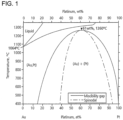
- Fig. 1 illustrates a Pt-Au system phase diagram.
- a Pt-Au alloy is also revealed from thermodynamic calculation, with respect to a region (chemical spinodal curve) indicating composition and temperature regions which allow for the occurrence of spinodal decomposition.
- composition optimization within a binary alloy has limitations to maximum exhibition of the hardening ability of a precious metal alloy by spinodal decomposition and a ternary or higher alloy is to be applied.
- the present inventors have then made intensive studies, and as a result, have found that an increase in hardness by spinodal decomposition can be achieved by not only optimization of the composition of a quaternary alloy of Pt, Au, Ni, and Pd, as a configuration of a precious metal alloy, but also an appropriate heat treatment.
- a Pt-Au-Ni-Pd quaternary alloy having the predetermined composition can express the ordering of constituent elements singly or together with spinodal decomposition.
- Such expression of the ordering results in generation of an ordered phase of a predetermined structure and accordingly the action of an increase in hardness.
- the present inventors have perceived that hardening with such an ordered phase can act on a Pt-Au-Ni-Pd alloy singly or compositely with hardening by spinodal decomposition.
- compositional parameter a parameter associated with interaction among such composition ranges.
- the present inventors have made optimization of an alloy composition range and two compositional parameters which allow for the occurrence of an increase in hardness by spinodal decomposition and ordering, and thus have conceived the present invention.
- the present invention is also drawn to a precious metal alloy including 10% by atom or more and 67.5% by atom or less of Pt, 5.85% by atom or more and 40% by atom or less of Au, 10% by atom or more and 60% by atom or less of Ni, and 0.2% by atom or more and 34% by atom or less of Pd, and fulfilling requirements with respect to the first and second compositional parameters.
- the present invention is further drawn to a precious metal alloy including 17.5% by atom or more and 60.5% by atom or less of Pt, 6.25% by atom or more and 30% by atom or less of Au, 15% by atom or more and 57.5% by atom or less of Ni, and 0.75% by atom or more and 24.5% by atom or less of Pd, and fulfilling requirements with respect to the first and second compositional parameters.
- Each of the Pt-Au-Ni-Pd alloys having the above three composition ranges includes a modulated texture by spinodal decomposition, and/or an ordered phase.
- a present inventive method for producing the precious metal alloy is a method for producing the precious metal alloy, including a step of providing a precious metal alloy including 7.5% by atom or more and 72.5% by atom or less of Pt, 5.5% by atom or more and 62.5% by atom or less of Au, 3% by atom or more and 62.5% by atom or less of Ni, and 0.15% by atom or more and 38% by atom or less of Pd, a solution treatment step of heating the precious metal alloy at a temperature of 850°C or more and 1350°C or less and then quenching the precious metal alloy, and an aging treatment step of heating the precious metal alloy after the solution treatment, at a temperature of 300°C or more and 700°C or less.
- Another present inventive method for producing the precious metal alloy is a method for producing the precious metal alloy, including a step of providing a precious metal alloy including 7.5% by atom or more and 72.5% by atom or less of Pt, 5.5% by atom or more and 62.5% by atom or less of Au, 3% by atom or more and 62.5% by atom or less of Ni, and 0.15% by atom or more and 38% by atom or less of Pd, and a heat treatment step of heating the precious metal alloy at a temperature of 850°C or more and 1350°C or less and then cooling the precious metal alloy, wherein the cooling in the heat treatment step is a treatment involving quenching in a temperature region of not more than a melting point and 600°C or more and cooling at a cooling rate of 2.5°C/s or less in a temperature region of less than 600°C.
- the present invention is drawn to a precious metal alloy where material strengthening is made with a modulated texture by spinodal decomposition and an ordered phase, instead of solid solution strengthening, precipitation strengthening, or work hardening which has been widely used as a material-strengthening method.
- a high-hardness precious metal alloy with unprecedented strengthening ability can be obtained without any work hardening (dislocation strengthening) which may cause material embrittlement.
- the precious metal alloy of the present invention is a Pt-Au-Ni-Pd quaternary alloy, and a hardening factor of the precious metal alloy includes at least any of a modulated texture by spinodal decomposition and an ordered phase by ordering.
- the following description also provides the description of each strengthening mechanism in the present invention, and the descriptions of constituent metals of the precious metal alloy of the present invention and their composition ranges and also two compositional parameters, as well as material texture features and the hardness of the precious metal alloy of the present invention.
- the method for producing the precious metal alloy of the present invention heat treatment step is also described.
- a texture formed by spinodal decomposition is referred to as so-called modulated texture.
- the modulated texture is periodically varied in concentration, and circumferentially forms an internal stress field and thus contributes to an increase in hardness.
- the resistance force (critical shear stress) of dislocation motion in such a periodic internal stress field is expressed by the following expression, and the lattice strain ( ⁇ ), the elastic coefficient (Y), and the modulation amplitude in concentration (A) are considered to be control factors (examples of specific reference documents include Masaharu KATO, Introduction to the Theory of Dislocations (issued on August, 1999, publication: Shokado).).
- ⁇ YA ⁇ 6
- the mixing enthalpy is positive in combinations of Au-Pt, Au-Ni, and Pt-Pd. It is understood from binary phase diagrams of Au-Pt-based and Au-Ni-based alloys that these alloys are characterized by providing a single phase at a high temperature, but being very high in value itself of mixing enthalpy. Expression of spinodal decomposition and remarkable hardening with the modulated texture in the precious metal alloy of the present invention can be presumed in consideration of Expression 3 with reference to the lattice constant in Table 1 and the mixing enthalpy in Table 2, based on each binary phase diagram between the constituent metals. This point is described below in more detail.
- An ordered phase generated by ordering contributes to an increase in hardness of the alloy due to each factor: (i) the Burgers vector of dislocation increases, (ii) an antiphase boundary can occur in the ordered phase, and (iii) the change in volume due to ordering results in distortion of the lattices in the interior of the ordered phase and the exterior of the ordered phase and acts on suppression of dislocation motion.
- the precious metal alloy of the present invention includes both metals constituting a Pt-Ni-based alloy known as a combination of metals which generate ordering.
- the ordering in the Pt-Ni-based alloy is expressed by a solution treatment and an aging treatment, and is known to be achieved by an aging treatment in an order-disorder transformation region or air cooling or the like started from a single phase region to result in hardening.
- the ordering in the Pt-Ni-based alloy can provide hardening with an ordered phase of an L1 0 -type structure or an L1 2 -type structure.
- the precious metal alloy of the present invention can achieve increased hardness with an ordered phase generated by ordering as in the above Pt-Ni-based alloy.
- the configuration of the ordered phase in the present invention is not necessarily completely clear, the configuration is considered to correspond to a phase having a crystal structure which is the same as or similar to the ordered phase generated in the above Pt-Ni-based alloy.
- such a phase is a phase including at least Pt and Ni and having a fcc structure and/or a fct structure.
- the ordered phase in the present invention is presumed to be preferably a phase of an L1 0 -type structure or an L1 2 -type structure, or a crystal structure similar thereto.
- the precious metal alloy of the present invention is a Pt-Au-Ni-Pd quaternary alloy.
- Pt-Au-Ni-Pd quaternary alloy With respect to a binary phase diagram constituted with metal elements among Au, Ni, Pd, and Pt, Au-Ni-based, Au-Pt-based, and Pt-Pd-based alloys are two-phase separation type alloys. It can be seen from Table 2 above that there are many combinations of elements, in which the mixing enthalpy between metal elements among Au, Ni, Pd, and Pt is positive. It is thus considered that the Pt-Au-Ni-Pd-based alloy is highly liable to have a high mixing enthalpy and exhibit phase separation in a low temperature region.
- the Pt-Au-Ni-Pd quaternary alloy highly possibly expresses spinodal decomposition and the concentration amplitude (A) due to such expression is also large.
- Pt and Ni are relatively high in Young's modulus and thus are considered to be also high in elastic coefficient (Y).
- Ni is large in difference in lattice constant from those of Au, Pt, and Pd and thus is considered to be also high in lattice strain ( ⁇ ).
- the constituent metals of the precious metal alloy of the present invention are considered to correspond to a suitable combination for achieving expression of spinodal decomposition and an increase in hardness due to spinodal decomposition.
- the action of each metal constituting the present invention is described.
- Pt is an essential element for spinodal decomposition in the alloy system of the present invention.
- Spinodal decomposition is not expressed at a too high or too low Pt concentration, and the concentration range of Pt, necessary for expression, is present.
- Pt can be taken with Ni to form an ordered phase, contributing to an increase in hardness.
- the Young's modulus of Pt is as relatively high as 169.9 GPa.
- Pt can be expected as a metal which allows for an increase in amount of hardening of the alloy in expression of spinodal decomposition.
- Au is also an essential element for expression of spinodal decomposition in the alloy system of the present invention.
- Spinodal decomposition is not expressed at a too high or too low Au concentration, and the concentration range of Au, necessary for expression, is present. If the Au concentration is out of an optimal range, usual nucleation/growth easily occurs and no suitable increase in hardness can be obtained.
- Ni acts as a strengthening factor in expression of spinodal decomposition, in the precious metal alloy of the present invention.
- Ni is higher in Young's modulus than Au, Pt, and Pd.
- Ni is large in difference in lattice constant from each metal of Au, Pt, and Pd, and increases the lattice strain ⁇ . Accordingly, Ni acts to increase strengthening ability due to spinodal decomposition, as can be seen from Expression 3.
- Ni and Pt are metals forming an ordered phase, and also act to contribute to an increase in hardness by ordering.
- Ni is a congener with and is similar in electron structure to Pt and Pd, and thus can constitute an alloy without any losses in corrosion resistance and oxidation resistance of a precious metal as much as possible. Thus, Ni also has a secondary effect of reducing the price of the entire precious metal alloy.
- Pd acts to not only extend the solid solubility limit of each element constituting the precious metal alloy of the present invention and expand the concentration region which allows for expression of spinodal decomposition in the precious metal alloy of the present invention, but also promote spinodal decomposition, and has an effect of enhancing the amount of hardening due to spinodal decomposition.
- Pd is excessively added, the spinodal decomposition temperature is excessively reduced and thus spinodal decomposition is liable to be inhibited on the contrary.
- excess addition of Pd is also liable to suppress ordering, leading to a reduction in amount of hardening of the alloy system as a whole.
- Pd also has an optimal concentration range as described above in order to optimize the amount of hardening of the precious metal alloy.
- the Pd concentration is controlled by a compositional parameter associated with the Au concentration.
- composition range of each metal element of Pt, Au, Ni, and Pd in the precious metal alloy of the present invention is defined so that the above-described actions are exerted.
- the composition range is as follows: Pt: 7.5% by atom or more and 72.5% by atom or less, Au: 5.5% by atom or more and 62.5% by atom or less, Ni: 3% by atom or more and 62.5% by atom or less, and Pd: 0.15% by atom or more and 38% by atom or less.
- concentration range defined for expression of spinodal decomposition and ordering effective for an increase in hardness of the precious metal alloy.
- composition range is sometimes referred to as "composition range A1".
- the precious metal alloy of the present invention While the detail of the method for producing the precious metal alloy of the present invention is described below, spinodal decomposition is expressed in a solution treatment for quenching a solid solution alloy having the composition and an aging treatment step, and high hardness can be obtained.
- the precious metal alloy of the present invention while exhibits a region allowing for a whole solid solution widely extending in a high temperature region, has a miscibility gap in a low temperature region. Therefore, it is considered that the precious metal alloy of the present invention, having the above composition range, can be subjected to a solution treatment in a high temperature region and then quenched to form a supersaturated solid solution and be subjected to a subsequent aging treatment to generate spinodal decomposition.
- thermodynamic behaviors transformation point, phase equilibrium, solid solubility limit, melting point, and the like
- thermodynamic behaviors transformation point, phase equilibrium, solid solubility limit, melting point, and the like
- thermodynamic behaviors transformation point, phase equilibrium, solid solubility limit, melting point, and the like
- thermodynamic behaviors transformation point, phase equilibrium, solid solubility limit, melting point, and the like
- thermodynamic behaviors transformation point, phase equilibrium, solid solubility limit, melting point, and the like
- the precious metal alloy of the present invention it is necessary for the precious metal alloy of the present invention to not only have the above composition range of each constituent metal element, but also satisfy z1 and z2 as first and second compositional parameters associated with correlation of the concentration of each metal element.
- Such two compositional parameters are defined as follows, when the respective concentrations (% by atom) of Pt, Au, and Ni in the precious metal alloy are designated as C Pt , C Au , C Ni , and C Pd .
- the first compositional parameter z1 is defined by the following expression with the concentrations (C Pt , C Au , C Ni ) of Pt, Au, and Ni.
- z 1 C P t ⁇ C A u ⁇ C N i / 1 0 0 0 0 0 0
- the value of the first parameter z1 is needed to be 0.5 or more and 2.88 or less. If the value of z1 is less than 0.5, spinodal strengthening ability is low and no sufficient hardness is obtained even by the aging treatment. On the other hand, if the value of z1 is more than 2.88, the solid solubility limit of each element is low and two-phase separation is much more liable to occur. Therefore, no sufficient supersaturated solid solution is obtained even by the solution treatment and the hardness after the aging treatment is insufficient.
- the value of the first compositional parameter z1 is more preferably 1.0 or more and 2.7 or less, further preferably 1.1 or more and 2.6 or less.
- the second compositional parameter z2 is defined by the following expression with the concentration (C Au ) of Au in the precious metal alloy.
- z 2 a ⁇ C A u 3 + b ⁇ C A u 2 + c ⁇ C A u + d
- the second compositional parameter z2 defines the upper limit of the Pd concentration in the precious metal alloy (the Pd concentration defined with the compositional parameter z2 is sometimes referred to as "critical Pd concentration").
- the Pd concentration in the precious metal alloy of the present invention is needed to be z2 or less. If the Pd concentration is more than z2, spinodal decomposition and/or ordering of the precious metal alloy are/is suppressed and hardening as a whole is insufficient.
- the second compositional parameter z2 is a compositional parameter thus provided.
- the second compositional parameter z2 is defined with coefficients a, b, c, and d in the above expression.
- composition of the precious metal alloy of the present invention is needed to satisfy the above composition range of each metal element and fulfill both requirements defined based on the two compositional parameters z1 and z2.
- the present invention is here drawn to a precious metal alloy including Pt, Au, Ni, and Pd in the above ranges, preferably a precious metal alloy including Pt, Au, Ni, and Pd in the above ranges and an inevitable component.
- the inevitable component is an unavoidable component included in impurities in a raw material or included due to a production step or the like.
- Specific examples of the inevitable component include Ag, Rh, Ir, Ru, Al, Mg, Ca, Fe, Mn, Sc, Y, Zr, Zn, Re, Mo, Cr, Nb, Ta, V, Hf, Ti, W, Co, Si, Sn, Cu, Th, B, C, N, S, P, O, H, and rare-earth elements.
- Such inevitable impurities are incorporated from a raw material, and an apparatus and the like in melting and casting.
- the content of such inevitable impurities is preferably within a range not inhibiting characteristics of the precious metal alloy of the present invention, the content per element is preferably 0.1% by atom or less, and the total is preferably 0.5% by atom or less, particularly preferably 0.1% by atom or less.
- the inevitable component when the inevitable component is included in the precious metal alloy, it is difficult to clearly distinguish whether the inevitable component is a component inevitably included or a component willingly added. In the present invention, as long as the component does not modify characteristics of the precious metal alloy, the component is considered to be an inevitable component without any distinction of the object of such incorporation.
- the precious metal alloy of the present invention achieves an increase in hardness by spinodal decomposition and/or ordering.
- the material texture includes a fine modulated texture by spinodal decomposition, and/or an ordered phase.
- the modulated texture is a material texture varied in composition with a modulation cycle at a nanometer level.
- Such material textures can be confirmed with X-ray diffraction (XRD), a transmission electron microscope (TEM), an electron beam diffraction pattern with TEM, or a scanning transmission electron microscope (STEM).
- a broad peak referred to as so-called side band peak is observed in at least one side portion (preferably both side portions) of a main peak in an X-ray diffraction pattern with X-ray diffraction (XRD) or an electron beam diffraction pattern with TEM. Whether or not a texture by spinodal decomposition is presented can be determined with the presence or absence of the side band peak.
- a crystal structure of a matrix of the precious metal alloy of the present invention is a face-centered cubic lattice (fcc), and Miller indices ⁇ 111 ⁇ plane, ⁇ 200 ⁇ plane, ⁇ 220 ⁇ plane, ⁇ 311 ⁇ plane, and the like appear as main peaks.
- a side band peak assigned to a texture by spinodal decomposition appears at both sides or one side of at least any of the main peaks.
- the reason why such a side band peak appears at only one side of such any main peak is considered because separation from the main peaks is difficult.
- An ordered phase with respect to an X-ray diffraction pattern or an electron beam diffraction pattern is confirmed by observation of an ordered reflection peak.
- the modulated texture of the precious metal alloy constituted from Pt, Au, Ni, and Pd, of the present invention is liable to be configured from two regions of a region where the Au concentration and the Pd concentration are relatively high (the Pt concentration and the Ni concentration are relatively low) and a region where the Au concentration and the Pd concentration are relatively low (the Pt concentration and the Ni concentration are relatively high).
- the ordered phase generated in the precious metal alloy of the present invention includes at least any of an ordered phase of an L1 0 -type structure or an L1 2 -type structure, and is particularly liable to include an ordered phase of an L1 2 -type structure.
- the precious metal alloy of the present invention not only has the above composition range, but also satisfies the two compositional parameters z1 and z2, and thus achieves hardening by spinodal decomposition and/or ordering.
- the precious metal alloy of the present invention exhibits a hardness of 500 Hv or more in terms of Vickers hardness.
- the precious metal alloy of the present invention can be the above hardness precious metal alloy only by the heat treatment without use of any work hardening at all, namely, without the occurrence of material embrittlement due to dislocation strain.
- the value of the hardness of the precious metal alloy of the present invention can be adjusted with the composition range.
- the precious metal alloy exhibits a Vickers hardness of 500 Hv or more in a range corresponding to the composition region A1.
- a Vickers hardness of 550 Hv or more is exhibited in composition ranges of Pt: 10% by atom or more and 67.5% by atom or less, Au: 5.85% by atom or more and 40% by atom or less, Ni: 10% by atom or more and 60% by atom or less, and Pd: 0.2% by atom or more and 34% by atom or less (hereinafter, sometimes referred to as "composition range A2”), belonging to the above corresponding composition range.
- composition range A3 a Vickers hardness of 620 Hv or more is exhibited in composition ranges of Pt: 17.5% by atom or more and 60.5% by atom or less, Au: 6.25% by atom or more and 30% by atom or less, Ni: 15% by atom or more and 57.5% by atom or less, Pd: 0.75% by atom or more and 24.5% by atom or less (hereinafter, sometimes referred to as "composition range A3").
- composition range A3 The above requirements with the two compositional parameters z1 and z2 are here also applied to the above composition ranges A2 and A3.
- the values of a, b, c, and d, which are preferable or more preferable with respect to z2, can also be again applied to the composition ranges A2 and A3.
- the upper limit of the hardness of the precious metal alloy of the present invention is not to be particularly limited, and the upper limit value is preferably 800 Hv or less. If the value is more than 800 Hv, fracture and/or chipping in the course of use may occur.
- the Vickers hardness described above is a value at room temperature.
- the Vickers hardness can be measured with a known Vickers hardness meter.
- the measurement load is preferably 0.05 kgf or more and 0.5 kgf or less, more preferably 0.2 kgf.
- a present inventive method for producing the precious metal alloy is described.
- a high-hardness precious metal alloy is provided by spinodal decomposition and/or ordering due to selection of constituent metals (Pt, Au, Ni, Pd) and optimization of the composition ranges of such metals.
- the precious metal alloy is produced with limitation on not only the composition ranges of the constituent metals, but also an optimal heat treatment step of the precious metal alloy.
- the optimal heat treatment step is a heat treatment step with combination of a solution treatment and an aging treatment, and this step is performed to result in progression of spinodal decomposition and/or ordering and then an increase in hardness.
- the method for producing the precious metal alloy of the present invention is a method for achieving material hardening by a heat treatment without any work hardening.
- the method for producing the precious metal alloy of the present invention is described, with each heat treatment step being mentioned.
- the temperature for example, each heating temperature of various heat treatments described below, is the temperature of the precious metal alloy to be treated, unless particularly clearly noted.
- the precious metal alloy of the present invention is not necessarily produced by only the optimal heat treatment step.
- the precious metal alloy of the present invention can be obtained after termination of a solution treatment with progression of spinodal decomposition and/or ordering in the course of the solution treatment depending on cooling conditions in the course of cooling in the solution treatment. In other words, the precious metal alloy of the present invention can be produced even if the aging treatment of the above conditions is omitted.
- This production method is deemed to be a suitable production method, and this production method is described after the description of the optimal heat treatment step.
- a precious metal alloy before the hardening serving as a precursor of the precious metal alloy of the present invention.
- the alloy serving as the precursor can be produced by a usual melting and casting method. Respective raw materials of metals of Pt, Au, Ni, and Pd described above are appropriately weighed or the like to allow for adjustment to the above composition, and molten/cast, and thus an alloy ingot is produced.
- An alloy (mother alloy) such as an Au-Pd alloy or a Pt-Ni alloy may be here appropriately combined and molten.
- the melting and casting of such a precious metal alloy can be performed with a known procedure such as arc melting, high-frequency melting, vacuum melting, or continuous casting.
- Such a precious metal alloy may also be provided by any method other than melting and casting, such as a powder metallurgy method.
- a precious metal alloy powder for example, precious metal alloy powder produced by atomizing
- a precious metal alloy powder which is adjusted so as to have the composition can be sintered, thereby providing an alloy ingot to be subjected to a heat treatment.
- such a precious metal alloy powder which is adjusted so as to have the composition may also be used to produce an ingot having a near net shape by a known additive fabrication method.
- a precious metal alloy layer having the composition may also be formed on any mother material by a known alloy formation procedure such as sputtering or thermal spray.
- a supersaturated solid solution of such a precious metal alloy provided as above is formed by a solution treatment.
- the solution treatment is a step of heating such a precious metal alloy at a high temperature to provide a solid solution texture of a single phase or a single phase analog, and then quenching the texture to form a supersaturated solid solution.
- the heating temperature of the solution treatment is preferably a temperature of (Tm - 500°C) or more and Tm or less under the assumption that the melting point (solidus line) of such a precious metal alloy is Tm (°C).
- a temperature of less than (Tm - 500°C) leads to low solid solubility of each element and is insufficient for formation of the supersaturated solid solution, and a temperature of more than Tm is not preferable because material melting begins from the vicinity of a grain boundary.
- the holding time during heating is preferably in the range of 0.01 hours or more and 168 hours or less.
- a holding time of less than 0.01 hours is not preferable from the viewpoint of productivity because formation of the supersaturated solid solution is insufficient and even heating for 168 hours or more has no large effect on formation of the supersaturated solid solution.
- the melting point means a solidus temperature.
- cooling from the solution treatment temperature is needed to be rapidly made to such an extent that no grain-boundary reaction occurs in a high temperature region.
- quenching is needed.
- the cooling rate is here preferably 10°C/s or more, more preferably 50°C/s or more.
- the cooling rate is preferably low from the viewpoints of quench crack, change in dimension, deformation, and the like. Therefore, the above cooling rate, called quenching, is not needed in a low temperature region where no grain-boundary reaction occurs and no spinodal decomposition and/or no ordering excessively proceed(s), from the viewpoint of an enhancement in hardness of the precious metal alloy.
- the heating temperature of conditions of the aging treatment of the supersaturated solid solution is a temperature of 300°C or more and 700°C or less. A temperature of less than 300°C makes progression of transformation difficult. A temperature of more than 700°C remarkably causes material softening due to grain-boundary reaction.
- the heating temperature is more preferably 350°C or more and 650°C or less.
- the heating time in the aging treatment is preferably 0.01 hours or more and 168 hours or less. A time of less than 0.01 hours causes insufficient transformation and leads to the variation in hardness, resulting in poor productivity and an increase in production cost in a treatment at 168 hours or more.
- the cooling method after termination of the aging treatment is not particularly limited.
- a working/heat treatment may also be, of necessary, performed before and/or after the precious metal alloy provision and the heat treatment step.
- Examples of such any working/heat treatment step include hot working such as hot forging and hot rolling, and a homogenization treatment.
- the hot working can achieve breaking of a solidified texture in a precious metal alloy ingot provided, and disappearance of defects such as voids.
- the homogenization treatment is a heat treatment involving heating a precious metal alloy at a high temperature of not more than a melting point for a long time.
- the homogenization treatment can also achieve formation of a metal texture where an element concentration distribution of a precious metal alloy provided is uniform.
- Such working/heat treatment does not act to have any effect on progression of spinodal decomposition and ordering. Therefore, such a working/heat treatment step is an optional step.
- the precious metal alloy of the present invention is not necessarily produced by a method with only a combination of the solution treatment and the aging treatment.
- the precious metal alloy of the present invention can be produced by adjustment of cooling conditions in the solution treatment, without any implementation of the aging treatment under the above conditions.
- a suitable method for producing the precious metal alloy of the present invention, with only the solution treatment, is here described.
- the subsequent cooling treatment includes quenching in a temperature region of not more than a melting point and 600°C or more and cooling at a cooling rate of 2.5°C/s or less in a temperature region of less than 600°C.
- quenching is performed in a high temperature region of not more than a melting point and 600°C or more, which easily leads to the occurrence of grain-boundary reaction, and cooling is performed at a low cooling rate of 2.5°C/s or less in a middle temperature region of less than 600°C, which leads to progression of spinodal decomposition and/or ordering.
- Such quenching in a high temperature region in the cooling treatment has the same meaning as quenching in the above solution treatment, and the cooling rate is preferably 10°C/s or more, more preferably 50°C/s or more.
- the cooling rate in a temperature region of less than 600°C is 2.5°C/s or less, preferably 1°C/s or less. It is preferable to perform cooling to room temperature with isothermal holding or adjustment of the cooling rate in a temperature region of less than 600°C. The residence time in a temperature region of less than 600°C is thus increased, thereby allowing for progression of spinodal decomposition and/or ordering and production of the precious metal alloy of the present invention.
- the method for producing the precious metal alloy, including the cooling treatment, although has a difficulty in monitoring the cooling rate, has an effect comparable with that of the above production method with the solution treatment and the aging treatment which are combined.
- the production method can allow the aging treatment step to be omitted.
- the production method also has the advantages of allowing for suppression or decrease of quench crack, the change in dimension, and deformation which can occur in the case of excess quenching performed in the solution treatment.
- hot working, a homogenization treatment, and/or the like may be optionally performed before and/or after the precious metal alloy provision and the solution treatment step also in a suitable production method described above with no aging treatment.
- test piece produced was subjected to a solution treatment and an aging treatment.
- solution treatment the test piece was heated at a temperature of 1100°C to 1250°C, and then cooled to room temperature with water.
- the test piece after the solution treatment was heated and held at 300 to 650°C for 1 hour. Thereafter, such a specimen piece after the aging treatment was embedded in a resin for the purpose of removal of an oxidized layer and residual stress due to thermal strain, and subjected to rough polishing (#500, #800, #1200) and mirror polishing in diamond suspensions of 1 ⁇ m and 1/4 ⁇ m. As described above, samples of various compositions were produced.
- a Au-Pt alloy as a precious metal alloy capable of expressing spinodal decomposition and a Pt-Ni alloy as a precious metal alloy capable of expressing ordered hardening were produced as Reference Examples, and samples were produced with the solution treatment and the aging treatment in the same manner as in the above embodiments (Reference Examples 1 to 6).
- Hardness measurement was performed about the samples of the precious metal alloys produced as described above. Hardness measurement was performed at a test load of 0.2 kgf and at room temperature with a measurement apparatus (HM-210 manufactured by Mitutoyo Corporation). The measurement results are shown in Table 1. Hardness measurement was performed randomly at 15 points with respect to each of the samples, and the average value was defined as the hardness value. The measurement positions in each of the samples were determined by selection of a plurality of crystal grains, and measurement was performed around the most center of each of the crystal grains in a non-grain boundary portion of each of the crystal grains. The measurement results of the samples, classified to each of composition regions A1, A2, and A3 with respect to the results, are shown in Tables 3 to 5.
- Comparative Examples 9 and 10 corresponded to precious metal alloys which respectively, while satisfied requirements of the composition ranges, had a first compositional parameter z1 of less than 5.0 (Comparative Example 9) and a first compositional parameter z1 of more than 2.88 (Comparative Example 10).
- Comparative Examples 11 and 12 corresponded to precious metal alloys which respectively, while met requirements of the composition ranges, had Pd concentrations more than the critical Pd concentration calculated as the second compositional parameter z2.
- Such a precious metal alloy was insufficient in spinodal decomposition and increase in hardness by ordering, could not be sufficiently hardened even by the heat treatment, and exhibited a hardness of less than 500 Hv. It was confirmed from comparison between Examples and Comparative Examples that not only optimization of the concentration range of each constituent metal, but also fulfillment of requirements with the first and second compositional parameters were necessary for allowing a quaternary alloy including Pt, Au, Ni, and Pd to achieve a suitable increase in hardness.
- the Pt-Ni alloy was presumed to be liable to easily generate ordering due to an equimolar composition of the Pt concentration and the Ni concentration.
- the precious metal alloy of Reference Example 5 also exhibited favorable hardness and also an ordered phase was found to serve as a useful strengthening mechanism.
- the precious metal alloy of the present invention has been then confirmed to be able to exhibit hardness more than those of Reference Examples, by use of at least any of spinodal decomposition and ordering.
- the precious metal alloys of the present embodiments, produced as above, were subjected to XRD analysis in order to perform (a) confirmation of spinodal decomposition and (b) confirmation of generation of an ordered phase.
- Analysis conditions such as a sample size in each study item in XRD were as follows.
- the heat treatment step solution treatment and aging treatment
- resin embedding-polishing after the heat treatment were performed by the same methods as described above.
- This XRD analysis was set so that the precious metal alloy (solid solution material) after the solution treatment and the precious metal alloy (aging material) after the aging treatment were analyzed and expression of spinodal decomposition and ordering with the aging treatment could be confirmed with the analysis results being compared.
- Evaluation was performed as follows: a case where one or more side band peaks appeared was regarded as the occurrence of spinodal decomposition, a case where no side band peaks appeared at all was regarded as no occurrence of spinodal decomposition, and a case where a side band peak was overlapped with the main peak and no determination was made was regarded as non-identifiable.
- the above XRD analysis was performed with respect to the precious metal alloys of Examples 10, 16, 20, 34,36, 38, 39, 44, 52, 67, 68, 71, 72, 73, and 75, and Comparative Examples 4, 11, and 13.
- the presence or absence of a side band peak and an ordered peak was confirmed with respect to each of the precious metal alloys.
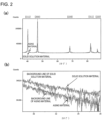
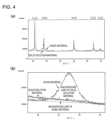
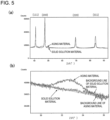
- the evaluation results are shown in Table 7. Fig. 2 , Fig. 3 , Fig. 4 , and Fig.
- Example 5 respectively illustrate the results of XRD of the precious metal alloys of Example 20 (Pt67.5-Au10-Ni17.5-Pd5), Example 36 (Pt35-Au10-Ni35-Pd20), Example 71 (Pt42.5-Au10-Ni42.5-Pd5), and Example 75 (Pt37.5-Au10-Ni37.5-Pd15).
- Fig. 6 and Fig. 7 respectively illustrate the results of XRD of the precious metal alloys of Comparative Example 13 (Pt22.5-Au10-Ni22.5-Pd45) and Comparative Example 11 (Pt30-Au10-Ni30-Pd30).
- the drawings each illustrates an XRD diffraction profile for confirmation of spinodal decomposition in (a) and an XRD diffraction profile for confirmation of an ordered phase in (b).
- Alloy composition (at%) Compositional parameters Hardness (Hv) XRD Pt Au Ni Pd z1 z2 Side band peak Ordered peak
- Example 10 15 50 15 20 1.13 23.32 512.1 ⁇ ⁇
- Example 16 57.5 20 7.5 15 0.86 39.22 541.4 ⁇ -
- Example 20 67.5 10 17.5 5 1.18 28.36 555.0 ⁇ -
- Example 34 17.5 15 57.5 10 1.51 35.48 583.4 ⁇ ⁇
- Example 36 35 10 35 20 1.23 28.36 584.2 ⁇ ⁇
- Example 38 12.5 20 52.5 15 1.31 39.22 599.2 ⁇ -
- Example 39 52.5 10 32.5 5 1.71 28.36 599.8 ⁇ ⁇
- Example 44 32.5 10 52.5 5 1.71 28.36
- Example 36 Pt35-Au10-Ni35-Pd20
- Example 71 Pt42.5-Au10-Ni42.5-Pd5
- Example 75 Pt37.5-Au10-Ni37.5-Pd15
- a peak viewable as a side band peak could be confirmed at both sides or one side of a peak corresponding to other crystal plane.
- Fig. 5 illustrates the results of XRD of the precious metal alloy (Pt22.5-Au10-Ni22.5-Pd45) of Comparative Example 13.
- a side band peak was not observed at both sides of a diffraction peak and a side band peak was not observed also at one side in an XRD profile of the aging material of the precious metal alloy of Comparative Example 13.
- a peak having a higher intensity than that of the background in a region of 2 ⁇ around 30° to 35° was also not observed.
- the precious metal alloy of Example 10 where a side band peak was not clearly observed, but an ordered peak was observed, also exhibited a hardness of more than 500 Hv. It was confirmed from these results that a precious metal alloy was increased in hardness by expression of at least any of spinodal decomposition and ordering. Comparative Example 4 and Comparative Example 13, not falling within the composition range defined in the present invention and not allowing for expression of both spinodal decomposition and ordering, each provided a clearly lower hardness than that in each of Examples.
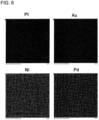
- Fig. 8 illustrates the results (Pt, Au, Pd: L-line, Ni: K-line) of mapping measurement of each constituent element (Pt, Au, Ni, and Pd) of the precious metal alloy of Example 75, with STEM-EDS. It was found from Fig. 8 that the material texture of such a precious metal alloy of the present embodiments had a modulated texture of two regions of a region where the Au concentration and the Pd concentration were relatively high and a region where the Au concentration and the Pd concentration were relatively low, and these regions were alternately connected. The modulated texture has no clear interface, and thus was presumed to be due to spinodal decomposition.
- Fig. 9 illustrates an electron beam diffraction pattern of the precious metal alloy of Example 75, obtained with TEM analysis ( ⁇ 001>crystal zone axis incident conditions). It was confirmed from Fig. 9 that not only basic reflection with a fcc structure, but also a diffraction spot due to an ordered phase was observed in such a precious metal alloy of the present embodiments.
- the diffraction spot due to an ordered phase is considered to be due to an L1 2 structure in consideration of the position of appearance, the intensity, and the place spacing. Accordingly, the precious metal alloy of the present invention is considered to be capable of generating an ordered phase of an L1 2 structure due to ordering with application of an aging treatment.
- the present invention is drawn to a precious metal alloy which can exhibit an increase in hardness due to spinodal decomposition and/or ordering and which has novel configuration/composition ranges.
- a high-hardness alloy material can be obtained without any work hardening (dislocation strengthening). Therefore, an increase in hardness can be achieved without any concern about embrittlement along with work hardening.
- the precious metal alloy of the present invention is expected to be applied to various uses where high hardness/high wear resistance is required, for example, electric/electronic materials such as probe pins and electric contacts, medical tools, and coating members by sputtering/thermal spraying/plating or the like.
Landscapes
- Chemical & Material Sciences (AREA)
- Engineering & Computer Science (AREA)
- Materials Engineering (AREA)
- Mechanical Engineering (AREA)
- Metallurgy (AREA)
- Organic Chemistry (AREA)
- Physics & Mathematics (AREA)
- Thermal Sciences (AREA)
- Crystallography & Structural Chemistry (AREA)
- Adornments (AREA)
- Dental Preparations (AREA)
- Contacts (AREA)
Abstract


a = 0. 00077, b = - 0. 102,
c = 3. 60"l, d = 1. 722
Description
- The present invention relates to a high-hardness precious metal alloy where Pt, Au, and Pd as precious metals are essential constituent metals, particularly to a Pt-Au-Ni-Pd quaternary alloy which achieves increased hardness comparable with or more than conventional one, by spinodal decomposition and/or ordering.
- Precious metals such as Pt (platinum) and Au (gold) are metals not only excellent in chemical stability/corrosion resistance, but also favorable in electric characteristics such as conductivity. Therefore, precious metals and alloys thereof are utilized in various fields, for example, in the electric/electronic field and in the medical field. Examples of use of precious metal alloys in the electric/electronic field include probe pins incorporated in probe cards for inspection of semiconductor devices or the like, and electric contacts (sliding contacts/switching contacts) such as brushes for motors, relays, and switches. Use in the medical field has recently attracted attentions, and precious metal alloys are used as constituent materials of various medical instruments. Examples of such medical instruments include various types of medical instruments, such as embolization coils and embolization clips, guide wires, stents, and catheters. Such medical instruments are tools to be directly contacted with the human body and embedded in the human body and thus are required to have biocompatibility and chemical stability. Such medical instruments are also required to have X-ray visibility in consideration of use in surgery/diagnosis with X-ray. Precious metal alloys are also favorable in such biocompatibility and X-ray visibility.
- Precious metal alloys, if subjected to various applications described above, are required to be enhanced in mechanical properties such as hardness and strength. For example, probe pins are to be repeatedly contacted with mating materials for a long period, and thus are required to have wear resistance. In particular, higher-hardness probe pins are needed to be developed in order to address recent high integration of various devices and recent high performance of motors. Medical tools, which are tools to be travelled in pulsing/beating vessels and then embedded, such as guide wires and embolization coils, are required to have mechanical properties such as hardness and spring properties so that operations of such tools are made without any failures.
- Precious metal alloys are also metals, and thus common strengthening mechanisms for metal materials can be applied for an enhancement in hardness of such alloys. In other words, conventional precious metal alloys have been tried to be enhanced in hardness by application of any combination of strengthening mechanisms including work hardening (dislocation strengthening), solid solution strengthening, and precipitation hardening (dispersion strengthening). Examples of an enhancement in hardness of the above precious metal alloys as probe pins or contact materials include an increase in hardness by not only solid solution strengthening for alloying of Pt with Ni or the like, but also work hardening for an increase in final rate of working, as in a Pt-Ni alloy described in Patent Document 1. In Patent Document 2 (Ag-Pd-Cu-based alloy) and Patent Document 3 (Pt-Cr-Ni-based alloy), a high-hardness precious metal alloy is obtained with not only solid solution strengthening and precipitation hardening with additive elements, but also work hardening where the rate of working is adjusted.
-
- Patent Document 1:
Japanese Patent Application Laid-Open No. 2005-233967 - Patent Document 2:
Japanese Patent Application Laid-Open No. 2012- 242184 - Patent Document 3:
Japanese Patent No. 6372952 - As described above, precious metal alloys are required to be enhanced in mechanical properties such as hardness in various applications. In order to respond to such requirements, it is also deemed that there is a need for further strengthening with various strengthening mechanisms described above. However, solid solution strengthening and precipitation strengthening, while are tried to achieve selection of an additive element and optimization of the amount of such an additive element, and also optimization of a production process such as a heat treatment, have limitations to the amount of hardening with these trials. For example, the amount of hardening by precipitation hardening of the precious metal alloys of Patent Documents 2 and 3 is about 150 Hv, and no sufficient hardness is achieved with only precipitation hardening. These precious metal alloys actually make up hardness with not only precipitation hardening, but also work hardening.
- If work hardening is excessively applied, there is a problem to be concerned. Work hardening, while provides a large amount of hardening and is deemed to be a useful strengthening method, sometimes causes embrittlement of a material. Such material embrittlement can be a factor of disconnection during wire drawing, or of breakage or fracture in secondary working (pressing, coiling, bending, or the like) or in actual use. Electric materials such as probe pins and medical tools such as guide wires and embolization coils are produced by working of thin wires, and thus it is necessary to ensure workability in thin-wire working. Therefore, there are also naturally limitations to the amount of hardening by work hardening, in consideration of the problems of material embrittlement and workability.
- The present invention has been made in view of the above circumstances, and provides a precious metal alloy increased in hardness by application of a strengthening mechanism different from a method which has been routinely used. In view of such an object, the present invention provides a material-strengthening method which does not depend on work hardening and which is based on a process involving mainly a heat treatment.
- In order to solve the above problems, the present inventors have focused on spinodal decomposition as a strengthening method different from any strengthening mechanism noted above. Spinodal decomposition corresponds to one mode of phase separation in a material texture, and is a phenomenon where decomposition progresses due to a continuous increase in variation in concentration without a nucleation/growth process to be applied to precipitation hardening. A material texture generated by spinodal decomposition due to the variation in concentration exhibits a very fine periodic structure of several nanometers to several tens of nanometers, called modulated texture. A modulated texture generated by spinodal decomposition is periodically varied in concentration of a solute atom in a crystal, as a function of location, and is also periodically changed in lattice constant. Thus, a periodic internal stress field is generated on a sliding surface, and the field interacts with dislocation.
- While such a strengthening mechanism by spinodal decomposition is deemed to be similar to precipitation strengthening due to nucleation/growth, both are different in that the change in lattice constant, imparted with not a precipitate but the modulation in concentration, contributes a hindrance to dislocation movement. Such strengthening by spinodal decomposition provides a high amount of hardening due to a fine modulated texture as described above, and thus is deemed to be useful as a procedure for enhancing hardness without causing any material embrittlement as in work hardening.
- Herein, a phenomenon called spinodal decomposition and a fine texture formed with this phenomenon are known, and a strengthening mechanism with this phenomenon is also clarified to some extent. A Pt-Au alloy is then known as an alloy generating spinodal decomposition, among precious metal alloys.
Fig. 1 illustrates a Pt-Au system phase diagram. A Pt-Au alloy is also revealed from thermodynamic calculation, with respect to a region (chemical spinodal curve) indicating composition and temperature regions which allow for the occurrence of spinodal decomposition. - Even if a Pt-Au alloy is hardened by spinodal decomposition, the amount of hardening is at most about 160 Hv and the resulting hardness is at most about 500 Hv. While spinodal decomposition is known about its phenomenon and mechanism, there are a few application examples, in particular, application examples to precious metal alloys. The present inventors have determined that there is a room of improvement in strengthening by spinodal decomposition, as a method for hardening/strengthening a precious metal alloy, and have decided to make further considerations. As a result, the present inventors have considered that composition optimization within a binary alloy has limitations to maximum exhibition of the hardening ability of a precious metal alloy by spinodal decomposition and a ternary or higher alloy is to be applied. The present inventors have then made intensive studies, and as a result, have found that an increase in hardness by spinodal decomposition can be achieved by not only optimization of the composition of a quaternary alloy of Pt, Au, Ni, and Pd, as a configuration of a precious metal alloy, but also an appropriate heat treatment.
- The present inventors have also found in the course of the foregoing studies that a Pt-Au-Ni-Pd quaternary alloy having the predetermined composition can express the ordering of constituent elements singly or together with spinodal decomposition. Such expression of the ordering results in generation of an ordered phase of a predetermined structure and accordingly the action of an increase in hardness. The present inventors have perceived that hardening with such an ordered phase can act on a Pt-Au-Ni-Pd alloy singly or compositely with hardening by spinodal decomposition.
- If a Pt-Au-Ni-Pd alloy is a precious metal alloy hardenable by spinodal decomposition and ordering, there should be, of course, a composition range where such ordering is expressed. The present inventors have made further studies, namely, have searched the constitution range of an alloy to be increased in hardness by spinodal decomposition or the like, and as a result, have found that definition of such a range requires not only specification of the composition range of each metal element (Pt, Au, Ni, Pd), but also introduction of a parameter (hereinafter, this parameter is referred to as "compositional parameter") associated with interaction among such composition ranges. The present inventors have made optimization of an alloy composition range and two compositional parameters which allow for the occurrence of an increase in hardness by spinodal decomposition and ordering, and thus have conceived the present invention.
- In other words, the present invention is drawn to a precious metal alloy including 7.5% by atom or more and 72.5% by atom or less of Pt, 5.5% by atom or more and 62.5% by atom or less of Au, 3% by atom or more and 62.5% by atom or less of Ni, and 0.15% by atom or more and 38% by atom or less of Pd, wherein, when respective concentrations (% by atom) of Pt, Au, Ni, and Pd are designated as CPt, CAu, CNi, and CPd, a value of a first compositional parameter z1 represented by the following expression is 0.5 or more and 2.88 or less, and furthermore the concentration CPd of Pd satisfies CPd ≤ z2 with respect to a second compositional parameter z2 represented by the following expression:


- a = 0. 00077, b = - 0. 102,
- c = 3. 607, d = 1. 722
- The present invention is also drawn to a precious metal alloy including 10% by atom or more and 67.5% by atom or less of Pt, 5.85% by atom or more and 40% by atom or less of Au, 10% by atom or more and 60% by atom or less of Ni, and 0.2% by atom or more and 34% by atom or less of Pd, and fulfilling requirements with respect to the first and second compositional parameters.
- The present invention is further drawn to a precious metal alloy including 17.5% by atom or more and 60.5% by atom or less of Pt, 6.25% by atom or more and 30% by atom or less of Au, 15% by atom or more and 57.5% by atom or less of Ni, and 0.75% by atom or more and 24.5% by atom or less of Pd, and fulfilling requirements with respect to the first and second compositional parameters.
- Each of the Pt-Au-Ni-Pd alloys having the above three composition ranges includes a modulated texture by spinodal decomposition, and/or an ordered phase.
- The present application provides a method for producing the above precious metal alloy. In other words, a present inventive method for producing the precious metal alloy is a method for producing the precious metal alloy, including a step of providing a precious metal alloy including 7.5% by atom or more and 72.5% by atom or less of Pt, 5.5% by atom or more and 62.5% by atom or less of Au, 3% by atom or more and 62.5% by atom or less of Ni, and 0.15% by atom or more and 38% by atom or less of Pd, a solution treatment step of heating the precious metal alloy at a temperature of 850°C or more and 1350°C or less and then quenching the precious metal alloy, and an aging treatment step of heating the precious metal alloy after the solution treatment, at a temperature of 300°C or more and 700°C or less.
- Another present inventive method for producing the precious metal alloy is a method for producing the precious metal alloy, including a step of providing a precious metal alloy including 7.5% by atom or more and 72.5% by atom or less of Pt, 5.5% by atom or more and 62.5% by atom or less of Au, 3% by atom or more and 62.5% by atom or less of Ni, and 0.15% by atom or more and 38% by atom or less of Pd, and a heat treatment step of heating the precious metal alloy at a temperature of 850°C or more and 1350°C or less and then cooling the precious metal alloy, wherein the cooling in the heat treatment step is a treatment involving quenching in a temperature region of not more than a melting point and 600°C or more and cooling at a cooling rate of 2.5°C/s or less in a temperature region of less than 600°C.
- As described above, the present invention is drawn to a precious metal alloy where material strengthening is made with a modulated texture by spinodal decomposition and an ordered phase, instead of solid solution strengthening, precipitation strengthening, or work hardening which has been widely used as a material-strengthening method. According to the present invention, a high-hardness precious metal alloy with unprecedented strengthening ability can be obtained without any work hardening (dislocation strengthening) which may cause material embrittlement.
-
-
Fig. 1 is a diagram illustrating a Pt-Au system phase diagram and a spinodal curve of a Pt-Au alloy; -
Fig. 2 is a diagram illustrating the results of XRD of a solid solution material and an aging material in Example 20 (Pt67.5-Au10-Ni17.5-Pd5); -
Fig. 3 is a diagram illustrating the results of XRD of a solid solution material and an aging material in Example 36 (Pt35-Au10-Ni35-Pd20); -
Fig. 4 is a diagram illustrating the results of XRD of a solid solution material and an aging material in Example 71 (Pt42.5-Au10-Ni42.5-Pd5); -
Fig. 5 is a diagram illustrating the results of XRD of a solid solution material and an aging material in Example 75 (Pt37.5-Au10-Ni37.5-Pd15); -
Fig. 6 is a diagram illustrating the results of XRD of a solid solution material and an aging material in Comparative Example 13 (Pt22.5-Au10-Ni22.5-Pd45); -
Fig. 7 is a diagram illustrating the results of XRD of a solid solution material and an aging material in Comparative Example 11 (Pt30-Au10-Ni30-Pd30); -
Fig. 8 is a STEM-EDS mapping image illustrating a modulated texture in Example 75 (Pt37.5-Au10-Ni37.5-Pd15); and -
Fig. 9 is an electron beam diffraction image illustrating an ordered phase (L12 structure) in Example 75 (Pt37.5-Au10-Ni37.5-Pd15). - Hereinafter, embodiments of the present invention are described. As described above, the precious metal alloy of the present invention is a Pt-Au-Ni-Pd quaternary alloy, and a hardening factor of the precious metal alloy includes at least any of a modulated texture by spinodal decomposition and an ordered phase by ordering. The following description also provides the description of each strengthening mechanism in the present invention, and the descriptions of constituent metals of the precious metal alloy of the present invention and their composition ranges and also two compositional parameters, as well as material texture features and the hardness of the precious metal alloy of the present invention. The method for producing the precious metal alloy of the present invention (heat treatment step) is also described.
- As described above, a texture formed by spinodal decomposition is referred to as so-called modulated texture. The modulated texture is periodically varied in concentration, and circumferentially forms an internal stress field and thus contributes to an increase in hardness. The resistance force (critical shear stress) of dislocation motion in such a periodic internal stress field is expressed by the following expression, and the lattice strain (ε), the elastic coefficient (Y), and the modulation amplitude in concentration (A) are considered to be control factors (examples of specific reference documents include Masaharu KATO, Introduction to the Theory of Dislocations (issued on August, 1999, publication: Shokado).).

- τ: Critical shear stress
- Y: Elastic coefficient
- A: Modulation amplitude in concentration
- ε: Lattice strain
- It is considered in studies based on Expression 3 described above that, roughly, the elastic coefficient is proportional to the Young's modulus of each constituent metal and the lattice strain ε is proportional to the difference in lattice constant between the constituent metals. It is also considered that the modulation amplitude in concentration A in Expression 3 indicates a larger value as the mixing enthalpy between metal elements is larger. Values in Table 1 below are known with respect to the lattice constants of Pt, Au, Ni, and Pd constituting the Pt-Au-Ni-Pd alloy of the present invention. Values in Table 2 below are known with respect to values of mixing enthalpy (Reference Document: Akira Takeuchi, Akihisa Inoue, "Classification of Bulk Metallic Glasses by Atomic Size Difference, Heat of Mixing and Period of Constituent Elements and Its Application to Characterization of the Main Alloying Element", Materials Transactions, vol 46 (2005), p 2817-2829.).
[Table 1] Au Pt Ni Pd Lattice constant (Å) 4.08 3.92 3.52 3.89 [Table 2] Au Pt Ni Pd Au - 4 7 0 Pt 4 - -5 2 Ni 7 -5 - 0 Pd 0 2 0 - (Unit: kJ/mol) - With reference to Table 2, the mixing enthalpy is positive in combinations of Au-Pt, Au-Ni, and Pt-Pd. It is understood from binary phase diagrams of Au-Pt-based and Au-Ni-based alloys that these alloys are characterized by providing a single phase at a high temperature, but being very high in value itself of mixing enthalpy. Expression of spinodal decomposition and remarkable hardening with the modulated texture in the precious metal alloy of the present invention can be presumed in consideration of Expression 3 with reference to the lattice constant in Table 1 and the mixing enthalpy in Table 2, based on each binary phase diagram between the constituent metals. This point is described below in more detail.
- An ordered phase generated by ordering contributes to an increase in hardness of the alloy due to each factor: (i) the Burgers vector of dislocation increases, (ii) an antiphase boundary can occur in the ordered phase, and (iii) the change in volume due to ordering results in distortion of the lattices in the interior of the ordered phase and the exterior of the ordered phase and acts on suppression of dislocation motion.
- The precious metal alloy of the present invention includes both metals constituting a Pt-Ni-based alloy known as a combination of metals which generate ordering. The ordering in the Pt-Ni-based alloy is expressed by a solution treatment and an aging treatment, and is known to be achieved by an aging treatment in an order-disorder transformation region or air cooling or the like started from a single phase region to result in hardening. The ordering in the Pt-Ni-based alloy can provide hardening with an ordered phase of an L10-type structure or an L12-type structure.
- The precious metal alloy of the present invention can achieve increased hardness with an ordered phase generated by ordering as in the above Pt-Ni-based alloy. Although the configuration of the ordered phase in the present invention is not necessarily completely clear, the configuration is considered to correspond to a phase having a crystal structure which is the same as or similar to the ordered phase generated in the above Pt-Ni-based alloy. In other words, such a phase is a phase including at least Pt and Ni and having a fcc structure and/or a fct structure. The ordered phase in the present invention is presumed to be preferably a phase of an L10-type structure or an L12-type structure, or a crystal structure similar thereto.
- The precious metal alloy of the present invention is a Pt-Au-Ni-Pd quaternary alloy. With respect to a binary phase diagram constituted with metal elements among Au, Ni, Pd, and Pt, Au-Ni-based, Au-Pt-based, and Pt-Pd-based alloys are two-phase separation type alloys. It can be seen from Table 2 above that there are many combinations of elements, in which the mixing enthalpy between metal elements among Au, Ni, Pd, and Pt is positive. It is thus considered that the Pt-Au-Ni-Pd-based alloy is highly liable to have a high mixing enthalpy and exhibit phase separation in a low temperature region. Therefore, it is considered that the Pt-Au-Ni-Pd quaternary alloy highly possibly expresses spinodal decomposition and the concentration amplitude (A) due to such expression is also large. Pt and Ni are relatively high in Young's modulus and thus are considered to be also high in elastic coefficient (Y). Furthermore, Ni is large in difference in lattice constant from those of Au, Pt, and Pd and thus is considered to be also high in lattice strain (ε). In consideration of these and Expression 3, the constituent metals of the precious metal alloy of the present invention are considered to correspond to a suitable combination for achieving expression of spinodal decomposition and an increase in hardness due to spinodal decomposition. Hereinafter, the action of each metal constituting the present invention is described.
- Pt is an essential element for spinodal decomposition in the alloy system of the present invention. Spinodal decomposition is not expressed at a too high or too low Pt concentration, and the concentration range of Pt, necessary for expression, is present. Pt can be taken with Ni to form an ordered phase, contributing to an increase in hardness. The Young's modulus of Pt is as relatively high as 169.9 GPa. As can be seen from Expression 3 described above, Pt can be expected as a metal which allows for an increase in amount of hardening of the alloy in expression of spinodal decomposition.
- Au is also an essential element for expression of spinodal decomposition in the alloy system of the present invention. Spinodal decomposition is not expressed at a too high or too low Au concentration, and the concentration range of Au, necessary for expression, is present. If the Au concentration is out of an optimal range, usual nucleation/growth easily occurs and no suitable increase in hardness can be obtained.
- Ni acts as a strengthening factor in expression of spinodal decomposition, in the precious metal alloy of the present invention. Ni is higher in Young's modulus than Au, Pt, and Pd. As can be seen with respect to Table 1 above, Ni is large in difference in lattice constant from each metal of Au, Pt, and Pd, and increases the lattice strain ε. Accordingly, Ni acts to increase strengthening ability due to spinodal decomposition, as can be seen from Expression 3. Furthermore, Ni and Pt are metals forming an ordered phase, and also act to contribute to an increase in hardness by ordering.
- Ni is a congener with and is similar in electron structure to Pt and Pd, and thus can constitute an alloy without any losses in corrosion resistance and oxidation resistance of a precious metal as much as possible. Thus, Ni also has a secondary effect of reducing the price of the entire precious metal alloy.
- Pd acts to not only extend the solid solubility limit of each element constituting the precious metal alloy of the present invention and expand the concentration region which allows for expression of spinodal decomposition in the precious metal alloy of the present invention, but also promote spinodal decomposition, and has an effect of enhancing the amount of hardening due to spinodal decomposition. Herein, if Pd is excessively added, the spinodal decomposition temperature is excessively reduced and thus spinodal decomposition is liable to be inhibited on the contrary. Furthermore, excess addition of Pd is also liable to suppress ordering, leading to a reduction in amount of hardening of the alloy system as a whole. Accordingly, Pd also has an optimal concentration range as described above in order to optimize the amount of hardening of the precious metal alloy. As described below, the Pd concentration is controlled by a compositional parameter associated with the Au concentration.
- The composition range of each metal element of Pt, Au, Ni, and Pd in the precious metal alloy of the present invention is defined so that the above-described actions are exerted. The composition range is as follows: Pt: 7.5% by atom or more and 72.5% by atom or less, Au: 5.5% by atom or more and 62.5% by atom or less, Ni: 3% by atom or more and 62.5% by atom or less, and Pd: 0.15% by atom or more and 38% by atom or less. This corresponds to a concentration range defined for expression of spinodal decomposition and ordering effective for an increase in hardness of the precious metal alloy. Hereinafter, the composition range is sometimes referred to as "composition range A1".
- While the detail of the method for producing the precious metal alloy of the present invention is described below, spinodal decomposition is expressed in a solution treatment for quenching a solid solution alloy having the composition and an aging treatment step, and high hardness can be obtained. The precious metal alloy of the present invention, while exhibits a region allowing for a whole solid solution widely extending in a high temperature region, has a miscibility gap in a low temperature region. Therefore, it is considered that the precious metal alloy of the present invention, having the above composition range, can be subjected to a solution treatment in a high temperature region and then quenched to form a supersaturated solid solution and be subjected to a subsequent aging treatment to generate spinodal decomposition. It is here also effective to utilize a CALPHAD method (Calculation of Phase Diagrams method) with respect to thermodynamic behaviors (transformation point, phase equilibrium, solid solubility limit, melting point, and the like) of the precious metal alloy of the present invention. Calculation by a CALPHAD method is preferably made by use of commercially available thermodynamic calculation software (for example, Thermo-Calc (ITOCHU Techno-Solutions Corporation)) and precious metal alloy database (for example, TCNOB1 (ITOCHU Techno-Solutions Corporation)).
- It is necessary for the precious metal alloy of the present invention to not only have the above composition range of each constituent metal element, but also satisfy z1 and z2 as first and second compositional parameters associated with correlation of the concentration of each metal element. Such two compositional parameters are defined as follows, when the respective concentrations (% by atom) of Pt, Au, and Ni in the precious metal alloy are designated as CPt, CAu, CNi, and CPd.
- The first compositional parameter z1 is defined by the following expression with the concentrations (CPt, CAu, CNi) of Pt, Au, and Ni.

- In the present invention, the value of the first parameter z1 is needed to be 0.5 or more and 2.88 or less. If the value of z1 is less than 0.5, spinodal strengthening ability is low and no sufficient hardness is obtained even by the aging treatment. On the other hand, if the value of z1 is more than 2.88, the solid solubility limit of each element is low and two-phase separation is much more liable to occur. Therefore, no sufficient supersaturated solid solution is obtained even by the solution treatment and the hardness after the aging treatment is insufficient. The value of the first compositional parameter z1 is more preferably 1.0 or more and 2.7 or less, further preferably 1.1 or more and 2.6 or less.
- The second compositional parameter z2 is defined by the following expression with the concentration (CAu) of Au in the precious metal alloy.

- The second compositional parameter z2 defines the upper limit of the Pd concentration in the precious metal alloy (the Pd concentration defined with the compositional parameter z2 is sometimes referred to as "critical Pd concentration"). The Pd concentration in the precious metal alloy of the present invention is needed to be z2 or less. If the Pd concentration is more than z2, spinodal decomposition and/or ordering of the precious metal alloy are/is suppressed and hardening as a whole is insufficient. The second compositional parameter z2 is a compositional parameter thus provided.
- The second compositional parameter z2 is defined with coefficients a, b, c, and d in the above expression. The coefficients a, b, c, and d are as follows: a = 0.00077, b = -0.102, c = 3.607, and d = 1.722. The parameter z2 determined from these coefficients is preferably a value calculated with a = 0.00143, b = -0.155, c = 4.739, and d = -10.201. A value calculated with a = 0.00310, b = -0.255, c = 6.047, and d = -18.974 is more preferably applied to the compositional parameter z2.
- The composition of the precious metal alloy of the present invention is needed to satisfy the above composition range of each metal element and fulfill both requirements defined based on the two compositional parameters z1 and z2.
- The present invention is here drawn to a precious metal alloy including Pt, Au, Ni, and Pd in the above ranges, preferably a precious metal alloy including Pt, Au, Ni, and Pd in the above ranges and an inevitable component. The inevitable component is an unavoidable component included in impurities in a raw material or included due to a production step or the like. Specific examples of the inevitable component include Ag, Rh, Ir, Ru, Al, Mg, Ca, Fe, Mn, Sc, Y, Zr, Zn, Re, Mo, Cr, Nb, Ta, V, Hf, Ti, W, Co, Si, Sn, Cu, Th, B, C, N, S, P, O, H, and rare-earth elements. Such inevitable impurities are incorporated from a raw material, and an apparatus and the like in melting and casting. The content of such inevitable impurities is preferably within a range not inhibiting characteristics of the precious metal alloy of the present invention, the content per element is preferably 0.1% by atom or less, and the total is preferably 0.5% by atom or less, particularly preferably 0.1% by atom or less. Herein, when the inevitable component is included in the precious metal alloy, it is difficult to clearly distinguish whether the inevitable component is a component inevitably included or a component willingly added. In the present invention, as long as the component does not modify characteristics of the precious metal alloy, the component is considered to be an inevitable component without any distinction of the object of such incorporation.
- The precious metal alloy of the present invention achieves an increase in hardness by spinodal decomposition and/or ordering. The material texture includes a fine modulated texture by spinodal decomposition, and/or an ordered phase. The modulated texture is a material texture varied in composition with a modulation cycle at a nanometer level. Such material textures can be confirmed with X-ray diffraction (XRD), a transmission electron microscope (TEM), an electron beam diffraction pattern with TEM, or a scanning transmission electron microscope (STEM).
- A broad peak referred to as so-called side band peak (satellite peak) is observed in at least one side portion (preferably both side portions) of a main peak in an X-ray diffraction pattern with X-ray diffraction (XRD) or an electron beam diffraction pattern with TEM. Whether or not a texture by spinodal decomposition is presented can be determined with the presence or absence of the side band peak. A crystal structure of a matrix of the precious metal alloy of the present invention is a face-centered cubic lattice (fcc), and Miller indices {111} plane, {200} plane, {220} plane, {311} plane, and the like appear as main peaks. A side band peak assigned to a texture by spinodal decomposition appears at both sides or one side of at least any of the main peaks. Herein, the reason why such a side band peak appears at only one side of such any main peak is considered because separation from the main peaks is difficult.
- An ordered phase with respect to an X-ray diffraction pattern or an electron beam diffraction pattern is confirmed by observation of an ordered reflection peak. For example, an ordered reflection peak appears at 2θ = around 30° to 35° in the case of θ-2θ measurement with CuKα ray as an X-ray source, in observation of an ordered reflection peak in an X-ray diffraction pattern.
- Herein, the modulated texture of the precious metal alloy constituted from Pt, Au, Ni, and Pd, of the present invention, is liable to be configured from two regions of a region where the Au concentration and the Pd concentration are relatively high (the Pt concentration and the Ni concentration are relatively low) and a region where the Au concentration and the Pd concentration are relatively low (the Pt concentration and the Ni concentration are relatively high). The ordered phase generated in the precious metal alloy of the present invention includes at least any of an ordered phase of an L10-type structure or an L12-type structure, and is particularly liable to include an ordered phase of an L12-type structure.
- The precious metal alloy of the present invention not only has the above composition range, but also satisfies the two compositional parameters z1 and z2, and thus achieves hardening by spinodal decomposition and/or ordering. The precious metal alloy of the present invention exhibits a hardness of 500 Hv or more in terms of Vickers hardness. The precious metal alloy of the present invention can be the above hardness precious metal alloy only by the heat treatment without use of any work hardening at all, namely, without the occurrence of material embrittlement due to dislocation strain.
- The value of the hardness of the precious metal alloy of the present invention can be adjusted with the composition range. The precious metal alloy exhibits a Vickers hardness of 500 Hv or more in a range corresponding to the composition region A1. A Vickers hardness of 550 Hv or more is exhibited in composition ranges of Pt: 10% by atom or more and 67.5% by atom or less, Au: 5.85% by atom or more and 40% by atom or less, Ni: 10% by atom or more and 60% by atom or less, and Pd: 0.2% by atom or more and 34% by atom or less (hereinafter, sometimes referred to as "composition range A2"), belonging to the above corresponding composition range. Furthermore, a Vickers hardness of 620 Hv or more is exhibited in composition ranges of Pt: 17.5% by atom or more and 60.5% by atom or less, Au: 6.25% by atom or more and 30% by atom or less, Ni: 15% by atom or more and 57.5% by atom or less, Pd: 0.75% by atom or more and 24.5% by atom or less (hereinafter, sometimes referred to as "composition range A3"). The above requirements with the two compositional parameters z1 and z2 are here also applied to the above composition ranges A2 and A3. The values of a, b, c, and d, which are preferable or more preferable with respect to z2, can also be again applied to the composition ranges A2 and A3.
- The upper limit of the hardness of the precious metal alloy of the present invention is not to be particularly limited, and the upper limit value is preferably 800 Hv or less. If the value is more than 800 Hv, fracture and/or chipping in the course of use may occur. The Vickers hardness described above is a value at room temperature. The Vickers hardness can be measured with a known Vickers hardness meter. The measurement load is preferably 0.05 kgf or more and 0.5 kgf or less, more preferably 0.2 kgf.
- Next, a present inventive method for producing the precious metal alloy is described. In the present invention, a high-hardness precious metal alloy is provided by spinodal decomposition and/or ordering due to selection of constituent metals (Pt, Au, Ni, Pd) and optimization of the composition ranges of such metals. The precious metal alloy is produced with limitation on not only the composition ranges of the constituent metals, but also an optimal heat treatment step of the precious metal alloy. The optimal heat treatment step is a heat treatment step with combination of a solution treatment and an aging treatment, and this step is performed to result in progression of spinodal decomposition and/or ordering and then an increase in hardness. The method for producing the precious metal alloy of the present invention is a method for achieving material hardening by a heat treatment without any work hardening. Hereinafter, the method for producing the precious metal alloy of the present invention is described, with each heat treatment step being mentioned. In the present invention, the temperature, for example, each heating temperature of various heat treatments described below, is the temperature of the precious metal alloy to be treated, unless particularly clearly noted.
- Herein, the precious metal alloy of the present invention is not necessarily produced by only the optimal heat treatment step. The precious metal alloy of the present invention can be obtained after termination of a solution treatment with progression of spinodal decomposition and/or ordering in the course of the solution treatment depending on cooling conditions in the course of cooling in the solution treatment. In other words, the precious metal alloy of the present invention can be produced even if the aging treatment of the above conditions is omitted. This production method is deemed to be a suitable production method, and this production method is described after the description of the optimal heat treatment step.
- First, a precious metal alloy before the hardening, serving as a precursor of the precious metal alloy of the present invention, is provided. The alloy serving as the precursor can be produced by a usual melting and casting method. Respective raw materials of metals of Pt, Au, Ni, and Pd described above are appropriately weighed or the like to allow for adjustment to the above composition, and molten/cast, and thus an alloy ingot is produced. An alloy (mother alloy) such as an Au-Pd alloy or a Pt-Ni alloy may be here appropriately combined and molten. The melting and casting of such a precious metal alloy can be performed with a known procedure such as arc melting, high-frequency melting, vacuum melting, or continuous casting.
- Such a precious metal alloy may also be provided by any method other than melting and casting, such as a powder metallurgy method. In the powder metallurgy method, a precious metal alloy powder (for example, precious metal alloy powder produced by atomizing) which is adjusted so as to have the composition can be sintered, thereby providing an alloy ingot to be subjected to a heat treatment. Alternatively, such a precious metal alloy powder which is adjusted so as to have the composition may also be used to produce an ingot having a near net shape by a known additive fabrication method. Furthermore, a precious metal alloy layer having the composition may also be formed on any mother material by a known alloy formation procedure such as sputtering or thermal spray.
- A supersaturated solid solution of such a precious metal alloy provided as above is formed by a solution treatment. The solution treatment is a step of heating such a precious metal alloy at a high temperature to provide a solid solution texture of a single phase or a single phase analog, and then quenching the texture to form a supersaturated solid solution. The heating temperature of the solution treatment is preferably a temperature of (Tm - 500°C) or more and Tm or less under the assumption that the melting point (solidus line) of such a precious metal alloy is Tm (°C). A temperature of less than (Tm - 500°C) leads to low solid solubility of each element and is insufficient for formation of the supersaturated solid solution, and a temperature of more than Tm is not preferable because material melting begins from the vicinity of a grain boundary. The holding time during heating is preferably in the range of 0.01 hours or more and 168 hours or less. A holding time of less than 0.01 hours is not preferable from the viewpoint of productivity because formation of the supersaturated solid solution is insufficient and even heating for 168 hours or more has no large effect on formation of the supersaturated solid solution. In the present invention, the melting point means a solidus temperature.
- In addition, cooling from the solution treatment temperature is needed to be rapidly made to such an extent that no grain-boundary reaction occurs in a high temperature region. In other words, quenching is needed. The cooling rate is here preferably 10°C/s or more, more preferably 50°C/s or more. In this regard, the cooling rate is preferably low from the viewpoints of quench crack, change in dimension, deformation, and the like. Therefore, the above cooling rate, called quenching, is not needed in a low temperature region where no grain-boundary reaction occurs and no spinodal decomposition and/or no ordering excessively proceed(s), from the viewpoint of an enhancement in hardness of the precious metal alloy. For example, no quenching is needed in the case of the cooling rate in a temperature region of 400°C or less. Therefore, the occurrence of quench crack and the like is suppressed or decreased, and thus, for example, air cooling may also be adopted in a temperature region of 300°C or less after quenching to 300°C. The end point of cooling in the solution treatment is here preferably room temperature.
- Spinodal decomposition and ordering in the precious metal alloy of the present invention progress by an aging treatment of the supersaturated solid solution formed above, in a lower temperature region than the spinodal decomposition temperature and the order-disorder transformation temperature.
- The heating temperature of conditions of the aging treatment of the supersaturated solid solution is a temperature of 300°C or more and 700°C or less. A temperature of less than 300°C makes progression of transformation difficult. A temperature of more than 700°C remarkably causes material softening due to grain-boundary reaction. The heating temperature is more preferably 350°C or more and 650°C or less. The heating time in the aging treatment is preferably 0.01 hours or more and 168 hours or less. A time of less than 0.01 hours causes insufficient transformation and leads to the variation in hardness, resulting in poor productivity and an increase in production cost in a treatment at 168 hours or more. The cooling method after termination of the aging treatment is not particularly limited.
- The solution treatment and aging treatment in the optimal heat treatment step described above can be carried out to provide the high-hardness precious metal alloy of the present invention. Herein, a working/heat treatment may also be, of necessary, performed before and/or after the precious metal alloy provision and the heat treatment step. Examples of such any working/heat treatment step include hot working such as hot forging and hot rolling, and a homogenization treatment. The hot working can achieve breaking of a solidified texture in a precious metal alloy ingot provided, and disappearance of defects such as voids. The homogenization treatment is a heat treatment involving heating a precious metal alloy at a high temperature of not more than a melting point for a long time. The homogenization treatment can also achieve formation of a metal texture where an element concentration distribution of a precious metal alloy provided is uniform. Such working/heat treatment, of course, does not act to have any effect on progression of spinodal decomposition and ordering. Therefore, such a working/heat treatment step is an optional step.
- As described above, the precious metal alloy of the present invention is not necessarily produced by a method with only a combination of the solution treatment and the aging treatment. The precious metal alloy of the present invention can be produced by adjustment of cooling conditions in the solution treatment, without any implementation of the aging treatment under the above conditions. A suitable method for producing the precious metal alloy of the present invention, with only the solution treatment, is here described.
- While such a suitable method for producing the precious metal alloy is the same as described above with respect to the precious metal alloy provision step and heating for the solution treatment, the subsequent cooling treatment includes quenching in a temperature region of not more than a melting point and 600°C or more and cooling at a cooling rate of 2.5°C/s or less in a temperature region of less than 600°C. In other words, quenching is performed in a high temperature region of not more than a melting point and 600°C or more, which easily leads to the occurrence of grain-boundary reaction, and cooling is performed at a low cooling rate of 2.5°C/s or less in a middle temperature region of less than 600°C, which leads to progression of spinodal decomposition and/or ordering. Such quenching in a high temperature region in the cooling treatment has the same meaning as quenching in the above solution treatment, and the cooling rate is preferably 10°C/s or more, more preferably 50°C/s or more. The cooling rate in a temperature region of less than 600°C is 2.5°C/s or less, preferably 1°C/s or less. It is preferable to perform cooling to room temperature with isothermal holding or adjustment of the cooling rate in a temperature region of less than 600°C. The residence time in a temperature region of less than 600°C is thus increased, thereby allowing for progression of spinodal decomposition and/or ordering and production of the precious metal alloy of the present invention.
- The method for producing the precious metal alloy, including the cooling treatment, although has a difficulty in monitoring the cooling rate, has an effect comparable with that of the above production method with the solution treatment and the aging treatment which are combined. The production method can allow the aging treatment step to be omitted. The production method also has the advantages of allowing for suppression or decrease of quench crack, the change in dimension, and deformation which can occur in the case of excess quenching performed in the solution treatment.
- It is noted that hot working, a homogenization treatment, and/or the like may be optionally performed before and/or after the precious metal alloy provision and the solution treatment step also in a suitable production method described above with no aging treatment.
- Hereinafter, Examples as specific embodiments of the present invention are described. In the present embodiments, a plurality of Pt-Au-Ni-Pd alloys was produced with the variation in composition of Pt, Au, Ni, and Pd, and the hardness was measured.
- High-purity bare metals of respective metals of Pt, Au, Ni, and Pd, as raw materials, were weighed and mixed so that a predetermined composition was achieved, and an alloy ingot was molten and cast in an inert gas by arc melting. A test piece (5 mm × 5 mm × 3 mm) was cut out from the alloy ingot.
- The test piece produced was subjected to a solution treatment and an aging treatment. In the solution treatment, the test piece was heated at a temperature of 1100°C to 1250°C, and then cooled to room temperature with water.
- In the aging treatment, the test piece after the solution treatment was heated and held at 300 to 650°C for 1 hour. Thereafter, such a specimen piece after the aging treatment was embedded in a resin for the purpose of removal of an oxidized layer and residual stress due to thermal strain, and subjected to rough polishing (#500, #800, #1200) and mirror polishing in diamond suspensions of 1 µm and 1/4 µm. As described above, samples of various compositions were produced.
- In the present embodiments, a Au-Pt alloy as a precious metal alloy capable of expressing spinodal decomposition and a Pt-Ni alloy as a precious metal alloy capable of expressing ordered hardening were produced as Reference Examples, and samples were produced with the solution treatment and the aging treatment in the same manner as in the above embodiments (Reference Examples 1 to 6).
- Hardness measurement was performed about the samples of the precious metal alloys produced as described above. Hardness measurement was performed at a test load of 0.2 kgf and at room temperature with a measurement apparatus (HM-210 manufactured by Mitutoyo Corporation). The measurement results are shown in Table 1. Hardness measurement was performed randomly at 15 points with respect to each of the samples, and the average value was defined as the hardness value. The measurement positions in each of the samples were determined by selection of a plurality of crystal grains, and measurement was performed around the most center of each of the crystal grains in a non-grain boundary portion of each of the crystal grains. The measurement results of the samples, classified to each of composition regions A1, A2, and A3 with respect to the results, are shown in Tables 3 to 5. The measurement results of the precious metal alloys of Comparative Examples and Reference Examples are shown in Table 6.
[Table 3] Alloy composition (at%) Compositional parameters Solution treatment conditions Aging temperature (°C) Hardness (Hv) Pt Au Ni Pd z1 z2 Temperature (°C) Time (hr) Example 1 67.5 15 7.5 10 0.76 35.48 1250 24 550 500.4 Example 2 70 10 15 5 1.05 28.36 1250 24 550 502.0 Example 3 22 20 22 36 0.97 39.22 1200 24 550 502.5 Example 4 12.5 60 12.5 15 0.94 17.26 1150 24 500 502.7 Example 5 31.5 10 31.5 27 0.99 28.36 1200 24 550 503.5 Example 6 60 20 5 15 0.60 39.22 1250 24 550 503.8 Example 7 22.5 10 52.5 15 1.18 28.36 1200 24 500 505.0 Example 8 44.5 5.75 44.5 5.25 1.14 19.24 1200 24 550 505.7 Example 9 15 15 60 10 1.35 35.48 1100 24 500 506.7 Example 10 15 50 15 20 1.13 23.32 1200 6.7 500 512.1 Example 11 10 20 55 15 1.10 39.22 1100 60 550 513.0 Example 12 50 7.8 42 0.2 1.64 24.02 1200 24 550 518.1 Example 13 27.5 40 7.5 25 0.83 32.08 1250 16 500 526.6 Example 14 57.5 10 17.5 15 1.01 28.36 1200 24 600 530.6 Example 15 30 30 30 10 2.70 38.92 1175 13.8 400 531.3 Example 16 57.5 20 7.5 15 0.86 39.22 1250 24 550 541.4 Example 17 38.75 7.5 38.75 15 1.13 23.36 1200 21 550 546.8 Example 18 17.5 40 17.5 25 1.23 32.08 1200 24.1 450 549.8 Example 19 27.5 15 27.5 30 1.13 35.48 1200 18.8 550 553.3 Example 20 67.5 10 17.5 5 1.18 28.36 1250 24 550 555.0 Example 21 20 30 20 30 1.20 38.92 1250 6 550 556.0 Example 22 45.87 8 45.88 0.25 1.68 24.44 1250 60.3 550 558.2 [Table 4] Alloy composition (at%) Compositional parameters Solution treatment conditions Aging temperature (°C) Hardness (Hv) Pt Au Ni Pd z1 z2 Temperature (°C) Time (hr) Example 23 44.5 6.1 44.5 4.9 1.21 20.10 1200 24 500 570.6 Example 24 17 15 58 10 1.48 35.48 1100 24 550 571.8 Example 25 20 37.5 20 22.5 1.50 34.15 1200 18 450 572.0 Example 26 34.5 10 34.5 21 1.19 28.36 1200 24 550 572.0 Example 27 65 10 20 5 1.30 28.36 1250 16 550 572.4 Example 28 62.5 15 12.5 10 1.17 35.48 1250 15 550 572.7 Example 29 22.5 23 22.5 32 1.16 40.09 1150 24 550 573.6 Example 30 11 20 54 15 1.19 39.22 1100 64.5 500 573.9 Example 31 36 20 36 8 2.59 39.22 1100 62 500 574.0 Example 32 44.38 6.24 44.38 5.00 1.23 20.47 1200 18 550 579.7 Example 33 62.5 10 22.5 5 1.41 28.36 1250 7.3 600 581.1 Example 34 17.5 15 57.5 10 1.51 35.48 1100 24 500 583.4 Example 35 25 20 25 30 1.25 39.22 1200 24 500 583.8 Example 36 35 10 35 20 1.23 28.36 1100 65.1 550 584.2 Example 37 41.18 6.86 41.18 10.78 1.16 21.91 1200 18 550 590.8 Example 38 12.5 20 52.5 15 1.31 39.22 1100 65.1 500 599.2 Example 39 52.5 10 32.5 5 1.71 28.36 1250 7.3 550 599.8 Example 40 45 7.5 45 2.5 1.52 23.36 1200 18.8 550 601.0 Example 41 47.5 10 27.5 15 1.31 28.36 1200 24 600 601.3 Example 42 23.53 23.53 29.41 23.53 1.63 40.15 1220 24 600 607.5 Example 43 26.67 20 26.67 26.67 1.42 39.22 1220 24 600 609.9 Example 44 32.5 10 52.5 5 1.71 28.36 1150 14 500 614.8 Example 45 29.41 23.53 23.53 23.53 1.63 40.15 1220 24 500 616.9 Example 46 52.5 20 12.5 15 1.31 39.22 1250 24 600 616.9 Example 47 45.375 9 45.375 0.25 1.85 26.48 1200 24 550 618.0 Example 48 26.67 26.66 26.67 20 1.90 39.98 1220 24 600 624.5 Example 49 27.5 10 47.5 15 1.31 28.36 1200 24 550 630.3 Example 50 41.25 7.5 41.25 10 1.28 23.36 1200 18.8 550 631.7 Example 51 45 9 45 1 1.82 26.48 1250 19.8 550 635.7 Example 52 57.5 15 17.5 10 1.51 35.48 1250 24 550 637.0 [Table 5] Alloy composition (at%) Compositional parameters Solution treatment conditions Aging temperatur e (°C) Hardnes s (Hv) Pt Au Ni Pd z1 z2 Temperature (°C) Time (hr) Example 53 27.78 27.78 27.78 16.67 2.14 39.72 1220 24 600 640.1 Example 54 30 23 30 17 2.07 40.09 1200 24 550 641.0 Example 55 47.5 20 17.5 15 1.66 39.22 1250 24 500 641.0 Example 56 58.5 14 22.5 5 1.84 34.34 1200 24 550 641.6 Example 57 35 20 35 10 2.45 39.22 1200 24 550 642.0 Example 58 20 15 55 10 1.65 35.48 1100 60 500 642.0 Example 59 46 6.75 43 4.25 1.34 21.66 1200 24 550 642.7 Example 60 46 10 43 1 1.98 28.36 1250 48 550 642.9 Example 61 43.75 7.5 43.75 5 1.44 23.36 1200 18.8 550 643.1 Example 62 32 17.5 27 23.5 1.51 37.73 1200 24 550 645.8 Example 63 42.5 20 22.5 15 1.91 39.22 1250 8.8 550 658.8 Example 64 22.5 20 42.5 15 1.91 39.22 1150 65.5 500 661.6 Example 65 44 10 44 2 1.94 28.36 1250 19.8 550 666.5 Example 66 35 20 30 15 2.10 39.22 1220 24 600 666.8 Example 67 37.5 15 37.5 10 2.11 35.48 1220 24 500 667.5 Example 68 30 20 35 15 2.10 39.22 1200 48 550 689.7 Example 69 32.5 20 32.5 15 2.11 39.22 1220 24 550 673.2 Example 70 36.25 15 36.25 12.5 1.97 35.48 1220 24 550 701.1 Example 71 42.5 10 42.5 5 1.81 28.36 1220 24 550 705.7 Example 72 27.5 15 47.5 10 1.96 35.48 1150 24 500 708.2 Example 73 47.5 15 27.5 10 1.96 35.48 1250 24 550 713.3 Example 74 41.25 12.5 41.25 5 2.13 32.38 1220 24 600 740.8 Example 75 37.5 10 37.5 15 1.41 28.36 1150 12 525 645.0 [Table 6] Alloy composition (at%) Compositional parameters Solution treatment conditions Aging temperatur e (°C) Hardnes s (Hv) Pt Au Ni Pd z1 z2 Temperature (°C) Time (hr) Comparativ e Example 1 45 5 45 5 1.01 17.30 1200 14.3 500 413.4 Comparativ e Example 2 11.25 65 11.25 12.5 0.82 16.69 1125 60.6 450 351.9 Comparativ e Example 3 80 15 2.5 2.5 0.30 35.48 1300 7.2 600 424.5 Comparativ e Example 4 10 15 65 10 0.98 35.48 1100 60.5 500 401.7 Comparativ e Example 5 46.75 6.4 46.75 0.1 1.40 20.83 1200 24 550 475.0 Comparativ e Example 6 18 24 18 40 0.78 40.18 1250 60.3 400 436.3 Comparativ e Example 7 5 20 58 17 0.58 39.22 1100 60.6 500 372.6 Comparativ e Example 8 75 10 10 5 0.75 28.36 1250 12.3 600 440.6 Comparativ e Example 9 53 12.5 7 27.5 0.46 32.38 1200 24 550 442.3 Comparativ e Example 10 31 31 31 7 2.98 38.46 1125 93 550 480.0 Comparativ e Example 11 30 10 30 30 0.90 28.36 1200 14.3 500 460.3 Comparativ e Example 12 11.25 60 11.25 17.5 0.76 17.26 1150 14.5 500 471.6 Comparativ e Example 13 22.5 10 22.5 45 0.51 28.36 1200 13.5 500 294.5 Reference Example 1 90 10 - - - - 1275 60.5 550 291.4 Reference Example 2 80 20 - - - - 1275 60.5 550 492.7 Reference Example 3 60 40 - - - - 1275 60.5 400 492.0 Reference Example 4 60 - 40 - - - 1300 4.6 450 342.8 Reference Example 5 50 - 50 - - - 1300 4.6 400 460.6 Reference Example 6 40 - 60 - - - 1300 4.6 400 292.6 - From Table 3 to Table 5, all the Pt-Au-Ni-Pd alloys as the precious metal alloys of Example 1 to Example 89, having the composition ranges in the present invention, each exhibited a Vickers hardness value of 500 Hv or more. Each of Examples 23 to 52 in Table 4 corresponded to an alloy satisfying the composition range A2, and provided a hardness of 550 Hv or more by the heat treatment. Furthermore, each of the precious metal alloys of Examples 53 to 74, having the composition range falling within the composition range A3, exhibited a particularly high hardness of 620 Hv or more by the heat treatment.
- In this regard, with reference to the results of Comparative Examples 1 to 8, and 13 in Table 6, a precious metal alloy which, even if was a quaternary alloy including Pt, Au, Ni, and Pd, fulfilled no requirement of any appropriate composition range, exhibited a hardness of less than 500 Hv even by the heat treatment performed. Comparative Examples 9 and 10 corresponded to precious metal alloys which respectively, while satisfied requirements of the composition ranges, had a first compositional parameter z1 of less than 5.0 (Comparative Example 9) and a first compositional parameter z1 of more than 2.88 (Comparative Example 10). Furthermore, Comparative Examples 11 and 12 corresponded to precious metal alloys which respectively, while met requirements of the composition ranges, had Pd concentrations more than the critical Pd concentration calculated as the second compositional parameter z2. Such a precious metal alloy was insufficient in spinodal decomposition and increase in hardness by ordering, could not be sufficiently hardened even by the heat treatment, and exhibited a hardness of less than 500 Hv. It was confirmed from comparison between Examples and Comparative Examples that not only optimization of the concentration range of each constituent metal, but also fulfillment of requirements with the first and second compositional parameters were necessary for allowing a quaternary alloy including Pt, Au, Ni, and Pd to achieve a suitable increase in hardness.
- Furthermore, when Au-Pt alloys (Reference Examples 1 to 3) capable of generating spinodal decomposition and Pt-Ni alloys (Reference Examples 4 to 6) capable of expressing ordered hardening, as in the present invention, were reviewed, there were alloys (Reference Examples 2 and 3) relatively high in hardness approaching 500 Hv, but a hardness of 500 Hv or more could not be exhibited. The alloys of Reference Examples 2 and 3 were considered to be increased in hardness due to spinodal decomposition, and usability of spinodal decomposition in a material-strengthening mechanism could be confirmed. The Pt-Ni alloy of Reference Example 5 was considered to lead to expression of hardening with an ordered phase. The Pt-Ni alloy was presumed to be liable to easily generate ordering due to an equimolar composition of the Pt concentration and the Ni concentration. The precious metal alloy of Reference Example 5 also exhibited favorable hardness and also an ordered phase was found to serve as a useful strengthening mechanism. The precious metal alloy of the present invention has been then confirmed to be able to exhibit hardness more than those of Reference Examples, by use of at least any of spinodal decomposition and ordering.
- The precious metal alloys of the present embodiments, produced as above, were subjected to XRD analysis in order to perform (a) confirmation of spinodal decomposition and (b) confirmation of generation of an ordered phase. Analysis conditions such as a sample size in each study item in XRD were as follows. Herein, the heat treatment step (solution treatment and aging treatment) and resin embedding-polishing after the heat treatment were performed by the same methods as described above. This XRD analysis was set so that the precious metal alloy (solid solution material) after the solution treatment and the precious metal alloy (aging material) after the aging treatment were analyzed and expression of spinodal decomposition and ordering with the aging treatment could be confirmed with the analysis results being compared.
-
- Sample size: ϕ22 mm × 2 mmt
- XRD apparatus: X'Pert PRO MPD manufactured by PANalytical B.V.
- Target: Cu anode
- Optical system-detector: focusing optical system-one-dimensional semiconductor detector (PIXcel 1D)
- Current-voltage: 45 kV-40 mA
-
- 2θ scanning range: 20° to 130°
- 2θ step size (I): 0.0013
- 2θ scanning rate (I/s): 0.1094
-
- 2θ scanning range: 20° to 38°
- 2θ step size (I): 0.0131
- 2θ scanning rate (I/s): 0.0223
- In the study of spinodal decomposition with XRD, determination was made about whether or not one or more side band peaks appeared on one side or both sides about both ends (about ± 0.5 to 3° in terms of 20) of a main peak observed with respect to each of Miller indices {111} plane, {200} plane, {220} plane, and {311} plane in an XRD diffraction profile obtained in the above conditions. Evaluation was performed as follows: a case where one or more side band peaks appeared was regarded as the occurrence of spinodal decomposition, a case where no side band peaks appeared at all was regarded as no occurrence of spinodal decomposition, and a case where a side band peak was overlapped with the main peak and no determination was made was regarded as non-identifiable.
- In the study of an ordered phase with XRD, first, expression of an ordered reflection peak and the intensity of an ordered peak were confirmed around 2θ = 30° to 35°, from the XRD diffraction profile in Reference Example 5 (Pt50-Ni50). With reference to this, the presence or absence of an ordered peak in the above angle range was confirmed with respect to an XRD diffraction profile of each of the samples. Whether or not the intensity of an ordered peak was higher than the background in the relevant region was confirmed. A case where the intensity of an ordered peak was higher than the background was evaluated as the presence of an ordered phase. On the other hand, a case where the peak intensity was equal to or lower than the background was evaluated as the absence of an ordered phase.
- In the present embodiments, the above XRD analysis was performed with respect to the precious metal alloys of Examples 10, 16, 20, 34,36, 38, 39, 44, 52, 67, 68, 71, 72, 73, and 75, and Comparative Examples 4, 11, and 13. The presence or absence of a side band peak and an ordered peak was confirmed with respect to each of the precious metal alloys. The evaluation results are shown in Table 7.
Fig. 2 ,Fig. 3 ,Fig. 4 , andFig. 5 respectively illustrate the results of XRD of the precious metal alloys of Example 20 (Pt67.5-Au10-Ni17.5-Pd5), Example 36 (Pt35-Au10-Ni35-Pd20), Example 71 (Pt42.5-Au10-Ni42.5-Pd5), and Example 75 (Pt37.5-Au10-Ni37.5-Pd15).Fig. 6 andFig. 7 respectively illustrate the results of XRD of the precious metal alloys of Comparative Example 13 (Pt22.5-Au10-Ni22.5-Pd45) and Comparative Example 11 (Pt30-Au10-Ni30-Pd30). The drawings each illustrates an XRD diffraction profile for confirmation of spinodal decomposition in (a) and an XRD diffraction profile for confirmation of an ordered phase in (b).[Table 7] Alloy composition (at%) Compositional parameters Hardness (Hv) XRD Pt Au Ni Pd z1 z2 Side band peak Ordered peak Example 10 15 50 15 20 1.13 23.32 512.1 Δ ○ Example 16 57.5 20 7.5 15 0.86 39.22 541.4 ○ - Example 20 67.5 10 17.5 5 1.18 28.36 555.0 ○ - Example 34 17.5 15 57.5 10 1.51 35.48 583.4 ○ ○ Example 36 35 10 35 20 1.23 28.36 584.2 ○ ○ Example 38 12.5 20 52.5 15 1.31 39.22 599.2 ○ - Example 39 52.5 10 32.5 5 1.71 28.36 599.8 ○ ○ Example 44 32.5 10 52.5 5 1.71 28.36 614.8 ○ ○ Example 52 57.5 15 17.5 10 1.51 35.48 637.0 ○ - Example 67 37.5 15 37.5 10 2.11 35.48 667.5 ○ ○ Example 68 30 20 35 15 2.10 39.22 689.7 ○ ○ Example 71 42.5 10 42.5 5 1.81 28.36 705.7 ○ ○ Example 72 27.5 15 47.5 10 1.96 35.48 708.2 ○ ○ Example 73 47.5 15 27.5 10 1.96 35.48 713.3 ○ ○ Example 75 37.5 10 37.5 15 1.41 28.36 645.0 ○ ○ Comparative Example 4 10 15 65 10 0.98 35.48 401.7 - - Comparative Example 11 30 10 30 30 0.90 28.36 460.3 ○ - Comparative Example 13 22.5 10 22.5 45 0.51 28.36 294.5 - - *1..Determination results of presence of peak
○: Present -: Absent
Δ: Non-identifiable - The contents analyzed, of the XRD analysis performed in the present embodiments, are described with reference to
Fig. 2 to Fig. 7 . With reference to the results of the precious metal alloy of Example 20 (Pt67.5-Au10-Ni17.5-Pd5) inFig. 2 , a peak identifiable as a side band peak could be confirmed at both ends of a peak at 2θ = around 40° to 41°, corresponding to the {111} plane, with respect to the precious metal alloy (Fig. 2(a) ). A peak viewable as a side band peak could be confirmed at one side of a peak corresponding to other crystal plane. On the other hand, with reference toFig. 2(b) , no peak (ordered peak) deemed to be higher than the background could be observed in a region of 2θ = around 30° to 35°. It was thus presumed that spinodal decomposition was expressed, but no ordering occurred in Example 20. - Next, the results with the precious metal alloys of Example 36 (Pt35-Au10-Ni35-Pd20) in
Fig. 3 , Example 71 (Pt42.5-Au10-Ni42.5-Pd5) inFig. 4 , and Example 75 (Pt37.5-Au10-Ni37.5-Pd15) inFig. 5 were reviewed. With reference toFig. 3(a) ,Fig. 4(a) , andFig. 5(a) , a distinct peak identifiable as a side band peak was confirmed at both sides of each of a peak at 2θ = around 40° to 41°, corresponding to the {111} plane, and a peak at 2θ = around 47° to 48°, corresponding to the {200} plane, with respect to the precious metal alloys. A peak viewable as a side band peak could be confirmed at both sides or one side of a peak corresponding to other crystal plane. With reference toFig. 3(b) ,Fig. 4(b) , andFig. 5(b) , a peak (ordered peak) clearly higher than the background was observed in a region of 2θ = around 30° to 35° with respect to each of the precious metal alloys. It was thus presumed that the precious metal alloys of Example 36, Example 71, and Example 75 expressed both spinodal decomposition and ordering. - On the contrary to these Examples, both a side band peak and an ordered peak were not observed with respect to the precious metal alloys of Comparative Example 4 and Comparative Example 13.
Fig. 5 illustrates the results of XRD of the precious metal alloy (Pt22.5-Au10-Ni22.5-Pd45) of Comparative Example 13. A side band peak was not observed at both sides of a diffraction peak and a side band peak was not observed also at one side in an XRD profile of the aging material of the precious metal alloy of Comparative Example 13. A peak having a higher intensity than that of the background in a region of 2θ = around 30° to 35° was also not observed. - In this regard, with reference to the XRD results of the precious metal alloy (Pt30-Au10-Ni30-Pd30) of Comparative Example 11, illustrated in
Fig. 6 , the presence of a weak peak scarcely identifiable as a side band peak was confirmed at both sides of a peak at 2θ = around 47° to 48°, corresponding to the {200} plane. With reference toFig. 5(b) , a peak having a higher intensity than that of the background was not observed in a region of 2θ = around 30° to 35°. It was thus presumed that the precious metal alloy of Comparative Example 11 slightly expressed spinodal decomposition, but expressed no ordering. - In the discussion of both the results of the hardness and XRD analysis of each of the precious metal alloys with reference to Table 7, it could be confirmed that a suitable increase in hardness occurred by optimization of the composition range and compositional parameters (z1, z2) and effective expression of spinodal decomposition and/or ordering in each of the precious metal alloys. The precious metal alloys of Examples 34, 36, 39, 44, 67, 68, 71, 72, 73, and 75 which generated both spinodal decomposition and ordering exhibited an increased hardness of more than 580 Hv, and some of the alloys exhibited a hardness of more than 700 Hv. The precious metal alloys of Examples 16, 20, 38, and 52 which generated only spinodal decomposition also exhibited favorable hardness. Furthermore, the precious metal alloy of Example 10, where a side band peak was not clearly observed, but an ordered peak was observed, also exhibited a hardness of more than 500 Hv. It was confirmed from these results that a precious metal alloy was increased in hardness by expression of at least any of spinodal decomposition and ordering. Comparative Example 4 and Comparative Example 13, not falling within the composition range defined in the present invention and not allowing for expression of both spinodal decomposition and ordering, each provided a clearly lower hardness than that in each of Examples. In the discussion of the results with the precious metal alloy of Comparative Example 11, it has also been confirmed that the precious metal alloy of the present invention is needed to be produced also in consideration of a range (compositional parameter z2) which allows for appropriate exertion of the effects of spinodal decomposition and ordering.
- Confirmation of a material texture of the precious metal alloy of Example 75 (Pt37.5-Au10-Ni37.5-Pd15) (expression of a modulated texture by spinodal decomposition and expression of an ordered phase by ordering) was performed. This study was performed with TEM/STEM analysis. The TEM/STEM analyzer used was an atom resolution electron microscope (JEM-ARM300F GRAND ARM manufactured by JEOL Ltd.) (acceleration voltage 300 kV). Herein, a specimen for TEM/STEM analysis was produced before TEM/STEM analysis, with focused ion beam (FIB) after the heat treatment step (solution treatment and aging treatment) and resin embedding-polishing after the heat treatment were performed in the same manner as described above.
-
Fig. 8 illustrates the results (Pt, Au, Pd: L-line, Ni: K-line) of mapping measurement of each constituent element (Pt, Au, Ni, and Pd) of the precious metal alloy of Example 75, with STEM-EDS. It was found fromFig. 8 that the material texture of such a precious metal alloy of the present embodiments had a modulated texture of two regions of a region where the Au concentration and the Pd concentration were relatively high and a region where the Au concentration and the Pd concentration were relatively low, and these regions were alternately connected. The modulated texture has no clear interface, and thus was presumed to be due to spinodal decomposition. -
Fig. 9 illustrates an electron beam diffraction pattern of the precious metal alloy of Example 75, obtained with TEM analysis (<001>crystal zone axis incident conditions). It was confirmed fromFig. 9 that not only basic reflection with a fcc structure, but also a diffraction spot due to an ordered phase was observed in such a precious metal alloy of the present embodiments. The diffraction spot due to an ordered phase is considered to be due to an L12 structure in consideration of the position of appearance, the intensity, and the place spacing. Accordingly, the precious metal alloy of the present invention is considered to be capable of generating an ordered phase of an L12 structure due to ordering with application of an aging treatment. - As described above, the present invention is drawn to a precious metal alloy which can exhibit an increase in hardness due to spinodal decomposition and/or ordering and which has novel configuration/composition ranges. According to the present invention, a high-hardness alloy material can be obtained without any work hardening (dislocation strengthening). Therefore, an increase in hardness can be achieved without any concern about embrittlement along with work hardening. The precious metal alloy of the present invention is expected to be applied to various uses where high hardness/high wear resistance is required, for example, electric/electronic materials such as probe pins and electric contacts, medical tools, and coating members by sputtering/thermal spraying/plating or the like.
Claims (7)
- A precious metal alloy comprising 7.5% by atom or more and 72.5% by atom or less of Pt, 5.5% by atom or more and 62.5% by atom or less of Au, 3% by atom or more and 62.5% by atom or less of Ni, and 0.15% by atom or more and 38% by atom or less of Pd, wherein,when respective concentrations (% by atom) of Pt, Au, Ni, and Pd are designated as CPt, CAu, CNi, and CPd, a value of a first compositional parameter z1 represented by the following expression is 0.5 or more and 2.88 or less, andfurthermore the concentration CPd of Pd satisfies CPd ≤ z2 with respect to a second compositional parameter z2 represented by the following expression:

 coefficients a, b, c, and d are the following numerical values.a = 0. 00077, b = - 0. 102,c = 3. 607, d = 1. 722
 - The precious metal alloy according to claim 1, comprising 10% by atom or more and 67.5% by atom or less of Pt, 5.85% by atom or more and 40% by atom or less of Au, 10% by atom or more and 60% by atom or less of Ni, and 0.2% by atom or more and 34% by atom or less of Pd.
- The precious metal alloy according to claim 1, comprising 17.5% by atom or more and 60.5% by atom or less of Pt, 6.25% by atom or more and 30% by atom or less of Au, 15% by atom or more and 57.5% by atom or less of Ni, and 0.75% by atom or more and 24.5% by atom or less of Pd.
- The precious metal alloy according to any one of claim 1 to claim 3, wherein a material texture comprises a modulated texture by spinodal decomposition.
- The precious metal alloy according to any one of claim 1 to claim 4, wherein a material texture comprises an ordered phase.
- A method for producing the precious metal alloy defined in any one of claim 1 to claim 5, comprising the steps of:providing a precious metal alloy comprising 7.5% by atom or more and 72.5% by atom or less of Pt, 5.5% by atom or more and 62.5% by atom or less of Au, 3% by atom or more and 62.5% by atom or less of Ni, and 0.15% by atom or more and 38% by atom or less of Pd;executing a solution treatment of heating the precious metal alloy at a temperature of 850°C or more and 1350°C or less and then quenching the precious metal alloy; andexecuting an aging treatment of heating the precious metal alloy after the solution treatment, at a temperature of 300°C or more and 700°C or less.
- A method for producing the precious metal alloy defined in any one of claim 1 to claim 5, comprising the steps of:providing a precious metal alloy comprising 7.5% by atom or more and 72.5% by atom or less of Pt, 5.5% by atom or more and 62.5% by atom or less of Au, 3% by atom or more and 62.5% by atom or less of Ni, and 0.15% by atom or more and 38% by atom or less of Pd; andexecuting a heat treatment of heating the precious metal alloy at a temperature of 850°C or more and 1350°C or less and then cooling the precious metal alloy, whereinthe cooling in the heat treatment step is a treatment involving quenching in a temperature region of not more than a melting point and 600°C or more and cooling at a cooling rate of 2.5°C/s or less in a temperature region of less than 600°C.
Applications Claiming Priority (2)
| Application Number | Priority Date | Filing Date | Title |
|---|---|---|---|
| JP2021169887 | 2021-10-15 | ||
| PCT/JP2022/037042 WO2023063156A1 (en) | 2021-10-15 | 2022-10-04 | High-hardness noble metal alloy and method for producing same |
Publications (2)
| Publication Number | Publication Date |
|---|---|
| EP4379078A1 true EP4379078A1 (en) | 2024-06-05 |
| EP4379078A4 EP4379078A4 (en) | 2025-04-30 |
Family
ID=85988567
Family Applications (1)
| Application Number | Title | Priority Date | Filing Date |
|---|---|---|---|
| EP22880852.3A Pending EP4379078A4 (en) | 2021-10-15 | 2022-10-04 | HIGH-HARDNESS NOBLE METAL ALLOY AND PROCESS FOR PRODUCING THE SAME |
Country Status (7)
| Country | Link |
|---|---|
| US (1) | US20250305094A1 (en) |
| EP (1) | EP4379078A4 (en) |
| JP (1) | JPWO2023063156A1 (en) |
| KR (1) | KR20240073963A (en) |
| CN (1) | CN118019867A (en) |
| TW (1) | TWI844981B (en) |
| WO (1) | WO2023063156A1 (en) |
Families Citing this family (3)
| Publication number | Priority date | Publication date | Assignee | Title |
|---|---|---|---|---|
| EP4696794A1 (en) * | 2023-04-14 | 2026-02-18 | Tanaka Precious Metal Technologies Co., Ltd. | High hardness au-ni-pd-pt-based noble metal alloy |
| TWI898709B (en) | 2023-07-11 | 2025-09-21 | 日商田中貴金屬工業股份有限公司 | High hardness au-ni-pd-pt-based precious metal alloy |
| CN117448620B (en) * | 2023-10-30 | 2026-03-13 | 中国科学院物理研究所 | Thermoelectric alloy thin film materials, their preparation methods and applications |
Family Cites Families (11)
| Publication number | Priority date | Publication date | Assignee | Title |
|---|---|---|---|---|
| JPS56156729A (en) * | 1980-05-02 | 1981-12-03 | Ishifuku Kinzoku Kogyo Kk | Platinum alloy for decoration |
| JPH0419862Y2 (en) | 1986-10-31 | 1992-05-07 | ||
| JPH04147932A (en) * | 1990-10-08 | 1992-05-21 | Citizen Watch Co Ltd | Pt alloy for outer ornament for wristwatch |
| JP2004093355A (en) * | 2002-08-30 | 2004-03-25 | Toshiba Corp | Pd alloy based probe pin and probe pin device using the same |
| JP4216823B2 (en) | 2005-03-04 | 2009-01-28 | 田中貴金属工業株式会社 | Probe pin and a blob card having the blob bin |
| US7959855B2 (en) * | 2006-10-19 | 2011-06-14 | Heru Budihartono | White precious metal alloy |
| JP4878401B1 (en) | 2011-05-17 | 2012-02-15 | 石福金属興業株式会社 | Probe pin material, probe pin and manufacturing method thereof |
| JP6372952B2 (en) | 2013-10-25 | 2018-08-15 | 石福金属興業株式会社 | Probe pin material composed of a Pt-based alloy and method for manufacturing the probe pin |
| US10858722B2 (en) * | 2018-09-21 | 2020-12-08 | Deringer-Ney, Inc. | Platinum-nickel-based alloys, products, and methods of making and using same |
| JP7394070B2 (en) * | 2018-11-30 | 2023-12-07 | 田中貴金属工業株式会社 | Conductive material with excellent wear resistance and heat resistance |
| CN111139372B (en) * | 2020-01-15 | 2020-12-11 | 贵研铂业股份有限公司 | A kind of palladium alloy containing precious and rare metals and its preparation method and use |
-
2022
- 2022-10-04 KR KR1020247014924A patent/KR20240073963A/en active Pending
- 2022-10-04 WO PCT/JP2022/037042 patent/WO2023063156A1/en not_active Ceased
- 2022-10-04 CN CN202280065902.6A patent/CN118019867A/en active Pending
- 2022-10-04 EP EP22880852.3A patent/EP4379078A4/en active Pending
- 2022-10-04 US US18/700,703 patent/US20250305094A1/en active Pending
- 2022-10-04 JP JP2023554419A patent/JPWO2023063156A1/ja active Pending
- 2022-10-07 TW TW111138185A patent/TWI844981B/en active
Also Published As
| Publication number | Publication date |
|---|---|
| US20250305094A1 (en) | 2025-10-02 |
| WO2023063156A1 (en) | 2023-04-20 |
| TWI844981B (en) | 2024-06-11 |
| CN118019867A (en) | 2024-05-10 |
| EP4379078A4 (en) | 2025-04-30 |
| TW202330949A (en) | 2023-08-01 |
| JPWO2023063156A1 (en) | 2023-04-20 |
| KR20240073963A (en) | 2024-05-27 |
Similar Documents
| Publication | Publication Date | Title |
|---|---|---|
| US20250305094A1 (en) | High-hardness precious metal alloy and method for producing the same | |
| EP2784167B1 (en) | Cu-Ti based copper alloy sheet, method for producing the same, and electric current carrying component | |
| EP2194149B1 (en) | Copper alloy plate and method for producing the same | |
| JP4189435B2 (en) | Cu-Ni-Si-based copper alloy sheet and method for producing the same | |
| JP4660735B2 (en) | Method for producing copper-based alloy sheet | |
| JP5479798B2 (en) | Copper alloy sheet, copper alloy sheet manufacturing method, and electric / electronic component | |
| EP2508631A1 (en) | Copper alloy sheet material, connector using same, and copper alloy sheet material production method for producing same | |
| CN108884529B (en) | Cr-based two-phase alloy and its products | |
| EP3438298A1 (en) | Copper alloy for electronic and electrical equipment, copper alloy plate strip for electronic and electrical equipment, component for electronic and electrical equipment, terminal, busbar, and movable piece for relays | |
| JPWO2009107586A1 (en) | High-strength, high-conductivity copper rod | |
| US4657601A (en) | Thermomechanical processing of beryllium-copper alloys | |
| JP5135496B2 (en) | Cu-Be based copper alloy sheet and method for producing the same | |
| JP6324431B2 (en) | Copper alloy sheet and method for producing copper alloy sheet | |
| JP5107093B2 (en) | Copper alloy with high strength and high conductivity | |
| JP2006265731A (en) | Copper alloy | |
| EP4696794A1 (en) | High hardness au-ni-pd-pt-based noble metal alloy | |
| CN119506649A (en) | Cu-Ti copper alloy plate material, method for producing the same, current-carrying component and heat-dissipating component | |
| KR101895558B1 (en) | Cu-Ti-based copper alloy sheet material and method of manufacturing same | |
| TWI898709B (en) | High hardness au-ni-pd-pt-based precious metal alloy | |
| KR101664819B1 (en) | Cu-Ti-based copper alloy sheet material and method of manufacturing same | |
| TWI918486B (en) | Probe pin material made of ag-pd-cu alloy, and probe pin | |
| KR100328891B1 (en) | Beryllium-copper alloy with excellent strength, processability and heat resistance | |
| TWI918991B (en) | Cu-Ti-BASED COPPER ALLOY PLATE, METHOD OF MANUFACTURING THE SAME, CURRENT-CARRYING PARTS, AND HEAT-RADIATING PARTS | |
| GB2149819A (en) | Thermomechanical treatment of copper beryllium alloys | |
| JP2025018531A (en) | Cu-Ni-Al copper alloy sheet material, its manufacturing method, electronic device parts, conductive spring member, and spring member for autofocus camera module |
Legal Events
| Date | Code | Title | Description |
|---|---|---|---|
| STAA | Information on the status of an ep patent application or granted ep patent |
Free format text: STATUS: THE INTERNATIONAL PUBLICATION HAS BEEN MADE |
|
| PUAI | Public reference made under article 153(3) epc to a published international application that has entered the european phase |
Free format text: ORIGINAL CODE: 0009012 |
|
| STAA | Information on the status of an ep patent application or granted ep patent |
Free format text: STATUS: REQUEST FOR EXAMINATION WAS MADE |
|
| 17P | Request for examination filed |
Effective date: 20240227 |
|
| AK | Designated contracting states |
Kind code of ref document: A1 Designated state(s): AL AT BE BG CH CY CZ DE DK EE ES FI FR GB GR HR HU IE IS IT LI LT LU LV MC ME MK MT NL NO PL PT RO RS SE SI SK SM TR |
|
| DAV | Request for validation of the european patent (deleted) | ||
| DAX | Request for extension of the european patent (deleted) | ||
| A4 | Supplementary search report drawn up and despatched |
Effective date: 20250328 |
|
| RIC1 | Information provided on ipc code assigned before grant |
Ipc: C22F 1/14 20060101ALI20250324BHEP Ipc: C22F 1/10 20060101ALI20250324BHEP Ipc: C22F 1/00 20060101ALI20250324BHEP Ipc: C22C 19/03 20060101ALI20250324BHEP Ipc: C22C 30/00 20060101ALI20250324BHEP Ipc: C22C 5/04 20060101ALI20250324BHEP Ipc: C22C 5/02 20060101AFI20250324BHEP |
|
| RAP3 | Party data changed (applicant data changed or rights of an application transferred) |
Owner name: TANAKA PRECIOUS METAL TECHNOLOGIES CO., LTD. |