EP4378930A1 - Fluoropolyether compound - Google Patents
Fluoropolyether compound Download PDFInfo
- Publication number
- EP4378930A1 EP4378930A1 EP22853019.2A EP22853019A EP4378930A1 EP 4378930 A1 EP4378930 A1 EP 4378930A1 EP 22853019 A EP22853019 A EP 22853019A EP 4378930 A1 EP4378930 A1 EP 4378930A1
- Authority
- EP
- European Patent Office
- Prior art keywords
- group
- fluorine
- formula
- cyclic compound
- independently
- Prior art date
- Legal status (The legal status is an assumption and is not a legal conclusion. Google has not performed a legal analysis and makes no representation as to the accuracy of the status listed.)
- Granted
Links
Images

Classifications
-
- C—CHEMISTRY; METALLURGY
- C08—ORGANIC MACROMOLECULAR COMPOUNDS; THEIR PREPARATION OR CHEMICAL WORKING-UP; COMPOSITIONS BASED THEREON
- C08G—MACROMOLECULAR COMPOUNDS OBTAINED OTHERWISE THAN BY REACTIONS ONLY INVOLVING UNSATURATED CARBON-TO-CARBON BONDS
- C08G69/00—Macromolecular compounds obtained by reactions forming a carboxylic amide link in the main chain of the macromolecule
- C08G69/42—Polyamides containing atoms other than carbon, hydrogen, oxygen, and nitrogen
-
- C—CHEMISTRY; METALLURGY
- C08—ORGANIC MACROMOLECULAR COMPOUNDS; THEIR PREPARATION OR CHEMICAL WORKING-UP; COMPOSITIONS BASED THEREON
- C08G—MACROMOLECULAR COMPOUNDS OBTAINED OTHERWISE THAN BY REACTIONS ONLY INVOLVING UNSATURATED CARBON-TO-CARBON BONDS
- C08G65/00—Macromolecular compounds obtained by reactions forming an ether link in the main chain of the macromolecule
- C08G65/002—Macromolecular compounds obtained by reactions forming an ether link in the main chain of the macromolecule from unsaturated compounds
- C08G65/005—Macromolecular compounds obtained by reactions forming an ether link in the main chain of the macromolecule from unsaturated compounds containing halogens
- C08G65/007—Macromolecular compounds obtained by reactions forming an ether link in the main chain of the macromolecule from unsaturated compounds containing halogens containing fluorine
-
- C—CHEMISTRY; METALLURGY
- C07—ORGANIC CHEMISTRY
- C07D—HETEROCYCLIC COMPOUNDS
- C07D233/00—Heterocyclic compounds containing 1,3-diazole or hydrogenated 1,3-diazole rings, not condensed with other rings
- C07D233/54—Heterocyclic compounds containing 1,3-diazole or hydrogenated 1,3-diazole rings, not condensed with other rings having two double bonds between ring members or between ring members and non-ring members
- C07D233/64—Heterocyclic compounds containing 1,3-diazole or hydrogenated 1,3-diazole rings, not condensed with other rings having two double bonds between ring members or between ring members and non-ring members with substituted hydrocarbon radicals attached to ring carbon atoms, e.g. histidine
-
- C—CHEMISTRY; METALLURGY
- C08—ORGANIC MACROMOLECULAR COMPOUNDS; THEIR PREPARATION OR CHEMICAL WORKING-UP; COMPOSITIONS BASED THEREON
- C08G—MACROMOLECULAR COMPOUNDS OBTAINED OTHERWISE THAN BY REACTIONS ONLY INVOLVING UNSATURATED CARBON-TO-CARBON BONDS
- C08G65/00—Macromolecular compounds obtained by reactions forming an ether link in the main chain of the macromolecule
- C08G65/02—Macromolecular compounds obtained by reactions forming an ether link in the main chain of the macromolecule from cyclic ethers by opening of the heterocyclic ring
- C08G65/32—Polymers modified by chemical after-treatment
- C08G65/329—Polymers modified by chemical after-treatment with organic compounds
- C08G65/333—Polymers modified by chemical after-treatment with organic compounds containing nitrogen
Definitions
- the present disclosure relates to a novel fluoropolyether compound.
- fluoropolyether group-containing compounds are chain compounds, and cyclic compounds containing a fluoropolyether group have not been known.
- the present disclosure includes the following embodiments.
- the monovalent organic group may be a hydrocarbon group or a derivative thereof unless otherwise specified.
- a derivative of a hydrocarbon group means a group having one or more of N, O, S, Si, amide, sulfonyl, siloxane, carbonyl, carbonyloxy, and the like at the end or in the molecular chain of the hydrocarbon group.
- organic group refers to a monovalent organic group.
- divalent organic group refers to a divalent group containing carbon. Examples of the divalent organic group include, but are not limited to, a divalent group obtained by further removing one hydrogen atom from a monovalent organic group.
- hydrocarbon group refers to a group that contains carbon and hydrogen and that is obtained by removing one hydrogen atom from a hydrocarbon.
- the hydrocarbon group is not limited, and examples include a C 1-20 hydrocarbon group optionally substituted with one or more substituents, such as an aliphatic hydrocarbon group and an aromatic hydrocarbon group.
- the "aliphatic hydrocarbon group” may be either linear, branched, or cyclic, and may be either saturated or unsaturated.
- the hydrocarbon group may contain one or more ring structures.
- examples of the substituent of the "hydrocarbon group” include, but are not limited to, one or more groups selected from a halogen atom; and a C 1-6 alkyl group, a C 2-6 alkenyl group, a C 2-6 alkynyl group, a C 3-10 cycloalkyl group, a C 3-10 unsaturated cycloalkyl group, a 5 to 10-membered heterocyclyl group, a 5 to 10-membered unsaturated heterocyclyl group, a C 6-10 aryl group, and a 5 to 10-membered heteroaryl group, each of which is optionally substituted with one or more halogen atoms.
- the present disclosure provides a fluorine-containing cyclic compound represented by the following formula (1): [In the formula:
- the above A is a divalent organic group.
- the above A is a group represented by the following formula: -R 2 -R 1 -R 2 - [In the formula:
- R 1 is -R 4 -R 6 -R 4 -. That is, the above A is a group represented by the following formula: -R 2 -R 4 -R 6 -R 4 -R 2 - [In the formula:
- R 2 is each independently an alkylene group, an oxygen atom, -COO-, -OCO-, -CONR 11 -, or -NR 11 CO-.
- R 2 is R 2a and R 2b . That is, A is -R 2a -R 1 -R 2b -.
- R 2a is an alkylene group, an oxygen atom, -COO-, or - CONR 11 -
- R 2b is an alkylene group, an oxygen atom, -OCO-, or -NR 11 CO-. Note that the right side of R 2a is bonded to R 1 and the left side of R 2b is bonded to R 1 .
- R 2a and R 2b are preferably groups corresponding to each other. That is, the combination of the above R 2a and R 2b is preferably an alkylene group and an alkylene group, an oxygen atom and an oxygen atom, -COO- and -OCO-, or -CONR 11 - and - NR 11 CO-.
- R 2a is -CONR 11 -
- R 2b is -NR 11 CO-.
- the alkylene group in R 2 is preferably a C 1-6 alkylene group and more preferably a C 1-3 alkylene group.
- the alkylene group may be linear or branched.
- R 11 is a hydrogen atom or a C 1-6 alkyl group and is preferably a hydrogen atom.
- the C 1-6 alkyl group in R 11 is preferably a C 1-3 alkyl group, more preferably a methyl group or an ethyl group, and still more preferably a methyl group.
- the C 1-6 alkyl group may be linear or branched.
- R 11 is preferably a methyl group or a hydrogen atom and more preferably a hydrogen atom.
- R 4 is each independently a single bond or a divalent organic group.
- R 4 is each independently a single bond or -(R 15 ) n1 -.
- R 15 is each independently at each occurrence a C 1-6 alkylene group, a 3- to 8-membered cycloalkylene group, a 3- to 8-membered cycloalkenylene group, a 3- to 8-membered heterocycloalkylene group, a 3- to 8-membered heterocycloalkenylene group, an arylene group, or a heteroarylene group; and n1 is an integer of 1 to 6.
- R 4 is each independently a C 1-6 alkylene group or -R 17 -R 18 -R 19 -. Note that R 17 in R 4 is bonded to R 6 .
- R 17 is a single bond
- R 18 is an arylene group
- R 19 is a C 1-6 alkylene group.
- the C 1-6 alkylene group in R 4 is preferably a C 1-3 alkylene group and more preferably a C 1-2 alkylene group.
- the C 1-6 alkylene group may be linear or branched.
- the C 1-6 alkylene group and the arylene group in R 4 may be substituted.
- the substituent is not limited, and examples thereof include one or more groups selected from a halogen atom; and a C 1-6 alkyl group, a C 2-6 alkenyl group, a C 2-6 alkynyl group, a C 3-10 cycloalkyl group, a C 3-10 unsaturated cycloalkyl group, a 5- to 10-membered heterocyclyl group, a 5- to 10-membered unsaturated heterocyclyl group, a C 6-10 aryl group, and a 5- to 10-membered heteroaryl group, each of which is optionally substituted with one or more halogen atoms.
- Ph 1 and Ar 1 are unsubstituted.
- Ph 1 and Ar 1 are substituted.
- the substituent in Ph 1 and Ar 1 is not limited, and examples thereof include one or more groups selected from a halogen atom; and a C 1-6 alkyl group, a C 2-6 alkenyl group, a C 2-6 alkynyl group, a C 3-10 cycloalkyl group, a C 3-10 unsaturated cycloalkyl group, a 5- to 10-membered heterocyclyl group, a 5- to 10-membered unsaturated heterocyclyl group, a C 6-10 aryl group, and a 5- to 10-membered heteroaryl group, each of which is optionally substituted with one or more halogen atoms.
- R F is a divalent organic group containing a fluoropolyether group.
- the above fluoropolyether group is a group represented by the following formula: - (C ⁇ F ⁇ R h ⁇ O) ⁇ - [In the formula:
- the above fluoropolyether group is preferably a perfluoropolyether group.
- the perfluoropolyether group is a group represented by the following formula: - (C ⁇ F 2 ⁇ O) ⁇ - [In the formula: ⁇ and ⁇ are each independently at each occurrence any integer.] .
- the above fluoropolyether group is a group represented by the following formula: -(OC 6 F 12 ) a -(OC 5 F 10 ) b -(OC 4 F 8 ) c -(OC 3 R h 6 ) d -(OC 2 F 4 ) e -(OCF 2 ) f - [In the formula:
- R h is preferably a hydrogen atom or a fluorine atom and more preferably a fluorine atom. Provided that when all R h s are hydrogen atoms or chlorine atoms, at least one of a, b, c, e, and f is 1 or more.
- a, b, c, d, e, and f may be each independently an integer of 0 to 100.
- the sum of a, b, c, d, e, and f is preferably 5 or more, and more preferably 10 or more, and may be, for example, 15 or more or 20 or more.
- the sum of a, b, c, d, e, and f is preferably 200 or less, more preferably 100 or less, and even more preferably 60 or less, and may be, for example, 50 or less or 30 or less.
- repeating units may be linear or branched.
- - (OC 6 F 12 )- may be - (OCF 2 CF2CF 2 CF 2 CF 2 CF 2 )-, - (OCF(CF 3 )CF 2 CF 2 CF 2 )-, -(OCF 2 CF(CF 3 )CF 2 CF 2 CF 2 )-, - (OCF 2 CF 2 CF(CF 3 )CF 2 CF 2 )-, -(OCF 2 CF 2 CF 2 CF(CF 3 )CF 2 )-, - (OCF 2 CF 2 CF 2 CF(CF 3 )CF 2 )-, - (OCF 2 CF 2 CF 2 CF(CF 3 ))-, or the like.
- - (OC 5 F 10 )- may be - (OCF 2 CF 2 CF 2 CF 2 CF 2 )- , -(OCF(CF 3 )CF 2 CF 2 CF 2 )- , - (OCF 2 CF(CF 3 )CF 2 CF 2 )-, -(OCF 2 CF 2 CF(CF 3 )CF 2 )-, - (OCF 2 CF 2 CF(CF 3 )) -, or the like.
- - (OC 4 F 8 )- may be any of - (OCF 2 CF 2 CF 2 CF 2 )-, -(OCF(CF 3 )CF 2 CF 2 )-, -(OCF 2 CF(CF 3 )CF 2 )-, - (OCF 2 CF 2 CF(CF 3 ))-, - (OCF 2 C(CF 3 ) 2 )-, - (OCF(CF 3 )CF(CF 3 )) -, - (OCF(C 2 F 5 )CF 2 )-, and - (OCF 2 CF(C 2 F 5 )) - .
- - (OC 3 F 6 )- (that is, R h is a fluorine atom in the above formula) may be any of - (OCF 2 CF 2 CF 2 )-, - (OCF(CF 3 )CF 2 )-, and - (OCF 2 CF(CF 3 ))-.
- -(OC 2 F 4 )- may be any of -(OCF 2 CF 2 )- and - (OCF(CF 3 )) - .
- the above fluoropolyether group is each independently at each occurrence a group represented by any of the following formulae (f1) to (f5).
- - (OC 3 F 6 ) d -(OC 2 F 4 ) e - (f1) [In the formula, d is an integer of 1 to 200, and e is 0 or 1.]
- c and d are each independently an integer of 0 or more and 30 or less
- e and f are each independently an integer of 1 or more and 200 or less
- d is preferably 5 to 200, more preferably 10 to 100, and even more preferably 15 to 50, and is, for example, an integer of 25 to 35.
- e is 0.
- e is 1.
- the above formula (f1) is preferably a group represented by - (OCF 2 CF 2 CF 2 ) d -(OCF 2 CF 2 ) e - or - (OCF(CF 3 )CF 2 ) d -(OCF(CF) 3 ) e - and is more preferably a group represented by - (OCF 2 CF 2 CF 2 ) d -(OCF 2 CF 2 ) e -.
- e and f are each independently an integer of preferably 5 to 200, and more preferably 10 to 200.
- the sum of c, d, e, and f is preferably 5 or more, and more preferably 10 or more, and may be, for example, 15 or more or 20 or more.
- the formula (f2) is preferably a group represented by -(OCF 2 CF 2 CF 2 CF 2 ) c -(OCF 2 CF 2 CF 2 ) d -(OCF 2 CF 2 ) e -(OCF 2 ) f -.
- the formula (f2) may be a group represented by -(OC 2 F 4 ) e -(OCF 2 ) f -.
- R 6 is preferably OC 2 F 4 .
- R 7 is preferably a group selected from OC 2 F 4 , OC 3 F 6 , and OC 4 F 8 , or a combination of two or three groups independently selected from these groups, and is more preferably a group selected from OC 3 F 6 and OC 4 F 8 .
- Examples of the combination of two or three groups independently selected from OC 2 F 4 , OC 3 F 6 , and OC 4 F 8 include, but are not limited to, -OC 2 F 4 OC 3 F 6 -, -OC 2 F 4 OC 4 F 8 -, -OC 3 F 6 OC 2 F 4 -, -OC 3 F 6 OC 3 F 6 -, -OC 3 F 6 OC 4 F 8 -, -OC 4 F 8 OC 4 F 8 -, -OC 4 F 8 OC 3 F 6 -, -OC 4 F 8 OC 2 F 4 -, -OC 2 F 4 OC 2 F 4 OC 3 F 6 -, -OC 2 F 4 OC 2 F 4 OC 3 F 6 -, -OC 2 F 4 OC 2 F 4 OC 3 F 6 -, -OC 2 F 4 OC 2 F 4 OC 4 F 8 -, -OC 2 F 4 OC 3 F 6 -, -OC 2 F 4 OC 2 F 4
- g is an integer of preferably 3 or more, and more preferably 5 or more. g is preferably an integer of 50 or less.
- OC 2 F 4 , OC 3 F 6 , OC 4 F 8 , OC 5 F 10 , and OC 6 F 12 may be either linear or branched, and are preferably linear.
- the formula (f3) is preferably -(OC 2 F 4 -OC 3 F 6 ) g - or -(OC 2 F 4 -OC 4 F 8 ) g -.
- e is an integer of preferably 1 or more and 100 or less, and more preferably 5 or more and 100 or less.
- the sum of a, b, c, d, e, and f is preferably 5 or more, and more preferably 10 or more, and is, for example, 10 or more and 100 or less.
- f is an integer of preferably 1 or more and 100 or less, and more preferably 5 or more and 100 or less.
- the sum of a, b, c, d, e, and f is preferably 5 or more, and more preferably 10 or more, and is, for example, 10 or more and 100 or less.
- the above fluoropolyether group is a group represented by the above formula (f1).
- the above fluoropolyether group is a group represented by the above formula (f2).
- the above fluoropolyether group is a group represented by the above formula (f3).
- the above fluoropolyether group is a group represented by the above formula (f4).
- the above fluoropolyether group is a group represented by the above formula (f5).
- R F is a group represented by -Rf 1 p -R Fa -O q - [In the formula:
- Rf 1 is a C 1-6 alkylene group optionally substituted with one or more fluorine atoms.
- the "C 1-6 alkylene group” may be linear or branched, and is preferably a linear or branched C 1-3 alkylene group, and more preferably a linear C 1-3 alkylene group.
- Rf 1 is preferably a C 1-6 alkylene group substituted with one or more fluorine atoms, more preferably a C 1-6 perfluoroalkylene group, and still more preferably a C 1-3 perfluoroalkylene group.
- the above C 1-6 perfluoroalkylene group may be linear or branched, and is preferably a linear or branched C 1-3 perfluoroalkylene group, more preferably a linear C 1-3 perfluoroalkyl group, and specifically -CF 2 -, -CF 2 CF 2 -, or - CF 2 CF 2 CF 2 -.
- p is 0 or 1. In one embodiment, p is 0. In another embodiment, p is 1.
- q is each independently 0 or 1. In one embodiment, q is 0. In another embodiment, q is 1.
- R Fa is a divalent fluoropolyether group.
- the divalent fluoropolyether group is the fluoropolyether group described above.
- the number average molecular weight of the fluorine-containing cyclic compound represented by formula (1) of the present disclosure is not limited, and may be 300 or more, preferably 500 or more, more preferably 1,000 or more, and still more preferably 2,000 or more.
- the number average molecular weight of the fluorine-containing cyclic compound represented by formula (1) of the present disclosure is not limited, and may be 100,000 or less, preferably 30,000 or less, more preferably 20,000 or less, and still more preferably 10,000 or less.
- the number average molecular weight of the fluorine-containing cyclic compound represented by formula (1) of the present disclosure is not limited, and may be 300 to 100,000, preferably 500 to 30,000, more preferably 1,000 to 20,000, and still more preferably 2,000 to 10,000, for example.
- the above number average molecular weight can be measured by gel permeation chromatography (GPC).
- the molecular weight distribution (weight average molecular weight/number average molecular weight) of the fluorine-containing cyclic compound represented by the above formula (1) is preferably 1.0 or more, but may be 1.1 or more or 1.2 or more.
- the molecular weight distribution of the fluorine-containing cyclic compound represented by the above formula (1) is preferably 4.0 or less, more preferably 3.0 or less, and still more preferably 2.0 or less.
- the molecular weight distribution of the fluoropolyether group-containing chain compound represented by the above formula (1) is preferably 1.0 to 4.0, more preferably 1.0 to 3.0, and still more preferably 1.0 to 2.0.
- the above molecular weight distribution can be measured by gel permeation chromatography (GPC).
- the fluorine-containing cyclic compound represented by formula (1) of the present disclosure may be crystalline. That is, the present disclosure provides a crystal of the fluorine-containing cyclic compound represented by formula (1) of the present disclosure. The crystal of the fluorine-containing cyclic compound represented by formula (1) can be confirmed through observation with a polarization microscope.
- the crystal of the fluorine-containing cyclic compound represented by formula (1) can be obtained by heating the compound to a melting point thereof or higher to melt the compound and subsequently cooling the compound.
- the crystal can be obtained by heating the compound to 200°C or to 20°C above a melting point of the compound and gradually cooling same to room temperature.
- the temperature decreasing rate may be preferably 20°C/minute or less and more preferably 10°C/minute or less.
- the present disclosure also provides a fluorine-containing cyclic compound represented by the following formula (1'): [In the formula:
- R F ' is each independently at each occurrence a group represented by -R FA -(Z A -R FA ) m - [In the formula:
- R FA , Rf 1 , R Fa , p, and q are the same as R FA , Rf 1 , R Fa , p, and q defined for the above formula (I) .
- Z A is a divalent organic group.
- the above Z A may have the same structure as A described above.
- Z A is each independently at each occurrence a group represented by the following formula: -R 2 -R 1 -R 2 - [In the formula, R 1 and R 2 are the same as defined above.] .
- the above Z A is each independently at each occurrence a group represented by the following formula: -R 2 -R 4 -R 6 -R 4 -R 2 - [In the formula, R 2 , R 4 , and R 6 are the same as defined above.].
- Z A is the same group as A.
- Z A is a group different from A.
- n is an integer of 0 to 10, preferably an integer of 0 to 8, or an integer of 0 to 5.
- m is 0.
- m is 1.
- m is 2 or more.
- n is an integer of 2 to 100, preferably an integer of 2 to 50, more preferably an integer of 2 to 30, and still more preferably an integer of 2 to 20.
- the fluorine-containing cyclic compound of the present disclosure can be obtained by subjecting a fluoropolyether group-containing chain compound having a coupling functional group at both ends to coupling reaction to couple the fluoropolyether group-containing chain compound to have a cyclic structure.
- the present disclosure provides a method for producing a fluorine-containing cyclic compound represented by the following formula (1): [In the formula:
- the above production method is a method for producing the compound represented by formula (1) .
- the above production method is a method for producing the compound represented by formula (1').
- the present disclosure provides a fluoropolyether group-containing chain compound having a coupling functional group at both ends, which can be a raw material of the fluorine-containing cyclic compound of the present disclosure.
- the above fluoropolyether group-containing chain compound is represented by the following formula (2): B-R FA '-(Z A '-R FA ') m' -B [In the formula:
- R FA ' is each independently at each occurrence a divalent organic group containing a fluoropolyether group and is preferably each independently -Rf 1 p -R Fa -O q -.
- R FA ' corresponds to R FA in the above formula (1) . That is, R FA ' includes groups and aspects exemplified as R FA .
- Z A ' is each independently at each occurrence a divalent organic group.
- the Z A ' corresponds to Z A in the above formula (1) . That is, Z A ' includes groups and aspects exemplified as Z A .
- Z A ' is each independently at each occurrence a group represented by the following formula: -R 2 -R 1 -R 2 - [In the formula, R 1 and R 2 are the same as defined above.] .
- the above Z A ' is each independently at each occurrence a group represented by the following formula: -R 2 -R 4 -R 6 -R 4 -R 2 - [In the formula, R 2 , R 4 , and R 6 are the same as defined above.] .
- B is a group represented by the following formula: -R 7 -R 8 -R 9 [In the formula:
- R 7 corresponds to R 2 in the above formula (1) . That is, R 7 includes groups and aspects exemplified as R 2 .
- R 7 is -CONR 11 -.
- R 11 is a hydrogen atom or a C 1-6 alkyl group and is preferably a hydrogen atom.
- the C 1-6 alkyl group in R 11 is preferably a C 1-3 alkyl group, more preferably a methyl group or an ethyl group, and still more preferably a methyl group.
- the C 1-6 alkyl group may be linear or branched.
- R 11 is preferably a methyl group or a hydrogen atom and more preferably a hydrogen atom.
- R 8 corresponds to R 4 and R 5 in the above formula (1). That is, R 8 includes groups and aspects exemplified as R 4 and R5.
- R 8 is each independently a single bond or - (R 15 ) n1 -.
- R 15 is each independently at each occurrence a C 1-6 alkylene group, a 3- to 8-membered cycloalkylene group, a 3- to 8-membered cycloalkenylene group, a 3- to 8-membered heterocycloalkylene group, a 3- to 8-membered heterocycloalkenylene group, an arylene group, or a heteroarylene group; and n1 is an integer of 1 to 6.
- R 8 is a C 1-6 alkylene group or -R 17 -R 18 -R 19 -. Note that R 17 in R 8 is bonded to R 9 .
- R 17 is a single bond
- R 18 is an arylene group
- R 19 is a C 1-6 alkylene group.
- the C 1-6 alkylene group in R 8 is preferably a C 1-3 alkylene group and more preferably a C 1-2 alkylene group.
- the C 1-6 alkylene group may be linear or branched.
- the C 1-6 alkylene group and the arylene group in R 8 may be substituted.
- the substituent is not limited, and examples thereof include one or more groups selected from a halogen atom; and a C 1-6 alkyl group, a C 2-6 alkenyl group, a C 2-6 alkynyl group, a C 3-10 cycloalkyl group, a C 3-10 unsaturated cycloalkyl group, a 5- to 10-membered heterocyclyl group, a 5- to 10-membered unsaturated heterocyclyl group, a C 6-10 aryl group, and a 5- to 10-membered heteroaryl group, each of which is optionally substituted with one or more halogen atoms.
- R 9 is a group represented by the following formula: (In the formula,
- n' is an integer of 0 to 10, preferably an integer of 0 to 5, or an integer of 0 to 3.
- m' is 0.
- m' is 1.
- the number average molecular weight of the fluoropolyether group-containing chain compound having a coupling functional group at both ends of the present disclosure is not limited, and may be 300 or more, preferably 500 or more, more preferably 1,000 or more, and still more preferably 2,000 or more.
- the number average molecular weight of the fluoropolyether group-containing chain compound having a coupling functional group at both ends of the present disclosure is not limited, and may be 100,000 or less, preferably 30,000 or less, more preferably 20,000 or less, and still more preferably 10,000 or less.
- the number average molecular weight of the fluoropolyether group-containing chain compound having a coupling functional group at both ends of the present disclosure is not limited, and may be 300 to 100,000, preferably 500 to 30,000, more preferably 1,000 to 20,000, and still more preferably 2,000 to 10,000, for example.
- the above number average molecular weight can be measured by gel permeation chromatography (GPC) .
- the compounds represented by formula (1) and formula (1') of the present disclosure can be obtained by a method including subjecting a fluoropolyether group-containing chain compound having a coupling functional group at both ends to coupling reaction to couple the fluoropolyether group-containing chain compound to have a cyclic structure.
- the fluoropolyether group-containing chain compound having a coupling functional group at both ends may form a ring through intramolecular reaction, that is, by bonding the coupling functional groups at both ends of one molecule, or may form a ring including two or more molecule units through intermolecular reaction, that is, by bonding two or more molecules to each other.
- the fluoropolyether group-containing chain compound having a coupling functional group at both ends is a compound represented by the above formula (2).
- the compounds represented by formula (1) and formula (1') of the present disclosure can be obtained by a method including subjecting a compound represented by the following formula: HC ⁇ C-R 8 -R 7 -R FA '-R 7 -R 8 -C ⁇ CH
- R 7 is preferably -CONR 11 -. Note that the left side of R 7 is bonded to R FA ' .
- R 8 is preferably a C 1-6 alkylene group.
- the above reaction can be carried out in the presence of copper bromide, copper iodide, copper chloride, or copper acetate or in the presence of a copper (I) salt under an oxygen atmosphere.
- R 7 is preferably -CONR 11 -. Note that the left side of R 7 is bonded to R FA ' .
- R 8 is preferably a C 1-6 alkylene group.
- the above reaction can be carried out using various Grubbs catalysts (first generation Grubbs catalyst, second generation Grubbs catalyst, and Hoveyda-Grubbs reagent) or a Schrock catalyst.
- the compound represented by formula (1) of the present disclosure can be obtained by a method including subjecting a compound represented by the following formula: HOC-R 8 -R 7 -R FA '-R 7 -R 8 -COH
- R 7 is preferably -CONR 11 -. Note that the left side of R 7 is bonded to R FA ' .
- R 8 is preferably -R 17 -R 1 8-R 19 -. Note that R 17 in R 8 is bonded to COH.
- R 17 is a single bond
- R 18 is an arylene group
- R 19 is a C 1-6 alkylene group.
- the C 1-6 alkylene group and the arylene group in R 8 may be substituted.
- the substituent is not limited, and examples thereof include one or more groups selected from a halogen atom; and a C 1-6 alkyl group, a C 2-6 alkenyl group, a C 2-6 alkynyl group, a C 3-10 cycloalkyl group, a C 3-10 unsaturated cycloalkyl group, a 5- to 10-membered heterocyclyl group, a 5- to 10-membered unsaturated heterocyclyl group, a C 6-10 aryl group, and a 5- to 10-membered heteroaryl group, each of which is optionally substituted with one or more halogen atoms.
- the above reaction can be carried out using a titanium chloride-zinc (copper) alloy.
- the compound represented by formula (1) of the present disclosure can be obtained by a method including subjecting a compound represented by the following formula: R 13 -R 8 -R 7 -R FA '-R 7 -R 8 -R 13 [In the formula:
- R 8 is preferably a C 1-6 alkylene group.
- Ph 1 is preferably an unsubstituted phenyl group.
- Ar 1 is preferably an unsubstituted phenylene group.
- the compound represented by formula (1) obtained by the above method is a compound in which R 6 is and is preferably
- the above reaction can be carried out using a one-electron oxidant such as potassium ferricyanide.
- the lower limit of the concentration of the chain compound in the above reaction is preferably 0.1 mg/mL and may be, for example, 0.6 mg/mL or 1.0 mg/mL.
- the upper limit of the concentration of the chain compound is preferably 500 mg/mL, more preferably 200 mg/mL, and still more preferably 100 mg/mL, and may be, for example, 10 mg/mL or 2 mg/mL.
- the concentration of the chain compound in the above reaction is preferably 0.1 to 500 mg/mL, more preferably 0.1 to 200 mg/mL, and still more preferably 0.1 to 100 mg/mL, and may be, for example, 0.6 to 100 mg/mL or 0.6 to 2 mg/mL.
- the present disclosure provides a composition including the fluorine-containing cyclic compound represented by formula (1) of the present disclosure.
- the composition of the present disclosure further includes at least one selected from the fluorine-containing cyclic compound represented by formula (1'), the fluoropolyether group-containing chain compound having a coupling functional group at both ends, and a fluorine-containing oil.
- the composition of the present disclosure includes the fluorine-containing cyclic compound represented by formula (1) and the fluorine-containing cyclic compound represented by formula (1').
- the composition of the present disclosure includes the fluorine-containing cyclic compound represented by formula (1) and the fluoropolyether group-containing chain compound having a coupling functional group at both ends.
- the composition of the present disclosure includes the fluorine-containing cyclic compound represented by formula (1), the fluorine-containing cyclic compound represented by formula (1'), and the fluoropolyether group-containing chain compound having a coupling functional group at both ends.
- the composition of the present disclosure includes the fluorine-containing cyclic compound represented by formula (1) and a fluorine-containing oil.
- the composition of the present disclosure includes the fluorine-containing cyclic compound represented by formula (1), the fluorine-containing cyclic compound represented by formula (1'), and a fluorine-containing oil.
- the composition of the present disclosure includes the fluorine-containing cyclic compound represented by formula (1), the fluorine-containing cyclic compound represented by formula (1'), the fluoropolyether group-containing chain compound having a coupling functional group at both ends, and a fluorine-containing oil.
- the present disclosure provides a composition including the fluoropolyether group-containing chain compound having a coupling functional group at both ends.
- the fluoropolyether group-containing chain compound having a coupling functional group at both ends is a compound represented by the above formula (2): B-R FA '-(Z A '-R FA ') m' -B of the present disclosure.
- composition of the present disclosure includes the fluoropolyether group-containing chain compound represented by formula (2) in which m' is 0.
- composition of the present disclosure includes the fluoropolyether group-containing chain compound represented by formula (2) in which m' is an integer of 1 to 10.
- the composition of the present disclosure includes the fluoropolyether group-containing chain compound represented by formula (2) in which m' is 0 and the fluoropolyether group-containing chain compound represented by formula (2) in which m' is an integer of 1 to 10.
- the fluorine-containing oil is a compound represented by the following formula (3): Rf 2 -Rf 1 p -R Fa -O q -Rf 3 [In the formula:
- the present disclosure further provides a composition including the fluorine-containing cyclic compound represented by formula (1), and a precursor and/or a derivative of the fluoropolyether group-containing chain compound.
- the above composition may further include at least one selected from the fluorine-containing cyclic compound represented by formula (1'), the fluoropolyether group-containing chain compound having a coupling functional group at both ends, and a fluorine-containing oil.
- Examples of the derivative of the fluoropolyether group-containing chain compound include a compound represented by R 13 -R 8 -R 7 -R FA '-R 7 -R 8 -R 13 [In the formula:
- Examples of the precursor of the fluoropolyether group-containing chain compound include a compound represented by Rf -Rf 1 p -R Fa -O q -R 23 -R 24 [In the formula:
- the precursor of the fluoropolyether group-containing chain compound may be a compound represented by Rf-Rf 1 p -R Fa -O q -CH 2 -CH(OH) -CHz-OH Rf-Rf 1 p -R Fa -O q -CH 2 -R 24 .
- composition of the present disclosure can be used, for example, for rubber materials such as a sealing agent, an adhesive, a compatibilizing agent, a water-repelling material, a coating agent, potting gel, an O ring, packing, a gasket, a diaphragm, a valve, and a seal, but are not limited thereto.
- rubber materials such as a sealing agent, an adhesive, a compatibilizing agent, a water-repelling material, a coating agent, potting gel, an O ring, packing, a gasket, a diaphragm, a valve, and a seal, but are not limited thereto.
- the present disclosure provides a mixture including the fluorine-containing cyclic compound represented by formula (1) of the present disclosure, and at least one selected from the group consisting of the fluorine-containing oil, a fluoropolyether group-containing alkyl ester, lophine, and Fe.
- the present disclosure provides a formed article including the fluorine-containing cyclic compound represented by formula (1) of the present disclosure or the composition of the present disclosure.
- the method for forming the compound and the composition of the present disclosure is not limited, and general forming methods such as extrusion forming, injection molding, press forming, vacuum forming, and transfer forming can be used.
- the shape of a formed article obtained is not limited and may be any desired shapes such as a block shape, a sheet shape, a film shape, and a bar shape and other various shapes according to application.
- HABI-type fluoropolyether group (PFPE)-containing cyclic compound was synthesized according to the following scheme.
- Benzil (4.3 g, 20 mmol), 4-cyanobenzaldehyde (2.7 g, 21 mmol), and ammonium acetate (4.8 g, 62 mmol) were dissolved in a mixed solvent of methanol (60 mL) and ethyl acetate (30 mL), and heated and stirred at 60°C for two days. After returning the temperature to room temperature, filtration was carried out, and the residue was cleaned with methanol to obtain a target substance (3.6 g, 11 mmol, yield: 55%) as a white solid.
- the PFPE compound (1) (4.53 g, 1.05 mmol) was dissolved in hexafluoro-m-xylene (25 mL), and a THF solution (1.32 g, 4.06 mmol, 50 mL) of 4-(4,5-diphenyl-1H-imidazole-2-yl)benzylamine (2) was added to the solution, followed by stirring at room temperature for 20 hours under nitrogen. Thereafter, the solvent was distilled off, and the remaining solid was washed with methanol and dried to obtain a lophine-type chain PFPE compound as a white solid (4.50 g, 88%).
- Synthesis of a HABI-type PFPE-containing cyclic compound (4) was confirmed by 1 H NMR and 19 F NMR. Upon irradiation of the obtained yellow film-shaped solid with a blue laser (405 ⁇ 10 nm) light, violet coloration was observed, and an absorption maximum value was observed at 570 nm through measurement with an ultraviolet-visible light spectrophotometer. The signal at g value of 2.0010 increased by irradiation with light in ESR. From this result, generation of radicals through irradiation with light was confirmed, and it was confirmed that the HABI-type PFPE-containing cyclic compound (4), a target substance, was obtained.
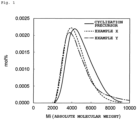
- the ratio of the peak molecular weight (M p ) of the sample obtained under this concentration condition to the PFPE compound (1), which was the raw material, was calculated as 0.79, and this value was in consistency with a value derived from reduction in peak molecular weight due to general circularization. From this result, it can be said that when the concentration at the time of irradiation with light is 2 mg/mL or less, a cyclic polymer formed from one molecule of the PFPE-containing chain compound is selectively produced, and it is considered that when circularization reaction is carried out at a substrate concentration lower than this concentration, a cyclic polymer compound formed from one molecule of the PFPE-containing chain compound can be selectively produced also in general ring-closing reaction.
- This value is a higher value compared with the concentration of 0.5 mg/mL or less which is a general concentration when a cyclic compound is synthesized through ring-closing reaction of a chain polymer compound. This result suggests that ring-closing reaction of a single molecule using a PFPE-containing chain compound can be carried out at a high concentration, and a cyclic polymer compound can be relatively easily synthesized.
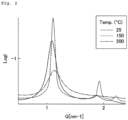
- Emitted light measurement through temperature modulation was carried out. Specifically, the temperature was increased from 25°C to 200°C and cooled again to 25°C, and emitted light was measured at 25°C, 50°C, 100°C, 150°C, and 200°C.
- a scattering pattern derived from a hexagonal phase was clearly observed at 150°C, and an isotropic phase was observed at 200°C during increasing temperature.
- a hexagonal scattering pattern appeared at 150°C, and scattering was broadened below 100°C during decreasing temperature.
- the HABI-type PFPE-containing cyclic compound (4) was sandwiched between glass slides and heated to 200°C with a hot-stage. Thereafter, the temperature was decreased at a temperature decreasing condition of 10°C/minute. The state of the HABI-type PFPE-containing cyclic compound (4) during this period was observed with a polarized optical microscope. As a result, crystals were observed from 146.5°C.
- the HABI-type PFPE-containing cyclic compound (4) obtained in the above item 1 was heated to 200°C and melted. Thereafter, the temperature was decreased to room temperature at a temperature decreasing condition of 10°C/minute to obtain a crystalline PFPE-containing compound.
- Example 2 Glaser coupling cyclization reaction of PFPE-containing chain compound using end alkyne
- the PFPE compound (1), propargylamine (5), and metaxylene fluoride as a solvent were reacted at room temperature for three days to obtain a propargylamide-type PFPE-containing chain compound (6). Progress of reaction was confirmed through 19 F NMR.
- the obtained oily product was dissolved in a mixed solvent of F6-m-xylene and acetone (about 10:1) and was passed through silica-gel, followed by concentration to obtain a milky light yellow oily product (98.3 mg).
- the obtained sample was subjected to 1 H NMR to confirm progress of coupling reaction.
- the compound of the present disclosure may be used in a wide range of application such as rubber materials including a sealing agent, an adhesive, a compatibilizing agent, a water-repelling material, a coating agent, potting gel, an O ring, packing, a gasket, a diaphragm, a valve, and a seal.
- rubber materials including a sealing agent, an adhesive, a compatibilizing agent, a water-repelling material, a coating agent, potting gel, an O ring, packing, a gasket, a diaphragm, a valve, and a seal.
Landscapes
- Chemical & Material Sciences (AREA)
- Organic Chemistry (AREA)
- Health & Medical Sciences (AREA)
- Chemical Kinetics & Catalysis (AREA)
- Medicinal Chemistry (AREA)
- Polymers & Plastics (AREA)
- General Chemical & Material Sciences (AREA)
- Polyethers (AREA)
- Compositions Of Macromolecular Compounds (AREA)
- Other Resins Obtained By Reactions Not Involving Carbon-To-Carbon Unsaturated Bonds (AREA)
- Organic Low-Molecular-Weight Compounds And Preparation Thereof (AREA)
- Hydrogenated Pyridines (AREA)
- Plural Heterocyclic Compounds (AREA)
Abstract
Description
- The present disclosure relates to a novel fluoropolyether compound.
- Compounds having a fluoropolyether group are used in a wide range of application as a fluoroelastomer, a surface-treating agent, a lubricant, and the like, and thus fluoropolyether group-containing compounds having various structures are known (
Patent Literatures 1 to 3). -
- Patent Literature 1:
JP 2017-149839 A - Patent Literature 2:
JP 2017-082194 A - Patent Literature 3:
JP 2018-521183 A - However, known fluoropolyether group-containing compounds are chain compounds, and cyclic compounds containing a fluoropolyether group have not been known.
- The present disclosure includes the following embodiments.
- [1] A fluorine-containing cyclic compound represented by the following formula (1):

- A is a divalent organic group; and
- RF is a divalent organic group containing a fluoropolyether group.].
- [2] The fluorine-containing cyclic compound according to [1], wherein RF is -Rf1 p-RFa-Oq-;
- Rf1 is a C1-6 alkylene group optionally substituted with one or more fluorine atoms;
- RFa is a divalent fluoropolyether group;
- p is 0 or 1; and
- q is 0 or 1.
- [3] The fluorine-containing cyclic compound according to [2], wherein RFa is a group represented by the following formula:
-(OC6F12)a-(OC5F10)b-(OC4F8)c-(OC3Rh 6)d-(OC2F4)e- (OCF2)f-
[In the formula:- Rh is each independently at each occurrence a hydrogen atom, a fluorine atom, or a chlorine atom;
- a, b, c, d, e, and f are each independently an integer of 0 to 200; the sum of a, b, c, d, e, and f is 1 or more; and the occurrence order of the respective repeating units enclosed in parentheses provided with a, b, c, d, e, or f is not limited in the formula.].
- [4] The fluorine-containing cyclic compound according to [2] or [3], wherein RFa is each independently a group represented by the following formula (f1), (f2), (f3), (f4), or (f5) :
-(OC3F6)d-(OC2F4)e- (f1)
[In the formula, d is an integer of 1 to 200, and e is 0 or 1.],
- (OC4F8)c-(OC3F6)d-(OC2F4)e-(OCF2)f- (f2)
[In the formula, c and d are each independently an integer of 0 to 30;- e and f are each independently an integer of 1 to 200;
- the sum of c, d, e, and f is an integer of 10 to 200; and
- the occurrence order of the respective repeating units enclosed in parentheses provided with a subscript c, d, e, or f is not limited in the formula.],
- (Ra-Rb)g- (f3)
[In the formula, Ra is OCF2 or OC2F4;- Rb is a group selected from OC2F4, OC3F6, OC4F8, OC5F10, and OC6F12, or a combination of two or three groups selected from these groups; and
- g is an integer of 2 to 100.],
- (OC6F12)a-(OC5F10)b-(OC4F8)c-(OC3F6)d-(OC2F4)e-(OCF2)f- (f4)
[In the formula, e is an integer of 1 or more and 200 or less, a, b, c, d, and f are each independently an integer of 0 or more and 200 or less, and the occurrence order of the respective repeating units enclosed in parentheses provided with a, b, c, d, e, or f is not limited in the formula.], and
- (OC6F12)a-(OC5F10)b-(OC4F8)c-(OC3F6)d-(OC2F4)e-(OCF2)f- (f5)
[In the formula, f is an integer of 1 or more and 200 or less, a, b, c, d, and e are each independently an integer of 0 or more and 200 or less, and the occurrence order of the respective repeating units enclosed in parentheses provided with a, b, c, d, e, or f is not limited in the formula.].
- [5] The fluorine-containing cyclic compound according to any one of [1] to [4], wherein A is -R2-R1-R2-;
- R1 is a divalent organic group;
- R2 is each independently an alkylene group, an oxygen atom, -COO-, -OCO-, -CONR11-, or -NR11CO-; and
- R11 is a hydrogen atom or a C1-6 alkyl group.
- [6] The fluorine-containing cyclic compound according to any one of [1] to [5], wherein A is -R2-R4-R6-R4-R2-;
- R2 is each independently an alkylene group, an oxygen atom, -COO-, -OCO-, -CONR11-, or -NR11CO-;
- R11 is a hydrogen atom or a C1-6 alkyl group;
- R4 is each independently a single bond or a divalent organic group; and
- R6 is -CH=CH-, -CH=CH-CH=CH-, -C=C-, -C=C-C=C-, or

- Ph1 is each independently a phenyl group optionally having a substituent;
- Ar1 is each independently a phenylene group optionally having a substituent; and
- * represents a bonding site.].
- [7] The fluorine-containing cyclic compound according to any one of [1] to [6], having a molecular weight distribution of 1.0 to 4.0.
- [8] A fluoropolyether group-containing chain compound having a coupling functional group at both ends.
- [9] A composition comprising
- the fluorine-containing cyclic compound according to any one of [1] to [7]; and
- at least one selected from a fluorine-containing cyclic compound represented by the following formula (1'):

- A is each independently at each occurrence a divalent organic group;
- RF is each independently at each occurrence a divalent organic group containing a fluoropolyether group; and
- n is an integer of 2 to 100.],
Rf2-Rf1 p-RFa-Oq-Rf3
[In the formula:- Rf1 is a C1-6 alkylene group optionally substituted with one or more fluorine atoms;
- Rf2 is a hydrogen atom or a fluorine atom;
- Rf3 is a C1-6 alkylene group optionally substituted with one or more fluorine atoms;
- RFa is a divalent fluoropolyether group;
- p is 0 or 1; and
- q is 0 or 1.] .
- [10] The composition according to [9], comprising: the fluorine-containing cyclic compound according to any one of [1] to [7]; and the fluorine-containing cyclic compound represented by formula (1').
- [11] The composition according to [9] or [10], comprising: the fluorine-containing cyclic compound according to any one of [1] to [7]; the fluorine-containing cyclic compound represented by formula (1'); and the fluoropolyether group-containing chain compound having a coupling functional group at both ends.
- [12] The composition according to [9], further comprising: the fluorine-containing cyclic compound according to any one of [1] to [7]; and the fluorine-containing oil represented by the following formula (3):
Rf2-Rf1 p-RFa-Oq-Rf3
[In the formula:- Rf1 is a C1-6 alkylene group optionally substituted with one or more fluorine atoms;
- Rf2 is a hydrogen atom or a fluorine atom;
- Rf3 is a C1-6 alkylene group optionally substituted with one or more fluorine atoms;
- RFa is a divalent fluoropolyether group;
- p is 0 or 1; and
- q is 0 or 1.].
- [13] The composition according to [9], comprising: the fluorine-containing cyclic compound according to any one of
claims 1 to 7; the fluorine-containing cyclic compound represented by formula (1'); the fluoropolyether group-containing chain compound having a coupling functional group at both ends; and the fluorine-containing oil represented by formula (3). - [14] A mixture comprising:
- the fluorine-containing cyclic compound according to any one of
claims 1 to 7; and - at least one selected from the group consisting of a fluorine-containing oil, a fluoropolyether group-containing alkyl ester, lophine, and Fe.
- the fluorine-containing cyclic compound according to any one of
- [15] A formed article comprising the fluorine-containing cyclic compound according to any one of [1] to [7].
- [16] A formed article comprising the composition according to any one of [9] to [13].
- According to the present disclosure, it is possible to provide a cyclic compound containing a fluoropolyether group.
-
- [
FIG. 1] FIG. 1 is a graph showing GPC data in examples. - [
FIG. 2] FIG. 2 is a graph showing data pertaining to emitted light measurement (temperature rise) in temperature modulation. - [
FIG. 3] FIG. 3 is a graph showing data pertaining to emitted light measurement (temperature fall) in temperature modulation. - The term "monovalent organic group", as used herein, refers to a monovalent group containing carbon. The monovalent organic group may be a hydrocarbon group or a derivative thereof unless otherwise specified. A derivative of a hydrocarbon group means a group having one or more of N, O, S, Si, amide, sulfonyl, siloxane, carbonyl, carbonyloxy, and the like at the end or in the molecular chain of the hydrocarbon group. The term "organic group" refers to a monovalent organic group. The term "divalent organic group" refers to a divalent group containing carbon. Examples of the divalent organic group include, but are not limited to, a divalent group obtained by further removing one hydrogen atom from a monovalent organic group.
- The term "hydrocarbon group", as used herein, refers to a group that contains carbon and hydrogen and that is obtained by removing one hydrogen atom from a hydrocarbon. The hydrocarbon group is not limited, and examples include a C1-20 hydrocarbon group optionally substituted with one or more substituents, such as an aliphatic hydrocarbon group and an aromatic hydrocarbon group. The "aliphatic hydrocarbon group" may be either linear, branched, or cyclic, and may be either saturated or unsaturated. The hydrocarbon group may contain one or more ring structures.
- As used herein, examples of the substituent of the "hydrocarbon group" include, but are not limited to, one or more groups selected from a halogen atom; and a C1-6 alkyl group, a C2-6 alkenyl group, a C2-6 alkynyl group, a C3-10 cycloalkyl group, a C3-10 unsaturated cycloalkyl group, a 5 to 10-membered heterocyclyl group, a 5 to 10-membered unsaturated heterocyclyl group, a C6-10 aryl group, and a 5 to 10-membered heteroaryl group, each of which is optionally substituted with one or more halogen atoms.
- The present disclosure provides a fluorine-containing cyclic compound represented by the following formula (1):

- A is a divalent organic group; and
- RF is a divalent organic group containing a fluoropolyether group.].
- The above A is a divalent organic group.
- In one embodiment, the above A is a group represented by the following formula:
-R2-R1-R2-
[In the formula: - R1 is a divalent organic group;
- R2 is each independently an alkylene group, an oxygen atom, -COO-, -OCO-, -CONR11-, or -NR11CO-; and
- R11 is a hydrogen atom or a C1-6 alkyl group.] .
- In a preferable embodiment, R1 is -R4-R6-R4-. That is, the above A is a group represented by the following formula:
-R2-R4-R6-R4-R2-
[In the formula: - R2 is each independently an alkylene group, an oxygen atom, -COO-, -OCO-, -CONR11-, or -NR11CO-; and
- R11 is a hydrogen atom or a C1-6 alkyl group;
- R4 is a single bond or a divalent organic group; and
- R6 is -CH=CH-, -CH=CH-CH=CH-, -C≡C-, -C≡C-C≡-, or

- Ph1 is each independently a phenyl group optionally having a substituent;
- Ar1 is each independently a phenylene group optionally having a substituent; and
- * represents a bonding site.).]
- R2 is each independently an alkylene group, an oxygen atom, -COO-, -OCO-, -CONR11-, or -NR11CO-.
- In a preferable embodiment, R2 is R2a and R2b. That is, A is -R2a-R1-R2b-.
- R2a is an alkylene group, an oxygen atom, -COO-, or - CONR11-, and R2b is an alkylene group, an oxygen atom, -OCO-, or -NR11CO-. Note that the right side of R2a is bonded to R1 and the left side of R2b is bonded to R1.
- R2a and R2b are preferably groups corresponding to each other. That is, the combination of the above R2a and R2b is preferably an alkylene group and an alkylene group, an oxygen atom and an oxygen atom, -COO- and -OCO-, or -CONR11- and - NR11CO-.
- In a preferable embodiment, R2a is -CONR11-, and R2b is -NR11CO-.
- The alkylene group in R2 is preferably a C1-6 alkylene group and more preferably a C1-3 alkylene group. The alkylene group may be linear or branched.
- R11 is a hydrogen atom or a C1-6 alkyl group and is preferably a hydrogen atom.
- The C1-6 alkyl group in R11 is preferably a C1-3 alkyl group, more preferably a methyl group or an ethyl group, and still more preferably a methyl group. The C1-6 alkyl group may be linear or branched.
- R11 is preferably a methyl group or a hydrogen atom and more preferably a hydrogen atom.
- R4 is each independently a single bond or a divalent organic group.
- In one embodiment, R4 is each independently a single bond or -(R15)n1-.
- In the above formula, R15 is each independently at each occurrence a C1-6 alkylene group, a 3- to 8-membered cycloalkylene group, a 3- to 8-membered cycloalkenylene group, a 3- to 8-membered heterocycloalkylene group, a 3- to 8-membered heterocycloalkenylene group, an arylene group, or a heteroarylene group; and n1 is an integer of 1 to 6.
- In a preferable embodiment, R4 is each independently a C1-6 alkylene group or -R17-R18-R19-. Note that R17 in R4 is bonded to R6.
- In the above formula,
- R17 is a single bond or a C1-6 alkylene group;
- R18 is an arylene group; and
- R19 is a single bond or a C1-6 alkylene group.
- In one embodiment, R17 is a single bond, R18 is an arylene group, and R19 is a C1-6 alkylene group.
- The C1-6 alkylene group in R4 is preferably a C1-3 alkylene group and more preferably a C1-2 alkylene group. The C1-6 alkylene group may be linear or branched.
- The C1-6 alkylene group and the arylene group in R4 may be substituted. The substituent is not limited, and examples thereof include one or more groups selected from a halogen atom; and a C1-6 alkyl group, a C2-6 alkenyl group, a C2-6 alkynyl group, a C3-10 cycloalkyl group, a C3-10 unsaturated cycloalkyl group, a 5- to 10-membered heterocyclyl group, a 5- to 10-membered unsaturated heterocyclyl group, a C6-10 aryl group, and a 5- to 10-membered heteroaryl group, each of which is optionally substituted with one or more halogen atoms.
- R6 is -CH=CH-, -CH=CH-CH=CH-, -C=C-, -C=C-C=C-, or

- Ph1 is each independently a phenyl group optionally having a substituent;
- Ar1 is each independently a phenylene group optionally having a substituent; and
- * represents a bonding site.].
- In a preferable embodiment,


- In one embodiment, Ph1 and Ar1 are unsubstituted.
- In another embodiment, Ph1 and Ar1 are substituted.
- The substituent in Ph1 and Ar1 is not limited, and examples thereof include one or more groups selected from a halogen atom; and a C1-6 alkyl group, a C2-6 alkenyl group, a C2-6 alkynyl group, a C3-10 cycloalkyl group, a C3-10 unsaturated cycloalkyl group, a 5- to 10-membered heterocyclyl group, a 5- to 10-membered unsaturated heterocyclyl group, a C6-10 aryl group, and a 5- to 10-membered heteroaryl group, each of which is optionally substituted with one or more halogen atoms.
- The above RF is a divalent organic group containing a fluoropolyether group.
- The above fluoropolyether group is a group represented by the following formula:
- (CαFβRh γO)δ-
[In the formula: - Rh is a hydrogen atom, a fluorine atom, or a chlorine atom; and
- α, β, γ, and δ are each independently at each occurrence any integer,
- provided that at least one β is 1 or more, and
- 2α = β + γ is satisfied.].
- The above fluoropolyether group is preferably a perfluoropolyether group. The perfluoropolyether group is a group represented by the following formula:
- (CαF2αO)δ-
[In the formula:
α and δ are each independently at each occurrence any integer.] . - In one embodiment, the above fluoropolyether group is a group represented by the following formula:
-(OC6F12)a-(OC5F10)b-(OC4F8)c-(OC3Rh 6)d-(OC2F4)e-(OCF2)f-
[In the formula: - Rh is each independently at each occurrence a hydrogen atom, a fluorine atom, or a chlorine atom; and
- a, b, c, d, e, and f are each independently an integer of 0 to 200, the sum of a, b, c, d, e, and f is 1 or more, and the occurrence order of the respective repeating units enclosed in parentheses provided with a, b, c, d, e, or f is not limited in the formula.].
- Rh is preferably a hydrogen atom or a fluorine atom and more preferably a fluorine atom. Provided that when all Rhs are hydrogen atoms or chlorine atoms, at least one of a, b, c, e, and f is 1 or more.
- Preferably, a, b, c, d, e, and f may be each independently an integer of 0 to 100.
- The sum of a, b, c, d, e, and f is preferably 5 or more, and more preferably 10 or more, and may be, for example, 15 or more or 20 or more. The sum of a, b, c, d, e, and f is preferably 200 or less, more preferably 100 or less, and even more preferably 60 or less, and may be, for example, 50 or less or 30 or less.
- These repeating units may be linear or branched. For example, - (OC6F12)- may be - (OCF2CF2CF2CF2CF2CF2)-, - (OCF(CF3)CF2CF2CF2CF2)-, -(OCF2CF(CF3)CF2CF2CF2)-, - (OCF2CF2CF(CF3)CF2CF2)-, -(OCF2CF2CF2CF(CF3)CF2)-, - (OCF2CF2CF2CF2CF(CF3))-, or the like. - (OC5F10)- may be - (OCF2CF2CF2CF2CF2)- , -(OCF(CF3)CF2CF2CF2)- , - (OCF2CF(CF3)CF2CF2)-, -(OCF2CF2CF(CF3)CF2)-, - (OCF2CF2CF2CF(CF3)) -, or the like. - (OC4F8)- may be any of - (OCF2CF2CF2CF2)-, -(OCF(CF3)CF2CF2)-, -(OCF2CF(CF3)CF2)-, - (OCF2CF2CF(CF3))-, - (OC(CF3)2CF2)-, - (OCF2C(CF3)2)-, - (OCF(CF3)CF(CF3)) -, - (OCF(C2F5)CF2)-, and - (OCF2CF(C2F5)) - . - (OC3F6)- (that is, Rh is a fluorine atom in the above formula) may be any of - (OCF2CF2CF2)-, - (OCF(CF3)CF2)-, and - (OCF2CF(CF3))-. -(OC2F4)- may be any of -(OCF2CF2)- and - (OCF(CF3)) - .
- In a preferable embodiment, the above fluoropolyether group is each independently at each occurrence a group represented by any of the following formulae (f1) to (f5).
- (OC3F6)d-(OC2F4)e- (f1)
[In the formula, d is an integer of 1 to 200, and e is 0 or 1.] ,
-(OC4F8)c-(OC3F6)d-(OC2F4)e-(OCF2)f- (f2)
[In the formula, c and d are each independently an integer of 0 or more and 30 or less, e and f are each independently an integer of 1 or more and 200 or less, - the sum of c, d, e, and f is 2 or more, and
- the occurrence order of the respective repeating units enclosed in parentheses provided with a subscript c, d, e, or f is not limited in the formula.],
- (R6-R7)g- (f3)
[In the formula, R6 is OCF2 or OC2F4,- R7 is a group selected from OC2F4, OC3F6, OC4F8, OC5F10, and OC6F12, or a combination of two or three groups independently selected from these groups, and
- g is an integer of 2 to 100.],
-(OC6F12)a-(OC5F10)b-(OC4F8)c-(OC3F6)d-(OC2F4)e-(OCF2)f- (f4)
[In the formula, e is an integer of 1 or more and 200 or less, a, b, c, d, and f are each independently an integer of 0 or more and 200 or less, and the occurrence order of the respective repeating units enclosed in parentheses provided with a, b, c, d, e, or f is not limited in the formula.], and
-(OC6F12)a-(OC5F10)b-(OC4F8)c-(OC3F6)d-(OC2F4)e-(OCF2)f- (f5)
[In the formula, f is an integer of 1 or more and 200 or less, a, b, c, d, and e are each independently an integer of 0 or more and 200 or less, and the occurrence order of the respective repeating units enclosed in parentheses provided with a, b, c, d, e, or f is not limited in the formula.].
- In the above formula (f1), d is preferably 5 to 200, more preferably 10 to 100, and even more preferably 15 to 50, and is, for example, an integer of 25 to 35. In one embodiment, e is 0. In another embodiment, e is 1. The above formula (f1) is preferably a group represented by - (OCF2CF2CF2)d-(OCF2CF2)e- or - (OCF(CF3)CF2)d-(OCF(CF)3)e- and is more preferably a group represented by - (OCF2CF2CF2)d-(OCF2CF2)e-.
- In the formula (f2), e and f are each independently an integer of preferably 5 to 200, and more preferably 10 to 200. The sum of c, d, e, and f is preferably 5 or more, and more preferably 10 or more, and may be, for example, 15 or more or 20 or more. In one embodiment, the formula (f2) is preferably a group represented by -(OCF2CF2CF2CF2)c-(OCF2CF2CF2)d-(OCF2CF2)e-(OCF2)f-. In another embodiment, the formula (f2) may be a group represented by -(OC2F4)e-(OCF2)f-.
- In the formula (f3), R6 is preferably OC2F4. In the formula (f3), R7 is preferably a group selected from OC2F4, OC3F6, and OC4F8, or a combination of two or three groups independently selected from these groups, and is more preferably a group selected from OC3F6 and OC4F8. Examples of the combination of two or three groups independently selected from OC2F4, OC3F6, and OC4F8 include, but are not limited to, -OC2F4OC3F6-, -OC2F4OC4F8-, -OC3F6OC2F4-, - OC3F6OC3F6-, -OC3F6OC4F8-, -OC4F8OC4F8-, -OC4F8OC3F6-, - OC4F8OC2F4-, -OC2F4OC2F4OC3F6-, -OC2F4OC2F4OC4F8-, - OC2F4OC3F6OC2F4-, -OC2F4OC3F6OC3F6-, -OC2F4OC4F8OC2F4-, - OC3F6OC2F4OC2F4-, -OC3F6OC2F4OC3F6-, -OC3F6OC3F6OC2F4-, and - OC4F8OC2F4OC2F4-. In the formula (f3), g is an integer of preferably 3 or more, and more preferably 5 or more. g is preferably an integer of 50 or less. In the formula (f3), OC2F4, OC3F6, OC4F8, OC5F10, and OC6F12 may be either linear or branched, and are preferably linear. In this embodiment, the formula (f3) is preferably -(OC2F4-OC3F6)g- or -(OC2F4-OC4F8)g-.
- In the formula (f4), e is an integer of preferably 1 or more and 100 or less, and more preferably 5 or more and 100 or less. The sum of a, b, c, d, e, and f is preferably 5 or more, and more preferably 10 or more, and is, for example, 10 or more and 100 or less.
- In the formula (f5), f is an integer of preferably 1 or more and 100 or less, and more preferably 5 or more and 100 or less. The sum of a, b, c, d, e, and f is preferably 5 or more, and more preferably 10 or more, and is, for example, 10 or more and 100 or less.
- In one embodiment, the above fluoropolyether group is a group represented by the above formula (f1).
- In one embodiment, the above fluoropolyether group is a group represented by the above formula (f2).
- In one embodiment, the above fluoropolyether group is a group represented by the above formula (f3).
- In one embodiment, the above fluoropolyether group is a group represented by the above formula (f4).
- In one embodiment, the above fluoropolyether group is a group represented by the above formula (f5).
- In a preferable embodiment, RF is a group represented by
-Rf1 p-RFa-Oq-
[In the formula: - Rf1 is a C1-6 alkylene group optionally substituted with one or more fluorine atoms;
- RFa is a divalent fluoropolyether group;
- p is 0 or 1;
- q is 0 or 1; and
- m is an integer of 0 to 10.].
- In the above formula, Rf1 is a C1-6 alkylene group optionally substituted with one or more fluorine atoms.
- In the C1-6 alkylene group optionally substituted with one or more fluorine atoms, the "C1-6 alkylene group" may be linear or branched, and is preferably a linear or branched C1-3 alkylene group, and more preferably a linear C1-3 alkylene group.
- The above Rf1 is preferably a C1-6 alkylene group substituted with one or more fluorine atoms, more preferably a C1-6 perfluoroalkylene group, and still more preferably a C1-3 perfluoroalkylene group.
- The above C1-6 perfluoroalkylene group may be linear or branched, and is preferably a linear or branched C1-3 perfluoroalkylene group, more preferably a linear C1-3 perfluoroalkyl group, and specifically -CF2-, -CF2CF2-, or - CF2CF2CF2-.
- In the above formula, p is 0 or 1. In one embodiment, p is 0. In another embodiment, p is 1.
- In the above formula, q is each independently 0 or 1. In one embodiment, q is 0. In another embodiment, q is 1.
- In the above formula, RFa is a divalent fluoropolyether group. The divalent fluoropolyether group is the fluoropolyether group described above.
- The number average molecular weight of the fluorine-containing cyclic compound represented by formula (1) of the present disclosure is not limited, and may be 300 or more, preferably 500 or more, more preferably 1,000 or more, and still more preferably 2,000 or more. In addition, the number average molecular weight of the fluorine-containing cyclic compound represented by formula (1) of the present disclosure is not limited, and may be 100,000 or less, preferably 30,000 or less, more preferably 20,000 or less, and still more preferably 10,000 or less. The number average molecular weight of the fluorine-containing cyclic compound represented by formula (1) of the present disclosure is not limited, and may be 300 to 100,000, preferably 500 to 30,000, more preferably 1,000 to 20,000, and still more preferably 2,000 to 10,000, for example. The above number average molecular weight can be measured by gel permeation chromatography (GPC).
- The molecular weight distribution (weight average molecular weight/number average molecular weight) of the fluorine-containing cyclic compound represented by the above formula (1) is preferably 1.0 or more, but may be 1.1 or more or 1.2 or more. The molecular weight distribution of the fluorine-containing cyclic compound represented by the above formula (1) is preferably 4.0 or less, more preferably 3.0 or less, and still more preferably 2.0 or less. The molecular weight distribution of the fluoropolyether group-containing chain compound represented by the above formula (1) is preferably 1.0 to 4.0, more preferably 1.0 to 3.0, and still more preferably 1.0 to 2.0. The above molecular weight distribution can be measured by gel permeation chromatography (GPC).
- In one embodiment, the fluorine-containing cyclic compound represented by formula (1) of the present disclosure may be crystalline. That is, the present disclosure provides a crystal of the fluorine-containing cyclic compound represented by formula (1) of the present disclosure. The crystal of the fluorine-containing cyclic compound represented by formula (1) can be confirmed through observation with a polarization microscope.
- The crystal of the fluorine-containing cyclic compound represented by formula (1) can be obtained by heating the compound to a melting point thereof or higher to melt the compound and subsequently cooling the compound. For example, the crystal can be obtained by heating the compound to 200°C or to 20°C above a melting point of the compound and gradually cooling same to room temperature. The temperature decreasing rate may be preferably 20°C/minute or less and more preferably 10°C/minute or less.
- The present disclosure also provides a fluorine-containing cyclic compound represented by the following formula (1'):

- A is each independently at each occurrence a divalent organic group;
- RF' is each independently at each occurrence a divalent organic group containing a fluoropolyether group; and
- n is an integer of 2 to 100.] .
- In the above formula (I'), A is the same as A defined for the above formula (I).
- RF' is each independently at each occurrence a group represented by
-RFA-(ZA-RFA)m-
[In the formula: - RFA is each independently -Rf1 p-RFa-Oq-;
- Rf1 is a C1-6 alkylene group optionally substituted with one or more fluorine atoms;
- RFa is a divalent fluoropolyether group;
- p is 0 or 1;
- q is 0 or 1;
- m is an integer of 0 to 10; and
- ZA is a divalent organic group.].
- In the above formula, RFA, Rf1, RFa, p, and q are the same as RFA, Rf1, RFa, p, and q defined for the above formula (I) .
- In the above formula, ZA is a divalent organic group.
- In one embodiment, the above ZA may have the same structure as A described above.
- That is, ZA is each independently at each occurrence a group represented by the following formula:
-R2-R1-R2-
[In the formula, R1 and R2 are the same as defined above.] . - In a preferable embodiment, the above ZA is each independently at each occurrence a group represented by the following formula:
-R2-R4-R6-R4-R2-
[In the formula, R2, R4, and R6 are the same as defined above.]. - In one embodiment, ZA is the same group as A.
- In another embodiment, ZA is a group different from A.
- m is an integer of 0 to 10, preferably an integer of 0 to 8, or an integer of 0 to 5.
- In one embodiment, m is 0.
- In one embodiment, m is 1.
- In another embodiment, m is 2 or more.
- In the above formula (I'), n is an integer of 2 to 100, preferably an integer of 2 to 50, more preferably an integer of 2 to 30, and still more preferably an integer of 2 to 20.
- The fluorine-containing cyclic compound of the present disclosure can be obtained by subjecting a fluoropolyether group-containing chain compound having a coupling functional group at both ends to coupling reaction to couple the fluoropolyether group-containing chain compound to have a cyclic structure.
- Accordingly, the present disclosure provides a method for producing a fluorine-containing cyclic compound represented by the following formula (1):

- A is a divalent organic group; and
- RF is a divalent organic group containing a fluoropolyether group.]
- A is each independently at each occurrence a divalent organic group;
- RF' is each independently at each occurrence a divalent organic group containing a fluoropolyether group; and
- n is an integer of 2 to 100.],
- the production method including subjecting a fluoropolyether group-containing chain compound having a coupling functional group at both ends to coupling reaction to couple the fluoropolyether group-containing chain compound to have a cyclic structure.
- In one embodiment, the above production method is a method for producing the compound represented by formula (1) .
- In another embodiment, the above production method is a method for producing the compound represented by formula (1').
- In addition, the present disclosure provides a fluoropolyether group-containing chain compound having a coupling functional group at both ends, which can be a raw material of the fluorine-containing cyclic compound of the present disclosure.
- In one embodiment, the above fluoropolyether group-containing chain compound is represented by the following formula (2):
B-RFA'-(ZA'-RFA')m'-B
[In the formula: - RFA' is each independently at each occurrence a divalent organic group containing a fluoropolyether group;
- ZA' is each independently at each occurrence a divalent organic group;
- m' is an integer of 0 to 10; and
- B is each independently a group including a coupling functional group.].
- RFA' is each independently at each occurrence a divalent organic group containing a fluoropolyether group and is preferably each independently -Rf1 p-RFa-Oq-. RFA' corresponds to RFA in the above formula (1) . That is, RFA' includes groups and aspects exemplified as RFA.
- ZA' is each independently at each occurrence a divalent organic group. The ZA' corresponds to ZA in the above formula (1) . That is, ZA' includes groups and aspects exemplified as ZA.
- ZA' is each independently at each occurrence a group represented by the following formula:
-R2-R1-R2-
[In the formula, R1 and R2 are the same as defined above.] . - In a preferable embodiment, the above ZA' is each independently at each occurrence a group represented by the following formula:
-R2-R4-R6-R4-R2-
[In the formula, R2, R4, and R6 are the same as defined above.] . - B is a group represented by the following formula:
-R7-R8-R9
[In the formula: - R7 is an alkylene group, an oxygen atom, -COO-, or - CONR11-;
- R11 is a hydrogen atom or a C1-6 alkyl group;
- R8 is a single bond or a divalent organic group;
- R9 is a coupling functional group.].
- R7 corresponds to R2 in the above formula (1) . That is, R7 includes groups and aspects exemplified as R2.
- In a preferable embodiment, R7 is -CONR11-.
- R11 is a hydrogen atom or a C1-6 alkyl group and is preferably a hydrogen atom.
- The C1-6 alkyl group in R11 is preferably a C1-3 alkyl group, more preferably a methyl group or an ethyl group, and still more preferably a methyl group. The C1-6 alkyl group may be linear or branched.
- R11 is preferably a methyl group or a hydrogen atom and more preferably a hydrogen atom.
- R8 corresponds to R4 and R5 in the above formula (1). That is, R8 includes groups and aspects exemplified as R4 and R5.
- In one embodiment, R8 is each independently a single bond or - (R15)n1-.
- In the above formula, R15 is each independently at each occurrence a C1-6 alkylene group, a 3- to 8-membered cycloalkylene group, a 3- to 8-membered cycloalkenylene group, a 3- to 8-membered heterocycloalkylene group, a 3- to 8-membered heterocycloalkenylene group, an arylene group, or a heteroarylene group; and n1 is an integer of 1 to 6.
- In a preferable embodiment, R8 is a C1-6 alkylene group or -R17-R18-R19-. Note that R17 in R8 is bonded to R9.
- In the above formula,
- R17 is a single bond or a C1-6 alkylene group;
- R18 is an arylene group; and
- R19 is a single bond or a C1-6 alkylene group.
- In one embodiment, R17 is a single bond, R18 is an arylene group, and R19 is a C1-6 alkylene group.
- The C1-6 alkylene group in R8 is preferably a C1-3 alkylene group and more preferably a C1-2 alkylene group. The C1-6 alkylene group may be linear or branched.
- The C1-6 alkylene group and the arylene group in R8 may be substituted. The substituent is not limited, and examples thereof include one or more groups selected from a halogen atom; and a C1-6 alkyl group, a C2-6 alkenyl group, a C2-6 alkynyl group, a C3-10 cycloalkyl group, a C3-10 unsaturated cycloalkyl group, a 5- to 10-membered heterocyclyl group, a 5- to 10-membered unsaturated heterocyclyl group, a C6-10 aryl group, and a 5- to 10-membered heteroaryl group, each of which is optionally substituted with one or more halogen atoms.
- In one embodiment, R9 is -C=CH, -CH=CHR20 (in the formula, R20 is a chlorine atom, a bromine atom, an iodine atom, a hydrogen atom, or -OSO2R21, preferably a chlorine atom, a bromine atom, an iodine atom, or a hydrogen atom, and more preferably a hydrogen atom; and R21 is a C1-6 alkyl group optionally including one or more fluorine atoms or a phenyl group optionally having a substituent), -COH,
or a group represented by the following formula:
- Ph1 is each independently a phenyl group optionally having a substituent;
- Ar1 is each independently a phenylene group optionally having a substituent; and
- * represents a bonding site.).
- In a preferable embodiment, R9 is a group represented by the following formula:

- Ph1 is each independently a phenyl group optionally having a substituent;
- Ar1 is each independently a phenylene group optionally having a substituent; and
- * represents a bonding site.).
- In a preferable embodiment,
- ZA' is each independently at each occurrence -R2-R4-R6-R5-R3-;
- R2 is an alkylene group, an oxygen atom, -COO-, or - CONR11-;
- R3 is an alkylene group, an oxygen atom, -OCO-, or - NR11CO-;
- R11 is a hydrogen atom or a C1-6 alkyl group;
- R4 is a single bond or a divalent organic group; and
- R5 is a single bond or a divalent organic group;
- R6 is a group represented by the following formula:

- Ph1 is each independently a phenyl group optionally having a substituent;
- Ar1 is each independently a phenylene group optionally having a substituent; and
- * represents a bonding site.];
- B is -R7-R8-R9-;
- R7 is an alkylene group, an oxygen atom, -COO-, or - CONR11-;
- R11 is a hydrogen atom or a C1-6 alkyl group;
- R8 is a divalent organic group; and
- R9 is a group represented by the following formula:
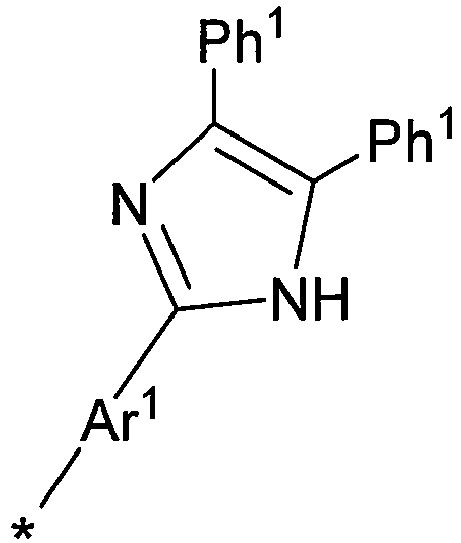
- Ph1 is each independently a phenyl group optionally having a substituent;
- Ar1 is each independently a phenylene group optionally having a substituent; and
- * represents a bonding site.].
- m' is an integer of 0 to 10, preferably an integer of 0 to 5, or an integer of 0 to 3.
- In one embodiment, m' is 0.
- In one embodiment, m' is 1.
- In another embodiment, m' is 2 or more.
- The number average molecular weight of the fluoropolyether group-containing chain compound having a coupling functional group at both ends of the present disclosure is not limited, and may be 300 or more, preferably 500 or more, more preferably 1,000 or more, and still more preferably 2,000 or more. The number average molecular weight of the fluoropolyether group-containing chain compound having a coupling functional group at both ends of the present disclosure is not limited, and may be 100,000 or less, preferably 30,000 or less, more preferably 20,000 or less, and still more preferably 10,000 or less. The number average molecular weight of the fluoropolyether group-containing chain compound having a coupling functional group at both ends of the present disclosure is not limited, and may be 300 to 100,000, preferably 500 to 30,000, more preferably 1,000 to 20,000, and still more preferably 2,000 to 10,000, for example. The above number average molecular weight can be measured by gel permeation chromatography (GPC) .
- As described above, the compounds represented by formula (1) and formula (1') of the present disclosure can be obtained by a method including subjecting a fluoropolyether group-containing chain compound having a coupling functional group at both ends to coupling reaction to couple the fluoropolyether group-containing chain compound to have a cyclic structure. In the reaction, the fluoropolyether group-containing chain compound having a coupling functional group at both ends may form a ring through intramolecular reaction, that is, by bonding the coupling functional groups at both ends of one molecule, or may form a ring including two or more molecule units through intermolecular reaction, that is, by bonding two or more molecules to each other.
- In one embodiment, the fluoropolyether group-containing chain compound having a coupling functional group at both ends is a compound represented by the above formula (2).
- In one embodiment, the compounds represented by formula (1) and formula (1') of the present disclosure can be obtained by a method including subjecting a compound represented by the following formula:
HC≡C-R8-R7 -RFA'-R7-R8-C≡CH
- [In the formula, RFA', R7, and R8 are the same as defined above.]
- to reaction to obtain a cyclic compound including -C=C-C=C-within a ring.
- In the present embodiment, R7 is preferably -CONR11-. Note that the left side of R7 is bonded to RFA' .
- In the present embodiment, R8 is preferably a C1-6 alkylene group.
- The compound represented by formula (1) obtained by the above method is a compound in which R6 is -C=C-C=C-.
- The above reaction can be carried out in the presence of copper bromide, copper iodide, copper chloride, or copper acetate or in the presence of a copper (I) salt under an oxygen atmosphere.
- In another embodiment, the compounds represented by formula (1) and formula (1') of the present disclosure can be obtained by a method including subjecting a compound represented by the following formula:
CH2=CH-R8-R7-RFA'-R7-R8-CH=CH2
- [In the formula, RFA', R7, and R8 are the same as defined above.]
- to reaction to obtain a cyclic compound including -HC=CH-within a ring.
- In the present embodiment, R7 is preferably -CONR11-. Note that the left side of R7 is bonded to RFA' .
- In the present embodiment, R8 is preferably a C1-6 alkylene group.
- The compounds represented by formula (1) and formula (1') obtained by the above method is a compound in which R6 is -HC=CH-.
- The above reaction can be carried out using various Grubbs catalysts (first generation Grubbs catalyst, second generation Grubbs catalyst, and Hoveyda-Grubbs reagent) or a Schrock catalyst.
- In another embodiment, the compound represented by formula (1) of the present disclosure can be obtained by a method including subjecting a compound represented by the following formula:
HOC-R8-R7-RFA'-R7-R8-COH
- [In the formula, RFA', R7, and R8 are the same as defined above.]
- to reaction to obtain a cyclic compound including -HC=CH-within a ring.
- In the present embodiment, R7 is preferably -CONR11-. Note that the left side of R7 is bonded to RFA' .
- In the present embodiment, R8 is preferably -R17-R18-R19-. Note that R17 in R8 is bonded to COH.
- In the above formula,
- R17 is a single bond or a C1-6 alkylene group;
- R18 is an arylene group; and
- R19 is a single bond or a C1-6 alkylene group.
- In one embodiment, R17 is a single bond, R18 is an arylene group, and R19 is a C1-6 alkylene group.
- The C1-6 alkylene group in R8 is preferably a C1-3 alkylene group and more preferably a C1-2 alkylene group. The C1-6 alkylene group may be linear or branched.
- The C1-6 alkylene group and the arylene group in R8 may be substituted. The substituent is not limited, and examples thereof include one or more groups selected from a halogen atom; and a C1-6 alkyl group, a C2-6 alkenyl group, a C2-6 alkynyl group, a C3-10 cycloalkyl group, a C3-10 unsaturated cycloalkyl group, a 5- to 10-membered heterocyclyl group, a 5- to 10-membered unsaturated heterocyclyl group, a C6-10 aryl group, and a 5- to 10-membered heteroaryl group, each of which is optionally substituted with one or more halogen atoms.
- The compound represented by formula (1) obtained by the above method is a compound in which R6 is -HC=CH-.
- The above reaction can be carried out using a titanium chloride-zinc (copper) alloy.
- In another embodiment, the compound represented by formula (1) of the present disclosure can be obtained by a method including subjecting a compound represented by the following formula:
R13-R8-R7-RFA'-R7-R8-R13
[In the formula: - RFA', R7, and R8 are the same as defined above; and
- R13 is a group represented by

- Ph1 and Ar1 are the same as defined above; and
- * represents a bonding site.).]
- Ph1 and Ar1 are the same as defined above; and
- * represents a bonding site.]
- In the present embodiment, R7 is preferably -CONR11-. Note that the left side of R7 is bonded to RFA' .
- In the present embodiment, R8 is preferably a C1-6 alkylene group.
- Ph1 is preferably an unsubstituted phenyl group.
- Ar1 is preferably an unsubstituted phenylene group.
- The compound represented by formula (1) obtained by the above method is a compound in which R6 is


- The above reaction can be carried out using a one-electron oxidant such as potassium ferricyanide.
- The lower limit of the concentration of the chain compound in the above reaction is preferably 0.1 mg/mL and may be, for example, 0.6 mg/mL or 1.0 mg/mL. The upper limit of the concentration of the chain compound is preferably 500 mg/mL, more preferably 200 mg/mL, and still more preferably 100 mg/mL, and may be, for example, 10 mg/mL or 2 mg/mL. The concentration of the chain compound in the above reaction is preferably 0.1 to 500 mg/mL, more preferably 0.1 to 200 mg/mL, and still more preferably 0.1 to 100 mg/mL, and may be, for example, 0.6 to 100 mg/mL or 0.6 to 2 mg/mL.
- The present disclosure provides a composition including the fluorine-containing cyclic compound represented by formula (1) of the present disclosure.
- In one embodiment, the composition of the present disclosure further includes at least one selected from the fluorine-containing cyclic compound represented by formula (1'), the fluoropolyether group-containing chain compound having a coupling functional group at both ends, and a fluorine-containing oil.
- In one embodiment, the composition of the present disclosure includes the fluorine-containing cyclic compound represented by formula (1) and the fluorine-containing cyclic compound represented by formula (1').
- In one embodiment, the composition of the present disclosure includes the fluorine-containing cyclic compound represented by formula (1) and the fluoropolyether group-containing chain compound having a coupling functional group at both ends.
- In one embodiment, the composition of the present disclosure includes the fluorine-containing cyclic compound represented by formula (1), the fluorine-containing cyclic compound represented by formula (1'), and the fluoropolyether group-containing chain compound having a coupling functional group at both ends.
- In one embodiment, the composition of the present disclosure includes the fluorine-containing cyclic compound represented by formula (1) and a fluorine-containing oil.
- In one embodiment, the composition of the present disclosure includes the fluorine-containing cyclic compound represented by formula (1), the fluorine-containing cyclic compound represented by formula (1'), and a fluorine-containing oil.
- In one embodiment, the composition of the present disclosure includes the fluorine-containing cyclic compound represented by formula (1), the fluorine-containing cyclic compound represented by formula (1'), the fluoropolyether group-containing chain compound having a coupling functional group at both ends, and a fluorine-containing oil.
- The present disclosure provides a composition including the fluoropolyether group-containing chain compound having a coupling functional group at both ends.
- The fluoropolyether group-containing chain compound having a coupling functional group at both ends is a compound represented by the above formula (2):
B-RFA'-(ZA'-RFA')m'-B
of the present disclosure. - In one embodiment, the composition of the present disclosure includes the fluoropolyether group-containing chain compound represented by formula (2) in which m' is 0.
- In one embodiment, the composition of the present disclosure includes the fluoropolyether group-containing chain compound represented by formula (2) in which m' is an integer of 1 to 10.
- In one embodiment, the composition of the present disclosure includes the fluoropolyether group-containing chain compound represented by formula (2) in which m' is 0 and the fluoropolyether group-containing chain compound represented by formula (2) in which m' is an integer of 1 to 10.
- The fluorine-containing oil is a compound represented by the following formula (3):
Rf2-Rf1 p-RFa-Oq-Rf3
[In the formula: - Rf1 is a C1-6 alkylene group optionally substituted with one or more fluorine atoms;
- Rf2 is a hydrogen atom or a fluorine atom;
- Rf3 is a C1-6 alkylene group optionally substituted with one or more fluorine atoms;
- RFa is a divalent fluoropolyether group;
- p is 0 or 1; and
- q is 0 or 1.].
- The present disclosure further provides a composition including the fluorine-containing cyclic compound represented by formula (1), and a precursor and/or a derivative of the fluoropolyether group-containing chain compound.
- In one embodiment, the above composition may further include at least one selected from the fluorine-containing cyclic compound represented by formula (1'), the fluoropolyether group-containing chain compound having a coupling functional group at both ends, and a fluorine-containing oil.
- Examples of the derivative of the fluoropolyether group-containing chain compound include a compound represented by
R13-R8-R7-RFA'-R7-R8-R13
[In the formula: - RFA', R7, and R8 are the same as defined above;
- R13 is a group represented by

- Ph1 and Ar1 are the same as defined above; and
- R21 is a C1-6 alkyl, OH, or a halogen atom (for example, a fluorine atom, a chlorine atom, or a bromine atom);
- R22 is a carboxylic acid-containing group, an estercontaining group, or an amide-containing group; and
- * represents a bonding site.).].
- Examples of the precursor of the fluoropolyether group-containing chain compound include a compound represented by
Rf -Rf1 p-RFa-Oq-R23-R24
[In the formula: - Rf1 is a C1-6 alkyl group optionally substituted with one or more fluorine atoms;
- Rf1 is a C1-6 alkylene group optionally substituted with one or more fluorine atoms;
- RFa is a divalent fluoropolyether group;
- p is 0 or 1;
- q is 0 or 1;
- R23 is a single bond or a divalent organic group;
- R24 is -COOH, -COOR25, or -CONR26 2 ;
- R25 is a C1-6 alkyl group; and
- R26 is a hydrogen atom or a C1-6 alkyl group.].
- In one embodiment, the precursor of the fluoropolyether group-containing chain compound may be a compound represented by
Rf-Rf1 p-RFa-Oq-CH2-CH(OH) -CHz-OH
Rf-Rf1 p-RFa-Oq-CH2-R24.
- The above composition of the present disclosure can be used, for example, for rubber materials such as a sealing agent, an adhesive, a compatibilizing agent, a water-repelling material, a coating agent, potting gel, an O ring, packing, a gasket, a diaphragm, a valve, and a seal, but are not limited thereto.
- The present disclosure provides a mixture including the fluorine-containing cyclic compound represented by formula (1) of the present disclosure, and at least one selected from the group consisting of the fluorine-containing oil, a fluoropolyether group-containing alkyl ester, lophine, and Fe.
- The present disclosure provides a formed article including the fluorine-containing cyclic compound represented by formula (1) of the present disclosure or the composition of the present disclosure.
- The method for forming the compound and the composition of the present disclosure is not limited, and general forming methods such as extrusion forming, injection molding, press forming, vacuum forming, and transfer forming can be used.
- The shape of a formed article obtained is not limited and may be any desired shapes such as a block shape, a sheet shape, a film shape, and a bar shape and other various shapes according to application.
- The compound of the present disclosure will be described more specifically through the following Examples, but the present disclosure is not limited to these Examples. Note that, in the present Examples, the occurrence order of the repeating units (CF2O) and (CF2CF2O) constituting perfluoropolyether is not limited. All the chemical formulae shown below represent average compositions.
- A HABI-type fluoropolyether group (PFPE)-containing cyclic compound was synthesized according to the following scheme.


- Benzil (4.3 g, 20 mmol), 4-cyanobenzaldehyde (2.7 g, 21 mmol), and ammonium acetate (4.8 g, 62 mmol) were dissolved in a mixed solvent of methanol (60 mL) and ethyl acetate (30 mL), and heated and stirred at 60°C for two days. After returning the temperature to room temperature, filtration was carried out, and the residue was cleaned with methanol to obtain a target substance (3.6 g, 11 mmol, yield: 55%) as a white solid.
1H NMR (500 MHz, DMSO-d6) δ 13.01 (bs, 1H), 8.25(d, J = 8.5 Hz 2H), 7.94 (d, J = 8.5 Hz 2H), 7.54-7.24 (m, 10H) - 4-(4,5-Diphenyl-1H-imidazole-2-yl)benzonitrile (1.86 g, 5.79 mmol) was dissolved in ultradehydrated tetrahydrofuran (THF, 30 mL), and lithium aluminum hydroxide LAH (1.13 g, 29.8 mmol) was gradually added thereto at 0°C. The temperature was returned to room temperature, and stirring was carried out under nitrogen for 22 hours. The reaction was terminated by adding water at 0°C, followed by filtration, the residue was cleaned with ethyl acetate, and the cleaning solution was added to the filtrate, followed by cleaning with water. Next, the organic layer was dried over sodium sulfate, and sodium sulfate was removed through filtration, and the solvent was distilled off, followed by vacuum drying to obtain a target substance (1.72 g, 5.29 mmol, yield: 91%) as a white solid.
- 1H NMR (500 MHz, DMSO-d6) δ 12.61 (bs, 1H), 8.01(d, J = 8.0 Hz 2H), 7.53-7.23 (m, 12H), 3.76 (s, 2H).
- 13C NMR (125 MHz, DMSO-d6) δ 145.69, 144.31, 128.41, 127.30, 125.02, 45.39
- HR-MS (ESI+), calculation value as C22H19N3 [M+H] +326.1652, measurement value 326.1658
- The following compound was prepared as a PFPE compound (1) .
H3COOC-CF2-(OC2F4)m-(OCF2)n-COOCH3
(m ≈ 19, n ≈ 28) - The PFPE compound (1) (4.53 g, 1.05 mmol) was dissolved in hexafluoro-m-xylene (25 mL), and a THF solution (1.32 g, 4.06 mmol, 50 mL) of 4-(4,5-diphenyl-1H-imidazole-2-yl)benzylamine (2) was added to the solution, followed by stirring at room temperature for 20 hours under nitrogen. Thereafter, the solvent was distilled off, and the remaining solid was washed with methanol and dried to obtain a lophine-type chain PFPE compound as a white solid (4.50 g, 88%).
- 1H NMR (500 MHz, Novec® 7200/MeOH (10/1, v/v)) δ 10.27 (bs, 2H), 8.47 (bs, 4H), 8.02 (bs, 8H), 7.91 (bs, 4H), 7.81-7.77 (m, 12H)
- 19F NMR (470 MHz, (2,4-bistrifluoromethylbenzene/MeOH (10/1, v/v)) δ -54.23, -55.83, -57.55, -80.51, -82.24, -91.16, - 92.82, -128.10, -131.74.
- An aqueous solution (25 mL) in which potassium hydroxide (1.29 g) and potassium ferricyanide (2.72 g) were dissolved was added to 2,4-bistrifluoromethyl benzene/methanol (v/v, 10/1) solution (66 mL) of the lophine-type chain PFPE compound (2.57 g) obtained above, followed by stirring for one hour under nitrogen, while shielding light. The organic layer was separated, and the water layer was extracted with Novec (registered trademark) 7200/methanol (10/1, v/v). The obtained organic layer was dried over magnesium sulfate and dried by distilling volatiles off under reduced pressure to obtain an initiator 1 (yellow solid, obtained amount: 0.25 g, yield: 10%).
1H NMR (500 MHz, Novec® 7200/MeOH (10/1, v/v)) δ ppm 10.22 (bs, 1H), 9.93 (bs, 1H), 8.03-7.62 (m, 26H) 7.38 (bs, 2H). 19F NMR (470 MHz, 2,4-bistrifluoromethylbenzene/MeOH (10/1, v/v)) δ ppm -54.26, -54.86, -57.58, -80.40, -82.12, -91.20, -92.86, -288.15, -131.79. - The obtained (HABI-type cyclic PFPE compound) compound (0.4 g) was dissolved in 2,4-bistrifluoromethyl benzene:methanol = 10:1, and the obtained solution was left to stand in an open system to slowly evaporate the solvent. After the sample no longer flowed, the sample was further dried under reduced pressure to prepare a film.
- Synthesis of a HABI-type PFPE-containing cyclic compound (4) was confirmed by 1H NMR and 19F NMR. Upon irradiation of the obtained yellow film-shaped solid with a blue laser (405 ± 10 nm) light, violet coloration was observed, and an absorption maximum value was observed at 570 nm through measurement with an ultraviolet-visible light spectrophotometer. The signal at g value of 2.0010 increased by irradiation with light in ESR. From this result, generation of radicals through irradiation with light was confirmed, and it was confirmed that the HABI-type PFPE-containing cyclic compound (4), a target substance, was obtained.
- Solutions of the HABI-type PFPE-containing cyclic compound (4) prepared at different concentrations were irradiated with light (364 ± 5 nm) for 100 minutes while stirring the solutions, the solutions were stirred for 20 minutes in a dark place after the irradiation with light was stopped, and the solvent was then distilled off to obtain a yellow solid. The molecular weight distribution of the obtained solid was obtained through GPC. As a result, the smaller the concentration at the time of irradiation with light was, the smaller the polymer component became, and the polymer component became approximately constant from a concentration of 2 mg/mL. Furthermore, the ratio of the peak molecular weight (Mp) of the sample obtained under this concentration condition to the PFPE compound (1), which was the raw material, was calculated as 0.79, and this value was in consistency with a value derived from reduction in peak molecular weight due to general circularization. From this result, it can be said that when the concentration at the time of irradiation with light is 2 mg/mL or less, a cyclic polymer formed from one molecule of the PFPE-containing chain compound is selectively produced, and it is considered that when circularization reaction is carried out at a substrate concentration lower than this concentration, a cyclic polymer compound formed from one molecule of the PFPE-containing chain compound can be selectively produced also in general ring-closing reaction. This value is a higher value compared with the concentration of 0.5 mg/mL or less which is a general concentration when a cyclic compound is synthesized through ring-closing reaction of a chain polymer compound. This result suggests that ring-closing reaction of a single molecule using a PFPE-containing chain compound can be carried out at a high concentration, and a cyclic polymer compound can be relatively easily synthesized.
[Table 1] Molecular weight distribution measurement result from GPC Sample Compound (4) Compound (1) Concentratio n at time of irradiation with light (mg/mL) 51 10 5 2 1 0.51 - Mn (Da) 2,820 2,662 2,672 2,643 2,544 2,323 4,310 Mw (Da) 3,931 3,908 3,500 3,391 3,216 2,917 4,638 Mz (Da) 5,403 5,772 4,565 4,324 4,095 3,535 4,993 Mp (Da) 3,774 3,420 3,430 3,378 3,176 2,998 4,251 Mw/Mn 1.394 1.468 1.31 1.283 1.264 1.256 1.08 - Emitted light measurement through temperature modulation was carried out. Specifically, the temperature was increased from 25°C to 200°C and cooled again to 25°C, and emitted light was measured at 25°C, 50°C, 100°C, 150°C, and 200°C.
- A scattering pattern derived from a hexagonal phase was clearly observed at 150°C, and an isotropic phase was observed at 200°C during increasing temperature. A hexagonal scattering pattern appeared at 150°C, and scattering was broadened below 100°C during decreasing temperature.
- The HABI-type PFPE-containing cyclic compound (4) was sandwiched between glass slides and heated to 200°C with a hot-stage. Thereafter, the temperature was decreased at a temperature decreasing condition of 10°C/minute. The state of the HABI-type PFPE-containing cyclic compound (4) during this period was observed with a polarized optical microscope. As a result, crystals were observed from 146.5°C.
- The HABI-type PFPE-containing cyclic compound (4) obtained in the
above item 1 was heated to 200°C and melted. Thereafter, the temperature was decreased to room temperature at a temperature decreasing condition of 10°C/minute to obtain a crystalline PFPE-containing compound. - The PFPE compound (1), propargylamine (5), and metaxylene fluoride as a solvent were reacted at room temperature for three days to obtain a propargylamide-type PFPE-containing chain compound (6). Progress of reaction was confirmed through 19F NMR.

- CuBr (25 mg) and N,N,N',N",N" - pentamethyldiethylenetriamine (PMDETA) (0.04 mL) were suspended in F6-m-xylene (90 mL), followed by stirring for one hour. To this solution, a solution in which the propargylamide-type PFPE-containing chain compound (194 mg) was dissolved in F6-m-xylene (10 mL) was added. After stirring for one day, a solution obtained by suspending CuBr (65 mg) and PMDETA (0.12 mL) in F6-m-xylene (5 mL) and stirring same for one hour was added, followed by additional stirring for one day. Thereafter, a small amount of MeOH was added, cleaning with saturated saline was carried out, sodium sulfate was added to the organic layer, followed by filtration, and the filtrate was concentrated. The obtained oily product was dissolved in a mixed solvent of F6-m-xylene and acetone (about 10:1) and was passed through silica-gel, followed by concentration to obtain a milky light yellow oily product (42.3 mg). The obtained sample was subjected to 1H NMR to confirm progress of coupling reaction.
- The same reaction was carried out using F6-m-xylene:MeOH = 9:1. CuBr (110 mg) and PMDETA (0.15 mL) were suspended in a mixed solvent of F6-m-xylene (80 mL) and MeOH (10 mL), followed by stirring for one hour. To this solution, a solution in which the propargylamide-type PFPE-containing chain compound (190 mg) was dissolved in F6-m-xylene (10 mL) was added. After stirring for one day, a small amount of MeOH was added, cleaning with saturated saline was carried out, sodium sulfate was added to the organic layer, followed by filtration, and the filtrate was concentrated. The obtained oily product was dissolved in a mixed solvent of F6-m-xylene and acetone (about 10:1) and was passed through silica-gel, followed by concentration to obtain a milky light yellow oily product (98.3 mg). The obtained sample was subjected to 1H NMR to confirm progress of coupling reaction.
- Cyclization was confirmed using GPC. From GPC data before and after reaction, the Mn, Mw, and molecular weight distribution were measured. Results are shown in the following Table 2 and
FIG. 1 .[Table 2] Cyclization precursor Example X Example Y Mn (Da) 4,663 4,238 4,279 Mw (Da) 4,969 4,557 4,722 Mz (Da) 5,295 4,925 5,300 Mp (Da) 4,665 4,267 4,102 Mw/Mn 1.066 1.075 1.104 Molecular weight ratio (Mp) - 0.91 0.88 >10000 0.0% 0.0% 0.8% >8000 1.0% 0.4% 2.1% >5000 33.0% 20.5% 19.8% >3000 61.6% 68.5% 64.7% >2000 4.4% 10.6% 12.7% >1000 0.0% 0.0% 0.0% Total 100% 100% 100% - From the above results, progress of cyclization reaction was confirmed as the proportion of low molecular weight (exceeding 2000 and 5000 or less) components increased. In addition, production of a polymerized product of the precursor compound was confirmed as the proportion of high molecular weight (exceeding 8000) components increased. These results demonstrated that cyclization progressed while including polymerized products of the precursor compound, and a composition including a cyclic compound and the polymerized products of the precursor compound was obtained.
- The compound of the present disclosure may be used in a wide range of application such as rubber materials including a sealing agent, an adhesive, a compatibilizing agent, a water-repelling material, a coating agent, potting gel, an O ring, packing, a gasket, a diaphragm, a valve, and a seal.


Claims (17)
- A fluorine-containing cyclic compound represented by the following formula (1):
 A is a divalent organic group; andRF is a divalent organic group containing a fluoropolyether group.
 - The fluorine-containing cyclic compound according to claim 1, wherein RF is -Rf1 p-RFa-Oq-;Rf1 is a C1-6 alkylene group optionally substituted with one or more fluorine atoms;RFa is a divalent fluoropolyether group;p is 0 or 1; andq is 0 or 1.
- The fluorine-containing cyclic compound according to claim 2, wherein RFa is a group represented by the following formula:
- (OC6F12)a-(OC5F10)b-(OC4F8)c-(OC3Rh 6)d-(OC2F4)e- (OCF2)f-
whereinRh is each independently at each occurrence a hydrogen atom, a fluorine atom, or a chlorine atom;a, b, c, d, e, and f are each independently an integer of 0 to 200, the sum of a, b, c, d, e, and f is 1 or more, and the occurrence order of the respective repeating units enclosed in parentheses provided with a, b, c, d, e, or f is not limited in the formula. - The fluorine-containing cyclic compound according to claim 2 or 3, wherein RFa is each independently a group represented by the following formula (f1), (f2), (f3), (f4), or (f5):
-(OC3F6)d-(OC2F4)e- (f1)
where d is an integer of 1 to 200, and e is 0 or 1,
- (OC4F8)c- (OC3F6)d-(OC2F4)e-(OCF2)f- (f2)
where c and d are each independently an integer of 0 to 30, ande and f are each independently an integer of 1 to 200;the sum of c, d, e, and f is an integer of 10 to 200; andthe occurrence order of the respective repeating units enclosed in parentheses provided with a subscript c, d, e, or f is not limited in the formula, -
(Ra-Rb)g- (f3)
where Ra is OCF2 or OC2F4;Rb is a group selected from OC2F4, OC3F6, OC4F8, OC5F10, and OC6F12, or a combination of two or three groups selected from these groups; andg is an integer of 2 to 100,
-(OC6F12)a-(OC5F10)b-(OC4F8)c-(OC3F6)d-(OC2F4)e-(OCF2)f- (f4)
where e is an integer of 1 or more and 200 or less, a, b, c, d, and f are each independently an integer of 0 or more and 200 or less, and the occurrence order of the respective repeating units enclosed in parentheses provided with a, b, c, d, e, or f is not limited in the formula, and
- (OC6F12)a-(OC5F10)b-(OC4F8)c-(OC3F6)d-(OC2F4)e-(OCF2)f- (f5)
where f is an integer of 1 or more and 200 or less, a, b, c, d, and e are each independently an integer of 0 or more and 200 or less, and the occurrence order of the respective repeating units enclosed in parentheses provided with a, b, c, d, e, or f is not limited in the formula. - The fluorine-containing cyclic compound according to any one of claims 1 to 4, wherein A is -R2-R1-R2-;R1 is a divalent organic group;R2 is each independently an alkylene group, an oxygen atom, -COO-, -OCO-, -CONR11-, or -NR11CO-; andR11 is a hydrogen atom or a C1-6 alkyl group.
- The fluorine-containing cyclic compound according to any one of claims 1 to 5, wherein A is -R2-R4-R6-R4-R2-;R2 is each independently an alkylene group, an oxygen atom, -COO-, -OCO-, -CONR11-, or -NR11CO- ;R11 is a hydrogen atom or a C1-6 alkyl group;R4 is each independently a single bond or a divalent organic group; andR6 is -CH=CH-, -CH=CH-CH=CH-, -C=C-, -C=C-C=C-, or
 Ph1 is each independently a phenyl group optionally having a substituent,Ar1 is each independently a phenylene group optionally having a substituent, and* represents a bonding site.
 - The fluorine-containing cyclic compound according to any one of claims 1 to 6, having crystallinity.
- The fluorine-containing cyclic compound according to any one of claims 1 to 7, wherein a molecular weight distribution of the fluorine-containing cyclic compound is 1.0 to 4.0.
- A fluoropolyether group-containing chain compound having a coupling functional group at both ends.
- A composition comprising:the fluorine-containing cyclic compound according to any one of claims 1 to 8; andat least one selected from a fluorine-containing cyclic compound represented by the following formula (1'):a fluoropolyether group-containing chain compound having a coupling functional group at both ends, and a fluorine-containing oil represented by the following formula (3):
 A is each independently at each occurrence a divalent organic group,RF is each independently at each occurrence a divalent organic group containing a fluoropolyether group, andn is an integer of 2 to 100,
Rf2-Rf1 p-RFa-Oq-Rf3
where:Rf1 is a C1-6 alkylene group optionally substituted with one or more fluorine atoms,Rf2 is a hydrogen atom or a fluorine atom,Rf3 is a C1-6 alkylene group optionally substituted with one or more fluorine atoms,RFa is a divalent fluoropolyether group,p is 0 or 1, andq is 0 or 1. - The composition according to claim 10, comprising: the fluorine-containing cyclic compound according to any one of claims 1 to 8; and the fluorine-containing cyclic compound represented by formula (1').
- The composition according to claim 10 or 11, comprising: the fluorine-containing cyclic compound according to any one of claims 1 to 8; the fluorine-containing cyclic compound represented by formula (1'); and the fluoropolyether group-containing chain compound having a coupling functional group at both ends.
- The composition according to claim 10, further comprising: the fluorine-containing cyclic compound according to any one of claims 1 to 8; and the fluorine-containing oil represented by the following formula (3):
Rf2-Rf1 p-RFa-Oq-Rf3
wherein:Rf1 is a C1-6 alkylene group optionally substituted with one or more fluorine atoms;Rf2 is a hydrogen atom or a fluorine atom;Rf3 is a C1-6 alkylene group optionally substituted with one or more fluorine atoms;RFa is a divalent fluoropolyether group;p is 0 or 1; andq is 0 or 1. - The composition according to claim 10, comprising: the fluorine-containing cyclic compound according to any one of claims 1 to 8; the fluorine-containing cyclic compound represented by formula (1'); the fluoropolyether group-containing chain compound having a coupling functional group at both ends; and the fluorine-containing oil represented by formula (3).
- A mixture comprising:the fluorine-containing cyclic compound according to any one of claims 1 to 8; andat least one selected from the group consisting of a fluorine-containing oil, a fluoropolyether group-containing alkyl ester, lophine, and Fe.
- A formed article comprising the fluorine-containing cyclic compound according to any one of claims 1 to 8.
- A formed article comprising the composition according to any one of claims 10 to 14.
Applications Claiming Priority (2)
| Application Number | Priority Date | Filing Date | Title |
|---|---|---|---|
| JP2021126704 | 2021-08-02 | ||
| PCT/JP2022/029540 WO2023013600A1 (en) | 2021-08-02 | 2022-08-01 | Fluoropolyether compound |
Publications (3)
| Publication Number | Publication Date |
|---|---|
| EP4378930A1 true EP4378930A1 (en) | 2024-06-05 |
| EP4378930A4 EP4378930A4 (en) | 2024-11-27 |
| EP4378930B1 EP4378930B1 (en) | 2025-12-10 |
Family
ID=85155568
Family Applications (1)
| Application Number | Title | Priority Date | Filing Date |
|---|---|---|---|
| EP22853019.2A Active EP4378930B1 (en) | 2021-08-02 | 2022-08-01 | Fluoropolyether compound |
Country Status (6)
| Country | Link |
|---|---|
| US (1) | US20240182641A1 (en) |
| EP (1) | EP4378930B1 (en) |
| JP (1) | JP7274158B2 (en) |
| CN (1) | CN117794981A (en) |
| TW (1) | TW202340320A (en) |
| WO (1) | WO2023013600A1 (en) |
Family Cites Families (9)
| Publication number | Priority date | Publication date | Assignee | Title |
|---|---|---|---|---|
| JPH0768338B2 (en) * | 1987-06-02 | 1995-07-26 | ダイキン工業株式会社 | Fluorine-containing polyether and its manufacturing method |
| JPH0660125B2 (en) * | 1989-08-03 | 1994-08-10 | 信越化学工業株式会社 | Fluorine-containing carboxylic acid derivative and method for producing the same |
| JP2001316468A (en) * | 2000-05-01 | 2001-11-13 | Nippon Mektron Ltd | Method for producing fluoropolymer |
| JP2002269724A (en) * | 2001-03-15 | 2002-09-20 | Sony Corp | Magnetic recording media |
| JP6082355B2 (en) * | 2014-02-07 | 2017-02-15 | 信越化学工業株式会社 | Negative electrode active material for negative electrode material of non-aqueous electrolyte secondary battery, negative electrode for non-aqueous electrolyte secondary battery, and non-aqueous electrolyte secondary battery |
| US10442893B2 (en) | 2015-07-09 | 2019-10-15 | Solvay Specialty Polymers Italy S.P.A. | (per)fluoropolyether polymers |
| WO2017022437A1 (en) | 2015-07-31 | 2017-02-09 | ダイキン工業株式会社 | Silane compound containing perfluoro(poly)ether group |
| JP2017149839A (en) | 2016-02-24 | 2017-08-31 | ダイキン工業株式会社 | Fluororubber composition and molded product |
| KR102869124B1 (en) * | 2019-02-13 | 2025-10-13 | 에이지씨 가부시키가이샤 | Fluorinated ether composition, coating solution, article and method for producing the same |
-
2022
- 2022-08-01 WO PCT/JP2022/029540 patent/WO2023013600A1/en not_active Ceased
- 2022-08-01 EP EP22853019.2A patent/EP4378930B1/en active Active
- 2022-08-01 CN CN202280053701.4A patent/CN117794981A/en active Pending
- 2022-08-01 JP JP2022122551A patent/JP7274158B2/en active Active
- 2022-08-01 TW TW111128801A patent/TW202340320A/en unknown
-
2024
- 2024-02-01 US US18/430,072 patent/US20240182641A1/en active Pending
Also Published As
| Publication number | Publication date |
|---|---|
| TW202340320A (en) | 2023-10-16 |
| JP7274158B2 (en) | 2023-05-16 |
| CN117794981A (en) | 2024-03-29 |
| JP2023021948A (en) | 2023-02-14 |
| US20240182641A1 (en) | 2024-06-06 |
| EP4378930B1 (en) | 2025-12-10 |
| EP4378930A4 (en) | 2024-11-27 |
| WO2023013600A1 (en) | 2023-02-09 |
Similar Documents
| Publication | Publication Date | Title |
|---|---|---|
| Bou et al. | Optically active polyamides derived from L-tartaric acid | |
| JPH1053596A (en) | Production of polymerizing phosphazene derivative and its use | |
| KR102065710B1 (en) | Azide-type Crosslinking Agent Having Many Crosslinking Functional Groups | |
| EP0208634A1 (en) | Maleimides and thermohardening compositions containing them | |
| EP4378930B1 (en) | Fluoropolyether compound | |
| DE102017130504A1 (en) | Latent catalysts with chelating ligands for the polymerization of dicyclopentadiene (DCPD) | |
| EP2280037A1 (en) | Fluorine-containing polyether compound and method for producing the same | |
| EP0792306B1 (en) | Process for polymerizing cyclical olefins and photopolymerizable composition | |
| FR2748750A1 (en) | Copolymer of ethylene@] sulphide and sulphur and its preparation | |
| JPH02292333A (en) | New polymers and their applications | |
| KR101947594B1 (en) | Self-healing polyvinyl and method for preparing the same | |
| US20030069385A1 (en) | Optically active maleimide derivatives, optically active polymaleimide derivatives,production method thereof, separating agent using the same derivative, and method for separating optically active compounds using the same agent | |
| WO2023186782A1 (en) | Use of tetrakisacylgermanes as photoinitiators | |
| EP0171707A2 (en) | Process for the fabrication of polyimide-esters of trimellitic acid | |
| DE1149534B (en) | Process for the production of epoxy polymers | |
| EP0087385B1 (en) | Transparent, cross-linkable polyamides | |
| US3660444A (en) | Process for the production of pyrolysates and their use as stabilizers | |
| US4115367A (en) | Perfluoroalkylene ether bibenzoxazole polymers | |
| US4142037A (en) | Readily curable fluorocarbon ether bibenzoxazole polymers | |
| JP3876320B2 (en) | Organic solvent gelled product containing diacetylene compound blended in one direction | |
| JPS63146855A (en) | Ester of 3-tertiary-butyl or 3-tertiary-butyl- 5-alkyl-4-hydroxyphenyl-(alkane)-carboxylic acid and oxyethylate of polythiols, its production and its use as stabilizer | |
| RU2100360C1 (en) | Products of oligomerization of 10-propenyl phenothiazine as stabilizing agent for polyolefins | |
| JPS60190424A (en) | Unsaturated amide-substituted polyoxyalkylene and its production | |
| JPH0656703A (en) | Process for producing perfluoroalkyl-substituted biphenyl derivative | |
| SU1011649A1 (en) | Trimethyl (p-methylcyclohexylphenoxy)silane as antioxidant of butyl rubber |
Legal Events
| Date | Code | Title | Description |
|---|---|---|---|
| STAA | Information on the status of an ep patent application or granted ep patent |
Free format text: STATUS: THE INTERNATIONAL PUBLICATION HAS BEEN MADE |
|
| PUAI | Public reference made under article 153(3) epc to a published international application that has entered the european phase |
Free format text: ORIGINAL CODE: 0009012 |
|
| STAA | Information on the status of an ep patent application or granted ep patent |
Free format text: STATUS: REQUEST FOR EXAMINATION WAS MADE |
|
| 17P | Request for examination filed |
Effective date: 20240228 |
|
| AK | Designated contracting states |
Kind code of ref document: A1 Designated state(s): AL AT BE BG CH CY CZ DE DK EE ES FI FR GB GR HR HU IE IS IT LI LT LU LV MC MK MT NL NO PL PT RO RS SE SI SK SM TR |
|
| DAV | Request for validation of the european patent (deleted) | ||
| DAX | Request for extension of the european patent (deleted) | ||
| A4 | Supplementary search report drawn up and despatched |
Effective date: 20241025 |
|
| RIC1 | Information provided on ipc code assigned before grant |
Ipc: C08L 71/02 20060101ALI20241021BHEP Ipc: C08G 65/333 20060101ALI20241021BHEP Ipc: C08G 65/332 20060101ALI20241021BHEP Ipc: C08G 65/22 20060101ALI20241021BHEP Ipc: C07D 233/64 20060101AFI20241021BHEP |
|
| GRAP | Despatch of communication of intention to grant a patent |
Free format text: ORIGINAL CODE: EPIDOSNIGR1 |
|
| STAA | Information on the status of an ep patent application or granted ep patent |
Free format text: STATUS: GRANT OF PATENT IS INTENDED |
|
| INTG | Intention to grant announced |
Effective date: 20250722 |
|
| GRAS | Grant fee paid |
Free format text: ORIGINAL CODE: EPIDOSNIGR3 |
|
| GRAA | (expected) grant |
Free format text: ORIGINAL CODE: 0009210 |
|
| STAA | Information on the status of an ep patent application or granted ep patent |
Free format text: STATUS: THE PATENT HAS BEEN GRANTED |
|
| P01 | Opt-out of the competence of the unified patent court (upc) registered |
Free format text: CASE NUMBER: UPC_APP_0011271_4378930/2025 Effective date: 20251028 |
|
| AK | Designated contracting states |
Kind code of ref document: B1 Designated state(s): AL AT BE BG CH CY CZ DE DK EE ES FI FR GB GR HR HU IE IS IT LI LT LU LV MC MK MT NL NO PL PT RO RS SE SI SK SM TR |
|
| REG | Reference to a national code |
Ref country code: CH Ref legal event code: F10 Free format text: ST27 STATUS EVENT CODE: U-0-0-F10-F00 (AS PROVIDED BY THE NATIONAL OFFICE) Effective date: 20251210 Ref country code: GB Ref legal event code: FG4D |
|
| REG | Reference to a national code |
Ref country code: DE Ref legal event code: R096 Ref document number: 602022026775 Country of ref document: DE |
|
| REG | Reference to a national code |
Ref country code: IE Ref legal event code: FG4D |
|
| PG25 | Lapsed in a contracting state [announced via postgrant information from national office to epo] |
Ref country code: ES Free format text: LAPSE BECAUSE OF FAILURE TO SUBMIT A TRANSLATION OF THE DESCRIPTION OR TO PAY THE FEE WITHIN THE PRESCRIBED TIME-LIMIT Effective date: 20251210 |
|
| REG | Reference to a national code |
Ref country code: LT Ref legal event code: MG9D |
|
| PG25 | Lapsed in a contracting state [announced via postgrant information from national office to epo] |
Ref country code: NO Free format text: LAPSE BECAUSE OF FAILURE TO SUBMIT A TRANSLATION OF THE DESCRIPTION OR TO PAY THE FEE WITHIN THE PRESCRIBED TIME-LIMIT Effective date: 20260310 |
|
| PG25 | Lapsed in a contracting state [announced via postgrant information from national office to epo] |
Ref country code: FI Free format text: LAPSE BECAUSE OF FAILURE TO SUBMIT A TRANSLATION OF THE DESCRIPTION OR TO PAY THE FEE WITHIN THE PRESCRIBED TIME-LIMIT Effective date: 20251210 Ref country code: HR Free format text: LAPSE BECAUSE OF FAILURE TO SUBMIT A TRANSLATION OF THE DESCRIPTION OR TO PAY THE FEE WITHIN THE PRESCRIBED TIME-LIMIT Effective date: 20251210 |
|
| REG | Reference to a national code |
Ref country code: NL Ref legal event code: MP Effective date: 20251210 |
|
| PG25 | Lapsed in a contracting state [announced via postgrant information from national office to epo] |
Ref country code: RS Free format text: LAPSE BECAUSE OF FAILURE TO SUBMIT A TRANSLATION OF THE DESCRIPTION OR TO PAY THE FEE WITHIN THE PRESCRIBED TIME-LIMIT Effective date: 20260310 |
|
| PG25 | Lapsed in a contracting state [announced via postgrant information from national office to epo] |
Ref country code: LV Free format text: LAPSE BECAUSE OF FAILURE TO SUBMIT A TRANSLATION OF THE DESCRIPTION OR TO PAY THE FEE WITHIN THE PRESCRIBED TIME-LIMIT Effective date: 20251210 |
|
| PG25 | Lapsed in a contracting state [announced via postgrant information from national office to epo] |
Ref country code: BG Free format text: LAPSE BECAUSE OF FAILURE TO SUBMIT A TRANSLATION OF THE DESCRIPTION OR TO PAY THE FEE WITHIN THE PRESCRIBED TIME-LIMIT Effective date: 20251210 |
|
| REG | Reference to a national code |
Ref country code: AT Ref legal event code: MK05 Ref document number: 1866076 Country of ref document: AT Kind code of ref document: T Effective date: 20251210 |
|
| PG25 | Lapsed in a contracting state [announced via postgrant information from national office to epo] |
Ref country code: NL Free format text: LAPSE BECAUSE OF FAILURE TO SUBMIT A TRANSLATION OF THE DESCRIPTION OR TO PAY THE FEE WITHIN THE PRESCRIBED TIME-LIMIT Effective date: 20251210 |
|
| PG25 | Lapsed in a contracting state [announced via postgrant information from national office to epo] |
Ref country code: LT Free format text: LAPSE BECAUSE OF FAILURE TO SUBMIT A TRANSLATION OF THE DESCRIPTION OR TO PAY THE FEE WITHIN THE PRESCRIBED TIME-LIMIT Effective date: 20251210 |
|
| PG25 | Lapsed in a contracting state [announced via postgrant information from national office to epo] |
Ref country code: SM Free format text: LAPSE BECAUSE OF FAILURE TO SUBMIT A TRANSLATION OF THE DESCRIPTION OR TO PAY THE FEE WITHIN THE PRESCRIBED TIME-LIMIT Effective date: 20251210 |
|
| PG25 | Lapsed in a contracting state [announced via postgrant information from national office to epo] |
Ref country code: PL Free format text: LAPSE BECAUSE OF FAILURE TO SUBMIT A TRANSLATION OF THE DESCRIPTION OR TO PAY THE FEE WITHIN THE PRESCRIBED TIME-LIMIT Effective date: 20251210 |
|
| PG25 | Lapsed in a contracting state [announced via postgrant information from national office to epo] |
Ref country code: AT Free format text: LAPSE BECAUSE OF FAILURE TO SUBMIT A TRANSLATION OF THE DESCRIPTION OR TO PAY THE FEE WITHIN THE PRESCRIBED TIME-LIMIT Effective date: 20251210 |
|
| PG25 | Lapsed in a contracting state [announced via postgrant information from national office to epo] |
Ref country code: EE Free format text: LAPSE BECAUSE OF FAILURE TO SUBMIT A TRANSLATION OF THE DESCRIPTION OR TO PAY THE FEE WITHIN THE PRESCRIBED TIME-LIMIT Effective date: 20251210 |
|
| PG25 | Lapsed in a contracting state [announced via postgrant information from national office to epo] |
Ref country code: IS Free format text: LAPSE BECAUSE OF FAILURE TO SUBMIT A TRANSLATION OF THE DESCRIPTION OR TO PAY THE FEE WITHIN THE PRESCRIBED TIME-LIMIT Effective date: 20260410 Ref country code: PT Free format text: LAPSE BECAUSE OF FAILURE TO SUBMIT A TRANSLATION OF THE DESCRIPTION OR TO PAY THE FEE WITHIN THE PRESCRIBED TIME-LIMIT Effective date: 20260410 |
|
| PG25 | Lapsed in a contracting state [announced via postgrant information from national office to epo] |
Ref country code: CZ Free format text: LAPSE BECAUSE OF FAILURE TO SUBMIT A TRANSLATION OF THE DESCRIPTION OR TO PAY THE FEE WITHIN THE PRESCRIBED TIME-LIMIT Effective date: 20251210 |
|
| PG25 | Lapsed in a contracting state [announced via postgrant information from national office to epo] |
Ref country code: SK Free format text: LAPSE BECAUSE OF FAILURE TO SUBMIT A TRANSLATION OF THE DESCRIPTION OR TO PAY THE FEE WITHIN THE PRESCRIBED TIME-LIMIT Effective date: 20251210 |
|
| PG25 | Lapsed in a contracting state [announced via postgrant information from national office to epo] |
Ref country code: SE Free format text: LAPSE BECAUSE OF FAILURE TO SUBMIT A TRANSLATION OF THE DESCRIPTION OR TO PAY THE FEE WITHIN THE PRESCRIBED TIME-LIMIT Effective date: 20251210 |