EP4377627B1 - Hitch - Google Patents
Hitch Download PDFInfo
- Publication number
- EP4377627B1 EP4377627B1 EP22758191.5A EP22758191A EP4377627B1 EP 4377627 B1 EP4377627 B1 EP 4377627B1 EP 22758191 A EP22758191 A EP 22758191A EP 4377627 B1 EP4377627 B1 EP 4377627B1
- Authority
- EP
- European Patent Office
- Prior art keywords
- hitch
- point
- actuator
- vehicle
- actuators
- Prior art date
- Legal status (The legal status is an assumption and is not a legal conclusion. Google has not performed a legal analysis and makes no representation as to the accuracy of the status listed.)
- Active
Links
Images










Classifications
-
- B—PERFORMING OPERATIONS; TRANSPORTING
- B60—VEHICLES IN GENERAL
- B60D—VEHICLE CONNECTIONS
- B60D1/00—Traction couplings; Hitches; Draw-gear; Towing devices
- B60D1/14—Draw-gear or towing devices characterised by their type
- B60D1/167—Draw-gear or towing devices characterised by their type consisting of articulated or rigidly assembled bars or tubes forming a V-, Y- or U-shaped draw gear
- B60D1/1675—Draw-gear or towing devices characterised by their type consisting of articulated or rigidly assembled bars or tubes forming a V-, Y- or U-shaped draw gear comprising extendable, retractable or foldable members
-
- B—PERFORMING OPERATIONS; TRANSPORTING
- B60—VEHICLES IN GENERAL
- B60D—VEHICLE CONNECTIONS
- B60D1/00—Traction couplings; Hitches; Draw-gear; Towing devices
- B60D1/24—Traction couplings; Hitches; Draw-gear; Towing devices characterised by arrangements for particular functions
- B60D1/26—Traction couplings; Hitches; Draw-gear; Towing devices characterised by arrangements for particular functions for remote control, e.g. for releasing
-
- B—PERFORMING OPERATIONS; TRANSPORTING
- B60—VEHICLES IN GENERAL
- B60D—VEHICLE CONNECTIONS
- B60D1/00—Traction couplings; Hitches; Draw-gear; Towing devices
- B60D1/48—Traction couplings; Hitches; Draw-gear; Towing devices characterised by the mounting
- B60D1/54—Traction couplings; Hitches; Draw-gear; Towing devices characterised by the mounting collapsible or retractable when not in use, e.g. hide-away hitches
-
- F—MECHANICAL ENGINEERING; LIGHTING; HEATING; WEAPONS; BLASTING
- F41—WEAPONS
- F41H—ARMOUR; ARMOURED TURRETS; ARMOURED OR ARMED VEHICLES; MEANS OF ATTACK OR DEFENCE, e.g. CAMOUFLAGE, IN GENERAL
- F41H11/00—Defence installations; Defence devices
- F41H11/12—Means for clearing land minefields; Systems specially adapted for detection of landmines
- F41H11/16—Self-propelled mine-clearing vehicles; Mine-clearing devices attachable to vehicles
-
- A—HUMAN NECESSITIES
- A01—AGRICULTURE; FORESTRY; ANIMAL HUSBANDRY; HUNTING; TRAPPING; FISHING
- A01B—SOIL WORKING IN AGRICULTURE OR FORESTRY; PARTS, DETAILS, OR ACCESSORIES OF AGRICULTURAL MACHINES OR IMPLEMENTS, IN GENERAL
- A01B59/00—Devices specially adapted for connection between animals or tractors and agricultural machines or implements
- A01B59/002—Details, component parts
- A01B59/004—Length-adjustable links
-
- A—HUMAN NECESSITIES
- A01—AGRICULTURE; FORESTRY; ANIMAL HUSBANDRY; HUNTING; TRAPPING; FISHING
- A01B—SOIL WORKING IN AGRICULTURE OR FORESTRY; PARTS, DETAILS, OR ACCESSORIES OF AGRICULTURAL MACHINES OR IMPLEMENTS, IN GENERAL
- A01B59/00—Devices specially adapted for connection between animals or tractors and agricultural machines or implements
- A01B59/002—Details, component parts
- A01B59/008—Link connectors with spherical surfaces
-
- B—PERFORMING OPERATIONS; TRANSPORTING
- B60—VEHICLES IN GENERAL
- B60D—VEHICLE CONNECTIONS
- B60D1/00—Traction couplings; Hitches; Draw-gear; Towing devices
- B60D2001/001—Traction couplings; Hitches; Draw-gear; Towing devices specially adapted for use on vehicles other than cars
- B60D2001/008—Traction couplings; Hitches; Draw-gear; Towing devices specially adapted for use on vehicles other than cars specially adapted for implements, e.g. towed tools
Definitions
- the present invention relates generally to the attachment of implements to vehicles and particularly, although not exclusively, to a vehicle-to-equipment hitch.
- a hitch system binds a prime mover and an implement into a single working unit.
- a hitch is a link through which the vehicle delivers tractive effort and/or torque in the form of pull or push to counteract a force from an implement or attachment.
- a hitch point (virtual or real) is the point on the vehicle (as an integral part or otherwise) through which the "line of push" must pass.
- Real hitch points e.g. a conventional car/trailer tow ball, cannot be positioned low to the ground, particularly on off-road vehicles, where they might come into contact with the ground causing damage such as disengagement of the hitch or reducing vehicle mobility.
- VHP Virtual hitch points generated by linkage mechanisms e.g. 4 bar agricultural tractor hitches can be designed so the physical parts are high above ground but the VHP occurs in a different but desirable location e.g. very low to the ground. However, the VHP position moves as the linkage articulates possibly to other less desirable locations.
- the present invention seeks to provide improvements in or relating to hitching.
- Some embodiments provide or relate to a vehicle to equipment hitch point.
- the present invention provides a vehicle-to-implement hitch comprising a force transfer hitch connector adapted to provide a hitch point to which an implement can be connected, the hitch is movable between a stowed configuration and a deployed configuration and is deployable from a vehicle in use, wherein the hitch comprises at least one extendable actuator and at least two flexible tensioning members, whereby the flexible tensioning members and the actuator respectively connect the hitch point to different positions on a vehicle, whereby in the deployed position the tensioning members assume a generally triangular configuration with the hitch point formed at an apex thereof, whereby the actuator when being fully extended and exposed to an overload is no longer fully extended .
- the tensioning members may be relaxed in the stowed configuration and taut in the deployed position.
- Some embodiments provide a hitch that is stowed and then deployed.
- Some embodiments provide a hitch at a desirable location that in some circumstances can move away from that location; one alternative location might be a stowed position.
- Some embodiments of the present invention enable the creation of a hitch point in previously unoccupied space.
- the hitch location could, for example, be provided as or generally in the form of a point or an axis.
- the hitch location could, for example, be provided as or generally in the form of a ball joint, a Hooke's joint, a universal joint, or a pin joint.
- the form of the hitch may remove one or more degrees of freedom from a hitch location e.g. one or two rotational degrees of freedom.
- the hitch When overloaded the hitch may be configured to permit translation. Rotational degrees of freedom may be unchanged in an overload situation.
- the connector may, for example, be a boom.
- the boom can articulate.
- the connector may form part of the hitch location.
- the connector may be "forward" (e.g. in advance of) the hitch location.
- the hitch may further comprise one or more actuators for moving the hitch from the stowed to the deployed configuration.
- the hitch comprises a first actuator for moving the tensioning member/s to the deployed position and a second actuator for moving the connector to a deployed position.
- the actuators may, for example, deploy in sequence or simultaneously.
- the tensioning member/s are fully deployed followed by deployment of the connector.
- a hitch point may be, provide or form part of a real or virtual hitch point.
- the or each actuator may be pre-charged and stored energised.
- the or each actuator may be connected or connectable to an external power source.
- the or each actuator may be a gas strut.
- the or each tensioning/tensionable member may be a cable, rope, strap, cord, chain or the like.
- the or each tensioning/tensionable member may be a wire rope.
- the or each tensioning/tensionable member may be a telescoping cylinder.
- Excess member length may be controlled to ensure they pack neatly; for example excess length may be controlled by additional weak springs or weak restraints.
- Taut ropes may be used to provide lateral stiffness (i.e. into / out of the plane of the figures) to the mechanisms.
- Some embodiments may be based on the use of flexible elements such and cables, ropes or chains, which become rigid in tension after the deployment event.
- Some embodiments provide a hitch point formed as part of a triangular linkage, with the hitch point formed at/by an apex.
- Some embodiments form a hitch point in space using actuators and rope.
- a hitch point is formed by two tautable cables and a gas spring.
- Some embodiments provide a hitch point that is movable in the event of an overload.
- the hitch point may be or form part of a generally triangular linkage, with, for example, the hitch point itself being formed at a tip of the triangle.
- the hitch may comprise means for locking the mechanism, or parts of the mechanism, into the stowed position.
- the present invention also provides a hitch as described herein in combination with a vehicle.
- Hitches may be provided and the front and/or rear of a vehicle.
- the hitch may be configured for use with front end equipment, such as equipment to be used in conjunction with a military vehicle (such as a plough or dozer blade).
- the present invention also provides a mine clearance system comprising a vehicle provided with one or more hitches or hitch mechanisms as defined herein, and a surface clearance implement connected to the vehicle via the hitch/es or hitch mechanism/s.
- Some embodiments of the present invention provide a surface clearance device, such as an implement for the clearance of surface laid or scattered mines, in a lightweight and compact system.
- the Real Hitch Point is also limited by the stowed position.
- the tool can be raised from the ground but the equipment cannot be returned to a compact stowed position in such a simple implementation.
- a Real Hitch Point can be improved by moving the connection point D lower to the ground. This limits the undesirable force increase and ground pressure, when subjected to a large draught force. The undesirable consequence of the low connection point is a reduction in ground clearance.
- This simple implementation has a similar limitation on the compactness of the stowed position.
- the tool can be raised but compact stowage is not possible.
- the second actuator (3) is commanded to move. This lowers the boom (1) and any attached ground-clearing tools or other equipment to the ground ( Figure 11 ). In the case of ground clearing tools it can applied a near-constant "pushdown" force, while able to contour the ground.
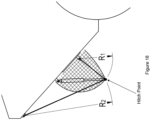
- FIG 18 A simple 2D system is illustrated in Figure 18 comprising one actuator and two ropes, assumed to act in a plane.
- the two rope radii R 1 and R 2 ) are marked.
- the hitch point when fully deployed is at the vertex. If one rope is slack then the hitch point will move along one edge. If both ropes are slack the hitch location (e.g. hitch point) will be located inside the hatched area. Note the similarities between Figure 18 and Figures 15 .
Landscapes
- Engineering & Computer Science (AREA)
- Transportation (AREA)
- Mechanical Engineering (AREA)
- General Engineering & Computer Science (AREA)
- Fittings On The Vehicle Exterior For Carrying Loads, And Devices For Holding Or Mounting Articles (AREA)
- Agricultural Machines (AREA)
Description
- The present invention relates generally to the attachment of implements to vehicles and particularly, although not exclusively, to a vehicle-to-equipment hitch.
- A hitch system binds a prime mover and an implement into a single working unit. A hitch is a link through which the vehicle delivers tractive effort and/or torque in the form of pull or push to counteract a force from an implement or attachment. A hitch point (virtual or real) is the point on the vehicle (as an integral part or otherwise) through which the "line of push" must pass.
- Real hitch points (RHP), e.g. a conventional car/trailer tow ball, cannot be positioned low to the ground, particularly on off-road vehicles, where they might come into contact with the ground causing damage such as disengagement of the hitch or reducing vehicle mobility.
- Virtual hitch points (VHP) generated by linkage mechanisms e.g. 4 bar agricultural tractor hitches can be designed so the physical parts are high above ground but the VHP occurs in a different but desirable location e.g. very low to the ground. However, the VHP position moves as the linkage articulates possibly to other less desirable locations.
-
- The present invention seeks to provide improvements in or relating to hitching.
- Some embodiments provide or relate to a vehicle to equipment hitch point.
- The present invention provides a vehicle-to-implement hitch comprising a force transfer hitch connector adapted to provide a hitch point to which an implement can be connected, the hitch is movable between a stowed configuration and a deployed configuration and is deployable from a vehicle in use, wherein the hitch comprises at least one extendable actuator and at least two flexible tensioning members, whereby the flexible tensioning members and the actuator respectively connect the hitch point to different positions on a vehicle, whereby in the deployed position the tensioning members assume a generally triangular configuration with the hitch point formed at an apex thereof, whereby the actuator when being fully extended and exposed to an overload is no longer fully extended .
- The tensioning members may be relaxed in the stowed configuration and taut in the deployed position.
- Some embodiments provide a hitch that is stowed and then deployed.
- Some embodiments provide a hitch at a desirable location that in some circumstances can move away from that location; one alternative location might be a stowed position.
- Some embodiments of the present invention enable the creation of a hitch point in previously unoccupied space.
- In embodiments of the present invention the hitch location could, for example, be provided as or generally in the form of a point or an axis.
- The hitch location could, for example, be provided as or generally in the form of a ball joint, a Hooke's joint, a universal joint, or a pin joint.
- The form of the hitch may remove one or more degrees of freedom from a hitch location e.g. one or two rotational degrees of freedom.
- When overloaded the hitch may be configured to permit translation. Rotational degrees of freedom may be unchanged in an overload situation.
- The connector may, for example, be a boom. In some embodiments the boom can articulate.
- The connector may form part of the hitch location.
- The connector may be "forward" (e.g. in advance of) the hitch location.
- The hitch may further comprise one or more actuators for moving the hitch from the stowed to the deployed configuration.
- In some embodiments the hitch comprises a first actuator for moving the tensioning member/s to the deployed position and a second actuator for moving the connector to a deployed position.
- In embodiments with multiple actuators the actuators may, for example, deploy in sequence or simultaneously. For example, in one embodiment the tensioning member/s are fully deployed followed by deployment of the connector.
- A hitch point may be, provide or form part of a real or virtual hitch point.
- The or each actuator may be pre-charged and stored energised.
- The or each actuator may be connected or connectable to an external power source.
- The or each actuator may be a gas strut.
- The or each tensioning/tensionable member may be a cable, rope, strap, cord, chain or the like.
- The or each tensioning/tensionable member may be a wire rope.
- The or each tensioning/tensionable member may be a telescoping cylinder.
- Excess member length may be controlled to ensure they pack neatly; for example excess length may be controlled by additional weak springs or weak restraints.
- Taut ropes may be used to provide lateral stiffness (i.e. into / out of the plane of the figures) to the mechanisms.
- Some embodiments may be based on the use of flexible elements such and cables, ropes or chains, which become rigid in tension after the deployment event.
- Some embodiments provide a hitch point formed as part of a triangular linkage, with the hitch point formed at/by an apex.
- Some embodiments form a hitch point in space using actuators and rope.
- In some embodiments a hitch point is formed by two tautable cables and a gas spring.
- Some embodiments provide a hitch point that is movable in the event of an overload.
- The hitch point may be or form part of a generally triangular linkage, with, for example, the hitch point itself being formed at a tip of the triangle.
- The hitch may comprise means for locking the mechanism, or parts of the mechanism, into the stowed position.
- The present invention also provides a hitch as described herein in combination with a vehicle.
- Hitches may be provided and the front and/or rear of a vehicle. For example, the hitch may be configured for use with front end equipment, such as equipment to be used in conjunction with a military vehicle (such as a plough or dozer blade).
- The present invention also provides a mine clearance system comprising a vehicle provided with one or more hitches or hitch mechanisms as defined herein, and a surface clearance implement connected to the vehicle via the hitch/es or hitch mechanism/s.
- In some embodiments the hitch point may be configured to be very low to the ground, which despite being very low is tolerant to striking the ground if this occurs.
- The principles of the present invention allow for creation of structural members in a location that could not be achieved when the equipment is stowed without detriment to the host vehicle. This can provide for optimised hitch point characteristics that could not be achieved with permanently located structures.
- The lightweight structure may be loaded beyond the limits of typical equipment. The nature of the flexible elements allows for a controlled overload without damage to the equipment. This provides for optimised load bearing characteristics, strength and weight with reduced risk of damage to the operational parts.
- The pseudo-rigid structure provides for a controlled over-load reaction from which the structure can recover without damage.
- Some embodiments of the present invention provide a surface clearance device, such as an implement for the clearance of surface laid or scattered mines, in a lightweight and compact system.
- Surface clearance devices can be powerful but bulky and heavy pieces of equipment which, when fitted, reduce the capability of the host vehicle. They are often very strong and capable they can be a considerable size, even when not in use.
- Some embodiments provide a rigid, deployable structure which is deployed from a compact, stowed configuration using actuators (such as gas struts) and flexible members (such as wire rope) which becomes rigid when tensioned and create a real hitch point (RHP) at its extremity. The resulting structure is able to collapse if it does hit an obstacle such as the ground and then re-form after passing the obstacle, temporarily moving the RHP only if required in this situation.
- Some embodiments of this invention allows, for example, a mine clearance device to be fitted to nearly any vehicle with minimal impact. It could, for example, be worn as a "life-jacket" to protect against attack of scatterable mines, without the need for heavy engineering vehicles to accompany. The solution could be applied to front-line combat vehicles and to logistics vehicles, equally.
- In some embodiments the mechanism can collapse upwards if it strikes the ground and rearwards if draft force is too high. Alternatively or additionally the mechanism may also protect if reversing and draft force were too high in that direction, then it may deflect forwards.
- Some embodiments provide or relate to a 2-dimensional 2 rope principle in which the hitch point can move anywhere it needs to if it is overloaded in a space defined by 2 radii - the taut lengths of the 2 cables (assuming it is also constrained to stay in a 2D plane).
- Some embodiments have multiple sets of this 2-dimensional mechanism. In other embodiments a 3-dimensional mechanism with 3 ropes and one actuator tensioning them may, for example, be provided. In that case the hitch point can move, if overloaded, anywhere in a 3D envelope created from 3 radii of 3 rope lengths.
- The pseudo-rigid structure of some embodiments provides for a controlled over-load reaction from which the structure can recover without damage. In some embodiments this works for 3D as well as 2D and overloads in any direction within a geometric envelop defined by the taut members.
- Some embodiments provide or relate to a 2D envelope in which a hitch point can move. The same logic may apply in 3D, but the envelope is more complex.
- Different aspects and embodiments of the invention may be used separately or together.
- Further particular and preferred aspects of the present invention are set out in the accompanying independent and dependent claims. Features of the dependent claims may be combined with the features of the independent claims as appropriate, and in combinations other than those explicitly set out in the claims.
- The present invention is more particularly shown and described, by way of example, in the accompanying drawings, in which:
-
Figures 1 to 7 - hitch point information and discussion. -
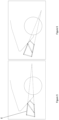
Figure 8 - the hitch point deployment structure in a stowed position. -
Figure 9 - the deployment structure in a deployed position. -
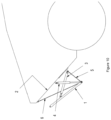
Figure 10 - the hitch point in an intermediate position. -
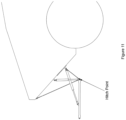
Figure 11 - the deployment structure in the fully deployed position. -
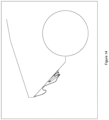
Figure 12 - the deployment structure as if an overload force has been applied to the front of the boom. -
Figure 13 - the deployment structure as if the boom strikes an immovable object and the hitch point deflects upwards, or in any other direction. -
Figure 14 andFigure 15 - stowed and deployed positions of a hitch formed according to a further embodiment. -
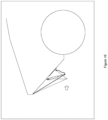
Figure 16 - illustrate that if the structure ofFigure 15 is overloaded from excessive draught force it can deflect rearwards and can be made to recover the original position. -
Figure 17 - illustrates that if the structure ofFigure 15 strikes an immovable object, such as debris or extreme undulations in the ground surface, the structure is able to deflect upwards, or in any other direction and can be made to recover the original position. -
Figure 18 - a 2D system comprising one actuator and two ropes. -
Figures 19 to 22 - a 3D system comprising three tautable ropes. - The example embodiments are described in sufficient detail to enable those of ordinary skill in the art to embody and implement the systems and processes herein described. It is important to understand that embodiments can be provided in many alternative forms and should not be construed as limited to the examples set forth herein.
- Accordingly, while embodiments can be modified in various ways and take on various alternative forms, specific embodiments thereof are shown in the drawings and described in detail below as examples. There is no intent to limit to the particular forms disclosed. On the contrary, all modifications, equivalents, and alternatives falling within the scope of the appended claims should be included. Elements of the example embodiments are consistently denoted by the same reference numerals throughout the drawings and detailed description where appropriate.
- Unless otherwise defined, all terms (including technical and scientific terms) used herein are to be interpreted as is customary in the art. It will be further understood that terms in common usage should also be interpreted as is customary in the relevant art and not in an idealised or overly formal sense unless expressly so defined herein.
- In the description, all orientational terms, such as upper, lower, radially and axially, are used in relation to the drawings and should not be interpreted as limiting on the invention.
- A simple "Real Hitch Point" where a boom (A) is directly attached to a vehicle (B) with a rigid connection (C), shown in the working position, with a tool (not shown) lowered to the ground. It is simple and lightweight but the angle of the boom directs the weight of the vehicle in to the tool and when subject to a large draught force the tool will be pressed in to the ground with greater force.
- The Real Hitch Point is also limited by the stowed position. The tool can be raised from the ground but the equipment cannot be returned to a compact stowed position in such a simple implementation.
- A Real Hitch Point can be improved by moving the connection point D lower to the ground. This limits the undesirable force increase and ground pressure, when subjected to a large draught force. The undesirable consequence of the low connection point is a reduction in ground clearance.
- This simple implementation has a similar limitation on the compactness of the stowed position. The tool can be raised but compact stowage is not possible.
- All of these hitch points may allow the tool to pivot freely and contour the ground, the tool may be rigidly attached to the boom, in which case the tool will rotate with the boom, or the tool may pivot on the end of the boom and be controlled by an additional actuator.
- A further development of a low hitch point could be the 3-point hitch or a "virtual hitch point" where an additional, upper boom E is added, which is also pivotably connected to the tool. This control the pitch angle of the tool but also directs the forces through a point (represented in the figure) by the meeting of the dashed lines. This allows the draught forces subjected to the tool and the vehicle to be carefully controlled. The location of the hitch point will move slightly through the working position of the tool.
- The 3-point hitch is still limited in how much it can be compactly stowed.
-
Figures 8 to 11 illustrate ahitch mechanism 10 formed in accordance with the present invention and shown coupled to ahost vehicle 2 in a stowed (Figure 8 ), intermediate (Figure 10 ) deployed (Figures 9 and11 ) position. - The hitch mechanism is initially stowed up close to the host vehicle (
Figure 8 ). Actuators (3) and (4) are compressed. These may be pre-charged and stored energised or may be connected to an external power source. Ropes (5) and (6) and actuator (4) connect the rear of the boom (1) to the vehicle (2) in a forward and rearward position. The ropes are essentially slack in the stowed position but their excess length may be controlled by additional weak springs or weak restraints to ensure they pack neatly. - A facility to lock the mechanism, or parts of the mechanism, into the stowed position may or may not be required/provided.
- When the system is released, actuator (4) is commanded to move and extends (
Figure 10 ); the mechanism starts to deploy (Figure 10 ). This moves the rear end of the boom (1) to a low, stable position about which the boom can pivot during operations; a real hitch point (RHP) has been formed. - Latterly, the second actuator (3) is commanded to move. This lowers the boom (1) and any attached ground-clearing tools or other equipment to the ground (
Figure 11 ). In the case of ground clearing tools it can applied a near-constant "pushdown" force, while able to contour the ground. - In some ways this arrangement can be thought of as a pin-jointed triangle. The ropes are only capable of transmitting tension and the actuator (4) serves as a strut between them, connecting common ends of the ropes at an apex which then creates the hitch point in space.
- The use of ropes, wires or the like and actuators allows a simple system using a real hitch point in the ideal location to be generated, where the forces subjected to equipment and vehicle and minimised.
- The use of ropes, wires or the like and actuators allows the rigid structure to be collapsed for compact stowage.
- There may be multiple sets of this 2-dimensional mechanism across the width of the vehicle.
- If the structure is overloaded from excessive draught force, the structure can deflect rearwards (see
Figure 12 ) and can be made to recover the original position. - If the structure strikes an immovable object, such as debris or extreme undulations in the ground surface, the structure is able to deflect upwards, or in any other direction (see
Figure 13 ) and can be made to recover the original position. -
Figure 14 andFigure 15 show stowed and deployed positions of a hitch formed according to a further embodiment. The hitch point actuator and ropes are shown.Figure 15 illustrates the generation of the hitch point using the actuator and the ropes. - The hitch point is a point in the generally triangular linkage. It could be considered as a real hitch point, but it is movable in the event of an overload - see below.
- If the structure is overloaded from excessive draught force, the structure can deflect rearwards (see
Figure 16 ) and can be made to recover the original position. - If the structure strikes an immovable object, such as debris or extreme undulations in the ground surface, the structure is able to deflect upwards, or in any other direction (see
Figure 17 ) and can be made to recover the original position. - A simple 2D system is illustrated in
Figure 18 comprising one actuator and two ropes, assumed to act in a plane. The two rope radii (R1 and R2) are marked. The hitch point when fully deployed is at the vertex. If one rope is slack then the hitch point will move along one edge. If both ropes are slack the hitch location (e.g. hitch point) will be located inside the hatched area. Note the similarities betweenFigure 18 andFigures 15 . - Referring now to
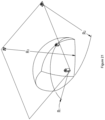
Figures 19 to 22 a generic 3D embodiment is shown, including three taut cables from three corners of the rectangular plate (the vehicle front) individually create three spherical surfaces and the hitch point is able to move within the common volume of these three spheres. i.e. the hitch moves over the surfaces show when two of the cables are slack and one taut. It moves along the lines where two surfaces interest when one cable is slack. And the hitch point is at the point where the three surfaces meet when all the cables are taut. When all three cables are slack, the hitch location is somewhere inside this surface envelope. -
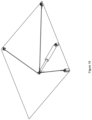
Figure 19 illustrates an assembly of three ropes and an actuator to tension them. -
Figure 20 illustrates a 3Dshape envelope showing possible positions of hitch point, should the actuator be overloaded and rope/s become slack.Figure 21 further draws attention to the radius of each face, which is generated by a rope. - In
Figure 22 the key points of the shape are labelled, explaining the possible positions of hitch location: - a. If the actuator is fully extended then all ropes are taut and the hitch location is located at the "vertex"
- b. If the actuator is overloaded and is no longer fully extended the hitch point location is undefined:
- i. If one rope is slack then the hitch point is located along one "edge" (n.b. there are three edges on the diagram)
- ii. If two ropes are slack then the hitch point is located one "face" (n.b. there are three faces on the diagram)
- iii. If all ropes are slack then the hitch point is located inside the volume.
- Although illustrative embodiments of the invention have been disclosed in detail herein, with reference to the accompanying drawings, it is understood that the invention is not limited to the precise embodiments shown and that various changes and modifications can be effected therein by one skilled in the art without departing from the scope of the invention as defined by the appended claims and their equivalents.
Claims (15)
- A vehicle-to-implement hitch comprising a force transfer hitch connector adapted to provide a hitch point to which an implement can be connected, the hitch is movable between a stowed configuration and a deployed configuration and is deployable from a vehicle in use, wherein the hitch comprises at least one extendable actuator (4), characterised in that the hitch furthermore comprises at least two flexible tensioning members (5, 6), whereby the flexible tensioning members and the actuator respectively connect the hitch point to different positions on a vehicle, whereby in the deployed position the tensioning members assume a generally triangular configuration with the hitch point formed at an apex thereof, whereby the actuator when being fully extended and exposed to an overload is no longer fully extended.
- A hitch as claimed in claim 1, in which the connector is a boom (1) connected to the hitch point.
- A hitch as claimed in claim 1 or claim 2, in which the hitch location is real.
- A hitch as claimed in claim 1 or claim 2, in which the hitch location is a pivot point that is part of a linkage that forms a virtual hitch point.
- A hitch as claimed in any preceding claim, in which the connector is in advance of the hitch location.
- A hitch as claimed in any preceding claim, in which the connector is part of the hitch point.
- A hitch as claimed in any preceding claim, further comprising one or more actuators for moving the hitch from the stowed to the deployed configuration.
- A hitch as claimed in claim 7, in which the or each actuator is pre-charged and stored energised and/or in which the or each actuator is connected or connectable to an external power source.
- A hitch as claimed in claim 7 or claim 8, comprising a plurality of actuators and in which actuators deploy in sequence or in which actuators deploy simultaneously.
- A hitch as claimed in any preceding claim, in which each tensioning member is a cable, rope, strap, cord, chain or the like.
- A hitch as claimed in any preceding claim, in which the flexible tensioning members comprise two or three ropes.
- A hitch as claimed in any preceding claim and comprising means for locking the mechanism, or parts of the mechanism, into the stowed position.
- A hitch as claimed in any preceding claim, formed as a 2D mechanism or formed as a 3D mechanism.
- A hitch according to any preceding claim in combination with a vehicle.
- A mine clearance system comprising a hitch according to any preceding claim and a surface clearance implement connected to the vehicle via the hitch.
Applications Claiming Priority (2)
| Application Number | Priority Date | Filing Date | Title |
|---|---|---|---|
| GBGB2110837.8A GB202110837D0 (en) | 2021-07-28 | 2021-07-28 | Improvements in or relating to hitching |
| PCT/EP2022/071170 WO2023006864A1 (en) | 2021-07-28 | 2022-07-28 | Improvements in or relating to hitching |
Publications (2)
| Publication Number | Publication Date |
|---|---|
| EP4377627A1 EP4377627A1 (en) | 2024-06-05 |
| EP4377627B1 true EP4377627B1 (en) | 2025-07-02 |
Family
ID=77541010
Family Applications (1)
| Application Number | Title | Priority Date | Filing Date |
|---|---|---|---|
| EP22758191.5A Active EP4377627B1 (en) | 2021-07-28 | 2022-07-28 | Hitch |
Country Status (5)
| Country | Link |
|---|---|
| US (1) | US20240367468A1 (en) |
| EP (1) | EP4377627B1 (en) |
| ES (1) | ES3047706T3 (en) |
| GB (2) | GB202110837D0 (en) |
| WO (1) | WO2023006864A1 (en) |
Family Cites Families (3)
| Publication number | Priority date | Publication date | Assignee | Title |
|---|---|---|---|---|
| FR909874A (en) * | 1944-11-08 | 1946-05-21 | Device for detonating mines | |
| GB8801871D0 (en) * | 1988-01-28 | 1989-05-17 | Firth Defence Systems Limited | Mine clearing apparatus |
| CA2813395A1 (en) * | 2013-04-11 | 2013-07-31 | Weimin Wu | Ultimate cyber security switch, 9/11-equivalent event-proof switch, and others |
-
2021
- 2021-07-28 GB GBGB2110837.8A patent/GB202110837D0/en not_active Ceased
-
2022
- 2022-07-28 US US18/291,469 patent/US20240367468A1/en active Pending
- 2022-07-28 GB GB2400830.2A patent/GB2623672A/en active Pending
- 2022-07-28 ES ES22758191T patent/ES3047706T3/en active Active
- 2022-07-28 WO PCT/EP2022/071170 patent/WO2023006864A1/en not_active Ceased
- 2022-07-28 EP EP22758191.5A patent/EP4377627B1/en active Active
Also Published As
| Publication number | Publication date |
|---|---|
| GB202400830D0 (en) | 2024-03-06 |
| ES3047706T3 (en) | 2025-12-04 |
| GB202110837D0 (en) | 2021-09-08 |
| US20240367468A1 (en) | 2024-11-07 |
| GB2623672A (en) | 2024-04-24 |
| EP4377627A1 (en) | 2024-06-05 |
| WO2023006864A1 (en) | 2023-02-02 |
Similar Documents
| Publication | Publication Date | Title |
|---|---|---|
| EP3035786B1 (en) | Attachment system for an implement | |
| EP1484451A1 (en) | Tool coupler | |
| WO2012010921A1 (en) | Detachable thumb assembly and backhoe digging apparatus comprising the same | |
| EP4377627B1 (en) | Hitch | |
| US11259464B2 (en) | Locking linkage for folding agricultural implement | |
| US20100104406A1 (en) | Stabilizing assembly for a forwarder headboard and method | |
| US7937858B2 (en) | Hitch assembly and tractor scraper using same | |
| US20140015213A1 (en) | Tractor having reinforced buffering function | |
| EP3844348B1 (en) | Lift arm assembly of a power machine | |
| EP3571908A2 (en) | Folding hitch | |
| US12371115B2 (en) | Dual use trailer vehicle | |
| US12146292B2 (en) | Reconfigurable box blade | |
| EP3575496B1 (en) | Coupling assembly for attaching a tool to a hydraulic excavator or other work machine | |
| US12565408B2 (en) | Handling machine with telescopic arm | |
| CA2052374A1 (en) | Implement attachment means for mechanical diggers | |
| JP7722740B2 (en) | Work equipment | |
| IL314547A (en) | Dual use trailer vehicle | |
| AU4872499A (en) | Improved drawbar | |
| NZ756409B2 (en) | An attachment system for a soil working implement |
Legal Events
| Date | Code | Title | Description |
|---|---|---|---|
| STAA | Information on the status of an ep patent application or granted ep patent |
Free format text: STATUS: UNKNOWN |
|
| STAA | Information on the status of an ep patent application or granted ep patent |
Free format text: STATUS: THE INTERNATIONAL PUBLICATION HAS BEEN MADE |
|
| PUAI | Public reference made under article 153(3) epc to a published international application that has entered the european phase |
Free format text: ORIGINAL CODE: 0009012 |
|
| STAA | Information on the status of an ep patent application or granted ep patent |
Free format text: STATUS: REQUEST FOR EXAMINATION WAS MADE |
|
| 17P | Request for examination filed |
Effective date: 20240206 |
|
| AK | Designated contracting states |
Kind code of ref document: A1 Designated state(s): AL AT BE BG CH CY CZ DE DK EE ES FI FR GB GR HR HU IE IS IT LI LT LU LV MC MK MT NL NO PL PT RO RS SE SI SK SM TR |
|
| STAA | Information on the status of an ep patent application or granted ep patent |
Free format text: STATUS: EXAMINATION IS IN PROGRESS |
|
| 17Q | First examination report despatched |
Effective date: 20240903 |
|
| DAV | Request for validation of the european patent (deleted) | ||
| DAX | Request for extension of the european patent (deleted) | ||
| GRAP | Despatch of communication of intention to grant a patent |
Free format text: ORIGINAL CODE: EPIDOSNIGR1 |
|
| STAA | Information on the status of an ep patent application or granted ep patent |
Free format text: STATUS: GRANT OF PATENT IS INTENDED |
|
| RIC1 | Information provided on ipc code assigned before grant |
Ipc: A01B 59/00 20060101ALI20250220BHEP Ipc: B60D 1/54 20060101ALI20250220BHEP Ipc: B60D 1/26 20060101ALI20250220BHEP Ipc: B60D 1/167 20060101ALI20250220BHEP Ipc: B60D 1/00 20060101ALI20250220BHEP Ipc: A01B 59/06 20060101ALI20250220BHEP Ipc: F41H 11/16 20110101AFI20250220BHEP |
|
| INTG | Intention to grant announced |
Effective date: 20250304 |
|
| GRAS | Grant fee paid |
Free format text: ORIGINAL CODE: EPIDOSNIGR3 |
|
| GRAA | (expected) grant |
Free format text: ORIGINAL CODE: 0009210 |
|
| STAA | Information on the status of an ep patent application or granted ep patent |
Free format text: STATUS: THE PATENT HAS BEEN GRANTED |
|
| AK | Designated contracting states |
Kind code of ref document: B1 Designated state(s): AL AT BE BG CH CY CZ DE DK EE ES FI FR GB GR HR HU IE IS IT LI LT LU LV MC MK MT NL NO PL PT RO RS SE SI SK SM TR |
|
| REG | Reference to a national code |
Ref country code: GB Ref legal event code: FG4D |
|
| REG | Reference to a national code |
Ref country code: CH Ref legal event code: EP |
|
| REG | Reference to a national code |
Ref country code: DE Ref legal event code: R096 Ref document number: 602022017003 Country of ref document: DE |
|
| REG | Reference to a national code |
Ref country code: IE Ref legal event code: FG4D |
|
| PGFP | Annual fee paid to national office [announced via postgrant information from national office to epo] |
Ref country code: ES Payment date: 20250821 Year of fee payment: 4 |
|
| PGFP | Annual fee paid to national office [announced via postgrant information from national office to epo] |
Ref country code: DE Payment date: 20250806 Year of fee payment: 4 |
|
| PGFP | Annual fee paid to national office [announced via postgrant information from national office to epo] |
Ref country code: FR Payment date: 20250814 Year of fee payment: 4 Ref country code: AT Payment date: 20251020 Year of fee payment: 4 |
|
| REG | Reference to a national code |
Ref country code: NL Ref legal event code: MP Effective date: 20250702 |
|
| REG | Reference to a national code |
Ref country code: ES Ref legal event code: FG2A Ref document number: 3047706 Country of ref document: ES Kind code of ref document: T3 Effective date: 20251204 |
|
| PG25 | Lapsed in a contracting state [announced via postgrant information from national office to epo] |
Ref country code: PT Free format text: LAPSE BECAUSE OF FAILURE TO SUBMIT A TRANSLATION OF THE DESCRIPTION OR TO PAY THE FEE WITHIN THE PRESCRIBED TIME-LIMIT Effective date: 20251103 |
|
| PG25 | Lapsed in a contracting state [announced via postgrant information from national office to epo] |
Ref country code: NL Free format text: LAPSE BECAUSE OF FAILURE TO SUBMIT A TRANSLATION OF THE DESCRIPTION OR TO PAY THE FEE WITHIN THE PRESCRIBED TIME-LIMIT Effective date: 20250702 |
|
| REG | Reference to a national code |
Ref country code: AT Ref legal event code: MK05 Ref document number: 1809647 Country of ref document: AT Kind code of ref document: T Effective date: 20250702 |
|
| PG25 | Lapsed in a contracting state [announced via postgrant information from national office to epo] |
Ref country code: IS Free format text: LAPSE BECAUSE OF FAILURE TO SUBMIT A TRANSLATION OF THE DESCRIPTION OR TO PAY THE FEE WITHIN THE PRESCRIBED TIME-LIMIT Effective date: 20251102 |
|
| PG25 | Lapsed in a contracting state [announced via postgrant information from national office to epo] |
Ref country code: NO Free format text: LAPSE BECAUSE OF FAILURE TO SUBMIT A TRANSLATION OF THE DESCRIPTION OR TO PAY THE FEE WITHIN THE PRESCRIBED TIME-LIMIT Effective date: 20251002 |
|
| REG | Reference to a national code |
Ref country code: LT Ref legal event code: MG9D |
|
| PG25 | Lapsed in a contracting state [announced via postgrant information from national office to epo] |
Ref country code: AT Free format text: LAPSE BECAUSE OF FAILURE TO SUBMIT A TRANSLATION OF THE DESCRIPTION OR TO PAY THE FEE WITHIN THE PRESCRIBED TIME-LIMIT Effective date: 20250702 |
|
| PG25 | Lapsed in a contracting state [announced via postgrant information from national office to epo] |
Ref country code: FI Free format text: LAPSE BECAUSE OF FAILURE TO SUBMIT A TRANSLATION OF THE DESCRIPTION OR TO PAY THE FEE WITHIN THE PRESCRIBED TIME-LIMIT Effective date: 20250702 |
|
| PG25 | Lapsed in a contracting state [announced via postgrant information from national office to epo] |
Ref country code: HR Free format text: LAPSE BECAUSE OF FAILURE TO SUBMIT A TRANSLATION OF THE DESCRIPTION OR TO PAY THE FEE WITHIN THE PRESCRIBED TIME-LIMIT Effective date: 20250702 |
|
| PG25 | Lapsed in a contracting state [announced via postgrant information from national office to epo] |
Ref country code: GR Free format text: LAPSE BECAUSE OF FAILURE TO SUBMIT A TRANSLATION OF THE DESCRIPTION OR TO PAY THE FEE WITHIN THE PRESCRIBED TIME-LIMIT Effective date: 20251003 |
|
| PG25 | Lapsed in a contracting state [announced via postgrant information from national office to epo] |
Ref country code: CZ Free format text: LAPSE BECAUSE OF FAILURE TO SUBMIT A TRANSLATION OF THE DESCRIPTION OR TO PAY THE FEE WITHIN THE PRESCRIBED TIME-LIMIT Effective date: 20250702 Ref country code: SE Free format text: LAPSE BECAUSE OF FAILURE TO SUBMIT A TRANSLATION OF THE DESCRIPTION OR TO PAY THE FEE WITHIN THE PRESCRIBED TIME-LIMIT Effective date: 20250702 |
|
| PG25 | Lapsed in a contracting state [announced via postgrant information from national office to epo] |
Ref country code: LV Free format text: LAPSE BECAUSE OF FAILURE TO SUBMIT A TRANSLATION OF THE DESCRIPTION OR TO PAY THE FEE WITHIN THE PRESCRIBED TIME-LIMIT Effective date: 20250702 |
|
| PG25 | Lapsed in a contracting state [announced via postgrant information from national office to epo] |
Ref country code: BG Free format text: LAPSE BECAUSE OF FAILURE TO SUBMIT A TRANSLATION OF THE DESCRIPTION OR TO PAY THE FEE WITHIN THE PRESCRIBED TIME-LIMIT Effective date: 20250702 Ref country code: PL Free format text: LAPSE BECAUSE OF FAILURE TO SUBMIT A TRANSLATION OF THE DESCRIPTION OR TO PAY THE FEE WITHIN THE PRESCRIBED TIME-LIMIT Effective date: 20250702 |
|
| PG25 | Lapsed in a contracting state [announced via postgrant information from national office to epo] |
Ref country code: RS Free format text: LAPSE BECAUSE OF FAILURE TO SUBMIT A TRANSLATION OF THE DESCRIPTION OR TO PAY THE FEE WITHIN THE PRESCRIBED TIME-LIMIT Effective date: 20251002 |
|
| REG | Reference to a national code |
Ref country code: CH Ref legal event code: H13 Free format text: ST27 STATUS EVENT CODE: U-0-0-H10-H13 (AS PROVIDED BY THE NATIONAL OFFICE) Effective date: 20260224 |
|
| PG25 | Lapsed in a contracting state [announced via postgrant information from national office to epo] |
Ref country code: RO Free format text: LAPSE BECAUSE OF FAILURE TO SUBMIT A TRANSLATION OF THE DESCRIPTION OR TO PAY THE FEE WITHIN THE PRESCRIBED TIME-LIMIT Effective date: 20250702 Ref country code: LU Free format text: LAPSE BECAUSE OF NON-PAYMENT OF DUE FEES Effective date: 20250728 |
|
| REG | Reference to a national code |
Ref country code: BE Ref legal event code: MM Effective date: 20250731 |
|
| PG25 | Lapsed in a contracting state [announced via postgrant information from national office to epo] |
Ref country code: SM Free format text: LAPSE BECAUSE OF FAILURE TO SUBMIT A TRANSLATION OF THE DESCRIPTION OR TO PAY THE FEE WITHIN THE PRESCRIBED TIME-LIMIT Effective date: 20250702 |
|
| PG25 | Lapsed in a contracting state [announced via postgrant information from national office to epo] |
Ref country code: DK Free format text: LAPSE BECAUSE OF FAILURE TO SUBMIT A TRANSLATION OF THE DESCRIPTION OR TO PAY THE FEE WITHIN THE PRESCRIBED TIME-LIMIT Effective date: 20250702 |
|
| PG25 | Lapsed in a contracting state [announced via postgrant information from national office to epo] |
Ref country code: BE Free format text: LAPSE BECAUSE OF NON-PAYMENT OF DUE FEES Effective date: 20250731 Ref country code: IT Free format text: LAPSE BECAUSE OF FAILURE TO SUBMIT A TRANSLATION OF THE DESCRIPTION OR TO PAY THE FEE WITHIN THE PRESCRIBED TIME-LIMIT Effective date: 20250702 |
|
| PG25 | Lapsed in a contracting state [announced via postgrant information from national office to epo] |
Ref country code: CH Free format text: LAPSE BECAUSE OF NON-PAYMENT OF DUE FEES Effective date: 20250731 |
|
| PG25 | Lapsed in a contracting state [announced via postgrant information from national office to epo] |
Ref country code: SK Free format text: LAPSE BECAUSE OF FAILURE TO SUBMIT A TRANSLATION OF THE DESCRIPTION OR TO PAY THE FEE WITHIN THE PRESCRIBED TIME-LIMIT Effective date: 20250702 Ref country code: EE Free format text: LAPSE BECAUSE OF FAILURE TO SUBMIT A TRANSLATION OF THE DESCRIPTION OR TO PAY THE FEE WITHIN THE PRESCRIBED TIME-LIMIT Effective date: 20250702 |