EP4377308B1 - Compounds for complexation of rare earth elements and/or s-, p-, d- block metals, their coordination compounds, peptide conjugates, method of their preparation and use thereof - Google Patents

Compounds for complexation of rare earth elements and/or s-, p-, d- block metals, their coordination compounds, peptide conjugates, method of their preparation and use thereof Download PDF

Info

Publication number
EP4377308B1
EP4377308B1 EP22782448.9A EP22782448A EP4377308B1 EP 4377308 B1 EP4377308 B1 EP 4377308B1 EP 22782448 A EP22782448 A EP 22782448A EP 4377308 B1 EP4377308 B1 EP 4377308B1
Authority
EP
European Patent Office
Prior art keywords
cooh
arom
group
equiv
evaporated
Prior art date
Legal status (The legal status is an assumption and is not a legal conclusion. Google has not performed a legal analysis and makes no representation as to the accuracy of the status listed.)
Active
Application number
EP22782448.9A
Other languages
German (de)
French (fr)
Other versions
EP4377308A1 (en
EP4377308C0 (en
Inventor
Miloslav Polasek
Tomas David
Michal Straka
Adam Jaros
Current Assignee (The listed assignees may be inaccurate. Google has not performed a legal analysis and makes no representation or warranty as to the accuracy of the list.)
Institute of Organic Chemistry and Biochemistry CAS
Original Assignee
Institute of Organic Chemistry and Biochemistry CAS
Priority date (The priority date is an assumption and is not a legal conclusion. Google has not performed a legal analysis and makes no representation as to the accuracy of the date listed.)
Filing date
Publication date
Application filed by Institute of Organic Chemistry and Biochemistry CAS filed Critical Institute of Organic Chemistry and Biochemistry CAS
Publication of EP4377308A1 publication Critical patent/EP4377308A1/en
Application granted granted Critical
Publication of EP4377308B1 publication Critical patent/EP4377308B1/en
Publication of EP4377308C0 publication Critical patent/EP4377308C0/en
Active legal-status Critical Current
Anticipated expiration legal-status Critical

Links

Classifications

    • GPHYSICS
    • G01MEASURING; TESTING
    • G01NINVESTIGATING OR ANALYSING MATERIALS BY DETERMINING THEIR CHEMICAL OR PHYSICAL PROPERTIES
    • G01N33/00Investigating or analysing materials by specific methods not covered by groups G01N1/00 - G01N31/00
    • G01N33/48Biological material, e.g. blood, urine; Haemocytometers
    • G01N33/50Chemical analysis of biological material, e.g. blood, urine; Testing involving biospecific ligand binding methods; Immunological testing
    • G01N33/68Chemical analysis of biological material, e.g. blood, urine; Testing involving biospecific ligand binding methods; Immunological testing involving proteins, peptides or amino acids
    • G01N33/6803General methods of protein analysis not limited to specific proteins or families of proteins
    • G01N33/6848Methods of protein analysis involving mass spectrometry
    • AHUMAN NECESSITIES
    • A61MEDICAL OR VETERINARY SCIENCE; HYGIENE
    • A61KPREPARATIONS FOR MEDICAL, DENTAL OR TOILETRY PURPOSES
    • A61K49/00Preparations for testing in vivo
    • A61K49/06Nuclear magnetic resonance [NMR] contrast preparations; Magnetic resonance imaging [MRI] contrast preparations
    • A61K49/08Nuclear magnetic resonance [NMR] contrast preparations; Magnetic resonance imaging [MRI] contrast preparations characterised by the carrier
    • A61K49/085Nuclear magnetic resonance [NMR] contrast preparations; Magnetic resonance imaging [MRI] contrast preparations characterised by the carrier conjugated systems
    • AHUMAN NECESSITIES
    • A61MEDICAL OR VETERINARY SCIENCE; HYGIENE
    • A61KPREPARATIONS FOR MEDICAL, DENTAL OR TOILETRY PURPOSES
    • A61K49/00Preparations for testing in vivo
    • A61K49/06Nuclear magnetic resonance [NMR] contrast preparations; Magnetic resonance imaging [MRI] contrast preparations
    • A61K49/08Nuclear magnetic resonance [NMR] contrast preparations; Magnetic resonance imaging [MRI] contrast preparations characterised by the carrier
    • A61K49/10Organic compounds
    • A61K49/14Peptides, e.g. proteins
    • AHUMAN NECESSITIES
    • A61MEDICAL OR VETERINARY SCIENCE; HYGIENE
    • A61KPREPARATIONS FOR MEDICAL, DENTAL OR TOILETRY PURPOSES
    • A61K49/00Preparations for testing in vivo
    • A61K49/06Nuclear magnetic resonance [NMR] contrast preparations; Magnetic resonance imaging [MRI] contrast preparations
    • A61K49/08Nuclear magnetic resonance [NMR] contrast preparations; Magnetic resonance imaging [MRI] contrast preparations characterised by the carrier
    • A61K49/10Organic compounds
    • A61K49/14Peptides, e.g. proteins
    • A61K49/16Antibodies; Immunoglobulins; Fragments thereof
    • AHUMAN NECESSITIES
    • A61MEDICAL OR VETERINARY SCIENCE; HYGIENE
    • A61KPREPARATIONS FOR MEDICAL, DENTAL OR TOILETRY PURPOSES
    • A61K51/00Preparations containing radioactive substances for use in therapy or testing in vivo
    • A61K51/02Preparations containing radioactive substances for use in therapy or testing in vivo characterised by the carrier, i.e. characterised by the agent or material covalently linked or complexing the radioactive nucleus
    • A61K51/04Organic compounds
    • A61K51/0474Organic compounds complexes or complex-forming compounds, i.e. wherein a radioactive metal (e.g. 111In3+) is complexed or chelated by, e.g. a N2S2, N3S, NS3, N4 chelating group
    • A61K51/0482Organic compounds complexes or complex-forming compounds, i.e. wherein a radioactive metal (e.g. 111In3+) is complexed or chelated by, e.g. a N2S2, N3S, NS3, N4 chelating group chelates from cyclic ligands, e.g. DOTA
    • AHUMAN NECESSITIES
    • A61MEDICAL OR VETERINARY SCIENCE; HYGIENE
    • A61KPREPARATIONS FOR MEDICAL, DENTAL OR TOILETRY PURPOSES
    • A61K51/00Preparations containing radioactive substances for use in therapy or testing in vivo
    • A61K51/02Preparations containing radioactive substances for use in therapy or testing in vivo characterised by the carrier, i.e. characterised by the agent or material covalently linked or complexing the radioactive nucleus
    • A61K51/04Organic compounds
    • A61K51/0497Organic compounds conjugates with a carrier being an organic compounds
    • AHUMAN NECESSITIES
    • A61MEDICAL OR VETERINARY SCIENCE; HYGIENE
    • A61KPREPARATIONS FOR MEDICAL, DENTAL OR TOILETRY PURPOSES
    • A61K51/00Preparations containing radioactive substances for use in therapy or testing in vivo
    • A61K51/02Preparations containing radioactive substances for use in therapy or testing in vivo characterised by the carrier, i.e. characterised by the agent or material covalently linked or complexing the radioactive nucleus
    • A61K51/04Organic compounds
    • A61K51/08Peptides, e.g. proteins, carriers being peptides, polyamino acids, proteins
    • A61K51/088Peptides, e.g. proteins, carriers being peptides, polyamino acids, proteins conjugates with carriers being peptides, polyamino acids or proteins
    • CCHEMISTRY; METALLURGY
    • C07ORGANIC CHEMISTRY
    • C07BGENERAL METHODS OF ORGANIC CHEMISTRY; APPARATUS THEREFOR
    • C07B59/00Introduction of isotopes of elements into organic compounds ; Labelled organic compounds per se
    • C07B59/008Peptides; Proteins
    • CCHEMISTRY; METALLURGY
    • C07ORGANIC CHEMISTRY
    • C07DHETEROCYCLIC COMPOUNDS
    • C07D257/00Heterocyclic compounds containing rings having four nitrogen atoms as the only ring hetero atoms
    • C07D257/02Heterocyclic compounds containing rings having four nitrogen atoms as the only ring hetero atoms not condensed with other rings
    • CCHEMISTRY; METALLURGY
    • C07ORGANIC CHEMISTRY
    • C07DHETEROCYCLIC COMPOUNDS
    • C07D401/00Heterocyclic compounds containing two or more hetero rings, having nitrogen atoms as the only ring hetero atoms, at least one ring being a six-membered ring with only one nitrogen atom
    • C07D401/02Heterocyclic compounds containing two or more hetero rings, having nitrogen atoms as the only ring hetero atoms, at least one ring being a six-membered ring with only one nitrogen atom containing two hetero rings
    • C07D401/06Heterocyclic compounds containing two or more hetero rings, having nitrogen atoms as the only ring hetero atoms, at least one ring being a six-membered ring with only one nitrogen atom containing two hetero rings linked by a carbon chain containing only aliphatic carbon atoms
    • CCHEMISTRY; METALLURGY
    • C07ORGANIC CHEMISTRY
    • C07DHETEROCYCLIC COMPOUNDS
    • C07D401/00Heterocyclic compounds containing two or more hetero rings, having nitrogen atoms as the only ring hetero atoms, at least one ring being a six-membered ring with only one nitrogen atom
    • C07D401/14Heterocyclic compounds containing two or more hetero rings, having nitrogen atoms as the only ring hetero atoms, at least one ring being a six-membered ring with only one nitrogen atom containing three or more hetero rings
    • CCHEMISTRY; METALLURGY
    • C07ORGANIC CHEMISTRY
    • C07DHETEROCYCLIC COMPOUNDS
    • C07D471/00Heterocyclic compounds containing nitrogen atoms as the only ring hetero atoms in the condensed system, at least one ring being a six-membered ring with one nitrogen atom, not provided for by groups C07D451/00 - C07D463/00
    • C07D471/22Heterocyclic compounds containing nitrogen atoms as the only ring hetero atoms in the condensed system, at least one ring being a six-membered ring with one nitrogen atom, not provided for by groups C07D451/00 - C07D463/00 in which the condensed systems contains four or more hetero rings
    • CCHEMISTRY; METALLURGY
    • C07ORGANIC CHEMISTRY
    • C07FACYCLIC, CARBOCYCLIC OR HETEROCYCLIC COMPOUNDS CONTAINING ELEMENTS OTHER THAN CARBON, HYDROGEN, HALOGEN, OXYGEN, NITROGEN, SULFUR, SELENIUM OR TELLURIUM
    • C07F13/00Compounds containing elements of Groups 7 or 17 of the Periodic Table
    • C07F13/005Compounds without a metal-carbon linkage
    • CCHEMISTRY; METALLURGY
    • C07ORGANIC CHEMISTRY
    • C07FACYCLIC, CARBOCYCLIC OR HETEROCYCLIC COMPOUNDS CONTAINING ELEMENTS OTHER THAN CARBON, HYDROGEN, HALOGEN, OXYGEN, NITROGEN, SULFUR, SELENIUM OR TELLURIUM
    • C07F15/00Compounds containing elements of Groups 8, 9, 10 or 18 of the Periodic Table
    • C07F15/0006Compounds containing elements of Groups 8, 9, 10 or 18 of the Periodic Table compounds of the platinum group
    • C07F15/006Palladium compounds
    • C07F15/0066Palladium compounds without a metal-carbon linkage
    • CCHEMISTRY; METALLURGY
    • C07ORGANIC CHEMISTRY
    • C07FACYCLIC, CARBOCYCLIC OR HETEROCYCLIC COMPOUNDS CONTAINING ELEMENTS OTHER THAN CARBON, HYDROGEN, HALOGEN, OXYGEN, NITROGEN, SULFUR, SELENIUM OR TELLURIUM
    • C07F3/00Compounds containing elements of Groups 2 or 12 of the Periodic Table
    • C07F3/04Calcium compounds
    • CCHEMISTRY; METALLURGY
    • C07ORGANIC CHEMISTRY
    • C07FACYCLIC, CARBOCYCLIC OR HETEROCYCLIC COMPOUNDS CONTAINING ELEMENTS OTHER THAN CARBON, HYDROGEN, HALOGEN, OXYGEN, NITROGEN, SULFUR, SELENIUM OR TELLURIUM
    • C07F3/00Compounds containing elements of Groups 2 or 12 of the Periodic Table
    • C07F3/06Zinc compounds
    • CCHEMISTRY; METALLURGY
    • C07ORGANIC CHEMISTRY
    • C07FACYCLIC, CARBOCYCLIC OR HETEROCYCLIC COMPOUNDS CONTAINING ELEMENTS OTHER THAN CARBON, HYDROGEN, HALOGEN, OXYGEN, NITROGEN, SULFUR, SELENIUM OR TELLURIUM
    • C07F3/00Compounds containing elements of Groups 2 or 12 of the Periodic Table
    • C07F3/08Cadmium compounds
    • CCHEMISTRY; METALLURGY
    • C07ORGANIC CHEMISTRY
    • C07FACYCLIC, CARBOCYCLIC OR HETEROCYCLIC COMPOUNDS CONTAINING ELEMENTS OTHER THAN CARBON, HYDROGEN, HALOGEN, OXYGEN, NITROGEN, SULFUR, SELENIUM OR TELLURIUM
    • C07F5/00Compounds containing elements of Groups 3 or 13 of the Periodic Table
    • C07F5/003Compounds containing elements of Groups 3 or 13 of the Periodic Table without C-Metal linkages
    • CCHEMISTRY; METALLURGY
    • C07ORGANIC CHEMISTRY
    • C07FACYCLIC, CARBOCYCLIC OR HETEROCYCLIC COMPOUNDS CONTAINING ELEMENTS OTHER THAN CARBON, HYDROGEN, HALOGEN, OXYGEN, NITROGEN, SULFUR, SELENIUM OR TELLURIUM
    • C07F7/00Compounds containing elements of Groups 4 or 14 of the Periodic Table
    • C07F7/24Lead compounds
    • CCHEMISTRY; METALLURGY
    • C07ORGANIC CHEMISTRY
    • C07FACYCLIC, CARBOCYCLIC OR HETEROCYCLIC COMPOUNDS CONTAINING ELEMENTS OTHER THAN CARBON, HYDROGEN, HALOGEN, OXYGEN, NITROGEN, SULFUR, SELENIUM OR TELLURIUM
    • C07F9/00Compounds containing elements of Groups 5 or 15 of the Periodic Table
    • C07F9/02Phosphorus compounds
    • C07F9/547Heterocyclic compounds, e.g. containing phosphorus as a ring hetero atom
    • C07F9/6524Heterocyclic compounds, e.g. containing phosphorus as a ring hetero atom having four or more nitrogen atoms as the only ring hetero atoms
    • CCHEMISTRY; METALLURGY
    • C07ORGANIC CHEMISTRY
    • C07FACYCLIC, CARBOCYCLIC OR HETEROCYCLIC COMPOUNDS CONTAINING ELEMENTS OTHER THAN CARBON, HYDROGEN, HALOGEN, OXYGEN, NITROGEN, SULFUR, SELENIUM OR TELLURIUM
    • C07F9/00Compounds containing elements of Groups 5 or 15 of the Periodic Table
    • C07F9/02Phosphorus compounds
    • C07F9/547Heterocyclic compounds, e.g. containing phosphorus as a ring hetero atom
    • C07F9/6558Heterocyclic compounds, e.g. containing phosphorus as a ring hetero atom containing at least two different or differently substituted hetero rings neither condensed among themselves nor condensed with a common carbocyclic ring or ring system
    • C07F9/65583Heterocyclic compounds, e.g. containing phosphorus as a ring hetero atom containing at least two different or differently substituted hetero rings neither condensed among themselves nor condensed with a common carbocyclic ring or ring system each of the hetero rings containing nitrogen as ring hetero atom
    • CCHEMISTRY; METALLURGY
    • C07ORGANIC CHEMISTRY
    • C07KPEPTIDES
    • C07K7/00Peptides having 5 to 20 amino acids in a fully defined sequence; Derivatives thereof
    • C07K7/04Linear peptides containing only normal peptide links
    • C07K7/06Linear peptides containing only normal peptide links having 5 to 11 amino acids
    • GPHYSICS
    • G01MEASURING; TESTING
    • G01NINVESTIGATING OR ANALYSING MATERIALS BY DETERMINING THEIR CHEMICAL OR PHYSICAL PROPERTIES
    • G01N1/00Sampling; Preparing specimens for investigation
    • G01N1/28Preparing specimens for investigation including physical details of (bio-)chemical methods covered elsewhere, e.g. G01N33/50, C12Q
    • G01N1/40Concentrating samples
    • G01N1/4044Concentrating samples by chemical techniques; Digestion; Chemical decomposition
    • GPHYSICS
    • G01MEASURING; TESTING
    • G01NINVESTIGATING OR ANALYSING MATERIALS BY DETERMINING THEIR CHEMICAL OR PHYSICAL PROPERTIES
    • G01N33/00Investigating or analysing materials by specific methods not covered by groups G01N1/00 - G01N31/00
    • G01N33/48Biological material, e.g. blood, urine; Haemocytometers
    • G01N33/50Chemical analysis of biological material, e.g. blood, urine; Testing involving biospecific ligand binding methods; Immunological testing
    • G01N33/58Chemical analysis of biological material, e.g. blood, urine; Testing involving biospecific ligand binding methods; Immunological testing involving labelled substances
    • G01N33/60Chemical analysis of biological material, e.g. blood, urine; Testing involving biospecific ligand binding methods; Immunological testing involving labelled substances involving radioactive labelled substances
    • CCHEMISTRY; METALLURGY
    • C07ORGANIC CHEMISTRY
    • C07BGENERAL METHODS OF ORGANIC CHEMISTRY; APPARATUS THEREFOR
    • C07B2200/00Indexing scheme relating to specific properties of organic compounds
    • C07B2200/05Isotopically modified compounds, e.g. labelled

Definitions

  • the present invention relates to new macrocyclic compounds suitable as cross-bridged chelators for complexation of rare earth elements and/or s-, p-, d- block metals, forming extremely stable coordination compounds. These coordination compounds are suitable for use as labels for quantitative detection of peptide conjugates, and/or as contrast agents for magnetic resonance imaging.
  • the invention further relates to a method of preparation of the chelators and to a method of tracing peptide/protein containing medicaments.
  • Metal elements find biomedical applications such as imaging contrast agents, radiotherapeutic agents or bioanalytical labels. For most of these applications, it is necessary to bind the metal in a stable chelate that can be covalently linked to other molecules, such as targeting vectors based on peptides or antibodies.
  • a chelator applicable to majority of metal elements is DOTA (1,4,7,10-tetraazacyclododecane-1,4,7,10-tetraacetic acid) and its derivatives.
  • DOTA 1,4,7,10-tetraazacyclododecane-1,4,7,10-tetraacetic acid
  • a broad range of other chelators have been developed specifically for particular metal elements. [ Price E. W., Orvig C. (2014), Chem. Soc. Rev. 43(1), 260 - 290 ].
  • Rare earth elements (scandium - Sc, yttrium - Y, lanthanum - La, cerium - Ce, praseodymium - Pr, neodymium - Nd, promethium - Pm, samarium - Sm, europium - Eu, gadolinium - Gd, terbium - Tb, dysprosium - Dy, holmium - Ho, erbium - Er, thulium - Tm, ytterbium - Yb and lutetium - Lu) are a group of metals that offer a broad range of medical applications.
  • Radiopharmaceuticals based on 90 Y, 153 Sm and 177 Lu are approved by FDA, clinical trials are ongoing with 166 Ho, and others show advantageous properties for Positron Emission Tomography (PET), Single-Photon Emission Computed Tomography (SPECT) or therapy ( 44 Sc, 47 Sc, 86 Y, 149 Pm, 159 Gd, 149 Tb, 161 Tb, 165 Dy, 161 Ho, 169 Er and 175 Yb).
  • Stable, non-radioactive Gd chelates are in clinical use as contrast agents for Magnetic Resonance Imaging (MRI).
  • Stable isotopes of rare earth elements also serve as labels for analytical purposes.
  • metal elements from s-, p- and d-block of the periodic system such as 89 Sr, 223 Ra, 117m Sn, 212 Pb, 213 Bi, 64 Cu, 225 Ac, find use in radiopharmaceutical compounds for imaging or therapy.
  • thermodynamic stability constant provides insufficient information, because most applications proceed under conditions far from thermodynamic equilibrium (e.g. in-vivo ) . Instead, kinetic inertness that characterizes the rate at which the metal ion escapes from the chelate under given conditions must be considered. Kinetic inertness strongly correlates with rigidity of the chelator. Acyclic chelators of the type DTPA (diethylenetriaminepentaacetic acid) have more flexible structure and provide lower kinetic inertness than macrocyclic chelators of the type DOTA, which are more rigid.
  • DTPA diethylenetriaminepentaacetic acid
  • Chelates with high kinetic inertness are desirable particularly for in-vivo applications, where the metal chelate is challenged with excess of competing biogenic chelators and metal ions.
  • the rigid and kinetically inert macrocyclic chelators are preferred to the flexible acyclic ones.
  • macrocyclic chelator DOTA practically all radiopharmaceuticals based on the radionuclide 177 Lu (half-life 6.7 days) that are approved or in development make use of the macrocyclic chelator DOTA, as the metal must remain bound to the targeting molecule in-vivo for weeks in order to have the desired curative effect.
  • macrocyclic chelates of gadolinium(III) are preferred to the acyclic DTPA type.
  • a cross-bridged macrocyclic chelator cb-TE2A (4,11-bis(carboxymethyl)-1,4,9,11-tetraazabicyclo[6.6.2]hexadecane) provides much more inert chelates with copper(II) ion than the non-cross-bridged analogues [ Boswell C. A. et al. (2004), J. Med. Chem. 47(6), 1465-1474 ].
  • Another similar chelator cb-TEDPA (6,6'-((1,4,9,11-Tetraazabicyclo[6.6.2]hexadecane-4,11-diyl)bis(methylene))dipicolinic acid) was shown to provide exceptionally inert lanthanide(III) chelates [ Rodriguez-Rodriguez A. et al. (2016), Inorg. Chem. 55(5), 2227-2239 ].
  • Another cyclen-based cross-bridged chelator provided extremely inert copper(II) chelates [ Esteves, C. V. et al. (2013), Inorg. Chem. 52(9), 5138-5153 ].
  • a common feature of these chelators is that the bridge is independent from the coordinating pendant arms and is oriented on the opposite side from the pendant arms in the chelate. Chelators where the bridge connected the pendant arms themselves have also been made, but the effect on stability of the chelates was strongly negative [ Vipond, J. et al. (2007), Inorg. Chem. 46(7), 2584-2595 ].
  • chelators which form a bridge after complexation of the metal ion that rigidifies the structure and increases kinetic inertness.
  • the bridge is formed between two coordinating pendant arms based on cycloaddition reaction between alkyne and azide substituents on the opposite pendant arms. This reaction does not require catalyzation by Cu(I) ions as is usually the case, and occurs spontaneously after formation of a non-bridged chelate.
  • the chelator therefore acts as a one-way trap for the metal ion. Initial formation of the non-bridged chelate is relatively fast. Then, a bridge is formed that traps the metal inside the chelator.
  • the resulting bridged chelates show extremely high kinetic inertness that is up to 6 orders of magnitude higher than for the analogous chelates with DOTA.
  • Such unusually high inertness allows new uses of the chelates as analytical labels that can withstand harsh hydrolytic conditions in concentrated acids and can be quantified in the lysate as intact chelates with liquid chromatography - mass spectrometry (LC-MS).
  • LC-MS liquid chromatography - mass spectrometry
  • the use of LC-MS is advantageous, as it is much more common instrument than ICP-MS.
  • the extremely high inertness is also advantageous for potential in-vivo use of the chelates, such as MRI contrast agents or radiopharmaceuticals, as no free metal is released in-vivo from the coordination compounds, therefore no metal deposit occurs in human or animal body.
  • the compounds according to the present invention are capable of acting as extremely efficient molecular traps, which can coordinate metal ions in an extremely stable, rigid and well defined manner.
  • the ligands can be prepared in relatively a few number of steps of organic synthesis.
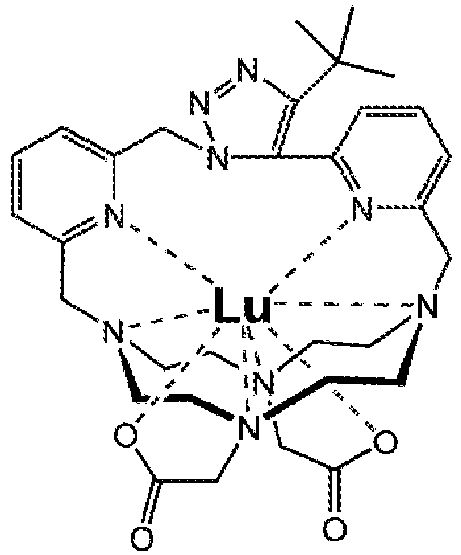
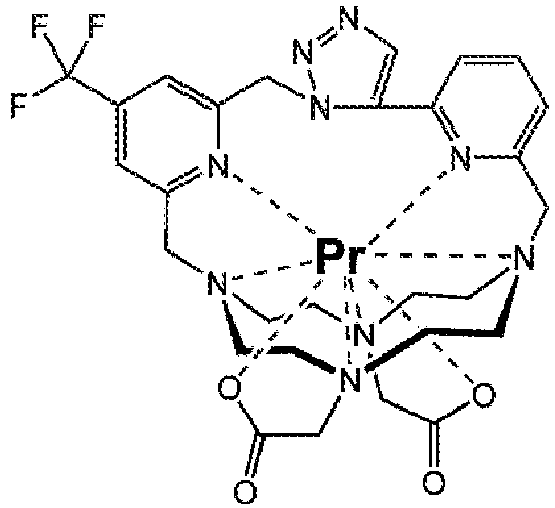
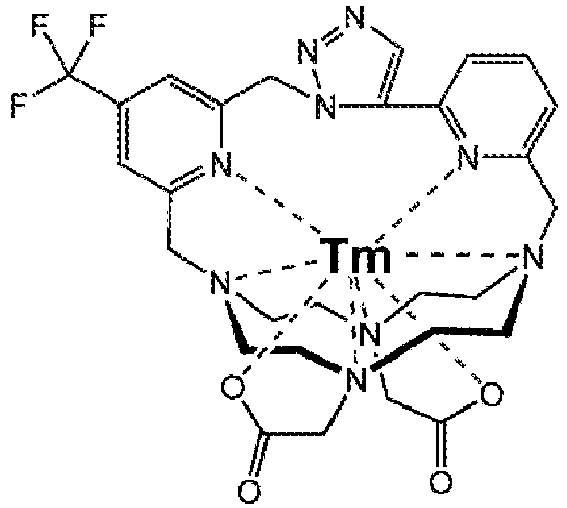
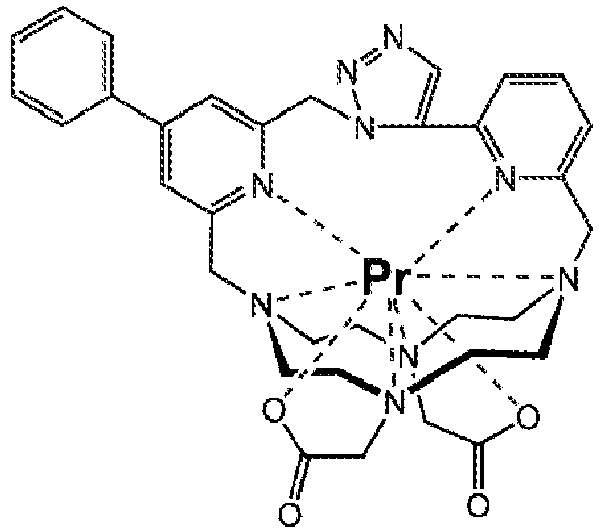
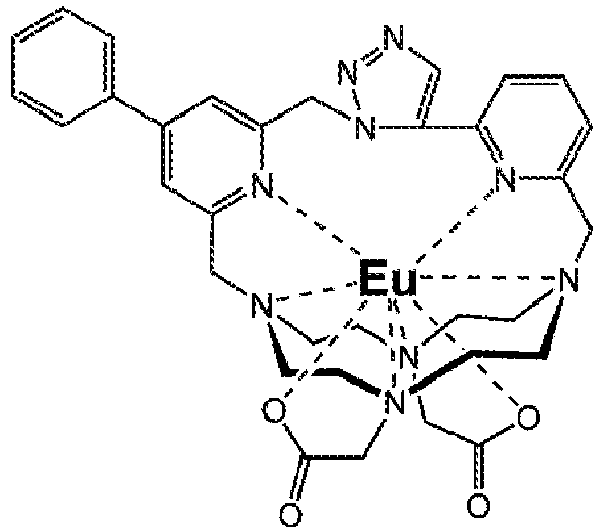
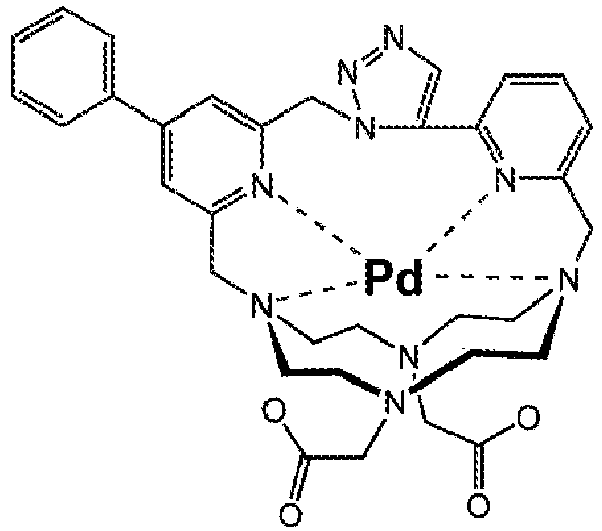
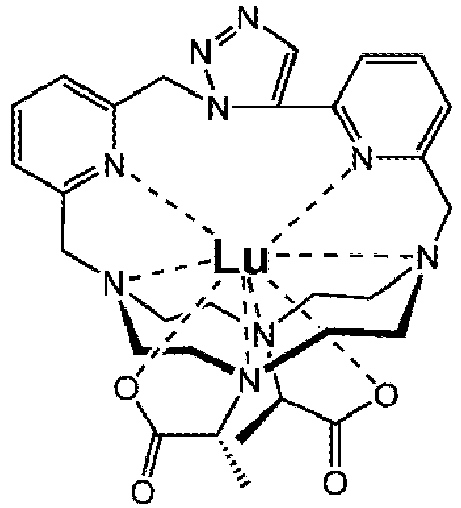
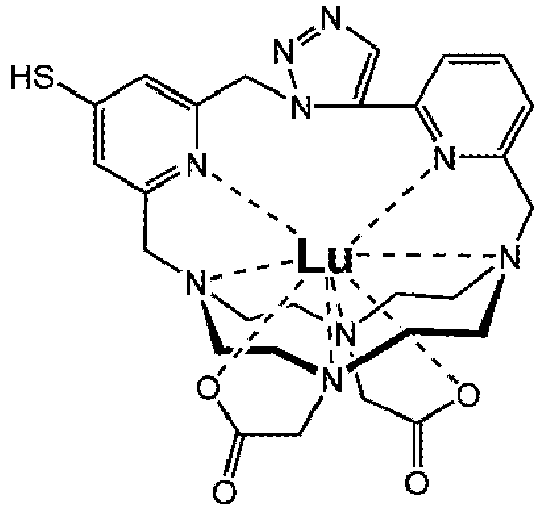
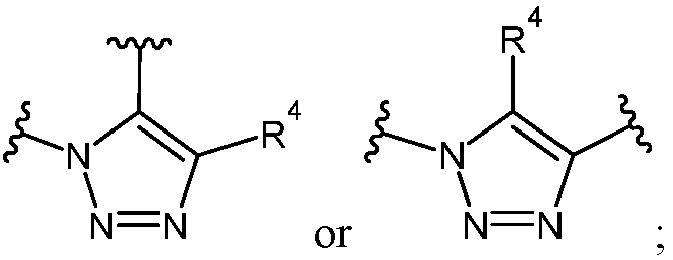
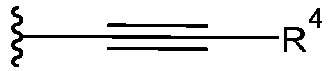
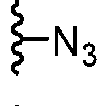
  • the click reaction is performed between the azide group and a triple bond present in opposite pendant arms of the macrocycle, forming a triazole bridge, and enclosing the metal ion within the cage (forming the so-called click-zipped complex).
  • the formation of triazole is irreversible and is depicted in Scheme 1 below.
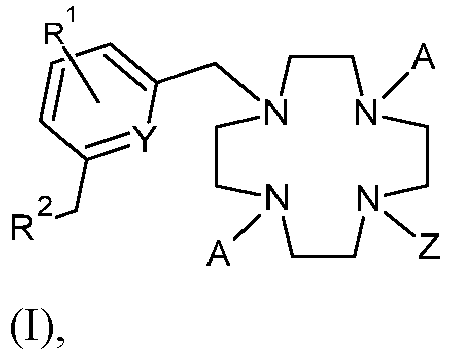
  • the subject of the present invention relates to compounds of general formula (I) wherein
  • the present invention further includes the compounds of general formula (I) in the form of salts with alkali metals, ammonium or amines, as well as in the form of addition salts with acids.
  • halogen means any iozotop of F, Cl, Br, and I; in particular, this term includes non-radioactive izotopes, such as 19 F, 35 Cl, 37 Cl, 79 Br, 81 Br, 127 I; and radioizotopes, such as 18 F, 36 Cl, 77 Br, 83 Br, 123 I, 124 I, 125 I, 1311.
  • A are independently selected from the group consisting of H; -(CH 2 ) n COOH, wherein n is an integer from 1 to 3; -CH(CH 3 )COOH; -CH((CH 2 ) n CH 3 )COOH, wherein n is an integer from 1 to 3;
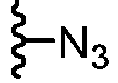
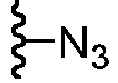
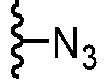
  • R 1 is selected from the group consisting of H; halogen; -OH; -N 3 ; -CH 2 N 3 ; -NR 2 , wherein R is independently selected from H or C 1 to C 6 alkyl, which may be branched or linear; -CH 2 NR 2 , wherein R are as defined above; C 6 to C 10 aryl, which can optionally be substituted with -NH 2 , -NO 2 , -COOH and/or -CH 2 COOH; C 7 to C 10 arylalkyl, which can optionally be substituted with -NH 2 , -NO 2 , -COOH, -CH 2 Cl and/or -CH 2 COOH; -CF 3 ; -COOR, wherein R is as defined above; -(CH 2 ) n COOR, wherein n and R are as defined above; -CH 2 CH(OMe) 2 ; -SH; -SO 3 H; -SO 2 Ar, wherein
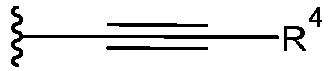
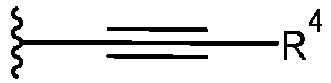
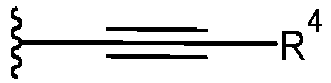
  • R 4 is selected from the group consisting of H; halogen; piperidinyl; trimethylsilyl; triisopropylsilyl; phenyl; C 1 to C 6 alkyl, which may be branched or linear; C 3 to C 6 cycloalkyl; -CF 3 ; - CH 2 NHR 6 , wherein R 6 is selected from H, fluorenylmethyloxycarbonyl, tert-butyloxycarbonyl and benzyloxycarbonyl; -C(CH 3 ) 2 (NHR 6 ), wherein R 6 is as defined above; adamantyl; preferably R 4 is selected from the group consisting of H; trifluoromethyl; 4-piperidinyl; -CH 2 -NH 2 ; phenyl; cyclopropyl; adamantyl; terc-butyl; trimethylsilyl (TMS); triisopropylsilyl (TIPS); halogen (F
  • the compounds of general formula (I) comprises the following substituents:
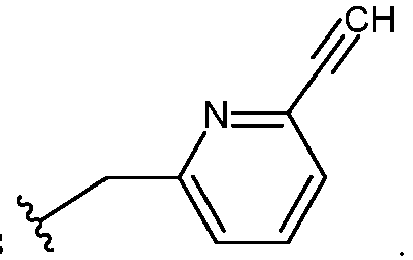
  • Y is nitrogen, thus forming a pendant arm comprising a pyridyl moiety, substituted with R 1 and R 2 .
  • R 1 is in meta-position from Y, and para-position from R 2 -CH 2 -.
  • R 1 is in meta-position from Y, and orto-position from R 2 -CH 2 -.
  • R 1 is in para-position from Y.
  • R 2 is
  • R 2 is and R' is selected from the group comprising H, phenyl, carboxyphenyl, halogen (preferably Cl), trifluoromethyl, carboxyl, carboxylic ester or amine, more preferably R 1 is H or carboxyphenyl.
  • Z is
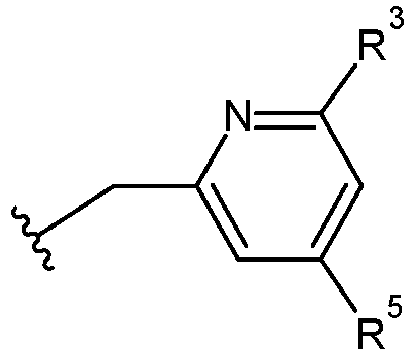
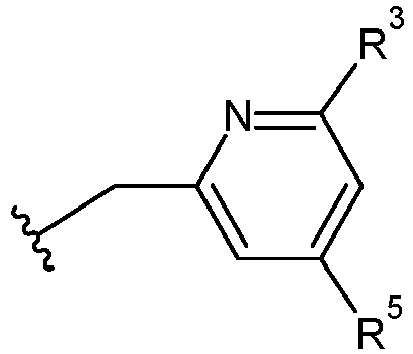
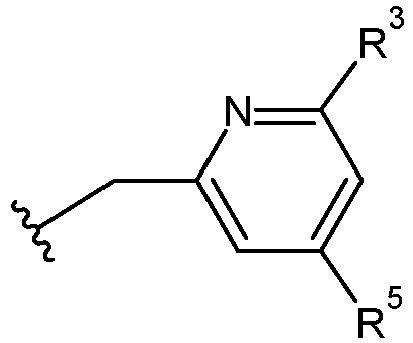
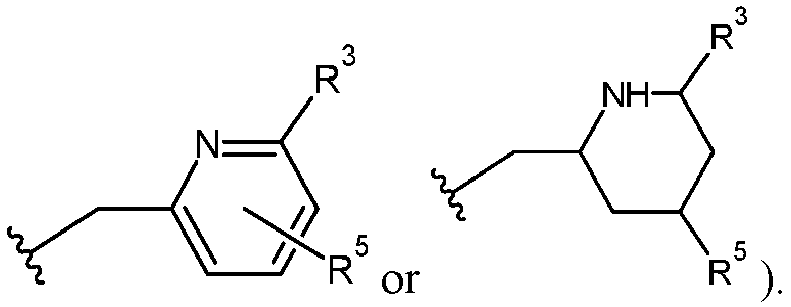
  • Z is and R 3 and R 5 are as defined above.
  • Z is even more preferably, Z is
  • A can be the same or different. Preferably, A are the same.
  • Z is
  • Z is
  • A is -(CH 2 )COOH.
  • Y is nitrogen;
  • R 1 is selected from the group consisting of H; Cl; -N(CH 3 ) 2 ; phenyl, which can optionally be substituted with -COOH or -CH 2 COOH; benzyl, which can optionally be substituted with -COOH or -CH 2 COOH; -CF 3 ; -COOCH 3 ; -COOCH(CH 3 ) 2 ; -COOtBu; -SH;
  • Z is R 3 is R 4 and R 5 are as defined above, preferably R 4 and R 5 are H.
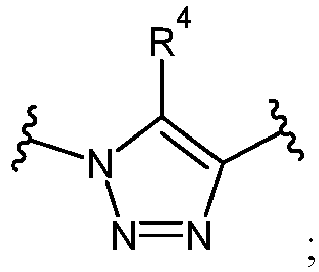
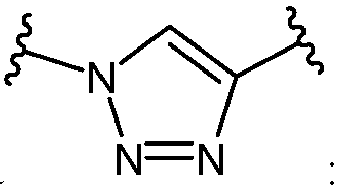
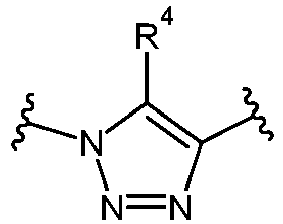
  • R 2 and R 3 together form a 1,2,3-triazole group of formula or wherein R 4 is as defined above, preferably R 4 is hydrogen.
  • R 4 is as defined above, preferably R 4 is hydrogen.
  • L is more preferably L is
  • the subject of the present invention is a method of synthesis of the compounds of general formula (1), comprising the following steps:
  • compounds of general formula Z-Cl can be obtained commercially or can be synthesised using Pd(0) catalyzed Sonogashira cross-coupling reaction from corresponding 2-halopyridines (preferably Br, I) and terminal alkynes or silyl-protected acetylenes.
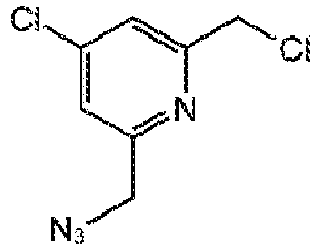
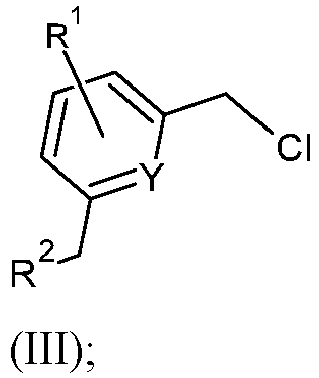
  • Compounds of general formula (III) can be obtained from 2,6-bis(halomethyl)pyridines (preferably Cl) by desymetrization using sodium azide as a source of azide moiety.
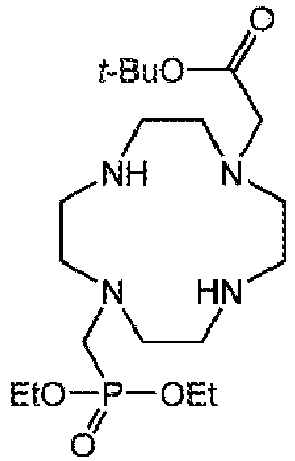
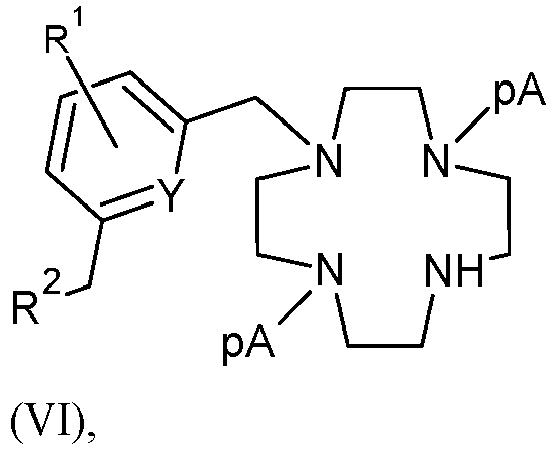
  • Cyclene derivatives of general formula (IV) are commercially available or may be prepared by reaction of cyclen or trans - N -bis-protected cyclen (preferably carbamate protected) with alkyl haloacetates (alkylation), alkyl acrylates (Michael addition) or trialkylphosphites in the presence of (para)formaldehyde (Kabachnik-Fields reaction).
  • Steps iv-A), iv-B), v-A) and v-B) take place in a solvent selected from the group comprising MeCN (preferably), DMSO or DMF.
  • the reaction takes place at room temperature for usually several hours up to several days.
  • Step vi) of deprotecting pA groups is optional, for example if pA is -CH 2 P(O)(OEt) 2 , then if no deprotection takes place, the resulting A in general formula (I) equals pA.
  • Specific conditions for deprotection of the protecting group depend on the chemical nature of the protecting group, and are known to the person skilled in the art.
  • terc-butyl ester protecting groups and Boc protecting group are hydrolyzed under acidic conditions (TFA) or thermally, methyl or isopropyl protecting groups are hydrolyzed under alkaline conditions, ethyl phosphonate ester are converted to corresponding phosphonic acids by transesterification using trimethylsilylbromide in presence of pyridine base.
  • TFA acidic conditions
  • methyl or isopropyl protecting groups are hydrolyzed under alkaline conditions
  • ethyl phosphonate ester are converted to corresponding phosphonic acids by transesterification using trimethylsilylbromide in presence of pyridine base.
  • Another subject of the present invention is a coordination compound of the compound of the general formula (I) as defined above with a metal cation, selected from the group consisting of lanthanide(III) cations, Na + , Ba 2+ , Pb 2+ , Sr 2+ , Ca 2+ , Cd 2+ , Zn 2+ , Mn 2+ , Pt 2+ , Cu 2+ , Ni 2+ , Sc 3+ , Y 3+ , Bi 3+ , In 3+ , Ru 3+ , Ir 3+ , Ga 3+ , Tl 3+ , Pd 2+ ; preferably the metal cation is selected from the group consisting of La 3+ , Ce 3+ , Pr 3+ , Nd 3+ , Sm 3+ , Eu 3+ , Gd 3+ , Tb 3+ , Dy 3+ , Ho 3+ , Er 3+ , Tm 3+ , Yb 3+ , Lu 3+ , Y 3
  • the metal ions shall be undestood as comprising any izotope of the particular metal, including stable isotopes such as 40 Ca, 42 Ca, 43 Ca, 44 Ca, 46 Ca, 48 Ca, 45 Sc, 89 Y, 138 La, 139 La, 136 Ce, 138 Ce, 140 Ce, 142 Ce, 141 Pr, 142 Nd, 143 Nd, 144 Nd, 145 Nd, 146 Nd, 148 Nd, 150 Nd, 144 Sm, 147 Sm, 148 Sm, 149 Sm, 150 Sm, 152 Sm, 154 Sm, 151 Eu, 153 Eu, 152 Gd, 154 Gd, 155 Gd, 156 Gd, 157 Gd, 158 Gd, 160 Gd, 159 Tb, 156 Dy, 158 Dy, 160 Dy, 161 Dy, 162 Dy, 163 Dy, 164 Dy, 165 Ho, 162 Er, 164 Er, 166 Er, 167 Er, 168 Er, 170
  • Lanthanides (Ln) are defined as chemical elements comprising 15 metallic chemical elements with atomic numbers in the range of from 57 to 71 (from lanthanum through lutetium).
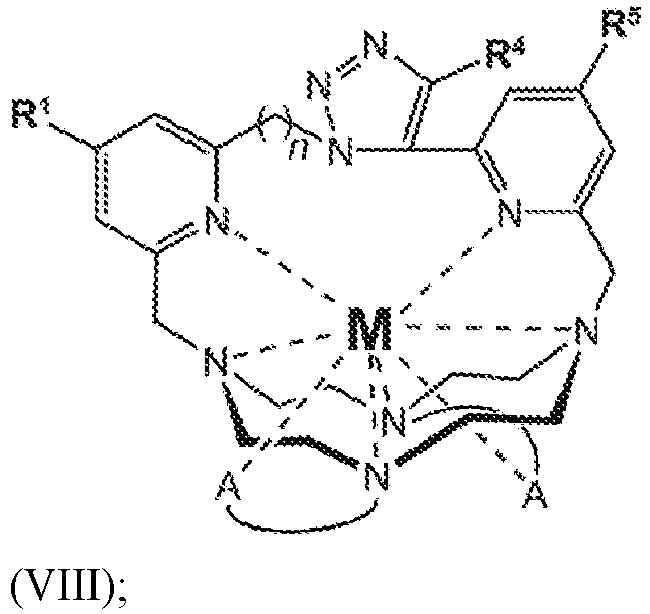
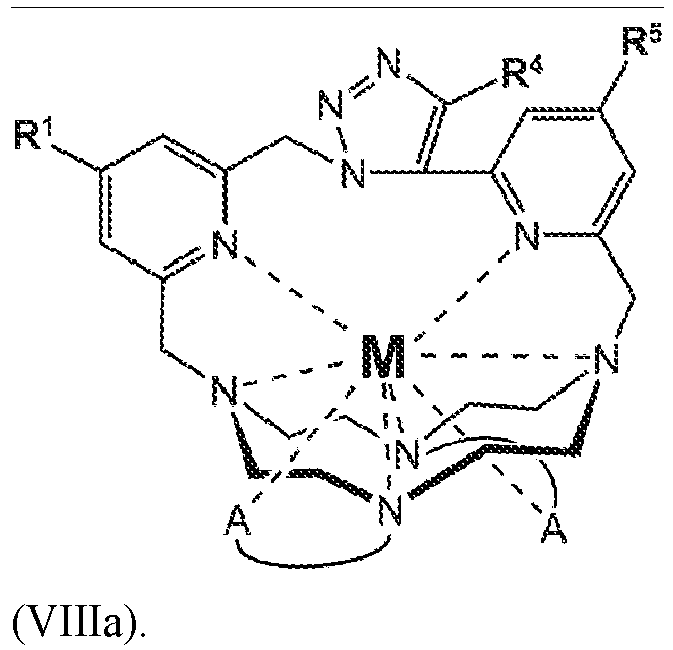
  • the coordination compound has a general formula (VIII) wherein M is the metal cation, R 1 , R 4 , R 5 and A are as defined above, and n is selected from 1, 2, 3 and 4; more preferably, the coordination compound has a general formula (VIIIa)
  • the coordination compounds according to the present invention comprise also solvates and salts of pharmaceutically acceptable acids.
  • the positive charge of the metal cation is counterbalanced by two negative charges arising from A pendant arms (e.g. acetates). Therefore, the overall charge of the coordination compound is -1 (for monovalent metal ions), 0 (for divalent metal ions) or +1 (trivalent metal ions).
  • the counterion, compensating for the overall charge of the coordination compound is selected from the group, comprising anions derived from the following pharmaceutically acceptable acids: 1-hydroxy-2-naphthoic acid; 2,2-dichloroacetic acid; 2-hydroxyethanesulfonic acid; 2-oxoglutaric acid; 4-acetamidobenzoic acid; 4-aminosalicylic acid; acetic acid; adipic acid; ascorbic acid (L); aspartic acid (L); benzenesulfonic acid; benzoic acid; camphoric acid (+); camphor-10-sulfonic acid (+); capric acid (decanoic acid); caproic acid (hexanoic acid); caprylic acid (octanoic acid); carbonic acid; cinnamic acid; citric acid; cyclamic acid; dodecylsulfuric acid; ethane-1,2-disulfonic acid; ethanesulfonic acid; formic acid; fumaric acid
  • the coordination compounds can be prepared according to Scheme 1 above from the free ligand of general formula (I) (preferably the non-caged, therefore preferably without the trazole bridge) and a metal salt (typically water soluble metal salt, preferably selected from a group comprising chloride, nitrate, acetate, formate, trifluoroacetate, trifluoromethylsulfonate, more preferably chloride or nitrate salt).
  • a metal salt typically water soluble metal salt, preferably selected from a group comprising chloride, nitrate, acetate, formate, trifluoroacetate, trifluoromethylsulfonate, more preferably chloride or nitrate salt.
  • the suitable ligands are not limited to the non-caged compounds of general formula (1), eventhough they are preferred because wider range of metal cations (such as lanthanides) may form the caged coordination compounds.
  • the bridged (caged) compounds of general formula (I) with 1,5-triazole bridge are capable of forming coordination compounds with metal cations, typically selected from the group comprising Tl 3+ , Pb 2+ , Bi 3+ , In 3+ , Cd 2+ , Ca 2+ , Cu 2+ , Ni 2+ , Mn 2+ , Pd 2+ , Na + .
  • the bridged (caged) compounds of general formula (I) with 1,4-triazole bridge are capable of forming coordination compounds with metal cations, typically selected from the group comprising La 3+ , Ce 3+ , Pr 3+ , Nd 3+ , Sm 3+ , Eu 3+ , Gd 3+ , Tb 3+ , Dy 3+ , Ho 3+ , Er 3+ , Tm 3+ , Yb 3+ , Lu 3+ , Y 3+ , Tl 3+ , Pb 2+ , Bi 3+ , In 3+ , Cd 2+ , Ca 2+ , Cu 2+ , Ni 2+ , Mn 2+ , Pd 2+ , Na + .
  • the resulting coordination compounds are very inert and stable, therefore suitable for various applications, such as MRI contract agents, radiodiagnostics or radiotherapy, peptide or protein containing drug tracing.
  • the coordination of the compound of general formula (I) to a metal cation takes place via the macrocyclic nitrogen atoms of the cyclene moiety, oxygen atoms present in groups A (pendant arms) and Y group (when Y is N-oxide), and via nitrogen atoms of Y group (when Y is nitrogen) and nitrogen atom present in Z group.
  • the coordination compounds according to the present invention may undergo a post-clickzip transformation. It means that after the metal cation is coordinated within the cage of the compound of general formula (I) by either following the Scheme 1 or coordinating with the caged compound of general formula (1), some functional groups, if present, may undergo a further reaction. Typically, such functional group is a halogen, preferably Cl, NO 2 or SH, present within substituent R' or R 5 of the coordination compound, however, post-clickzip transformations may include reactions of R 1 , R 4 , R 5 and/or A groups (such as amidic coupling reactions of non-coordinated carboxylic or amino groups).
  • the resulting carboxylate moiety can be then utilized in amide coupling reaction for synthesis of peptide conjugates.
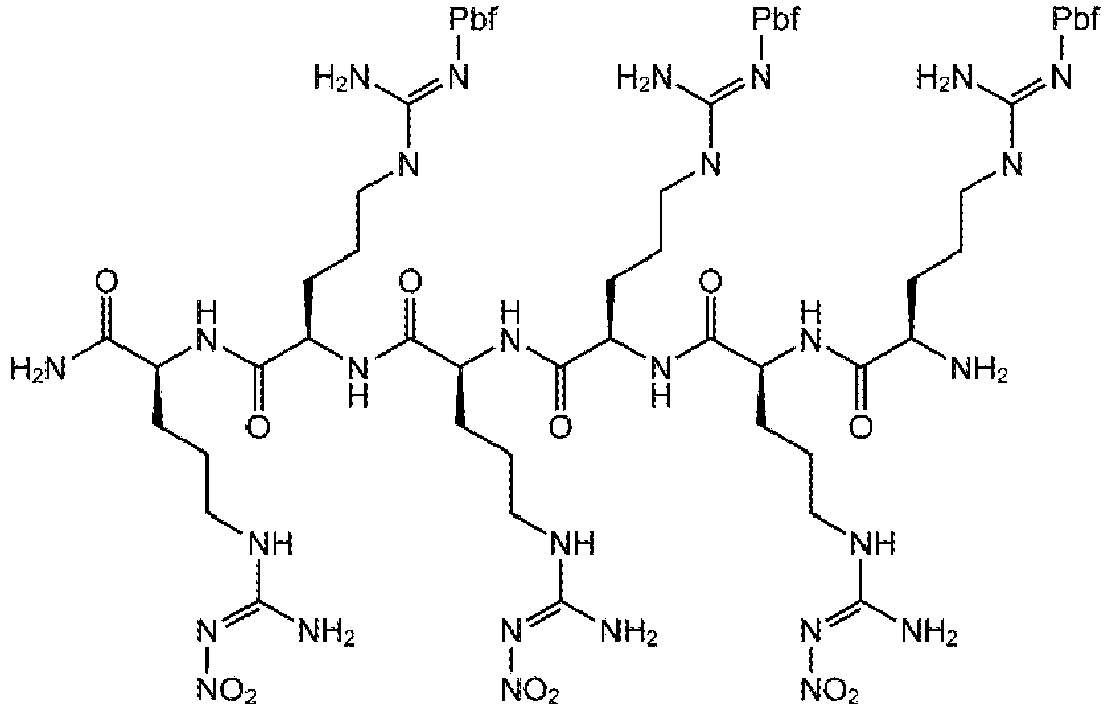
  • Conjugates with oligoarginines are capable of crossing cell membrane, allowing metal cages to be incorporated to the cells
  • Another possible post-click transformation is the replacement of halogen present within R 1 , R 4 and/or R 5 substituent by -N 3 group by reaction with NaN 3 .
  • the resulting azide can be used for coupling of the metal cage to another alkyne-bearing moiety using copper-catalysed azide-alkyne cycloaddition (CuAAC) reaction.
  • CuAAC copper-catalysed azide-alkyne cycloaddition
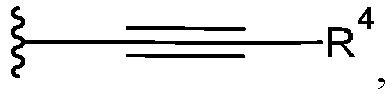
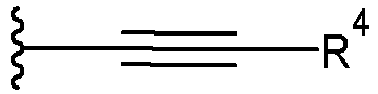
  • Another possible post-click transformation is the hydrolysis of TIPS protecting group present in R 1 , R 4 and/or R 5 substituent and protecting the triple bond (R 1 , R 3 and/or R 5 is ).
  • the hydrolysis is performed using aqueous K 2 CO 3 , and results in R 1 , R 3 and/or R 5 being
  • the resulting deprotected triple bond is suitable for further conjugations via reaction with the alkyne, for example click reactions with azides and forming triazole bridges (e.g. CuAAC reaction).
  • the post-click transformation may be addition reaction of methanol to R 1 , R 4 and/or R 5 , wherein R 1 , R 3 and/or R 5 is thus transforming the triple bond to dimethyl acetal (protected version of an aldehyde).
  • R 1 , R 3 and/or R 5 is thus transforming the triple bond to dimethyl acetal (protected version of an aldehyde).
  • This demonstrates conversion of one functional group (alkyne) to another (aldehyde).
  • Aldehydes are usable for conjugation reactions based on formation of Schiff bases with amines, hydrazines and acid hydrazides.
  • the post-click transformation may be deuteration reaction of CH 2 groups of the pendant arms in D 2 O in presence of DBU, transforming them into CD 2 groups.
  • This conversion does not alter the physico-chemical properties of the molecule (in terms of stability or reactivity), but changes the overall mass of the molecule, to be entirely distinguishable from the parent non-deuterated molecule using mass spectrometry.
  • the metal ion cage with one particular metal can be used as two different mass tags.
  • the post-click transformation may be a selective reduction of pyridyl cycle of Z substituent, wherein Z is and R 3 and R 5 are as defined above, using NaBH 4 or NaBD 4 as the reducing agent, thus transforming the Z group into respectively.
  • this conversion changes the mass of the molecule for metal tags purposes.
  • the post-click transformation may be reaction of NH 2 group, if present, of R 1 and/or R 4 and/or R 5 and/or A, wherein R 1 and/or R 4 and/or R 5 contains -NH 2 or -(CH 2 ) n NH 2 , with FmocCl, resulting in transformation of-NH 2 group into NHFmoc group.
  • Fmoc group is the most commonly encountered amine protecting group used in solid-phase peptide synthesis (SPPS). Introducting of Fmoc group therefore facilitates use of the metal cages for SPPS.
  • the post-click transformation may be reaction of NH 2 group, if present, of R 1 and/or R 4 and/or R 5 and/or A, with a carboxyl group of another molecule of general formula (I) or of its metal complex as defined above, resulting in conjugation of two or more compounds of general formula (I) or of their metal complexes into conjugates bound via a peptide (amide) bond.
  • the post-click transformation may be reaction of non-coordinating -COOH group, if present, in R 1 and/or R 4 and/or R 5 and/or A, with an amino group of an aminoacid or peptide, thus forming a peptide bond for conjugation purposes.
  • the post-click transformation may be S-alkylation reaction of a halogen, preferably Cl, of R 1 , R 4 and/or R 5 substituent with a thiol, resulting in trasforming the halogen into sulfide.
  • the thiol may be e.g. Na 2 S, NaSH, N-Boc-cysteine or a cysteine-containing peptide and the reaction may take place in presence of DIPEA. Incorporating cysteine (aminoacid) into the structure of the coordination compound according to the present invention opens futher possibilities for amide bonds (e.g. peptide attachment).
  • the post-click transformation may be reaction of group of R 1 , R 3 and/or R 5 , wherein R 1 , R 3 and/or R 5 contains with an azide, preferably with alkyl- or arylazide, thereby forming a triazole bridge connecting the alkyl- or aryl- to R 1 , R 3 and/or R 5 group.
  • the arylazide is preferably C6 to C10 arylazide, e.g. benzyl azide, optionally substituted with -COOH or -CH 2 COOH.
  • the alkyl azide is preferably C1 to C7 alkyl azide, wherein the alkyl may be linear or branched.
  • the post-click transformation may be reaction of-N 3 group of R 1 or R 5 , wherein R 1 or R 5 contains -N 3 group, with a substituent comprising a carbon-carbon triple bond, thereby forming a triazole bridge connecting the substituent with the coordination compound.
  • the substituent comprising a triple bond may be for example C7 to C10 arylalkynyl, optionally substituted with -COOH or -CH 2 COOH, e.g. phenylacetylene, wherein the phenyl moiety may optionally be substituted with -COOH or -CH 2 COOH.
  • the post-clickzip transformation may be reaction of -SH group of R 1 and/or R 5 , with a substituent comprising maleimide, thereby forming thiosuccinimide linkage connecting the substituent with the coordination compound; or reaction of -SH group of R 1 and/or R 5 , with a substituent comprising another -SH group, thereby forming a disulfide bridge connecting the substituent with the coordination compound; or reaction of-SH group of R 1 and/or R 5 , with alkyl- or arylhalogenide, thereby forming a thioether linkage connecting the alkyl- or aryl- to the coordination compound.
  • the post-clickzip transformation may be reaction of-NO 2 group of R 1 and/or R 5 , with a substituent comprising -SH group, thereby forming a thioether linkage connecting the substituent with the coordination compound.
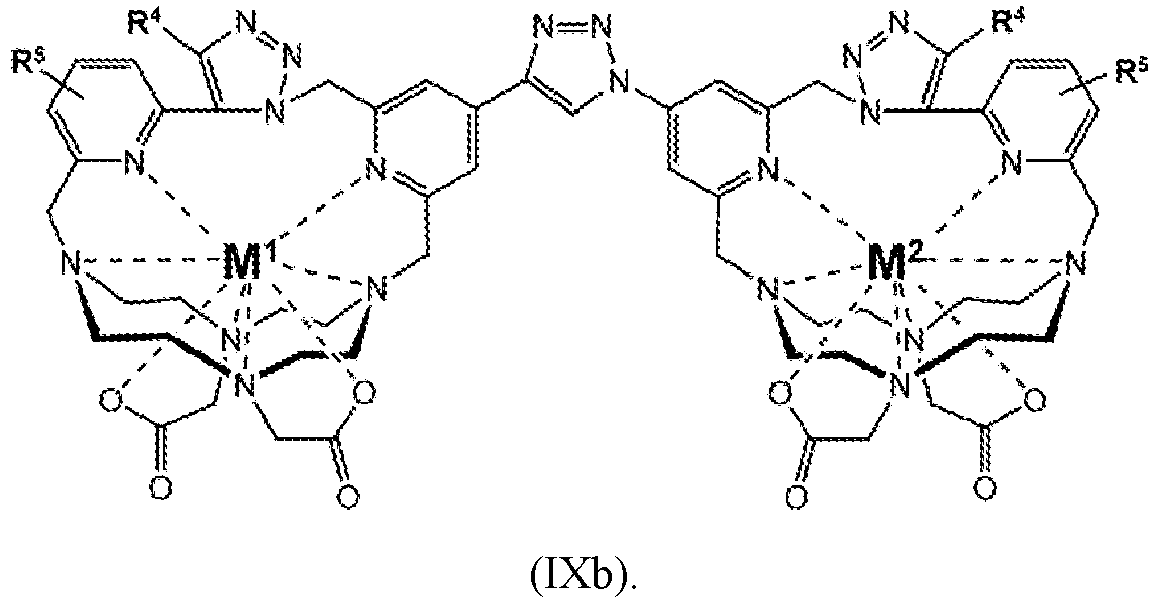
  • the post-click transformation may include reaction with another coordination compound of the present invention, thereby forming a chain or a dimer.
  • the coordination compound chain or dimer may contain the same metal cation in both click-zipped cages or it may contain different metal cations in each of the chelates.
  • the advantage of the chains and dimers lies in the possibility to combine properties of the two caged chelates, such as their unique weights to produce mass tags with higher variability of weights.
  • the coordination compounds are bound into the chain by forming a triazole bridge between R 1 or R 5 group of the first coordination compound and R 1 or R 5 group of the following coordination compound (the use of R 5 group is only possible for Z being
  • the coordination compounds are bound into the chain by amide bonds formed between a substituent of one coordination compound containing an amine group (R 1 and/or R 4 and/or R 5 and/or A) and a substituent of another coordination compound containing a carboxyl group (R 1 and/or R 4 and/or R 5 and/or A).
  • the chain usually contains two coordination compounds according to the present invention, however it may contain three, four or more coordination compounds.
  • two neighbouring coordination compounds may be linked by one triazole bridge, leaving R 5 or R 1 substituent available for linking another coordination compound according to the present invention, either via a triazole bridge or, if amino or carboxyl groups are present, via an amide bond.
  • the coordination compounds are bound into the chain by disulfide bonds (-S-S-) formed between a substituent R 1 or R 5 of one coordination compound containing -SH group, and a substituent R 1 or R 5 of another coordination compound containing -SH group.
  • the coordination compound dimer contains two coordination compounds according to the present invention, bound together by forming a triazole bridge between R 1 group of the first coordination compound and R 5 group of the second coordination compound, and, at the same time, by forming a triazole bridge between R 5 group of the first coordination compound and R 1 group of the second coordination compound.
  • the synthesis of the coordination compound chain or dimer is based on a click reaction between an azido group of the first coordination compound and a triple bond of the second coordination compound, thereby forming a triazole bridge, linking the two coordination compound into a dimer.
  • the triazole bridge is selected from the group comprising: 1,2,3-triazole group of formula formed between -N 3 group of R 1 or R 4 or R 5 of first coordination compound and the triple bond of R 1 or R 4 or R 5 of the second coordination compound.
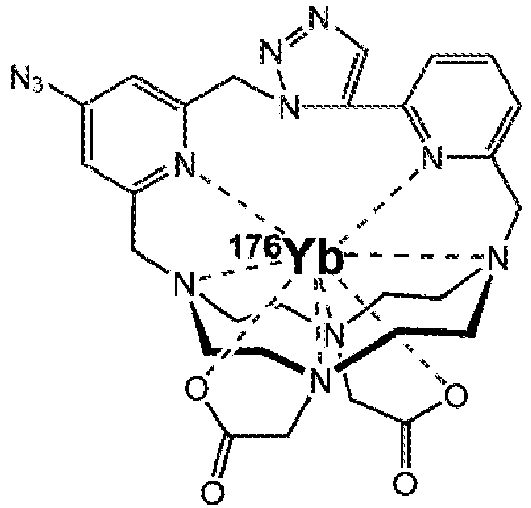
  • the metal cations are different, for example the metal cations are selected from Tb 3+ and 176 Yb 3+ .
  • Yet another object of the present invention is a conjugate suitable for use as markers for drug tracing.
  • Many drugs are based on peptides or proteins, and their biodistribution can be traced by attachment of a fluorescent or radioactive marker to the peptide or protein structure.
  • the coordination compounds and dimers of the present invention are suitable for their attachment to the peptide or protein of a drug to be traced.
  • the isolated cell culture or a tissue can then be analysed for the presence of the metal complex using conventional methods, such as LC-MS, which is commonly used and relatively unexpensive instrument.
  • the cells or tissues can be entirely hydrolyzed in a strong acid without any decomposition of the coordination compound according to the present invention.
  • the coordination compound can then be detected in a hydrolyzed sample.
  • LC-MS method also allows for using a plurality of different coordination compounds with different metal isotops (multiplexing), which may then be all analyzed during one LC-MS analysis.
  • the conjugate according to the present invention contains the coordination compound according to the present invention as defined above or the coordination compound dimer or chain as defined above, conjugated to a peptide or to a protein.
  • the conjugation takes place via an amide bond, formed between the amino group of the peptide or the protein and a carboxyl group of the coordination compound or of the chain or dimer or vice versa.
  • the coordination compound or the chain or dimer need to contain either -NH 2 or -COOH group prior to peptide or protein conjugation.
  • the -NH 2 or -COOH group is part of the R 1 and/or R 4 and/or R 5 group, therefore the conjugates are formed from coordination compounds or coordination compound dimers, which have R 1 and/or R 4 and/or R 5 group selected from the group comprising -NH 2 ; -(CH 2 ) n NH 2 ; -COOH; - (CH 2 ) n COOH; C 6 to C 10 aryl, substituted with -NH 2 , -COOH, -(CH 2 ) n NH 2 , or -(CH 2 ) n COOH; wherein n is an integer in the range of from 1 to 3.
  • the conjugation reaction conditions are known to the person skilled in the art, typically the reaction takes place at 25 °C in DMSO, using commonly used peptide coupling agents (preferebaly HATU, PyAOP) in the presence of organic base (triethylamine, ethyldiisopropylamine). Reaction are usually completed within several minutes.
  • the peptide is preferably selected from the group comprising oligopeptides of 3 to 20 aminoacids;
  • the protein is preferably selected from the group comprising antibodies, preferably monoclonal antibodies.
  • Another object of the present invention is a method of drug tracing, preferably of tracing of peptide-based or protein-based drugs, which comprises the following steps:
  • Further object of the present invention is the in vitro use of the coordination compound or of the coordination compound dimer or of the conjugate according to the present invention in pharmacy, preferably for development and testing of new drugs, more preferably for drug marking and tracing.
  • Another object of the present invention is the use of the coordination compounds or of the coordination compound dimers according to the present invention in medical diagnostics, preferably as MRI contrast agents.
  • MRI contrast agents preferably as MRI contrast agents.
  • Gd 3+ coordination compounds or dimers shall be used as MRI contrast agents, as Gd has a very high relaxivity.
  • the extremely high kinetic inertness of the coordination compounds (approximately 100x higher than for GdDOTA, a commonly used MRI contrast agent) allows for using even higher dosages and no free gadolinium, which itself is toxic for humans or animals, is released from the coordination compounds according to the present invention.
  • the claimed coordination compounds are thus expected to be safe for use in human or animal beings.
  • Another object of the present invention is the use of the coordination compound or the coordination compound chain or the coordination compound dimer according to the present invention, wherein M is a radionuclide, preferably selected from the group comprising 44 Sc, 47 Sc, 64 Cu, 67 Cu, 86 Y, 90 Y, 140 Nd, 149 Pm, 151 Pm, 153 Sm, 159 Gd, 149 Tb, 161 Tb, 165 Dy, 161 Ho, 166 Ho, 169 Er, 167 Tm, 175 Yb, 177 Lu, in medicine as radiodiagnostic and/or radiopharmaceutic agents.
  • a radionuclide may also be present in the side chain of the coordination compound such as a radioizotope of a halogen, e.g. R 1 and/or R 5 may be 18 F.
  • the present invention is further demostrated by the following examples.
  • TD701 Pear-shape glass flask (50 mL) was charged with (6-Bromopyridin-2-yl)methanol (2.47 g; 13.1 mmol; 1.0 equiv.) and magnetic stirrer and three times secured with argon. Solid CuI (149 mg; 782 ⁇ mol; 6.0 mol%) and [Pd(PPh 3 ) 2 Cl 2 ] (225 mg; 321 ⁇ mol; 2.4 mol%) were subsequently added followed by another securing with argon (three times).
  • TD557 In a round-bottom glass flask (100 mL), TD701 (2.16 g; 10.5 mmol; 1.0 equiv.) was dissolved in DCM (40 mL). Freshly prepared solution of SOCl 2 (1.50 mL; 20.7 mmol; 2.0 equiv.) in DCM (10 mL) was then added and the open flask was stirred 1 h at RT. Dil. aq. solution of NaHCO 3 (50 mL) was then added and resulting biphasic mixture was vigorously stirred for additional 1 h at RT, during which bubbles of gas slowly evolved. Mixture was then transferred to a separatory funnel. After shaking, the bottom phase was separated.
  • Aqueous phase was further extracted with DCM (4 ⁇ 50 mL). Combined organic layers were dried with anhydrous Na 2 SO 4 , filtered through glass frit (S3) and evaporated to dryness.
  • the brown residue (already pure according to 1 H NMR) was purified on flash chromatography (330 g SiO 2 , 60% P.E. in DCM to 20% P.E. in DCM) to remove the intensively colored impurities. Combined fractions with product were evaporated to dryness and further co-evaporated once with DCM. The residual nearly colorless oil was left in a freezer to solidify. Resulting solid was crushed and further dried on high vacuum overnight to give product in the form of free base as fine white powder.
  • TD558 In a pear-shaped glass flask (100 mL), TD557 (1.05 g; 4.69 mmol; 1.0 equiv.) was dissolved in MeCN (40 mL). Freshly prepared solution of KF (406 mg; 7.0 mmol; 1.5 equiv.) in H 2 O (7 mL) was then added and the flask was vigorously stirred 2 h at RT. The mixture was concentrated to ⁇ 10 mL and then diluted with DCM (50 mL) and dil. aq. NaHCO 3 (50 mL). The mixture was transferred to a separatory funnel. After shaking, the bottom phase was separated.
  • TD712 Pear-shape glass flask (10 mL) was charged with (6-Bromopyridin-2-yl)methanol (284 mg; 1.51 mmol; 1.0 equiv.) and magnetic stirrer and three times secured with argon. Solid CuI (14.5 mg; 76 ⁇ mol; 5.0 mol%) and [Pd(PPh 3 ) 2 Cl 2 ] (21 mg; 30 ⁇ mol; 2.0 mol%) were subsequently added followed by another securing with argon (three times).
  • TD712 (384 g; 1.33 mmol; 1.0 equiv.) was dissolved in DCM (5 mL). Freshly prepared solution of SOCl 2 (200 ⁇ L; 2.75 mmol; 2.1 equiv.) in DCM (1 mL) was then added and the open flask was stirred 1 h at RT. Dil. aq. solution of NaHCO 3 (10 mL) was then added and resulting biphasic mixture was vigorously stirred for additional 1 h at RT, during which bubbles of gas slowly evolved. Mixture was then transferred to a separatory funnel. After shaking, the bottom phase was separated.
  • TD538 In a round-bottom glass flask (250 mL), TD530 (568 mg; 2.17 mmol; 1.0 equiv.) was dissolved in DCM (20 mL) followed by addition of TEA (900 ⁇ L; 6.46 mmol; 3.0 equiv.). Freshly prepared solution of MsCl (355 ⁇ L; 4.33 mmol; 2.0 equiv.) in DCM (5 mL) was then added. Resulting solution was stirred 20 min at RT. Mixture was then diluted with DCM (50 mL) followed by addition of dil. aq. solution of NaHCO 3 (50 mL).
  • TD1045 Pear-shaped glass flask (25 mL) was charged with (6-Bromopyridin-2-yl)methanol (500 mg; 2.67 mmol; 1.0 equiv.), 1,1 -Dimethylpropargylamine (420 ⁇ L; 3.99 mmol; 1.5 equiv.) and magnetic stirrer and three times secured with argon. Solid CuI (21 mg; 110 ⁇ mol; 4.0 mol%) and [Pd(PPh 3 ) 2 Cl 2 ] (19 mg; 27 ⁇ mol; 1.0 mol%) were subsequently added followed by another securing with argon (three times).
  • TD1050 In a glass vial (20 mL), TD1048 (19 mg; 65 ⁇ mol; 1.0 equiv.) was dissolved in DCM (3 mL) followed by addition of TEA (28 ⁇ L;201 ⁇ mol; 3.1 equiv.). Freshly prepared solution of MsCl (10 ⁇ L; 129 ⁇ mol; 2.0 equiv.) in DCM (1 mL) was then added. Resulting solution was stirred 20 min at RT. Mixture was then diluted with DCM (15 mL) followed by addition of dil. aq. solution of NaHCO 3 (15 mL). The resulting biphasic mixture was then transferred to a separatory funnel. After shaking, the bottom phase was separated.
  • TD1117 In a glass vial (20 mL), TD952 (50.0 mg; 158 ⁇ mol; 1.0 equiv.) was dissolved in DCM (6 mL) followed by addition of TEA (66 ⁇ L; 473 ⁇ mol; 3.0 equiv.) and neat MsCl (25 ⁇ L; 323 ⁇ mol; 2.0 equiv.). Resulting solution was stirred 20 min at RT followed by addition of DCM (10 mL) dil. aq. solution of NaHCO 3 (10 mL).
  • TD939 In a glass vial (20 mL), TD936 (22 mg; 105 ⁇ mol; 1.0 equiv.) was dissolved in DCM (6 mL) followed by addition of TEA (44 ⁇ L; 316 ⁇ mol; 3.0 equiv.). and neat MsCl (16 ⁇ L; 207 ⁇ mol; 2.0 equiv.). Resulting solution was stirred 20 min at RT followed by addition of dil. aq. solution of NaHCO 3 (5 mL). The resulting biphasic mixture was then transferred to a separatory funnel. After shaking, the bottom phase was separated. Aqueous phase was further extracted with DCM (4 ⁇ 25 mL).
  • TD940 In a glass vial (20 mL), TD937 (26 mg; 150 ⁇ mol; 1.0 equiv.) was dissolved in DCM (9 mL) followed by addition of TEA (63 ⁇ L; 452 ⁇ mol; 3.0 equiv.) and neat MsCl (23 ⁇ L; 297 ⁇ mol; 2.0 equiv.). Resulting solution was stirred 20 min at RT followed by addition of dil. aq. solution of NaHCO 3 (5 mL).
  • TD956 In a glass vial (20 mL), TD952 (8 mg; 42 ⁇ mol; 1.0 equiv.) was dissolved in DCM (3 mL) followed by addition of TEA (18 ⁇ L; 129 ⁇ mol; 3.0 equiv.) and neat MsCl (6.5 ⁇ L; 84 ⁇ mol; 2.0 equiv.). Resulting solution was stirred 20 min at RT followed by addition of DCM (5 mL) dil. aq. solution of NaHCO 3 (5 mL). The resulting biphasic mixture was then transferred to a separatory funnel. After shaking, the bottom phase was separated. Aqueous phase was further extracted with DCM (4 ⁇ 10 mL).
  • Synthesis of TD965 Glass vial (4 mL) was charged with (6-Bromopyridin-2-yl)methanol (53 mg; 283 ⁇ mol; 1.0 equiv.), 1 -Ethynyladamantane (50 mg; 312 ⁇ mol; 1.1 equiv.), CuI (2.7 mg; 14 ⁇ mol; 5.0 mol%), [Pd(PPh 3 ) 2 Cl 2 ] (5.0 mg; 7 ⁇ mol; 2.5 mol%) and magnetic stirrer and three times secured with argon.
  • Residue was dissolved in a mixture of DCM (25 mL) and H 2 O (25 mL) and transferred to a separatory funnel. After brief shaking, the bottom phase was separated and the aq. layer was further extracted with DCM (4 ⁇ 10 mL). Combined organic layers were dried with anhydrous Na 2 SO 4 , filtered through glass frit (S3) and evaporated to dryness. The residual solid was briefly dried on high vacuum to give product in the form of free base as a colourless oil. Yield: 67 mg (89%; 1 step; based on (6-Bromopyridin-2-yl)methanol).
  • TD990 In a glass vial (20 mL), TD965 (21 mg; 79 ⁇ mol; 1.0 equiv.) was dissolved in DCM (3 mL) followed by addition of TEA (33 ⁇ L; 237 ⁇ mol; 3.0 equiv.) and neat MsCl (12 ⁇ L; 155 ⁇ mol; 2.0 equiv.). Resulting solution was stirred 20 min at RT followed by addition of DCM (10 mL) dil. aq. solution of NaHCO 3 (10 mL).
  • TD1194 In a glass vial (4 mL), TD558 (110 mg; 726 ⁇ mol; 1.0 equiv.) was dissolved in MeCN (3.3 mL) followed by addition of NIS (180 mg; 800 ⁇ mol; 1.1 equiv.) and AcOH (50 ⁇ L; 875 ⁇ mol; 1.2 equiv.) and the resulting mixture was stirred 3 h at 80 °C. Mixture was then directly purified by preparative HPLC (C18; H 2 O-MeCN gradient with FA additive). Fractions containing product were joned and diluted with DCM (50 mL). The resulting biphasic mixture was transferred to a separatory funnel followed by addition of dil.
  • TD1178 Glass vial (20 mL) was charged with CuI (60.0 mg; 315 ⁇ mol; 40 mol%), Phen (114 mg; 633 ⁇ mol; 80.0 mol%), KHCO 3 (159 mg; 1.59 mmol; 2.0 equiv.) and magnetic stirrer and three times secured with argon. Under constant flow of argon was then added solution of TD558 (120 mg; 792 ⁇ mol; 1.0 equiv.) and Togni I (288 mg; 872 ⁇ mol; 1.1 equiv.) in dry DCM (8 mL) through septum and the resulting mixture was stirred 2 d at RT.
  • TD804 Glass vial (4 mL) was charged with TD797 (100 mg; 375 ⁇ mol; 1.0 equiv.) and magnetic stirrer and three times secured with argon. Solid CuI (4.3 mg; 23 ⁇ mol; 6.0 mol%) and [Pd(PPh 3 ) 2 Cl 2 ] (8.0 mg; 11 ⁇ mol; 3.0 mol%) were subsequently added followed by another securing with argon (three times).
  • TD806 In a pear-shaped glass flask (50 mL), TD804 (98 mg; 325 ⁇ mol; 1.0 equiv.) was dissolved in DCM (3 mL). Freshly prepared solution of SOCl 2 (47 ⁇ L; 647 ⁇ mol; 2.0 equiv.) in DCM (1 mL) was then added and the open flask was stirred 1 h at RT. Reaction mixture was diluted with DCM (16 mL) and dil. aq. solution of NaHCO 3 (20 mL) was then added and resulting biphasic mixture was vigorously stirred for additional 1 h at RT, during which bubbles of gas slowly evolved.
  • TD662 In a glass vial (4 mL), Dipropargylamine (116 ⁇ L; 1.12 mmol; 1.0 equiv.) was dissolved in MeCN (2.5 mL) followed by addition of neat 1,2-Dibromoethane (965 ⁇ L; 11.2 mmol; 10 equiv.) and NaHCO 3 (113 mg; 1.35 mmol; 1.2 equiv.) and the resulting mixture was stirred 2 days at 80 °C. Mixture was then diluted with DCM (50 mL) followed by addition of dil. aq. solution of NaHCO 3 (50 mL). The resulting biphasic mixture was then transferred to a separatory funnel.
  • TD595 In a glass vial (20 mL), TD406 (30 mg; 162 ⁇ mol; 1.0 equiv.) was dissolved in DCM (5 mL) followed by addition of freshly prepared solution of MCPBA (77%; 72 mg; 320 ⁇ mol; 2.0 equiv.) in DCM (1 mL). The resulting solution was stirred 3 h at RT. Mixture was then diluted with DCM (20 mL) and dil. aq. NaHCO 3 (25 mL) and transferred to a separatory funnel. After shaking, the bottom layer was separated and aqueous layer was further extracted with DCM (3 ⁇ 20 mL).
  • TD760 In a glass vial (20 mL), TD759 (708 mg; 3.36 mmol; 1.3 equiv.) was dissolved in MeCN (20 mL) followed by addition of solid NaN 3 (168 mg; 2.58 mmol; 1.0 equiv.) and dried K 2 CO 3 (360 mg; 2.61 mmol; 1.0 equiv.) and the resulting suspension was stirred 24 h at 80 °C. The mixture was filtered on through syringe microfilter (PTFE) and the solid residue was washed with MeCN. Filtrate was evaporated to dryness and yellow oily residue was purified by column chromatography (SiO 2 , 40% P.E. in DCM to 10% P.E.
  • TD1146 In a glass vial (20 mL), TD726 (495 mg; 2.85 mmol; 1.0 equiv.) was dissolved in DMF (11.0 mL; 143 mmol; 50 equiv.) followed by addition of freshly ground KOH (1.6 g; 28.5 mmol; 10 equiv.). The resulting suspension was stirred 3 days at 100 °C in the presence of air (vial septum was punctured by two thick needles). The mixture was then filtered through syringe microfilter (PTFE; the solids were washed with DMF). Filtrate was evaporated to dryness and purified by preparative HPLC (C18; H 2 O-MeCN gradient with TFA additive).
  • TD1154 (103.9 mg; 474 ⁇ mol; 1.3 equiv.) was dissolved in MeCN (7 mL) followed by addition of solid NaN 3 (23.7 mg; 365 ⁇ mol; 1.0 equiv.) and dried K 2 CO 3 (50.3 mg; 364 ⁇ mol; 1.0 equiv.) and the resulting suspension was stirred 24 h at 70 °C. The mixture was filtered on through syringe microfilter (PTFE) and the solid residue was washed with MeCN.
  • PTFE syringe microfilter
  • TD808 In a round-bottom glass flask (250 mL), TD1024 (3.15 g; 8.39 mmol; 1.0 equiv.) was dissolved in a mixture of THF (60 mL) and MeOH (30 mL). Then, solid NaBH 4 (2.55 g; 67.4 mmol; 8 equiv.) was added portion wise over the course of 1 h (during which hydrogen gas evolved intensively) and the color of the mixture changed to dark red. After the addition, the flask was further stirred 1 h at RT. The mixture was evaporated to dryness.
  • Residue was resuspended in DCM (200 mL) and H 2 O (200 mL) and transferred to a separatory funnel. After shaking, the bottom phase (as a suspension) was separated. Aqueous phase was further extracted with DCM (3 ⁇ 100 mL). Combined organic layers were diluted with EtOAc (500 mL). The resulting brown solution was then dried with anhydrous Na 2 SO 4 , filtered through glass frit (S3) and evaporated to dryness. The residue was further dried on high vacuum overnight to give product in the form of free base as pale brown solid. Yield: 2.61 g (97%; 1 step; based on TD1024).
  • TD815 In a round-bottom glass flask (250 mL), pre-purified TD808 (2.61 g; 8.17 mmol; 1.0 equiv.) was suspended in DCM (100 mL). Freshly prepared solution of SOCl 2 (1.80 mL; 24.8 mmol; 3.0 equiv.) in DCM (10 mL) was then added and the open flask was stirred 1 h at RT. Dil. aq. solution of NaHCO 3 (100 mL) was then added and resulting biphasic mixture was vigorously stirred for additional 1 h at RT, during which bubbles of gas slowly evolved. Mixture was then transferred to a separatory funnel.
  • TD817 In a round-bottom glass flask (250 mL), TD815 (2.86 g; 8.02 mmol; 1.2 equiv.) was dissolved in MeCN (130 mL) followed by addition of solid NaN 3 (435 mg; 6.69 mmol; 1.0 equiv.) and dried K 2 CO 3 (920 mg; 6.67 mmol; 1.0 equiv.) and the resulting suspension was stirred 16 h at 80 °C. The mixture was filtered through syringe microfilter (PTFE) and the solid residue was washed with MeCN. Filtrate was evaporated to dryness and orange oily residue was purified by column chromatography (220 g SiO 2 , 30% P.E.
  • PTFE syringe microfilter
  • TD1052 In a glass vial (20 mL), Dimethyl 4-iodopyridine-2,6-dicarboxylate (500 mg; 1.56 mmol; 1.0 equiv.), CuI (600 mg; 3.15 mmol, 2.0 equiv.) and [(dppf)PdCl 2 ] (7.0 mg, 10 ⁇ mol; 0.6 mol%) were dissolved in dry DMF (8 mL) followed by addition of Methyl 2,2-difluoro-2-(fluorosulfonyl)acetate (600 mg; 3.12 mmol; 2.0 equiv.) in dry DMF (2 mL). The resulting dark mixture was stirred 16 h at 100 °C.
  • TD1053 In a round-bottom glass flask (100 mL), TD1052 (365 mg; 1.39 mmol; 1.0 equiv.) was dissolved in a mixture of MeOH (5 mL) and THF (10 mL). The resulting colourless solution was cooled with an ice bath ( ⁇ 5 °C) followed by portion wise additions (over course of 30 min, with no stopper on the flask) of solid NaBH 4 (420 mg; 11.1 mmol; 8.0 equiv.) during which hydrogen gas evolved intensively and the color of the mixture changed to red and orange. After the addition, the flask was allowed to warm up to RT and was further stirred 30 min at RT.
  • TD1055 In a round-bottom glass flask (100 mL), TD1053 (169 mg; 816 ⁇ mol; 1.0 equiv.) was dissolved in DCM (20 mL). Freshly prepared solution of SOCl 2 (237 ⁇ L; 3.26 mmol; 4.0 equiv.) in DCM (5 mL) was then added and the resulting mixture was stirred 16 h at RT. Dil. aq.
  • TD1057 In a glass vial (4 mL), TD1055 (143 mg; 586 ⁇ mol; 1.8 equiv.) was dissolved in MeCN (3.5 mL) followed by addition of solid NaN 3 (21.5 mg; 331 ⁇ mol; 1.0 equiv.) and dried K 2 CO 3 (46 mg; 333 ⁇ mol; 1.0 equiv.) and the resulting suspension was stirred 3 d at 70 °C. The mixture was filtered through syringe microfilter (PTFE) and the solid residue was washed with MeCN. Filtrate was evaporated to dryness and orange oily residue was purified by column chromatography (80 g SiO 2 , 30% P.E.
  • PTFE syringe microfilter
  • Synthesis of TD549 Pear-shape glass flask (250 mL) was charged with Dimethyl 4-chloropyridine-2,6-dicarboxylate (5.00 g; 21.8 mmol; 1.0 equiv.), Phenylboronic acid (3.20 g; 26.2 mmol; 1.2 equiv.) and XPhos Pd G2 (510 mg; 648 ⁇ mol; 3.0 mol%) and was then three times secured with argon.
  • Residue was dissolved in a mixture of H 2 O (300 mL) and DCM (300 mL) and transferred to a separatory funnel. After shaking, the bottom phase was separated. Aqueous phase was further extracted with DCM (8 ⁇ 75 mL). Combined organic layers were dried with anhydrous Na 2 SO 4 , filtered through glass frit (S3) and evaporated to dryness. The resulting crystalized residue was crushed and further dried on high vacuum overnight to give product in the form of free base as nearly colorless solid. Yield: 2.29 g (97%; 1 step; based on TD549).
  • TD564 In a round-bottom glass flask (500 mL), TD563 (2.25 g; 10.5 mmol; 1.0 equiv.) was dissolved (with gentle heating) in DCM (250 mL). Freshly prepared solution of SOCl 2 (2.27 mL; 31.3 mmol; 3.0 equiv.) in DCM (10 mL) was then added, after which precipitate started to form. After 1 h of stirring at RT, all of the previously formed precipitate was dissolved again. Dil. aq.
  • TD566 In a pear-shaped glass flask (100 mL), TD564 (1.60 g; 6.35 mmol; 1.3 equiv.) was dissolved (with gentle heating) in MeCN (60 mL) followed by addition of solid NaN 3 (320 mg; 4.92 mmol; 1.0 equiv.) and dried K 2 CO 3 (680 mg; 4.93 mmol; 1.0 equiv.) and the resulting suspension was stirred 24 h at 80°C. The mixture was filtered on glass frit S3 and the solid residue was washed with MeCN. Filtrate was evaporated to dryness and the orange oily residue was purified by column chromatography (SiOz, 15% P.E.
  • TD1087 In a round-bottom glass flask (50 mL), TD1083 (96.2 mg; 488 ⁇ mol; 1.0 equiv.) was dissolved in DCM (20 mL) followed by addition of SOCl 2 (106 ⁇ L;1.46 mmol; 3.0 equiv.). The mixture was stirred 1 h at RT. Mixture was then quenched by addition of dil. aq. solution of NaHCO 3 (20 mL). The resulting biphasic mixture was vigorously stirred for additional 1 h at RT, during which bubbles of gas slowly evolved. Mixture was then transferred to a separatory funnel. After shaking, the bottom phase was separated.
  • TD1109 In around-bottom glass flask (100 mL), TD1101 (283 mg; 1.26 mmol; 1.0 equiv.) was dissolved in DCM (40 mL) followed by addition of SOCl 2 (275 ⁇ L;3.79 mmol; 3.0 equiv.). The mixture was stirred 1 h at RT. Mixture was then quenched by addition of dil. aq. solution of NaHCO 3 (40 mL). The resulting biphasic mixture was vigorously stirred for additional 1 h at RT, during which bubbles of gas slowly evolved. Mixture was then transferred to a separatory funnel. After shaking, the bottom phase was separated.
  • TD1112 In a glass vial (20 mL), TD1109 (321 mg; 1.23 mmol; 1.2 equiv.) was dissolved in MeCN (6 mL) followed by addition of solid NaN 3 (66.5 mg; 1.02 mmol; 1.0 equiv.) and dried K 2 CO 3 (141 mg; 1.02 mmol; 1.0 equiv.) and the resulting suspension was stirred 16 h at 70 °C. The mixture was filtered on through syringe microfilter (PTFE) and the solid residue was washed with MeCN.
  • PTFE syringe microfilter
  • TD1119 In a glass vial (40 mL), tert -butyl isonicotinate (486 mg; 2.71 mmol; 1.0 equiv.) was dissolved in MeOH (15 mL) followed by addition of conc. H 2 SO 4 (40 ⁇ L). Then, solution of (NH 4 ) 2 S 2 O 8 (6.20 g; 27.2 mmol; 10 equiv.) in H 2 O (15 mL) was added dropwise and the resulting mixture was further stirred 30 min at 80 °C. Reaction was then carefully neutralized by aq. NaHCO 3 . Mixture was then transferred to a separatory funnel and extracted with EtOAc (5 ⁇ 30 mL).
  • TD1129 In a round-bottom glass flask (100 mL), TD1119 (159 mg; 664 ⁇ mol; 1.0 equiv.) was dissolved in DCM (20 mL) followed by addition of SOCl 2 (145 ⁇ L;2.00 mmol; 3.0 equiv.). The mixture was stirred 1 h at RT. Mixture was then quenched by addition of dil. aq. solution of NaHCO 3 (20 mL). The resulting biphasic mixture was vigorously stirred for additional 1 h at RT, during which bubbles of gas slowly evolved. Mixture was then transferred to a separatory funnel. After shaking, the bottom phase was separated.
  • TD725 Glass vial (40 mL) was charged with TD726 (628 mg; 3.62 mmol; 1.0 equiv.), (4-(tert-Butoxycarbonyl)phenyl)boronic acid (880 mg; 3.96 mmol; 1.1 equiv.) and XPhos Pd G2 (57 mg; 7.2 ⁇ mol; 2.0 mol%) and was then three times secured with argon.
  • TD730 In a round-bottom glass flask (250 mL), pre-purified TD725 (1.04 g; ⁇ 3.30 mmol; 1.0 equiv.) was suspended in DCM (35 mL). Freshly prepared solution of SOCl 2 (721 ⁇ L; 9.93 mmol; ⁇ 3.0 equiv.) in DCM (5 mL) was then added. Clear solution was quickly formed and the open flask was stirred 1 h at RT. Mixture was then quenched by addition of dil. aq. solution of NaHCO 3 (60 mL). The resulting biphasic mixture was vigorously stirred for additional 1 h at RT, during which bubbles of gas slowly evolved.
  • TD733 In a glass vial (20 mL), TD730 (837 mg; 2.38 mmol; 1.3 equiv.) was dissolved in MeCN (18 mL) followed by addition of solid NaN 3 (119 mg; 1.83 mmol; 1.0 equiv.) and dried K 2 CO 3 (253 mg; 1.83 mmol; 1.0 equiv.) and the resulting suspension was stirred 24 h at 80 °C. The mixture was filtered on through syringe microfilter (PTFE) and the solid residue was washed with MeCN.
  • PTFE syringe microfilter
  • TD1428 Pear-shaped glass flask (25 mL) was charged with TD1425 (523 mg; 1.69 mmol; 1.0 equiv.), N -Boc- 1,1 -dimethylpropargylamine (310 mg; 1.69 mmol; 1.0 equiv.) and magnetic stirrer and three times secured with argon. Solid CuI (13.0 mg; 68 ⁇ mol; 4.0 mol%) and [Pd(PPh 3 ) 2 Cl 2 ] (24 mg; 34 ⁇ mol; 2.0 mol%) were subsequently added followed by another securing with argon (three times).
  • TD1386 In a round-bottom glass flask (100 mL), pyridine-2,6-diyldimethanol (2.00 g; 14.4 mmol; 1.0 equiv.) and Imidazole (0.98 g; 14.4 mmol; 1.0 equiv.) were dissolved in DMF (20 mL) followed by addition of TBDMSCl (2.17 g; 14.4 mmol; 1.0 equiv.). The resulting solution was stirred 2 h at RT. Mixture was evaporated to dryness and the residue dissolved in a mixture of DCM (50 mL) and dil. aq. NaHCO 3 (50 mL) and transferred to a separatory funnel.
  • TD1389 In a round-bottom glass flask (250 mL), TD1386 (1.54 g; 6.08 mmol; 1.0 equiv.) was dissolved in DCM (60 mL) followed by addition of SOCl 2 (885 ⁇ L;12.0 mmol; 2.0 equiv.). The mixture was stirred 1 h at RT. Mixture was then quenched by addition of dil. aq. solution of NaHCO 3 (60 mL).
  • TD1393 In a pear-shaped glass flask (100 mL), TD1390 (700 mg; 2.67 mmol; 1.00 equiv.) was dissolved in MeOH (2.70 mL; 66.7 mmol; 25 equiv.) followed by addition of TMSCl (2.37 mL; 18.7 mmol; 7.0 equiv.). The resulting mixture was vigorously stirred for 2 h at 60 °C.
  • Residue was dissolved in DCM (100 mL) and H 2 O (100 mL) and transferred to a separatory funnel. After shaking, the bottom phase was separated. Aqueous phase was further extracted with DCM (4 ⁇ 50 mL). Combined organic layers were dried with anhydrous Na 2 SO 4 , filtered through glass frit (S3) and evaporated to dryness. The residue was further briefly dried on high vacuum to give product in the form of free base as faint yellow oil. Yield: 404 mg (84%; 1 step; based on TD1390).
  • TD1401 In a round-bottom glass flask (50 mL), TD1396 (94 mg; 352 ⁇ mol; 1.0 equiv.) was dissolved in DCM (3.5 mL) followed by addition of SOCl 2 (51 ⁇ L; 702 ⁇ mol; 2.0 equiv.). The mixture was stirred 3 h at RT. Mixture was then diluted with DCM (20 mL) and quenched by addition of dil. aq. solution of NaHCO 3 (10 mL).
  • TD1406 In a round-bottom glass flask (25 mL), TD1401 (16.5 mg; 92.6 ⁇ mol; 1.0 equiv.) was dissolved in DCM (1.85 mL) followed by addition of SOCl 2 (13.5 ⁇ L; 186 ⁇ mol;2.0 equiv.). The mixture was stirred 1 h at RT. Mixture was then diluted with DCM (10 mL) and quenched by addition of dil. aq. solution of NaHCO 3 (10 mL).
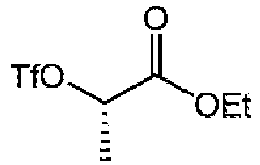
  • TD1488 Pear-shaped glass flask (25 mL) was charged with dimethyl L-malate (200 mg; 1.23 mmol; 1.00 equiv.) and magnetic stirrer and three times briefly secured with argon. Under constant flow of argon was then added dry DCM (4 mL) through septum and the mixture was cooled with an ice bath (5 °C) followed by dropwise addition of triflic anhydride (220 ⁇ L; 1.31 mmol; 1.06 equiv.) and immediately followed by dropwise addition of dry pyridine (105 ⁇ L; 1.30 mmol; 1.06 equiv.). The resulting mixture was stirred at RT for 30 min.
  • TD680 In a pear-shape glass flask (250 mL), Cbz2cyclen (free base; 1.54 g; 3.50 mmol; 1.6 equiv.) was dissolved in MeCN (100 mL) followed by addition of dried K 2 CO 3 (300 mg; 2.17 mmol; 1.0 equiv.). To the vigorously stirred reaction mixture, solution of tert -Butyl bromoacetate (427 mg; 2.19 mmol; 1.0 equiv.) in dry MeCN (25 mL) was added dropwise (over the course of 2 h). Solids were filtered off using syringe microfilter (PTFE) and filtrate was evaporated to dryness.
  • PTFE syringe microfilter
  • Residue was purified by preparative HPLC (C18; H 2 O-MeCN gradient with FA additive). Fractions with product were combined, neutralized with dil. aq. NaHCO 3 and evaporated to dryness. Residue was dissolved in DCM (150 mL) and H 2 O (150 mL) and transferred to a separatory funnel. After shaking, the bottom phase was separated. Aqueous phase was further extracted with DCM (3 ⁇ 75 mL). Combined organic layers were dried with anhydrous Na 2 SO 4 , filtered through glass frit (S3) and evaporated to dryness. The residue was further dried on high vacuum overnight to give product in the form of free base as nearly colorless oil.
  • TD686 In a glass vial (4 mL), TD680 (150 mg; 270 ⁇ mol; 1.0 equiv.) was dissolved in MeCN (3 mL) followed by addition of Boc 2 O (2.0 M solution in THF; 200 ⁇ L; 400 ⁇ mol; 1.5 equiv.). Resulting mixture was stirred 16 h at RT. Reaction mixture was directly purified by preparative HPLC (C18; H 2 O-MeCN gradient with FA additive). Fractions with product were combined, immediately neutralized with dil. aq. NaHCO 3 and evaporated to dryness.
  • Residue was dissolved in DCM (50 mL) and H 2 O (50 mL) and transferred to a separatory funnel. After shaking, the bottom phase was separated. Aqueous phase was further extracted with DCM (3 ⁇ 25 mL). Combined organic layers were dried with anhydrous Na 2 SO 4 , filtered through glass frit (S3) and evaporated to dryness. The residue was further dried on high vacuum overnight to give product in the form of free base as colorless oil. Yield: 170 mg (96%; 1 step; based on TD680).
  • TD691 Pear-shape glass flask (25 mL) was charged with TD686 (170 mg; 260 ⁇ mol) and magnetic stirrer and three times secured with argon. Solid Pd@C (17 mg) was then added followed by another securing with argon (three times). Under constant flow of argon was then added MeOH (10 mL) through septum. Argon input was then removed and H 2 gas (from balloon) was allowed to bubble through the mixture for 30 min at RT. Catalyst was then filtered off using syringe microfilter (PTFE; filter was further washed with MeOH). Filtrate was evaporated to dryness and once co-evaporated with DCM.
  • PTFE syringe microfilter
  • TD1106 In a pear-shape glass flask (50 mL), Cbz2cyclen (free base; 500 mg; 1.14 mmol; 1.0 equiv.) was dissolved in MeCN (10 mL) followed by addition of dried K 2 CO 3 (870 mg; 5.69 mmol; 5.0 equiv.) and Methyl bromoacetate (235 ⁇ L; 2.51 mmol; 2.2 equiv.) in MeCN (5 mL). The resulting suspension was stirred 2 d at RT. Solids were filtered off using syringe microfilter (PTFE) and filtrate was evaporated to dryness.
  • PTFE syringe microfilter
  • Residue was purified by preparative HPLC (C18; H 2 O-MeCN gradient with FA additive). Fractions with product were combined, neutralized with dil. aq. NaHCO 3 and evaporated to dryness. Residue was dissolved in DCM (50 mL) and H 2 O (50 mL) and transferred to a separatory funnel. After shaking, the bottom phase was separated. Aqueous phase was further extracted with DCM (3 ⁇ 50 mL). Combined organic layers were dried with anhydrous Na 2 SO 4 , filtered through glass frit (S3) and evaporated to dryness. The residue was further dried on high vacuum overnight to give product in the form of free base as colorless oil.
  • TD1116 Pear-shape glass flask (50 mL) was charged with Pd@C (42 mg) and magnetic stirrer and three times secured with argon. Under constant flow of argon was then added solution of TD1106 (418 mg; 715 ⁇ mol) in MeOH (25 mL) through septum. Argon input was then removed and Hz gas (from balloon) was allowed to bubble through the mixture for 1 h at RT. Catalyst was then filtered off using syringe microfilter (PTFE; filter was further washed with MeOH). Filtrate was evaporated to dryness and once co-evaporated with DCM.
  • PTFE syringe microfilter
  • TD687 In a glass vial (2 mL), TD680 (150 mg; 270 ⁇ mol; 1.0 equiv.) and P(OEt) 3 (232 ⁇ L; 1.35 mmol; 5.0 equiv.) were mixed together followed by addition of solid (CH 2 O) n (12 mg; 400 ⁇ mol; 1.5 equiv.). The resulting suspension was stirred 3 d at RT. Reaction mixture was then diluted with MeCN (700 ⁇ L) and filtered through syringe microfilter (PTFE). Filter was further washed with MeCN. Filtrate was then directly purified by preparative HPLC (C18; HzO-MeCN gradient with FA additive).
  • TD910 Pear-shape glass flask (50 mL) was charged with TD913 (250 mg; 322 ⁇ mol) and magnetic stirrer and three times secured with argon. Solid Pd@C (50 mg) was then added followed by another securing with argon (three times). Under constant flow of argon was then added MeOH (25 mL) through septum. Argon input was then removed and H 2 gas (from balloon) was allowed to bubble through the mixture for 2 h at RT. Catalyst was then filtered off using syringe microfilter (PTFE; filter was further washed with MeOH). Filtrate was evaporated to dryness and once co-evaporated with DCM.
  • PTFE syringe microfilter
  • Solid Pd@C (129 mg) was then added followed by another securing with argon (three times). Under constant flow of argon was then added EtOH (96%, 70 mL) through septum. Argon input was then removed and H 2 gas (from balloon) was allowed to bubble through the mixture for 30 min at RT. The reaction mixture was further stirred under hydrogen atmosphere (from balloon) 16 h at RT. Catalyst was then filtered off using syringe microfilter (PTFE; filter was further washed with EtOH). Filtrate was evaporated to dryness and once co-evaporated with DCM. The residue was further dried on high vacuum overnight to give product in the form of free base as slightly yellow oil.
  • TD423 In a pear-shape glass flask (25 mL), tBuDO2A (free base; 410 mg; 1.03 mmol; 1.4 equiv.) was dissolved in dry MeCN (8 mL) followed by addition of Cs 2 CO 3 (840 mg; 2.58 mmol; 3.4 equiv.) and of KI (172 mg; 1.04 mmol; 1.4 equiv.). Solution of 2-Chloro- N -(prop-2-yn-1-yl)acetamide (100 mg; 760 ⁇ mol; 1.0 equiv.) in dry MeCN (2 mL) was added and the resulting mixture was stirred 3 d at RT.
  • Residue was purified by preparative HPLC (C18; H 2 O-MeCN gradient with FA additive). Fractions with product were combined, neutralized with dil. aq. NaHCO 3 and evaporated to dryness. Residue was dissolved in DCM (100 mL) and H 2 O (100 mL) and transferred to a separatory funnel. After shaking, the bottom phase was separated. Aqueous phase was further extracted with DCM (3 ⁇ 50 mL).
  • TD635 In a pear-shape glass flask (250 mL), tBuDO2A (free base; 1.21 g; 3.02 mmol; 2.3 equiv.) was dissolved in MeCN (150 mL). To the vigorously stirred reaction mixture, solution of TD558 (1202 mg; 1.33 mmol; 1.0 equiv.) in MeCN (100 mL) was added dropwise (over the course of 2 h). Resulting mixture was further stirred 2 d at RT after which was evaporated to dryness. Residue was purified by preparative HPLC (C18; H 2 O-MeCN gradient with FA additive). Fractions with product were combined, neutralized with dil.
  • Residue was dissolved in DCM (150 mL) and H 2 O (150 mL) and transferred to a separatory funnel. After shaking, the bottom phase was separated. Aqueous phase was further extracted with DCM (3 ⁇ 100 mL). Combined organic layers were dried with anhydrous Na 2 SO 4 , filtered through glass frit (S3) and evaporated to dryness. The residue was further dried on high vacuum overnight to give product in the form of free base as yellow solidified oil. Yield: 653 mg (47%; 2 steps; based on TD530 ).
  • TD1118 In a pear-shape glass flask (50 mL), tBuDO2A (free base; 160 mg; 399 ⁇ mol; ⁇ 2.5 equiv.) was dissolved in MeCN (10 mL) followed by addition of dried K 2 CO 3 (65 mg; 470 ⁇ mol; ⁇ 3 equiv.). To the vigorously stirred reaction mixture, solution of freshly prepared and isolated TD1117 ( ⁇ 470 mmol; 1.0 equiv.) in MeCN (10 mL) was added dropwise (over the course of 5 min).
  • Residue was purified by preparative HPLC (C18; H 2 O-MeCN gradient with FA additive). Fractions with product were combined, neutralized with dil. aq. NaHCO 3 and evaporated to dryness. Residue was dissolved in DCM (50 mL) and H 2 O (50 mL) and transferred to a separatory funnel. After shaking, the bottom phase was separated. Aqueous phase was further extracted with DCM (3 ⁇ 30 mL).
  • TD692 In a pear-shape glass flask (250 mL), TD681 (100 mg; 259 ⁇ mol; 1.5 equiv.) was dissolved in MeCN (25 mL). To the vigorously stirred reaction mixture, solution of TD558 (26 mg; 172 ⁇ mol;1.0 equiv.) in MeCN (25 mL) was added dropwise (over the course of 1 h). Resulting mixture was further stirred 2 d at RT.
  • Residue was purified by preparative HPLC (C18; H 2 O-MeCN gradient with FA additive). Fractions with product were combined, immediately neutralized with dil. aq. NaHCO 3 and evaporated to dryness. Residue was dissolved in DCM (25 mL) and H 2 O (25 mL) and transferred to a separatory funnel. After shaking, the bottom phase was separated. Aqueous phase was further extracted with DCM (3 ⁇ 25 mL). Combined organic layers were dried with anhydrous Na 2 SO 4 , filtered through glass frit (S3) and evaporated to dryness.
  • PTFE syringe microfilter
  • TD579 In a pear-shape glass flask (25 mL), TD573 (600 mg; 1.27 mmol; 2.0 equiv.) was dissolved in MeCN (10 mL). To the vigorously stirred reaction mixture, solution of TD558 (30 mg; 488 ⁇ mol; 1.0 equiv.) in MeCN (10 mL) was added dropwise (over the course of 30 min). Resulting mixture was further stirred 16 h at RT. Solids were filtered off using syringe microfilter (PTFE) and filtrate was evaporated to dryness. Residue was purified by preparative HPLC (C18; H 2 O-MeCN gradient with FA additive).
  • TD579 was directly used for TD575 and TD580 and without further characterization.
  • Synthesis of TD799 In a pear-shape glass flask (100 mL), tBuDO2Prop (free base; 165 mg; 385 ⁇ mol; 2.0 equiv.) was dissolved in MeCN (30 mL). To the vigorously stirred reaction mixture, solution of TD558 (29 mg; 191 ⁇ mol; 1.0 equiv.) in MeCN (30 mL) was added dropwise (over the course of 6 h).
  • Residue was purified by preparative HPLC (C18; H 2 O-MeCN gradient with FA additive). Fractions with product were combined, neutralized with dil. aq. NaHCO 3 and evaporated to dryness. Residue was dissolved in DCM (50 mL) and H 2 O (50 mL) and transferred to a separatory funnel. After shaking, the bottom phase was separated. Aqueous phase was further extracted with DCM (3 ⁇ 25 mL).
  • Residue was purified by preparative HPLC (C18; H 2 O-MeCN gradient with FA additive). Fractions with product were combined, neutralized with dil. aq. NaHCO 3 and evaporated to dryness. Residue was dissolved in DCM (50 mL) and H 2 O (50 mL) and transferred to a separatory funnel. After shaking, the bottom phase was separated. Aqueous phase was further extracted with DCM (3 ⁇ 25 mL).
  • Residue was purified by preparative HPLC (C18; H 2 O-MeCN gradient with FA additive). Fractions with product were combined, neutralized with dil. aq. NaHCO 3 and evaporated to dryness. Residue was dissolved in DCM (100 mL) and H 2 O (100 mL) and transferred to a separatory funnel. After shaking, the bottom phase was separated. Aqueous phase was further extracted with DCM (3 ⁇ 50 mL). Combined organic layers were dried with anhydrous Na 2 SO 4 , filtered through glass frit (S3) and evaporated to dryness.
  • PTFE syringe microfilter
  • Residue was purified by preparative HPLC (C18; H 2 O-MeCN gradient with FA additive). Fractions with product were combined, neutralized with dil. aq. NaHCO 3 and evaporated to dryness. Residue was dissolved in DCM (50 mL) and H 2 O (50 mL) and transferred to a separatory funnel. After shaking, the bottom phase was separated and the aqueous phase was further extracted with DCM (3 ⁇ 25 mL). Combined organic layers were dried with anhydrous Na 2 SO 4 , filtered through glass frit (S3) and evaporated to dryness.
  • PTFE syringe microfilter
  • TD1340 In a pear-shaped glass flask (50 mL), Cbz2cyclen (free base; 1.32 g; 3.0 mmol; 1.0 equiv.) was dissolved in dry MeCN (15 mL) followed by addition of dried K 2 CO 3 (1.65 g; 12.0 mmol; 4.0 equiv.). Then, solution of TD1339 (1.50 g; 6.0 mmol; 2.0 equiv.) in dry MeCN (5 mL) was added and the resulting suspension was stirred 8 h at RT. Solids were filtered off using syringe microfilter (PTFE) and the filtrate was evaporated to dryness.
  • PTFE syringe microfilter
  • Residue was purified by preparative HPLC (C18; H 2 O-MeCN gradient with FA additive). Fractions with product were combined, neutralized with dil. aq. NaHCO 3 and evaporated to dryness. Residue was dissolved in DCM (150 mL) and H 2 O (150 mL) and transferred to a separatory funnel. After shaking, the bottom phase was separated. Aqueous phase was further extracted with DCM (4 ⁇ 50 mL). Combined organic layers were dried with anhydrous Na 2 SO 4 , filtered through glass frit (S3) and evaporated to dryness. Residue was further dried on high vacuum overnight to give product in the form of free base as colourless oil.
  • Synthesis of TD1341 Pear-shaped glass flask (100 mL) was charged with Pd@C (127 mg) and magnetic stirrer and three times secured with argon. Solution of TD1340 (1.27 g; 1.98 mmol) in MeOH (50 mL) was then added through septum. Argon input was then removed and H 2 gas (from balloon) was allowed to bubble through the mixture for 1 h at RT. Catalyst was then filtered off using syringe microfilter (PTFE; filter was further washed with MeOH).
  • PTFE syringe microfilter
  • TD1343 In a pear-shaped glass flask (50 mL), TD1341 (143 mg; 384 ⁇ mol; 2.0 equiv.) was dissolved in MeCN (15 mL) followed by addition of dried K 2 CO 3 (26.3 mg; 191 ⁇ mol; 1.0 equiv.). To the vigorously stirred reaction mixture, solution of TD558 (29.0 mg; 191 ⁇ mol; 1.0 equiv.) in MeCN (15 mL) was added dropwise (over the course of 15 min). Resulting mixture was stirred 2 d at RT. Solids were filtered off using syringe microfilter (PTFE) and filtrate was evaporated to dryness.
  • PTFE syringe microfilter
  • Residue was purified by preparative HPLC (C18; H 2 O-MeCN gradient with FA additive). Fractions with product were combined, neutralized with dil. aq. NaHCO 3 and evaporated to dryness. Residue was dissolved in DCM (25 mL) and H 2 O (25 mL) and transferred to a separatory funnel. After shaking, the bottom phase was separated. Aqueous phase was further extracted with DCM (3 ⁇ 10 mL). Combined organic layers were dried with anhydrous Na 2 SO 4 , filtered through glass frit (S3) and evaporated to dryness. The residue was further briefly dried on high vacuum to give product in the form of free base as nearly colourless oil.
  • TD1345 In a pear-shaped glass flask (25 mL), TD1343 (45.0 mg; 92 ⁇ mol; 1.0 equiv.) was dissolved in MeCN (2 mL) followed by addition of dried K 2 CO 3 (51 mg; 196 ⁇ mol; 4.0 equiv.). Solution of TD406 (20.0 mg; 110 ⁇ mol; 1.2 equiv.) in MeCN (2 mL) was then added and the resulting suspension was stirred 7 d at RT.
  • TD1493 In a glass vial (20 mL), rac -TD1489 (free base; 172 mg; 294 ⁇ mol; 1.0 equiv.) was dissolved in MeCN (2 mL) followed by addition of dried K 2 CO 3 (162 mg; 1.17 mmol; 4.0 equiv.). Then, solution of TD1399 (148 mg; 592 ⁇ mol; 2.0 equiv.) in MeCN (2 mL) was added and the resulting suspension was stirred 70 min at 40 °C. Solids were filtered off using syringe microfilter (PTFE) and further washed with MeCN. The filtrate was evaporated to dryness.
  • PTFE syringe microfilter
  • Residue was purified by preparative HPLC (C18; H 2 O-MeCN gradient with FA additive). Fractions with pure product (the more hydrophobic diastereomer differing in chirality of the malate arm was successfully separated) were combined, neutralized with dil. aq. NaHCO 3 and concentrated on rotary evaporator to remove most of MeCN. Mixture was diluted with DCM (25 mL) and transferred to a separatory funnel. After shaking, the bottom phase was separated. Aqueous phase was further extracted with DCM (3 ⁇ 10 mL). Combined organic layers were dried with anhydrous Na 2 SO 4 , filtered through glass frit (S3) and evaporated to dryness.
  • TD1500 In a glass vial (4 mL), TD1497 (12.1 mg; 23 ⁇ mol; 1.0 equiv.) was dissolved in solution of TD406 (5.8 mg; 32 ⁇ mol; 1.4 equiv.) in MeCN (2 mL) followed by addition of dried K 2 CO 3 (17.5 mg; 127 ⁇ mol; 4.0 equiv.). The resulting suspension was stirred 1 d at 40 °C. Solids were filtered off using syringe microfilter (PTFE) and filtrate was diluted with H 2 O (1 mL). Resulting solution was purified by preparative HPLC (C18; H 2 O-MeCN gradient with FA additive).
  • TD425 In a pear-shape glass flask (50 mL), crude TD423 ( ⁇ 75% in a mixture with ⁇ 25% of bis(substituted) by-product; 180 mg; ⁇ 1.0 equiv.) was dissolved in dry MeCN (10 mL) followed by addition of Cs 2 CO 3 (360 mg; 1.11 mmol; 3.8 equiv.). Solution of TD566 (75 mg; 290 ⁇ mol; 1.0 equiv.) in MeCN (5 mL) was then added and the resulting suspension was stirred 2 d at RT. Solids were filtered off using syringe microfilter (PTFE) and filtrate was evaporated to dryness.
  • PTFE syringe microfilter
  • Residue was purified by preparative HPLC (C18; H 2 O-MeCN gradient with FA additive). Fractions with tert -butyl protected product were combined, evaporated to dryness and twice co-evaporated with MeOH to remove most of MeCN. Residue was dissolved in TFA (3 mL) and the resulting clear mixture was stirred 16 h at RT. Mixture was evaporated to dryness and twice co-evaporated with MeOH to remove most of TFA. Residue was purified by preparative HPLC (C18; HzO-MeCN gradient with FA additive). Fractions with product were joined and directly lyophilized to give product in nearly zwitterionic form as white fluffy solid.
  • TD662 (10 mg; 50 ⁇ mol; 1.0 equiv.) in MeCN (500 ⁇ L) was then added and the resulting suspension was stirred 2 d at RT. Another portion of TD662 (6 mg; 30 ⁇ mol; 0.6 equiv.) in MeCN (200 ⁇ L) was then added and the mixture was further stirred 2 d at RT. Solids were filtered off using syringe microfilter (PTFE) and filtrate was directly purified by preparative HPLC (C18; H 2 O-MeCN gradient with FA additive). Fractions with tert-butyl protected product were combined, evaporated to dryness and twice co-evaporated with MeOH to remove most of MeCN.
  • PTFE syringe microfilter
  • TD604 In a glass vial (4 mL), TD596 (44 mg; 78 ⁇ mol; 1.0 equiv.) was dissolved in MeCN (3 mL) followed by addition of dried K 2 CO 3 (33 mg; 239 ⁇ mol; 3.0 equiv.). Solution of TD558 (13 mg; 86 ⁇ mol; 1.1 equiv.) in MeCN (600 ⁇ L) was then added and the resulting suspension was stirred 16 d at RT.
  • Residue was purified by preparative HPLC (C18; H 2 O-MeCN gradient with FA additive). Fractions with tert -butyl protected product were combined, evaporated to dryness and twice co-evaporated with MeOH to remove most of MeCN. Residue was dissolved in TFA (3 mL) and the resulting clear mixture was stirred 16 h at RT. Mixture was evaporated to dryness and twice co-evaporated with MeOH to remove most of TFA. Residue was directly purified by preparative HPLC (C18; H 2 O-MeCN gradient with FA additive).
  • Residue was purified by preparative HPLC (C18; H 2 O-MeCN gradient with FA additive). Fractions with tert -butyl protected product were combined, evaporated to dryness and twice co-evaporated with MeOH to remove most of MeCN. Residue was dissolved in TFA (3 mL) and the resulting clear mixture was stirred 16 h at RT. Mixture was evaporated to dryness and twice co-evaporated with MeOH to remove most of TFA. Residue was directly purified by preparative HPLC (C18; H 2 O-MeCN gradient with FA additive).
  • Residue was dissolved in TFA (3 mL) and the resulting clear mixture was stirred 16 h at RT. Mixture was evaporated to dryness and three-times co-evaporated with MeOH to remove most of TFA. Residue was directly purified by preparative HPLC (C18; H 2 O-MeCN gradient with FA additive). Fractions with product were joined and directly lyophilized to give product in the form of mixed trifluoroacetate/formate salt as slightly yellow viscous oil. Yield: 16 mg (34%; 2 steps; based on TD692 ).
  • TD714 In a glass vial (4 mL), TD705 (22 mg; 32 ⁇ mol;1.0 equiv.) was dissolved in dry Pyridine (1 mL) followed by addition of neat TMSBr (50 ⁇ L; 379 ⁇ mol; 12.0 equiv.) and the resulting mixture was stirred 16 h at RT. Reaction was then quenched with 50% aq. MeOH (1 mL) and the mixture was further stirred 1 h at RT. The mixture was then directly purified by preparative HPLC (C18; H 2 O-MeCN gradient with FA additive).
  • TD921 In a pear-shape glass flask (25 mL), TD910 (160 mg; 315 ⁇ m ⁇ l; 2.0 equiv.) was dissolved in MeCN (10 mL) followed by addition of solution of dried K 2 CO 3 (22 mg; 160 ⁇ m ⁇ l; 1.0 equiv.).
  • Residue was purified by preparative HPLC (C18; H 2 O-MeCN gradient with TFA additive). Fractions with product were combined, neutralized with dil. aq. NaHCO 3 and evaporated to dryness. Residue was s dissolved in DCM (50 mL) and H 2 O (50 mL) and transferred to a separatory funnel. After shaking, the bottom phase was separated. Aqueous phase was further extracted with DCM (3 ⁇ 25 mL). Combined organic layers were dried with anhydrous Na 2 SO 4 , filtered through glass frit (S3) and evaporated to dryness.
  • PTFE syringe microfilter
  • TD581 In a glass vial (4 mL), TD580 (25 mg; 34 ⁇ m ⁇ l; 1.0 equiv.) was dissolved in dry Pyridine (1 mL) followed by addition of neat TMSBr (110 ⁇ L; 833 ⁇ m ⁇ l; ⁇ 25 equiv.) and the resulting mixture was stirred 16 h at RT. Reaction was then quenched with 50% aq. MeOH (1 mL) and the mixture was further stirred 1 h at RT. The mixture was then directly purified by preparative HPLC (C18; H 2 O-MeCN gradient with FA additive).
  • TD575 In a glass vial (20 mL), TD579 (51 mg; 87 ⁇ m ⁇ l; 1.2 equiv.) was dissolved in MeCN (3 mL) followed by addition of dried K 2 CO 3 (30 mg; 217 ⁇ m ⁇ l; 3.0 equiv.). Solution of TD566 (20 mg; 73 ⁇ m ⁇ l; 1.0 equiv.) in MeCN (2 mL) was then added and the resulting suspension was stirred 16 h at RT. Solids were filtered off using syringe microfilter (PTFE) and filtrate was evaporated to dryness. Residue was purified by preparative HPLC (C18; H 2 O-MeCN gradient with FA additive).
  • TD575 was directly used for TD576 and without further characterization. Synthesis of TD576: In a glass vial (4 mL), TD575 (23 mg; 28 ⁇ m ⁇ l; 1.0 equiv.) was dissolved in dry Pyridine (1 mL) followed by addition of neat TMSBr (220 ⁇ L; 1.67 mmol; ⁇ 60 equiv.) and the resulting mixture was stirred 16 h at RT. Reaction was then quenched with 50% aq. MeOH (1 mL) and the mixture was further stirred 1 h at RT.
  • Residue was purified by preparative HPLC (C18; H 2 O-MeCN gradient with FA additive). Fractions with tert-butyl protected product were combined, evaporated to dryness and twice co-evaporated with MeOH to remove most of MeCN. Residue was dissolved in TFA (3 mL) and the resulting clear mixture was stirred 16 h at RT. Mixture was evaporated to dryness and twice co-evaporated with MeOH to remove most of TFA. Residue was directly purified by preparative HPLC (C18; H 2 O-MeCN gradient with FA additive).
  • Residue was dissolved in TFA (3 mL) and the resulting clear mixture was stirred 16 h at RT. Mixture was evaporated to dryness and twice co-evaporated with MeOH to remove most of TFA. Residue was directly purified by preparative HPLC (C18; H 2 O-MeCN gradient with FA additive). Fractions with product were joined and directly lyophilized to give product in nearly zwitterionic form as white fluffy solid. Yield: 31.9 mg (74%; 2 steps; based on TD635).
  • TD1176 In a glass vial (4 mL), TD635 (43.5 mg; 84.4 ⁇ m ⁇ l; 1.1 equiv.) was dissolved in MeCN (2 mL) followed by addition of dried K 2 CO 3 (42.5 mg; 308 ⁇ m ⁇ l; 4.0 equiv.). Solution of TD1163 (17.3 mg; 76.7 ⁇ m ⁇ l; 1.0 equiv.) in MeCN (1 mL) was then added and the resulting suspension was stirred 2 d at RT. Solids were filtered off using syringe microfilter (PTFE) and filtrate was evaporated to dryness. Residue was purified by preparative HPLC (C18; H 2 O-MeCN gradient with FA additive).
  • the resulting solid was dissolved in a mixture of H 2 O (6 mL), MeCN (6 mL) and THF (2 mL) followed by addition of BoczO (2.0 M in dry THF; 315 ⁇ L; 630 ⁇ m ⁇ l; ⁇ 3.4 equiv.) and NaHCO 3 (210 mg; 2.50 mmol; ⁇ 13.5 equiv.)
  • BoczO 2.0 M in dry THF; 315 ⁇ L; 630 ⁇ m ⁇ l; ⁇ 3.4 equiv.
  • NaHCO 3 210 mg; 2.50 mmol; ⁇ 13.5 equiv.
  • the resulting mixture was stirred 2 d at RT after which another portion of BoczO (2.0 M in dry THF; 315 ⁇ L; 630 ⁇ m ⁇ l; ⁇ 3.4 equiv.) was added.
  • the mixture was further stirred 16 h at RT.
  • TD1127 In a glass vial (20 mL), TD1118 (56.9 mg; 81.4 ⁇ m ⁇ l; 1.0 equiv.) was dissolved in MeCN (2 mL) followed by addition of dried K 2 CO 3 (45.0 mg; 326 ⁇ m ⁇ l; 4.0 equiv.) and TD406 (16.0 mg; 87.6 ⁇ m ⁇ l; 1.1 equiv.) in MeCN (1 mL). The resulting suspension was stirred 16 h at RT. Solids were filtered off using syringe microfilter (PTFE) and filtrate was directly purified by preparative HPLC (C18; H 2 O-MeCN gradient with FA additive).
  • PTFE syringe microfilter
  • TD1188 In a glass vial (4mL), TD711 (70.0 mg; 128 ⁇ m ⁇ l; 1.0 equiv.) was dissolved in MeCN (1.5 mL) followed by addition of dried K 2 CO 3 (71 mg; 514 ⁇ m ⁇ l; 4.0 equiv.). Solution of TD1178 (31 mg; 141 ⁇ m ⁇ l; 1.1 equiv.) in MeCN (1.5 mL) was then added and the resulting suspension was stirred 7 d at RT. Solids were filtered off using syringe microfilter (PTFE) and filtrate was evaporated to dryness. Residue was purified by preparative HPLC (C18; H 2 O-MeCN gradient with FA additive).
  • Citric acid 100 mM; 20 mL; 2.0 mmol; 10 equiv.
  • Resulting mixture was then stirred 2 d at 80 °C.
  • Mixture was then filtered through syringe microfilter (RC).
  • the filtrate was concentrated on rotary evaporator and then directly purified by preparative HPLC (C18; H 2 O-MeCN gradient with FA additive). Fractions with product were joined and directly lyophilized to give product in the form of formate salt as white fluffy solid. Yield: 109 mg (77%; 1 step; based on TD647 ⁇ 0.2FA ⁇ 0.9H 2 O).
  • TD734 In a glass vial (20 mL), TD714 ⁇ 0.1FA ⁇ xH 2 O (6 mg; ⁇ 10 ⁇ m ⁇ l; 1.0 equiv.) was dissolved in H 2 O (4 mL) followed by addition aq. MOPS/NaOH buffer (500 mM; pH 7.0; 1.00 mL; 500 ⁇ m ⁇ l; ⁇ 50 equiv.) and aq. LuCl 3 (100 mM; 110 ⁇ L; 11 ⁇ m ⁇ l; ⁇ 1.1 equiv.) and the mixture was stirred 16 h at 80 °C. Mixture was then filtered through syringe microfilter (RC).
  • MOPS/NaOH buffer 500 mM; pH 7.0; 1.00 mL; 500 ⁇ m ⁇ l; ⁇ 50 equiv.
  • LuCl 3 100 mM; 110 ⁇ L; 11 ⁇ m ⁇ l; ⁇ 1.1 equiv.
  • Synthesis of TD560 In a glass vial (20 mL), TD556 ⁇ 0.1FA ⁇ 1.6H 2 O (39 mg; 69 ⁇ m ⁇ l; 1.0 equiv.) was dissolved in H 2 O (15 mL) followed by addition aq. MOPS/NaOH buffer (500 mM; pH 7.0; 3.40 mL; 1.70 mmol; 25 equiv.) and aq.
  • MOPS/NaOH buffer 500 mM; pH 7.0; 3.40 mL; 1.70 mmol; 25 equiv.
  • GdCl3 100 mM; 745 ⁇ L; 75 ⁇ m ⁇ l; 1.1 equiv.
  • the filtrate was concentrated on rotary evaporator and then directly purified by preparative HPLC (C18; H 2 O-MeCN gradient with FA additive). Fractions with product were joined and directly lyophilized to give product in the form of formate salt as white fluffy solid.
  • TD562 In a glass vial (20 mL), TD556 ⁇ 0.1FA ⁇ 1.6H 2 O (40 mg; 69 ⁇ m ⁇ l; 1.0 equiv.) was dissolved in H 2 O (15 mL) followed by addition aq. MOPS/NaOH buffer (500 mM; pH 7.0; 3.40 mL; 1.70 mmol; 25 equiv.) and aq. TbCl 3 (100 mM; 745 ⁇ L; 75 ⁇ m ⁇ l; 1.1 equiv.) and the mixture was stirred 4 d at 80 °C. Mixture was then filtered through syringe microfilter (RC).
  • RC syringe microfilter
  • MOPS/NaOH buffer 500 mM; pH 7.0; 2.00 mL; 1.00 mmol; 50 equiv.
  • aq. LuCl 3 100 mM; 220 ⁇ L; 22 ⁇ m ⁇ l; 1.1 equiv.
  • the filtrate was concentrated on rotary evaporator and then directly purified by preparative HPLC (C18; H 2 O-MeCN gradient with FA additive). Fractions with product were joined and directly lyophilized to give product in the form of formate salt as white fluffy solid.
  • TD946 In a glass vial (20 mL), TD943 ⁇ 1.5H 2 O (28.1 mg; 45.6 ⁇ m ⁇ l; 1.0 equiv.) was dissolved in H 2 O (16 mL) followed by addition aq. MOPS/NaOH buffer (500 mM; pH 7.0; 3.00 mL; 1.50 mmol; 33 equiv.) and aq. LuCl 3 (100 mM; 540 ⁇ L; 54 ⁇ m ⁇ l; 1.2 equiv.) and the mixture was stirred 3 days at 80 °C. Mixture was then filtered through syringe microfilter (RC).
  • MOPS/NaOH buffer 500 mM; pH 7.0; 3.00 mL; 1.50 mmol; 33 equiv.
  • LuCl 3 100 mM; 540 ⁇ L; 54 ⁇ m ⁇ l; 1.2 equiv.
  • MOPS/NaOH buffer 500 mM; pH 7.0; 1.20 mL; 600 ⁇ m ⁇ l; 27 equiv.
  • aq. LuCl 3 100 mM; 265 ⁇ L; 26.5 ⁇ m ⁇ l; 1.2 equiv.
  • the filtrate was concentrated on rotary evaporator and then directly purified by preparative HPLC (C18; H 2 O-MeCN gradient with TFA additive). Fractions with product were joined and directly lyophilized to give product in the form of trifluoroacetate salt as white fluffy solid.
  • MOPS/NaOH buffer 500 mM; pH 7.0; 2.85 mL; 1.43 mmol; 25 equiv.
  • aq. LuCl 3 100 mM; 625 ⁇ L; 62.5 ⁇ m ⁇ l; 1.1 equiv.
  • Mixture was then filtered through syringe microfilter (RC).
  • the filtrate was concentrated on rotary evaporator and then directly purified by preparative HPLC (C18; H 2 O-MeCN gradient with TFA additive). Fractions with product were joined and directly lyophilized to give product in the form of trifluoroacetate salt as white fluffy solid.
  • MOPS/NaOH buffer 500 mM; pH 7.0; 1.57 mL; 785 ⁇ m ⁇ l; 26 equiv.
  • aq. LuCl 3 100 mM; 375 ⁇ L; 37.5 ⁇ m ⁇ l; 1.2 equiv.
  • the filtrate was concentrated on rotary evaporator and then directly purified by preparative HPLC (C18; H 2 O-MeCN gradient with TFA additive). Fractions with product were joined and directly lyophilized to give product in the form of trifluoroacetate salt as white fluffy solid.
  • 176 YbCl 3 ( ⁇ 90 ⁇ m ⁇ l; ⁇ 10 eq.; obtained by dissolving 18.1 mg of 176 Yb 2 O in 0.5 mL of 6 M HCl at 80 °C for several hours, followed by evaporation of the acid and adding 10 mL of H 2 O to the residue). Mixture was then stirred 6 h at 80 °C after which was filtered through syringe microfilter (RC). The filtrate was concentrated on rotary evaporator and then directly purified by preparative HPLC (C18; H 2 O-MeCN gradient with TFA additive). Fractions with product were joined and directly lyophilized to give product in the form of trifluoroacetate salt as white fluffy solid.
  • TD822 In a glass vial (20 mL), TD810 ⁇ 0.5TFA ⁇ 0.1FA ⁇ 2.1H 2 O (26 mg; 39 ⁇ m ⁇ l; 1.0 equiv.) was dissolved in H 2 O (17 mL) followed by addition aq. AcOH/NaOH buffer (500 mM; pH 5.8; 2.1 mL; 1.05 mmol; 27 equiv.) and aq. EuCl 3 (100 mM; 510 ⁇ L; 51 ⁇ m ⁇ l; 1.3 equiv.) and the mixture was stirred 3 d at 80 °C. Mixture was then filtered through syringe microfilter (RC).
  • RC syringe microfilter
  • TD823 In a glass vial (20 mL), TD810 ⁇ 0.5TFA ⁇ 0.1FA ⁇ 2.1H 2 O (28 mg; 42 ⁇ m ⁇ l; 1.0 equiv.) was dissolved in H 2 O (17 mL) followed by addition aq. AcOH/NaOH buffer (500 mM; pH 5.8; 2.3 mL; 1.15 mmol; 28 equiv.) and aq. TbCl 3 (100 mM; 530 ⁇ L; 53 ⁇ m ⁇ l; 1.3 equiv.) and the mixture was stirred 2 d at 80 °C. Mixture was then filtered through syringe microfilter (RC).
  • RC syringe microfilter
  • TD831 In a glass vial (20 mL), TD827 ⁇ 0.8FA ⁇ 1.6H 2 O (50 mg; 63 ⁇ m ⁇ l; 1.0 equiv.) was dissolved in a mixture of abs. EtOH (8 mL) and H 2 O (7.5 mL) followed by addition aq. AcOH/NaOH buffer (500 mM; pH 5.8; 3.3 mL; 1.65 mmol; 26 equiv.) and aq. EuCl 3 (100 mM; 740 ⁇ L; 74 ⁇ m ⁇ l; 1.2 equiv.) and the mixture was stirred 4 d at 80 °C.
  • abs. EtOH 8 mL
  • H 2 O 7.5 mL
  • aq. AcOH/NaOH buffer 500 mM; pH 5.8; 3.3 mL; 1.65 mmol; 26 equiv.
  • EuCl 3 100 mM; 740 ⁇ L; 74 ⁇ m
  • TD833 In a glass vial (20 mL), TD827 ⁇ 0.8FA ⁇ 1.6H 2 O (64.8 mg; 81 ⁇ m ⁇ l; 1.0 equiv.) was dissolved in a mixture of i -PrOH (10 mL) and H 2 O (5 mL) followed by addition aq. MOPS/NaOH buffer (500 mM; pH 7.0; 4.1 mL; 2.05 mmol; 25 equiv.) and aq. LuCl 3 (100 mM; 900 ⁇ L; 90 ⁇ m ⁇ l; 1.1 equiv.) and the mixture was stirred 20 h at 80 °C. Mixture was then filtered through syringe microfilter (RC).
  • RC syringe microfilter
  • PrCl 3 (100 mM; 67 ⁇ L; 6.7 ⁇ m ⁇ l; 1.1 equiv.) and the mixture was stirred 10 d at 80 °C. Mixture was then filtered through syringe microfilter (RC). The filtrate was concentrated on rotary evaporator and then directly purified by preparative HPLC (C18; H 2 O-MeCN gradient with TFA additive). Fractions with product were joined and directly lyophilized to give product in the form of trifluoroacetate salt as white fluffy solid.
  • MOPS/NaOH buffer 500 mM; pH 7.0; 310 ⁇ L; 155 ⁇ m ⁇ l; 25 equiv.
  • SmCl 3 100 mM; 67 ⁇ L; 6.7 ⁇ m ⁇ l; 1.1 equiv.
  • Mixture was then filtered through syringe microfilter (RC).
  • the filtrate was concentrated on rotary evaporator and then directly purified by preparative HPLC (C18; H 2 O-MeCN gradient with TFA additive). Fractions with product were joined and directly lyophilized to give product in the form of trifluoroacetate salt as white fluffy solid.
  • MOPS/NaOH buffer 500 mM; pH 7.0; 326 ⁇ L; 163 ⁇ m ⁇ l; 25 equiv.
  • GdCl 3 100 mM; 78 ⁇ L; 7.8 ⁇ m ⁇ l; 1.2 equiv.
  • the filtrate was concentrated on rotary evaporator and then directly purified by preparative HPLC (C18; H 2 O-MeCN gradient with TFA additive). Fractions with product were joined and directly lyophilized to give product in the form of trifluoroacetate salt as white fluffy solid.
  • MOPS/NaOH buffer 500 mM; pH 7.0; 225 ⁇ L; 113 ⁇ m ⁇ l; 25 equiv.
  • DyCl 3 100 mM; 55 ⁇ L; 5.5 ⁇ m ⁇ l; 1.2 equiv.
  • the filtrate was concentrated on rotary evaporator and then directly purified by preparative HPLC (C18; H 2 O-MeCN gradient with TFA additive). Fractions with product were joined and directly lyophilized to give product in the form of trifluoroacetate salt as white fluffy solid.
  • MOPS/NaOH buffer 500 mM; pH 7.0; 225 ⁇ L; 113 ⁇ m ⁇ l; 25 equiv.
  • aq. ErCl 3 100 mM; 55 ⁇ L; 5.5 ⁇ m ⁇ l; 1.2 equiv.
  • the filtrate was concentrated on rotary evaporator and then directly purified by preparative HPLC (C18; H 2 O-MeCN gradient with TFA additive). Fractions with product were joined and directly lyophilized to give product in the form of trifluoroacetate salt as white fluffy solid.
  • MOPS/NaOH buffer 500 mM; pH 7.0; 225 ⁇ L; 113 ⁇ m ⁇ l; 25 equiv.
  • aq. YbCl 3 100 mM; 55 ⁇ L; 5.5 ⁇ m ⁇ l; 1.2 equiv.
  • the filtrate was concentrated on rotary evaporator and then directly purified by preparative HPLC (C18; H 2 O-MeCN gradient with TFA additive). Fractions with product were joined and directly lyophilized to give product in the form of trifluoroacetate salt as white fluffy solid.
  • TD1079 In a glass vial (20 mL), TD1063 ⁇ 0.1FA ⁇ 1.2H 2 O (14.7 mg; 22.8 ⁇ m ⁇ l; 1.0 equiv.) was dissolved in H 2 O (18 mL) followed by addition aq. MOPS/NaOH buffer (500 mM; pH 7.0; 1150 ⁇ L; 575 ⁇ m ⁇ l; 25 equiv.) and aq. LuCl 3 (100 mM; 250 ⁇ L; 25.0 ⁇ m ⁇ l; 1.1 equiv.) and the mixture was stirred 16 h at 80 °C. Mixture was then filtered through syringe microfilter (RC).
  • RC syringe microfilter
  • TD1080 In a glass vial (20 mL), TD1063 ⁇ 0.1FA ⁇ 1.2H 2 O (2.9 mg; 4.6 ⁇ m ⁇ l; 1.0 equiv.) was dissolved in H 2 O (10 mL) followed by addition aq. MOPS/NaOH buffer (500 mM; pH 7.0; 225 ⁇ L; 113 ⁇ m ⁇ l; 25 equiv.) and aq. YCl 3 (100 mM; 55 ⁇ L; 5.5 ⁇ m ⁇ l; 1.2 equiv.) and the mixture was stirred 16 h at 80 °C. Mixture was then filtered through syringe microfilter (RC).
  • RC syringe microfilter
  • MOPS/NaOH buffer 500 mM; pH 7.0; 2.30 mL; 1.15 mmol; 25 equiv.
  • LaCl 3 100 mM; 500 ⁇ L; 50 ⁇ mol; 1.1 equiv.
  • the filtrate was concentrated on rotary evaporator and then directly purified by preparative HPLC (C18; H 2 O-MeCN gradient with FA additive). Fractions with product were joined and directly lyophilized to give product in the form of formate salt as white fluffy solid.
  • MOPS/NaOH buffer 500 mM; pH 7.0; 2.30 mL; 1.15 mmol; 29 equiv.
  • aq. CeCl 3 100 mM; 545 ⁇ L; 54.5 ⁇ mol; 1.4 equiv.
  • the filtrate was concentrated on rotary evaporator and then directly purified by preparative HPLC (C18; H 2 O-MeCN gradient with FA additive). Fractions with product were joined and directly lyophilized to give product in the form of formate salt as white fluffy solid.
  • TD867 In a glass vial (20 mL), TD647 ⁇ 1.3TFA (25.6 mg; 33.1 ⁇ mol; 1.0 equiv.) was dissolved in H 2 O (17 mL) followed by addition aq. MOPS/NaOH buffer (500 mM; pH 7.0; 2.30 mL; 1.15 mmol; 35 equiv.) and aq. SmCl 3 (100 mM; 460 ⁇ L; 46.0 ⁇ mol; 1.4 equiv.) and the mixture was stirred 12 d at 80 °C. Mixture was then filtered through syringe microfilter (RC).
  • RC syringe microfilter
  • TD527 In a glass vial (40 mL), TD647 ⁇ 2.2H 2 O (75 mg; 113 ⁇ mol; 1.0 equiv.) was dissolved in H 2 O (32 mL) followed by addition aq. MOPS/NaOH buffer (500 mM; pH 7.0; 4.60 mL; 2.30 mmol; 20 equiv.) and aq. GdCl 3 (100 mM; 1.20 mL; 120 ⁇ mol; 1.1 equiv.) and the mixture was stirred 2 d at 80 °C. Mixture was then filtered through syringe microfilter (RC).
  • MOPS/NaOH buffer 500 mM; pH 7.0; 4.60 mL; 2.30 mmol; 20 equiv.
  • GdCl 3 100 mM; 1.20 mL; 120 ⁇ mol; 1.1 equiv.
  • MOPS/NaOH buffer 500 mM; pH 7.0; 2.30 mL; 1.15 mmol; 30 equiv.
  • aq. LuCl 3 100 mM; 500 ⁇ L; 50.0 ⁇ mol; 1.3 equiv.
  • the filtrate was concentrated on rotary evaporator and then directly purified by preparative HPLC (C18; H 2 O-MeCN gradient with FA additive). Fractions with product were joined and directly lyophilized to give product in the form of formate salt as white fluffy solid.
  • Residue was re-dissolved in D 2 O (500 ⁇ L) followed by addition of neat DBU (29 ⁇ L; 194 ⁇ mol; 20 equiv.) and the resulting solution was stirred 2 d at 80 °C. Mixture was then evaporated to dryness. Residue was re-dissolved in D 2 O (500 ⁇ L) followed by addition of another portion of neat DBU (15 ⁇ L; 100 ⁇ mol; ⁇ 10 equiv.) and the resulting solution was further stirred 16 h at 80 °C.
  • TD735 In a glass vial (20 mL), TD722 ⁇ 0.7TFA ⁇ 2.0H 2 O (100 mg; 130 ⁇ mol; 1.0 equiv.) was dissolved in H 2 O (30 mL) followed by addition aq. MOPS/NaOH buffer (500 mM; pH 7.0; 7.00 mL; 3.50 mmol; 27 equiv.) and aq. LuCl 3 (100 mM; 1.50 mL; 150 ⁇ mol; 1.2 equiv.) and the mixture was stirred 16 h at 80 °C. Mixture was then filtered through syringe microfilter (RC).
  • MOPS/NaOH buffer 500 mM; pH 7.0; 7.00 mL; 3.50 mmol; 27 equiv.
  • LuCl 3 100 mM; 1.50 mL; 150 ⁇ mol; 1.2 equiv.
  • MOPS/NaOH buffer 500 mM; pH 7.0; 800 ⁇ L; 400 ⁇ mol; 31 equiv.
  • aq. LuCl 3 100 mM; 150 ⁇ L; 15.0 ⁇ mol; 1.2 equiv.
  • the filtrate was concentrated on rotary evaporator and then directly purified by preparative HPLC (C18; H 2 O-MeCN gradient with TFA additive). Fractions with product were joined and directly lyophilized to give product in the form of trifluoroacetate salt as white fluffy solid.
  • MOPS/NaOH buffer 500 mM; pH 7.0; 2.35 mL; 1.18 mmol; 25 equiv.
  • aq. LuCl 3 100 mM; 520 ⁇ L; 52.0 ⁇ mol; 1.1 equiv.
  • the filtrate was concentrated on rotary evaporator and then directly purified by preparative HPLC (C18; H 2 O-MeCN gradient with TFA additive). Fractions with product were joined and directly lyophilized to give product in the form of trifluoroacetate salt as white fluffy solid.
  • MOPS/NaOH buffer 500 mM; pH 7.0; 3.15 mL; 1.58 mmol; 30 equiv.
  • aq. LuCl 3 100 mM; 690 ⁇ L; 69.0 ⁇ mol; 1.3 equiv.
  • the filtrate was concentrated on rotary evaporator and then directly purified by preparative HPLC (C18; H 2 O-MeCN gradient with TFA additive). Fractions with product were joined and directly lyophilized to give product in the form of trifluoroacetate salt as white fluffy solid.
  • MOPS/NaOH buffer 500 mM; pH 7.0; 2.77 mL; 1.39 mmol; 25 equiv.
  • aq. LuCl 3 100 mM; 610 ⁇ L; 61.0 ⁇ mol; 1.1 equiv.
  • the filtrate was concentrated on rotary evaporator and then directly purified by preparative HPLC (C18; H 2 O-MeCN gradient with TFA additive). Fractions with product were joined and directly lyophilized to give product in the form of trifluoroacetate salt as white fluffy solid.
  • MOPS/NaOH buffer 500 mM; pH 7.0; 2.05 mL; 1.03 mmol; 25 equiv.
  • aq. LuCl 3 100 mM; 450 ⁇ L; 45.0 ⁇ mol; 1.1 equiv.
  • the filtrate was concentrated on rotary evaporator and then directly purified by preparative HPLC (C18; H 2 O-MeCN gradient with TFA additive). Fractions with product were joined and directly lyophilized to give product in the form of trifluoroacetate salt as white fluffy solid.
  • MOPS/NaOH buffer 500 mM; pH 7.0; 2.05 mL; 1.03 mmol; 25 equiv.
  • aq. LuCl 3 100 mM; 450 ⁇ L; 45.0 ⁇ mol; 1.1 equiv.
  • the filtrate was concentrated on rotary evaporator and then directly purified by preparative HPLC (C18; H 2 O-MeCN gradient with TFA additive). Fractions with product were joined and directly lyophilized to give product in the form of trifluoroacetate salt as white fluffy solid.
  • TD748 In a glass vial (20 mL), TD742 ⁇ 0.2FA ⁇ 1.6H 2 O (85 mg; 120 ⁇ mol; 1.0 equiv.) was dissolved in H 2 O (12 mL) followed by addition aq. MOPS/NaOH buffer (500 mM; pH 7.0; 6.00 mL; 3.00 mmol; 25 equiv.) and aq. LuCl 3 (100 mM; 1.3 mL; 130 ⁇ mol; 1.1 equiv.) and the mixture was stirred 16 h at 80 °C. Mixture was then filtered through syringe microfilter (RC).
  • MOPS/NaOH buffer 500 mM; pH 7.0; 6.00 mL; 3.00 mmol; 25 equiv.
  • LuCl 3 100 mM; 1.3 mL; 130 ⁇ mol; 1.1 equiv.
  • MOPS/NaOH buffer 500 mM; pH 7.0; 1.20 mL; 600 ⁇ mol; 31 equiv.
  • aq. YCl 3 100 mM; 197 ⁇ L; 20 ⁇ mol; 1.1 equiv.
  • the filtrate was concentrated on rotary evaporator and then directly purified by preparative HPLC (C18; H 2 O-MeCN gradient with TFA additive). Fractions with product were joined and directly lyophilized to give product in the form of trifluoroacetate salt as white fluffy solid.
  • MOPS/NaOH buffer 500 mM; pH 7.0; 2.80 mL; 1.40 mmol; 30 equiv.
  • aq. LuCl 3 100 mM; 550 ⁇ L; 55.0 ⁇ mol; 1.2 equiv.
  • the filtrate was concentrated on rotary evaporator and then directly purified by preparative HPLC (C18; H 2 O-MeCN gradient with TFA additive). Fractions with product were joined and directly lyophilized to give product in the form of trifluoroacetate salt as white fluffy solid.
  • the resulting suspension was stirred 20 d at 80 °C. Then, the mixture was diluted with additional H 2 O (16 mL) followed by another portion of aq. MOPS/NaOH buffer (500 mM; pH 7.0; 750 ⁇ L; 375 ⁇ mol; 26 equiv.) and aq. GdCl 3 (100 mM; 180 ⁇ L; 18.0 ⁇ mol; 1.3 equiv.). The resulting suspension was further stirred 10 d at 80 °C. Mixture was the filtered through syringe microfilter (RC). The filtrate was evaporated to dryness and then resuspended in H 2 O (3.6 mL).
  • aq. MOPS/NaOH buffer 500 mM; pH 7.0; 750 ⁇ L; 375 ⁇ mol; 26 equiv.
  • GdCl 3 100 mM; 180 ⁇ L; 18.0 ⁇ mol; 1.3 equiv.
  • TD874 In a glass vial (20 mL), TD871 ⁇ 0.6FA ⁇ 2.3H 2 O (10.0 mg; 14.4 ⁇ mol; 1.0 equiv.) was dissolved in H 2 O (2 mL) followed by addition of aq. MOPS/NaOH buffer (500 mM; pH 7.0; 750 ⁇ L; 375 ⁇ mol; 26 equiv.) and aq. LuCl 3 (100 mM; 180 ⁇ L; 18.0 ⁇ mol; 1.3 equiv.). The resulting suspension was stirred 20 d at 80 °C. Then, the mixture was diluted with additional H 2 O (16 mL) followed by another portion of aq.
  • MOPS/NaOH buffer 500 mM; pH 7.0; 750 ⁇ L; 375 ⁇ mol; 26 equiv.
  • LuCl 3 100 mM; 180 ⁇ L; 18.0 ⁇ mol; 1.3 equiv.
  • MOPS/NaOH buffer 500 mM; pH 7.0; 750 ⁇ L; 375 ⁇ mol; 26 equiv.
  • aq. LuCl 3 100 mM; 180 ⁇ L; 18.0 ⁇ mol; 1.3 equiv.
  • the resulting suspension was further stirred 10 d at 80 °C.
  • Mixture was the filtered through syringe microfilter (RC).
  • the filtrate was evaporated to dryness and then resuspended in H 2 O (3.6 mL).
  • Mixture was once more filtered through syringe microfilter (RC) and the filtrate was purified by preparative HPLC (C18; H 2 O-MeCN gradient with FA additive).
  • TD685 In a glass vial (20 mL), TD669 ⁇ 0.1FA ⁇ x H 2 O (17 mg; ⁇ 27 ⁇ mol; 1.0 equiv.) was dissolved in H 2 O (17 mL) followed by addition aq. MOPS/NaOH buffer (500 mM; pH 7.0; 2.10 mL; 1.05 mmol; ⁇ 40 equiv.) and aq. YCl 3 (100 mM; 290 ⁇ L; 29 ⁇ mol; ⁇ 1.1 equiv.) and the mixture was stirred 6 weeks at 80 °C. Mixture was then filtered through syringe microfilter (RC).
  • RC syringe microfilter
  • 1,4-TD1413 In a glass vial (20 mL), TD1408 ⁇ 0.1FA ⁇ 2.4H 2 O (10.0 mg; 16.4 ⁇ mol; 1.0 equiv.) was dissolved in H 2 O (19 mL) followed by addition of aq. MOPS/NaOH buffer (500 mM; pH 7.0; 820 ⁇ L; 410 ⁇ mol; 25 equiv.) and aq. LuCl 3 (100 mM; 196 ⁇ L; 19.6 ⁇ mol; 1.2 equiv.). The resulting suspension was stirred 1 w at 80 °C. Mixture was the filtered through syringe microfilter (RC).
  • aq. MOPS/NaOH buffer 500 mM; pH 7.0; 820 ⁇ L; 410 ⁇ mol; 25 equiv.
  • LuCl 3 100 mM; 196 ⁇ L; 19.6 ⁇ mol; 1.2 equiv.
  • TD1350 In a glass vial (20 mL), TD1346 ⁇ 0.1FA ⁇ 3.0H 2 O (6.9 mg; 10.8 ⁇ mol; 1.0 equiv.) was dissolved in H 2 O (19 mL) followed by addition aq. MOPS/NaOH buffer (500 mM; pH 7.0; 550 ⁇ L; 275 ⁇ mol; 25 equiv.) and aq. LuCl 3 (100 mM; 120 ⁇ L; 12.0 ⁇ mol; 1.1 equiv.) and the mixture was stirred 16 h at 80 °C. Mixture was then filtered through syringe microfilter (RC).
  • MOPS/NaOH buffer 500 mM; pH 7.0; 550 ⁇ L; 275 ⁇ mol; 25 equiv.
  • LuCl 3 100 mM; 120 ⁇ L; 12.0 ⁇ mol; 1.1 equiv.
  • MES/NaOH buffer 500 mM; pH 5.2; 548 ⁇ L; 274 ⁇ mol; ⁇ 50 equiv.
  • t -BuOH 1.1 mL
  • CuSO 4 100 mM; 11 ⁇ L; 1.1 ⁇ mol; ⁇ 0.2 equiv.
  • To the resulting solution was added freshly prepared aq. solution of sodium ascorbate (100 mM; 11 ⁇ L; 1.1 ⁇ mol; ⁇ 0.2 equiv.) and the mixture was stirred 2 h at RT. The mixture was then concentrated to ⁇ 1 mL and then purified by preparative HPLC (C18; H 2 O-MeCN gradient with TFA additive).
  • TD1484 In a glass vial (4 mL), TD1483 ( ⁇ 20 mM in DMSO; 20 ⁇ L; 0.4 ⁇ mol; 1.0 equiv.), TD1473 ( ⁇ 20 mM in DMSO; 20 ⁇ L; 0.4 ⁇ mol; 1.0 equiv.), DIPEA (400 mM in DMF; 15 ⁇ L; 6.0 ⁇ mol; 15 equiv.) and DMSO (21 ⁇ L) were mixed together followed by addition of PyAOP (200 mM in DMSO; 4 ⁇ L; 0.8 ⁇ mol; 2.0 equiv.) and the resulting mixture was stirred 30 min at RT.
  • PyAOP 200 mM in DMSO; 4 ⁇ L; 0.8 ⁇ mol; 2.0 equiv.
  • TD1512-SS Obtained as a side product (in the form of trifluoroacetate salt) during synthesis and purification of TD1512. Yield: 0.1 mg.
  • ESI-MS (LC-MS): 753.3 [M] 2+ (theor. [C 54 H 64 Lu 2 N 18 O 8 S 2 ] 2+ 753.2).
  • TD982 In a glass vial (20 mL), TD981 ⁇ 1.4TFA ⁇ 1.4H 2 O (360 mg; 348 ⁇ mol; 1.1 equiv.) and NH 4 Cl (27 mg; 505 ⁇ mol; 1.5 equiv.) were dissolved (with the help of vortexing/gentle heating) in DMSO (2 mL) followed by addition of NMM (140 ⁇ L; 1.27 mmol; 3.0 equiv.) and of solid PyAOP (264 mg; 506 ⁇ mol; 1.5 equiv.).
  • TD986 In a glass vial (20 mL), TD981 ⁇ 1.4TFA ⁇ 1.4H 2 O (258 mg; 249 ⁇ mol; 1.0 equiv.) and TD982 ⁇ 2.3TFA ⁇ 1.9H 2 O (222 mg; 240 ⁇ mol; 1.0 equiv.) were dissolved (with the help of vortexing/gentle heating) in DMSO (2 mL) followed by addition of NMM (220 ⁇ L; 2.00 mmol; 8.3 equiv.) and of solid PyAOP (136 mg; 261 ⁇ mol; 1.1 equiv.).
  • Residue was re dissolved in H 2 O (10 mL) and transferred via syringe through septum to a glass flask (25 mL) already filled with Pd/C (30 mg) and argon secured. Hydrogen gas was then left bubbling through the suspension for 2 days at RT. Mixture was then filtered through syringe microfilter (RC), and the filtrate was evaporated to dryness. Residue was purified by preparative HPLC (C18; H 2 O-MeCN gradient with TFA additive). Fractions with product were joined and directly lyophilized to give product in the form of trifluoroacetate salt as white fluffy solid (the amount of TFA was set arbitrary from analogous TD975 ).
  • TD582 ⁇ 275 0% 0% 5% 6% 12% 14% 15% 18% 18% 16% 15% 14% 12% 5% TD604 280 0% 0% 0% 0% 0% 0% 0% 1% 1% 1% 2% 2% 1% TD647 280 1% 1% 1% 1% 3% 4% 5% 9% 13% 21% 32% 48% 61% 64% TD669 275 0% 0% 0% 0% 0% 0% 0% 0% 0% 0% 0% 0% 0% 0% 0% 0% TD714 * 270 0% 1% 2% 3% 5% 7% 9% 17% 23% 26% 34% 40% 40% 37% TD722 280 0% 0% 0% 0% 0% 1% 1% 2% 3% 5% 9% 17% 27% 38% 49% TD728 / 275 0% 0% 0% 0% 0% 0% 0% 0% 0% 0% 1% 1% 1% 2% 2% TD742 285 1%
  • Metal ions are sorted by decreasing ionic radius.
  • Metal ions are sorted by decreasing ionic radius. Lig ⁇ , nm Ba II Pb II Sr II Ca II Cd II Pd II Mn 11 Pt II Zn II Cu II Ni II TD639 275 0% - 0% - - - - - - - TD647 280 0% 2% 0% 16% 64% - - - 0% prec.
  • Chart 7 Formation of 1,5 -cz-[M( Lig )] from Lig and M II ions ( metal dependent click zip ): conversion determined after 1 week at 80 °C by analytical HPLC (H 2 O-MeCN system with 0.1% FA additive; detection at ⁇ ; rounded to integers; aliquots from reaction mixtures were diluted with H 2 O, vortexed, centrifuged and then injected to HPLC). Initial component concentrations: 0.5 mM aq. Lig (1.0 equiv.); 1.0 mM aq. M II (2.0 equiv.); 50 mM aq. MOPS/NaOH buffer pH 7.0 (100 equiv.). Performed in glass vials with magnetic stirrers.
  • Metal ions are sorted by decreasing ionic radius. Lig ⁇ , nm Ba II Pb II Sr II Ca II Cd II Pd II Mn II Pt II Zn II Cu II Ni II TD639 275 0% - 0% - - - - - - - TD647 280 0% 54% 0% 87% 86% - - - 0% prec.
  • Chart 8 Formation of 1,5 -cz-[Ln( Lig )] from 1,5 -cz- Lig (metal dependent direct complexation): conversion determined after 1 hour at 80 °C ( A ), 1 week at 80 °C ( B ) and ⁇ 6 months at 80 °C ( B ) by analytical HPLC (H 2 O-MeCN system with 0.1% FA additive; detection at ⁇ ; rounded to integers; aliquots from reaction mixtures were diluted with H 2 O, vortexed, centrifuged and then injected to HPLC). Initial component concentrations: 0.5 mM aq. 1,5 -cz- Lig (1.0 equiv.); 1.0 mM aq.
  • M II or M III (2.0 equiv.); 50 mM aq. MOPS/NaOH buffer pH 7.0 (100 equiv.). Performed in glass vials with magnetic stirrers. Metal ions are sorted by decreasing ionic radius.

Landscapes

  • Chemical & Material Sciences (AREA)
  • Health & Medical Sciences (AREA)
  • Organic Chemistry (AREA)
  • Life Sciences & Earth Sciences (AREA)
  • General Health & Medical Sciences (AREA)
  • Molecular Biology (AREA)
  • Engineering & Computer Science (AREA)
  • Physics & Mathematics (AREA)
  • Medicinal Chemistry (AREA)
  • Proteomics, Peptides & Aminoacids (AREA)
  • Animal Behavior & Ethology (AREA)
  • Epidemiology (AREA)
  • Public Health (AREA)
  • Veterinary Medicine (AREA)
  • Biochemistry (AREA)
  • Immunology (AREA)
  • Urology & Nephrology (AREA)
  • Hematology (AREA)
  • Biomedical Technology (AREA)
  • Pharmacology & Pharmacy (AREA)
  • Optics & Photonics (AREA)
  • Bioinformatics & Cheminformatics (AREA)
  • Bioinformatics & Computational Biology (AREA)
  • Nuclear Medicine, Radiotherapy & Molecular Imaging (AREA)
  • Radiology & Medical Imaging (AREA)
  • Pathology (AREA)
  • General Physics & Mathematics (AREA)
  • Analytical Chemistry (AREA)
  • Biophysics (AREA)
  • Microbiology (AREA)
  • Cell Biology (AREA)
  • Biotechnology (AREA)
  • Food Science & Technology (AREA)
  • Spectroscopy & Molecular Physics (AREA)
  • Genetics & Genomics (AREA)
  • Organic Low-Molecular-Weight Compounds And Preparation Thereof (AREA)
  • Medicinal Preparation (AREA)
  • Medicines Containing Antibodies Or Antigens For Use As Internal Diagnostic Agents (AREA)

Description

    State of Art
  • The present invention relates to new macrocyclic compounds suitable as cross-bridged chelators for complexation of rare earth elements and/or s-, p-, d- block metals, forming extremely stable coordination compounds. These coordination compounds are suitable for use as labels for quantitative detection of peptide conjugates, and/or as contrast agents for magnetic resonance imaging. The invention further relates to a method of preparation of the chelators and to a method of tracing peptide/protein containing medicaments.
  • Background Art
  • Metal elements find biomedical applications such as imaging contrast agents, radiotherapeutic agents or bioanalytical labels. For most of these applications, it is necessary to bind the metal in a stable chelate that can be covalently linked to other molecules, such as targeting vectors based on peptides or antibodies. The most universal example of a chelator applicable to majority of metal elements is DOTA (1,4,7,10-tetraazacyclododecane-1,4,7,10-tetraacetic acid) and its derivatives. A broad range of other chelators have been developed specifically for particular metal elements. [Price E. W., Orvig C. (2014), Chem. Soc. Rev. 43(1), 260 - 290].
  • Rare earth elements (scandium - Sc, yttrium - Y, lanthanum - La, cerium - Ce, praseodymium - Pr, neodymium - Nd, promethium - Pm, samarium - Sm, europium - Eu, gadolinium - Gd, terbium - Tb, dysprosium - Dy, holmium - Ho, erbium - Er, thulium - Tm, ytterbium - Yb and lutetium - Lu) are a group of metals that offer a broad range of medical applications. Radiopharmaceuticals based on 90Y, 153Sm and 177Lu are approved by FDA, clinical trials are ongoing with 166Ho, and others show advantageous properties for Positron Emission Tomography (PET), Single-Photon Emission Computed Tomography (SPECT) or therapy (44Sc, 47Sc, 86Y, 149Pm, 159Gd, 149Tb, 161Tb, 165Dy, 161Ho, 169Er and 175Yb). Stable, non-radioactive Gd chelates are in clinical use as contrast agents for Magnetic Resonance Imaging (MRI). Stable isotopes of rare earth elements also serve as labels for analytical purposes. Compounds of interest labeled in this way can be visualized, traced and quantified based on unique luminescence or isotope mass of the elements that have zero background in biological systems. The unique isotope mass is especially useful, as it allows many compounds to be quantified simultaneously in a single analysis (multiplexing), typically with the use of inductively-coupled plasma mass spectrometry (ICP-MS) [Bodenmiller B. et al. (2012), Nat. Biotechnol. 30(9), 858-867]. Other metal elements from s-, p- and d-block of the periodic system, such as 89Sr, 223Ra, 117mSn, 212Pb, 213Bi, 64Cu, 225Ac, find use in radiopharmaceutical compounds for imaging or therapy.
  • For practical use, metal chelates must be very stable, so that the metal ion cannot easily escape from the chelator and detach from the carrier molecule. In this respect, thermodynamic stability constant provides insufficient information, because most applications proceed under conditions far from thermodynamic equilibrium (e.g. in-vivo). Instead, kinetic inertness that characterizes the rate at which the metal ion escapes from the chelate under given conditions must be considered. Kinetic inertness strongly correlates with rigidity of the chelator. Acyclic chelators of the type DTPA (diethylenetriaminepentaacetic acid) have more flexible structure and provide lower kinetic inertness than macrocyclic chelators of the type DOTA, which are more rigid. Chelates with high kinetic inertness are desirable particularly for in-vivo applications, where the metal chelate is challenged with excess of competing biogenic chelators and metal ions. For this reason, the rigid and kinetically inert macrocyclic chelators are preferred to the flexible acyclic ones. For example, practically all radiopharmaceuticals based on the radionuclide 177Lu (half-life 6.7 days) that are approved or in development make use of the macrocyclic chelator DOTA, as the metal must remain bound to the targeting molecule in-vivo for weeks in order to have the desired curative effect. Similarly, in MRI contrast agents, macrocyclic chelates of gadolinium(III) are preferred to the acyclic DTPA type. It has been recently found that significant amount of free gadolinium is released in-vivo from the acyclic agents and deposited in human brain for long time. [Fur M. L., Caravan P. (2019), Metallomics 11(2), 240-254] In response to this finding and to prevent potential harm to patients, the use of the acyclic MRI contrast agents has been severely restricted around the globe by drug-regulating agencies. It is therefore likely that the importance of kinetic inertness of metal chelates will grow in medical and other applications, and chelators providing higher inertness will be needed.
  • Methods to further increase kinetic inertness rely on reinforcement and rigidification of the macrocyclic chelators with additional rings. For example, a cross-bridged macrocyclic chelator cb-TE2A (4,11-bis(carboxymethyl)-1,4,9,11-tetraazabicyclo[6.6.2]hexadecane) provides much more inert chelates with copper(II) ion than the non-cross-bridged analogues [Boswell C. A. et al. (2004), J. Med. Chem. 47(6), 1465-1474]. Another similar chelator cb-TEDPA (6,6'-((1,4,9,11-Tetraazabicyclo[6.6.2]hexadecane-4,11-diyl)bis(methylene))dipicolinic acid) was shown to provide exceptionally inert lanthanide(III) chelates [Rodriguez-Rodriguez A. et al. (2016), Inorg. Chem. 55(5), 2227-2239]. Another cyclen-based cross-bridged chelator provided extremely inert copper(II) chelates [Esteves, C. V. et al. (2013), Inorg. Chem. 52(9), 5138-5153]. A common feature of these chelators is that the bridge is independent from the coordinating pendant arms and is oriented on the opposite side from the pendant arms in the chelate. Chelators where the bridge connected the pendant arms themselves have also been made, but the effect on stability of the chelates was strongly negative [Vipond, J. et al. (2007), Inorg. Chem. 46(7), 2584-2595].
  • Lixiong et al.; Inorganic Chemistry, vol. 60, pages 7082-7088, EP3757098 and EP2476683 disclose macrocyclic compounds and their use in diagnostics.
  • There are also practical limitations when too high kinetic inertness becomes counterproductive. This is because the energy barrier that the metal ion must overcome on the way out of the chelate is similar to the barrier that it has to overcome on the way in during chelate formation. Generally, the more inert a chelate is, the more difficult it is to make. The formation kinetics can be accelerated with high temperature and long reaction times. However, such reaction conditions are often incompatible with sensitive targeting vectors (e.g. antibodies) and/or half-life of metal radionuclides in preparation of radiopharmaceuticals.
  • There remains a strong need for new types of chelators, which would form highly kinetically inert metal complexes quickly and under mild synthetic conditions.
  • Disclosure of Invention
  • We have circumvented problems of the background art with a new type of chelators, which form a bridge after complexation of the metal ion that rigidifies the structure and increases kinetic inertness. The bridge is formed between two coordinating pendant arms based on cycloaddition reaction between alkyne and azide substituents on the opposite pendant arms. This reaction does not require catalyzation by Cu(I) ions as is usually the case, and occurs spontaneously after formation of a non-bridged chelate. The chelator therefore acts as a one-way trap for the metal ion. Initial formation of the non-bridged chelate is relatively fast. Then, a bridge is formed that traps the metal inside the chelator. For rare earth elements, the resulting bridged chelates show extremely high kinetic inertness that is up to 6 orders of magnitude higher than for the analogous chelates with DOTA. Such unusually high inertness allows new uses of the chelates as analytical labels that can withstand harsh hydrolytic conditions in concentrated acids and can be quantified in the lysate as intact chelates with liquid chromatography - mass spectrometry (LC-MS). The use of LC-MS is advantageous, as it is much more common instrument than ICP-MS. The extremely high inertness is also advantageous for potential in-vivo use of the chelates, such as MRI contrast agents or radiopharmaceuticals, as no free metal is released in-vivo from the coordination compounds, therefore no metal deposit occurs in human or animal body.
  • The compounds according to the present invention are capable of acting as extremely efficient molecular traps, which can coordinate metal ions in an extremely stable, rigid and well defined manner. The ligands can be prepared in relatively a few number of steps of organic synthesis. After coordination of the metal ion, the click reaction is performed between the azide group and a triple bond present in opposite pendant arms of the macrocycle, forming a triazole bridge, and enclosing the metal ion within the cage (forming the so-called click-zipped complex). The formation of triazole is irreversible and is depicted in Scheme 1 below.
    Figure imgb0001
    Figure imgb0002
  • In first aspect, the subject of the present invention relates to compounds of general formula (I)
    Figure imgb0003
    wherein
    • Y is selected from a group consisting of nitrogen (N); N-oxide (N+-O-);
    • R1 is selected from the group consisting of H; halogen; -OH; -N3; -(CH2)nN3, wherein n is an integer in the range of from 1 to 3; -NR2, wherein R is independently selected from H or C1 to C6 alkyl, which may be branched or linear; -(CH2)nNR2, wherein n and R are as defined above; C6 to C10 aryl, which can optionally be substituted with -NH2, -NO2, -N3,
      Figure imgb0004
      -COOH, -CH2Cl and/or -CH2COOH; C7 to C10 arylalkyl, which can optionally be substituted with -NH2, -NO2, -N3,
      Figure imgb0005
      -COOH, -CH2Cl and/or - CH2COOH; -CF3; -COOR, wherein R is as defined above; -(CH2)nCOOR, wherein n and R are as defined above;
      Figure imgb0006
      -CH2CH(OMe)2;
      Figure imgb0007
      -SH; -SO3H; -SO2Ar, wherein Ar is phenyl; NO2;
    • R2 is
      Figure imgb0008
      wherein n is an integer in the range of from 1 to 3; preferably, R2 is
      Figure imgb0009
      or
      Figure imgb0010
      more preferably R2 is
      Figure imgb0011
    • A are independently selected from the group consisting of H; -(CH2)nCOOH, wherein n is an integer from 1 to 3; -CH(CH3)COOH; -CH((CH2)nCH3)COOH, wherein n is as defined above; -CH2P(=O)(OR)2, wherein R is as defined above; -CH((CH2)nCOOH)COOH, wherein n is an integer from 1 to 3;
    • -CH((CH2)nNH2)COOH, wherein n is an integer from 1 to 3;
    • -CH2C(=O)(NH2); -CH2C(=O)(NH)-CH2COOH; -CH2P(=O)(OH)(Ar), wherein Ar is phenyl, which can optionally be substituted with C1 to C6 alkyl;
    • Z is selected from a group consisting of
      Figure imgb0012
      wherein
    • R3 is
      Figure imgb0013
      R4 is selected from the group consisting of H; halogen; piperidinyl; trimethylsilyl; triisopropylsilyl; phenyl; C1 to C6 alkyl, which may be branched or linear; C3 to C6 cycloalkyl; -CF3; -(CH2)nNHR6, wherein n is an integer in the range of from 1 to 3 and R6 is selected from H, fluorenylmethyloxycarbonyl, tert-butyloxycarbonyl and benzyloxycarbonyl; -C(CH3)2(NHR6), wherein R6 is as defined above; adamantyl;
      Figure imgb0014
      -(CH2)nCOOH, wherein n is as defined above; C6 to C10 aryl, which can optionally be substituted with -NH2, -NO2, -N3,
      Figure imgb0015
      -COOH, -CH2Cl and/or -CH2COOH;
    • R5 is R1 or
      Figure imgb0016
      wherein R4 is as defined above; preferably R5 is H; -CF3; halogen; -OH; C7 to C10 arylalkyl, which can optionally be substituted with -NH2, -NO2, -COOH, -CH2Cl and/or -CH2COOH; or
      Figure imgb0017
    • and/or R2 and R3 together form a 1,2,3-triazole group of formula
      Figure imgb0018
      wherein
    • R4 is defined above;
    • with the proviso that at most one A is H.
  • When the compounds of this invention contain a chiral centre, then all enantiomers, mixtures of enantiomers and racemates fall within the framework of the present invention. The present invention further includes the compounds of general formula (I) in the form of salts with alkali metals, ammonium or amines, as well as in the form of addition salts with acids.
  • The term "halogen" means any iozotop of F, Cl, Br, and I; in particular, this term includes non-radioactive izotopes, such as 19F, 35Cl, 37Cl, 79Br, 81Br, 127I; and radioizotopes, such as 18F, 36Cl, 77Br, 83Br, 123I, 124I, 125I, 1311.
  • In one embodiment, A are independently selected from the group consisting of H; -(CH2)nCOOH, wherein n is an integer from 1 to 3; -CH(CH3)COOH; -CH((CH2)nCH3)COOH, wherein n is an integer from 1 to 3;
    • -CH2P(=O)(OR)2, wherein R is as defined above; -CH2C(=O)(NH2); -CH2C(=O)(NH)-CH2COOH;
    • -CH2P(=O)(OH)(Ar), wherein Ar is phenyl, which can optionally be substituted with C1 to C6 alkyl.
  • In one embodiment, R1 is selected from the group consisting of H; halogen; -OH; -N3; -CH2N3; -NR2, wherein R is independently selected from H or C1 to C6 alkyl, which may be branched or linear; -CH2NR2, wherein R are as defined above; C6 to C10 aryl, which can optionally be substituted with -NH2, -NO2, -COOH and/or -CH2COOH; C7 to C10 arylalkyl, which can optionally be substituted with -NH2, -NO2, -COOH, -CH2Cl and/or -CH2COOH; -CF3; -COOR, wherein R is as defined above; -(CH2)nCOOR, wherein n and R are as defined above;
    Figure imgb0019
    -CH2CH(OMe)2;
    Figure imgb0020
    -SH; -SO3H; -SO2Ar, wherein Ar is phenyl; NO2;
    preferably R1 is selected from H; halogen; -OH; -N3; -CH2N3; -N(CH3)2; phenyl; carboxyphenyl; -CF3; -COOR, wherein R is as defined above; and
    Figure imgb0021
  • In one embodiment, R4 is selected from the group consisting of H; halogen; piperidinyl; trimethylsilyl; triisopropylsilyl; phenyl; C1 to C6 alkyl, which may be branched or linear; C3 to C6 cycloalkyl; -CF3; - CH2NHR6, wherein R6 is selected from H, fluorenylmethyloxycarbonyl, tert-butyloxycarbonyl and benzyloxycarbonyl; -C(CH3)2(NHR6), wherein R6 is as defined above; adamantyl;
    Figure imgb0022
    preferably R4 is selected from the group consisting of H; trifluoromethyl; 4-piperidinyl; -CH2-NH2; phenyl; cyclopropyl; adamantyl; terc-butyl; trimethylsilyl (TMS); triisopropylsilyl (TIPS); halogen (F, Cl, Br, 1);
    -C(CH3)2NH2; and -C(CH3)2NHBoc. More preferably, R4 is hydrogen.
  • In one embodiment of the present invention, the compounds of general formula (I) comprises the following substituents:
    • Y is nitrogen (N);
    • R1 is selected from the group consisting of H; halogen; -OH; -N3; -CH2N3; -NR2, wherein R is independently selected from H or C1 to C6 alkyl, which may be branched or linear; C6 to C10 aryl, which can optionally be substituted with -NH2, -NO2, -COOH and/or -CH2COOH; C7 to C10 arylalkyl, which can optionally be substituted with -NH2, -NO2, -COOH, -CH2Cl and/or -CH2COOH;
    • -CF3; -COOR, wherein R is as defined above;
      Figure imgb0023
      -CH2CH(OMe)2;
      Figure imgb0024
      R2 is
      Figure imgb0025
    • A are independently selected from the group consisting of H; -(CH2)nCOOH, wherein n is an integer from 1 to 3; -CH(CH3)COOH; -CH((CH2)nCH3)COOH, wherein n is as defined above; -CH2P(=O)(OR)2, wherein R is as defined above; -CH2C(=O)(NH2); -CH2C(=O)(NH)-CH2COOH; -CH2P(=O)(OH)(Ar), wherein Ar is phenyl, which can optionally be substituted with C1 to C6 alkyl;
    • Z is selected from a group consisting of
      Figure imgb0026
    • wherein
    • R3 is
      Figure imgb0027
    • R4 is selected from the group consisting of H; halogen; piperidinyl; trimethylsilyl; triisopropylsilyl; phenyl; C1 to C6 alkyl, which may be branched or linear; C3 to C6 cycloalkyl; -CF3; -CH2NHR6, wherein R6 is selected from H, fluorenylmethyloxykarbonyl and benzyloxycarbonyl; -C(CH3)2(NHR6), wherein R6 is as defined above; adamantyl;
      Figure imgb0028
    • R5 is H; -CF3; halogen; -OH; C7 to C10 arylalkyl, which can optionally be substituted with -NH2, -NO2, -COOH, -CH2Cl and/or -CH2COOH; or
      Figure imgb0029
      wherein R4 is as defined above;
    • and/or R2 and R3 together form a 1,2,3-triazole group of formula
      Figure imgb0030
      wherein
    • R4 is defined above;
    • with the proviso that at most one A is H.
  • In one preferred embodiment, Y is nitrogen, thus forming a pendant arm comprising a pyridyl moiety, substituted with R1 and R2.
  • In one embodiment, R1 is in meta-position from Y, and para-position from R2-CH2-.
  • In one embodiment, R1 is in meta-position from Y, and orto-position from R2-CH2-.
  • In another embodiment, R1 is in para-position from Y.
  • In one preferred embodiment, R2 is
    Figure imgb0031
  • Preferably, R2 is
    Figure imgb0032
    and R' is selected from the group comprising H, phenyl, carboxyphenyl, halogen (preferably Cl), trifluoromethyl, carboxyl, carboxylic ester or amine, more preferably R1 is H or carboxyphenyl.
  • In one embodiment, Z is
    Figure imgb0033
  • In one preferred embodiment, Z is
    Figure imgb0034
    and R3 and R5 are as defined above. Preferably, Z is
    Figure imgb0035
    even more preferably, Z is
    Figure imgb0036
  • In the compound of general formula (1), A can be the same or different. Preferably, A are the same.
  • In one embodiment, Z is
    Figure imgb0037
  • In one embodiment, Z is
    Figure imgb0038
  • In one embodiment, A is selected from the group comprising -(CH2)COOH; -(CH2)2COOH; -CH2P(=O)(OEt)2; -CH2P(=O)(OH)2; -CH2P(=O)(OH)(OEt); -CH2P(=O)(Ph)(OH); -(CH2)COONH2; -(CH2)C(=O)NH-CH2COOH; -(CH2)COOtBu; -CH(CH2COOH)COOH.
  • Preferably, A is selected from the group comprising -(CH2)COOH; -CH2P(=O)(OEt)2; -CH2P(=O)(OH)2; -CH2P(=O)(OH)(OEt); and -CH2P(=O)(Ph)(OH). Most preferably, A is -(CH2)COOH.
  • In one embodiment, Y is nitrogen; R1 is selected from the group consisting of H; Cl; -N(CH3)2; phenyl, which can optionally be substituted with -COOH or -CH2COOH; benzyl, which can optionally be substituted with -COOH or -CH2COOH; -CF3; -COOCH3; -COOCH(CH3)2;
    -COOtBu;
    Figure imgb0039
    -SH;
    • A are independently selected from the group consisting of H; -(CH2)nCOOH, wherein n is 1 or 2; -CH2P(=O)(OH)2; -CH2P(=O)(OH)(OEt); -CH2P(=O)(OEt)2; -CH2C(=O)(NH2); -CH2C(=O)(NH)-CH2COOH; -CH2P(=O)(OH)(Ph);
    • Z is selected from a group consisting of
      Figure imgb0040
    • wherein
    • R3 is
      Figure imgb0041
    • R4 is selected from the group consisting of H; halogen; piperidinyl; trimethylsilyl; triisopropylsilyl; phenyl; cyclopropyl, terc-butyl; -CF3; -CH2NH2; -CH2N(H)(Fmoc); -C(CH3)2(NH2); -C(CH3)2(NHBoc); adamantyl;
    • R5 is H or
      Figure imgb0042
      wherein R4 is as defined above;
    • with the proviso that at most one A is H.
  • In one preferred embodiment, Z is
    Figure imgb0043
    R3 is
    Figure imgb0044
    R4 and R5 are as defined above, preferably R4 and R5 are H.
  • In another embodiment, R2 and R3 together form a 1,2,3-triazole group of formula
    Figure imgb0045
    or
    Figure imgb0046
    wherein R4 is as defined above, preferably R4 is hydrogen. In such embodiment,
    • a bridge is formed between two opposite nitrogen atoms of the cyclen moiety, and the compound of general formula (I) thus forms a cage-like structure. The bridge is an entity of general formula (IIa) or (IIb)
      Figure imgb0047
      wherein
    • L is a linker selected from the group consisting of
      Figure imgb0048
      Figure imgb0049
    • and R1, R4 and R5 are as defined above. The linker L is derived from the group Z defined above.
  • Preferably, L is
    Figure imgb0050
    more preferably L is
    Figure imgb0051
  • In one preferred embodiment, the compound of general formula (I) is selected from the group comprising compounds with the following combinations of substituents:
    Y is N+-O-; R1, R4 and R5 is H:
    Compound A Z R2 R3
    TD604 -(CH2)COOH
    Figure imgb0052
    Figure imgb0053
    Figure imgb0054

    Y is N; R1, R4 and R5 is H:
    Compound A Z R2 R3
    TD556 -(CH2)COOH
    Figure imgb0055
    Figure imgb0056
    Figure imgb0057
    TD1204 -(CH2)COOH
    Figure imgb0058
    Figure imgb0059
    Figure imgb0060
    TD703 -(CH2)COOH and H
    Figure imgb0061
    Figure imgb0062
    Figure imgb0063
    TD705 -CH2P(=O)(OEt)2 and -(CH2)COOtBu
    Figure imgb0064
    Figure imgb0065
    Figure imgb0066
    TD714 -CH2P(=O)(OH)2 and -(CH2)COOH
    Figure imgb0067
    Figure imgb0068
    Figure imgb0069
    TD921 -CH2P(=O)(Ph)(OH)
    Figure imgb0070
    Figure imgb0071
    Figure imgb0072
    TD580 -CH2P(=O)(OEt)2
    Figure imgb0073
    Figure imgb0074
    Figure imgb0075
    TD582 - CH2P(=O)(OH)(OEt)
    Figure imgb0076
    Figure imgb0077
    Figure imgb0078
    TD581 -CH2P(=O)(OH)2
    Figure imgb0079
    Figure imgb0080
    Figure imgb0081
    TD801 -(CH2)2COOH
    Figure imgb0082
    Figure imgb0083
    Figure imgb0084
    TD1346 -CH(CH3)COOH
    Figure imgb0085
    Figure imgb0086
    Figure imgb0087
    TD1408 -(CH2)COOH
    Figure imgb0088
    Figure imgb0089
    Figure imgb0090
    cz-TD556 -(CH2)COOH
    Figure imgb0091
    Figure imgb0092

    Y is N; Z is
    Figure imgb0093
    and R2 is
    Figure imgb0094
    Compound R1 A
    TD827
    Figure imgb0095
    -(CH2)COOH
    TD575 Ph -CH2P(=O)(OEt)2
    TD576 Ph -CH2P(=O)(OH)2
    TD764 Cl -(CH2)COOH
    TD1063 -CF3 -(CH2)COOH
    TD1092 -COOCH3 -(CH2)COOH
    TD1148 -COO'Pr -(CH2)COOH
    TD1160 -COOtBu -(CH2)COOH
    TD1176 -N(CH3)2 -(CH2)COOH
    TD647 Ph -(CH2)COOH
    TD742 4-carboxyphenyl -(CH2)COOH
    TD779 Ph -(CH2)COONH2
    TD778 Ph -(CH2)CONH-CH2COOH
    TD1504 H -CH(CH2COOH)COOH;
    -CH(CH3)COOH

    Y is N; and R2 and R3 together form a 1,2,3-triazole group of formula
    Figure imgb0096
    Compound R1 A Z R4
    cz-TD425 Ph -(CH2)COOH
    Figure imgb0097
    H
    cz-TD764 Cl -(CH2)COOH
    Figure imgb0098
    H
    cz-TD1063 -CF3 -(CH2)COOH
    Figure imgb0099
    H
    TD1188 H -(CH2)COOH
    Figure imgb0100
    -CF3
    TD650 Ph -(CH2)COOH
    Figure imgb0101
    H

    Y is N; and R2 and R3 together form a 1,2,3-triazole group of formula
    Figure imgb0102
    Compound R1 A Z
    TD871 Ph -(CH2)COOH
    Figure imgb0103

    Y is N; R1 is phenyl; and R2 is
    Figure imgb0104
    : and R3 is
    Figure imgb0105
    Compound A Z
    TD425 -(CH2)COOH
    Figure imgb0106
    TD669 -(CH2)COOH
    Figure imgb0107

    Y is N; A is -(CH2)COOH; R1 is H; and R2 is
    Figure imgb0108
    Compound Z R3 R4 R5
    TD810
    Figure imgb0109
    Figure imgb0110
    H
    Figure imgb0111
    TD718
    Figure imgb0112
    Figure imgb0113
    TMS H
    TD728
    Figure imgb0114
    Figure imgb0115
    TIPS H
    TD1204
    Figure imgb0116
    Figure imgb0117
    I H
    TD944
    Figure imgb0118
    Figure imgb0119
    Ph H
    TD943
    Figure imgb0120
    Figure imgb0121
    cyclopropyl H
    TD959
    Figure imgb0122
    Figure imgb0123
    tBu H
    TD992
    Figure imgb0124
    Figure imgb0125
    adamantyl H
    TD1105
    Figure imgb0126
    Figure imgb0127
    - C(CH3)2N HBoc H
    TD1127
    Figure imgb0128
    Figure imgb0129
    4-piperidinyl H

    Y is N; A is -(CH2)COOH; R2 is
    Figure imgb0130
    and Z is
    Figure imgb0131
    Compound R1 R3 R4
    TD722 Ph
    Figure imgb0132
    -CH2NH2
    TD1054 Ph
    Figure imgb0133
    -C(CH3)2NH2
    TD744 4-carboxyphenyl
    Figure imgb0134
    -CH2-NH2

    Y is N; A is -CH(CH3)COOH; R2 is
    Figure imgb0135
    and Z is
    Figure imgb0136
    Compound R1 R3 R4 R5 R6
    TD1451 -CF3
    Figure imgb0137
    -C(CH3)2(NHR6) -COOH tert-butyloxycarbonyl
  • In the most preferred embodiment, the compound of general formula (I) is selected from the group
    comprising compounds, wherein Y is nitrogen, Z is
    Figure imgb0138
    and the remaining substituents are present in the following combinations:
    Compou nd R1 A R2 R3 R4 R5
    TD556 H -(CH2)COOH
    Figure imgb0139
    Figure imgb0140
    H H
    TD810 H -(CH2)COOH
    Figure imgb0141
    Figure imgb0142
    H
    Figure imgb0143
    TD827
    Figure imgb0144
    -(CH2)COOH
    Figure imgb0145
    Figure imgb0146
    H H
    TD718 H -(CH2)COOH
    Figure imgb0147
    Figure imgb0148
    TMS H
    TD728 H -(CH2)COOH
    Figure imgb0149
    Figure imgb0150
    TIPS H
    TD1204 H -(CH2)COOH
    Figure imgb0151
    Figure imgb0152
    I H
    TD944 H -(CH2)COOH
    Figure imgb0153
    Figure imgb0154
    Ph H
    TD943 H -(CH2)COOH
    Figure imgb0155
    Figure imgb0156
    cyclopropyl H
    TD959 H -(CH2)COOH
    Figure imgb0157
    Figure imgb0158
    tBu H
    TD992 H -(CH2)COOH
    Figure imgb0159
    Figure imgb0160
    adamantyl H
    TD705 H -CH2P(=O)(OEt)2 and -(CH2)COOtBu
    Figure imgb0161
    Figure imgb0162
    H H
    TD714 H -CH2P(=O)(OH)2 and -(CH2)COOH
    Figure imgb0163
    Figure imgb0164
    H H
    TD921 H -CH2P(=O)(Ph)(OH)
    Figure imgb0165
    Figure imgb0166
    H H
    TD580 H -CH2P(=O)(OEt)2
    Figure imgb0167
    Figure imgb0168
    H H
    TD582 H -CH2P(=O)(OH)(OEt)
    Figure imgb0169
    Figure imgb0170
    H H
    TD581 H -CH2P(=O)(OH)2
    Figure imgb0171
    Figure imgb0172
    H H
    TD575 Ph -CH2P(=O)(OEt)2
    Figure imgb0173
    Figure imgb0174
    H H
    TD576 Ph -CH2P(=O)(OH)2
    Figure imgb0175
    Figure imgb0176
    H H
    TD764 Cl -(CH2)COOH
    Figure imgb0177
    Figure imgb0178
    H H
    TD1063 -CF3 -(CH2)COOH
    Figure imgb0179
    Figure imgb0180
    H H
    TD1092 -COOCH3 -(CH2)COOH
    Figure imgb0181
    Figure imgb0182
    H H
    TD1148 -COOiPr -(CH2)COOH
    Figure imgb0183
    Figure imgb0184
    H H
    TD1160 -COOtBu -(CH2)COOH
    Figure imgb0185
    Figure imgb0186
    H H
    TD1176 -N(CH3)2 -(CH2)COOH
    Figure imgb0187
    Figure imgb0188
    H H
    TD647 Ph -(CH2)COOH
    Figure imgb0189
    Figure imgb0190
    H H
    TD722 Ph -(CH2)COOH
    Figure imgb0191
    Figure imgb0192
    -CH2NH2 H
    TD1054 Ph -(CH2)COOH
    Figure imgb0193
    Figure imgb0194
    -C(CH3)2NH2 H
    TD1105 H -(CH2)COOH
    Figure imgb0195
    Figure imgb0196
    -C(CH3)2NHBoc H
    TD1127 H -(CH2)COOH
    Figure imgb0197
    Figure imgb0198
    4-piperidinyl H
    TD742 4-carboxyphen yl -(CH2)COOH
    Figure imgb0199
    Figure imgb0200
    H H
    TD744 4-carboxyphen yl -(CH2)COOH
    Figure imgb0201
    Figure imgb0202
    -CH2-NH2 H
    TD779 Ph -(CH2)COONH2
    Figure imgb0203
    Figure imgb0204
    H H
    TD778 Ph -(CH2)CONH-CH2COOH
    Figure imgb0205
    Figure imgb0206
    H H
    cz-TD556 H -(CH2)COOH
    Figure imgb0207
    H H
    cz-TD764 Cl -(CH2)COOH
    Figure imgb0208
    H H
    cz-TD1063 -CF3 -(CH2)COOH
    Figure imgb0209
    H H
    TD1188 H -(CH2)COOH
    Figure imgb0210
    -CF3 H
    TD650 Ph -(CH2)COOH
    Figure imgb0211
    H H
    TD871 Ph -(CH2)COOH
    Figure imgb0212
    H H
  • In another aspect, the subject of the present invention is a method of synthesis of the compounds of general formula (1), comprising the following steps:
    • i) providing an alkyne intermediate of general formula Z-Cl, wherein Z is as defined above;
    • ii) providing an azide intermediate of general formula (III)
      Figure imgb0213
      wherein Y, R1 and R2 are as defined above;
    • iii) providing a cyclen derivative of general formula (IV)
      Figure imgb0214
      wherein pA is selected from the group comprising -(CH2)nCOOtBu, wherein n is an integer from 1 to 3; benzyloxycarbonyl; -CH(CH3)COOtBu; -CH(CH3)COOR, wherein R is tert-butyl, methyl or ethyl; -CH((CH2)nCH3)COOR, wherein n and R are as defined above; -CH((CH2)nCOOR)COOR, wherein n is as defined above and R are independently selected from tert-butyl, methyl or ethyl;-CH2P(=O)(OR)2, wherein R is C1 to C6 alkyl, which may be branched or linear; -CH2C(=O)(NH2); -CH2C(=O)(NH)-CH2COOH; - CH2P(=O)(OH)(Ar), wherein Ar is phenyl, which can optionally be substituted with C1 to C6 alkyl; preferably pA is selected from the group comprising -CH2COOtBu; -CH2P(O)(OEt)2; -(CH2)2COOtBu;
    • iv-A) reacting the cyclen derivative of general formula (IV) with alkyne intermediate Z-Cl to obtain an intermediate of general formula (V)
      Figure imgb0215
      wherein Z and pA are as defined above;
      or
    • iv-B) reacting the cyclen derivative of general formula (IV) with the azide intermediate of general formula (III) to obtain an intermediate of general formula (VI)
      Figure imgb0216
      wherein Y, R1, R2 and pA are as defined above;
    • v-A) reacting the intermediate of general formula (V) with the azide intermediate of general formula (III) to obtain an intermediate of general formula (VII)
      Figure imgb0217
      wherein Y, R1,R2, pA and Z are as defined above;
      or
    • v-B) reacting the intermediate of general formula (VI) with the alkyne intermediate Z-Cl to obtain the intermediate of general formula (VII);
    • vi) optionally, hydrolysis of protecting groups, resulting in the compound of general formula (I).
  • In general, compounds of general formula Z-Cl can be obtained commercially or can be synthesised using Pd(0) catalyzed Sonogashira cross-coupling reaction from corresponding 2-halopyridines (preferably Br, I) and terminal alkynes or silyl-protected acetylenes.
  • Compounds of general formula (III) can be obtained from 2,6-bis(halomethyl)pyridines (preferably Cl) by desymetrization using sodium azide as a source of azide moiety.
  • Cyclene derivatives of general formula (IV) are commercially available or may be prepared by reaction of cyclen or trans-N-bis-protected cyclen (preferably carbamate protected) with alkyl haloacetates (alkylation), alkyl acrylates (Michael addition) or trialkylphosphites in the presence of (para)formaldehyde (Kabachnik-Fields reaction).
  • Steps iv-A), iv-B), v-A) and v-B) take place in a solvent selected from the group comprising MeCN (preferably), DMSO or DMF. The reaction takes place at room temperature for usually several hours up to several days.
  • Step vi) of deprotecting pA groups is optional, for example if pA is -CH2P(O)(OEt)2, then if no deprotection takes place, the resulting A in general formula (I) equals pA. Specific conditions for deprotection of the protecting group depend on the chemical nature of the protecting group, and are known to the person skilled in the art. Typically, terc-butyl ester protecting groups and Boc protecting group are hydrolyzed under acidic conditions (TFA) or thermally, methyl or isopropyl protecting groups are hydrolyzed under alkaline conditions, ethyl phosphonate ester are converted to corresponding phosphonic acids by transesterification using trimethylsilylbromide in presence of pyridine base.
  • Another subject of the present invention is a coordination compound of the compound of the general formula (I) as defined above with a metal cation, selected from the group consisting of lanthanide(III) cations, Na+, Ba2+, Pb2+, Sr2+, Ca2+, Cd2+, Zn2+, Mn2+, Pt2+, Cu2+, Ni2+, Sc3+, Y3+, Bi3+, In3+, Ru3+, Ir3+, Ga3+, Tl3+, Pd2+; preferably the metal cation is selected from the group consisting of La3+, Ce3+, Pr3+, Nd3+, Sm3+, Eu3+, Gd3+, Tb3+, Dy3+, Ho3+, Er3+, Tm3+, Yb3+, Lu3+, Y3+, Sc3+, Bi3+, In3+, Tl3+, Pb2+, Ca2+, Cd2+, Zn2+, Cu2+, Ni2+, Mn2+, Pd2+, Na+.
  • The metal ions shall be undestood as comprising any izotope of the particular metal, including stable isotopes such as 40Ca, 42Ca, 43Ca, 44Ca, 46Ca, 48Ca, 45Sc, 89Y, 138La, 139La, 136Ce, 138Ce, 140Ce, 142Ce, 141Pr, 142Nd, 143Nd, 144Nd, 145Nd, 146Nd, 148Nd, 150Nd, 144Sm, 147Sm, 148Sm, 149Sm, 150Sm, 152Sm, 154Sm, 151Eu, 153Eu, 152Gd, 154Gd, 155Gd, 156Gd, 157Gd, 158Gd, 160Gd, 159Tb, 156Dy, 158Dy, 160Dy, 161Dy, 162Dy, 163Dy, 164Dy, 165Ho, 162Er, 164Er, 166Er, 167Er, 168Er, 170Er, 169Tm, 168Yb, 170Yb, 171Yb, 172Yb, 173Yb, 174Yb, 176Yb, 175Lu, 176Lu, and radioisotopes such as 44Sc, 47Sc, 64Cu, 67Cu, 86Y, 90Y, 140Nd, 149Pm, 151Pm, 153Sm, 159Gd, 149Tb, 161Tb, 165Dy, 161Ho, 166Ho, 169Er, 167Tm, 175Yb, 177Lu.
  • Lanthanides (Ln) are defined as chemical elements comprising 15 metallic chemical elements with atomic numbers in the range of from 57 to 71 (from lanthanum through lutetium).
  • Preferably, the coordination compound has a general formula (VIII)
    Figure imgb0218
    wherein M is the metal cation, R1, R4, R5 and A are as defined above, and n is selected from 1, 2, 3 and 4;
    more preferably, the coordination compound has a general formula (VIIIa)
    Figure imgb0219
  • The coordination compounds according to the present invention comprise also solvates and salts of pharmaceutically acceptable acids. The positive charge of the metal cation is counterbalanced by two negative charges arising from A pendant arms (e.g. acetates). Therefore, the overall charge of the coordination compound is -1 (for monovalent metal ions), 0 (for divalent metal ions) or +1 (trivalent metal ions). The counterion, compensating for the overall charge of the coordination compound, is selected from the group, comprising anions derived from the following pharmaceutically acceptable acids:
    1-hydroxy-2-naphthoic acid; 2,2-dichloroacetic acid; 2-hydroxyethanesulfonic acid; 2-oxoglutaric acid; 4-acetamidobenzoic acid; 4-aminosalicylic acid; acetic acid; adipic acid; ascorbic acid (L); aspartic acid (L); benzenesulfonic acid; benzoic acid; camphoric acid (+); camphor-10-sulfonic acid (+); capric acid (decanoic acid); caproic acid (hexanoic acid); caprylic acid (octanoic acid); carbonic acid; cinnamic acid; citric acid; cyclamic acid; dodecylsulfuric acid; ethane-1,2-disulfonic acid; ethanesulfonic acid; formic acid; fumaric acid; galactaric acid; gentisic acid; glucoheptonic acid (D); gluconic acid (D); glucuronic acid (D); glutamic acid; glutaric acid; glycerophosphoric acid; glycolic acid; hippuric acid; hydrobromic acid; hydrochloric acid; isobutyric acid; lactic acid (DL); lactobionic acid; lauric acid; maleic acid; malic acid (- L); malonic acid; mandelic acid (DL); methanesulfonic acid; naphthalene-1,5-disulfonic acid; naphthalene-2-sulfonic acid; nicotinic acid; nitric acid; oleic acid; oxalic acid; palmitic acid; pamoic acid; phosphoric acid; proprionic acid; pyroglutamic acid (- L); salicylic acid; sebacic acid; stearic acid; succinic acid; sulfuric acid; tartaric acid (+ L); thiocyanic acid; toluenesulfonic acid (p); undecylenic acid; trifluoroacetic acid.
  • The coordination compounds can be prepared according to Scheme 1 above from the free ligand of general formula (I) (preferably the non-caged, therefore preferably without the trazole bridge) and a metal salt (typically water soluble metal salt, preferably selected from a group comprising chloride, nitrate, acetate, formate, trifluoroacetate, trifluoromethylsulfonate, more preferably chloride or nitrate salt). By stirring of these reactants in an aqueous environment (pH 5-7) at temperature in the range of from 25 °C to 100 °C, the metal cation coordinates into the compound of general formula (I) and the R2 and R3 substituents then "click-zip" the metal cation inside the cage by forming the triazole bridge (reaction temperatures and times are strongly dependent on the choice of ligand and metal cation).
  • However, the suitable ligands are not limited to the non-caged compounds of general formula (1), eventhough they are preferred because wider range of metal cations (such as lanthanides) may form the caged coordination compounds. The bridged (caged) compounds of general formula (I) with 1,5-triazole bridge are capable of forming coordination compounds with metal cations, typically selected from the group comprising Tl3+, Pb2+, Bi3+, In3+, Cd2+, Ca2+, Cu2+, Ni2+, Mn2+, Pd2+, Na+. The bridged (caged) compounds of general formula (I) with 1,4-triazole bridge are capable of forming coordination compounds with metal cations, typically selected from the group comprising La3+, Ce3+, Pr3+, Nd3+, Sm3+, Eu3+, Gd3+, Tb3+, Dy3+, Ho3+, Er3+, Tm3+, Yb3+, Lu3+, Y3+, Tl3+, Pb2+, Bi3+, In3+, Cd2+, Ca2+, Cu2+, Ni2+, Mn2+, Pd2+, Na+.
  • The resulting coordination compounds are very inert and stable, therefore suitable for various applications, such as MRI contract agents, radiodiagnostics or radiotherapy, peptide or protein containing drug tracing.
  • The coordination of the compound of general formula (I) to a metal cation takes place via the macrocyclic nitrogen atoms of the cyclene moiety, oxygen atoms present in groups A (pendant arms) and Y group (when Y is N-oxide), and via nitrogen atoms of Y group (when Y is nitrogen) and nitrogen atom present in Z group.
  • In one embodiment, the coordination compounds according to the present invention may undergo a post-clickzip transformation. It means that after the metal cation is coordinated within the cage of the compound of general formula (I) by either following the Scheme 1 or coordinating with the caged compound of general formula (1), some functional groups, if present, may undergo a further reaction. Typically, such functional group is a halogen, preferably Cl, NO2 or SH, present within substituent R' or R5 of the coordination compound, however, post-clickzip transformations may include reactions of R1, R4, R5 and/or A groups (such as amidic coupling reactions of non-coordinated carboxylic or amino groups).
  • For example, when R1 is halogen, preferably Cl; or R1 is C6 to C10 aryl, substituted with -CH2Cl, then the coordination compound of general formula (VIII) may undergo post-click transformation using Pd(0) catalyzed Suzuki cross-coupling reaction with phenylboronic acids (3-borono-5-nitrobenzoic acid or 2-(4-(4,4,5,5-tetramethyl-1,3,2-dioxaborolan-2-yl)phenyl)acetic acid or 2-(4-boronophenyl)acetic acid), during which the halogen is replaced, thus the resulting coordination compound of general formula (VIII) would have R1 = COOH or C6 to C10 aryl, substituted with -COOH or -CH2COOH. The resulting carboxylate moiety can be then utilized in amide coupling reaction for synthesis of peptide conjugates. Conjugates with oligoarginines are capable of crossing cell membrane, allowing metal cages to be incorporated to the cells.
  • Another possible post-click transformation is the replacement of halogen present within R1, R4 and/or R5 substituent by -N3 group by reaction with NaN3. The resulting azide can be used for coupling of the metal cage to another alkyne-bearing moiety using copper-catalysed azide-alkyne cycloaddition (CuAAC) reaction.
  • Another possible post-click transformation is the hydrolysis of TIPS protecting group present in R1, R4 and/or R5 substituent and protecting the triple bond (R1, R3 and/or R5 is
    Figure imgb0220
    ). The hydrolysis is performed using aqueous K2CO3, and results in R1, R3 and/or R5 being
    Figure imgb0221
    The resulting deprotected triple bond is suitable for further conjugations via reaction with the alkyne, for example click reactions with azides and forming triazole bridges (e.g. CuAAC reaction).
  • In another embodiment, the post-click transformation may be addition reaction of methanol to R1, R4 and/or R5, wherein R1, R3 and/or R5 is
    Figure imgb0222
    thus transforming the triple bond to dimethyl acetal (protected version of an aldehyde). This demonstrates conversion of one functional group (alkyne) to another (aldehyde). Aldehydes are usable for conjugation reactions based on formation of Schiff bases with amines, hydrazines and acid hydrazides.
  • In yet another embodiment, the post-click transformation may be deuteration reaction of CH2 groups of the pendant arms in D2O in presence of DBU, transforming them into CD2 groups. This conversion does not alter the physico-chemical properties of the molecule (in terms of stability or reactivity), but changes the overall mass of the molecule, to be entirely distinguishable from the parent non-deuterated molecule using mass spectrometry. This means, that the metal ion cage with one particular metal can be used as two different mass tags.
  • In yet another embodiment, the post-click transformation may be a selective reduction of pyridyl cycle of Z substituent, wherein Z is
    Figure imgb0223
    and R3 and R5 are as defined above, using NaBH4 or NaBD4 as the reducing agent, thus transforming the Z group into
    Figure imgb0224
    respectively. Similiarly to the deuteration of CH2 groups, this conversion changes the mass of the molecule for metal tags purposes.
  • In yet another embodiment, the post-click transformation may be reaction of NH2 group, if present, of R1 and/or R4 and/or R5 and/or A, wherein R1 and/or R4 and/or R5 contains -NH2 or -(CH2)nNH2, with FmocCl, resulting in transformation of-NH2 group into NHFmoc group. Fmoc group is the most commonly encountered amine protecting group used in solid-phase peptide synthesis (SPPS). Introducting of Fmoc group therefore facilitates use of the metal cages for SPPS.
  • In yet another embodiment, the post-click transformation may be reaction of NH2 group, if present, of R1 and/or R4 and/or R5 and/or A, with a carboxyl group of another molecule of general formula (I) or of its metal complex as defined above, resulting in conjugation of two or more compounds of general formula (I) or of their metal complexes into conjugates bound via a peptide (amide) bond.
  • In yet another embodiment, the post-click transformation may be reaction of non-coordinating -COOH group, if present, in R1 and/or R4 and/or R5 and/or A, with an amino group of an aminoacid or peptide, thus forming a peptide bond for conjugation purposes.
  • In yet another embodiment, the post-click transformation may be S-alkylation reaction of a halogen, preferably Cl, of R1, R4 and/or R5 substituent with a thiol, resulting in trasforming the halogen into sulfide. The thiol may be e.g. Na2S, NaSH, N-Boc-cysteine or a cysteine-containing peptide and the reaction may take place in presence of DIPEA. Incorporating cysteine (aminoacid) into the structure of the coordination compound according to the present invention opens futher possibilities for amide bonds (e.g. peptide attachment).
  • In yet another embodiment, the post-click transformation may be reaction of
    Figure imgb0225
    group of R1, R3 and/or R5, wherein R1, R3 and/or R5 contains
    Figure imgb0226
    with an azide, preferably with alkyl- or arylazide, thereby forming a triazole bridge connecting the alkyl- or aryl- to R1, R3 and/or R5 group. The arylazide is preferably C6 to C10 arylazide, e.g. benzyl azide, optionally substituted with -COOH or -CH2COOH. The alkyl azide is preferably C1 to C7 alkyl azide, wherein the alkyl may be linear or branched.
  • In yet another embodiment, the post-click transformation may be reaction of-N3 group of R1 or R5, wherein R1 or R5 contains -N3 group, with a substituent comprising a carbon-carbon triple bond, thereby forming a triazole bridge connecting the substituent with the coordination compound. The substituent comprising a triple bond may be for example C7 to C10 arylalkynyl, optionally substituted with -COOH or -CH2COOH, e.g. phenylacetylene, wherein the phenyl moiety may optionally be substituted with -COOH or -CH2COOH.
  • In yet another embodiment, the post-clickzip transformation may be reaction of -SH group of R1 and/or R5, with a substituent comprising maleimide, thereby forming thiosuccinimide linkage connecting the substituent with the coordination compound; or reaction of -SH group of R1 and/or R5, with a substituent comprising another -SH group, thereby forming a disulfide bridge connecting the substituent with the coordination compound; or reaction of-SH group of R1 and/or R5, with alkyl- or arylhalogenide, thereby forming a thioether linkage connecting the alkyl- or aryl- to the coordination compound.
  • In yet another embodiment, the post-clickzip transformation may be reaction of-NO2 group of R1 and/or R5, with a substituent comprising -SH group, thereby forming a thioether linkage connecting the substituent with the coordination compound.
  • In one embodiment, the post-click transformation may include reaction with another coordination compound of the present invention, thereby forming a chain or a dimer. The coordination compound chain or dimer may contain the same metal cation in both click-zipped cages or it may contain different metal cations in each of the chelates. The advantage of the chains and dimers lies in the possibility to combine properties of the two caged chelates, such as their unique weights to produce mass tags with higher variability of weights.
  • Typically, the coordination compounds are bound into the chain by forming a triazole bridge between R1 or R5 group of the first coordination compound and R1 or R5 group of the following coordination compound (the use of R5 group is only possible for Z being
    Figure imgb0227
  • The general basic structure of the coordination compound chain is thus (IXa) or (IXb)
    Figure imgb0228
    Figure imgb0229
  • In one embodiment, the coordination compounds are bound into the chain by amide bonds formed between a substituent of one coordination compound containing an amine group (R1 and/or R4 and/or R5 and/or A) and a substituent of another coordination compound containing a carboxyl group (R1 and/or R4 and/or R5 and/or A).
  • The chain usually contains two coordination compounds according to the present invention, however it may contain three, four or more coordination compounds.
  • In yet another embodiment the two types of linkage, described above, are possible in one chain, for example two neighbouring coordination compounds may be linked by one triazole bridge, leaving R5 or R1 substituent available for linking another coordination compound according to the present invention, either via a triazole bridge or, if amino or carboxyl groups are present, via an amide bond.
  • In one embodiment, the coordination compounds are bound into the chain by disulfide bonds (-S-S-) formed between a substituent R1 or R5 of one coordination compound containing -SH group, and a substituent R1 or R5 of another coordination compound containing -SH group.
  • The coordination compound dimer contains two coordination compounds according to the present invention, bound together by forming a triazole bridge between R1 group of the first coordination compound and R5 group of the second coordination compound, and, at the same time, by forming a triazole bridge between R5 group of the first coordination compound and R1 group of the second coordination compound.
  • The general structure of the coordination compound dimer is thus (X)
    Figure imgb0230
  • The synthesis of the coordination compound chain or dimer is based on a click reaction between an azido group of the first coordination compound and a triple bond of the second coordination compound, thereby forming a triazole bridge, linking the two coordination compound into a dimer. The triazole bridge is selected from the group comprising:
    1,2,3-triazole group of formula
    Figure imgb0231
    formed between -N3 group of R1 or R4 or R5 of first coordination compound and the triple bond of R1 or R4 or R5 of the second coordination compound. Preferably, the metal cations are different, for example the metal cations are selected from Tb3+ and 176Yb3+.
  • Yet another object of the present invention is a conjugate suitable for use as markers for drug tracing. Many drugs are based on peptides or proteins, and their biodistribution can be traced by attachment of a fluorescent or radioactive marker to the peptide or protein structure. The coordination compounds and dimers of the present invention are suitable for their attachment to the peptide or protein of a drug to be traced. The isolated cell culture or a tissue can then be analysed for the presence of the metal complex using conventional methods, such as LC-MS, which is commonly used and relatively unexpensive instrument. The cells or tissues can be entirely hydrolyzed in a strong acid without any decomposition of the coordination compound according to the present invention. The coordination compound can then be detected in a hydrolyzed sample. Such method is unexpensive and reliable thanks to the extremely high stability of the coordination compounds. LC-MS method also allows for using a plurality of different coordination compounds with different metal isotops (multiplexing), which may then be all analyzed during one LC-MS analysis.
  • The conjugate according to the present invention contains the coordination compound according to the present invention as defined above or the coordination compound dimer or chain as defined above, conjugated to a peptide or to a protein. The conjugation takes place via an amide bond, formed between the amino group of the peptide or the protein and a carboxyl group of the coordination compound or of the chain or dimer or vice versa. Thus, the coordination compound or the chain or dimer need to contain either -NH2 or -COOH group prior to peptide or protein conjugation. Preferably, the -NH2 or -COOH group is part of the R1 and/or R4 and/or R5 group, therefore the conjugates are formed from coordination compounds or coordination compound dimers, which have R1 and/or R4 and/or R5 group selected from the group comprising -NH2; -(CH2)nNH2; -COOH; - (CH2)nCOOH; C6 to C10 aryl, substituted with -NH2, -COOH, -(CH2)nNH2, or -(CH2)nCOOH; wherein n is an integer in the range of from 1 to 3.
  • The conjugation reaction conditions are known to the person skilled in the art, typically the reaction takes place at 25 °C in DMSO, using commonly used peptide coupling agents (preferebaly HATU, PyAOP) in the presence of organic base (triethylamine, ethyldiisopropylamine). Reaction are usually completed within several minutes. The peptide is preferably selected from the group comprising oligopeptides of 3 to 20 aminoacids;
  • The protein is preferably selected from the group comprising antibodies, preferably monoclonal antibodies.
  • Another object of the present invention is a method of drug tracing, preferably of tracing of peptide-based or protein-based drugs, which comprises the following steps:
    1. i) providing a cell culture or a tissue to be analyzed, containing at least one conjugate defined above, wherein the peptide or the protein is of the peptide-based or protein-based drug to be traced;
    2. ii) hydrolyzing the cell culture or tissue from step i) using a strong acid, preferably non-oxidizing aq. HCl, obtaining a hydrolyzate;
    3. iii) qualitative and/or quantitative analysis of the hydrolyzate of step ii) for the presence of the coordination compound or of the coordination compound dimer according to the present invention, preferably using LC-MS.
  • Further object of the present invention is the in vitro use of the coordination compound or of the coordination compound dimer or of the conjugate according to the present invention in pharmacy, preferably for development and testing of new drugs, more preferably for drug marking and tracing.
  • Another object of the present invention is the use of the coordination compounds or of the coordination compound dimers according to the present invention in medical diagnostics, preferably as MRI contrast agents. Preferably, Gd3+ coordination compounds or dimers shall be used as MRI contrast agents, as Gd has a very high relaxivity. The extremely high kinetic inertness of the coordination compounds (approximately 100x higher than for GdDOTA, a commonly used MRI contrast agent) allows for using even higher dosages and no free gadolinium, which itself is toxic for humans or animals, is released from the coordination compounds according to the present invention. The claimed coordination compounds are thus expected to be safe for use in human or animal beings.
  • Another object of the present invention is the use of the coordination compound or the coordination compound chain or the coordination compound dimer according to the present invention, wherein M is a radionuclide, preferably selected from the group comprising 44Sc, 47Sc, 64Cu, 67Cu, 86Y, 90Y, 140Nd, 149Pm, 151Pm, 153Sm, 159Gd, 149Tb, 161Tb, 165Dy, 161Ho, 166Ho, 169Er, 167Tm, 175Yb, 177Lu, in medicine as radiodiagnostic and/or radiopharmaceutic agents. Alternatively, a radionuclide may also be present in the side chain of the coordination compound such as a radioizotope of a halogen, e.g. R1 and/or R5 may be 18F.
  • The present invention is further demostrated by the following examples.
  • Examples Example 1: Synthesis of intermediates of alkyne pendant arms
  • Figure imgb0232
    Synthesis of TD701: Pear-shape glass flask (50 mL) was charged with (6-Bromopyridin-2-yl)methanol (2.47 g; 13.1 mmol; 1.0 equiv.) and magnetic stirrer and three times secured with argon. Solid CuI (149 mg; 782 µmol; 6.0 mol%) and [Pd(PPh3)2Cl2] (225 mg; 321 µmol; 2.4 mol%) were subsequently added followed by another securing with argon (three times). Under constant flow of argon was then added dry THF (25 mL) through septum followed by addition of Ethynyltrimethylsilane (2.0 mL; 14.5 mmol; 1.1 equiv.) and TEA (5.5 mL; 39.5 mmol; 3.0 equiv.) after which the mixture changed color to dark brown. The flask was left stirring under septum (but without external argon) for 3 h at RT. The mixture was then transferred to a separatory funnel with EtOAc (150 mL) and H2O (100 mL). After shaking, the dark colored (and not entirely homogenous) organic layer was separated and the aqueous layer was further extracted with EtOAc (5 × 50 mL). Combined organic layers were filtered through cotton plug and the filtrate was further dried with anhydrous Na2SO4, filtered through glass frit (S3) and evaporated to dryness. Resulting dark brown oily residue was purified on flash chromatography (330 g SiOz, 100% DCM to 10% EtOAc in DCM). Combined fractions with product were evaporated to dryness and further co-evaporated once with DCM. The residue was further dried on high vacuum overnight to give product in the form of free base as dark yellow oil. Yield: 2.16 g (80%; 1 step; based on (6-Bromopyridin-2-yl)methanol). NMR (DMSO-d 6 ): 1H δH 0.24 (CH 3, s, 9H); 4.52 (CH 2, d, 2H, 3 J HH = 6); 5.48 (OH, t, 1H, 3 J HH = 6); 7.39 (arom., dd, 1H, 3 J HH = 8; 4 J HH = 1); 7.46 (arom., dd, 1H, 3 J HH = 8; 4 J HH = 1); 7.80 (arom., t, 1H, 3 J HH = 8). 13C{1H} δC -0.3 (CH3, s); 63.9 (CH2, s); 93.4 and 104.5 (CC; 2 × s); 120.2 (arom., s); 125.4 (arom., s); 137.2 (arom., s); 140.8 (arom., s); 162.7 (arom., s). ESI-HRMS: 206.0995 [M+H]+ (theor. [C11H16N1O1Si1]+ = 206.0996).
    Figure imgb0233
    Synthesis of TD557: In a round-bottom glass flask (100 mL), TD701 (2.16 g; 10.5 mmol; 1.0 equiv.) was dissolved in DCM (40 mL). Freshly prepared solution of SOCl2 (1.50 mL; 20.7 mmol; 2.0 equiv.) in DCM (10 mL) was then added and the open flask was stirred 1 h at RT. Dil. aq. solution of NaHCO3 (50 mL) was then added and resulting biphasic mixture was vigorously stirred for additional 1 h at RT, during which bubbles of gas slowly evolved. Mixture was then transferred to a separatory funnel. After shaking, the bottom phase was separated. Aqueous phase was further extracted with DCM (4 × 50 mL). Combined organic layers were dried with anhydrous Na2SO4, filtered through glass frit (S3) and evaporated to dryness. The brown residue (already pure according to 1H NMR) was purified on flash chromatography (330 g SiO2, 60% P.E. in DCM to 20% P.E. in DCM) to remove the intensively colored impurities. Combined fractions with product were evaporated to dryness and further co-evaporated once with DCM. The residual nearly colorless oil was left in a freezer to solidify. Resulting solid was crushed and further dried on high vacuum overnight to give product in the form of free base as fine white powder. Yield: 2.14 g (87%; 1 step; based on TD701). NMR (DMSO-d 6 ): 1H δH 0.25 (CH 3, s, 9H); 4.76 (CH 2, s, 2H); 7.50 (arom., dd, 1H, 3 J HH = 8; 4 J HH = 1); 7.55 (arom., dd, 1H, 3 J HH = 8; 4 J HH = 1); 7.86 (arom., t, 1H, 3 J HH = 8). 13C{1H} δC -0.4 (CH3, s); 46.3 (CH2, s); 94.3 and 103.8 (CC; 2 × s); 123.3 (arom., s); 126.7 (arom., s); 138.1 (arom., s); 141.5 (arom., s); 157.0 (αrom., s). ESI-HRMS: 224.0657 [M+H]+ (theor. [C11H15N1Cl1Si1]+ = 224.0657).
    Figure imgb0234
    Synthesis of TD558: In a pear-shaped glass flask (100 mL), TD557 (1.05 g; 4.69 mmol; 1.0 equiv.) was dissolved in MeCN (40 mL). Freshly prepared solution of KF (406 mg; 7.0 mmol; 1.5 equiv.) in H2O (7 mL) was then added and the flask was vigorously stirred 2 h at RT. The mixture was concentrated to ~10 mL and then diluted with DCM (50 mL) and dil. aq. NaHCO3 (50 mL). The mixture was transferred to a separatory funnel. After shaking, the bottom phase was separated. Aqueous phase was further extracted with DCM (4 × 25 mL). Combined organic layers were dried with anhydrous Na2SO4, filtered through glass frit (S3) and evaporated to dryness. The residue was further briefly dried on high vacuum to give product in the form of free base as pale yellow oil. Yield: 702 mg (99%; 1 step; based on TD557). NMR (DMSO-d 6 ): 1H δH 4.37 (C≡CH, s, 1H); 4.76 (CH 2, s, 2H); 7.53 (arom., dd, 1H, 3 J HH = 8; 4 J HH = 1); 7.57 (arom., dd, 1H, 3 J HH = 8; 4 J HH = 1); 7.87 (arom., t, 1H, 3 J HH = 8). 13C{1H} 46.3 (CH2, s); 80.6 and 82.6 (CCH; 2 × s); 123.4 (arom., s); 126.8 (arom., s); 138.1 (arom., s); 141.3 (arom., s); 157.0 (arom., s). ESI-HRMS: 152.0262 [M+H]+ (theor. [C8H7N1Cl1]+ = 152.0262).
    Figure imgb0235
    Synthesis of TD712: Pear-shape glass flask (10 mL) was charged with (6-Bromopyridin-2-yl)methanol (284 mg; 1.51 mmol; 1.0 equiv.) and magnetic stirrer and three times secured with argon. Solid CuI (14.5 mg; 76 µmol; 5.0 mol%) and [Pd(PPh3)2Cl2] (21 mg; 30 µmol; 2.0 mol%) were subsequently added followed by another securing with argon (three times). Under constant flow of argon was then added dry THF (4 mL) through septum followed by addition of Ethynyltriisopropylsilane (370 µL; 1.65 mmol; 1.1 equiv.) and TEA (630 µL; 4.52 mmol; 3.0 equiv.) after which the mixture changed color to dark brown. The flask was left stirring under septum (but without external argon) for 16 h at RT. The mixture was then transferred to a separatory funnel with EtOAc (30 mL) and H2O (30 mL). After shaking, the dark colored (and not entirely homogenous) organic layer was separated and the aqueous layer was further extracted with EtOAc (5 × 25 mL). Combined organic layers were filtered through cotton plug and the filtrate was further dried with anhydrous Na2SO4, filtered through glass frit (S3) and evaporated to dryness. Resulting dark brown oily residue was purified on flash chromatography (120 g SiO2, 100% DCM to 10% EtOAc in DCM). Combined fractions with product were evaporated to dryness and further co-evaporated once with DCM. The residue was further dried on high vacuum overnight to give product in the form of free base as yellow oil. Yield: 387 mg (89%; 1 step; based on (6-Bromopyridin-2-yl)methanol). NMR (DMSO-d 6 ): 1H δH 0.92-1.26 (i-Pr, m, 21H); 4.53 (CH 2, d, 2H, 3 J HH = 6); 5.48 (OH, t, 1H, 3 J HH = 6); 7.40 (arom., dd, 1H, 3 J HH = 8; 3 J HH = 1); 7.47 (arom., dd, 1H, 3 J HH = 8; 4 J HH = 1); 7.80 (arom., t, 1H, 3 J HH = 8). 13C{1H} δC 10.7 (i-Pr, s); 18.5 (i-Pr, s); 64.0 (CH2, s); 89.4 and 106.6 (CC; 2 × s); 120.2 (arom., s); 125.8 (arom., s); 137.2 (arom., s); 140.9 (arom., s); 162.7 (arom., s). ESI-HRMS: 290.1932 [M+H]+ (theor. [C17H28N1O1Si1]+ = 290.1935).
    Figure imgb0236
    Synthesis of TD723: In a round-bottom glass flask (25 mL), TD712 (384 g; 1.33 mmol; 1.0 equiv.) was dissolved in DCM (5 mL). Freshly prepared solution of SOCl2 (200 µL; 2.75 mmol; 2.1 equiv.) in DCM (1 mL) was then added and the open flask was stirred 1 h at RT. Dil. aq. solution of NaHCO3 (10 mL) was then added and resulting biphasic mixture was vigorously stirred for additional 1 h at RT, during which bubbles of gas slowly evolved. Mixture was then transferred to a separatory funnel. After shaking, the bottom phase was separated. Aqueous phase was further extracted with DCM (4 × 10 mL). Combined organic layers were dried with anhydrous Na2SO4, filtered through glass frit (S3) and evaporated to dryness. The brown residue (already pure according to 1H NMR) was purified on flash chromatography (120 g SiO2, 20% DCM in P.E. to 30% DCM in P.E.) to remove the intensively colored impurities. Combined fractions with product were evaporated to dryness and further co-evaporated once with DCM. The residual colorless oil was further dried on high vacuum overnight to give product in the form of free base as colourless solid. Yield: 356 mg (87%; 1 step; based on TD712). NMR (DMSO-d 6 ): 1H δH 0.91-1.28 (i-Pr, m, 21H); 4.78 (CH 2, s); 7.52 (arom., dd, 1H, 3 J HH = 8; 4 J HH = 1); 7.57 (arom., dd, 1H, 3 J HH = 8; 4 J HH = 1); 7.86 (arom., t, 1H, 3 J HH = 8). ESI-HRMS: 308.1593 [M+H]+ (theor. [C17H27N1Cl1Si1]+ = 308.1596).
    Figure imgb0237
    Synthesis of TD530: Pear-shape glass flask (50 mL) was charged with (6-Bromopyridin-2-yl)methanol (1.00 g; 5.35 mmol; 1.0 equiv.), N-Boc-propargylamine (1.00 g; 6.44 mmol; 1.2 equiv.) and magnetic stirrer and three times secured with argon. Solid CuI (102 mg; 536 µmol; 10.0 mol%) and [Pd(PPh3)2Cl2] (187 mg; 266 µmol; 5.0 mol%) were subsequently added followed by another securing with argon (three times). Under constant flow of argon was then added dry THF (27 mL) through septum followed by addition of TEA (2.24 mL; 16.1 mmol; 3.0 equiv.) after which the mixture changed color to dark brown. The flask was left stirring under septum (but without external argon) for 18 h at RT. The mixture was then transferred to a separatory funnel with EtOAc (30 mL) and H2O (50 mL). After shaking, the dark colored (and not entirely homogenous) organic layer was separated and the aqueous layer was further extracted with EtOAc (3 × 30 mL). Combined organic layers were filtered through cotton plug and the filtrate was further dried with anhydrous Na2SO4, filtered through glass frit (S3) and evaporated to dryness. Resulting dark brown oily residue was purified on flash chromatography (220 g SiO2, 100% DCM to 100% EtOAc). Combined fractions with product were evaporated to dryness and further co-evaporated once with DCM. The residue was further dried on high vacuum overnight to give product in the form of free base as yellow oil. Yield: 610 mg (43%; 1 step; based on (6-Bromopyridin-2-yl)methanol). NMR (DMSO-d 6 ): 1H δH 1.40 (CH 3, s, 9H); 3.99 (CH 2, d, 2H, 3 J HH = 6); 4.51 (CH 2, d, 2H, 3 J HH = 6); 5.47 (OH, t, 1H, 3 J HH = 6); 7.32 (arom., dd, 1H, 3 J HH = 8; 4 J HH = 1); 7.40 (NH, t, 1H, 3 J HH = 6); 7.44 (arom., dd, 1H, 3 J HH = 8; 4 J HH = 1); 7.79 (arom., t, 1H, 3 J HH = 8). 13C{1H} δC 28.2 (CH3, s); 29.9 (CH2, s); 64.0 (CH2, s); 78.4 (C-CH3, s); 81.3 and 86.9 (CC; 2 × s); 119.8 (arom., s); 125.0 (arom., s); 137.2 (arom., s); 141.1 (arom., s); 155.3 (CO, s); 162.5 (arom., s). ESI-HRMS: 263.1390 [M+H]+ (theor. [C14H19N2O3]+ = 263.1390).
    Figure imgb0238
    Synthesis of TD538: In a round-bottom glass flask (250 mL), TD530 (568 mg; 2.17 mmol; 1.0 equiv.) was dissolved in DCM (20 mL) followed by addition of TEA (900 µL; 6.46 mmol; 3.0 equiv.). Freshly prepared solution of MsCl (355 µL; 4.33 mmol; 2.0 equiv.) in DCM (5 mL) was then added. Resulting solution was stirred 20 min at RT. Mixture was then diluted with DCM (50 mL) followed by addition of dil. aq. solution of NaHCO3 (50 mL). The resulting biphasic mixture was then transferred to a separatory funnel. After shaking, the bottom phase was separated. Aqueous phase was further extracted with DCM (3 × 50 mL). Combined organic layers were dried with anhydrous Na2SO4, filtered through glass frit (S3) and evaporated to dryness. ESI-MS (LC-MS): 341.1 [M+H]+ (theor. [C15H21N2O5S1]+ = 341.1). All of TD538 obtained in this way was directly used for TD539 without further purification or characterization.
    Figure imgb0239
    Synthesis of TD1045: Pear-shaped glass flask (25 mL) was charged with (6-Bromopyridin-2-yl)methanol (500 mg; 2.67 mmol; 1.0 equiv.), 1,1-Dimethylpropargylamine (420 µL; 3.99 mmol; 1.5 equiv.) and magnetic stirrer and three times secured with argon. Solid CuI (21 mg; 110 µmol; 4.0 mol%) and [Pd(PPh3)2Cl2] (19 mg; 27 µmol; 1.0 mol%) were subsequently added followed by another securing with argon (three times). Under constant flow of argon was then added dry THF (10 mL) through septum followed by addition of TEA (1.10 mL; 7.89 mmol; 3.0 equiv.) after which the mixture changed color to dark brown. The flask was left stirring under septum (but without external argon) for 18 h at RT. The mixture was filtered with syringe microfilter (PTFE) and the solid phase was further washed with MeCN. Filtrate was evaporated to dryness and the resulting dark brown solid residue was purified on flash chromatography (120 g SiOz, 100% EtOAc to 40% EtOAc in MeOH). Combined fractions with product were evaporated to dryness and further co-evaporated once with DCM. The residue was further dried on high vacuum overnight to give product in the form of free base as yellow solidified oil. Yield: 283 mg (56%; 1 step; based on (6-Bromopyridin-2-yl)methanol). NMR (DMSO-d 6 ): 1H δH 1.38 (CH 3, s, 6H); 3.17 (NH 2, s, 2H); 4.51 (CH 2, s, 2H); 5.44 (OH, bs, 1H); 7.26 (arom., dd, 1H, 3 J HH = 8; 4 J HH = 1); 7.40 (arom., dd, 1H, 3 J HH = 8; 4 J HH = 1); 7.76 (arom., t, 1H, 3 J HH = 8). ESI-HRMS: 191.1180 [M+H]+ (theor. [C11H15N2O1]+ = 191.1180).
    Figure imgb0240
    Synthesis of TD1048: Pear-shaped glass flask (25 mL) was charged with TD1045 (280 mg; 1.47 mmol; 1.0 equiv.) followed by addition of MeCN (10 mL) and solution of Boc2O (2.0 M in dry THF; 1.0 mL; 2.00 mmol; 1.4 equiv.). The resulting mixture was stirred 16 h at RT. Mixture was then evaporated to dryness and the resulting yellow residue was purified on flash chromatography (120 g SiO2, 100% DCM to 100% EtOAc). Combined fractions with product were evaporated to dryness and further co-evaporated once with DCM. The residue was further dried on high vacuum overnight to give product in the form of free base as colourless solid. Yield: 242 mg (57%; 1 step; based on TD1045). NMR (DMSO-d 6 ): 1H δH 1.40 (CH 3, s, 9H), 1.53 (CH 3, s, 6H); 4.51 (CH 2, d, 2H, 3 J HH = 4); 5.44 (OH, t, 1H, 3 J HH = 4); 7.12 (NH, bs, 1H); 7.25 (arom., dd, 1H, 3 J HH = 8; 4 J HH = 1); 7.41 (arom., dd, 1H, 3 J HH = 8; 4 J HH = 1); 7.77 (arom., t, 1H, 3 J HH = 8). ESI-HRMS: 291.1704 [M+H]+ (theor. [C16H23N2O3]+ = 291.1703).
    Figure imgb0241
    Synthesis of TD1050: In a glass vial (20 mL), TD1048 (19 mg; 65 µmol; 1.0 equiv.) was dissolved in DCM (3 mL) followed by addition of TEA (28 µL;201 µmol; 3.1 equiv.). Freshly prepared solution of MsCl (10 µL; 129 µmol; 2.0 equiv.) in DCM (1 mL) was then added. Resulting solution was stirred 20 min at RT. Mixture was then diluted with DCM (15 mL) followed by addition of dil. aq. solution of NaHCO3 (15 mL). The resulting biphasic mixture was then transferred to a separatory funnel. After shaking, the bottom phase was separated.
  • Aqueous phase was further extracted with DCM (3 × 20 mL). Combined organic layers were dried with anhydrous Na2SO4, filtered through glass frit (S3) and evaporated to dryness. ESI-MS (LC-MS): 369.1 [M+H]+ (theor. [C17H25N2O5S1]+ = 369.1). All of TD1050 obtained in this way was directly used for TD1054 (and analogically for TD1105) without further purification or characterization.
    Figure imgb0242
    Synthesis of TD966: Pear-shape glass flask (100 mL) was charged with (6-Bromopyridin-2-yl)methanol (1.00 g; 5.35 mmol; 1.0 equiv.), N-Boc-4-ethynylpiperidine (1.23 g; 5.88 mmol; 1.1 equiv.) and magnetic stirrer and three times secured with argon. Solid CuI (41 mg; 215 µmol; 4.0 mol%) and [Pd(PPh3)2Cl2] (75 mg; 107 µmol; 2.0 mol%) were subsequently added followed by another securing with argon (three times). Under constant flow of argon was then added dry THF (40 mL) through septum followed by addition of TEA (2.20 mL; 15.7 mmol; 3.0 equiv.) after which the mixture changed color to dark brown. The flask was left stirring under septum (but without external argon) for 2 d at RT. The mixture was then transferred to a separatory funnel with EtOAc (30 mL) and H2O (50 mL). After shaking, the dark colored (and not entirely homogenous) organic layer was separated and the aqueous layer was further extracted with EtOAc (3 × 30 mL). Combined organic layers were filtered through cotton plug and the filtrate was further dried with anhydrous Na2SO4, filtered through glass frit (S3) and evaporated to dryness. Resulting dark brown oily residue was purified on flash chromatography (220 g SiO2, 100% DCM to 100% EtOAc). Combined fractions with product were evaporated to dryness and further co-evaporated once with DCM. The residue was further dried on high vacuum overnight to give product in the form of free base as yellow oil. Yield: 1.47 g (87%; 1 step; based on (6-Bromopyridin-2-yl)methanol). NMR (DMSO-d 6 ): 1H δH 1.40 (CH 3, s, 9H); 1.44-1.57 (CH 2, m, 2H); 1.75-1.89 (CH 2, m, 2H); 2.87 (CH-C≡C tt, 1H, 3 J HH = 8, 3 J HH = 4); 3.01-3.17 (CH 2, m, 2H); 3.59-3.73 (CH 2, m, 2H); 4.51 (CH 2-O, d, 2H, 3 J HH = 6); 5.44 (OH, t, 1H, 3 J HH = 6); 7.32 (arom., dd, 1H, 3 J HH = 8; 4 J HH = 1); 7.41 (arom., dd, 1H, 3 J HH = 8; 4 J HH = 1); 7.76 (arom., t, 1H, 3 J HH = 8). ESI-HRMS: 317.1860 [M+H]+ (theor. [C18H25N2O3]+ = 317.1860).
    Figure imgb0243
    Synthesis of TD1117: In a glass vial (20 mL), TD952 (50.0 mg; 158 µmol; 1.0 equiv.) was dissolved in DCM (6 mL) followed by addition of TEA (66 µL; 473 µmol; 3.0 equiv.) and neat MsCl (25 µL; 323 µmol; 2.0 equiv.). Resulting solution was stirred 20 min at RT followed by addition of DCM (10 mL) dil. aq. solution of NaHCO3 (10 mL). The resulting biphasic mixture was then transferred to a separatory funnel. After shaking, the bottom phase was separated. Aqueous phase was further extracted with DCM (4 × 10 mL). Combined organic layers were dried with anhydrous Na2SO4, filtered through glass frit (S3) and evaporated to dryness. ESI-MS (LC-MS): 395.2 [M+H]+ (theor. [C19H27N2O5S1]+ = 395.2). All of TD1117 obtained in this way was directly used for TD1118 without further purification or characterization.
    Figure imgb0244
    Synthesis of TD936: Glass vial (4 mL) was charged with (6-Bromopyridin-2-yl)methanol (135 mg; 722 µmol; 1.0 equiv.), CuI (5.5 mg; 29 µmol; 4.0 mol%), [Pd(PPh3)2Cl2] (10.0 mg; 14 µmol; 2.0 mol%) and magnetic stirrer and three times secured with argon. Under constant flow of argon was then added dry THF (3 mL) through septum followed by addition of phenylacetylene (95 µL; 865 µmol; 1.2 equiv.) and TEA (300 µL; 2.15 mmol; 3.0 equiv.) after which the mixture changed color to dark brown. The vial was left stirring under septum (but without external argon) for 16 h at RT. The mixture was then filtered through syringe microfilter (PTFE) followed by washing with MeCN. Filtrate was evaporated to dryness, re-dissolved in MeCN (3 mL) and directly purified by preparative HPLC (C18; H2O-MeCN gradient with TFA additive). Fractions containing product were neutralized with dil. aq. NaHCO3 and evaporated to dryness. Residue was dissolved in a mixture of DCM (50 mL) and H2O (50 mL) and transferred to a separatory funnel. After brief shaking, the bottom phase was separated and the aq. layer was further extracted with DCM (4 × 25 mL). Combined organic layers were dried with anhydrous Na2SO4, filtered through glass frit (S3) and evaporated to dryness. The residual solid was briefly dried on high vacuum to give product in the form of free base as a yellow oil. Yield: 141 mg (93%; 1 step; based on (6-Bromopyridin-2-yl)methanol). NMR (DMSO-d 6 ): 1H δH 4.57 (CH 2, d, 2H, 3 J HH = 6); 5.50 (OH, t, 1H, 3 J HH = 6); 7.42-7.54 (arom., Ph, m, 2+3H); 7.57-7.64 (Ph, m, 2H); 7.85 (arom., t, 1H, 3 J HH = 8). ESI-HRMS: 210.0913 [M+H]+ (theor. [C14H12N1O1]+ = 210.0913).
    Figure imgb0245
    Synthesis of TD939: In a glass vial (20 mL), TD936 (22 mg; 105 µmol; 1.0 equiv.) was dissolved in DCM (6 mL) followed by addition of TEA (44 µL; 316 µmol; 3.0 equiv.). and neat MsCl (16 µL; 207 µmol; 2.0 equiv.). Resulting solution was stirred 20 min at RT followed by addition of dil. aq. solution of NaHCO3 (5 mL). The resulting biphasic mixture was then transferred to a separatory funnel. After shaking, the bottom phase was separated. Aqueous phase was further extracted with DCM (4 × 25 mL). Combined organic layers were dried with anhydrous Na2SO4, filtered through glass frit (S3) and evaporated to dryness. ESI-MS (LC-MS): 288.1 [M+H]+ (theor. [C15H14N1O3S1]+ = 288.1). All of TD939 obtained in this way was directly used for TD944 without further purification or characterization.
    Figure imgb0246
    Synthesis of TD937: Glass vial (4 mL) was charged with (6-Bromopyridin-2-yl)methanol (135 mg; 722 µmol; 1.0 equiv.), CuI (5.5 mg; 29 µmol; 4.0 mol%), [Pd(PPh3)2Cl2] (10.0 mg; 14 µmol; 2.0 mol%) and magnetic stirrer and three times secured with argon. Under constant flow of argon was then added dry THF (3 mL) through septum followed by addition of Cyclopropylacetylene (75 µL; 886 µmol; 1.2 equiv.) and TEA (300 µL; 2.15 mmol; 3.0 equiv.) after which the mixture changed color to dark brown. The vial was left stirring under septum (but without external argon) for 16 h at RT. The mixture was then filtered through syringe microfilter (PTFE) followed by washing with MeCN. Filtrate was evaporated to dryness, re-dissolved in MeCN (3 mL) and directly purified by preparative HPLC (C18; H2O-MeCN gradient with TFA additive). Fractions containing product were neutralized with dil. aq. NaHCO3 and evaporated to dryness. Residue was dissolved in a mixture of DCM (50 mL) and H2O (50 mL) and transferred to a separatory funnel. After brief shaking, the bottom phase was separated and the aq. layer was further extracted with DCM (4 × 25 mL). Combined organic layers were dried with anhydrous Na2SO4, filtered through glass frit (S3) and evaporated to dryness. The residual solid was briefly dried on high vacuum to give product in the form of free base as a yellow oil. Yield: 98 mg (78%; 1 step; based on (6-Bromopyridin-2-yl)methanol). NMR (DMSO-d 6 ): 1H δH 0.69-0.83 (CH 2-CH, m, 2H); 0.83-0.99 (CH 2-CH, m, 2H); 1.56 (CH, tt, 3 J HH = 8, 3 J HH = 5); 4.49 (CH 2, d, 2H, 3 J HH = 6); 5.42 (OH, t, 1H, 3 J HH = 6); 7.27 (arom., dd, 1H, 3 J HH = 8, 4 J HH = 1); 7.38 (arom., dd, 1H, 3 J HH = 8, 4 J HH = 1); 7.74 (arom., t, 1H, 3 J HH = 8). ESI-HRMS: 174.0913 [M+H]+ (theor. [C11H12N1O1]+= 174.0913).
    Figure imgb0247
    Synthesis of TD940: In a glass vial (20 mL), TD937 (26 mg; 150 µmol; 1.0 equiv.) was dissolved in DCM (9 mL) followed by addition of TEA (63 µL; 452 µmol; 3.0 equiv.) and neat MsCl (23 µL; 297 µmol; 2.0 equiv.). Resulting solution was stirred 20 min at RT followed by addition of dil. aq. solution of NaHCO3 (5 mL). The resulting biphasic mixture was then transferred to a separatory funnel. After shaking, the bottom phase was separated. Aqueous phase was further extracted with DCM (4 × 25 mL). Combined organic layers were dried with anhydrous Na2SO4, filtered through glass frit (S3) and evaporated to dryness. ESI-MS (LC-MS): 252.0 [M+H]+ (theor. [C12H14N1O3S1]+ = 252.1). All of TD940 obtained in this way was directly used for TD943 without further purification or characterization.
    Figure imgb0248
    Synthesis of TD952: Glass vial (4 mL) was charged with (6-Bromopyridin-2-yl)methanol (150 mg; 802 µmol; 1.0 equiv.), CuI (6.1 mg; 32 µmol; 4.0 mol%), [Pd(PPh3)2Cl2] (11.5 mg; 16 µmol; 2.0 mol%) and magnetic stirrer and three times secured with argon. Under constant flow of argon was then added dry THF (3 mL) through septum followed by addition of tert-butylacetylene (200 µL; 1.62 mmol; 2.0 equiv.) and TEA (340 µL; 2.44 mmol; 3.0 equiv.) after which the mixture changed color to dark brown. The vial was left stirring under septum (but without external argon) for 24 h at RT. The mixture was then filtered through syringe microfilter (PTFE) followed by washing with MeCN. Filtrate was evaporated to dryness, re-dissolved in MeCN (3 mL) and directly purified by preparative HPLC (C18; H2O-MeCN gradient with TFA additive). Fractions containing product were neutralized with dil. aq. NaHCO3 and evaporated to dryness. Residue was dissolved in a mixture of DCM (50 mL) and H2O (50 mL) and transferred to a separatory funnel. After brief shaking, the bottom phase was separated and the aq. layer was further extracted with DCM (4 × 25 mL). Combined organic layers were dried with anhydrous Na2SO4, filtered through glass frit (S3) and evaporated to dryness. The residual solid was briefly dried on high vacuum to give product in the form of free base as a yellow oil. Yield: 146 mg (96%; 1 step; based on (6-Bromopyridin-2-yl)methanol). NMR (DMSO-d 6 ): 1H δH 1.30 (CH 3, s, 9H); 4.51 (CH 2, d, 2H, 3 J HH = 6); 5.43 (OH, t, 1H, 3 J HH = 6); 7.26 (arom., dd, 1H, 3 J HH = 8, 4 J HH = 1); 7.39 (arom., dd, 1H, 3 J HH = 8, 4 J HH = 1); 7.74 (arom., t, 1H, 3 J HH = 8). ESI-HRMS: 190.1227 [M+H]+ (theor. [C12H16N1O1]+ = 190.1226).
    Figure imgb0249
    Synthesis of TD956: In a glass vial (20 mL), TD952 (8 mg; 42 µmol; 1.0 equiv.) was dissolved in DCM (3 mL) followed by addition of TEA (18 µL; 129 µmol; 3.0 equiv.) and neat MsCl (6.5 µL; 84 µmol; 2.0 equiv.). Resulting solution was stirred 20 min at RT followed by addition of DCM (5 mL) dil. aq. solution of NaHCO3 (5 mL). The resulting biphasic mixture was then transferred to a separatory funnel. After shaking, the bottom phase was separated. Aqueous phase was further extracted with DCM (4 × 10 mL). Combined organic layers were dried with anhydrous Na2SO4, filtered through glass frit (S3) and evaporated to dryness. ESI-MS (LC-MS): 268.1 [M+H]+ (theor. [C13H18N1O3S1]+ = 268.1). All of TD956 obtained in this way was directly used for TD959 without further purification or characterization.
    Figure imgb0250
    Synthesis of TD965: Glass vial (4 mL) was charged with (6-Bromopyridin-2-yl)methanol (53 mg; 283 µmol; 1.0 equiv.), 1-Ethynyladamantane (50 mg; 312 µmol; 1.1 equiv.), CuI (2.7 mg; 14 µmol; 5.0 mol%), [Pd(PPh3)2Cl2] (5.0 mg; 7 µmol; 2.5 mol%) and magnetic stirrer and three times secured with argon. Under constant flow of argon was then added dry THF (1.5 mL) through septum followed by addition of TEA (120 µL; 861 µmol; 3.0 equiv.) after which the mixture changed color to dark brown. The vial was left stirring under septum (but without external argon) for 2 d at RT. The mixture was then filtered through syringe microfilter (PTFE) followed by washing with MeCN. Filtrate was evaporated to dryness, re-dissolved in MeCN (3 mL) and directly purified by preparative HPLC (C18; H2O-MeCN gradient with TFA additive). Fractions containing product were neutralized with dil. aq. NaHCO3 and evaporated to dryness. Residue was dissolved in a mixture of DCM (25 mL) and H2O (25 mL) and transferred to a separatory funnel. After brief shaking, the bottom phase was separated and the aq. layer was further extracted with DCM (4 × 10 mL). Combined organic layers were dried with anhydrous Na2SO4, filtered through glass frit (S3) and evaporated to dryness. The residual solid was briefly dried on high vacuum to give product in the form of free base as a colourless oil. Yield: 67 mg (89%; 1 step; based on (6-Bromopyridin-2-yl)methanol). NMR (DMSO-d 6 ): 1H δH 1.61-1.76 (Adm., m, 6H); 1.82-1.93 (Adm., m, 6H); 1.94-2.00 (Adm., m, 3H); 4.50 (CH 2, d, 2H, 3 J HH = 6); 5.43 (OH, t, 1H, 3 J HH = 6); 7.25 (arom., dd, 1H, 3 J HH = 8, 4 J HH = 1); 7.38 (arom., dd, 1H, 3 J HH = 8, 4 J HH = 1); 7.74 (arom., t, 1H, 3 J HH = 8). ESI-HRMS: 268.1694 [M+H]+ (theor. [C18H22N1O1]+ = 268.1696).
    Figure imgb0251
    Synthesis of TD990: In a glass vial (20 mL), TD965 (21 mg; 79 µmol; 1.0 equiv.) was dissolved in DCM (3 mL) followed by addition of TEA (33 µL; 237 µmol; 3.0 equiv.) and neat MsCl (12 µL; 155 µmol; 2.0 equiv.). Resulting solution was stirred 20 min at RT followed by addition of DCM (10 mL) dil. aq. solution of NaHCO3 (10 mL). The resulting biphasic mixture was then transferred to a separatory funnel. After shaking, the bottom phase was separated. Aqueous phase was further extracted with DCM (3 × 15 mL). Combined organic layers were dried with anhydrous Na2SO4, filtered through glass frit (S3) and evaporated to dryness. ESI-MS (LC-MS): 346.1 [M+H]+ (theor. [C19H24N1O3S1]+ = 346.1). All of TD990 obtained in this way was directly used for TD992 without further purification or characterization.
    Figure imgb0252
    Synthesis of TD1194: In a glass vial (4 mL), TD558 (110 mg; 726 µmol; 1.0 equiv.) was dissolved in MeCN (3.3 mL) followed by addition of NIS (180 mg; 800 µmol; 1.1 equiv.) and AcOH (50 µL; 875 µmol; 1.2 equiv.) and the resulting mixture was stirred 3 h at 80 °C. Mixture was then directly purified by preparative HPLC (C18; H2O-MeCN gradient with FA additive). Fractions containing product were joned and diluted with DCM (50 mL). The resulting biphasic mixture was transferred to a separatory funnel followed by addition of dil. aq. NaHCO3 and aq. Na2S3O3. After brief shaking, the bottom phase was separated and the aq. layer was further extracted with DCM (3 × 25 mL). Combined organic layers were dried with anhydrous Na2SO4, filtered through glass frit (S3) and evaporated to dryness. The residue was briefly dried on high vacuum to give product in the form of free base as a pale red solid. Yield: 61.5 mg (31%; 1 step; based on TD558). NMR (DMSO-d 6 ): 1H δH 4.74 (CH 2, s, 2H); 7.48 (arom., dd, 1H, 3 J HH = 8, 4 J HH = 1); 7.54 (arom., dd, 1H, 3 J HH = 8, 4 J HH = 1); 7.85 (arom., t, 1H, 3 J HH = 8). ESI-HRMS: 277.9230 [M+H]+ (theor. [C8H6N1I1C11]+ = 277.9228).
    Figure imgb0253
    Synthesis of TD1178: Glass vial (20 mL) was charged with CuI (60.0 mg; 315 µmol; 40 mol%), Phen (114 mg; 633 µmol; 80.0 mol%), KHCO3 (159 mg; 1.59 mmol; 2.0 equiv.) and magnetic stirrer and three times secured with argon. Under constant flow of argon was then added solution of TD558 (120 mg; 792 µmol; 1.0 equiv.) and Togni I (288 mg; 872 µmol; 1.1 equiv.) in dry DCM (8 mL) through septum and the resulting mixture was stirred 2 d at RT. Mixture was then filtered through syringe microfilter (PTFE) and the solid phase was further washed with DCM. Filtrate was evaporated to dryness and the residue was resuspended in MeCN (3 mL). Mixture was again filtered through syringe microfilter (PTFE) and the filtrate was purified by preparative HPLC (C18; H2O-MeCN gradient with FA additive). Fractions containing product were joined and diluted with DCM (50 mL). The resulting biphasic mixture was transferred to a separatory funnel followed by addition of dil. aq. NaHCO3. After brief shaking, the bottom phase was separated and the aq. layer was further extracted with DCM (3 × 25 mL). Combined organic layers were dried with anhydrous Na2SO4, filtered through glass frit (S3) and evaporated to dryness.
  • The resulting yellow oil was briefly dried on high vacuum (until the oil crystallized) to give product in the form of free base as pale yellow solid (portion of the product sublimed as colourless crystals on the upper part of the flask). Yield: 48.5 mg (28%; 1 step; based on TD558). NMR (DMSO-d 6 ): 1H δH 4.83 (CH 2, s, 2H); 7.78 (arom., dd, 1H, 3 J HH = 8, 4 J HH = 1); 7.88 (arom., dd, 1H, 3 J HH = 8, 4 J HH = 1); 8.04 (arom., t, 1H, 3 J HH = 8). 19F{1H} δF -49.2 (s). ESI-HRMS: 220.0140 [M+H]+ (theor. [C9H6N1F3Cl1]+ = 220.0135).
    Figure imgb0254
    Synthesis of TD797: In a round-bottom glass flask (50 mL), Methyl 4,6-dibromopicolinate (200 mg; 678 µmol; 1.0 equiv.) was dissolved in a mixture of THF (4 mL) and MeOH (2 mL). To the resulting slightly yellow solution was added portion wise (over course of 10 min, with no stopper on the flask) solid NaBH4 (205 mg; 5.42 mmol; 8.0 equiv.) during which hydrogen gas evolved intensively and the color of the mixture changed to nearly colorless. Mixture was then transferred to a separatory funnel and diluted with DCM (100 mL) and H2O (100 mL). After shaking, the bottom phase was separated. Aqueous phase was further extracted with DCM (3 × 50 mL). Combined organic layers were dried with anhydrous Na2SO4, filtered through glass frit (S3) and evaporated to dryness. The residue was further dried on high vacuum overnight to give product in the form of free base as white solid. Yield: 179 mg (99%; 1 step; based on Methyl 4,6-dibromopicolinate). NMR (DMSO-d 6 ): 1H δH 4.53 (CH 2, s, 2H); 5.68 (OH, bs, 1H); 7.67 (arom., m, 1H); 7.89 (arom., m, 1H). ESI-HRMS: 265.8809 [M+H]+ (theor. [C6H6N1O1Br2]+ = 265.8811).
    Figure imgb0255
    Synthesis of TD804: Glass vial (4 mL) was charged with TD797 (100 mg; 375 µmol; 1.0 equiv.) and magnetic stirrer and three times secured with argon. Solid CuI (4.3 mg; 23 µmol; 6.0 mol%) and [Pd(PPh3)2Cl2] (8.0 mg; 11 µmol; 3.0 mol%) were subsequently added followed by another securing with argon (three times). Under constant flow of argon was then added dry THF (1.5 mL) through septum followed by addition of Ethynyltrimethylsilane (160 µL; 1.16 mmol; 3.1 equiv.) and TEA (160 µL; 1.15 mmol; 3.1 equiv.) after which the mixture changed color to dark brown. The flask was left stirring under septum (but without external argon) for 16 h at RT. The mixture was then transferred to a separatory funnel with EtOAc (50 mL) and H2O (50 mL). After shaking, the dark colored organic layer was separated and the aqueous layer was further extracted with EtOAc (3 × 25 mL). Combined organic layers were dried with anhydrous Na2SO4, filtered through glass frit (S3) and evaporated to dryness. Resulting dark brown oily residue was purified on flash chromatography (120 g SiO2, 100% DCM to 20% EtOAc in DCM). Combined fractions with product were evaporated to dryness and further co-evaporated once with DCM. The residue was further dried on high vacuum overnight to give product in the form of free base as dark brown oil. Yield: 99 mg (88%; 1 step; based on TD797). NMR (DMSO-d 6 ): 1H δH 0.24 (CH 3, s, 9H); 0.25 (CH 3, s, 9H); 4.51 (CH 2, d, 2H, 3 J HH = 6); 5.53 (OH, t, 1H, 3 J HH = 6); 7.40 (arom., d, 1H, 4 J HH = 2); 7.42 (arom., d, 1H, 4 J HH = 2). ESI-HRMS: 302.1389 [M+H]+ (theor. [C16H24N1O1Si2]+ = 302.1391).
    Figure imgb0256
    Synthesis of TD806: In a pear-shaped glass flask (50 mL), TD804 (98 mg; 325 µmol; 1.0 equiv.) was dissolved in DCM (3 mL). Freshly prepared solution of SOCl2 (47 µL; 647 µmol; 2.0 equiv.) in DCM (1 mL) was then added and the open flask was stirred 1 h at RT. Reaction mixture was diluted with DCM (16 mL) and dil. aq. solution of NaHCO3 (20 mL) was then added and resulting biphasic mixture was vigorously stirred for additional 1 h at RT, during which bubbles of gas slowly evolved. Mixture was then transferred to a separatory funnel. After shaking, the bottom phase was separated. Aqueous phase was further extracted with DCM (3 × 20 mL). Combined organic layers were dried with anhydrous Na2SO4, filtered through glass frit (S3) and evaporated to dryness. The residue was further dried on high vacuum overnight to give product in the form of free base as brown oil. Yield: 102 mg (98%; 1 step; based on TD804). NMR (DMSO-d 6 ): 1H δH 0.25 (CH 3, s, 18H); 4.74 (CH 2, s, 2H); 7.53 (arom., d, 1H, 4 J HH = 2); 7.60 (arom., d, 1H, 4 J HH = 2). ESI-HRMS: 320.1051 [M+H]+ (theor. [C16H23N1O1Cl1Si2]+ = 320.1052).
    Figure imgb0257
    Synthesis of TD807: In a round-bottom glass flask (50 mL), TD806 (101 mg; 316 µmol; 1.0 equiv.) was dissolved in MeCN (5 mL). Freshly prepared solution of KF (46.4 mg; 800 µmol; 2.5 equiv.) in H2O (800 µL) was then added and the flask was stirred 5 h at RT. The mixture was concentrated to ~1 ml and diluted with DCM (50 mL) and dil. aq. NaHCO3 (50 mL). The mixture was transferred to a separatory funnel. After shaking, the bottom phase was separated. Aqueous phase was further extracted with DCM (3 × 25 mL). Combined organic layers were dried with anhydrous Na2SO4, filtered through glass frit (S3) and evaporated to dryness. The residue was further dried on high vacuum overnight to give product in the form of free base as brown solid. Yield: 48 mg (87%; 1 step; based on TD806). NMR (DMSO-d 6 ): 1H δH 4.48 (C≡CH, s, 1H); 4.75 (C≡CH, s, 1H); 4.76 (CH 2, s, 2H); 7.61 (arom., d, 1H, 4 J HH = 1); 7.65 (arom., d, 1H, 4 J HH = 1). ESI-HRMS: 176.0267 [M+H]+ (theor. [C10H7N1Cl1]+ = 176.0267).
    Figure imgb0258
    Synthesis of TD662: In a glass vial (4 mL), Dipropargylamine (116 µL; 1.12 mmol; 1.0 equiv.) was dissolved in MeCN (2.5 mL) followed by addition of neat 1,2-Dibromoethane (965 µL; 11.2 mmol; 10 equiv.) and NaHCO3 (113 mg; 1.35 mmol; 1.2 equiv.) and the resulting mixture was stirred 2 days at 80 °C. Mixture was then diluted with DCM (50 mL) followed by addition of dil. aq. solution of NaHCO3 (50 mL). The resulting biphasic mixture was then transferred to a separatory funnel. After shaking, the bottom phase was separated. Aqueous phase was further extracted with DCM (3 × 25 mL). Combined organic layers were dried with anhydrous Na2SO4, filtered through glass frit (S3) and evaporated to dryness. Residue was further purified by column chromatography (SiO2; 25 g; DCM). Combined fractions with product were evaporated to dryness. The residue was further dried on high vacuum overnight to give product in the form of free base as nearly colorless oil. Yield: 69 mg (31%; 1 step; based on Dipropargylamine). NMR (DMSO-d 6 ): 1H δH 2.86 (CH 2, t, 2H, 3 J HH = 7); 3.21 (C≡CH, t, 2H, 4 J HH = 2); 3.21 (CH 2, t, 4H, 4 J HH = 2); 3.55 (CH 2, t, 2H, 3 J HH = 7). 13C{1H} δC 30.3 (CH2, s); 41.6 (CH2, s); 53.9 (CH2, s); 76.4 and 78.5 (C=CH, 2 × s). ESI-HRMS: 200.0070 [M+H]+ (theor. [C8H11N1Br1]+ = 200.0070).
  • Example 2: Synthesis of intermediates of azide pendant arms
  • Figure imgb0259
    Synthesis of TD406: In a round-bottom glass flask (250 mL), 2,6-Bis(chloromethyl)pyridine (6.17 g; 35.0 mmol; 1.2 equiv.) was dissolved in MeCN (80 mL) followed by addition of solid NaN3 (1.90 g; 29.2 mmol; 1.0 equiv.) and anhydrous K2CO3 (4.04 g; 29.2 mmol; 1.0 equiv.) and the resulting suspension was stirred 5 days at 50 °C. The mixture was filtered on glass frit S3 and the solid residue was washed with MeCN. Filtrate was evaporated to dryness and the orange oily residue was purified by column chromatography (SiO2, 30% P.E. in DCM to 100% DCM). Fractions with product were combined and evaporated to dryness. The residue was further dried on high vacuum overnight to give product in the form of free base as faint yellow oil. Yield: 2.62 g (49%; 1 step; based on NaN3). Recovery: 2.21 g of 2,6-Bis(chloromethyl)pyridine (36% of the initial amount used). NMR (DMSO-d 6 ): 1H δH 4.53 (CH 2, s, 2H); 4.78 (CH 2, s, 2H); 7.40 (arom., d, 1H, 3 J HH = 8; 4 J HH = 1); 7.52 (arom., d, 1H, 3 J HH = 8; 4 J HH = 1); 7.89 (arom., t, 1H, 3 J HH = 8). 13C{1H} δc 46.6 (CH2, s); 54.2 (CH2, s); 121.9 (arom., s); 122.6 (arom., s); 138.5 (arom., s); 155.7 (arom., s); 156.3 (arom., s). ESI-HRMS: 183.0433 [M+H]+ (theor. [C7H8N4Cl1]+ = 183.0432).
    Figure imgb0260
    Synthesis of TD595: In a glass vial (20 mL), TD406 (30 mg; 162 µmol; 1.0 equiv.) was dissolved in DCM (5 mL) followed by addition of freshly prepared solution of MCPBA (77%; 72 mg; 320 µmol; 2.0 equiv.) in DCM (1 mL). The resulting solution was stirred 3 h at RT. Mixture was then diluted with DCM (20 mL) and dil. aq. NaHCO3 (25 mL) and transferred to a separatory funnel. After shaking, the bottom layer was separated and aqueous layer was further extracted with DCM (3 × 20 mL). Combined organic layers were dried with anhydrous Na2SO4, filtered through glass frit (S3) and evaporated to dryness. ESI-MS (LC-MS): 199.0 [M+H]+ (theor. [C7H8N4O1Cl1]+ = 199.0). All of TD595 obtained in this way was directly used for TD596 without further purification or characterization.
    Figure imgb0261
    Synthesis of TD726: In a round-bottom glass flask (1000 mL), Dimethyl 4-chloropyridine-2,6-dicarboxylate (15.0 g; 65.3 mmol; 1.0 equiv.) was gradually dissolved in a mixture of THF (540 mL) and MeOH (120 mL). The resulting slightly yellow solution was cooled with an ice bath (~5 °C) followed by portion wise additions (over course of 1 h, with no stopper on the flask) of solid NaBH4 (12.4 g; 328 mmol; 5.0 equiv.) during which hydrogen gas evolved intensively and the color of the mixture changed to red, orange and eventually yellow. After the addition, the flask was allowed to warm up to RT and was further stirred 16 h at RT. Resulting faint yellow opalescent solution was filtered on glass frit (S3), the filtrate was evaporated to dryness and further co-evaporated with DCM (as a suspension). Residue was dissolved in boiling H2O (~600 mL) and the resulting highly alkaline solution was continuously extracted by DCM overnight. The organic layer (containing partly crystallized product) was evaporated to dryness. The residue was mechanically crushed and further dried on high vacuum (till constant mass) to give product in the form of free base as nearly colorless microcrystalline powder. Yield: 10.84 g (96%; 1 step; based on Dimethyl 4-chloropyridine-2,6-dicarboxylate). NMR (DMSO-d 6 ): 1H δH 4.53 (CH 2, d, 4H, 3 J HH = 6); 5.54 (OH, t, 2H, 3 J HH = 6); 7.36 (arom., s, 2H). 13C{1H} δC 63.7 (CH2, s); 118.0 (arom., s); 144.0 (arom., s); 163.5 (arom., s). ESI-HRMS: 174.0317 [M+H]+ (theor. [C7H9N1O2Cl1]+ = 174.0316). EA (C7H8N1O2Cl1 M R = 173.6): C 48.4 (48.5); H 4.7 (4.5); N 7.7 (8.1); Cl 20.4 (21.2).
    Figure imgb0262
    Synthesis of TD759: In a round-bottom glass flask (100 mL), TD726 (626 mg; 3.61 mmol; 1.0 equiv.) was suspended in DCM (20 mL). Freshly prepared solution of SOCl2 (780 µL; 10.7 mmol; 3.0 equiv.) in DCM (10 mL) was then added and the open flask was stirred 90 min at RT, producing clear solution. Dil. aq. solution of NaHCO3 (40 mL) was then added and resulting biphasic mixture was vigorously stirred for additional 1 h at RT, during which bubbles of gas slowly evolved. Mixture was then transferred to a separatory funnel. After shaking, the bottom phase was separated. Aqueous phase was further extracted with DCM (3 × 50 mL). Combined organic layers were dried with anhydrous Na2SO4, filtered through glass frit (S3) and evaporated to dryness. The resulting crystalized residue was crushed and further dried on high vacuum overnight to give product in the form of free base as nearly colorless microcrystalline powder. Yield: 711 mg (94%; 1 step; based on TD726). NMR (DMSO-d 6 ): 1H δH 4.79 (CH 2, s, 4H); 7.70 (arom., s, 2H). 13C{1H} δC 45.7 (CH2, s); 122.8 (arom., s); 144.4 (arom., s); 158.2 (arom., s). ESI-HRMS: 209.9638 [M+H]+ (theor. [C7H7N1Cl3]+ = 209.9639).
    Figure imgb0263
    Synthesis of TD760: In a glass vial (20 mL), TD759 (708 mg; 3.36 mmol; 1.3 equiv.) was dissolved in MeCN (20 mL) followed by addition of solid NaN3 (168 mg; 2.58 mmol; 1.0 equiv.) and dried K2CO3 (360 mg; 2.61 mmol; 1.0 equiv.) and the resulting suspension was stirred 24 h at 80 °C. The mixture was filtered on through syringe microfilter (PTFE) and the solid residue was washed with MeCN. Filtrate was evaporated to dryness and yellow oily residue was purified by column chromatography (SiO2, 40% P.E. in DCM to 10% P.E. in DCM). Fractions with product were combined and evaporated to dryness. The residue was further dried on high vacuum 1 h to give product in the form of free base as faint yellow oil. Yield: 323 mg (58%; 1 step; based on NaN3). Recovery: 218 mg of TD759 (31% of the initial amount used). NMR (DMSO-d 6 ): 1H δH 4.56 (CH 2, s, 2H); 4.78 (CH 2, s, 2H); 7.58 (arom., d, 1H, 4 J HH = 2); 7.69 (arom., d, 1H, 3 J HH = 8). 13C{1H} δC 45.8 (CH2, s); 53.6 (CH2, s); 121.9 (arom., s); 122.5 (arom., s); 144.4 (arom., s); 157.9 (arom., s); 158.2 (arom., s). ESI-HRMS: 217.0040 [M+H]+ (theor. [C7H7N4Cl2]+ = 217.0042).
    Figure imgb0264
    Synthesis of TD1146: In a glass vial (20 mL), TD726 (495 mg; 2.85 mmol; 1.0 equiv.) was dissolved in DMF (11.0 mL; 143 mmol; 50 equiv.) followed by addition of freshly ground KOH (1.6 g; 28.5 mmol; 10 equiv.). The resulting suspension was stirred 3 days at 100 °C in the presence of air (vial septum was punctured by two thick needles). The mixture was then filtered through syringe microfilter (PTFE; the solids were washed with DMF). Filtrate was evaporated to dryness and purified by preparative HPLC (C18; H2O-MeCN gradient with TFA additive). Fractions with product were combined and directly lyophilized to give product in the form of trifluoroacetate salt as white foam. Yield: 187 mg (22%; 1 step; based on TD726). NMR (DMSO-d 6 ): 1H δH 3.18 (CH 3, s, 6H); 4.59 (CH 2, d, 4H, 3 J HH = 6); 5.91 (OH, t, 2H, 3 J HH = 6); 6.84 (arom., s, 2H). ESI-HRMS: 183.1128 [M+H]+ (theor. [C9H15N2O2]+ = 183.1128). EA (C9H14N2O2·1.0TFA, M R = 296.2): C 44.6 (44.1); H 5.1 (4.9); N 9.5 (9.1); F 19.2 (18.2).
    Figure imgb0265
    Synthesis of TD1154: In a round-bottom glass flask (100 mL), TD1146 ·1.0TFA (173.3 mg; 585 µmol; 1.0 equiv.) was suspended in DCM (17 mL) followed by addition of neat SOCl2 (780 µL; 2.34 mmol; 4.0 equiv.). The resulting mixture was stirred 90 min at RT, producing clear solution. Dil. aq. solution of NaHCO3 (20 mL) was then added and resulting biphasic mixture was vigorously stirred for additional 1 h RT, during which bubbles of gas slowly evolved. Mixture was then transferred to a separatory funnel. After shaking, the bottom phase was separated. Aqueous phase was further extracted with DCM (3 × 25 mL). Combined organic layers were dried with anhydrous Na2SO4, filtered through glass frit (S3) and evaporated to dryness. The residue was further dried on high vacuum overnight to give product in the form of free base as white solid. Yield: 105.6 mg (82%; 1 step; based on TD726). NMR (DMSO-d 6 ): 1H δH 2.98 (CH 3, s, 6H); 4.60 (CH 2, s, 4H); 6.73 (arom., s, 2H). ESI-HRMS: 219.0450 [M+H]+ (theor. [C9H13N2Cl2]+ = 219.0450).
    Figure imgb0266
    Synthesis of TD1163: In a glass vial (20 mL), TD1154 (103.9 mg; 474 µmol; 1.3 equiv.) was dissolved in MeCN (7 mL) followed by addition of solid NaN3 (23.7 mg; 365 µmol; 1.0 equiv.) and dried K2CO3 (50.3 mg; 364 µmol; 1.0 equiv.) and the resulting suspension was stirred 24 h at 70 °C. The mixture was filtered on through syringe microfilter (PTFE) and the solid residue was washed with MeCN. Filtrate was evaporated to dryness and the residue was purified by column chromatography (SiO2, 5% EtOAc in DCM to 10% EtOAc in DCM). Fractions with product were combined and evaporated to dryness. The residue was further dried on high vacuum 1 h to give product in the form of free base as colourless oil. Yield: 33.8 mg (41%; 1 step; based on NaN3). Recovery: 11.0 mg of TD1154 (11% of the initial amount used). NMR (DMSO-d 6 ): 1H δH 2.99 (CH 3, s, 6H); 4.32 (CH 2, s, 2H); 4.60 (CH 2, s, 2H); 6.60 (arom., d, 1H, 4 J HH = 2); 6.73 (arom., d, 1H, 4 J HH = 2). ESI-HRMS: 226.0853 [M+H]+ (theor. [C9H13N5Cl1]+ = 226.0854).
    Figure imgb0267
    Synthesis of TD1024: Glass vial (100 mL) was charged with CuI (70 mg; 0.37 mmol; 4.0 mol%) and [Pd(PPh3)2Cl2] (125 mg; 0.18 mmol; 2.0 mol%) and magnetic stirrer and three times secured with argon. Solution of Dimethyl 4-iodopyridine-2,6-dicarboxylate (2.93 g; 9.13 mmol; 1.0 equiv.) in mixture of dry THF (40 ml), dry Toluene (40 ml) and dry DMF (2 mL) was subsequently added through septum followed by addition of Ethynyltriisopropylsilane (2.25 mL; 10.0 mmol; 1.1 equiv.) and TEA (3.80 mL; 27.3 mmol; 3.0 equiv.) after which the mixture changed color to pale red. The flask was left stirring under septum (but without external argon) for 20 h at RT. The resulting dark mixture was filtered through syringe microfilter (PTFE) and the filtrate was evaporated to dryness. Residue was dissolved in DCM (250 mL) and the resulting red solution was washed once with aq. solution of Na2S2O3. The organic layer was separated, dried with Na2SO4, filtered through glass frit (S3) and evaporated to dryness. Residue was purified on flash chromatography (220 g SiO2, 100% DCM to 20% EtOAc in DCM). Combined fractions with product were evaporated to dryness and further co-evaporated once with DCM. The residue was further dried on high vacuum overnight to give pre-purified product in the form of free base as orange oil. Yield: 3.16 g (92%; 1 step; based on Dimethyl 4-iodopyridine-2,6-dicarboxylate). NMR (DMSO-d 6 ): 1H δH 0.92-1.27 (i-Pr, m, 21H); 3.92 (CH 3, s, 6H); 8.16 (arom., s, 2H). 13C{1H} δC 10.6 (i-Pr, s); 18.4 (i-Pr, s); 52.9 (CH3, s); 99.0 (C≡C-Si, s); 102.5 (C≡C-arom.; s); 129.3 (arom., s); 132.7 (arom., s); 148.4 (arom., s); 164.0 (CO, s). ESI-HRMS: 376.1939 [M+H]+ (theor. [C20H30N1O4Si1]+ = 376.1939).
    Figure imgb0268
    Synthesis of TD808: In a round-bottom glass flask (250 mL), TD1024 (3.15 g; 8.39 mmol; 1.0 equiv.) was dissolved in a mixture of THF (60 mL) and MeOH (30 mL). Then, solid NaBH4 (2.55 g; 67.4 mmol; 8 equiv.) was added portion wise over the course of 1 h (during which hydrogen gas evolved intensively) and the color of the mixture changed to dark red. After the addition, the flask was further stirred 1 h at RT. The mixture was evaporated to dryness. Residue was resuspended in DCM (200 mL) and H2O (200 mL) and transferred to a separatory funnel. After shaking, the bottom phase (as a suspension) was separated. Aqueous phase was further extracted with DCM (3 × 100 mL). Combined organic layers were diluted with EtOAc (500 mL). The resulting brown solution was then dried with anhydrous Na2SO4, filtered through glass frit (S3) and evaporated to dryness. The residue was further dried on high vacuum overnight to give product in the form of free base as pale brown solid. Yield: 2.61 g (97%; 1 step; based on TD1024). NMR (DMSO-d 6 ): 1H δH 1.04-1.17 (i-Pr, m, 21H); 4.51 (CH 2, d, 4H, 3 J HH = 6); 5.48 (OH, t, 2H, 3 J HH = 6); 7.31 (arom., s, 2H). 13C{1H} δC 10.6 (i-Pr, s); 18.5 (i-Pr, s); 63.9 (CH2, s); 94.6 (C=C-Si, s); 105.1 (C≡C-arom.; s); 119.8 (arom., s); 130.8 (arom., s); 161.9 (arom., s). ESI-HRMS: 320.2036 [M+H]+ (theor. [C18H30N1O2]+ = 320.2040).
    Figure imgb0269
    Synthesis of TD815: In a round-bottom glass flask (250 mL), pre-purified TD808 (2.61 g; 8.17 mmol; 1.0 equiv.) was suspended in DCM (100 mL). Freshly prepared solution of SOCl2 (1.80 mL; 24.8 mmol; 3.0 equiv.) in DCM (10 mL) was then added and the open flask was stirred 1 h at RT. Dil. aq. solution of NaHCO3 (100 mL) was then added and resulting biphasic mixture was vigorously stirred for additional 1 h at RT, during which bubbles of gas slowly evolved. Mixture was then transferred to a separatory funnel. After shaking, the bottom phase was separated. Aqueous phase was further extracted with DCM (3 × 75 mL). Combined organic layers were dried with anhydrous Na2SO4, filtered through glass frit (S3) and evaporated to dryness. The residue was further dried on high vacuum overnight to give product in the form of free base as yellow oil. Yield: 2.87 g (99%; 1 step; based on TD808). NMR (DMSO-d 6 ): 1H δH 0.97-1.20 (i-Pr, m, 21H); 4.78 (CH 2, s, 4H); 7.59 (arom., s, 2H). 13C{1H} δC 10.6 (i-Pr, s); 18.4 (i-Pr, s); 45.9 (CH2, s); 96.6 (C≡C-Si, s); 103.5 (C≡C-arom.; s); 124.6 (arom., s); 132.0 (arom., s); 157.1 (arom., s). ESI-HRMS: 356.1368 [M+H]+ (theor. [C18H28N1Cl2Si1]+ = 356.1368).
    Figure imgb0270
    Synthesis of TD817: In a round-bottom glass flask (250 mL), TD815 (2.86 g; 8.02 mmol; 1.2 equiv.) was dissolved in MeCN (130 mL) followed by addition of solid NaN3 (435 mg; 6.69 mmol; 1.0 equiv.) and dried K2CO3 (920 mg; 6.67 mmol; 1.0 equiv.) and the resulting suspension was stirred 16 h at 80 °C. The mixture was filtered through syringe microfilter (PTFE) and the solid residue was washed with MeCN. Filtrate was evaporated to dryness and orange oily residue was purified by column chromatography (220 g SiO2, 30% P.E. in DCM to 10% P.E. in DCM). Fractions with product were combined and evaporated to dryness. The residue was further dried on high vacuum 1 h to give product in the form of free base as faint yellow oil. Yield: 1.23 g (51%; 1 step; based on NaN3). Recovery: 709 mg of TD815 (25% of the initial amount used). NMR (DMSO-d 6 ): 1H δH 1.01-1.21 (i-Pr, m, 21H); 4.55 (CH 2, s, 2H); 4.78 (CH 2, s, 2H); 7.47 (arom., d, 1H, 4 J HH = 1); 7.58 (arom., d, 1H, 4 J HH = 1). 13C{1H} δC 10.6 (i-Pr, s); 18.4 (i-Pr, s); 46.0 (CH2, s); 53.7 (CH2, s); 96.5 (C≡C-Si, s); 103.7 (C≡C-arom.; s); 123.7 (arom., s); 124.3 (arom., s); 131.8 (arom., s); 156.6 (arom., s); 157.1 (arom., s). ESI-HRMS: 363.1763 [M+H]+ (theor. [C18H28N4Cl1Si1]+ = 363.1766).
    Figure imgb0271
    Synthesis of TD1052: In a glass vial (20 mL), Dimethyl 4-iodopyridine-2,6-dicarboxylate (500 mg; 1.56 mmol; 1.0 equiv.), CuI (600 mg; 3.15 mmol, 2.0 equiv.) and [(dppf)PdCl2] (7.0 mg, 10 µmol; 0.6 mol%) were dissolved in dry DMF (8 mL) followed by addition of Methyl 2,2-difluoro-2-(fluorosulfonyl)acetate (600 mg; 3.12 mmol; 2.0 equiv.) in dry DMF (2 mL). The resulting dark mixture was stirred 16 h at 100 °C. After cooling down, the mixture was diluted with DCM (10 mL) and filtered through syringe microfilter (PTFE). The solids were further washed with DCM. Filtrate was further diluted with DCM (50 mL) and washed with dil. aq. NaHCO3 (5 × 25 mL). Organic layer was dried with anhydrous Na2SO4, filtered through glass frit (S3) and evaporated to dryness. Residue was purified by column chromatography (120 g SiOz, 100 % DCM to 15% EtOAc in DCM). Fractions with product were combined and evaporated to dryness. The residue was further dried on high vacuum overnight to give product in the form of free base as colorless solid. Yield: 366 mg (89%; 1 step; based on Dimethyl 4-iodopyridine-2,6-dicarboxylate). NMR (DMSO-d 6 ): 1H δH 3.97 (CH 3, s, 6H); 8.49 (arom., q, 2H, 4 J HF = 1). 19F{1H} δF -63.4 (s). ESI-HRMS: 264.0480 [M+H]+ (theor. [C10H9N1O4F3]+ = 264.0478).
    Figure imgb0272
    Synthesis of TD1053: In a round-bottom glass flask (100 mL), TD1052 (365 mg; 1.39 mmol; 1.0 equiv.) was dissolved in a mixture of MeOH (5 mL) and THF (10 mL). The resulting colourless solution was cooled with an ice bath (~5 °C) followed by portion wise additions (over course of 30 min, with no stopper on the flask) of solid NaBH4 (420 mg; 11.1 mmol; 8.0 equiv.) during which hydrogen gas evolved intensively and the color of the mixture changed to red and orange. After the addition, the flask was allowed to warm up to RT and was further stirred 30 min at RT. Resulting yellow solution was evaporated to dryness. Residue was purified by column chromatography (120 g SiOz, solid load technique, 100 % EtOAc to 15% MeOH in EtOAc). Fractions with product were combined and evaporated to dryness. The residue was further dried on high vacuum overnight to give product in the form of free base as yellow oil. Yield: 171 mg (60%; 1 step; based on TD1052). NMR (DMSO-d 6 ): 1H δH 4.62 (CH 2, s, 4H); 5.65 (OH, s, 2H); 7.60 (arom., q, 2H, 4 J HF = 1). 19F{1H} δF -63.6 (s). ESI-HRMS: 208.0580 [M+H]+ (theor. [C8H9N1O2F3]+ = 208.0580).
    Figure imgb0273
    Synthesis of TD1055: In a round-bottom glass flask (100 mL), TD1053 (169 mg; 816 µmol; 1.0 equiv.) was dissolved in DCM (20 mL). Freshly prepared solution of SOCl2 (237 µL; 3.26 mmol; 4.0 equiv.) in DCM (5 mL) was then added and the resulting mixture was stirred 16 h at RT. Dil. aq. solution of NaHCO3 (25 mL) was then added and resulting biphasic mixture was vigorously stirred for additional 10 min at RT, during which bubbles of gas slowly evolved. Mixture was then transferred to a separatory funnel. After shaking, the bottom phase was separated. Aqueous phase was further extracted with DCM (3 × 25 mL). Combined organic layers were dried with anhydrous Na2SO4, filtered through glass frit (S3) and evaporated to dryness. The residue was further dried on high vacuum overnight to give product in the form of free base as yellow oil. Yield: 168 mg (84%; 1 step; based on TD1053). NMR (DMSO-d 6 ): 1H δH 4.90 (CH 2, s, 4H); 7.94 (arom., s, 2H). 19F{1H} δF -63.4 (s). APCI-HRMS: 243.9902 [M+H]+ (theor. [C8H7N1F3Cl2]+ = 243.9902).
    Figure imgb0274
    Synthesis of TD1057: In a glass vial (4 mL), TD1055 (143 mg; 586 µmol; 1.8 equiv.) was dissolved in MeCN (3.5 mL) followed by addition of solid NaN3 (21.5 mg; 331 µmol; 1.0 equiv.) and dried K2CO3 (46 mg; 333 µmol; 1.0 equiv.) and the resulting suspension was stirred 3 d at 70 °C. The mixture was filtered through syringe microfilter (PTFE) and the solid residue was washed with MeCN. Filtrate was evaporated to dryness and orange oily residue was purified by column chromatography (80 g SiO2, 30% P.E. in DCM to 40% DCM in P.E.). Fractions with product were combined and evaporated to dryness. The residue was further dried on high vacuum 1 h to give product in the form of free base as colourless oil. Yield: 43.9 g (53%; 1 step; based on NaN3). Recovery: 32.1 mg of TD1055 (22% of the initial amount used). NMR (DMSO-d 6 ): 1H δH 4.69 (CH 2, s, 2H); 4.90 (CH 2, s, 2H); 7.81 (arom., d, 1H, 4 J HH = 1); 7.93 (arom., d, 1H, 4 J HH = 1). 19F{1H} δF -63.4 (s). APCI-HRMS: 251.0306 [M+H]+ (theor. [C8H7N4F3Cl1]+ = 251.0306).
    Figure imgb0275
    Synthesis of TD549: Pear-shape glass flask (250 mL) was charged with Dimethyl 4-chloropyridine-2,6-dicarboxylate (5.00 g; 21.8 mmol; 1.0 equiv.), Phenylboronic acid (3.20 g; 26.2 mmol; 1.2 equiv.) and XPhos Pd G2 (510 mg; 648 µmol; 3.0 mol%) and was then three times secured with argon. Under constant flow of argon was then added dry DMF (110 mL) through septum followed by addition of freshly dried (using heat gun under high vacuum) Cs2CO3 (15.6 g; 47.9 mmol; 2.2 equiv.; the flask was briefly opened for addition). The mixture was then stirred 20 h under septum (but without external argon) at 80 °C. Resulting dark mixture was filtered through glass frit (S3) and the filtrate was poured to a stirred beaker with H2O (500 mL). Precipitate was collected on glass frit (S2), washed with H2O and further dried on high vacuum overnight to give product in the form of free base as off white solid. Yield: 3.01 g (51%; 1 step; based on Dimethyl 4-chloropyridine-2,6-dicarboxylate). NMR (DMSO-d 6 ): 1H δH 3.95 (CH 3, s, 6H); 7.45-7.57 (Ph, m, 3H); 7.82-8.00 (Ph, m, 2H); 8.48 (arom., s, 2H); 13C{1H} δC 52.7 (CH 3, s); 125.0 (arom., s); 127.2 (Ph., s); 129.5 (Ph., s); 130.2 (Ph., s); 135.5 (Ph., s); 148.6 (arom., s); 150.0 (arom., s); 164.7 (CO., s). ESI-HRMS: 272.0916 [M+H]+ (theor. [C15H14N1O4]+ = 272.0917).
    Figure imgb0276
    Synthesis of TD563: In a round-bottom glass flask (500 mL), TD549 (2.98 g; 11.0 mmol; 1.0 equiv.) was dissolved in a mixture of MeOH (100 mL) and THF (100 mL). The resulting slightly yellow solution was cooled with an ice bath (~5 °C) followed by portion wise additions (over course of 30 min, with no stopper on the flask) of solid NaBH4 (2.90 g; 76.7 mmol; 9.0 equiv.) during which hydrogen gas evolved intensively and the color of the mixture changed to red and orange. After the addition, the flask was allowed to warm up to RT and was further stirred 30 min at RT. Resulting faint yellow opalescent solution was filtered through syringe microfilter (PTFE). The filtrate was evaporated to dryness and further co-evaporated with DCM (as a suspension). Residue was dissolved in a mixture of H2O (300 mL) and DCM (300 mL) and transferred to a separatory funnel. After shaking, the bottom phase was separated. Aqueous phase was further extracted with DCM (8 × 75 mL). Combined organic layers were dried with anhydrous Na2SO4, filtered through glass frit (S3) and evaporated to dryness. The resulting crystalized residue was crushed and further dried on high vacuum overnight to give product in the form of free base as nearly colorless solid. Yield: 2.29 g (97%; 1 step; based on TD549). NMR (DMSO-d 6 ): 1H δH 4.59 (CH 2, s, 4H); 5.45 (OH, s, 2H); 7.45-7.57 (Ph, m, 3H); 7.60 (arom., s, 2H); 7.68-7.82 (Ph, m, 2H). 13C{1H} δC 64.2 (CH2, s); 115.7 (arom., s); 126.7 (Ph, s); 129.1 (Ph, s); 129.3 (Ph, s); 138.1 (Ph, s); 148.2 (arom., s); 161.7 (arom., s). ESI-HRMS: 216.1022 [M+H]+ (theor. [C13H14N1O2]+ = 216.1019).
    Figure imgb0277
    Synthesis of TD564: In a round-bottom glass flask (500 mL), TD563 (2.25 g; 10.5 mmol; 1.0 equiv.) was dissolved (with gentle heating) in DCM (250 mL). Freshly prepared solution of SOCl2 (2.27 mL; 31.3 mmol; 3.0 equiv.) in DCM (10 mL) was then added, after which precipitate started to form. After 1 h of stirring at RT, all of the previously formed precipitate was dissolved again. Dil. aq. solution of NaHCO3 (150 mL) was then added to the clear yellow solution and the resulting biphasic mixture was vigorously stirred for additional 1 h at RT, during which bubbles of gas slowly evolved. Mixture was then transferred to a separatory funnel. After shaking, the bottom phase was separated. Aqueous phase was further extracted with DCM (3 × 100 mL). Combined organic layers were dried with anhydrous Na2SO4, filtered through glass frit (S3) and evaporated to dryness. The residue was further dried on high vacuum overnight to give product in the form of free base as faint yellow solid. Yield: 2.59 g (98%; 1 step; based on TD563). NMR (DMSO-d 6 ): 1H δH 4.88 (CH 2, s, 4H); 7.47-7.58 (Ph, m, 3H); 7.77-7.85 (Ph, m, 2H); 7.86 (arom., s, 2H). 13C{1H} δC 46.6 (CH2, s); 120.3 (arom., s); 126.9 (Ph, s); 129.3 (Ph, s); 129.7 (Ph, s); 136.5 (Ph, s); 149.5 (arom., s); 157.1 (arom., s); 157.1 (arom., s); ESI-HRMS: 252.0342 [M+H]+ (theor. [C13H12N1Cl2]+= 252.0341).
    Figure imgb0278
    Synthesis of TD566: In a pear-shaped glass flask (100 mL), TD564 (1.60 g; 6.35 mmol; 1.3 equiv.) was dissolved (with gentle heating) in MeCN (60 mL) followed by addition of solid NaN3 (320 mg; 4.92 mmol; 1.0 equiv.) and dried K2CO3 (680 mg; 4.93 mmol; 1.0 equiv.) and the resulting suspension was stirred 24 h at 80°C. The mixture was filtered on glass frit S3 and the solid residue was washed with MeCN. Filtrate was evaporated to dryness and the orange oily residue was purified by column chromatography (SiOz, 15% P.E. in DCM to 100% DCM). Fractions with product were combined and evaporated to dryness. The residue was further dried 1 h on high vacuum to give product in the form of free base as white solid. Yield: 691 mg (54%; 1 step; based on NaN3). Recovery: 613 mg of TD564 (38% of the initial amount used). NMR (DMSO-d 6 ): 1H δH 4.59 (CH 2, s, 2H); 4.84 (CH 2, s, 2H); 7.46-7.60 (Ph, m, 3H); 7.74 (arom., d, 1H, 4 J HH = 2); 7.77-7.85 (Ph, m, 2H); 7.86 (arom., d, 1H, 4 J HH = 2). 13C{1H} δC 46.7 (CH2, s); 54.2 (CH2, s); 119.4 (arom., s); 120.0 (arom., s); 126.9 (Ph, s); 129.3 (Ph, s); 129.7 (Ph, s); 136.6 (Ph, s); 149.3 (arom., s); 156.6 (arom., s); 157.1 (arom., s). ESI-HRMS: 259.0747 [M+H]+ (theor. [C13H12N4Cl1]+ = 259.0745).
    Figure imgb0279
    Synthesis of TD1083: In a round-bottom glass flask (100 mL), methyl isonicotinate (250 mg; 1.83 mmol; 1.0 equiv.) was dissolved in MeOH (10 mL) followed by addition of conc. H2SO4 (25 µL). The resulting mixture was stirred 30 min at 55 °C. After cooling down, solution of (NH4)2S2O8 (4.16 g; 18.2 mmol; 10 equiv.) in H2O (10 mL) was added dropwise and the resulting mixture was then further stirred 16 h at 55 °C. Reaction was then carefully quenched by aq. NaHCO3. Mixture was then transferred to a separatory funnel and extracted with EtOAc (5 × 50 mL). Combined organic layers were dried with anhydrous Na2SO4, filtered through glass frit (S3) and evaporated to dryness. Residue was purified by preparative HPLC (C18; H2O-MeCN gradient with FA additive). Fractions with product were joined and directly lyophilized to give product in the form of free base as white fluffy solid. Yield: 99.5 mg (28%; 1 step; based on methyl isonicotinate). NMR (DMSO-d 6 ): 1H δH 3.92 (CH 3, s, 3H); 4.60 (CH 2, d, 4H, 3 J HH = 6); 5.58 (OH, t, 2H, 3 J HH = 6); 7.80 (arom., s, 2H). ESI-HRMS: 198.0759 [M+H]+ (theor. [C9H12N1O4]+ = 198.0761). EA (C9H11N1O4, M R = 197.2): C 54.8 (54.8); H 5.6 (5.5); N 7.1 (7.0).
    Figure imgb0280
    Synthesis of TD1087: In a round-bottom glass flask (50 mL), TD1083 (96.2 mg; 488 µmol; 1.0 equiv.) was dissolved in DCM (20 mL) followed by addition of SOCl2 (106 µL;1.46 mmol; 3.0 equiv.). The mixture was stirred 1 h at RT. Mixture was then quenched by addition of dil. aq. solution of NaHCO3 (20 mL). The resulting biphasic mixture was vigorously stirred for additional 1 h at RT, during which bubbles of gas slowly evolved. Mixture was then transferred to a separatory funnel. After shaking, the bottom phase was separated. Aqueous phase was further extracted with DCM (3 × 30 mL). Combined organic layers were dried with anhydrous Na2SO4, filtered through glass frit (S3) and evaporated to dryness. The residue was further dried on high vacuum overnight (where product slowly crystallized) to give product in the form of free base as bright yellow solid. Yield: 112.8 mg (99%; 1 step; based on TD1083). NMR (DMSO-d 6 ): 1H δH 3.92 (CH3, s, 3H); 4.90 (CH 2, s, 4H); 7.98 (arom., s, 2H). ESI-HRMS: 234.0085 [M+H]+ (theor. [C9H10N1O2Cl2]+ = 234.0083).
    Figure imgb0281
    Synthesis of TD1089: In a glass vial (4 mL), TD1087 (112.0 mg; 478 µmol; 1.2 equiv.) was dissolved in MeCN (2 mL) followed by addition of solid NaN3 (26.0 mg; 400 µmol; 1.0 equiv.) and dried K2CO3 (55.0 mg; 400 µmol; 1.0 equiv.) and the resulting suspension was stirred 2 h at 70 °C. The mixture was filtered on through syringe microfilter (PTFE) and the solid residue was washed with MeCN. Filtrate was evaporated to dryness and oily residue was purified by column chromatography (SiO2, DCM to 10% EtOAc in DCM). Fractions with product were combined and evaporated to dryness. The residue was further dried on high vacuum overnight to give pre-purified product (containing ~20% of bis azide byproduct) in the form of free base as yellow oil. Yield: 49.6 mg. ESI-HRMS: 241.0490 [M+H]+ (theor. [C9H10N4O2Cl1]+ = 241.0487). Part of TD1089 obtained in this way was directly used for TD1092 without further purification or characterization.
    Figure imgb0282
    Synthesis of TD1101: In a round-bottom glass flask (100 mL), isopropyl isonicotinate (600 mg; 3.63 mmol; 1.0 equiv.) was dissolved in MeOH (20 mL) followed by addition of conc. H2SO4 (50 µL). Then, solution of (NH4)2S2O8 (8.32 g; 36.5 mmol; 10 equiv.) in H2O (20 mL) was added dropwise and the resulting mixture was further stirred 16 h at 70 °C. Reaction was then carefully neutralized by aq. NaHCO3. Mixture was then transferred to a separatory funnel and extracted with EtOAc (5 × 50 mL). Combined organic layers were dried with anhydrous Na2SO4, filtered through glass frit (S3) and evaporated to dryness. Residue was purified by preparative HPLC (C18; H2O-MeCN gradient with FA additive). Fractions with product were joined and directly lyophilized to give product in the form of free base as white fluffy solid. Yield: 284 mg (35%; 1 step; based on isopropyl isonicotinate). NMR (DMSO-d 6 ): 1H δH 1.34 (CH 3, d, 6H, 3 J HH = 6); 4.59 (CH 2, d, 4H, 3 J HH = 6); 5.19 (CH, hept, 1H, 3 J HH = 6); 5.57 (OH, t, 2H, 3 J HH = 6); 7.78 (arom., s, 2H). ESI-HRMS: 226.1076 [M+H]+ (theor. [C11H16N1O4]+ = 226.1074).
    Figure imgb0283
    Synthesis of TD1109: In around-bottom glass flask (100 mL), TD1101 (283 mg; 1.26 mmol; 1.0 equiv.) was dissolved in DCM (40 mL) followed by addition of SOCl2 (275 µL;3.79 mmol; 3.0 equiv.). The mixture was stirred 1 h at RT. Mixture was then quenched by addition of dil. aq. solution of NaHCO3 (40 mL). The resulting biphasic mixture was vigorously stirred for additional 1 h at RT, during which bubbles of gas slowly evolved. Mixture was then transferred to a separatory funnel. After shaking, the bottom phase was separated. Aqueous phase was further extracted with DCM (3 × 50 mL). Combined organic layers were dried with anhydrous Na2SO4, filtered through glass frit (S3) and evaporated to dryness. The residue was further dried on high vacuum overnight (where product slowly crystallized) to give product in the form of free base as pale yellow solid. Yield: 322 mg (98%; 1 step; based on TD1101). NMR (DMSO-d 6 ): 1H δH 1.35 (CH 3, d, 6H, 3 J HH = 6); 4.90 (CH 2, s, 4H); 5.20 (CH, hept, 1H, 3 J HH = 6); 7.96 (arom., s, 2H). ESI-HRMS: 262.0399 [M+H]+ (theor. [C11H14N1O2Cl2]+ = 262.0396).
    Figure imgb0284
    Synthesis of TD1112: In a glass vial (20 mL), TD1109 (321 mg; 1.23 mmol; 1.2 equiv.) was dissolved in MeCN (6 mL) followed by addition of solid NaN3 (66.5 mg; 1.02 mmol; 1.0 equiv.) and dried K2CO3 (141 mg; 1.02 mmol; 1.0 equiv.) and the resulting suspension was stirred 16 h at 70 °C. The mixture was filtered on through syringe microfilter (PTFE) and the solid residue was washed with MeCN. Filtrate was evaporated to dryness and oily residue was purified by column chromatography (SiO2, DCM to 3% EtOAc in DCM). Fractions with product were combined and evaporated to dryness. The residue was further dried on high vacuum overnight to give product in the form of free base as colourless oil. Yield: 116 mg (42%; 1 step; based on NaN3). Recovery: 124 mg of TD1109 (39% of the initial amount used). NMR (DMSO-d 6 ): 1H δH 1.35 (CH 3, d, 6H, 3 J HH = 6); 4.67 (CH 2, s, 2H); 4.89 (CH 2, s, 4H); 5.19 (CH, hept, 1H, 3 J HH = 6); 7.83 (arom., d, 1H, 4 J HH = 1).7.95 (arom., d, 1H, 4 J HH = 1). ESI-HRMS: 269.0800 [M+H]+ (theor. [C11H14N4O2Cl1]+ = 269.0800).
    Figure imgb0285
    Synthesis of TD1119: In a glass vial (40 mL), tert-butyl isonicotinate (486 mg; 2.71 mmol; 1.0 equiv.) was dissolved in MeOH (15 mL) followed by addition of conc. H2SO4 (40 µL). Then, solution of (NH4)2S2O8 (6.20 g; 27.2 mmol; 10 equiv.) in H2O (15 mL) was added dropwise and the resulting mixture was further stirred 30 min at 80 °C. Reaction was then carefully neutralized by aq. NaHCO3. Mixture was then transferred to a separatory funnel and extracted with EtOAc (5 × 30 mL). Combined organic layers were dried with anhydrous Na2SO4, filtered through glass frit (S3) and evaporated to dryness. Residue was purified by preparative HPLC (C18; H2O-MeCN gradient with FA additive). Fractions with product were joined and directly lyophilized to give product in the form of free base as white fluffy solid. Yield: 161 mg (25%; 1 step; based on tert-butyl isonicotinate). NMR (DMSO-d 6 ): 1H δH 1.57 (CH 3, s, 9H); 4.58 (CH 2, d, 4H, 3 J HH = 4); 5.54 (OH, t, 2H, 3 J HH = 4); 7.73 (arom., s, 2H). ESI-HRMS: 240.1230 [M+H]+ (theor. [C12H18N1O4]+ = 240.1230).
    Figure imgb0286
    Synthesis of TD1129: In a round-bottom glass flask (100 mL), TD1119 (159 mg; 664 µmol; 1.0 equiv.) was dissolved in DCM (20 mL) followed by addition of SOCl2 (145 µL;2.00 mmol; 3.0 equiv.). The mixture was stirred 1 h at RT. Mixture was then quenched by addition of dil. aq. solution of NaHCO3 (20 mL). The resulting biphasic mixture was vigorously stirred for additional 1 h at RT, during which bubbles of gas slowly evolved. Mixture was then transferred to a separatory funnel. After shaking, the bottom phase was separated. Aqueous phase was further extracted with DCM (3 × 25 mL). Combined organic layers were dried with anhydrous Na2SO4, filtered through glass frit (S3) and evaporated to dryness. The residue was further dried on high vacuum overnight (where product slowly crystallized) to give product in the form of free base as faint yellow solid. Yield: 175 mg (95%; 1 step; based on TD1119). NMR (DMSO-d 6 ): 1H δH 1.57 (CH 3, s, 9H); 4.89 (CH 2, s, 4H); 7.91 (arom., s, 2H). ESI-HRMS: 276.0552 [M+H]+ (theor. [C12H16N1O2Cl2]+ = 276.0553).
    Figure imgb0287
    Synthesis of TD1130: In a glass vial (4 mL), TD1129 (174.0 mg; 630 µmol; 1.2 equiv.) was dissolved in MeCN (3 mL) followed by addition of solid NaN3 (34.0 mg; 523 µmol; 1.0 equiv.) and dried K2CO3 (72.0 mg; 522 µmol; 1.0 equiv.) and the resulting suspension was stirred 6 h at 70 °C. The mixture was filtered on through syringe microfilter (PTFE) and the solid residue was washed with MeCN. Filtrate was evaporated to dryness and oily residue was purified by column chromatography (SiOz, DCM to 3% EtOAc in DCM). Fractions with product were combined and evaporated to dryness. The residue was further dried on high vacuum overnight to give product in the form of free base as colourless oil. Yield: 58.2 mg (39%; 1 step; based on NaN3). Recovery: 90.5 mg of TD1129 (52% of the initial amount used). NMR (DMSO-d 6 ): 1H δH 1.57 (CH 3, s, 9H); 4.66 (CH 2, s, 2H); 4.89 (CH 2, s, 2H); 7.79 (arom., d, 1H, 4 J HH = 2).7.91 (arom., d, 1H, 4 J HH = 2). ESI-HRMS: 305.0772 [M+Na]+ (theor. [C12H15N4O2Cl1Na1]+ = 305.0776).
    Figure imgb0288
    Synthesis of TD725: Glass vial (40 mL) was charged with TD726 (628 mg; 3.62 mmol; 1.0 equiv.), (4-(tert-Butoxycarbonyl)phenyl)boronic acid (880 mg; 3.96 mmol; 1.1 equiv.) and XPhos Pd G2 (57 mg; 7.2 µmol; 2.0 mol%) and was then three times secured with argon. Under constant flow of argon was then added dry 1,4-Dioxane (16 mL) through septum followed by addition of freshly prepared (and briefly washed with argon prior addition) solution of K3PO4·H2O (920 mg; 4.00 mmol; 1.1 equiv.) in H2O (8 mL). The mixture was then stirred 16 h under septum (but without external argon) at 80 °C. Resulting dark mixture was transferred to a separatory funnel and diluted with EtOAc (40 mL) and H2O (50 ml). After shaking, upper layer was separated and aqueous layer was further extracted with EtOAc (5 × 30 mL). Combined organic layers were dried with anhydrous Na2SO4, filtered through glass frit (S3) and evaporated to dryness. Residue was purified on flash chromatography (120 g SiOz, 100% EtOAc to 30% MeOH in EtOAc). Combined fractions with product were evaporated to dryness and further co-evaporated once with DCM. The residue was further dried on high vacuum overnight to give pre-purified product in the form of free base as off-white powder. Yield: 1.04 g. NMR (DMSO-d 6 ): 1H δH 1.57 (CH 3, s, 9H); 4.61 (CH 2, d, 4H, 3 J HH = 6); 5.48 (OH, t, 2H, 3 J HH = 6); 7.64 (arom., s, 2H); 7.88 (arom., dm, 2H, 3 J HH = 9); 8.04 (arom., dm, 2H, 3 J HH = 9). 13C{1H} δC 27.8 (CH3, s); 64.2 (CH2, s); 81.0 (C-CH3, s); 115.8 (arom., s); 127.0 (arom., s); 129.9 (arom., s); 131.6 (arom., s); 142.2 (arom., s); 147.0 (arom., s); 162.0 (arom., s); 164.6 (CO, s). ESI-HRMS: 316.1539 [M+H]+ (theor. [C18H22N1O4]+ = 316.1543).
    Figure imgb0289
    Synthesis of TD730: In a round-bottom glass flask (250 mL), pre-purified TD725 (1.04 g; ≤3.30 mmol; 1.0 equiv.) was suspended in DCM (35 mL). Freshly prepared solution of SOCl2 (721 µL; 9.93 mmol; ≥3.0 equiv.) in DCM (5 mL) was then added. Clear solution was quickly formed and the open flask was stirred 1 h at RT. Mixture was then quenched by addition of dil. aq. solution of NaHCO3 (60 mL). The resulting biphasic mixture was vigorously stirred for additional 1 h at RT, during which bubbles of gas slowly evolved. Mixture was then transferred to a separatory funnel. After shaking, the bottom phase was separated. Aqueous phase was further extracted with DCM (5 × 30 mL). Combined organic layers were dried with anhydrous Na2SO4, filtered through glass frit (S3) and evaporated to dryness. The residue was purified on flash chromatography (120 g SiOz, 100% DCM to 20% EtOAc in DCM). Combined fractions with product were evaporated to dryness and further co-evaporated once with DCM. The residual faint yellow oil slowly crystallized. The solid was crushed and further dried on high vacuum overnight to give product in the form of free base as off-white powder. Yield: 839 mg (66%; 2 steps; based on TD726). NMR (DMSO-d 6 ): 1H δH 1.58 (CH 3, s, 9H); 4.86 (CH 2, s, 4H); 7.92 (arom., s, 2H); 7.94 (arom., dm, 2H, 3 J HH = 9); 8.05 (arom., dm, 2H, 3 J HH = 9). 13C{1H} δC 27.8 (CH3, s); 46.5 (CH2, s); 81.2 (C-CH3, s); 120.6 (arom., s); 127.2 (arom., s); 129.9 (arom., s); 132.1 (arom., s); 140.6 (arom., s); 148.3 (arom., s); 157.3 (arom., s); 164.5 (CO, s). ESI-HRMS: 352.0866 [M+H]+ (theor. [C18H20N1O2Cl2]+ = 352.0866).
    Figure imgb0290
    Synthesis of TD733: In a glass vial (20 mL), TD730 (837 mg; 2.38 mmol; 1.3 equiv.) was dissolved in MeCN (18 mL) followed by addition of solid NaN3 (119 mg; 1.83 mmol; 1.0 equiv.) and dried K2CO3 (253 mg; 1.83 mmol; 1.0 equiv.) and the resulting suspension was stirred 24 h at 80 °C. The mixture was filtered on through syringe microfilter (PTFE) and the solid residue was washed with MeCN. Filtrate was evaporated to dryness and oily residue was purified by column chromatography (SiO2, 20% Pentane in DCM to 1% EtOAc in DCM). Fractions with product were combined and evaporated to dryness. The resulting nearly colorless oil was further dried on high vacuum overnight (where product slowly crystallized) to give product in the form of free base as colorless solid. Yield: 230 mg (35%; 1 step; based on NaN3). Recovery: 442 mg of TD730 (53% of the initial amount used). NMR (DMSO-d 6 ): 1H δH 1.57 (CH 3, s, 9H); 4.62 (CH 2, s, 2H); 4.86 (CH 2, s, 2H); 7.80 (arom., d, 1H, 4 J HH = 2); 7.91 (arom., d, 1H, 4 J HH = 2); 7.94 (arom., dm, 2H, 3 J HH = 9); 8.05 (arom., dm, 2H, 3 J HH = 9). 13C{1H} δC 27.8 (CH3, s); 46.6 (CH2, s); 54.2 (CH2, s); 81.2 (C-CH3, s); 119.6 (arom., s); 120.3 (arom., s); 127.2 (arom., s); 129.9 (arom., s); 132.1 (arom., s); 140.7 (arom., s); 148.1 (arom., s); 156.8 (arom., s); 157.3 (arom., s); 164.5 (CO, s). ESI-HRMS: 359.1270 [M+H]+ (theor. [C18H20N4O2C11]+ = 359.1269).
    Figure imgb0291
    Synthesis of TD1425: Glass vial (40 mL) was charged methyl 2-bromo-6-methylisonicotinate (1.00 g; 4.35 mmol; 1.0 equiv.), NBS (recrystallized from boiling HzO; 770 mg; 4.33 mmol; 1.0 equiv.), (BnO)2 (53 mg; 219 µmol; 5 mol%) and magnetic stirrer and three times secured with argon. Under constant flow of argon was then added CCl4 (21 mL) through septum. The vial was left stirring under septum (but without external argon) for 24 h at 75 °C. After cooling down, the mixture was filtered through syringe microfilter (PTFE) and the solids were washed with DCM. Filtrate was evaporated to dryness, re-suspended in c-Hex (25 ml) and filtered through syringe microfilter (PTFE). Filtrate was evaporated to dryness and the residue was purified by flash chromatography (120 g SiOz, 100% c-Hex to 80% DCM in c-Hex). Combined fractions with product were evaporated to dryness. The residual oil was further dried on high vacuum overnight (where the product crystallized) to give product in the form of free base as faint yellow solid. Yield: 571 mg (43%; 1 step; based on methyl 2-bromo-6-methylisonicotinate). Recovery: 314 mg of methyl 2-bromo-6-methylisonicotinate (31% of the initial amount used). NMR (DMSO-d 6 ): 1H δH 3.91 (CH 3, s, 3H); 4.79 (CH 2, s, 2H); 7.94 (arom., d, 1H, 4 J HH = 1); 8.05 (arom., d, 1H, 4 J HH = 1). ESI-HRMS: 307.8916 [M+H]+ (theor. [C8H8N1O2Br2]+ = 307.8916).
    Figure imgb0292
    Synthesis of TD1428: Pear-shaped glass flask (25 mL) was charged with TD1425 (523 mg; 1.69 mmol; 1.0 equiv.), N-Boc-1,1-dimethylpropargylamine (310 mg; 1.69 mmol; 1.0 equiv.) and magnetic stirrer and three times secured with argon. Solid CuI (13.0 mg; 68 µmol; 4.0 mol%) and [Pd(PPh3)2Cl2] (24 mg; 34 µmol; 2.0 mol%) were subsequently added followed by another securing with argon (three times). Under constant flow of argon was then added dry THF (7.5 mL) through septum followed by addition of DIPEA (885 µL; 5.08 mmol; 3.0 equiv.). The flask was left stirring under septum (but without external argon) for 2 d at RT. The mixture was evaporated to dryness, re-suspended in DCM (15 mL) and filtered through syringe microfilter (PTFE) and the solid phase was further washed with DCM. Filtrate was purified on flash chromatography (120 g SiOz, 10% EtOAc in c-Hex to 50% EtOAc in c-Hex). Combined fractions with product were evaporated to dryness and once re-purified on flash chromatography (80 g SiOz, 100% DCM to 5% EtOAc in DCM). Combined fractions with product were evaporated to dryness and further co-evaporated once with DCM. The residue was further dried on high vacuum overnight to give product in the form of free base as faint yellow solidified oil. Yield: 175 mg (25%; 1 step; based on TD1425). NMR (DMSO-d 6 ): 1H δH 1.42 (CH 3-C-O, s, 9H); 1.56 (CH 3-C-N, s, 6H); 3.91 (CH 3-O, s, 3H); 4.79 (CH 2, s, 2H); 7.23 (NH, bs, 1H); 7.71 (arom., d, 1H, 4 J HH = 1); 7.97 (arom., d, 1H, 4 J HH = 1). ESI-HRMS: 411.0913 [M+H]+ (theor. [C18H24N2O4Br1]+ = 411.0914).
    Figure imgb0293
    Synthesis of TD1386: In a round-bottom glass flask (100 mL), pyridine-2,6-diyldimethanol (2.00 g; 14.4 mmol; 1.0 equiv.) and Imidazole (0.98 g; 14.4 mmol; 1.0 equiv.) were dissolved in DMF (20 mL) followed by addition of TBDMSCl (2.17 g; 14.4 mmol; 1.0 equiv.). The resulting solution was stirred 2 h at RT. Mixture was evaporated to dryness and the residue dissolved in a mixture of DCM (50 mL) and dil. aq. NaHCO3 (50 mL) and transferred to a separatory funnel. After brief shaking, the bottom phase was separated and the aq. layer was further extracted with DCM (5 × 30 mL). Combined organic layers were dried with anhydrous Na2SO4, filtered through glass frit (S3) and evaporated to dryness. Residue was purified by column chromatography (100 g SiOz, DCM to 50% EtOAc in DCM). Fractions with product were combined and evaporated to dryness and once co-evaporated with DCM. The residue was further dried on high vacuum overnight to give product in the form of free base as nearly colorless oil. Yield: 1.54 g (42%; 1 step; based on pyridine-2,6-diyldimethanol). NMR (DMSO-d 6 ): 1H δH 0.09 (CH 3, s, 6H); 0.92 (CH 3, s, 9H); 4.51 (CH 2, d, 2H, 3 J HH = 5); 4.71 (CH 2, s, 2H); 5.37 (OH, t, 1H, 3 J HH = 5); 7.28 (arom., dd, 1H, 3 J HH = 8; 4 J HH = 1); 7.34 (arom., dd, 1H, 3 J HH = 8; 4 J HH = 1); 7.81 (arom., t, 1H, 3 J HH = 8). ESI-HRMS: 254.1569 [M+H]+ (theor. [C13H24N1O2Si1]+ = 254.1571).
    Figure imgb0294
    Synthesis of TD1389: In a round-bottom glass flask (250 mL), TD1386 (1.54 g; 6.08 mmol; 1.0 equiv.) was dissolved in DCM (60 mL) followed by addition of SOCl2 (885 µL;12.0 mmol; 2.0 equiv.). The mixture was stirred 1 h at RT. Mixture was then quenched by addition of dil. aq. solution of NaHCO3 (60 mL). The resulting biphasic mixture was vigorously stirred for additional 30 min at RT, during which bubbles of gas slowly evolved. Mixture was then transferred to a separatory funnel. After shaking, the bottom phase was separated. Aqueous phase was further extracted with DCM (3 × 50 mL). Combined organic layers were dried with anhydrous Na2SO4, filtered through glass frit (S3) and evaporated to dryness. The residue was further dried on high vacuum overnight to give product in the form of free base as nearly colorless oil. Yield: 1.63 g (99%; 1 step; based on TD1386). NMR (DMSO-d 6 ): 1H δH 0.10 (CH 3, s, 6H); 0.92 (CH 3, s, 9H); 4.74 (CH 2, s, 2H); 4.75 (CH 2, s, 2H); 7.40 (arom., dd, 1H, 3 J HH = 8; 4 J HH = 1); 7.42 (arom., dd, 1H, 3 J HH = 8; 4 J HH = 1); 7.87 (arom., t, 1H, 3 J HH = 8). ESI-HRMS: 272.1231 [M+H]+ (theor. [C13H23N1O1Cl1Si1]+ = 272.1232).
    Figure imgb0295
    Synthesis of TD1390: In a glass flask (20 mL), KCN (390 mg; 5.99 mmol; 1.05 equiv.) was dissolved in H2O (2 mL) followed by addition of TD1389 (1.55 g; 5.70 mmol; 1.0 equiv.) in DMF (6 mL). The resulting mixture was vigorously stirred for 70 min at 100 °C. After cooling to RT, mixture was diluted with H2O (4 mL) and MeCN (8 mL) and filtered through syringe microfilter (PTFE). Filtrate was directly purified by preparative HPLC (C18; H2O-MeCN gradient with FA additive). Fractions with product were combined, neutralized with dil. aq. NaHCO3 and evaporated to dryness. Residue was dissolved in DCM (100 mL) and H2O (100 mL) and transferred to a separatory funnel. After shaking, the bottom phase was separated. Aqueous phase was further extracted with DCM (4 × 50 mL). Combined organic layers were dried with anhydrous Na2SO4, filtered through glass frit (S3) and evaporated to dryness. The residual pale yellow oil was left in a freezer to solidify. Resulting solid was crushed and further dried on high vacuum overnight to give product in the form of free base as faint yellow powder. Yield: 1.23 g (82%; 1 step; based on TD1389). NMR (DMSO-d 6 ): 1H δH 0.10 (CH 3, s, 6H); 0.92 (CH 3, s, 9H); 4.17 (CH 2, s, 2H); 4.75 (CH 2, s, 2H); 7.30 (arom., dd, 1H, 3 J HH = 8; 4 J HH = 1); 7.40 (arom., dd, 1H, 3 J HH = 8; 4 J HH = 1); 7.86 (arom., t, 1H, 3 J HH = 8). ESI-HRMS: 263.1573 [M+H]+ (theor. [C14H23N2O1Si1]+ = 263.1574).
    Figure imgb0296
    Synthesis of TD1393: In a pear-shaped glass flask (100 mL), TD1390 (700 mg; 2.67 mmol; 1.00 equiv.) was dissolved in MeOH (2.70 mL; 66.7 mmol; 25 equiv.) followed by addition of TMSCl (2.37 mL; 18.7 mmol; 7.0 equiv.). The resulting mixture was vigorously stirred for 2 h at 60 °C. After cooling to RT, mixture was quenched with H2O (4 mL) and partly neutralized (to pH 3-4) by slow addition of sat. aq. NaHCO3 (5 mL). Resulting biphasic mixture was carefully evaporated to dryness followed by addition of H2O (10 mL) to the residue. Mixture was then filtered through syringe microfilter (RC) and the filtrate was directly purified by preparative HPLC (C18; H2O-MeCN gradient with FA additive). Fractions with product were combined, neutralized with dil. aq. NaHCO3 and evaporated to dryness. Residue was dissolved in DCM (100 mL) and H2O (100 mL) and transferred to a separatory funnel. After shaking, the bottom phase was separated. Aqueous phase was further extracted with DCM (4 × 50 mL). Combined organic layers were dried with anhydrous Na2SO4, filtered through glass frit (S3) and evaporated to dryness. The residue was further briefly dried on high vacuum to give product in the form of free base as faint yellow oil. Yield: 404 mg (84%; 1 step; based on TD1390). NMR (DMSO-d 6 ): 1H δH 3.61 (CH 3, s, 3H); 3.81 (CH 2, s, 2H); 4.51 (CH 2, d, 2H, 3 J HH = 5); 5.39 (OH, t, 1H, 3 J HH = 5); 7.20 (arom., dd, 1H, 3 J HH = 8; 4 J HH = 1); 7.36 (arom., dd, 1H, 3 J HH = 8; 4 J HH = 1); 7.76 (arom., t, 1H, 3 J HH = 8). ESI-HRMS: 182.0811 [M+H]+ (theor. [C9H12N1O3]+ = 182.0812).
    Figure imgb0297
    Synthesis of TD1395: In a round-bottom glass flask (50 mL), TD1393 (340 mg; 1.88 mmol; 1.0 equiv.) and Imidazole (190 mg; 2.79 mmol; 1.5 equiv.) were dissolved in DMF (6 mL) followed by addition of TBDMSCl (425 mg; 2.82 mmol; 1.5 equiv.). The resulting solution was stirred 16 h at RT. Mixture was directly purified by preparative HPLC (C18; H2O-MeCN gradient with FA additive). Fractions with product were combined, neutralized with dil. aq. NaHCO3 and evaporated to dryness. Residue was dissolved in DCM (50 mL) and H2O (50 mL) and transferred to a separatory funnel. After shaking, the bottom phase was separated. Aqueous phase was further extracted with DCM (4 × 25 mL). Combined organic layers were dried with anhydrous Na2SO4, filtered through glass frit (S3) and evaporated to dryness. The residue was further dried on high vacuum overnight to give product in the form of free base as faint yellow oil. Yield: 537 mg (97%; 1 step; based on TD1393). NMR (DMSO-d 6 ): 1H δH 0.09 (CH 3, s, 6H); 0.91 (CH 3, s, 9H); 3.61 (CH 3, s, 3H); 3.81 (CH 2, s, 2H); 4.70 (CH 2, s, 2H); 7.23 (arom., dd, 1H, 3 J HH = 8; 4 J HH = 1); 7.32 (arom., dd, 1H, 3 J HH = 8; 4 J HH = 1); 7.79 (arom., t, 1H, 3 J HH = 8). ESI-HRMS: 296.1676 [M+H]+ (theor. [C15H26N1O3Si1]+ = 296.1677).
    Figure imgb0298
    Synthesis of TD1396: In a round-bottom glass flask (100 mL), TD1395 (537 mg; 1.82 mmol; 1.0 equiv.) was dissolved in a mixture of THF (9 mL) and MeOH (9 mL). To the resulting colourless solution was added portion wise (over course of 10 min, with no stopper on the flask) solid NaBH4 (2.06 g; 54.5 mmol; 30 equiv.) during which hydrogen gas evolved intensively. Mixture was further stirred 1 h at RT, during which was twice diluted with MeOH (9 mL each) to ensure stirring. Mixture was then diluted with DCM (100 mL) and H2O (100 mL) and transferred to a separatory funnel. After shaking, the bottom phase was separated. Aqueous phase was further extracted with DCM (4 × 25 mL). Combined organic layers were dried with anhydrous Na2SO4, filtered through glass frit (S3) and evaporated to dryness. The residue was further dried on high vacuum overnight to give product in the form of free base as nearly colourless oil. Yield: 483 mg (99%; 1 step; based on TD1395). NMR (DMSO-d 6 ): 1H δH 0.09 (CH 3, s, 6H); 0.92 (CH 3, s, 9H); 2.84 (CH 2, t, 2H, 3 J HH = 7); 3.71 (CH 2, td, 2H, 3 J HH = 7, 3 J HH = 5); 4.62 (OH, t, 1H, 3 J HH = 5); 4.71 (CH 2, s, 2H); 7.14 (arom., dd, 1H, 3 J HH = 8; 4 J HH = 1); 7.24 (arom., dd, 1H, 3 J HH = 8; 4 J HH = 1); 7.70 (arom., t, 1H, 3 J HH = 8). ESI-HRMS: 268.1726 [M+H]+ (theor. [C14H26N1O2Si1]+ = 268.1727).
    Figure imgb0299
    Synthesis of TD1401: In a round-bottom glass flask (50 mL), TD1396 (94 mg; 352 µmol; 1.0 equiv.) was dissolved in DCM (3.5 mL) followed by addition of SOCl2 (51 µL; 702 µmol; 2.0 equiv.). The mixture was stirred 3 h at RT. Mixture was then diluted with DCM (20 mL) and quenched by addition of dil. aq. solution of NaHCO3 (10 mL). The resulting biphasic mixture was vigorously stirred for additional 30 min at RT, during which bubbles of gas slowly evolved. Mixture was then transferred to a separatory funnel. After shaking, the bottom phase was separated. Aqueous phase was further extracted with DCM (3 × 15 mL). Combined organic layers were dried with anhydrous Na2SO4, filtered through glass frit (S3) and evaporated to dryness. The residue was dissolved in DMF (1.7 mL) followed by addition of solid NaN3 (46 mg; 708 µmol; 2.0 equiv.). The resulting mixture was stirred at 80 °C overnight. After cooling, the mixture was directly purified by preparative HPLC (C18; H2O-MeCN gradient with FA additive). Fractions with product were combined, neutralized with dil. aq. NaHCO3 and evaporated to dryness. Residue was dissolved in DCM (25 mL) and H2O (25 mL) and transferred to a separatory funnel. After shaking, the bottom phase was separated. Aqueous phase was further extracted with DCM (4 × 10 mL). Combined organic layers were dried with anhydrous Na2SO4, filtered through glass frit (S3) and evaporated to dryness. The residue was further dried on high vacuum overnight to give product in the form of free base as colorless oil. Yield: 17.6 mg (28%; 2 steps; based on TD1396). NMR (DMSO-d 6 ): 1H δH 2.98 (CH 2, t, 2H, 3 J HH = 7); 3.69 (CH 2, td, 2H, 3 J HH = 7, 3 J HH = 5); 4.53 (CH 2, d, 2H, 3 J HH = 6); 5.37 (OH, t, 1H, 3 J HH = 6); 7.18 (arom., dd, 1H, 3 J HH = 8; 4 J HH = 1); 7.32 (arom., dd, 1H, 3 J HH = 8; 4 J HH = 1); 7.73 (arom., t, 1H, 3 J HH = 8). ESI-HRMS: 201.0746 [M+Na]+ (theor. [C8H10N4O1Na1]+ = 201.0747).
    Figure imgb0300
    Synthesis of TD1406: In a round-bottom glass flask (25 mL), TD1401 (16.5 mg; 92.6 µmol; 1.0 equiv.) was dissolved in DCM (1.85 mL) followed by addition of SOCl2 (13.5 µL; 186 µmol;2.0 equiv.). The mixture was stirred 1 h at RT. Mixture was then diluted with DCM (10 mL) and quenched by addition of dil. aq. solution of NaHCO3 (10 mL). The resulting biphasic mixture was vigorously stirred for additional 30 min at RT, during which bubbles of gas slowly evolved. Mixture was then transferred to a separatory funnel. After shaking, the bottom phase was separated. Aqueous phase was further extracted with DCM (3 × 10 mL). Combined organic layers were dried with anhydrous Na2SO4, filtered through glass frit (S3) and evaporated to dryness. The residue was further dried on high vacuum overnight to give product in the form of free base as colourless solid. Yield: 17.7 mg (97%; 1 step; based on TD1401). NMR (DMSO-d 6 ): 1H δH 3.02 (CH 2, t, 2H, 3 J HH = 7); 3.71 (CH 2, td, 2H, 3 J HH = 7, 3 J HH = 5); 4.75 (CH 2, s, 2H); 7.32 (arom., dd, 1H, 3 J HH = 8; 4 J HH = 1); 7.41 (arom., dd, 1H, 3 J HH = 8; 4 J HH = 1); 7.79 (arom., t, 1H, 3 J HH = 8). ESI-HRMS: 197.0589 [M+H]+ (theor. [C8H10N4Cl1]+ = 197.0589).
    Figure imgb0301
    Synthesis of TD1339: Pear-shaped glass flask (250 mL) was charged with ethyl l-lactate (3.54 g; 30.0 mmol; 1.00 equiv.) and magnetic stirrer and three times briefly secured with argon. Under constant flow of argon was then added dry DCM (100 mL) through septum and the mixture was cooled with an ice bath (5 °C) followed by dropwise addition of triflic anhydride (5.3 mL; 31.5 mmol; 1.05 equiv.) and immediately followed by dropwise addition of dry pyridine (2.54 ml; 31.5 mmol; 1.05 equiv.). The resulting mixture was stirred at 5 °C for 30 min. Resulting suspension was then directly purified by column chromatography (140 g SiOz, DCM). Combined fractions with product were evaporated to dryness and briefly dried on high vacuum to give product as faintly pinkish oil. Yield: 5.90 g (79%; 1 step; based on ethyl 1-lactate). NMR (DMSO-d 6 ): 1H δH 1.26 (CH 3-CH2, t, 3H, 3 J HH = 7); 1.51 (CH 3-CH, d, 3H, 3 J HH = 7); 4.19-4.31 (CH 2, m, 2H); 5.27 (CH, q, 1H, 3 J HH = 7). 19F{1H} δF -77.7 (s). CI-HRMS: 251.0193 [M+H]+ (theor. [C6H10O5S1F3]+ = 251.0196).
    Figure imgb0302
    Synthesis of TD1488: Pear-shaped glass flask (25 mL) was charged with dimethyl L-malate (200 mg; 1.23 mmol; 1.00 equiv.) and magnetic stirrer and three times briefly secured with argon. Under constant flow of argon was then added dry DCM (4 mL) through septum and the mixture was cooled with an ice bath (5 °C) followed by dropwise addition of triflic anhydride (220 µL; 1.31 mmol; 1.06 equiv.) and immediately followed by dropwise addition of dry pyridine (105 µL; 1.30 mmol; 1.06 equiv.). The resulting mixture was stirred at RT for 30 min. Resulting suspension was then directly purified by column chromatography (30 g SiO2, DCM). Combined fractions with product were evaporated to dryness and briefly dried on high vacuum to give product as colourless oil. Yield: 258 mg (77%; 1 step; based on dimethyl L-malate). NMR (DMSO-d 6 ): 1H δH 3.08 (CH 2, dd, 1H, 2 J HH = 17, 3 J HH = 5); 3.13 (CH 2, dd, 1H, 2 J HH = 17, 3 J HH = 6); 4.65 (CH 3, s, 3H); 3.78 (CH 3, s, 3H); 5.48 (CH, dd, 1H, 3 J HH = 6, 3 J HH = 5). 19F{1H} δF -77.7 (s). ESI-HRMS: 316.9910 [M+Na]+ (theor. [C7H9O7F3S1Na1]+ = 316.9913).
  • Example 3: Synthesis of protected macrocyclic intermediates
  • Figure imgb0303
    Synthesis of TD680: In a pear-shape glass flask (250 mL), Cbz2cyclen (free base; 1.54 g; 3.50 mmol; 1.6 equiv.) was dissolved in MeCN (100 mL) followed by addition of dried K2CO3 (300 mg; 2.17 mmol; 1.0 equiv.). To the vigorously stirred reaction mixture, solution of tert-Butyl bromoacetate (427 mg; 2.19 mmol; 1.0 equiv.) in dry MeCN (25 mL) was added dropwise (over the course of 2 h). Solids were filtered off using syringe microfilter (PTFE) and filtrate was evaporated to dryness. Residue was purified by preparative HPLC (C18; H2O-MeCN gradient with FA additive). Fractions with product were combined, neutralized with dil. aq. NaHCO3 and evaporated to dryness. Residue was dissolved in DCM (150 mL) and H2O (150 mL) and transferred to a separatory funnel. After shaking, the bottom phase was separated. Aqueous phase was further extracted with DCM (3 × 75 mL). Combined organic layers were dried with anhydrous Na2SO4, filtered through glass frit (S3) and evaporated to dryness. The residue was further dried on high vacuum overnight to give product in the form of free base as nearly colorless oil. Yield: 624 mg (51%; 1 step; based on tert-Butyl bromoacetate). NMR (CD3CN): 1H δH 1.32-1.49 (CH 3, m, 9H); 2.57-2.76 (mc, m, 4H); 2.81-2.98 (mc, m, 4H); 3.23-3.64 (me, CH 2-CO, m, 8+2H); 5.00-5.15 (CH 2-Ph, m, 4H); 7.19-7.48 (Ph, m, 10H). ESI-HRMS: 555.3171 [M+H]+ (theor. [C30H43N4O6]+ = 555.3177).
    Figure imgb0304
    Synthesis of TD686: In a glass vial (4 mL), TD680 (150 mg; 270 µmol; 1.0 equiv.) was dissolved in MeCN (3 mL) followed by addition of Boc2O (2.0 M solution in THF; 200 µL; 400 µmol; 1.5 equiv.). Resulting mixture was stirred 16 h at RT. Reaction mixture was directly purified by preparative HPLC (C18; H2O-MeCN gradient with FA additive). Fractions with product were combined, immediately neutralized with dil. aq. NaHCO3 and evaporated to dryness. Residue was dissolved in DCM (50 mL) and H2O (50 mL) and transferred to a separatory funnel. After shaking, the bottom phase was separated. Aqueous phase was further extracted with DCM (3 × 25 mL). Combined organic layers were dried with anhydrous Na2SO4, filtered through glass frit (S3) and evaporated to dryness. The residue was further dried on high vacuum overnight to give product in the form of free base as colorless oil. Yield: 170 mg (96%; 1 step; based on TD680). NMR (CD3CN): 1H δH 1.17-1.56 (CH 3, m, 18H); 2.62-2.99 (mc, m, 4H); 3.10-3.53 (me, CH 2-CO, m, 12+2H); 4.96-5.16 (CH 2-Ph, m, 4H); 7.20-7.47 (Ph, m, 10H). ESI-HRMS: 655.3691 [M+H]+ (theor. [C35H51N4O8]+ = 655.3701).
    Figure imgb0305
    Synthesis of TD691: Pear-shape glass flask (25 mL) was charged with TD686 (170 mg; 260 µmol) and magnetic stirrer and three times secured with argon. Solid Pd@C (17 mg) was then added followed by another securing with argon (three times). Under constant flow of argon was then added MeOH (10 mL) through septum. Argon input was then removed and H2 gas (from balloon) was allowed to bubble through the mixture for 30 min at RT. Catalyst was then filtered off using syringe microfilter (PTFE; filter was further washed with MeOH). Filtrate was evaporated to dryness and once co-evaporated with DCM. The residue was further dried on high vacuum overnight to give product in the form of free base as colorless oil. Yield: 100 mg (>99%; 1 step; based on TD686). ESI-MS (LC-MS): 387.3 [M+H]+ (theor. [C19H39N4O4]+ = 387.3). All of TD691 was directly used for TD692 without further characterization.
    Figure imgb0306
    Synthesis of TD1106: In a pear-shape glass flask (50 mL), Cbz2cyclen (free base; 500 mg; 1.14 mmol; 1.0 equiv.) was dissolved in MeCN (10 mL) followed by addition of dried K2CO3 (870 mg; 5.69 mmol; 5.0 equiv.) and Methyl bromoacetate (235 µL; 2.51 mmol; 2.2 equiv.) in MeCN (5 mL). The resulting suspension was stirred 2 d at RT. Solids were filtered off using syringe microfilter (PTFE) and filtrate was evaporated to dryness. Residue was purified by preparative HPLC (C18; H2O-MeCN gradient with FA additive). Fractions with product were combined, neutralized with dil. aq. NaHCO3 and evaporated to dryness. Residue was dissolved in DCM (50 mL) and H2O (50 mL) and transferred to a separatory funnel. After shaking, the bottom phase was separated. Aqueous phase was further extracted with DCM (3 × 50 mL). Combined organic layers were dried with anhydrous Na2SO4, filtered through glass frit (S3) and evaporated to dryness. The residue was further dried on high vacuum overnight to give product in the form of free base as colorless oil. Yield: 422 mg (64%; 1 step; based on Cbz2cyclen). NMR (CD3CN): 1H δH 2.63-2.88 (mc, m, 8H); 3.19-3.49 (me, CH 2-CO, m, 8+4H); 3.59 (CH 3, s, 6H); 5.07 (CH 2-Ph, s, 4H); 7.21-7.41 (Ph, m, 10H). ESI-LCMS: 585.3 [M+H]+ (theor. [C30H41N4O8]+ = 585.3).
    Figure imgb0307
    Synthesis of TD1116: Pear-shape glass flask (50 mL) was charged with Pd@C (42 mg) and magnetic stirrer and three times secured with argon. Under constant flow of argon was then added solution of TD1106 (418 mg; 715 µmol) in MeOH (25 mL) through septum. Argon input was then removed and Hz gas (from balloon) was allowed to bubble through the mixture for 1 h at RT. Catalyst was then filtered off using syringe microfilter (PTFE; filter was further washed with MeOH). Filtrate was evaporated to dryness and once co-evaporated with DCM. The residue was further dried on high vacuum overnight to give product in the form of free base as colorless oil that crystallized on standing. Yield: 223 mg (99%; 1 step; based on TD1106). NMR (CD3CN): 1H δH 2.48-2.57 (mc, m, 8H); 2.63-2.74 (mc, m, 8H); 3.36 (CH 2-CO, s, 4H); 3.64 (CH 3, s, 6H). ESI-MS (LC-MS): 317.2 [M+H]+ (theor. [C14H29N4O4]+ = 317.2).
    Figure imgb0308
    Synthesis of TD687: In a glass vial (2 mL), TD680 (150 mg; 270 µmol; 1.0 equiv.) and P(OEt)3 (232 µL; 1.35 mmol; 5.0 equiv.) were mixed together followed by addition of solid (CH2O) n (12 mg; 400 µmol; 1.5 equiv.). The resulting suspension was stirred 3 d at RT. Reaction mixture was then diluted with MeCN (700 µL) and filtered through syringe microfilter (PTFE). Filter was further washed with MeCN. Filtrate was then directly purified by preparative HPLC (C18; HzO-MeCN gradient with FA additive). Fractions with product were combined, immediately neutralized with dil. aq. NaHCO3 and evaporated to dryness. Residue was dissolved in DCM (25 mL) and H2O (25 mL) and transferred to a separatory funnel. After shaking, the bottom phase was separated. Aqueous phase was further extracted with DCM (3 × 25 mL). Combined organic layers were dried with anhydrous Na2SO4, filtered through glass frit (S3) and evaporated to dryness. The residue was further dried on high vacuum overnight to give product in the form of free base as slightly yellow oil. Yield: 167 mg (87%; 1 step; based on TD680). ESI-MS (LC-MS): 705.4 [M+H]+ (theor. [C35H54N4O9P1]+ = 705.4). All of TD687 was directly used for TD695 without further characterization.
    Figure imgb0309
    Synthesis of TD695: Pear-shape glass flask (25 mL) was charged with TD687 (167 mg; 237 µmol) and magnetic stirrer and three times secured with argon. Solid Pd@C (17 mg) was then added followed by another securing with argon (three times). Under constant flow of argon was then added MeOH (10 mL) through septum. Argon input was then removed and Hz gas (from balloon) was allowed to bubble through the mixture for 30 min at RT. The reaction mixture was further stirred under hydrogen atmosphere (from balloon) 16 h at RT. Catalyst was then filtered off using syringe microfilter (PTFE; filter was further washed with MeOH). Filtrate was evaporated to dryness and once co-evaporated with DCM. The residue was further dried on high vacuum overnight to give product in the form of free base as slightly yellow oil. Yield: 100 mg (97%; 1 step; based on TD686). ESI-MS (LC-MS): 437.2 [M+H]+ (theor. [C19H41N4O4P1]+ = 437.3). All of TD695 was directly used for TD700 without further characterization.
    Figure imgb0310
    Synthesis of TD913: In a glass vial (20 mL), Cbz2cyclen (free base; 242 mg; 549 µmol; 1.0 equiv.) was dissolved in MeCN (12 mL) followed by addition of solid (CH2O) n (50 mg; 1.67 mmol; 3.0 equiv.) and PhP(OMe)2 (350 µL; 2.2 mmol; 4.0 equiv.). The resulting suspension was stirred 24 h at 80°C. Reaction mixture was then filtered through syringe microfilter (PTFE) and the filtrate was evaporated to dryness. Residue was purified by preparative HPLC (C18; H2O-MeCN gradient with TFA additive). Fractions with product were combined, neutralized with dil. aq. NaHCO3 and evaporated to dryness. Residue was dissolved in DCM (75 mL) and H2O (75 mL) and transferred to a separatory funnel. After shaking, the bottom phase was separated. Aqueous phase was further extracted with DCM (3 × 25 mL). Combined organic layers were dried with anhydrous Na2SO4, filtered through glass frit (S3) and evaporated to dryness. The residue was further dried on high vacuum overnight to give product in the form of free base as nearly colourless oil. Yield: 259 mg (61%; 1 step; based on Cbz2cyclen). NMR (CD3CN): 1H δH 2.30-3.38 (mc, CH 2-P, m, 16+4H); 3.47 (CH 3, d, 6H, 3 J HP = 11); 5.00-5.12 (CH 2-Ph, m, 4H); 7.27-7.40 (Ph, m, 10H); 7.40-7.51 (Ph, m, 4H); 7.51-7.60 (Ph, m, 2H); 7.60-7.82 (Ph, m, 4H). 31P δP 42.8 (m). ESI-HRMS: 777.3178 [M+H]+ (theor. [C40H51N4O8P2]+ = 777.3177).
    Figure imgb0311
    Synthesis of TD910: Pear-shape glass flask (50 mL) was charged with TD913 (250 mg; 322 µmol) and magnetic stirrer and three times secured with argon. Solid Pd@C (50 mg) was then added followed by another securing with argon (three times). Under constant flow of argon was then added MeOH (25 mL) through septum. Argon input was then removed and H2 gas (from balloon) was allowed to bubble through the mixture for 2 h at RT. Catalyst was then filtered off using syringe microfilter (PTFE; filter was further washed with MeOH). Filtrate was evaporated to dryness and once co-evaporated with DCM. The residue was further dried on high vacuum overnight to give product in the form of free base as nearly colourless oil. Yield: 161 mg (98%; 1 step; based on TD913). NMR (CD3CN): 1H δH 2.28-3.14 (me, CH 2-P, m, 16+4H); 3.53 (CH 3, d, 3H, 3 J HP = 11); 3.54 (CH 3, d, 3H, 3J HP = 11); 7.46-7.63 (Ph, m, 6H); 7.71-7.83 (Ph, m, 4H). 31P δP 43.3 (m). ESI-HRMS: 509.2438 [M+H]+ (theor. [C24H39N4O4P2]+ = 509.2441).
    Figure imgb0312
    Synthesis of TD571: In a glass vial (4 mL), Cbz2cyclen (free base; 1.00 g; 2.27 mmol; 1.0 equiv.) and P(OEt)3 (2.00 mL; 11.7 mmol; 5.1 equiv.) were mixed together followed by addition of solid (CH2O) n (164 mg; 5.47 mmol; 2.4 equiv.). The resulting suspension was stirred 24 h at RT. Reaction mixture was then evaporated to dryness and the residue was purified by column chromatography (SiO2; 80 g; DCM-MeOH-aq. NH3 150:10:1). Fractions with product were combined and evaporated to dryness. The residue was further dried on high vacuum overnight to give product in the form of free base as slightly yellow oil. Yield: 1.29 g (77%; 1 step; based on Cbz2cyclen). ESI-MS (LC-MS): 741.3 [M+H]+ (theor. [C34H55N4O10P2]+ = 741.3). All of TD571 was directly used for TD573 without further characterization.
    Figure imgb0313
    Synthesis of TD573: Pear-shape glass flask (100 mL) was charged with TD571 (1.29 g; 1.74 mmol) and magnetic stirrer and three times secured with argon. Solid Pd@C (129 mg) was then added followed by another securing with argon (three times). Under constant flow of argon was then added EtOH (96%, 70 mL) through septum. Argon input was then removed and H2 gas (from balloon) was allowed to bubble through the mixture for 30 min at RT. The reaction mixture was further stirred under hydrogen atmosphere (from balloon) 16 h at RT. Catalyst was then filtered off using syringe microfilter (PTFE; filter was further washed with EtOH). Filtrate was evaporated to dryness and once co-evaporated with DCM. The residue was further dried on high vacuum overnight to give product in the form of free base as slightly yellow oil. Yield: 776 mg (95%; 1 step; based on TD571). ESI-MS (LC-MS): 473.2 [M+H]+ (theor. [C18H43N4O4P2]+ = 473.3). Major portion of TD573 was directly used for TD579 without further characterization.
    Figure imgb0314
    Synthesis of TD423: In a pear-shape glass flask (25 mL), tBuDO2A (free base; 410 mg; 1.03 mmol; 1.4 equiv.) was dissolved in dry MeCN (8 mL) followed by addition of Cs2CO3 (840 mg; 2.58 mmol; 3.4 equiv.) and of KI (172 mg; 1.04 mmol; 1.4 equiv.). Solution of 2-Chloro-N-(prop-2-yn-1-yl)acetamide (100 mg; 760 µmol; 1.0 equiv.) in dry MeCN (2 mL) was added and the resulting mixture was stirred 3 d at RT. Solids were filtered off using syringe microfilter (PTFE) and filtrate was evaporated to dryness. Residue was purified by preparative HPLC (C18; H2O-MeCN gradient with FA additive). Fractions with product were combined, neutralized with dil. aq. NaHCO3 and evaporated to dryness. Residue was dissolved in DCM (100 mL) and H2O (100 mL) and transferred to a separatory funnel. After shaking, the bottom phase was separated. Aqueous phase was further extracted with DCM (3 × 50 mL). Combined organic layers were dried with anhydrous Na2SO4, filtered through glass frit (S3) and evaporated to dryness to give pre-purified product in the form of free base as yellow oil. Yield: 180 mg (~75% of TD423 in a mixture with ~25% of bis(substituted) by-product). ESI-MS (LC-MS): 496.4 [M+H]+ (theor. [C25H46N5O5]+ = 496.3). All of TD423 was directly used for TD425 without further purification and characterization.
    Figure imgb0315
    Synthesis of TD635: In a pear-shape glass flask (250 mL), tBuDO2A (free base; 1.21 g; 3.02 mmol; 2.3 equiv.) was dissolved in MeCN (150 mL). To the vigorously stirred reaction mixture, solution of TD558 (1202 mg; 1.33 mmol; 1.0 equiv.) in MeCN (100 mL) was added dropwise (over the course of 2 h). Resulting mixture was further stirred 2 d at RT after which was evaporated to dryness. Residue was purified by preparative HPLC (C18; H2O-MeCN gradient with FA additive). Fractions with product were combined, neutralized with dil. aq. NaHCO3 and evaporated to dryness. Residue was dissolved in DCM (100 mL) and H2O (100 mL) and transferred to a separatory funnel. After shaking, the bottom phase was separated. Aqueous phase was further extracted with DCM (4 × 50 mL). Combined organic layers were dried with anhydrous Na2SO4, filtered through glass frit (S3) and evaporated to dryness. The residue was further dried on high vacuum overnight to give product in the form of free base as faint yellow oil that crystallized on standing. Yield: 453 mg (66%; 1 step; based on TD558). NMR (CD3CN): 1H δH 1.39 (CH 3, s, 18H); 2.53 (mc, m, 4H); 2.61 (mc, m, 4H); 2.73 (me, m, 4H); 2.77 (me, m, 4H); 3.01 (CH 2-CO, s, 4H); 3.44 (C≡CH, s, 1H); 3.66 (CH 2-arom., s, 2H); 7.38 (arom., dd, 1H, 3 J HH = 8, 4 J HH = 1); 7.70 (arom., t, 1H, 3 J HH = 8); 7.76 (arom., dd, 1H, 3 J HH = 8, 4 J HH = 1). 13C{1H} δC 28.4 (CH3, s); 48.2 (me, s); 51.8 (me, s); 52.6 (me, s); 54.9 (me, s); 57.6 (CH2-CO, s); 59.3 (CH2-arom., s); 78.0 (C≡CH, s); 81.3 (C-CH3, s); 84.0 (C=CH, s); 124.9 (arom., s); 126.5 (arom., s); 137.8 (arom., s); 141.6 (arom., s); 162.8 (arom., s); 172.0 (CO, s). ESI-HRMS: 516.3542 [M+H]+ (theor. [C28H46N5O4]+ = 516.3544).
    Figure imgb0316
    Synthesis of TD539: In a pear-shape glass flask (100 mL), tBuDO2A (free base; 1.73 g; 4.32 mmol; ≥2.0 equiv.) was dissolved in dry MeCN (15 mL) followed by addition of dried K2CO3 (900 mg; 6.52 mmol; ≥3.0 equiv.). To the vigorously stirred reaction mixture, solution of freshly prepared and isolated TD538 (≤2.17 mmol; 1.0 equiv.) in dry MeCN (10 mL) was added dropwise (over the course of 15 min). Resulting mixture was further stirred 20 h at RT. Solids were filtered off using syringe microfilter (PTFE) and filtrate was evaporated to dryness. Residue was purified by preparative HPLC (C18; H2O-MeCN gradient with FA additive). Fractions with product were combined, neutralized with dil. aq. NaHCO3 and evaporated to dryness. Residue was dissolved in DCM (150 mL) and H2O (150 mL) and transferred to a separatory funnel. After shaking, the bottom phase was separated. Aqueous phase was further extracted with DCM (3 × 100 mL). Combined organic layers were dried with anhydrous Na2SO4, filtered through glass frit (S3) and evaporated to dryness. The residue was further dried on high vacuum overnight to give product in the form of free base as yellow solidified oil. Yield: 653 mg (47%; 2 steps; based on TD530). NMR (CD3CN): 1H δH 1.39 (CH 3, s, 18H); 1.43 (CH 3, s, 9H); 2.51-2.84 (mc, m, 16H); 3.01 (CH 2-CO, s, 4H); 3.64 (CH 2-arom., s, 2H); 4.05 (CH 2-C≡C, bd, 2H, 3 J HH = 5); 5.97 (NH-CO, bt, 1H, 3 J HH = 5); 7.27 (arom., dd, 1H, 3 J HH = 7, 4 J HH = 2); 7.66-7.75 (arom., m, 2H). 13C{1H} δC 28.4 (CH3, s); 28.6 (CH3, s); 31.2 (CH2-C≡C, bs); 48.1 (mc, s); 51.8 (mc, s); 52.8 (mc, s); 55.1 (me, s); 57.6 (CH2-CO, s); 59.6 (CH2-arom., s); 81.3 (C-CH3, 2 × s); 82.6 and 87.0 (C≡C, 2 × s); 124.3 (arom., s); 126.0 (arom., s); 137.7 (arom., s); 142.3 (arom., s); 162.7 (arom., s); 172.0 (CO, s). ESI-HRMS: 645.4331 [M+H]+ (theor. [C34H57N6O6]+ = 645.4334).
    Figure imgb0317
    Synthesis of TD1118: In a pear-shape glass flask (50 mL), tBuDO2A (free base; 160 mg; 399 µmol; ≥2.5 equiv.) was dissolved in MeCN (10 mL) followed by addition of dried K2CO3 (65 mg; 470 µmol;≥3 equiv.). To the vigorously stirred reaction mixture, solution of freshly prepared and isolated TD1117 (≤470 mmol; 1.0 equiv.) in MeCN (10 mL) was added dropwise (over the course of 5 min). Resulting mixture was further stirred 16 h at RT. Solids were filtered off using syringe microfilter (PTFE) and filtrate was evaporated to dryness. Residue was purified by preparative HPLC (C18; H2O-MeCN gradient with FA additive). Fractions with product were combined, neutralized with dil. aq. NaHCO3 and evaporated to dryness. Residue was dissolved in DCM (50 mL) and H2O (50 mL) and transferred to a separatory funnel. After shaking, the bottom phase was separated. Aqueous phase was further extracted with DCM (3 × 30 mL). Combined organic layers were dried with anhydrous Na2SO4, filtered through glass frit (S3) and evaporated to dryness. The residue was further dried on high vacuum overnight to give product in the form of free base as colourless solidified oil. Yield: 62.2 mg (57%; 2 steps; based on TD966). NMR (CD3CN): 1H δH 1.40 (CH 3, s, 18H); 1.43 (CH 3, s, 9H); 1.53-1.64 (CH 2, m, 2H); 1.82-1.91 (CH 2, m, 2H); 2.47-2.79 (mc, m, 16H); 2.79-2.88 (CH-C≡C, m, 1H); 3.01 (CH 2-CO, s, 4H); 3.06-3.18 (CH 2, m, 2H); 3.63 (CH 2-arom., s, 2H); 3.71-3.82 (CH 2, m, 2H); 7.27 (arom., dd, 1H, 3 J HH = 7, 4 J HH = 2); 7.62-7.72 (arom., m, 2H). ESI-HRMS: 699.4801 [M+H]+ (theor. [C38H63N6O6]+ = 699.4804).
    Figure imgb0318
    Synthesis of TD692: In a pear-shape glass flask (250 mL), TD681 (100 mg; 259 µmol; 1.5 equiv.) was dissolved in MeCN (25 mL). To the vigorously stirred reaction mixture, solution of TD558 (26 mg; 172 µmol;1.0 equiv.) in MeCN (25 mL) was added dropwise (over the course of 1 h). Resulting mixture was further stirred 2 d at RT. Solids were filtered off using syringe microfilter (PTFE) and filtrate was evaporated to dryness. Residue was purified by preparative HPLC (C18; H2O-MeCN gradient with FA additive). Fractions with product were combined, immediately neutralized with dil. aq. NaHCO3 and evaporated to dryness. Residue was dissolved in DCM (25 mL) and H2O (25 mL) and transferred to a separatory funnel. After shaking, the bottom phase was separated. Aqueous phase was further extracted with DCM (3 × 25 mL). Combined organic layers were dried with anhydrous Na2SO4, filtered through glass frit (S3) and evaporated to dryness. The residue was further dried on high vacuum overnight to give product in the form of free base as yellow oil. Yield: 38 mg (44%; 1 step; based on TD558). ESI-MS (LC-MS): 502.4 [M+H]+ (theor. [C27H44N5O4]+ = 502.3). All of TD692 was directly used for TD703 without further characterization.
    Figure imgb0319
    Synthesis of TD700: In a pear-shape glass flask (100 mL), TD695 (100 mg; 229 µmol;1.5 equiv.) was dissolved in MeCN (25 mL) followed by addition of dried K2CO3 (21 mg; 152 µmol; 1.0 equiv.). To the vigorously stirred reaction mixture, solution of TD558 (23 mg; 152 µmol; 1.0 equiv.) in MeCN (25 mL) was added dropwise (over the course of 1 h). Resulting mixture was further stirred 16 h at RT. Solids were filtered off using syringe microfilter (PTFE) and filtrate was evaporated to dryness. Residue was purified by preparative HPLC (C18; H2O-MeCN gradient with FA additive). Fractions with product were combined, neutralized with dil. aq. NaHCO3 and evaporated to dryness. Residue was dissolved in DCM (75 mL) and H2O (75 mL) and transferred to a separatory funnel. After shaking, the bottom phase was separated. Aqueous phase was further extracted with DCM (3 × 25 mL). Combined organic layers were dried with anhydrous Na2SO4, filtered through glass frit (S3) and evaporated to dryness. The residue was further dried on high vacuum overnight to give product in the form of free base as yellow oil. Yield: 20 mg (24%; 1 step; based on TD558). ESI-MS (LC-MS): 552.3 [M+H]+ (theor. [C27H47N5O5P1]+ = 552.3). All of TD700 was directly used for TD705 without further characterization.
    Figure imgb0320
    Synthesis of TD579: In a pear-shape glass flask (25 mL), TD573 (600 mg; 1.27 mmol; 2.0 equiv.) was dissolved in MeCN (10 mL). To the vigorously stirred reaction mixture, solution of TD558 (30 mg; 488 µmol; 1.0 equiv.) in MeCN (10 mL) was added dropwise (over the course of 30 min). Resulting mixture was further stirred 16 h at RT. Solids were filtered off using syringe microfilter (PTFE) and filtrate was evaporated to dryness. Residue was purified by preparative HPLC (C18; H2O-MeCN gradient with FA additive). Fractions with product were combined, neutralized with dil. aq. NaHCO3 and evaporated to dryness. Residue was dissolved in DCM (125 mL), H2O (125 mL) and aq. NaOH (1%; 20 mL) and transferred to a separatory funnel. After shaking, the bottom phase was separated. Aqueous phase was further extracted with DCM (3 × 50 mL). Combined organic layers were dried with anhydrous Na2SO4, filtered through glass frit (S3) and evaporated to dryness. The residue was further dried on high vacuum overnight to give product in the form of free base as yellow oil. Yield: 137 mg (48%; 1 step; based on TD558). ESI-MS (LC-MS): 588.3 [M+H]+ (theor. [C26H48N5O6P2]+ = 588.3). TD579 was directly used for TD575 and TD580 and without further characterization.
    Figure imgb0321
    Synthesis of TD799: In a pear-shape glass flask (100 mL), tBuDO2Prop (free base; 165 mg; 385 µmol; 2.0 equiv.) was dissolved in MeCN (30 mL). To the vigorously stirred reaction mixture, solution of TD558 (29 mg; 191 µmol; 1.0 equiv.) in MeCN (30 mL) was added dropwise (over the course of 6 h). Resulting mixture was further stirred 10 h at RT. Solids were filtered off using syringe microfilter (PTFE) and filtrate was evaporated to dryness. Residue was purified by preparative HPLC (C18; H2O-MeCN gradient with FA additive). Fractions with product were combined, neutralized with dil. aq. NaHCO3 and evaporated to dryness. Residue was dissolved in DCM (50 mL) and H2O (50 mL) and transferred to a separatory funnel. After shaking, the bottom phase was separated. Aqueous phase was further extracted with DCM (3 × 25 mL). Combined organic layers were dried with anhydrous Na2SO4, filtered through glass frit (S3) and evaporated to dryness. The residue was further dried on high vacuum overnight to give product in the form of free base as slightly yellow oil. Yield: 47 mg (45%; 1 step; based on TD558). NMR (CD3CN): 1H δH 1.38 (CH 3, s, 18H); 2.19-2.25 (CH 2-CO, m, 4H); 2.44-2.64 (me, CH 2-CH2-CO, m, 16+4H); 3.41 (C≡CH, s, 1H); 3.66 (CH 2-arom., s, 2H); 7.36 (arom., dd, 1H, 3 J HH = 8, 4 J HH = 1); 7.70 (arom., t, 1H, 3 J HH = 8); 7.77 (arom., bd, 1H, 3 J HH = 8). ESI-HRMS: 544.3854 [M+H]+ (theor. [C30H50N5O4]+ = 544.3857).
    Figure imgb0322
    Synthesis of TD663: In a pear-shape glass flask (50 mL), tBuDO2A (free base; 210 mg; 524 µmol; 2.7 equiv.) was dissolved in MeCN (15 mL) followed by addition of dried K2CO3 (27 mg; 195 µmol; 1.0 equiv.). To the vigorously stirred reaction mixture, solution of TD566 (50 mg; 193 µmol; 1.0 equiv.) in MeCN (15 mL) was added dropwise (over the course of 15 min). Resulting mixture was further stirred 2 d at RT. Solids were filtered off using syringe microfilter (PTFE) and filtrate was evaporated to dryness. Residue was purified by preparative HPLC (C18; H2O-MeCN gradient with FA additive). Fractions with product were combined, neutralized with dil. aq. NaHCO3 and evaporated to dryness. Residue was dissolved in DCM (50 mL) and H2O (50 mL) and transferred to a separatory funnel. After shaking, the bottom phase was separated. Aqueous phase was further extracted with DCM (3 × 25 mL). Combined organic layers were dried with anhydrous Na2SO4, filtered through glass frit (S3) and evaporated to dryness. The residue was further dried on high vacuum overnight to give product in the form of free base as nearly colorless oil. Yield: 83 mg (69%; 1 step; based on TD566). NMR (CD3CN): 1H δH 1.33 (CH 3, s, 18H); 2.62 (mc, m, 4H); 2.66 (mc, m, 4H); 2.74 (mc, m, 4H); 2.80 (mc, m, 4H); 2.82 (CH 2-CO, s, 4H); 3.74 (CH 2-arom., s, 2H); 4.46 (CH 2-N3, s, 2H); 2.46-7.58 (Ph, arom., m, 3+1H); 7.78-7.87 (Ph, m, 2H); 8.18 (arom., bs, 1H). ESI-HRMS: 623.4022 [M+H]+ (theor. [C33H51N8O4]+ = 623.4028).
    Figure imgb0323
    Synthesis of TD711: In a pear-shape glass flask (100 mL), tBuDO2A (free base; 564 mg; 1.41 mmol; 2.5 equiv.) was dissolved in MeCN (40 mL). To the vigorously stirred reaction mixture, solution of TD406 (103 mg; 564 µmol; 1.0 equiv.) in MeCN (40 mL) was added dropwise (over the course of 2 h). Resulting mixture was further stirred 3 d at RT. Solids were filtered off using syringe microfilter (PTFE) and filtrate was evaporated to dryness. Residue was purified by preparative HPLC (C18; H2O-MeCN gradient with FA additive). Fractions with product were combined, neutralized with dil. aq. NaHCO3 and evaporated to dryness. Residue was dissolved in DCM (100 mL) and H2O (100 mL) and transferred to a separatory funnel. After shaking, the bottom phase was separated. Aqueous phase was further extracted with DCM (3 × 50 mL). Combined organic layers were dried with anhydrous Na2SO4, filtered through glass frit (S3) and evaporated to dryness. The residue was further dried on high vacuum overnight to give product in the form of free base as nearly colourless oil. Yield: 217 mg (70%; 1 step; based on TD406). NMR (CD3CN): 1H δH 1.39 (CH 3, s, 18H); 2.55 (mc, m, 4H); 2.60 (mc, m, 4H); 2.76 (mc, m, 8H); 3.03 (CH 2-CO, s, 4H); 3.70 (CH 2-arom., s, 2H); 4.39 (CH 2-N3, s, 2H); 7.21 (arom., dd, 1H, 3 J HH = 8, 4 J HH = 1); 7.67 (arom., dd, 1H, 3 J HH = 8, 4 J HH = 1); 7.73 (arom., t, 1H, 3 J HH = 8). 13C{1H} δC 28.4 (CH3, s); 48.3 (me, s); 51.8 (me, s); 52.7 (me, s); 54.7 (mc, s); 56.1 (CH2-N3, s); 57.7 (CH2-CO, s); 59.0 (CH2-arom., s); 81.2 (C-CH3, s); 121.2 (arom., s); 124.1 (arom., s); 138.2 (arom., s); 155.6 (arom., s); 161.9 (arom., s); 172.0 (CO, s). ESI-HRMS: 547.3716 [M+H]+ (theor. [C27H47N8O4]+ = 547.3715).
    Figure imgb0324
    Synthesis of TD596: In a pear-shape glass flask (25 mL), tBuDO2A (free base; 162 mg; 405 µmol; ≥2.5 equiv.) was dissolved in MeCN (10 mL). To the vigorously stirred reaction mixture, solution of crude TD633 (≤162 µmol; 1.0 equiv.) in MeCN (10 mL) was added dropwise (over the course of 15 min). Resulting mixture was further stirred 2 d at RT. Solids were filtered off using syringe microfilter (PTFE) and filtrate was evaporated to dryness. Residue was purified by preparative HPLC (C18; H2O-MeCN gradient with FA additive). Fractions with product were combined, neutralized with dil. aq. NaHCO3 and evaporated to dryness. Residue was dissolved in DCM (50 mL) and H2O (50 mL) and transferred to a separatory funnel. After shaking, the bottom phase was separated and the aqueous phase was further extracted with DCM (3 × 25 mL). Combined organic layers were dried with anhydrous Na2SO4, filtered through glass frit (S3) and evaporated to dryness. The residue was further dried on high vacuum overnight to give product in the form of free base as nearly colorless oil. Yield: 44 mg (48%; 2 steps; based on TD406). ESI-MS (LC-MS): 563.4 [M+H]+ (theor. [C27H47N8O5]+ = 563.4). All of TD596 was directly used for TD604 without further characterization.
    Figure imgb0325
    Synthesis of TD1340: In a pear-shaped glass flask (50 mL), Cbz2cyclen (free base; 1.32 g; 3.0 mmol; 1.0 equiv.) was dissolved in dry MeCN (15 mL) followed by addition of dried K2CO3 (1.65 g; 12.0 mmol; 4.0 equiv.). Then, solution of TD1339 (1.50 g; 6.0 mmol; 2.0 equiv.) in dry MeCN (5 mL) was added and the resulting suspension was stirred 8 h at RT. Solids were filtered off using syringe microfilter (PTFE) and the filtrate was evaporated to dryness. Residue was purified by preparative HPLC (C18; H2O-MeCN gradient with FA additive). Fractions with product were combined, neutralized with dil. aq. NaHCO3 and evaporated to dryness. Residue was dissolved in DCM (150 mL) and H2O (150 mL) and transferred to a separatory funnel. After shaking, the bottom phase was separated. Aqueous phase was further extracted with DCM (4 × 50 mL). Combined organic layers were dried with anhydrous Na2SO4, filtered through glass frit (S3) and evaporated to dryness. Residue was further dried on high vacuum overnight to give product in the form of free base as colourless oil. Yield: 1.57 g (82%; 1 step; based on Cbz2cyclen). NMR (CD3CN): 1H δH 1.09 (CH 3-CH, d, 6H, 3 J HH = 7); 1.19 (CH 3-CH2, t, 6H, 3 J HH = 7); 2.58-2.70 (mc, m, 4H); 2.76-2.98 (mc, m, 4H); 3.23-3.52 (mc, m, 8H); 3.52-3.79 (CH, m, 2H); 4.06 (CH 2-CH3, q, 4H, 3 J HH = 7); 5.00-5.13 (CH 2-Ph, m, 4H); 7.24-7.41 (Ph, m, 10H). ESI-HRMS: 641.3539 [M+H]+ (theor. [C34H49N4O8]+ = 641.3545).
    Figure imgb0326
    Synthesis of TD1341: Pear-shaped glass flask (100 mL) was charged with Pd@C (127 mg) and magnetic stirrer and three times secured with argon. Solution of TD1340 (1.27 g; 1.98 mmol) in MeOH (50 mL) was then added through septum. Argon input was then removed and H2 gas (from balloon) was allowed to bubble through the mixture for 1 h at RT. Catalyst was then filtered off using syringe microfilter (PTFE; filter was further washed with MeOH). Filtrate was evaporated to dryness and once co-evaporated with DCM. The residue was further dried on high vacuum overnight to give product in the form of free base as nearly colourless oil. Yield: 723 mg (98%; 1 step; based on TD1340). NMR (CD3CN): 1H δH 1.16-1.33 (CH 3, m, 12H); 2.35-2.45 (mc, m, 4H); 2.56-2.65 (mc, m, 4H); 2.65-2.76 (mc, m, 4H); 2.76-2.85 (mc, m, 4H); 3.54 (CH, q, 2H, 3 J HH = 7); 4.00-4.24 (CH 2-CH3, q, 4H, 3 J HH = 7). ESI-HRMS: 372.2808 [M+H]+ (theor. [C18H37N4O4]+ = 373.2809).
    Figure imgb0327
    Synthesis of TD1343: In a pear-shaped glass flask (50 mL), TD1341 (143 mg; 384 µmol; 2.0 equiv.) was dissolved in MeCN (15 mL) followed by addition of dried K2CO3 (26.3 mg; 191 µmol; 1.0 equiv.). To the vigorously stirred reaction mixture, solution of TD558 (29.0 mg; 191 µmol; 1.0 equiv.) in MeCN (15 mL) was added dropwise (over the course of 15 min). Resulting mixture was stirred 2 d at RT. Solids were filtered off using syringe microfilter (PTFE) and filtrate was evaporated to dryness. Residue was purified by preparative HPLC (C18; H2O-MeCN gradient with FA additive). Fractions with product were combined, neutralized with dil. aq. NaHCO3 and evaporated to dryness. Residue was dissolved in DCM (25 mL) and H2O (25 mL) and transferred to a separatory funnel. After shaking, the bottom phase was separated. Aqueous phase was further extracted with DCM (3 × 10 mL). Combined organic layers were dried with anhydrous Na2SO4, filtered through glass frit (S3) and evaporated to dryness. The residue was further briefly dried on high vacuum to give product in the form of free base as nearly colourless oil. Yield: 46.0 mg (49%; 1 step; based on TD558). NMR (CD3CN): 1H δH 1.14 (CH 3-CH, d, 6H, 3 J HH = 7); 1.19 (CH 3-CH2, t, 6H, 3 J HH = 7); 2.28-2.38 (me, m, 4H); 2.45-2.59 (me, m, 4H); 2.59-2.94 (me, m, 8H); 3.23 (CH, q, 2H, 3 J HH = 7); 3.41 (CH 2-arom., d, 1H, 2 J HH = 15); 3.45 (C≡CH, s, 1H); 3.88 (CH 2-arom., d, 1H, 2 J HH = 15); 4.06 (CH 2-CH3, q, 4H, 3 J HH = 7); 7.35-7.42 (arom., m, 1H); 7.66-7.79 (arom., m, 2H). ESI-HRMS: 488.3231 [M+H]+ (theor. [C26H42N5O4]+ = 488.3231).
    Figure imgb0328
    Synthesis of TD1345: In a pear-shaped glass flask (25 mL), TD1343 (45.0 mg; 92 µmol; 1.0 equiv.) was dissolved in MeCN (2 mL) followed by addition of dried K2CO3 (51 mg; 196 µmol; 4.0 equiv.). Solution of TD406 (20.0 mg; 110 µmol; 1.2 equiv.) in MeCN (2 mL) was then added and the resulting suspension was stirred 7 d at RT. Solids were filtered off using syringe microfilter (PTFE) and filtrate was directly purified by preparative HPLC (C18; H2O-MeCN gradient with FA additive). Fractions with product were combined, neutralized with dil. aq. NaHCO3 and evaporated to dryness. Residue was dissolved in DCM (25 mL) and H2O (25 mL) and transferred to a separatory funnel. After shaking, the bottom phase was separated. Aqueous phase was further extracted with DCM (4 × 10 mL). Combined organic layers were dried with anhydrous Na2SO4, filtered through glass frit (S3) and evaporated to dryness. The residue was further briefly dried on high vacuum to give product in the form of free base as nearly colourless oil. Yield: 52.9 mg (90%; 1 step; based on TD1343). ESI-HRMS: 634.3825 [M+H]+ (theor. [C33H48N9O4]+ = 634.3824). All of TD1345 was directly used for TD1346 without further characterization.
    Figure imgb0329
    Synthesis of TD1447: In a pear-shaped glass flask (100 mL), TD1341 (722 mg; 1.94 mmol; 2.0 equiv.) was dissolved in MeCN (40 mL) followed by addition of dried K2CO3 (133 mg; 964 µmol; 1.0 equiv.). To the vigorously stirred reaction mixture, solution of TD1057 (241 mg; 962 µmol; 1.0 equiv.) in MeCN (40 mL) was added dropwise (over the course of 2 h). Resulting mixture was further stirred 16 h at RT. Solids were filtered off using syringe microfilter (PTFE) and filtrate was evaporated to dryness. Residue was purified by preparative HPLC (C18; H2O- -MeCN gradient with FA additive). Fractions with product were combined, neutralized with dil. aq. NaHCO3 and evaporated to dryness. Residue was dissolved in DCM (100 mL) and H2O (100 mL) and transferred to a separatory funnel. After shaking, the bottom phase was separated. Aqueous phase was further extracted with DCM (4 × 25 mL). Combined organic layers were dried with anhydrous Na2SO4, filtered through glass frit (S3) and evaporated to dryness. The residue was further dried on high vacuum overnight to give product in the form of formate salt as faint yellow oil. Yield: 367 mg (60% assuming M·1.0FA; M R = 632.7; 1 step; based on TD1057). Recovery: 352 mg of TD1341 (49% of the initial amount used). NMR (CD3CN): 1H δH 1.18 (CH 3-CH, d, 6H, 3 J HH = 7); 1.21 (CH 3-CH2, t, 6H, 3 J HH = 7); 2.52-2.62 (mc, m, 4H); 2.64-2.76 (me, m, 4H); 2.81-2.94 (me, m, 4H); 2.95-3.06 (mc, m, 4H); 3.39 (CH-CH3, q, 2H, 3 J HH = 7); 3.81 (CH 2-arom., d, 1H, 2 J HH = 15); 3.90 (CH 2-arom., d, 1H, 2 J HH = 15); 4.09 (CH 2-CH3, q, 4H, 3 J HH = 7); 4.62 (CH 2-N3, s, 2H); 7.58 (arom., d, 1H, 4 J HH = 2); 7.66 (arom., d, 1H, 4 J HH = 2). 19F δF -65.10 (s). ESI-HRMS: 587.3266 [M+H]+ (theor. [C26H42N8O4F3]+ = 587.3276).
    Figure imgb0330
    Synthesis of TD1449: In a pear-shaped glass flask (25 mL), TD1447 (assumingM·FA; 263.0 mg; 418 µmol; 1.0 equiv.) was dissolved in MeCN (5 mL) followed by addition of dried K2CO3 (231 mg; 1.67 µmol; 4.0 equiv.). Solution of TD1428 (173.0 mg; 421 µmol; 1.0 equiv.) in MeCN (10 mL) was then added and the resulting suspension was stirred 1 d at 40 °C. Solids were filtered off using syringe microfilter (PTFE) and filtrate was evaporated to dryness. Residue was purified by preparative HPLC (C18; H2O-MeCN gradient with FA additive). Fractions with product were combined, neutralized with dil. aq. NaHCO3 and evaporated to dryness. Residue was dissolved in DCM (50 mL) and H2O (50 mL) and transferred to a separatory funnel. After shaking, the bottom phase was separated. Aqueous phase was further extracted with DCM (4 × 25 mL). Combined organic layers were dried with anhydrous Na2SO4, filtered through glass frit (S3) and evaporated to dryness. The residue was further briefly dried on high vacuum to give product in the form of free base as yellow waxy oil. Yield: 309 mg (81%; 1 step; based on TD1447). NMR (CD3CN): 1H δH 1.10 (CH 3-CH, d, 6H, 3 J HH = 7); 1.13 (CH 3-CH2, t, 6H, 3 J HH = 7); 1.43 (CH 3-C-O, s, 9H); 1.61 (CH 3-C-N, s, 6H); 2.53-2.80 (mc, m, 12H); 2.89-3.03 (mc, m, 4H); 3.32 (CH-CH3, q, 2H, 3 J HH = 7); 3.68 (CH 2-arom., s, 2H); 3.71 (CH 2-arom., d, 1H, 2 J HH = 15); 3.77 (CH 2-arom., d, 1H, 2 J HH = 15); 3.89 (CH 3-O, s, 3H); 3.99 (CH 2-CH3, q, 4H, 3 J HH = 7); 4.52 (CH 2-N3, s, 2H); 5.56 (NH, bs, 1H); 7.50 (arom., d, 1H, 4 J HH = 2); 7.71 (arom., d, 1H, 4 J HH = 2); 8.00 (arom., d, 1H, 4 J HH = 2); 8.16 (arom., d, 1H, 4 J HH = 2). 19F δF -64.98 (s). ESI-HRMS: 917.4851 [M+H]+ (theor. [C44H64N10O8F3]+ = 917.4855).
    Figure imgb0331
    Synthesis of rac-TD1489: In a glass vial (20 mL), Cbz2cyclen (free base; 178 mg; 404 µmol; 1.0 equiv.) was dissolved in MeCN (2 mL) followed by addition of dried K2CO3 (225 mg; 1.63 mmol; 4.0 equiv.). Then, solution of TD1488 (250 mg; 850 µmol; 2.1 equiv.) in MeCN (2 mL) was added and the resulting suspension was stirred 4 d at 40 °C (racemization occurred during the course of the reaction). Solids were filtered off using syringe microfilter (PTFE) and further washed with MeCN. The filtrate was evaporated to dryness. Residue was purified by preparative HPLC (C18; H2O-MeCN gradient with FA additive). Fractions with product were combined, neutralized with dil. aq. NaHCO3 and concentrated on rotary evaporator to remove most of MeCN. Mixture was diluted with DCM (25 mL) and transferred to a separatory funnel. After shaking, the bottom phase was separated. Aqueous phase was further extracted with DCM (3 × 10 mL). Combined organic layers were dried with anhydrous Na2SO4, filtered through glass frit (S3) and evaporated to dryness. Residue was further dried on high vacuum overnight to give product in the form of free base as colourless oil. Yield: 172 mg (73%; 1 step; based on Cbz2cyclen). ESI-MS (LC-MS): 585.3 [M+H]+ (theor. [C30H41N4O8]+ = 585.3).
    Figure imgb0332
    Synthesis of TD1493: In a glass vial (20 mL), rac-TD1489 (free base; 172 mg; 294 µmol; 1.0 equiv.) was dissolved in MeCN (2 mL) followed by addition of dried K2CO3 (162 mg; 1.17 mmol; 4.0 equiv.). Then, solution of TD1399 (148 mg; 592 µmol; 2.0 equiv.) in MeCN (2 mL) was added and the resulting suspension was stirred 70 min at 40 °C. Solids were filtered off using syringe microfilter (PTFE) and further washed with MeCN. The filtrate was evaporated to dryness. Residue was purified by preparative HPLC (C18; H2O-MeCN gradient with FA additive). Fractions with pure product (the more hydrophobic diastereomer differing in chirality of the malate arm was successfully separated) were combined, neutralized with dil. aq. NaHCO3 and concentrated on rotary evaporator to remove most of MeCN. Mixture was diluted with DCM (25 mL) and transferred to a separatory funnel. After shaking, the bottom phase was separated. Aqueous phase was further extracted with DCM (3 × 10 mL). Combined organic layers were dried with anhydrous Na2SO4, filtered through glass frit (S3) and evaporated to dryness. Residue was further dried on high vacuum overnight to give product in the form of free base as colourless oil. Yield: 88.1 mg (44%; 1 step; based on rac-TD1489). NMR (CD3CN): 1H δH 1.09 (CH 3-CH, d, 3H, 3 J HH = 7); 1.19 (CH 3-CH2, t, 3H, 3 J HH = 7); 2.44 (CH 2-CH, dd, 1H, 2 J HH = 17, 3 J HH = 6); 2.55-2.70 (me, CH 2-CH, m, 3+2H); 2.73-7.43 (Ph, m, 10H). ESI-HRMS: 685.3439 [M+H]+ (theor. [C35H49O10N4]+ = 685.3443).
    Figure imgb0333
    Synthesis of TD1495: Pear-shaped glass flask (25 mL) was charged with Pd@C (9 mg) and magnetic stirrer and three times secured with argon. Solution of TD1493 (88.0 mg; 129 µmol) in MeOH (6 mL) was then added through septum. Argon input was then removed and H2 gas (from balloon) was allowed to bubble through the mixture for 1 h at RT. Catalyst was then filtered off using syringe microfilter (PTFE; filter was further washed with MeOH). Filtrate was evaporated to dryness and once co-evaporated with DCM. The residue was further dried on high vacuum overnight to give product in the form of free base as colourless oil. Yield: 52.6 mg (98%; 1 step; based on TD1493). ESI-HRMS: 417.2706 [M+H]+ (theor. [C19H37O6N4]+ = 417.2708).
    Figure imgb0334
    Synthesis of TD1497: In a pear-shaped glass flask (25 mL), TD1495 (55 mg; 132 µmol; 1.7 equiv.) was dissolved in MeCN (5 mL) followed by addition of dried K2CO3 (11.0 mg; 80 µmol; 1.0 equiv.). To the vigorously stirred reaction mixture, solution of TD558 (12.0 mg; 79 µmol; 1.0 equiv.) in MeCN (5 mL) was added dropwise (over the course of 15 min). Resulting mixture was stirred 4 d at RT. Solids were filtered off using syringe microfilter (PTFE) and filtrate was evaporated to dryness. Residue was purified by preparative HPLC (C18; H2O-MeCN gradient with FA additive). Fractions with product were combined, neutralized with dil. aq. NaHCO3 and evaporated to dryness. Residue was dissolved in DCM (25 mL) and H2O (25 mL) and transferred to a separatory funnel. After shaking, the bottom phase was separated. Aqueous phase was further extracted with DCM (3 × 10 mL). Combined organic layers were dried with anhydrous Na2SO4, filtered through glass frit (S3) and evaporated to dryness. The residue was further briefly dried on high vacuum to give product in the form of free base as nearly colourless oil. Yield: 12.1 mg (29%; 1 step; based on TD558). ESI-MS (LC-MS): 532.3 [M+H]+ (theor. [C27H42N5O6]+ = 532.3).
    Figure imgb0335
    Synthesis of TD1500: In a glass vial (4 mL), TD1497 (12.1 mg; 23 µmol; 1.0 equiv.) was dissolved in solution of TD406 (5.8 mg; 32 µmol; 1.4 equiv.) in MeCN (2 mL) followed by addition of dried K2CO3 (17.5 mg; 127 µmol; 4.0 equiv.). The resulting suspension was stirred 1 d at 40 °C. Solids were filtered off using syringe microfilter (PTFE) and filtrate was diluted with H2O (1 mL). Resulting solution was purified by preparative HPLC (C18; H2O-MeCN gradient with FA additive). Fractions with product were combined, neutralized with dil. aq. NaHCO3 and evaporated to dryness. Residue was dissolved in DCM (25 mL) and H2O (25 mL) and transferred to a separatory funnel. After shaking, the bottom phase was separated. Aqueous phase was further extracted with DCM (4 × 25 mL). Combined organic layers were dried with anhydrous Na2SO4, filtered through glass frit (S3) and evaporated to dryness. The residue was further briefly dried on high vacuum to give product in the form of free base as faint yellow oil. Yield: 11.9 mg (77%; 1 step; based on TD1497). ESI-MS (LC-MS): 678.3 [M+H]+ (theor. [C34H48N9O6]+ = 678.4).
  • Example 4: Synthesis of non-caged macrocyclic ligands
  • Figure imgb0336
    Synthesis of TD425: In a pear-shape glass flask (50 mL), crude TD423 (~75% in a mixture with ~25% of bis(substituted) by-product; 180 mg; ≥1.0 equiv.) was dissolved in dry MeCN (10 mL) followed by addition of Cs2CO3 (360 mg; 1.11 mmol; 3.8 equiv.). Solution of TD566 (75 mg; 290 µmol; 1.0 equiv.) in MeCN (5 mL) was then added and the resulting suspension was stirred 2 d at RT. Solids were filtered off using syringe microfilter (PTFE) and filtrate was evaporated to dryness. Residue was purified by preparative HPLC (C18; H2O-MeCN gradient with FA additive). Fractions with tert-butyl protected product were combined, evaporated to dryness and twice co-evaporated with MeOH to remove most of MeCN. Residue was dissolved in TFA (3 mL) and the resulting clear mixture was stirred 16 h at RT. Mixture was evaporated to dryness and twice co-evaporated with MeOH to remove most of TFA. Residue was purified by preparative HPLC (C18; HzO-MeCN gradient with FA additive). Fractions with product were joined and directly lyophilized to give product in nearly zwitterionic form as white fluffy solid. Yield: 129 mg (27%; 3 steps; based on 2-Chloro-N-(prop-2-yn-1-yl)acetamide). NMR (D2O, pD ~5): 1H δH 2.62 (C≡CH, t, 1H, 4 J HH = 3); 2.89-3.74 (me, CH 2-CO, m, 16+6H); 3.79 (CH 2-C≡CH, t, 2H, 4 J HH = 3); 4.03 (CH 2-arom., bs, 2H); 4.68 (CH 2-N3, s, 2H); 7.55-7.67 (Ph, arom., m, 3+1H); 7.78 (arom., d, 1H, 4 J HH = 2); 7.85-7.92 (Ph, m, 2H); 8.17 (arom., d, 1H, 4 J HH = 2). ESI-HRMS: 606.3151 [M+H]+ (theor. [C30H40N9O5]+ = 606.3147). EA (C30H39N9O5· 0.1FA· 1.3H2O, M R = 633.7): C 57.0 (56.8); H 6.6 (6.3); N 19.9 (19.5).
    Figure imgb0337
    Synthesis of TD669: In a glass vial (4 mL), TD663 (30 mg; 48 µmol, 1.0 equiv.) was dissolved in dry MeCN (500 µL) followed by addition of K2CO3 (20 mg; 145 µmol; 3 equiv.). Solution of TD662 (10 mg; 50 µmol; 1.0 equiv.) in MeCN (500 µL) was then added and the resulting suspension was stirred 2 d at RT. Another portion of TD662 (6 mg; 30 µmol; 0.6 equiv.) in MeCN (200 µL) was then added and the mixture was further stirred 2 d at RT. Solids were filtered off using syringe microfilter (PTFE) and filtrate was directly purified by preparative HPLC (C18; H2O-MeCN gradient with FA additive). Fractions with tert-butyl protected product were combined, evaporated to dryness and twice co-evaporated with MeOH to remove most of MeCN. Residue was dissolved in TFA (3 mL) and the resulting clear mixture was stirred 16 h at RT. Mixture was evaporated to dryness and twice co-evaporated with MeOH to remove most of TFA. Residue was purified by preparative HPLC (C18; H2O-MeCN gradient with FA additive). Fractions with product were joined and directly lyophilized to give product in nearly zwitterionic form as white fluffy solid. Yield: 27 mg (≤88% assuming M·0.1FA·xH2O; M R = 634.4; 2 steps; based on TD663). NMR (D2O, pD ~5): 1H δH 2.59-3.82 (mc, CH 2-CO, CH 2-CH 2-N(CH 2-C≡CH)2, m, 16+4+10H); 4.00 (CH 2-arom., bs, 2H); 4.64 (CH 2-N3, s, 2H); 7.55-7.65 (Ph, m, 3H); 7.74 (arom., d, 1H, 4 J HH = 2); 7.83-7.91 (Ph, m, 2H); 8.17 (arom., d, 1H, 4 J HH = 2). ESI-HRMS: 630.3510 [M+H]+ (theor. [C33H44N9O4]+ = 630.3511).
    Figure imgb0338
    Synthesis of TD604: In a glass vial (4 mL), TD596 (44 mg; 78 µmol; 1.0 equiv.) was dissolved in MeCN (3 mL) followed by addition of dried K2CO3 (33 mg; 239 µmol; 3.0 equiv.). Solution of TD558 (13 mg; 86 µmol; 1.1 equiv.) in MeCN (600 µL) was then added and the resulting suspension was stirred 16 d at RT. Then additional portion of TD558 (2 mg; 13 µmol; 0.2 equiv.) in MeCN (400 µL). Reaction mixture was further stirred 2 d at RT. Solids were filtered off using syringe microfilter (PTFE) and filtrate was evaporated to dryness. Residue was purified by preparative HPLC (C18; H2O-MeCN gradient with FA additive). Fractions with tert-butyl protected product were combined, evaporated to dryness and twice co-evaporated with MeOH to remove most of MeCN. Residue was dissolved in TFA (3 mL) and the resulting clear mixture was stirred 16 h at RT. Mixture was evaporated to dryness and twice co-evaporated with MeOH to remove most of TFA. Residue was purified by preparative HPLC (C18; H2O-MeCN gradient with FA additive). Fractions with product were joined and directly lyophilized to give product in nearly zwitterionic form as white fluffy solid. Yield: 38 mg (81%; 2 steps; based on TD596). NMR (D2O, pD ~4): 1H δH 2.80-3.68 (me, CH 2-CO, m, 16+4H); 3.72 (C≡CH, s, 1H); 3.93 (CH 2-arom., bs, 2H); 4.17 (CH 2-arom., s, 2H); 4.74 (CH 2-N3, s, 2H); 7.48-7.67 (arom., m, 3H); 7.74-7.95 (arom., m, 3H). 13C{1H} δC 48.3 (me, s); 48.9 (me, s); 50.6 (CH2-N3, s); 51.4 (CH2-arom., s); 51.5 (mc, s); 51.7 (mc, s); 56.7 (CH2-CO, s); 58.8 (CH2-arom., s); 80.7 and 82.2 (C≡CH; 2 × s); 126.0 (arom., s); 126.5 (arom., s); 127.9 (arom., s); 128.5 (arom., s); 131.5 (arom., s); 140.3 (arom., s); 141.2 (arom., s); 148.4 (arom., s); 148.7 (arom., s); 157.3 (arom., s); 169.5 (CO, s). ESI-HRMS: 566.2836 [M+H]+ (theor. [C27H36N9O5]+ = 566.2834). EA (C27H35N9O5 · 0.1FA- 1.6H2O, M R = 599.1): C 54.3 (54.4); H 6.5 (6.1); N 21.0 (20.7).
    Figure imgb0339
    Synthesis of TD556: In a pear-shape glass flask (25 mL), TD635 (216 mg; 419 µmol; 1.0 equiv.) was dissolved in MeCN (12 mL) followed by addition of dried K2CO3 (174 mg; 1.26 mmol; 3.0 equiv.). Solution of TD406 (92 mg; 504 µmol; 1.2 equiv.) in MeCN (3 mL) was then added and the resulting suspension was stirred 3 d at RT. Solids were filtered off using syringe microfilter (PTFE) and filtrate was evaporated to dryness. Residue was purified by preparative HPLC (C18; H2O-MeCN gradient with FA additive). Fractions with tert-butyl protected product were combined, evaporated to dryness and twice co-evaporated with MeOH to remove most of MeCN. Residue was dissolved in TFA (3 mL) and the resulting clear mixture was stirred 16 h at RT. Mixture was evaporated to dryness and twice co-evaporated with MeOH to remove most of TFA. Residue was directly purified by preparative HPLC (C18; H2O-MeCN gradient with FA additive). Fractions with product were joined and directly lyophilized to give product in nearly zwitterionic form as white fluffy solid. Yield: 161 mg (66%; 2 steps; based on TD635). NMR (D2O, pD ~4): 1H δH 2.80-3.60 (me, CH 2-CO, m, 16+4H); 3.74 (C≡CH, s, 1H); 3.86 (CH 2-arom., bs, 2H); 3.94 (CH 2-arom., bs, 2H); 4.72 (CH 2-N3, s, 2H); 7.65 (arom., dd, 1H, 3 J HH = 8, 4 J HH = 1); 7.67 (arom., dd, 1H, 3 J HH = 8, 4 J HH = 1); 7.95-8.03 (arom., m, 3H); 8.12 (arom., t, 1H, 3 J HH = 8); 13C{1H} δC 48.3 (me, s); 48.4 (me, s); 51.4 (me, s); 51.5 (me, s); 54.3 (CH2-N3, s); 56.6 (CH2-CO, s); 58.0 (CH2-arom., s); 58.9 (CH2-arom., s); 80.9 and 82.0 (C≡CH; 2 × s); 124.5 (arom., s); 126.2 (arom., s); 126.3 (arom., s); 128.5 (arom., s); 140.5 (arom., s); 141.2 (arom., s); 142.7 (arom., s); 155.0 (arom., s); 155.5 (arom., s); 157.2 (arom., s); 169.2 (CO, s). ESI-HRMS: 550.2880 [M+H]+ (theor. [C27H36N9O4]+ = 550.2885). EA (C27H35N9O4·0.1FA·1.6H2O, M R = 583.1): C 55.8 (55.5); H 6.6 (6.1); N 21.6 (21.2).
    Figure imgb0340
    Synthesis of TD810: In a glass vial (20 mL), TD711 (103 mg; 188 µmol;1.0 equiv.) was dissolved in MeCN (5 mL) followed by addition of dried K2CO3 (130 mg; 942 µmol; 5.0 equiv.). Solution of TD807 (33 mg; 188 µmol; 1.0 equiv.) in MeCN (2 mL) was then added and the resulting suspension was stirred 3 d at RT. Solids were filtered off using syringe microfilter (PTFE) and filtrate was evaporated to dryness. Residue was purified by preparative HPLC (C18; H2O-MeCN gradient with FA additive). Fractions with tert-butyl protected product were combined, evaporated to dryness and twice co-evaporated with MeOH to remove most of MeCN. Residue was dissolved in TFA (3 mL) and the resulting clear mixture was stirred 16 h at RT. Mixture was evaporated to dryness and twice co-evaporated with MeOH to remove most of TFA. Residue was directly purified by preparative HPLC (C18; H2O-MeCN gradient with FA additive). Fractions with product were joined and directly lyophilized to give product in the form of mixed trifluoroacetate/formate salt as off white fluffy solid. Yield: 55 mg (43%; 2 steps; based on TD711). NMR (D2O, pD ~4): 1H δH 2.79-3.63 (me, CH 2-CO, m, 16+4H); 3.74 (C≡CH, s, 1H); 3.82 (CH 2-arom., bs, 2H); 3.87 (CH 2-arom., bs, 2H); 3.92 (C≡CH, s, 1H); 4.63 (CH 2-N3, s, 2H); 7.55 (arom., dd, 1H, 3 J HH = 8, 4 J HH = 1); 7.72 (arom., d, 1H, 4 J HH = 1); 8.10 (arom., dd, 1H, 3 J HH = 8, 4 J HH = 1); 8.16 (arom., t, 1H, 3 J HH = 8); 8.26 (arom., d, 1H, 4 J HH = 1). ESI-HRMS: 574.2882 [M+H]+ (theor. [C29H36N9O4]+ = 574.2885). EA (C29H35N9O4·0.5TFA·0.1A·2.1H2O, M R = 673.1): C 53.7 (53.8); H 6.0 (6.2); N 18.7 (18.7).
    Figure imgb0341
    Synthesis of TD827: In a glass vial (20 mL), TD635 (157 mg; 304 µmol; 1.0 equiv.) was dissolved in dry MeCN (7 mL) followed by addition of dried K2CO3 (210 mg; 1.52 mmol; 5.0 equiv.). Solution of TD817 (110 mg; 303 µmol; 1.0 equiv.) in dry MeCN (3 mL) was then added and the resulting suspension was stirred 2 d at RT. Solids were filtered off using syringe microfilter (PTFE) and filtrate was evaporated to dryness. Residue was purified by preparative HPLC (C18; H2O-MeCN gradient with FA additive). Fractions with tert-butyl protected product were combined, concentrated to approx. half volume (to remove most of MeCN) and then diluted with DCM (125 mL). The resulting biphasic mixture was transferred to a separatory funnel. Aqueous phase was only then neutralized with dil. aq. NaHCO3. After shaking, the bottom phase was separated and the aqueous phase was further extracted with DCM (3 × 50 mL). Combined organic layers were with anhydrous Na2SO4, filtered through glass frit (S3) and evaporated to dryness. Residue was dissolved in TFA (3 mL) and the resulting clear mixture was stirred 16 h at RT. Mixture was evaporated to dryness and once co-evaporated with MeOH to remove most of TFA. Residue was directly purified by preparative HPLC (C18; H2O-MeCN gradient with FA additive). Fractions with product were joined and directly lyophilized to give product in the form of formate salt as off white fluffy solid. Yield: 149 mg (62%; 2 steps; based on TD711). NMR (D2O+FA, pD ~3): 1H δH 0.86-1.33 (i-Pr, m, 21H); 2.58-3.78 (me, CH 2-CO, C≡CH, bm, 16+4+1H); 3.93 (CH 2-arom., bs, 2H); 4.06 (CH 2-arom., bs, 2H); 4.56 (CH 2-N3, s, 2H); 7.37 (arom., s, 1H); 7.53 (arom., d, 1H, 3 J HH = 8); 7.74 (arom., s, 1H); 7.80 (arom., d, 1H, 3 J HH = 8); 7.96 (arom., t, 1H, 3 J HH = 8). ESI-HRMS: 730.4216 [M+H]+ (theor. [C38H56N9O4Si1]+ = 730.4219). EA (C38H55N9O4Si1·0.8FA·1.6H2O, M R = 795.6): C 58.6 (58.7); H 7.6 (7.7); N 15.8 (15.7); Si 3.5 (3.2).
    Figure imgb0342
    Synthesis of TD718: In a pear-shape glass flask (10 mL), TD711 (31 mg; 57 µmol; 1.0 equiv.) was dissolved in dry MeCN (2 mL) followed by addition of dried K2CO3 (31 mg; 225 µmol; 4.0 equiv.). Solution of TD706 (13 mg; 58 µmol; 1.0 equiv.) in dry MeCN (2 mL) was then added and the resulting suspension was stirred 24 h at RT. Solids were filtered off using syringe microfilter (PTFE) and filtrate was evaporated to dryness. Residue was purified by preparative HPLC (C18; H2O-MeCN gradient with FA additive). Fractions with tert-butyl protected product were combined, diluted with DCM (100 mL) and transferred to a separatory funnel. Aqueous phase was only then neutralized with dil. aq. NaHCO3. After shaking, bottom phase was separated, dried with anhydrous Na2SO4, filtered through glass frit (S3) and evaporated to dryness. Residue was dissolved in TFA (3 mL) and the resulting clear mixture was stirred 16 h at RT. Mixture was evaporated to dryness and once co-evaporated with MeOH to remove most of TFA. Residue was directly purified by preparative HPLC (C18; H2O-MeCN gradient with FA additive). Fractions with product were joined and directly lyophilized to give product in zwitterionic form as white fluffy solid. Yield: 23 mg (61%; 2 steps; based on TD706). NMR (D2O, pD ~5): 1H δH 0.28 (CH 3, s, 9H); 2.28-3.67 (me, CH 2-CO, m, 16+4H); 3.89 (CH 2-arom., bs, 4H); 4.57 (CH 2-N3, s, 2H); 7.49 (arom., dd, 1H, 3 J HH = 7, 4 J HH = 2); 7.58-7.64 (arom., m, 1H); 7.78-7.98 (arom., m, 4H). ESI-HRMS: 622.6277 [M+H]+ (theor. [C30H44N9O4Si1]+ = 622.3280). EA (C30H43N9O4Si1·2.6H2O, M R = 668.7): C 53.9 (53.9); H 7.3 (7.0); N 18.9 (18.7).
    Figure imgb0343
    Synthesis of TD728: In a pear-shape glass flask (10 mL), TD711 (66 mg; 121 µmol; 1.0 equiv.) was dissolved in MeCN (2 mL) followed by addition of dried K2CO3 (67 mg; 486 µmol; 4.0 equiv.). Solution of TD723 (37 mg; 120 µmol; 1.0 equiv.) in MeCN (2 mL) was then added and the resulting suspension was stirred 24 h at RT. Solids were filtered off using syringe microfilter (PTFE) and filtrate was evaporated to dryness. Residue was purified by preparative HPLC (C18; H2O-MeCN gradient with FA additive). Fractions with tert-butyl protected product were combined, diluted with DCM (150 mL) and the resulting biphasic mixture was transferred to a separatory funnel. Aqueous phase was only then neutralized with dil. aq. NaHCO3. After shaking, the bottom phase was separated and the aqueous phase was further extracted with DCM (2 × 50 mL). Combined organic layers were with anhydrous Na2SO4, filtered through glass frit (S3) and evaporated to dryness. Residue was dissolved in TFA (3 mL) and the resulting clear mixture was stirred 16 h at RT. Mixture was evaporated to dryness and once co-evaporated with MeOH to remove most of TFA. Residue was directly purified by preparative HPLC (C18; H2O-MeCN gradient with FA additive). Fractions with product were joined and directly lyophilized to give product in zwitterionic form as white fluffy solid. Yield: 64 mg (71%; 2 steps; based on TD723). NMR (D2O, pD ~5): 1H δH 0.84-1.34 (i-Pr, m, 21H); 2.41-3.78 (me, CH 2-CO, m, 16+4H); 3.89 (CH 2-arom., bs, 2H); 3.95 (CH 2-arom., bs, 2H); 4.52 (CH 2-N3, s, 2H); 7.42 (arom., d, 1H, 3 J HH = 8); 7.46 (arom., d, 1H, 3 J HH = 8); 7.74 (arom., d, 1H, 3 J HH = 8); 7.78 (arom., d, 1H, 3 J HH = 8); 7.85 (arom., t, 1H, 3 J HH = 8); 7.87 (arom., t, 1H, 3 J HH = 8). ESI-HRMS: 706.4221 [M+H]+ (theor. [C36H56N9O4Si1]+ = 706.4219). EA (C36H55N9O4Si1·2.6H2O, M R = 752.8): C 57.4 (57.7); H 8.1 (8.0); N 16.7 (16.5); Si 3.7 (3.8).
    Figure imgb0344
    Synthesis of TD1204: In a glass vial (20 mL), TD711 (35.0 mg; 64.0 µmol; 1.0 equiv.) was dissolved in MeCN (1 mL) followed by addition of dried K2CO3 (44.2 mg; 320 µmol; 5.0 equiv.). Solution of TD1194 (21.4 mg; 77.1 µmol; 1.2 equiv.) in MeCN (2 mL) was then added and the resulting suspension was stirred 2 d at RT. Solids were filtered off using syringe microfilter (PTFE) and filtrate was evaporated to dryness. Residue was purified by preparative HPLC (C18; H2O-MeCN gradient with FA additive). Fractions with tert-butyl protected product were combined, evaporated to dryness and twice co-evaporated with MeOH to remove most of MeCN. Residue was dissolved in TFA (3 mL) and the resulting clear mixture was stirred 16 h at RT. Mixture was evaporated to dryness and twice co-evaporated with MeOH to remove most of TFA. Residue was directly purified by preparative HPLC (C18; H2O-MeCN gradient with FA additive). Fractions with product were joined and directly lyophilized to give product in the form of formate salt as white fluffy solid. Yield: 23.3 mg (49%; 2 steps; based on TD711). NMR (D2O, pD ~7): 1H δH 2.83-3.67 (mc, CH 2-CO, m, 16+4H); 3.88 (CH 2-arom., bs, 2H); 3.92 (CH 2-arom., bs, 2H); 4.56 (CH 2-N3, s, 2H); 7.49 (arom., d, 1H, 3 J HH = 8); 7.54 (arom., d, 1H, 3 J HH = 8); 7.87-8.00 (arom., m, 4H). ESI-HRMS: 676.1855 [M+H]+ (theor. [C27H35N9O4I1]+ = 676.1851). EA (C27H34N9O4I1·0.3FA·2.7H2O, M R = 738.0): C 44.4 (44.6); H 5.5 (5.1); N 17.1 (16.7).
    Figure imgb0345
    Synthesis of TD944: In a pear-shape glass flask (10 mL), TD711 (58 mg; 106 µmol; 1.0 equiv.) was dissolved in MeCN (2 mL) followed by addition of dried K2CO3 (87 mg; 629 µmol; 6.0 equiv.). Solution of freshly prepared and isolated TD939 (≤105 µmol; ≤1.0 equiv.) in MeCN (2 mL) was then added and the resulting suspension was stirred 2 d at RT. Solids were filtered off using syringe microfilter (PTFE) and filtrate was evaporated to dryness. Residue was purified by preparative HPLC (C18; H2O-MeCN gradient with FA additive). Fractions with tert-butyl protected product were combined, evaporated to dryness and twice co-evaporated with MeOH to remove most of MeCN. Residue was dissolved in TFA (3 mL) and the resulting clear mixture was stirred 16 h at RT. Mixture was evaporated to dryness and twice co-evaporated with MeOH to remove most of TFA. Residue was directly purified by preparative HPLC (C18; H2O-MeCN gradient with FA additive). Fractions with product were joined and directly lyophilized to give product in zwitterionic form as faint yellow solid. Yield: 38 mg (55%; 3 steps; based on TD936). NMR (D2O, pD ~7): 1H δH 2.82-3.67 (me, CH 2-CO, m, 16+4H); 3.91 (CH 2-arom., bs, 2H); 3.95 (CH 2-arom., bs, 2H); 4.58 (CH 2-N3, s, 2H); 7.40-8.07 (Ph, arom., m, 5+6H). ESI-HRMS: 626.3197 [M+H]+ (theor. [C33H40N9O4]+ = 626.3198). EA (C30H39N9O4·1.5H2O,M R = 652.8): C 60.7 (61.0); H 6.5 (6.3); N 19.3 (18.8).
    Figure imgb0346
    Synthesis of TD943: In a pear-shape glass flask (10 mL), TD711 (82 mg; 150 µmol;1.0 equiv.) was dissolved in MeCN (2 mL) followed by addition of dried K2CO3 (125 mg; 904 µmol; 6.0 equiv.). Solution of freshly prepared and isolated TD940 (≤150 µmol; ≤1.0 equiv.) in MeCN (2 mL) was then added and the resulting suspension was stirred 2 d at RT. Solids were filtered off using syringe microfilter (PTFE) and filtrate was evaporated to dryness. Residue was purified by preparative HPLC (C18; H2O-MeCN gradient with FA additive). Fractions with tert-butyl protected product were combined, evaporated to dryness and twice co-evaporated with MeOH to remove most of MeCN. Residue was dissolved in TFA (3 mL) and the resulting clear mixture was stirred 16 h at RT. Mixture was evaporated to dryness and twice co-evaporated with MeOH to remove most of TFA. Residue was directly purified by preparative HPLC (C18; H2O-MeCN gradient with FA additive). Fractions with product were joined and directly lyophilized to give product in zwitterionic form as faint yellow solid. Yield: 66 mg (71%; 3 steps; based on TD937). NMR (D2O, pD ~7): 1H δH 0.74-1.06 (CH 2-CH, m, 4H); 1.35-1.66 (CH2-CH, m, 1H); 2.69-3.65 (me, CH 2-CO, m, 16+4H); 3.86 (CH 2-arom., bs, 2H); 3.92 (CH 2-arom., bs, 2H); 4.57 (CH 2-N3, s, 2H); 7.42-7.53 (arom., m, 2H); 7.83-8.01 (arom., m, 4H). ESI-HRMS: 590.3196 [M+H]+ (theor. [C30H40N9O4]+ = 590.3198). EA (C30H39N9O4·1.5H2O, M R = 616.7): C 58.4 (58.6); H 6.9 (6.9); N 20.4 (20.3).
    Figure imgb0347
    Synthesis of TD959: In a pear-shape glass flask (10 mL), TD711 (23 mg; 42 µmol; 1.0 equiv.) was dissolved in MeCN (1 mL) followed by addition of dried K2CO3 (35 mg; 253 µmol; 6.0 equiv.). Solution of freshly prepared and isolated TD956 (≤42 µmol; ≤1.0 equiv.) in MeCN (1 mL) was then added and the resulting suspension was stirred 2 d at RT. Solids were filtered off using syringe microfilter (PTFE) and filtrate was evaporated to dryness. Residue was purified by preparative HPLC (C18; H2O-MeCN gradient with FA additive). Fractions with tert-butyl protected product were combined, evaporated to dryness and twice co-evaporated with MeOH to remove most of MeCN. Residue was dissolved in TFA (3 mL) and the resulting clear mixture was stirred 16 h at RT. Mixture was evaporated to dryness and twice co-evaporated with MeOH to remove most of TFA. Residue was directly purified by preparative HPLC (C18; H2O-MeCN gradient with FA additive). Fractions with product were joined and directly lyophilized to give product in zwitterionic form as nearly colourless solid. Yield: 18 mg (67%; 3 steps; based on TD952). NMR (D2O, pD ~6): 1H δH 1.34 (CH 3, s, 9H); 2.72-3.69 (me, CH 2-CO, m, 16+4H); 3.88 (CH 2-arom., bs, 2H); 3.92 (CH 2-arom., bs, 2H); 4.57 (CH 2-N3, s, 2H); 7.46-7.55 (arom., m, 2H); 7.84-8.03 (arom., m, 4H). ESI-HRMS: 606.3513 [M+H]+ (theor. [C31H44N9O4]+ = 606.3511). EA (C31H43N9O4· 1.8H2O, M R = 638.2): C 58.3 (58.7); H 7.4 (7.0); N 19.8 (19.4
    Figure imgb0348
    Synthesis of TD992: In a glass vial (4 mL), TD711 (43 mg; 79 µmol; 1.0 equiv.) was dissolved in MeCN (1 mL) followed by addition of dried K2CO3 (44 mg; 318 µmol; 4.1 equiv.). Solution of freshly prepared and isolated TD990 (≤79 µmol; ≤1.0 equiv.) in MeCN (1 mL) was then added and the resulting suspension was stirred 16 h at 40 °C. Solids were filtered off using syringe microfilter (PTFE) and filtrate was evaporated to dryness. Residue was purified by preparative HPLC (C18; H2O-MeCN gradient with FA additive). Fractions with tert-butyl protected product were combined, evaporated to dryness and twice co-evaporated with MeOH to remove most of MeCN. Residue was dissolved in TFA (3 mL) and the resulting clear mixture was stirred 16 h at RT. Mixture was evaporated to dryness and twice co-evaporated with MeOH to remove most of TFA. Residue was directly purified by preparative HPLC (C18; H2O-MeCN gradient with FA additive). Fractions with product were joined and directly lyophilized to give product in the form of formate salt as off white fluffy solid. Yield: 42.0 mg (73%; 3 steps; based on TD965). NMR (D2O, pD ~5): 1H δH 1.62-1.83 (Adm., m, 6H); 1.86-2.04 (Adm., m, 9H); 2.77-3.70 (me, CH 2-CO, m, 16+4H); 3.90 (CH 2-arom., bs, 2H); 3.94 (CH 2-arom., bs, 2H); 4.57 (CH 2-N3, s, 2H); 7.44-7.56 (arom., m, 2H); 7.82-8.00 (arom., m, 4H). ESI-HRMS: 684.3982 [M+H]+ (theor. [C37H50N9O4]+ = 684.3980). EA (C37H49N9O4·0.3FA· 1.9H2O, M R = 731.9): C 61.2 (61.2); H 7.1 (7.1); N 17.2 (17.0).
    Figure imgb0349
    Synthesis of TD703: In a glass vial (20 mL), TD692 (38 mg; 76 µmol; 1.0 equiv.) was dissolved in MeCN (3 mL) followed by addition of dried K2CO3 (31 mg; 217 µmol; 3.0 equiv.). Solution of TD406 (14 mg; 77 µmol; 1.0 equiv.) in MeCN (2 mL) was then added and the resulting suspension was stirred 16 h at RT. Then, another portion of dried K2CO3 (31 mg; 217 µmol; 3.0 equiv.) and of TD406 (10 mg; 55 µmol; 0.7 equiv.) in MeCN (1 mL) was added and the resulting suspension was further stirred 3 d at RT. Solids were filtered off using syringe microfilter (PTFE) and filtrate was evaporated to dryness. Residue was purified by preparative HPLC (C18; H2O-MeCN gradient with FA additive). Fractions with protected product were combined, evaporated to dryness and further two-times co-evaporated with MeOH. Residue was dissolved in TFA (3 mL) and the resulting clear mixture was stirred 16 h at RT. Mixture was evaporated to dryness and three-times co-evaporated with MeOH to remove most of TFA. Residue was directly purified by preparative HPLC (C18; H2O-MeCN gradient with FA additive). Fractions with product were joined and directly lyophilized to give product in the form of mixed trifluoroacetate/formate salt as slightly yellow viscous oil. Yield: 16 mg (34%; 2 steps; based on TD692). NMR (D2O, pD ~5): 1H δH 2.59-3.73 (me, CH 2-CO, m, 16+2H); 3.75 (C≡CH, s, 1H); 3.84 (CH 2-arom., bs, 2H); 4.29-4.62 (CH 2-arom., CH 2-N3, m, 2+2H); 7.37 (arom., dd, 1H, 3 J HH = 8, 4 J HH = 1); 7.45 (arom., dd, 1H, 3 J HH = 8, 4 J HH = 1); 7.52 (arom., t, 1H, 3 J HH = 8); 7.56 (arom., dd, 1H, 3 J HH = 8, 4 J HH = 1); 7.59 (arom., dd, 1H, 3 J HH = 8, 4 J HH = 1); 7.89 (arom., t, 1H, 3 J HH = 8). ESI-HRMS: 492.2829 [M+H]+ (theor. [C25H34N9O2]+ = 492.2830). EA (C25H33N9O2·0.3TFA·0.7FA·3.5H2O, M R = 621.1): C 50.9 (51.1); H 6.8 (6.8); N 20.3 (20.0).
    Figure imgb0350
    Synthesis of TD705: In a glass vial (20 mL), TD700 (20 mg; 36 µmol; 1.0 equiv.) was dissolved in MeCN (3 mL) followed by addition of dried K2CO3 (20 mg; 145 µmol; 4.0 equiv.). Solution of TD406 (9 mg; 49 µmol; 1.4 equiv.) in MeCN (1 mL) was then added and the resulting suspension was stirred 2 d at RT. Solids were filtered off using syringe microfilter (PTFE) and filtrate was evaporated to dryness. Residue was purified by preparative HPLC (C18; H2O-MeCN gradient with FA additive). Fractions with product were combined, neutralized with dil. aq. NaHCO3 and evaporated to dryness. Residue was dissolved in DCM (50 mL) and H2O (50 mL) and transferred to a separatory funnel. After shaking, the bottom phase was separated. Aqueous phase was further extracted with DCM (3 × 25 mL). Combined organic layers were dried with anhydrous Na2SO4, filtered through glass frit (S3) and evaporated to dryness. The residue was further dried on high vacuum overnight to give product in the form of free base as nearly colorless oil. Yield: 22 mg (87%; 1 step; based on TD406). ESI-MS (LC-MS): 698.4 [M+H]+ (theor. [C34H53N9O5P1]+ = 698.4). All of TD705 was directly used for TD714 without further characterization.
    Figure imgb0351
    Synthesis of TD714: In a glass vial (4 mL), TD705 (22 mg; 32 µmol;1.0 equiv.) was dissolved in dry Pyridine (1 mL) followed by addition of neat TMSBr (50 µL; 379 µmol; 12.0 equiv.) and the resulting mixture was stirred 16 h at RT. Reaction was then quenched with 50% aq. MeOH (1 mL) and the mixture was further stirred 1 h at RT. The mixture was then directly purified by preparative HPLC (C18; H2O-MeCN gradient with FA additive). Fractions with tert-butyl protected product were combined, evaporated to dryness and further two-times co-evaporated with MeOH. Residue was dissolved in TFA (3 mL) and the resulting clear mixture was stirred 16 h at RT. Mixture was evaporated to dryness and twice co-evaporated with MeOH to remove most of TFA. Residue was directly purified by preparative HPLC (C18; H2O-MeCN gradient with FA additive). Fractions with product were joined and directly lyophilized to give product in nearly zwitterionic form as white fluffy solid. Yield: 12 mg (≤64% assuming M·0.1FA·xH2O; M R = 590.2; 2 steps; based on TD705). NMR (D2O, pD ~5): 1H δH 2.73-3.71 (mc, CH 2-CO, CH 2-P, m, 16+2+1H); 3.74 (C≡CH, s, 1H); 3.84 (CH 2-arom, bs, 1H); 3.99 (CH 2-arom., bs, 1H); 4.17 (CH 2-arom., bs, 2H); 4.47 (CH 2-P; bd, 2 J H = 13); 4.67 (CH 2-N3, s, 1H); 4.68 (CH 2-N3, s, 1H); 7.54 (arom., d, 1H, 3 J HH = 8); 7.61 (arom., d, 1H, 3 J HH = 8); 7.62 (arom., d, 1H, 3 J HH = 8); 7.64 (arom., d, 1H, 3 J HH = 8); 7.90 (arom., t, 1H, 3 J HH = 8); 7.93 (arom., t, 1H, 3 J HH = 8). ESI-HRMS: 586.2649 [M+H]+ (theor. [C26H37N9O5P1]+ = 586.2650).
    Figure imgb0352
    Synthesis of TD921: In a pear-shape glass flask (25 mL), TD910 (160 mg; 315 µmοl; 2.0 equiv.) was dissolved in MeCN (10 mL) followed by addition of solution of dried K2CO3 (22 mg; 160 µmοl; 1.0 equiv.). Solution of TD558 (24 mg; 158 µmοl; 1.0 equiv.) in MeCN (5 mL) was then added dropwise over the course of 15 min and the resulting suspension was stirred for 24 h at RT. Solids were filtered off using syringe microfilter (PTFE) and filtrate was evaporated to dryness. Residue was purified by preparative HPLC (C18; H2O--MeCN gradient with TFA additive). Fractions with product were combined, neutralized with dil. aq. NaHCO3 and evaporated to dryness. Residue was s dissolved in DCM (50 mL) and H2O (50 mL) and transferred to a separatory funnel. After shaking, the bottom phase was separated. Aqueous phase was further extracted with DCM (3 × 25 mL). Combined organic layers were dried with anhydrous Na2SO4, filtered through glass frit (S3) and evaporated to dryness. The resulting alkyne bearing intermediate (together with partially N-methylated/demethylated by-products as a consequence of ongoing self-methylation; 49 mg; ≤78 µmοl; ≤1.0 equiv.) was dissolved in MeCN (7 mL) followed by addition of TD406 (18 mg; 119 µmοl; ≥1.5 equiv.) and K2CO3 (54 mg; 391 µmοl; ≥5.0 equiv.) and the resulting suspension was stirred 16 h at RT. Solids were filtered off using syringe microfilter (PTFE) and filtrate was evaporated to dryness. Residue was purified by preparative HPLC (C18; H2O-MeCN gradient with TFA additive). Fractions with product were combined, neutralized with dil. aq. NaHCO3 and evaporated to dryness. Residue was s dissolved in DCM (50 mL) and H2O (50 mL) and transferred to a separatory funnel. After shaking, the bottom phase was separated. Aqueous phase was further extracted with DCM (3 × 25 mL). Combined organic layers were dried with anhydrous Na2SO4, filtered through glass frit (S3) and evaporated to dryness. The resulting methyl ester of product (together with partially N-methylated/demethylated by-products as a consequence of ongoing self-methylation; 37 mg; ≤48 µmοl; ≤1.0 equiv.) was dissolved in dry Pyridine (2 mL) followed by addition of neat TMSBr (65 µL; 492 µmοl; ≥12.0 equiv.) and the resulting mixture was stirred 16 h at RT. Reaction was then quenched with 50% aq. MeOH (1 mL) and the mixture was further stirred 1 h at RT. The mixture was then directly purified by preparative HPLC (C18; H2O-MeCN gradient with FA additive). Fractions with product were joined and directly lyophilized to give product in zwitterionic form as white fluffy solid. Yield: 25.6 mg (20%; 3 steps; based on TD558). NMR (D2O, pD ~4): 1H δH 2.56-3.75 (mc, CH 2 -P, C≡CH, m, 16+4+1H); 4.20 (CH 2-arom., bs, 2H); 4.29 (CH 2-arom., bs, 2H); 4.45 (CH 2-N3, s, 2H); 7.23-7.77 (Ph, arom., m, 10+4H); 7.96 (arom., t, 1H, 3 J HH = 8); 7.97 (arom., t, 1H, 3 J HH = 8). 31P{1H} δP 25.1 (bs). ESI-HRMS: 796.2334 [M+H]+ (theor. [C44H34N10O2P2]+ = 796.2336). EA (C37H45N9O4P2-4.6H2O, M R = 824.6): C 53.9 (54.5); H 6.6 (6.3); N 15.3 (14.7).
    Figure imgb0353
    Synthesis of TD580: In a glass vial (20 mL), TD579 (137 mg; 233 µmοl; 1.0 equiv.) was dissolved in MeCN (7 mL) followed by addition of dried K2CO3 (141 mg; 1.02 mmol; 4.4 equiv.). Solution of TD406 (50 mg; 274 µmοl; 1.2 equiv.) in MeCN (3 mL) was then added and the resulting suspension was stirred 3 d at RT. Solids were filtered off using syringe microfilter (PTFE) and filtrate was evaporated to dryness. Residue was purified by preparative HPLC (C18; H2O-MeCN gradient with FA additive). Fractions with product were combined, neutralized with dil. aq. NaHCO3 and evaporated to dryness. Residue was dissolved in DCM (50 mL) and H2O (50 mL) and transferred to a separatory funnel. After shaking, the bottom phase was separated. Aqueous phase was further extracted with DCM (3 × 50 mL). Combined organic layers were dried with anhydrous Na2SO4, filtered through glass frit (S3) and evaporated to dryness. The residue was further dried on high vacuum overnight to give product in the form of free base as colorless oil. Yield: 125 mg (73%; 1 step; based on TD579). NMR (CD3CN): 1H δH 1.21 (CH 3, t, 12H, 3 J HH = 7); 2.90 (mc, m, 8H); 2.97 (CH 2-P, d, 4H, 2 J HP = 10); 2.99 (mc, m, 4H); 3.24 (mc, m, 8H); 3.55 (C≡CH, s, 1H); 4.01 (CH 2-O-P, m, 8H); 4.21 (CH 2-arom., s, 2H); 4.48 (CH 2-N3, s, 2H); 4.55 (CH 2-arom., s, 2H); 7.37 (arom., dd, 1H, 3 J HH = 8, 4 J HH = 1); 7.49 (arom., dd, 1H, 3 J HH = 8, 4 J HH = 1); 7.51 (arom., dd, 1H, 3 J HH = 8, 4 J HH = 1); 7.54 (arom., dd, 1H, 3 J HH = 8, 4 J HH = 1); 7.80 (arom., t, 1H, 3 J HH = 8); 7.94 (arom., t, 1H, 3 J HH = 8). 31P{1H} δP 24.8 (s). ESI-MS (LC-MS): 734.5 [M+H]+ (theor. [C33H54N9O6P2]+ = 734.4).
    Figure imgb0354
    Synthesis of TD582: In a glass vial (4 mL), TD580 (25 mg; 34 µmοl; 1.0 equiv.) was dissolved in a mixture of aq. NaOH (10%; 1 mL) and EtOH (300 µL) and the resulting solution was stirred 2 d at RT. Reaction was then quenched with AcOH (200 µL) and the mixture was directly purified by preparative HPLC (C18; H2O-MeCN gradient with FA additive). Fractions with product were joined and directly lyophilized to give product in nearly zwitterionic form as white fluffy solid. Yield: 9 mg (≤39% assuming M·0.1FA·xH2O; M R = 682.3; 1 step; based on TD580). ESI-MS (LC-MS): 678.4 [M+H]+ (theor. [C29H46N9O6P2]+ = 678.3).
    Figure imgb0355
    Synthesis of TD581: In a glass vial (4 mL), TD580 (25 mg; 34 µmοl; 1.0 equiv.) was dissolved in dry Pyridine (1 mL) followed by addition of neat TMSBr (110 µL; 833 µmοl; ~25 equiv.) and the resulting mixture was stirred 16 h at RT. Reaction was then quenched with 50% aq. MeOH (1 mL) and the mixture was further stirred 1 h at RT. The mixture was then directly purified by preparative HPLC (C18; H2O-MeCN gradient with FA additive). Fractions with product were joined and directly lyophilized to give product in nearly zwitterionic form as slightly yellow fluffy solid. Yield: 6 mg (≤28% assuming M·0.1FA·xH2O; M R = 626.2; 1 step; based on TD580). ESI-MS (LC-MS): 622.3 [M+H]+ (theor. [C25H38N9O6P2]+ = 622.2).
    Figure imgb0356
    Synthesis of TD575: In a glass vial (20 mL), TD579 (51 mg; 87 µmοl; 1.2 equiv.) was dissolved in MeCN (3 mL) followed by addition of dried K2CO3 (30 mg; 217 µmοl; 3.0 equiv.). Solution of TD566 (20 mg; 73 µmοl; 1.0 equiv.) in MeCN (2 mL) was then added and the resulting suspension was stirred 16 h at RT. Solids were filtered off using syringe microfilter (PTFE) and filtrate was evaporated to dryness. Residue was purified by preparative HPLC (C18; H2O-MeCN gradient with FA additive). Fractions with product were combined, neutralized with dil. aq. NaHCO3 and evaporated to dryness. Residue was dissolved in DCM (50 mL) and H2O (50 mL) and transferred to a separatory funnel. After shaking, the bottom phase was separated. Aqueous phase was further extracted with DCM (3 × 25 mL). Combined organic layers were dried with anhydrous Na2SO4, filtered through glass frit (S3) and evaporated to dryness. The residue was further dried on high vacuum overnight to give product in the form of free base as nearly colorless oil. Yield: 46 mg (90%; 1 step; based on TD566). ESI-MS (LC-MS): 810.4 [M+H]+ (theor. [C39H58N9O6P2]+ = 810.4). TD575 was directly used for TD576 and without further characterization.
    Figure imgb0357
    Synthesis of TD576: In a glass vial (4 mL), TD575 (23 mg; 28 µmοl; 1.0 equiv.) was dissolved in dry Pyridine (1 mL) followed by addition of neat TMSBr (220 µL; 1.67 mmol; ~60 equiv.) and the resulting mixture was stirred 16 h at RT. Reaction was then quenched with 50% aq. MeOH (1 mL) and the mixture was further stirred 1 h at RT. The mixture was then directly purified by preparative HPLC (C18; H2O-MeCN gradient with FA additive). Fractions with product were joined and directly lyophilized to give product in nearly zwitterionic form as white fluffy solid. Yield: 15 mg (≤75% assuming M·0.1FA·xH2O; M R = 702.3; 1 step; based on TD575). NMR (D2O+NaOD, pD ~8): 1H δH 2.54-3.76 (mc, CH 2 -P, m, 16+4H); 3.93 (CH 2-arom., bs, 2H); 4.10 (CH 2-arom., bs, 2H); 4.60 (CH 2-N3, s, 2H); 7.44 (arom., dd, 1H, 3 J HH = 8, 4 J HH = 1); 7.46-7.51 (Ph, m, 3H); 7.53 (arom., dd, 1H, 3 J HH = 8, 4 J HH = 1); 7.66-7.70 (Ph, m, 2H); 7.71 (arom., d, 1H, 4 J HH = 2); 7.77 (arom., d, 1H, 4 J HH = 2); 7.81 (arom., t, 1H, 3 J HH = 8). 31P{1H} δP 8.2 (bs). ESI-HRMS: 696.2575 [M-H]- (theor. [C31H40N9O6P2]- = 696.2582).
    Figure imgb0358
    Synthesis of TD801: In a glass vial (20 mL), TD799 (46 mg; 85 µmοl; 1.0 equiv.) was dissolved in MeCN (5 mL) followed by addition of dried K2CO3 (48 mg; 348 µmοl; 4.1 equiv.). Solution of TD406 (20 mg; 110 µmοl; 1.3 equiv.) in MeCN (1 mL) was then added and the resulting suspension was stirred 2 d at RT. Solids were filtered off using syringe microfilter (PTFE) and filtrate was evaporated to dryness. Residue was purified by preparative HPLC (C18; H2O-MeCN gradient with FA additive). Fractions with tert-butyl protected product were combined, evaporated to dryness and twice co-evaporated with MeOH to remove most of MeCN. Residue was dissolved in TFA (3 mL) and the resulting clear mixture was stirred 16 h at RT. Mixture was evaporated to dryness and twice co-evaporated with MeOH to remove most of TFA. Residue was directly purified by preparative HPLC (C18; H2O-MeCN gradient with FA additive). Fractions with product were joined and directly lyophilized to give product in nearly zwitterionic form as white fluffy solid. Yield: 33 mg (48%; 2 steps; based on TD799). NMR (D2O, pD ~3): 1H δH 2.41-3.78 (mc, CH 2-CO, CH 2 -P, m, 16+2+2H); 3.89 (CH 2-arom., bs, 2H); 3.95 (CH 2-arom., bs, 2H); 4.52 (CH 2-N3, s, 2H); 7.42 (arom., d, 1H, 3 J HH = 8); 7.46 (arom., d, 1H, 3 J HH = 8); 7.74 (arom., d, 1H, 3 J HH = 8); 7.78 (arom., d, 1H, 3 J HH = 8); 7.85 (arom., t, 1H, 3 J HH = 8); 7.87 (arom., t, 1H, 3 J HH = 8). ESI-HRMS: 578.3208 [M+H]+ (theor. [C29H40N9O4]+ = 578.3203). EA (C29H39N9O4·2.0TFA,M R = 805.7): C 49.2 (49.3); H 5.1 (5.4); N 15.6 (15.7).
    Figure imgb0359
    Synthesis of TD764: In a glass vial (20 mL), TD635 (304 mg; 589 µmοl; 1.1 equiv.) was dissolved in MeCN (7 mL) followed by addition of dried K2CO3 (305 mg; 2.21 mmol; 4.0 equiv.). Solution of TD760 (120 mg; 553 µmοl; 1.0 equiv.) in MeCN (3 mL) was then added and the resulting suspension was stirred 2 d at RT. Solids were filtered off using syringe microfilter (PTFE) and filtrate was evaporated to dryness. Residue was purified by preparative HPLC (C18; H2O-MeCN gradient with FA additive). Fractions with tert-butyl protected product were combined, evaporated to dryness and twice co-evaporated with MeOH to remove most of MeCN. Residue was dissolved in TFA (3 mL) and the resulting clear mixture was stirred 16 h at RT. Mixture was evaporated to dryness and twice co-evaporated with MeOH to remove most of TFA. Residue was directly purified by preparative HPLC (C18; H2O-MeCN gradient with FA additive). Fractions with product were joined and directly lyophilized to give product in the form of trifluoroacetate salt as white fluffy solid. Yield: 196 mg (51%; 2 steps; based on TD635). NMR (D2O, pD ~3): 1H δH 2.86-3.60 (mc, CH 2-CO, m, 16+4H); 3.77 (C≡CH, s, 1H); 3.79-4.06 (CH 2-arom., bm, 4H); 4.62 (CH 2-N3, s, 2H); 7.62 (arom., d, 1H, 4 J HH = 2); 7.67-7.73 (arom., m, 1H); 8.07-8.14 (arom., m, 2H); 8.17 (arom., d, 1H, 4 J HH = 2). ESI-HRMS: 582.2344 [M-H]- (theor. [C27H33N9O4Cl1]- = 582.2350). EA (C27H34N9O4Cl1·0.7TFA·1.7H2O, M R = 694.5): C 49.1 (49.0); H 5.5 (5.4); N 18.2 (18.4); Cl 5.1 (5.3).
    Figure imgb0360
    Synthesis of TD1063: In a glass vial (4 mL), TD635 (50 mg; 97 µmοl; 1.0 equiv.) was dissolved in MeCN (1 mL) followed by addition of dried K2CO3 (67 mg; 485 µmοl; 5.0 equiv.). Solution of TD1057 (24 mg; 96 µmοl; 1.0 equiv.) in MeCN (1 mL) was then added and the resulting suspension was stirred 2 d at RT. Solids were filtered off using syringe microfilter (PTFE) and filtrate was evaporated to dryness. Residue was purified by preparative HPLC (C18; H2O-MeCN gradient with FA additive). Fractions with tert-butyl protected product were combined, evaporated to dryness and twice co-evaporated with MeOH to remove most of MeCN. Residue was dissolved in TFA (3 mL) and the resulting clear mixture was stirred 16 h at RT. Mixture was evaporated to dryness and twice co-evaporated with MeOH to remove most of TFA. Residue was directly purified by preparative HPLC (C18; H2O-MeCN gradient with FA additive). Fractions with product were joined and directly lyophilized to give product in nearly zwitterionic form as white fluffy solid. Yield: 33.4 mg (55%; 2 steps; based on TD635). NMR (D2O, pD ~7): 1H δH 2.81-3.68 (mc, CH 2-CO, m, 16+4H); 3.72 (C≡CH, s, 1H); 3.82 (CH 2-arom., bs, 2H); 4.05 (CH 2-arom., bs, 2H); 4.70 (CH 2-N3, s, 2H); 7.62-7.69 (arom., m, 1H); 7.82 (arom., s, 1H); 7.92-7.99 (arom., m, 2H); 8.38 (arom., s, 1H). 19F{1H} δF -64.2 (s). ESI-HRMS: 618.2759 [M+H]+ (theor. [C28H35N9O4F3]+ = 618.2759). EA (C28H34N9O4F3·0.1FA·1.2H2O, M R = 643.8): C 52.4 (52.8); H 5.7 (5.4); N 19.6 (19.4); F 8.8 (7.8).
    Figure imgb0361
    Synthesis of TD1092: In a glass vial (4 mL), TD635 (35 mg; 68 µmοl; 1.0 equiv.) was dissolved in MeCN (2 mL) followed by addition of dried K2CO3 (44 mg; 318 µmοl; 4.7 equiv.). Solution of pre-purified TD1089 (containing ~20% of the bis azide byproduct; 20 mg; <83 µmοl; <1.2 equiv.) in MeCN (1 mL) was then added and the resulting suspension was stirred 24 h at RT. Solids were filtered off using syringe microfilter (PTFE) and filtrate was evaporated to dryness. Residue was purified by preparative HPLC (C18; H2O-MeCN gradient with FA additive). Fractions with tert-butyl protected product were combined, evaporated to dryness and twice co-evaporated with MeOH to remove most of MeCN. Residue was dissolved in TFA (3 mL) and the resulting clear mixture was stirred 16 h at RT. Mixture was evaporated to dryness and twice co-evaporated with MeOH to remove most of TFA. Residue was directly purified by preparative HPLC (C18; H2O-MeCN gradient with FA additive). Fractions with product were joined and directly lyophilized to give product in nearly zwitterionic form as white fluffy solid. Yield: 31.9 mg (74%; 2 steps; based on TD635). NMR (D2O, pD ~6): 1H δH 2.76-3.62 (me, CH 2-CO, m, 16+4H); 3.73 (C≡CH, s, 1H); 3.83 (CH2-arom., bs, 2H); 3.99 (CH 3, s, 3H); 4.05 (CH 2-arom., bs, 2H); 4.69 (CH 2-N3, s, 2H); 7.70 (arom., dd, 1H, 3 J HH = 8, 4 J HH = 1); 8.02 (arom., d, 1H, 4 J HH = 1); 8.05 (arom., dd, 1H, 3 J HH = 8, 4 J HH = 1); 8.15 (arom., t, 1H, 3 J HH = 8); 8.58 (arom., d, 1H, 4 J HH = 1). ESI-HRMS: 608.2939 [M+H]+ (theor. [C29H38N9O6]+ = 608.2940). EA (C29H37N9O6·0.1FA·1.1H2O, M R = 632.1): C 55.3 (55.1); H 6.3 (6.0); N 19.9 (19.6).
    Figure imgb0362
    Synthesis of TD1148: In a glass vial (4 mL), TD635 (44 mg; 85 µmοl; 1.0 equiv.) was dissolved in MeCN (2.5 mL) followed by addition of dried K2CO3 (47 mg; 340 µmοl; 4.0 equiv.). Solution of TD1112 (23 mg; 86 µmοl; 1.0 equiv.) in MeCN (1 mL) was then added and the resulting suspension was stirred 3 d at RT. Solids were filtered off using syringe microfilter (PTFE) and filtrate was evaporated to dryness. Residue was purified by preparative HPLC (C18; H2O-MeCN gradient with FA additive). Fractions with tert-butyl protected product were combined, evaporated to dryness and twice co-evaporated with MeOH to remove most of MeCN. Residue was dissolved in TFA (3 mL) and the resulting clear mixture was stirred 16 h at RT. Mixture was evaporated to dryness and twice co-evaporated with MeOH to remove most of TFA. Residue was directly purified by preparative HPLC (C18; H2O-MeCN gradient with FA additive). Fractions with product were joined and directly lyophilized to give product in nearly zwitterionic form as white fluffy solid. Yield: 30.7 mg (55%; 2 steps; based on TD635). NMR (D2O, pD ~6): 1H δH 1.40 (CH 3, d, 6H, 3 J HH = 6); 2.77-3.63 (mc, CH 2-CO, m, 16+4H); 3.70 (C≡CH, s, 1H); 3.80 (CH 2-arom., bs, 2H); 4.06 (CH 2-arom., bs, 2H); 4.65 (CH 2-N3, s, 2H); 5.26 (CH, hept, 1H, 3 J HH = 6); 7.65 (arom., dd, 1H, 3 J HH = 8, 4 J HH = 1); 7.93-8.00 (arom., m, 2H); 8.12 (arom., t, 1H, 3 J HH = 8); 8.45 (arom., d, 1H, 4 J HH = 2). ESI-HRMS: 636.3247 [M+H]+ (theor. [C31H42N9O6]+ = 636.3253). EA (C31H41N9O6·0.1FA·1.0H2O, M R = 658.3): C 56.7 (56.4); H 6.6 (6.4); N 19.1 (18.8).
    Figure imgb0363
    Synthesis of TD1160: In a pear-shape glass flask (100 mL), TD1116 (50 mg; 158 µmοl; 2.0 equiv.) was dissolved in MeCN (20 mL) followed by addition of dried K2CO3 (11 mg; 80 µmοl; 1.0 equiv.). Solution of TD558 (12 mg; 79 µmοl; 1.0 equiv.) in MeCN (20 mL) was then added dropwise over the course of 2 h and the resulting suspension was stirred 7 d at RT. Solids were filtered off using syringe microfilter (PTFE) and filtrate was evaporated to dryness. Residue was purified by preparative HPLC (C18; H2O-MeCN gradient with FA additive). Fractions with mono alkylated intermediate were combined and directly lyophilized. Resulting solid (15.4 mg; ≤36 µmοl; 1.0 equiv.) was dissolved in MeCN (2 mL) followed by addition of dried K2CO3 (25 mg; 181 µmοl; ≥5.0 equiv.). Solution of TD1130 (15 mg; 53 µmοl; ≥1.5 equiv.) in MeCN (1 mL) was then added and the resulting suspension was stirred 7 d at RT. Solids were filtered off using syringe microfilter (PTFE) and filtrate was evaporated to dryness. Residue was purified by preparative HPLC (C18; H2O-MeCN gradient with FA additive). Fractions with methyl protected product were joined and directly lyophilized. Residue was re-dissolved in a mixture of MeOH (2 mL) and H2O (1 mL) followed by addition of solid LiOH·H2O (15 mg; 360 µmοl; >10 equiv.). The resulting mixture was stirred 15 min at RT, quenched with FA (15 µL) and then directly purified by preparative HPLC (C18; H2O-MeCN gradient with FA additive). Fractions with product were joined and directly lyophilized to give product as white solid. Yield: 1.7 mg (<5%; 3 steps; based on TD558). ESI-HRMS: 650.3407 [M+H]+ (theor. [C32H44N9O6]+ = 650.3409).
    Figure imgb0364
    Synthesis of TD1176: In a glass vial (4 mL), TD635 (43.5 mg; 84.4 µmοl; 1.1 equiv.) was dissolved in MeCN (2 mL) followed by addition of dried K2CO3 (42.5 mg; 308 µmοl; 4.0 equiv.). Solution of TD1163 (17.3 mg; 76.7 µmοl; 1.0 equiv.) in MeCN (1 mL) was then added and the resulting suspension was stirred 2 d at RT. Solids were filtered off using syringe microfilter (PTFE) and filtrate was evaporated to dryness. Residue was purified by preparative HPLC (C18; H2O-MeCN gradient with FA additive). Fractions with tert-butyl protected product were combined, evaporated to dryness and twice co-evaporated with MeOH to remove most of MeCN. Residue was dissolved in TFA (3 mL) and the resulting clear mixture was stirred 16 h at RT. Mixture was evaporated to dryness and twice co-evaporated with MeOH to remove most of TFA. Residue was directly purified by preparative HPLC (C18; H2O-MeCN gradient with FA additive). Fractions with product were joined and directly lyophilized to give product in the form of formate salt as white fluffy solid. Yield: 43.6 mg (80%; 2 steps; based on TD1163). NMR (D2O, pD ~7): 1H δH 2.74-3.62 (mc, CH 2-CO, CH 3, m, 16+4+6H); 3.70 (C≡CH, s, 1H); 3.76 (CH 2-arom., bs, 2H); 3.84 (CH 2-arom., bs, 2H); -4.7-4.8 (CH 2-N3, obscured by HOD signal); 6.85 (arom., bs, 1H); 7.02 (arom., bs, 1H); 7.64 (arom., dd, 1H, 3 J HH = 8, 4 J HH = 1); 7.88 (arom., bt, 1H, 3 J HH = 8); 7.94 (arom., bd, 1H, 3 J HH = 8). ESI-HRMS: 593.3310 [M+H]+ (theor. [C29H41N10O4]+ = 593.3307). EA (C29H40N10O4·0.8FA·4.4H2O, M R = 708.8): C 50.5 (50.8); H 7.2 (7.1); N 19.8 (19.5).
    Figure imgb0365
    Synthesis of TD647: In a pear-shape glass flask (50 mL), TD635 (375 mg; 727 µmοl; 1.0 equiv.) was dissolved in dry MeCN (20 mL) followed by addition of dried K2CO3 (300 mg; 2.17 mmol; 3.0 equiv.). Solution of TD566 (189 mg; 731 µmοl; 1.0 equiv.) in dry MeCN (5 mL) was then added and the resulting suspension was stirred 24 h at RT. Solids were filtered off using syringe microfilter (PTFE) and filtrate was evaporated to dryness. Residue was purified by preparative HPLC (C18; H2O-MeCN gradient with FA additive). Fractions with tert-butyl protected product were combined, evaporated to dryness and twice co-evaporated with MeOH to remove most of MeCN. Residue was dissolved in TFA (3 mL) and the resulting clear mixture was stirred 16 h at RT. Mixture was evaporated to dryness and twice co-evaporated with MeOH to remove most of TFA. Residue was directly purified by preparative HPLC (C18; H2O-MeCN gradient with FA additive). Fractions with product were joined and directly lyophilized to give product in nearly zwitterionic form as white fluffy solid. Yield: 342 mg (72%; 2 steps; based on TD635). NMR (D2O, pD ~4): 1H δH 2.70-3.59 (me, CH 2-CO, m, 16+4H); 3.66 (CH2-arom., bs, 2H); 3.69 (C≡CH, s, 1H); 3.90 (CH2-arom., bs, 2H); 4.64 (CH2-N3, s, 2H); 7.46-7.60 (Ph, arom., m, 3+1H); 7.64 (arom., dd, 1H, 3 J HH = 8, 4 J HH = 2); 7.68 (arom., t, 1H, 3 J HH = 8); 7.69 (arom., d, 1H, 4 J HH = 2); 7.79-7.88 (Ph, m, 2H); 8.28 (arom., d, 1H, 4 J HH = 2). 13C{1H} δC 48.2 (mc, s); 48.3 (mc, s); 51.2 (mc, s); 51.3 (mc, s); 54.7 (CH2-N3, s); 56.4 (CH2-CO, s); 57.8 (CH2-arom., s); 59.1 (CH2-arom., s); 80.3 and 82.4 (CCH; 2 × s); 121.9 (arom., s); 124.4 (arom., s); 125.6 (arom., s); 128.2 (Ph, s); 128.5 (Ph, s); 130.0 (Ph, s); 130.8 (arom., s); 137.7 (Ph, s); 140.3 (arom., s); 141.2 (arom., s); 153.6 (arom., s); 155.4 (arom., bs); 156.2 (arom., s); 157.6 (arom., s); 168.7 (CO, s). ESI-HRMS: 626.3195 [M+H]+ (theor. [C33H40N9O4]+ = 626.3198). EA (C33H39N9O4·0.2FA·0.9H2O, M R = 651.2): C 61.2 (61.6); H 6.4 (6.1); N 19.4 (19.1).
    Figure imgb0366
    Synthesis of TD722: In a glass vial (20 mL), TD539 (350 mg; 543 µmοl; 1.0 equiv.) was dissolved in MeCN (15 mL) followed by addition of dried K2CO3 (375 mg; 2.72 mmol; 5.0 equiv.). Solution of TD566 (140 mg; 541 µmοl; 1.0 equiv.) in MeCN (3 mL) was then added and the resulting suspension was stirred 24 h at RT. Solids were filtered off using syringe microfilter (PTFE) and filtrate was evaporated to dryness. Residue was purified by preparative HPLC (C18; H2O-MeCN gradient with FA additive). Fractions with tert-butyl/Boc protected product were combined, evaporated to dryness and twice co-evaporated with MeOH to remove most of MeCN. Residue was dissolved in TFA (5 mL) and the resulting clear mixture was stirred 16 h at RT. Mixture was evaporated to dryness and twice co-evaporated with MeOH to remove most of TFA. Residue was directly purified by preparative HPLC (C18; H2O-MeCN gradient with FA additive). Fractions with product were joined and directly lyophilized to give product in the form of trifluoroacetate salt as slightly yellow solid. Yield: 295 mg (69%; 2 steps; based on TD566). NMR (D2O, pD ~7): 1H δH 2.74-3.64 (mc, CH 2-CO, m, 16+4H); 3.72 (CH 2-arom., bs, 2H); 3.98 (CH 2-arom., bs, 2H); 4.10 (CH 2-C≡C, s, 2H); 4.65 (CH 2-N3, s, 2H); 7.47-7.69 (Ph, arom., m, 3+3H); 7.72 (arom., d, 1H, 4 J HH = 2); 7.85-7.96 (Ph, m, 2H); 8.41 (arom., d, 1H, 4 J HH = 2). ESI-HRMS: 655.3460 [M+H]+ (theor. [C34H43N10O4]+ = 655.3463). EA (C34H42N10O4·0.7TFA·2.0H2O, M R = 770.6): C 55.2 (54.9); H 6.1 (5.8); N 18.2 (18.3); F 5.2 (5.3).
    Figure imgb0367
    Synthesis of TD1054: In a glass vial (4 mL), TD663 (30.0 mg; 45.3 µmοl; 1.0 equiv.) was dissolved in MeCN (1 mL) followed by addition of dried K2CO3 (37.5 mg; 271 µmοl; 5.0 equiv.). Solution of freshly prepared and isolated TD1050 (≤65.3 µmοl; ≤1.5 equiv.) in MeCN (1 mL) was then added and the resulting suspension was stirred 3 d at RT. Solids were filtered off using syringe microfilter (PTFE) and filtrate was evaporated to dryness. Residue was purified by preparative HPLC (C18; H2O-MeCN gradient with FA additive). Fractions with tert-butyl/Boc protected product were combined, evaporated to dryness and twice co-evaporated with MeOH to remove most of MeCN. Residue was dissolved in TFA (3 mL) and the resulting clear mixture was stirred 16 h at RT. Mixture was evaporated to dryness and twice co-evaporated with MeOH to remove most of TFA. Residue was directly purified by preparative HPLC (C18; H2O-MeCN gradient with FA additive). Fractions with product were joined and directly lyophilized to give product in the form of mixed trifluoroacetate/formate salt as colourless solid. Yield: 23.0 mg (65%; 2 steps; based on TD663). NMR (D2O, pD ~8): 1H δH 1.72 (CH 3, s, 6H); 2.67-3.61 (mc, CH 2-CO, m, 16+4H); 3.70 (CH 2-arom., bs, 2H); 3.97 (CH 2-arom., bs, 2H); 4.64 (CH 2-N3, s, 2H); 7.45-7.67 (Ph, arom., m, 3+3H); 7.72 (arom., d, 1H, 4 J HH = 2); 7.86-7.93 (Ph, m, 2H); 8.40 (arom., d, 1H, 4 J HH = 2). ESI-HRMS: 683.3775 [M+H]+ (theor. [C36H47N10O4]+ = 683.3776). EA (C36H46N10O4·0.3TFA·0.8FA·2.3H2O, M R = 777.3): C 57.8 (58.0); H 6.5 (6.5); N 18.0 (17.7).
    Figure imgb0368
    Synthesis of TD1105: In a glass vial (4 mL), TD711 (101 mg; 185 µmοl; 1.0 equiv.) was dissolved in MeCN (2 mL) followed by addition of dried K2CO3 (102 mg; 738 µmοl; 4.0 equiv.). Solution of freshly prepared and isolated TD1050 (≤222 µmοl; ≤1.2 equiv.) in MeCN (1 mL) was then added and the resulting suspension was stirred 24 h at 40 °C. Solids were filtered off using syringe microfilter (PTFE) and filtrate was evaporated to dryness. Residue was purified by preparative HPLC (C18; H2O-MeCN gradient with FA additive). Fractions with tert-butyl/Boc protected product were combined, evaporated to dryness and twice co-evaporated with MeOH to remove most of MeCN. Residue was dissolved in TFA (3 mL) and the resulting clear mixture was stirred 16 h at RT. Mixture was evaporated to dryness and twice co-evaporated with MeOH to remove most of TFA. Residue was directly purified by preparative HPLC (C18; H2O-MeCN gradient with FA additive). Fractions with fully deprotected intermediate were joined and directly lyophilized. The resulting solid was dissolved in a mixture of H2O (6 mL), MeCN (6 mL) and THF (2 mL) followed by addition of BoczO (2.0 M in dry THF; 315 µL; 630 µmοl; ≥3.4 equiv.) and NaHCO3 (210 mg; 2.50 mmol; ≥13.5 equiv.) The resulting mixture was stirred 2 d at RT after which another portion of BoczO (2.0 M in dry THF; 315 µL; 630 µmοl; ≥3.4 equiv.) was added. The mixture was further stirred 16 h at RT. Mixture was evaporated to dryness and the residue was directly purified by preparative HPLC (C18; H2O-MeCN gradient with FA additive). Fractions with product were joined to give product in nearly zwitterionic form as white fluffy solid. Yield: 36.8 mg (27%; 3 steps; based on TD711). NMR (D2O, pD ~7): 1H δH 1.47 (CH 3, s, 9H); 1.65 (CH 3, s, 6H); 2.85-3.65 (mc, CH 2-CO, m, 16+4H); 3.91 (CH 2-arom., bs, 2H); 3.95 (CH 2-arom., bs, 2H); 4.59 (CH 2-N3, s, 2H); 7.51 (arom., dd, 1H, 3 J HH = 7, 4 J HH = 2); 7.59 (arom., dd, 1H, 3 J HH = 7, 4 J HH = 2); 7.89-8.05 (arom., m, 4H). ESI-HRMS: 707.3988 [M+H]+ (theor. [C35H51N10O6]+ = 707.3988). EA (C35H50N10O6·0.1FA·2.0H2O, M R = 747.5): C 56.4 (56.7); H 7.3 (7.0); N 18.7 (18.5).
    Figure imgb0369
    Synthesis of TD1127: In a glass vial (20 mL), TD1118 (56.9 mg; 81.4 µmοl; 1.0 equiv.) was dissolved in MeCN (2 mL) followed by addition of dried K2CO3 (45.0 mg; 326 µmοl; 4.0 equiv.) and TD406 (16.0 mg; 87.6 µmοl; 1.1 equiv.) in MeCN (1 mL). The resulting suspension was stirred 16 h at RT. Solids were filtered off using syringe microfilter (PTFE) and filtrate was directly purified by preparative HPLC (C18; H2O-MeCN gradient with FA additive). Fractions with tert-butyl/Boc protected product were combined, evaporated to dryness and twice co-evaporated with MeOH to remove most of MeCN. Residue was dissolved in TFA (3 mL) and the resulting clear mixture was stirred 16 h at RT. Mixture was evaporated to dryness and twice co-evaporated with MeOH to remove most of TFA. Residue was directly purified by preparative HPLC (C18; H2O-MeCN gradient with FA additive). Fractions with product were joined and directly lyophilized to give product in the form of mixed trifluoroacetate/formate salt as colourless solid. Yield: 49.0 mg (71%; 2 steps; based on TD1118). NMR (D2O, pD ~7): 1H δH 1.96-2.11 (CH 2, m, 2H); 2.14-2.29 (CH 2, m, 2H); 2.86-3.63 (me, CH 2-CO, CH 2, CH, m, 16+4+4+1H); 3.90 (CH2-arom., bs, 2H); 3.94 (CH 2-arom., bs, 2H); 4.59 (CH 2-N3, s, 2H); 7.49-7.55 (arom., m, 1H); 7.60 (arom., dd, 1H, 3 J HH = 8, 4 J HH = 2); 7.92-8.04 (arom., m, 4H). ESI-HRMS: 633.3612 [M+H]+ (theor. [C32H45N10O4]+ = 633.3620). EA (C32H44N10O4·1.8TFA·0.1FA, M R = 878.6): C 50.9 (50.7); H 5.5 (5.9); N 16.6 (16.9).
    Figure imgb0370
    Synthesis of TD742: In a glass vial (20 mL), TD635 (90 mg; 163 µmοl; 1.1 equiv.) was dissolved in MeCN (6 mL) followed by addition of dried K2CO3 (85 mg; 616 µmοl; 4.0 equiv.). Solution of TD733 (55 mg; 153 µmοl; 1.0 equiv.) in MeCN (2 mL) was then added and the resulting suspension was stirred 18 h at RT. Solids were filtered off using syringe microfilter (PTFE) and filtrate was evaporated to dryness. Residue was purified by preparative HPLC (C18; H2O-MeCN gradient with FA additive). Fractions with tert-butyl protected product were combined, evaporated to dryness and twice co-evaporated with MeOH to remove most of MeCN. Residue was dissolved in TFA (3 mL) and the resulting clear mixture was stirred 16 h at RT. Mixture was evaporated to dryness and twice co-evaporated with MeOH to remove most of TFA. Residue was directly purified by preparative HPLC (C18; H2O-MeCN gradient with FA additive). Fractions with product were joined and directly lyophilized to give product in nearly zwitterionic form as white fluffy solid. Yield: 87 mg (80%; 2 steps; based on TD733). NMR (D2O, pD ~4): 1H δH 2.76-3.64 (mc, CH 2-CO, m, 16+4H); 3.69 (C≡CH, s, 1H); 3.72 (CH 2-arom., bs, 2H); 3.99 (CH 2-arom., bs, 2H); 4.77 (CH 2-N3, s, 2H); 7.54-7.70 (arom., m, 3H); 7.85 (arom., d, 1H, 4 J HH = 2); 7.96 (arom., d, 2H, 3 J HH = 8); 8.11 (arom., d, 2H, 3 J HH = 8); 8.38 (arom., d, 1H, 4 J HH = 2). ESI-HRMS: 670.3094 [M+H]+ (theor. [C34H40N9O6]+ = 670.3096). EA (C34H40N9O6·0.2FA·1.6H2O, M R = 707.8): C 58.0 (58.4); H 6.1 (5.9); N 17.8 (17.5).
    Figure imgb0371
    Synthesis of TD744: In a glass vial (20 mL), TD539 (80 mg; 124 µmοl; 1.1 equiv.) was dissolved in MeCN (3 mL) followed by addition of dried K2CO3 (65 mg; 471 µmοl; 4.0 equiv.). Solution of TD733 (42 mg; 117 µmοl; 1.0 equiv.) in MeCN (3 mL) was then added and the resulting suspension was stirred 24 h at RT. Solids were filtered off using syringe microfilter (PTFE) and filtrate was evaporated to dryness. Residue was purified by preparative HPLC (C18; H2O-MeCN gradient with FA additive). Fractions with protected product were combined, evaporated to dryness and twice co-evaporated with MeOH to remove most of MeCN. Residue was dissolved in TFA (3 mL) and the resulting clear mixture was stirred 16 h at RT. Mixture was evaporated to dryness and twice co-evaporated with MeOH to remove most of TFA. Residue was directly purified by preparative HPLC (C18; H2O-MeCN gradient with FA additive). Fractions with product were joined and directly lyophilized to give product in the form of mixed trifluoroacetate/formate salt as off white fluffy solid. Yield: 44 mg (45%; 2 steps; based on TD733). NMR (D2O, pD ~4): 1H δH 2.71-3.64 (mc, CH 2-CO, m, 16+4H); 3.70 (CH 2-arom., bs, 2H); 3.98 (CH 2-arom., bs, 2H); 4.12 (CH 2-C≡C, s, 2H); 4.70 (CH2-N3, s, 2H); 7.50-7.59 (arom., m, 2H); 7.63 (arom., dd, 1H, 3 J HH = 7, 4 J HH = 2); 7.78 (arom., d, 1H, 4 J HH = 2); 7.95 (arom., d, 2H, 3 J HH = 9); 8.07 (arom., d, 2H, 3 J HH = 9); 8.42 (arom., d, 1H, 4 J HH = 2). ESI-HRMS: 699.3358 [M+H]+ (theor. [C35H43N10O6]+ = 699.3362). EA (C35H42N10O6·1.0TFA·1.3H2O, M R = 836.2): C 53.1 (52.8); H 5.5 (5.8); N 16.8 (16.9). Synthesis of TD750: In a glass vial (2 mL), TD744·1.0TFA·1.3H2O (1.5 mg; ~1.8 µmοl; 1.0 equiv.) was dissolved in aq. Borate/NaOH buffer (200 mM; pH 9.0; 900 µL; 180 mmol; ~100 equiv.). followed by addition of freshly prepared solution of FmocCl (0.6 mg; ~2.3 µmοl; 1.3 equiv.) in MeCN (900 µL). The resulting clear solution was stirred 2 h at RT. Mixture was then directly purified by preparative HPLC (C18; H2O-MeCN gradient with FA additive). Fractions with product were joined and directly lyophilized to give product in nearly zwitterionic form as white fluffy solid. Yield: 0.8 mg (≤48% assuming M·0.2FA·xH2O; M R = 930.2; 1 step; based on TD744·1.0TFA·1.3H2O). ESI-HRMS: 921.4044 [M+H]+ (theor. [C50H53N10O8]+ = 921.4042).
    Figure imgb0372
    Synthesis of TD779: In a glass vial (4 mL), TD647·0.2FA·0.9H2O (10 mg; 15 µmοl; 1.0 equiv.) and Ammonium chloride (2 mg; 38 µmοl; 2.5 equiv.) were dissolved in DMSO (2 mL) followed by addition of DIPEA (22 µL; 126 µmοl; 8.2 equiv.) and solid HATU (18 mg; 47 µmοl; 3.1 equiv.). The resulting yellow solution was stirred 15 min at RT. Mixture was then quenched with FA (6 µL; 169 µmοl; 10 equiv.) and directly purified by preparative HPLC (C18; H2O-MeCN gradient with FA additive). Fractions with product were joined and directly lyophilized to give product in nearly zwitterionic form as white fluffy solid. Yield: 7 mg (≤73% assuming M·0.1FA·xH2O; M R = 628.4; 1 step; based on TD647·0.2FA·0.9H2O). NMR (D2O+FA, pD ~3): 1H δH 2.83-3.74 (mc, CH 2-CO, bm, 16+4H); 3.65 (C≡CH, s, 1H); 4.13-4.68 (CH 2-arom., bm, 4H); 4.69 (CH 2-N3, s, 2H); 7.52-7.66 (Ph, arom., m, 3+1H); 7.71 (arom., dd, 1H, 3 J HH = 8, 4 J HH = 1); 7.80-7.88 (Ph, m, 2H); 7.90 (arom., d, 1H, 4 J HH = 2); 7.91 (arom., t, 1H, 3 J HH = 8); 8.00 (arom., bs, 1H). ESI-HRMS: 624.3503 [M+H]+ (theor. [C33H42N11O2]+ = 624.3504).
    Figure imgb0373
    Synthesis of TD778: In a glass vial (4 mL), TD647·0.2FA·0.9H2O (12 mg; 18 µmοl; 1.0 equiv.) and Glycine tert-butyl ester hydrochloride (8 mg; 48 µmοl; 2.6 equiv.) were dissolved in DMSO (2 mL) followed by addition of DIPEA (26 µL; 149 µmοl; 8.1 equiv.) and solid HATU (21 mg; 55 µmοl; 3.0 equiv.). The resulting yellow solution was stirred 20 min at RT. Mixture was then quenched with FA (7 µL; 186 µmοl; 10 equiv.) and directly purified by preparative HPLC (C18; H2O-MeCN gradient with FA additive). Fractions with tert-butyl protected product were combined, evaporated to dryness and twice co-evaporated with MeOH to remove most of MeCN. Residue was dissolved in TFA (3 mL) and the resulting clear mixture was stirred 16 h at RT. Mixture was evaporated to dryness and twice co-evaporated with MeOH to remove most of TFA. Residue was directly purified by preparative HPLC (C18; H2O-MeCN gradient with FA additive). Fractions with product were joined and directly lyophilized to give product in nearly zwitterionic form as white fluffy solid. Yield: 9 mg (62%; 2 steps; based on TD647·0.2FA·0.9H2O). NMR (D2O, pD ~5): 1H δH 2.83-3.93 (mc, CH 2-CO, C≡CH, bm, 16+8+1H); 4.35-4.69 (CH 2-arom., CH 2-N3., bm, 4+2H); 7.49 (arom., d, 1H, 3 J HH = 8); 7.56-7.73 (Ph, arom., m, 3+1H); 7.75-7.92 (Ph, arom., m, 2+2H); 8.06 (arom., s, 1H). ESI-HRMS: 738.3471 [M-H]- (theor. [C37H44N11O6]- = 738.3482). EA (C37H45N11O6·0.1FA·2.4H2O, M R = 787.7): C 56.6 (55.9); H 6.4 (5.8); N 19.6 (20.3).
    Figure imgb0374
    Synthesis of TD1408: In a glass vial (25 mL), TD635 (51 mg; 99 µmοl; 1.1 equiv.) was dissolved in MeCN (1 mL) followed by addition of dried K2CO3 (54 mg; 391 µmοl; 4.4 equiv.). Solution of TD1406 (17.5 mg; 89 µmοl; 1.0 equiv.) in MeCN (1 mL) was then added and the resulting suspension was stirred 16 h at 40 °C. Solids were filtered off using syringe microfilter (PTFE) and filtrate was evaporated to dryness. Residue was purified by preparative HPLC (C18; H2O-MeCN gradient with FA additive). Fractions with tert-butyl protected product were combined, evaporated to dryness and twice co-evaporated with MeOH to remove most of MeCN. Residue was dissolved in TFA (3 mL) and the resulting clear mixture was stirred 16 h at RT. Mixture was evaporated to dryness and twice co-evaporated with MeOH to remove most of TFA. Residue was purified by preparative HPLC (C18; H2O-MeCN gradient with FA additive). Fractions with product were joined and directly lyophilized to give product in nearly zwitterionic form as white fluffy solid. Yield: 41.7 mg (77%; 2 steps; based on TD1406). NMR (D2O, pD ~7): 1H δH 2.74-4.16 (mc, CH 2-CO, CH 2-arom., CH 2-CH 2-N3, C≡CH, m, 16+4+4+4+1H); 7.37-7.45 (arom., m, 1H); 7.65 (arom., dd, 1H, 3 J HH = 8, 4 J HH = 1); 7.85-7.93 (arom., m, 2H); 7.96 (arom., t, 1H, 3 J HH = 8); 8.06 (arom., dd, 1H, 3 J HH = 8, 4 J HH = 1). ESI-HRMS: 564.3044 [M+H]+ (theor. [C28H38N9O4]+ = 564.3041). EA (C28H37N9O4·0.1FA·2.4H2O, M R = 611.5): C 55.2 (56.0); H 6.9 (6.7); N 20.6 (19.8).
    Figure imgb0375
    Synthesis of TD1346: In a pear-shaped glass flask (25 mL), TD1345 (52.7 mg; 83 µmοl; 1.0 equiv.) was dissolved in 60 % aq. MeCN (2.7 mL) followed by addition of freshly prepared aq. LiOH (1.0 M; 830 µL; 830 µmοl; 10 equiv.). Resulting solution was stirred at RT for 5 h. Mixture was quenched by addition of FA (31 µL; 822 µmοl; 10 equiv.). The resulting solution was briefly concentrated to remove most of MeCN and then directly purified by preparative HPLC (C18; H2O-MeCN gradient with FA additive). Fractions with product were joined and directly lyophilized to give product in the form of free base as white fluffy solid. Yield: 35.4 mg (71%; 1 step; based on TD1345). NMR (D2O, pD ~7): 1H δH 1.24-1.42 (CH 3, m, 6H); 2.44-3.81 (mc, CH 2-arom., C≡CH, m, 16+4+1H); 4.41-4.53 (CH-CH3, m, 2H); 4.56 (CH 2-N3, s, 2H); 7.49 (arom., d, 1H, 3 J HH = 8); 7.63 (arom., d, 1H, 3 J HH = 8); 7.93 (arom., t, 1H, 3 J HH = 8); 7.96 (arom., t, 1H, 3 J HH = 8); 8.05 (arom., d, 1H, 3 J HH = 8); 8.10 (arom., d, 1H, 3 J HH = 8). ESI-HRMS: 578.3197 [M+H]+ (theor. [C29H40N9O4]+ = 578.3198). EA (C29H39N9O4·1.2H2O, M R = 599.3): C 58.1 (58.0); H 7.0 (6.5); N 21.0 (20.6).
    Figure imgb0376
    Synthesis of TD1451: In a pear-shaped glass flask (25 mL), TD1449 (302 mg; 330 µmοl; 1.0 equiv.) was dissolved in 60 % aq. MeCN (17 mL) followed by addition of freshly prepared aq. LiOH (1.0 M; 3.3 mL; 3.3 mmol; 10 equiv.). Resulting solution was stirred at RT for 2 h. Mixture was briefly concentrated to remove most of MeCN and then directly purified by preparative HPLC (C18; H2O-MeCN gradient with FA additive). Fractions with product were joined and directly lyophilized to give product in nearly zwitterionic form as white fluffy solid. Yield: 257 mg (87%; 1 step; based on TD1449). NMR (D2O, pD ~3): 1H δH 1.37-1.60 (CH 3-C-O, CH 3-CH, m, 9+6H); 1.67 (CH 3-C-N, s, 6H); 2.66-4.30 (mc, CH 2-arom., CH-CH3, m, 16+4+2H); 4.68 (CH 2-N3, s, 2H); 7.80 (arom., s, 1H); 7.92 (arom., s, 1H); 7.98 (arom., s, 1H); 8.02 (arom., s, 1H). 19F δF -64.44 (s). ESI-HRMS: 847.4070 [M+H]+ (theor. [C39H54N10O8F3]+ = 634.3824). EA (C39H53N10O8F3·0.1FA·2.7H2O, M R = 900.1): C 52.2 (53.1); H 6.6 (6.2); N 15.6 (15.5); 6.3 (5.4).
    Figure imgb0377
    Synthesis of TD1504: In a glass vial (25 mL), TD1500 (11.9 mg; 18 µmοl; 1.0 equiv.) was dissolved in MeCN (800 µL) and H2O (550 µL) followed by addition of freshly prepared aq. LiOH (1.0 M; 263 µL; 263 µmοl; 15 equiv.). Resulting solution was stirred at RT for 3 h. Mixture was quenched by addition of FA (8 µL; 212 µmοl; 12 equiv.). The resulting solution was diluted with H2O (2 mL) and then directly purified by preparative HPLC (C18; H2O-MeCN gradient with FA additive). Fractions with product were joined and directly lyophilized to give product in the form of free base as white fluffy solid. Yield: 8.9 mg (~77 % assuming M·2H2O; M R = 657.7; 2 steps; based on TD1500). NMR (D2O, pD ~3): 1H δH 1.28-1.45 (CH 3, m, 3H); 2.49-3.70 (mc, CH-CH3, CH-CH 2, CH 2-arom., m, 16+1+3+4H); 3.76 (C≡CH, s, 1H); 4.35-4.51 (CH2-N3, m, 2H); 7.69 (arom., dd, 2H, 3 J HH = 8, 4 J HH = 1); 7.98 (arom., t, 1H, 3 J HH = 8); 8.05-8.21 (arom., m, 3H). ESI-MS (LC-MS): 622.3 [M+H]+ (theor. [C30H40N9O6]+ = 622.3).
  • Example 5: Synthesis of caged macrocyclic ligands (bridged with a triazole group)
  • Figure imgb0378
    Synthesis of cz-TD425: Obtained as side product during synthesis of TD425 in nearly zwitterionic form as white fluffy solid. Yield: 3 mg (≤1% assuming M·0.1FA·xH2O; M R = 609.9; 3 steps; based on 2-Chloro-N-(prop-2-yn-1-yl)acetamide). NMR (D2O, pD ~3): 1H δH 2.52-5.20 (me, CH 2-CO, CH 2-NH-CO-CH 2, CH 2-arom., bm, 16+4+4+2H); 6.24 (CH 2-N3., bs, 2H); 7.56-7.72 (Ph, m, 3H); 7.88 (CH-N3, s, 1H); 7.88-7.94 (Ph, m, 2H); 8.33 (arom., d, 1H, 4 J HH = 2); 8.73 (arom., d, 1H, 4 J HH = 2). ESI-HRMS: 606.3143 [M+H]+ (theor. [C30H40N9O5]+ = 606.3147).
    Figure imgb0379
    Synthesis of cz-TD556: Obtained as side product during synthesis of TD556 in the form of trifluoroacetate salt as white fluffy solid. Yield: 9 mg (-2%; 2 steps; based on TD635). NMR (D2O, pD ~3): 1H δH 2.54-4.06 (mc, CH 2-CO, bm, 16+4H); 4.59 (CH 2-arom., bs, 2H); 5.02 (CH 2-arom., bs, 2H); 5.86 (CH 2-N3, bs, 2H); 7.67 (arom., bd, 1H, 3JHH = 8); 7.70 (arom., bd, 1H, 3 J HH = 8); 7.83 (arom., bd, 1H, 3 J HH = 8); 7.87 (arom., bd, 1H, 3 J HH = 8); 8.14 (arom., bt, 1H, 3 J HH = 8); 8.16 (CH-N3, bs, 1H); 8.17 (arom., bt, 1H, 3 J HH = 8). ESI-HRMS: 550.2889 [M+H]+ (theor. [C27H36N9O4]+ = 550.2885). EA (C27H35N9O4·2.7TFA·0.5H2O, M R = 866.4): C 44.9 (44.8); H 4.5 (4.8); N 14.5 (14.8).
    Figure imgb0380
    Synthesis of cz-TD764: Obtained as side product during synthesis of TD764 in the form of trifluoroacetate salt as white fluffy solid. Yield: 9 mg (-2%; 2 steps; based on TD635). NMR (D2O, pD ~3): 1H δH 2.48-3.94 (me, CH 2-CO, bm, 16+4H); 4.57 (CH 2-arom., bs, 2H); 5.00 (CH 2-arom., bs, 2H); 5.94 (CH 2-N3, bs, 2H); 7.64 (arom., d, 1H, 3 J HH = 8); 7.79 (arom., s, 1H); 7.84 (arom., d, 1H, 3 J HH = 8); 7.92 (arom., s, 1H); 8.14 (arom., t, 1H, 3 J HH = 8); 8.15 (CH-N3, s, 1H). ESI-HRMS: 582.2344 [M-H]- (theor. [C27H33N9O4Cl1]- = 582.2350). EA (C27H34N9O4Cl1·1.8TFA·3.3H2O, M R = 848.7): C 43.3 (43.3); H 5.0 (4.5); N 14.9 (14.5); Cl 4.2 (4.2); F 12.1 (12.0).
    Figure imgb0381
    Synthesis of cz-TD1063: Obtained as side product during synthesis of TD1113 in the form of trifluoroacetate salt as white fluffy solid. Yield: 1.7 mg. NMR (D2O, pD -3): 1H δH 2.57-3.84 (me, CH 2-CO, m, 16+4H); 4.70 (CH 2-arom., s, 2H); 4.99 (CH 2-arom., bs, 2H); 6.03 (CH 2-N3, bs, 2H); 7.65 (arom., d, 1H, 3 J HH = 8); 7.86 (arom., d, 1H, 3 J HH = 8); 8.05 (arom., s, 1H); 8.12-8.18 (arom., CH-N3, m, 1+1H); 8.19 (arom., s, 1H). 19F δF -65.82 (s). NMR (~0.5 mM cz-TD1063 in -50 mM MOPS/NaOH buffer in 10% H2O, pH 7.0): 19F δF -65.66 (s; ΔH½ = 4.6 Hz). ESI-HRMS: 618.2754 [M+H]+ (theor. [C29H35N9O4F3]+ = 618.2759).
    Figure imgb0382
    Synthesis of TD1188: In a glass vial (4mL), TD711 (70.0 mg; 128 µmοl; 1.0 equiv.) was dissolved in MeCN (1.5 mL) followed by addition of dried K2CO3 (71 mg; 514 µmοl; 4.0 equiv.). Solution of TD1178 (31 mg; 141 µmοl; 1.1 equiv.) in MeCN (1.5 mL) was then added and the resulting suspension was stirred 7 d at RT. Solids were filtered off using syringe microfilter (PTFE) and filtrate was evaporated to dryness. Residue was purified by preparative HPLC (C18; H2O-MeCN gradient with FA additive). Fractions with tert-butyl protected product were combined, evaporated to dryness and twice co-evaporated with MeOH to remove most of MeCN. Residue was dissolved in TFA (3 mL) and the resulting clear mixture was stirred 16 h at RT. Mixture was evaporated to dryness and twice co-evaporated with MeOH to remove most of TFA. Residue was directly purified by preparative HPLC (C18; H2O-MeCN gradient with FA additive). Fractions with product were joined and directly lyophilized to give product in zwitterionic form as white fluffy solid. Yield: 9.5 mg (10%; 2 steps; based on TD711). NMR (D2O, pD ~5): 1H δH 2.11-4.00 (mc, CH 2-CO, bm, 16+4H); 4.52 (CH 2-arom., bs, 2H); 4.88-6.58 (CH 2-arom., CH 2-N3, bm, 4H); 7.66 (arom., bd, 1H, 3 J HH = 8); 7.68 (arom., d, 1H, 3 J HH = 8); 7.75 (arom., bd, 1H, 3JHH = 8); 7.85 (arom., d, 1H, 3JHH = 8); 8.08 (arom., bt, 1H, 3JHH = 8); 8.16 (arom., t, 1H, 3JHH = 8). 19F δF -59.35 (s). ESI-HRMS: 618.2756 [M+H]+ (theor. [C28H35N9O4F3]+ = 618.2759). EA (C28H34N9O4F3·0.2TFA·0.4FA·4.3H2O, M R = 736.3): C 47.0 (46.6); H 6.0 (5.6); N 17.1 (16.8); F 9.3 (10.1).
    Figure imgb0383
    Synthesis of TD650: In a glass vial (40 mL), TD647·0.2FA·0.9H2O (130 mg; 200 µmοl; 1.0 equiv.) was dissolved in H2O (20 mL) followed by addition aq. Citric acid (100 mM; 20 mL; 2.0 mmol; 10 equiv.) to reach pH 2.4. Resulting mixture was then stirred 2 d at 80 °C. Mixture was then filtered through syringe microfilter (RC). The filtrate was concentrated on rotary evaporator and then directly purified by preparative HPLC (C18; H2O-MeCN gradient with FA additive). Fractions with product were joined and directly lyophilized to give product in the form of formate salt as white fluffy solid. Yield: 109 mg (77%; 1 step; based on TD647·0.2FA·0.9H2O). NMR (D2O, pD ~5, 95 °C): 1H δH 2.69-3.63 (mc, CH 2-CO, m, 16+4H); 4.22 (CH 2-arom., s, 2H); 4.58 (CH 2-arom., s, 2H); 6.22 (CH 2-N3, s, 2H); 7.61 (arom., dd, 1H, 3 J HH = 8, 4 J HH = 1); 7.60-7.67 (Ph, m, 3H); 7.83 (arom., s, 1H); 7.85 (arom., dd, 1H, 3 J HH = 8, 4 J HH = 1); 7.86-7.92 (Ph, m, 2H); 8.00 (arom., s, 1H); 8.11 (arom., t, 1H, 3 J HH = 8); 8.21 (CH-N3, s, 1H). 13C{1H} δC 48.5 (mc, s); 49.9 (mc, s); 50.2 (mc, s); 50.4 (mc, s); 53.4 (CH2-N3, s); 55.6 (CH2-CO, s); 57.8 (CH2-arom., s); 59.2 (CH2-arom., s); 122.6 (arom., s); 124.2 (arom., s); 125.4 (arom., s); 125.9 (arom., s); 127.8 (Ph, s); 129.9 (Ph, s); 130.7 (Ph, s); 134.5 (CH-N3, s); 137.0 (Ph, s); 138.0 (arom., s); 139.9 (arom., s); 147.1 (arom., s); 152.3 (arom., bs); 153.6 (arom., bs); 153.8 (arom., bs); 156.8 (arom., s); 172.6 (CO, s). ESI-HRMS: 626.3200 [M+H]+ (theor. [C33H40N9O4]+ = 626.3198). EA (C33H39N9O4·0.9FA·2.0H2O, M R = 703.2): C 57.9 (58.3); H 6.4 (5.9); N 17.9 (17.5).
    Figure imgb0384
    Synthesis of TD871: In a glass vial (40 mL), TD647·1.3TFA (78.0 mg; 103 µmοl; 1.0 equiv.) was dissolved in H2O (34 mL) followed by addition aq. Borate/CsOH buffer (200 mM; pH 9.0; 6.0 mL; 1.2 mmol; ~12 equiv.). Resulting mixture was then stirred 6 d at 80 °C. Mixture was then filtered through syringe microfilter (RC). The filtrate was concentrated on rotary evaporator and then directly purified by preparative HPLC (C18; H2O-MeCN gradient with FA additive). Fractions with product were joined and directly lyophilized to give product in the form of formate salt as white fluffy solid. Yield: 49.3 mg (70%; 1 step; based on TD647·1.3TFA). NMR (D2O, pD ~5,95 °C): 1H δH 2.93-3.56 (me, CH 2-CO, m, 16+4H); 4.41 (CH2-arom., s, 2H); 4.49 (CH2-arom., s, 2H); 6.00 (CH2-N3, s, 2H); 7.54 (arom., dd, 1H, 3JHH = 7, 4 J HH = 2); 7.56-7.66 (Ph, m, 3H); 7.77 (arom., d, 1H, 4 J HH = 1); 7.79-7.87 (Ph, m, 2H); 7.94 (arom., d, 1H, 4 J HH = 1); 8.05 (arom., dd, 1H, 3 J HH = 8, 4 J HH = 2); 8.07 (arom., dd, 1H, 3 J HH = 8, 3 J HH = 7); 8.93 (CH-N3, s, 1H). 13C{1H} δC 50.0 (me, s); 50.7 (me, bs); 52.0 (me, s); 52.3 (me, s); 54.8 (CH2-N3, s); 56.6 (CH2-CO, s); 59.9 (CH2-arom., s); 60.2 (CH2-arom., bs); 121.2 (arom., s); 121.7 (arom., s); 123.3 (arom., s); 124.5 (arom., s); 127.0 (CH-N3, s); 127.7 (Ph, s); 129.9 (Ph, s); 130.5 (Ph, s); 137.1 (Ph, s); 140.2 (arom., s); 148.0 (arom., s); 150.3 (arom., s); 151.7 (arom., s); 152.5 (arom., bs); 154.9 (arom., s); 155.0 (arom., s); 174.4 (CO, s). ESI-HRMS: 626.3199 [M+H]+ (theor. [C33H40N9O4]+ = 626.3198). EA (C33H39N9O4·0.6FA·2.3H2O, M R = 696.8): C 58.1 (57.9); H 6.5 (6.2); N 18.1 (18.2).
  • Example 6: Synthesis of coordination compounds
  • Figure imgb0385
    Synthesis of TD734: In a glass vial (20 mL), TD714·0.1FA·xH2O (6 mg; ~10 µmοl; 1.0 equiv.) was dissolved in H2O (4 mL) followed by addition aq. MOPS/NaOH buffer (500 mM; pH 7.0; 1.00 mL; 500 µmοl; ~50 equiv.) and aq. LuCl3 (100 mM; 110 µL; 11 µmοl; ~1.1 equiv.) and the mixture was stirred 16 h at 80 °C. Mixture was then filtered through syringe microfilter (RC). The filtrate was concentrated on rotary evaporator and then directly purified by preparative HPLC (C18; H2O-MeCN gradient with FA additive). Fractions with product were joined and directly lyophilized to give product as a mixture of two diastereoisomer (-11:1) in the form of formate salt as white fluffy solid. Yield: 5 mg (≤61% assuming [M]+[FA]-·xH2O; M R = 803.6; 1 step; based on TD714·0.1FA·xH2O). NMR (D2O, pD -4, signals of major isomer): 1H δH 2.50-3.82 (me, CH 2-CO, CH 2 -P, m, 16+2+1H); 3.95-4.00 (CH2-arom., CH 2 -P, m, 1+1H); 4.10 (CH2-arom., d, 1H, 2 J HH = 16); 4.23 (CH 2-arom., d, 1H, 2 J HH = 15); 4.99 (CH2-arom., d, 1H, 2 J HH = 15); 5.53 (CH2-N3, d, 1H, 2 J HH = 15); 7.56 (CH2-N3, d, 1H, 2 J HH = 15); 7.67 (arom., dd, 1H, 3 J HH = 8, 4 J HH = 1); 7.73 (arom., dd, 1H, 3JHH = 8, 4 J HH = 1); 7.81 (arom., dd, 1H, 3JHH = 8, 4 J HH = 2); 7.83 (CH-N3, s, 1H); 7.98 (arom., dd, 1H, 3JHH = 8, 4 J HH = 2); 7.18 (arom., t, 1H, 3 J HH = 8); 8.20 (arom., t, 1H, 3 J HH = 8); 8.35 (FA, s, 1H). 13C{1H} δC 48.9 (me, s); 51.3 (me, s); 51.6 (CH2-P, d, 1 J CP = 73); 52.0 (me, s); 52.3 (me, s); 53.4 (me, s); 53.5 (CH2-N3, s); 53.6 (me, s); 55.0 (me, s); 56.3 (me, s); 59.7 (CH2-arom., s); 60.0 (CH2-arom., s); 61.0 (CH2-CO, s); 125.9 (arom., s); 127.6 (arom., s); 128.9 (arom., s); 130.4 (arom., s); 136.4 (CH-N3, s); 138.7 (arom., s); 142.0 (arom., s); 142.9 (arom., s); 146.2 (arom., s); 156.8 (arom., s); 157.6 (arom., s); 158.6 (arom., s); 169.5 (FA, s); 178.2 (CO, s). 31P{1H} δP 17.8 (s). ESI-HRMS: 758.1822 [M]+ (theor. [C26H34N9O5P1Lu1]+ = 758.1823).
    Figure imgb0386
    Synthesis of TD925: In a glass vial (20 mL), TD921·4.6H2O (6.1 mg; 7.4 µmοl; 1.0 equiv.) was dissolved in H2O (18 mL) and i-PrOH (1 mL) followed by addition aq. MOPS/NaOH buffer (500 mM; pH 7.0; 400 µL; 200 µmοl; 27 equiv.) and aq. GdCl3 (100 mM; 95 µL; 9.5 µmοl; 1.3 equiv.) and the mixture was stirred 7 d at 80 °C. Mixture was then filtered through syringe microfilter (RC). The filtrate was concentrated on rotary evaporator and then directly purified by preparative HPLC (C18; H2O-MeCN gradient with TFA additive). Fractions with product were joined and directly lyophilized to give product in the form of trifluoroacetate salt as white fluffy solid. Yield: 2.5 mg (≤33% assuming [M]+[TFA]-·xH2O; M R = 1010.0; 1 step; based on TD921·4.6H2O). ESI-HRMS: 897.2158 [M]+ (theor. [C37H43N9O4P2Gd1]+ = 897.2149).
    Figure imgb0387
    Synthesis of TD560: In a glass vial (20 mL), TD556·0.1FA·1.6H2O (39 mg; 69 µmοl; 1.0 equiv.) was dissolved in H2O (15 mL) followed by addition aq. MOPS/NaOH buffer (500 mM; pH 7.0; 3.40 mL; 1.70 mmol; 25 equiv.) and aq. EuCl3 (100 mM; 745 µL; 75 µmοl; 1.1 equiv.) and the mixture was stirred 4 d at 80 °C. Mixture was then filtered through syringe microfilter (RC). The filtrate was concentrated on rotary evaporator and then directly purified by preparative HPLC (C18; H2O-MeCN gradient with FA additive). Fractions with product were joined and directly lyophilized to give product in the form of formate salt as white fluffy solid. Yield: 24 mg (43%; 1 step; based on TD556·0.1FA·1.6H2O). ESI-HRMS: 700.1867 [M]+ (theor. [C27H33N9O4Eu1]+ = 700.1862). EA ([C27H33N9O4Eu1]+[FA]-·4.5H2O, M R = 825.7): C 40.7 (40.7); H 5.2 (4.8); N 15.3 (15.0); Eu 18.4 (17.7).
    Figure imgb0388
    Synthesis of TD561: In a glass vial (20 mL), TD556·0.1FA·1.6H2O (40 mg; 69 µmοl; 1.0 equiv.) was dissolved in H2O (15 mL) followed by addition aq. MOPS/NaOH buffer (500 mM; pH 7.0; 3.40 mL; 1.70 mmol; 25 equiv.) and aq. GdCl3 (100 mM; 745 µL; 75 µmοl; 1.1 equiv.) and the mixture was stirred 4 d at 80 °C. Mixture was then filtered through syringe microfilter (RC). The filtrate was concentrated on rotary evaporator and then directly purified by preparative HPLC (C18; H2O-MeCN gradient with FA additive). Fractions with product were joined and directly lyophilized to give product in the form of formate salt as white fluffy solid. Yield: 24 mg (42%; 1 step; based on TD556·0.1FA·1.6H2O). ESI-HRMS: 705.1893 [M]+ (theor. [C27H33N9O4Gd1]+ = 705.1891). EA ([C27H33N9O4Gd1]+[FA]-·4.6H2O, M R = 832.8): C 40.4 (40.8); H 5.2 (4.9); N 15.1 (15.5); Gd 18.9 (18.1).
    Figure imgb0389
    Synthesis of TD562: In a glass vial (20 mL), TD556·0.1FA·1.6H2O (40 mg; 69 µmοl; 1.0 equiv.) was dissolved in H2O (15 mL) followed by addition aq. MOPS/NaOH buffer (500 mM; pH 7.0; 3.40 mL; 1.70 mmol; 25 equiv.) and aq. TbCl3 (100 mM; 745 µL; 75 µmοl; 1.1 equiv.) and the mixture was stirred 4 d at 80 °C. Mixture was then filtered through syringe microfilter (RC). The filtrate was concentrated on rotary evaporator and then directly purified by preparative HPLC (C18; H2O-MeCN gradient with FA additive). Fractions with product were joined and directly lyophilized to give product in the form of formate salt as white fluffy solid. Yield: 27 mg (47%; 1 step; based on TD556·0.1FA·1.6H2O). ESI-HRMS: 706.1906 [M]+ (theor. [C27H33N9O4Tb1]+ = 706.1903). EA ([C27H33N9O4Tb1]+[FA]-·4.7H2O, M R = 836.2): C 40.2 (40.5); H 5.2 (4.9); N 15.1 (14.7); Tb 19.0 (18.7).
    Figure imgb0390
    Synthesis of TD1069: In a glass vial (20 mL), TD556·0.1FA·1.6H2O (20.8 mg; 35.7 µmοl; 1.0 equiv.) was dissolved in H2O (17 mL) followed by addition aq. MOPS/NaOH buffer (500 mM; pH 7.0; 1.80 mL; 900 µmοl; 25 equiv.) and aq. LuCl3 (100 mM; 400 µL; 40.0 µmοl; 1.1 equiv.) and the mixture was stirred 16 h at 80 °C. Mixture was then filtered through syringe microfilter (RC). The filtrate was concentrated on rotary evaporator and then directly purified by preparative HPLC (C18; H2O-MeCN gradient with TFA additive). Fractions with product were joined and directly lyophilized to give product in the form of trifluoroacetate salt as white fluffy solid. Yield: 26.6 mg (82%; 1 step; based on TD556·0.1FA·1.6H2O). NMR (D2O, pD ~3): 1H δH 2.64-3.82 (me, CH 2-CO, m, 16+4H); 3.95 (CH2-arom., d, 1H, 2 J HH = 15); 4.15 (CH2-arom., d, 1H, 2 J HH = 16); 4.29 (CH2-arom., d, 1H, 2 J HH = 15); 4.85 (CH2-arom., d, 1H, 2 J HH = 16); 5.60 (CH2-N3, d, 1H, 2 J HH = 15); 7.10 (CH2-N3, d, 1H, 2 J HH = 15); 7.73 (arom., dd, 1H, 3 J HH = 8, 4 J HH = 1); 7.80 (arom., dd, 1H, 3JHH = 8, 4 J HH = 1); 7.85 (arom., dd, 1H, 3JHH = 8, 4 J HH = 1); 7.88 (CH-N3, s, 1H); 8.02 (arom., dd, 1H, 3 J HH = 8, 4 J HH = 1); 8.25 (arom., t, 1+1H, 3JHH = 8). ESI-HRMS: 722.2060 [M]+ (theor. [C27H33N9O4Lu1]+ = 722.2058). EA ([C27H33N9O4Lu1]+[TFA]-·0.3TFA·2.4H2O, M R = 913.0): C 38.9 (38.7); H 4.2 (3.8); N 13.8 (13.7); Lu 19.2 (16.5).
    Figure imgb0391
    Synthesis of TD751: In a glass vial (20 mL), TD718·2.6H2O (14 mg; 21 µmοl; 1.0 equiv.) was dissolved in H2O (18 mL) followed by addition aq. MES/NaOH buffer (500 mM; pH 5.2; 1.30 mL; 650 µmοl; 31 equiv.) and aq. LuCl3 (100 mM; 236 µL; 24 µmοl; 1.1 equiv.) and the mixture was stirred 3 h at 80 °C. Mixture was then filtered through syringe microfilter (RC). The filtrate was concentrated on rotary evaporator and then directly purified by preparative HPLC (C18; H2O-MeCN gradient with FA additive). Fractions with product were joined and directly lyophilized to give product in the form of formate salt as white fluffy solid. Yield: 13 mg (65%; 1 step; based on TD718·2.6H2O). NMR (D2O, pD ~6): 1H δH 0.10 (CH 3, s, 9H); 2.61-3.83 (me, CH 2-CO, m, 16+4H); 3.94 (CH2-arom., d, 1H, 2 J HH = 15); 4.24 (CH2-arom., d, 1H, 2 J HH = 16); 4.24 (CH2-arom., d, 1H, 2 J HH = 15); 4.84 (CH2-arom., d, 1H, 2 J HH = 16); 5.54 (CH2-N3, d, 1H, 2 J HH = 15); 6.92 (CH2-N3, d, 1H, 2 J HH = 15); 7.70 (arom., dd, 1H, 3 J HH = 8, 4 J HH = 1); 7.75 (arom., dd, 1H, 3 J HH = 8, 4 J HH = 1); 7.85 (arom., dd, 1H, 3 J HH = 8, 4 J HH = 1); 7.98 (arom., dd, 1H, 3JHH = 8, 4 J HH = 1); 8.22 (arom., t, 1H, 3JHH = 8); 8.26 (arom., t, 1H, 3 J HH = 8); 8.45 (FA, s, 1H). 13C{1H} δC -1.85 (CH 3, s); 48.4 (me, s); 48.7 (me, s); 50.7 (me, s); 51.9 (me, s); 52.0 (CH2-N3, s); 53.2 (mc, s); 53.8 (mc, s); 54.4 (mc, s); 55.5 (mc, s); 58.4 (CH2-CO, s); 59.0 (CH2-arom., s); 59.1 (CH2-arom., s); 60.9 (CH2-CO, s); 125.9 (arom., s); 126.7 (arom., s); 128.3 (arom., s); 130.4 (arom., s); 141.4 (arom., s); 142.3 (arom., s); 142.6 (arom., s); 146.3 (arom., s); 147.5 (arom., s); 155.1 (arom., s); 157.7 (arom., s); 158.7 (arom., s); 171.0 (FA, s); 176.8 (CO, s); 178.6 (CO, s). ESI-HRMS: 794.2445 [M]+ (theor. [C30H41N9O4Si1Lu1]+ = 794.2453). EA ([C30H41N9O4Si1Lu1]+[FA]-·6.6H2O, M R = 958.7): C 38.8 (39.0); H 5.8 (5.3); N 13.1 (13.0); Si 2.9 (3.0); Lu 18.2 (17.4).
    Figure imgb0392
    Synthesis of TD737: In a glass vial (20 mL), TD728·2.6H2O (15 mg; 20 µmοl; 1.0 equiv.) was dissolved in H2O (17 mL) followed by addition aq. MOPS/NaOH buffer (500 mM; pH 7.0; 2.00 mL; 1.00 mmol; 50 equiv.) and aq. LuCl3 (100 mM; 220 µL; 22 µmοl; 1.1 equiv.) and the mixture was stirred 5 days at 80 °C. Mixture was then filtered through syringe microfilter (RC). The filtrate was concentrated on rotary evaporator and then directly purified by preparative HPLC (C18; H2O-MeCN gradient with FA additive). Fractions with product were joined and directly lyophilized to give product in the form of formate salt as white fluffy solid. Yield: 12 mg (58%; 1 step; based on TD728·2.6H2O). NMR (D2O, pD ~5): δH 0.96 (i-Pr, d, 9H, 3 J HH = 8); 0.99 (i-Pr, d, 9H, 3 J HH = 8); 1.26 (i-Pr, hept, 3H, 3 J HH = 8); 2.62-3.84 (me, CH 2-CO, m, 16+4H); 4.05 (CH 2-arom., s, 2H); 4.29 (CH 2-arom., d, 1H, 2 J HH = 17); 4.88 (CH 2-arom., d, 1H, 2 J HH = 17); 5.43 (CH 2-N3, d, 1H, 2 J HH = 15); 6.74 (CH 2-N3, d, 1H, 2 J HH = 15); 7.67 (arom., dd, 1H, 3 J HH = 8, 4 J HH = 1); 7.82 (arom., dd, 1H, 3 J HH = 8, 4 J HH = 1); 7.83 (arom., dd, 1H, 3 J HH = 8, 4 J HH = 1); 7.94 (arom., dd, 1H, 3 J HH = 8, 4 J HH = 1); 8.20 (arom., t, 1H, 3 J HH = 8); 8.22 (arom., t, 1H, 3 J HH = 8); 8.43 (FA, s, 1H). 13C{1H} δC 12.1 (i-Pr, s); 18.8 (i-Pr, 2 × s); 47.9 (me, bs); 50.0 (me, bs); 50.4 (me, bs); 52.2 (me, bs); 53.0 (CH2-N3, s); 54.0 (me, s); 55.2 (me, s); 57.2 (me, s); 57.6 (me, s); 59.3 (CH2-CO, s); 60.0 (CH 2-arom., s); 62.3 (CH 2-arom., bs); 64.0 (CH2-CO, s); 126.1 (arom., s); 127.4 (arom., s); 128.9 (arom., s); 130.8 (arom., s); 141.6 (arom., s); 143.3 (arom., s); 143.8 (arom., s); 144.6 (arom., s); 147.1 (arom., s); 156.1 (arom., s); 158.4 (arom., s); 159.6 (arom., s); 171.5 (FA, s); 178.0 (CO, s); 179.1 (CO, s). ESI-HRMS: 878.3396 [M]+ (theor. [C36H53N9O4Si1Lu1]+ = 878.3392). EA ([C36H53N9O4Si1Lu1]+[FA]-·5.9H2O, M R = 1030.2): C 43.1 (43.4); H 12.2 (11.8); N 12.2 (11.8); Si 2.7 (2.9); Lu 17.0 (16.9).
  • Synthesis of TD946: In a glass vial (20 mL), TD943·1.5H2O (28.1 mg; 45.6 µmοl; 1.0 equiv.) was dissolved
    Figure imgb0393
    in H2O (16 mL) followed by addition aq. MOPS/NaOH buffer (500 mM; pH 7.0; 3.00 mL; 1.50 mmol; 33 equiv.) and aq. LuCl3 (100 mM; 540 µL; 54 µmοl; 1.2 equiv.) and the mixture was stirred 3 days at 80 °C. Mixture was then filtered through syringe microfilter (RC). The filtrate was concentrated on rotary evaporator and then directly purified by preparative HPLC (C18; H2O-MeCN gradient with TFA additive). Fractions with product were joined and directly lyophilized to give product in the form of trifluoroacetate salt as white fluffy solid. Yield: 32.6 mg (77%; 1 step; based on TD943·1.5H2O). NMR (D2O, pD ~5): δH 0.69-0.94 (CH 2-CH, m, 2H); 0.94-1.07 (CH 2-CH, m, 2H); 1.65 (CH2-CH, tt, 1H, 3 J HH = 8, 3 J HH = 5); 2.58-3.86 (me, CH 2-CO, m, 16+4H); 3.97 (CH 2-arom., d, 1H, 2 J HH = 15); 4.19 (CH 2-arom., d, 1H, 2 J HH = 16); 4.29 (CH 2-arom., d, 1H, 2 J HH = 15); 4.87 (CH 2-arom., d, 1H, 2 J HH = 16); 5.53 (CH 2-N3, d, 1H, 2 J HH = 15); 6.99 (CH 2-N3, d, 1H, 2 J HH = 15); 7.73 (arom., dd, 1H, 3 J HH = 8, 4 J HH = 1); 7.86 (arom., dd, 1H, 3 J HH = 8, 4 J HH = 1); 7.93 (arom., dd, 1H, 3 J HH = 8, 4 J HH = 1); 7.99 (arom., dd, 1H, 3 J HH = 8, 4 J HH = 1); 8.24 (arom., t, 1H, 3 J HH = 8); 8.29 (arom., t, 1H, 3 J HH = 8). ESI-HRMS: 762.2375 [M]+ (theor. [C30H37N9O4Lu1]+ = 762.2371). EA ([C30H37N9O4Lu1]+[TFA]-·0.2TFA·1.8H2O,M R = 930.8): C 41.8 (42.2); H 4.4 (4.2); N 13.5 (13.1); F 7.3 (7.0).
    Figure imgb0394
    Synthesis of TD961: In a glass vial (20 mL), TD959·1.5H2O (14.7 mg; 23.0 µmοl; 1.0 equiv.) was dissolved in H2O (16 mL) followed by addition aq. MOPS/NaOH buffer (500 mM; pH 7.0; 1.50 mL; 0.75 mmol; 33 equiv.) and aq. LuCl3 (100 mM; 280 µL; 28 µmοl; 1.2 equiv.) and the mixture was stirred 3 days at 80 °C. Mixture was then filtered through syringe microfilter (RC). The filtrate was concentrated on rotary evaporator and then directly purified by preparative HPLC (C18; H2O-MeCN gradient with TFA additive). Fractions with product were joined and directly lyophilized to give product in the form of trifluoroacetate salt as white fluffy solid. Yield: 20.1 mg (90%; 1 step; based on TD959- 1.8H2O). NMR (D2O, pD ~4): δH 1.18 (CH 3, s, 9H); 2.64-3.86 (me, CH 2-CO, m, 16+4H); 4.01 (CH 2-arom., d, 1H, 2 J HH = 15); 4.16 (CH 2-arom., d, 1H, 2 J HH = 15); 4.35 (CH 2-arom., d, 1H, 2 J HH = 17); 4.87 (CH 2-arom., d, 1H, 2 J HH = 17); 5.48 (CH 2-N3, d, 1H, 2 J HH = 15); 6.66 (CH 2-N3, d, 1H, 2 J HH = 15); 7.70 (arom., dd, 1H, 3 J HH = 8, 4 J HH = 1); 7.84 (arom., dd, 1H, 3 J HH = 8, 4 J HH = 1); 7.87 (arom., dd, 1H, 3 J HH = 8, 4 J HH = 1); 7.93 (arom., dd, 1H, 3 J HH = 8, 4 J HH = 1); 8.22 (arom., t, 1H, 3 J HH = 8); 8.26 (arom., t, 1H, 3 J HH = 8). ESI-HRMS: 778.2685 [M]+ (theor. [C31H41N9O4Lu1]+ = 778.2684). EA ([C31H41N9O4Lu1]+[TFA]-·0.2TFA·3.0H2O,M R = 968.5): C 41.4 (41.5); H 4.9 (4.6); N 13.0 (12.7); F 7.1 (7.4).
    Figure imgb0395
    Synthesis of TD951: In a glass vial (20 mL), TD944·1.5H2O (14.4 mg; 22.1 µmοl; 1.0 equiv.) was dissolved in H2O (18 mL) followed by addition aq. MOPS/NaOH buffer (500 mM; pH 7.0; 1.20 mL; 600 µmοl; 27 equiv.) and aq. LuCl3 (100 mM; 265 µL; 26.5 µmοl; 1.2 equiv.) and the mixture was stirred 4 days at 80 °C. Mixture was then filtered through syringe microfilter (RC). The filtrate was concentrated on rotary evaporator and then directly purified by preparative HPLC (C18; H2O-MeCN gradient with TFA additive). Fractions with product were joined and directly lyophilized to give product in the form of trifluoroacetate salt as white fluffy solid. Yield: 17.4 mg (80%; 1 step; based on TD944·1.5H2O). NMR (D2O, pD ~2): δH 2.69-3.88 (me, CH 2-CO, m, 16+4H); 3.97 (CH 2-arom., d, 1H, 2 J HH = 15); 4.16-4.36 (CH 2-arom., m, 2H); 4.88 (CH 2-arom., d, 1H, 2 J HH = 17); 5.51 (CH 2-N3, d, 1H, 2 J HH = 15); 6.97 (CH 2-N3, d, 1H, 2 J HH = 15); 7.16-7.25 (Ph, m, 2H); 7.28-7.41 (Ph, m, 3H); 7.49 (arom., dd, 1H, 3 J HH = 8, 4 J HH = 1); 7.73 (arom., dd, 1H, 3 J HH = 8, 4 J HH = 1); 7.83 (arom., dd, 1H, 3 J HH = 8, 4 J HH = 1); 8.03 (arom., dd, 1H, 3 J HH = 8, 4 J HH = 1); 8.06 (arom., t, 1H, 3 J HH = 8); 8.25 (arom., t, 1H, 3 J HH = 8). ESI-HRMS: 798.2379 [M]+ (theor. [C33H37N9O4Lu1]+ = 798.2371). EA ([C33H37N9O4Lu1]+[TFA]-·0.2TFA·3.0H2O, M R = 988.5): C 43.0 (43.0); H 4.4 (4.3); N 12.8 (12.6); F 6.9 (6.9).
    Figure imgb0396
    Synthesis of TD994: In a glass vial (20 mL), TD992·0.3FA- 1.9H2O (41.6 mg; 56.8 µmol; 1.0 equiv.) was dissolved in H2O (16 mL) followed by addition aq. MOPS/NaOH buffer (500 mM; pH 7.0; 2.85 mL; 1.43 mmol; 25 equiv.) and aq. LuCl3 (100 mM; 625 µL; 62.5 µmοl; 1.1 equiv.) and the mixture was stirred 8 days at 80 °C. Mixture was then filtered through syringe microfilter (RC). The filtrate was concentrated on rotary evaporator and then directly purified by preparative HPLC (C18; H2O-MeCN gradient with TFA additive). Fractions with product were joined and directly lyophilized to give product in the form of trifluoroacetate salt as white fluffy solid. Yield: 52.3 mg (86%; 1 step; based on TD992·0.3FA·1.9H2O). NMR (D2O, pD ~4): δH 1.52-1.78 (Adm., m, 9H); 1.80-1.95 (Adm., m, 6H); 2.60-3.83 (me, CH 2-CO, m, 16+4H); 3.99 (CH 2-arom., d, 1H, 2 J HH = 15); 4.11 (CH 2-arom., d, 1H, 2 J HH = 15); 4.33 (CH 2-arom., d, 1H, 2 J HH = 17); 4.84 (CH 2-arom., d, 1H, 2 J HH = 17); 5.43 (CH 2-N3, d, 1H, 2 J HH = 15); 6.58 (CH 2-N3, d, 1H, 2 J HH = 15); 7.66 (arom., d, 1H, 3 J HH = 8); 7.80 (arom., d, 1H, 3 J HH = 8); 7.88-7.92 (arom., m, 2H); 8.18 (arom., t, 1H, 3 J HH = 8); 8.22 (arom., t, 1H, 3 J HH = 8). ESI-HRMS: 856.3154 [M]+ (theor. [C37H47N9O4Lu1]+ = 856.3153). EA ([C37H47N9O4Lu1]+[TFA]-·0.4TFA·3.0H2O, M R = 1069.4): C 44.7 (44.3); H 5.0 (4.6); N 11.8 (11.5); F 7.5 (7.4); Lu 16.4 (14.0).
    Figure imgb0397
    Synthesis of TD1221: In a glass vial (20 mL), TD1204·0.3FA·2.7H2O (22.5 mg; 30.5 µmοl; 1.0 equiv.) was dissolved in H2O (18 mL) followed by addition aq. MOPS/NaOH buffer (500 mM; pH 7.0; 1.57 mL; 785 µmοl; 26 equiv.) and aq. LuCl3 (100 mM; 375 µL; 37.5 µmοl; 1.2 equiv.) and the mixture was stirred 24 h at 80 °C. Mixture was then filtered through syringe microfilter (RC). The filtrate was concentrated on rotary evaporator and then directly purified by preparative HPLC (C18; H2O-MeCN gradient with TFA additive). Fractions with product were joined and directly lyophilized to give product in the form of trifluoroacetate salt as white fluffy solid. Yield: 24.5 mg (74%; 1 step; based on TD1204·0.3FA·2.7H2O). NMR (D2O, pD ~2): 1H δH 2.59-3.83 (me, CH 2-CO, m, 16+4H); 3.95 (CH 2-arom., d, 1H, 2 J HH = 15); 4.23 (CH 2-arom., d, 1H, 2 J HH = 17); 4.27 (CH 2-arom., d, 1H, 2 J HH = 15); 4.85 (CH 2-arom., d, 1H, 3 J HH = 17); 5.62 (CH 2-N3, d, 1H, 2 J HH = 15); 7.01 (CH 2-N3, d, 1H, 2 J HH = 15); 7.72 (arom., dd, 1H, 3 J HH = 8, 3 J HH = 1); 7.87 (arom., d, 1H, 4 J HH = 2); 7.90 (arom., dd, 1H, 3 J HH = 8, 4 J HH = 1); 7.97 (arom., dd, 1H, 3 J HH = 8, 3 J HH = 1); 8.23 (arom., t, 1H, 3 J HH = 8); 8.29 (arom., t, 1H, 3 J HH = 8). ESI-HRMS: 848.1020 [M]+ (theor. [C27H32N9O4I1Lu1]+ = 848.1024). EA ([C27H32N9O4IILu1]+[TFA]-0.5TFA·4.1H2O, M R = 1092.3): C 33.0 (33.8); H 3.8 (3.6); N 11.5 (11.8); I 11.6 (10.9); F 7.8 (7.0).
    Figure imgb0398
    Synthesis of TD782: In a glass vial (40 mL), TD764·0.7TFA·1.7H2O (190 mg; 274 µmοl; 1.0 equiv.) was dissolved in H2O (21 mL) followed by addition aq. MOPS/NaOH buffer (500 mM; pH 7.0; 15.4 mL; 7.70 mmol; 28 equiv.) and aq. LuCl3 (100 mM; 3.30 mL; 330 µmοl; 1.2 equiv.) and the mixture was stirred 16 h at 80 °C. Mixture was then filtered through syringe microfilter (RC). The filtrate was concentrated on rotary evaporator and then directly purified by preparative HPLC (C18; H2O-MeCN gradient with TFA additive). Fractions with product were joined and directly lyophilized to give product in the form of trifluoroacetate salt as white fluffy solid. Yield: 224 mg (85%; 1 step; based on TD764·0.7TFA·1.7H2O). NMR (D2O, pD ~3): 1H δH 2.61-3.84 (me, CH 2-CO, m, 16+4H); 3.94 (CH 2-arom., d, 1H, 2 J HH = 15); 4.15 (CH 2-arom., d, 1H, 2 J HH = 16); 4.29 (CH 2-arom., d, 1H, 2 J HH = 15); 4.84 (CH 2-arom., d, 1H, 2 J HH = 16); 5.58 (CH 2-N3, d, 1H, 2 J HH = 15); 7.10 (CH 2-N3, d, 1H, 2 J HH = 15); 7.80 (arom., dd, 1H, 3 J HH = 8, 4 J HH = 1); 7.83 (arom., d, 1H, 4 J HH = 2); 7.85 (arom., dd, 1H, 3 J HH = 8, 4 J HH = 1); 7.88 (CH-N3, s, 1H); 8.13 (arom., d, 1H, 4 J HH = 2); 8.24 (arom., t, 1H, 3 J HH = 8). ESI-HRMS: 756.1664 [M]+ (theor. [C27H32N9O4Cl1Lu1]+ = 756.1668). EA ([C27H32N9O4Cl1Lu1]+[TFA]-·5.1H2O, M R = 961.9): C 36.2 (36.4); H 4.4 (4.0); N 13.1 (12.9); Cl 3.7 (3.7); F 5.9 (6.4); Lu 18.2 (16.8).
    Figure imgb0399
    Synthesis of TD819: Glass vial (4 mL) was charged with [TD782]+[TFA]-·5.1H2O (10.0 mg; 10.4 µmοl; 1.0 equiv.), 3-borono-5-nitrobenzoic acid (4.4 mg; 21 µmοl; 2.0 equiv.) and XPhos Pd G2 (0.5 mg; ~0.6 µmοl; 6 mol%) and was then three times secured with argon. Under constant flow of argon was then added dry DMF (420 µL) through septum followed by addition of freshly prepared (and briefly washed with argon prior addition) aq. solution of K3PO4 ·H2O (326 mM; 160 µL; 52 µmοl; 5.0 equiv.). The mixture was then stirred 16 h under septum (but without external argon) at 80 °C. Resulting heterogenous mixture was diluted with H2O (2 mL) and the resulting slightly opalescent pale-yellow solution was filtered through syringe microfilter (RC). Filtrate was then directly purified by preparative HPLC (C18; H2O-MeCN gradient with TFA additive). Fractions with product were joined and directly lyophilized to give product as white fluffy solid. Yield: 10 mg (≤96% assuming [M]+[TFA]-·xH2O; M R = 1000.7; 1 step; based on [TD782]+[TFA]-·5.1H2O). NMR (D2O, pD ~3): 1H δH 2.66-3.84 (mc, CH 2-CO, m, 16+4H); 4.07 (CH 2-arom., d, 1H, 2 J HH = 15); 4.17 (CH 2-arom., d, 1H, 3 J HH = 16); 4.39 (CH 2-arom., d, 1H, 2 J HH = 15); 4.87 (CH 2-arom., d, 1H, 2 J HH = 15); 5.72 (CH 2-N3, d, 1H, 2 J HH = 15); 7.19 (CH 2-N3, d, 1H, 2 J HH = 15); 7.83 (arom., dd, 1H, 3 J HH = 8, 3 J HH = 1); 7.87 (arom., dd, 1H, 3 J HH = 8, 4 J HH = 1); 7.90 (CH-N3, s, 1H); 8.14 (arom., d, 1H, 4 J HH = 2); 8.26 (arom., t, 1H, 3 J HH = 8); 8.45 (arom., d, 1H, 4 J HH = 2); 8.82 (arom., dm, 1H, 4 J HH = 2); 8.92 (arom., dd, 1H, 4 J HH = 2, 4 J HH = 1); 8.97 (arom., dm, 1H, 4 J HH = 2). ESI-HRMS: 887.2121 [M]+ (theor. [C34H36N10O8Lu1]+ = 887.2120).
    Figure imgb0400
    Synthesis of TD891: Glass vial (4 mL) was charged with [TD782]+[TFA]-·5.1H2O (15.0 mg; 15.6 µmol; 1.0 equiv.), 2-(4-(4,4,5,5-tetramethyl-1,3,2-dioxaborolan-2-yl)phenyl)acetic acid (8.0 mg; 30.5 µmοl; 2.0 equiv.) and XPhos Pd G2 (0.7 mg; ~0.9 µmοl; 6 mol%) and was then three times secured with argon. Under constant flow of argon was then added dry DMF (600 µL) through septum followed by addition of freshly prepared (and briefly washed with argon prior addition) aq. solution of K3PO4 ·H2O (391 mM; 200 µL; 78 µmοl; 5.0 equiv.). The mixture was then stirred 16 h under septum (but without external argon) at 80 °C. Resulting heterogenous mixture was diluted with H2O (2 mL) and the resulting slightly opalescent pale-yellow solution was filtered through syringe microfilter (RC). Filtrate was then directly purified by preparative HPLC (C18; H2O-MeCN gradient with TFA additive). Fractions with product were joined and directly lyophilized to give product as white fluffy solid. Yield: 7.2 mg (41%; 1 step; based on [TD782]+[TFA]-·5.1H2O). NMR (D2O, pD ~3): 1H δH 2.60-3.82 (me, CH 2-CO, m, 16+4H); 3.86 (OC-CH 2-arom., s, 2H); 3.99 (CH 2-arom., d, 1H, 2 J HH = 15); 4.15 (CH 2-arom., d, 1H, 2 J HH = 16); 4.32 (CH 2-arom., d, 1H, 2 J HH = 15); 4.84 (CH 2-arom., d, 1H, 2 J HH = 16); 5.65 (CH 2-N3, d, 1H, 2 J HH = 15); 7.13 (CH 2-N3, d, 1H, 2 J HH = 15); 7.54 (arom., dm, 2H, 3 J HH = 8); 7.81 (arom., dd, 1H, 3 J HH = 8, 4 J HH = 1); 7.85 (arom., dd, 1H, 3 J HH = 8, 4 J HH = 1); 7.90 (CH-N3, s, 1H); 7.92 (arom., dm, 2H, 3 J HH = 8); 7.99 (arom., d, 1H, 4 J HH = 1); 8.25 (arom., t, 1H, 3 J HH = 8); 8.30 (arom., d, 1H, 4 J HH = 1). ESI-HRMS: 856.2418 [M]+ (theor. [C35H39N9O6Lu1]+ = 856.2426). EA ([C35H39N9O6Cl1Lu1]+[TFA]-·0.7TFA·4.6H2O, M R = 1132.4): C 40.7 (40.6); H 4.4 (4.3); N 11.1 (11.3).
    Figure imgb0401
    Synthesis of TD891-OH: TD891-OH was obtained (in the form of trifluoroacetate salt as white fluffy solid) as by-product during synthesis TD891. Yield: 5.7 mg. NMR (D2O, pD ~3): 1H δH 2.60-3.83 (mc, CH 2-CO, CH 2-arom., m, 16+4+1H); 4.13 (CH 2-arom., d, 1H, 2 J HH = 16); 4.20 (CH 2-arom., d, 1H, 2 J HH = 15); 4.82 (CH 2-arom., d, 1H, 2 J HH = 16); 5.43 (CH 2-N3, d, 1H, 2 J HH = 15); 6.97 (CH 2-N3, d, 1H, 2 J HH = 15); 7.09 (arom., d, 1H, 4 J HH = 2); 7.40 (arom., d, 1H, 4 J HH = 2); 7.79 (arom., dd, 1H, 3 J HH = 8, 4 J HH = 1); 7.84 (arom., dd, 1H, 3 J HH = 8, 4 J HH = 1); 7.89 (CH-N3, s, 1H); 8.23 (arom., t, 1H, 3 J HH = 8). ESI-HRMS: 738.2003 [M]+ (theor. [C27H33N9O5Lu1]+ = 738.2007).
    Figure imgb0402
    Synthesis of TD786: In a glass vial (4 mL), [TD782]+[TFA]-·5.1H2O (37 mg; 38 µmοl; 1.0 equiv.) was dissolved in DMSO (3 mL) followed by addition solid NaN3 (54 mg; 831 µmοl; 20 equiv.) and the mixture was stirred 2 h at 80 °C. Mixture was then concentrated to remove most of DMSO. Residue was dissolved in H2O and lyophilized. Crude product was purified by preparative HPLC (C18; H2O-MeCN gradient with TFA additive). Fractions with product were joined and directly lyophilized to give product in the form of trifluoroacetate salt as white fluffy solid. Yield: 21 mg (55%; 1 step; based on [TD782]+[TFA]-·5.1H2O). NMR (D2O, pD ~4): 1H δH 2.62-3.81 (me, CH 2-CO, m, 16+4H); 3.87 (CH 2-arom., d, 1H, 2 J HH = 15); 4.14 (CH 2-arom., d, 1H, 2 J HH = 16); 4.25 (CH 2-arom., d, 1H, 2 J HH = 15); 4.83 (CH 2-arom., d, 1H, 2 J HH = 16); 5.52 (CH 2-N3, d, 1H, 2 J HH = 15); 7.05 (CH 2-N3, d, 1H, 2 J HH = 15); 7.38 (arom., d, 1H, 4 J HH = 2); 7.71 (arom., d, 1H, 3 J HH = 2); 7.80 (arom., dd, 1H, 3 J HH = 8, 4 J HH = 1); 7.84 (arom., dd, 1H, 3 J HH = 8, 4 J HH = 1); 7.88 (CH-N3, s, 1H); 8.24 (arom., t, 1H, 3 J HH = 8). ESI-HRMS: 763.2075 [M]+ (theor. [C27H32N12O4Lu1]+ = 763.2072). EA ([C27H32N12O4Lu1]+[TFA]-·0.2TFA-5.2H2O, MR = 993.0): C 35.6 (35.6); H 4.3 (4.0); N 16.9 (16.6); F 6.9 (6.8).
    Figure imgb0403
    Synthesis of TD787: Obtained as side product during synthesis of TD786 in the form of trifluoroacetate salt as white fluffy solid. Yield: 5 mg (-10%; 1 step; based on TD782·5.1H2O). NMR (D2O, pD -2): 1H δH 2.59-3.79 (me, CH 2-CO, CH 2-arom., m, 16+4+1H); 4.02-4.19 (CH 2-arom., m, 2H); 4.25 (CH 2-arom., d, 1H, 2 J HH = 15); 4.79 (CH 2-arom., d, 1H, 2 J HH = 15); 5.27 (CH 2-N3, d, 1H, 2 J HH = 15); 6.74 (arom., d, 1H, 4 J HH = 2); 6.83 (CH 2-N3, d, 1H, 2 J HH = 15); 7.03 (arom., d, 1H, 4 J HH = 2); 7.78 (arom., dd, 1H, 3 J HH = 8, 4 J HH = 1); 7.82 (arom., dd, 1H, 3 J HH = 8, 3 J HH = 1); 7.89 (CH-N3, s, 1H); 8.22 (arom., t, 1H, 3 J HH = 8). ESI-HRMS: 737.2165 [M]+ (theor. [C27H34N10O4Lu1]+ = 737.2167).
    Figure imgb0404
    Synthesis of TD830: In a glass vial (20 mL), TD764·0.7TFA - 1.7H2O (60 mg; 86 µmοl; 1.0 equiv.) was dissolved in H2O (5 mL) followed by addition aq. MOPS/NaOH buffer (500 mM; pH 7.0; 5.0 mL; 2.50 mmol; 29 equiv.). and freshly prepared aq. 176YbCl3 (~90 µmοl; ~10 eq.; obtained by dissolving 18.1 mg of 176Yb2O in 0.5 mL of 6 M HCl at 80 °C for several hours, followed by evaporation of the acid and adding 10 mL of H2O to the residue). Mixture was then stirred 6 h at 80 °C after which was filtered through syringe microfilter (RC). The filtrate was concentrated on rotary evaporator and then directly purified by preparative HPLC (C18; H2O-MeCN gradient with TFA additive). Fractions with product were joined and directly lyophilized to give product in the form of trifluoroacetate salt as white fluffy solid. Yield: 71 mg (≤94% assuming [M]+[TFA]-·xH2O; M R = 871.0; 1 step; based on TD764·0.7TFA·1.7H2O). ESI-HRMS: 757.1680 [M]+ (theor. [C27H32N9O4Cl1]176Yb1]+ = 757.1686).
    Figure imgb0405
    Synthesis of TD836: In a glass vial (4 mL), [TD830]+[TFA]-·xH2O (12.1 mg; ~14 µmοl; 1.0 equiv.) was dissolved in DMSO (500 µL) followed by addition solid NaN3 (9.0 mg; 138 µmοl; ~10 equiv.) and the mixture was stirred 30 min at 80 °C. Mixture was then diluted with H2O (3 mL) and directly purified by preparative HPLC (C18; H2O-MeCN gradient with TFA additive). Fractions with product were joined and directly lyophilized to give product as white fluffy solid. Yield: 9.9 mg (≤81% assuming [M]+[TFA]-·xH2O; M R = 877.6; 1 step; based on [TD830]+[TFA]-·xH2O). ESI-HRMS: 764.2085 [M]+ (theor. [C27H32N12O4 176Yb1]+ = 764.2090).
    Figure imgb0406
    Synthesis of TD888: In a glass vial (20 mL), TD764·0.6TFA·1.0H2O (56.5 mg; 84.3 µmοl; 1.0 equiv.) was dissolved in H2O (15 mL) followed by addition aq. MOPS/NaOH buffer (500 mM; pH 7.0; 4.0 mL; 2.00 mmol; 24 equiv.). and aq. TmCl3 (100 mM; 1.00 mL; 100 µmοl; 1.2 equiv.) and the mixture was stirred 6 h at 80 °C. Mixture was then filtered through syringe microfilter (RC). The filtrate was concentrated on rotary evaporator and then directly purified by preparative HPLC (C18; H2O-MeCN gradient with TFA additive). Fractions with product were joined and directly lyophilized to give product in the form of trifluoroacetate salt as white fluffy solid. Yield: 68.0 mg (86%, 1 step; based on TD7640·6TFA·1.0H2O). ESI-HRMS: 750.1608 [M]+ (theor. [C27H32N9O4Cl1Tm1]+ = 750.1602). EA ([C27H32N9O4Cl1Tm1]+[TFA]-·0.2TFA·2.6H2O, M R = 933.6): C 37.8 (37.7); H 4.0 (3.8); N 13.5 (13.4); Cl 3.8 (3.9); F 7.3 (7.3); Tm 18.1 (17.8).
    Figure imgb0407
    Synthesis of TD899: Glass vial (4 mL) was charged with [TD888]+[TFA]-·0.2TFA·2.6H2O (15.0 mg; 16.1 µmοl; 1.0 equiv.), 2-(4-boronophenyl)acetic acid (4.2 mg; 23.3 µmοl; 1.5 equiv.) and XPhos Pd G2 (0.7 mg; ~0.9 µmοl; 6 mol%) and was then three times secured with argon. Under constant flow of argon was then added dry 1,4-Dioxane (600 µL) through septum followed by addition of freshly prepared (and briefly washed with argon prior addition) aq. solution of K3PO4 ·H2O (391 mM; 200 µL; 78 µmοl; 4.9 equiv.). The mixture was then stirred 16 h under septum (but without external argon) at 80 °C. Resulting heterogenous mixture was evaporated to dryness. Residue was re-dissolved in H2O (3 mL), filtered through syringe microfilter (RC) and purified by preparative HPLC (C18; H2O-MeCN gradient with TFA additive). Fractions with product were joined and directly lyophilized to give product as white fluffy solid. Yield: 10.1 mg (57%; 1 step; based on [TD888]+[TFA]- ·0.2TFA·2.6H2O). ESI-HRMS: 850.2362 [M]+(theor. [C35H39N9O6Tm1]+ = 850.2360). EA ([C35H39N9O6Tm1]+[TFA]-·0.2TFA·7.0H2O, M R = 1112.6): C 40.4 (40.6); H 4.8 (4.7); N 11.3 (11.1); F 6.1 (6.4).
    Figure imgb0408
    Synthesis of TD822: In a glass vial (20 mL), TD810·0.5TFA·0.1FA·2.1H2O (26 mg; 39 µmοl; 1.0 equiv.) was dissolved in H2O (17 mL) followed by addition aq. AcOH/NaOH buffer (500 mM; pH 5.8; 2.1 mL; 1.05 mmol; 27 equiv.) and aq. EuCl3 (100 mM; 510 µL; 51 µmοl; 1.3 equiv.) and the mixture was stirred 3 d at 80 °C. Mixture was then filtered through syringe microfilter (RC). The filtrate was concentrated on rotary evaporator and then directly purified by preparative HPLC (C18; H2O-MeCN gradient with TFA additive). Fractions with product were joined and directly lyophilized to give product in the form of trifluoroacetate salt as white fluffy solid. Yield: 19 mg (≤59% assuming [M]+[TFA]-·xH2O; M R = 836.6; 1 step; based on TD810·0.5TFA·0.1FA·2.1H2O). ESI-HRMS: 724.1861 [M]+ (theor. [C29H33N9O4Eu1]+ = 724.1862).
    Figure imgb0409
    Synthesis of TD823: In a glass vial (20 mL), TD810·0.5TFA·0.1FA·2.1H2O (28 mg; 42 µmοl; 1.0 equiv.) was dissolved in H2O (17 mL) followed by addition aq. AcOH/NaOH buffer (500 mM; pH 5.8; 2.3 mL; 1.15 mmol; 28 equiv.) and aq. TbCl3 (100 mM; 530 µL; 53 µmοl; 1.3 equiv.) and the mixture was stirred 2 d at 80 °C. Mixture was then filtered through syringe microfilter (RC). The filtrate was concentrated on rotary evaporator and then directly purified by preparative HPLC (C18; H2O-MeCN gradient with TFA additive). Fractions with product were joined and directly lyophilized to give product in the form of trifluoroacetate salt as white fluffy solid. Yield: 22 mg (≤63%assuming [M]+[TFA]-·xH2O; M R = 843.6; 1 step; based on TD810·0.5TFA·0.1FA·2.1H2O). ESI-HRMS: 730.1899 [M]+ (theor. [C29H33N9O4Tb1]+ = 730.1903).
    Figure imgb0410
    Synthesis of TD831: In a glass vial (20 mL), TD827·0.8FA·1.6H2O (50 mg; 63 µmοl; 1.0 equiv.) was dissolved in a mixture of abs. EtOH (8 mL) and H2O (7.5 mL) followed by addition aq. AcOH/NaOH buffer (500 mM; pH 5.8; 3.3 mL; 1.65 mmol; 26 equiv.) and aq. EuCl3 (100 mM; 740 µL; 74 µmοl; 1.2 equiv.) and the mixture was stirred 4 d at 80 °C. Mixture was then diluted with EtOH (100 mL) and filtered through syringe microfilter (RC). The filtrate was concentrated on rotary evaporator. The residue was purified by preparative HPLC (C18; H2O-MeCN gradient with TFA additive). Fractions with product were joined and directly lyophilized to give product in the form of trifluoroacetate salt as white fluffy solid. Yield: 36 mg (≤58% assuming [M]+[TFA]-·xH2O; M R = 993.0; 1 step; based on TD827·0.8FA·1.6H2O). ESI-HRMS: 880.3189 [M]+ (theor. [C38H53N9O4Si1Eu1]+ = 880.3197).
    Figure imgb0411
    Synthesis of TD885: In a glass vial (4 mL), [TD831]+[TFA]-·xH2O (30.5 mg; 30.7 µmοl; 1.0 equiv.) was dissolved in a H2O (3.4 mL) followed by addition aq. K2CO3 (1.0 M; 155 µL; 155 µmοl; ~5 equiv.) and the mixture was stirred 40 min at 80 °C. The resulting orange-brown (and not entirely homogenous) mixture was then filtered through syringe microfilter (RC) and the filtrate was purified by preparative HPLC (C18; H2O-MeCN gradient with TFA additive). Fractions with product were joined and directly lyophilized to give product in the form of trifluoroacetate salt as white fluffy solid. Yield: 15.4 mg (≤60% assuming [M]+[TFA]-·xH2O; M R = 836.6; 1 step; based on [TD831]+[TFA]-·xH2O). ESI-HRMS: 724.1858 [M]+ (theor. [C29H33N9O4Eu1]+ = 724.1862).
    Figure imgb0412
    Synthesis of TD832: In a glass vial (20 mL), TD827·0.8FA- 1.6H2O (47 mg; 59 µmοl; 1.0 equiv.) was dissolved in a mixture of abs. EtOH (8 mL) and H2O (8 mL) followed by addition aq. AcOH/NaOH buffer (500 mM; pH 5.8; 3.1 mL; 1.55 mmol; 26 equiv.) and aq. EuCl3 (100 mM; 720 µL; 72 µmοl; 1.2 equiv.) and the mixture was stirred 4 d at 80 °C. Mixture was then diluted with EtOH (100 mL) and filtered through syringe microfilter (RC). The filtrate was concentrated on rotary evaporator. The residue was purified by preparative HPLC (C18; H2O-MeCN gradient with TFA additive). Fractions with product were joined and directly lyophilized to give product in the form of trifluoroacetate salt as white fluffy solid. Yield: 46 mg (≤78% assuming [M]+[TFA]-·xH2O; M R = 999.9; 1 step; based on TD827·0.8FA- 1.6H2O). ESI-HRMS: 886.3229 [M]+ (theor. [C38H53N9O4Si1Tb1]+ = 886.3238).
    Figure imgb0413
    Synthesis of TD886: In a glass vial (4 mL), [TD832]+[TFA]-·xH2O (46.2 mg; 46.2 µmοl; 1.0 equiv.) was dissolved in a H2O (3.3 mL) followed by addition aq. K2CO3 (1.0 M; 230 µL; 230 µmοl; ~5 equiv.) and the mixture was stirred 40 min at 80 °C. The resulting orange-brown (and not entirely homogenous) mixture was then filtered through syringe microfilter (RC) and the filtrate was purified by preparative HPLC (C18; H2O-MeCN gradient with TFA additive). Fractions with product were joined and directly lyophilized to give product in the form of trifluoroacetate salt as white fluffy solid. Yield: 29.3 mg (≤75% assuming [M]+[TFA]-·xH2O; M R = 843.6; 1 step; based on [TD832]+[TFA]-·xH2O). ESI-HRMS: 730.7901 [M]+ (theor. [C29H33N9O4Tb1]+ = 730.1903).
    Figure imgb0414
    Synthesis of TD829: In a glass vial (20 mL), TD827·0.8FA·1.6H2O (31 mg; 39 µmοl; 1.0 equiv.) was dissolved in a mixture of abs. EtOH (11 mL) and H2O (6 mL) followed by addition aq. AcOH/NaOH buffer (500 mM; pH 5.8; 2.0 mL; 1.00 mmol; 26 equiv.) and aq. YbCl3 (100 mM; 400 µL; 40 µmοl; 1.0 equiv.) and the mixture was stirred 8 h at 80 °C. Mixture was then diluted with MeOH (20 mL) and filtered through syringe microfilter (RC). The filtrate was concentrated on rotary evaporator. The residue was purified by preparative HPLC (C18; H2O-MeCN gradient with TFA additive). Fractions with product were joined and directly lyophilized to give product in the form of trifluoroacetate salt as white fluffy solid. Yield: 38 mg (≤96% assuming [M]+[TFA]-·xH2O; M R = 1014.0; 1 step; based on TD827·0.8FA·1.6H2O). ESI-HRMS: 901.3372 [M]+ (theor. [C38H53N9O4Si1Yb1]+ = 901.3373).
    Figure imgb0415
    Synthesis of TD834: In a glass vial (4 mL), [TD829]+[TFA]-·xH2O (37.9 mg; 37.4 µmοl; 1.0 equiv.) was dissolved in a 50% aq. MeOH (18 mL) followed by addition aq. K2CO3 (100 mM; 2.0 mL µL; 200 µmοl; ~5 equiv.) and the mixture was stirred 1 h at 80 °C. The resulting mixture was then concentrated to ~3 mL and then purified by preparative HPLC (C18; H2O-MeCN gradient with TFA additive). Fractions with product were joined and directly lyophilized to give product in the form of trifluoroacetate salt as white fluffy solid. Yield: 22.5 mg (≤65% assuming [M]+[TFA]-·xH2O; M R = 921.8; 1 step; based on [TD829]+[TFA]-·xH2O). ESI-HRMS: 809.2570 [M]+ (theor. [C31H41N9O6Yb1]+ = 809.2563).
    Figure imgb0416
    Synthesis of TD833: In a glass vial (20 mL), TD827·0.8FA·1.6H2O (64.8 mg; 81 µmοl; 1.0 equiv.) was dissolved in a mixture of i-PrOH (10 mL) and H2O (5 mL) followed by addition aq. MOPS/NaOH buffer (500 mM; pH 7.0; 4.1 mL; 2.05 mmol; 25 equiv.) and aq. LuCl3 (100 mM; 900 µL; 90 µmοl; 1.1 equiv.) and the mixture was stirred 20 h at 80 °C. Mixture was then filtered through syringe microfilter (RC). The filtrate was concentrated on rotary evaporator. The residue was purified by preparative HPLC (C18; H2O-MeCN gradient with TFA additive). Fractions with product were joined and directly lyophilized to give product in the form of trifluoroacetate salt as white fluffy solid. Yield: 76.3 mg (78%; 1 step; based on TD8270·8FA·1.6H2O). NMR (D2O, pD ~3): 1H δH 1.06-1.32 (i-Pr, m, 21H); 2.63-3.81 (me, CH 2-CO, m, 16+4H); 3.90 (CH 2-arom., d, 1H, 2 J HH = 15); 4.15 (CH 2-arom., d, 1H, 2 J HH = 16); 4.28 (CH 2-arom., d, 1H, 2 J HH = 15); 4.84 (CH 2-arom., d, 1H, 3 J HH = 16); 5.55 (CH 2-N3, d, 1H, 2 J HH = 16); 7.09 (CH 2-N3, d, 1H, 2 J HH = 16); 7.76 (arom., d, 1H, 3 J HH = 1); 7.80 (arom., dd, 1H, 3 J HH = 8, 4 J HH = 1); 7.85 (arom., dd, 1H, 3 J HH = 8, 4 J HH = 1); 7.88 (CH-N3, s, 1H); 8.06 (arom., d, 1H, 4 J HH = 1); 8.24 (arom., t, 1H, 3 J HH = 8). ESI-HRMS: 902.3386 [M]+ (theor. [C38H53N9O4Si1Lu1]+ = 902.3392). EA ([C38H53N9O4Si1Lu1]+[TFA]-·1.0TFA-4.0H2O, M R = 1202.0): C 42.0 (41.7); H 5.2 (5.0); N 10.5 (10.4); Si 2.3 (1.9); F 9.5 (9.4).
    Figure imgb0417
    Synthesis of MIS007: In a glass vial (40 mL), [TD833]+[TFA]-·1.0TFA·4.0H2O (19 mg; 16 µmοl; 1.0 equiv.) was dissolved in a 50% aq. MeCN (20 mL) followed by addition aq. K2CO3 (100 mM; 2.0 mL; 200 µmοl; ~10 equiv.) and the mixture was stirred 1 h at 80 °C. Mixture was then filtered through syringe microfilter (RC). The filtrate was concentrated to ~3 mL and then purified by preparative HPLC (C18; H2O-MeCN gradient with TFA additive). Fractions with product were joined and directly lyophilized to give product in the form of trifluoroacetate salt as white fluffy solid. Yield: 13 mg (≤81% assuming [M]+[TFA]-·xH2O; M R = 1016.0; 1 step; based on [TD833]+[TFA]-·1.0TFA·4.0H2O). NMR (D2O, pD ~5): 1H δH 2.68-3.84 (me, CH 2-CO, m, 16+4H); 3.96 (CH 2-arom., d, 1H, 2 J HH = 15); 4.17 (CH 2-arom., d, 1H, 2 J HH = 16); 4.18 (C≡CH, s, 1H); 4.30 (CH 2-arom., d, 1H, 2 J HH = 15); 4.86 (CH 2-arom., d, 1H, 2 J HH = 16); 5.61 (CH 2-N3, d, 1H, 2 J HH = 16); 7.11 (CH 2-N3, d, 1H, 2 J HH = 16); 7.82 (arom., d, 1H, 4 J HH = 2); 7.82 (arom., dd, 1H, 3 J HH = 8, 4 J HH = 1); 7.87 (arom., dd, 1H, 3 J HH = 8, 4 J HH = 1); 7.90 (CH-N3, s, 1H); 8.11 (arom., d, 1H, 4 J HH = 2); 8.27 (arom., t, 1H, 3 J HH = 8). ESI-HRMS: 746.2059 [M]+ (theor. [C29H33N9O4Lu1]+ = 746.2058).
    Figure imgb0418
    Synthesis of TD1113: In a glass vial (20 mL), TD1063·0.1FA·1.2H2O (4.0 mg; 6.2 µmοl; 1.0 equiv.) was dissolved in H2O (10 mL) followed by addition aq. MOPS/NaOH buffer (500 mM; pH 7.0; 310 µL; 155 µmοl; 25 equiv.) and aq. PrCl3 (100 mM; 67 µL; 6.7 µmοl; 1.1 equiv.) and the mixture was stirred 10 d at 80 °C. Mixture was then filtered through syringe microfilter (RC). The filtrate was concentrated on rotary evaporator and then directly purified by preparative HPLC (C18; H2O-MeCN gradient with TFA additive). Fractions with product were joined and directly lyophilized to give product in the form of trifluoroacetate salt as white fluffy solid. Yield: 0.6 mg (≤10% assuming [M]+[TFA]-·1.0TFA ·xH2O; M R = 985.9; 1 step; based on TD1063·0.1FA- 1.2H2O). NMR (D2O, pD ~3): 19F δF -66.45 (bs). NMR (~0.5 mM TD1113 in -50 mM MOPS/NaOH buffer in 10% D2O, pH 7.0): 19F δF -66.49 (bs; ΔH½ = 135.2 Hz). ESI-HRMS: 756.1593 [M]+ (theor. [C28H32N9O4F3Pr1]+ = 756.1600).
    Figure imgb0419
    Synthesis of TD1114: In a glass vial (20 mL), TD1063·0.1FA·1.2H2O (4.0 mg; 6.2 µmοl; 1.0 equiv.) was dissolved in H2O (10 mL) followed by addition aq. MOPS/NaOH buffer (500 mM; pH 7.0; 310 µL; 155 µmοl; 25 equiv.) and aq. NdCl3 (100 mM; 67 µL; 6.7 µmοl; 1.1 equiv.) and the mixture was stirred 10 d at 80 °C. Mixture was then filtered through syringe microfilter (RC). The filtrate was concentrated on rotary evaporator and then directly purified by preparative HPLC (C18; H2O-MeCN gradient with TFA additive). Fractions with product were joined and directly lyophilized to give product in the form of trifluoroacetate salt as white fluffy solid. Yield: 2.0 mg (≤33% assuming [M]+[TFA]-·0.9TFA·xH2O; M R = 975.5; 1 step; based on TD1063·0.1FA·1.2H2O). NMR (D2O, pD -3): 19F δF -66.75 (s). NMR (~0.5 mM TD1114 in -50 mM MOPS/NaOH buffer in 10% D2O, pH 7.0): 19F δF -66.76 (s; ΔH½ = 47.4 Hz). ESI-HRMS: 757.1595 [M]+ (theor. [C28H32N9O4F3N1]+ = 757.1601).
    Figure imgb0420
    Synthesis of TD1115: In a glass vial (20 mL), TD1063·0.1FA·1.2H2O (4.0 mg; 6.2 µmοl; 1.0 equiv.) was dissolved in H2O (10 mL) followed by addition aq. MOPS/NaOH buffer (500 mM; pH 7.0; 310 µL; 155 µmοl; 25 equiv.) and aq. SmCl3 (100 mM; 67 µL; 6.7 µmοl; 1.1 equiv.) and the mixture was stirred 10 d at 80 °C. Mixture was then filtered through syringe microfilter (RC). The filtrate was concentrated on rotary evaporator and then directly purified by preparative HPLC (C18; H2O-MeCN gradient with TFA additive). Fractions with product were joined and directly lyophilized to give product in the form of trifluoroacetate salt as white fluffy solid. Yield: 3.6 mg (≤63% assuming [M]+[TFA]-·0.3TFA·xH2O; M R = 913.2; 1 step; based on TD1063·0.1FA·1.2H2O). NMR (D2O, pD -2): 19F δF -66.03 (s). NMR (-0.5 mM TD1115 in -50 mM MOPS/NaOH buffer in 10% D2O, pH 7.0): 19F δF -66.06 (s; ΔH½ = 1.9 Hz). ESI-HRMS: 767.1713 [M]+ (theor. [C28H32N9O4F3Sm1]+ = 767.1721).
    Figure imgb0421
    Synthesis of TD1072: In a glass vial (20 mL), TD1063·0.1FA·1.2H2O (2.9 mg; 4.6 µmοl; 1.0 equiv.) was dissolved in H2O (10 mL) followed by addition aq. MOPS/NaOH buffer (500 mM; pH 7.0; 225 µL; 113 µmοl; 25 equiv.) and aq. EuCl3 (100 mM; 55 µL; 5.5 µmοl; 1.2 equiv.) and the mixture was stirred 8 d at 80 °C. Mixture was then filtered through syringe microfilter (RC). The filtrate was concentrated on rotary evaporator and then directly purified by preparative HPLC (C18; H2O-MeCN gradient with TFA additive). Fractions with product were joined and directly lyophilized to give product in the form of trifluoroacetate salt as white fluffy solid. Yield: 2.7 mg (≤66% assuming [M]+[TFA]-·0.3TFA·xH2O; M R = 914.8; 1 step; based on TD1063·0.1FA·1.2H2O). NMR (D2O, pD ~2): 19F δF -62.77 (s). NMR (~0.5 mM TD1072 in -50 mM MOPS/NaOH buffer in 10% D2O, pH 7.0): 19F δF -62.79 (s; ΔH½ = 3.3 Hz). ESI-HRMS: 768.1738 [M]+ (theor. [C28H32N9O4F3Eu1]+ = 768.1736).
    Figure imgb0422
    Synthesis of TD1179: In a glass vial (20 mL), TD1063·0.1FA1.2H2O (4.0 mg; 6.5 µmοl; 1.0 equiv.) was dissolved in H2O (13 mL) followed by addition aq. MOPS/NaOH buffer (500 mM; pH 7.0; 326 µL; 163 µmοl; 25 equiv.) and aq. GdCl3 (100 mM; 78 µL; 7.8 µmοl; 1.2 equiv.) and the mixture was stirred 4 d at 80 °C. Mixture was then filtered through syringe microfilter (RC). The filtrate was concentrated on rotary evaporator and then directly purified by preparative HPLC (C18; H2O-MeCN gradient with TFA additive). Fractions with product were joined and directly lyophilized to give product in the form of trifluoroacetate salt as white fluffy solid. Yield: 2.2 mg (≤36% assuming [M]+[TFA]-·0.9TFA·xH2O; M R = 988.5; 1 step; based on TD1063·0.1FA·1.2H2O). NMR (D2O, pD ~2): 19F δF -62.98 (bs). NMR (~0.5 mM TD1179 in -50 mM MOPS/NaOH buffer in 10% D2O, pH 7.0): 19F δF -62.97 (bs; ΔH½ = 342.9 Hz). ESI-HRMS: 773.1779 [M]+ (theor. [C28H32N9O4F3Gd1]+ = 773.1765).
    Figure imgb0423
    Synthesis of TD1073: In a glass vial (20 mL), TD1063·0.1FA·1.2H2O (2.9 mg; 4.6 µmοl; 1.0 equiv.) was dissolved in H2O (10 mL) followed by addition aq. MOPS/NaOH buffer (500 mM; pH 7.0; 225 µL; 113 µmοl; 25 equiv.) and aq. TbCl3 (100 mM; 55 µL; 5.5 µmοl; 1.2 equiv.) and the mixture was stirred 6 d at 80 °C. Mixture was then filtered through syringe microfilter (RC). The filtrate was concentrated on rotary evaporator and then directly purified by preparative HPLC (C18; H2O-MeCN gradient with TFA additive). Fractions with product were joined and directly lyophilized to give product in the form of trifluoroacetate salt as white fluffy solid. Yield: 2.8 mg (≤64% assuming [M]+[TFA]-·0.7TFA·xH2O; M R = 967.3; 1 step; based on TD1063·0.1FA·1.2H2O). NMR (D2O, pD -2): 19F δF -107.22 (bs). NMR (~0.5 mM TD1073 in ~50 mM MOPS/NaOH buffer in 10% D2O, pH 7.0): 19F δF -107.50 (bs; ΔH½ = 708.6 Hz). ESI-HRMS: 774.1779 [M]+ (theor. [C28H32N9O4F3Tb1]+ = 774.1777).
    Figure imgb0424
    Synthesis of TD1074: In a glass vial (20 mL), TD1063·0.1FA·1.2H2O (2.9 mg; 4.6 µmοl; 1.0 equiv.) was dissolved in H2O (10 mL) followed by addition aq. MOPS/NaOH buffer (500 mM; pH 7.0; 225 µL; 113 µmοl; 25 equiv.) and aq. DyCl3 (100 mM; 55 µL; 5.5 µmοl; 1.2 equiv.) and the mixture was stirred 5 d at 80 °C. Mixture was then filtered through syringe microfilter (RC). The filtrate was concentrated on rotary evaporator and then directly purified by preparative HPLC (C18; H2O-MeCN gradient with TFA additive). Fractions with product were joined and directly lyophilized to give product in the form of trifluoroacetate salt as white fluffy solid. Yield: 3.3 mg (≤75% assuming [M]+[TFA]-·0.7TFA·xH2O; M R = 970.9; 1 step; based on TD1063·0.1FA·1.2H2O). NMR (D2O, pD ~2): 19F δF -142.86 (s). NMR (~0.5 mM TD1074 in -50 mM MOPS/NaOH buffer in 10% D2O, pH 7.0): 19F δF -143.22 (s; ΔH½ = 47.2 Hz). ESI-HRMS: 779.1816 [M]+ (theor. [C28H32N9O4F3Dy1]+ = 779.1816).
    Figure imgb0425
    Synthesis of TD1075: In a glass vial (20 mL), TD1063·0.1FA·1.2H2O (2.9 mg; 4.6 µmοl; 1.0 equiv.) was dissolved in H2O (10 mL) followed by addition aq. MOPS/NaOH buffer (500 mM; pH 7.0; 225 µL; 113 µmοl; 25 equiv.) and aq. HoCl3 (100 mM; 55 µL; 5.5 µmοl; 1.2 equiv.) and the mixture was stirred 5 d at 80 °C. Mixture was then filtered through syringe microfilter (RC). The filtrate was concentrated on rotary evaporator and then directly purified by preparative HPLC (C18; H2O-MeCN gradient with TFA additive). Fractions with product were joined and directly lyophilized to give product in the form of trifluoroacetate salt as white fluffy solid. Yield: 4.0 mg (≤90% assuming [M]+[TFA]-·0.8TFA·xH2O; M R = 984.7; 1 step; based on TD1063 ·0.1FA- 1.2H2O). NMR (D2O, pD ~2): 19F δF -85.69 (bs). NMR (~0.5 mM TD1075 in -50 mM MOPS/NaOH buffer in 10% D2O, pH 7.0): 19F δF -85.79 (bs; ΔH½ = 185.8 Hz). ESI-HRMS: 780.1829 [M]+ (theor. [C28H32N9O4F3Ho1]+ = 780.1827).
    Figure imgb0426
    Synthesis of TD1076: In a glass vial (20 mL), TD1063·0.1FA·1.2H2O (2.9 mg; 4.6 µmοl; 1.0 equiv.) was dissolved in H2O (10 mL) followed by addition aq. MOPS/NaOH buffer (500 mM; pH 7.0; 225 µL; 113 µmοl; 25 equiv.) and aq. ErCl3 (100 mM; 55 µL; 5.5 µmοl; 1.2 equiv.) and the mixture was stirred 4 d at 80 °C. Mixture was then filtered through syringe microfilter (RC). The filtrate was concentrated on rotary evaporator and then directly purified by preparative HPLC (C18; H2O-MeCN gradient with TFA additive). Fractions with product were joined and directly lyophilized to give product in the form of trifluoroacetate salt as white fluffy solid. Yield: 4.1 mg (≤92% assuming [M]+[TFA]-·1.0TFA·xH2O; M R = 987.1; 1 step; based on TD1063·0.1FA·1.2H2O). NMR (D2O, pD ~2): 19F δF -47.48 (s). NMR (~0.5 mM TD1076 in -50 mM MOPS/NaOH buffer in 10% D2O, pH 7.0): 19F δF -47.42 (s; ΔH½ = 19.3 Hz). ESI-HRMS: 781.1824 [M]+ (theor. [C28H32N9O4F3E1]+ = 781.1827).
    Figure imgb0427
    Synthesis of 1077: In a glass vial (20 mL), TD1063·0.1FA - 1.2H2O (2.9 mg; 4.6 µmοl; 1.0 equiv.) was dissolved in H2O (10 mL) followed by addition aq. MOPS/NaOH buffer (500 mM; pH 7.0; 225 µL; 113 µmοl; 25 equiv.) and aq. TmCl3 (100 mM; 55 µL; 5.5 µmοl; 1.2 equiv.) and the mixture was stirred 4 d at 80 °C. Mixture was then filtered through syringe microfilter (RC). The filtrate was concentrated on rotary evaporator and then directly purified by preparative HPLC (C18; H2O-MeCN gradient with TFA additive). Fractions with product were joined and directly lyophilized to give product in the form of trifluoroacetate salt as white fluffy solid. Yield: 4.2 mg (≤92% assuming [M]+[TFA]-·1.0TFA ·xH2O; M R = 1011.6; 1 step; based on TD1063·0.1FA·1.2H2O). NMR (D2O, pD ~2): 19F δF -57.57 (bs). NMR (~0.5 mM TD1077 in -50 mM MOPS/NaOH buffer in 10% D2O, pH 7.0): 19F δF -57.51 (bs; ΔH½ = 138.72 Hz). ESI-HRMS: 784.1863 [M]+ (theor. [C28H32N9O4F3Tm1]+ = 784.1866).
    Figure imgb0428
    Synthesis of 1078: In a glass vial (20 mL), TD1063·0.1FA·1.2H2O (2.9 mg; 4.6 µmοl; 1.0 equiv.) was dissolved in H2O (10 mL) followed by addition aq. MOPS/NaOH buffer (500 mM; pH 7.0; 225 µL; 113 µmοl; 25 equiv.) and aq. YbCl3 (100 mM; 55 µL; 5.5 µmοl; 1.2 equiv.) and the mixture was stirred 16 h at 80 °C. Mixture was then filtered through syringe microfilter (RC). The filtrate was concentrated on rotary evaporator and then directly purified by preparative HPLC (C18; H2O-MeCN gradient with TFA additive). Fractions with product were joined and directly lyophilized to give product in the form of trifluoroacetate salt as white fluffy solid. Yield: 3.7 mg (≤82% assuming [M]+[TFA]-·0.9TFA·xH2O; M R = 1004.3; 1 step; based on TD1063·0.1FA·1.2H2O). NMR (D2O, pD -2): 19F δF -59.01 (s). NMR (-0.5 mM TD1078 in -50 mM MOPS/NaOH buffer in 10% D2O, pH 7.0): 19F δF -59.00 (s; ΔH½ = 18.4 Hz). ESI-HRMS: 789.1913 [M]+ (theor. [C28H32N9O4F3Yb1]+ = 789.1912).
    Figure imgb0429
    Synthesis of TD1079: In a glass vial (20 mL), TD1063·0.1FA·1.2H2O (14.7 mg; 22.8 µmοl; 1.0 equiv.) was dissolved in H2O (18 mL) followed by addition aq. MOPS/NaOH buffer (500 mM; pH 7.0; 1150 µL; 575 µmοl; 25 equiv.) and aq. LuCl3 (100 mM; 250 µL; 25.0 µmοl; 1.1 equiv.) and the mixture was stirred 16 h at 80 °C. Mixture was then filtered through syringe microfilter (RC). The filtrate was concentrated on rotary evaporator and then directly purified by preparative HPLC (C18; H2O-MeCN gradient with TFA additive). Fractions with product were joined and directly lyophilized to give product in the form of trifluoroacetate salt as white fluffy solid. Yield: 16.1 mg (70%; 1 step; based on TD1063·0.1FA·1.2H2O). NMR (D2O, pD ~2): 1H δH 2.69-3.85 (me, CH 2-CO, m, 16+4H); 4.12 (CH 2-arom., d, 1H, 2 J HH = 15); 4.19 (CH 2-arom., d, 1H, 2 J HH = 16); 4.38 (CH 2-arom., d, 1H, 2 J HH = 15); 4.88 (CH 2-arom., d, 1H, 2 J HH = 16); 5.75 (CH 2-N3, d, 1H, 2 J HH = 15); 7.23 (CH 2-N3, d, 1H, 2 J HH = 15); 7.83 (arom., dd, 1H, 3 J HH = 8, 4 J HH = 1); 7.88 (arom., dd, 1H, 3 J HH = 8, 4 J HH = 1); 7.90 (CH-N3, s, 1H); 8.12 (arom., d, 1H, 4 J HH = 2); 8.28 (arom., t, 1H, 3 J HH = 8), 8.43 (arom., d, 1H, 4 J HH = 2). 19F δF -66.10 (s). NMR (~0.5 mM TD1079 in -50 mM MOPS/NaOH buffer in 10% D2O, pH 7.0): 19F δF -66.13 (s; ΔH½ = 2.4 Hz). ESI-HRMS: 790.1931 [M]+ (theor. [C28H32N9O4F3Lu1]+ = 790.1932). EA ([C28H32N9O4Lu1F3]+[TFA]-·0.2TFA·4.1H2O, M R = 1000.2): C 36.5 (36.2); H 4.1 (3.6); N 12.6 (12.3); F 12.5 (12.0).
    Figure imgb0430
    Synthesis of TD1080: In a glass vial (20 mL), TD1063·0.1FA·1.2H2O (2.9 mg; 4.6 µmοl; 1.0 equiv.) was dissolved in H2O (10 mL) followed by addition aq. MOPS/NaOH buffer (500 mM; pH 7.0; 225 µL; 113 µmοl; 25 equiv.) and aq. YCl3 (100 mM; 55 µL; 5.5 µmοl; 1.2 equiv.) and the mixture was stirred 16 h at 80 °C. Mixture was then filtered through syringe microfilter (RC). The filtrate was concentrated on rotary evaporator and then directly purified by preparative HPLC (C18; H2O-MeCN gradient with TFA additive). Fractions with product were joined and directly lyophilized to give product in the form of trifluoroacetate salt as white fluffy solid. Yield: 3.6 mg (≤94% assuming [M]+[TFA]-·0.3TFA·xH2O; M R = 851.7; 1 step; based on TD1063·0.1FA·1.2H2O). NMR (D2O, pD ~2): 1H δH 2.66-3.87 (mc, CH 2-CO, m, 16+4H); 4.11 (CH 2-arom., d, 1H, 2 J HH = 15); 4.18 (CH 2-arom., d, 1H, 3 J HH = 16); 4.42 (CH 2-arom., d, 1H, 2 J HH = 15); 4.89 (CH 2-arom., d, 1H, 3 J HH = 16); 5.80 (CH 2-N3, d, 1H, 2 J HH = 16); 7.16 (CH 2-N3, d, 1H, 2 J HH = 16); 7.84 (arom., dd, 1H, 3 J HH = 8, 3 J HH = 1); 7.87 (arom., dd, 1H, 3 J HH = 8, 4 J HH = 1); 7.90 (CH-N3, s, 1H); 8.13 (arom., d, 1H, 4 J HH = 2); 8.28 (arom., t, 1H, 3 J HH = 8), 8.43 (arom., d, 1H, 4 J HH = 2). 19F δF -66.10 (s). NMR (-0.5 mM TD1080 in -50 mM MOPS/NaOH buffer in 10% D2O, pH 7.0): 19F δF -66.12 (s; ΔH½ = 2.1 Hz). ESI-HRMS: 704.1583 [M]+ (theor. [C28H32N9O4F3Y1]+= 704.1582).
    Figure imgb0431
    Synthesis of TD651: In a glass vial (20 mL), TD647·0.2FA·0.9H2O (30 mg; 46 µmol; 1.0 equiv.) was dissolved in H2O (17 mL) followed by addition aq. MOPS/NaOH buffer (500 mM; pH 7.0; 2.30 mL; 1.15 mmol; 25 equiv.) and aq. LaCl3 (100 mM; 500 µL; 50 µmol; 1.1 equiv.) and the mixture was stirred 14 d at 80 °C. Mixture was then filtered through syringe microfilter (RC). The filtrate was concentrated on rotary evaporator and then directly purified by preparative HPLC (C18; H2O-MeCN gradient with FA additive). Fractions with product were joined and directly lyophilized to give product in the form of formate salt as white fluffy solid. Yield: 15 mg (36%; 1 step; based on TD647·0.2FA·0.9H2O). NMR (D2O, pD ~5): 1H δH 2.54-3.63 (mc, CH 2-CO, m, 16+3H); 3.96 (CH 2-arom., d, 1H, 2 J HH = 15); 4.00 (CH 2-arom., d, 1H, 2 J HH = 14); 4.09 (CH 2-CO, 1H, d, 2 J HH = 17); 4.23 (CH 2-arom., d, 1H, 2 J HH = 15); 4.25 (CH 2-arom., d, 1H, 2 J HH = 14); 5.72 (CH 2-N3, d, 1H, 2 J HH = 16); 6.62 (CH 2-N3, d, 1H, 2 J HH = 16); 7.58-7.66 (Ph, m, 3H); 7.70 (arom., dd, 1H, 3 J HH = 8, 4 J HH = 1); 7.81 (arom., dd, 1H, 3 J HH = 8, 4 J HH = 1); 7.83-7.95 (Ph, arom., m, 2+1H); 8.06 (arom., d, 1H, 4 J HH = 2); 8.16 (CH-N3, s, 1H); 8.22 (arom., t, 1H, 3 J HH = 8); 8.42 (FA, s, 1H). 13C{1H} δC 53.5 (CH2-N3, s); 56.3 (mc, s); 58.7 (mc, s); 58.9 (mc, s); 59.2 (mc, s); 59.3 (mc, s); 60.0 (mc, s); 61.9 (mc, s); 62.5 (CH2-CO, s); 63.5 (mc, s); 65.1 (CH2-CO, s); 65.2 (CH2-arom., s); 66.6 (CH2-arom., s); 124.1 (arom., s); 124.6 (arom., s); 127.1 (arom., s); 127.9 (arom., s); 128.1 (Ph, s); 130.2 (Ph, s); 131.5 (Ph, s); 136.1 (arom, s); 136.2 (Ph., s); 136.8 (CH-N3, s); 142.0 (arom., s); 144.9 (arom., s); 153.6 (arom., s); 157.0 (arom., s); 157.5 (arom., s); 159.0 (arom., s); 171.0 (FA, s); 179.0 (CO, s); 180.4 (CO, s). ESI-HRMS: 762.2024 [M]+ (theor. [C33H37N9O4La1]+ = 762.2027). EA ([C33H37N9O4La1]+[FA]-·4.8H2O, M R = 894.1): C 45.7 (46.1); H 5.4 (4.7); N 14.1 (13.6); La 15.5 (15.0).
    Figure imgb0432
    Synthesis of TD870: In a glass vial (20 mL), TD647·1.3TFA (30.5 mg; 39.4 µmol; 1.0 equiv.) was dissolved in H2O (17 mL) followed by addition aq. MOPS/NaOH buffer (500 mM; pH 7.0; 2.30 mL; 1.15 mmol; 29 equiv.) and aq. CeCl3 (100 mM; 545 µL; 54.5 µmol; 1.4 equiv.) and the mixture was stirred 14 d at 80 °C. Mixture was then filtered through syringe microfilter (RC). The filtrate was concentrated on rotary evaporator and then directly purified by preparative HPLC (C18; H2O-MeCN gradient with FA additive). Fractions with product were joined and directly lyophilized to give product in the form of formate salt as white fluffy solid. Yield: 21.2 mg (58%; 1 step; based on TD647·1.3TFA). ESI-HRMS: 763.2012 [M]+ (theor. [C33H37N9O4Ce1]+ = 763.2017). EA ([C33H37N9O4Ce1]+[FA]-·6.5H2O, M R = 925.9): C 44.1 (44.7); H 5.6 (5.1); N 13.6 (13.1); Ce 15.1 (14.5).
    Figure imgb0433
    Synthesis of TD869: In a glass vial (20 mL), TD647·1.3TFA (26.4 mg; 34.1 µmol; 1.0 equiv.) was dissolved in H2O (17 mL) followed by addition aq. MOPS/NaOH buffer (500 mM; pH 7.0; 2.40 mL; 1.20 mmol; 35 equiv.) and aq. PrCl3 (100 mM; 500 µL; 50.0 µmol; 1.5 equiv.) and the mixture was stirred 14 d at 80 °C. Mixture was then filtered through syringe microfilter (RC). The filtrate was concentrated on rotary evaporator and then directly purified by preparative HPLC (C18; H2O-MeCN gradient with FA additive). Fractions with product were joined and directly lyophilized to give product in the form of formate salt as white fluffy solid. Yield: 17.7 mg (56%; 1 step; based on TD647·1.3TFA). ESI-HRMS: 764.2035 [M]+ (theor. [C33H37N9O4Pr1]+ = 764.2040). EA ([C33H37N9O4Pr1]+[FA]-·6.4H2O, M R = 924.9): C 44.2 (44.7); H 5.5 (5.0); N 13.6 (13.1); Pr 15.2 (14.8).
    Figure imgb0434
    Synthesis of TD868: In a glass vial (20 mL), TD647·1.3TFA (25.7 mg; 33.2 µmol; 1.0 equiv.) was dissolved in H2O (17 mL) followed by addition aq. MOPS/NaOH buffer (500 mM; pH 7.0; 2.30 mL; 1.15 mmol; 35 equiv.) and aq. NdCl3 (100 mM; 460 µL; 46.0 µmol; 1.4 equiv.) and the mixture was stirred 12 d at 80 °C. Mixture was then filtered through syringe microfilter (RC). The filtrate was concentrated on rotary evaporator and then directly purified by preparative HPLC (C18; H2O-MeCN gradient with FA additive). Fractions with product were joined and directly lyophilized to give product in the form of formate salt as white fluffy solid. Yield: 19.8 mg (65%; 1 step; based on TD647·1.3TFA). ESI-HRMS: 765.2039 [M]+ (theor. [C33H37N9O4Nd1]+ = 765.2040). EA ([C33H37N9O4Nd1]+[FA]-·5.6H2O,M R = 913.9): C 44.7 (45.0); H 5.4 (4.6); N 13.8 (13.4); Nd 15.8 (15.2).
    Figure imgb0435
    Synthesis of TD867: In a glass vial (20 mL), TD647·1.3TFA (25.6 mg; 33.1 µmol; 1.0 equiv.) was dissolved in H2O (17 mL) followed by addition aq. MOPS/NaOH buffer (500 mM; pH 7.0; 2.30 mL; 1.15 mmol; 35 equiv.) and aq. SmCl3 (100 mM; 460 µL; 46.0 µmol; 1.4 equiv.) and the mixture was stirred 12 d at 80 °C. Mixture was then filtered through syringe microfilter (RC). The filtrate was concentrated on rotary evaporator and then directly purified by preparative HPLC (C18; H2O-MeCN gradient with FA additive). Fractions with product were joined and directly lyophilized to give product in the form of formate salt as white fluffy solid. Yield: 22.3 mg (73%; 1 step; based on TD647·1.3TFA). ESI-HRMS: 775.2158 [M]+ (theor. [C33H37N9O4Sm1]+ = 775.2160). EA ([C33H37N9O4Sm1]+[FA]-·5.8H2O, M R = 923.6): C 44.2 (44.7); H 5.4 (4.9); N 13.6 (13.3); Nd 16.3 (15.8).
    Figure imgb0436
    Synthesis of TD599: In a glass vial (20 mL), TD647·1.3H2O (50 mg; 77 µmol; 1.0 equiv.) was dissolved in H2O (15 mL) followed by addition aq. MOPS/NaOH buffer (500 mM; pH 7.0; 3.75 mL; 1.88 mmol; 24 equiv.) and aq. EuCl3 (100 mM; 825 µL; 83 µmol; 1.1 equiv.) and the mixture was stirred 3 d at 80 °C. Mixture was then filtered through syringe microfilter (RC). The filtrate was concentrated on rotary evaporator and then directly purified by preparative HPLC (C18; H2O-MeCN gradient with FA additive). Fractions with product were joined and directly lyophilized to give product in the form of formate salt as white fluffy solid. Yield: 44 mg (63%; 1 step; based on TD647·1.3H2O). ESI-HRMS: 776.2171 [M]+ (theor. [C33H37N9O4Eu1]+ = 776.2175). EA ([C33H37N9O4Eu1]+[FA]-·4.6H2O, M R = 903.6): C 45.2 (45.3); H 5.3 (5.1); N 14.0 (13.7); Eu 16.8 (16.5).
    Figure imgb0437
    Synthesis of TD451: In a glass vial (2 mL), TD647·2.2H2O (2.0 mg; 3.1 µmol; 1.0 equiv.) was dissolved in aq. MOPS/NaOH buffer (500 mM; pH 7.0; 155 µL; 77.5 µmol; 25 equiv.) and aq. GdCl3 (100 mM; 34 µL; 120 µmol; 1.1 equiv.) and the mixture was stirred 2 d at RT. Mixture was then diluted with H2O and filtered through syringe microfilter (RC). The filtrate was directly purified by preparative HPLC (C18; H2O-MeCN gradient with FA additive). Fractions with product were joined and directly lyophilized to give product in the form of formate salt as white fluffy solid. Yield: 0.3 mg.
    Figure imgb0438
    Synthesis of TD527: In a glass vial (40 mL), TD647·2.2H2O (75 mg; 113 µmol; 1.0 equiv.) was dissolved in H2O (32 mL) followed by addition aq. MOPS/NaOH buffer (500 mM; pH 7.0; 4.60 mL; 2.30 mmol; 20 equiv.) and aq. GdCl3 (100 mM; 1.20 mL; 120 µmol; 1.1 equiv.) and the mixture was stirred 2 d at 80 °C. Mixture was then filtered through syringe microfilter (RC). The filtrate was concentrated on rotary evaporator and then directly purified by preparative HPLC (C18; H2O-MeCN gradient with FA additive). Fractions with product were joined and directly lyophilized to give product in the form of formate salt as white fluffy solid. Yield: 58 mg (56%; 1 step; based on TD647·2.2H2O). ESI-HRMS: 781.2218 [M]+ (theor. [C33H37N9O4Gd1]+ = 781.2204). EA ([C33H37N9O4Gd1]+[FA]-·5.3H2O, M R = 921.5): C 44.3 (44.7); H 5.3 (4.7); N 13.7 (13.4); Gd 17.1 (16.2).
    Figure imgb0439
    Synthesis of TD600: In a glass vial (20 mL), TD647·1.3H2O (50 mg; 77 µmol; 1.0 equiv.) was dissolved in H2O (15 mL) followed by addition aq. MOPS/NaOH buffer (500 mM; pH 7.0; 3.75 mL; 1.88 mmol; 24 equiv.) and aq. TbCl3 (100 mM; 825 µL; 83 µmol; 1.1 equiv.) and the mixture was stirred 3 d at 80 °C. Mixture was then filtered through syringe microfilter (RC). The filtrate was concentrated on rotary evaporator and then directly purified by preparative HPLC (C18; H2O-MeCN gradient with FA additive). Fractions with product were joined and directly lyophilized to give product in the form of formate salt as white fluffy solid. Yield: 49 mg (69%; 1 step; based on TD647·1.3H2O). ESI-HRMS: 782.2211 [M]+ (theor. [C33H37N9O4Tb1]+ = 781.2217). EA ([C33H37N9O4Tb1]+[FA]-·4.9H2O, M R = 915.9): C 44.6 (44.7); H 5.3 (5.1); N 13.8 (13.6); Tb 17.4 (17.1).
    Figure imgb0440
    Synthesis of TD866: In a glass vial (20 mL), TD647·1.3TFA (20.0 mg; 25.8 µmol; 1.0 equiv.) was dissolved in H2O (17 mL) followed by addition aq. MOPS/NaOH buffer (500 mM; pH 7.0; 1.84 mL; 920 µmol; 36 equiv.) and aq. DyCl3 (100 mM; 370 µL; 37.0 µmol; 1.4 equiv.) and the mixture was stirred 46 h at 80 °C. Mixture was then filtered through syringe microfilter (RC). The filtrate was concentrated on rotary evaporator and then directly purified by preparative HPLC (C18; H2O-MeCN gradient with FA additive). Fractions with product were joined and directly lyophilized to give product in the form of formate salt as white fluffy solid. Yield: 22.2 mg (89%; 1 step; based on TD647·1.3TFA). ESI-HRMS: 787.2248 [M]+ (theor. [C33H37N9O4Dy1]+ = 787.2255). EA ([C33H37N9O4Dy1]+[FA]-·7.7H2O, M R = 970.0): C 42.1 (42.5); H 5.5 (5.0); N 13.0 (12.6); Dy 16.8 (16.1).
    Figure imgb0441
    Synthesis of TD648: In a glass vial (20 mL), TD647·0.2FA·0.9H2O (22 mg; 34 µmol; 1.0 equiv.) was dissolved in H2O (17 mL) followed by addition aq. MOPS/NaOH buffer (500 mM; pH 7.0; 1.72 mL; 860 µmol; 25 equiv.) and aq. HoCl3 (100 mM; 375 µL; 38 µmol; 1.1 equiv.) and the mixture was stirred 20 h at 80 °C. Mixture was then filtered through syringe microfilter (RC). The filtrate was concentrated on rotary evaporator and then directly purified by preparative HPLC (C18; H2O-MeCN gradient with FA additive). Fractions with product were joined and directly lyophilized to give product in the form of formate salt as white fluffy solid. Yield: 24 mg (76%; 1 step; based on TD647·0.2FA·0.9H2O). ESI-HRMS: 788.2265 [M]+ (theor. [C33H37N9O4Ho1]+ = 788.2266). EA ([C33H37N9O4Ho1]+[FA]-·5.0H2O,M R = 923.7): C 44.2 (44.2); H 5.2 (4.8); N 13.6 (13.3); Ho 17.9 (17.3).
    Figure imgb0442
    Synthesis of TD865: In a glass vial (20 mL), TD647·1.3TFA (20.5 mg; 26.5 µmol; 1.0 equiv.) was dissolved in H2O (17 mL) followed by addition aq. MOPS/NaOH buffer (500 mM; pH 7.0; 1.84 mL; 920 µmol; 35 equiv.) and aq. ErCl3 (100 mM; 370 µL; 37.0 µmol; 1.4 equiv.) and the mixture was stirred 22 h at 80 °C. Mixture was then filtered through syringe microfilter (RC). The filtrate was concentrated on rotary evaporator and then directly purified by preparative HPLC (C18; H2O-MeCN gradient with FA additive). Fractions with product were joined and directly lyophilized to give product in the form of formate salt as white fluffy solid. Yield: 22.8 mg (90%; 1 step; based on TD647·1.3TFA). ESI-HRMS: 791.2280 [M]+ (theor. [C33H37N9O4Er1]+ = 791.2302). EA ([C33H37N9O4Er1]+[FA]-·6.9H2O, M R = 960.3): C 42.5 (42.4); H 5.4 (4.9); N 13.1 (12.7); Er 17.4 (16.8).
    Figure imgb0443
    Synthesis of TD601: In a glass vial (20 mL), TD647·1.3H2O (49 mg; 75 µmol; 1.0 equiv.) was dissolved in H2O (15 mL) followed by addition aq. MOPS/NaOH buffer (500 mM; pH 7.0; 3.75 mL; 1.88 mmol; 25 equiv.) and aq. TmCl3 (100 mM; 825 µL; 83 µmol; 1.1 equiv.) and the mixture was stirred 20 h at 80 °C. Mixture was then filtered through syringe microfilter (RC). The filtrate was concentrated on rotary evaporator and then directly purified by preparative HPLC (C18; H2O-MeCN gradient with FA additive). Fractions with product were joined and directly lyophilized to give product in the form of formate salt as white fluffy solid. Yield: 51 mg (73%; 1 step; based on TD6471,3H2O). ESI-HRMS: 792.2299 [M]+(theor. [C33H37N9O4Tm1]+ = 792.2305). EA ([C33H37N9O4Tm1]+[FA]-·4.7H2O,M R = 922.3): C 44.3 (44.4); H 5.2 (5.1); N 13.7 (13.5); Tm 18.3 (18.3).
    Figure imgb0444
    Synthesis of TD602: In a glass vial (20 mL), TD647·1.3H2O (49 mg; 75 µmol; 1.0 equiv.) was dissolved in H2O (15 mL) followed by addition aq. MOPS/NaOH buffer (500 mM; pH 7.0; 3.75 mL; 1.88 mmol; 25 equiv.) and aq. YbCl3 (100 mM; 825 µL; 83 µmol; 1.1 equiv.) and the mixture was stirred 20 h at 80 °C. Mixture was then filtered through syringe microfilter (RC). The filtrate was concentrated on rotary evaporator and then directly purified by preparative HPLC (C18; H2O-MeCN gradient with FA additive). Fractions with product were joined and directly lyophilized to give product in the form of formate salt as white fluffy solid. Yield: 53 mg (77%; 1 step; based on TD647·1.3H2O). ESI-HRMS: 797.2347 [M]+ (theor. [C33H37N9O4Yb1]+ = 797.2352). EA ([C33H37N9O4Yb1]+[FA]-·4.2H2O, M R = 917.4): C 44.5 (44.1); H 5.1 (5.1); N 13.7 (13.3); Yb 18.4 (18.7).
    Figure imgb0445
    Synthesis of TD522: In a glass vial (20 mL), TD647·1.3TFA (30.0 mg; 38.8 µmol; 1.0 equiv.) was dissolved in H2O (17 mL) followed by addition aq. MOPS/NaOH buffer (500 mM; pH 7.0; 2.30 mL; 1.15 mmol; 30 equiv.) and aq. LuCl3 (100 mM; 500 µL; 50.0 µmol; 1.3 equiv.) and the mixture was stirred 4 h at 80 °C. Mixture was then filtered through syringe microfilter (RC). The filtrate was concentrated on rotary evaporator and then directly purified by preparative HPLC (C18; H2O-MeCN gradient with FA additive). Fractions with product were joined and directly lyophilized to give product in the form of formate salt as white fluffy solid. Yield: 32.6 mg (89%; 1 step; based on TD647·1.3TFA). NMR (D2O, pD ~5): 1H δH 2.62-3.83 (mc, CH 2-CO, m, 16+4H); 3.99 (CH 2-arom., d, 1H, 2 J HH = 15); 4.16 (CH 2-arom., d, 1H, 2 J HH = 16); 4.32 (CH 2-arom., d, 1H, 2 J HH = 15); 4.84 (CH 2-arom., d, 1H, 2 J HH = 16); 5.66 (CH 2-N3, d, 1H, 2 J HH = 15); 7.13 (CH 2-N3, d, 1H, 2 J HH = 15); 7.60-7.67 (Ph, m, 3H); 7.81 (arom., dd, 1H, 3 J HH = 8, 4 J HH = 1); 7.86 (arom., dd, 1H, 3 J HH = 8, 4 J HH = 1); 7.90 (CH-N3, s, 1H); 7.91-7.97 (Ph, m, 2H); 7.99 (arom., d, 1H, 4 J HH = 2); 8.25 (arom., t, 1H, 3 J HH = 8); 8.31 (arom., d, 1H, 4 J HH = 2); 8.38 (FA, s, 1H). 13C{1H} δC 48.9 (mc, bs); 49.1 (mc, bs); 51.8 (mc, bs); 51.9 (mc, bs); 52.9 (CH2-N3, s); 53.8 (mc, s); 53.9 (mc, bs); 54.9 (mc, s); 56.0 (mc, s); 59.2 (CH2-CO, s); 59.6 (CH2-arom., s); 59.7 (CH2-arom., s); 61.0 (CH2-CO, s); 123.7 (arom., s); 126.5 (arom., s); 127.7 (arom., s); 128.3 (Ph, s); 130.3 (Ph, s); 130.5 (arom., s); 131.8 (Ph, s); 136.0 (Ph, s); 136.4 (CH-N3, s); 138.4 (arom., s); 142.6 (arom., s); 146.4 (arom., s); 154.7 (arom., s); 156.0 (arom., s); 158.7 (arom., s); 158.8 (arom., s); 170.0 (FA, s); 177.9 (CO, s); 179.4 (CO, s). ESI-HRMS: 798.2377 [M]+ (theor. [C33H37N9O4Lu1]+ = 798.2371). EA ([C33H37N9O4Lu1]+[FA]-·5.5H2O, M R = 942.8): C 43.3 (43.7); H 5.2 (4.6); N 13.4 (13.1); Lu 18.6 (18.0).
    Figure imgb0446
    Synthesis of TD776: In a glass vial (4 mL), [TD522] +[FA]-·5.5H2O (9.0 mg; 9.5 µmol; 1.0 equiv.) was dissolved in D2O (500 µL) and evaporated to dryness. Residue was re-dissolved in D2O (500 µL) followed by addition of neat DBU (29 µL; 194 µmol; 20 equiv.) and the resulting solution was stirred 2 d at 80 °C. Mixture was then evaporated to dryness. Residue was re-dissolved in D2O (500 µL) followed by addition of another portion of neat DBU (15 µL; 100 µmol; ~10 equiv.) and the resulting solution was further stirred 16 h at 80 °C. Mixture was then quenched by addition of FA (75 µL; 2.92 mmol; ~300 equiv.) and directly purified by preparative HPLC (C18; H2O-MeCN gradient with FA additive). Fractions with product were joined and directly lyophilized to give crude product in the form of formate salt as white fluffy solid (1H NMR analysis found ~1 equiv. of DBU or its byproducts apart from otherwise pure deka-deuterated chelate). Bulk of the material was therefore repurified by preparative HPLC (C18; H2O-MeCN gradient with TFA additive). Fractions with product were joined and directly lyophilized to give product in the form of trifluoroacetate salt as white fluffy solid. Yield: 7.6 mg (≤87% assuming [M] +[TFA]-·xH2O; M R = 921.7; 1 step; based on [TD522] +[FA]-·5.5H2O). NMR (D2O, pD ~4): 1H δH 2.64-3.83 (mc, m, 16H); 7.59-7.67 (Ph, m, 3H); 7.80 (arom., dd, 1H, 3 J HH = 8, 4 J HH = 1); 7.84 (arom., dd, 1H, 3 J HH = 8, 4 J HH = 1); 7.89 (CH-N3, s, 1H); 7.90-7.96 (Ph, m, 2H); 7.98 (arom., d, 1H, 4 J HH = 2); 8.24 (arom., t, 1H, 3 J HH = 8); 8.30 (arom., d, 1H, 4 J HH = 2); 8.39 (FA, s, 1H). 13C{1H} δC 48.9 (mc, bs); 49.2 (mc, bs); 51.8 (mc, bs); 51.9 (mc, bs); 52.0-52.9 (CD2-N3, bm); 53.8 (mc, s); 53.9 (me, bs); 54.8 (mc, s); 55.9 (mc, s); 58.2-59.7 (CD2-CO, 2 × CD2-arom., bm); 59.7-60.9 (CD2-CO, s); 123.8 (arom., s); 126.5 (arom., s); 127.8 (arom., s); 128.3 (Ph, s); 130.3 (Ph, s); 130.5 (arom., s); 131.8 (Ph, s); 136.1 (Ph, s); 136.4 (CH-N3, s); 138.5 (arom., s); 142.6 (arom., s); 146.4 (arom., s); 154.8 (arom., s); 156.0 (arom., s); 158.7 (arom., s); 158.8 (arom., s); 170.5 (FA, s); 178.0 (CO, s); 179.4 (CO, s). ESI-HRMS: 808.3004 [M]+ (theor. [C33H27D10N9O4Lu1]+ = 808.2998).
    Figure imgb0447
    Synthesis of TD688: In a glass vial (2 mL), [TD522]+[FA]-·5.5H2O (1 mg; ~1 µmol; 1.0 equiv.) was dissolved in MeOH (1 mL) followed by addition of solid NaBH4 (4 mg; ~100 mmol; ~100 equiv.). The resulting open vial was stirred 1 h at RT after which further portions of NaBH4 were added until all starting material was consumed (analyzed by LC-MS). The mixture was then diluted with H2O (2 mL), neutralized with neat FA (200 µL) and filtered through syringe microfilter (RC). Filtrate was directly purified by preparative HPLC (C18; H2O-MeCN gradient with FA additive). Fractions with product were joined and directly lyophilized to give product in the form of formate salt as white fluffy solid. Yield: <1 mg. NMR (D2O, pD ~6): 1H δH 1.42-2.23 (Pip., m, 6H); 2.52-3.70 (mc, CH 2-CO, CH 2-Pip., m, 16+3+2H); 3.76 (Pip., m, 1H); 4.16 (CH 2-CO, d, 2 J HH = 17); 4.22 (CH 2-arom., d, 1H, 2 J HH = 16); 4.32 (CH 2-arom., d, 1H, 2 J HH = 16); 4.78 (Pip., m, 1H); 5.66 (CH 2-N3, d, 1H, 2 J HH = 16); 6.88 (CH 2-N3, d, 1H, 2 J HH = 16); 7.68-7.74 (Ph, m, 3H); 7.91 (CH-N3, s, 1H); 7.98 (arom., d, 1H, 4 J HH = 2); 7.98-8.02 (Ph, m, 2H); 8.25 (arom., d, 1H, 4 J HH = 2); 8.52 (FA, s). 13C{1H} δC 22.8 (Pip., s); 27.0 (Pip., s); 29.5 (Pip., s); 50.1 (Pip., s); 51.4 (CH2-N3, s); 52.1 (mc, s); 53.4 (mc, s); 54.4 (mc, s); 54.5 (Pip., s); 55.4 (mc, s); 55.6 (mc, s); 56.0 (mc, s); 56.1 (mc, s); 56.8 (mc, s); 56.0 (CH2-Pip., s); 64.7 (CH2-CO, s); 64.8 (CH2-arom., s); 65.4 (CH2-Pip., s); 119.8 (arom., s); 123.7 (arom., s); 126.9 (Ph, s); 129.0 (Ph, s); 130.5 (Ph, s); 131.6 (CH-N3, s); 135.7 (Ph, s); 138.9 (arom., s); 153.1 (arom., s); 155.9 (arom., s); 159.0 (arom., s); 170.5 (FA, s); 178.8 (CO, s); 179.5 (CO, s). ESI-HRMS: 804.2841 [M]+ (theor. [C33H43N9O4Lu1]+ = 804.2840).
    Figure imgb0448
    Synthesis of TD739: In a glass vial (2 mL), [TD522]+[FA]-·5.5H2O (10 mg; 11 µmol; 1.0 equiv.) was dissolved in CD3OD (1 mL) followed by addition of solid NaBD4 (44 mg; 1.05 mmol; ~100 equiv.). The resulting open vial was stirred 1 h at RT after which another portion of NaBD4 (28 mg; 0.67 mmol; ~60 equiv.) was added. Mixture was further stirred with 1 h at RT. The mixture was then diluted with H2O (2 mL), neutralized with neat FA (160 µL; ~400 equiv.) and filtered through syringe microfilter (RC). Filtrate was directly purified by preparative HPLC (C18; H2O-MeCN gradient with FA additive). Fractions with product (major diastereoisomer) were joined and directly lyophilized to give product in the form of formate salt as white fluffy solid. Yield: 6 mg (-60%; 1 step; based on [TD522] +[FA]-·5.5H2O). NMR (D2O, pD ~5): 1.33-1.77 (Pip., m, 1H); 1.93-2.09 (Pip., m, 2H); 2.42-3.62 (mc, CH 2-CO, CH2-Pip. m, 16+3H+1H); 4.07 (CH 2-CO, d, 1H, 2 J HH = 17); 4.19 (CHD-arom., s, 1H); 5.56 (CH 2-N3, d, 1H, 2 J HH = 16); 6.78 (CH 2-N3, d, 1H, 2 J HH = 16); 7.59-7.65 (Ph, m, 3H); 7.82 (CH-N3, s, 1H); 7.87 (arom., d, 1H, 2 J HH = 2); 7.99-7.93 (Ph, m, 2H); 8.14 (arom., d, 1H, 4 J HH = 2); 8.43 (FA, s, 1H). 13C{1H} δC 23.4 (Pip., bs); 27.7 (Pip., bs); 30.3 (Pip., bs); 50.9 (Pip., bs); 52.7 (CH2-N3, s); 53.4 (me, s); 54.7 (me, s); 55.3 (Pip., bs); 55.7 (me, s); 56.7 (me, s); 56.8 (me, s); 57.3 (me, s); 57.4 (me, s); 58.1 (me, s); 61.2 (CH2-CO, s); 65.8 (CHD-arom., bs); 66.0 (CH2-Pip., s); 66.8 (CH2-CO, s); 121.1 (arom., s); 125.0 (arom., s); 128.2 (Ph, s); 130.3 (Ph, s); 131.8 (Ph, s); 132.9 (arom., s); 135.9 (Ph, s); 140.2 (arom., s); 154.3 (arom., s); 157.2 (arom., s); 160.3 (arom., s); 171.4 (FA, s); 180.1 (CO, s); 180.8 (CO, s). ESI-HRMS: 810.3215 [M]+ (theor. [C33H37D6N9O4Lu1]+ = 810.3217).
    Figure imgb0449
    Synthesis of TD649: In a glass vial (20 mL), TD647·0.2FA·0.9H2O (38 mg; 59 µmol; 1.0 equiv.) was dissolved in H2O (16 mL) followed by addition aq. MOPS/NaOH buffer (500 mM; pH 7.0; 2.96 mL; 1.48 mmol; 25 equiv.) and aq. YCl3 (100 mM; 650 µL; 65 µmol; 1.1 equiv.) and the mixture was stirred 20 h at 80 °C. Mixture was then filtered through syringe microfilter (RC). The filtrate was concentrated on rotary evaporator and then directly purified by preparative HPLC (C18; H2O-MeCN gradient with FA additive). Fractions with product were joined and directly lyophilized to give product in the form of formate salt as white fluffy solid. Yield: 32 mg (65%; 1 step; based on TD647·0.2FA·0.9H2O). NMR (D2O, pD ~5): 1H δH 2.58-3.86 (mc, CH 2-CO, m, 16+4H); 3.99 (CH 2-arom., d, 1H, 2 J HH = 15); 4.15 (CH 2-arom., d, 1H, 2 J HH = 16); 4.37 (CH 2-arom., d, 1H, 2 J HH = 15); 4.85 (CH 2-arom., d, 1H, 2 J HH = 16); 5.71 (CH 2-N3, d, 1H, 2 J HH = 16); 7.07 (CH 2-N3, d, 1H, 2 J HH = 16); 7.58-7.68 (Ph, m, 3H); 7.78-7.86 (arom., m, 2H); 7.89 (CH-N3, s, 1H); 7.91-7.97 (Ph, m, 2H); 7.99 (arom., d, 1H, 4 J HH = 2); 8.26 (arom., t, 1H, 3 J HH = 8); 8.31 (arom., d, 1H, 4 J HH = 2); 8.42 (FA, s, 1H). 13C{1H} δC 49.0 (mc, s); 49.2 (mc, s); 51.4 (mc, s); 51.7 (mc, s); 53.0 (CH2-N3, s); 53.9 (mc, s); 54.1 (mc, s); 54.7 (mc, s); 55.7 (mc, s); 59.5 (CH2-CO, s); 59.6 (CH2-arom., s); 59.8 (CH2-arom., s); 61.4 (CH2-CO, s); 123.9 (arom., s); 126.5 (arom., s); 127.6 (arom., s); 128.4 (Ph, s); 130.1 (arom., s); 130.3 (Ph, s); 131.8 (Ph, s); 136.2 (Ph, s); 136.8 (CH-N3, s); 138.2 (arom., s); 142.8 (arom., s); 146.0 (arom., s); 155.0 (arom., s); 155.6 (arom., s); 158.6 (arom., s); 158.7 (arom., s); 171.2 (FA, s); 177.7 (CO, s); 179.0 (CO, s). ESI-HRMS: 712.2017 [M]+ (theor. [C33H37N9O4Y1]+ = 712.2022). EA ([C33H37N9O4Y1]4[FA]-·4.5H2O,M R = 838.7): C 48.7 (48.6); H 5.6 (5.2); N 15.0 (14.7); Y 10.6 (10.3).
    Figure imgb0450
    Synthesis of TD890: In a glass vial (4 mL), TD650·1.1FA·1.6H2O (15.2 mg; 21.6 µmol; 1.0 equiv.) was dissolved in H2O (2 mL) followed by addition aq. MOPS/NaOH buffer (500 mM; pH 7.0; 1.10 mL; 550 µmol; 25 equiv.) and aq. Zn(NO3)2 (51.7 mM; 460 µL; 23.8 µmol; 1.1 equiv.) and the mixture was stirred 2 h at 80 °C. Mixture was then directly purified by preparative HPLC (C18; H2O-MeCN gradient with no additive). Fractions with product were joined and directly lyophilized to give product as white fluffy solid. Yield: 15.5 mg (91%; 1 step; based on TD650·1.1FA- L6H2O). NMR (D2O, pD ~8): 1H δH 2.43-3.38 (mc, CH 2-CO, bm, 16+4H); 4.14 (CH 2-arom., s, 2H); 4.25 (CH 2-arom., bs, 2H); 6.48 (CH 2-N3, bs, 2H); 7.60 (arom., dd, 1H, 3 J HH = 8, 4 J HH = 1); 7.62-7.68 (Ph, m, 3H); 7.85 (arom., dd, 1H, 3 J HH = 8, 4 J HH = 1); 7.86 (arom., d, 1H, 4 J HH = 2); 7.91-7.98 (Ph, m, 2H); 8.09 (arom., t, 1H,3 J HH = 8); 8.21 (CH-N3, s, 1H); 8.31 (arom., d, 1H, 4 J HH = 2). ESI-HRMS: 688.2339 [M+H]+ (theor. [C33H38N9O4Zn1]+ = 688.2333). EA ([C33H37N9O4Zn1]-5.5H2O, M R = 788.2): C 50.3 (50.2); H 6.1 (5.8); N 16.0 (15.7); Zn 8.3 (8.5).
    Figure imgb0451
    Synthesis of TD1195: In a glass vial (4 mL), TD650·1.1FA·1.6H2O (9.0 mg; 12.8 µmol; 1.0 equiv.) was dissolved in H2O (780 µL) followed by addition aq. MOPS/NaOH buffer (500 mM; pH 7.0; 650 µL; 325 µmol; 25 equiv.) and aq. MnCl2 (25.0 mM; 570 µL; 14.3 µmol; 1.1 equiv.) and the mixture was stirred 1 h at 80 °C. Mixture was then directly purified by preparative HPLC (C18; H2O-MeCN gradient with FA additive). Fractions with product were joined and directly lyophilized to give product as white fluffy solid. Yield: 7.5 mg (74%; 1 step; based on TD650·1.1FA·L6H2O). ESI-HRMS: 679.2423 [M+H]+ (theor. [C33H38N9O4Mn1]+ = 679.2422). EA ([C33H37N9O4Mn1]·6.4H2O, M R = 794.0): C 49.9 (49.5); H 6.3 (5.9); N 15.9 (15.7); Mn 6.9 (6.2).
    Figure imgb0452
    Synthesis of TD880: In a glass vial (4 mL), TD650·1.1FA·1.6H2O (35.0 mg; 49.8 µmol; 1.0 equiv.) was dissolved in aq. MOPS/NaOH buffer (500 mM; pH 7.0; 2.50 mL; 1.25 mmol; 25 equiv.) and aq. CdCl2 (62.6 mM; 875 µL; 54.8 µmol; 1.1 equiv.) and the mixture was stirred 1 h at 80 °C. Mixture was then directly purified by preparative HPLC (C18; H2O-MeCN gradient with no additive). Fractions with product were joined and directly lyophilized to give product as white fluffy solid. Yield: 37.1 mg (90%; 1 step; based on TD650·1.1FA1.6H2O). NMR (D2O, pD ~7): 1H δH 2.24-3.54 (mc, CH 2-CO, m, 16+4H); 3.60-3.79 (CH 2-arom., m, 2H); 4.03 (CH 2-arom., d, 1H, 2 J HH = 13); 4.75 (CH 2-arom., d, 1H, 2 J HH = 14); 5.51 (CH 2-N3, d, 1H, 2 J HH = 15); 6.95 (CH 2-N3, d, 1H, 2 J HH = 15); 7.58-7.67 (Ph, m, 3H); 7.71 (arom., dd, 1H, 3 J HH = 8, 4 J HH = 1); 7.80 (arom., dd, 1H, 3 J HH = 8, 4 J HH = 1); 7.89 (arom., d, 1H, 4 J HH = 2); 7.93-7.98 (Ph, m, 2H); 8.04 (CH-N3, s, 1H); 8.15 (arom., t, 1H, 2 J HH = 8); 8.21 (arom., d, 1H, 4 J HH = 2); 13C{1H} δC 47.8 (mc, s); 48.3 (mc, s); 49.3 (mc, s); 50.3 (mc, s); 50.9 (mc, s); 51.1 (mc, s); 51.2 (mc, s); 51.5 (mc, s); 53.4 (CH2-N3, s); 56.6 (CH2-CO, s); 57.4 (CH2-arom., s); 57.6 (CH2-CO, s); 58.6 (CH2-arom., s); 124.3 (arom., s); 125.2 (arom., s); 128.2 (Ph, s); 128.3 (arom., s); 128.9 (arom., s); 130.2 (Ph, s); 131.3 (Ph, s); 135.3 (CH-N3, s); 136.6 (Ph, s); 138.8 (arom., s); 141.3 (arom., s); 147.4 (arom., s); 153.6 (arom., s); 156.9 (arom., s); 157.9 (arom., s); 158.3 (arom., s); 175.7 (CO, s); 177.4 (CO, s). ESI-HRMS: 738.2079 [M+H]+ (theor. [C33H38N9O4Cd1]+ = 738.2075). EA ([C33H37N9O4Cd1]·5.1H2O,M R = 828.0): C 47.9 (47.6); H 5.7 (5.0); N 15.2 (14.6); Cd 13.6 (13.5).
    Figure imgb0453
    Synthesis of TD863: In a glass vial (20 mL), TD650·1.1FA·1.6H2O (8.2 mg; 11.7 µmol; 1.0 equiv.) was dissolved in H2O (2 mL) followed by addition aq. MOPS/NaOH buffer (500 mM; pH 7.0; 1.35 mL; 675 µmol; 58 equiv.) and aq. Ca(NO3)2 (100 mM; 200 µL; 20 µmol; 1.7 equiv.) and the mixture was stirred 24 h at 80 °C. Mixture was then directly purified by preparative HPLC (C18; H2O-MeCN gradient with no additive). Fractions with product were joined and directly lyophilized to give product as white fluffy solid. Yield: 7.4 mg (81%; 1 step; based on TD650·1.1FA- 1.6H2O). NMR (D2O, pD ~6): 1H δH 2.20-3.58 (mc, CH 2-CO, m, 16+4H); 3.62 (CH 2-arom., d, 1H, 2 J HH = 14); 3.76 (CH 2-arom., d, 1H, 2 J HH = 15); 4.09 (CH 2-arom., d, 1H, 2 J HH = 14); 4.54 (CH 2-arom., d, 1H, 2 J HH = 15); 5.56 (CH 2-N3, d, 1H, 2 J HH = 16); 7.02 (CH 2-N3, d, 1H, 2 J HH = 16); 7.57-7.65 (Ph, m, 3H); 7.66 (arom., dd, 1H, 3 J HH = 8, 4 J HH = 1); 7.72 (arom., dd, 1H, 3 J HH = 8, 4 J HH = 1); 7.83 (arom., d, 1H, 4 J HH = 2); 7.89 (CH-N3, s, 1H); 7.90-7.95 (Ph, m, 2H); 8.09 (arom., t, 1H, 2 J HH = 8); 8.12 (arom., d, 1H, 4 J HH = 2); 13C{1H} δC 48.4 (mc, s); 48.5 (mc, s); 50.6 (mc, s); 50.7 (mc, s); 52.6 (mc, s); 52.7 (mc, s); 53.0 (mc, s); 53.3 (CH2-N3, s); 53.6 (mc, s); 57.9 (CH2-CO, s); 59.1 (CH2-arom., s); 59.2 (CH2-arom., s); 59.3 (CH2-CO, s); 123.3 (arom., s); 124.7 (arom., s); 127.0 (arom., s); 128.1 (Ph, s); 128.2 (arom., s); 130.1 (Ph, s); 130.9 (Ph, s); 136.7 (CH-N3, s); 137.3 (Ph, s); 139.4 (arom., s); 140.9 (arom., s); 146.7 (arom., s); 153.1 (arom., s); 155.5 (arom., s); 159.3 (arom., s); 159.5 (arom., s); 178.4 (CO, s); 179.7 (CO, s). ESI-HRMS: 664.2663 [M+H]+ (theor. [C33H38N9O4Ca1]+ = 664.2667). EA ([C33H37N9O4Ca1]-6.7H2O, M R = 784.5): C 50.5 (50.5); H 6.5 (6.0); N 16.1 (15.6); Ca 5.1 (4.8).
    Figure imgb0454
    Synthesis of TD1214: In a glass vial (20 mL), TD650·1.1FA- 1.6H2O (9.0 mg; 12.8 µmol; 1.0 equiv.) was dissolved in H2O (780 µL) followed by addition aq. MOPS/NaOH buffer (500 mM; pH 7.0; 650 µL; 325 µmol; 25 equiv.) and aq. Na2[PdCl4] (25 mM; 570 µL; 14.3 µmol; 1.1 equiv.) and the mixture was stirred 4 d at 80 °C. Mixture was then filtered through syringe microfilter (RC) and directly purified by preparative HPLC (C18; H2O-MeCN gradient with FA additive). Fractions with product were joined and directly lyophilized to give product as white fluffy solid. Yield: 6.4 mg (58%; 1 step; based on TD650·1.1FA- 1.6H2O). NMR (D2O, pD ~5): 1.54-3.82 (mc, CH 2-CO, bm, 16+4H); 4.21-5.10 (CH 2-arom., bm, 4H overlapped with water signal); 5.69 (CH 2-N3, bs, 1H); 7.42-7.54 (Ph, arom., m, 3+1H); 7.60 (arom., d, 1H, 2 J HH = 8); 7.65 (CH 2-N3, bs, 1H); 7.69-7.76 (Ph, m, 2H); 8.01 (arom., d, 1H, 3 J HH = 8); 8.08-8.15 (arom., m, 2H); 8.47 (CH-N3, s, 1H). ESI-HRMS: 730.2088 [M+H]+ (theor. [C33H38N9O4Pd1]+ = 730.2076). EA ([C33H37N9O4Pd1]·0.2FA·7.0H2O, M R = 865.2): C 46.1 (46.4); H 6.0 (5.7); N 14.6 (14.4); Pd 12.3 (9.6).
    Figure imgb0455
    Synthesis of TD876: In a glass vial (20 mL), TD650·1.1FA·1.6H2O (8.2 mg; 11.7 µmol; 1.0 equiv.) was dissolved in H2O (2.5 mL) followed by addition aq. MOPS/NaOH buffer (500 mM; pH 7.0; 580 µL; 290 µmol; 25 equiv.) and aq. Pb(NO3)2 (52.4 mM; 300 µL; 15.7 µmol; 1.3 equiv.) and the mixture was stirred 5 min at RT. Mixture was then directly purified by preparative HPLC (C18; H2O-MeCN gradient with no additive). Fractions with product were joined and directly lyophilized to give product as white fluffy solid. Yield: 10.4 mg (94%; 1 step; based on TD650·1.1FA- L6H2O). NMR (D2O, pD ~6): δH 2.40-3.62 (mc, CH 2-CO, bm, 16+4H); 4.20 (CH 2-arom., bm, 4H); 5.72 (CH 2-N3, bd, 1H, 2 J HH = 15); 6.18 (CH 2-N3, bd, 1H, 2 J HH = 15); 7.56-7.67 (Ph, m, 3H); 7.74 (arom., dd, 1H, 3 J HH = 8, 4 J HH = 1); 7.79 (arom., dd, 1H, 2 J HH = 8, 4 J HH = 1); 7.86-7.90 (Ph, m, 2H); 7.91 (arom., d, 1H, 4 J HH = 2); 7.99 (CH-N3, s, 1H); 8.08 (arom., d, 1H, 4 J HH = 2); 8.16 (arom., t, 1H,3 J HH = 8). ESI-HRMS: 832.2806 [M+H]+ (theor. [C33H38N9O4Pb1]+ = 832.2808). EA ([C33H37N9O4Pb1]·6.4H2O, M R = 946.2): C 41.9 (42.6); H 5.3 (4.7); N 13.3 (12.6); Pb 21.9 (21.4).
    Figure imgb0456
    Synthesis of TD1238: Synthesis: In a glass vial (20 mL), TD1188·0.2TFA·0.4FA-4.3H2O (6.5 mg; 8.6 µmol; 1.0 equiv.) was dissolved in H2O (19 mL) followed by addition aq. MOPS/NaOH buffer (500 mM; pH 7.0; 950 µL; 475 µmol; 56 equiv.) and solid Tl(NO3)3 ·3H2O (4.2 mg; 9.5 µmol; 1.1 equiv.) and the mixture was stirred 2 h at 80 °C. Then, another portion of Tl(NO3) 3·3H2O (19.0 mg; 43 µmol; 5.0 equiv.) was added and the mixture was further stirred 20 h at 80 °C. Mixture was then filtered through syringe microfilter (RC) and the filtrate was evaporated to dryness. Residue was re-dissolved in H2O and directly purified by preparative (HPLC C18; H2O-MeCN gradient with TFA additive). Fractions with product were joined and directly lyophilized to give product as white solid. Yield: 1.4 mg (≤18% assuming [M] +[TFA]-·xH2O; M R = 933.0; 1 step; based on TD1188·0.2TFA·0.4FA·4.3H2O). NMR (D2O, pD ~4, two set of signals on 1H, but one on 19F): δH 2.17-5.34 (mc, CH 2-CO, CH 2-arom., m, 16+4H+4H); 5.54-5.70 (CH 2-N3, m, 1H); 6.93-7.07 (CH 2-N3, m, 1H); 7.69-8.44 (arom., m, 6H). 19F δF -58.70 (s). ESI-HRMS: 820.2265 [M]+ (theor. [C28H32N9O4F3TL1]+ = 820.2264).
    Figure imgb0457
    Synthesis of TD735: In a glass vial (20 mL), TD722·0.7TFA·2.0H2O (100 mg; 130 µmol; 1.0 equiv.) was dissolved in H2O (30 mL) followed by addition aq. MOPS/NaOH buffer (500 mM; pH 7.0; 7.00 mL; 3.50 mmol; 27 equiv.) and aq. LuCl3 (100 mM; 1.50 mL; 150 µmol; 1.2 equiv.) and the mixture was stirred 16 h at 80 °C. Mixture was then filtered through syringe microfilter (RC). The filtrate was concentrated on rotary evaporator and then directly purified by preparative HPLC (C18; H2O-MeCN gradient with TFA additive). Fractions with product were joined and directly lyophilized to give product in the form of trifluoroacetate salt as white fluffy solid. Yield: 134.2 mg (91%; 1 step; based on TD722·0.7TFA·2.0H2O). NMR (D2O, pD ~4): 1H δH 2.65-3.84 (mc, CH 2-CO, m, 16+4H); 4.01 (CH 2-arom., d, 1H, 2 J HH = 15); 4.04 (CH 2-NH2, d, 1H, 2 J HH = 15); 4.23 (CH 2-arom., d, 1H, 2 J HH = 16); 4.31 (CH 2-NH2, d, 1H, 2 J HH = 15); 4.33 (CH 2-arom., d, 1H, 2 J HH = 15); 4.86 (CH 2-arom., d, 1H, 2 J HH = 16); 5.68 (CH 2-N3, d, 1H, 2 J HH = 15); 7.08 (CH 2-N3, d, 1H, 2 J HH = 15); 7.60-7.69 (Ph, m, 3H); 7.72 (arom., dd, 1H, 2 J HH = 8, 4 J HH = 1); 7.91 (arom., dd, 1H, 2 J HH = 8, 4 J HH = 1); 7.92-7.99 (Ph, m, 2H); 8.03 (arom., d, 1H, 4 J HH = 2); 8.31 (arom., t, 1H, 2 J HH = 8); 8.33 (arom., d, 1H, 4 J HH = 2). 13C{1H} δC 34.8 (CH2-C≡C, s); 48.9 (mc, s); 49.2 (me, s); 51.8 (mc, s); 52.0 (mc, s); 53.4 (CH 2-N3, s); 53.9 (mc, s); 54.1 (mc, s); 55.2 (mc, s); 56.1 (mc, s); 59.2 (CH2-CO, s); 59.7 (CH 2-arom., s); 60.0 (CH 2-arom., s); 61.1 (CH2-CO, s); 124.0 (arom., s); 126.8 (arom., s); 128.2 (arom., s); 128.4 (Ph, s); 130.3 (Ph, s); 130.8 (arom., s); 131.9 (Ph, s); 136.0 (Ph, s); 136.2 (arom, s); 140.5 (arom., s); 142.8 (arom., s); 144.4 (arom., s); 155.0 (arom., s); 156.0 (arom., s); 158.9 (arom., s); 160.0 (arom., s); 170.7 (FA, s); 178.8 (CO, s); 179.3 (CO, s). ESI-HRMS: 827.2637 [M]+ (theor. [C34H40N10O4Lu1]+ = 827.2636). EA ([C34H40N10O4Lu1]+[TFA]-·1.2TFA·3.1H2O, M R = 1133.3): C 40.7 (40.9); H 4.2 (3.9); N 12.4 (12.1); Lu 11.1 (11.0).
    Figure imgb0458
    Synthesis of TD1059: In a glass vial (20 mL), TD1054·0.3TFA·0.8FA·2.3H2O (10.0 mg; 12.9 µmol; 1.0 equiv.) was dissolved in H2O (19 mL) followed by addition aq. MOPS/NaOH buffer (500 mM; pH 7.0; 800 µL; 400 µmol; 31 equiv.) and aq. LuCl3 (100 mM; 150 µL; 15.0 µmol; 1.2 equiv.) and the mixture was stirred 16 h at 80 °C. Mixture was then filtered through syringe microfilter (RC). The filtrate was concentrated on rotary evaporator and then directly purified by preparative HPLC (C18; H2O-MeCN gradient with TFA additive). Fractions with product were joined and directly lyophilized to give product in the form of trifluoroacetate salt as white fluffy solid. Yield: 10.8 mg (71%; 1 step; based on TD1054·0.3TFA·0.8FA·2.3H2O). NMR (D2O, pD ~6): 1H δH 1.18 (CH 3, s, 3H); 1.79 (CH 3, s, 3H); 2.64-3.85 (mc, CH 2-CO, m, 16+4H); 4.03 (CH 2-arom., d, 1H, 2 J HH = 15); 4.30 (CH 2-arom., d, 1H, 2 J HH = 16); 4.36 (CH 2-arom., d, 1H, 2 J HH = 18); 4.86 (CH 2-arom., d, 1H, 2 J HH = 18); 5.62 (CH 2-N3, d, 1H, 2 J HH = 15); 6.83 (CH 2-N3, d, 1H, 2 J HH = 15); 7.60-7.68 (Ph, m, 3H); 7.83 (arom., d, 1H, 3 J HH = 8); 7.89 (arom., d, 1H, 3 J HH = 8); 7.91-7.98 (Ph, m, 2H); 8.03 (arom., d, 1H, 4 J HH = 2); 8.28 (arom., t, 1H, 3 J HH = 8); 8.30 (arom., d, 1H, 4 J HH = 2). ESI-HRMS: 855.2951 [M]+ (theor. [C36H44N10O4Lu1]+ = 855.2949). EA ([C37H45N10O4Lu1]+[TFA]-·1.0TFA·4.6H2O, M R = 1178.6): C 41.8 (41.4); H 4.7 (4.2); N 11.9 (11.7); Lu 14.8 (13.2).
    Figure imgb0459
    Synthesis of TD1124: In a glass vial (20 mL), TD1105·0.1FA·2.0H2O (35.2 mg; 47.1 µmol; 1.0 equiv.) was dissolved in H2O (17 mL) followed by addition aq. MOPS/NaOH buffer (500 mM; pH 7.0; 2.35 mL; 1.18 mmol; 25 equiv.) and aq. LuCl3 (100 mM; 520 µL; 52.0 µmol; 1.1 equiv.) and the mixture was stirred 4 d at 80 °C. Mixture was then filtered through syringe microfilter (RC). The filtrate was concentrated on rotary evaporator and then directly purified by preparative HPLC (C18; H2O-MeCN gradient with TFA additive). Fractions with product were joined and directly lyophilized to give product in the form of trifluoroacetate salt as white fluffy solid. Yield: 41.2 mg (77%; 1 step; based on TD1105·0.1FA·2.0H2O). NMR (D2O, pD~3): 1H δH 1.17 (CH 3, s, 3H); 1.78 (CH 3, s, 3H); 2.64-3.84 (mc, CH 2-CO, m, 16+4H); 3.97 (CH 2-arom., d, 1H, 2 J HH = 15); 4.25 (CH 2-arom., d, 1H, 2 J HH = 15); 4.35 (CH 2-arom., d, 1H, 2 J HH = 17); 4.86 (CH 2-arom., d, 1H, 2 J HH = 17); 5.56 (CH 2-N3, d, 1H, 2 J HH = 15); 6.80 (CH 2-N3, d, 1H, 2 J HH = 15); 7.73 (arom., d, 1H, 3 J HH = 8); 7.82 (arom., d, 1H, 3 J HH = 8); 7.88 (arom., d, 1H, 3 J HH = 8); 7.99 (arom., d, 1H, 2 J HH = 8); 8.24 (arom., t, 1H, 3 J HH = 8); 8.27 (arom., t, 1H, 3 J HH = 8). ESI-HRMS: 779.2636 [M]+ (theor. [C30H40N10O4Lu1]+ = 779.2636). EA ([C30H40N10O4Lu1]+[TFA]-·1.5TFA·3.9H2O, M R = 1133.9): C 37.1 (37.3); H 4.4 (3.9); N 12.4 (12.0); F 12.6 (12.1).
    Figure imgb0460
    Synthesis of TD1137: In a glass vial (20 mL), TD1127·1.8TFA 0.1FA (45.9 mg; 52.2 µmol; 1.0 equiv.) was dissolved in H2O (16 mL) followed by addition aq. MOPS/NaOH buffer (500 mM; pH 7.0; 3.15 mL; 1.58 mmol; 30 equiv.) and aq. LuCl3 (100 mM; 690 µL; 69.0 µmol; 1.3 equiv.) and the mixture was stirred 2 d at 80 °C. Mixture was then filtered through syringe microfilter (RC). The filtrate was concentrated on rotary evaporator and then directly purified by preparative HPLC (C18; H2O-MeCN gradient with TFA additive). Fractions with product were joined and directly lyophilized to give product in the form of trifluoroacetate salt as white fluffy solid. Yield: 58.2 mg (98%; 1 step; based on TD1127- 1.8TFA·0.1FA). NMR (D2O, pD ~4): 1H δH 1.92-2.13 (CH 2, m, 3H); 2.17-2.33 (CH 2, m, 1H); 2.63-3.83 (mc, CH 2-CO, CH 2, CH, m, 16+4+4+1H); 3.98 (CH 2-arom., d, 1H, 2 J HH = 15); 4.22 (CH 2-arom., d, 1H, 2 J HH = 15); 4.34 (CH 2-arom., d, 1H, 2 J HH = 17); 4.87 (CH 2-arom., d, 1H, 2 J HH = 17); 5.50 (CH 2-N3, d, 1H, 2 J HH = 15); 6.93 (CH 2-N3, d, 1H, 2 J HH = 15); 7.67-7.76 (arom., m, 2H); 7.85 (arom., dd, 1H, 3 J HH = 8, 4 J HH = 1); 7.98 (arom., dd, 1H, 3 J HH = 8, 4 J HH = 1); 8.23 (arom., t, 1H, 3 J HH = 8); 8.27 (arom., t, 1H, 3 J HH = 8). ESI-HRMS: 805.2786 [M]+ (theor. [C32H42N10O4Lu1]+ = 805.2793). EA ([C32H42N10O4Lu1]+[TFA]-·1.0TFA·5.5H2O, M R = 1131.8): C 38.2 (38.7); H 4.8 (4.5); N 12.4 (11.9); F 10.1 (9.9).
    Figure imgb0461
    Synthesis of TD1182: In a glass vial (20 mL), TD1176·0.8FA·4.4H2O (39.3 mg; 55.4 µmol; 1.0 equiv.) was dissolved in H2O (16 mL) followed by addition aq. MOPS/NaOH buffer (500 mM; pH 7.0; 2.77 mL; 1.39 mmol; 25 equiv.) and aq. LuCl3 (100 mM; 610 µL; 61.0 µmol; 1.1 equiv.) and the mixture was stirred 16 h at 80 °C. Mixture was then filtered through syringe microfilter (RC). The filtrate was concentrated on rotary evaporator and then directly purified by preparative HPLC (C18; H2O-MeCN gradient with TFA additive). Fractions with product were joined and directly lyophilized to give product in the form of trifluoroacetate salt as white fluffy solid. Yield: 44.8 mg (77%; 1 step; based on TD1176·0.8FA·4.4H2O). NMR (D2O, pD ~2): 1H δH 2.55-3.78 (mc, CH 2-CO, CH 3, CH 2-arom., m, 16+4+6+2H); 4.11 (CH 2-arom., d, 1H, 2 J HH = 16); 4.13 (CH 2-arom., d, 1H, 2 J HH = 14); 5.31 (CH 2-N3, d, 1H, 2 J HH = 15); 6.73 (arom., d, 1H, 2 J HH = 2); 6.83 (CH 2-N3, d, 1H, 2 J HH = 15); 7.07 (arom., d, 1H, 4 J HH = 2); 7.78 (arom., dd, 1H, 3 J HH = 8, 4 J HH = 1); 7.82 (arom., dd, 1H, 3 J HH = 8, 4 J HH = 1); 7.89 (CH-N3, s, 1H); 8.22 (arom., t, 1H, 3 J HH = 8). ESI-HRMS: 765.2487 [M]+ (theor. [C29H39N10O4Lu1]+ = 765.2486). EA ([C29H38N10O4Lu1]+[TFA]-·1.0TFA·3.4H2O,M R = 1053.9): C 37.6 (37.5); H 4.4 (4.1); N 13.3 (13.1); F 10.8 (10.5).
    Figure imgb0462
    Synthesis of TD1152: In a glass vial (20 mL), TD1148·0.1FA·1.0H2O (27.0 mg; 41.0 µmol; 1.0 equiv.) was dissolved in H2O (17 mL) followed by addition aq. MOPS/NaOH buffer (500 mM; pH 7.0; 2.05 mL; 1.03 mmol; 25 equiv.) and aq. LuCl3 (100 mM; 450 µL; 45.0 µmol; 1.1 equiv.) and the mixture was stirred 3 h at 80 °C. Mixture was then filtered through syringe microfilter (RC). The filtrate was concentrated on rotary evaporator and then directly purified by preparative HPLC (C18; H2O-MeCN gradient with TFA additive). Fractions with product were joined and directly lyophilized to give product in the form of trifluoroacetate salt as white fluffy solid. Yield: 24.5 mg (60%; 1 step; based on TD1148·0.1FA·1.0H2O). NMR (D2O, pD ~3): 1H δH 1.43 (CH 3, d, 6H, 3 J HH = 6); 2.65-3.85 (mc, CH 2-CO, m, 16+4H); 4.06 (CH 2-arom., d, 1H, 2 J HH = 15); 4.16 (CH 2-arom., d, 1H, 2 J HH = 16); 4.34 (CH 2-arom., d, 1H, 2 J HH = 15); 4.86 (CH 2-arom., d, 1H, 2 J HH = 16); 5.34 (CH, hept, 1H, 3 J HH = 6); 5.69 (CH 2-N3, d, 1H, 2 J HH = 15); 7.17 (CH 2-N3, d, 1H, 2 J HH = 15); 7.81 (arom., dd, 1H, 3 J HH = 8, 4 J HH = 1); 7.86 (arom., dd, 1H, 3 J HH = 8, 4 J HH = 1); 7.88 (CH-N3, s, 1H); 8.22 (arom., d, 1H, 4 J HH = 2); 8.25 (arom., t, 1H, 3 J HH = 8); 8.53 (arom., d, 1H, 4 J HH = 2). ESI-HRMS: 808.2425 [M]+ (theor. [C31H39N9O6Lu1]+ = 808.2426). EA ([C31H39N9O6Lu1]+[TFA]-·0.3TFA·2.5H2O, M R = 1000.9): C 40.3 (40.7); H 4.5 (4.2); N 12.6 (12.2); F 7.4 (7.6).
    Figure imgb0463
    Synthesis of TD1123: In a glass vial (20 mL), TD1092·0.1FA·1.1H2O (25.9 mg; 41.0 µmol; 1.0 equiv.) was dissolved in H2O (17 mL) followed by addition aq. MOPS/NaOH buffer (500 mM; pH 7.0; 2.05 mL; 1.03 mmol; 25 equiv.) and aq. LuCl3 (100 mM; 450 µL; 45.0 µmol; 1.1 equiv.) and the mixture was stirred 16 h at 80 °C. Mixture was then filtered through syringe microfilter (RC). The filtrate was concentrated on rotary evaporator and then directly purified by preparative HPLC (C18; H2O-MeCN gradient with TFA additive). Fractions with product were joined and directly lyophilized to give product in the form of trifluoroacetate salt as white fluffy solid. Yield: 24.7 mg (60%; 1 step; based on TD1092·0.1FA·1.1H2O). NMR (D2O, pD ~2): 1H δH 2.65-3.86 (mc, CH 2-CO, m, 16+4H); 4.09 (CH 2-arom., d, 1H, 2 J HH = 15); 4.18 (CH 2-arom., d, 1H, 2 J HH = 16); 4.36 (CH 2-arom., d, 1H, 2 J HH = 15); 4.87 (CH 2-arom., d, 1H, 2 J HH = 16); 5.73 (CH 2-N3, d, 1H, 2 J HH = 15); 7.19 (CH 2-N3, d, 1H, 2 J HH = 15); 7.83 (arom., dd, 1H, 3 J HH = 8, 4 J HH = 1); 7.88 (arom., dd, 1H, 3 J HH = 8, 4 J HH = 1); 7.90 (CH-N3, s, 1H); 8.21 (arom., d, 1H, 4 J HH = 2); 8.27 (arom., t, 1H, 3 J HH = 8); 8.50 (arom., d, 1H, 4 J HH = 2). ESI-HRMS: 766.1948 [M]+ (theor. [C28H33N9O6Lu1]+ = 766.1956). EA ([C28H33N9O6Lu1]+[TFA]-·0.6TFA·3.6H2O, M R = 1012.8): C 37.0 (36.7); H 4.1 (3.6); N 12.4 (12.0); F 9.0 (8.6).
    Figure imgb0464
    Synthesis of TD897: In a glass vial (20 mL), TD742·0.1FA.3.2H2O (48.6 mg; 66.4 µmol; 1.0 equiv.) was dissolved in H2O (15 mL) followed by addition aq. MOPS/NaOH buffer (500 mM; pH 7.0; 3.4 mL; 1.70 mmol; 26 equiv.) and aq. TmCl3 (100 mM; 800 µL; 80.0 µmol; 1.2 equiv.) and the mixture was stirred 8 h at 80 °C. Mixture was then filtered through syringe microfilter (RC). The filtrate was concentrated on rotary evaporator and then directly purified by preparative HPLC (C18; H2O-MeCN gradient with TFA additive). Fractions with product were joined and directly lyophilized to give product in the form of trifluoroacetate salt as white fluffy solid. Yield: 65.2 mg (88%; 1step; based on TD742·0.1FA.3.2H2O). ESI-HRMS: 836.2206 [M]+ (theor. [C34H37N9O6Tm1]+ = 836.2203). EA ([C34H40N10O4Tm1]+[TFA]-·1.1TFA·2.6H2O, M R = 1121.9): C 40.9 (40.9); H 3.9 (3.8); N 11.2 (11.2); Tm 15.1 (15.2); F 10.7 (10.7).
    Figure imgb0465
    Synthesis of TD748: In a glass vial (20 mL), TD742·0.2FA·1.6H2O (85 mg; 120 µmol; 1.0 equiv.) was dissolved in H2O (12 mL) followed by addition aq. MOPS/NaOH buffer (500 mM; pH 7.0; 6.00 mL; 3.00 mmol; 25 equiv.) and aq. LuCl3 (100 mM; 1.3 mL; 130 µmol; 1.1 equiv.) and the mixture was stirred 16 h at 80 °C. Mixture was then filtered through syringe microfilter (RC). The filtrate was concentrated on rotary evaporator and then directly purified by preparative HPLC (C18; H2O-MeCN gradient with TFA additive). Fractions with product were joined and directly lyophilized to give product in the form of trifluoroacetate salt as white fluffy solid. Yield: 105 mg (75%; 1step; based on TD742·0.1FA·2.9H2O). NMR (D2O, pD ~2): 1H δH 2.64-3.86 (mc, CH 2-CO, m, 16+4H); 3.98 (CH 2-arom., d, 1H, 2 J HH = 15); 4.18 (CH 2-arom., d, 1H, 2 J HH = 16); 4.34 (CH 2-arom., d, 1H, 2 J HH = 15); 4.87 (CH 2-arom., d, 1H, 2 J HH = 16); 5.71 (CH 2-N3, d, 1H, 2 J HH = 15); 7.17 (CH 2-N3, d, 1H, 2 J HH = 15); 7.83 (arom., dd, 1H, 3 J HH = 8, 4 J HH = 1); 7.88 (arom., dd, 1H, 3 J HH = 8, 4 J HH = 1); 7.92 (arom., d, 1H, 4 J HH = 2); 7.94 (CH-N3, s, 1H); 7.97 (arom., dm, 2H, 3 J HH = 9); 8.15 (arom., dm, 2H, 3 J HH = 9); 8.27 (arom., t, 1H, 3 J HH = 8); 8.43 (arom., d, 1H, 4 J HH = 2). ESI-HRMS: 842.2259 [M]+ (theor. [C34H37N9O6Lu1]+ = 842.2269).EA ([C34H40N10O4Lu1]+[TFA]-·1.4TFA·3.2H2O, M R = 1172.9): C 39.7 (40.0); H 3.9 (3.5); N 10.7 (10.3); Lu 14.9 (14.9); F 11.7 (11.8).
    Figure imgb0466
    Synthesis of TD785: In a glass vial (20 mL), TD742·0.1FA·2.9H2O 13 mg; 18 µmol; 1.0 equiv.) was dissolved in H2O (18 mL) followed by addition aq. MOPS/NaOH buffer (500 mM; pH 7.0; 1.20 mL; 600 µmol; 31 equiv.) and aq. YCl3 (100 mM; 197 µL; 20 µmol; 1.1 equiv.) and the mixture was stirred 22 h at 80 °C. Mixture was then filtered through syringe microfilter (RC). The filtrate was concentrated on rotary evaporator and then directly purified by preparative HPLC (C18; H2O-MeCN gradient with TFA additive). Fractions with product were joined and directly lyophilized to give product in the form of trifluoroacetate salt as white fluffy solid. Yield: 13 mg (71%; 1step; based on TD742·0.1FA·2.9H2O). NMR(D2O, pD~2): 1H δH 2.60-3.88 (mc, CH 2-CO, m, 16+4H); 3.98 (CH 2-arom., d, 1H, 2 J HH = 15); 4.16 (CH 2-arom., d, 1H, 2 J HH = 16); 4.38 (CH 2-arom., d, 1H, 2 J HH = 15); 4.86 (CH 2-arom., d, 1H, 2 J HH = 16); 5.94 (CH 2-N3, d, 1H, 2 J HH = 16); 7.09 (CH 2-N3, d, 1H, 2 J HH = 16); 7.82 (arom., dd, 1H, 3 J HH = 8, 4 J HH = 1); 7.85 (arom., dd, 1H, 3 J HH = 8, 4 J HH = 1); 7.91 (CH-N3, s, 1H); 7.98 (arom., d, 1H, 4 J HH = 2); 8.00 (arom., dm, 2H, 3 J HH = 9); 8.02 (arom., dm, 2H, 3 J HH = 9); 8.26 (arom., t, 1H, 3 J HH = 8); 8.40 (arom., d, 1H, 4 J HH = 2). ESI-HRMS: 756.1925 [M]+ (theor. [C34H37N9O6Y1]+ = 756.1920). EA ([C34H37N9O6Y1]+[TFA]-·0.6TFA·4.8H2O, M R = 1024.5): C 43.6 (43.9); H 4.6 (4.2); N 12.3 (12.0); Y 8.7 (7.9); F 8.9 (8.5).
    Figure imgb0467
    Synthesis of TD904: In a glass vial (20 mL), TD744·1.0TFA·1.3H2O (38.6 mg; 46.2 µmol; 1.0 equiv.) was dissolved in H2O (16 mL) followed by addition aq. MOPS/NaOH buffer (500 mM; pH 7.0; 2.80 mL; 1.40 mmol; 30 equiv.) and aq. LuCl3 (100 mM; 550 µL; 55.0 µmol; 1.2 equiv.) and the mixture was stirred 16 h at 80 °C. Mixture was then filtered through syringe microfilter (RC). The filtrate was concentrated on rotary evaporator and then directly purified by preparative HPLC (C18; H2O-MeCN gradient with TFA additive). Fractions with product were joined and directly lyophilized to give product in the form of trifluoroacetate salt as white fluffy solid. Yield: 42.2 mg (75%; 1 step; based on TD744·1.0TFA·1.3H2O). NMR (D2O, pD ~3): 1H δH 2.62-3.87 (mc, CH 2-CO, m, 16+4H); 4.03 (CH 2-NH2, d, 1H, 2 J HH = 15); 4.05 (CH 2-arom., d, 1H, 2 J HH = 15); 4.24 (CH 2-arom., d, 1H, 2 J HH = 16); 4.32 (CH 2-NH2, d, 1H, 2 J HH = 15); 4.35 (CH 2-arom., d, 1H, 2 J HH = 15); 4.87 (CH 2-arom., d, 1H, 2 J HH = 16); 5.71 (CH 2-N3, d, 1H, 2 J HH = 15); 7.10 (CH 2-N3, d, 1H, 2 J HH = 15); 7.73 (arom., dd, 1H, 2 J HH = 8, 4 J HH = 1); 7.92 (arom., dd, 1H, 3 J HH = 8, 4 J HH = 1); 8.03 (arom., dm, 2H, 3 J HH = 9); 8.07 (arom., d, 1H, 4 J HH = 2); 8.21 (arom., dm, 2H, 3 J HH = 9); 8.31 (arom., t, 1H, 3 J HH = 8); 8.40 (arom., d, 1H, 4 J HH = 2). ESI-HRMS: 871.2536 [M]+ (theor. [C35H40N10O6Lu1]+ = 471.2535). EA ([C35H40N10O6Lu1]+[TFA]-·1.1TFA·6.0H2O,M R = 1218.2): C 38.6 (38.6); H 4.4 (4.1); N 11.5 (11.2); F 9.8 (9.5).
    Figure imgb0468
    Synthesis of 905: In a glass vial (2 mL), [TD904]+[TFA]-·1.1TFA·6.0H2O (10.0 mg; 8.2 µmol; 1.0 equiv.) was dissolved in aq. Borate/NaOH buffer (200 mM; pH 9.0; 2.00 mL; 400 mmol; 50 equiv.). followed by addition of freshly prepared solution of FmocCl (3.3 mg; 12.8 µmol; 1.6 equiv.) in MeCN (1.5 mL). The resulting clear solution was stirred 30 min at RT. Mixture was then directly purified by preparative HPLC (C18; H2O-MeCN gradient with TFA additive). Fractions with product were joined and directly lyophilized to give product in the form of trifluoroacetate salt as white fluffy solid. Yield: 9.8 mg (≤99% assuming [M]+[TFA]-·xH2O; M R = 1207.0; 1step; based on [TD904]+[TFA]-·1.1TFA·6.0H2O). NMR (CD3CN; compound is soluble in D2O but shows broad 1H signals): 1H δH 2.52-3.64 (mc, CH 2-CO, m, 16+4H); 3.89 (CH 2-arom., d, 1H, 2 J HH = 15); 4.03 (CH 2-NH-Fmoc, dd, 1H, 2 J HH = 15, 3 J HH = 3); 4.05 (CH 2-arom., d, 1H, 2 J HH = 16); 4.18 (Fmoc, t, 1H, 3 J HH = 7); 4.26-4.35 (Fmoc, m, 2H); 4.36 (CH 2-arom., d, 1H, 2 J HH = 15); 4.52 (CH 2-NH-Fmoc, dd, 1H, 2 J HH = 15, 3 J HH = 7); 4.78 (CH 2-arom., d, 1H, 2 J HH = 16); 5.50 (CH 2-N3, d, 1H, 2 J HH = 15); 6.54 (NH-Fmoc, dd, 1H, 3 J HH = 7, 3 J HH = 3); 7.27-7.33 (Fmoc, m, 2H); 7.35-7.43 (Fmoc, CH 2-N3, m, 2+1H); 7.57-7.65 (Fmoc, CH 2-arom., m, 2+1H); 7.70 (arom., dd, 1H, 3 J HH = 8, 4 J HH = 1); 7.78-7.84 (Fmoc, m, 2H); 7.91 (arom., d, 1H, 4 J HH = 2); 7.97 (arom., dm, 2H, 3 J HH = 9); 8.14 (arom., t, 1H, 3 J HH = 8); 8.18 (arom., dm, 2H, 3 J HH = 9); 8.26 (arom., d, 1H, 4 J HH = 2). ESI-HRMS: 1093.3219 [M]+ (theor. [C50H50N10O8Lu1]+ = 1093.3215).
    Figure imgb0469
    Synthesis of TD757: In a glass vial (2 mL), [TD748]+[FA]-·6.4H2O (0.7 mg; 0.7 µmol; 1.0 equiv.) was dissolved in DMSO (75 µL) followed by addition of 4-Fluoro-L-phenylalanine hydrochloride (50 mM in DMSO; 22 µL; 1.1 µmol; 1.5 equiv.), DIPEA (100 mM in DMSO; 22 µL; 2.2 µmol; 3.1 equiv.) and HATU (freshly prepared 50 mM in DMSO; 24 µL; 1.2 µmol; 1.7 equiv.) and the resulting yellow solution was stirred 5 min at RT. Mixture was then diluted with H2O (750 µL) and directly purified by preparative HPLC (C18; H2O-MeCN gradient with FA additive). Fractions with product were joined and directly lyophilized to give product as white fluffy solid. Yield: 0.7 mg (≤90% assuming [M]+[FA]-·xH2O; M R = 1066.9; 1 step; based on [TD748]+[FA]-·6.4H2O). NMR (D2O, pD ~4): 1H δH 2.56-3.79 (mc, CH 2-CO, CH 2-CH, m, 16+4+2H); 3.82 (CH 3, s, 3H); 4.02 (CH 2-arom., d, 1H, 2 J HH = 15); 4.16 (CH 2-arom., d, 1H, 2 J HH = 16); 4.35 (CH 2-arom., d, 1H, 2 J HH = 15); 4.86 (CH 2-arom., d, 1H, 2 J HH = 16); 4.96 (CH2-CH, dd, 1H, 3 J HH = 10, 3 J HH = 5); 5.68 (CH 2-N3, d, 1H, 2 J HH = 15); 7.04-7.20 (CH 2-N3, arom., m, 1+2H); 7.27-7.34 (arom., dd, 2H, 3J HF = 9,3 J HH = 6); 7.78-7.88 (arom., m, 4H); 7.90 (CH-N3, s, 1H); 7.95-8.06 (arom., m, 3H); 8.26 (arom., t, 1H, 3 J HH = 8); 8.35 (arom., d, 1H, 4 J HH = 2); 8.46 (FA, s, 1H). 19F δF -116.5 (tt, 3 J FH = 9, 4 J FH = 5). ESI-HRMS: 1021.3014 [M]+ (theor. [C44H47N10O7F1Lu1]+= 1021.3015).
    Figure imgb0470
    Synthesis of TD793: In a glass vial (2 mL), [TD782]+[TFA]-·5.1H2O (4.4 mg; 4.6 µmol; 1.0 equiv.) was dissolved in DMSO (460 µL) followed by addition of N-Boc-cysteine (50 mM in DMSO; 185 µL; 9.3 µmol; 2.0 equiv.) and DIPEA (8 µL; 46 µmol; 10 equiv.) and the resulting solution was stirred 16 h RT. Mixture was then diluted with H2O (2 mL) and directly purified by preparative HPLC (C18; H2O-MeCN gradient with TFA additive). Fractions with product were joined and directly lyophilized to give product as white fluffy solid. Yield: 2.0 mg (≤41% assuming [M]+[TFA]-·xH2O; M R = 1054.8; 1 step; based on [TD782]+[TFA]-·5.1H2O). NMR (D2O, pD ~3): 1H δH 1.28-1.54 (CH 3, m, 9H); 2.63-3.95 (mc, CH 2-CO, CH 2-S, CH 2-arom., m, 16+4+2+1H); 4.16 (CH 2-arom., d, 1H, 2 J HH = 16); 4.26 (CH 2-arom., d, 1H, 2 J HH = 15); 4.49-4.63 (NH-CH-COOH, m, 1H); 4.84 (CH 2-arom., d, 1H, 2 J HH = 16); 5.45-5.59 (CH 2-N3, m, 1H); 7.03 (CH 2-N3, d, 1H, 2 J HH = 15); 7.59-7.65 (arom., m, 1H); 7.81 (arom., dd, 1H, 3 J HH = 8, 4 J HH = 1); 7.86 (arom., dd, 1H, 3 J HH = 8, 4 J HH = 1); 7.90 (CH-N3, s, 1H); 7.90-7.95 (arom., m, 1H); 8.26 (arom., t, 1H, 3 J HH = 8). ESI-HRMS: 941.2614 [M]+ (theor. [C35H46N10O8S1Lu1]+= 941.2623).
    Figure imgb0471
    Synthesis of TD875: In a glass vial (20 mL), TD871·0.6FA·2.3H2O (10.0 mg; 14.4 µmol; 1.0 equiv.) was dissolved in H2O (2 mL) followed by addition of aq. MOPS/NaOH buffer (500 mM; pH 7.0; 750 µL; 375 µmol; 26 equiv.) and aq. GdCl3 (100 mM; 180 µL; 18.0 µmol; 1.3 equiv.). The resulting suspension was stirred 20 d at 80 °C. Then, the mixture was diluted with additional H2O (16 mL) followed by another portion of aq. MOPS/NaOH buffer (500 mM; pH 7.0; 750 µL; 375 µmol; 26 equiv.) and aq. GdCl3 (100 mM; 180 µL; 18.0 µmol; 1.3 equiv.). The resulting suspension was further stirred 10 d at 80 °C. Mixture was the filtered through syringe microfilter (RC). The filtrate was evaporated to dryness and then resuspended in H2O (3.6 mL). Mixture was once more filtered through syringe microfilter (RC) and the filtrate was purified by preparative HPLC (C18; H2O-MeCN gradient with FA additive). Fractions with product were joined and directly lyophilized to give product as white fluffy solid. Yield: 2.1 mg (≤18% assuming [M]+[FA]-·xH2O; M R = 826.0; 1 step; based on TD871·0.6FA·2.3H2O). ESI-HRMS: 781.2205 [M]+ (theor. [C33H37N9O4Gd1]+= 781.2204).
    Figure imgb0472
    Synthesis of TD874: In a glass vial (20 mL), TD871·0.6FA·2.3H2O (10.0 mg; 14.4 µmol; 1.0 equiv.) was dissolved in H2O (2 mL) followed by addition of aq. MOPS/NaOH buffer (500 mM; pH 7.0; 750 µL; 375 µmol; 26 equiv.) and aq. LuCl3 (100 mM; 180 µL; 18.0 µmol; 1.3 equiv.). The resulting suspension was stirred 20 d at 80 °C. Then, the mixture was diluted with additional H2O (16 mL) followed by another portion of aq. MOPS/NaOH buffer (500 mM; pH 7.0; 750 µL; 375 µmol; 26 equiv.) and aq. LuCl3 (100 mM; 180 µL; 18.0 µmol; 1.3 equiv.). The resulting suspension was further stirred 10 d at 80 °C. Mixture was the filtered through syringe microfilter (RC). The filtrate was evaporated to dryness and then resuspended in H2O (3.6 mL). Mixture was once more filtered through syringe microfilter (RC) and the filtrate was purified by preparative HPLC (C18; H2O-MeCN gradient with FA additive). Fractions with product were joined and directly lyophilized to give product as white fluffy solid. Yield: 8.6 mg (≤71% assuming [M]+[FA]-·xH2O; M R = 843.2; 1 step; based on TD871·0.6FA·2.3H2O). NMR (D2O, pD ~6): 1H δH 2.13-3.76 (me, CH 2-CO, CH 2-arom., m, 16+3+1H); 4.13 (CH 2-CO, d, 1H, 2 J HH = 18); 4.32 (CH 2-arom., d, 1H, 2 J HH = 16); 4.45 (CH 2-arom., d, 1H, 2 J HH = 16); 4.67 (CH 2-arom., d, 1H, 2 J HH = 13); 5.81 (CH 2- N3, d, 1H, 2 J HH = 14); 6.08 (CH 2- N3, d, 1H, 2 J HH = 14); 7.56-7.64 (Ph, arom., m, 3+1H); 7.67 (arom., d, 1H, 4 J HH = 2); 7.79-7.85 (Ph, m, 2H); 7.90 (arom., dd, 1H, 3 J HH = 8, 4 J HH = 1); 8.09 (arom., d, 1H, 4 J HH = 2); 8.16 (arom., t, 1H, 3 J HH = 8); 8.45 (FA, s, 1H); 8.72 (CH-N3, s, 1H). ESI-HRMS: 798.2376 [M]+ (theor. [C33H37N9O4Lu1]+ = 798.2371).
    Figure imgb0473
    Synthesis of TD900: In a glass vial (4 mL), TD871·0.6FA·2.3H2O (4.3 mg; 6.2 µmol; 1.0 equiv.) was dissolved in aq. MOPS/NaOH buffer (500 mM; pH 7.0; 640 µL; 320 µmol; 52 equiv.) and aq. CdCl2 (62.6 mM; 120 µL; 7.5 µmol; 1.2 equiv.) and the mixture was stirred 1 h at 80 °C. Mixture was then directly purified by preparative HPLC (C18; H2O-MeCN gradient with no additive). Fractions with product were joined and directly lyophilized to give product as white fluffy solid. Yield: 4.2 mg (≤92% assuming [MxH2O; M R = 736.1; 1 step; based on TD871·0.6FA·2.3H2O). NMR (D2O, pD ~7): 1H δH 2.00-4.41 (mc, CH 2-CO, CH 2-arom., bm, 16+4+4H); 5.93 (CH 2-N3, bs, 2H); 7.44 (arom., dd, 1H, 3 J HH = 8, 4 J HH = 1); 7.53-7.63 (Ph, m, 3H); 7.73-7.84 (Ph, arom., m, 2+1H); 7.88-7.96 (arom., m, 2H); 8.01 (arom., t, 1H, 3 J HH = 8); 9.74 (CH-N3, s, 1H). ESI-HRMS: 738.2081 [M+H]+ (theor. [C33H38N9O4Cd1]+ = 738.2075).
    Figure imgb0474
    Synthesis of TD685: In a glass vial (20 mL), TD669·0.1FA·xH2O (17 mg; ~27 µmol; 1.0 equiv.) was dissolved in H2O (17 mL) followed by addition aq. MOPS/NaOH buffer (500 mM; pH 7.0; 2.10 mL; 1.05 mmol; ~40 equiv.) and aq. YCl3 (100 mM; 290 µL; 29 µmol; ~1.1 equiv.) and the mixture was stirred 6 weeks at 80 °C. Mixture was then filtered through syringe microfilter (RC). The filtrate was concentrated on rotary evaporator and then directly purified by preparative HPLC (C18; H2O-MeCN gradient with FA additive). Fractions with product were joined and directly lyophilized to give product in the form of formate salt as white fluffy solid. Yield: 4 mg (≤21% assuming [M]+[FA]-·xH2O; M R = 761.7; 1 step; based on TD669·0.1FA·xH2O). NMR (D2O, pD ~5): 1H δH 2.63-3.09 (mc, CH 2-CH 2-N-CH2-C≡CH, m, 4+2H); 3.11 (C≡CH, t, 1H, 4 J HH = 2); 3.13-3.75 (mc, CH 2 -CH 2-N-CH2-C≡CH, CH 2-CO, 12+2+2H); 3.78 (CH 2-CO, d, 1H, 2 J HH = 19); 3.79 (CH 2-C≡CH, dm, 1H, 2 J HH = 18); 3.91 (CH 2-C≡CH, dd, 1H, 2 J HH = 18, 4 J HH = 2); 4.01 (CH 2-CO, d, 1H, 2 J HH = 19); 4.09 (CH 2-arom., d, 1H, 2 J HH = 15); 4.25 (CH 2-arom., d, 1H, 2 J HH = 15); 4.39 (CH 2-C-N3, d, 1H, 2 J HH = 15); 4.75 (CH 2-C-N3, d, 1H, 2 J HH = 15); 5.67 (CH 2-N3, d, 1H, 2 J HH = 15); 7.00 (CH 2-N3, d, 1H, 2 J HH = 15); 7.67-7.73 (Ph, m, 3H); 7.94 (arom., d, 1H, 4 J HH = 2); 7.96-8.00 (Ph, m, 2H); 8.13 (CH-N3, s, 1H); 8.30 (arom., d, 1H, 4 J HH = 2); 8.52 (FA, s, 1H). 13C{1H} δc 41.2 (CH2-C≡CH, s); 47.8 (CH2-C-N3, s); 52.6 (CH2-CH2-N-CH2-C≡CH, s); 54.1 (CH2-CH2-N-CH2-CCH, s); 54.4 (CH2-N3, s); 55.1 (mc, s); 57.2 (mc, s); 58.0 (mc, s); 59.0 (mc, s); 59.4 (mc, s); 59.5 (mc, s); 59.9 (mc, s); 60.1 (mc, bs); 66.0 (CH2-CO, s); 67.2 (CH2-CO, s); 67.6 (CH2-arom., s); 75.3 (C≡CH, s); 81.8 (C≡CH, s); 124.8 (arom., s); 127.7 (arom., s); 130.0 (Ph, s); 132.1 (Ph, s); 133.6 (Ph, s); 143.4 (arom., s); 137.5 (Ph, s); 138.1 (CH-N3, s); 156.1 (arom., s); 158.6 (arom., s); 161.4 (arom., s); 173.3 (FA, s); 181.2 (CO, s); 181.5 (CO, s). ESI-HRMS: 716.2327 [M]+ (theor. [C33H41N9O4Y1]+ = 716.2335).
    Figure imgb0475
    Synthesis of TD780: In a glass vial (4 mL), [TD685]+[FA]-·xH2O (3 mg; ~4 µmol; 1.0 equiv.) was dissolved in aq. MES/NaOH buffer (500 mM; pH 5.2; 375 µL; 188 µmol; ~50 equiv.) followed by addition of t-BuOH (240 µL), Benzyl azide (500 mM in t-BuOH; 12 µL; 6 µmol; ~1.6 equiv.) and aq. solution of CuSO4 (500 mm; 3 µL; 1.5 µmol; ~0.4 equiv.). To the resulting faint light blue solution was added freshly prepared aq. solution of Sodium ascorbate (100 mM; 15 µL; 1.5 µmol; ~0.4 equiv.) and the color of the solution immediately changed to yellow-green. Mixture was stirred 1 h at RT after which was diluted with H2O (2.4 mL) and filtered through syringe microfilter (RC). The filtrate was directly purified by preparative HPLC (C18; H2O-MeCN gradient with TFA additive). Fractions with product were joined and directly lyophilized to give product in the form of trifluoroacetate salt as white fluffy solid. Yield: 3 mg (≤74% assuming [M]+[TFA]-·xH2O; M R = 962.8; 1 step; based on TD685·xH2O). NMR (D2O, pD ~3): 1H δH 2.46-4.59 (mc, CH 2-CO, CH 2-arom., CH 2-CH 2-N-(CH 2-C=C)2, m, 16+4+2+8H); 5.60 (CH 2-N3, d, 1H, 2 J HH = 16); 5.71 (CH 2-Ph, s, 2H); 6.94 (CH 2-N3, d, 1H, 2 J HH = 15); 7.37-7.50 (Ph, m, 5H); 7.59-7.65 (Ph, m, 3H); 7.88 (arom., d, 1H, 4 J HH = 2); 7.89-7.93 (Ph, m, 2H); 8.21 (arom., d, 1H, 4 J HH = 2); 8.34 (CH-N3, s, 1H); 8.35 (CH-N3, s, 1H). ESI-HRMS: 849.2970 [M]+ (theor. [C40H48N12O4]+ = 849.2975).
    Figure imgb0476
    Synthesis of 1,4-TD1413: In a glass vial (20 mL), TD1408·0.1FA·2.4H2O (10.0 mg; 16.4 µmol; 1.0 equiv.) was dissolved in H2O (19 mL) followed by addition of aq. MOPS/NaOH buffer (500 mM; pH 7.0; 820 µL; 410 µmol; 25 equiv.) and aq. LuCl3 (100 mM; 196 µL; 19.6 µmol; 1.2 equiv.). The resulting suspension was stirred 1 w at 80 °C. Mixture was the filtered through syringe microfilter (RC). The filtrate was evaporated to dryness and the residue was purified by preparative HPLC (C18; H2O-MeCN gradient with FA additive). Fractions with product were joined and directly lyophilized to give product in the form of formate salt as white fluffy solid. Yield: 9.3 mg (≤73% assuming [M]+[FA]-·xH2O; M R = 781.6; 1 step; based on TD1408·0.1FA·2.4H2O). NMR (D2O, pD ~5): 1H δH 1.73-3.16 (mc, CH 2-CO, m, 12+1H); 3.27 (CH 2-CO, d, 2 J HH = 13); 3.42-3.77 (mc, CH 2-CH2-N3, CH 2-CO, m, 4+2+1H); 4.03 (CH2-CH 2-N3, ddd, 1H, 2 J HH = 14, 3 J HH = 12, 3 J HH = 16); 4.10 (CH 2-arom., d, 1H, 2 J HH = 17); 4.19 (CH 2-arom., d, 1H, 2 J HH = 16); 4.34 (CH 2-arom., d, 1H, 2 J HH = 16); 4.56 (CH 2-CO, d, 1H, 2 J HH = 13); 4.92-5.03 (CH2-CH 2-N3, CH 2-arom., m, 1+1H); 7.18 (arom., dd, 1H, 3 J HH = 8, 4 J HH = 1); 7.54-7.60 (arom., m, 2H); 7.71-7.77 (arom., m, 2H); 8.11 (arom., t, 1H, 3 J HH = 8); 8.13 (CH-N3, s, 1H); 8.44 (FA, s, 1H). ESI-HRMS: 736.2217 [M]+ (theor. [C28H35N9O4Lu1]+= 736.2214).
    Figure imgb0477
    Synthesis of 1,5-TD1413: Obtained as a side product during synthesis of 1,4-TD1413 in the form of formate salt as white fluffy solid. Yield: 4.0 mg (≤31% assuming [M]+[FA]-·xH2O; M R = 781.6; 1 step; based on TD1408·0.1FA·2.4H2O). NMR (D2O, pD ~6): 1H δH 2.62-4.60 (mc, CH 2-CO, CH2-arom., CH 2-CH2-N3, CH2-CH 2-N3, m, 16+4+3+2+1H); 4.85 (CH2-arom., m, 1H); 5.45 (CH2-CH 2-N3, bs, 1H); 7.44 (arom., dd, 1H, 3 J HH = 8, 4 J HH = 1); 7.67-7.78 (arom., m, 2H); 7.81-7.90 (arom., CH-N3, m, 1+1H); 8.02 (arom., t, 1H, 3 J HH = 8); 8.25 (arom., t, 1H, 3 J HH = 8); 8.45 (FA, s, 1H). ESI-HRMS: 736.2218 [M]+ (theor. [C28H35N9O4Lu1]+= 736.2214).
    Figure imgb0478
    Synthesis of 1,5-TD1414: In a glass vial (20 mL), TD1408·0.1FA·2.4H2O (10.0 mg; 16.4 µmol; 1.0 equiv.) was dissolved in H2O (19 mL) followed by addition of aq. MOPS/NaOH buffer (500 mM; pH 7.0; 820 µL; 410 µmol; 25 equiv.) and aq. YCl3 (100 mM; 196 µL; 19.6 µmol; 1.2 equiv.). The resulting suspension was stirred 1 w at 80 °C. Mixture was the filtered through syringe microfilter (RC). The filtrate was evaporated to dryness and the residue was purified by preparative HPLC (C18; H2O-MeCN gradient with FA additive). Fractions with product were joined and directly lyophilized to give product in the form of formate salt as white fluffy solid. Yield: 6.6 mg (≤58% assuming [M]+[FA]-·xH2O; M R = 695.6; 1 step; based on TD1408·0.1FA·2.4H2O). NMR (D2O, pD ~6): 1H δH 2.56-4.00 (mc, CH 2-CO, CH 2-CH2-N3, CH 2-arom., m, 16+4+2+1H); 4.06 (CH 2-arom., d, 1H, 2 J HH = 15); 4.38 (CH 2-arom., d, 1H, 2 J HH = 16); 4.42-4.54 (CH2-CH 2-N3, m, 1H); 4.93 (CH 2-arom., d, 1H, 2 J HH = 15); 5.72-5.91 (CH2-CH 2-N3, m, 1H); 7.45 (arom., dd, 1H, 3 J HH = 8, 4 J HH = 1); 7.69-7.80 (arom., m, 2H); 7.84 (arom., dd, 1H, 3 J HH = 8, 4 J HH = 1); 7.87 (CH-N3, s, 1H); 8.01 (arom., t, 1H, 3 J HH = 8); 8.26 (arom., t, 1H, 3 J HH = 8); 8.46 (FA, s, 1H). ESI-HRMS: 650.1867 [M]+ (theor. [C28H35N9O4Y1]+ = 650.1865).
    Figure imgb0479
    Synthesis of 1,4-TD1414: Obtained as a side product during synthesis of 1,5-TD1414 in the form of formate salt as white fluffy solid. Yield: 4.0 mg (≤35% assuming [M]+[FA]-·xH2O; M R = 695.6; 1 step; based on TD1408·0.1FA·2.4H2O). NMR (D2O, pD ~5): 1H δH 1.76-3.19 (mc, CH 2-CO, m, 12+1H); 3.23 (CH 2-CO, d, 2 J HH = 13); 3.43-3.79 (mc, CH 2-CH2-N3, CH 2-CO, m, 4+2+1H); 4.06-4.24 (CH2-CH 2-N3, CH 2-arom., m, 1+2H); 4.34 (CH 2-arom., d, 1H, 2 J HH = 15); 4.60 (CH 2-CO, d, 1H, 2 J HH = 12); 4.89-5.05 (CH2-CH 2-N3, CH 2-arom., m, 1+1H); 7.17 (arom., dd, 1H, 3 J HH = 8, 4 J HH = 1); 7.50-7.58 (arom., m, 2H); 7.72 (arom., t, 1H, 3 J HH = 8); 7.74 (arom., dd, 1H, 3 J HH = 8, 4 J HH = 1); 8.09 (arom., t, 1H, 3 J HH = 8); 8.14 (CH-N3, s, 1H); 8.43 (FA, s, 1H). ESI-HRMS: 650.1868 [M]+ (theor. [C28H35N9O4Y1]+= 650.1865).
    Figure imgb0480
    Synthesis of TD1350: In a glass vial (20 mL), TD1346·0.1FA·3.0H2O (6.9 mg; 10.8 µmol; 1.0 equiv.) was dissolved in H2O (19 mL) followed by addition aq. MOPS/NaOH buffer (500 mM; pH 7.0; 550 µL; 275 µmol; 25 equiv.) and aq. LuCl3 (100 mM; 120 µL; 12.0 µmol; 1.1 equiv.) and the mixture was stirred 16 h at 80 °C. Mixture was then filtered through syringe microfilter (RC). The filtrate was concentrated on rotary evaporator and then directly purified by preparative HPLC (C18; H2O-MeCN gradient with TFA additive). Fractions with product were joined and directly lyophilized to give product in the form of trifluoroacetate salt as white fluffy solid. Yield: 41.4 mg (84%; 1 step; based on TD1346·0.1FA·3.0H2O). NMR (D2O, pD ~3): 1H δH 1.03 (CH 3, d, 3H, 3 J HH = 7); 1.12 (CH 3, d, 3H, 3 J HH = 7); 2.69-3.81 (mc, CH-CH3, m, 16+2H); 3.90 (CH 2-arom., d, 1H, 2 J HH = 15); 4.10 (CH 2-arom., d, 1H, 2 J HH = 16); 4.23 (CH 2-arom., d, 1H, 2 J HH = 15); 4.78 (CH 2-arom., d, 1H, 2 J HH = 16); 5.58 (CH 2-N3, d, 1H, 2 J HH = 15); 7.11 (CH 2-N3, d, 1H, 2 J HH = 15); 7.70 (arom., dd, 1H, 3 J HH = 8, 4 J HH = 1); 7.78 (arom., dd, 1H, 3 J HH = 8, 4 J HH = 1); 7.83 (arom., dd, 1H, 3 J HH = 8, 4 J HH = 1); 7.84 (CH-N3, s, 1H); 8.01 (arom., dd, 1H, 3 J HH = 8, 4 J HH = 1); 8.22 (arom., t, 1+1H, 3 J HH = 8). ESI-HRMS: 750.2370 [M]+ (theor. [C29H37N9O4Lu1]+ = 750.2371). EA ([C29H37N9O4Lu1]+[TFA]-·0.3TFA·2.1H2O, M R = 935.6): C 40.6 (40.6); H 4.5 (4.2); N 13.5 (13.2); F 7.9 (8.1).
    Figure imgb0481
    Synthesis of TD1452: In a glass vial (40 mL), TD1451·0.1FA·2.7H2O (101 mg; 112 µmol; 1.0 equiv.) was dissolved in H2O (30 mL) followed by addition aq. MOPS/NaOH buffer (500 mM; pH 7.0; 7.0 mL; 3.50 mmol; 31 equiv.) and aq. LuCl3 (100 mM; 1.40 mL; 140 µmol; 1.3 equiv.) and the mixture was stirred 18 d at 80 °C. Mixture was then filtered through syringe microfilter (RC). The filtrate was concentrated on rotary evaporator and then directly purified by preparative HPLC (C18; H2O-MeCN gradient with TFA additive). Fractions with product were joined and directly lyophilized to give product in the form of trifluoroacetate salt as faint yellow fluffy solid. Yield: 115 mg (76%; 1 step; based on TD1451·0.1FA·2.7H2O). NMR (D2O, pD ~3): 1H δH 1.12 (CH 3-CH, d, 3H, 3 J HH = 7); 1.18 (CH 3-C-NH2, s, 3H); 1.19 (CH 3-CH, d, 3H, 3 J HH = 7); 1.80 (CH 3-C-NH2, s, 3H); 2.77-3.90 (mc, CH-CO, m, 16+2H); 4.08 (CH 2-arom., d, 1H, 2 J HH = 15); 4.31 (CH 2-arom., d, 1H, 2 J HH = 15); 4.44 (CH 2-arom., d, 1H, 2 J HH = 18); 4.87 (CH 2-arom., d, 1H, 2 J HH = 18); 5.71 (CH 2-N3, d, 1H, 2 J HH = 15); 6.97 (CH 2-N3, d, 1H, 2 J HH = 15); 8.05 (arom., d, 1H, 4 J HH = 2); 8.11 (arom., d, 1H, 4 J HH = 1); 8.16 (arom., d, 1H, 4 J HH = 2); 8.41 (arom., d, 1H, 4 J HH = 1); 19F δF -66.1 (s). NMR (~0.5 mM TD1452 in -50 mM MOPS/NaOH buffer in 10% D2O, pH 7.0): 19F δF -66.12 (s). ESI-HRMS: 919.2725 [M]+ (theor. [C34H43N10O6F3Lu1]+ = 919.2721). EA ([C33H43N10O6Lu1F3]+[TFA]-·1.5TFA·8.3H2O, M R = 1353.2): C 34.6 (35.4); H 4.6 (3.7); N 10.4 (9.7); F 14.7 (14.3).
    Figure imgb0482
    Synthesis of TD1453: In a glass vial (20 mL), TD1451·0.1FA·2.7H2O (21.7 mg; 24.1 µmol; 1.0 equiv.) was dissolved in H2O (18 mL) followed by addition aq. MOPS/NaOH buffer (500 mM; pH 7.0; 1.50 mL; 750 µmol; 31 equiv.) and aq. ErCl3 (100 mM; 300 µL; 30.0 µmol; 1.2 equiv.) and the mixture was stirred 10 d at 80 °C. Mixture was then filtered through syringe microfilter (RC). The filtrate was concentrated on rotary evaporator and then directly purified by preparative HPLC (C18; H2O-MeCN gradient with TFA additive). Fractions with product were joined and directly lyophilized to give product in the form of trifluoroacetate salt as white fluffy solid. Yield: 22.6 mg (~70% assuming [M]+[TFA]-·1.5TFA·8.3H2O; M R = 1345; 1 step; based on TD1451·0.1FA·2.7H2O). NMR (~0.5 mM TD1453 in ~50 mM MOPS/NaOH buffer in 10% D2O, pH 7.0): 19F δF -47.85 (s). ESI-HRMS: 910.2620 [M]+ (theor. [C34H43N10O6F3Er1]+ = 910.2617).
    Figure imgb0483
    Synthesis of TD1472: In a glass vial (4 mL), [TD1452]+[TFA]-·1.5TFA·8.3H2O (20.0 mg; 14.8 µmol; 1.0 equiv.) was dissolved in DMSO (1.5 mL) followed by addition of AcOH (42 µL; 735 µmol; 50 equiv.) and DIPEA (181 µL; 1.04 mmol; 70 equiv.). Freshly prepared solution of PyAOP (200 mM in DMSO; 368 µL; 73.7 µmol; 5.0 equiv.) was then added and the resulting mixture was stirred 5 min at RT. The resulting biphasic mixture was diluted with DMF (800 µL), and the resulting solution was directly purified by preparative HPLC (C18; H2O-MeCN gradient with TFA additive). Fractions with product were joined and directly lyophilized to give product in the form of trifluoroacetate salt as white fluffy solid. Yield: 11.5 mg (64%; 1 step; based on [TD1452]+[TFA]-·1.5TFA·8.3H2O). NMR (~0.5 mM TD1472 in ~50 mM MOPS/NaOH buffer in 10% D2O, pH 7.0): 19F δF -66.10 (s). EA ([C36H45N10O7Lu1F3]+[TFA]-·0.8TFA·3.1H2O, M R = 1221.8): C 38.9 (39.1); H 4.3 (4.5); N 11.5 (11.3).
    Figure imgb0484
    Synthesis of TD1473: In a glass vial (4 mL), [TD1452]+[TFA]-·1.5TFA·8.3H2O (16.2 mg; 12.0 µmol; 1.0 equiv.) was dissolved in a MeOH (1.20 mL) followed by addition of SOCl2 (8.8 µL; 121 µmol; 10 equiv.). The resulting clear solution was stirred 2 d at 50 °C. Mixture was then diluted with H2O (2 mL) and directly purified by preparative HPLC (C18; H2O-MeCN gradient with TFA additive). Fractions with product were joined and directly lyophilized to give product in the form of trifluoroacetate salt as white fluffy solid. Yield: 13.2 mg (91%; 1 step; based on [TD1452]+[TFA]-·1.5TFA·8.3H2O). NMR (~0.5 mM TD1473 in ~50 mM MOPS/NaOH buffer in 10% D2O, pH 7.0): 19F δF -66.13 (s). EA ([C35H45N10O6Lu1F3]+[TFA]-·0.2TFA·7.2H2O, M R = 1199.2): C 37.5 (37.1); H 5.0 (4.0); N 11.7 (10.7).
    Figure imgb0485
    Synthesis of TD1475: In a glass vial (4 mL), TD1453 (assuming [TD1453]+[TFA]-·1.5TFA·8.3H2O; M R = 1345; 20.6 mg; 15.3 µmol; 1.0 equiv.) was dissolved in a MeOH (1.50 mL) followed by addition of SOCl2 (11.2 µL; 154 µmol; 10 equiv.). The resulting clear solution was stirred 2 d at 50 °C. Mixture was then diluted with H2O (2 mL) and directly purified by preparative HPLC (C18; H2O-MeCN gradient with TFA additive). Fractions with product were joined and directly lyophilized to give product in the form of trifluoroacetate salt as white fluffy solid. Yield: 15.5 mg (~85% assuming [M]+[TFA]-·0.2TFA·7.2H2O; M R = 1192; 1 step; based on [TD1453]). NMR (~0.5 mM TD1475 in ~50 mM MOPS/NaOH buffer in 10% D2O, pH 7.0): 19F δF -48.45 (s).
    Figure imgb0486
    Synthesis of TD1506: In a glass vial (20 mL), TD1504 (assuming M·2.0H2O; M R = 657.7, 8.7 mg; 13.2 µmol; 1.0 equiv.) was dissolved in H2O (19 mL) followed by addition aq. MOPS/NaOH buffer (500 mM; pH 7.0; 595 µL; 398 µmol; 30 equiv.) and aq. LuCl3 (100 mM; 159 µL; 15.9 µmol; 1.2 equiv.) and the mixture was stirred 16 h at 80 °C. Mixture was then filtered through syringe microfilter (RC). The filtrate was concentrated on rotary evaporator and then directly purified by preparative HPLC (C18; H2O-MeCN gradient with FA additive). Fractions with products (both diastereoisomers were fully separated) were joined and directly lyophilized to give product in the form of formate salt as white fluffy solid. Yield: 6.9+3.4 mg (≤62+31% assuming [M]+[FA]-·xH2O; M R = 836.6; 1 step; based on TD1504·2.0H2O). NMR (first isomer, D2O, pD ~4): 1H δH 1.06 (CH 3, d, 3H, 3 J HH = 7); 2.53-2.65 (CH 2-CO, m, 2H); 2.76-3.84 (mc, CH-CH2, CH-CH3, m, 16+1+1H); 3.96 (CH 2-arom., d, 1H, 2 J HH = 15); 4.13 (CH 2-arom., d, 1H, 2 J HH = 16); 4.27 (CH 2-arom., d, 1H, 2 J HH = 15); 4.77 (CH 2-arom., d, 1H, 2 J HH = 16); 5.61 (CH 2-N3, d, 1H, 2 J HH = 15); 7.11 (CH 2-N3, d, 1H, 2 J HH = 15); 7.78 (arom., dd, 1H, 3 J HH = 8, 4 J HH = 1); 7.81 (arom., dd, 1H, 3 J HH = 8, 4 J HH = 1); 7.85 (arom., dd, 1H, 3 J HH = 8, 4 J HH = 1); 7.87 (CH-N3, s, 1H); 8.03 (arom., dd, 1H, 3 J HH = 8, 4 J HH = 1); 8.25 (arom., t, 1H, 3 J HH = 8); 8.28 (arom., t, 1H, 3 J HH = 8); 8.40 (FA, s, 1H). NMR (second isomer, D2O, pD ~5): 1H δH 1.14 (CH 3, d, 3H, 3 J HH = 7); 2.38-2.61 (CH 2-CO, m, 2H); 2.76-3.82 (mc, CH-CH2, CH-CH3, m, 16+1+1H); 3.92 (CH 2-arom., d, 1H, 2 J HH = 15); 4.16 (CH 2-arom., d, 1H, 2 J HH = 16); 4.25 (CH 2-arom., d, 1H, 2 J HH = 15); 4.80 (CH 2-arom., d, 1H, 2 J HH = 16); 5.61 (CH 2-N3, d, 1H, 2 J HH = 15); 7.14 (CH 2-N3, d, 1H, 2 J HH = 15); 7.73 (arom., dd, 1H, 3 J HH = 8, 4 J HH = 1); 7.82 (arom., dd, 1H, 3 J HH = 8, 4 J HH = 1); 7.88 (arom., dd, 1H, 3 J HH = 8, 4 J HH = 1); 7.90 (CH-N3, s, 1H); 8.03 (arom., dd, 1H, 3 J HH = 8, 4 J HH = 1); 8.24 (arom., t, 1H, 3 J HH = 8); 8.27 (arom., t, 1H, 3 J HH = 8); 8.45 (FA, s, 1H). ESI-MS (LC-MS): 794.2 [M]+ (theor. [C30H37N9O6Lu1]+ = 794.2).
    Figure imgb0487
    Synthesis of TD1512: In a glass vial (2 mL), [TD782]+[TFA]-·5.1H2O (0.5 mg; 0.52 µmol; 1.0 equiv.) was dissolved in solution of freshly prepared DIPEA (100 mM in DMSO; 104 µL; 10.4 µmol; 20 equiv.) followed by addition of freshly prepared solution of NaSH (500 mM in DMSO; 4.2 µL; 2.1 µmol; 4 equiv.) and the resulting mixture was stirred 15 min at RT. Mixture was diluted with H2O (800 µL) and purified by preparative HPLC (C18; H2O-MeCN gradient with TFA additive). Fractions with product were joined and directly lyophilized to give product in the form of trifluoroacetate salt as white fluffy solid. Yield: 0.2 mg (≤44% assuming [M]+[TFA]-·xH2O; M R = 867.6; 1 step; based on [TD782]+[TFA]-·5.1H2O). NMR (D2O, pD ~4): 1H δH 2.63-3.79 (mc, CH 2-CO, CH 2-arom., m, 16+4+1H); 4.05-4.17 (CH 2-arom., m, 2H); 4.79 (CH 2-arom., d, 1H, 2 J HH = 15); 5.28 (CH 2-N3, d, 1H, 2 J HH = 15); 6.83 (CH 2-N3, d, 1H, 2 J HH = 15); 7.47 (arom., d, 1H, 4 J HH = 2); 7.72 (arom., d, 1H, 4 J HH = 2); 7.79 (arom., dd, 1H, 3 J HH = 8, 4 J HH = 1); 7.83 (arom., dd, 1H, 3 J HH = 8, 4 J HH = 1); 7.88 (CH-N3, s, 1H); 8.23 (arom., t, 1H, 3 J HH = 8). ESI-MS (LC-MS): 754.2 [M]+ (theor. [C27H33N9O4S1Lu1]+ = 754.2).
    Figure imgb0488
    Synthesis of TD1512-SO3H: In a glass vial (2 mL), [TD782]+[TFA]-·5.1H2O (1.0 mg; 1.0 µmol; 1.0 equiv.) was dissolved in H2O (156 µL) followed by addition of aq. solution of Na2S (100 mM; 52 µL; 5.2 µmol; 5 equiv.) and the resulting mixture was stirred at 80 °C overnight. Mixture was diluted with H2O (800 µL) and purified by preparative HPLC (C18; H2O-MeCN gradient with TFA additive). Fractions with product were joined and directly lyophilized to give product in the form of trifluoroacetate salt as white fluffy solid. Yield: 0.3 mg (≤32% assuming [M]+[TFA]-·xH2O; M R = 915.6; 1 step; based on [TD782]+[TFA]-·5.1H2O). NMR (D2O, pD ~7): 1H δH 2.60-3.83 (mc, CH 2-CO, CH 2-arom., m, 16+4H); 4.09 (CH 2-arom., d, 1H, 2 J HH = 15); 4.16 (CH 2-arom., d, 1H, 2 J HH = 16); 4.35 (CH 2-arom., d, 1H, 2 J HH = 15); 4.82 (CH 2-arom., d, 1H, 2 J HH = 16); 5.72 (CH 2-N3, d, 1H, 2 J HH = 15); 7.16 (CH 2-N3, d, 1H, 2 J HH = 15); 7.82 (arom., dd, 1H, 3 J HH = 8, 4 J HH = 1); 7.86 (arom., dd, 1H, 3 J HH= 8, 4 J HH = 1); 7.88 (CH-N3, s, 1H); 8.06 (arom., d, 1H, 4 J HH = 2); 8.25 arom., t, 1H, 3 J HH = 8); 8.36 (arom., d, 1H, 4 J HH = 2). ESI-MS (LC-MS): 802.1 [M]+ (theor. [C27H33N9O7S1Lu1]+ = 802.2).
  • Example 7: Synthesis of chains of coordination compounds
  • Figure imgb0489
    Synthesis of TD837: In a glass vial (4 mL), aq. solution of [TD836]+[TFA]-·xH2O (~20 mM; 274 µL; ~5.5 µmol; 1.0 equiv.) was mixed with aq. solution of [TD823]+[TFA]-·xH2O (~20 mM; 274 µL; ~5.5 µmol; 1.0 equiv.) followed by addition of aq. MES/NaOH buffer (500 mM; pH 5.2; 548 µL; 274 µmol; ~50 equiv.), t-BuOH (1.1 mL) and aq. solution of CuSO4 (100 mM; 11 µL; 1.1 µmol; ~0.2 equiv.). To the resulting solution was added freshly prepared aq. solution of sodium ascorbate (100 mM; 11 µL; 1.1 µmol; ~0.2 equiv.) and the mixture was stirred 2 h at RT. The mixture was then concentrated to ~1 mL and then purified by preparative HPLC (C18; H2O-MeCN gradient with TFA additive). Fractions with product were joined and directly lyophilized to give product in the form of trifluoroacetate salt as white fluffy solid. Yield: 4.7 mg (≤50% assuming [M]2+[TFA]2 2-·xH2O; M R = 1721; 1 step; based on [TD836]+[TFA]-·xH2O). ESI-HRMS: 747.1998 [M]2+ (theor. [C56H65N21O8Tb1 176Yb1]2+ = 747.1997).
    Figure imgb0490
    Synthesis of TD889: In a glass vial (4 mL), aq. solution of [TD836]+[TFA]-·xH2O (~20 mM; 274 µL; ~5.5 µmol; 1.0 equiv.) was mixed with aq. solution of [TD886]+[TFA]-·xH2O (~20 mM; 274 µL; ~5.5 µmol; 1.0 equiv.) followed by addition of aq. MES/NaOH buffer (500 mM; pH 5.2; 548 µL; 274 µmol; ~50 equiv.), t-BuOH (1.1 mL) and aq. solution of CuSO4 (100 mM; 28 µL; 2.8 µmol; ~0.5 equiv.). To the resulting solution was added freshly prepared aq. solution of sodium ascorbate (100 mM; 28 µL; 2.8 µmol; ~0.5 equiv.) and the mixture was stirred 30 min at RT. The mixture was then concentrated to ~1 mL and then purified by preparative HPLC (C18; H2O-MeCN gradient with TFA additive). Fractions with product were joined and directly lyophilized to give product in the form of trifluoroacetate salt as white fluffy solid. Yield: 7.8 mg (≤82% assuming [M]2+[TFA]2 2-·xH2O; M R = 1721; 1 step; based on [TD836]+[TFA]-·xH2O). ESI-HRMS: 747.2002 [M]2+ (theor. [C56H65N21O8Tb1 176Yb1]2+ = 747.1997).
    Figure imgb0491
    Synthesis in TD1483: In a glass vial (4 mL), [TD1472]+[TFA]-·0.8TFA·3.1H2O (7.8 mg; 6.4 µmol; 1.0 equiv.) and [TD1473]+[TFA]-·0.2TFA·7.2H2O (7.5 mg; 6.4 µmol; 1.0 equiv.) were dissolved in DMSO (335 µL) followed by addition of DIPEA (400 mM in DMF; 240 µL; 96 µmol; 15 equiv.). Freshly prepared solution of PyAOP (200 mM in DMSO; 64 µL; 12.8 µmol; 2.0 equiv.) was then added and the resulting mixture was vortexed for 1 min and further left standing for 5 min at RT. Mixture was then diluted with H2O (1 mL), vortexed for 1 min and further left standing for 5 min at RT. Reaction mixture was then directly purified by preparative HPLC (C18; H2O-MeCN gradient with TFA additive). Fractions with product were joined and directly lyophilized to give product in the form of trifluoroacetate salt as white fluffy solid. Yield: 10.8 mg (≤80% assuming [M]2+[TFA]2 -·xH2O; M R = 2090; 1 step; based on [TD1472]+[TFA]-·0.8TFA·3.1H2O). NMR (~0.5 mM TD1483 in ~50 mM MOPS/NaOH buffer in 10% D2O, pH 7.0): 19F δF -66.10 (CF3, s, 3F); -66.11 (CF3, s, 3F).
    Figure imgb0492
    Synthesis of TD1484: In a glass vial (4 mL), TD1483 (~20 mM in DMSO; 20 µL; 0.4 µmol; 1.0 equiv.), TD1473 (~20 mM in DMSO; 20 µL; 0.4 µmol; 1.0 equiv.), DIPEA (400 mM in DMF; 15 µL; 6.0 µmol; 15 equiv.) and DMSO (21 µL) were mixed together followed by addition of PyAOP (200 mM in DMSO; 4 µL; 0.8 µmol; 2.0 equiv.) and the resulting mixture was stirred 30 min at RT. Mixture was then diluted with H2O (2 mL) and further stirred 30 min at RT. Mixture was then directly purified by preparative HPLC (C18; H2O-MeCN gradient with TFA additive). Fractions with product were joined and directly lyophilized. All of the obtained product was used for 19F NMR characterization. NMR (~0.5 mM TD1484 in ~50 mM MOPS/NaOH buffer in 10% D2O, pH 7.0): 19F δF -65.86 (CF3, s, 3F); -66.09 (CF3, s, 3F); -66.10 (CF3, s, 3F).
    Figure imgb0493
    Synthesis of TD1512-SS: Obtained as a side product (in the form of trifluoroacetate salt) during synthesis and purification of TD1512. Yield: 0.1 mg. ESI-MS (LC-MS): 753.3 [M]2+ (theor. [C54H64Lu2N18O8S2]2+ = 753.2).
    Figure imgb0494
    Synthesis: In a glass vial (4 mL), TD1483 (~20 mM in DMSO; 20 µL; 0.4 µmol; 1.0 equiv.), TD1475 (~20 mM in DMSO; 20 µL; 0.4 µmol; 1.0 equiv.), DIPEA (400 mM in DMF; 15 µL; 6.0 µmol; 15 equiv.) and DMSO (21 µL) were mixed together followed by addition of PyAOP (200 mM in DMSO; 4 µL; 0.8 µmol; 2.0 equiv.) and the resulting mixture was stirred 30 min at RT. Mixture was then diluted with H2O (2 mL) and further stirred 30 min at RT. Mixture was then directly purified by preparative HPLC (C18; H2O-MeCN gradient with TFA additive). Fractions with product were joined and directly lyophilized. All of the obtained product was used for 19F NMR characterization. NMR (~0.5 mM TD1485 in ~50 mM MOPS/NaOH buffer in 10% D2O, pH 7.0): 19F δF -48.05 (CF3, s, 3F); -65.13 (CF3, s, 3F); -67.24 (CF3, s, 3F).
  • Example 8: Synthesis of dimers of coordination compounds
  • Figure imgb0495
    Synthesis of sc-TD647: Obtained as side product during synthesis of TD647. Yield: ~8 mg. NMR (D2O): 1H δH 2.69-3.65 (mc and CH 2-CO, 32+8H); 3.68 (C≡CH, s, 1H); 3.70 (CH 2-arom., bs, 2H); 3.75-4.12 (CH 2-arom., 6H); 4.59 (CH 2-N3., s, 2H); 5.89 (CH 2-N3, s, 2H); 7.36-7.97 (Ph and arom., 10+8H); 8.15 (arom., bs, 1H); 8.32 (arom., bs, 1H); 8.64 (CH-N3, s, 1H). ESI-HRMS: 1251.6313 [M+H]+ (theor. [C66H79N18O8]+ = 1251.6323).
    Figure imgb0496
    Synthesis of TD613: In a glass vial (20 mL), sc-TD647·xH2O (5.0 mg; ~4 µmol; 1.0 equiv.) was dissolved in H2O (14 mL) followed by addition aq. MOPS/NaOH buffer (500 mM; pH 7.0; 800 µL; 400 mmol; ~100 equiv.) and aq. LuCl3 (100 mM; 88 µL; 8.8 µmol; ~2.2 equiv.) and the mixture was stirred 1 h at 80 °C. Mixture was then filtered through syringe microfilter (RC). The filtrate was concentrated on rotary evaporator and then directly purified by preparative HPLC (C18; H2O-MeCN gradient with FA additive). Fractions with product were joined and directly lyophilized to give product in the form of formate salt as white fluffy solid. Yield: 4 mg (~60%; 1 step; based on sc-TD647·xH2O). ESI-HRMS: 798.2368 [M]2+ (theor. [C66H74N18O8Lu2]2+ = 798.2371).
  • Synthesis of TD598: Obtained as side product during synthesis of TD651 in the form of formate salt as white fluffy solid. Yield: 6 mg. NMR (D2O, pD ~5): 1H δH 2.47-3.99 (me, CH 2-CO, CH 2-arom, m, 32+8+4H); 4.42 (CH 2-arom., d, 2H, 2 J HH = 17); 4.75 (CH 2-arom., d, 2H, 2 J HH = 17); 5.90 (CH 2-N3, d, 2H, 2 J HH = 16); 6.20 (CH 2-N3, d, 2H, 2 J HH = 16); 7.07 (arom., d, 2H, 4 J HH = 2); 7.44 (arom., d, 2H, 4 J HH = 2); 7.47-7.63 (Ph, m, 10H); 7.66 (arom., dd, 2H, 3 J HH = 8, 4 J HH = 1); 7.89 (arom., dd, 2H, 3 J HH = 8, 4 J HH = 1); 8.15 (arom., t, 2H, 3 J HH = 8); 8.42 (FA, s); 8.74 (CH-N3, s, 2H). 13C{1H} δc 49.3 (me, s); 49.4 (me, s); 51.0 (me, s); 51.6 (me, s); 52.5 (me, s); 53.9 (me, s); 54.0 (me, s); 54.3 (me, s); 55.6 (CH2-N3, s); 59.2 (CH2-arom., s); 59.8 (CH2-CO, s); 61.2 (CH2-arom., s); 61.9 (CH2-CO, s); 120.7 (arom., s); 121.2 (arom., s); 122.2 (arom., s); 125.4 (arom., s); 126.7 (CH-N3, s); 128.2 (Ph, s); 129.6 (Ph, s); 131.6 (Ph, s); 135.2 (Ph, s); 143.0 (arom., s); 145.5 (arom., s); 148.9 (arom., s); 150.2 (arom., s); 157.2 (arom., s); 157.3 (arom., s); 158.9 (arom., s); 170.8 (FA, s); 177.9 (CO, s); 180.5 (CO, s). ESI-HRMS: 762.2025 [M]2+ (theor. [C66H74N18O8La2]2+ = 762.2027).
    Figure imgb0497
  • Example 9: Synthesis of conjugates of coordination compounds with peptides
  • Figure imgb0498
    Synthesis of TD981: In a glass vial #1 (20 mL), HO-R(N ω-NO2)-Fmoc (886 mg; 2.01 mmol; 1.1 equiv.) was dissolved (with the help of vortexing/gentle heating) in DMSO (6 mL) followed by addition of DBU (550 µL; 3.68 mmol; 2.0 equiv.) and the resulting solution was briefly vortexed and further stirred 2 mins at RT. In a glass vial #2 (20 mL), HO-DR(Pbf)-Fmoc (1.20 g; 1.85 mmol; 1.0 equiv.) was dissolved (with the help of vortexing/gentle heating) in a mixture of DMSO (9 mL) and NMM (1.0 mL; 9.09 mmol; 4.9 equiv.) followed by addition of solid PyAOP (965 mg; 1.85 mmol; 1.0 equiv.). The mixture was briefly vortexed and the resulting slightly yellow solution was further stirred 2 mins at RT). Solution from vial #1 was then added in one portion (via syringe) to the intensively stirred solution in vial #2. Resulting bright yellow solution was further gentle stirred 5 mins at RT after which neat TFA (430 µL; 5.62 mmol; 3.0 equiv.) was added. Mixture was then directly purified by flash chromatography (C18; H2O-MeCN gradient with TFA additive). Fractions with pure product were joined and directly lyophilized. Fractions containing impure product were joined, lyophilized and subsequently re-purified by preparative HPLC (C18; H2O-MeCN gradient with TFA additive) and re-lyophilized. Both solids were then joined and homogenized to give product as off-white solid. Yield: 1.21 g (63%; 2 steps; based on HO-DR(Pbf)-H). ESI-MS (LC-MS): 850.4 [M+H]+ (theor. [C40H52N9O10S1]+= 850.3). EA (C40H51N9O10S1·1.4TFA·1.4H2O, M R = 1034.8): C 49.7 (50.0); H 5.4 (5.1); N 12.2 (11.8); F 7.7 (7.8).
    Figure imgb0499
    Synthesis of TD982: In a glass vial (20 mL), TD981·1.4TFA·1.4H2O (360 mg; 348 µmol; 1.1 equiv.) and NH4Cl (27 mg; 505 µmol; 1.5 equiv.) were dissolved (with the help of vortexing/gentle heating) in DMSO (2 mL) followed by addition of NMM (140 µL; 1.27 mmol; 3.0 equiv.) and of solid PyAOP (264 mg; 506 µmol; 1.5 equiv.). Mixture was briefly vortexed and the resulting bright yellow solution was further stirred 5 mins at RT followed by addition of DBU (380 µL; 2.54 mmol; 7.3 equiv.). Mixture was briefly vortexed and the resulting bright yellow solution was further stirred 2 mins at RT after which neat TFA (160 µL; 2.09 mmol; 6.0 equiv.) was added. Mixture was then directly purified by preparative HPLC (C18; H2O-MeCN gradient with TFA additive). Fractions with pure product were joined and directly lyophilized to give product as white fluffy solid. Yield: 237 mg (74%; 2 steps; based on TD981·1.4TFA·1.4H2O). ESI-MS (LC-MS): 627.4 [M+H]+ (theor. [C25H42N10O7S1]+ = 627.3). EA (C25H42N10O7S1·2.3TFA·1.9H2O, M R = 923.2): C 38.5 (38.7); H 5.3 (4.9); N 15.2 (14.8); F 14.2 (14.0).
    Figure imgb0500
    Synthesis of TD986: In a glass vial (20 mL), TD981·1.4TFA·1.4H2O (258 mg; 249 µmol; 1.0 equiv.) and TD982·2.3TFA·1.9H2O (222 mg; 240 µmol; 1.0 equiv.) were dissolved (with the help of vortexing/gentle heating) in DMSO (2 mL) followed by addition of NMM (220 µL; 2.00 mmol; 8.3 equiv.) and of solid PyAOP (136 mg; 261 µmol; 1.1 equiv.). Mixture was briefly vortexed and the resulting bright yellow solution was further stirred 15 mins at RT followed by addition of DBU (221 µL; 1.48 mmol; 6.2 equiv.). Mixture was briefly vortexed and the resulting bright yellow solution was further stirred 15 mins at RT after which another portion of DBU (36 µL; 241 µmol; 1.0 equiv.) was added. Mixture was briefly vortexed and the resulting bright yellow solution was further stirred 5 mins at RT after which neat TFA (58 µL; 758 µmol; 3.2 equiv.) was added. Mixture was then directly purified by preparative HPLC (C18; H2O-MeCN gradient with TFA additive). Fractions with pure product were joined and directly lyophilized. The resulting tetraarginine intermediate NH2-R(N ω -NO2)DR(Pbf)R(N ω-NO2)DR(Pbf)-H (≤238 µmol; 1.0 equiv.) was transferred to a glass vial (20 mL) followed by addition of TD981·1.4TFA·1.4H2O (259 mg; 250 µmol; ≥1.1 equiv.), DMSO (2 mL; dissolved with the help of vortexing/gentle heating), NMM (276 µL; 2.51 mmol; ≥10.5 equiv.) and of solid PyAOP (144 mg; 277 µmol; ≥1.2 equiv.). Mixture was briefly vortexed and the resulting bright yellow solution was further stirred 20 mins at RT followed by addition of DBU (263 µL; 1.76 mmol; ≥7.0 equiv.). Mixture was briefly vortexed and the resulting bright yellow solution was further stirred 5 mins at RT after which neat TFA (77 µL; 1.00 mmol; ≥4.0 equiv.) was added. Mixture was then directly purified by preparative HPLC (C18; H2O-MeCN gradient with TFA additive). Fractions with pure product were joined and directly lyophilized to give product as white fluffy solid. Yield: 368 mg (66%; 4 steps; based on TD982·2.3TFA·1.9H2O). ESI-MS (LC-MS): 923.6 [M+2H]2+ (theor. [C75H120N28O21S3]2+ = 923.4). EA (C75H120N28O21S3·3.2TFA·5.3H2O, M R = 2306.4): C 42.4 (42.8); H 5.8 (5.4); N 17.0 (16.6); F 7.9 (7.6).
    Figure imgb0501
    Synthesis of TD802: In a glass vial (4 mL), [TD748]+[TFA]-·1.4TFA·3.2H2O (3.3 mg; 2.8 µmol; 1.0 equiv.) and H2N-GVHFYA-H· 1.0TFA·xH2O (3.4 mg; ~4.2 µmol; ~1.5 equiv.) were dissolved in DMSO (1 mL) followed by addition of DIPEA (5.0 µL; 29 µmol; ~10 equiv.) and PyOAP (freshly prepared 100 mM in DMSO; 52 µL; 5.2 µmol; 1.9 equiv.) and the resulting yellow solution was stirred 20 min at RT. Mixture was then directly purified by preparative HPLC (C18; H2O-MeCN gradient with TFA additive). Fractions with product were joined and directly lyophilized to give product as white fluffy solid. Yield: 4.4 mg (≤96% assuming [M]+[TFA]-·xH2O; M R = 1629.5; 1 step; based on [TD748]+[TFA]-· 1.4TFA- 3.2H2O). NMR (D2O, pD ~5): 1H δH 0.93 (VCH 3, d, 3H, 3 J HH = 7); 0.95 (VCH 3, d, 3H, 3 J HH = 7); 1.42 (ACH 3, d, 3H, 3 J HH = 7); 2.03 (VCH-(CH3)2, dhept, 1H, 3 J HH = 7, 3 J HH = 7); 2.62-3.81 (mc, CH 2-CO, HCH 2, FCH 2, YCH 2, m, 16+4+2+2+2H); 3.84 (GCH 2, d, 1H, 2 J HH = 17); 3.95 (GCH 2, d, 1H, 2 J HH = 17); 4.01 (CH 2-arom., d, 1H, 2 J HH = 15); 4.02 (VCH, d, 1H, 3 J HH = 7); 4.15 (CH 2-arom., d, 1H, 2 J HH = 16); 4.35 (CH 2-arom., d, 1H, 2 J HH = 15); 4.45 (ACH, q, 1H, 3 J HH = 7); 4.52-4.66 (HCH, FCH, YCH, m, 1+1+1H); 4.85 (CH 2-arom., d, 1H, 2 J HH = 16); 5.67 (CH 2-N3, d, 1H, 2 J HH = 15); 6.59 (Y arom., dm, 2H, 3 J HH = 8); 6.96 (Y arom., dm, 2H, 3 J HH = 8); 7.08-7.18 (CH 2-N3, F arom., m, 1+2H); 7.19 (H arom., s, 1H); 7.23-7.30 (F αrom., m, 3H); 7.81 (arom., dd, 1H, 3 J HH = 8; 3 J HH = 1); 7.82-7.87 (arom., m, 3H); 7.89 (CH-N3, s, 1H); 8.00 (arom., dm, 2H, 3 J HH = 8); 8.03 (arom., d, 1H, 4 J HH = 2); 8.24 (arom., t, 1H, 3 J HH = 8); 8.33 (arom., d, 1H, 4 J HH = 2); 8.48 (H arom., bs, 1H). ESI-HRMS: 1515.5593 [M]+ (theor. [C68H80N18O12Lu1]+= 1515.5605).
    Figure imgb0502
    Synthesis of TD792: In a glass vial (4 mL), [TD785]+[TFA]-·0.6TFA·4.8H2O (3.0 mg; 2.9 µmol; 1.0 equiv.) and H2N-GVHFYA-H· 1.0TFA·xH2O peptide (3.4 mg; ~4.2 µmol; ~1.4 equiv.) were dissolved in DMSO (1 mL) followed by addition of DIPEA (5.0 µL; 29 µmol; ~10 equiv.) and PyOAP (freshly prepared 100 mM in DMSO; 52 µL; 5.2 µmol; 1.8 equiv.) and the resulting yellow solution was stirred 20 min at RT. Mixture was then directly purified by preparative HPLC (C18; H2O-MeCN gradient with TFA additive). Fractions with product were joined and directly lyophilized to give product as white fluffy solid. Yield: 4.0 mg (≤89% assuming [M]+[TFA]-·xH2O; M R = 1543.3; 1 step; based on [TD785]+[TFA]~· ·0.6TFA·4.8H2O). NMR (D2O, pD ~5): 1H δH 0.93 (VCH 3, d, 3H, 3 J HH = 7); 0.95 (VCH 3, d, 3H, 3 J HH = 7); 1.42 (ACH 3, d, 3H, 3 J HH = 7); 2.03 (VCH-(CH3)2, dhept, 1H, 3 J HH = 7, 3 J HH = 7); 2.62-3.81 (mc, CH 2-CO, HCH 2, FCH 2, YCH 2, m, 16+4+2+2+2H); 3.84 (GCH 2, d, 1H, 2 J HH = 17); 3.95 (GCH 2, d, 1H, 2 J HH = 17); 4.01 (CH 2-arom., d, 1H, 2 J HH = 15); 4.02 (VCH, d, 1H, 3 J HH = 7); 4.14 (CH 2-arom., d, 1H, 2 J HH = 16); 4.39 (CH 2-arom., d, 1H, 2 J HH = 15); 4.45 (ACH, q, 1H, 3 J HH = 7); 4.52-4.67 (HCH, FCH, YCH, m, 1+1+1H); 4.85 (CH 2-arom., d, 1H, 2 J HH = 16); 5.72 (CH 2-N3, d, 1H, 2 J HH = 16); 6.59 (Y arom., dm, 2H, 3 J HH = 8); 6.96 (Y arom., dm, 2H, 3 J HH = 8); 7.09 (CH 2-N3, d, 1H, 2 J HH = 16); 7.10-7.16 (F arom., m, 2H); 7.21 (H arom., s, 1H); 7.24-7.30 (F arom., m, 3H); 7.78-7.86 (arom., m, 4H); 7.89 (CH-N3, s, 1H); 8.00 (arom., dm, 2H, 3 J HH = 8); 8.03 (arom., d, 1H, 4 J HH = 2); 8.25 (arom., t, 1H, 3 J HH = 8); 8.33 (arom., d, 1H, 4 J HH = 2); 8.53 (H arom., t, 1H, 4 J HH = 2). ESI-HRMS: 1429.5264 [M]+ (theor. [C68H80N18O12Y1]+ = 1429.5256).
    Figure imgb0503
    Synthesis of TD901: In a glass vial (4 mL), [TD899]+[TFA]-·0.2TFA·7.0H2O (1.6 mg; 1.4 µmol; 1.0 equiv.) and H2N-GVHFYA-H·1.0TFA·xH2O (1.6 mg; ~2.0 µmol; ~1.4 equiv.) were dissolved in DMSO (500 µL) followed by addition of DIPEA (2.3 µL; 13 µmol; 9 equiv.) and PyOAP (freshly prepared 100 mM in DMSO; 25 µL; 2.5 µmol; 1.7 equiv.) and the resulting yellow solution was stirred 40 min at RT. Mixture was then directly purified by preparative HPLC (C18; H2O- -MeCN gradient with TFA additive). Fractions with product were joined and directly lyophilized to give product as white fluffy solid. Yield: 2.0 mg (≤85% assuming [M]+[TFA]-·xH2O; M R = 1637.5; 1 step; based on [TD899]+[TFA]-·0.2TFA·7.0H2O). ESI-HRMS: 762.2885 [M+H]2+ (theor. [C69H83N18O12Tm1]2+ = 762.2887).
    Figure imgb0504
    Synthesis of TD902: In a glass vial (4 mL), [TD891]+[TFA]-·0.7TFA·4.6H2O (1.6 mg; 1.4 µmol; 1.0 equiv.) and H2N-GVHFYA-H·1.0TFA·xH2O (1.6 mg; ~2.0 µmol; ~1.4 equiv.) were dissolved in DMSO (500 µL) followed by addition of DIPEA (2.3 µL; 13 µmol; 9.4 equiv.) and PyOAP (freshly prepared 100 mM in DMSO; 25 µL; 2.5 µmol; 1.8 equiv.) and the resulting yellow solution was stirred 40 min at RT. Mixture was then directly purified by preparative HPLC (C18; H2O- -MeCN gradient with TFA additive). Fractions with product were joined and directly lyophilized to give product as white fluffy solid. Yield: 1.8 mg (≤78% assuming [M]+[TFA]-·xH2O; M R= 1643.5; 1 step; based on [TD891]+[TFA]-·0.7TFA·4.6H2O). NMR (D2O, pD ~4, assignment was complicated by two distinguishable diastereomeric set of most of the signals): 1H δH 0.91 (VCH 3, d, 3H, 3 J HH = 7); 0.93 (VCH 3, d, 3H, 3 J HH = 7); 1.36 (ACH 3, d, 3H, 3 J HH = 7); 1.90-4.21 (VCH-(CH3)2, mc, CH 2-CO, HCH 2, FCH 2, YCH 2, GCH 2, CH 2-arom., VCH, ACH, m, 1+16+4+2+2+2+2+5+1+1H); 4.21-4.56 (HCH, FCH, YCH, m, 1+1+1H); 4.91-4.90 (CH 2-arom., m, 1H); 5.52-5.62 (CH 2-N3, m, 1H); 6.77-7.18 (Y arom., CH 2-N3, F arom., H arom., F arom., m, 4+1+2+1+3H); 7.34-8.10 (arom., CH-N3, 8+1H); 8.21-8.30 (arom., m, 1H); 8.52-8.58 (H αrom., m, 1H). ESI-HRMS: 765.2919 [M+H]2+ (theor. [C69H83N18O12Lu1]2+ = 765.2917).
    Figure imgb0505
    Synthesis of TD975: In a glass vial (4 mL), [TD748]+[TFA]-·1.4TFA·3.2H2O (7.1 mg; 6.1 µmol; 1.0 equiv.) and H2N--[LR(Pbf)DR(Pbf)]3-H·1.0TFA·xH2O (21 mg; ~8.1 µmol; ~1.3 equiv.) were dissolved in DMSO (1 mL) followed by addition of NMM (20 µL; 182 µmol; 30 equiv.) and PyOAP (15.5 mg; 29.7 µmol; 5.0 equiv.) and the resulting yellow solution was stirred 20 min at RT. Mixture was then directly purified by preparative HPLC (C18; H2O-MeCN gradient with TFA additive). Fractions with Pbf protected product were joined, evaporated to dryness and twice co-evaporated with MeOH. Residue was dissolved in TFA (3 mL) and the resulting clear mixture was stirred 16 h at RT. Mixture was evaporated to dryness and the residue was directly purified by preparative HPLC (C18; H2O-MeCN gradient with TFA additive). Fractions with product were joined and directly lyophilized to give product in the form of trifluoroacetate salt as white fluffy solid (the amount of TFA was determined by qNMR using external capillary solution of 1,3,5-tris(trifluoromethyl)benzene in CCl4). Yield: 13.0 mg (~85% assuming [M]+[TFA]-·5.4TFA·xH2O;M R = 2510; 2 steps; based on [TD748]+[TFA]-·1.4TFA·3.2H2O). NMR (D2O, pD ~3): 1H δH 1.41-2.07 (RCH 2, m, 24H); 2.63-3.88 (mc, CH 2-CO, RCH 2, m, 16+4+12H); 4.05 (CH 2-arom., d, 1H, 2 J HH = 15); 4.18 (CH 2-arom., d, 1H, 2 J HH = 16); 4.21-4.57 (RCH, CH 2-arom., m, 5+1H); 4.53 (RCH, t, 1H, 3 J HH = 7); 4.87 (CH 2-arom., d, 1H, 2 J HH = 16); 5.69 (CH 2-N3, d, 1H, 2 J HH = 15); 7.19 (CH 2-N3, d, 1H, 2 J HH = 15); 7.82 (arom., dd, 1H, 3 J HH = 8; 4 J HH = 1); 7.88 (arom., dd, 1H, 3 J HH = 8; 4 J HH = 1); 7.91 (CH-N3, s, 1H); 8.03 (arom., dm, 2H, 3 J HH = 8); 8.06-8.12 (arom., m, 3H); 8.27 (arom., t, 1H, 3 J HH = 8); 8.39 (arom., d, 1H, 4 J HH = 2). MALDI-HRMS: 1777.8487 [M]+ (theor. [C70H110N34O11Lu1]+ = 1777.8496).
    Figure imgb0506
    Synthesis of TD989: In a glass vial (4 mL), [TD897]+[TFA]-·1.1TFA·2.6H2O (15.0 mg; 13.4 µmol; 1.0 equiv.) and TD986·3.2TFA·5.3H2O (30.9 mg; 13.4 µmol; 1.0 equiv.) were dissolved in DMSO (1.5 mL) followed by addition of solution of NMM (400 mM, 335 µL; 134 µmol; ~10 equiv.) in DMSO and freshly prepared solution of PyOAP (110 mM; 210 µL; 23.1 µmol; 1.7 equiv.) in DMSO and the resulting yellow solution was stirred 30 min at RT. Mixture was then directly purified by preparative HPLC (C18; H2O-MeCN gradient with TFA additive). Fractions with fully protected product were joined, evaporated to dryness and twice co-evaporated with MeOH. Residue was dissolved in TFA (3 mL) and stirred overnight at RT to remove Pbf groups. Resulting blue solution was evaporated to dryness and the residue was purified by preparative HPLC (C18; H2O-MeCN gradient with TFA additive). Fractions with partly protected product were joined, and evaporated to dryness. Residue was re dissolved in H2O (10 mL) and transferred via syringe through septum to a glass flask (25 mL) already filled with Pd/C (30 mg) and argon secured. Hydrogen gas was then left bubbling through the suspension for 2 days at RT. Mixture was then filtered through syringe microfilter (RC), and the filtrate was evaporated to dryness. Residue was purified by preparative HPLC (C18; H2O-MeCN gradient with TFA additive). Fractions with product were joined and directly lyophilized to give product in the form of trifluoroacetate salt as white fluffy solid (the amount of TFA was set arbitrary from analogous TD975). Yield: 14.6 mg (~45% assuming [M]+[TFA]-·5.4TFA·xH2O; M R = 2505; 3 steps; based on [TD897]+[TFA]-·1.1TFA-2.6H2O). MALDI-HRMS: 1771.8412 [M]+ (theor. [C70H83N34O11Tm1]+ = 1771.8435).
    Figure imgb0507
    Synthesis of TD1011: In a glass vial (4 mL), [TD748]+[TFA]-·1.4TFA·3.2H2O (15.0 mg; 12.8 µmol; 1.0 equiv.) and TD986·3.2TFA·5.3H2O (31 mg; 13.4 µmol; 1.0 equiv.) were dissolved in DMSO (1.5 mL) followed by addition of solution of NMM (400 mM, 340 µL; 136 µmol; 11 equiv.) in DMSO and freshly prepared solution of PyOAP (110 mM; 210 µL; 23.1 µmol; 1.8 equiv.) in DMSO and the resulting yellow solution was stirred 30 min at RT. Mixture was then directly purified by preparative HPLC (C18; H2O-MeCN gradient with TFA additive). Fractions with Pbf protected product were joined, evaporated to dryness and twice co-evaporated with MeOH. Residue was dissolved in TFA (3 mL) and the resulting clear mixture was stirred 16 h at RT. Mixture was evaporated to dryness and the residue was suspended in 20 % MeCN (3 mL). Mixture was filtered through syringe microfilter (RC) and the filtrate was directly purified by preparative HPLC (C18; H2O-MeCN gradient with TFA additive). Fractions with product were joined and directly lyophilized to give product in the form of trifluoroacetate salt as white fluffy solid (the amount of TFA was determined by qNMR using external capillary solution of 1,3,5-tris(trifluoromethyl)benzene in CCl4). Yield: 18.4 mg (~55% assuming [M]+[TFA]-·4.5TFA·xH2O; M R = 2540; 2 steps; based on [TD748]+[TFA]-· 1.4TFA·3.2H2O). NMR (D2O, pD ~5): 1H δH 1.39-2.07 (RCH 2, m, 24H); 2.63-3.85 (mc, CH 2-CO, RCH 2, m, 16+4+12H); 4.04 (CH 2-arom., d, 1H, 2 J HH = 15); 4.16 (CH 2-arom., d, 1H, 2 J HH = 16); 4.21-4.66 (RCH, CH 2-arom., m, 6+1H); 4.86 (CH 2-arom., d, 1H, 2 J HH = 16); 5.69 (CH 2-N3, d, 1H, 2 J HH = 15); 7.18 (CH 2-N3, d, 1H, 2 J HH = 15); 7.81 (arom., dd, 1H, 3 J HH = 8; 4 J HH = 1); 7.86j (arom., dd, 1H, 3 J HH = 8; 4 J HH = 1); 7.90 (CH-N3, s, 1H); 7.95-8.09 (arom., m, 5H); 8.25 (arom., t, 1H, 3 J HH = 8); 8.37 (arom., d, 1H, 4 J HH = 2). MALDI-HRMS: 1912.8054 [M]+ (theor. [C70H107N37O17Lu1]+ = 1912.8048).
  • Synthesis of TD1010: In a glass vial (4 mL), ), [TD897]+[TFA]-·
  • 1.1TFA·2.6H2O (10.0 mg; 8.9 µmol; 1.0 equiv.) and TD986·3.2TFA·5.3H2O (21 mg; 9.1 µmol; 1.0 equiv.) were dissolved in DMSO (1.0 mL) followed by addition of solution of NMM (400 mM, 230 µL; 92 µmol; 10 equiv.) in DMSO and freshly prepared solution of PyOAP (110 mM; 140 µL; 15.4 µmol; 1.7 equiv.) in DMSO and the resulting yellow solution was stirred 30 min at RT. Mixture was then directly purified by preparative HPLC (C18; H2O-MeCN gradient with TFA additive). Fractions with Pbf protected product were joined, evaporated to dryness and twice co-evaporated with MeOH. Residue was dissolved in TFA (3 mL) and the resulting clear mixture was stirred 16 h at RT. Mixture was evaporated to dryness and the residue was suspended in 20 % MeCN (3 mL). Mixture was filtered through syringe microfilter (RC) and the filtrate was directly purified by preparative HPLC (C18; H2O-MeCN gradient with TFA additive). Fractions with product were joined and directly lyophilized to give product in the form of trifluoroacetate salt as white fluffy solid (the amount of TFA was set arbitrary from analogous TD1011). Yield: 11.6 mg (~50% assuming [M]+[TFA]-·4.5TFA·xH2O; M R = 2530; 2 steps; based on [TD897]+[TFA]-·1.1TFA·2.6H2O). MALDI-HRMS: 1906.7973 [M]+ (theor. [C70H107N37O17Tm1]+= 1906.7982).
    Figure imgb0508
  • Example 10: Charts
  • Chart 1. Formation of 1,5-cz-[Ln(Lig)] from Lig and LnIII ions (metal dependent click zip): conversion determined after 1 hour at 80 °C by analytical HPLC (H2O-MeCN system with 0.1% FA additive; detection at λ; rounded to integers; aliquots from reaction mixtures were diluted with H2O, vortexed, centrifuged and then injected to HPLC). Initial component concentrations: 0.5 mM aq. Lig (1.0 equiv.); 1.0 mM aq. LnIII (2.0 equiv.); 50 mM aq. MOPS/NaOH buffer pH 7.0 (100 equiv.). Performed in glass vials with magnetic stirrers. Metal ions are sorted by decreasing ionic radius.
    Lig λ, nm LaIII CeIII PrIII NdIII SmIII EuIII GdIII TbIII DyIII HoIII ErIII TmIII YbIII LuIII
    TD425 275 0% 0% 0% 0% 0% 0% 0% 0% 0% 0% 0% 0% 0% 0%
    TD556 275 1% 1% 1% 2% 3% 4% 5% 11% 16% 24% 37% 52% 64% 71%
    TD576 280 ? ? ? ? ? ? ? ? ? ? ? ? ? ?
    TD582 275 0% 0% 5% 6% 12% 14% 15% 18% 18% 16% 15% 14% 12% 5%
    TD604 280 0% 0% 0% 0% 0% 0% 0% 1% 1% 1% 1% 2% 2% 1%
    TD647 280 1% 1% 1% 1% 3% 4% 5% 9% 13% 21% 32% 48% 61% 64%
    TD669 275 0% 0% 0% 0% 0% 0% 0% 0% 0% 0% 0% 0% 0% 0%
    TD714 * 270 0% 1% 2% 3% 5% 7% 9% 17% 23% 26% 34% 40% 40% 37%
    TD722 280 0% 0% 0% 0% 1% 1% 2% 3% 5% 9% 17% 27% 38% 49%
    TD728 / 275 0% 0% 0% 0% 0% 0% 0% 0% 1% 1% 1% 1% 2% 2%
    TD742 285 1% 1% 1% 1% 3% 4% 5% 9% 15% 22% 34% 48% 55% 66%
    TD778 285 24% 20% 13% 9% 4% 4% 4% 9% 13% 17% 25% 31% 30% 26%
    TD779 280 0% 0% 0% 0% 1% 2% 3% 6% 8% 10% 12% 9% 9% 5%
    TD801 275 0% 0% 0% 0% 0% 0% 0% 0% 0% 0% 0% 0% 0% 0%
    TD827 / 275 1% 2% 2% 3% 7% 9% 11% 21% 30% 43% 56% 68% 75% 77%
    TD921 275 0% 0% 5% 4% 1% 1% 0% 1% 1% 1% 1% 1% 1% 1%
    TD943 280 0% 0% 0% 0% 0% 0% 0% 1% 1% 2% 2% 3% 3% 5%
    TD944 270 0% 0% 0% 0% 0% 0% 0% 0% 0% 1% 1% 1% 2% 2%
    TD959 275 0% 0% 0% 0% 1% 1% 1% 1% 1% 2% 3% 4% 5% 6%
    TD992 275 0% 0% 0% 0% 1% 1% 1% 1% 1% 2% 2% 4% 5% 6%
    TD1054 280 0% 0% 0% 1% 2% 3% 3% 6% 10% 16% 26% 39% 53% 63%
    TD1063 278 0% 1% 1% 2% 3% 4% 5% 10% 15% 22% 33% 45% 53% 54%
    TD1092
    Figure imgb0509
    280 0% 0% 0% 1% 1% 2% 2% 3% 5% 7% 12% 19% 24% 26%
    0% 0% 0% 0% 2% 2% 3% 6% 8% 13% 19% 26% 30% 30%
    TD1105
    Figure imgb0510
    275 0% 0% 0% 1% 1% 1% 1% 2% 2% 3% 4% 5% 7% 8%
    0% 0% 0% 0% 0% 0% 0% 0% 0% 1% 2% 3% 5% 9%
    TD1127 278 0% 0% 0% 0% 0% 1% 1% 1% 2% 3% 4% 7% 10% 13%
    TD1148
    Figure imgb0511
    280 0% 0% 0% 1% 3% 4% 5% 9% 14% 21% 33% 45% 54% 57%
    0% 0% 0% 0% 0% 0% 1% 1% 2% 3% 4% 5% 5% 6%
    TD1160
    Figure imgb0512
    280 - - - - 0% - - 0% - - - - - 3%
    3% 9% 61%
    TD1176 285 0% 0% 1% 2% 5% 6% 7% 14% 20% 31% 46% 63% 75% 85%
    TD1204 278 0% 0% 0% 0% 1% 1% 1% 2% 2% 4% 6% 11% 15% 18%
    ? No complex (either Ln(TD576) or 1,5-cz-[Ln(TD576)]) was detected, although consumption of the starting ligand was observed (slowest for La, fastest for Lu). Reaction mixtures did not contain visible precipitate. Addition of organic co-solvent (MeOH or MeCN) to reaction mixtures and/or HPLC aliquots did not have significant effect. This behaviour was also observed in the case of a less hydrophobic analogue TD581.
    Obtained data might not accurately reflect abundance of 1,5-cz-[Ln(Lig)] in the whole mixture as non-negligible variation of overall signal intensity was observed throughout the series.
    Propionate pendants arms detach during course of the reaction, yielding a mixture of 1,4-cz-TD801 and 1,5- TD801 and their corresponding derivatives with either one or both propionate arms removed.
    * Sum of two diastereoisomers.
    / Performed in a mixture of 50% i-PrOH in aq. MOPS/NaOH Buffer pH 7.0.
    Pendant arms of 1,5-cz-[Ln(Lig)] are coordinated in deprotonated iminol form (each bearing -1 charge). As a consequence, these species undergo hydrolysis to acetate arms (i.e. in situ yielding 1,5-cz-[Ln(TD647)]).
    Figure imgb0513
    Values in italics: 1,5-cz-[Ln(Lig)] with hydrolysed group in the side chain (Me ester in the case of TD1092, i-Pr ester in the case of TD1148, t-Bu ester in the case of TD1160 and Boc in the case of TD1105).
    - Not performed.
  • Chart 2. Formation of 1,5-cz-[Ln(Lig)] from Lig and LnIII ions (metal dependent click zip): conversion determined after 1 week at 80 °C by analytical HPLC (H2O-MeCN system with 0.1% FA additive; detection at λ; rounded to integers; aliquots from reaction mixtures were diluted with H2O, vortexed, centrifuged and then injected to HPLC). Initial component concentrations: 0.5 mM aq. Lig (1.0 equiv.); 1.0 mM aq. LnIII (2.0 equiv.); 50 mM aq. MOPS/NaOH buffer pH 7.0 (100 equiv.). Performed in glass vials with magnetic stirrers. Metal ions are sorted by decreasing ionic radius.
    Lig λ, nm LaIII CeIII PrIII NdIII SmIII EuIII GdIII TbIII DyIII HoIII ErIII TmIII YbIII LuIII
    TD425 275 0% 0% 0% 0% 0% 0% 0% 0% 0% 0% 0% 0% 0% 0%
    TD556 275 50% 25% 64% 81% 92% 92% 91% 95% 94% 95% 95% 95% 95% 95%
    TD582 275 0% 0% 17% 60% 86% 87% 86% 82% 85% 79% 74% 68% 59% 26%
    TD604 280 15% 17% 16% 16% 27% 51% 50% 69% 67% 69% 66% 71% 72% 74%
    TD647 280 49% 50% 69% 79% 86% 89% 92% 91% 92% 95% 95% 96% 96% 96%
    TD669 275 n. d. n. d. n. d. n. d. 33% 25% 24% err. 20% 14% 12% 11% 10% 7%
    TD714 * 270 4% 40% 80% 73% 82% 85% 85% 92% 91% 93% 93% 94% 93% 93%
    TD722 280 2% 1% 3% 4% 9% 14% 19% 54% 65% 82% 91% 96% 96% 96%
    TD728 / 275 13% 5% 23% 24% 34% 35% 32% 49% 54% 60% 72% 84% 88% 88%
    TD742 285 40% 43% 66% 76% 87% 89% 91% 93% 93% 94% 94% 94% 93% 94%
    TD764 278 25% 20% 35% 50% 73% 79% 86% 91% 93% 94% 95% 96% 96% 96%
    TD778 285 0% 0% 0% 0% 1% 3% 11% 15% 18% 30% 32% 31% 27% 34%
    TD779 280 0% 0% 0% 0% 0% 0% 0% 0% 0% 0% 0% 0% 0% 0%
    TD801 275 0% 0% 0% 0% 0% 0% 0% 0% 0% 0% 0% 0% 0% 0%
    TD827 / 275 46% 22% 79% 84% 91% 92% 93% 95% 96% 96% 96% 97% 97% 97%
    TD921 275 0% 0% 55% 43% 42% 31% 28% 41% 37% 31% 26% 18% 15% 10%
    TD943 280 5% 4% 10% 16% 29% 36% 40% 56% 65% 77% 88% 94% 97% 97%
    TD944 270 4% 3% 6% 8% 16% 19% 23% 37% 51% 68% 84% 93% 95% 94%
    TD959 275 18% 11% 27% 34% 48% 51% 54% 68% 76% 84% 93% 97% 98% 99%
    TD992 275 22% 20% 33% 40% 55% 59% 61% 73% 81% 89% 95% 98% 99% 99%
    TD1054 280 4% 4% 10% 11% 22% 28% 33% 55% 70% 79% 88% 94% 97% 98%
    TD1063 278 5% 1% 35% 52% 57% 73% 74% 83% 86% 90% 93% 93% 95% 95%
    TD1092
    Figure imgb0514
    280 0% 0% 0% 0% 0% 0% 0% 0% 0% 0% 0% 0% 0% 0%
    40% 37% 62% 73% 88% 91% 92% 93% 94% 94% 94% 95% 96% 97%
    TD1105
    Figure imgb0515
    275 0% 0% 0% 0% 1% 1% 2% 1% 0% 1% 1% 1% 1% 1%
    11% 8% 21% 23% 44% 49% 57% 74% 82% 87% 92% 94% 97% 98%
    TD1127 278 18% 7% 15% 25% 46% 53% 56% 72% 80% 86% 91% 93% 95% 97%
    TD1148
    Figure imgb0516
    280 0% 0% 0% 0% 0% 0% 0% 0% 0% 0% 0% 0% 0% 0%
    36% 27% 61% 71% 86% 90% 90% 91% 93% 94% 94% 95% 95% 96%
    TD1160
    Figure imgb0517
    280 - - - - 0% - - 0% - - - - - 0%
    85% 89% 91%
    TD1176 285 73% 60% 82% 85% 92% 93% 91% 94% 96% 96% 96% 96% 97% 96%
    TD1204 278 0% 0% 0% 1% 4% 5% 5% 10% 17% 23% 39% 62% 76% 83%
    Legend: Obtained data might not accurately reflect abundance of 1,5-cz-[Ln(Lig)] in the whole mixture as non-negligible variation of overall signal intensity was observed throughout the series.
    Propionate pendants arms detach during course of the reaction, yielding a mixture of 1,4-cz-TD801 and 1,5-TD801 and their corresponding derivatives with either one or both propionate arms removed.
    n. d. Could not be precisely determined due to signal overlapping and/or decomplexation during HPLC analysis.
    * Sum of two diastereoisomers.
    / Performed in a mixture of 50% i-PrOH in aq. MOPS/NaOH Buffer pH 7.0.
    Pendant arms of 1,5-cz-[Ln(Lig)] are coordinated in deprotonated iminol form (each bearing -1 charge). As a consequence, these species undergo hydrolysis to acetate arms (i.e. in situ yielding 1,5-cz-[Ln(TD647)]).
    err. Accidental evaporation of the whole reaction solvent due to untighten vial cap.
    Figure imgb0518
    Values in italics: 1,5-cz-[Ln(Lig)] with hydrolysed group in the side chain (Me ester in the case of TD1092, i-Pr ester in the case of TD1148, t-Bu ester in the case of TD1160 and Boc in the case of TD1105).
    - Not performed.
  • Chart 3. Formation of 1,5-cz-[Ln(Lig)] from Lig and LnIII ions (metal dependent click zip): conversion determined after 1 hour at 80 °C (A) and 18 hours at 80 °C (B) by analytical HPLC (H2O-MeCN system with 0.1% FA additive; detection at λ; rounded to integers; aliquots from reaction mixtures were diluted with H2O, vortexed, centrifuged and then injected to HPLC). Initial component concentrations: 0.5 mM aq. Lig (1.0 equiv.); 1.0 mM aq. LnIII (2.0 equiv.); 50 mM aq. MES/NaOH buffer pH 5.2 (100 equiv.). Performed in glass vials with magnetic stirrers. Metal ions are sorted by decreasing ionic radius.
    A λ, nm LaIII CeIII PrIII NdIII SmIII EuIII GdIII TbIII DyIII HoIII ErIII TmIII YbIII LuIII
    TD750 270 - - - - - - 3% - - - - - - 19%
    B λ, nm LaIII CeIII PrIII NdIII SmIII EuIII GdIII TbIII DyIII HoIII ErIII TmIII YbIII LuIII
    TD750 270 - - - - - - 9% - - - - - - 71%
    Legend: - Not performed.
  • Chart 4. Formation of 1,5-cz-[M(Lig)] from Lig and MIII ions (metal dependent cliek-zip): conversion determined after 1 hour at 80 °C by analytical HPLC (H2O-MeCN system with 0.1% FA additive; detection at λ; rounded to integers; aliquots from reaction mixtures were diluted with H2O, vortexed, centrifuged and then injected to HPLC). Initial component concentrations: 0.5 mM aq. Lig (1.0 equiv.); 1.0 mM aq. MIII (2.0 equiv.); 50 mM aq. MOPS/NaOH buffer pH 7.0 (100 equiv.). Performed in glass vials with magnetic stirrers. Metal ions are sorted by decreasing ionic radius.
    Lig λ, nm BiIII YIII InIII ScIII RuIII IrIII GaIII
    TD425 275 - 0% - 0% - - -
    TD556 275 - 22% - 2% - - -
    TD582 275 - 11% - 0% - - -
    TD604 280 - 1% - 1% - - -
    TD639 275 - 0% - 0% - - -
    TD647 280 29% 20% 0% 7% - - 0%
    TD669 275 - 0% - 0% - - -
    TD714 * 270 - 22% - prec. - - -
    TD722 280 - 9% - 3% - - -
    TD728 / 275 5% 1% - 0% 0% 0% -
    TD742 285 - 22% - 7% - - -
    TD764 278 31% - - - - - -
    TD778 285 - 17% - 0% - - -
    TD779 280 - 4% - 0% - - -
    TD801 275 - 0% - 0% - - -
    TD827 / 275 - 42% - 2% - - -
    TD921 275 - 0% - 0% - - -
    TD943 280 - 1% - 0% - - -
    TD944 270 - 1% - 0% - - -
    TD959 275 - 1% - 0% - - -
    TD992 275 - 2% - 0% - - -
    TD1054 280 - 16% - 4% - - -
    TD1063 278 - 20% - 1% - - -
    TD1063 278 - 20% - 1% - - -
    TD1092
    Figure imgb0519
    280 - 6% - 1% - - -
    12% 0%
    TD1105
    Figure imgb0520
    275 - 2% - 0% - - -
    1% 0%
    TD1127 278 - 2% - 0% - - -
    TD1148
    Figure imgb0521
    280 - 18% - 0% - - -
    3% 0%
    TD1160
    Figure imgb0522
    280 - 1% - - - - -
    17%
    TD1176 285 - 30% - 6% - - -
    TD1204 278 - 3% - 0% - -
    Legend: prec. Could not be reasonably determined due to formation of precipitate.
    * Sum of two diastereoisomers.
    / Performed in a mixture of 50% i-PrOH in aq. MOPS/NaOH Buffer pH 7.0.
    Performed in a mixture of 4% DMSO in aq. MOPS/NaOH Buffer pH 7.0.
    Pendant arms of 1,5-cz-[Ln(Lig)] are coordinated in deprotonated iminol form (each bearing -1 charge). As a consequence, these species undergo hydrolysis to acetate arms (i.e. in situ yielding 1,5-cz-[Ln(TD647)]).
    Figure imgb0523
    Values in italics: 1,5-cz-[Ln(Lig)] with hydrolysed group in the side chain (Me ester in the case of TD1092, i-Pr ester in the case of TD1148, t-Bu ester in the case of TD1160 and Boc in the case of TD1105).
    - Not performed.
  • Chart 5. Formation of 1,5-cz-[M(Lig)] from Lig and MIII (metal dependent click zip): conversion determined after 1 week at 80 °C by analytical HPLC (H2O-MeCN system with 0.1% FA additive; detection at λ; rounded to integers; aliquots from reaction mixtures were diluted with H2O, vortexed, centrifuged and then injected to HPLC). Initial component concentrations: 0.5 mM aq. Lig (1.0 equiv.); 1.0 mM aq. MIII (2.0 equiv.); 50 mM aq. MOPS/NaOH buffer pH 7.0 (100 equiv.). Performed in glass vials with magnetic stirrers. Metal ions are sorted by decreasing ionic radius.
    Lig λ, nm BiIII YIII InIII ScIII RuIII IrIII GaIII
    TD425 275 - 0% - 0% - - -
    TD556 275 - 95% - 23% - - -
    TD582 275 - 68% - 0% - - -
    TD604 280 - 58% - 10% - - -
    TD639 275 - 0% - 0% - - -
    TD647 280 73% 93% 8% 35% - - 0%
    TD669 275 - 12% - 0% - - -
    TD714 * 270 - 89% - prec. - - -
    TD722 280 - 71% - 14% - - -
    TD728 / 275 29% 50% - 2% 0% 0% -
    TD742 285 - 94% - 52% - - -
    TD764 278 85% 95% - 5% - - -
    TD778 285 - 27% - 0% - - -
    TD779 280 - 0% - 0% - - -
    TD801 275 - 0% - 0% - - -
    TD827 / 275 - 96% - 55% - - -
    TD921 275 - 14% - 0% - - -
    TD943 280 - 74% - 5% - - -
    TD944 270 - 63% - 4% - - -
    TD959 275 - 82% - 1% - - -
    TD992 275 - 87% - 2% - - -
    TD1054 280 - 80% - 61% - - -
    TD1063 278 - 91% - 8% - - -
    TD1092
    Figure imgb0524
    280 - 0% - 0% - - -
    95% 17%
    TD1105
    Figure imgb0525
    275 - 0% - 0% - - <
    87% 60
    TD1127 278 - 83% - 29% - - -
    TD1148
    Figure imgb0526
    280 - 0% - 0% - - -
    94% 11%
    TD1160
    Figure imgb0527
    280 - 0% - - - - -
    90%
    TD1176 285 - 95% - 31% - - -
    TD1204 278 - 22% - 16% - - -
    Legend: prec. Could not be reasonably determined due to formation of precipitate.
    * Sum of two diastereoisomers.
    / Performed in a mixture of 50% i-PrOH in aq. MOPS/NaOH Buffer pH 7.0.
    Performed in a mixture of 4% DMSO in aq. MOPS/NaOH Buffer pH 7.0.
    Pendant arms of 1,5-cz-[Ln(Lig)] are coordinated in deprotonated iminol form (each bearing -1 charge). As a consequence, these species undergo hydrolysis to acetate arms (i.e. in situ yielding 1,5-cz-[Ln(TD647)]).
    Figure imgb0528
    Values in italics: 1,5-cz-[Ln(Lig)] with hydrolysed group in the side chain (Me ester in the case of TD1092, i-Pr ester in the case of TD1148, t-Bu ester in the case of TD1160 and Boc in the case of TD1105).
    - Not performed.
  • Chart 6. Formation of 1,5-cz-[M(Lig)] from Lig and MII ions (metal dependent click zip): conversion determined after 1 hour at 80 °C by analytical HPLC (H2O-MeCN system with 0.1% FA additive; detection at λ; rounded to integers; aliquots from reaction mixtures were diluted with H2O, vortexed, centrifuged and then injected to HPLC). Initial component concentrations: 0.5 mM aq. Lig (1.0 equiv.); 1.0 mM aq. MII (2.0 equiv.); 50 mM aq. MOPS/NaOH buffer pH 7.0 (100 equiv.). Performed in glass vials with magnetic stirrers. Metal ions are sorted by decreasing ionic radius.
    Lig λ, nm BaII PbII SrII CaII CdII PdII Mn11 PtII ZnII CuII NiII
    TD639 275 0% - 0% 0% - - - - - - -
    TD647 280 0% 2% 0% 16% 64% - - - 0% prec. 0%
    TD714 * 270 0% - 0% 0% 89% - - - - - -
    TD728 / 275 - 0% - 0% 1% 1% 0% 0% - - -
    TD764 278 - 1% - 16% 53% 10% 1% - - - -
    TD921 275 0% - 0% 0% 92% - - - - - -
    TD959 275 - - - 1% 2% - - - - - -
    Legend: prec. Could not be reasonably determined due to formation of precipitate.
    * Sum of two diastereoisomers.
    / Performed in a mixture of 50% i-PrOH in aq. MOPS/NaOH Buffer pH 7.0.
    - Not performed.
  • Chart 7. Formation of 1,5-cz-[M(Lig)] from Lig and MII ions (metal dependent click zip): conversion determined after 1 week at 80 °C by analytical HPLC (H2O-MeCN system with 0.1% FA additive; detection at λ; rounded to integers; aliquots from reaction mixtures were diluted with H2O, vortexed, centrifuged and then injected to HPLC). Initial component concentrations: 0.5 mM aq. Lig (1.0 equiv.); 1.0 mM aq. MII (2.0 equiv.); 50 mM aq. MOPS/NaOH buffer pH 7.0 (100 equiv.). Performed in glass vials with magnetic stirrers. Metal ions are sorted by decreasing ionic radius.
    Lig λ, nm BaII PbII SrII CaII CdII PdII MnII PtII ZnII CuII NiII
    TD639 275 0% - 0% 0% - - - - - - -
    TD647 280 0% 54% 0% 87% 86% - - - 0% prec. 0%
    TD714 * 270 0% - 0% 6% 92% - - - - - -
    TD728 / 275 - 14% - 37% 36% 1% 1% 0% - - -
    TD764 278 - 37% - 95% 96% 9% 35% - - - -
    TD921 275 0% - 0% 0% 96% - - - - - -
    TD959 275 - - - 83% 96% - - - - - -
    Legend: prec. Could not be reasonably determined due to formation of precipitate.
    * Sum of two diastereoisomers.
    / Performed in a mixture of 50% i-PrOH in aq. MOPS/NaOH Buffer pH 7.0.
    - Not performed.
  • Chart 8. Formation of 1,5-cz-[Ln(Lig)] from 1,5-cz-Lig (metal dependent direct complexation): conversion determined after 1 hour at 80 °C (A), 1 week at 80 °C (B) and ~ 6 months at 80 °C (B) by analytical HPLC (H2O-MeCN system with 0.1% FA additive; detection at λ; rounded to integers; aliquots from reaction mixtures were diluted with H2O, vortexed, centrifuged and then injected to HPLC). Initial component concentrations: 0.5 mM aq. 1,5-cz-Lig (1.0 equiv.); 1.0 mM aq. LnIII (2.0 equiv.); 50 mM aq. MOPS/NaOH buffer pH 7.0 (100 equiv.). Performed in glass vials with magnetic stirrers. Metal ions are sorted by decreasing ionic radius.
    A λ, nm LaIII CeIII PrIII NdIII SmIII EuIII GdIII TbIII DyIII HoIII ErIII TmIII YbIII LuIII
    TD650 280 0% 0% 0% 0% 0% 0% 0% 0% 0% 0% 0% 0% 0% 0%
    B A, nm LaIII CeIII PrIII NdIII SmIII EuIII GdIII TbIII DyIII HoIII ErIII TmIII YbIII LuIII
    TD650 280 0% 0% 0% 0% 0% 0% 0% 0% 0% 0% 0% 0% 0% 0%
    C λ, nm LaIII CeIII PrIII NdIII SmIII EuIII GdIII TbIII DyIII HoIII ErIII TmIII YbIII LuIII
    TD650 280 - - - - - - 0% - - - - - - 0%
    Legend: - Not performed.
  • Chart 9. Formation of 1,5-cz-[Ln(Lig)] from 1,5-cz-Lig (metal dependent direct complexation): conversion determined after 1 min at RT (A), 1 hour at RT (B), 1 hour at 80 °C (C) and 1 week at 80 °C (D) by analytical HPLC (H2O-MeCN system with 0.1% FA additive; detection at λ; rounded to integers; aliquots from reaction mixtures were diluted with H2O, vortexed, centrifuged and then injected to HPLC). Initial component concentrations: 0.5 mM aq. 1,5-cz-Lig (1.0 equiv.); 1.0 mM aq. MII or MIII (2.0 equiv.); 50 mM aq. MOPS/NaOH buffer pH 7.0 (100 equiv.). Performed in glass vials with magnetic stirrers. Metal ions are sorted by decreasing ionic radius.
    A λ, nm BaII PbII SrII BiIII CaII CdII YIII InIII ScIII ZnII CuII NiII GaII
    TD650 280 - 98% - - - - - - - - 43% - -
    B λ, nm BaII PbII SrII BiIII CaII CdII YIII InIII ScIII ZnII CuII NiII GaII
    TD650 280 - 99% - 2% 0% 58% - - - 59% 47% 0% -
    C λ, nm BaII PbII SrII BiIII CaII CdII YIII InIII ScIII ZnII CuII NiII GaII
    TD650 280 - 98% - 96% 23% 98% - - - 91% 49% 9% -
    D λ, nm BaII PbII SrII BiIII CaII CdII YIII InIII ScIII ZnII CuII NiII GaII
    TD650 280 0% 98% 0% 90% 96% 99% 0% 0% 0% 99% 78% 11% 0%
    Legend: ' Performed in a mixture of ~4% DMSO in aq. MOPS/NaOH Buffer pH 7.0.
    - Not performed.
  • Chart 10. Formation of 1,4-cz-[Ln(Lig)] from 1,4-cz-Lig (metal dependent direct complexation): conversion determined after 1 week at 80 °C (A) by analytical HPLC (H2O-MeCN system with 0.1% FA additive; detection at 2; rounded to integers; aliquots from reaction mixtures were diluted with H2O, vortexed, centrifuged and then injected to HPLC). Initial component concentrations: 0.5 mM aq. 1,4-cz-Lig (1.0 equiv.); 1.0 mM aq. LnIII (2.0 equiv.); 50 mM aq. MOPS/NaOH buffer pH 7.0 (100 equiv.). Performed in glass vials with magnetic stirrers. Metal ions are sorted by decreasing ionic radius.
    A λ, nm LaIII CeIII PrIII NdIII SmIII EuIII GdIII TbIII DyIII HoIII ErIII TmIII YbIII LuIII
    TD622 275 0% 0% 3% 6% 34% 45% 46% 61% 66% 68% 70% 71% 51% 53%
  • Chart 11. Formation of 1,4-cz-[Ln(Lig)] from 1,4-cz-Lig (metal dependent direct complexation): conversion determined after 1 hour at 80 °C (A) and 1 week at 80 °C (B) by analytical HPLC (H2O-MeCN system with 0.1% FA additive; detection at λ; rounded to integers; aliquots from reaction mixtures were diluted with H2O, vortexed, centrifuged and then injected to HPLC). Initial component concentrations: 0.5 mM aq. 1,4-cz-Lig (1.0 equiv.); 1.0 mM aq. MII or MIII (2.0 equiv.); 50 mM aq. MOPS/NaOH buffer pH 7.0 (100 equiv.). Performed in glass vials with magnetic stirrers. Metal ions are sorted by decreasing ionic radius.
    A λ, nm BaII PbII SrII BiIII CaII CdII YIII InIII ScIII ZnII CuII NiII GaII
    TD622 275 - 98% - 98% 20% 98% - - - 88% 42% 41% -
    B λ, nm BaII PbII SrII BiIII CaII CdII YIII InIII ScIII ZnII CuII NiII GaII
    TD622 275 0% 99% 0% 91% 21% 99% 51% 13% 0% 99% 48% 44% 8%
    Legend: Performed in a mixture of ~4% DMSO in aq. MOPS/NaOH Buffer pH 7.0.
    - Not performed.
  • Chart 12. Formation of 1,5-cz-[Lu(Lig)] from Lig (metal dependent click zip) with various absolute concentrations: conversion determined after 1 hour at 80 °C (A), 1 day at 80 °C (B) and 1 week at 80 °C (C) by analytical HPLC (H2O-MeCN system with 0.1% FA additive; detection at 280 nm; rounded to integers; aliquots from reaction mixtures were diluted with H2O. vortexed, centrifuged and then injected to HPLC). Performed with constant ratio of reagents (Lig : LuIII : aq. MOPS/NaOH buffer pH 7.0 = 1.0 : 1.5 : 50). Performed in glass vials with magnetic stirrers.
    Lig, mM 5.0 × 101 5.0 × 100 5.0 × 10⁻¹ 5.0 × 10⁻² 5.0 × 10⁻³
    LuIII mm 7.5 × 101 7.5 × 100 7.5 × 10⁻¹ 7.5 × 10⁻² 7.5 × 10⁻³
    aq. MOPS/NaOH buffer pH 7.0, mm 2.5 × 10³ 2.5 × 10² 2.5 × 101 2.5 × 100 2.5 × 10⁻¹
    TD647 (A) 71% 74% 70% 60% 15%
    TD647 (B) 84% 96% 97% 96% 59%
    TD647 (C) 86% 96% 97% 96% 57%
  • Chart 13. pH dependent formation of 1,5- and 1,4-cz-Lig isomers from Lig (pH dependent click zip): conversion determined after 1 hour at 80 °C (A) and 1 day at 80 °C (B) by analytical HPLC (H2O-MeCN system with 0.1% FA additive; detection at λ; rounded to integers; aliquots from reaction mixtures were diluted with H2O, vortexed and then injected to HPLC). Initial component concentrations: 0.5 mM aq. Lig (1.0 equiv.); 1.0 M HClO4 (pH ~0)/0.1 M HClO4 (pH ~1)/50 mM aq. buffer (100 equiv.). Performed in glass vials with magnetic stirrers.
    A λ, nm Syste m aq. HClO4 aq. Citrate/NaOH buffer aq. Borate/NaOH buffer
    pH ~0 ~1 2.2 3.0 3.8 4.6 5.4 6.2 7.0 8.6 9.4 10.2
    275 1,5 13% 13% 13% 10% 3% 1% 1% 0% 0% 0% 1% 1%
    TD42 5 1,4 0% 0% 0% 0% 0% 0% 0% 0% 0% 0% 0% 0%
    TD64 7 280 1,5 9% 44% 17% 6% 1% 1% 1% 1% 1% 2% 8% 17%
    1,4 2% 3% 2% 1% 1% 1% 1% 1% 2% 3% 3% 2%
    B λ, nm Syste m aq. HClO4 aq. Citrate/NaOH buffer aq. Borate/NaOH buffer
    pH ~0 ~1 2.2 3.0 3.8 4.6 5.4 6.2 7.0 8.6 9.4 10.2
    TD42 5 275 1,5 88% 90% 93% 89% 57% 15% 6% 6% 8% 10% 11% 12%
    1,4 0% 0% 0% 0% 0% 0% 0% 1% 4% 5% 4% 2%
    TD64 7 280 1,5 72% 91% 88% 69% 22% 13% 12% 11% 19% 26% 60% 80%
    1,4 8% 5% 6% 6% 6% 5% 6% 12% 23% 32% 17% 5%
  • Chart 14. Alkali metal dependent formation of 1,5-cz-Lig and 1,4-cz-Lig isomers from Lig (alkali metal dependent click zip) at pH 10.2: conversion determined after 1 hour at 80 °C (A) and 1 day at 80 °C (B) by analytical HPLC (H2O-MeCN system with 0.1% FA additive; detection at λ; rounded to integers; aliquots from reaction mixtures were diluted with H2O, vortexed and then injected to HPLC). Initial component concentrations: 0.5 mM aq. Lig (1.0 equiv.); 50 mM aq. Borate/(MI)2CO3 buffer (MI= LiI- CsI; 100 equiv.). Performed in plastic Eppendorf test tubes with magnetic stirrers.
    A λ, nm System aq. Borate/(MI)2CO3 buffer (pH 10.2)
    MI LiI NaI KI RbI CsI
    TD425 275 1,5 0% 1% 0% 1% 1%
    1,4 0% 0% 1% 1% 1%
    TD647 280 1,5 0% 15% 1% 0% 0%
    1,4 0% 1% 2% 2% 2%
    TD921 275 1,5 12% 30% 2% 2% 2%
    1,4 1% 2% 2% 2% 2%
    B λ, nm System aq. Borate/(MI)2CO3 buffer (pH 10.2)
    MI ψLiI NaI KI RbI CsI
    TD425 275 1,5 2% 9% 10% 10% 11%
    1,4 0% 1% 10% 10% 10%
    TD647 280 1,5 9% 85% 10% 6% 7%
    1,4 2% 1% 40% 41% 39%
    TD582 275 1,5 53% 69% 11% 10% 10%
    1,4 3% 2% 25% 25% 26%
    TD581 280 1,5 10% 25% 7% 7% 6%
    1,4 19% 26% 32% 32% 31%
    TD703 270 1,5 24% 75% 14% 14% 13%
    1,4 14% 10% 20% 20% 20%
    TD714 270 1,5 15% 81% 10% 9% 9%
    1,4 12% 7% 46% 45% 44%
    TD921 275 1,5 86% 89% 23% 21% 21%
    1,4 6% 4% 31% 31% 31%
    Legend: Reaction mixture contained a visible precipitate, which was shown to be analyte free (all forms).
  • Chart 15. Relaxitivities of GdIII chelates TD451 and TD527 determined by standard inversion recovery pulse sequence on relaxometer (the minispec mq20 NMR analyzer; 0.5T; Bruker) at 40.0 °C (concentration of chelates: 1.0 mM in aq. MOPS/NaOH buffer, pH 7.0).
    species formally relaxivity, mM-1s-1
    TD451 [Gd(TD647)]) 2.39
    TD527 1,5-cz-[Gd(TD647)]) 1.48
  • Chart 17. Dissociation of chelates in aq. 6.0 M HCl at 80 °C (acid decomplexation kinetic inertness): fraction of intact chelate determined after 1 hour, 1 day, 1 week and 1 month by analytical HPLC (H2O-MeCN system with 0.1% FA additive; detection at 280 nm; rounded to integers; aliquots from reaction mixtures were appropriately diluted to prevent re-complexation, vortexed, centrifuged and then injected to HPLC). Performed in glass vials with magnetic stirrers.
    chelate formally λ, nm 1 hour 1 day 1 week 1 month t ½, hours f
    TD875 A 1,4-cz-[GdIII(TD647)] 278 0% 0% 0% 0% too unstable
    TD874 A 1,4-cz-[LuIII(TD647)] 278 0% 0% 0% 0% too unstable
    TD900 A 1,4-cz-[CdII(TD647)] 278 0% 0% 0% 0% too unstable
    TD651 B 1,5-cz-[LaIII(TD647)] 278 0% 0% 0% 0% too unstable
    TD870 B 1,5-cz-[CeIII(TD647)] 278 0% 0% 0% 0% too unstable
    TD869 B 1,5-cz-[PrIII(TD647)] 278 0% 0% 0% 0% too unstable
    TD868 B 1,5-cz-[NdIII(TD647)] 278 0% 0% 0% 0% too unstable
    TD867 B 1,5-cz-[SmIII(TD647)] 278 0% 0% 0% 0% too unstable
    TD599 B 1,5-cz-[EuIII(TD647)] 278 0% 0% 0% 0% too unstable
    TD527 B 1,5-cz-[GdIII(TD647)] 278 2% 0% 0% 0% 1.7E-1
    TD600 B 1,5-cz-[TbIII(TD647)] 278 72% 0% 0% 0% 2.7E0
    TD866 B 1,5-cz-[DyIII(TD647)] 278 95% 25% 0% 0% 1.2E 1±1.3E-1
    TD648 B 1,5-cz-[HoIII(TD647)] 278 99% 81% 17% 0% 6.8E1 ±2.7E0
    TD865 B 1,5-cz-[ErIII(TD647)] 278 99% 95% 71% 24% 3.4E2 ±2.5E0
    TD601 B 1,5-cz-[TmIII(TD647)] 278 100% 99% 92% 69% 1.4E3 ±1.2E1
    TD602 B 1,5-cz-[YbIII(TD647)] 278 100% 100% 98% 90% 4.7E3 ±2.1E1
    TD522 B 1,5-cz-[LuIII(TD647)] 278 100% 100% 99% 98% 3.3E 4±1.4E3
    TD649 B 1,5-cz-[YIII(TD647)] 278 98% 69% 7% 0% 4.5E 1±3.1E-1
    TD876 A 1,5-cz-[PbII(TD647)] 278 0% 0% 0% 0% too unstable
    TD863 A 1,5-cz-[CaII(TD647)] 278 0% 0% 0% 0% too unstable
    TD880 A 1,5-cz-[CdII(TD647)] 278 43% 0% 0% 0% 1.2E0
    TD890 A 1,5-cz-[ZnII(TD647)] 278 0% 0% 0% 0% too unstable
    TD624-La A,* [LaIII( p-NO2BnDOTA)] 285 0% 0% 0% 0% too unstable
    TD624-Gd A,* [GdIII( p-NO2BnDOTA)] 285 0% 0% 0% 0% too unstable
    TD624-Lu A,* [LuIII( p-NO2BnDOTA)] 285 0% 0% 0% 0% too unstable
    TD925 B 1,5-cz-[GdIII(TD921)] 275 77% 0% 0% 0% 2.6E0
    TD748 B 1,5-cz-[LuIII(TD742)] 285 100% 100% 100% 97% 1.5E4 ±2.9E2
    TD735 B 1,5-cz-[LuIII(TD722)] 280 100% 100% 99% 98% 2.3E4 ±8.3E2
    TD739 B,* - 275 100% 90% 43% 15% 1.5E2 ±2.6E1
    TD734 B,* 1,5-cz-[LuIII(TD714)] 280 100% 100% 98% 95% 1.6E4 ±1.5E3
    TD737 B 1,5-cz-[LuIII(TD728)] 280 100% (87%/13%)
    Figure imgb0529
    100% (3%/97%)
    Figure imgb0530
    99% (0%/99%)
    Figure imgb0531
    98% (0%/98%)
    Figure imgb0532
    -
    Legend: Aliquots (2 µL) were neutralized with 500 mM FA/NaOH buffer (pH 3.6; 200 µL) prior measurement.
    B Aliquots (2 µL) were neutralized with 500 mM MOPS/NaOH buffer (pH 7.0; 200 µL) prior measurement.
    f Dissociation data were fitted by exponential decay (equation y = exp(-x/t); y = fraction of intact chelate; x = time; t = decay constant). Chelate stability is expressed as half-life t ½, (in hours; highlighted bold), derived from decay constant (t ½, = ln(2) × t). The error of the fitting is not displayed for single data point fitting.
    * Sum of two diastereoisomers.
    Stock solutions preparation: In Eppendorf tube (0.5 mL), 2,2',2",2‴-(2-(4-nitrobenzyl)-1,4,7,10-tetraazacyclododecane-1,4,7,10-tetrayl)tetraacetic acid tetrahydrochloride (10.0 mM in H2O; 100 µL; 1 µmol; 1.0 equiv.) was mixed with corresponding aq. LnCl3 (100 mM; 23.5 µL; 1.1 µmol; 1.1 equiv.), H2O (59 µL) and aq. NaOH (400 mM; 17.5 µL; 7.0 µmol; 7.0 equiv.). The resulting mixtures were then stirred 16 h at RT (full conversion was confirmed by LC-MS) followed by centrifugation. Supernatants were then directly used as stock solutions for the dissociation assay.
    -- Isolated only as a click-zipped complex (no parent ligand exists).
    ∞ Additional data points were collected over the period of 6 months (included in the fitting).
    Figure imgb0533
    Values in brackets: chelate with intact TIPS group/chelate with hydrolysed TIPS group.
    - The half-life cannot be rigorously determined due to a parallel hydrolysis of TIPS group.
  • Chart 18. Dissociation of chelates in aq. 1.0 M HCl at 80 °C (acid decomplexation kinetic inertness): fraction of intact chelate determined after 1 hour, 1 day, 1 week and 1 month by analytical HPLC (H2O-MeCN system with 0.1% FA additive; detection at 280 nm; rounded to integers; aliquots from reaction mixtures were neutralized with aq. MOPS/NaOH Buffer pH 7.0, vortexed, centrifuged and then injected to HPLC). Performed in glass vials with magnetic stirrers.
    chelate formally λ, nm 1 hour 1 day 1 week 1 month t½, hours f
    TD875 A 1,4-cz-[GdIII(TD647)] 278 0% 0% 0% 0% too unstable
    TD874 A 1,4-cz-[LuIII(TD647)] 278 0% 0% 0% 0% too unstable
    TD900 A 1,4-cz-[CdII(TD647)] 278 0% 0% 0% 0% too unstable
    TD651 B 1,5-cz-[LaIII(TD647)] 278 0% 0% 0% 0% too unstable
    TD870B 1,5-cz-[CeIII(TD647)] 278 0% 0% 0% 0% too unstable
    TD869 B 1,5-cz-[PrIII(TD647)] 278 0% 0% 0% 0% too unstable
    TD868 B 1,5-cz-[NdIII(TD647)] 278 0% 0% 0% 0% too unstable
    TD867B 1,5-cz-[SmIII(TD647)] 278 62% 0% 0% 0% 1.5E0
    TD599 B 1,5-cz-[EuIII(TD647)] 278 92% 10% 0% 0% 7.3E0 ± 2.6E-1
    TD527B 1,5-cz-[GdIII(TD647)] 278 98% 58% 1% 0% 3.0E1 ± 4.9E-1
    TD600 B 1,5-cz-[TbIII(TD647)] 278 99% 96% 78% 23% 3.7E2 ± 3.2E1
    TD866 B 1,5-cz-[DyIII(TD647)] 278 100% 99% 96% 87% 3.6E3 ± 5.0E1
    TD648 B 1,5-cz-[HoIII(TD647)] 278 100% 100% 99% 96% 1.3E4 ± 2.6E2
    TD865 B 1,5-cz-[ErIII(TD647)] 278 100% 100% 100% 99% 5.9E4 ± 1.1E3
    TD601 B 1,5-cz-[TmIII(TD647)] 278 100% 100% 100% 100% too stable
    TD602 B 1,5-cz-[YbIII(TD647)] 278 100% 100% 100% 100% too stable
    TD522 B 1,5-cz-[LuIII(TD647)] 278 100% 100% 100% 100% too stable
    TD649B 1,5-cz-[YIII (TD647)] 278 100% 100% 98% 92% 5.9E3 ± 1.4E2
    TD876 A 1,5-cz-[PbII(TD647)] 278 0% 0% 0% 0% too unstable
    TD863 A 1,5-cz-[CaII(TD647)] 278 0% 0% 0% 0% too unstable
    TD880 A 1,5-cz-[CdII(TD647)] 278 100% 99% 90% 63% 1.1E3 ± 7.7E0
    TD890 A 1,5-cz-[ZnII(TD647)] 278 0% 0% 0% 0% too unstable
    TD624-LaA,* [LaIII( p-NO2BnDOTA)] 285 0% 0% 0% 0% too unstable
    TD624-Gd A,* [GdIII( p-NO2BnDOTA)] 285 15% 0% 0% 0% 3.7E-1
    TD624-Lu A,* [LuIII( p-NO2BnDOTA)] 285 12% 0% 0% 0% 3.3E-1
    TD925 B 1,5-cz-[GdIII(TD921)] 275 100% 82% 21% 0% 7.7E1± 2.3E0
    Legend: A Aliquots (2 µL) were neutralized with 125 mM FA/NaOH buffer (pH 3.6; 200 µL) prior measurement.
    B Aliquots (2 µL) were neutralized with 500 mM MOPS/NaOH buffer (pH 7.0; 200 µL) prior measurement.
    f Dissociation data were fitted by exponential decay (equation y = exp(-x/t); y = fraction of intact chelate; x = time; t = decay constant). Chelate stability is expressed as half-life t ½,(in hours; highlighted bold), derived from decay constant (t ½, = ln(2) × t). The error of the fitting is not displayed for single data point fitting.
    * Sum of two diastereoisomers.
    Figure imgb0534
    Stock solutions preparation: In Eppendorf tube (0.5 mL), 2,2',2",2‴-(2-(4-nitrobenzyl)-1,4,7,10-tetraazacyclododecane-1,4,7,10-tetrayl)tetraacetic acid tetrahydrochloride (10.0 mM in H2O; 100 µL; 1 µmol; 1.0 equiv.) was mixed with corresponding aq. LnCl3 (100 mM; 23.5 µL; 1.1 µmol; 1.1 equiv.), H2O (59 µL) and aq. NaOH (400 mM; 17.5 µL; 7.0 µmol; 7.0 equiv.). The resulting mixtures were then stirred 16 h at RT (full conversion was confirmed by LC-MS) followed by centrifugation. Supernatants were then directly used as stock solutions for the dissociation assay.
  • Chart 19. Dissociation of chelates in aq. 0.1 M HCl at 80 °C (acid decomplexation kinetic inertness): fraction of intact chelate determined after 1 hour, 1 day, 1 week and 1 month by analytical HPLC (H2O-MeCN system with 0.1% FA additive; detection at 280 nm; rounded to integers; aliquots from reaction mixtures were diluted with H2O, vortexed and then injected to HPLC). Performed in glass vials with magnetic stirrers.
    chelate formally λ, nm 1 hour 1 day 1 week 1 month t½, hours f
    TD875 A 1,4-cz-[GdIII(TD647)] 278 0% 0% 0% 0% too unstable
    TD874 A 1,4-cz-[LuIII(TD647)] 278 0% 0% 0% 0% too unstable
    TD900 A 1,4-cz-[CdII(TD647)] 278 56% 0% 0% 0% 1.2E0
    TD651 B 1,5-cz-[LaIII(TD647)] 278 0% 0% 0% 0% too unstable
    TD870 B 1,5-cz-[CeIII(TD647)] 278 0% 0% 0% 0% too unstable
    TD869 B 1,5-cz-[PrIII(TD647)] 278 23% 0% 0% 0% 4.7E-1
    TD868 B 1,5-cz-[NdIII(TD647)] 278 76% 0% 0% 0% 1.2E0
    TD867 B 1,5-cz-[SmIII(TD647)] 278 99% 86% 35% 1% 1,1E2 ± 7.5E-1
    TD599 B 1,5-cz-[EuIII(TD647)] 278 100% 97% 83% 21% 3.8E2 ± 5.8E1
    TD527 B 1,5-cz-[GdIII(TD647)] 278 100% 99% 95% 82% 2.5E 3 ± 3.7E1
    TD600 B 1,5-cz-[TbIII (TD647)] 278 100% 100% 99% 99% 3.2E4 ± 3.3E3
    TD866 B 1,5-cz-[DyIII(TD647)] 278 100% 100% 100% 100% 9.SE4 ± 3.0E3
    TD648 B 1,5-cz-[HoIII(TD647)] 278 100% 100% 100% 100% too stable
    TD865 B 1,5-cz-[ErIII(TD647)] 278 100% 100% 100% 100% too stable
    TD601 B 1,5-cz-[TmIII(TD647)] 278 100% 100% 100% 100% too stable
    TD602 B 1,5-cz-[YbIII(TD647)] 278 100% 100% 100% 100% too stable
    TD522 B 1,5-cz-[LuIII(TD647)] 278 100% 100% 100% 100% too stable
    TD649 B 1,5-cz-[YIII(TD647)] 278 100% 100% 100% 100% too stable
    TD876 A 1,5-cz-[PbII(TD647)] 278 0% 0% 0% 0% too unstable
    TD863 A 1,5-cz-[CaII(TD647)] 278 0% 0% 0% 0% too unstable
    TD880 A 1,5-cz-[CdII(TD647)] 278 100% 100% 100% 100% too stable
    TD890 A 1,5-cz-[ZnII(TD647)] 278 46% 0% 0% 0% 4.7E-1
    TD624-La A,* [LaIII( p-NO2BnDOTA)] 285 9% 0% 0% 0% 2.9E-1
    TD624-Gd A,* [GdIII( p-NO2BnDOTA)] 285 88% 2% 0% 0% 4.9E0 ± 2.9E-1
    TD624-Lu A,* [LuIII( p-NO2BnDOTA)] 285 76% 2% 0% 0% 2.5E0 ± 9.6E-2
    TD925 B 1,5-cz-[GdIII(TD921)] 275 100% 98% 90% 60% 9.9E2 ± 2.2E1
    Legend: Aliquots (2 µL were diluted with H2O (200 µL prior measurement.
    B Aliquots (2 µL) were neutralized with 500 mM MOPS/NaOH buffer (pH 7.0; 200 µL) prior measurement.
    f Dissociation data were fitted by exponential decay (equation y = exp(-x/t); y = fraction of intact chelate; x = time; t = decay constant). Chelate stability is expressed as half-life t ½, (in hours; highlighted bold), derived from decay constant (t ½, = ln(2) × t). The error of the fitting is not displayed for single data point fitting.
    * Sum of two diastereoisomers.
    Figure imgb0535
    Stock solutions preparation: In Eppendorf tube (0.5 mL), 2,2',2",2‴-(2-(4-nitrobenzyl)-1,4,7,10-tetraazacyclododecane-1,4,7,10-tetrayl)tetraacetic acid tetrahydrochloride (10.0 mM in H2O; 100 µL; 1 µmol; 1.0 equiv.) was mixed with corresponding aq. LnCl3 (100 mM; 23.5 µL; 1.1 µmol; 1.1 equiv.), H2O (59 µL) and aq. NaOH (400 mM; 17.5 µL; 7.0 µmol; 7.0 equiv.). The resulting mixtures were then stirred 16 h at RT (full conversion was confirmed by LC-MS) followed by centrifugation. Supernatants were then directly used as stock solutions for the dissociation assay.
  • Chart 20. Dissociation of chelates in aq. 0.1 M HCl at RT (acid decomplexation kinetic inertness): fraction of intact chelate determined after 1 hour, 1 day, 1 week and 1 month by analytical HPLC (H2O-MeCN system with 0.1% FA additive; detection at 280 nm; rounded to integers; aliquots from reaction mixtures were diluted with H2O, vortexed and then injected to HPLC). Performed in glass vials with magnetic stirrers.
    chelate formally λ, nm 1 hour 1 day 1 week 1 month t½, hours f
    TD875 A 1,4-cz-[GdIII(TD647)] 278 98% 58% 6% 0% 3.2E1 ± 2.1E0
    TD874 A 1,4-cz-[LuIII(TD647)] 278 99% 68% 14% 0% 5.1E1 ± 4.8E0
    TD900 A 1,4-cz-[CdII(TD647)] 278 100% 99% 91% 63% 1.3E3 ± 5.8E0
    TD651 B 1,5-cz-[LaIII(TD647)] 278 76% 4% 0% 0% 2.5E0 ± 2.5E-1
    TD870 B 1,5-cz-[CeIII(TD647)] 278 95% 37% 0% 0% 1.7E1 ± 2.9E-1
    TD869 B 1,5-cz-[PrIII(TD647)] 278 98% 71% 12% 0% 5.2E1 ± 2.2E0
    TD868 B 1,5-cz-[NdIII(TD647)] 278 99% 90% 54% 2% 1.8E2 ± 1.2E1
    TD867B 1,5-cz-[SmIII(TD647)] 278 100% 100% 99% 96% 1.3E4 ± 4.4E2
    TD599 B 1,5-cz-[EuIII(TD647)] 278 100% 100% 100% 100% too stable
    TD527B 1,5-cz-[GdIII(TD647)] 278 100% 100% 100% 100% too stable
    TD600 B 1,5-cz-[TbIII(TD647)] 278 100% 100% 100% 100% too stable
    TD866 B 1,5-cz-[DyIII(TD647)] 278 100% 100% 100% 100% too stable
    TD648 B 1,5-cz-[HoIII(TD647)] 278 100% 100% 100% 100% too stable
    TD865 B 1,5-cz-[ErIII(TD647)] 278 100% 100% 100% 100% too stable
    TD601 B 1,5-cz-[TmIII(TD647)] 278 100% 100% 100% 100% too stable
    TD602 B 1,5-cz-[YbIII(TD647)] 278 100% 100% 100% 100% too stable
    TD522 B 1,5-cz-[LuIII(TD647)] 278 100% 100% 100% 100% too stable
    TD649B 1,5-cz-[YIII(TD647)] 278 100% 100% 100% 100% too stable
    TD876 A 1,5-cz-[PbII(TD647)] 278 6% 0% 0% 0% 2.4E-1
    TD863 A 1,5-cz-[CaII(TD647)] 278 39% 0% 0% 0% 7.3E-1
    TD880 A 1,5-cz-[CdII(TD647)] 278 100% 100% 100% 100% too stable
    TD890 A 1,5-cz-[ZnII(TD647)] 278 100% 93% 54% 5% 1.9E2 ±8.5E0
    TD624-LaA,* [LaIII( p-NO2BnDOTA)] 285 95% 36% 0% 0% 1.6E1 ±1.8E-1
    TD624-Gd A,* [GdIII( p-NO2BnDOTA)] 285 100% 99% 92% 79% 2.1E3 ± 1.2E2
    TD624-Lu A,* [LuIII( p-NO2BnDOTA)] 285 99% 98% 87% 67% 1.2E3 ± 8.7E1
    TD925B 1,5-cz-[GdIII (TD921)] 275 100% 100% 100% 100% too stable
    Legend: Aliquots (2 µL) were diluted with H2O (200 µL) prior measurement.
    B Aliquots (2 µL) were neutralized with 500 mM MOPS/NaOH buffer (pH 7.0; 200 µL) prior measurement.
    f Dissociation data were fitted by exponential decay (equation y = exp(-x/t); y = fraction of intact chelate; x = time; t = decay constant). Chelate stability is expressed as half-life t ½, (in hours; highlighted bold), derived from decay constant ( t ½, = ln(2) × t). The error of the fitting is not displayed for single data point fitting.
    * Sum of two diastereoisomers.
    Figure imgb0536
    Stock solutions preparation: In Eppendorf tube (0.5 mL), 2,2',2",2‴-(2-(4-nitrobenzyl)-1,4,7,10-tetraazacyclododecane-1,4,7,10-tetrayl)tetraacetic acid tetrahydrochloride (10.0 mM in H2O; 100 µL; 1 µmol; 1.0 equiv.) was mixed with corresponding aq. LnCl3 (100 mM; 23.5 µL; 1.1 µmol; 1.1 equiv.), H2O (59 µL) and aq. NaOH (400 mM; 17.5 µL; 7.0 µmol; 7.0 equiv.). The resulting mixtures were then stirred 16 h at RT (full conversion was confirmed by LC-MS) followed by centrifugation. Supernatants were then directly used as stock solutions for the dissociation assay.
  • Chart 21. Cleavage of model hexapeptide-chelate conjugates into parent chelate and individual amino acids in aq. 3.0 M HCl at 80 °C over the course of 1 week (acid peptide hydrolysis kinetics): fractions of starting chelate-peptide conjugate (S), chelate-containing intermediates (I), parent chelate ( P ) and free ligand (L) determined by analytical HPLC (H2O-MeCN system with 0.1% FA additive; detection at 285 nm; rounded to integers; aliquots from reaction mixtures were neutralized with MOPS buffer, pH 7.0, vortexed and then injected to HPLC). Performed in glass vials with magnetic stirrers.
    chelate species 1 h 1 d 2 d 3 d 4 d 5 d 6 d 7 d
    TD802' 1,5-cz-[LuIII(Lig-AYFHVG-NH2 )] S 0% 0% 0% 0% 0% 0% 0% 0%
    1,5-cz-[LuIII(Lig-AYFHVG-OH)] I 48% 0% 0% 0% 0% 0% 0% 0%
    1,5-cz-[LuIII(Lig-AYFHV-OH)] I 2% 0% 0% 0% 0% 0% 0% 0%
    1,5-cz-[LuIII(Lig-AYFH-OH)] I 5% 0% 0% 0% 0% 0% 0% 0%
    1,5-cz-[LuIII(Lig-AYF-OH)] I 9% 0% 0% 0% 0% 0% 0% 0%
    1,5-cz-[LuIII(Lig-AY-OH)] I 8% 0% 0% 0% 0% 0% 0% 0%
    1,5-cz-[LuIII(Lig-A-OH)] I 21% 12% 2% 0% 0% 0% 0% 0%
    1,5-cz-[LuIII(Lig)] P 7% 88% 98% 100% 100% 100% 100% 100%
    1,5-cz-Lig L 0% 0% 0% 0% 0% 0% 0% 0%
    chelate species 1 h 1 d 2 d 3 d 4 d 5 d 6 d 7 d
    TD792' 1,5-cz-[YIII(Lig-AYFHVG-NH2 )] S 0% 0% 0% 0% 0% 0% 0% 0%
    1,5-cz-[YIII(Lig-AYFHVG-OH)] I 46% 0% 0% 0% 0% 0% 0% 0%
    1,5-cz-[YIII(Lig-AYFHV-OH)] I 2% 0% 0% 0% 0% 0% 0% 0%
    1,5-cz-[YIII(Lig-AYFH-OH)] I 5% 0% 0% 0% 0% 0% 0% 0%
    1,5-cz-[YIII(Lig-AYF-OH)] I 9% 0% 0% 0% 0% 0% 0% 0%
    1,5-cz-[YIII(Lig-AY-OH)] I 9% 0% 0% 0% 0% 0% 0% 0%
    1,5-cz-[YIII(Lig-A-OH)] I 22% 13% 2% 0% 0% 0% 0% 0%
    1,5-cz-[YIII(Lig-COOH)] P 7% 84% 91% 90% 87% 84% 81% 77%
    1,5-cz-Lig # L 0% 3% 7% 10% 13% 16% 19% 23%
    chelate species 1 h 1 d 2 d 3 d 4 d 5 d 6 d 7 d
    TD902" 1,5-cz-[LuIII(Lig-AYFHVG-NH2 )] S 0% 0% 0% 0% 0% 0% 0% 0%
    1,5-cz-[LuIII(Lig-AYFHVG-OH)] I 32% 0% 0% 0% 0% 0% 0% 0%
    1,5-cz-[LuIII(Lig-AYFHV-OH)] I 1% 0% 0% 0% 0% 0% 0% 0%
    1,5-cz-[LuIII(Lig-AYFH-OH)] I 4% 0% 0% 0% 0% 0% 0% 0%
    1,5-cz-[LuIII(Lig-AYF-OH)] I 6% 0% 0% 0% 0% 0% 0% 0%
    1,5-cz-[LuIII(Lig-AY-OH)] I 5% 0% 0% 0% 0% 0% 0% 0%
    1,5-cz-[LuIII(Lig-A-OH)] I 13% 0% 0% 0% 0% 0% 0% 0%
    1,5-cz-[LuIII(Lig)] P 39% 100% 100% 100% 100% 100% 100% 100%
    1,5-cz-Lig L 0% 0% 0% 0% 0% 0% 0% 0%
    TD901 " 1,5-cz-[TmIII(Lig-AYFHVG-NH2 )] S 0% 0% 0% 0% 0% 0% 0% 0%
    1,5-cz-[TmIII(Lig-AYFHVG-OH)] I 34% 0% 0% 0% 0% 0% 0% 0%
    1,5-cz-[TmIII(Lig-AYFHV-OH)] I 1% 0% 0% 0% 0% 0% 0% 0%
    1,5-cz-[TmIII(Lig-AYFH-OH)] I 4% 0% 0% 0% 0% 0% 0% 0%
    1,5-cz-[TmIII(Lig-AYF-OH)] I 6% 0% 0% 0% 0% 0% 0% 0%
    1,5-cz-[TmIII(Lig-AY-OH)] I 4% 0% 0% 0% 0% 0% 0% 0%
    1,5-cz-[TmIII(Lig-A-OH)] I 12% 0% 0% 0% 0% 0% 0% 0%
    1,5-cz-[TmIII(Lig)] P 37% 100% 100% 100% 100% 100% 100% 99%
    1,5-cz-Lig L 0% 0% 0% 0% 0% 0% 0% 1%
    Legend: ' Hexapeptide is connected to the chelate through aromatic amide moiety.
    " Hexapeptide is connected to the chelate through aliphatic amide moiety.
    # Sum of 1,5-cz-Lig and 1,5-cz-Lig-A-OH.
  • Chart 22. Cleavage of model hexapeptide-chelate conjugates into parent chelate and individual amino acids in aq. 2.0 M HCl at 80 °C over the course of 1 week (acid peptide hydrolysis kinetics): fractions of starting chelate-peptide conjugate (S), chelate-containing intermediates (I), parent chelate ( P ) and free ligand (L) determined by analytical HPLC (H2O-MeCN system with 0.1% FA additive; detection at 285 nm; rounded to integers; aliquots from reaction mixtures were neutralized with MOPS buffer, pH 7.0, vortexed and then injected to HPLC). Performed in glass vials with magnetic stirrers.
    chelate species 1 h 1 d 2 d 3 d 4 d 5 d 6 d 7 d
    TD802' 1,5-cz-[LuIII(Lig-AYFHVG-NH2 )] S 0% 0% 0% 0% 0% 0% 0% 0%
    1,5-cz-[LuIII(Lig-AYFHVG-OH)] I 65% 0% 0% 0% 0% 0% 0% 0%
    1,5-cz-[LuIII(Lig-AYFHV-OH)] I 1% 0% 0% 0% 0% 0% 0% 0%
    1,5-cz-[LuIII(Lig-AYFH-OH)] I 4% 0% 0% 0% 0% 0% 0% 0%
    1,5-cz-[LuIII(Lig-AYF-OH)] I 7% 0% 0% 0% 0% 0% 0% 0%
    1,5-cz-[LuIII(Lig-AY-OH)] I 6% 1% 0% 0% 0% 0% 0% 0%
    1,5-cz-[LuIII(Lig-A-OH)] I 13% 30% 8% 3% 1% 0% 0% 0%
    1,5-cz-[LuIII(Lig)] P 5% 69% 92% 97% 99% 100% 100% 100%
    1,5-cz-Lig L 0% 0% 0% 0% 0% 0% 0% 0%
    TD792' 1,5-cz-[YIII(Lig-AYFHVG-NH2 )] S 1% 0% 0% 0% 0% 0% 0% 0%
    1,5-cz-[YIII(Lig-AYFHVG-OH)] I 63% 0% 0% 0% 0% 0% 0% 0%
    1,5-cz-[YIII(Lig-AYFHV-OH)] I 1% 0% 0% 0% 0% 0% 0% 0%
    1,5-cz-[YIII(Lig-AYFH-OH)] I 4% 0% 0% 0% 0% 0% 0% 0%
    1,5-cz-[YIII(Lig-AYF-OH)] I 7% 0% 0% 0% 0% 0% 0% 0%
    1,5-cz-[YIII(Lig-AY-OH)] I 6% 0% 0% 0% 0% 0% 0% 0%
    1,5-cz-[YIII(Lig-A-OH)] I 14% 28% 10% 4% 1% 0% 0% 0%
    1,5-cz-[YIII(Lig-COOH)] P 5% 70% 88% 93% 94% 94% 93% 92%
    1,5-cz-Lig # L 0% 1% 2% 4% 5% 6% 7% 8%
    chelate species 1 h 1 d 2 d 3 d 4 d 5 d 6 d 7 d
    TD902" 1,5-cz-[LuIII(Lig-AYFHVG-NH2 )] S 0% 0% 0% 0% 0% 0% 0% 0%
    1,5-cz-[LuIII(Lig-AYFHVG-OH)] I 48% 0% 0% 0% 0% 0% 0% 0%
    1,5-cz-[LuIII(Lig-AYFHV-OH)] I 1% 0% 0% 0% 0% 0% 0% 0%
    1,5-cz-[LuIII(Lig-AYFH-OH)] I 3% 0% 0% 0% 0% 0% 0% 0%
    1,5-cz-[LuIII(Lig-AYF-OH)] I 5% 0% 0% 0% 0% 0% 0% 0%
    1,5-cz-[LuIII(Lig-AY-OH)] I 3% 0% 0% 0% 0% 0% 0% 0%
    1,5-cz-[LuIII(Lig-A-OH)] I 9% 0% 0% 0% 0% 0% 0% 0%
    1,5-cz-[LuIII(Lig)] P 31% 100% 100% 100% 100% 100% 100% 100%
    1,5-cz-Lig L 0% 0% 0% 0% 0% 0% 0% 0%
    TD901" 1,5-cz-[TmIII(Lig-AYFHVG-NH2 )] S 0% 0% 0% 0% 0% 0% 0% 0%
    1,5-cz-[TmIII(Lig-AYFHVG-OH)] I 50% 0% 0% 0% 0% 0% 0% 0%
    1,5-cz-[TmIII(Lig-AYFHV-OH)] I 1% 0% 0% 0% 0% 0% 0% 0%
    1,5-cz-[TmIII(Lig-AYFH-OH)] I 3% 0% 0% 0% 0% 0% 0% 0%
    1,5-cz-[TmIII(Lig-AYF-OH)] I 5% 0% 0% 0% 0% 0% 0% 0%
    1,5-cz-[TmIII(Lig-AY-OH)] I 3% 0% 0% 0% 0% 0% 0% 0%
    1,5-cz-[TmIII(Lig-A-OH)] I 8% 0% 0% 0% 0% 0% 0% 0%
    1,5-cz-[TmIII(Lig)] P 30% 100% 100% 100% 100% 100% 100% 100%
    1,5-cz-Lig L 0% 0% 0% 0% 0% 0% 0% 0%
    Legend: ' Hexapeptide is connected to the chelate through aromatic amide moiety.
    " Hexapeptide is connected to the chelate through aliphatic amide moiety.
    # Sum of 1,5-cz-Lig and 1,5-cz-Lig-A-OH.
  • Chart 23. Cleavage of model hexapeptide-chelate conjugates into parent chelate and individual amino acids in aq. 1.0 M HCl at 80 °C over the course of 1 week (acid peptide hydrolysis kinetics): fractions of starting chelate-peptide conjugate (S), chelate-containing intermediates (I), parent chelate ( P ) and free ligand (L) determined by analytical HPLC (H2O-MeCN system with 0.1% FA additive; detection at 285 nm; rounded to integers; aliquots from reaction mixtures were neutralized with MOPS buffer, pH 7.0, vortexed and then injected to HPLC). Performed in glass vials with magnetic stirrers.
    chelate species 1 h 1 d 2 d 3 d 4 d 5 d 6 d 7 d
    TD802' 1,5-cz-[LuIII(Lig-AYFHVG-NH2 )] S 4% 0% 0% 0% 0% 0% 0% 0%
    1,5-cz-[LuIII(Lig-AYFHVG-OH)] I 80% 1% 0% 0% 0% 0% 0% 0%
    1,5-cz-[LuIII(Lig-AYFHV-OH)] I 1% 0% 0% 0% 0% 0% 0% 0%
    1,5-cz-[LuIII(Lig-AYFH-OH)] I 2% 1% 0% 0% 0% 0% 0% 0%
    1,5-cz-[LuIII(Lig-AYF-OH)] I 3% 2% 0% 0% 0% 0% 0% 0%
    1,5-cz-[LuIII(Lig-AY-OH)] I 3% 5% 1% 0% 0% 0% 0% 0%
    1,5-cz-[LuIII(Lig-A-OH)] I 6% 55% 40% 28% 17% 10% 6% 3%
    1,5-cz-[LuIII(Lig)] P 2% 34% 59% 72% 83% 90% 94% 97%
    1,5-cz-Lig L 0% 0% 0% 0% 0% 0% 0% 0%
    TD792' 1,5-cz-[YIII(Lig-AYFHVG-NH2 )] S 5% 0% 0% 0% 0% 0% 0% 0%
    1,5-cz-[YIII(Lig-AYFHVG-OH)] I 77% 1% 0% 0% 0% 0% 0% 0%
    1,5-cz-[YIII(Lig-AYFHV-OH)] I 1% 0% 0% 0% 0% 0% 0% 0%
    1,5-cz-[YIII(Lig-AYFH-OH)] I 2% 1% 0% 0% 0% 0% 0% 0%
    1,5-cz-[YIII(Lig-AYF-OH)] I 4% 2% 0% 0% 0% 0% 0% 0%
    1,5-cz-[YIII(Lig-AY-OH)] I 3% 5% 1% 0% 0% 0% 0% 0%
    1,5-cz-[YIII(Lig-A-OH)] I 6% 56% 35% 26% 16% 8% 5% 4%
    1,5-cz-[YIII(Lig-COOH)] P 2% 35% 64% 73% 83% 91% 93% 95%
    1,5-cz-Lig # L 0% 0% 0% 1% 1% 1% 2% 2%
    chelate species 1 h 1 d 2 d 3 d 4 d 5 d 6 d 7 d
    TD902" 1,5-cz-[LuIII(Lig-AYFHVG-NH2 )] S 3% 0% 0% 0% 0% 0% 0% 0%
    1,5-cz-[LuIII(Lig-AYFHVG-OH)] I 67% 0% 0% 0% 0% 0% 0% 0%
    1,5-cz-[LuIII(Lig-AYFHV-OH)] I 1% 0% 0% 0% 0% 0% 0% 0%
    1,5-cz-[LuIII(Lig-AYFH-OH)] I 2% 0% 0% 0% 0% 0% 0% 0%
    1,5-cz-[LuIII(Lig-AYF-OH)] I 3% 0% 0% 0% 0% 0% 0% 0%
    1,5-cz-[LuIII(Lig-AY-OH)] I 2% 0% 0% 0% 0% 0% 0% 0%
    1,5-cz-[LuIII(Lig-A-OH)] I 4% 3% 0% 0% 0% 0% 0% 0%
    1,5-cz-[LuIII(Lig)] P 19% 97% 100% 100% 100% 100% 100% 100%
    1,5-cz-Lig L 0% 0% 0% 0% 0% 0% 0% 0%
    Chelate species 1 h 1 d 2 d 3 d 4 d 5 d 6 d 7 d
    TD901" 1,5-cz-[TmIII(Lig-AYFHVG-NH2 )] S 2% 0% 0% 0% 0% 0% 0% 0%
    1,5-cz-[TmIII(Lig-AYFHVG-OH)] I 68% 1% 0% 0% 0% 0% 0% 0%
    1,5-cz-[TmIII(Lig-AYFHV-OH)] I 1% 0% 0% 0% 0% 0% 0% 0%
    1,5-cz-[TmIII(Lig-AYFH-OH)] I 2% 0% 0% 0% 0% 0% 0% 0%
    1,5-cz-[TmIII(Lig-AYF-OH)] I 3% 0% 0% 0% 0% 0% 0% 0%
    1,5-cz-[TmIII(Lig-AY-OH)] I 2% 0% 0% 0% 0% 0% 0% 0%
    1,5-cz-[TmIII(Lig-A-OH)] I 4% 4% 0% 0% 0% 0% 0% 0%
    1,5-cz-[TmIII(Lig)] P 19% 95% 100% 100% 100% 100% 100% 100%
    1,5-cz-Lig L 0% 0% 0% 0% 0% 0% 0% 0%
    Legend: Hexapeptide is connected to the chelate through aromatic amide moiety.
    " Hexapeptide is connected to the chelate through aliphatic amide moiety.
    # Sum of 1,5-cz-Lig and 1,5-cz-Lig-A-OH.
  • Chart 24. Cell penetrating properties of TD975, TD989, TD1010 and TD1011 (CPP-conjugates). Protocol: Grown cells (CCRF-CEM; T-lymphoblastic leukemia) were centrifuged (250 × g, RT), washed with PBS and resuspended in RPMI medium Dutch modification (with HEPES buffer, without antibiotics) to a concentration 2.5 × 10⁷ mL-1. Suspension was transferred into 12 (4 CPP-conjugate combinations, each in triplicate) Eppendorf tubes (400 µL of suspension to each). Stock solution of CPP conjugates (5.0 mM, 50 µL) were added to reach 0.5 mM final concentration of given CPP-conjugate. Cells were then incubated 2 h at 37 °C. After incubation, samples were centrifuged (900 × g, RT). Medium was carefully pipetted out and the pellets twice washed with 1 mL PBS. Resulting pellets were treated with HCl (3.0 M, 500 µL) and stirred 7 days at 80 °C. Resulting solutions were then analyzed for cell uptake.
    CPP conjugates incubated with cells cell uptake, %
    0.5 mM TD975 + 0.5 mM TD989 TD975 a 0.54±0.012% b 0.57±0.039 c TD989 a 0.47±0.049 b 0.47±0.052 c
    0.5 mM TD1011 + 0.5 mM TD1010 TD1011 a 0.13±0.013% b 0.15±0.017 c TD1010 a 0.13±0.003 b 0.14±0.019 c
    0.5 mM TD975 + 0.5 mM TD1010 TD975 a 0.72±0.006% b 0.73±0.020 c TD1010 a 0.06±0.036 b 0.06±0.027 c
    0.5 mM TD1011 + 0.5 mM TD989 TD1011 a 0.07±0.014% b 0.07±0.049 c TD989 a 0.69±0.003 b 0.66±0.018 c
    Legend: a analysed as 1D748 and TDS97 alter acid hydrolysis of parent CPP conjugates.
    b quantified by LC-MS: UV integration at 285 nm; ESI-MS integration of EIC+ 841-843 m/z ([TD748] +) and 835-837 m/z ([TD897]+). The quantification was based on calibration (of both UV and ESI-MS modes) using stock solutions of TD748 and TD897 with known concentrations.
    c quantified by ICP.
  • Abbreviations and definitions
  • cyclene
    1,4,7,10-tetraazacyclododecane
    Cbz
    benzylchloroformate
    tBu
    terc-butyl
    Boc
    benzyloxycarbonyl
    DCM
    dichloromethane
    TFA
    trifluoroacetic acid
    TIPS
    triisopropylsilyl
    TMS
    trimethylsilyl
    Ph
    phenyl
    Fmoc
    fluorenylmethyloxykarbonyl
    iPr
    isopropyl
    MOPS
    3-(N-morpholino)propanesulfonic acid
    DIPEA
    N,N-Diisopropylethylamine
    LC-MS
    liquid chromatography - mass spectrometry
    MRI
    magnetic resonance imaging
    aryl
    substituent derived from at least one aromatic hydrocarbon ring by removal of one hydrogen atom from the aromatic ring, e.g. phenyl or naphtyl
    alkyl
    substituent derived from an alkane (linear or branched) which is derived from an alkane by removal of one hydrogen atom, e.g. methyl or ethyl
    arylalkyl
    substituent derived from an aryl-substituted alkane (linear or branched) which is derived from an alkane by removal of one hydrogen atom from the alkane chain., e.g. benzyl
    arylalkynyl
    substituent derived from an aryl-substituted alkyne by removing one hydrogen (thus containing a triple bond), which may be linear or branched
    click-zip
    closed cage ligand or complex, wherein the click reaction between the azide and the triple bond took place and the triazole bridge was formed, thereby "zipping" the metal coordination place.
    1,5-cz-[M(Lig)] from
    Lig and M ions is a general notation of the coordination compounds according to the present invention. "1,5-cz-" stands for a 1,5-triazole bridged cage, [M(Lig)] stands for a coordination compound of a metal cation and a ligand (the compound according to general formula (1)).

Claims (15)

  1. Compound of general formula (I)
    Figure imgb0537
    wherein
    Y is selected from a group consisting of nitrogen; N-oxide;
    R1 is selected from the group consisting of H; halogen; -OH; -N3; -(CH2)nN3, wherein n is an integer in the range of from 1 to 3; -NR2, wherein R is independently selected from H or C1 to C6 alkyl, which may be branched or linear; -(CH2)nNR2, wherein n and R are as defined above; C6 to C10 aryl, which can optionally be substituted with -NH2, -NO2, -N3,
    Figure imgb0538
    -COOH, -CH2Cl and/or -CH2COOH; C7 to C10 arylalkyl, which can optionally be substituted with -NH2, -NO2, -N3,
    Figure imgb0539
    -COOH, -CH2Cl and/or -CH2COOH; -CF3; -COOR, wherein R is as defined above; -(CH2)nCOOR, wherein n and R are as defined above;
    Figure imgb0540
    -CH2CH(OMe)2;
    Figure imgb0541
    -SH; -SO3H; -SO2Ar, wherein Ar is phenyl; NO2;
    R2 is
    Figure imgb0542
    wherein n is an integer in the range of from 1 to 3;
    A are independently selected from the group consisting of H; -(CH2)nCOOH, wherein n is an integer from 1 to 3; -CH(CH3)COOH; -CH((CH2)nCH3)COOH, wherein n is as defined above; -CH2P(=O)(OR)2, wherein R is as defined above; -CH((CH2)nCOOH)COOH, wherein n is an integer from 1 to 3; -CH((CH2)nNH2)COOH, wherein n is an integer from 1 to 3; -CH2C(=O)(NH2); -CH2C(=O)(NH)-CH2COOH; -CH2P(=O)(OH)(Ar), wherein Ar is phenyl, which can optionally be substituted with C1 to C6 alkyl;
    Z is selected from a group consisting of
    Figure imgb0543
    wherein
    R3 is
    Figure imgb0544
    R4 is selected from the group consisting of H; halogen; piperidinyl; trimethylsilyl; triisopropylsilyl; phenyl; C1 to C6 alkyl, which may be branched or linear; C3 to C6 cycloalkyl; -CF3; -(CH2)nNHR6, wherein n is an integer in the range of from 1 to 3 and R6 is selected from H, fluorenylmethyloxycarbonyl, tertbutyloxycarbonyl and benzyloxycarbonyl; -C(CH3)2(NHR6), wherein R6 is as defined above; adamantyl;
    Figure imgb0545
    -(CH2)nCOOH, wherein n is as defined above; C6 to C10 aryl, which can optionally be substituted with -NH2, -NO2, -N3,
    Figure imgb0546
    -COOH, -CH2Cl and/or -CH2COOH;
    R5 is R1 or
    Figure imgb0547
    wherein R4 is as defined above;
    and/or R2 and R3 together form a 1,2,3-triazole group of formula
    Figure imgb0548
    wherein
    R4 is defined above;
    with the proviso that at most one A is H.
  2. Compound of general formula (I) according to claim 1, wherein:
    Y is nitrogen;
    R1 is selected from the group consisting of H; Cl; -N(CH3)2; phenyl, which can optionally be substituted with -COOH or -CH2COOH; benzyl, which can optionally be substituted with -COOH or -CH2COOH; -CF3; - COOCH3; -COOCH(CH3)2; -COOtBu;
    Figure imgb0549
    A are independently selected from the group consisting of H; -(CH2)nCOOH, wherein n is 1 or 2; - CH2P(=O)(OH)2; -CH2P(=O)(OH)(OEt); -CH2P(=O)(OEt)2; -CH2C(=O)(NH2); -CH2C(=O)(NH)-CH2COOH; -CH2P(=O)(OH)(Ph);
    Z is selected from a group consisting of
    Figure imgb0550
    wherein
    R3 is
    Figure imgb0551
    R4 is selected from the group consisting of H; halogen; piperidinyl; trimethylsilyl; triisopropylsilyl; phenyl; cyclopropyl, terc-butyl; -CF3; -CH2NH2; -CH2N(H)(Fmoc); -C(CH3)2(NH2); -C(CH3)2(NHBoc); adamantyl;
    R5is H or
    Figure imgb0552
    wherein R4 is as defined above;
    with the proviso that at most one A is H.
  3. Compound according to claim 1 or 2,
    wherein Z is
    Figure imgb0553
    R3 is
    Figure imgb0554
    R4 and R5 are as defined above, preferably R4 and R5 are H.
  4. Compound of general formula (I) according to claim 1, wherein R2 and R3 together form a 1,2,3-triazole
    group of formula
    Figure imgb0555
    such that the bridge between two opposite nitrogen atoms of the cyclen moiety is an entity of general formula (IIa) or (IIb)
    Figure imgb0556
    wherein
    L is selected from the group consisting of
    Figure imgb0557
    and R1, R4 and R5 are as defined in claim 1;
    preferably L is
    Figure imgb0558
    more preferably L is
    Figure imgb0559
  5. Compound of general formula (I) according to any one of the preceding claims, selected from the group comprising compounds, wherein Y is nitrogen, Z is
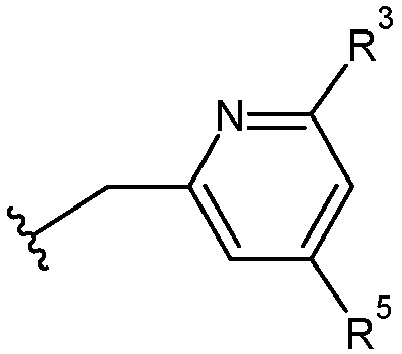
    Figure imgb0560
    and the remaining substituents are present in the following combinations: Compou nd R1 A R2 R3 R4 R5 TD556 H -(CH2)COOH
    Figure imgb0561
    Figure imgb0562
    H H
    TD810 H -(CH2)COOH
    Figure imgb0563
    Figure imgb0564
    H
    Figure imgb0565
    TD827
    Figure imgb0566
    -(CH2)COOH
    Figure imgb0567
    Figure imgb0568
    H H
    TD718 H -(CH2)COOH
    Figure imgb0569
    Figure imgb0570
    TMS H
    TD728 H -(CH2)COOH
    Figure imgb0571
    Figure imgb0572
    TIPS H
    TD 1204 H -(CH2)COOH
    Figure imgb0573
    Figure imgb0574
    I H
    TD944 H -(CH2)COOH
    Figure imgb0575
    Figure imgb0576
    Ph H
    TD943 H -(CH2)COOH
    Figure imgb0577
    Figure imgb0578
    cyclopropyl H
    TD959 H -(CH2)COOH
    Figure imgb0579
    Figure imgb0580
    tBu H
    TD992 H -(CH2)COOH
    Figure imgb0581
    Figure imgb0582
    adamantyl H
    TD705 H -CH2P(=O)(OEt)2 and -(CH2)COOtBu
    Figure imgb0583
    Figure imgb0584
    H H
    TD714 H -CH2P(=O)(OH)2 and -(CH2)COOH
    Figure imgb0585
    Figure imgb0586
    H H
    TD921 H -CH2P(=O)(Ph)(OH)
    Figure imgb0587
    Figure imgb0588
    H H
    TD580 H -CH2P(=O)(OEt)2
    Figure imgb0589
    Figure imgb0590
    H H
    TD582 H -CH2P(=O)(OH)(OEt)
    Figure imgb0591
    Figure imgb0592
    H H
    TD581 H -CH2P(=O)(OH)2
    Figure imgb0593
    Figure imgb0594
    H H
    TD575 Ph -CH2P(=O)(OEt)2
    Figure imgb0595
    Figure imgb0596
    H H
    TD576 Ph -CH2P(=O)(OH)2
    Figure imgb0597
    Figure imgb0598
    H H
    TD764 Cl -(CH2)COOH
    Figure imgb0599
    Figure imgb0600
    H H
    TD1063 -CF3 -(CH2)COOH
    Figure imgb0601
    Figure imgb0602
    H H
    TD1092 -COOCH3 -(CH2)COOH
    Figure imgb0603
    Figure imgb0604
    H H
    TD1148 -COOiPr -(CH2)COOH
    Figure imgb0605
    Figure imgb0606
    H H
    TD1160 -COOtBu -(CH2)COOH
    Figure imgb0607
    Figure imgb0608
    H H
    TD1176 -N(CH3)2 -(CH2)COOH
    Figure imgb0609
    Figure imgb0610
    H H
    TD647 Ph -(CH2)COOH
    Figure imgb0611
    Figure imgb0612
    H H
    TD722 Ph -(CH2)COOH
    Figure imgb0613
    Figure imgb0614
    -CH2NH2 H
    TD1054 Ph -(CH2)COOH
    Figure imgb0615
    Figure imgb0616
    -C(CH3)2NH2 H
    TD1105 H -(CH2)COOH
    Figure imgb0617
    Figure imgb0618
    -C(CH3)2NHBoc H
    TD1127 H -(CH2)COOH
    Figure imgb0619
    Figure imgb0620
    4-piperidinyl H
    TD742 4-carboxyphen yl -(CH2)COOH
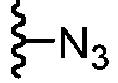
    Figure imgb0621
    Figure imgb0622
    H H
    TD744 4-carboxyphen yl -(CH2)COOH
    Figure imgb0623
    Figure imgb0624
    -CH2-NH2 H
    TD779 Ph -(CH2)COONH2
    Figure imgb0625
    Figure imgb0626
    H H
    TD778 Ph -(CH2)CONH-CH2COOH
    Figure imgb0627
    Figure imgb0628
    H H
    TD1346 H -CH(CH3)COOH
    Figure imgb0629
    Figure imgb0630
    H H
    TD 1408 H -(CH2)COOH
    Figure imgb0631
    Figure imgb0632
    H H
    TD1451 -CF3 -CH(CH3)COOH
    Figure imgb0633
    Figure imgb0634
    -C(CH3)2NHBoc -COOH
    TD1504 H -CH(CH2COOH)COOH; -CH(CH3)COOH
    Figure imgb0635
    Figure imgb0636
    H H
    cz-TD556 H -(CH2)COOH
    Figure imgb0637
    H H
    cz-TD764 Cl -(CH2)COOH
    Figure imgb0638
    H H
    cz-TD1063 -CF3 -(CH2)COOH
    Figure imgb0639
    H H
    TD1188 H -(CH2)COOH
    Figure imgb0640
    -CF3 H
    TD650 Ph -(CH2)COOH
    Figure imgb0641
    H H
    TD871 Ph -(CH2)COOH
    Figure imgb0642
    H H
  6. A method of preparation of the compound of the general formula (I) according to any one of the claims 1 to 5, characterized in that it comprises the following steps:
    i) providing an alkyne intermediate of general formula Z-Cl, wherein Z is as defined in claim 1;
    ii) providing an azide intermediate of general formula (III)
    Figure imgb0643
    wherein Y, R1 and R2 are as defined in claim 1;
    iii) providing a cyclen derivative of general formula (IV)
    Figure imgb0644
    wherein pA is selected from the group comprising -(CH2)nCOOtBu, wherein n is an integer from 1 to 3; benzyloxycarbonyl; -CH(CH3)COOR, wherein R is tert-butyl, methyl or ethyl; -CH((CH2)nCH3)COOR, wherein n is an integer from 1 to 3 and R is tert-butyl, methyl or ethyl; -CH((CH2)nCOOR)COOR, wherein n is an integer from 1 to 3 and R are independently selected from tert-butyl, methyl or ethyl;
    -CH2P(=O)(OR)2, wherein R is C1 to C6 alkyl, which may be branched or linear;
    -CH2C(=O)(NH2); -CH2C(=O)(NH)-CH2COOH; -CH2P(=O)(OH)(Ar), wherein Ar is phenyl, which can optionally be substituted with C1 to C6 alkyl;
    iv-A) reacting the cyclen derivative of general formula (IV) with alkyne intermediate Z-Cl to obtain an intermediate of general formula (V)
    Figure imgb0645
    wherein Z is as defined in claim 1, and pA is defined above;
    or
    iv-B) reacting the cyclen derivative of general formula (IV) with the azide intermediate of general formula (III) to obtain an intermediate of general formula (VI)
    Figure imgb0646
    wherein Y, R1, R2 and pA are as defined above;
    v-A) reacting the intermediate of general formula (V) with the azide intermediate of general formula (III) to obtain an intermediate of general formula (VII)
    Figure imgb0647
    wherein Y, R1, R2, pA and Z are as defined above;
    or
    v-B) reacting the intermediate of general formula (VI) with the alkyne intermediate Z-Cl to obtain the intermediate of general formula (VII);
    vi) optionally, hydrolysis of protecting groups, resulting in the compound of general formula (1).
  7. A coordination compound of the compound of the general formula (I) according to any one of the claims 1 to 5 with a metal cation, selected from the group consisting of lanthanide(III) cations, Na+, Ba2+, Pb2+, Sr2+, Ca2+, Cd2+, Zn2+, Mn2+, Pt2+, Cu2+, Ni2+, Sc3+, Y3+, Bi3+, In3+, Ru3+, Ir3+, Ga3+, Tl3+, Pd2+; preferably the metal cation is selected from the group consisting of La3+, Ce3+, Pr3+, Nd3+, Sm3+, Eu3+, Gd3+, Tb3+, Dy3+, Ho3+, Er3+, Tm3+, Yb3+, Lu3+, Y3+, Sc3+, Bi3+, In3+, Tl3+, Pb2+, Ca2+, Cd2+, Zn2+, Cu2+, Ni2+, Mn2+, Pd2+, Na+.
  8. A method of preparation of the coordination compound according to claim 7, characterized in that it comprises the following steps:
    i) synthesis of the compound of the general formula (I) according to claim 6;
    ii) providing a salt of an inorganic acid and a metal cation, selected from the group consisting of lanthanide(III) cations, Na+, Ba2+, Pb2+, Sr2+, Ca2+, Cd2+, Zn2+, Mn2+, Pt2+, Cu2+, Ni2+, Sc3+, Y3+, Bi3+, In3+, Ru3+, Ir3+, Ga3+, Tl3+, Pd2+; preferably, the salt is selected from a group comprising chloride, nitrate, acetate, formate, trifluoroacetate, trifluoromethylsulfonate;
    iii) mixing the compound of the general formula (I) from step i) with the metal salt from step ii) in aqueous solution, preferably for at least 1 hour at temperature in the range of from 25 to 100 °C, resulting in chelation of the metal cation by the compound of general formula (I) and formation of the coordination compound according to claim 7;
    iv) optionally, transformation of the coordination compound from step iii), wherein the transformation is selected from at least one of the following reactions:
    - substitution reaction of halogen group present in R1 and/or R4 and/or R5, with a phenylboronic acid, thus transforming the halogen substituent into -COOH;
    - substitution reaction of halogen group present in R1 and/or R4 and/or R5, with -N3 group by reaction with NaN3;
    - hydrolysis of TIPS protecting group present in R1 and/or R4 and/or R5 substituent, wherein R1 and/or R3 and/or R5 is
    Figure imgb0648
    resulting in R1 and/or R3 and/or R5 being
    Figure imgb0649
    - addition reaction of methanol to R1 and/or R4 and/or R5, wherein R1 and/or R3 and/or R5 is
    Figure imgb0650
    thus transforming the triple bond to dimethyl acetal;
    - deuteration of CH2 groups of the pendant arms in D2O in presence of DBU, transforming them into CD2 groups;
    - selective reduction of pyridyl cycle of Z substituent, wherein Z is
    Figure imgb0651
    and R3 and R5 are as defined in claim 1, using NaBH4 or NaBD4 as the reducing agent, thus transforming the Z group into
    Figure imgb0652
    respectively;
    - reaction of NHz group of R1 and/or R4 and/or R5 and/or A, wherein R1 and/or R4 and/or R5 and/or A contains
    - NH2 or -(CH2)nNH2, with FmocCl, resulting in transformation of-NH2 group into -NHFmoc group;
    - reaction of -COOH group present in R1 and/or R4 and/or R5 and/or A, with an amino group of an aminoacid or peptide, thus forming a peptide bond;
    - S-alkylation reaction of a halogen, preferably Cl, of R1, R4 and/or R5 substituent with a thiol, resulting in trasforming the halogen into sulfide;
    - reaction of
    Figure imgb0653
    group of R1, R3 and/or R5, wherein R1, R3 and/or R5 contains
    Figure imgb0654
    , with an azide, preferably with alkyl- or arylazide, thereby forming a triazole bridge connecting the alkyl- or aryl- to R1, R3 and/or R5 group;
    - reaction of-N3 group of R1 and/or R5, wherein R1 and/or R5 contains -N3 group, with a substituent comprising a carbon-carbon triple bond, thereby forming a triazole bridge connecting the substituent with the coordination compound;
    - reaction of -SH group of R1 and/or R5, with a substituent comprising maleimide, thereby forming thiosuccinimide linkage connecting the substituent with the coordination compound;
    - reaction of -SH group of R1 and/or R5, with a substituent comprising another -SH group, thereby forming a disulfide bridge connecting the substituent with the coordination compound;
    - reaction of -SH group of R1 and/or R5, with alkyl- or arylhalogenide, thereby forming a thioether linkage connecting the alkyl- or aryl- to the coordination compound;
    - reaction of-NOz group of R1 and/or R5, with a substituent comprising -SH group, thereby forming a thioether linkage connecting the substituent with the coordination compound.
  9. A coordination compound chain containing at least two coordination compounds according to claim 7, bound via a triazole bridge formed between R1 or R5 group of the first coordination compound and R1 or R5 group of the following coordination compound and/or via amide bond formed between a substituent R1 or R4 or R5 or A of one coordination compound containing an amine group and a substituent R1 or R4 or R5 or A of another coordination compound containing a carboxyl group and/or via disulfide bonds formed between a substituent R1 or R5 of one coordination compound containing -SH group, and a substituent R1 or R5 of another coordination compound containing -SH group.
  10. A coordination compound dimer of general formula (X)
    Figure imgb0655
    wherein M1 and M2 are independently metal cations as defined in claim 7, and R1, R4 and R5 are as defined in claim 1.
  11. A conjugate for drug tracing, which contains the coordination compound according to claim 7 or the coordination compound chain according to claim 9, conjugated to a peptide or to a protein;
    wherein the coordination compound according to claim 7 or the coordination compound chain according to claim 9 contain R1 and/or R4 and/or R5 group comprising -NH2 or -COOH group; preferably R1 and/or R4 and/or R5 is selected from -NH2; -(CH2)nNH2; -COOH; -(CH2)nCOOH; C6 to C10 aryl, substituted with-NH2, -COOH, -(CH2)nNH2, or -(CH2)nCOOH; wherein n is an integer in the range of from 1 to 3;
    which is conjugated to the peptide or the protein via an amide bond formed between -COOH group present in R1 and/or R4 and/or R5 and amino group of the peptide or the protein or via an amide bond formed between -NH2 group present in R1 and/or R4 and/or R5 and carboxyl group of the peptide or the protein;
    and wherein the peptide is selected from the group comprising oligopeptides of 3 to 20 aminoacids;
    and wherein the protein is selected from the group comprising antibodies, preferably monoclonal antibodies.
  12. A method of drug tracing, characterized in that it comprises the following steps:
    i) providing a cell culture or a tissue to be analyzed, containing at least one conjugate according to claim 11, wherein the peptide or the protein is of the peptide-based or protein-based drug to be traced;
    ii) hydrolyzing the cell culture or tissue from step i) using a strong acid, preferably HCl, obtaining a hydrolyzate;
    iii) qualitative and/or quantitative analysis of the hydrolyzate of step ii) for the presence of the coordination compound of claim 7 or of the coordination compound chain of claim 9, preferably using LC-MS.
  13. Use in vitro of the coordination compound according to claim 7 or of the coordination compound chain according to claim 9 or of the coordination compound dimer according to claim 10 or of the conjugate according to claim 11 in pharmacy, preferably for development and testing of new drugs, more preferably for drug marking and tracing.
  14. The coordination compound according to claim 7 or the coordination compound chain according to claim 9 or the coordination compound dimer according to claim 10 for use in medical diagnostics, preferably as MRI contrast agents.
  15. The coordination compound according to claim 7 or the coordination compound chain according to claim 9 or the coordination compound dimer according to claim 10, wherein M is selected from the group comprising 44Sc, 47Sc, 64Cu, 67Cu, 86Y, 90Y, 140Nd, 149Pm, 151Pm, 153Sm, 159Gd, 149Tb, 161Tb, 165Dy, 161Ho, 166Ho, 169Er, 167Tm, 175Yb, 177Lu, and/or R1, R4 and/or R5 contains a radioactive halogen, for use in medicine as radiodiagnostic and/or radiopharmaceutic agents.
EP22782448.9A 2021-09-10 2022-09-09 Compounds for complexation of rare earth elements and/or s-, p-, d- block metals, their coordination compounds, peptide conjugates, method of their preparation and use thereof Active EP4377308B1 (en)

Applications Claiming Priority (2)

Application Number Priority Date Filing Date Title
EP21196175.0A EP4148051A1 (en) 2021-09-10 2021-09-10 Compounds for complexation of rare earth elements and/or s-, p-, d- block metals, their coordination compounds, peptide conjugates, method of their preparation and use thereof
PCT/CZ2022/050087 WO2023036350A1 (en) 2021-09-10 2022-09-09 Compounds for complexation of rare earth elements and/or s-, p-, d- block metals, their coordination compounds, peptide conjugates, method of their preparation and use thereof

Publications (3)

Publication Number Publication Date
EP4377308A1 EP4377308A1 (en) 2024-06-05
EP4377308B1 true EP4377308B1 (en) 2024-11-20
EP4377308C0 EP4377308C0 (en) 2024-11-20

Family

ID=77738952

Family Applications (2)

Application Number Title Priority Date Filing Date
EP21196175.0A Withdrawn EP4148051A1 (en) 2021-09-10 2021-09-10 Compounds for complexation of rare earth elements and/or s-, p-, d- block metals, their coordination compounds, peptide conjugates, method of their preparation and use thereof
EP22782448.9A Active EP4377308B1 (en) 2021-09-10 2022-09-09 Compounds for complexation of rare earth elements and/or s-, p-, d- block metals, their coordination compounds, peptide conjugates, method of their preparation and use thereof

Family Applications Before (1)

Application Number Title Priority Date Filing Date
EP21196175.0A Withdrawn EP4148051A1 (en) 2021-09-10 2021-09-10 Compounds for complexation of rare earth elements and/or s-, p-, d- block metals, their coordination compounds, peptide conjugates, method of their preparation and use thereof

Country Status (9)

Country Link
US (1) US20250147039A1 (en)
EP (2) EP4148051A1 (en)
JP (1) JP2024533430A (en)
KR (1) KR20240058157A (en)
CN (1) CN118215658A (en)
AU (1) AU2022343785B9 (en)
CA (1) CA3229808A1 (en)
IL (1) IL310752B2 (en)
WO (1) WO2023036350A1 (en)

Family Cites Families (4)

* Cited by examiner, † Cited by third party
Publication number Priority date Publication date Assignee Title
AU1694895A (en) * 1994-01-28 1995-08-15 Mallinckrodt Medical, Inc. Functionalized aza-bimacrocyclic ligands for imaging applications
KR101199570B1 (en) * 2009-09-09 2012-11-13 경북대학교 산학협력단 Novel tetraaza macrocyclic compounds, mauufacturing method and using thereof
EP2604281B1 (en) * 2011-12-14 2014-07-30 Centre National de la Recherche Scientifique (CNRS) Clicked somatostatin conjugated analogs for biological applications
EP3757098A1 (en) * 2019-06-25 2020-12-30 Ustav Organicke Chemie a Biochemie AV CR, v.v.i. Cyclen based compounds, coordination compounds, peptides, pharmaceutical preparation, and use thereof

Non-Patent Citations (1)

* Cited by examiner, † Cited by third party
Title
SEE AMY M ET AL: "Showcasing research by Dr Kellie Tuck, Dr Amy Barrios and co-workers from the As featured in", CHEMCOMM, 24 March 2017 (2017-03-24), pages 4911 - 4914, XP093001003, Retrieved from the Internet <URL:https://pubs.rsc.org/en/content/articlepdf/2017/cc/c7cc01764b> [retrieved on 20221122] *

Also Published As

Publication number Publication date
IL310752A (en) 2024-04-01
JP2024533430A (en) 2024-09-12
IL310752B1 (en) 2024-06-01
EP4377308A1 (en) 2024-06-05
WO2023036350A1 (en) 2023-03-16
US20250147039A1 (en) 2025-05-08
CA3229808A1 (en) 2023-03-16
AU2022343785A9 (en) 2025-03-20
CN118215658A (en) 2024-06-18
KR20240058157A (en) 2024-05-03
IL310752B2 (en) 2024-10-01
AU2022343785A1 (en) 2024-02-29
AU2022343785B9 (en) 2025-03-20
EP4377308C0 (en) 2024-11-20
EP4148051A1 (en) 2023-03-15

Similar Documents

Publication Publication Date Title
US4923985A (en) Process for synthesizing macrocyclic chelates
AU2020262961B2 (en) Prostate-specific membrane antigen (PSMA) inhibitors as diagnostic and radionuclide therapeutic agents
US6056939A (en) Self-assembling heteropolymetallic chelates as imaging agents and radiopharmaceuticals
EP3131585B1 (en) Multidentate bifunctional chelating agents for radionuclide complexation in diagnostics and therapy
Greifenstein et al. Synthesis and labeling of a squaric acid containing PSMA-inhibitor coupled to AAZTA5 for versatile labeling with 44Sc, 64Cu, 68Ga and 177Lu
US11097017B2 (en) Gadolinium-based contrast agents for sensitive detection of Zn2+with MRI
US20140142298A1 (en) SYNTHESIS OF IMIDAZO[1,2-a]PYRAZIN-4-IUM SALTS FOR THE SYNTHESIS OF 1,4,7-TRIAZACYCLONONANE (TACN) AND N- AND/OR C-FUNCTIONALIZED DERIVATIVES THEREOF
Gugliotta et al. AAZTA-based bifunctional chelating agents for the synthesis of multimeric/dendrimeric MRI contrast agents
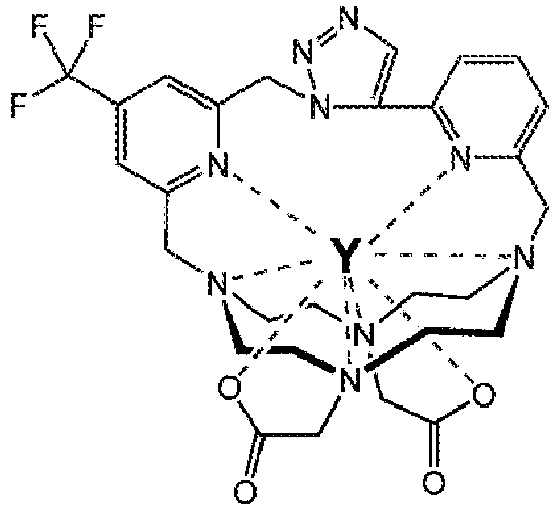
WO1995001346A1 (en) Chelating compounds
CN116916972A (en) Marker precursors and radiotracers for use in nuclear medicine diagnosis and treatment of prostate cancer-induced bone metastases
Palma et al. 99m Tc (CO) 3-labeled pamidronate and alendronate for bone imaging
CA2891593C (en) Di-macrocycles
AU2022343785B9 (en) Compounds for complexation of rare earth elements and/or s-, p-, d- block metals, their coordination compounds, peptide conjugates, method of their preparation and use thereof
US20040167330A1 (en) Novel chelating agents and conjugates thereof, their synthesis and use as diagnois and therapeutic agents
WO2009021947A1 (en) Chelators, paramagnetic chelates thereof and their use as contrast agents in magnetic resonance imaging (mri)
JP5476541B2 (en) Telomerase inhibitor
US6488909B1 (en) Chelating agents as well as their tricarbonyl complexes with technetium and rhenium
WO2013060793A1 (en) Bifunctional ligands for radiometals
Kohl et al. New synthetic routes for 1-benzyl-1, 4, 7, 10-tetraazacyclododecane and 1, 4, 7, 10-tetraazacyclododecane-1-acetic acid ethyl ester, important starting materials for metal-coded DOTA-based affinity tags
EP2032590A1 (en) Triazole containing metal chelating agents
RU2808670C1 (en) Bifunctional chelator for production of radiopharmaceuticals
WO2011102626A2 (en) Polyazamacrocyclic compound, and a production method and a biomedical use therefor
WO2025146126A1 (en) Preparation method of compounds targeting neurotensin receptor
WO2023126336A1 (en) Novel bispidine-based metal chelating ligands displaying good relaxivity
WO2012150302A1 (en) Tetraaza-cycloalkanes based ligands and their use in nuclear medicine and molecular imaging

Legal Events

Date Code Title Description
STAA Information on the status of an ep patent application or granted ep patent

Free format text: STATUS: UNKNOWN

STAA Information on the status of an ep patent application or granted ep patent

Free format text: STATUS: THE INTERNATIONAL PUBLICATION HAS BEEN MADE

PUAI Public reference made under article 153(3) epc to a published international application that has entered the european phase

Free format text: ORIGINAL CODE: 0009012

STAA Information on the status of an ep patent application or granted ep patent

Free format text: STATUS: REQUEST FOR EXAMINATION WAS MADE

REG Reference to a national code

Ref country code: DE

Ipc: G01N0033680000

Ref legal event code: R079

Ref document number: 602022008001

Country of ref document: DE

Free format text: PREVIOUS MAIN CLASS: C07D0401140000

17P Request for examination filed

Effective date: 20240229

AK Designated contracting states

Kind code of ref document: A1

Designated state(s): AL AT BE BG CH CY CZ DE DK EE ES FI FR GB GR HR HU IE IS IT LI LT LU LV MC MK MT NL NO PL PT RO RS SE SI SK SM TR

GRAP Despatch of communication of intention to grant a patent

Free format text: ORIGINAL CODE: EPIDOSNIGR1

GRAP Despatch of communication of intention to grant a patent

Free format text: ORIGINAL CODE: EPIDOSNIGR1

STAA Information on the status of an ep patent application or granted ep patent

Free format text: STATUS: GRANT OF PATENT IS INTENDED

RIC1 Information provided on ipc code assigned before grant

Ipc: A61K 51/08 20060101ALI20240521BHEP

Ipc: C07F 7/24 20060101ALI20240521BHEP

Ipc: A61K 49/14 20060101ALI20240521BHEP

Ipc: C07F 15/00 20060101ALI20240521BHEP

Ipc: C07F 13/00 20060101ALI20240521BHEP

Ipc: C07F 5/00 20060101ALI20240521BHEP

Ipc: A61K 51/04 20060101ALI20240521BHEP

Ipc: A61K 49/08 20060101ALI20240521BHEP

Ipc: A61K 49/12 20060101ALI20240521BHEP

Ipc: C07D 471/22 20060101ALI20240521BHEP

Ipc: C07F 9/6524 20060101ALI20240521BHEP

Ipc: C07K 7/06 20060101ALI20240521BHEP

Ipc: C07F 3/04 20060101ALI20240521BHEP

Ipc: C07F 3/06 20060101ALI20240521BHEP

Ipc: C07F 3/08 20060101ALI20240521BHEP

Ipc: C07D 401/14 20060101ALI20240521BHEP

Ipc: G01N 33/68 20060101AFI20240521BHEP

INTG Intention to grant announced

Effective date: 20240614

GRAS Grant fee paid

Free format text: ORIGINAL CODE: EPIDOSNIGR3

GRAA (expected) grant

Free format text: ORIGINAL CODE: 0009210

STAA Information on the status of an ep patent application or granted ep patent

Free format text: STATUS: THE PATENT HAS BEEN GRANTED

AK Designated contracting states

Kind code of ref document: B1

Designated state(s): AL AT BE BG CH CY CZ DE DK EE ES FI FR GB GR HR HU IE IS IT LI LT LU LV MC MK MT NL NO PL PT RO RS SE SI SK SM TR

DAV Request for validation of the european patent (deleted)
DAX Request for extension of the european patent (deleted)
REG Reference to a national code

Ref country code: GB

Ref legal event code: FG4D

REG Reference to a national code

Ref country code: CH

Ref legal event code: EP

REG Reference to a national code

Ref country code: DE

Ref legal event code: R096

Ref document number: 602022008001

Country of ref document: DE

REG Reference to a national code

Ref country code: IE

Ref legal event code: FG4D

U01 Request for unitary effect filed

Effective date: 20241120

U07 Unitary effect registered

Designated state(s): AT BE BG DE DK EE FI FR IT LT LU LV MT NL PT RO SE SI

Effective date: 20241126

PG25 Lapsed in a contracting state [announced via postgrant information from national office to epo]

Ref country code: IS

Free format text: LAPSE BECAUSE OF FAILURE TO SUBMIT A TRANSLATION OF THE DESCRIPTION OR TO PAY THE FEE WITHIN THE PRESCRIBED TIME-LIMIT

Effective date: 20250320

Ref country code: HR

Free format text: LAPSE BECAUSE OF FAILURE TO SUBMIT A TRANSLATION OF THE DESCRIPTION OR TO PAY THE FEE WITHIN THE PRESCRIBED TIME-LIMIT

Effective date: 20241120

PG25 Lapsed in a contracting state [announced via postgrant information from national office to epo]

Ref country code: ES

Free format text: LAPSE BECAUSE OF FAILURE TO SUBMIT A TRANSLATION OF THE DESCRIPTION OR TO PAY THE FEE WITHIN THE PRESCRIBED TIME-LIMIT

Effective date: 20241120

PG25 Lapsed in a contracting state [announced via postgrant information from national office to epo]

Ref country code: GR

Free format text: LAPSE BECAUSE OF FAILURE TO SUBMIT A TRANSLATION OF THE DESCRIPTION OR TO PAY THE FEE WITHIN THE PRESCRIBED TIME-LIMIT

Effective date: 20250221

PG25 Lapsed in a contracting state [announced via postgrant information from national office to epo]

Ref country code: PL

Free format text: LAPSE BECAUSE OF FAILURE TO SUBMIT A TRANSLATION OF THE DESCRIPTION OR TO PAY THE FEE WITHIN THE PRESCRIBED TIME-LIMIT

Effective date: 20241120

PG25 Lapsed in a contracting state [announced via postgrant information from national office to epo]

Ref country code: RS

Free format text: LAPSE BECAUSE OF FAILURE TO SUBMIT A TRANSLATION OF THE DESCRIPTION OR TO PAY THE FEE WITHIN THE PRESCRIBED TIME-LIMIT

Effective date: 20250220

PG25 Lapsed in a contracting state [announced via postgrant information from national office to epo]

Ref country code: SM

Free format text: LAPSE BECAUSE OF FAILURE TO SUBMIT A TRANSLATION OF THE DESCRIPTION OR TO PAY THE FEE WITHIN THE PRESCRIBED TIME-LIMIT

Effective date: 20241120

PG25 Lapsed in a contracting state [announced via postgrant information from national office to epo]

Ref country code: SK

Free format text: LAPSE BECAUSE OF FAILURE TO SUBMIT A TRANSLATION OF THE DESCRIPTION OR TO PAY THE FEE WITHIN THE PRESCRIBED TIME-LIMIT

Effective date: 20241120

PLBE No opposition filed within time limit

Free format text: ORIGINAL CODE: 0009261

STAA Information on the status of an ep patent application or granted ep patent

Free format text: STATUS: NO OPPOSITION FILED WITHIN TIME LIMIT

REG Reference to a national code

Ref country code: CH

Ref legal event code: U11

Free format text: ST27 STATUS EVENT CODE: U-0-0-U10-U11 (AS PROVIDED BY THE NATIONAL OFFICE)

Effective date: 20251001

PGFP Annual fee paid to national office [announced via postgrant information from national office to epo]

Ref country code: NO

Payment date: 20250922

Year of fee payment: 4

26N No opposition filed

Effective date: 20250821

PGFP Annual fee paid to national office [announced via postgrant information from national office to epo]

Ref country code: CZ

Payment date: 20250805

Year of fee payment: 4

U20 Renewal fee for the european patent with unitary effect paid

Year of fee payment: 4

Effective date: 20250929

PGFP Annual fee paid to national office [announced via postgrant information from national office to epo]

Ref country code: CH

Payment date: 20251001

Year of fee payment: 4