EP4376373A1 - Dynamic configuration of customer premises equipment - Google Patents
Dynamic configuration of customer premises equipment Download PDFInfo
- Publication number
- EP4376373A1 EP4376373A1 EP23211352.2A EP23211352A EP4376373A1 EP 4376373 A1 EP4376373 A1 EP 4376373A1 EP 23211352 A EP23211352 A EP 23211352A EP 4376373 A1 EP4376373 A1 EP 4376373A1
- Authority
- EP
- European Patent Office
- Prior art keywords
- cpe
- operator
- network
- specific configuration
- identification parameters
- Prior art date
- Legal status (The legal status is an assumption and is not a legal conclusion. Google has not performed a legal analysis and makes no representation as to the accuracy of the status listed.)
- Pending
Links
Images


Classifications
-
- H—ELECTRICITY
- H04—ELECTRIC COMMUNICATION TECHNIQUE
- H04L—TRANSMISSION OF DIGITAL INFORMATION, e.g. TELEGRAPHIC COMMUNICATION
- H04L41/00—Arrangements for maintenance, administration or management of data switching networks, e.g. of packet switching networks
- H04L41/08—Configuration management of networks or network elements
- H04L41/0876—Aspects of the degree of configuration automation
- H04L41/0886—Fully automatic configuration
-
- H—ELECTRICITY
- H04—ELECTRIC COMMUNICATION TECHNIQUE
- H04L—TRANSMISSION OF DIGITAL INFORMATION, e.g. TELEGRAPHIC COMMUNICATION
- H04L41/00—Arrangements for maintenance, administration or management of data switching networks, e.g. of packet switching networks
- H04L41/08—Configuration management of networks or network elements
- H04L41/0803—Configuration setting
- H04L41/0813—Configuration setting characterised by the conditions triggering a change of settings
- H04L41/0816—Configuration setting characterised by the conditions triggering a change of settings the condition being an adaptation, e.g. in response to network events
-
- G—PHYSICS
- G06—COMPUTING OR CALCULATING; COUNTING
- G06F—ELECTRIC DIGITAL DATA PROCESSING
- G06F9/00—Arrangements for program control, e.g. control units
- G06F9/06—Arrangements for program control, e.g. control units using stored programs, i.e. using an internal store of processing equipment to receive or retain programs
- G06F9/44—Arrangements for executing specific programs
- G06F9/4401—Bootstrapping
- G06F9/4416—Network booting; Remote initial program loading [RIPL]
-
- H—ELECTRICITY
- H04—ELECTRIC COMMUNICATION TECHNIQUE
- H04L—TRANSMISSION OF DIGITAL INFORMATION, e.g. TELEGRAPHIC COMMUNICATION
- H04L41/00—Arrangements for maintenance, administration or management of data switching networks, e.g. of packet switching networks
- H04L41/08—Configuration management of networks or network elements
- H04L41/0803—Configuration setting
- H04L41/0806—Configuration setting for initial configuration or provisioning, e.g. plug-and-play
- H04L41/0809—Plug-and-play configuration
-
- H—ELECTRICITY
- H04—ELECTRIC COMMUNICATION TECHNIQUE
- H04L—TRANSMISSION OF DIGITAL INFORMATION, e.g. TELEGRAPHIC COMMUNICATION
- H04L41/00—Arrangements for maintenance, administration or management of data switching networks, e.g. of packet switching networks
- H04L41/08—Configuration management of networks or network elements
- H04L41/0803—Configuration setting
- H04L41/084—Configuration by using pre-existing information, e.g. using templates or copying from other elements
- H04L41/0846—Configuration by using pre-existing information, e.g. using templates or copying from other elements based on copy from other elements
-
- H—ELECTRICITY
- H04—ELECTRIC COMMUNICATION TECHNIQUE
- H04L—TRANSMISSION OF DIGITAL INFORMATION, e.g. TELEGRAPHIC COMMUNICATION
- H04L41/00—Arrangements for maintenance, administration or management of data switching networks, e.g. of packet switching networks
- H04L41/08—Configuration management of networks or network elements
- H04L41/085—Retrieval of network configuration; Tracking network configuration history
- H04L41/0853—Retrieval of network configuration; Tracking network configuration history by actively collecting configuration information or by backing up configuration information
Definitions
- the present subject matter relates, in general, to Customer Premises Equipment, CPE, and in particular, to techniques for facilitating dynamic configuration of CPEs.
- the CPE are typically utilized for accessing services provided by a network operator at a customer premise.
- the CPE is usually connected to a telecommunication circuit of the network operator at a demarcation point, where the demarcation point is a physical point where a public network of the network operator ends, and private network of a customer begins.
- identification parameters comprising at least one of a CPE identifier and a network identifier are transmitted to a Cloud Onboarding Server, COS.
- COS Cloud Onboarding Server
- an operator specific configuration corresponding to the identification parameters is received, where the operator specific configuration is indicative of operational parameters associated with the network operator.
- the CPE is then configured based on the operator specific configuration.
- the method further comprises: i) launching boot firmware of the CPE; and ii) connecting the CPE to a communication network hosted by the network operator, for transmitting the identification parameters.
- the operator specific configuration comprises at least a management service uniform resource locator, URL, corresponding to the network operator.
- the configuring the CPE further comprises triggering connection to an auto configuration server, ACS, associated with the network operator based on the management service URL.
- the CPE identifier comprises a serial number of the CPE and a model number of the CPE; and the network identifier comprises an internet protocol, IP, subnet associated with the network operator, network operator identifier, and Wi-Fi neighbour information.
- identification parameters comprising at least one of a CPE identifier and a network identifier are received from a CPE.
- an operator specific configuration corresponding to the identification parameters is determined, where the operator specific configuration is indicative of operational parameters associated with the network operator. The operator specific configuration is then transmitted to the CPE.
- the CPE identifier comprises a serial number of the CPE and a model number of the CPE; and the network identifier comprises an internet protocol, IP, subnet associated with the network operator, network operator identifier, and Wi-Fi neighbour information.
- the method further comprises: i) ascertaining presence of an operator specific configuration corresponding to the identification parameters based on a mapping table between a plurality of operator specific configurations and a plurality of identification parameters, wherein the plurality of identification parameters comprises a plurality of CPE identifiers and a plurality of network identifiers; and ii) transmitting the operator specific configuration.
- the method further comprises: i) ascertaining absence of an operator specific configuration corresponding to the identification parameters based on a mapping table between a plurality of operator specific configurations and a plurality of identification parameters, wherein the plurality of identification parameters comprises a plurality of CPE identifiers and a plurality of network identifiers; and ii) skipping transmission of the operator specific configuration.
- the method further comprises blocking the CPE on ascertaining the absence of the operator specific configuration in the plurality of operator specific configurations.
- a CPE includes a communication engine to transmit, to a COS, identification parameters comprising at least one of a CPE identifier and a network identifier.
- the communication engine then receives an operator specific configuration corresponding to the identification parameters, where the operator specific configuration is indicative of operational parameters associated with the network operator.
- the CPE further includes a configuration engine to configure the CPE based on the operator specific configuration.
- the configuration engine is further configured to: i) launch boot firmware of the CPE; and ii) connect the CPE to a communication network hosted by the network operator, for transmitting the identification parameters.
- the operator specific configuration comprises at least a management service uniform resource locator, URL, corresponding to the network operator.
- the configuration engine is further configured to trigger connection to an auto configuration server, ACS, associated with the network operator based on the management service URL.
- the CPE identifier comprises a serial number of the CPE and a model number of the CPE; and the network identifier comprises an internet protocol, IP, subnet associated with the network operator, network operator identifier, and Wi-Fi neighbour information.
- a COS includes a reception engine to receive, from a CPE, identification parameters comprising at least one of a CPE identifier and a network identifier.
- the COS further includes a determination engine coupled to the reception engine to determine an operator specific configuration based on the identification parameters, where the operator specific configuration is indicative of operational parameters associated with the network operator.
- a transmission engine coupled to the determination engine is further included in the COS, where the transmission engine is to transmit the operator specific configuration to the CPE.
- the CPE identifier comprises a serial number of the CPE and a model number of the CPE; and the network identifier comprises an internet protocol, IP, subnet associated with the network operator, network operator identifier, and Wi-Fi neighbour information.
- the determination engine is further configured to: i) ascertain presence of an operator specific configuration corresponding to at the identification parameters based on a mapping table between a plurality of operator specific configurations and a plurality of identification parameters, wherein the plurality of identification parameters comprises a plurality of CPE identifiers and a plurality of network identifiers; and ii) transmit the operator specific configuration.
- the determination engine is further configured to: i) ascertain absence of an operator specific configuration corresponding to the identification parameters based on a mapping table between a plurality of operator specific configurations and a plurality of identification parameters, wherein the plurality of identification parameters comprises a plurality of CPE identifiers and a plurality of network identifiers; and ii) skip the transmission of the operator specific configuration.
- the transmission engine is further configured to transmit an indication to block communication ports of the CPE on ascertaining the absence of the operator specific configuration in the plurality of operator specific configurations.
- CPEs are usually manufactured to fulfil specific operational requirements of a network operator.
- operator specific configuration corresponding to a network operator is pre-provisioned in the CPE during manufacturing of the CPE.
- the CPE When the CPE is powered on at a customer premise, the CPE utilizes the operator specific configuration to connect to an auto configuration server (ACS) of the network operator for deployment of the CPE at the customer premise.
- ACS auto configuration server
- pre-provisioning operator specific configuration corresponding to different network operators in different CPEs increases time and complexity involved in manufacturing and commissioning of the CPEs.
- the technique involves providing a CPE with operator specific configuration corresponding to a network operator during deployment of the CPE at a customer premise instead of pre-provisioning operator specific configuration during manufacturing of the CPE.
- Configuring the CPEs with the operator specific configuration dynamically during deployment reduces the time and complexity involved in pre-provisioning different CPEs with different operator specific configurations during manufacturing, thereby reducing the time and complexity involved in manufacturing of the CPEs.
- identification parameters comprising at least one of a CPE identifier and a network identifier are transmitted over a communication network to a Cloud Onboarding Server (COS).
- COS Cloud Onboarding Server
- an operator specific configuration corresponding to the identification parameters is identified at the COS, where the operator specific configuration is indicative of operational parameters associated with the network operator.
- the operator specific configuration is then transmitted from the COS to the CPE.
- the CPE is then configured based on the operator specific configuration.
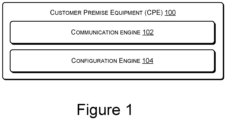
- FIG. 1 illustrates schematic of a CPE 100, in accordance with an example of the present subject matter.
- CPE 100 may include, but are not limited to, routers such as, Digital Subscriber Line (DSL) modems and cable routers; Optical Network Terminal (ONT); private branch exchange (PBX) switching equipment; and key and hybrid telephone systems.
- DSL Digital Subscriber Line
- ONT Optical Network Terminal
- PBX private branch exchange
- the CPE 100 comprises a communication engine 102 that may transmit identification parameters to a COS (not shown).
- the identification parameters may comprise a CPE identifier, a network identifier, or a combination thereof.
- the CPE identifier may include, but are not limited to, serial number of the CPE, a model number of the CPE.
- the network identifier may include, but are not limited to, an internet protocol (IP) subnet associated with the network operator, network operator identifier such as, Mobile Country Code (MCC) and Mobile Network Code (MNC), and Wi-Fi neighbour information.
- IP internet protocol
- MCC Mobile Country Code
- MNC Mobile Network Code
- the communication engine 102 may receive an operator specific configuration corresponding to the identification parameters.
- the operator specific configuration may indicate operational parameters associated with the network operator.
- the communication engine 102 may receive the operator specific configuration from the COS.
- the CPE 100 further comprises a configuration engine 104 that may configure the CPE 100 to connect to a communication network of the network operator based on the operator specific configuration.
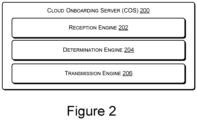
- FIG. 2 illustrates schematics of a COS 200 for facilitating dynamic configuration of the CPE, in accordance with an example of the present subject matter.
- the COS may be a cloud server hosted and maintained by a manufacturer of the CPEs.
- the COS 200 may include a reception engine 202 that may receive identification parameters comprising at least one of a CPE identifier and a network identifier.
- the CPE identifier may include, but are not limited to, serial number of the CPE, a model number of the CPE.
- the network identifier may include, but are not limited to, an internet protocol (IP) subnet associated with the network operator, network operator identifier such as, Mobile Country Code (MCC) and Mobile Network Code (MNC), and Wi-Fi neighbour information.
- IP internet protocol
- MCC Mobile Country Code
- MNC Mobile Network Code
- the reception engine 202 may receive the identification parameters from the CPE, such as the CPE 100.
- the COS 200 may further include a determination engine 204 coupled to the reception engine 202, where the determination engine 204 may determine an operator specific configuration based on the identification parameters.
- the operator specific configuration is indicative of operational parameters associated with the network operator.
- the COS 200 may include a transmission engine 206 coupled to the determination engine 204.
- the transmission engine 206 may then transmit the operator specific configuration to the CPE.
- FIG. 3 illustrates the CPE 100 communicatively coupled to the COS 200, in accordance with an example of the present subject matter.
- the CPE 100 may be communicatively coupled to the COS 200 via a communication network (not shown).
- the communication network may be a wireless or a wired network, or a combination thereof.
- the communication network can be a collection of individual networks, interconnected with each other and functioning as a single large network. Examples of such individual networks include, but are not limited to, Global System for Mobile communication (GSM) network, Universal Mobile Telecommunications System (UMTS) network, Long Term Evolution (LTE) network, personal communications service (PCS) network, Time-division multiple access (TDMA) network, Code-Division Multiple Access (CDMA) network, next-generation network (NGN), public switched telephone network (PSTN), and Integrated Services Digital Network (ISDN).
- GSM Global System for Mobile communication
- UMTS Universal Mobile Telecommunications System
- LTE Long Term Evolution
- PCS personal communications service
- TDMA Time-division multiple access
- CDMA Code-Division Multiple Access
- NTN next-generation network
- PSTN public
- the CPE 100 may include CPE processor(s) 302 and a CPE memory 304 coupled to the CPE processor 302.
- the functions of functional block labelled as "processor(s)" may be provided through the use of dedicated hardware as well as hardware capable of executing instructions. When provided by a processor, the functions may be provided by a single dedicated processor, by a single shared processor, or by a plurality of individual processors, some of which may be shared.
- processor would not be construed to refer exclusively to hardware capable of executing instructions, and may implicitly include, without limitation, digital signal processor (DSP) hardware, network processor, application specific integrated circuit (ASIC), field programmable gate array (FPGA), read only memory (ROM) for storing instructions, random access memory (RAM), non-volatile storage.
- DSP digital signal processor
- ASIC application specific integrated circuit
- FPGA field programmable gate array
- ROM read only memory
- RAM random access memory
- non-volatile storage Other hardware, standard and/or custom, may also be included.
- the CPE memory 304 may include any computer-readable medium including, for example, volatile memory (e.g., RAM), and/or non-volatile memory (e.g., EPROM, flash memory, etc.).
- volatile memory e.g., RAM
- non-volatile memory e.g., EPROM, flash memory, etc.
- the CPE 100 may further include CPE engine(s) 306, where the engines 306 may include the communication engine 102, the configuration engine 104 coupled to the communication engine 102, and the booting engine 106 coupled to the communication engine 102 and the configuration engine 104.
- the engines 306 may be implemented as a combination of hardware and firmware.
- such combinations of hardware and firmware may be implemented in several different ways.
- the firmware for the engine may be processor executable instructions stored on a non-transitory machine-readable storage medium and the hardware for the engine may include a processing resource (for example, implemented as either a single processor or a combination of multiple processors), to execute such instructions.
- the machine-readable storage medium may store instructions that, when executed by the processing resource, implement the functionalities of the engine.
- the CPE 100 may include the machine-readable storage medium storing the instructions and the processing resource to execute the instructions.
- the machine-readable storage medium may be located at a different location but accessible to the CPE 100 and the CPE processor 302.
- the CPE 100 may further include CPE data 308, that serves, amongst other things, as a repository for storing data that may be fetched, processed, received, or generated by the communication engine 102, the configuration engine 104, and the booting engine 106.
- the CPE data 308, among other data, may include communication data 310, configuration data 312, and booting data 314.
- the CPE data 308 may be stored in the CPE memory 304.
- the COS 200 may include COS processor(s) 316 and a COS memory 318 coupled to the COS processor 316.
- the functions of functional block labelled as "processor(s)" may be provided through the use of dedicated hardware as well as hardware capable of executing instructions. When provided by a processor, the functions may be provided by a single dedicated processor, by a single shared processor, or by a plurality of individual processors, some of which may be shared.
- processor would not be construed to refer exclusively to hardware capable of executing instructions, and may implicitly include, without limitation, digital signal processor (DSP) hardware, network processor, application specific integrated circuit (ASIC), field programmable gate array (FPGA), read only memory (ROM) for storing instructions, random access memory (RAM), non-volatile storage.
- DSP digital signal processor
- ASIC application specific integrated circuit
- FPGA field programmable gate array
- ROM read only memory
- RAM random access memory
- non-volatile storage Other hardware, standard and/or custom, may also be included.
- the COS memory 318 may include any computer-readable medium including, for example, volatile memory (e.g., RAM), and/or non-volatile memory (e.g., EPROM, flash memory, etc.).
- volatile memory e.g., RAM
- non-volatile memory e.g., EPROM, flash memory, etc.
- the COS 200 may further include COS engines 320, where the engines 320 may include the reception engine 202, determination engine 204 coupled to the reception engine 202, and the transmission engine 206 coupled to the determination engine 204.
- the engines 320 may be implemented as a combination of hardware and firmware.
- such combinations of hardware and firmware may be implemented in several different ways.
- the firmware for the engine may be processor executable instructions stored on a non-transitory machine-readable storage medium and the hardware for the engine may include a processing resource (for example, implemented as either a single processor or a combination of multiple processors), to execute such instructions.
- the machine-readable storage medium may store instructions that, when executed by the processing resource, implement the functionalities of the engine.
- the COS 200 may include the machine-readable storage medium storing the instructions and the processing resource to execute the instructions.
- the machine-readable storage medium may be located at a different location but accessible to the COS 200 and the COS processor 316.
- the COS 200 may further include COS data 322, that serves, amongst other things, as a repository for storing data that may be fetched, processed, received, or generated by the reception engine 202, the determination engine 204, and the transmission engine 206.
- the COS data 322, among other data, may include reception data 324, determination data 326, transmission data 328.
- the COS data 322 may be stored in the COS memory 318.
- the booting engine 106 of the CPE 100 may launch a boot firmware to bootup the CPE 100.
- the booting engine 106 may detect a CPE identifier, such as serial number of the CPE and model number of the CPE.
- the booting engine 106 may then activate a wide area network (WAN) port of the CPE 100 to connect the CPE to a communication network of the network operator.
- WAN wide area network
- the booting engine 106 may detect a network identifier, such as IP subnet associated with the network operator and network operator identifier, such as MCC and MNC.
- the bootup engine 106 may also detect at least one Wireless Access Point (WAP) in the vicinity of the CPE 100. The booting engine 106 may then send a connection request to the at least one WAP. In the example, in response to the connection request, the booting engine 106 may receive Wi-Fi neighbour information from the WAP. In an example, the Wi-Fi neighbour information may include a Received Signal Strength Indicator (RSSI) beacon and an IP subnet of network operator of the at least one WAP. In an example, the booting engine 106 may store the identification parameters in the booting data 314.
- WAP Wireless Access Point
- the communication engine 102 of the CPE 100 may then access the booting data 314 and transmit the identification parameters to the COS 200.
- a reception engine 202 of the COS 200 may receive the identification parameters from the CPE 100.
- the reception engine 202 may store the identification parameters in the reception data 324.
- the determination engine 204 may then access the identification parameters from the reception data 324 and ascertain presence of an operator specific configuration corresponding to the identification parameters.
- the determination engine 204 may have access to a mapping table between a plurality of operator specific configurations and a plurality of identification parameters, where the plurality of identification parameters comprises a plurality of CPE identifiers and a plurality of network identifiers.
- the mapping table may include a predetermined number of operator specific configurations corresponding to each of the plurality of network operators, where the predetermined number of operator specific configurations may be different from each other with respect to a type of CPE.
- the mapping table may be stored in the determination data 326.
- the determination engine 204 may then access the determination data 326 and identify an operator specific configuration that may be suitable for the CPE 100 and the network operator.
- identification parameters received from the CPE 100 may include at least one of model number, serial number of the CPE 100, and an IP subnet associated with a first network operator.
- the determination engine 204 may determine multiple operator specific configurations corresponding to the first network operator based on the IP subnet. Further, the determination engine 204 may identify an operator specific configuration, from the multiple operator specific configurations, suitable for the CPE 100 based on the model number and/or serial number of the CPE 100.
- the transmission engine 206 of the COS 200 may then transmit the identified operator specific configuration to the CPE 100.
- the determination engine 204 may verify whether identification parameters have been tampered before transmission to the COS 200.
- the determination engine 200 may utilize the Wi-Fi neighbour information to identify a geographic location of at least one neighbour WAP in the vicinity of the CPE 100.
- the determination engine 204 may then compare the geographic location of at least one neighbour WAP with the identification parameters of the CPE 100. If the geographic location of the at least one neighbour WAP and the identification parameters of the CPE 100 has no correlation, the determination engine 106 may ascertain that the identification parameters have been tampered before transmission to the COS 200. In such a situation, the transmission engine 206 may not transmit the operator specific configuration to the CPE 100.
- the determination engine 204 may not find an operator specific configuration corresponding to the identification parameters received from the CPE 100. Such situations may arise, for example, when the CPE 100 is not allowed to be utilized in a particular country. In such a situation, the mapping table won't include any operator specific configuration corresponding to identification parameters associated with network operators operating in the particular country. Accordingly, the determination engine 204 may determine that the CPE 100 is being utilized in a restricted country. In such a situation, the transmission engine 206 may not transmit any operator specification configuration to the CPE 100. Instead, the transmission engine 206 may transmit an indication to block various communication ports of the CPE 100.
- the configuration engine 104 may receive the operator specific configuration in response to transmission of the identification parameters. Accordingly, the configuration engine 104 may configure the CPE 100 based on the operator specific configuration.
- the operator specific configuration may include a management service uniform resource locator (URL) corresponding to the network operator.
- the configuration engine 104 may trigger a connection to an Auto Configuration Server (ACS) associated with the network operator based on the management service URL to complete deployment of the CPE 100 at a customer premise.
- ACS Auto Configuration Server
- the configuration engine 104 may receive an indication to block various communication ports of the CPE 100 in response to transmission of the identification parameters. In the example, the configuration engine 104 may block the communication ports of the of the CPE 100, thereby restricting utilization of the CPE 100.
- the booting engine 106 may detect identification parameters on every bootup of the CPE 100. The booting engine 106 may accordingly compare the identification parameters with previously detected identification parameters stored in the booting data 314. If the booting engine 106 detects any changes in the identification parameters with respect to the previously detected identification parameters, the communication engine 102 may transmit the identification parameters to the COS 200.
- the COS 200 may receive the identification parameters, determine another operator specific configuration based on the identification parameters, and transmit the other operator specific configuration for reconfiguration of the CPE 100.
- the COS 200 may receive the identification parameters, determine that there exists no operator specific configuration corresponding to the identification parameters, and transmit an indication to block various communication ports of the CPE 100.
- Configuring the CPEs with the operator specific configuration dynamically during deployment reduces the time and complexity involved in pre-provisioning different CPEs with different operator specific configurations during manufacturing, thereby reducing the time and complexity involved in manufacturing of the CPEs.
- Figure 4 illustrates a call flow 400 for communication between the CPE 100 and the COS 200 for facilitating dynamic configuration of the CPE 100, in accordance with an example of the present subject matter.
- the CPE 100 may be booted up.
- the CPE 100 may be booted up by launching a boot firmware of the CPE 100.
- the CPE 100 may be connected to a communication network of a network operator, such as the network operator 402.
- a WAN port of the CPE 100 may be activated to connect the CPE to the communication network.
- identification parameters comprising at least one of a CPE identifier and a network identifier may be detected at the CPE 100.
- the CPE identifier may include, but are not limited to, serial number of the CPE, a model number of the CPE.
- the network identifier may include, but are not limited to, an internet protocol (IP) subnet associated with the network operator, network operator identifier such as, Mobile Country Code (MCC) and Mobile Network Code (MNC), and Wi-Fi neighbour information.
- IP internet protocol
- MCC Mobile Country Code
- MNC Mobile Network Code
- the COS 200 may determine an operator specific configuration corresponding to the identification parameters.
- the CPE 100 may have access to a mapping table between a plurality of operator specific configurations and a plurality of identification parameters, where the plurality of identification parameters comprises a plurality of CPE identifiers and a plurality of network identifiers.
- the COS 200 may determine the operator specific configuration corresponding to the identification parameters based on the mapping table between the plurality of operator specific configurations and the plurality of identification parameters.
- the COS 200 may transmit the operator specific configuration to the CPE 100.
- the operator specific configuration among other information, may include a management service URL corresponding to the network operator 402.
- the CPE 100 may trigger connection to an ACS of the network operator.
- the CPE 100 may trigger connection to the ACS based on the management service URL included in the operator specific configuration.
- a connection may be established with the ACS of the network operator and deployment of the CPE 100 may be completed.
- Figure 5 illustrates a method for facilitating dynamic configuration of the CPE, in accordance with an example of the present subject matter.
- the method 500 may be implemented in a variety of devices, but for the ease of explanation, the description of the method 500 is provided in reference to the above-described CPE 100.
- the order in which the method 500 is described is not intended to be construed as a limitation, and any number of the described method blocks may be combined in any order to implement the method 500, or an alternative method.
- blocks of the method 500 may be performed in the CPE 100.
- the blocks of the method 500 may be executed based on instructions stored in a non-transitory computer-readable medium, as will be readily understood.
- the non-transitory computer-readable medium may include, for example, digital memories, magnetic storage media, such as magnetic disks and magnetic tapes, hard drives, or optically readable digital data storage media.
- identification parameters comprising at least one of a CPE identifier and a network identifier may be transmitted to a COS.
- the CPE identifier may include, but are not limited to, serial number of the CPE, a model number of the CPE.
- the network identifier may include, but are not limited to, an internet protocol (IP) subnet associated with the network operator, network operator identifier such as, Mobile Country Code (MCC) and Mobile Network Code (MNC), and Wi-Fi neighbour information.
- IP internet protocol
- MCC Mobile Country Code
- MNC Mobile Network Code
- Wi-Fi neighbour information may be transmitted by the communication engine 102 of the CPE 100.
- an operator specific configuration corresponding to the identification parameters may be received.
- the operator specific configuration may indicate operational parameters associated with the network operator.
- the operator specific configuration may be received by the communication engine 102 of the CPE 100.
- the CPE may be configured based on the operator specific configuration.
- the operator specific configuration may include a management service URL corresponding to the network operator.
- a connection between the CPE and an ACS of the network operator may be triggered based on the management service URL included in the operator specific configuration.
- a connection between the CPE and the ACS of the network operator may be established and the CPE 100 may be deployed at the customer premise.
- Figure 6 illustrates another method for facilitating dynamic configuration of the CPE, in accordance with an example of the present subject matter.
- the method 600 may be implemented in a variety of devices, but for the ease of explanation, the description of the method 600 is provided in reference to the above-described COS 200.
- the order in which the method 600 is described is not intended to be construed as a limitation, and any number of the described method blocks may be combined in any order to implement the method 600, or an alternative method.
- blocks of the method 600 may be performed in the COS 200.
- the blocks of the method 600 may be executed based on instructions stored in a non-transitory computer-readable medium, as will be readily understood.
- the non-transitory computer-readable medium may include, for example, digital memories, magnetic storage media, such as magnetic disks and magnetic tapes, hard drives, or optically readable digital data storage media.
- identification parameters comprising at least one of a CPE identifier and a network identifier may be received.
- the identification parameters may be received from the CPE.
- the identification parameters may be received by the reception engine 202 of the COS 200.
- the operator specific information may be indicative of the operational requirements of the network operator.
- presence of the operator specific configuration corresponding to the identification parameters may be determined based on a mapping table between a plurality of operator specific configurations and a plurality of identification parameters, where the plurality of identification parameters comprises a plurality of CPE identifiers and a plurality of network identifiers. If an operator specific configuration corresponding to the identification parameters is found to be present, the method 600 proceeds to block 606. Otherwise, the method 600 proceeds to block 608.
- the method proceeds to block 606.
- the operator specific configuration may be transmitted to the CPE.
- the operator specific configuration may be transmitted by the transmission engine 206 of the COS 200.
- the method 600 proceeds to block 608.
- the operator specific configuration corresponding to the identification parameters may be absent in various situations. For instance, when the CPE is not allowed to be utilized in a particular country, the mapping table won't include any operator specific configuration corresponding to identification parameters associated with network operators operating in the particular country. In such a situation, the method would proceed to block 608, where transmission of the operator specific configuration would be skipped. In such a situation, an indication to block communication ports of the CPE may be transmitted. In an example, the indication to block communication ports of the CPE may be transmitted by the transmission engine 206.
Landscapes
- Engineering & Computer Science (AREA)
- Computer Networks & Wireless Communication (AREA)
- Signal Processing (AREA)
- Software Systems (AREA)
- Theoretical Computer Science (AREA)
- Automation & Control Theory (AREA)
- Computer Security & Cryptography (AREA)
- Physics & Mathematics (AREA)
- General Engineering & Computer Science (AREA)
- General Physics & Mathematics (AREA)
- Stored Programmes (AREA)
- Mobile Radio Communication Systems (AREA)
Abstract
Description
- The present subject matter relates, in general, to Customer Premises Equipment, CPE, and in particular, to techniques for facilitating dynamic configuration of CPEs.
- CPE are typically utilized for accessing services provided by a network operator at a customer premise. The CPE is usually connected to a telecommunication circuit of the network operator at a demarcation point, where the demarcation point is a physical point where a public network of the network operator ends, and private network of a customer begins.
- This summary is provided to introduce concepts related to dynamic configuration of CPEs. This summary is not intended to identify essential features of the claimed subject matter nor is it intended for use in determining or limiting the scope of the claimed subject matter.
- According to a first example aspect, a method implemented on a CPE is described. In operation, identification parameters comprising at least one of a CPE identifier and a network identifier are transmitted to a Cloud Onboarding Server, COS. In response to transmission of the identification parameters, an operator specific configuration corresponding to the identification parameters is received, where the operator specific configuration is indicative of operational parameters associated with the network operator. The CPE is then configured based on the operator specific configuration.
- According to an example, the method further comprises: i) launching boot firmware of the CPE; and ii) connecting the CPE to a communication network hosted by the network operator, for transmitting the identification parameters.
- According to an example, the operator specific configuration comprises at least a management service uniform resource locator, URL, corresponding to the network operator.
- According to an example, the configuring the CPE further comprises triggering connection to an auto configuration server, ACS, associated with the network operator based on the management service URL.
- According to an example, the CPE identifier comprises a serial number of the CPE and a model number of the CPE; and the network identifier comprises an internet protocol, IP, subnet associated with the network operator, network operator identifier, and Wi-Fi neighbour information.
- According to a second example aspect, a method implemented on a COS is described. In operation, identification parameters comprising at least one of a CPE identifier and a network identifier are received from a CPE. In response to reception of the identification parameters, an operator specific configuration corresponding to the identification parameters is determined, where the operator specific configuration is indicative of operational parameters associated with the network operator. The operator specific configuration is then transmitted to the CPE.
- According to an example, the CPE identifier comprises a serial number of the CPE and a model number of the CPE; and the network identifier comprises an internet protocol, IP, subnet associated with the network operator, network operator identifier, and Wi-Fi neighbour information.
- According to an example, the method further comprises: i) ascertaining presence of an operator specific configuration corresponding to the identification parameters based on a mapping table between a plurality of operator specific configurations and a plurality of identification parameters, wherein the plurality of identification parameters comprises a plurality of CPE identifiers and a plurality of network identifiers; and ii) transmitting the operator specific configuration.
- According to an example, the method further comprises: i) ascertaining absence of an operator specific configuration corresponding to the identification parameters based on a mapping table between a plurality of operator specific configurations and a plurality of identification parameters, wherein the plurality of identification parameters comprises a plurality of CPE identifiers and a plurality of network identifiers; and ii) skipping transmission of the operator specific configuration.
- According to an example, the method further comprises blocking the CPE on ascertaining the absence of the operator specific configuration in the plurality of operator specific configurations.
- According to a third example embodiment, a CPE is described. In an example, the CPE includes a communication engine to transmit, to a COS, identification parameters comprising at least one of a CPE identifier and a network identifier. The communication engine then receives an operator specific configuration corresponding to the identification parameters, where the operator specific configuration is indicative of operational parameters associated with the network operator. The CPE further includes a configuration engine to configure the CPE based on the operator specific configuration.
- According to an example, the configuration engine is further configured to: i) launch boot firmware of the CPE; and ii) connect the CPE to a communication network hosted by the network operator, for transmitting the identification parameters.
- According to an example, the operator specific configuration comprises at least a management service uniform resource locator, URL, corresponding to the network operator.
- According to an example, the configuration engine is further configured to trigger connection to an auto configuration server, ACS, associated with the network operator based on the management service URL.
- According to an example, the CPE identifier comprises a serial number of the CPE and a model number of the CPE; and the network identifier comprises an internet protocol, IP, subnet associated with the network operator, network operator identifier, and Wi-Fi neighbour information.
- According to a fourth example aspect, a COS is described. In an example, the COS includes a reception engine to receive, from a CPE, identification parameters comprising at least one of a CPE identifier and a network identifier. The COS further includes a determination engine coupled to the reception engine to determine an operator specific configuration based on the identification parameters, where the operator specific configuration is indicative of operational parameters associated with the network operator. A transmission engine coupled to the determination engine is further included in the COS, where the transmission engine is to transmit the operator specific configuration to the CPE.
- According to an example, the CPE identifier comprises a serial number of the CPE and a model number of the CPE; and the network identifier comprises an internet protocol, IP, subnet associated with the network operator, network operator identifier, and Wi-Fi neighbour information.
- According to an example, the determination engine is further configured to: i) ascertain presence of an operator specific configuration corresponding to at the identification parameters based on a mapping table between a plurality of operator specific configurations and a plurality of identification parameters, wherein the plurality of identification parameters comprises a plurality of CPE identifiers and a plurality of network identifiers; and ii) transmit the operator specific configuration.
- According to an example, the determination engine is further configured to: i) ascertain absence of an operator specific configuration corresponding to the identification parameters based on a mapping table between a plurality of operator specific configurations and a plurality of identification parameters, wherein the plurality of identification parameters comprises a plurality of CPE identifiers and a plurality of network identifiers; and ii) skip the transmission of the operator specific configuration.
- According to an example, the transmission engine is further configured to transmit an indication to block communication ports of the CPE on ascertaining the absence of the operator specific configuration in the plurality of operator specific configurations.
-
-
Figure 1 illustrates schematic of a CPE for facilitating dynamic configuration of the CPE, in accordance with an example of the present subject matter, -
Figure 2 illustrates schematic of a Cloud Onboarding Server (COS) for facilitating dynamic configuration of the CPE, in accordance with an example of the present subject matter, -
Figure 3 illustrates the CPE communicatively coupled to the COS for facilitating dynamic configuration of the CPE, in accordance with an example of the present subject matter, -
Figure 4 illustrates a call flow for facilitating dynamic configuration of the CPE, in accordance with an example of the present subject matter, -
Figure 5 illustrates a method for facilitating dynamic configuration of the CPE, in accordance with an example of the present subject matter, and -
Figure 6 illustrates another method for facilitating dynamic configuration of the CPE, in accordance with an example of the present subject matter. - CPEs are usually manufactured to fulfil specific operational requirements of a network operator. To ensure the fulfilment of such operational requirements, operator specific configuration corresponding to a network operator is pre-provisioned in the CPE during manufacturing of the CPE. When the CPE is powered on at a customer premise, the CPE utilizes the operator specific configuration to connect to an auto configuration server (ACS) of the network operator for deployment of the CPE at the customer premise.
- However, pre-provisioning operator specific configuration corresponding to different network operators in different CPEs increases time and complexity involved in manufacturing and commissioning of the CPEs.
- According to examples of the present subject matter, techniques for dynamically configuring CPEs are described.
- In an example, the technique involves providing a CPE with operator specific configuration corresponding to a network operator during deployment of the CPE at a customer premise instead of pre-provisioning operator specific configuration during manufacturing of the CPE. Configuring the CPEs with the operator specific configuration dynamically during deployment reduces the time and complexity involved in pre-provisioning different CPEs with different operator specific configurations during manufacturing, thereby reducing the time and complexity involved in manufacturing of the CPEs.
- In an example of the present subject matter, upon bootup of the CPE at a customer premise, identification parameters comprising at least one of a CPE identifier and a network identifier are transmitted over a communication network to a Cloud Onboarding Server (COS). In an example, upon receiving the identification parameters from the CPE, an operator specific configuration corresponding to the identification parameters is identified at the COS, where the operator specific configuration is indicative of operational parameters associated with the network operator. The operator specific configuration is then transmitted from the COS to the CPE. The CPE is then configured based on the operator specific configuration.
- The above techniques are further described with reference to
Figure 1 to Figure 6 . It should be noted that the description and the figures merely illustrate the principles of the present subject matter along with examples described herein and should not be construed as a limitation to the present subject matter. It is, thus understood that various arrangements may be devised that although not explicitly described or shown herein, embody the principles of the present subject matter. Moreover, all statements herein reciting principles, aspects, and implementations of the present subject matter, as well as specific examples thereof, are intended to encompass equivalents thereof. -
Figure 1 illustrates schematic of aCPE 100, in accordance with an example of the present subject matter. Examples ofCPE 100 may include, but are not limited to, routers such as, Digital Subscriber Line (DSL) modems and cable routers; Optical Network Terminal (ONT); private branch exchange (PBX) switching equipment; and key and hybrid telephone systems. - In an example, the
CPE 100 comprises acommunication engine 102 that may transmit identification parameters to a COS (not shown). The identification parameters may comprise a CPE identifier, a network identifier, or a combination thereof. Examples of the CPE identifier may include, but are not limited to, serial number of the CPE, a model number of the CPE. Further, examples of the network identifier may include, but are not limited to, an internet protocol (IP) subnet associated with the network operator, network operator identifier such as, Mobile Country Code (MCC) and Mobile Network Code (MNC), and Wi-Fi neighbour information. - In response to transmission of the identification parameters, the
communication engine 102 may receive an operator specific configuration corresponding to the identification parameters. The operator specific configuration may indicate operational parameters associated with the network operator. In an example, thecommunication engine 102 may receive the operator specific configuration from the COS. - The
CPE 100 further comprises a configuration engine 104 that may configure theCPE 100 to connect to a communication network of the network operator based on the operator specific configuration. -
Figure 2 illustrates schematics of aCOS 200 for facilitating dynamic configuration of the CPE, in accordance with an example of the present subject matter. In an example, the COS may be a cloud server hosted and maintained by a manufacturer of the CPEs. - In an example, the
COS 200 may include areception engine 202 that may receive identification parameters comprising at least one of a CPE identifier and a network identifier. Examples of the CPE identifier may include, but are not limited to, serial number of the CPE, a model number of the CPE. Further, examples of the network identifier may include, but are not limited to, an internet protocol (IP) subnet associated with the network operator, network operator identifier such as, Mobile Country Code (MCC) and Mobile Network Code (MNC), and Wi-Fi neighbour information. - The
reception engine 202 may receive the identification parameters from the CPE, such as theCPE 100. - The
COS 200 may further include adetermination engine 204 coupled to thereception engine 202, where thedetermination engine 204 may determine an operator specific configuration based on the identification parameters. In an example, the operator specific configuration is indicative of operational parameters associated with the network operator. - Further, the
COS 200 may include atransmission engine 206 coupled to thedetermination engine 204. In an example, once thedetermination engine 204 determines the operator specific configuration based on the identification parameters, thetransmission engine 206 may then transmit the operator specific configuration to the CPE. -
Figure 3 illustrates theCPE 100 communicatively coupled to theCOS 200, in accordance with an example of the present subject matter. - In an example, the
CPE 100 may be communicatively coupled to theCOS 200 via a communication network (not shown). The communication network may be a wireless or a wired network, or a combination thereof. The communication network can be a collection of individual networks, interconnected with each other and functioning as a single large network. Examples of such individual networks include, but are not limited to, Global System for Mobile communication (GSM) network, Universal Mobile Telecommunications System (UMTS) network, Long Term Evolution (LTE) network, personal communications service (PCS) network, Time-division multiple access (TDMA) network, Code-Division Multiple Access (CDMA) network, next-generation network (NGN), public switched telephone network (PSTN), and Integrated Services Digital Network (ISDN). Depending on the terminology, the communication network includes various network entities, such as gateways and routers; however, such details have been omitted to maintain the brevity of the description. - The
CPE 100 may include CPE processor(s) 302 and aCPE memory 304 coupled to theCPE processor 302. The functions of functional block labelled as "processor(s)", may be provided through the use of dedicated hardware as well as hardware capable of executing instructions. When provided by a processor, the functions may be provided by a single dedicated processor, by a single shared processor, or by a plurality of individual processors, some of which may be shared. Moreover, explicit use of the term "processor" would not be construed to refer exclusively to hardware capable of executing instructions, and may implicitly include, without limitation, digital signal processor (DSP) hardware, network processor, application specific integrated circuit (ASIC), field programmable gate array (FPGA), read only memory (ROM) for storing instructions, random access memory (RAM), non-volatile storage. Other hardware, standard and/or custom, may also be included. - The
CPE memory 304 may include any computer-readable medium including, for example, volatile memory (e.g., RAM), and/or non-volatile memory (e.g., EPROM, flash memory, etc.). - The
CPE 100 may further include CPE engine(s) 306, where theengines 306 may include thecommunication engine 102, the configuration engine 104 coupled to thecommunication engine 102, and thebooting engine 106 coupled to thecommunication engine 102 and the configuration engine 104. In an example, theengines 306 may be implemented as a combination of hardware and firmware. In examples described herein, such combinations of hardware and firmware may be implemented in several different ways. For example, the firmware for the engine may be processor executable instructions stored on a non-transitory machine-readable storage medium and the hardware for the engine may include a processing resource (for example, implemented as either a single processor or a combination of multiple processors), to execute such instructions. - In the present examples, the machine-readable storage medium may store instructions that, when executed by the processing resource, implement the functionalities of the engine. In such examples, the
CPE 100 may include the machine-readable storage medium storing the instructions and the processing resource to execute the instructions. In other examples of the present subject matter, the machine-readable storage medium may be located at a different location but accessible to theCPE 100 and theCPE processor 302. - The
CPE 100 may further includeCPE data 308, that serves, amongst other things, as a repository for storing data that may be fetched, processed, received, or generated by thecommunication engine 102, the configuration engine 104, and thebooting engine 106. TheCPE data 308, among other data, may includecommunication data 310, configuration data 312, and bootingdata 314. In an example, theCPE data 308 may be stored in theCPE memory 304. - The
COS 200 may include COS processor(s) 316 and aCOS memory 318 coupled to theCOS processor 316. The functions of functional block labelled as "processor(s)", may be provided through the use of dedicated hardware as well as hardware capable of executing instructions. When provided by a processor, the functions may be provided by a single dedicated processor, by a single shared processor, or by a plurality of individual processors, some of which may be shared. Moreover, explicit use of the term "processor" would not be construed to refer exclusively to hardware capable of executing instructions, and may implicitly include, without limitation, digital signal processor (DSP) hardware, network processor, application specific integrated circuit (ASIC), field programmable gate array (FPGA), read only memory (ROM) for storing instructions, random access memory (RAM), non-volatile storage. Other hardware, standard and/or custom, may also be included. - The
COS memory 318 may include any computer-readable medium including, for example, volatile memory (e.g., RAM), and/or non-volatile memory (e.g., EPROM, flash memory, etc.). - The
COS 200 may further includeCOS engines 320, where theengines 320 may include thereception engine 202,determination engine 204 coupled to thereception engine 202, and thetransmission engine 206 coupled to thedetermination engine 204. In an example, theengines 320 may be implemented as a combination of hardware and firmware. In examples described herein, such combinations of hardware and firmware may be implemented in several different ways. For example, the firmware for the engine may be processor executable instructions stored on a non-transitory machine-readable storage medium and the hardware for the engine may include a processing resource (for example, implemented as either a single processor or a combination of multiple processors), to execute such instructions. - In the present examples, the machine-readable storage medium may store instructions that, when executed by the processing resource, implement the functionalities of the engine. In such examples, the
COS 200 may include the machine-readable storage medium storing the instructions and the processing resource to execute the instructions. In other examples of the present subject matter, the machine-readable storage medium may be located at a different location but accessible to theCOS 200 and theCOS processor 316. - The
COS 200 may further includeCOS data 322, that serves, amongst other things, as a repository for storing data that may be fetched, processed, received, or generated by thereception engine 202, thedetermination engine 204, and thetransmission engine 206. TheCOS data 322, among other data, may includereception data 324,determination data 326,transmission data 328. In an example, theCOS data 322 may be stored in theCOS memory 318. - In operation, the booting
engine 106 of theCPE 100 may launch a boot firmware to bootup theCPE 100. On successful bootup of theCPE 100, the bootingengine 106 may detect a CPE identifier, such as serial number of the CPE and model number of the CPE. - The booting
engine 106 may then activate a wide area network (WAN) port of theCPE 100 to connect the CPE to a communication network of the network operator. Once the CPE is connected to the communication network, the bootingengine 106 may detect a network identifier, such as IP subnet associated with the network operator and network operator identifier, such as MCC and MNC. - In an example, upon successful bootup of the
CPE 100, thebootup engine 106 may also detect at least one Wireless Access Point (WAP) in the vicinity of theCPE 100. The bootingengine 106 may then send a connection request to the at least one WAP. In the example, in response to the connection request, the bootingengine 106 may receive Wi-Fi neighbour information from the WAP. In an example, the Wi-Fi neighbour information may include a Received Signal Strength Indicator (RSSI) beacon and an IP subnet of network operator of the at least one WAP. In an example, the bootingengine 106 may store the identification parameters in the bootingdata 314. - The
communication engine 102 of theCPE 100 may then access the bootingdata 314 and transmit the identification parameters to theCOS 200. - In an example, a
reception engine 202 of theCOS 200 may receive the identification parameters from theCPE 100. In the example, thereception engine 202 may store the identification parameters in thereception data 324. Thedetermination engine 204 may then access the identification parameters from thereception data 324 and ascertain presence of an operator specific configuration corresponding to the identification parameters. - The
determination engine 204 may have access to a mapping table between a plurality of operator specific configurations and a plurality of identification parameters, where the plurality of identification parameters comprises a plurality of CPE identifiers and a plurality of network identifiers. In an example, the mapping table may include a predetermined number of operator specific configurations corresponding to each of the plurality of network operators, where the predetermined number of operator specific configurations may be different from each other with respect to a type of CPE. The mapping table may be stored in thedetermination data 326. Thedetermination engine 204 may then access thedetermination data 326 and identify an operator specific configuration that may be suitable for theCPE 100 and the network operator. - In an illustrative example, identification parameters received from the
CPE 100 may include at least one of model number, serial number of theCPE 100, and an IP subnet associated with a first network operator. In the example, thedetermination engine 204 may determine multiple operator specific configurations corresponding to the first network operator based on the IP subnet. Further, thedetermination engine 204 may identify an operator specific configuration, from the multiple operator specific configurations, suitable for theCPE 100 based on the model number and/or serial number of theCPE 100. Thetransmission engine 206 of theCOS 200 may then transmit the identified operator specific configuration to theCPE 100. - In an example, before transmitting the operator specific configuration to the
CPE 100, thedetermination engine 204 may verify whether identification parameters have been tampered before transmission to theCOS 200. In the example, thedetermination engine 200 may utilize the Wi-Fi neighbour information to identify a geographic location of at least one neighbour WAP in the vicinity of theCPE 100. Thedetermination engine 204 may then compare the geographic location of at least one neighbour WAP with the identification parameters of theCPE 100. If the geographic location of the at least one neighbour WAP and the identification parameters of theCPE 100 has no correlation, thedetermination engine 106 may ascertain that the identification parameters have been tampered before transmission to theCOS 200. In such a situation, thetransmission engine 206 may not transmit the operator specific configuration to theCPE 100. - There may be situations when the
determination engine 204 may not find an operator specific configuration corresponding to the identification parameters received from theCPE 100. Such situations may arise, for example, when theCPE 100 is not allowed to be utilized in a particular country. In such a situation, the mapping table won't include any operator specific configuration corresponding to identification parameters associated with network operators operating in the particular country. Accordingly, thedetermination engine 204 may determine that theCPE 100 is being utilized in a restricted country. In such a situation, thetransmission engine 206 may not transmit any operator specification configuration to theCPE 100. Instead, thetransmission engine 206 may transmit an indication to block various communication ports of theCPE 100. - In an example, the configuration engine 104 may receive the operator specific configuration in response to transmission of the identification parameters. Accordingly, the configuration engine 104 may configure the
CPE 100 based on the operator specific configuration. The operator specific configuration, among other information, may include a management service uniform resource locator (URL) corresponding to the network operator. In the example, the configuration engine 104 may trigger a connection to an Auto Configuration Server (ACS) associated with the network operator based on the management service URL to complete deployment of theCPE 100 at a customer premise. - In another example, the configuration engine 104 may receive an indication to block various communication ports of the
CPE 100 in response to transmission of the identification parameters. In the example, the configuration engine 104 may block the communication ports of the of theCPE 100, thereby restricting utilization of theCPE 100. - In an example, the booting
engine 106 may detect identification parameters on every bootup of theCPE 100. The bootingengine 106 may accordingly compare the identification parameters with previously detected identification parameters stored in the bootingdata 314. If thebooting engine 106 detects any changes in the identification parameters with respect to the previously detected identification parameters, thecommunication engine 102 may transmit the identification parameters to theCOS 200. In an example, theCOS 200 may receive the identification parameters, determine another operator specific configuration based on the identification parameters, and transmit the other operator specific configuration for reconfiguration of theCPE 100. In another example, theCOS 200 may receive the identification parameters, determine that there exists no operator specific configuration corresponding to the identification parameters, and transmit an indication to block various communication ports of theCPE 100. - Configuring the CPEs with the operator specific configuration dynamically during deployment reduces the time and complexity involved in pre-provisioning different CPEs with different operator specific configurations during manufacturing, thereby reducing the time and complexity involved in manufacturing of the CPEs.
-
Figure 4 illustrates acall flow 400 for communication between theCPE 100 and theCOS 200 for facilitating dynamic configuration of theCPE 100, in accordance with an example of the present subject matter. - In the
call flow 400, at step 400-1, theCPE 100 may be booted up. In an example, theCPE 100 may be booted up by launching a boot firmware of theCPE 100. At step 400-2, theCPE 100 may be connected to a communication network of a network operator, such as thenetwork operator 402. In an example, a WAN port of theCPE 100 may be activated to connect the CPE to the communication network. - At step 400-3, identification parameters comprising at least one of a CPE identifier and a network identifier may be detected at the
CPE 100. Examples of the CPE identifier may include, but are not limited to, serial number of the CPE, a model number of the CPE. Further, examples of the network identifier may include, but are not limited to, an internet protocol (IP) subnet associated with the network operator, network operator identifier such as, Mobile Country Code (MCC) and Mobile Network Code (MNC), and Wi-Fi neighbour information. At step 400-4, the identification parameters may be transmitted from theCPE 100 to theCOS 200. - At step 400-5, on reception of the identification parameters from the
CPE 100, theCOS 200 may determine an operator specific configuration corresponding to the identification parameters. In an example, theCPE 100 may have access to a mapping table between a plurality of operator specific configurations and a plurality of identification parameters, where the plurality of identification parameters comprises a plurality of CPE identifiers and a plurality of network identifiers. In the example, theCOS 200 may determine the operator specific configuration corresponding to the identification parameters based on the mapping table between the plurality of operator specific configurations and the plurality of identification parameters. At step 400-6, theCOS 200 may transmit the operator specific configuration to theCPE 100. In an example, the operator specific configuration, among other information, may include a management service URL corresponding to thenetwork operator 402. - At step 400-7, the
CPE 100 may trigger connection to an ACS of the network operator. In an example, theCPE 100 may trigger connection to the ACS based on the management service URL included in the operator specific configuration. At step 400-8, a connection may be established with the ACS of the network operator and deployment of theCPE 100 may be completed. -
Figure 5 illustrates a method for facilitating dynamic configuration of the CPE, in accordance with an example of the present subject matter. Although themethod 500 may be implemented in a variety of devices, but for the ease of explanation, the description of themethod 500 is provided in reference to the above-describedCPE 100. The order in which themethod 500 is described is not intended to be construed as a limitation, and any number of the described method blocks may be combined in any order to implement themethod 500, or an alternative method. - It may be understood that blocks of the
method 500 may be performed in theCPE 100. The blocks of themethod 500 may be executed based on instructions stored in a non-transitory computer-readable medium, as will be readily understood. The non-transitory computer-readable medium may include, for example, digital memories, magnetic storage media, such as magnetic disks and magnetic tapes, hard drives, or optically readable digital data storage media. - At
block 502, identification parameters comprising at least one of a CPE identifier and a network identifier may be transmitted to a COS. Examples of the CPE identifier may include, but are not limited to, serial number of the CPE, a model number of the CPE. Further, examples of the network identifier may include, but are not limited to, an internet protocol (IP) subnet associated with the network operator, network operator identifier such as, Mobile Country Code (MCC) and Mobile Network Code (MNC), and Wi-Fi neighbour information. In an example, the identification parameters may be transmitted by thecommunication engine 102 of theCPE 100. - At
block 504, an operator specific configuration corresponding to the identification parameters may be received. The operator specific configuration may indicate operational parameters associated with the network operator. In an example, the operator specific configuration may be received by thecommunication engine 102 of theCPE 100. - At
block 506, the CPE may be configured based on the operator specific configuration. In an example, the operator specific configuration, among other information, may include a management service URL corresponding to the network operator. In the example, a connection between the CPE and an ACS of the network operator may be triggered based on the management service URL included in the operator specific configuration. Subsequently, a connection between the CPE and the ACS of the network operator may be established and theCPE 100 may be deployed at the customer premise. -
Figure 6 illustrates another method for facilitating dynamic configuration of the CPE, in accordance with an example of the present subject matter. Although themethod 600 may be implemented in a variety of devices, but for the ease of explanation, the description of themethod 600 is provided in reference to the above-describedCOS 200. The order in which themethod 600 is described is not intended to be construed as a limitation, and any number of the described method blocks may be combined in any order to implement themethod 600, or an alternative method. - It may be understood that blocks of the
method 600 may be performed in theCOS 200. The blocks of themethod 600 may be executed based on instructions stored in a non-transitory computer-readable medium, as will be readily understood. The non-transitory computer-readable medium may include, for example, digital memories, magnetic storage media, such as magnetic disks and magnetic tapes, hard drives, or optically readable digital data storage media. - At
block 602, identification parameters comprising at least one of a CPE identifier and a network identifier may be received. In an example, the identification parameters may be received from the CPE. In the example, the identification parameters may be received by thereception engine 202 of theCOS 200. - At
block 604, it may be determined whether an operator specific configuration corresponding to the identification parameters is present. In an example, the operator specific information may be indicative of the operational requirements of the network operator. In the example, presence of the operator specific configuration corresponding to the identification parameters may be determined based on a mapping table between a plurality of operator specific configurations and a plurality of identification parameters, where the plurality of identification parameters comprises a plurality of CPE identifiers and a plurality of network identifiers. If an operator specific configuration corresponding to the identification parameters is found to be present, themethod 600 proceeds to block 606. Otherwise, themethod 600 proceeds to block 608. - On ascertaining that an operator specific configuration corresponding to the identification parameters is present, the method proceeds to block 606. At
block 606, the operator specific configuration may be transmitted to the CPE. In an example, the operator specific configuration may be transmitted by thetransmission engine 206 of theCOS 200. - On the other hand, on ascertaining that an operator specific configuration corresponding to the identification parameters is absent, the
method 600 proceeds to block 608. The operator specific configuration corresponding to the identification parameters may be absent in various situations. For instance, when the CPE is not allowed to be utilized in a particular country, the mapping table won't include any operator specific configuration corresponding to identification parameters associated with network operators operating in the particular country. In such a situation, the method would proceed to block 608, where transmission of the operator specific configuration would be skipped. In such a situation, an indication to block communication ports of the CPE may be transmitted. In an example, the indication to block communication ports of the CPE may be transmitted by thetransmission engine 206. - Although examples of the present subject matter have been described in language specific to methods and/or structural features, it is to be understood that the present subject matter is not limited to the specific methods or features described. Rather, the methods and specific features are disclosed and explained as examples of the present subject matter.
Claims (15)
- A method comprising:transmitting, to a Cloud Onboarding Server, COS, identification parameters comprising at least one of a Consumer Premises Equipment, CPE, identifier and a network identifier;receiving an operator specific configuration based on the identification parameters, wherein the operator specific configuration is indicative of operational parameters associated with a network operator; andconfiguring the CPE based on the operator specific configuration.
- The method as claimed in claim 1, further comprising:launching boot firmware of the CPE; andconnecting the CPE to a communication network hosted by the network operator, for transmitting the identification parameters.
- The method as claimed in claim 1, wherein the operator specific configuration comprises at least a management service uniform resource locator, URL, corresponding to the network operator.
- The method as claimed in claim 3, wherein the configuring the CPE further comprises triggering connection to an auto configuration server, ACS, associated with the network operator based on the management service URL.
- The method as claimed in claim 1, wherein the CPE identifier comprises a serial number of the CPE and a model number of the CPE; and wherein the network identifier comprises an internet protocol, IP, subnet associated with the network operator, network operator identifier, and Wi-Fi neighbour information.
- A method comprising:receiving, from a Consumer Premise Equipment, CPE, identification parameters comprising at least one of a CPE identifier and a network identifier;determining an operator specific configuration based on the identification parameters, wherein the operator specific configuration is indicative of operational parameters associated with a network operator; andtransmitting the operator specific configuration to the CPE.
- The method as claimed in claim 6, wherein the CPE identifier comprises a serial number of the CPE and a model number of the CPE; and wherein the network identifier comprises an internet protocol, IP, subnet associated with the network operator, network operator identifier, and Wi-Fi neighbour information.
- The method as claimed in claim 6, further comprising:ascertaining presence of an operator specific configuration corresponding to the identification parameters based on a mapping table between a plurality of operator specific configurations and a plurality of identification parameters, wherein the plurality of identification parameters comprises a plurality of CPE identifiers and a plurality of network identifiers; andtransmitting the operator specific configuration.
- The method as claimed in claim 6, further comprising:ascertaining absence of an operator specific configuration corresponding to the identification parameters based on a mapping table between a plurality of operator specific configurations and a plurality of identification parameters, wherein the plurality of identification parameters comprises a plurality of CPE identifiers and a plurality of network identifiers; andskipping transmission of the operator specific configuration.
- The method as claimed in claim 9, further comprising blocking the CPE on ascertaining the absence of the operator specific configuration in the plurality of operator specific configurations.
- A Customer Premises Equipment, CPE, comprising:a communication engine configured to:transmit, to a Cloud Onboarding Server, COS, identification parameters comprising at least one of a CPE identifier and a network identifier; andreceive an operator specific configuration based on the identification parameters, wherein the operator specific configuration is indicative of operational parameters associated with the network operator; anda configuration engine configured to configure the CPE based on the operator specific configuration.
- The CPE as claimed in claim 11, wherein the configuration engine is further configured to:launch boot firmware of the CPE; andconnect the CPE to a communication network hosted by the network operator, for transmitting the identification parameters.
- The CPE as claimed in claim 11, wherein the operator specific configuration comprises at least a management service uniform resource locator, URL, corresponding to the network operator.
- A Cloud Onboarding Server, COS, comprising:a reception engine configured to receive, from a Consumer Premise Equipment, CPE, identification parameters comprising at least one of a CPE identifier and a network identifier;a determination engine coupled to the reception engine configured to determine an operator specific configuration based on the identification parameters, wherein the operator specific configuration is indicative of operational parameters associated with a network operator; anda transmission engine coupled to the determination engine configured to transmit the operator specific configuration to the CPE.
- The COS as claimed in claim 16, wherein the CPE identifier comprises a serial number of the CPE and a model number of the CPE; and wherein the network identifier comprises an internet protocol, IP, subnet associated with the network operator, network operator identifier, and Wi-Fi neighbour information.
Applications Claiming Priority (1)
| Application Number | Priority Date | Filing Date | Title |
|---|---|---|---|
| IN202241067724 | 2022-11-24 |
Publications (1)
| Publication Number | Publication Date |
|---|---|
| EP4376373A1 true EP4376373A1 (en) | 2024-05-29 |
Family
ID=88923791
Family Applications (1)
| Application Number | Title | Priority Date | Filing Date |
|---|---|---|---|
| EP23211352.2A Pending EP4376373A1 (en) | 2022-11-24 | 2023-11-22 | Dynamic configuration of customer premises equipment |
Country Status (3)
| Country | Link |
|---|---|
| US (1) | US12395403B2 (en) |
| EP (1) | EP4376373A1 (en) |
| CN (1) | CN118075117A (en) |
Citations (2)
| Publication number | Priority date | Publication date | Assignee | Title |
|---|---|---|---|---|
| WO2011117193A2 (en) * | 2010-03-22 | 2011-09-29 | Koninklijke Kpn N.V. | System and method for handling a configuration request |
| US20180034698A1 (en) * | 2016-07-28 | 2018-02-01 | Charter Communications Operating, Llc | Automatic provisioning of customer premises equipment |
Family Cites Families (1)
| Publication number | Priority date | Publication date | Assignee | Title |
|---|---|---|---|---|
| US20130268578A1 (en) * | 2012-04-10 | 2013-10-10 | Arabinda Bose | Method And Apparatus For Facilitating Communications With A Managed Client Device |
-
2023
- 2023-11-17 US US18/512,355 patent/US12395403B2/en active Active
- 2023-11-22 EP EP23211352.2A patent/EP4376373A1/en active Pending
- 2023-11-23 CN CN202311569046.0A patent/CN118075117A/en active Pending
Patent Citations (2)
| Publication number | Priority date | Publication date | Assignee | Title |
|---|---|---|---|---|
| WO2011117193A2 (en) * | 2010-03-22 | 2011-09-29 | Koninklijke Kpn N.V. | System and method for handling a configuration request |
| US20180034698A1 (en) * | 2016-07-28 | 2018-02-01 | Charter Communications Operating, Llc | Automatic provisioning of customer premises equipment |
Non-Patent Citations (1)
| Title |
|---|
| "T01020006270701MSWE_Y2014-clean_v1", ITU-T DRAFT ; STUDY PERIOD 2005-2008, INTERNATIONAL TELECOMMUNICATION UNION, GENEVA ; CH, vol. Study Group 13, 8 April 2008 (2008-04-08), pages 1 - 50, XP017522818, [retrieved on 20080408] * |
Also Published As
| Publication number | Publication date |
|---|---|
| US12395403B2 (en) | 2025-08-19 |
| US20240179056A1 (en) | 2024-05-30 |
| CN118075117A (en) | 2024-05-24 |
Similar Documents
| Publication | Publication Date | Title |
|---|---|---|
| RU2563882C2 (en) | Communication device and method for mobile communication network | |
| US10069557B2 (en) | Communication method and device | |
| EP4084451B1 (en) | Originating a voice call from a selected number using a temporary routing number | |
| US9288702B2 (en) | User equipment reporting of connection loss | |
| EP3398395B1 (en) | Method and network for providing a setup of an enhanced call via a wireless local area network | |
| CN113163471B (en) | Method for evolved packet data gateway selection and related user equipment | |
| US20170013113A1 (en) | Emergency call service for groups of devices with a shared number | |
| US12022536B2 (en) | Method, system and device for providing a setup of an enhanced call via a wireless local area network | |
| US7974635B2 (en) | Method and system for automated collection of call routing performance data in a wireless network | |
| US10129079B2 (en) | Telecommunications system and method | |
| US9215169B2 (en) | Delivering correct number information in a private SIP network | |
| US12395403B2 (en) | Dynamic configuration of customer premises equipment | |
| US20140092897A1 (en) | Computer system, a telecommunication device and a telecommunication network | |
| EP3062483B1 (en) | System and method for providing location based services, especially emergency calls, for voice calls originating from a data network | |
| US9716655B2 (en) | Processing requests | |
| EP3152927B1 (en) | Establishing the location of unmanaged network access points | |
| CN106686595A (en) | Telephone configuration method and system | |
| US11272349B2 (en) | Deployment, configuration and provision of services and/or features for an inbound roamer | |
| JP2006513647A (en) | Interception of a group of subscribers (interception) | |
| RU2848721C1 (en) | Method for detecting operation of sim box | |
| US20240267455A1 (en) | End-to-end emergency call testing | |
| US11184758B2 (en) | Method and device for managing user service profiles | |
| CN116886310A (en) | Mapping relation identification method, AP equipment, message forwarding control method and storage medium | |
| US20120127987A1 (en) | PACKET ROUTE MANAGEMENT DEVICE, VoIP SYSTEM AND METHOD OF CONTROLLING VoIP VOICE CALL QUALITY | |
| US20080095352A1 (en) | System and method for distributing auto-attendant across user endpoints |
Legal Events
| Date | Code | Title | Description |
|---|---|---|---|
| PUAI | Public reference made under article 153(3) epc to a published international application that has entered the european phase |
Free format text: ORIGINAL CODE: 0009012 |
|
| STAA | Information on the status of an ep patent application or granted ep patent |
Free format text: STATUS: THE APPLICATION HAS BEEN PUBLISHED |
|
| AK | Designated contracting states |
Kind code of ref document: A1 Designated state(s): AL AT BE BG CH CY CZ DE DK EE ES FI FR GB GR HR HU IE IS IT LI LT LU LV MC ME MK MT NL NO PL PT RO RS SE SI SK SM TR |
|
| STAA | Information on the status of an ep patent application or granted ep patent |
Free format text: STATUS: REQUEST FOR EXAMINATION WAS MADE |
|
| 17P | Request for examination filed |
Effective date: 20241129 |
|
| RBV | Designated contracting states (corrected) |
Designated state(s): AL AT BE BG CH CY CZ DE DK EE ES FI FR GB GR HR HU IE IS IT LI LT LU LV MC ME MK MT NL NO PL PT RO RS SE SI SK SM TR |
|
| STAA | Information on the status of an ep patent application or granted ep patent |
Free format text: STATUS: EXAMINATION IS IN PROGRESS |
|
| 17Q | First examination report despatched |
Effective date: 20260305 |