EP4376154B1 - Battery cell balancing based on wireless charging - Google Patents
Battery cell balancing based on wireless charging Download PDFInfo
- Publication number
- EP4376154B1 EP4376154B1 EP22209868.3A EP22209868A EP4376154B1 EP 4376154 B1 EP4376154 B1 EP 4376154B1 EP 22209868 A EP22209868 A EP 22209868A EP 4376154 B1 EP4376154 B1 EP 4376154B1
- Authority
- EP
- European Patent Office
- Prior art keywords
- balancer
- battery
- battery cell
- stage
- charge
- Prior art date
- Legal status (The legal status is an assumption and is not a legal conclusion. Google has not performed a legal analysis and makes no representation as to the accuracy of the status listed.)
- Active
Links
Images

Classifications
-
- H—ELECTRICITY
- H01—ELECTRIC ELEMENTS
- H01M—PROCESSES OR MEANS, e.g. BATTERIES, FOR THE DIRECT CONVERSION OF CHEMICAL ENERGY INTO ELECTRICAL ENERGY
- H01M10/00—Secondary cells; Manufacture thereof
- H01M10/42—Methods or arrangements for servicing or maintenance of secondary cells or secondary half-cells
- H01M10/425—Structural combination with electronic components, e.g. electronic circuits integrated to the outside of the casing
- H01M10/4257—Smart batteries, e.g. electronic circuits inside the housing of the cells or batteries
-
- H—ELECTRICITY
- H02—GENERATION; CONVERSION OR DISTRIBUTION OF ELECTRIC POWER
- H02J—ELECTRIC POWER NETWORKS; CIRCUIT ARRANGEMENTS OR SYSTEMS FOR SUPPLYING OR DISTRIBUTING ELECTRIC POWER; SYSTEMS FOR STORING ELECTRIC ENERGY
- H02J7/00—Circuit arrangements for charging or discharging batteries or for supplying loads from batteries
- H02J7/50—Circuit arrangements for charging or discharging batteries or for supplying loads from batteries acting upon multiple batteries simultaneously or sequentially
- H02J7/52—Circuit arrangements for charging or discharging batteries or for supplying loads from batteries acting upon multiple batteries simultaneously or sequentially for charge balancing, e.g. equalisation of charge between batteries
- H02J7/56—Active balancing, e.g. using capacitor-based, inductor-based or DC-DC converters
-
- H—ELECTRICITY
- H02—GENERATION; CONVERSION OR DISTRIBUTION OF ELECTRIC POWER
- H02J—ELECTRIC POWER NETWORKS; CIRCUIT ARRANGEMENTS OR SYSTEMS FOR SUPPLYING OR DISTRIBUTING ELECTRIC POWER; SYSTEMS FOR STORING ELECTRIC ENERGY
- H02J50/00—Circuit arrangements or systems for wireless supply or distribution of electric power
- H02J50/005—Mechanical details of housing or structure aiming to accommodate the power transfer means, e.g. mechanical integration of coils, antennas or transducers into emitting or receiving devices
-
- H—ELECTRICITY
- H02—GENERATION; CONVERSION OR DISTRIBUTION OF ELECTRIC POWER
- H02J—ELECTRIC POWER NETWORKS; CIRCUIT ARRANGEMENTS OR SYSTEMS FOR SUPPLYING OR DISTRIBUTING ELECTRIC POWER; SYSTEMS FOR STORING ELECTRIC ENERGY
- H02J50/00—Circuit arrangements or systems for wireless supply or distribution of electric power
- H02J50/10—Circuit arrangements or systems for wireless supply or distribution of electric power using inductive coupling
-
- H—ELECTRICITY
- H02—GENERATION; CONVERSION OR DISTRIBUTION OF ELECTRIC POWER
- H02J—ELECTRIC POWER NETWORKS; CIRCUIT ARRANGEMENTS OR SYSTEMS FOR SUPPLYING OR DISTRIBUTING ELECTRIC POWER; SYSTEMS FOR STORING ELECTRIC ENERGY
- H02J50/00—Circuit arrangements or systems for wireless supply or distribution of electric power
- H02J50/80—Circuit arrangements or systems for wireless supply or distribution of electric power involving the exchange of data, concerning supply or distribution of electric power, between transmitting devices and receiving devices
-
- H—ELECTRICITY
- H02—GENERATION; CONVERSION OR DISTRIBUTION OF ELECTRIC POWER
- H02J—ELECTRIC POWER NETWORKS; CIRCUIT ARRANGEMENTS OR SYSTEMS FOR SUPPLYING OR DISTRIBUTING ELECTRIC POWER; SYSTEMS FOR STORING ELECTRIC ENERGY
- H02J7/00—Circuit arrangements for charging or discharging batteries or for supplying loads from batteries
- H02J7/34—Parallel operation in networks using both storage and other DC sources, e.g. providing buffering
- H02J7/342—The other DC source being a battery actively interacting with the first one, i.e. battery to battery charging
-
- H—ELECTRICITY
- H02—GENERATION; CONVERSION OR DISTRIBUTION OF ELECTRIC POWER
- H02J—ELECTRIC POWER NETWORKS; CIRCUIT ARRANGEMENTS OR SYSTEMS FOR SUPPLYING OR DISTRIBUTING ELECTRIC POWER; SYSTEMS FOR STORING ELECTRIC ENERGY
- H02J7/00—Circuit arrangements for charging or discharging batteries or for supplying loads from batteries
- H02J7/40—Circuit arrangements for charging or discharging batteries or for supplying loads from batteries characterised by the exchange of charge or discharge related data
- H02J7/44—Circuit arrangements for charging or discharging batteries or for supplying loads from batteries characterised by the exchange of charge or discharge related data between battery management systems and power sources
-
- H—ELECTRICITY
- H02—GENERATION; CONVERSION OR DISTRIBUTION OF ELECTRIC POWER
- H02J—ELECTRIC POWER NETWORKS; CIRCUIT ARRANGEMENTS OR SYSTEMS FOR SUPPLYING OR DISTRIBUTING ELECTRIC POWER; SYSTEMS FOR STORING ELECTRIC ENERGY
- H02J7/00—Circuit arrangements for charging or discharging batteries or for supplying loads from batteries
- H02J7/80—Circuit arrangements for charging or discharging batteries or for supplying loads from batteries including monitoring or indicating arrangements
- H02J7/82—Control of state of charge [SOC]
-
- H—ELECTRICITY
- H01—ELECTRIC ELEMENTS
- H01M—PROCESSES OR MEANS, e.g. BATTERIES, FOR THE DIRECT CONVERSION OF CHEMICAL ENERGY INTO ELECTRICAL ENERGY
- H01M10/00—Secondary cells; Manufacture thereof
- H01M10/42—Methods or arrangements for servicing or maintenance of secondary cells or secondary half-cells
- H01M10/425—Structural combination with electronic components, e.g. electronic circuits integrated to the outside of the casing
- H01M2010/4271—Battery management systems including electronic circuits, e.g. control of current or voltage to keep battery in healthy state, cell balancing
-
- H—ELECTRICITY
- H01—ELECTRIC ELEMENTS
- H01M—PROCESSES OR MEANS, e.g. BATTERIES, FOR THE DIRECT CONVERSION OF CHEMICAL ENERGY INTO ELECTRICAL ENERGY
- H01M10/00—Secondary cells; Manufacture thereof
- H01M10/42—Methods or arrangements for servicing or maintenance of secondary cells or secondary half-cells
- H01M10/425—Structural combination with electronic components, e.g. electronic circuits integrated to the outside of the casing
- H01M2010/4278—Systems for data transfer from batteries, e.g. transfer of battery parameters to a controller, data transferred between battery controller and main controller
Definitions
- the present invention relates to a system of a battery stack and a charger device to charge the battery stack with active balancing of battery cells, which battery stack comprises: a series of battery cells with at least a first battery cell and a second battery cell connected with battery cell contacts in series between a battery stack plus contact and a battery stack minus contact and which charger device is connectable to a power source and comprises: a charger module connected with a charger plus contact to the battery stack plus contact and connected with a charger minus contact to the battery stack minus contact and built to charge the series of battery cells based on a charger program when the charger device is connected to the power source and which system comprises: a balancer module with a balancer stage for each of the battery cells of the battery stack built to transfer energy from an already fully charged battery cell to a battery cell with a lower state of charge, wherein each balancer stage of the balancer module is connected in parallel to only one sole battery cell of the battery cells of the battery stack.
- the present invention furthermore relates to a battery stack with a series of battery cells with at least a first battery cell and a second battery cell connected with battery cell contacts in series between a battery stack plus contact and a battery stack minus contact.
- LTC680x family series for a charger device to charge such battery stacks and to monitor each individual cell in the battery stack.
- the LTC680x monitors cell parameters of each individual cell in the battery stack and communicates this information through a proprietary serial bus to a central processing unit.
- commands are issued to the LTC680x to turn on that cell's passive shunt, bypassing the charging current to that cell and allowing the current to continue to the rest of the battery cells.
- Linear Technology furthermore offers an integrated circuit LT8584 that enables actively redirecting the charging current back to the power source used to charge the battery stack. Instead of the energy being lost as heat, it is reused to charge the rest of the batteries in the stack.
- Figure 1 shows such a prior art system 1 of a battery stack 2 with twelve battery cells 3 connected in series and a charger device 4 to charge the battery stack 2.
- the charger device 4 comprises twelve balancer stages 6, which each are connected to a battery stack monitor 5 and comprise the LT8584 integrated circuit 7 and a wire-wound transformer 8.
- Each of the LT8584 integrated circuits 7 measures the actual state of charge of the battery cell 3 it is connected to and provides these cell parameters to the battery stack monitor 5 via a proprietary serial bus.
- the battery stack monitor 5 is the master that oversees all these cell parameters of all battery cells 3 in the battery stack 2 and sends commands to the individual LT8584 integrated circuits 7 to discharge current through a primary coil of the wire-wound transformer 8 in case the battery cell 3 already reached the fully charged state of charge.
- a secondary coil of the wire-wound transformer 8 is connected to a battery stack plus contact 9 and a battery stack minus contact 10 and transfers such discharge current back for reuse to charge the battery stack 2.
- This known system 1 for active balancing of the battery cells 3 of the battery stack 2 comprises the disadvantage that a lot energy is lost in the wire-wound transformers 8 for those battery cells 3 that are already fully charged.
- balancer cable has to be used to connect each of the balancer stages 6 with one of the battery cells 3. This additional cable between the battery stack 2 and the charger device 4 adds complexity and costs.
- US 11,495,994 B2 discloses a battery stack for active balancing of battery cells based on a decentralized system. Each battery cell is connected via a dissipative element with a balancer unit.
- the dissipative elements are realized as MOSFET and used at the end of charging to short-circuiting the battery cell that is already fully charged.
- US 2019/0089022 A1 discloses a battery stack with battery cells, each connected to a transmission module to communicate with a reception module of a centralized battery management unit.
- the battery management unit monitors the remaining capacity and charging state of the battery cells and detects battery cells with operation abnormality to exchange these. All transmission modules and the reception module are arranged on a magnetic core to enable data communication based on RFID (NFC).
- NFC RFID
- each balancer stage of the balancer module comprises an RFID antenna and is built to communicate decentrally and without involvement of a master with one or two or all other balancer stages to exchange information and energy between the battery cells of these balancer stages.
- This inventive balancer module with individual self-sufficient balancer stages may be part of the physical casing of the charger device or, in another embodiment of the invention, may be part of the battery stack.
- the balancer module is part of the battery stack no balancer cable is needed to connect each balancer stage with the relevant battery cell, which reduces technical complexity and cost and improves ease of use.
- the balancer module may be used to transfer energy from a battery cell with a higher state of charge to a battery cell with a compared to this higher state of charge lower state of charge. This helps to avoid deep discharge of a battery cell while other battery cells of this battery stack still are in an acceptable higher state of charge. This balancing of the battery stack during the use of the battery stack to power a portable device enables to extend the lifetime of the battery stack.
- the communication between the first balancer stage and the second balancer stage and all other balancer stages of the balancer module may comply with the standard ISO 18.092 known as Near Field Communication. Any other comparable RFID standard could be used as well.
- Near Field Communication as one example realizes an RFID communication distance of about 10 centimeters.
- a company developing a charger device or a battery stack with balancer stages that each comprise their own RFID antenna may therefore decide which of these RFID antennas will be located within or without the RFID communication distance of other RFID antennas or other balancer stages. Based on this physical arrangement of the RFID antennas some of balancer stages may communicate with each other and their battery cells may exchange energy with each other and others may not, what enables a lot of different embodiments that will have advantages depending of the concrete different applications.
- two or more battery stacks may be just put together in a distance closer than the RFID communication distance.
- this communication is not limited to balancer stages of one balancer module and does not need a master as in state of the art systems.
- the two battery stacks put close together will charge those battery cells that have the strongest need for energy without any charger device involved.
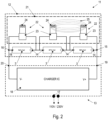
- FIG. 2 shows a first embodiment of the invention with a system 11 of a battery stack 12 and a charger device 13 to charge the battery stack 12 with active balancing of the Li-Ion battery cells 3.
- the battery stack 12 comprises a series of three battery cells 3 with at least a first battery cell and a second battery cell connected with battery cell contacts 14 in series between a battery stack plus contact 15 and a battery stack minus contact 16.
- the charger device 13 is connectable with contacts 17 and a cable to mains to power the charger device 13 as power source.
- the charger device 13 comprises a charger integrated circuit 18 connected with a charger plus contact 19 to the battery stack plus contact 15 and connected with a charger minus contact 20 to the battery stack minus contact 16.
- the charger integrated circuit 18 is built to charge the series of battery cells 3 based on a charger program when the charger device 13 is connected to the power source to charge the Li-Ion battery cells 3.
- the charger program charges the battery cells 3 in different time periods with different charge currents and charge voltages as for instance it is described in EP 4 040 637 A1 .
- the battery stack 12 of system 11 comprises a balancer module 21 realized on a printed circuit board with a balancer stage 22 for each of the battery cells 3 of the battery stack 12.
- Each of the balancer stages 22 is built to transfer energy from an already fully charged battery cell 3 to a battery cell 3 with a lower state of charge, wherein each balancer stage 22 of the balancer module 21 is connected in parallel to only one sole battery cell 3 of the battery stack 12.
- Each balancer stage 22 comprises an RFID chip 23 connected to an RFID antenna 24.
- the RFID chip 23 in this embodiment of the invention is realized to comply with the standard ISO 18.092 known as Near Field Communication and processes a program that enables it to process an anti-collision and RFID communication with other RFID chips 23 of the balancer module 21.
- the RFID chip 23 or another integrated circuit of the balancer stage 22 not shown in figure 2 is built to measure the state of charge of the battery cell 3 it is in parallel connected to. Furthermore a temperature sensor may be added to the balancer stage 22 to enable the balancer stage 22 to measure the individual temperature of the battery cell 3 it is in parallel connected to. Other sensors or measurement elements may be added to the balancer stage 22 to gather such actual cell parameters about this individual battery cell 3.
- the program processed by all of the RFID chips 23 enable them to transmit and receive (to exchange) these cell parameters and other information via a common magnetic field 25.
- the magnetic field 25 may be generated by one of the balancer stages 22 and other balancer stages 22 with RFID antennas 24 in an RFID communication range of for instance 10 centimeters may communicate with this balancer stage 22.
- There are different ways to implement such a program logic but as one example the first balancer stage 22 connected to the battery cell 3 with a state of charge of 98% may communicate with the second balancer stage 22 connected to the battery cell 3 with a state of charge of 87%.
- the first balancer stage 22 and the second balancer stage 22 every for instance one or five seconds exchange these cell parameters during the time the charger device 13 processes its charger program and charges the battery cells 3.
- Each of these balancer stages 22 is built to compare cell parameters received from other balancer stages 22 with its own cell parameters and, as a result of this comparison, is built to negotiate and agree on an energy transfer with one or more balancer stages 22 that share the common magnetic field 25 to transfer energy from the first balancer stage 22 with a higher state of charge of the first battery cell 3 to the second balancer stage 22 with the compared to the higher state of charge of the first battery cell 3 lower state of charge of the second battery cell 3.
- This negotiation and agreement may be realized in a way that each balancer stage 22 that is in the need to dispense energy or that is in the need to receive energy for their parallel connected battery cells 3 are free to ask others and that both affected balancer stages 22 then have to agree to the transfer of energy before it starts.
- the balancer stage 22 in the need to dispense energy will simply use more or less all energy provided by the charger integrated circuit 18 at the battery cell contacts 14 of the already fully charged battery cell 3 to generate the magnetic field 25.
- a balancer stage 22 in the need to receive energy for its battery cell 3 will simply harvest as much as possible energy from the magnetic field generated by another balancer stage 22.
- Other more intelligent realizations with concrete agreements might be possible as well.
- the first balancer stage 22 informs the second balancer stage 22 that the second balancer stage 22 is allowed and obliged to harvest energy from the magnetic field 25 generated by the first balancer stage 22.
- the RFID chip 23 of the first balancer stage 22 uses more or less all energy provided by the charger integrated circuit 18 at the battery cell contacts 14 of the already fully charged battery cell 3 to generate the magnetic field 25 and in that way bypasses the charge current for this fully charged battery cell 3.
- the energy harvested by the second balancer stage 22 from the magnetic field 25 is used by the RFID chip 23 of the second balancer stage 22 to provide more energy at the battery cell contacts 14 of the not yet fully charged battery cell 3.
- all the RFID antennas 24 of the three balancer stages 22 are arranged on the printed circuit board within the same RFID communication range to ensure that information and energy exchange and active balancing is possible between all three balancer stages 22 and their battery cells 3.
- other arrangements might be useful where different subsets of balancer stages of the same balancer module are defined and only the balancer stages of each subset are arranged in RFID communication distance to communicate and exchange energy.
- one or more RFID antennas 24 of balancer stages 22 may be located at the outer area of the RFID communication distance where the magnetic field 25 is not that strong anymore like in the inner area of the RFID communication range.
- balancer stages 22 in the inner area will be in a preferred position to harvest more energy than the other balancer stages 22 at the outer area of the RFID communication distance to the balancer stage 22 that generates the magnetic field 25.
- a person skilled in the art will understand the different applications possible with these different locations of RFID antennas 24 that enable or disable or favor some of the balancer stages.
- the battery stack 12 has been charged with the charger device 13 and is now disconnected from charger device 13 and connected to a portable device to power this portable device.
- the portable device may be any device like a mobile phone or radio or model airplane or other device that needs to be powered with battery cells 3.
- the state of charge of the battery cells 3 reduces, but due to differences of the battery cells 3 not in the same speed.
- each of the battery cells 3 may comprise a different state of charge as shown in figure 2 .
- the balancer stages 22 may start to communicate and exchange their cell parameters.
- balancer stages 22 may decide to exchange energy between their battery cells 3. This enables to avoid situations where one of the battery cells 3 gets deep discharged and as a result destroys the complete battery stack 12 while other battery cells 3 still have a higher state of charge.
- the three RFID chips 23 are realized on one single integrated circuit and only their RFID antennas 24 are separate physical elements. In that case the communication between the balancer stages could be realized just within this integrated circuit and only the energy transfer between the balancer stages would be via the RFID antennas 24.
- the charger device of system comprises a balancer module realized on a printed circuit board of the charger device with a balancer stage for each of the battery cells of the battery stack.
- a balancer cable from the charger device to the battery stack would still be needed, the transfer of energy for active balancing of the battery cells would still be done via RFID antennas located within the charger device.
- the RFID communication distance may be only 1 centimeter or up to 1 meter.
Landscapes
- Engineering & Computer Science (AREA)
- Power Engineering (AREA)
- Computer Networks & Wireless Communication (AREA)
- Microelectronics & Electronic Packaging (AREA)
- Manufacturing & Machinery (AREA)
- Chemical & Material Sciences (AREA)
- Chemical Kinetics & Catalysis (AREA)
- Electrochemistry (AREA)
- General Chemical & Material Sciences (AREA)
- Charge And Discharge Circuits For Batteries Or The Like (AREA)
Description
- The present invention relates to a system of a battery stack and a charger device to charge the battery stack with active balancing of battery cells, which battery stack comprises: a series of battery cells with at least a first battery cell and a second battery cell connected with battery cell contacts in series between a battery stack plus contact and a battery stack minus contact and
which charger device is connectable to a power source and comprises:
a charger module connected with a charger plus contact to the battery stack plus contact and connected with a charger minus contact to the battery stack minus contact and built to charge the series of battery cells based on a charger program when the charger device is connected to the power source and which system comprises:
a balancer module with a balancer stage for each of the battery cells of the battery stack built to transfer energy from an already fully charged battery cell to a battery cell with a lower state of charge, wherein each balancer stage of the balancer module is connected in parallel to only one sole battery cell of the battery cells of the battery stack. - The present invention furthermore relates to a battery stack with a series of battery cells with at least a first battery cell and a second battery cell connected with battery cell contacts in series between a battery stack plus contact and a battery stack minus contact.
- Many portable devices are powered by a battery stack which comprises a number of at least two battery cells connected in series between a battery stack plus contact and a battery stack minus contact. This increases the available capacity and voltage of the battery stack. In such systems, the individual battery cells must be constantly monitored to ensure that they operate within a controlled range. Otherwise, the battery's capacity and life span may be compromised. Linear Technology offers an integrated circuit LTC680x family series for a charger device to charge such battery stacks and to monitor each individual cell in the battery stack. The LTC680x monitors cell parameters of each individual cell in the battery stack and communicates this information through a proprietary serial bus to a central processing unit. As a battery cell begins to reach the upper charge limit to be fully charged, commands are issued to the LTC680x to turn on that cell's passive shunt, bypassing the charging current to that cell and allowing the current to continue to the rest of the battery cells. Using this passive
- shunt is inefficient and the shunted current produces considerable heat at higher charging currents.
- Linear Technology furthermore offers an integrated circuit LT8584 that enables actively redirecting the charging current back to the power source used to charge the battery stack. Instead of the energy being lost as heat, it is reused to charge the rest of the batteries in the stack.
Figure 1 shows such aprior art system 1 of abattery stack 2 with twelvebattery cells 3 connected in series and acharger device 4 to charge thebattery stack 2. Thecharger device 4 comprises twelvebalancer stages 6, which each are connected to abattery stack monitor 5 and comprise the LT8584 integratedcircuit 7 and a wire-wound transformer 8. Each of the LT8584 integratedcircuits 7 measures the actual state of charge of thebattery cell 3 it is connected to and provides these cell parameters to thebattery stack monitor 5 via a proprietary serial bus. Thebattery stack monitor 5 is the master that oversees all these cell parameters of allbattery cells 3 in thebattery stack 2 and sends commands to the individual LT8584 integratedcircuits 7 to discharge current through a primary coil of the wire-wound transformer 8 in case thebattery cell 3 already reached the fully charged state of charge. A secondary coil of the wire-wound transformer 8 is connected to a battery stack pluscontact 9 and a battery stack minuscontact 10 and transfers such discharge current back for reuse to charge thebattery stack 2. - This known
system 1 for active balancing of thebattery cells 3 of thebattery stack 2 comprises the disadvantage that a lot energy is lost in the wire-wound transformers 8 for thosebattery cells 3 that are already fully charged. Charge current that flows from battery stack pluscontact 9 through the series ofbattery cells 3 to the battery stack minuscontact 10, as long as all thesebattery cells 3 are charged, is discharged or bypassed through the primary coil of the wire-wound transformer 8 for thosebalancer stages 6 with already fullycharged battery cells 3, what until the end of the charge program causes a high energy loss in those wire-wound transformers 8. - Furthermore a balancer cable has to be used to connect each of the
balancer stages 6 with one of thebattery cells 3. This additional cable between thebattery stack 2 and thecharger device 4 adds complexity and costs. -
US 11,495,994 B2 -
US 2019/0089022 A1 discloses a battery stack with battery cells, each connected to a transmission module to communicate with a reception module of a centralized battery management unit. The battery management unit monitors the remaining capacity and charging state of the battery cells and detects battery cells with operation abnormality to exchange these. All transmission modules and the reception module are arranged on a magnetic core to enable data communication based on RFID (NFC). - It is an object of the invention to provide a system of a battery stack and a charger device to charge the battery stack with active balancing of battery cells and to provide a battery stack which improves the energy efficiency and enables more flexibility for faster charging of the battery stack.
- This object is achieved in a system according to
claim 1 and a battery stack according toclaim 9. - In an inventive system each balancer stage of the balancer module comprises an RFID antenna and is built to communicate decentrally and without involvement of a master with one or two or all other balancer stages to exchange information and energy between the battery cells of these balancer stages. This means that at least a first RFID antenna of a first balancer stage connected in parallel to the first battery cell and a second RFID antenna of a second balancer stage connected in parallel to the second battery cell are arranged or located in a way that they are in an RFID communication distance to each other to exchange energy and/or information via a common first magnetic field. This direct energy transfer from one already fully charged battery cell to a not yet fully charged battery cell is much more efficient than feeding the discharge current of the state of the art system back into the power system of the battery stack plus contact and a battery stack minus contact to charge the battery stack. The galvanic isolation of the battery cells and balancer stages using RFID antennas enables a substantial advantage for the active balancing of the battery cells.
- This inventive balancer module with individual self-sufficient balancer stages may be part of the physical casing of the charger device or, in another embodiment of the invention, may be part of the battery stack. This reduces the charger device to a charger integrated circuit that processes the charger program to charge a for instance Li-Ion battery stack that needs to be charged by the charger device in different time periods with different charge currents and charge voltages. As in this embodiment the balancer module is part of the battery stack no balancer cable is needed to connect each balancer stage with the relevant battery cell, which reduces technical complexity and cost and improves ease of use. The further advantage is achieved, that after charging of the battery stack during the period the battery stack powers a portable device, the balancer module may be used to transfer energy from a battery cell with a higher state of charge to a battery cell with a compared to this higher state of charge lower state of charge. This helps to avoid deep discharge of a battery cell while other battery cells of this battery stack still are in an acceptable higher state of charge. This balancing of the battery stack during the use of the battery stack to power a portable device enables to extend the lifetime of the battery stack.
- The communication between the first balancer stage and the second balancer stage and all other balancer stages of the balancer module may comply with the standard ISO 18.092 known as Near Field Communication. Any other comparable RFID standard could be used as well. Near Field Communication as one example realizes an RFID communication distance of about 10 centimeters. A company developing a charger device or a battery stack with balancer stages that each comprise their own RFID antenna may therefore decide which of these RFID antennas will be located within or without the RFID communication distance of other RFID antennas or other balancer stages. Based on this physical arrangement of the RFID antennas some of balancer stages may communicate with each other and their battery cells may exchange energy with each other and others may not, what enables a lot of different embodiments that will have advantages depending of the concrete different applications.
- In another embodiment of the invention two or more battery stacks may be just put together in a distance closer than the RFID communication distance. As the individual balancer stages are built to communicate with other balancer stages to decide which of the battery cells has a stronger need to receive energy this communication is not limited to balancer stages of one balancer module and does not need a master as in state of the art systems. As a result the two battery stacks put close together will charge those battery cells that have the strongest need for energy without any charger device involved.
- These and other aspects of the invention will be apparent from and elucidated with reference to the embodiments described hereinafter. The person skilled in the art will understand that various embodiments may be combined.
-
-
Figure 1 shows a system according to the state of the art, which comprises a battery stack with twelve battery cells connected in series and a charger device to charge the battery stack. -
Figure 2 shows a system according to the invention, which comprises a balancer module wherein each balancer stage comprises its own RFID antenna to independently communicate with other balancer stages about the transfer of energy. -
Figure 2 shows a first embodiment of the invention with asystem 11 of abattery stack 12 and acharger device 13 to charge thebattery stack 12 with active balancing of the Li-Ion battery cells 3. Thebattery stack 12 comprises a series of threebattery cells 3 with at least a first battery cell and a second battery cell connected withbattery cell contacts 14 in series between a battery stack pluscontact 15 and a battery stack minuscontact 16. Thecharger device 13 is connectable withcontacts 17 and a cable to mains to power thecharger device 13 as power source. Thecharger device 13 comprises a charger integratedcircuit 18 connected with a charger pluscontact 19 to the battery stack pluscontact 15 and connected with a charger minuscontact 20 to the battery stack minuscontact 16. The charger integratedcircuit 18 is built to charge the series ofbattery cells 3 based on a charger program when thecharger device 13 is connected to the power source to charge the Li-Ion battery cells 3. The charger program charges thebattery cells 3 in different time periods with different charge currents and charge voltages as for instance it is described inEP 4 040 637 A1 - In the embodiment of the invention shown in
figure 2 thebattery stack 12 ofsystem 11 comprises abalancer module 21 realized on a printed circuit board with abalancer stage 22 for each of thebattery cells 3 of thebattery stack 12. Each of the balancer stages 22 is built to transfer energy from an already fully chargedbattery cell 3 to abattery cell 3 with a lower state of charge, wherein eachbalancer stage 22 of thebalancer module 21 is connected in parallel to only onesole battery cell 3 of thebattery stack 12. Eachbalancer stage 22 comprises anRFID chip 23 connected to anRFID antenna 24. TheRFID chip 23 in this embodiment of the invention is realized to comply with the standard ISO 18.092 known as Near Field Communication and processes a program that enables it to process an anti-collision and RFID communication withother RFID chips 23 of thebalancer module 21. TheRFID chip 23 or another integrated circuit of thebalancer stage 22 not shown infigure 2 is built to measure the state of charge of thebattery cell 3 it is in parallel connected to. Furthermore a temperature sensor may be added to thebalancer stage 22 to enable thebalancer stage 22 to measure the individual temperature of thebattery cell 3 it is in parallel connected to. Other sensors or measurement elements may be added to thebalancer stage 22 to gather such actual cell parameters about thisindividual battery cell 3. - The program processed by all of the
RFID chips 23 enable them to transmit and receive (to exchange) these cell parameters and other information via a commonmagnetic field 25. Themagnetic field 25 may be generated by one of the balancer stages 22 and other balancer stages 22 withRFID antennas 24 in an RFID communication range of forinstance 10 centimeters may communicate with thisbalancer stage 22. There are different ways to implement such a program logic, but as one example thefirst balancer stage 22 connected to thebattery cell 3 with a state of charge of 98% may communicate with thesecond balancer stage 22 connected to thebattery cell 3 with a state of charge of 87%. Thefirst balancer stage 22 and thesecond balancer stage 22 every for instance one or five seconds exchange these cell parameters during the time thecharger device 13 processes its charger program and charges thebattery cells 3. Each of these balancer stages 22 is built to compare cell parameters received from other balancer stages 22 with its own cell parameters and, as a result of this comparison, is built to negotiate and agree on an energy transfer with one or more balancer stages 22 that share the commonmagnetic field 25 to transfer energy from thefirst balancer stage 22 with a higher state of charge of thefirst battery cell 3 to thesecond balancer stage 22 with the compared to the higher state of charge of thefirst battery cell 3 lower state of charge of thesecond battery cell 3. This negotiation and agreement may be realized in a way that eachbalancer stage 22 that is in the need to dispense energy or that is in the need to receive energy for their parallel connectedbattery cells 3 are free to ask others and that both affected balancer stages 22 then have to agree to the transfer of energy before it starts. In another realization thebalancer stage 22 in the need to dispense energy will simply use more or less all energy provided by the charger integratedcircuit 18 at thebattery cell contacts 14 of the already fully chargedbattery cell 3 to generate themagnetic field 25. Abalancer stage 22 in the need to receive energy for itsbattery cell 3 will simply harvest as much as possible energy from the magnetic field generated by anotherbalancer stage 22. Other more intelligent realizations with concrete agreements might be possible as well. - At the time instance when the
battery cell 3 connected to thefirst balancer stage 22 reaches the full state of charge, what might be 100% or less as defined in a setup, thefirst balancer stage 22 informs thesecond balancer stage 22 that thesecond balancer stage 22 is allowed and obliged to harvest energy from themagnetic field 25 generated by thefirst balancer stage 22. TheRFID chip 23 of thefirst balancer stage 22 uses more or less all energy provided by the charger integratedcircuit 18 at thebattery cell contacts 14 of the already fully chargedbattery cell 3 to generate themagnetic field 25 and in that way bypasses the charge current for this fully chargedbattery cell 3. The energy harvested by thesecond balancer stage 22 from themagnetic field 25 is used by theRFID chip 23 of thesecond balancer stage 22 to provide more energy at thebattery cell contacts 14 of the not yet fully chargedbattery cell 3. As a result, energy is transferred from the already fully chargedbattery cell 3 to thebattery cell 3 with a lower state of charge to on the one hand protect the already fully chargedbattery cell 3 from overloading and to on the other hand speed-up the charging process of the not yet fully chargedbattery cell 3. This active balancing is achieved without any balancing cable connection from thecharger device 13 to thebattery stack 12 and without a master integrated circuit of the state of the art to manage the balancer stages to achieve active balancing. Furthermore, the balancer stages 22 are only connected via the air interface of themagnetic field 25 what ensures complete galvanic isolation. - In the first embodiment of the invention shown in
figure 2 all theRFID antennas 24 of the three balancer stages 22 are arranged on the printed circuit board within the same RFID communication range to ensure that information and energy exchange and active balancing is possible between all threebalancer stages 22 and theirbattery cells 3. In other applications and battery stacks other arrangements might be useful where different subsets of balancer stages of the same balancer module are defined and only the balancer stages of each subset are arranged in RFID communication distance to communicate and exchange energy. In further embodiments of the invention one ormore RFID antennas 24 of balancer stages 22 may be located at the outer area of the RFID communication distance where themagnetic field 25 is not that strong anymore like in the inner area of the RFID communication range. With these different locations balancerstages 22 in the inner area will be in a preferred position to harvest more energy than the other balancer stages 22 at the outer area of the RFID communication distance to thebalancer stage 22 that generates themagnetic field 25. A person skilled in the art will understand the different applications possible with these different locations ofRFID antennas 24 that enable or disable or favor some of the balancer stages. - In another use case of the
battery stack 12 shown infigure 2 thebattery stack 12 has been charged with thecharger device 13 and is now disconnected fromcharger device 13 and connected to a portable device to power this portable device. The portable device may be any device like a mobile phone or radio or model airplane or other device that needs to be powered withbattery cells 3. During the use of this portable device the state of charge of thebattery cells 3 reduces, but due to differences of thebattery cells 3 not in the same speed. As a result each of thebattery cells 3 may comprise a different state of charge as shown infigure 2 . From time to time or depending on the state of charge of some or all of thebattery cells 3 the balancer stages 22 may start to communicate and exchange their cell parameters. Based on the comparison of cell parameters received from other balancer stages 22 and the cell parameters of theown battery cell 3 balancer stages 22 may decide to exchange energy between theirbattery cells 3. This enables to avoid situations where one of thebattery cells 3 gets deep discharged and as a result destroys thecomplete battery stack 12 whileother battery cells 3 still have a higher state of charge. - In a further embodiment of the invention the three
RFID chips 23 are realized on one single integrated circuit and only theirRFID antennas 24 are separate physical elements. In that case the communication between the balancer stages could be realized just within this integrated circuit and only the energy transfer between the balancer stages would be via theRFID antennas 24. - In a further embodiment of the invention, not shown in the figures, the charger device of system comprises a balancer module realized on a printed circuit board of the charger device with a balancer stage for each of the battery cells of the battery stack. In this less preferred embodiment, as a balancer cable from the charger device to the battery stack would still be needed, the transfer of energy for active balancing of the battery cells would still be done via RFID antennas located within the charger device.
- In other embodiments of the invention the RFID communication distance may be only 1 centimeter or up to 1 meter.
Claims (16)
- System (11) of a battery stack (12) and a charger device (13) to charge the battery stack (12) with active balancing of battery cells (3), which battery stack (12) comprises:a series of battery cells (3) with at least a first battery cell and a second battery cell connected with battery cell contacts (14) in series between a battery stack plus contact (15) and a battery stack minus contact (16) andwhich charger device (13) is connectable to a power source and comprises:
a charger module (18) connected with a charger plus contact (19) to the battery stack plus contact (15) and connected with a charger minus contact (20) to the battery stack minus contact (16) and built to charge the series of battery cells (3) based on a charger program when the charger device (13) is connected to the power source and which system (11) comprises:a balancer module (21) with a balancer stage (22) for each of the battery cells (3) of the battery stack (12) built to transfer energy from an already fully charged battery cell (3) to a battery cell (3) with a lower state of charge, wherein each balancer stage (22) of the balancer module (21) is connected in parallel to only one sole battery cell (3) of the battery cells (3) of the battery stack (12), characterized in,that each balancer stage (22) of the balancer module (21) comprises an RFID antenna (24), wherein at least a first RFID antenna of a first balancer stage connected in parallel to the first battery cell and a second RFID antenna of a second balancer stage connected in parallel to the second battery cell are arranged in an RFID communication distance to exchange energy and information via a common first magnetic field (25),wherein the first balancer stage (22) uses more or less all energy provided by the charger module (18) at the battery cell contacts (14) of the already fully charged battery cell (3) to generate a magnetic field (25) and in that way bypasses a charge current for this fully charged battery cell (3). - System (11) according to claim 1, wherein each balancer stage (22) is built to measure the actual state of charge and/or temperature of the parallel connected battery cell (3) and to exchange such cell parameters via the common first magnetic field with other balancer stages (22) of the balancer module (21).
- System (11) according to claim 2, wherein each balancer stage (22) is built to compare cell parameters from other balancer stages (22) with its own cell parameters and as a result of this comparison is built to agree on an energy transfer with one or more balancer stages (22) that share the common first magnetic field to transfer energy from the first balancer stage with a higher state of charge of the first battery cell to the second balancer stage with the compared to the higher state of charge of the first battery cell lower state of charge of the second battery cell.
- System (11) according to any of the claims 1 to 3, wherein a first subset of balancer stages of the balancer module (21) comprises the first balancer stage and the second balancer stage that share the common first magnetic field to exchange energy and/or information and a second subset of balancer stages of the balancer module comprises a third balancer stage with a third RFID antenna and a fourth balancer stage with a fourth RFID antenna that share a common second magnetic field to exchange energy and/or information.
- System (11) according to claim 4, wherein the first antenna and the second antenna that share the common first magnetic field and the third antenna and the fourth antenna that share the common second magnetic field are arranged to enable the exchange of energy and/or information between all four balancer stages.
- System (11) according to claim 4, wherein the first antenna and the second antenna that share the common first magnetic field are arranged outside of the RFID communication distance of the third antenna and the fourth antenna that share the common second magnetic field to disable the exchange of energy and/or information.
- System (11) according to any of the claims 3 to 6, wherein the balancer module (21) is built to transfer energy from one balancer stage (22) with a higher state of charge of the battery cell (3) to another balancer stage (22) with a lower state of charge of the battery cell (3), even when the charger device (13) is disconnected from the battery stack (12).
- System (11) according to any of the claims 1 to 7, which balancer stages (22) are built to exchange energy and/or information via the common first magnetic field as NFC interface that complies with the standard ISO 18.092.
- Battery stack (12) with a series of battery cells (3) with at least a first battery cell and a second battery cell connected with battery cell (14) contacts in series between a battery stack plus contact (15) and a battery stack minus contact (16) characterized in, that the battery stack (12) comprises a balancer module (21) with a balancer stage (22) for each of the battery cells (3) of the battery stack (12) built to transfer energy from a battery cell (3) with a higher state of charge to a battery cell (3) with a compared to this higher state of charge lower state of charge, wherein each balancer stage (22) of the balancer module (21) is connected in parallel to only one sole battery cell (3) of the battery cells (3) of the battery stack (12), andthat each balancer stage (22) of the balancer module (21) comprise an RFID antenna (24), wherein at least a first RFID antenna of a first balancer stage connected in parallel to the first battery cell and a second RFID antenna of a second balancer stage connected in parallel to the second battery cell are arrange in an RFID communication distance to exchange energy and information via a common first magnetic field (25),wherein the first balancer stage (22) uses more or less all energy provided by the charger module (18) at the battery cell contacts (14) of the already fully charged battery cell (3) to generate a magnetic field (25) and in that way bypasses a charge current for this fully charged battery cell (3).
- Battery stack (12) according to claim 9, wherein each balancer stage (22) is built to measure the actual state of charge and/or temperature of the parallel connected battery cell (3) and to exchange such cell parameters via the common first magnetic field with other balancer stages (22) of the balancer module (21).
- Battery stack (12) according to claim 10, wherein each balancer stage (22) is built to compare cell parameters from other balancer stages (22) with its own cell parameters and as a result of this comparison is built to agree on an energy transfer with one or more balancer stages (22) that share the common first magnetic field to transfer energy from the first balancer stage with a higher state of charge of the first battery cell to the second balancer stage with the compared to the higher state of charge of the first battery cell lower state of charge of the second battery cell.
- Battery stack (12) according to any of the claims 9 to 11, wherein a first subset of balancer stages of the balancer module (21) comprises the first balancer stage and the second balancer stage that share the common first magnetic field to exchange energy and/or information and a second subset of balancer stages of the balancer module comprises a third balancer stage with a third RFID antenna and a fourth balancer stage with a fourth RFID antenna that share a common second magnetic field to exchange energy and/or information.
- Battery stack (12) according to claim 12, wherein the first antenna and the second antenna that share the common first magnetic field and the third antenna and the fourth antenna that share the common second magnetic field are arranged to enable the exchange of energy and/or information between all four balancer stages.
- Battery stack (12) according to claim 12, wherein the first antenna and the second antenna that share the common first magnetic field are arranged outside of the RFID communication distance of the third antenna and the fourth antenna that share the common second magnetic field to disable the exchange of energy and/or information.
- Battery stack (12) according to any of the claims 11 to 14, wherein the balancer module (21) is built to transfer energy from one balancer stage (22) with a higher state of charge of the battery cell (3) to another balancer stage (22) with a lower state of charge of the battery cell (3), even when the charger device (13) is disconnected from the battery stack (12).
- Battery stack (12) according to any of the claims 9 to 15, which balancer stages (22) are built to exchange energy and/or information via the common first magnetic field as NFC interface that complies with the standard ISO 18.092.
Priority Applications (4)
| Application Number | Priority Date | Filing Date | Title |
|---|---|---|---|
| EP22209868.3A EP4376154B1 (en) | 2022-11-28 | 2022-11-28 | Battery cell balancing based on wireless charging |
| US19/133,368 US20260005525A1 (en) | 2022-11-28 | 2023-08-29 | Battery cell balancing based on wireless charging |
| PCT/EP2023/073580 WO2024114966A1 (en) | 2022-11-28 | 2023-08-29 | Battery cell balancing based on wireless charging |
| CN202380082208.XA CN120266316A (en) | 2022-11-28 | 2023-08-29 | Battery cell balancing based on wireless charging |
Applications Claiming Priority (1)
| Application Number | Priority Date | Filing Date | Title |
|---|---|---|---|
| EP22209868.3A EP4376154B1 (en) | 2022-11-28 | 2022-11-28 | Battery cell balancing based on wireless charging |
Publications (2)
| Publication Number | Publication Date |
|---|---|
| EP4376154A1 EP4376154A1 (en) | 2024-05-29 |
| EP4376154B1 true EP4376154B1 (en) | 2024-10-23 |
Family
ID=84363739
Family Applications (1)
| Application Number | Title | Priority Date | Filing Date |
|---|---|---|---|
| EP22209868.3A Active EP4376154B1 (en) | 2022-11-28 | 2022-11-28 | Battery cell balancing based on wireless charging |
Country Status (4)
| Country | Link |
|---|---|
| US (1) | US20260005525A1 (en) |
| EP (1) | EP4376154B1 (en) |
| CN (1) | CN120266316A (en) |
| WO (1) | WO2024114966A1 (en) |
Citations (1)
| Publication number | Priority date | Publication date | Assignee | Title |
|---|---|---|---|---|
| JP2016081934A (en) * | 2014-10-20 | 2016-05-16 | 日本電気株式会社 | Power storage system and alarming method |
Family Cites Families (4)
| Publication number | Priority date | Publication date | Assignee | Title |
|---|---|---|---|---|
| JP5641006B2 (en) * | 2011-08-31 | 2014-12-17 | ソニー株式会社 | Power storage device |
| JP6987579B2 (en) * | 2017-09-21 | 2022-01-05 | ラピスセミコンダクタ株式会社 | Battery unit, battery monitoring system, battery replacement method |
| ES2884140T3 (en) * | 2018-07-30 | 2021-12-10 | Belenos Clean Power Holding Ag | Battery Cell Wireless Balancing Unit and System |
| EP4040637A1 (en) | 2021-02-04 | 2022-08-10 | Panthronics AG | Adaptive charger for wireless charging |
-
2022
- 2022-11-28 EP EP22209868.3A patent/EP4376154B1/en active Active
-
2023
- 2023-08-29 US US19/133,368 patent/US20260005525A1/en active Pending
- 2023-08-29 CN CN202380082208.XA patent/CN120266316A/en active Pending
- 2023-08-29 WO PCT/EP2023/073580 patent/WO2024114966A1/en not_active Ceased
Patent Citations (1)
| Publication number | Priority date | Publication date | Assignee | Title |
|---|---|---|---|---|
| JP2016081934A (en) * | 2014-10-20 | 2016-05-16 | 日本電気株式会社 | Power storage system and alarming method |
Also Published As
| Publication number | Publication date |
|---|---|
| CN120266316A (en) | 2025-07-04 |
| EP4376154A1 (en) | 2024-05-29 |
| WO2024114966A1 (en) | 2024-06-06 |
| US20260005525A1 (en) | 2026-01-01 |
Similar Documents
| Publication | Publication Date | Title |
|---|---|---|
| EP1780863B1 (en) | Apparatus and method of wirelessly sharing power by inductive method | |
| US11043820B2 (en) | Battery power delivery module | |
| KR101485127B1 (en) | Battery energy storage apparatus using wireless controlling method | |
| US9362757B2 (en) | Solid-state active switch matrix for high energy, moderate power battery systems | |
| USRE46111E1 (en) | Non-contact charger available of wireless data and power transmission, charging battery-pack and mobile device using non-contact charger | |
| US9397508B2 (en) | System and method for cell balancing and charging using a serially coupled inductor and capacitor | |
| EP3029801A1 (en) | System and method for cell balancing and charging using a serially coupled inductor and capacitor | |
| EP2538519B1 (en) | Stackable bi-directional multicell battery balancer | |
| US20120161721A1 (en) | Power harvesting systems | |
| US8692516B2 (en) | Stackable bi-directional multicell battery balancer | |
| US20220344952A1 (en) | Battery pack charger including a settable power level | |
| US9088163B2 (en) | Secondary battery pack | |
| CN106463983A (en) | Battery packs, cell modules, and cell module assemblies | |
| WO2008142480A2 (en) | Battery power delivery module | |
| CN102637915A (en) | Battery, battery pack, battery charger, and battery charging system | |
| EP3432409B1 (en) | Cell supervision circuit carrier, battery system and electric vehicle | |
| EP3432443B1 (en) | Wireless power system | |
| CN104253490A (en) | Feed devices and feed systems | |
| KR100859445B1 (en) | Portable terminal with a contactless rechargeable battery pack and a contactless battery pack | |
| JP2023058465A (en) | Supporting base plate and storage rack suitable for placing battery pack, and corresponding battery pack | |
| EP4376154B1 (en) | Battery cell balancing based on wireless charging | |
| US20180159377A1 (en) | Wireless power transmission device | |
| KR100487622B1 (en) | Device and the Method for variating the charging current of battery | |
| KR20230008355A (en) | Wired and wireless charging supercapacitor pack battery device | |
| KR20230000824A (en) | Apparatus for charging battery and system for charging battery |
Legal Events
| Date | Code | Title | Description |
|---|---|---|---|
| PUAI | Public reference made under article 153(3) epc to a published international application that has entered the european phase |
Free format text: ORIGINAL CODE: 0009012 |
|
| STAA | Information on the status of an ep patent application or granted ep patent |
Free format text: STATUS: REQUEST FOR EXAMINATION WAS MADE |
|
| 17P | Request for examination filed |
Effective date: 20230810 |
|
| AK | Designated contracting states |
Kind code of ref document: A1 Designated state(s): AL AT BE BG CH CY CZ DE DK EE ES FI FR GB GR HR HU IE IS IT LI LT LU LV MC ME MK MT NL NO PL PT RO RS SE SI SK SM TR |
|
| REG | Reference to a national code |
Ref country code: DE Ref legal event code: R079 Free format text: PREVIOUS MAIN CLASS: H01M0010420000 Ipc: H02J0007340000 Ref country code: DE Ref legal event code: R079 Ref document number: 602022007039 Country of ref document: DE Free format text: PREVIOUS MAIN CLASS: H01M0010420000 Ipc: H02J0007340000 |
|
| GRAP | Despatch of communication of intention to grant a patent |
Free format text: ORIGINAL CODE: EPIDOSNIGR1 |
|
| STAA | Information on the status of an ep patent application or granted ep patent |
Free format text: STATUS: GRANT OF PATENT IS INTENDED |
|
| RIC1 | Information provided on ipc code assigned before grant |
Ipc: H02J 50/00 20160101ALI20240529BHEP Ipc: H02J 7/00 20060101ALI20240529BHEP Ipc: H02J 50/10 20160101ALI20240529BHEP Ipc: H01M 10/42 20060101ALI20240529BHEP Ipc: H02J 7/34 20060101AFI20240529BHEP |
|
| INTG | Intention to grant announced |
Effective date: 20240613 |
|
| GRAS | Grant fee paid |
Free format text: ORIGINAL CODE: EPIDOSNIGR3 |
|
| GRAA | (expected) grant |
Free format text: ORIGINAL CODE: 0009210 |
|
| STAA | Information on the status of an ep patent application or granted ep patent |
Free format text: STATUS: THE PATENT HAS BEEN GRANTED |
|
| AK | Designated contracting states |
Kind code of ref document: B1 Designated state(s): AL AT BE BG CH CY CZ DE DK EE ES FI FR GB GR HR HU IE IS IT LI LT LU LV MC ME MK MT NL NO PL PT RO RS SE SI SK SM TR |
|
| REG | Reference to a national code |
Ref country code: GB Ref legal event code: FG4D |
|
| REG | Reference to a national code |
Ref country code: CH Ref legal event code: EP |
|
| REG | Reference to a national code |
Ref country code: DE Ref legal event code: R096 Ref document number: 602022007039 Country of ref document: DE |
|
| REG | Reference to a national code |
Ref country code: IE Ref legal event code: FG4D |
|
| REG | Reference to a national code |
Ref country code: LT Ref legal event code: MG9D |
|
| REG | Reference to a national code |
Ref country code: NL Ref legal event code: MP Effective date: 20241023 |
|
| REG | Reference to a national code |
Ref country code: AT Ref legal event code: MK05 Ref document number: 1735649 Country of ref document: AT Kind code of ref document: T Effective date: 20241023 |
|
| PG25 | Lapsed in a contracting state [announced via postgrant information from national office to epo] |
Ref country code: NL Free format text: LAPSE BECAUSE OF FAILURE TO SUBMIT A TRANSLATION OF THE DESCRIPTION OR TO PAY THE FEE WITHIN THE PRESCRIBED TIME-LIMIT Effective date: 20241023 |
|
| PG25 | Lapsed in a contracting state [announced via postgrant information from national office to epo] |
Ref country code: NL Free format text: LAPSE BECAUSE OF FAILURE TO SUBMIT A TRANSLATION OF THE DESCRIPTION OR TO PAY THE FEE WITHIN THE PRESCRIBED TIME-LIMIT Effective date: 20241023 |
|
| PG25 | Lapsed in a contracting state [announced via postgrant information from national office to epo] |
Ref country code: HR Free format text: LAPSE BECAUSE OF FAILURE TO SUBMIT A TRANSLATION OF THE DESCRIPTION OR TO PAY THE FEE WITHIN THE PRESCRIBED TIME-LIMIT Effective date: 20241023 Ref country code: IS Free format text: LAPSE BECAUSE OF FAILURE TO SUBMIT A TRANSLATION OF THE DESCRIPTION OR TO PAY THE FEE WITHIN THE PRESCRIBED TIME-LIMIT Effective date: 20250223 Ref country code: PT Free format text: LAPSE BECAUSE OF FAILURE TO SUBMIT A TRANSLATION OF THE DESCRIPTION OR TO PAY THE FEE WITHIN THE PRESCRIBED TIME-LIMIT Effective date: 20250224 |
|
| PG25 | Lapsed in a contracting state [announced via postgrant information from national office to epo] |
Ref country code: FI Free format text: LAPSE BECAUSE OF FAILURE TO SUBMIT A TRANSLATION OF THE DESCRIPTION OR TO PAY THE FEE WITHIN THE PRESCRIBED TIME-LIMIT Effective date: 20241023 |
|
| PG25 | Lapsed in a contracting state [announced via postgrant information from national office to epo] |
Ref country code: BG Free format text: LAPSE BECAUSE OF FAILURE TO SUBMIT A TRANSLATION OF THE DESCRIPTION OR TO PAY THE FEE WITHIN THE PRESCRIBED TIME-LIMIT Effective date: 20241023 |
|
| PG25 | Lapsed in a contracting state [announced via postgrant information from national office to epo] |
Ref country code: ES Free format text: LAPSE BECAUSE OF FAILURE TO SUBMIT A TRANSLATION OF THE DESCRIPTION OR TO PAY THE FEE WITHIN THE PRESCRIBED TIME-LIMIT Effective date: 20241023 |
|
| PG25 | Lapsed in a contracting state [announced via postgrant information from national office to epo] |
Ref country code: NO Free format text: LAPSE BECAUSE OF FAILURE TO SUBMIT A TRANSLATION OF THE DESCRIPTION OR TO PAY THE FEE WITHIN THE PRESCRIBED TIME-LIMIT Effective date: 20250123 |
|
| PG25 | Lapsed in a contracting state [announced via postgrant information from national office to epo] |
Ref country code: LV Free format text: LAPSE BECAUSE OF FAILURE TO SUBMIT A TRANSLATION OF THE DESCRIPTION OR TO PAY THE FEE WITHIN THE PRESCRIBED TIME-LIMIT Effective date: 20241023 Ref country code: AT Free format text: LAPSE BECAUSE OF FAILURE TO SUBMIT A TRANSLATION OF THE DESCRIPTION OR TO PAY THE FEE WITHIN THE PRESCRIBED TIME-LIMIT Effective date: 20241023 Ref country code: GR Free format text: LAPSE BECAUSE OF FAILURE TO SUBMIT A TRANSLATION OF THE DESCRIPTION OR TO PAY THE FEE WITHIN THE PRESCRIBED TIME-LIMIT Effective date: 20250124 |
|
| PG25 | Lapsed in a contracting state [announced via postgrant information from national office to epo] |
Ref country code: PL Free format text: LAPSE BECAUSE OF FAILURE TO SUBMIT A TRANSLATION OF THE DESCRIPTION OR TO PAY THE FEE WITHIN THE PRESCRIBED TIME-LIMIT Effective date: 20241023 |
|
| PG25 | Lapsed in a contracting state [announced via postgrant information from national office to epo] |
Ref country code: RS Free format text: LAPSE BECAUSE OF FAILURE TO SUBMIT A TRANSLATION OF THE DESCRIPTION OR TO PAY THE FEE WITHIN THE PRESCRIBED TIME-LIMIT Effective date: 20250123 |
|
| PG25 | Lapsed in a contracting state [announced via postgrant information from national office to epo] |
Ref country code: SM Free format text: LAPSE BECAUSE OF FAILURE TO SUBMIT A TRANSLATION OF THE DESCRIPTION OR TO PAY THE FEE WITHIN THE PRESCRIBED TIME-LIMIT Effective date: 20241023 |
|
| PG25 | Lapsed in a contracting state [announced via postgrant information from national office to epo] |
Ref country code: MC Free format text: LAPSE BECAUSE OF FAILURE TO SUBMIT A TRANSLATION OF THE DESCRIPTION OR TO PAY THE FEE WITHIN THE PRESCRIBED TIME-LIMIT Effective date: 20241023 |
|
| PG25 | Lapsed in a contracting state [announced via postgrant information from national office to epo] |
Ref country code: DK Free format text: LAPSE BECAUSE OF FAILURE TO SUBMIT A TRANSLATION OF THE DESCRIPTION OR TO PAY THE FEE WITHIN THE PRESCRIBED TIME-LIMIT Effective date: 20241023 |
|
| PG25 | Lapsed in a contracting state [announced via postgrant information from national office to epo] |
Ref country code: LU Free format text: LAPSE BECAUSE OF NON-PAYMENT OF DUE FEES Effective date: 20241128 |
|
| PG25 | Lapsed in a contracting state [announced via postgrant information from national office to epo] |
Ref country code: EE Free format text: LAPSE BECAUSE OF FAILURE TO SUBMIT A TRANSLATION OF THE DESCRIPTION OR TO PAY THE FEE WITHIN THE PRESCRIBED TIME-LIMIT Effective date: 20241023 |
|
| PG25 | Lapsed in a contracting state [announced via postgrant information from national office to epo] |
Ref country code: RO Free format text: LAPSE BECAUSE OF FAILURE TO SUBMIT A TRANSLATION OF THE DESCRIPTION OR TO PAY THE FEE WITHIN THE PRESCRIBED TIME-LIMIT Effective date: 20241023 |
|
| REG | Reference to a national code |
Ref country code: DE Ref legal event code: R097 Ref document number: 602022007039 Country of ref document: DE |
|
| PG25 | Lapsed in a contracting state [announced via postgrant information from national office to epo] |
Ref country code: SK Free format text: LAPSE BECAUSE OF FAILURE TO SUBMIT A TRANSLATION OF THE DESCRIPTION OR TO PAY THE FEE WITHIN THE PRESCRIBED TIME-LIMIT Effective date: 20241023 |
|
| PG25 | Lapsed in a contracting state [announced via postgrant information from national office to epo] |
Ref country code: CZ Free format text: LAPSE BECAUSE OF FAILURE TO SUBMIT A TRANSLATION OF THE DESCRIPTION OR TO PAY THE FEE WITHIN THE PRESCRIBED TIME-LIMIT Effective date: 20241023 |
|
| PG25 | Lapsed in a contracting state [announced via postgrant information from national office to epo] |
Ref country code: IT Free format text: LAPSE BECAUSE OF FAILURE TO SUBMIT A TRANSLATION OF THE DESCRIPTION OR TO PAY THE FEE WITHIN THE PRESCRIBED TIME-LIMIT Effective date: 20241023 |
|
| REG | Reference to a national code |
Ref country code: BE Ref legal event code: MM Effective date: 20241130 |
|
| PLBE | No opposition filed within time limit |
Free format text: ORIGINAL CODE: 0009261 |
|
| STAA | Information on the status of an ep patent application or granted ep patent |
Free format text: STATUS: NO OPPOSITION FILED WITHIN TIME LIMIT |
|
| PG25 | Lapsed in a contracting state [announced via postgrant information from national office to epo] |
Ref country code: SE Free format text: LAPSE BECAUSE OF FAILURE TO SUBMIT A TRANSLATION OF THE DESCRIPTION OR TO PAY THE FEE WITHIN THE PRESCRIBED TIME-LIMIT Effective date: 20241023 |
|
| 26N | No opposition filed |
Effective date: 20250724 |
|
| PG25 | Lapsed in a contracting state [announced via postgrant information from national office to epo] |
Ref country code: BE Free format text: LAPSE BECAUSE OF NON-PAYMENT OF DUE FEES Effective date: 20241130 |
|
| PG25 | Lapsed in a contracting state [announced via postgrant information from national office to epo] |
Ref country code: FR Free format text: LAPSE BECAUSE OF NON-PAYMENT OF DUE FEES Effective date: 20241223 |
|
| PG25 | Lapsed in a contracting state [announced via postgrant information from national office to epo] |
Ref country code: IE Free format text: LAPSE BECAUSE OF NON-PAYMENT OF DUE FEES Effective date: 20241128 |
|
| PGFP | Annual fee paid to national office [announced via postgrant information from national office to epo] |
Ref country code: DE Payment date: 20251118 Year of fee payment: 4 |
|
| PG25 | Lapsed in a contracting state [announced via postgrant information from national office to epo] |
Ref country code: HU Free format text: LAPSE BECAUSE OF FAILURE TO SUBMIT A TRANSLATION OF THE DESCRIPTION OR TO PAY THE FEE WITHIN THE PRESCRIBED TIME-LIMIT; INVALID AB INITIO Effective date: 20221128 |
|
| PG25 | Lapsed in a contracting state [announced via postgrant information from national office to epo] |
Ref country code: CY Free format text: LAPSE BECAUSE OF FAILURE TO SUBMIT A TRANSLATION OF THE DESCRIPTION OR TO PAY THE FEE WITHIN THE PRESCRIBED TIME-LIMIT; INVALID AB INITIO Effective date: 20221128 |