EP4376145A2 - Solid electrolyte having excellent moisture stability and method for preparing same - Google Patents
Solid electrolyte having excellent moisture stability and method for preparing same Download PDFInfo
- Publication number
- EP4376145A2 EP4376145A2 EP23192396.2A EP23192396A EP4376145A2 EP 4376145 A2 EP4376145 A2 EP 4376145A2 EP 23192396 A EP23192396 A EP 23192396A EP 4376145 A2 EP4376145 A2 EP 4376145A2
- Authority
- EP
- European Patent Office
- Prior art keywords
- solid electrolyte
- peak
- chemical formula
- region
- ray diffraction
- Prior art date
- Legal status (The legal status is an assumption and is not a legal conclusion. Google has not performed a legal analysis and makes no representation as to the accuracy of the status listed.)
- Pending
Links
Images



Classifications
-
- H—ELECTRICITY
- H01—ELECTRIC ELEMENTS
- H01M—PROCESSES OR MEANS, e.g. BATTERIES, FOR THE DIRECT CONVERSION OF CHEMICAL ENERGY INTO ELECTRICAL ENERGY
- H01M10/00—Secondary cells; Manufacture thereof
- H01M10/05—Accumulators with non-aqueous electrolyte
- H01M10/056—Accumulators with non-aqueous electrolyte characterised by the materials used as electrolytes, e.g. mixed inorganic/organic electrolytes
- H01M10/0561—Accumulators with non-aqueous electrolyte characterised by the materials used as electrolytes, e.g. mixed inorganic/organic electrolytes the electrolyte being constituted of inorganic materials only
- H01M10/0562—Solid materials
-
- C—CHEMISTRY; METALLURGY
- C01—INORGANIC CHEMISTRY
- C01B—NON-METALLIC ELEMENTS; COMPOUNDS THEREOF; METALLOIDS OR COMPOUNDS THEREOF NOT COVERED BY SUBCLASS C01C
- C01B25/00—Phosphorus; Compounds thereof
- C01B25/14—Sulfur, selenium, or tellurium compounds of phosphorus
-
- C—CHEMISTRY; METALLURGY
- C01—INORGANIC CHEMISTRY
- C01G—COMPOUNDS CONTAINING METALS NOT COVERED BY SUBCLASSES C01D OR C01F
- C01G19/00—Compounds of tin
- C01G19/006—Compounds containing tin, with or without oxygen or hydrogen, and containing two or more other elements
-
- H—ELECTRICITY
- H01—ELECTRIC ELEMENTS
- H01M—PROCESSES OR MEANS, e.g. BATTERIES, FOR THE DIRECT CONVERSION OF CHEMICAL ENERGY INTO ELECTRICAL ENERGY
- H01M10/00—Secondary cells; Manufacture thereof
- H01M10/05—Accumulators with non-aqueous electrolyte
- H01M10/052—Li-accumulators
-
- C—CHEMISTRY; METALLURGY
- C01—INORGANIC CHEMISTRY
- C01P—INDEXING SCHEME RELATING TO STRUCTURAL AND PHYSICAL ASPECTS OF SOLID INORGANIC COMPOUNDS
- C01P2002/00—Crystal-structural characteristics
- C01P2002/70—Crystal-structural characteristics defined by measured X-ray, neutron or electron diffraction data
- C01P2002/72—Crystal-structural characteristics defined by measured X-ray, neutron or electron diffraction data by d-values or two theta-values, e.g. as X-ray diagram
-
- H—ELECTRICITY
- H01—ELECTRIC ELEMENTS
- H01M—PROCESSES OR MEANS, e.g. BATTERIES, FOR THE DIRECT CONVERSION OF CHEMICAL ENERGY INTO ELECTRICAL ENERGY
- H01M2300/00—Electrolytes
- H01M2300/0017—Non-aqueous electrolytes
- H01M2300/0065—Solid electrolytes
- H01M2300/0068—Solid electrolytes inorganic
-
- H—ELECTRICITY
- H01—ELECTRIC ELEMENTS
- H01M—PROCESSES OR MEANS, e.g. BATTERIES, FOR THE DIRECT CONVERSION OF CHEMICAL ENERGY INTO ELECTRICAL ENERGY
- H01M2300/00—Electrolytes
- H01M2300/0017—Non-aqueous electrolytes
- H01M2300/0065—Solid electrolytes
- H01M2300/0068—Solid electrolytes inorganic
- H01M2300/008—Halides
-
- H—ELECTRICITY
- H01—ELECTRIC ELEMENTS
- H01M—PROCESSES OR MEANS, e.g. BATTERIES, FOR THE DIRECT CONVERSION OF CHEMICAL ENERGY INTO ELECTRICAL ENERGY
- H01M2300/00—Electrolytes
- H01M2300/0088—Composites
- H01M2300/0091—Composites in the form of mixtures
-
- H—ELECTRICITY
- H01—ELECTRIC ELEMENTS
- H01M—PROCESSES OR MEANS, e.g. BATTERIES, FOR THE DIRECT CONVERSION OF CHEMICAL ENERGY INTO ELECTRICAL ENERGY
- H01M4/00—Electrodes
- H01M4/02—Electrodes composed of, or comprising, active material
- H01M4/36—Selection of substances as active materials, active masses, active liquids
- H01M4/38—Selection of substances as active materials, active masses, active liquids of elements or alloys
- H01M4/381—Alkaline or alkaline earth metals elements
- H01M4/382—Lithium
-
- H—ELECTRICITY
- H01—ELECTRIC ELEMENTS
- H01M—PROCESSES OR MEANS, e.g. BATTERIES, FOR THE DIRECT CONVERSION OF CHEMICAL ENERGY INTO ELECTRICAL ENERGY
- H01M4/00—Electrodes
- H01M4/02—Electrodes composed of, or comprising, active material
- H01M4/36—Selection of substances as active materials, active masses, active liquids
- H01M4/48—Selection of substances as active materials, active masses, active liquids of inorganic oxides or hydroxides
- H01M4/52—Selection of substances as active materials, active masses, active liquids of inorganic oxides or hydroxides of nickel, cobalt or iron
- H01M4/525—Selection of substances as active materials, active masses, active liquids of inorganic oxides or hydroxides of nickel, cobalt or iron of mixed oxides or hydroxides containing iron, cobalt or nickel for inserting or intercalating light metals, e.g. LiNiO2, LiCoO2 or LiCoOxFy
-
- Y—GENERAL TAGGING OF NEW TECHNOLOGICAL DEVELOPMENTS; GENERAL TAGGING OF CROSS-SECTIONAL TECHNOLOGIES SPANNING OVER SEVERAL SECTIONS OF THE IPC; TECHNICAL SUBJECTS COVERED BY FORMER USPC CROSS-REFERENCE ART COLLECTIONS [XRACs] AND DIGESTS
- Y02—TECHNOLOGIES OR APPLICATIONS FOR MITIGATION OR ADAPTATION AGAINST CLIMATE CHANGE
- Y02E—REDUCTION OF GREENHOUSE GAS [GHG] EMISSIONS, RELATED TO ENERGY GENERATION, TRANSMISSION OR DISTRIBUTION
- Y02E60/00—Enabling technologies; Technologies with a potential or indirect contribution to GHG emissions mitigation
- Y02E60/10—Energy storage using batteries
Definitions
- the present disclosure relates to a solid electrolyte for an all-solid-state battery having excellent moisture stability and a method for preparing the same.
- Sulfide-based solid electrolytes are in the spotlight as solid electrolytes for all-solid-state batteries since they have high lithium ion conductivity and are ductile.
- the sulfide-based solid electrolytes have poor moisture stability. Water molecules in the air decompose the bonds of bridging sulfur in the sulfide-based solid electrolytes to generate hydrogen sulfide (H 2 S) and lower crystallinity to reduce lithium ion conductivity.
- Li 6 PS 5 Cl having an argyrodite-type crystal structure among the sulfide-based solid electrolytes has an advantage of high lithium ion conductivity.
- An embodiment of the present disclosure provides a solid electrolyte having excellent moisture stability and lithium ion conductivity and a method for preparing the same.
- a solid electrolyte according to one embodiment of the present disclosure may include a first compound represented by Chemical Formula 1 below and a second compound represented by Chemical Formula 2 below.
- Chemical Formula 1 Li 7-a PS 6-a (X1 1-b )X 2b ) a
- X1 and X2 may be the same or different and may each represent F, Cl, Br, or I, and 0 ⁇ a ⁇ 2 and 0 ⁇ b ⁇ 1 may be satisfied.
- Chemical Formula 2 Li 7-c P 1-2d M d S 6-c-3d (X1 1-e X2 e ) c
- X1 and X2 may be the same or different and may each represent F, Cl, Br, or I, M may represent at least one of Ge, Si, Sn, or any combination thereof, and 0 ⁇ c ⁇ 2, 0 ⁇ d ⁇ 0.5, and 0 ⁇ e ⁇ 1 may be satisfied.
- the solid electrolyte may further include a third compound represented by Chemical Formula 3 below.
- Chemical Formula 3 Li f M g S h
- M may represent at least one of Ge, Si, Sn, or any combination thereof, and 0 ⁇ f ⁇ 10, 0 ⁇ g ⁇ 5, and 0 ⁇ h ⁇ 10 may be satisfied.
- An X-ray diffraction (XRD) pattern of the solid electrolyte may include a peak due to a cubic argyrodite-type crystal structure and a peak due to an orthorhombic crystal structure.
- the solid electrolyte may be one in which, as d in Chemical Formula 2 above increases, 2 ⁇ value of a peak of a (220) plane of the cubic argyrodite-type crystal structure in the X-ray diffraction (XRD) pattern may shift to lower angles by greater than 0° and 0.1° or less.
- XRD X-ray diffraction
- a result of XPS may include a first region and a second region with different contents of an element M.
- the content of the element M in the first region may be about 0.9 at% to 1.2 at%.
- the content of the element M in the second region may be about 0.2 at% to 0.5 at%.
- the solid electrolyte may have a lithium ion conductivity retention rate of about 80% or more after 3 days under dry condition in an air atmosphere having a dew point of -70°C or less.
- a method for preparing a solid electrolyte may include steps of preparing a starting material including a compound containing lithium, a compound containing phosphorus (P), a compound containing an element M, and two or more compounds containing different halogen elements, preparing an intermediate material by pulverizing the starting material, and heat treating the intermediate material.
- a starting material including a compound containing lithium, a compound containing phosphorus (P), a compound containing an element M, and two or more compounds containing different halogen elements
- the preparation method may be to pulverize the starting material at about 800 rpm to 1,000 rpm.
- the preparation method may be to pulverize the starting material by applying a force of about 25 G to 50 G to the starting material.
- the preparation method may be to heat treat the intermediate material at about 400°C to 600°C for about 25 minutes to 36 hours.
- a solid electrolyte having excellent moisture stability and lithium ion conductivity can be obtained.
- first, second, etc. may be used to describe various components, but the components should not be limited by the terms. The terms are used only for the purpose of distinguishing one component from another component. For example, a first component may be referred to as a second component, and similarly, the second component may also be referred to as the first component, without departing from the scope of rights of the present disclosure.
- the singular expression includes the plural expression unless the context clearly dictates otherwise.
- FIG. 1 shows an all-solid-state battery according to embodiments of the present disclosure.
- the all-solid-state battery may include an anode current collector 10, an anode layer 20, a solid electrolyte layer 30, a cathode layer 40, and a cathode current collector 50.
- At least one of the anode layer 20, the solid electrolyte layer 30, and the cathode layer 40 may include a solid electrolyte.
- the solid electrolyte may include a first compound represented by Chemical Formula 1 below, a second compound represented by Chemical Formula 2 below, and a third compound represented by Chemical Formula 3 below.
- Chemical Formula 1 Li 7-a PS 6-a (X1 1-b X2 b ) a
- X1 and X2 may be the same or different and may each represent F, Cl, Br, or I, and 0 ⁇ a ⁇ 2 and 0 ⁇ b ⁇ 1 may be satisfied.
- Chemical Formula 2 Li 7-c P 1-2d M d S 6-c-3d (X1 1-e X2 e ) c
- X1 and X2 may be the same or different and may each represent F, Cl, Br, or I, M may represent at least one of Ge, Si, Sn, or any combination thereof, and 0 ⁇ c ⁇ 2, 0 ⁇ d ⁇ 0.5, and 0 ⁇ e ⁇ 1 may be satisfied.
- Chemical Formula 3 Li f M g S h
- M may be the same as M in Chemical Formula 2, and 0 ⁇ f ⁇ 10, 0 ⁇ g ⁇ 5, and o ⁇ h ⁇ 10 may be satisfied.
- the first compound represented by Chemical Formula 1 above may be a solid electrolyte having an argyrodite-type crystal structure.
- the solid electrolyte having an argyrodite-type crystal structure may refer to a solid electrolyte exhibiting lithium ion conductivity while having a crystal structure such as Ag 8 GeS 6 that is an ore, and a representative example is Li 7 PS 6 .
- the first compound represented by Chemical Formula 1 above may be one in which a part of a sulfur (S) element of Li 7 PS 6 is substituted with the halogen element. Since the halogen element has superior moisture stability and oxidation stability compared to the sulfur element, structural stability of the first compound may be improved when substituting a part of the sulfur element with the halogen element. In addition, when the halogen element is substituted, since a vacancy is formed in a lithium site part inside the argyrodite-type crystal structure, lithium ion conductivity may be increased.
- the first compound may include Li 6 PS 5 Cl 0.5 Br 0.5 , Li 5.4 PS 4.4 Cl 0.8 Br 0.8 , and the like.
- the second compound represented by Chemical Formula 2 above is a solid electrolyte having an argyrodite-type crystal structure in which a part of a phosphorus (P) element of the first compound is substituted with an element M.
- the element M may include an element having a larger ionic radius than the phosphorus element.
- the element M may include at least one of Ge, Si, Sn, or any combination thereof.
- the second compound may include Li 5.4 P 0.8 Ge 0.1 S 4.1 Cl 0.8 Br 0.8 , Li 5.4 P 0.85 Ge 0.075 S 4.175 Cl 0.8 Br 0.8 , Li 5.4 P 0.88 Ge 0.06 S 4.22 Cl 0.8 Br 0.8 , Li 5.4 P 0.9 Ge 0.05 S 4.25 Cl 0.8 Br 0.8 , Li 5.4 P 0.8 Si 0.1 S 4.1 Cl 0.8 Br 0.8 , Li 5.4 P 0.85 Si 0.075 S 4.175 Cl 0.8 Br 0.8 , Li 5.4 P 0.88 Si 0.06 S 4.22 Cl 0.8 Br 0.8 , Li 5.4 P 0.9 Si 0.05 S 4.25 Cl 0.8 Br 0.8 , Li 5.4 P 0.8 Sn 0.1 S 4.1 Cl 0.8 Br 0.8 , Li 5.4 P 0.85 Sn 0.075 S 4.175 Cl 0.8 Br 0.8 , Li 5.4 P 0.88 Sn 0.06 S 4.22 Cl 0.8 Br 0.8 , Li 54 P 0.9 Sn 0.05 S 4.25 Cl 0.8 Br 0.8 ,
- the third compound represented by Chemical Formula 3 above may be a solid electrolyte having an orthorhombic crystal structure. Since the third compound is a solid electrolyte having excellent lithium ion conductivity and moisture stability, the lithium ion conductivity and moisture stability of the solid electrolyte according to embodiments of the present disclosure may be simultaneously improved by complexing it with the first compound and the second compound.
- “complexing” may mean obtaining a solid electrolyte including the first compound to third compound through pulverization and heat treatment steps under specific conditions not by simply mixing the first compound to third compound, but by using a specific starting material.
- the third compound may include Li 4 GeS 4 , Li 4 SiS 4 , Li 4 SnS 4 , and the like.
- the solid electrolyte may have a lithium ion conductivity of about 1.0 mS/cm or more, about 1.5 mS/cm or more, about 2.0 mS/cm or more, about 2.5 mS/cm or more, about 3.0 mS/cm or more, about 3.5 mS/cm or more, about 4.0 mS/cm or more, or about 5.0 mS/cm or more at about 25°C.
- the lithium ion conductivity may be measured through a DC polarization method, impedance spectroscopy, or the like.
- the solid electrolyte may have a lithium ion conductivity retention rate of about 80% or more when left in a dry room having a dew point of -10°C or less, -30°C or less, -50°C or less, or -70°C or less for 3 days.
- the lithium ion conductivity retention rate can be calculated by Mathematical Equation 1 below.
- Lithium ion conductivity retention rate % Lithium ion conductivity of solid electrolyte after 3 days/Initial lithium ion conductivity of solid electrolyte ⁇ 100
- the initial lithium ion conductivity of the solid electrolyte may mean the lithium ion conductivity before storage in dry conditions.
- the anode current collector 10 may include a plate-shaped substrate having electrical conductivity. Specifically, the anode current collector 10 may have a sheet, thin film, or foil shape.
- the anode current collector 10 may include a material that does not react with lithium.
- the anode current collector 10 may include at least one selected from the group consisting of Ni, Cu, stainless steel (SUS), and combinations thereof.
- the anode layer 20 may include a composite anode containing an anode active material and a solid electrolyte.
- the anode active material is not particularly limited and may include, for example, at least one selected from the group consisting of a carbon active material, a metal active material, and a combination thereof.
- the carbon active material may include graphite, such as mesocarbon microbeads (MCMB), highly oriented pyrolytic graphite (HOPG), and the like, and amorphous carbon such as hard carbon, soft carbon, and the like.
- MCMB mesocarbon microbeads
- HOPG highly oriented pyrolytic graphite
- amorphous carbon such as hard carbon, soft carbon, and the like.
- the metal active material may include at least one selected from the group consisting of In, Al, Si, Sn, and combinations thereof.
- the anode layer 20 may further contain a solid electrolyte having a different composition together with the solid electrolyte described above.
- the anode layer 20 may further include an oxide-based solid electrolyte or a sulfide-based solid electrolyte.
- the sulfide-based solid electrolytes may include Li 2 S-P 2 S 5 , Li 2 S-P 2 S 5 -LiI, Li 2 S-P 2 S 5 -LiCl, Li 2 S-P 2 S 5 -LiBr, Li 2 S-P 2 S 5 -Li 2 O, Li 2 S-P 2 S 5 -Li 2 O-LiI, Li 2 S-SiS 2 , Li 2 S-SiS 2 -LiI, Li 2 S-SiS 2 -LiBr, Li 2 S-SiS 2 -LiCl, Li 2 S-SiS 2 -B 2 S 3 -LiI, Li 2 S-SiS 2 -P 2 S 5 -LiI, Li 2 S-B 2 S 3 , Li 2 S-P 2 S 5 -Z m S n (provided that m and n are positive numbers, and Z is one of Ge, Zn, and Ga), Li 2 S-Ge
- the oxide-based solid electrolyte may include lithium phosphorous oxynitride (LiPON), a garnet-based solid electrolyte, a perovskite-based solid electrolyte, a Na superionic conductor (NASICON)-based solid electrolyte, and the like.
- LiPON lithium phosphorous oxynitride
- NAICON Na superionic conductor
- the perovskite-based solid electrolyte may include Li 0.5-3x La 0.5+x TiO 3 (where x is 0 ⁇ x ⁇ 0.15).
- the Na superionic conductor (NASICON)-based solid electrolyte may include Li 1+x Al x Ti 2-x (PO 4 ) 3 (where x is 0 ⁇ x ⁇ 3), Li 1+x Al x Ge 2-x (PO 4 ) 3 (where x is 0 ⁇ x ⁇ 3), and the like.
- the anode layer 20 may include lithium metal or a lithium metal alloy.
- the lithium metal alloy may include lithium and a metal or metalloid capable of alloying with lithium.
- the metal or metalloid capable of alloying with lithium may include Si, Sn, Al, Ge, Pb, Bi, Sb, and the like.
- the anode layer 20 may not include an anode active material and a configuration playing substantially the same role as the anode active material.
- lithium ions that have migrated from the cathode layer 40 may be precipitated and stored in the form of lithium metal between the anode layer 20 and the anode current collector 10.
- the anode layer 20 may include an amorphous carbon and a metal capable of forming an alloy with lithium.
- the amorphous carbon may include at least one selected from the group consisting of furnace black, acetylene black, Ketjen black, graphene, and combinations thereof.
- the metal may include at least one selected from the group consisting of gold (Au), platinum (Pt), palladium (Pd), silicon (Si), silver (Ag), aluminum (Al), bismuth (Bi), tin (Sn), zinc (Zn), and combinations thereof.
- the solid electrolyte layer 30 may further include a solid electrolyte having a different composition together with the solid electrolyte described above.
- the solid electrolyte layer 30 may further include an oxide-based solid electrolyte, a sulfide-based solid electrolyte, a polymer electrolyte, and the like.
- oxide-based solid electrolyte and the sulfide-based solid electrolyte are as described above.
- the polymer electrolyte may include a gel polymer electrolyte, a solid polymer electrolyte, and the like.
- the cathode layer 40 may include a cathode active material, a solid electrolyte, a conductive material, a binder, and the like.
- the cathode active material may reversibly intercalate and disintercalate lithium ions.
- the cathode active material may be an oxide active material or a sulfide active material.
- the oxide active material may include a rock salt layer-type active material such as LiCoO 2 , LiMnO 2 , LiNiO 2 , LiVO 2 , Li 1+x Ni 1/3 Co 1/3 Mn 1/3 O 2 , or the like, a spinel-type active material such as LiMn 2 O 4 , Li(Ni 0.5 Mn 1.5 )O 4 , or the like, a reverse spinel-type active material such as LiNiVO 4 , LiCoVO 4 , or the like, an olivine-type active material such as LiFePO 4 , LiMnPO 4 , LiCoPO 4 , LiNiPO 4 , or the like, a silicon-containing active material such as Li 2 FeSiO 4 , Li 2 MnSiO 4 , or the like, a rock salt layer-type active material in which a part of the transition metal is substituted with a dissimilar metal, such as LiNi 0.8 Co (0.2-x) Al x O 2 (0 ⁇ x ⁇ 0.2), a spine
- the sulfide active material may include copper chevrel, iron sulfide, cobalt sulfide, nickel sulfide, and the like.
- the cathode layer 40 may further include a solid electrolyte having a different composition together with the solid electrolyte described above.
- the cathode layer 40 may further include an oxide-based solid electrolyte or a sulfide-based solid electrolyte.
- the oxide-based solid electrolyte and the sulfide-based solid electrolyte are as described above.
- the conductive material may include carbon black, conductive graphite, ethylene black, graphene, and the like.
- the binder may include butadiene rubber (BR), nitrile butadiene rubber (NBR), hydrogenated nitrile butadiene rubber (HNBR), polyvinylidene difluoride (PVDF), polytetrafluoroethylene (PTFE), carboxymethyl cellulose (CMC), and the like.
- BR butadiene rubber
- NBR nitrile butadiene rubber
- HNBR hydrogenated nitrile butadiene rubber
- PVDF polyvinylidene difluoride
- PTFE polytetrafluoroethylene
- CMC carboxymethyl cellulose
- the cathode current collector 50 may be a plate-shaped substrate having electrical conductivity.
- the cathode current collector 50 may include an aluminum foil.
- the preparation method may include steps of preparing a starting material including a compound containing lithium, a compound containing phosphorus (P), a compound containing the element M, and two or more compounds containing different halogen elements, preparing an intermediate material by pulverizing the starting material, and heat-treating the intermediate material.
- the compound containing lithium may include a sulfide containing lithium.
- the compound containing lithium may include lithium sulfide (Li 2 S).
- the compound containing phosphorus (P) may include a sulfide containing phosphorus.
- it may include phosphorus pentasulfide (P 2 S 5 ).
- the compound containing the element M may include a sulfide containing the element M.
- the compound including the element M may include GeS 2 , SiS 2 , SnS 2 , and the like.
- the compounds containing halogen elements may include lithium salts containing the halogen elements.
- the compounds containing the halogen elements may include LiF, LiCl, LiBr, LiI, and the like.
- the weighed compounds are mixed to prepare a starting material, and the starting material is pulverized at about 800 rpm to 1,000 rpm so that an intermediate material may be obtained.
- the starting material is pulverized at the above speed, a force of about 25 G to 50 G may be applied to the starting material. If a pulverization speed of the starting material is less than 800 rpm, the element M may not substitute for the phosphorus element, and the substituted solid electrolyte may not be mixed.
- the pulverization time for the starting material is not particularly limited, and it may be, for example, about 1 hour to 36 hours.
- the intermediate material may be heat treated at about 400°C to 600°C for about 25 minutes to 36 hours to obtain a solid electrolyte which contains a first compound, a second compound, and a third compound, and is crystalline.
- a solid electrolyte which contains a first compound, a second compound, and a third compound, and is crystalline.
- Heat treatment for the intermediate material may be performed in an inert atmosphere.
- the inert atmosphere is an atmosphere containing an inert gas.
- the inert gas is, for example, nitrogen, argon, or the like, but is not necessarily limited thereto, and any one used as an inert gas in the art is possible.
- a starting material was prepared by combining Li 2 S, P 2 S 5 , SnS 2 , LiCl, and LiBr at a stoichiometric ratio according to the corresponding composition.
- the starting material was pulverized at about 800 rpm in a planetary ball mill of an argon atmosphere containing zirconia balls for about 24 hours to obtain an intermediate material.
- the intermediate material was heat treated at about 450°C for about 25 minutes to obtain a solid electrolyte according to Example 1.
- a starting material was prepared by combining Li 2 S, P 2 S 5 , SnS 2 , LiCl, and LiBr at a stoichiometric ratio according to the corresponding composition.
- Example 2 a solid electrolyte according to Example 2 was prepared in the same manner as in Example 1.
- a starting material was prepared by combining Li 2 S, P 2 S 5 , SnS 2 , LiCl, and LiBr at a stoichiometric ratio according to the corresponding composition.
- Example 2 a solid electrolyte according to Example 2 was prepared in the same manner as in Example 1.
- a starting material was prepared by combining Li 2 S, P 2 S 5 , SnS 2 , LiCl, and LiBr at a stoichiometric ratio according to the corresponding composition.
- Example 2 a solid electrolyte according to Example 2 was prepared in the same manner as in Example 1.
- a starting material was prepared by combining Li 2 S, P 2 S 5 , and LiCl at a stoichiometric ratio according to the corresponding composition.
- a starting material was prepared by combining Li 2 S, P 2 S 5 , LiCl, and LiBr at a stoichiometric ratio according to the corresponding composition.
- a starting material was prepared by mixing Li 5.4 PS 4.4 Cl 0.8 Br 0.8 and Li 4 SnS 4 at a molar ratio of 80:20.
- a starting material was prepared by mixing Li 5.4 PS 4.4 Cl 0.8 Br 0.8 and Li 4 SnS 4 at a molar ratio of 94:6.
- a starting material was prepared by mixing Li 5.4 PS 4.4 Cl 0.8 Br 0.8 and Li 4 SnS 4 at a molar ratio of 98:2.
- a solid electrolyte according to Comparative Example 4a was prepared in the same manner as in Example 4 except that the starting material was pulverized at 400 rpm.
- a solid electrolyte according to Comparative Example 4b was prepared in the same manner as in Example 4 except that the starting material was pulverized at 600 rpm.
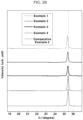
- FIG. 2A shows X-ray diffraction analysis results of the solid electrolytes of Examples 1 to 4 and Comparative Example 2.
- a peak argyrodite
- a peak Li 4 SnS 4
- the solid electrolyte of Comparative Example 2 does not show a peak due to the orthorhombic crystal structure.
- FIG. 2B shows an enlarged view of partial regions of FIG. 2A .
- the 2 ⁇ value of the peak of the (220) plane of the cubic argyrodite-type crystal structure shifts to lower angles as it goes from Example 4 with a small number of moles of the tin element to Example 1 with a large number of moles of the tin element.
- the 2 ⁇ value of the peak of the (220) plane shifts to lower angles by greater than 0° and 0.1° or less.
- FIG. 3A shows X-ray diffraction analysis results of the solid electrolytes of Comparative Examples 3a to 3c.
- FIG. 3B shows an enlarged view of partial regions of FIG. 3A . Referring to FIGS. 3A and 3B , the peak of the (220) plane does not shift in Comparative Examples 3a to 3c.
- Examples 1 to 4 are solid electrolytes prepared by combining Li 2 S, P 2 S 5 , SnS 2 , LiCl, and LiBr, and Comparative Examples 3a to 3c are solid electrolytes prepared by mixing Li 5.4 PS 4.4 Cl 0.8 Br 0.8 and Li 4 SnS 4 . It is not possible to obtain a solid electrolyte in which the first compound, the second compound, and the third compound are complexed as in embodiments of the present disclosure only by combining two types of solid electrolytes that have already been synthesized as in Comparative Examples 3a to 3c, and this may be seen from whether the peaks of the (220) planes of FIGS. 2 and 3 are shifted or not.
- FIG. 4 shows X-ray diffraction analysis results of the solid electrolytes of Example 4, Comparative Example 4a, and Comparative Example 4b.
- Li n Sn m is formed when a tin element replaces a phosphorus element and reacts with lithium without entering the crystal structure of the solid electrolyte. Even if Li 2 S, P 2 S 5 , SnS 2 , LiCl, and LiBr are used in combination as a starting material as in embodiments of the present disclosure, the phosphorus element cannot be replaced with the element M when the starting material is pulverized at a speed of less than 800 rpm as in Comparative Example 4a and Comparative Example 4b.
- FIG. 5 shows the contents of the tin element of the solid electrolytes of Example 4 and Comparative Example 3c by X-ray photoelectron spectroscopy (XPS).
- the results of Example 4 include a first region and a second region in which the measured tin element contents are different from each other.
- the solid electrolyte according to embodiments of the present disclosure is one in which the first compound, the second compound, and the third compound are complexed.
- FIG. 6A it can be seen that a region having a small content of the tin element and a region having a large content of the tin element are distinguished.
- the region having a small content of the tin element is the second region, and the region having a large content of the tin element is the first region.
- FIG. 6B since the solid electrolyte of Comparative Example 3c is a mixture of two types of solid electrolytes that have already been synthesized, these are coarsely distributed so that a portion where the tin element is present and a portion where the tin element is not present appear randomly.
- a powder was prepared by pulverizing each solid electrolyte with an agate mortar. 150 mg of the powder was pressed at a pressure of about 4 ton/cm 2 for about 10 seconds to 2 minutes to prepare a pellet specimen having a thickness of about 0.500 mm to 0.900 mm and a diameter of about 13 mm.
- a symmetric cell was prepared by disposing stainless steel (SuS) and lithium (Li) electrodes having a thickness of about 50 ⁇ m to 200 ⁇ m and a diameter of about 13 mm on both surfaces of the specimen, respectively. The preparation of the symmetric cell was carried out in an argon atmosphere glove box.
- Impedance of the symmetric cell was measured by a 2-probe method using an impedance analyzer (Material Mates 7260 impedance analyzer). The frequency range was 0.1 Hz to 1 MHz, and the amplitude voltage was 10 mV. Impedance was measured under conditions of an argon atmosphere and about 25°C. The resistance value was obtained from the arc of the Nyquist plot for the impedance measurement result, and the lithium ion conductivity was calculated in consideration of the area and thickness of the specimen. The result was set as the initial lithium ion conductivity of the solid electrolyte in Table 1 below.
- Each powder pulverized with the agate mortar was stored for 3 days in an air atmosphere dry room having a dew point of about -60°C or less, and then taken out to measure the lithium ion conductivity in the same manner as above. The result was set as the lithium ion conductivity of the solid electrolyte after 3 days in Table 1 below.
- Lithium ion conductivity retention rate % Lithium ion conductivity of solid electrolyte after 3 days/Initial lithium ion conductivity of solid electrolyte ⁇ 100 Table 1 Classification Lithium ion conductivity @25°C [S/cm] Lithium ion conductivity retention rate [%] Initial After 3 days
- Example 4 2.16 ⁇ 10 -3 2.43 ⁇ 10 -3 More than 100 Comparative Example 1 1.95 ⁇ 10 -3 1.46 ⁇ 10 -3 74.9 Comparative Example 2 4.76 ⁇ 10 -3 2.85 ⁇ 10 -3 59.8 Comparative Example 3c 3.67 ⁇ 10 -3 2.32 ⁇ 10 -3 63.2
- the solid electrolyte according to Example 4 has a lithium ion conductivity retention rate of more than 100%, whereas the solid electrolytes of Comparative Example 1, Comparative Example 2, and Comparative Example 3c have lithium ion conductivity retention rates of less than 80%.
- the solid electrolyte containing the first compound, the second compound, and the third compound according to embodiments of the present disclosure has excellent moisture stability compared to Comparative Examples.
- a cathode mixture was prepared by mixing a cathode active material, solid electrolytes, and a conductive material at a weight ratio of 80 to 85:20 to 15:0.5.
- the cathode active material is LiNi 0.8 Co 0.15 Al 0.05 O 2 (NCA)
- the solid electrolytes are the solid electrolytes according to Example 4, Comparative Example 1, Comparative Example 2, and Comparative Example 3c, respectively
- the conductive material is CNF.
- Solid electrolyte powders were prepared by pulverizing the solid electrolytes according to Example 4, Comparative Example 1, Comparative Example 2, and Comparative Example 3c with an agate mortar.
- a metal lithium foil having a thickness of about 30 ⁇ m was prepared as an anode layer.
- Each all-solid-state battery was put in a chamber of about 45°C. Each all-solid-state battery was charged with a constant current of 0.1C and a constant voltage of 4.25 V until a current value of 0.05C was reached. Subsequently, the battery was discharged at a constant current of 0.2C until the battery voltage reached 2.5 V. Thereafter, a change in implemented capacity according to an increase in the discharge rate was observed by repeating charging after each discharging under the same conditions and performing discharging three times at constant currents of 0.33C, 0.5C, and 1C, respectively. The results are shown in Table 2 below.
- the all-solid-state battery including the solid electrolyte of Example 4 was superior in all of charging capacity, discharge capacity, and efficiency to those of Comparative Examples.
- the all-solid-state battery including the solid electrolyte of Example 4 is superior in all of charging capacity, discharge capacity, and efficiency to those of Comparative Examples.
- the all-solid-state battery including the solid electrolyte of Example 4 shows a remarkably lower drop in characteristics than those of Comparative Examples by comparing with the results of Table 2.
Landscapes
- Chemical & Material Sciences (AREA)
- Inorganic Chemistry (AREA)
- Manufacturing & Machinery (AREA)
- Engineering & Computer Science (AREA)
- Chemical Kinetics & Catalysis (AREA)
- Electrochemistry (AREA)
- General Chemical & Material Sciences (AREA)
- Organic Chemistry (AREA)
- General Physics & Mathematics (AREA)
- Condensed Matter Physics & Semiconductors (AREA)
- Physics & Mathematics (AREA)
- Conductive Materials (AREA)
- Secondary Cells (AREA)
Abstract
Description
- The present disclosure relates to a solid electrolyte for an all-solid-state battery having excellent moisture stability and a method for preparing the same.
- Sulfide-based solid electrolytes are in the spotlight as solid electrolytes for all-solid-state batteries since they have high lithium ion conductivity and are ductile. However, the sulfide-based solid electrolytes have poor moisture stability. Water molecules in the air decompose the bonds of bridging sulfur in the sulfide-based solid electrolytes to generate hydrogen sulfide (H2S) and lower crystallinity to reduce lithium ion conductivity.
- Li6PS5Cl having an argyrodite-type crystal structure among the sulfide-based solid electrolytes has an advantage of high lithium ion conductivity. In order to increase the moisture stability of Li6PS5Cl, an attempt was made to increase the ratio of a halogen element. Increasing the ratio of the halogen element may temporarily improve moisture stability and lithium ion conductivity, but it is not a fundamental solution since it cannot prevent water molecules in the air from decomposing the bonds of bridging sulfur.
- An embodiment of the present disclosure provides a solid electrolyte having excellent moisture stability and lithium ion conductivity and a method for preparing the same.
- The embodiments of the present disclosure are not limited to the embodiment mentioned above. The embodiments of the present disclosure will become more apparent from the following description and will be realized by means and combinations thereof described in the claims.
- A solid electrolyte according to one embodiment of the present disclosure may include a first compound represented by Chemical Formula 1 below and a second compound represented by Chemical Formula 2 below.
Chemical Formula 1 Li7-aPS6-a(X11-b)X2b)a
- In
Chemical Formula 1, X1 and X2 may be the same or different and may each represent F, Cl, Br, or I, and 0<a≤2 and 0<b<1 may be satisfied.
Chemical Formula 2 Li7-cP1-2dMdS6-c-3d(X11-eX2e)c
- In
Chemical Formula 2, X1 and X2 may be the same or different and may each represent F, Cl, Br, or I, M may represent at least one of Ge, Si, Sn, or any combination thereof, and 0<c≤2, 0<d<0.5, and 0<e<1 may be satisfied. - The solid electrolyte may further include a third compound represented by Chemical Formula 3 below.
Chemical Formula 3 LifMgSh
- In Chemical Formula 3, M may represent at least one of Ge, Si, Sn, or any combination thereof, and 0<f≤10, 0<g≤5, and 0<h≤10 may be satisfied.
- In Chemical Formula 2, 0<d≤0.1 maybe satisfied.
- An X-ray diffraction (XRD) pattern of the solid electrolyte may include a peak due to a cubic argyrodite-type crystal structure and a peak due to an orthorhombic crystal structure.
- The solid electrolyte may be one in which, as d in
Chemical Formula 2 above increases, 2θ value of a peak of a (220) plane of the cubic argyrodite-type crystal structure in the X-ray diffraction (XRD) pattern may shift to lower angles by greater than 0° and 0.1° or less. - The solid electrolyte may have a ratio (I(38.s)/I(30.0)) of peak intensity at 2θ=38.5±0.5° to peak intensity at 2θ=30±0.5° in the X-ray diffraction (XRD) pattern of about 0.01 or less.
- The solid electrolyte may have a ratio (I(25)/I(17)) of peak intensity at 2θ=25±0.5° to peak intensity at 20=17±0.5° in the X-ray diffraction (XRD) pattern of about 1 to 10.
- When the solid electrolyte is analyzed by X-ray photoelectron spectroscopy (XPS), a result of XPS may include a first region and a second region with different contents of an element M.
- The content of the element M in the first region may be about 0.9 at% to 1.2 at%.
- The content of the element M in the second region may be about 0.2 at% to 0.5 at%.
- The solid electrolyte may have a lithium ion conductivity retention rate of about 80% or more after 3 days under dry condition in an air atmosphere having a dew point of -70°C or less.
- A method for preparing a solid electrolyte according to one embodiment of the present disclosure may include steps of preparing a starting material including a compound containing lithium, a compound containing phosphorus (P), a compound containing an element M, and two or more compounds containing different halogen elements, preparing an intermediate material by pulverizing the starting material, and heat treating the intermediate material.
- The preparation method may be to pulverize the starting material at about 800 rpm to 1,000 rpm.
- The preparation method may be to pulverize the starting material by applying a force of about 25 G to 50 G to the starting material.
- The preparation method may be to heat treat the intermediate material at about 400°C to 600°C for about 25 minutes to 36 hours.
- According to embodiments of the present disclosure, a solid electrolyte having excellent moisture stability and lithium ion conductivity can be obtained.
- The embodiments of the present disclosure are not limited to the above-mentioned embodiments. It should be understood that the embodiments of the present disclosure include all embodiments that can be inferred from the following description.
-
-
FIG. 1 shows an all-solid-state battery according to embodiments of the present disclosure. -
FIG. 2A shows X-ray diffraction analysis results of the solid electrolytes of Examples 1 to 4 and Comparative Example 2. -
FIG. 2B shows an enlarged view of partial regions ofFIG. 2A . -
FIG. 3A shows X-ray diffraction analysis results of the solid electrolytes of Comparative Examples 3a to 3c. -
FIG. 3B shows an enlarged view of partial regions ofFIG. 3A . -
FIG. 4 shows X-ray diffraction analysis results of the solid electrolytes of Example 4, Comparative Example 4a, and Comparative Example 4b. -
FIG. 5 shows the contents of the tin element of the solid electrolytes of Example 4 and Comparative Example 3c by X-ray photoelectron spectroscopy (XPS). -
FIG. 6A shows a scanning electron microscope-energy dispersive X-ray spectrometer (SEM-EDS) analysis result for the tin element of the solid electrolyte according to Example 4. -
FIG. 6B shows a SEM-EDS analysis result of the tin element of the solid electrolyte according to Comparative Example 3c. - The above objects, other objects, features and advantages of embodiments of the present disclosure will be easily understood through the following preferred embodiments related to the accompanying drawings. However, the present disclosure is not limited to the embodiments described herein and may be embodied in other forms. Rather, the embodiments introduced herein are provided so that the disclosed content may become thorough and complete, and the present disclosure may be sufficiently conveyed to those skilled in the art.
- The similar reference numerals have been used for similar elements while explaining each drawing. In the accompanying drawings, the dimensions of the structures are illustrated after being more enlarged than the actual dimensions for clarity of the present disclosure. Terms such as first, second, etc. may be used to describe various components, but the components should not be limited by the terms. The terms are used only for the purpose of distinguishing one component from another component. For example, a first component may be referred to as a second component, and similarly, the second component may also be referred to as the first component, without departing from the scope of rights of the present disclosure. The singular expression includes the plural expression unless the context clearly dictates otherwise.
- In the present specification, terms such as "comprise", "have", etc. are intended to designate that a feature, number, step, operation, component, part, or a combination thereof described in the specification exists, but it should be understood that the terms do not preclude the possibility of the existence or addition of one or more other features, numbers, steps, operations, components, parts, or combinations thereof. Further, when a part of a layer, film, region, plate, etc. is said to be "on" other part, this includes not only the case where it is "directly on" the other part, but also the case where there is another part in the middle therebetween. Conversely, when a part of a layer, film, region, plate, etc. is said to be "under" another part, this includes not only the case where it is "directly under" the other part, but also the case where there is another part in the middle therebetween.
- Unless otherwise specified, since all numbers, values, and/or expressions expressing quantities of components, reaction conditions, polymer compositions, and formulations used in the present specification are approximate values reflecting various uncertainties of the measurement that arise in obtaining these values among others in which these numbers are essentially different, they should be understood as being modified by the term "about" in all cases. Further, when a numerical range is disclosed in this description, such a range is continuous, and includes all values from a minimum value of such a range to a maximum value including the minimum and maximum values, unless otherwise indicated. Furthermore, when such a range refers to an integer, all integers including from a minimum value to a maximum value including the minimum and maximum values are included, unless otherwise indicated.
-
FIG. 1 shows an all-solid-state battery according to embodiments of the present disclosure. The all-solid-state battery may include an anodecurrent collector 10, ananode layer 20, asolid electrolyte layer 30, acathode layer 40, and a cathodecurrent collector 50. - At least one of the
anode layer 20, thesolid electrolyte layer 30, and thecathode layer 40 may include a solid electrolyte. - The solid electrolyte may include a first compound represented by
Chemical Formula 1 below, a second compound represented byChemical Formula 2 below, and a third compound represented byChemical Formula 3 below.
Chemical Formula 1 Li7-aPS6-a(X11-bX2b)a
- In
Chemical Formula 1, X1 and X2 may be the same or different and may each represent F, Cl, Br, or I, and 0<a≤2 and 0<b<1 may be satisfied.
Chemical Formula 2 Li7-cP1-2dMdS6-c-3d(X11-eX2e)c
- In
Chemical Formula 2, X1 and X2 may be the same or different and may each represent F, Cl, Br, or I, M may represent at least one of Ge, Si, Sn, or any combination thereof, and 0<c≤2, 0<d<0.5, and 0<e<1 may be satisfied.
Chemical Formula 3 LifMgSh
- In
Chemical Formula 3, M may be the same as M inChemical Formula - The first compound represented by
Chemical Formula 1 above may be a solid electrolyte having an argyrodite-type crystal structure. The solid electrolyte having an argyrodite-type crystal structure may refer to a solid electrolyte exhibiting lithium ion conductivity while having a crystal structure such as Ag8GeS6 that is an ore, and a representative example is Li7PS6. The first compound represented byChemical Formula 1 above may be one in which a part of a sulfur (S) element of Li7PS6 is substituted with the halogen element. Since the halogen element has superior moisture stability and oxidation stability compared to the sulfur element, structural stability of the first compound may be improved when substituting a part of the sulfur element with the halogen element. In addition, when the halogen element is substituted, since a vacancy is formed in a lithium site part inside the argyrodite-type crystal structure, lithium ion conductivity may be increased. - The first compound may include Li6PS5Cl0.5Br0.5, Li5.4PS4.4Cl0.8Br0.8, and the like.
- The second compound represented by
Chemical Formula 2 above is a solid electrolyte having an argyrodite-type crystal structure in which a part of a phosphorus (P) element of the first compound is substituted with an element M. The element M may include an element having a larger ionic radius than the phosphorus element. For example, the element M may include at least one of Ge, Si, Sn, or any combination thereof. As ions of the element M having a larger ionic radius than phosphorus (P) ions are disposed on a portion of the phosphorus (P) site, the crystal lattice volume increases. When the crystal lattice volume increases, since the movement of lithium ions within the crystal lattice becomes easier, the lithium ion conductivity and the retention rate of the lithium ion conductivity may be improved. - The second compound may include Li5.4P0.8Ge0.1S4.1Cl0.8Br0.8, Li5.4P0.85Ge0.075S4.175Cl0.8Br0.8, Li5.4P0.88Ge0.06S4.22Cl0.8Br0.8, Li5.4P0.9Ge0.05S4.25Cl0.8Br0.8, Li5.4P0.8Si0.1S4.1Cl0.8Br0.8, Li5.4P0.85Si0.075S4.175Cl0.8Br0.8, Li5.4P0.88Si0.06S4.22Cl0.8Br0.8, Li5.4P0.9Si0.05S4.25Cl0.8Br0.8, Li5.4P0.8Sn0.1S4.1Cl0.8Br0.8, Li5.4P0.85Sn0.075S4.175Cl0.8Br0.8, Li5.4P0.88Sn0.06S4.22Cl0.8Br0.8, Li54P0.9Sn0.05S4.25Cl0.8Br0.8, and the like.
- The third compound represented by
Chemical Formula 3 above may be a solid electrolyte having an orthorhombic crystal structure. Since the third compound is a solid electrolyte having excellent lithium ion conductivity and moisture stability, the lithium ion conductivity and moisture stability of the solid electrolyte according to embodiments of the present disclosure may be simultaneously improved by complexing it with the first compound and the second compound. Here, "complexing" may mean obtaining a solid electrolyte including the first compound to third compound through pulverization and heat treatment steps under specific conditions not by simply mixing the first compound to third compound, but by using a specific starting material. - The third compound may include Li4GeS4, Li4SiS4, Li4SnS4, and the like.
- The solid electrolyte may have a lithium ion conductivity of about 1.0 mS/cm or more, about 1.5 mS/cm or more, about 2.0 mS/cm or more, about 2.5 mS/cm or more, about 3.0 mS/cm or more, about 3.5 mS/cm or more, about 4.0 mS/cm or more, or about 5.0 mS/cm or more at about 25°C. The lithium ion conductivity may be measured through a DC polarization method, impedance spectroscopy, or the like.
- The solid electrolyte may have a lithium ion conductivity retention rate of about 80% or more when left in a dry room having a dew point of -10°C or less, -30°C or less, -50°C or less, or -70°C or less for 3 days. The lithium ion conductivity retention rate can be calculated by
Mathematical Equation 1 below.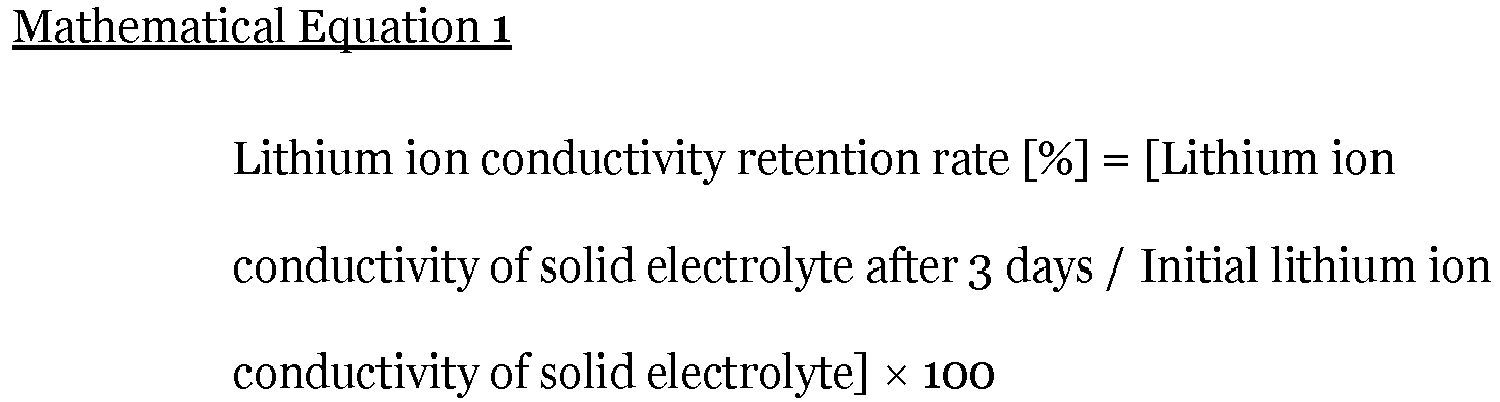
- In
Mathematical Equation 1, the initial lithium ion conductivity of the solid electrolyte may mean the lithium ion conductivity before storage in dry conditions. - Hereinafter, each configuration of the all-solid-state battery will be described specifically.
- The anode
current collector 10 may include a plate-shaped substrate having electrical conductivity. Specifically, the anodecurrent collector 10 may have a sheet, thin film, or foil shape. - The anode
current collector 10 may include a material that does not react with lithium. Specifically, the anodecurrent collector 10 may include at least one selected from the group consisting of Ni, Cu, stainless steel (SUS), and combinations thereof. - According to the first embodiment of the present disclosure, the
anode layer 20 may include a composite anode containing an anode active material and a solid electrolyte. - The anode active material is not particularly limited and may include, for example, at least one selected from the group consisting of a carbon active material, a metal active material, and a combination thereof.
- The carbon active material may include graphite, such as mesocarbon microbeads (MCMB), highly oriented pyrolytic graphite (HOPG), and the like, and amorphous carbon such as hard carbon, soft carbon, and the like.
- The metal active material may include at least one selected from the group consisting of In, Al, Si, Sn, and combinations thereof.
- The
anode layer 20 may further contain a solid electrolyte having a different composition together with the solid electrolyte described above. For example, theanode layer 20 may further include an oxide-based solid electrolyte or a sulfide-based solid electrolyte. - The sulfide-based solid electrolytes may include Li2S-P2S5, Li2S-P2S5-LiI, Li2S-P2S5-LiCl, Li2S-P2S5-LiBr, Li2S-P2S5-Li2O, Li2S-P2S5-Li2O-LiI, Li2S-SiS2, Li2S-SiS2-LiI, Li2S-SiS2-LiBr, Li2S-SiS2-LiCl, Li2S-SiS2-B2S3-LiI, Li2S-SiS2-P2S5-LiI, Li2S-B2S3, Li2S-P2S5-ZmSn (provided that m and n are positive numbers, and Z is one of Ge, Zn, and Ga), Li2S-GeS2, Li2S-SiS2-Li3PO4, Li2S-SiS2-LixMOy (provided that x and y are positive numbers, and M is one of P, Si, Ge, B, Al, Ga, and In), Li10GeP2S12, and the like.
- The oxide-based solid electrolyte may include lithium phosphorous oxynitride (LiPON), a garnet-based solid electrolyte, a perovskite-based solid electrolyte, a Na superionic conductor (NASICON)-based solid electrolyte, and the like.
- The garnet-based solid electrolyte may include Li7-yLa3-xAxZr2-yMyOl2 (where x is 0≤x≤3, y is 0≤y≤2, A is at least one selected from the group consisting of Y, Nd, Sm, and Gd, and M is Nb or Ta).
- The perovskite-based solid electrolyte may include Li0.5-3xLa0.5+xTiO3 (where x is 0≤x≤0.15).
- The Na superionic conductor (NASICON)-based solid electrolyte may include Li1+xAlxTi2-x(PO4)3 (where x is 0≤x≤3), Li1+xAlxGe2-x(PO4)3 (where x is 0≤ x≤3), and the like.
- According to a second embodiment of the present disclosure, the
anode layer 20 may include lithium metal or a lithium metal alloy. - The lithium metal alloy may include lithium and a metal or metalloid capable of alloying with lithium. The metal or metalloid capable of alloying with lithium may include Si, Sn, Al, Ge, Pb, Bi, Sb, and the like.
- According to a third embodiment of the present disclosure, the
anode layer 20 may not include an anode active material and a configuration playing substantially the same role as the anode active material. During charging of the all-solid-state battery, lithium ions that have migrated from thecathode layer 40 may be precipitated and stored in the form of lithium metal between theanode layer 20 and the anodecurrent collector 10. - The
anode layer 20 may include an amorphous carbon and a metal capable of forming an alloy with lithium. - The amorphous carbon may include at least one selected from the group consisting of furnace black, acetylene black, Ketjen black, graphene, and combinations thereof.
- The metal may include at least one selected from the group consisting of gold (Au), platinum (Pt), palladium (Pd), silicon (Si), silver (Ag), aluminum (Al), bismuth (Bi), tin (Sn), zinc (Zn), and combinations thereof.
- The
solid electrolyte layer 30 may further include a solid electrolyte having a different composition together with the solid electrolyte described above. For example, thesolid electrolyte layer 30 may further include an oxide-based solid electrolyte, a sulfide-based solid electrolyte, a polymer electrolyte, and the like. - The oxide-based solid electrolyte and the sulfide-based solid electrolyte are as described above.
- The polymer electrolyte may include a gel polymer electrolyte, a solid polymer electrolyte, and the like.
- The
cathode layer 40 may include a cathode active material, a solid electrolyte, a conductive material, a binder, and the like. - The cathode active material may reversibly intercalate and disintercalate lithium ions. The cathode active material may be an oxide active material or a sulfide active material.
- The oxide active material may include a rock salt layer-type active material such as LiCoO2, LiMnO2, LiNiO2, LiVO2, Li1+xNi1/3Co1/3Mn1/3O2, or the like, a spinel-type active material such as LiMn2O4, Li(Ni0.5Mn1.5)O4, or the like, a reverse spinel-type active material such as LiNiVO4, LiCoVO4, or the like, an olivine-type active material such as LiFePO4, LiMnPO4, LiCoPO4, LiNiPO4, or the like, a silicon-containing active material such as Li2FeSiO4, Li2MnSiO4, or the like, a rock salt layer-type active material in which a part of the transition metal is substituted with a dissimilar metal, such as LiNi0.8Co(0.2-x)AlxO2 (0<x<0.2), a spinel-type active material in which a part of the transition metal is substituted with a dissimilar metal, such as Li1+xMn2-x-yMyO4 (M is at least one of Al, Mg, Co, Fe, Ni, and Zn, and 0<x+y<2), or a lithium titanate such as Li4Ti5O12 or the like.
- The sulfide active material may include copper chevrel, iron sulfide, cobalt sulfide, nickel sulfide, and the like.
- The
cathode layer 40 may further include a solid electrolyte having a different composition together with the solid electrolyte described above. For example, thecathode layer 40 may further include an oxide-based solid electrolyte or a sulfide-based solid electrolyte. The oxide-based solid electrolyte and the sulfide-based solid electrolyte are as described above. - The conductive material may include carbon black, conductive graphite, ethylene black, graphene, and the like.
- The binder may include butadiene rubber (BR), nitrile butadiene rubber (NBR), hydrogenated nitrile butadiene rubber (HNBR), polyvinylidene difluoride (PVDF), polytetrafluoroethylene (PTFE), carboxymethyl cellulose (CMC), and the like.
- The cathode
current collector 50 may be a plate-shaped substrate having electrical conductivity. The cathodecurrent collector 50 may include an aluminum foil. - Hereinafter, a method for preparing a solid electrolyte according to embodiments of the present disclosure will be described in detail.
- The preparation method may include steps of preparing a starting material including a compound containing lithium, a compound containing phosphorus (P), a compound containing the element M, and two or more compounds containing different halogen elements, preparing an intermediate material by pulverizing the starting material, and heat-treating the intermediate material.
- The compound containing lithium may include a sulfide containing lithium. For example, the compound containing lithium may include lithium sulfide (Li2S).
- The compound containing phosphorus (P) may include a sulfide containing phosphorus. For example, it may include phosphorus pentasulfide (P2S5).
- The compound containing the element M may include a sulfide containing the element M. For example, the compound including the element M may include GeS2, SiS2, SnS2, and the like.
- The compounds containing halogen elements may include lithium salts containing the halogen elements. For example, the compounds containing the halogen elements may include LiF, LiCl, LiBr, LiI, and the like.
- After weighing respective compounds according to the desired composition of the solid electrolyte, the weighed compounds are mixed to prepare a starting material, and the starting material is pulverized at about 800 rpm to 1,000 rpm so that an intermediate material may be obtained. When the starting material is pulverized at the above speed, a force of about 25 G to 50 G may be applied to the starting material. If a pulverization speed of the starting material is less than 800 rpm, the element M may not substitute for the phosphorus element, and the substituted solid electrolyte may not be mixed.
- The pulverization time for the starting material is not particularly limited, and it may be, for example, about 1 hour to 36 hours.
- The intermediate material may be heat treated at about 400°C to 600°C for about 25 minutes to 36 hours to obtain a solid electrolyte which contains a first compound, a second compound, and a third compound, and is crystalline. When the temperature and time of the heat treatment are less than the above numerical ranges, the crystallinity of the solid electrolyte is not sufficient, and thus the lithium ion conductivity may decrease. When the temperature and time of the heat treatment exceed the above numerical ranges, the solid electrolyte may deteriorate.
- Heat treatment for the intermediate material may be performed in an inert atmosphere. The inert atmosphere is an atmosphere containing an inert gas. The inert gas is, for example, nitrogen, argon, or the like, but is not necessarily limited thereto, and any one used as an inert gas in the art is possible.
- Hereinafter, other forms of embodiments of the present disclosure will be described in more detail through examples. The following examples are merely examples to help understanding of embodiments of the present disclosure, and the scope of the present disclosure is not limited thereto.
- In order to obtain a solid electrolyte in which Li5.4PS4.4Cl0.8Br0.8, Li5.4P0.8Sn0.1S4.1Cl0.8Br0.8, and Li4SnS4 were complexed, a starting material was prepared by combining Li2S, P2S5, SnS2, LiCl, and LiBr at a stoichiometric ratio according to the corresponding composition.
- The starting material was pulverized at about 800 rpm in a planetary ball mill of an argon atmosphere containing zirconia balls for about 24 hours to obtain an intermediate material.
- The intermediate material was heat treated at about 450°C for about 25 minutes to obtain a solid electrolyte according to Example 1.
- In order to obtain a solid electrolyte in which Li5.4PS4.4Cl0.8Br0.8, Li5.4P0.85Sn0.075S4.175Cl0.8Br0.8, and Li4SnS4 were complexed, a starting material was prepared by combining Li2S, P2S5, SnS2, LiCl, and LiBr at a stoichiometric ratio according to the corresponding composition.
- Except for this, a solid electrolyte according to Example 2 was prepared in the same manner as in Example 1.
- In order to obtain a solid electrolyte in which Li5.4PS4.4Cl0.8Br0.8, Li5.4P0.88Sn0.06S4.22Cl0.8Br0.8, and Li4SnS4 were complexed, a starting material was prepared by combining Li2S, P2S5, SnS2, LiCl, and LiBr at a stoichiometric ratio according to the corresponding composition.
- Except for this, a solid electrolyte according to Example 2 was prepared in the same manner as in Example 1.
- In order to obtain a solid electrolyte in which Li5.4PS4.4Cl0.8Br0.8, Li5.4P0.9Sn0.05S4.25Cl0.8Br0.8, and Li4SnS4 were complexed, a starting material was prepared by combining Li2S, P2S5, SnS2, LiCl, and LiBr at a stoichiometric ratio according to the corresponding composition.
- Except for this, a solid electrolyte according to Example 2 was prepared in the same manner as in Example 1.
- In order to obtain a solid electrolyte represented by Li6PS5Cl, a starting material was prepared by combining Li2S, P2S5, and LiCl at a stoichiometric ratio according to the corresponding composition.
- Except for this, a solid electrolyte according to Comparative Example 1 was prepared in the same manner as in Example 1.
- In order to obtain a solid electrolyte represented by Li5.4PS4.4Cl0.8Br0.8, a starting material was prepared by combining Li2S, P2S5, LiCl, and LiBr at a stoichiometric ratio according to the corresponding composition.
- Except for this, a solid electrolyte according to Comparative Example 2 was prepared in the same manner as in Example 1.
- A starting material was prepared by mixing Li5.4PS4.4Cl0.8Br0.8 and Li4SnS4 at a molar ratio of 80:20.
- Except for this, a solid electrolyte according to Comparative Example 3a was prepared in the same manner as in Example 1.
- A starting material was prepared by mixing Li5.4PS4.4Cl0.8Br0.8 and Li4SnS4 at a molar ratio of 94:6.
- Except for this, a solid electrolyte according to Comparative Example 3b was prepared in the same manner as in Example 1.
- A starting material was prepared by mixing Li5.4PS4.4Cl0.8Br0.8 and Li4SnS4 at a molar ratio of 98:2.
- Except for this, a solid electrolyte according to Comparative Example 3c was prepared in the same manner as in Example 1.
- A solid electrolyte according to Comparative Example 4a was prepared in the same manner as in Example 4 except that the starting material was pulverized at 400 rpm.
- A solid electrolyte according to Comparative Example 4b was prepared in the same manner as in Example 4 except that the starting material was pulverized at 600 rpm.
-
FIG. 2A shows X-ray diffraction analysis results of the solid electrolytes of Examples 1 to 4 and Comparative Example 2. In the solid electrolytes of Examples 1 to 4, both of a peak (argyrodite) due to the cubic argyrodite-type crystal structure and a peak (Li4SnS4) due to the orthorhombic crystal structure are found. The solid electrolyte of Comparative Example 2 does not show a peak due to the orthorhombic crystal structure. -
FIG. 2B shows an enlarged view of partial regions ofFIG. 2A . In the solid electrolytes of Examples 1 to 4, the 2θ value of the peak of the (220) plane of the cubic argyrodite-type crystal structure shifts to lower angles as it goes from Example 4 with a small number of moles of the tin element to Example 1 with a large number of moles of the tin element. Specifically, the 2θ value of the peak of the (220) plane shifts to lower angles by greater than 0° and 0.1° or less.FIG. 3A shows X-ray diffraction analysis results of the solid electrolytes of Comparative Examples 3a to 3c.FIG. 3B shows an enlarged view of partial regions ofFIG. 3A . Referring toFIGS. 3A and 3B , the peak of the (220) plane does not shift in Comparative Examples 3a to 3c. - Examples 1 to 4 are solid electrolytes prepared by combining Li2S, P2S5, SnS2, LiCl, and LiBr, and Comparative Examples 3a to 3c are solid electrolytes prepared by mixing Li5.4PS4.4Cl0.8Br0.8 and Li4SnS4. It is not possible to obtain a solid electrolyte in which the first compound, the second compound, and the third compound are complexed as in embodiments of the present disclosure only by combining two types of solid electrolytes that have already been synthesized as in Comparative Examples 3a to 3c, and this may be seen from whether the peaks of the (220) planes of
FIGS. 2 and3 are shifted or not. -
FIG. 4 shows X-ray diffraction analysis results of the solid electrolytes of Example 4, Comparative Example 4a, and Comparative Example 4b. The solid electrolyte of Example 4 has a ratio (I(38.5)/I(30.0)) of the peak intensity at 2θ=38.5±0.5° to the peak intensity at 2θ=30±0.5° of about 0.01 or less. The solid electrolytes of Comparative Examples 4a and 4b have a ratio (I(38.5)/I(30.0)) of the peak intensity at 2θ=38.5±0.5° to the peak intensity at 2θ=30±0.5° of about 1 or more. The peak at 2θ=38.5±0.5° found in the solid electrolytes of Comparative Examples 4a and 4b is due to LinSnm. LinSnm is formed when a tin element replaces a phosphorus element and reacts with lithium without entering the crystal structure of the solid electrolyte. Even if Li2S, P2S5, SnS2, LiCl, and LiBr are used in combination as a starting material as in embodiments of the present disclosure, the phosphorus element cannot be replaced with the element M when the starting material is pulverized at a speed of less than 800 rpm as in Comparative Example 4a and Comparative Example 4b. - Further, the solid electrolyte according to embodiments of the present disclosure may have a ratio (I(25)/I(17)) of the peak intensity at 2θ=25±0.5° to the peak intensity at 2θ=17±0.5° in the X-ray diffraction (XRD) pattern of about 1 to 10. The peak at 2θ=25±0.5° is a peak due to the argyrodite-type crystal structure, and the peak at 2θ=17±0.5° is a peak due to Li4SnS4.
-
FIG. 5 shows the contents of the tin element of the solid electrolytes of Example 4 and Comparative Example 3c by X-ray photoelectron spectroscopy (XPS). The results of Example 4 include a first region and a second region in which the measured tin element contents are different from each other. - Since the tin element content of the first region is similar to Comparative Example 3c, the first region corresponds to Li4SnS4. The second region having a low tin element content corresponds to Li5.4P0.9Sn0.05S4.25Cl0.8Br0.8. It can be seen through this that the solid electrolyte according to embodiments of the present disclosure is one in which the first compound, the second compound, and the third compound are complexed.
- Referring to
FIG. 6A , it can be seen that a region having a small content of the tin element and a region having a large content of the tin element are distinguished. The region having a small content of the tin element is the second region, and the region having a large content of the tin element is the first region. On the other hand, referring toFIG. 6B , since the solid electrolyte of Comparative Example 3c is a mixture of two types of solid electrolytes that have already been synthesized, these are coarsely distributed so that a portion where the tin element is present and a portion where the tin element is not present appear randomly. - Moisture stability of the solid electrolytes according to Example 4, Comparative Example 1, Comparative Example 2, and Comparative Example 3c was evaluated.
- A powder was prepared by pulverizing each solid electrolyte with an agate mortar. 150 mg of the powder was pressed at a pressure of about 4 ton/cm2 for about 10 seconds to 2 minutes to prepare a pellet specimen having a thickness of about 0.500 mm to 0.900 mm and a diameter of about 13 mm. A symmetric cell was prepared by disposing stainless steel (SuS) and lithium (Li) electrodes having a thickness of about 50 µm to 200 µm and a diameter of about 13 mm on both surfaces of the specimen, respectively. The preparation of the symmetric cell was carried out in an argon atmosphere glove box.
- Impedance of the symmetric cell was measured by a 2-probe method using an impedance analyzer (Material Mates 7260 impedance analyzer). The frequency range was 0.1 Hz to 1 MHz, and the amplitude voltage was 10 mV. Impedance was measured under conditions of an argon atmosphere and about 25°C. The resistance value was obtained from the arc of the Nyquist plot for the impedance measurement result, and the lithium ion conductivity was calculated in consideration of the area and thickness of the specimen. The result was set as the initial lithium ion conductivity of the solid electrolyte in Table 1 below.
- Each powder pulverized with the agate mortar was stored for 3 days in an air atmosphere dry room having a dew point of about -60°C or less, and then taken out to measure the lithium ion conductivity in the same manner as above. The result was set as the lithium ion conductivity of the solid electrolyte after 3 days in Table 1 below.
- The lithium ion conductivity retention rate of each solid electrolyte was calculated by
Mathematical Equation 1 below and shown in Table 1.
Table 1 Classification Lithium ion conductivity @25°C [S/cm] Lithium ion conductivity retention rate [%] Initial After 3 days Example 4 2.16×10⁻³ 2.43×10⁻³ More than 100 Comparative Example 1 1.95×10⁻³ 1.46×10⁻³ 74.9 Comparative Example 2 4.76×10⁻³ 2.85×10⁻³ 59.8 Comparative Example 3c 3.67×10⁻³ 2.32×10⁻³ 63.2 - The solid electrolyte according to Example 4 has a lithium ion conductivity retention rate of more than 100%, whereas the solid electrolytes of Comparative Example 1, Comparative Example 2, and Comparative Example 3c have lithium ion conductivity retention rates of less than 80%.
- It can be seen that the solid electrolyte containing the first compound, the second compound, and the third compound according to embodiments of the present disclosure has excellent moisture stability compared to Comparative Examples.
- The characteristics of all-solid-state batteries including the solid electrolytes according to Example 4, Comparative Example 1, Comparative Example 2, and Comparative Example 3c were evaluated.
- A cathode mixture was prepared by mixing a cathode active material, solid electrolytes, and a conductive material at a weight ratio of 80 to 85:20 to 15:0.5. The cathode active material is LiNi0.8Co0.15Al0.05O2 (NCA), the solid electrolytes are the solid electrolytes according to Example 4, Comparative Example 1, Comparative Example 2, and Comparative Example 3c, respectively, and the conductive material is CNF.
- Solid electrolyte powders were prepared by pulverizing the solid electrolytes according to Example 4, Comparative Example 1, Comparative Example 2, and Comparative Example 3c with an agate mortar.
- A metal lithium foil having a thickness of about 30 µm was prepared as an anode layer.
- After sequentially stacking the anode layer, about 150 mg of the solid electrolyte powders, and about 15 to 30 mg of the cathode mixture on stainless steel (SUS) as the anode current collector, stainless steel (SUS) as the cathode current collector was disposed on the cathode mixture to prepare laminates. The laminates were pressed at a pressure of about 4 ton/cm2 for about 1 minute to 2 minutes. All-solid-state batteries were manufactured by applying pressure to the pressed laminates at a torque of about 50 N·m using a torque wrench.
- Each all-solid-state battery was put in a chamber of about 45°C. Each all-solid-state battery was charged with a constant current of 0.1C and a constant voltage of 4.25 V until a current value of 0.05C was reached. Subsequently, the battery was discharged at a constant current of 0.2C until the battery voltage reached 2.5 V. Thereafter, a change in implemented capacity according to an increase in the discharge rate was observed by repeating charging after each discharging under the same conditions and performing discharging three times at constant currents of 0.33C, 0.5C, and 1C, respectively. The results are shown in Table 2 below.
Table 2 Classification Charge 0.1C CC/CV, discharge 0.2C 0.33C 0.5C 1C Charging capacity Discharge capacity Efficiency [%] Discharge capacity Discharge capacity Discharge capacity [mAh/g] [mAh/g] [mAh/g] [mAh/g] [mAh/g] Example 4 237.1 207.0 87.3 202.3 193.1 179.5 Comparative Example 1 229.2 194.8 85.0 185.5 172.7 161.2 Comparative Example 2 233.1 202.5 86.9 196.8 188.5 165.1 Comparative Example 3c 230.8 199.6 86.5 192.4 181.7 167.3 - The all-solid-state battery including the solid electrolyte of Example 4 was superior in all of charging capacity, discharge capacity, and efficiency to those of Comparative Examples.
- The solid electrolytes according to Example 4, Comparative Example 1, Comparative Example 2, and Comparative Example 3c were stored in an air atmosphere dry room of about -60°C or less for 3 days, and then taken out to manufacture all-solid-state batteries in the same manner as above, and the characteristics of each all-solid-state battery were evaluated in the same manner as above. The results are shown in Table 3 below.
Table 3 Classification Charge 0.1C CC/CV, discharge 0.2C 0.33C 0.5C 1C Charging capacity Discharge capacity Efficiency [%] Discharge capacity Discharge capacity Discharge capacity [mAh/g] [mAh/g] [mAh/g] [mAh/g] [mAh/g] Example 4 231.3 202.0 87.3 197.9 188.7 173.4 Comparative Example 1 218.1 185.4 85.0 175.5 163.1 143.9 Comparative Example 2 231.5 190.8 82.4 181.0 169.3 154.5 Comparative Example 3c 209.1 170.0 81.3 160.6 146.5 108.4 - The all-solid-state battery including the solid electrolyte of Example 4 is superior in all of charging capacity, discharge capacity, and efficiency to those of Comparative Examples. In addition, the all-solid-state battery including the solid electrolyte of Example 4 shows a remarkably lower drop in characteristics than those of Comparative Examples by comparing with the results of Table 2.
- As the examples of embodiments of the present disclosure have been described in detail above, the proper scope of the present disclosure is not limited to the above-described examples, and various modifications and improved forms by those skilled in the art using the basic concepts of the present disclosure defined in the following claims are also included in the proper scope of the present disclosure.
Claims (15)
- A solid electrolyte comprising:a first compound represented by a first chemical formula
Li7-aPS6-a(X11-bX2b)a,
wherein X1 and X2 are the same or different and are each and element selected from the group consisting of F, Cl, Br, and I, and wherein 0<a≤2 and 0<b<1; anda second compound represented by a second chemical formula
Li7-cP1-2dMdS6-c-3d(X11-eX2e)c, wherein M comprises an element selected from the group consisting of Ge, Si, and Sn, and combination thereof, and wherein 0<c≤2, 0<d<0.5, and 0<e<1. - The solid electrolyte of claim 1, wherein the solid electrolyte further comprises a third compound represented by a third chemical formula LifMgSh, wherein 0<f≤10, 0<g≤5, and 0<h≤10.
- The solid electrolyte of claim 1 or 2, wherein an X-ray diffraction pattern of the solid electrolyte comprises:a peak due to a cubic argyrodite-type crystal structure; anda peak due to an orthorhombic crystal structure.
- The solid electrolyte of any one of claims 1 to 3, wherein the solid electrolyte has properties such that as d in the second chemical formula increases, 2θ value of a peak of a (220) plane in an X-ray diffraction pattern of the solid electrolyte shifts to lower angles by greater than 0° and 0.1° or less, wherein the peak of the (220) plane is due to a cubic argyrodite-type crystal structure.
- The solid electrolyte of any one of claims 1 to 4, wherein the solid electrolyte has a ratio (I(38.5)/I(30.0)) of peak intensity at 2θ=38.5±0.5° to peak intensity at 2θ=30±0.5° in an X-ray diffraction pattern of 0.01 or less.
- The solid electrolyte of any one of claims 1 to 5, wherein the solid electrolyte has a ratio (I(25)/I(17)) of peak intensity at 2θ=25±0.5° to peak intensity at 2θ=17±0.5° in an X-ray diffraction pattern of 1 to 10.
- The solid electrolyte of any one of claims 1 to 6, wherein, when the solid electrolyte is analyzed by X-ray photoelectron spectroscopy, a first region and a second region with different contents of M appear, in which the content of M in the first region is 0.9 at% to 1.2 at% and the content of M in the second region is 0.2 at% to 0.5 at%.
- The solid electrolyte of any one of claims 1 to 7, wherein the solid electrolyte has a lithium ion conductivity retention rate of 80% or more after 3 days under dry conditions in an air atmosphere having a dew point of -70°C or less.
- A method for preparing a solid electrolyte comprising:preparing a starting material comprising a compound comprising lithium, a compound comprising phosphorus, a compound comprising an element M, and two or more compounds comprising different halogen elements;preparing an intermediate material by pulverizing the starting material; andheat treating the intermediate material;wherein the solid electrolyte comprises:a first compound represented by a first chemical formula Li7-aPS6-a(X11-bX2b)a, wherein X1 and X2 are the same or different and each comprise an element selected from the group consisting of F, Cl, Br, or I, and wherein 0<a≤2 and 0<b<1; anda second compound represented by a second chemical formula Li7-cP1-2dMdS6-c-3d(X11-eX2e)c, wherein M comprises an element selected from the group consisting of Ge, Si, and Sn, and combinations thereof, and wherein 0<c≤2, 0<d<0.5, and 0<e<1.
- The method of claim 9, wherein the solid electrolyte further comprises a third compound represented by a third chemical formula LifMgSh, wherein 0<f≤10, 0<g≤5, and 0<h≤10.
- The method of claim 9 or 10, wherein pulverizing the starting material comprises pulverizing the starting material by applying a force of 25 G to 50 G and a rotate speed at 800 rpm to 1,000 rpm to the starting material.
- The method of any one of claims 9 to 11, wherein heat treating the intermediate material comprising heat treating the intermediate material at 400°C to 600°C for 25 minutes to 36 hours.
- The method of any one of claims 9 to 12, wherein an X-ray diffraction pattern of the solid electrolyte comprises:a peak due to a cubic argyrodite-type crystal structure; anda peak due to an orthorhombic crystal structure.
- The method of any one of claims 9 to 13, wherein the solid electrolyte has properties such that as d in the second chemical formula increases, 2θ value of a peak of a (220) plane in an X-ray diffraction pattern of the solid electrolyte shifts to lower angles by greater than 0° and 0.1° or less, wherein the peak of the (220) plane is due to a cubic argyrodite-type crystal structure.
- The method of any one of claims 9 to 14, wherein the solid electrolyte has a ratio (I(38.5)/I(30.0)) of peak intensity at 2θ=38.5±0.5° to peak intensity at 2θ=30±0.5° in an X-ray diffraction pattern of 0.01 or less,wherein the solid electrolyte has a ratio (I(25)/I(17)) of peak intensity at 2θ=25±0.5° to peak intensity at 2θ=17±0.5° in an X-ray diffraction pattern of 1 to 10, andwherein, when the solid electrolyte is analyzed by X-ray photoelectron spectroscopy, a first region and a second region with different contents of the element M appear, in which the content of the element M in the first region is 0.9 at% to 1.2 at% and the content of the element M in the second region is 0.2 at% to 0.5 at%.
Applications Claiming Priority (1)
| Application Number | Priority Date | Filing Date | Title |
|---|---|---|---|
| KR1020220131442A KR20240051584A (en) | 2022-10-13 | 2022-10-13 | Solid electrolyte having excellent stability against moisture and manufacturing method thereof |
Publications (2)
| Publication Number | Publication Date |
|---|---|
| EP4376145A2 true EP4376145A2 (en) | 2024-05-29 |
| EP4376145A3 EP4376145A3 (en) | 2024-07-24 |
Family
ID=87760535
Family Applications (1)
| Application Number | Title | Priority Date | Filing Date |
|---|---|---|---|
| EP23192396.2A Pending EP4376145A3 (en) | 2022-10-13 | 2023-08-21 | Solid electrolyte having excellent moisture stability and method for preparing same |
Country Status (4)
| Country | Link |
|---|---|
| US (1) | US20240128502A1 (en) |
| EP (1) | EP4376145A3 (en) |
| KR (1) | KR20240051584A (en) |
| CN (1) | CN117895061A (en) |
Families Citing this family (2)
| Publication number | Priority date | Publication date | Assignee | Title |
|---|---|---|---|---|
| KR20260047163A (en) * | 2024-09-30 | 2026-04-07 | 주식회사 엘지화학 | Sulfide solid electrolyte, fabrication method thereof, and all-solid-state battery comprising same |
| CN120809942B (en) * | 2025-09-09 | 2025-11-14 | 广州天赐高新材料股份有限公司 | Sulfide solid electrolyte and all-solid-state lithium battery |
Family Cites Families (3)
| Publication number | Priority date | Publication date | Assignee | Title |
|---|---|---|---|---|
| CN105210154B (en) * | 2013-07-04 | 2017-07-14 | 三井金属矿业株式会社 | Crystalline solid electrolyte and its manufacture method |
| JP6044588B2 (en) * | 2014-05-15 | 2016-12-14 | トヨタ自動車株式会社 | Sulfide solid electrolyte material, battery, and method for producing sulfide solid electrolyte material |
| CN117099168A (en) * | 2021-03-31 | 2023-11-21 | 三井金属矿业株式会社 | solid electrolyte |
-
2022
- 2022-10-13 KR KR1020220131442A patent/KR20240051584A/en active Pending
-
2023
- 2023-08-14 US US18/449,318 patent/US20240128502A1/en active Pending
- 2023-08-21 EP EP23192396.2A patent/EP4376145A3/en active Pending
- 2023-08-30 CN CN202311109793.6A patent/CN117895061A/en active Pending
Also Published As
| Publication number | Publication date |
|---|---|
| US20240128502A1 (en) | 2024-04-18 |
| EP4376145A3 (en) | 2024-07-24 |
| KR20240051584A (en) | 2024-04-22 |
| CN117895061A (en) | 2024-04-16 |
Similar Documents
| Publication | Publication Date | Title |
|---|---|---|
| EP3828980B1 (en) | Sulfide solid electrolyte and all-solid-state battery | |
| EP4228047A1 (en) | All-solid-state secondary battery and manufacturing method therefor | |
| CN111279528B (en) | Positive electrode active material for nonaqueous electrolyte secondary battery, method for producing same, positive electrode composite material paste, and nonaqueous electrolyte secondary battery | |
| Angulakshmi et al. | Cycling profile of MgAl2O4-incorporated composite electrolytes composed of PEO and LiPF6 for lithium polymer batteries | |
| EP3798184A1 (en) | Solid ion conductor, solid electrolyte including the solid ion conductor, electrochemical cell including the solid ion conductor, and preparation method of the same | |
| CN108292780B (en) | Material for solid electrolyte | |
| US20200381772A1 (en) | Solid electrolyte, preparation method thereof, and all-solid-state battery employing the same | |
| EP4145559A1 (en) | Positive electrode material, and battery | |
| US20160233510A1 (en) | All-solid state battery, electrode for all-solid state battery, and method of manufacturing the same | |
| EP3817117A1 (en) | Solid ion conductor compound, solid electrolyte including solid ion conductor compound, electrochemical cell including solid ion conductor compound, and method of preparing solid ion conductor compound | |
| US20230084324A1 (en) | Solid ion conductor compound, solid electrolyte comprising same, electrochemical cell comprising same, and manufacturing method thereof | |
| KR101685799B1 (en) | Method for manufacturing electrodes for all-solid battery and method for manufacturing all-solid battery | |
| EP4224588A1 (en) | Solid ion conductor compound, solid electrolyte comprising same, electrochemical cell comprising same, and manufacturing method thereof | |
| US11961962B2 (en) | Solid ion conductor compound, solid electrolyte including the same, electrochemical cell including the same, and preparation method thereof | |
| US20240128502A1 (en) | Solid Electrolyte Having Excellent Moisture Stability and Method for Preparing Same | |
| EP3872901A1 (en) | All-solid secondary battery | |
| KR20170103610A (en) | Lithium ion secondary battery | |
| WO2019141981A1 (en) | Manganese phosphate coated lithium nickel oxide materials | |
| WO2024096111A1 (en) | Composite electrolyte, electrolyte for battery, and battery | |
| WO2015159331A1 (en) | Solid-state battery, electrode for solid-state battery, and production processes therefor | |
| JP7595621B2 (en) | Ion conductive material, electrolyte, and battery | |
| JP2023043881A (en) | Sulfide solid electrolyte, method of producing the same and all-solid-state battery comprising the same | |
| EP3649082B1 (en) | New lithium mixed metal sulfide with high ionic conductivity | |
| EP4562692A1 (en) | Coated particulate material for use in an electrode of an electrochemical cell | |
| KR20230167905A (en) | Positive electrode for all solid state battery and manufacturing method thereof |
Legal Events
| Date | Code | Title | Description |
|---|---|---|---|
| PUAI | Public reference made under article 153(3) epc to a published international application that has entered the european phase |
Free format text: ORIGINAL CODE: 0009012 |
|
| STAA | Information on the status of an ep patent application or granted ep patent |
Free format text: STATUS: THE APPLICATION HAS BEEN PUBLISHED |
|
| AK | Designated contracting states |
Kind code of ref document: A2 Designated state(s): AL AT BE BG CH CY CZ DE DK EE ES FI FR GB GR HR HU IE IS IT LI LT LU LV MC ME MK MT NL NO PL PT RO RS SE SI SK SM TR |
|
| PUAL | Search report despatched |
Free format text: ORIGINAL CODE: 0009013 |
|
| AK | Designated contracting states |
Kind code of ref document: A3 Designated state(s): AL AT BE BG CH CY CZ DE DK EE ES FI FR GB GR HR HU IE IS IT LI LT LU LV MC ME MK MT NL NO PL PT RO RS SE SI SK SM TR |
|
| RIC1 | Information provided on ipc code assigned before grant |
Ipc: H01M 4/525 20100101ALN20240617BHEP Ipc: H01M 4/38 20060101ALN20240617BHEP Ipc: H01M 10/0562 20100101ALI20240617BHEP Ipc: H01M 10/052 20100101AFI20240617BHEP |
|
| STAA | Information on the status of an ep patent application or granted ep patent |
Free format text: STATUS: REQUEST FOR EXAMINATION WAS MADE |
|
| 17P | Request for examination filed |
Effective date: 20250124 |
|
| P01 | Opt-out of the competence of the unified patent court (upc) registered |
Free format text: CASE NUMBER: APP_12947/2025 Effective date: 20250314 |