EP4376126A1 - Electrode for lithium secondary battery and lithium secondary battery including the same - Google Patents
Electrode for lithium secondary battery and lithium secondary battery including the same Download PDFInfo
- Publication number
- EP4376126A1 EP4376126A1 EP23178733.4A EP23178733A EP4376126A1 EP 4376126 A1 EP4376126 A1 EP 4376126A1 EP 23178733 A EP23178733 A EP 23178733A EP 4376126 A1 EP4376126 A1 EP 4376126A1
- Authority
- EP
- European Patent Office
- Prior art keywords
- electrode
- active material
- secondary battery
- lithium
- electrode active
- Prior art date
- Legal status (The legal status is an assumption and is not a legal conclusion. Google has not performed a legal analysis and makes no representation as to the accuracy of the status listed.)
- Granted
Links
Images



Classifications
-
- H—ELECTRICITY
- H01—ELECTRIC ELEMENTS
- H01M—PROCESSES OR MEANS, e.g. BATTERIES, FOR THE DIRECT CONVERSION OF CHEMICAL ENERGY INTO ELECTRICAL ENERGY
- H01M4/00—Electrodes
- H01M4/02—Electrodes composed of, or comprising, active material
- H01M4/13—Electrodes for accumulators with non-aqueous electrolyte, e.g. for lithium-accumulators; Processes of manufacture thereof
- H01M4/131—Electrodes based on mixed oxides or hydroxides, or on mixtures of oxides or hydroxides, e.g. LiCoOx
-
- H—ELECTRICITY
- H01—ELECTRIC ELEMENTS
- H01M—PROCESSES OR MEANS, e.g. BATTERIES, FOR THE DIRECT CONVERSION OF CHEMICAL ENERGY INTO ELECTRICAL ENERGY
- H01M4/00—Electrodes
- H01M4/02—Electrodes composed of, or comprising, active material
- H01M4/36—Selection of substances as active materials, active masses, active liquids
- H01M4/362—Composites
- H01M4/366—Composites as layered products
-
- H—ELECTRICITY
- H01—ELECTRIC ELEMENTS
- H01M—PROCESSES OR MEANS, e.g. BATTERIES, FOR THE DIRECT CONVERSION OF CHEMICAL ENERGY INTO ELECTRICAL ENERGY
- H01M10/00—Secondary cells; Manufacture thereof
- H01M10/05—Accumulators with non-aqueous electrolyte
-
- H—ELECTRICITY
- H01—ELECTRIC ELEMENTS
- H01M—PROCESSES OR MEANS, e.g. BATTERIES, FOR THE DIRECT CONVERSION OF CHEMICAL ENERGY INTO ELECTRICAL ENERGY
- H01M4/00—Electrodes
- H01M4/02—Electrodes composed of, or comprising, active material
- H01M4/62—Selection of inactive substances as ingredients for active masses, e.g. binders, fillers
-
- H—ELECTRICITY
- H01—ELECTRIC ELEMENTS
- H01M—PROCESSES OR MEANS, e.g. BATTERIES, FOR THE DIRECT CONVERSION OF CHEMICAL ENERGY INTO ELECTRICAL ENERGY
- H01M4/00—Electrodes
- H01M4/02—Electrodes composed of, or comprising, active material
- H01M4/64—Carriers or collectors
-
- H—ELECTRICITY
- H01—ELECTRIC ELEMENTS
- H01M—PROCESSES OR MEANS, e.g. BATTERIES, FOR THE DIRECT CONVERSION OF CHEMICAL ENERGY INTO ELECTRICAL ENERGY
- H01M10/00—Secondary cells; Manufacture thereof
- H01M10/05—Accumulators with non-aqueous electrolyte
- H01M10/052—Li-accumulators
-
- H—ELECTRICITY
- H01—ELECTRIC ELEMENTS
- H01M—PROCESSES OR MEANS, e.g. BATTERIES, FOR THE DIRECT CONVERSION OF CHEMICAL ENERGY INTO ELECTRICAL ENERGY
- H01M4/00—Electrodes
- H01M4/02—Electrodes composed of, or comprising, active material
- H01M2004/021—Physical characteristics, e.g. porosity, surface area
-
- Y—GENERAL TAGGING OF NEW TECHNOLOGICAL DEVELOPMENTS; GENERAL TAGGING OF CROSS-SECTIONAL TECHNOLOGIES SPANNING OVER SEVERAL SECTIONS OF THE IPC; TECHNICAL SUBJECTS COVERED BY FORMER USPC CROSS-REFERENCE ART COLLECTIONS [XRACs] AND DIGESTS
- Y02—TECHNOLOGIES OR APPLICATIONS FOR MITIGATION OR ADAPTATION AGAINST CLIMATE CHANGE
- Y02E—REDUCTION OF GREENHOUSE GAS [GHG] EMISSIONS, RELATED TO ENERGY GENERATION, TRANSMISSION OR DISTRIBUTION
- Y02E60/00—Enabling technologies; Technologies with a potential or indirect contribution to GHG emissions mitigation
- Y02E60/10—Energy storage using batteries
Definitions
- the present disclosure relates to an electrode for a lithium secondary battery and a lithium secondary battery including the same. More specifically, the present invention relates to an electrode for a lithium secondary battery including an electrode active material, and a lithium secondary battery including the electrode.
- a secondary battery is a battery that can be repeatedly charged and discharged, and is widely applied to portable electronic communication devices such as camcorders, mobile phones, and laptop computers with the development of information communication and display industries.
- the secondary battery may include a lithium secondary battery, a nickel-cadmium battery, a nickel-hydrogen battery and the like.
- the lithium secondary battery has a high operating voltage and a high energy density per unit weight, and is advantageous in terms of a charging speed and light weight.
- the lithium secondary battery has been actively developed and applied as a power source.
- the lithium secondary battery may include an electrode assembly including a cathode, an anode, and a separation membrane (separator), and an electrolyte immersing the electrode assembly.
- the lithium secondary battery may further include an outer case having, e.g., a pouch-shaped for accommodating the electrode assembly and the electrolyte are housed.
- the electrode may include electrode active material particles capable of intercalating and deintercalating lithium ions.
- electrode active material particles capable of intercalating and deintercalating lithium ions.
- mechanical and chemical damage such as crack of the particles may occur, and contact between the active material particles may be deteriorated and short circuit may occur.
- Korean Patent Laid-Open Publication No. 2017-0099748 discloses an electrode assembly for a lithium secondary battery and a lithium secondary battery including the same, but there is a limitation in securing sufficient high rate and high capacity characteristics.
- an electrode for a lithium secondary battery having improved electrical properties and stability.
- a lithium secondary battery including the electrode having improved electrical properties and stability.
- an electrode for a lithium secondary battery including: an electrode current collector; an electrode active material layer which is disposed on at least one surface of the electrode current collector and includes electrode active material particles; and a lithium salt-containing coating which is formed on at least portions of surfaces of the electrode active material particles or at least a portion of a surface of the electrode active material layer, wherein the electrode has a surface arithmetic average roughness (Ra or R a ) represented by Equation 1 below: Ra ⁇ 25 nm
- Ra is a value obtained by calculating an arithmetic average of surface roughness values measured in 20 or more measurement regions of the surface of the electrode for a lithium secondary battery using an atomic force microscopy in a scan range of 0.5 ⁇ m ⁇ 0.5 ⁇ m.
- the surface arithmetic average roughness (Ra) may be 0.1 to 25 nm.
- a surface roughness value measured in each of the measurement regions may be an arithmetic average value of roughness values excluding a maximum value and a minimum value among the surface roughness values when the surface roughness value is measured 15 or more times in a scan range of 0.5 ⁇ m ⁇ 0.5 ⁇ m for each of the measurement regions.
- a standard deviation of the surface roughness values measured in the measurement regions of the surface of the electrode for a lithium secondary battery may be 2.5 nm or less.
- the lithium salt-containing coating may have a continuous film shape which covers the surfaces of the electrode active material particles or the surface of the electrode active material layer.
- the lithium salt-containing coating may have a thickness of 1 nm to 1,000 nm.
- the lithium salt-containing coating may include at least one of LiCl, LiF, Li 3 PO 4 , LiBO 2 , LiIO 2 , Li 2 CO 3 , Li 2 B 4 O 7 , Li 2 SO 4 , LiBr, LiI, LiNO 3 , Li(CF 3 CO 2 ), Li((CH 3 ) 3 SiO), Li(CH 3 O), LiCH 2 COO, Li(CO 2 CH 3 ), (CH 3 ) 2 CHOLi (lithium isopropoxide), CH 3 CH(OH)COOLi (lithium lactate), Li 2 S, LiOH, Li 2 O, Li 2 O 2 , CH 3 CH 2 OLi (lithium ethoxide), C 6 H 5 OLi (lithium phenoxide) and C 7 H 5 LiO 2 (lithium benzoate).
- a content of the lithium salt-containing coating measured by high performance liquid chromatography may be 20 ppm to 600 ppm based on a total weight of the electrode active material layer.
- the lithium salt-containing coating may be formed on both the surfaces of the electrode active material particles and the surface of the electrode active material layer.
- the lithium salt-containing coating may have a lithium ion conductivity of 1 ⁇ 10 -7 S/cm or more and an electronic conductivity of 1 ⁇ 10 -5 S/cm or less.
- the electrode for a lithium secondary battery may be an anode or a cathode.
- a lithium secondary battery including: a cathode; and an anode disposed to face the cathode, wherein at least one of the cathode and the anode is the above-described electrode for a lithium secondary battery.
- the lithium secondary battery may further include an electrolyte in which the cathode and the anode are impregnated, wherein the lithium salt-containing coating has a solubility of 1 g/L or less in the electrolyte.
- the electrode for a lithium secondary battery may include a lithium salt-containing coating formed on the surface of an electrode active material or the surface of an electrode active material layer. Direct contact between the electrode active material and the electrolyte may be suppressed by the lithium salt-containing coating, and volume expansion and structural collapse of the electrode active material may be prevented.
- the electrode for a lithium secondary battery may have a predetermined surface arithmetic average roughness. Accordingly, a side reaction between the electrode active material and the electrolyte may be further suppressed. Thus, consumption of the electrolyte and irreversible capacity loss may be reduced, and rapid charging and cycle properties of the lithium secondary battery may be improved.
- the lithium salt-containing coating has high lithium ion conductivity and low electronic conductivity, thereby life-span characteristics and structural stability of the electrode active material may be improved even during repeated charging/discharging behaviors under severe high temperature/high humid conditions. Accordingly, durability and charge/discharge capacities of the lithium secondary battery may be improved without decreasing initial efficiency and high charging speed.
- an electrode for a lithium secondary battery including a lithium salt-containing coating and having a predetermined surface arithmetic average roughness value is provided.
- a lithium secondary battery including the above-described electrode for a lithium secondary battery is provided.
- the electrode for a lithium secondary battery includes an electrode current collector and an electrode active material layer disposed on at least one surface of the electrode current collector and including electrode active material particles.
- a lithium salt-containing coating is formed on at least portions of surfaces of the electrode active material particles and/or at least a portion of a surface of the electrode active material layer.
- the lithium salt-containing coating may be formed on at least a portion of the surface of the electrode active material.
- the lithium salt-containing coating may be formed on at least a portion of the surface of the electrode active material layer.
- the term "surface of the electrode active material layer" means the outside part or uppermost layer of the electrode active material layer which preferably faces the electrolyte in use.
- the lithium salt-containing coating is formed on the surface of the electrode active material and/or on the surface of the electrode active material layer, so that direct exposure of the electrode active material particles to an electrolyte may be prevented. Therefore, a side reaction between the electrode active material particles and the electrolyte may be suppressed thus to prevent irreversible decomposition of the electrolyte.
- the electrode for a lithium secondary battery has a surface arithmetic average roughness (Ra or R a ) represented by Equation 1 below.
- the surface arithmetic average roughness (Ra) is obtained from surface roughness values measured on the surface of the electrode active material layer using an atomic force microscopy (AFM) in a scan range of 0.5 ⁇ m ⁇ 0.5 ⁇ m.
- Ra measures the deviation of a surface from a mean height, i.e., Ra is the average, or arithmetic average of profile height deviations from the mean line.
- the scan range of 0.5 ⁇ m ⁇ 0.5 ⁇ m may be a range of a portion of the surface of the electrode for a lithium secondary battery or a portion of the surface of the electrode active material particle designated in a surface direction of the electrode active material layer when observed the surface with the atomic force microscopy (AFM).
- AFM atomic force microscopy
- the Ra of the electrode for a lithium secondary battery is an arithmetic average value of surface roughness values measured in predetermined regions of the surface of the electrode active material layer using the atomic force microscopy (AFM).
- the Ra of the electrode for a lithium secondary battery may be obtained by measuring the surface roughness values of at least three regions of the electrode.
- the surface arithmetic average roughness (Ra) may be obtained by selecting three or more regions of the surface of the electrode active material layer to measure surface roughness values in each region, and calculating an arithmetic average of the measured surface roughness values.
- measuring the surface arithmetic average roughness (Ra) may be performed by arbitrary (randomly) designating 15 or more regions, 30 or more regions, 45 or more regions, 100 or more regions, or 100 to 1000 regions of the surface of the electrode active material layer. As the number of measurement regions is increased, accuracy and reliability of measurement may be more improved.
- An area of each measurement region may be in a size of about 20 ⁇ m ⁇ about 20 ⁇ m.
- the surface roughness value of each of the measurement regions may be obtained by measuring roughness values in the measurement region multiple times in a scan range of 0.5 ⁇ m ⁇ 0.5 ⁇ m for each of the measurement regions, and calculating an arithmetic average of the measured roughness values.
- the roughness value may be obtained from electrode active material particles present in each measurement region, and may mean a center line average roughness in a direction perpendicular to a surface of the measurement region.
- the roughness values in each measurement region may be measured in several directions for each measurement region.
- the surface roughness value of the measurement region may be obtained by measuring roughness values in the measurement region in each of 15 or more directions and calculating an arithmetic average of the measured roughness values.
- the roughness values of each measurement region may be measured 15 times or more, 30 times or more, or 50 to 200 times.
- the measurement direction in the measurement region may be randomly selected.
- the surface roughness value of each measurement region may be obtained by calculating an arithmetic average of roughness values excluding a maximum value and a minimum value among the measured roughness values in consideration of measurement error and dispersion.
- the electrode for a lithium secondary battery has a surface arithmetic average roughness value within the above range, a surface area of the electrode exposed to the electrolyte may be reduced, and a side reaction within the electrode may be suppressed thus to improve life-span characteristics.
- the surface area exposed to the electrolyte may be increased due to an uneven structure. Accordingly, a side reaction between the electrolyte and the electrode active material may be increased, and structural collapse of the electrode active material and depletion of the electrolyte may occur due to repeated charging and discharging.
- the lithium salt-containing coating is formed on the surfaces of the electrode active material particles and/or the surface of the electrode active material layer, and the surface arithmetic average roughness of the electrode for a lithium secondary battery is adjusted within the above-described range, thereby a side reaction between the electrode active material and the electrolyte may be further suppressed.
- the surface area of the electrode active material is reduced, contact between the electrode active material and the electrolyte may be suppressed, and as the electronic conductivity is decreased by the lithium salt-containing coating, a side reaction with the electrolyte may be prevented.
- the surface arithmetic average roughness value may be easily adjusted by the lithium salt-containing coating.
- the surface arithmetic average roughness of the electrode for a lithium secondary battery may be 0.001 to 25 nm, and for example, 0.1 to 25 nm or 0.1 to 21 nm.
- a stable solid electrolyte interface (SEI) layer may be easily formed on the surface of the electrode active material layer during initial driving, and reactivity between the electrode active material and the electrolyte may be further reduced. Accordingly, the life-span characteristics of the battery may be more improved by further preventing the collapse/reproduction of the SEI layer and the consumption of the electrolyte due to the same during repeated charging and discharging.
- SEI solid electrolyte interface
- a standard deviation of the surface roughness values measured in the measurement regions of the surface of the electrode for a lithium secondary battery may be 2.5 nm or less.
- the standard deviation may be less than 2.5 nm, 2.3 nm or less, or 2.0 nm or less.
- the standard deviation may be an index representing uniformity of the roughness of the surface of the electrode for a lithium secondary battery. For example, as the surface roughness values measured in an arbitrary region of the surface of an electrode for a lithium secondary battery have a low standard deviation or a narrow distribution, a roughness deviation between local regions may be reduced.
- a portion of the region of the electrode surface may have relatively high roughness. Therefore, since a reaction between the electrode active material and the electrolyte can be concentrated in the corresponding region, such that structural stability of the electrode and life-span characteristics of the electrode active material may be relatively decreased.
- the surface of the electrode may have a low and uniform roughness as a whole. Accordingly, the stability and life-span characteristics of the lithium secondary battery may be further improved.
- the lithium salt-containing coating may cover at least a portion of the surface of the electrode active material and/or at least a portion of the surface of the electrode active material layer.
- the lithium salt-containing coating may have a continuous film shape which covers a part or all of the surface of the electrode active material and/or the surface of the electrode active material layer.
- FIG. 1 is a schematic cross-sectional view illustrating an electrode active material included in the electrode for a lithium secondary battery according to example embodiments.
- the electrode for a lithium secondary battery may include an electrode active material particle 10 and a lithium salt-containing coating 12 which surrounds the surface of the electrode active material particle 10.
- the lithium salt-containing coating 12 is formed on the surface of the electrode active material particle 10
- direct contact between the electrode active material particle 10 and the electrolyte may be prevented, and mechanical/thermal shocks from an outside may be alleviated. Therefore, structural defect and damage to the electrode active material particles 10 may be prevented.
- the lithium salt-containing coating 12 may be formed by a wet coating method.
- the lithium salt-containing coating 12 may be formed on the surfaces of the electrode active material particles 10 by mixing and stirring a mixed solution containing a lithium salt and an organic solvent with the electrode active material particles 10, followed by drying the mixture to evaporate the organic solvent.
- a heat treatment step may be additionally performed after the drying.
- FIG. 2 is a schematic cross-sectional view illustrating an electrode for a lithium secondary battery according to example embodiments.
- an electrode 20 for a lithium secondary battery may include an electrode current collector 22, an electrode active material layer 24 formed on at least one surface of the electrode current collector 22, and a lithium salt-containing coating 26 which covers at least a portion of the surface of the electrode active material layer 24.
- the electrode active material layer 24 may be formed on both surfaces of the electrode current collector 22.
- the electrode active material layer 24 may be coated on upper and lower surfaces of the electrode current collector 22, respectively.
- the electrode active material layer 24 may be directly coated on the surface of the electrode current collector 22.
- the lithium salt-containing coating 26 may be formed to cover the electrode active material layer 24.
- the lithium salt-containing coating 26 may be formed by a wet coating method.
- the lithium salt-containing coating 26 may be formed by applying the mixed solution containing a lithium salt and an organic solvent to the electrode active material layer 24, followed by drying the mixture.
- a heat treatment step may be additionally performed after the drying.
- the lithium salt-containing coating 26 may be formed on the electrode active material layer 24 by immersing the electrode active material layer 24 in a solution in which lithium salts are dissolved, then taking out the electrode active material layer 24 and drying.
- a heat treatment step may be additionally performed after the drying.
- the lithium salt-containing coating may have a thickness of 1 to 1,000 nm, and for example, 1 to 500 nm. In some embodiments, the lithium salt-containing coating on the electrode active material particles may have a thickness of 1 to 1,000 nm, and for example, 1 to 500 nm or 10 to 500 nm and/or the lithium salt-containing coating on the electrode active material layer may have a thickness of 1 to 1,000 nm, and for example, 1 to 500 nm or 10 to 500 nm.
- the thickness of the lithium salt-containing coating is less than 1 nm, it may be relatively difficult to block permeation of the electrolyte due to the thin coating, and a side reaction between the electrode active material and the electrolyte cannot be effectively suppressed. If the thickness of the lithium salt-containing coating is greater than 1,000 nm, resistance may be relatively increased due to the thickly formed coating, and initial efficiency and performance of the lithium secondary battery may be relatively decreased.
- the lithium salt-containing coatings may be formed on both the surfaces of the electrode active material particles and the surface of the electrode active material layer.
- the lithium salt-containing coating may include a first lithium salt-containing coating which covers the surfaces of the electrode active material particles and a second lithium salt-containing coating which covers the surface of the electrode active material layer.
- lithium salt-containing coatings are formed on both the surfaces of the electrode active material particles and the surface of the electrode active material layer, penetration of the electrolyte into the electrode active material particles is doubly blocked, thereby further improving life-span characteristics.
- high ion conductivity may be secured, output characteristics and charge/discharge capacities may be further improved.
- a part of the lithium salt-containing coating may be individually distributed and disposed in an island shape on the surface of the electrode active material and/or the surface of the electrode active material layer.
- the lithium salt-containing coating may be disposed in an area of 90% or more of the surface of the electrode active material and/or an area of 90% or more of the surface of the electrode active material layer, and for example, may be disposed in an area of 95% or more, or 99% or more. Accordingly, deterioration of the electrode active material due to the external environment and charging/discharging may be prevented while maintaining high lithium ion conductivity, and thus initial efficiency and capacity retention rate may be further improved.
- the lithium salt-containing coating may include a lithium salt having low solubility and swelling characteristics in an organic solvent. Accordingly, the lithium salt-containing coating may have low reactivity to the electrolyte, high insulation properties, and improved mechanical/chemical stabilities.
- the lithium salt since the lithium salt has low electronic conductivity and high stability even under severe high temperature/high humid conditions, a side reaction between the electrode active material and the electrolyte may be suppressed. Therefore, oxidation/reduction of the electrode active material by the electrolyte may be prevented, and structural collapse and crack of the electrode active material due to driving at high temperature/high voltage and external physical impact may be prevented.
- the lithium salt may improve a rate of intercalation and deintercalation of lithium ions, and thus, irreversible reaction and capacity loss due to overvoltage occurring during high speed charging may be prevented.
- initial efficiency and high speed charging characteristics are improved due to high lithium ion conductivity and low reactivity to the electrolyte, capacity retention rate and cycle characteristics may be improved.
- the lithium salt-containing coating may include LiCl, LiF, Li 3 PO 4 , LiBO 2 , LiIO 2 , Li 2 CO 3 , Li 2 B 4 O 7 , Li 2 SO 4 , LiBr, LiI, LiNO 3 , Li(CF 3 CO 2 ), Li((CH 3 ) 3 SiO), Li(CH 3 O), LiCH 2 COO, Li(CO 2 CH 3 ), (CH 3 ) 2 CHOLi (lithium isopropoxide), CH 3 CH(OH)COOLi (lithium lactate), Li 2 S, LiOH, Li 2 O, Li 2 O 2 , CH 3 CH 2 OLi (lithium ethoxide), C 6 H 5 OLi (lithium phenoxide), C 7 H 5 LiO 2 (lithium benzoate) and the like. These may be used alone or in combination of two or more thereof.
- the lithium salt-containing coating may include C 7 H 5 LiO 2 (lithium benzoate).
- C 7 H 5 LiO 2 has low reactivity to the electrolyte or organic solvent and has a high transport capacity for lithium ions, such that the charging characteristics and life-span characteristics of the lithium secondary battery may be further improved.
- the lithium salt-containing coating may consist of a lithium salt.
- the lithium salt-containing coating may not include a polymeric component or a polymer such as a binder resin. In this case, a decrease in the lithium ion conductivity and an increase in the resistance due to other components (e.g., the polymeric component or polymer) may be prevented, and electrochemical characteristics of the lithium secondary battery may be further improved.
- a content of the lithium salt-containing coating may be 20 ppm or more based on a total weight of the electrode active material layer.
- the content of the lithium salt-containing coating may be measured through high performance liquid chromatography (HPLC) analysis.
- a ratio of the lithium salt-containing coating to the electrode active material may be calculated by analyzing a peak area (e.g., peak area %) of the lithium salt compound measured through an HPLC analysis graph.
- the lithium salt-containing coating measured by HPLC peak area is less than 20 ppm
- the lithium salt-containing coating may not be substantially present on the surface of the electrode active material or the surface of the electrode active material layer.
- a peak area of less than 20 ppm may be a value measured from a by-product produced from the electrolyte or a cathode.
- the content of the lithium salt-containing coating measured by HPLC may be about 20 to 600 ppm, 50 to 600 ppm, or 100 to 450 ppm based on the total weight of the electrode active material layer.
- the above-described range may be a content measured after a formation process or initial charging and discharging of the lithium secondary battery.
- the content of the lithium salt-containing coating measured after fully charging and discharging the lithium secondary battery may be 20 to 600 ppm.
- a coating coverage rate of the electrode active material or the electrode active material layer may be increased while further suppressing an increase in the resistance due to the lithium salt-containing coating.
- the capacity and energy density of the lithium secondary battery may be relatively reduced.
- the content of the lithium salt-containing coating measured before the formation process of the lithium secondary battery or before initial charging and discharging may be 0.005 to 10 parts by weight ("wt. parts") based on 100 wt. parts of the electrode active material layer, and for example, may be 0.01 to 5 wt. parts.
- the coating coverage rate may be decreased due to the decomposition of the lithium salt-containing coating that occurs during an initial charging and discharging process, and life-span characteristics and stability of the electrode for a lithium secondary battery may be relatively decreased.
- a thick film may be formed on the electrode active material during the initial charging and discharging process, thereby causing an increase in the internal resistance, and a relative decrease in the electrochemical performance.
- the content of the lithium salt-containing coating in the electrode active material layer may be measured through high performance liquid chromatography (HPLC) analysis.
- HPLC high performance liquid chromatography
- 0.5 g of an electrode active material sample which is obtained from the electrode active material layer and has a lithium salt-containing coating formed thereon, may be added to 10 g of DI water (0.1% trifluoroacetic acid (TFA)), then subjected to ultrasonic extraction for 20 minutes. Thereafter, the sample may be pretreated by mixing the extracted solution for 12 hours and filtering the mixture with a syringe filter (Whatman, 67502502). Then, a content of the lithium salt-containing coating may be measured by performing HPLC analysis on the pretreated sample under the following analysis conditions. Specific compounds corresponding to each peak in the HPLC graph may be analyzed through an MS detector.
- the lithium salt-containing coating may have a form of a solid electrolyte having high lithium ion conductivity and low electronic conductivity.
- the lithium salt-containing coating may have a lithium ion conductivity of 1 ⁇ 10 -7 S/cm or more and an electronic conductivity of 1 ⁇ 10 -5 S/cm or less.
- the lithium ion conductivity and electronic conductivity may be calculated by measuring a resistance with electrochemical impedance spectroscopy (EIS) and then converting it into a thickness and an area of the lithium salt-containing coating.
- EIS electrochemical impedance spectroscopy
- the lithium ion conductivity of the lithium salt-containing coating may be 1 ⁇ 10 -7 S/cm to 1 ⁇ 10 -2 S/cm, and for example, 1 ⁇ 10 -6 S/cm to 1 ⁇ 10 -2 S/cm.
- the lithium salt-containing coating has high lithium ion conductivity, an increase in the resistance in the coating layer may be suppressed, and thus life-span characteristics, initial efficiency, and stability of the secondary battery may be further improved.
- the electronic conductivity of the lithium salt-containing coating may be 1 ⁇ 10 -9 S/cm or less, and for example, 1 ⁇ 10 -10 S/cm or less.
- the lithium salt-containing coating has the above-described low electronic conductivity, oxidation/reduction or side reaction of the electrode active material may be prevented, and cycle characteristics and operation stability of the lithium secondary battery may be further improved.
- the electrode for a lithium secondary battery may be a cathode including a cathode active material.
- the electrode current collector may be a cathode current collector
- the electrode active material layer may be a cathode active material layer.
- the electrode for a lithium secondary battery may be an anode including an anode active material.
- the electrode current collector may be an anode current collector
- the electrode active material layer may be an anode active material layer.
- the cathode active material may include a lithium metal oxide, for example, a lithium (Li)-nickel (Ni) oxide or a lithium iron phosphate compound (LFePO 4 ).
- a lithium metal oxide for example, a lithium (Li)-nickel (Ni) oxide or a lithium iron phosphate compound (LFePO 4 ).
- the lithium (Li)-nickel (Ni) oxide included in the cathode active material layer may be represented by Formula 1 below. Li 1 + a Ni 1 ⁇ x + y Co x M y O 2
- a, x and y may be in a range of -0.05 ⁇ a ⁇ 0.15, 0 ⁇ x ⁇ 1, 0 ⁇ y ⁇ 1, 0 ⁇ x+y ⁇ 1, respectively, and M may be one or more elements selected from the group consisting of Mg, Sr, Ba, B, Al, Si, Mn, Ti, Zr and W. In one embodiment, x and y may be in a range of 0.01 ⁇ x ⁇ 02, 0.01 ⁇ y ⁇ 02, respectively.
- M may be manganese (Mn).
- NCM nickel-cobalt-manganese
- the anode active material may include carbon-based materials such as crystalline carbon, amorphous carbon, carbon composite, carbon fiber, etc.; a lithium alloy; silicon or tin.
- amorphous carbon examples include hard carbon, cokes, mesocarbon microbead (MCMB), mesophase pitch-based carbon fiber (MPCF) or the like.
- Examples of the crystalline carbon may include graphite-based carbon such as natural graphite, graphite cokes, graphite MCMB, graphite MPCF or the like.
- graphite-based carbon such as natural graphite, graphite cokes, graphite MCMB, graphite MPCF or the like.
- Al, Zn, Bi, Cd, At, Si, Pb, Sn, Ga or In may be used.
- a lithium secondary battery includes a cathode and an anode disposed to face the cathode, and the electrode for a lithium secondary battery including a lithium salt-containing coating is at least one of the cathode and the anode.
- the lithium salt-containing coating may be included in the cathode, or included in the anode.
- the lithium salt-containing coating may be included in both the cathode and the anode.
- FIGS. 3 and 4 are a schematic plan view and a cross-sectional view illustrating the secondary battery according to example embodiments, respectively.
- FIG. 4 is a cross-sectional view taken on line I-I' shown in FIG. 3 .
- the secondary battery may include an electrode assembly 150 and a case 160 in which the electrode assembly 150 is housed.
- the electrode assembly 150 may include a cathode 100, an anode 130 and a separation membrane 140.
- the cathode 100 may include a cathode current collector 105 and a cathode active material layer 110 formed on at least one surface of the cathode current collector 105.
- the above-described lithium salt-containing coating may be formed on at least a portion of the surface of the cathode active material layer 110.
- the cathode active material layer 110 may be formed on both surfaces (e.g., upper and lower surfaces) of the cathode current collector 105.
- the cathode active material layer 110 may be coated on the upper and lower surfaces of the cathode current collector 105, respectively, or may be directly coated on the surface of the cathode current collector 105.
- the cathode current collector 105 may include, for example, stainless steel, nickel, aluminum, titanium, copper, or an alloy thereof, and preferably includes aluminum or an aluminum alloy.
- a cathode slurry may be coated on the cathode current collector 105, followed by compressing and drying to form the cathode active material layer 110.
- the cathode slurry may be prepared by mixing the cathode active material with a binder, a conductive material and/or a dispersant in a solvent, followed by stirring the same.
- the above-described lithium salt-containing coating may be formed on at least a portion of the surface of the cathode active material.
- the binder may include, for example, an organic binder such as vinylidene fluoride-hexafluoropropylene copolymer (PVDF-co-HFP), polyvinylidene fluoride (PVDF), polyacrylonitrile, polymethyl methacrylate, etc., or an aqueous binder such as styrene-butadiene rubber (SBR), and may be used together with a thickener such as carboxymethyl cellulose (CMC).
- an organic binder such as vinylidene fluoride-hexafluoropropylene copolymer (PVDF-co-HFP), polyvinylidene fluoride (PVDF), polyacrylonitrile, polymethyl methacrylate, etc.
- an aqueous binder such as styrene-butadiene rubber (SBR)
- SBR styrene-butadiene rubber
- CMC carboxymethyl cellulose
- a PVDF-based binder may be used as a binder for forming the cathode.
- an amount of the binder for forming the cathode active material layer 110 may be reduced and an amount of the cathode active material or lithium metal oxide particles may be relatively increased. Thereby, the output and capacity of the secondary battery may be further improved.
- the conductive material may be included to facilitate electron transfer between the active material particles.
- the conductive material may include a carbon-based conductive material such as graphite, carbon black, graphene, or carbon nanotubes and/or a metal-based conductive material such as tin, tin oxide, titanium oxide, or a perovskite material such as LaSrCoO 3 , and LaSrMnO 3 , etc.
- the cathode 100 may have an electrode density of 3.0 to 3.9 g/cc, and for example, 3.2 to 3.8 g/cc.
- the anode 130 may include an anode current collector 125 and an anode active material layer 120 formed on at least one surface of the anode current collector 125.
- the lithium salt-containing coating may be formed on at least a portion of the surface of the anode active material layer 120.
- the anode active material layer 120 may be formed on both surfaces (e.g., upper and lower surfaces) of the anode current collector 125.
- the anode active material layer 120 may be coated on the upper and lower surfaces of the anode current collector 125, respectively, and may be in direct contact with the surface of the anode current collector 125.
- the anode current collector 125 may include gold, stainless steel, nickel, aluminum, titanium, copper or an alloy thereof, and preferably includes copper or a copper alloy.
- an anode slurry may be applied (coated) to the anode current collector 125, followed by compressing and drying to form the anode active material layer 120.
- the anode slurry may be prepared by mixing the anode active material with a binder, a conductive material and/or a dispersant in a solvent, followed by stirring the same.
- the above-described lithium salt-containing coating may be formed on at least a portion of the surface of the anode active material.
- the binder and the conductive material may be used as the binder and the conductive material.
- the binder for forming the anode 130 may include, for example, styrene-butadiene rubber (SBR) or an acrylic binder for consistency with the graphite-based active material, and may be used together with a thickener such as carboxymethyl cellulose (CMC).
- SBR styrene-butadiene rubber
- CMC carboxymethyl cellulose
- the anode active material layer 120 may have a density of 1.4 to 1.9 g/cc.
- the anode 130 may have an area (e.g., a contact area with the separation membrane 140) and/or volume larger than those/that of the cathode 100. Thereby, lithium ions generated from the cathode 100 may smoothly move to the anode 130 without being precipitated in the middle, such that output and capacity characteristics may be further improved.
- the separation membrane 140 may be interposed between the cathode 100 and the anode 130.
- the separation membrane 140 may include a porous polymer film made of a polyolefin polymer such as ethylene homopolymer, propylene homopolymer, ethylene/butene copolymer, ethylene/hexene copolymer, ethylene/methacrylate copolymer.
- the separation membrane may include a nonwoven fabric made of glass fiber having a high melting point, polyethylene terephthalate fiber or the like.
- the separation membrane 140 may extend between the cathode 100 and the anode 130, and may be folded and wound in a thickness direction of the lithium secondary battery. Accordingly, a plurality of cathodes 100 and anodes 130 may be laminated in the thickness direction with the separation membrane 140 interposed therebetween.
- an electrode cell is defined by the cathode 100, the anode 130, and the separation membrane 140, and a plurality of electrode cells are laminated to form, for example, a jelly roll type electrode assembly 150.
- the electrode assembly 150 may be formed by winding, lamination, folding, or the like of the separation membrane 140.
- the electrode assembly 150 is housed in the case 160, and an electrolyte may be injected into the case 160 together.
- the case 160 may include, for example, a pouch, a can, or the like in shape.
- a non-aqueous electrolyte may be used as the electrolyte.
- the non-aqueous electrolyte includes a lithium salt of an electrolyte and an organic solvent, the lithium salt is represented by, for example, Li + X - , and as an anion (X - ) of the lithium salt, F - , Cl - , Br - , I - , NO 3 - , N(CN) 2 - , BF 4 - , ClO 4 - , PF 6 - , (CF 3 ) 2 PF 4 - , (CF 3 ) 3 PF 3 - , (CF 3 ) 4 PF 2 - , (CF 3 ) 5 PF - , (CF 3 ) 6 P - , CF 3 SO 3 - , CF 3 CF 2 SO 3 - , (CF 3 SO 2 ) 2 N - , (FSO 2 ) 2 N - , CF 3 CF 2 (CF 3 ) 2 CO - , (CF 3 SO 2 ) 2 CH - ,
- organic solvent for example, propylene carbonate (PC), ethylene carbonate (EC), diethyl carbonate (DEC), dimethyl carbonate (DMC), ethylmethyl carbonate (EMC), methylpropyl carbonate, dipropyl carbonate, dimethyl sulfoxide (DMSO), acetonitrile, dimethoxyethane, diethoxyethane, vinylene carbonate, sulforane, ⁇ -butyrolactone, propylene sulfite, tetrahydrofurane, and the like may be used. These compounds may be used alone or in combination of two or more thereof.
- the lithium salt-containing coating in the electrolyte may have a solubility of 1 g/L or less, and preferably 0.1 g/L or less.
- the lithium salt-containing coating may have the above-described low solubility in the organic solvent included in the electrolyte.
- the lithium salt-containing coating may have improved chemical stability, and low reactivity to the electrolyte, such that deterioration of the electrode active material layer by the electrolyte may be suppressed. Accordingly, a lithium secondary battery having an improved capacity retention rate and high efficiency even during repeated charging/discharging behaviors may be provided.
- electrode tabs may protrude from the cathode current collector 105 and the anode current collector 125, respectively, which belong to each electrode cell, and may extend to one side of the case 160.
- the electrode tabs may be fused together with the one side of the case 160 to form electrode leads (a cathode lead 107 and an anode lead 127) extending or exposed to an outside of the case 160.
- FIG. 3 illustrates that the cathode lead 107 and the anode lead 127 are formed on the same side of the lithium secondary battery of the case 160, but these electrode leads may be formed on sides opposite to each other.
- the cathode lead 107 may be formed on one side of the case 160, and the anode lead 127 may be formed on the other side of the case 160.
- the lithium secondary battery may be manufactured, for example, in a cylindrical shape using a can, a square shape, a pouch type or a coin shape.
- a process of forming a lithium salt-containing coating on the electrode active material particles was performed (see also Fig. 1 ). Specifically, a coating solution, in which 5 wt.% of lithium benzoate (C 7 H 5 LiO 2 ) was dissolved in a mixed solvent of water and ethanol, was put into a vacuum planetary mixer (Kurabo mixer manufactured by KURABO), and the prepared anode active material was added, followed by mixing at a stirring speed of 20 Hz for 2 hours. Then, the mixture was dried for 24 hours in a vacuum state and at a temperature of 60°C to form a lithium salt-containing coating having a thickness shown in Table 1, 2 nd column, below.
- a coating solution in which 5 wt.% of lithium benzoate (C 7 H 5 LiO 2 ) was dissolved in a mixed solvent of water and ethanol, was put into a vacuum planetary mixer (Kurabo mixer manufactured by KURABO), and the prepared anode active material was added, followed by mixing at a stirring speed
- a composition for an anode was prepared by mixing the prepared anode active material, conductive material (carbon black), binder (SBR), and thickener (CMC) in a ratio of 94:3:1.5:1.2.
- the prepared composition for an anode was applied to a Cu foil, dried and rolled to prepare an anode active material layer having a slurry density of 10 mg/cm 2 and 1.7 g/cc.
- a process of forming a lithium salt-containing coating was performed (see also Fig. 2 ). Specifically, a coating solution, in which 5 wt.% of lithium benzoate (C 7 H 5 LiO 2 ) was dissolved in a mixed solvent of water and ethanol, was applied to the anode active material layer, and then dried in a convection oven under a temperature condition of 60°C for 24 hours to form a lithium salt-containing coating having a thickness listed in Table 1, 4 th column, below.
- a coating solution in which 5 wt.% of lithium benzoate (C 7 H 5 LiO 2 ) was dissolved in a mixed solvent of water and ethanol, was applied to the anode active material layer, and then dried in a convection oven under a temperature condition of 60°C for 24 hours to form a lithium salt-containing coating having a thickness listed in Table 1, 4 th column, below.
- EC ethyl carbonate
- EMC ethylmethyl carbonate
- O denotes an anode active material layer in which the lithium salt-containing coating is formed.
- X denotes an anode active material layer in which a lithium salt-containing coating is not formed.
- the roughness (i.e., center line average roughness) in each region was measured 15 times using an atomic force microscopy (Icon, Bruker Co.) under a condition of an XY scan range of 0.5 ⁇ m ⁇ 0.5 ⁇ m.
- the surface roughness value in each region was calculated as an arithmetic average value of values excluding the maximum and minimum values among the measured values.
- the Ra value of the anode was calculated as the arithmetic average value of the surface roughness values of each region.
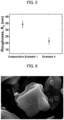
- FIG. 5 is a graph illustrating the distribution of surface roughness values measured on anodes according to Example 4 and Comparative Example 1.
- the anode of Example 4 has a low arithmetic average value of the surface roughness values measured therefrom as a whole, and a relatively narrow distribution. Accordingly, the anode may have a low standard deviation value of the surface roughness values, and a relatively constant roughness over the entire area of the surface thereof.
- the anode according to Comparative Example 1 has a high arithmetic average value of the surface roughness values measured therefrom as a whole, and a relatively wide distribution. Therefore, it could be confirmed that the deviation of the roughness values for each region of the anode surface was high, and the roughness uniformity of the anode was low.
- the standard deviation of the surface roughness values measured on the anode according to Example 4 was 2.3 nm, and the standard deviation of the surface roughness values measured on the anode according to Comparative Example 1 was 2.56 nm.
- anode active material sample was obtained from the anode active material layer.
- the obtained sample was added to 10 g of DI water (0.1% trifluoroacetic acid (TFA)) and subjected to ultrasonic extraction for 20 minutes, then the extracted solution was mixed for 12 hours and filtered through a syringe filter. HPLC analysis was performed on the sample filtered under the following HPLC analysis conditions to measure a content of the lithium salt-containing coating.
- DI water 0.1% trifluoroacetic acid (TFA)
- TFA trifluoroacetic acid
- FIG. 6 is an atomic force microscopy (AFM) image illustrating an upper surface of the anode according to Example 4
- FIG. 7 is an atomic force microscopy image illustrating an upper surface of the anode according to Comparative Example 1.
- the anode according to Example 4 exhibited that the arithmetic average roughness was 23 nm or less, and the upper surface of the anode was uniform.
- the anode according to Comparative Example 1 exhibited that the lithium salt-containing coating was not formed on both the anode active material and the anode active material layer, and the upper surface of the anode was non-uniform.
- Charging (CC/CV 0.5 C 4.2 V 0.05 C CUT-OFF) and discharging (CC 0.5 C 2.5 V CUT-OFF) were performed on the secondary batteries according to the examples and comparative examples to measure initial charge/discharge capacities (CC: Constant Current, CV: Constant Voltage).
- the initial efficiency was evaluated as a percentage of the value obtained by dividing the initial discharge capacity by the initial charge capacity.
- 300 cycles of charging/discharging were repeatedly performed on the secondary batteries according to the examples and comparative examples in a way of executing charging (CC/CV method, current rate 0.5 C, upper limit voltage 4.2 V, cut-off current 0.05 C) and discharging (CC, 0.5 C, lower limit voltage 2.5 V cut-off) at 25 °C was set to be one cycle. Thereafter, the capacity retention rate was evaluated as a percentage of the value obtained by dividing the discharge capacity at 300 cycles by the discharge capacity at one cycle.
- the secondary batteries of the examples which include the lithium salt-containing coatings, exhibited that the surface arithmetic average roughness of the anode was 25 nm or less, and the initial efficiency and capacity retention rate were improved.
- the secondary battery of Comparative Example 1 which does not include the lithium salt-containing coating, exhibited that the surface arithmetic average roughness value of the anode was greater than 25 nm, and the initial efficiency and capacity retention rate were decreased.
- the secondary batteries of Examples 7 to 9 exhibited that, since the lithium salt-containing coatings were formed on the surface of the anode active material and the surface of the anode active material layer, the performance of the secondary battery was improved as a whole.
Landscapes
- Chemical & Material Sciences (AREA)
- Chemical Kinetics & Catalysis (AREA)
- Electrochemistry (AREA)
- General Chemical & Material Sciences (AREA)
- Engineering & Computer Science (AREA)
- Manufacturing & Machinery (AREA)
- Composite Materials (AREA)
- Materials Engineering (AREA)
- Battery Electrode And Active Subsutance (AREA)
Abstract
Description
- The present disclosure relates to an electrode for a lithium secondary battery and a lithium secondary battery including the same. More specifically, the present invention relates to an electrode for a lithium secondary battery including an electrode active material, and a lithium secondary battery including the electrode.
- A secondary battery is a battery that can be repeatedly charged and discharged, and is widely applied to portable electronic communication devices such as camcorders, mobile phones, and laptop computers with the development of information communication and display industries. Examples of the secondary battery may include a lithium secondary battery, a nickel-cadmium battery, a nickel-hydrogen battery and the like. Among them, the lithium secondary battery has a high operating voltage and a high energy density per unit weight, and is advantageous in terms of a charging speed and light weight. In this regard, the lithium secondary battery has been actively developed and applied as a power source.
- The lithium secondary battery may include an electrode assembly including a cathode, an anode, and a separation membrane (separator), and an electrolyte immersing the electrode assembly. In addition, the lithium secondary battery may further include an outer case having, e.g., a pouch-shaped for accommodating the electrode assembly and the electrolyte are housed.
- For example, the electrode may include electrode active material particles capable of intercalating and deintercalating lithium ions. When repeatedly charging/discharging the secondary battery, mechanical and chemical damage such as crack of the particles may occur, and contact between the active material particles may be deteriorated and short circuit may occur.
- When changing the composition and structure of the electrode active material in order to improve stability of the active material particles, conductivity may be reduced to cause a decrease in an output of the secondary battery. Therefore, development of a secondary battery electrode capable of securing life-span stability and output/capacity characteristics is required.
- For example,
Korean Patent Laid-Open Publication No. 2017-0099748 - According to an aspect of the present disclosure, there is provided an electrode for a lithium secondary battery having improved electrical properties and stability.
- According to an aspect of the present disclosure, there is provided a lithium secondary battery including the electrode having improved electrical properties and stability.
- To achieve the above objects, according to an aspect of the present invention, there is provided an electrode for a lithium secondary battery including: an electrode current collector; an electrode active material layer which is disposed on at least one surface of the electrode current collector and includes electrode active material particles; and a lithium salt-containing coating which is formed on at least portions of surfaces of the electrode active material particles or at least a portion of a surface of the electrode active material layer, wherein the electrode has a surface arithmetic average roughness (Ra or Ra) represented by
Equation 1 below:

- Wherein, in
Equation 1, Ra is a value obtained by calculating an arithmetic average of surface roughness values measured in 20 or more measurement regions of the surface of the electrode for a lithium secondary battery using an atomic force microscopy in a scan range of 0.5 µm × 0.5 µm. - For example, the surface arithmetic average roughness (Ra) may be 0.1 to 25 nm.
- In some embodiments, a surface roughness value measured in each of the measurement regions may be an arithmetic average value of roughness values excluding a maximum value and a minimum value among the surface roughness values when the surface roughness value is measured 15 or more times in a scan range of 0.5 µm × 0.5 µm for each of the measurement regions.
- In some embodiments, a standard deviation of the surface roughness values measured in the measurement regions of the surface of the electrode for a lithium secondary battery may be 2.5 nm or less.
- In some embodiments, the lithium salt-containing coating may have a continuous film shape which covers the surfaces of the electrode active material particles or the surface of the electrode active material layer.
- In some embodiments, the lithium salt-containing coating may have a thickness of 1 nm to 1,000 nm.
- In some embodiments, the lithium salt-containing coating may include at least one of LiCl, LiF, Li3PO4, LiBO2, LiIO2, Li2CO3, Li2B4O7, Li2SO4, LiBr, LiI, LiNO3, Li(CF3CO2), Li((CH3)3SiO), Li(CH3O), LiCH2COO, Li(CO2CH3), (CH3)2CHOLi (lithium isopropoxide), CH3CH(OH)COOLi (lithium lactate), Li2S, LiOH, Li2O, Li2O2, CH3CH2OLi (lithium ethoxide), C6H5OLi (lithium phenoxide) and C7H5LiO2 (lithium benzoate).
- In some embodiments, a content of the lithium salt-containing coating measured by high performance liquid chromatography (HPLC) may be 20 ppm to 600 ppm based on a total weight of the electrode active material layer.
- In some embodiments, the lithium salt-containing coating may be formed on both the surfaces of the electrode active material particles and the surface of the electrode active material layer.
- In some embodiments, the lithium salt-containing coating may have a lithium ion conductivity of 1 × 10⁻⁷ S/cm or more and an electronic conductivity of 1 × 10⁻⁵ S/cm or less.
- In some embodiments, the electrode for a lithium secondary battery may be an anode or a cathode.
- According to another aspect of the present invention, there is provided a lithium secondary battery including: a cathode; and an anode disposed to face the cathode, wherein at least one of the cathode and the anode is the above-described electrode for a lithium secondary battery.
- In some embodiments, the lithium secondary battery may further include an electrolyte in which the cathode and the anode are impregnated, wherein the lithium salt-containing coating has a solubility of 1 g/L or less in the electrolyte.
- The electrode for a lithium secondary battery according to example embodiments may include a lithium salt-containing coating formed on the surface of an electrode active material or the surface of an electrode active material layer. Direct contact between the electrode active material and the electrolyte may be suppressed by the lithium salt-containing coating, and volume expansion and structural collapse of the electrode active material may be prevented.
- The electrode for a lithium secondary battery may have a predetermined surface arithmetic average roughness. Accordingly, a side reaction between the electrode active material and the electrolyte may be further suppressed. Thus, consumption of the electrolyte and irreversible capacity loss may be reduced, and rapid charging and cycle properties of the lithium secondary battery may be improved.
- The lithium salt-containing coating has high lithium ion conductivity and low electronic conductivity, thereby life-span characteristics and structural stability of the electrode active material may be improved even during repeated charging/discharging behaviors under severe high temperature/high humid conditions. Accordingly, durability and charge/discharge capacities of the lithium secondary battery may be improved without decreasing initial efficiency and high charging speed.
-
-
FIG. 1 is a schematic image illustrating an electrode active material having a lithium salt-containing coating according to example embodiments; -
FIG. 2 is a schematic cross-sectional view illustrating an electrode for a lithium secondary battery according to example embodiments; -
FIG. 3 is a schematic plan view illustrating a lithium secondary battery according to example embodiments; -
FIG. 4 is a schematic cross-sectional view illustrating an electrode assembly according to example embodiments; -
FIG. 5 is a graph illustrating the distribution of surface roughness values measured on anodes according to Example 4 and Comparative Example 1; -
FIG. 6 is an atomic force microscopy (AFM) image illustrating the surface of the electrode for a lithium secondary battery according to Example 4; and -
FIG. 7 is an atomic force microscopy (AFM) image illustrating the surface of the electrode for a lithium secondary battery according to Comparative Example 1. - According to embodiments of the present disclosures, an electrode for a lithium secondary battery including a lithium salt-containing coating and having a predetermined surface arithmetic average roughness value is provided.
- In addition, a lithium secondary battery including the above-described electrode for a lithium secondary battery is provided.
- Hereinafter, various features of the disclosed technology will be described in detail with reference to embodiments and the accompanying drawings.
- The electrode for a lithium secondary battery includes an electrode current collector and an electrode active material layer disposed on at least one surface of the electrode current collector and including electrode active material particles. A lithium salt-containing coating is formed on at least portions of surfaces of the electrode active material particles and/or at least a portion of a surface of the electrode active material layer.
- For example, the lithium salt-containing coating may be formed on at least a portion of the surface of the electrode active material. For example, the lithium salt-containing coating may be formed on at least a portion of the surface of the electrode active material layer. For example, the term "surface of the electrode active material layer" means the outside part or uppermost layer of the electrode active material layer which preferably faces the electrolyte in use.
- The lithium salt-containing coating is formed on the surface of the electrode active material and/or on the surface of the electrode active material layer, so that direct exposure of the electrode active material particles to an electrolyte may be prevented. Therefore, a side reaction between the electrode active material particles and the electrolyte may be suppressed thus to prevent irreversible decomposition of the electrolyte.
- The electrode for a lithium secondary battery has a surface arithmetic average roughness (Ra or Ra) represented by
Equation 1 below.

- In
Equation 1, the surface arithmetic average roughness (Ra) is obtained from surface roughness values measured on the surface of the electrode active material layer using an atomic force microscopy (AFM) in a scan range of 0.5 µm × 0.5 µm. For example, Ra measures the deviation of a surface from a mean height, i.e., Ra is the average, or arithmetic average of profile height deviations from the mean line. - The scan range of 0.5 µm × 0.5 µm may be a range of a portion of the surface of the electrode for a lithium secondary battery or a portion of the surface of the electrode active material particle designated in a surface direction of the electrode active material layer when observed the surface with the atomic force microscopy (AFM).
- The Ra of the electrode for a lithium secondary battery is an arithmetic average value of surface roughness values measured in predetermined regions of the surface of the electrode active material layer using the atomic force microscopy (AFM).
- In one embodiment, the Ra of the electrode for a lithium secondary battery may be obtained by measuring the surface roughness values of at least three regions of the electrode. For example, the surface arithmetic average roughness (Ra) may be obtained by selecting three or more regions of the surface of the electrode active material layer to measure surface roughness values in each region, and calculating an arithmetic average of the measured surface roughness values.
- In one embodiment, measuring the surface arithmetic average roughness (Ra) may be performed by arbitrary (randomly) designating 15 or more regions, 30 or more regions, 45 or more regions, 100 or more regions, or 100 to 1000 regions of the surface of the electrode active material layer. As the number of measurement regions is increased, accuracy and reliability of measurement may be more improved. An area of each measurement region may be in a size of about 20 µm × about 20 µm.
- In one embodiment, the surface roughness value of each of the measurement regions may be obtained by measuring roughness values in the measurement region multiple times in a scan range of 0.5 µm × 0.5 µm for each of the measurement regions, and calculating an arithmetic average of the measured roughness values.
- For example, the roughness value may be obtained from electrode active material particles present in each measurement region, and may mean a center line average roughness in a direction perpendicular to a surface of the measurement region.
- The roughness values in each measurement region may be measured in several directions for each measurement region. For example, the surface roughness value of the measurement region may be obtained by measuring roughness values in the measurement region in each of 15 or more directions and calculating an arithmetic average of the measured roughness values. For example, the roughness values of each measurement region may be measured 15 times or more, 30 times or more, or 50 to 200 times. The measurement direction in the measurement region may be randomly selected.
- In an embodiment, the surface roughness value of each measurement region may be obtained by calculating an arithmetic average of roughness values excluding a maximum value and a minimum value among the measured roughness values in consideration of measurement error and dispersion.
- As the electrode for a lithium secondary battery has a surface arithmetic average roughness value within the above range, a surface area of the electrode exposed to the electrolyte may be reduced, and a side reaction within the electrode may be suppressed thus to improve life-span characteristics.
- For example, when the surface roughness of the electrode active material and/or the electrode active material are/is high, the surface area exposed to the electrolyte may be increased due to an uneven structure. Accordingly, a side reaction between the electrolyte and the electrode active material may be increased, and structural collapse of the electrode active material and depletion of the electrolyte may occur due to repeated charging and discharging.
- The lithium salt-containing coating is formed on the surfaces of the electrode active material particles and/or the surface of the electrode active material layer, and the surface arithmetic average roughness of the electrode for a lithium secondary battery is adjusted within the above-described range, thereby a side reaction between the electrode active material and the electrolyte may be further suppressed.
- For example, as the surface area of the electrode active material is reduced, contact between the electrode active material and the electrolyte may be suppressed, and as the electronic conductivity is decreased by the lithium salt-containing coating, a side reaction with the electrolyte may be prevented. In addition, the surface arithmetic average roughness value may be easily adjusted by the lithium salt-containing coating.
- In some embodiments, the surface arithmetic average roughness of the electrode for a lithium secondary battery may be 0.001 to 25 nm, and for example, 0.1 to 25 nm or 0.1 to 21 nm. Within the above range, a stable solid electrolyte interface (SEI) layer may be easily formed on the surface of the electrode active material layer during initial driving, and reactivity between the electrode active material and the electrolyte may be further reduced. Accordingly, the life-span characteristics of the battery may be more improved by further preventing the collapse/reproduction of the SEI layer and the consumption of the electrolyte due to the same during repeated charging and discharging.
- In some embodiments, a standard deviation of the surface roughness values measured in the measurement regions of the surface of the electrode for a lithium secondary battery may be 2.5 nm or less. For example, the standard deviation may be less than 2.5 nm, 2.3 nm or less, or 2.0 nm or less.
- The standard deviation may be an index representing uniformity of the roughness of the surface of the electrode for a lithium secondary battery. For example, as the surface roughness values measured in an arbitrary region of the surface of an electrode for a lithium secondary battery have a low standard deviation or a narrow distribution, a roughness deviation between local regions may be reduced.
- For example, as the above-described standard deviation is increased, a portion of the region of the electrode surface may have relatively high roughness. Therefore, since a reaction between the electrode active material and the electrolyte can be concentrated in the corresponding region, such that structural stability of the electrode and life-span characteristics of the electrode active material may be relatively decreased.
- According to example embodiments, as both the arithmetic average value (Ra) and the standard deviation of the surface roughness values measured from the surface of the electrode for a lithium secondary battery have a low value, the surface of the electrode may have a low and uniform roughness as a whole. Accordingly, the stability and life-span characteristics of the lithium secondary battery may be further improved.
- In some embodiments, the lithium salt-containing coating may cover at least a portion of the surface of the electrode active material and/or at least a portion of the surface of the electrode active material layer. For example, the lithium salt-containing coating may have a continuous film shape which covers a part or all of the surface of the electrode active material and/or the surface of the electrode active material layer.
-
FIG. 1 is a schematic cross-sectional view illustrating an electrode active material included in the electrode for a lithium secondary battery according to example embodiments. - Referring to
FIG. 1 , the electrode for a lithium secondary battery may include an electrodeactive material particle 10 and a lithium salt-containingcoating 12 which surrounds the surface of the electrodeactive material particle 10. - As the lithium salt-containing
coating 12 is formed on the surface of the electrodeactive material particle 10, direct contact between the electrodeactive material particle 10 and the electrolyte may be prevented, and mechanical/thermal shocks from an outside may be alleviated. Therefore, structural defect and damage to the electrodeactive material particles 10 may be prevented. - For example, the lithium salt-containing
coating 12 may be formed by a wet coating method. For example, the lithium salt-containingcoating 12 may be formed on the surfaces of the electrodeactive material particles 10 by mixing and stirring a mixed solution containing a lithium salt and an organic solvent with the electrodeactive material particles 10, followed by drying the mixture to evaporate the organic solvent. A heat treatment step may be additionally performed after the drying. -
FIG. 2 is a schematic cross-sectional view illustrating an electrode for a lithium secondary battery according to example embodiments. - Referring to
FIG. 2 , anelectrode 20 for a lithium secondary battery may include an electrodecurrent collector 22, an electrodeactive material layer 24 formed on at least one surface of the electrodecurrent collector 22, and a lithium salt-containingcoating 26 which covers at least a portion of the surface of the electrodeactive material layer 24. - In some embodiments, the electrode
active material layer 24 may be formed on both surfaces of the electrodecurrent collector 22. For example, the electrodeactive material layer 24 may be coated on upper and lower surfaces of the electrodecurrent collector 22, respectively. The electrodeactive material layer 24 may be directly coated on the surface of the electrodecurrent collector 22. - The lithium salt-containing
coating 26 may be formed to cover the electrodeactive material layer 24. For example, the lithium salt-containingcoating 26 may be formed by a wet coating method. - In one embodiment, the lithium salt-containing
coating 26 may be formed by applying the mixed solution containing a lithium salt and an organic solvent to the electrodeactive material layer 24, followed by drying the mixture. A heat treatment step may be additionally performed after the drying. - In one embodiment, the lithium salt-containing
coating 26 may be formed on the electrodeactive material layer 24 by immersing the electrodeactive material layer 24 in a solution in which lithium salts are dissolved, then taking out the electrodeactive material layer 24 and drying. A heat treatment step may be additionally performed after the drying. - In some embodiments, the lithium salt-containing coating may have a thickness of 1 to 1,000 nm, and for example, 1 to 500 nm. In some embodiments, the lithium salt-containing coating on the electrode active material particles may have a thickness of 1 to 1,000 nm, and for example, 1 to 500 nm or 10 to 500 nm and/or the lithium salt-containing coating on the electrode active material layer may have a thickness of 1 to 1,000 nm, and for example, 1 to 500 nm or 10 to 500 nm.
- Within the above ranges, depletion of the electrolyte and oxidation/reduction of the electrode active material due to the contact between the electrode active material and the electrolyte may be more suppressed. In addition, as a lithium movement path in the lithium salt-containing coating is shortened, ionic conductivity may be improved, and the lithium secondary battery may have higher initial efficiency and charge/discharge capacities.
- For example, if the thickness of the lithium salt-containing coating is less than 1 nm, it may be relatively difficult to block permeation of the electrolyte due to the thin coating, and a side reaction between the electrode active material and the electrolyte cannot be effectively suppressed. If the thickness of the lithium salt-containing coating is greater than 1,000 nm, resistance may be relatively increased due to the thickly formed coating, and initial efficiency and performance of the lithium secondary battery may be relatively decreased.
- In some embodiments, the lithium salt-containing coatings may be formed on both the surfaces of the electrode active material particles and the surface of the electrode active material layer. For example, the lithium salt-containing coating may include a first lithium salt-containing coating which covers the surfaces of the electrode active material particles and a second lithium salt-containing coating which covers the surface of the electrode active material layer.
- As the lithium salt-containing coatings are formed on both the surfaces of the electrode active material particles and the surface of the electrode active material layer, penetration of the electrolyte into the electrode active material particles is doubly blocked, thereby further improving life-span characteristics. In addition, since high ion conductivity may be secured, output characteristics and charge/discharge capacities may be further improved.
- In some embodiments, a part of the lithium salt-containing coating may be individually distributed and disposed in an island shape on the surface of the electrode active material and/or the surface of the electrode active material layer.
- In one embodiment, the lithium salt-containing coating may be disposed in an area of 90% or more of the surface of the electrode active material and/or an area of 90% or more of the surface of the electrode active material layer, and for example, may be disposed in an area of 95% or more, or 99% or more. Accordingly, deterioration of the electrode active material due to the external environment and charging/discharging may be prevented while maintaining high lithium ion conductivity, and thus initial efficiency and capacity retention rate may be further improved.
- In some embodiments, the lithium salt-containing coating may include a lithium salt having low solubility and swelling characteristics in an organic solvent. Accordingly, the lithium salt-containing coating may have low reactivity to the electrolyte, high insulation properties, and improved mechanical/chemical stabilities.
- For example, since the lithium salt has low electronic conductivity and high stability even under severe high temperature/high humid conditions, a side reaction between the electrode active material and the electrolyte may be suppressed. Therefore, oxidation/reduction of the electrode active material by the electrolyte may be prevented, and structural collapse and crack of the electrode active material due to driving at high temperature/high voltage and external physical impact may be prevented.
- The lithium salt may improve a rate of intercalation and deintercalation of lithium ions, and thus, irreversible reaction and capacity loss due to overvoltage occurring during high speed charging may be prevented. In addition, while initial efficiency and high speed charging characteristics are improved due to high lithium ion conductivity and low reactivity to the electrolyte, capacity retention rate and cycle characteristics may be improved.
- For example, the lithium salt-containing coating may include LiCl, LiF, Li3PO4, LiBO2, LiIO2, Li2CO3, Li2B4O7, Li2SO4, LiBr, LiI, LiNO3, Li(CF3CO2), Li((CH3)3SiO), Li(CH3O), LiCH2COO, Li(CO2CH3), (CH3)2CHOLi (lithium isopropoxide), CH3CH(OH)COOLi (lithium lactate), Li2S, LiOH, Li2O, Li2O2, CH3CH2OLi (lithium ethoxide), C6H5OLi (lithium phenoxide), C7H5LiO2 (lithium benzoate) and the like. These may be used alone or in combination of two or more thereof.
- In one embodiment, the lithium salt-containing coating may include C7H5LiO2 (lithium benzoate). C7H5LiO2 has low reactivity to the electrolyte or organic solvent and has a high transport capacity for lithium ions, such that the charging characteristics and life-span characteristics of the lithium secondary battery may be further improved.
- In some embodiments, the lithium salt-containing coating may consist of a lithium salt. For example, the lithium salt-containing coating may not include a polymeric component or a polymer such as a binder resin. In this case, a decrease in the lithium ion conductivity and an increase in the resistance due to other components (e.g., the polymeric component or polymer) may be prevented, and electrochemical characteristics of the lithium secondary battery may be further improved.
- In some embodiments, a content of the lithium salt-containing coating may be 20 ppm or more based on a total weight of the electrode active material layer. The content of the lithium salt-containing coating may be measured through high performance liquid chromatography (HPLC) analysis.
- For example, a ratio of the lithium salt-containing coating to the electrode active material may be calculated by analyzing a peak area (e.g., peak area %) of the lithium salt compound measured through an HPLC analysis graph.
- If the content of the lithium salt-containing coating measured by HPLC peak area is less than 20 ppm, the lithium salt-containing coating may not be substantially present on the surface of the electrode active material or the surface of the electrode active material layer. For example, a peak area of less than 20 ppm may be a value measured from a by-product produced from the electrolyte or a cathode.
- In one embodiment, the content of the lithium salt-containing coating measured by HPLC may be about 20 to 600 ppm, 50 to 600 ppm, or 100 to 450 ppm based on the total weight of the electrode active material layer. The above-described range may be a content measured after a formation process or initial charging and discharging of the lithium secondary battery. For example, the content of the lithium salt-containing coating measured after fully charging and discharging the lithium secondary battery may be 20 to 600 ppm.
- Within the above range, a coating coverage rate of the electrode active material or the electrode active material layer may be increased while further suppressing an increase in the resistance due to the lithium salt-containing coating.
- For example, when the content of the lithium salt-containing coating included in the electrode measured after initial charging and discharging is greater than 600 ppm based on the total weight of the electrode active material layer, the capacity and energy density of the lithium secondary battery may be relatively reduced.
- In some embodiments, the content of the lithium salt-containing coating measured before the formation process of the lithium secondary battery or before initial charging and discharging may be 0.005 to 10 parts by weight ("wt. parts") based on 100 wt. parts of the electrode active material layer, and for example, may be 0.01 to 5 wt. parts.
- For example, if the content of the lithium salt-containing coating measured before the formation process is less than 0.005 wt. parts, the coating coverage rate may be decreased due to the decomposition of the lithium salt-containing coating that occurs during an initial charging and discharging process, and life-span characteristics and stability of the electrode for a lithium secondary battery may be relatively decreased.
- For example, if the content of the lithium salt-containing coating measured before the formation process is greater than 10 wt. parts, a thick film may be formed on the electrode active material during the initial charging and discharging process, thereby causing an increase in the internal resistance, and a relative decrease in the electrochemical performance.
- In one embodiment, the content of the lithium salt-containing coating in the electrode active material layer may be measured through high performance liquid chromatography (HPLC) analysis. For example, 0.5 g of an electrode active material sample, which is obtained from the electrode active material layer and has a lithium salt-containing coating formed thereon, may be added to 10 g of DI water (0.1% trifluoroacetic acid (TFA)), then subjected to ultrasonic extraction for 20 minutes. Thereafter, the sample may be pretreated by mixing the extracted solution for 12 hours and filtering the mixture with a syringe filter (Whatman, 67502502). Then, a content of the lithium salt-containing coating may be measured by performing HPLC analysis on the pretreated sample under the following analysis conditions. Specific compounds corresponding to each peak in the HPLC graph may be analyzed through an MS detector.
-
- i) Device: Agilent HPLC 1200 Module
- ii) Column: Agilent C18, 5 µm, 150*4.6 mm
- iii) Column heater temperature: 30 °C
- iv) Eluent: Water (0.1% trifluoroacetic acid) : acetonitrile = 9:1
- v) Wavelength: 230 nm
- vi) Flow rate: 1.0 ml/min
- vii) Injection amount: 30 µl
- viii) MS detector: Thermo Scientific, LTQ XL
- In some embodiments, the lithium salt-containing coating may have a form of a solid electrolyte having high lithium ion conductivity and low electronic conductivity. For example, the lithium salt-containing coating may have a lithium ion conductivity of 1 × 10⁻⁷ S/cm or more and an electronic conductivity of 1 × 10⁻⁵ S/cm or less. For example, the lithium ion conductivity and electronic conductivity may be calculated by measuring a resistance with electrochemical impedance spectroscopy (EIS) and then converting it into a thickness and an area of the lithium salt-containing coating.
- In one embodiment, the lithium ion conductivity of the lithium salt-containing coating may be 1 × 10⁻⁷ S/cm to 1 × 10⁻² S/cm, and for example, 1 × 10⁻⁶ S/cm to 1 × 10⁻² S/cm. As the lithium salt-containing coating has high lithium ion conductivity, an increase in the resistance in the coating layer may be suppressed, and thus life-span characteristics, initial efficiency, and stability of the secondary battery may be further improved.
- In one embodiment, the electronic conductivity of the lithium salt-containing coating may be 1 × 10⁻⁹ S/cm or less, and for example, 1 × 10⁻¹⁰ S/cm or less. As the lithium salt-containing coating has the above-described low electronic conductivity, oxidation/reduction or side reaction of the electrode active material may be prevented, and cycle characteristics and operation stability of the lithium secondary battery may be further improved.
- In some embodiments, the electrode for a lithium secondary battery may be a cathode including a cathode active material. For example, the electrode current collector may be a cathode current collector, and the electrode active material layer may be a cathode active material layer.
- In some embodiments, the electrode for a lithium secondary battery may be an anode including an anode active material. For example, the electrode current collector may be an anode current collector, and the electrode active material layer may be an anode active material layer.
- In some embodiments, the cathode active material may include a lithium metal oxide, for example, a lithium (Li)-nickel (Ni) oxide or a lithium iron phosphate compound (LFePO4). For example, the lithium (Li)-nickel (Ni) oxide included in the cathode active material layer may be represented by
Formula 1 below.

- In
Formula 1, a, x and y may be in a range of -0.05≤a≤0.15, 0≤x≤1, 0≤y≤1, 0≤x+y≤1, respectively, and M may be one or more elements selected from the group consisting of Mg, Sr, Ba, B, Al, Si, Mn, Ti, Zr and W. In one embodiment, x and y may be in a range of 0.01≤x≤02, 0.01≤y≤02, respectively. - In one embodiment, in
Formula 1, M may be manganese (Mn). In this case, nickel-cobalt-manganese (NCM) lithium oxide may be used as the cathode active material. - In some embodiments, the anode active material may include carbon-based materials such as crystalline carbon, amorphous carbon, carbon composite, carbon fiber, etc.; a lithium alloy; silicon or tin.
- Examples of the amorphous carbon may include hard carbon, cokes, mesocarbon microbead (MCMB), mesophase pitch-based carbon fiber (MPCF) or the like.
- Examples of the crystalline carbon may include graphite-based carbon such as natural graphite, graphite cokes, graphite MCMB, graphite MPCF or the like. As an element included in the lithium alloy, Al, Zn, Bi, Cd, At, Si, Pb, Sn, Ga or In may be used.
- A lithium secondary battery includes a cathode and an anode disposed to face the cathode, and the electrode for a lithium secondary battery including a lithium salt-containing coating is at least one of the cathode and the anode. For example, the lithium salt-containing coating may be included in the cathode, or included in the anode. For example, the lithium salt-containing coating may be included in both the cathode and the anode.
-
FIGS. 3 and 4 are a schematic plan view and a cross-sectional view illustrating the secondary battery according to example embodiments, respectively. For example,FIG. 4 is a cross-sectional view taken on line I-I' shown inFIG. 3 . - Referring to
FIGS. 3 and 4 , the secondary battery may include anelectrode assembly 150 and acase 160 in which theelectrode assembly 150 is housed. Theelectrode assembly 150 may include acathode 100, ananode 130 and aseparation membrane 140. - The
cathode 100 may include a cathodecurrent collector 105 and a cathodeactive material layer 110 formed on at least one surface of the cathodecurrent collector 105. In one embodiment, the above-described lithium salt-containing coating may be formed on at least a portion of the surface of the cathodeactive material layer 110. - In some embodiments, the cathode
active material layer 110 may be formed on both surfaces (e.g., upper and lower surfaces) of the cathodecurrent collector 105. For example, the cathodeactive material layer 110 may be coated on the upper and lower surfaces of the cathodecurrent collector 105, respectively, or may be directly coated on the surface of the cathodecurrent collector 105. - The cathode
current collector 105 may include, for example, stainless steel, nickel, aluminum, titanium, copper, or an alloy thereof, and preferably includes aluminum or an aluminum alloy. - In some embodiments, in the case of the cathode
active material layer 110, a cathode slurry may be coated on the cathodecurrent collector 105, followed by compressing and drying to form the cathodeactive material layer 110. For example, the cathode slurry may be prepared by mixing the cathode active material with a binder, a conductive material and/or a dispersant in a solvent, followed by stirring the same. In some embodiments, the above-described lithium salt-containing coating may be formed on at least a portion of the surface of the cathode active material. - The binder may include, for example, an organic binder such as vinylidene fluoride-hexafluoropropylene copolymer (PVDF-co-HFP), polyvinylidene fluoride (PVDF), polyacrylonitrile, polymethyl methacrylate, etc., or an aqueous binder such as styrene-butadiene rubber (SBR), and may be used together with a thickener such as carboxymethyl cellulose (CMC).
- For example, a PVDF-based binder may be used as a binder for forming the cathode. In this case, an amount of the binder for forming the cathode
active material layer 110 may be reduced and an amount of the cathode active material or lithium metal oxide particles may be relatively increased. Thereby, the output and capacity of the secondary battery may be further improved. - The conductive material may be included to facilitate electron transfer between the active material particles. For example, the conductive material may include a carbon-based conductive material such as graphite, carbon black, graphene, or carbon nanotubes and/or a metal-based conductive material such as tin, tin oxide, titanium oxide, or a perovskite material such as LaSrCoO3, and LaSrMnO3, etc.
- In some embodiments, the
cathode 100 may have an electrode density of 3.0 to 3.9 g/cc, and for example, 3.2 to 3.8 g/cc. - The
anode 130 may include an anodecurrent collector 125 and an anodeactive material layer 120 formed on at least one surface of the anodecurrent collector 125. In some embodiments, the lithium salt-containing coating may be formed on at least a portion of the surface of the anodeactive material layer 120. - In some embodiments, the anode
active material layer 120 may be formed on both surfaces (e.g., upper and lower surfaces) of the anodecurrent collector 125. The anodeactive material layer 120 may be coated on the upper and lower surfaces of the anodecurrent collector 125, respectively, and may be in direct contact with the surface of the anodecurrent collector 125. - The anode
current collector 125 may include gold, stainless steel, nickel, aluminum, titanium, copper or an alloy thereof, and preferably includes copper or a copper alloy. - In some embodiments, in the case of the anode
active material layer 120, an anode slurry may be applied (coated) to the anodecurrent collector 125, followed by compressing and drying to form the anodeactive material layer 120. For example, the anode slurry may be prepared by mixing the anode active material with a binder, a conductive material and/or a dispersant in a solvent, followed by stirring the same. In some embodiments, the above-described lithium salt-containing coating may be formed on at least a portion of the surface of the anode active material. - Materials substantially the same as or similar to those used for forming the
cathode 100 may be used as the binder and the conductive material. In some embodiments, the binder for forming theanode 130 may include, for example, styrene-butadiene rubber (SBR) or an acrylic binder for consistency with the graphite-based active material, and may be used together with a thickener such as carboxymethyl cellulose (CMC). - In some embodiments, the anode
active material layer 120 may have a density of 1.4 to 1.9 g/cc. - In some embodiments, the
anode 130 may have an area (e.g., a contact area with the separation membrane 140) and/or volume larger than those/that of thecathode 100. Thereby, lithium ions generated from thecathode 100 may smoothly move to theanode 130 without being precipitated in the middle, such that output and capacity characteristics may be further improved. - The
separation membrane 140 may be interposed between thecathode 100 and theanode 130. Theseparation membrane 140 may include a porous polymer film made of a polyolefin polymer such as ethylene homopolymer, propylene homopolymer, ethylene/butene copolymer, ethylene/hexene copolymer, ethylene/methacrylate copolymer. The separation membrane may include a nonwoven fabric made of glass fiber having a high melting point, polyethylene terephthalate fiber or the like. - The
separation membrane 140 may extend between thecathode 100 and theanode 130, and may be folded and wound in a thickness direction of the lithium secondary battery. Accordingly, a plurality ofcathodes 100 andanodes 130 may be laminated in the thickness direction with theseparation membrane 140 interposed therebetween. - In some embodiments, an electrode cell is defined by the
cathode 100, theanode 130, and theseparation membrane 140, and a plurality of electrode cells are laminated to form, for example, a jelly rolltype electrode assembly 150. For example, theelectrode assembly 150 may be formed by winding, lamination, folding, or the like of theseparation membrane 140. - The
electrode assembly 150 is housed in thecase 160, and an electrolyte may be injected into thecase 160 together. Thecase 160 may include, for example, a pouch, a can, or the like in shape. - In some embodiments, a non-aqueous electrolyte may be used as the electrolyte.
- The non-aqueous electrolyte includes a lithium salt of an electrolyte and an organic solvent, the lithium salt is represented by, for example, Li+X-, and as an anion (X-) of the lithium salt, F-, Cl-, Br-, I-, NO3 -, N(CN)2 -, BF4 -, ClO4 -, PF6 -, (CF3)2PF4 -, (CF3)3PF3 -, (CF3)4PF2 -, (CF3)5PF-, (CF3)6P-, CF3SO3 -, CF3CF2SO3 -, (CF3SO2)2N-, (FSO2)2N-, CF3CF2(CF3)2CO-, (CF3SO2)2CH-, (SF5)3C-, (CF3SO2)3C-, CF3(CF2)7SO3 -, CF3CO2 -, CH3CO2 -, SCN- and (CF3CF2SO2)2N-, etc. may be exemplified.
- As the organic solvent, for example, propylene carbonate (PC), ethylene carbonate (EC), diethyl carbonate (DEC), dimethyl carbonate (DMC), ethylmethyl carbonate (EMC), methylpropyl carbonate, dipropyl carbonate, dimethyl sulfoxide (DMSO), acetonitrile, dimethoxyethane, diethoxyethane, vinylene carbonate, sulforane, γ-butyrolactone, propylene sulfite, tetrahydrofurane, and the like may be used. These compounds may be used alone or in combination of two or more thereof.
- In some embodiments, the lithium salt-containing coating in the electrolyte may have a solubility of 1 g/L or less, and preferably 0.1 g/L or less. For example, the lithium salt-containing coating may have the above-described low solubility in the organic solvent included in the electrolyte.
- Accordingly, the lithium salt-containing coating may have improved chemical stability, and low reactivity to the electrolyte, such that deterioration of the electrode active material layer by the electrolyte may be suppressed. Accordingly, a lithium secondary battery having an improved capacity retention rate and high efficiency even during repeated charging/discharging behaviors may be provided.
- As shown in
FIG. 3 , electrode tabs (a cathode tab and an anode tab) may protrude from the cathodecurrent collector 105 and the anodecurrent collector 125, respectively, which belong to each electrode cell, and may extend to one side of thecase 160. The electrode tabs may be fused together with the one side of thecase 160 to form electrode leads (acathode lead 107 and an anode lead 127) extending or exposed to an outside of thecase 160. -
FIG. 3 illustrates that thecathode lead 107 and theanode lead 127 are formed on the same side of the lithium secondary battery of thecase 160, but these electrode leads may be formed on sides opposite to each other. - For example, the
cathode lead 107 may be formed on one side of thecase 160, and theanode lead 127 may be formed on the other side of thecase 160. - The lithium secondary battery may be manufactured, for example, in a cylindrical shape using a can, a square shape, a pouch type or a coin shape.
- Hereinafter, experimental examples including specific examples and comparative examples are proposed to facilitate understanding of the present invention.
- 100 g of artificial graphite (D50: 10 µm) was prepared as an anode active material.
- Thereafter, a process of forming a lithium salt-containing coating on the electrode active material particles was performed (see also
Fig. 1 ). Specifically, a coating solution, in which 5 wt.% of lithium benzoate (C7H5LiO2) was dissolved in a mixed solvent of water and ethanol, was put into a vacuum planetary mixer (Kurabo mixer manufactured by KURABO), and the prepared anode active material was added, followed by mixing at a stirring speed of 20 Hz for 2 hours. Then, the mixture was dried for 24 hours in a vacuum state and at a temperature of 60°C to form a lithium salt-containing coating having a thickness shown in Table 1, 2nd column, below. - In Table 1, 2nd column, below, "O" denotes an anode active material in which the lithium salt-containing coating is formed. "X" denotes an anode active material in which the lithium salt-containing coating is not formed. The anode active material, in which the lithium salt-containing coating is not formed, was prepared in the same manner except for omitting the process of forming a lithium salt-containing coating on the electrode active material particles.
- A composition for an anode was prepared by mixing the prepared anode active material, conductive material (carbon black), binder (SBR), and thickener (CMC) in a ratio of 94:3:1.5:1.2. The prepared composition for an anode was applied to a Cu foil, dried and rolled to prepare an anode active material layer having a slurry density of 10 mg/cm2 and 1.7 g/cc.
- Thereafter, a process of forming a lithium salt-containing coating was performed (see also
Fig. 2 ). Specifically, a coating solution, in which 5 wt.% of lithium benzoate (C7H5LiO2) was dissolved in a mixed solvent of water and ethanol, was applied to the anode active material layer, and then dried in a convection oven under a temperature condition of 60°C for 24 hours to form a lithium salt-containing coating having a thickness listed in Table 1, 4th column, below. - A coin cell type secondary battery was manufactured using an Li foil as a counter electrode and an electrolyte containing 1 M LiPF6 in a mixed solvent of ethyl carbonate (EC) and ethylmethyl carbonate (EMC) (EC:EMC = 3:7).
- In Table 1, 4th column, below, "O" denotes an anode active material layer in which the lithium salt-containing coating is formed. "X" denotes an anode active material layer in which a lithium salt-containing coating is not formed. The anode active material layer, in which a lithium salt-containing coating is not formed, was prepared in the same manner except for omitting the process of forming a lithium salt-containing coating on the anode active material layer.
- 50 or more arbitrary regions of an upper surface of the prepared anode were designated and the roughness (i.e., center line average roughness) in each region was measured 15 times using an atomic force microscopy (Icon, Bruker Co.) under a condition of an XY scan range of 0.5 µm × 0.5 µm. The surface roughness value in each region was calculated as an arithmetic average value of values excluding the maximum and minimum values among the measured values.
- Thereafter, the Ra value of the anode was calculated as the arithmetic average value of the surface roughness values of each region.
-
FIG. 5 is a graph illustrating the distribution of surface roughness values measured on anodes according to Example 4 and Comparative Example 1. - Referring to
FIG. 5 , the anode of Example 4 has a low arithmetic average value of the surface roughness values measured therefrom as a whole, and a relatively narrow distribution. Accordingly, the anode may have a low standard deviation value of the surface roughness values, and a relatively constant roughness over the entire area of the surface thereof. - However, the anode according to Comparative Example 1 has a high arithmetic average value of the surface roughness values measured therefrom as a whole, and a relatively wide distribution. Therefore, it could be confirmed that the deviation of the roughness values for each region of the anode surface was high, and the roughness uniformity of the anode was low.
- The standard deviation of the surface roughness values measured on the anode according to Example 4 was 2.3 nm, and the standard deviation of the surface roughness values measured on the anode according to Comparative Example 1 was 2.56 nm.
- After performing charging (CC / CV 0.5 C 4.2 V 0.05 C CUT-OFF) and discharging (CC 0.5 C 2.5 V CUT-OFF) on the prepared secondary battery, 0.5 g of an anode active material sample was obtained from the anode active material layer.
- The obtained sample was added to 10 g of DI water (0.1% trifluoroacetic acid (TFA)) and subjected to ultrasonic extraction for 20 minutes, then the extracted solution was mixed for 12 hours and filtered through a syringe filter. HPLC analysis was performed on the sample filtered under the following HPLC analysis conditions to measure a content of the lithium salt-containing coating.
-
- i) Device: Agilent HPLC 1200 Module
- ii) Column: Agilent C18, 5 µm, 150*4.6 mm
- iii) Column heater temperature: 30 °C
- iv) Eluent: Water (0.1% trifluoroacetic acid) : acetonitrile = 9:1
- v) Wavelength: 230 nm
- vi) Flow rate: 1.0ml/min
- vii) Injection volume: 30 µl
- viii) MS detector: Thermo Scientific, LTQ XL
-
FIG. 6 is an atomic force microscopy (AFM) image illustrating an upper surface of the anode according to Example 4, andFIG. 7 is an atomic force microscopy image illustrating an upper surface of the anode according to Comparative Example 1. - Referring to
FIGs. 5 and 6 , the anode according to Example 4 exhibited that the arithmetic average roughness was 23 nm or less, and the upper surface of the anode was uniform. - Referring to
FIG. 7 , the anode according to Comparative Example 1 exhibited that the lithium salt-containing coating was not formed on both the anode active material and the anode active material layer, and the upper surface of the anode was non-uniform. - Charging (CC/CV 0.5 C 4.2 V 0.05 C CUT-OFF) and discharging (CC 0.5 C 2.5 V CUT-OFF) were performed on the secondary batteries according to the examples and comparative examples to measure initial charge/discharge capacities (CC: Constant Current, CV: Constant Voltage). The initial efficiency was evaluated as a percentage of the value obtained by dividing the initial discharge capacity by the initial charge capacity.
- 300 cycles of charging/discharging were repeatedly performed on the secondary batteries according to the examples and comparative examples in a way of executing charging (CC/CV method, current rate 0.5 C, upper limit voltage 4.2 V, cut-off current 0.05 C) and discharging (CC, 0.5 C, lower limit voltage 2.5 V cut-off) at 25 °C was set to be one cycle. Thereafter, the capacity retention rate was evaluated as a percentage of the value obtained by dividing the discharge capacity at 300 cycles by the discharge capacity at one cycle.
- Evaluation results are shown in Table 2 below.
[TABLE 2] Item Initial efficiency (%) Capacity retention rate (%) (@300 cycle) Example 1 95.8 93.1 Example 2 95.6 93.1 Example 3 95.4 92.9 Example 4 95.0 93.3 Example 5 95.7 92.9 Example 6 95.5 92.6 Example 7 95.6 92.8 Example 8 95.4 92.7 Example 9 96.8 95.8 Comparative Example 1 92.3 89.1 Comparative Example 2 93.3 90.1 Comparative Example 3 92.8 89.5 - Referring to Table 2, the secondary batteries of the examples, which include the lithium salt-containing coatings, exhibited that the surface arithmetic average roughness of the anode was 25 nm or less, and the initial efficiency and capacity retention rate were improved.
- On the other hand, the secondary battery of Comparative Example 1, which does not include the lithium salt-containing coating, exhibited that the surface arithmetic average roughness value of the anode was greater than 25 nm, and the initial efficiency and capacity retention rate were decreased.
- In addition, the secondary batteries of Comparative Examples 2 and 3 exhibited that the surface roughness values were high, and the initial efficiency and cycle characteristics were decreased.
- Meanwhile, the secondary batteries of Examples 7 to 9 exhibited that, since the lithium salt-containing coatings were formed on the surface of the anode active material and the surface of the anode active material layer, the performance of the secondary battery was improved as a whole.
| Anode active material | Anode active material layer | Coating content (ppm) | Arithmetic average roughness (nm) | |||
| Whether coating formed | Coating thickness (nm) | Whether coating formed | Coating thickness (nm) | |||
| Example 1 | X | - | ○ | 100 | 80 | 19 |
| Example 2 | X | - | ○ | 400 | 180 | 15 |
| Example 3 | X | - | ○ | 1200 | 350 | 10 |
| Example 4 | ○ | 50 | |
30 | 23 | |
| Example 5 | ○ | 350 | X | 170 | 15 | |
| Example 6 | ○ | 1100 | X | 300 | 8 | |
| Example 7 | ○ | 50 | ○ | 100 | 50 | 14 |
| Example 8 | ○ | 100 | ○ | 50 | 100 | 10 |
| Example 9 | ○ | 100 | ○ | 100 | 150 | 7 |
| Comparative Example 1 | X | - | X | - | 0 | 35 |
| Comparative Example 2 | ○ | 2000 | X | - | 1500 | 52 |
| Comparative Example 3 | X | - | ○ | 3000 | 2000 | 48 |
Claims (13)
- An electrode for a lithium secondary battery comprising:an electrode current collector;an electrode active material layer disposed on at least one surface of the electrode current collector and including electrode active material particles; anda lithium salt-containing coating formed on at least portions of surfaces of the electrode active material particles and/or on at least a portion of a surface of the electrode active material layer,wherein the electrode has a surface arithmetic average roughness (Ra) represented by Equation 1:
 wherein, in Equation 1, Ra is a value obtained by calculating an arithmetic average of surface roughness values measured in 20 or more measurement regions of the surface of the electrode using an atomic force microscopy in a scan range of 0.5 µm × 0.5 µm.
 - The electrode for a lithium secondary battery according to claim 1, wherein the surface arithmetic average roughness (Ra) is from 0.1 nm to 25 nm.
- The electrode for a lithium secondary battery according to any one of claims 1 and 2, wherein a surface roughness value measured in each of the measurement regions is an arithmetic average value of roughness values excluding a maximum value and a minimum value among the surface roughness values when the surface roughness value is measured 15 or more times in a scan range of 0.5 µm × 0.5 µm for each of the measurement regions.
- The electrode for a lithium secondary battery according to any one of claims 1 to 3, wherein a standard deviation of the surface roughness values measured in the measurement regions of the surface of the electrode is 2.5 nm or less.
- The electrode for a lithium secondary battery according to any one of claims 1 to 4, wherein the lithium salt-containing coating has a continuous film shape which partially or completely covers the surfaces of the electrode active material particles and/or the surface of the electrode active material layer.
- The electrode for a lithium secondary battery according to any one of claims 1 to 5, wherein the lithium salt-containing coating has a thickness of 1 nm to 1,000 nm.
- The electrode for a lithium secondary battery according to any one of claims 1 to 6, wherein the lithium salt-containing coating includes at least one of LiCl, LiF, Li3PO4, LiBO2, LiIO2, Li2CO3, Li2B4O7, Li2SO4, LiBr, LiI, LiNO3, Li(CF3CO2), Li((CH3)3SiO), Li(CH3O), LiCH2COO, Li(CO2CH3), (CH3)2CHOLi (lithium isopropoxide), CH3CH(OH)COOLi (lithium lactate), Li2S, LiOH, Li2O, Li2O2, CH3CH2OLi (lithium ethoxide), C6H5OLi (lithium phenoxide) and C7H5LiO2 (lithium benzoate).
- The electrode for a lithium secondary battery according to any one of claims 1 to 7, wherein a content of the lithium salt-containing coating measured by high performance liquid chromatography (HPLC) is 20 ppm to 600 ppm based on a total weight of the electrode active material layer.
- The electrode for a lithium secondary battery according to any one of claims 1 to 8, wherein the lithium salt-containing coating is formed on both the surfaces of the electrode active material particles and the surface of the electrode active material layer.
- The electrode for a lithium secondary battery according to any one of claims 1 to 9, wherein the lithium salt-containing coating has a lithium ion conductivity of 1 × 10⁻⁷ S/cm or more and an electronic conductivity of 1 × 10⁻⁵ S/cm or less.
- The electrode for a lithium secondary battery according to any one of claims 1 to 10, wherein the electrode is an anode or a cathode.
- A lithium secondary battery comprising:a cathode; andan anode facing the cathode,wherein at least one of the cathode and the anode is the electrode for a lithium secondary battery according to any one of claims 1 to 11.
- The lithium secondary battery according to claim 12, further comprising an electrolyte immersing the cathode and the anode,
wherein the lithium salt-containing coating has a solubility of 1 g/L or less in the electrolyte.
Applications Claiming Priority (2)
| Application Number | Priority Date | Filing Date | Title |
|---|---|---|---|
| KR20220157578 | 2022-11-22 | ||
| KR1020230028636A KR20240076652A (en) | 2022-11-22 | 2023-03-03 | Electrode for lithium secondary battery and lithium secondary battery including the same |
Publications (2)
| Publication Number | Publication Date |
|---|---|
| EP4376126A1 true EP4376126A1 (en) | 2024-05-29 |
| EP4376126B1 EP4376126B1 (en) | 2025-06-11 |
Family
ID=86760152
Family Applications (1)
| Application Number | Title | Priority Date | Filing Date |
|---|---|---|---|
| EP23178733.4A Active EP4376126B1 (en) | 2022-11-22 | 2023-06-12 | Electrode for lithium secondary battery and lithium secondary battery including the same |
Country Status (2)
| Country | Link |
|---|---|
| US (1) | US12034146B2 (en) |
| EP (1) | EP4376126B1 (en) |
Citations (2)
| Publication number | Priority date | Publication date | Assignee | Title |
|---|---|---|---|---|
| KR20170099748A (en) | 2016-02-24 | 2017-09-01 | 주식회사 엘지화학 | Electrode assembly for lithium secondary battery and electrode module |
| US20210143433A1 (en) * | 2019-11-08 | 2021-05-13 | Samsung Sdi Co., Ltd. | Negative electrode layer for all-solid secondary battery, all-solid secondary battery including the same, and preparation method thereof |
Family Cites Families (8)
| Publication number | Priority date | Publication date | Assignee | Title |
|---|---|---|---|---|
| KR100570677B1 (en) * | 2003-09-26 | 2006-04-12 | 삼성에스디아이 주식회사 | Lithium secondary battery |
| JP4404928B2 (en) * | 2007-10-18 | 2010-01-27 | トヨタ自動車株式会社 | Method for producing coated positive electrode active material, method for producing positive electrode for non-aqueous secondary battery, and method for producing non-aqueous secondary battery |
| JP2011150942A (en) | 2010-01-22 | 2011-08-04 | Toyota Motor Corp | Negative electrode active material and method for manufacturing the same, and all-solid lithium secondary battery and method for manufacturing the same |
| KR20140125970A (en) | 2013-04-19 | 2014-10-30 | 국립대학법인 울산과학기술대학교 산학협력단 | Lithium metal battery and method of preparing the same |
| US10050258B2 (en) | 2013-11-29 | 2018-08-14 | Iucf-Hyu (Industry-University Cooperation Foundation Hanyang University) | Active material for all-solid lithium secondary battery, method for manufacturing same, and all-solid lithium secondary battery comprising same |
| KR102115602B1 (en) | 2017-06-21 | 2020-05-26 | 주식회사 엘지화학 | Lithium secondary battery |
| JP7008262B2 (en) * | 2017-10-13 | 2022-01-25 | トヨタ自動車株式会社 | Lithium-ion secondary battery electrodes and lithium-ion secondary batteries |
| KR102221634B1 (en) | 2018-01-10 | 2021-02-26 | 삼성에스디아이 주식회사 | Negative electrode for rechargeable lithium battery, and rechargeable lithium battery including same |
-
2023
- 2023-06-12 EP EP23178733.4A patent/EP4376126B1/en active Active
- 2023-07-12 US US18/351,183 patent/US12034146B2/en active Active
Patent Citations (2)
| Publication number | Priority date | Publication date | Assignee | Title |
|---|---|---|---|---|
| KR20170099748A (en) | 2016-02-24 | 2017-09-01 | 주식회사 엘지화학 | Electrode assembly for lithium secondary battery and electrode module |
| US20210143433A1 (en) * | 2019-11-08 | 2021-05-13 | Samsung Sdi Co., Ltd. | Negative electrode layer for all-solid secondary battery, all-solid secondary battery including the same, and preparation method thereof |
Non-Patent Citations (1)
| Title |
|---|
| KVALVIK JULIE N ET AL: "LiF by atomic layer deposition-Made easy", JOURNAL OF VACUUM SCIENCE, AMERICAN INSTITUTE OF PHYSICS, 2 HUNTINGTON QUADRANGLE, MELVILLE, NY 11747, vol. 38, no. 5, 6 August 2020 (2020-08-06), XP012249161, ISSN: 0734-2101, [retrieved on 20200806], DOI: 10.1116/6.0000314 * |
Also Published As
| Publication number | Publication date |
|---|---|
| EP4376126B1 (en) | 2025-06-11 |
| US20240170642A1 (en) | 2024-05-23 |
| US12034146B2 (en) | 2024-07-09 |
Similar Documents
| Publication | Publication Date | Title |
|---|---|---|
| US11646404B2 (en) | Lithium secondary battery | |
| US11271194B2 (en) | Lithium secondary battery and method of manufacturing the same | |
| EP1995817B1 (en) | Lithium rechargeable battery using ionic liquid | |
| US12482813B2 (en) | Cathode for lithium secondary battery and lithium secondary battery including the same | |
| EP3840089A1 (en) | Positive electrode active material for lithium secondary battery, method for manufacturing same, and lithium secondary battery including same | |
| US12394785B2 (en) | Cathode for lithium secondary battery and lithium secondary battery including the same | |
| KR102947098B1 (en) | Positive electrode for secondary battery, method for preparing thereof and lithium secondary battery comprising the same | |
| KR102207527B1 (en) | Anode comprising electrode protective layer and lithium secondary battery comprising the same | |
| EP3605708A2 (en) | Nonaqueous electrolyte for lithium secondary battery and lithium secondary battery comprising same | |
| EP4012802A1 (en) | Anode pre-lithiation-pre-sodiation method, pre-lithiated and pre-sodiated anode, and lithium secondary battery comprising same | |
| JP6057644B2 (en) | Lithium ion battery | |
| EP4210144A2 (en) | Electrolyte for lithium secondary battery and lithium secondary battery including the same | |
| EP4203086A1 (en) | Electrode for lithium secondary battery and lithium secondary battery including the same | |
| KR20230127189A (en) | Lithium secondary battery | |
| KR102850501B1 (en) | Positive active material and method for preparing the same | |
| KR20190059483A (en) | Lithium secondary battery | |
| EP4195323B1 (en) | Cathode active material for lithium secondary battery, method of manufacturing the same and lithium secondary battery including the same | |
| EP4376126B1 (en) | Electrode for lithium secondary battery and lithium secondary battery including the same | |
| US20240347710A1 (en) | Electrode for Lithium Secondary Battery and Lithium Secondary Battery Including the Same | |
| EP4503181A1 (en) | Positive electrode active material | |
| KR102933417B1 (en) | Cathode active material and lithium ion battery containing the cathode active material | |
| EP4576237A1 (en) | Cathode for lithium secondary battery, method of fabricating the same and lithium secondary battery including the same | |
| KR102930362B1 (en) | Cathode active material for lithium secondary battery, cathode including the same, and lithium secondary battery including the same | |
| EP4693498A1 (en) | Electrolyte for rechargeable lithium battery and rechargeable lithium battery including the same | |
| US12562372B2 (en) | Lithium secondary battery and method of manufacturing the same |
Legal Events
| Date | Code | Title | Description |
|---|---|---|---|
| PUAI | Public reference made under article 153(3) epc to a published international application that has entered the european phase |
Free format text: ORIGINAL CODE: 0009012 |
|
| STAA | Information on the status of an ep patent application or granted ep patent |
Free format text: STATUS: REQUEST FOR EXAMINATION WAS MADE |
|
| 17P | Request for examination filed |
Effective date: 20230612 |
|
| AK | Designated contracting states |
Kind code of ref document: A1 Designated state(s): AL AT BE BG CH CY CZ DE DK EE ES FI FR GB GR HR HU IE IS IT LI LT LU LV MC ME MK MT NL NO PL PT RO RS SE SI SK SM TR |
|
| GRAP | Despatch of communication of intention to grant a patent |
Free format text: ORIGINAL CODE: EPIDOSNIGR1 |
|
| STAA | Information on the status of an ep patent application or granted ep patent |
Free format text: STATUS: GRANT OF PATENT IS INTENDED |
|
| INTG | Intention to grant announced |
Effective date: 20250129 |
|
| GRAS | Grant fee paid |
Free format text: ORIGINAL CODE: EPIDOSNIGR3 |
|
| GRAA | (expected) grant |
Free format text: ORIGINAL CODE: 0009210 |
|
| STAA | Information on the status of an ep patent application or granted ep patent |
Free format text: STATUS: THE PATENT HAS BEEN GRANTED |
|
| AK | Designated contracting states |
Kind code of ref document: B1 Designated state(s): AL AT BE BG CH CY CZ DE DK EE ES FI FR GB GR HR HU IE IS IT LI LT LU LV MC ME MK MT NL NO PL PT RO RS SE SI SK SM TR |
|
| REG | Reference to a national code |
Ref country code: GB Ref legal event code: FG4D |
|
| REG | Reference to a national code |
Ref country code: CH Ref legal event code: EP |
|
| REG | Reference to a national code |
Ref country code: IE Ref legal event code: FG4D |
|
| REG | Reference to a national code |
Ref country code: DE Ref legal event code: R096 Ref document number: 602023003907 Country of ref document: DE |
|
| PGFP | Annual fee paid to national office [announced via postgrant information from national office to epo] |
Ref country code: DE Payment date: 20250626 Year of fee payment: 3 |
|
| PGFP | Annual fee paid to national office [announced via postgrant information from national office to epo] |
Ref country code: AT Payment date: 20250721 Year of fee payment: 3 |
|
| PG25 | Lapsed in a contracting state [announced via postgrant information from national office to epo] |
Ref country code: FI Free format text: LAPSE BECAUSE OF FAILURE TO SUBMIT A TRANSLATION OF THE DESCRIPTION OR TO PAY THE FEE WITHIN THE PRESCRIBED TIME-LIMIT Effective date: 20250611 Ref country code: ES Free format text: LAPSE BECAUSE OF FAILURE TO SUBMIT A TRANSLATION OF THE DESCRIPTION OR TO PAY THE FEE WITHIN THE PRESCRIBED TIME-LIMIT Effective date: 20250611 |
|
| REG | Reference to a national code |
Ref country code: LT Ref legal event code: MG9D |
|
| PG25 | Lapsed in a contracting state [announced via postgrant information from national office to epo] |
Ref country code: GR Free format text: LAPSE BECAUSE OF FAILURE TO SUBMIT A TRANSLATION OF THE DESCRIPTION OR TO PAY THE FEE WITHIN THE PRESCRIBED TIME-LIMIT Effective date: 20250912 Ref country code: NO Free format text: LAPSE BECAUSE OF FAILURE TO SUBMIT A TRANSLATION OF THE DESCRIPTION OR TO PAY THE FEE WITHIN THE PRESCRIBED TIME-LIMIT Effective date: 20250911 |
|
| REG | Reference to a national code |
Ref country code: NL Ref legal event code: MP Effective date: 20250611 |
|
| PG25 | Lapsed in a contracting state [announced via postgrant information from national office to epo] |
Ref country code: BG Free format text: LAPSE BECAUSE OF FAILURE TO SUBMIT A TRANSLATION OF THE DESCRIPTION OR TO PAY THE FEE WITHIN THE PRESCRIBED TIME-LIMIT Effective date: 20250611 |
|
| PG25 | Lapsed in a contracting state [announced via postgrant information from national office to epo] |
Ref country code: HR Free format text: LAPSE BECAUSE OF FAILURE TO SUBMIT A TRANSLATION OF THE DESCRIPTION OR TO PAY THE FEE WITHIN THE PRESCRIBED TIME-LIMIT Effective date: 20250611 |
|
| PG25 | Lapsed in a contracting state [announced via postgrant information from national office to epo] |
Ref country code: RS Free format text: LAPSE BECAUSE OF FAILURE TO SUBMIT A TRANSLATION OF THE DESCRIPTION OR TO PAY THE FEE WITHIN THE PRESCRIBED TIME-LIMIT Effective date: 20250911 |
|
| PG25 | Lapsed in a contracting state [announced via postgrant information from national office to epo] |
Ref country code: LV Free format text: LAPSE BECAUSE OF FAILURE TO SUBMIT A TRANSLATION OF THE DESCRIPTION OR TO PAY THE FEE WITHIN THE PRESCRIBED TIME-LIMIT Effective date: 20250611 |
|
| PG25 | Lapsed in a contracting state [announced via postgrant information from national office to epo] |
Ref country code: NL Free format text: LAPSE BECAUSE OF FAILURE TO SUBMIT A TRANSLATION OF THE DESCRIPTION OR TO PAY THE FEE WITHIN THE PRESCRIBED TIME-LIMIT Effective date: 20250611 |
|
| PG25 | Lapsed in a contracting state [announced via postgrant information from national office to epo] |
Ref country code: PT Free format text: LAPSE BECAUSE OF FAILURE TO SUBMIT A TRANSLATION OF THE DESCRIPTION OR TO PAY THE FEE WITHIN THE PRESCRIBED TIME-LIMIT Effective date: 20251013 |
|
| REG | Reference to a national code |
Ref country code: AT Ref legal event code: MK05 Ref document number: 1802973 Country of ref document: AT Kind code of ref document: T Effective date: 20250611 |
|
| PG25 | Lapsed in a contracting state [announced via postgrant information from national office to epo] |
Ref country code: IS Free format text: LAPSE BECAUSE OF FAILURE TO SUBMIT A TRANSLATION OF THE DESCRIPTION OR TO PAY THE FEE WITHIN THE PRESCRIBED TIME-LIMIT Effective date: 20251011 |
|
| PG25 | Lapsed in a contracting state [announced via postgrant information from national office to epo] |
Ref country code: SM Free format text: LAPSE BECAUSE OF FAILURE TO SUBMIT A TRANSLATION OF THE DESCRIPTION OR TO PAY THE FEE WITHIN THE PRESCRIBED TIME-LIMIT Effective date: 20250611 Ref country code: AT Free format text: LAPSE BECAUSE OF FAILURE TO SUBMIT A TRANSLATION OF THE DESCRIPTION OR TO PAY THE FEE WITHIN THE PRESCRIBED TIME-LIMIT Effective date: 20250611 |
|
| PG25 | Lapsed in a contracting state [announced via postgrant information from national office to epo] |
Ref country code: CZ Free format text: LAPSE BECAUSE OF FAILURE TO SUBMIT A TRANSLATION OF THE DESCRIPTION OR TO PAY THE FEE WITHIN THE PRESCRIBED TIME-LIMIT Effective date: 20250611 |
|
| PG25 | Lapsed in a contracting state [announced via postgrant information from national office to epo] |
Ref country code: PL Free format text: LAPSE BECAUSE OF FAILURE TO SUBMIT A TRANSLATION OF THE DESCRIPTION OR TO PAY THE FEE WITHIN THE PRESCRIBED TIME-LIMIT Effective date: 20250611 |
|
| PG25 | Lapsed in a contracting state [announced via postgrant information from national office to epo] |
Ref country code: EE Free format text: LAPSE BECAUSE OF FAILURE TO SUBMIT A TRANSLATION OF THE DESCRIPTION OR TO PAY THE FEE WITHIN THE PRESCRIBED TIME-LIMIT Effective date: 20250611 |
|
| PG25 | Lapsed in a contracting state [announced via postgrant information from national office to epo] |
Ref country code: SK Free format text: LAPSE BECAUSE OF FAILURE TO SUBMIT A TRANSLATION OF THE DESCRIPTION OR TO PAY THE FEE WITHIN THE PRESCRIBED TIME-LIMIT Effective date: 20250611 |
|
| PG25 | Lapsed in a contracting state [announced via postgrant information from national office to epo] |
Ref country code: LU Free format text: LAPSE BECAUSE OF NON-PAYMENT OF DUE FEES Effective date: 20250612 |
|
| REG | Reference to a national code |
Ref country code: BE Ref legal event code: MM Effective date: 20250630 |
|
| PG25 | Lapsed in a contracting state [announced via postgrant information from national office to epo] |
Ref country code: RO Free format text: LAPSE BECAUSE OF FAILURE TO SUBMIT A TRANSLATION OF THE DESCRIPTION OR TO PAY THE FEE WITHIN THE PRESCRIBED TIME-LIMIT Effective date: 20250611 |
|
| REG | Reference to a national code |
Ref country code: DE Ref legal event code: R097 Ref document number: 602023003907 Country of ref document: DE |
|
| PG25 | Lapsed in a contracting state [announced via postgrant information from national office to epo] |
Ref country code: MC Free format text: LAPSE BECAUSE OF FAILURE TO SUBMIT A TRANSLATION OF THE DESCRIPTION OR TO PAY THE FEE WITHIN THE PRESCRIBED TIME-LIMIT Effective date: 20250611 |
|
| PG25 | Lapsed in a contracting state [announced via postgrant information from national office to epo] |
Ref country code: IE Free format text: LAPSE BECAUSE OF NON-PAYMENT OF DUE FEES Effective date: 20250612 Ref country code: DK Free format text: LAPSE BECAUSE OF FAILURE TO SUBMIT A TRANSLATION OF THE DESCRIPTION OR TO PAY THE FEE WITHIN THE PRESCRIBED TIME-LIMIT Effective date: 20250611 |
|
| PG25 | Lapsed in a contracting state [announced via postgrant information from national office to epo] |
Ref country code: IT Free format text: LAPSE BECAUSE OF FAILURE TO SUBMIT A TRANSLATION OF THE DESCRIPTION OR TO PAY THE FEE WITHIN THE PRESCRIBED TIME-LIMIT Effective date: 20250611 Ref country code: BE Free format text: LAPSE BECAUSE OF NON-PAYMENT OF DUE FEES Effective date: 20250630 |
|
| PLBE | No opposition filed within time limit |
Free format text: ORIGINAL CODE: 0009261 |
|
| STAA | Information on the status of an ep patent application or granted ep patent |
Free format text: STATUS: NO OPPOSITION FILED WITHIN TIME LIMIT |
|
| PGFP | Annual fee paid to national office [announced via postgrant information from national office to epo] |
Ref country code: FR Payment date: 20260323 Year of fee payment: 4 |
|
| REG | Reference to a national code |
Ref country code: CH Ref legal event code: L10 Free format text: ST27 STATUS EVENT CODE: U-0-0-L10-L00 (AS PROVIDED BY THE NATIONAL OFFICE) Effective date: 20260423 |