EP4375859A1 - System and method of fuzzing prevention using intentional responses that appear to be randomized - Google Patents
System and method of fuzzing prevention using intentional responses that appear to be randomized Download PDFInfo
- Publication number
- EP4375859A1 EP4375859A1 EP23210601.3A EP23210601A EP4375859A1 EP 4375859 A1 EP4375859 A1 EP 4375859A1 EP 23210601 A EP23210601 A EP 23210601A EP 4375859 A1 EP4375859 A1 EP 4375859A1
- Authority
- EP
- European Patent Office
- Prior art keywords
- fuzzing
- perceptual
- hash value
- action
- input
- Prior art date
- Legal status (The legal status is an assumption and is not a legal conclusion. Google has not performed a legal analysis and makes no representation as to the accuracy of the status listed.)
- Pending
Links
Images


Classifications
-
- G—PHYSICS
- G06—COMPUTING OR CALCULATING; COUNTING
- G06N—COMPUTING ARRANGEMENTS BASED ON SPECIFIC COMPUTATIONAL MODELS
- G06N7/00—Computing arrangements based on specific mathematical models
- G06N7/02—Computing arrangements based on specific mathematical models using fuzzy logic
- G06N7/023—Learning or tuning the parameters of a fuzzy system
-
- G—PHYSICS
- G06—COMPUTING OR CALCULATING; COUNTING
- G06F—ELECTRIC DIGITAL DATA PROCESSING
- G06F21/00—Security arrangements for protecting computers, components thereof, programs or data against unauthorised activity
- G06F21/50—Monitoring users, programs or devices to maintain the integrity of platforms, e.g. of processors, firmware or operating systems
- G06F21/52—Monitoring users, programs or devices to maintain the integrity of platforms, e.g. of processors, firmware or operating systems during program execution, e.g. stack integrity ; Preventing unwanted data erasure; Buffer overflow
- G06F21/54—Monitoring users, programs or devices to maintain the integrity of platforms, e.g. of processors, firmware or operating systems during program execution, e.g. stack integrity ; Preventing unwanted data erasure; Buffer overflow by adding security routines or objects to programs
-
- G—PHYSICS
- G06—COMPUTING OR CALCULATING; COUNTING
- G06F—ELECTRIC DIGITAL DATA PROCESSING
- G06F18/00—Pattern recognition
- G06F18/20—Analysing
- G06F18/21—Design or setup of recognition systems or techniques; Extraction of features in feature space; Blind source separation
- G06F18/217—Validation; Performance evaluation; Active pattern learning techniques
- G06F18/2178—Validation; Performance evaluation; Active pattern learning techniques based on feedback of a supervisor
- G06F18/2185—Validation; Performance evaluation; Active pattern learning techniques based on feedback of a supervisor the supervisor being an automated module, e.g. intelligent oracle
-
- G—PHYSICS
- G06—COMPUTING OR CALCULATING; COUNTING
- G06F—ELECTRIC DIGITAL DATA PROCESSING
- G06F18/00—Pattern recognition
- G06F18/20—Analysing
- G06F18/22—Matching criteria, e.g. proximity measures
-
- G—PHYSICS
- G06—COMPUTING OR CALCULATING; COUNTING
- G06F—ELECTRIC DIGITAL DATA PROCESSING
- G06F21/00—Security arrangements for protecting computers, components thereof, programs or data against unauthorised activity
- G06F21/50—Monitoring users, programs or devices to maintain the integrity of platforms, e.g. of processors, firmware or operating systems
- G06F21/55—Detecting local intrusion or implementing counter-measures
- G06F21/554—Detecting local intrusion or implementing counter-measures involving event detection and direct action
-
- G—PHYSICS
- G06—COMPUTING OR CALCULATING; COUNTING
- G06F—ELECTRIC DIGITAL DATA PROCESSING
- G06F21/00—Security arrangements for protecting computers, components thereof, programs or data against unauthorised activity
- G06F21/50—Monitoring users, programs or devices to maintain the integrity of platforms, e.g. of processors, firmware or operating systems
- G06F21/57—Certifying or maintaining trusted computer platforms, e.g. secure boots or power-downs, version controls, system software checks, secure updates or assessing vulnerabilities
- G06F21/577—Assessing vulnerabilities and evaluating computer system security
-
- G—PHYSICS
- G06—COMPUTING OR CALCULATING; COUNTING
- G06N—COMPUTING ARRANGEMENTS BASED ON SPECIFIC COMPUTATIONAL MODELS
- G06N7/00—Computing arrangements based on specific mathematical models
- G06N7/02—Computing arrangements based on specific mathematical models using fuzzy logic
- G06N7/026—Development tools for entering the parameters of a fuzzy system
-
- H—ELECTRICITY
- H04—ELECTRIC COMMUNICATION TECHNIQUE
- H04L—TRANSMISSION OF DIGITAL INFORMATION, e.g. TELEGRAPHIC COMMUNICATION
- H04L9/00—Cryptographic mechanisms or cryptographic arrangements for secret or secure communications; Network security protocols
- H04L9/06—Cryptographic mechanisms or cryptographic arrangements for secret or secure communications; Network security protocols the encryption apparatus using shift registers or memories for block-wise or stream coding, e.g. DES systems or RC4; Hash functions; Pseudorandom sequence generators
- H04L9/0618—Block ciphers, i.e. encrypting groups of characters of a plain text message using fixed encryption transformation
-
- H—ELECTRICITY
- H04—ELECTRIC COMMUNICATION TECHNIQUE
- H04L—TRANSMISSION OF DIGITAL INFORMATION, e.g. TELEGRAPHIC COMMUNICATION
- H04L9/00—Cryptographic mechanisms or cryptographic arrangements for secret or secure communications; Network security protocols
- H04L9/06—Cryptographic mechanisms or cryptographic arrangements for secret or secure communications; Network security protocols the encryption apparatus using shift registers or memories for block-wise or stream coding, e.g. DES systems or RC4; Hash functions; Pseudorandom sequence generators
- H04L9/0643—Hash functions, e.g. MD5, SHA, HMAC or f9 MAC
Definitions
- the present invention relates in general to fuzzing prevention, and more particularly to a system and method of impeding fuzzing by selecting responses that appear to be randomized to mislead a fuzzer.
- a "fuzzer” is a hacker or other entity that performs a fuzzing analysis to discover any bugs in a device. Such bugs may represent vulnerabilities that compromise the integrity of the software or hardware and may thus be exploited by a hacker and used to attack the device.
- the main idea behind fuzzing is to follow the expected protocol between the devices while introducing random mutations or modifications or the like. Examples of such modifications include random bit flips in messages or changes of the order of messages or parts of a message. If the device does not detect an error in the request message, then it might get into an incoherent situation such as deadlock or it might even crash. Incoherent states that can lead to the crash of the device may be exploited by a hacker. If such problems are not discovered during device manufacturing, they may be discovered by a hacker exposing any vulnerabilities of the device.
- a fuzzing prevention technique as described herein can be used to counter a fuzzing campaign against a device or a program by selecting actions in response to fuzzing inputs to stagnate or impede the fuzzing campaign.
- a "fuzzing campaign” as used herein refers to analysis activities that are used to identify bugs in hardware or software of a device that render the device vulnerable to subsequent attack by a hacker.
- a person or other entity that conducts a fuzzing campaign, such as a hacker or attacker or the like, is referred to herein as a fuzzer.
- the fuzzing prevention technique fools the fuzzer into thinking that the fuzzing campaign is progressing when, instead, it has been detected and is, in fact, not actually succeeding.
- a fuzzing prevention technique as described herein concerns reacting to and impeding a fuzzing campaign that has been detected.
- the response may include random-looking outputs that are selected from among a list of actions or responses, such as rebooting the device, requesting some user input, introducing delay after the query, sending a special response, etc.
- An advantage of a random-looking responses is that they are harder to automate the appropriate reaction for the fuzzer to continue the fuzzing analysis.
- a perceptual hash function is used to generate random-looking actions performed in response to fuzzing in order to mislead the fuzzer.
- the actions performed in response to fuzzing (which may include responses back to the fuzzer) are generated in such a manner that it is difficult to automate the fuzzing campaign and it is also difficult for the fuzzer to distinguish a real error from an intentional "fake” error that has been generated to mislead the fuzzer.
- a fuzzing prevention technique as described herein causes the fuzzer to spend as much time as possible analyzing fake actions or responses to fuzzing without actually discovering anything that may be used to harm the protected device.
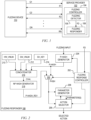
- FIG. 1 is a simplified block diagram of a service provider 102 including a fuzzing responder 108 implemented according to one embodiment.
- the service provider 102 is configured with data and programs and the like to provide data and services or the like in response to inquiries and may be available via a network or the like, such as the Internet.
- a fuzzing device 110 which is being used by a fuzzer to perform a fuzzing campaign against the service provider 102 in an attempt to create a fault or exploit a bug in the code of one or more devices or programs of the service provider 102.
- the fuzzing device 110 is conducting a fuzzing campaign by "fuzzing" the service provider 102 using multiple queries, shown as Q1, Q2, ..., QN, provoking the service provider 102 to provide corresponding responses, shown as R1, R2, ..., RN.
- FIG. 1 The configuration shown in FIG. 1 is only one example that is shown for the sake of clarity and simplicity using a simple communication protocol. It is appreciated, however, that fuzzing and fuzzing prevention as described herein can be applied to a variety of different use cases and scenarios.
- Examples of interacting entities include devices, programs on the same device or different devices, a human and one or more devices or one or more programs, etc.
- Examples of communication methods include a file being used as an input, a message of a protocol being parsed by a program, a request sent using an application programming interface (API), etc.
- API application programming interface
- the service provider 102 includes a fuzzing controller 104 which further includes a fuzzing detector 106 and the fuzzing responder 108.
- the fuzzing detector 106 incorporates a fuzzing detection mechanism that monitors inputs, which may include one or more of the queries Q1 - QN, to detect fuzzing according to any one or more fuzzing detection techniques that are not further described herein.
- the fuzzing detector 106 detects fuzzing, it asserts a fuzzing detection signal FD to the fuzzing responder 108.
- the fuzzing responder 108 responds by setting the service provider 102 into a "fuzzed" mode at least with respect to the fuzzing device 110 and its user (or any of its users).
- the fuzzing responder 108 takes control of interactions with the fuzzing device 110 and generates "random-looking" but consistent responses for the fuzzer to make them think that one or more errors have been found or are being found.
- random-looking means that the response appears to be random to the fuzzer but is in fact selected from a predetermined list of actions based on the fuzzing input as further described herein.
- FIG. 2 is a simplified block diagram of the fuzzing responder 108 according to one embodiment.
- the FD signal is provided to and sensed by fuzzing response controller 202 that activates a P-HASH generator 204 that performs a perceptual hashing function (PHF) on the fuzzing input to generate a perceptual hash value P-HASH.
- PHF perceptual hashing function
- the PHF operates according to a perceptual hash algorithm. PHFs are hash functions meaning that they map any input to a fixed-sized output.
- PHFs are not cryptographic hash functions that map to substantially different hash values with similar inputs. In cryptographical hash functions, even a single bit difference between two inputs results in two very different output hash values, such as on average 50% of bits change in the output hash value when only one bit of the input value is modified. Instead, PHFs are used to map similar inputs to the same output value, called the P-HASH value.
- PHF Planar Function
- the fuzzing response controller 202 controls a multiplexer (MUX) 205 to select the P-HASH value as the perceptual hash value PHSH provided to an action selector 206.
- the action selector 206 stores or otherwise points to or accesses a list of possible actions to choose from in response to the PHSH value for providing a selected action at its output.
- the selected action is executed in response instead of the normal response to the input or query.
- the input from the fuzzing device 110 is redirected to the fuzzing responder 108, and the selected action generated by the fuzzing responder 108 is performed the response to the input from the fuzzing device 110.
- the selected action may or may not include an actual response to the fuzzing device 110.
- Examples of possible actions in the action selector 206 include rebooting the device; logging out the current user (of the fuzzing device 110); deleting some parts of the device's configuration, such as, for example, user data code, resetting to default settings, deleting keys or passwords, etc.; appearing to be stuck such as by not responding to any subsequent inputs or queries until reboot or the like; sending one of multiple standard error message selected as a parameter that can be sent during the normal execution of the protocol such as an error message that is specified by the specified by the format or the standard that the protocol implements; sending a special error message that is not specified by the standard, e.g., "Unexpected error” or "Unexpected error at address XXXX" in which XXX is a selected parameter; sending a normal (appearing to be random) message of a protocol (such as one specified in the standard), in which the random message is selected as a parameter; and sending a random looking garbage-message instead of a normal response, in which the content of the message is selected as
- the action selector 206 detects that a selected action requires a parameter and prompts a parameter generator 208 to generate and provide one or more parameters to the action selector 206 to formulate the complete action as the response.
- the PHSH value is also provided to the parameter generator 208 for generating one or more parameters to be used by the selected actions.
- the PHF is used on the input that was received from a fuzzer to generate the P-HASH value, which is the same for identical inputs and is likely the same for similar inputs.
- the P-HASH value is used to choose the action that the service provider 102 produces to react to the input of the fuzzer as well as to produce parameters for this reaction (if parameters are required).
- This use of PHF to generate the P-HASH value ensures the same behavior observed by a fuzzer on different devices and on the same device across many trials for the same input.
- the fuzzer is duped into thinking that they are finding real errors that might be used to formulate an attack.
- the fuzzing campaign being conducted by the fuzzing device 110 has been detected and the fuzzing responder 108 essentially "fakes" the responses so that the fuzzer has not discovered any real errors.
- the service provider 102 may be updated with new software or new hardware. In either or in both cases, while some of the errors of the older system may have been discovered and fixed in the newer versions, new errors or bugs may also be introduced. A new or updated system likely reacts differently to the same fuzzing inputs from the fuzzer as compared to the old system. A savvy fuzzer may detect fuzzing responses to a fuzzing campaign, which is not desired.
- the fuzzing responder 108 is configured to minimize detection by a fuzzer when new hardware or software is being used by the service provider 102.
- a hardware version number (HW_VNUM) 210, a software version number (SW_VNUM) 212, a secret shared key (SH_KEY) 214, and the P-HASH value may be provided to respective inputs of a concatenator 216, which provides a concatenated value CVAL to an input of a non-perceptual (NP) hash generator 218, which outputs a revised hash value P-HASH-REV.
- NP non-perceptual
- each concatenator described herein, including the concatenator 216 and another concatenator 502 ( FIG. 5 ) combines its inputs in a relatively simple manner by appending or prepending on value with another.
- More complicated combining methods are contemplated using other logical functions, such as logic AND, NAND, OR, NOR, Exclusive-OR (XOR), XNOR, etc., for combining multiple values. It is also noted that any combination of HW_VNUM, SW_VNUM, and SH_KEY may be combined with the P-HASH value to generate P-HASH-REV.
- P-HASH-REV is provided to another input of the MUX 205, which may be selected by the fuzzing response controller 202 instead of P-HASH as the PHSH value provided to the action selector 206 and to the parameter generator 208.
- P-HASH is concatenated with any selected combination of the hardware version number HW_VNUM, the software version number SW_VNUM, and the secret shared key SH_KEY, and the combined value is hashed using a non-perceptual hashing function.
- the NP hashing function performed by the NP hash generator 218 may be, for example, a cryptographic hash function, or a stream cipher or the like. In this manner, old and new devices do not respond in the same manner to fuzzing inputs and the fuzzer might think that some significant code differences are present in the device and will likely spend more time on the analysis.
- the secret key should be shared across the devices including all devices, or at least those devices that have the same hardware or software version, to ensure different behavior with different versioned devices and identical behavior with the same versioned devices.
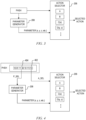
- FIG. 3 is a simplified block diagram of action selection and parameter generation used by the fuzzing responder 108 according to one embodiment.
- the action selector 206 identifies a simplified list of actions A, B, C(x), D(x, y), ..., in which the actions A and B do not need parameters, action C uses a parameter "x", and D uses parameters "y" and "z". Many more actions may be included, each including zero up to any suitable number of parameters.
- the PHSH value which is a selected one of the P-HASH value or the P-HASH-REV value, is provided as an input to the action selector 206 to select one of the listed actions A, B, C, D, ..., as the selected action.
- the action selector 206 When no parameter is needed, such as for the actions A or B, the action selector 206 simply outputs the selected action and operation is completed.
- the PHSH value is also provided to the parameter generator 208, which outputs corresponding parameters (e.g., x, y, z, etc.) to the action selector 206.
- the generated parameters from the parameter generator 208 are used as the parameters of the selected action and the action selector 206 outputs the selected action with the generated parameters and operation is completed.
- FIG. 4 is a simplified block diagram of action selection and parameter generation used by the fuzzing responder 108 according to another embodiment.
- the action selector 206 and the parameter generator 208 receiving the PHSH value are included in a similar manner as shown in FIG. 3 .
- PVAL may be separated into a lower portion 402 including a number of lower bits and an upper portion 404 including a number of the remaining upper bits.
- the lower portion 402 may be used as an action select value A_SEL which is applied to the action selector 206 for selecting an action in a similar manner as previously described.
- the upper portion 404 may be used as a parameter select value P_SEL which is applied to the parameter generator 208 which outputs corresponding parameters (e.g., x, y, z, etc.) to the action selector 206 in a similar manner as previously described.
- P_SEL parameter select value
- the action selector 206 simply outputs the selected action and operation is completed.
- the generated parameters from the parameter generator 208 are used as the parameters of the selected action and the action selector 206 outputs the selected action with the generated parameters and operation is completed.
- FIG. 5 is a simplified block diagram of an alternative method of generating the PHSH value according to another embodiment that may be used within the fuzzing responder 108.
- Any combination of HW_VNUM 210, SW_VNUM 212, and SH_KEY 214 may be concatenated together (without P-HASH) by the concatenator 216 and the concatenated value is provided to an input of the NP hash generator 218.
- the non-perceptual hashing function performed by the NP hash generator 218 may be a cryptographic hash function or a stream cipher or the like.
- the output of the NP hash generator 218 and the P-HASH value from the P-HASH generator 204 are concatenated together by another concatenator 502, and the concatenated (or combined) output is provided to another P-HASH generator 504 providing another revised hash value P-HASH-REV.
- P-HASH-REV and P-HASH are provided to the inputs of the MUX 205, which selects either one to provide the PHSH value as previously described.
- P-HASH generators 204 and 504 are shown, common p-hash circuitry may be used for both.
- FIG. 6 is a simplified block diagram of an alternative method of generating the PHSH value according to another embodiment that may be used within the fuzzing responder 108.
- the alternative method shown in FIG. 6 is substantially similar to the alternative method shown in FIG. 5 except that INPUT is provided to an input of the concatenator 502 rather than P-HASH for generating P-HASH-REV. Again, P-HASH-REV and P-HASH are provided to the inputs of the MUX 205 for determining the PHSH value as previously described.
- FIG. 7 is a flowchart diagram illustrating operation of the service provider 102 incorporating the fuzzing responder 108 implemented according to one embodiment.
- the service provider 102 represents any device or program that incorporates a fuzzing response system or method as described herein.
- an input is received from an entity interfacing the service provider 102, such as, for example, the fuzzing device 110.
- An entity represents any user or device interfacing the service provider 102 for data or services.
- it is queried whether the service provider 102 is already in the fuzzed mode for the entity that sent the input. If not, operation proceeds to block 706 in which the service provider 102 performs its normal execution in response to the received input.
- the fuzzing detector 106 runs fuzzing detection on the entity. Operation then advances to block 708, in which it is queried whether the FD signal has been asserted by the fuzzing detector 106 indicating fuzzing detection. If not, operation proceeds to block 710 in which the service provider 102 sends its normal response or performs its normal action in response to the received input. Operation then loops back to block 702 for receiving the next input from the entity. Operation may stay at block 702 indefinitely while waiting for the next input, or may loop between blocks 702, 704, 706, 708, and 710 for normal operation while a fuzzing campaign is not detected.
- fuzzing detector 106 has instead asserted the FD signal indicating that a fuzzing campaign has been detected from the entity, such as, for example, from the fuzzing device 110, operation instead proceeds to block 710 in which the service provider 102 enters the fuzzed mode for that entity, which is now referred to as a fuzzer. It is noted that the service provider 102 may be providing data or services to other entities in which the fuzzed mode may be entered only for those entities for which fuzzing has been detected. Operation then advances to block 712 in which inputs from the fuzzer are redirected to the fuzzing responder 108.
- Operation then advances to block 714 in which the service provider 102 performs the action selected by the fuzzing responder 108. Depending upon the action performed, operation may loop back to block 702 for receiving the next input from the fuzzer. If and when a subsequent input is received from the fuzzer, then at block 704 operation instead proceeds to block 712 in which each subsequent input is redirected to the fuzzing responder 108. Operation may stay at block 702 indefinitely while waiting for the next fuzzing input, or may loop between blocks 702, 704, 712, and 714 for fuzzing operation in response to the fuzzer.
- FIG. 8 is a flowchart diagram illustrating operation of the fuzzing responder 108 implemented according to an embodiment including any one or more of the embodiments shown in FIGs 2 - 6 .
- a fuzzing input is received from a fuzzer such as, for example, the fuzzing device 110.
- Operation then advances to block 804 in which the perceptual hashing function (PHF) is performed using the fuzzing input to generate the PHSH value based on P-HASH, such as according to any of the embodiments shown in FIGs 2 , 5 , and 6 .
- Operation then advances to block 806 to select an action to be performed in response to the fuzzing input, such as any of the actions in the action selector 206.
- PPF perceptual hashing function
- Operation then advances to block 808 in which it is queried whether the selected action needs any parameters. If not, operation advances to block 810 in which the selected action is performed. Depending upon the selected action performed, operation may advance back to block 802 for receiving the next fuzzing input from the fuzzer. Referring back to block 808, if the selected action needs any parameters, operation instead advances to block 812 in which the parameter(s) is/are generated, and then to block 810 to perform the selected action using the generated parameter(s).
- circuitry states such as circuitry low and circuitry high may be reversed depending upon whether the pin or signal is implemented in positive or negative circuitry or the like.
- the circuitry state may be programmable in which the circuitry state may be reversed for a given circuitry function.
Landscapes
- Engineering & Computer Science (AREA)
- Software Systems (AREA)
- Theoretical Computer Science (AREA)
- Computer Security & Cryptography (AREA)
- Physics & Mathematics (AREA)
- General Physics & Mathematics (AREA)
- General Engineering & Computer Science (AREA)
- Data Mining & Analysis (AREA)
- Automation & Control Theory (AREA)
- Fuzzy Systems (AREA)
- Artificial Intelligence (AREA)
- Life Sciences & Earth Sciences (AREA)
- Evolutionary Computation (AREA)
- Computer Hardware Design (AREA)
- Signal Processing (AREA)
- Computer Networks & Wireless Communication (AREA)
- Computing Systems (AREA)
- Mathematical Optimization (AREA)
- Mathematical Physics (AREA)
- Health & Medical Sciences (AREA)
- Mathematical Analysis (AREA)
- Algebra (AREA)
- Pure & Applied Mathematics (AREA)
- Molecular Biology (AREA)
- Computational Mathematics (AREA)
- Biomedical Technology (AREA)
- General Health & Medical Sciences (AREA)
- Power Engineering (AREA)
- Computer Vision & Pattern Recognition (AREA)
- Evolutionary Biology (AREA)
- Bioinformatics & Computational Biology (AREA)
- Bioinformatics & Cheminformatics (AREA)
- Storage Device Security (AREA)
Abstract
Description
- The present invention relates in general to fuzzing prevention, and more particularly to a system and method of impeding fuzzing by selecting responses that appear to be randomized to mislead a fuzzer.
- Hackers often analyze a device (or a program) by interacting with the device or the like using any of the protocols that the device expects in an attempt to create a fault or exploit a bug in the code of the device being analyzed. Hackers may try to craft a malicious message that does not exactly follow the rules of a protocol. Before attacking the device, the hacker may attempt to understand how to craft a malicious message that can be used to exploit a bug in the code. Since the source code is rarely available, the hacker often uses "fuzzing" as an analysis technique to discover bugs in the implementation of the target device. Fuzzing is a well-known analysis technique that is used by a hacker or a test programmer to discover bugs in software or in hardware. A "fuzzer" is a hacker or other entity that performs a fuzzing analysis to discover any bugs in a device. Such bugs may represent vulnerabilities that compromise the integrity of the software or hardware and may thus be exploited by a hacker and used to attack the device.
- The main idea behind fuzzing is to follow the expected protocol between the devices while introducing random mutations or modifications or the like. Examples of such modifications include random bit flips in messages or changes of the order of messages or parts of a message. If the device does not detect an error in the request message, then it might get into an incoherent situation such as deadlock or it might even crash. Incoherent states that can lead to the crash of the device may be exploited by a hacker. If such problems are not discovered during device manufacturing, they may be discovered by a hacker exposing any vulnerabilities of the device.
- Embodiments of the present invention are illustrated by way of example and are not limited by the accompanying figures. Similar references in the figures may indicate similar elements. Elements in the figures are illustrated for simplicity and clarity and have not necessarily been drawn to scale.
-
FIG. 1 is a simplified block diagram of a service provider including a fuzzing responder implemented according to one embodiment. -
FIG. 2 is a simplified block diagram of the fuzzing responder ofFIG. 1 according to one embodiment. -
FIG. 3 is a simplified block diagram of action selection and parameter generation used by the fuzzing responder ofFIG. 1 according to one embodiment. -
FIG. 4 is a simplified block diagram of action selection and parameter generation used by the fuzzing responder ofFIG. 1 according to another embodiment. -
FIG. 5 is a simplified block diagram of an alternative method of generating the perceptual hash value according to another embodiment that may be used within the fuzzing responder ofFIG. 1 . -
FIG. 6 is a simplified block diagram of an alternative method of generating the perceptual hash value according to another embodiment that may be used within the fuzzing responder ofFIG. 1 . -
FIG. 7 is a flowchart diagram illustrating operation of the service provider incorporating the fuzzing responder ofFIG. 1 implemented according to one embodiment. -
FIG. 8 is a flowchart diagram illustrating operation of the fuzzing responder ofFIG. 1 implemented according to an embodiment including any one or more of the embodiments shown inFIGs 2 - 6 . - A fuzzing prevention technique as described herein can be used to counter a fuzzing campaign against a device or a program by selecting actions in response to fuzzing inputs to stagnate or impede the fuzzing campaign. A "fuzzing campaign" as used herein refers to analysis activities that are used to identify bugs in hardware or software of a device that render the device vulnerable to subsequent attack by a hacker. A person or other entity that conducts a fuzzing campaign, such as a hacker or attacker or the like, is referred to herein as a fuzzer. The fuzzing prevention technique fools the fuzzer into thinking that the fuzzing campaign is progressing when, instead, it has been detected and is, in fact, not actually succeeding. In this manner, fuzzing against a protected device becomes much more difficult and costly to execute potentially leading to fuzzing prevention. A fuzzing prevention technique as described herein concerns reacting to and impeding a fuzzing campaign that has been detected. After fuzzing has been detected using various fuzzing detection techniques, the response may include random-looking outputs that are selected from among a list of actions or responses, such as rebooting the device, requesting some user input, introducing delay after the query, sending a special response, etc. An advantage of a random-looking responses is that they are harder to automate the appropriate reaction for the fuzzer to continue the fuzzing analysis.
- As further described herein, upon detecting fuzzing or a fuzzing campaign, a perceptual hash function is used to generate random-looking actions performed in response to fuzzing in order to mislead the fuzzer. The actions performed in response to fuzzing (which may include responses back to the fuzzer) are generated in such a manner that it is difficult to automate the fuzzing campaign and it is also difficult for the fuzzer to distinguish a real error from an intentional "fake" error that has been generated to mislead the fuzzer. A fuzzing prevention technique as described herein causes the fuzzer to spend as much time as possible analyzing fake actions or responses to fuzzing without actually discovering anything that may be used to harm the protected device.
-
FIG. 1 is a simplified block diagram of aservice provider 102 including afuzzing responder 108 implemented according to one embodiment. In one implementation, theservice provider 102 is configured with data and programs and the like to provide data and services or the like in response to inquiries and may be available via a network or the like, such as the Internet. Also shown is afuzzing device 110 which is being used by a fuzzer to perform a fuzzing campaign against theservice provider 102 in an attempt to create a fault or exploit a bug in the code of one or more devices or programs of theservice provider 102. In this case thefuzzing device 110 is conducting a fuzzing campaign by "fuzzing" theservice provider 102 using multiple queries, shown as Q1, Q2, ..., QN, provoking theservice provider 102 to provide corresponding responses, shown as R1, R2, ..., RN. - The configuration shown in
FIG. 1 is only one example that is shown for the sake of clarity and simplicity using a simple communication protocol. It is appreciated, however, that fuzzing and fuzzing prevention as described herein can be applied to a variety of different use cases and scenarios. Examples of interacting entities include devices, programs on the same device or different devices, a human and one or more devices or one or more programs, etc. Examples of communication methods include a file being used as an input, a message of a protocol being parsed by a program, a request sent using an application programming interface (API), etc. - The
service provider 102 includes afuzzing controller 104 which further includes afuzzing detector 106 and thefuzzing responder 108. Thefuzzing detector 106 incorporates a fuzzing detection mechanism that monitors inputs, which may include one or more of the queries Q1 - QN, to detect fuzzing according to any one or more fuzzing detection techniques that are not further described herein. When thefuzzing detector 106 detects fuzzing, it asserts a fuzzing detection signal FD to thefuzzing responder 108. Thefuzzing responder 108 responds by setting theservice provider 102 into a "fuzzed" mode at least with respect to the fuzzingdevice 110 and its user (or any of its users). Once in the fuzzed mode, thefuzzing responder 108 takes control of interactions with thefuzzing device 110 and generates "random-looking" but consistent responses for the fuzzer to make them think that one or more errors have been found or are being found. The term "random-looking" means that the response appears to be random to the fuzzer but is in fact selected from a predetermined list of actions based on the fuzzing input as further described herein. -
FIG. 2 is a simplified block diagram of thefuzzing responder 108 according to one embodiment. The FD signal is provided to and sensed by fuzzingresponse controller 202 that activates a P-HASH generator 204 that performs a perceptual hashing function (PHF) on the fuzzing input to generate a perceptual hash value P-HASH. Subsequent inputs received from thefuzzing device 110, including, for example, one or more of the queries Q1 - QN, are redirected to an input of the P-HASH generator 204, which generates and outputs corresponding P-HASH values. The PHF operates according to a perceptual hash algorithm. PHFs are hash functions meaning that they map any input to a fixed-sized output. PHFs are not cryptographic hash functions that map to substantially different hash values with similar inputs. In cryptographical hash functions, even a single bit difference between two inputs results in two very different output hash values, such as on average 50% of bits change in the output hash value when only one bit of the input value is modified. Instead, PHFs are used to map similar inputs to the same output value, called the P-HASH value. - There are libraries implementing PHFs that can be used by the P-
HASH generator 204, or a special PHF can be generated and used. PHF may be done in several ways including the use of self-supervised machine learning algorithms. This tailored approach helps to create a PHF better suited for a specific given system with a particular protocol, file format, message structure, etc. - In one configuration, the
fuzzing response controller 202 controls a multiplexer (MUX) 205 to select the P-HASH value as the perceptual hash value PHSH provided to anaction selector 206. Theaction selector 206 stores or otherwise points to or accesses a list of possible actions to choose from in response to the PHSH value for providing a selected action at its output. In the fuzzed mode as indicated by thefuzzing response controller 202, the selected action is executed in response instead of the normal response to the input or query. In other words, the input from thefuzzing device 110 is redirected to thefuzzing responder 108, and the selected action generated by thefuzzing responder 108 is performed the response to the input from thefuzzing device 110. The selected action may or may not include an actual response to thefuzzing device 110. - Examples of possible actions in the
action selector 206 include rebooting the device; logging out the current user (of the fuzzing device 110); deleting some parts of the device's configuration, such as, for example, user data code, resetting to default settings, deleting keys or passwords, etc.; appearing to be stuck such as by not responding to any subsequent inputs or queries until reboot or the like; sending one of multiple standard error message selected as a parameter that can be sent during the normal execution of the protocol such as an error message that is specified by the specified by the format or the standard that the protocol implements; sending a special error message that is not specified by the standard, e.g., "Unexpected error" or "Unexpected error at address XXXX" in which XXXX is a selected parameter; sending a normal (appearing to be random) message of a protocol (such as one specified in the standard), in which the random message is selected as a parameter; and sending a random looking garbage-message instead of a normal response, in which the content of the message is selected as a parameter. This list of actions performed in response to fuzzing is not exhaustive by any means but provides an exemplary number of different actions that can be chosen with different probabilities based on the P-HASH value. - As noted by the possible actions of the
action selector 206, some actions need a parameter to complete. Theaction selector 206 detects that a selected action requires a parameter and prompts aparameter generator 208 to generate and provide one or more parameters to theaction selector 206 to formulate the complete action as the response. As described further herein, the PHSH value is also provided to theparameter generator 208 for generating one or more parameters to be used by the selected actions. - Generally, the PHF is used on the input that was received from a fuzzer to generate the P-HASH value, which is the same for identical inputs and is likely the same for similar inputs. The P-HASH value is used to choose the action that the
service provider 102 produces to react to the input of the fuzzer as well as to produce parameters for this reaction (if parameters are required). This use of PHF to generate the P-HASH value ensures the same behavior observed by a fuzzer on different devices and on the same device across many trials for the same input. Thus, the fuzzer is duped into thinking that they are finding real errors that might be used to formulate an attack. In fact, however, the fuzzing campaign being conducted by thefuzzing device 110 has been detected and thefuzzing responder 108 essentially "fakes" the responses so that the fuzzer has not discovered any real errors. - The
service provider 102 may be updated with new software or new hardware. In either or in both cases, while some of the errors of the older system may have been discovered and fixed in the newer versions, new errors or bugs may also be introduced. A new or updated system likely reacts differently to the same fuzzing inputs from the fuzzer as compared to the old system. A savvy fuzzer may detect fuzzing responses to a fuzzing campaign, which is not desired. Thefuzzing responder 108 is configured to minimize detection by a fuzzer when new hardware or software is being used by theservice provider 102. - A hardware version number (HW_VNUM) 210, a software version number (SW_VNUM) 212, a secret shared key (SH_KEY) 214, and the P-HASH value may be provided to respective inputs of a
concatenator 216, which provides a concatenated value CVAL to an input of a non-perceptual (NP)hash generator 218, which outputs a revised hash value P-HASH-REV. It is noted that each concatenator described herein, including theconcatenator 216 and another concatenator 502 (FIG. 5 ), combines its inputs in a relatively simple manner by appending or prepending on value with another. More complicated combining methods are contemplated using other logical functions, such as logic AND, NAND, OR, NOR, Exclusive-OR (XOR), XNOR, etc., for combining multiple values. It is also noted that any combination of HW_VNUM, SW_VNUM, and SH_KEY may be combined with the P-HASH value to generate P-HASH-REV. P-HASH-REV is provided to another input of theMUX 205, which may be selected by thefuzzing response controller 202 instead of P-HASH as the PHSH value provided to theaction selector 206 and to theparameter generator 208. In this manner, instead of using the P-HASH value directly, P-HASH is concatenated with any selected combination of the hardware version number HW_VNUM, the software version number SW_VNUM, and the secret shared key SH_KEY, and the combined value is hashed using a non-perceptual hashing function. The NP hashing function performed by theNP hash generator 218 may be, for example, a cryptographic hash function, or a stream cipher or the like. In this manner, old and new devices do not respond in the same manner to fuzzing inputs and the fuzzer might think that some significant code differences are present in the device and will likely spend more time on the analysis. - In case the use of such system is known to the fuzzer, their goal may be to distinguish real errors or reactions from the fake ones (the ones computed using PHFs). To prevent the fuzzer from doing this, the SH_KEY may be incorporated into the computation. The secret key should be shared across the devices including all devices, or at least those devices that have the same hardware or software version, to ensure different behavior with different versioned devices and identical behavior with the same versioned devices.
-
FIG. 3 is a simplified block diagram of action selection and parameter generation used by thefuzzing responder 108 according to one embodiment. Theaction selector 206 identifies a simplified list of actions A, B, C(x), D(x, y), ..., in which the actions A and B do not need parameters, action C uses a parameter "x", and D uses parameters "y" and "z". Many more actions may be included, each including zero up to any suitable number of parameters. The PHSH value, which is a selected one of the P-HASH value or the P-HASH-REV value, is provided as an input to theaction selector 206 to select one of the listed actions A, B, C, D, ..., as the selected action. When no parameter is needed, such as for the actions A or B, theaction selector 206 simply outputs the selected action and operation is completed. The PHSH value is also provided to theparameter generator 208, which outputs corresponding parameters (e.g., x, y, z, etc.) to theaction selector 206. When one or more parameters are needed, such as for the actions C or D, the generated parameters from theparameter generator 208 are used as the parameters of the selected action and theaction selector 206 outputs the selected action with the generated parameters and operation is completed. -
FIG. 4 is a simplified block diagram of action selection and parameter generation used by thefuzzing responder 108 according to another embodiment. Theaction selector 206 and theparameter generator 208 receiving the PHSH value are included in a similar manner as shown inFIG. 3 . In this case, however, PVAL may be separated into alower portion 402 including a number of lower bits and anupper portion 404 including a number of the remaining upper bits. Thelower portion 402 may be used as an action select value A_SEL which is applied to theaction selector 206 for selecting an action in a similar manner as previously described. Theupper portion 404 may be used as a parameter select value P_SEL which is applied to theparameter generator 208 which outputs corresponding parameters (e.g., x, y, z, etc.) to theaction selector 206 in a similar manner as previously described. When no parameter is needed, such as for the actions A or B, theaction selector 206 simply outputs the selected action and operation is completed. When one or more parameters are needed, such as for the actions C or D, the generated parameters from theparameter generator 208 are used as the parameters of the selected action and theaction selector 206 outputs the selected action with the generated parameters and operation is completed. -
FIG. 5 is a simplified block diagram of an alternative method of generating the PHSH value according to another embodiment that may be used within thefuzzing responder 108. Any combination ofHW_VNUM 210,SW_VNUM 212, andSH_KEY 214 may be concatenated together (without P-HASH) by theconcatenator 216 and the concatenated value is provided to an input of theNP hash generator 218. Again, the non-perceptual hashing function performed by theNP hash generator 218 may be a cryptographic hash function or a stream cipher or the like. The output of theNP hash generator 218 and the P-HASH value from the P-HASH generator 204 are concatenated together by anotherconcatenator 502, and the concatenated (or combined) output is provided to another P-HASH generator 504 providing another revised hash value P-HASH-REV. P-HASH-REV and P-HASH are provided to the inputs of theMUX 205, which selects either one to provide the PHSH value as previously described. Although separate P-HASH generators -
FIG. 6 is a simplified block diagram of an alternative method of generating the PHSH value according to another embodiment that may be used within thefuzzing responder 108. The alternative method shown inFIG. 6 is substantially similar to the alternative method shown inFIG. 5 except that INPUT is provided to an input of theconcatenator 502 rather than P-HASH for generating P-HASH-REV. Again, P-HASH-REV and P-HASH are provided to the inputs of theMUX 205 for determining the PHSH value as previously described. -
FIG. 7 is a flowchart diagram illustrating operation of theservice provider 102 incorporating thefuzzing responder 108 implemented according to one embodiment. Theservice provider 102 represents any device or program that incorporates a fuzzing response system or method as described herein. At afirst block 702, an input is received from an entity interfacing theservice provider 102, such as, for example, thefuzzing device 110. An entity represents any user or device interfacing theservice provider 102 for data or services. Atnext block 704, it is queried whether theservice provider 102 is already in the fuzzed mode for the entity that sent the input. If not, operation proceeds to block 706 in which theservice provider 102 performs its normal execution in response to the received input. In addition, thefuzzing detector 106 runs fuzzing detection on the entity. Operation then advances to block 708, in which it is queried whether the FD signal has been asserted by thefuzzing detector 106 indicating fuzzing detection. If not, operation proceeds to block 710 in which theservice provider 102 sends its normal response or performs its normal action in response to the received input. Operation then loops back to block 702 for receiving the next input from the entity. Operation may stay atblock 702 indefinitely while waiting for the next input, or may loop betweenblocks - Referring back to block 708, if the
fuzzing detector 106 has instead asserted the FD signal indicating that a fuzzing campaign has been detected from the entity, such as, for example, from thefuzzing device 110, operation instead proceeds to block 710 in which theservice provider 102 enters the fuzzed mode for that entity, which is now referred to as a fuzzer. It is noted that theservice provider 102 may be providing data or services to other entities in which the fuzzed mode may be entered only for those entities for which fuzzing has been detected. Operation then advances to block 712 in which inputs from the fuzzer are redirected to thefuzzing responder 108. Operation then advances to block 714 in which theservice provider 102 performs the action selected by thefuzzing responder 108. Depending upon the action performed, operation may loop back to block 702 for receiving the next input from the fuzzer. If and when a subsequent input is received from the fuzzer, then atblock 704 operation instead proceeds to block 712 in which each subsequent input is redirected to thefuzzing responder 108. Operation may stay atblock 702 indefinitely while waiting for the next fuzzing input, or may loop betweenblocks -
FIG. 8 is a flowchart diagram illustrating operation of thefuzzing responder 108 implemented according to an embodiment including any one or more of the embodiments shown inFIGs 2 - 6 . At first block 802 a fuzzing input is received from a fuzzer such as, for example, thefuzzing device 110. Operation then advances to block 804 in which the perceptual hashing function (PHF) is performed using the fuzzing input to generate the PHSH value based on P-HASH, such as according to any of the embodiments shown inFIGs 2 ,5 , and6 . Operation then advances to block 806 to select an action to be performed in response to the fuzzing input, such as any of the actions in theaction selector 206. Operation then advances to block 808 in which it is queried whether the selected action needs any parameters. If not, operation advances to block 810 in which the selected action is performed. Depending upon the selected action performed, operation may advance back to block 802 for receiving the next fuzzing input from the fuzzer. Referring back to block 808, if the selected action needs any parameters, operation instead advances to block 812 in which the parameter(s) is/are generated, and then to block 810 to perform the selected action using the generated parameter(s). - Although the present invention has been described in connection with several embodiments, the invention is not intended to be limited to the specific forms set forth herein. On the contrary, it is intended to cover such alternatives, modifications, and equivalents as can be reasonably included within the scope of the invention as defined by the appended claims. For example, variations of positive circuitry or negative circuitry may be used in various embodiments in which the present invention is not limited to specific circuitry polarities, device types or voltage or error levels or the like. For example, circuitry states, such as circuitry low and circuitry high may be reversed depending upon whether the pin or signal is implemented in positive or negative circuitry or the like. In some cases, the circuitry state may be programmable in which the circuitry state may be reversed for a given circuitry function.
- The terms "a" or "an," as used herein, are defined as one or more than one. Also, the use of introductory phrases such as "at least one" and "one or more" in the claims should not be construed to imply that the introduction of another claim element by the indefinite articles "a" or "an" limits any particular claim containing such introduced claim element to inventions containing only one such element, even when the same claim includes the introductory phrases "one or more" or "at least one" and indefinite articles such as "a" or "an." The same holds true for the use of definite articles. Unless stated otherwise, terms such as "first" and "second" are used to arbitrarily distinguish between the elements such terms describe. Thus, these terms are not necessarily intended to indicate temporal or other prioritization of such elements.
Claims (15)
- A method of responding to fuzzing, comprising:receiving a fuzzing input while in fuzzed mode;performing a perceptual hashing function using the fuzzing input to generate a perceptual hash value;selecting an action from a plurality of predetermined actions using the perceptual hash value; andperforming the selected action in response to the fuzzing input.
- The method of claim 1, wherein said performing a perceptual hashing function using the fuzzing input comprises generating a perceptual hash value that is the same for a subset of a plurality of possible fuzzing inputs that are considered similar.
- The method of claim 1 or 2, further comprising generating at least one parameter that is used by the selected action when performed.
- The method of claim 3, wherein said selecting an action comprises using a first portion of the perceptual hash value to select an action, and wherein said generating at least one parameter comprises using a second portion of the perceptual hash value applied to a parameter generator for generating the at least one parameter.
- The method of any preceding claim, wherein said performing a perceptual hashing function comprises:combining at least one version number and a shared secret key to provide a combined value; andperforming a non-perceptual hash function on the combined value to provide a hash value.
- The method of claim 5, wherein said combining includes combining the perceptual hash value to provide the combined value, and wherein said performing a non-perceptual hash function on the combined value comprises performing a non-perceptual hash function on the combined value to provide a revised perceptual hash value.
- The method of claim 5 or 6, further comprising:combining the perceptual hash value with the hash value to provide a first revised perceptual hash value; andperforming a perceptual hashing function on the first revised perceptual hash value to provide a second revised perceptual hash value.
- The method of any one of claims 5 to 7, further comprising:combining the fuzzing input with the hash value to provide a second combined value; andwherein said performing a perceptual hashing function comprises performing a perceptual hashing function on the second combined value to provide a revised perceptual hash value.
- The method of any one of claims 5 to 8, wherein said combining comprises concatenating.
- The method of any one of claims 5 to 9, wherein said combining comprises combining at least one of a hardware version number and a software version number.
- The method of any one of claims 5 to 10, wherein said performing a non-perceptual hash function comprises performing a cryptographic hash function.
- The method of any one of claims 5 to 11, wherein said performing a non-perceptual hash function comprises performing a stream cipher.
- A fuzzing responder, comprising:a perceptual hash generator that is configured to perform a perceptual hashing function using a fuzzing input to generate a perceptual hash value; andan action selector that is configured to select an action from a predetermined list of actions using the perceptual hash value in response to the fuzzing input.
- The fuzzing responder of claim 13, further comprising a parameter generator that is configured to use the perceptual hash value to generate at least one parameter for the selected action.
- The fuzzing responder of claim 14, wherein the action selector is configured to use a first portion of the perceptual hash value to select an action and wherein the parameter generator is configured to use a second portion of the perceptual hash value to generate the at least one parameter.
Applications Claiming Priority (1)
| Application Number | Priority Date | Filing Date | Title |
|---|---|---|---|
| US17/993,735 US12346839B2 (en) | 2022-11-23 | 2022-11-23 | System and method of fuzzing prevention using intentional responses that appear to be randomized |
Publications (1)
| Publication Number | Publication Date |
|---|---|
| EP4375859A1 true EP4375859A1 (en) | 2024-05-29 |
Family
ID=88838907
Family Applications (1)
| Application Number | Title | Priority Date | Filing Date |
|---|---|---|---|
| EP23210601.3A Pending EP4375859A1 (en) | 2022-11-23 | 2023-11-17 | System and method of fuzzing prevention using intentional responses that appear to be randomized |
Country Status (2)
| Country | Link |
|---|---|
| US (1) | US12346839B2 (en) |
| EP (1) | EP4375859A1 (en) |
Citations (3)
| Publication number | Priority date | Publication date | Assignee | Title |
|---|---|---|---|---|
| US20170060732A1 (en) * | 2015-08-31 | 2017-03-02 | Vmware, Inc. | Automated bug detection with virtual machine forking |
| US20190052674A1 (en) * | 2016-04-19 | 2019-02-14 | Mitsubishi Electric Corporation | Relay device |
| US20200028689A1 (en) * | 2018-07-18 | 2020-01-23 | Ca, Inc. | Location-based and time-based photo authentication |
Family Cites Families (19)
| Publication number | Priority date | Publication date | Assignee | Title |
|---|---|---|---|---|
| US6996273B2 (en) | 2001-04-24 | 2006-02-07 | Microsoft Corporation | Robust recognizer of perceptually similar content |
| US9094715B2 (en) * | 2009-05-29 | 2015-07-28 | Cognitive Networks, Inc. | Systems and methods for multi-broadcast differentiation |
| US20110119293A1 (en) * | 2009-10-21 | 2011-05-19 | Randy Gilbert Taylor | Method And System For Reverse Pattern Recognition Matching |
| GB2477307A (en) * | 2010-01-28 | 2011-08-03 | Adsensa Ltd | Embedding authentication data into an electronic document image |
| US9015667B2 (en) | 2010-10-06 | 2015-04-21 | Microsoft Technology Licensing, Llc | Fuzz testing of asynchronous program code |
| WO2014041561A2 (en) * | 2012-08-31 | 2014-03-20 | Iappsecure Solutions Pvt. Ltd. | A system for analyzing applications accurately for finding security and quality issues |
| US9036943B1 (en) * | 2013-03-14 | 2015-05-19 | Amazon Technologies, Inc. | Cloud-based image improvement |
| RU2527738C1 (en) | 2013-04-24 | 2014-09-10 | Общество с ограниченной ответственностью "НАНО Секьюрити" | Method of neutralising malware blocking pc operation using separate device for user activation of malware counteracting procedure |
| EP3533004B1 (en) * | 2016-10-26 | 2020-07-29 | Swiss Reinsurance Company Ltd. | Data extraction engine for structured, semi-structured and unstructured data with automated labeling and classification of data patterns or data elements therein, and corresponding method thereof |
| LU93398B1 (en) | 2016-12-23 | 2018-07-24 | Luxembourg Inst Science & Tech List | Method for orchestrating reactions to complex attacks on cumputing systems |
| US10452526B2 (en) | 2017-06-15 | 2019-10-22 | Microsoft Technology Licensing, Llc | Machine learning for constrained mutation-based fuzz testing |
| US10523699B1 (en) * | 2017-06-20 | 2019-12-31 | Amazon Technologies, Inc. | Privilege escalation vulnerability detection using message digest differentiation |
| US20190332921A1 (en) * | 2018-04-13 | 2019-10-31 | Vosai, Inc. | Decentralized storage structures and methods for artificial intelligence systems |
| US10491782B1 (en) * | 2018-06-13 | 2019-11-26 | Xerox Corporation | Method and apparatus to prevent reproduction of secure data |
| CN109308415B (en) | 2018-09-21 | 2021-11-19 | 四川大学 | Binary-oriented guidance quality fuzzy test method and system |
| CN109597767B (en) | 2018-12-19 | 2021-11-12 | 中国人民解放军国防科技大学 | Genetic variation-based fuzzy test case generation method and system |
| US10713151B1 (en) * | 2019-04-18 | 2020-07-14 | Microsoft Technology Licensing, Llc | Program execution coverage expansion by selective data capture |
| RU2748518C1 (en) | 2020-08-27 | 2021-05-26 | Общество с ограниченной ответственностью "Траст" | Method for counteracting malicious software (malware) by imitating test environment |
| CN112328505B (en) | 2021-01-04 | 2021-04-02 | 中国人民解放军国防科技大学 | A method and system for improving the coverage of fuzz testing |
-
2022
- 2022-11-23 US US17/993,735 patent/US12346839B2/en active Active
-
2023
- 2023-11-17 EP EP23210601.3A patent/EP4375859A1/en active Pending
Patent Citations (3)
| Publication number | Priority date | Publication date | Assignee | Title |
|---|---|---|---|---|
| US20170060732A1 (en) * | 2015-08-31 | 2017-03-02 | Vmware, Inc. | Automated bug detection with virtual machine forking |
| US20190052674A1 (en) * | 2016-04-19 | 2019-02-14 | Mitsubishi Electric Corporation | Relay device |
| US20200028689A1 (en) * | 2018-07-18 | 2020-01-23 | Ca, Inc. | Location-based and time-based photo authentication |
Also Published As
| Publication number | Publication date |
|---|---|
| US12346839B2 (en) | 2025-07-01 |
| US20240169226A1 (en) | 2024-05-23 |
Similar Documents
| Publication | Publication Date | Title |
|---|---|---|
| US10402179B1 (en) | Application randomization mechanism | |
| Chatzikonstantinou et al. | Evaluation of cryptography usage in android applications | |
| US11861006B2 (en) | High-confidence malware severity classification of reference file set | |
| EP2150888B1 (en) | Initial seed management for pseudorandom number generator | |
| KR101066727B1 (en) | Secure Boot of Computing Devices | |
| EP3543881B1 (en) | Chip access method, security control module, chip and debugging device | |
| US6581093B1 (en) | Policy validation in a LDAP directory | |
| US20180075233A1 (en) | Systems and methods for agent-based detection of hacking attempts | |
| US20190036878A1 (en) | Protecting computer servers from api attacks using coordinated varying of url addresses in api requests | |
| EP3270318A1 (en) | Dynamic security module terminal device and method for operating same | |
| AU2019307885B2 (en) | Systems and methods for reporting computer security incidents | |
| GB2599375A (en) | Malware infection mitigation of critical computer systems | |
| US10412116B1 (en) | Mechanism for concealing application and operation system identity | |
| CN105229652A (en) | Detect the utilization for software application | |
| Chen et al. | Towards Precise Reporting of Cryptographic Misuses. | |
| WO2021051591A1 (en) | Secure keyboard realizing method and apparatus, and computer device and storage medium | |
| Steel | Formal analysis of PIN block attacks | |
| US10284592B1 (en) | Application randomization mechanism | |
| CN111475168A (en) | A method and device for compiling code | |
| US10200406B1 (en) | Configuration of application randomization mechanism | |
| US12346839B2 (en) | System and method of fuzzing prevention using intentional responses that appear to be randomized | |
| Alzhrani et al. | Windows and linux random number generation process: A comparative analysis | |
| US10200401B1 (en) | Evaluating results of multiple virtual machines that use application randomization mechanism | |
| Wang et al. | WireWatch: Measuring the security of proprietary network encryption in the global Android ecosystem | |
| US20220043900A1 (en) | Method and device for authenticating an fpga configuration |
Legal Events
| Date | Code | Title | Description |
|---|---|---|---|
| PUAI | Public reference made under article 153(3) epc to a published international application that has entered the european phase |
Free format text: ORIGINAL CODE: 0009012 |
|
| STAA | Information on the status of an ep patent application or granted ep patent |
Free format text: STATUS: THE APPLICATION HAS BEEN PUBLISHED |
|
| AK | Designated contracting states |
Kind code of ref document: A1 Designated state(s): AL AT BE BG CH CY CZ DE DK EE ES FI FR GB GR HR HU IE IS IT LI LT LU LV MC ME MK MT NL NO PL PT RO RS SE SI SK SM TR |
|
| STAA | Information on the status of an ep patent application or granted ep patent |
Free format text: STATUS: REQUEST FOR EXAMINATION WAS MADE |
|
| 17P | Request for examination filed |
Effective date: 20241129 |
|
| RBV | Designated contracting states (corrected) |
Designated state(s): AL AT BE BG CH CY CZ DE DK EE ES FI FR GB GR HR HU IE IS IT LI LT LU LV MC ME MK MT NL NO PL PT RO RS SE SI SK SM TR |