EP4374909A1 - Mold for manufacturing thin film attachable to skin and method for manufacturing thin film attached to skin by using same - Google Patents
Mold for manufacturing thin film attachable to skin and method for manufacturing thin film attached to skin by using same Download PDFInfo
- Publication number
- EP4374909A1 EP4374909A1 EP21951056.7A EP21951056A EP4374909A1 EP 4374909 A1 EP4374909 A1 EP 4374909A1 EP 21951056 A EP21951056 A EP 21951056A EP 4374909 A1 EP4374909 A1 EP 4374909A1
- Authority
- EP
- European Patent Office
- Prior art keywords
- thin film
- skin
- mold
- protruding
- mixed solution
- Prior art date
- Legal status (The legal status is an assumption and is not a legal conclusion. Google has not performed a legal analysis and makes no representation as to the accuracy of the status listed.)
- Pending
Links
Images




Classifications
-
- A—HUMAN NECESSITIES
- A61—MEDICAL OR VETERINARY SCIENCE; HYGIENE
- A61F—FILTERS IMPLANTABLE INTO BLOOD VESSELS; PROSTHESES; DEVICES PROVIDING PATENCY TO, OR PREVENTING COLLAPSING OF, TUBULAR STRUCTURES OF THE BODY, e.g. STENTS; ORTHOPAEDIC, NURSING OR CONTRACEPTIVE DEVICES; FOMENTATION; TREATMENT OR PROTECTION OF EYES OR EARS; BANDAGES, DRESSINGS OR ABSORBENT PADS; FIRST-AID KITS
- A61F13/00—Bandages or dressings; Absorbent pads
- A61F13/02—Adhesive bandages or dressings
- A61F13/0276—Apparatus or processes for manufacturing adhesive dressings or bandages
-
- A—HUMAN NECESSITIES
- A61—MEDICAL OR VETERINARY SCIENCE; HYGIENE
- A61M—DEVICES FOR INTRODUCING MEDIA INTO, OR ONTO, THE BODY; DEVICES FOR TRANSDUCING BODY MEDIA OR FOR TAKING MEDIA FROM THE BODY; DEVICES FOR PRODUCING OR ENDING SLEEP OR STUPOR
- A61M37/00—Other apparatus for introducing media into the body; Percutany, i.e. introducing medicines into the body by diffusion through the skin
- A61M37/0015—Other apparatus for introducing media into the body; Percutany, i.e. introducing medicines into the body by diffusion through the skin by using microneedles
-
- A—HUMAN NECESSITIES
- A61—MEDICAL OR VETERINARY SCIENCE; HYGIENE
- A61F—FILTERS IMPLANTABLE INTO BLOOD VESSELS; PROSTHESES; DEVICES PROVIDING PATENCY TO, OR PREVENTING COLLAPSING OF, TUBULAR STRUCTURES OF THE BODY, e.g. STENTS; ORTHOPAEDIC, NURSING OR CONTRACEPTIVE DEVICES; FOMENTATION; TREATMENT OR PROTECTION OF EYES OR EARS; BANDAGES, DRESSINGS OR ABSORBENT PADS; FIRST-AID KITS
- A61F13/00—Bandages or dressings; Absorbent pads
- A61F13/00051—Accessories for dressings
- A61F13/00063—Accessories for dressings comprising medicaments or additives, e.g. odor control, PH control, debriding, antimicrobic
-
- A—HUMAN NECESSITIES
- A61—MEDICAL OR VETERINARY SCIENCE; HYGIENE
- A61F—FILTERS IMPLANTABLE INTO BLOOD VESSELS; PROSTHESES; DEVICES PROVIDING PATENCY TO, OR PREVENTING COLLAPSING OF, TUBULAR STRUCTURES OF THE BODY, e.g. STENTS; ORTHOPAEDIC, NURSING OR CONTRACEPTIVE DEVICES; FOMENTATION; TREATMENT OR PROTECTION OF EYES OR EARS; BANDAGES, DRESSINGS OR ABSORBENT PADS; FIRST-AID KITS
- A61F13/00—Bandages or dressings; Absorbent pads
- A61F13/00987—Apparatus or processes for manufacturing non-adhesive dressings or bandages
-
- B—PERFORMING OPERATIONS; TRANSPORTING
- B29—WORKING OF PLASTICS; WORKING OF SUBSTANCES IN A PLASTIC STATE IN GENERAL
- B29C—SHAPING OR JOINING OF PLASTICS; SHAPING OF MATERIAL IN A PLASTIC STATE, NOT OTHERWISE PROVIDED FOR; AFTER-TREATMENT OF THE SHAPED PRODUCTS, e.g. REPAIRING
- B29C39/00—Shaping by casting, i.e. introducing the moulding material into a mould or between confining surfaces without significant moulding pressure; Apparatus therefor
- B29C39/02—Shaping by casting, i.e. introducing the moulding material into a mould or between confining surfaces without significant moulding pressure; Apparatus therefor for making articles of definite length, i.e. discrete articles
- B29C39/026—Shaping by casting, i.e. introducing the moulding material into a mould or between confining surfaces without significant moulding pressure; Apparatus therefor for making articles of definite length, i.e. discrete articles characterised by the shape of the surface
-
- B—PERFORMING OPERATIONS; TRANSPORTING
- B29—WORKING OF PLASTICS; WORKING OF SUBSTANCES IN A PLASTIC STATE IN GENERAL
- B29C—SHAPING OR JOINING OF PLASTICS; SHAPING OF MATERIAL IN A PLASTIC STATE, NOT OTHERWISE PROVIDED FOR; AFTER-TREATMENT OF THE SHAPED PRODUCTS, e.g. REPAIRING
- B29C39/00—Shaping by casting, i.e. introducing the moulding material into a mould or between confining surfaces without significant moulding pressure; Apparatus therefor
- B29C39/02—Shaping by casting, i.e. introducing the moulding material into a mould or between confining surfaces without significant moulding pressure; Apparatus therefor for making articles of definite length, i.e. discrete articles
- B29C39/10—Shaping by casting, i.e. introducing the moulding material into a mould or between confining surfaces without significant moulding pressure; Apparatus therefor for making articles of definite length, i.e. discrete articles incorporating preformed parts or layers, e.g. casting around inserts or for coating articles
-
- B—PERFORMING OPERATIONS; TRANSPORTING
- B29—WORKING OF PLASTICS; WORKING OF SUBSTANCES IN A PLASTIC STATE IN GENERAL
- B29C—SHAPING OR JOINING OF PLASTICS; SHAPING OF MATERIAL IN A PLASTIC STATE, NOT OTHERWISE PROVIDED FOR; AFTER-TREATMENT OF THE SHAPED PRODUCTS, e.g. REPAIRING
- B29C39/00—Shaping by casting, i.e. introducing the moulding material into a mould or between confining surfaces without significant moulding pressure; Apparatus therefor
- B29C39/22—Component parts, details or accessories; Auxiliary operations
- B29C39/26—Moulds or cores
-
- B—PERFORMING OPERATIONS; TRANSPORTING
- B29—WORKING OF PLASTICS; WORKING OF SUBSTANCES IN A PLASTIC STATE IN GENERAL
- B29C—SHAPING OR JOINING OF PLASTICS; SHAPING OF MATERIAL IN A PLASTIC STATE, NOT OTHERWISE PROVIDED FOR; AFTER-TREATMENT OF THE SHAPED PRODUCTS, e.g. REPAIRING
- B29C43/00—Compression moulding, i.e. applying external pressure to flow the moulding material; Apparatus therefor
- B29C43/02—Compression moulding, i.e. applying external pressure to flow the moulding material; Apparatus therefor of articles of definite length, i.e. discrete articles
- B29C43/021—Compression moulding, i.e. applying external pressure to flow the moulding material; Apparatus therefor of articles of definite length, i.e. discrete articles characterised by the shape of the surface
-
- B—PERFORMING OPERATIONS; TRANSPORTING
- B29—WORKING OF PLASTICS; WORKING OF SUBSTANCES IN A PLASTIC STATE IN GENERAL
- B29C—SHAPING OR JOINING OF PLASTICS; SHAPING OF MATERIAL IN A PLASTIC STATE, NOT OTHERWISE PROVIDED FOR; AFTER-TREATMENT OF THE SHAPED PRODUCTS, e.g. REPAIRING
- B29C43/00—Compression moulding, i.e. applying external pressure to flow the moulding material; Apparatus therefor
- B29C43/32—Component parts, details or accessories; Auxiliary operations
- B29C43/36—Moulds for making articles of definite length, i.e. discrete articles
-
- A—HUMAN NECESSITIES
- A61—MEDICAL OR VETERINARY SCIENCE; HYGIENE
- A61F—FILTERS IMPLANTABLE INTO BLOOD VESSELS; PROSTHESES; DEVICES PROVIDING PATENCY TO, OR PREVENTING COLLAPSING OF, TUBULAR STRUCTURES OF THE BODY, e.g. STENTS; ORTHOPAEDIC, NURSING OR CONTRACEPTIVE DEVICES; FOMENTATION; TREATMENT OR PROTECTION OF EYES OR EARS; BANDAGES, DRESSINGS OR ABSORBENT PADS; FIRST-AID KITS
- A61F13/00—Bandages or dressings; Absorbent pads
- A61F13/02—Adhesive bandages or dressings
- A61F13/0276—Apparatus or processes for manufacturing adhesive dressings or bandages
- A61F2013/0296—Apparatus or processes for manufacturing adhesive dressings or bandages for making transdermal patches (chemical processes excluded)
-
- A—HUMAN NECESSITIES
- A61—MEDICAL OR VETERINARY SCIENCE; HYGIENE
- A61M—DEVICES FOR INTRODUCING MEDIA INTO, OR ONTO, THE BODY; DEVICES FOR TRANSDUCING BODY MEDIA OR FOR TAKING MEDIA FROM THE BODY; DEVICES FOR PRODUCING OR ENDING SLEEP OR STUPOR
- A61M37/00—Other apparatus for introducing media into the body; Percutany, i.e. introducing medicines into the body by diffusion through the skin
- A61M37/0015—Other apparatus for introducing media into the body; Percutany, i.e. introducing medicines into the body by diffusion through the skin by using microneedles
- A61M2037/0023—Drug applicators using microneedles
-
- A—HUMAN NECESSITIES
- A61—MEDICAL OR VETERINARY SCIENCE; HYGIENE
- A61M—DEVICES FOR INTRODUCING MEDIA INTO, OR ONTO, THE BODY; DEVICES FOR TRANSDUCING BODY MEDIA OR FOR TAKING MEDIA FROM THE BODY; DEVICES FOR PRODUCING OR ENDING SLEEP OR STUPOR
- A61M37/00—Other apparatus for introducing media into the body; Percutany, i.e. introducing medicines into the body by diffusion through the skin
- A61M37/0015—Other apparatus for introducing media into the body; Percutany, i.e. introducing medicines into the body by diffusion through the skin by using microneedles
- A61M2037/0046—Solid microneedles
-
- A—HUMAN NECESSITIES
- A61—MEDICAL OR VETERINARY SCIENCE; HYGIENE
- A61M—DEVICES FOR INTRODUCING MEDIA INTO, OR ONTO, THE BODY; DEVICES FOR TRANSDUCING BODY MEDIA OR FOR TAKING MEDIA FROM THE BODY; DEVICES FOR PRODUCING OR ENDING SLEEP OR STUPOR
- A61M37/00—Other apparatus for introducing media into the body; Percutany, i.e. introducing medicines into the body by diffusion through the skin
- A61M37/0015—Other apparatus for introducing media into the body; Percutany, i.e. introducing medicines into the body by diffusion through the skin by using microneedles
- A61M2037/0053—Methods for producing microneedles
-
- A—HUMAN NECESSITIES
- A61—MEDICAL OR VETERINARY SCIENCE; HYGIENE
- A61M—DEVICES FOR INTRODUCING MEDIA INTO, OR ONTO, THE BODY; DEVICES FOR TRANSDUCING BODY MEDIA OR FOR TAKING MEDIA FROM THE BODY; DEVICES FOR PRODUCING OR ENDING SLEEP OR STUPOR
- A61M2205/00—General characteristics of the apparatus
- A61M2205/02—General characteristics of the apparatus characterised by a particular materials
- A61M2205/0244—Micromachined materials, e.g. made from silicon wafers, microelectromechanical systems [MEMS] or comprising nanotechnology
-
- A—HUMAN NECESSITIES
- A61—MEDICAL OR VETERINARY SCIENCE; HYGIENE
- A61M—DEVICES FOR INTRODUCING MEDIA INTO, OR ONTO, THE BODY; DEVICES FOR TRANSDUCING BODY MEDIA OR FOR TAKING MEDIA FROM THE BODY; DEVICES FOR PRODUCING OR ENDING SLEEP OR STUPOR
- A61M2207/00—Methods of manufacture, assembly or production
- A61M2207/10—Device therefor
-
- B—PERFORMING OPERATIONS; TRANSPORTING
- B29—WORKING OF PLASTICS; WORKING OF SUBSTANCES IN A PLASTIC STATE IN GENERAL
- B29C—SHAPING OR JOINING OF PLASTICS; SHAPING OF MATERIAL IN A PLASTIC STATE, NOT OTHERWISE PROVIDED FOR; AFTER-TREATMENT OF THE SHAPED PRODUCTS, e.g. REPAIRING
- B29C43/00—Compression moulding, i.e. applying external pressure to flow the moulding material; Apparatus therefor
- B29C43/02—Compression moulding, i.e. applying external pressure to flow the moulding material; Apparatus therefor of articles of definite length, i.e. discrete articles
- B29C43/021—Compression moulding, i.e. applying external pressure to flow the moulding material; Apparatus therefor of articles of definite length, i.e. discrete articles characterised by the shape of the surface
- B29C2043/023—Compression moulding, i.e. applying external pressure to flow the moulding material; Apparatus therefor of articles of definite length, i.e. discrete articles characterised by the shape of the surface having a plurality of grooves
- B29C2043/025—Compression moulding, i.e. applying external pressure to flow the moulding material; Apparatus therefor of articles of definite length, i.e. discrete articles characterised by the shape of the surface having a plurality of grooves forming a microstructure, i.e. fine patterning
-
- B—PERFORMING OPERATIONS; TRANSPORTING
- B29—WORKING OF PLASTICS; WORKING OF SUBSTANCES IN A PLASTIC STATE IN GENERAL
- B29C—SHAPING OR JOINING OF PLASTICS; SHAPING OF MATERIAL IN A PLASTIC STATE, NOT OTHERWISE PROVIDED FOR; AFTER-TREATMENT OF THE SHAPED PRODUCTS, e.g. REPAIRING
- B29C43/00—Compression moulding, i.e. applying external pressure to flow the moulding material; Apparatus therefor
- B29C43/02—Compression moulding, i.e. applying external pressure to flow the moulding material; Apparatus therefor of articles of definite length, i.e. discrete articles
- B29C43/021—Compression moulding, i.e. applying external pressure to flow the moulding material; Apparatus therefor of articles of definite length, i.e. discrete articles characterised by the shape of the surface
- B29C2043/026—Compression moulding, i.e. applying external pressure to flow the moulding material; Apparatus therefor of articles of definite length, i.e. discrete articles characterised by the shape of the surface having functional projections, e.g. fasteners
Definitions
- the present disclosure relates to a technique for manufacturing a thin film, and particularly, to a mold for manufacturing a skin attachable thin film and a manufacturing method of a skin attachable thin film using the same.
- a certain medicine especially a protein or peptide medicine, may not be effectively adsorbed into a human body by this method due to its intense degradation in the gastrointestinal tract, its poor absorption from an intestinal cell membrane, and/or an interruption of its first-pass by the liver.
- Needle injection may cause a needle phobia, a substantial pain, and a local damage to the skin in many patients. Retrieval of a body fluid, such as blood, for a diagnostic purpose may raise a similar concern.
- the needle injection may not be ideal for a regular medicine delivery or a regular diagnosis.
- Still another medicine delivery technique may use a transdermal delivery method, which usually relies on spread of the medicine across the skin. This method may not be widely used due to poor skin permeability of many medicines.
- the stratum corneum which is an outermost layer of the skin, may represent a main barrier to penetration of the transdermal medicine.
- the medicine Once reaches a dermal depth (i.e., below the epithelium), the medicine may quickly spread to a deeper tissue layer and other parts of the body through blood circulation.
- chemical enhancers, iontophoresis, electroporation, ultrasound, and thermal devices have been used to supplement the medicine delivery.
- the thin film may be manufactured in a process of injecting a solution having a low concentration (of 30% or less) into a mold, then drying the same in air, vacuum, blowing, hot air, or the like, separating the thin film from the mold, and cutting the same into a plurality of thin films having a size required for a product.
- the dried thin film in a region of the mold where its bottom and wall surface meet each other may be distorted due to shrinkage or separated from a mold surface.
- the present disclosure attempts to provide a mold for manufacturing a plurality of precise and flat thin films, and a manufacturing method of a skin attachable thin film using the same.
- the present disclosure also attempts to provide a mold for manufacturing a plurality of thin films without any additional post-process after a drying process, and a manufacturing method of a skin attachable thin film using the same.
- the present disclosure also attempts to provide a mold for manufacturing thin films having different thicknesses through a single process, and a manufacturing method of a skin attachable thin film using the same.
- the present disclosure also attempts to provide a mold allowing reuse of a solution used in the manufacturing of a skin attachable thin film, and a manufacturing method of a skin attachable thin film using the same.
- a mold for manufacturing a skin attachable thin film including: a cast part accommodating a mixed solution in an inner space; and a protruding pillar formed in the cast part, the skin attachable thin film being manufactured on an upper surface of the protruding pillar, wherein the cast part includes a lower surface part forming a bottom and a side part vertically protruding from an outer peripheral surface of the lower surface part, and a plurality of protruding pillars protrude from the lower surface part.
- a first microstructure may be on the upper surface of the protruding pillar.
- the upper surface of the protruding pillar may be a curved surface.
- the mold may further include a first accommodation protrusion protruding from an outer peripheral surface of the upper surface of the protruding pillar.
- the mold may further include a second accommodation protrusion having a polygonal or circular shape and protruding in a closed curve from a region of the lower surface part without the protruding pillar.
- a second microstructure may be formed on a surface of an inner region surrounded by the second accommodation protrusion in the region of the lower surface part without the protruding pillar.
- the cast part may include a plurality of separators disposed between the protruding pillars.
- the cast part may include a plurality of holes capable of being opened and closed that are disposed between the protruding pillars.
- a manufacturing method of a skin attachable thin film using the mold for manufacturing a skin attachable thin film described above including: a step of accommodating a mixed solution of accommodating the mixed solution in an inner space by supplying the mixed solution to a cast part; a step of drying the mixed solution accommodated in the inner space for the mixed solution supplied to the cast part to be changed into the skin attachable thin film; and a step of acquiring the thin film of separating the skin attachable thin film that is formed as the step of drying the mixed solution is performed from the cast part.
- the skin attachable thin film that is acquired in the step of acquiring the thin film may be formed on an upper surface of a protruding pillar.
- the skin attachable thin film that is acquired in the step of acquiring the thin film may be formed in an inner region surrounded by a second accommodation protrusion.
- the method may include: the step of accommodating the mixed solution of accommodating the mixed solution in the inner space by supplying the mixed solution to the cast part; the step of drying the mixed solution accommodated in the inner space for the mixed solution supplied to the cast part to be changed into the skin attachable thin film; a step of coating a functional material of selectively coating the functional material on the skin attachable thin film; a solidification step of drying and solidifying the coated functional material; a step of coating a functional material of selectively coating the functional material on the skin attachable thin film; and the step of acquiring the thin film of separating the skin attachable thin film that is formed as the step of drying the mixed solution is performed in the cast part.
- the step of coating the functional material may further include a step of coating an aqueous solution to gather the functional material coated on the skin attachable thin film.
- the step of coating the aqueous solution may further include a step of additionally supplying the mixed solution.
- the skin attachable thin film may be separated from the cast part by bringing an adhesive film including an adhesive into contact with the cast part.
- the adhesive film may separate the plurality of skin attachable thin films by being manufactured to have a length substantially the same as a length of the cast part or have a length shorter than the length of the cast part and greater than a distance between the protruding pillars.
- the adhesive film may separate the skin attachable thin film by being manufactured to have a length substantially the same as a length of the protruding pillar or have a length greater than the length of the protruding pillar and shorter than a distance between the protruding pillars.
- the mold for manufacturing a skin attachable thin film and the manufacturing method of a skin attachable thin film using the same according to the embodiments of the present disclosure may have the following effects.
- the plurality of precise and flat thin films may be manufactured using the single mold.
- the plurality of thin films may be manufactured without any additional post-process, such as the cutting process after the drying process.
- the thin films having the different thicknesses may be manufactured in the single process.
- the manufacturing cost of the skin attachable thin film may be lower by reusing the solution used in the manufacturing of the skin attachable thin film.
- the description describes a first example of a mold for manufacturing a skin attachable thin film according to the present disclosure as follows.
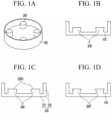
- FIG. 1 is a view showing a first example of a mold for manufacturing a skin attachable thin film according to the present disclosure
- FIG. 2 is a view showing an example of a first microstructure in the first example of the mold for manufacturing a skin attachable thin film according to the present disclosure.
- the first example of the mold for manufacturing a skin attachable thin film may include a cast part 100 and a protruding pillar 200.
- the cast part 100 may include an open upper surface, a 'U'-shaped cross section, a lower surface part 110, and a side part 120 protruding upward from an outer peripheral surface of the lower surface part 110 to accommodate a mixed solution S (in FIG 10 ) for manufacturing the skin attachable thin film in an inner space.
- a height of the side part 120 may be determined based on the maximum value of a thickness of a skin attachable thin film T (in FIG. 10 ) to be formed.
- the thickness of the skin attachable thin film may be determined based on an amount of mixed solution accommodated in the inner space of the cast part 100, that is, a depth of the mixed solution. Accordingly, the maximum value of the thickness of the skin attachable thin film may be determined based on the height of the side part 120.
- the protruding pillar 200 may protrude from at least a partial region of the lower surface part 110, and the cast part 100 may have at least one protruding pillar.
- the skin attachable thin film that is generated as the mixed solution is once accommodated in the inner space of the cast part 100 and goes through a drying process may have the same number as the number of protruding pillars 200.
- the plurality of protruding pillars 200 may be formed on the single mold and the thin film may be manufactured thereon, thereby completing the plurality of skin attachable thin films only in a separation process after drying the thin film. That is, the manufacturing process and cost of the present disclosure may be reduced by eliminating a cutting process.
- the present disclosure may manufacture a plurality of precise and flat thin films by manufacturing the thin films on the plurality of protruding pillars 200. Furthermore, when manufacturing the thin film on the bottom of the mold, a remaining thin film used to be contaminated or deformed as the thin film goes through the cutting process after the separation, thus making it impossible to reuse the thin film. However, the present disclosure may lower the manufacturing cost of skin attachable thin film by melting and reusing the thin film remaining on the bottom of the mold.
- the shape and size of an upper surface 200U of the protruding pillar 200 may be modified to match the shape and size of the skin attachable thin film to be manufactured.
- the upper surface of the protruding pillar 200 may have a circular or polygonal shape, thus acquiring the skin attachable thin film to be formed without any restriction on its shape and size.
- the upper surface 200U of the protruding pillar 200 may be surface-treated to be hydrophilic.
- the mixed solution in a step of drying the mixed solution (S110), the mixed solution may have stability without being separated from the upper surface of the protruding pillar 200 to thus form the skin attachable thin film.
- the upper surface of the protruding pillar 200 may be a flat surface or a curved surface.
- the skin attachable thin film may be basically made of a material having flexibility based on a type of the mixed solution, or may also have a shape corresponding to the surface to which the film is attached, thereby increasing its adhesion.
- the protruding pillar may have a shape of a cylinder with parallel side surfaces, and as shown in FIGS. 1C and 1D , an area of the upper surface of the protruding pillar may be larger than an area of its lower surface.
- a protruding pillar 200' may have a shape of a side surface narrower toward the bottom, and as shown in FIG. 1D , a protruding pillar 200" may have a stepped shape.
- a region of the lower surface part 110 without the protruding pillar 200' or 200" become larger to secure a larger area where a second accommodation protrusion 400 (in FIG. 4 ) described below protrude.
- the second accommodation protrusion is described below.
- a first microstructure 210 may be formed on the upper surface of the protruding pillar 200.
- the first microstructure 210 may be recessed in the upper surface of the protruding pillar 200, a shape of the first microstructure 210 may be freely deformable into a shape enabling accommodation of a coated functional material in a manufacturing method of a skin attachable thin film according to the present disclosure, which is described below, and a diameter of the first microstructure 210 may be several nm to several mm.
- the description describes a second example of a mold for manufacturing a skin attachable thin film according to the present disclosure as follows.
- the second example of the mold for manufacturing a skin attachable thin film according to the present disclosure may be the same as the first example described above in that at least one protruding pillar 200 is formed on the lower surface part 110 of the cast part 100, and the first microstructure 210 is formed on the upper surface of the protruding pillar 200.
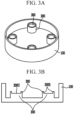
- the second example of the mold for manufacturing a skin attachable thin film according to the present disclosure may further include a first accommodation protrusion 300.
- the first accommodation protrusion 300 may protrude from an outer peripheral surface of the upper surface of the protruding pillar 200 to thus accommodate the mixed solution in the upper surface of the protruding pillar 200.
- the upper surface 200U of the protruding pillar 200 may be hydrophilic, as described above in the first example of the mold for manufacturing a skin attachable thin film according to the present disclosure.
- an inner peripheral surface 300S of the first accommodation protrusion 300 may be hydrophobic to prevent the thin film from being formed on the inner peripheral surface 300S of the first accommodation protrusion 300 when the thin film is dried, thereby preventing the formed skin attachable thin film from being stepped by the first accommodate protrusion 300.
- the description describes a third example of a mold for manufacturing a skin attachable thin film according to the present disclosure as follows.
- the third example of the mold for manufacturing a skin attachable thin film according to the present disclosure may be the same as the first example described above in that at least one protruding pillar 200 is formed from the lower surface part 110 of the cast part 100, and the first microstructure 210 is formed on the upper surface of the protruding pillar 200.
- the third example of the mold for manufacturing a skin attachable thin film according to the present disclosure may further include the second accommodation protrusion 400.
- the second accommodation protrusion 400 may have the polygonal or circular shape and protruding in a closed curve from the region of the lower surface part 110 without the protruding pillar 200 to accommodate the mixed solution therein.
- the skin attachable thin film may be formed not only on the upper surface of the protruding pillar 200 described above, but also in the lower surface part 110 of the cast part 100.
- the shape and size of the second accommodation protrusion 400 may be modified to match the shape and size of the skin attachable thin film to be manufactured. As a result, the skin attachable thin film to be formed may be acquired without any restriction on its shape and size.
- a surface 110U of an inner region surrounded by the second accommodation protrusion 400 in the region of the lower surface part 110 without the protruding pillar 200 may be hydrophilic like the upper surface 200U of the protruding pillar 200.
- an inner peripheral surface 400S of the second accommodation protrusion 400 may be hydrophobic to prevent the thin film from being formed on the inner peripheral surface 400S of the second accommodation protrusion 400 when the thin film is dried, thereby preventing the formed skin attachable thin film from being stepped by the second accommodate protrusion 400.
- a second microstructure 410 may be formed in the surface of the inner region surrounded by the second accommodation protrusion 400 in the region of the lower surface part 110 without the protruding pillar 200.
- the second microstructure 410 may be recessed in the upper surface of the protruding pillar 200, a shape of the second microstructure 410 may be freely deformable into a shape enabling the accommodation of the coated functional material in the manufacturing method of a skin attachable thin film according to the present disclosure, which is described below, and a diameter of the second microstructure 410 may be several nm to several mm.
- the description describes a fourth example of a mold for manufacturing a skin attachable thin film according to the present disclosure as follows.
- the fourth example of the mold for manufacturing a skin attachable thin film according to the present disclosure may be the same as the first example described above in that at least one protruding pillar 200 is formed from the lower surface part 110 of the cast part 100, and the first microstructure 210 is formed on the upper surface of the protruding pillar 200.
- the fourth example of the mold for manufacturing a skin attachable thin film according to the present disclosure may further include a pillar fitting block 510 or 520.
- the pillar fitting block 510 or 520 may be inserted into the protruding pillar 200 to acquire a skin attachable thin film that has a size larger than the size of the skin attachable thin film that is capable of being manufactured from the protruding pillar 200.
- the pillar fitting block 510 or 520 may have an inner diameter that is the same as or slightly larger than an outer diameter of the protruding pillar 200 to thus be inserted into the protruding pillar 200, and the pillar fitting block 510 or 520 may have an outer diameter larger than the outer diameter of the protruding pillar 200.
- an upper surface of the pillar fitting block 510 or 520 may be the flat surface or the curved surface, the upper surface of the pillar fitting block 510 or 520 may have various shapes, and a third microstructure (not shown) performing the same function as the first and second microstructures 210 and 410 described above may be formed on the upper surface of the pillar fitting block 510 or 520.
- a third accommodation protrusion (not shown) performing the same function as the first and second accommodation protrusions 300 and 400 described above may be formed on the upper surface of the pillar fitting block.
- the pillar fitting block may have a length to entirely cover the side surface of the protruding pillar 200 (in the case of the pillar fitting block 510), or have a length to cover only a portion of an upper part of the protruding pillar 200 (in the case of the pillar fitting block 520) not to interfere with the generation of the skin attachable thin film that is formed by the second accommodation protrusion 400 formed on the lower surface part 110 of the cast part 100.
- the pillar fitting block 510 or 520 may be selectively inserted into the protruding pillar 200, thus making it possible to acquire thin films having different sizes in a single process.
- the description describes a fifth example of a mold for manufacturing a skin attachable thin film according to the present disclosure as follows.
- the fifth example of the mold for manufacturing a skin attachable thin film according to the present disclosure may be the same as the first example described above in that at least one protruding pillar 200 is formed from the lower surface part 110 of the cast part 100, and the first microstructure 210 is formed on the upper surface of the protruding pillar 200.
- the protruding pillar may include a first protruding pillar 200A and a second protruding pillar 200B.
- the first protruding pillar 200A and the second protruding pillar 200B may have different heights, and the thickness of the formed skin attachable thin film may be changed based on a height difference between the first protruding pillar 200A and the second protruding pillar 200B.
- the skin attachable thin films that have different thicknesses may be generated through the single process in the fifth example of the mold for manufacturing a skin attachable thin film according to the present disclosure.
- the description describes a sixth example of a mold for manufacturing a skin attachable thin film according to the present disclosure as follows.
- the sixth example of the mold for manufacturing a skin attachable thin film according to the present disclosure may be the same as the first example described above in that at least one protruding pillar 200 is formed from the lower surface part 110 of the cast part 100, and the first microstructure 210 is formed on the upper surface of the protruding pillar 200.
- the sixth example of the mold for manufacturing a skin attachable thin film according to the present disclosure may further include a plurality of separators 600.
- the separator 600 may be formed not only between the protruding pillars 200, but also between a side wall of the cast part 100 and the protruding pillar 200.
- the separator 600 may prevent the mixed solution that is changed into the skin attachable thin film from being deformed due to the shrinkage in the step of drying the mixed solution described below.
- a height of the separator 600 may not exceed a height of the cast part 100.
- the separator 600 may not only prevent the mixed solution from being deformed, but also function as the protruding pillar 200 by forming the microstructure in an upper surface of the separator 600. That is, more skin attachable thin films may be acquired when the separator 600 is used as the protruding pillar 200.
- the description describes a seventh example of a mold for manufacturing a skin attachable thin film according to the present disclosure as follows.
- the seventh example of the mold for manufacturing a skin attachable thin film according to the present disclosure may be the same as the first example described above in that at least one protruding pillar 200 is formed from the lower surface part 110 of the cast part 100, and the first microstructure 210 is formed on the upper surface of the protruding pillar 200.
- the seventh example of the mold for manufacturing a skin attachable thin film according to the present disclosure may further include a plurality of holes 700 capable of being opened and closed.
- the plurality of holes 700 capable of being opened and closed may be formed not only between the protruding pillars 200, but also between the side wall of the cast part 100 and the protruding pillar 200.
- the plurality of holes 700 capable of being opened and closed may enable the mixed solution to be reused by controlling its opening and closing before the mixed solution is dried in a step of accommodating the mixed solution described below to thus discharge the mixed solution to the outside of the cast part 100.
- the plurality of holes 700 capable of being opened and closed may enable the mixed solution to be reused even though the same amount of mixed solution is used to manufacture the skin attachable thin film, thereby enabling a larger amount of the skin attachable thin film to be manufactured.
- the configurations of the mold for manufacturing a skin attachable thin film in the first to seventh examples of the present disclosure described above may be not only used in one embodiment, but also used in other embodiments with different configurations for the respective examples.
- the description describes a manufacturing method of a skin attachable thin film according to the present disclosure as follows.
- the manufacturing method of a skin attachable thin film according to the present disclosure uses a mold 1000 for manufacturing a skin attachable thin film according to the first to seventh examples of the present disclosure, and reference numerals indicating the components of the mold 1000 for manufacturing a skin attachable thin film are the same as those described with reference to FIGS. 1 to 9 .
- the manufacturing method of a skin attachable thin film according to the present disclosure may include a step of accommodating the mixed solution (S100), the step of drying the mixed solution (S110), and a step of acquiring the thin film (S120).
- the mixed solution S may be accommodated in the inner space by supplying the mixed solution S to the cast part 100.
- the mixed solution S may be vacuum treated while being accommodated in the cast part 100.
- An accommodation state of the mixed solution S in the cast part 100 may be stabilized by the vacuum treatment, an air bubble in the mixed solution S may be removed, or drying of the mixed solution S may be promoted.
- the mixed solution S may be vacuum treated before being supplied to the cast part 100.
- a solute in the mixed solution S may be a material which may be dissolved or decomposed in a living body.
- the solute may consist of the following groups: nucleic acid, deoxyribonucleic acid (DNA), ribonucleic acid (RNA), polydeoxyribonucleotide (PDRN), hyaluronic acid, alginic acid, pectin, carrageenan, chondroitin (sulfate), chondroitin sulfate, glycogen, dextran (sulfate), dextran, dextrin, chitosan, polylysine, collagen, gelatin, carboxymethyl chitin, fibrin, agarose, pullulan polylactide, polyglycolide (PGA), polylactide-glycolide copolymer (PLGA), hyaluronic acid, alginic acid, pectin, carrageenan, chondroitin (sulfate), dextran (sulfate),
- the solute of the mixed solution S may include a material that may be dissolved in both of a volatile inorganic solvent such as water and an organic solvent such as ethanol, acetone, ether, or benzene.
- the mixed solution S accommodated in the inner space may be dried for the mixed solution S supplied to the cast part 100 to be changed into a skin attachable thin film T.
- the cast part 100 accommodating the mixed solution S may be dried using air, vacuum, blowing, hot air, or the like at a certain drying temperature for a certain drying time in a separate drying unit (not shown).
- a drying method performed in the step of drying the mixed solution (S110) is not limited to the method described above, and may be performed using a usable drying method.
- the drying temperature and the drying time in the step of drying the mixed solution (S110) may be adjusted based on a type of the mixed solution S and a capacity of the mixed solution S accommodated in the cast part 100.
- the bubble in the mixed solution S accommodated in the cast part 100 may be removed through a pipetting unit (not shown) to generate the high-quality skin attachable thin film T.
- the skin attachable thin film T that is formed as the step of drying the mixed solution (S110) is performed may be separated from the cast part 100.
- the thin film T may be separated using a separate adhesive film. This configuration is described below.
- the skin attachable thin film T that is acquired in the step of acquiring the thin film (S120) may not only be the skin attachable thin film T that is formed on the upper surface of the protruding pillar 200, that is, the inner region surrounded by the second accommodation protrusion 400, but also be the skin attachable thin film T that is formed on the upper surface of the pillar fitting block 510 or 520.
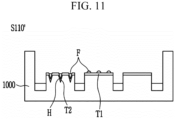
- the manufacturing method of a skin attachable thin film according to the present disclosure may further include a step of coating the functional material (S110') and a solidification step (not shown).
- the step of coating the functional material (S110') may preferably be performed after the step of drying the mixed solution (S110).
- the mixed solution S or a functional heterogeneous material hereinafter, referred to as a functional material F
- a functional material F may be selectively coated on an upper surface of the skin attachable thin film T.
- the functional material F may include a material exhibiting a medicinal, mechanical, or electrochemical property exhibiting an effective property of a human body.
- the functional material F may be selectively coated on an upper surface of a flat skin attachable thin film T1 that is formed on the upper surface of the protruding pillar 200 shown in FIG. 1 , or may be selectively coated in a groove part H formed in a skin attachable thin film T2 by the first microstructure to the third microstructure.
- the functional material F coated on the skin attachable thin film T1 or T2 may be dried and solidified, and the step of acquiring the thin film (which is the same as the step S120 in FIG. 10 ) may then be performed, thereby acquiring the skin attachable thin film T1 or T2 that includes the functional material F.
- the functional material F may be selectively coated on the upper surface of the flat skin attachable thin film T1 that is formed on the upper surface of the protruding pillar 200 shown in FIG. 1 , or may be selectively coated in the groove part H formed in the skin attachable thin film T2 by the first microstructure to the third microstructure.
- the functional material may be coated (S210'), and a step of accommodating the mixed solution S in the cast part 100 (S211') may then be performed again.
- the mixed solution S may be accommodated again and a step of acquiring the thin film (S220', which is the same as the step S120 in FIG. 10 ) may then be performed to thus acquire not only the skin attachable thin film T that is disposed under the functional material F but also a skin attachable thin film T' that is disposed on the functional material F, thereby acquiring more skin attachable thin films.
- the functional material F in the step of coating the functional material (which is the same as the step S210' in FIG. 12 ), the functional material F may be selectively coated on the upper surface of the flat skin attachable thin film T1 that is formed on the upper surface of the protruding pillar 200 shown in FIG. 1 , or may be selectively coated in the groove part H formed in the skin attachable thin film T2 by the first microstructure to the third microstructure.
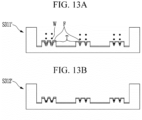
- the functional material may be coated (which is the same as the step of S210' in FIG. 12 ), and a step of coating an aqueous solution W (S311') may then be performed on the functional material.
- the step of coating the aqueous solution (S311') may be performed before the functional material is dried.
- the aqueous solution W may be coated on the functional material F, thereby gathering the functional material coated on the skin attachable thin film T (S312').
- the functional material F may be coated in the groove part H formed in the skin attachable thin film T2 by the first to third microstructures of the protruding pillar 200 shown in FIG. 1 .
- the aqueous solution W may gather the functional material F to an end of the groove part H.
- the groove part H formed in the skin attachable thin film T2 may be inserted into the skin and then be dissolved to deliver the functional material F including the groove part H to the skin.
- the aqueous solution W may gather the functional material F to the end of the groove part H, thereby delivering the functional material F deep into the skin.
- the aqueous solution W may be evaporated while going through a step of drying the functional material.
- the mixed solution S may be accommodated again after the step of coating the aqueous solution (S311'), and the step of acquiring the thin film (which is the same as the step S220' in FIG. 12 ) may be performed to thus acquire not only the skin attachable thin film T that is disposed under the functional material F but also the skin attachable thin film T' that is disposed on the functional material F, thereby acquiring more skin attachable thin films.
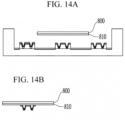
- the skin attachable thin film T, T1, T2 or T' may be separated from the cast part 100 by bringing an adhesive film 800 including an adhesive 810 into contact with the cast part 100.
- the adhesive film 800 may simultaneously acquire the plurality of skin attachable thin films that are formed on the upper surfaces of the protruding pillars 200 of the cast part 100 by having a length substantially the same as a length of the cast part 100, or having a length shorter than the length of the cast part 100 and greater than a distance between the protruding pillars 200.
- the adhesive film 800 is not limited thereto, and may acquire only one skin attachable thin film that is formed on the upper surface of the protruding pillar 200 of the cast part 100 by having a length substantially the same as the length of the protruding pillar 200, or having a length greater than the length of the protruding pillar 200 and shorter than the distance between the protruding pillars 200.
Landscapes
- Health & Medical Sciences (AREA)
- Engineering & Computer Science (AREA)
- General Health & Medical Sciences (AREA)
- Veterinary Medicine (AREA)
- Heart & Thoracic Surgery (AREA)
- Life Sciences & Earth Sciences (AREA)
- Animal Behavior & Ethology (AREA)
- Biomedical Technology (AREA)
- Public Health (AREA)
- Vascular Medicine (AREA)
- Mechanical Engineering (AREA)
- Manufacturing & Machinery (AREA)
- Dermatology (AREA)
- Medical Informatics (AREA)
- Anesthesiology (AREA)
- Hematology (AREA)
- Chemical & Material Sciences (AREA)
- Medicinal Chemistry (AREA)
- Moulding By Coating Moulds (AREA)
Abstract
Description
- The present disclosure relates to a technique for manufacturing a thin film, and particularly, to a mold for manufacturing a skin attachable thin film and a manufacturing method of a skin attachable thin film using the same.
- In generally, most medicines may be orally administered. However, a certain medicine, especially a protein or peptide medicine, may not be effectively adsorbed into a human body by this method due to its intense degradation in the gastrointestinal tract, its poor absorption from an intestinal cell membrane, and/or an interruption of its first-pass by the liver.
- Another medicine administration technique may be parenteral injection using a standard syringe or a catheter. Needle injection may cause a needle phobia, a substantial pain, and a local damage to the skin in many patients. Retrieval of a body fluid, such as blood, for a diagnostic purpose may raise a similar concern. In addition, the needle injection may not be ideal for a regular medicine delivery or a regular diagnosis.
- Still another medicine delivery technique may use a transdermal delivery method, which usually relies on spread of the medicine across the skin. This method may not be widely used due to poor skin permeability of many medicines. The stratum corneum, which is an outermost layer of the skin, may represent a main barrier to penetration of the transdermal medicine. When the medicine once reaches a dermal depth (i.e., below the epithelium), the medicine may quickly spread to a deeper tissue layer and other parts of the body through blood circulation. In an attempt to improve a rate of protein medicine delivery through the skin, chemical enhancers, iontophoresis, electroporation, ultrasound, and thermal devices have been used to supplement the medicine delivery.
- In order to perform the medicine delivery through the skin, it may be necessary to manufacture a thin film capable of being attached to the skin. In general, the thin film may be manufactured in a process of injecting a solution having a low concentration (of 30% or less) into a mold, then drying the same in air, vacuum, blowing, hot air, or the like, separating the thin film from the mold, and cutting the same into a plurality of thin films having a size required for a product.
- However, when manufacturing the thin film by using this manufacturing process, the dried thin film in a region of the mold where its bottom and wall surface meet each other may be distorted due to shrinkage or separated from a mold surface.
- Accordingly, it may be difficult to perform post-process on the thin film separated from the mold surface, and it may be very difficult to form a precise and flat thin film.
- The present disclosure attempts to provide a mold for manufacturing a plurality of precise and flat thin films, and a manufacturing method of a skin attachable thin film using the same.
- The present disclosure also attempts to provide a mold for manufacturing a plurality of thin films without any additional post-process after a drying process, and a manufacturing method of a skin attachable thin film using the same.
- The present disclosure also attempts to provide a mold for manufacturing thin films having different thicknesses through a single process, and a manufacturing method of a skin attachable thin film using the same.
- The present disclosure also attempts to provide a mold allowing reuse of a solution used in the manufacturing of a skin attachable thin film, and a manufacturing method of a skin attachable thin film using the same.
- According to an embodiment, provided is a mold for manufacturing a skin attachable thin film, the mold including: a cast part accommodating a mixed solution in an inner space; and a protruding pillar formed in the cast part, the skin attachable thin film being manufactured on an upper surface of the protruding pillar, wherein the cast part includes a lower surface part forming a bottom and a side part vertically protruding from an outer peripheral surface of the lower surface part, and a plurality of protruding pillars protrude from the lower surface part.
- Here, a first microstructure may be on the upper surface of the protruding pillar.
- In addition, the upper surface of the protruding pillar may be a curved surface.
- Meanwhile, The mold may further include a first accommodation protrusion protruding from an outer peripheral surface of the upper surface of the protruding pillar.
- In addition, the mold may further include a second accommodation protrusion having a polygonal or circular shape and protruding in a closed curve from a region of the lower surface part without the protruding pillar.
- In addition, a second microstructure may be formed on a surface of an inner region surrounded by the second accommodation protrusion in the region of the lower surface part without the protruding pillar.
- Meanwhile, the cast part may include a plurality of separators disposed between the protruding pillars.
- In addition, the cast part may include a plurality of holes capable of being opened and closed that are disposed between the protruding pillars.
- According to another embodiment, provided is a manufacturing method of a skin attachable thin film using the mold for manufacturing a skin attachable thin film described above, the method including: a step of accommodating a mixed solution of accommodating the mixed solution in an inner space by supplying the mixed solution to a cast part; a step of drying the mixed solution accommodated in the inner space for the mixed solution supplied to the cast part to be changed into the skin attachable thin film; and a step of acquiring the thin film of separating the skin attachable thin film that is formed as the step of drying the mixed solution is performed from the cast part.
- Here, the skin attachable thin film that is acquired in the step of acquiring the thin film may be formed on an upper surface of a protruding pillar.
- In addition, the skin attachable thin film that is acquired in the step of acquiring the thin film may be formed in an inner region surrounded by a second accommodation protrusion.
- In another example, the method may include: the step of accommodating the mixed solution of accommodating the mixed solution in the inner space by supplying the mixed solution to the cast part; the step of drying the mixed solution accommodated in the inner space for the mixed solution supplied to the cast part to be changed into the skin attachable thin film; a step of coating a functional material of selectively coating the functional material on the skin attachable thin film; a solidification step of drying and solidifying the coated functional material; a step of coating a functional material of selectively coating the functional material on the skin attachable thin film; and the step of acquiring the thin film of separating the skin attachable thin film that is formed as the step of drying the mixed solution is performed in the cast part.
- Here, the step of coating the functional material may further include a step of coating an aqueous solution to gather the functional material coated on the skin attachable thin film.
- In addition, the step of coating the aqueous solution may further include a step of additionally supplying the mixed solution.
- Meanwhile, in the step of acquiring the thin film, the skin attachable thin film may be separated from the cast part by bringing an adhesive film including an adhesive into contact with the cast part.
- Here, the adhesive film may separate the plurality of skin attachable thin films by being manufactured to have a length substantially the same as a length of the cast part or have a length shorter than the length of the cast part and greater than a distance between the protruding pillars.
- Alternatively, the adhesive film may separate the skin attachable thin film by being manufactured to have a length substantially the same as a length of the protruding pillar or have a length greater than the length of the protruding pillar and shorter than a distance between the protruding pillars.
- The mold for manufacturing a skin attachable thin film and the manufacturing method of a skin attachable thin film using the same according to the embodiments of the present disclosure may have the following effects.
- First, the plurality of precise and flat thin films may be manufactured using the single mold.
- Second, the plurality of thin films may be manufactured without any additional post-process, such as the cutting process after the drying process.
- Third, the thin films having the different thicknesses may be manufactured in the single process.
- Fourth, the manufacturing cost of the skin attachable thin film may be lower by reusing the solution used in the manufacturing of the skin attachable thin film.
-
-
FIG. 1 is a view showing a first example of a mold for manufacturing a skin attachable thin film according to the present disclosure. -
FIG. 2 is a view showing an example of a first microstructure in the first example of the mold for manufacturing a skin attachable thin film according to the present disclosure. -
FIG. 3 is a view showing a second example of a mold for manufacturing a skin attachable thin film according to the present disclosure. -
FIG. 4 is a view showing a third example of a mold for manufacturing a skin attachable thin film according to the present disclosure. -
FIG. 5 is a view showing an example of a second microstructure in the third example of the mold for manufacturing a skin attachable thin film according to the present disclosure. -
FIG. 6 is a view showing a fourth example of a mold for manufacturing a skin attachable thin film according to the present disclosure. -
FIG. 7 is a view showing a fifth example of a mold for manufacturing a skin attachable thin film according to the present disclosure. -
FIG. 8 is a view showing a sixth example of a mold for manufacturing a skin attachable thin film according to the present disclosure. -
FIG. 9 is a view showing a seventh example of a mold for manufacturing a skin attachable thin film according to the present disclosure. -
FIG. 10 is a view showing steps of a manufacturing method of a skin attachable thin film according to the present disclosure. -
FIG. 11 is a first view showing a step of coating the functional material which may be additionally performed in the manufacturing method of a skin attachable thin film according to the present disclosure. -
FIG. 12 is a second view showing a step of coating the functional material which may be additionally performed in the manufacturing method of a skin attachable thin film according to the present disclosure. -
FIG. 13 is a third view showing a step of coating the functional material which may be additionally performed in the manufacturing method of a skin attachable thin film according to the present disclosure. -
FIG. 14 is a view showing a step of acquiring the thin film in the manufacturing method of a skin attachable thin film according to the present disclosure. - Hereinafter, the description describes embodiments of the present disclosure for specifically implementing objects of the present disclosure with reference to the accompanying drawings. In describing the embodiments, the same components are denoted by the same names and the same reference numerals, and the following description omits an additional description thereof.
- Referring to
FIGS. 1 and2 , the description describes a first example of a mold for manufacturing a skin attachable thin film according to the present disclosure as follows. -
FIG. 1 is a view showing a first example of a mold for manufacturing a skin attachable thin film according to the present disclosure; andFIG. 2 is a view showing an example of a first microstructure in the first example of the mold for manufacturing a skin attachable thin film according to the present disclosure. - First, as shown in
FIG. 1 , the first example of the mold for manufacturing a skin attachable thin film may include acast part 100 and aprotruding pillar 200. - The
cast part 100 may include an open upper surface, a 'U'-shaped cross section, alower surface part 110, and aside part 120 protruding upward from an outer peripheral surface of thelower surface part 110 to accommodate a mixed solution S (inFIG 10 ) for manufacturing the skin attachable thin film in an inner space. - A height of the
side part 120 may be determined based on the maximum value of a thickness of a skin attachable thin film T (inFIG. 10 ) to be formed. - The reason is that the thickness of the skin attachable thin film that is described below may be determined based on an amount of mixed solution accommodated in the inner space of the
cast part 100, that is, a depth of the mixed solution. Accordingly, the maximum value of the thickness of the skin attachable thin film may be determined based on the height of theside part 120. - The protruding
pillar 200 may protrude from at least a partial region of thelower surface part 110, and thecast part 100 may have at least one protruding pillar. - When the plurality of protruding
pillars 200 are provided, the skin attachable thin film that is generated as the mixed solution is once accommodated in the inner space of thecast part 100 and goes through a drying process may have the same number as the number of protrudingpillars 200. - In this way, according to the present disclosure, the plurality of protruding
pillars 200 may be formed on the single mold and the thin film may be manufactured thereon, thereby completing the plurality of skin attachable thin films only in a separation process after drying the thin film. That is, the manufacturing process and cost of the present disclosure may be reduced by eliminating a cutting process. - In addition, when manufacturing the thin film on the bottom of the mold, the dried thin film in a region of the mold where its bottom and wall surface meet each other used to be deformed due to shrinkage, or separated from a surface of the mold, thus making it difficult to form a flat thin film. However, the present disclosure may manufacture a plurality of precise and flat thin films by manufacturing the thin films on the plurality of protruding
pillars 200. Furthermore, when manufacturing the thin film on the bottom of the mold, a remaining thin film used to be contaminated or deformed as the thin film goes through the cutting process after the separation, thus making it impossible to reuse the thin film. However, the present disclosure may lower the manufacturing cost of skin attachable thin film by melting and reusing the thin film remaining on the bottom of the mold. - The shape and size of an
upper surface 200U of the protrudingpillar 200 may be modified to match the shape and size of the skin attachable thin film to be manufactured. - That is, the upper surface of the protruding
pillar 200 may have a circular or polygonal shape, thus acquiring the skin attachable thin film to be formed without any restriction on its shape and size. - Here, the
upper surface 200U of the protrudingpillar 200 may be surface-treated to be hydrophilic. As a result, in a step of drying the mixed solution (S110), the mixed solution may have stability without being separated from the upper surface of the protrudingpillar 200 to thus form the skin attachable thin film. - In addition, the upper surface of the protruding
pillar 200 may be a flat surface or a curved surface. - Accordingly, the skin attachable thin film may be basically made of a material having flexibility based on a type of the mixed solution, or may also have a shape corresponding to the surface to which the film is attached, thereby increasing its adhesion.
- In addition, as shown in
FIGS. 1A and 1B , the protruding pillar may have a shape of a cylinder with parallel side surfaces, and as shown inFIGS. 1C and 1D , an area of the upper surface of the protruding pillar may be larger than an area of its lower surface. - That is, as shown in
FIG. 1C , a protruding pillar 200' may have a shape of a side surface narrower toward the bottom, and as shown inFIG. 1D , a protrudingpillar 200" may have a stepped shape. - As the protruding
pillar 200' or 200" has the shape of the area narrower toward the bottom, a region of thelower surface part 110 without the protrudingpillar 200' or 200" become larger to secure a larger area where a second accommodation protrusion 400 (inFIG. 4 ) described below protrude. The second accommodation protrusion is described below. - In addition, as shown in
FIG. 2 , in the first example of the mold for manufacturing a skin attachable thin film according to the present disclosure, afirst microstructure 210 may be formed on the upper surface of the protrudingpillar 200. - The
first microstructure 210 may be recessed in the upper surface of the protrudingpillar 200, a shape of thefirst microstructure 210 may be freely deformable into a shape enabling accommodation of a coated functional material in a manufacturing method of a skin attachable thin film according to the present disclosure, which is described below, and a diameter of thefirst microstructure 210 may be several nm to several mm. - Referring to
FIG. 3 , the description describes a second example of a mold for manufacturing a skin attachable thin film according to the present disclosure as follows. - The second example of the mold for manufacturing a skin attachable thin film according to the present disclosure may be the same as the first example described above in that at least one protruding
pillar 200 is formed on thelower surface part 110 of thecast part 100, and thefirst microstructure 210 is formed on the upper surface of the protrudingpillar 200. - However, the second example of the mold for manufacturing a skin attachable thin film according to the present disclosure that is shown in
FIG. 3 may further include afirst accommodation protrusion 300. - That is, as shown in
FIG. 3 , thefirst accommodation protrusion 300 may protrude from an outer peripheral surface of the upper surface of the protrudingpillar 200 to thus accommodate the mixed solution in the upper surface of the protrudingpillar 200. - Here, the
upper surface 200U of the protrudingpillar 200 may be hydrophilic, as described above in the first example of the mold for manufacturing a skin attachable thin film according to the present disclosure. - In addition, an inner
peripheral surface 300S of thefirst accommodation protrusion 300 may be hydrophobic to prevent the thin film from being formed on the innerperipheral surface 300S of thefirst accommodation protrusion 300 when the thin film is dried, thereby preventing the formed skin attachable thin film from being stepped by the first accommodateprotrusion 300. - Referring to
FIGS. 4 and5 , the description describes a third example of a mold for manufacturing a skin attachable thin film according to the present disclosure as follows. - The third example of the mold for manufacturing a skin attachable thin film according to the present disclosure may be the same as the first example described above in that at least one protruding
pillar 200 is formed from thelower surface part 110 of thecast part 100, and thefirst microstructure 210 is formed on the upper surface of the protrudingpillar 200. - However, the third example of the mold for manufacturing a skin attachable thin film according to the present disclosure that is shown in
FIG. 4 may further include thesecond accommodation protrusion 400. - As shown in
FIG. 4 , thesecond accommodation protrusion 400 may have the polygonal or circular shape and protruding in a closed curve from the region of thelower surface part 110 without the protrudingpillar 200 to accommodate the mixed solution therein. - That is, the skin attachable thin film may be formed not only on the upper surface of the protruding
pillar 200 described above, but also in thelower surface part 110 of thecast part 100. - The shape and size of the
second accommodation protrusion 400 may be modified to match the shape and size of the skin attachable thin film to be manufactured. As a result, the skin attachable thin film to be formed may be acquired without any restriction on its shape and size. - Here, a
surface 110U of an inner region surrounded by thesecond accommodation protrusion 400 in the region of thelower surface part 110 without the protrudingpillar 200 may be hydrophilic like theupper surface 200U of the protrudingpillar 200. - In addition, an inner
peripheral surface 400S of thesecond accommodation protrusion 400 may be hydrophobic to prevent the thin film from being formed on the innerperipheral surface 400S of thesecond accommodation protrusion 400 when the thin film is dried, thereby preventing the formed skin attachable thin film from being stepped by the second accommodateprotrusion 400. - In addition, as shown in
FIG. 5 , in the third example of the mold for manufacturing a skin attachable thin film according to the present disclosure, asecond microstructure 410 may be formed in the surface of the inner region surrounded by thesecond accommodation protrusion 400 in the region of thelower surface part 110 without the protrudingpillar 200. - The
second microstructure 410 may be recessed in the upper surface of the protrudingpillar 200, a shape of thesecond microstructure 410 may be freely deformable into a shape enabling the accommodation of the coated functional material in the manufacturing method of a skin attachable thin film according to the present disclosure, which is described below, and a diameter of thesecond microstructure 410 may be several nm to several mm. - Referring to
FIG. 6 , the description describes a fourth example of a mold for manufacturing a skin attachable thin film according to the present disclosure as follows. - The fourth example of the mold for manufacturing a skin attachable thin film according to the present disclosure may be the same as the first example described above in that at least one protruding
pillar 200 is formed from thelower surface part 110 of thecast part 100, and thefirst microstructure 210 is formed on the upper surface of the protrudingpillar 200. - However, the fourth example of the mold for manufacturing a skin attachable thin film according to the present disclosure that is shown in
FIG. 6 may further include a pillarfitting block - As shown in
FIG. 6 , the pillarfitting block pillar 200 to acquire a skin attachable thin film that has a size larger than the size of the skin attachable thin film that is capable of being manufactured from the protrudingpillar 200. - That is, the pillar
fitting block pillar 200 to thus be inserted into the protrudingpillar 200, and the pillarfitting block pillar 200. - Here, an upper surface of the pillar
fitting block fitting block second microstructures fitting block - In addition, a third accommodation protrusion (not shown) performing the same function as the first and
second accommodation protrusions - In addition, the pillar fitting block may have a length to entirely cover the side surface of the protruding pillar 200 (in the case of the pillar fitting block 510), or have a length to cover only a portion of an upper part of the protruding pillar 200 (in the case of the pillar fitting block 520) not to interfere with the generation of the skin attachable thin film that is formed by the
second accommodation protrusion 400 formed on thelower surface part 110 of thecast part 100. - As a result, the pillar
fitting block pillar 200, thus making it possible to acquire thin films having different sizes in a single process. - Referring to
FIG. 7 , the description describes a fifth example of a mold for manufacturing a skin attachable thin film according to the present disclosure as follows. - The fifth example of the mold for manufacturing a skin attachable thin film according to the present disclosure may be the same as the first example described above in that at least one protruding
pillar 200 is formed from thelower surface part 110 of thecast part 100, and thefirst microstructure 210 is formed on the upper surface of the protrudingpillar 200. - However, in the fifth example of the mold for manufacturing a skin attachable thin film according to the present disclosure, the protruding pillar may include a first
protruding pillar 200A and a secondprotruding pillar 200B. - As shown in
FIG. 7 , the firstprotruding pillar 200A and the secondprotruding pillar 200B may have different heights, and the thickness of the formed skin attachable thin film may be changed based on a height difference between the firstprotruding pillar 200A and the secondprotruding pillar 200B. - That is, the skin attachable thin films that have different thicknesses may be generated through the single process in the fifth example of the mold for manufacturing a skin attachable thin film according to the present disclosure.
- Referring to
FIG. 8 , the description describes a sixth example of a mold for manufacturing a skin attachable thin film according to the present disclosure as follows. - The sixth example of the mold for manufacturing a skin attachable thin film according to the present disclosure may be the same as the first example described above in that at least one protruding
pillar 200 is formed from thelower surface part 110 of thecast part 100, and thefirst microstructure 210 is formed on the upper surface of the protrudingpillar 200. - However, the sixth example of the mold for manufacturing a skin attachable thin film according to the present disclosure that is shown in
FIG. 8 may further include a plurality ofseparators 600. - Here, the
separator 600 may be formed not only between the protrudingpillars 200, but also between a side wall of thecast part 100 and the protrudingpillar 200. In addition, theseparator 600 may prevent the mixed solution that is changed into the skin attachable thin film from being deformed due to the shrinkage in the step of drying the mixed solution described below. Here, a height of theseparator 600 may not exceed a height of thecast part 100. - On the other hand, the
separator 600 may not only prevent the mixed solution from being deformed, but also function as the protrudingpillar 200 by forming the microstructure in an upper surface of theseparator 600. That is, more skin attachable thin films may be acquired when theseparator 600 is used as the protrudingpillar 200. - Referring to
FIG. 9 , the description describes a seventh example of a mold for manufacturing a skin attachable thin film according to the present disclosure as follows. - The seventh example of the mold for manufacturing a skin attachable thin film according to the present disclosure may be the same as the first example described above in that at least one protruding
pillar 200 is formed from thelower surface part 110 of thecast part 100, and thefirst microstructure 210 is formed on the upper surface of the protrudingpillar 200. - However, the seventh example of the mold for manufacturing a skin attachable thin film according to the present disclosure that is shown in
FIG. 9 may further include a plurality ofholes 700 capable of being opened and closed. - Here, the plurality of
holes 700 capable of being opened and closed may be formed not only between the protrudingpillars 200, but also between the side wall of thecast part 100 and the protrudingpillar 200. In addition, the plurality ofholes 700 capable of being opened and closed may enable the mixed solution to be reused by controlling its opening and closing before the mixed solution is dried in a step of accommodating the mixed solution described below to thus discharge the mixed solution to the outside of thecast part 100. - That is, the plurality of
holes 700 capable of being opened and closed may enable the mixed solution to be reused even though the same amount of mixed solution is used to manufacture the skin attachable thin film, thereby enabling a larger amount of the skin attachable thin film to be manufactured. - The configurations of the mold for manufacturing a skin attachable thin film in the first to seventh examples of the present disclosure described above may be not only used in one embodiment, but also used in other embodiments with different configurations for the respective examples.
- The description describes a manufacturing method of a skin attachable thin film according to the present disclosure as follows.
- As shown in
FIG. 10 , the manufacturing method of a skin attachable thin film according to the present disclosure uses amold 1000 for manufacturing a skin attachable thin film according to the first to seventh examples of the present disclosure, and reference numerals indicating the components of themold 1000 for manufacturing a skin attachable thin film are the same as those described with reference toFIGS. 1 to 9 . - In detail, the manufacturing method of a skin attachable thin film according to the present disclosure may include a step of accommodating the mixed solution (S100), the step of drying the mixed solution (S110), and a step of acquiring the thin film (S120).
- In the step of accommodating the mixed solution (S100), the mixed solution S may be accommodated in the inner space by supplying the mixed solution S to the
cast part 100. - In the step of accommodating the mixed solution (S100), the mixed solution S may be vacuum treated while being accommodated in the
cast part 100. An accommodation state of the mixed solution S in thecast part 100 may be stabilized by the vacuum treatment, an air bubble in the mixed solution S may be removed, or drying of the mixed solution S may be promoted. In addition, the mixed solution S may be vacuum treated before being supplied to thecast part 100. - Here, a solute in the mixed solution S may be a material which may be dissolved or decomposed in a living body. The solute may consist of the following groups: nucleic acid, deoxyribonucleic acid (DNA), ribonucleic acid (RNA), polydeoxyribonucleotide (PDRN), hyaluronic acid, alginic acid, pectin, carrageenan, chondroitin (sulfate), chondroitin sulfate, glycogen, dextran (sulfate), dextran, dextrin, chitosan, polylysine, collagen, gelatin, carboxymethyl chitin, fibrin, agarose, pullulan polylactide, polyglycolide (PGA), polylactide-glycolide copolymer (PLGA), hyaluronic acid, alginic acid, pectin, carrageenan, chondroitin (sulfate), dextran (sulfate), chitin, chitosan, polylysine, collagen, gelatin, polysaccharides such as carboxymethyl chitin, fibrin, agarose, and pullulan, proteins such as collagen, gelatin, and their hydrolysates, pullulan polyanhydride, polyortheoester, polyetherester, polycaprolactone, polyesteramide, poly (butyric acid), poly (valeric acid), polyurethane, polyacrylate, ethylene-vinyl acetate polymers, acrylic substituted cellulose acetate, nondegradable polyurethanes, polystyrene, polyvinyl chloride, polyvinyl fluoride, poly (vinyl imidazole), chlorosulphonatepolyolefins, polyethylene oxide, polyvinylpyrrolidone (PVP), polyvinyl alcohol, polyethylene glycol (PEG), polymethacrylate, polyacrylic acid, carboxyvinyl polymer, hydroxypropyl methylcellulose, ethylcellulose (EC), hydroxypropylcellulose (HPC), carboxymethylcellulose, cyclodextrin, and the copolymers of the monomers and celluloses that form these polymers.
- In addition, the solute of the mixed solution S may include a material that may be dissolved in both of a volatile inorganic solvent such as water and an organic solvent such as ethanol, acetone, ether, or benzene.
- In the step of drying the mixed solution (S110), the mixed solution S accommodated in the inner space may be dried for the mixed solution S supplied to the
cast part 100 to be changed into a skin attachable thin film T. - In the step of drying the mixed solution (S110), the
cast part 100 accommodating the mixed solution S may be dried using air, vacuum, blowing, hot air, or the like at a certain drying temperature for a certain drying time in a separate drying unit (not shown). - A drying method performed in the step of drying the mixed solution (S110) is not limited to the method described above, and may be performed using a usable drying method.
- The drying temperature and the drying time in the step of drying the mixed solution (S110) may be adjusted based on a type of the mixed solution S and a capacity of the mixed solution S accommodated in the
cast part 100. - In addition, in the step of drying the mixed solution (S110), the bubble in the mixed solution S accommodated in the
cast part 100 may be removed through a pipetting unit (not shown) to generate the high-quality skin attachable thin film T. - In the step of acquiring the thin film (S120), the skin attachable thin film T that is formed as the step of drying the mixed solution (S110) is performed may be separated from the
cast part 100. - In the step of acquiring the thin film (S120), the thin film T may be separated using a separate adhesive film. This configuration is described below.
- In addition, the skin attachable thin film T that is acquired in the step of acquiring the thin film (S120) may not only be the skin attachable thin film T that is formed on the upper surface of the protruding
pillar 200, that is, the inner region surrounded by thesecond accommodation protrusion 400, but also be the skin attachable thin film T that is formed on the upper surface of the pillarfitting block - In addition, the manufacturing method of a skin attachable thin film according to the present disclosure may further include a step of coating the functional material (S110') and a solidification step (not shown).
- The step of coating the functional material (S110') may preferably be performed after the step of drying the mixed solution (S110). In the step of coating the functional material (S110'), the mixed solution S or a functional heterogeneous material (hereinafter, referred to as a functional material F) may be selectively coated on an upper surface of the skin attachable thin film T.
- Here, the functional material F may include a material exhibiting a medicinal, mechanical, or electrochemical property exhibiting an effective property of a human body.
- As shown in
FIG. 11 , in the step of coating the functional material (S110'), the functional material F may be selectively coated on an upper surface of a flat skin attachable thin film T1 that is formed on the upper surface of the protrudingpillar 200 shown inFIG. 1 , or may be selectively coated in a groove part H formed in a skin attachable thin film T2 by the first microstructure to the third microstructure. - Next, in the solidification step, the functional material F coated on the skin attachable thin film T1 or T2 may be dried and solidified, and the step of acquiring the thin film (which is the same as the step S120 in
FIG. 10 ) may then be performed, thereby acquiring the skin attachable thin film T1 or T2 that includes the functional material F. - As shown in
FIG. 11 andFIGS. 12A to 12C , in the step of coating the functional material, the functional material F may be selectively coated on the upper surface of the flat skin attachable thin film T1 that is formed on the upper surface of the protrudingpillar 200 shown inFIG. 1 , or may be selectively coated in the groove part H formed in the skin attachable thin film T2 by the first microstructure to the third microstructure. - However, unlike the fact that the solidification step is performed after the functional material is coated in the example of
FIG. 11 , in the examples ofFIGS. 12A to 12C , the functional material may be coated (S210'), and a step of accommodating the mixed solution S in the cast part 100 (S211') may then be performed again. - That is, in the examples of
FIGS. 12A to 12C , the mixed solution S may be accommodated again and a step of acquiring the thin film (S220', which is the same as the step S120 inFIG. 10 ) may then be performed to thus acquire not only the skin attachable thin film T that is disposed under the functional material F but also a skin attachable thin film T' that is disposed on the functional material F, thereby acquiring more skin attachable thin films. - Referring to
FIG. 11 to FIGS. 13A and13B , in the step of coating the functional material (which is the same as the step S210' inFIG. 12 ), the functional material F may be selectively coated on the upper surface of the flat skin attachable thin film T1 that is formed on the upper surface of the protrudingpillar 200 shown inFIG. 1 , or may be selectively coated in the groove part H formed in the skin attachable thin film T2 by the first microstructure to the third microstructure. - However, unlike the fact that the step of accommodating the mixed solution S in the
cast part 100 is performed again after the functional material is coated in the example ofFIG. 12 , in the examples ofFIGS. 13A and 13B , the functional material may be coated (which is the same as the step of S210' inFIG. 12 ), and a step of coating an aqueous solution W (S311') may then be performed on the functional material. Here, the step of coating the aqueous solution (S311') may be performed before the functional material is dried. - That is, in the examples of
FIGS. 13A and 13B , the aqueous solution W may be coated on the functional material F, thereby gathering the functional material coated on the skin attachable thin film T (S312'). For example, the functional material F may be coated in the groove part H formed in the skin attachable thin film T2 by the first to third microstructures of the protrudingpillar 200 shown inFIG. 1 . In this case, the aqueous solution W may gather the functional material F to an end of the groove part H. - When the skin attachable thin film T2 is separated from the mold and attached to the skin, the groove part H formed in the skin attachable thin film T2 may be inserted into the skin and then be dissolved to deliver the functional material F including the groove part H to the skin. The aqueous solution W may gather the functional material F to the end of the groove part H, thereby delivering the functional material F deep into the skin. Here, the aqueous solution W may be evaporated while going through a step of drying the functional material. In the examples of
FIGS. 13A and 13B , the mixed solution S may be accommodated again after the step of coating the aqueous solution (S311'), and the step of acquiring the thin film (which is the same as the step S220' inFIG. 12 ) may be performed to thus acquire not only the skin attachable thin film T that is disposed under the functional material F but also the skin attachable thin film T' that is disposed on the functional material F, thereby acquiring more skin attachable thin films. - Referring to
FIGS. 11 to 14 , in the manufacturing method of a skin attachable thin film according to the present disclosure, in the step of acquiring the thin film (which is the same as S120 inFIG. 10 ), the skin attachable thin film T, T1, T2 or T' may be separated from thecast part 100 by bringing anadhesive film 800 including an adhesive 810 into contact with thecast part 100. - Here, the
adhesive film 800 may simultaneously acquire the plurality of skin attachable thin films that are formed on the upper surfaces of the protrudingpillars 200 of thecast part 100 by having a length substantially the same as a length of thecast part 100, or having a length shorter than the length of thecast part 100 and greater than a distance between the protrudingpillars 200. - However, the
adhesive film 800 is not limited thereto, and may acquire only one skin attachable thin film that is formed on the upper surface of the protrudingpillar 200 of thecast part 100 by having a length substantially the same as the length of the protrudingpillar 200, or having a length greater than the length of the protrudingpillar 200 and shorter than the distance between the protrudingpillars 200. - As described above, the present disclosure is not limited to the above-mentioned specific embodiments, and may be variously modified by those skilled in the art to which the present disclosure pertains without departing from the scope and spirit of the present disclosure as disclosed in the accompanying claims. These modifications should also be understood to fall within the scope of the present disclosure.
Claims (17)
- A mold for manufacturing a skin attachable thin film, the mold comprising:a cast part accommodating a mixed solution in an inner space; anda protruding pillar in the cast part, the skin attachable thin film being manufactured on an upper surface of the protruding pillar,wherein the cast part includes a lower surface part forming a bottom and a side part vertically protruding from an outer peripheral surface of the lower surface part, anda plurality of protruding pillars protrude from the lower surface part.
- The mold of claim 1, wherein
a first microstructure is on the upper surface of the protruding pillar. - The mold of claim 1, wherein
the upper surface of the protruding pillar is a curved surface. - The mold of claim 1, further comprising
a first accommodation protrusion protruding from an outer peripheral surface of the upper surface of the protruding pillar. - The mold of claim 1, further comprising
a second accommodation protrusion having a polygonal or circular shape and protruding in a closed curve from a region of the lower surface part without the protruding pillar. - The mold of claim 5, wherein
a second microstructure is formed on a surface of an inner region surrounded by the second accommodation protrusion in the region of the lower surface part without the protruding pillar. - The mold of claim 1, whereinthe cast part includesa plurality of separators disposed between the protruding pillars.
- The mold of claim 1, whereinthe cast part includesa plurality of holes capable of being opened and closed that are disposed between the protruding pillars.
- A manufacturing method of a skin attachable thin film using the mold for manufacturing a skin attachable thin film according to any one of claims 1 to 8, the method comprising:accommodating the mixed solution in an inner space by supplying the mixed solution to a cast part;drying the mixed solution accommodated in the inner space for the mixed solution supplied to the cast part to be changed into the skin attachable thin film; andseparating the skin attachable thin film that is formed as the drying the mixed solution is performed from the cast part.
- The method of claim 9, wherein
the skin attachable thin film that is acquired in the separating the thin film is formed on an upper surface of a protruding pillar. - The method of claim 9, wherein
the skin attachable thin film that is acquired in the separating the thin film is formed in an inner region surrounded by a second accommodation protrusion. - The method of claim 9, further comprising:between the drying the mixed solution and the separating the thin film,selectively coating the functional material on the skin attachable thin film; anddrying and solidifying the coated functional material.
- The method of claim 12, whereinthe coating the functional material further includescoating an aqueous solution to gather the functional material coated on the skin attachable thin film.
- The method of claim 13, whereinthe coating the aqueous solution further includesadditionally supplying the mixed solution.
- The method of claim 12, whereinin the separatin the thin film,the skin attachable thin film is separated from the cast part by bringing an adhesive film including an adhesive into contact with the cast part.
- The method of claim 15, whereinthe adhesive film separatesthe plurality of skin attachable thin films by being manufactured to have a length substantially the same as a length of the cast part or have a length shorter than the length of the cast part and greater than a distance between the protruding pillars.
- The method of claim 15, whereinthe adhesive film separatesthe skin attachable thin film by being manufactured to have a length substantially the same as a length of the protruding pillar or have a length greater than the length of the protruding pillar and shorter than a distance between the protruding pillars.
Applications Claiming Priority (2)
| Application Number | Priority Date | Filing Date | Title |
|---|---|---|---|
| KR1020210095533A KR102788775B1 (en) | 2021-07-21 | 2021-07-21 | Mold for manufacturing thin film attached to skin and manufacturing method of the thin film using the same |
| PCT/KR2021/020225 WO2023003108A1 (en) | 2021-07-21 | 2021-12-29 | Mold for manufacturing thin film attachable to skin and method for manufacturing thin film attached to skin by using same |
Publications (2)
| Publication Number | Publication Date |
|---|---|
| EP4374909A1 true EP4374909A1 (en) | 2024-05-29 |
| EP4374909A4 EP4374909A4 (en) | 2025-07-02 |
Family
ID=84980170
Family Applications (1)
| Application Number | Title | Priority Date | Filing Date |
|---|---|---|---|
| EP21951056.7A Pending EP4374909A4 (en) | 2021-07-21 | 2021-12-29 | Mold for producing a skin-applicable thin film and method for producing a skin-applicable thin film using the same |
Country Status (4)
| Country | Link |
|---|---|
| US (1) | US12622815B2 (en) |
| EP (1) | EP4374909A4 (en) |
| KR (1) | KR102788775B1 (en) |
| WO (1) | WO2023003108A1 (en) |
Families Citing this family (1)
| Publication number | Priority date | Publication date | Assignee | Title |
|---|---|---|---|---|
| KR20250039802A (en) | 2023-09-14 | 2025-03-21 | 한국기계연구원 | Manufacturing method of micro-needle patch and micro-needle patch manufactured thereby |
Family Cites Families (16)
| Publication number | Priority date | Publication date | Assignee | Title |
|---|---|---|---|---|
| JP5161776B2 (en) | 2005-09-06 | 2013-03-13 | セラジェクト, インコーポレイテッド | Solid solution punch comprising drug particles and / or particles adsorbed with drugs |
| US20080020007A1 (en) * | 2006-07-18 | 2008-01-24 | Zang Hongmei | Liquid-containing film structure |
| FR2933959B1 (en) | 2008-07-16 | 2010-09-10 | Roquette Freres | PROCESS FOR PRODUCING FILMS DIRECTLY IN ALVEOL |
| EP2821096B1 (en) | 2012-02-29 | 2019-05-22 | Toppan Printing Co., Ltd. | Method for manufacturing needle-like material |
| KR102140553B1 (en) * | 2012-06-22 | 2020-08-03 | 도판 인사츠 가부시키가이샤 | Needle-shaped body and manufacturing method for needle-shaped body |
| JP5851077B1 (en) * | 2014-03-26 | 2016-02-03 | 日本写真印刷株式会社 | Packing body for cone-shaped projection sheet and method for manufacturing the same |
| JP6411395B2 (en) * | 2015-03-10 | 2018-10-24 | 富士フイルム株式会社 | Method for producing transdermal absorption sheet |
| JP6571586B2 (en) * | 2016-05-13 | 2019-09-04 | 富士フイルム株式会社 | Method for producing mold, method for producing pattern sheet, method for producing electroformed mold, and method for producing mold using electroformed mold |
| JP6588864B2 (en) * | 2016-05-23 | 2019-10-09 | 富士フイルム株式会社 | Method for producing transdermal absorption sheet |
| TWI860282B (en) * | 2017-10-18 | 2024-11-01 | 瑞士商Bvw控股公司 | Device with microstructure mediated absorption profile |
| JP7095937B2 (en) | 2018-03-09 | 2022-07-05 | ミネベアミツミ株式会社 | Manufacturing method of fluorescent sheet |
| WO2019188935A1 (en) * | 2018-03-30 | 2019-10-03 | 富士フイルム株式会社 | Microneedle array manufacturing method |
| WO2019225288A1 (en) * | 2018-05-25 | 2019-11-28 | 富士フイルム株式会社 | Method for manufacturing mold having recessed pattern in recessed step part, and method for producing pattern sheet |
| KR102240614B1 (en) * | 2018-06-22 | 2021-04-16 | 주식회사 에스엔비아 | Arrowhead shaped microneedle |
| WO2020067102A1 (en) * | 2018-09-26 | 2020-04-02 | 富士フイルム株式会社 | Mold, and method for producing transdermal absorption sheet |
| KR102372815B1 (en) | 2020-03-13 | 2022-03-10 | 한국기계연구원 | Mold for manufacturing thin film attached to skin and manufacturing method of the thin film using the same |
-
2021
- 2021-07-21 KR KR1020210095533A patent/KR102788775B1/en active Active
- 2021-12-29 US US18/580,690 patent/US12622815B2/en active Active
- 2021-12-29 WO PCT/KR2021/020225 patent/WO2023003108A1/en not_active Ceased
- 2021-12-29 EP EP21951056.7A patent/EP4374909A4/en active Pending
Also Published As
| Publication number | Publication date |
|---|---|
| KR102788775B1 (en) | 2025-04-01 |
| US20240350322A1 (en) | 2024-10-24 |
| WO2023003108A1 (en) | 2023-01-26 |
| EP4374909A4 (en) | 2025-07-02 |
| US12622815B2 (en) | 2026-05-12 |
| KR20230014325A (en) | 2023-01-30 |
Similar Documents
| Publication | Publication Date | Title |
|---|---|---|
| KR101136738B1 (en) | Process for Preparing Solid Microstructures by Blowing and Solid Microstructures Prepared by the Same | |
| KR101633137B1 (en) | Liposommal microstructure for drug delivery and Method for preparing the same | |
| JP6159770B2 (en) | Process for manufacturing microprojection arrays | |
| EP2934660B1 (en) | Microarray for delivery of therapeutic agent and method of making same | |
| EP3021931B1 (en) | Hollow microneedle array article | |
| CN104117137B (en) | Unloaded medicine microneedle array and preparation method thereof in a kind of capsule-type | |
| KR20100037389A (en) | Solid microstructure with multi-controlled release and process for preparing the same | |
| KR101703312B1 (en) | Microstructure-based Drug Delivery Systems Comprising Microporous Structure | |
| US20020082543A1 (en) | Microneedle devices and production thereof | |
| JP2016511014A5 (en) | ||
| US10231879B2 (en) | Manufacturing method of microstructure | |
| KR101925678B1 (en) | Micro-needles and method of mamufacture | |
| JP6622818B2 (en) | Fine room microstructure and manufacturing method thereof | |
| US12622815B2 (en) | Mold for manufacturing skin attachable thin film and method for manufacturing skin attachable thin film by using same | |
| US20210121673A1 (en) | Micro-needle and method of manufacture | |
| EP3854441A1 (en) | Microstructure-based drug injection device and method for manufacturing same | |
| KR101613008B1 (en) | Microbullet for drug delivery | |
| KR102372815B1 (en) | Mold for manufacturing thin film attached to skin and manufacturing method of the thin film using the same | |
| KR20110116110A (en) | Method for manufacturing solid microstructure by blowing | |
| US20250001651A1 (en) | Mold unit for manufacturing microstructures | |
| KR20180011837A (en) | Composition for microstructure comprising organic solvent, and Method of preparing microstructure using the same | |
| TWI645870B (en) | Microstructure for transdermal absorption and process for preparing the same | |
| KR20250009619A (en) | Soluble micro needle implantable in the human body for drug delivery, method of manufacturing method the micro needle, infusion device of the micro needle, and using method of micro needle using the infusion device | |
| KR20170138291A (en) | Composition for microstructure comprising organic solvent, and Method of preparing microstructure using the same | |
| WO2017196069A1 (en) | Microstructure using waterproof thin film and manufacturing method therefor |
Legal Events
| Date | Code | Title | Description |
|---|---|---|---|
| STAA | Information on the status of an ep patent application or granted ep patent |
Free format text: STATUS: THE INTERNATIONAL PUBLICATION HAS BEEN MADE |
|
| PUAI | Public reference made under article 153(3) epc to a published international application that has entered the european phase |
Free format text: ORIGINAL CODE: 0009012 |
|
| STAA | Information on the status of an ep patent application or granted ep patent |
Free format text: STATUS: REQUEST FOR EXAMINATION WAS MADE |
|
| 17P | Request for examination filed |
Effective date: 20240221 |
|
| AK | Designated contracting states |
Kind code of ref document: A1 Designated state(s): AL AT BE BG CH CY CZ DE DK EE ES FI FR GB GR HR HU IE IS IT LI LT LU LV MC MK MT NL NO PL PT RO RS SE SI SK SM TR |
|
| DAV | Request for validation of the european patent (deleted) | ||
| DAX | Request for extension of the european patent (deleted) | ||
| A4 | Supplementary search report drawn up and despatched |
Effective date: 20250602 |
|
| RIC1 | Information provided on ipc code assigned before grant |
Ipc: B29C 39/02 20060101ALI20250527BHEP Ipc: B29C 43/36 20060101ALI20250527BHEP Ipc: B29C 43/02 20060101ALI20250527BHEP Ipc: A61F 13/00 20240101ALI20250527BHEP Ipc: A61F 13/02 20240101ALI20250527BHEP Ipc: A61M 37/00 20060101AFI20250527BHEP |