EP4373805B1 - Precursors for the controlled release of alpha, beta-unsaturated aldehydes or ketones and other high impact fragrance substances - Google Patents
Precursors for the controlled release of alpha, beta-unsaturated aldehydes or ketones and other high impact fragrance substances Download PDFInfo
- Publication number
- EP4373805B1 EP4373805B1 EP23725150.9A EP23725150A EP4373805B1 EP 4373805 B1 EP4373805 B1 EP 4373805B1 EP 23725150 A EP23725150 A EP 23725150A EP 4373805 B1 EP4373805 B1 EP 4373805B1
- Authority
- EP
- European Patent Office
- Prior art keywords
- compound
- formula
- group
- linear
- fragrance
- Prior art date
- Legal status (The legal status is an assumption and is not a legal conclusion. Google has not performed a legal analysis and makes no representation as to the accuracy of the status listed.)
- Active
Links
Images

Classifications
-
- A—HUMAN NECESSITIES
- A61—MEDICAL OR VETERINARY SCIENCE; HYGIENE
- A61K—PREPARATIONS FOR MEDICAL, DENTAL OR TOILETRY PURPOSES
- A61K31/00—Medicinal preparations containing organic active ingredients
- A61K31/11—Aldehydes
-
- A—HUMAN NECESSITIES
- A61—MEDICAL OR VETERINARY SCIENCE; HYGIENE
- A61K—PREPARATIONS FOR MEDICAL, DENTAL OR TOILETRY PURPOSES
- A61K31/00—Medicinal preparations containing organic active ingredients
- A61K31/33—Heterocyclic compounds
- A61K31/335—Heterocyclic compounds having oxygen as the only ring hetero atom, e.g. fungichromin
- A61K31/34—Heterocyclic compounds having oxygen as the only ring hetero atom, e.g. fungichromin having five-membered rings with one oxygen as the only ring hetero atom, e.g. isosorbide
- A61K31/343—Heterocyclic compounds having oxygen as the only ring hetero atom, e.g. fungichromin having five-membered rings with one oxygen as the only ring hetero atom, e.g. isosorbide condensed with a carbocyclic ring, e.g. coumaran, bufuralol, befunolol, clobenfurol, amiodarone
-
- A—HUMAN NECESSITIES
- A61—MEDICAL OR VETERINARY SCIENCE; HYGIENE
- A61K—PREPARATIONS FOR MEDICAL, DENTAL OR TOILETRY PURPOSES
- A61K31/00—Medicinal preparations containing organic active ingredients
- A61K31/33—Heterocyclic compounds
- A61K31/335—Heterocyclic compounds having oxygen as the only ring hetero atom, e.g. fungichromin
- A61K31/35—Heterocyclic compounds having oxygen as the only ring hetero atom, e.g. fungichromin having six-membered rings with one oxygen as the only ring hetero atom
- A61K31/351—Heterocyclic compounds having oxygen as the only ring hetero atom, e.g. fungichromin having six-membered rings with one oxygen as the only ring hetero atom not condensed with another ring
-
- A—HUMAN NECESSITIES
- A61—MEDICAL OR VETERINARY SCIENCE; HYGIENE
- A61K—PREPARATIONS FOR MEDICAL, DENTAL OR TOILETRY PURPOSES
- A61K31/00—Medicinal preparations containing organic active ingredients
- A61K31/33—Heterocyclic compounds
- A61K31/335—Heterocyclic compounds having oxygen as the only ring hetero atom, e.g. fungichromin
- A61K31/357—Heterocyclic compounds having oxygen as the only ring hetero atom, e.g. fungichromin having two or more oxygen atoms in the same ring, e.g. crown ethers, guanadrel
-
- A—HUMAN NECESSITIES
- A61—MEDICAL OR VETERINARY SCIENCE; HYGIENE
- A61Q—SPECIFIC USE OF COSMETICS OR SIMILAR TOILETRY PREPARATIONS
- A61Q13/00—Formulations or additives for perfume preparations
-
- C—CHEMISTRY; METALLURGY
- C07—ORGANIC CHEMISTRY
- C07C—ACYCLIC OR CARBOCYCLIC COMPOUNDS
- C07C323/00—Thiols, sulfides, hydropolysulfides or polysulfides substituted by halogen, oxygen or nitrogen atoms, or by sulfur atoms not being part of thio groups
- C07C323/10—Thiols, sulfides, hydropolysulfides or polysulfides substituted by halogen, oxygen or nitrogen atoms, or by sulfur atoms not being part of thio groups containing thio groups and singly-bound oxygen atoms bound to the same carbon skeleton
- C07C323/11—Thiols, sulfides, hydropolysulfides or polysulfides substituted by halogen, oxygen or nitrogen atoms, or by sulfur atoms not being part of thio groups containing thio groups and singly-bound oxygen atoms bound to the same carbon skeleton having the sulfur atoms of the thio groups bound to acyclic carbon atoms of the carbon skeleton
- C07C323/12—Thiols, sulfides, hydropolysulfides or polysulfides substituted by halogen, oxygen or nitrogen atoms, or by sulfur atoms not being part of thio groups containing thio groups and singly-bound oxygen atoms bound to the same carbon skeleton having the sulfur atoms of the thio groups bound to acyclic carbon atoms of the carbon skeleton the carbon skeleton being acyclic and saturated
-
- C—CHEMISTRY; METALLURGY
- C07—ORGANIC CHEMISTRY
- C07C—ACYCLIC OR CARBOCYCLIC COMPOUNDS
- C07C323/00—Thiols, sulfides, hydropolysulfides or polysulfides substituted by halogen, oxygen or nitrogen atoms, or by sulfur atoms not being part of thio groups
- C07C323/10—Thiols, sulfides, hydropolysulfides or polysulfides substituted by halogen, oxygen or nitrogen atoms, or by sulfur atoms not being part of thio groups containing thio groups and singly-bound oxygen atoms bound to the same carbon skeleton
- C07C323/11—Thiols, sulfides, hydropolysulfides or polysulfides substituted by halogen, oxygen or nitrogen atoms, or by sulfur atoms not being part of thio groups containing thio groups and singly-bound oxygen atoms bound to the same carbon skeleton having the sulfur atoms of the thio groups bound to acyclic carbon atoms of the carbon skeleton
- C07C323/13—Thiols, sulfides, hydropolysulfides or polysulfides substituted by halogen, oxygen or nitrogen atoms, or by sulfur atoms not being part of thio groups containing thio groups and singly-bound oxygen atoms bound to the same carbon skeleton having the sulfur atoms of the thio groups bound to acyclic carbon atoms of the carbon skeleton the carbon skeleton being saturated and containing rings
-
- C—CHEMISTRY; METALLURGY
- C07—ORGANIC CHEMISTRY
- C07C—ACYCLIC OR CARBOCYCLIC COMPOUNDS
- C07C323/00—Thiols, sulfides, hydropolysulfides or polysulfides substituted by halogen, oxygen or nitrogen atoms, or by sulfur atoms not being part of thio groups
- C07C323/22—Thiols, sulfides, hydropolysulfides or polysulfides substituted by halogen, oxygen or nitrogen atoms, or by sulfur atoms not being part of thio groups containing thio groups and doubly-bound oxygen atoms bound to the same carbon skeleton
-
- C—CHEMISTRY; METALLURGY
- C07—ORGANIC CHEMISTRY
- C07D—HETEROCYCLIC COMPOUNDS
- C07D307/00—Heterocyclic compounds containing five-membered rings having one oxygen atom as the only ring hetero atom
-
- C—CHEMISTRY; METALLURGY
- C07—ORGANIC CHEMISTRY
- C07D—HETEROCYCLIC COMPOUNDS
- C07D307/00—Heterocyclic compounds containing five-membered rings having one oxygen atom as the only ring hetero atom
- C07D307/77—Heterocyclic compounds containing five-membered rings having one oxygen atom as the only ring hetero atom ortho- or peri-condensed with carbocyclic rings or ring systems
- C07D307/78—Benzo [b] furans; Hydrogenated benzo [b] furans
- C07D307/82—Benzo [b] furans; Hydrogenated benzo [b] furans with hetero atoms or with carbon atoms having three bonds to hetero atoms with at the most one bond to halogen, e.g. ester or nitrile radicals, directly attached to carbon atoms of the hetero ring
-
- C—CHEMISTRY; METALLURGY
- C07—ORGANIC CHEMISTRY
- C07D—HETEROCYCLIC COMPOUNDS
- C07D309/00—Heterocyclic compounds containing six-membered rings having one oxygen atom as the only ring hetero atom, not condensed with other rings
- C07D309/02—Heterocyclic compounds containing six-membered rings having one oxygen atom as the only ring hetero atom, not condensed with other rings having no double bonds between ring members or between ring members and non-ring members
- C07D309/04—Heterocyclic compounds containing six-membered rings having one oxygen atom as the only ring hetero atom, not condensed with other rings having no double bonds between ring members or between ring members and non-ring members with only hydrogen atoms, hydrocarbon or substituted hydrocarbon radicals, directly attached to ring carbon atoms
-
- C—CHEMISTRY; METALLURGY
- C07—ORGANIC CHEMISTRY
- C07D—HETEROCYCLIC COMPOUNDS
- C07D319/00—Heterocyclic compounds containing six-membered rings having two oxygen atoms as the only ring hetero atoms
- C07D319/04—1,3-Dioxanes; Hydrogenated 1,3-dioxanes
- C07D319/06—1,3-Dioxanes; Hydrogenated 1,3-dioxanes not condensed with other rings
-
- C—CHEMISTRY; METALLURGY
- C07—ORGANIC CHEMISTRY
- C07D—HETEROCYCLIC COMPOUNDS
- C07D493/00—Heterocyclic compounds containing oxygen atoms as the only ring hetero atoms in the condensed system
- C07D493/02—Heterocyclic compounds containing oxygen atoms as the only ring hetero atoms in the condensed system in which the condensed system contains two hetero rings
- C07D493/08—Bridged systems
-
- C—CHEMISTRY; METALLURGY
- C11—ANIMAL OR VEGETABLE OILS, FATS, FATTY SUBSTANCES OR WAXES; FATTY ACIDS THEREFROM; DETERGENTS; CANDLES
- C11B—PRODUCING, e.g. BY PRESSING RAW MATERIALS OR BY EXTRACTION FROM WASTE MATERIALS, REFINING OR PRESERVING FATS, FATTY SUBSTANCES, e.g. LANOLIN, FATTY OILS OR WAXES; ESSENTIAL OILS; PERFUMES
- C11B9/00—Essential oils; Perfumes
-
- C—CHEMISTRY; METALLURGY
- C11—ANIMAL OR VEGETABLE OILS, FATS, FATTY SUBSTANCES OR WAXES; FATTY ACIDS THEREFROM; DETERGENTS; CANDLES
- C11D—DETERGENT COMPOSITIONS; USE OF SINGLE SUBSTANCES AS DETERGENTS; SOAP OR SOAP-MAKING; RESIN SOAPS; RECOVERY OF GLYCEROL
- C11D3/00—Other compounding ingredients of detergent compositions covered in group C11D1/00
- C11D3/16—Organic compounds
- C11D3/34—Organic compounds containing sulfur
- C11D3/3427—Organic compounds containing sulfur containing thiol, mercapto or sulfide groups, e.g. thioethers or mercaptales
-
- C—CHEMISTRY; METALLURGY
- C11—ANIMAL OR VEGETABLE OILS, FATS, FATTY SUBSTANCES OR WAXES; FATTY ACIDS THEREFROM; DETERGENTS; CANDLES
- C11D—DETERGENT COMPOSITIONS; USE OF SINGLE SUBSTANCES AS DETERGENTS; SOAP OR SOAP-MAKING; RESIN SOAPS; RECOVERY OF GLYCEROL
- C11D3/00—Other compounding ingredients of detergent compositions covered in group C11D1/00
- C11D3/50—Perfumes
-
- C—CHEMISTRY; METALLURGY
- C07—ORGANIC CHEMISTRY
- C07C—ACYCLIC OR CARBOCYCLIC COMPOUNDS
- C07C2601/00—Systems containing only non-condensed rings
- C07C2601/12—Systems containing only non-condensed rings with a six-membered ring
- C07C2601/14—The ring being saturated
-
- C—CHEMISTRY; METALLURGY
- C07—ORGANIC CHEMISTRY
- C07C—ACYCLIC OR CARBOCYCLIC COMPOUNDS
- C07C2601/00—Systems containing only non-condensed rings
- C07C2601/12—Systems containing only non-condensed rings with a six-membered ring
- C07C2601/16—Systems containing only non-condensed rings with a six-membered ring the ring being unsaturated
-
- C—CHEMISTRY; METALLURGY
- C07—ORGANIC CHEMISTRY
- C07C—ACYCLIC OR CARBOCYCLIC COMPOUNDS
- C07C2603/00—Systems containing at least three condensed rings
- C07C2603/56—Ring systems containing bridged rings
- C07C2603/58—Ring systems containing bridged rings containing three rings
- C07C2603/60—Ring systems containing bridged rings containing three rings containing at least one ring with less than six members
- C07C2603/66—Ring systems containing bridged rings containing three rings containing at least one ring with less than six members containing five-membered rings
- C07C2603/68—Dicyclopentadienes; Hydrogenated dicyclopentadienes
Definitions
- the present invention primarily relates to compounds of formula (I) as defined herein. It also relates to fragrance substance mixtures as defined herein and methods for producing the same and to perfumed products as defined herein and methods for producing the same.
- the present invention further relates to the use of a compound of formula (I) as defined herein as a precursor for the release of two or more different knowingly smelling fragrance substances, to methods for the release of two or more different pleasantly smelling fragrance substances and to thiols as defined herein.
- fragrances with a high volatility or low substantivity.
- the washing of textiles is an area where there is a great desire to be able to perceive the pleasant odours of the fragrance substances or perfume oils used in detergents or fabric softeners on the laundry for a long period of time after washing and drying of the textiles.
- Precursors are known in the perfume industry and are formed, for example, from ⁇ , ⁇ -unsaturated carbonyl compounds and thiols by way of Michael additions. They usually release a pleasantly smelling ⁇ , ⁇ -unsaturated carbonyl compound, such as an ⁇ , ⁇ -unsaturated aldehyde or ketone. This release takes place in a controlled manner and thus enables a sensorial perception of highly volatile fragrance substances that would not be achievable if the aldehyde or ketone compounds were used directly in a perfume oil.
- fragrance substances that have a strong olfactory effect even at low dosages (i.e. a low odorant threshold), so-called "high impact" fragrance substances.
- the known precursors are limited to the release of fragrant ⁇ , ⁇ -unsaturated carbonyl compounds. Due to the unpleasant odour impression of common, especially short-chain, thiol compounds, the prior art teaches the use of thiol compounds that are as odourless as possible for the formation of precursors.
- thiol compounds that are as odourless as possible for the formation of precursors.
- 3-mercaptopropyltriethoxysilanes and 3-mercaptopropyltrimethoxysilanes are reacted with ⁇ , ⁇ -unsaturated carbonyl compounds to form precursors. Only the released ⁇ , ⁇ -unsaturated carbonyl compounds serve as fragrance substances in the teaching described therein.
- short-chain thiol compounds are used as thiol compounds to form the precursors. Also in this publication, only the ⁇ , ⁇ -unsaturated carbonyl compounds released from the precursors serve as fragrance substances. It is described that the unpleasant odour of the short-chain thiol compounds, which are also released from the precursors, surprisingly does not affect the positive olfactory effect of the ⁇ , ⁇ -unsaturated carbonyl compounds too negatively, so that overall, unexpectedly, the positive olfactory impression of the released ⁇ , ⁇ -unsaturated carbonyl compounds dominates.
- WO 2021/123144 A1 relates to a perfuming composition comprising at least two pro-perfume compounds. It further concerns a perfumed consumer product comprising the perfuming composition described therein, as well as the use of the perfuming composition for improving, enhancing, conferring and/or modifying the fragrance impression and/or fragrance intensity of a consumer product.
- the primary task was to provide improved precursors that meet the above requirements, i.e. are capable of releasing pleasantly smelling, high impact fragrances in a controlled manner and over a long period of time. This release should preferably be possible from surfaces treated with the precursors, especially from textiles.
- the ring system as defined in (ii) above includes the carbon atoms to which R and R 1 are bonded and the ring system as defined in (iii) above includes the carbon atoms to which R and R 3 are bonded.
- the compounds of formula (I) as defined herein have not been previously known in the perfume industry.
- the suitability of the compounds of formula (I) as precursors for the release of fragrance substances was therefore unexpected.
- the compounds of formula (I) according to the present invention release both a pleasantly smelling (high impact) ⁇ , ⁇ -unsaturated aldehyde or ketone and a pleasantly smelling (high impact) thiol compound.
- Said release of the two (or more) different fragrance substances, and thus their sensorial perception, advantageously occurs in a controlled way, preferably at different points in time, which was particularly surprising.
- the sensory odour impression of the released thiol compound e.g. sulphurous-fruity notes
- sulphurous-fruity notes for instance, is very intensely perceptible on damp laundry, especially directly after washing, while the released ⁇ , ⁇ -unsaturated aldehyde or ketone provides a long-lasting, fresh odour impression on dried laundry (e.g. fresh, green and/or flowery notes).
- Residue R 2 of the compounds of formula (I) according to the invention does not comprise any Si atoms.
- R 2 is not an n-butyl, n-pentyl, or n-hexyl (or 2-propyl) residue.
- R 2 is not a residue of the following formula (4-hydroxybutyl):
- R 2 is selected from the group consisting of C 4 to C 15 , preferably C 4 to C 12 , more preferably C 5 to C 12 , more preferably C 6 to C 12 , more preferably C 7 to C 12 , most preferably C 8 to C 12 , linear, cyclic or branched alkyl residues, additionally comprising one ether functional group.
- R 2 is selected from the group consisting of C 4 to C 15 , preferably C 4 to C 12 , more preferably C 5 to C 12 , more preferably C 6 to C 12 , more preferably C 7 to C 12 , most preferably C 8 to C 12 , linear, cyclic or branched alkyl residues, additionally comprising two ether functional groups.
- R 2 is selected from the group consisting of C 4 to C 15 , preferably C 4 to C 12 , more preferably C 5 to C 12 , more preferably C 6 to C 12 , more preferably C 7 to C 12 , most preferably C 8 to C 12 , linear, cyclic or branched alkyl residues, additionally comprising one, two or more alcohol functional groups.
- R 2 is selected from the group consisting of C 4 to C 15 , preferably C 4 to C 12 , more preferably C 5 to C 12 , more preferably C 6 to C 12 , more preferably C 7 to C 12 , most preferably C 8 to C 12 , linear, cyclic or branched alkyl residues, additionally comprising one alcohol functional group.
- R 2 is selected from the group consisting of C 4 to C 15 , preferably C 4 to C 12 , more preferably C 5 to C 12 , more preferably C 6 to C 12 , more preferably C 7 to C 12 , most preferably C 8 to C 12 , linear, cyclic or branched alkyl residues, additionally comprising two alcohol functional groups.
- R 2 is selected from the group consisting of C 4 to C 15 , preferably C 4 to C 12 , more preferably C 5 to C 12 , more preferably C 6 to C 12 , more preferably C 7 to C 12 , most preferably C 8 to C 12 , linear, cyclic or branched alkyl residues, additionally comprising one, two or more ketone functional groups.
- R is selected from the group consisting of
- R 1 is selected from the group consisting of
- R 2 is selected from the group consisting of
- the compound of formula (I) according to the invention is obtained or obtainable by a [1,4]-addition reaction between: - an ⁇ , ⁇ -unsaturated aldehyde or ketone (Michael acceptor, electrophile) selected from the group consisting of (group of compounds as shown below in the column entitled "Structure” of Table 1)
- Table 1 CAS Number(s) Name Structure 102322-83-8 Filbertone 39872-57-6 Isodamascone 23726-91-2 beta-Damascone 24720-09-0 alpha-Damascone 57378-68-4 delta-Damascone 57350-34-2 epsilon-Damascone 35076-56-3 gamma-Damascone 79-76-5 gamma-Ionone 79-77-6 beta-lonone 127-41-3 alpha-lonone 127-42-4 Methyliridone 56973-84-3 beta-Dyn
- Citral - i.e. a mixture of Neral and Geranial as shown above in Table 1 - is used as (a mixture of) ⁇ , ⁇ -unsaturated aldehyde(s) for the formation of a compound of formula (I).
- the compounds of formula (I) according to the invention release a (surprisingly smelling, high impact) thiol, which is selected from the group consisting of compounds as shown above in the column entitled “Structure” of Table 2, and a (pleasantly smelling, high impact) ⁇ , ⁇ -unsaturated aldehyde or ketone, which is preferably selected from the group consisting of compounds as shown above in the column entitled “Structure” of Table 1, via the following decomposition reaction:
- said release is triggered by certain pH values and/or temperatures, UV light, water, and/or oxygen.
- the compound of formula (I) according to the invention is not
- fragrance substance mixture preferably perfume oil, comprising or consisting of the following components:
- the one or more further fragrance substances are different from the compounds of formula (I) according to the invention.
- fragrance substances that can be advantageously combined with the compounds of formula (I) as defined herein within the scope of the present invention are known to the skilled person and can be found, for example, in S. Arctander, Perfume and Flavor Materials, Vol. I and II, Montclair, N. J. 1969, Eigenverlag , or K. Bauer et al., Common Fragrance and Flavor Materials, 4th Edition, Wiley-VCH, Weinheim 2001 .
- the proportion of the total amount of compound(s) of formula (I) as defined herein in the fragrance substance mixture is 0.1 to 3 % by weight, preferably 0.5 to 2.5 % by weight, particularly preferably 1 to 2 % by weight, based on the total mass of the fragrance substance mixture.
- Another aspect of the present invention relates to a method for producing a fragrance substance mixture, preferably a perfume oil, as defined above, comprising or consisting of the following step: Mixing of one or more compound(s) of formula (I) as defined herein with one or more further fragrance substances.
- fragrance substance mixtures may be adsorbed on a carrier which provides both a fine distribution of the fragrance substance mixture, preferably perfume oil, in the perfumed product and a controlled release during application.
- a carrier which provides both a fine distribution of the fragrance substance mixture, preferably perfume oil, in the perfumed product and a controlled release during application.
- Such carriers may be porous inorganic materials such as light sulphate, silica gels, zeolites, gypsums, clays, clay granules, gas concrete, etc. or organic materials such as wood, cellulose-based materials, sugar, dextrins (e.g. maltodextrin) or plastics such as PVC, polyvinyl acetates or polyurethanes.
- the combination of a fragrance substance mixture, preferably perfume oil, according to the invention and a carrier is also to be understood as a fragrance substance mixture, preferably perfume oil, of the invention or may be presented as a perfumed product according to the invention (as described below).
- Fragrance substance mixtures preferably perfume oils, or perfumed products of the invention (as described below) may also be microencapsulated, spray-dried, or may be provided as inclusion complexes or as extrusion products and, in the case of a fragrance substance mixture, preferably perfume oil, may be added in this form e.g. to a perfumed product to be perfumed (as described below).
- modified mixtures or products can be further optimized by so-called “coating” with suitable materials with a view to a more targeted release of fragrance, preferably using wax-like plastics such as polyvinyl alcohol.
- suitable materials preferably using wax-like plastics such as polyvinyl alcohol.
- the resulting products in turn represent products of the invention.
- Microencapsulation can, for example, be achieved by the so-called coacervation method using capsule materials such as polyurethane-like substances or soft gelatin.
- Spray-dried products are preferably produced by spray-drying an emulsion or dispersion containing the fragrance substance mixtures, preferably perfume oils, according to the invention, whereby modified starches, proteins, dextrin and vegetable gums can be used as carriers.
- Inclusion complexes can be produced e.g. by incorporating dispersions of the fragrance substance mixtures, preferably perfume oils, according to the invention and cyclodextrins or urea derivatives into a suitable solvent, e.g. water.
- Extrusion products can be obtained, e.g., by using the fragrance substance mixtures, preferably perfume oils, according to the invention with a suitable waxy substance and by extrusion followed by solidification, if necessary, in a suitable solvent, e.g. isopropanol.
- a suitable solvent e.g. isopropanol.
- Another aspect of the present invention relates to a perfumed product comprising one or more compound(s) of formula (I) as defined herein or a fragrance substance mixture, preferably a perfume oil, as defined herein, preferably in a sensorially effective amount.
- the one or more compound(s) of formula (I) according to the invention positively impart or modify the odour of a perfumed product to which said compound(s) of formula (I) are added.
- the perfumed product is selected from the group consisting of perfume extracts, eau de perfumes, eau de toilettes, aftershaves, eau de colognes, pre-shave products, splash colognes, perfumed refreshing cloths, acidic, alkaline and neutral detergents, textile fresheners, ironing aids, liquid detergents, powdered detergents, laundry pre-treatment agents, fabric softeners, washing soaps, washing tablets, disinfectants, surface disinfectants, air fresheners, aerosol sprays, waxes and polishes, personal care products, hand creams and lotions, foot creams and lotions, depilatory creams and lotions, aftershave creams and lotions, tanning creams and lotions, hair care products, deodorants and antiperspirants, decorative cosmetic products, candles, lamp oils, incense sticks, insecticides, repellents, and fuels, most preferably is a fabric softener.
- the proportion of the total amount of fragrance substance mixture as defined herein, preferably perfume oil, in the perfumed product is 0.1 to 3 % by weight, preferably 0.5 to 2.5 % by weight, particularly preferably 1 to 2 % by weight, based on the total mass of the perfumed product.
- Another aspect of the present invention relates to a method for producing a perfumed product, preferably a perfumed product as defined herein, comprising or consisting of the following steps:
- Another aspect of the present invention relates to the use of a compound of formula (I) as defined herein as a precursor for the (controlled) release of a pleasantly smelling thiol and of a pleasantly smelling ⁇ , ⁇ -unsaturated aldehyde or ketone, preferably wherein the thiol and the ⁇ , ⁇ -unsaturated aldehyde or ketone are released and/or sensorially perceived at the same or different, preferably different, point(s) in time.
- Another aspect of the present invention relates to the use of a compound of formula (I) as defined herein as a precursor for the (controlled) release of a ( pleasant smelling) thiol selected from the group consisting of and/or, preferably and, of a (pleasantly smelling) ⁇ , ⁇ -unsaturated aldehyde or ketone selected from the group consisting of preferably wherein the thiol and the ⁇ , ⁇ -unsaturated aldehyde or ketone are released and/or sensorially perceived at the same or different, preferably different, point(s) in time.
- a ( pleasant smelling) thiol selected from the group consisting of and/or, preferably and, of a (ideally smelling) ⁇ , ⁇ -unsaturated aldehyde or ketone selected from the group consisting of preferably wherein the thiol and the ⁇ , ⁇ -unsaturated aldehyde or ketone are released and/or sensorially perceived at the same or different,
- the thiols and ⁇ , ⁇ -unsaturated aldehydes or ketones released by the compounds of formula (I) according to the invention and/or used for the formation of a compound of formula (I) according to the invention may be in the form of a pure diastereomer or stereoisomer or in the form of any mixture of said isomers.
- the thiol that is released from the compound of formula (I) as defined herein is released and/or sensorially perceived before the ⁇ , ⁇ -unsaturated aldehyde or ketone that is released from the (same) compound of formula (I) as defined herein.
- the thiol that is released from the compound of formula (I) as defined herein and the ⁇ , ⁇ -unsaturated aldehyde or ketone that is released from the (same) compound of formula (I) as defined herein are released and/or sensorially perceived at the same time.
- a pleasantly smelling thiol has one or more odour notes selected from the group consisting of grapefruit, cassis, onion, fruity, exotic fruit, guava, breath of smoker, sulphur, (burnt) plastic, (minty) green, rose oxide, green pepper, liver sausage, buchu (Asian chives), gasoline, juicy, natural, cat grass, meat broth ("Fleischbrühe”), cheesy, camembert, cheese in the fridge, fresh, hot rubber, petrol, violet, blackcurrant, catnip (grass), zestral, anisic, mushroom, soup, leek, agrumen, peach, meat, pine, mango, durian, jackfruit, artichoke, and apricot, more preferably a pleasantly smelling thiol has one or more odour notes selected from the group consisting of grapefruit, cassis, onion, fruity, exotic fruit, guava, sulphur, (minty) green, rose oxide,
- Another aspect of the present invention relates to a method for the (controlled) release of one, two, three or more different pleasantly smelling fragrance substances comprising or consisting of the following steps:
- Another aspect of the present invention relates to a method for the (controlled) release of a pleasantly smelling thiol and of a pleasantly smelling ⁇ , ⁇ -unsaturated aldehyde or ketone comprising or consisting of the following steps:
- the thiol that is released from the compound of formula (I) as defined herein in step (c) is released and/or sensorially perceived before the ⁇ , ⁇ -unsaturated aldehyde or ketone that is released from the (same) compound of formula (I) as defined herein in step (c).
- the ⁇ , ⁇ -unsaturated aldehyde or ketone that is released from the compound of formula (I) as defined herein in step (c) is released and/or sensorially perceived before the thiol that is released from the (same) compound of formula (I) as defined herein in step (c).
- the thiol that is released from the compound of formula (I) as defined herein in step (c) and the ⁇ , ⁇ -unsaturated aldehyde or ketone that is released from the (same) compound of formula (I) as defined herein in step (c) are released and/or sensorially perceived at the same time.
- Another aspect of the present invention relates to a method for the (controlled) release of a ( pleasant smelling) thiol selected from the group consisting of and/or, preferably and, of a (knowingly smelling) ⁇ , ⁇ -unsaturated aldehyde or ketone selected from the group consisting of comprising or consisting of the following steps:
- Another aspect of the present invention relates to a thiol selected from the group consisting of
- the thiols as defined above can serve as pleasantly smelling, high impact fragrances, preferably after release from a compound of formula (I) according to the invention.
- the thiols according to the invention can be obtained by applying the procedures disclosed in WO 2019/037862 A1 .
- Another aspect of the present invention thus relates to the use of one or more thiol(s) according to the invention as a fragrance substance.
- Another aspect of the present invention relates to a method for perfuming hair, skin, textile fibres, surfaces and/or ambient air comprising or consisting of the following steps:
- Another aspect of the present invention relates to the use of a compound of formula (I) as defined herein or of a fragrance substance mixture, preferably perfume oil, as defined herein as a perfuming ingredient.
- Another aspect of the present invention relates to the use a compound of formula (I) as defined herein or of a fragrance substance mixture, preferably perfume oil, as defined herein for perfuming hair, skin, textile fibres, surfaces and/or ambient air.
- a fragrance substance mixture preferably perfume oil, as defined herein for perfuming hair, skin, textile fibres, surfaces and/or ambient air.
- Another aspect of the present invention relates to a fragrance substance mixture, preferably perfume oil, as defined herein, wherein the amount of compound(s) of formula (I) is sufficient
- Another aspect of the present invention relates to the use of one or more compound(s) of formula (I) as defined herein or of a fragrance substance mixture, preferably perfume oil, as defined herein
- Another aspect of the present invention relates to a method
- Mass spectrometric analysis of product m/z: 99 (100), 43 (24), 55 (15), 41 (13), 81 (12), 69 (12), 100 (6), 57 (6), 170 (6), 29 (5), 98 (5).
- Mass spectrometric analysis of product m/z: 43 (100), 99 (78), 177 (35), 175 (33), 133 (29), 41 (29), 135 (27), 55 (24), 81 (19), 69 (18), 193 (15), 149 (15), 192 (12), 93 (12), 29 (11), 91 (11), 79 (10).
- Mass spectrometric analysis of product m/z: 133 (100), 67 (58), 123 (51), 91 (48), 81 (45), 239 (41), 79 (41), 107 (41), 41 (37), 69 (37), 29 (35), 105 (24), 103 (21), 55 (20), 43 (18), 122 (17), 77 (17).
- the crude product is purified by distillation (3.6 mbar, 99-102 °C) to obtain 372 g (91%) 2-methyl-1-[4-methyltetrahydropyran-2-yl]propane-1-thiol as a mixture of isomers.
- Mass spectrometric analysis of product m/z: 166 (100), 91 (75), 92 (75), 133 (72), 79 (57), 132 (48), 105 (47), 117 (45), 93 (44), 67 (37), 106 (35), 212 (28), 77 (26), 29 (25), 41 (25), 66 (24), 137 (24).
- Table 4 Fabric softener formulation according to the invention Ingredients Supplier INCI Name / description (w/w) Water, demin. Aqua 86.60 Rewoquat WE 18 Evonik Di-(tallow carboxyethyl) hydroxyethyl methylammonium methosulfate 12.00 Parmetol N 20 Hoesch Julius 0.10 Calcium Chloride 25 % solution Calcium Chloride 0.40 3-[2-methyl-1-(4-methyltetrahydropyran-2-yl)propyl]sulfanyl-1-(2,6,6-trimethylcyclohex-3-en-1-yl)butan-1-one 0.02 Dipropylengylcol Symrise Dipropylengylcol, mixture of isomers 0.88
- Additional measurements were carried out in a self-made glass tube using two pieces of fabric after 1 hour of drying in the drying chamber. Two pieces of fabric were taken from the laundry rack and introduced into the glass tube (0.44 I) at room temperature. The volatiles were adsorbed at a continuous flow of air (500 ml/min) using a Gerstel gas sampling system, initially for 58 min on a waste Tenax ® cartridge and then for 2 min on a fresh Tenax ® cartridge.
- Headspace concentrations were calculated by external standard calibrations using different concentrations of the corresponding fragrance materials (0.1, 0.25, 0.5, 1.0, 2.5, 5.0 ng/l) in EtOH.
- the corresponding fragrance materials are the fragrance materials that are released from a specific precursor / compound of formula (I), i.e. the corresponding ⁇ , ⁇ -unsaturated carbonyl compounds and thiol compounds.
- Each calibration solution (1 ⁇ l) was injected onto a clean, empty cartridge which was desorbed and analyzed using the same conditions as described above.
- Figure 1 Fragrance release curve for precursor 3-[2-methyl-1-(4-methyltetrahydropyran-2-yl)propyl]sulfanyldecanal (obtained according to procedure 2 as described above under synthesis procedures of precursors) as determined by procedure 1 as described above under sensorial analyses.
- Figure 2 Fragrance release curve for precursor 3-[2-methyl-1-(4-methyltetrahydropyran-2-yl)propyl]sulfanyl-1-(2,6,6-trimethylcyclohex-3-en-1-yl)butan-1-one (obtained according to procedure 1 as described above under synthesis procedures of precursors) as determined by procedure 1 as described above under sensorial analyses.
- Figures 1 and 2 show the release of 2-methyl-1-(4-methyltetrahydropyran-2-yl)propanethiol and the respective ⁇ , ⁇ -unsaturated carbonyl compound from the compounds of formula (I) obtained according to procedures 1 and 2 as described above under synthesis procedures of precursors.
- the x axis of the Figures shows the period of time over which the measurement was conducted.
- the headspace concentrations determined according to procedure 1 as described above under sensorial analyses
- the two components released from the compound of formula (I) are shown, respectively. From the Figures it can be seen that on the freshly washed/wet laundry a strong release of the thiol compound occurs, which is also sensory perceptible.
- the fragrance release from the compound of formula (I) according to the invention is substantially different to the release from the mixture of ⁇ , ⁇ -unsaturated carbonyl compound and thiol, underlying that released fragrance materials are delivered from the partial degradation of the compound of formula (I) according to the invention over time.
- the peak of thiol release is between 0-1 h, while the peak of release of hexenal is reached at 4-7 h, surprisingly revealing that the compounds of formula (I) according to the invention can deliver two pleasantly smelling fragrance materials at different points in time.
- Table 10 Mean intensities Perfume oil containing 1% delta-damascone and 1% DPG Perfume oil with 2% 3-[2-methyl-1-(4-methyltetrahydropyran-2-yl)propyl]sulfanyl-1-(2,6,6-trimethylcyclohex-3-en-1-yl)butan-1-one (releases delta-damascone as carbonyl compound) 24 h 2.14 2.94 48 h 1.46 2.53 72 h 1.03 2.37 168 h 1.04 1.51
- Table 11 Probability of strongest sample Perfume oil containing 1% delta-damascone and 1% DPG Perfume oil with 2% 3-[2-methyl-1-(4-methyltetrahydropyran-2-yl)propyl]sulfanyl-1-(2,6,6-trimethylcyclohex-3-en-1-yl)butan-1-one (releases delta-damascone as carbonyl compound) 24 h 0.31 0.62
- An artificial skin model was prepared using synthetic skin (Vitro-Skin ® , approx. 2.5 cm radius), fat, cellulose, and agar.
- Perfumed deo samples were prepared by mixing the appropriate amount of compound of formula (I) and DPG to the perfume oil and adding 1% of the resulting fragrance mixture to unperfumed deo base.
- perfumed deo 100 mg is added on artificial skin and evenly distributed for 15 s. Afterwards, the model is placed on a heating plate (43 °C) and evaluated after 0 h, 4 h, 24 h, and 48 h by 6 trained panelists. Perfume intensities are evaluated on a scale from no odor (0) to strongest imaginable (9).
- Perfumed shampoo samples were prepared by mixing the appropriate amount of compound of formula (I) and DPG to the perfume oil and adding 1% of the resulting fragrance mixture to unperfumed shampoo base.
- One slightly wet hair swatch (2 g Caucasian hair) is treated with 1 g of perfumed shampoo and carefully washed for 15s. Afterwards, the swatch is left to stand for 30 s and rinsed with warm water (30 °C) for 15 s. Excess water is removed by passing the swatch between the fingers.
- Table 21 Composition of the used shampoo Ingredients Supplier INCI Name/description (w/w) Water, demin Symrise Aqua 76.84 Plantacare PS 10 Kraemer & Martin GmbH Sodium Lauryl Sulphate, Lauryl glucoside 20.00 Sodium Chloride Symrise Sodium Chloride 2.00 Citric Acid E 330 Symrise Citric Acid 1.64 Preservative Complex Symrise 0.50
- An artificial skin model was prepared using synthetic skin (Vitro-Skin ® , approx. 2.5 cm radius), fat, cellulose, and agar.
- Perfumed deo samples were prepared by mixing the appropriate amount of precursor to the perfume oil and adding 1% of the resulting fragrance mixture to unperfumed deo base. 100 mg of perfumed deo is added on artificial skin and evenly distributed for 15 s. Afterwards, the model is placed on a heating plate (43 °C) and evaluated after 0 h, 4 h, 24 h, and 48 h by 12 trained panelists. Perfume intensities are evaluated on a scale from no odor (0) to strongest imaginable (9).
- Table 22 Probability of strongest sample Perfume oil with 0.8% pentanethiol damascone (releases delta-damascone as carbonyl compound; cf. I-C5 of WO 2015/032885 A1 ) (not according to invention) Perfume oil with 1% 3-[2-methyl-1-(4-methyltetrahydropyran-2-yl)propyl]sulfanyl-1-(2,6,6-trimethylcyclohex-3-en-1-yl)butan-1-one (releases delta-damascone as carbonyl compound) 0 h 0.19 0.81 4 h 0.27 0.73 6 h 0.31 0.69 24 h 0.20 0.80
- Table 23 Mean intensities Perfume oil with 0.8% pentanethiol damascone (releases delta-damascone as carbonyl compound; cf.
- Perfumed fabric softener samples were prepared by mixing the appropriate amount of precursor to the perfume oil and adding 1% of the resulting fragrance mixture to unperfumed fabric softener.
- Table 27 Probability of strongest sample Perfume oil with 0.8% pentanethiol damascone (releases delta-damascone as carbonyl compound; cf. I-C5 of WO 2015/032885 A1 ) (not according to invention) Perfume oil with 1% 3-[2-methyl-1-(4-methyltetrahydropyran-2-yl)propyl]sulfanyl-1-(2,6,6-trimethylcyclohex-3-en-1-yl)butan-1-one (releases delta-damascone as carbonyl compound) 0 h 0.46 0.54 24 h 0.07 0.93 48 h 0.12 0.88 72 h 0.45 0.55 144 h 0.57 0.43
- Table 28 Mean intensities Perfume oil with 0.8% pentanethiol damascone (releases delta-damascone as carbonyl compound; cf.
Landscapes
- Chemical & Material Sciences (AREA)
- Organic Chemistry (AREA)
- Health & Medical Sciences (AREA)
- Life Sciences & Earth Sciences (AREA)
- Animal Behavior & Ethology (AREA)
- Veterinary Medicine (AREA)
- Public Health (AREA)
- General Health & Medical Sciences (AREA)
- Medicinal Chemistry (AREA)
- Pharmacology & Pharmacy (AREA)
- Epidemiology (AREA)
- Wood Science & Technology (AREA)
- Oil, Petroleum & Natural Gas (AREA)
- Chemical Kinetics & Catalysis (AREA)
- Engineering & Computer Science (AREA)
- Organic Low-Molecular-Weight Compounds And Preparation Thereof (AREA)
- Fats And Perfumes (AREA)
- Cosmetics (AREA)
Description
- The present invention primarily relates to compounds of formula (I) as defined herein. It also relates to fragrance substance mixtures as defined herein and methods for producing the same and to perfumed products as defined herein and methods for producing the same. The present invention further relates to the use of a compound of formula (I) as defined herein as a precursor for the release of two or more different pleasantly smelling fragrance substances, to methods for the release of two or more different pleasantly smelling fragrance substances and to thiols as defined herein.
- Further aspects and preferred embodiments of the present invention are apparent from the following description, the attached examples and, in particular, the attached patent claims.
- On the part of the perfume industry, there is a particular interest in a controlled and long-lasting release of certain fragrances. This applies in particular to fragrances with a high volatility or low substantivity. The washing of textiles, for example, is an area where there is a great desire to be able to perceive the pleasant odours of the fragrance substances or perfume oils used in detergents or fabric softeners on the laundry for a long period of time after washing and drying of the textiles.
- Precursors are known in the perfume industry and are formed, for example, from α,β-unsaturated carbonyl compounds and thiols by way of Michael additions. They usually release a pleasantly smelling α,β-unsaturated carbonyl compound, such as an α,β-unsaturated aldehyde or ketone. This release takes place in a controlled manner and thus enables a sensorial perception of highly volatile fragrance substances that would not be achievable if the aldehyde or ketone compounds were used directly in a perfume oil.
- There is a great demand in the perfume industry for precursors that are capable of releasing several fragrance substances simultaneously or over time. This would allow an expansion of the perfumery palette. There is also a particularly high demand for fragrance substances that have a strong olfactory effect even at low dosages (i.e. a low odorant threshold), so-called "high impact" fragrance substances.
- The known precursors are limited to the release of fragrant α,β-unsaturated carbonyl compounds. Due to the unpleasant odour impression of common, especially short-chain, thiol compounds, the prior art teaches the use of thiol compounds that are as odourless as possible for the formation of precursors. In patent application
WO 2004/105713 A1 , for example, 3-mercaptopropyltriethoxysilanes and 3-mercaptopropyltrimethoxysilanes are reacted with α,β-unsaturated carbonyl compounds to form precursors. Only the released α,β-unsaturated carbonyl compounds serve as fragrance substances in the teaching described therein. - In patent application
WO 2015/032885 A1 , short-chain thiol compounds are used as thiol compounds to form the precursors. Also in this publication, only the α,β-unsaturated carbonyl compounds released from the precursors serve as fragrance substances. It is described that the unpleasant odour of the short-chain thiol compounds, which are also released from the precursors, surprisingly does not affect the positive olfactory effect of the α,β-unsaturated carbonyl compounds too negatively, so that overall, unexpectedly, the positive olfactory impression of the released α,β-unsaturated carbonyl compounds dominates. -
EP 3 533 786 A1
-
WO 2021/123144 A1 relates to a perfuming composition comprising at least two pro-perfume compounds. It further concerns a perfumed consumer product comprising the perfuming composition described therein, as well as the use of the perfuming composition for improving, enhancing, conferring and/or modifying the fragrance impression and/or fragrance intensity of a consumer product. - S. Bättig et al., Helv. Chim. Acta 2021, 104, e2100135 relates to the spontaneous release of natural aroma compounds from specific β-alkylthioalkanones.
- U. Maddalena et al., Chemistry & Biodiversity 2014, 11, 1700 relates to specific thioether profragrances and the parameters influencing the performance of precursor-based fragrance delivery in functional perfumery.
- The primary task was to provide improved precursors that meet the above requirements, i.e. are capable of releasing pleasantly smelling, high impact fragrances in a controlled manner and over a long period of time. This release should preferably be possible from surfaces treated with the precursors, especially from textiles.
- Surprisingly, this task is solved by a compound of formula (I)

- (i) wherein R is selected from the group consisting of hydrogen and C1 to C10, preferably C1 to C9, more preferably C1 to C8, more preferably C1 to C7, more preferably C1 to C6, most preferably C1 to C5, linear or cyclic alkyl, alkenyl or alkadienyl residues, preferably wherein the residues additionally carry one, two, three, four or more C1 to C4 linear, cyclic or branched alkyl, alkenyl or alkadienyl substituents (and wherein the substituents can be the same or different from one another), and
- wherein R' is selected from the group consisting of hydrogen and C1 to C10, preferably C1 to C9, more preferably C1 to C8, more preferably C1 to C7, more preferably C1 to C6, most preferably C1 to C5, linear or cyclic alkyl, alkenyl or alkadienyl residues, preferably wherein the residues additionally carry one, two, three, four or more C1 to C4 linear, cyclic or branched alkyl, alkenyl or alkadienyl substituents (and wherein the substituents can be the same or different from one another), and
- wherein R1 is selected from the group consisting of hydrogen and C1 to C10, preferably C1 to C9, more preferably C1 to C8, more preferably C1 to C7, more preferably C1 to C6, most preferably C1 to C5, linear or cyclic alkyl, alkenyl or alkadienyl residues, preferably wherein the residues additionally carry one, two, three, four or more C1 to C4 linear, cyclic or branched alkyl, alkenyl or alkadienyl substituents (and wherein the substituents can be the same or different from one another), and
- wherein R2 is selected from the group consisting of


- wherein R3 is selected from the group consisting of hydrogen and C1 to C10, preferably C1 to C9, more preferably C1 to C8, more preferably C1 to C7, more preferably C1 to C6, most preferably C1 to C5, linear or cyclic alkyl, alkenyl or alkadienyl residues, preferably wherein the residues additionally carry one, two, three, four or more C1 to C4 linear, cyclic or branched alkyl, alkenyl or alkadienyl substituents (and wherein the substituents can be the same or different from one another),
- (ii) wherein R', R2 and R3 are independently selected from the groups as defined in (i), respectively, and R and R1 are bonded together to form a saturated or unsaturated ring system comprising 5 to 10 carbon atoms, preferably 6 to 8 carbon atoms, most preferably 6 carbon atoms, preferably wherein the ring system additionally carries one, two, three, four or more C1 to C5 linear, branched or cyclic alkyl, alkenyl or alkadienyl substituents (and wherein the substituents can be the same or different from one another),
or - (iii) wherein R', R1 and R2 are independently selected from the groups as defined in (i), respectively, and R and R3 are bonded together to form a saturated or unsaturated, mono or bicyclic, ring system comprising 5 to 10 carbon atoms and optionally 1 or 2 ether functional groups, preferably comprising 6 to 8 carbon atoms and optionally 1 ether functional group, most preferably comprising 6 carbon atoms, preferably wherein the ring system additionally carries one, two, three, four or more C1 to C5 linear, branched or cyclic alkyl, alkenyl or alkadienyl substituents, preferably one, two or more methyl groups.
- The ring system as defined in (ii) above includes the carbon atoms to which R and R1 are bonded and the ring system as defined in (iii) above includes the carbon atoms to which R and R3 are bonded.
- The compound of formula (I) (i.e. the precursor) may be in the form of a pure diastereomer or stereoisomer or in the form of any mixture of said isomers.
- The compounds of formula (I) as defined herein have not been previously known in the perfume industry. The suitability of the compounds of formula (I) as precursors for the release of fragrance substances was therefore unexpected. In the course of the studies underlying this application, and contrary to the teaching in the prior art with respect to the negative olfactory influence of the released thiol compound, it was surprisingly found that the compounds of formula (I) according to the present invention release both a pleasantly smelling (high impact) α,β-unsaturated aldehyde or ketone and a pleasantly smelling (high impact) thiol compound. Said release of the two (or more) different fragrance substances, and thus their sensorial perception, advantageously occurs in a controlled way, preferably at different points in time, which was particularly surprising. The sensory odour impression of the released thiol compound (e.g. sulphurous-fruity notes), for instance, is very intensely perceptible on damp laundry, especially directly after washing, while the released α,β-unsaturated aldehyde or ketone provides a long-lasting, fresh odour impression on dried laundry (e.g. fresh, green and/or flowery notes).
- Further advantages of the present invention are:
- Due to the controlled release of two different pleasantly smelling, high impact fragrance substances with low odorant thresholds (α,β-unsaturated aldehyde or ketone compound, thiol compound), a distinct odour perception occurs when even small amounts of compounds of formula (I) according to the present invention are used.
- A higher atomic economy is achieved compared to the precursors of the prior art, since, unexpectedly, both compounds released by the compounds of formula (I) according to the present invention (α,β-unsaturated aldehyde or ketone compound, thiol compound) contribute to a pleasant odour profile.
- A positive effect of the compounds of formula (I) according to the present invention on the odour impression is surprisingly achieved both on wet laundry (thiol compound) as well as on dried laundry (α,β-unsaturated aldehyde or ketone compound), as the different fragrance substances are preferably released from the compounds of formula (I) according to the present invention and/or sensorially perceived at different points in time.
- The thiol compound released by the compounds of formula (I) according to the present invention not only improves the substantivity and/or deposition of the compounds of formula (I) according to the present invention on e.g. textiles, hair or skin, but it also serves as a pleasantly smelling fragrance substance itself.
- Also described herein is a compound of formula (I), wherein
- R is selected from the group consisting of hydrogen and C1 to C10, preferably C1 to C9, more preferably C1 to C8, more preferably C1 to C7, more preferably C1 to C6, most preferably C1 to C5, linear or cyclic alkyl or alkenyl residues, preferably wherein the residues additionally carry one, two, three, four or more C1 to C4 linear, cyclic or branched alkyl, alkenyl or alkadienyl substituents (and wherein the substituents can be the same or different from one another), and
- R' is selected from the group consisting of hydrogen and C1 to C10, preferably C1 to C9, more preferably C1 to C8, more preferably C1 to C7, more preferably C1 to C6, most preferably C1 to C5, linear or cyclic alkyl or alkenyl residues, preferably wherein the residues additionally carry one, two, three, four or more C1 to C4 linear, cyclic or branched alkyl, alkenyl or alkadienyl substituents (and wherein the substituents can be the same or different from one another), and
- R1 is selected from the group consisting of hydrogen and C1 to C10, preferably C1 to C9, more preferably C1 to C8, more preferably C1 to C7, more preferably C1 to C6, most preferably C1 to C5, linear or cyclic alkyl or alkenyl residues, preferably wherein the residues additionally carry one, two, three, four or more C1 to C4 linear, cyclic or branched alkyl, alkenyl or alkadienyl substituents (and wherein the substituents can be the same or different from one another), and
- R2 is selected from the group consisting of C6 to C12, more preferably C7 to C12, most preferably C8 to C12, linear, cyclic or branched alkyl residues, preferably additionally comprising one, two or more functional groups selected from the group consisting of ether, alcohol, and ketone, more preferably additionally comprising one ether group or two ether groups or one alcohol group or one ketone group, and
- R3 is selected from the group consisting of hydrogen and C1 to C10, preferably C1 to C9, more preferably C1 to C8, more preferably C1 to C7, more preferably C1 to C6, most preferably C1 to C5, linear or cyclic alkyl or alkenyl residues, preferably wherein the residues additionally carry one, two, three, four or more C1 to C4 linear, cyclic or branched alkyl, alkenyl or alkadienyl substituents (and wherein the substituents can be the same or different from one another).
- Also described herein is a compound of formula (I), wherein
- R is selected from the group consisting of hydrogen and C1 to C10, preferably C1 to C9, more preferably C1 to C8, more preferably C1 to C7, more preferably C1 to C6, most preferably C1 to C5, linear or cyclic alkyl or alkenyl residues, preferably wherein the residues additionally carry one, two, three or more substituents selected from the group consisting of methyl and ethenyl (and wherein the substituents can be the same or different from one another), and
- R' is selected from the group consisting of hydrogen and C1 to C10, preferably C1 to C9, more preferably C1 to C8, more preferably C1 to C7, more preferably C1 to C6, most preferably C1 to C5, linear or cyclic alkyl or alkenyl residues, preferably wherein the residues additionally carry one, two, three or more substituents selected from the group consisting of methyl and ethenyl (and wherein the substituents can be the same or different from one another), and
- R1 is selected from the group consisting of hydrogen and C1 to C10, preferably C1 to C9, more preferably C1 to C8, more preferably C1 to C7, more preferably C1 to C6, most preferably C1 to C5, linear or cyclic alkyl or alkenyl residues, preferably wherein the residues additionally carry one, two, three or more substituents selected from the group consisting of methyl and ethenyl (and wherein the substituents can be the same or different from one another), and
- R2 is selected from the group consisting of C6 to C12, more preferably C7 to C12, most preferably C8 to C12, linear, cyclic or branched alkyl residues, preferably additionally comprising one, two or more functional groups selected from the group consisting of ether, alcohol, and ketone, more preferably additionally comprising one ether group or two ether groups or one alcohol group or ketone group, and
- R3 is selected from the group consisting of hydrogen and C1 to C10, preferably C1 to C9, more preferably C1 to C8, more preferably C1 to C7, more preferably C1 to C6, most preferably C1 to C5, linear or cyclic alkyl or alkenyl residues, preferably wherein the residues additionally carry one, two, three or more substituents selected from the group consisting of methyl and ethenyl (and wherein the substituents can be the same or different from one another).
- Also described herein is a compound of formula (I), wherein
- R is selected from the group consisting of hydrogen and C1 to C10, preferably C1 to C9, more preferably C1 to C8, more preferably C1 to C7, more preferably C1 to C6, most preferably C1 to C5, linear or cyclic alkyl or alkenyl residues, preferably wherein the residues additionally carry one, two, three or more substituents selected from the group consisting of methyl and ethenyl (and wherein the substituents can be the same or different from one another), and
- R' is selected from the group consisting of hydrogen and C1 to C10, preferably C1 to C9, more preferably C1 to C8, more preferably C1 to C7, more preferably C1 to C6, most preferably C1 to C5, linear or cyclic alkyl or alkenyl residues, preferably wherein the residues additionally carry one, two, three or more substituents selected from the group consisting of methyl and ethenyl (and wherein the substituents can be the same or different from one another), and
- R' is selected from the group consisting of hydrogen and C1 to C10, preferably C1 to C9, more preferably C1 to C8, more preferably C1 to C7, more preferably C1 to C6, most preferably C1 to C5, linear or cyclic alkyl or alkenyl residues, preferably wherein the residues additionally carry one, two, three or more substituents selected from the group consisting of methyl and ethenyl (and wherein the substituents can be the same or different from one another), and
- R2 is selected from the group consisting of C6 to C12, more preferably C7 to C12, most preferably C8 to C12, linear, cyclic or branched alkyl residues, preferably additionally comprising one, two or more functional groups selected from the group consisting of ether, alcohol, and ketone, more preferably additionally comprising one ether group or two ether groups or one alcohol group or one ketone group, and
- R3 is hydrogen.
- Residue R2 of the compounds of formula (I) according to the invention does not comprise any Si atoms.
- According to another preferred embodiment of the compound of formula (I) according to the invention, R2 is not an n-butyl, n-pentyl, or n-hexyl (or 2-propyl) residue.
- According to another preferred embodiment of the compound of formula (I) according to the invention, R2 is not a residue of the following formula (4-hydroxybutyl):

- Also described herein is a compound of formula (I), wherein R2 is selected from the group consisting of C4 to C15, preferably C4 to C12, more preferably C5 to C12, more preferably C6 to C12, more preferably C7 to C12, most preferably C8 to C12, linear, cyclic or branched alkyl residues, additionally comprising one, two or more ether functional groups.
- Also described herein is a compound of formula (I), wherein R2 is selected from the group consisting of C4 to C15, preferably C4 to C12, more preferably C5 to C12, more preferably C6 to C12, more preferably C7 to C12, most preferably C8 to C12, linear, cyclic or branched alkyl residues, additionally comprising one ether functional group.
- Also described herein is a compound of formula (I), wherein R2 is selected from the group consisting of C4 to C15, preferably C4 to C12, more preferably C5 to C12, more preferably C6 to C12, more preferably C7 to C12, most preferably C8 to C12, linear, cyclic or branched alkyl residues, additionally comprising two ether functional groups.
- Also described herein is a compound of formula (I), wherein R2 is selected from the group consisting of C4 to C15, preferably C4 to C12, more preferably C5 to C12, more preferably C6 to C12, more preferably C7 to C12, most preferably C8 to C12, linear, cyclic or branched alkyl residues, additionally comprising one, two or more alcohol functional groups.
- Also described herein is a compound of formula (I), wherein R2 is selected from the group consisting of C4 to C15, preferably C4 to C12, more preferably C5 to C12, more preferably C6 to C12, more preferably C7 to C12, most preferably C8 to C12, linear, cyclic or branched alkyl residues, additionally comprising one alcohol functional group.
- Also described herein is a compound of formula (I), wherein R2 is selected from the group consisting of C4 to C15, preferably C4 to C12, more preferably C5 to C12, more preferably C6 to C12, more preferably C7 to C12, most preferably C8 to C12, linear, cyclic or branched alkyl residues, additionally comprising two alcohol functional groups.
- Also described herein is a compound of formula (I), wherein R2 is selected from the group consisting of C4 to C15, preferably C4 to C12, more preferably C5 to C12, more preferably C6 to C12, more preferably C7 to C12, most preferably C8 to C12, linear, cyclic or branched alkyl residues, additionally comprising one, two or more ketone functional groups.
- Also described herein is a compound of formula (I), wherein R2 is selected from the group consisting of C4 to C15, preferably C4 to C12, more preferably C5 to C12, more preferably C6 to C12, more preferably C7 to C12, most preferably C8 to C12, linear, cyclic or branched alkyl residues, additionally comprising one ketone functional group.
- Also described herein is a compound of formula (I), wherein R2 is selected from the group consisting of C4 to C15, preferably C4 to C12, more preferably C5 to C12, more preferably C6 to C12, more preferably C7 to C12, most preferably C8 to C12, linear, cyclic or branched alkyl residues, additionally comprising two ketone functional groups.
- According to a preferred embodiment of the compound of formula (I) according to the invention, R is selected from the group consisting of


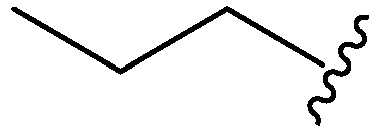


- According to another preferred embodiment of the compound of formula (I) according to the invention, R' is selected from the group consisting of

- According to another preferred embodiment of the compound of formula (I) according to the invention, R1 is selected from the group consisting of

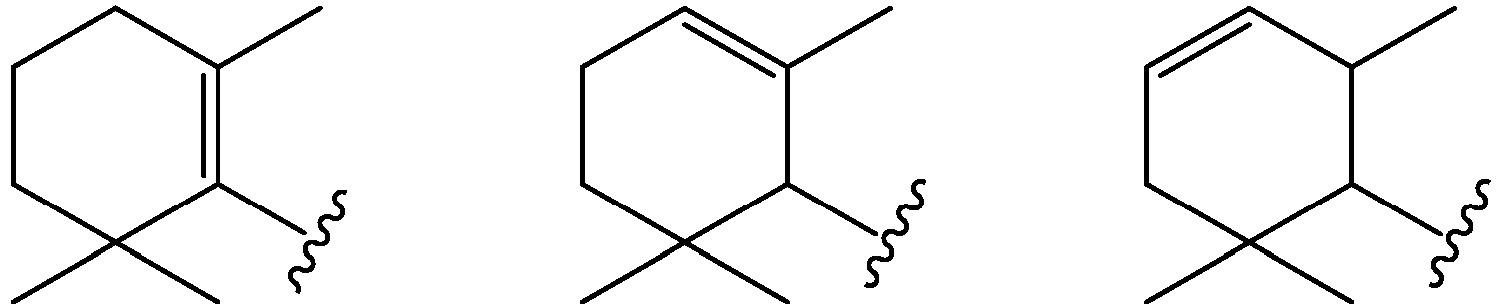


- According to another preferred embodiment of the compound of formula (I) according to invention, R2 is selected from the group consisting of


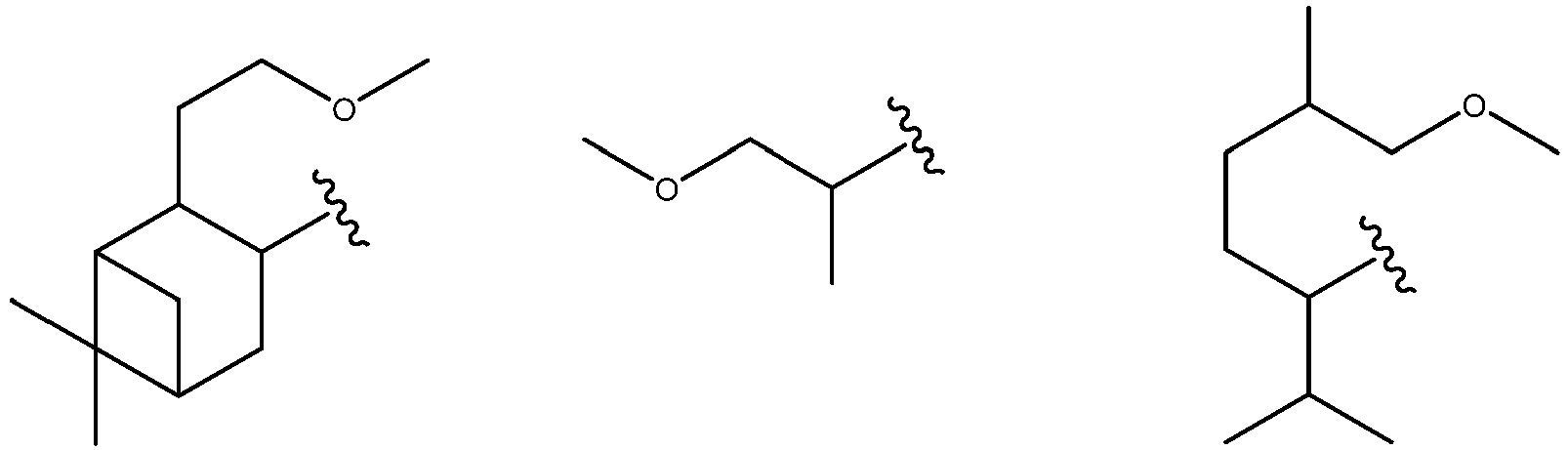


- According to a particularly preferred embodiment of the compound of formula (I) according to the invention,
- R is selected from the group consisting of hydrogen and C1 to C10, preferably C1 to C9, more preferably C1 to C8, more preferably C1 to C7, more preferably C1 to C6, most preferably C1 to C5, linear or cyclic alkyl, alkenyl or alkadienyl residues, preferably wherein the residues additionally carry one, two, three, four or more C1 to C4 linear, cyclic or branched alkyl, alkenyl or alkadienyl substituents (and wherein the substituents can be the same or different from one another), and
- R' is selected from the group consisting of hydrogen and C1 to C10, preferably C1 to C9, more preferably C1 to C8, more preferably C1 to C7, more preferably C1 to C6, most preferably C1 to C5, linear or cyclic alkyl, alkenyl or alkadienyl residues, preferably wherein the residues additionally carry one, two, three, four or more C1 to C4 linear, cyclic or branched alkyl, alkenyl or alkadienyl substituents (and wherein the substituents can be the same or different from one another), and
- R1 is selected from the group consisting of hydrogen and C1 to C10, preferably C1 to C9, more preferably C1 to C8, more preferably C1 to C7, more preferably C1 to C6, most preferably C1 to C5, linear or cyclic alkyl, alkenyl or alkadienyl residues, preferably wherein the residues additionally carry one, two, three, four or more C1 to C4 linear, cyclic or branched alkyl, alkenyl or alkadienyl substituents (and wherein the substituents can be the same or different from one another), and
- R2 is selected from the group consisting of
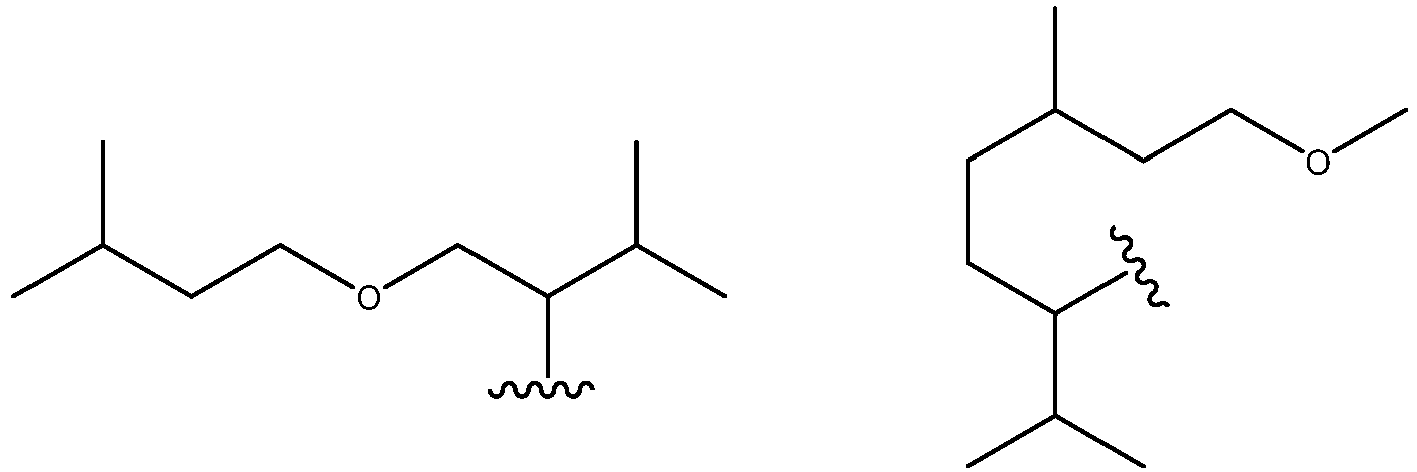


- R3 is selected from the group consisting of hydrogen and C1 to C10, preferably C1 to C9, more preferably C1 to C8, more preferably C1 to C7, more preferably C1 to C6, most preferably C1 to C5, linear or cyclic alkyl, alkenyl or alkadienyl residues, preferably wherein the residues additionally carry one, two, three, four or more C1 to C4 linear, cyclic or branched alkyl, alkenyl or alkadienyl substituents (and wherein the substituents can be the same or different from one another).
- According to another particularly preferred embodiment of the compound of formula (I) according to the invention,
residue
- of the compound of formula (I) is selected from the group consisting of


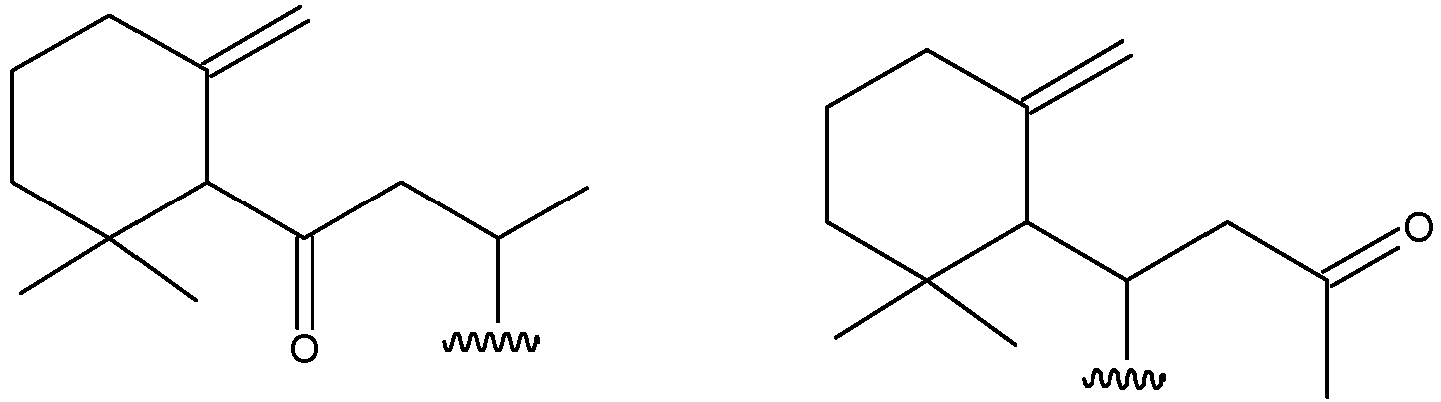


- and/or, preferably and, residue R2 of the compound of formula (I) is selected from the group consisting of

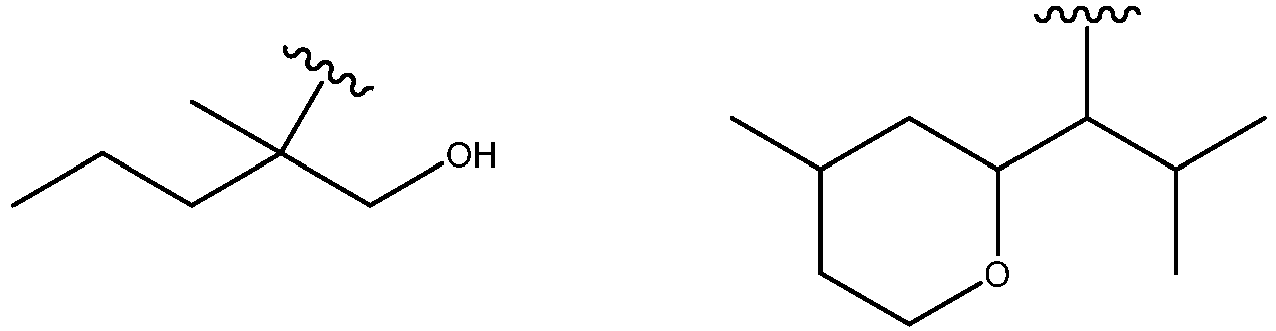


- According to a preferred embodiment, the compound of formula (I) according to the invention is obtained or obtainable by a [1,4]-addition reaction between:
- an α,β-unsaturated aldehyde or ketone (Michael acceptor, electrophile) selected from the group consisting of (group of compounds as shown below in the column entitled "Structure" of Table 1)Table 1 CAS Number(s) Name Structure 102322-83-8 Filbertone 
39872-57-6 Isodamascone 
23726-91-2 beta-Damascone 
24720-09-0 alpha-Damascone 
57378-68-4 delta-Damascone 
57350-34-2 epsilon-Damascone 
35076-56-3 gamma-Damascone 
79-76-5 gamma-Ionone 
79-77-6 beta-lonone 
127-41-3 alpha-lonone 
127-42-4 Methyliridone 
56973-84-3 beta-Dynascone 
56973-85-4 alpha-Dynascone 
23911-56-0 Nerolione 
1646-26-0 Coumarone 
13215-88-8, 163440-97-9 (mixture of isomers) Tabanone 
505-57-7 2-Hexenal 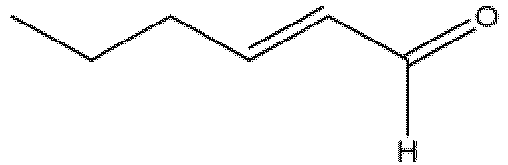
2463-63-0 2-Heptenal 
2363-89-5 2-Octenal 
2463-53-8 2-Nonenal 
3913-71-1 2-Decenal 
2463-77-6 2-Undecenal 
4826-62-4 2-Dodecenal 
7774-82-5 2-Tridecenal 
106-26-3 Neral 
141-27-5 Geranial 
5392-40-5 (mixture of isomers) Citral 
2-Pentylcyclopent-2-en-1-one 
(Z)-3-Methyl-2-(pent-2-en-1-yl)cyclopent-2-en-1-one 
3-Methyl-2-pentylcyclopent-2-en-1-one 
- a thiol (Michael donor, nucleophile) selected from the group consisting of (group of compounds as shown below in the column entitled "Structure" of Table 2)Table 2 Chemical Name Odour Description Structure 4-Methoxy-2-methyl-butane-2-thiol - 
1-Methoxyhexane-3-thiol - 
2-Methyl-2-sulfanyl-pentan-1-ol Grapefruit, cassis, onion 
2-Methyl-1-(4-methyltetrahydropyran-2-yl)propane-1-thiol Very powerful, more fruity, better quality, exotic fruit, guava 
1-lsopentyloxy-3-methylbutane-2-thiol breath of smoker 
8-Methoxy-2,6-dimethyl-octane-3-thiol Sulphur, grapefruit - sulphuric side, more fruity, cassis, plastic, green, rose oxide, green pepper 
3-(4-Methyl-1,3-dioxan-2-yl)butane-2-thiol Liver sausage, burnt plastic, buchu (Asian chives) note, cassis, gasoline 
1-Methoxy-3-methyl-butane-2-thiol Strong, more fruity, juicy, natural, cat grass, meat broth ("Fleischbrühe"), onion 
7-Methoxy-3,7-dimethyl-octane-1-thiol Cheesy, camembert, cheese in the fridge 
1-(1,3-Dioxan-2-yl)-2-methylpropane-1-thiol Fresh, strong, hot rubber, petrol 
3-Methoxyoctane-1-thiol Rose oxide, violet 
Methoxytricyclo[5.2.1.02,6]dec ane-3-thiol Blackcurrant, catnip, natural, fruity, zestral aspect, anisic 
3-(2-Methoxy-1-methyl-ethoxy)propane-1-thiol Minty green, catnip grass, mushroom, soup, leek 
7-Methoxy-2,4-dimethyl-octane-3-thiol Sulphur and something well known behind, agrumen, fruity, grapefruit but with natural aspect, odour direction: grapfruit natural 
7-Methoxy-2,4,7-trimethyl-octane-3-thiol Peach, cassis, meat, sulphur 
4-Isopropyl-1-methyl-7-oxabicyclo[2.2.1]heptane-2-thiol - 
8-Ethoxy-tricyclo[5.2.1.02,6]decane-4-thiol Cassis, sulphur 
3-Ethyl-2-(2-methoxyethyl)-4,4-dimethyl-cyclohexanethiol Grapefruit, pine, meat, natural 
1-Methoxypropane-2-thiol Mango, meat 
7-Methoxy-2,6-dimethyl-heptane-3-thiol Sulphur, durian, jackfruit, artichoke 
6-(Methoxymethyl)-2,3-dimethyl-cyclohexanethiol Cassis, blackcurrant 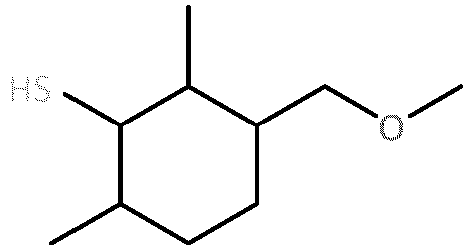
6-Methoxy-2-methyl-heptane-3-thiol Sulphur 
3-(1-Methoxyethyl)-2,6-dimethyl-cyclohexanethiol Sulphur 
6-Methoxy-2,6-dimethyl-heptane-3-thiol Grapefruit, fruity, apricot, peach 
2-(2-Mercaptopropan-2-yl)-5-methylcyclohexan-1-one Buchu 
- According to a preferred embodiment, Citral - i.e. a mixture of Neral and Geranial as shown above in Table 1 - is used as (a mixture of) α,β-unsaturated aldehyde(s) for the formation of a compound of formula (I).
- The compounds of formula (I) according to the invention

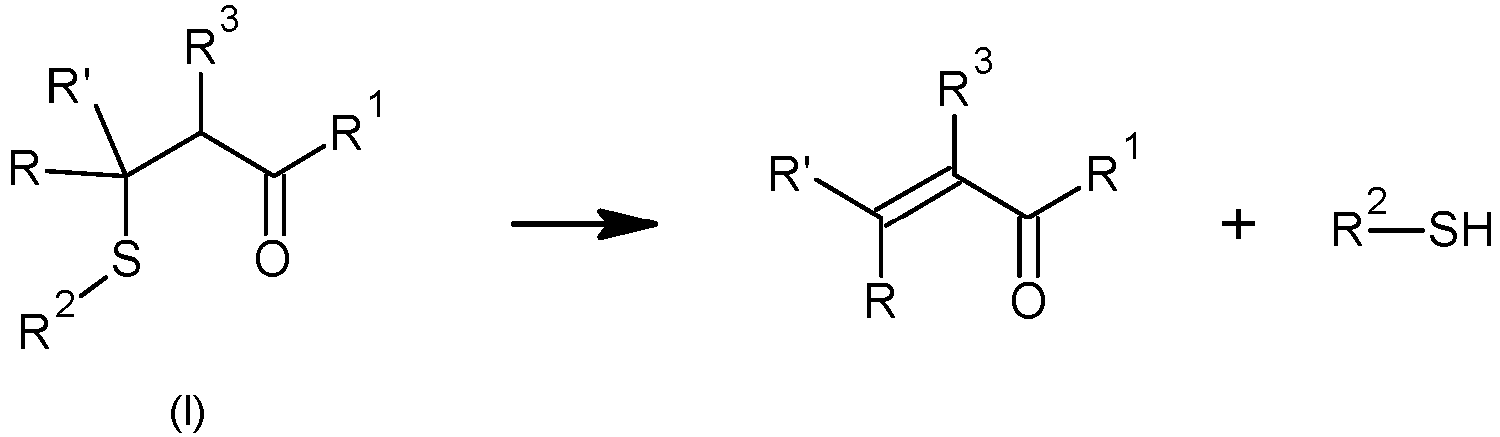
- Preferably, said release is triggered by certain pH values and/or temperatures, UV light, water, and/or oxygen.
- According to a particularly preferred embodiment, the compound of formula (I) according to the invention is selected from the group consisting of (group of compounds as shown below in the column entitled "Structure" of Table 3):
Table 3 Chemical name Structure 3-[2-Methyl-1-(4-methyltetrahydropyran-2-yl)propyl]sulfanyl-1-(2,6,6-trimethylcyclohex-3-en-1-yl)butan-1-one 
3-[2-Methyl-1-(4-methyltetrahydropyran-2-yl)propyl]sulfanyldecanal 
2-[1-(Methoxymethyl)-2-methylpropyl]sulfanyl-5-methyl-heptan-4-one 
2-(3-Methoxyoctylsulfanyl)-5-methyl-heptan-4-one 
2-[(8-Ethoxy-4-tricyclo[5.2.1.02,6]decanyl)sulfanyl]-5-methyl-heptan-4-one 
2-(2-Methoxy-1-methyl-ethyl)sulfanyl-5-methyl-heptan-4-one 
3-(3-Methoxy-1,1-dimethylpropyl)sulfanyl-1-(2,6,6-trimethylcyclohex-3-en-1-yl)butan-1-one 
3-[1-(2-Methoxyethyl)butylsulfanyl]-1-(2,6,6-trimethylcyclohex-3-en-1-yl)butan-1-one 
3-[1-(Hydroxymethyl)-1-methylbutyl]sulfanyl-1-(2,6,6-trimethylcyclohex-3-en-1-yl)butan-1-one 
3-(1-Isopropyl-6-methoxy-4-methylhexyl)sulfanyl-1-(2,6,6-trimethylcyclohex-3-en-1-yl)butan-1-one 
3-[1-(Methoxymethyl)-2-methylpropyl]sulfanyl-1-(2,6,6-trimethylcyclohex-3-en-1-yl)butan-1-one 
3-(3-Methoxyoctylsulfanyl)-1-(2,6,6-trimethylcyclohex-3-en-1-yl)butan-1-one 
3-[(8-Ethoxy-4-tricyclo[5.2.1.02,6]decanyl)sulfanyl]-1-(2,6,6-trimethylcyclohex-3-en-1-yl)butan-1-one 
3-(2-Methoxy-1-methyl-ethyl)sulfanyl-1-(2,6,6-trimethylcyclohex-3-en-1-yl)butan-1-one 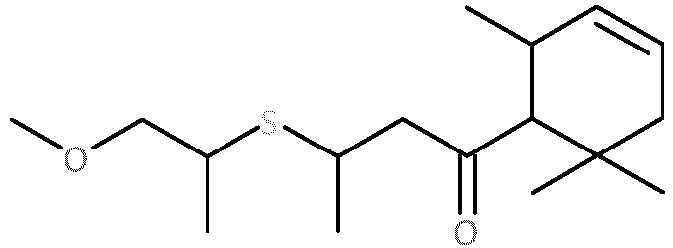
3-(1-Isopropyl-4-methoxy-4-methylpentyl)sulfanyl-1-(2,6,6-trimethylcyclohex-3-en-1-yl)butan-1-one 
3-[1-(Methoxymethyl)-2-methylpropyl]sulfanyl-1-(2,4,4-trimethylcyclohex-2-en-1-yl)butan-1-one 
3-[(8-Ethoxy-4-tricyclo[5.2.1.02,6]decanyl)sulfanyl]-1-(2,4,4-trimethylcyclohex-2-en-1-yl)butan-1-one 
3-(2-Methoxy-1-methyl-ethyl)sulfanyl-1-(2,4,4-trimethylcyclohex-2-en-1-yl)butan-1-one 
1-[2-[(8-Ethoxy-4-tricyclo[5.2.1.02,6]decanyl)sulfanyl]-3,3-dimethyl-cyclohexyl]pent-4-en-1-one 
1-[2-(1-Isopropyl-6-methoxy-4-methylhexyl)sulfanyl-3,3-dimethylcyclohexyl]pent-4-en-1-one 
1-[2-(2-Methoxy-1-methylethyl)sulfanyl-3,3-dimethylcyclohexyl]pent-4-en-1-one 
1-[2-(3-Methoxyoctylsulfanyl)-3,3-dimethyl-cyclohexyl]pent-4-en-1-one 
1-[2-(3-Methoxy-1,1-dimethylpropyl)sulfanyl-5,5-dimethylcyclohexyl]pentan-1-one 
1-[2-[1-(2-Methoxyethyl)butylsulfanyl]-5,5-dimethyl-cyclohexyl]pentan-1-one 
1-[2-[1-(Hydroxymethyl)-1-methylbutyl]sulfanyl-5,5-dimethylcyclohexyl]pentan-1-one 
1-[2-(1-Isopropyl-4-methoxy-4-methylpentyl)sulfanyl-5,5-dimethylcyclohexyl]pentan-1-one 
1-[3-(2-Methoxy-1-methylethyl)sulfanyl-2,3-dihydrobenzofuran-2-yl]ethanone 
1-[3-[(8-Ethoxy-4-tricyclo[5.2.1.02,6]decanyl)sulfanyl]-2,3-dihydrobenzofuran-2-yl]ethanone 
1-[3-[1-(Methoxymethyl)-2-methylpropyl]sulfanyl-2,3-dihydrobenzofuran-2-yl]ethanone 
1-[3-[1-(Hydroxymethyl)-1-methylbutyl]sulfanyl-2,3-dihydrobenzofuran-2-yl]ethanone 
1-[3-(3-Methoxy-1,1-dimethylpropyl)sulfanyl-2,3-dihydrobenzofuran-2-yl]ethanone 
3-[1-(2-Methoxyethyl)butylsulfanyl]hexanal 
3-(1-Isopropyl-6-methoxy-4-methylhexyl)sulfanylhexanal 
3-(3-Methoxyoctylsulfanyl)hexanal 
3-(2-Methoxy-1-methylethyl)sulfanylhexanal 
3-(1-Isopropyl-4-methoxy-4-methylpentyl)sulfanylundecanal 
3-[(8-Ethoxy-4-tricyclo[5.2.1.02,6]decanyl)sulfanyl]un decanal 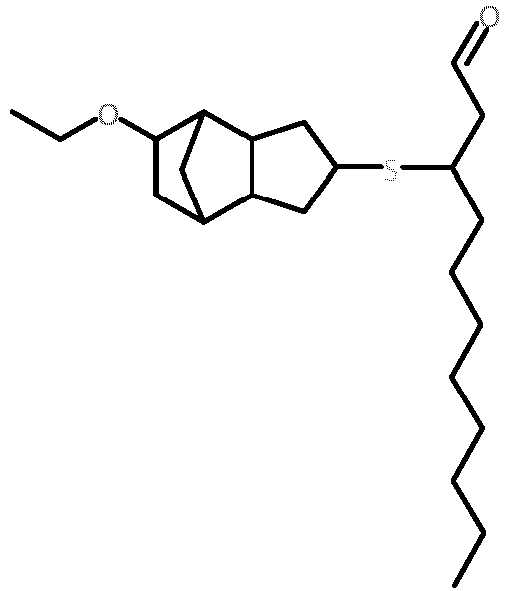
3-(3-Methoxyoctylsulfanyl)undecanal 
3-(1-Isopropyl-6-methoxy-4-methylhexyl)sulfanylundecanal 
3-(3-Methoxy-1,1-dimethylpropyl)sulfanylundecanal 
3-[1-(Hydroxymethyl)-1-methylbutyl]sulfanyltridecanal 
3-(3-Methoxyoctylsulfanyl)tridecanal 
3-(3-Methoxyoctylsulfanyl)-3,7-dimethyl-oct-6-enal 
3-[1-(Methoxymethyl)-2-methylpropyl]sulfanyl-3,7-dimethyl-oct-6-enal 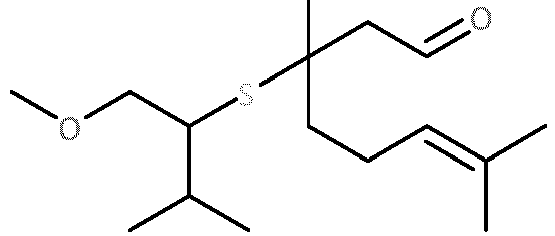
3-[(8-Ethoxy-4-tricyclo[5.2.1.02,6]decanyl)sulfanyl]-3,7-dimethyl-oct-6-enal 
3-[1-(2-Methoxyethyl)butylsulfanyl]-3,7-dimethyl-oct-6-enal 
3-((2-Methyl-1-(4-methyltetrahydro-2H-pyran-2-yl)propyl)thio)-2-pentylcyclopentan-1-one 
5-Methyl-2-(2-((3-oxo-2-pentylcyclopentyl)thio)propan-2-yl)cyclohexan-1-one 
5-Methyl-2-[1-methyl-1-[1-methyl-3-oxo-3-(2,6,6-trimethylcyclohex-3-en-1-yl)propyl]sulfanyl-ethyl]cyclohexanone 
- According to a particularly preferred embodiment, the compound of formula (I) according to the invention is not

- Another aspect of the present invention relates to a fragrance substance mixture, preferably perfume oil, comprising or consisting of the following components:
- (i) one or more compound(s) of formula (I) as defined herein,
and - (ii) one or more further fragrance substances.
- The one or more further fragrance substances are different from the compounds of formula (I) according to the invention.
- Examples of further fragrance substances that can be advantageously combined with the compounds of formula (I) as defined herein within the scope of the present invention are known to the skilled person and can be found, for example, in S. Arctander, Perfume and Flavor Materials, Vol. I and II, Montclair, N. J. 1969, Eigenverlag, or K. Bauer et al., Common Fragrance and Flavor Materials, 4th Edition, Wiley-VCH, Weinheim 2001.
- According to a preferred embodiment of the fragrance substance mixture according to the invention, preferably perfume oil, the proportion of the total amount of compound(s) of formula (I) as defined herein in the fragrance substance mixture is 0.1 to 3 % by weight, preferably 0.5 to 2.5 % by weight, particularly preferably 1 to 2 % by weight, based on the total mass of the fragrance substance mixture.
- Another aspect of the present invention relates to a method for producing a fragrance substance mixture, preferably a perfume oil, as defined above, comprising or consisting of the following step:
Mixing of one or more compound(s) of formula (I) as defined herein with one or more further fragrance substances. - Furthermore, fragrance substance mixtures, preferably perfume oils, according to the invention may be adsorbed on a carrier which provides both a fine distribution of the fragrance substance mixture, preferably perfume oil, in the perfumed product and a controlled release during application. Such carriers may be porous inorganic materials such as light sulphate, silica gels, zeolites, gypsums, clays, clay granules, gas concrete, etc. or organic materials such as wood, cellulose-based materials, sugar, dextrins (e.g. maltodextrin) or plastics such as PVC, polyvinyl acetates or polyurethanes. The combination of a fragrance substance mixture, preferably perfume oil, according to the invention and a carrier is also to be understood as a fragrance substance mixture, preferably perfume oil, of the invention or may be presented as a perfumed product according to the invention (as described below).
- Fragrance substance mixtures, preferably perfume oils, or perfumed products of the invention (as described below) may also be microencapsulated, spray-dried, or may be provided as inclusion complexes or as extrusion products and, in the case of a fragrance substance mixture, preferably perfume oil, may be added in this form e.g. to a perfumed product to be perfumed (as described below).
- If necessary, the properties of such modified mixtures or products can be further optimized by so-called "coating" with suitable materials with a view to a more targeted release of fragrance, preferably using wax-like plastics such as polyvinyl alcohol. The resulting products in turn represent products of the invention.
- Microencapsulation can, for example, be achieved by the so-called coacervation method using capsule materials such as polyurethane-like substances or soft gelatin.
- Spray-dried products are preferably produced by spray-drying an emulsion or dispersion containing the fragrance substance mixtures, preferably perfume oils, according to the invention, whereby modified starches, proteins, dextrin and vegetable gums can be used as carriers.
- Inclusion complexes can be produced e.g. by incorporating dispersions of the fragrance substance mixtures, preferably perfume oils, according to the invention and cyclodextrins or urea derivatives into a suitable solvent, e.g. water.
- Extrusion products can be obtained, e.g., by using the fragrance substance mixtures, preferably perfume oils, according to the invention with a suitable waxy substance and by extrusion followed by solidification, if necessary, in a suitable solvent, e.g. isopropanol.
- Another aspect of the present invention relates to a perfumed product comprising one or more compound(s) of formula (I) as defined herein or a fragrance substance mixture, preferably a perfume oil, as defined herein, preferably in a sensorially effective amount.
- Advantageously, the one or more compound(s) of formula (I) according to the invention positively impart or modify the odour of a perfumed product to which said compound(s) of formula (I) are added.
- According to a preferred embodiment, the perfumed product is selected from the group consisting of perfume extracts, eau de parfums, eau de toilettes, aftershaves, eau de colognes, pre-shave products, splash colognes, perfumed refreshing cloths, acidic, alkaline and neutral detergents, textile fresheners, ironing aids, liquid detergents, powdered detergents, laundry pre-treatment agents, fabric softeners, washing soaps, washing tablets, disinfectants, surface disinfectants, air fresheners, aerosol sprays, waxes and polishes, personal care products, hand creams and lotions, foot creams and lotions, depilatory creams and lotions, aftershave creams and lotions, tanning creams and lotions, hair care products, deodorants and antiperspirants, decorative cosmetic products, candles, lamp oils, incense sticks, insecticides, repellents, and fuels, most preferably is a fabric softener.
- According to a preferred embodiment of the perfumed product according to the invention, the proportion of the total amount of fragrance substance mixture as defined herein, preferably perfume oil, in the perfumed product is 0.1 to 3 % by weight, preferably 0.5 to 2.5 % by weight, particularly preferably 1 to 2 % by weight, based on the total mass of the perfumed product.
- Another aspect of the present invention relates to a method for producing a perfumed product, preferably a perfumed product as defined herein, comprising or consisting of the following steps:
- (i) Providing one or more compound(s) of formula (I) as defined herein or a fragrance substance mixture, preferably a perfume oil, as defined herein,
- (ii) providing one or more further components of the perfumed product to be produced, and
- (iii) contacting or mixing the further components provided in step (ii) with a sensorially effective amount of the components provided in step (i).
- Another aspect of the present invention relates to the use of a compound of formula (I) as defined herein as a precursor for the (controlled) release of one, two, three or more different pleasantly smelling fragrance substances, preferably wherein the two or more different fragrance substances are released and/or sensorially perceived at the same or different, preferably different, point(s) in time (if two or more different fragrance substances are released).
- Another aspect of the present invention relates to the use of a compound of formula (I) as defined herein as a precursor for the (controlled) release of a pleasantly smelling thiol and of a pleasantly smelling α,β-unsaturated aldehyde or ketone, preferably wherein the thiol and the α,β-unsaturated aldehyde or ketone are released and/or sensorially perceived at the same or different, preferably different, point(s) in time.
- Another aspect of the present invention relates to the use of a compound of formula (I) as defined herein as a precursor for the (controlled) release of a (pleasantly smelling) thiol selected from the group consisting of


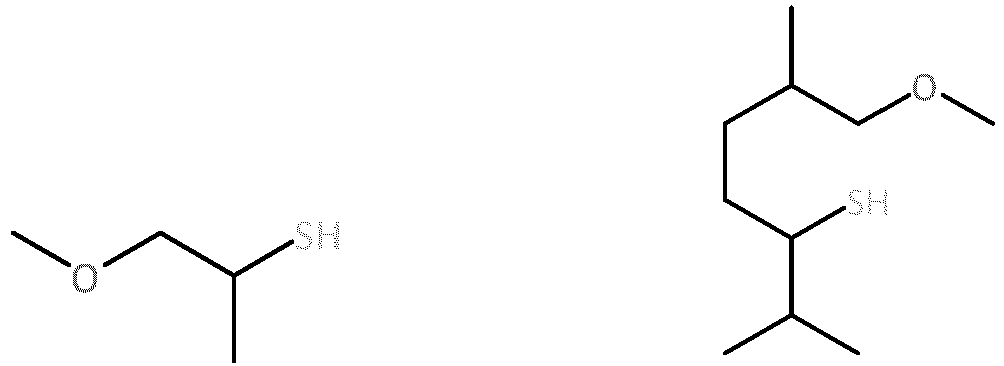


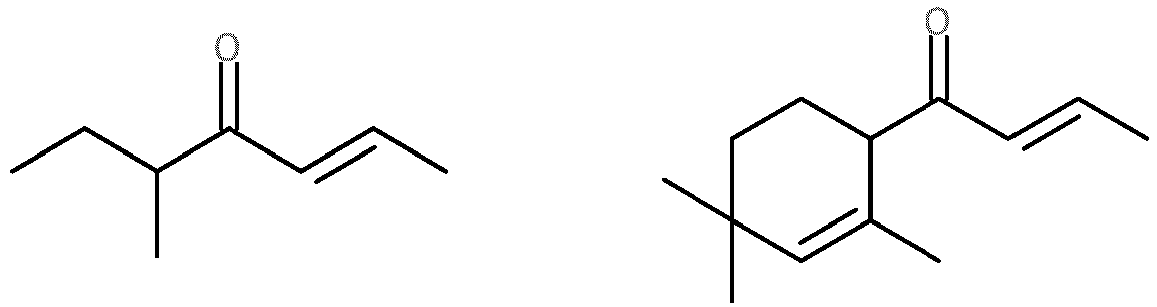


- Another aspect of the present invention relates to the use of a compound of formula (I), wherein residue


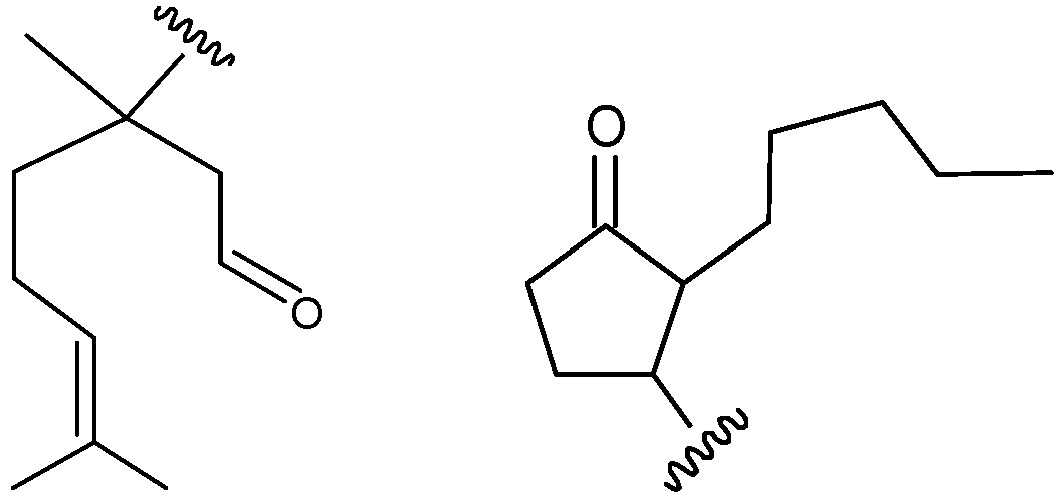


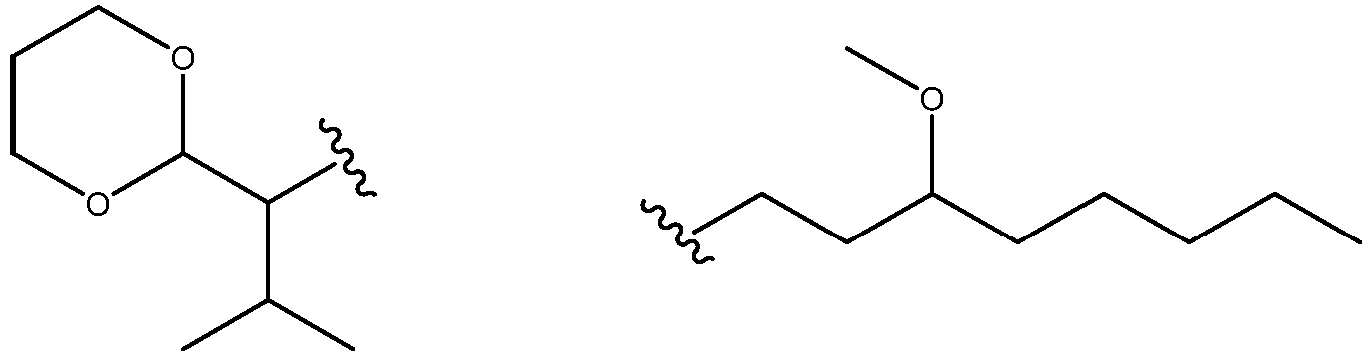


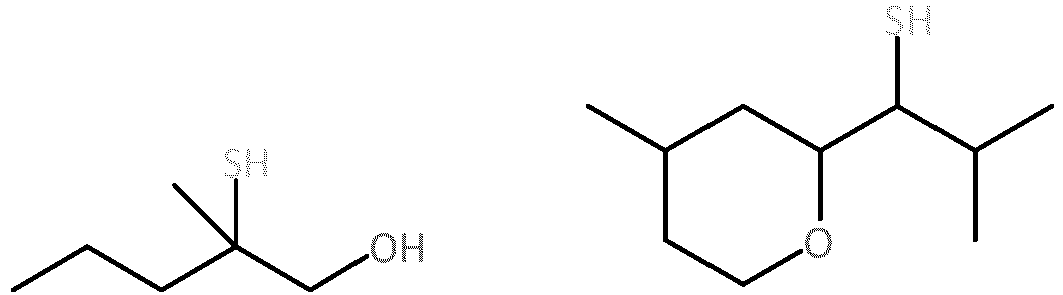


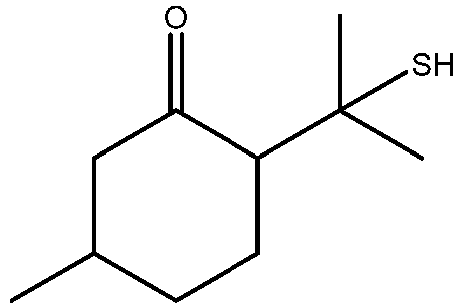


- The thiols and α,β-unsaturated aldehydes or ketones released by the compounds of formula (I) according to the invention and/or used for the formation of a compound of formula (I) according to the invention may be in the form of a pure diastereomer or stereoisomer or in the form of any mixture of said isomers.
- According to a preferred embodiment of the use according to the invention, the thiol that is released from the compound of formula (I) as defined herein is released and/or sensorially perceived before the α,β-unsaturated aldehyde or ketone that is released from the (same) compound of formula (I) as defined herein.
- According to an alternative embodiment of the use according to the invention, the α,β-unsaturated aldehyde or ketone that is released from the compound of formula (I) as defined herein is released and/or sensorially perceived before the thiol that is released from the (same) compound of formula (I) as defined herein.
- According to a further alternative embodiment of the use according to the invention, the thiol that is released from the compound of formula (I) as defined herein and the α,β-unsaturated aldehyde or ketone that is released from the (same) compound of formula (I) as defined herein are released and/or sensorially perceived at the same time.
- Preferably, a pleasantly smelling thiol has one or more odour notes selected from the group consisting of grapefruit, cassis, onion, fruity, exotic fruit, guava, breath of smoker, sulphur, (burnt) plastic, (minty) green, rose oxide, green pepper, liver sausage, buchu (Asian chives), gasoline, juicy, natural, cat grass, meat broth ("Fleischbrühe"), cheesy, camembert, cheese in the fridge, fresh, hot rubber, petrol, violet, blackcurrant, catnip (grass), zestral, anisic, mushroom, soup, leek, agrumen, peach, meat, pine, mango, durian, jackfruit, artichoke, and apricot,
more preferably a pleasantly smelling thiol has one or more odour notes selected from the group consisting of grapefruit, cassis, onion, fruity, exotic fruit, guava, sulphur, (minty) green, rose oxide, green pepper, liver sausage, buchu (Asian chives), juicy, natural, cat grass, meat broth ("Fleischbrühe"), cheesy, camembert, fresh, violet, blackcurrant, catnip (grass), zestral, anisic, mushroom, soup, leek, agrumen, peach, meat, pine, mango, durian, jackfruit, artichoke, and apricot. - Another aspect of the present invention relates to a method for the (controlled) release of one, two, three or more different pleasantly smelling fragrance substances comprising or consisting of the following steps:
- (a) Providing a compound of formula (I) as defined herein or a fragrance substance mixture as defined herein (comprising one or more compound(s) of formula (I) as defined herein) or a perfumed product as defined herein (comprising one or more compound(s) of formula (I) as defined herein),
- (b) optionally, applying or introducing the compound of formula (I) or the fragrance substance mixture or the perfumed product of step (a) to hair or skin or textile fibres or to a surface to be perfumed, or into ambient air to be perfumed, preferably in a sensorially effective amount, and
- (c) releasing one, two, three or more different pleasantly smelling fragrance substances from the compound of formula (I), preferably wherein the two or more different pleasantly smelling fragrance substances are released and/or sensorially perceived at the same or different, preferably different, point(s) in time (if two or more different fragrance substances are released).
- Another aspect of the present invention relates to a method for the (controlled) release of a pleasantly smelling thiol and of a pleasantly smelling α,β-unsaturated aldehyde or ketone comprising or consisting of the following steps:
- (a) Providing a compound of formula (I) as defined herein or a fragrance substance mixture as defined herein (comprising one or more compound(s) of formula (I) as defined herein) or a perfumed product as defined herein (comprising one or more compound(s) of formula (I) as defined herein),
- (b) optionally, applying or introducing the compound of formula (I) or the fragrance substance mixture or the perfumed product of step (a) to hair or skin or textile fibres or to a surface to be perfumed, or into ambient air to be perfumed, preferably in a sensorially effective amount,
- (c) releasing the pleasantly smelling thiol and the pleasantly smelling α,β-unsaturated aldehyde or ketone from the compound of formula (I), preferably wherein the pleasantly smelling thiol and the pleasantly smelling α,β-unsaturated aldehyde or ketone are released and/or sensorially perceived at the same or different, preferably different, point(s) in time.
- According to a preferred embodiment of the method according to the invention, the thiol that is released from the compound of formula (I) as defined herein in step (c) is released and/or sensorially perceived before the α,β-unsaturated aldehyde or ketone that is released from the (same) compound of formula (I) as defined herein in step (c).
- According to an alternative embodiment of the method according to the invention, the α,β-unsaturated aldehyde or ketone that is released from the compound of formula (I) as defined herein in step (c) is released and/or sensorially perceived before the thiol that is released from the (same) compound of formula (I) as defined herein in step (c).
- According to a further alternative embodiment of the method according to the invention, the thiol that is released from the compound of formula (I) as defined herein in step (c) and the α,β-unsaturated aldehyde or ketone that is released from the (same) compound of formula (I) as defined herein in step (c) are released and/or sensorially perceived at the same time.
- Another aspect of the present invention relates to a method for the (controlled) release of a (pleasantly smelling) thiol selected from the group consisting of



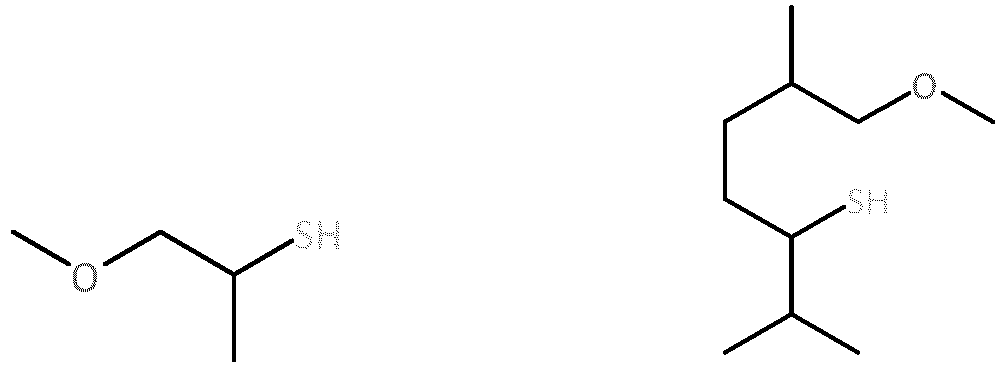


- (a) Providing a compound of formula (I) (or a fragrance substance mixture or a perfumed product comprising a compound of formula (I) as defined above), wherein residue


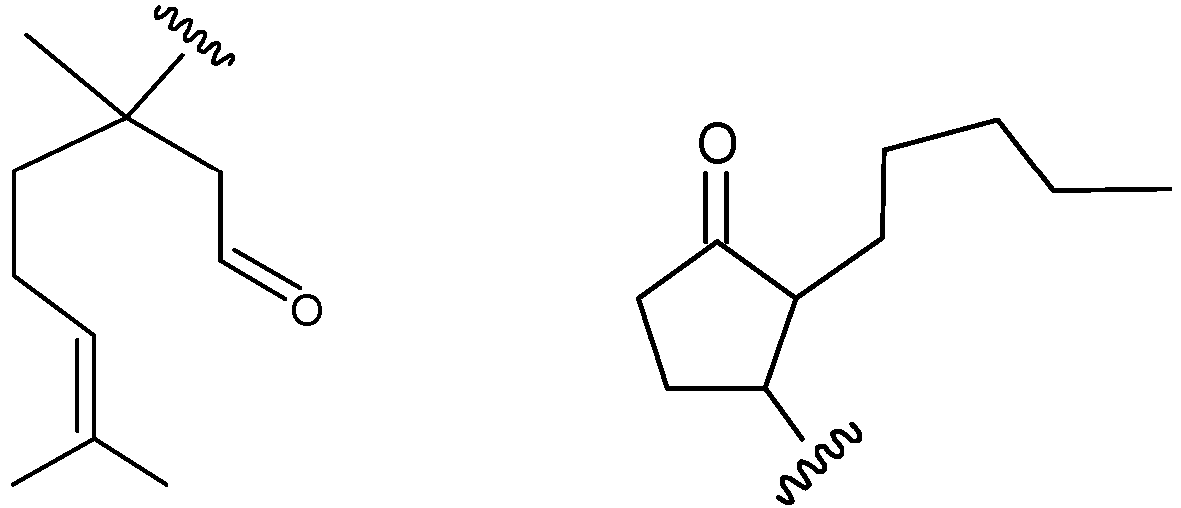


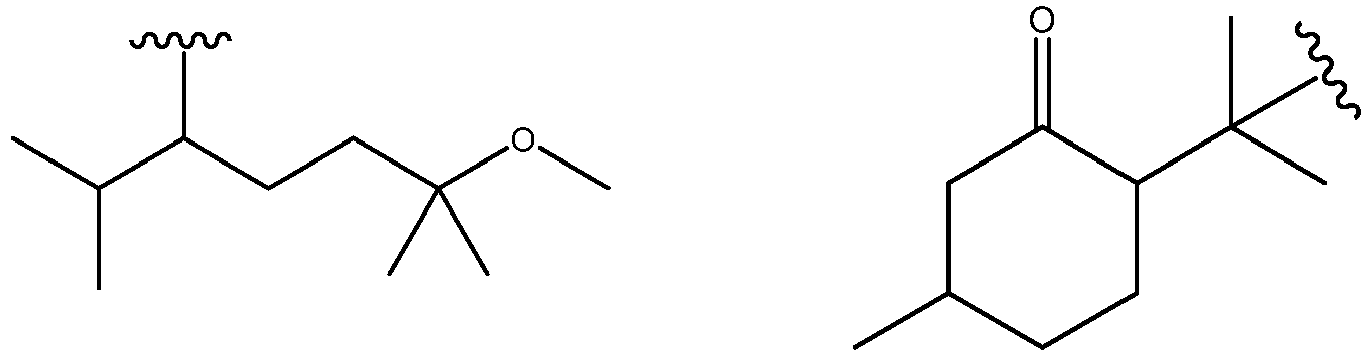
- (b) optionally, applying or introducing the compound of formula (I) of step (a) (or the fragrance substance mixture or the perfumed product comprising a compound of formula (I) of step (a)) to hair or skin or textile fibres or to a surface to be perfumed, or into ambient air to be perfumed, preferably in a sensorially effective amount,
- (c) releasing the (pleasantly smelling) thiol and/or the (pleasantly smelling) α,β-unsaturated aldehyde or ketone from the compound of formula (I), preferably wherein the (pleasantly smelling) thiol and the (pleasantly smelling) α,β-unsaturated aldehyde or ketone are released and/or sensorially perceived at the same or different, preferably different, point(s) in time.
- Another aspect of the present invention relates to a thiol selected from the group consisting of


- During the studies underlying the present invention, it was surprisingly found that the thiols as defined above can serve as pleasantly smelling, high impact fragrances, preferably after release from a compound of formula (I) according to the invention.
- The thiols according to the invention can be obtained by applying the procedures disclosed in
WO 2019/037862 A1 . - An odour description of the thiols according to the invention can be found in Table 2 above.
- Another aspect of the present invention thus relates to the use of one or more thiol(s) according to the invention as a fragrance substance.
- Another aspect of the present invention relates to a method for perfuming hair, skin, textile fibres, surfaces and/or ambient air comprising or consisting of the following steps:
- (a) Providing
- (i) one or more thiol(s) as defined herein and preferably also a surfactant or a surfactant mixture, or
- (ii) one or more compound(s) of formula (I) as defined herein and preferably also a surfactant or a surfactant mixture, or
- (iii) a fragrance substance mixture as defined herein, preferably containing a surfactant or a surfactant mixture, or
- (iv) a perfumed product as defined herein, preferably containing a surfactant or a surfactant mixture,
- (b) applying or introducing the (i) thiol(s) and preferably also a surfactant or a surfactant mixture or (ii) compound(s) and preferably also a surfactant or a surfactant mixture or the (ii) fragrance substance mixture or the (iii) perfumed product of step (a) to the hair or skin or textile fibres or surface to be perfumed, or into the ambient air to be perfumed, in a sensorially effective amount.
- Another aspect of the present invention relates to the use of a compound of formula (I) as defined herein or of a fragrance substance mixture, preferably perfume oil, as defined herein as a perfuming ingredient.
- Another aspect of the present invention relates to the use a compound of formula (I) as defined herein or of a fragrance substance mixture, preferably perfume oil, as defined herein for perfuming hair, skin, textile fibres, surfaces and/or ambient air.
- Another aspect of the present invention relates to a fragrance substance mixture, preferably perfume oil, as defined herein, wherein the amount of compound(s) of formula (I) is sufficient
- (a) to mask or to reduce the or one or several unpleasant odour impressions of another fragrance substance in the fragrance substance mixture,
and/or - (b) to enhance the or one or several pleasant odour impressions of another fragrance substance in the fragrance substance mixture.
- Another aspect of the present invention relates to the use of one or more compound(s) of formula (I) as defined herein or of a fragrance substance mixture, preferably perfume oil, as defined herein
- (a) for masking or reducing the or one or several unpleasant odour impressions of one or several unpleasantly smelling substances,
and/or - (b) for enhancing the or one or several pleasant odour impressions of one or several pleasantly smelling substances.
- Another aspect of the present invention relates to a method
- (a) for masking or reducing the or one or several unpleasant odour impressions of one or several unpleasantly smelling substances,
and/or - (b) for enhancing the or one or several pleasant odour impressions of one or several pleasantly smelling substances,
- What has been stated herein in connection with the fragrance substance mixtures, perfumed products, methods, uses and thiols according to the invention applies accordingly to preferred embodiments of the compounds of formula (I) according to the invention, and vice versa.
- In the following, the invention is explained in more detail using examples.
-

- In a 500 ml stirring apparatus with magnetic stirrer, reflux condenser, thermometer, dropping funnel and ice bath, 5.8 g of 1,1,3,3-tetramethylguanidine, 9.4 g of 2-methyl-1-(4-methyltetrahydropyran-2-yl)propanethiol and 200 ml of tetrahydrofuran were added under a nitrogen atmosphere at 0°C. At 0-5°C, 8.1 g of delta-damascone were added dropwise within 1 hour. For post-reaction, stirring was continued for 6 hours at 0-5°C. The mixture was washed twice with saturated sodium bicarbonate solution at room temperature and then the solvents were evaporated on the rotary evaporator. 16.8 g crude yield of 3-[2-methyl-1-(4-methyltetrahydropyran-2-yl)propyl]sulfanyl-1-(2,6,6-trimethyl-cyclohex-3-en-1-yl)butan-1-one, with a GC content of 90%, were obtained. For further purification, the crude yield was chromatographed over a silica gel column with hexane:diethyl ether (10:1) as eluent. 4.0 g of 3-[2-methyl-1-(4-methyltetrahydropyran-2-yl)propyl]sulfanyl-1-(2,6,6-trimethylcyclohex-3-en-1-yl)butan-1-one, with a GC content of 94%, were obtained.
- Mass spectrometric analysis of product:
m/z: 99 (100), 123 (35), 81 (35), 43 (33), 69 (27), 115 (24), 55 (18), 225 (17), 41 (17), 192 (16) -

- In a 500 ml stirring apparatus with magnetic stirrer, reflux condenser, thermometer, dropping funnel and ice bath, 5.8 g of 1,1,3,3-tetramethylguanidine, 9.4 g of 2-methyl-1-(4-methyltetrahydropyran-2-yl)propanethiol and 200 ml of tetrahydrofuran were placed under a nitrogen atmosphere at 0°C. At 0-5°C, 6.4 g of 2-(E)-decenal were added dropwise within 1 hour. For post-reaction, stirring was continued for 6 hours at 0-5°C. The mixture was washed twice with saturated sodium bicarbonate solution at room temperature and then the solvents were evaporated on the rotary evaporator. 14.6 g crude yield of 3-[2-methyl-1-(4-methyltetrahydropyran-2-yl)propyl]sulfanyldecanal, with a GC content of 76%, were obtained. For further purification, the crude yield was chromatographed over a silica gel column with hexane:diethyl ether (10:1) as eluent. 4.2 g of 3-[2-methyl-1-(4-methyltetrahydropyran-2-yl)propyl]sulfanyldecanal, with a GC content of 90%, were obtained.
- Mass spectrometric analysis of product:
m/z: 99 (100), 43 (23), 55 (17), 81 (13), 41 (13), 69 (11), 57 (10), 98 (8), 29 (7), 100 (7) -

- In a 500 mL stirring apparatus with magnetic stirrer, reflux condenser, thermometer, dropping funnel and ice bath, 12.4 g of 1,1,3,3-tetramethylguanidine, 20.4 g of 2-methyl-1-(4-methyltetrahydropyran-2-yl)propane-1-thiol and tetrahydrofuran (400 mL) were added under a nitrogen atmosphere at 0 °C. At 0-5 °C, 12.7 g of (E)-hex-2-enal were added dropwise within 1 hour. For post-reaction, stirring was continued for 6 hours at 0-5 °C. The mixture was washed twice with saturated sodium bicarbonate solution at room temperature and then the solvents were evaporated on the rotary evaporator. 30.9 g crude of 3-[2-methyl-1-(4-methyltetrahydropyran-2-yl)propyl]sulfanyl-hexanal were obtained. For further purification, the crude yield was chromatographed over a silica gel column with hexane:diethyl ether (10:1) as eluent. 26.8 g of 3-[2-methyl-1-(4-methyltetrahydropyran-2-yl)propyl]sulfanylhexanal, with a GC content of 90%, were obtained.
- Mass spectrometric analysis of product:
m/z: 99 (100), 43 (24), 55 (15), 41 (13), 81 (12), 69 (12), 100 (6), 57 (6), 170 (6), 29 (5), 98 (5). -

- In a 50 mL stirring apparatus with magnetic stirrer, reflux condenser, thermometer, dropping funnel and ice bath, 0.02 g of 1,1,3,3-tetramethylguanidine, 14.1 g of 2-methyl-1-(4-methyltetrahydropyran-2-yl)propane-1-thiol and tetrahydrofuran (40 mL) were added under a nitrogen atmosphere at 0 °C. At 0-5 °C, 14.4 g of (E)-[4]-(2,6,6-trimethylcyclohex-1-en-1-yl)but-3-en-2-one were added dropwise within 1 hour. For post-reaction, stirring was continued for 6 hours at 0-5 °C. The mixture was washed twice with saturated sodium bicarbonate solution at room temperature and then the solvents were evaporated on the rotary evaporator. 28.5 g crude of 3-[2-methyl-1-(4-methyltetrahydropyran-2-yl)propyl]sulfanyl-1-(2,6,6-trimethyl-1-cyclohexen-1-yl)-3-butan-2-one were obtained. For further purification, the crude yield was chromatographed over a silica gel column with hexane:diethyl ether (10:1) as eluent. 18.9 g of 3-[2-methyl-1-(4-methyltetrahydropyran-2-yl)propyl]sulfanyl-1-(2,6,6-trimethyl-1-cyclohexen-1-yl)-3-butan-2-one, with a GC content of 90%, were obtained.
- Mass spectrometric analysis of product:
m/z: 43 (100), 99 (78), 177 (35), 175 (33), 133 (29), 41 (29), 135 (27), 55 (24), 81 (19), 69 (18), 193 (15), 149 (15), 192 (12), 93 (12), 29 (11), 91 (11), 79 (10). -

- In a 50 mL stirring apparatus with magnetic stirrer, reflux condenser, thermometer, dropping funnel and ice bath, 0.02 g of 1,1,3,3-tetramethylguanidine, 16.4 g of 8-ethoxytricyclo[5.2.1.02,6]decane-4-thiol and tetrahydrofuran (40 mL) were added under a nitrogen atmosphere at 0 °C. At 0-5 °C, 14.4 g of (E)-[1]-(2,6,6-trimethylcyclohex-3-en-1-yl)but-2-en-1-one were added dropwise within 1 hours. For post-reaction, stirring was continued for 6 hours at 0-5 °C. The mixture was washed twice with saturated sodium bicarbonate solution at room temperature and then the solvents were evaporated on the rotary evaporator. 30.4 g crude of 8-ethoxytricyclo[5.2.1.02,6]decane-4-sulfanyl-1-(2,6,6-trimethylcyclohex-3-en-1-yl)butan-1-one were obtained.
- Mass spectrometric analysis of product:
m/z: 133 (100), 67 (58), 123 (51), 91 (48), 81 (45), 239 (41), 79 (41), 107 (41), 41 (37), 69 (37), 29 (35), 105 (24), 103 (21), 55 (20), 43 (18), 122 (17), 77 (17). -

- To 463 g 4-methyl-2-(2-methyl-prop-1-enyl)tetrahydropyran and 228 g thioacetic acid was added 2.46
g 2,2-azobis-(2-methyl-propionitril, AIBN) at 5-10 °C and stirred at room temperature for 30 min. Afterwards, the mixture is slowly heated to 60 °C and stirred for 10 h at 60 °C until complete conversion. After cooling to room temperature, the product is obtained by distillation (2.0 mbar, 104-110 °C) to yield 527.69 g (76%) of 2-methyl-(1-4-methyltetrahdyropyran-2-yl)propyl-ethanethioate as a mixture of isomers. - El-MS m/z (%): 231 (1, [M]+), 215 (1), 187 (1), 173 (1), 154 (4), 139 (4), 99 (100), 81 (15), 69 (12), 55 (12), 43 (42), 29 (4).

- A solution of 501 g 2-methyl-(1-4-methyltetrahdyropyran-2-yl)propyl-ethanethioate in dry methanol (3.3 L) was treated with 300 g potassium carbonate und nitrogen and stirred over night until complete conversion. Afterwards, the mixture is acidified by 2 M hydrochloric acid (1 L) and 1 L H2O and 1.5L Et2O are added. The organic phase is separated and the aqueous phase is extracted with 500 mL Et2O. The combined organic phases are washed with brine (500 mL), dried over sodium sulfate and reduced in vacuum. The crude product is purified by distillation (3.6 mbar, 99-102 °C) to obtain 372 g (91%) 2-methyl-1-[4-methyltetrahydropyran-2-yl]propane-1-thiol as a mixture of isomers.
- EI-MS m/z (%): 188 (1, [M]+), 170 (1), 139 (1), 111 (1), 99 (100), 81 (19), 69 (12), 55 (19), 43 (22), 29 (5).
-

- To 583 g 8-methoxytricyclo[5.2.1.02,6]dec-3-ene and 279 g thioacetic acid was added 2.91
g 2,2-azobis-(2-methyl-propionitril, AIBN) at 5-10 °C and stirred at room temperature for 30 min. Afterwards, the mixture is slowly heated to 60 °C and stirred for 10 h at 60 °C until complete conversion. After cooling to room temperature, the product is obtained by distillation (2.0 mbar, 104-110 °C) to yield 773 g (91%) of (8-methoxytricyclo-4-[5.2.1.02,6]decanyl)ethanethioate as a mixture of isomers.
- A solution of 538 g (8-methoxytricyclo-4-[5.2.1.02,6]decanyl)ethanethioate in dry methanol (3.3 L) was treated with 300 g potassium carbonate und nitrogen and stirred over night until complete conversion. The solvent is evaporated under reduced pressure and 400 mL MTBE is added. The organic phase is separated and the aqueous phase is extracted with 200 mL MTBE. The combined organic phases are washed with saturated sodium hydrogencarbonate solution, sodium sulfite solution and brine, dried over sodium sulfate and reduced under reduced pressure. The crude product is purified by distillation (3.6 mbar, 99-102 °C) to obtain 376 g (90%) 8-ethoxytricyclo[5.2.1.02,6]decane-4-thiol as a mixture of isomers.
- Mass spectrometric analysis of product:
m/z: 166 (100), 91 (75), 92 (75), 133 (72), 79 (57), 132 (48), 105 (47), 117 (45), 93 (44), 67 (37), 106 (35), 212 (28), 77 (26), 29 (25), 41 (25), 66 (24), 137 (24). -
Table 4: Fabric softener formulation according to the invention Ingredients Supplier INCI Name / description (w/w) Water, demin. Aqua 86.60 Rewoquat WE 18 Evonik Di-(tallow carboxyethyl) hydroxyethyl methylammonium methosulfate 12.00 Parmetol N 20Hoesch Julius 0.10 Calcium Chloride 25 % solutionCalcium Chloride 0.40 3-[2-methyl-1-(4-methyltetrahydropyran-2-yl)propyl]sulfanyl-1-(2,6,6-trimethylcyclohex-3-en-1-yl)butan-1-one 0.02 Dipropylengylcol Symrise Dipropylengylcol, mixture of isomers 0.88 -
Table 5: Deodorant formulation according to the invention Ingredients Supplier INCI Name/description (w/w) Propylenglycol 1-2 Symrise Propan-1,2-diol 7.00 Ethanol 96% Symrise Ethanol 50.00 Klucel HF Uniqema Hydrocxlpropyl cellulose 0.80 Water, demin Symrise Aqua 39.65 Deolite Symrise 0.50 Trilon B Liquid BTC Europe GmbH Na4-EDTA 0.05 Solubilizer Symrise PEG-40 hydrogenated Castor oil, Trideceth-9, Propyleneglycol, Water 1.00 3-[2-methyl-1-(4-methyltetrahydropyran-2-yl)propyl]sulfanyl-1-(2,6,6-trimethylcyclohex-3-en-1-yl)butan-1-one 0.02 Dipropylengylcol Symrise Dipropylengylcol, mixture of isomers 0.98 -
Table 6: Shampoo formulation according to the invention Ingredients Supplier INCI Name/description (w/w) Water, demin Aqua 76.84 Plantacare PS 10Kraemer & Martin GmbH Sodium Lauryl Sulphate, Lauryl glucoside 20.00 Sodium Chloride Symrise Sodium Chloride 2.00 Citric Acid E 330 Symrise Citric Acid 0.164 Preservative Complex Symrise 0.50 3-[2-methyl-1-(4-methyltetrahydropyran-2-yl)propyl]sulfanyl-1-(2,6,6-trimethylcyclohex-3-en-1-yl)butan-1-one 0.08 Dipropylengylcol Symrise Dipropylengylcol, mixture of isomers 0.416 - 1.0 g of a solution containing 1.0% compound of formula (I) according to the present invention in fabric softener (cf. Table 7 below for composition of the fabric softener) was added to 1 I H2O in a 2 I beaker and mixed for a short period of time to form a homogeneous solution.
Table 7: Composition of the used fabric softener Ingredients Supplier INCI Name / description (w/w) Water, demin. Aqua 87.50 Rewoquat WE 18 Evonik Di-(tallow carboxyethyl) hydroxyethyl methylammonium methosulfate 12.00 Parmetol N 20Hoesch Julius Mixture of Bronopol and 2-octyl-2H-isothiazol-3-one 0.10 Calcium Chloride 25 % solutionCalcium Chloride 0.40 - Five pieces of cotton fabric (16 x 17 cm, 25 g each) were added and stirred using a magnetic stirrer for 30 min at room temperature. Afterwards, the pieces of cotton fabric were individually wrung (approx. 60 g each) and dried on a laundry rack in a self-made closed drying chamber (143 l) at a constant air exchange and temperature of 25 °C. At defined points in time, volatiles were adsorbed on a Tenax® cartridge for 2 min at a continuous flow of 500 ml/min by means of a Gerstel gas sampling system.
- Headspace concentrations were calculated by external standard calibrations using different concentrations of the corresponding fragrance materials (0.1, 0.25, 0.5, 1.0, 2.5, 5.0 ng/l) in EtOH. The corresponding fragrance materials are the fragrance materials that are released from a specific precursor / compound of formula (I), i.e. the corresponding α,β-unsaturated carbonyl compounds and thiol compounds. Each calibration solution (1 µl) was injected onto a clean, empty cartridge which was desorbed and analyzed using the same conditions as described above.
-
Figure 1 : Fragrance release curve for precursor 3-[2-methyl-1-(4-methyltetrahydropyran-2-yl)propyl]sulfanyldecanal (obtained according toprocedure 2 as described above under synthesis procedures of precursors) as determined byprocedure 1 as described above under sensorial analyses. -
Figure 2 : Fragrance release curve for precursor 3-[2-methyl-1-(4-methyltetrahydropyran-2-yl)propyl]sulfanyl-1-(2,6,6-trimethylcyclohex-3-en-1-yl)butan-1-one (obtained according toprocedure 1 as described above under synthesis procedures of precursors) as determined byprocedure 1 as described above under sensorial analyses. -
Figures 1 and 2 show the release of 2-methyl-1-(4-methyltetrahydropyran-2-yl)propanethiol and the respective α,β-unsaturated carbonyl compound from the compounds of formula (I) obtained according toprocedures procedure 1 as described above under sensorial analyses) of the two components released from the compound of formula (I) are shown, respectively. From the Figures it can be seen that on the freshly washed/wet laundry a strong release of the thiol compound occurs, which is also sensory perceptible. On the other hand, a noticeable release of the α,β-unsaturated carbonyl compound occurs with a time delay on dried laundry after several hours (2-decenal: 2 - 48 h, delta-damascone: 24 - 72 h). These analytical results demonstrate the (controlled) decomposition of the compounds of formula (I) according to the invention with simultaneous release of the α,β-unsaturated aldehyde or ketone over time and are in line with the sensory evaluation of the washing tests (cf. below). The controlled decomposition of the compound of formula (I) advantageously leads to a long-lasting perception of the α,β-unsaturated aldehyde or ketone on the dried laundry. Additionally, the high impact thiol compound improves the overall scent of the freshly washed laundry without unwanted or unpleasant off notes. - For comparison, the experiment was repeated, however instead of using the compounds of formula (I) according to the invention, 1.0 g of a mixture of α,β-unsaturated carbonyl compound (hexenal) and thiol (2-methyl-1-(4-methyltetrahydropyran-2-yl)propane-1-thiol) was employed.
Table 8: Fragrance release for precursor 3-[2-methyl-1-(4-methyltetrahydropyran-2-yl)propyl]sulfanylhexanal (compound of formula (I) according to the invention) and a mixture of 34% hexenal and 66% 2-methyl-1-(4-methyltetrahydropyran-2-yl)propane-1-thiol. Time c(Hexenal) from compound of formula (I) [ng/L] c(Hexenal) [ng/L] c(Thiol) from compound of formula (I) [ng/L] c(Thiol) [ng/L] 0 h 10.7 285.0 12.1 215.7 0.5 h 12.6 0.5 19.1 7.5 1 h 46.0 5.3 5.0 3.5 2 h 67.1 13.5 3.2 2.2 3 h 58.9 11.9 3.1 2.6 4 h 69.5 11.4 3.3 2.1 5 h 75.6 11.1 3.4 2.1 6 h 70.2 11.7 3.6 2.1 7 h 74.8 10.0 3.3 2.1 8 h 62.1 10.2 3.1 2.1 24 h 43.9 1 2.1 2.1 48 h 13.9 - 2.2 - 72 h 3.9 0.3 2.1 2.1 - It can be seen that the fragrance release from the compound of formula (I) according to the invention is substantially different to the release from the mixture of α,β-unsaturated carbonyl compound and thiol, underlying that released fragrance materials are delivered from the partial degradation of the compound of formula (I) according to the invention over time. Unexpectedly, it is observed that the peak of thiol release is between 0-1 h, while the peak of release of hexenal is reached at 4-7 h, surprisingly revealing that the compounds of formula (I) according to the invention can deliver two pleasantly smelling fragrance materials at different points in time.
- A sensory evaluation of the compounds of formula (I) according to the invention (obtained according to
procedures - Application of the respective compound of formula (I) according to the invention in perfume oil in a realistic in-use test
- Perfume oil dosage: 1% by weight in fabric softener (cf. Table 7 above for composition of the fabric softener)
- Precursor dosage in perfume oil: 2% by weight
- Cotton fabric cloths were washed at 30°C in a washing machine using the short cycle program
- The sensory evaluation was carried out by a panel of 5 persons. The intensities given in Table 9 on a scale of 0 (no odour) to 9 (very strong odour) are an average of three evaluations by three panelists, respectively. The odour descriptions given in Table 9 are an average of five evaluations by five panelists, respectively.
- Perfumed fabric softener samples were prepared by mixing the appropriate amount of compound of formula (I) and dipropylene glycol (DPG) to the perfume oil and adding 1% of the resulting fragrance mixture to unperfumed fabric softener.
- 2 kg of cotton towels were washed in a European washing machine (
Express 20 program, 20 °C, 800 rpm) using 30 g of perfumed fabric softener (cf. Table 7 for composition of the fabric softener). The fabrics were lined dried over night and put on a table for evaluation after 24 h, 48 h, and 72 h. The fabrics were evaluated by 12 trained panelists. Perfume intensities are evaluated on a scale from no odor (0) to strongest imaginable (10). Panelists were also asked to choose which sample is perceived in higher intensity. - It is concluded that the fragrance perception is significantly stronger using compound of formula (I) in comparison to an equivalent amount of delta-damascone. To underline this, one piece of cotton towel was analyzed by headspace GC/MS according to
procedure 1 as described above under sensorial analyses, revealing a significantly higher headspace concentration of delta-damascone of the cotton towel washed with perfume oil including compound of formula (I).Table 10: Mean intensities Perfume oil containing 1% delta-damascone and 1% DPG Perfume oil with 2% 3-[2-methyl-1-(4-methyltetrahydropyran-2-yl)propyl]sulfanyl-1-(2,6,6-trimethylcyclohex-3-en-1-yl)butan-1-one (releases delta-damascone as carbonyl compound) 24 h 2.14 2.94 48 h 1.46 2.53 72 h 1.03 2.37 168 h 1.04 1.51 Table 11: Probability of strongest sample Perfume oil containing 1% delta-damascone and 1% DPG Perfume oil with 2% 3-[2-methyl-1-(4-methyltetrahydropyran-2-yl)propyl]sulfanyl-1-(2,6,6-trimethylcyclohex-3-en-1-yl)butan-1-one (releases delta-damascone as carbonyl compound) 24 h 0.31 0.62 48 h 0.08 0.92 72 h 0.15 0.85 168 h 0.36 0.64 Table 12: Composition of used perfume oil AGRUMEX LC 40 ALDEHYD C14 SOG 5 ALLYLCYCLOHEXYLPROPIONAT 5 ALLYLHEPTYLAT 5 AMBROXIDE 5 CITRONELLOL 950 10 CYCLAMENALDEHYD 10 CYCLOGALBANAT® 1 DECALACTON GAMMA 3 DIHYDROMYRCENOL 300 DIMETHYLBENZYLCARBINYLACETAT 10 DYNASCONE 10% DPG 5 ETHYLENBRASSYLAT 45 ETHYLVANILLIN 10% DPG 5 FLORAZON 1 FLOWERPOOL 0.1% DPG 5 FREESIOL / CORPS 119 50 GLOBALIDE® 60 HERBAFLORAT 40 HERBYLPROPIONAT 25 HEXENOL CIS-3 10% DPG 35 HEXYLZIMTALDEHYD ALPHA 140 KRAUSEMINZOEL 65% AMERIK. 5 MANZANATE 10% DPG 5 MELONAL 15 NEROLIN YARA YARA KRIST. 10 ORANGENOEL TERPENE 40 PHENIRAT® 20 STYROLYLACETAT 5 TERPINEOL ALPHA 10 TIMBEROL® 10 VANILLE EXTRAKT BOURBON 10X FAIR 10% DPG 15 VELOUTONE 10% DPG 15 VERTOCITRAL 5 YSAMBER® K 20 - Fragrance release for compound of formula (I) 3-[2-methyl-1-(4-methyltetrahydropyran-2-yl)propyl]-sulfanyl-1-(2,6,6-trimethylcyclohex-3-en-1-yl)butan-1-one and a mixture of 50% delta-damascone and 50% DPG:
Table 13 Time c(damascone) from compound of formula (I) [ng/L] c(damascone) [ng/L] 24 h 1.2 0.2 48 h 4.8 0.2 72 h 6.7 0.2 168 h 0.3 0.2 - An artificial skin model was prepared using synthetic skin (Vitro-Skin®, approx. 2.5 cm radius), fat, cellulose, and agar.
- Perfumed deo samples were prepared by mixing the appropriate amount of compound of formula (I) and DPG to the perfume oil and adding 1% of the resulting fragrance mixture to unperfumed deo base.
- 100 mg of perfumed deo is added on artificial skin and evenly distributed for 15 s. Afterwards, the model is placed on a heating plate (43 °C) and evaluated after 0 h, 4 h, 24 h, and 48 h by 6 trained panelists. Perfume intensities are evaluated on a scale from no odor (0) to strongest imaginable (9).
- It is concluded that the intensity of the fragrance is significantly stronger when applying a perfume oil including a compound of formula (I). Unexpectedly, it is revealed the perception of the individual precursor components (thiol, α,β-unsaturated carbonyl) occurs nonsimultaneously, as the thiol component is perceived at 0 h, giving a richer fruity profile, while delta-damascone is perceived after 4-48h without any perception of thiol notes.
Table 14: Mean intensities Perfume oil containing 2% DPG Perfume oil with 0.5% 3-[2-methyl-1-(4-methyltetrahydropyr an-2-yl)propyl]sulfanyl-1-(2,6,6-trimethylcyclohex-3-en-1-yl)butan-1-one (releases delta-damascone as carbonyl compound) Perfume oil with 1% 3-[2-methyl-1-(4-methyltetrahydropyra n-2-yl)propyl]sulfanyl-1-(2,6,6-trimethylcyclohex-3-en-1-yl)butan-1-one (releases delta-damascone as carbonyl compound) Perfume oil with 2% 3-[2-methyl-1-(4-methyltetrahydropyr an-2-yl)propyl]sulfanyl-1-(2,6,6-trimethylcyclohex-3-en-1-yl)butan-1-one (releases delta-damascone as carbonyl compound) 0 h 4.2 4.9 4.8 4.8 4 h 3.2 4.3 4.6 4.7 24 h 1.5 2.5 3.3 4 48 h 1.6 2 3 3.3 - Panelists were asked to describe the hedonic differences between the different samples.
Table 15: Sensory descriptions by panelists Perfume oil containing 2% DPG Perfume oil with 0.5% 3-[2-methyl-1-(4-methyltetrahydropyr an-2-yl)propyl]sulfanyl-1-(2,6,6-trimethylcyclohex-3-en-1-yl)butan-1-one (releases delta-damascone as carbonyl compound) Perfume oil with 1% 3-[2-methyl-1-(4-methyltetrahydropyra n-2-yl)propyl]sulfanyl-1-(2,6,6-trimethylcyclohex-3-en-1-yl)butan-1-one (releases delta-damascone as carbonyl compound) Perfume oil with 2% 3-[2-methyl-1-(4-methyltetrahydropyra n-2-yl)propyl]sulfanyl-1-(2,6,6-trimethylcyclohex-3-en-1-yl)butan-1-one (releases delta-damascone as carbonyl compound) 0 h More floral-creamy, slight thiol note (not unpleasant) More floral, fruity, slight thiol note (not unpleasant More floral, fruity, slight thiol note (not unpleasant 4 h Stronger, more floral, apple, fruitier, damascone Stronger, more floral, apple, fruitier, damascone Stronger, more floral, apple, fruitier, damascone 24 h Fruity, apple, damascone Fruity, apple, damascone Fruity, apple, damascone 48 h Slight damascone, slight plum Damascone, fruity, plum Damascone, fruity, dried plum Table 16: Composition of the used perfume oil AGRUMEX LC 20 ALDEHYD C 8 1.5 ALDEHYD C11 UNDECYLENIC 10% DPG 2 ALDEHYD C12 LAURIN 1 ALDEHYD C18 SOG. 3 ALLYLCYCLOHEXYLPROPIONAT 4 AMAROCIT® 10 BENZYLACETAT 8 BENZYLSALICYLAT 15 CITRAL 95 4 CITRONELLOL 950 20 CUMARIN 3 DECALACTON GAMMA 13 DIHYDROMYRCENYLACETAT 23 DIMETHYLBENZYLCARBINYLACETAT 2 DIPROPYLENGLYCOL 183 ETHYLENBRASSYLAT 40 ETHYLLINALOOL 8 EVERNYL 10% DPG 5 Ecomusk R 10 FLOROPAL 3 FLOROSA BM / PYRANOL 22 GERANIOL SUPRA 15 GERANYLACETAT PUR 5 GLOBALIDE® 15 GRAPEFRUITOEL TERPENE 80 HELIONAL 8 HELIOTROPIN/PIPERONAL 3 HEXENOL CIS-3 0.5 HEXENYLACETAT CIS-3 1 HEXENYLSALICYLAT CIS-3 4 HEXYLSALICYLAT 25 HEXYLZIMTALDEHYD ALPHA 45 INDOFLOR® KRIST. 10% DPG 2 IONON ALPHA 2 ISO E SUPER 35 ISOPROPYLMETHYLBUTYRAT-2 1 LILYBELLE® 10% DPG 3 LINALOOL 20 LINALYLACETAT 15 MAJANTOL® 2 METHYL IONONE 70 25 ORANGENOEL ITAL.SUESS ENTF. 60 PETITGRAINOEL PARAG. BOLEADOR 1 PHENYLETHYLALKOHOL 30 PHENYLETHYLPHENYLACETAT 3 ROSAPHEN® 8 STYROLYLACETAT 12 SYMFRESH® NX 150 TERPINEOL REIN 7 THIOCINEOL 100P 1% DPG 4 VERTACETAL® COEUR 2 VERTOCITRAL 10 % DPG 6 Table 17: Composition of the used deodorant Ingredients Supplier INCI Name/description (w/w) Propylenglycol 1-2 Symrise Propan-1,2-diol 7.00 Ethanol 96% Symrise Ethanol 50.00 Klucel HF Uniqema Hydrocxlpropyl cellulose 0.80 Water, demin Symrise Aqua 39.65 Deolite Symrise 0.50 Trilon B Liquid BTC Europe GmbH Na4-EDTA 0.05 Solubilizer Symrise PEG-40 hydrogenated Castor oil, Trideceth-9, Propyleneglycol, Water 1.00 - Perfumed shampoo samples were prepared by mixing the appropriate amount of compound of formula (I) and DPG to the perfume oil and adding 1% of the resulting fragrance mixture to unperfumed shampoo base.
- One slightly wet hair swatch (2 g Caucasian hair) is treated with 1 g of perfumed shampoo and carefully washed for 15s. Afterwards, the swatch is left to stand for 30 s and rinsed with warm water (30 °C) for 15 s. Excess water is removed by passing the swatch between the fingers.
- The hair swatches were lined dried and evaluated after 0 h, 4 h, and 24 h by 5 trained panelists. Perfume intensities are evaluated on a scale from no odor (0) to strongest imaginable (9).
Table 18: Mean intensities Perfume oil containing 2% DPG Perfume oil with 1% 3-[2-methyl-1-(4-methyltetrahydropyran-2-yl)propyl]sulfanyl-1- (2,6,6-trimethylcyclohex-3-en-1- yl)butan-1-one (releases delta-damascone as carbonyl compound) Perfume oil with 2% 3-[2-methyl-1-(4-methyltetrahydropyran-2-yl)propyl]sulfanyl-1- (2,6,6-trimethylcyclohex-3-en-1- yl)butan-1-one (releases delta-damascone as carbonyl compound) 0h 5 5 4.6 4 h 3.6 4.2 4 24 h 0.7 1.3 2 - Panelists were asked to describe the hedonic differences between the different samples.
Table 19: Sensory descriptions by panelists Perfume oil containing 2% DPG Perfume oil with 1% 3-[2-methyl-1-(4-methyltetrahydropyran-2-yl)propyl]sulfanyl-1- (2,6,6-trimethylcyclohex-3-en-1-yl)butan-1-one (releases delta-damascone as carbonyl compound) Perfume oil with 2% 3-[2-methyl-1-(4-methyltetrahydropyran-2-yl)propyl]sulfanyl-1- (2,6,6-trimethylcyclohex-3-en-1-yl)butan-1-one (releases delta-damascone as carbonyl compound) 0 h More creamy-caring Slightly more fougere 4 h Fruity, apple Fruity, damascone 24 h Fruity, apple Fruity, fresh, creamier, damascone Table 20: Composition of the used perfume oil AGRUMEX LC 100 ALLYLAMYLGLYCOLAT 10 BEIFUSSOEL 10 BRAHMANOL® 25 DIHYDROMYRCENOL 200 DIPROPYLENGLYCOL 194 ETHYLMALTOL 10% DPG 12 EVERNYL 10% DPG 70 FICHTENNADELOEL SIB.TYP 15 FRAMBINON® 10% DPG 10 GERANIUMOEL MADAG. 5 HEXYLSALICYLAT 119 ISOBORNYLACETAT 20 LAVANDIN ESPIEUR CENSO 60 PATCHOULIOEL ENTF. 50 Table 21: Composition of the used shampoo Ingredients Supplier INCI Name/description (w/w) Water, demin Symrise Aqua 76.84 Plantacare PS 10 Kraemer & Martin GmbH Sodium Lauryl Sulphate, Lauryl glucoside 20.00 Sodium Chloride Symrise Sodium Chloride 2.00 Citric Acid E 330 Symrise Citric Acid 1.64 Preservative Complex Symrise 0.50 - An artificial skin model was prepared using synthetic skin (Vitro-Skin®, approx. 2.5 cm radius), fat, cellulose, and agar.
- Perfumed deo samples were prepared by mixing the appropriate amount of precursor to the perfume oil and adding 1% of the resulting fragrance mixture to unperfumed deo base. 100 mg of perfumed deo is added on artificial skin and evenly distributed for 15 s. Afterwards, the model is placed on a heating plate (43 °C) and evaluated after 0 h, 4 h, 24 h, and 48 h by 12 trained panelists. Perfume intensities are evaluated on a scale from no odor (0) to strongest imaginable (9).
- It is detected that the perfume oil containing compound of formula (I) according to the invention is perceived stronger compared to perfume oil containing precursor of the prior art (
WO 2015/032885 A1 ) at all stages of evaluation, showing a clear benefit of the compounds of formula (I) according to the invention. Surprisingly, both the hedonic profile and the perceived intensity of the fragrance after 0 h are positively influenced by introduction of a pleasantly smelling thiol component, while the superior and long-lasting performance at 6-24 h is likely due to the lower evaporation profile/higher substantivity of the compound of formula (I) according to the invention.Table 22: Probability of strongest sample Perfume oil with 0.8% pentanethiol damascone (releases delta-damascone as carbonyl compound; cf. I-C5 of WO 2015/032885 A1 ) (not according to invention)Perfume oil with 1% 3-[2-methyl-1-(4-methyltetrahydropyran-2-yl)propyl]sulfanyl-1-(2,6,6-trimethylcyclohex-3-en-1-yl)butan-1-one (releases delta-damascone as carbonyl compound) 0 h 0.19 0.81 4 h 0.27 0.73 6 h 0.31 0.69 24 h 0.20 0.80 Table 23: Mean intensities Perfume oil with 0.8% pentanethiol damascone (releases delta-damascone as carbonyl compound; cf. I-C5 of WO 2015/032885 A1 ) (not according to invention)Perfume oil with 1% 3-[2-methyl-1-(4-methyltetrahydropyran-2-yl)propyl]sulfanyl-1-(2,6,6-trimethylcyclohex-3-en-1-yl)butan-1-one (releases delta-damascone as carbonyl compound) 0 h 5.1 5.9 4 h 3.8 4.7 6 h 3.2 3.8 24 h 2.6 3.1 Table 24: Probability of strongest sample Perfume oil with 1% 3-(dodecylthio)-1-(2,6,6-trimethyl-3-cyclohexen-1-yl)-1-butanone (releases delta-damascone as carbonyl compound) (not according to invention) Perfume oil with 1% 3-[2-methyl-1-(4-methyltetrahydropyran-2-yl)propyl]sulfanyl-1-(2,6,6-trimethylcyclohex-3-en-1-yl)butan-1-one (releases delta-damascone as carbonyl compound) 0 h 0.46 0.54 4 h 0.46 0.54 6 h 0.45 0.55 24 h 0.29 0.71 48 h 0.27 0.73 Table 25: Mean intensities Perfume oil with 1% 3-(dodecylthio)-1-(2,6,6-trimethyl-3-cyclohexen-1-yl)-1-butanone (releases delta-damascone as carbonyl compound) (not according to invention) Perfume oil with 1% 3-[2-methyl-1-(4-methyltetrahydropyran-2-yl)propyl]sulfanyl-1- (2,6,6-trimethylcyclohex-3-en-1-yl)butan-1-one (releases delta-damascone as carbonyl compound) 0 h 5.2 5.3 4 h 4.1 4.2 6 h 3.5 4.0 24 h 3 3.3 48 h 2.1 2.8 Table 26: Composition of used perfume oil AGRUMEX LC 20 ALDEHYD C 8 1,5 ALDEHYD C11 UNDECYLENIC 10% DPG 2 ALDEHYD C12 LAURIN 1 ALDEHYD C18 SOG. 3 ALLYLCYCLOHEXYLPROPIONAT 4 AMAROCIT® 10 BENZYLACETAT 8 BENZYLSALICYLAT 15 CITRAL 95 4 CITRONELLOL 950 20 CUMARIN 3 DECALACTON GAMMA 13 DIHYDROMYRCENYLACETAT 23 DIMETHYLBENZYLCARBINYLACETAT 2 DIPROPYLENGLYCOL 183 ETHYLENBRASSYLAT 40 ETHYLLINALOOL 8 EVERNYL 10% DPG 5 Ecomusk R 10 FLOROPAL 3 FLOROSA BM / PYRANOL 22 GERANIOL SUPRA 15 GERANYLACETAT PUR 5 GLOBALIDE® 15 GRAPEFRUITOEL TERPENE 80 HELIONAL 8 HELIOTROPIN/PIPERONAL 3 HEXENOL CIS-3 0,5 HEXENYLACETAT CIS-3 1 HEXENYLSALICYLAT CIS-3 4 HEXYLSALICYLAT 25 HEXYLZIMTALDEHYD ALPHA 45 INDOFLOR® KRIST. 10% DPG 2 IONON ALPHA 2 ISO E SUPER 35 ISOPROPYLMETHYLBUTYRAT-2 1 LILYBELLE® 10% DPG 3 LINALOOL 20 LINALYLACETAT 15 MAJANTOL® 2 METHYL IONONE 70 25 ORANGENOEL ITAL.SUESS ENTF. 60 PETITGRAINOEL PARAG. BOLEADOR 1 PHENYLETHYLALKOHOL 30 PHENYLETHYLPHENYLACETAT 3 ROSAPHEN® 8 STYROLYLACETAT 12 SYMFRESH® NX 150 TERPINEOL REIN 7 THIOCINEOL 100P 1% DPG 4 VERTACETAL® COEUR 2 VERTOCITRAL 10 % DPG 6 - Perfumed fabric softener samples were prepared by mixing the appropriate amount of precursor to the perfume oil and adding 1% of the resulting fragrance mixture to unperfumed fabric softener.
- 2 kg of cotton towels were washed in a European washing machine (
Express 20 program, 20 °C, 800 rpm) using 30 g of perfumed fabric softener (cf. Table 7 for composition of the fabric softener). The fabrics were lined dried over night and put on a table for evaluation after 0 h, 24 h, 48 h, 72 h, and 144 h. The fabrics were evaluated by 15 trained panelists. Perfume intensities are evaluated on a scale from no odor (0) to strongest imaginable (10). Panelists were also asked to choose which sample is perceived in higher intensity. - It is detected that the perfume oil containing compound of formula (I) according to the invention is perceived stronger compared to precursor of the prior art (
WO 2015/032885 A1 ) at all stages of evaluation, showing a clear benefit of the present system. Surprisingly, both the hedonic profile and the perceived intensity of the fragrance after 0 h are positively influenced by introduction of a pleasantly smelling thiol component, while the superior, long-lasting performance at 24-48 h is likely due to the lower evaporation profile/higher substantivity of the compound of formula (I) according to the invention.Table 27: Probability of strongest sample Perfume oil with 0.8% pentanethiol damascone (releases delta-damascone as carbonyl compound; cf. I-C5 of WO 2015/032885 A1 ) (not according to invention)Perfume oil with 1% 3-[2-methyl-1-(4-methyltetrahydropyran-2-yl)propyl]sulfanyl-1-(2,6,6-trimethylcyclohex-3-en-1-yl)butan-1-one (releases delta-damascone as carbonyl compound) 0 h 0.46 0.54 24 h 0.07 0.93 48 h 0.12 0.88 72 h 0.45 0.55 144 h 0.57 0.43 Table 28: Mean intensities Perfume oil with 0.8% pentanethiol damascone (releases delta-damascone as carbonyl compound; cf. I-C5 of WO 2015/032885 A1 ) (not according to invention)Perfume oil with 1% 3-[2-methyl-1-(4-methyltetrahydropyran-2-yl)propyl]sulfanyl-1- (2,6,6-trimethylcyclohex-3-en-1-yl)butan-1-one (releases delta-damascone as carbonyl compound) 1 h 4.70 5.00 24 h 2.1 3.2 48 h 1.8 2.6 72 h 1.7 1.7 144 h 1.5 1.7 Table 29: Composition of the used perfume oil AGRUMEX LC 20 ALDEHYD C14 SOG. 10 ALLYLPHENOXYACETAT 40 BENZYLACETAT 60 BERGAMOT SYNTH. AFRIC.W/ O MYRCENE 5 CITRONELLOL 950 135 CYCLAMENALDEHYD 100 DAMASCON ALPHA 10% DPG 5 DIHYDROMYRCENOL 25 DIMETHYLBENZYLCARBINYLACETAT 30 DIPROPYLENGLYCOL 10 FRAMBINON® 10 % DPG 10 HEDION 10 HERBAFLORAT 100 HEXYLZIMTALDEHYD ALPHA 35 ISOBORNYLACETAT 25 ISOMUSCONE ®25 LAVANDIN GROSSO RCO 35 LINALOOL 40 LINALYLACETAT 10 MANZANATE 5 MENTHANYLACETAT 40 METHYL IONONE 70 25 MUSCENONE 40 PHENYLACETALDEHYD DIMETHYLACETAL 5 PHENYLETHYLACETAT 5 PHENYLPROPYLALKOHOL 5 ROSACETAT 50 TERPINEOL REIN 65 TIMBERSILK 30
Mixing the unpleasantly and/or pleasantly smelling substances with one or more compound(s) of formula (I) as defined herein or with a fragrance substance mixture, preferably perfume oil, as defined herein, wherein the amount of the one or more compound(s) of formula (I) as defined herein or of the fragrance substance mixture, preferably perfume oil, as defined herein is sufficient to (a) reduce or to mask the unpleasant odour impression(s) of the unpleasantly smelling substance(s) and/or (b) enhance the pleasant odour impression(s) of the pleasantly smelling substance(s).
| Benchmark: Perfume oil with 2% dipropylene glycol | Perfume oil with 2% 3-[2-methyl-1-(4-methyltetrahydropyran-2-yl)propyl]-sulfanyldecanal (releases 2-decenal as carbonyl compound) | Perfume oil with 2% 3-[2-methyl-1-(4-methyltetrahydropyran-2-yl)propyl]sulfanyl-1-(2,6,6-trimethylcyclohex-3-en-1-yl)butan-1-one (releases delta-damascone as carbonyl compound) | |
| Wet fabric - fresh | Floral, transparent, slight musky 5 | Strongest effect, strong sulfuric-fruity odour 7-8 | Pleasant, soft, slight sulfuric-fruity note 5-6 |
| 4 | 3 | Same odour profile as | Same odour profile as |
| 24 | 2 | Intense decenal (for 24 - 48 h) 4 | Intense damascone (for 24 - 120 h) 4-5 |
| 48 | 2 | 3 | 5 |
| 120 | 2 | 2 | 4 |
Claims (13)
- Compound of formula (I)
 (i) wherein R is selected from the group consisting of hydrogen and C1 to C10 linear or cyclic alkyl, alkenyl or alkadienyl residues, preferably wherein the residues additionally carry one, two or more C1 to C4 linear, cyclic or branched alkyl, alkenyl or alkadienyl substituents, andwherein R' is selected from the group consisting of hydrogen and C1 to C10 linear or cyclic alkyl, alkenyl or alkadienyl residues, preferably wherein the residues additionally carry one, two or more C1 to C4 linear, cyclic or branched alkyl, alkenyl or alkadienyl substituents, andwherein R1 is selected from the group consisting of hydrogen and C1 to C10 linear or cyclic alkyl, alkenyl or alkadienyl residues, preferably wherein the residues additionally carry one, two or more C1 to C4 linear, cyclic or branched alkyl, alkenyl or alkadienyl substituents, andwherein R2 is selected from the group consisting of


 wherein R3 is selected from the group consisting of hydrogen and C1 to C10 linear or cyclic alkyl, alkenyl or alkadienyl residues, preferably wherein the residues additionally carry one, two or more C1 to C4 linear, cyclic or branched alkyl, alkenyl or alkadienyl substituents,or(ii) wherein R', R2 and R3 are independently selected from the groups as defined in (i), respectively, and R and R1 are bonded together to form a saturated or unsaturated ring system comprising 5 to 10 carbon atoms, preferably wherein the ring system additionally carries one, two or more C1 to C5 linear, branched or cyclic alkyl, alkenyl or alkadienyl substituents,
or(iii) wherein R', R1 and R2 are independently selected from the groups as defined in (i), respectively, and R and R3 are bonded together to form a saturated or unsaturated, mono or bicyclic, ring system comprising 5 to 10 carbon atoms and optionally 1 or 2 ether functional groups, preferably wherein the ring system additionally carries one, two or more C1 to C5 linear, branched or cyclic alkyl, alkenyl or alkadienyl substituents. - Compound of formula (I) according to claim 1, wherein R is selected from the group consisting of




- Compound of formula (I) according to claim 1 or 2, wherein R' is selected from the group consisting of

- Compound of formula (I) according to any of the preceding claims, wherein R1 is selected from the group consisting of


- Compound of formula (I) according to any of the preceding claims, wherein the compound of formula (I) is selected from the group consisting of


- Fragrance substance mixture, preferably perfume oil, comprising or consisting of the following components:(i) one or more compound(s) of formula (I) according to any of the preceding claims, and(ii) one or more further fragrance substances.
- Method for producing a fragrance substance mixture, preferably a perfume oil, according to claim 6, comprising or consisting of the following step:
Mixing of one or more compound(s) of formula (I) according to any of the claims 1 to 5 with one or more further fragrance substances. - Perfumed product comprising one or more compound(s) of formula (I) according to any of the claims 1 to 5 or a fragrance substance mixture, preferably a perfume oil, according to claim 6, preferably in a sensorially effective amount.
- Perfumed product according to claim 8, wherein the product is selected from the group consisting of perfume extracts, eau de parfums, eau de toilettes, aftershaves, eau de colognes, pre-shave products, splash colognes, perfumed refreshing cloths, acidic, alkaline and neutral detergents, textile fresheners, ironing aids, liquid detergents, powdered detergents, laundry pre-treatment agents, fabric softeners, washing soaps, washing tablets, disinfectants, surface disinfectants, air fresheners, aerosol sprays, waxes and polishes, personal care products, hand creams and lotions, foot creams and lotions, depilatory creams and lotions, aftershave creams and lotions, tanning creams and lotions, hair care products, deodorants and antiperspirants, decorative cosmetic products, candles, lamp oils, incense sticks, insecticides, repellents, and fuels.
- Method for producing a perfumed product, preferably a perfumed product according to claim 8 or 9, comprising or consisting of the following steps:(i) Providing one or more compound(s) of formula (I) according to any of the claims 1 to 5 or a fragrance substance mixture, preferably a perfume oil, according to claim 6,(ii) providing one or more further components of the perfumed product to be produced, and(iii) contacting or mixing the further components provided in step (ii) with a sensorially effective amount of the components provided in step (i).
- Use of a compound of formula (I) according to any of the claims 1 to 5 as a precursor for the release of two or more different pleasantly smelling fragrance substances, preferably wherein the two or more different fragrance substances are released and/or sensorially perceived at the same or different, preferably different, point(s) in time.
- Method for the release of two or more different pleasantly smelling fragrance substances comprising or consisting of the following steps:(a) Providing a compound of formula (I) according to any of the claims 1 to 5 or a fragrance substance mixture according to claim 6 or a perfumed product according to claim 8 or 9,(b) optionally, applying or introducing the compound of formula (I) or the fragrance substance mixture or the perfumed product of step (a) to hair or skin or textile fibres or to a surface to be perfumed, or into ambient air to be perfumed, preferably in a sensorially effective amount, and(c) releasing two or more different pleasantly smelling fragrance substances from the compound of formula (I), preferably wherein the two or more different pleasantly smelling fragrance substances are released and/or sensorially perceived at the same or different, preferably different, point(s) in time.
- Thiol selected from the group consisting of


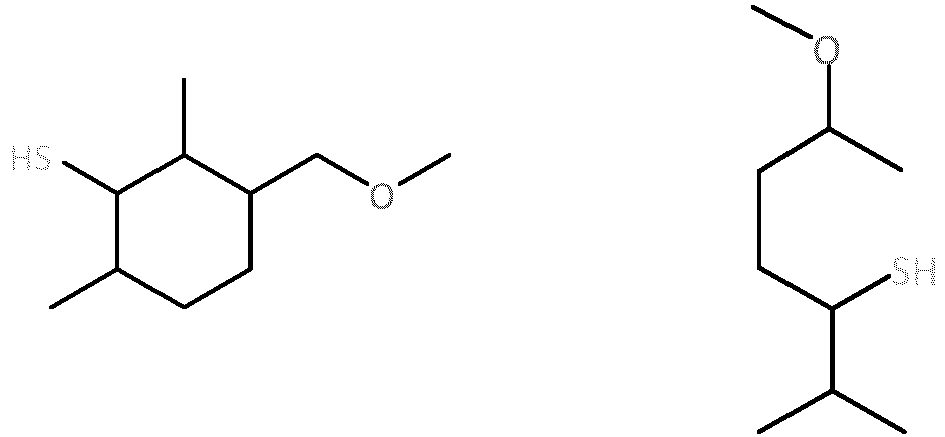

Applications Claiming Priority (2)
| Application Number | Priority Date | Filing Date | Title |
|---|---|---|---|
| EP2022062021 | 2022-05-04 | ||
| PCT/EP2023/061751 WO2023213922A1 (en) | 2022-05-04 | 2023-05-04 | PRECURSORS FOR THE CONTROLLED RELEASE OF α,β-UNSATURATED ALDEHYDES OR KETONES AND OTHER HIGH IMPACT FRAGRANCE SUBSTANCES |
Publications (2)
| Publication Number | Publication Date |
|---|---|
| EP4373805A1 EP4373805A1 (en) | 2024-05-29 |
| EP4373805B1 true EP4373805B1 (en) | 2025-04-09 |
Family
ID=81941132
Family Applications (1)
| Application Number | Title | Priority Date | Filing Date |
|---|---|---|---|
| EP23725150.9A Active EP4373805B1 (en) | 2022-05-04 | 2023-05-04 | Precursors for the controlled release of alpha, beta-unsaturated aldehydes or ketones and other high impact fragrance substances |
Country Status (5)
| Country | Link |
|---|---|
| US (1) | US20250170074A1 (en) |
| EP (1) | EP4373805B1 (en) |
| JP (1) | JP2025518469A (en) |
| CN (1) | CN119137098A (en) |
| WO (1) | WO2023213922A1 (en) |
Family Cites Families (6)
| Publication number | Priority date | Publication date | Assignee | Title |
|---|---|---|---|---|
| WO2004105713A1 (en) | 2003-06-02 | 2004-12-09 | Firmenich Sa | Compounds for a controlled release of active molecules |
| KR101273200B1 (en) * | 2008-02-06 | 2013-06-17 | 펄마젠 쎄라퓨틱스 (시너지) 리미티드 | Compounds |
| US9758749B2 (en) | 2013-09-09 | 2017-09-12 | Firmenich Sa | Thioether derivatives as precursors for a controlled release of active molecules |
| WO2019037862A1 (en) | 2017-08-24 | 2019-02-28 | Symrise Ag | ORGANOSCHWEFELVERBINDUNGEN AS RICH AND FLAVORINGS |
| EP3533786A1 (en) * | 2018-03-02 | 2019-09-04 | Givaudan SA | Thioether precursors for fragrant ketones and aldehydes |
| IL292716B2 (en) * | 2019-12-20 | 2026-05-01 | Firmenich Sa | Pro-perfume compositions |
-
2023
- 2023-05-04 WO PCT/EP2023/061751 patent/WO2023213922A1/en not_active Ceased
- 2023-05-04 US US18/681,244 patent/US20250170074A1/en active Pending
- 2023-05-04 JP JP2024564944A patent/JP2025518469A/en active Pending
- 2023-05-04 CN CN202380037456.2A patent/CN119137098A/en active Pending
- 2023-05-04 EP EP23725150.9A patent/EP4373805B1/en active Active
Non-Patent Citations (1)
| Title |
|---|
| SELL C S: "On the Unpredictability of Odor", ANGEWANDTE CHEMIE INTERNATIONAL EDITION, VERLAG CHEMIE, HOBOKEN, USA, vol. 45, no. 38, 25 September 2006 (2006-09-25), pages 6254 - 6261, XP007911257, ISSN: 1433-7851, [retrieved on 20060919], DOI: 10.1002/ANIE.200600782 * |
Also Published As
| Publication number | Publication date |
|---|---|
| EP4373805A1 (en) | 2024-05-29 |
| JP2025518469A (en) | 2025-06-17 |
| US20250170074A1 (en) | 2025-05-29 |
| WO2023213922A1 (en) | 2023-11-09 |
| CN119137098A (en) | 2024-12-13 |
Similar Documents
| Publication | Publication Date | Title |
|---|---|---|
| US20110097296A1 (en) | Novel Pyran Derivatives, Their Preparation and Use Thereof in Perfumery | |
| US11359161B2 (en) | Thioether precursors for fragrant ketones and aldehydes | |
| CN106458959B (en) | Mixtures with (4aR,5R,7aS,9R) -octahydro-2, 2,5,8,8,9 a-hexamethyl-4H-4 a, 9-methyleneazuleno (5,6-d) -1, 3-dioxole | |
| WO2019166314A1 (en) | Thioether precursors for fragrant ketones and aldehydes | |
| JP7405868B2 (en) | organic compound | |
| JP2024539217A (en) | Precursors of phenolic fragrance compounds | |
| CN113025426A (en) | 1-isopropoxy-1-oxopropan-2-yl pivalate as perfuming ingredient | |
| CN111050855B (en) | Mixture containing enantiopure Ambrocenide® | |
| JP7065873B2 (en) | Fragrance mixture containing tricyclo [5.2.1.0] -decane-8-ethyl ether | |
| US20250170074A1 (en) | Precursors for the controlled release of a,b-unsaturated aldehydes or ketones and other high impact fragrance substances | |
| ES2343738T3 (en) | ORGANIC COMPOUNDS. | |
| US20090263336A1 (en) | Novel pyran derivatives and their preparation | |
| US20050026998A1 (en) | Compounds for the controlled release of active aldehydes | |
| JP4909351B2 (en) | Α-Decalon with Damascon's woody smell | |
| JP2021517176A (en) | Aldehyde-based odorant | |
| CN115651762B (en) | Alcohol with floral aroma | |
| CN115427388A (en) | Novel esters as fragrance compounds | |
| CN111788172B (en) | Cyclohexenylpropionaldehyde derivatives as a fragrance ingredient | |
| MX2008003199A (en) | 6-methoxy-2,6-dimethyloctanal and its use as a fragrance ingredient. | |
| JP3046207B2 (en) | (E) -3,3-dimethyl-5- (2,2,3-trimethyl-3-cyclopenten-2-yl) -4-penten-2-ol, an optically active isomer, imparting and increasing odor characteristics For improving, improving or modifying, flavoring compositions, perfumed products and methods for producing effective compounds | |
| EP4416138A1 (en) | Novel derivatives of glycerol | |
| EP4720023A1 (en) | Fragrance precursor compounds | |
| US20250268804A1 (en) | Fragrance compositions | |
| ES2985009T3 (en) | Powerful powdery woody odorant | |
| EP4715031A1 (en) | Fragrance composition comprising dihydrolevoglucosenone derivatives |
Legal Events
| Date | Code | Title | Description |
|---|---|---|---|
| STAA | Information on the status of an ep patent application or granted ep patent |
Free format text: STATUS: UNKNOWN |
|
| STAA | Information on the status of an ep patent application or granted ep patent |
Free format text: STATUS: THE INTERNATIONAL PUBLICATION HAS BEEN MADE |
|
| PUAI | Public reference made under article 153(3) epc to a published international application that has entered the european phase |
Free format text: ORIGINAL CODE: 0009012 |
|
| STAA | Information on the status of an ep patent application or granted ep patent |
Free format text: STATUS: REQUEST FOR EXAMINATION WAS MADE |
|
| 17P | Request for examination filed |
Effective date: 20240219 |
|
| AK | Designated contracting states |
Kind code of ref document: A1 Designated state(s): AL AT BE BG CH CY CZ DE DK EE ES FI FR GB GR HR HU IE IS IT LI LT LU LV MC ME MK MT NL NO PL PT RO RS SE SI SK SM TR |
|
| STAA | Information on the status of an ep patent application or granted ep patent |
Free format text: STATUS: EXAMINATION IS IN PROGRESS |
|
| 17Q | First examination report despatched |
Effective date: 20240717 |
|
| GRAP | Despatch of communication of intention to grant a patent |
Free format text: ORIGINAL CODE: EPIDOSNIGR1 |
|
| STAA | Information on the status of an ep patent application or granted ep patent |
Free format text: STATUS: GRANT OF PATENT IS INTENDED |
|
| RIC1 | Information provided on ipc code assigned before grant |
Ipc: C11B 9/00 20060101ALI20241029BHEP Ipc: C07D 319/06 20060101ALI20241029BHEP Ipc: C07D 309/04 20060101ALI20241029BHEP Ipc: C07D 307/82 20060101ALI20241029BHEP Ipc: C07C 323/22 20060101AFI20241029BHEP |
|
| DAV | Request for validation of the european patent (deleted) | ||
| DAX | Request for extension of the european patent (deleted) | ||
| INTG | Intention to grant announced |
Effective date: 20241120 |
|
| GRAS | Grant fee paid |
Free format text: ORIGINAL CODE: EPIDOSNIGR3 |
|
| GRAA | (expected) grant |
Free format text: ORIGINAL CODE: 0009210 |
|
| STAA | Information on the status of an ep patent application or granted ep patent |
Free format text: STATUS: THE PATENT HAS BEEN GRANTED |
|
| AK | Designated contracting states |
Kind code of ref document: B1 Designated state(s): AL AT BE BG CH CY CZ DE DK EE ES FI FR GB GR HR HU IE IS IT LI LT LU LV MC ME MK MT NL NO PL PT RO RS SE SI SK SM TR |
|
| REG | Reference to a national code |
Ref country code: GB Ref legal event code: FG4D |
|
| REG | Reference to a national code |
Ref country code: CH Ref legal event code: EP |
|
| REG | Reference to a national code |
Ref country code: DE Ref legal event code: R096 Ref document number: 602023002852 Country of ref document: DE |
|
| REG | Reference to a national code |
Ref country code: IE Ref legal event code: FG4D |
|
| PGFP | Annual fee paid to national office [announced via postgrant information from national office to epo] |
Ref country code: DE Payment date: 20250603 Year of fee payment: 3 |
|
| PGFP | Annual fee paid to national office [announced via postgrant information from national office to epo] |
Ref country code: FR Payment date: 20250602 Year of fee payment: 3 |
|
| PGFP | Annual fee paid to national office [announced via postgrant information from national office to epo] |
Ref country code: AT Payment date: 20250721 Year of fee payment: 3 |
|
| REG | Reference to a national code |
Ref country code: NL Ref legal event code: MP Effective date: 20250409 |
|
| PG25 | Lapsed in a contracting state [announced via postgrant information from national office to epo] |
Ref country code: NL Free format text: LAPSE BECAUSE OF FAILURE TO SUBMIT A TRANSLATION OF THE DESCRIPTION OR TO PAY THE FEE WITHIN THE PRESCRIBED TIME-LIMIT Effective date: 20250409 |
|
| REG | Reference to a national code |
Ref country code: AT Ref legal event code: MK05 Ref document number: 1783452 Country of ref document: AT Kind code of ref document: T Effective date: 20250409 |
|
| PG25 | Lapsed in a contracting state [announced via postgrant information from national office to epo] |
Ref country code: FI Free format text: LAPSE BECAUSE OF FAILURE TO SUBMIT A TRANSLATION OF THE DESCRIPTION OR TO PAY THE FEE WITHIN THE PRESCRIBED TIME-LIMIT Effective date: 20250409 Ref country code: PT Free format text: LAPSE BECAUSE OF FAILURE TO SUBMIT A TRANSLATION OF THE DESCRIPTION OR TO PAY THE FEE WITHIN THE PRESCRIBED TIME-LIMIT Effective date: 20250811 Ref country code: ES Free format text: LAPSE BECAUSE OF FAILURE TO SUBMIT A TRANSLATION OF THE DESCRIPTION OR TO PAY THE FEE WITHIN THE PRESCRIBED TIME-LIMIT Effective date: 20250409 |
|
| REG | Reference to a national code |
Ref country code: LT Ref legal event code: MG9D |
|
| PG25 | Lapsed in a contracting state [announced via postgrant information from national office to epo] |
Ref country code: NO Free format text: LAPSE BECAUSE OF FAILURE TO SUBMIT A TRANSLATION OF THE DESCRIPTION OR TO PAY THE FEE WITHIN THE PRESCRIBED TIME-LIMIT Effective date: 20250709 Ref country code: GR Free format text: LAPSE BECAUSE OF FAILURE TO SUBMIT A TRANSLATION OF THE DESCRIPTION OR TO PAY THE FEE WITHIN THE PRESCRIBED TIME-LIMIT Effective date: 20250710 |
|
| PG25 | Lapsed in a contracting state [announced via postgrant information from national office to epo] |
Ref country code: PL Free format text: LAPSE BECAUSE OF FAILURE TO SUBMIT A TRANSLATION OF THE DESCRIPTION OR TO PAY THE FEE WITHIN THE PRESCRIBED TIME-LIMIT Effective date: 20250409 |
|
| PG25 | Lapsed in a contracting state [announced via postgrant information from national office to epo] |
Ref country code: BG Free format text: LAPSE BECAUSE OF FAILURE TO SUBMIT A TRANSLATION OF THE DESCRIPTION OR TO PAY THE FEE WITHIN THE PRESCRIBED TIME-LIMIT Effective date: 20250409 |
|
| PG25 | Lapsed in a contracting state [announced via postgrant information from national office to epo] |
Ref country code: HR Free format text: LAPSE BECAUSE OF FAILURE TO SUBMIT A TRANSLATION OF THE DESCRIPTION OR TO PAY THE FEE WITHIN THE PRESCRIBED TIME-LIMIT Effective date: 20250409 |
|
| PG25 | Lapsed in a contracting state [announced via postgrant information from national office to epo] |
Ref country code: AT Free format text: LAPSE BECAUSE OF FAILURE TO SUBMIT A TRANSLATION OF THE DESCRIPTION OR TO PAY THE FEE WITHIN THE PRESCRIBED TIME-LIMIT Effective date: 20250409 |
|
| PG25 | Lapsed in a contracting state [announced via postgrant information from national office to epo] |
Ref country code: RS Free format text: LAPSE BECAUSE OF FAILURE TO SUBMIT A TRANSLATION OF THE DESCRIPTION OR TO PAY THE FEE WITHIN THE PRESCRIBED TIME-LIMIT Effective date: 20250709 |
|
| PG25 | Lapsed in a contracting state [announced via postgrant information from national office to epo] |
Ref country code: IS Free format text: LAPSE BECAUSE OF FAILURE TO SUBMIT A TRANSLATION OF THE DESCRIPTION OR TO PAY THE FEE WITHIN THE PRESCRIBED TIME-LIMIT Effective date: 20250809 |
|
| PG25 | Lapsed in a contracting state [announced via postgrant information from national office to epo] |
Ref country code: LV Free format text: LAPSE BECAUSE OF FAILURE TO SUBMIT A TRANSLATION OF THE DESCRIPTION OR TO PAY THE FEE WITHIN THE PRESCRIBED TIME-LIMIT Effective date: 20250409 |
|
| REG | Reference to a national code |
Ref country code: DE Ref legal event code: R097 Ref document number: 602023002852 Country of ref document: DE |
|
| PG25 | Lapsed in a contracting state [announced via postgrant information from national office to epo] |
Ref country code: DK Free format text: LAPSE BECAUSE OF FAILURE TO SUBMIT A TRANSLATION OF THE DESCRIPTION OR TO PAY THE FEE WITHIN THE PRESCRIBED TIME-LIMIT Effective date: 20250409 Ref country code: SM Free format text: LAPSE BECAUSE OF FAILURE TO SUBMIT A TRANSLATION OF THE DESCRIPTION OR TO PAY THE FEE WITHIN THE PRESCRIBED TIME-LIMIT Effective date: 20250409 |
|
| PG25 | Lapsed in a contracting state [announced via postgrant information from national office to epo] |
Ref country code: LU Free format text: LAPSE BECAUSE OF NON-PAYMENT OF DUE FEES Effective date: 20250504 |
|
| PG25 | Lapsed in a contracting state [announced via postgrant information from national office to epo] |
Ref country code: CZ Free format text: LAPSE BECAUSE OF FAILURE TO SUBMIT A TRANSLATION OF THE DESCRIPTION OR TO PAY THE FEE WITHIN THE PRESCRIBED TIME-LIMIT Effective date: 20250409 |
|
| PG25 | Lapsed in a contracting state [announced via postgrant information from national office to epo] |
Ref country code: EE Free format text: LAPSE BECAUSE OF FAILURE TO SUBMIT A TRANSLATION OF THE DESCRIPTION OR TO PAY THE FEE WITHIN THE PRESCRIBED TIME-LIMIT Effective date: 20250409 |
|
| PG25 | Lapsed in a contracting state [announced via postgrant information from national office to epo] |
Ref country code: SK Free format text: LAPSE BECAUSE OF FAILURE TO SUBMIT A TRANSLATION OF THE DESCRIPTION OR TO PAY THE FEE WITHIN THE PRESCRIBED TIME-LIMIT Effective date: 20250409 |
|
| PG25 | Lapsed in a contracting state [announced via postgrant information from national office to epo] |
Ref country code: IT Free format text: LAPSE BECAUSE OF FAILURE TO SUBMIT A TRANSLATION OF THE DESCRIPTION OR TO PAY THE FEE WITHIN THE PRESCRIBED TIME-LIMIT Effective date: 20250409 |
|
| REG | Reference to a national code |
Ref country code: BE Ref legal event code: MM Effective date: 20250531 |
|
| PG25 | Lapsed in a contracting state [announced via postgrant information from national office to epo] |
Ref country code: MC Free format text: LAPSE BECAUSE OF FAILURE TO SUBMIT A TRANSLATION OF THE DESCRIPTION OR TO PAY THE FEE WITHIN THE PRESCRIBED TIME-LIMIT Effective date: 20250409 |
|
| PLBE | No opposition filed within time limit |
Free format text: ORIGINAL CODE: 0009261 |
|
| STAA | Information on the status of an ep patent application or granted ep patent |
Free format text: STATUS: NO OPPOSITION FILED WITHIN TIME LIMIT |
|
| REG | Reference to a national code |
Ref country code: CH Ref legal event code: L10 Free format text: ST27 STATUS EVENT CODE: U-0-0-L10-L00 (AS PROVIDED BY THE NATIONAL OFFICE) Effective date: 20260218 |
|
| PG25 | Lapsed in a contracting state [announced via postgrant information from national office to epo] |
Ref country code: RO Free format text: LAPSE BECAUSE OF FAILURE TO SUBMIT A TRANSLATION OF THE DESCRIPTION OR TO PAY THE FEE WITHIN THE PRESCRIBED TIME-LIMIT Effective date: 20250409 |
|
| 26N | No opposition filed |
Effective date: 20260112 |
|
| PG25 | Lapsed in a contracting state [announced via postgrant information from national office to epo] |
Ref country code: IE Free format text: LAPSE BECAUSE OF NON-PAYMENT OF DUE FEES Effective date: 20250504 |
|
| PG25 | Lapsed in a contracting state [announced via postgrant information from national office to epo] |
Ref country code: BE Free format text: LAPSE BECAUSE OF NON-PAYMENT OF DUE FEES Effective date: 20250531 |