EP4373028A1 - Communication devices for use in challenge-response rounds and corresponding operating methods - Google Patents
Communication devices for use in challenge-response rounds and corresponding operating methods Download PDFInfo
- Publication number
- EP4373028A1 EP4373028A1 EP22207597.0A EP22207597A EP4373028A1 EP 4373028 A1 EP4373028 A1 EP 4373028A1 EP 22207597 A EP22207597 A EP 22207597A EP 4373028 A1 EP4373028 A1 EP 4373028A1
- Authority
- EP
- European Patent Office
- Prior art keywords
- communication device
- response
- key
- challenge
- cryptographic
- Prior art date
- Legal status (The legal status is an assumption and is not a legal conclusion. Google has not performed a legal analysis and makes no representation as to the accuracy of the status listed.)
- Granted
Links
Images




Classifications
-
- H—ELECTRICITY
- H04—ELECTRIC COMMUNICATION TECHNIQUE
- H04L—TRANSMISSION OF DIGITAL INFORMATION, e.g. TELEGRAPHIC COMMUNICATION
- H04L9/00—Cryptographic mechanisms or cryptographic arrangements for secret or secure communications; Network security protocols
- H04L9/08—Key distribution or management, e.g. generation, sharing or updating, of cryptographic keys or passwords
- H04L9/0861—Generation of secret information including derivation or calculation of cryptographic keys or passwords
-
- H—ELECTRICITY
- H04—ELECTRIC COMMUNICATION TECHNIQUE
- H04L—TRANSMISSION OF DIGITAL INFORMATION, e.g. TELEGRAPHIC COMMUNICATION
- H04L9/00—Cryptographic mechanisms or cryptographic arrangements for secret or secure communications; Network security protocols
- H04L9/32—Cryptographic mechanisms or cryptographic arrangements for secret or secure communications; Network security protocols including means for verifying the identity or authority of a user of the system or for message authentication, e.g. authorization, entity authentication, data integrity or data verification, non-repudiation, key authentication or verification of credentials
- H04L9/3271—Cryptographic mechanisms or cryptographic arrangements for secret or secure communications; Network security protocols including means for verifying the identity or authority of a user of the system or for message authentication, e.g. authorization, entity authentication, data integrity or data verification, non-repudiation, key authentication or verification of credentials using challenge-response
-
- H—ELECTRICITY
- H04—ELECTRIC COMMUNICATION TECHNIQUE
- H04L—TRANSMISSION OF DIGITAL INFORMATION, e.g. TELEGRAPHIC COMMUNICATION
- H04L9/00—Cryptographic mechanisms or cryptographic arrangements for secret or secure communications; Network security protocols
- H04L9/002—Countermeasures against attacks on cryptographic mechanisms
-
- H—ELECTRICITY
- H04—ELECTRIC COMMUNICATION TECHNIQUE
- H04L—TRANSMISSION OF DIGITAL INFORMATION, e.g. TELEGRAPHIC COMMUNICATION
- H04L9/00—Cryptographic mechanisms or cryptographic arrangements for secret or secure communications; Network security protocols
- H04L9/002—Countermeasures against attacks on cryptographic mechanisms
- H04L9/003—Countermeasures against attacks on cryptographic mechanisms for power analysis, e.g. differential power analysis [DPA] or simple power analysis [SPA]
-
- H—ELECTRICITY
- H04—ELECTRIC COMMUNICATION TECHNIQUE
- H04L—TRANSMISSION OF DIGITAL INFORMATION, e.g. TELEGRAPHIC COMMUNICATION
- H04L9/00—Cryptographic mechanisms or cryptographic arrangements for secret or secure communications; Network security protocols
- H04L9/14—Cryptographic mechanisms or cryptographic arrangements for secret or secure communications; Network security protocols using a plurality of keys or algorithms
-
- H—ELECTRICITY
- H04—ELECTRIC COMMUNICATION TECHNIQUE
- H04L—TRANSMISSION OF DIGITAL INFORMATION, e.g. TELEGRAPHIC COMMUNICATION
- H04L9/00—Cryptographic mechanisms or cryptographic arrangements for secret or secure communications; Network security protocols
- H04L9/14—Cryptographic mechanisms or cryptographic arrangements for secret or secure communications; Network security protocols using a plurality of keys or algorithms
- H04L9/16—Cryptographic mechanisms or cryptographic arrangements for secret or secure communications; Network security protocols using a plurality of keys or algorithms the keys or algorithms being changed during operation
Definitions
- the present disclosure relates to communication devices for use in one or more challenge-response rounds. Furthermore, the present disclosure relates to corresponding methods of operating communication devices for use in one or more challenge-response rounds, and to computer programs for carrying out said methods.
- Authentication protocols are used to authenticate devices. Authentication is one of the main concepts in security and cryptography. Authentication allows to make sure that an entity with which communication is performed is genuine, authentic and is what or who it claims to be.
- a communication device for use in one or more challenge-response rounds, comprising: a response generation unit configured to generate, in each challenge-response round, a response to a challenge received from an external communication device, wherein said response is generated by performing a cryptographic function on said challenge, and wherein the cryptographic function takes said challenge and a cryptographic key as inputs; a key selection unit configured to select said cryptographic key from a set of cryptographic keys by executing a predefined key selection algorithm that has been shared with the external communication device.
- the key selection algorithm includes selecting, in each challenge-response round, a different cryptographic key from said set of cryptographic keys.
- the key selection algorithm includes selecting the cryptographic key from a subset of the set of cryptographic keys, wherein the subset does not include all the cryptographic keys from said set.
- the key selection algorithm includes selecting the same cryptographic key for a predefined number of consecutive challenge-response rounds.
- the key selection algorithm is configured to select the cryptographic key from the set of cryptographic keys in a predefined order.
- said order depends on at least one of the following parameters: an identifier of the communication device, a randomization key, an authentication round.
- the set of cryptographic keys is generated by deriving the cryptographic keys from a master key.
- the communication device is configured to act as a prover in an authentication protocol.
- a method of operating a communication device for use in one or more challenge-response rounds comprising performing in each challenge-response round: selecting, by a key selection unit comprised in the communication device, a cryptographic key from a set of cryptographic keys by executing a predefined key selection algorithm that has been shared with an external communication device; generating, by a response generation unit comprised in the communication device, a response to a challenge received from the external communication device, wherein said response is generated by performing a cryptographic function on said challenge, and wherein the cryptographic function takes the challenge and the cryptographic key as inputs.
- a computer program comprising executable instructions which, when executed by a communication device in accordance with the first aspect, carry out a method in accordance with the second aspect.
- a communication device for use in one of more challenge-response rounds, comprising: a response verification unit configured to verify, in each challenge-response round, a response transmitted by an external communication device, wherein said response is verified using a cryptographic key; a key selection unit configured to select said cryptographic key from a set of cryptographic keys by executing a predefined key selection algorithm that has been shared with the external communication device.
- the communication device is configured to act as a verifier in an authentication protocol.
- a method of operating a communication device for use in one of more challenge-response rounds comprising performing in each challenge-response round: selecting, by a key selection unit comprised in the communication device, a cryptographic key from a set of cryptographic keys by executing a predefined key selection algorithm that has been shared with an external communication device; verifying, by a response verification unit comprised in the communication device, a response transmitted by the external communication device, wherein said response is verified using the cryptographic key.
- a computer program comprising executable instructions which, when executed by a communication device in accordance with the fourth aspect, carry out a method in accordance with the fifth aspect.
- an authentication system configured to execute an authentication protocol, the authentication system comprising a communication device in accordance with the first aspect, which is configured to act as a prover in said authentication protocol, and a communication device in accordance with the fourth aspect, which is configured to act as a verifier in said authentication protocol.
- authentication protocols are used to authenticate devices. Authentication is one of the main concepts in security and cryptography. Authentication allows to make sure that an entity with which communication is performed is genuine, authentic and is what or who it claims to be. Depending on the application it may be important to authenticate people, devices or data. In the context of the present disclosure, authentication specifically refers to an interactive authentication that is suitable for people and devices, but not for data. It is noted that in practice people will likely use a hardware device that will actually run the authentication protocol. Many of the interactive authentication protocols, such as the protocols based on zero-knowledge proofs, typically run multiple rounds of the authentication in one authentication session. Roughly speaking, one round only gives a weak indication that an authenticated entity is genuine, but repeating such rounds many times increases the certainty that the entity is genuine.
- SCAs Side-channel attacks
- SCAs are attacks against implementations of security algorithms and protocols. SCAs rely on information leakage that a device accidentally produces. Usually, this information leakage can be measured by observing physical characteristics of the device such as power consumption.
- One of the most common types of SCAs is power analysis.
- the goal of an SCA is to retrieve some secret information that is manipulated by the device, most of the time the target of an SCA is a secret encryption key. Once a secret key is retrieved from the device, the attacker can use it to create a clone of the original device. More specifically, an almost identical hardware device can be provisioned with the retrieved secret key to act instead of the original. It is important to increase the resistance against such SCAs.
- Fig. 1A shows an example of an authentication system 100.
- the authentication system 100 comprises a first communication device that acts as a prover 102 and a second communication device that acts as a verifier 104.
- the verifier 104 sends a first challenge to the prover 102.
- the prover 102 computes a response to the first challenge and transmits this response to the verifier 104.
- the verifier 104 verifies the response, thereby completing a first challenge-response round. Subsequently, further challenge-response rounds are executed.
- a predefined number N of challenge-response rounds may be executed between the prover 102 and the verifier 104.
- Fig. 1A shows a typical authentication session between two devices, fitting many cryptographic protocols.
- the number of challenge-response rounds (i.e., repetitions) depends on the level of certainty that one wants to achieve in the system. Often the number of rounds is suggested in protocol implementations for standard levels of security (e.g., 128-bit).
- the response to each challenge is computed using a secret key and the challenge itself.
- Fig. 1B shows an example of a response generation 106 by a prover.
- the response generation 106 includes executing a cryptographic algorithm 110 that takes a challenge 108 and a secret key 112 as inputs.
- the cryptographic algorithm 110 may take additional data 116 as inputs, such as a device identifier and a timestamp.
- the cryptographic algorithm 110 outputs a response 114 to the challenge 108.
- the prover and the verifier exchange multiple challenges or responses in each message to reduce the communication overhead.
- the verifier may send 10 challenges in one message and the prover may send the 10 corresponding responses as a reply in one message.
- the prover executes the cryptographic algorithm 110 for every challenge before sending the response or responses.
- communication devices and corresponding operating methods which facilitate increasing the resistance against side-channel attacks of the kind set forth. Furthermore, the presently disclosed techniques may facilitate increasing the resistance of the communication devices against cloning and reverse engineering.
- the communication devices and corresponding operating methods may be used to advantage in authentication systems which are configured to execute authentication protocols of the kind set forth above.
- Fig. 2A shows an illustrative embodiment of a communication device 200.
- the communication device 200 comprises a response generation unit 202 and a key selection unit 204, which are operatively coupled to each other.
- the response generation unit 202 is configured to generate, in each challenge-response round, a response to a challenge received from an external communication device (not shown), wherein said response is generated by performing a cryptographic function on said challenge, and wherein the cryptographic function takes said challenge and a cryptographic key as inputs.
- the key selection unit 204 is configured to select said cryptographic key from a set of cryptographic keys by executing a predefined key selection algorithm that has been shared with the external communication device.
- the key selection algorithm may have been shared with the external communication device in a device configuration process, which is carried out prior to the authentication process.
- the communication device 200 is configured to act as a prover in an authentication protocol.
- the external communication device is configured to act as the verifier in said authentication protocol.
- the key selection algorithm includes selecting, in each challenge-response round, a different cryptographic key from said set of cryptographic keys. In this way, the key diversity may be increased, which further facilitates increasing the resistance against side-channel attacks. Furthermore, the key selection algorithm includes selecting the cryptographic key from a subset of the set of cryptographic keys, wherein the subset does not include all the cryptographic keys from said set. Since not all available cryptographic keys are used, the difficulty may be increased for an attacker to analyze the behavior of the communication device. In other words, the resistance against side-channel attacks may be further increased. Furthermore, in one or more embodiments, the key selection algorithm includes selecting the same cryptographic key for a predefined number of consecutive challenge-response rounds. In this way, the key selection may be optimized, in the sense that less key switches are necessary. Still, the resistance against side-channel attacks may be increased by, for example, selecting different keys in challenge-response rounds different from the consecutive rounds.
- the key selection algorithm is configured to select the cryptographic key from the set of cryptographic keys in a predefined order.
- said order depends on at least one of the following parameters: an identifier of the communication device, a randomization key, an authentication round (i.e., a challenge-response round).
- an authentication round i.e., a challenge-response round.
- This may further increase the difficulty for an attacker to retrieve the cryptographic keys used during the challenge-response rounds. Accordingly, the resistance against side-channel attacks may be further increased.
- the randomization key and the authentication round can be use as auxiliary information to parametrize the sequence of keys.
- Using these additional parameters may help in case the attacker knows the algorithm and even the authentication keys. For example, without the randomization key he will still not be able to predict the sequence of the keys that are used. If a different device identifier is used in every device then, even by knowing something about the order of keys in one device, the attacker will not know anything about the order in another device given that everything else is the same.
- a hash function may be used. For example, a hash value may be computed on the device identifier, randomization key and other information, which may subsequently be used in the randomization algorithm that computes the sequences of keys to be used.
- the set of cryptographic keys is generated by deriving the cryptographic keys from a master key. In this way, there is no need for a significantly larger storage space in the communication device, while it is still possible to obtain a plurality of cryptographic keys.
- Fig. 2B shows an illustrative embodiment of a method 206 of operating a communication device, more specifically a method of operating the communication device shown in Fig. 2A .
- the method 206 comprises performing the following steps in each challenge-response round.
- a key selection unit comprised in the communication device selects a cryptographic key from a set of cryptographic keys by executing a predefined key selection algorithm that has been shared with an external communication device.
- a response generation unit comprised in the communication device generates a response to a challenge received from the external communication device, wherein said response is generated by performing a cryptographic function on said challenge, and wherein the cryptographic function takes the challenge and the cryptographic key as inputs.
- Fig. 2C shows another illustrative embodiment of a communication device 212.
- the communication device 212 comprises a response verification unit 214 and a key selection unit 216, which are operatively coupled to each other.
- the response verification unit 214 is configured to verify, in each challenge-response round, a response transmitted by an external communication device (not shown), wherein said response is verified using a cryptographic key.
- the key selection unit 216 is configured to select said cryptographic key from a set of cryptographic keys by executing a predefined key selection algorithm that has been shared with the external communication device.
- the key selection algorithm may have been shared with the external communication device in a device configuration process, which is carried out prior to the authentication process.
- the communication device 212 is configured to act as a verifier in an authentication protocol.
- the external communication device is configured to act as the prover in said authentication protocol.
- Fig. 2D shows another illustrative embodiment of a method 218 of operating a communication device, more specifically a method of operating the communication device shown in Fig. 2C .
- the method 218 comprises performing the following steps in each challenge-response round.
- a key selection unit comprised in the communication device selects a cryptographic key from a set of cryptographic keys by executing a predefined key selection algorithm that has been shared with an external communication device.
- a response verification unit comprised in the communication device verifies a response transmitted by the external communication device, wherein said response is verified using the cryptographic key.
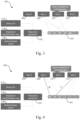
- Fig. 3 shows an illustrative embodiment of a key selection algorithm 300.
- the key selection algorithm 300 is implemented as a sequence generator 302, which generates a sequence 304.
- the sequence of keys 304 includes binary numbers, which uniquely identify one of a plurality of cryptographic keys 306, 308, 310, 312.
- the cryptographic keys used for the consecutive challenge-response rounds are selected in accordance with the binary numbers included in the sequence 304.
- the sequence generator 302 may take into account a device identifier 314, a sequence randomization key 316 and an authentication round 318, in order to generate the sequence 304. Using the sequence randomization key 316, it may be ensured that the order in which the keys are selected is randomized.
- a prover and a verifier in an authentication system may share a common key selection algorithm.
- This algorithm may also use a secret key, and it may be based on well-known cryptographic algorithms such as random number generators, stream ciphers, etc.
- the goal of this algorithm is to choose a key that is supposed to be used in a challenge-response round of the authentication protocol.
- An example of the key selection scheme is shown in Fig. 3 .
- the sequence of keys 304 to be used depends on the device ID 314, a secret key 316 shared between prover and verifier and the round 318 of the authentication.
- This example shows a scheme with 4 available keys 306, 308, 310, 312 and thus one would take 2 bits at a time from the sequence generator 302 to select a key. Once the key is selected it will be the one used to compute the response for the challenge that the verifier sent to the prover. It is noted that the verifier will also know all the information required to compute the key number that is supposed to be used for this round.
- sequence generator 302 can be based on a stream cipher, a block cipher in (for example) a counter mode, a pseudorandom number generator (PRNG) or a sponge construction (such as Keccak). It is noted that the three parameters 314, 316, 318 in Fig. 3 are optional. For instance, the sequence does not have to be dependent on the authentication round 318. Furthermore, other parameters can be included, such as the date, in order to randomize the sequence every day. Furthermore, one can also include a random number, for example as provided by the verifier in its first response when the prover initiated the communication.
- PRNG pseudorandom number generator
- Fig. 4 shows another illustrative embodiment of a key selection algorithm 400.
- the key selection algorithm 400 is similar to the key selection algorithm 300 shown in Fig. 3 .
- the key selection algorithm 300 is implemented as a sequence generator 302, which generates a sequence 304.
- the key selection algorithm 400 includes selecting the cryptographic key from a subset 308, 310 of the set of cryptographic keys 306, 308, 310, 312, wherein the subset does not include all the cryptographic keys 306, 308, 310, 312 from said set.
- the first two binary numbers of the sequence 402 indicate which of the available keys can be selected: the second key 308 and the fourth key 312. Then, the remaining binary numbers of the sequence 402, consisting of only a single bit, indicate whether the second key 308 or the fourth key 312 should be selected.
- the presently disclosed technique it may either be possible to use all of the available keys in a random order for every authentication, or to use only a subset of the available keys. It is noted that it is unlikely that one of the keys does not get to be used if the output of the sequence generator is uniform and the number of keys is much smaller than the number of rounds. This means that during one authentication session all keys will get to be used and will be "visible” in for example a power trace for the analysis. However, it is possible to ensure that not all keys are used on every authentication, thus making it more difficult to analyze the communication device and extract them. To do so, one might either use two separate key selection functions or handle the first few bits of the output of the key selection function (i.e., the sequence generator) differently.
- Fig. 4 An example is shown in Fig. 4 , where only two keys are used for the authentication session among the four available ones. To accomplish this, first bits of the sequence generator are used to select a subset of the keys (2 out of 4 in this example) and remaining bits are used to select the keys out of the subset.
- the key selection algorithm includes selecting the same cryptographic key for a predefined number of consecutive challenge-response rounds. In other words, it is possible to optimize the scheme to have les key switches, for example by using the same key N times instead of once before selecting a next one. However, if the attacker knows about this property than it will be easier for him to distinguish the keys from each other.
- an authentication protocol may consist of only a single challenge-response round. In that case, the presently disclosed technique may still be used, in the sense that only one cryptographic key will be selected from the set of available keys. Subsequently, the selected cryptographic key may be used in the challenge-response round.
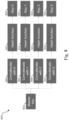
- Fig. 5 shows examples of sequences of keys 500.
- the first sequence 502, second sequence 504, third sequence 506 and fourth sequence 508 are the same, and the same key is used repeatedly within each sequence.
- the first sequence 502 is used in a first authentication session consisting of multiple challenge-response rounds
- the second sequence 504 is used in a second authentication session consisting of multiple challenge-response rounds, etc.
- the sequences 502, 504, 506, 508 also correspond to the series of observable leakages (e.g., as visible through side-channels). In theory, a strong attacker will be able to extract the single key from the data recovered (e.g., a power trace) from a single authentication session in a standard implementation.
- Fig. 6 shows illustrative embodiments of sequences of keys 600.
- the first sequence 602 which is used in a first authentication session, includes different keys for each challenge-response round. These keys are selected by the key selection algorithm.
- the second sequence 604 which is used in a second authentication session, keys for each challenge-response round, etc.
- different keys are used for the challenge-response rounds in each authentication session.
- the order in which the keys are used differs for each authentication session. In this way, the resistance against side-channel attacks may be increased.
- Fig. 7 shows further illustrative embodiments of sequences of keys 700.
- the first sequence 702 which is used in a first authentication session, includes different keys for each challenge-response round. These keys are selected by the key selection algorithm.
- the second sequence 704 which is used in a second authentication session, keys for each challenge-response round, etc.
- different keys are used for the challenge-response rounds in each authentication session.
- the order in which the keys are used differs for each authentication session.
- only a subset of the available keys is used.
- some keys 710, 712, 714, 716 remain unused, in the sense that they are not selected by the key selection algorithm. In this way, the resistance against side-channel attacks may be further increased. In particular, if only subsets of keys are used each time even a very strong attacker will need many authentication sessions and a way to distinguish different keys, in addition to having to recover the sequence randomization key and parameters.
- Fig. 8 shows an illustrative embodiment of a key generation process 800.
- the key generation process 800 generates a set of cryptographic keys 820, 822, 824, 826 by deriving said cryptographic keys 820, 822, 824, 826 from a master key 802. As mentioned above, this reduces the need for a significantly larger storage space in the communication device, while it is still possible to obtain a plurality of cryptographic keys 820, 822, 824, 826.
- the master key 802 is first concatenated 804, 806, 808, 810 with predefined numbers, and then hash functions 812, 814, 816, 818 are performed on the results of the concatenations 804, 806, 808, 810.
- a cost trade-off may be achieved between execution time and memory space. For example, instead of generating 4 keys, one would have to generate a single master key K M 802.
- the master key 802 can be used to generate the required 4 keys 820, 822, 824, 826 at the beginning of the authentication process.
- a stream cipher or a hash function to generate the required keys 820, 822, 824, 826 for the authentication, as is shown in Fig. 8 .
- the specific key generation process 800 shown in Fig. 8 is useful for optimizing the scenario in which only of a subset of the cryptographic keys is used, as explained with reference to Fig. 7 . In that case, only the required keys should be generated, but not all the keys.
- the systems and methods described herein may at least partially be embodied by a computer program or a plurality of computer programs, which may exist in a variety of forms both active and inactive in a single computer system or across multiple computer systems.
- they may exist as software program(s) comprised of program instructions in source code, object code, executable code or other formats for performing some of the steps.
- Any of the above may be embodied on a computer-readable medium, which may include storage devices and signals, in compressed or uncompressed form.
- the term "computer” refers to any electronic device comprising a processor, such as a general-purpose central processing unit (CPU), a specific-purpose processor or a microcontroller.
- a computer is capable of receiving data (an input), of performing a sequence of predetermined operations thereupon, and of producing thereby a result in the form of information or signals (an output).
- the term "computer” will mean either a processor in particular or more generally a processor in association with an assemblage of interrelated elements contained within a single case or housing.
- processor or “processing unit” refers to a data processing circuit that may be a microprocessor, a co-processor, a microcontroller, a microcomputer, a central processing unit, a field programmable gate array (FPGA), a programmable logic circuit, and/or any circuit that manipulates signals (analog or digital) based on operational instructions that are stored in a memory.
- memory refers to a storage circuit or multiple storage circuits such as read-only memory, random access memory, volatile memory, non-volatile memory, static memory, dynamic memory, Flash memory, cache memory, and/or any circuit that stores digital information.
- a "computer-readable medium” or “storage medium” may be any means that can contain, store, communicate, propagate, or transport a computer program for use by or in connection with the instruction execution system, apparatus, or device.
- the computer-readable medium may be, for example but not limited to, an electronic, magnetic, optical, electromagnetic, infrared, or semiconductor system, apparatus, device, or propagation medium.
Landscapes
- Engineering & Computer Science (AREA)
- Computer Security & Cryptography (AREA)
- Computer Networks & Wireless Communication (AREA)
- Signal Processing (AREA)
- Mobile Radio Communication Systems (AREA)
Abstract
Description
- The present disclosure relates to communication devices for use in one or more challenge-response rounds. Furthermore, the present disclosure relates to corresponding methods of operating communication devices for use in one or more challenge-response rounds, and to computer programs for carrying out said methods.
- Authentication protocols are used to authenticate devices. Authentication is one of the main concepts in security and cryptography. Authentication allows to make sure that an entity with which communication is performed is genuine, authentic and is what or who it claims to be.
- In accordance with a first aspect of the present disclosure, a communication device for use in one or more challenge-response rounds is provided, comprising: a response generation unit configured to generate, in each challenge-response round, a response to a challenge received from an external communication device, wherein said response is generated by performing a cryptographic function on said challenge, and wherein the cryptographic function takes said challenge and a cryptographic key as inputs; a key selection unit configured to select said cryptographic key from a set of cryptographic keys by executing a predefined key selection algorithm that has been shared with the external communication device.
- In one or more embodiments, the key selection algorithm includes selecting, in each challenge-response round, a different cryptographic key from said set of cryptographic keys.
- In one or more embodiments, the key selection algorithm includes selecting the cryptographic key from a subset of the set of cryptographic keys, wherein the subset does not include all the cryptographic keys from said set.
- In one or more embodiments, the key selection algorithm includes selecting the same cryptographic key for a predefined number of consecutive challenge-response rounds.
- In one or more embodiments, the key selection algorithm is configured to select the cryptographic key from the set of cryptographic keys in a predefined order.
- In one or more embodiments, said order depends on at least one of the following parameters: an identifier of the communication device, a randomization key, an authentication round.
- In one or more embodiments, the set of cryptographic keys is generated by deriving the cryptographic keys from a master key.
- In one or more embodiments, the communication device is configured to act as a prover in an authentication protocol.
- In accordance with a second aspect of the present disclosure, a method of operating a communication device for use in one or more challenge-response rounds is conceived, the method comprising performing in each challenge-response round: selecting, by a key selection unit comprised in the communication device, a cryptographic key from a set of cryptographic keys by executing a predefined key selection algorithm that has been shared with an external communication device; generating, by a response generation unit comprised in the communication device, a response to a challenge received from the external communication device, wherein said response is generated by performing a cryptographic function on said challenge, and wherein the cryptographic function takes the challenge and the cryptographic key as inputs.
- In accordance with a third aspect of the present disclosure, a computer program is provided, comprising executable instructions which, when executed by a communication device in accordance with the first aspect, carry out a method in accordance with the second aspect.
- In accordance with a fourth aspect of the present disclosure, a communication device for use in one of more challenge-response rounds is provided, comprising: a response verification unit configured to verify, in each challenge-response round, a response transmitted by an external communication device, wherein said response is verified using a cryptographic key; a key selection unit configured to select said cryptographic key from a set of cryptographic keys by executing a predefined key selection algorithm that has been shared with the external communication device.
- In one or more embodiments, the communication device is configured to act as a verifier in an authentication protocol.
- In accordance with a fifth aspect of the present disclosure, a method of operating a communication device for use in one of more challenge-response rounds is conceived, the method comprising performing in each challenge-response round: selecting, by a key selection unit comprised in the communication device, a cryptographic key from a set of cryptographic keys by executing a predefined key selection algorithm that has been shared with an external communication device; verifying, by a response verification unit comprised in the communication device, a response transmitted by the external communication device, wherein said response is verified using the cryptographic key.
- In accordance with a sixth aspect of the present disclosure, a computer program is provided, comprising executable instructions which, when executed by a communication device in accordance with the fourth aspect, carry out a method in accordance with the fifth aspect.
- In accordance with a seventh aspect of the present disclosure, an authentication system configured to execute an authentication protocol is provided, the authentication system comprising a communication device in accordance with the first aspect, which is configured to act as a prover in said authentication protocol, and a communication device in accordance with the fourth aspect, which is configured to act as a verifier in said authentication protocol.
- Embodiments will be described in more detail with reference to the appended drawings.
-
Fig. 1A shows an example of an authentication system. -
Fig. 1B shows an example of a response generation by a prover. -
Fig. 2A shows an illustrative embodiment of a communication device. -
Fig. 2B shows an illustrative embodiment of a method of operating a communication device. -
Fig. 2C shows another illustrative embodiment of a communication device. -
Fig. 2D shows another illustrative embodiment of a method of operating a communication device. -
Fig. 3 shows an illustrative embodiment of a key selection algorithm. -
Fig. 4 shows another illustrative embodiment of a key selection algorithm. -
Fig. 5 shows examples of sequences of keys. -
Fig. 6 shows illustrative embodiments of sequences of keys. -
Fig. 7 shows further illustrative embodiments of sequences of keys. -
Fig. 8 shows an illustrative embodiment of a key generation process. - As mentioned above, authentication protocols are used to authenticate devices. Authentication is one of the main concepts in security and cryptography. Authentication allows to make sure that an entity with which communication is performed is genuine, authentic and is what or who it claims to be. Depending on the application it may be important to authenticate people, devices or data. In the context of the present disclosure, authentication specifically refers to an interactive authentication that is suitable for people and devices, but not for data. It is noted that in practice people will likely use a hardware device that will actually run the authentication protocol. Many of the interactive authentication protocols, such as the protocols based on zero-knowledge proofs, typically run multiple rounds of the authentication in one authentication session. Roughly speaking, one round only gives a weak indication that an authenticated entity is genuine, but repeating such rounds many times increases the certainty that the entity is genuine.
- Side-channel attacks (SCAs) are attacks against implementations of security algorithms and protocols. SCAs rely on information leakage that a device accidentally produces. Usually, this information leakage can be measured by observing physical characteristics of the device such as power consumption. One of the most common types of SCAs is power analysis. The goal of an SCA is to retrieve some secret information that is manipulated by the device, most of the time the target of an SCA is a secret encryption key. Once a secret key is retrieved from the device, the attacker can use it to create a clone of the original device. More specifically, an almost identical hardware device can be provisioned with the retrieved secret key to act instead of the original. It is important to increase the resistance against such SCAs.
-
Fig. 1A shows an example of anauthentication system 100. Theauthentication system 100 comprises a first communication device that acts as aprover 102 and a second communication device that acts as averifier 104. After an initial communication from theprover 102 to theverifier 104, theverifier 104 sends a first challenge to theprover 102. Subsequently, theprover 102 computes a response to the first challenge and transmits this response to theverifier 104. Then, theverifier 104 verifies the response, thereby completing a first challenge-response round. Subsequently, further challenge-response rounds are executed. In particular, a predefined number N of challenge-response rounds may be executed between theprover 102 and theverifier 104. More specifically,Fig. 1A shows a typical authentication session between two devices, fitting many cryptographic protocols. The number of challenge-response rounds (i.e., repetitions) depends on the level of certainty that one wants to achieve in the system. Often the number of rounds is suggested in protocol implementations for standard levels of security (e.g., 128-bit). The response to each challenge is computed using a secret key and the challenge itself. -
Fig. 1B shows an example of aresponse generation 106 by a prover. Theresponse generation 106 includes executing acryptographic algorithm 110 that takes achallenge 108 and asecret key 112 as inputs. Optionally, thecryptographic algorithm 110 may takeadditional data 116 as inputs, such as a device identifier and a timestamp. Thecryptographic algorithm 110 outputs aresponse 114 to thechallenge 108. In some scenarios the prover and the verifier exchange multiple challenges or responses in each message to reduce the communication overhead. For example, the verifier may send 10 challenges in one message and the prover may send the 10 corresponding responses as a reply in one message. In any case, the prover executes thecryptographic algorithm 110 for every challenge before sending the response or responses. - Now discussed are communication devices and corresponding operating methods, which facilitate increasing the resistance against side-channel attacks of the kind set forth. Furthermore, the presently disclosed techniques may facilitate increasing the resistance of the communication devices against cloning and reverse engineering. The communication devices and corresponding operating methods may be used to advantage in authentication systems which are configured to execute authentication protocols of the kind set forth above.
-
Fig. 2A shows an illustrative embodiment of acommunication device 200. Thecommunication device 200 comprises aresponse generation unit 202 and akey selection unit 204, which are operatively coupled to each other. Theresponse generation unit 202 is configured to generate, in each challenge-response round, a response to a challenge received from an external communication device (not shown), wherein said response is generated by performing a cryptographic function on said challenge, and wherein the cryptographic function takes said challenge and a cryptographic key as inputs. Furthermore, thekey selection unit 204 is configured to select said cryptographic key from a set of cryptographic keys by executing a predefined key selection algorithm that has been shared with the external communication device. For example, the key selection algorithm may have been shared with the external communication device in a device configuration process, which is carried out prior to the authentication process. In a practical implementation, thecommunication device 200 is configured to act as a prover in an authentication protocol. In that case, the external communication device is configured to act as the verifier in said authentication protocol. By selecting the cryptographic key with which the response is computed from a set of cryptographic keys, in particular by executing a shared, predefined key selection algorithm, the resistance against side-channel attacks performed on the communication device may be increased. - In one or more embodiments, the key selection algorithm includes selecting, in each challenge-response round, a different cryptographic key from said set of cryptographic keys. In this way, the key diversity may be increased, which further facilitates increasing the resistance against side-channel attacks. Furthermore, the key selection algorithm includes selecting the cryptographic key from a subset of the set of cryptographic keys, wherein the subset does not include all the cryptographic keys from said set. Since not all available cryptographic keys are used, the difficulty may be increased for an attacker to analyze the behavior of the communication device. In other words, the resistance against side-channel attacks may be further increased. Furthermore, in one or more embodiments, the key selection algorithm includes selecting the same cryptographic key for a predefined number of consecutive challenge-response rounds. In this way, the key selection may be optimized, in the sense that less key switches are necessary. Still, the resistance against side-channel attacks may be increased by, for example, selecting different keys in challenge-response rounds different from the consecutive rounds.
- In a practical implementation, the key selection algorithm is configured to select the cryptographic key from the set of cryptographic keys in a predefined order. Furthermore, in one or more embodiments, said order depends on at least one of the following parameters: an identifier of the communication device, a randomization key, an authentication round (i.e., a challenge-response round). This may further increase the difficulty for an attacker to retrieve the cryptographic keys used during the challenge-response rounds. Accordingly, the resistance against side-channel attacks may be further increased. In particular, it may not be desirable to repeat the sequences of the key selection (i.e., their order) from one device to another, so it is helpful to use the device identifier as one of the parameters for generating the sequence of keys to use. Similarly, the randomization key and the authentication round can be use as auxiliary information to parametrize the sequence of keys. Using these additional parameters may help in case the attacker knows the algorithm and even the authentication keys. For example, without the randomization key he will still not be able to predict the sequence of the keys that are used. If a different device identifier is used in every device then, even by knowing something about the order of keys in one device, the attacker will not know anything about the order in another device given that everything else is the same. In a practical implementation, a hash function may be used. For example, a hash value may be computed on the device identifier, randomization key and other information, which may subsequently be used in the randomization algorithm that computes the sequences of keys to be used. It is noted that this practical implementation is illustrated in
Fig. 3 . Furthermore, in one or more embodiments, the set of cryptographic keys is generated by deriving the cryptographic keys from a master key. In this way, there is no need for a significantly larger storage space in the communication device, while it is still possible to obtain a plurality of cryptographic keys. -
Fig. 2B shows an illustrative embodiment of amethod 206 of operating a communication device, more specifically a method of operating the communication device shown inFig. 2A . Themethod 206 comprises performing the following steps in each challenge-response round. At 208, a key selection unit comprised in the communication device selects a cryptographic key from a set of cryptographic keys by executing a predefined key selection algorithm that has been shared with an external communication device. Furthermore, at 210, a response generation unit comprised in the communication device generates a response to a challenge received from the external communication device, wherein said response is generated by performing a cryptographic function on said challenge, and wherein the cryptographic function takes the challenge and the cryptographic key as inputs. -
Fig. 2C shows another illustrative embodiment of acommunication device 212. Thecommunication device 212 comprises aresponse verification unit 214 and akey selection unit 216, which are operatively coupled to each other. Theresponse verification unit 214 is configured to verify, in each challenge-response round, a response transmitted by an external communication device (not shown), wherein said response is verified using a cryptographic key. Furthermore, thekey selection unit 216 is configured to select said cryptographic key from a set of cryptographic keys by executing a predefined key selection algorithm that has been shared with the external communication device. For example, the key selection algorithm may have been shared with the external communication device in a device configuration process, which is carried out prior to the authentication process. In a practical implementation, thecommunication device 212 is configured to act as a verifier in an authentication protocol. In that case, the external communication device is configured to act as the prover in said authentication protocol. As mentioned above, by selecting the cryptographic key with which the response is computed from a set of cryptographic keys, in particular by executing a shared, predefined key selection algorithm, the resistance against side-channel attacks performed on the communication device may be increased. -
Fig. 2D shows another illustrative embodiment of amethod 218 of operating a communication device, more specifically a method of operating the communication device shown inFig. 2C . Themethod 218 comprises performing the following steps in each challenge-response round. At 220, a key selection unit comprised in the communication device selects a cryptographic key from a set of cryptographic keys by executing a predefined key selection algorithm that has been shared with an external communication device. Furthermore, at 222, a response verification unit comprised in the communication device verifies a response transmitted by the external communication device, wherein said response is verified using the cryptographic key. -
Fig. 3 shows an illustrative embodiment of akey selection algorithm 300. Thekey selection algorithm 300 is implemented as asequence generator 302, which generates asequence 304. The sequence ofkeys 304 includes binary numbers, which uniquely identify one of a plurality ofcryptographic keys sequence 304. Optionally, thesequence generator 302 may take into account adevice identifier 314, asequence randomization key 316 and anauthentication round 318, in order to generate thesequence 304. Using thesequence randomization key 316, it may be ensured that the order in which the keys are selected is randomized. It is noted that from the point of view of communications there is no change in the way the challenge-response rounds are carried out, compared to the standard protocol as shown inFig. 1A . Thus, for an attacker the communication devices are executing the exact same protocols and steps. For instance, the same sizes of keys may be used, the same number of rounds and the same cryptographic algorithm (these are typically easily observable by an analyst), so it is not straightforward to distinguish the presently disclosed response generation from a standard non-modified one. - In accordance with the present disclosure, a prover and a verifier in an authentication system may share a common key selection algorithm. This algorithm may also use a secret key, and it may be based on well-known cryptographic algorithms such as random number generators, stream ciphers, etc. The goal of this algorithm is to choose a key that is supposed to be used in a challenge-response round of the authentication protocol. An example of the key selection scheme is shown in
Fig. 3 . In this example, the sequence ofkeys 304 to be used depends on thedevice ID 314, asecret key 316 shared between prover and verifier and theround 318 of the authentication. This example shows a scheme with 4available keys sequence generator 302 to select a key. Once the key is selected it will be the one used to compute the response for the challenge that the verifier sent to the prover. It is noted that the verifier will also know all the information required to compute the key number that is supposed to be used for this round. - The skilled person will appreciate that the
sequence generator 302 can be based on a stream cipher, a block cipher in (for example) a counter mode, a pseudorandom number generator (PRNG) or a sponge construction (such as Keccak). It is noted that the threeparameters Fig. 3 are optional. For instance, the sequence does not have to be dependent on theauthentication round 318. Furthermore, other parameters can be included, such as the date, in order to randomize the sequence every day. Furthermore, one can also include a random number, for example as provided by the verifier in its first response when the prover initiated the communication. -
Fig. 4 shows another illustrative embodiment of akey selection algorithm 400. Thekey selection algorithm 400 is similar to thekey selection algorithm 300 shown inFig. 3 . Again, thekey selection algorithm 300 is implemented as asequence generator 302, which generates asequence 304. However, in this example not all of the availablecryptographic keys key selection algorithm 400 includes selecting the cryptographic key from asubset cryptographic keys cryptographic keys sequence 402 indicate which of the available keys can be selected: thesecond key 308 and thefourth key 312. Then, the remaining binary numbers of thesequence 402, consisting of only a single bit, indicate whether thesecond key 308 or thefourth key 312 should be selected. - Accordingly, using the presently disclosed technique it may either be possible to use all of the available keys in a random order for every authentication, or to use only a subset of the available keys. It is noted that it is unlikely that one of the keys does not get to be used if the output of the sequence generator is uniform and the number of keys is much smaller than the number of rounds. This means that during one authentication session all keys will get to be used and will be "visible" in for example a power trace for the analysis. However, it is possible to ensure that not all keys are used on every authentication, thus making it more difficult to analyze the communication device and extract them. To do so, one might either use two separate key selection functions or handle the first few bits of the output of the key selection function (i.e., the sequence generator) differently. An example is shown in
Fig. 4 , where only two keys are used for the authentication session among the four available ones. To accomplish this, first bits of the sequence generator are used to select a subset of the keys (2 out of 4 in this example) and remaining bits are used to select the keys out of the subset. - As mentioned above, in some embodiments the key selection algorithm includes selecting the same cryptographic key for a predefined number of consecutive challenge-response rounds. In other words, it is possible to optimize the scheme to have les key switches, for example by using the same key N times instead of once before selecting a next one. However, if the attacker knows about this property than it will be easier for him to distinguish the keys from each other. Furthermore, it is noted that an authentication protocol may consist of only a single challenge-response round. In that case, the presently disclosed technique may still be used, in the sense that only one cryptographic key will be selected from the set of available keys. Subsequently, the selected cryptographic key may be used in the challenge-response round. Furthermore, it is noted that even if an attacker knows that the presently disclosed technique is used, he or she will have to extract all keys to be able to clone the communication device, including the sequence randomization key to be able to predict which key to use next. This last task can be very challenging, especially if the sequence generator algorithm and/or its parameters are not known to the attacker.
-
Fig. 5 shows examples of sequences ofkeys 500. In particular, thefirst sequence 502,second sequence 504,third sequence 506 andfourth sequence 508 are the same, and the same key is used repeatedly within each sequence. It is noted that thefirst sequence 502 is used in a first authentication session consisting of multiple challenge-response rounds, thesecond sequence 504 is used in a second authentication session consisting of multiple challenge-response rounds, etc. In other words, in this typical authentication protocol only a single key is used for all authentication sessions, and for all challenge-response rounds within said authentication sessions. It is noted that thesequences -
Fig. 6 shows illustrative embodiments of sequences ofkeys 600. In particular, the use of a key selection algorithm in accordance with the present disclosure is shown. Thefirst sequence 602, which is used in a first authentication session, includes different keys for each challenge-response round. These keys are selected by the key selection algorithm. Similarly, thesecond sequence 604, which is used in a second authentication session, keys for each challenge-response round, etc. In other words, in this authentication protocol different keys are used for the challenge-response rounds in each authentication session. Furthermore, the order in which the keys are used differs for each authentication session. In this way, the resistance against side-channel attacks may be increased. -
Fig. 7 shows further illustrative embodiments of sequences ofkeys 700. In particular, the use of a key selection algorithm in accordance with the present disclosure is shown. Thefirst sequence 702, which is used in a first authentication session, includes different keys for each challenge-response round. These keys are selected by the key selection algorithm. Similarly, thesecond sequence 704, which is used in a second authentication session, keys for each challenge-response round, etc. In other words, in this authentication protocol different keys are used for the challenge-response rounds in each authentication session. Furthermore, the order in which the keys are used differs for each authentication session. In addition, in each authentication session only a subset of the available keys is used. In particular, for each authentication session, somekeys -
Fig. 8 shows an illustrative embodiment of akey generation process 800. Thekey generation process 800 generates a set ofcryptographic keys cryptographic keys master key 802. As mentioned above, this reduces the need for a significantly larger storage space in the communication device, while it is still possible to obtain a plurality ofcryptographic keys cryptographic keys master key 802, themaster key 802 is first concatenated 804, 806, 808, 810 with predefined numbers, and then hashfunctions concatenations cryptographic keys master key 802, a cost trade-off may be achieved between execution time and memory space. For example, instead of generating 4 keys, one would have to generate a singlemaster key K M 802. Themaster key 802 can be used to generate the required 4keys keys Fig. 8 . It is noted that the specifickey generation process 800 shown inFig. 8 is useful for optimizing the scenario in which only of a subset of the cryptographic keys is used, as explained with reference toFig. 7 . In that case, only the required keys should be generated, but not all the keys. - The systems and methods described herein may at least partially be embodied by a computer program or a plurality of computer programs, which may exist in a variety of forms both active and inactive in a single computer system or across multiple computer systems. For example, they may exist as software program(s) comprised of program instructions in source code, object code, executable code or other formats for performing some of the steps. Any of the above may be embodied on a computer-readable medium, which may include storage devices and signals, in compressed or uncompressed form.
- As used herein, the term "computer" refers to any electronic device comprising a processor, such as a general-purpose central processing unit (CPU), a specific-purpose processor or a microcontroller. A computer is capable of receiving data (an input), of performing a sequence of predetermined operations thereupon, and of producing thereby a result in the form of information or signals (an output). Depending on the context, the term "computer" will mean either a processor in particular or more generally a processor in association with an assemblage of interrelated elements contained within a single case or housing.
- The term "processor" or "processing unit" refers to a data processing circuit that may be a microprocessor, a co-processor, a microcontroller, a microcomputer, a central processing unit, a field programmable gate array (FPGA), a programmable logic circuit, and/or any circuit that manipulates signals (analog or digital) based on operational instructions that are stored in a memory. The term "memory" refers to a storage circuit or multiple storage circuits such as read-only memory, random access memory, volatile memory, non-volatile memory, static memory, dynamic memory, Flash memory, cache memory, and/or any circuit that stores digital information.
- As used herein, a "computer-readable medium" or "storage medium" may be any means that can contain, store, communicate, propagate, or transport a computer program for use by or in connection with the instruction execution system, apparatus, or device. The computer-readable medium may be, for example but not limited to, an electronic, magnetic, optical, electromagnetic, infrared, or semiconductor system, apparatus, device, or propagation medium.
- It is noted that the embodiments above have been described with reference to different subject-matters. In particular, some embodiments may have been described with reference to method-type claims whereas other embodiments may have been described with reference to apparatus-type claims. However, a person skilled in the art will gather from the above that, unless otherwise indicated, in addition to any combination of features belonging to one type of subject-matter also any combination of features relating to different subject-matters, in particular a combination of features of the method-type claims and features of the apparatus-type claims, is considered to be disclosed with this document.
- Furthermore, it is noted that the drawings are schematic. In different drawings, similar or identical elements are provided with the same reference signs. Furthermore, it is noted that in an effort to provide a concise description of the illustrative embodiments, implementation details which fall into the customary practice of the skilled person may not have been described. It should be appreciated that in the development of any such implementation, as in any engineering or design project, numerous implementation-specific decisions must be made in order to achieve the developers' specific goals, such as compliance with system-related and business-related constraints, which may vary from one implementation to another. Moreover, it should be appreciated that such a development effort might be complex and time consuming, but would nevertheless be a routine undertaking of design, fabrication, and manufacture for those of ordinary skill.
- Finally, it is noted that the skilled person will be able to design many alternative embodiments without departing from the scope of the appended claims. In the claims, any reference sign placed between parentheses shall not be construed as limiting the claim. The word "comprise(s)" or "comprising" does not exclude the presence of elements or steps other than those listed in a claim. The word "a" or "an" preceding an element does not exclude the presence of a plurality of such elements. Measures recited in the claims may be implemented by means of hardware comprising several distinct elements and/or by means of a suitably programmed processor. In a device claim enumerating several means, several of these means may be embodied by one and the same item of hardware. The mere fact that certain measures are recited in mutually different dependent claims does not indicate that a combination of these measures cannot be used to advantage.
-
- 100
- authentication system
- 102
- prover
- 104
- verifier
- 106
- response generation by a prover
- 108
- challenge
- 110
- cryptographic algorithm
- 112
- cryptographic key
- 114
- response
- 116
- additional data
- 200
- communication device
- 202
- response generation unit
- 204
- key selection unit
- 206
- method of operating a communication device
- 208
- selecting, by a key selection unit comprised in a communication device, a cryptographic key from a set of cryptographic keys by executing a predefined key selection algorithm that has been shared with an external communication device
- 210
- generating, by a response generation unit comprised in the communication device, a response to a challenge received from the external communication device, wherein said response is generated by performing a cryptographic function on said challenge, and wherein the cryptographic function takes the challenge and the cryptographic key as inputs
- 212
- communication device
- 214
- response verification unit
- 216
- key selection unit
- 218
- method of operating a communication device
- 220
- selecting, by a key selection unit comprised in a communication device, a cryptographic key from a set of cryptographic keys by executing a predefined key selection algorithm that has been shared with an external communication device
- 222
- verifying, by a response verification unit comprised in the communication device, a response transmitted by the external communication device, wherein said response is verified using the cryptographic key
- 300
- key selection algorithm
- 302
- sequence generator
- 304
- sequence of keys
- 306
- key 0
- 308
- key 1
- 310
- key 2
- 312
- key 3
- 314
- device identifier
- 316
- sequence randomization key
- 318
- authentication round
- 400
- key selection algorithm
- 402
- sequence of keys
- 500
- sequences of keys
- 502
- first sequence
- 504
- second sequence
- 506
- third sequence
- 508
- fourth sequence
- 600
- sequences of keys
- 602
- first sequence
- 604
- second sequence
- 606
- third sequence
- 608
- fourth sequence
- 700
- sequences of keys
- 702
- first sequence
- 704
- second sequence
- 706
- third sequence
- 708
- fourth sequence
- 710
- unused keys
- 712
- unused keys
- 714
- unused keys
- 716
- unused keys
- 800
- key generation process
- 802
- master key
- 804
- concatenate with 0
- 806
- concatenate with 1
- 808
- concatenate with 2
- 810
- concatenate with 3
- 812
- hash function
- 814
- hash function
- 816
- hash function
- 818
- hash function
- 820
- key 0
- 822
- key 1
- 824
- key 2
- 826
- key 3
Claims (15)
- A communication device for use in one or more challenge-response rounds, comprising:a response generation unit configured to generate, in each challenge-response round, a response to a challenge received from an external communication device, wherein said response is generated by performing a cryptographic function on said challenge, and wherein the cryptographic function takes said challenge and a cryptographic key as inputs;a key selection unit configured to select said cryptographic key from a set of cryptographic keys by executing a predefined key selection algorithm that has been shared with the external communication device.
- The communication device of claim 1, wherein the key selection algorithm includes selecting, in each challenge-response round, a different cryptographic key from said set of cryptographic keys.
- The communication device of claim 1 or 2, wherein the key selection algorithm includes selecting the cryptographic key from a subset of the set of cryptographic keys, wherein the subset does not include all the cryptographic keys from said set.
- The communication device of any preceding claim, wherein the key selection algorithm includes selecting the same cryptographic key for a predefined number of consecutive challenge-response rounds.
- The communication device of any preceding claim, wherein the key selection algorithm is configured to select the cryptographic key from the set of cryptographic keys in a predefined order.
- The communication device of claim 5, wherein said order depends on at least one of the following parameters: an identifier of the communication device, a randomization key, an authentication round.
- The communication device of any preceding claim, wherein the set of cryptographic keys is generated by deriving the cryptographic keys from a master key.
- The communication device of any preceding claim, being configured to act as a prover in an authentication protocol.
- A method of operating a communication device for use in one or more challenge-response rounds, the method comprising performing in each challenge-response round:selecting, by a key selection unit comprised in the communication device, a cryptographic key from a set of cryptographic keys by executing a predefined key selection algorithm that has been shared with an external communication device;generating, by a response generation unit comprised in the communication device, a response to a challenge received from the external communication device, wherein said response is generated by performing a cryptographic function on said challenge, and wherein the cryptographic function takes the challenge and the cryptographic key as inputs.
- A computer program comprising executable instructions which, when executed by the communication device of any one of claims 1 to 8, carry out the method of claim 9.
- A communication device for use in one of more challenge-response rounds, comprising:a response verification unit configured to verify, in each challenge-response round, a response transmitted by an external communication device, wherein said response is verified using a cryptographic key;a key selection unit configured to select said cryptographic key from a set of cryptographic keys by executing a predefined key selection algorithm that has been shared with the external communication device.
- The communication device of claim 11, being configured to act as a verifier in an authentication protocol.
- A method of operating a communication device for use in one of more challenge-response rounds, the method comprising performing in each challenge-response round:selecting, by a key selection unit comprised in the communication device, a cryptographic key from a set of cryptographic keys by executing a predefined key selection algorithm that has been shared with an external communication device;verifying, by a response verification unit comprised in the communication device, a response transmitted by the external communication device, wherein said response is verified using the cryptographic key.
- A computer program comprising executable instructions which, when executed by the communication device of claim 11 or 12, carry out the method of claim 13.
- An authentication system configured to execute an authentication protocol, the authentication system comprising the communication device of any one of claims 1 to 7 configured to act as a prover in said authentication protocol, and the communication device of claim 11 configured to act as a verifier in said authentication protocol.
Priority Applications (3)
| Application Number | Priority Date | Filing Date | Title |
|---|---|---|---|
| EP22207597.0A EP4373028B1 (en) | 2022-11-15 | 2022-11-15 | Communication devices for use in challenge-response rounds and corresponding operating methods |
| CN202311319960.XA CN118054908A (en) | 2022-11-15 | 2023-10-12 | Communication device for use in a challenge-response round and corresponding operation method |
| US18/488,609 US12483428B2 (en) | 2022-11-15 | 2023-10-17 | Communication devices for use in challenge-response rounds and corresponding operating methods |
Applications Claiming Priority (1)
| Application Number | Priority Date | Filing Date | Title |
|---|---|---|---|
| EP22207597.0A EP4373028B1 (en) | 2022-11-15 | 2022-11-15 | Communication devices for use in challenge-response rounds and corresponding operating methods |
Publications (2)
| Publication Number | Publication Date |
|---|---|
| EP4373028A1 true EP4373028A1 (en) | 2024-05-22 |
| EP4373028B1 EP4373028B1 (en) | 2026-01-07 |
Family
ID=84358089
Family Applications (1)
| Application Number | Title | Priority Date | Filing Date |
|---|---|---|---|
| EP22207597.0A Active EP4373028B1 (en) | 2022-11-15 | 2022-11-15 | Communication devices for use in challenge-response rounds and corresponding operating methods |
Country Status (3)
| Country | Link |
|---|---|
| US (1) | US12483428B2 (en) |
| EP (1) | EP4373028B1 (en) |
| CN (1) | CN118054908A (en) |
Families Citing this family (1)
| Publication number | Priority date | Publication date | Assignee | Title |
|---|---|---|---|---|
| CN118509167B (en) * | 2024-07-19 | 2024-09-20 | 中航(成都)无人机系统股份有限公司 | Key negotiation method, device, equipment and computer readable storage medium |
Family Cites Families (23)
| Publication number | Priority date | Publication date | Assignee | Title |
|---|---|---|---|---|
| US5479514A (en) * | 1994-02-23 | 1995-12-26 | International Business Machines Corporation | Method and apparatus for encrypted communication in data networks |
| FR2787264B1 (en) | 1998-12-15 | 2001-11-02 | Bull Sa | METHOD FOR CREATING AND MANAGING AT LEAST ONE CRYPTOGRAPHIC KEY AND SYSTEM FOR IMPLEMENTING IT |
| GB0228760D0 (en) * | 2002-12-10 | 2003-01-15 | Koninkl Philips Electronics Nv | Efficient implementation of zero knowledge protocols |
| US20070198837A1 (en) * | 2005-04-29 | 2007-08-23 | Nokia Corporation | Establishment of a secure communication |
| JP4776378B2 (en) | 2006-01-11 | 2011-09-21 | 日本電信電話株式会社 | MULTI-KEY AUTHENTICATION TERMINAL DEVICE, MULTI-KEY AUTHENTICATION MANAGEMENT DEVICE, MULTI-KEY AUTHENTICATION SYSTEM, AND PROGRAM |
| US20080104403A1 (en) * | 2006-09-29 | 2008-05-01 | Shay Gueron | Methods and apparatus for data authentication with multiple keys |
| WO2009083109A1 (en) * | 2008-01-02 | 2009-07-09 | National University Of Ireland, Galway | A method and apparatus for authenticating a user |
| US9154480B1 (en) * | 2012-12-12 | 2015-10-06 | Emc Corporation | Challenge-response authentication of a cryptographic device |
| US8954728B1 (en) * | 2012-12-28 | 2015-02-10 | Emc Corporation | Generation of exfiltration-resilient cryptographic keys |
| US10700856B2 (en) * | 2013-11-19 | 2020-06-30 | Network-1 Technologies, Inc. | Key derivation for a module using an embedded universal integrated circuit card |
| KR20150136957A (en) | 2014-05-28 | 2015-12-08 | 주식회사 쿠노소프트 | Method and apparatus for authentication using multi-key |
| US9485609B2 (en) * | 2015-02-06 | 2016-11-01 | Nxp B.V. | Pulse frequency control for wireless communications and ranging |
| US10469260B2 (en) * | 2016-07-08 | 2019-11-05 | Microsoft Technology Licensing, Llc | Multiple cryptographic key generation for two-way communication |
| US10887107B1 (en) * | 2017-10-05 | 2021-01-05 | National Technology & Engineering Solutions Of Sandia, Llc | Proof-of-work for securing IoT and autonomous systems |
| EP3867785B1 (en) * | 2018-10-17 | 2026-02-11 | Nokia Solutions and Networks Oy | Secure cryptoprocessor |
| CN110493272B (en) | 2019-09-25 | 2020-10-02 | 北京风信科技有限公司 | Communication method and communication system using multiple keys |
| US10915888B1 (en) * | 2020-04-30 | 2021-02-09 | Capital One Services, Llc | Contactless card with multiple rotating security keys |
| DE102020206561A1 (en) * | 2020-05-26 | 2021-12-02 | Infineon Technologies Ag | DEVICES AND METHODS FOR AUTHENTICATION |
| EP4226734A4 (en) * | 2020-10-06 | 2024-11-06 | Nokia Technologies Oy | ESTABLISHING MULTIPLE NON-ACCESS STRATUM CONNECTIONS OVER A SINGLE RADIO RESOURCE CONTROL LINK |
| GB2603113B (en) * | 2021-01-13 | 2023-12-20 | Arqit Ltd | System and method for key establishment |
| GB2604323B (en) * | 2021-01-13 | 2023-10-18 | Arqit Ltd | System and method for group key formation |
| US20230038135A1 (en) * | 2021-07-23 | 2023-02-09 | Arizona Board Of Regents On Behalf Of Northern Arizona University | Salted hashing method for response-based cryptography |
| CN114863589A (en) | 2022-04-14 | 2022-08-05 | 广州汽车集团股份有限公司 | Multi-key authentication management method, device, system and storage medium |
-
2022
- 2022-11-15 EP EP22207597.0A patent/EP4373028B1/en active Active
-
2023
- 2023-10-12 CN CN202311319960.XA patent/CN118054908A/en active Pending
- 2023-10-17 US US18/488,609 patent/US12483428B2/en active Active
Non-Patent Citations (2)
| Title |
|---|
| IOANA BOUREANU ET AL: "Optimal Proximity Proofs", IACR, INTERNATIONAL ASSOCIATION FOR CRYPTOLOGIC RESEARCH, vol. 20150116:085047, 16 January 2015 (2015-01-16), pages 1 - 21, XP061017645 * |
| SINIŠA TOMOVIĆ ET AL: "A Protocol for Provably Secure Authentication of a Tiny Entity to a High Performance Computing One", MATHEMATICAL PROBLEMS IN ENGINEERING, vol. 2016, 1 January 2016 (2016-01-01), CH, pages 1 - 9, XP055402574, ISSN: 1024-123X, DOI: 10.1155/2016/9289050 * |
Also Published As
| Publication number | Publication date |
|---|---|
| US12483428B2 (en) | 2025-11-25 |
| US20240163115A1 (en) | 2024-05-16 |
| EP4373028B1 (en) | 2026-01-07 |
| CN118054908A (en) | 2024-05-17 |
Similar Documents
| Publication | Publication Date | Title |
|---|---|---|
| Shelat et al. | Fast two-party secure computation with minimal assumptions | |
| JP4216475B2 (en) | Cryptographic indexed key update method and device having leakage resistance | |
| US8712036B2 (en) | System for encrypting and decrypting a plaintext message with authentication | |
| RU2661564C2 (en) | Random number generator and stream cipher | |
| Dubrova et al. | CRC-PUF: A machine learning attack resistant lightweight PUF construction | |
| US20060034456A1 (en) | Method and system for performing perfectly secure key exchange and authenticated messaging | |
| Damgård et al. | Unconditionally secure and universally composable commitments from physical assumptions | |
| Jakobsen et al. | A practical cryptanalysis of the Telegram messaging protocol | |
| Tymokhanov et al. | Alpha-rays: Key extraction attacks on threshold ecdsa implementations | |
| CN110855667A (en) | Block chain encryption method, device and system | |
| Kumari et al. | Lightweight encryption with data and device integrity using NLFSR and PUF for the Internet of Medical Things | |
| US12483428B2 (en) | Communication devices for use in challenge-response rounds and corresponding operating methods | |
| US9049004B2 (en) | Low-power encryption apparatus and method | |
| Koroglu et al. | Can there be a two way hash function? | |
| Al-Bayati | Enhancing Performance of Hybrid AES, RSA and Quantum Encryption Algorithm | |
| TWI863100B (en) | Method of generating randomness by public participation | |
| Degabriele et al. | Unpicking PLAID: A Cryptographic Analysis of an ISO-Standards-Track Authentication Protocol | |
| US20160380766A1 (en) | Encryption system with a generator of one-time keys and a method for generating one time-keys | |
| CN112187447A (en) | Encryption and decryption algorithm key generation method and device | |
| US12425189B1 (en) | Cryptographic computer machines with novel switching devices | |
| Naumenko | Cryptographically Secure Pseudorandom Number Generators | |
| Geltink | Concealing KETJE: A lightweight PUF-based privacy preserving authentication protocol | |
| CN112235105A (en) | A dynamic password authentication method against man-in-the-middle attack | |
| Degabriele et al. | Unpicking PLAID: a cryptographic analysis of an ISO-standards-track authentication protocol | |
| Turan | On statistical analysis of synchronous stream ciphers |
Legal Events
| Date | Code | Title | Description |
|---|---|---|---|
| PUAI | Public reference made under article 153(3) epc to a published international application that has entered the european phase |
Free format text: ORIGINAL CODE: 0009012 |
|
| STAA | Information on the status of an ep patent application or granted ep patent |
Free format text: STATUS: THE APPLICATION HAS BEEN PUBLISHED |
|
| AK | Designated contracting states |
Kind code of ref document: A1 Designated state(s): AL AT BE BG CH CY CZ DE DK EE ES FI FR GB GR HR HU IE IS IT LI LT LU LV MC ME MK MT NL NO PL PT RO RS SE SI SK SM TR |
|
| STAA | Information on the status of an ep patent application or granted ep patent |
Free format text: STATUS: REQUEST FOR EXAMINATION WAS MADE |
|
| 17P | Request for examination filed |
Effective date: 20241122 |
|
| RBV | Designated contracting states (corrected) |
Designated state(s): AL AT BE BG CH CY CZ DE DK EE ES FI FR GB GR HR HU IE IS IT LI LT LU LV MC ME MK MT NL NO PL PT RO RS SE SI SK SM TR |
|
| GRAP | Despatch of communication of intention to grant a patent |
Free format text: ORIGINAL CODE: EPIDOSNIGR1 |
|
| STAA | Information on the status of an ep patent application or granted ep patent |
Free format text: STATUS: GRANT OF PATENT IS INTENDED |
|
| INTG | Intention to grant announced |
Effective date: 20250929 |
|
| GRAS | Grant fee paid |
Free format text: ORIGINAL CODE: EPIDOSNIGR3 |
|
| GRAA | (expected) grant |
Free format text: ORIGINAL CODE: 0009210 |
|
| STAA | Information on the status of an ep patent application or granted ep patent |
Free format text: STATUS: THE PATENT HAS BEEN GRANTED |
|
| AK | Designated contracting states |
Kind code of ref document: B1 Designated state(s): AL AT BE BG CH CY CZ DE DK EE ES FI FR GB GR HR HU IE IS IT LI LT LU LV MC ME MK MT NL NO PL PT RO RS SE SI SK SM TR |
|
| REG | Reference to a national code |
Ref country code: CH Ref legal event code: F10 Free format text: ST27 STATUS EVENT CODE: U-0-0-F10-F00 (AS PROVIDED BY THE NATIONAL OFFICE) Effective date: 20260107 Ref country code: GB Ref legal event code: FG4D |
|
| REG | Reference to a national code |
Ref country code: DE Ref legal event code: R096 Ref document number: 602022028329 Country of ref document: DE |
|
| REG | Reference to a national code |
Ref country code: IE Ref legal event code: FG4D |
|
| REG | Reference to a national code |
Ref country code: NL Ref legal event code: MP Effective date: 20260107 |
|
| PG25 | Lapsed in a contracting state [announced via postgrant information from national office to epo] |
Ref country code: NL Free format text: LAPSE BECAUSE OF FAILURE TO SUBMIT A TRANSLATION OF THE DESCRIPTION OR TO PAY THE FEE WITHIN THE PRESCRIBED TIME-LIMIT Effective date: 20260107 |
|
| REG | Reference to a national code |
Ref country code: AT Ref legal event code: MK05 Ref document number: 1876318 Country of ref document: AT Kind code of ref document: T Effective date: 20260107 |
|
| PG25 | Lapsed in a contracting state [announced via postgrant information from national office to epo] |
Ref country code: RS Free format text: LAPSE BECAUSE OF FAILURE TO SUBMIT A TRANSLATION OF THE DESCRIPTION OR TO PAY THE FEE WITHIN THE PRESCRIBED TIME-LIMIT Effective date: 20260407 |
|
| PG25 | Lapsed in a contracting state [announced via postgrant information from national office to epo] |
Ref country code: ES Free format text: LAPSE BECAUSE OF FAILURE TO SUBMIT A TRANSLATION OF THE DESCRIPTION OR TO PAY THE FEE WITHIN THE PRESCRIBED TIME-LIMIT Effective date: 20260107 |
|
| PG25 | Lapsed in a contracting state [announced via postgrant information from national office to epo] |
Ref country code: PL Free format text: LAPSE BECAUSE OF FAILURE TO SUBMIT A TRANSLATION OF THE DESCRIPTION OR TO PAY THE FEE WITHIN THE PRESCRIBED TIME-LIMIT Effective date: 20260107 |
|
| PG25 | Lapsed in a contracting state [announced via postgrant information from national office to epo] |
Ref country code: GR Free format text: LAPSE BECAUSE OF FAILURE TO SUBMIT A TRANSLATION OF THE DESCRIPTION OR TO PAY THE FEE WITHIN THE PRESCRIBED TIME-LIMIT Effective date: 20260408 |
|
| REG | Reference to a national code |
Ref country code: LT Ref legal event code: MG9D |
|
| PG25 | Lapsed in a contracting state [announced via postgrant information from national office to epo] |
Ref country code: LT Free format text: LAPSE BECAUSE OF FAILURE TO SUBMIT A TRANSLATION OF THE DESCRIPTION OR TO PAY THE FEE WITHIN THE PRESCRIBED TIME-LIMIT Effective date: 20260107 |
|
| PG25 | Lapsed in a contracting state [announced via postgrant information from national office to epo] |
Ref country code: NO Free format text: LAPSE BECAUSE OF FAILURE TO SUBMIT A TRANSLATION OF THE DESCRIPTION OR TO PAY THE FEE WITHIN THE PRESCRIBED TIME-LIMIT Effective date: 20260407 |
|
| PG25 | Lapsed in a contracting state [announced via postgrant information from national office to epo] |
Ref country code: SE Free format text: LAPSE BECAUSE OF FAILURE TO SUBMIT A TRANSLATION OF THE DESCRIPTION OR TO PAY THE FEE WITHIN THE PRESCRIBED TIME-LIMIT Effective date: 20260107 Ref country code: FI Free format text: LAPSE BECAUSE OF FAILURE TO SUBMIT A TRANSLATION OF THE DESCRIPTION OR TO PAY THE FEE WITHIN THE PRESCRIBED TIME-LIMIT Effective date: 20260107 Ref country code: AT Free format text: LAPSE BECAUSE OF FAILURE TO SUBMIT A TRANSLATION OF THE DESCRIPTION OR TO PAY THE FEE WITHIN THE PRESCRIBED TIME-LIMIT Effective date: 20260107 |
|
| PG25 | Lapsed in a contracting state [announced via postgrant information from national office to epo] |
Ref country code: HR Free format text: LAPSE BECAUSE OF FAILURE TO SUBMIT A TRANSLATION OF THE DESCRIPTION OR TO PAY THE FEE WITHIN THE PRESCRIBED TIME-LIMIT Effective date: 20260107 |
|
| PG25 | Lapsed in a contracting state [announced via postgrant information from national office to epo] |
Ref country code: IS Free format text: LAPSE BECAUSE OF FAILURE TO SUBMIT A TRANSLATION OF THE DESCRIPTION OR TO PAY THE FEE WITHIN THE PRESCRIBED TIME-LIMIT Effective date: 20260507 Ref country code: PT Free format text: LAPSE BECAUSE OF FAILURE TO SUBMIT A TRANSLATION OF THE DESCRIPTION OR TO PAY THE FEE WITHIN THE PRESCRIBED TIME-LIMIT Effective date: 20260507 |
|
| PG25 | Lapsed in a contracting state [announced via postgrant information from national office to epo] |
Ref country code: LV Free format text: LAPSE BECAUSE OF FAILURE TO SUBMIT A TRANSLATION OF THE DESCRIPTION OR TO PAY THE FEE WITHIN THE PRESCRIBED TIME-LIMIT Effective date: 20260107 |
|
| PG25 | Lapsed in a contracting state [announced via postgrant information from national office to epo] |
Ref country code: BG Free format text: LAPSE BECAUSE OF FAILURE TO SUBMIT A TRANSLATION OF THE DESCRIPTION OR TO PAY THE FEE WITHIN THE PRESCRIBED TIME-LIMIT Effective date: 20260107 |