EP4373007A1 - Csi compression based on multi-dimensional mimo rf signature - Google Patents
Csi compression based on multi-dimensional mimo rf signature Download PDFInfo
- Publication number
- EP4373007A1 EP4373007A1 EP23210345.7A EP23210345A EP4373007A1 EP 4373007 A1 EP4373007 A1 EP 4373007A1 EP 23210345 A EP23210345 A EP 23210345A EP 4373007 A1 EP4373007 A1 EP 4373007A1
- Authority
- EP
- European Patent Office
- Prior art keywords
- matrix
- feedback
- basis
- coefficient matrix
- coefficient
- Prior art date
- Legal status (The legal status is an assumption and is not a legal conclusion. Google has not performed a legal analysis and makes no representation as to the accuracy of the status listed.)
- Pending
Links
Images




Classifications
-
- H—ELECTRICITY
- H04—ELECTRIC COMMUNICATION TECHNIQUE
- H04B—TRANSMISSION
- H04B7/00—Radio transmission systems, i.e. using radiation field
- H04B7/02—Diversity systems; Multi-antenna system, i.e. transmission or reception using multiple antennas
- H04B7/04—Diversity systems; Multi-antenna system, i.e. transmission or reception using multiple antennas using two or more spaced independent antennas
- H04B7/06—Diversity systems; Multi-antenna system, i.e. transmission or reception using multiple antennas using two or more spaced independent antennas at the transmitting station
- H04B7/0613—Diversity systems; Multi-antenna system, i.e. transmission or reception using multiple antennas using two or more spaced independent antennas at the transmitting station using simultaneous transmission
- H04B7/0615—Diversity systems; Multi-antenna system, i.e. transmission or reception using multiple antennas using two or more spaced independent antennas at the transmitting station using simultaneous transmission of weighted versions of same signal
- H04B7/0619—Diversity systems; Multi-antenna system, i.e. transmission or reception using multiple antennas using two or more spaced independent antennas at the transmitting station using simultaneous transmission of weighted versions of same signal using feedback from receiving side
- H04B7/0621—Feedback content
- H04B7/0626—Channel coefficients, e.g. channel state information [CSI]
-
- H—ELECTRICITY
- H04—ELECTRIC COMMUNICATION TECHNIQUE
- H04B—TRANSMISSION
- H04B7/00—Radio transmission systems, i.e. using radiation field
- H04B7/02—Diversity systems; Multi-antenna system, i.e. transmission or reception using multiple antennas
- H04B7/04—Diversity systems; Multi-antenna system, i.e. transmission or reception using multiple antennas using two or more spaced independent antennas
- H04B7/0413—MIMO systems
- H04B7/0456—Selection of precoding matrices or codebooks, e.g. using matrices antenna weighting
- H04B7/0478—Special codebook structures directed to feedback optimisation
-
- H—ELECTRICITY
- H04—ELECTRIC COMMUNICATION TECHNIQUE
- H04B—TRANSMISSION
- H04B7/00—Radio transmission systems, i.e. using radiation field
- H04B7/02—Diversity systems; Multi-antenna system, i.e. transmission or reception using multiple antennas
- H04B7/04—Diversity systems; Multi-antenna system, i.e. transmission or reception using multiple antennas using two or more spaced independent antennas
- H04B7/0413—MIMO systems
- H04B7/0456—Selection of precoding matrices or codebooks, e.g. using matrices antenna weighting
- H04B7/0478—Special codebook structures directed to feedback optimisation
- H04B7/0479—Special codebook structures directed to feedback optimisation for multi-dimensional arrays, e.g. horizontal or vertical pre-distortion matrix index [PMI]
-
- H—ELECTRICITY
- H04—ELECTRIC COMMUNICATION TECHNIQUE
- H04B—TRANSMISSION
- H04B7/00—Radio transmission systems, i.e. using radiation field
- H04B7/02—Diversity systems; Multi-antenna system, i.e. transmission or reception using multiple antennas
- H04B7/04—Diversity systems; Multi-antenna system, i.e. transmission or reception using multiple antennas using two or more spaced independent antennas
- H04B7/06—Diversity systems; Multi-antenna system, i.e. transmission or reception using multiple antennas using two or more spaced independent antennas at the transmitting station
- H04B7/0613—Diversity systems; Multi-antenna system, i.e. transmission or reception using multiple antennas using two or more spaced independent antennas at the transmitting station using simultaneous transmission
- H04B7/0615—Diversity systems; Multi-antenna system, i.e. transmission or reception using multiple antennas using two or more spaced independent antennas at the transmitting station using simultaneous transmission of weighted versions of same signal
- H04B7/0619—Diversity systems; Multi-antenna system, i.e. transmission or reception using multiple antennas using two or more spaced independent antennas at the transmitting station using simultaneous transmission of weighted versions of same signal using feedback from receiving side
- H04B7/0636—Feedback format
- H04B7/0639—Using selective indices, e.g. of a codebook, e.g. pre-distortion matrix index [PMI] or for beam selection
-
- H—ELECTRICITY
- H04—ELECTRIC COMMUNICATION TECHNIQUE
- H04B—TRANSMISSION
- H04B7/00—Radio transmission systems, i.e. using radiation field
- H04B7/02—Diversity systems; Multi-antenna system, i.e. transmission or reception using multiple antennas
- H04B7/04—Diversity systems; Multi-antenna system, i.e. transmission or reception using multiple antennas using two or more spaced independent antennas
- H04B7/06—Diversity systems; Multi-antenna system, i.e. transmission or reception using multiple antennas using two or more spaced independent antennas at the transmitting station
- H04B7/0613—Diversity systems; Multi-antenna system, i.e. transmission or reception using multiple antennas using two or more spaced independent antennas at the transmitting station using simultaneous transmission
- H04B7/0615—Diversity systems; Multi-antenna system, i.e. transmission or reception using multiple antennas using two or more spaced independent antennas at the transmitting station using simultaneous transmission of weighted versions of same signal
- H04B7/0619—Diversity systems; Multi-antenna system, i.e. transmission or reception using multiple antennas using two or more spaced independent antennas at the transmitting station using simultaneous transmission of weighted versions of same signal using feedback from receiving side
- H04B7/0658—Feedback reduction
- H04B7/0663—Feedback reduction using vector or matrix manipulations
Definitions
- the disclosed embodiments relate generally to wireless communication, and, more particularly, to method and user equipment for CSI compression based on multi-dimensional multi-input multi-output (MIMO) radio frequency (RF) signature.
- MIMO multi-dimensional multi-input multi-output
- RF radio frequency
- the user equipment can measure channel state information reference signals (CSI-RSs) transmitted from a base station (BS) under a multi-input multi-output (MIMO) network, and determine downlink channel matrices according to the CSI-RSs. Then, the UE can calculate precoder(s) based on the downlink channel matrices, and report the compressed/quantized precoder(s) through precoding matrix indicator(s) (PMIs) to the BS using one of the specified codebooks.
- the legacy CSI feedback principle is to provide information on a selected precoder(s) by the UE. Therefore, the BS can transmit subsequent physical downlink shared channels (PDSCHs) by applying the precoder(s).
- the precoder information at the network node does not provide complete information for multi-use MIMO transmission scheme determination.
- Enhancement and improvement are needed for the MIMO channel modeling for the CSI feedback with compression.
- the UE receives CSI-RSs, estimates a basis matrix and a coefficient matrix of a downlink matrix based on the at least one of the CSI-RSs, wherein the basis matrix is an N-dimensional sinusoidal matrix and the coefficient matrix is a linear combination coefficient matrix associated with the basis matrix, and transmits to the network at least one feedback comprising feeding back the basis matrix in a first periodicity and feeding back the coefficient matrix in a second periodicity.
- the UE compresses the basis matrix and the coefficient matrix to a feedback basis matrix and a feedback coefficient matrix before transmitting.
- one or more elements of the coefficient matrix are removed based on one or more coefficient compressing criteria comprising: removing one or more elements with value smaller than a predefined threshold, selecting a predefined number of elements, and selecting a predefined percentage number of elements.
- the feedback coefficient matrix is derived by projecting the coefficient matrix on the at least one eigenvector matrix.
- the compressing reduces receiving antennas dimension by eigenvalue decomposition or by singular value decomposition (SVD).
- only the basis matrix is transmitted as a feedback when the feedback is for acquiring spatial domain channel characteristics for beam direction acquisition.
- the basis matrix is parameterized by a group of N-dimensional parameter sets, and wherein the feeding back of the basis matrix is accomplished by feeding back the group of N-dimensional parameter sets.
- doppler information components are reduced from both the basis matrix and the coefficient matrix for feedback.
- FIG. 1 illustrates an exemplary 5G new radio network supporting CSI compression based on multi-dimensional MIMO RF signature in accordance with embodiments of the current invention.
- the 5G NR network 100 includes a user equipment (UE) 110 communicatively connected to a gNB 121 operating in a licensed band (e.g., sub 6GHz or 30GHz ⁇ 300GHz for mmWave) of an access network 120 which provides radio access using a Radio Access Technology (RAT) (e.g., the 5G NR technology).
- RAT Radio Access Technology
- the access network 120 is connected to a 5G core network 130 by means of the NG interface, more specifically to a User Plane Function (UPF) by means of the NG user-plane part (NG-u), and to an Access and Mobility Management Function (AMF) by means of the NG control-plane part (NG-c).
- UPF User Plane Function
- AMF Access and Mobility Management Function
- One gNB can be connected to multiple UPFs/AMFs for the purpose of load sharing and redundancy.
- the UE 110 may be a smart phone, a wearable device, an Internet of Things (IoT) device, and a tablet, etc.
- UE 110 may be a Notebook (NB) or a Personal Computer (PC) inserted or installed with a data card which includes a modem and RF transceiver(s) to provide the functionality of wireless communication.
- the gNB 121 may provide communication coverage for a geographic coverage area in which communications with the UE 110 is supported via a communication link 101.
- the communication link 101 shown in the 5G NR network 100 may include UL transmissions from the UE 110 to the gNB 121 (e.g., on the Physical Uplink Control Channel (PUCCH) or Physical Uplink Shared Channel (PUSCH)) or downlink (DL) transmissions from the gNB 121 to the UE 110 (e.g., on the Physical Downlink Control Channel (PDCCH) or Physical Downlink Shared Channel (PDSCH)).
- PUCCH Physical Uplink Control Channel
- PUSCH Physical Uplink Shared Channel
- the UE estimates a multi-dimensional non-orthogonal basis at a receiver based on a set of reference signals (RSs)transmitted by a transmitter(s) and feeds back the multi-dimensional non-orthogonal basis (e.g. N-dimensional sinusoidal matrix) in a first periodicity; and estimates a linear combination coefficients of the multi-dimensional non-orthogonal basis based on the set of reference signals and feeds back the linear combination coefficients in a second periodicity.
- the UE receives reference signals, such as the CSI-RS.
- the UE obtains feedback configurations.
- the feedback configuration is predefined.
- the feedback configuration is dynamically updated.
- the UE estimates the basis matrix and the coefficient matrix.
- the UE compresses the basis matrix and the coefficient matrix as a compressed feedback.
- the UE transmits the compressed feedback to the network. While the multi-dimensional basis is in general non-orthogonal, in some embodiments, orthogonal basis is used as approximation.
- FIG. 2 is a simplified block diagram of the gNB 121 and UE 110 in accordance with embodiments of the present invention.
- antennas 197 transmit and receive radio signal under MIMO network.
- a radio frequency (RF) transceiver module 196 coupled with the antennas 197, receives RF signals from the antennas 197, converts them to baseband signals and sends them to processor 193.
- RF transceiver 196 also converts received baseband signals from the processor 193, converts them to RF signals, and sends out to antennas 197.
- Processor 193 processes the received baseband signals and invokes different functional modules and circuits to perform features in the gNB 121.
- Memory 192 stores program instructions and data 190 to control the operations of the gNB 121.
- antennas 177 transmit and receives RF signal under MIMO network.
- RF transceiver module 176 coupled with the antennas 177, receives RF signals from the antennas 177, converts them to baseband signals and sends them to processor 173.
- the RF transceiver 176 also converts received baseband signals from the processor 173, converts them to RF signals, and sends out to antennas 177.
- Processor 173 processes the received baseband signals and invokes different functional modules and circuits to perform features in the UE 110.
- Memory 172 stores program instructions and data 170 to control the operations of the UE 110.
- any number of the antennas 177 and 197 may be introduced under the MIMO network.
- the gNB 121 and the UE 110 also include several functional modules and circuits that can be implemented and configured to perform embodiments of the present invention.
- the gNB 121 includes a set of control functional modules and circuits 180.
- Channel state information (CSI) handling circuit 182 handles CSI and associated network parameters for the UE 110.
- Configuration and control circuit 181 provides different parameters to configure and control the UE 110.
- the UE 110 includes a set of control functional modules and circuits 160.
- CSI handling circuit 162 handles CSI and associated network parameters.
- Configuration and control circuit 161 handles configuration and control parameters from the gNB 121.
- the set of control functional modules and circuits 160 is configured with a CSI-RS module that receives at least one CSI-RS from a network; an estimation module that estimates a basis matrix and a coefficient matrix of a downlink channel matrix based on the at least one CSI-RS, wherein the basis matrix is an N-dimensional non-orthogonal matrix and the coefficient matrix is a linear combination coefficient matrix associated with the basis matrix, and wherein N is greater than two; and a feedback module that transmits at least one feedback comprising feeding back the basis matrix in a first periodicity and feeding back the coefficient matrix in a second periodicity to the network.
- a CSI-RS module that receives at least one CSI-RS from a network
- an estimation module that estimates a basis matrix and a coefficient matrix of a downlink channel matrix based on the at least one CSI-RS, wherein the basis matrix is an N-dimensional non-orthogonal matrix and the coefficient matrix is a linear combination coefficient matrix associated with the basis matrix, and wherein N is greater than two
- the different functional modules and circuits can be implemented and configured by software, firmware, hardware, and any combination thereof.
- the function modules and circuits when executed by the processors 193 and 173 (e.g., via executing program codes 190 and 170), allow the gNB 121 and the UE 110 to perform embodiments of the present invention.
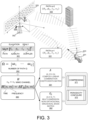
- Figure 3 illustrates exemplary diagrams of a geometrical model for multi-dimensional MIMO channel and CSI feedback with a basis matrix and a coefficient matrix in accordance with embodiments of the current invention.
- a UE 301 with MIMO transceiver/antennas 310 established RF link with gNB 302 with transceiver array 320.
- the channel between the gNB antenna array 320 and one RX antenna i of antennas 310 is determined by the number of paths Q and the parameter vector ⁇ q 351 for each path q.
- gNB 302 transmits at least one channel state information reference signal (CSI-RS) to UE 301.
- the UE 301 receives the at least one CSI-RS from gNB 302.
- UE 301 estimates at least one covariance matrix of at least one downlink channel matrix according to the at least one CSI-RS at different times n and frequencies m.
- UE 301 estimates the covariance matrices of the downlink channel matrices according to the CSI-RSs at different times and frequencies.
- n R is the number of receiving antennas (i.e., antennas 310).
- n T is number of transmitting antennas (i.e., antennas 320).
- n is time domain index.
- m is frequency domain index.
- the channel matrices H [ n, m ] is modeled as a linear combination of multi-dimensional complex sinusoids.
- CSI feedback is sent to the network based on the estimation of the multi-dimensional non-orthogonal basis matrix 362 and the linear combination coefficient matrix 361.
- the feedback of the basis matrix may be accomplished by feeding back matrix ⁇ .
- the basis matrix ⁇ ⁇ can be reconstructed based on the formulation above accordingly.
- the basis matrix is parameterized by a group of N-dimensional parameter sets.
- the feeding back of the basis matrix is accomplished by feeding back the group of N-dimensional parameter sets.
- the CSI estimation matrices are compressed before sending the feedback.
- periodicity is configured for the compressed feedback CSI matrices.
- FIG. 4 illustrates exemplary diagrams for CSI feedback compression based on the coefficient matrix in accordance with embodiments of the current invention.
- the UE receives at least one CSI-RS from the network.
- the TX antenna is an antenna array.
- the number of TX antenna n T is determined by N p , the number of elements in elevation and M p , the number of elements in azimuth and a number of polarization N pol .
- the UE estimates the time-frequency MIMO channel based on multi-dimensional non-orthogonal basis and corresponding linear combination coefficients.
- the estimation is compressed for feedback based on the coefficient matrix.
- the CSI feedback will be compressed based on the feedback overhead.
- the feedback of ⁇ and ⁇ is reduced based on the ⁇ 430.
- ⁇ 430 is n R ⁇ Q representing 1-Q columns of paths and 1- n R rows of receiving antennas.
- one or more elements ( ⁇ iq ) of the coefficient matrix ⁇ are removed based on one or more coefficient compressing criteria.
- the one or more coefficient compressing criteria comprise removing element(s) with value smaller than a predefined threshold, and/or selecting a predefined number of elements, and/or selecting a predefined percentage number of elements.
- element ⁇ iq ' s is "small" compared with other elements, it may be ignored from feedback.
- the determination of "small” is by comparing the element with a threshold.
- the threshold may be predefined or is derived based on all or a subset of element values in ⁇ .
- the determination of "small" is by sorting.
- a fixed number of elements with biggest values are selected.
- the value of the fixed number can be predefined or dynamically configured or derived.
- a fixed ratio among all elements is selected.
- the value of the fixed ratio can be predefined or dynamically configured or derived.
- one or more path columns are removed based on one or more path-based compression criteria.
- One or more elements of the coefficient matrix are removed based on all values across all receiving antennas for each path and one or more paths are identified to be compressed.
- one or more elements of the coefficient matrix are removed based on all values across all element values in a first dimension denoting a path of the coefficient matrix, and wherein elements in a second dimension of the coefficient matrix are identified to be compressed.
- the path-based compressing criteria is based on all values across the RX antennas for a fixed path.
- one or more values of the path are compared with a threshold or one or more paths are selected by sorting.
- a path q is determined for not feedback, its associated ⁇ q does not feedback either.
- the selection of one or more paths for removing is by comparing the value(s) across the path with a path threshold.
- the path threshold is predefined.
- the path threshold is dynamically configured or derived.
- the selection of one or more paths for removing is by sorting.
- a fixed number of paths / columns with biggest values are selected.
- the value of the fixed number can be predefined or dynamically configured or derived.
- a fixed ratio among all paths /columns is selected.
- the value of the fixed ratio can be predefined or dynamically configured or derived. It is noted that when path q is needed for feedback, feeding back ⁇ 2 may be enough for deriving its associated sinusoidal basis in ⁇ ⁇ .
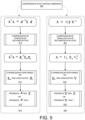
- FIG. 5 illustrates exemplary diagrams for CSI feedback compression in RX antenna dimension in accordance with embodiments of the current invention.
- the CSI feedback may be compressed by reducing one of the dimensions of the coefficient matrix by compressing a decomposition matrix derived from the coefficient matrix.
- the CSI feedback is compressed in RX antenna dimension by eigenvalue decomposition (EVD) or by singular value decomposition (SVD).
- the CSI feedback matrix ⁇ is of dimension n R ⁇ Q. If the RX antennas are correlated (due to proximity for example), the rank of ⁇ may be smaller than n R , or at least the number of significant eigenvalues of ⁇ is smaller than n R . Therefore, we can further compress the CSI feedback from the RX antenna dimension into the smaller rank dimension.
- the compressing reduces receiving antenna dimension by eigenvalue decomposition.
- ⁇ is of dimension n R ⁇ Q.
- the dimension of RX antenna n R can be reduced to ⁇ , where ⁇ ⁇ n R .
- the product of coefficient matrix ⁇ and its Hermitian transpose ⁇ H can be expressed as: ⁇ H ⁇ ⁇ ⁇ ⁇ H ⁇ ⁇ ⁇ where
- the compressing reduces CSI feedback in receiving antenna dimension by SVD.
- ⁇ is of dimension n R ⁇ Q.
- the dimension of RX antenna n R can be reduced to ⁇ , where ⁇ ⁇ n R .
- the coefficient matrix ⁇ can be expressed as: ⁇ ⁇ U ⁇ V H Where
- Figure 6 illustrates exemplary diagrams for different options for CSI feedback including the representation, periodicity, and other configuration in accordance with embodiments of the current invention.
- one or more feedback options are configured.
- different representations can be configured as different feedback options.
- the basis matrix is in a format of 4D(4 dimension), 3D(3 dimension), or 2D(2 dimension).
- the MIMO channel model H [ n, m ] has the time domain index n and the frequency domain index m.
- ⁇ and ⁇ are constants or slow-varying.
- feedback periodicity is configured accordingly.
- the parameters for deriving basis matrix are constant or slow varying, and its associated feedback is provided in a first periodicity.
- the coefficient matrix does not include timing-varying components (that is, without time index n), and are constant or slow varying.
- the associated feedback for the coefficient matrix are transmitted in a second periodicity.
- the second periodicity is longer than or equal to the first periodicity.
- the coefficient matrix includes time-varying components, and wherein the time-varying coefficient matrix is transmitted in a third periodicity that is shorter than the first periodicity or shorter than the second periodicity.
- ⁇ , ⁇ ', ⁇ " in 4D/3D/2D basic matrix are constants or slow-varying and are configured with a first periodicity for feedback.
- ⁇ is constants or slow-varying, and is configured with a second periodicity for feedback. The second periodicity is equal to or longer than the first periodicity.
- ⁇ [ n ], ⁇ [ n, m ] are time-varying faster than ⁇ , ⁇ , ⁇ ', ⁇ ", and are configured with a third periodicity for feedback.
- the third periodicity is shorter than the first periodicity.
- the third periodicity is shorter than the second periodicity.
- ⁇ ⁇ , ⁇ ⁇ ' , ⁇ ⁇ " may be fed back without accompanying ⁇ , ⁇ [ n ], ⁇ [ n, m ].
- Only the basis matrix (or the parameters for deriving the basis matrix) is transmitted as a feedback when the feedback is for acquiring spatial domain channel characteristics, for example, beam direction acquisition.
- ⁇ ⁇ " is fed back for acquiring spatial domain characteristics of the channel for (analog) beam direction acquisition.
- no doppler information is reported. The information related to v q and its index n may not be included in the corresponding 2D/3D/4D representation and accordingly, may not be fed back.
- Figure 7 illustrates an exemplary flow chart for the CSI compression and feedback based on multi-dimensional MIMO RF signature in accordance with embodiments of the current invention.
- the UE receives at least one channel state information-reference signal (CSI-RS) from a network.
- the UE estimates a basis matrix and a coefficient matrix of a downlink channel matrix based on the at least one CSI-RS, wherein the basis matrix is an N-dimensional (non-orthogonal) sinusoidal matrix and the coefficient matrix is a linear combination coefficient matrix associated with the basis matrix, and wherein N is greater than two.
- the UE transmits to the network at least one feedback comprising feeding back the basis matrix in a first periodicity and feeding back the coefficient matrix in a second periodicity.
Landscapes
- Engineering & Computer Science (AREA)
- Computer Networks & Wireless Communication (AREA)
- Signal Processing (AREA)
- Physics & Mathematics (AREA)
- Mathematical Physics (AREA)
- Radio Transmission System (AREA)
- Compression, Expansion, Code Conversion, And Decoders (AREA)
- Transmitters (AREA)
Abstract
Description
- This application claims the benefit under 35 U.S.C. §119 from
U.S. provisional application serial number 63/384,240, entitled "CSI COMPRESSION BASED ON MULTI-DIMENSIONAL MIMO RF SIGNATURE," filed on Nov. 18, 2022 - The disclosed embodiments relate generally to wireless communication, and, more particularly, to method and user equipment for CSI compression based on multi-dimensional multi-input multi-output (MIMO) radio frequency (RF) signature.
- In the conventional network of 3rd generation partnership project (3GPP) 5G new radio (NR), the user equipment (UE) can measure channel state information reference signals (CSI-RSs) transmitted from a base station (BS) under a multi-input multi-output (MIMO) network, and determine downlink channel matrices according to the CSI-RSs. Then, the UE can calculate precoder(s) based on the downlink channel matrices, and report the compressed/quantized precoder(s) through precoding matrix indicator(s) (PMIs) to the BS using one of the specified codebooks. The legacy CSI feedback principle is to provide information on a selected precoder(s) by the UE. Therefore, the BS can transmit subsequent physical downlink shared channels (PDSCHs) by applying the precoder(s). The precoder information at the network node does not provide complete information for multi-use MIMO transmission scheme determination.
- Enhancement and improvement are needed for the MIMO channel modeling for the CSI feedback with compression.
- Method and user equipment (UE) are provided for CSI compression based on multi-dimensional MIMO RF signature and are defined in the independent claims. The dependent claims define preferred embodiments thereof. In one novel aspect, the UE receives CSI-RSs, estimates a basis matrix and a coefficient matrix of a downlink matrix based on the at least one of the CSI-RSs, wherein the basis matrix is an N-dimensional sinusoidal matrix and the coefficient matrix is a linear combination coefficient matrix associated with the basis matrix, and transmits to the network at least one feedback comprising feeding back the basis matrix in a first periodicity and feeding back the coefficient matrix in a second periodicity. Preferably, the UE compresses the basis matrix and the coefficient matrix to a feedback basis matrix and a feedback coefficient matrix before transmitting. Preferably, one or more elements of the coefficient matrix are removed based on one or more coefficient compressing criteria comprising: removing one or more elements with value smaller than a predefined threshold, selecting a predefined number of elements, and selecting a predefined percentage number of elements. Preferably, the feedback coefficient matrix is derived by projecting the coefficient matrix on the at least one eigenvector matrix. Alternatively or additionally preferably, the compressing reduces receiving antennas dimension by eigenvalue decomposition or by singular value decomposition (SVD). Preferably, only the basis matrix is transmitted as a feedback when the feedback is for acquiring spatial domain channel characteristics for beam direction acquisition. Alternatively or additionally preferably, the basis matrix is parameterized by a group of N-dimensional parameter sets, and wherein the feeding back of the basis matrix is accomplished by feeding back the group of N-dimensional parameter sets. Alternatively or additionally preferably, doppler information components are reduced from both the basis matrix and the coefficient matrix for feedback.
- Other embodiments and advantages are described in the detailed description below. This summary does not purport to define the invention. The invention is defined by the claims.
- The accompanying drawings, where like numerals indicate like components, illustrate embodiments of the invention.
-
Figure 1 illustrates an exemplary 5G new radio network supporting CSI compression based on multi-dimensional MIMO RF signature in accordance with embodiments of the current invention. -
Figure 2 is a simplified block diagram of the gNB and the UE in accordance with embodiments of the current invention. -
Figure 3 illustrates exemplary diagrams of geometrical model for multi-dimensional MIMO channel and CSI feedback with a basis matrix and a coefficient matrix in accordance with embodiments of the current invention. -
Figure 4 illustrates exemplary diagrams for CSI feedback compression based on the coefficient matrix in accordance with embodiments of the current invention. -
Figure 5 illustrates exemplary diagrams for CSI feedback compression in RX antenna dimension in accordance with embodiments of the current invention. -
Figure 6 illustrates exemplary diagrams for different options for CSI feedback including the representation, periodicity, and other configuration in accordance with embodiments of the current invention. -
Figure 7 illustrates an exemplary flow chart for the CSI compression and feedback based on multi-dimensional MIMO RF signature in accordance with embodiments of the current invention. - Reference will now be made in detail to some embodiments of the invention, examples of which are illustrated in the accompanying drawings.
-
Figure 1 illustrates an exemplary 5G new radio network supporting CSI compression based on multi-dimensional MIMO RF signature in accordance with embodiments of the current invention. The 5G NRnetwork 100 includes a user equipment (UE) 110 communicatively connected to a gNB 121 operating in a licensed band (e.g., sub 6GHz or 30GHz~300GHz for mmWave) of anaccess network 120 which provides radio access using a Radio Access Technology (RAT) (e.g., the 5G NR technology). Theaccess network 120 is connected to a 5G core network 130 by means of the NG interface, more specifically to a User Plane Function (UPF) by means of the NG user-plane part (NG-u), and to an Access and Mobility Management Function (AMF) by means of the NG control-plane part (NG-c). One gNB can be connected to multiple UPFs/AMFs for the purpose of load sharing and redundancy. The UE 110 may be a smart phone, a wearable device, an Internet of Things (IoT) device, and a tablet, etc. Alternatively, UE 110 may be a Notebook (NB) or a Personal Computer (PC) inserted or installed with a data card which includes a modem and RF transceiver(s) to provide the functionality of wireless communication. - The gNB 121 may provide communication coverage for a geographic coverage area in which communications with the UE 110 is supported via a
communication link 101. Thecommunication link 101 shown in the5G NR network 100 may include UL transmissions from the UE 110 to the gNB 121 (e.g., on the Physical Uplink Control Channel (PUCCH) or Physical Uplink Shared Channel (PUSCH)) or downlink (DL) transmissions from the gNB 121 to the UE 110 (e.g., on the Physical Downlink Control Channel (PDCCH) or Physical Downlink Shared Channel (PDSCH)). - In one novel aspect, the UE estimates a multi-dimensional non-orthogonal basis at a receiver based on a set of reference signals (RSs)transmitted by a transmitter(s) and feeds back the multi-dimensional non-orthogonal basis (e.g. N-dimensional sinusoidal matrix) in a first periodicity; and estimates a linear combination coefficients of the multi-dimensional non-orthogonal basis based on the set of reference signals and feeds back the linear combination coefficients in a second periodicity. As illustrated, at
step 131, the UE receives reference signals, such as the CSI-RS. Atstep 132, the UE obtains feedback configurations. Preferably, the feedback configuration is predefined. Alternatively preferably, the feedback configuration is dynamically updated. Atstep 133, the UE estimates the basis matrix and the coefficient matrix. Atstep 134, the UE compresses the basis matrix and the coefficient matrix as a compressed feedback. Atstep 135, the UE transmits the compressed feedback to the network. While the multi-dimensional basis is in general non-orthogonal, in some embodiments, orthogonal basis is used as approximation. -
Figure 2 is a simplified block diagram of the gNB 121 and UE 110 in accordance with embodiments of the present invention. For the gNB 121,antennas 197 transmit and receive radio signal under MIMO network. A radio frequency (RF)transceiver module 196, coupled with theantennas 197, receives RF signals from theantennas 197, converts them to baseband signals and sends them toprocessor 193.RF transceiver 196 also converts received baseband signals from theprocessor 193, converts them to RF signals, and sends out toantennas 197.Processor 193 processes the received baseband signals and invokes different functional modules and circuits to perform features in the gNB 121.Memory 192 stores program instructions anddata 190 to control the operations of the gNB 121. - Similarly, for the UE 110,
antennas 177 transmit and receives RF signal under MIMO network.RF transceiver module 176, coupled with theantennas 177, receives RF signals from theantennas 177, converts them to baseband signals and sends them toprocessor 173. TheRF transceiver 176 also converts received baseband signals from theprocessor 173, converts them to RF signals, and sends out toantennas 177.Processor 173 processes the received baseband signals and invokes different functional modules and circuits to perform features in the UE 110.Memory 172 stores program instructions anddata 170 to control the operations of the UE 110. - Although a specific number of the
antennas figure 2 , it is contemplated that any number of theantennas - The
gNB 121 and theUE 110 also include several functional modules and circuits that can be implemented and configured to perform embodiments of the present invention. In the example offigure 2 , thegNB 121 includes a set of control functional modules andcircuits 180. Channel state information (CSI) handlingcircuit 182 handles CSI and associated network parameters for theUE 110. Configuration and control circuit 181 provides different parameters to configure and control theUE 110. TheUE 110 includes a set of control functional modules andcircuits 160.CSI handling circuit 162 handles CSI and associated network parameters. Configuration and control circuit 161 handles configuration and control parameters from thegNB 121. Preferably, the set of control functional modules andcircuits 160 is configured with a CSI-RS module that receives at least one CSI-RS from a network; an estimation module that estimates a basis matrix and a coefficient matrix of a downlink channel matrix based on the at least one CSI-RS, wherein the basis matrix is an N-dimensional non-orthogonal matrix and the coefficient matrix is a linear combination coefficient matrix associated with the basis matrix, and wherein N is greater than two; and a feedback module that transmits at least one feedback comprising feeding back the basis matrix in a first periodicity and feeding back the coefficient matrix in a second periodicity to the network. - Note that the different functional modules and circuits can be implemented and configured by software, firmware, hardware, and any combination thereof. The function modules and circuits, when executed by the
processors 193 and 173 (e.g., via executingprogram codes 190 and 170), allow thegNB 121 and theUE 110 to perform embodiments of the present invention. -
Figure 3 illustrates exemplary diagrams of a geometrical model for multi-dimensional MIMO channel and CSI feedback with a basis matrix and a coefficient matrix in accordance with embodiments of the current invention. AUE 301 with MIMO transceiver/antennas 310 established RF link withgNB 302 withtransceiver array 320. There are multiple, 1 to Q, transceiving paths for the link betweenUE 301 andgNB 302. Each path is defined by anelevation angle θ 321, anazimuth angle φ 322, a delay τ, and a doppler v. An exemplary illustration of a first path (q=1) 331, which is a line of sight path and a second path (q=2) 332 are shown infigure 3 . The channel between thegNB antenna array 320 and one RX antenna i ofantennas 310 is determined by the number of paths Q and theparameter vector ω q 351 for each path q. The multi-path channel with number of Q paths is modelled asmatrix Ω 352, where Ω=[ω 1, ω 2, ... ω q]. - In one exemplary scenario,
gNB 302 transmits at least one channel state information reference signal (CSI-RS) toUE 301. TheUE 301 receives the at least one CSI-RS fromgNB 302.UE 301 estimates at least one covariance matrix of at least one downlink channel matrix according to the at least one CSI-RS at different times n and frequencies m. Preferably,UE 301 estimates the covariance matrices of the downlink channel matrices according to the CSI-RSs at different times and frequencies. In particular, after receiving the CSI-RSs at different times and frequencies, theUE 110 estimates the downlink channel matrices H [ n, m ] of nR × nT MIMO channels as below:
- nR is the number of receiving antennas (i.e., antennas 310). nT is number of transmitting antennas (i.e., antennas 320). n is time domain index. m is frequency domain index. Assuming the complex channel gain for the RX antenna i of the path q is λiq.


- In one novel aspect, the channel matrices H [ n, m ] is modeled as a linear combination of multi-dimensional complex sinusoids. In one
implementation 360, the time-frequency MIMO channel is modeled as a linear combination of 4-D basis represented as:
-
Λ 361 is the complex linear combination matrix of dimension nR × Q:

- In one novel aspect, CSI feedback is sent to the network based on the estimation of the multi-dimensional non-orthogonal basis matrix 362 and the linear
combination coefficient matrix 361. The feedback of the basis matrix may be accomplished by feeding back matrix Ω. The basis matrix ΓΩ can be reconstructed based on the formulation above accordingly. The basis matrix is parameterized by a group of N-dimensional parameter sets. The feeding back of the basis matrix is accomplished by feeding back the group of N-dimensional parameter sets. In one alternative orsupplemental implementation 371, the CSI estimation matrices are compressed before sending the feedback. In one alternative or supplemental implementation 372, periodicity is configured for the compressed feedback CSI matrices. -
Figure 4 illustrates exemplary diagrams for CSI feedback compression based on the coefficient matrix in accordance with embodiments of the current invention. Atstep 401, the UE receives at least one CSI-RS from the network. In oneimplementation 410, the TX antenna is an antenna array. The number of TX antenna nT is determined by Np, the number of elements in elevation and Mp, the number of elements in azimuth and a number of polarization Npol. As illustrated, Np =2, Mp =8 and Npol =2. nT = MpNpNpol =32. Atstep 402, the UE estimates the time-frequency MIMO channel based on multi-dimensional non-orthogonal basis and corresponding linear combination coefficients. In one alternative orsupplemental implementation 420, MIMO channel in the time-frequency is modeled as a linear combination of the 4-D basis:
- At
step 403, the estimation is compressed for feedback based on the coefficient matrix. The CSI feedback will be compressed based on the feedback overhead. The feedback of Λ and Ω is reduced based on theΛ 430.Λ 430 is nR × Q representing 1-Q columns of paths and 1- nR rows of receiving antennas. - In one alternative or
supplemental implementation 431, one or more elements ( λiq ) of the coefficient matrix Λ are removed based on one or more coefficient compressing criteria. In one alternative orsupplemental implementation 435, the one or more coefficient compressing criteria comprise removing element(s) with value smaller than a predefined threshold, and/or selecting a predefined number of elements, and/or selecting a predefined percentage number of elements. In one example, if element λiq 's is "small" compared with other elements, it may be ignored from feedback. Preferably, the determination of "small" is by comparing the element with a threshold. The threshold may be predefined or is derived based on all or a subset of element values in Λ . Alternatively or additionally preferably, the determination of "small" is by sorting. In one example, a fixed number of elements with biggest values are selected. The value of the fixed number can be predefined or dynamically configured or derived. In another example, a fixed ratio among all elements is selected. The value of the fixed ratio can be predefined or dynamically configured or derived. - In one alternative or
supplemental implementation 432, one or more path columns are removed based on one or more path-based compression criteria. One or more elements of the coefficient matrix are removed based on all values across all receiving antennas for each path and one or more paths are identified to be compressed. Preferably, one or more elements of the coefficient matrix are removed based on all values across all element values in a first dimension denoting a path of the coefficient matrix, and wherein elements in a second dimension of the coefficient matrix are identified to be compressed. In one alternative orsupplemental implementation 436, the path-based compressing criteria is based on all values across the RX antennas for a fixed path. Preferably, one or more values of the path are compared with a threshold or one or more paths are selected by sorting. For example, the selection is based on all values across RX antennas i for a fixed path q, that is, λ'iq s for i = 1, ... nR . Preferably, if a path q is determined for not feedback, its associated ωq does not feedback either. The determination of a path q not to be feedback may be based on a function of
-
Figure 5 illustrates exemplary diagrams for CSI feedback compression in RX antenna dimension in accordance with embodiments of the current invention. The CSI feedback may be compressed by reducing one of the dimensions of the coefficient matrix by compressing a decomposition matrix derived from the coefficient matrix. In oneimplementation 500, the CSI feedback is compressed in RX antenna dimension by eigenvalue decomposition (EVD) or by singular value decomposition (SVD). The CSI feedback matrix Λ is of dimension nR × Q. If the RX antennas are correlated (due to proximity for example), the rank of Λ may be smaller than nR , or at least the number of significant eigenvalues of Λ is smaller than nR . Therefore, we can further compress the CSI feedback from the RX antenna dimension into the smaller rank dimension. - In one alternative or
supplemental implementation 510, the compressing reduces receiving antenna dimension by eigenvalue decomposition. Λ is of dimension nR × Q. The dimension of RX antenna nR can be reduced to ρ, where ρ ≤ nR . The product of coefficient matrix Λ and its Hermitian transpose ΛH can be expressed as:
- Σ is a ρ × ρ diagonal matrix with ρ ≤ nR,
- Λ̃ is a ρ × Q rank-reduced matrix containing the linear combination coefficients,
- Λ̃H with the dimension of Q × ρ is the Hermitian transpose of Λ̃.
- In one alternative or
supplemental implementation 520, the compressing reduces CSI feedback in receiving antenna dimension by SVD. Λ is of dimension nR × Q. The dimension of RX antenna nR can be reduced to ρ, where ρ ≤ nR . The coefficient matrix Λ can be expressed as:
- Σ is a ρ × ρ diagonal matrix with ρ ≤ nR, ρ < Q ;
- U is a nR × ρ rank-reduced matrix containing left eigen vector;
- V is a Q × ρ rank-reduced matrix containing right eigen vector;
- VH with the dimension of ρ × Q is the Hermitian transpose of V.
-
Figure 6 illustrates exemplary diagrams for different options for CSI feedback including the representation, periodicity, and other configuration in accordance with embodiments of the current invention. In oneimplementation 600, one or more feedback options are configured. In one alternative orsupplemental implementation 610, different representations can be configured as different feedback options. The basis matrix is in a format of 4D(4 dimension), 3D(3 dimension), or 2D(2 dimension). The MIMO channel model H [n, m] has the time domain index n and the frequency domain index m.
In a 4D-basis representation 611:


- In a 3D-
basis representation 612, time index n is absorbed into linear combination coefficients λiq , and λiq [n] = λiqe j2πnvd = e j2π[0 0 0 n]ωq accordingly, wherein


- In a 2D-
basis representation 613, time index n and frequency index m are both absorbed into linear combination coefficients λiq , and λiq [n, m] = λiqe -j2πmτ+2πnvd = e j2π[0 0 -m n]ωq as a result, wherein


- In one alternative or
supplemental implementation 620, based on the representation, feedback periodicity is configured accordingly. Preferably, the parameters for deriving basis matrix are constant or slow varying, and its associated feedback is provided in a first periodicity. Preferably, the coefficient matrix does not include timing-varying components (that is, without time index n), and are constant or slow varying. The associated feedback for the coefficient matrix are transmitted in a second periodicity. Preferably, the second periodicity is longer than or equal to the first periodicity. Alternatively or additionally preferably, the coefficient matrix includes time-varying components, and wherein the time-varying coefficient matrix is transmitted in a third periodicity that is shorter than the first periodicity or shorter than the second periodicity. In one alternative or supplemental implementation 621, Ω, Ω', Ω" in 4D/3D/2D basic matrix, respectively, are constants or slow-varying and are configured with a first periodicity for feedback. In one alternative orsupplemental implementation 622, Λ is constants or slow-varying, and is configured with a second periodicity for feedback. The second periodicity is equal to or longer than the first periodicity. In one alternative orsupplemental implementation 623, Λ[n], Λ[n, m] are time-varying faster than Λ, Ω, Ω', Ω", and are configured with a third periodicity for feedback. The third periodicity is shorter than the first periodicity. The third periodicity is shorter than the second periodicity. It is noted that for CSI feedback purpose, one out of 2D/3D/4D representation may be used (for example by configuration). The compression details and periodicity setting may follow the used representation accordingly as discussed above. - In one alternative or supplemental implementation 630, other configurations for feedback are available. In one alternative or
supplemental implementation 631, Γ Ω, Γ Ω', Γ Ω" may be fed back without accompanying Λ, Λ[n], Λ[n, m]. Only the basis matrix (or the parameters for deriving the basis matrix) is transmitted as a feedback when the feedback is for acquiring spatial domain channel characteristics, for example, beam direction acquisition. Preferably, Γ Ω" is fed back for acquiring spatial domain characteristics of the channel for (analog) beam direction acquisition. In one alternative orsupplemental implementation 632, no doppler information is reported. The information related to vq and its index n may not be included in the corresponding 2D/3D/4D representation and accordingly, may not be fed back. -
Figure 7 illustrates an exemplary flow chart for the CSI compression and feedback based on multi-dimensional MIMO RF signature in accordance with embodiments of the current invention. Atstep 701, the UE receives at least one channel state information-reference signal (CSI-RS) from a network. Atstep 702, the UE estimates a basis matrix and a coefficient matrix of a downlink channel matrix based on the at least one CSI-RS, wherein the basis matrix is an N-dimensional (non-orthogonal) sinusoidal matrix and the coefficient matrix is a linear combination coefficient matrix associated with the basis matrix, and wherein N is greater than two. Atstep 703, the UE transmits to the network at least one feedback comprising feeding back the basis matrix in a first periodicity and feeding back the coefficient matrix in a second periodicity. - Although the present invention has been described in connection with certain specific embodiments for instructional purposes, the present invention is not limited thereto. Accordingly, various modifications, adaptations, and combinations of various features of the described embodiments can be practiced without departing from the scope of the invention as set forth in the claims.


It is noted that since H [n, m] = ΛΓ Ω [n, m] in our formulation,


Claims (15)
- A method, comprising:receiving, by a user equipment, in the following also referred to as UE, at least one channel state information-reference signal, in the following also referred to as CSI-RS, from a network (701);estimating, by the UE, a basis matrix and a coefficient matrix of a downlink channel matrix based on the at least one CSI-RS, wherein the basis matrix is a N-dimensional sinusoidal matrix and the coefficient matrix is a linear combination coefficient matrix associated with the basis matrix, and wherein N is greater than two (702); andtransmitting, by the UE to the network, at least one feedback comprising feeding back the basis matrix in a first periodicity and feeding back the coefficient matrix in a second periodicity (703).
- The method of claim 1, further comprising:
compressing, by the UE, the basis matrix and the coefficient matrix to a feedback basis matrix and a feedback coefficient matrix before transmitting. - The method of claim 2, wherein one or more elements of the coefficient matrix are removed based on one or more coefficient compressing criteria comprising: removing one or more elements with value smaller than a predefined threshold, selecting a predefined number of elements, and selecting a predefined percentage number of elements.
- The method of claim 2 or 3, wherein one or more elements of the coefficient matrix are removed based on all values across all element values in a first dimension denoting a path of the coefficient matrix, and wherein elements in a second dimension of the coefficient matrix are identified to be compressed.
- The method of any one of claims 2 to 4, wherein the compressing reduces one of the dimensions of the coefficient matrix by compressing a decomposition matrix derived from the coefficient matrix.
- The method of claim 5, wherein the decomposition matrix is associated with at least one diagonal eigenvalue matrix and at least one eigenvector matrix, and the compressing of the decomposition matrix is based on the eigenvalues of the at least one diagonal eigenvalue matrix,
wherein the feedback coefficient matrix is derived by projecting the coefficient matrix on the at least one eigenvector matrix. - The method of claim 6, wherein one or more eigenvalues of the at least one diagonal eigenvalue matrix and the associated eigenvectors of the at least one eigenvector matrix are removed from the feedback coefficient matrix and the feedback basis matrix based on one or more criteria comprising removing eigenvalues smaller than a predefined threshold, selecting a predefined number of eigenvalues, and selecting a predefined percentage number of eigenvalues.
- The method of any one of claims 1 to 7, wherein the second periodicity is longer than or equal to the first periodicity,
wherein the coefficient matrix is transmitted in a third periodicity that is shorter than the first periodicity or shorter than the second periodicity. - The method of any one of claims 1 to 8, wherein the coefficient matrix further includes frequency components.
- The method of any one of claims 1 to 9, wherein only the basis matrix is transmitted as a feedback when the feedback is for acquiring spatial domain channel characteristics for beam direction acquisition.
- The method of any one of claims 1 to 10, wherein doppler information components are not included in the basis matrix.
- The method of any one of claims 1 to 11, further comprising:receiving a feedback configuration from the network,wherein the feeding back the basis matrix and the feeding back the coefficient matrix are based on the feedback configuration.
- The method of any one of claims 1 to 12, wherein the basis matrix is parameterized by a group of N-dimensional parameter sets, and wherein the feeding back of the basis matrix is accomplished by feeding back the group of N-dimensional parameter sets.
- A user equipment, in the following also referred to as UE, (110) comprising:An RF transceiver (176) that transmits and receives radio frequency, in the following also referred to as RF, signal in a network;a channel state information-reference signal, in the following also referred to as CSI-RS, module (160) that receives at least one CSI-RS from a network via the RF transceiver (176);an estimation module (160) that estimates a basis matrix and a coefficient matrix of a downlink channel matrix based on the at least one CSI-RS, wherein the basis matrix is an N-dimensional sinusoidal matrix and the coefficient matrix is a linear combination coefficient matrix associated with the basis matrix, and wherein N is greater than two; anda feedback module (160) that transmits at least one feedback comprising feeding back the basis matrix in a first periodicity and feeding back the coefficient matrix in a second periodicity to the network.
- The UE of claim 14, further comprising:
a compression module (160) that compresses the basis matrix and the coefficient matrix to a feedback basis matrix and a feedback coefficient matrix before transmitting.
Applications Claiming Priority (2)
| Application Number | Priority Date | Filing Date | Title |
|---|---|---|---|
| US202263384240P | 2022-11-18 | 2022-11-18 | |
| US18/508,148 US12562797B2 (en) | 2022-11-18 | 2023-11-13 | CSI compression based on multi-dimensional MIMO RF signature |
Publications (1)
| Publication Number | Publication Date |
|---|---|
| EP4373007A1 true EP4373007A1 (en) | 2024-05-22 |
Family
ID=88837237
Family Applications (1)
| Application Number | Title | Priority Date | Filing Date |
|---|---|---|---|
| EP23210345.7A Pending EP4373007A1 (en) | 2022-11-18 | 2023-11-16 | Csi compression based on multi-dimensional mimo rf signature |
Country Status (3)
| Country | Link |
|---|---|
| US (1) | US12562797B2 (en) |
| EP (1) | EP4373007A1 (en) |
| TW (1) | TW202437714A (en) |
Cited By (1)
| Publication number | Priority date | Publication date | Assignee | Title |
|---|---|---|---|---|
| WO2025254775A1 (en) * | 2024-06-03 | 2025-12-11 | Qualcomm Incorporated | Multiple-input and multiple-output channel feedback with dictionary learning |
Families Citing this family (2)
| Publication number | Priority date | Publication date | Assignee | Title |
|---|---|---|---|---|
| US12562797B2 (en) * | 2022-11-18 | 2026-02-24 | Mediatek Inc. | CSI compression based on multi-dimensional MIMO RF signature |
| WO2026007272A1 (en) * | 2024-07-05 | 2026-01-08 | Huawei Technologies Co., Ltd. | Methods and systems for sensing assisted channel estimation |
Citations (1)
| Publication number | Priority date | Publication date | Assignee | Title |
|---|---|---|---|---|
| US20220263552A1 (en) * | 2019-06-21 | 2022-08-18 | Qualcomm Incorporated | Codebook subset restriction (cbsr) on per spatial domain amplitude |
Family Cites Families (5)
| Publication number | Priority date | Publication date | Assignee | Title |
|---|---|---|---|---|
| US20220200666A1 (en) * | 2020-12-17 | 2022-06-23 | Samsung Electronics Co., Ltd. | High-resolution codebook for distributed mimo transmission |
| EP4274112A4 (en) * | 2021-01-31 | 2024-02-28 | Huawei Technologies Co., Ltd. | METHOD FOR FEEDBACKING CHANNEL STATUS INFORMATION AND COMMUNICATION DEVICE |
| US12574077B2 (en) * | 2021-05-11 | 2026-03-10 | Telefonaktiebolaget Lm Ericsson (Publ) | Configuring channel state information (CSI) feedback |
| US20240364393A1 (en) * | 2021-09-13 | 2024-10-31 | Nokia Technologies Oy | Demodulation reference signal assisted channel state information feedback scheme |
| US12562797B2 (en) * | 2022-11-18 | 2026-02-24 | Mediatek Inc. | CSI compression based on multi-dimensional MIMO RF signature |
-
2023
- 2023-11-13 US US18/508,148 patent/US12562797B2/en active Active
- 2023-11-16 TW TW112144309A patent/TW202437714A/en unknown
- 2023-11-16 EP EP23210345.7A patent/EP4373007A1/en active Pending
Patent Citations (1)
| Publication number | Priority date | Publication date | Assignee | Title |
|---|---|---|---|---|
| US20220263552A1 (en) * | 2019-06-21 | 2022-08-18 | Qualcomm Incorporated | Codebook subset restriction (cbsr) on per spatial domain amplitude |
Non-Patent Citations (2)
| Title |
|---|
| CEWIT: "Discussion on CSI Enhancements for high/medium UE velocities and coherent JT (CJT)", vol. RAN WG1, no. Toulouse, France; 20220822 - 20220826, 12 August 2022 (2022-08-12), XP052275004, Retrieved from the Internet <URL:https://ftp.3gpp.org/tsg_ran/WG1_RL1/TSGR1_110/Docs/R1-2207066.zip R1-2207066.docx> [retrieved on 20220812] * |
| NOKIA ET AL: "CSI enhancement for high/medium UE velocities and CJT", vol. RAN WG1, no. Toulouse, France; 20220822 - 20220826, 12 August 2022 (2022-08-12), XP052275482, Retrieved from the Internet <URL:https://ftp.3gpp.org/tsg_ran/WG1_RL1/TSGR1_110/Docs/R1-2207546.zip R1-2207546_Rel-18 CSI enhancement.docx> [retrieved on 20220812] * |
Cited By (1)
| Publication number | Priority date | Publication date | Assignee | Title |
|---|---|---|---|---|
| WO2025254775A1 (en) * | 2024-06-03 | 2025-12-11 | Qualcomm Incorporated | Multiple-input and multiple-output channel feedback with dictionary learning |
Also Published As
| Publication number | Publication date |
|---|---|
| US12562797B2 (en) | 2026-02-24 |
| US20240178896A1 (en) | 2024-05-30 |
| TW202437714A (en) | 2024-09-16 |
Similar Documents
| Publication | Publication Date | Title |
|---|---|---|
| US12191954B2 (en) | Channel state information feedback method, device, terminal, and network side, and storage medium | |
| US10819406B2 (en) | Codebook-based channel state information feedback method and device | |
| US20220224391A1 (en) | Methods and Apparatuses for CSI Reporting in a Wirless CFCommunication System | |
| US12574089B2 (en) | Channel state information feedback method and communication apparatus | |
| US12562797B2 (en) | CSI compression based on multi-dimensional MIMO RF signature | |
| EP2988430B1 (en) | Method for determining precoding matrix indicator, user equipment and base station | |
| US20240421866A1 (en) | Channel state information feedback method and communication apparatus | |
| CN115244864A (en) | Precoding method and device | |
| US20250081021A1 (en) | Channel measurement method and apparatus | |
| EP3288189B1 (en) | Channel information feedback method and apparatus for array antenna | |
| US12483302B2 (en) | Transmission method and apparatus, device, and readable storage medium | |
| US11483035B2 (en) | Method and device for performing precoding | |
| US9252992B2 (en) | Method, apparatus and system for multi-antenna transmission | |
| CN118057757A (en) | CSI compression method and user equipment thereof | |
| CN106817720B (en) | A method and device for acquiring channel information | |
| US20230208480A1 (en) | Transmit Channel Initial Phase Correction Method and Apparatus | |
| US12452106B2 (en) | Communication method based on quantum channel estimation and base station | |
| US12489502B2 (en) | Method and user equipment for determining precoder of MIMO system | |
| US20250158678A1 (en) | Method and apparatus for channel information feedback in mobile communications | |
| US20260081648A1 (en) | Method And Apparatus For Tiered Channel State Information Feedback In Mobile Communications | |
| WO2025050954A1 (en) | Method and apparatus for channel information feedback with whitening information in mobile communications |
Legal Events
| Date | Code | Title | Description |
|---|---|---|---|
| PUAI | Public reference made under article 153(3) epc to a published international application that has entered the european phase |
Free format text: ORIGINAL CODE: 0009012 |
|
| STAA | Information on the status of an ep patent application or granted ep patent |
Free format text: STATUS: THE APPLICATION HAS BEEN PUBLISHED |
|
| AK | Designated contracting states |
Kind code of ref document: A1 Designated state(s): AL AT BE BG CH CY CZ DE DK EE ES FI FR GB GR HR HU IE IS IT LI LT LU LV MC ME MK MT NL NO PL PT RO RS SE SI SK SM TR |
|
| STAA | Information on the status of an ep patent application or granted ep patent |
Free format text: STATUS: REQUEST FOR EXAMINATION WAS MADE |
|
| 17P | Request for examination filed |
Effective date: 20241122 |
|
| RBV | Designated contracting states (corrected) |
Designated state(s): AL AT BE BG CH CY CZ DE DK EE ES FI FR GB GR HR HU IE IS IT LI LT LU LV MC ME MK MT NL NO PL PT RO RS SE SI SK SM TR |
|
| STAA | Information on the status of an ep patent application or granted ep patent |
Free format text: STATUS: EXAMINATION IS IN PROGRESS |