EP4372697A1 - System and method of unveiling high-resolution visible face images from low-resolution face images - Google Patents
System and method of unveiling high-resolution visible face images from low-resolution face images Download PDFInfo
- Publication number
- EP4372697A1 EP4372697A1 EP22306692.9A EP22306692A EP4372697A1 EP 4372697 A1 EP4372697 A1 EP 4372697A1 EP 22306692 A EP22306692 A EP 22306692A EP 4372697 A1 EP4372697 A1 EP 4372697A1
- Authority
- EP
- European Patent Office
- Prior art keywords
- resolution
- face images
- loss
- infrared
- adversarial network
- Prior art date
- Legal status (The legal status is an assumption and is not a legal conclusion. Google has not performed a legal analysis and makes no representation as to the accuracy of the status listed.)
- Withdrawn
Links
Images


Classifications
-
- G—PHYSICS
- G06—COMPUTING OR CALCULATING; COUNTING
- G06V—IMAGE OR VIDEO RECOGNITION OR UNDERSTANDING
- G06V40/00—Recognition of biometric, human-related or animal-related patterns in image or video data
- G06V40/10—Human or animal bodies, e.g. vehicle occupants or pedestrians; Body parts, e.g. hands
- G06V40/16—Human faces, e.g. facial parts, sketches or expressions
- G06V40/168—Feature extraction; Face representation
-
- G—PHYSICS
- G06—COMPUTING OR CALCULATING; COUNTING
- G06V—IMAGE OR VIDEO RECOGNITION OR UNDERSTANDING
- G06V10/00—Arrangements for image or video recognition or understanding
- G06V10/40—Extraction of image or video features
- G06V10/44—Local feature extraction by analysis of parts of the pattern, e.g. by detecting edges, contours, loops, corners, strokes or intersections; Connectivity analysis, e.g. of connected components
- G06V10/443—Local feature extraction by analysis of parts of the pattern, e.g. by detecting edges, contours, loops, corners, strokes or intersections; Connectivity analysis, e.g. of connected components by matching or filtering
- G06V10/449—Biologically inspired filters, e.g. difference of Gaussians [DoG] or Gabor filters
- G06V10/451—Biologically inspired filters, e.g. difference of Gaussians [DoG] or Gabor filters with interaction between the filter responses, e.g. cortical complex cells
- G06V10/454—Integrating the filters into a hierarchical structure, e.g. convolutional neural networks [CNN]
-
- G—PHYSICS
- G06—COMPUTING OR CALCULATING; COUNTING
- G06V—IMAGE OR VIDEO RECOGNITION OR UNDERSTANDING
- G06V10/00—Arrangements for image or video recognition or understanding
- G06V10/70—Arrangements for image or video recognition or understanding using pattern recognition or machine learning
- G06V10/82—Arrangements for image or video recognition or understanding using pattern recognition or machine learning using neural networks
Definitions
- the present disclosure generally relates to generating high-resolution visible face images from low-resolution face images. More particularly, but not exclusively, the present disclosure relates to unveiling high-resolution visible face images from any low-resolution infrared face or thermal face images while preserving biometric identity.
- infrared imaging and thermal imaging in particular does not provide a detailed rendering of faces, thus making it challenging when operating a biometric monitoring system.
- long distance acquisitions degrade facial verification performances as faces represent few pixels of the images with little biometrics information. Therefore, recovering accurate High-Resolution (HR) visible-spectrum face images from any Low spatial Resolution (LR) infrared spectrum face images is of particular pertinence in designing operational Cross-spectral Face Recognition (CFR) systems, where a visible face image is compared to a face image acquired beyond the visible.
- CFR operational Cross-spectral Face Recognition
- Such artificial process is referred to as Super Resolution (SR) or Hallucination, and can infer HR image from a single image or sequential LR images.
- SR Super Resolution
- Hallucination can infer HR image from a single image or sequential LR images.
- the present invention provides a solution for the aforementioned problems by a method of unveiling high-resolution visible face images from any low-resolution infrared face images according to claim 1, a system for unveiling high-resolution visible face images from any low-resolution infrared face images according to claim 12, and a system for unveiling high-resolution visible face images from any low-resolution infrared face images according to claim 15.
- a method of unveiling high-resolution visible face images from any low-resolution infrared face images according to claim 1 a system for unveiling high-resolution visible face images from any low-resolution infrared face images according to claim 12, and a system for unveiling high-resolution visible face images from any low-resolution infrared face images according to claim 15.
- preferred embodiments of the invention are defined.
- the invention provides a method of unveiling high-resolution visible face images from any low-resolution infrared face images can include the steps of inputting any number of infrared face images as an input through a generative adversarial network to perform spectrum translation of the low-resolution infrared face images to a number of high-resolution visible face images, training the generative adversarial network with at least a reference high resolution image, adapting the generative adversarial network for one or more among L1 loss, perceptual loss, and identity loss, and generating a high-resolution visible face image from any low-resolution infrared face images provided as an input to the generative adversarial network.
- infrared face images includes thermal face images.
- infrared spectrum includes four spectral bands: “near infrared” (NIR), “short-wave infrared” (SWIR), “medium-wave infrared” (MWIR) and “long wave infrared” (LWIR). Both MWIR and LWIR are also known as “thermal”.
- the method according to the invention can be used with any infrared input images.
- the method simultaneously performs the functions of super resolution and domain translation of the infrared face images while preserving biometric identity.
- the method learns an end-to-end mapping between the thermal or infrared spectrum and the visible spectrum trains of the adversarial network.
- the method uses an image encoder-decoder structure to generate the high-resolution visible face images.
- the method uses an image encoder-decoder structure based on a pyramidal architecture that relies on multi-scale analysis to generate the high-resolution visible face images.
- the method further adapts the generative adversarial network by further training the adversarial networking using one or more among attribute loss and local loss. In some embodiments, the method simultaneously adapts for one or more of L1 loss, perceptual loss, identity loss, attribute loss and local loss.
- the method performs the step of skip connection between encoded infrared face images and the decoded high-resolution visible face images.
- the method performs the step of squeeze and excitation between encoded infrared face images and the decoded high-resolution visible face images.
- the method performs the steps of skip connection and squeeze and excitation between encoded infrared face images and the decoded high-resolution visible face images to enable super resolution and domain translation of the infrared face images while preserving biometric identity for any resolution of infrared face images as inputs.
- the method unveils high-resolution visible face images from any low-resolution infrared face images while ensuring cross-spectral identity.
- the invention provides a system for unveiling high-resolution visible face images from any low-resolution infrared face images includes one or more processors, and a memory coupled to the one or more processors (such as GPUs or CPUs), the memory containing computer instructions which when executed causes the one or more processors to perform certain steps or operations at an generative adversarial network.
- the steps or operations can include inputting any number of infrared face images as an input through the generative adversarial network to perform spectrum translation of the low-resolution infrared face images to a number of high-resolution visible face images, training the adversarial network with at least a reference high resolution image, filtering the generative adversarial network for one or more among L1 loss, perceptual loss, and identity loss, and generating a high-resolution visible face image from any low-resolution infrared face images provided as an input to the generative adversarial network.
- the system simultaneously performs the functions of super resolution and domain translation of the infrared face images while preserving biometric identity.
- the system uses an image encoder-decoder structure to generate the high-resolution visible face images.
- the system uses an image encoder-decoder structure based on a pyramidal architecture that relies on multi-scale analysis to generate the high-resolution visible face images.
- the system further filters the generative adversarial network by further filtering for one or more among attribute loss and local loss. In some embodiments, the system simultaneously filters for one or more of L1 loss, perceptual loss, identity loss, attribute loss and local loss.
- the system performs the step of skip connection between encoded infrared face images and the decoded high-resolution visible face images.
- the system performs the step of squeeze and excitation between encoded infrared face images and the decoded high-resolution visible face images.
- the invention provides a system for unveiling high-resolution visible face images from any low-resolution infrared face images can include one or more processors, and a memory coupled to the one or more processors, the memory containing computer instructions which when executed causes the one or more processors to perform certain steps or operations at generative adversarial network.
- the operations or step can include inputting any number of infrared face images as an input through a generative adversarial network to simultaneously perform super resolution and spectrum translation of the low-resolution infrared face images to a number of high-resolution visible face images, training the adversarial network with at least a reference high resolution image, filtering the generative adversarial network for one or more among L1 loss, perceptual loss, and identity loss, and generating a high-resolution visible face image from any low-resolution infrared face images provided as an input to the generative adversarial network.
- the embodiments herein address the task of matching any low-resolution infrared face images against a gallery of high-resolution visible face images by designing a unique model handling dual computer vision task of super resolution and domain translation , streamlined to be more adaptive to ensure the faithful representation of cross-spectral identity.
- ANYRES enables simultaneously performing face super resolution and thermal-to-visible or infrared-to-visible spectrum translation while being robust to any low-resolution infrared inputs while preserving the identity. Benefits from the simultaneous process helps to avoid accumulating both errors and artifacts generation and to simultaneously bridge the modality gap and resolution gap.
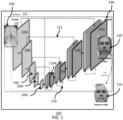
- a blurry, infrared low-resolution face image 106 is transformed into sharp, realistic, high-resolution visible face image 120.
- the designed network brings the advantages to preserve consistent biometrics features across both low/high resolution space and infrared/visible spectrum, thus making it possible to compare the super resolved images against a gallery of visible images using any off-the-shelf face marking algorithms.
- the embodiments appear to be adaptive to real world scenarios as during operational applications humans are randomly distant from the camera and can there- fore depict multi-scale LR infrared face images (which depends upon the acquisition distance).
- ANYRES highlights its ability to operate at any input resolution ranging from low to high resolution.
- the encoded infrared input "images" range from higher resolution to lower resolution from 108a to 108e using the encoder 102 from the generative adversarial network 101.
- 108a to 108e are encoded layers rather than images.
- Each of 108a-e is not one respective image anymore.
- 108a would be a set of maps (which are also known as images, but the preferred technical term is a "map" at this stage).
- 108a can have 16 maps
- 108b can have 32 maps, and so on.
- the increasing number of maps is not mandatory, but it is typically an ensemble.
- the decoded synthetic visible output "images" 110a-d (likewise, as noted with respect to 108a-e, will be sets of maps and not single images) ranging from higher resolution to lower resolution from 110a to 110d as shown using the decoder 104.
- the system 100 performs the step of skip connection 112 between encoded infrared face images and the decoded high-resolution visible face images. In some embodiments, the system 100 will also perform the step of squeeze and excitation 114 between encoded infrared face images and the decoded high-resolution visible face images. In some embodiments, the system 100 will also use a reference visible image 116 to account for loss functions to facilitate the generation of the synthetic visible output 120 in the training phase.
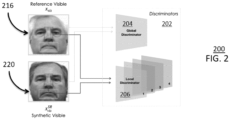
- discriminators 202 can be used including Global discriminator 204 and Local discriminators 206. While global discriminator 204 helps generate the right identity overall, the local discriminators 206, named L1,L2,L3 and L4 located on eyes, nose and mouth, respectively (of a Reference Visible image 216 and a synthetic visible image 220), are designed to focus on generated details of cross-spectral biometrics features and helps improve that identity by focusing on more biometric-relevant parts of the face. The photo-realistic images come from the L1 loss.
- ANYRES Some of the main contributions or novelties of ANYRES include a novel supervised learning framework for CFR that translates any LR infrared face image to HR visible face image.
- a system incorporating ANYRES can make possible the comparison of super resolved images against a gallery of visible images using any off-the-shelf face marking algorithms.
- ANYRES can accept any resolution, from low to high scale, thus making the model suitable for biometrics monitoring systems.
- ANYRES can also simultaneously perform super resolution and spectrum translation computer vision tasks, thus avoiding accumulated errors in-between steps.
- Custom loss functions have also been introduced in order to enhance both image quality as well as biometrics features preservation. Additionally, ANYRES can be adapted to any pair of spectra.
- AxialGAN by Immidisetti, R., Hu, S., Patel, V. M. (2021, August) disclose "simultaneous face hallucination and translation for thermal to visible face verification using AxialGAN".
- IJCB International Joint Conference on Biometrics
- GAN aims to synthesize facial high-resolution visible images from low-resolution thermal counterparts.
- the proposed GAN framework designed an axial-attention layer, incorporated into both generator and discriminator networks, to model long-range dependencies to facilitate long-distance face matching.
- MEI Yiqun
- GUO Pengfei
- et PATEL Vishal M.
- the proposed ANYRES method and system is a generative adversarial network (GAN) designed to address simultaneously dual computer vision tasks of domain translation and super resolution while preserving identity.
- GAN generative adversarial network
- ANYRES tackles the problem of matching any LR infrared face images or thermal face images against HR visible face images by (i) learning an end-to-end mapping between the thermal or infrared spectrum and the visible spectrum, and (ii) learning to handle any resolution input.
- Domain translation phase In the domain translation phase, image-to-image translation is performed by learning an end-to-end non-linear mapping, denoted ⁇ t ⁇ v , between the thermal spectrum and the visible spectrum. This is formalized as follows: ⁇ t ⁇ v : T ⁇ V x thm ⁇ x vis synthetic .
- ⁇ t ⁇ v is the function that synthesizes the corresponding thermal face images (see 306 in FIG. 3 ) into a realistic synthetic visible face images (320) x vis synthetic in the high-resolution space.
- thermal-to-visible face recognition based on GAN-synthesis aims to learn an unified function that, when applied to any low-resolution thermal image x thm LR , yields a higherresolution super resolved visible image x vis SR ⁇ R m ⁇ n with rich semantic and identity information.
- the contribution of ANYRES is that it is learning simultaneously the global interaction between both domain translation and resolution scalability through the enrichment of Equation (1) by Equation (2).
- the method ⁇ t ⁇ v is designed to learn neural networks by considering (x thm , x vis ) -paired facial images and minimizing specific loss functions.
- anyRES as shown in the system 300 of FIG. 3 is based on a U-shape pyramidal architecture, thus relying naturally on a multi-scale analysis.
- the overall architecture is illustrated in FIG. 3 .
- a U-Net architecture is used for its efficiency, where the generator 301 consists of an encoder-decoder structure (302/304) with skip connections 312 between domain specific encoder 302 and decoder 304.
- the system 300 further uses Squeeze-and-Excitation (SE) blocks (314), which play the role of gate modulator after each skip connections process.
- SE Squeeze-and-Excitation
- the encoder 302 can extract multi-resolution features in parallel and fuse them repeatedly during the learning stage in order to generate high-quality SR- representations (320) with rich semantic/identity information.
- H i is the same composite function defined in Equation (3), and Pool denotes a max pooling operation where the most prominent features of the prior feature map are preserved.
- the decoder 304 aims at transforming a high-dimensional feature space into an output super resolved image 320 in the visible spectrum.
- G i represents the decoded intermediate feature maps (see, for example, 310a) after the i-th operation preceded by Squeeze and Excitation SE (314).
- Global Discriminator In some embodiments, a multi-scale discriminator is used which enables generation of realistic images with refined details.
- the global discriminator (such as 204 in FIG. 2 ) is responsible for performing a binary-classification by distinguishing a super resolved image x vis SR (320) from real image x vis . (316).
- the embodiments can focus on discriminative areas relevant for identity information, such as eyes, nose and mouth. Such regions of interests are represented by the same cropping area (shown in Fig. 2 ) between the images x vis and x vis SR respectively titled x vis-ROI,i or x vis ⁇ ROI , i SR , with i E [0, 4].
- Each independent discriminator pays attention to every single facial fine detail and benefits from local inherent attention to capture faithful biometric features during the generation.
- the adversarial learning process of ANYRES can be further augmented by an efficient combination of objective functions and pave the way to control the synthesis process at both pixels and features levels.
- the adversarial loss (322) including global and local is responsible to make generative sample realistic and not distinguishable from real images in the target domain.
- the L1 loss drives the spectrum translation, while the perceptual loss, identity loss and attribute loss are used at high-level features to affect the perceptive rendering of the image, preserve the biometrics identity-specific features and enforce the consistent age-gender reconstruction, respectively. All loss functions combined together bring realism during spectral translation and avoid blurriness introduced by any low scale of resolution from thermal image inputs.
- Adversarial loss Images generated during the translated phase through Equation (1) must be realistic. Therefore, the objective of the generator is to maximize the probability of the discriminators making incorrect decisions. The objective of the discriminators, on the other hand, is to maximize the probability of making a correct decision, i.e., to effectively distinguish between real and synthesized images.
- L GAN Global E x vis ⁇ p v log Dis global x vis + E x vis SR ⁇ pv log 1 ⁇ Dis global x vis SR
- L GAN Local , i E x vis ⁇ ROI , i ⁇ pv log L i x vis ⁇ ROI , i + E x vis ⁇ ROI , i SR ⁇ p v log 1 ⁇ L i x vis ⁇ ROI , i SR , then, the adversarial loss is denoted as follows.
- L GAN L GAN Global + L GAN Local .
- Conditional loss Imposing a condition on the spectral distribution is essential for generating images within the target spectrum.
- the perceptual loss L P affects the perceptive rendering of the image by measuring the high-level semantic difference between synthesized and target face images. It reduces artefacts and enables the reproduction of realistic details.
- the attribute loss L A prevents attribute shift during spectrum translation.
- the overall loss function for the proposed ANYRES embodiments herein can be the combination or any combination of the aforementioned loss functions.
- the chart 500 of FIG. 5 further compares specific parameters (such as Area Under Curve (AUC), Equal Error Rate (EER), False Acceptance Rate (FAR), Structural Similarity (SSIM), peak signal-to-noise ratio (PSNR), and Learned Perceptual Image Patch Similarity (LPIPS)) between the ANYRES any resolution images and the AxialGan fixed mono resolution images.
- AUC Area Under Curve
- EER Equal Error Rate
- FAR False Acceptance Rate
- SSIM Structural Similarity
- PSNR peak signal-to-noise ratio
- LPIPS Learned Perceptual Image Patch Similarity
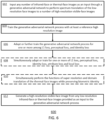
- a method 600 of FIG. 6 of unveiling high-resolution visible face images from any low-resolution infrared face or thermal face images can include the steps of inputting at 602 any number of infrared face or thermal face images as an input through a generative adversarial network to perform spectrum translation of the low-resolution infrared face or thermal face images to a number of high-resolution visible face images, training at 604 the generative adversarial network with at least a reference high resolution image, adapting at 606 the generative adversarial network for one or more among L1 loss, perceptual loss, and identity loss, and generating at 612 a high-resolution visible face image from any low-resolution infrared face or thermal face images provided as an input to the generative adversarial network.
- the method further filters the generative adversarial network by further filtering for one or more among attribute loss and local loss.
- the method at step 608 simultaneously filters for one or more of L1 loss, perceptual loss, identity loss, attribute loss and local loss.
- the method at step 610 simultaneously performs the functions of super resolution and domain translation of the infrared face or thermal face images while preserving biometric identity.
- the method learns an end-to-end mapping between the thermal spectrum and the visible spectrum trains of the adversarial network.
- the method uses an image encoder-decoder structure to generate the high-resolution visible face images.
- the method uses an image encoder-decoder structure based on a pyramidal architecture that relies on multi-scale analysis to generate the high-resolution visible face images.
- the method performs the step of skip connection between encoded infrared face or thermal face images and the decoded high-resolution visible face images and/or performs the step of squeeze and excitation between encoded infrared face or thermal face images and the decoded high-resolution visible face images.
- the method performs the steps of skip connection and squeeze and excitation between encoded infrared face or thermal face images and the decoded high-resolution visible face images to enable super resolution and domain translation of the infrared face or thermal face images while preserving biometric identity for any resolution of infrared face or thermal face images as inputs.
- the method unveils high-resolution visible face images from any low-resolution infrared face or thermal face images while ensuring cross-spectral identity.
- ANYRES is an innovative deep learning model designed to address simultaneously dual computer vision tasks of super resolution and domain translation while preserving identity.
- ANYRES tackles the problem of matching any LR infrared face or thermal face images against HR visible face images by (i) learning an end-to-end mapping between the infrared or thermal spectrum and the visible spectrum and (ii) learning to handle any resolution input.
- ANYRES proposes a novel supervised learning framework for CFR that translates any LR infrared face or thermal face image to HR visible face image.
- the system and method proposed makes it possible to compare the super resolved images against a gallery of visible image using any off-the-shelf face marking algorithms.
- ANYRES accepts any resolution, from low to high scale, thus making the model suitable for biometrics monitoring systems.
- ANYRES performs simultaneously super resolution and spectrum translation computer vision tasks, thus avoiding accumulated errors in-between steps. Custom loss functions have been introduced in order to enhance both image quality as well as biometrics features preservation.
- conjunctive lists make use of a comma, which may be known as an Oxford comma, a Harvard comma, a serial comma, or another like term. Such lists are intended to connect words, clauses or sentences such that the thing following the comma is also included in the list.
- each computing device or processor may be transformed from a generic and unspecific computing device or processor to a combination device comprising hardware and software configured for a specific and particular purpose providing more than conventional functions and solving a particular technical problem with a particular technical solution.
- a generic and unspecific computing device or processor to a combination device comprising hardware and software configured for a specific and particular purpose providing more than conventional functions and solving a particular technical problem with a particular technical solution.
Landscapes
- Engineering & Computer Science (AREA)
- Health & Medical Sciences (AREA)
- Theoretical Computer Science (AREA)
- Computer Vision & Pattern Recognition (AREA)
- General Health & Medical Sciences (AREA)
- Physics & Mathematics (AREA)
- General Physics & Mathematics (AREA)
- Multimedia (AREA)
- Evolutionary Computation (AREA)
- Artificial Intelligence (AREA)
- Oral & Maxillofacial Surgery (AREA)
- Human Computer Interaction (AREA)
- Computing Systems (AREA)
- Databases & Information Systems (AREA)
- Medical Informatics (AREA)
- Software Systems (AREA)
- Life Sciences & Earth Sciences (AREA)
- Biodiversity & Conservation Biology (AREA)
- Biomedical Technology (AREA)
- Molecular Biology (AREA)
- Image Processing (AREA)
Abstract
The present invention provides a method or system of unveiling high-resolution visible face images from any low-resolution thermal face images can include inputting any number of thermal face images as an input through a generative adversarial network to perform spectrum translation of the low-resolution thermal face images to a number of high-resolution visible face images, training the generative adversarial network with at least a reference high resolution image, adapting or training the generative adversarial network for one or more among L1 loss, perceptual loss, and identity loss, and generating a high-resolution visible face image from any low-resolution thermal face images provided as an input to the generative adversarial network. In some embodiments, the method further adapts the generative adversarial network by further adapting or training for one or more among attribute loss and local loss. In some embodiments, the method simultaneously adapts for one or more of L1 loss, perceptual loss, identity loss, attribute loss and local loss.
Description
- The present disclosure generally relates to generating high-resolution visible face images from low-resolution face images. More particularly, but not exclusively, the present disclosure relates to unveiling high-resolution visible face images from any low-resolution infrared face or thermal face images while preserving biometric identity.
- Thermal sensors play a crucial role in detecting and recognizing humans during surveillance operations, especially in the context of long-range distance acquisition or capture under adverse lighting conditions (low-light or night-time environments). However, infrared imaging and thermal imaging in particular does not provide a detailed rendering of faces, thus making it challenging when operating a biometric monitoring system. In particular, long distance acquisitions degrade facial verification performances as faces represent few pixels of the images with little biometrics information. Therefore, recovering accurate High-Resolution (HR) visible-spectrum face images from any Low spatial Resolution (LR) infrared spectrum face images is of particular pertinence in designing operational Cross-spectral Face Recognition (CFR) systems, where a visible face image is compared to a face image acquired beyond the visible. Such artificial process is referred to as Super Resolution (SR) or Hallucination, and can infer HR image from a single image or sequential LR images.
- All existing solutions and related work noted by third parties disclosed further below only allow for super resolution from a fixed input resolution, making them completely impractical in real-life scenarios.
- All of the subject matter discussed in the Background section is not necessarily prior art and should not be assumed to be prior art merely as a result of its discussion in the Background section. Along these lines, any recognition of problems in the prior art discussed in the Background section or associated with such subject matter should not be treated as prior art unless expressly stated to be prior art. Instead, the discussion of any subject matter in the Background section should be treated as part of the inventor's approach to the particular problem, which, in and of itself, may also be inventive.
- The present invention provides a solution for the aforementioned problems by a method of unveiling high-resolution visible face images from any low-resolution infrared face images according to
claim 1, a system for unveiling high-resolution visible face images from any low-resolution infrared face images according to claim 12, and a system for unveiling high-resolution visible face images from any low-resolution infrared face images according to claim 15. In dependent claims, preferred embodiments of the invention are defined. - In a first inventive aspect, the invention provides a method of unveiling high-resolution visible face images from any low-resolution infrared face images can include the steps of inputting any number of infrared face images as an input through a generative adversarial network to perform spectrum translation of the low-resolution infrared face images to a number of high-resolution visible face images, training the generative adversarial network with at least a reference high resolution image, adapting the generative adversarial network for one or more among L1 loss, perceptual loss, and identity loss, and generating a high-resolution visible face image from any low-resolution infrared face images provided as an input to the generative adversarial network. Note that infrared face images includes thermal face images.
- Namely, infrared spectrum includes four spectral bands: "near infrared" (NIR), "short-wave infrared" (SWIR), "medium-wave infrared" (MWIR) and "long wave infrared" (LWIR). Both MWIR and LWIR are also known as "thermal".
- Therefore, the method according to the invention can be used with any infrared input images.
- In some embodiments, the method simultaneously performs the functions of super resolution and domain translation of the infrared face images while preserving biometric identity.
- In some embodiments, the method learns an end-to-end mapping between the thermal or infrared spectrum and the visible spectrum trains of the adversarial network.
- In some embodiments, the method uses an image encoder-decoder structure to generate the high-resolution visible face images.
- In some embodiments, the method uses an image encoder-decoder structure based on a pyramidal architecture that relies on multi-scale analysis to generate the high-resolution visible face images.
- In some embodiments, the method further adapts the generative adversarial network by further training the adversarial networking using one or more among attribute loss and local loss. In some embodiments, the method simultaneously adapts for one or more of L1 loss, perceptual loss, identity loss, attribute loss and local loss.
- In some embodiments, the method performs the step of skip connection between encoded infrared face images and the decoded high-resolution visible face images.
- In some embodiments, the method performs the step of squeeze and excitation between encoded infrared face images and the decoded high-resolution visible face images.
- In some embodiments, the method performs the steps of skip connection and squeeze and excitation between encoded infrared face images and the decoded high-resolution visible face images to enable super resolution and domain translation of the infrared face images while preserving biometric identity for any resolution of infrared face images as inputs.
- In some embodiments, the method unveils high-resolution visible face images from any low-resolution infrared face images while ensuring cross-spectral identity.
- In a second inventive aspect, the invention provides a system for unveiling high-resolution visible face images from any low-resolution infrared face images includes one or more processors, and a memory coupled to the one or more processors (such as GPUs or CPUs), the memory containing computer instructions which when executed causes the one or more processors to perform certain steps or operations at an generative adversarial network. In some embodiments, the steps or operations can include inputting any number of infrared face images as an input through the generative adversarial network to perform spectrum translation of the low-resolution infrared face images to a number of high-resolution visible face images, training the adversarial network with at least a reference high resolution image, filtering the generative adversarial network for one or more among L1 loss, perceptual loss, and identity loss, and generating a high-resolution visible face image from any low-resolution infrared face images provided as an input to the generative adversarial network.
- In some embodiments, the system simultaneously performs the functions of super resolution and domain translation of the infrared face images while preserving biometric identity.
- In some embodiments, the system uses an image encoder-decoder structure to generate the high-resolution visible face images.
- In some embodiments, the system uses an image encoder-decoder structure based on a pyramidal architecture that relies on multi-scale analysis to generate the high-resolution visible face images.
- In some embodiments, the system further filters the generative adversarial network by further filtering for one or more among attribute loss and local loss. In some embodiments, the system simultaneously filters for one or more of L1 loss, perceptual loss, identity loss, attribute loss and local loss.
- In some embodiments, the system performs the step of skip connection between encoded infrared face images and the decoded high-resolution visible face images.
- In some embodiments, the system performs the step of squeeze and excitation between encoded infrared face images and the decoded high-resolution visible face images.
- In a third inventive aspect, the invention provides a system for unveiling high-resolution visible face images from any low-resolution infrared face images can include one or more processors, and a memory coupled to the one or more processors, the memory containing computer instructions which when executed causes the one or more processors to perform certain steps or operations at generative adversarial network. In some embodiments, the operations or step can include inputting any number of infrared face images as an input through a generative adversarial network to simultaneously perform super resolution and spectrum translation of the low-resolution infrared face images to a number of high-resolution visible face images, training the adversarial network with at least a reference high resolution image, filtering the generative adversarial network for one or more among L1 loss, perceptual loss, and identity loss, and generating a high-resolution visible face image from any low-resolution infrared face images provided as an input to the generative adversarial network.
- All the features described in this specification (including the claims, description and drawings) and/or all the steps of the described method can be combined in any combination, with the exception of combinations of such mutually exclusive features and/or steps.
- Non-limiting and non-exhaustive embodiments are described with reference to the following drawings, wherein like labels refer to like parts throughout the various views unless otherwise specified. The sizes and relative positions of elements in the drawings are not necessarily drawn to scale. For example, the shapes of various elements are selected, enlarged, and positioned to improve drawing legibility. The particular shapes of the elements as drawn have been selected for ease of recognition in the drawings. One or more embodiments are described hereinafter with reference to the accompanying drawings in which:
-
FIG. 1 illustrates a system of Unveiling High-Resolution visible face images from any Low-Resolution thermal face or infrared face images in accordance with the embodiments; -
FIG. 2 illustrates global and local discriminator losses that can be used in system of Unveiling High-Resolution visible face images from any Low-Resolution thermal face or infrared face images accordance with the embodiments; -
FIG. 3 illustrates another system of Unveiling High-Resolution visible face images from any Low-Resolution thermal face or infrared face images during a training phase in accordance with the embodiments; -
FIG. 4 illustrates a couple of charts comparing results from the current embodiments with results from another third party system and further demonstrates the ability to reconstruct the same identity with different resolutions as an input in accordance with the embodiments; -
FIG. 5 illustrates a chart comparing results from the current embodiments with the results from an AxialGAN system in accordance with the embodiments; and -
FIG. 6 illustrates a flow chart of a method of Unveiling High-Resolution visible face images from any Low-Resolution thermal face or infrared face images in accordance with the embodiments. - In the following description, certain specific details are set forth in order to provide a thorough understanding of various disclosed embodiments. However, one skilled in the relevant art will recognize that embodiments may be practiced without one or more of these specific details, or with other methods, components, materials, etc. Also in these instances, well-known structures may be omitted or shown and described in reduced detail to avoid unnecessarily obscuring descriptions of the embodiments.
- Motivated by the deficiencies noted above in the existing technology, the embodiments herein address the task of matching any low-resolution infrared face images against a gallery of high-resolution visible face images by designing a unique model handling dual computer vision task of super resolution and domain translation, streamlined to be more adaptive to ensure the faithful representation of cross-spectral identity.
- The disclosure herein also referred to as "ANYRES" enables simultaneously performing face super resolution and thermal-to-visible or infrared-to-visible spectrum translation while being robust to any low-resolution infrared inputs while preserving the identity. Benefits from the simultaneous process helps to avoid accumulating both errors and artifacts generation and to simultaneously bridge the modality gap and resolution gap. In particular with reference to the system and method 100 of
FIG. 1 , a blurry, infrared low-resolution face image 106 is transformed into sharp, realistic, high-resolutionvisible face image 120. The designed network brings the advantages to preserve consistent biometrics features across both low/high resolution space and infrared/visible spectrum, thus making it possible to compare the super resolved images against a gallery of visible images using any off-the-shelf face marking algorithms. Furthermore, the embodiments appear to be adaptive to real world scenarios as during operational applications humans are randomly distant from the camera and can there- fore depict multi-scale LR infrared face images (which depends upon the acquisition distance). Unlike known technology, where the resolution is fixed as input, ANYRES highlights its ability to operate at any input resolution ranging from low to high resolution. InFIG. 1 , the encoded infrared input "images" range from higher resolution to lower resolution from 108a to 108e using theencoder 102 from the generativeadversarial network 101. Generally, in some embodiments, 108a to 108e are encoded layers rather than images. Each of 108a-e is not one respective image anymore. 108a would be a set of maps (which are also known as images, but the preferred technical term is a "map" at this stage). For example, 108a can have 16 maps, 108b can have 32 maps, and so on. The increasing number of maps is not mandatory, but it is typically an ensemble. The decoded synthetic visible output "images" 110a-d (likewise, as noted with respect to 108a-e, will be sets of maps and not single images) ranging from higher resolution to lower resolution from 110a to 110d as shown using thedecoder 104. In some embodiments as further detailed below, the system 100 performs the step ofskip connection 112 between encoded infrared face images and the decoded high-resolution visible face images. In some embodiments, the system 100 will also perform the step of squeeze andexcitation 114 between encoded infrared face images and the decoded high-resolution visible face images. In some embodiments, the system 100 will also use a referencevisible image 116 to account for loss functions to facilitate the generation of the syntheticvisible output 120 in the training phase. - Referring to the system 200 of
FIG. 2 ,discriminators 202 can be used includingGlobal discriminator 204 andLocal discriminators 206. Whileglobal discriminator 204 helps generate the right identity overall, thelocal discriminators 206, named L1,L2,L3 and L4 located on eyes, nose and mouth, respectively (of aReference Visible image 216 and a synthetic visible image 220), are designed to focus on generated details of cross-spectral biometrics features and helps improve that identity by focusing on more biometric-relevant parts of the face. The photo-realistic images come from the L1 loss. - Some of the main contributions or novelties of ANYRES include a novel supervised learning framework for CFR that translates any LR infrared face image to HR visible face image. Thus, a system incorporating ANYRES can make possible the comparison of super resolved images against a gallery of visible images using any off-the-shelf face marking algorithms. ANYRES can accept any resolution, from low to high scale, thus making the model suitable for biometrics monitoring systems. ANYRES can also simultaneously perform super resolution and spectrum translation computer vision tasks, thus avoiding accumulated errors in-between steps. Custom loss functions have also been introduced in order to enhance both image quality as well as biometrics features preservation. Additionally, ANYRES can be adapted to any pair of spectra.
- [AxialGAN] by Immidisetti, R., Hu, S., Patel, V. M. (2021, August) disclose "simultaneous face hallucination and translation for thermal to visible face verification using AxialGAN". In 2021 IEEE International Joint Conference on Biometrics (IJCB) (pp. 1-8). IEEE. AxialGAN aims to synthesize facial high-resolution visible images from low-resolution thermal counterparts. The proposed GAN framework designed an axial-attention layer, incorporated into both generator and discriminator networks, to model long-range dependencies to facilitate long-distance face matching. In another related work, MEI, Yiqun, GUO, Pengfei, et PATEL, Vishal M. disclose "Escaping Data Scarcity for High-Resolution Heterogeneous Face Hallucination". In: Proceedings of the I EEE/CVF Conference on Computer Vision and Pattern Recognition. 2022. p. 18676-18686. In yet another related work, MEI, Kangfu, MEI, Yiqun, et PATEL, Vishal M. disclose "Thermal to Visible Image Synthesis under Atmospheric Turbulence". arXiv preprint arXiv:2204.03057, 2022.
- The proposed ANYRES method and system is a generative adversarial network (GAN) designed to address simultaneously dual computer vision tasks of domain translation and super resolution while preserving identity. In particular, ANYRES tackles the problem of matching any LR infrared face images or thermal face images against HR visible face images by (i) learning an end-to-end mapping between the thermal or infrared spectrum and the visible spectrum, and (ii) learning to handle any resolution input.
- Lets consider the high-resolution space, with dimensionality m × n, incorporating a visible domain V with visible face images xvis ∈ R m×n , and a thermal domain T with thermal face images xthm ∈ R m×n .
- Domain translation phase: In the domain translation phase, image-to-image translation is performed by learning an end-to-end non-linear mapping, denoted Θ t→v , between the thermal spectrum and the visible spectrum. This is formalized as follows:

- Consequently, Θ t→v is the function that synthesizes the corresponding thermal face images (see 306 in
FIG. 3 ) into a realistic synthetic visible face images (320)
- Super Resolution phase: Given the embedding of Equation (1), the
network 301 encapsulates as a simultaneous task, the super resolution scalability. Therefore, we aim to learn a conditional generation function where thermal low resolution facial image

- As elaborate above, thermal-to-visible face recognition based on GAN-synthesis, with the objective of being robust to any low resolution thermal inputs, aims to learn an unified function that, when applied to any low-resolution thermal image


- To learn how to process any resolution as its input, without having to estimate such resolution, ANYRES as shown in the
system 300 ofFIG. 3 is based on a U-shape pyramidal architecture, thus relying naturally on a multi-scale analysis. The overall architecture is illustrated inFIG. 3 . In one particular implementation, a U-Net architecture is used for its efficiency, where thegenerator 301 consists of an encoder-decoder structure (302/304) withskip connections 312 between domainspecific encoder 302 anddecoder 304. Considering the larger discrepancy between the images resulted from LR and HR spaces, thesystem 300 further uses Squeeze-and-Excitation (SE) blocks (314), which play the role of gate modulator after each skip connections process. With such strategy, channel-wise relationships brings flexible control and balances encoded features with decoded super resolved features. - Cross-Resolution Interaction. During training time, the network is fed simultaneously by batches of a wide range r-scale factor of low resolution
thermal images 306. Note that, in the extreme case where only one low scale of resolution is considered, with fixed r, the model would be able to super resolve image from
- Encoder (302). The
encoder 302 can extract multi-resolution features in parallel and fuse them repeatedly during the learning stage in order to generate high-quality SR-representations (320) with rich semantic/identity information. - Given a LR thermal input image (such as 306)


- Here, Ho refers to a composite function of two successive Convolution-BatchNormalization-ReLU layers. Then, we apply a sequence of operations:

- Decoder (304). The
decoder 304 aims at transforming a high-dimensional feature space into an output super resolvedimage 320 in the visible spectrum. Hence, the generative task towards the super resolved images is started from the deep level (U bottleneck),
- Then sequentially incremented, for all i ∈ [1,K - 1], by


- While S refers to upsampling operation of factor 2 followed by Convolution-BatchNormalization-ReLU layers, C concatenates all channels from the skip connection (312) Fi-1 (see 311a) with the up-sampled Si layers (see 309a). Finally, Gi represents the decoded intermediate feature maps (see, for example, 310a) after the i-th operation preceded by Squeeze and Excitation SE (314).
- In an adversarial learning, ANYRES is complemented by global and locally enhanced discriminators (see 204 and 206 in
FIG. 2 or 324 inFIG. 3 ), named Disglobal and Dislocal respectively. The former helps the above generator to synthesize photo-realistic HR image in the visible spectrum, whereas the latter (in some embodiments) pays attention to every single facial fine detail and benefits from local inherent attention to capture faithful biometric features during the generation. - Global Discriminator: In some embodiments, a multi-scale discriminator is used which enables generation of realistic images with refined details. The global discriminator (such as 204 in
FIG. 2 ) is responsible for performing a binary-classification by distinguishing a super resolved image
- Local Discriminator: To synthesize biometric-realistic semantic content, the embodiments can focus on discriminative areas relevant for identity information, such as eyes, nose and mouth. Such regions of interests are represented by the same cropping area (shown in
Fig. 2 ) between the images xvis and

- The adversarial learning process of ANYRES can be further augmented by an efficient combination of objective functions and pave the way to control the synthesis process at both pixels and features levels. On the one hand, the adversarial loss (322) including global and local is responsible to make generative sample realistic and not distinguishable from real images in the target domain. And on the other hand, the L1 loss drives the spectrum translation, while the perceptual loss, identity loss and attribute loss are used at high-level features to affect the perceptive rendering of the image, preserve the biometrics identity-specific features and enforce the consistent age-gender reconstruction, respectively. All loss functions combined together bring realism during spectral translation and avoid blurriness introduced by any low scale of resolution from thermal image inputs.
- Adversarial loss Images generated during the translated phase through Equation (1) must be realistic. Therefore, the objective of the generator is to maximize the probability of the discriminators making incorrect decisions. The objective of the discriminators, on the other hand, is to maximize the probability of making a correct decision, i.e., to effectively distinguish between real and synthesized images. The global


- Conditional loss: Imposing a condition on the spectral distribution is essential for generating images within the target spectrum. The conditional loss; or known as L1 loss, is defined as follows:

- Perceptual loss: The perceptual loss LP affects the perceptive rendering of the image by measuring the high-level semantic difference between synthesized and target face images. It reduces artefacts and enables the reproduction of realistic details. LP is defined as follows:

- Identity Loss: The identity loss


- Attribute Loss: The attribute loss




- Finally, the overall loss function for the proposed ANYRES embodiments herein can be the combination or any combination of the aforementioned loss functions.
- Referring to the
chart 400 ofFIG. 4 , a comparison can be visually made between the ANYRES synthetic Super Resolution visible output resulting from various low resolution thermal input images and the AxialGan output for both female and male genders. Thechart 500 ofFIG. 5 further compares specific parameters (such as Area Under Curve (AUC), Equal Error Rate (EER), False Acceptance Rate (FAR), Structural Similarity (SSIM), peak signal-to-noise ratio (PSNR), and Learned Perceptual Image Patch Similarity (LPIPS)) between the ANYRES any resolution images and the AxialGan fixed mono resolution images. - In some embodiments with reference to a
method 600 ofFIG. 6 of unveiling high-resolution visible face images from any low-resolution infrared face or thermal face images can include the steps of inputting at 602 any number of infrared face or thermal face images as an input through a generative adversarial network to perform spectrum translation of the low-resolution infrared face or thermal face images to a number of high-resolution visible face images, training at 604 the generative adversarial network with at least a reference high resolution image, adapting at 606 the generative adversarial network for one or more among L1 loss, perceptual loss, and identity loss, and generating at 612 a high-resolution visible face image from any low-resolution infrared face or thermal face images provided as an input to the generative adversarial network. In some embodiments, the method further filters the generative adversarial network by further filtering for one or more among attribute loss and local loss. In some embodiments, the method atstep 608 simultaneously filters for one or more of L1 loss, perceptual loss, identity loss, attribute loss and local loss. - In some embodiments, the method at
step 610 simultaneously performs the functions of super resolution and domain translation of the infrared face or thermal face images while preserving biometric identity. In some embodiments, the method learns an end-to-end mapping between the thermal spectrum and the visible spectrum trains of the adversarial network. In some embodiments, the method uses an image encoder-decoder structure to generate the high-resolution visible face images. In some embodiments, the method uses an image encoder-decoder structure based on a pyramidal architecture that relies on multi-scale analysis to generate the high-resolution visible face images. - In some embodiments, the method performs the step of skip connection between encoded infrared face or thermal face images and the decoded high-resolution visible face images and/or performs the step of squeeze and excitation between encoded infrared face or thermal face images and the decoded high-resolution visible face images.
- In some embodiments, the method performs the steps of skip connection and squeeze and excitation between encoded infrared face or thermal face images and the decoded high-resolution visible face images to enable super resolution and domain translation of the infrared face or thermal face images while preserving biometric identity for any resolution of infrared face or thermal face images as inputs. In some embodiments, the method unveils high-resolution visible face images from any low-resolution infrared face or thermal face images while ensuring cross-spectral identity.
- In summary, ANYRES is an innovative deep learning model designed to address simultaneously dual computer vision tasks of super resolution and domain translation while preserving identity. In particular, ANYRES tackles the problem of matching any LR infrared face or thermal face images against HR visible face images by (i) learning an end-to-end mapping between the infrared or thermal spectrum and the visible spectrum and (ii) learning to handle any resolution input.
- (i) With respect to learning a mapping, ANYRES is based on a Generative Adversarial Network (GAN), which aims to perform spectrum translation, from the infrared or thermal domain to visible domain. The proposed architecture can use an image encoder/decoder structure. The decoding structure performing the generative task can be controlled through a combination of losses specifically designed to recreate realistic images (L1 loss), insuring they represent faces (perceptual loss) and more so are preserving the identity of the input face (identity loss). This process can be augmented by auxiliary tasks to better ensure the fidelity of the reconstruction, and these tasks include but are not limited to gender and age classification.
- This process can be improved upon by using local discriminative losses on areas like the eyes, the nose and the mouth.
(ii) In order to learn to process any resolution as its input, without having to estimate the resolution, ANYRES can be based on a pyramidal architecture so that it is relying naturally on a multi-scale analysis. In one implementation, a U-net architecture is chosen for its efficiency, but other pyramidal architectures could be introduced. ANYRES can then be trained on batches of images of different resolutions. The skip connections (see 112 inFIG. 1 or 312 inFIG. 3 ) in the U-net architecture allows users to train the system to weigh the influence of different scales, thus making it possible to handle different resolutions with the same system. - Again, ANYRES proposes a novel supervised learning framework for CFR that translates any LR infrared face or thermal face image to HR visible face image. Thus, the system and method proposed makes it possible to compare the super resolved images against a gallery of visible image using any off-the-shelf face marking algorithms. ANYRES accepts any resolution, from low to high scale, thus making the model suitable for biometrics monitoring systems. ANYRES performs simultaneously super resolution and spectrum translation computer vision tasks, thus avoiding accumulated errors in-between steps. Custom loss functions have been introduced in order to enhance both image quality as well as biometrics features preservation.
- In the absence of any specific clarification related to its express use in a particular context, where the terms " substantial " or " about " or "usually" in any grammatical form are used as modifiers in the present disclosure and any appended claims ( e.g., to modify a structure, a dimension, a measurement, or some other characteristic), it is understood that the characteristic may vary by up to 30 percent.
- The terms "include" and "comprise" as well as derivatives thereof, in all of their syntactic contexts, are to be construed without limitation in an open, inclusive sense, (e.g., "including, but not limited to" ). The term "or," is inclusive, meaning and / or. The phrases "associated with" and "associated therewith," as well as derivatives thereof, can be understood as meaning to include, be included within, interconnect with, contain, be contained within, connect to or with, couple to or with, be communicable with, cooperate with, interleave, juxtapose, be proximate to, be bound to or with, have, have a property of, or the like.
- Unless the context requires otherwise, throughout the specification and claims which follow, the word "comprise" and variations thereof, such as, "comprises" and "comprising," are to be construed in an open, inclusive sense, e.g., "including, but not limited to."
- Reference throughout this specification to "one embodiment" or "an embodiment" or "some embodiments" and variations thereof mean that a particular feature, structure, or characteristic described in connection with the embodiment is included in at least one embodiment. Thus, the appearances of the phrases "in one embodiment" or "in an embodiment" in various places throughout this specification are not necessarily all referring to the same embodiment. Furthermore, the particular features, structures, or characteristics may be combined in any suitable manner in one or more embodiments.
- As used in this specification and the appended claims, the singular forms "a," "an," and "the" include plural referents unless the content and context clearly dictates otherwise. It should also be noted that the conjunctive terms, "and" and "or" are generally employed in the broadest sense to include "and/or" unless the content and context clearly dictates inclusivity or exclusivity as the case may be. In addition, the composition of "and" and "or" when recited herein as "and/or" is intended to encompass an embodiment that includes all of the associated items or ideas and one or more other alternative embodiments that include fewer than all of the associated items or idea .
- In the present disclosure, conjunctive lists make use of a comma, which may be known as an Oxford comma, a Harvard comma, a serial comma, or another like term. Such lists are intended to connect words, clauses or sentences such that the thing following the comma is also included in the list.
- As the context may require in this disclosure, except as the context may dictate otherwise, the singular shall mean the plural and vice versa. All pronouns shall mean and include the person, entity, firm or corporation to which they relate. Also, the masculine shall mean the feminine and vice versa.
- When so arranged as described herein, each computing device or processor may be transformed from a generic and unspecific computing device or processor to a combination device comprising hardware and software configured for a specific and particular purpose providing more than conventional functions and solving a particular technical problem with a particular technical solution. When so arranged as described herein, to the extent that any of the inventive concepts described herein are found by a body of competent adjudication to be subsumed in an abstract idea, the ordered combination of elements and limitations are expressly presented to provide a requisite inventive concept by transforming the abstract idea into a tangible and concrete practical application of that abstract idea.
- The headings and Abstract of the Disclosure provided herein are for convenience only and do not limit or interpret the scope or meaning of the embodiments. The various embodiments described above can be combined to provide further embodiments. Aspects of the embodiments can be modified, if necessary to employ concepts of the various patents, application and publications to provide further embodiments.
Claims (15)
- A method of unveiling high-resolution visible face images from any low-resolution infrared face images, comprising the steps of:inputting any number of infrared face images as an input through a generative adversarial network to perform spectrum translation of the low-resolution infrared face images to a number of high-resolution visible face images;training the generative adversarial network with at least a reference high resolution image;adapting the generative adversarial network for one or more among L1 loss, perceptual loss, and identity loss; andgenerating a high-resolution visible face image from any low-resolution infrared face images provided as an input to the generative adversarial network.
- The method according to claim 1, wherein the method simultaneously performs the functions of super resolution and domain translation of the infrared face images while preserving biometric identity.
- The method according to any of claims 1 or 2, wherein learning an end-to-end mapping between the infrared spectrum and the visible spectrum trains of the adversarial network.
- The method according to any of claims 1 to 3, wherein method uses an image encoder-decoder structure to generate the high-resolution visible face images.
- The method according to claim 4, wherein method uses an image encoder-decoder structure based on a pyramidal architecture that relies on multi-scale analysis to generate the high-resolution visible face images.
- The method according to any of claims 1 to 5, wherein the method further adapts the generative adversarial network by further training for one or more among attribute loss and local loss.
- The method according to claim 6, wherein the method simultaneously trains for one or more of L1 loss, perceptual loss, identity loss, attribute loss and local loss.
- The method according to any of claims 1 to 7, wherein the method performs the step of skip connection between encoded infrared face images and the decoded high-resolution visible face images.
- The method according to any of claims 1 to 8, wherein the method performs the step of squeeze and excitation between encoded infrared face images and the decoded high-resolution visible face images.
- The method according to any of claims 1 to 9, wherein the method performs the steps of skip connection and squeeze and excitation between encoded infrared face images and the decoded high-resolution visible face images to enable super resolution and domain translation of the infrared face images while preserving biometric identity for any resolution of infrared face images as inputs.
- The method according to any of claims 1 to 10, wherein the method unveils high-resolution visible face images from any low-resolution infrared face images while ensuring cross-spectral identity.
- A system for unveiling high-resolution visible face images from any low-resolution infrared face images, comprising:one or more processors;a memory coupled to the one or more processors, the memory containing computer instructions which when executed causes the one or more processors to perform the steps at an generative adversarial network of:inputting any number of infrared face images as an input through the generative adversarial network to perform spectrum translation of the low-resolution infrared face images to a number of high-resolution visible face images during a training phase;training the adversarial network with at least a reference high resolution image;adapting the generative adversarial network for one or more among L1 loss, perceptual loss, and identity loss; andgenerating a high-resolution visible face image from any low-resolution infrared face images provided as an input to the generative adversarial network.
- The system according to claim 12, wherein the system simultaneously performs the functions of super resolution and domain translation of the infrared face images while preserving biometric identity.
- The system according to any of claims 12 or 13, wherein system uses an image encoder-decoder structure to generate the high-resolution visible face images, wherein the system preferably uses an image encoder-decoder structure based on a pyramidal architecture that relies on multi-scale analysis to generate the high-resolution visible face images.
- A system for unveiling high-resolution visible face images from any low-resolution infrared face or thermal face images, comprising:one or more processors;a memory coupled to the one or more processors, the memory containing computer instructions which when executed causes the one or more processors to perform the steps at generative adversarial network of:inputting any number of infrared face or thermal face images as an input through a generative adversarial network to simultaneously perform super resolution and spectrum translation of the low-resolution infrared face or thermal face images to a number of high-resolution visible face images;training the adversarial network with at least a reference high resolution image;filtering the generative adversarial network for one or more among L1 loss, perceptual loss, and identity loss; andgenerating a high-resolution visible face image from any low-resolution infrared face or thermal face images provided as an input to the generative adversarial network.
Priority Applications (3)
| Application Number | Priority Date | Filing Date | Title |
|---|---|---|---|
| EP22306692.9A EP4372697A1 (en) | 2022-11-17 | 2022-11-17 | System and method of unveiling high-resolution visible face images from low-resolution face images |
| EP23805096.7A EP4619950A1 (en) | 2022-11-17 | 2023-11-16 | System and method of unveiling high-resolution visible face images from low-resolution face images |
| PCT/EP2023/082122 WO2024105196A1 (en) | 2022-11-17 | 2023-11-16 | System and method of unveiling high-resolution visible face images from low-resolution face images |
Applications Claiming Priority (1)
| Application Number | Priority Date | Filing Date | Title |
|---|---|---|---|
| EP22306692.9A EP4372697A1 (en) | 2022-11-17 | 2022-11-17 | System and method of unveiling high-resolution visible face images from low-resolution face images |
Publications (1)
| Publication Number | Publication Date |
|---|---|
| EP4372697A1 true EP4372697A1 (en) | 2024-05-22 |
Family
ID=84981978
Family Applications (2)
| Application Number | Title | Priority Date | Filing Date |
|---|---|---|---|
| EP22306692.9A Withdrawn EP4372697A1 (en) | 2022-11-17 | 2022-11-17 | System and method of unveiling high-resolution visible face images from low-resolution face images |
| EP23805096.7A Pending EP4619950A1 (en) | 2022-11-17 | 2023-11-16 | System and method of unveiling high-resolution visible face images from low-resolution face images |
Family Applications After (1)
| Application Number | Title | Priority Date | Filing Date |
|---|---|---|---|
| EP23805096.7A Pending EP4619950A1 (en) | 2022-11-17 | 2023-11-16 | System and method of unveiling high-resolution visible face images from low-resolution face images |
Country Status (2)
| Country | Link |
|---|---|
| EP (2) | EP4372697A1 (en) |
| WO (1) | WO2024105196A1 (en) |
Cited By (1)
| Publication number | Priority date | Publication date | Assignee | Title |
|---|---|---|---|---|
| CN119648831A (en) * | 2024-11-28 | 2025-03-18 | 中国科学院沈阳自动化研究所 | A method for infrared image generation based on multi-scale perception |
Families Citing this family (2)
| Publication number | Priority date | Publication date | Assignee | Title |
|---|---|---|---|---|
| CN120411810B (en) * | 2025-07-01 | 2025-09-30 | 中国科学院空天信息创新研究院 | Water body extraction method and device based on multisource multiscale optical remote sensing data |
| CN120495087B (en) * | 2025-07-17 | 2025-11-28 | 浙江大学 | Visible light guided infrared image super-resolution method and system with multi-level attention |
-
2022
- 2022-11-17 EP EP22306692.9A patent/EP4372697A1/en not_active Withdrawn
-
2023
- 2023-11-16 EP EP23805096.7A patent/EP4619950A1/en active Pending
- 2023-11-16 WO PCT/EP2023/082122 patent/WO2024105196A1/en not_active Ceased
Non-Patent Citations (6)
| Title |
|---|
| CHEN CUNJIAN ET AL: "Attention-Guided Generative Adversarial Network for Explainable Thermal to Visible Face Recognition", 2022 IEEE INTERNATIONAL JOINT CONFERENCE ON BIOMETRICS (IJCB), IEEE, 10 October 2022 (2022-10-10), pages 1 - 8, XP034274806, DOI: 10.1109/IJCB54206.2022.10008000 * |
| DAVID ANGHELONE ET AL: "Beyond the Visible: A Survey on Cross-spectral Face Recognition", ARXIV.ORG, CORNELL UNIVERSITY LIBRARY, 201 OLIN LIBRARY CORNELL UNIVERSITY ITHACA, NY 14853, 6 May 2022 (2022-05-06), XP091216887 * |
| IMMIDISETTI, R.HU, SPATEL, V. M.: "2021 IEEE International Joint Conference on Biometrics (IJCB", August 2021, IEEE, article "simultaneous face hallucination and translation for thermal to visible face verification using AxialGAN", pages: 1 - 8 |
| MEI, KANGFUMEI, YIQUNPATEL, VISHAL M: "Thermal to Visible Image Synthesis under Atmospheric Turbulence", ARXIV PREPRINT ARXIV:2204.03057, 2022 |
| MEI, YIQUNGUO, PENGFEIPATEL, VISHAL M.: "Escaping Data Scarcity for High-Resolution Heterogeneous Face Hallucination", PROCEEDINGS OF THE I EEE/CVF CONFERENCE ON COMPUTER VISION AND PATTERN RECOGNITION, 2022, pages 18676 - 18686 |
| RAKHIL IMMIDISETTI ET AL: "Simultaneous Face Hallucination and Translation for Thermal to Visible Face Verification using Axial-GAN", ARXIV.ORG, CORNELL UNIVERSITY LIBRARY, 201 OLIN LIBRARY CORNELL UNIVERSITY ITHACA, NY 14853, 7 August 2021 (2021-08-07), XP091024788, DOI: 10.1109/IJCB52358.2021.9484353 * |
Cited By (1)
| Publication number | Priority date | Publication date | Assignee | Title |
|---|---|---|---|---|
| CN119648831A (en) * | 2024-11-28 | 2025-03-18 | 中国科学院沈阳自动化研究所 | A method for infrared image generation based on multi-scale perception |
Also Published As
| Publication number | Publication date |
|---|---|
| WO2024105196A1 (en) | 2024-05-23 |
| EP4619950A1 (en) | 2025-09-24 |
Similar Documents
| Publication | Publication Date | Title |
|---|---|---|
| Chen et al. | MICU: Image super-resolution via multi-level information compensation and U-net | |
| Chen et al. | Dual degradation image inpainting method via adaptive feature fusion and U-net network | |
| Yu et al. | Super-resolving very low-resolution face images with supplementary attributes | |
| Wang et al. | Perceptual adversarial networks for image-to-image transformation | |
| Liu et al. | Unsupervised image-to-image translation networks | |
| EP4619950A1 (en) | System and method of unveiling high-resolution visible face images from low-resolution face images | |
| CN105069825B (en) | Image super-resolution rebuilding method based on depth confidence network | |
| Yi et al. | Diff-Retinex++: Retinex-driven reinforced diffusion model for low-light image enhancement | |
| CN116664435B (en) | A face restoration method based on multi-scale face analysis map integration | |
| CN116452420B (en) | Hyper-spectral image super-resolution method based on fusion of Transformer and CNN (CNN) group | |
| JP2023092185A (en) | Image processing device, learning method and program | |
| Cai et al. | Perception preserving decolorization | |
| Fang et al. | DCAFusion: A novel general image fusion framework based on reference image reconstruction and dual-cross attention mechanism | |
| Peng et al. | Face photo–sketch synthesis via intra-domain enhancement | |
| Campana et al. | Variable-hyperparameter visual transformer for efficient image inpainting | |
| Karthikeyan et al. | Attention-based lightweight deep hybrid CNN framework for image restoration | |
| Sun et al. | Face image-sketch synthesis via generative adversarial fusion | |
| Wu et al. | Latent diffusion, implicit amplification: Efficient continuous-scale super-resolution for remote sensing images | |
| Liu et al. | Diffosr: Latitude-aware conditional diffusion probabilistic model for omnidirectional image super-resolution | |
| Jing et al. | An efficient dehazing method using pixel unshuffle and color correction | |
| Wang | Single image super-resolution with u-net generative adversarial networks | |
| CN120147181A (en) | An image defogging algorithm guided by fog concentration information | |
| Oh et al. | SoFoNO: Arbitrary-scale image super-resolution via Sobolev Fourier neural operator | |
| US12519974B2 (en) | Machine learning based video processing | |
| Zhang et al. | Parallel frequency-invertible adversarial network for infrared and visible image fusion |
Legal Events
| Date | Code | Title | Description |
|---|---|---|---|
| PUAI | Public reference made under article 153(3) epc to a published international application that has entered the european phase |
Free format text: ORIGINAL CODE: 0009012 |
|
| STAA | Information on the status of an ep patent application or granted ep patent |
Free format text: STATUS: THE APPLICATION HAS BEEN PUBLISHED |
|
| AK | Designated contracting states |
Kind code of ref document: A1 Designated state(s): AL AT BE BG CH CY CZ DE DK EE ES FI FR GB GR HR HU IE IS IT LI LT LU LV MC ME MK MT NL NO PL PT RO RS SE SI SK SM TR |
|
| STAA | Information on the status of an ep patent application or granted ep patent |
Free format text: STATUS: THE APPLICATION IS DEEMED TO BE WITHDRAWN |
|
| 18D | Application deemed to be withdrawn |
Effective date: 20241123 |