EP4372577A1 - Unit prediction for custom feature engineering - Google Patents
Unit prediction for custom feature engineering Download PDFInfo
- Publication number
- EP4372577A1 EP4372577A1 EP23208719.7A EP23208719A EP4372577A1 EP 4372577 A1 EP4372577 A1 EP 4372577A1 EP 23208719 A EP23208719 A EP 23208719A EP 4372577 A1 EP4372577 A1 EP 4372577A1
- Authority
- EP
- European Patent Office
- Prior art keywords
- column
- columns
- value
- dataset
- title
- Prior art date
- Legal status (The legal status is an assumption and is not a legal conclusion. Google has not performed a legal analysis and makes no representation as to the accuracy of the status listed.)
- Pending
Links
Images




Classifications
-
- G—PHYSICS
- G06—COMPUTING OR CALCULATING; COUNTING
- G06F—ELECTRIC DIGITAL DATA PROCESSING
- G06F16/00—Information retrieval; Database structures therefor; File system structures therefor
- G06F16/30—Information retrieval; Database structures therefor; File system structures therefor of unstructured textual data
- G06F16/33—Querying
- G06F16/332—Query formulation
- G06F16/3329—Natural language query formulation
-
- G—PHYSICS
- G06—COMPUTING OR CALCULATING; COUNTING
- G06F—ELECTRIC DIGITAL DATA PROCESSING
- G06F16/00—Information retrieval; Database structures therefor; File system structures therefor
- G06F16/20—Information retrieval; Database structures therefor; File system structures therefor of structured data, e.g. relational data
- G06F16/21—Design, administration or maintenance of databases
- G06F16/215—Improving data quality; Data cleansing, e.g. de-duplication, removing invalid entries or correcting typographical errors
-
- G—PHYSICS
- G06—COMPUTING OR CALCULATING; COUNTING
- G06F—ELECTRIC DIGITAL DATA PROCESSING
- G06F16/00—Information retrieval; Database structures therefor; File system structures therefor
- G06F16/30—Information retrieval; Database structures therefor; File system structures therefor of unstructured textual data
- G06F16/35—Clustering; Classification
- G06F16/355—Creation or modification of classes or clusters
-
- G—PHYSICS
- G06—COMPUTING OR CALCULATING; COUNTING
- G06F—ELECTRIC DIGITAL DATA PROCESSING
- G06F16/00—Information retrieval; Database structures therefor; File system structures therefor
- G06F16/90—Details of database functions independent of the retrieved data types
- G06F16/903—Querying
- G06F16/9032—Query formulation
- G06F16/90332—Natural language query formulation or dialogue systems
Definitions
- the embodiments discussed in the present disclosure are related to unit prediction for custom feature engineering (FE).
- Machine learning systems may be used in many technology sectors including but not limited to financial technologies, eCommerce, social media, gaming, facial recognition, and autonomous driving. These machine learning systems may be able to receive an input that may allow the system to learn and adapt to different sets of circumstances. In many cases, the input that the machine learning system may be able to receive may be a set or sets of data.
- One or more embodiments of the present disclosure may include a method.
- the method may include obtaining a dataset that may include at least a first column and a second column, and where the first column may include a first title and a first value and the second column may include a second title and a second value. Additionally, the method may include determining a total similarity value between the first column and the second column which may be based on at least one of a metadata similarity value, a semantic similarity value, and a unit of measurement similarity value. The method may additionally include adding the first column and the second column to a cluster if the total similarity value is less than a threshold value.
- the method may include generating a new column to add to the cluster that may be done by using a feature engineering function, where the new column may include a new title and a new value, the new value may be determined by using the feature engineering function by acting on at least one of the first value of the first column and the second value of the second column. Additionally, the method may include, adding the new column to the dataset.
- One or more embodiments of the present disclosure may include a method.
- the method may include obtaining a dataset having one or more columns, each of the one or more columns may include a title and at least one value.
- the method may additionally include extracting, for each of the one or more columns, the title and a sample value from the at least one value.
- the method may include, synthesizing a question based on the title and the sample value for each of the one or more columns.
- the method may additionally include, sending the question to a language model to obtain an answer; and further, the method may include, generating from the answer to the question, a predicted unit of measurement for the at least one value in each of the one or more columns.
- Machine learning systems and algorithms are increasingly used in a number of technology areas using artificial intelligence and particularly in tasks involving prediction. Developing machine learning systems and algorithms to comport with a number of applications has become increasingly more difficult and expensive. Machine learning system development may be time consuming and may include a large number of man hours and professional expertise from data scientists and others to prepare datasets associated with the machine learning systems. These datasets may be used in training machine learning systems to perform a specific task.
- a useful tool in developing datasets used to train machine learning systems may be feature engineering.
- the present disclosure relates to feature engineering and functions designed to use feature engineering.
- feature engineering may refer to any number of operations, such as mathematical operations, that may be designed to expand, contract, clean, filter, or clarify data within a given dataset.
- Some example operations associated with or implementations of feature engineering may include feature selection, feature extraction, and/or feature construction.
- a feature as used in the context of feature engineering in the present disclosure, may refer to a unique attribute or variable in a dataset.
- Features may be contextualized in a dataset as a single column within the dataset.
- Feature selection may include a process whereby redundancy in a dataset is reduced by removing one or more redundant features in the dataset.
- Feature extraction may include a process whereby the dimensionality of features in a given dataset may be reduced by combining, displaying, or otherwise manipulating the data such that fewer variables are used.
- the dimensionality of features in the dataset may be reduced by using a mapping function to identify one or more variables that may be removed or combined with another variable.
- a principal component analysis (PCA) mapping function may be used to identify the principal components of the dataset and may extract that data in a way that may be visualized or illustrated with fewer variables.
- PCA principal component analysis
- Feature construction may refer to the expansion of existing features in the dataset to include other features that may not have been originally listed. Feature construction may include using mathematical functions (such as addition, subtraction, division, multiplication, combinations thereof, or others) that may be performed on two or more features such that a new feature may be created and added to the dataset.
- the dataset, including the new feature or column added to the dataset may be used to train the machine learning system such that the performance of the machine learning system may improve.
- While feature engineering may be a tool used to improve datasets, the process of performing feature engineering may be expensive.
- Current automated machine learning algorithms and systems may have difficulty on their own in identifying relevant features, comparing those relevant features, and creating new features that may improve the dataset via feature engineering. Therefore, manual avenues may be those typically taken to perform feature engineering on datasets, including large datasets.
- feature engineering may typically be performed by experienced data scientists who may add features to a dataset, remove feature redundancy in the dataset, and/or who may reduce dimensionality within the dataset.
- datasets that may be used to train machine learning systems may be large (e.g., on the order of thousands or millions of data points, or more). Indeed, many applications for machine learning may be benefited by training such machine learning systems with large datasets which, in turn, may require more time, more professional expertise, and more money to apply feature engineering functions that may create more effective datasets that may be used to train the machine learning systems.
- Some embodiments described in the present disclosure may substantially decrease the cost (e.g., computing, human, and/or monetary costs) associated with training machine learning systems by disclosing a method and system capable of performing feature engineering processes to create new features such that the dataset may be better suited to train machine learning systems.
- the method and system described in the present disclosure may find a similarity between features in a dataset, cluster similar features in the dataset based on the similarity between features in the dataset, generate new features, add the new features to the dataset, eliminate redundant or irrelevant features from the dataset, and/or use the dataset, including the new features, to train a machine learning system that may be designed to perform a task.
- a system designed to implement the method or methods as described below may generate and add at least one new feature to the dataset. Additionally or alternatively, the dataset may be used to train a machine learning system to perform a given task. Further, the dataset, including the at least one new feature generated by the system and added to the dataset, may be used in a machine learning pipeline that may be designed to train a number of machine learning systems and/or machine learning algorithms.
- adding the at least one new feature may improve the dataset by including an additional amount of information that may not be present in the dataset without the at least one new feature.
- the at least one new feature in the dataset may include context that may further explain another feature in the dataset.
- a dataset may include a first feature "quick” and a second feature "100 mph.”
- the feature engineering function may combine the first feature and the second feature which may generate a third feature where "100 mph" may provide further context for "quick” in the dataset.
- the additional context may provide a correlation between features.
- a first feature "quick” and a second feature “fast” may each be combined with a third feature "100 mph” and a fourth feature "200 mph” respectively generating a fifth and sixth feature.
- the generated fifth and sixth features may provide a correlation between the first feature "quick” and the second feature "fast” that may not have otherwise been expressed in the dataset.
- a machine learning system or algorithm trained using the dataset including the at least one new feature may have an increased predictive accuracy and/or efficiency compared to a machine learning system trained using the dataset without the at least one new feature.
- the dataset that may include the at least one new feature may include fewer redundant features, which may increase the speed with which a machine learning system may be trained and may reduce overfitting by reducing noisy and less important features.
- the use of the described principles and/or operations for predicting a unit of measurement for a given feature may provide the described benefit. For example, by providing a predicted unit of measurement for a given feature, the machine learning system may be better able to perform the task to which the machine learning system is assigned (e.g., may be more accurate and/or faster in performing its task). Overall, in some circumstances, the performance of the machine learning system may improve by using the methods and systems of the present disclosure and/or the new dataset created by such methods and systems. Additionally, a performance of a machine learning pipeline, where the machine learning pipeline may be designed to train any number of machine learning systems and/or algorithms, may improve by using one or more principles of the present disclosure and/or the new dataset created in embodiments of the present disclosure.
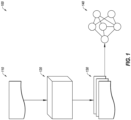
- FIG. 1 illustrates an example embodiment of a system 100 that can utilize a feature engineering function (such as automated custom feature engineering), in accordance with at least one embodiment described in the present disclosure.
- the system 100 may include a dataset 110, a feature engineering system 120, a new dataset 130, and a machine learning system 140.
- the dataset 110 may include values that may be representative of a given feature.
- the values representative of the given feature may be organized into column(s).
- the dataset 110 may include a number of columns where each column may include a title and any number of values. For example, if the dataset included information regarding homes, the title of the first column may be "total square feet" and each of the values may represent the "total square feet" of the corresponding home for that entry in the dataset.
- the columns in the dataset 110 may each represent a distinct or different feature in the dataset 110.
- the dataset 110 may include a first column that may represent a first feature and the dataset 110 may further include a second column which may represent a second feature.
- features within a dataset may be used as an input variable in a feature engineering function.
- the input variable in the feature engineering function may be represented by a given "column" in the dataset where the values in the given column may share one or more properties or characteristics consistent with each other. While the example of columns is utilized, it will be appreciated that any other data storage or representation approach may be undertaken, such as by storing the data associated with the feature in rows, arrays, vectors, or any other approach.
- the values in each of the columns may be the same data type or may be a different data type.
- each of the values in each of the columns of the dataset 110 may be integers.
- each of the values in each of the columns of the dataset 110 may be strings.
- the values in a first column in the dataset 110 may be strings and the values in a second column in the dataset 110 may be integers.
- a given column in the dataset 110 may include different data types.
- the values of the dataset 110 may include integers, floating points, strings, characters, and/or any other data types.
- the dataset 110 may be stored in a comma separated values file type ("CSV"), Hierarchical Data Format (“HDF”), Java Script Object Notation (“JSON”), Text File (“TXT”), Structured Query Language (“SQL”) Database, or any other file type that may allow for the columns and the values in the dataset 110 to be stored and organized.
- the dataset 110 may be received by the feature engineering system 120.
- the feature engineering system 120 may include any system, apparatus, or device configured to receive the dataset 110 and generate a new column to add to the dataset 110 based on at least one of the values in the dataset 110.
- the feature engineering system 120 may include a feature engineering function designed to determine a similarity between values in a first column and values in a second column. Additionally or alternatively, based on a determination that the values in the first column are similar to the values in the second column, the feature engineering function may generate new values in a new column.
- the feature engineering function may generate new values in the new column by performing a mathematical operation on one or more of the values in the first column and/or one or more of the values in the second column. Additionally or alternatively, the feature engineering system 120 may add the new column including the new values to the dataset 110. In such a circumstance, the updated dataset with the new column may be referred to as a new dataset 130.
- the feature engineering function 120 may eliminate columns from the dataset 110 when forming the new dataset 130. For example, the feature engineering system 120 may determine that the values in the first column and the values in the second column may be redundant of each other and, in response, the feature engineering system 120 may remove the second column from the dataset 110.
- the new dataset 130 may include the original dataset 110 and the new column that may have been generated by the feature engineering function by the feature engineering system 120. In some embodiments, the new dataset 130 may include any number of new columns added by the feature engineering system 120 to the dataset 110. In these and other embodiments, each of the new columns may be generated by a different feature engineering function. In some embodiments, the new dataset 130 may include fewer columns than in the original dataset 110. For example, by removing redundancy, the new dataset 130 may include fewer columns than the original dataset 110.
- the new dataset 130 may not include all of the columns from the original dataset 110 (e.g., one or more columns may have been removed) and may include one or more new columns that may have been added to the dataset 110 by the feature engineering system 120.
- the dataset 110 may include a first column with first values, a second column with second values, a third column with third values, and a fourth column with fourth values.
- the feature engineering system 120 may remove both the third and the fourth columns because the third values and the fourth values may be redundant in light of the first values and the second values.
- the feature engineering system may additionally have generated a new column with new values based on a comparison between the first values in the first column and the second values in the second column.
- the feature engineering system 120 may add the new column to the dataset 110 such that the new dataset 130 includes three columns (one fewer than the original dataset 110) that include the new column generated by the feature engineering system 120.
- the feature engineering system 120 may be designed to send the new dataset 130 to a machine learning system 140.
- the machine learning system 140 may be any suitable system, apparatus, or device configured to utilize a dataset to be trained to perform a given task.
- the machine learning system 140 may be configured to receive the new dataset 130 from the feature engineering system 120.
- the new dataset 130 may be used to train the machine learning system 140 to complete the given task.
- the given task may include making a prediction, identifying relationships, or any other task.
- the machine learning system 140 may include an algorithm configured to predict prices of residential homes.
- the machine learning system 140 may receive the dataset 110 that may have a first column with values that represent "location” and a second column with values that represent "last sale price.”
- the dataset 110 may be used to train the machine learning system 140 to perform its target function of predicting a price of a given residential home based on other data such as the location and the last sale price.
- the machine learning system 140 may include an algorithm configured to predict prices of residential homes.
- the machine learning system 140 may receive the new dataset 130 that may have the first column with values that represent "location” and the second column with values that represent "last sale price” as illustrated in the above example with respect to the dataset 110.
- the new dataset 130 may include a third column with values that may represent "square footage," and a fourth column with values that may be generated by the feature engineering system representative of a "price per square foot.”
- the new dataset 130 may be used to train the machine learning system 140 to predict a price of a given residential home.
- the machine learning system 140 that receives the new dataset 130 may be able to predict a price of a given residential home with more accuracy than if the machine learning system 140 had been trained with the original dataset 110.
- system 100 may include any number of other elements or may be implemented with other systems or environments than those described.
- FIG. 2 illustrates an example embodiment of a system 200 configured to generate a number of new columns to add to a dataset 210, in accordance with at least one embodiment described in the present disclosure.
- the system 200 may include the dataset 210 which may include a number of columns including a first column 220a, a second column 220b up to an nth column 220n (collectively "the columns 220").
- the system 200 may be configured to receive the dataset 210 and may additionally include a metadata similarity module 230, a semantic similarity module 240, and a unit similarity module 250.
- the system 200 may further include a cluster module 260.
- the system 200 may additionally include a new dataset 270 which may include the first column 220a, the second column 220b up to the nth column 220n with at least one new column 220d generated by the system 200.
- the system 200 may additionally be configured to send the new dataset 270 to a machine learning system 280.
- the dataset 210 may include the first column 220a, the second column 220b up to the nth column 220n.
- the first column 220a may include a first title and first values
- the second column 220b may include a second title and second values
- the nth column may include an nth title and nth values.
- the first title of the first column 220a may be the same as the second title of the second column 220b and the same as the nth title of the nth column 220n. Additionally or alternatively, the first title of the first column 220a may not be the same as the second title of the second column 220b and the first title of the first column 220a may not be the same as the nth title of the nth column 220n.
- the values in a given column may relate to the title of the column.
- the title of a given column may be "price per square foot" and the values in the given column may include values that relate back to the title "price per square foot,” such as [[100 125 140.70]] and/or other values that may be commensurate with the title.
- the system 200 may compare the columns 220 to determine whether the columns 220 may be similar. For example, the first column 220a may be compared to the second column 220b, the nth column 220n, or any other column. In some embodiments, any number of columns may be compared with each other, such as the first column 220a being compared to both the second column 220b and the nth column 220n.
- a total similarity value between the columns 220 may be determined based on at least one of a metadata similarity value, a semantic similarity value, and a unit similarity value.
- the system 200 may determine the metadata similarity value using the metadata similarity module 230. Additionally or alternatively, the system 200 may determine the semantic similarity value using the semantic similarity module 240. Additionally or alternatively, the system 200 may determine the unit similarity value using the unit similarity module 250. To determine at least one of the metadata similarity value, the sematic similarity value, and the unit similarity value, the system 200 may compare the columns 220.
- the columns 220 may be compared by the metadata similarity module 230 to determine the metadata similarity value between the columns 220.
- the metadata similarity module 230 may be able to receive one or more of the columns 220, such as the first column 220a.
- the metadata similarity module 230 may additionally be configured to extract metadata from the values of the columns.
- the metadata similarity module 230 may extract metadata from the first column 220a, the second column 220b and/or the nth column 220n.
- the extracted metadata may include a data type for the values, statistics associated with the values (e.g., minimum, maximum, range, etc.), data distribution of the values (e.g., variance, standard deviation, etc.), and/or characteristic types associated with the values (e.g., length, quantity, volume, etc.).
- the metadata similarity module 230 may be configured to compare the extracted metadata from one column with extracted metadata from another column (e.g., the metadata extracted from the first column 220a and the metadata extracted from the second column 220b). In some embodiments, the metadata similarity module 230 may be configured to compare the extracted metadata from any number of columns (e.g., the metadata extracted from the first column 220a, the second column 220b, and/or the nth column 220n). The metadata similarity module 230 may compare the extracted metadata between columns, such as comparing the data type, the data distribution, the characteristic type, and/or any other information extracted from the values of the respective columns.
- the metadata similarity module 230 may determine a metadata similarity value by comparing the extracted metadata from the first values in the first column 220a and the extracted metadata from the second values in the second column 220b as described and illustrated in further detail in FIGs. 3A and 3B below.
- the semantic similarity module 240 may be configured to compare extracted semantic data from one column with extracted semantic data from another column (e.g., the title extracted from the first column 220a and the title extracted from the second column 220b). The semantic similarity module 240 may compare the extracted semantic data between columns, such as comparing the titles, values extracted from the respective columns, and any other information extracted from the respective columns. In some embodiments, semantic similarity module 240 may additionally be configured to generate a semantic similarity value between respective columns based on comparing the extracted semantic data between columns.
- the unit similarity module 250 may be configured to compare a unit of measurement for the values from one column with a unit of measurement from another column (e.g., the unit of measurement for the values in the first column 220a and the unit of measurement for the values in the second column 220b).
- the unit of measurement module 250 may be configured to predict a unit of measurement for the values in each of the columns 220. For example, the values in the first column 220a and/or the associated metadata or other associated information may not include a unit of measurement for the values. In these and other embodiments, the unit of measurement module 250 may be configured to predict a unit of measurement for the values in the first column 220a as described and illustrated in further detail in FIGs. 5-8 below.
- the unit of measurement module 250 may be configured to predict the unit of measurement for the values in any number of columns by using a language model. For example, the unit of measurement module 250 may generate a question designed to elicit an answer that includes a predicted unit of measurement. In some embodiments, the unit of measurement module 250 may additionally be configured to send the question to the language model. In these and other embodiments, the language model may be configured to receive the question and generate an answer that includes the predicted unit of measurement.
- the unit of measurement module 250 may receive the values and/or the title from the first column 220a when the values do not have a known unit of measurement. In some embodiments, the unit of measurement module 250 may generate a question that includes one of the values in the first column 220a. In these and other embodiments, the question generated by the unit of measurement module 250 may include additional or other information obtained regarding the title of the first column 220a.
- the question generated may include “what is the unit of [the title]?”
- the title may be "price per square foot” and the question may read, "what is the unit of price per square foot?”
- the generated question may be sent to the language model such that the question may elicit an answer that includes a predicted unit of measurement.
- the language model may return an answer that includes the predicted unit of measurement.
- the unit of measurement module 250 may generate questions for any number of columns to facilitate prediction of associated units of measurement.
- the unit of measurement module 250 may generate questions for the first column 220a, the second column 220b, and/or the nth column 220n.
- the unit of measurement module 250 may be configured to compare a first predicted unit of measurement from the first column, a second predicted unit of measurement from the second column, up to an nth predicted unit of measurement from the nth column. In these and other embodiments, the unit of measurement module 250 may determine a first unit similarity value by comparing the first predicted unit of measurement to the second predicted unit of measurement. Additionally or alternatively, the unit of measurement module 250 may be configured to determine a second unit similarity value by comparing the second predicted unit to the nth predicted unit of measurement.
- the system 200 may be configured to generate clusters of columns.
- the clusters may be generated by a cluster module 260. Additionally or alternatively, the cluster module 260 may be configured to add one or more columns to the clusters.
- the cluster module 260 may be configured to receive the dataset 210 that may include the first column 220a, the second column 220b, up to the nth column 220n.
- the cluster module 260 may be configured to receive the metadata similarity value from the metadata similarity module 230, the sematic similarity value from the semantic similarity module 240, and/or the unit similarity value from the unit of measurement module 250.
- the metadata similarity value, the semantic similarity value, and/or the unit similarity value may together constitute a total similarity value between the columns 220, for example, between the first column 220a and the second column 220b.
- the cluster module 260 may be configured to generate a cluster of similar columns. For example, the cluster module 260 may generate a first cluster that may include the first column 220a and the second column 220b. In these and other embodiments, the cluster module 260 may determine that columns are similar based on one or more of the metadata similarity value, the semantic similarity value, and/or the unit similarity value falling below a threshold. For example, the first column 220a and the second column 220b may be determined to be similar because at least one of the metadata similarity value, the semantic similarity value, and/or the unit similarity value may fall below a threshold. In some embodiments, the first column 220a and the second column 220b may be determined to be similar because the total similarity value falls beneath the threshold.
- the clustering and/or the associated threshold is further described and illustrated in FIGs. 3 , 4 , and 8 below.
- complete similarity between columns may be shown with a total similarity value of zero; by contrast, complete dissimilarity between columns may be shown with a total similarity value of infinity.
- a smaller total similarity value may indicate greater similarity between columns than a larger total similarity value. Therefore, a threshold may be set such that a total similarity value below the threshold may indicate similarity between columns such that the columns may be clustered.
- a threshold may be set such that a total similarity value above the threshold may indicate greater similarity between columns such that the columns may be clustered.
- the similarity values may include a value between zero and one, with one representing complete similarity and zero representing complete dissimilarity, or with one representing complete dissimilarity and zero representing complete similarity.
- the cluster module 260 may add one of the columns 220 to an existing cluster. For example, the nth column including the nth number of values and the nth title may be similar to the first column 220a and the second column 220b in the first cluster. Based on the similarity, the cluster module 260 may add the nth column to the first cluster such that the first cluster includes each of the first column 220a, the second column 220b, and the nth column 220n. In some embodiments, the nth column may be found dissimilar from the first column 220a and the second column 220b in the first cluster. In such embodiments, the cluster module 260 may generate a second cluster that includes the nth column 220n.
- the system 200 may generate a new column 220d based on the columns 220 in the clusters generated by the cluster module 260.
- the system 200 may automatically select and deploy a feature engineering function that may perform a mathematical operation on a value in at least one of the columns 220 in at least one of the clusters.
- the system 200 may generate a new dataset 270 that may include the new column 220d.
- the new dataset 270 may include the first column 220a, the second column 220b up to the nth column 220n, and a new column 220d.
- the new values in the new column 220d may be generated by the feature engineering function that may be automatically selected and deployed by the system 200.
- the first column 220a with the first values may be similar to the second column 220b with the second values and the first column 220a and the second column 220b may be added to the first cluster based on the similarity.
- the first values may indicate a "price per square foot" for residential homes and the second values may indicate "total square feet" for residential homes.
- the feature engineering function may multiply the first values in the first column 220a and the second values from the second column 220b which may generate a third column with third values that may indicate a "total home price.”
- the third column with the third values may be added to the first cluster with the first column and the second column and may be the new column 220d added to the dataset 210 to form the new dataset 270.
- the system 200 may be configured to send the new dataset 270 that may include the first column 220a, the second column 220b up to the nth column 220n, and the new column 220d to the machine learning system 280.
- the machine learning system 280 may be included in the system 200.
- the machine learning system 280 may be configured to receive the new dataset 270.
- the machine learning system 280 may be trained by the new dataset 270.
- system 200 may include any number of other elements or may be implemented with other systems or environments than those described.
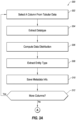
- FIG. 3A illustrates a flowchart of an example method 300 of extracting information for computing a metadata similarity value, in accordance with at least one embodiment described in the present disclosure.
- the method 300 may be performed by any suitable system, apparatus, or device with respect to the feature engineering system 100 of FIG. 1 , the metadata similarity module 230 in FIG. 2 , and/or the system 200 in FIG. 2 .
- the method 300 may include one or more blocks 302, 304, 306, 308, 310, and 312. Although illustrated with discrete blocks, the steps and operations associated with one or more of the blocks of the method 300 may be divided into additional blocks, combined into fewer blocks, or eliminated, depending on the particular implementation.
- the method 300 may begin at block 302.
- a column may be selected from tabular data.
- the tabular data may be in the form of a dataset that may include values that may be organized into column(s) where each of the columns may include a title.
- the feature engineering system 120 as described above in FIG. 1 above may be configured to select the column(s).
- the columns may be the same or similar to the columns 220 in FIG. 2 illustrated above. Additionally or alternatively, the column may be selected from the dataset that may be the same or similar to the dataset 210 in FIG. 2 and/or the dataset 110 in FIG. 1 as described and illustrated above.
- a data type may be extracted.
- the data type may be extracted by a system, device, or apparatus configured to extract the data type from the tabular data (e.g., the system 100 in FIG. 1 , the feature engineering system 120 in FIG. 1 , the system 200 via the metadata similarity module 230 as described above in FIG. 2 ).
- the data type may be extracted from the values in the columns selected from the tabular data.
- the data type may be a part of the metadata or may be extracted by analyzing characteristics of the values in the column to extract ethe data type.
- the data type may be one of an integer, double, float, floating point, string, character, boolean, or other data types that may describe the values in columns selected from the tabular data.
- a data distribution may be computed.
- the values in each of the columns selected from the tabular data may include descriptive metadata from which values describing the data distribution may be computed.
- each column may include a minimum value and a maximum value from which a range for each column may be computed by determining the difference between the maximum value and the minimum value.
- data distribution values may be computed from the values in the columns (e.g., a variance, a standard deviation, a mode, a median, a local maximum, a local minimum, a distribution of data, a shape of data, a correlation, a probability, a covariance, a skewness, and/or other values that may describe the data distribution of the columns).
- a characteristic type may be determined from the values from the columns in the tabular data.
- the characteristic type may include a length, an area, a location, a time, a volume, a quantity, a quality, a density, a level, a count, an amount, or another descriptor of the characteristic type of values in each of the columns.
- any suitable device or system may be configured to deduce or otherwise determine the characteristic type or characteristic types. For example, the system 200 described and illustrated in FIG. 2 or another device or system configured to perform operations as described in the metadata similarity module 230 illustrated in FIG. 2 .
- the data distribution values, data types, characteristic types, and other forms of metadata may be saved for each of the columns.
- the data types, the characteristic types, and the other forms of metadata (“the metadata") extracted and calculated as described in the method 300 may be stored and may be associated with each of the columns from which the metadata may be extracted.
- a determination may be made if more columns exist in the tabular data.
- the metadata from each of the columns may be extracted from the tabular data.
- a system may be configured to determine whether the metadata has been extracted from each of the columns and, if not, the system may select another column and may begin a process of extracting the metadata beginning at block 302.
- a determination may be made that there are no further columns in the dataset from which to extract metadata.
- the method 300 may continue to FIG. 3B as described and illustrated below.
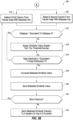
- FIG. 3B illustrates a flowchart of an example method 350 of determining a metadata similarity value, in accordance with at least one embodiment described in the present disclosure.
- the method 350 may be performed by any suitable system, apparatus, or device with respect the feature engineering system 100 of FIG. 1 , the metadata similarity module 230 in FIG. 2 , and the system 200 in FIG. 2 .
- the method 300 may include one or more blocks 318, 320, 322, 324, 326, 328, 330, 332, and 334. Although illustrated with discrete blocks, the steps and operations associated with one or more of the blocks of the method 350 may be divided into additional blocks, combined into fewer blocks, or eliminated, depending on the particular implementation.
- the method 350 may be a continuation of the method 300 as described and illustrated above in FIG. 3A .
- the method 350 may begin at block 318.
- a first column may be selected that includes extracted metadata.
- the extracted metadata may include at least one of the data type, the characteristic type, or other forms of metadata as described above in the method 300 and illustrated in FIG. 3A .
- a second column may be selected that includes extracted metadata.
- the extracted metadata may include at least one of the data type, the characteristic type, or other forms of metadata as described in the method 300 above and illustrated in FIG. 3A .
- the extracted metadata from the first selected column may include similar information to the extracted metadata from the second selected column.
- the extracted metadata from the first selected column may include a data type, a minimum, a maximum, a mean, and a characteristic type.
- the extracted metadata from the second selected column may include a data type, a minimum, a maximum, a mean, and a characteristic type.
- the extracted metadata from the first selected column may not be similar to the extracted metadata from the second selected column.
- a determination may be made as to whether the data type from the first selected column is equivalent to the data type from the second selected column.
- the data type from the first selected column may be an integer and the data type from the second selected column may also be an integer. Continuing the example, it may be determined that both data types are therefore equivalent.
- the data types may not be the same while remaining equivalent according to aspects of these embodiments. For example, one data type may be an integer while another data type be a float value. Further continuing the example, the data types may be equivalent even if the data types do not match because they may be comparable enough for the system to compare the values in the first column to the values in the second column. In some embodiments, the data types may not be equivalent.
- one data type may be an integer and another data type may be a string.
- the data types may not be equivalent because the integer may not be adequately comparable to the string such that a metadata similarity value may be determined. If the data types are equivalent, the method 350 may proceed to the block 324. If the data types are not equivalent, the method 350 may proceed to the block 326.
- a first data distribution may be equivalent to a second data distribution.
- the first data distribution may be equivalent to the second data distribution if the values in the first column may be comparable to the values in the second column.
- the first data distribution may include a range of values between 75-100 and the second data distribution may include a range of values from 60-115.
- the first range of values and the second range of values may be equivalent because the values from the first column and the values from the second column may be comparable.
- the first data distribution and the second data distribution may be equivalent based on any number of rules established to determine equivalence.
- one of the rules established to determine equivalence may include that the range of values in the first data distribution is on a similar scale to the range of values in the second data distribution.
- the range of values in the first data distribution may be equivalent to the range of values in the second data distribution if the larger of the range of values is less than twice that of the smaller of the range of values. For example, if the range of values in the first data distribution between a minimum and a maximum is 50 and the range of values in the second data distribution between a minimum and a maximum is 150 (more than twice that of the range of values in the first data distribution) the ranges of values may not be equivalent. If the data distributions are equivalent, the method 350 may proceed to the block 328. If the data distributions are not equivalent, the method 350 may proceed to the block 326.
- a similarity value greater than a threshold number may be assigned.
- the similarity value assigned between columns may be greater than the threshold value if the data type of the values in the first column is not equivalent to the data type of the values in the second column.
- one data type may be a floating point and another data type may be a string.
- the floating point and the string may not be comparable and, therefore, the similarity value may be assigned a greater value than the threshold value which may indicate that the values may not be similar.
- a similarity value may range between zero and infinity, where a value of infinity may indicate no similarity whatsoever.
- the similarity value may range between zero and one, where one may indicate no similarity whatsoever.
- the system via the feature engineering function, may not generate new values for a new column when the similarity value above a threshold is assigned.
- a distance may be computed between the values in the first column and the values in the second column.
- the distance between the columns may be used to determine the metadata similarity value between the columns.
- the values in the first selected column may be strings and the values in the second selected column may be strings. Additionally or alternatively, the distance may be determined by converting the strings in the first column into a vector and the strings in the second column into a vector.
- the distance between the vectors may be determined using a Levenshtein distance, a cosine distance, or another mathematical similarity function configured to calculate the distance between the vectors representative of the values in the columns. In some embodiments, the distance calculated may be used to determine the metadata similarity value between the values in the first column and the values in the second column.
- a metadata similarity value may be determined between extracted metadata associated with the first column and the second column.
- the metadata similarity value may be determined based on at least one of the distance between vectors, a distribution similarity between data distributions associated with the first column and the second column respectively, and a data type similarity between the first and second columns.
- the metadata similarity value may be determined based on a previously determined threshold value. For example, it may have been previously determined that the threshold value be "2" and therefore a metadata similarity value assigned over "2" may indicate that the extracted metadata between the first and second selected columns may not be similar or, at least, the extracted metadata between the first and second columns may not be similar enough to include in a cluster as illustrated below in FIG. 9 .
- the metadata similarity value may be saved.
- the metadata similarity value may be saved such that the metadata similarity value may be associated with the first and second columns.
- the metadata similarity value may be saved such that the metadata similarity value may be saved with other metadata similarity values each associated with a pair of columns. For example, there may be a metadata similarity value illustrating a similarity between the first column 220a and the second column 220b which may be saved with another metadata similarity value illustrating the similarity between the second column 220b and the nth column 220n.
- the tabular data may include columns that may each be compared to determine the metadata similarity value between each pair of the columns.
- the tabular data may have three columns, the first column 220a, the second column 220b, and the nth column 220n.
- the method 300 may compare the first column 220a and the second column 220b, the first column 220a and the nth column 220n, and the second column 220b and the nth column 220n.
- the determination may be made whether each of those comparisons have yet been made. If the comparisons have been made, the method 350 may proceed to the block 334 and, if not, the method 350 may return to the block 318 and/or may return to the block 302 of the method 300.
- Metadata similarity values may be sent to a system or may be used in a function to create a total similarity value as illustrated in FIGs. 1 , 2 , and 9 .
- FIG. 4 illustrates a flowchart of an example method 400 of determining a semantic similarity value between a pair of columns in a dataset, in accordance with at least one embodiment described in the present disclosure.
- the method 400 may be performed by any suitable system, apparatus, or device with respect to the feature engineering system 100 of FIG. 1 , the semantic similarity module 240 in FIG. 2 , and the system 200 in FIG. 2 .
- the method 400 may include one or more blocks 410, 420, 430, 440, 450, 460, 470, and 480. Although illustrated with discrete blocks, the steps and operations associated with one or more of the blocks of the method 400 may be divided into additional blocks, combined into fewer blocks, or eliminated, depending on the particular implementation.
- the method 400 may start at block 410.
- a pair of columns may be selected from a dataset.
- the pair of columns selected from the dataset may include a pair of columns which may each include a title.
- the titles may describe values in each of the columns of the dataset. For example, one value in one of the columns may be 150 and the corresponding title may be "Price per Square Foot" which may describe the value(s).
- a first title in a first column and a second title from a second column may be extracted from the dataset.
- the first title in the first column and the second title in the second column may not be the same. Additionally or alternatively, the first title and the second title may be the same.
- the first title in the first column may be abbreviated.
- the first title may be "GarageYrBlt" which may be an abbreviated form of "Garage Year Built.”
- the first title may be converted into a first vector and the second title may be converted into a second vector.
- the first title and the second title may be converted into the first vector and the second vector, respectively, using an embedding function.
- the embedding function may include Word2Vector, Bidirectional Encoder Representations from Transformers-Embedding ("BERT-Embedding"), Generative Pre-trained Transformer (“GPT-Embedding”), and any other function capable of converting titles into vectors.
- the first vector may include a numerical representation of the words in the first title and the second vector may include a numerical representation of the words in the second title.
- a distance between the first vector and the second vector may be computed.
- the distance between the first vector and the second vector may be computed using a similarity function.
- the similarity function may be a cosine similarity function, a Euclidean distance function, or any other function designed to determine the distance between two vectors.
- the distance computed between the first vector and the second vector may be used to determine whether the first title in the first column and the second title in the second column may be similar.
- a smaller distance between the first vector and the second vector may be an indicator that the first title and the second title may be similar.
- the first title may be "1stFlrSF” which may be an abbreviated form of "First Floor Square Feet” and the second title may be "2ndFlrSF” which may be an abbreviated form of "Second Floor Square Feet.”
- the first title and the second title may be converted into the first vector and the second vector and the distance computed between the first vector and the second vector may be 0.25.
- the first title may be "1stFlrSF” and the second title may be "HousingPrice.”
- the first title may be converted into the first vector and the second title may be converted into the second vector and the distance computed between the first vector and the second vector may be 1.25.
- the distance computed in the first example may be smaller than the distance computed in the second example which may indicate that there may be a greater similarity in the first example between the first title and the second title than may be between the first title and the second title in the second example.
- a sematic similarity value may be determined based on the computed distance between the first vector and the second vector.
- the semantic similarity value may be the same as the computed distance between the first vector and the second vector.
- the computed distance between the first vector and the second vector may be converted into the semantic similarity value based on a number of factors including the distance between the first vector and the second vector.
- the semantic similarity value may be determined based on the distance between the first vector and the second vector in addition to a comparison between predicted units of measurement associated with the first column and the second column.
- the dataset may include a first column and a second column where the first column may have a title, "salary” which may describe values in the first column and the second column may have a title, "overall” which may describe values in the second column.
- the values in the first and second columns both have a predicted unit of "dollars” that may be predicted using a method according to various embodiments described below with respect to FIGs. 5-8 .
- it may be determined that the distance between the first title "salary” and the second title “overall” may be relatively high which may indicate that the first column and the second column may not be similar.
- the semantic similarity value between the first column and the second column may be lower than the semantic similarity value may have been using the distance between the first title and the second title alone, which may indicate that the first column and the second column may be similar.
- a determination may be made whether the first column and the second column are to be considered similar. In some embodiments, the determination may be based on whether or not a semantic similarity value is below a threshold. For example, the distance between the first vector and the second vector may be determined. If the distance is above a threshold value, the first column and the second column may not be similar. If it is determined that the first and second columns are not to be considered similar, the method 400 may proceed to the block 470. If it is determined that the first and second column are to be considered similar, the method 400 may proceed to the block 480.
- a determination may be made if more columns exist to compare.
- each of the columns may be compared to each other.
- the dataset may include a first column, a second column, and a third column.
- the first column may be compared to the second column and the third column, and the second column may be compared to the third column.
- a determination may be made after each comparison whether all columns have been compared. If there are additional pairs for analysis, the method 400 may return to the block 410 to consider another pair of columns. If there are no additional pairs of columns for analysis, the method may end.
- the semantic similarity value determined at block 450 may be saved.
- the semantic similarity value may be saved such that the semantic similarity value may be associated with the pair of columns.
- the semantic similarity value may be saved which may be used by a feature engineering function along with a data similarity value and a metadata similarity value to determine whether the pair of columns may be clustered together as described and illustrated in FIG. 9 , below.
- the method 400 may proceed to the block 470 to determine if there are any additional pairs of columns for analysis of any remaining pairs of columns.
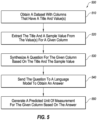
- FIG. 5 illustrates a flowchart of an example method 500 of generating a predicted unit of measurement for a value in the dataset, in accordance with at least one embodiment described in the present disclosure.
- the method 500 may be performed by any suitable system, apparatus, or device with respect to the feature engineering system 100 of FIG. 1 , the unit similarity module 250 in FIG. 2 , and the system 200 in FIG. 2 .
- the method 500 may include one or more blocks 510, 520, 530, 540, and 550. Although illustrated with discrete blocks, the steps and operations associated with one or more of the blocks of the method 500 may be divided into additional blocks, combined into fewer blocks, or eliminated, depending on the particular implementation.
- the method 500 may start at block 510.
- a dataset may be obtained that may include column(s) with a title/or and value(s). Examples of such a dataset are illustrated as the dataset 210 illustrated in FIG. 2 and/or the dataset 110 illustrated in FIG. 1 .
- the title and the value(s) may be extracted from the columns.
- the title and the values may be extracted from the columns in combination such that the system may be configured to synthesize a question that may include both the title and the values as discussed at block 530 below.
- a question may be synthesized based on the title and the value(s).
- the question may be synthesized as a natural language question.
- the question may be synthesized such that the question may elicit a response that may include a predicted unit of measurement for the values.
- the question synthesized may include "what is the unit of [the value(s)]?” which may be drafted to elicit a response that includes the unit of measurement for the values in the column.
- the question synthesized may be drafted with the value(s) and the title such that the question may provide some additional context to the question.
- the title of a column may be "Basement Square Feet” and the value in the column may be 1,000. Further continuing the example, the question synthesized may include "The Basement Square Feet is 1,000, what is the unit of Basement Square Feet?" In these and other embodiments, the title of the column may be abbreviated, for example, instead of the title being "Basement Square Feet," the first title may be "BmtSF.” Therefore, as illustrated in the above example, the question synthesized may be "The BmtSF is 1,000, what is the unit of BmtSF?" In these and other embodiments, the question synthesized may be based on other considerations which may include a column description, an expanded title, a number of sample questions, a machine learning task description, a number of question-answer examples, and other relevant considerations as illustrated and described further in FIG. 7 , below.
- the question synthesized may be sent to a language model to obtain an answer.
- the question may be sent to the language model such that the language model may generate an answer to the question that may include a predicted unit of measurement.
- the language model may include a pre-trained large language model which may include language models such as Generative Pre-Trained Transformer 3 ("GPT3"), Bidirectional Encoder Representations from Transformers (“BERT”), Robustly Optimized Bidirectional Encoder Representations from Transformers (“RoBERTa”), Text-to-Text Transfer Transformer (“T5"), and other language models designed to receive the question synthesized and provide an answer that may include a predicted unit of measurement.
- GPT3 Generative Pre-Trained Transformer 3
- BERT Bidirectional Encoder Representations from Transformers
- RoBERTa Robustly Optimized Bidirectional Encoder Representations from Transformers
- T5 Text-to-Text Transfer Transformer
- a larger language model may more accurately answer the question synthesized.
- a T5-11b language model includes 11 billion parameters that the language model may attempt to improve during training whereas a T5-Small language model includes 60 million parameters that the language model may attempt to improve during training.
- the T5-11b language model may be trained using a larger dataset than, for example, a T5-Small language model and therefore the T5-11b language model may be better suited to answer the question accurately than the T5-Small language model.
- a predicted unit of measurement may be generated based on the answer.
- one question may be synthesized and sent to the language model and the language model may provide the predicted unit of measurement as the answer to the synthesized question.
- questions may be generated based on values and a title in the column.
- the language model may be configured to receive multiple questions for multiple values in a given column, or even each of the values in the given column.
- the language model may be configured to provide an answer to each of the questions.
- the predicted unit of measurement may be selected based on agreement from a majority of the answers provided by the language model for multiple questions.
- the first column may include a first title, a first value, a second value, and a third value.
- a first question may be synthesized based on the first title and the first value
- a second question may be synthesized based on the first title and the second value
- a third question may be synthesized based on the first title and the third value.
- Each of the first question, second question, and third question may be sent to the language model, and the language model may provide a first answer to the first question, a second answer to the second question, and a third answer to the third question.
- the first answer and the second answer may be the same and the third answer may be different.
- the majority answer e.g., the first answer and the second answer
- FIG. 6 illustrates a flowchart of an example method 600 of determining a unit similarity value between two predicted units, in accordance with at least one embodiment described in the present disclosure.
- the method 600 may be performed by any suitable system, apparatus, or device with respect to the feature engineering system 100 of FIG. 1 , the unit similarity module 250 in FIG. 2 , and the system 200 in FIG. 2 .
- the method 600 may include one or more blocks 602, 604, 606, 608, 610, 612, 614, and 616. Although illustrated with discrete blocks, the steps and operations associated with one or more of the blocks of the method 600 may be divided into additional blocks, combined into fewer blocks, or eliminated, depending on the particular implementation.
- the method 600 may start at blocks 602 and 604.
- a first column may be selected from a dataset and at block 604 a second column may be selected from the dataset.
- the first column and the second column may each include a title and a value where the values in the first column may have a unit of measurement and the values in the second column may have a unit of measurement.
- a prompt may be generated.
- the prompt generated may be the question synthesized as described and illustrated in method 500 at block 530 above.
- the prompt may be generated in accordance with considerations that may be used to synthesize a question as detailed and illustrated in method 700 in FIG. 7 below.
- considerations may include a number of sample column values, a column description, an expanded column name, a machine learning task description, example question-answer pairs, and other forms of information that may be useful in generating the prompt sent to the language model and that may be designed to elicit an answer that may include a unit of measurement.
- the prompt may be generated to receive an answer from a language model where the language model may be predicting a unit of measurement for the values in the first column and a unit of measurement for the values in the second column.
- the values in the first column may include a value, 1,050, where the value does not include a unit of measurement.
- the prompt may be generated and may include a question that may be designed to elicit a response and the response may include a predicted unit of measurement for the value.
- the prompt may include the following: "What is the unit of measurement for 1,050?" Additionally or alternatively, the prompt may include additional information, for example, the title of the first column, the column description, the expanded column name, the machine learning task description, example question-answer pairs, and other forms of information.
- the title of the first column may be "TotSF” and the machine learning task description may be "predict housing prices” and, with that additional information the prompt may be: “To predict housing prices, TotSF is 1,050. What is the unit of TotSF?"
- the prompt may be designed to elicit a predicted unit of "square feet.”
- the prompt may include a masked unit such that the prompt may be designed to have the masked unit replaced by the predicted unit of measurement.
- the values in the first column may be used in a prompt that may include a masked unit.
- the values in the second column may be used in a second prompt that may include another masked unit.
- the first column may have a value (1232), a title ("Bsmt total SF"), and a masked unit such that the prompt may be drafted as shown below:
- a predicted unit for the first column and a predicted unit for the second column may be provided.
- the prompt as detailed above at block 608 may be sent to a language model.
- the language model may be pre-trained such that the language model may be capable of generating the predicted unit of measurement for the first column.
- the language model may include language models such as GPT3, BERT, RoBERTa, and other language models designed to receive the prompt and provide the predicted unit of measurement as detailed and illustrated further in method 500 in FIG. 5 above.
- the language model may provide several predicted units of measurement for the predicted unit of measurement for the first column.
- the prompt may be "The [MASK] is 1232 Bsmt total SF" and the language model may provide four possible units where the language model may assign an associated probability that each of the four possible units may be correct.
- the language model may answer with the following units of measurement:
- a unit similarity value may be saved.
- the unit similarity value may be determined based on how similar the first predicted unit of measurement may be to the second predicted unit of measurement.
- the unit similarity value may either be one or zero which may depend on if the predicted units of measurement match. For example, the predicted unit of measurement may be "square feet" which may match another predicted unit of measurement that may also be “square feet.” Because the predicted units of measurement match, the unit measurement similarity value may be "0" between the predicted units of measurement.
- the first predicted unit of measurement may be "square feet" and the second predicted unit of measurement may be “square meters.”
- the unit measurement similarity value may be "1.”
- the unit measurement similarity value may be a value between zero and one which may depend on how similar the predicted units of measurement may be. For example, one predicted unit of measurement may be "square feet" and another predicted unit of measurement may be "square foot.” Unlike the example above, where the predicted units of measurement may be given a similarity value of one because the predicted units of measurement may not match, here a similarity value of between zero and one may be given to show how similar or dissimilar the predicted units of measurement may be.
- a text normalization process may be implemented to increase the accuracy of comparing the predicted units of measurement.
- one predicted unit of measurement was "square feet" and another predicted unit of measurement was “square foot.”
- the predicted units of measurement may be different in that "feet” may different from “foot” but practically, there may be no difference.
- the text normalization process may allow for a more accurate unit similarity value by identifying and normalizing certain textual terms to be consistent with each other (e.g., foot and feet both become feet).
- a predicted unit similarity value approaching zero may illustrate that the predicted units of measurement may be more similar than dissimilar while a predicted unit similarity value approaching one may illustrate that the predicted units of measurement may be more dissimilar than similar.
- a determination may be made as to whether other pairs of columns may be available to compare from the dataset.
- the dataset may include a number of columns where each of the number of columns may be compared to each of the other columns in the number of columns. If no other pairs of columns to compare in the dataset, the method 600 may proceed to the block 616, where the method 600 may end. If yes, the method 600 may return to the blocks 602 and 606 where a first column and a second column may be selected for comparison.
- FIG. 7 illustrates a flowchart of an example method 700 of generating a number of questions for the language model, in accordance with at least one embodiment described in the present disclosure.
- the method 700 may be performed by any suitable system, apparatus, or device with respect to the feature engineering system 100 of FIG. 1 , the unit similarity module 250 in FIG. 2 , and the system 200 in FIG. 2 .
- the method 700 may include one or more blocks 702, 704, 706, 708, 710, 712, 714, 716, 718, 720, 722, and 724. Although illustrated with discrete blocks, the steps and operations associated with one or more of the blocks of the method 700 may be divided into additional blocks, combined into fewer blocks, or eliminated, depending on the particular implementation.
- the method 700 may start at block 702.
- a column may be extracted from tabular data.
- the tabular data may include a dataset that may be separated into any number of columns where the columns may each include a title and/or value(s).
- sample values may be extracted from the columns.
- the column may include values from which sample values may be extracted.
- the column may include 1,500 total values and, from those 1,500 values, five sample values may be extracted and may be used to synthesize one question for each of the five sample values.
- the five sample values may be randomly selected. Additionally or alternatively, the five sample values may be the five most common values in the column.
- each of the five sample values selected may include different sample values such that the questions synthesized may include different sample values.
- the five sample questions may be drafted to elicit five answers that may each include a predicted unit of measurement.
- each of the five questions synthesized may be sent to a language model that may be trained to answer the five questions with five corresponding answers, each of the five answers may include a predicted unit of measurement.
- a column title may be extracted.
- each of columns may have a title and each title from each of the columns may be extracted.
- a determination may be made as to whether a column description may be available.
- one or more of the columns in the dataset may include a column description that may provide additional information regarding a meaning of variables, titles, values, and other components of the columns in the dataset.
- the column description may provide additional context with which the questions for the language model may be synthesized. If the column description is available, the method 700 may proceed to block 710. If the column description is not available, the method 700 may proceed to block 712.
- the column description may be extracted such that the column descriptions may be used to facilitate generation of questions.
- the column description may provide context for the given column.
- a column may include a title which may be an abbreviated title: "OveralQual.”
- the column may additionally include a column description where the column description explains, for example, that the first title "OveralQual” may describe "Overall material and finish quality.”
- the column description may be used in the method 700 to generate questions that may include additional context, such as an explanation for the abbreviated title "OveralQual” in the column.
- the column description may be used to generate the number of questions instead of the title in the column, or may be used in conjunction with the title in the column.
- the column name may be abbreviated in the dataset for a variety of reasons including efficiency, space used, etc. In these and other embodiments, it may be determined that the column name may be abbreviated.
- the column name may be "GrgeYrBlt" which may be an abbreviated form of "Garage Year Built.” If the column name is abbreviated, the method 700 may proceed to block 714. If the column name is not abbreviated, the method 700 may proceed to block 716.
- the column name may be expanded.
- the column name may be "GrgeYrBlt,” which may be automatically expanded to be "Garage Year Built.”
- the expanded column name may be used to generate questions at block 722 where the expanded column name may be used to provide additional information and additional context with which the language model generates an answer that may provide a basis for a predicted unit of measurement for the values in the associated column.
- the original column name may be used.
- the column name may be determined to be abbreviated at block 712 but may also not have an identifiable expanded name and, in such a circumstance, the original column name may be used to generate questions at block 722.
- the column name may be "Xlt" which may be an abbreviated column name, but an expanded version of the abbreviated column name may not be readily identifiable. In that instance, "Xlt" may be used to generate questions at block 722.
- a machine learning task description may be identified.
- an improved dataset with additional features as a result of the methods described in Figs. 3-7 and illustrated as systems in FIGs. 1 , 2 , and 10 may be used to train a machine learning model to complete a task more quickly, effectively, and/or efficiently.
- the task or target description of the machine learning problem may be known.
- the known task or target description may be used to generate a question drafted to elicit an answer of a predicted unit of measurement that may be targeted to completing the known task.
- the task description for the machine learning model may be to "predict residential housing price” and a column name in the dataset may be “GarageArea.”
- the question generated may include the machine learning task as context: "to predict the residential housing price, what is the unit of GarageArea?"
- the additional context provided as a result of using the known task description may increase the ability of the language model to accurately predict a unit of measurement for the values in the first column.
- example question-answer pairs may be generated.
- the example question-answer pairs may be generated to provide examples to the language model such that the language model may be able to more readily and accurately answer the questions generated at block 722.
- the question-answer pairs may include different units.
- the question-answer pairs may include the same units. For example, the number of question-answer pairs generated may include the following:
- questions may be generated.
- the questions generated may be generated based on one or more of the column sample values extracted at block 704, the column description at block 710, the expanded column name at block 714, the original column name at block 716, the machine learning task description at block 718, and the question-answer pairs generated at block 720.
- the questions generated may be generated to send to the language model in a form like the following:
- the method 700 used to generate questions to send to the language model may end.
- FIG. 8 illustrates a flowchart of an example method 800 of determining the predicted unit of measurement via majority voting, in accordance with at least one embodiment described in the present disclosure.
- the method 800 may be performed by any suitable system, apparatus, or device with respect to the feature engineering system 100 of FIG. 1 , the unit similarity module 250 in FIG. 2 , and the system 200 in FIG. 2 .
- the method 800 may include one or more blocks 810, 820, 830, 840, 850, 860, and 870. Although illustrated with discrete blocks, the steps and operations associated with one or more of the blocks of the method 800 may be divided into additional blocks, combined into fewer blocks, or eliminated, depending on the particular implementation.
- the method 800 may start at block 810.
- questions may be synthesized.
- the questions synthesized may be the same questions as those generated in method 700 (e.g., at block 722).
- the questions synthesized may be based on a number of sample values extracted from a column.
- the questions synthesized may be configured to be sent to a language model and may be drafted to elicit an answer from the language model where the answer from the language model may be used to generate a predicted unit of measurement for the column.
- the language model may be configured to receive the questions synthesized.
- the language model may be configured to answer each of the questions synthesized where the answer to each of the questions synthesized may include a unit of measurement.
- the dataset may include columns where questions may be synthesized for each of the columns to predict a unit of measurement for values in each of the columns.
- the language model may include language models as described and illustrated above in FIG. 5 .
- the answers may be received from the language model.
- each of the questions may be drafted to elicit an answer that includes a unit of measurement.
- a determination may be made as to whether enough questions have been answered by the language model.
- whether the number of questions answered is enough may be based on a threshold number of questions.
- the threshold number of questions may be based on a number of values in the first column.
- the threshold number of questions may be based on a determined effectiveness of the language model. For example, if the language model has been proven to provide an answer that includes a correct predicted unit of measurement at a rate of 50%, the threshold number of questions may be higher than a language model that has proven to provide an answer that includes a correct predicted unit of measurement at a rate of 80%.
- the threshold number of questions may be determined based on using a majority vote method of determining a predicted unit of measurement.
- the language model may provide several different answers (e.g. for questions with different sample values) and the predicted unit of measurement may be selected based on a majority agreement of the several answers given from the language model.
- a number of answers to achieve the best answer may be predefined.
- the predefined number of answers to achieve the best answer may indicate a corresponding number of questions that may be synthesized and answered by the language model.
- the predefined number of answers to achieve the best answer may be three.
- the corresponding number of questions that may be synthesized and answered by the language model may be three to five questions. If enough questions have been processed, the method 800 may proceed to block 860. If not, the method 800 may proceed to block 850.
- an additional question may be synthesized to send to the language model.
- the additional question synthesized may be synthesized using a different sample value than the sample values that may have already been used to synthesize the questions that may have been sent to the language model. For example, a first question synthesized based on a first sample value from the first column and a second question synthesized based on a second sample value from the first column may have been sent to the language model. Further continuing the example, an additional question may be synthesized where the additional question may be generated based on a third sample value from the first column.
- a determination may be made as to whether a best answer has been provided through the majority vote method.
- the best answer may be provided through the majority vote method if a majority of the answers provided by the language model agree. For example, one of the questions synthesized may be "what is the unit of measurement for Price per Square Foot?" Continuing the example, three answers may be provided by the language model: “dollar,” “square feet,” and “dollar.” Because there is a majority answer (e.g., "dollar”), enough questions may have been answered by the language model. As another example, five answers may be provided by the language model and three answers of the five answers may include "dollars" as the predicted unit of measurement.
- the determination may be made in the affirmative that the best answer had been provided through the majority vote method. If there is a best answer, the method 800 may proceed to the block 870. If there is not a best answer, the method 800 may proceed to the block 850 to synthesize an additional question.
- the best answer may be determined based on the majority vote method.
- the language model may provide an answer to each of the number of questions synthesized such that there may be several answers corresponding to the questions.
- a majority of the answers provided by the language model may be the same and, in that instance, the answer for the predicted unit of measurement may be the majority of the answers provided by the language model.
- FIG. 9 illustrates a flowchart of an example method 900 of generating a new column with new values to add to the dataset, in accordance with at least one embodiment described in the present disclosure.
- the method 900 may be performed by any suitable system, apparatus, or device with respect to the feature engineering system 100 of FIG. 1 , the cluster module 260 in FIG. 2 , and the system 200 in FIG. 2 .
- the feature engineering system 100 of FIG. 1 and the system 200 of FIG. 2 may include one or more blocks 910, 920, 930, 940, and 950. Although illustrated with discrete blocks, the steps and operations associated with one or more of the blocks of the method 900 may be divided into additional blocks
- the method 900 may start at block 910.
- a dataset may be obtained that may have columns where each column may include a title and value(s) in each of the columns.
- a total similarity value may be determined between pairs of columns.
- the columns may be compared in pairs of columns where each may be compared to each of the other columns in the dataset.
- a column in the dataset may be compared to another column in the dataset to determine the total similarity value between the pair of columns.
- the total similarity value may be based on at least one of the metadata similarity value, the semantic similarity value, and the unit similarity value. Additionally or alternatively, the total similarity value may be based on all three of the metadata similarity value, the semantic similarity value, and the unit similarity value.
- the metadata similarity value may be determined and obtained as illustrated and described in FIGs.
- the semantic similarity value may be determined and obtained as illustrated and described in FIGs. 2 and/or 4. Additionally or alternatively, the unit similarity value may be determined and obtained as illustrated and described in FIGs. 2 , and/or 5-8.
- the total similarity value may be determined by adding each of the metadata similarity value, the semantic similarity value, and the unit similarity value together.
- the metadata similarity value may be 0.25
- the semantic similarity value may be 1.0
- the unit similarity value may be 0.75 and therefore the total similarity value may be 2.0.
- the total similarity value may include averaging the respective similarity values, using a weighted average, or any other combinatorial technique.
- the columns may be added to a cluster based on the total similarity value.
- each of the columns may be added to the cluster based on the total similarity values between each of the pairs of columns in the dataset.
- each of the columns may be added to the cluster based on a threshold similarity value.
- the total similarity value between the first column and the second column may be 2.0 as described above, and the threshold similarity value may be 3.0. Further continuing the example, because 2.0 may be less than 3.0, the first column and the second column may be added to the cluster.
- the threshold similarity value may be based on an nth smallest distance between all of the columns in the dataset.
- the columns may be clustered based on the nth smallest distance between the other columns in the dataset where "n" may be any number of values.
- the columns in the dataset may be clustered using a K-means clustering method or a K Nearest Neighbor Clustering method where K may be any number of values (e.g., 1, 2, 3, etc.). Additionally or alternatively, the columns may be clustered using any number of different clustering methods where the columns may be clustered based on the total similarity value between columns.
- a new column may be generated using a feature engineering function.
- the new column may be added to the cluster.
- the first cluster may include first values in a first column and second values in a second column.
- the feature engineering function may generate new values in the new column by performing a mathematical operation on at least the first values.
- the feature engineering function may generate the new values by performing a mathematical operation on both the values in the first column and the values in the second column. For example, the feature engineering function may add, subtract, divide, multiply, or use any other mathematical function that may create the new values in the new column using the values in the first column and/or the values in the second column.
- the values in the first column may illustrate "finished household square feet" and the values in the second column may illustrate "unfinished household square feet.”
- the first column may be clustered together with the second column, and the feature engineering function may create new values in a new column of "total household square feet.”
- the feature engineering function may create the new values by adding the values in the first column to the values in the second column.
- the new column may then be clustered together with the first column and the second column.
- the new column may be added to the dataset.
- the dataset may be used to train a machine learning system. Additionally or alternatively, the dataset including the new column may be used in a machine learning pipeline where a number of machine learning systems may be trained.
- FIG. 10 illustrates a block diagram of an example computing system 1002, according to at least one embodiment of the present disclosure.
- the computing system 1002 may be configured to implement or direct one or more suitable operations described in the present disclosure.
- the computing system 1002 may be used in various elements of the above disclosure (e.g., feature engineering system 120, machine learning system 140, and feature engineering system 260, or other systems capable of performing one or more operations or actions in the disclosed embodiments).
- the computing system 1002 may be used to control operations related to generating a new column for a new dataset.
- the computing system 1002 may be used to train a machine learning model using the new dataset.
- the computing system 1002 may include a processor 1050, a memory 1052, and a data storage 1054.
- the processor 1050, the memory 1052, and the data storage 1054 may be communicatively coupled.
- the processor 1050 may include any suitable computer, computing entity, or processing device including various computer hardware or software modules and may be configured to execute instructions stored on any applicable computer-readable storage media.
- the processor 1050 may include a microprocessor, a microcontroller, a digital signal processor (DSP), an application-specific integrated circuit (ASIC), a Field-Programmable Gate Array (FPGA), or any other digital or analog circuitry configured to interpret and/or to execute program instructions and/or to process data.
- DSP digital signal processor
- ASIC application-specific integrated circuit
- FPGA Field-Programmable Gate Array
- the processor 1050 may include any number of processors configured to, individually or collectively, perform or direct performance of any number of operations described in the present disclosure. Additionally, one or more of the processors may be present on one or more different electronic devices, such as different servers.
- the processor 1050 may be configured to interpret and/or execute program instructions and/or process data stored in the memory 1052, the data storage 1054, or the memory 1052 and the data storage 1054. In some embodiments, the processor 1050 may fetch program instructions from the data storage 1054 and load the program instructions in the memory 1052. After the program instructions are loaded into memory 1052, the processor 1050 may execute the program instructions.
- the memory 1052 and the data storage 1054 may include computer-readable storage media for carrying or having computer-executable instructions or data structures stored thereon.
- computer-readable storage media may include tangible or non-transitory computer-readable storage media including Random Access Memory (RAM), Read-Only Memory (ROM), Electrically Erasable Programmable Read-Only Memory (EEPROM), Compact Disc Read-Only Memory (CD-ROM)or other optical disk storage, magnetic disk storage or other magnetic storage devices, flash memory devices (e.g., solid state memory devices), or any other non-transitory storage medium which may be used to store particular program code in the form of computer-executable instructions or data structures and which may be accessed by a general-purpose or special-purpose computer.
- RAM Random Access Memory
- ROM Read-Only Memory
- EEPROM Electrically Erasable Programmable Read-Only Memory
- CD-ROM Compact Disc Read-Only Memory
- flash memory devices e.g., solid state memory devices
- non-transitory as explained in the present disclosure should be construed to exclude only those types of transitory media that were found to fall outside the scope of patentable subject matter in the Federal Circuit decision of In re Nuijten, 500 F.3d 1346 (Fed. Cir. 2007).
- Computer-executable instructions may include, for example, instructions and data configured to cause the processor 1050 to perform a certain operation or group of operations.
- the computing system 1002 may include any number of other components that may not be explicitly illustrated or described.
- Embodiments described in the present disclosure may be implemented using computer-readable media for carrying or having computer-executable instructions or data structures stored thereon.
- Such computer-readable media may be any available media that may be accessed by a general purpose or special purpose computer.
- Such computer-readable media may include non-transitory computer-readable storage media including Random Access Memory (RAM), Read-Only Memory (ROM), Electrically Erasable Programmable Read-Only Memory (EEPROM), Compact Disc Read-Only Memory (CD-ROM) or other optical disk storage, magnetic disk storage or other magnetic storage devices, flash memory devices (e.g., solid state memory devices), or any other storage medium which may be used to carry or store desired program code in the form of computer-executable instructions or data structures and which may be accessed by a general purpose or special purpose computer. Combinations of the above may also be included within the scope of computer-readable media.
- Computer-executable instructions may include, for example, instructions and data, which cause a general-purpose computer, special purpose computer, or special purpose processing device (e.g., one or more processors) to perform a certain function or group of functions.
- any disjunctive word or phrase presenting two or more alternative terms, whether in the description, claims, or drawings, should be understood to contemplate the possibilities of including one of the terms, either of the terms, or both terms.
- the phrase “A or B” should be understood to include the possibilities of "A” or “B” or “A and B.”
Landscapes
- Engineering & Computer Science (AREA)
- Theoretical Computer Science (AREA)
- Physics & Mathematics (AREA)
- Databases & Information Systems (AREA)
- General Physics & Mathematics (AREA)
- Data Mining & Analysis (AREA)
- Mathematical Physics (AREA)
- General Engineering & Computer Science (AREA)
- Computational Linguistics (AREA)
- Artificial Intelligence (AREA)
- Human Computer Interaction (AREA)
- Quality & Reliability (AREA)
- Information Retrieval, Db Structures And Fs Structures Therefor (AREA)
Abstract
Description
- The embodiments discussed in the present disclosure are related to unit prediction for custom feature engineering (FE).
- Unless otherwise indicated in the present disclosure, the materials described in the present disclosure are not prior art to the claims in the present application and are not admitted to be prior art by inclusion in this section.
- Machine learning systems may be used in many technology sectors including but not limited to financial technologies, eCommerce, social media, gaming, facial recognition, and autonomous driving. These machine learning systems may be able to receive an input that may allow the system to learn and adapt to different sets of circumstances. In many cases, the input that the machine learning system may be able to receive may be a set or sets of data.
- The subject matter claimed in the present disclosure is not limited to embodiments that solve any disadvantages or that operate only in environments such as those described above. Rather, this background is only provided to illustrate one example technology area where some embodiments described in the present disclosure may be practiced.
- This Summary is provided to introduce a selection of concepts in a simplified form that are further described below in the Detailed Description. This Summary is not intended to identify key features or essential characteristics of the claimed subject matter, nor is it intended to be used as an aid in determining the scope of the claimed subject matter.
- One or more embodiments of the present disclosure may include a method. The method may include obtaining a dataset that may include at least a first column and a second column, and where the first column may include a first title and a first value and the second column may include a second title and a second value. Additionally, the method may include determining a total similarity value between the first column and the second column which may be based on at least one of a metadata similarity value, a semantic similarity value, and a unit of measurement similarity value. The method may additionally include adding the first column and the second column to a cluster if the total similarity value is less than a threshold value. Further, the method may include generating a new column to add to the cluster that may be done by using a feature engineering function, where the new column may include a new title and a new value, the new value may be determined by using the feature engineering function by acting on at least one of the first value of the first column and the second value of the second column. Additionally, the method may include, adding the new column to the dataset.
- One or more embodiments of the present disclosure may include a method. The method may include obtaining a dataset having one or more columns, each of the one or more columns may include a title and at least one value. The method may additionally include extracting, for each of the one or more columns, the title and a sample value from the at least one value. Furthermore, the method may include, synthesizing a question based on the title and the sample value for each of the one or more columns. The method may additionally include, sending the question to a language model to obtain an answer; and further, the method may include, generating from the answer to the question, a predicted unit of measurement for the at least one value in each of the one or more columns.
- The object and advantages of the embodiments will be realized and achieved at least by the elements, features, and combinations particularly pointed out in the claims. It is to be understood that both the foregoing general description and the following detailed description are exemplary and explanatory and are not restrictive of the invention, as claimed.
- Example embodiments will be described and explained with additional specificity and detail through the use of the accompanying drawings in which:
-
FIG. 1 illustrates an example embodiment of a system that can utilize automated custom feature engineering; -
FIG. 2 illustrates an example embodiment of a system configured to generate a number of new columns to add to a dataset; -
FIG. 3A illustrates a flowchart of an example method of extracting information for computing a metadata similarity value; -
FIG. 3B illustrates a flowchart of an example method of determining a metadata similarity value; -
FIG. 4 illustrates a flowchart of an example method of determining a semantic similarity value; -
FIG. 5 illustrates a flowchart of an example method of generating a predicted unit of measurement for a value in a dataset; -
FIG. 6 illustrates a flowchart of an example method of determining a unit similarity value between two predicted units; -
FIG. 7 illustrates a flowchart of an example method of generating a number of questions for a language model; -
FIG. 8 illustrates a flowchart of an example method of determining a predicted unit of measurement via majority voting; -
FIG. 9 illustrates a flowchart of an example method of generating a new column with new values to add to a dataset; and -
FIG. 10 illustrates a block diagram of an example computing system, all arranged in accordance with some embodiments of the present disclosure. - Machine learning systems and algorithms are increasingly used in a number of technology areas using artificial intelligence and particularly in tasks involving prediction. Developing machine learning systems and algorithms to comport with a number of applications has become increasingly more difficult and expensive. Machine learning system development may be time consuming and may include a large number of man hours and professional expertise from data scientists and others to prepare datasets associated with the machine learning systems. These datasets may be used in training machine learning systems to perform a specific task.
- A useful tool in developing datasets used to train machine learning systems may be feature engineering. The present disclosure relates to feature engineering and functions designed to use feature engineering. For example, feature engineering may refer to any number of operations, such as mathematical operations, that may be designed to expand, contract, clean, filter, or clarify data within a given dataset. Some example operations associated with or implementations of feature engineering may include feature selection, feature extraction, and/or feature construction.
- A feature, as used in the context of feature engineering in the present disclosure, may refer to a unique attribute or variable in a dataset. Features may be contextualized in a dataset as a single column within the dataset.
- Feature selection may include a process whereby redundancy in a dataset is reduced by removing one or more redundant features in the dataset.
- Feature extraction may include a process whereby the dimensionality of features in a given dataset may be reduced by combining, displaying, or otherwise manipulating the data such that fewer variables are used. For example, the dimensionality of features in the dataset may be reduced by using a mapping function to identify one or more variables that may be removed or combined with another variable. For example, a principal component analysis (PCA) mapping function may be used to identify the principal components of the dataset and may extract that data in a way that may be visualized or illustrated with fewer variables.
- Feature construction may refer to the expansion of existing features in the dataset to include other features that may not have been originally listed. Feature construction may include using mathematical functions (such as addition, subtraction, division, multiplication, combinations thereof, or others) that may be performed on two or more features such that a new feature may be created and added to the dataset. The dataset, including the new feature or column added to the dataset may be used to train the machine learning system such that the performance of the machine learning system may improve.
- While feature engineering may be a tool used to improve datasets, the process of performing feature engineering may be expensive. Current automated machine learning algorithms and systems may have difficulty on their own in identifying relevant features, comparing those relevant features, and creating new features that may improve the dataset via feature engineering. Therefore, manual avenues may be those typically taken to perform feature engineering on datasets, including large datasets.
- For example, feature engineering may typically be performed by experienced data scientists who may add features to a dataset, remove feature redundancy in the dataset, and/or who may reduce dimensionality within the dataset. Furthermore, datasets that may be used to train machine learning systems may be large (e.g., on the order of thousands or millions of data points, or more). Indeed, many applications for machine learning may be benefited by training such machine learning systems with large datasets which, in turn, may require more time, more professional expertise, and more money to apply feature engineering functions that may create more effective datasets that may be used to train the machine learning systems.
- Some embodiments described in the present disclosure may substantially decrease the cost (e.g., computing, human, and/or monetary costs) associated with training machine learning systems by disclosing a method and system capable of performing feature engineering processes to create new features such that the dataset may be better suited to train machine learning systems. For example, the method and system described in the present disclosure may find a similarity between features in a dataset, cluster similar features in the dataset based on the similarity between features in the dataset, generate new features, add the new features to the dataset, eliminate redundant or irrelevant features from the dataset, and/or use the dataset, including the new features, to train a machine learning system that may be designed to perform a task.
- According to one or more embodiments of the present disclosure, a system designed to implement the method or methods as described below may generate and add at least one new feature to the dataset. Additionally or alternatively, the dataset may be used to train a machine learning system to perform a given task. Further, the dataset, including the at least one new feature generated by the system and added to the dataset, may be used in a machine learning pipeline that may be designed to train a number of machine learning systems and/or machine learning algorithms.
- According to one or more embodiments of the present disclosure, adding the at least one new feature may improve the dataset by including an additional amount of information that may not be present in the dataset without the at least one new feature. Additionally or alternatively, the at least one new feature in the dataset may include context that may further explain another feature in the dataset. For example, a dataset may include a first feature "quick" and a second feature "100 mph." Further continuing the example, the feature engineering function may combine the first feature and the second feature which may generate a third feature where "100 mph" may provide further context for "quick" in the dataset. In these and other embodiments, the additional context may provide a correlation between features. For example, a first feature "quick" and a second feature "fast" may each be combined with a third feature "100 mph" and a fourth feature "200 mph" respectively generating a fifth and sixth feature. Further continuing the example, the generated fifth and sixth features may provide a correlation between the first feature "quick" and the second feature "fast" that may not have otherwise been expressed in the dataset. In some embodiments, a machine learning system or algorithm trained using the dataset including the at least one new feature, may have an increased predictive accuracy and/or efficiency compared to a machine learning system trained using the dataset without the at least one new feature. Additionally or alternatively, the dataset that may include the at least one new feature may include fewer redundant features, which may increase the speed with which a machine learning system may be trained and may reduce overfitting by reducing noisy and less important features. In some embodiments, the use of the described principles and/or operations for predicting a unit of measurement for a given feature may provide the described benefit. For example, by providing a predicted unit of measurement for a given feature, the machine learning system may be better able to perform the task to which the machine learning system is assigned (e.g., may be more accurate and/or faster in performing its task). Overall, in some circumstances, the performance of the machine learning system may improve by using the methods and systems of the present disclosure and/or the new dataset created by such methods and systems. Additionally, a performance of a machine learning pipeline, where the machine learning pipeline may be designed to train any number of machine learning systems and/or algorithms, may improve by using one or more principles of the present disclosure and/or the new dataset created in embodiments of the present disclosure.
- These and other embodiments of the present disclosure will be explained with reference to the accompanying figures. It is to be understood that the figures are diagrammatic and schematic representations of such example embodiments, and are not limiting, nor are they necessarily drawn to scale. In the figures, features with like numbers indicate like structure and function unless described otherwise.
-
FIG. 1 illustrates an example embodiment of asystem 100 that can utilize a feature engineering function (such as automated custom feature engineering), in accordance with at least one embodiment described in the present disclosure. Thesystem 100 may include adataset 110, afeature engineering system 120, anew dataset 130, and amachine learning system 140. - The
dataset 110 may include values that may be representative of a given feature. The values representative of the given feature may be organized into column(s). In some embodiments, thedataset 110 may include a number of columns where each column may include a title and any number of values. For example, if the dataset included information regarding homes, the title of the first column may be "total square feet" and each of the values may represent the "total square feet" of the corresponding home for that entry in the dataset. In some embodiments, the columns in thedataset 110 may each represent a distinct or different feature in thedataset 110. For example, thedataset 110 may include a first column that may represent a first feature and thedataset 110 may further include a second column which may represent a second feature. In some embodiments, features within a dataset may be used as an input variable in a feature engineering function. In these and other embodiments, the input variable in the feature engineering function may be represented by a given "column" in the dataset where the values in the given column may share one or more properties or characteristics consistent with each other. While the example of columns is utilized, it will be appreciated that any other data storage or representation approach may be undertaken, such as by storing the data associated with the feature in rows, arrays, vectors, or any other approach. - In some embodiments, the values in each of the columns may be the same data type or may be a different data type. For example, each of the values in each of the columns of the
dataset 110 may be integers. As another example, each of the values in each of the columns of thedataset 110 may be strings. As an additional example, the values in a first column in thedataset 110 may be strings and the values in a second column in thedataset 110 may be integers. In some embodiments, a given column in thedataset 110 may include different data types. In these and other embodiments, the values of thedataset 110 may include integers, floating points, strings, characters, and/or any other data types. - In these and other embodiments, the
dataset 110 may be stored in a comma separated values file type ("CSV"), Hierarchical Data Format ("HDF"), Java Script Object Notation ("JSON"), Text File ("TXT"), Structured Query Language ("SQL") Database, or any other file type that may allow for the columns and the values in thedataset 110 to be stored and organized. In these and other embodiments, thedataset 110 may be received by thefeature engineering system 120. - The
feature engineering system 120 may include any system, apparatus, or device configured to receive thedataset 110 and generate a new column to add to thedataset 110 based on at least one of the values in thedataset 110. In some embodiments, thefeature engineering system 120 may include a feature engineering function designed to determine a similarity between values in a first column and values in a second column. Additionally or alternatively, based on a determination that the values in the first column are similar to the values in the second column, the feature engineering function may generate new values in a new column. In some embodiments, the feature engineering function may generate new values in the new column by performing a mathematical operation on one or more of the values in the first column and/or one or more of the values in the second column. Additionally or alternatively, thefeature engineering system 120 may add the new column including the new values to thedataset 110. In such a circumstance, the updated dataset with the new column may be referred to as anew dataset 130. - In some embodiments, the
feature engineering function 120 may eliminate columns from thedataset 110 when forming thenew dataset 130. For example, thefeature engineering system 120 may determine that the values in the first column and the values in the second column may be redundant of each other and, in response, thefeature engineering system 120 may remove the second column from thedataset 110. - In some embodiments, the
new dataset 130 may include theoriginal dataset 110 and the new column that may have been generated by the feature engineering function by thefeature engineering system 120. In some embodiments, thenew dataset 130 may include any number of new columns added by thefeature engineering system 120 to thedataset 110. In these and other embodiments, each of the new columns may be generated by a different feature engineering function. In some embodiments, thenew dataset 130 may include fewer columns than in theoriginal dataset 110. For example, by removing redundancy, thenew dataset 130 may include fewer columns than theoriginal dataset 110. - In some embodiments, the
new dataset 130 may not include all of the columns from the original dataset 110 (e.g., one or more columns may have been removed) and may include one or more new columns that may have been added to thedataset 110 by thefeature engineering system 120. For example, thedataset 110 may include a first column with first values, a second column with second values, a third column with third values, and a fourth column with fourth values. Continuing the example, thefeature engineering system 120 may remove both the third and the fourth columns because the third values and the fourth values may be redundant in light of the first values and the second values. Further continuing the example, the feature engineering system may additionally have generated a new column with new values based on a comparison between the first values in the first column and the second values in the second column. Continuing the example, thefeature engineering system 120 may add the new column to thedataset 110 such that thenew dataset 130 includes three columns (one fewer than the original dataset 110) that include the new column generated by thefeature engineering system 120. - In some embodiments, the
feature engineering system 120 may be designed to send thenew dataset 130 to amachine learning system 140. - The
machine learning system 140 may be any suitable system, apparatus, or device configured to utilize a dataset to be trained to perform a given task. In some embodiments, themachine learning system 140 may be configured to receive thenew dataset 130 from thefeature engineering system 120. In some embodiments, thenew dataset 130 may be used to train themachine learning system 140 to complete the given task. In some embodiments, the given task may include making a prediction, identifying relationships, or any other task. - As an example, the
machine learning system 140 may include an algorithm configured to predict prices of residential homes. In this example, themachine learning system 140 may receive thedataset 110 that may have a first column with values that represent "location" and a second column with values that represent "last sale price." Thedataset 110 may be used to train themachine learning system 140 to perform its target function of predicting a price of a given residential home based on other data such as the location and the last sale price. - In another example, the
machine learning system 140 may include an algorithm configured to predict prices of residential homes. Continuing the example, themachine learning system 140 may receive thenew dataset 130 that may have the first column with values that represent "location" and the second column with values that represent "last sale price" as illustrated in the above example with respect to thedataset 110. Additionally, thenew dataset 130 may include a third column with values that may represent "square footage," and a fourth column with values that may be generated by the feature engineering system representative of a "price per square foot." Thenew dataset 130 may be used to train themachine learning system 140 to predict a price of a given residential home. Further continuing the example, because the additional feature, "price per square footage," may have been added to thedataset 110 by thefeature engineering system 120 when generating thenew dataset 130, themachine learning system 140 that receives thenew dataset 130 may be able to predict a price of a given residential home with more accuracy than if themachine learning system 140 had been trained with theoriginal dataset 110. - Modifications, additions, or omissions may be made to the
system 100 without departing from the scope of the disclosure. For example, the designations of different elements in the manner described is meant to help explain concepts described herein and is not limiting. Further, thesystem 100 may include any number of other elements or may be implemented with other systems or environments than those described. -
FIG. 2 illustrates an example embodiment of asystem 200 configured to generate a number of new columns to add to adataset 210, in accordance with at least one embodiment described in the present disclosure. Thesystem 200 may include thedataset 210 which may include a number of columns including afirst column 220a, a second column 220b up to annth column 220n (collectively "the columns 220"). Thesystem 200 may be configured to receive thedataset 210 and may additionally include ametadata similarity module 230, asemantic similarity module 240, and aunit similarity module 250. Thesystem 200 may further include acluster module 260. Thesystem 200 may additionally include a new dataset 270 which may include thefirst column 220a, the second column 220b up to thenth column 220n with at least onenew column 220d generated by thesystem 200. Thesystem 200 may additionally be configured to send the new dataset 270 to amachine learning system 280. - The
dataset 210 may include thefirst column 220a, the second column 220b up to thenth column 220n. Thefirst column 220a may include a first title and first values, the second column 220b may include a second title and second values, and the nth column may include an nth title and nth values. - In some embodiments, the first title of the
first column 220a may be the same as the second title of the second column 220b and the same as the nth title of thenth column 220n. Additionally or alternatively, the first title of thefirst column 220a may not be the same as the second title of the second column 220b and the first title of thefirst column 220a may not be the same as the nth title of thenth column 220n. - In these and other embodiments, the values in a given column may relate to the title of the column. For example, the title of a given column may be "price per square foot" and the values in the given column may include values that relate back to the title "price per square foot," such as [[100 125 140.70]] and/or other values that may be commensurate with the title.
- In some embodiments, the
system 200 may compare the columns 220 to determine whether the columns 220 may be similar. For example, thefirst column 220a may be compared to the second column 220b, thenth column 220n, or any other column. In some embodiments, any number of columns may be compared with each other, such as thefirst column 220a being compared to both the second column 220b and thenth column 220n. - In some embodiments, a total similarity value between the columns 220 may be determined based on at least one of a metadata similarity value, a semantic similarity value, and a unit similarity value. In some embodiments, the
system 200 may determine the metadata similarity value using themetadata similarity module 230. Additionally or alternatively, thesystem 200 may determine the semantic similarity value using thesemantic similarity module 240. Additionally or alternatively, thesystem 200 may determine the unit similarity value using theunit similarity module 250. To determine at least one of the metadata similarity value, the sematic similarity value, and the unit similarity value, thesystem 200 may compare the columns 220. - In some embodiments, the columns 220 may be compared by the
metadata similarity module 230 to determine the metadata similarity value between the columns 220. Themetadata similarity module 230 may be able to receive one or more of the columns 220, such as thefirst column 220a. - In some embodiments, the
metadata similarity module 230 may additionally be configured to extract metadata from the values of the columns. For example, themetadata similarity module 230 may extract metadata from thefirst column 220a, the second column 220b and/or thenth column 220n. In some embodiments, the extracted metadata may include a data type for the values, statistics associated with the values (e.g., minimum, maximum, range, etc.), data distribution of the values (e.g., variance, standard deviation, etc.), and/or characteristic types associated with the values (e.g., length, quantity, volume, etc.). - In some embodiments, the
metadata similarity module 230 may be configured to compare the extracted metadata from one column with extracted metadata from another column (e.g., the metadata extracted from thefirst column 220a and the metadata extracted from the second column 220b). In some embodiments, themetadata similarity module 230 may be configured to compare the extracted metadata from any number of columns (e.g., the metadata extracted from thefirst column 220a, the second column 220b, and/or thenth column 220n). Themetadata similarity module 230 may compare the extracted metadata between columns, such as comparing the data type, the data distribution, the characteristic type, and/or any other information extracted from the values of the respective columns. - In these and other embodiments, the
metadata similarity module 230 may determine a metadata similarity value by comparing the extracted metadata from the first values in thefirst column 220a and the extracted metadata from the second values in the second column 220b as described and illustrated in further detail inFIGs. 3A and3B below. - In some embodiments, the
semantic similarity module 240 may be configured to compare extracted semantic data from one column with extracted semantic data from another column (e.g., the title extracted from thefirst column 220a and the title extracted from the second column 220b). Thesemantic similarity module 240 may compare the extracted semantic data between columns, such as comparing the titles, values extracted from the respective columns, and any other information extracted from the respective columns. In some embodiments,semantic similarity module 240 may additionally be configured to generate a semantic similarity value between respective columns based on comparing the extracted semantic data between columns. - In some embodiments, the
unit similarity module 250 may be configured to compare a unit of measurement for the values from one column with a unit of measurement from another column (e.g., the unit of measurement for the values in thefirst column 220a and the unit of measurement for the values in the second column 220b). - In some embodiments, the unit of
measurement module 250 may be configured to predict a unit of measurement for the values in each of the columns 220. For example, the values in thefirst column 220a and/or the associated metadata or other associated information may not include a unit of measurement for the values. In these and other embodiments, the unit ofmeasurement module 250 may be configured to predict a unit of measurement for the values in thefirst column 220a as described and illustrated in further detail inFIGs. 5-8 below. - In some embodiments, the unit of
measurement module 250 may be configured to predict the unit of measurement for the values in any number of columns by using a language model. For example, the unit ofmeasurement module 250 may generate a question designed to elicit an answer that includes a predicted unit of measurement. In some embodiments, the unit ofmeasurement module 250 may additionally be configured to send the question to the language model. In these and other embodiments, the language model may be configured to receive the question and generate an answer that includes the predicted unit of measurement. - In some embodiments, the unit of
measurement module 250 may receive the values and/or the title from thefirst column 220a when the values do not have a known unit of measurement. In some embodiments, the unit ofmeasurement module 250 may generate a question that includes one of the values in thefirst column 220a. In these and other embodiments, the question generated by the unit ofmeasurement module 250 may include additional or other information obtained regarding the title of thefirst column 220a. For example, the question generated may include "what is the unit of [the title]?" Continuing the example, the title may be "price per square foot" and the question may read, "what is the unit of price per square foot?" In these and other embodiments, the generated question may be sent to the language model such that the question may elicit an answer that includes a predicted unit of measurement. In some embodiments, the language model may return an answer that includes the predicted unit of measurement. - While illustrated using one column, it will be appreciated that the unit of
measurement module 250 may generate questions for any number of columns to facilitate prediction of associated units of measurement. For example, the unit ofmeasurement module 250 may generate questions for thefirst column 220a, the second column 220b, and/or thenth column 220n. - In some embodiments, the unit of
measurement module 250 may be configured to compare a first predicted unit of measurement from the first column, a second predicted unit of measurement from the second column, up to an nth predicted unit of measurement from the nth column. In these and other embodiments, the unit ofmeasurement module 250 may determine a first unit similarity value by comparing the first predicted unit of measurement to the second predicted unit of measurement. Additionally or alternatively, the unit ofmeasurement module 250 may be configured to determine a second unit similarity value by comparing the second predicted unit to the nth predicted unit of measurement. - In some embodiments, the
system 200 may be configured to generate clusters of columns. In some embodiments, the clusters may be generated by acluster module 260. Additionally or alternatively, thecluster module 260 may be configured to add one or more columns to the clusters. In some embodiments, thecluster module 260 may be configured to receive thedataset 210 that may include thefirst column 220a, the second column 220b, up to thenth column 220n. In these and other embodiments, thecluster module 260 may be configured to receive the metadata similarity value from themetadata similarity module 230, the sematic similarity value from thesemantic similarity module 240, and/or the unit similarity value from the unit ofmeasurement module 250. In these and other embodiments the metadata similarity value, the semantic similarity value, and/or the unit similarity value may together constitute a total similarity value between the columns 220, for example, between thefirst column 220a and the second column 220b. - In some embodiments, the
cluster module 260 may be configured to generate a cluster of similar columns. For example, thecluster module 260 may generate a first cluster that may include thefirst column 220a and the second column 220b. In these and other embodiments, thecluster module 260 may determine that columns are similar based on one or more of the metadata similarity value, the semantic similarity value, and/or the unit similarity value falling below a threshold. For example, thefirst column 220a and the second column 220b may be determined to be similar because at least one of the metadata similarity value, the semantic similarity value, and/or the unit similarity value may fall below a threshold. In some embodiments, thefirst column 220a and the second column 220b may be determined to be similar because the total similarity value falls beneath the threshold. The clustering and/or the associated threshold is further described and illustrated inFIGs. 3 ,4 , and8 below. - By way of example, complete similarity between columns may be shown with a total similarity value of zero; by contrast, complete dissimilarity between columns may be shown with a total similarity value of infinity. As indicated above, a smaller total similarity value may indicate greater similarity between columns than a larger total similarity value. Therefore, a threshold may be set such that a total similarity value below the threshold may indicate similarity between columns such that the columns may be clustered.
- Alternatively, the opposite may be true. For example, complete similarity between columns may be shown with a total similarity value of infinity; by contrast, complete dissimilarity between columns may be shown with a total similarity value of zero. Therefore, a threshold may be set such that a total similarity value above the threshold may indicate greater similarity between columns such that the columns may be clustered.
- In some embodiments, instead of a value of infinity and zero for complete similarity or dissimilarity, the similarity values may include a value between zero and one, with one representing complete similarity and zero representing complete dissimilarity, or with one representing complete dissimilarity and zero representing complete similarity.
- In some embodiments, the
cluster module 260 may add one of the columns 220 to an existing cluster. For example, the nth column including the nth number of values and the nth title may be similar to thefirst column 220a and the second column 220b in the first cluster. Based on the similarity, thecluster module 260 may add the nth column to the first cluster such that the first cluster includes each of thefirst column 220a, the second column 220b, and thenth column 220n. In some embodiments, the nth column may be found dissimilar from thefirst column 220a and the second column 220b in the first cluster. In such embodiments, thecluster module 260 may generate a second cluster that includes thenth column 220n. - In some embodiments, the
system 200 may generate anew column 220d based on the columns 220 in the clusters generated by thecluster module 260. Thesystem 200 may automatically select and deploy a feature engineering function that may perform a mathematical operation on a value in at least one of the columns 220 in at least one of the clusters. In these and other embodiments, thesystem 200 may generate a new dataset 270 that may include thenew column 220d. For example, the new dataset 270 may include thefirst column 220a, the second column 220b up to thenth column 220n, and anew column 220d. - In some embodiments, the new values in the
new column 220d may be generated by the feature engineering function that may be automatically selected and deployed by thesystem 200. For example, thefirst column 220a with the first values may be similar to the second column 220b with the second values and thefirst column 220a and the second column 220b may be added to the first cluster based on the similarity. For example, the first values may indicate a "price per square foot" for residential homes and the second values may indicate "total square feet" for residential homes. Further continuing the example, the feature engineering function may multiply the first values in thefirst column 220a and the second values from the second column 220b which may generate a third column with third values that may indicate a "total home price." In some embodiments, the third column with the third values may be added to the first cluster with the first column and the second column and may be thenew column 220d added to thedataset 210 to form the new dataset 270. - In some embodiments, the
system 200 may be configured to send the new dataset 270 that may include thefirst column 220a, the second column 220b up to thenth column 220n, and thenew column 220d to themachine learning system 280. In some embodiments, themachine learning system 280 may be included in thesystem 200. In these and other embodiments, themachine learning system 280 may be configured to receive the new dataset 270. In some embodiments, themachine learning system 280 may be trained by the new dataset 270. - Modifications, additions, or omissions may be made to the
system 200 without departing from the scope of the disclosure. For example, the designations of different elements in the manner described is meant to help explain concepts described herein and is not limiting. Further, thesystem 200 may include any number of other elements or may be implemented with other systems or environments than those described. -
FIG. 3A illustrates a flowchart of anexample method 300 of extracting information for computing a metadata similarity value, in accordance with at least one embodiment described in the present disclosure. Themethod 300 may be performed by any suitable system, apparatus, or device with respect to thefeature engineering system 100 ofFIG. 1 , themetadata similarity module 230 inFIG. 2 , and/or thesystem 200 inFIG. 2 . Themethod 300 may include one ormore blocks method 300 may be divided into additional blocks, combined into fewer blocks, or eliminated, depending on the particular implementation. - In some embodiments, the
method 300 may begin atblock 302. Atblock 302, a column may be selected from tabular data. In some embodiments, the tabular data may be in the form of a dataset that may include values that may be organized into column(s) where each of the columns may include a title. In some embodiments, thefeature engineering system 120 as described above inFIG. 1 above may be configured to select the column(s). In these and other embodiments, the columns may be the same or similar to the columns 220 inFIG. 2 illustrated above. Additionally or alternatively, the column may be selected from the dataset that may be the same or similar to thedataset 210 inFIG. 2 and/or thedataset 110 inFIG. 1 as described and illustrated above. - At
block 304, a data type may be extracted. In some embodiments, the data type may be extracted by a system, device, or apparatus configured to extract the data type from the tabular data (e.g., thesystem 100 inFIG. 1 , thefeature engineering system 120 inFIG. 1 , thesystem 200 via themetadata similarity module 230 as described above inFIG. 2 ). In some embodiments, the data type may be extracted from the values in the columns selected from the tabular data. For example, the data type may be a part of the metadata or may be extracted by analyzing characteristics of the values in the column to extract ethe data type. In these and other embodiments, the data type may be one of an integer, double, float, floating point, string, character, boolean, or other data types that may describe the values in columns selected from the tabular data. - At
block 306, a data distribution may be computed. In some embodiments, the values in each of the columns selected from the tabular data may include descriptive metadata from which values describing the data distribution may be computed. For example, each column may include a minimum value and a maximum value from which a range for each column may be computed by determining the difference between the maximum value and the minimum value. In these and other embodiments, data distribution values may be computed from the values in the columns (e.g., a variance, a standard deviation, a mode, a median, a local maximum, a local minimum, a distribution of data, a shape of data, a correlation, a probability, a covariance, a skewness, and/or other values that may describe the data distribution of the columns). - At
block 308, a characteristic type may be determined from the values from the columns in the tabular data. In some embodiments, the characteristic type may include a length, an area, a location, a time, a volume, a quantity, a quality, a density, a level, a count, an amount, or another descriptor of the characteristic type of values in each of the columns. In these and other embodiments, any suitable device or system may be configured to deduce or otherwise determine the characteristic type or characteristic types. For example, thesystem 200 described and illustrated inFIG. 2 or another device or system configured to perform operations as described in themetadata similarity module 230 illustrated inFIG. 2 . - At
block 310, the data distribution values, data types, characteristic types, and other forms of metadata may be saved for each of the columns. In these and other embodiments, the data types, the characteristic types, and the other forms of metadata ("the metadata") extracted and calculated as described in themethod 300 may be stored and may be associated with each of the columns from which the metadata may be extracted
Atblock 312, a determination may be made if more columns exist in the tabular data. In some embodiments the metadata from each of the columns may be extracted from the tabular data. In these and other embodiments, a system may be configured to determine whether the metadata has been extracted from each of the columns and, if not, the system may select another column and may begin a process of extracting the metadata beginning atblock 302. - In some embodiments, a determination may be made that there are no further columns in the dataset from which to extract metadata. In some embodiments, after the metadata has been extracted from the columns, the
method 300 may continue toFIG. 3B as described and illustrated below. - Modifications, additions, or omissions may be made to the
method 300 without departing from the scope of the present disclosure. For example, the operations ofmethod 300 may be implemented in differing order. Additionally or alternatively, two or more operations may be performed at the same time. Furthermore, the outlined operations and actions are only provided as examples, and some of the operations and actions may be optional, combined into fewer operations and actions, or expanded into additional operations and actions without detracting from the essence of the described embodiments. -
FIG. 3B illustrates a flowchart of anexample method 350 of determining a metadata similarity value, in accordance with at least one embodiment described in the present disclosure. Themethod 350 may be performed by any suitable system, apparatus, or device with respect thefeature engineering system 100 ofFIG. 1 , themetadata similarity module 230 inFIG. 2 , and thesystem 200 inFIG. 2 . Themethod 300 may include one ormore blocks method 350 may be divided into additional blocks, combined into fewer blocks, or eliminated, depending on the particular implementation. - In some embodiments, the
method 350 may be a continuation of themethod 300 as described and illustrated above inFIG. 3A . In some embodiments themethod 350 may begin atblock 318. Atblock 318, a first column may be selected that includes extracted metadata. In some embodiments, the extracted metadata may include at least one of the data type, the characteristic type, or other forms of metadata as described above in themethod 300 and illustrated inFIG. 3A . - At
block 320, a second column may be selected that includes extracted metadata. In some embodiments, the extracted metadata may include at least one of the data type, the characteristic type, or other forms of metadata as described in themethod 300 above and illustrated inFIG. 3A . In some embodiments, the extracted metadata from the first selected column may include similar information to the extracted metadata from the second selected column. For example, the extracted metadata from the first selected column may include a data type, a minimum, a maximum, a mean, and a characteristic type. Additionally, the extracted metadata from the second selected column may include a data type, a minimum, a maximum, a mean, and a characteristic type. In some embodiments, the extracted metadata from the first selected column may not be similar to the extracted metadata from the second selected column. - At
block 322, a determination may be made as to whether the data type from the first selected column is equivalent to the data type from the second selected column. For example, the data type from the first selected column may be an integer and the data type from the second selected column may also be an integer. Continuing the example, it may be determined that both data types are therefore equivalent. In some embodiments, the data types may not be the same while remaining equivalent according to aspects of these embodiments. For example, one data type may be an integer while another data type be a float value. Further continuing the example, the data types may be equivalent even if the data types do not match because they may be comparable enough for the system to compare the values in the first column to the values in the second column. In some embodiments, the data types may not be equivalent. For example, one data type may be an integer and another data type may be a string. Continuing the example, the data types may not be equivalent because the integer may not be adequately comparable to the string such that a metadata similarity value may be determined. If the data types are equivalent, themethod 350 may proceed to theblock 324. If the data types are not equivalent, themethod 350 may proceed to theblock 326. - At
block 324, it is determined whether a first data distribution may be equivalent to a second data distribution. In some embodiments, the first data distribution may be equivalent to the second data distribution if the values in the first column may be comparable to the values in the second column. For example, the first data distribution may include a range of values between 75-100 and the second data distribution may include a range of values from 60-115. Continuing the example, the first range of values and the second range of values may be equivalent because the values from the first column and the values from the second column may be comparable. In some embodiments, the first data distribution and the second data distribution may be equivalent based on any number of rules established to determine equivalence. For example, one of the rules established to determine equivalence may include that the range of values in the first data distribution is on a similar scale to the range of values in the second data distribution. As another example, the range of values in the first data distribution may be equivalent to the range of values in the second data distribution if the larger of the range of values is less than twice that of the smaller of the range of values. For example, if the range of values in the first data distribution between a minimum and a maximum is 50 and the range of values in the second data distribution between a minimum and a maximum is 150 (more than twice that of the range of values in the first data distribution) the ranges of values may not be equivalent. If the data distributions are equivalent, themethod 350 may proceed to theblock 328. If the data distributions are not equivalent, themethod 350 may proceed to theblock 326. - At
block 326, a similarity value greater than a threshold number may be assigned. In some embodiments, the similarity value assigned between columns may be greater than the threshold value if the data type of the values in the first column is not equivalent to the data type of the values in the second column. For example, one data type may be a floating point and another data type may be a string. Continuing the example, the floating point and the string may not be comparable and, therefore, the similarity value may be assigned a greater value than the threshold value which may indicate that the values may not be similar. In these and other embodiments, a similarity value may range between zero and infinity, where a value of infinity may indicate no similarity whatsoever. In some embodiments, the similarity value may range between zero and one, where one may indicate no similarity whatsoever. Further continuing the example, the system, via the feature engineering function, may not generate new values for a new column when the similarity value above a threshold is assigned. In some embodiments, a distance may be computed between the values in the first column and the values in the second column. In some embodiments, the distance between the columns may be used to determine the metadata similarity value between the columns. In some embodiments, the values in the first selected column may be strings and the values in the second selected column may be strings. Additionally or alternatively, the distance may be determined by converting the strings in the first column into a vector and the strings in the second column into a vector. In some embodiments, the distance between the vectors may be determined using a Levenshtein distance, a cosine distance, or another mathematical similarity function configured to calculate the distance between the vectors representative of the values in the columns. In some embodiments, the distance calculated may be used to determine the metadata similarity value between the values in the first column and the values in the second column. - At
block 328, a metadata similarity value may be determined between extracted metadata associated with the first column and the second column. In some embodiments, the metadata similarity value may be determined based on at least one of the distance between vectors, a distribution similarity between data distributions associated with the first column and the second column respectively, and a data type similarity between the first and second columns. In some embodiments, the metadata similarity value may be determined based on a previously determined threshold value. For example, it may have been previously determined that the threshold value be "2" and therefore a metadata similarity value assigned over "2" may indicate that the extracted metadata between the first and second selected columns may not be similar or, at least, the extracted metadata between the first and second columns may not be similar enough to include in a cluster as illustrated below inFIG. 9 . - At
block 330, the metadata similarity value may be saved. In some embodiments, the metadata similarity value may be saved such that the metadata similarity value may be associated with the first and second columns. In some embodiments, the metadata similarity value may be saved such that the metadata similarity value may be saved with other metadata similarity values each associated with a pair of columns. For example, there may be a metadata similarity value illustrating a similarity between thefirst column 220a and the second column 220b which may be saved with another metadata similarity value illustrating the similarity between the second column 220b and thenth column 220n. - At
block 332, a determination may be made if more columns remain to be compared. In some embodiments, the tabular data may include columns that may each be compared to determine the metadata similarity value between each pair of the columns. For example, the tabular data may have three columns, thefirst column 220a, the second column 220b, and thenth column 220n. Themethod 300 may compare thefirst column 220a and the second column 220b, thefirst column 220a and thenth column 220n, and the second column 220b and thenth column 220n. In some embodiments, atblock 332, the determination may be made whether each of those comparisons have yet been made. If the comparisons have been made, themethod 350 may proceed to theblock 334 and, if not, themethod 350 may return to theblock 318 and/or may return to theblock 302 of themethod 300. - At
block 334, metadata similarity values may be sent to a system or may be used in a function to create a total similarity value as illustrated inFIGs. 1 ,2 , and9 . - Modifications, additions, or omissions may be made to the
method 350 without departing from the scope of the present disclosure. For example, the operations ofmethod 350 may be implemented in differing order. Additionally or alternatively, two or more operations may be performed at the same time. Furthermore, the outlined operations and actions are only provided as examples, and some of the operations and actions may be optional, combined into fewer operations and actions, or expanded into additional operations and actions without detracting from the essence of the described embodiments. -
FIG. 4 illustrates a flowchart of anexample method 400 of determining a semantic similarity value between a pair of columns in a dataset, in accordance with at least one embodiment described in the present disclosure. Themethod 400 may be performed by any suitable system, apparatus, or device with respect to thefeature engineering system 100 ofFIG. 1 , thesemantic similarity module 240 inFIG. 2 , and thesystem 200 inFIG. 2 . Themethod 400 may include one ormore blocks method 400 may be divided into additional blocks, combined into fewer blocks, or eliminated, depending on the particular implementation. - In some embodiments, the
method 400 may start atblock 410. Atblock 410, a pair of columns may be selected from a dataset. In some embodiments, the pair of columns selected from the dataset may include a pair of columns which may each include a title. In some embodiments, the titles may describe values in each of the columns of the dataset. For example, one value in one of the columns may be 150 and the corresponding title may be "Price per Square Foot" which may describe the value(s). - At
block 420, a first title in a first column and a second title from a second column may be extracted from the dataset. In some embodiments, the first title in the first column and the second title in the second column may not be the same. Additionally or alternatively, the first title and the second title may be the same. In some embodiments, the first title in the first column may be abbreviated. For example, the first title may be "GarageYrBlt" which may be an abbreviated form of "Garage Year Built." - At
block 430, the first title may be converted into a first vector and the second title may be converted into a second vector. In some embodiments, the first title and the second title may be converted into the first vector and the second vector, respectively, using an embedding function. Examples of the embedding function may include Word2Vector, Bidirectional Encoder Representations from Transformers-Embedding ("BERT-Embedding"), Generative Pre-trained Transformer ("GPT-Embedding"), and any other function capable of converting titles into vectors. In some embodiments, the first vector may include a numerical representation of the words in the first title and the second vector may include a numerical representation of the words in the second title. - At
block 440, a distance between the first vector and the second vector may be computed. In some embodiments, the distance between the first vector and the second vector may be computed using a similarity function. In some embodiments, the similarity function may be a cosine similarity function, a Euclidean distance function, or any other function designed to determine the distance between two vectors. In some embodiments, the distance computed between the first vector and the second vector may be used to determine whether the first title in the first column and the second title in the second column may be similar. In some embodiments, a smaller distance between the first vector and the second vector may be an indicator that the first title and the second title may be similar. For example, the first title may be "1stFlrSF" which may be an abbreviated form of "First Floor Square Feet" and the second title may be "2ndFlrSF" which may be an abbreviated form of "Second Floor Square Feet." Continuing the example, the first title and the second title may be converted into the first vector and the second vector and the distance computed between the first vector and the second vector may be 0.25. In another example the first title may be "1stFlrSF" and the second title may be "HousingPrice." In the second example, the first title may be converted into the first vector and the second title may be converted into the second vector and the distance computed between the first vector and the second vector may be 1.25. In the above examples, the distance computed in the first example may be smaller than the distance computed in the second example which may indicate that there may be a greater similarity in the first example between the first title and the second title than may be between the first title and the second title in the second example. - At
block 450, a sematic similarity value may be determined based on the computed distance between the first vector and the second vector. In some embodiments, the semantic similarity value may be the same as the computed distance between the first vector and the second vector. In some embodiments, the computed distance between the first vector and the second vector may be converted into the semantic similarity value based on a number of factors including the distance between the first vector and the second vector. In some embodiments, the semantic similarity value may be determined based on the distance between the first vector and the second vector in addition to a comparison between predicted units of measurement associated with the first column and the second column. For example, the dataset may include a first column and a second column where the first column may have a title, "salary" which may describe values in the first column and the second column may have a title, "overall" which may describe values in the second column. Continuing the example, it may be determined that the values in the first and second columns both have a predicted unit of "dollars" that may be predicted using a method according to various embodiments described below with respect toFIGs. 5-8 . Further continuing the example, it may be determined that the distance between the first title "salary" and the second title "overall" may be relatively high which may indicate that the first column and the second column may not be similar. However, because the values have the same predicted unit, "dollars," the semantic similarity value between the first column and the second column may be lower than the semantic similarity value may have been using the distance between the first title and the second title alone, which may indicate that the first column and the second column may be similar. - At
block 460, a determination may be made whether the first column and the second column are to be considered similar. In some embodiments, the determination may be based on whether or not a semantic similarity value is below a threshold. For example, the distance between the first vector and the second vector may be determined. If the distance is above a threshold value, the first column and the second column may not be similar. If it is determined that the first and second columns are not to be considered similar, themethod 400 may proceed to theblock 470. If it is determined that the first and second column are to be considered similar, themethod 400 may proceed to theblock 480. - At
block 470, a determination may be made if more columns exist to compare. In these and other embodiments, each of the columns may be compared to each other. For example, the dataset may include a first column, a second column, and a third column. Continuing the example, the first column may be compared to the second column and the third column, and the second column may be compared to the third column. In some embodiments, a determination may be made after each comparison whether all columns have been compared. If there are additional pairs for analysis, themethod 400 may return to theblock 410 to consider another pair of columns. If there are no additional pairs of columns for analysis, the method may end. - At
block 480, the semantic similarity value determined atblock 450 may be saved. In some embodiments, the semantic similarity value may be saved such that the semantic similarity value may be associated with the pair of columns. The semantic similarity value may be saved which may be used by a feature engineering function along with a data similarity value and a metadata similarity value to determine whether the pair of columns may be clustered together as described and illustrated inFIG. 9 , below. After theblock 480, themethod 400 may proceed to theblock 470 to determine if there are any additional pairs of columns for analysis of any remaining pairs of columns. - Modifications, additions, or omissions may be made to the
method 400 without departing from the scope of the present disclosure. For example, the operations ofmethod 400 may be implemented in differing order. Additionally or alternatively, two or more operations may be performed at the same time. Furthermore, the outlined operations and actions are only provided as examples, and some of the operations and actions may be optional, combined into fewer operations and actions, or expanded into additional operations and actions without detracting from the essence of the described embodiments. -
FIG. 5 illustrates a flowchart of anexample method 500 of generating a predicted unit of measurement for a value in the dataset, in accordance with at least one embodiment described in the present disclosure. Themethod 500 may be performed by any suitable system, apparatus, or device with respect to thefeature engineering system 100 ofFIG. 1 , theunit similarity module 250 inFIG. 2 , and thesystem 200 inFIG. 2 . Themethod 500 may include one ormore blocks method 500 may be divided into additional blocks, combined into fewer blocks, or eliminated, depending on the particular implementation. - In some embodiments, the
method 500 may start atblock 510. Atblock 510, a dataset may be obtained that may include column(s) with a title/or and value(s). Examples of such a dataset are illustrated as thedataset 210 illustrated inFIG. 2 and/or thedataset 110 illustrated inFIG. 1 . - At
block 520, the title and the value(s) may be extracted from the columns. In some embodiments, the title and the values may be extracted from the columns in combination such that the system may be configured to synthesize a question that may include both the title and the values as discussed atblock 530 below. - At
block 530, a question may be synthesized based on the title and the value(s). In some embodiments, the question may be synthesized as a natural language question. In these and other embodiments, the question may be synthesized such that the question may elicit a response that may include a predicted unit of measurement for the values. For example, the question synthesized may include "what is the unit of [the value(s)]?" which may be drafted to elicit a response that includes the unit of measurement for the values in the column. In these and other embodiments, the question synthesized may be drafted with the value(s) and the title such that the question may provide some additional context to the question. For example, the title of a column may be "Basement Square Feet" and the value in the column may be 1,000. Further continuing the example, the question synthesized may include "The Basement Square Feet is 1,000, what is the unit of Basement Square Feet?" In these and other embodiments, the title of the column may be abbreviated, for example, instead of the title being "Basement Square Feet," the first title may be "BmtSF." Therefore, as illustrated in the above example, the question synthesized may be "The BmtSF is 1,000, what is the unit of BmtSF?" In these and other embodiments, the question synthesized may be based on other considerations which may include a column description, an expanded title, a number of sample questions, a machine learning task description, a number of question-answer examples, and other relevant considerations as illustrated and described further inFIG. 7 , below. - At
block 540, the question synthesized may be sent to a language model to obtain an answer. In some embodiments, the question may be sent to the language model such that the language model may generate an answer to the question that may include a predicted unit of measurement. In these and other embodiments, the language model may include a pre-trained large language model which may include language models such as Generative Pre-Trained Transformer 3 ("GPT3"), Bidirectional Encoder Representations from Transformers ("BERT"), Robustly Optimized Bidirectional Encoder Representations from Transformers ("RoBERTa"), Text-to-Text Transfer Transformer ("T5"), and other language models designed to receive the question synthesized and provide an answer that may include a predicted unit of measurement. In these and other embodiments, a larger language model may more accurately answer the question synthesized. For example, a T5-11b language model includes 11 billion parameters that the language model may attempt to improve during training whereas a T5-Small language model includes 60 million parameters that the language model may attempt to improve during training. Continuing the example, the T5-11b language model may be trained using a larger dataset than, for example, a T5-Small language model and therefore the T5-11b language model may be better suited to answer the question accurately than the T5-Small language model. - At
block 550, a predicted unit of measurement may be generated based on the answer. In some embodiments, one question may be synthesized and sent to the language model and the language model may provide the predicted unit of measurement as the answer to the synthesized question. In some embodiments, questions may be generated based on values and a title in the column. In some embodiments, the language model may be configured to receive multiple questions for multiple values in a given column, or even each of the values in the given column. In these and other embodiments, the language model may be configured to provide an answer to each of the questions. In some embodiments, the predicted unit of measurement may be selected based on agreement from a majority of the answers provided by the language model for multiple questions. For example, the first column may include a first title, a first value, a second value, and a third value. Continuing the example, a first question may be synthesized based on the first title and the first value, a second question may be synthesized based on the first title and the second value, and a third question may be synthesized based on the first title and the third value. Each of the first question, second question, and third question may be sent to the language model, and the language model may provide a first answer to the first question, a second answer to the second question, and a third answer to the third question. Continuing the example, the first answer and the second answer may be the same and the third answer may be different. In such a circumstance, the majority answer (e.g., the first answer and the second answer) may be the predicted unit of measurement as further described and illustrated inFIG. 8 , below. - Modifications, additions, or omissions may be made to the
method 500 without departing from the scope of the present disclosure. For example, the operations ofmethod 500 may be implemented in differing order. Additionally or alternatively, two or more operations may be performed at the same time. Furthermore, the outlined operations and actions are only provided as examples, and some of the operations and actions may be optional, combined into fewer operations and actions, or expanded into additional operations and actions without detracting from the essence of the described embodiments. -
FIG. 6 illustrates a flowchart of anexample method 600 of determining a unit similarity value between two predicted units, in accordance with at least one embodiment described in the present disclosure. Themethod 600 may be performed by any suitable system, apparatus, or device with respect to thefeature engineering system 100 ofFIG. 1 , theunit similarity module 250 inFIG. 2 , and thesystem 200 inFIG. 2 . Themethod 600 may include one ormore blocks method 600 may be divided into additional blocks, combined into fewer blocks, or eliminated, depending on the particular implementation. - In some embodiments, the
method 600 may start atblocks block 602, a first column may be selected from a dataset and at block 604 a second column may be selected from the dataset. In these and other embodiments, the first column and the second column may each include a title and a value where the values in the first column may have a unit of measurement and the values in the second column may have a unit of measurement. - At
block 606, a prompt may be generated. In some embodiments, the prompt generated may be the question synthesized as described and illustrated inmethod 500 atblock 530 above. Additionally or alternatively, the prompt may be generated in accordance with considerations that may be used to synthesize a question as detailed and illustrated inmethod 700 inFIG. 7 below. For example, some of the considerations detailed inFIG. 7 below may include a number of sample column values, a column description, an expanded column name, a machine learning task description, example question-answer pairs, and other forms of information that may be useful in generating the prompt sent to the language model and that may be designed to elicit an answer that may include a unit of measurement. In some embodiments, the prompt may be generated to receive an answer from a language model where the language model may be predicting a unit of measurement for the values in the first column and a unit of measurement for the values in the second column. For example, the values in the first column may include a value, 1,050, where the value does not include a unit of measurement. Continuing the example, the prompt may be generated and may include a question that may be designed to elicit a response and the response may include a predicted unit of measurement for the value. The prompt may include the following: "What is the unit of measurement for 1,050?" Additionally or alternatively, the prompt may include additional information, for example, the title of the first column, the column description, the expanded column name, the machine learning task description, example question-answer pairs, and other forms of information. In the above example, the title of the first column may be "TotSF" and the machine learning task description may be "predict housing prices" and, with that additional information the prompt may be: "To predict housing prices, TotSF is 1,050. What is the unit of TotSF?" Continuing the example, the prompt may be designed to elicit a predicted unit of "square feet." - At
block 608, features for unit prediction may be masked. In some embodiments, the prompt may include a masked unit such that the prompt may be designed to have the masked unit replaced by the predicted unit of measurement. In these and other embodiments, the values in the first column may be used in a prompt that may include a masked unit. In some embodiments, the values in the second column may be used in a second prompt that may include another masked unit. For example, the first column may have a value (1232), a title ("Bsmt total SF"), and a masked unit such that the prompt may be drafted as shown below:
                             The [MASK] is <value> <column name>.
                                The [MASK] is 1232 Bsmt total SF.
In the above example, a purpose in drafting the prompt may be to elicit an answer for the masked unit which, in the above example, may be "square feet." Continuing the above example, the title of the first column may be expanded to read "Basement Square Footage" which may provide additional context with which the mask may be predicted with increased accuracy and speed.
                                     area (square feet): 0.326
                                      price (dollars): 0.252
                                        population: 0.046
                                         density: 0.023
In the above example, "area (square feet)" may be selected as the predicted unit of measurement because its probability may be the largest among the four possible units that may have been provided by the language model. In these and other embodiments, the argument maxima (argmax) of the predicted unit of measurement may be taken such that the predicted unit of measurement may be one of the four possible units that may have the highest probability of being correct.
- Question 1: To predict telescope class, the fDist is 333.0607. What is the unit of fDist? Answer 1: millimeter
- Question 2: To predict quake, the latitude is -32.98. What is the unit of latitude? Answer 2: degree
- Question 3: To predict minerals, the Mohs hardness is 4.5. What is the unit of Mohs? Answer 3: ordinal scale
               [question-answer example(s)]. To predict [machine learning task
               description], [the column description or the expanded column name or
               the original column name] is [sample value]. What is the unit of [the
               column description or the expanded column name or the original
               column name]?
or by way of example when the above template is filled in:
- To predict residential housing value, Basement Square Feet is 1,005.
- What is the unit of Basement Square Feet ?
- 1. A method, comprising:
- obtaining a dataset having one or more columns, each of the one or more columns includes a title and at least one value;
- extracting, for each of the one or more columns, the title and a sample value from the at least one value;
- synthesizing a question based on the title and the sample value for each of the one or more columns;
- sending the question to a language model to obtain an answer; and
- generating from the answer to the question, a predicted unit of measurement for the at least one value in each of the one or more columns.
- 2. The method of
embodiment 1, further comprising, prior to synthesizing the question for each of the one or more columns, expanding the title from each of the one or more columns. - 3. The method of
embodiment 1, wherein the question synthesized includes a machine learning task description. - 4. The method of
embodiment 1, wherein a number of sample values are extracted for each of the one or more columns and a number of questions are synthesized, the number of questions synthesized is determined based on a predefined minimum threshold value. - 5. The method of
embodiment 1, further comprising, prior to sending the question to a language model, training the language model by sending at least one question-answer pair to the language model, the at least one question answer pair including:- an example question drafted to elicit an example answer that includes an example unit of measurement; and
- the example answer including the example unit of measurement.
- 6. The method of
embodiment 1, wherein at least three questions are synthesized; and
wherein the predicted unit of measurement is generated by selecting a majority answer from at least three answers received from the language model. - 7. The method of
embodiment 1, further comprising:- determining a similarity value between the one or more columns in the dataset based on the predicted unit of measurement;
- generating a cluster including the one or more columns in the dataset if the similarity value is greater than a threshold value;
- generating a new column including a new title and at least one new value to add to the cluster using a feature engineering function;
- adding the new column including the new title and the at least one new value to the dataset; and
- training a machine learning model using the dataset including the new column.
- 8. One or more non-transitory computer-readable storage media configured to store instructions that, in response to being executed, cause a system to perform operations, the operations comprising:
- obtaining a dataset having one or more columns, each of the one or more columns includes a title and at least one value;
- extracting, for each of the one or more columns, the title and a sample value from the at least one value;
- synthesizing a question based on the title and the sample value for each of the one or more columns;
- sending the question to a language model to obtain an answer; and
- generating from the answer to the question, a predicted unit of measurement for the at least one value in each of the one or more columns.
- 9. The one or more non-transitory computer-readable storage media of
embodiment 8, further comprising, prior to synthesizing the question for each of the one or more columns, expanding the title from each of the one or more columns. - 10. The one or more non-transitory computer-readable storage media of
embodiment 8, wherein the question synthesized is based on a machine learning task description. - 11. The one or more non-transitory computer-readable storage media of
embodiment 8, wherein a number of sample values are extracted for each of the one or more columns and a number of questions are synthesized, the number of questions synthesized is determined based on a predefined minimum threshold value. - 12. The one or more non-transitory computer-readable storage media of
embodiment 8, further comprising, prior to sending the question to a language model, training the language model by sending at least one question answer pair to the language model, the question answer pair including an example question drafted to elicit an example answer that includes an example unit of measurement and the example answer including the example unit of measurement. - 13. The one or more non-transitory computer-readable storage media of
embodiment 8, wherein at least three questions are synthesized; and
wherein the predicted unit of measurement is generated by selecting a majority answer from at least three answers received from the language model. - 14. The one or more non-transitory computer-readable storage media of
embodiment 8, further comprising:- determining a similarity value between the one or more columns in the dataset based on the predicted unit of measurement;
- generating a cluster including the one or more columns in the dataset if the similarity value is greater than a threshold value;
- generating a new column including a new title and at least one new value to add to the cluster using a feature engineering function;
- adding the new column including the new title and the at least one new value to the dataset; and
- training a machine learning model using the dataset including the new column.
- 15. A system comprising:
- one or more processors; and
- one or more non-transitory computer-readable storage media configured to store instructions that, in response to being executed, cause the system to perform operations, the operations comprising:
- obtaining a dataset having one or more columns, each of the one or more columns includes a title and at least one value;
- extracting, for each of the one or more columns, the title and a sample value from the at least one value;
- synthesizing a question based on the title and the sample value for each of the one or more columns;
- sending the question to a language model to obtain an answer; and
- generating from the answer to the question, a predicted unit of measurement for the at least one value in each of the one or more columns.
- 16. The system of embodiment 15, wherein the question synthesized is based on a machine learning task description.
- 17. The system of embodiment 15, wherein a number of sample values are extracted for each of the one or more columns and a number of questions are synthesized, the number of questions synthesized is determined based on a predefined minimum threshold value.
- 18. The system of embodiment 15, further comprising, prior to sending the question to a language model, training the language model by sending at least one question answer pair to the language model, the question answer pair including an example question drafted to elicit an example answer that includes an example unit of measurement and the example answer including the example unit of measurement.
- 19. The system of embodiment 15, wherein at least three questions are synthesized; and
wherein the predicted unit of measurement is generated by selecting a majority answer from at least three answers received from the language model. - 20. The system of embodiment 15, further comprising:
- determining a similarity value between the one or more columns in the dataset based on the predicted unit of measurement;
- generating a cluster including the one or more columns in the dataset if the similarity value is greater than a threshold value;
- generating a new column including a new title and at least one new value to add to the cluster using a feature engineering function;
- adding the new column including the new title and the at least one new value to the dataset; and
- training a machine learning model using the dataset including the new column.
Claims (9)
- A method, comprising:obtaining a dataset having one or more columns, each of the one or more columns includes a title and at least one value;extracting, for each of the one or more columns, the title and a sample value from the at least one value;synthesizing a question based on the title and the sample value for each of the one or more columns;sending the question to a language model to obtain an answer; andgenerating from the answer to the question, a predicted unit of measurement for the at least one value in each of the one or more columns.
- The method of claim 1, further comprising, prior to synthesizing the question for each of the one or more columns, expanding the title from each of the one or more columns.
- The method of claim 1, wherein the question synthesized includes a machine learning task description.
- The method of claim 1, wherein a number of sample values are extracted for each of the one or more columns and a number of questions are synthesized, the number of questions synthesized is determined based on a predefined minimum threshold value.
- The method of claim 1, further comprising, prior to sending the question to a language model, training the language model by sending at least one question-answer pair to the language model, the at least one question answer pair including:an example question drafted to elicit an example answer that includes an example unit of measurement; andthe example answer including the example unit of measurement.
- The method of claim 1, wherein at least three questions are synthesized; and
wherein the predicted unit of measurement is generated by selecting a majority answer from at least three answers received from the language model. - The method of claim 1, further comprising:determining a similarity value between the one or more columns in the dataset based on the predicted unit of measurement;generating a cluster including the one or more columns in the dataset if the similarity value is greater than a threshold value;generating a new column including a new title and at least one new value to add to the cluster using a feature engineering function;adding the new column including the new title and the at least one new value to the dataset; andtraining a machine learning model using the dataset including the new column.
- One or more non-transitory computer-readable storage media configured to store instructions that, in response to being executed, cause a system to perform operations, the operations comprising:obtaining a dataset having one or more columns, each of the one or more columns includes a title and at least one value;extracting, for each of the one or more columns, the title and a sample value from the at least one value;synthesizing a question based on the title and the sample value for each of the one or more columns;sending the question to a language model to obtain an answer; andgenerating from the answer to the question, a predicted unit of measurement for the at least one value in each of the one or more columns.
- A system comprising:one or more processors; andone or more non-transitory computer-readable storage media configured to store instructions that, in response to being executed, cause the system to perform operations, the operations comprising:obtaining a dataset having one or more columns, each of the one or more columns includes a title and at least one value;extracting, for each of the one or more columns, the title and a sample value from the at least one value;synthesizing a question based on the title and the sample value for each of the one or more columns;sending the question to a language model to obtain an answer; andgenerating from the answer to the question, a predicted unit of measurement for the at least one value in each of the one or more columns.
Applications Claiming Priority (1)
| Application Number | Priority Date | Filing Date | Title |
|---|---|---|---|
| US17/988,651 US12332926B2 (en) | 2022-11-16 | 2022-11-16 | Unit prediction for custom feature engineering |
Publications (1)
| Publication Number | Publication Date |
|---|---|
| EP4372577A1 true EP4372577A1 (en) | 2024-05-22 |
Family
ID=88779334
Family Applications (1)
| Application Number | Title | Priority Date | Filing Date |
|---|---|---|---|
| EP23208719.7A Pending EP4372577A1 (en) | 2022-11-16 | 2023-11-09 | Unit prediction for custom feature engineering |
Country Status (3)
| Country | Link |
|---|---|
| US (1) | US12332926B2 (en) |
| EP (1) | EP4372577A1 (en) |
| JP (1) | JP2024072804A (en) |
Families Citing this family (2)
| Publication number | Priority date | Publication date | Assignee | Title |
|---|---|---|---|---|
| US20240160999A1 (en) * | 2022-11-15 | 2024-05-16 | Fujitsu Limited | Automated custom feature engineering |
| JP7542772B1 (en) * | 2024-06-25 | 2024-08-30 | 株式会社アシュアード | Information processing system, information processing method, and program |
Family Cites Families (4)
| Publication number | Priority date | Publication date | Assignee | Title |
|---|---|---|---|---|
| US11120062B2 (en) * | 2019-01-07 | 2021-09-14 | International Business Machines Corporation | Framework for analyzing graphical data by question answering systems |
| US11514911B2 (en) * | 2019-09-12 | 2022-11-29 | Oracle International Corporation | Reduced training for dialog systems using a database |
| US11720567B2 (en) * | 2020-07-27 | 2023-08-08 | Regenerative Medicine LLC | Method and system for processing large amounts of real world evidence |
| US12380881B2 (en) * | 2022-07-29 | 2025-08-05 | Microsoft Technology Licensing, Llc | Prompt generation for guided custom machine learning collaboration |
-
2022
- 2022-11-16 US US17/988,651 patent/US12332926B2/en active Active
-
2023
- 2023-11-09 EP EP23208719.7A patent/EP4372577A1/en active Pending
- 2023-11-13 JP JP2023193032A patent/JP2024072804A/en active Pending
Non-Patent Citations (1)
| Title |
|---|
| KORN FLIP ET AL: "Automatically Generating Interesting Facts from Wikipedia Tables", PROCEEDINGS OF THE SECOND WORKSHOP ON DISTRIBUTED INFRASTRUCTURES FOR DEEP LEARNING, IEEE PRESSPUB767, PISCATAWAY, NJ, USA, 25 June 2019 (2019-06-25), pages 349 - 361, XP059209366, ISBN: 978-1-7281-1436-1, DOI: 10.1145/3299869.3314043 * |
Also Published As
| Publication number | Publication date |
|---|---|
| JP2024072804A (en) | 2024-05-28 |
| US12332926B2 (en) | 2025-06-17 |
| US20240160646A1 (en) | 2024-05-16 |
Similar Documents
| Publication | Publication Date | Title |
|---|---|---|
| Dahouda et al. | A deep-learned embedding technique for categorical features encoding | |
| CN113298230B (en) | A prediction method for imbalanced datasets based on generative adversarial networks | |
| CN108846077B (en) | Semantic matching method, device, medium and electronic equipment for question and answer text | |
| CN109446430A (en) | Method, apparatus, computer equipment and the readable storage medium storing program for executing of Products Show | |
| US12332926B2 (en) | Unit prediction for custom feature engineering | |
| CN114708903A (en) | Method for predicting distance between protein residues based on self-attention mechanism | |
| CN116363212B (en) | A 3D visual positioning method and system based on semantic matching knowledge distillation | |
| CN107392217B (en) | Computer-implemented information processing method and device | |
| CN115310547A (en) | Model training method, article recognition method and device, electronic device and medium | |
| Coşkun et al. | Credit risk analysis using boosting methods | |
| CN115129863A (en) | Intention recognition method, device, equipment, storage medium and computer program product | |
| CN116304748A (en) | Text similarity calculation method, system, equipment and medium | |
| Lamba et al. | A MCDM-based performance of classification algorithms in breast cancer prediction for imbalanced datasets | |
| EP4372631A1 (en) | Automated custom feature engineering | |
| CN114494777A (en) | Hyperspectral image classification method and system based on 3D CutMix-transform | |
| CN111985616A (en) | Image feature extraction method, image retrieval method, device and equipment | |
| JP7055848B2 (en) | Learning device, learning method, learning program, and claim mapping device | |
| JP2025130695A (en) | Dataset Encoding Using Generative Artificial Intelligence | |
| CN114528482B (en) | Method and device for determining recommended object, electronic equipment and storage medium | |
| CN108563777A (en) | A kind of method and apparatus obtaining graphical representation | |
| US20240346244A1 (en) | Training machine learning systems using custom feature engineering | |
| Han | Explainable credit scoring through generative adversarial networks | |
| CN116127071B (en) | Sample data generation, model training, domain term recognition methods and devices | |
| KR20210150788A (en) | Method and appratus for training news article analyzing model | |
| CN117150047B (en) | Entity Relationship Extraction Methods, Devices, Terminals, and Storage Media |
Legal Events
| Date | Code | Title | Description |
|---|---|---|---|
| PUAI | Public reference made under article 153(3) epc to a published international application that has entered the european phase |
Free format text: ORIGINAL CODE: 0009012 |
|
| STAA | Information on the status of an ep patent application or granted ep patent |
Free format text: STATUS: THE APPLICATION HAS BEEN PUBLISHED |
|
| AK | Designated contracting states |
Kind code of ref document: A1 Designated state(s): AL AT BE BG CH CY CZ DE DK EE ES FI FR GB GR HR HU IE IS IT LI LT LU LV MC ME MK MT NL NO PL PT RO RS SE SI SK SM TR |
|
| STAA | Information on the status of an ep patent application or granted ep patent |
Free format text: STATUS: REQUEST FOR EXAMINATION WAS MADE |
|
| 17P | Request for examination filed |
Effective date: 20241028 |
|
| RBV | Designated contracting states (corrected) |
Designated state(s): AL AT BE BG CH CY CZ DE DK EE ES FI FR GB GR HR HU IE IS IT LI LT LU LV MC ME MK MT NL NO PL PT RO RS SE SI SK SM TR |
|
| STAA | Information on the status of an ep patent application or granted ep patent |
Free format text: STATUS: EXAMINATION IS IN PROGRESS |
|
| 17Q | First examination report despatched |
Effective date: 20260123 |